


Story and translation by
DAVID ROMAN AROS
Co-Editor
Translated by
VICTORIA HERNANDEZ
Co-Editor
Cultural diversity has become a big part of Weber State University’s sports teams, where athletes from different countries and backgrounds share the goal of competing at the highest level and leaving a legacy both on and off campus.
In sports such as tennis, cheerleading and basketball, international and local students train together, participate in community activities and develop an identity rooted in respect, discipline and teamwork. For many of them, sports represent more than competition; they are an opportunity for personal growth while representing the university.
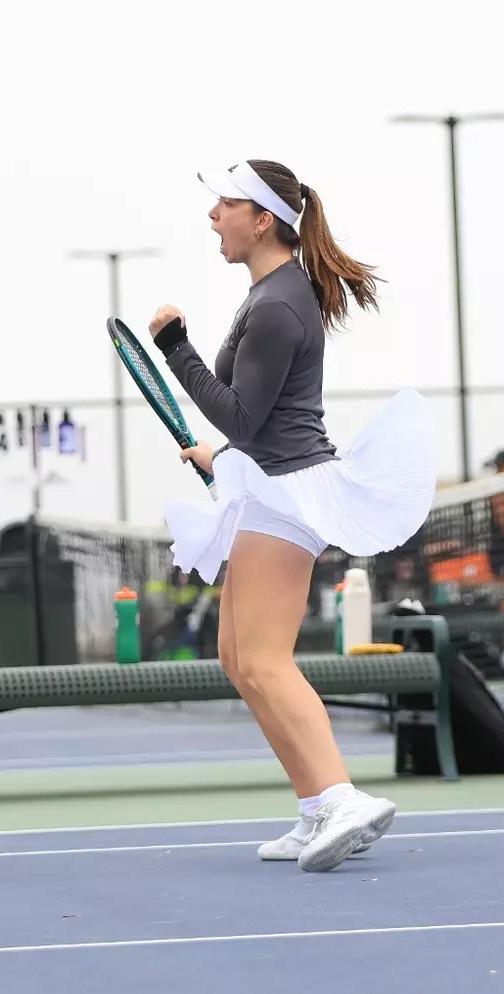
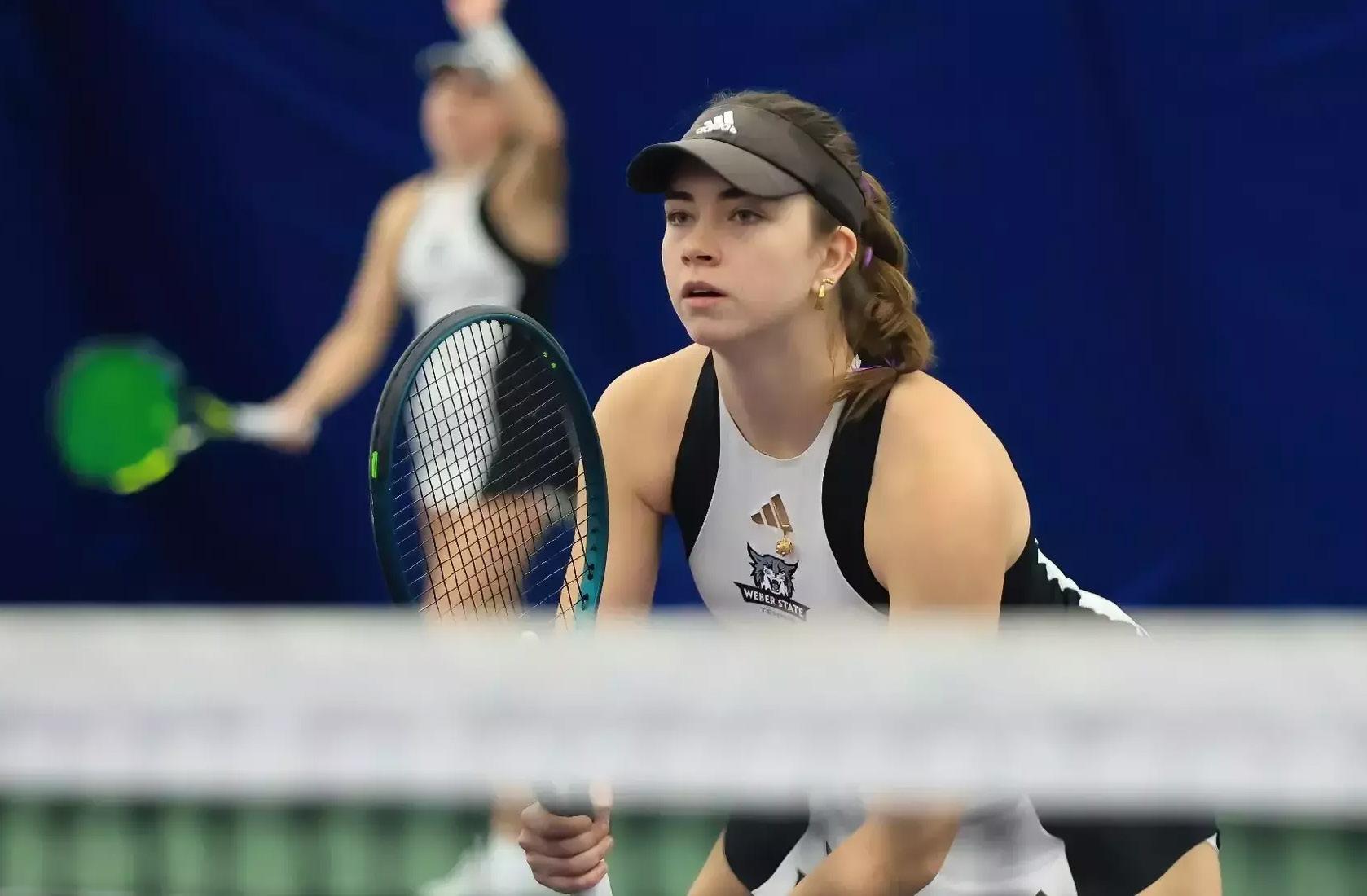
Alicia Celorio, a player on the Weber State University women’s tennis team, said that off-court activities strengthen trust among teammates and help create a healthy competitive environment.
“Throughout the year, we have various community service projects and team activities,” Celorio said. “In the end, we all compete for a spot, but in a very healthy way.”
Celorio explained that these experiences allow the players to get to know each other beyond just their athletic performance. According to her, spending time together outside of competition fosters mutual respect
and strengthens group confidence, elements that are then reflected during games.
She also pointed out that the values associated with sports don’t always come solely from each athlete’s previous personal training.
“I think it’s the other way around. For example, sports teach us values, and we transfer those values to our personal lives,” Celorio said.
For many international students, the opportunity to compete in the United States represents the culmination of years of sacrifice. Nicolas Pulido Santana, a member of the Weber State University Spirit Squad, said he didn’t hesitate when he was given the opportunity to be part of the program.
Pulido Santana said that each member’s individual commitment has contributed to the team’s recognition at the national and international levels. According to him, the collective success has attracted the attention of athletes around the world.
“The team has managed to create quite a legacy, which has literally caught the attention of programs, people and athletes from other parts of the world who now want to be here,” he said.
The athlete added that diversity within the team strengthens their performance and enriches the university experience.
“Something important about what makes Weber State better is also that the diversity of athletes, the diversity of people,” Pulido Santana said. “Each one brings their own flavor,
their own charisma, their own personality and complements the team.”
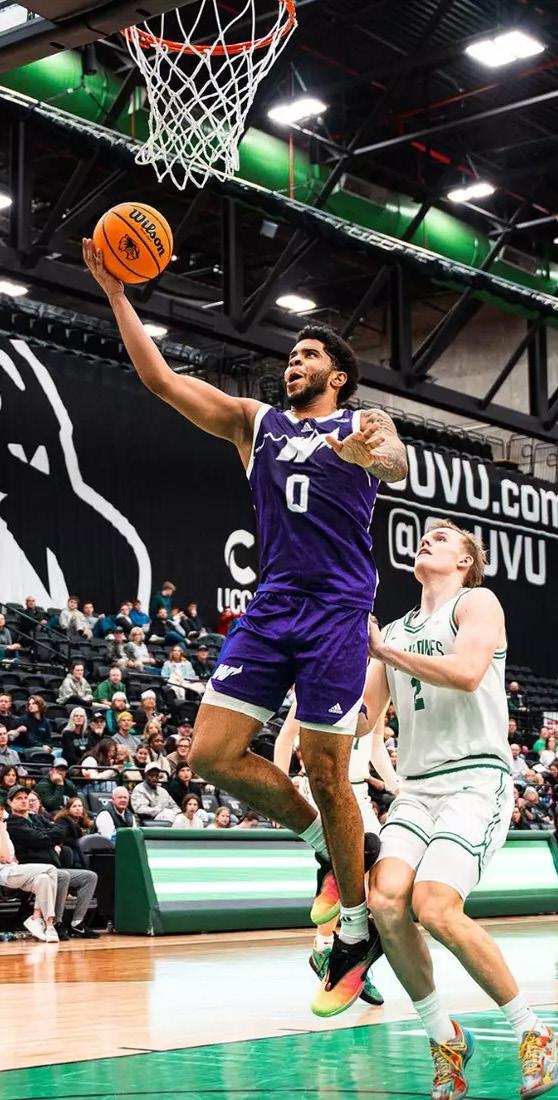
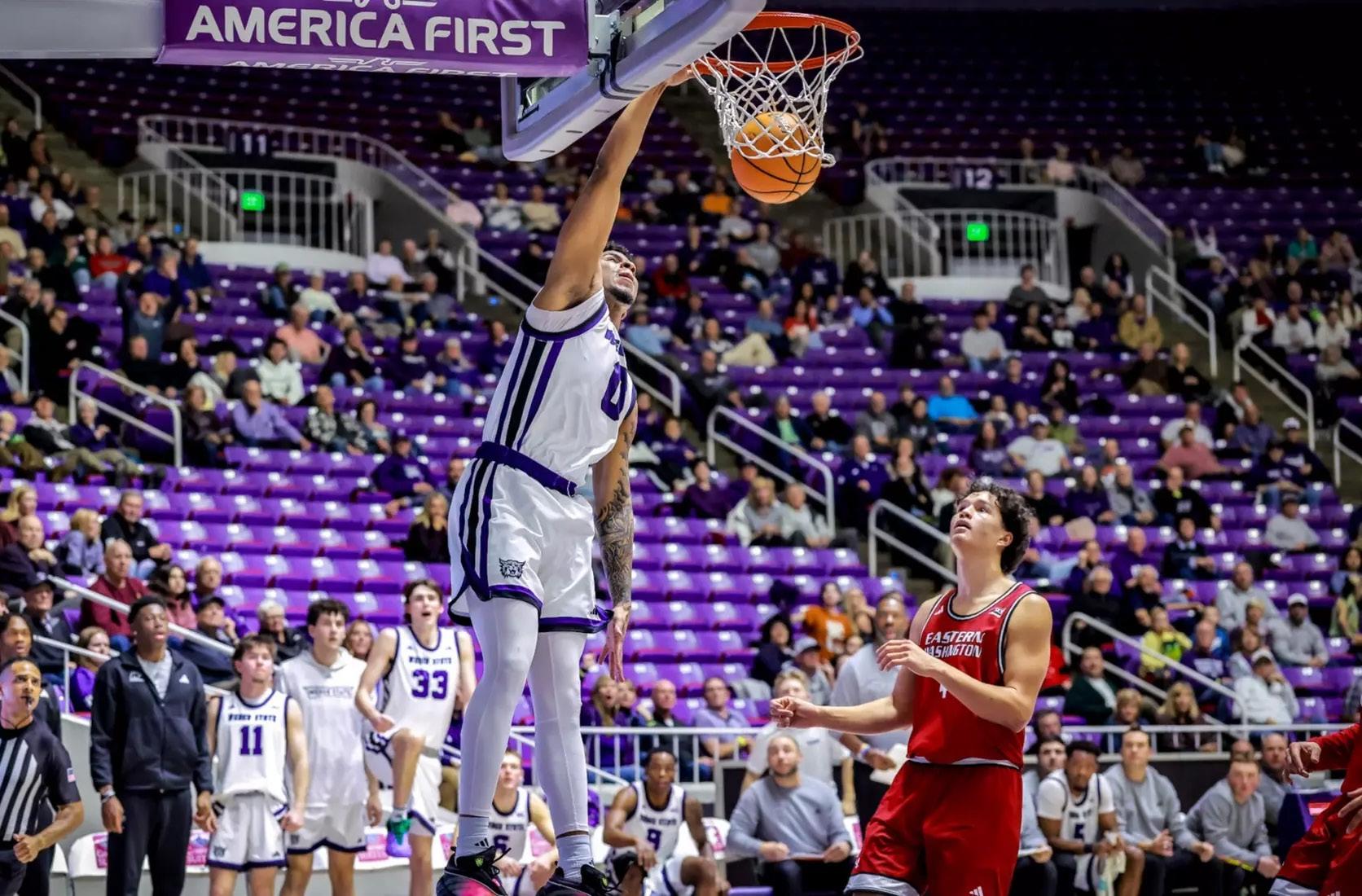
This mix of different cultural backgrounds is also reflected in other sports programs at the university. After the Feb. 19 victory over Montana State University, Weber State University men’s basketball player Edwin Suárez Jr. explained what motivates him to compete as an athlete.
“What really motivates me to play is my family, my team and the coaches,” Suárez said.
Suárez explains that personal motivation and a sense of responsibility toward the team influence his performance on the field. For him, competing is not limited to individual results, but also involves representing those who support him both inside and outside of sports.
Although individual dreams and aspirations may vary, several athletes agree that the collective goal of leaving a positive mark on the athletic program is shared. Daily discipline, consistent training and academic commitment are part of a process that goes beyond just statistics.
The players noted that living alongside teammates from different countries and cultures has allowed them to broaden their perspectives and learn to collaborate with people with experiences different from their own. This exchange, they said, strengthens both competitive performance and personal development.
At Weber State University, diversity not
only describes the demographic makeup of its teams but is also part of its athletic identity. According to the athletes themselves, the combination of cultures, languages and personal histories contribute to an environment where respect and teamwork are essential to achieving shared goals.
Beyond trophies or awards, athletes emphasize that the training process and living together leave them with lasting lessons. Discipline, hard work and the ability to adapt to new circumstances are skills they said they will apply in their lives after college sports.
Through their experiences, athletes agree that diversity is not a barrier, but rather an element that strengthens team unity and deepens the reach of their influence both on and off campus.
Editor’s Note:
This story was originally written and interviewed in Spanish. For the purpose of this story and its audience, it has been translated from Spanish to English.
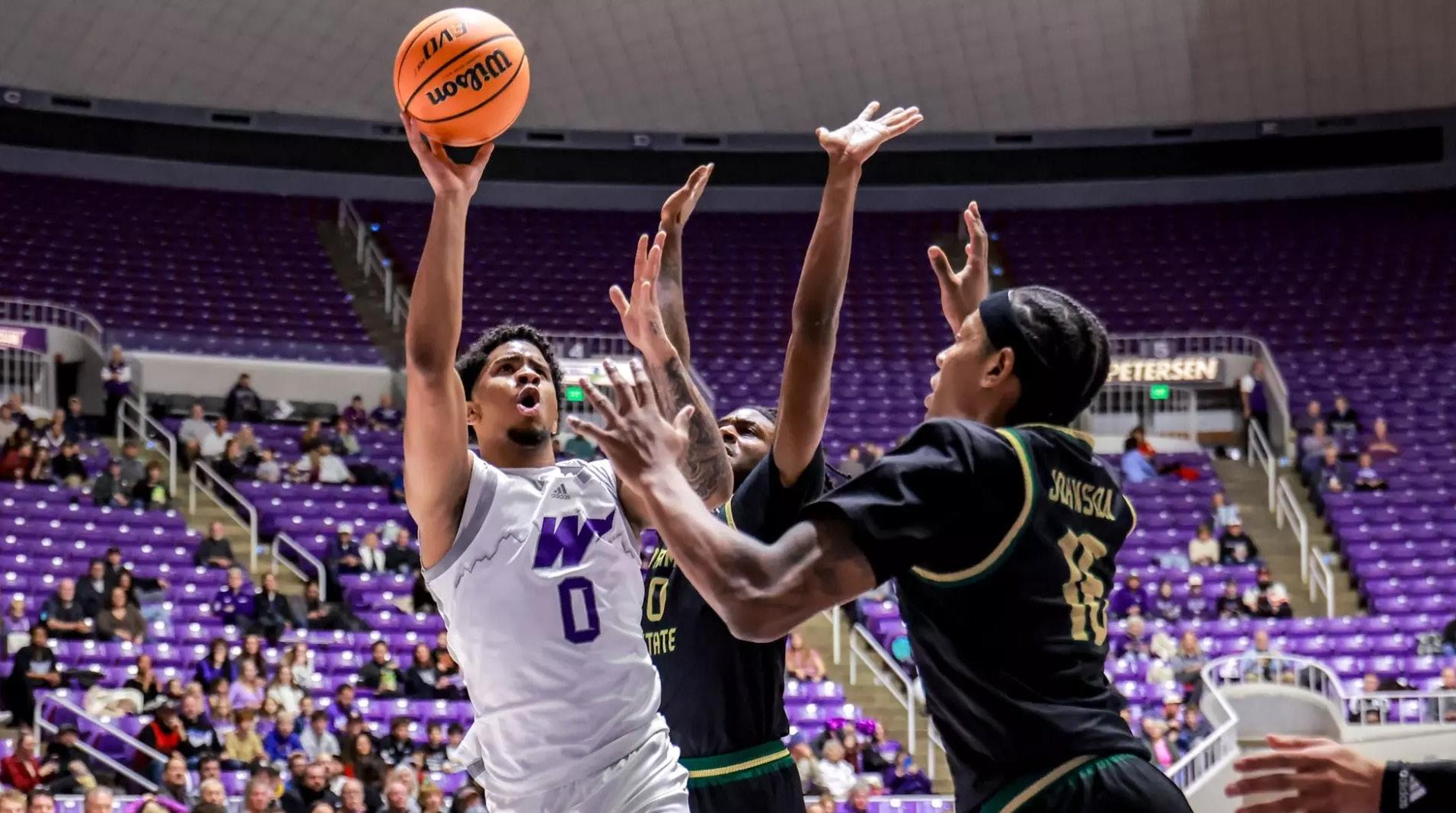
LEFT: Weber State University forward Edwin Suarez Jr. (#0), dunks the ball during a game against Eastern Washington University.
RIGHT: Weber State University women’s tennis player Alicia Celorio prepares for a tennis match to begin.
Por DAVID ROMAN AROS Co-Editor
La diversidad cultural se ha convertido en una de las fortalezas principales de los equipos deportivos de la Universidad de Weber State, donde atletas de distintos países y orígenes comparten el objetivo de competir al más alto nivel y dejar un legado dentro y fuera del campus.
En disciplinas que incluyen tenis, cheerleading y baloncesto, estudiantes internacionales y locales entrenan juntos, participan en actividades comunitarias y desarrollan una identidad basada en el respeto, la disciplina y el trabajo en equipo. Para muchos de ellos, el deporte representa más que competencia: es una oportunidad para crecer personalmente mientras representan a la universidad.
Alicia Celorio, jugadora del equipo femenino de tenis de la Universidad de Weber State, dijo que las actividades fuera de la cancha fortalecen la confianza entre compañeras y ayudan a crear un ambiente competitivo saludable.
“Durante todo el año tenemos varios servicios comunitarios y actividades como equipo”, dijo Celorio. “Al final todos competimos por un puesto, pero de una manera muy sana”.
Celorio explicó que esas experiencias permiten que las jugadoras se conozcan más allá de solamente sus rendimientos deportivos. Según dijo ella, compartir tiempo fuera de la competencia fomenta respeto mutuo y fortalece la confianza del grupo, elementos que luego se reflejan durante los partidos. Además, señaló que los valores asociados con el deporte no siempre provienen solamente de la formación personal previa de cada atleta.
“Creo que es poco al revés. Por ejemplo, el deporte nos enseña los valores, y los trasladamos a valores personales”, dijo Celorio. Para muchos estudiantes internacionales, la oportunidad de competir en Estados Unidos representa la culminación de años de sacrificio. Nicolas Pulido Santana, integrante del equipo de Cheerleading de la Universidad de Weber State, dijo que no dudó cuando recibió la oportunidad de formar parte del programa.
“Se me dio la oportunidad, así que no dudé en tomarla”, dijo Pulido Santana. Pulido Santana explicó que el compromiso
individual de cada integrante ha contribuido al reconocimiento del equipo a nivel nacional e internacional. Según dijo, el éxito colectivo ha atraído la atención de atletas de otras partes del mundo.
“El equipo ha logrado crear un legado bastante grande, que literalmente ha llamado la atención de programas, personas y atletas de otras partes del mundo que ahora quieren estar aquí”, dijo él.
El atleta agregó que la diversidad dentro del equipo fortalece su desempeño y enriquece la experiencia universitaria.
“Algo importante acerca de lo que hace que Weber State sea mejor también es eso, la diversidad de atletas, la diversidad de personas”, dijo Pulido Santana. “Cada uno trae su propio sabor, su propio carisma, su propia personalidad y complementa el equipo”.
Esa combinación de antecedentes culturales distintos se refleja también en otros programas deportivos de la universidad. Después de la victoria del 19 de febrero ante Montana State, Edwin Suarez Jr., jugador del equipo masculino de baloncesto de Weber State University, explicó qué lo motiva a competir como atleta.
“Lo que me motiva jugar en verdad es mi familia, es mi equipo, los coaches”, dijo Suarez.
Suarez explica que la motivación personal y el sentido de responsabilidad hacia el grupo influyen en su desempeño en la cancha. Para él, competir no se limita a resultados individuales, sino que implica representar a quienes lo apoyan dentro y fuera del deporte. Aunque los sueños y aspiraciones individuales pueden variar, varios atletas están de acuerdo que el objetivo colectivo de dejar una huella positiva en el programa deportivo es compartido. La disciplina diaria, el entrenamiento constante y el compromiso académico forman parte de un proceso que va más allá que solamente las estadísticas.
Los jugadores señalaron que la convivencia con compañeros de distintos países y culturas les ha permitido ampliar su perspectiva y aprender a colaborar con personas que tienen experiencias diferentes a las propias. Ese intercambio, dijeron, fortalece tanto el rendimiento competitivo como el desarrollo personal.
En la Universidad de Weber State, la diversidad no solo describe la composición
demográfica de sus equipos, sino que forma parte de su identidad deportiva. Según los propios atletas, la combinación de culturas, idiomas e historias personales contribuye a crear un ambiente donde el respeto y el trabajo conjunto son esenciales para alcanzar metas compartidas.
Más allá de trofeos o reconocimientos, los deportistas destacan que el proceso de entrenamiento y convivencia les deja aprendizajes duraderos. La disciplina, el trabajo constante y la capacidad de adaptarse a nuevas circunstancias son habilidades que, según dijeron, aplicarán en sus vidas después del deporte universitario.
A través de sus experiencias, los atletas coinciden en que la diversidad no representa una barrera, sino un elemento que fortalece la unidad del equipo y profundiza el alcance de su influencia dentro y fuera del campus.
Nota del Editora:
Esta historia fue escrita y las entrevistas fueron en español. Para el propósito de esta historia y su audiencia ha sido traducido al español al inglés.
By GAVIN NELSON Editor
The Weber State University men’s basketball team had its final home stand against Montana State University and then the University of Montana.
The first game of the home stand saw the Wildcats take on the Montana State Bobcats in a rematch of a Jan. 24 game where the Bobcats survived a late Wildcat comeback to win 91–88.
The game was a battle in the first half, with the teams trading leads throughout, leaving Montana State with a 29-28 halftime lead.
The second half was more of the same, and the Wildcats got a 62–58 lead with 4:22 remaining. However, the Bobcats didn’t go away, with star player Jed Miller hitting a 3-pointer followed by a layup to give the Bobcats a 63–62 lead with 3:33 remaining.
The teams went back-and-forth, with Miller hitting a jumper to make it 67–66 with 1:12 left. Later, Weber’s Trevor Hennig was fouled and went to the line for two free throws. He hit the first one to tie it up, but missed the second one.
The Bobcats drove down the court, but Miller’s 3-pointer was blocked by Wildcat Nigel Burris. The Bobcats got the rebound, but Burris stole the ball and called a timeout to give the Wildcats the opportunity to win the game. However, Hennig missed the game-winning shot, and the game went into overtime.
In overtime, the teams traded blows until Miller hit a 3-pointer to make it 74–71. After a layup and a 3-point play from Edwin Suarez Jr., Weber took a 76–74 lead and never looked back, winning 82–79.
Hennig led the team in points with 19, followed by Nigel Burris with 15.
“We’re not going to be a pretty team right now,” Head Coach Eric Duft said. “These aren’t going to be pretty games, but the toughest team is going to win most nights.”
Two nights after the game against the Bobcats, the Wildcats welcomed the Bobcats’ rivals, the Grizzlies, to Ogden. This was the Wildcats’ final home game of the season, making it senior night, though they had only
one senior: Nigel Burris, who was honored before the game.
While the game against Montana State was a closely fought battle, the game against Montana was quite the opposite.
The Wildcats led 45–32 going into halftime, but turned it up another notch in the second half. At one point, the Wildcats led 86–57, but the Grizzlies made some garbage time baskets to make it 92–72 at the end of the game.
Wildcat junior forward Viljami Vartiainen had himself a game, scoring 25 points on seven 3-pointers, tying his career high in 3-pointers in a game.
“Honestly, today I felt like every shot felt good,” Vartiainen said. “They were guarding me really hard before I started making shots. So finding those windows where you get a shot off, and then obviously the coaching staff putting me in positions where I can get those shots off. So once I see one go in … it’s easier to get a couple more.”
The Wildcats now get Feb. 26 off, before heading up to Pocatello, Idaho, to take on rival Idaho State University on Feb. 28. Then they’ll head to Portland, Oregon, for the final regular season game of the season on March 2 against Portland State University.
Following those two games, the Wildcats will be in Boise for the Big Sky Conference Tournament, for a chance to make it to the NCAA Tournament.
Share this story at thesignpostwsu.com
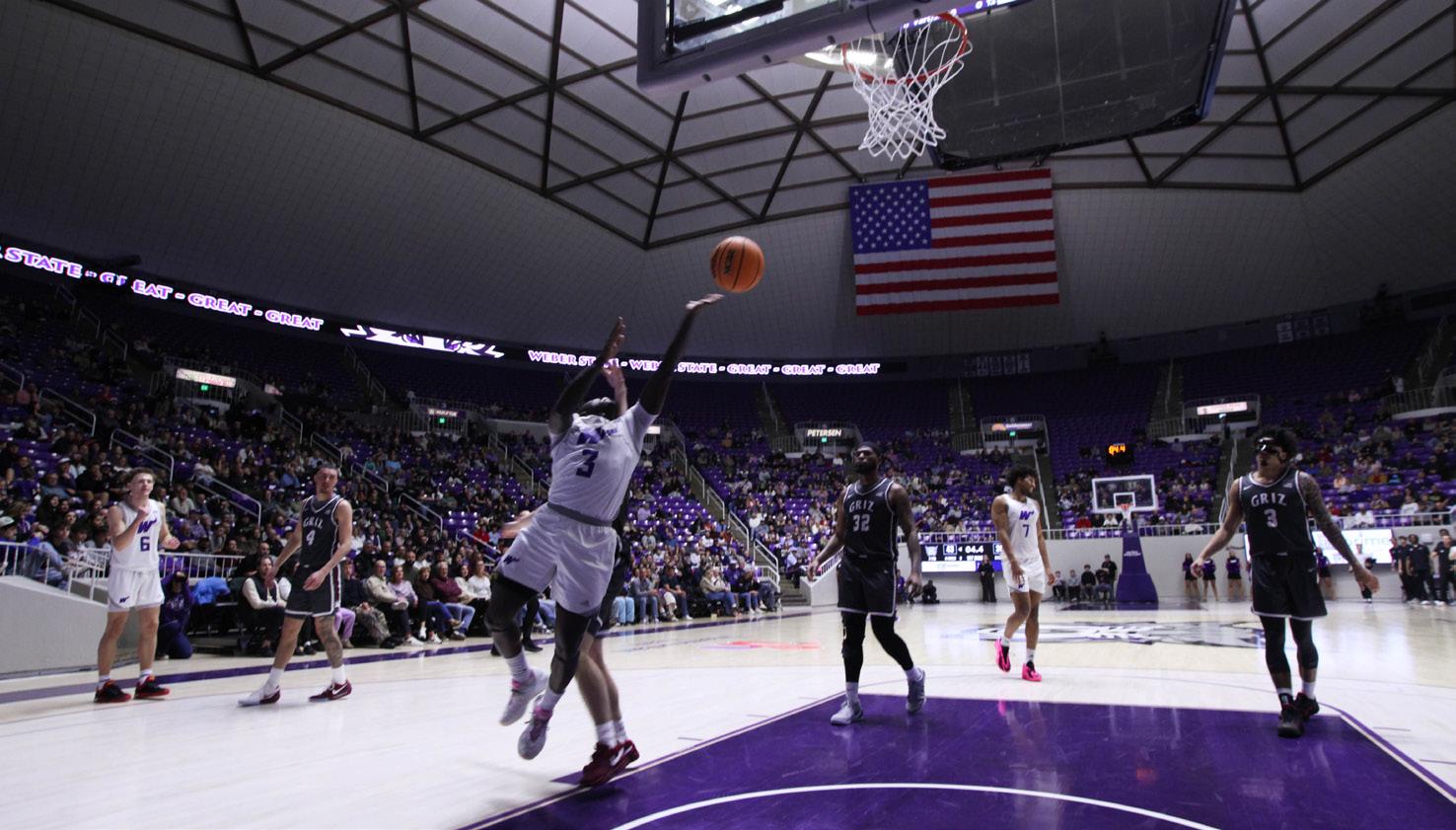
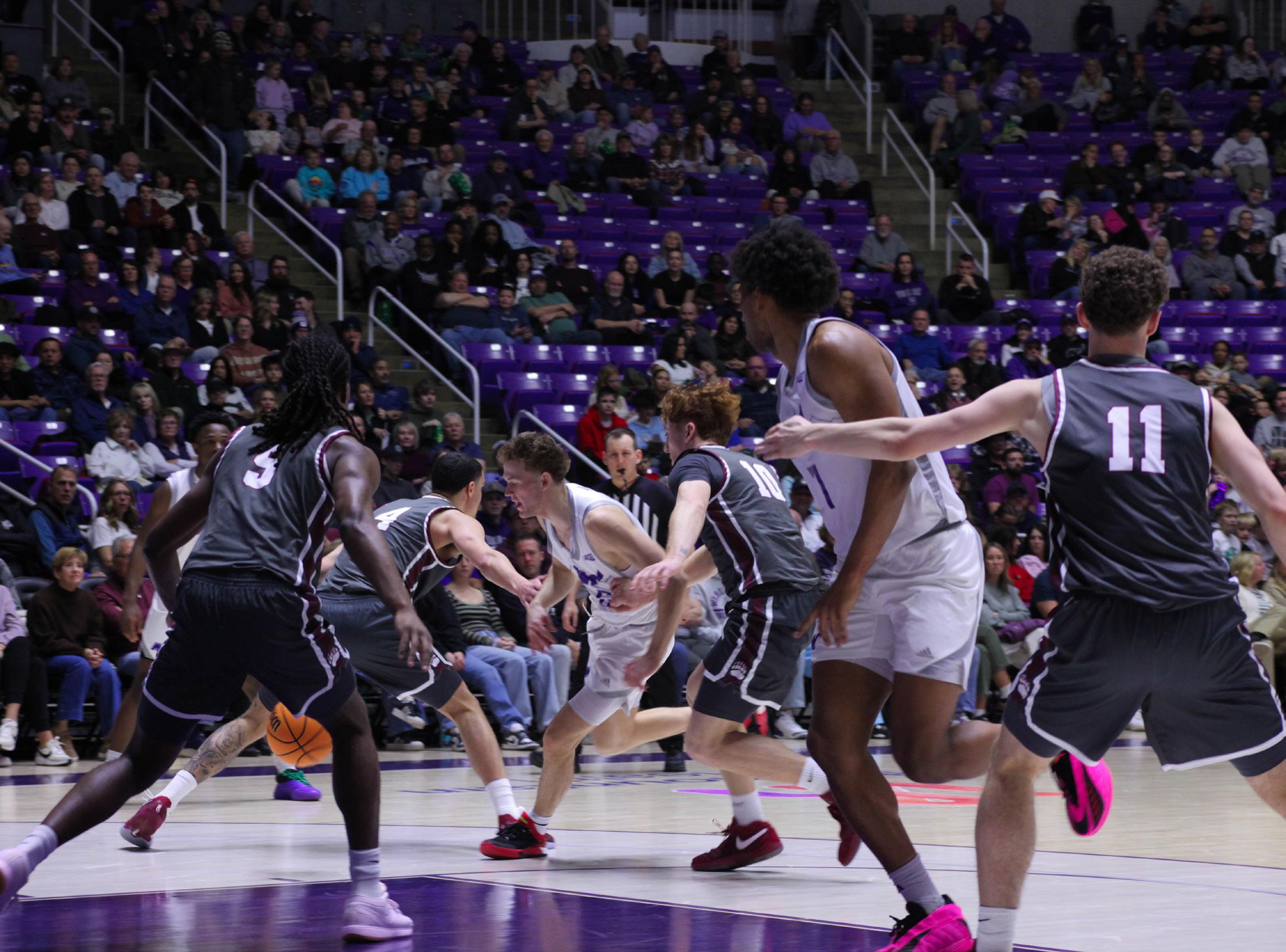
TOP: Weber State University guard Tijan Saine Jr. fouled while jumping for a layup on Feb. 21.
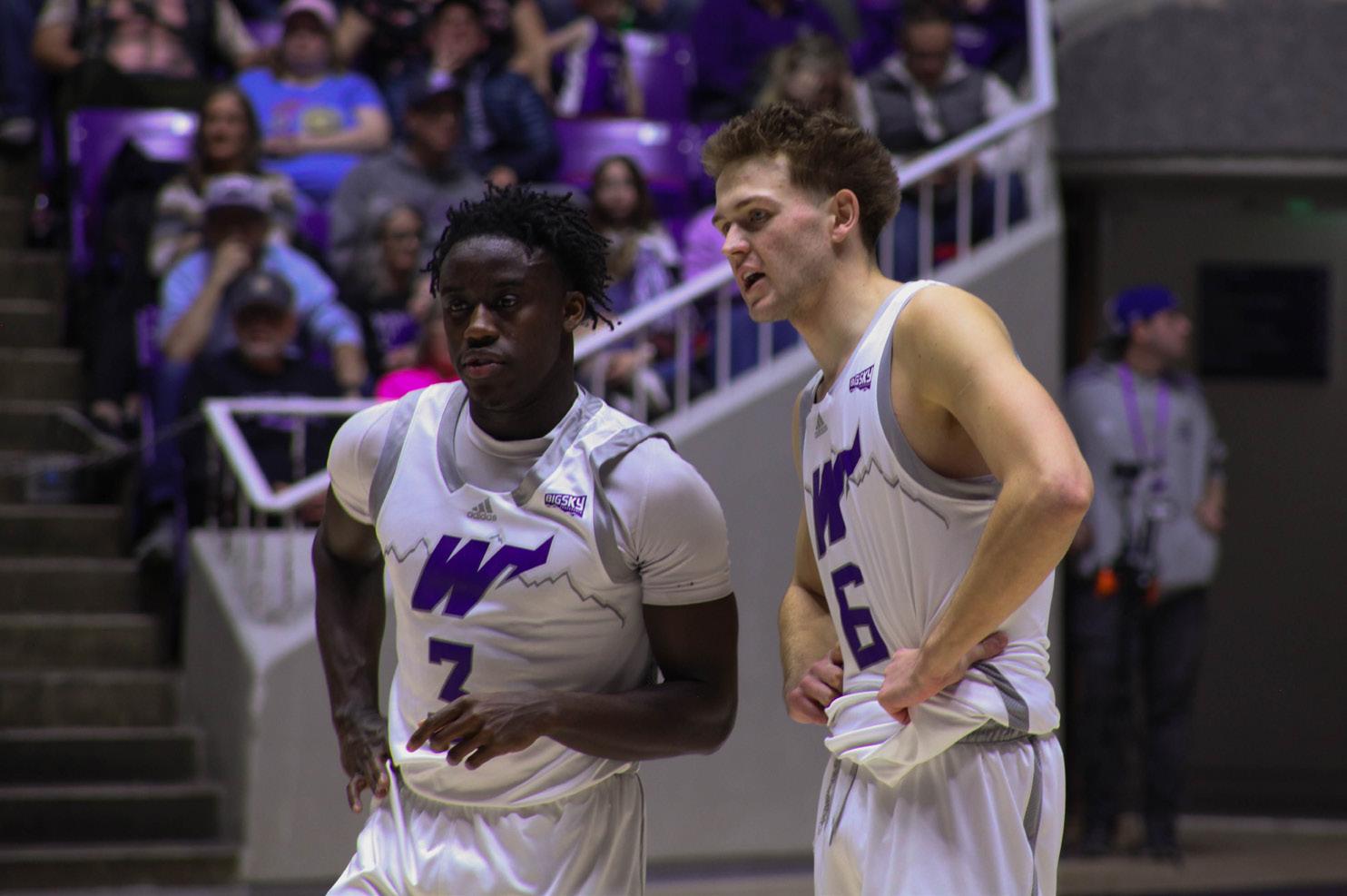
MIDDLE: Trevor Hennig and Tijan Saine Jr. discuss the next play on the court on Feb. 26.
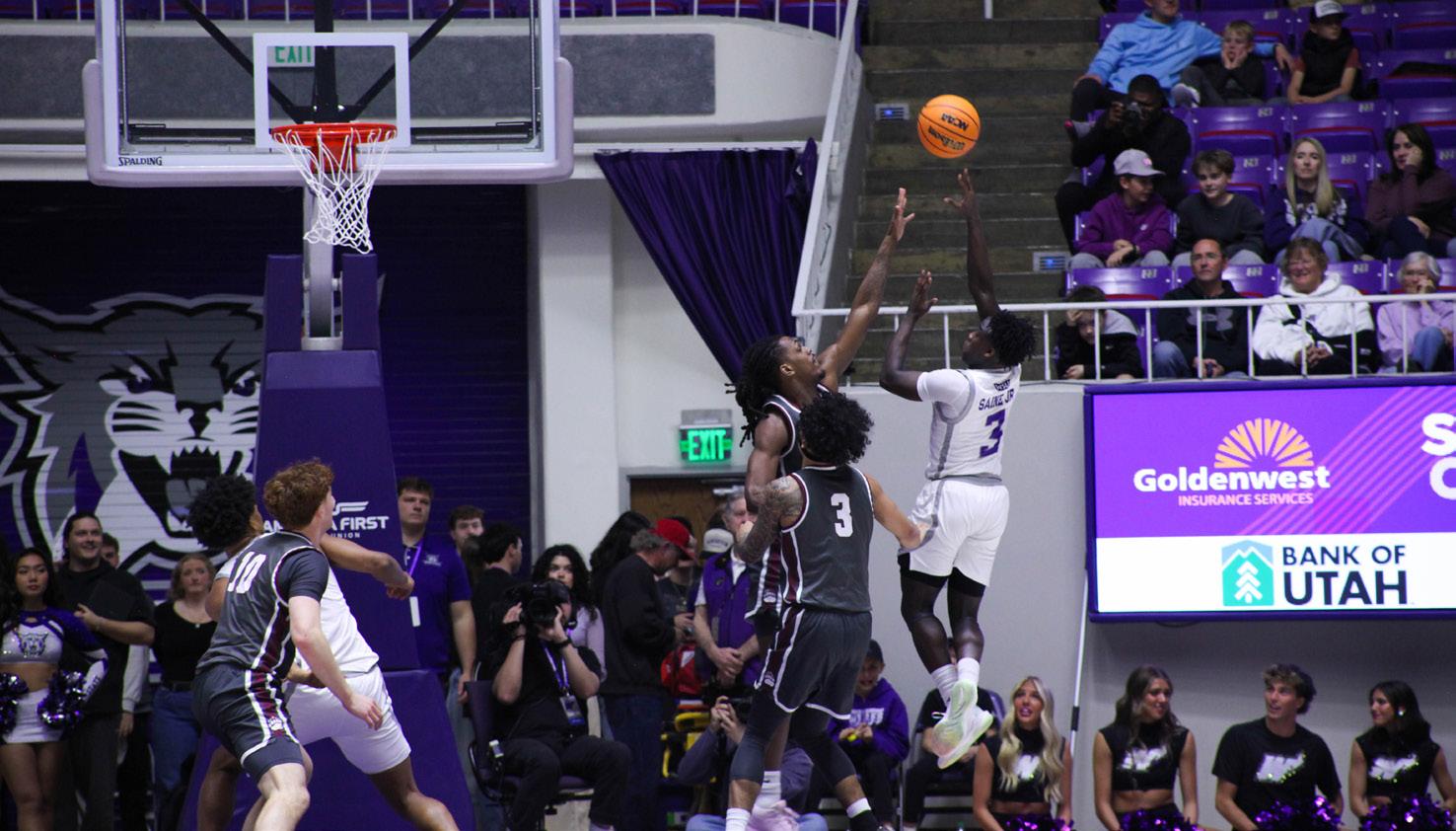
BOTTOM: Tijan Saine Jr. shoots a basket at the Dee Events Center on Feb. 21.
VICTORIA HERNANDEZ Co-Editora
Por GAVIN NELSON Editor Traducido por
El equipo masculino de baloncesto de la Universidad de Weber State tuvo su última serie de partidos en casa contra la Universidad de Montana State y luego contra la Universidad de Montana.
Weber contra Montana State
En el primer partido de la serie en casa, los Wildcats se enfrentaron a los Bobcats de Montana State en una revancha del partido del 24 de enero, en el que los Bobcats sobrevivieron a una recuperación tardía de los Wildcats y ganaron 91-88.
El partido fue muy reñido en la primera mitad, con los equipos intercambiando el liderazgo a lo largo del mismo, lo que dejó a Montana State con una ventaja de 29-28 al medio tiempo.
La segunda mitad fue más de lo mismo, y los Wildcats consiguieron una ventaja de 62-58 a 4:22 del final. Sin embargo, los Bobcats no se rindieron, y su jugador estrella, Jed Miller, anotó un triple seguido de una bandeja para dar a los Bobcats una ventaja de 63-62 a 3:33 del final.
Los equipos siguieron intercambiando canastas, y Miller anotó un tiro en salto para poner el 67-66 a falta de 1:12 para el final. Más tarde, Trevor Hennig, de Weber, recibió una falta y se dirigió a la línea para lanzar dos tiros libres. Anotó el primero para empatar el partido, pero falló el segundo.
Los Bobcats avanzaron por la cancha, pero el triple de Miller fue bloqueado por Nigel Burris, de los Wildcats. Los Bobcats consiguieron el rebote, pero Burris robó el balón y pidió un tiempo muerto para dar a los Wildcats la oportunidad de ganar el partido. Sin embargo, Hennig falló el tiro que habría dado la victoria, y el partido se fue a overtime.
En overtime, los equipos intercambiaron canastas hasta que Miller anotó un triple para poner el marcador en 74-71. Tras una canasta y una jugada de tres puntos de Edwin Suárez Jr., Weber tomó una ventaja de 76-74 y no miró atrás, ganando 82-79.
Hennig lideró al equipo en puntos con 19, seguido por Nigel Burris con 15.
“No vamos a ser un equipo bonito en este momento”, dijo el entrenador Eric Duft.
“Estos no van a ser partidos bonitos, pero el equipo más duro va a ganar la mayoría de las noches”.
Weber contra Montana
Dos noches después del partido contra los Bobcats, los Wildcats recibieron en Ogden a los rivales de los Bobcats, los Grizzlies. Este era el último partido en casa de los Wildcats de la temporada, por lo que se convirtió en la noche de los seniors, aunque solo tenían uno: Nigel Burris, que fue homenajeado antes del partido.
Mientras que el partido contra Montana State fue muy reñido, el partido contra Montana fue todo lo contrario.
Los Wildcats lideraban 45-32 al llegar al medio tiempo, pero subieron el ritmo en la segunda mitad. En un momento dado, los Wildcats lideraban 86-57, pero los Grizzlies anotaron algunas canastas en los últimos minutos para dejar el marcador en 92-72 al final del partido.
El alero junior de los Wildcats, Viljami Vartiainen, tuvo un gran partido, anotando 25 puntos con siete triples, igualando su récord personal de triples en un partido.
“Sinceramente, hoy sentí que todos los tiros me salían bien”, dijo Vartiainen. “Me estaban defendiendo muy fuerte antes de
que empezara a encestar. Así que había que encontrar esos huecos para lanzar y, obviamente, el cuerpo técnico me colocaba en posiciones en las que podía lanzar. Una vez que veo que entra uno... es más fácil meter un par más”.
Los Wildcats ahora tienen libre el 26 de febrero, antes de viajar a Pocatello, Idaho, para enfrentarse a su rival, la Universidad de Idaho State, el 28 de febrero. Luego se dirigirán a Portland, Oregón, para el último partido de la temporada regular, el 2 de marzo contra la Universidad de Portland State.
Después de esos dos partidos, los Wildcats estarán en Boise para el Torneo de la Conferencia Big Sky, con la oportunidad de clasificarse para el Torneo de la NCAA.
By GRAYSON FREESTONE Asst. Editor
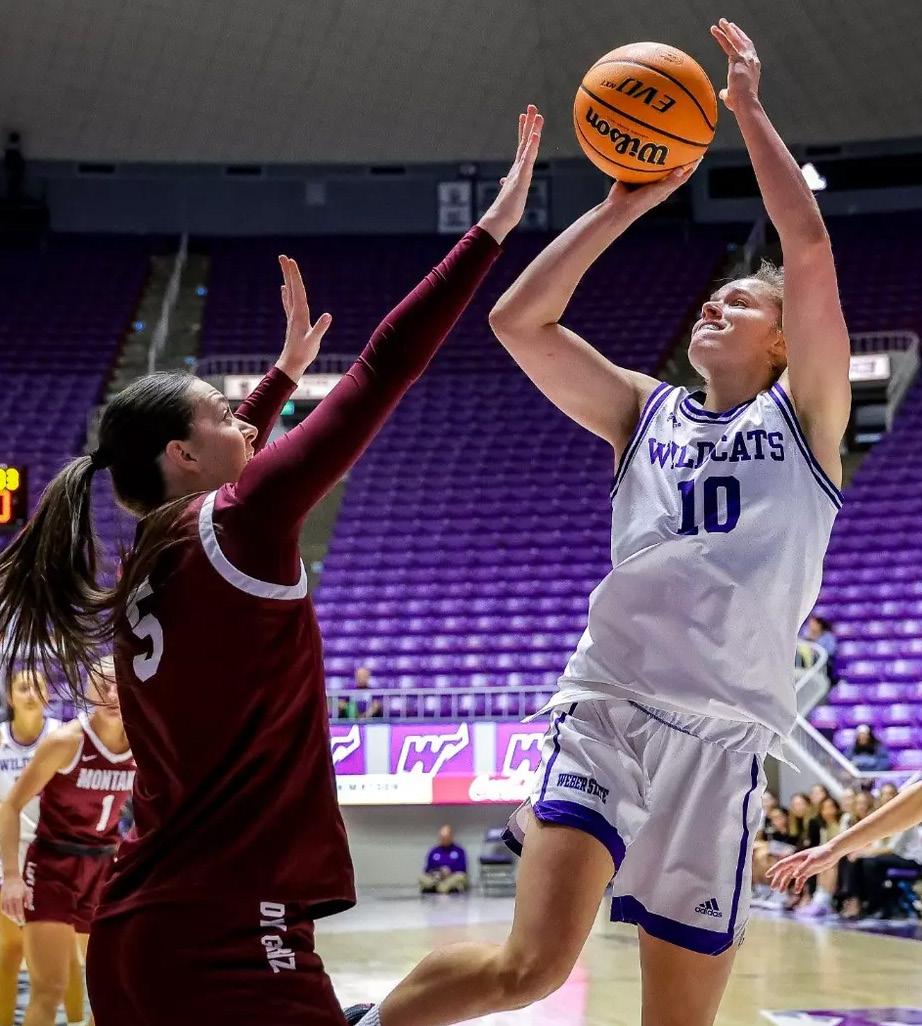
On the final road trip of the regular season, Weber State University women’s basketball traveled to Montana to play Montana State University and the University of Montana.
Weber vs. Montana State
Weber’s road trip started with a matchup against one of the Big Sky’s top teams, the Bobcats. In their previous matchup in Ogden at the end of January, the Wildcats kept pace in the first half before falling apart in the second half, losing 92–72.
In Bozeman, Montana, the Wildcats kept it close, 19–12, after the first quarter. Then things fell apart; they were outscored 33–4 in the second, 13–8 in the third and 16–12 in the fourth.
The Bobcats scored 40 points off the Wildcats’ 32 turnovers.
Those turnovers and 25.5% shooting left them with a crushing 45-point loss, 81–36.
Weber vs. Montana
Coming off the loss, the Wildcats traveled to Missoula to play the Grizzlies at Dahlberg Arena, where they were 4-win, 44-loss alltime record.
Nevertheless, Weber State’s offense came out firing. They scored 17 points in the first
quarter, with Antoniette Emma-Nnopu and Lanae Billy leading the charge with six points each.
Billy tacked on another five points in the second, while Paris Lauro drained two 3-pointers. Weber entered the locker room tied 30–30.
The duo of Billy and Emma-Nnopu continued dominating in the second half, with ten and 17 points, respectively.
The two teams went back and forth in the fourth quarter with six ties. Weber led 69–67 when Montana’s Jocelyn Land attempted a 3-pointer that was partially blocked by Emma-Nnopu. However, the ref called a foul on the Weber forward, giving Montana a chance at the lead with four seconds left.
Land missed her first free throw but made the next two to tie it. A missed Sydney White 3-pointer took the Wildcats to their second overtime in their last three games.
Emma-Nnopu used her aggressiveness to earn six attempts at the free-throw line, making five. However, she was called for her fifth foul and fouled out.
The Wildcats led by as many as six points, but a 6–0 Grizzlies run tied the game with a minute left. On the next possession, Lauro was forced to shoot a deep corner 3-pointer with the shot clock winding down. She banked it high off the glass and in for a clutch go-ahead triple.

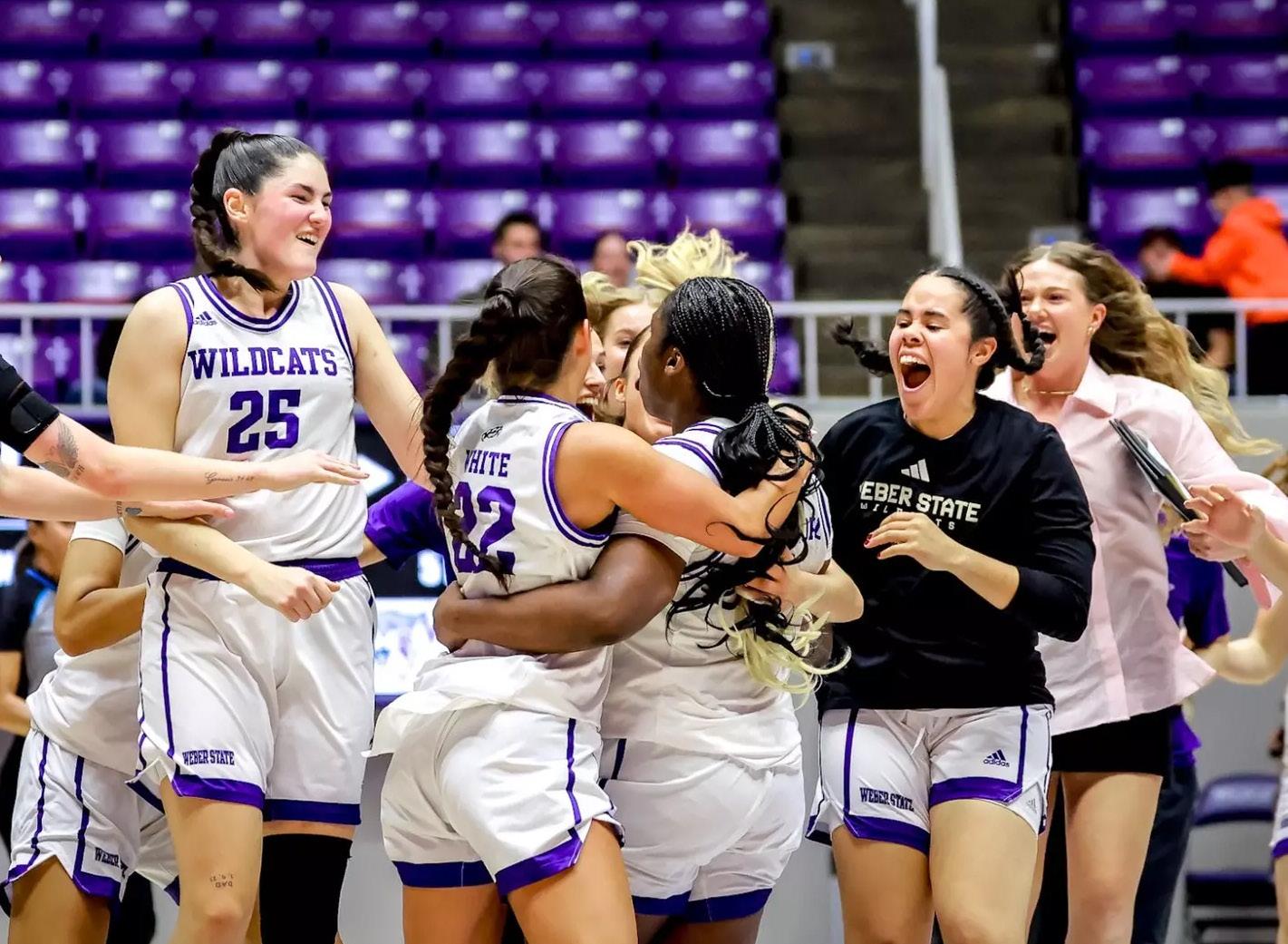
Montana was forced to foul numerous times in the final 40 seconds, and Weber held on for an 86–79 win.
Emma-Nnopu led the Wildcats with 28 points, six rebounds, two assists, one block and four steals. She went 10-for-16 from the field and 1-for-3 from the arc.
Billy also had an efficient 23-point performance, going 6-for-9 from the field and 5-for7 from beyond the arc.
The win moves the Wildcats to 9-wins, 20-losses on the season and 3-wins, 13-losses in the conference. It also brings them within striking distance of jumping Montana in
the standings with the Big Sky tournament looming.
Weber will wrap up their regular season with two home games against Idaho State University on Feb. 28 and Portland State University on March 2.
Traducido por
DAVID ROMAN AROS
Co-Editor
Por GRAYSON FREESTONE
Editor Assistente
En el último viaje de la temporada regular, el equipo femenino de baloncesto de la Universidad de Weber State viajó a Montana para enfrentarse a la Universidad de Montana State y a la Universidad de Montana.
Weber contra Montana State
La gira de Weber comenzó con un enfrentamiento contra uno de los mejores equipos de la Big Sky, las Bobcats. En su anterior enfrentamiento en Ogden a finales de enero, las Wildcats mantuvieron el ritmo en la primera parte, pero se desmoronaron en la segunda y perdieron por 92–72
En Bozeman, Montana, las Wildcats mantuvieron el marcador ajustado, 19–12, tras el primer cuarto. Luego todo se vino abajo: les superaron por 33–4 en el segundo cuarto, 13–8 en el tercero y 16–12 en el cuarto.
Las Bobcats anotaron 40 puntos gracias a las 32 pérdidas de balón de las Wildcats. Esas pérdidas de balón y un 25,5 % de tiros les dejaron con una aplastante derrota por 45 puntos, 81-36.
Weber contra Montana
Tras la derrota, las Wildcats viajaron a Missoula para enfrentarse a las Grizzlies en el Dahlberg Arena, donde tenían un récord histórico de 4 victorias y 44 derrotas.
Sin embargo, la ofensiva de Weber State salió con fuerza. Anotaron 17 puntos en el primer cuarto, con Antoniette Emma-Nnopu y Lanae Billy liderando la carga con seis puntos cada una.
Billy sumó otros cinco puntos en el segundo cuarto, mientras que Paris Lauro anotó dos triples. Weber llegó al descanso con un empate a 30.
El dúo formado por Billy y Emma-Nnopu siguió dominando en la segunda mitad, con diez y 17 puntos, respectivamente.
Los dos equipos se intercambiaron el liderazgo en el último cuarto con seis empates. Weber ganaba 69-67 cuando Jocelyn Land, de Montana, intentó un triple que fue parcialmente bloqueado por Emma-Nnopu. Sin embargo, el árbitro pitó una falta a la delantera de Weber, lo que le dio a Montana la oportunidad de ponerse por delante a cuatro segundos del final.
Land falló su primer tiro libre, pero anotó los dos siguientes para empatar el partido. Un triple fallido de Sydney White llevó a las Wildcats a su segunda prórroga en los últimos tres partidos.
Emma-Nnopu utilizó su agresividad para conseguir seis intentos desde la línea de tiros
libres, anotando cinco. Sin embargo, le pitó su quinta falta y fue expulsada por faltas.
Las Wildcats llegaron a tener una ventaja de hasta seis puntos, pero una racha de 6–0 de las Grizzlies empató el partido a un minuto del final. En la siguiente posesión, Lauro se vio obligada a lanzar un triple desde la esquina con el reloj de lanzamiento a punto de agotarse. Lo lanzó alto contra el tablero y entró para dar la ventaja a su equipo.
Montana se vio obligada a cometer numerosas faltas en los últimos 40 segundos, y Weber se impuso por 86–79.
Emma-Nnopu lideró a las Wildcats con 28 puntos, seis rebotes, dos asistencias, un bloqueo y cuatro robos. Acabó con 10 de 16 tiros
de campo y 1 de 3 desde la línea de tres. Billy también tuvo una actuación eficaz con 23 puntos, acertando 6 de 9 tiros de campo y 5 de 7 desde más allá del arco.
La victoria sitúa a las Wildcats con 9 victorias y 20 derrotas en la temporada y 3 victorias y 13 derrotas en la conferencia. También las coloca a una distancia considerable de superar a Montana en la clasificación, con el
Las jugadores de la Universidad Estatal de Weber celebran la victoria del equipo sobre la Universidad Estatal de Montana.





By KAYLI JACOB Reporter
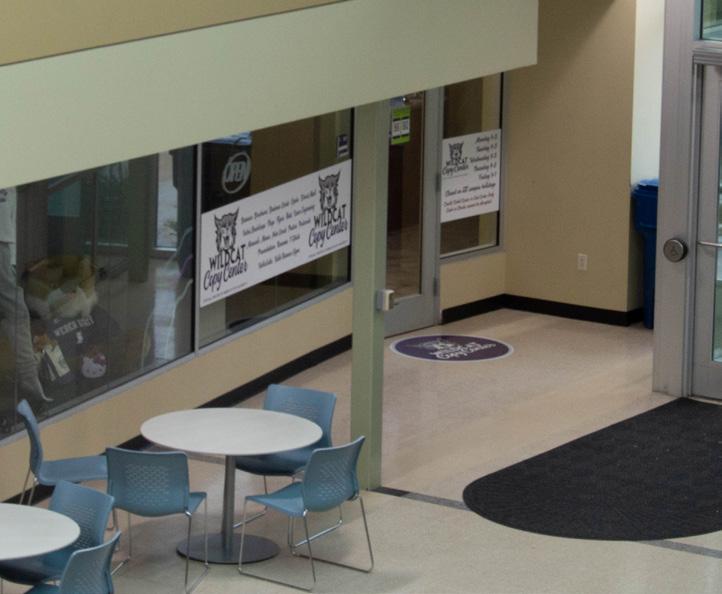
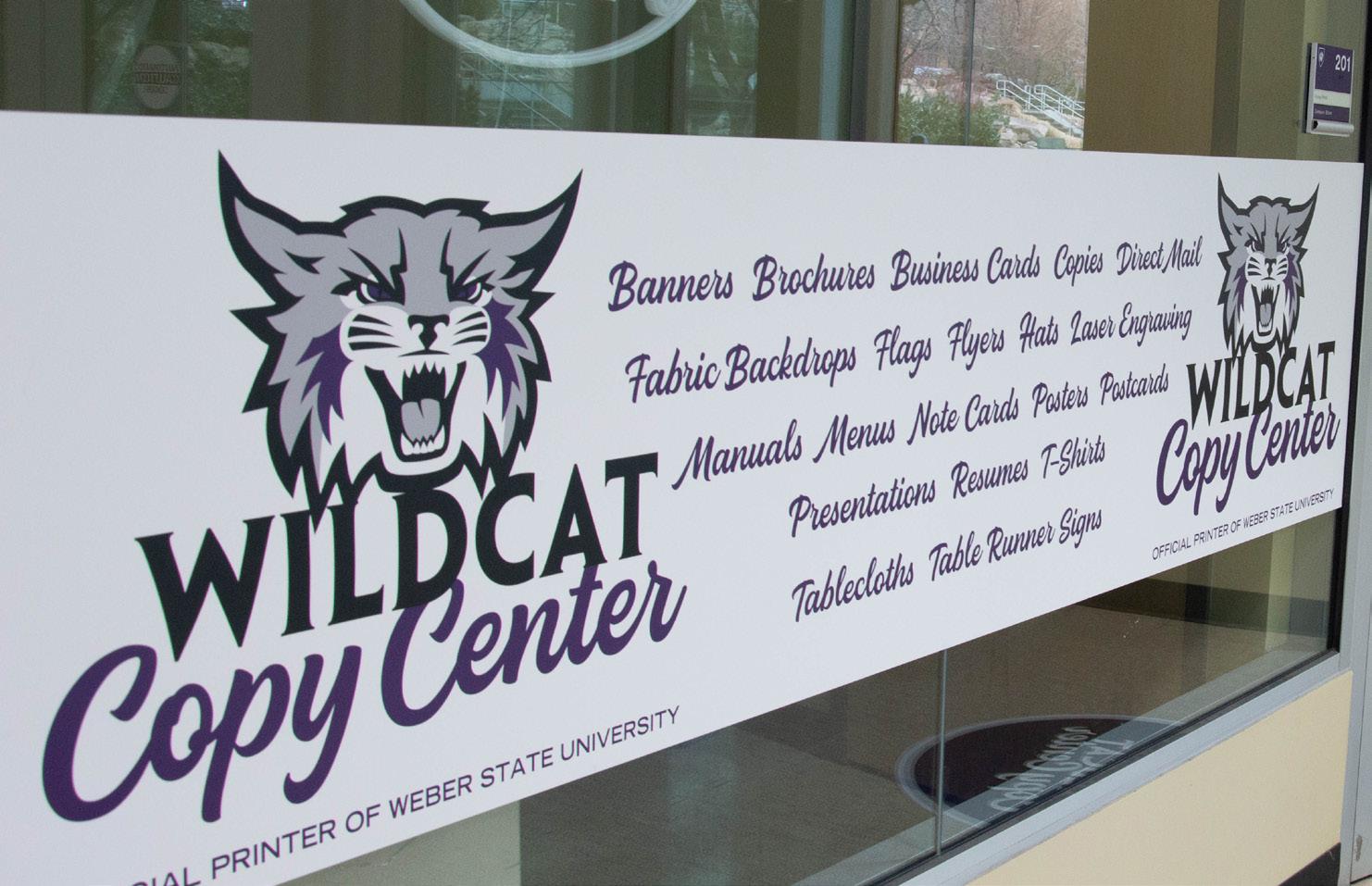
The Copy Center in the Shepherd Union will close permanently on Feb. 27. Kevin Wallace, Wildcat Design and Print and Copy Center manager, said print orders will still be available. Orders should be emailed to printing@weber.edu and can be picked up from either the Wildcat Design and Print office, the Wildcat Store’s online window or delivered directly to a department through campus mail.
The hours listed online and outside of the Copy Center do not align, the website states the center is open 9 a.m. - 1 p.m. Monday through Thursday and closed Fridays while signage outside the center claims later hours Monday through Thursday and closure at 1 p.m. on Fridays.
Another student, William Cady, said he does not feel this closure will create much change. He explained that he has used other printing services on campus, having never
Student Jana Moon said that while she had only tried to use the Copy Center once she did not find it a very easy process. “They just had hard hours to work with for me, but I don’t know, maybe that’s a me schedule thing,” Moon said.
used the Copy Center himself, and as those options will still be available to students he did not feel this closure would be impactful.
“This transition to a centralized digital-request model is part of a broader effort to remain fiscally responsible by streamlining operations and reducing overhead costs,” Wallace said. By consolidating these resources the university can more efficiently use them. He also thanks the university for their continued support through this transition.
Both Copy Center and Wildcat Design and Print employees declined to comment, as did representatives from the Shepherd Union Building Manager.
Traducido por LUNA MALAGON SOLORZANO Traductora
Por KAYLI JACOB Reportera
El centro de copiado en el Shepherd Unión va a ser cerrado permanentemente el 27 de febrero. Kevin Wallace, encargado del Wildcat Diseño y Centro de Impresión y Copiado, dijo que las órdenes de impresión siguen disponibles. Las órdenes deben ser enviadas al email printing@weber.edu y pueden ser recogidas en la oficina de Wildcat Design and Print, en la ventana online de Wildcat Store o entregado directamente a un departamento a través del correo interno del campus.
La estudiante Jana Moon dijo que, aunque solo había intentado utilizar el centro de copiado una vez, no le pareció un proceso muy fácil. «Para mí, el horario era muy complicado, pero no sé, quizá sea cosa mía», dijo Moon. Los horarios que aparecen en Internet y en
el exterior del centro de copiado no coinciden: la página web indica que el centro está abierto de 9:00 a 13:00 de lunes a jueves y cerrado los viernes, mientras que el cartel exterior indica un horario más amplio de lunes a jueves y cierre a las 13:00 los viernes.
Otro estudiante, William Cady, dijo que no cree que este cierre suponga un gran cambio. Explicó que ha utilizado otros servicios de impresión en el campus, ya que nunca ha utilizado el Copy Center, y como esas opciones seguirán estando disponibles para los estudiantes, no cree que este cierre tenga un gran impacto.
“Esta transición a un modelo centralizado de solicitudes digitales forma parte de un esfuerzo más amplio por mantener la responsabilidad fiscal mediante la racionalización de las operaciones y la reducción de los gastos generales”, dijo Wallace. Al consolidar estos recursos, la universidad puede utilizarlos de manera más eficiente. También agradeció a la universidad su continuo apoyo durante esta transición.
Tanto los empleados del Copy Center
como los de Wildcat Design and Print se negaron a hacer comentarios, al igual que los
By HENRY CRAIG
On Feb. 13 at 8:29 a.m., Weber State University Police Department officers responded to a report of suspicious vehicles. Officers met with a parking attendant who informed them there were two vehicles with the same plates, one truck and one car. Officers ran the plates and found that both belonged to the same person. Officers contacted the individual who clarified that the truck was fresh out of the shop, and the other car was a loaner. Officers
Reporter Por HENRY CRAIG
Oferta dos por uno El 13 de febrero a las 8:29 a.m., Oficiales del Departamento de Policía de la Universidad de Weber State respondieron a un reporte sobre vehículos sospechosos. Los oficiales se encontraron con un empleado del estacionamiento que les informó que había dos vehículos con las mismas matrículas, una camioneta y un carro. Comprobaron las matrículas y descubrieron que ambas pertenecían a la misma persona. Los oficiales
explained that it was a crime to place one vehicle’s plates on another. Officers advised the parking attendant to ticket both vehicles.
Shepherd smoker
On Feb. 13 at 5:34 p.m., WSUPD officers on foot patrol through the Shepherd Union building smelled cigar smoke. Officers looked around and found an individual smoking a cigar on the southern patio. Officers informed the individual about campus smoking policy, the individual apologized and left without incident.
Noise complaint
On Feb. 14 at 10:29 p.m., WSUPD officers
received a noise complaint at the Dee Events Center parking lot. The report stated a white car was blasting music, but upon arrival officers heard no music. They spoke with the individual in the car, who stated they were playing music earlier. No crime occurred.
Dorm room disturbance
On Feb. 15 at 3:55 p.m., WSUPD officers responded to reports of a disturbance at the dorms. When officers arrived they were unable to hear any disturbance, but were able to get in contact with the parties involved. Upon investigation officers found property had been damaged/destroyed resulting
in one of the individuals being arrested for criminal mischief and more.
Serenade at the Sheet
On Feb. 16 at 7:21 p.m., officers responded to a noise complaint near the Weber County Ice Sheet. The complaint stated an individual who appeared to be homeless was playing the guitar. Officers arrived, and the individuals willingly identified themselves to the officers, and stated they needed guitar practice. Officers informed the individual they were free to stay as long as they followed the noise code. The individual voluntarily left.
contactaron al individuo, quien aclaró que la camioneta acababa de salir del taller y que el otro carro era un vehículo de sustitución. Los oficiales explicaron que era un delito colocar las placas de un vehículo en otro. Le aconsejaron al empleado del estacionamiento que multará a ambos vehículos.
Fumador Shepherd
El 13 de febrero a las 5:34 p.m., oficiales WSUPD durante una patrulla a pie por el edificio Shepherd Union, percibieron un olor a humo de cigarrillo. Los oficiales miraron alrededor y encontraron a un individuo fumando un cigarrillo en el patio sur. Los oficiales informaron al individuo sobre la política de fumadores del campus, el individuo se disculpó y se marchó sin incidentes.
Queja por ruido
El 14 de febrero a las 10:29 p.m., Oficiales
WSUPD recibieron una queja por ruido en el estacionamiento del Dee Events Center. El reporte indicaba que un carro blanco estaba poniendo música a todo volumen pero cuando los oficiales llegaron no oyeron nada.
Hablaron con el individuo que estaba en el carro, quien afirmó que antes estaban escuchando música. No ocurrió ningún delito. Disturbios en los dormitorios
El 15 de febrero a las 3:55 p.m., oficiales
WSUPD respondieron informes de disturbios en los dormitorios. Cuando los oficiales llegaron no pudieron oír ningún disturbio pero pudieron ponerse en contacto con las partes involucradas. Tras una investigación, los ofi-
ciales encontraron que se habían producido daños en la propiedad resultando en la detención de un individuo por delito contra la propiedad y más.
Serenata en el Sheet
El 16 de febrero a las 7:21 p.m., los oficiales respondieron a una queja por ruido cerca del Weber County Ice Sheet. El denunciante afirmó que un individuo que parecía ser una persona sin hogar estaba tocando la guitarra. Los oficiales llegaron y los individuos se identificaron voluntariamente antes ellos y mencionaron que necesitaban prácticas de guitarra. Los oficiales le informaron al individuo que podía quedarse siempre y cuando respetara las normas sobre ruido. El individuo se marchó voluntariamente.
By CAEL BLACK Reporter
Each Wednesday from 2-6 p.m., the Wildcats of the Coast MTG gaming club comes together to play “Magic: The Gathering.” Newcomers are welcome to join even if they do not have cards of their own. Club member Hayes Holman said that while MTG can be a very complex game, the club was more than willing to teach newcomers how to play. “The game is complicated enough that you can put together a number of cards to make it a functional computer, essentially,” Holman said. “It can be a complicated game, and that can be intimidating. I get it. There are ways to learn. We’re happy to help people get into it.”
Players can also compete online in “Magic: The Gathering’s” online client, “MTG Arena.” Holman said that “MTG Arena” can be a good place for people to learn the game, but it’s missing a key part of the “Magic: The Gathering” experience: socializing. Holman said that playing in person lets the more experienced players give more meaningful feedback to the newcomer.
“They can help tell you. Like, ‘Hey, this is how the game ended,’” Holman said.
Playing in person can still be a gamble when playing with random players. Michael Spilman, the treasurer for the MTG club, said that random players can be a mixed bag.
“Some people lie about the power of their deck for some reason … You also have a good chance of meeting toxic people that are there to win,” Spilman said.
The MTG club aims to provide a more consistent and positive environment for Weber State’s students.
“We want this to be the place where you come and enjoy the game, enjoy your hobby,” Holman said.
While some players can be overly competitive, that isn’t a trait they want to discourage from their club members. Instead, the club aims to build a constructive and competitive environment where players can compete with each other and be better for it.
“If you have a competitive spirit, that’s not bad. We can have competitive games, but we’re not so cutthroat that everything has to be exact,” Holman said.

Spilman said that there are aspects of the community that would keep him coming back after graduation, as other alumni have done. “I know the people. People know me. This is also where I learned how to play ‘Magic’ as well,” Spilman said.
A powerful card in “Magic: The Gathering,” Jeweled Lotus, was banned in one of the games most popular formats for the reason that it provided players an overpowered advantage. Before its banning in 2024, the card was worth nearly $100. Afterwards, the price crashed.
“You see all those posts of people who have got 11 or 22 Jeweled Lotuses whining about how they just lost thousands of dollars, when I’m sitting over here saying good,”
Spilman said.
Holman said that buying expensive cards isn’t necessary to build a strong deck. “In my experience, 70% of a player’s win comes from their skill, and 30% comes from the deck. A $10,000 deck is going to lose,” Holman said.
For more information on the “Magic: The Gathering” club and where to meet if a student wishes to come play for free and learn, their club page is weber.edu/sss/clubs.html, with their Discord link that provides meeting times and locations.

By CAEL BLACK Reporter
Campus recreation is a resource for students that can offer stress relief for those who may be wired up from assignments and exams. Morgan Milton, third-year psychology student, often uses it for this reason.
“It’s been super helpful because then I can just study a whole bunch before class and then I do this to let off some steam and then I’m in class, and I feel like I’m able to focus better,” Milton said on her usage of the pool tables in the Shepherd Union building.
Group recreation and activities offer a chance for students to break the ice with others while having fun. Forming a group to enjoy campus recreation together was possible for Milton and her friends. “We did meet a few guys. They’re international students, they’re from Nepal. And we meet up with them once a week now,” Milton said.
Despite a positive experience with campus recreation, Milton said that if it weren’t covered by tuition, she would be less likely to use it.
“I want it to be included in tuition for sure because it’s the convenience of having already paid for it … I already get to go in because I have a student card, so I want to go there. But then if I have to pay for it, like the Davis campus, then I’m less likely,” Milton said.
The Stromberg Complex is a popular rec spot for students, with gym-goers Rhett Nye and Jimmy Savage using it for personal health and to get in shape.
“For me, I like improving myself, seeing progress and lifting weights. One, to look better, and two, to get in shape,” Nye said.
Savage said the equipment and conditions at the gym were nice. “As far as equipment goes, it’s pretty solid. I think I’ve got everything. It’s really nice,” Savage said.

Hazu Indish, an employee at Wildcat Lanes, is also content with the resources that campus recreation has to offer.
“I think it is pretty good as is … Everybody’s pretty happy with a lot of things that we have. As long as we have a growing community along the campus, I think it’s something that could be good,” Indish said.
Student manager of clubs and intramurals, Rachel Perry, said that campus recreation isn’t being used to its fullest potential.
“I feel like the hardest thing about Weber is getting students active in all the different programs we have,” Perry said. “So I think if I could change anything about it, it would be finding better ways to get students to things because that’s always like our issue every year is getting participation in events and stuff.”
Social media outreach and professor involvement are things that Perry said would help drive engagement with campus rec-
reation events that students are usually not aware of.
“Do you know we have a rodeo team? It’s actually the oldest club that Weber State has. And it was the first athletics that we had,” Perry said.
The best aspect of campus recreation to her is the student-run nature of the clubs and their ability to teach students leadership skills and self-promotion that can be used in professional life after graduation.
It could be argued that campus recreation, while being a resource with little quality complaints, could reach new heights with better promotion and awareness of its many clubs and activities.
Further information on it can be found on their website weber.edu/campusrecreation.
Co-Editora
Por CAEL BLACK
Reportero Traducido por VICTORIA HERNANDEZ
La recreación en el campus es un recurso para estudiantes que puede aliviar el estrés de quienes están agobiados por los trabajos y los exámenes. Morgan Milton, estudiante de tercer año de psicología, lo utiliza a menudo por este motivo.
“Me ha ayudado muchísimo porque puedo estudiar mucho antes de clase y después hago esto para desahogarme y cuando estoy en clase, siento que me puedo concentrar mejor”, Milton dijo sobre su uso de las mesas de pool en el edificio de Shepherd Union. La recreación grupal y actividades ofrecen a los estudiantes una oportunidad de romper el hielo con los demás mientras se divierten. Formar un grupo de estudiantes para disfrutar la recreación en el campus juntos fue posible para Milton y sus amigos. “Conocimos unos chicos. Son estudiantes internacionales de Nepal. Y ahora nos vemos una vez a la semana”, dijo Milton.
A pesar de la buena experiencia con la recreación en campus, Milton agregó que si no fuera cubierto por su matrícula, ella no lo
utilizaría.
“Quiero que esté incluido en la matrícula sin duda, porque es más cómodo ya tenerlo pagado... Ya puedo entrar porque tengo tarjeta de estudiante, así que quiero ir allí. Pero si tengo que pagarlo, como en el campus de Davis, entonces es menos probable que vaya”, afirmó Milton.
El Centro Stromberg es un lugar muy popular entre los estudiantes, y los aficionados al gimnasio Rhett Nye y Jimmy Savage lo utilizan para cuidar de su salud y mantenerse en forma.
“A mi me gusta mejorar, ver progresos y levantar pesas. Primero, para tener un mejor aspecto, y segundo, para ponerme en forma”, afirma Nye.
Savage dice que las condiciones del gimnasio y el equipo son muy buenas. “En cuanto al equipamiento, es bastante sodio. Creo que lo tiene todo. Es realmente bueno”, dice Savage.
Hazu Indish, empleado de Wildcat Lanes, también está contento con los recursos que ofrece el centro recreativo del campus.
“Creo que está bien tal y como está… Todo el mundo está muy contento con muchas de las cosas que tenemos. Mientras tengamos una comunidad en crecimiento en el campus, creo que es algo que podría ser bueno”, dijo Indish.

La directora estudiantil de clubes y actividades intramuros, Rachel Perry, dijo que las instalaciones recreativas del campus no se están utilizando en todo su potencial.
“Creo que lo más difícil en Weber es conseguir que los estudiantes participen activamente en todos los programas que ofrecemos”, afirma Perry. “Por eso, si pudiera cambiar algo, sería encontrar mejores formas de atraer a los estudiantes, ya que cada año nos enfrentamos al mismo problema: conseguir que participen en eventos y otras actividades”.
Perry afirma que las redes sociales y la implicación de los profesores ayudarían a fomentar la participación en los eventos recreativos del campus, que los estudiantes suelen desconocer.
“¿Sabías que tenemos un equipo de ro-
deo? De hecho, es el club más antiguo de Weber State. Y fue el primer equipo deportivo que tuvimos”, explica Perry.
Para ella, lo mejor de las actividades recreativas del campus es que los clubes están gestionados por los propios estudiantes y que estos pueden aprender habilidades de liderazgo y autopromoción que les serán útiles en su vida profesional tras graduarse.
Se podría argumentar que las actividades recreativas del campus, aunque son un recurso con pocas quejas en cuanto a calidad, podrían alcanzar nuevas cotas con una mejor promoción y difusión de sus numerosos clubes y actividades.
Para más información, visite su sitio web weber.edu/campusrecreation.
By SKYLAR WOLFE Reporter
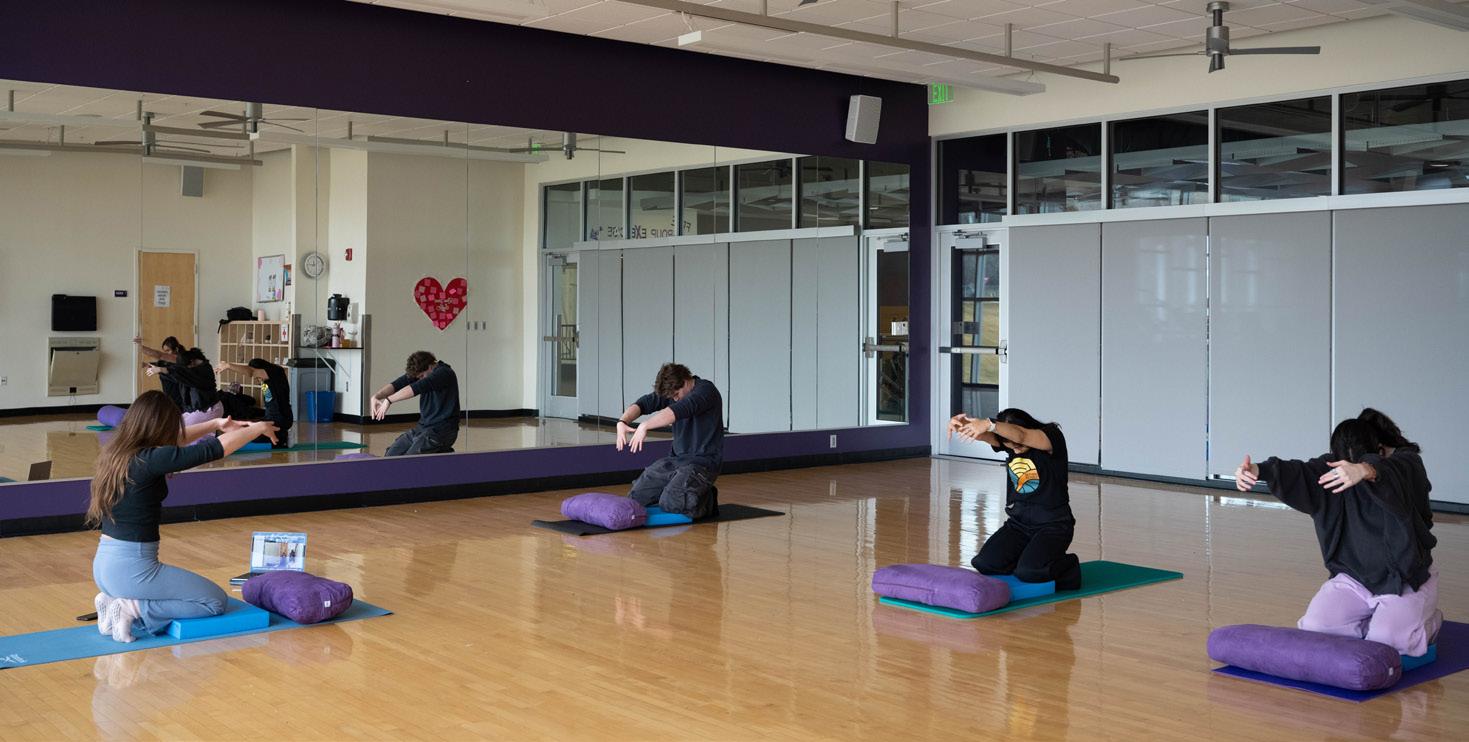
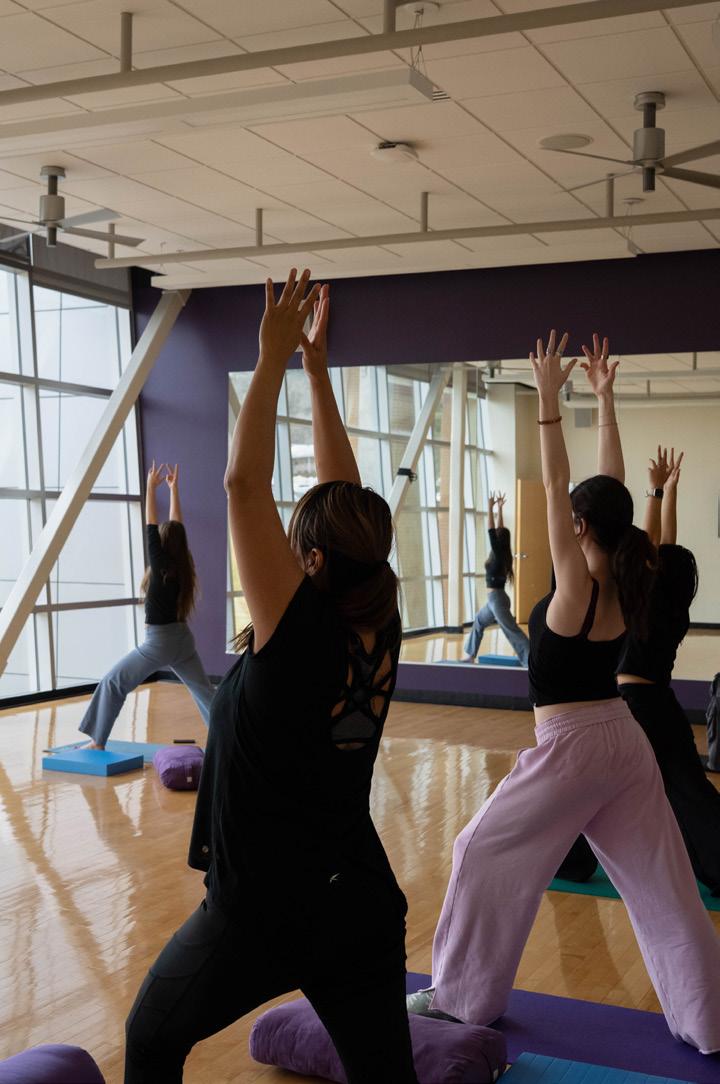
Weber State University has free exercise classes for students and faculty through the campus Group eXercise program, or GroupX, including several styles of yoga designed to help students manage stress and improve overall well being. These classes are taught by experienced instructors and have different kinds of exercises to choose from.
“GroupX classes … it’s such great classes that students have access to,” yoga instructor Claudette Halvison said. “We offer different styles of yoga, and there are several teachers — and they’re experienced teachers. They can adapt classes or give suggestions on different adjustments they can do and poses that will help them.”
For many students, yoga is more than physical movement. It is also a way to manage academic pressure. Laila Stoker, a nursing student at Weber, said that she returned to yoga during one of the most stressful peri-
ods of her education.
“I’ve done yoga periodically throughout my life, and then I really started back up when I started nursing school because I was super stressed,” Stoker said. “It was a really good way to recenter myself and refocus on my breathing.”
Stoker uses the breathing techniques she learned in yoga outside of the class, like during exams, to stay calm and focused in high-pressure situations.
“I would actually find myself going back to techniques that we used in yoga to help control our breath during different postures when I would be taking tests or when things get stressful,” Stoker said.
Halvison has noticed differences in how students benefit depending on when they attend class. Morning participants often report starting their day with greater calm and awareness, while evening attendees use yoga as a way to unwind.
Students who have incorporated yoga into their weekly routines report improvements
not only in stress levels but also in physical strength, balance and confidence. Some describe feeling more fluid in their movements and more aware of the connection between their mental and physical states. Others say yoga has helped them feel stronger and more stable while teaching them that strength can also mean listening to their
bodies and adapting when needed. Many participants say they feel both physically and mentally better on days they attend class. Improved sleep, reduced soreness, and a noticeable shift in energy are among the most commonly reported benefits.
Traducido por
LUNA MALAGON SOLORZANO
Traductora
Por SKYLAR WOLFE
Reportera
La Universidad de Weber State tiene clases gratis de ejercicio para estudiantes y profesores alrededor del campus, el programa de Group eXercise, o GroupX, incluye varios tipos de yoga diseñados para ayudar a los estudiantes a manejar el estrés y mejorar el bienestar en general. Las clases son dadas por instructoras con experiencias y tienen diferentes tipos de ejercicios para que se pueda elegir de ahí.
“Las clases de GroupX… es un gran recurso al que los estudiantes tienen acceso”, dijo la instructora de yoga Claudette Halvison. “Ofrecemos diferentes estilos de yoga, y ahí hay diferentes profesores y son personas con experiencia. Ellos pueden adaptar las clases o dar sugerencias sobre diferentes ajustes que pueden hacer y posturas que les ayudarán”.
Para muchos estudiantes yoga es más que un momento físico. Es también una manera de manejar la presión académica. Laila Stoker, una estudiante de enfermería de Weber, dijo que volvió al yoga durante uno de los períodos más estresantes de su educación.
“He hecho yoga periódicamente durante mi vida, realmente volví a empezar cuando comencé la escuela de enfermería porque estaba muy estresada”, dijo Stoker. “Fue una forma muy buena de volver a centrarme y volver a concentrarme en mi respiración”.
Stoker usa las técnicas de respiración que aprendió en yoga fuera de clase, durante sus exámenes, le ayuda a mantenerse calmada y enfocada en situaciones de mucha presión.
“De hecho me encontraba recurriendo a las técnicas que utilizamos en yoga para controlar la respiración durante las diferentes posturas cuando tenía exámenes o cuando las cosas se ponían estresantes”, dijo Stoker.
Halvison ha observado diferencias en los beneficios que obtienen los alumnos en
función del momento del día en que asisten a clase. Los participantes matutinos suelen afirmar que comienzan el día con mayor calma y conciencia, mientras que los asistentes vespertinos utilizan el yoga como una forma de relajarse.
Los estudiantes que han incorporado al yoga en su rutina semanal han mejorado no solo en sus niveles de estrés si no también en su fuerza física, balance y confianza, algunas lo describen como sentirse mas fluido en sus movimientos y más conscientes en la coneccion entre su estado mental y físico otros dicen que el yoga les ha ayudado a sentirse más fuertes y estables, al tiempo que les ha enseñado que la fuerza también puede significar escuchar a su cuerpo y adaptarse cuando es necesario.
Muchos participantes afirman sentirse mejor tanto física como mentalmente los días que asisten a clase. Entre los beneficios más comunes se encuentran la mejora del sueño, la reducción del dolor y un cambio notable en la energía.
By ALEESA CAMPBELL Copy Editor
The play “Ushuaia Blue” is a poetic tragedy by Caridad Svich, which was inspired by James McClintock’s interviews. The opening show for Ushuaia Blue, presented by Weber State University’s Val A. Browning Center for the Performing Arts, was on Feb. 13.
The cast consists of Mei Flint playing Sara, Kaplan Keener as Jordan, Laura Segura Leal as Pepa, Virginia Stott as Piper, Emma Young as Ash, Mandy Chandler as Zane and Beckham Westenskow as the understudy for Jordan.
Sara and Jordan are married and frequently misunderstand each other. Sara is a bio-acoustics specialist and is filming the “Ushuaia Blue Chronicles”, as she refuses to call it a documentary. Jordan is a marine biologist and they have been traveling to Antarctica for some time to do research on glaciers, penguins, as well as the Yaghan and Selknam people in Tierra del Fuego. Sara interviews and records Pepa, as she’s lived there her whole life and that land has been in her family for generations. Sara starts to gain a different perspective on the world that clashes with Jordan’s throughout this play.
Editor-in-Chief
Nelly Hernandez Tejada nhernandeztejada@mail.weber.edu
Managing Editor
James Gordon jamesgordon@mail.weber.edu
Collaboration Editor
Bryce Odenthal bryceodenthal@mail.weber.edu
Design & Graphics Editor
Izabelle Cordeiro icorderio@mail.weber.edu
Assistant Design & Graphics Editor
Sydnie Parkinson sydniepalmer@mail.weber.edu
On Weber’s Current Theatre Season Webpage, “Ushuaia Blue” is said to be a “Moving exploration of what it means to remember, to endure and to hope.”
Sarah Brew, director of “Ushuaia Blue,” said this is a love story that takes place in Antarctica, during the end of the world. The play covers a tragedy that Sara and Jordan experience, as well as how each character views and is dealing with the end of the world.
“It’s a play about listening and not listening and the stakes of what it means to not listen to the planet and each other,” Brew said.
The play’s music is pre-recorded and came from recordings of a glacier turned into electronic music.
“Ushuaia Blue” was a breathtaking play for some, while others didn’t seem to understand how the plot was progressing. There was some comic relief to break the tension of certain intense scenes, but some didn’t resonate with the audience. In between some scenes, there were interpretive dances per-
formed mainly by the background characters.
A costume designer for “Ushuaia Blue,” Samantha Olsen, said being a part of this play allowed her to help make an impact and how she wanted the characters to represent realism.
“Being able to hear that there are still people fighting and willing to make entire productions about protecting this land, this area, means a lot,” Olsen said.
After the play, they had refreshments in the lobby of the Browning Center’s Eccles Theatre. The cast and crew members were in the lobby talking to audience members, while enjoying some lemonade with brownies.
There, Laura Mackley spoke highly of this performance and what she knows about this play from her son. Laura Mackley is the mother of Cameron Mackley, the sound designer for Ushuaia Blue. She said, “It was amazing. I didn’t quite know what to expect but they did an excellent job.”


TOP: The poster advertising for the performance of Ushuaia Blue happening at Weber State University through Feb. 13-21.
BOTTOM: Ushuaia Blue is one of the productions that was lined up for the 2025-2026 Weber State University Theatre Season.
Photography Editor
Anna Kuglar briannakuglar@mail.weber.edu
Assistant Photography Editor Gavin Olson gavinolson1@mail.weber.edu
News Co-Editor Kyle Greenawalt kylegreenawalt@mail.weber.edu
News Co-Editor
Aisha Rucker aisharucker@mail.weber.edu
Sports Editor Gavin Nelson gavinnelson1@mail.weber.edu
Assistant Sports Editor Grayson Freestone graysonfreestone@mail.weber.edu
Culture Editor Jared Mitchell jaredmitchell@mail.weber.edu
Assistant Culture Editor Hannah Richards hannahrichards1@mail.weber.edu
Chief Copy Editor
Mindy Brown mindybrown1@mail.weber.edu
Assistant Chief Copy Editor
Sloane Ostler aostler@mail.weber.edu
Translation Co-Editor
Victoria Hernandez victoriahernandez1@mail.weber.edu
Translation Co-Editor
David Roman Aros davidromanaros@mail.weber.edu
Business Manager Rob Steedley robertsteedley@weber.edu
Adviser
Jean Norman jeannorman@weber.edu