TSL January 2026

Page 1


LOOKING

AHEAD Connection, Leadership, and the Evolving Secured Finance Landscape

As we begin a new year of opportunity and transformation across the secured finance community, SFNet’s 2026 plans offer a clear view of the forces shaping our industry’s next chapter. From foundational education, to crucial information, to high-impact national, global, local and niche events, the months ahead promise meaningful dialogue, renewed connection, and practical insight at a time when adaptability and perspective are more important than ever.

February brings the Asset-Based Capital Conference in Las Vegas, one of the industry’s premier networking and deal-making forums. As lenders, advisors, investors, and service providers gather to make deals and exchange ideas, this conference sets the tone for how the market is thinking about growth, risk, and opportunity as we collectively prepare for new market cycles. It is a place where relationships are strengthened and transactions are sparked.

On March 3 (preceding the National Jewish Financial Services Dinner), the Supply Chain Finance Convergence ’26 in New York will spotlight the increasingly interconnected landscape of ABL, factoring, and supply chain finance, an evolution influencing every corner of our sector. As capital structures grow more complex and borrower needs more nuanced, this convergence is no longer theoretical; it is shaping how deals are structured and monitored every day. This program will also feature the presentation of findings from SFNet’s Fraud Task Force, offering a timely perspective on risk, transparency, and the governance frameworks that support resilient financing solutions. In an environment where speed and innovation often collide with controls, these insights are especially critical.

In April, SFNet will be in Atlanta for two key events: The Emerging Leaders Conference will convene rising professionals for targeted education and peer connection, while SFNet’s Independent Finance Roundtable (IFR) brings together nonbank factoring and ABL leaders to exchange insights on market trends and best practices.

June marks another important moment for our community. On June 11 in New York City, we will celebrate the 2026 class of the SFNet 40 Under 40 Awards, recognizing emerging leaders who are already making a meaningful impact across secured finance. Nominations remain open through February 12, and I encourage you to take a moment to nominate

your rising stars. These individuals represent not only the future of our industry, but also its continued commitment to excellence, innovation, and leadership. SFNet’s Women in Secured Finance Conference begins the evening before, convening industry leaders for candid conversations, skillbuilding, and connections across the industry.

That spirit of leadership and evolution is reflected throughout this issue. In The New Wave of Leaders: Rewriting the Playbook for ABL and Factoring , TSL’s editor-inchief speaks with ten professionals who have stepped into new roles across bank ABL platforms, independent factoring firms, and specialty lenders. Their perspectives highlight how the next generation is honoring the discipline and structure that have long defined the industry while bringing fresh approaches to growth, culture, and client solutions.

2025 Asset-Based Loan Activity Highlights Wins and Losses as Over US$136bn Clears Market places recent performance in the context of volatility, policy uncertainty, and record-setting leveraged loan volume. Several articles in the issue explore risk from different angles, including the use of independent directors as an alternative to bankruptcy, the lessons hidden beneath record-breaking 2025 holiday sales, and the complex interactions between receivables purchase facilities and ABL structures through the lens of the First Brands case.

Finally, we look beyond U.S. borders with an overview of CRD VI and its implications for U.S. lenders operating in the EU, and we debut a new column, Industry Pulse . In this inaugural installment, we asked members a simple, but revealing, question: What is impeding deals from closing? Their candid responses offer a snapshot of today’s market realities.

As always, thank you for being an integral part of the SFNet community. I look forward to connecting with you in the months ahead and continuing the conversations that move our industry forward.

TABLE OF CONTENTS. JAN/FEB 2026 VOL. 82 ISSUE 1

COVER STORY

THE NEW WAVE OF LEADERS: REWRITING THE PLAYBOOK FOR ABL AND FACTORING P6
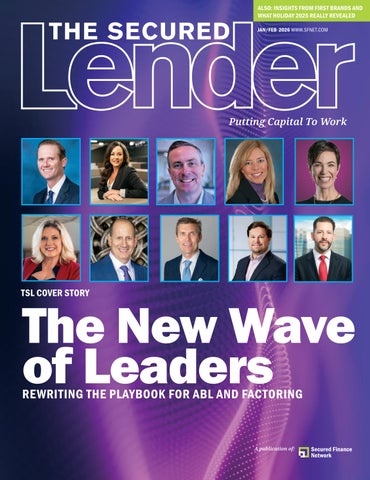
The New Wave of Leaders: Rewriting the Playbook for ABL and Factoring

From bank ABL platforms to independent factoring and specialty lenders, a new cohort of leaders is stepping into pivotal roles, bringing fresh perspectives while honoring the discipline and structure that have long defined the industry. TSL’s editor-in-chief interviewed ten leaders who have taken on new roles. 6 BY

FEATURE STORIES

2025 Asset-Based Loan Activity Highlights Wins and Losses as Over US$136bn Clears Market

Maria Dikeos of LSEG LPC provides readers with the highlights of 2025 and explores the trends, insights, and what’s ahead for the leveraged lending market in 2026. 12 BY MARIA C. DIKEOS

FEATURED STORY

APPOINTING INDEPENDENT DIRECTORS TO DISTRESSED COMPANIES: AN ALTERNATIVE TO BANKRUPTCY P.16

Appointing Independent Directors to Distressed Companies: An Alternative to Bankruptcy

The most traditional avenue for a distressed company seeking to reorganize existing debts or maximize company value is through a Chapter 11 bankruptcy. However, due to its complexity, a Chapter 11 bankruptcy can be a lengthy, expensive process that is not always palatable for the distressed company’s secured lenders. 16 BY JOHN F. VENTOLA, JONATHAN D. MARSHALL, DOUGLAS R. GOODING, ALEXANDRA THOMAS, AND JACOB LANG

Interview with Terry Keating of Valley Bank

In November, Valley National Bank announced the appointment of Terry M. Keating as head of Asset-Based Lending (ABL). In this role, Keating oversees the continued growth and strategic direction of Valley’s ABL platform. 20 BY

Articles

TRENDS IN SECURED FINANCE Receivables Purchase and Asset-Based Lending: Insights from First Brands

When a borrower layers factoring, supply chain finance, securitization, and ABL into a single capital stack, the risks multiply fast. 25

RETAIL FINANCE TRENDS

The Trillion-Dollar Question: What Holiday 2025 Really Revealed

Holiday sales in 2025 generated more than a trillion dollars in U.S. retail sales for the first time in history. It also revealed warning signs that asset-based lenders cannot afford to ignore. 32

NON-BANK TRENDS

New EU Branch Rules for Non-EU Banks: What US Lenders Need to Know About CRD VI

The EU is changing the rules for non-EU banks—and U.S. lenders need to pay attention. Under CRD VI, cross-border lending into the EU without a local branch will soon be off the table. 36 BY FRANS VAN DER EERDEN AND LAURENS SPELTEN

M&A TRENDS Distressed M&A Through the Lens of Asset-Based Lending

For decades, asset-based lenders have been essential participants in distressed situations. 39

PULSE

The Secured Lender’s Industry Pulse

In this new column, we ask industry executives about a hot topic. In this issue, we are asking: What is impeding deals from closing? 42

PUTTING

CAPITAL TO WORK

Inside the Partnership Between Gateway Trade Funding and Sweet Source

When Adil Hafeez launched Sweet Source in 2019, he had a bold vision: to bring premium, value-driven beverage brands from Asia to American shelves. 44

SFNET COMMITTEE SPOTLIGHT

SFNet’s Emerging Leaders Committee

Here we speak with Boudewijn Smit, partner at NautaDutilh and chair of SFNet’s Emerging Leaders Committee. 46 BY EILEEN WUBBE

SFNET MEMBER PROFILE

ABLSoft is ‘Supercharged’ in

2026

Veteran ABL lending platform ABLSoft continues to broaden and deepen its solutions for asset-based lending and factoring, delivering a best-in-class user experience at scale. 50

BY EILEEN WUBBE

Departments

The Secured Finance Network is the trade group for the asset-based lending arms of domestic and foreign commercial banks, small and large independent finance companies, floor plan financing organizations, factoring organizations and financing subsidiaries of major industrial corporations.

The objectives of the Association are to provide, through discussion and publication, a forum for the consideration of inter- and intra-industry ideas and opportunities; to make available current information on legislation and court decisions relating to asset-based financial services; to improve legal and operational procedures employed by the industry; to furnish to the general public information on the function and significance of the industry in the credit structure of the country; to encourage the Association’s members, and their personnel, in the performance of their social and community responsibilities; and to promote, through education, the sound development of asset-based financial services.

The opinions and views expressed by The Secured Lender’s contributing editors and authors are their own and do not necessarily express the magazine’s viewpoint or position. Reprinting of any material is prohibited without the express written permission of The Secured Lender

The Secured Lender, magazine of the asset-based financial services industry (ISSN 0888-255X), is published 6 times per year (Jan/Feb, March, June, July/Aug, Sept and Nov) $65 per year non-member rate, and $105 for two years non-member rate. SFNet members are complimentary.

Secured Finance Network

370 Seventh Avenue, Suite 1801, New York, NY 10001. (212) 792 -9390 Email: tsl@sfnet.com www.SFNet.com

Periodicals postage paid at New York, NY, and at additional mailing offices. Postmaster, send address changes to The Secured Lender, c/o Secured Finance Network, 370 Seventh Avenue, Suite 1801, New York, NY 10001

Editorial Staff

Michele Ocejo

Editor-in-Chief and SFNet Communications Director mocejo@sfnet.com

Eileen Wubbe Senior Editor ewubbe@sfnet.com

Aydan Savaser

Art Director asavaser@sfnet.com

Advertising Contact: James Kravitz

Chief Business Development Director

T: 646-839-6080 jkravitz@sfnet.com

2026

BMO Adds Paul Thomsen to Lead new Utah Commercial Banking Office

BMO Commercial Bank appointed Paul Thomsen as managing director and Utah market executive. Thomsen will build the bank’s new Middle Market office in Utah, which will provide capital and tailored financial solutions to Utah’s strong business community.

Cambridge Savings Bank Appoints

Cal Navatto as Senior Vice President, Senior Asset-Based Lending Relationship Manager

In this role, W. Calvin “Cal” Navatto will focus on expanding CSB’s assetbased lending portfolio, deepening relationships with middle-market companies, and supporting the continued growth of the Bank’s ABL business. Navatto brings decades of experience in commercial finance, business development, and asset-based lending.

Errin Richardson Glasgow Named as New President of Nationwide Operations of Cascade Credit Services, LLC

The Cascade Credit Services Board of Advisors and CEO, Wade Owens, is pleased to announce the addition of Errin Richardson Glasgow as the company’s new president of nationwide operations. With over three decades of experience in the asset-based finance sector, Glasgow is widely respected for her leadership, collaborative approach, operational insight, and deep understanding of credit risk and borrower dynamics.

Choate Hires Longtime Morgan Lewis

Partner Marc Leduc to Join Seasoned Finance and Restructuring Team

Marc Leduc has joined Choate as a partner in the Firm’s nationally recognized Finance and Restructuring Group. He will advise commercial banks and private credit lenders on a broad range of domestic and international finance transactions and debt restructurings.

Swimmer Named Head of Commercial Banking at Citizens; McCree to Retire in March 2026

Citizens Financial Group, Inc. announced that Ted Swimmer , head of capital markets and advisory for Citizens Commercial Banking, has been named head of Commercial Banking, effective immediately. Swimmer succeeds Don McCree, who will remain at Citizens as chair of Commercial Banking until his retirement at the end of March 2026.

Culain Capital Funding LLC Welcomes Travis Pocock as Chief Revenue Officer

Travis Pocock has joined Culain Capital Funding, LLC as chief revenue officer (CRO), bringing more than 15 years of experience helping businesses access the working capital they need to grow. Pocock is a seasoned finance executive with deep expertise in factoring, assetbased lending, and strategic portfolio growth.

Culain Capital Funding Appoints Travis Smith as Senior Vice President –Regional Sales Executive

Travis Smith brings over 25 years of experience in financial services with a deep focus on accounts receivable financing, asset-based lending, and commercial banking. Smith is a seasoned business development professional with extensive expertise in asset-based lending and commercial banking.

Robin Moses Joins Eastern Bank as Senior Vice President, Team Leader for Commercial & Industrial Banking In Rhode Island

Eastern Bank is pleased to welcome Robin Moses as senior vice president, team leader for Commercial & Industrial Banking in Rhode Island. Moses brings more than two decades of experience in commercial lending, relationship management and community leadership.

eCapital Names Amanda Bowman as Head of Sales, Transportation Group

Reporting to Melissa Forman-Barenblit, president, head of Transportation Group, Amanda Bowman will lead the division’s sales organization with a continued focus on client success, advancing eCapital’s long-standing commitment to delivering solutions that strengthen and simplify how transportation businesses access working capital.

eCapital Appoints Industry Veteran

Nate Gilmore as Head of Strategic Partnerships & Integrations for its Transportation Group

Reporting to Melissa Forman-Barenblit, president, head of Transportation Group, Nate Gilmore will lead initiatives to expand distribution, strengthen eCapital’s partner network, and drive new revenue growth through platform integrations and strategic collaborations.

eCapital Adds Rachel Navarro to Lead Client Experience for its Transportation Group

Reporting to Melissa Forman-Barenblit, president, head of Transportation Group, Rachel Navarro will play a central role in shaping and advancing the division’s client strategy. Navarro draws on over 15 years of leadership and industry insight in building lasting client relationships across transportation and commercial finance.

First Bank Appoints Bridget Welborn as New Chief Risk Officer

First Bank is pleased to announce Bridget Welborn joined the bank this October as its new chief risk officer and head of Legal. Welborn brings more than 15 years of experience in legal, risk, privacy, and regulatory compliance, with a proven track record advising boards, CEOs, and executive management on critical initiatives.

First Citizens Names Mike Spencer Middle Market Banking Leader in Georgia

First Citizens Bank announced that Mike Spencer has joined the company as managing director of Middle Market Banking in Atlanta. In this role, Spencer will expand First Citizens’ middle market banking presence throughout Georgia and nearby markets. Navarro draws on over 15 years of leadership and industry insight in building lasting client relationships across transportation and commercial finance.

First Citizens Names Snow Holding Middle Market Banking Leader for Northeastern United States

First Citizens Bank announced that Snow Holding has been named director and market leader of Middle Market Banking for the Northeast, where he will lead relationship managers and business expansion efforts in both the Boston and New York offices, as well as the broader Northeast Corridor.

First Horizon Bank Names Todd Warrick as Triangle Market President in the Mid-Atlantic Region

First Horizon Bank announced that Todd Warrick, executive vice president and Corporate and Commercial market leader, has been promoted to Triangle Market president for the Mid-Atlantic region.

FGI Risk Expands Southeast Presence with Hiring of Janelle Foy

FGI Worldwide LLC announced the hiring of Janelle Foy as director, FGI Risk. Based in Atlanta, Foy will focus on developing relationships and new business opportunities in the southeastern United States for FGI’s credit insurance brokerage and risk advisory division.

Frost Brown Todd Continues Growth in Texas with Commercial Finance Partner Sarah Naseman

Frost Brown Todd (FBT) announced that Sarah M. Naseman has joined the firm’s Houston office as a partner in the

Commercial Finance practice group. Naseman brings a wealth of experience in debt and equity finance, with a particular focus on private credit and lower middle-market leveraged buyouts, further expanding the firm’s capabilities in support of financial institutions nationwide.

Frost Brown Todd and Gibbons Announce Combination to Form FBT Gibbons

Frost Brown Todd LLP (FBT) and Gibbons P.C. have agreed to combine, with a planned effective date of January 1, 2026. The new firm, to be named FBT Gibbons LLP, will create a mid-market legal powerhouse with approximately 800 attorneys across 25 offices nationwide.

Robert Sartin , chairman of FBT, will serve as chairman of FBT Gibbons. Peter Torcicollo , managing director of Gibbons, and Adam Hall , chief executive officer of FBT, will serve as co-managing partners of the combined firm.

Gordon Brothers Bolsters Market Presence & Welcomes Brian Wright as Managing Director, Lending Client Coverage & Origination

In this role, Brian Wright will propel the lending business and origination efforts across the entire Gordon Brothers’ platform delivering tailored, end-to-end solutions for clients. Based in Chicago, Wright has over 30 years of experience in commercial banking, origination and credit leadership working with customers of all sizes and complexities.

Chad Simon Joins Gordon Brothers as Senior Managing Director, Transactions

In this role, Chad Simon joins the team responsible for structuring transactions that leverage the firm’s full asset capabilities to provide solutions for clients and partners as well as building lending solutions that complement Gordon Brothers’ existing asset-based lending facilities in North America.

Hilco Global Appoints Robert Gorin and David Campbell to Lead its Getzler Henrich Turnaround and Restructuring Practice

Hilco Global announced the appointment of new leadership of Getzler Henrich & Associates (“GHA”), Hilco Global Professional Services division’s dedicated turnaround and restructuring practice. Robert Gorin and David Campbell assume the role of coexecutive directors – Restructuring for Getzler Henrich & Associates, where they will lead the middle market advisory practice for corporate turnaround and restructuring. Gorin and Campbell succeed co-chairmen Bill Henrich and Joel Getzler, who will remain engaged in senior advisory roles and provide strategic counsel to ensure a seamless transition and business continuity.

J D Factors Hires Domenic Garcia as Business Development Officer

J D Factors is proud to announce the hiring of Domenic Garcia as business development officer in Austin, TX. Garcia will be responsible for generating new business in Texas along with Oklahoma, Louisiana, Missouri and Arkansas.

Legacy Corporate Lending Bolsters Leadership Team with Addition of Jeffrey Seiden as Executive Vice President

Legacy Corporate Lending, LLC announced the appointment of Jeffrey Seiden as executive vice president, Portfolio & Underwriting. Seiden will work closely with Legacy’s originations team and will be responsible for conducting the underwriting process and structuring and closing new transactions.

Mayer Brown Expands Global Leveraged Finance & Private Capital Practice with Leading Lawyers

Frederick Cristman and James Adams

Mayer Brown announced that Frederick Cristman and James Adams have joined the Washington DC office as partners in the firm’s Global Leveraged Finance and Private Capital Group.

The New Wave of Leaders: Rewriting the Playbook for ABL and Factoring

From bank ABL platforms to independent factoring and specialty lenders, a new cohort of leaders is stepping into pivotal roles, bringing fresh perspectives while honoring the discipline and structure that have long defined the industry. TSL’s editor-in-chief interviewed ten leaders who have taken on new roles: Jon Biorkman, head of Asset-Based Lending & Equipment Finance, BMO; Kim Fisk, president, Triumph Factoring; John Freeman, head of Asset-Based Finance, U.S. Bank; Yvonne Kizner, senior vice president, head of Asset-Based Lending, Cambridge Savings Bank; Niamh Kristufek, president – Specialty Finance, First Business Bank; Gen Merritt-Parikh, co-CEO, Haversine Funding; Steve Pomerantz, ABL group head, Fifth Third Bank; Jay Schweiger, president, Huntington Business Credit; Andrew Ray, global head of Asset-Based Lending, J.P. Morgan; and Neil Wolfe, CEO, Iron Horse Credit.

Adynamic handoff is underway across secured finance. From bank ABL platforms to independent factoring and specialty lenders, a new cohort of leaders is taking the helm. They are inheriting the sturdy foundations that built this industry, discipline, structure, and focus on collateral, while ushering in data-rich, technology-enabled ways of working.

Leadership, Empowerment, and Culture

The new leadership ethos isn’t about disruption for its own sake. It’s about sharpening the classic virtues of secured finance—clarity of purpose, disciplined risk-taking, and transparent communication—while empowering teams closest to the work to act decisively. ABL and factoring remain peopleoriented businesses: relationships, expertise, and judgment are integral to putting capital to work. Today’s leaders emphasize enabling their teams and removing friction so decisions can be made with speed and confidence.

John Freeman was named head of asset-based finance at U.S. Bank in 2024. He reflected on how three decades of diverse roles in asset-based lending shaped his problem-solving mindset and prepared him for this role: “My career in asset-based lending began 30 years ago with Congress Financial, where I held roles within ABL operations, field examination and portfolio management. From there, I embraced new opportunities with JPMorgan, including underwriting debtor-in-possession and exit financings, and opening an ABL office in Vancouver, Canada. Each of these experiences deepened my understanding of how to solve complex problems for clients. Joining U.S. Bank in 2020 also marked a pivotal chapter; by 2024, I was honored to lead our ABF business, driven by a passion for growth and teamwork.”

“Leadership today means shaping a growth trajectory that redefines what’s possible. For the next generation of ABL professionals, that requires cultivating collaboration across diverse viewpoints, eliminating friction in processes, and harnessing technology to elevate client outcomes. Effective leadership combines strategic vision with adaptability and an unwavering commitment to continuous improvement,” said Jon Biorkman who became head of Asset-Based Lending & Equipment Finance, BMO, in the fall of 2025, after Michael Scolaro’s retirement.

“At BMO, we’re fortunate to build on a foundation of excellence established by leaders like Mike Scolaro. Our mandate is to preserve that strength while advancing purposeful innovation. Modernization isn’t disruption for its own sake—it’s grounded in listening to clients, anticipating change, and empowering exceptional talent. We emphasize disciplined risk–reward decisions, a growth mindset, and delivering the full breadth of BMO’s capabilities to help clients thrive through all different market cycles,” he added.

Biorkman explained that a leader’s responsibilities include setting the direction, empowering team members, and communicating clearly and consistently. Biorkman believes that regardless of past outcomes, each day offers a new opportunity to make a significant impact, both now and in the future.

Steve Pomerantz, who became ABL group head at Fifth Third last year, said, “Leadership in today’s secured finance environment is about clarity, discipline, and adaptability… our core responsibilities haven’t changed: protect credit, manage risk, and deliver reliable liquidity through the cycle for our clients. What has changed is the pace. For the next generation, leadership means developing real credit judgment early, empowering teams to make decisions within clear guardrails, and reinforcing that accountability matters even more as the business moves faster.”

Across bank and independent platforms alike, empowerment recurs as a theme. Leaders are instituting clear decision-making rights and encouraging curiosity. They want team members to propose recommendations, then debate them to reach the best answer for clients and the institution.

Jay Schweiger, who was named president of Huntington Business Credit in the fall, said: “I strongly believe in empowering the entire team to make decisions. On my very first day with my new team, I emphasized that we could not be successful if they did not feel empowered to make timely decisions. We have established a framework for decision-making and are continually refining that and will continue to do so into 2026 and beyond.”

JON BIORKMAN BMO
JOHN FREEMAN U.S. Bank
KIM FISK
Triumph Factoring
YVONNE KIZNER
Cambridge Savings Bank

Kim Fisk, who was named president of Triumph Factoring in March 2025, said: “I believe the next generation of ABL and factoring professionals needs more than technical skills. They need confidence, creativity, and a collaborative mindset. Investing in people is imperative. My focus is on building a culture where ideas are valued, continuous learning is encouraged, and diversity of thought drives better outcomes.”

In early 2025, Iron Horse Credit announced the appointment of Neil Wolfe as CEO. Wolfe believes culture starts at the top. “Leadership is about fostering culture, which in turn helps to drive an organization’s vision, and, equally important, is being adaptable. Leaders must prioritize empowering their teams and encouraging cross-functional collaboration, even challenging executive decisions as may be necessary from time-to-time.” He added, “There is no secret sauce in my approach. One ‘legacy’ practice I cannot abandon is personal attention and touch. You can have the best data and technology, but if you can’t connect with people, I find organizations will struggle.”

Niamh Kristufek, who was named First Business Bank’s president-specialty finance last year, spoke of the bank’s core culture: “Thankfully, the culture at First Business Bank does not need

changing—it’s core to who we are and a competitive strength in the marketplace. Our latest results show 97% client satisfaction, 87% manager effectiveness, and employee engagement hit 86%.”

In early 2025, Yvonne Kizner was named head of Asset-Based Lending at Cambridge Savings Bank. She commented: “Engaging in culture is a core tenet of CSB, which I have seen in action with my involvement in our Professional Women’s Network. We try to foster engagement and development for women in their careers through various activities including networking, volunteering, and participating in wellness.”

Talent Development and Career Pathways

Leaders are rewriting how talent enters the industry, furthers their professional development, and advances in their careers. The aim is to expose emerging professionals early to the realities of structuring, monitoring, and managing risk—while layering in analytics, automation, consulting skills, and rotational exposure.

Freeman of U.S. Bank said, “As our teams continue to evolve, attracting and developing emerging talent has become a key focus. Historically, the secured finance industry hasn’t seen a large influx of young professionals, but at U.S. Bank, we’ve made significant strides in developing talent both internally and externally, often promoting from within. This approach sets us apart in the marketplace, as we’re committed to supporting and retaining team members within the right roles, regardless of their initial function.”

Freeman explained it’s important to tailor your approach to each individual: “What matters most is finding the right fit for each person, so I strive to engage my team several layers deep, ensuring they feel heard and supported. I make it a priority to initiate career conversations early and regularly, making sure team members understand the opportunities available, and I encourage my team leaders to do the same.”

He went on to emphasize the importance of mentoring: “Mentoring is another cornerstone of our development strategy. We encourage participation in external classes – primarily through SFNet – and regularly give early talent learning opportunities, such as presenting potential transactions to senior leaders, clients and prospects. These experiences foster their growth and confidence over time.”

Ray of J.P. Morgan discussed the bank’s internship and analyst training programs: “The strength of our team is built on a solid foundation of hands-on training in diligence, structuring, and risk management. By exposing young professionals to real-world scenarios and mentorship early in their careers, we are able to prepare our next generation of leaders to thrive in a rapidly changing industry.”

Several of the leaders mentioned internships as being key to attracting new talent. “One of the teams that we established early after I arrived was an ABL summer internship program team, a fantastic 11–12 week rotational program through our ABL group. Our interns will rotate through all aspects of the team from field exam, underwriting, portfolio and relationship management, and finally business development,” said Schweiger.

Kizner said, “CSB also has a robust internship program in the summers, mainly focused on the credit analyst function. Whenever

NIAMH KRISTUFEK First Business Bank
STEVE POMERANTZ Fifth Third Bank
GEN MERRITT-PARIKH Haversine Funding
JAY SCHWEIGER Huntington Business Credit

possible, I try to expose the interns to ABL credits, in the hopes that they consider our entry-level position, which is usually the collateral analyst function.”

Gen Merritt-Parikh, who was named co-CEO of Haversine Funding last year, believes taking chances is key to growth. “Growth doesn’t happen by staying safe. We encourage team members to take on new goals each year, try things they haven’t done before, and build a broad set of skills. I believe we should give people the space to grow, especially when they’re willing to step out of their comfort zone.”

Concerning the next generation of leaders, Kristufek said: “I find younger professionals to be mission-driven. When we talk about secured finance as a way to help companies survive during hard times and grow during times of opportunity, that resonates. We encourage our younger professionals to keep an open mind and learn about all our groups and to remember that the one thing that connects all our teams is passion for our clients.”

Leaders also spoke at length about how to tell the story of secured finance to a generation that may not know the field exists. SFNet’s Guest Lecture Program and The Secured Lender’s Great Places to Work issues have been raising the profile of the industry across the country, but more work must be done to reach the next generation.

Kizner said, “Connecting individuals from the SFNet network with undergraduate and graduate finance students is a great way to attract new talent and makes students aware of the career opportunities our sector offers.”

Pomerantz said, “Most young professionals simply haven’t been exposed to secured finance, which puts the responsibility on us to tell the story correctly. ABL is problem-solving finance. We focus on early exposure to real transactions so people learn how risk actually behaves, not just how it looks in a model.”

Huntington has established and will utilize its summer program to seed a career development and rotational program, according to Schweiger.

“Internally, we foster the idea of developing career paths. Through pairing with experienced staff and affording opportunities to participate in training, we strive to fulfill colleagues’ desire to learn and grow without the conventional shackles,” said Wolfe.

Views on Technology

Every leader interviewed respects the legacy practices because they work. What’s changing is how those practices are executed— augmented by data, automation, and analytics to reach better decisions faster while keeping human judgment front and center. Modernization is a means to strengthen discipline, not replace it.

Ray of J.P. Morgan, explained that the bank “has a deep-rooted culture of risk management and thoughtful structuring, which remains foundational to our approach. My goal is to enhance these practices by integrating advanced data analysis and digital tools into our prospecting and diligence processes. It isn’t about changing what has worked; it’s about making our legacy practices more efficient and insightful through technology.”

“To make modernization meaningful, we connect the why to

the how and the what happens if we don’t. That clarity lets the team innovate without losing sight of risk. Practically, we review our processes several times a year and ask: Are these steps still adding value? Reducing risk? Saving time? Getting us closer to the outcome we actually want? If the answer is no, we rethink it,” said Merritt-Parikh.

Fisk agreed that a balance must be struck. “Balancing legacy practices with modernization starts with understanding why those practices exist. They’ve built security, trust, stability, and reliability in our industry and amongst our people… modernization isn’t optional; it’s essential for staying relevant and competitive.” She added: “We’re automating certain processes that can think faster and more accurately than a human, which frees our people to focus on handling exceptions and complex scenarios. This allows our teams to evolve into true problem solvers and critical thinkers.”

Kizner agreed: “As we continue to grow, it is imperative we embrace technology, both to enable us to scale and to ensure our team is focusing on the more complex areas that require more management and possibly partnership with our clients. We’ve upgraded our collateral monitoring system over the past 12 months and have tried to cut out as many manual practices as possible, although the work continues with several initiatives in 2026 we are pursuing.”

Pomerantz said, “We need to question long-held assumptions the same way we test new ideas, using data, experience, and judgment rather than habit. Leveraging data and automation to improve decisions within clear guardrails allows us to create value rather than destroy it.”

First Business Bank is currently assessing end-to-end processes throughout the teams to identify where manual, low-expertise work is being completed, according to Kristufek. “By automating this type of work, it frees up our experienced back-office staff to redirect their talents into the more intuitive risk management, deal structuring, and customer service work where we excel,” Kristufek explained.

Schweiger described his team’s innovative work: “Our team is doing exciting and cutting-edge work with various technology tools including PowerBI and various API applications to mine data from our systems and use it to educate not only ourselves, but also our prospects and customers on various asset-based and financial best practices. One

9 THE SECURED LENDER JAN/FEB. 2026

ANDREW RAY J.P. Morgan
NEIL WOLFE Iron Horse Credit

of my favorite teams that we recently launched is the What-if-Council. We might brainstorm 1,000 ’what-ifs’ and only act on 10 of them, but I guarantee, those 10 will be game changers that elevate our performance enormously,” said Schweiger.

“If new systems are slower, too complex, or don’t add insight, we don’t implement them. But if they truly align the ‘how’ with the ‘why’ and make us better or more scalable, then we’re all in,” Merritt-Parikh said.

The Journey to Leadership

Reflecting on the role mentors played throughout his career, Freeman said: “Throughout my career, I’ve always taken the view that change is the only thing that stays the same, so I try to instill this mindset with my team. I also worked under great industry leaders who significantly impacted my approach to leadership: Dan Lane, with Chase, demonstrated balance and a relentless focus on putting the client first. Joe Virzi, now with First Merchants, exemplified the importance of culture as a foundation for success. Dan Son, U.S. Bank, taught me the value of visionary leadership and strategic foresight.

“These exceptional mentors have firmly shaped my conviction that adaptability, a strong organizational culture, and a client-first mindset are essential to lasting success. Sharing these values and investing in the growth of emerging talent isn’t just rewarding – it’s a responsibility I take seriously. As we navigate an ever-changing industry landscape, I remain committed to fostering the next generation of secured finance leaders and upholding the highest standards of excellence for our clients and our profession.”

Schweiger also emphasized the importance of mentors: “I’ve had the privilege of learning from some of the best in the industry-- Mike Scolaro, Kris Coghlan, and Steve Friedlander. They have advised me to listen, be patient, but act decisively, and always remember that you never know what someone else may be dealing with on any given day or in any situation.”

Ray describes his leadership philosophy as being anchored in four principles: attitude, effort, accountability, and curiosity. “I believe in making decisions collectively, but decisively, and executing with precision,” he said. “Leadership in today’s secured finance landscape is fundamentally about talent development and thoughtful client selection. By investing in our people and leveraging technology, we can build a culture that is both high-performing and resilient… Leadership is not just about setting direction, but about empowering teams to grow, adapt, and deliver excellence.”

“My leadership philosophy is grounded in integrity, commitment to both my colleagues and clients, and partnership. I believe in fair dealing when it comes to opportunity, and instilling calmness during uncertainty… My job is to make them successful. And if they are successful, I too will be,” explained Wolfe.

Kizner commented on the power of escaping your comfort zone: “I learned early on to say yes to opportunities that get you outside of your comfort zone, and to take on challenges that make your direct manager’s life easier. There is so much value in just showing up consistently in the office—being able to participate in hallway postmortems on calls and meetings will really push you along faster.” She

added: “To me, leadership is providing a framework for others to thrive, making sure we have the systems and structure in place to ensure efficiency, fostering teamwork, and ensuring there are opportunities to learn and grow.”

The Future of Secured Finance

In many ways, the future will be much like the past: focused on relationships. The fundamentals of trust, but verify; structure and monitoring; cash conversion and collateral quality, remain nonnegotiable. However, the overlay is different: data-rich workflows, automated monitoring, transparent decision-making frameworks, and cultures that foster curiosity and accountability. Three trajectories stand out: responsibly data-driven underwriting and monitoring; human-centered automation that elevates exception handling and client dialogue; and onboarding models that blend rotations, external education, and strength-based coaching.

The result? An industry that can move faster without losing its balance. An industry that is resilient through cycles, more attractive to new talent, and more valuable to the companies that depend on secured finance for liquidity and growth. Technology matters, but people decide. The future belongs to organizations that limit friction so their experts can do what only humans do: ask better questions, make better calls, and build better relationships. Secured finance has always been durable and resilient, but many leaders believe its best years are still ahead.

“While technology is reducing friction in our processes and making it easier to serve customers day to day, the human element of banking remains unchanged. We are a relationship bank that does the work to really understand our clients’ needs today and their short-term and long-term goals so we can provide expert advice and guidance,” said Kristufek.

Fisk commented on the needs of the new generation and their role in the future: “Stepping into the role of president of factoring during such a transformative time means it’s imperative we meet the needs of a new generation. For me, leadership starts with the people you surround yourself with, the focus on development of who’s next, and embracing innovation and technology while putting the client’s needs top of mind.”

If there is a single mandate emerging from these voices, it is this: lead with sound judgment and build systems that make sound judgment easier every day. That means sticking to fundamentals while investing in tools, training, and culture that help teams see around corners. It means designing processes that surface problems quickly and empower experts to act. And above all, it means remembering that secured finance is a relationship industry. Success will come not by how fast leaders can decide, but by how well they listen, how clearly they communicate, and how reliably they show up for clients. In the end, technology will continue to evolve—but the industry’s compass remains the same: disciplined credit, resilient teams, and enduring partnerships.

Michele Ocejo is SFNet director of communications and editor-in-chief of The Secured Lender.

2025 Asset-Based Loan Activity Highlights Wins and Losses as Over US$136bn Clears Market

Maria Dikeos of LSEG LPC provides readers with the highlights of 2025 and explores the trends, insights, and what’s ahead for the leveraged lending market in 2026.

Against the backdrop of bouts of market uncertainty and the whiplash of tariff announcements (followed by episodic recants), US lenders placed US$1.7trn of leveraged loan volume via the broadly syndicated loan market by mid-December 2025. The results not only represent a 3% increase over year-ago totals, but are on track to set an annual record (Fig. 1).

Despite burgeoning M&A optimism and lender hopes for increased deal flow at the end of 2024, 2025 got off to a slow start in the wake of Liberation Day pronouncements. On the heels of a promising start in January, the leveraged loan calendar came to a near standstill by late March and into April as volatility spiked and the bond and equity markets tumbled.

The VIX, which represents market expectations of 30-day forward-looking volatility, shot up from a low of 21.51 at the end of March to a high of 52.33 in early April before coming down to about 16.6 by the end of June.

For much of the second quarter, both lenders and borrowers pulled back from deal making and/or slow walked existing pipeline deals in the near term, as they grappled with concerns around credit risk.

The market angst was proved to be short lived, however. Although actual headlines and circumstances did not meaningfully change or go away, the capital markets pivoted away from Liberation Day volatility as strong technicals supported a return to doing deals. In 3Q25 steady market liquidity shored up lender demand for assets, fueling a calendar of deals which, if not broadly aggressive, were certainly opportunistic in the form of repricings, refinancings, dividend recapitalizations and a smattering of M&A opportunities. Most of this activity came into focus during the normally tepid summer months – especially after Labor Day. At over US$525bn, 3Q25 leveraged loan volume, was not only up 56% compared to the same time last year, but also set a new quarterly record.

There were qualifiers to the strong results, however. At just over US$127bn, new loan assets represented only 24% of total leveraged loan volume for the quarter (Fig. 2).

In September, a record US$20bn financing backing the US$55bn buyout of video gamer, Electronic Arts – the largest leveraged buyout ever - was announced, a testament to the market’s appetite for deals. Notwithstanding the size and optimism around the deal, sustained momentum around new loan generation remained tenuous.

In early October, on the heels of the First Brands and Tricolor bankruptcies, hopeful signs of a credit rally were displaced by renewed focus on risk, monitoring and exposure levels to certain industries – including the automotive sector.

By December, predictions that the Federal Reserve was entering a rate-cutting cycle were tempered by inflation indicators. Despite lowering rates for the third time in 2025,

the Fed signaled that 2026 may only allow for one cut.

ABL Volume Near Record Highs, but Lending Felt Thin Against this backdrop, the US asset-based lending (ABL) market pushed over US$136bn of issuance through retail syndication by early December, increasing its share of total leveraged loan volume to 8% from the record low of 6% garnered last year.

The results represented the fourth highest annual total on record (although it is expected to edge up by the end of the year) and the highest total since the surge of issuance

MARIA C. DIKEOS LSEG LPC
Fig. 1: Leveraged volume
2025 US leveraged loan issuance at almost US$1.7Tr, a record high
Fig. 2: New Money
New leveraged loan assets make a slow return to market
Source: LSEG LPC

fueled by Libor cessation. Similar to trends observed in the broader leveraged cash flow market, the mix of deals skewed heavily toward opportunistic refinancings, supplemented by a nascent but limited new money pipeline. There was spotty but real frustration with the lack of adequate deal flow to meet lender demand for assets and the reality of growth ambitions tainted by the largest write off in ABL history: Rite Aid.

Nearly 72% of total 2025 ABL loan volume or US$97.5bn came in the form of refinanced credits (Fig. 4), down modestly year over year on a pro rata basis, but up 16% in terms of dollars raised. Just shy of US$39bn, new money assets were up 42% year over year to mark the second highest annual total on record (2022 logged nearly US$44bn of new money issuance).

M&A financings totaled less than US$19bn for the year or roughly 13% of total annual issuance. This was up from full year 2024 results (US$3.5bn) which came in at just over 3% of ABL volume (Fig. 5). In July, Walgreens Boots Alliance tapped the market for over US$5bn in ABL loans which came in tandem with additional financing backing the sale of The Boots Group to Sycamore Partners. This was followed in September with the completion of a US$2.25bn ABL credit for C&S Wholesale Grocers Inc., which backed the company’s acquisition of SpartanNash. A US$1.4bn ABL facility backing Dollar Tree’s sale of Family Dollar (via 1959 Holdings Inc) rounded out the largest grouping of M&A deals for the year.

“It was not a great origination year,” pointed out one ABL lender. “There was not a ton of M&A or fallen angels.” Most of the new money origination came in the second and third quarters – followed by a significant drop in 4Q25 (Fig. 6). But if the calendar was not filled with new issuers in the ABL market, opportunities to top up on existing credits did present themselves. Nearly US$16bn of additional ABL loan volume or over 40% of new money came via the upsizing of existing credits as deals were renewed. In the context of the ABL construct, this is largely a function of inflation over the last

Outstanding ABL holdings over US$364bn, up nearly US$20bn year

Fig. 4: ABL New Money vs Refi Vol Refinancings make up roughly 72% of 2025 ABL calendar at US$97.5bn
Fig. 5: ABL Vol by purpose M&A lendng represents over 13% of 2025 ABL issuance
Fig. 6: ABL New Money UOP Upsizings of existing credits make up over 40% of 2025 new money
Source: LSEG LPC
Fig. 7: ABL Loan Commitment
Source: LSEG LPC

five years cumulatively raising the working capital capacity of borrowers and presenting many with the opportunity to increase the size of their facilities.

The Rite Aid Impact and 2026 Prospects

Despite the unevenness across the leveraged loan market as a whole, and the supply/demand imbalance relative to assetbased lending specifically, by the end of 2025, outstanding ABL holdings topped US$364bn, an increase of nearly US$20bn compared to last year and a new record (Fig. 7).

Lenders note that there is renewed momentum for M&A across several industry verticals heading into 2026 and that sponsors are transacting more. Additionally, until the matter of tariffs is resolved, a few companies may struggle with liquidity, potentially giving rise to a flurry of cash flow to ABL credits (in turn, there may be challenges for existing ABL borrowers who face liquidity challenges).

The December 5 announcement by the Office of the Comptroller of the Currency (OCC) and the FDIC that they are rescinding the Interagency Guidance on Leveraged Lending –the Federal Reserve is yet to opine – may allow for a lessprescriptive approach to leveraged lending, while providing bank lenders – on the margin – with more opportunities to do deals.

Yet all of this positive momentum is joined up with a dose of pragmatism. The maturity wall for the asset-based loan market has been pushed out significantly to 2029 and 2030. Roughly US$130bn or 36% of current ABL commitments are set to mature in the next two years with about US$45bn maturing in 2026 alone so there will be a steady – albeit not necessarily incremental - pipeline of refinancings to come in the new year (Fig. 8).

Additionally, to the extent that the Rite Aid and First Brands bankruptcies may be perceived as aberrations, they nonetheless represent real market losses. Coupled with smaller bank losses, lenders say there has been a real impact not only in the context of renewed focus on rigorous credit

Fig. 8: ABL Refi Cliff Hist Comp

US$130bn or 36% of current ABL outstanding commitments mature between 2026 and 2027

analysis, but also on growth ambitions. “It is a split screen for banks right now,” explains one lender. “Everyone will be more cautious to the extent [Rite Aid and First Brands] happened, but on the other hand there is demand for assets, and if you pair that with the cessation of Leveraged Lending Guidance, banks may get bolder.”

Maria C. Dikeos is a director of Analytics and head of Global Loans Contributions at LSEG LPC in New York. Dikeos runs a team of analysts in the US, Europe and Asia who cover analysis of the regional syndicated loan markets. She has a B.A. from Wellesley College and masters in international affairs from Columbia University.

Appointing Independent Directors to Distressed Companies: An Alternative to Bankruptcy

The most traditional avenue for a distressed company seeking to reorganize existing debts or maximize company value is through a Chapter 11 bankruptcy. However, due to its complexity, a Chapter 11 bankruptcy can be a lengthy, expensive process that is not always palatable for the distressed company’s secured lenders.

In some situations, appointing an independent director or board of directors to replace the existing directors (consensually or non-consensually) is a quicker, more cost-effective turnaround approach. Independent directors can be beneficial for distressed companies because they (i) offer expertise as to maximizing value in a struggling business and (ii) insulate the company from liability related to any real or perceived conflicts of interest at the director level. For secured lenders, particularly when existing management is acting unreasonably, independent directors can offer fresh and unbiased perspective for the company, allowing for a unified path towards maximizing value. This article explores the mechanisms a secured lender can utilize when seeking to appoint independent directors, and key issues that secured lenders and independent directors alike should consider.

Mechanisms for Appointing Independent Directors

Independent directors can be appointed to take over a distressed company consensually or non-consensually.

Consensual path : A distressed company will often seek to alleviate economic stressors by negotiating an amendment to its existing credit facility or entering into a forbearance agreement with its secured lenders. Secured lenders can utilize this opportunity to add a condition precedent to the effectiveness of the applicable agreement that requires appointment of independent directors (who are agreeable both to the secured lenders and to the company) by a certain date. This is the most desirable approach, as it promotes a unified path forward and is generally less risky and less costly.

Non-consensual path: A typical secured financing will include an equity pledge and/or proxy right that allows secured lenders to exercise voting rights on the company’s behalf upon the occurrence of an uncured event of default. When a distressed company has triggered an event of default under the existing loan facility and is not cooperating with its secured lenders, the secured lenders can choose to exercise their proxy rights to replace the existing directors with new independent directors who are better suited to act in the best interest of the company’s stakeholders. This is generally considered the riskier approach, as it may result in litigation or disgruntled sponsors and company management that can undermine the new directors’ efforts.

Fiduciary Duties of Independent Directors

The role of independent directors in a distressed company will vary based on the facts and circumstances of each company. Once independent directors have been appointed, however, they must comply with several fiduciary duties, including: Duty to maximize value: Directors of any company are obligated to maximize value for shareholders. However,

in the case of distressed companies that may be insolvent, directors are obligated to maximize value for all stakeholders — including both the existing equity holders and the company’s secured and unsecured creditors. Independent directors must therefore pursue the

JOHN F. VENTOLA Choate
DOUGLAS R. GOODING Choate
JONATHAN D. MARSHALL Choate
ALEXANDRA THOMAS Choate
JACOB LANG Choate

transactions that would maximize value for the company as a whole, irrespective of the impact on any particular subset of stakeholders.

Duty of independence: One of the main benefits of appointing independent directors is that the new directors are free of any connection to the company’s existing management team or equity holders. This permits unbiased decisions with respect to the company’s goals and allows independent directors to engage in arms-length transactions with the company’s insiders if necessary. Independent directors have a duty to ensure that there is no conflict or appearance of conflict with the company’s insiders and largest creditors in any value-maximizing transaction.

Considerations

Appointing new directors, particularly when done nonconsensually, is atypical and is often viewed as an extreme remedy. It is important that secured lenders and independent directors alike consider a few key issues when deciding on their course of action.

Industry:

that grants the assets to the buyer free and clear of all liens, claims, and encumbrances (which is not available outside of the bankruptcy process).

Litigious sponsor or equity holders: Consider the secured lenders’ relationship with the company’s equity holders and sponsor (if applicable) prior to appointing any new directors. Depending on the situation, the sponsor may or may not be cooperative. It is likely that a sponsor has one or two board seats and losing control of the company could result in material and costly litigation if the sponsor chooses to challenge the independent directors’ authority over the company. Affirmative steps may be necessary to thwart or mitigate litigation.

Understand the nature of the distressed company before deciding whether appointing independent directors would be valuemaximizing. If the company is in a specialized industry, appointment of independent directors may not be beneficial unless the new directors have expertise in that industry. Consider whether offering roles to existing management who have intimate knowledge of the business may be necessary to effectuate a value-maximizing transaction.

Appointing new directors, particularly when done non-consensually, is atypical and is often viewed as an extreme remedy. It is important that secured lenders and independent directors alike consider a few key issues when deciding on their course of action.

Insurance: Review the company’s existing insurance policies to confirm that coverage is sufficient to cover potential exposures occurring after the change of control — in particular, secured lenders should know whether a change of control will result in significant impact to, or termination of, any D&O policies. If coverage is insufficient, non-existent, or subject to termination, a new policy should be procured to protect the new directors prior to exercising the secured lenders’ rights.

Salary/Indemnity: Understand the independent directors’ desired salary and related indemnity rights. Consider whether the company’s current cash flow can support the new directors’ salary requirements. Independent directors may also request that the company indemnify the directors against any losses stemming from their appointment. Be prepared to negotiate indemnity provisions and tailor the provisions to the needs of the company and the particular directors.

Optimal path: Understand the optimal path for the company to recoup value. If the company is in a dire financial position, asset foreclosure may be the only viable option such that independent directors may not be a worthwhile appointment. If the company is seeking to sell all or substantially all of its assets, consider whether potential buyers may prefer a sale by and through a bankruptcy filing

Credit agreement and intercreditor provisions: To avoid scrutiny when exercising a pledge or proxy right, secured lenders must exercise caution and confirm that (i) an indisputable event of default has occurred under the applicable credit documents and (ii) they are exercising their rights in strict accordance with the terms of the applicable credit documents, including all relevant voting

and notice provisions. Before acting on an equity pledge, the agent of any secured facility should determine whether a required lender vote is necessary to effectuate the transaction and acquire the necessary votes, if applicable.

Other secured lenders: Consider the reaction of the company’s other secured lenders. Efforts should be made to gain the other secured lenders’ consent to the new directors’ appointment if possible. Otherwise, ensure that the appointment complies with existing intercreditor agreements, as they may impose additional requirements. The independent directors, once appointed, should confirm for the other secured lenders that all actions are being pursued for the benefit of all creditors, not just the most senior secured lender.

Other key constituencies: Review the company’s material contracts to determine if the board flip would trigger any change-of-control provisions and, if so, the impact on the company’s business. Additionally, the new directors should have a plan for go-forward communications with employees, key customers, suppliers and/or regulators.

Organizational structure: To maximize the authority of the independent directors, thoroughly analyze the company’s organizational structure and operational documents. There is likely to be an optimal entry point in the organizational structure that will bind all operational entities to the decisions of the new directors. It is unlikely, however, that any equity pledge would cover the equity owned by a sponsor in the ultimate parent company. As a result, the ultimate parent may not be bound by the organizational decisions of the independent directors. Consider whether the sponsor is likely to be uncooperative. It is also worth considering whether any existing directors or managers of the company’s subsidiaries must be replaced in accordance with the organizational documents in order to ensure that the independent directors have decisional authority over the subsidiaries.

Compliance with fiduciary duties: Independent directors should understand their fiduciary duties once appointed. It is important to maintain independence such that all transactions executed by the company, particularly those involving insiders or the secured lenders, will not be later analyzed by a bankruptcy court or creditors’ committee under a heightened standard of scrutiny. Be forewarned that the new directors may be challenged as lacking independence if they have been appointed as directors in past transactions involving the same secured lenders. New directors must distance themselves from the secured lenders and safeguard against perceptions that decisions are being made for their sole benefit. For Delaware LLCs, it is becoming common practice for a director’s fiduciary duties to be waived in the company operating agreement. In such scenarios, strict compliance measures are not the dominant concern.

John Ventola, department chair of Choate’s Finance & Restructuring Group, has more than 25 years of experience representing banks, private credit lenders, and distressed investors and helping guide them through a wide range of complex lending and corporate restructuring issues, including Chapter 11 cases and out-of-court workouts. John is a Fellow of the prestigious American College of Bankruptcy.

Jonathan Marshall is a partner at Choate with over a decade of experience advising financial institutions and companies on a range of complex financial transactions, with a concentration on corporate restructurings and loan workouts. He specializes in advising first- and second-lien lenders, troubled companies, and other strategic parties in both in- and out-of-court restructurings. Jonathan also has substantial experience representing insurance providers throughout the bankruptcy process.

Douglas Gooding, a partner at Choate, has more than 25 years of experience advising on financing and restructuring transactions, particularly on debtor-inpossession lending and the representation of holders of senior, second lien, and mezzanine debt in complex restructurings. He also specializes in advising troubled companies in various industries including healthcare and retail. Doug also has extensive experience in mass tort bankruptcy cases representing insurance providers.

Alexandra Thomas is an associate at Choate representing debtors, lenders, and creditors in chapter 11 cases across a variety of industries. She also has experience representing banks, non-bank lenders, and other financial institutions in a range of complex financial transactions.

Jacob Lang is an associate at Choate working with financial institutions and companies in a range of complex financial transactions, with a concentration on corporate restructurings and bankruptcies. He has experience advising financial institutions as debtor-in-possession lenders, as well as litigating on their behalf as the need arises. Jacob also advises insurance providers and other creditor-side companies throughout the bankruptcy process.

Embracing Change and Innovation: Interview with Terry Keating of Valley Bank

In November, Valley National Bank announced the appointment of Terry M. Keating as head of AssetBased Lending (ABL). In this role, Keating oversees the continued growth and strategic direction of Valley’s ABL platform.

Keating brings more than three decades of leadership experience in commercial finance, specialty lending, growth, organizational development and transformation, including 25 years in commercial banking. Most recently, he was CEO of Access Capital leading the specialty asset-based lender through a period of transition and growth.

Based in New York City, Keating leads the ABL team delivering tailored financing structures to support workingcapital growth, acquisitions, and recapitalizations for middle-market businesses across a wide range of industries nationwide.

He is an active member of the Secured Finance Network, and has served on its Data Committee, DEI Committee, and also participates in leading its Mentoring Program. He also serves on the boards of the New York Chapter of SFNet and the New York Institute of Credit.

Keating succeeds John DePledge, who retired at the end of 2025 after a long and distinguished career in asset-based lending.

Tell us about your career trajectory. It has been an interesting journey thus far and not a short story. To paraphrase a favorite Beatles song, “It’s been a long and winding road.” After starting college at Valparaiso University in northwest Indiana as a history major, I graduated with a degree in economics and no specific career path in mind, just ambition and willingness to work hard.

A summer job at a local bank before my last semester of college turned into full-time when I graduated. This was a $50-million community bank, which I thought was all the money in the world. I had a wide variety of duties, from manning a teller window on Friday evenings (cashing a lot of payroll checks), to managing its student loan and auto finance portfolios, making and managing commercial loans to local businesses and farmers.

After three years I wanted to get to Chicago, answered an ad and more or less talked my way into a job as a middle-market lender that, at least on paper, I wasn’t qualified for. The bank was UnibancTrust Company, based in the Sears Tower. I went from a city of 20,000 people to a building with 15,000 people. That turned out to be one of many big transitions for me. At Unibanc, I was exposed to the Chicago middle market and completed my MBA at night.

Following three years at Unibanc, I moved to LaSalle Bank in a similar role, but with larger and more sophisticated companies. A couple of years in, I was trying to figure out how to differentiate myself. I had the idea of starting an industry specialty and was given the opportunity to do so. I’d had some experience dabbling in a couple of industry specialties: diamond/jewelry, short line railroad, and a few non-bank lenders. I chose lender finance and for the next 15 years I built a division lending to consumer, commercial, leasing, mortgage

banking, premium finance, BDCs, etc. Pretty much any lender that didn’t have a banking license across the country. This was LaSalle’s first national specialty business and when I left the bank, and banking, in 2005, it was $1 billion in commitments, $500 million in outstanding loans and $1 billion in deposits, primarily from mortgage servicing companies.

I then spent five years consulting on my own, before joining Amherst Partners, a Detroit-based investment bank and turnaround advisory firm. My role was sourcing and delivering services to financial companies, as well as building their market presence in Chicago.

Five years into my stint with them I was calling on Accord Financial, a Toronto Canada-based public company with a factoring business in the US. I was pitching some acquisition ideas to the CEO, who instead of hiring Amherst to do buyside work, hired me to run the US business, based in Greenville, SC. After a very short two-week interview process, I move to Greenville with a mandate to grow and “modernize” the business, including greatly expanding its nascent ABL product.

Over eight years, we more than doubled AUM, transformed every aspect of the business. I played a significant role in two acquisitions by the parent company, worked on other corporate projects, from brand refresh, digital marketing, better integrating and working more closely with the other business units, and increasing our bank facility.

I left in mid-2021 and returned to advisory work. Notably I arranged senior debt placement for an equipment lender and served as an independent director for a highly distressed commercial finance platform on behalf of its lender group. In addition, I joined forces with a former client, Crosslake Group, an independent sponsor who was building an aerospace parts platform. I served as an advisor to Crosslake and became a board member as we acquired several businesses.

Then in May of 2022 I was recruited by Access Capital, to become CEO following the death of its founder and longtime CEO. Access specializes in asset-based lending for temporary staffing and related industries. My mandate was to chart a course for the future of the business, modernize many aspects of its operations, and grow the platform. All of which we were able to do, including as I had told the family ownership, I would build/curate a team that didn’t need me, and I left in May of 2025 at the end of my three-year employment contract.

In the months following departing Access, I spent considerable time with Crosslake as we sold the four businesses we had acquired to a funded sponsor, while also

TERRY KEATING Valley Bank

considering several leadership and board roles. Then in September I saw that Valley Bank was looking for a successor to John DePlege, who was retiring. I know John fairly well from industry associations in New York, we’ve spoken on panels together etc. In addition, I knew/know Valley Bank well, as they became Access’s lead bank during my tenure there.

Following a short, but fairly intense, interview process, I joined the bank on October 27.

As the new head of ABL for Valley Bank, what is your strategic vision for expanding the ABL platform, and how do you see it differentiating in today’s competitive market?

ABL has existed at Valley for a good number years, but it has been under-emphasized as a growth vehicle. Over the past few years, the bank has moved to significantly expand its commercial banking operations on top of its community bank and real estate roots. In 2022 Valley acquired Bank Leumi US, including its ABL business that John DePledge was leading.

A key component of our commercial growth going forward is to build on the asset-based lending foundation and significantly expand the business nationally. While there are ultimately many aspects to this, in the nearer term there are several primary levers to pull.

First is closely working with the commercial banking teams in our geographic markets. This includes New York, New Jersey, western Pennsylvania, Florida/Southeast, Chicago/Midwest, and Southern California. These teams are good sources of deals as they are out in their local markets every day.

Second, leveraging my network within various segments. With different things I’ve done over the course of my career, I have decent networks across the country within SFNet, TMA, ACG, NYIC PE/Independent Sponsors, and several industry groups. Since joining Valley, I have already been receiving calls and leads from my network.

Third, following two departures in 2025, we are reconstituting the originations team. As we do this we’ll be working developing a proprietary direct pipeline through a variety of techniques. With information and technology that is available today this is more achievable, but still a challenge to be effective. We have coverage today in New York, and Florida, and we are actively looking to add, in Chicago, in early 2026, Southern California.

The second part of your question, differentiation, that’s the simple but hard part.

Yes, the market is competitive, but as I’ve observed in the past, when hasn’t it been? Fundamentally, we sell a commodity product and the only real differentiation available is how you deliver service, through the entire customer journey. How a prospect is treated, how a referral source is treated and, most importantly, how a client is treated. I could talk about innovative structure and pricing and, not to diminish the importance, but there is honestly not a lot of room on structure or pricing that doesn’t imperil a lender over time, so it comes

down to asking a lot of questions, listening to the company, working to understand the business and industry and within reasonable parameters accommodate their business model. I have always found that personal touch and taking the time to educate and teach is generally successful.

Bottom line, personalized long-term relationship-based service is how we go to market.

You’ve spent over three decades in commercial finance, including leadership roles at Access Capital and Accord Financial. How has asset-based lending evolved during your career, and what trends do you believe will shape the next five years?

Now that’s a big question. For sure the competitive landscape and accepted deal structures have evolved over the years. Asset-based lending has become a much more commonly accepted form of finance. If you go back far enough, assetbased lending was considered a secondary form of finance and a sign that a company was having financial issues. Today it is very mainstream and often a preferred choice for companies looking for more leverage and covenant freedom versus normal commercial banking facilities.

Additionally, advance rates, covenants and other structural elements have gotten more liberal over time. Some of that is attributed to lenders seeking to defend or gain market share. But there is also a case to be made that with better information and use of technology, we are better able to evaluate and monitor collateral today than in the past. This means, to a certain extent, we can structure with a bit less margin for error and have a similar loss given default outcome. That’s the theory at least and to be fair, it’s not really been tested in a truly stressed credit environment. Since the Great Recession, we’ve not had a real credit event. The COVID years were the closest to that, and with the extensive government stimulus programs, everyone, including the lenders were bailed out.

Another thing that has changed is the geographic dimensions of the market. Real national competition was once the domain of larger companies, with lots of regional and local lenders. Today it is rare to see even a relatively small lender that does not do business nationally; even if they don’t have originators and portfolio managers across the country. Again, thank technology for that.

In terms of the next five years, look to technology to continue to influence how business is conducted; how we gather and process information. This has been a journey of 30-plus years. When I first came into banking fax machines, electric typewriters and FedEx were new on the scene, and changing how we did business. Now only FedEx remains active, but who has seen a fax machine or typewriter in the last five years? Laptop computers, tablets, email and messaging apps have vastly changed how and where we can operate.

Over the past few years, AI has “come on to the scene,” as if it is something entirely new. But it simply represents the most

advanced and accessible technology in a long evolution. In the past few months I have been hearing the term “machine learning,” again. I say again because this is something that goes back decades and was very prevalent in consumer finance products in the 1990s.

What all of this means is that we have even more powerful tools that accelerate the collection, organization and evaluation of data and information. It enables us to look at and evaluate companies in increasingly powerful and precise ways. But even though some scientists and others say it is replacing humans, I would argue that like most technologies since the dawn of time, it serves to make humans more productive and free us from tasks that require more labor than thinking.

Overall, the industry will look much the same as it does today, except we’ll do more, faster and with fewer errors (hopefully) than today.

As you step into this leadership role at Valley Bank, what qualities do you believe are essential for guiding teams through periods of economic uncertainty and rapid industry change?

Make sure the ship is prepared for rough water. Keep a steady hand on the tiller, a positive outlook and a determination to work through the challenges that confront us. The fear of the future is far worse than the reality in nearly every situation.

Lastly, remind the team that they are just that, a team. As we go along, you may get tired, weary, not know exactly what to do, but the team is there to support and assist – as a group we’ll chart a course and navigate what we need to navigate.

We’ve also been discussing a mid-career mentoring idea. Helping individuals who are moving up the leadership ladder, with support as they move from individual contributors to management and leadership.

First, as a leader, lean into change. Change is coming whether you like it or not. Change is a constant of the human condition. We can either embrace it and profit from it, or we can ignore it and get left behind. That doesn’t mean it is always easy and comfortable. In fact, in most cases, it is neither of those things. But people and organizations who learn to embrace being uncomfortable will advance and be more likely to prosper over the medium and long run.

As a leader it starts with me. Be a lifelong learner yourself. Set the example for your teams. Be honest that you don’t know everything and that you are willing to learn and evolve. This helps set up an environment where this is not only safe, but it is expected. I like to tell teams, “I don’t know all the answers, but I do know a lot of the questions. One thing I do know, is that we figure out the answers together.” I remind teams constantly that change has been a constant since the beginning of time, so whatever we are going through now is nothing new.

You’re active in the Secured Finance Network’s Mentoring Program. Tell us a bit about that experience and what you think the industry can do to attract and retain more young professionals. Thank you for asking about the Mentoring Program. Without detracting from the other important and tremendous work done throughout SFNet, I think the Mentoring Program is the single most important program we run. It is literally creating the future of the industry. But it is one part of a multiprong effort by our industry to develop its future. The young professionals community features social and education opportunities, an annual twoday Emerging Leaders Summit, a glossary of terms and is integrated into the local chapters.

The Mentorship Program was started to address one aspect of our industry’s workforce needs, retention and development. We had observed that young people were coming into the industry, but not staying, and to answer that challenge, the Mentorship Program was launched, initially led by Candice Hubert. It has been successful, grown to a spring and a fall class and it keeps evolving with new related initiatives.

Several years ago I had the privilege of moderating a panel of young professionals at the Annual Convention. One of the panelists, Boudewijn Smit, shared with us the idea of reverse mentoring. This is where a young professional mentors a seasoned executive – helping them see and understand the world views and concerns of the younger generation in a meaningful and in-depth manner. While we don’t have it off the ground yet, we’ve been discussing how to structure and

launch this initiative to further deepen the connection and communication between generations of leaders in our industry.

We’ve also been discussing a mid-career mentoring idea. Helping individuals who are moving up the leadership ladder, with support as they move from individual contributors to management and leadership.

Another aspect of overall initiative is the awareness of the industry as a career path. The Guest Lecture Program involves SFNet members going to college/university campuses and speaking to students about the commercial finance industry. It’s something not taught in the classrooms and the industry doesn’t get the sort of profile as some other finance career paths. This, paired with our internship program, is a great way to introduce young people to a career choice that is rich and rewarding with many different sub-paths available, depending on their skills and interests.

When you’re not focused on building Valley Bank’s ABL platform, how do you like to spend your time?

First, spending time with my wife, whatever it is we are doing. I like to read fiction, non-fiction, historical novels, and I’ve always had a love of science, understanding how the world around us works. When we’re not hanging out at home, we enjoy exploring New York and taking short day and weekend trips by train to explore.

Michele Ocejo is SFNet director of communications and editor-in-chief of The Secured Lender.

Lastly, I want to say that participating in these initiatives has made me better at my job and better as a person. In the daily rush of our work, we far too rarely slow down and really get to see the world through the eyes of another person, in particular from the professionals coming into our industry. I have learned so much and been mentored by my mentees. Several years ago I was paired as a mentor with Emily Neuherz. I had shared with her that I had a really important board meeting coming up and I was feeling a bit nervous about it. The morning of the board meeting I received a text message from her: “Good luck at the board meeting today. The dream is free……the hustle is sold separate!” I also want to thank Conner Bannigan and Mitya Quick, who I also have had the privilege of mentoring.

Ask yourself every morning; “What am I thinking about, learning today and doing today?”The other thing is to remember that leaders get leadership jobs. We don’t become leaders when we get a leadership job.

What advice would you give to emerging professionals who aspire to leadership roles in asset-based lending, especially in an environment that demands agility and innovation?

One, ask yourself every morning; “What am I thinking about learning today and doing today?”

Two, leaders get leadership jobs. We don’t become leaders when we get a job, we get the job because we are leaders. Lead from wherever you are – the job title and role will follow.

TRENDS

IN SECURED FINANCE Receivables Purchase and Asset-Based Lending: Insights from First Brands

When a borrower layers factoring, supply chain finance, securitization, and ABL into a single capital stack, the risks multiply fast. Using the First Brands bankruptcy as a case study, David W. Morse unpacks how receivables purchase facilities can collide with asset-based lending—and what lenders should be doing in their documents and monitoring to better catch the next double-pledge disaster.

A lot has been written (and continues to be—proof positive right here) about the First Brands bankruptcy and its various elements. The complex debt structure of First Brands, mixed with the allegations of fraud, has led to a range of issues for lenders to consider. ( EDITOR’s NOTE: SFNet’s Supply Chain Finance Convergence, which will be held in New York on March 3, will also cover recent prominent frauds as well as SFNet’s Fraud Task Force recommendation. )

A company may work with a factor, with advance or maturity factoring, with recourse or without recourse, with or without notification to customers, in addition to an asset-based facility or without one. Or, a company might have a customer who has established a supply chain program. The company will want to have an asset-based facility that permits it to sell its receivables due from that customer using the customer supply chain program, so the company gets paid earlier than it otherwise would under the extended terms offered by the customer. Or, a company may itself establish its own supply chain program, so that its suppliers may sell the receivables owing by the company through the program and it can extend payment terms with its suppliers. Or, a company may have a line of business that uses a securitization facility.

Less common, perhaps a company has off-balance sheet inventory financing using multiple special-purpose vehicles.

First Brands used not one or two of these, but almost all of them: factoring, supply chain finance programs, structured inventory financing and, in addition, an asset-based facility. And that doesn’t include the series of secured term loans that the company has (including first lien, second lien and “side

car” loans). It does seem to raise the question of just how far a complicated capital structure might go.

For our purposes here, the focus will be on the receivables purchase facilities and to review how asset-based lenders have typically addressed, or perhaps should address, the relationship between such receivables financings and the asset-based facility in the asset-based loan documentation.

While the terms of loan documents can never substitute for the careful monitoring and administration of credit facilities, particularly setting up clear cash management structures and tracking cash balances and invoices to receivables, the terms of the loan documents may provide a basis for the asset-based lender to analyze and understand how its borrower is using another form of receivables financing in addition to the asset-based lending facility and by requiring compliance with those terms may facilitate identifying when there is an issue.

Review of First Brand Receivables Financings

First Brands commenced its Chapter 11 case in the United Stated Bankruptcy Court for the Southern District of Texas in Houston on September 24, 2025 as to certain First Brands companies and September 28, 2025 as to others. With the filing of the petitions, on September 29, 2025, the debtors filed the Declaration of Charles M. Moore in Support of Debtors’ Chapter 11 Petitions (the “Declaration”). Charles Moore, a managing director at Alvarez & Marsal, is the chief restructuring officer of First Brands Group, LLC and its debtor affiliates.

The Declaration describes the complex capital structure of the First Brands debtors matched by an equally complex corporate structure. In addition to the asset-based facilities, leveraged term loan facilities and structured inventory financing programs, the Declaration refers to the following categories of receivables financing facilities:

Customer factoring

Third party factoring

Supply chain financing

“Customer Factoring”

Based on the description in the Declaration, “Customer Factoring” refers to a standard “buyer” side supply chain

financing, sometimes referred to as “reverse factoring”, with the “buyer” in this case being the customer of First Brands. This means that certain customers of the First Brand companies (principally large retail customers) had established supply chain programs pursuant to which the suppliers to such customers, like First Brands, are able to sell the receivables due from the customer at a discount to the supply chain program financier, or through its platform to other purchasers, in order to obtain payments, not of the receivables, but the purchase price pursuant to the sale of the receivables, prior to the date that the customer is otherwise obligated to pay the receivable under the terms it imposes on its suppliers, like First Brands.

These programs enable the customer (the “buyer”) to agree to pay its suppliers on extended terms (as the Declaration notes, up to 365 days) without leaving its supplier unable to operate in the absence of the funds from getting paid earlier, by offering suppliers who participate in the program the ability to get funds from the sale of the receivables prior to the extended due date-albeit at a cost. The customer with the supply chain program then pays the receivable to the supply chain program financier when it is due. The supply chain financier takes the credit risk on the customer. The sales of the receivables by the supplier are typically “non-recourse” to the supplier except if there is some issue with respect to the receivable unrelated to the credit of the customer (that is, unrelated to the customer’s financial inability to pay). The purchases by the supply chain financier of the receivables is completely discretionary, so it may at any time elect not to purchase the receivables, which may be likely if the customer’s business deteriorates.

“Third Party Factoring”

As described in the Declaration, “third party factoring” is traditional factoring, where the First Brands company sells (or “factors”) receivables due from a customer to a traditional “third-party” factor, meaning, in this case, a factor that is not working through a customer’s supply chain program. Factoring arrangements may be on a “notification” basis where the customer is notified of the assignment of the receivable and directed to pay the receivable directly to the factor or on a “non-notification” basis where the customer pays to a “lockbox” at a bank which is then swept daily into a payment account of the factor or some similar arrangement. In the meantime, as with the “customer factoring” the supplier to the customer selling its receivables to the factor gets paid the purchase price for the sale of the receivable to it (at a discount and subject to the factor’s commission and fees) and the factor takes the credit risk on the customer. Like the supply chain product, there is some level of discretion to the obligation of the factor to purchase a receivable.

The factoring used by First Brands does not seem to have been on a “notification” basis or to have required that customers’ payments on the factored receivables be paid directly to the factor.

First Brands “Supply Chain Financing” Facility

Besides having customers that had established a supply chain program, it appears that First Brands itself also set up its own supply chain program for its suppliers. Now it is First Brands that accepts an invoice from a supplier pursuant to which it acknowledges the obligation and agrees to pay it when due—but on extended terms. On that basis, the supplier offers the invoice for purchase to the supply chain program financier or through its platform to other purchasers, who buy the receivable of the supplier owing by First Brands, enabling the supplier to First Brands to get paid earlier than would otherwise be the case based on the terms of payment between First Brands as the customer and the supplier.

Unlike with what the Declaration refers to as “customer factoring” or third-party factoring, in the case of its own supply chain finance program, the obligation of First Brands in respect of the amounts and terms that it owes to the supplier does not change (which is a core feature of the product so that it does not become treated as “debt”)—the change is that instead of being obligated to pay the supplier, First Brands is now obligated to pay the purchaser of the receivable of the supplier.

The effect on the company from the perspective of the asset-based lender in this scenario is different from “customer factoring” or “third-party factoring.” This arrangement effectively puts the supply chain financiers who have purchased the receivables in the traditional place held by trade creditors in a Chapter 11. This may have a practical impact on how a bankruptcy will be managed given the concentration of the receivables with the supply chain financier as contrasted with a more diverse group of trade suppliers and given its exposure, and that it is not in the business of selling goods to the company, the supply chain financier may have a different approach to the company in a bankruptcy.

The First Brands’ Receivables Financing Problem

While there seem to be challenging issues around the structured inventory financing that First Brands used as reflected in the litigation in the Chapter 11, the magnitude of the issues around the receivables purchase facilities is striking. The Declaration says:

Following diligence performed by the Company’s Advisors, the Debtors believe that an unpaid prepetition balance of approximately $2.3 billion has accrued with respect to the Third-Party Factoring arrangements as of the Petition Date. The Debtors’ factoring practices are subject to the Special Committee’s ongoing Investigation including (i) whether receivables had been turned over to third party factors upon receipt, and (ii) whether receivables may have been factored more than once. Pending the results of the Investigation, the Debtors will segregate funds received on account of receivables that were factored prior to the Petition Date by the Company.

Here the Declaration refers to two “classic” frauds in receivables financing:

Diverting the payments on the receivables that were supposed to be paid to the factor as the purchaser of the receivable; and the “double pledge” of the same receivable.

The Threshold Question

In asset-based facilities, there may be at least three forms of receivables purchase facilities that a borrower may want to be permitted to have under the terms of the asset-based facility: Factoring

Supply chain

Securitization

Here, the reference to the supply chain program is to the program established by the customer of the assetbased borrower, not a supply chain program established by the borrower. Having both its own supply chain program and having customers with supply chain programs, and layering in the structured inventory financing, clearly distinguishes First Brands from how most businesses are financed.

Allowing for the use of these other methods of financing is challenging for the asset-based lender at a number of levels given the potential overlap in the collateral between the receivables subject to the purchase facility and the receivables that the asset-based lender is looking to as the basis for its facility.

Basic Requirements to Consider

As part of managing the relationship between the receivables purchases facility and the asset-based facility, there are at least three key conditions that the asset-based lender should consider that it may require.

Reporting: Reporting by the borrower as to the receivables sold, which might include purchase dates, purchase amounts, purchase price, amounts paid to the borrower in respect of the purchase price and the collection account to which the purchase price has been paid;

Separate customers: The receivables that may be sold to the factor, supply chain program financier or to the special purpose vehicle used for the securitization are receivables due from customers whose receivables are excluded from the borrowing base (i.e., “ineligible”);

Allowing payments on both sold receivables and unsold receivables to be paid to the same deposit accounts would require a level of detail in monitoring and tracking and reconciliation that will be challenging at best. So, separate deposit accounts for payments on receivables is a necessity.

In view of these challenges, the threshold issue for the asset-based lender that has a borrower that is selling receivables, or wants the loan documents to give it the flexibility to sell receivables, through the use of factoring, supply chain programs or securitization, is whether the lender is satisfied that the borrower has the systems to provide reliable and verifiable reporting that will enable the lender to track receivables that are being sold and that those same receivables are not being included in the borrowing base that the asset-based lender is relying on. This is the “double-pledge” problem that has surfaced in the First Brands bankruptcy.

Separate collection accounts: The establishment of separate designated collection accounts exclusively used for receipts from the customers making payments on the sold receivables.

The exact nature of the reporting may depend on the type of receivables purchase facility involved, but in some manner the assetbased lender is going to want to understand how the company is being affected by the financing from the other sources and to use the information to verify that there is no duplication.

Having the same

customers obligated on both receivables that have been purchased by the factor, the supply chain financier or the securitization special purpose entity and therefore are then owing to the receivables purchaser ---the “sold receivables”--and receivables from the same customers that have not been sold and therefore are owing to the borrower, the “unsold receivables”, is going to lead to issues, including, for example, dealing with collecting those receivables (when a customer doesn’t pay for whatever reason, for example), the allocation of payments as between the sold and unsold receivables

(particularly when the customer does not specify as to how a payment should be applied), and allocating credits, discounts, and allowances as between sold receivables and unsold receivables, among others. The best situation is when the originator of the receivables is a separate subsidiary or a clearly identifiable and managed line of business.

While “sold” receivables would automatically be excluded from the borrowing base since one of the basic requirements for an “eligible account” to be in the borrowing base is that the receivable be owned by the borrower, the eligibility criteria need to address receivables that have not yet been sold. This means that the eligibility criteria should expressly make receivables owing from a customer whose receivables are subject to the applicable receivables facility, whether or not at any point in time the receivable has been sold, ineligible.

Allowing payments on both sold receivables and unsold receivables to be paid to the same deposit accounts would require a level of detail in monitoring and tracking and reconciliation that will be challenging at best. So, separate deposit accounts for payments on receivables is a necessity. Even with amounts paid to separate deposit accounts, the asset-based lender will want to monitor payments received to correspond to “its” receivables collateral to be certain to maintain the integrity of the borrowing base.

Other Key Requirements to Consider

There are several other aspects of having a receivables financing facility together with an asset-based facility that the asset-based lender should consider.

Non-Recourse Sales

Factoring is a flexible product that may involve sales of receivables with the “buyer” (that is the factor) having “recourse” to the “seller” (that is the company or “factored client”) in the event that the customer does not pay the receivable. If the customer does not pay, then the company is required to make payments to the factor for the purchase price paid by the factor for the purchase of the receivable. Or, the factoring may be done on a “non-recourse” basis. In this case, if the customer does not pay the receivable, the factor does not have “recourse” (i.e. right to get paid by the company for what the factor paid the company for the purchase of the receivable) in the event that the customer does not pay the receivable— except if the customer does not pay the receivable as a result of its financial inability to do so.

Sales of receivables by a company to a supply chain financier or other purchasers through a supply chain program of the company’s customer obligated on such receivables are intended to be done on a “non-recourse” basis. Similarly, with a securitization facility, the sales of the receivables by the company (the “originator”) to the special purpose bankruptcy remote “securitization subsidiary” are intended to be on a nonrecourse basis.

In general, the factor, supply chain financier and the securitization subsidiary purchase the receivables on a nonrecourse basis because it provides the basis for making the argument that the receivables are purchased pursuant to a “true sale”, so that the receivable would not be included in the estate of the company if it were to be subject to an insolvency proceeding, and so that the transaction should not be recharacterized as a secured loan by the “purchaser” to the company secured by the receivable.

From the asset-based lender perspective, having the sale of the receivables on a non-recourse basis is desirable because it limits the contingent obligations of the borrower to the purchaser of the receivables. For this purpose it is important to understand that “non-recourse” does not mean “no recourse”—it just means that the purchaser cannot look for payments from the borrower if the customer obligated on the receivable does not pay as a result of its financial inability to pay—that is, it goes to which party as between the “seller” (the company) and the “buyer” (the factor, supply chain financier or securitization subsidiary) takes the credit risk on the customer. For example, if the customer does not pay because it received defective or non-conforming goods or there is otherwise a dispute about the goods or amounts payable, the receivables purchaser will have “recourse” to the borrower (even if the documents refer to the sale as being on a “non-recourse” basis).

So, the asset-based lender will want to understand that the purchase price that its borrower may receive for the sale of the receivables may have to be repaid or the amounts payable by the purchaser for the purchase price of subsequent purchases of receivable reduced by the amount of the receivables previously sold that did not get paid for reasons other than the financial inability of the customer to pay—for a factor, a “charge back” or in a supply chain or securitization it might be referred to as a “credit note” or similar term.

This “recourse” to the borrower may take the form of the obligation of the borrower to repurchase the receivable if any of the representations (effectively like eligibility criteria) are not satisfied or an indemnification obligation by the borrower to the receivables purchaser for the losses suffered by the receivables purchaser as a result of the failure of the receivable to satisfy the criteria. In a credit agreement that allows a securitization facility, the basis for the borrower’s liability to the purchaser to repurchase the receivables or indemnify the receivables purchaser will be defined as the “Standard Securitization Undertakings.”

Still, the asset-based lender will want to have the sales on a non-recourse basis, but will need to permit the contingent liability of its borrower in connection with the sale of the receivables.

Rights of Asset-Based Lender to Purchase Price; Timing of Release of Asset-Based Lender Lien, Etc.

Pursuant to the sale of the receivables to the factor, supply

chain financier or special purpose securitization subsidiary, the borrower will be entitled to the payment of the purchase price for such receivable. This right to payment, just like the receivable that is sold, is an asset of the borrower that should be subject to the security interest of the asset-based lender.

The principal difference between the original receivable and the purchase price payment is that the party obligated to make the payment has shifted from the customer that purchased the goods or services from the borrower to the factor, supply chain financier or the bankruptcy remote special purpose securitization subsidiary. That, and the terms under which the payment to the borrower is to be made, is now governed by a different set of terms and agreements. The right to payment of the borrower after the sale is subject to the terms of the factoring agreement or receivables purchase agreement (including, for example, the recourse to the borrower and reduction in the purchase price if the receivable is not paid as described above).

The asset-based lender will want the documentation to be clear that:

its consent to a sale of the receivables does not mean that it is releasing its rights to all amounts at any time payable by the purchaser to the borrower, but the security interests of the asset-based lender continue in the proceeds from the sale of the receivables;

the asset-based lender has a security interest in all of the rights of the borrower under the factoring agreement or receivables purchase agreement or related documents and is authorized by the borrower to exercise any of such rights; the release of the lien of the asset-based lender on receivables that are sold only occurs upon the receipt of the payment of the purchase price for such receivables, and so long as such payment is made to the deposit account specifically designated for the purpose of receiving such payments; and if the borrower is required to repurchase receivables that did not satisfy the requirements for purchase under the terms of the applicable receivables purchase agreement or other terms and conditions of the purchase, the security interest of the lender in such receivable automatically attaches to the receivable when it is repurchased or if the borrower otherwise acquires rights to a receivable that was previously sold.

Amount of the Purchase Price

When it comes to the amount that the borrower should be paid as the purchase price for the sale of any of its receivables, the interests of borrower and asset-based lender are clearly aligned. More is better. The less the discount from the face amount of the sold receivable, the greater the cash flow benefit to the borrower of being able to get paid in respect of the receivable earlier, rather than waiting until the extended due date that would otherwise be the time when the borrower received payment from the customer owing the receivable.

As a condition to allowing the sale of the receivables, the asset-based lender may want to require the receipt of a minimum amount as the purchase price based on a percentage of the amount of the receivable. Usually, this will be consistent with the determination of the purchase price under the terms of the applicable receivables purchase facility.

The issue is that the amount of the purchase price payable by the receivables purchaser may be reduced by various amounts, and it may get particularly complicated in arrangements with a factor. The factor will have its “commission” and various fees as part of the standard pricing and other charges that may relate to the scope of the services it is providing to the borrower as part of the factoring arrangements. Still, if the factoring arrangements do not involve “advances” in respect of the purchase price or the extension of other financial accommodations, but is “maturity” factoring, as is usually the case with a borrower that has an asset-based facility, there may still be a minimum amount for the purchase price required by the asset-based lender.

In general, on the other side of the equation, the receivables purchaser will also want the purchase price that it pays to be a reasonable amount in order to avoid potential fraudulent transfer claims against it. This will also relate to the characterization of the sale as a “true sale”, which is an important element of the structure of the receivables financing from the perspective of the receivables purchaser.

Limit on Amount of Receivables Sold

In order to manage the impact on the borrowing base or the pool of receivables that may be collateral to secure the asset-based facility generally, the asset-based lender may want to include a dollar limit on the aggregate amount of the receivables that have been sold and are outstanding at any one time. This may be done in the basket for the receivables purchase facility under the negative covenant on asset dispositions.

In the case of a securitization facility, there may also be a dollar limit on the amount of the debt that the special purpose subsidiary that is used to purchase the receivables may have outstanding at any one time, although since debt may only be one way for the subsidiary to finance the purchase of the receivables it is not as comprehensive an approach in managing the magnitude of the impact of the receivables purchase facility on the business as limiting the amount of outstanding receivables sold in the asset disposition covenant.

Agreement with Receivables Purchase Facility Provider

In the case of a factoring arrangement, it has been customary for the factor, the asset-based lender and the company to enter into a tri-party agreement consisting of an “assignment of factoring proceeds and acknowledgement”, effectively an intercreditor agreement between factor and asset-based lender. Both factor and asset-based lender share a common interest in clearly defining their respective rights to the assets of the common borrower, as well as for the asset-based lender

being able to track the receivables that should be included in its borrowing base and those that should be excluded. This is a relatively standard document that includes a number of provisions that align with the requirements of the asset-based lender for the sale of receivables.

In the case of a customer supply chain program, there is also commonly a form of “lien release” agreement between the supply chain program provider and the asset-based lender as acknowledged by the company which also addresses many of the points of concern to the asset-based lender, as well as confirming for the supply chain financier that it is purchasing the receivables free and clear of any lien of the asset-based lender. Some supply chain providers have more recently not been requiring such agreements, which seems to increase the likelihood of a dispute as to the priority of the claims to receivables between the parties.

The determination of the priority between a receivables purchaser and a secured lender is somewhat complex although Permanent Editorial Board Commentary No. 29, Sections 9-203(b)(2) and 9-318 (February 7, 2025) issued by the Permanent Editorial Board for the Uniform Commercial Code (the “PEB”) on the subject is very helpful in addressing the issues related to such determination. The PEB is responsible for the comments to the Uniform Commercial Code and issuing clarifying commentary. Still, there is the question about how the security interest of the lender would relate to the rights of the purchaser if the purchaser is determined to have acquired the receivables in a “true sale” so that the receivables are not included in its estate in the event of a bankruptcy of the company. Having a tri-party agreement would generally seem preferable to having to litigate the issue.

Interestingly, in the First Brands case, it seems that the factoring arrangements allowed payments by customers to be made to a deposit account of the company and the factor was making advance payments of the purchase price to First Brands. There also does not appear to be any tri-party agreement among company, factor and asset-based lender.

Credit Agreement Provisions: Defining the “Permitted Receivables Financing”

As the description of the issues for the asset-based lender to consider suggest, there are a number of provisions in the credit agreement that will be affected by having a borrower that has some form of receivables financing facility in place, or wants the flexibility to do so in the future.

The Affected Covenants

Depending on the exact nature of the receivables purchase facility, the credit agreement may need to address permitting such a facility in some or all of the following provisions: eligibility criteria for eligible accounts, the negative covenant on asset dispositions,

the negative covenant on investments, the negative covenant on indebtedness, the negative covenant on liens, and the affirmative covenant on reporting.

The receivables purchase facility will also have implications for the terms relating to the financial covenants, including the definition of EBITDA and related provisions (such as interest expense). And the negative covenant on allowing subsidiaries to enter into agreements that restrict dividends or other transactions and the negative covenant on transactions with affiliates may also have to be addressed.

The impact on the various negative covenants is much broader if the receivables purchase facility is in the form of a securitization given the use of a special purpose bankruptcy remote subsidiary as a fundamental element of the structure. As a subsidiary of the borrower, it will generally be subject to the covenants in the credit agreement and so its unique purpose will lead to various “baskets” to permit it to function as intended as part of the securitization facility. The covenants affected will be more limited if the receivables purchase facility will only be in the form of factoring or dealing with a customer’s supply chain program.

While there will typically be a specific clause in the negative covenant on asset dispositions permitting the sales of the receivables and related assets under the receivable finance facility, the other baskets in the negative covenant on asset dispositions, investments and restricted payments should be reviewed to see if those other baskets might inadvertently permit the sale of receivables through a receivables financing facility, but without requiring the satisfaction of the conditions that should apply to the sale.

Scope of Assets Permitted to be Sold

For each of factoring, supply chain and securitization facilities, there will be a need to define the scope of the assets that may be sold, since this will understandably include not only the receivables, but related assets, sometimes defined as “Related Assets” or “Receivables Assets” or “Securitization Assets.”

The assets will typically include the receivables owed to the borrower arising in the ordinary course of business from the sale of goods or services, all collateral securing such receivables, all contracts and contract rights and all guarantees or other obligations in respect of such receivables, in each case to the extent sold by the borrower to the receivables purchaser in connection with the permitted receivables financing, together with the collections and proceeds of the receivables and all lockboxes, lockbox accounts, collection accounts or other deposit accounts exclusively used for the receipt of such proceeds.

In some instances, a borrower may want to expand the categories of assets that might be the basis for some form of

“securitization” or separate financing, but that should depend on the nature of the borrower’s business and be carefully considered in how it impacts the risks for the asset-based lender.

The Securitization Special Purpose Vehicle

For a securitization, there will be a need to define the special purpose bankruptcy remote subsidiary that will be used to purchase the receivables. The requirements for this special purpose subsidiary may include, among other things, that it: engages in no activities other than the purchase of the “Securitization Assets”, the issuance of debt, equity or other interests to finance the purchase of them, and any activities reasonably related thereto and that is designated by the board of directors (or similar governing body) of the borrower as a “Securitization Subsidiary”; has no indebtedness that: (i) is guaranteed by the borrower (other than a guarantee that might be deemed to exist by virtue of the “Standard Securitization Undertakings”); (ii) is otherwise with recourse to the borrower (other than such Standard Securitization Undertakings) or obligates the borrower in any way or creates a lien on, or otherwise encumbers or restricts, any assets of the borrower; or (iii) subjects any property or assets of the borrower, directly or indirectly, contingently or otherwise, to the satisfaction thereof;

has no agreements with the borrower other than on terms no less favorable to the borrower than those that might be obtained at the time from a person that is not an affiliate of the borrower, consisting of customary agreements with respect to the sale, purchase and servicing of Securitization Assets on market terms for similar securitization transactions;

the borrower does not have any obligation to maintain or preserve the Securitization Subsidiary’s financial condition or cause the Securitization Subsidiary to achieve levels of operating results; and does not commingle its funds or assets with those of the borrower.

The Key: Defining the “Permitted Receivables Financing”

Most of the points noted above as to how an asset-based lender should consider structuring its documents to work with a receivable purchase facility will tie to a definition of “Permitted Receivables Financing” or “Permitted Securitization Facility” or an equivalent term that refers to a sale of receivables and related assets pursuant to a securitization or other similar financing (including any factoring program) that has at least the following characteristics: it is “non-recourse” to the borrower or its assets except for the obligation of the borrower as the seller to repurchase or indemnify the receivables purchaser if the receivables sold

are not paid for a reason other than the financial inability of the customer to make the payment (or otherwise referring to the “Standard Securitization Undertakings”); the proceeds of the sold receivables (and related assets) are clearly identifiable and are paid to separate deposit accounts established and exclusively used for such purpose and are not commingled with any assets of the borrower; the release of the security interest of the lender in the receivables and related assets sold only occurs contemporaneously with the payment of the net cash proceeds of such sale to the borrower; the security interests of the lender (A) continue in the proceeds of the sale of the receivables and related assets (that is the purchase price) and (B) automatically attach to any such receivables and related assets required to be, or that are, repurchased by, or otherwise reconveyed to the borrower;

the borrower receives fair value in the form of cash in exchange for the sale of the receivables; and a limit on the amount of the receivables that may be sold.

Conclusion

No terms of a loan document will, in and of itself, prevent a fraud that may lead to a loss for a lender. But having documentation that sets out a road map for the scope and nature of other obligations of a borrower and the assets that secure such other obligations, together with ongoing diligence, may provide a tool for a lender to find one.

David W. Morse is a member of the finance practice of the law firm of Otterbourg P.C. in New York City and chair of its international finance practice. He represents banks, private debt funds, commercial finance companies and other institutional lenders in structuring and documenting domestic and cross-border loan and other finance transactions, as well as loan workouts and restructurings. He has worked on numerous financing transactions confronting a wide range of legal issues raised by Federal, State and international law. Morse has been recognized in Super Lawyers, Best Lawyers and selected by Global Law Experts for the banking and finance law expert position in New York. Morse has been a representative from the Secured Finance Network to the United Nations Commission on International Trade Law (UNCITRAL) on concerning secured transactions law and is a member of SFNet’s Hall of Fame.

RETAIL FINANCE TRENDS

The Trillion-Dollar Question: What Holiday 2025 Really Revealed

DOMINICK KEEFE AND ALEXANDER MCKEOWN

Holiday sales in 2025 generated more than a trillion dollars in U.S. retail sales for the first time in history. It also revealed warning signs that asset-based lenders cannot afford to ignore.

On the surface, the season exceeded expectations. Heading into November, consumer sentiment was poor, savings rates were declining, and credit card debt had hit an all-time high. Many forecasters anticipated a pullback. Instead, sales grew, traffic held strong, and retailers breathed a sigh of relief.

But how those results were achieved should give secured lenders pause. Consumers arrived with thinner financial cushions, higher debt loads, and greater reliance on installment financing than at any point in the past decade while retailers deployed steeper discounts earlier in the season than ever before. The trillion-dollar milestone was real, but sales generated through deep promotions at lower margins and consumers stretching for the holidays don’t necessarily translate into healthier collateral positions.

The Headline Results

U.S. holiday retail spending rose 4.2% year over year, according to Visa, with Mastercard reporting a similar 3.9% increase. Both exceeded forecasts. A record 202.9 million consumers shopped during the Thanksgiving-through-Cyber-Monday window, per National Retail Federation data.

But context matters. That 4.2% is nominal—unadjusted for inflation. Real growth was closer to 2.2%. And the 4.2% nominal growth rate was actually lower than the 4.8% recorded in 2024. So while the headline number was positive, the pace of growth decelerated, and consumer’s purchasing power grew modestly.

More revealing: Salesforce data from Black Friday showed that while online spending rose 3%, order volume declined 1%. The increase came from a 7% jump in average selling price. This means consumers spent more dollars on fewer items.

The Consumer Behind the Numbers

The financial position of the consumer who produced these results warrants scrutiny. The savings buffer that supported post-pandemic spending has eroded and the personal savings rate stood at 4.7% as of September 2025, according to Federal Reserve data, well below historical norms. Meanwhile, credit card debt reached $1.233 trillion in Q3 2025, according to the Federal Reserve Bank of New York, the highest since tracking began, with delinquency rates near the highest levels since 2011.

While the consumer is still spending, their financial cushion is thinner and their debt load heavier. Consumers are not in crisis, but they are not operating from a position of strength, either. That distinction matters when assessing how durable current demand levels really are.

How the Sales Were Generated Deeper, Earlier Discounts

Promotional activity was more aggressive than in prior years. Industry data shows average discounts during Black Friday reached 25% in 2025, up from 21% in 2024, with U.S. discounts averaging 35%. The promotional calendar also continues to expand – aggressive discounting starts in early November rather than concentrating around Thanksgiving weekend. What was historically a concentrated shopping period has become a multi-week promotional campaign.

This tells us something important: full-price sales are harder to come by. Consumers are conditioned to wait for deals and expect significant markdowns. Retailers who hoped to protect margins found themselves matching competitors’ aggressive promotions or losing both traffic and sales to competitors.

Hilco witnessed this first-hand in rationalization projects it was operating. Competitors to some of Hilco’s rationalization projects discounted deeper and faster than anticipated,

DOMINICK KEEFE
Hilco Global
ALEXANDER MCKEOWN
Hilco Global

necessitating an adjustment in promotional strategy to remain competitive and avoid losing critical sales.

Buy Now, Pay Later

BNPL has evolved from a niche payment option into structural support for holiday (and year-round) demand. Adobe Analytics estimates BNPL usage reached $20.2 billion in NovemberDecember 2025, up 11% year over year. On Cyber Monday alone, consumers financed over $1 billion through BNPL—a single-day record.

When a consumer uses BNPL, the BNPL provider pays the retailer upfront (minus a 2-8% fee) and then collects from the consumer over time. The retailer receives funds within days and carries no receivable. The direct impact is margin compression from the fees, not AR quality. There is also a more opaque concern: most consumers pay for the product on credit (the first layer of debt) and then finance it through a BNPL provider (the secondary layer of credit). BNPL often offers low or zero interest for a short period of time, and then charges interest often exceeding 25% plus fees for missed payments.

BNPL prevalence signals something important about consumer financial health. CFPB research indicates that 61% of BNPL borrowers are subprime or deep subprime, and surveys show that 41% made at least one late payment in the past year. Most BNPL loans aren’t reported to credit bureaus— they compete for wallet share without appearing in traditional credit assessments. A customer base that increasingly relies on installment financing to complete purchases is a customer base under pressure.

What Moved—And What It Means for Collateral

For asset-based lenders, the question isn’t just whether inventory sold; it’s what sold, at what margin, and what’s left behind.

Category performance varied dramatically. Electronics led the season at 5.8% growth; apparel rose 5.3%. But home improvement declined 1.0%, and furniture managed only 0.8%—effectively flat or negative after inflation. These aren’t minor variations. A borrower in electronics and a borrower in home furnishings had fundamentally different holiday seasons, even if both report “normalized” inventory levels.

Strong sell-through numbers can also mask problematic inventory dynamics. When a retailer clears goods through deep promotions, the question becomes: what’s the quality of what remains? If the fresh, desirable merchandise moved at steep discounts and what’s left is older or less desirable product, the borrowing base may look stable while the underlying collateral quality has deteriorated. Inventory that was already slow-moving before the holidays doesn’t become more valuable because faster-moving goods sold around it.

Sell-through rates will directly impact inventory mix, one of the most critical components to a borrowing base. Aggregate

inventory-to-sales ratios can look healthy while masking imbalances—too much depth in underperforming categories, insufficient stock in what’s actually selling, or an age profile that’s quietly deteriorating. A “normalized” inventory ratio doesn’t tell you whether the goods on hand are the goods customers want to buy and will affect margins.

Implications for Secured Lenders

Holiday 2025 delivered numbers that, at the headline level, look reassuring. But the same results can mean different things to different stakeholders. A retailer may view 4% growth as a win. An equity holder may see maintained revenue as stability. A secured lender must ask different questions: Does the way those results were achieved strengthen or weaken the collateral position? What inventory sold, and what’s left? Can my borrower replenish effectively, or are they entering the new year with stale inventory and constrained liquidity?

Several considerations warrant attention:

Look beyond the turn metrics. Strong sell-through achieved through aggressive discounting may produce robust topline numbers while masking margin erosion and collateral quality issues. Understanding what sold, at what price, and what remains is essential.

Assess replenishment capacity. A borrower’s ability to refresh inventory with desirable goods matters as much as their ability to clear what they had. Constrained open-to-buy or liquidity issues can leave a retailer with a technically “clean” inventory position that nonetheless lacks the merchandise to drive future sales.

Evaluate inventory mix and age. Aggregate ratios can obscure problems. Dig into category performance, aging reports, and the balance between core assortment and promotional goods. A normalized total may hide deterioration in specific areas.

Factor in consumer fragility. Demand supported by depleted savings, record credit card debt, and growing BNPL usage is more fragile than demand from consumers with healthy balance sheets. This affects both ongoing borrower performance and recovery assumptions in a stress scenario. Adjust recovery expectations for current realities. Consumers now expect significant discounts. This can drive traffic in a liquidation—but the spread between retail price and net orderly liquidation value may be widening in a highly promotional environment.

Looking Ahead

Holiday 2025 neither reset the retail sector nor broke it. The season delivered nominal growth roughly in line with inflation, achieved through promotional intensity and consumer financing that sustained demand without expanding it in real terms. Against muted expectations, this qualifies as a win.

Against the requirements of durable sector health, it qualifies as maintenance.

For secured lenders, the takeaway is not that Holiday 2025 failed – it didn’t. The takeaway is that headline metrics require more careful interpretation when sales are being generated through deep discounts and stretched consumers rather than organic demand. The numbers tell you that retail survived the season. They don’t tell you whether your collateral position improved, held steady, or quietly eroded beneath the surface.

That question requires looking past the headlines – at your specific borrowers, at what they sold and what they kept, at how they’re positioned for the year ahead.

Dominick Keefe is co-head of Originations & Transactions in the Capital Solutions division at Hilco Global. He specializes in structuring deals and originating new business opportunities that generate significant asset recovery values and liquidity. His efforts over the years have contributed to the growth and diversification of Hilco’s retail platform and service offerings, reinforcing the company’s position in both the retail and financial services sectors. Among other strategic initiatives, Dominick was instrumental in the development and early stages of ReStore Capital, Hilco Global’s hedge fund.

Dominick is an active member of several professional organizations, including the Turnaround Management Association (TMA), Secured Finance Network (SFNet), Association for Corporate Growth (ACG), and American Bankruptcy Institute (ABI). He holds a Master of Business Administration from the Kellogg School of Management at Northwestern University and a Bachelor of Business Administration from the Knauss School of Business at the University of San Diego.

Alexander McKeown is co-head of Originations & Transactions in the Capital Solutions division at Hilco Global. Alex joined Hilco Merchant Resources in 2017 with a focus on business development across the company’s global retail platform. Since that time, Alex has originated and helped to structure numerous transactions, facilitating the restructuring and/or recovery of billions of dollars in asset value.

In addition to his business development efforts, Alex has played an integral role supporting the company’s strategic growth initiatives. This has included the launch and development of ReStore Capital, a Commercial Finance Company focusing on Retail and Consumer Product Goods (CPG) companies; the growth and development of CareerFlex, a cloud-based outplacement and job search tool focused on retail employees affected by Reductions in Force (RIF); and HMR’s other core subsidiaries.

Prior to Hilco, Alex spent time at both retail and technology companies, providing retail operational expertise and a unique technological perspective. Alex has held leadership positions with the Turnaround Management Association’s (TMA) Chicago Chapter and is a member of the Secured Finance Network (SFNet), and the Association for Corporate Growth (ACG). He holds a BA in political psychology from Bates College in Lewiston, Maine.

New EU Branch Rules for Non-EU Banks: What US Lenders Need to Know About CRD VI

BY FRANS VAN DER EERDEN AND LAURENS SPELTEN

The EU is changing the rules for non-EU banks—and U.S. lenders need to pay attention. Under CRD VI, cross-border lending into the EU without a local branch will soon be off the table. What does this mean for your business? This article breaks down the new requirements, key exemptions, and strategic options to stay compliant before the July 2026 deadline.

The EU is on the verge of implementing a new regulatory regime for non-EU banks performing banking activities in the EU. Currently, non-EU banks may provide loans on a cross-border basis to borrowers in various EU jurisdictions. This will come to an end. Per the Capital Requirements Directive VI (“CRD VI”), non-EU banks lending into an EU Member State will generally be required to establish a local branch with a license in that EU Member State.

This article sets out what the new requirement means for US-based banks and practitioners, addressing the key questions US-based banks would need to consider and which exemptions may be available.1

Who Does CRD VI Apply To? And For Which Type of Services?

Which institutions are affected by CRD VI? Any non-EU bank that provides banking services in an EU Member State will be required to open a branch and apply for a license. NonEU banks are entities that would qualify as a bank under the European banking regime if they were established in the EU. This means that it (i) takes deposits or other repayable funds from the public and (ii) provide loans for its own account. Specific details of the definition could be interpreted differently across EU Member States.

Which services trigger the requirement? The third-country branch requirement applies to deposit taking, lending (such as corporate lending and factoring) and issuing guarantees by a non-EU bank (such as a US-based bank). 2

Who will not be affected? The regime only applies to banking entities. Non-banks lending into the EU generally will not be affected by the third-country branch requirement. This means that alternative lending vehicles, private credit funds, CLO vehicles and insurance companies can continue to provide loans to EU borrowers, without triggering the branch requirement.

How Can Non-EU Banks Comply?

What is the requirement? If a non-EU bank provides loans in an EU Member State, it must establish and license a local branch in that EU Member State unless a specific exemption applies.

Why is this impactful?

Non-EU banks will be required to establish branches in each relevant EU Member State where they want to provide banking services. There will be no EU passport available for thirdcountry branches.

Setting up individual branch offices across various EU Member States demands significant time and resources. It also presents operational challenges including the need for local branch employees, physical premises, IT infrastructure, and similar requirements in each country. Authorized branches of non-EU banks are also subject to ongoing regulatory obligations, such as prudential requirements (including capital requirements), reporting duties and governance standards.

Are there any exemptions? Exemptions

There are certain exemptions that may allow non-EU banks to avoid the branch requirement:

FRANS VAN DER EERDEN
LAURENS SPELTEN NautaDutilh

1. Intragroup transactions are not subject to the third-country branch requirements if they occur between entities that are part of the same group, provided that certain conditions are met.

2. Intrabank lending with another EU bank as borrower is also out of scope.

3. Investment services which include lending or guarantees are, in principle, not covered by the new requirement.

4. Reverse solicitation - A reverse solicitation exemption applies in situations where non-EU bank does not approach the European market, but the client in the EU initiates contact with a non-EU bank on the client’s own exclusive initiative. It must be noted, however, that the reverse solicitation exemption is interpreted restrictively.

Reverse solicitation: a factual test

To determine if the reverse solicitation exemption applies, a strict and factual approach is applied by the European regulators. It is therefore important that non-EU banks carefully consider whether reverse solicitation applies and maintain records demonstrating that the transaction was genuinely initiated by the client. Since the test is factual, it does not suffice to simply include a provision in the agreement that the EU borrower has approached the US bank.

In which scenarios may reverse solicitation apply?

We have included two examples relating to this exemption below.

Scenario A: US-based bank lends to a US group - an EU affiliate is added as borrower

A US-based bank provides an ABL facility to a US borrower. The US borrower wants to add its Dutch subsidiary as a borrower to include the Dutch entity’s assets in the borrowing base.

This scenario could trigger the branch requirement. However, if the initiative to add the Dutch borrower stems exclusively from the borrower, and all marketing activity by the US-based bank relating to the ABL facility was undertaken in the US and related only to lending to the US borrower, the transaction could potentially benefit from the reverse solicitation exemption. Each transaction requires a factual analysis. A key question is: who initiated the inclusion of the Dutch subsidiary as a borrower under the facility?

Scenario B: US-based bank is requested to join a syndicate that lends to an EU borrower

A US-based bank is approached to take part in a syndicate providing a loan to a European borrower. The US-based bank has had no prior contact with the borrower or the arranging banks in relation to this loan.

Whether the US-based bank is subject to the branch requirements depends on whether any marketing

activities in Europe have been undertaken. There can be circumstances that may trigger the view that the non-EU bank which joined such syndicates would be deemed to have approached the EU jurisdiction through the syndicate lead as agent. At the same time, where the US-based bank does not participate in any marketing activities aimed at the EU market, the invitation to participate in a lending arrangement with an EU borrower should, in our view, in itself not be seen as a marketing effort. In such situations, there may well be a good argument for a reverse solicitation exemption. Also here, a factual analysis is merited.

When Does the New Third-Country Branch Requirement Take Effect?

Timeline: July 11, 2026 as key date

CRD VI is a directive, which means that EU Member States must implement it into their national law. Each EU Member State should have a third-country branch regime in place as of January 11, 2027. However, July 11, 2026 is also an important cut-off date as explained below.

Are existing contracts affected?

Non-EU banks that already provide banking services to the EU on a cross-border basis may rely on a grandfathering rule. The branch requirement does not apply to contracts that are entered into before July 11, 2026. The recitals to CRD VI state that this exemption should be interpreted strictly.

How will grandfathering work in practice? The Dutch implementation as an example

Under the revised draft Dutch implementation act for CRD VI, the Netherlands will make use of a phasing out regime. This means that existing agreements entered into before July 11, 2026 may continue without triggering any requirements. However, there are important limitations. Changes to existing credit agreements after this date, such as amendments, renewals or extensions will generally trigger the branch requirement. It is also explicitly stated that novation of an existing loan will trigger the branch requirement.

Will grandfathering be the same in every EU Member State?

No. Since the grandfathering regime will be implemented under national legislation, the implementation may differ slightly in each EU Member State. This means that non-EU banks will need to analyze the specific implementation in each relevant EU Member State where they have existing credit relationships.

Possible next steps

The following options can be considered by parties in scope of the third-country branch requirement:

1. Use of a non-bank entity for lending activities into the EU. An institution that only performs lending activities, but

that does not also take deposits or other repayable funds, should not be caught by the branch requirement for non-EU banks.

2. Establish an EU subsidiary and apply for an EU banking license. This would involve bringing the EU banking activities fully within the EU. The upside of this option would be that this EU subsidiary would be able to passport its license into all EU Member States, meaning that clients throughout the EU can be served from one location in the EU and no separate license requirements apply in each EU Member State.

Non-EU banks that already have EU banking subsidiaries should analyse if loans provided by the non-EU bank should be transferred to this EU subsidiary. This could be helpful, or required, in case of any amendments or renewals that take place after the branch requirement applies.

3. Open European branch office(s) and apply for local license(s). The licence procedure and ongoing supervision for third-country branches are less far-reaching than a full EU licence. However, this option does not permit a European passporting structure. As an example, a Dutch branch office of a non-EU bank cannot passport its branch authorization to Germany (which would be possible with a full banking licence as under option 2). This would mean that the non-EU bank would have to establish a local branch in each relevant EU member state and apply for a local authorization. This does not seem to be the most feasible option.

4. Limit activities to reverse solicitation scenarios. NonEU banks may decide to limit their activities to reverse solicitation scenarios. As set out above, these can only be relied upon under strict conditions and in limited circumstances.

5. Partner with a local EU Bank. Intrabank lending is not prohibited. An option could be to partner with a local EU bank, which acts as lender of record, whilst the non-EU bank participates in a back-to-back funding arrangement with the partner bank.

Conclusion

The branch requirement represents a shift from today’s patchwork of national rules in the EU. Previously, some EU Member States required local branches whilst others did not; CRD VI harmonizes the approach across the EU. CRD VI requires important strategic considerations for nonEU banks such as client engagement and long-term positioning in the European market, as continued access to EU clients increasingly depends on having a regulated presence within the EU.

The time to act is now. With the grandfathering cut-off date of July 11, 2026 approaching, non-EU banks should evaluate their options and develop a compliance strategy that aligns with their business objectives in the European market.

Frans van der Eerden is a partner in the Banking & Finance Group of NautaDutilh. He advises banks, insurers, asset managers and investment funds on financial regulatory law, including the design and implementation of new prudential, conduct and payments rules. His practice focuses on capital requirements for financial institutions, mortgage lending frameworks, fund structuring and governance, and payment services. Frans regularly publishes and teaches on financial supervision. He is the author of the ISDA opinions for the Netherlands – including the collateral and cleared opinions – and of the ICMA/ISLA opinions for the Netherlands.

Laurens Spelten is part of NautaDutilh’s Finance practice group in New York. He advises financial institutions and corporations on cross-border financing transactions. Laurens started in the financial regulatory group, where he advised international companies and financial institutions, such as banks, (re)insurers, investment firms and investment funds on issues of financial regulatory law, contract law and securities law.

M&A TRENDS

Distressed M&A Through the Lens of Asset-Based Lending: Where ABL Lenders Should Play - and Where They Should Not

For decades, asset-based lenders have been essential participants in distressed situations. They understand collateral values, liquidity constraints, and the operational realities of borrowers under stress better than almost anyone in the capital stack. Yet, when the conversation turns to mergers and acquisitions, particularly distressed M&A, many ABL lenders still view themselves as adjacent to new transaction opportunities rather than integral to it.

That mindset is increasingly outdated as more ABL teams consider M&A as a path to growth.

As economic volatility persists, corporate debt addiction continues, and traditional exit paths narrow, distressed M&A activity is accelerating. Businesses are being sold not because growth has peaked, but because liquidity, governance, or capital structure has failed. In this environment, asset-based lenders are uniquely positioned — not just to finance outcomes, but to shape them.

The challenge is discernment. Not every way to sell a business fits the underwriting discipline, diligence requirements, and collateral-driven risk framework of assetbased lending. Some sale strategies align naturally with ABL strengths. Others create structural friction that undermines recoveries.

Using the framework of the “16 Ways to Sell a Distressed Business,” this article evaluates each path through a strict ABL lens — identifying where lenders should lean in, where caution is warranted, and where participation is structurally misaligned.

ABL’s Natural Advantage in Distressed M&A

ABL lenders start with an advantage that most M&A participants lack: an operating-level view of the business. Field exams, borrowing-base analysis, inventory turns, receivables quality, and covenant performance provide a real-time picture of how value is created — or destroyed — inside a company.

KENNETH R. YAGER, II

In distressed M&A, this perspective matters. Valuation is less about projections and more about what can be monetized, how quickly, and under whose control. The closer the sale structure stays to tangible assets and working capital, the more relevant ABL expertise becomes.

Newpoint Advisors Corporation

However, distressed exits span a wide range of legal, financial, and operational structural options. To understand where ABL lenders fit best, it helps to categorize the available paths. Below is a characterization of the 16 ways sorted into four relative buckets of opportunity.

Fast & Low-Cost Sales: Speed With Tradeoffs

1. Quick Sale of Assets — MAYBE

Quick asset sales prioritize speed and cost efficiency, often occurring when owners simply shut down operations and liquidate pieces of the business. While attractive for deleveraging, these transactions frequently involve messy collateral transfers, lien releases, and fragmented asset packages. For ABL lenders, the fit depends on whether assets can be reassembled into a financeable borrowing base posttransaction. As an entry point, these deals are situational rather than core.

2. Quick Sale of Stock or Equity — GOOD FIT

Equity sales can preserve contracts, licenses, and customer relationships that would otherwise be lost in an asset sale. This is useful for high-growth companies. From an ABL standpoint, this structure works when liabilities are manageable, and governance changes stabilize liquidity. While ABL lenders generally prefer asset deals, stock transactions can be effective when collateral remains intact, and the transaction corrects capital structure weaknesses rather than compounding them.

3. Take the Keys (Deed-in-Lieu / Ownership Handoff) — GOOD FIT

When creditors assume control, the opportunity to preserve and manage collateral improves significantly. These opportunities are back in style with the spread of private credit lead transactions. These transactions allow lenders or lenderbacked buyers to stabilize operations, protect asset values, and execute a thoughtful monetization strategy. For ABL lenders, this structure aligns well with disciplined oversight and measured execution.

4. Note Sale — MAYBE

Selling the note offers a clean exit for incumbent lenders, but as a point of entry it is mixed for ABL participants. Note buyers may pursue wind down, foreclosure or debt-for-equity strategies, but regulated lenders often face constraints on ownership and control. Without a clear post-control collateral plan, the ABL role is often indirect.

5. Secured Party Sale (UCC Article 9) — GOOD FIT

UCC sales represent one of the most natural intersections of distressed M&A and asset-based lending. The lender-driven process, when properly managed, provides meaningful control, adequate diligence windows, and alignment with collateralfocused outcomes. Title issues can be managed, and buyers often emerge with a clean (but not the cleanest) platform for post-sale financing.

6. Public Auction Sale — MAYBE

Auctions can be effective liquidation tools, but tend to produce forced values and limited predictability. For ABL lenders, auctions work best when conducted with protections and a defined buyer strategy. They are more attractive when the objective is financing an operating business rather than liquidating assets.

Controlled Transfers: Balance and Complexity

7. Carveouts / Reverse Sales — BAD FIT

These transactions are typically driven by strategic acquirers seeking synergies rather than collateral value. Financing is often embedded in the buyer’s capital structure, leaving little room for ABL participation. From a risk perspective, collateral control and predictability are secondary concerns.

8. Creditor-Managed Liquidation — BAD FIT

While effective for niche asset classes like fleets, creditormanaged liquidations usually prioritize orderly wind-downs over going-concern preservation. Borrowing bases shrink quickly, limiting ABL relevance as a new deal entry.

9. Private Party Receivership (State) — MAYBE State receiverships can isolate assets, impose discipline, and

create structured sale environments. For ABL lenders, the opportunity improves when operations continue and collateral integrity is preserved. Outcomes depend heavily on execution quality and jurisdictional nuances where only about half of US states have active receivership processes.

10. Private Party Receivership (Federal) — MAYBE

Federal receiverships offer similar advantages, particularly for businesses with multi-state footprints. They can provide strong control dynamics, but collateral performance during the process remains the key determinant of ABL viability. Federal receiverships offer levels of sophistication and speed not seen in some state-level actions.

11. Assignment for the Benefit of Creditors (ABC) — MAYBE

ABCs vary widely by state and are not available practically in some states. When executed well, they offer a lower-cost alternative to bankruptcy with professional asset sales. For ABL lenders, ABCs work best when collateral quality is preserved and buyer readiness is high. They are less effective when assets deteriorate during the process.

12. Structured Wind-Down & Piecemeal Sale — BAD FIT

Although orderly, and can obtain high asset sale values, these strategies rarely preserve a financeable going concern. As assets are sold incrementally, borrowing bases erode, making ABL participation unattractive beyond short-term exit financing.

Court-Supervised Sales: Clean Title, Higher Cost

13. Chapter 7 Liquidation — BAD FIT

Chapter 7 provides legal clarity, but prioritizes liquidation over continuity. Collateral predictability declines rapidly, and operating businesses rarely survive the process in a financeable form.

14. Chapter 11 Planned Sell Off — MAYBE

Planned sell-offs under Chapter 11 can protect cash flow long enough to avoid fire-sale pricing. However, cost, timing, and uncertainty often exceed what ABL lenders prefer unless the collateral profile is unusually strong and stable in a scenario like a sale of a division or line of business.

15. Formal Bankruptcy Sale (363 Sale) — GOOD FIT

Section 363 sales are among the strongest ABL entry points in distressed M&A. The court cleans liens, provides process discipline, and delivers clear title. When paired with capable buyers, these transactions create excellent platforms for postclose asset-based financing, but suffer from a lack of relative timeliness.

Complex Structured Sales: Preserving Value

16. Recapitalization — GOOD

FIT

Recapitalizations represent one of the most attractive distressed opportunities for ABL lenders. When new equity stabilizes governance and reduces leverage, ABL can refinance working capital, maintain senior collateral positions, and support durable operating plans. These transactions often convert distress into sustainable performance, but also suffer from slow processes relative to other options.

What the Matrix Reveals

Several patterns emerge. ABL lenders thrive in structures where collateral remains central, control is clear, and diligence is respected. Creditor-driven processes and recapitalizations offer the strongest alignment. Conversely, strategies dominated by strategic synergies or prolonged wind-downs tend to fall outside the ABL sweet spot. This article is purposefully silent on the choices sellers have to make.

Distressed M&A is not a single market; it is a spectrum. Asset-based lenders who understand where they fit on that spectrum can expand opportunity while maintaining discipline.

Takeaways for Asset-Based Lenders

For ABL lenders evaluating distressed M&A opportunities, several practical lessons emerge from this framework: Not every distressed sale path is an ABL opportunity. Discipline starts with filtering structures that preserve collateral integrity, control, and predictability.

Creditor-controlled venues create the best outcomes. UCC sales, select receiverships, and Section 363 transactions align most closely with ABL underwriting and execution realities.

Recapitalizations are often underappreciated. When governance and leverage are corrected, ABL lenders can play a central role in refinancing and stabilizing otherwise viable businesses.

Speed without diligence is not an advantage. Transactions that move too quickly to allow field exams, appraisals, and borrowing base validation often transfer risk rather than reduce it.

Collateral performance during transition matters more than form. The strongest ABL opportunities are those where operations continue and borrowing bases remain measurable throughout the transaction.

ABL lenders who apply this lens consistently can expand deal flow while maintaining the discipline that defines the asset-based model.

Closing Thought

As distress-driven transactions increase, ABL lenders have an

opportunity to redefine their role — not merely as providers of liquidity, but as informed participants in value transitions. The key is knowing which doors to walk through, and which to leave closed.

In distressed M&A, alignment matters. When structure and collateral align, asset-based lenders are not on the sidelines — they are at the center of the deal.

Ken Yager is the founder and president of Newpoint Advisors Corporation, with over 300 managed engagements and over 35 years of experience in the turnaround management field. Ken and his team are a nationally recognized name for helping small, distressed businesses. He is also the innovator of Newpoint’s proprietary Turnaround Action Matrix Evaluation (TAME), the only scientific methodology that provides a structured framework to help businesses identify and address distress and failure.

The Secured Lender’s Industry Pulse

In this new column, we ask industry executives about a hot topic. In this issue, we are asking: What is impeding deals from closing?
LISA

The current market has a lot of refinancing opportunities coming from commercial banks. We frequently find borrowing base availability numbers to be different from those generated by conforming ABL advances. Bank special assets groups are often reluctant to obtain new appraisals, as doing so can expose an undercollateralized position and draw increased regulatory scrutiny.

Diminished performance, together with broader market conditions, has led to declining asset values. As a result, the primary obstacle to closing many transactions is that companies are overleveraged, i.e., there is simply not enough borrowing availability generated from conforming ABL structures.

At Legacy, we focus on completing as much upfront analysis as possible to establish current asset values and determine realistic lending capacity. In today’s environment, lenders must also be creative and flexible. When there is a meaningful capital shortfall, but the underlying business remains viable, alternative solutions are often required. We have structured loans against less traditional assets, including intellectual property, and/or partnered with lenders that focus on asset classes outside our scope, and implemented over-advance structures, among other approaches.

The challenge is that these nontraditional structures frequently introduce legal complexities, which can extend negotiation and documentation timelines.

Andrew Cooney, vice president, Altriarch

This year specifically, we’ve seen a major slowdown in the time it takes for a borrower to commit and sign a term sheet. We attribute this to two related factors: (i) increased competition in the specialty finance space and (ii) optionality provided to the potential borrower.

The small business lending landscape has become highly competitive, with larger credit funds and banks willing to write smaller checks at lower yields to win business. We’ve also seen a flurry of new entrants into the specialty finance space that are eager to build a track record, making it even more difficult to close new deals and win business. While this benefits the small businesses, each deal process has become more complex, with multiple turns around overall rates, covenants, and repayment schedules, just to name a few. Deals that once moved swiftly now require more diligence, careful relationship management, and strategic positioning to stand out in a crowded market.

ANDREW COONEY Altriarch
DESANTIS ADAMS Legacy Corporate Lending LLC

As a result of the increased competition, potential borrowers now expect optionality in terms of the overall loan structure and provisions. Potential lenders are not only measured by pricing and structure, but also speed and tailored solutions that resonate with the borrower’s long-term goals. Therefore, the overall negotiation timelines have been extended.

Anthony Fortunato, EVP Sales and Underwriting, nFusion Capital

Across the secured finance market, lenders and borrowers are aligned on one thing: deals are taking longer, and too many are completely stalling. The causes are not mysterious; they are structural.

First, underwriting standards have tightened. Lenders are requiring cleaner financials, more granular reporting, and stronger evidence of how the collateral performs. When borrowers cannot quickly produce reliable aging reports, tax compliance, or inventory reporting, progress halts.

Second, lien complexity has increased. Payoff letters, UCC terminations, intercreditor agreements, and old filings often require extended negotiation. Existing lenders are slower to respond, and borrowers rarely anticipate the time required to clear the path.

Third, risk surprises continue to emerge late in the process. Customer concentrations, dilution, unresolved disputes, and tax issues force re-underwriting and further delays.

Finally, operational readiness remains a hidden obstacle. Establishing lockboxes, modifying invoicing processes, and aligning reporting capabilities all slow things down.

Secured finance transactions are not failing for lack of interest. They are failing because of execution discipline - documentation, transparency, collateral clarity—has not kept pace with today’s credit environment. In this market, preparedness is the difference between momentum and completely stalled out.

Political,

This year has been viewed by many prospects as controlled chaos due to the constantly changing landscape their businesses operate in and the rules they have to play by. This has necessarily extended the debt provider’s sales cycle. Potential borrowers are delaying debt funding as they attempt to gauge when, how much and where they can effectively expand their businesses. Changing lenders and taking on new debt has not been a top priority. Maintaining status quo for many has been the primary objective.

Complexity of Deals: It seems that even the smallest of lower middle-market deals have layers of issues to address prior to closing. Some of these are:

Securing a first lien position now often involves dealing with

multiple parties in both the public and private sector.

If certain debt is to remain in the company, the documentation process can be lengthy. Prior to funding, it might be necessary to obtain a subordination from the SBA or other federal or local agencies the company has used to finance its initial growth. In other cases, we might have to negotiate an intercreditor with a family trust or other groups that have provided low-cost term loans during the company’s start up period.

If current debt is replaced by our line, a bank lender or other commercial finance/factor take out can usually be readily accomplished with available collateral, However, it is often more difficult and time consuming to pay off other private debt. This includes MCAs, which in recent years have become very prevalent on LMM company debt schedules.

Corporate structures of many lower middle-market companies have become increasingly complicated, involving multiple subsidiaries, often foreign, with diverse ownership. This can require intercompany guarantees and other provisions to secure a first lien. This can significantly lengthen the documentation and closing processes.

Incomplete or Lack of Information on the Collateral Supporting the Financing Request: We often receive packages requesting a senior secured line of credit where adequate collateral detail and support for the collateral values presented are lacking. It takes additional time to obtain appraisals and to ensure that the books and records are organized in a coherent manner, suitable for an asset-based line of credit.

International Scope of Deals: The increasing number of foreign subsidiaries and foreign account debtors in lower middle deals has often made verifying credit risk even with the help of insurers more time consuming. Sometimes it is not even possible, with account debtors in certain countries who will not release financials to insurers and thus cannot be credit rated.

PUTTING CAPITAL TO WORK

Sweet Success: Inside the Partnership Between Gateway Trade Funding and Sweet Source that is Fueling Growth

When Adil Hafeez launched Sweet Source in 2019, he had a bold vision: to bring premium, value-driven beverage brands from Asia to American shelves. Operating as a U.S.-based sourcing and distribution company, Sweet Source bridges the gap between high-quality manufacturers in Malaysia, Singapore, and Indonesia and major retail channels across North America.

But turning that vision into reality required something every importer knows is critical — cash flow.

“Cash flow is the biggest challenge in this industry,” Hafeez explains. “When you have long production and shipping times, retailers that pay in 30 to 90 days, and large purchase orders to fill, you need a partner who can help you manage that gap. Gateway Trade Funding has been that partner for me.”

Finding a Partner in Growth

Hafeez discovered Gateway Trade Funding, a leading provider of purchase order and stretch financing, roughly four years ago. At the time, Sweet Source was already using a factoring company for invoices, but Hafeez needed a more flexible solution for funding the front end of each deal — paying manufacturers and covering logistics before customers like Dollar Tree and Dollar General sent payments.

“I found Gateway online and called them directly,” Hafeez recalls. “From my first conversation with Tom Novembrino, it felt different. It wasn’t just transactional. They wanted to understand my business, my suppliers, my customers — and they moved fast. From that first call until now, they have become like family.”

Bridging the Cash Flow Gap

Sweet Source’s growth model depends on importing high-volume beverages for major retail accounts. That process involves months between placing a factory order and receiving payment from the retailer. Without creative financing, that gap can cripple even a thriving distributor.

Gateway Trade Funding stepped in with purchase order financing, covering supplier costs so Sweet Source could fulfill large orders and continue expanding.

“Without Gateway, I wouldn’t be doing these

big programs with national chains,” Hafeez says. “When you’re waiting three to four months to get paid, it’s impossible to fund everything yourself. Gateway eliminates that worry. I can focus on negotiating new deals instead of stressing about when the cash will come in.”

Technology and Transparency

One of the standout features for Hafeez is Gateway’s commitment to transparency and technology. The company’s real-time client dashboard enables borrowers to track payments, invoices, and receivables — a crucial advantage for importers managing complex distribution networks.

“We’re supplying Dollar Tree, which has around 8,000 stores and 15 to 16 distribution centers across the U.S.,” Hafeez explains. “Each distribution center has separate invoices. With Gateway’s system, I can log in and instantly see when a customer has paid. I don’t have to send an email or wait for an update. That transparency builds trust and keeps everything running smoothly.”

Tom Novembrino, principal at Gateway Trade Funding, says that kind of transparency and ease is intentional. “We’ve invested heavily in tools that make financing easier and more transparent for our clients,” Novembrino notes. “Our goal is to remove uncertainty. When an entrepreneur like Adil can see exactly where things stand, they can make faster, smarter decisions — and that confidence fuels growth.”

A True Partnership Through Challenges

The beverage industry is no stranger to volatility — from shifting tariffs to retailer bankruptcies. When one of Sweet Source’s large customers, 99 Cents Only Stores, filed for bankruptcy in 2024, Hafeez was left with unpaid invoices and potential losses.

Rather than pull back, Gateway Trade Funding worked with him to navigate the challenge.

“They didn’t pressure me or make it difficult,” Hafeez recalls. “They believed in me and gave me time to work through it. That kind of support is rare. They’ve stood by me not only in good times but also when things got tough.”

Novembrino echoes that philosophy. “We don’t just look at numbers on a page,” he says. “We look at people. Adil is a smart, resilient entrepreneur who understands his business inside and out. When challenges come up, we work through them together. That’s what true partnership means.”

Growth, Powered by Partnership

Sweet Source’s continued success recently led Hafeez to secure the exclusive U.S. representation for one of Asia’s fastest-growing beverage brands.

“It’s a massive opportunity,” Hafeez says. “And I could only take it on because I have the financial backing from Gateway. Traditional banks wouldn’t touch something like this — too complex, too international, too fast-moving. But Gateway understands how to fund growth in the real world.”

Novembrino agrees that agility is what sets Gateway apart. “Our clients are innovators,” he explains. “They’re moving quickly to capture market opportunities. Traditional lenders can’t always keep pace. Our role is to give them the working capital they need, exactly when they need it — so they can focus on building their businesses.”

Smart Risk Management

Beyond financing, Gateway Trade Funding provides due diligence support that helps clients vet potential customers before accepting large purchase orders.

“When I get a new customer, I submit their information to Gateway,” Hafeez says. “They check their background, payment history, and credit profile. Sometimes they’ll tell me, ‘We can only approve $20,000 with this buyer,’ even if the PO is for $70,000. That helps me avoid risky situations. A few times, it’s saved me from real losses.”

For Novembrino, this added layer of risk management is part of Gateway’s responsibility to protect both sides of the transaction. “Every deal we finance is a partnership,” he says. “We’re protecting our client, their supplier, and our own investment. That balance of caution and creativity is what makes deals successful long-term.”

Fueling Confidence and Growth

With Gateway’s support, Hafeez says he can approach negotiations with manufacturers and retailers from a position of strength.

“When I’m sitting in meetings in Asia, I know I can say yes to a big order because I have Gateway behind me,” he says. “I can tell my suppliers, ‘Don’t worry about payment — we’re backed by a U.S. finance company that’s solid and reliable.’ That gives them confidence, and it gives me the power to grow.”

For Novembrino, stories like Sweet Source’s are what Gateway Trade Funding is all about. “Our mission is to help great companies scale,” he says. “When we see entrepreneurs like Adil take an idea, build relationships across continents, and bring new products to market — and we know we played a role in that — that’s incredibly rewarding.”

About Gateway Trade Funding

Gateway Trade Funding provides purchase order financing and stretch financing to help businesses manage cash flow, fulfill large orders, and grow without taking on additional debt or giving up equity. By combining flexible funding, personal relationships, and real-time technology, Gateway empowers entrepreneurs across industries to turn opportunities into long-term success.

Tina Szwejkowski is president and chief marketing officer at Szway Marketing. She has been working with companies in the commercial finance industry for 19 years.

SFNet’s Emerging Leaders Committee

This column highlights

the

hard work and dedication of SFNet’s Committee volunteers. Here we speak with Boudewijn Smit, partner at NautaDutilh and chair of SFNet’s Emerging Leaders (Young Professionals) Committee.

BOUDEWIJN SMIT

NautaDutilh

Please provide our readers with background on your career. How did you get started in this industry?

My journey into secured finance began somewhat serendipitously in 2011 when I joined NautaDutilh as a student intern at age 20. I had no idea what to expect from big law, but I landed in the finance practice by chance and was immediately captivated—primarily by the people. The diversity and professionalism of the team made a lasting impression on me. For the first few years, I balanced my studies with work at NautaDutilh, and in 2015, immediately after completing my degree, I joined the firm full-time as an associate. NautaDutilh gave me tremendous opportunities early in my career, including extended stints working abroad—first in New York from 2019 to 2020, then in London from 2021 to 2023. These experiences allowed me to fully immerse myself in cross-border finance practice and develop a truly international perspective on secured lending. I returned to New York in 2023, where I’m now a partner in NautaDutilh’s Finance practice, focusing on complex cross-border transactions. Looking back, what started as a chance placement in a finance practice has become a career I’m genuinely passionate about.

How and why did you decide to get involved in SFNet’s Emerging Leaders (Young Professionals) Committee? What did you enjoy about it?

I first encountered SFNet while living and working in London. At my first International Lending Conference in 2021, I was introduced to young

professionals from JPMorgan and Hilco—Jessica Thiel and Jamie Sanchez—and together we recognized an opportunity to create a YoPro chapter in Europe.

We launched the SFNet European YoPro Chapter with the goal of building a community within the community. We organized mentor programs, panel discussions, fireside chats, and social gatherings, particularly before major conferences in Europe. The idea was to ensure young professionals could connect with each other before being immersed in larger events with more seasoned professionals. This created a supportive network that made the broader SFNet experience less intimidating and more accessible.

When I moved back to the United States, I continued these activities, first under the inspiring leadership of Kathleen Parker, and now—as of October 2025—I’m at the helm of the Emerging Leaders Committee myself. What keeps me engaged is simple: the relationships. The connections I’ve made through SFNet have become lifelong professional friendships, and I want to facilitate that same experience for the next generation.

What have you liked about planning the Emerging Leaders Summit and then seeing it come to fruition and attending it?

Organizing the Emerging Leaders Summit is a significant undertaking. We receive fantastic support from the SFNet team, but there’s substantial responsibility in curating the program and recruiting speakers. Despite the weight of that responsibility, the satisfaction of seeing an idea become reality is immense.

My first summit was in Los Angeles in 2024, and because our small planning group had worked so closely together in preparation, the event felt immediately familiar and welcoming. That year, I also participated on a panel about the “Evolution of Inclusivity” in our industry alongside Gammie Chung from Republic Business Credit, Diona Rogers from Thompson Coburn, and Sabrina Singh from Bank of America. I still try to meet up with them for lunch at every annual conference—in fact, just this past November in Los Angeles, I had lunch with two of them along with Kathleen Parker. These are networks for life, and that’s exactly what the Summit is designed to create.

As the Committee’s new chair, what are your goals for the Committee in 2026? What would you like to see the Committee achieve?

First and foremost, my goal is to fill the considerable shoes of Kathleen Parker. She transformed the Emerging Leaders Summit into what it is today, and I feel a responsibility to steward that legacy carefully.

That said, I do want to lower the barrier to entry even further for young professionals in our industry. My focus areas include: nuts-andbolts educational panels that demystify the fundamentals of secured finance; continued attention to inclusivity and diversity; and creating more opportunities for meaningful connection among emerging leaders.

If there’s one thing I’d want readers to know, it’s this: the secured finance industry thrives on relationships. The technical skills matter, the market knowledge matters, but the connections you build—the

SFNet 2026 Emerging Leaders Committee Members

Chairperson, Boudewijn Smit, NautaDutilh

Brendan Ahern, Otterbourg P.C.

Justin Alexander, Gordon Brothers

Damon Dickens, Sallyport Commercial Finance, LLC

Annie Frankenburg, Riveron

Clara Goetsch, CR3 Partners

Michelle Hayek, Thompson Coburn LLP

James Keeley, BMO Commercial Bank ABL

Eunice Kepka, JPalmer Collective

Andrew Knuckles, CB&S Business Capital

Andrew Marzullo, Thompson Coburn LLP

Kyler Merck, CR3 Partners

Hagop Nazarian, Blank Rome LLP

Emily Jane Neuherz, Capital Foundry, LLC

Katherine Seghers, Republic Business Credit

William Tyler, Texas Capital Bank

James Wollweber, TD Bank

Nicholas Zortea, AmeriFactors Financial Group, LLC

trust you establish with clients, colleagues, and counterparties—that’s what sustains a long and fulfilling career. The Emerging Leaders Committee exists to help young professionals build those connections early, so they have a strong foundation for everything that follows.

I’m particularly excited to pursue these goals alongside my vice chair, Eunice Kepka. Eunice also played a pivotal role in organizing the last Emerging Leaders Summit, and we’ve discovered that we complement each other exceptionally well. We really enjoy collaborating—our working styles and perspectives mesh in a way that makes the planning process both productive and energizing. With her on the team, I’m convinced this will be a success.

During the SFNet Annual Convention, we had several meetings with SFNet’s Executive Committee, and I was inspired by how consistently they emphasized that the new generation is the future of our industry. There’s a clear awareness that emerging leaders must be nurtured— it’s essential for continuity. In this context, we’ve discussed various ideas to lower barriers for young professionals, including dynamic pricing models and encouraging senior members to bring and introduce junior colleagues to events.

We also recognize the challenges: budgets are often limited, and

there isn’t always financial flexibility for junior professionals to attend conferences. Additionally, younger generations often view in-person meeting opportunities differently—they’re more accustomed to a digital world. Personally, I strongly believe in the value of face-to-face meetings. They’re the best way to develop genuine connections, and those connections are the most important superpower for long-term success in this industry. The deals I work on where I’ve met my client in person are easier and more enjoyable because there’s already a foundation of trust. You communicate more efficiently, you understand how someone thinks, and you’re more transparent with each other.

What can attendees look forward to for this year’s Emerging Leaders Summit?

This year we’re heading to Atlanta on April 15, 2026! Atlanta is a major U.S. corporate headquarters hub, and we’re hoping its central location will attract participants from both the East and West coasts.

While we’re still in the early stages of programming, attendees can expect panels focused on content that’s directly relevant to emerging professionals—sessions that provide a better understanding of our industry’s fundamentals as well as the latest developments. We want to ensure that young professionals leave with both practical knowledge they can apply immediately and insights into where the industry is heading.

Can you explain more about collaboration opportunities with the SFNet European Chapter to create more international perspectives?

Given my background as a Dutch lawyer working across multiple jurisdictions, I have a natural affinity for cross-border perspectives. The United States is undeniably the epicenter of the secured finance industry—it’s always at the forefront of trends and new developments. From the expanding role of direct lenders to liability management exercises, development which began in the U.S. generally then spreads to Europe.

There’s tremendous value in mutual learning. Europe is a critical market for many of us, and there are significant developments on the horizon. For instance, the implementation of CRD VI (the Capital Requirements Directive VI) is introducing new supervisory requirements for credit institutions across the EU, with enhanced rules on ESG risks, digital operational resilience, and proportionality in regulatory treatment. European markets are also grappling with their own evolution in private credit and alternative lending structures. By maintaining strong ties between the U.S. and European chapters, we can share insights on how different regulatory frameworks are shaping market practices, learn from each other’s approaches to emerging asset classes, and ensure our members have a truly global perspective on secured finance.

What are some ways the Committee is encouraging greater participation of young professionals in the industry?

Beyond the initiatives I mentioned earlier—dynamic pricing, senior sponsorship of junior attendees—we’re focused on creating

programming that speaks directly to where young professionals are in their careers. That means “nuts and bolts” sessions that don’t assume extensive prior knowledge, mentorship opportunities that facilitate oneon-one guidance, and social events that make networking less formal and more accessible.

We’re also working to demonstrate the tangible value of in-person participation. While I understand the appeal of digital alternatives, I’ve seen firsthand how the relationships built at SFNet events translate into career opportunities, deal flow, and professional support systems that last decades. Our challenge is to communicate that value proposition effectively to a generation that may be more skeptical of traditional networking events.

Ultimately, we want young professionals to see SFNet not just as a professional organization, but as their community—a place where they can learn, grow, and build the relationships that will define their careers.

When you are not busy at NautaDutilh or volunteering with SFNet, what can you be found doing?

I love immersing myself in New York, London, and Amsterdam nightlife—dancing the night away with friends is my preferred way to completely unwind on weekends. There’s something about losing yourself in music in an underground club that provides the perfect counterbalance to the intensity of legal practice.

But just as I can immerse myself in music in a club, I equally enjoy immersing myself in music in a concert hall. I recently bought my tickets for this opera season at the Metropolitan Opera—I’m planning to attend at least one opera almost every month.

During the week, I’m a fanatical CrossFitter and Hyrox athlete. I try to get to the gym six days a week. The discipline and physical challenge provide a different kind of release than music, but both are essential to maintaining balance in my life.

Eileen Wubbe is senior editor of The Secured Lender.

James Keeley, VP, BMO Bank N.A.

As a new member of the Committee, what are you most looking forward to?

I’m excited about the opportunity to collaborate with other members to create events and forums that spark meaningful dialogue around emerging trends in our markets. The annual Emerging Leaders Summit in Atlanta on April 15, 2026, will be a highlight, and I look forward to helping shape an agenda with speakers and sessions that attract top talent from across the country—and engaging with that talent firsthand.

What made you decide to join this Committee?

After transitioning from audit to the ABL world, I’ve actively participated in SFNet events in Chicago. Joining this committee felt like the perfect next step to deepen my involvement and connect with more leaders in our industry in a meaningful way.

How is being on this committee helpful for your role at BMO?

SFNet has been instrumental in my transition from audit to banking. It offers both professional development and networking opportunities that broaden my perspective. From educational seminars to meeting new industry contacts, SFNet fosters a community of growth and collaboration. At BMO, success requires critical thinking and a deep understanding of market dynamics, and the network I’ve built through SFNet is one of the most valuable tools I leverage to achieve that.

What are you looking forward to for this year’s Committee?

The year ahead promises the potential for significant change—markets are poised for growth, evolving dynamics between banks and private lenders, global trade tensions, and the future of investments in AI are at the forefront of conversations. I’m eager for our committee to be at the forefront of these conversations and to help create a platform where diverse perspectives can come to life in real time.

Eunice Kepka, business development officer, JPalmer Collective

What do you like about being on the Committee?

This is my fourth year of involvement on the planning committee, and at this point I can confidently say that one of my favorite things is connecting with my peers from across the country to curate the content for each summit. The volunteers range from attorneys to underwriters to originators, so there are always varying insights regarding the market, industry, and career development - this makes for some excellent discussions and collaboration when we plan the panels. I learn so much from the group, both during the planning and the conference itself.

How is it important or help you in your job?

As an originator (but also an extrovert), it goes without saying that connection is incredibly important. The committee and conference itself allow me to connect with people I may not have otherwise met in my region. Even though half of us are lenders, we all lend differently, right? So, meeting my peers across the spectrum is an opportunity to potentially refer business to each other or collaborate on deals. It only helps open the door for more opportunity!

What are you looking forward to for this year’s Committee?

I’m looking forward to meeting this year’s group of volunteers! There are always some new faces, and it’s really great to see people wanting to get involved. SFNet has been an invaluable resource for me in my career, particularly since getting involved with the Committee and my local chapter. I hope that the newcomers enjoy the experience, and that this encourages them to get involved in their local chapters.

Hagop Nazarian, associate, Blank Rome

What do you like about being on the Emerging Leaders Committee?

What I enjoy most about being on the Emerging Leaders Committee is the opportunity to stay closely connected to what is happening

across the secured finance industry and to help identify and spotlight the topics and trends that matter most to the next generation of industry leaders. The committee plays a meaningful role in shaping programming for the Emerging Leaders Summit, and it is rewarding to contribute to that process.

Through this role I am also able to uncover hot topics and trends across the entire spectrum: shifts in asset based lending dynamics, evolving regulatory and legal factors, innovations in financing structures, and market stress patterns. We are not just reacting to change, we are helping shape what SFNet members are thinking about and talking about. It is exciting to be ahead of the curve and to understand what might be coming next.

I also value the opportunity to engage with bankers, fellow legal professionals, accountants, and other stakeholders. Those interactions broaden my perspective beyond my day-to-day and allow me to see how different segments of our industry approach challenges and opportunities.

How is being on this committee helpful for your role at Blank Rome?

The committee keeps me closely tied to what is happening in the market in real time, which is incredibly valuable in my role at Blank Rome. I am able to bring to my clients and colleagues timely insight on trends, challenges, and opportunities. This perspective is valuable both internally and for our clients, who rely on us to anticipate changes and offer practical, forward-looking guidance. Equally important is the network that comes with the role. Working alongside SFNet members across different disciplines strengthens my relationships across the industry, helps further strengthen Blank Rome’s active presence in the secured finance community, and creates opportunities for collaboration that extend far beyond the committee itself.

What are you looking forward to for this year’s Committee?

I am looking forward to more of the same—just on a bigger level. Having been involved for a few years now, I am excited to play a larger role in setting the agenda and helping guide the direction of the committee’s programming and initiatives. It is also incredibly rewarding to reconnect with the contacts and friends I have made along the way. Each year becomes more meaningful as those relationships deepen, and I am excited to continue building on that momentum. I am energized by what is ahead and excited about what we can accomplish together this year as Emerging Leaders.

Commercial Lending Power Player ABLSoft is ‘Supercharged’ in 2026

Veteran ABL lending platform

ABLSoft continues to broaden and deepen its solutions for asset-based lending and factoring, delivering a best-in-class user experience at scale. As AI reshapes the industry, the company is investing in advanced automation and data infrastructure to help lenders manage risk, efficiency, and growth.

LEE ABLSoft

20 Years of Asset Based Lending Leadership

ABLSoft was co-founded by Nancy Lee and Joe Rosario in 2005 as an enterprise consulting firm that combined their deep product development experience with enterprise delivery. Both come from the enterprise software world, with Lee having spent a decade on the Sun Microsystems’ Java team that helped revolutionize software development with code that could run across different operating systems and powered the internet with the first large-scale, web applications, and Rosario having built a range of enterprise solutions, including one of the first online electronic medical records systems for Kaiser Permanente Hospital.

Through their professional and subsequent consulting experience, Lee and Rosario recognized a gap in the market and saw that asset-based lenders needed custom-built systems. ABLSoft was built from the ground up on an enterprise architecture, delivering a rich, flexible platform with high performance, scalability, and security, and in 2012, launched the first cloud-native software for asset-based lending. Over the years, ABLSoft has expanded its functionality to support factoring, new loan structures and deeper, more flexible workflow for collateral monitoring. ABLSoft has since become a major industry leader, providing superior depth and flexibility of collateral monitoring and loan management capabilities that sets them apart from other players.

“Our platform is built to support the full spectrum of asset based finance workflows in a single, accurate system — from traditional ABL to ledgered ABL to full recourse factoring,” explains Lee. “Beneath the surface, the system is engineered to handle the intricacies of asset

based lending with time tested functional breadth and verified accuracy, including areas such as collateral roll forwards, inventory caps and limits, global debtor ineligibles, invoice anomalies, and cash detailing.”

Emphasizing Customer Service Excellence

ABLSoft’s company culture has long emphasized a customerfirst mentality in order to continuously improve and innovate for their users, Lee added. With a strong team of long-tenured associates with a combined 100 years of industry experience, ABLSoft is proud to provide white-glove service that delivers high-touch support to their loyal and longstanding clients. Strategic, personalized 1:1 client reviews and fast US-based support and response times, ABLSoft’s customers achieve up to 40% faster resolution times to help meet their business targets. Additionally, ABLSoft is regularly assessing customer feedback in order to inform product enhancement and new features that provide superior user experience. Over the past five years, ABLSoft has invested in its core infrastructure, user interface, enterprise APIs, and numerous feature enhancements in the collateral monitoring workflow and loan structures.

compliance. Those outside of the standard ABL profile, like FinTechs and other new entrants, can accelerate time to market with ABLSoft’s Lending Engine and APIs to build their custom lending offering. One of ABLSoft’s customers is a large FinTech offering a hybrid factoring and lending product with scaling requirements for up to 25,000 borrowers and with the ability to support 2.4 million invoices.

“ABLSoft can support new lending products and support higher borrower volumes for new and growing companies. For example, the power and flexibility of our platform allow lenders to shift a low-risk borrower on a lightweight borrowing base to a ledgered ABL deal anytime as profile risks increase,” Lee promised.

What’s different now, Lee said, is the speed and visibility of tangible quick wins with AI that make deployments feel more immediate and achievable rather than long-term strategic aspirations.

“Our goal is to build the market’s most robust, flexible, and easily integrated asset-based finance platform that can scale as our lenders’ businesses and product needs evolve,” Lee said.

ABLSoft Scales Across Lender Strategies

Lenders across asset-based finance, including banks, alternative lenders, factors, private creditors and FinTechs rely on ABLSoft for a powerful platform that supports a wide range of deal structures and collateral monitoring workflows. Banks often use the software for collateral monitoring and participations with real time integration to their core systems. Alternative lenders, who take on higher risk deals with multiple portfolios including factoring, while other nonbank lenders, including private creditors with complex, non-standard asset-based loans like Special Purpose Vehicles (SPVs) and securities, often seek a single loan management system for better tracking and

ABLSoft Supercharged

Last fall, ABLSoft announced the launch of ABLSoft Supercharged, a strategic initiative designed to accelerate technologyled innovation, broaden supported deal structures, and elevate customer experience for asset-based lending, factoring, and other secured lending solutions.

The Supercharged initiative represents ABLSoft’s commitment to invest in new innovative capabilities and AI technology to support the broader asset-based finance market needs.

One of the key areas that the Supercharged initiative focuses on is advanced automation.

To power this, ABLSoft is actively investing in AI, and Lee says she expects ABLSoft to be at the forefront of the ABL industry’s transformational change. The company is adding AI agentic capabilities to automate AR mappings and using AI to more quickly find information and identify anomalies in reports. It is also improving its data layer structure to enable customers to take advantage of AI for their own reporting and analysis.

As AI continues to rapidly advance, speed and accuracy of ABL management will improve over time. Lee expects borrowing bases to become more dynamic and efficient with real time daily analysis of receivables and ineligibles.

“In the back office, we could eventually see AI-agents analyzing trends to initiate borrowing base funding approvals as well as identifying anomalies and gaps to predict realtime collateral degradation or potential fraud under human

2026

supervision,” Lee said. “On the other hand, we’ll also likely see more fraud utilizing advanced techniques to more quickly and creatively generate fraudulent invoices or manipulate large data sets.”

As AI accelerates lenders’ ability to mitigate risk and detect fraud, the demand for deeper data insights is growing. ABLSoft is providing loan and collateral information in clean, structured formats that can support advanced analysis and clearer reporting so that lenders will have the power to manipulate their own datasets, build custom reports, and run analyses tailored to their portfolios.

“Lenders require significant flexibility to support variation in their credit terms but that requires more options and introduces complexity, which can make it more difficult for lenders to use and learn the application,” Lee said. “Adding an AI agent can help guide users as they navigate a complex workflow and offer options to guide users towards their intended goal.”

ABL Industry Transformation

Digital transformation has traditionally been owned by strategic task forces or R&D groups and pushed through top-down mandates, rather than pulled by the day-to-day needs of frontline teams. While many companies have made progress with APIs and automation in isolated initiatives, execution is frequently complex, slow and not broadly adopted.

What’s different now, Lee said, is the speed and visibility of tangible quick wins with AI that make deployments feel more immediate and achievable rather than long-term strategic aspirations.

“There is greater urgency within organizations for digital solutions as a competitive requirement for cost control, speed and rising customer expectations, rather than a nice-to-have. AI is promising, but meaningful automation, reliability, and auditability in this industry will not happen overnight. For asset-based lending in particular, the technology still is not mature enough to consistently deliver the accuracy needed for high-stakes decisions. Firms should start exploring now because progress is moving quickly, but expectations should be realistic. AI can support workflows and surface insights today, yet fully reliable predictive forecasting for ABL is not there just yet. “

Lee cautioned that as the ABL industry goes through a generational turnover, institutional know-how is at risk of eroding, especially as AI becomes more embedded and workflows become increasingly automated. “There’s a growing risk that fewer people truly understand the intricacies in how ABL works day-to-day—how ineligibles, caps, and limits are calculated and why they matter. ABLSoft, Lee says, is specifically well-suited to help clients navigate this industrywide technological change. ABLSoft has deep institutional knowledge of their customers, over 20 years of industry leadership, and has pioneered the ABL technology across two

decades to help steward the industry in the next phase of growth.

Looking Ahead - Bigger, Better, and Broader

In 2026 and beyond, ABLSoft is scaling into broader markets with expanded loan structures, making collateral monitoring smoother, and improving automation with value-added AI enhancements. ABLSoft is making strategic investments into AI to deliver stronger analytics for risk and fraud mitigation, while equipping customers with cleaner, structured data tools they can actually use to unlock new insights and opportunities. Finally, ABLSoft continues to expand its partner ecosystem to enable a more seamless, end-to-end workflow for secured finance clients.

SFNet’s Supply Chain Finance Convergence ‘26

Experience world-class insights, practical strategies, and powerful networking— all at exceptional value—during our half-day program in Midtown Manhattan on March 3, 2026. Conveniently scheduled before the National Jewish Health Financial Industries Dinner.

Hear from Financial Times reporter Robert Smith, who broke the First Brands story, sharing his unique perspectives on the scope, impact, and patterns of fraud in financial services.

Gain the latest perspectives on:

• Emerging trends from SFNet’s Supply Chain Finance Market Sizing Study

• SFNet’s Fraud Task Force recommendations and risk mitigation best practices

• Convergence of product solutions such as ABL, factoring, and supply chain finance

Earn CLE and CPE credits, connect with leading professionals, and stay ahead of the market.

Turn static files into dynamic content formats.

Create a flipbook
Issuu converts static files into: digital portfolios, online yearbooks, online catalogs, digital photo albums and more. Sign up and create your flipbook.