

A Child’s Easter in San Sebastián






Arash Khamooshi/The New York Times



GOOD MORNING

Fiscal
By THE STAR STAFF
The Financial Oversight and Management Board wants the judge overseeing the Puerto Rico Electric Power Authority (PREPA) Title III bankruptcy to immediately shift to valuing the bondholders’ collateral, because that determination is the critical missing piece needed to con firm a plan of adjustment and move the power utility out of bankruptcy.
PREPA has been in bankruptcy since 2017 to restruc ture some $9 billion in debt but has been unable to reach an agreement with bondholders. In a recent status report, the oversight board contends that continued litigation over past accounting issues is wasteful, backward‑looking, and obstructive, and that the bondholders’ tactics are delaying resolution rather than advancing it.
In arguing for the need of a collateral valuation, the oversight board said in the March 31 status report that the First Circuit has already ruled that bondholders hold a lien only on PREPA’s “Net Revenues” and nothing more. Because bondholders are non‑recourse creditors, the value of those net revenues equals the maximum possible recovery they can ever receive. Therefore, the court must now determine the value of the bondholders’ collateral under Bankruptcy Code § 506 and Rule 3012.
Once the collateral is valued, the amount of the bon dholders’ sole secured claim will be fixed, the oversight board noted. It will become clear whether the current plan is confirmable or needs amendment. Settlement may become more likely because the bondholders’ leverage will be capped
and the case can move toward confirmation and exit from Title III.
While the bondholders want to lift the auto matic stay or dismiss the bankruptcy case, the oversight board said valuing the collateral directly resolves the core issue underlying stay‑relief re quests, and the courts do not dismiss municipal bankruptcies when a potentially confirmable plan is actively being pursued.
The bondholders want to litigate an “accou nting claim” to examine PREPA’s past handling of revenues.
The oversight board proposes a tight, court‑managed timeline: Between April and June of this year there will be a limited fact discovery (focused on valuation) and expert reports. Briefing and evidentiary hearing can take place in July. A court‑determined value of the bondholders’ secured claim can take place by late summer this year.
The Unsecured Creditors Committee and the Puerto Rico Fiscal Agency and Financial Advisory Authority support the oversight board’s petition.
The Fuel Line Lenders stated that they are bound by a previously negotiated plan support and settlement agreement with the oversight board and expect the board to continue pursuing a plan consistent with that agreement.
PREPA’s Employees’ Retirement System (SREAEE by its initials in Spanish), noted that valuation of the bondholders’ collateral could affect issues central to its interests, including the characterization of revenues and expenses, the scope and value of collateral, and the allocation of value among competing claims. SREAEE therefore reserves all rights to participate fully in collateral valuation proceedings and any related discovery.
The bondholders assert that although they remain open to a consensual resolution, PREPA’s nearly nine year bankruptcy and continued use of net revenues without payment or formal adequate protection demonstrates a lack of incentive by the oversight board to resolve the case promptly. Citing the First Circuit’s confirmation of their perfected security interest in PREPA’s net revenues, they argue that their collateral rema ins unprotected and that recent court rulings heighten the urgency of relief. They therefore request that the litigation stay be lifted to allow their pending motions for stay relief or dismissal, as well as their reinstated accounting coun terclaim, contending that these actions are necessary both to protect their rights and to force meaningful
toward resolution.
The San Juan Daily Star
Monday, April 6, 2026 3
Nearly 1,000 children turn out for Easter event in San Sebastián
By THE STAR STAFF
Mayor Eladio “Layito” Cardona Quiles and the Municipal Government of San Sebastián celebrated the second edition of the event “Easter with Meaning for Our Loved Ones” on Saturday at the urban forest alongside the western town’s sports complex.
The event brought together hundreds of families and featured nearly 1,000 children who enjoyed a diverse program designed especially for them, including educational stations, shows, gifts from children’s characters, candy distribution, and the traditional Easter egg hunt. The event also included a lively appearance by the character Chicle.
“The success of this second edition of ‘Meaningful Easter for Our Children’ reaffirms our commitment to continue creating safe and educational spaces for our boys and girls,” the mayor said.

San Sebastián Mayor Eladio Cardona Quiles and first lady Iris N. Barreto Barreto with young participants at Saturday’s Easter event. “Seeing so many families sharing in an atmosphere of joy and unity is what motivates us to continue promoting activities that foster values and strengthen the social fabric of our community,” the mayor said.
“Seeing so many families sharing in an atmosphere of joy and unity is what motivates us to continue promoting activities that foster values and strengthen the social fabric of our community.”
The first lady of San Sebastián, Iris N. Barreto Barreto, who promoted the initiative, expressed pleasure with the reception of the event and its positive impact on the children of the municipality.
“The activity was designed with a lot of love for our children, seeking not only to provide them with fun, but also educational and meaningful experiences,” she said. “It fills us with joy to see so many smiles and to know that we are contributing to the comprehensive development of our boys and girls in a healthy and family-friendly environment.”
The mayor and the first lady thanked all the municipal employees, collaborators and volunteers who made the event possible.
Stateside budget directors to join gov’t officials, economists to discuss revenue prediction
By THE STAR STAFF
On April 15, government officials, economists and budget directors will meet in San Juan for the symposium
“A Better Plan: Puerto Rico’s Fiscal Future – Budget Tools, Principles, and State Practices.” Their main focus will be a straightforward question: how much should the government actually spend? For fiscal policymakers, the answer depends on how well the government can predict its revenue.
The Financial Oversight and Management Board said in a recent blog post that it is organizing a symposium that will bring together budget directors from six U.S. states to examine how revenue forecasting supports responsible budgeting. The event is part of a larger effort by the Puerto Rico government and the oversight board to improve how economic and revenue estimates are made, following years of overly optimistic forecasts that led to repeated budget deficits.
Governments, much like businesses, need to estimate future income before deciding on spending. That involves predicting how many taxpayers will file returns, the amount of income and sales tax collected, economic growth, new business openings,
and federal support. The projections are key to setting the budget and avoiding shortfalls during the year.
For almost 20 years, Puerto Rico struggled to make accurate revenue projections, the oversight board noted. Different administrations often overestimated income and approved budgets that were too large, leading to at least 16 years of deficits, rising debt and, eventually, bankruptcy. Since the oversight board approved its first budget for fiscal year 2017, deficits have been eliminated. However, officials caution that sustaining that progress will require lasting changes to how forecasts are made.
A major challenge has been the fragmented approach to revenue forecasting in Puerto Rico. Several agencies are involved, such as the Office of Management and Budget, the Treasury Department, the Puerto Rico Fiscal Agency and Financial Advisory Authority, and the Puerto Rico Planning Board. The setup has caused coordination issues, inconsistent timing, limited long-term planning, and capacity problems in some agencies. Sometimes, economic data was missing when budget decisions were made, and long-term planning often relied on assumptions that did not form a single, unified approach.
At the April 15 symposium, speakers will likely discuss
Body of young man swept away by currents
By THE STAR STAFF
Authorities on Sunday recovered the body of 24-year-old Jonathan Luis Michell Álvarez, who had been swept away by ocean currents last Thursday at Poza Las Mujeres beach in the Las Palmas neighborhood of Manatí.
The body was found inside a cave. The recovery operation was successfully completed following several previous inci-
dents. At around 6:10 p.m. on Saturday, an incident occurred involving emergency management personnel when two divers were swept away by strong waves while attempting to recover the body.
Both individuals were rescued and transported to the Medical Center in Río Piedras. One was discharged, while the other remains hospitalized; his condition was described as stable.
how many U.S. states have addressed similar problems through consensus-based forecasting systems. These models usually include nonpartisan experts from government, universities and the private sector, and involve both the executive and legislative branches. Forecasts and methods are made public. Most states also forecast revenues four to five years ahead and update their estimates several times a year to keep up with economic changes. The oversight board has already held economic forecast symposiums for 2025 and 2026 and plans to include more formal revenue outlooks in future events. Officials say the aim is to build a system focused on collaboration, transparency and shared assumptions, which should help prevent major forecasting mistakes.
Oversight Board Executive Director Robert F. Mujica Jr. highlighted the importance of the issue at a recent symposium, saying that responsible budgets start with an honest and transparent look at the economy. As Puerto Rico prepares for a future without federal oversight, participants in next week’s event are expected to emphasize that strong revenue forecasting is more than just a technical task. It is a safeguard against repeating past fiscal mistakes and a key to long-term stability.

Authorities on Sunday recovered the body of a 24-yearold man who had been swept away by ocean currents last Thursday at Poza Las Mujeres beach in the Las Palmas neighborhood of Manatí.
Energy Bureau overhauls power grid reporting, expands performance metrics
By THE STAR STAFF
The Puerto Rico Energy Bureau (PREB) has announced major changes to how the island’s private electrical grid operators report on performance, safety and reliability to better match reporting with the incentive structures in power generation contracts.
In a recent Resolution and Order, the PREB made three key changes to quarterly reporting templates used by LUMA Energy, the private operator of the transmission and distribution system, and Genera PR, the private operator of the Puerto Rico Electric Power Authority’s power plants. The PREB added new metrics, required submission of historical data dating to Genera’s 2023 takeover, and mandated more detailed reliability information documenting customer outages.
PREB officials said the updated framework is designed to strengthen oversight, ensure accountability, and provide clearer insights into system performance as restructuring efforts continue.
A central element is the alignment of Genera’s reports with the incentive metrics in its Operation and Maintenance Agreement, under which Genera earns financial incentives. The order specifically links Genera’s reporting to incentive payments, emphasizing the importance of meeting those targets.
The PREB told Genera to report equivalent availability factor, or EAF, metrics -- an indicator of how often power plants are ready for service -- for both baseload and peaking

The Puerto Rico Energy Bureau told Genera PR to report equivalent availability factor, or EAF, metrics -- an indicator of how often power plants are ready for service -- for both baseload and peaking units. (Facebook via Autoridad de Energía Eléctrica)
units. This measure is used to determine incentive payments. Genera already tracks plant availability. The PREB said aligning reporting definitions with the agreement enables regulators to directly assess whether incentive targets are met.
Key changes include expanding safety reporting beyond Occupational Safety and Health Administration rates to include raw incident counts -- such as lost-time incidents, recordable injuries, and fatalities or severe injuries. The incentive structure has shifted to count incidents rather than rates, prompting
the PREB to require monthly reporting of those counts.
The order adds a new “Operation Cost Efficiency” metric, which tracks spending as a percentage of the approved operating budget. The metric mirrors the incentive calculation in Genera’s contract. It includes operating expenses, maintenance, and contributions to the generation maintenance reserve fund.
The PREB further directed Genera to report newly required items: consent decree violations, environmental notices of violation, compliance failures, decommissioning cost-efficiency, and fuel-optimization savings tied to approved initiatives. Notably, supporting workpapers must now accompany several of these key metrics.
Genera must submit historical monthly data from July 2023 for all new metrics and those with changed methodologies.
Meanwhile, LUMA Energy’s customer reliability metrics are expanding. The new requirements aim to better capture customer experiences and highlight areas of concern.
While LUMA currently reports standard reliability indices -- SAIDI and SAIFI -- excluding major event days, the PREB determined that additional metrics are needed for transparency.
Under the new requirements, key changes include LUMA’s obligation to report generation-related load-shedding events, such as outages from generation shortfalls or unit performance issues. Additionally, LUMA must now provide updated versions of SAIDI and SAIFI that specifically isolate generation-driv-
en interruptions and incorporate previously excluded events.
The key changes are: the new “unnormalized” and “all-in” system metrics now capture a wider range of outages -- including major storms, planned outages, and momentary interruptions. Regulators stated that by expanding these metrics, policymakers and the public will gain a more complete understanding of the reliability challenges faced on the island.
LUMA must begin reporting these new reliability metrics in its next quarterly filing, providing retroactive data for all previous months in fiscal year 2026.
The PREB approved key template changes requested by LUMA: The Circo One Salinas solar facility will now appear as its own subgroup in the section tracking renewable energy production, and advanced metering infrastructure, or AMI, reporting -- which monitors smart electricity meters -- will expand to include all municipalities.
The PREB now requires the quarterly reporting template to be split into two files: one for transmission and distribution data, and another for generation metrics. Additionally, starting in the current fiscal year 2026, Genera will submit its third-quarter performance data separately from LUMA’s.
Both companies must also complete methodology disclosures for all new metrics. Key changes include the requirement to detail data sources, calculations and assumptions, as well as to verify the accuracy of both English and Spanish definitions.
New Fortress Energy secures support for restructuring
By THE STAR STAFF
New Fortress Energy Inc. (NFE), the parent company of legacy power plant fleet operator Genera PR, has secured overwhelming support from its creditors for a previously announced restructuring transaction, clearing a major hurdle as the company moves forward with a U.K.-based debt reorganization.
The liquefied natural gas infrastructure company said in an April 1 statement that creditors representing more than 95% of its approximately $5.8 billion in total outstanding debt have indicated support for the restructuring, which will be implemented through a consensual U.K. restructuring plan. NFE first announced the transaction on March 17.
According to the company, support includes roughly 93% of holders of its 2026 legacy notes, 87% of holders of 2029 legacy notes, and 98% of holders of 2029 new notes. The restructuring has also received backing from all lend-
ers under the company’s Term Loan A and revolving credit facility, as well as 88% of lenders under its Term Loan B.
The company said the strong participation reflects broad agreement among creditors on the proposed transaction, which is designed to address its capital structure while allowing operations to continue uninterrupted.
To allow remaining creditors additional time to participate, NFE announced it is extending the deadline for creditors to accede to the restructuring support agreement. Creditors who submit their accession by 5 p.m. New York time on Wednesday, April 8, may still be eligible for an early consent fee, provided certain conditions are met.
As previously disclosed, NFE expects to formally launch the U.K. restructuring plan process in April. The company said it remains on track to complete the transaction by the third quarter of 2026, subject to court scheduling, regulatory approvals and customary closing conditions.

Liquefied natural gas infrastructure company New Fortress Energy Inc., the parent company of legacy power plant fleet operator Genera PR, said in an April 1 statement that creditors representing more than 95% of its approximately $5.8 billion in total outstanding debt have indicated support for a planned restructuring transaction to be implemented through a consensual U.K. restructuring plan. (Facebook via New Fortress Energy)
The San Juan Daily Star
April 6, 2026 5
NASA astronauts are closer to moon than Earth on Artemis II day 4
By KATRINA MILLER
As Day 4 dawned on the Artemis II mission, the astronauts were closer to the moon than to Earth, after crossing the halfway point between the two bodies on Friday night.
Before Day 3 ended, the stark gray disk appeared in the crew’s view of the blackness of space from the window of their Orion spacecraft overnight. The crew has named the vehicle Integrity.
“It is a beautiful sight,” said Christina Koch, a mission specialist, while communicating with mission control on Earth. “We’re seeing more and more of the far side, and it’s just a thrill to be here.”
The crew is already observing some features that have never before been seen with human eyes, not even by the Apollo astronauts.
NASA shared more pictures taken from Integrity, including a view of what is partially the lunar near side, the part that is visible from the ground and splotched with dark plains where lava once formed.

Other images that NASA released show Koch and Reid Wiseman, the mission commander, gazing out of the window at Earth.
Using a camera on one of its solar arrays, Orion also snapped a picture of the retro NASA “worm” logo on its side. The agency brought the worm out of retirement in 2020.
It is the first time Jeremy Hansen, a mission specialist from the Canadian Space Agency, has been to space. In a video call with NBC News on Saturday afternoon, he described feeling a mix of disbelief, excitement and gratitude.
“I know those photos are amazing, but let me assure you, it is another level of amazing up here,” he said.
With their destination looming, Wiseman said in an update shared by NASA that the crew wasn’t sure what day it was on their home planet.
“We heard a rumor up here that it is actually Saturday back on Earth,” he said during a check-in with mission control after the crew started their day. “We have definitely lost track of the days.”
After a busy first two days of the mission, the Artemis II crew transitioned to more routine tasks on their third day of flight, including exercising and medical check-ins. They also began deploying cameras and other equipment that will be used during the lunar flyby.
Mission control woke the astronauts on Saturday around 12:35 p.m. Eastern time with “Pink Pony Club” by Chappell Roan and began troubleshooting the toilet drain. On Friday night, a routine wastewater dump to funnel urine out of the capsule and into space failed, most likely because of ice on the drain nozzle.
From Houston, flight controllers positioned Integrity
to orient the nozzle of the drain line toward the sun on Saturday in hopes of thawing any ice. In the meantime, the crew will use backup waste collection bags, like the Apollo astronauts in the 1960s and ’70s.
“We are no-go for toilet,” Koch said as flight controllers attempted another wastewater dump.
In a news conference on Saturday evening, NASA confirmed that the toilet is functioning and can be used, though the thawing attempt was only partially successful.
Officials also acknowledged public interest on the situation.
“I think the fixation on the toilet is kind of human nature,” John Honeycutt, the chair of the mission management team, said with a smirk. “Everybody knows how important that is to us here on Earth. And it’s harder to manage in space.”
But Debbie Korth, Orion’s deputy program manager, said in the news conference that the capsule’s systems were faring even better than during Artemis I.
Glover and Wiseman also had the opportunity to speak with their families for the first time Saturday. (Koch and Hansen connected with their loved ones on mission Day 3.)
As the sole parent of two daughters, Wiseman
described speaking to his children on the way to the moon as “surreal.”
“I was reunited with my little family, and it was the greatest moment of my entire life,” he said.
On Saturday night, the crew performed another test of Integrity’s manual handling to demonstrate how the Orion spacecraft can be controlled while maneuvering the spacecraft in different modes.
Hansen used two small hand controllers to test out small movements of the vehicle. After 20 minutes, Koch took over the piloting, while Wiseman and Glover requested maneuvers to see specific views from the window.
The crew’s last major task of Day 4 is to review a finalized list of lunar-surface features they will see Monday, while looping around the moon’s far side.
The astronauts will take a break from those lunar observations to watch a 53-minute eclipse that will occur soon after Earthrise.
Down in Houston on Saturday, a couple dozen flight officers appeared calm at Johnson Space Center as Orion zoomed toward its target. Judd Frieling, the Artemis II flight director, spoke to members of the media during a tour of mission control. He said his team was not anxious about losing contact with the astronauts as they sojourn behind our closest celestial neighbor.
“We absolutely know physics is going to take them back to us,” Frieling said. “We’ll take a break, a breather,” he added, “and we’ll meet them on the other side.”
In a video call with CBS News, Koch and Glover mused about the vastness of the black space surrounding Earth.
“This is a whole bunch of nothing, this thing we call the universe,” Glover said, but amid the emptiness, “you have this oasis. This beautiful place that we get to exist together.”
The crew all grabbed hands after.


A photo provided by NASA shows astronaut Christina Koch illuminated by a screen inside the darkened Orion spacecraft on the third day of the agency’s Artemis II mission, April 3, 2026. The astronauts said they had lost track of which day it is on Earth on their transit to the moon. (NASA via The New York Times)
New attorney general, same albatross: Trump’s quest for retribution
By ALAN FEUER and GLENN THRUSH
President Donald Trump’s pick to replace Pam Bondi will face the same conundrum that every attorney general he has hired and fired has confronted: It is hard to steer the Justice Department when the president is grabbing the wheel and stepping on the gas.
Trump is searching for a tougher version of Bondi, but the fault lies not in the shirking weakness of those he has called upon to execute his will, but rather in the impossibility of his request: to bring criminal charges against political targets with little to no evidence or legal justification.
The president has settled for the moment on Bondi’s chief deputy and his former defense lawyer, Todd Blanche, whose grasp of legal matters and low-key personality represent a contrast from the voluble, less lawyerly Bondi.
Yet the name atop the Justice Department’s organizational chart matters less than the overbearing presence of a president whose demands for retribution against his enemies have become so frequent and extreme that even his most obsequious appointees have fallen short.
“It’s certainly not about the willingness or the loyalty of any one person to carry out the president’s orders,” said Mimi Rocah, a former federal prosecutor who is writing a book about the current state of the Justice Department. “It’s more that there are limits on the president — courts, grand juries, lawyers and investigators who understand norms and ethics — that have started getting in his way.”
Over the past few months, those limits have become more visible as the legal system has pushed back in an extraordinary manner against the president’s attempts to investigate and prosecute his enemies, no matter how much — or rather, little — evidence exists to support the cases. Judges, grand juries and some federal prosecutors

have stepped in to block Trump’s most egregious efforts, serving as a bulwark against his maximalist personal and political goals.
It remains unclear for now how long Blanche, 51, might stay in his new job as acting attorney general — or who is likely to replace him. One senior administration official, speaking on the condition of anonymity, described the job as Blanche’s to lose.
Several other names have been floated in recent days, including Lee Zeldin, the administrator of the Environmental Protection Agency; Sen. Mike Lee, R-Utah; and Sen. Ashley Moody, R-Fla. But it is unclear how serious any of these candidates might be, given Trump’s habit of musing with his associates about potential personnel moves.
Bondi had tried to redirect some of the president’s anger by blaming local federal prosecutors who have, in several important cases, declined to quickly indict those he had singled out as criminals.
At a reception for U.S. attorneys last December, Trump berated the top federal prosecutor in Maryland, Kelly O. Hayes, for not indicting Sen. Adam B. Schiff, D-Calif. and an outspoken critic, for mortgage fraud, as Bondi and stunned officials looked on, according to a person who attended the event.
Bondi and Blanche got the president’s message, stepping up efforts to investigate several other Trump targets, including the Democratic fundraising group ActBlue; John O. Brennan, the former CIA director; and Cassidy Hutchinson, whom the president has accused of lying about his actions on Jan. 6, 2021, according to two officials briefed on the effort.
But more aggression in the courts is unlikely to solve the problem that Trump and his supporters are actually facing: that the cases he has asked for — and the people he has chosen to go after — are not, on the basis of the facts and law, targets for viable prosecution.
Blanche, who represented Trump in

three of the four criminal cases he faced while out of office, at least comes to the job of leading the department with an advantage that Bondi and most of the other candidates never had: strong ties to the president forged during their shared time in the courtroom. The cases drew the men together in a bond based on a mutual feeling that Trump had been wronged by the Justice Department during the Biden administration.
Still, even Blanche, who has often claimed to have witnessed firsthand how the law was “weaponized” against the president, may not be able to deliver in the end on Trump’s desire to go after those he believes went after him.
Under Blanche, the Justice Department has already failed to win cases against two of Trump’s most reviled adversaries, former FBI Director James Comey and New York Attorney General Letitia James. Those cases died in November when a federal judge determined that Lindsey Halligan, the inexperienced loyalist who was hand-picked by the president to bring charges, was put into her job unlawfully.
The department also failed on Blanche’s watch to secure an indictment against six Democratic
lawmakers who made a video last year reminding military and intelligence personnel of their obligations to disobey illegal orders. Around the same time, prosecutors were unable to move forward with making a case against former President Joe Biden and aides over allegations that they had broken the law by using the autopen to sign presidential documents
In yet another unusual move, Judge James E. Boasberg, the chief federal judge in Washington, threw a significant roadblock last month into an investigation into Jerome Powell, the Federal Reserve chair, over claims that there were overruns in the central bank’s renovations of its headquarters. Boasberg determined that prosecutors had issued subpoenas to the Fed for no other reason than to harass Powell, who had long run afoul of Trump for not dropping interest rates, more or less at the president’s request.
Before Trump began demanding that the Justice Department file cases against his enemies, grand juries rarely rejected efforts to secure indictments, and prosecutors could go through long careers without experiencing the embarrassment of failing to get charges.
But under Trump, such failures have become more common — so common, in fact, that last month, Boasberg issued a remarkable standing order directing grand jury forepersons to alert the court if they rejected an indictment in what is known as a no true bill.
Attorney General Pam Bondi makes remarks in the briefing room at the White House in Washington, June 27, 2025. The name atop the Justice Department’s organizational chart matters less than the presence of a president whose demands for revenge have become so extreme that even his most obsequious appointees have fallen short. (Pete Marovich/ The New York Times)
NEW YORK TIMES EDITORIAL
Trump has no idea how to clean up his own mess
By MICHELLE GOLDBERG
In a functioning American democracy, the president would deliver an Oval Office address at the start of a new military conflict. Donald Trump, however, decided to wait until a month into his war with Iran to give a speech about it to a skeptical public.
In the run-up to his address, experts speculated about what he was going to announce. A ground invasion? Deescalation? A petulant withdrawal from NATO because no one wants to help him open the Strait of Hormuz? It was none of these. Instead, a slurring Trump rehashed a bunch of his Truth Social posts, alternately boasting about America’s military progress while threatening war crimes. His speech told us very little, at least explicitly, but revealed quite a lot.
First, he showed us that he has no plan to get out of the mess he created. One way to judge how the war is going is to look at which side is trying to wrap it up. On Wednesday, Axios reported that Vice President JD Vance has made overtures to Iran, via mediators, about a possible ceasefire. Iran, however, may not be willing to negotiate. U.S. intelligence agencies, according to The New York Times, have assessed that “the Iranian government believes it is in a strong position in the war and does not have to

PO BOX 6537 Caguas PR 00726
Telephones: (787) 743-3346 • (787) 743-6537 (787) 743-5606 • Fax (787) 743-5100

Dr. Ricardo Angulo
Founder
Manuel Sierra
General Manager
María de L. Márquez
Business Director
R. Mariani
Circulation Director
Lisette Martínez
Advertising Agency Director
Ray Ruiz
Legal Notice Director
Sharon Ramírez Legal Notices Graphics Manager
Aaron Christiana Editor
María Rivera Graphic Artist Manager
accede to America’s diplomatic demands.”
Perhaps hoping to get Iran to the table, Trump on Wednesday repeated ultimatums he’s already made. “Over the next two to three weeks, we’re going to bring them back to the stone ages, where they belong,” he said. Absent a deal, he threatened to destroy Iran’s electric plants and, perhaps, its oil, which would be illegal under international law, not that the president cares.
By Thursday, U.S. and Israeli strikes had already severely damaged the Pasteur Institute in Tehran, a major medical research center. Vali Nasr, an Iranian American political scientist and a former State Department adviser, saw the attack as part of Trump’s promised campaign to destroy Iran as a modern society. As a child, Nasr recalled, he got his vaccinations at the Pasteur Institute. His grandfather, a doctor, worked there. It is, he said, “the gold standard of international-level health care in Iran.”
The bombing of the institute, he pointed out, comes just days after airstrikes on two pharmaceutical production facilities, which are particularly important to Iran given how expensive foreign medicines have become, thanks to international sanctions. The United States and Israel may claim that these were dual-use facilities, but Iranians, said Nasr, sense that “this is no longer a war on the Islamic Republic or its missiles or its nuclear facility. This is a war on the country. This is about turning Iran into a failed state.”
That, in turn, strengthens the regime’s hand domestically. Ali Vaez, the Iran project director at the International Crisis Group, pointed out that every night since the beginning of the war, the regime has been turning out its supporters in public squares throughout the country. “Those crowds are actually growing bigger and bigger,” he said. Even Iranians who dislike their rulers have come to oppose the war “because of the damage to their infrastructure, because of the civilian casualties, because of the targeting of historic sites and Trump’s rhetoric.”
Meanwhile, Iran’s leaders can surely see that Trump’s domestic position is weakening. The war has dragged his approval ratings close to career lows: 35%, in a recent YouGov/The Economist poll. That’s not far from where President George W. Bush was when he left office in disgrace amid a failed war and economic collapse. Most likely, one reason Trump gave his Oval Office speech in the first place was to try to convince Americans that his Iran adventure is going better than they think. For an inveterate liar, Trump can be surprisingly transparent about his motives, and on Wednesday afternoon he said, “Tonight I’m making a little speech at 9 o’clock, and basically I’m going to tell everybody how great I am.”
His desperation is obvious. The speech, said Nasr, is a signal to Iran that “he’s not doing really well with his own

A monitor displays President Donald Trump as he delivers a message on the war in Iran in Washington, April 1, 2026. In a functioning American democracy, the president would deliver an Oval Office address at the start of a new military conflict. Donald Trump, however, decided to wait until a month into his war with Iran to give a speech about it to a skeptical public. (Jason Hendardy/The New York Times)
public and that he’s under pressure.” It’s in Iran’s interest to ratchet that pressure up, which is why Vaez believes that the regime currently has little interest in ending the war. Trump does seem to want to end it, but he doesn’t know how. We still don’t know whether he’ll send soldiers into Iran to try to score a decisive blow, whether he’ll declare victory and leave or if he’ll finally finagle some type of deal. All we know is that he has managed to give Iran the upper hand in this conflict while tanking the global economy and shredding America’s most important alliances. Trump may not have pulled out of NATO on Wednesday, but European leaders understand that the pact is increasingly meaningless. “If you create doubt every day about your commitment, you hollow it out,” President Emmanuel Macron of France told reporters Thursday.
Think back to the rambling briefings Trump gave during the COVID pandemic, when he suggested injecting bleach, boasted about the “great job” he was doing and repeatedly promised that the virus would disappear naturally. It was a seasick feeling, to realize our country was in a cascading crisis with a bumbling narcissist at the helm. “When this conflict is over, the strait will open up naturally,” Trump said Wednesday night of the Strait of Hormuz, which Iran is currently using to choke global energy supplies while increasing its own oil exports. “It will just open up naturally.” Sounds familiar.
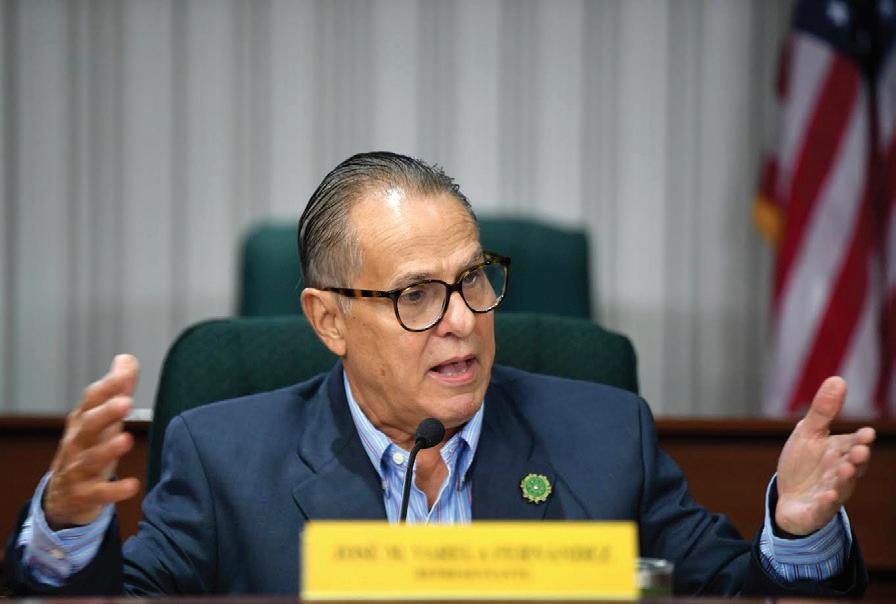
Representante José “Conny” Varela exige total transparencia en el proceso de adquisición de nuevas máquinas de escrutinio electrónico
POR
EL STAR STAFF
CAGUAS – El representante popular por Caguas, José “Conny” Varela, urgió el domingo a la Comisión Estatal de Elecciones (CEE) a divulgar de manera inmediata y detallada toda la información relacionada con el proceso de compra o alquiler de nuevas máquinas de escrutinio electrónico, luego de que trascendiera públicamente que la agencia ya inició gestiones para su adquisición.
Varela señaló que, tras el fiasco administrativo y operacional asociado al suplidor anterior, Dominion Voting Systems, el país exige y merece un proceso completamente transparente, abierto al escrutinio público y libre de cualquier duda sobre la pureza de la transacción.
“La CEE administra el corazón del sistema democrático: el voto. Por eso, cualquier proceso de adquisición de maquinaria electoral debe manejarse con absoluta claridad. El pueblo tiene derecho a saber qué empresas están participando, cuáles son los criterios de evalua-
ción, cuánto costará el contrato y cómo se garantizará la confiabilidad del sistema”, expresó Varela.
El legislador destacó que, a pesar de la magnitud del asunto, la Comisión ha comunicado muy poco sobre el proceso, lo que podría generar preocupación entre
electores y funcionarios electorales.
“No puede repetirse la experiencia pasada. La falta de información solo alimenta la desconfianza. La CEE debe comunicar de forma constante, proactiva y accesible. No se trata de un trámite administrativo más; se trata de proteger la integridad del voto y la credibilidad del sistema electoral”, añadió.
Varela adelantó que solicitará formalmente a la CEE un informe detallado sobre el estado del proceso, incluyendo propuestas recibidas, criterios de evaluación, análisis de costos, garantías de funcionamiento y cualquier recomendación técnica emitida por personal interno o asesores externos.
Asimismo, reiteró que desde la Cámara de Representantes ejercerá su función fiscalizadora para asegurar que la adquisición se realice conforme a la ley, con eficiencia, transparencia y responsabilidad fiscal.
“El país no tolerará improvisaciones ni decisiones tomadas a puertas cerradas. La democracia exige publicidad y transparencia. La CEE debe abrir este proceso al escrutinio público de inmediato”, concluyó.
Le pegan fuego a las cámaras de seguridad del municipio de Yauco
YAUCO
– Las autoridades investigan una querella de daños y vandalismo reportada a eso de las 11:12 de la noche del sábado, en la calle Manuel Negrón, en Yauco.
Según la información provista por la Policía, emplea-
dos del municipio instalaron recientemente un sistema de cámaras portátiles. No obstante, alrededor de las 11:00 de la noche, varios individuos le pegaron fuego, por lo que el equipo se destruyó en su totalidad.
Los daños fueron estimados en 65 mil dólares.
El agente Edgar Cordero Caraballo, adscrito al Distrito de Yauco, investiga.


‘A Little Prayer,’ ‘Splitsville’ and more streaming gems
By JASON BAILEY
‘A Little Prayer’ (2025)
David Strathairn led the all-star cast of “Good Night and Good Luck” in 2005, got an Oscar nomination for his trouble, and then … kept right on being David Strathairn, making small movies with lesser-known directors (rather than cashing in as, say, a Marvel villain). He’s particularly good, in all of his specific ways, in this modest drama of a quietly messy family, from writer-director Angus Maclachlan. As the patriarch Bill Brass, Strathairn is solid as a rock; he knows this guy to the marrow of his bones, and the anguish and indecision of MacLachlan’s script offer him much to play, but (as ever) he underplays beautifully.
The surrounding performers are excellent, but this is Strathairn’s show; near the end, there’s a tight close-up of his face, that great, gray, weathered face, with miles in its lines and pain in its eyes, that makes you realize what a treasure we have in this actor. (Stream it on Amazon Prime Video.)
‘Splitsville’ (2025)

The filmmaking team of Michael Angelo Covino and Kyle Marvin (with both as writers and stars and Covino directing) fulfills the promise of their 2020 debut feature “The Climb” with this ferociously funny and unexpectedly poignant examination of two faltering marriages further confused by the illusion of sexual freedom. Joining the two are Dakota Johnson and Adria Arjona as the women in their lives, baffled by these men and their pettiness and indecision; such roles are often thinly drawn barnacles or empty eye candy when viewed through the gaze of male filmmakers, but to their credit, Covino and Marvin write them most of the best lines, and all of the keenest insights. (Stream it on Hulu.)
‘21 Bridges’ (2019)
When contemplating the tragically early death of Chadwick Boseman, it’s easy to focus either on his powerful presence in prestige pictures (like “Ma Rainey’s Black Bottom”) or his injection of charisma and personality into
tentpole movies (such as “Black Panther”). But Boseman was the kind of movie star who could do anything, and this police procedural proves that point. It’s the kind of corrupt-cop drama that old-school directors like Sidney Lumet made their bread and butter, and Boseman anchors it with the kind of gravity and gravitas that recalls Al Pacino in his heyday. The ace supporting cast includes Stephan James, Taylor Kitsch, Sienna Miller and J.K. Simmons. (Stream it on Netflix.)
‘News of the World’ (2020)
Of all the movies relegated to home consumption and quickly forgotten during the COVID lockdown, few have lost more of their impact, or been as unjustly memory-holed as this modest Western drama, which reunited Tom Hanks with his “Captain Phillips” director Paul Greengrass. Set in Texas in the 1870s, it features Hanks as a Civil War vet who makes his living traveling from place to place with a stack of newspapers, sharing the events of the outside world. It’s a meager but easy living,
complicated when he takes it upon himself to deliver an orphaned girl (Helena Zengel, excellent) to faraway relatives. Greengrass’ frontier photography is gorgeous, but the real journey here is an emotional one, and at its best, “News” recalls the psychological prickliness of classic Westerns by Anthony Mann and Budd Boetticher. (Stream it on Peacock.)
‘Decision to Leave’ (2022)
This year’s Oscar snub of “No Other Choice” was somewhat shocking — but unsurprising to fans of its director Park Chan-wook, who has somehow never been recognized by the Academy. The dismissal of this, his previous effort, was even more egregious; it’s the kind of virtuosic, spellbinding filmmaking that’s hard to ignore, a “Vertigo” riff that folds in contemporary elements of erotic thrillers and cop dramas with the kind of dazzling stylistic flourishes that have defined this South Korean master since his breakthrough film, “Oldboy.” Staggeringly erotic and quietly heart-wrenching, it’s one of his finest works to date. (Stream it on Hulu and Mubi.)
‘The D Train’ (2015)
This good-natured comedy starts off like many a post-Apatow bromance, with Jack Black as Dan, a once-and-forever square who, as a planner for his 20th high school reunion, reconnects with handsome jock Oliver (James Marsden), whom he still sees as a golden god among men. But writer-directors Jarrad Paul and Andrew Mogel take Dan’s admiration a step further than your typical mainstream comedy, as the two men’s bond quickly progresses from emotional to physical, and perhaps the most admirable quality of “The D Train” is how cheerfully it takes that turn, studiously avoiding the casual “gay panic” homophobia present in far too many films of its ilk. Marsden finds just the right note as the man of Dan’s dreams, and Kathryn Hahn is (as usual) terrific as Dan’s confused spouse, but this is one of Black’s most splendid performances, turning what could have been a one-joke character into a complicated, knotty, nuanced portrayal of late-30s ennui. (Stream it on Netflix.)
‘Clerk’ (2021)
This biographical documentary, covering the life and career thus far of filmmaker, podcaster and all-around raconteur Kevin Smith isn’t exactly a hard-hitting, deeply probing exposé — Smith is a longtime friend and occasional producer for director Malcolm Ingram. But that proximity ultimately works in the film’s favor, allowing Ingram access not only to rare archival materials but also to moments of genuine candor and emotion that peek out from behind Smith’s carefully cultivated public persona.
The title comes from Smith’s debut feature, “Clerks,” the 1994 low-budget marvel that put him on the map, and while that and his subsequent pictures are covered, this is less of a director profile than a study of the strange evolution of his singular career, as he’s become known less as filmmaker than as a pop-culture mascot and enthusiast. “Clerk” shambles and rambles a bit, but so does its subject — and like Smith, it’s charming, kindhearted and frequently funny. (Stream it on Amazon Prime Video.)

Stocks
Private credit sector stresses could be catastrophic, but not just yet
Some investors think private credit is a tempest in a teapot. Others think it is about to spark a new financial crisis. Depending on the time horizon, both sets of views about the esoteric sector may be right.
Signs of trouble in the obscure world of private lending, which had soared in popularity with companies looking for quick bespoke debt and investors seeking high returns, have been brewing since the middle of last year.
The pace at which investors are demanding money back from some of the private credit funds, known as business development companies (BDCs), has accelerated this year on worries about competition, falling returns and fears artificial intelligence will upend software businesses financed by them.
Blue Owl Capital was the latest BDC to report it received a historic level of redemption requests this week and was limiting withdrawals, which it is allowed to do.
Other big players such as Ares Management, Apollo Global, Blackstone, KKR and private credit arms of banks such as Morgan Stanley, J.P. Morgan, Goldman Sachs have also capped redemptions.
Most have signalled the redemptions showed the private credit industry was going through a period of recalibration, rather than a crisis.
Still, other signs of stress have emerged. BDCs are getting hit with higher rates on their bank borrowings even as the historically high double-digit returns they make on private lending shrink.
“You’re going to have credit cycles, you’re going to have losses, you’re going to have some markdowns. I mean, they’re not lending at 5% for a reason, right?” said John Giordano, managing director of New York-based Seaport Global Holdings.
Giordano doesn’t believe risks are systemic, pointing to how BDCs have low leverage, hold senior debt or are involved through equity holdings in the management of their companies. He also cited how well capitalised the banking sector is.
Private lending bloomed after the 2008 financial crisis, becoming the alternative to bank finance for private equity firms seeking to acquire medium-sized businesses via long-term loans with simpler covenants and high returns.
Data on exact exposures, valuations and losses at BDCs remains sequestered, given they are private deals, but they collectively hold more than half a trillion dollars of private assets. The private credit industry, the Alternative Investment Management Association estimates at $3.5 trillion, is big enough to be consequential for financial markets.
Share prices of some of the publicly listed BDCs have fallen sharply this year, trading at a roughly 20% discount to their net


asset values. Shares of U.S. software services firms, the sector most closely linked to private credit, have also fallen by a fifth this year.
Rory Dowie, equity portfolio manager at Marlborough in London, said his firm has cut exposure to some of these asset managers and even shed holdings in Swiss private equity firm Partners Group, whose chair Steffen Meister said last month default rates in private
PUERTO RICO STOCKS

Abodada-Notario
• HERENCIAS | QUIEBRA | DERECHO Hogar Seguro Testamento

jrclegalsolutions tuabogadapr@outlook.com
Urb. Villa Blanca 76 Calle Aquamarina Lcda.Jeanette Rodríguez COMMODITIES CURRENCY

HOLDINGS SUMMARY

credit could double over the next few years owing to AI-driven economic disruption.
Dowie says the symbiotic relationship in AI-financing between public and private markets could result in a snowball effect. “It’s hard to say what’s going to crack first... and it becomes a self-fulfilling prophecy whereby you could get a bigger, more systemic issue occurring.”
Javier Corominas, director of global macro strategy at Oxford Economics, said in a note this week the market is already in the early stages of a rolling crisis in private credit, based on estimates that 25%–35% of these portfolios are subject to AI disruption risk.
The San Juan Daily Star
Dozens killed in Haiti massacre as international force trickles in
By ANDRÉ PAULTRE and FRANCES ROBLES
Ilres Théophile, a farmer living north of Haiti’s capital, said he woke in the middle of the night last Sunday to the unmistakable sound of heavy gunfire. Gran Grif, a feared gang in the area, had warned for days that it planned to attack a nearby community.
He fled, returning after sunrise to find carnage in the streets. Théophile’s three brothers and his son were among the dead. Homes, including his, were in flames. Gran Grif’s coordinated assault on at least eight towns in the agricultural Artibonite region left as many as 70 people dead.
“My son died with his eyes open,” said Théophile, 55. “We didn’t expect such horror.”
The massacre took place a few days before the arrival of the first wave of a United Nationsbacked, multinational force created to quell the spiraling gang violence that has gripped Haiti for years. While the new Gang Suppression Force is expected to take a more aggressive approach than previous efforts, the slaughter in Artibonite underscored the challenges facing both the new force and Haitian police in confronting the heavily armed groups.
The understaffed and ill-equipped police were delayed in responding to the violence because the gang had set up roadblocks, according to both police and human rights activists. When police left the scene after a few hours, the gang returned and set homes ablaze.
“These are terrorists; it’s not something for a police operation,” said Pierre Espérance, executive director of the National Human Rights Defense Network, a leading human rights group.
Estimates of the death toll range from 42 to 70. Regardless of the exact tally, the U.N.backed force is not expected to field a full, 5,500-member contingent until the fall, leaving Haitians trapped in the crossfire of a war for power, money and territory.
Nearly 6,000 people died in gang violence in 2025, and more than one-tenth of the country’s population, about 1.4 million people, have been uprooted from their homes, according to U.N. figures.
In 2024, foreign police officers, mostly Kenyan, arrived to back the fledgling Haitian National Police, but they have failed to stop the rampant killings. The new Gang Suppression Force, approved by the U.N. Security Council in September, will be more militarized and act more independently.

Members of the Kenya MSS patrol the National Port Authority in Port-au-Prince, Haiti, Sept. 25, 2024. Gangs tore through several rural communities last weekend, underscoring the challenges that will face the new, U.N.-backed Gang Suppression Force starting to enter the country. (Adriana Zehbrauskas/The New York Times)
Last year, the Haitian government hired military contractors led by Erik Prince, a supporter of President Donald Trump best known for previously owning Blackwater, the private military company. A task force he advises has carried out drone strikes in the metropolitan areas of the capital of Port-au-Prince, but has yet to capture or kill any high-profile gang leader.
Private contractors and international forces have focused mostly on the capital, leaving gangs unchecked in rural areas north of the city, experts say. But in recent months, the gangs seemed to retreat as police secured some roads. More anti-gang operations north of Port-au-Prince are expected in the coming weeks, according to a person familiar with the effort who spoke on the condition of anonymity to discuss sensitive matters.
The person said police appeared to be improving, and that the arrival of the new multinational force — with soldiers and police officers from Latin America, Africa and Asia — should strengthen the authorities’ hold on areas that have already been cleared and help expand operations.
“The gangs in general were in a bit of a retreat, until this happened,” said Carlos Ruiz Massieu, the special representative for the U.N. secretary-general in Haiti. “Even though
there have been some gains in security forces, still, there are challenges in terms of sustaining those gains.”
But the Artibonite killings may signal that gangs are exploiting a transition period, with the Kenyan police leaving in stages, well before the arrival of the full U.N.-backed contingent.
“There’s a transition period now that’s also quite dangerous,” said Bill O’Neill, the U.N.’s human rights expert in Haiti. He predicted that gangs would test the new force to gauge its power, especially before it reaches full strength.
Human rights activists and experts said the massacre was particularly troubling because of reports that it involved so-called selfdefense groups, armed vigilantes. The groups, ostensibly formed to fight the gangs, are in some cases little more than gangs themselves. One person involved in the Artibonite assault had reportedly defected from a self-defense group and joined the gang, experts said.
“The people of the Artibonite region are held hostage between the armed self-defense brigades and armed gangs,” said Bertide Horace, a community leader. “The self-defense brigades are also terrorizing the population. The state’s absence in the Artibonite Valley leaves the population to fend for itself.”
The Sunday morning violence began about 2 a.m., when Gran Grif, based in the Savien area, attacked the town of Pon Benwa, before moving on to other towns, according to a preliminary report by the National Human Rights Defense Network. A self-defense group tried to fight back but was outgunned and forced to retreat, the report said.
Gang members forced residents out of their beds, gathered them in courtyards and in the streets, and shot dozens of them, said a senior diplomat who was familiar with the events but not authorized to speak publicly.
An unknown number of people went missing and were presumed abducted.
“Many terrorists from the Savien group were firing in all directions,” Kendy Jean, 41, a teacher who now works as a farmer, said in an interview. “And they fired for hours.”
He said the region felt ignored because police had concentrated their efforts on the capital. “The state has completely abdicated its responsibilities,” he added. “We are alone.”
He said his neighbors counted between 45 and 50 dead. People lost their phones in the mayhem and will not know if a gang member calls to ask for ransom for people they abducted, he said.
In a statement on the social platform X regarding that night, the Haitian National Police said their operations were yielding “great results,” with four gang barricades having been destroyed and several criminals “neutralized.”
Lyvenson Gauthier, a police commissioner in Saint Marc, which encompasses the areas that were hit, said in an interview that townspeople had so far brought 16 bodies to the morgue. People in the region also said that some families buried their own dead.
“The number of cases could be higher, as well as residents who may be missing, but we cannot yet confirm other cases,” he said.
The prime minister, Alix Didier Fils-Aimé, released a statement offering condolences and vowing swift action against the perpetrators.
“The determination of the government is total: restore the republican order, protect the population and regain control of the national territory,” he said. “The state is engaged in a win-back dynamic.”
Théophile, whose son and brothers died, said the government needed to do more.
“Unfortunately, the Haitian state isn’t taking care of us,” Théophile said. “We’re abandoned.”
Iran’s downing of plane and US rescue leave both sides dangerously emboldened
By ERIKA SOLOMON
Iran’s downing of an American fighter plane and the dramatic U.S. mission that followed to rescue a stranded airman provides both countries with fodder to claim a victory, but this chapter could end up propelling them toward further escalation.
Iranian state media on Sunday published photographs of a charred U.S. aircraft and declared that the downing of three American aircraft in three days was a triumph of “divine grace.” Reposting the picture, Iran’s hard-line speaker of parliament, Mohammad Ghalibaf, said, “If the United States gets three more victories like this, it will be utterly ruined.”
From the U.S. perspective, President Donald Trump also emerged emboldened, boasting Sunday about how U.S. forces were able to pull off a risky ground operation and issuing a crudely worded threat that he would begin striking infrastructure targets.
“Tuesday will be Power Plant Day, and Bridge Day, all wrapped up in one, in Iran. There will be nothing like it!!!” he wrote. Calling Iran’s leaders “crazy bastards” and using an expletive, he demanded they open the Strait of Hormuz shipping route, “or you’ll be living in Hell — JUST WATCH! Praise be to Allah.”
Iran is now one day away from Trump’s ultimatum to strike critical Iranian infrastructure if the country does not make a deal with Washington, or open the strategic strait. Attacking bridges or power plants, which could plunge Iran’s population of more than 90 million into darkness, would constitute a war crime.
Washington’s ally in the war, Israel, has already launched strikes on critical infrastructure, including a major pharmaceutical plant and its largest petrochemical complex.
Iran has warned it will retaliate by bombarding similar strategic assets in neighboring Persian Gulf countries. Such escalation could be devastating for millions of civilians in the region, and wreak further havoc on the global economy and the already volatile markets.
“Iran’s approach is not to yield to these threats. Be-

People walk in front of a billboard depicting captured U.S. aircraft in a net in Tehran, Iran, Sunday, April 5, 2026. After Iran shot down a U.S. plane and U.S. forces pulled off a risky ground operation to extricate a stranded airman, both sides claimed victory. That confidence could fuel further escalation. (Arash Khamooshi/The New York Times)
cause if so, Trump will only continue,” said Sasan Karimi, a political scientist at the University of Tehran and the former deputy vice president for strategy in Iran’s previous government. “So Iran will use its maximum capability to retaliate — and not necessarily proportionally, because Iran’s infrastructure is vital, and hitting it is a violation of international law. A war crime, actually.”
With both sides perceiving themselves as at an advantage, there is currently little hope of making progress on a diplomatic solution to end the crisis, said Ali Vaez, the Iran project director of the International Crisis Group, a research organization. “From this point on, this war will become even more dangerous than it was before,” he said.
“This is exactly the kind of escalation trap that results in mission creep — which is if you constantly think that with more targeting and more pressure, you could eventually be able to force the Iranians to capitulate.”
Another question is whether the successful rescue operation inside Iran will encourage Trump to try riskier
things, such as sending limited ground troops onto islands in the Strait of Hormuz or mounting a special operation to seize Iran’s enriched uranium in an effort to cripple its nuclear program.
“It might give the U.S. more confidence that they can do it,” said Farzan Sabet, an analyst of Iran and weapons systems at the Geneva Graduate Institute in Switzerland.
While the successful Iranian strikes have raised doubts about U.S. and Israeli claims of having established “air dominance” over Iranian territory, Sabet said, U.S. forces may instead conclude they were simply too lax by allowing nonstealth aircraft to fly at low altitudes in a region where they may not have expected Iran to have air defenses.
Yet observers say Iran has now repeatedly shown itself able to strike at U.S. aircraft in ways that should give Washington pause before any further escalation of the war. Iranian forces have hit a base in Saudi Arabia, striking two U.S. KC-135 aerial refueling planes and destroying an American E-3 early warning detection system. Iran has also been successfully shooting down Israeli and U.S. drones, some military analysts say.
And in retaliation for attacks on its water, energy and other infrastructure, it has been launching strikes on similar targets across the Gulf.
“In terms of Iran being able to conduct those offensive operations, what they’ve shown us is that when they — so far, more than a month into the war — when they need to hit a target, they can hit,” Sabet said.
If U.S. forces were to move forward with the kind of major attacks Trump has threatened, Iran could respond, depending on what was targeted, by hitting desalination facilities that could endanger Gulf citizens’ access to fresh water — or by hitting gas and oil installations, which would plunge markets further into turmoil.
Karimi, the former Iranian official, urged Arab countries in the Gulf to pressure Washington to back down from such a confrontation.
“Whether it is justified or not from their point of view,” he said, “the whole region will be unsafe while Iran is unsafe.”

Economists once dismissed the AI job threat, but not anymore
By BEN CASSELMAN
Among tech evangelists in Silicon Valley, it has become conventional wisdom that artificial intelligence will rapidly reshape the labor market, for better or worse. Economists, however, have often discussed AI’s impact with a skepticism bordering on dismissiveness.
Rising unemployment among young college graduates? The result of high interest rates and macroeconomic uncertainty. Dire predictions of widespread job losses? A failure to understand the lessons of past technological revolutions. Even the layoffs that companies themselves blamed on artificial intelligence were often chalked up to “AI-washing” from executives looking for something to blame other than their own mismanagement.
Recently, however, the message from economists has undergone a subtle change. Most still do not see much evidence that AI is disrupting the job market. But they are starting to take seriously the possibility that it could someday soon. If it does, they are worried that policymakers are not ready to respond.
“I don’t think AI has hit the labor market yet, and I don’t think it’s radically changed corporate productivity yet, either, but I think it’s coming,” said Daniel Rock, a University of Pennsylvania economist who has studied the economic impact of artificial intelligence.
In a working paper published this week, a team of researchers surveyed economists about their outlook over the next five and 25 years. Most expect the economy to grow a bit more quickly as AI improves, but not to diverge substantially from historical patterns. If the technology improves rapidly — a possibility they consider unlikely but plausible — they envision a far more drastic scenario with faster growth but also greater inequality and the disappearance of millions of jobs.
“Economists are certainly taking AI seriously,” said Ezra Karger, an economist at the Federal Reserve Bank of Chicago who was one of the study’s authors.
Economists’ expectations for the future looked relatively similar to those of AI industry insiders, who were also surveyed for the study. Both groups agree the future is uncertain: AI could either wipe out whole categories of jobs or cause few job losses. Its effects could be concentrated among entrylevel white-collar workers or spread to more experienced workers and those in blue-collar

Artificial intelligence hasn’t disrupted the labor market, economists say, but they are increasingly convinced that it will — and that policymakers are unprepared. (Maxime Mouysset/The New York Times)
jobs. The changes could upend the economy within years or take decades to play out.
Given the potential scale of the disruption, economists say it is time to start considering the policies that could help workers displaced or otherwise harmed by the changing economy — something that societies often failed to accomplish in past technological transitions.
“There’s enough conversation around this that we certainly should, as a country, be talking about what sorts of policies make sense in a world where the way employment and careers work now changes a lot in the next two to five years,” said Robert Seamans, an economist at New York University.
A paradigm shift
When OpenAI released ChatGPT to the public in November 2022, Alex Imas, an economist at the University of Chicago, did not necessarily see it as an economic game changer, he said. The technology was powerful but limited, prone to mistakes and incapable of producing work with the quality and consistency necessary for most professional applications.
“I knew it was important, but I was definitely on the more skeptical side when it first came out,” Imas recalled.
For Imas, the real shift came in late 2024, when OpenAI released a model capable of “reasoning,” meaning it could work through a question step by step before producing an answer. That ability greatly expanded the type of problems the model could tackle, and made it more reliable at solving them.
“It was just a paradigm shift for me,” Imas said. “And then I started thinking, ‘This is po-
tentially an industrial revolution-scale event, if not more.’”
For other economists, the shift came just in the past few months, with the release of Claude Code — a tool from AI company Anthropic that writes computer code from users’ prompts — and the widespread rollout of AI “agents,” autonomous systems capable of performing tasks directly.
“These conversations have been, in my opinion, overly focused on what the technology can do,” said Martha Gimbel, the executive director of the Budget Lab at Yale University. “There’s plenty of technology that could have changed things and didn’t.”
Many hospitals kept patients’ health records on paper for decades after the technology existed to digitize them, Gimbel noted. Videoconferencing tools have existed for years, but it took a pandemic to force companies to embrace them.
There are signs that AI could flow through the economy more quickly than past innovations. Already, nearly 1 in 5 companies report having used AI in the last two weeks, according to data from the Census Bureau, and in some industries the rate is twice as high. Workers report using AI at even higher rates, suggesting many may be experimenting with the tools on their own initiative.
And while AI has not yet had a big impact on aggregate statistics, some economists argue its effects are visible beneath the surface. In a paper published last year, researchers at Stanford University found that employment was declining for entry-level workers in jobs that were highly exposed to AI.
Technological advancements “sometimes take decades” to appear in the economy in the form of increased productivity, said Erik Brynjolfsson, one of the authors of the Stanford paper. “I don’t think it’s going to be decades this time.”
‘How painful is it going to be?’
Brynjolfsson stands out among economists for his confidence in AI’s impact. But his forecasts look sober compared with many coming out of Silicon Valley.
Dario Amodei, the head of Anthropic, has warned that AI could eliminate 50% of entrylevel white-collar jobs within years. Tech investor Vinod Khosla predicted last year that AI would replace 80% of jobs by 2030. Elon Musk has said the technology will render work “optional.”
Many economists dismiss such predictions, arguing that the AI debate should focus
less on where the economy will wind up in the end and more on the potentially difficult period of transition.
“The pressing question is, ‘You’re going to have a technological shock — how painful is it going to be?’” Gimbel said.
The spread of AI does not have to mean large-scale job losses, economists argue. As much as 70% of jobs, by some estimates, are in some way exposed to AI. But that does not necessarily mean those workers are about to be laid off.
In a report published Friday, researchers at Boston Consulting Group estimated that more than half of the jobs in the United States would be “reshaped” by artificial intelligence over the next two to three years but that far fewer would be replaced entirely. Most workers perform a range of tasks in their jobs, only some of which can be done reliably by AI. And even where it may be possible to replace a worker, companies are proceeding cautiously because the stakes are higher if humans are no longer signing off on the computer’s work.
If the AI revolution plays out gradually, it will give workers time to adapt. Older workers can finish out careers, while younger ones can learn relevant skills or change careers entirely. If AI’s impact is limited to certain sectors, that will make it easier for workers to find opportunities in other parts of the economy.
But a broad, rapid change will give workers little time to adapt, and few places to hide.
“If speed is slow, then you have time for employment to adjust, for new roles to be created,” Imas said. “There’s disruption, but not something we haven’t seen before. But if it’s fast, you can get really wacky things start happening.”
How to prepare
However AI affects the labor market, economists say policymakers should act now to modernize programs that could help displaced workers.
The unemployment insurance system, for example, excludes many of the new graduates who are likely to be hit first by AI. Retraining programs are often slow-moving and poorly funded.
But some economists worry that such tools are not up to the challenge.
“In the past, our social safety net was designed to help people over transitory shocks,” said Anton Korinek, an economist at the University of Virginia. “This one might actually be a more permanent shock.”
Could a blood test predict if you’ll get Alzheimer’s?
By DANA G. SMITH
Could a simple blood test predict your risk of getting dementia years, or even decades, before you experience memory loss?
That’s the potential promise of a new class of biomarker tests. Two were approved last year by the Food and Drug Administration to help diagnose people with Alzheimer’s disease if they have symptoms of dementia. Scientists are now studying whether these types of tests can also identify who is at risk for Alzheimer’s long before symptoms appear: One recent paper found they might be able to predict the onset of dementia symptoms as many as 20 years ahead of time.
The push to diagnose Alzheimer’s at the earliest possible stage, even before symptoms occur, coincides with a push to develop treatments to prevent or delay cognitive decline. Clinical trials on a few drugs are currently underway, with results expected in 2027.
But the tests aren’t perfect. Here’s what to know about their current capabilities and shortcomings, and what they might be able to do in the future.
How do the tests work?
In the brain, Alzheimer’s is characterized by two proteins, amyloid beta and tau, that become dysfunctional, forming plaques and tangles that damage neurons. Amyloid plaques can emerge up to 20 years before dementia
symptoms start to occur, whereas tau tangles come later, often coinciding with the onset of cognitive impairment.
“We think of tau tangles and neurodegeneration as the raging fire that does the most damage in people with Alzheimer’s disease,” said Dr. Eric Reiman, the chief executive of the Banner Alzheimer’s Institute and a founder of ALZpath, a biotech company that developed and sells one of the tests. “I think of amyloid plaques as the smoldering kindling, not causing much damage itself, but leading to that raging fire.”
An Alzheimer’s diagnosis is partially based on the presence of amyloid plaques in the brain. Traditionally, that has been confirmed using PET scans and cerebrospinal fluid tests, but those tests are expensive and invasive, and many patients do not receive them. Because of this, researchers have been looking for a blood test to use as a diagnostic tool instead.
Initially, scientists tried to develop blood tests for amyloid, but they ran into several challenges. “Amyloid in blood is really complicated to measure,” said Thomas Karikari, an associate professor of psychiatry at the University of Pittsburgh. For one, there’s “a lot of amyloid that gets into blood that’s also made from non-brain sources, like the heart,” he said.
But researchers discovered that blood tests measuring a modified form of tau could be a good proxy for amyloid buildup in the brain. That’s because, while tau tangles come later, the tau protein starts to become modified and dysfunctional around the same time amyloid plaques form. The tests that are currently available are referred to by a number — like pTau181 or pTau217 — that indicates the location of the modification on the tau protein.


Scientists aren’t exactly sure why amyloid accumulation is so closely linked to tau modification, but one theory is that it’s the amyloid plaques that cause the modifications to occur.
The tests can tell someone that the amyloid is “bothering the tau, and that unfortunately they’re at increased risk for getting the tau tangles and cognitive decline,” said Dr. Reisa Sperling, a professor of neurol-

The tests could help to improve dementia care, but scientists say there are still some caveats and unknowns. (Ricardo Tomás/The New York Times)
ogy at Harvard Medical School.
How accurate are the tests for people with dementia symptoms?
The tests have been shown to be about 90% accurate at detecting the presence of amyloid plaques, helping doctors determine whether a patient’s cognitive impairment is being caused by Alzheimer’s or if they should consider a different disease.
“With these blood tests, we really think that there is a possibility of providing many more people with a diagnosis, which is really exciting,” said Dr. Suzanne Schindler, an associate professor of neurology at WashU Medicine in St. Louis.
The accuracy of the tests depends on how much modified tau is in the blood. If the levels are very low, experts feel fairly confident a person does not currently have amyloid deposits in the brain, and if the levels are high, then there is a very strong chance the patient does. But people with levels in the middle are more ambiguous. In those cases, experts often recommend getting a PET scan or cerebrospinal fluid test to confirm an Alzheimer’s diagnosis.
What if you have no symptoms but are worried about getting Alzheimer’s someday?
There’s a lot of excitement about using the tests to screen people who might develop Alzheimer’s symptoms in the future, and some direct-to-consumer lab test startups, like Function, already offer them. But the experts interviewed for this article tended to recommend against that, for now.
For one, the tests are less accurate at detecting amyloid plaques in people without cognitive impairment. If someone has a nega-
tive test, that person very likely does not have signs of Alzheimer’s in the brain, said Dr. Christopher Rowe, the director of the Australian Dementia Network at the University of Melbourne. But if the test comes back positive, he estimated, it’s a 50/50 chance whether the person has plaques or not.
“I’m being a little pessimistic perhaps, but the message is if you do have a positive result, there’s a fair chance it’s a false positive,” he said.
And unfortunately, if someone does have amyloid plaques in the brain, there isn’t much that can be done about it right now. A couple of studies have found that physical activity and other lifestyle interventions may help lower tau blood levels or delay tau tangles from developing. But until the results from the clinical trials aiming to delay dementia come out, that’s the extent of the current options.
Will the tests ever be used to predict Alzheimer’s?
Many experts think the tests will eventually be used for pre-dementia screening. Some even speculated that they would be used widely, similar to mammograms or colonoscopies.
Scientists are working to improve the tests’ prediction capabilities, including by developing algorithms that incorporate dementia risk factors like age, sex, race and genetics.
“Let’s say you come and you are 67 and you’re a woman and depending on your family history you want to know, What is my risk in two years, five years, 10 years?” Sperling said. “That’s the kind of data that I think people are working on right now, the individualized risk prediction.”
It also depends on the findings from the dementia prevention clinical trials (both Reiman and Sperling are involved in them). The trials are testing two drugs that treat Alzheimer’s by removing amyloid plaques from the brain. The hope is that if this is done early, the tau tangles won’t develop, which would prevent neurons from dying. If that pans out, the experts said, there will be good reason to identify people with signs of Alzheimer’s in their brains before they possibly develop cognitive decline.
But that’s still a big if. Other studies testing earlier versions of the drugs were not effective at preventing or delaying dementia in people at risk for Alzheimer’s.
“It’s a remarkably exciting time, but data wins at the end of the day,” said Reiman, who led one of the earlier studies. “There’s no guarantee. We’ve always been burned, but there’s reason to be especially hopeful.”
Jonatan Ramos Director Funerario
San Juan Daily Star
What’s new in Bangkok
By SETH SHERWOOD
Travelers have been flooding Bangkok, elevating it into the most visited city on the planet. And it’s not just tourists. International five-star hotel chains, global luxury brands and renowned chefs are jockeying for prime spaces amid the traffic-packed boulevards and soaring skyscrapers of Thailand’s capital, boosting the street-food mecca into a highend playground.
But Bangkok, which this year is included in The New York Times Travel section’s 52 Places to Go, offers much more than bling. Numerous new independent hangouts — back-alley bars, small hotels, easygoing restaurants — are adding to the city’s cool factor with less fanfare and more street cred. And with an art scene driven by edgy new galleries and museums, the city is rising as a bohemian getaway as well.
Hotels
You can hardly hurl a pillow menu in Bangkok without hitting a new upscale hotel from Aman, Hilton, Hyatt, Standard or another global-hospitality juggernaut. And this year’s expected new openings — including a Fairmont, a Langham and two Nobus — promise even more spas and welcome drinks.
Bangkok’s most soulful new places to sleep, however, are more confidential. Are you a fan of the HBO series “The White Lotus?” Motor your boat across the Chao Phraya River to the elegant Siri Sala Private Thai Villa, featured in an episode of the show. (You can also arrive by car.)
Opened in 2022 as a rentable vacation home and events space, this white Mediterranean-style villa reinvented itself last year as a canal-side, five-room boutique hotel, complete with a boat dock, a spa, a garden, a saltwater pool and a chef. Prices for doubles start at 29,425 baht, or about $908.
Nestled among art galleries and design boutiques in the Talat Noi neighborhood, the 12room Blu Dock Restel Bangkok is a husbandand-wife venture where water is a key element. Though the playful space has no actual dock or access to the nearby Chao Phraya, the river’s blue waters and blue-orange tugboats influenced the hotel’s color scheme and other touches.
“I have loved traveling by boat along the river since childhood,” said Piyanuch Saeju, one of the owners. “We wanted to reflect that feeling in the guest experience.”
Behind a blue door, the lobby is decorated with books, ceramics, porthole-like windows and a 5-foot-tall wicker dog statue. Upstairs, airy, uncluttered rooms contain pink marble tables, traditional Chinese wooden doors and
maritime-blue curtains. Prices for doubles start at 1,839 baht.
Art
Three years ago, New York City gallerist Harper Levine visited Bangkok for the first time in decades and was “amazed” by it.
“It was immediately clear the city had remarkable energy and promise,” he said, comparing it to “a younger New York.”
Levine secured a space in Siam Patumwan House, a sleek office tower, for his own gallery, Harper’s Bangkok, opening with a show by American painter Joel Mesler.
“I expect Bangkok to rise quickly as a serious destination for the art world,” Levine said.
Two new venues are leading that rise. One, Bangkok Kunsthalle, occupies a gutted former printing plant full of raw concrete surfaces and tangled electrical cables.
With guidance from Stefano Rabolli Pansera, a former director of the Hauser & Wirth gallery in London, and a board that includes Jessica Morgan, director of the Dia Art Foundation, the space hosts both international and Thai artists. Past exhibits have included Yoko Ono’s “Mend Piece,” a long table piled with ceramic shards that visitors are encouraged to reassemble, and the mystical black-on-white abstract paintings of Thai-Chinese artist Tang Chang. A sister site, Khao Yai Art Forest, displays avant-garde outdoor works by French American artist Louise Bourgeois and other artists on 89 acres about three hours by car from Bangkok.
Bangkok’s other new big art museum, Dib Bangkok, opened in December. Kulapat Yantrasast, a Thai architect who has executed projects for the Louvre and the Metropolitan Museum of Art, has transformed a onetime warehouse into a symphony of geometric forms by outfitting the main building with triangular rooftop fins, a conical tower and a tubular turret (which houses a James Turrell exhibition). Large, stone spheres by Polish artist Alicja Kwade fill the rectangular courtyard.
Until Aug. 3 the inaugural exhibition, “(In) Visible Presence,” showcases works by 40 international artists, including Anselm Kiefer and Bourgeois, and Thai figures like Somboon Hormtientong, whose room of fallen temple columns ranks among the show’s most powerful creations.
Restaurants
Pichaya Soontornyanakij, named the world’s best female chef last year by the World’s 50 Best Restaurants, landed like a meteorite in the Bangkok dining scene in 2021 when she opened Potong in an old Chinatown shop house.
Her newest venture, Khao San Sek, opened
April 6, 2026 15
last year in a nearby historical townhouse jazzed up with street art and mirrored mosaics. The menu divides dishes into five categories, depending on which “sacred ingredient” of Thai cuisine — rice, coconut, chiles, palm sugar or fish sauce — figures prominently. Recent menu standouts include slow-cooked fatty beef on toasted brioche with spicy satay sauce (220 baht) and coconut ice cream with custard on brioche under a sprinkling of salted egg (250 baht).
Chef Tae, as the 35-year-old Worathon Udomchalotorn is known, could be Bangkok’s next homegrown star. With a background that includes top American restaurants like WD-50 and Benu, he added to 2025’s stellar restaurant crop with Sakkwa, which is practically hidden on the fourth floor of a nondescript building in Talat Noi.
His precisely executed dishes move seamlessly from delicate seafood concoctions (amberjack sashimi in a light, citrusy peanut sauce, 700 baht) to rich recipes that showcase the Thai terroir (yellow curry with cashews, chicken wings and sliced bananas, 450 baht). The gallery-like white room, abstract paintings and jazzy soul music provide a classy backdrop.
Anyone hungry for additional takes on Thai comfort food should beeline to the convivial, wood-lined dining room of Soma. This contemporary-chic new venture counts Chalee Kader (whose Wana Yook restaurant has one Michelin star) among its owners and serves hearty Thai dishes, both reverent and reinterpreted, amid abstract paintings and an electro-rock soundtrack.
If grilled bee larvae sound too daring, consider the tangy salad with fermented pork and deep-fried rice patties or the loamy mash-up of fried rice, salted mackerel and minced pork in a stone bowl. And you can easily add art to your outing: Levine’s gallery occupies the same building. Dinner for two costs around 2,000 baht.
Nightlife
Bangkok’s thirst for new rooftop cocktail bars is being slaked these days at Sanctuary, which offers a view of the glimmering Sukhumvit strip — Bangkok’s Broadway — 34 floors below. Relaxing under a cathedral-like canopy made from massive wooden sculptures, you are likely to hear DJs mix “Thai Dreamer,” a local deep-house favorite. Try the River Prawn Butter cocktail — a combination of the creamy yellow “butter” from shrimp shells (washed with cognac), St. Germain liqueur, lime, passion fruit, egg white and tonic (480 baht).
The more remarkable trend is spreading below, as worldclass wine bars finally arrive in

Piché, a wine bar in a busy community mall in Bangkok, March 19, 2026. From backstreet wine bars to world-class museums, new spots are sprouting up all over the world’s most visited city. (Lauren DeCicca/ The New York Times)
Bangkok, notably on Sukhumvit’s side streets. Francophiles should slip into Verlan, a classy, glassy building where a well-heeled crowd chatters in the bar and minimalist dining rooms while sipping some 15 French vintages and enjoying French-Thai dishes and bar snacks. For a more spirited soiree, Piché is a candlelit, DJ-fueled, pre-party haven for Bangkok’s gilded youth and young professionals that is also serious about wine. The 10 varieties on tap range from European vintages to a house orange (blended from French pinot gris and pinot blanc), and some lovely surprises lurk in the 150-label cellar, including a merlot aged in amphorae by Japanese winemaker Grape Republic. A deeper dive into Bangkok’s fledgling natural-wine scene awaits at Salon Kiku. Anyone who can find the friendly little spot — through a bending alley, into an undistinguished building and up three flights of stairs — deserves a drink. Fortunately, the bar, where DJs spin vinyl albums, serves plenty. Eastern European macerated wines? Yes. Cult Western European varietals? In abundance. Hard-to-find Japanese bottles? Absolutely.



Ave. Luis Muñoz Marín Y-30, Urb. Mariolga, Caguas , P.R. (787) 744-9168
Horario: Lunes a Viernes | 8:30 AM - 5:00 PM
*SE ATIENDEN EMERGENCIAS*
Atención profesional, cálida y comprometida con tu salud oral.
hoy y agenda
LEGAL NOTICE
ESTADO LIBRE ASOCIADO DE PUERTO RICO TRIBUNAL DE PRIMERA INSTANCIA
SALA SUPERIOR DE BAYAMÓN JUAN VÁZQUEZ VIRELLA
Peticionario Vs EX PARTE
Civil Núm.: BY2026CV00577.
Sobre: EXPEDIENTE DE DOMINIO. EDICTO.
A: Sucesión de Edelmiro Lugo, dueño anterior, o sus herederos, cesionarios o causahabientes, por ignorarse sus nombres, existencia o paradero. Sucesión de Agustín Rivera, colindante por el Sur, o sus herederos, cesionarios o causahabientes, por ignorarse su existencia o paradero. Las personas ignoradas y desconocidas a quienes pudiera perjudicar la inscripción del dominio a favor de la parte peticionaria en el Registro de la Propiedad de la finca que más adelante se describirá y a toda persona en general que con derecho para ello desee oponerse a este Expediente de Dominio. EL ESTADO LIBRE ASOCIADO DE PUERTO RICO, a todo lo que tenga algún derecho real sobre el descrito en este EXPEDIENTE DE DOMINIO, las personas ignoradas a quien pueda perjudicar la inscripción y en general a toda persona que desee oponerse. Por la presente se le notifica que comparezcan, si creyeren que les conviene, ante este Honorable Tribunal dentro de 20 días a partir desde que fueron notificados de esta CITACIÓN, y exponer lo que a sus derechos convenga en el expediente promovido por la parte peticionaria para adquirir su dominio sobre la siguiente finca: RUSTICA: Predio de terreno radicado en el Barrio Cibuco del término Municipal de Corozal, Puerto Rico, con una cabida superficial de SEISCIENTOS OCHENTA Y OCHO PUNTO CUATRO MIL SEISCIENTOS VEINTIUN METROS CUADRADOS (688.4621 mc), equivalentes a cero punto mil setecientos cincuenta dos (0.1752) cuerdas. En lindes por el Norte, con Carretera Estatal número ciento cincuenta y nueve (159); por el Sur, con la Sucesión de Agustín Rivera; por el Este, con calle municipal;
y por el Oeste, con calle municipal. Enclava en el solar descrito, una vivienda de hormigón y bloques propiedad del Sr Juan Vázquez Virella. No consta inscrita en el Registro de la Propiedad. Catastro: 139-000001-33-001. Debe presentar su alegación responsiva a través del Sistema Unificado de Administración y Manejo de Casos (SUMAC), al cual puede acceder utilizando la siguiente dirección electrónica: https://unired. ramajudicial.pr, salvo que se represente por derecho propio, en cuyo caso deberá presentar su alegación responsiva en la secretaria del tribunal. En Bayamón, Puerto Rico, hoy 3 de marzo de 2026. ALICIA AYALA SANJURJO, SECRETARIA REGIONAL. LUISA I. ANDINO AYALA, SECRETARIA AUXILIAR.
LEGAL NOTICE
ESTADO LIBRE ASOCIADO DE PUERTO RICO TRIBUNAL DE PRIMERA INSTANCIA SALA SUPERIOR DE ARECIBO
MARISOL LOPEZ ROMAN
Parte Peticionaria EXPARTE
Civil Núm.: CM2026CV00065. Sala: 401. Sobre: EXPEDIENTE DE DOMINIO. EDICTO. ESTADOS UNIDOS DE AMÉRICA, EL PRESIDENTE DE LOS E.E.U.U., EL ESTADO LIBRE ASOCIADO DE PR, SS. A: FELIX VARGAS RIVERA, LUIS ANTONIO VARGAS RIVERA, HERIBERTO VARGAS RIVERA, HERMINIO ROMAN VARGAS, SUCESIÓN DESCONOCIDA DE JOSE DEL CARMEN VARGAS RIVERA, JOHN DOE, JANE DOE, RICHARD DOE, LAS PERSONAS IGNORADAS Y DESCONOCIDAS A QUIENES PUDIERA
PERJUDICAR LA INSCRIPCIÓN DEL DOMINIO A FAVOR DE LA PARTE PETICIONARIA EN EL REGISTRO DE LA PROPIEDAD DE LA FINCA QUE MÁS ADELANTE SE DESCRIBIRÁ Y A TODA PERSONA EN GENERAL QUE CON DERECHO PARA ELLO DESEE
OPONERSE A ESTE EXPEDIENTE. POR LA PRESENTE se les notifica para que comparezcan, si lo creyeren pertinente, ante este Honorable Tribunal dentro de los veinte (20) días contados
a partir de la última publicación de este edicto a exponer lo que a sus derechos convenga en el expediente promovido por la parte peticionaria para adquirir su dominio sobre la finca que se describe más adelante. Usted deberá presentar su posición a través del Sistema Unificado de Manejo y Administración de Casos (SUMAC), al cual puede acceder utilizando la siguiente dirección electrónica: https://unired.ramajudicial. pr, salvo que se presente por derecho propio, en cuyo caso deberá presentar su alegación en la secretaría del Tribunal. Si usted deja de expresarse dentro del referido término, el Tribunal podrá dictar sentencia, previo a escuchar la prueba de valor de la parte peticionaria en su contra, sin más citarle ni oírle y conceder el remedio solicitando en la petición o cualquier otro, si el Tribunal, en el ejercicio de su sana discreción, lo entiende procedente. RUSTICA: Solar ubicado en el Barrio Piedra Gorda de la Municipalidad de Camuy, Puerto Rico con un área de quinientos seis punto mil cincuenta y cuatro (506.1954) metros cuadrados equivalentes a cero punto uno nueve cinco cuatro cuerdas (0.1288 cdas), en lindes por el NORTE, en una distancia de veintiuno punto ocho seis uno dos metros (8.8612 mtrs) con faja de terreno dedicada a uso público, para futuro ensanche de carretera Municipal, por el SUR, en una distancia de veintidós punto dos tres uno cuatro metros (22.2313mts), con el remanente de la finca de la cual se segrega; por el ESTE en una distancia de veintidós punto cinco tres seis seis metros (22.5366 mts), con el remanente de la finca de la cual se segrega y por el OESTE, en una distancia de veintitrés punto cuatro cinco ocho cero metros (23.4580 mts) con el remanente de la finca de la cual se segrega. Contiene una casa para fines residenciales. Número de Catastro: 027-089-003-01-001. Valor de la propiedad es de Cien Mil Dólares ($100,000.00). La abogada de la parte peticionaria es la Lcda. Lizibel Salazar Acevedo, con oficina en la Avenida Ponce de León 452, Edif. Asociación de Maestros, Oficina 514, San Juan, Puerto Rico 00918-3412, dirección postal P.O. Box 367265, San Juan, Puerto Rico 00936, Tel. 787-475-2288. Se le informa además, que el Tribunal ha señalado vista en este caso para el XXX, a las XXX en el Tribunal de Primera Instancia Sala de Lajas, a la cual usted puede comparecer asistido por abogado y presentar oposición a la petición. Este edicto deberá ser
publicado en tres (3) ocasiones dentro del término de veinte (20) días, en un periódico de circulación general diaria, para que comparezcan si quieren alegar su derecho. Toda primera mención de persona natural y/o jurídica que se mencione en el mismo. Se identificará en letra tamaño 10 punto y negrillas, conforme a lo dispuesto en las Reglas de Procedimiento Civil, 2009. Se le apercibe que de no comparecer los interesados y/o partes citadas, o en su defecto los organismos públicos afectados en el término improrrogable de veinte (20) días a contar de la fecha de la última publicación de edicto, el Tribunal podrá conceder el remedio solicitado por la parte peticionaria, sin más citarle ni oírle. En Arecibo, Puerto Rico, a 9 de marzo de 2026. VIVÍAN Y. FRESSE GONZÁLEZ, SECRETARIA REGIONAL. VANESSA M. GONZÁLEZ MALAVÉ, SECRETARIA AUXILIAR DEL TRIBUNAL.
LEGAL NOTICE
ESTADO LIBRE ASOCIADO DE PUERTO RICO TRIBUNAL DE PRIMER INSTANCIA SALA DE SUPERIOR DE CANÓVANAS MUNICIPIO DE CANÓVANAS, REPRESENTADA POR SU
ALCALDESA LORNNA J. SOTO VILLANUEVA Peticionario V. ADQUISICIÓN DE FINCA 11694 DE LA CALLE PEPITA ALBANDOZ, DEL TÉRMINO MUNICIPAL DE CANÓVANAS; VALENTÍN HACE GONZÁLEZ, ET ALS.
Partes con Interés Civil Núm.: CN2025CV00365. Sobre: PROCEDIMIENTO SUMARIO DE EXPROPIACIÓN
FORZOSA DE ESTORBO PÚBLICO. EDICTO. ESTADOS UNIDOS DE AMÉRICA, EL PRESIDENTE DE LOS EE.UU., EL ESTADO LIBRE ASOCIADO DE P.R., SS. A: VALENTÍN HACE GONZÁLEZ, CARMEN LUISA MONTAÑEZ, también conocida como CARMEN LUISA CRUZ VELÁZQUEZ y como CARMEN LUISA CRUZ DE MONTAÑEZ, por sí y como miembro de la sociedad legal de gananciales compuesta por Carmen Luisa Montañez y Nicolás Montañez Claudio; y NICOLÁS MONTAÑEZ CLAUDIO, por sí y como
miembro de la sociedad legal de gananciales compuesta por Carmen Luisa Montañez y Nicolás Montañez Claudio, JOHN DOE, dueños desconocidos y/o cualquier persona con algún posible interés.
Se le emplaza y notifica que, con el fin público de erradicar el abandono y peligrosidad de propiedades declaradas estorbos públicos, el Municipio de Canóvanas ha radicado en esta Secretaría una Petición de Expropiación Forzosa al amparo de la Ley General de Expropiación Forzosa del 12 de marzo de 1903, según enmendada; la Ley Núm. 107 de 14 de agosto de 2020 conocida como el Código Municipal de Puerto Rico, en su Artículo 2.018 [21 L.P.R.A. § 7183]; la Ordenanza Núm. 32, Serie 2024-2025, aprobada por la Legislatura Municipal de Canóvanas, Puerto Rico el 24 de junio de 2025; y, firmada por su Alcaldesa el día 26 del mismo mes; bajo el procedimiento sumario de expropiación forzosa de estorbos públicos que establece el Artículo 4.012A del Código Municipal establecido mediante la Ley Núm. 114 del 29 de junio de 2024, para adquirir la siguiente Finca: URBANA: Solar: CALLE PEPITA ALBANDOZ de Canóvanas. Cabida: 96 Metros Cuadrados. Linderos: NORTE, en seis metros cuarenta centímetros con la calle Pepita Albandoz. SUR, en seis metros cuarenta centímetros con un solar ocupado por la familia Correa. ESTE, en quince metros con otro solar ocupado por la señora Valentina López. OESTE, en quince metros con otro solar ocupado por la familia. Enclava una casa de madera y techo de zinc destinada a vivienda. FINCA 11694 inscrita al FOLIO 238 del TOMO 259 de Canóvanas. USO PÚBLICO: “CASA PILAR”, proyecto de vivienda digna para envejecientes sin hogar. CATASTRO NÚM.: 089086-034-07-001. JUSTA COMPENSACIÓN: $40,000, a ser consignados a tenor con el Art. 4.012A(f) del Código Municipal. No habiéndose podido emplazar personalmente a las partes con interés antes relacionadas, por desconocer su paradero, este Tribunal ha ordenado que se les emplace por edicto, el cual se publicará una (1) vez por semana, durante 3 semanas consecutivas en un periódico de circulación diaria en Puerto Rico. Se le notifica que, si usted desea presentar objeción o defensa a la incautación de las estructuras descritas,
debe presentar su contestación en este Tribunal dentro del término improrrogable de 30 DÍAS, contados a partir de la última publicación de este edicto, debiendo notificar con copia de la misma a la parte peticionaria, a través de la LCDA. JOSEPHINE M. RODRÍGUEZ RÍOS - RUA 15,736: PO BOX 889 FAJARDO, PR 00738 Email: josephine.rodriguez@gmail.com. De usted no comparecer en el término aquí fijado, el Tribunal le anotará la rebeldía y dictará Sentencia en un término no mayor de 5 días. De usted comparecer o contestar la Petición, el Tribunal citará para juicio, el cual será celebrado en un término no menor de 15 días ni mayor de 30, de haberse contestado la Petición. Expedida por Orden del Tribunal, en Canóvanas, Puerto Rico a 16 de marzo de 2026. LIC. KANELLY ZAYAS ROBLES, SECRETARIA. DENISE TORRES RUIZ, SUB-SECRETARIA.
LEGAL NOTICE
IN THE UNITED STATES DISTRICT COURT FOR THE DISTRICT OF PUERTO RICO VISTAS DE CANÓVANAS I, INC.
Plaintiff V. FEDERAL DEPOSIT INSURANCE CORPORATION, AS RECEIVER OF DORAL BANK, ET ALS.
Defendant Case No.: 16-02568 (FAB). NOTICE OF SALE. To: VISTAS DE CANÓVANAS I, INC., RAMÓN MAC CROHON BLANCO; AND GENERAL PUBLIC.
WHEREAS: On August 27, 2018, and consistent with the terms and conditions of a certain Judgment by Consent and Settlement Agreement executed by the parties, a Judgment (“Judgment”) was entered in favor of plaintiff Bautista Cayman Asset Company, now Bautista REO PR Corp. (“Bautista REO”) against Vistas de Canóvanas I, Inc. (“Borrower”) and Mr. Ramón Mac Crohon Blanco (the “Guarantor” and together with the Borrower, the “Debtors”). The Judgment by Consent granted Bautista REO, among other things, the right to execute the Judgment entered in connection with the Judgment by Consent and request the foreclosure of the Real Estate Collateral, as defined therein and described below, pursuant to the terms and conditions agreed by the Debtors and Bautista REO in the Judgment by Consent and Settlement Agreement. On Fe-
bruary 18, 2026, this Court entered an Amended Order Authorizing Execution of the Judgment (the “Amended Order of Execution”), designating Mr. Joel Ronda Feliciano as Special Master (the “Special Master”) for the execution of the Judgment. On February 19, 2026, this Court entered, in accordance with the Amended Order of Execution, an Amended Writ of Execution (the “Amended Writ of Execution”). The records of the case and of these proceedings may be examined by interested parties at the Office of the Clerk of the United States District Court for the District of Puerto Rico in 300 Recinto Sur St. in Old San Juan, Puerto Rico. WHEREAS: pursuant to the terms of the aforementioned Judgment, Amended Order of Execution, and the Amended Writ of Execution, the undersigned Special Master was ordered to sell at public auction for U.S. currency in cash, or certified or bank manager check without appraisement or right of redemption to the highest bidder and at the office of Rondapro, 441 Calle E, Frailes Industrial Park, Guaynabo, Puerto Rico 00969, to cover the sums adjudged to be paid to the plaintiff, the following property, described in the Spanish language (the “Real Estate Collateral”): Property 15,939: RÚSTICA: Compuesta de 417,287.6511 metros cuadrados, equivalentes a 106.1693 cuerdas, sita en el Barrio Hato Puerto del término municipal de Canóvanas, Puerto Rico. En lindes por el NORTE, con Sucesión José Pagan Mundo y con Sucesión Rafael Calderón Rivera, por el ESTE, con Juan Torres Medina, Pedro Fuster, Neftalí Ortiz, Emilio Vega y con Sucesión Juan Monge, por el SUR, con el Río Canóvanas y por el OESTE, con Río Canóvanas y con la carretera PR 185. Segregada parcela A de 2,912.795 metros cuadrados, parcela B de 100.0937 metros cuadrados, parcela D de 10,746.5396 metros cuadrados y parcela C de 35.3517 metros cuadrados al Estado Libre Asociado de Puerto Rico, fincas 15,997; 15,998; 15,600 y 15,999, respectivamente. NOTA: Luego de efectuadas las segregaciones, no se ha descrito remanente. OBSERVACIÓN: Surge en Karibe la cabida de 4,173,876,514 metros cuadrados Property 15,939 is recorded in favor of Vistas de Canóvanas I, Inc. Property 15,939 is recorded at page 124 of volume 389 of Canóvanas Property Registry, Third Section of Carolina. Property 15,939 was formed by the grouping of properties: 12,668, 12,762, 12,754, 7,712,
and 9,183, recorded at pages 133, 161, 133, 93, and 100 of volumes 382, 382, 384, 54 and 100 of Canóvanas. WHEREAS:
The Real Estate Collateral is encumbered by its origin by: (i) Easement in favor of the Puerto Rico Aqueduct and Sewer Authority. (ii) Easement in favor of the Commonwealth of Puerto Rico, for use and benefit of the Department of Natural Resources of Puerto Rico. (iii) Perpetual easement of way in favor of property number 9,183 as dominant property over property number 7,712 as servient property. (iv) Mention of perpetual easement of way in favor of property number 12,668 as dominant property over property number 12,671 as servient property. (v) Mortgage I securing a mortgage note in favor of Doral Bank, or to its order, in the principal amount of EIGHT HUNDRED AND TWENTY FIVE THOUSAND DOLLARS
($825,000.00), property number 15,939 responding for the amount of FOUR HUNDRED AND TWENTY FIVE THOUSAND DOLLARS
($425,000.00) with interests at Prime Rate, due on its presentation, constituted pursuant to the terms of deed number 411 executed in San Juan, Puerto Rico, on the eleventh (11) of November two thousand four (2004) before Notary Public Elaine Villanueva Martínez, recorded at page 178 of volume 387 of Canóvanas, property number 12,754, 7th recordation. (vi) Mortgage I securing a mortgage note in favor of Doral Bank, or to its order, in the principal amount of EIGHT HUNDRED AND TWENTY FIVE THOUSAND DOLLARS ($825,000.00), property number 15,939 responding for the amount of FOUR HUNDRED THOUSAND DOLLARS ($400,000.00) with interests at Prime Rate, due on its presentation, constituted pursuant to the terms of deed number 411 executed in San Juan, Puerto Rico, on the eleventh (11) of November two thousand four (2004) before Notary Public Elaine Villanueva Martínez, recorded at page 167 of volume 387 of Canóvanas, property number 7,712, 15th recordation. (vii) Pursuant to deed number 25, executed in San Juan, Puerto Rico, on October 2, 2025 before Notary Public Mariana Nácer Elizalde the mortgage in the amount of SIXTEEN MILLION, SIX HUNDRED AND SEVENTY FIVE THOUSAND DOLLARS ($16,675,000.00) (Mortgage II) 5th recordation, was subordinated in favor of the of mortgage in the amount EIGHT HUNDRED AND TWENTY FIVE THOUSAND
The San Juan Daily Star
DOLLARS ($825,000.00)
(Mortgage I), recorded in Volume Karibe of Canóvanas, Property No. 15,939, marginal note. The Real Estate Collateral is encumbered by itself: (i) Easement in favor of the Puerto Rico Telecommunications Regulatory Board, constituted pursuant to the terms of deed number 26 executed in San Juan, Puerto Rico, on the twenty-fourth (24) of april two thousand six (2006) before Notary Public Rodney W. Colon-Ortiz, recorded at page 124 of volume 389 of Canóvanas, property number 15,939, 2nd recordation. (ii) Easement in favor of the Puerto Rico Electric Power Authority, with a value of $1.00, per Certification dated May 18, 2006, recorded at page 124 of volume 389 of Canóvanas, property number 15,939, 3rd recordation. (iii) Restrictive covenants and easement in equity, constituted pursuant to the terms of deed number 35 executed in San Juan, Puerto Rico, on the twenty-eighth (28) of June two thousand six (2006) before Notary Public Rodney W. Colon, recorded at page 124 of volume 389 of Canóvanas, property number 15,939, 4th recordation. (iv) Mortgage II securing a mortgage note in favor of its bearer, or to its order, in the principal amount of SIXTEEN MILLION, SIX HUNDRED AND SEVENTY FIVE THOUSAND DOLLARS ($16,675,000.00), with annual interests at 6%, due on its presentation, constituted pursuant to the terms of deed number 63 executed in San Juan, Puerto Rico, on the twentieth (20) of December two thousand six (2006) before Notary Public Manuel Correa Calzada, recorded at page 183 of volume 391 of Canóvanas, property number 15,939, 5th recordation. (v) The rank of the mortgage that encumbers this property by its origin, for the amount of EIGHT HUNDRED AND TWENTY FIVE THOUSAND DOLLARS ($825,000.00) (Mortgage I) was equaled in rank to that of the mortgage for SIXTEEN MILLION, SIX HUNDRED AND SEVENTY FIVE THOUSAND DOLLARS ($16,675,000.00) (Mortgage II), pursuant to the terms of deed 64, executed in San Juan, Puerto Rico, on the twentieth (20) of December two thousand six (2006) before Notary Public Manuel Correa Calzada, recorded at pages 124 and 183 of volumes 389 and 391, agora of Canóvanas, property number 15,939, on the margin of the 1st recordation. Pursuant to deed number 25, executed in San Juan, Puerto Rico, on October 2, 2025 before Notary Public Mariana Nácer Elizalde the mortgage in the amount of SIXTEEN MILLION, SIX HUNDRED AND SEVENTY FIVE THOUSAND DOLLARS ($16,675,000.00) (Mort-
gage II) 5th recordation, was subordinated in favor of the of mortgage in the amount EIGHT HUNDRED AND TWENTY FIVE THOUSAND DOLLARS ($825,000.00) (Mortgage I), recorded in Volume Karibe of Canóvanas, Property No. 15,939, marginal note 1.6. (vi) A notice of complaint presented on May 18, 2017, which complaint was dated September 4, 2009, issued in the Court of First Instance of San Juan, Civil Case Num. KAC2009-0837, followed by Doral Bank against Vistas de Canóvanas I, Inc., in the principal amount of $6,412,431.29, which notice of complaint is recorded at the Karibe volume of Canóvanas, Property 15,939, Annotation A. Potential bidders are advised to verify the extent of preferential liens with the holders thereof. It shall be understood that each bidder accepts as sufficient the title and that prior and preferential liens to the one being foreclosed upon, including but not limited to any property tax, liens, (express, tacit, implied or legal) shall continue in effect it being understood further that the successful bidder accepts them and is subrogated in the responsibility for the same and that the bid price shall not be applied toward their cancellation. THEREFORE, the FIRST PUBLIC SALE shall be held on APRIL 10, 2026, AT 9:30 AM. The minimum bid that will be accepted is the sum of $825,000.00 in accordance with Mortgage I ($825,000.00).
In the event said first auction does not produce a bidder and the Real Estate Collateral is not adjudicated, a SECOND PUBLIC AUCTION shall be held on APRIL 17, 2026, AT 9:30 AM. The minimum bid that will be accepted is the sum of $550,000.00, which is twothirds of the amount of the minimum bid for the first public sale. If a second auction does not result in the adjudication and sale of the Real Estate Collateral, a THIRD PUBLIC AUCTION will be held on APRIL 24, 2026, AT 9:30 AM, the minimum bid that will be accepted is the sum of $412,500.00, which is onehalf of the minimum bid for the first public sale. The Special Master shall not accept in payment of the Real Estate Collateral to be sold anything but United States currency (cash), or certified or bank manager checks, except in case the Real Estate Collateral is sold and adjudicated to Bautista REO, in which case the amount of the bid made by Bautista REO shall be credited and deducted from its credit; Bautista REO being bound to pay in cash or certified check only any excess of its bid over the secured indebtedness that remains unsatisfied. If the third auction is deserted, Bautista REO may proceed to coordinate the execution of a deed of conveyance with the Marshal
within twenty (20) days of the public sale, to take title of the Real Estate Collateral in partial satisfaction of the Judgment. WHEREAS: said sale to be conducted by the Special Master pursuant to the Amended Order of Execution. Compliance with all foreclosure proceedings are subject to confirmation by the United States District Court for the District of Puerto Rico pursuant to article 107 of the Registry of the Property Act of the Commonwealth of Puerto Rico, (30 L.P.R.A. § 6144), and the corresponding deed of conveyance and possession to the Real Estate Collateral will be executed and delivered by the Special Master after delivery of such Order of Confirmation. Once the Real Estate Collateral is adjudicated in payment of the credit guaranteeing the mortgage(s), and the price does not exceed the value thereof, all junior liens must be canceled provided that said junior creditors be notified of the public sale of said Real Estate Collateral. For further information, reference is made to the Judgment entered by the Court in this case, which can be examined in the Office of Clerk of the United States District Court, District of Puerto Rico. In San Juan, Puerto Rico, on March 4, 2026. JOEL RONDA, SPECIAL MASTER.
LEGAL NOTICE
ESTADO LIBRE ASOCIADO DE PUERTO RICO TRIBUNAL GENERAL DE JUSTICIA TRIBUNAL DE PRIMERA INSTANCIA SALA SUPERIOR DE AGUADILLA
NILSA MÁRQUEZ
VILLAFAÑE, MARÍA DEL CARMEN MÁRQUEZ
VILLAFAÑE, MIGUEL
ÁNGEL MÁRQUEZ
TAMBIÉN CONOCIDO COMO MIGUEL
ÁNGEL MÁRQUEZ
VILLAFAÑE, BALBINO
MÁRQUEZ TAMBIÉN CONOCIDO COMO
BALBINO MÁRQUEZ
VILLAFAÑE, LUZ
NEREIDA HERNÁNDEZ
TAMBIÉN CONOCIDA COMO LUZ NEREIDA
MÁRQUEZ VILLAFAÑE, Y LUZ MARÍA VILLAFAÑE
RAMOS TAMBIÉN CONOCIDA COMO LUZ
MARÍA VILLAFAÑE, QUIENES COMPONEN LA SUCESIÓN DE BALBINO
MÁRQUEZ ROMÁN
TAMBIÉN CONOCIDO COMO BALBINO
MÁRQUEZ
Parte Peticionaria
EX-PARTE
Civil Núm.: AG2026CV00285.
Sobre: EXPEDIENTE DE DOMINIO. EDICTO. ESTA-
DOS UNIDOS DE AMÉRICA, EL PRESIDENTE DE LOS EE.UU., EL ESTADO LIBRE ASOCIADO DE PR, SS. A: A LOS POSIBLES HEREDEROS Y/O LEGATARIOS DE PABLO MÁRQUEZ PÉREZ Y ANASTACIA ROMÁN CRESPO; LAS PERSONAS IGNORADAS Y DESCONOCIDAS A QUIENES PUDIERA PERJUDICAR LA INSCRIPCIÓN DEL DOMINIO A FAVOR DE LA PARTE PETICIONARIA EN EL REGISTRO DE LA PROPIEDAD DE LAS FINCAS QUE MÁS ADELANTE SE DESCRIBIRÁN Y A TODA PERSONA EN GENERAL QUE CON DERECHO PARA ELLO DESEE OPONERSE A ESTE EXPEDIENTE. POR LA PRESENTE, se les notifica para que comparezcan, si lo creyeren pertinente, ante este Honorable Tribunal dentro de los veinte (20) días contados a partir de la última publicación de este edicto a exponer lo que a sus derechos convenga en el expediente promovido por la parte peticionaria para adquirir su dominio sobre la finca que se describe a continuación: RÚSTICA: Sita en el barrio Rocha de Moca, Puerto Rico, compuesta de QUINIENTOS VEINTISIETE PUNTO CUATRO MIL SETENTA Y SIETE DIEZMILÉSIMAS DE METROS CUADRADOS (527.4077 MC), equivalentes a CERO PUNTO MIL TRESCIENTAS CUARENTA Y DOS DIEZMILÉSIMAS DE CUERDAS (0.1342 CDAS), en lindes por el Norte, con Javier Márquez Velázquez; por el Sur, con Sucesión Miguel Sanabria Sierra; por el Este, con Waldemar Cordero Vázquez; y por el Oeste, con carretera municipal. Enclava una estructura dedicada a vivienda. Catastro: 071000-007-21-000. Usted deberá presentar su posición a través del Sistema Unificado de Manejo y Administración de Casos (SUMAC), al cual puede acceder utilizando la siguiente dirección electrónica: https://www. poderjudicial.pr/index.php/tribunal-electronico/, salvo que se represente por derecho propio, en cuyo caso deberá presentar su alegación responsiva en la Secretaría de este Tribunal, y notificar copia de la misma a la representante legal de la parte peticionaria, quien es: LCDA. JANICE L. SOTO CARDONA
RUA NÚM. 22,690
HC 5 BOX 54748
SAN SEBASTIÁN, PR 00685
TEL: (787) 896-2022
EMAIL: lcdajanicesotocardona@ gmail.com
Se le informa, además, que el Tribunal ha señalado vista en
este caso para el 23 de octubre de 2026, a las 9:00 de la mañana, mediante videoconferencia, a la cual usted puede comparecer asistido(a) por abogado y presentar oposición a la Petición. Este edicto será publicado en tres (3) ocasiones dentro del término de 20 días, en un periódico de circulación general diaria, para que comparezcan, si lo desean, a alegar su derecho. Toda primera mención de persona natural y/o jurídica que se mencione en el mismo se identificará en letra tamaño 10 puntos y en negrillas; toda primera mención de persona natural y/o jurídica que se mencione en el mismo, conforme a lo dispuesto en las Reglas de Procedimiento Civil, 2009. Se le apercibe que, de no comparecer los interesados y/o partes citadas, o, en su defecto, los organismos públicos afectados en el término improrrogable de veinte (20) días a contar de la fecha de la última publicación del edicto, el Tribunal podrá conceder el remedio solicitado por la parte peticionaria, sin más citarle ni oírle. POR ORDEN DE ESTE TRIBUNAL, expido la presente bajo mi firma y sello oficial, en Aguadilla, Puerto Rico, hoy 9 de marzo de 2026. SARAHÍ REYES PÉREZ, SECRETARIA REGIONAL. ARLENE GUZMÁN PABÓN, SECRETARIA AUXILIAR DEL TRIBUNAL.
LEGAL NOTICE
ESTADO LIBRE ASOCIADO DE PUERTO RICO TRIBUNAL DE PRIMERA INSTANCIA SALA SUPERIOR DE GUAYNABO
MCLP ASSET
COMPANY, INC.
Parte Demandante Vs. MILAGROS DEL ROSARIO PÉREZ
MIRANDA
Parte Demandada Civil Núm.: GB2023CV00814. Salón Núm.: (201). Sobre: EJECUCIÓN DE HIPOTECA Y COBRO DE DINERO. EDICTO DE SUBASTA. ESTADOS UNIDOS DE AMÉRICA, EL PRESIDENTE DE LOS ESTADOS UNIDOS, ESTADO LIBRE ASOCIADO DE P.R., SS. A: MILAGROS DEL ROSARIO PÉREZ
MIRANDA: EUROBANK, O A SU ORDEN: Y AL PÚBLICO EN GENERAL: El Alguacil que suscribe, certifica y hace constar que en cumplimiento de Mandamiento de Ejecución de Sentencia que me ha sido dirigido por la Secretaría del Tribunal de Primera Instancia, Sala Superior de Guaynabo, procederé a vender en pública subasta y al mejor postor, por separado, de contado y por moneda de curso legal de los Estados Unidos de América. Todo pago recibido por el (la) Alguacil por concepto de subastas será en
efectivo, giro postal o cheque certificado a nombre del (de la) Alguacil del Tribunal de Primera Instancia. Todo derecho, título, participación e interés que le corresponda a la parte demandada o cualquiera de ellos en el inmueble hipotecado objeto de ejecución que se describe a continuación: URBANA: APARTAMENTO NÚMERO C GUIÓN DOSCIENTOS UNO (C-201): PROPIEDAD HORIZONTAL: Apartamento residencial de dos (2) niveles de forma regular, localizado en los dos (2) pisos bajos del edificio “C” construido en hormigón, bloques, acero estructural y materiales accesorios en el CONDOMINIO PLAZA DE TORRIMAR I, en el Barrio Frailes de Guaynabo con un área de dos mil doscientos veintisiete punto trece pies cuadrados (2,227.13 p.c.) equivalentes a ciento catorce metros cuadrados (114.00 m.c.) con las colindancias siguientes: PRIMER NIVEL: con un área de seiscientos veinte punto treinta y ocho pies cuadrados (620.38 p.c.) equivalentes a cincuenta y siete punto sesenta y cuatro metros cuadrados (57.64 m.c). En lindes por el NORTE, en veintitrés pies tres pulgadas (23’3’’), con el exterior y la escalera; por el SUR, en veintitrés pies tres pulgadas (23’3’’) , con el exterior; por el ESTE, en veintinueve pies cuatro pulgadas (29’4’’), con el exterior y por el OESTE, en veintinueve pies cuatro pulgadas (29’4’’) , con el apartamento número doscientos dos (#202) y la escalera, SEGUNDO NIVEL: con área de seiscientos punto sesenta y cinco pies cuadrados (606.65 p.c.), equivalentes a cincuenta y seis punto treinta y siete metros cuadrados (56.37 m.c.). En lindes por el NORTE, en veintitrés pies tres pulgadas (23’3’’) con el exterior y la escalera; por el SUR, en veintirés pies nueve pulgadas (23’9’’), con el exterior, por el ESTE, en treinta y un pies cuatro pulgadas (31’4’’), con el exterior, por el OESTE, en treinta y un pies cuatro pulgadas (31’4’’), con el exterior y el apartamento doscientos dos (202). Este apartamento contiene en el primer nivel, salón, sala y comedor, cocina, laundry, baño, closet y escalera que conduce al segundo nivel. En el segundo nivel, contiene tres (3) habitaciones, tres (3) closets, baño, vestíbulo y los espacios de estacionamientos marcados con los números cincuenta (#50) y cincuenta y uno (#51). La entrada que llega a los patios comunes de los edificios que conduce a la vía pública. Corresponde de este apartamento el uno punto cuarenta y cuatro porciento (1.44%) en los elementos comunes al inmueble. Consta inscrita al folio 290 del tomo 1,092 de Guaynabo, finca número #37,961, Registro de la Propiedad de Puerto Rico, Sección de Guaynabo. La propiedad objeto de ejecución
está localizada en la siguiente dirección: Condominio Plazas de Torrimar, Torre I, Apartamento 201-C, Guaynabo, P.R. 00961. Para conocimiento de todas las personas interesadas en asistir a la subasta, se informa que, según figura en el Estudio de título, la propiedad objeto de ejecución está gravada a una primera hipoteca anterior al crédito ejecutante que se describe a continuación: a. Hipoteca en garantía de un pagaré a favor de Eurobank, o a su orden, por la suma principal de $79,200.00, con intereses al 6.375% anual, vencedero el día 1 de noviembre de 2032, constituida mediante la escritura número 128, otorgada en Carolina, Puerto Rico, el día 29 de octubre de 2002, ante el notario Delfin Sosa Suárez, e inscrita al folio 1 del tomo 1,203 de Guaynabo, finca número 37,961, inscripción 2da. Se informa que la propiedad a ser ejecutada se adquirirá libre de cargas y gravamen posterior, una vez sea otorgada la escritura de venta judicial y obtenida la Orden y Mandamiento de cancelación de gravamen posterior. (Art. 51, Ley 210-2015). En relación a la finca a subastarse, se establece como tipo mínimo de licitación en la Primera Subasta la suma de $20,000.00, según acordado entre las partes en el precio pactado en la Escritura de Hipoteca #59, otorgada en San Juan, Puerto Rico, el día 20 de marzo de 2008, ante la notario Claribel Toro Hernández, e inscrita al folio 151 del tomo 1,529 de Guaynabo, finca número 37,961, inscripción 3ra y última, extendida las líneas el día 5 de agosto de 2015 (Presentado el día 29 de abril de 2008 al Asiento 716 del Diario 542). La PRIMERA SUBASTA, se llevará a cabo el día 5 DE MAYO DE 2026 A LAS 10:00 DE LA MAÑANA, en mis oficinas sitas en el Tribunal de Primera Instancia, Sala Superior de Guaynabo, el tipo mínimo para la primera subasta es la suma de $20,000.00. Si la primera subasta del inmueble no produjere remate, ni adjudicación, se celebrará una SEGUNDA SUBASTA el día 12 DE MAYO DE 2026 A LAS 10:00 DE LA MAÑANA, en el mismo sitio y servirá de tipo mínimo las dos terceras partes del precio pactada para la primera subasta, o sea, la suma de $13,333.33. Si la segunda subasta no produjere remate, ni adjudicación, se celebrará una TERCERA SUBASTA el día 19 DE MAYO DE 2026 A LAS 10:00 DE LA MAÑANA, en el mismo lugar y regirá como tipo mínimo de la tercera subasta la mitad del precio pactado para la primera, o sea, la suma de $10,000.00. Dicha subasta se llevará a cabo, para con su producto satisfacer a la parte demandante el importe de la Sentencia dictada a su favor, a saber: La suma de $15,090.85
de principal; $3,566.15 de intereses adeudados al 26 de agosto de 2025, y los que se continúen acumulando a razón de 9.883% anual hasta su total y completo pago, más los cargos por demora que se corresponden a los plazos atrasados desde la fecha anteriormente indicada a razón de la tasa pactada de 5% de cualquier pago que éste en mora por más de quince (15) días desde la fecha de su vencimiento, más una suma equivalente a $2,000.00, por concepto de costas, gastos y honorarios de abogado todo según pactado, más cualquier otra suma que resulte por cualesquiera otros adelantos que se hayan hecho la demandante, en virtud de las disposiciones de la escritura de hipoteca y del Pagaré hipotecario. Para más información, a las personas interesadas se les notifica que los autos y todos los documentos correspondientes al procedimiento incoado, estarán de manifiesto en la Secretaría del Tribunal, durante las horas laborables. Este EDICTO DE SUBASTA, se publicará en los lugares públicos correspondientes y en un periódico de circulación general en la jurisdicción de Puerto Rico. Se entenderá que todo licitador acepta como bastante la titularidad y que las cargas y gravámenes anteriores y los referentes, si los hubiere, al crédito del ejecutante continuarán subsistentes. Se entenderá que el rematante los acepta y queda subrogado en la responsabilidad de los mismos, sin destinarse a su extinción el precio del remate. Se procederá a otorgar la correspondiente Escritura de Venta Judicial y el Alguacil pondrá en posesión judicial al nuevo dueño, si así se lo solicita dentro del término de veinte (20) días, de conformidad con las disposiciones de Ley. Si transcurren los referidos veinte (20) días, el tribunal podrá ordenar, sin necesidad de ulterior procedimiento, que se lleve a efecto el desalojo o lanzamiento del ocupante u ocupantes de la finca o de todos los que por orden o tolerancia del deudor la ocupen. Expedido en Guaynabo, Puerto Rico, a 17 de febrero de 2026. SHARO K. CORDERO CONTY, ALGUACIL SUPERVISORA PLACA #991. ***
LEGAL NOTICE
ESTADO LIBRE ASOCIADO DE PUERTO RICO TRIBUNAL DE PRIMERA INSTANCIA CENTRO JUDICIAL DE SAN JUAN SALA SUPERIOR PR RECOVERY AND DEVELOPMENT REO, LLC
Demandante V. ARGOS PRODUCTIVITY, INC.; JUAN JOSÉ RIGAU SEPÚLVEDA; CARMEN MARGARITA ROZAS
AUXILIAR DEL TRIBUNAL. LEGAL NOTICE
ESTADO LIBRE ASOCIADO DE PUERTO RICO TRIBUNAL DE PRIMERA INSTANCIA
SALA SUPERIOR DE SAN JUAN CARRINGTON MORTGAGE
SERVICES, LLC
Demandante V. LA SUCESIÓN DE JORGE OSVALDO PÉREZ
DÍAZ, COMPUESTA POR YOEL MAX PÉREZ
CORDERO, JORGE RAMÓN PÉREZ BERA, LUZ NANETTE PÉREZ BERA, FULANO DE TAL Y FULANA DE TAL COMO POSIBLES HEREDEROS
DESCONOCIDOS CON INTERÉS EN LA SUCESIÓN; CENTRO DE RECAUDACIÓN DE INGRESOS
MUNICIPALES; ESTADOS UNIDOS DE AMERICA
Demandados
Civil Núm.: SJ2025CV00973. Sobre: EJECUCIÓN DE HIPOTECA. EDICTO DE SUBASTA. ESTADOS UNIDOS DE AMÉRICA, EL PRESIDENTE DE LOS ESTADOS UNIDOS, EL ESTADO LIBRE ASOCIADO DE PUERTO RICO, SS. A: LA PARTE
DEMANDADA, AL (A LA) SECRETARIO(A) DE HACIENDA DE PUERTO RICO Y AL PÚBLICO
GENERAL:
Certifico y Hago Constar: Que en cumplimiento con el Mandamiento de Ejecución de Sentencia que me ha sido dirigido por el (la) Secretario(a) del Tribunal de Primera Instancia, Sala Superior de San Juan en el caso de epígrafe procederá a vender en pública subasta al mejor postor en efectivo, cheque gerente, giro postal, cheque certificado en moneda legal de los Estados Unidos de América al nombre del Alguacil del Tribunal de Primera Instancia, en mi oficina ubicada en el Tribunal de Primera Instancia, Sala de San Juan, el 29 DE ABRIL DE 2026 A LAS 10:30 DE LA MAÑANA, todo derecho título, participación o interés que le corresponda a la parte demandada o cualquiera de ellos en el inmueble hipotecado objeto de ejecución que se describe a continuación: URBANA: Solar marcado con el #19 del Bloque AK de la Urbanización Extensión Country Club, de Sabana Llana de Río Piedras, San Juan, con una cabida superficial de 342.37 metros cuadrados, en lindes por el NORTE, en 11.50 metros, con la Calle #60, por el SUR, en 15 metros, con el Solar #18, por el ESTE, en 23 metros, con el
Solar #20 y por el OESTE, en 19.50 metros, con la Calle 65. NORESTE, en 5.50 metros, con las intersecciones de la Calle 60 y 65. Enclava una casa. Inscrita al folio 96 del tomo 119 de Sabana Llana, finca número 5,120, Registro de la Propiedad de Puerto Rico, Sección Quinta de San Juan. Propiedad localizada en: Urb. Extensión Country Club, 950 (19AK) Calle Linancero, San Juan, Puerto Rico 00924. La propiedad objeto de ejecución no está gravada por cargas preferentes a la inscripción del crédito ejecutante. Según figura en la certificación registral, la propiedad objeto de ejecución está gravada por cargas posteriores a la inscripción del crédito ejecutante que se describe a continuación: HIPOTECA en garantía de pagaré a favor del Secretario de Vivienda y Desarrollo Urbano de los Estados Unidos, o a su orden, por la suma de $285,000.00 con intereses al 6.00% anual y vencimiento 22 de junio de 2083. Constituida por la escritura 224 otorgada en San Juan el 9 de septiembre de 2010 ante el notario Ileana Corral Lizardi. Inscrita el 28 de julio de 2011, al folio 14 del tomo 1088 de Sabana Llana, finca 5120, inscripción 15ª. Se entenderá que todo licitador acepta como bastante la titularidad de la propiedad y que todas las cargas y gravámenes anteriores y los preferentes al crédito ejecutante antes descritos, si los hubiere, continuarán subsistentes. El rematante acepta dichas cargas y gravámenes anteriores, y queda subrogado en la responsabilidad de los mismos, sin destinarse a su extinción el precio del remate. Se establece como tipo mínimo de subasta la suma de $285,000.00, según acordado entre las partes en el precio pactado en la escritura de hipoteca. De ser necesaria una SEGUNDA SUBASTA por declararse desierta la primera, la misma se celebrará en mi oficina, ubicada en el Tribunal de Primera Instancia, Sala de San Juan, el 6 DE MAYO DE 2026 A LAS 10:30 DE LA MAÑANA, y se establece como mínima para dicha segunda subasta la suma de $190,000.00 dos tercios (2/3) partes del tipo mínimo establecido originalmente. Si tampoco se produce remate ni adjudicación en la segunda subasta, se establece como mínima para la TERCERA SUBASTA, la suma de $142,500.00 la mitad (1/2) del precio pactado y dicha subasta se celebrará en mi oficina, ubicada en el Tribunal de Primera Instancia, Sala de San Juan el 13 DE MAYO DE 2026 A LAS 10:30 DE LA MAÑANA. Dicha subasta se llevará a cabo para, con su producto satisfacer a la parte demandante, el importe de la Sentencia dictada a su favor ascendente a las siguientes cantidades: la suma de $118, 709.50
por concepto de principal; más los intereses sobe dicha suma en la cantidad de $181,929.43, los cuales continúan acumulándose a razón de 6.00000% anual hasta su completo pago; más otros gastos acumulados. La suma global vencida, líquida y exigible incluyendo intereses y otros gastos acumulados es de $335,835.68, los cuales continúan acumulándose, así como la cantidad líquida estipulada en los documentos del préstamo para costas, gastos y honorarios de abogado en caso de reclamación judicial y que correspondan a intereses y cacos por demora hasta su pago total, más cualquier otra suma que se haga en virtud de la escritura de hipoteca y pagaré, todo ello de acuerdo a los términos de la Sentencia dictada, la cual es final y firme. Se notifica a todos los interesados que las actas y demás constancias del expediente de este caso están disponibles en la Secretaría del Tribunal durante horas laborables para ser examinadas por los (las) interesados (as). Y para su publicación en el periódico The San Juan Daily Star, que es un diario de circulación general en la isla de Puerto Rico, por espacio de dos semanas consecutivas con un intervalo de por lo menos siete (7) días entre ambas publicaciones, así como para su publicación en los sitios públicos de Puerto Rico. Expedido en San Juan, Puerto Rico, hoy día 26 de marzo de 2026. PEDRO HIEYE GONZÁLEZ, ALGUACIL AUXILIAR, TRIBUNAL DE PRIMERA INSTANCIA, CENTRO JUDICIAL DE SAN JUAN, SALA SUPERIOR.
LEGAL NOTICE
ESTADO LIBRE ASOCIADO DE PUERTO RICO TRIBUNAL GENERAL DE JUSTICIA TRIBUNAL DE PRIMERA INSTANCIA SALA SUPERIOR DE SAN JUAN NESKA MARY
PEREZ MALDONADO
Demandante Vs. LUIS JAVIER
PACHECO TORRES
Demandado Civil Núm.: SJ2025RF01745. (702). Sobre: ALIMENTOS. NOTIFICACIÓN - CITACIÓN PARA VISTA POR EDICTO. ESTADOS UNIDOS DE AMÉRICA, EL PRESIDENTE DE LOS EE.UU., ESTADO LIBRE ASOCIADO DE P.R., SS.
A: LUIS JAVIER
PACHECO TORRES. POR LA PRESENTE se le requiere que comparezca ante el (la) Examinador(a) de Pensiones Alimentarias, Lcda. Eva Dolores Vives Figueroa, para que muestre causa por la cual no deba dictarse sentencia, resolución u orden, según lo solicitado en la Petición presentada por la parte demandante en relación con su obligación
de prestar alimentos a favor del menor habido entre tas partes: F.E.P.P. La vista se celebrará por videoconferencia el día 19 DE MAYO DE 2026, A LAS 9:30 DE LA MAÑANA. Por ser este un procedimiento expedito de alimentos, se le advierte, que de estar debidamente citado(a) y no comparecera la vista, el (la) Examinador(a), conforme dispone el Art. 13 inciso C de la Ley Orgánica de la ASUME, podrá celebrar la vista en su ausencia y recomendar que se dicte orden de pensión alimentaria. Usted deberá llenar en su totalidad la Planilla de Información Personal y Económica (PIPE) (OAT 435) y entregarla a este Tribunal en un término de cinco (5) días antes de la Vista en el (la) Examinador(a). La Planilla deberá ser juramentada antes de entregarla. Expedido bajo mi firma y sello del Tribunal, en San Juan , Puerto Rico, el 30 de marzo de 2026. GRISELDA RODRÍGUEZ COLLADO, SECRETARIA REGIONAL. ALONDRA DÍAZ LÓPEZ, SECRETARIA AUXILIAR DEL TRIBUNAL.
LEGAL NOTICE
ESTADO LIBRE ASOCIADO DE PUERTO RICO TRIBUNAL DE PRIMERA INSTANCIA SALA DE GUAYNABO
E.M.I. EQUITY MORTGAGE, INC.
Parte Demandante V. JOHN DOE Y RICHARD ROE COMO POSIBLES TENEDORES
DESCONOCIDOS DEL PAGARÉ
Parte Demandada Civil Núm.: GB2026CV00249. Sobre: CANCELACIÓN DE PAGARÉ EXTRAVIADO. Sala:
202. EMPLAZAMIENTO POR EDICTO. ESTADOS UNIDOS DE AMÉRICA, EL PRESIDENTE DE LOS ESTADOS UNIDOS, EL ESTADO LIBRE ASOCIADO DE PUERTO RICO, SS.
A: JOHN DOE Y RICHARD ROE COMO POSIBLES TENEDORES DESCONOCIDOS DEL PAGARÉ EXTRAVIADO. Se les notifica por este medio que en el caso del epígrafe se solicita la CANCELACIÓN de un pagaré extraviado a favor de E.M.I. Equity Mortgage, Inc., o a su orden, por la suma principal de $99,750.00, constituida mediante la escritura número 601, otorgada en San Juan, Puerto Rico, el día 12 de febrero de 1999, ante el notario Jorge García Soto, e inscrita al folio 46 del tomo de 321 de Guaynabo, finca número 17,157, inscripción 7ma. Este Tribunal ha ordenado que se le(s) cite a usted(es) por edicto que se publicará una sola vez en un periódico de circulación general. Pudiendo usted tener interés en este caso o quedar
afectado por el remedio solicitado, se le emplaza por este Edicto que se publicará una vez en un periódico de circulación diaria general de Puerto Rico. Usted deberá presentar su alegación responsiva a través del Sistema Unificado de Manejo y Administración de Casos (SUMAC), al cual puede acceder utilizando la siguiente dirección electrónica: https:// unired.ramajudicial.pr/sumac/, salvo que se represente por derecho propio, en cuyo caso deberá presentar su alegación responsiva en la secretaria del tribunal y notifique copia de la Contestación de la Demanda a las oficinas de CARDONA & MALDONADO LAW OFFICES, P.S.C. ATENCIÓN al Lcdo. Duncan Maldonado Ejarque, P.O. Box 366221, San Juan, Puerto Rico 00936-6221; Tel (787) 622-7000, Fax (787) 6257001, Abogado de la Parte Demandante, dentro de los treinta (30) días siguientes a la publicación de este Edicto, apercibiéndole que de no hacerlo así dentro del término indicado, el Tribunal podrá anotar su Rebeldía y dictar Sentencia, concediéndose el remedio solicitado sin más citarle(s) ni oírle(s).
EXPEDIDO bajo mi firma y sello del Tribunal, en Guaynabo, Puerto Rico, a 30 de marzo de 2026. ALICIA AYALA SANJURJO, SECRETARIA REGIONAL INTERINA. SARA ROSA VILLEGAS, SECRETARIA DEL TRIBUNAL CONFIDENCIAL I. LEGAL NOTICE
ESTADO LIBRE ASOCIADO DE PUERTO RICO TRIBUNAL GENERAL DE JUSTICIA TRIBUNAL DE PRIMERA INSTANCIA SALA SUPERIOR DE BAYAMÓN
DRAINES
MONGE NAZARIO
Parte Demandante V. FRANK J. NIEVES
Parte Demandada Caso Núm.: BY2026RF00310. (3006). Sobre: DIVORCIO. NOTIFICACIÓN - CITACIÓN PARA VISTA.
P/C LCDA. MARISEL RODRIGUEZ LOPEZ. A: FRANK J. NIEVES - DIRECCIÓN: AVE. F BOGALUSA, LA 70427. Se le requiere que comparezca ante el (la) Examinador(a) de Pensiones Alimentarias LCDA. LISSETTE DOMENECH SANCHEZ para que muestre causa por la cual no deba dictarse sentencia, resolución u orden, según lo solicitado en la Petición presentada por la parte promovente en relación con su obligación de prestar alimentos a favor de los (las) menores habidos entre las partes: F.D.N & F.D.N (iniciales del (de los) menores). La Vista se celebrará: por videoconferencia. Fecha: 10/ABRIL/2026 Hora: 11:00 de la mañana. Por ser este un procedimiento expedito de alimentos, se le advierte, que de
estar debidamente citado(a) y no comparecer a la vista, el (la) Examinador(a), conforme dispone el Art. 13 inciso C. de la Ley Orgánica de la ASUME, podrá celebrar la vista en su ausencia y recomendar que se dicte orden de pensión alimentaria o filiación. Se incluye copia de la Petición. Usted deberá llenar en su totalidad la Planilla de Información Personal y Económica (PIPE) (OAT 435) y entregarla a este Tribunal en un término de cinco (5) días antes de la Vista ante el (la) Examinador(a). La Planilla deberá ser juramentada antes de entregarla. Expedido bajo mi firma y sello del Tribunal, en Bayamón, Puerto Rico el 16 de marzo de 2026. ALICIA AYALA SANJURJO, SECRETARIA REGIONAL. KARLA P. RIVERA ROMÁN, SECRETARIA AUXILIAR DEL TRIBUNAL.
LEGAL NOTICE
ESTADO LIBRE ASOCIADO DE PUERTO RICO TRIBUNAL DE PRIMERA INSTANCIA CENTRO JUDICIAL DE PONCE SALA SUPERIOR DE PONCE
MIRNA CELESTE
GALARZA RODRIGUEZ EN REPRESENTACION DE JESUARIEL RICARDO RIVERA DE JESÚS Y AMAIIA YEISLLANIS RIVERA DE JESÚS
Demandantes V. RAYSAMARIE DE JESÚS GALARZA Y JESÚS RIVERA PÉREZ
Demandados
Civil Núm.: PO2025RF01060. Sobre: CUSTODIA CON FACULTADES TUTELARES. EMPLAZAMIENTO POR EDICTO. ESTADOS UNIDOS DE AMÉRICA, EL PRESIDENTE DE LOS ESTADOS UNIDOS, EL ESTADO LIBRE ASOCIADO DE PUERTO RICO, SS. A: RAYSA M. DE JESÚS GALARZA - 296 FLOWER LN, APTO 2 KISSIMMEE, FL 34743.
POR LA PRESENTE se emplaza para que presente al Tribunal su alegación responsiva dentro de los treinta (30) días de haber sido diligenciado este emplazamiento, excluyéndose el día del diligenciamiento. Usted deberá presentar su alegación responsiva a través del Sistema Unificado de Manejo y Administración de Casos (SUMAC) al cual puede acceder utilizando la siguiente dirección electrónica: https://www.poderjudicial.pr/ index.php/tribunal-electronico/, salvo que se represente por derecho propio, en cuyo caso deberá presentar su alegación responsiva en la Secretaría del Tribunal. Si usted deja de presentar su alegación responsiva dentro del referido término, el tribunal podrá dictar sentencia en rebeldía en su contra y conceder el remedio solicitado en
la demanda, o cualquier otro, si el tribunal, en el ejercicio de su sana discreción, lo entiende procedente.
LCDA. LIZAIDA IRIZARRY ROSARIO
Nombre de la abogada de la parte demandante
18,508
Número ante el Tribunal Supremo SERVICIOS LEGALES DE PUERTO RICO INC. PO BOX 331109, PONCE, P.R. 00733-1109
Dirección
787-844-7335
Teléfono
lirizarry@servicioslegales.org
Correo electrónico
Expedido bajo mi firma y sello del Tribunal, el 9 de diciembre de 2025. CARMEN G. TIRÚ QUIÑONES, SECRETARIA REGIONAL. TANIA M. MELÉNDEZ CRUZ, SECRETARIA AUXILIAR DEL TRIBUNAL.
LEGAL NOTICE
ESTADO LIBRE ASOCIADO DE PUERTO RICO TRIBUNAL DE PRIMERA INSTANCIA CENTRO JUDICIAL DE PONCE SALA SUPERIOR DE JUANA DÍAZ
COOPERATIVA DE AHORRO Y CRÉDITO
SAN BLAS DE ILLESCAS
Demandante V. MANUEL RIVERA LATORRE
Demandado(a)
Caso Núm.: SI2025CV00137. (Salón: 1 SALA SUPERIOR). Sobre: COBRO DE DINEROORDINARIO. NOTIFICACIÓN DE SENTENCIA POR EDICTO. LEMUEL NEGRÓN COLÓNLEMUEL.LAW@GMALL.COM. A: MANUEL RIVERA LATORRE - P/C LCDO. LEMUEL NEGRON COLON PARA SER NOTIFICADO MEDIANTE EDICTO.
(Nombre de las partes que se le notifican la sentencia por edicto) EL SECRETARIO(A) que suscribe le notifica a usted que el 05 de marzo de 2026, este Tribunal ha dictado Sentencia, Sentencia Parcial o Resolución en este caso, que ha sido debidamente registrada y archivada en autos donde podrá usted enterarse detalladamente de los términos de la misma. Esta notificación se publicará una sola vez en un periódico de circulación general en la Isla de Puerto Rico, dentro de los 10 días siguientes a su notificación. Y, siendo o representando usted una parte en el procedimiento sujeta a los términos de la Sentencia, Sentencia Parcial o Resolución, de la cual puede establecerse recurso de revisión o apelación dentro del término de 30 días contados a partir de la publicación por edicto de esta notificación, dirijo a usted esta notificación que se considerará hecha en la fecha de la publicación de este edicto. Copia de esta notificación ha sido archivada en los autos de este caso, con fecha de 06 de marzo de 2026. En Juana
Díaz, Puerto Rico, el 06 de marzo de 2026. CARMEN G. TIRÚ QUIÑONES, SECRETARIA. VANESSA RODRÍGUEZ MALDONADO, SECRETARIA AUXILIAR DEL TRIBUNAL. LEGAL NOTICE
ESTADO LIBRE ASOCIADO DE PUERTO RICO TRIBUNAL DE PRIMERA INSTANCIA CENTRO JUDICIAL DE FAJARDO SALA SUPERIOR DE FAJARDO
DANIEL CRUZ BURGOS Y OTROS
Demandante V. SUCESIÓN FRANCISCA TORRES BULTRÓN Y OTROS
Demandado(a)
Caso Núm.: RG2026CV00010. (Salón: 302). Sobre: USUCAPIÓN. NOTIFICACIÓN DE SENTENCIA POR EDICTO. LUZ MYRIAD ACEVEDO DÍAZ - LUZ. ACEVEDO@BARCELOACEVEDO. COM.
A: SUCESIÓN FRANCISCO TORRES BULTRÓN COMPUESTA POR SUS HIJOS: DESCONOCIDO ROSARIO TORRES; DESCONOCIDA ROSARIO TORRES; FULANO DE TAL; FULANA DE TAL; MENGANO; MENGANA Y CUALQUIER OTRA PERSONA CON INTERÉS EN SU SUCESIÓN; JUAN DEL PUEBLO; JUANA DEL PUEBLO DIRECCIÓN DESCONOCIDA.
(Nombre de las partes que se le notifican la sentencia por edicto) EL SECRETARIO(A) que suscribe le notifica a usted que el 24 de marzo de 2026, este Tribunal ha dictado Sentencia, Sentencia Parcial o Resolución en este caso, que ha sido debidamente registrada y archivada en autos donde podrá usted enterarse detalladamente de los términos de la misma. Esta notificación se publicará una sola vez en un periódico de circulación general en la Isla de Puerto Rico, dentro de los 10 días siguientes a su notificación. Y, siendo o representando usted una parte en el procedimiento sujeta a los términos de la Sentencia, Sentencia Parcial o Resolución, de la cual puede establecerse recurso de revisión o apelación dentro del término de 30 días contados a partir de la publicación por edicto de esta notificación, dirijo a usted esta notificación que se considerará hecha en la fecha de la publicación de este edicto. Copia de esta notificación ha sido archivada en los autos de este caso, con fecha de 24 de marzo de 2026. En Fajardo, Puerto Rico, el 24 de marzo de 2026. WANDA SEGUÍ REYES, SECRETARIA. LYDIA E. RIVERA MIRANDA, SECRETARIA AUXILIAR DEL TRIBUNAL.
Sudoku
How to Play:
Fill in the empty fields with the numbers from 1 through 9.
Sudoku Rules:
Every row must contain the numbers from 1 through 9
Every column must contain the numbers from 1 through 9
Every 3x3 square must contain the numbers from 1 through 9
Crossword
Down
1. Coll. hotshot
2. Mauna Loa output
3. Some, in Somme
4. Nobelist Fermi
5. Boxing result
6. Spanish 101 verb
7. Punk's rival, in the '80s
8. Special boy
9. Mutinied ship of 1840
10. ____ at Work
11. Chomping "Man" in a video game
12. Nome knife
13. Fire prefix
18. Kind of resolution
22. Start of the fourth qtr.
24. Orgs. for former servicemen
26. Electric co.
27. Revolves
28. Certifiable, so to speak
29. Go in
30. Olive Garden and Red Lobster
31. Canyon edge
32. Zinc ___
33. 1970's nightspot
34. Dumas musketeer
38. Brand of jarred sauce
47. Norse god of war
48. Corporations that do business in numerous, different fields
52. Skeleton depository
53. Crib
54. Pronunciation symbol
57. Exercise move
61. Rosiness
65. Umber, for example
67. Certain Ivy Leaguer
68. Cross-country camper, for short 69. Camouflage
70. Pinnacles
71. Huge Brit. ref. works
72. Where a tab is inserted
40. Sci-fi play by Karel Capek
41. Kind of sack
44. Web-address separators
46. Secret store
49. Tolkien beast
50. Damsel's relieved cry
51. Piaf and Wharton
55. Swell
56. "That run-down jalopy is not worth ____ cent!"
58. Break one's back
59. Reverse
60. Amanda of films
61. ___ hair (barely)
62. Body of water, in France
63. 1805 victory site for Napoleon
64. German pronoun
66. AirTran carrier code
April 6, 2026
Vandals Warren The San Juan Daily Star

Abused Amass Amiss Backside Cactus Commute Crows Delusion Devout Ditto Dwelt Expanse Fable Fortifications Fresh Headrests Intestine Jacked Mattes Maxim Needs Nonchalantly Oddly
Overhand
Rakes
Recur
Screened
Seams
Shaft
Smacking
Sours
Sparsely
Tames
Tonne
Truces
Bayamón, Carolina, Ponce & Guaynabo notch wins in BSN

Gigantes handed the Atléticos of San Germán their first loss of the season, 104-97.
The Gigantes (1-1), who had held a 14-point lead, watched as the hosts closed the gap -- eventually taking command of the game within the first two minutes of the fourth quarter -- thanks to a basket by Jorge Matos that gave San Germán (5-1) a 71-70 lead. With seven seconds remaining and the score standing at 88-87 in favor of the Atléticos, Jaylen Nowell stepped up to the free-throw line after drawing a foul from Antonio Gordon. He missed the first shot but made the second to send the game into five minutes of overtime.
With the scoreboard reading 92-90 in favor of San Germán, the Gigantes put together a 13-4 run to put the game away.
The Leones extended the lead to 27 points -- 52-25 -- in the second quarter following a three-pointer by Avry Holmes with 2:24 left on the clock. Ponce went into halftime with a comfortable 54-37 advantage.
Terence Davis spearheaded the Leones’ attack with 22 points, while Alejandro Vázquez contributed 21. Jezreel de Jesús tallied 19 points, Isaiah Hicks added 13 points and Christian Negrón contributed 10.
Emmanuel Mudiay led the Piratas (0-4) with 29 points, followed by Dimencio Vaughn with 13 points, Víctor Liz with 11 and Kendall Munson with 10.
By THE STAR STAFF
The Vaqueros of Bayamón, Gigantes of Carolina, Leones of Ponce and Mets of Guaynabo all recorded victories on Saturday in the Baloncesto Superior Nacional (BSN by its initials in Spanish).
At the Palacio de Recreación y Deportes, the Vaqueros defeated the host Indios of Mayagüez, 86-79.
The matchup began with a high-intensity, back-and-forth first quarter that ended tied at 21. In the second period, the game remained tight and highly executed on both sides, with the Indios taking a slight 39-37 lead into halftime.
After the break, the Indios (1-4) managed to maintain a slim lead, closing the third quarter ahead 65-61.
In the fourth quarter, the Vaqueros (4-1) elevated their game at just the right moment, executing more effectively on offense and locking down on defense to shift the momentum. Bayamón capitalized in the final minutes to complete the comeback, securing the victory with a final score of 8679.
Jae Crowder finished with 15 points, 4 rebounds, 2 assists, and a steal for the winners. Renaldo Balkman contributed 14 points, 9 rebounds, and a steal, while Javier Mójica finished with 12 points, 3 rebounds, 3 assists, and a steal.
Elsewhere, at the Arquelio Torres Coliseum, the visiting

Hunter Tyson ignited the offensive burst with a long-range bomb, followed by another deep shot from Nowell that pushed the score to 96-92. Immediately thereafter, Gordon countered with a jump shot, but Kristian Doolittle added two more points with a hook shot in the paint, drawing a personal foul from Onzie Branch in the process.
Montrezl Harrell narrowed the gap with a two-handed dunk; however, Tyson converted a basket and the ensuing free throw to extend the visitors’ lead to 101-96.
Moments later, a steal by Doolittle and a pass to Nowell yielded the final two points of the run -- a sequence that forced head coach Eddie Casiano to call his final timeout in a losing effort, with the score at 103-96.
Tyson led the Gigantes with 28 points and seven rebounds, while Nowell finished the night with 22 points and four rebounds. Tremont Waters contributed 15 points, while both Doolittle and Daniel Rivera finished with 10 points apiece.
Harrell tallied 24 points and 17 rebounds for San Germán, followed by André Curbelo with 23 points. Nick Perkins added 21 points and 11 rebounds.
At Fernando “Rube” Hernández Coliseum in Gurabo, the Mets outlasted the Capitanes of Arecibo, 93-91.
Guaynabo (2-2) dominated the first quarter, establishing a commanding 31-12 lead, but Arecibo (3-2) mounted a 12-0 run at the end of the first half to narrow the gap.
Although the Capitanes managed to make adjustments and neutralize certain threats in the second half, the Mets maintained their composure, relying on the duo of Jaysean Paige and Ismael Romero.
Paige came up big for the Mets, scoring 30 points and sinking the deciding basket with 4.3 seconds left on the clock. Romero, meanwhile, recorded a double-double with 25 points and 10 rebounds.
Australian import Jack McVeigh led the Capitanes with 22 points, and rookie Rafael Pinzón scored 21.
Finally, at Juan “Pachín” Vicéns Auditorium in Ponce, the Leones defeated the Piratas of Quebradillas, 102-90.
Ponce (2-4) jumped out to a 31-16 lead in the first quarter and never looked back.

College Basketball
NCAA Division I Final Four
Men
At Lucas Oil Stadium, Indianapolis Semifinals
Saturday
UConn 71, Illinois 62
Michigan 91, Arizona 73
Final
Today
UConn vs Michigan, 8:50 p.m. ET (TBS, TNT)
Women At PHX Arena, Phoenix Semifinals
Friday
UCLA 51, Texas 44
South Carolina 62, UConn 48
Final
Sunday
UCLA 79, South Carolina 51
Terence Davis’ 22 points led the Leones of Ponce in a 102-90 win over the Piratas of Quebradillas on Saturday night.





Answers to the Sudoku and Crossword on page 21



Frank

Centro de Excelencia en Cuidados Intensivos
Hospital Menonita Caguas

La Unidad de Cuidado Intensivo de Neurocirugía ha sido reconocida con la Acreditación Gold como ICU Center of Excellence, que otorga la Sociedad de Cuidado Crítico (SCCM).
Este reconocimiento reafirma:
• Altos estándares de calidad
• Mejores prácticas basadas en evidencia
• Mejora continua en el cuidado crítico
• Excelencia en la atención a nuestros pacientes
¡Medicina de Calibre Mundial!