
RUME Magazine Issue 025 Spring 2026

Page 1


THE WORLD'S MOST BEAUTIFUL TRAIN JOURNEYS

INSIDE THE RED SEA

48 HOURS IN TORONTO
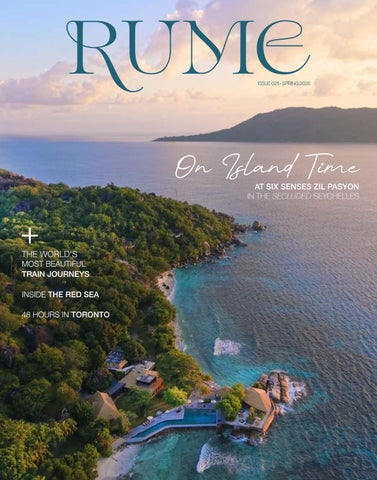
On Island Time

AT SIX SENSES ZIL PASYON IN THE SECLUDED SEYCHELLES

AFRICAN ODYSSEY

Experience the untamed elegance of BABOHI at QWABI Private Game Reserve, set within the pristine wilderness of QWABI Private Game Reserve, located in one of only two UNESCO-declared savannah biospheres in Africa. A three-hour journey from Johannesburg – discover Africa’s celebrated safari season, with golden light, mild temperatures, and exclusive Big Five encounters across vast, untouched landscapes.

Indulge in sophisticated accommodations designed for privacy and comfort, offering sweeping views of the African bush. From bespoke game drives to intuitive service, every detail is curated to create a rare sense of tranquillity and wonder. Join us in a harmonious blend of luxury, adventure, and responsible tourism, where each moment resonates with the heartbeat of the wild.

For bookings and enquiries, contact: reservations@newmarkhotels.com +27 21 427 5901 www.newmarkhotels.com

IN THE ISSUE

TRAIN JOURNEYS WHERE THE ROUTE MATTERS AS MUCH AS THE DESTINATION

SIX SENSES ZIL PASYON OFFERS SOMETHING INCREASINGLY RARE: A PRIVATE ISLAND THAT DOESN'T TRY TOO HARD ON

BEYOND THE MARBLE LOBBIES AND THE THREAD COUNTS, WE CONSIDER WHAT SEPARATES GOOD FROM GENUINELY MEMORABLE WHAT MAKES A GREAT CITY HOTEL?

CANADA'S MOST DYNAMIC CITY, DISTILLED INTO A WEEKEND – WHERE TO EAT, STAY AND SPEND YOUR TIME WELL 48 HOURS IN TORONTO

COURTSIDE AT ONE OF TENNIS' MOST STORIED TOURNAMENTS GAME,

THE WORLD'S MOST IMPRESSIVE TREEHOUSE HOTELS – AND WHY SLEEPING OFF THE GROUND CHANGES EVERYTHING

WHERE TO BE AND STAY, WHEN ASIA'S SAKURA SEASON ARRIVES

63 THE OPENINGS AROUND THE WORLD THAT BELONG ON YOUR RADAR THIS SUMMER HOT HOTELS TO BOOK IMMEDIATELY

THE PHILIPPINES HAS NO SHORTAGE OF ISLANDS. WE'VE DONE THE NARROWING DOWN FOR YOU 7,000 REASONS TO VISIT

SIDE

WHEN YOU'RE DONE WITH PHUKET'S PARTY SIDE, COMO POINT YAMU OFFERS SOMETHING MORE SUBTLE

THE GALLERIES, STUDIOS AND HOTELS MAKING THE CASE FOR DUBAI AS A SERIOUS DESIGN DESTINATION

editor's letter

I missed my flight...

For the first time ever. Even as an avid traveller it's taken until now for this very real situation to present itself, although I had hoped it never would. I couldn't even blame my life-on-the-edge partner for making us late – we arrived on time. It was my Type B personality and lack of planning that had us unknowingly living on the edge and turning up to the airport with no ETA visa for Seychelles. A quick panic application and €70 per person later, we missed the check-in by four minutes. Four.

Sometimes you have to learn lessons the hard way, it seems. Alas, we made it to the magical archipelago –albeit slightly behind schedule – and soon all that stress faded from the rear-view. The islands took my breath away. First on La Digue, where we began our trip inspired to visit the famous postcard-worthy rocky beach (totally worth it), and then on Félicité, the island home to Six Senses Zil Pasyon, our cover star this issue. Just a four-hour flight (and a couple of boat rides) away, this haven is a slice of paradise in the Indian Ocean. More mountainous than the Maldives, less rugged than Mauritius, it's the perfect getaway for a complete mental reset. Whether you're planning to follow in my messy footsteps this spring, or setting off on a more structured adventure, I hope it leaves you with the same enriched feeling we all seek out when we travel. Bon voyage!

EDITOR-IN-CHIEF

ELISE KERR elise@the-rume.com

MANAGING PARTNER

PAULO EDUARDO COSTA paulo@the-rume.com

LEAD DESIGNER

DOROTHY CASTILLO

JUNIOR EDITOR

ANDREA MORCO

CONTRIBUTORS

FELICITY CARTER MAX GERSTEIN

HEAD OFFICE

Media One Tower, Dubai Media City, PO Box 2331, Dubai, UAE. Tel: (+971) 4 4273000 Fax: (+971) 4 4282261

E-mail: motivate@motivate.ae

ON THE COVER SIX SENSES ZIL PASYON, SEYCHELLES

PHOTOGRAPHED BY ELISE KERR

FOLLOW RUME

rumemagazine.com @the.rume / @rumemagazine

TABLES BUILT

Food cities are not defined by how many Michelin stars they collect, but by how naturally eating shapes daily life. The most compelling destinations are those where markets still matter, chefs cook with intent rather than ego, and memorable meals happen as easily at lunch as at dinner. Across Europe, a handful of cities stand out not because they follow trends, but because they set their own rhythm. These are places where food is not an attraction layered onto the experience, but the reason you go in the first place.

San Sebastián, Spain

Where to Eat:

San Sebastián’s reputation is built on instinctive eating. Pintxos culture here is not curated for visitors. It’s a way of life that rewards curiosity, timing and appetite. The city balances technical excellence with casual confidence, allowing high-level cooking to feel both accessible and deeply local. What makes San Sebastián special is how seamlessly fine dining and bar-hopping coexist, often within the same evening.

Atari Gastroteka

Set beside the Basilica of Santa María del Coro, Atari balances polish with authenticity. Its pintxos counter is one of the city’s most visually compelling, while the kitchen delivers confident, modern Basque cooking without overcomplication. It’s a place that works just as well for a quick bite as it does for a longer, wine-led lunch.

Bodega Donostiarra

A long-standing local favourite, Bodega Donostiarra is best known for its tortilla, considered by many to be one of the city’s benchmarks. Beyond that, its bar showcases impeccable produce, from anchovies to cured meats, served with quiet assurance. The atmosphere is lively but unforced, making it a reliable reference point for how locals actually eat.

Gandarias Jatetxea

Part-bar, part-grill restaurant, Gandarias offers a more robust expression of San Sebastián’s food culture. The pintxos counter is generous, but it’s the charcoal-grilled meats that define the experience. Txuleta steak is cooked simply and confidently, drawing in diners who value flavour over finesse and tradition over trend.

Where to stay:

Hotel Maria Cristina

A Belle Époque landmark overlooking the river, offering old-world elegance with easy access to both the old town and the city’s best dining streets.

Cooking without complication.
Bodega Donostiarra
Atari Gastroteka

ON TASTE

Modena, Italy

Modena’s food culture is built on origin rather than abundance. This is a city where a handful of ingredients carry enormous weight, and where cooking is treated as a form of custodianship. What makes Modena special is the way tradition and contemporary thinking coexist naturally. Grounded, everyday food sits comfortably alongside some of the most influential cooking in the world, all within a city that still feels scaled to the producer rather than the visitor.

Where to Eat:

Osteria Francescana

Massimo Bottura’s threeMichelin-star restaurant is less about luxury and more about storytelling. Dishes draw on memory, local products and Italian cultural references, reframed through modern technique. It remains one of the most influential kitchens of the past two decades, not because it chases innovation, but because it seeks to reshape how Italian food can, and should, be interpreted.

Trattoria Pomposa al Re Gras

Lively, informal and deeply local, Pomposa captures Modena at its most immediate. Fresh pasta is the focus, often prepared in view of the dining room, with generous portions and a constant hum of conversation. It’s the sort of trattoria where tradition feels alive rather than preserved, and where the pleasure of eating well outweighs any concern for refinement.

Franceschetta 58

Relaxed, lively and contemporary, Franceschetta 58 shows how Modena eats today. Emilian classics are treated with respect but not nostalgia, served in a space that feels welcoming rather than reverential. It’s a reminder that serious cooking doesn’t need to be overly formal to feel considered. It remains one of the most influential kitchens, not because it chases innovation, but because it seeks to reshape how Italian food can be interpreted.

Casa Maria Luigia

Set just outside the city, Casa Maria Luigia is an intimate guesthouse created by Massimo Bottura and Lara Gilmore. Art, hospitality and food intersect naturally here, offering a quiet counterpoint to the intensity of Modena’s dining scene and a rare opportunity to experience the city’s culinary philosophy beyond the table.

Osteria Francescana
Trattoria Pomposa al Re Gras
Franceschetta 58
Ingredients are treated with respect, dishes are composed with restraint, and the experience feels immersive without being theatrical. GERANIUM

Copenhagen, Denmark

Copenhagen has reshaped modern European dining by placing seasonality, sustainability and restraint at the centre of the plate. But its real strength lies in how those ideas extend beyond tasting menus into everyday life. Bakeries, neighbourhood restaurants and destination kitchens operate with the same quiet discipline, creating a food culture that values clarity over excess and craft over performance.

Where to Eat:

Geranium

Situated in Copenhagen's national stadium, Geranium holds three Michelin stars and was named the world's best restaurant in 2022. Each dish in Chef Rasmus Kofoed's tasting menu follows the rhythms of the Danish seasons, built from foraged ingredients with precision.

Kadeau

Rooted in the flavours of Bornholm, Kadeau offers a refined yet grounded expression of Nordic cooking. Ingredients are treated with respect, dishes are composed with restraint, and the experience feels immersive without being theatrical. It represents Copenhagen at its most considered and quietly confident.

Where to stay:

Hotel Sanders

Juno the bakery

A benchmark for modern baking, Juno is defined by consistency and focus. Pastries are executed with precision rather than flair, reinforcing the idea that in Copenhagen, excellence is expected at every level of the food chain.

A discreet, design-led boutique hotel with a strong sense of character, Hotel Sanders feels more like a private residence than a traditional hotel. Its central location and intimate scale make it well suited to a city where attention to detail matters.

juno the bakery
kadeau

Freshness and flavour do the work, while the visuals feel distinctly modern.

Lisbon, Portugal

Lisbon’s food culture is built on generosity, rhythm and refinement. Seafood defines the table, but the city’s strength lies in how confidently it balances tradition with a more contemporary point of view. Classic institutions continue to thrive alongside modern kitchens, creating a dining scene that feels rooted yet quietly progressive. Lisbon rewards curiosity rather than rigid planning, offering deeply satisfying food in settings that value substance over spectacle.

Where to Eat:

Solar dos Presuntos Belcanto

Marisqueira Azul Lisboa

Solar dos Presuntos

A long-standing Lisbon institution, Solar dos Presuntos is known for its unwavering commitment to Portuguese produce. The menu leans heavily on regional specialities, from seafood to meat dishes, served generously and without pretence. Its walls, lined with photographs and memorabilia, reflect decades of local loyalty, making it as much a cultural reference as a restaurant.

Marisqueira Azul Lisboa

Set on the grand riverside Praça do Comércio, Marisqueira Azul offers a more contemporary take on Lisbon’s seafood culture. The setting is clean and light, allowing the quality of the produce to take centre stage. Shellfish and fish are prepared simply, letting freshness and flavour do the work, while the visuals feel composed and distinctly modern.

Belcanto

José Avillez’s flagship restaurant provides a refined counterpoint to Lisbon’s more informal dining culture. The cooking draws on Portuguese tradition with precision and polish, offering an experience that feels elegant without losing its sense of place. Belcanto anchors the city’s international reputation while remaining grounded in authentic local flavour.

Where to stay: Four Seasons Hotel Ritz Lisbon

A landmark of understated luxury, the Four Seasons Hotel Ritz Lisbon offers calm, space and a strong sense of heritage. Its elevated position provides a welcome pause from the city’s energy, making it a fitting base for travellers focused on Lisbon’s dining scene.

Precision and polish, offering an experience that feels elegant.

Destinations in Motion:

THE WORLD'S MOST BEAUTIFUL TRAIN JOURNEYS

There is a quality to watching a country reveal itself from a train window. The rhythm is unhurried, the perspective shifting but constant, the world beyond the glass unfolding with a patience that air travel cannot replicate. Rail journeys invite us to slow down, to observe, to let a landscape build gradually rather than arrive all at once. The routes gathered here span fjords and mountain passes, highland viaducts and Andean valleys. Each offers something distinct, yet all share a quiet conviction: that how we travel

shapes what we see. Some of these journeys are measured in hours, others in days. Some pass through scenery so dramatic it has drawn travellers for well over a century; others trace the engineering ambitions of an earlier age, routes carved through mountains and across ravines at considerable human cost. What they all offer is a substantial quality of attention – the kind that settles over you when the outside world is moving at exactly the right speed, and there isn't much to do but watch it pass and enjoy the ride.

Belmond’s Britannic Explorer

UNITED KINGDOM

The first luxury sleeper train to operate in England and Wales, the Britannic Explorer departs London Victoria for three-night journeys through Cornwall, the Lake District and Wales. The 10 carriages blend contemporary British style with a heritage sensibility drawn from the golden age of rail. Eighteen cabins, including three grand suites with double beds and marble en-suites, are dressed in botanical colour palettes inspired by the landscapes outside the windows. Rattan panels, mirrored

ceilings and floral light fittings give the two dining cars, Malva and Samphire, a warmth that shifts with each route. Chef Simon Rogan, whose restaurants collectively hold nine Michelin stars, oversees menus built around seasonal, regional

British produce. A Victorian apothecary-inspired bar in the observation car anchors the social life of the train, serving botanical cocktails alongside craft beers from independent British breweries. A wellness suite provides a further point of retreat.

Venice Simplon-OrientExpress, A Belmond Train

Few trains carry this much accumulated mythology. The Venice Simplon-OrientExpress traces its lineage to the original 1883 Orient Express service, and the restored 1920s sleeping cars that form today’s train preserve that heritage with extraordinary fidelity. Polished cherry wood, Lalique glass inlays in the Côte d’Azur dining car, and lacquer panels in L’Oriental create interiors that feel simultaneously museum-worthy and warmly intimate. Operating between March and November, the train connects London, Paris, Venice, Rome, Prague, Vienna and Budapest, with a signature annual journey extending to Istanbul. Chef Jean Imbert oversees the dining, working with local producers along each route to shape seasonal menus that reflect the passing geography. A bar car fitted with a baby grand piano sets the tone for the evening. Grand Suites, named Paris, Istanbul and Venice, offer ensuite bathrooms and private drawing salons, a rare elegance that speaks to the train’s enduring faith in the art of slow travel.

The Flåm Railway

One of the steepest standard-gauge railways in the world, the Flåm Railway descends 867 metres across just 20 kilometres, connecting the mountain station of Myrdal with the fjord village of Flåm in western Norway. Construction began in 1923 and was completed in 1940, with 18 of the line’s 20 tunnels carved entirely by hand, including one that spirals 180 degrees inside the mountain. The engineering alone would justify the journey, but it is the scenery that has earned this route international recognition. Over the course of one hour, the train passes waterfalls plunging from sheer rock faces, rivers cutting through deep ravines, and remote mountain farms perched on slopes that seem to defy habitation. A scheduled stop at Kjosfossen waterfall allows passengers to step onto the platform and feel the force of the water at close range.

Amtrak Empire Builder

UNITED STATES OF AMERICA

Named after James J. Hill, the railway tycoon who built the Great Northern Railway linking St. Paul to Seattle, Amtrak’s Empire Builder covers over 2,200 miles between Chicago and the Pacific Northwest across two nights. The route follows significant stretches of the Lewis and Clark trail, tracing the Mississippi River before crossing the golden expanse of the Great Plains. By the second morning, the landscape transforms as the train climbs into Montana’s Rocky Mountains, skirting the southern boundary of Glacier National Park and

crossing the Continental Divide at over 5,000 feet. The descent through the Cascade Range towards Seattle, or along the Columbia River Gorge towards Portland, provides a final act of considerable visual force. A Sightseer Lounge with panoramic floor-to-ceiling windows offers the ideal vantage point throughout. This is not a luxury train in the European tradition, but its appeal lies in something equally compelling: the sheer scale of the American landscape, revealed without interruption.

Belmond Hiram Bingham

The blue-and-gold carriages of the Hiram Bingham follow the Urubamba River from Cusco to the foot of Machu Picchu, descending through the Sacred Valley as Andean cloud forest thickens around the narrowing track. Named after the American explorer who brought the Inca citadel to global attention in 1911, the train launched in 2003 with interiors that evoke the elegance of 1920s parlour cars. Polished wood panelling and brass finishes line the dining and bar cars, where a three-course menu built around Peruvian ingredients is prepared entirely on board. Live traditional musicians move between carriages as the landscape shifts from high plateau to verdant gorge. An open-deck observation car at the rear offers an unobstructed view of the valley walls rising steeply on both sides, their upper reaches often lost in low cloud. The journey lasts roughly three hours in each direction, with brunch served outbound and a full dinner on the return through the darkening valley.

Live traditional musicians move between carriages as the landscape shifts from high plateau to verdant gorge.

Glacier Express

SWITZERLAND

Billed, without irony, as the world's slowest express train, the Glacier Express takes the best part of eight hours to cover the 291 kilometres between Zermatt and St Moritz – and every minute earns its place. Departing beneath the Matterhorn, the route climbs through the Mattertal valley before crossing 291 bridges and threading 91 tunnels through the heart of the Swiss Alps, reaching its high point at the Oberalp Pass, 2,033 metres above sea level. The descent follows the Rhine through the Ruinaulta gorge –

Switzerland's answer to the Grand Canyon – before the Landwasser Viaduct, a six-arched stone bridge curving directly into the mountainside, announces the final stretch to St Moritz. Part of the UNESCO-listed Rhaetian Railway, the route has been operating since 1930 and runs year-round. Panoramic windows run the full length of the carriages, and Excellence Class adds gourmet dining and dedicated concierge service for those who want the full complement of Alpine indulgence to accompany the view.

Zil Pasyon Six Senses

An island sanctuary beyond anywhere else

Six Senses Zil Pasyon sits on its own private island in the inner Seychelles, where the architecture disappears into ancient granite and the natural world does most of the work.

There are places you visit and places that stay with you long after you leave. Six Senses Zil Pasyon on Félicité Island belongs firmly in the second category. Set on a private island fringed with ancient granite boulders and dense tropical forest, this is a property that operates at a different frequency to almost anywhere else. The architecture disappears into the landscape, the staff seem to anticipate every need

before it arises, and the natural world, the bats at dusk, the birds at breakfast, the turtles nesting on the beach, all adds to the magic. We arrived as travellers and left feeling as though we had spent a week reconnecting with something we hadn’t realised was missing.

The journey to Six Senses Zil Pasyon is itself part of the experience. Arriving in Mahé, guests can either take a helicopter directly to Félicité or travel by boat from

Praslin or La Digue. We chose the latter route, spending a night on La Digue before making our way across, a decision we wouldn't regret. This small, unhurried island, where bicycles are the primary mode of transport and there isn't a chain hotel in sight, sets the tone for what Seychelles really is. We cycled for around 30 minutes to Grand Anse, a wide, sweeping beach with deep white sand and the kind of quiet that has become increasingly rare.

We also visited Anse Source d’Argent at dawn, the famous beach scattered with its distinctive granite formations, a little calmer in the early morning light than at peak hours, though its beauty is undeniably worth the trip. La Digue is a place that earns its reputation not through spectacle but through quiet

charm. Locals and visitors go about their days in a way that feels genuinely unhurried, and the island rewards those who slow down to match its pace. When we spoke to other travellers there, the message was consistent: you have not properly done the Seychelles until you have spent time on La Digue. The crossing to Félicité takes around ten minutes by speedboat, and when the island comes into view, all rock and palm and electric blue water, it is a genuinely arresting sight.

The welcome at Six Senses Zil Pasyon is considered without being theatrical. A crew meets guests at the dock, and before heading to the villas, each arriving party takes part in a brief local ritual. A handful of rice is cast into the water as an acknowledgement of the island, with fish darting

up from below to meet it. It's a quiet, charming touch that sets the property apart from the very first moment.

Guests are looked after by a GEM (Guest Experience Maker), who acts as a personal host throughout the stay. Ours drove us up to the Panorama Pool Villa by buggy and made sure we understood every detail of the space before leaving us to settle in.

The villa itself is expansive in a way that takes a moment to absorb. The bedroom faces the open ocean through floorto-ceiling windows, the fourposter bed oriented so that waking up becomes its own kind of ceremony. On our second morning, a brilliant orange sunrise filled the room before we had even reached for coffee – a sight that is not easily forgotten.

Outside, a large infinity pool sits at the edge of the deck alongside sun loungers, an outdoor day bed, and a

covered dining area. The whole space is more akin to a private house than a hotel room, complete with a well-stocked coffee station and wine cooler, a full dressing room, and a generous desk for those who cannot entirely disconnect from work. Each villa at the property is distinct. Some are built around the island’s ancient granite boulders, with the architecture designed to accommodate formations that have been in place for hundreds of millions of years rather than move them. It is a detail that speaks to the resort’s broader approach: building around nature, not over it.

The bathroom deserves particular mention. Designed with the same uninterrupted ocean focus as the rest of the villa, the freestanding bathtub sits directly in front of a large window. The mirrors are set to the sides rather than

facing the wall, meaning you are always looking outward rather than inward, and the wet room opens onto two corner windows. Even the most routine moments here carry the view. In the middle of the bathroom, hanging from the ceiling by thick rope, there is also a swing. It is a small detail, but one that captures something essential about the spirit of Six Senses Zil Pasyon: nothing here takes itself too seriously. On our first evening, the full moon sat low over the water, its reflection spreading across the sea in a wide, shifting column of silver. We had not planned to sleep with the curtains open, but it felt impossible to close them. All of the property’s restaurants and bars are clustered together near the main dock area, creating a social hub that feels distinct from the quiet seclusion of the villas. Island Cafe is the

heart of daily life here, open for breakfast and through the day, occupying a shaded pavilion with tables arranged around a large central tree, the ocean visible on multiple sides. The breakfast spread is thoughtfully curated with a wellness lean: fermented vegetables including kimchi and pickled carrots, made-toorder eggs, and more unusual options such as pumpkin pancakes served with coconut and syrup. Freshly baked bread is laid out on the main table, while cold cuts, cheeses, and fresh fruit are housed in the Wine Vault, a separate brick cellar room with wine racks lining the walls, where guests wander in to make their own selections. On our first evening, we ate at the property’s intimate chef’s kitchen, KRI, a Japanese omakase-style experience in which a small number of guests sit at a counter facing the open kitchen. Courses

arrived steadily: beautifully fresh sushi and sashimi, miso soup, and a simple ice cream dessert. The kitchen’s compact set-up lends itself to raw preparations and clean, precise flavours, and the quality of the fish is exceptional. It is an unlikely setting for Japanese cuisine and yet it works entirely, partly because of the intimacy and partly because there is nowhere you would rather be. Subsequent evenings were spent at Island Cafe for more relaxed à la carte dining. The pizza, ordered on something of a whim, was notably good, one of the highlights of the table across the whole stay. Koko Bar, the overwater cocktail bar at the main pool, hosts an outdoor cinema experience on certain evenings, Cinema Paradiso, where guests watch films above the water beneath an open sky. It is the kind of detail that makes you wish you had booked for longer. The Top Hill sundowner is perhaps the most romantic experience that Six Senses Zil Pasyon offers. Guests are taken up to a private high point on the island with unobstructed views across to La Digue, Praslin, and the surrounding islands. Here, the team sets up oversized beanbags, Champagne, and handmade canapés, and

lights a small fire. As the sun dropped below the horizon on our first evening, bats began to emerge from the mango trees in their dozens, wheeling across the orange sky in loose, unhurried patterns. It would have felt staged had it not been so completely, obviously real.

For those willing to lace up their boots, the morning hike to the island’s upper reaches is equally rewarding. The trail winds through dense vegetation, passing a handful of Coco de Mer palms, a species endemic to just two islands in the Seychelles and among the most protected plants in the world. These extraordinary palms can grow over 30 metres tall and produce what is recognised as the largest seed in the plant kingdom, with female nuts weighing up to 25 kilograms. The nuts take six to seven years to mature on the tree before falling. They are so strictly protected that each one sold in the Seychelles must carry an official government tag and export documentation to leave the country. To see the trees themselves, immense and prehistoric as they are, is one of those experiences that must be seen to be believed. The resort’s resident marine biologist leads snorkelling sessions off the island’s

beach, and her knowledge of the local turtle population adds considerable depth to what might otherwise be a straightforward activity. The sea conditions during our stay were rougher than ideal, limiting how far we ventured, but even close to shore there was plenty to see. On our final morning, we kayaked the short distance to Coco Island, an uninhabited nature reserve just 600 metres from Félicité, where the water is so clear and so strikingly blue it photographs almost like a digital rendering. The island is blanketed in birds and bats, the latter dozing while the former go about their business in the branches above. It feels genuinely wild. On the paddle back, a sea turtle surfaced alongside the kayak, close enough to count its markings. For those with an appetite for further exploration, the property also offers access to a secret beach on the island’s far side, reached via a short hike from a buggy drop-off point. The beach itself is small and tide-dependent in terms of how much sand you get, but the journey is worth it. There is also a concealed beachside cabana at the island’s western end, elevated on stilts with a direct sunset view, where the property sets up sun loungers and leaves you entirely to yourselves. We had not seen it mentioned in advance, and the sense of discovering it felt disproportionately exciting for what is, in the end, a couple of loungers and an extraordinary vantage point. Sometimes simplicity, in the right setting, is everything. The Six Senses spa at Zil Pasyon is built into and around the island’s ancient granite formations, which gives it a character unlike any spa we have

visited. Treatment rooms are positioned among the boulders rather than imposing on them, and access to some of the more secluded spaces requires crossing a swinging rope bridge between rock faces, a detail that perfectly encapsulates the resort’s willingness to let the landscape lead. One particularly dramatic passage takes guests through a natural tunnel formed by a massive boulder, the kind of geological drama that puts human architecture firmly in its place. A private infinity pool, bookable exclusively by villa, sits at the cliff edge near the spa and can be enjoyed during a dedicated one-hour slot with towels and refreshments provided. The property also offers a wellness screening with the resident practitioner, a body and lifestyle analysis that is a hallmark of the Six Senses approach to wellbeing, as well as an alchemy bar where guests can make their own soaps and products. These extras sit comfortably alongside the more standard massage and treatment menu, adding depth to what is already a serious spa offering. Most nationalities require an ETA (Electronic Travel Authorisation) for the Seychelles, which must be applied for online before departure. Processing typically takes several days, with an expedited option available at additional cost. This is worth checking well in advance. From Mahé airport, guests can reach Félicité by helicopter, or by boat from either Praslin or La Digue. We would strongly recommend routing via La Digue for at least one night. It adds meaningful context to the Seychelles experience and makes for a more considered arrival experience.

The small details capture something essential about the spirit of Six Senses Zil Pasyon: nothing here takes itself too seriously

Each villa at the property is distinct. Some are built around the island’s ancient granite boulders that have been in place for hundreds of millions of years.

AN INTIMATE ESCAPE ALONG OMAN’S COAST

MANDARIN ORIENTAL

Mandarin Oriental Muscat is Oman's first property from the group, and it arrives with considered interiors, a strong dining offer, and a location that puts the best of Muscat within easy reach

MUSCAT

The views catch the morning light, with the Hajar Mountains visible in the distance, while the other side of the property looks out over the pool.

Mandarin Oriental’s first property in Oman arrives with the weight of expectation that comes with the name – and, for the most part, it carries it well. Arriving at Mandarin Oriental Muscat on the Shatti Al Qurum corniche, you are immediately aware of the care that has gone into the interior. The lobby contains three fountains – representing Africa, the Middle East, and Asia – a nod to Oman's historical significance along the Silk Road trade route. It is a thoughtful detail, and one of many that reward closer attention throughout the property.

All rooms at Mandarin Oriental Muscat start at 50 square metres, and the deluxe mountain view room feels generously proportioned. The

palette is calm and pared back, with white linens, soft neutrals, and a striking headboard panel featuring traditional Omani geometric textile patterns. Brass pendant lanterns on either side of the bed add warmth without tipping into excess, and the overall feel is serene without being cold. The bathroom is a highlight. A freestanding tub sits against a deep blue mosaic-tiled wall, and the separate shower is equally spacious. A walkthrough wardrobe leads to the sofa area, which comes with a full minibar setup. The mountain views catch the morning light well, with the Hajar Mountains visible in the distance. Rooms on the other side of the property look out over the pool.

The bathroom is a highlight. A freestanding tub sits against a deep blue mosaic-tiled wall, and the separate shower is equally spacious.

Two small observations: the balcony is a generous size, though the absence of a table alongside the armchair and narrow sofa means it doesn't quite invite the kind of extended, unhurried moment the view would otherwise suggest. There is also no desk – just a low side table near the sofa – which is worth bearing in mind for anyone planning to get work done during their stay. The exterior of Mandarin Oriental Muscat is understated – a courtyardstyle structure with tiered balconies that reads as contemporary and functional. It is a contrast to the considered interiors within, where the design references feel genuinely rooted in place, and in some ways that contrast makes the arrival all the more pleasantly surprising.

The location, however, is

brilliantly placed for anyone looking to explore Muscat. The hotel sits directly on the Qurum Beach corniche, a community beach with a landscaped park, characterful leaning palms, and views across the Gulf of Oman. The beach is shared with the public rather than being private, and it is compact rather than sweeping, but the surrounding area is lively. A practical detail worth knowing: guests returning from the beach can access the hotel directly through a large wooden gate at street level, rather than having to loop back around to the main entrance. Muscat's Royal Opera is only

a short drive or a 10-minute walk away and worth visiting for its architecture alone. Its white marble exterior and grand performance hall can be enjoyed through guided tours if you don't have time for an evening show.

The standout dining experience at Mandarin Oriental Muscat is Essenza, the hotel’s Italian restaurant. Before dinner, it is worth heading up to the mezzanine bar above the main floor. It's a relaxed space with its own DJ and views across the hotel, bringing together Italian references and local architectural elements in a way that feels considered rather than forced.

Dinner is served on the outdoor terrace overlooking the corniche, or in a large indoor space with an open kitchen. The menu is built around sharing, with antipasti, pasta, and secondi designed to arrive at the centre of the table.

The carpaccio di manzo, thin-sliced wagyu beef with frisée, hazelnut dressing, and pecorino, was excellent. The bread and olive oil that open

the meal are high quality, a reliable indicator of the kitchen's standards. The tagliatelle all'astice, fresh pasta with Omani lobster in a bisque and cherry tomato sauce, holds your attention. Service was a genuine bright spot. The front-ofhouse presence is warm, knowledgeable, and unhurried in the best sense, exactly the kind of floor staff that makes a real difference to the overall experience. Breakfast at Rawya, the hotel’s all-day restaurant, is a well-stocked buffet –straightforward rather than ambitious, but a solid and pleasant start to the day. The pool at Mandarin Oriental Muscat is a proper centrepiece. It's large, wellproportioned, and flanked by palm trees and sun loungers, with a terrace that shifts atmosphere as the day progresses. By evening, the illuminated towers that frame the water make it one of the more striking spots on the property. The pool bar is a good option for a drink as the sun goes down, particularly on a clear night when the

temperature drops. The spa occupies the ground floor of Mandarin Oriental Muscat and opens onto the pool area through large windows. The space is calm and light, with a relaxation area that looks out over the pool. A massage here is pleasant and professionally delivered – a calm, well-run offering that sits comfortably alongside a stay.

For UAE residents making the

drive from Dubai, Mandarin Oriental Muscat offers a welllocated base with rooms that deliver comfort and calm in equal measure, and a setting that makes Muscat easy to explore. A few details would benefit from refinement, but this is a property that repays the journey – and, more importantly, one that makes a compelling case for Oman's capital as a destination in its own right.

The lobby contains three fountains, for Africa, the Middle East, and Asia

A nod to Oman's historical significance along the Silk Road trade route. It is a thoughtful detail, and one of many that reward closer attention throughout the property.

The standout dining experience is Essenza, the hotel's Italian restaurant

WHAT MAKES AN EXCEPTIONAL CITY HOTEL?

A great location and a beautiful lobby will only get you so far. For the well-travelled guest, it is the smaller things that leave a lasting impression: a breakfast that caters to early risers and late sleepers alike, a room designed for the reality of living out of a suitcase, and a bar that makes you feel like part of the city. We look at what truly sets the best city hotels apart...

The Tokyo EDITON Tokyo, Japan

There is a particular feeling that comes with walking into a city hotel that just works. It is hard to pinpoint at first, somewhere between relief and excitement, but it tends to reveal itself in the details that follow. The coffee at breakfast is made by someone who understands the difference between a bright, fruity roast and a deep, chocolatey one. The room goes properly dark at night. There is somewhere to put your suitcase that is not the floor. These are the things that frequent travellers quietly catalogue, and they are the things that separate a beautiful hotel from one you actually want to return to. We have been thinking about this a lot recently. Not the obvious markers of a great city hotel – a central location, strong thread counts and a photogenic lobby – but the second layer. The details that reveal whether a property was designed by people who actually stay in hotels, or by people who simply build them.

A city hotel breakfast has to work harder than almost any other meal in hospitality. The guest who needs to eat at 6am before a meeting and the one recovering from a late night out deserve equal consideration, which is why a generous window, ideally stretching from early morning through to at least 10:30am, makes such a difference. The Emory in London’s Belgravia includes daily English breakfast for all guests at abc kitchens, the first UK restaurant from celebrated chef JeanGeorges Vongerichten. It is a considered, unhurried affair, where the food feels like an integral part of the stay rather than an operational necessity.

In São Paulo, Pulso Hotel Faria Lima takes a similarly thoughtful approach. Charlô Whately, one of the city’s most respected restaurateurs, runs both Charlô Bistrô and Cha Cha Boulangerie within the hotel, the latter producing naturalfermentation breads and viennoiseries baked fresh each morning. It is the kind of breakfast that makes you want to rise earlier to enjoy for longer, which is arguably the highest compliment a city hotel can earn before midday. What both properties also understand is the importance of coffee served with genuine care. Different blends, proper preparation, a barista who knows that a flat white is not simply

The Mark Hotel New York, USA
Pulso Hotel Faria Lima São Paulo, Brazil

a large cup of milky coffee. It is a small distinction that shapes the entire morning. The way a hotel room photographs and the way it functions are often two very different things. Thoughtful design accounts for the reality of travel: somewhere to keep a suitcase open without it consuming half the floor space, an iron available as standard rather than something that requires a phone call and a 15-minute wait, and blackout curtains that do what they promise. Pulso handles this particularly well. Rooms feature Alexa-controlled window shades that can be operated from bed, and the blackout is genuinely effective, a small but meaningful detail for anyone arriving from a different time zone. The Tokyo Edition offers similar automated curtain controls within its warm, woodtoned rooms above the Toranomon district, with views of Tokyo Tower that look equally spectacular at sunrise and long after dark.

At Upper House in Hong Kong, the rooms begin on the 38th floor and feel closer to private apartments than hotel accommodations. The generous floor-to-ceiling windows, freestanding limestone bathtubs and double vanity bathrooms create a sense of space that is rare in the city. Each room comes with a complimentary maxi-bar, and the hotel’s paperless check-in process sets a relaxed, residential tone from the very first moment. Good lighting in a bathroom, preferably natural but at minimum well-considered artificial lighting, is one of those features that seems elementary until you find yourself getting ready in a dimly lit space where everything looks the same shade of amber. A quality hairdryer falls into the same category. It does not need to be the most expensive model on the market, but it does need to offer enough power and control to be genuinely

useful. The Emory provides Dyson products across all 61 of its suites, a detail that reflects the Maybourne group’s broader attention to the in-room experience, from the complimentary bar stocked with seasonal selections to the 24-hour Emory Assistant service.

Hotel gyms remain a curious blind spot in luxury hospitality. While spas receive considerable investment and creative thinking, the fitness offering is often limited to a row of identical Technogym machines with little variety. A wellconsidered gym would include versatile equipment, a bench press, a hack machine that allows for multiple exercises across different muscle groups, and free weights that extend beyond the standard range. It is a space with significant room

Hotel Fasano Rio de Janeiro Rio, Brazil
Four Seasons DIFC Dubai, UAE
The Emory London, UK

for innovation, and the property that gets it right will earn serious loyalty from the growing number of travellers for whom a morning workout is a non-negotiable part of their routine.

Perhaps the most telling quality of a great city hotel is whether its bar functions as a genuine gathering place. The Mark in New York is a fine example. The Jacques Grange-designed Mark Bar on the Upper East Side draws in a mix of hotel guests and neighbourhood regulars, creating an energy that makes you feel part of the city’s fabric without having to step outside. It is the kind of place where you might pop down for a single drink and find yourself staying for three, which is exactly the point.

Fasano Rio achieves something similar with Baretto-Londra, a space that channels the spirit of 1960s bossa nova Rio with its vinyl-covered walls and late-night atmosphere. And at Upper House in Hong Kong, Salisterra on the top floor draws locals and visitors alike for its Mediterranean sharing plates and sweeping

harbour views, a restaurant and bar that feels very much like a destination in its own right, not simply an extension of the hotel. At Capella Bangkok, the beating heart of the property is its Living Room. Separate from the lobby, it’s where all of the action happens, from checkin to happy hour (called Cin Cin), if you’re keen to feel part of the hotel’s community this is where your time should be spent.

The Four Seasons DIFC in Dubai also understands this well. With just 106 rooms, the property maintains a distinctly boutique energy, with Luna Dubai on the rooftop offering skyline views and modern Asian-inspired bites, and Mina Brasserie by Michael Mina providing a sophisticated groundfloor gathering spot within the heart of the financial district. When a hotel bar becomes a place where guests feel connected to the rhythm of a city, the

entire stay is elevated. Cheval Blanc Paris, with its four restaurants and bars helmed by threeMichelin-starred chef Arnaud Donckele, takes the concept further still. The rooftop brasserie Le Tout-Paris offers one of the finest panoramas in the city, from Notre-Dame to the Eiffel Tower, and is every bit as popular with discerning Parisians as it is with hotel guests.

It is these spaces that transform a city hotel from somewhere you sleep into somewhere you genuinely want to spend time. And that, ultimately, is the difference between a good stay and a great one. Not the marble or the thread count, but the feeling that every detail was considered by someone who understands what it is like to actually live in a hotel, even if only for a night or two.

Capella Bangkok Bangkok, Thailand
The Upper House Hong Kong, China
Cheval Blanc Paris, France

THE RED SEA

Spanning more than 28,000 square kilometres of Saudi Arabia’s northwest coast, The Red Sea is one of the most ambitious regenerative tourism projects in the world. Developed by Red Sea Global as part of Vision 2030, the destination encompasses an archipelago of over 90 islands, 200 kilometres of coastline, and a vast inland terrain of desert, mountains and dormant volcanoes. When fully complete, it will host 50 resorts with more than 8,000 rooms across 22 islands and six inland sites.

The Ummahat Islands are home to two of the destination's most exclusive properties: The St. Regis Red Sea Resort, with 90 overwater and beachfront villas, and Nujuma, A RitzCarlton Reserve, a 63-villa retreat. Both are accessible only by seaplane or chartered boat from the mainland, sitting roughly 26 kilometres offshore amid crystal-clear waters and coral reefs.

UMMAHAT ISLAND

PRISTINE ISLANDS

SHURA ISLAND

Shura Island is the beating heart of the destination. The dolphin-shaped island will be home to 11 resorts operated by brands including Four Seasons, SLS, Faena and Rosewood, alongside Saudi Arabia’s first island golf course, luxury marinas, dining and retail. Guests arrive via the 3.3km Shura crossing – the longest internal bridge in the country.

WORLD-CLASS RESORTS

Sheybarah Island hosts Shebara, the first resort fully owned and operated by Red Sea Global.

A 45-minute boat ride from the coast, the 73-key property features futuristic stainless-steel overwater and beachfront villas that reflect the colours and surface patterns of the surrounding sea. The resort offers specialty dining, a nature-inspired spa and direct access to a reef.

SHEYBARAH ISLAND

Red Sea International Airport offers routes from Dubai, Doha, Riyadh and Jeddah. Sitting within three hours' flying time of 250 million people, the airport serves as the gateway to the entire destination. From there, guests can reach the inland resorts by electric vehicle in under 30 minutes, or transfer to the island properties by seaplane or chartered boat.

DESERT ROCK RESORT

Desert Rock Resort is built directly into the Hijaz Mountains, inspired by the ancient Nabataean civilisation. The 64-key resort offers wadi villas, cliff-hanging suites and mountain cave rooms, each with private pools and sweeping views across the desert. Dining, spa and an adventure hub complete the picture.

SOUTHERN DUNES

Six Senses Southern Dunes was the first resort to open at The Red Sea in 2023. Set along the historic incense trade route with the Hijaz Mountains as a backdrop, the 76-key resort offers rooms, suites and pool villas across a landscape of rolling dunes and volcanic craters. Facilities include the Six Senses Spa and a programme of guided desert excursions.

RED SEA INTERNATIONAL AIRPORT

SIX SENSES

SOUTHERN DUNES

Deep in the Saudi Arabian desert, Six Senses Southern Dunes occupies a stretch of landscape that few travellers have yet thought to seek out. That, for now, is precisely the point. We spent several days at one of the Red Sea region's most compelling new addresses to find out what a stay here actually looks like.

resort's centrepiece is the Oasis

While Saudi Arabia might not be the first destination that comes to mind for a luxury wellness escape, this is in many ways what makes Six Senses Southern Dunes so compelling. Situated deep in the Alnesai dunes, the hourlong drive from the airport sets the tone entirely, winding through sand and red rock before the resort appears against the Hijaz Mountains. The resort's centrepiece is the Oasis: a lush green courtyard that feels entirely improbable in a desert landscape. Above it, a structural canopy inspired by the petals of the Alnesai flower creates natural shade and casts striking

shadows across the stone paths below. The design throughout the property draws heavily on Bedouin tradition and Nabataean heritage. Geometric embroidery trims the villa ceilings, kilim-patterned ottomans fill the lounge areas, and hand-woven textiles appear on every surface. It is meticulous without feeling overdressed. The pool villas are spacious and well-considered, with interiors that reference the desert palette: sandy tones, leather accents, and rattan headboards, without feeling heavy. Each villa comes with its own private plunge pool

Six Senses is known for its spa and at Southern Dunes it spans 4,000 sqm – it's the kind of facility

that deserves more than a passing visit.
The

on a teak deck, framing uninterrupted views of the dunes. The rooms more than deliver, offering every level of comfort expected from the Six Senses brand. The culinary programme is one of the most impressive aspects of the stay.

Breakfast at Bariya, the light-filled all-day dining

desert that is particularly impressive on a clear night. The non-alcoholic cocktail programme is excellent: refreshing and complex enough to feel celebratory.

Dishes draw from across the region, with Saudi Arabia, Morocco, Syria, Persia and Lebanon all

restaurant, begins at the wellness shot station: a spread of fermented drinks, ginger preparations, and gut-health options that immediately signal the Six Senses approach to food. The spread itself is focused rather than excessive, with live cooking stations, an à la carte menu, and a bread display.

An engaging hands-on cooking class led by an attentive chef focused on regional Arabic cuisine. The result was spiced kofta with tahini sauce, roasted cherry tomatoes, and pickled onion, well-executed and a good way to pick up some new techniques.

The evening at Al Sarab, Six Senses Southern Dunes' signature restaurant, is the standout experience of the stay. Perched on one of the highest dunes on the property, the restaurant offers a view deep into the

is consistent and notably personal. Staff address guests by name throughout the stay, and on one occasion proactively identified and resolved a transfer booking issue before it became a problem. For a resort of this scale in a relatively new destination, that level of genuine attentiveness is worth noting. Saudi Arabia's Red Sea region is still forming around it, which gives Six Senses Southern Dunes a quiet rarity that is hard to manufacture. For those considering the destination, the time to go is now.

appearing on the menu.

A slow-braised lamb tagine, served in a handpainted Moroccan vessel with toasted almonds, and a delicate fish course presented on a bed of mung beans were among the most impressive. For a more private option, the in-villa barbecue experience is worth requesting: a table set-up by the pool, fully staffed and served.

Six Senses is known for its spa and at Southern Dunes it spans almost 4,000 sqm – it's the kind of facility that deserves more than a passing visit. The lower floor houses treatment rooms, a traditional hammam, outdoor cabanas, and a large heated vitality pool that proved to be the most-used area of the stay.

The quality of service at Six Senses Southern Dunes

Two MICHELIN Keys
Five Dining Venues
World-Class Six Senses Spa
Panoramic Views of the Desert

S

RA ISLAND

Shura Island is the centrepiece of The Red Sea project — a dolphin-shaped island connected to the mainland via the 3.3 kilometre Shura crossing. When complete, it will be home to 11 resorts from some of the world's most recognised hotel brands, alongside Saudi Arabia's first island golf course, luxury marinas, dedicated dining and retail districts. Three properties are currently open, with the remainder scheduled to open progressively throughout 2026.

INTERCONTINENTAL the red

sea resort

On Shura Island, where the Red Sea meets some of the world's most intact coral, the InterContinental Red Sea Resort is among the first to open – and already, it has something most new hotels don't.

Saudi Arabia’s western coastline is quietly becoming one of the most compelling new destinations in the region. Shura Island – the centrepiece of The Red Sea project – now has three hotels open, and the InterContinental Red Sea Resort is among the first to welcome guests. Designed under the ‘Coral Bloom’ concept, the property sits on a dolphin-shaped island surrounded by what is considered the world’s fourthlargest barrier reef. For those who have yet to visit, the lagoon that wraps around the resort is worth knowing about: a vivid, almost altered bright turquoise that takes your breath away.

Arriving at the InterContinental Red Sea Resort, the first thing that strikes you is the architecture.

The curved, organic structure gives the property a sense of quiet distinction. Inside, the lobby maintains the same fluid language: doubleheight ceilings, floor-toceiling windows and a design philosophy that, as guests are told, consciously avoids straight lines. A spiral staircase descends from the lobby to Darein, the main all-day dining restaurant, which opens directly onto the pool and beach. The lagoon is right there from almost any point, its colour an immediate reminder that this is somewhere genuinely different from the established luxury hotel circuit.

The InterContinental Red Sea Resort offers 178 rooms and 32 suites across a range of configurations. Our onebedroom lagoon view suite comes with floor-to-ceiling

sliding doors, meaning you’re never more than a few steps away from the water. Each suite has a private terrace with a round outdoor day bed and a hanging wicker swing chair. Inside, the room is compact but well-considered: a curved ceiling detail with warm ambient lighting, woodpanelled walls, a generous wardrobe, and a lounge area with a separate seating section. Two-bedroom suites are also available and come with a separate living room and small kitchen, making them well suited to families or longer stays.

The standout experience of a stay at the InterContinental Red Sea Resort is, without question, the reef. Shura Island sits beside one of the world’s most intact coral systems – decades of limited international tourism mean

it has been largely left alone. Guests can arrange a guided snorkelling excursion through the hotel, departing by boat from Turtle Bay and reaching the reef in around 25 minutes. Full wetsuits, masks and fins are provided, along with experienced guides who accompany the group while allowing plenty of freedom to explore independently. What awaits underwater is striking. The coral here doesn’t spread across the seabed in shallow patches; it rises up like a submerged mountain range, dense and varied, with fish moving through it in every direction – orange anthias, trigger fish, tiny jellyfish, and dozens of other species.

It is worth noting that the hotel was still in its early stages at the time of our visit, with not all five dining venues

fully operational. Even so, the food made a largely positive impression. Lunch at Chimes, the poolside Mediterranean restaurant, offered a surprisingly good wood-fired sourdough pizza alongside lighter poolside bites. The pool setting is well designed and lively without being overrun, and the food quality sits comfortably above what you’d expect from a hotel pool bar. Dinner at Darein was more impressive still. The Levantine and Moroccan-inspired menu, led by executive chef Feras, delivered dishes with real care and quality: the beef was excellent, and the hummus, served alongside Les Estoublon olive oil from France, was quietly exceptional.

The Spa InterContinental spans 3,000 square metres and offers a full range of treatments alongside a vitality pool, yoga sessions and dedicated wellness programmes. We opted for a 90-minute movement and massage session that combined deep tissue work, targeted stretching and spinal manipulation. The result was one of

The standout experience of a stay at the InterContinental Red Sea Resort is, without question, the reef.

the more effective body treatments we’ve had in a hotel spa.

Beyond the reef, the resort’s activity offering is broad. Kayaking and paddleboarding can be arranged through the hotel, and tennis and padel courts are on site with equipment provided. Between the beach, the lagoon and the activities desk, it would be easy to fill several days without leaving the island.

The InterContinental Red Sea Resort is operating at an interesting moment: new enough that some elements are still being refined but established enough to deliver the experience it promises. As the broader Shura Island project develops and the remaining properties open around it, this stretch of Saudi Arabia is going to become a serious consideration for anyone looking for something genuinely different. For now, the InterContinental Red Sea Resort makes a compelling and convincing first chapter.

Kayaking through the mangrove channels offers a quieter perspective on the coastline

EXPLORE & EXPERIENCE

Beyond the polished lobbies and infinity pools, the Red Sea’s greatest draw is the landscape itself. Saudi Arabia’s northwestern coastline stretches across a terrain so varied it feels like several destinations compressed into one. Whether you arrive seeking stillness or adrenaline, the region delivers both in equal measure.

Sheltered lagoons along the coast provide ideal conditions for stand-up paddleboarding

Guided quad bike excursions venture deep into the hinterland, where golden dunes give way to dramatic volcanic plateaus

Saudi Arabia’s northwestern coastline stretches across a terrain so varied it feels like several destinations in one

The Hijaz Mountains provide a rugged backdrop for adventure

The Red Sea's underwater world is, by any measure, exceptional. More than 300 species of coral and over 1,200 species of fish inhabit these waters, many of them found nowhere else on earth. Visibility regularly exceeds 30 metres, making conditions ideal for both seasoned divers and first-timers alike. Snorkelling from the shore is possible at several resort beaches, where house reefs sit just metres from the sand and colourful parrotfish, clownfish and sea turtles are a common sight. For a deeper encounter, PADI-certified dive centres run daily excursions to outer reefs, wall dives and, in certain seasons, sites frequented by manta rays, whale sharks and hammerheads. Water temperatures remain warm year-round, meaning there is no real off-season for diving here. It is one of very few places in the world where marine biodiversity of this calibre exists alongside such accessible infrastructure, and efforts to protect these ecosystems are central to the region's longterm development plans. The coastline lends itself to long, unhurried days on the water. Stand-up paddleboarding across the sheltered lagoons is a popular choice, particularly in the cooler months when conditions are calm and the water is a translucent shade of green. Kayaking through the mangrove

channels offers a different perspective altogether – quiet, meditative and surprisingly rich in birdlife. Those after something faster will find kitesurfing and wakeboarding available at select properties, while sunset sailing trips along the coast provide a gentler way to close the day. Fishing enthusiasts are also well catered for, with deepsea charters heading offshore in search of larger game. Back on solid ground, the options shift towards wellness and cultural discovery. Several resorts incorporate the surrounding nature into their spa programmes, with outdoor treatment pavilions, sound healing sessions and sunrise yoga on the beach. Hiking trails wind through the volcanic rock formations of the Hijaz Mountains, where the geology tells a story millions of years in the making and the views from the ridgelines stretch far out across the coast. For something more leisurely, guided nature walks focus on the region's unique flora and fauna, from endemic bird species to the hardy desert plants that somehow thrive in the arid soil. The desert interior offers its own rewards too, with quad biking, camel treks and guided stargazing sessions drawing visitors away from the shoreline and into a landscape that feels vast and largely untouched. It is this combination of activity and calm, of adventure and restoration, that makes the Red Sea such a compelling destination. The diversity of what is on offer here means no two days need look the same – and for most visitors, that is precisely the appeal.

TORONTO 48 hours in

Toronto a city that is full of surprise. Luxury is weaved in through access, consistency, and point of view, shaped by experiences that privilege perspective over display. It is found in elevated interiors overlooking the skyline, in time spent along the harbour where the city opens outward, and within established neighbourhoods defined by heritage, design, and discretion rather than trend. Designed as a reference rather than a schedule, this guide highlights what to do and where to focus across two days.

WHERE TO STAY

The Ritz-Carlton, Toronto

Set above the city, this hotel offers a composed retreat from the pace below, where luxury is defined by calm, consistency, and a sense of intentional distance. Mornings begin slowly in the Club Lounge, where skyline views frame breakfast and coffee. Throughout the day, the hotel becomes a place to pause, whether through a quiet visit to the spa, a swim in the indoor pool, or time spent in the fitness centre overlooking the city’s shifting light. Dining is woven seamlessly into the rhythm of the stay. TOCA anchors the experience

with refined Italian cuisine and its celebrated cheese cave, offering one of the city’s most distinctive dining rituals. Evenings can unfold more casually at EPOCH Bar & Kitchen Terrace, where cocktails and seasonal dishes mirror Toronto’s understated elegance. For the traveller who values seamless access and a dedicated lounge experience, the hotel offers a level of ease that extends throughout the stay. The atmosphere is classic and polished, defined by consistency and quality rather than excess.

Spacious suites offer elevated city and lake views with a separate living area.

Along the Mink Mile

Afternoon stroll &luxury shopping

The afternoon unfolds along Bloor Street West, Toronto’s most prestigious shopping address, defined by international fashion houses, flagship storefronts, and impeccably designed façades. Anchored by Holt Renfrew and framed by Yorkville’s adjoining streets, the area invites an easy progression from boutiques to galleries and cafés just beyond the main avenue. It is an ideal choice for those seeking flagship fashion, personal shopping, and elevated retail.

The City Unfolds in Quiet Luxury

DAY 1

The Ritz-Carlton Club Lounge

Exclusive club level access

Set on the 20th floor, the Club Lounge offers a polished start to the day with breakfast, coffee, and sweeping skyline views of Toronto. Throughout the day, the lounge also serves light meals, refreshments, and evening hors d’oeuvres as part of the experience.

A landmark of Canadian luxury retail, offering designer fashion, personal shopping services, and an iconic flagship presence.

HOLT RENFREW

Mott 32

Combining richly layered interiors with meticulously executed Cantonese cuisine. The setting in Shangri-La feels bold yet composed, making it a destination as much for atmosphere as for flavour.

TOCA’s Cheese Cave

Curated tasting experience Chinese fine dining After-hours cocktails

Located beneath TOCA, the Cheese Cave is a rare and distinctive feature, housing an extensive collection of carefully aged cheeses. The experience is guided and considered, offering pairings that highlight craftsmanship and provenance.

Library Bar

Tucked inside the Fairmont Royal York, the Library Bar is defined by dark wood interiors, live jazz, and a menu rooted in classic cocktails.

From Harbour Lines to Skyline Views

DAY 2

FLYGTA, Billy Bishop Airport

Private air tour

Departing from Toronto’s downtown island airport, FLYGTA offers private fixed-wing flights that reveal the city from a rare vantage point. Flying at eye level with the CN Tower and tracing the harbour below, their signature Champagne Flight feels spacious and refined, offering a clear view of Toronto’s shoreline, islands, and skyline in one continuous sweep.

Before heading to the air or water, stop by the café, known for well-roasted Canadian beans and consistently good coffee, to start the day.

Toronto Yachts

Private yacht experience

Toronto Yachts provides a tailored way to experience the city from the water, with modern motor yachts designed for comfort and privacy. Cruising the harbour offers a contrasting perspective of the skyline, passing waterfront neighbourhoods and open stretches of lake that frame the city at a distance.

St. Lawrence Market Heritage market experience

Named the world’s top food market by National Geographic, it draws visitors seeking the city’s authentic food culture at its source. The experience works best when mixing the high and the familiar, from premium cheeses and caviar to the iconic peameal bacon sandwich. Those looking to elevate the visit often choose a private guide, such as Bruce Bell Tours, to navigate the market, access tastings, and add cultural context.

WHERE TO DINE

Osteria Giulia

Italian dining

Osteria Giulia is known for its precise, ingredientdriven approach to Italian cuisine, drawing inspiration from regional traditions while remaining firmly contemporary. The menu shifts with the seasons, highlighting carefully sourced produce, seafood, and housemade pastas that reflect a balance of restraint and technique. Interiors are clean and understated, creating a setting where the focus remains on the Michelin-starred food rather than spectacle.

Writers Room Bar Evening drinks & bites

Located high above the city in Park Hyatt, the Writers Room combines expansive Toronto views with a considered selection of drinks and food. The experience moves easily between light dining and evening drinks, framed by one of the city’s most elevated settings.

Constructed in 1803, it remains one of the city’s longest-standing and most important culinary institutions.

ROQUEBRUNE-CAP-MARTIN, FRANCE

MONTE CARLO MASTERS

APRIL 4 - 12, 2026

As the 119th edition of the Rolex Monte Carlo Masters approaches, we explore what makes this clay-court classic one of the most coveted events on the sporting calendar

Few tournaments in tennis carry the weight of history quite like the Monte Carlo Masters. Running from 4 to 12 April, the 2026 edition marks the 119th time the world’s best players will converge on the terraced clay courts overlooking the Mediterranean, competing for one of the sport’s most prestigious titles.

The club has been the tournament's home since 1928 and sits in RoquebruneCap-Martin, technically just over the border in France, though the principality's skyline is never far from view. Designed by architect Charles Letrosne in Art Déco style, its 21 courts are arranged across descending terraces that face the sea, with the main Court Rainier III positioned so that players compete with the Mediterranean directly behind them. The setting is compact compared to larger ATP venues, which gives the Monte Carlo Masters an atmosphere that feels closer to the action and harder to replicate elsewhere.

It is this blend of world-class sport and Riviera lifestyle that draws a particular crowd to Monte Carlo each April. Hospitality at the tournament itself ranges from premium courtside seating to private loge boxes with dedicated dining, while Monaco's most prestigious hotels tailor their

services around the event.

The Hôtel de Paris, Hôtel Hermitage and Monte-Carlo Bay all offer special packages during the tournament, often including grandstand access alongside spa treatments, fine dining and chauffeured transfers to the club. The tournament's origins date to 1897, when the first

a garage." Prince Louis II agreed, investing heavily in the construction of a new venue, and the MonteCarlo Country Club was inaugurated in February 1928 in the presence of European royalty and tennis figures from across the continent. That royal connection has continued. The principality's

The blend of world-class sport and Riviera lifestyle draws a crowd to Monte Carlo each April

edition was held on courts built above the cellars of the Hôtel de Paris. After stints in La Condamine and, briefly, on the roof of a garage in Beausoleil, the event found its permanent home thanks to American benefactor George Pierce Butler. A devoted admirer of French champion Suzanne Lenglen, Butler argued that her talent deserved "a jewel, not a simple roof on top of

ruling family has been closely tied to the club for nearly a century, with Princess Antoinette, Baroness Elizabeth-Ann de Massy and, most recently, MélanieAntoinette de Massy each serving as president. Prince Albert II is a regular in the stands each year, and after the final, the winner's trophy is traditionally presented by one of the members of the Grimaldi family.

Rafael Nadal's record at the Monte Carlo Masters remains the tournament's defining modern chapter. The Spaniard won 11 titles between 2005 and 2018, including eight in a row from 2005 to 2012. It is a run of dominance unlikely to be matched at any tournament, on any surface. Other notable champions include Björn Borg, Ilie Năstase, Ivan Lendl and Novak Djokovic, though none have come close to Nadal's tally. Carlos Alcaraz enters as defending champion, having taken his first Monte Carlo title last April with a victory over Lorenzo Musetti.

As much as the tennis draws the crowds, it is the wider experience that keeps people coming back. Masters week transforms Monaco into a hub of sporting and social energy, with long lunches between matches, sunset yacht cruises along the coast, and evenings spent at the principality's best restaurants and beach clubs.

THINGS TO DO

A day at the Monte Carlo Masters rarely ends when the final match does. Monaco offers plenty of ways to unwind, whether that means drifting across the Mediterranean, lingering over a long lunch, exploring the principality's dining scene, or finding a quiet stretch of coastline away from the crowds.

Yacht charter

Chartering a yacht is one of the finest ways to experience the Riviera during the Monte Carlo Masters. Cruising along the coastline offers uninterrupted sea views, quiet coves, and a perspective of Monaco's glamour that is only possible from the water. Whether it's a half-day escape between matches or a sunset cruise with champagne, a charter delivers privacy and a gentler pace away from the crowds. Most operators along Port Hercule offer flexible itineraries, so it's easy to fit around the match schedule.

Monte-Carlo SBM

The Monte-Carlo Société des Bains de Mer beach club is an easy choice after a morning at the courts. With its refined seaside setting, private cabanas, and attentive service, it offers a relaxed yet elegant atmosphere synonymous with Monaco. Spend the afternoon by the water, enjoy light Mediterranean fare, and soak up the Riviera sun in one of the principality's most exclusive and indemand coastal spots.

Gaia Monte-Carlo

Lunch at Gaia suits Masters week well, particularly if you're after something fresh and vibrant. The restaurant's modern Greek cuisine centres on quality ingredients and beautifully presented dishes, served in a lively yet polished setting in the Galerie Charles III. From the seafood mezze to the grilled octopus, the menu leans Mediterranean with a refined edge. It's a smart midday stop between matches that feels elevated and distinctly Monte Carlo.

Solarium Beach

Solarium Beach offers a more understated way to enjoy Monaco's coastline, well-suited to a quiet break from the tournament buzz. Built into the rocky shoreline near Port Hercule, the concrete platforms provide clear waters, open sea views, and a laid-back atmosphere. The water is deep and accessed by pool-style ladders, so it suits confident swimmers rather than families. It's popular with locals for a reason – no frills, just calm moments by the water without the formality of a beach club.

MONTE-CARLO SOCIÉTÉ DES BAINS DE MER BEACH CLUB
SOLARIUM BEACH
GAIA MONTE-CARLO

WHERE TO STAY

When the Monte Carlo Masters takes over the Riviera, where you stay matters almost as much as your Court Rainier III seat. The right hotel keeps you close to the action while offering calm, comfort, and a touch of glamour once the matches end.

Hotel Metropole Monte-Carlo

Just steps from Casino Square, Hôtel Métropole Monte-Carlo makes it easy to move between the Monte Carlo Masters and the best of the principality. The hotel blends classic elegance with modern comfort, featuring refined rooms, a Givenchy-designed pool area, and Michelin-starred dining by Christophe Cussac. Guests can drift seamlessly from tennis to evening strolls, shopping, and dinners without ever feeling rushed. Interiors feel softly luxurious, with polished yet personal service well-suited to unwinding after long days courtside. From relaxed poolside lunches to elegant evenings nearby, a stay here feels both central and effortlessly sophisticated.

Maybourne Riviera

High above the Mediterranean in Roquebrune-Cap-Martin, Maybourne Riviera offers a peaceful counterpoint to the tournament’s energy while remaining close to the action. The hotel takes a contemporary approach to Riviera luxury, with floor-to-ceiling windows, minimalist interiors, and sweeping sea views throughout. It suits those who prefer privacy, space, and a calmer

atmosphere after busy days at the courts. An infinity pool overlooking the coastline, a serene spa, and refined on-site dining mean evenings feel relaxed and unhurried. Maybourne Riviera delivers a stay that feels modern, restorative, and well-balanced for Masters week.

Hotel de Paris Monte-Carlo

Overlooking the legendary Casino Square, Hôtel de Paris Monte-Carlo places you at the centre of the tournament’s social scene. The hotel is a Monaco institution, defined by its grand Belle Époque architecture, ornate interiors, and a history that dates back to 1864. During Masters week, the atmosphere shifts noticeably, with players, sponsors, and guests moving between the courts and the square. Inside, the experience is unapologetically luxurious. Rooms and suites are elegantly appointed, many offering views across the square or out towards the Mediterranean, with a sense of classic refinement that feels consistent throughout the property. Dining remains a key part of the experience, led by the three-Michelin-starred Le Louis XV –Alain Ducasse, alongside a selection of restaurants and terraces that capture the energy of Monaco at its most vibrant.

MAYBOURNE RIVIERA
HÔTEL MÉTROPOLE MONTE-CARLO
HÔTEL DE PARIS MONTE-CARLO

Among the Treetops

ELEVATED RETREATS THAT PLACE YOU WITHIN THE CANOPY, FROM AFRICAN CLIFFTOPS TO COLOMBIAN CLOUD FORESTS

There is something quietly radical about sleeping among the trees. Not beneath them or beside them, but within the canopy itself, suspended at a height where the world below softens and the sky draws closer. Across the globe, a new generation of hoteliers has taken this primal impulse and shaped it into something considered, even reverent. These are not novelty treehouses. They are serious works of design that respond to their landscapes with intelligence. Whether raised on stilts above volcanic rock, woven into the rainforest canopy, or perched on a cliff edge, each asks the same quiet question: what happens when you build upward, into the arms of the forest?

Esiweni Luxury Safari Lodge

NAMBITI PRIVATE GAME RESERVE, SOUTH AFRICA

The approach to Esiweni is one of gradual revelation. The road winds through the malaria-free Nambiti Private Game Reserve in KwaZulu-Natal, a 20,000-acre conservancy of savannah, bush and waterfall-fed valleys. Then, as the terrain rises, the lodge appears: five suites built into the face of a cliff, overlooking the Sunday River and the vast grasslands beyond. The height here serves a purpose, placing guests at eye level with birds of prey and above the treeline, so that the reserve unfolds in panoramic stillness. Each suite opens through fully retractable patio doors onto a private deck. The interiors follow a refined colonial safari aesthetic, with stone hearths, dark timber and muted earth tones. Outdoor showers frame the valley below.

The honeymoon suite offers an open-air bath with views that stretch to the horizon. It is the kind of place where you might watch a herd of elephant pass silently through the bush while the sun drops behind the ridge. What distinguishes Esiweni from the region’s many safari lodges is its intimacy. A Relais & Châteaux property, it hosts no more than ten guests at a time. Meals are served on a broad wooden deck cantilevered over the cliff edge, or in a candlelit boma under the stars. Twice-daily game drives bring encounters with the Big Five, cheetah and over 280 bird species, but it is the return to the lodge that stays with you. That moment of ascending back to the clifftop, the light softening, and the reserve spreading out below like a living map.

One&Only Mandarina

RIVIERA NAYARIT, MEXICO

On the Riviera Nayarit coast, roughly 60 kilometres north of Puerto Vallarta, the jungle tumbles steeply from volcanic cliffs toward the Pacific. It is here, across 33 hectares of dense tropical forest, that Studio Rick Joy designed One&Only Mandarina: a resort of 105 standalone villas and treehouses that seem to have grown from the landscape rather than been placed upon it.

The treehouse suites sit 12 metres above ground, raised on slender steel columns and wrapped almost entirely in local Cumaru wood. Walls, floors and ceilings share the same warm grain, blurring the threshold between structure and forest. Floorto-ceiling glazing retracts fully, collapsing the boundary

between bedroom and canopy. Each has a private plunge pool and open-air bathtub screened by wooden slats. At the highest points of the site, panoramic treehouses deliver unbroken views of the Pacific coastline. Mandarina’s construction involved botanists who mapped every significant tree before a single foundation was laid. The result is a resort that feels woven into its terrain rather than imposed upon it.

At sunset, from the Treetop bar, the jungle canopy catches the last light in layered shades of green and copper, while the ocean glows beyond. It is architecture that invites you to look outward and, just as often, to simply listen.

Capella Ubud BALI,

INDONESIA

British-Thai architect Bill Bensley is known for designing hotels that tell stories, and Capella Ubud is perhaps his most fully realised narrative. Set across nine acres of rainforest and rice paddy in the artist village of Keliki, just outside Ubud, the property comprises 22 individually styled tented retreats and a single twobedroom lodge. The conceit is a camp established by shipwrecked Dutch settlers arriving in 1800s Bali, and every detail feeds this fiction. Bensley used bamboo mockups to position each tent according to the existing canopy, ensuring that the forest’s character remained intact. The tents are reached via suspension bridges and winding jungle paths, each one named for a different camp character. Inside, teak floors handmade in Central

Java meet hammered copper bathtubs, rococo sofas and vintage trunks concealing espresso machines. Handcarved Balinese doors, which took artisans a year to complete, frame views of the sacred Wos River.

The communal heart of the camp is The Officer’s Tent, a living room of antiques, trophies and Bensley’s signature maximalism, where evening cocktails are served to the sound of the forest. By the campfire, hot chocolate and marshmallows accompany a local storyteller.

The Cistern, a heated saltwater pool modelled on a camp reservoir, cuts through the trees in a long, quiet line. The canopy closes around you here. By the second morning, the jungle’s dawn chorus feels less like a wakeup call and more like a conversation.

Keemala

PHUKET, THAILAND

Above Kamala Beach on Phuket’s west coast, a hillside resort sits among the rainforest with the Andaman Sea glinting through the trees. Keemala is built around a fictional narrative of four ancient Phuketian clans, each with its own architectural language. There are Clay Pool Cottages for the Earth clan, Tent Pool Villas for the Wanderers, and two-storey Tree Pool Houses for the Sky worshippers. But it is the Bird’s Nest Pool Villas, inspired by the Rung-Nok clan, that are the property’s most recognisable form. Designed by Architect Space with creative direction from Pisit Aongskultong, the eight Bird’s Nest villas are raised above the forest floor, their exteriors woven in an intricate lattice that evokes a large bird’s nest. Inside, at 185 square metres including pool and sun deck, they are the resort’s most generous accommodation: a master bedroom, expansive bathroom with monsoon shower and freestanding bathtub, and floor-to-ceiling windows that open to views

of the rainforest and, beyond it, the sea.

The mythology is deliberate. The Rung-Nok were said to be artists, poets and astrologers who bathed under moonlight to sharpen their vision. Their yearning for exclusivity and creative expression is written into every surface. Shellembedded tiles, clay and wood, handcrafted mosaics: each clan’s materials are distinct, lending the resort the feel of a living village rather than a uniform hotel compound.

Keemala’s owners, a fourthgeneration Phuketian family, built the property with every existing tree preserved. A strict anti-animal exploitation policy governs the guest experience, and the resort’s own garden supplies around half of the kitchen’s needs.

In the late afternoon, as the forest cools and the light angles through the woven walls of your nest, there is a sense of having retreated into something ancient and quietly protected.

Wilderness Bisate Lodge

VOLCANOES NATIONAL PARK RUHENGERI, RWANDA

The word bisate means ‘pieces’ in Kinyarwanda, describing how the volcanic cone in which the lodge sits was once whole but has been shaped by centuries of erosion. Wilderness Bisate occupies this natural amphitheatre on the edge of Volcanoes National Park in Rwanda’s north-west, with views toward the brooding peaks of Bisoke, Karisimbi and Mikeno. It is arguably the finest base on the continent from which to trek to see mountain gorillas. The six forest villas are conical, fibre-thatched

structures whose design draws from the King’s Palace at Nyanza, the former seat of Rwanda’s last traditional monarchs. Each rises from the hillside at a different elevation, giving the impression of enormous nests scattered across the volcanic slope. Interiors are warm and contemporary: volcanic stone fireplaces with double-sided glass, woven baskets, imigongo tiles with geometric patterns, and chandeliers crafted from recycled green glass. Floor-to-ceiling windows draw Mount Bisoke into the room.

The lodge’s reforestation programme has transformed the surrounding 42 hectares, with indigenous saplings planted by guests and staff steadily returning the hillside to dense forest. Gentle trails trace the crater rim, ideal for a sunrise walk. After a morning trek through bamboo and cloud forest to spend an hour with a gorilla family, returning to your thatched nest, lighting the fire and sinking into a volcanic rock shower with the Virunga peaks framed in the glass feels like a completely natural conclusion.

BOSKO GUATAPÉ, COLOMBIA

BOSKO has quietly established itself as one of Latin America’s most striking elevated retreats. The ten suites, referred to as Mush·Rooms, take two forms: geodesic domes with transparent walls and timber-framed cabins covered in white canvas, all raised on stilts above the forest floor. King-size canopy beds, pared-back interiors and open-air rainfall

showers prioritise the view. Highertier suites include private jacuzzis or thermal plunge pools on terraced decks. The Presidential suites rely on bioclimatic design to regulate their own temperature, a quiet innovation that speaks to the property’s environmental thinking.

Above the forest, BOSKO’s signature Sky Pools crown the hillside: heated infinityedge plunge pools sheltered beneath mushroom-shaped sunshades, oriented toward the reservoir and the distant form of El Peñol. By night, the water temperature rises and the pools become a place for stargazing, the Andean sky vivid and close. There are no televisions or sound systems in the rooms. The soundtrack is the forest’s 52 recorded bird species and the occasional crack of a branch overhead. In a country increasingly recognised for its design ambition and ecological consciousness, this dome-crowned hideaway in the Colombian highlands feels like something genuinely new.

SAKURA SEASON Where to stay during

Sakura – or cherry blossom – season lasts, at most, a fortnight. Across East Asia, from the southern tip of Taiwan to the river valleys of central Japan, the bloom advances northward in a slow, silent wave, transforming landscapes for days rather than weeks. It is precisely this brevity that gives sakura its cultural weight.

Hoshinoya Kyoto

Arashiyama, Kyoto

Guests board a private wooden boat at the foot of Togetsukyo Bridge and travel upstream along the Oi River for 15 minutes, the sounds of Arashiyama’s crowds falling away with every stroke. The property, a former riverside residence dating back over a century, was restored by architect Rie Azuma and occupies a steep hillside above the jade-coloured water.

Cherry Blossom highlight: Weeping cherry trees line the riverbank and overhang the water’s edge, their pale branches trailing almost to the surface. Viewed from the arriving boat, the canopy creates a soft, dappled corridor of pink against the green gorge.

Best time to visit: 28 March – 6 April

Best time to visit: 23 – 31 March

Palace Hotel Tokyo

Marunouchi, Tokyo

Positioned directly opposite the Imperial Palace East Gardens, this Forbes fivestar property offers a rare combination of centrality and calm. Floor-to-ceiling windows frame the moat and its surrounding greenery. The hotel’s proximity to Otemachi station belies the serenity of its setting.

Cherry Blossom highlight: From upper-floor balconies, guests look directly over the Chidorigafuchi moat, where over 260 cherry trees form a pale canopy above the water. As petals detach and drift onto the surface, the moat becomes a slow-moving canvas of pink and green.

Beniya Mukayu

Yamashiro Onsen, Kaga (One hour from Kanazawa)

Recognised with a MICHELIN Key, this 16-room ryokan sits on the sacred Yakushiyama hillside above the onsen town of Yamashiro in Ishikawa Prefecture. The building channels sukiya principles through a contemporary lens: clean lines, restrained materials and an emphasis on negative space. The name itself, Mukayu, translates as “richness in emptiness,” a philosophy reflected in every uncluttered corridor and mossmapped garden. Each

Signiel Seoul Songpa-gu, Seoul

Occupying floors 76 to 101 of Lotte World Tower, South Korea’s tallest building at 555 metres, Signiel Seoul places guests above the city rather than within it. The 235 rooms blend contemporary Korean design with classical European proportions.

suite opens onto a private open-air onsen bath fed by the natural hot springs that have drawn visitors to this valley for over 1,300 years.

Cherry Blossom highlight: The Wakamurasaki Suite offers a privileged view of a centuryold cherry blossom tree from a bamboo veranda. Day trips to Kenrokuen Garden – one of Japan's Three Great Gardens – where 40 varieties of cherry trees bloom, including the rare 300-petal Kenrokuen Kikuzakura found nowhere else in the world.

Cherry Blossom highlight: Unparalleled aerial perspective of Seokchon Lake's 1,000+ cherry trees from 300+ metres above; the lake transforms into a soft pink ring visible from suite windows, with direct elevator access to ground-level lakeside promenades.

Capella Taipei

Xinyi District, Taipei

Capella Taipei occupies five floors of a tower in the Xinyi District, its 86 rooms positioned so that floorto-ceiling windows frame Taipei 101 and the mountain ranges beyond. The scale is deliberately intimate for a capital city hotel – six private pool terrace suites, a heated infinity pool on the 14th floor, and a dining programme that ranges from the precision of Mizue's omakase counter, built from a single length of 30-foot hinoki cypress, to the more convivial tableside carving at Ember 28. Capella's Culturist programme gives the property its point of difference: indigenous

weaving workshops, Hakka umbrella painting and neighbourhood walking tours led by the general manager himself fold local culture into the stay rather than leaving it at the door.

Cherry Blossom highlight: Capella Culturists arrange exclusive excursions to Yangmingshan National Park's cherry groves and the remote Wuling Farm – Taiwan's most celebrated cherry destination with 20,000 trees. Return via the hotel's infinity pool with Taipei 101 glittering at dusk.

Deer Chaser

Yuchi Township, Near Sun Moon Lake

Taiwan's most distinctive "Wild Luxury" resort, opened 2023. Inspired by African safari lodges, the property features 36 rooms across six dramatic styles – Safari, Nomad, Chief, Masai, Rainforest, and King Huts – with highstilt houses, Bald Cypress waterways, Masai-style communal pools, and romantic outdoor terrace tubs. The design philosophy centres on heaven, earth, and human harmony –natural elements like morning sun,

starry skies, and mountain breezes integrated into every space. Year-round outdoor pool, 1-night-3meals package with refined local cuisine. Less than 10 minutes from Sun Moon Lake and convenient for cherry blossom routes through the tea-farming highlands toward Alishan.

Cherry Blossom highlight: Strategic positioning for Taiwan's cherry trail — day trips to the tea-farming highlands where cherry trees line winding mountain roads, and excursions to Alishan's 30,000 cherry trees. Return to soak in your outdoor terrace tub beneath the stars.

Mandarin Oriental Pudong

Bvlgari Hotel Beijing

Lujiazui, Shanghai Embassy District, Beijing

Conceived as an urban resort, the 119-room Bvlgari Hotel Beijing sits within the Genesis complex in the capital’s Embassy District, on the banks of the Liangma River. Surrounding the building, Swiss landscape designer Enzo Enea has created sculpted Italian gardens featuring 200-year-old pines alongside carefully composed botanical arrangements. The nearby Tadao Andodesigned Genesis Art Gallery and the open-air Riverbank Amphitheatre further distinguish the setting. Inside, Navona travertine, teak finishes and custom Italian furnishings create a distinctly Mediterranean sensibility within the Chinese capital.

Contemporary elegance in Lujiazui with sweeping Huangpu River views. 362 rooms designed with Shanghai's 1920s glamour in mind. One Michelin-starred Yong Yi Ting for Jiangnan cuisine, holistic spa, and indoor lap pool. Convenient access to Century Park's cherry blossoms and Gucun Park expeditions.

Cherry Blossom highlight: The hotel arranges private excursions to Gucun Park –Shanghai's premier cherry destination with over 12,000 trees across 13 varieties – or the more intimate Century Park sakura groves. Return to Yong Yi Ting for seasonal spring tasting menus.

Cherry Blossom highlight: The hotel arranges excursions to Yuyuantan Park – Beijing's most beloved cherry blossom destination with over 3,000 trees. Return to La Terrazza, the lush garden terrace surrounded by blooming flowers and elegant landscaping, for alfresco dining as spring arrives.

Best time to visit: 20 March – 5 April
Best time to visit: 30 March – 15 April

SUMMER THE STAY LIST

New hotels to book for the season ahead, offering sun-soaked escapes from coastal retreats to cultural capitals across Europe, Asia, and the Americas.

The first Park Hyatt in Mexico draws its character from the raw beauty of the Baja coastline. The resort spans 26 acres within the private Cabo del Sol community, where sun-washed palettes and natural materials frame unobstructed views of the Sea of Cortez. Across 163 rooms and three villas, the architecture balances openness with refuge. Five pools, a beach club and restaurants including the tradition-rooted Mesa Madre bring a quietly confident energy to one of Mexico’s most compelling stretches of Pacific coast.

Where warm desert light meets the Sea of Cortez at dawn

PARK HYATT

A design-led coastal sanctuary in Baja California Sur where contemporary Mexican architecture by Sordo Madaleno meets the unhurried spirit of the warm Sea of Cortez.

CABO DEL SOL
MEXICO

CORINTHIA ROME

Warm Roman summers feel altogether different from inside a palazzo vault

Corinthia’s debut in Italy occupies a neoclassical palazzo on Piazza del Parlamento, originally designed by Pio and Marcello Piacentini between 1913 and 1921, as the headquarters of the Bank of Italy. Following a meticulous restoration by G.A. Design, the 60room property preserves original marble panelling, frescoes and carved wood while introducing refined contemporary detailing across seven floors. Chef Carlo Cracco brings his distinctive culinary perspective to Rome for the first time, and the spa – housed within the former bank vault –features bathing pools and treatments by 111Skin and Seed to Skin. An intimate, culturally rich addition to the Campo Marzio district.

A former Bank of Italy palazzo on Piazza del Parlamento, now a 60-room grand boutique hotel bringing intimate elegance to the heart of historic Rome.

Palazzo Donà Giovannelli, built in 1436 at the confluence of two canals in Cannaregio, has been reimagined following an eight-year renovation. The 47 rooms and suites look out over the hotel’s private garden or Venice’s waterways, while the Piano Nobile reveals the baroque Vittoria ballroom. Gothic windows, an octagonal staircase and interiors layered with watered silks and Murano glass capture centuries of Venetian artistry.

NEKAJUI

A RITZ-CARLTON RESERVE

An ultra-luxury clifftop reserve within Costa Rica’s Peninsula Papagayo, immersed in tropical dry forest and Pacific coastline, the first of its kind in the Americas.

Tropical canopy and deep Pacific blue seen from a clifftop tent

ORIENT EXPRESS

VENEZIA

The first Ritz-Carlton Reserve in Central and South America takes its name from the Chorotega word for “lush garden.” Built into a dramatic oceanfront bluff within the 1,400-acre Peninsula Papagayo, the resort offers 107 ocean-facing rooms and suites and three luxury treetop tents. Chef Diego Muñoz leads the Peruvian-inflected restaurant Puna, while a wellness programme rooted in the longevity traditions of the Nicoya people shapes the spa’s approach to restoration.

A 15th-century Venetian palazzo in the quiet Cannaregio district with private gardens and Gothic grandeur, brought to life as Orient Express’s atmospheric second Italian hotel.

LAKE COMO

EDITION’s highly anticipated Italian debut brings considered design-led minimalism, a floating pool directly on the water and celebrated dining to Lake Como’s storied western shore.

A 19th-century palazzo on the western shore of Lake Como, directly facing the Bellagio promontory, has been reimagined by Neri&Hu and De.Tales into a 145-room retreat that brings EDITION’s minimalist sensibility to one of Europe’s most storied lakeside settings. Terrazzo floors, Calacatta marble and cascading wisteria replace the heavy drapery of Como’s old guard. Chef Mauro Colagreco leads the culinary programme across two restaurants, while a floating pool on the lake itself and a private dock for boat arrivals underline the property’s connection to the water.

MEXICO

ROSEWOOD

MANDARINA

An immersive all-suite Rosewood resort on Mexico’s Pacific Riviera Nayarit coast where jungle, mountain and beach ecosystems meet indigenous artistry, equestrian culture and elevated dining.

Pacific sunsets caught from a jungle cliffside speakeasy bar each evening

An hour north of Puerto Vallarta, where Sierra Madre foothills meet the Pacific, Rosewood Mandarina’s all-suite accommodations span three distinct ecosystems: flatlands, mountain and beachfront. Design throughout references the indigenous Huichol and Cora cultures, with handcarved sculptures, artisanal rope installations and earthy tones drawn from the surrounding terrain. Dining ranges from the woodfired comal of La Cocina to the Japanese-Mexican fusion of Toppu on a mountaintop perch. A polo and equestrian club, a Greg Norman golf course and the Asaya Spa complement a cliffside speakeasy bar where Pacific sunset views add quiet drama to each evening.

Designed by Kengo Kuma and Associates with Brewin Design Office, this 89room hotel occupies the site of a former elementary school in the Miyagawachō district, steps from Kenninji, Kyoto’s oldest Zen temple. The four-storey property is arranged around a central courtyard beneath a dramatic karahafu roof, with interiors that draw on wabi-sabi principles, tatami, cedar and soft shadow. Six suites feature private onsen baths, while dining includes a collaboration with three-Michelin-starred SingleThread from Sonoma and a Japanese kappo restaurant.

LONDON

THE CHANCERY ROSEWOOD

Eero Saarinen’s iconic former US Embassy on Grosvenor Square in Mayfair, reimagined as a striking 144-suite hotel with seven restaurants, bars and a subterranean spa.

CAPELLA KYOTO JAPAN

Kengo Kuma’s intimate and contemplative homage to Gion’s living cultural traditions, featuring private onsen suites, a serene central courtyard and views towards ancient Kenninji temple.

Long Mayfair summer evenings seen from a golden rooftop eagle bar

Rosewood’s second London property occupies the Grade II-listed former American Embassy on Grosvenor Square, a modernist landmark designed by Eero Saarinen in 1960. Sir David Chipperfield led the architectural restoration, with Joseph Dirand creating 144 all-suite interiors. Dining spans seven concepts, including Tobi by two-Michelin-starred Masa Takayama and the rooftop Eagle Bar with views across Mayfair and Hyde Park.

SEVEN THOUSAND REASONS TO VISIT THE

PHILIPPINES

The Philippines is a breathtaking archipelago of

7,000 islands

spanning world-class surf breaks, secluded lagoons carved into limestone cliffs, and some of Southeast Asia's most compelling diving. From Siargao's laid-back surf culture and El Nido's dramatic karst landscapes to the private island indulgence of Balesin, each destination reveals its own distinct character. Together, they offer something increasingly rare: nature that remains largely intact, paired with hospitality that knows when to step back and let it speak for itself.

From world-class waves and crystal-clear lagoons to quiet fishing villages and glowing amber sunsets

Anislandthatfeels likealongexhale

Siargao

Once a surfer's secret, this teardrop-shaped island in the Mindanao Sea has grown into one of the Philippines' most compelling escapes – refined enough for considered travellers, unhurried enough to feel like an antidote to the rest of the world. From worldclass waves and crystal-clear lagoons to quiet fishing villages and glowing amber sunsets, Siargao moves to a soulful island rhythm entirely its own.

Where to stay:

NAY PALAD HIDEAWAY

Nay Palad Hideaway delivers an all-inclusive “slow luxury” escape that blends seamlessly with Siargao’s natural surroundings. Its 10 sustainably built villas feature open indoor–outdoor living, private terraces, outdoor showers, and direct beach access. From sunset beach dinners and island picnics to boat transfers, premium drinks, and personalised experiences, everything is thoughtfully included.

El Nido

El Nido is one of the Philippines’ most dramatic destinations, set on Palawan’s northern tip among towering limestone cliffs, hidden lagoons, and crystal-clear waters. Its Bacuit Archipelago is famed for emerald lagoons, secret pools, vibrant coral reefs, and rich marine life best explored by kayak or traditional bangka boat. Signature island-hopping tours and private charters reveal secluded beaches, caves, and snorkelling sites across this breathtaking seascape.

Where to stay:

CAUAYAN ISLAND RESORT

Set on its own private island in Bacuit Bay, this sustainability-focused retreat offers an exclusive escape rooted in environmental care. Twenty thoughtfully designed villas blend contemporary style with Filipino influences, featuring private terraces, outdoor showers, and serene views of either lush interiors or turquoise waters. Reefside dining, organic produce, and marine biologist–led snorkelling experiences complete a refined yet responsible island stay.

Coron

Known for its dramatic limestone cliffs and glassy freshwater lakes, Coron offers one of the Philippines’ most distinctive island landscapes. Beneath its clear waters lie World War II shipwrecks turned living reefs, alongside iconic sites like Kayangan Lake, Barracuda Lake, and the Twin Lagoons. Beyond diving, hot springs, secluded beaches, and traditional fishing villages complete this richly layered destination.

Where to stay:

SUNLIGHT ECOTOURISM ISLAND RESORT

Eco-luxury defines this private island escape, where sustainability and comfort exist in perfect balance. Pioneering overwater villas crafted from indigenous materials open directly onto the lagoon, offering sunrise or sunset views powered by renewable energy. Coral restoration, a giant clam sanctuary, and marine biologist–led experiences anchor the resort’s conservation-driven ethos.

Sustainability and comfort exist in perfect balance
Emeraldlagoonsheld byancientcliffs

Cebu & Mactan

Blending deep historical roots with exceptional marine biodiversity, Cebu offers a dynamic mix of culture and adventure. From centuries-old landmarks and vibrant food scenes to whale shark encounters, canyoneering at Kawasan Falls, and world-class diving in Moalboal, experiences span both land and sea. Luxury resorts on Mactan Island provide an ideal base, combining refined stays with direct access to marine sanctuaries and cultural highlights.

Where to stay:

SHANGRI-LA MACTAN

Boracay

Once known for excess, this island has re-emerged as a more sustainable and refined beach destination following major environmental rehabilitation. Its iconic White Beach offers kilometres of powder-soft sand, calm turquoise waters, and distinct zones ranging from tranquil and pristine to lively yet polished. Today, natural beauty leads the experience, balancing relaxation with thoughtful tourism.

Where to stay:

SHANGRI-LA BORACAY

A more peaceful side of Boracay unfolds here, where tropical gardens, calm cove waters, and refined comforts define the stay. Guests can choose between serene beachfront lounging or sunset strolls along White Beach, returning to world-class dining and holistic spa treatments. Thoughtful amenities cater equally to couples and families.

Marine conservation defines the experience at Shangri-La Mactan, where a vast protected reef lies just steps from the beach. Spacious accommodations range from ocean-view rooms to private villas, paired with refined dining and Horizon Club privileges. Wellness unfolds at the CHI Spa through treatments inspired by traditional Filipino healing.

culture, coast, comfortand

Where to stay:

AMORITA RESORT

Bohol

A slower rhythm defines Bohol, where sculptural landscapes and pristine seas encourage mindful exploration. The iconic Chocolate Hills, protected tarsier sanctuaries, and Panglao Island’s clear waters create a seamless balance between land and marine experiences.

Perched on limestone cliffs above Alona Beach, Amorita Resort offers sweeping views of the Bohol Sea paired with an intimate, boutique atmosphere. Contemporary Filipino–inspired rooms, a horizon-blending infinity pool, and sunset dining at Sands Restaurant create a relaxed yet refined escape. Its location allows easy access to both Panglao’s beaches and Bohol’s inland attractions.

Balesin

Exclusivity takes centre stage at Balesin Island Club, where curated global destinations coexist within a single, pristine island setting. Each village delivers immersive architecture, cuisine, and ambience, balanced by marine conservation and community partnerships. Seamless private access ensures both privacy and preservation.

Soft horizons, slower hours

Where to stay:

BALESIN ISLAND CLUB

Across seven destination-inspired villages, Balesin Island Club delivers varied stays unified by impeccable luxury. From Thai-style villas with private pools to Mediterranean suites overlooking the harbour, accommodations reflect global influences. Dining spans 15 restaurants, while a golf course, private beaches, and curated activities complete the experience.

Private access ensures both privacy and preservation

COMO POINT YAMU

We checked into COMO’s Phuket retreat to see whether the east

While most of Phuket’s top-tier hotels compete for prime sunset positions along the island’s western coastline, COMO Point Yamu takes a different approach entirely. Set on the tip of Cape Yamu on the east coast, this 106-room property faces the sunrise, looking out across the turquoise expanse of Phang Nga Bay and its dramatic limestone karsts. It is a location that immediately sets the tone for what COMO Point Yamu does best: slow things down. The drive from the airport takes around 25 minutes, and as the road narrows towards the cape, the shift in energy is noticeable. The tourist bustle of the west coast feels far away, replaced

by greenery, quiet roads, and the occasional glimpse of water through the trees.

The resort, designed by Italian creative Paola Navone, has been open for over a decade and holds a MICHELIN Key. Her playful interiors blend blue and turquoise accents with cool whites and grey Sinopatterned tiles, while floor-toceiling windows ensure the bay views take centre stage from almost every corner of the property. On arrival, the lobby is strikingly large and minimalist, with clean lines and an open atrium flooded with natural light. It is architecturally impressive, though it can feel a little sparse for guests looking for a lounge area to settle into

with a coffee. Beyond the main desk, there are a few enclosed spaces with a pool table and seating, but the lobby itself would benefit from a lounge area where guests could linger over a drink or catch up on reading. Our stay was in one of the resort’s rooms in the main building, and the space was generous by any standard. Bright, airy, and finished with

Navone’s signature style, it opened onto a balcony with uninterrupted views of Phang Nga Bay. The room felt like a genuine retreat in its own right, the kind of space where you could happily spend an afternoon with a glass of wine and nothing but the changing light over the water for company. For those booking a pool villa, COMO Point Yamu really comes into

coast’s quieter setting delivers on luxury

its own. The private pools are notably large, far bigger than what you would typically find at this level, and the villas themselves are expansive, with open-plan living areas, warm timber floors, and a genuine sense of seclusion. The resort’s main pool is equally impressive, stretching across three connected sections that span close to 100 metres in length. The deeper section draws most guests, while a shallower area is well suited to families and younger children. It is one of the standout features of a stay at COMO Point Yamu, particularly in the late afternoon when the water catches the light from across the bay. Loungers line the pool deck, and the Aqua Bar sits nearby, making it easy to settle in for a full afternoon without needing to move far. COMO Point Yamu offers two restaurants and a bar. nahmyaa, the resort’s Southern Thai restaurant, is open for dinner and serves a menu rooted in the bold, aromatic cooking of the region. The à la carte offering runs from small plates such as bue thod goong, deepfried spiced prawn with jungle leaf fritters, through to curries and wok-fried mains.

Dishes such as the kaeng kati poo bai chaplu, a blue crab curry with turmeric and green peppercorns, and the goong rad sauce makham, deep-fried tiger prawns in tamarind sauce, showcase locally sourced produce and traditional techniques. For guests looking for a broader sampling, the kitchen also

cuisine, the flavours can be punchy and direct, so it may not suit every palate, though the kitchen team is attentive and happy to guide diners through the menu. It is worth approaching nahmyaa with an open mind and an appetite for heat, as the cooking here leans closer to traditional Phuket flavour profiles than to the milder Thai dishes

everything from waffles and açaí bowls to omelettes and eggs Benedict. A highlight worth noting is the fresh coconut, sourced locally and served whole, which was some of the best we had during our time in Phuket.

La Sirena’s lunch menu leans into wood-fired pizzas and lighter Mediterranean dishes, offering a welcome

offers two signature tasting menus in a sharing style, which move through starters, mains, and dessert at a relaxed pace.

The setting, another Navone creation, is warm and colourful, with a gold-leaf feature wall adding texture to the room. For those less familiar with Southern Thai

many travellers may be accustomed to.

La Sirena, the resort’s Italian restaurant, covers breakfast, lunch, and dinner, and serves as the social heart of the property during the daytime. The breakfast spread is generous, combining a buffet with an à la carte selection that includes

alternative to the Thaifocused options at nahmyaa. With only two restaurants on site, guests staying more than a couple of nights may find the rotation limited, though the menus at both are broad enough to avoid repetition over a short stay.

Wellness is central to the COMO brand, and the COMO Shambhala retreat at COMO Point Yamu sits on the upper floors of the main building, offering treatment rooms with views across the bay. We had a couples’ massage that was well executed, with therapists who took time to adjust pressure and technique throughout the session. The treatment rooms themselves are pared-back and slightly dark, with natural stone floors and a raw, earthy aesthetic that feels intentional rather than sparse. After the treatment, guests are served tea before being invited

to use the spa’s own pool, which overlooks the main pool below. The water here is slightly warmer, and it is a peaceful spot to extend the post-treatment calm. Beyond the treatment rooms, the spa also houses a gym, steam rooms, a sauna, and a jacuzzi. The resort has also introduced hyperbaric oxygen therapy to its wellness offering, which sits alongside the brand’s signature COMO Shambhala treatments and a daily schedule of complimentary activities including yoga, stretching, and guided beach walks. One of the advantages of COMO Point Yamu’s east coast location is its proximity to Rang Yai Island, a quiet stretch of sand accessible by a short longtail boat ride. The hotel arranges morning excursions aboard a traditional wooden boat, and the island is far less crowded earlier in the day. The water close to the shore is shallow and clear, and the beach itself is simple and unmanicured, a welcome contrast to the more developed spots elsewhere on the island. It is a straightforward outing, with time for swimming and a walk along the beach, but one that gives a taste of Phuket’s calmer side. The boat crew offered insights into the local area along the way, pointing out features of the coastline and the surrounding islands, adding a personal touch to what is otherwise a low-key trip. It is the kind of excursion that suits the resort’s overall pace, unhurried and uncluttered. It is worth noting that COMO Point Yamu’s location, while ideal for those seeking quiet, does mean it sits some distance from Phuket’s main tourist areas, restaurants, and nightlife. The surrounding

neighbourhood is residential, with attractive private villas adding to the area’s upscale feel, but guests will need to arrange taxis or transfers to explore further afield. For those happy to stay within the resort and embrace a slower rhythm, this sense of remove is part of the appeal. COMO Point Yamu is a property that rewards guests looking to decompress rather than explore. The pools are among the finest on the island, the rooms are spacious and thoughtfully designed, and the COMO

Shambhala spa delivers on the brand’s wellness promise. The dining options, while limited to two restaurants, cover enough ground to keep a short stay interesting, and the views from almost every vantage point across the property are consistently impressive. It is not a hotel that tries to be everything to everyone, and that restraint works in its favour. For couples and travellers who value privacy, calm, and strong views over proximity to Phuket’s busier west coast scene, COMO Point Yamu makes a compelling case for the east side of the island.

THE ART OF LOOKING CLOSER

A guide to Dubai for design lovers

Dubai is often read through its skyline, but the city’s design language is more nuanced than its vertical landmarks suggest. Look beyond scale and spectacle, and a quieter narrative begins to emerge. One shaped by material choices, spatial restraint, and a growing confidence in how art, architecture, and everyday design intersect. Rather than existing within a single cultural quarter, Dubai’s creative energy is dispersed. Former industrial spaces have become cultural anchors. Waterfront institutions prioritise openness and light over monumentality. New commercial buildings

experiment with public space in ways that feel deliberate rather than decorative. Cafés, studios, and hybrid spaces blur the line between social ritual and creative production, becoming places where design is lived rather than observed. This decentralised nature is part of what defines the city. Design in Dubai is rarely prescriptive or uniform. Instead, it thrives in contrast. International influence is everywhere but increasingly filtered through local interpretation. Brutalist forms sit alongside softened interiors. Highly engineered architecture is offset by spaces that feel tactile, human, and intentionally curated.

The city’s contemporary art scene reflects this same tension. Galleries housed within repurposed warehouses sit comfortably alongside polished institutional spaces, each offering a different way of

engaging with art. What matters less is scale, and more the experience of moving through these environments: how light is used, how space unfolds, how a building invites pause rather than demands attention. For those drawn to design, Dubai rewards patience. Its most interesting spaces are rarely the loudest or most visible. They reveal themselves through repeat visits, through detail, and through a willingness to look past the obvious. Seen this way, the city becomes a study in evolution rather than arrival – a place where design continues to refine itself quietly, in plain sight.

Galleries, institutions & creative districts

Dubai’s contemporary art scene does not present itself all at once. It unfolds gradually, across districts that prioritise space, adaptability, and a certain looseness that allows ideas to breathe. At its centre is Alserkal Avenue, an industrial complex in Al Quoz that has evolved into the city’s most important cultural anchor. Once a working warehouse district, it now houses galleries, foundations, studios, and performance spaces, all within a raw architectural framework that resists polish. What sets Alserkal apart is not scale, but curatorial confidence. Galleries such as The Third Line and Carbon 12 have helped shape the city’s artistic language over the past decade, presenting work that feels internationally relevant while remaining rooted in regional dialogue. Spaces like Custot Gallery and Leila Heller Gallery bring a more global perspective, balancing established names with contemporary voices, while foundations such as Ishara focus on South Asian art and cross-cultural exchange. The experience

LOOKING CLOSER

of moving through these spaces is as important as the work itself, with generous volumes, natural light, and an absence of visual noise allowing exhibitions to take precedence.

Beyond Alserkal, Dubai’s cultural landscape becomes more dispersed. The Jameel Arts Centre, set along the Jaddaf Waterfront, offers a different rhythm altogether. Low-rise and outwardlooking, the building favours courtyards, terraces, and views across the water. Its exhibitions are complemented by public programmes, talks, and a library, positioning it as a place to spend time rather than pass through.

In contrast, the DIFC Art District reflects a more urban interpretation of

cultural space. Galleries such as Opera Gallery and Ayyam Gallery sit within a commercial environment, while ICD Brookfield Place introduces a thoughtful approach to corporate architecture, integrating

public art and carefully designed communal areas into its structure. Together, these spaces suggest a maturing ecosystem, one where art and architecture are increasingly embedded into the city’s everyday fabric.

Taken as a whole, Dubai’s gallery scene resists easy categorisation. It is neither singular nor centralised, but shaped by movement between places, by contrast, and by the act of looking closely. For those willing to spend time with it, the city reveals a cultural identity that feels considered, evolving, and quietly self-assured.

Cafés, concept spaces & quieter creative hubs

Away from galleries and institutions, Dubai’s design sensibility is often most visible in the everyday. In cafés, studios, and hybrid spaces where people work, meet, and return regularly, design becomes less about statement and more about atmosphere. These are places shaped by material choice, light, and proportion, where the experience of being in the space matters as much as what it produces.

In Downtown, Foundry has quietly established itself as a contemporary gathering point for the city’s creative community. Part café, part workspace, part event venue, the space is defined by clean lines, warm tones, and furniture chosen for comfort rather than effect. It attracts a steady rhythm of designers, architects, and writers throughout the day, shifting naturally from focused work in the morning to conversation and talks later on. The design is understated, but deliberate, allowing the

space to adapt without losing its identity.

Elsewhere, La Nena offers a more intimate counterpoint. With its pared-back interiors and calm, almost domestic atmosphere, it feels closer to a neighbourhood atelier than a café. Natural light, tactile materials, and a restrained palette create a sense of ease that encourages lingering. It is the kind of place that rewards repeat visits, revealing its character slowly rather than immediately.

Other spaces operate somewhere between these two moods. The Grey, known for its sculptural interiors and muted palette, approaches café design with an architectural sensibility, while Boon Coffee draws

from Japanese minimalism, favouring simplicity and clarity over excess. In each case, design is not treated as decoration, but as a framework for how the space is used.

Beyond cafés, a number of concept-led spaces continue to support Dubai’s creative ecosystem. Tashkeel functions as both studio and cultural platform, offering workshops, exhibitions, and production facilities within a thoughtfully designed environment.

Kave blends creative workspace with exhibition and retail, while Comptoir 102 combines design, fashion, and food within a bohemian, residential setting. These spaces resist easy categorisation, operating

instead as slow, evolving environments shaped by the people who inhabit them. Together, they form a quieter layer of the city’s design culture. One that exists not to be photographed once, but to be returned to, worked within, and gradually understood.

Architecture, events & the wider design landscape

Dubai’s architectural identity is often reduced to scale, yet some of its most considered design can be found in how buildings relate to their surroundings. Spaces such as ICD Brookfield Place demonstrate a growing interest in public realm design, with open circulation, natural light, and integrated art softening what might otherwise feel purely commercial. Similarly, the Jameel Arts Centre offers an alternative architectural language, favouring horizontality, outdoor courtyards, and a relationship with water that encourages slower movement through the

Design-forward places to stay

For those spending time in the city, certain hotels extend this design sensibility beyond cultural spaces and into daily living. Properties such as The Lana - Dorchester Collection reflect a contemporary approach to luxury, where interiors prioritise proportion, space. More overt architectural statements also form part of the city’s design conversation.

The Museum of the Future, with its highly engineered form and symbolic ambition, continues to provoke debate around what contemporary architecture should represent. Whether admired for its innovation or questioned for its presence, it reflects a city unafraid to test ideas at scale.

material quality, and light over ornamentation. At the Bulgari Resort Dubai, Italian modernism is translated into a low-rise, landscapeled environment that feels intentionally removed from the city’s vertical rhythm. Elsewhere, XVA Art Hotel

Design in Dubai is also shaped by its calendar. Events such as Art Dubai, Dubai Design Week, Downtown Design, Alserkal Art Week, and DIFC Art Nights provide recurring points of access into the city’s creative community.

These moments bring together galleries, designers, and institutions, offering a concentrated way to engage with work that otherwise unfolds more quietly throughout the year.

offers a more intimate experience, embedded within the historic fabric of Al Fahidi and shaped around courtyards and galleries. Al Seef Heritage Hotel reinterprets vernacular architecture through a contemporary lens, while 25hours Hotel One Central introduces a more playful design language, drawing on cultural references and communal spaces to create a social, and intentionally

design-aware atmosphere. Taken together, these places reflect a city that is increasingly confident in how design operates across different scales. From cultural institutions and neighbourhood cafés to architecture and places to stay, Dubai’s design story is not singular, but layered. It is revealed through attention, through repetition, and through the willingness to look a little closer.

DRIFT

is Dubai’s most luxurious beach destination, where French culinary excellence meets effortless seaside living.

From sun-filled lunches to spacious, elegant events, every moment unfolds with style.

Dryrobe® Tech-Lite packs down small, keeping you dry wherever the adventure takes you. pack lite. go further.

Turn static files into dynamic content formats.

Create a flipbook