URSULA MOREL
Personal Real Estate Corporation
REALTOR, CLHMS, MCNE, RSPS, TRC, CIPS, FIABC
RE/MAX Sea to Sky Real Estate Cell: 604.932.8629
email: ursula@morelrealestateteam.com website: morelrealestateteam.com
Ursula has been the President of FIABCI-Canada (International Real Estate Federation), is among the top RE/MAX Sea to Sky Whistler Real Estate agents, and won awards including the RE/MAX Lifetime Award and MLS Medallion Club. She is also a member of The Institute for Luxury Home Marketing with the achievement of the Million Dollar Guild (CLHMS), and recognized as an “exceptional agent” in the Wall Street Journal and Barron’s. Ursula Morel specializes in Luxury Resort & Second Home Properties (RSPS) and is licensed for Trading & Rental Property Management Services.
For the last 39 years, Ursula (relocated from Germany and France) has been welcoming people to Whistler from all over the world. That welcome comes in three languages: English, French, and German. Her strengths in negotiating as an MCNE (Master Certified Negotiation Expert) with international investors have made it easy not only to succeed locally but also to expand her activities globally as a CIPS member (Certified International Property Specialist), RSPS member (Certified Resort & Second Home Property Specialist), and the TRC (Transnational Referral Certificate) .
• 25 years of committed service in real estate
• 39 years resident of your community
• Proud supporter of The Children’s Miracle Network
PAGE 4-7
PAGE 8
PAGE 9
PAGE 10
PAGE 11-14
PAGE 15
PAGE 16
PAGE 17-21
PAGE 22
NORTH AMERICAN LUXURY MARKET REVIEW
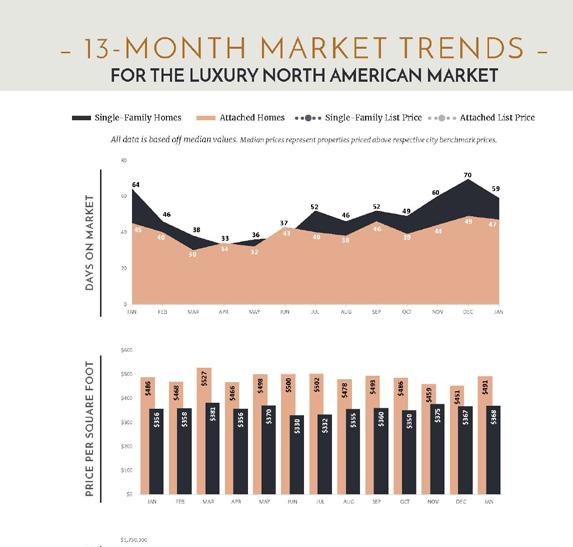
13-MONTH MARKET TRENDS
SINGLE-FAMILY HOMES MONTHLY OVERVIEW
ATTACHED HOMES MONTHLY OVERVIEW
MONTHLY STATISTICS BY CITY
LUXURY REPORT EXPLAINED
WELCOME MESSAGE
LOCAL LUXURY MARKET REVIEW
THANK YOU
NORTH AMERICAN LUXURY REVIEW
WHAT TO EXPECT IN 2026
As the North American luxury real estate market moves into 2026, it does so from a position of increasing maturity. The market has continued its transition into a more deliberate phase, one defined by balance, intention, and structural drivers rather than short-term speculation or volatility.
For high-net-worth buyers, investors, and luxury real estate professionals, 2026 is shaping up to be a year where decisions are guided by long-term alignment. Lifestyle priorities, capital preservation, and generational planning are increasingly influencing how, where, and why luxury real estate transactions occur, reflecting a market that has normalized into a more intentional and disciplined environment.
INSIGHTS FROM JANUARY
January’s data provides early confirmation of this stabilizing trajectory. Across key metrics, market activity closely mirrored January 2025 - a meaningful comparison given how unusually strong and seasonally atypical the start of last year proved to be. The ability to sustain similar patterns, even without a dramatic surge, reinforces the market’s underlying resilience rather than signaling a slowdown.
Sales volumes showed only modest year-over-year movement. Compared to January 2024, single-family home sales declined by just 1.4%, while condos and townhomes experienced a slightly larger decrease of 6.2%. These shifts appear less reflective of weakening demand and more indicative of evolving supply conditions.
Inventory levels increased moderately, with single-family home inventory rising 5.6% and condos and townhomes up 2.0% compared to January 2025. At the same time, new inventory entering the market declined, down 3.9% for single-family homes and 8.8% for attached properties, suggesting that limited fresh supply continues to influence transaction activity.
Pricing trends remain supportive. Median sold prices for single-family homes edged down marginally by 0.8%, while attached properties posted a notable increase of 5.7%. Together, these indicators point to a market that is recalibrating rather than retreating, maintaining price stability amid shifting dynamics.
A STABILIZING MARKET SHAPED BY MACROECONOMIC REALITY
As we step further into 2026, industry expectations point toward a market shaped by modest inventory growth, a moderation in price appreciation, and steady, though more measured, sales activity.
The luxury real estate market is anticipated to experience continued, incremental growth throughout the year. Price performance is likely to normalize, with flat to slightly positive gains across most established luxury markets. While inventory levels are expected to rise gradually, improving overall balance, they are unlikely to shift conditions decisively in favor of buyers.
Interest rates remain influential, though their impact in the luxury segment is nuanced. With U.S. mortgage rates expected to stabilize in the mid-5 percent range and Canada slightly lower, borrowing costs, while well above early-2020s lows, remain manageable for many affluent buyers, who often purchase with cash or use private banking solutions. As a result, rates tend to affect timing and leverage decisions more than overall demand.
Economic fundamentals continue to provide support. Low unemployment, resilient wage growth among top earners, and relatively strong household balance sheets have preserved confidence among highnet-worth individuals. While inflation and monetary policy uncertainty remain ongoing risks, the luxury real estate market’s insulation from short-term economic shocks continues to be one of its defining characteristics.
WEALTH TRANSFER AND DEMOGRAPHIC FORCES REDEFINING DEMAND
One of the most significant structural drivers likely to redefine what luxury means in 2026 may come from the ongoing Great Wealth Transfer. Trillions of dollars in assets, including a substantial share of real estate wealth, is one the move from Baby Boomers to Gen X and Millennial heirs.
These younger affluent buyers tend to prioritize utility, flexibility, and long-term value so homes are increasingly viewed as integrated lifestyle platforms rather than standalone assets. This is contributing to strong demand in the mid-luxury range, where properties balance quality, design, and functionality without excessive scale.
At the same time, younger Boomers are reshaping the market from the seller and buyer side. Many are downsizing primary residences while acquiring second or third homes that emphasize comfort, accessibility, and lifestyle amenities. Together, these demographic forces are broadening luxury demand across price points and geographies, reinforcing the market’s depth and resilience.
CAPITAL FLOWS AND THE EXPANDING LUXURY SEGMENT
From an investment perspective, luxury residential real estate continues to be attractive, more so because its increasingly viewed as a stabilizing component, especially as volatility persists in equity and alternative asset markets. Industry forecasts project steady growth in the North American luxury residential market through 2026 and beyond, supported by migration trends, population growth in key regions, and sustained wealth creation.
While it is anticipated that condominiums and luxury apartments will continue to see an uptick in transaction volume, single-family estates and ultra-luxury properties are expected to experience faster growth rates. This reflects both lifestyle preferences and the enduring appeal of tangible, scarce assets in prime locations.
GEOGRAPHY: WHERE LUXURY DEMAND IS CONCENTRATING
Geographically, 2026 is expected to reinforce trends that have been building for several years. Traditional luxury hubs, such as New York, Los Angeles in the U.S. and Vancouver and Toronto in Canada, will remain resilient, particularly at the ultra-luxury level. High-end properties in these areas continue to attract domestic and international buyers seeking long-term security and global relevance.
At the same time, migration-driven growth markets are capturing an increasing share of luxury demand. Sunbelt cities and tax-advantaged states, including Florida and Texas, as well as Calgary, Ottawa and Montreal in Canada have now become magnets for wealth, entrepreneurship, and development.
Secondary lifestyle markets are also gaining prominence. Smaller metropolitan areas offering quality of life, space, and connectivity are increasingly appealing to buyers who no longer need to anchor themselves to traditional financial centers. This dispersion of demand is reshaping luxury market rankings and creating new pockets of high-end activity across North America.
PROPERTY TYPES, DESIGN, AND THE EVOLUTION OF LUXURY LIVING
In 2026, luxury buyers will invest in environments that support health, productivity, and personal expression. Wellness-centric design has moved from a differentiator to an expectation, with features such as spa-like bathrooms, dedicated fitness and recovery spaces, and advanced lighting and air-quality systems becoming increasingly standard.
Technology, meanwhile, is expected to be seamlessly integrated rather than overt. Smart systems that enhance security, efficiency, and comfort are valued, but buyers increasingly favor solutions that operate quietly in the background without dominating the aesthetic or experience of the home.
Design trends emphasize authenticity and regional character, blending modern functionality with materials and forms that reflect local culture and environment. Buyers are also favoring turnkey homes that allow immediate enjoyment over renovation projects that introduce uncertainty and delays.
Flexibility remains a defining feature. Homes that support multi-generational living, hybrid work arrangements, and evolving lifestyle needs are positioned to outperform those with rigid layouts or overly specialized spaces.
FINANCIAL STRATEGY, RISK, AND THE ROLE OF LUXURY REAL ESTATE
Financially, luxury real estate in 2026 continues to serve both lifestyle and strategic investment purposes. While higher interest rates have shifted some buyers toward cash purchases, others are using leverage strategically - particularly where financing offers tax advantages or preserves liquidity for other investments.
Risk factors remain present, including regional insurance costs, climate exposure, and regulatory changes. These considerations are increasingly factored into pricing, location selection, and long-term planning, particularly in coastal and wildfire-prone markets. As a result, buyers are more analytical, and sellers are being challenged to justify pricing through quality, condition, and location rather than market momentum alone.
LOOKING AHEAD: WHAT 2026 REPRESENTS
Taken together, 2026 is shaping up to be a defining year for the luxury real estate market, not because of dramatic swings, but because of its increasing sophistication. The market is being driven less by urgency and more by alignment with lifestyle goals, generational priorities, and long-term capital strategy.
For buyers, sellers, and advisors alike, success in 2026 will depend on understanding these deeper forces and responding not with speed, but with insight, precision, and patience.
A Review of Key Market Differences Year over Year
SINGLE-FAMILY HOMES
SINGLE-FAMILY HOMES MARKET SUMMARY | JANUARY
• Official Market Type: Balanced Market with a 17.09% Sales Ratio.1
• Homes are selling for an average of 97.31% of list price.
• The median luxury threshold2 price is $900,000, and the median luxury home sales price is $1,310,000.
• Markets with the Highest Median Sales Price: Pitkin County ($12,000,000), Paradise Valley ($5,547,500), Naples ($4,472,500), and Ft. Lauderdale ($3,950,000).
• Markets with the Highest Sales Ratio: Lake County (54.5%), Morris County (53.5%), Anne Arundel County (53.1%), and Central Connecticut (48.5%). 1
A Review of Key Market Differences Year over Year
• Official Market Type: Balanced Market with a 13.14% Sales Ratio.1
• Attached homes are selling for an average of 98.01% of list price.
• The median luxury threshold2 price is $700,000, and the median attached luxury sale price is $956,250.
• Markets with the Highest Median Sales Price: Pitkin County ($3,150,000), San Francisco ($3,029,000), Ft. Lauderdale ($2,750,000), and Park City ($2,550,000).
• Markets with the Highest Sales Ratio: Fairfax County (82.7%), Somerset County (58.3%), Morris County (53.8%), and Howard County (51.4%).
– LUXURY REPORT EXPLAINED –
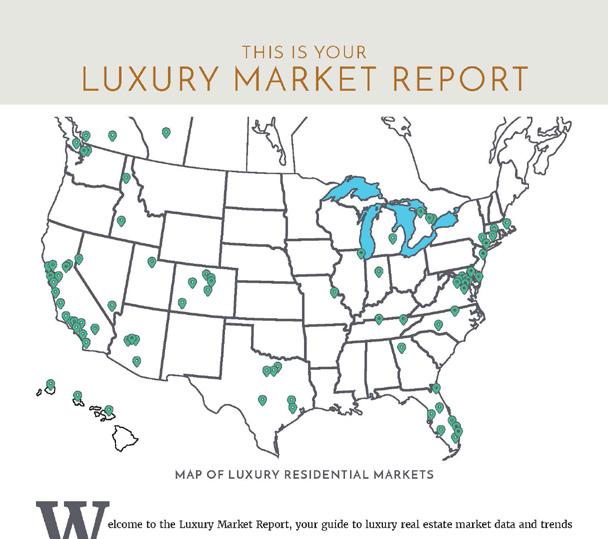
The Institute for Luxury Home Marketing has analyzed a number of metrics — including sales prices, sales volumes, number of sales, sales-price-to-list-price ratios, days on market and price-per-squarefoot – to provide you a comprehensive North American Luxury Market report.
Additionally, we have further examined all of the individual luxury markets to provide both an overview and an in-depth analysis - including, where data is sufficient, a breakdown by luxury singlefamily homes and luxury attached homes.
It is our intention to include additional luxury markets on a continual basis. If your market is not featured, please contact us so we can implement the necessary qualification process. More in-depth reports on the luxury communities in your market are available as well.
Looking through this report, you will notice three distinct market statuses, Buyer's Market, Seller's Market, and Balanced Market. A Buyer's Market indicates that buyers have greater control over the price point. This market type is demonstrated by a substantial number of homes on the market and few sales, suggesting demand for residential properties is slow for that market and/or price point.
By contrast, a Seller's Market gives sellers greater control over the price point. Typically, this means there are few homes on the market and a generous demand, causing competition between buyers who ultimately drive sales prices higher.
A Balanced Market indicates that neither the buyers nor the sellers control the price point at which that property will sell and that there is neither a glut nor a lack of inventory. Typically, this type of market sees a stabilization of both the list and sold price, the length of time the property is on the market as well as the expectancy amongst homeowners in their respective communities – so long as their home is priced in accordance with the current market value.