SALES
RISE AS INVENTORY TIGHTENS IN THE LUXURY REAL ESTATE MARKET
The North American luxury real estate market is continuing to demonstrate a resilience that increasingly sets it apart from the broader housing sector. While conventional market expectations would suggest that declining inventory and fewer new listings should lead to slower activity, the luxury segment is telling a very different story in 2026.
Traditionally, the spring market brings a significant increase in inventory as sellers look to capitalize on heightened seasonal demand. This year, however, a subtle but important shift has emerged. Over the past two months, the number of luxury properties entering the market has declined compared to the same period in 2025, yet sales activity has continued to strengthen, not only month-over-month, but year-over-year as well.
This divergence between supply and demand is revealing a luxury market that is being driven less by broader economic pressures and more by affluent buyer behavior, inventory scarcity, and long-term wealth positioning.
A CLOSER LOOK AT THE NUMBERS
The first two months of 2026 began much as expected. Both inventory and sales activity gradually increased for single-family and attached luxury properties as the market moved toward the spring season.
However, March marked the beginning of a notable shift. While overall inventory levels remained relatively consistent with 2025 figures, the number of new listings entering the market began to slow.
Compared to March 2025 new listings for single-family luxury homes fell by 3.1% and attached luxury properties declined by 7.2%
At the time, this appeared to be a potential anomaly. But April’s numbers suggest otherwise.
Although inventory levels continued to climb modestly from March into April, year-over-year inventory levels declined by 4.4% for single-family homes and 8.5% for attached properties.
More significantly, the number of new listings entering the market remained substantially below normal spring market expectations. Compared to April 2025 new listings for single-family properties fell 2.5% and attached properties declined by 9.8%.
This is not to say that inventory and new listings numbers are not increasing month-over-month in 2026, they are, but just at a much slower rate than typically expected.
Taken independently, declining inventory increases and reduced new listing activity would typically suggest a cooling market environment and softer buyer demand. However, the continued rise in both month-over-month and year-over-year sales activity points to a very different reality in the luxury sector: one driven by constrained supply, resilient affluent buyers, and increased competition for quality properties.
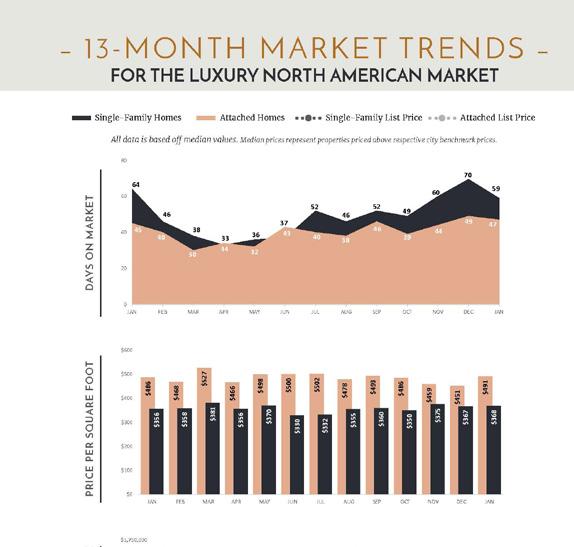
Sales of single-family luxury homes increased by 6.8% year-over-year compared to April 2025 and by 14.9% month-over-month compared to March 2026. Attached luxury properties also posted gains of 0.6% year-over-year and 4.3% month-over-month.
At the same time, market balance indicators continue to support seller strength. The median sold price for single-family luxury homes dipped slightly by 2.2%, while attached luxury properties posted a 1.0% increase. Average sold-to-list price ratios remained close to parity, and days on market held relatively stable across both segments.
Collectively, these metrics support that the single-family luxury market remains firmly in seller’s market territory, while the attached luxury segment is steadily trending back toward similar conditions.
WHY IS THIS HAPPENING?
Several broader economic and behavioral trends are helping explain why luxury real estate is continuing to outperform expectations despite declining inventory level increases.
AFFLUENT BUYERS ARE LESS SENSITIVE TO INTEREST RATES
One of the clearest distinctions between the luxury market and the broader residential sector is the financial profile of its buyers.
According to recent report from Realtor.com1, affluent buyers remain far less impacted by elevated borrowing costs because many are purchasing through cash reserves, portfolio-backed lending, or private banking relationships rather than relying on conventional financing.
This has created a situation where the luxury market is operating on a somewhat different thought
1 https://www.realtor.com/research/luxury-2026-outlook
process than buyers of traditional housing. While many midmarket buyers remain constrained by affordability pressures and mortgage rate volatility, high-net-worth individuals continue to transact based on lifestyle decisions, long-term investment strategies, and wealth preservation goals.
As a result, demand at the upper end of the market has remained surprisingly stable despite broader economic uncertainty.
SELLERS ARE HESITATING TO ENTER THE MARKET
At the same time, luxury sellers appear increasingly cautious about listing their properties.
Recent housing commentary reported by New York Post2 highlighted that many homeowners across North America are adopting a “wait-and-see” approach amid economic uncertainty and fluctuating interest rates. This trend appears even more pronounced in the luxury sector.
Unlike traditional homeowners who may need to move for financial or employment reasons, affluent sellers often have the flexibility to delay selling until market conditions align with their expectations. Many luxury homeowners are also reluctant to relinquish historically low mortgage rates or highly desirable properties unless there is a compelling reason to do so.
The result is a market where buyers remain active, but the flow of new inventory has become increasingly constrained.
SCARCITY IS DRIVING BUYER URGENCY
When inventory contracts while demand remains stable, competition naturally intensifies - particularly for high-quality properties in desirable locations. This appears to be exactly what is unfolding in the luxury segment.
Stable days on market and sold-to-list price ratios near parity indicate that well-positioned luxury properties are continuing to attract motivated buyers relatively quickly. Rather than waiting for additional inventory to arrive, many buyers are acting decisively when suitable properties become available.
In many markets, truly exceptional luxury inventory remains limited. Buyers understand that replacement opportunities may be scarce, particularly for turnkey homes, architecturally distinctive properties, or residences in highly sought-after neighborhoods.
This scarcity dynamic is increasingly shaping buyer behavior across North America’s luxury markets.
WEALTH CREATION CONTINUES TO SUPPORT THE LUXURY SECTOR
Another major factor supporting luxury housing demand is the continued expansion of wealth among affluent households.
2 https://nypost.com/2026/05/08/real-estate/homebuyers-sellers-growing-cautious-over-increasing-mortage-rates
Recent analysis from HousingWire3 notes that luxury real estate is increasingly moving independently from broader housing trends due to factors such as stock market performance, technology-sector wealth creation, intergenerational wealth transfers, and real estate’s growing role as a long-term wealth preservation strategy.
Even amid broader economic volatility, many affluent households continue to maintain strong balance sheets and substantial liquidity. This financial resilience is helping sustain demand for luxury real estate despite uncertainty in other sectors of the economy.
THE LUXURY MARKET IS NORMALIZED - NOT SLOWING
Importantly, the current market conditions do not necessarily point toward overheating. Instead, they suggest that the luxury market continues in its more normalized state, characterized by selective buyer competition and measured price growth, despite slowing inventory growth.
That distinction matters. The luxury market today is not being driven by speculative buying or unsustainable pricing surges. Instead, it is being supported by financially capable buyers competing for a relatively limited supply of desirable properties.
This is especially evident in the single-family luxury segment, where inventory shortages continue to place sellers in a position of strength. Meanwhile, the attached luxury market appears to be steadily regaining momentum after experiencing softer conditions over the past several quarters.
LOOKING AHEAD
As the market moves further into 2026, one of the most important indicators to watch will be whether inventory levels begin to recover during the traditionally active summer and early fall periods.
If new listing activity continues to remain below historical norms while buyer demand stays stable, luxury markets across North America could face even tighter conditions later this year.
For now, the data suggests that the luxury sector continues to demonstrate resilience that exceeds broader market expectations. Declining inventory would typically signal slowing momentum, yet rising sales activity tells a very different story: one defined by affluent buyer confidence, inventory scarcity, and the enduring appeal of luxury real estate as both a lifestyle and long-term asset.
3 https://www.housingwire.com/articles/luxury-housings-resilience-why-the-top-of-the-market-is-moving-on-a-different-cycle
A Review of Key Market Differences Year over Year
SINGLE-FAMILY HOMES
SINGLE-FAMILY HOMES MARKET SUMMARY | APRIL 2026
• Official Market Type: Seller's Market with a 26.02% Sales Ratio.1
• Homes are selling for an average of 98.52% of list price.
• The median luxury threshold2 price is $900,000, and the median luxury home sales price is $1,303,250.
• Markets with the Highest Median Sales Price: Whistler ($9,700,000), Silicon Valley ($5,900,000), Los Angeles Beach Cities ($4,170,000), and Naples ($4,125,000).
• Markets with the Highest Sales Ratio: San Francisco (154.2%), Cleveland Suburbs (92.3%), Marin County (86.0%), and Hamilton County (84.4%). 1
A Review of Key Market Differences Year over Year
• Official Market Type: Balanced Market with a 19.81% Sales Ratio.1
• Attached homes are selling for an average of 98.88% of list price.
• The median luxury threshold2 price is $700,000, and the median attached luxury sale price is $878,352.
• Markets with the Highest Median Sales Price: San Francisco ($2,687,000), Ft. Lauderdale ($2,250,000), Greater Boston ($2,175,000), and Park City ($2,175,000).
• Markets with the Highest Sales Ratio: Arlington & Alexandria (102.1%), Fairfax County (91.2%), San Francisco (91.0%), and Howard County (85.1%).
– LUXURY REPORT EXPLAINED –
The Institute for Luxury Home Marketing has analyzed a number of metrics — including sales prices, sales volumes, number of sales, sales-price-to-list-price ratios, days on market and price-per-squarefoot – to provide you a comprehensive North American Luxury Market report.
Additionally, we have further examined all of the individual luxury markets to provide both an overview and an in-depth analysis - including, where data is sufficient, a breakdown by luxury singlefamily homes and luxury attached homes.
It is our intention to include additional luxury markets on a continual basis. If your market is not featured, please contact us so we can implement the necessary qualification process. More in-depth reports on the luxury communities in your market are available as well.
Looking through this report, you will notice three distinct market statuses, Buyer's Market, Seller's Market, and Balanced Market. A Buyer's Market indicates that buyers have greater control over the price point. This market type is demonstrated by a substantial number of homes on the market and few sales, suggesting demand for residential properties is slow for that market and/or price point.
By contrast, a Seller's Market gives sellers greater control over the price point. Typically, this means there are few homes on the market and a generous demand, causing competition between buyers who ultimately drive sales prices higher.
A Balanced Market indicates that neither the buyers nor the sellers control the price point at which that property will sell and that there is neither a glut nor a lack of inventory. Typically, this type of market sees a stabilization of both the list and sold price, the length of time the property is on the market as well as the expectancy amongst homeowners in their respective communities – so long as their home is priced in accordance with the current market value.