HAWAI’I ISLAND
LUXURY MARKET REPORT
RENÉE H. KRAFT | JULY 2026
RENÉE H. KRAFT
REALTOR® Broker RB-23004
CRS®, CLHMS GUILD, PSA®, SRS®, RSPS®, CNS®, RENE®, GREEN®, ABR®, GRI® 808.345.2108
Renee@SearchHawaiiProperty.com www.SearchHawaiiProperty.com
As a luxury expert on the Big Island of Hawai’i Renée H. Kraft offers a wealth of knowledge and expertise that is unsurpassed. You can always trust her service, commitment, and confidentiality in all facets of the real estate transaction.
Renée H. Kraft acquired her Hawai’i real estate license in 1992 while attending college at the University of Hawaii at Manoa. She started in property management in Honolulu then after graduating moved into the practice of general real estate and relocated to her home in KailuaKona in 2003. The luxury benchmark on Hawai’i island typically starts at $1.2M with luxury median residential pricing in the resorts, private estates, villas, and condo markets varying between $2M-$5M. Several high end properties on an annual basis exceed the $5M-$20M benchmarks.
Born and raised on Oahu she brings an intimate lifetime of knowledge to the table having lived between Hawai’i Island and Oahu all her life. She enjoys serving her community as a longtime member of the Rotary Club of Kona and the Kona-Kohala Chamber of Commerce.
• Certified Luxury Property Specialist GUILD
• Certified Residential Specialist CRS®
• Resort and Second Home Property Specialist RSPS®
• Graduate Realtors Institute GRI®
• Seller Representative Specialist SRS®
• Pricing Strategies Advisor PSA®
• Real Estate Negotiation Expert RENE®
• Accredited Buyers Representative ABR®
• At Home with Diversity AHWD®
• Bachelor of Arts & Sciences Psychology & Economics
PAGE 4-7
PAGE 8
PAGE 9
PAGE 10
PAGE 11-14
PAGE 15
PAGE 16
PAGE 17-21
PAGE 22
NORTH AMERICAN LUXURY MARKET REVIEW
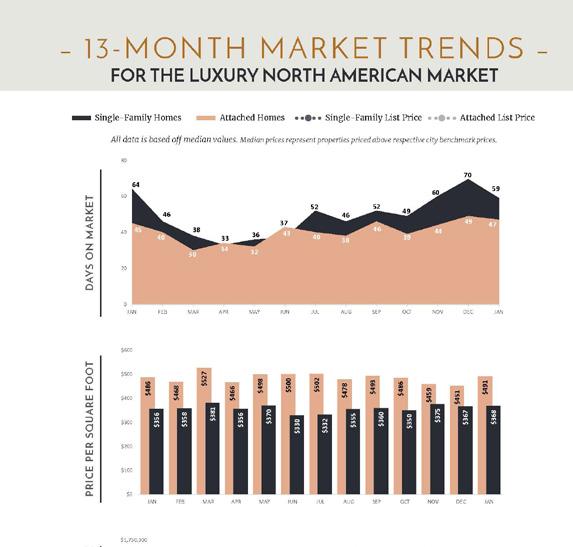
13-MONTH MARKET TRENDS
SINGLE-FAMILY HOMES MONTHLY OVERVIEW
ATTACHED HOMES MONTHLY OVERVIEW
MONTHLY STATISTICS BY CITY
LUXURY REPORT EXPLAINED
WELCOME MESSAGE
LOCAL LUXURY MARKET REVIEW
THANK YOU
2026 LUXURY MID-YEAR REVIEW: A MARKET DEFINED
BY RESILIENCE, SELECTIVITY, AND CONSTRAINT
As we close out the first half of 2026, North America’s luxury real estate market continues to distinguish itself from the broader housing sector. While economic uncertainty, interest rate expectations, and geopolitical events have prompted caution across many segments of the economy, affluent buyers have remained remarkably active, reinforcing luxury real estate’s reputation as a resilient long-term asset.
Rather than experiencing the slowdown many anticipated, the luxury market has spent the past six months demonstrating steady sales growth, stable pricing, and increasing competition for desirable properties. At the same time, however, inventory growth has slowed considerably compared to 2025 as fewer homeowners choose to bring their properties to market.
The result is a luxury market that remains fundamentally healthy, but one that is becoming increasingly strategic. Buyers have become more discerning, sellers more cautious, while exceptional properties continue to command strong demand.
FIRST QUARTER: STABILITY SETS THE FOUNDATION
The first quarter established the tone for the year, with the luxury market demonstrating steady, sustainable growth despite ongoing economic uncertainty.
January closely mirrored the unusually strong start to 2025. While year-over-year sales were relatively flat, stable pricing and modest inventory growth reinforced that buyer demand remained intact. More notably, new listings declined compared to January 2025, signalling that last year’s inventory expansion might be beginning to slow.
February reinforced these trends. Luxury single-family prices edged higher year-over-year, attached properties remained relatively stable, and sales activity held firm. Although inventory remained above 2024 levels, year-over-year growth moderated while the flow of new listings slowed, suggesting the market had reached a more balanced equilibrium following 2025’s supply recovery.
March provided the clearest evidence of the market’s underlying strength. Sales accelerated across both property types, significantly outpacing seasonal norms despite inventory remaining virtually unchanged from the previous year and new listings continuing to fall below 2025 levels. Rather than weakening demand, tighter supply resulted in available inventory being absorbed more quickly, gradually shifting market conditions back in favour of sellers.
Overall, the first quarter established the key themes that would define the first half of 2026: resilient demand, price stability, and tightening supply.
SECOND QUARTER: A DIVERGENCE BEGINS TO EMERGE
If the first quarter demonstrated the market’s resilience, April and May revealed one of the year’s defining trends: a growing disconnect between buyer demand and housing supply. Spring is typically the strongest season for new listings, but in 2026 both inventory growth and new listing activity consistently lagged behind 2025.
April provided the first clear indication that this was more than a temporary fluctuation. Compared to April 2025, inventory declined across both single-family and attached luxury markets, by 4.4% and 8.5% respectively, while new listings also fell despite entering what is traditionally the busiest selling season.
Under normal market conditions, this would suggest softening demand. Instead, sales continued to strengthen. Year-over-year single-family luxury sales rose nearly 7%, attached properties saw a slight gain of 0.6%, and pricing, sold-to-list ratios, and days on market remained remarkably stable.
By May, the divergence became even more pronounced. Single-family sales accelerated by 10.3%, while attached properties rebounded by 2.7% after the brief slowdown in April. At the same time, inventory fell further below 2025 levels, as new listings declined by 10.0% and 8.8% respectively, which also saw an unusual month-over-month drop that typically does not occur until the summer season.
However, rather than signalling weakening demand, available inventory was simply being absorbed faster than it could be replenished, which subsequently saw intensified competition for well-located, high-quality properties, particularly in the single-family segment.
JUNE: THE TREND BECOMES CLEAR
June provided the strongest confirmation yet that the luxury market has entered a distinctly different phase than many expected at the start of the year.
Sales accelerated significantly across both property types, with luxury single-family transactions rising 15.8% compared to June 2025 and attached luxury sales increasing 8.7%. Month-over-month activity also remained strong, demonstrating that buyer momentum had not faded as the market moved towards the traditionally slower summer season.
Pricing also remained stable. Luxury single-family homes posted year-over-year and month-over-month price gains of 3.9% and 3.6%, while attached properties maintained their median price despite minor monthly fluctuations. Just as importantly, sold-to-list price ratios strengthened slightly and days on market remained consistent with last year’s levels, indicating that buyer demand continues to support pricing without creating excessive market pressure.
Constrained inventory continued to be the dominant theme. New listings trailed both the previous month and June 2025, pushing overall inventory below last year’s levels across both market segments. By mid-year, this had become a consistent pattern rather than a short-term anomaly.
Looking across the first half of 2026 puts these monthly trends into perspective. Compared to the first six months of 2025, luxury single-family sales have increased by 8.3%, while attached luxury sales rose by 3.2%. Median sold prices also appreciated, increasing 1.2% for single-family homes and 2.1% for attached properties, while average inventory levels declined 3.9% and 5.9%, respectively.
Taken together, these results paint a picture that differs markedly from much of the broader housing market narrative, as the luxury sector continues to chart its own course.
KEY FORCES SHAPING TODAY’S LUXURY MARKET
The luxury market’s performance during the first half of 2026 has been shaped by buyer confidence, constrained supply, strategic demand and the enduring appeal of luxury real estate as a long-term investment.
Unlike the broader housing market, where affordability continues to be heavily influenced by borrowing costs, affluent buyers have remained relatively insulated from higher interest rates. Many luxury purchases are supported by significant equity or cash, allowing buyers to focus less on financing conditions and more on long-term lifestyle and investment opportunities.
At the same time, ongoing financial market volatility, geopolitical uncertainty, and inflation concerns have reinforced luxury real estate’s role as a stable store of wealth. For many affluent individuals, premium properties continue to offer both portfolio diversification and lasting lifestyle value, supporting buyer confidence even during periods of broader economic uncertainty.
Perhaps the most significant trend has been the growing imbalance between supply and demand. As fewer homeowners chose to sell, available inventory was absorbed faster than it could be replenished, gradually strengthening seller leverage across many luxury markets. Tightening inventory has also heightened buyer selectivity, with well-designed, move-in-ready homes continuing to command premium prices.