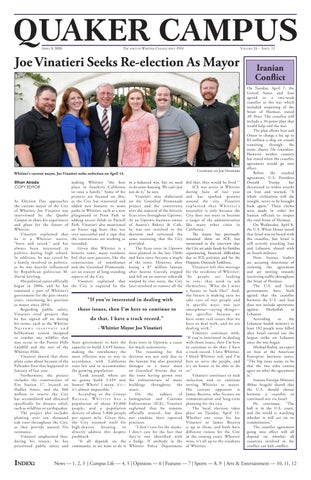
Joe Vinatieri Seeks Re-election As Mayor
Courtesy of Joe Vinatieri
Iranian Conflict
On Tuesday, April 7, the United States and Iran agreed to a two-week ceasefire in the war which included reopening of the Strait of Hormuz, stated AP News . The ceasefire will include a 10-point plan that would help end the war.
The plan allows Iran and Oman to charge a fee up to $2 million a ship on vessels transiting through the strait, shares The Guardian However neither country has stated when the ceasefire agreement would go into effect.
As Election Day approaches the current mayor of the City of Whittier, Joe Vinatieri was interviewed by the Quaker Campus to share his experiences and plans for the future of Whittier.
Vinatieri explained that he is a Whittier native, “born and raised,” and has always been interested in politics during high school. In addition, he was raised by a family involved in politics, as he was heavily influenced by Republican politician M. David Stirling.
His political career officially began in 2006, and he has remained a part of Whittier’s government for the past twenty years, continuing his position as mayor since 2016.
Regarding public safety, Vinatieri cited projects that he has signed off on during his terms, such as the Whittier Narrows reservoir and helihydrant system designed to combat any wildfire that may occur in the Puente Hills Landfill and the rest of the Whittier Hills.
Vinatieri shared that these plans came about because of the Palisades fires that happened in January of last year.
Furthermore, the project includes the construction of Fire Station 17, located on Hadley Street, and the $60 million in reserve the City has accumulated and allocated specifically for disaster relief, such as wildfires or earthquakes.
The project also includes planting over ten thousand oak trees throughout the City, as they provide natural fire resistance.
Vinatieri emphasized that, during his tenure, he has prioritized public safety and
making Whittier “the best place in Southern California to raise a family.” Some of his projects are focused on this, as the City has renovated and added new features to some parks in Whittier, such as a new playground in Penn Park or adding soccer fields to Parnell Park. Vinatieri also mentioned an Easter egg hunt that was very successful and a sign that the renovations are working as intended.
Given that Whittier is a historic town, many residents feel that new pursuits, like the construction of townhomes and the Greenleaf Promenade, are an erasure of long-standing aspects of the City.
Vinatieri explained that the City is required by the
in a balanced way, but we need to do some housing. We can’t just not do it,” he says.
Vinatieri also elaborated on the Greenleaf Promenade project and the controversy over the removal of the historic ficus trees throughout Uptown. As an Uptown business owner of Auntie’s Bakery & Cafe, he was not involved in the decision and reiterated the same reasoning that the City provided.
The ficus trees in Uptown were planted in the late 1960s and have since become a staple of the town. However, after losing a $7 million lawsuit after Justine Gurrola tripped and fell on an uneven sidewalk warped by tree roots, the City later resolved to remove all the
"If you're interested in dealing with those issues, then I'm here to continue to do that. I have a track record."
-
Whittier Mayor Joe Vinatieri
State government to have the capacity to build 3,439 homes, making the townhomes the most efficient way to stay in accordance with California state law and to accommodate the growing population.
“Look around, where are we gonna build 3,439 new homes? Where? I mean, it’s— it’s almost impossible.”
According to the Census Bureau, Whittier has a population of about 85,000 people, and a population density of about 5,800 people per square mile. Given this, the City rezoned itself for high-density housing to directly address this despite pushback.
“It all depends on the community, so we want to do it
ficus trees in Uptown, a cause for much controversy.
The reasoning for this decision was not only due to the lawsuit but also potential damages to a water main on Greenleaf Avenue due to the roots having grown into the infrastructure of many buildings throughout the street.
On the subject of Immigration and Customs Enforcement (ICE), Vinatieri explained that he remains officially neutral, but does not condone their reported practices.
“I don't care for the masks. I don't care for the fact that they're not identified with a badge. If anybody in the Whittier Police Department
did that, they would be fired.”
ICE was active in Whittier during June of last year and has sparked protests around the city. Vinatieri explained that Whittier’s neutrality is only because the City does not want to become a target of the administration like many other cities in California.
The mayor has previously remained silent on ICE, but mentioned in the interview that the City set aside funds for families experiencing financial difficulties due to ICE activities and for the Hispanic Outreach Taskforce.
Vinatieri left this message for the residents of Whittier:
“As people are looking to vote, they need to ask themselves, ‘What do I want a future to look like?’ And, the future is making sure we take care of our people and in specific ways, not just amorphous—saying things— but specifics because we have some real issues that we have to deal with, and we are dealing with."
Vinatieri continues with, "If you're interested in dealing with those issues, then I'm here to continue to do that. I have a track record. I love Whittier. I bleed Whittier red, and I'm here to serve the people, and it's an honor to be able to do so.”
Vinatieri continues to seek reelection and to continue serving Whittier as mayor. His current opponent is James Becerra, who focuses on communication and long-term planning for the city. The local election takes place on Tuesday, April 14. Whether one votes for Joe Vinatieri or James Becerra is up to them, and both have different visions for the City in the coming years. Whoever wins, it’s all up to the residents of Whittier.
Before the reached agreement, U.S. President Donald Trump has threatened to widen attacks on Iran and warned, “A whole civilization will die tonight, never to be brought back again.” These claims were made in order for Iranian officials to reopen the vital Strait of Hormuz.
On Wednesday, April 8, the U.S. White House stated that Israel was on board with the ceasefire, but Israel is still actively attacking Iran and Lebanon, shared with an Israeli military.
Now, Iranian leaders are accusing Americans of violating the agreement and are moving towards restricting traffic throughout the Strait of Hormuz.
The U.S. and Israel governments have both agreed that the ceasefire between the U.S. and Iran does not include operations against Hezbollah in Lebanon.
According to the Lebanese health ministry at least 182 people were killed after Israel carried out the largest strike on Lebanon since the war began.
Michael Rubin, an expert on Iran at the American Enterprise Institute states, “The big issue seems to be that the two sides cannot agree on what the agreement is.”
Iranian Foreign Minister Abbas Aragchi shared that the U.S. should choose between a ceasefire or continued war via Israel.
He continues, “The ball is in the U.S. court, and the world is watching whether it will act on its commitments.”
The ceasefire agreement going into effect will all depend on whether all countries involved in the conflict can halt conflict.
The voice of WhiTTier
Whittier's current mayor, Joe Vinatieri seeks reelection on April 14.
Ethan Airada COPY EDITOR
James Becerra: Future Mayor of Whittier?
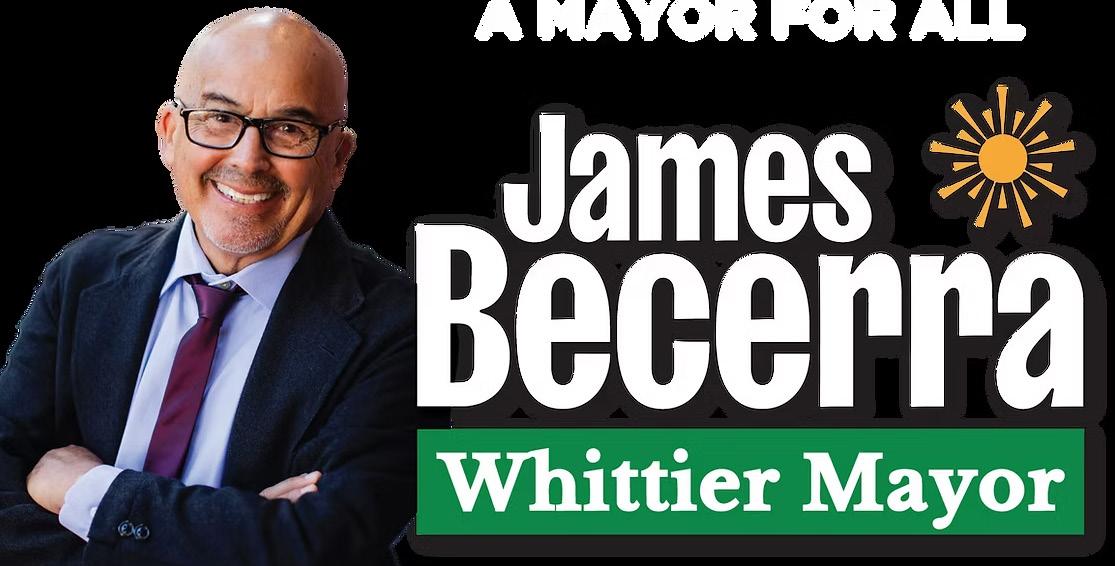
With the Whittier mayoral election approaching, candidates are presenting their platforms on key issues that the city is facing.
James Becerra, a candidate in the upcoming Whittier mayoral election, states his campaign focuses on leadership turnover, communication and longterm planning for the city. “I personally believe it’s time for change.”
Becerra has cited dissatisfaction with recent city decisions as a factor in his decision to run for Mayor, including the city’s failure to adopt a proposed ordinance related to federal immigration enforcement.
Becerra credits that decision as a contributing factor to his decision to pursue a more direct role in city governance.
“I’d rather be on the inside than complaining on the outside,” he added.
Becerra identified government transparency as a key issue in his campaign, though he said the concept should extend beyond simply making information publicly available.
He emphasized the
importance of clear and effective communication between the City and its residents, noting that access alone does not always translate to understanding.
“It’s not just transparency, it’s communicating effectively so people understand what is happening,” he emphasized. He also addressed how the
maintaining these elements can help guide more consistent and intentional development decisions.
On housing, Becerra believes additional development is necessary as the population grows, but he also emphasized the need for a broader, citywide planning approach rather than focusing on individual projects
“It’s not just transparency, it’s communicating effectively so people understand what is happening.” - James Becerra
City approaches development, particularly in relation to preserving Whittier’s existing character.
Becerra pointed to the City’s tree canopy as an example, describing it as part of the City’s infrastructure that contributes to both environmental conditions and residents’ experience.
“Trees are, or let's say, our urban tree canopy slash our urban forest is a part of the city’s infrastructure. They’re just as critical as water, sewer, gas, et cetera” he said, adding that
in isolation.
The city should consider how new developments fit into a larger framework that accounts for long-term growth and community needs.
“We’re going to have more people, so we have to accommodate that,” he said. “The question is how.”
If elected, Becerra would prioritize changes that could be implemented in the near future, including aligning Whittier’s municipal elections with state and federal election
THE QUAKER CAMPUS STAFF
EDITOR-IN-CHIEF Paige Meyer-Draffen
DePUTy eDiTOr
eMMa galvan
Managing eDiTOr
PenelOPe TUrgen
neWS eDiTOr
PaOla rUiz
OPiniOnS eDiTOr
angelica HenneSSy
SPOrTS eDiTOrS
Maia cHaiDez
MOnze Meraz-lerMa
caMPUS life
eDiTOr
naDia Miller
FEATURES EDITOR
eMMa cianciOla
a&e eDiTOr eliaS lOya
HeaD cOPy eDiTOr clOver MOraleS
SOcial MeDia MOnze Meraz-lerMa
STaff WriTerS
allara Baker
eTHan raMillanO
OSWen MarTinez
Tralee JacOBS
Jay fUenTeS
JayDen garreT
JayDen BOrgna
XOcHiTl HOOD
lUiS SanDOval
STeven lOPez
JaMie calDerOn
SOnny fOUrneaU
cOPy eDiTOrS
eTHan airaDa
Daniel gOMez
graPHic DeSigner
naDia Miller
carTOOniST
neMi DOc
facUlTy aDviSOr
JOSePH DOnnelly
cycles to increase voter turnout.
As Mayor, he would seek to revisit the previously rejected ordinance related to immigration enforcement.
In addition, Becerra believes the City could expand collaboration with local institutions such as Whittier College and Rio Hondo College.
He notes that these partnerships, development and post-graduation pathways for students, describing the institutions as underutilized resources within the city.
“There’s a lot more the City can do with these colleges,” he said.
Becerra also discussed the future of Uptown Whittier,
noting uncertainty in the retail sector and the need for the city to begin exploring new approaches to economic development.
While there is no single solution, he emphasized the importance of initiating broader conversations about how the area could evolve.
“There’s no clear answer yet,” he said. “But we need to start that conversation.”
As the election approaches, Becerra’s priorities focus on both near-term policy changes and longer-term planning efforts related to development, communication and the city’s overall direction.
LETTERS TO THE EDITOR
Submissions may be emailed to qc@poets.whitttier.edu in .doc or .docx format. Submissions must include the author’s name and year of graduation or position at the college in the signature. Letters are due by Monday at 5 p.m. to make it into that week’s issue. Submissions should be no more than 500 words. Submissions will undergo the same editing process from our production pipeline if selected. All stories must follow the same journalistic standards.
Due to the high cost of publication, members of the Whittier College community are permitted three copies per issue. Additional copies may be purchased with prior apporval for 50 cents each by contacting the Quaker Campus. Newspaper theft is a crime, and those who violate the three copy rule may be subject to civil and criminal prosecution.
The Quaker Campus does not change material posted on online articles once they have been published in the paper — with the exception of an error being found. Only then will a correction be made to the online version. The Quaker Campus is a publication of Whittier College. Columns and Signed editorials do not necessarily reflect the opinions of Whittier College or its affiliates.
Courtesy of James Becerra
James Becerra is looking to become the next Mayor for the City of Whittier.
Luis Sandoval STAFF WRITER
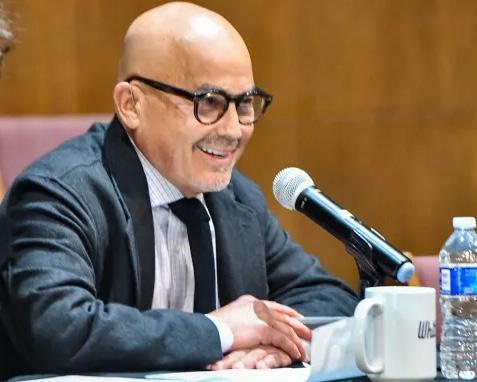
Courtesy of James Becerra
James Becerra's campaign runs on transparency.
Cesar Chavez Day Turned Farmworker's Day

Following recent allegations of sexual abuse raised against César Chávez, the California Legislature unanimously passed Assembly Bill 2156 on March 26, which renamed César Chávez Day to Farmworkers Day. California Governor Gavin Newsom signed the bill into law on the same day.
Césario Estrada “César” Chávez, born on March 31, 1927, was the co-founder of the United Farm Workers of America (UFW), a union of Hispanic farm workers in California. He led the Delano Grape Strike of 1965-1970, which protested the unfair treatment of Hispanic farm workers on table grape farms. He was also the face of the Chicano Movement in the '60s, which protested racism, suppression of cultural identity, and political inequality.
The grape strike achieved better wages, safer working conditions, and prohibited child labor exploitation on farms, while the Chicano Movement achieved increased political representation, bilingual education, and the promotion of Chicano identity.
Chávez eventually died of natural causes on April 23, 1993.
In 2000, California codified into law a new state holiday, César Chávez Day, falling annually on March 31, with other states joining in later years. The holiday was not recognized at the federal level, until President Barack Obama issued a proclamation in 2014, proclaiming March 31, 2014, as César Chávez Day.
On March 18, The New York Times published an article that detailed a five-year long investigation into sexual abuse claims against Chávez, including claims by two women, who accused him of sexual abuse, alleging that Chávez abused them when they were 12 and 13, respectively, describing the acts as grooming.
The article stated the women maintained their silence for 50 years as they feared that it would damage the Farmworker Movement and Chávez’s legacy as a civil rights leader and Latino icon.
The New York Times also reported that Chávez sexually advanced on a 19-year-old girl in 1988, sharing that Chávez told her that “he could use his influence to get something named for her if she slept with him.” She was fired from a union-run health clinic after she refused his advances.
The investigation also reported that Dolores Huerta, co-founder of the UFW and coleader of the grape strike, via a statement posted to Medium , was sexually assaulted by Chávez on two separate occasions, one where she was forced to have sex with him in an “environment where [she] felt trapped.” Both incidents resulting in pregnancies, in the birth of two children.
now be celebrated instead of Chávez’s. California renamed the holiday to Farmworkers Day on March 26.
Various cities, including Los Angeles, Phoenix, Denver, San Fernando, San Diego, Berkeley, Milwaukee, Austin, San Antonio, Portland, Albuquerque, Bakersfield, and others, have removed or are in the process of removing tributes to Chávez, including street names, park names, school names, and statues. The cities have also begun renaming or removing César Chávez Day from holiday calendars, with some cities remaining the holiday to Farmworker’s Day.
In a statement on March 19, Los Angeles Mayor Karen Bass
“One man does not define the farmworker movement. I stand firmly with the survivors coming forward and bravely sharing their stories.”
- Congresswoman Linda Sanchez
The children were confirmed to be Chávez’s and Huerta’s via DNA evidence acquired by The New York Times . Following the release of the article, Huerta also accused Chávez of emotional abuse, claiming that Chávez called her a “stupid b*tch” during a UFW meeting.
On March 17, the day before the article was published, UFW released a statement, saying that they had learned of the allegations against Chávez and had cancelled their annual César Chávez Day tribute. The family of César Chávez released a statement on March 18, stating that they were “devastated” by the allegations and that “This is deeply painful for our family.”
Following the article's release, various cities and states began to terminate or rename César Chávez tributes. Texas Governor Greg Abbott ordered state agencies to terminate commemoration of César Chávez Day, and called for legislation to remove the holiday from state law. The State of Washington declared that Dolores Huerta’s birthday, April 10, will
said, “I had the honor of meeting [Chávez] once and I thought it was the opportunity of a lifetime.
When I heard the painful news from the sister that I admire so much, Dolores Huerta, my heart broke for what she went through.”
According to ABC News , in a press conference, California Governor Gavin Newsom stated, “It is been hard to absorb this. [First Lady Jennifer Newsom] and I are very close with Dolores —so many of us are—but very close, have been for decades and decades…” and also stated that, “So we are just going to have to reflect on all of that […] and reflect on a farm workers' movement and a labor movement that was much bigger than one man.”
Congresswoman Linda Sánchez, representing California’s 38th congressional district, which covers the City of Whittier, released a statement on Facebook , saying that “One man does not define the farmworker movement. I stand firmly with the survivors coming forward and bravely sharing their stories.”
Paola Ruiz
EDITOR
Caucus also released a statement saying that “The accusations published against César Chávez are deeply disturbing and profoundly serious. We cannot celebrate a man, regardless of his accomplishments, who harmed women and children in such vile ways.”
In an email sent to students on March 20, Whittier College President Kristine Dillon released a statement saying, “As we approach César Chávez Day, a state holiday recognized by the College on March 31 […] I want to acknowledge the difficult context surrounding the occasion this year, with recent revelations of sexual abuse that went unreported for many decades, now eroding the Chávez legacy. We honor the history of labor rights and the achievements of collective action, as well as the contributions of civil rights leaders like Dolores Huerta. We also stand strongly with survivors.”
In a poll released on March 20 by YouGov , “13 percent [of respondents] had heard a lot about the allegations, 39 percent [had heard] a little, and 47 percent [had heard] nothing at all. After being told about the allegations, 52 percent of Americans support renaming things bearing Chávez's name. That includes 22 percent who say they never should
have been named after Chávez and 29 pecent who supported naming things for him before the allegations but now support renaming. Renaming is supported by 62 percent of those who have heard a little about Chávez's allegations and 76 percent of those who've heard a lot. Only 11 percent of Americans oppose renaming things with Chávez's name.”
The poll also found that “the ratio of support to opposition for removing Chávez's name is greater than three among men and women, among Hispanic Americans, and among liberals, moderates, and conservatives. The ratio of support to opposition also is three or greater among Hispanic men under 45, older Hispanic men, Hispanic women under 45, and older Hispanic women.”
As we approach Chávez's 100th Birthday in 2027, we must recognize that the Farmworkers’ movement was not just Chávez; it was Mexican-Americans, Filipino-Americans, Women, Children, American Citizens, and Foreign Immigrants. Chávez does not define the whole movement. March 31 belongs to all farmworkers, to remember and honor their struggle for better and equal treatment. The legacy of the movement is not Chávez's; it belongs to the people.

Steven Lopez STAFF WRITER
NEWS
Courtesy of ABC
People are painting over Cesar Chavez monuments after the allegations.
What’s up,
Whittier?
Stay up to date on events! For further info, visit https://whittier. campuslabs.com/Engage/
Poet Pantry
• Thursday, Apr. 9 at 12:30 p.m.
• Campus Center Room 141
Third Space Thursday: Thank You Letters
• Thursday, Apr. 9 at 4:30 p.m.
• Club 88
Intersectional Poetry Slam
• Thursday, Apr. 9 at 5:00 p.m.
• Villalobos Hall
Whittier Scholars Program
Senior Presentations
• Thursday, Apr. 9 at 5:30 p.m.
• Deihl Hall 118
Student Theatre Production of RENT: Book, Music and Lyrics by JOHNATHAN LARSON
• Thursday, Apr. 9 at 7:30 p.m.
• Ruth B. Shannon Center
D3 Week: Spring Sports Crawl
• Friday, Apr. 10 at 3:00 p.m.
• Graham Athletic Center
Wild Whittfest
• Friday, Apr. 10 at 4:00 p.m.
• Upper Quad
Brotherhood Leadership Program: Leadership Symposium
• Saturday, Apr. 11 at 11:30 a.m.
• Villalobos Hall
It's on Us Week: What is "It's on Us?"
• Monday, Apr. 13 at 12:00 p.m.
• Club 88
Bug Club Trip to the Butterfly Pavilion
• Monday, Apr. 13 at 4:00 p.m.
• Natural History Museum
Drawin' Together
• Monday, Apr. 13 at 5:00 p.m.
• Dezember House
Craft Night with Fiber Arts Club
• Monday, Apr. 13 at 5:00 p.m.
• Ettinger Lounge
FREE STD (Sexually Transmitted Diseases/ Infections) Testing
• Tuesday, Apr. 14 at 11:00 a.m.
• Next to Campus Center Building B
TOBGLAD Weekly Meetings!
• Tuesday, Apr. 14 at 12:15 p.m.
• Johnson Hall Lounge
Life After Whittier - A Career and Grad School Panel
• Tuesday, Apr. 14 at 12:30 p.m.
• Dezember House
Pet Therapy
• Tuesday, Apr. 14 at 12:30 p.m.
• Founder's Hill Lawn
Herbarium Presentation
• Thursday, Apr. 16 at 5:00 p.m.
• Poets Corner in the Wardman Library
ASWC Senate Night Market
• Thursday, Apr. 16 at 5:00 p.m.
• Upper Quad
CAMPUS LIFE
Whittier Superheroes Unite at Sportsfest
Jamie Calderon STAFF WRITER
With finals season rapidly approaching, Whittier’s campus has been in search of some heroes, and at Sportsfest 2026, six teams picked up the call. Last year, the long-standing tradition returned to Whittier College. This year, in a super way, teams of some of the bravest heroes and some of the most nefarious villains competed in Club 88 to take home the trophy.
This year's roster was jampacked with talent and passion. From the first generation students of Los Campeones Del Cambio and XGEN, to the undercover heroines The Palmer Girls, to our multiversial residential hall teams Into the Turner-Verse and Batman, and even a special appearance from The Legion of Doom! Spirits were high and tensions even higher as every team was ready to stake claim to victory.
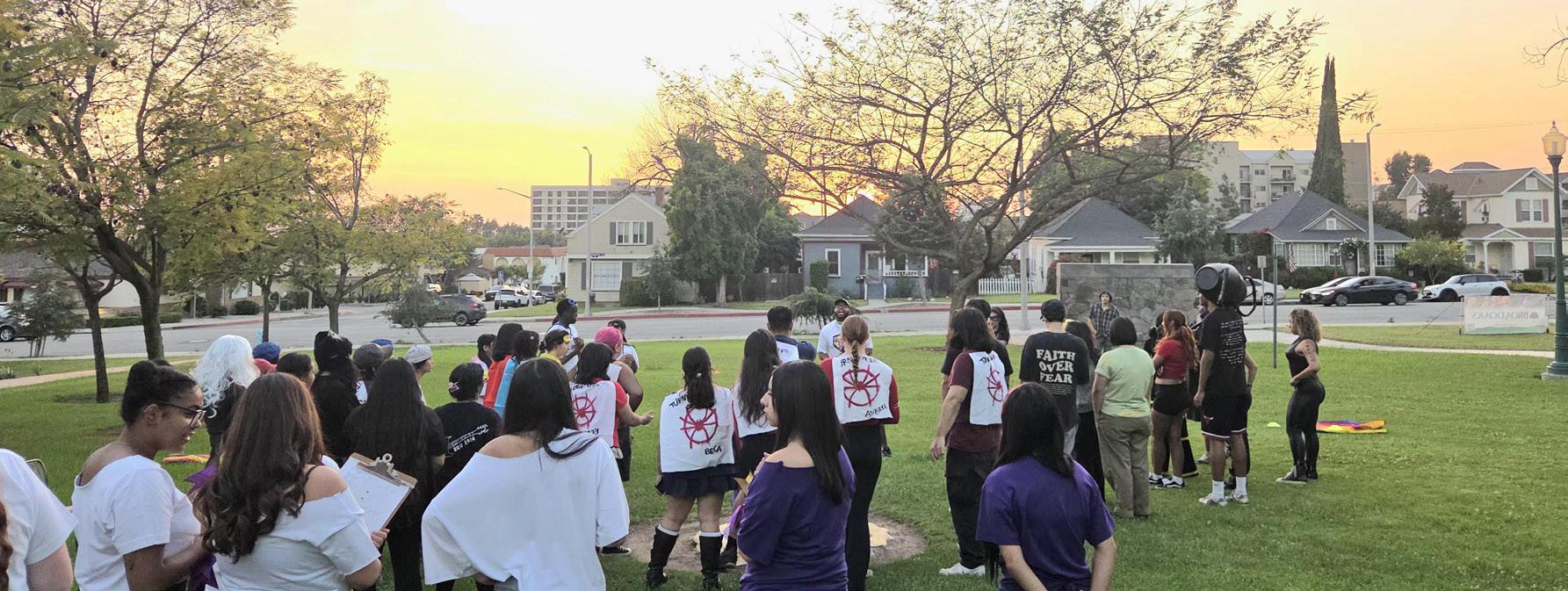
They started off with a feat of strength like no other: arm wrestling. Teams sent in their strongest, and after a long-fought battle, The Legion of Doom collected their first big points, and we moved to testing everyone's super smarts with superhero movie trivia. Teams raced across the room to answer questions like “Who is Spider-Man’s best friend in Tom Holland’s Spider-Man?” and “What do the six infinity stones represent?”
The next challenge kept their brains running with a telepathic game, testing who was really super… or at least who knew their team members the best. As the teams battled the war of intellect, Office of Student Engagement (OSE) Coordinator Candice Uy was setting up the next round of challenges. I was able to talk to her and learn how the committee created these games. “It comes off the brain, TikTok, Instagram reels. And I’m Filipino, so we play a lot of minute-to-win-it games," Uy says. Every challenge was created and run by a different member of the committee, or as they called themselves, the W.C. Villain Squad.
Uy's games had the teams throwing Captain America's shield, wielding Thor's hammer, web-spinning, hulk smashing, training like Black Widow, and
shooting like Hawkeye to be the fastest through. And after every team had a chance to run the gauntlet, the Director of Wellness and Recreational Sport, Jabari Lewis, took the teams outside for a relay race that ended with an epic round of tug-of-war in front of the Rock at sunset.
The final games of the night took us back to the Campus Center, where their teamwork was tested one last time. As the competition cooled down, the committee tallied points to determine the most super team. Our Comeback Heroes were the off-duty Palmer Girls. Our Rising Legends were the first-gen heroes Los Campeones Del Cambio. Our Masterminds of the night were XGEN (and allies). And Batman was recognized for their blockbuster movie-deserving performance.
And the big winners of the night were The Villains of the
Sankofa Collective, The Legion of Doom! They took home the award for Best Original Story, but they can really thank their teammate Thanos for finding the Infinity Stones and bringing their universes together. They also took home the coveted Spirit Award, and as anyone in the room could tell you, no team quite brought the energy like them.
And to top off a night of super-calculated villainy The Legion of Doom took home the big gold trophy, granting them bragging rights for the Black Student Housing Community for the second year in a row! And their team leader, current Editor-inChief of the Quaker Campus and fourth-year Paige Meyers-Draffen comments, “We were so excited to participate and win. And we will be back next year to win again.” And they’ll be back to tell you all about it.
Kaaihue-Paopao's Spoken History
Jamie Calderon STAFF WRITER
As Whittier begins saying goodbye to its senior class, one senior’s presentation had people saying “a hui hou.” Fourth-year student Ku’uipo Kaaihue-Paopao gave attendees a sneak peek of her senior symposium with a demonstration in the practice of poke preparation.
The tables in the room were scattered with recipes created by Kaaihue-Paopao and her mother: Shoyu Ahi Poke, Spicy Ahi Poke, and the classic preparation with coconut cream and salt. The main table was set up with everything you would need to recreate her recipes, including sample bowls to find your favorite, though KaaihuePaopao would recommend the shoyu ahi recipe: three spoonfuls of soy sauce, one spoonful of green onion, one spoonful of onion, and a sprinkle of salt.
After Kaaihue-Paopao walked me through the process of making my own bowl, I was able to speak with her about the steps she took in creating this event and her senior project. “Like any great idea, it came from my mom. Because I was telling her I had to come up with a topic for my senior project and she brought up the topic of diaspora.”
The conversation around diaspora, the dispersion of people from their ancestral homeland whether by choice or by force. This was central to her artist statement from this project.
In it, she talked a lot about
the effects of diaspora and cultural exclusion on the Hawaiian people living in diaspora. Her statement shared a lot of real emotions and difficult feelings she navigates as a Hawaiian living in diaspora and her connections to the culture, but her project reflects a hopeful outlook.
Kaaihue-Paopao is a Whittier Scholars Program (WSP) student, her self created major ‘Creative Expression Through Hawaiian Language and Culture’ aims to open up a pathway for Hawaiian culture to make its way into the mainstream conversation. Much of the culture is passed down through oral speach, traditions unwritten but still kept alive. And although Kaaihue-Paopao wrote down her
recipes for attendees, the process of building them was through her mom, and experimenting in the kitchen.
“When I was working on this demonstration, my mom was feeding me info. Because Hawaiian culture wasn’t written down until contact with other people. So she told me the traditional way first and I asked her ‘Wow, where do you find this?’ and she said you don’t. It’s passed down through word of mouth.”
And hats off to KaaihuePaopao, her recipes were delicious. And the conversations she inspired in the room were great. Outside of her artist statement, she shared a lot of personal feelings about her senior symposium topic. These
conversation include the erasure of Hawaiian culture from American conversations, like how the capital in Hawaii had electricity before the White House. Or even about how the presentation itself connects to the bigger idea.
Poke was used as an example of the cultural diffusion that has happened, a disconnect between the deep threads of culture and meaning, and the commodified American version. Her program, much like the goal of her bigger project, was to bring back the culture to the practice by reminding us about what it really means to really make and enjoy poke and reconnect it to its roots. So next time you’re looking for a fulfilling meal, try her shoyu ahi recipe.

The sunset after the tug of war battle at Sportsfest 2026.
Kaaihue-Paopao's Artist Statement.
Jamie Calderon / Quaker Campus
Nadia Miller / Quaker Campus
CAMPUS
Bleed Lavender and Gold at Whittier's Lav Grad
Lavender Graduation Will Honor This Year's Queer 2026 Graduates on May 6
Ethan Airada COPY EDITOR
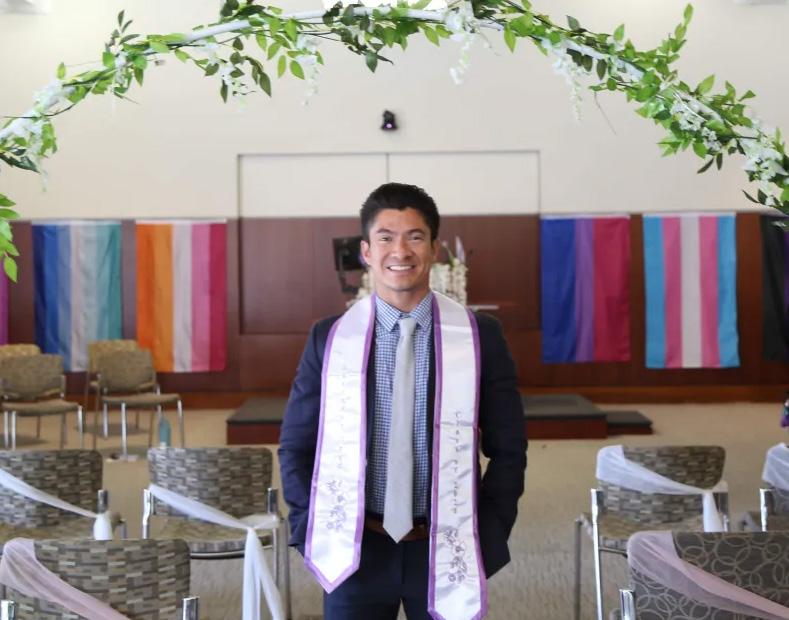
Graduation is fast approaching, and the Lavender Graduation Committee is working hard to make sure this year’s celebration stands the test of time. We had the opportunity to interview CoChair, ASWC Senate President, and fourth-year Izzy Brookshire, for the Lavender Graduate celebration this coming May. The celebration is meant to commemorate students at the College who are part of the LGBTQ+ community and their contributions to the campus.
Brookshire spoke much about the planning and organizing of the celebration. According to her, the theme for this year is “Dreaming of the Past, Waking up to the Future.”
The committee for the celebration wanted it to be a celebration of the grads’ childhood nostalgia, their dreams, and the experiences that brought them to where they are today.
Throughout the year,
Brookshire mentioned many “flower runs” from them and other Co-Chair, Tyler Johnson. This was done to give each graduate a bouquet and to decorate the venue. There were also the various other tasks such as the many meetings with committee members and contacting keynote speakers, all to make the celebration a truly memorable experience.
“There’s stuff happening every single week just, like, slowly moving it forward. Just, like, lots of office work,” Brookshire explains, emphasizing the work behind it, assisted by the Office of Inclusive Excellence (OIE) and the structure provided, making the process much easier, especially when the theme was chosen. “The theme is one of the hardest things to figure out early in the semester, so that we have, like, a guiding vision,” Brookshire says, explaining what the committee drew from the theme going into this year’s celebration.
This year, as befitting the theme of nostalgia, looks back on other
Lavender celebrations to see what will make this year better. One in particular, is the entertainment provided by a drag performer, who turned the celebration into a dance.
This year, another drag performance will occur in accordance with the theme, having them do a “storytime,” reading a children’s book to match the atmosphere. The Lavender Grad committee is particularly excited for this as Brookeshire shares, referring to last year, “It was really beautiful. That was one of the best entertainments I’ve seen.”
Another piece of the celebration, inspired by other graduate celebrations, will have baby photos, submitted to the committee, put up on the walls.
Brookshire is specifically excited to finally be a part of this year’s celebration, now having the opportunity to take part in it instead of simply preparing for it. “I’m excited to see how it comes together, because there are so many beautiful pieces already that
I’ve seen, and seeing it all come to fruition is going to be, like, ‘ha!’”
This year's celebration will take place on May 6 from 10 a.m. to 11:30 a.m. with each graduate receiving a gift for their participation. Participating graduates may also receive
a stole they can wear during commencement later on May 8.
If you’re a Lavender Grad, this is one last hurrah for all of you before graduation, and an opportunity to look back on all you’ve done, and then wake up in the future with more to come.
The War Of Narrative: The Case of Iran
Irfana Hashimi GUEST COMMENTATOR
Becky Overmyer -Velazquez GUEST COMMENTATOR
Guest columns and op-eds do not necessarily reflect the views of Quaker Campus, its staff, or Whittier College. The Quaker Campus aims to provide a platform for diverse viewpoints and campus discourse.
On Feb. 28, 2026, the U.S. and Israel attacked Iran without provocation. In the aftermath, much of the mainstream coverage framed events around Iranian State repression while narrowing the broader geopolitical context, thereby distorting public understanding of how and why this aggression unfolded.
Contested casualty figures during protests in Iran between Dec. 2025 and Feb. 2026 are central to this narrative. The Human Rights Activists in Iran (HRA), a U.S.-based NGO, documented approximately 7,000 deaths, while the Iranian government reported a much lower count of 3,117. Much higher numbers, ranging from 32,000 to 45,000, have circulated in political rhetoric but remain unverified.
Moreover, questions remain regarding responsibility for these deaths, given that Israeli and American sources, including President Trump most recently, admitted to arming and inciting rioters inside Iran.
Despite uncertainty, these figures have circulated widely in U.S. media, while allegations of foreign intelligence involvement have been sidelined, reinforcing a one-sided narrative that shapes public perception.
Representations of Iranian State violence form part of a broader war of narratives, in which partial reporting and unverified
claims actively legitimize U.S. and Israeli calls for military action and manufacture consent for war.
Following the Oct. 7 attacks on Israel, media coverage of certain alleged atrocities committed by Hamas and other Palestinian actors circulated quickly, often before verification.
Among the most widely disseminated claims were reports that came to be called the Hamas baby-beheading hoax, repeated across Western media outlets and by political leaders, including former U.S. President Joe Biden, before eventually being recognized as false. Reuters, AP, and BBC found no evidence to support claims of babies being beheaded.
Yet, these claims proved integral to building international support for Israel’s military response in Gaza, now widely recognized as the Palestinian genocide by scholars, human rights advocates, experts, international bodies, and states.
The speed and scale at which such claims spread demonstrate how unverified information can shape public perception and justify large-scale violence.
For this reason, it is crucial to critically examine how mainstream news frames the Israeli-U.S. war with Iran. An honest discussion must situate this war within the broader geopolitical context, including the Palestinian genocide and Israel’s broader ambitions of regional expansion, increasingly described as the Greater Israel Project.
The Greater Israel Project is a Zionist plan to give Israel more control over the West Bank and nearby countries like Jordan, Lebanon, Syria, and Egypt.
On Aug. 25, 2025, Israeli Prime Minister Benjamin Netanyahu expressed deep attachment to the vision of the Promised Land and Greater Israel, a vision consistent with the historical ideology of the
Likud Party and its Revisionist Zionist roots. Whether or not one accepts this view, it remains relevant to the current war in Iran.
Equally important, mainstream U.S. coverage has largely overlooked concerns that Israel is exporting the Gaza model of warfare to neighboring countries.
On March 24, Israel’s Defense Minister Israel Katz announced plans to extend operations in the south of Lebanon up to the Litani River, approximately 20 miles north of Israel's border (roughly 10 percent of Lebanon), while referencing the “Rafah and Bayt Hanun model” used in Gaza.
In early April, the Israeli military advanced deeper into Lebanese territory, ordering residents to evacuate and move north of the Zahrani River (an expansion reaching roughly 13–20 percent of Lebanon). These actions demonstrate that Israel's military strategies, first deployed in Gaza, are now exd across the region as part of a broader strategy.
According to the U.S. military, over 1,000 targets were struck in Iran within the first 24 hours of the aggression. The strike on a school in Minab, southern Iran— an attack that killed 165–175 adults and children, most of them girls between the ages of seven and twelve—has been presented as an intelligence failure.
However, witnesses and medics describe the Minab strike as a “double-tap” attack: first, targeting the school, and then a prayer hall where children had gathered while waiting for their parents and first responders.
While investigations are ongoing, this account raises serious concerns under international humanitarian law and could constitute a war crime. This massacre occurring on the first day of the war is no coincidence; it follows the Israeli targeting of children in Gaza
for maximum terror, a method well documented by doctors during the Palestinian genocide.
Regime change has long been a recurring feature of U.S. imperial policy. For decades, the U.S. and its allies sought to destabilize Iran to control its natural resources and strategic position. From the CIA-engineered coup in 1953 that overthrew democratically elected prime minister Mohammad Mosaddegh following his nationalization of Iran’s oil industry to U.S. support for Saddam Hussein during the Iran-Iraq War (198088), even as Iraq deployed chemical weapons, to more than 40 years of crippling sanctions imposed on the Iranian people, the U.S. has consistently acted as the aggressor, actively shaping and destabilizing Iran’s modern trajectory.
This record extends beyond Iran. It includes the illegal invasions of Iraq and Afghanistan, U.S. involvement in Syria through programs such as Timber Sycamore, widely criticized for arming groups like ISIS and Al-Qaeda, the NATO-led intervention in Libya, targeted assassinations of Iranian officials, and U.S. attacks on Iran during formal negotiations. Taken together, these actions point to the U.S. as the central destabilizing force in the region.
A growing number of Americans now view the Israeli-U.S. aggression against Iran as Israel’s war. On March 5, Netanyahu himself stated, "This joint war allows us to do what I have hoped to achieve for 40 years: to completely crush the regime of terror." Such statements reinforce the perception that the U.S. is waging a war of choice, one that does not have the support of most Americans and aligns closely with Israel’s long-term agenda.
For years, Americans have been conditioned to view Iran as one of the most dangerous states in the world, but Iran is not a
terrorist state by any stretch of the imagination. In addition, the claim that Israel is responding to threats against its security, rather than actively shaping and escalating the conflict, distorts the role of Israel as a primary driver of this war.
See, for example, Secretary of State Marco Rubio's assertion that the U.S. struck Iran because of an anticipated Israeli action: “If we stood and waited for that attack to come first before we hit them, we would suffer much higher casualties [. . .] We knew that there was going to be an Israeli action; we knew that that would precipitate an attack against American forces.”
The cruel irony is that U.S. and Israeli racist hubris blinded the leaders of both countries to Iran’s decades-long preparation for an asymmetrical war of attrition. The illegal assassination of Supreme Leader Ayatollah Ali Khamenei further galvanized Iranians and Shia across the region to resist aggression at any cost, because they understand that this is a war for the very existence of Iran, a center of Shia Islam, and the only power standing in the way of Israeli expansion.
Predictably, the U.S. and Israel not only face the unrelenting Iranian missile and drone barrages, but also coordinated attacks from Iranian allies in Yemen, Iraq, and Lebanon, with China and Russia providing behind-the-scenes economic and satellite support to Iran. Iran controls the Strait of Hormuz, directly impacting the global economy in ways foreseen by experts years ago.
The world is changing, and it will undoubtedly be different once this war concludes. As teachers and scholars, it is our responsibility to move beyond the propaganda masquerading as news to critically understand and explain the complex historical, political, and social contexts of these events and their consequences for all our lives.
Lavender Graduation will be held in Villalobos on May 6.
Courtesy of Izzy Brookeshire
Face It! Age Verification Invades Privacy
Allara Baker STAFF WRITER
In the current age of modern technology and social media, our jaded compliance has resulted in platforms utilizing artificial intelligence. Our algorithms depend on artificial intelligence (AI), using our personal information to show us exactly what we want to see.
We’ve become so accustomed to online surveillance that it’s something we hardly even notice anymore. But with the recent presence of AI age verification software, its invasiveness has become impossible to ignore, especially when the outputs coming from these systems are increasingly flawed.
YouTube, TikTok, Discord, and even gaming platforms like Roblox have all implemented age verification systems that require users to confirm their identity via facial scan or their governmentissued ID in order to continue using a more “user-accurate” version of their platforms. This was primarily put into place to prevent minors from having access to inappropriate content, so the platform could be adjusted algorithmically in a way that was more “suitable.” However, this identification system has brought up a plethora of new issues in what was an attempt to prevent them.
Not only is this software a gross invasion of privacy, but platforms like Discord are notorious for user data breaches, and these increased methods of surveillance have only made these weak spots more dangerous. It's forcing us to become accustomed to the idea of
our data and personal information needing to be accessed in order to continue using essential aspects of these platforms shouldn’t be commonplace.
In late 2025, Roblox introduced their new verification system in which any user who hadn’t uploaded an ID or a picture of themselves to the website would have certain restrictions on their account. This included being unable to chat with other players, which is one of the primary forms of interaction on the platform.
Many users who did go through the facial recognition process were met with even more problems. The scanner places the user in an “age group” that corresponds to the age they determined from the scan, making it so that players can only interact with those in the same age group as them. The system continuously sorting this data incorrectly was the source of a lot of frustration.
Some of those who were placed in lower age groups were in actuality much older, and the inverse was common as well due to their “facial age.” This also made
access to those who had harmful intentions much easier, as they could easily get themselves sorted into the younger category with little effort. In an attempt to create a safer environment, they only deepened the issue that was the result of the AI’s clear lack in skill and nuance in this sorting method.
On YouTube, this type of policy brought forth much greater controversy, as identity and age verification became required in order for both users and creators to ensure that “teens are treated like teens and adults are treated like adults,” as they stated in the official blog post for the update.
However, the AI’s method of sorting a specific user’s content to determine their age range, is based on account activity, account longevity, and search history. The system doesn’t deeply examine the content in question, only the category associated with it.
Any adult animation or video gameplay could just as well be sorted into a category marked for children due to its cursory appearance, even when it is intended for all ages. It also assumes that adults simply
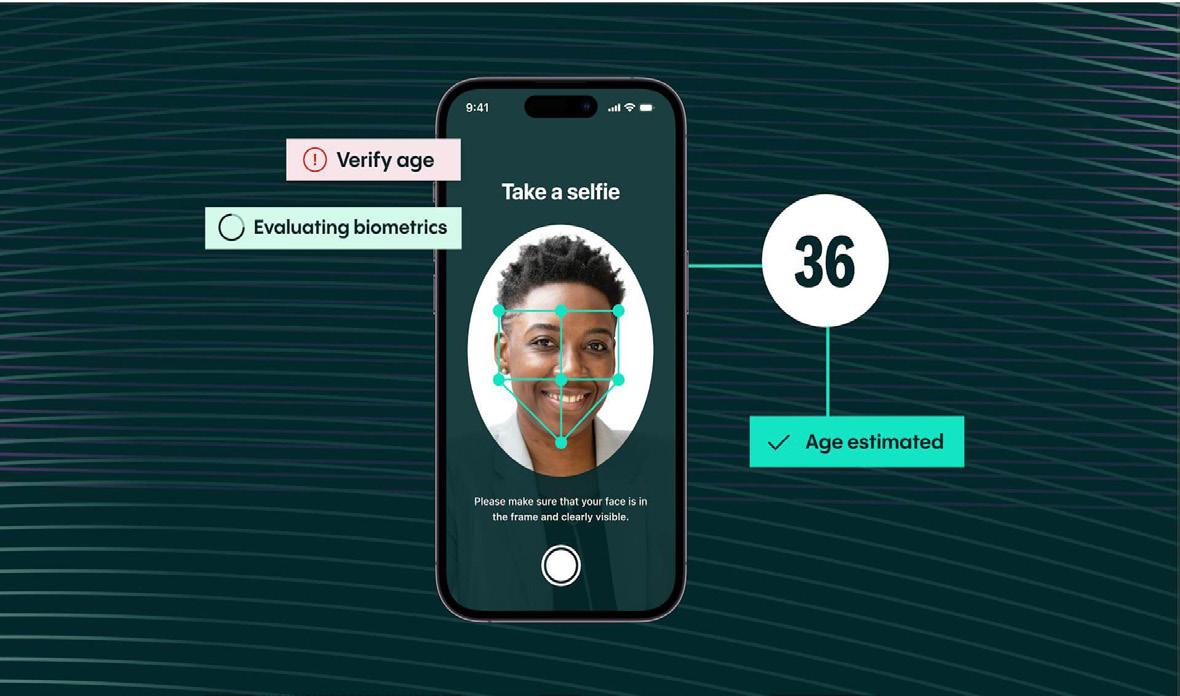
AI age verification software is not working.
don’t watch gaming content or animated shows because they are deemed “childish”, which is just factually incorrect.
Age verification systems are not helping content reach their intended audience despite what many platforms are claiming. These changes have been especially hard on creators because they run the risk of losing a significant portion of their viewers.
If the algorithm no longer determined their user base as in the correct age range, it would affect more than just their vanity.
Viewership affects monetization, and users were prevented from watching creators they had previously because it was deemed “not suitable for their age range.”
The implementation of these restrictions is ultimately the platforms shooting themselves in the foot. Because of how poorly their system’s AI processes our everyday body language, activities, and the things we watch and surround ourselves with, its adjustments don’t respond to those in a genuine way.
The concept of our bodies and lifestyles being constantly surveilled does not cross our minds, as it is an undue aspect of how we engage with others online. But the issue with these systems is that they don’t have a proper understanding of engagement. They sort us into categories incorrectly, because the ways these systems process age is simply not how we as complex individuals truly function.
While there are many methods to bypass this technology, in a flawed attempt to “protect” these media ecosystems—social media platforms are just making themselves practically unusable.
How Much Does it Cost to be an Artist?
Nadia Miller CAMPUS LIFE EDITOR
The art world is full of programs, materials, and creative methods but according to many professionals— only a handful of those actually matter. The majority of which are both expensive and difficult to get your hands on. Despite what some may say, there should be no shame in utilizing ways to create which are more easily accessible.
As a graphic designer, I’ve noticed this issue being particularly bad in my field. The industry standard is Adobe, with a monthly subscription for the Creative Cloud Pro costing $70. While it can be cheaper when just looking at certain programs, graphic designers need access to all Adobe has to offer. Photoshop, Illustrator, and InDesign are some of the most used Adobe programs. I myself use Illustrator and InDesign the most in and out of the classroom. And when it comes to the job market, employers expect and require efficiency in those very same programs.
When looking at other programs, there are many that are just as good if not better than Adobe. Take Canva for example. Canva has many different ways that users can create slideshows, videos,
flyers, logos and so much more. It is also considerably cheaper (the basic version of the program being free) and easier for users to navigate.
Another good example is Procreate, which for a cheap onetime purchase gives users the ability to create high quality graphics and animations. Even though these programs are both easier to access and also capable of creating work of equal quality to more expensive programs, they tend to be labelled “unprofessional” by those in the industry.
This emphasis on “industry standard” can be seen extending to the fine arts as well, a field that is full of elitist attitudes. People will get a lot of comments on which mediums to use and which brands to use for
those mediums. There are people who only consider oil paint to be the best of the best and look down on those who use acrylic paints. And even if these people use acrylic, you need to buy the most expensive set of paints for your painting to look good. At least that's what most people would say.
In reality however, you can buy Dollar Store acrylics, add some corn starch, and the paint will end up looking practically identical to higher end products.
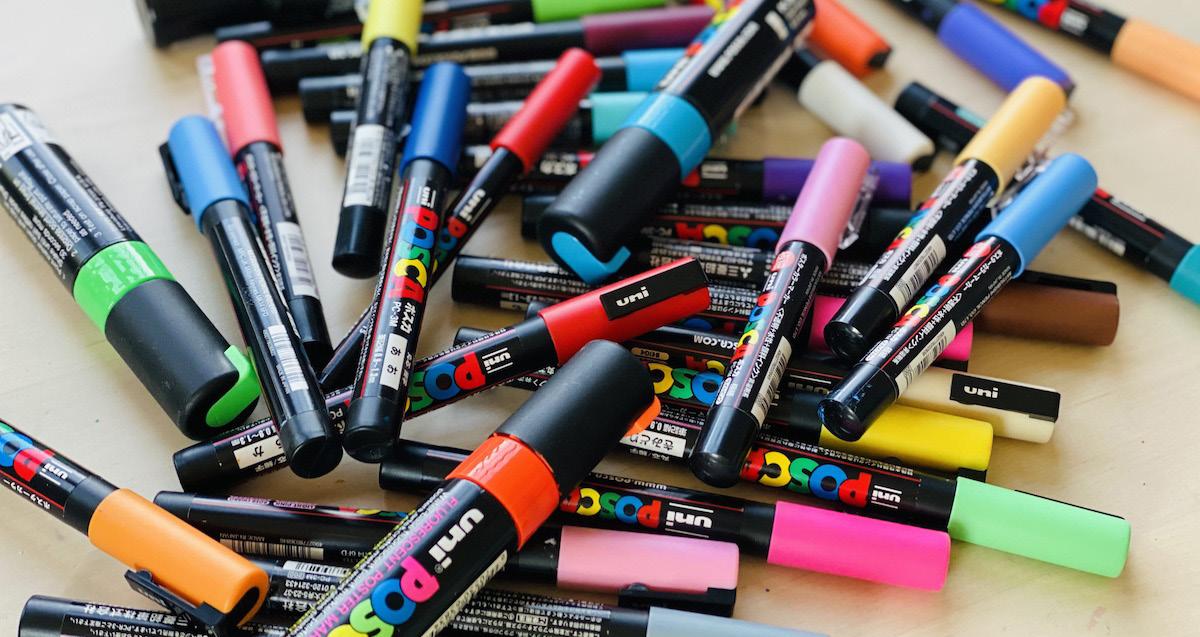
Recently, acrylic paint markers have been gaining popularity, used to create all sorts of artwork. Poscas are the most well known and frequently used brand, but they are also incredibly expensive. There are plenty of cheaper options

Dear Poets, I’m a senior who is just trying to finish this semester out but I’m basically checked out mentally. What do I do to finish this year up and get out of this slump? - A Senior-itis Poet
Jane: I mean what’s the worst case scenario here? It’s not like they’re going to take away your degree, you basically already earned it! Some other chum said “Remember the end goal,” but you’re already there! So just enjoy, relax, and party out with your friends for the rest of your college days.
Jo: As a fourth-year on the verge of graduating, I totally get you! With your final semester of undergrad winding down, the best thing you can do is to KEEP IT PUSHING! Just kidding, something that I do is just realize that, while I am super worn out, there are only a few more weeks left in my time here. With this in mind, I keep working as I always do, albeit with a bit more appreciation for all the hard work I’ve already put in. It’s natural to skip a few classes or have some missing assignments here and there. Go out and enjoy yourself a little, do some things that you wanna do. Overall, keep doing what you’re doing, but just remember to take care of yourself!
on Amazon that work just as well or even better! It is the same with colored pencils. So many people say you need to buy Prismacolor Pencils when Crayola colored pencils can achieve the same effects.
Many industry experts like to claim that if you use cheaper alternatives, that your art is inherently less professional or of lower quality. But in reality, artists should be focusing on finding the mediums and brands that work for them.
By demanding that artists only use the most expensive, “industry standard” resources–you are dipping into classist territory by basically saying those who are incapable of affording such products cannot be considered “real” artists.
It is this accessibility within the art world that keeps it alive and going. The people who strive to continue tend to start off with cheaper, more accessible materials and programs. While many may eventually move on to the more expensive “industry standard,” there are plenty who stay using more accessible options because they work.
The art and graphic design world needs more programs which are both easy to obtain and navigate. Not programs that only people with
Johnny: One phrase that I live by: Remember the end goal. Remember that you soon will be having the satisfaction of walking on that stage and finally earning that hard-worked diploma. Though, you can’t earn that if you stop now, you gotta push on! For completing assignments and projects, try setting up small rewards for doing each task leading up to the end of the school year. Turn in your assignment just five minutes late, take a nice walk, or have a nice doomscroll session. Just know that you’re almost there, it would suck to give up now and watch everyone else graduate. Anyway, I’m going to grab a nice coffee now for answering, and you should too.
- The Poets
money can get, but ways of creating that everyone can use. It makes beginners feel like they can’t make it or that in order to be the best you need the best. When the reality is you only need what works for you and if that means using what’s not “industry standard” then that is perfectly okay.
Creating art should be accessible, and not having fancy tools does not make you any less of an artist.
Courtesy of Veriff
Lacrossing-the-Pond for the Good Times
Xochitl Hood STAFF WRITER
Marton Ujvari, a Hungarian-born third-year exchange student out of the United Kingdom, is soaking in his last few weeks in Southern California. This land of canal-sized freeways, expensive Ubers, and a 21 year old age limit on libations will have to bid him farewell.
Before that day comes, Ujvari has been squeezing every bit of life he can from Whittier College, wanting to remember and be remembered on this little campus he calls “cute.”
“I can join a frat. Why shouldn’t I? Lacrosse. I’ve never seen it played before, but I could say I was a college athlete in Southern California, might as well do it,” Ujvari says.
Completely uninterested in limiting his attachments on campus, Ujvari’s actions reflect his passion, which took him thousands of miles to Whittier’s doorstep. Some might say it makes no sense to plant roots in a place one is planning to leave in a year, but he chooses to let roots take hold where they please.
With his heart set on returning to the U.K. this May and with hands full of memories, Ujvari had his ears to the ground.
Pledging for the Lancer Society this Spring semester was a big decision for him. His timing met with the course of the Lancers perfectly as they continue to pick up steam since stopping operations due to COVID-19 precautions. The brotherhood prides themselves on facilitating the culture that students make when they get together on campus.
“Now I’m a Lancer and I’m doing that for the rest of my life,” Ujvari says.
Ujvari joined the Lancers through a recommendation from a friend. While he has been determined to “not [be] bored all the time and just having something to do,” he has also become a foundational element to the reincarnation of the Lancers. Now, Ujvari serves as a building block to its growth, all while the Lancers have worked to help him grow his experiences at the College.
“We [do events] where you could throw water balloons at us or like pie us and stuff like that […]”
Ujvari says. “That day we met so many people, just messed about with everyone on campus.”
After befriending a Men’s Lacrosse player, he caught wind of his next adventure. They needed players, no questions asked. Signing up gave him another way
to spend his afternoon, edifying his name and experience in common Poet life. Ujvari’s love for lacrosse was unexpected as he admittedly never saw it played before joining.
“I thought, ‘Let’s do it. Why not?’” Ujvari says. “The team needs players, and I’m sure I could do something.”
He cites his experience playing “real football” back home as the source of what game-play success he finds, though he admits he is not very good.
The process of developing a team with varying experiences has been a challenge this season. However, he appreciates how willing the team has been in understanding each other's frustrations and limitations in developing together.
“We all got over ourselves, as well. Everyone did accept we’re not all gonna be the greatest and it will be fine,” Ujvari says.“We just need to make sure we understand what we are supposed to do and try to do it.”
Involving himself in the always-treacherous emotional soup of sport, he got the chance to deepen his bonds with teammates. In traditional Liberal Arts fashion, Ujvari’s joys from playing lacrosse did not end there.
Aside from lending his hand

to the making of team culture, he admitted in a previous Quaker Campus interview that he has carved a taste for the aesthetic beauty of its movement. Even if it comes at the cost of his teammate being horrifically hit by an excellent tackle, Ujvari’s concern for his bruised-up buddy does not prevent his appreciation blooming for how it looked in the moment.
“It’s good on the eyes, if we’re playing it well and there’s good catches, good throws, good shots and some beautiful tackles its good to watch,” Ujvari says. “If you wanna see something that is a bit brutal, but quite beautiful, I think
lacrosse is definitely there.”
With such fervid desire for participating in Poet life, one has to imagine Ujvari’s mental museum lined with relics undetectable to TSA scanners. He left home on the wings of living the American college experience. Now, he flies home to Southampton as a brother of the Lancers and a collegiate athlete.
These titles serve as beautiful, but brutal, reminders that the experiences which inspired them will never fully return. Ujvari knows the good times are coming to an end, but he is just a one-way flight away from more to come.
Dual-Athlete Rucker-Spears Moves with Memory
SPORTS EDITOR
From competing in Division I, transferring between four colleges, and nearly giving up on sports, Syree Rucker-Spears admits, "My story's a little crazy." As a dualathlete in football and track, he has landed at Whittier College and already proven himself as a strong competitor. More importantly, the College has offered him stability for his athletic and personal life.
Rucker-Spears attended Talare Union High School, where he competed in DII football and track. He found success in championships within his district and the state. Most crucial to his development was the training he received from his aunt, Alice Brown, a former track Olympian who competed in 1984 and 1988 alongside Florence “Flo-Jo” Griffith Joyner.
However, health complications with Rucker-Spears' greatgrandmother had him move to San Bernardino. This meant leaving behind the accessibility of his aunt’s track coaching and losing recruiters starting at a new school. He made the most of the experience anyway, playing alongside his cousins, one of whom is Jayden Daniels, the now Washington Commanders quarterback.
After graduating in 2019, Rucker-Spears attended the University of Arizona as a track and field recruit. He red-shirted as a walk-on for the football team, practicing but not playing. Before track season, COVID-19 sent students home.
During this transitional period,
Rucker-Spears took some classes at the College of Sequoias between 2020-22, expecting to return to his sports until he experienced an unexpected loss.
“We went to Mexico for my grandma’s birthday, came back, [and] then 21 days after her birthday, she passed away,” RuckerSpears says. “That was the punch in the gut that set me back because my whole world just flipped.”
Feeling lost in the athletic world and now with the loss of his grandmother, Rucker-Spears halted his pursuit of education and sports. While taking a year to deal with this pain and confusion, he began to think about his grandmother’s legacy.
He was reminded of her strong work ethic. She had received her Bachelor’s and Master’s and was devoted to different foundations raising money for women’s education.
“Once I sat back and thought about it, I thought, ‘No, my grandma would want me to at least get my education,’” Rucker-Spears says. “She used to say, ‘There’s one thing that nobody can take away from you, and that is your knowledge.’”
With this reignited passion and further motivation from his family, Rucker-Spears enrolled in Bakersfield College in Fall 2024 to finish his education and reclaim his athletic career. This journey ended again just as quickly as it had begun. During a preseason practice after scoring a touchdown, RuckerSpears suffered a season-ending and life-changing injury.
“As I’m walking back to the huddle, I’m just trying to make
a fist, just readjust and close my hand, and I’m like, ‘Why can’t I close it?’” Rucker-Spears says. “I take my glove off, and the whole right side of my right hand is destroyed.”
Besides football, RuckerSpears had also developed an interest in American Sign Language (ASL) when he noticed that his hometown neighbor, a one-year old girl, was deaf and quickly caught onto signing. He had strengthened this interest into a possible career choice after taking several classes to develop his ASL. Now that his dominant hand was broken, he had to relearn the language on his opposite hand.
To add on, Rucker-Spears had to redshirt another year as he watched his team have a successful season. By Fall 2024, surgery and rehab made him ready to compete. He practiced as a starter but faced a crushing reality when he wasn’t played in the first two games. After a talk with his coach, Rucker-Spears decided to quit.
“[My coach] told me to my face, ‘Kid, you have the speed, you have the hands, you have the brains. It’s just your size,’” RuckerSpears says, referring to his height, 5’6.
Rucker-Spears finished the semester with an Associate’s Degree in Sociology and Liberal Arts, but no football. Now 24 years old, he took a pause from any next options until his uncle, a football recruiter, heard about Whittier College. Within the next couple of days, Rucker-Spears took a tour of the College and officially transferred in Spring 2026.

Even without collegiate competition experience, his aunt’s coaching and his own determination have made him a top competitor in track and field. He has already claimed the 10th spot in the College’s program history for the 100-meter dash.
Coach Kathy Graham credits his humility and personal maturity.
The football team is gearing up to showcase its abilities next semester, so Rucker-Spears continues to dedicate his time and strength towards it as well. When he’s not practicing or competing for track, he is attending football meetings, lifting sessions, and practices, all of which Coach Corey White recognizes and appreciates.
“It’s just work ethic. The way he handles two sports,” White says. “The way he’s about to compete on the track and then come to practice and go all out and not ask for any kind of excuses or leniency.”
Beyond sports, Rucker-Spears
feels he has found a home at the College through his Sociology professor and advisor, Julie CollinsDogrul. After immense instability in his athletic career, he enjoys that Collins-Dogrul sees him as a student and not just an athlete.
“Sometimes coaches can be so athlete-drawn. They want to win, want you to be in practice, want this, this, and that,” Rucker-Spears says. “[Collins-Dogrul] has been the one to really ask, ‘What do you want to do in life because yes, sports are going to take you far, but you have after-sports, you have an afterlife.’”
Through his passion for ASL, football, and his major in Sociology, Rucker-Spears hopes to work where he can use these skills to advocate for deaf athletes or the deaf community in general. Rucker-Spears credits the College a “blessing” through the second chances it has provided him with athletically and academically.
Courtesy of Tony Leon / Action West PhotogrAPhy Marton Ujvari takes in the Poet experience as a new lacrosse player.
Monze Meraz-Lerma
Courtesy of Tony Leon / Action West PhotogrAPhy Syree Rucker-Spears competing at the SCIAC Quad Cup.
Poet’s Sports Schedule:
Men’s Tennis @ Caltech
Location: Pasadena, CA
• 5 p.m.
• April 9
Men’s Tennis vs. ClaremontMudd-Scripps Colleges
Location: Whittier, CA
• 3 p.m.
• April 10
Baseball vs. Caltech
Location: Whittier, CA
• 3 p.m.
• April 10
Softball vs. Pomona-Pitzer
Colleges
Location: Whittier, CA
• 3 p.m.
• April 10
Men’s and Women’s Track & Field vs. Pomona-Pitzer
Invite
Location: Claremont, CA
• All Day
• April 11
Baseball @ Caltech
Location: Pasadena, CA
• 11 a.m. & 2:30 p.m.
• April 11
Softball @ Pomona-Pitzer
Location: Claremont, CA
• 12 p.m. & 2 p.m.
• April 11
Men’s and Women’s Track & Field vs. Leopard Invite
Location: La Verne, CA
• All Day
• April 16
Men’s and Women’s Track & Field vs. Bryan Clay Invitational
Location: Azusa, CA
• All Day
• April 16
Women’s Tennis @ Caltech
Location: Pasadena, CA
• 5 p.m.
• April 16
Men’s and Women’s Track & Field vs. Leopard Invite
Location: La Verne, CA
• All Day
• April 17
Men’s and Women’s Track & Field vs. Bryan Clay Invitational
Location: Azusa, CA
• All Day
• April 17
Baseball @ Cal Lutheran
Location: Thousand Oaks, CA
• 3 p.m.
• April 17 Visit wcpoets.com/calendar for the full sports schedule!
SPORTS I.O.C. to Ban Trans Women Athletes

Maia Chaidez SPORTS EDITOR
On March 26, the International Olympic Committee (I.O.C.) announced a ban on transgender athletes competing in the women’s events. The policy, which will first take effect during LA28, is facing controversy and adding fuel to the fire of the trans panic in sports.
Kirsty Coventry, President of the I.O.C., defends the policy by stating that, “At the Olympic Games, even the smallest margins can be the difference between victory and defeat. So, it is absolutely clear that it would not be fair for biological males to compete in the female category. In addition, in some sports it would simply not be safe.” To enforce this policy, the I.O.C. will be issuing a mandatory gene test which will be done once in an athlete’s career.
This policy comes after no transgender women competed in the 2024 Paris Summer Games, and the first transgender woman,
in weightlifting, Laurel Hubbard, competed at the Tokyo Olympics in 2021, but didn’t qualify for any medals.
In fact, only one trans person has won an Olympic medal. That feat belongs to Quinn, who’s non-binary. They helped their country, Canada, bring home Gold for Women’s Soccer at the Tokyo Olympics, becoming the first transgender and non-binary Olympic champion to do so.
Defenders of the policy, however, may bring up Imane Khelif, the Algerian boxer who won Gold in Women’s Boxing at 2024 Summer Olympics in Paris. Due to a medical condition, she has higher levels of testosterone compared to her peers, giving her an edge over her competitors, but even so, she is under medical supervision to help suppress the unusually high levels. Because of this medical condition, however, many people began to claim she was biologically male, and that this was just another case of “trans
people dominating in women’s sports,” but it wasn’t. Khelif is a woman, from her birth in 1999 to now.
In addition, a 2024 study partly funded by the I.O.C. and published by the British Journal of Sports Medicine revealed that, when all is said and done, transgender women sports participants actually may be the ones facing a severe disadvantage when compared to cisgendered women.
The study found that transgender women have a very noticeable disadvantage in lower-body strength and lung function when compared to cisgendered women. Furthermore, bone density, a rather popular argumentative point brought up when people attack transgender women in sports, was found to be equivalent to that of a cisgender woman.
Finally, there were no outstanding differences found between transgender and
cisgender women’s hemoglobin profiles, which is a key factor when looking at athletic performance.
According to a study by UCLA’s School of Law, Williams Institute, transgender people make up only one percent of the United States’ population. An even smaller group, trans people make up just under 0.002 percent (or 10 out of 500,000) of U.S. college athletes. Despite this, in 2026 alone, 755 anti-trans bills have been, and continue to be, introduced across the country. These bills range from blocking trans people from receiving basic healthcare to even blocking peoples’ legal recognition and their right to exist.
Sports have always been a way for someone to express themselves and escape reality. As a transgender woman myself, I’ve used ice hockey as a way to vent my frustration and anger at the world, while also finding happiness and community due to the sport. But everything is political now, even sports, and even peoples’ lives.
The Ducks’ Fight Night at The Pond

Maia Chaidez SPORTS EDITOR
Radko Gudas, captain of the Anaheim Ducks, has had a rough start to 2026. During the Olympics, while representing his country Czechia, he injured Canada’s captain Sidney Crosby in the quarterfinals, sidelining him for six weeks. He also caught more criticism as, during the same game, he was heard using what is considered a homophobic slur.
The cherry on top was on March 12, where Gudas delivered a bad hit on captain of the Toronto Maple Leafs, Auston Matthews, who suffered a grade three MCL tear and had his season cut short.
As these events have happened, Gudas has apologized for every one
of those incidents. But in hockey, words aren’t enough to make things right. In hockey, if you’re going to face the music, you’re going to have to use your fist.
On March 30, a rematch between the Ducks and the Maple Leafs took place at the Honda Center in Anaheim. The fans knew what this game was going to be like, and so did the players. Gudas, who was injured prior to the game and had to use a walking boot, said to reporters, “I want to stand behind my own mistakes.”
As soon as referee Wes McCauley dropped the puck at center ice, Gudas and Maple Leafs’ Max Domi instantly dropped the gloves. The fight lasted just 12 seconds before the linesmen intervened, with Gudas not
throwing a single punch, simply accepting his punishment as Domi wailed on him. But the fights and scrums didn’t end there.
At nearly any time during the game where the whistle was blown to stop play, extracurricular activities occurred. These activities include, but are not limited to, your simple pushing and shoving, getting in a few sucker punches, knocking the stick out of your opponent’s hand, giving your opponent a face wash, or the everso popular option, fighting.
The action wasn’t limited to after the whistle was blown, however. This game was filled with big goals, big saves, but even bigger hits.
The Ducks would score two in the first and extended their lead by one making it 3-1 heading into the third period. But as the third period was underway, it seemed the wear and tear of the—though well-vetertained but majority younger—Ducks began to take hold. The Maple Leafs were able to score three straight, taking the lead 4-3. If it wasn’t for the late-game heroics of Ducks’ fan-favorite Leo Carlsson to score the game-tying goal, the game wouldn’t have made it to overtime.
It should also be mentioned that throughout the game, Gudas
took the brunt of the majority of hard hits, allowing his past mistakes to not affect his teammates’ play. Unfortunately, the Ducks wouldn’t take the win in this one. With just five seconds left in overtime, John Tavares of the Maple Leafs redirected a shot from his teammate right into the back of the Ducks’ net, ending it 5-4. Though the game ultimately ended in a loss for the Ducks, they were able to get a point in the standings, helping them maintain their place in the playoffs. If, or rather when, the Ducks make the playoffs, they’ve shown in this game that they are ready. As of publish, the Ducks have 87 points and are comfertably holding the third spot in the Pacific division, still trying their best to clinch first. If you have ESPN+, I implore you to watch the replay of this game. Everything felt personal. Whether it was the hits, the goals, or the saves, there were personal motives behind them that felt like more than just about winning the game. They wanted to send a message, and that’s all what the Stanley Cup playoffs are about. The Anaheim Ducks may still be a ways off from winning the Stanley Cup, but they’ve shown that they’re not going to be so easy to eliminate either.
Courtesy of The New York Times
What a bunch of hockey goons.
Courtesy of The New York Times
Olympics are for everyone, just not you.
SPORTS
Samantha Avila Wins With Ruthless Running
Monze Meraz-Lerma SPORTS EDITOR
Samantha Avila, Whittier College’s fastest long-distance runner, debuted her strong potential last Fall in cross country, finding top rankings and times within program history. Now, the freshman continues to show off her capabilities, this time on the track, with the help of her coaches and what she considers a “harsh” mindset.
Avila began running as a freshman in high school, though her primary focuses were soccer and basketball. When her soccer and basketball coach started a running team, she became his first runner. Even as a new, small team, her coach taught her a “no excuses” mentality, which she still carries today. Through trial-anderror, Avila found success on the state level.
“From my junior to my senior year, making it to state seemed like it could never happen,” Avila says. “There were these girls that [my coach and I] would watch on YouTube, and I thought, ‘I could never compete against them,’ and in my senior year, I was able to.”
Competing collegiately has required Avila to adopt new strategies. She credits Coach Kathy Graham for helping her run smarter and teach her tactics that have since upped her game.
“It’s all about the process,” Graham says. “If we’re only looking to chase PRs or a win, that’s pretty empty, and it won’t
get the results that we’re looking for, so we’re giving the runners very specific goals.”
Through tips, like running behind taller players to avoid strong winds and starting fast in a sprint, Avila explains that strategizing for races is essential. She primarily competes in the 1500, 5000, and the 10,000 meters, translating to just under a mile, three miles and six miles. In these long battles, Avila preaches the mindset, “tired is in your mind,” and finds Graham aligns with these values.
“Running is all in your head, so [Graham] helps us with telling us things that we can tell ourselves while we’re running,” Avila says. “She understands on which laps you’re mentally destroyed, and she helps us through that.”
These taxing races can be up to 25 laps long, which Avila claims becomes an opportunity for you to become mentally destroyed or to mentally destroy your opponent. She explains that racing is about keeping calm, but more importantly, intimidating your opponents. As Graham’s words echo in her mind, “You did all of this for a purpose,” she runs steady with the understanding that simply passing someone up momentarily is enough to win.
“This Sunday, [an opponent] passed me, and she was over there, and I was all the way over there,”
Avila says, pointing to two opposite sides of the track. “She started to slow down a lot, so I picked it up the whole way even though I was extremely tired. When I caught
her, she was surprised that I caught her and went even slower, even though she could have kept her pace.”
Avila admits that when she is the runner getting passed up, she fights for it to not get to her. Instead, she focuses on sticking close to the opponent to not get caught in a gap, which runners call the “desert,” or she catches them unexpectedly, like she previously did. Beyond her internal thoughtprocesses in these moments, she makes it a point to be externally cool, too.
“When you’re running, we’re out of breath and dying, but having a poker face, or having that face where, ‘You can pass me, I’m not even phased by it,’ is very important,” Avila says. “There’s people I have passed, and they show it all on their face. I can read them like a book and know she’s just going to die out.”
The team runs every day of the week, with practice MondayFriday, races on Saturday, and a Sunday optional “shakeout,” in which runners take a few slow miles to move lactic acid out of the body. When Avila opts out of this slow run, she spends her weekend working for her mother’s party rental business, which requires lifting and moving large items. It’s rare to find Avila taking a day off.
“Everybody’s working every day, and that’s something that’s hard as an athlete for running, especially for me,” Avila says. “I feel like I know everybody’s training every day, so if there’s a day that I miss, it mentally destroys

me because I think, ‘People are working, and I’m not.’”
Unfortunately, this excessive practice left Avila with balls of stress behind her knees, causing pain in every stride. Only when she finally took three days off did the pain completely resolve itself. In fact, Avila says that the SCIAC Quad Cup, hosted by the College on March 29, was the first race she has run without any pain.
“I know it’s harsh, but I think [a tough mindset] helped me improve and just be hard on myself,” Avila says. “But sometimes, it’s not okay to be doing that to myself.”
At the SCIAC Quad Cup,
Avila finished second in the 5000 meters and third in the 1500 meters. At the Oxy Distance Carnival on March 14, a race she was still experiencing pain, Avila achieved the eighth-fastest time in program history for the 10,000 meters, placing her second against SCIAC competitors. Graham calls Avila an “achiever,” evident in her impressive feats and dedicated mindset. Avila currently ranks as the No. 48 freshman in the nation for the 10K race. She looks to continue succeeding, or in her words, “Keep pushing, celebrate wins, then move on.”
Softball’s “Scary” Good Stats Strive to Succeed
Monze Meraz-Lerma SPORTS EDITOR
Whittier College Softball dominates the SCIAC in batting averages and individual performances but strives for a more consistent performance. With a team of SCIAC leaders, the team maintains a position to find higher rankings collectively and possibly a post-tournament spot, a title the team hasn’t reached since 2019.
“We haven’t put it together yet,” Head Coach Terry Schweikert says. “But when we can put it all together—good pitching, good defense, timely hitting—we are scary. We can be really good.”
The Poets hold scary stats against the conference as third in batting average and other top rankings in most other stats, including a notable first place spot in home runs. This comes from four Poets taking up spots in the top-10 home runs list, including No. 1 Mariah Rodriguez.
Rodriguez, a sophomore catcher, plays loud on the field, directing the pitcher and possible plays. Besides her home run toptitle, she also leads the SCIAC in slugging percentage and doubles. Despite her strong demeanor and dominating presence on the field, she admits that last year
she had a bad case of the yips—a psychological state where athletes overthink their abilities, often leading to failure.
“I felt like I couldn’t throw the ball, I felt like I couldn’t even feel it,” Rodriguez says. “I was scared to mess up.”
Rodriguez recalls feeling stiff and unsure in every pitch she returned back to the pitcher. After speaking to her now coach, Jessica Purcell, and practicing all summer, Rodriguez has come back as a force to be reckoned with.
“I want people to look at me and go, ‘Yeah, that’s Mariah Rodriguez,’” she says.
The team stands sixth in the conference, where only the top four teams enter the post-season tournament. With four more three-series match-ups, the Poets final placement is still up in the air. In their recent series against Occidental, the Poets fell short 3-5 in the first game. They followed up the next day with 1-0 and then a big 16-0 win, demonstrating the team’s ability to find huge, scary successes.
“We have amazing bright spots and not so bright spots, too,” Schweikert says. “The focus is just about competing and finding that consistency.”
Schweikert emphasizes a “pitch-by-pitch” strategy, in which the team takes the game one pitch at a time in efforts to
find stabilization and, hopefully, victories. Bella Peinado, a senior pitcher, serves as the team’s starter, always taking the pitching circle with a calm and collected expression.
“Once they call my name [in the lineup], and we go and do the national anthem, I do deep breaths and tell myself a lot of words of affirmation, like ‘I’m the best,’” Peinado says.
“The best” she is. Peinado has been named the Athlete of the Week for two consecutive weeks, credited for winning a pitching dual against one of Williams College’s nationally ranked pitchers and, most recently, throwing 10 shutout innings total in the series against Oxy. She’s ran through the motions of momentum-filled wins but confesses that the higher stakes of conference games often gets to her.
“It feels like we’re putting a lot of pressure on ourselves because now we’re in conference, and we’re facing these teams rather than these out of state teams where we just play them once or twice, and then, we don’t see them again,” Peinado says.
The team spends time scouting out their opponents’ pitches, average hits, and overall, typical strategy before game day. Although this preparation helps the team avoid any surprises, it doesn’t completely make the
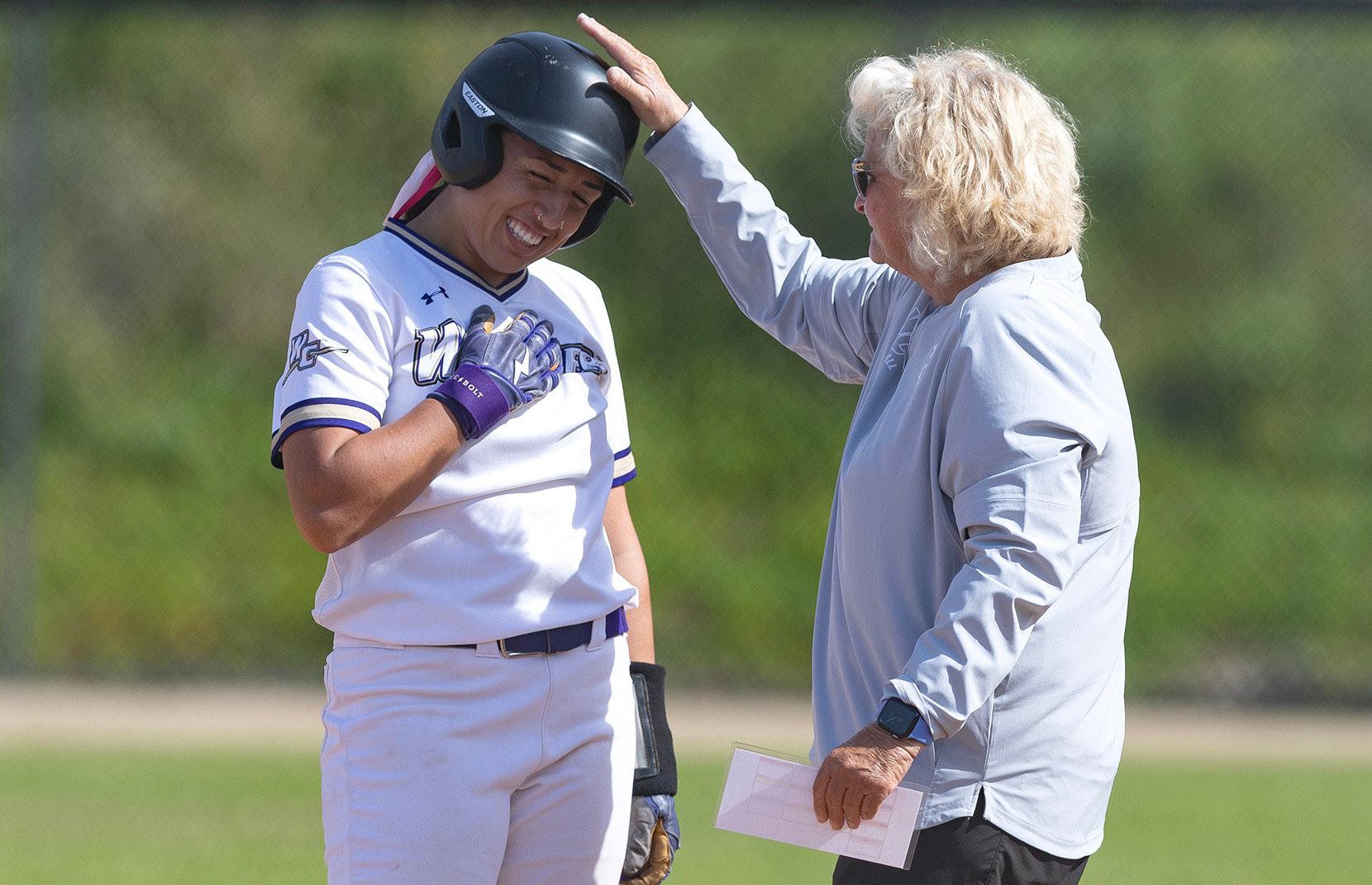
daunting importance of every conference win disappear. The Poets’ proof is in their pudding of stats, but sometimes, that’s not enough to pull them out of losses, as seen in previous games.
“They’re not better than us talent-wise. They’re just held to a certain standard just because of the name on their back,” Rodriguez says, referring to their match-up against No. 7 University of Redlands. “Just because of the name on their back, they’re expected to win, and we kind of let that get to us. Just because we’re Whittier, I feel like people expect us to lose.”
Although Schweikert comes from a DI playing and coaching background, she carries a different approach to this concept of
expected standards. She took the opportunity to coach DIII at the College last season and prioritizes accountability and keeping the team first. Schweikert doesn’t see DIII as a difference in capability but instead as an important experience that fosters a dual student-athlete identity.
“The game doesn’t know what level you play,” Schweikert says. Life doesn’t know what level you are. Experience doesn’t know what level you are, nor does leadership.”
The Poets have less than a month left to “clean up the little stuff” and play “dangerously,” as Rodriguez says. In the meantime, Schweikert leaves the team with a reminder: “[They must] believe they’re as good as their coaching staff believes they are.”
Courtesy of Tony Leon / AcTioN wesT PhoTogrAPhY Samantha Avila finishes as a top competitor at the SCIAC Quad Cup.
Courtesy of Tony Leon / AcTioN wesT PhoTogrAPhY Mariah Rodriguez leads the SCIAC in home runs and more.
The QC Staff
Suggests:
Xochitl Hood STAFF WRITER
Want to know what our Staff Writer recommends this week?
Movie: Matilda (1996) gave me permission to romanticize my solitude and independence. She was also a boss in the face of weird acting adults. As I have grown up, I lean on the lessons from the movie more and more.

Music:
"Mind Loaded" by Blood Orange has been so angelic to my ears. I've been obsessed with it because it erases my memory or makes harder things sweeter to think about. So clutch.

Hobby:
Doodling brings me so much freedom it truly has got to be studied. I fear I am addicted to splitting my attention and letting my unconscious hand do its thing. Depending on my season of mental health, my doodles are also home to some valuable interpretative advice on some Carl Jung theory-verifying stuff. Doodling is so worth it.
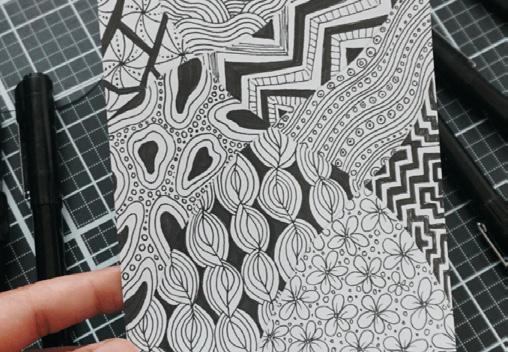
Rewards App: McDonald's has been there for me at my darkest hours. The iced coffee has likely sedimented into my stomach lining but I cannot deny the power of $1.99.
ARTS & ENTERTAINMENT
Cut The Check, RENT is Due!
A Story of Love, Family, and Resilience.
Tralee Jacobs STAFF WRITER
RENT is due! Whittier College’s production of Jonathan Larson’s iconic musical is a timely and heartfelt staging, led by a cast and crew who clearly care about its message.
The show follows a group of artists as money, health, and time slip away. Over the course of a year, they navigate developing relationships and personal challenges while struggling simply to live.
Inspired by La Bohème, Giacomo Puccini’s opera about Parisian bohemia in the 1830s tuberculosis epidemic, RENT is a rock musical set in New York City during the AIDS crisis of the 1900s. Both works ask the same question that endures the test of time: How do we live in the face of loss, and how do the people we love stay with us?
In preparation for the show, the cast held a screening of the 2012 documentary directed by David France, How to Survive a Plague, that offers an unflinching account of the early years of the AIDS epidemic and the activist movements that arose in response.
“It reveals the impact AIDS had on the population and how important community was,” Play Director Jennifer Holmes explains. The screening not only grounded the production in historical context but also gave actors a deeper understanding of the world their characters inhabit.
“A lot about being a performer is educating yourself on what you're
stepping into,” Holmes says. Fourthyear Carly Jade Mandell, who plays Mimi, a dancer with HIV, admires Holmes’ commitment to that process: “She takes being a director very seriously while also making sure all of her students feel loved and cared for.”
That process leads directly to the questions at the heart of RENT: How does a community come together to mourn and care for one another when it seems like no one else will? How do you love in the face of loss, in a world where you’re living a death sentence?
The cast carries the weight of these questions both onstage and off. Whether refining choreography or moving between scenes, they remain connected to the characters they portray and the people who lived their experiences. That sense of care translates into a visible feeling of community onstage, shaped in part by the work of choreographer and Julia Centeno, '25, whose movement emphasizes connection and shared
energy among the cast.
“I’m with my friends playing a group of artists who are all friends, and I think that connection is very apparent in the show,” says Meredith Lee, a fourth-year who plays Angel. Cielo Valenzuela-Lara, a fourth-year who plays Joanne, emphasizes the story’s importance: “It’s a very timely story right now. It doesn’t shy away from social and political issues that are still relevant.”
Musical director Lacey Benter reflects on the show’s message: “To be present in what you have and what you love in the moment that you have, because that is all that you have.” RENT will be performed in the Robinson Theatre at the Ruth B. Shannon Center for the Performing Arts. Performances run from April 9 to 19. It is an opportunity to witness and experience a story about resilience and found family, brought to life by performers who understand its stakes. Don't miss it!
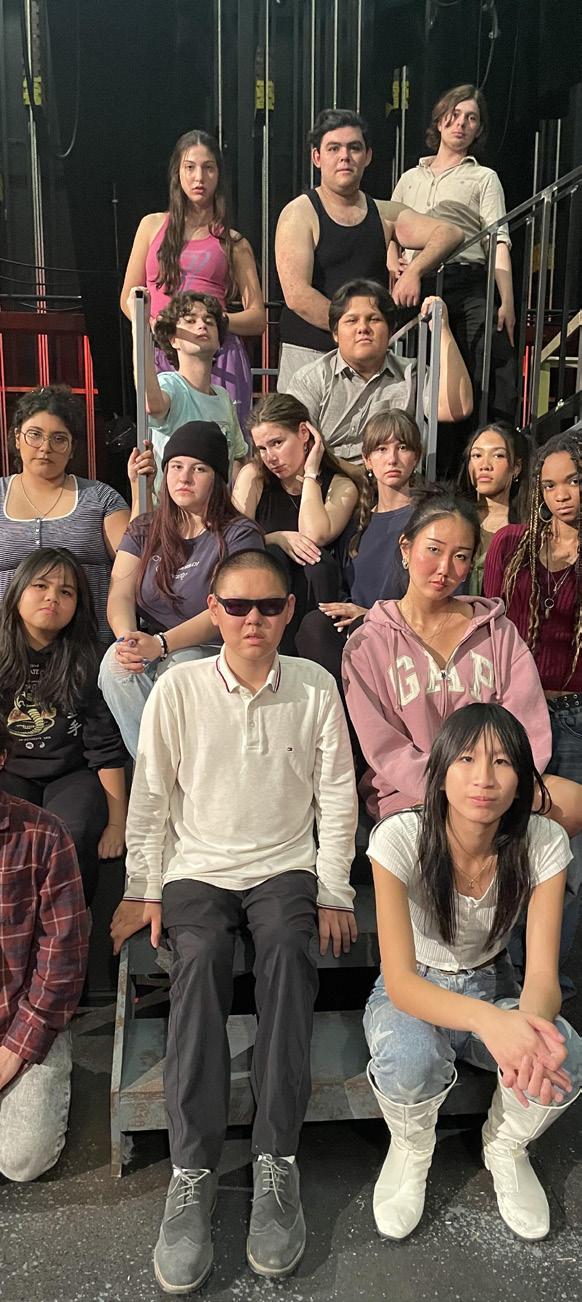

Banksy Has been Unmasked, What Now?
The Elusive Artist, Elusive
Luis Sandoval STAFF WRITER
Reports that Banksy may have been identified have reignited a longrunning question in the art world: does revealing an anonymous artist change the meaning of their work?
Banksy, whose identity has remained unknown for decades, is one of the most recognizable figures in contemporary art. Emerging from the United Kingdom’s graffiti scene in the late 1990s, he built a global following through public street pieces that blend satire with political critique. His work often appears without warning, turning everyday spaces into commentary on war, consumerism, and inequality.
Anonymity has been central to his influence. Without a public persona, Banksy’s work has largely spoken for itself. Viewers engage first with the message, not the artist behind it.
Several of his most widely known pieces reflect that approach. "Girl with Balloon," which shows a child reaching toward a drifting heart-shaped balloon, has been interpreted as a symbol of hope or her loss of love. In 2018, "Girl with Balloon" partially shredded
No More?
itself immediately after being sold at auction, a moment widely seen as a critique of the commercialization of art.
"Flower Thrower" replaces a weapon with a bouquet, reframing protest as an act tied to peace rather than violence. Together, these works illustrate how Banksy uses public spaces as part of the art to challenge audiences while avoiding traditional gallery spaces. His anonymity has helped reinforce that message, positioning him outside the institutions he often critiques.
Recent claims that Banksy has been “doxxed,” or publicly identified without consent, have shifted attention away from the work and instead toward the person behind it. Past reporting, including investigations referenced by Reuters, has linked the artist to a specific individual using patterns in location, interviews, and public records. However, Banksy’s identity has not been definitively confirmed.
While some online claims suggest there have been efforts to conceal his identity, such as the use of aliases, these remain unverified.
The uncertainty surrounding his identity continues to raise broader questions about privacy, accountability, and the role of anonymity in art.
Supporters of anonymity argue that it protects artists who engage in politically sensitive or legally risky work. Much of Banksy’s art is created without permission, and his critiques often target powerful institutions.
Remaining unknown allows him to operate without direct legal consequences and keeps the focus on the message rather than personal branding. Others argue that identification could bring greater accountability. Because Banksy’s work addresses complex political issues, some believe knowing his identity could provide context about his perspective and motives.
It may also challenge the idea that artists can critique systems while remaining outside of them.
Still, revealing his identity will inevitably alter how audiences interpret his work.
The mystery surrounding
Banksy has become part of his cultural impact. Removing that element may shift attention toward biography rather than meaning, potentially weakening the impact of his message. That said, many political artists whose identities are public (like Ai Weiwei and Barbara Kruger) continue to produce work that resonates widely, suggesting anonymity is not required for impact, but may shape how impact is experienced.
The debate over Banksy’s identity reflects a larger tension between public interest and personal privacy. In a media environment that often prioritizes exposure, his anonymity has functioned as both protection and statement.
Whether or not Banksy is identified, the discussion highlights the unique role anonymity plays in shaping how art is created, received, and understood.

Courtesy of New York Times
Courtesy of Sony Pictures
Courtesy of Altenew
Courtesy of McDonald's
Banksy's "The Colored Rain" (2009).
Courtesy of Banksy
Catch RENT on its opening night on April 9, 2026! Courtesy of Jennifer Holmes / Whittier College
ARTS & ENTERTAINMENT
Is Record Store Day Worth the Economic Hassle?
Is RSD a Cash Grab?
Elias Loya A&E EDITOR
Ever get the itch to drop $60+ on an album with a random colorway? Or feel the strong desire to wait in line for hours just for the chance to get your hands on a numbered record pressing?
Are you looking for the humbling experience of realizing that you actually can’t get anything off your wishlist, so you waited in line for nothing? Well look no further than the wishywashy world of Record Store Day, held at your local record store!
While not an official holiday, the world of physical media collecting treats it as such. Record Store Day (RSD) began on April 19, 2008, as a way of celebrating the distinctive heritage and community impact of the thousands of independently owned record shops around the world.
This event occurs twice a year, on the third Saturday of April and Black Friday in November. Most of its popularity comes from RSD-specific releases, whether it’s vinyl, CDs, figurines, or other exclusive merchandise.
RSD music releases include a combination of mainstream and lesser-known artists, but the process of actually releasing specific pressings is a collaborative effort between artists, their record labels, and RSD organizers.
In recent years, the release lists have gone on to feature over 300 different media releases,
so there’s almost certainly something for any kind of music taste. Some recent examples of RSD-exclusive releases include Siamese Dream (1993) by the Smashing Pumpkins, The Powers That B (2015) by Death Grips, and Jazz Impressions of “A Boy Named Charlie Brown” (1964) by the Vince Guaraldi Trio.
Admittedly, while there are hundreds of different items to choose from, RSD is not without its pitfalls, the first of which is the music selection. Yes, the selection process is collaborative, but, like most things in this world, money-hungry executives are behind a number of these pressings.
According to the Recording Industry Association of America’s end-of-year report, vinyl sales crossed into the billions in 2025, so why wouldn’t RSD organizers take advantage of this opportunity to pick out the albums and artists they think would bring in more revenue? RSD has been known for choosing major label releases, stifling the opportunity for the economic growth of independent record labels and big artists alike.
Another issue comes from actually being at the event itself. Imagine waking up early to get in line for your favorite music store, with a clear list of every single special release you want from this year’s RSD drop.
You walk to the store and wait in line for hours, with little to no shade or ability to leave the line, just for your picks to be sold out by the time you reach the front of the line. This is the reality for many RSD goers, since
each event has a limited amount of each release to give out to the public. Granted, part of the magic of media collection is the rarity of the albums in your collection, but the rise of resale culture has turned this attitude on its head.
Remember when people would camp out for Supreme drops, arriving at least five hours before doors opened? There are people who will do this for Record Store Day, too. Not only are people there to purchase these low-quantity releases, they’re there to profit off of those who were unable to afford or even access said releases.
The headache of RSD doesn't end at the consumer level; let’s not forget about the hundreds (or even thousands) of unsold RSD-exclusive media that independent shop owners must now prevent from rotting on their shelves and taking up valuable space for releases that customers might actually want.
Certainly, RSD must have some things going for it. A lot of the memorabilia sold are actually repressings of older works or albums that just never got a large production, creating an opportunity for older and younger collectors to network or get into the same music together.
Moreover, some releases come in specific colorways or with special packaging that other people may not have. In short, RSD can connect generations of fanatics, make older and lesser-known music more accessible, help diversify someone’s collection, and build
rapport between record stores and their communities.
Is it worth it? Kind of. It just depends on what you’re looking to get out of it. Just be prepared for long waits, high prices, and the potential to go home emptyhanded.
At its core, Record Store Day is great for media collectors who want to diversify their hobby and for the independent shop owners who seek community
engagement and support.
Regardless of whether you participate in this year’s RSD, make sure to support your local record store and any other independently owned businesses. They say money can’t buy happiness, but if your money can be put towards the music that you love and connect with, by all means, throw it at the record label executives who could care less about your hobby.

Reconnecting with Humility in the Face of AI
Maia Chaidez SPORTS EDITOR
The World Wide Web was created with the intention of connecting with people and communication. At its beginning, the creator, Tim BernersLee, wanted to meet the demand of information sharing between scientists and universities around the globe. Today, it still serves that purpose, and now it hones in on connecting other humans and building a sense of community. The rise of artificial intelligence, however, has thrown a wrench in this emphasis on human-tohuman interaction.
Chatbots, such as ChatGPT, claude.ai, and plenty of others are taking away from human interactions. Mihir “Mihi” Maroju took it upon himself to do something different.
Mihi’s website, youraislopbores.me, is simple. You have two options on the website: ask “AI” a question or become the “AI” Choosing to ask “AI” a question means asking an anonymous person a question.
For example, I asked an “AI” if they’d like to say anything for this article, and it replied, “All potatos are vegetables but not all vegetables are potatos,” misspelling the word
“potatoes” twice. As the website will tell you, “Humans make mistakes because that’s what makes us human.”
“Larping” as the “AI” entails answering questions as if you’re the allpowerful piece of technology, but you don’t necessarily have to be. In fact, the website almost encourages you to be as free as possible with your responses.
As the “AI,” I was asked, “If the sun turned the sky orange, how many oranges would turn into the sky?” to which I playfully replied, “At the very least one would… maybe even two.”
The person ended up liking my reply, putting me in a priority queue as I waited for my next question to come. This person didn’t want a scientific answer from a literal soulless robot. They wanted a human answer and a human connection, whereas an actual AI chat bot would have given a very serious, maybe even boring, answer.
In a similar vein, queeringthemap. com is “digitally archiving LGBTQIA+ experience in relation to physical space,” accoridng to the website’s “About” tab.
The website is as it says. Go to anywhere on the map—maybe your city, your old high school or college, or even your workplace. If you see a black pin, click on it and you’ll see words

Queering the Map and youraislopbores.me pave the way for human interaction in an AI dominated world.
from someone who shared their queer experience.
Whittier College has one pin, being at the Ruth B. Shannon Center for the Performing Arts. This person’s story reads, “[I] saw a production of Hamlet with a nonbinary actor playing the king’s ghost. Came out to myself later that night.”
Another pin in Whittier, being at the Sorenson Library, reads, “It was June (Pride Month), and I was volunteering at the library. The bookstand that you pass by on your way in was filled with LGBTQ+ history and picture books. My heart was filled with so much love, even though my mom said it was disgusting.”
The website has everything. From stories that will make you laugh to stories that will make you cry, or even stories you could relate to word-forword. Without this website, many of these peoples’ stories would go untold, lost throughout history.
“The platform provides an interface to collaboratively record the cartography of queer life in order to preserve our histories and unfolding realities, which continue to be invalidated, contested, and erased,” the website’s “About” tab later states.
Closing up its “About” tab, Queering the Map states that it’s “revealing the ways in which we are intimately connected.” Both of these
websites are reconnecting humans in different ways.
On youraislopbores.me, you can ask “AI” a silly question and get a silly answer back. On Queering the Map, you can see queer stories during a time where queer history is being erased and queer identities are being invalidated and prosecuted.
At their core, these sites tell you that you aren’t alone, creating an avenue for you to connect with other humans either through a fun interaction or a sad story. In their own unique and personal ways, these websites are helping people reconnect with each other in an age where AI chat bots and intolerance are rampant.
This year's Record Store Day features over 300+ different records.
Courtesy of Record Store Day
Courtesy of Youraislopbores me
Fruit Love Island & The Fruit-ure of AI-Generated Slop





Clover Morales HEAD COPY EDITOR
In a world where there is an assortment of different short-form content fighting for the diminishing attention span of Gen Z, the effects this kind of content has on the brain cannot be understated. AI-generated media has been the most prominent medium stealing attention, as anyone can open up sites like ChatGPT and create a hallucination.
On social media sites specifically, there has been a rise in accounts that produce cohesive series-like episodes pumped out just to make a quick buck. With how much this slop is dominating the market for attention, it is becoming evident how much people are starting to rely on artificial intelligence to generate bland, uninspired content to keep themselves glued to their screens.
One of the most prominent examples of this has been the phenomenon of “Fruit Love Island,” launched on TikTok on March 13. The popular show was a parody of the series Love Island, primarily screened on Peacock, and features AIgenerated anthropomorphic fruit.
Much like the show it’s been scraped from, the contestants have to complete challenges as they flirt generic lines back and forth. The account, @AI Cinema , has been one of the fastest-growing accounts on TikTok , amassing more than three million followers and 300 million total views in the span of about nine days since the account’s creation.
The whole series uses generative AI to make the scripts, voiceovers, and the visuals of the show itself, which is the cause for its uninspired visual style and feel. Although the show has amassed the account a huge following, there are wider implications of content such as this. To start, the female fruits in this type of content are often oversexualized, with the appearances of the female characters and their agency being completely reliant on men and appealing to the male audience.
Additionally, as with all other AIgenerated content, AI steals art, writing, and content, amalgamates them, and regurgitates low-quality content which lacks soul, creativity, and any semblance of meaning. This leads to mass-produced sludge, which quickly embeds itself into media.
The popularity of this content has
reached an absurd level, to the point where AI-generated “Italian Brainrot” from early 2025 is now being featured in high-profile media like Fortnite.
However, one of the heaviest criticisms against the series is how it has been taking focus away from real-world issues. Primarily, media isn't focusing in on the current administration’s push to mobilize U.S. troops into Iran, the worsening state of the economy, immigration officials, and ICE detention centers.
The visibility and conversations on the platform have instead been clogged with AI-generated muck, which overtakes the “For You” pages of many TikTok users. Human tragedies are being tuned out with vapid content, AI-generated content specifically, which hijacks and fries people’s dopamine receptors, making them reliant on consuming more and more slop in a vain attempt to drown out reality.
As artificial intelligence continues to evolve, killing your memory, desensitizing and dulling your brain, is it truly worth it to see the soulless visages of fruit masquerading as human relationships? Or will it take full-on ego death for people to see the truth of AI?

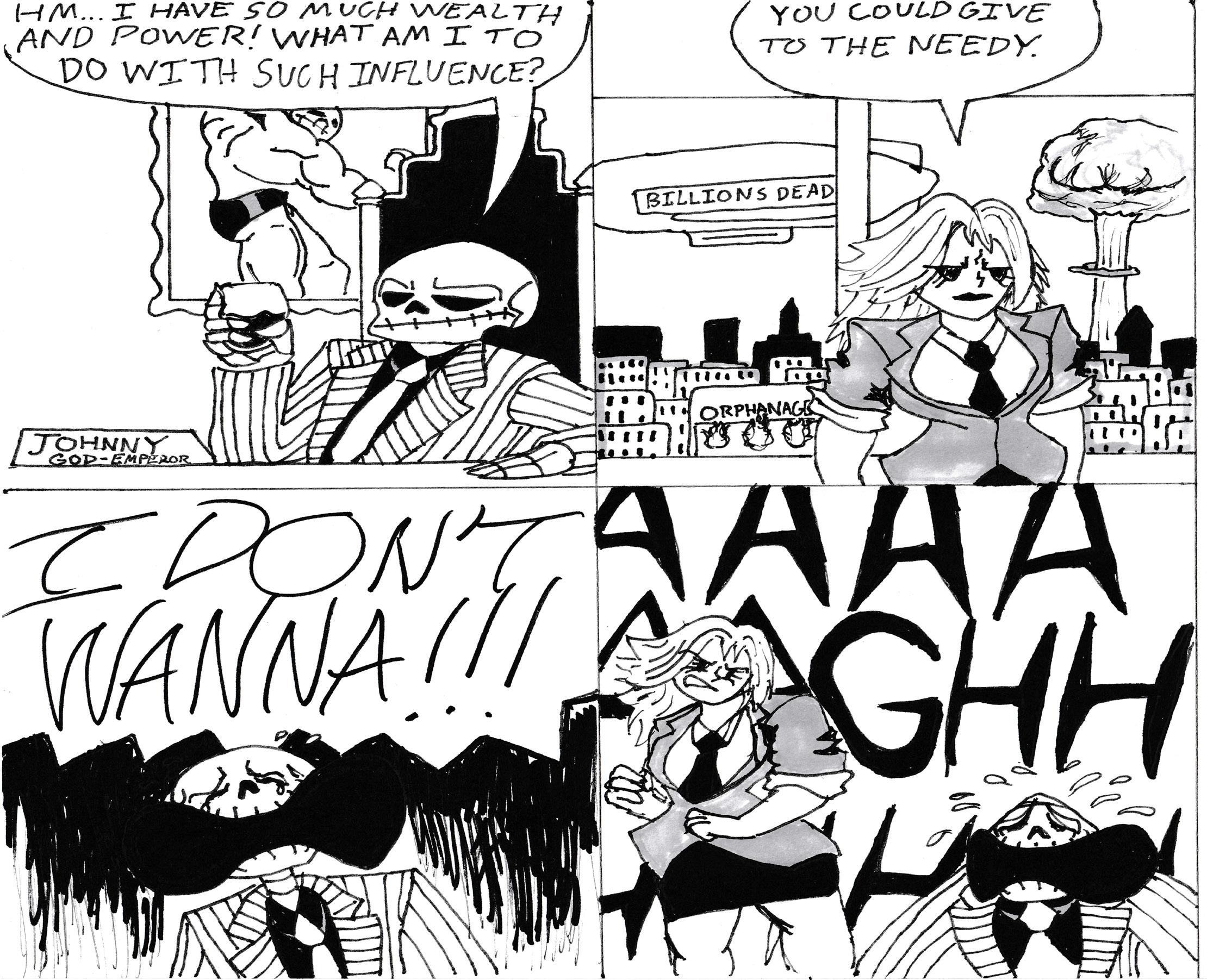
Fruit Love Island attempts to sloppily emulate the drama and emotional rollercoaster of Love Island.
Courtesy of mama kNows NuTriTioN