QUAKER CAMPUS
Oct. 2, 2025
Oct. 2, 2025

On Sept. 15, a survey went out to the student body from the Quaker Campus to gather information about how students are feeling about the current Immigration and Customs Enforcement (ICE) raids. The majority of the respondents shared that they felt anxious and stressed about the raids.
One student who identifies as a Hispanic and/or Latino male explains, “The ICE raids are something that have affected not only me, but many others negatively worldwide. I do not think it is fair for anyone having your family torn apart because you aren't from here. Most, if not all, that are being deported are not criminals and contribute to the country in a positive manner. It is also unjust that ICE has recently been given permission to racially profile people and detain anyone who looks ‘illegal’.”
The poll comes in the wake of the Trump administration making new laws that target racial and ethnic minorities like Hispanic and/or Latino communities. Since the start of Trump’s second term on Jan. 20, he immediately signed executive orders that undo the Biden administration's immigration policies. One executive order by the current administration is the "Laken Riley Act."
The "Laken Riley Act" requires the Department of Homeland Security (DHS) to enforce “the federal detention of illegal immigrants who are accused of theft, burglary, assaulting a law enforcement officer, and any crime that causes deaths or seriously bodily injury.”
Trump has also added funding to DHS through the “One Big Beautiful Bill Act.” This provides DHS with “$46.5 billion [...] to finish the border wall [...] The Big Beautiful Bill will allow ICE to arrest and remove even more criminal
aliens by providing $14.4 billion for removal, 10,000 new ICE agents, 80,000 new ICE beds, and a $10,000 signing bonus for new ICE agents.”
In response, a legal action that citizens have pursed towards ICE is Noem v. Vasquez Perdomo. This case explains how the federal court prevented ICE agents from stopping individuals based on “apparent race or ethnicity, speaking Spanish, or speaking English with an accent.”
However, on Sept. 8, the U.S.
The Supreme Court intervened in Noem v. Vasquez Perdomo, which restored ICE’s ability to racially profile an individual.
According to The New York Times, “...the court’s Republicanappointed majority will allow
"ICE
the respondents were diverse in demographics, but had a sense of unity in their views. Of the students who responded, 75 percent are U.S. citizens or permanent residents, while 25 percent are not.
In addition, 55 percent of students align with the Democratic Party, while 40 percent of students align with Independent parties and five percent identify with the Republican party. 50 percent were female, while males were at 45 percent and five percent preferred not to say. Furthermore, 40 percent of students identified as White, 55 percent Hispanic and/ or Latino, 15 percent Asian and/ or Pacific Islander, five percent Black and/or African American,
"I have an extremely negative opinion about the recent ICE raids in our communities. If ICE was really going after criminals, why are they seemingly taking anyone who looks foreign?"
the government to continue using aggressive–and unconstitutional, in the eyes of its critics—tactics in immigration sweeps as the litigation slowly plays out.”
The Californian Governor Gavin Newsom is actively trying to counteract the raids, by passing laws like “No Secret Police Act.”
This act tries to ensure that “federal law enforcement, including ICE, from hiding their identities” during the operations. On the local level, cities like Whittier are donating to foundations and charities to help families that are being affected by the raids.
The survey gathered views on how students feel about the ongoing ICE raids and some concerns they may have. In the survey, titled
and five percent Native American.
When asked who they voted for in the 2024 Presidential election, 50 percent replied with Kamala Harris, whereas five percent voted for other candidates and 45 percent could not vote for various reasons. For example, not being the legal age to vote (18), international or undocumented student, and chose to not vote.
One student who identifies as a Native American male says, “I have an extremely negative opinion about the recent ICE raids in our communities. If ICE was really going after criminals, why are they seemingly taking anyone who looks foreign? Though, I am biased about this, because one of my friends from my high school is an illegal immigrant, and I worry about her
constantly." Another student who identifies as a Hispanic and/or Latino male adds, “They are extremely dehumanizing with the conditions that detained people are put into, and extremely illegal and unjust with their methods of waiting outside courts to catch immigrants who are trying to get their citizenship.”
However, one student who identifies as an Asian and/or Pacific Islander female states, “I think the raids happened because some people broke U.S. laws. If someone is here illegally and doesn’t follow the rules, then I understand why ICE takes action. It’s important to respect the laws of the country we live in.”
Students were also asked to think about how these raids have impacted the student body or campus climate. One student that identifies as a White and Asian and/ or Pacific Islander female responds, “It's definitely concerning. People are scared, frustrated, sad, and angry. It affects us as students, but also as people with family members or friends who might directly be impacted. It's making the society we live in scarier. I don't know who this is helping.”
While another student who identifies as a Hispanic and/or Latino male shares, “They are extremely distressing to many students who understand that being racially profiled for being Hispanic, Asian, or African American/of African descent. It also could become a bigger issue for all international students seeing that they are all staying here with visas for their studies.”
Students were asked to think about how these events affect undocumented students. One student who identifies as White male responds, “I imagine undocumented students are incredibly fearful. They may not even feel safe leaving campus, and definitely cannot give their full effort to their studies.”
Continued on pg. 2
• On Wednesday, Oct. 1, the U.S. government shut down after not meeting the deadline to approve the Republican funding package. According to The Guardian, this is the "first time in nearly seven years” where a Republican dominated Congress, cannot pass their funding that allocates more money to federal departments. To pass this funding, republicans need “at least seven Democratic votes,” however, “Democrats are using that leverage to push for renewing expanded healthcare.”
• On Tuesday, Sept. 30, a 6.9 magnitude earthquake struck the central Philippines. The death rate is currently at 69, while at least 200 people are injured. According to Reuters , the earthquake has caused power outages and brought down numerous buildings.
• On Sept. 30, Pope Leo XIV shared his criticism of the current “hard-line immigration policies” made by the U.S. President Donald Trump. According to Reuters, Pope Leo does not agree that someone can be against abortion and “in agreement with the inhuman treatment of immigrants in the United States, I do not know if that is pro-life.”
• On Sept. 30, the former President Joseph Kabila of Congo was convicted and sentenced to death. The convictions were of “treason and war crimes [with] accusations of collaborating with anitgovernment rebels,” states AP News . Kabila has not appeared in trial since July, and he is still at large.
• On Friday, Sept. 26, during Israel's UN General Assembly speech “more than 100 diplomats from more than 50 countries” walked out. According to The Guardian, Israel’s Prime Minister Benjamin Netanyahu “vowed to ‘finish the job’ in Gaza.”
ICE Cont. from pg. 2
Also, another student who identifies as a Hispanic and/or Latino male states, “Many of them will come to our campus afraid that they may be targeted by agents. In Los Angeles, countless of both undocumented immigrants and residents/citizens have been wrongfully detained in a dehumanizing environment, and should not be stripped of their studies for this.” The same student who identifies as an Asian and/ or Pacific Islander female voices, “I think undocumented students may feel stressed, but that comes from the choices their families made. If they are not following U.S. laws, then it makes sense that they face these challenges. It shows the importance of respecting the rules of the country.”
Students were also asked to rate how informed they felt on the ICE raids. 20 percent of students rated they were very well-informed on the raids (five out of five), whereas five percent said they were not informed (one out of five). The majority of the students felt that they were fairly well-informed (four out of five) on the matter. When asked to rate Trump’s performance with ICE raids, 80 percent of students felt Trump is doing terrible, whereas five percent felt he is doing amazing. They were then asked to rate Newsom’s response to the ICE raids and 20 percent of students feel he is doing amazing, while 20 percent of students feel he is doing terrible. The majority of the students, 50 percent, think he is doing okay (three out of five).
Cities like Whittier are providing funding to help families affected by ICE raids. On Aug. 12, the Whittier City Council added $100,000 more to the original $30,000 donation to the Hispanic Outreach Taskforce (H.O.T) and Interfaith Food Center (I.F.C.).
This donation will help immigrant families in Whittier that have been affected by the ICE raids. H.O.T. will provide families with direct assistance to help them pay utility and household bills, support with rent or emergency expenses, and referral to additional wraparound services. I.F.C. will assist families with free grocery distribution for

households in need, emergency food boxes for homebound individuals, and an ongoing food pantry.
Most students (75 percent) responded that they want a statement from the College and/or for the College to provide undocumented students with protection. From a statement on June 9 President
She adds, “One such resource is the Poet Student Protections Policy, adopted in 2017 by the Whittier College Board of Trustees. This policy reaffirms the College’s unwavering commitment to supporting all students, including international, refugee, undocumented students, and those
“There is nothing that you need to do except call Campus Safety. You should not feel like you have to [...] interact with somebody [...] on campus..."
- President Kristine Dillon
Kristine Dillon states, “I understand that many in our Whittier College community may be experiencing uncertainty, stress and anxiety regarding protests and federal responses in our Southern California region regarding recent and ongoing Immigration and Customs Enforcement (ICE) actions. In these uncertain and challenging times, reaffirming our commitment to a welcoming and inclusive learning environment is not just important— it is urgent and essential.”
with Deferred Action for Childhood Arrivals (DACA) status. This commitment reflects the Quaker values upon which Whittier was founded—values that continue to guide us in creating a community of care, equity, and inclusion.”
Dillon suggests that all students go on the Whittier College website and read the policy to fully understand it. Students had questions on what procedures they had to follow, and if ICE agents were on campus. Dillon emphasizes,
EDITOR-IN-CHIEF Paige Meyer-Draffen
DePUTy eDiTOr eMMa galvan
Managing eDiTOr
PenelOPe TUrgen
neWS eDiTOr PaOla rUiz
OPiniOnS eDiTOr
angelica HenneSSy
SPOrTS eDiTOrS
aTTicUS cHaiDez
MOnze Meraz-lerMa
caMPUS life
eDiTOr
naDia Miller
FEATURES EDITOR eMMa cianciOla
a&e eDiTOr eliaS lOya
HeaD cOPy eDiTOr clOver MOraleS
SOcial MeDia MOnze Meraz-lerMa
STaff WriTerS allara Baker
eTHan raMillanO MaDySOn eScOBeDO OSWen MarTinez
Mickey rHODUS JayDen garreT
cOPy eDiTOr eTHan ariaDa
graPHic
DeSigner naDia Miller
carTOOniST neMi
facUlTy aDviSOr JOSePH DOnnelly
"There is nothing that you need to do except call Campus Safety. You should not feel like you have to personally interact with somebody coming on campus asking you for documentation or anything else. Campus Safety is on alert and is ready to respond.”
She acknowledges that students are anxious and have concerns about the current situation. “I do not want to single students out. I want them to feel that we care about them and that is what the policy says online [...] I do not want them to feel more at risk. I want them to know there are resources and lots of people on this campus who want
to support you."
She adds, “If a student were to come to a faculty member he or she trusted and said, ‘I am really worried,’ [to a] faculty, [...] [they] say ‘do you need me to file a CARE report’ because then we can get you know personalized resources to you if it's because you feel extremely anxious.” She wants students to know that she cares and is willing to lend a helping hand.
The ICE raids have caused concern throughout the student body at Whittier College. As students voice their opinions, the College is working to provide the adequate resources and support.
Paola Ruiz NEWS EDITOR
During the week of Sept. 11, the College changed the title of the Office of Equity and Inclusion (OEI) to the Office of Inclusive Excellence (OIE). The underlying reasons for this name change was to avoid facing legal challenges.
Dillon states, “...I think I am not willing to fight outside criticism for a label. I want us to do good work and this is the office title that the current staff thinks makes the most sense [...] I do not want to be in a position where we have got legal challenges that we are spending money on to support a label that has become so politicized.”
Dillon emphasizes that students should focus on the Quaker values on diversity of backgrounds, economic status, gender, and to celebrate representation within the community.
She adds, “I am not willing to fight about specific words as long as there are more words that describe what our values are. There are plenty of good words that describe what I'm very proud of as our values. So I am not willing to fight about 'Diversity Equity and Inclusion (DEI)' if I can continue to fight about living up to our values [...] We do not need those words. We need to go back and see
the values that college was founded on. So we are going to use the values rather than fight about the politically charged words.”
The Trump administration has passed two executive orders that remove DEI policies: “Ending Radical and Wasteful Government DEI Programs and Prefencing” and "Ending Illegal Discrimination and Restoring Merit-Based Opportunity." These orders make it difficult for companies and universities to use words like “diversity”, “equity”, and/ or “inclusion.” According to The Guardian, the Department of Education warned colleges that they could lose federal funding if they continued to operate DEI programs. However, a federal judge blocked it and ruled the government has “overstepped its authority” by attempting to cut grants. In response, Harvard University has renamed their Office of Equity, Diversity, Inclusion, and Belonging (OEDIB) to the Office of Community and Campus Life.
Students who are affiliated with the OEI are floating the idea of starting a petition for the office name to stay as Office of Equity and Inclusion. The Dean of Students sent out an email to the student body on Oct. 1, two weeks after, to finally address the name changes.
Submissions may be emailed to qc@poets.whitttier.edu in .doc or .docx format. Submissions must include the author’s name and year of graduation or position at the college in the signature. Letters are due by Monday at 5 p.m. to make it into that week’s issue. Submissions should be no more than 500 words. Submissions will undergo the same editing process from our production pipeline if selected. All stories must follow the same journalistic standards.
Due to the high cost of publication, members of the Whittier College community are permitted three copies per issue. Additional copies may be purchased with prior apporval for 50 cents each by contacting the Quaker Campus. Newspaper theft is a crime, and those who violate the three copy rule may be subject to civil and criminal prosecution.
The Quaker Campus does not change material posted on online articles once they have been published in the paper — with the exception of an error being found. Only then will a correction be made to the online version. The Quaker Campus is a publication of Whittier College. Columns and Signed editorials do not necessarily reflect the opinions of Whittier College or its affiliates.

this is not a real replacement for Anthropology’s own pathway and said it may take three to five years of student growth before those courses can be offered again.
Students in Latino Studies also feel the effects directly. Courses they want or need are sometimes not available, which can make completing major requirements more difficult. One example is Spanish for Heritage Speakers, a course designed for bilingual and bicultural students. Six students took it in Fall 2023, but the class was canceled in later terms. O’Connor-Gomez calls its absence “a real shame,” because it once attracted strong enrollments and gave heritage speakers a chance to build confidence and skills in their language.
college’s mission. “As a Hispanic Serving Institution, it is only logical we sustain a program in U.S. Latino Studies,” Contreras says.
At the same time, the struggles in Anthropology, Environmental Justice Studies, and Gender Studies show that Latinx Studies is not an isolated situation. Cuts to small programs are becoming common across campus, threatening the liberal arts foundation that the College has long relied on. The Latino Studies minor represents both the opportunities and
vulnerabilities of that model. Interest from students is there, but without enough faculty and consistent offerings, the program remains fragile. Faculty are pushing for a major proposal that could help the program grow, but only if the College provides the resources to sustain it. In the coming years, the future of Latino Studies, and of other small but important programs, will indicate whether Whittier College is willing to live up to its identity as a HSI and commit to supporting the communities it serves.
At Whittier College, a Hispanic Serving Institution (HSI), the Latino Studies minor is meant to play an important role in representing and supporting the student body. The Whittier College website states, “The primary goal of the Latino Studies minor is to teach undergraduate students about Latino/a experiences, cultures, and contributions to the United States.”
The program brings together courses from Spanish, History, Sociology, Politics, Art, Music, and Religion, giving students an interdisciplinary view of what it means to be Latino in the United States. Even so, the minor is facing serious challenges. Over the past few years, Latino Studies has lost faculty, struggled with inconsistent course offerings, saw low student enrollment rates, and has been affected by confusing enrollment numbers in courses. These issues raise concerns about how sustainable the program will be in the future, even as student interest remains steady.
Enrollment records from 2023 through 2025 show that students continue to take Latino Studies courses. In Fall 2023, LAT 100—Intro to U.S. Latino Studies enrolled 17 students, though 16 were counted under Spanish and only one under Latino Studies. In Spring 2024, LAT 225—Latino Literature and Cultural Production —enrolled 14 students. Fall 2024 saw 21 students in the introductory course (LAT 100), while Spring 2025 had 12 in LAT 225—Latino Literature and Cultural Production. The most recent offering in Fall 2025 had only 17 students.
These numbers suggest consistent interest, but the way courses are counted makes it look smaller than it is. For example, Music of Latin America had 25 students, but only one enrolled under Latino Studies because the course is cross-listed with Music.
“The tricky part is this cross-listing […] it shows numbers that aren’t really reflecting the interest in the program itself,” explains Professor Doreen O’Connor-Gomez.
The biggest strain has come
from losing faculty. José Flores, who joined the faculty in 2021 as a full-time lecturer teaching Spanish and Latino Studies, left when his position was cut. Bernabé Rodríguez, who taught Sociology courses which counted toward the minor, also got his position cut from full-time to part-time.
Longtime faculty member Shannon Stanton retired after more than 20 years at the College. Today, only about eight to ten faculty across all departments are still actively teaching courses connected to the minor. Many of them are also stretched thin with responsibilities in other programs.
Professor José Contreras, who began teaching at Whittier in Fall 2023, has quickly become the “anchor” of the program according to O’Connor-Gomez. He teaches both Latino Studies core classes and advanced Spanish courses,
Contreras explains the impact clearly, “The impossibility of fulfilling requirements when classes are not offered means students lose opportunities to continue developing their academic and linguistic skills.”
The advising system also suffers from a lack of clarity. The faculty listings on Whittier’s website are out of date, with missing or incorrect names. For small programs like Latino Studies, this can leave students confused about who to contact for help with petitions, substitutions, or course planning.
Despite all these challenges, faculty are working on a plan to strengthen the program. The Spanish Department is preparing a proposal for a new Spanish major with two tracks: one in Language and Literary Studies and another in Language and Latino Studies. The Latino Studies minor would stay the
"As a Hispanic-Serving Insitution, it is only logical we sustain a program in U.S. Latinos Studies"
advising and coordination. Still, his role has not been officially recognized by the administration. “We’d love to see a full-time, ideally tenuretrack, position for Latino Studies. It’s hard on students and faculty when positions are part-time and unstable,” says O’Connor-Gomez.
Other smaller majors and minors are also feeling the impact of the decline in student enrollment at the College. Anthropology Professor Ann Kakaliouras explains that several Anthropology core courses, such as The Art of Ethnography, Theory in Anthropology, and Ethnographic Methods, are no longer offered because of low numbers of enrollment in the major. She adds that Environmental Justice Studies and Gender Studies, which once contributed to those classes (as stated above), are also struggling. As a temporary solution, Anthropology students can take Sociology courses, since the two majors were designed to mirror each other. But Kakaliouras admits
same at 18 units, but the program would gain a redesigned senior seminar that grows from one unit to three, including more writing, handson learning, and reflection.
The success of this plan depends on stability, and especially the guarantee that Intro to U.S. Latino Studies and Latino Literature and Cultural Production are offered every year. “We must be able to offer these core courses every year,” O’ConnorGomez says. “Without them, the minor cannot exist.”
For faculty, the solution is clear: Whittier needs at least one full-time, tenure-track professor dedicated to Latino Studies who can also teach Spanish courses. This would provide stability for students, reduce the workload on other faculty, and show that the college is serious about supporting the program. Both Contreras and O’Connor-Gomez have stressed that Latino Studies is not optional. With nearly half of Whittier’s students identifying as Hispanic or Latino, the program is central to the
Paola Ruiz NEWS EDITOR
Paola Ruiz NEWS EDITOR
Under the current Trump Administration there have been various cuts to the Department of Education and education system nationwide. The new funding cuts that were announced in the week of Sept. 11 targets Hispanic Serving Institutions (HSI) and Minority Serving Institutions (MSI) like Whittier College.
President Dillon presents the College’s current races and ethnicities are, “...50 percent Hispanic/Latinx, 25 percent White, seven percent Asian, six percent two or more, five percent international, four percent Black or African -American, and then there are the small percentages of Native Hawaiian or American Indigenous.”
According to the U.S. Department of Education, “The Department agrees that the racial quotas in the HSI programs are unconstitutional. Due to similar issues with all MSI programs, the Department is using its statutory authority to reprogram discretionary funds to programs that do not present such concerns.”
However, Dillon does not want students to get concerned on these matters since “[this] is not as huge a deal for us. We currently do not have any grants that we received that were based on HSI or MSI status. So we are not at the risk of that.” She adds, “In the past, we have had some grants. We have never had lots of grants under that, despite the fact that we have been, I think we have felt more proud of how long we have been designated an HSI and how that has communicated our value system [...] I think it's really part of our whole Quaker values to be HSI or any other area that says we value cultural communities. That is part of our tradition.” Dillon ensures that all students will continue to receive the John Greenleaf Scholarship and it will be proportioned to their financial aid package. If the College needs more help to provide these scholarships she will “be explaining that to our donors and trying to see, and to our foundations and to others that support us, to see how much offset we can provide by explaining what this means to our students.”

Stay up to date on events! For further info, visit https://whittier. campuslabs.com/Engage/
Poet Pantry
• Thursday, Oct. 2 at 12:30 p.m.
• Campus Center Room 141
Purry Furry Thursdays
• Thursday, Oct. 2 at 3:00 p.m.
• Dezember House
The Politics of Space and Community: A Look at Gender Dynamics in West Hollywood for LGBTQ History Month
• Thursday, Oct. 2 at 7:00 p.m.
• Hartley House
TOBGLAD Weekly Meetings
• Friday, Oct. 3 at 11:00 a.m.
• Platner 203
Superman Movie Night
• Friday, Oct. 3 at 7:00 p.m.
• Campus Courtyard Lower Level
Bug Club Meeting!
• Monday, Oct. 6 at 12:30 p.m.
• Campus Courtyard Lower Level
Sustainability Club Bi-Weekly Meetings
• Tuesday, Oct. 7 at 12:30 p.m.
• Founder's Hill
First Generation & Allies 1st Meeting!
• Tuesday, Oct. 7 at 5:00 p.m.
• Platner 201 Program Board's Weekly Meeting!
• Tuesday, Oct. 7 at 6:00 p.m.
• OSE Conference Room
RENT Auditions
• Wednesday, Oct. 8 at 6:00 p.m.
• Arnold Hall
Chair Massage
• Thursday, Oct. 9 at 11:00 a.m.
• Naylor Portico (Deihl Hall Patio)
Poet Homecoming 2025
• Friday, Oct. 10 at 10:00 a.m.
• Whittier College Campus
Homecoming Musicale
• Friday, Oct. 10 at 12:00 p.m.
• Memorial Chapel Media Council Block Party!
• Friday, Oct. 10 at 12:00 p.m.
• Dean of Students Hallway
The Business of Entertainment Forum
• Friday, Oct. 10 at 3:00 p.m.
• Hoover 100
State of the College and Poet Awards
• Friday, Oct. 10 at 4:15 p.m.
• Ruth B. Shannon Center
MEChA Biweekly Meeting
• Monday, Oct. 13 at 4:30 p.m.
• Ortiz Lounge
Pet Therapy
• Tuesday, Oct. 14 at 11:00 a.m.
• Founder's Hill Lawn
Emma Cianciola FEATURES EDITOR
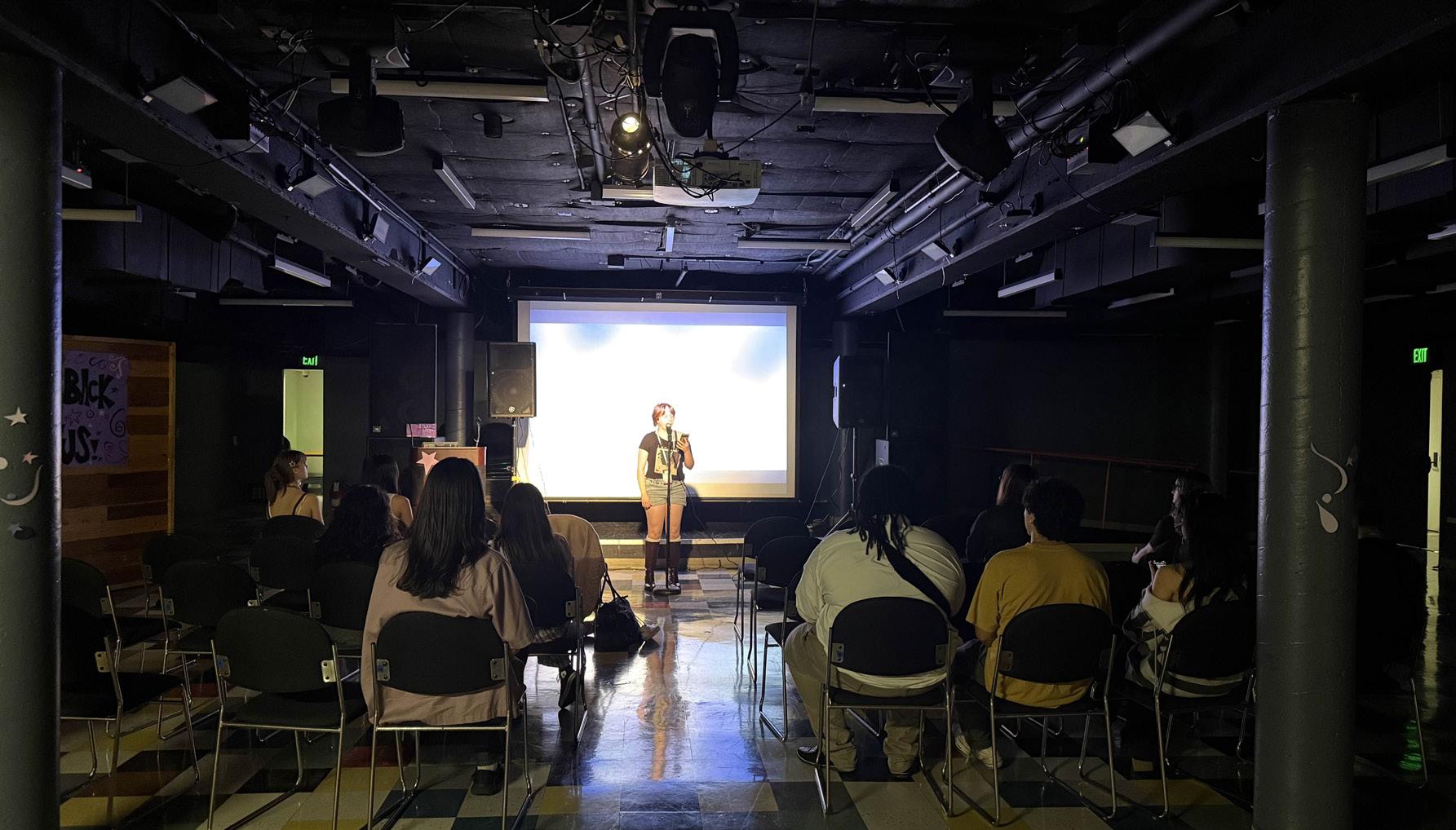
On Sept. 18, Club 88 was simmering with excitement as students gathered for KPOET's Welcome Back Open Mic Night, a night that entertained both heartfelt poetry and plenty of fun singalongs. The expansive space made room for the wonderful array of colors each performance act brought, where students shared not only their voices, but their personal stories.
First-year student Megan Barayoga, was thrilled to partake in the event. “I really love doing karaoke,” she said. “When I heard it was an open night, I was like, 'oh my gosh, that’s totally my thing!'” Her surprise performance of “Black Sheep” from Scott Pilgrim vs. The World quickly turned into a crowd favorite as the room burst with students clapping along to the beat and nodding along to the lyrics. Barayoga later shared how much she enjoys these types of club and organization events, “They’re really fun ways to, like, get to know the community.”
The night’s lineup reflected KPOET ’s commitment to showcasing all forms of art. Claude Steen, a member of KPOET, read two deeply personal poems. One about their boyfriend, and another inspired by a writer who continues to influence their own work. Their beautifully written words intertwined elegantly with the more heartfelt aspects of KPOET as a collective. KPOET deeply values bringing students together through different kinds of performance art to the community to nourish their
confidence.
Another highlight came from fourth-year Evan Josten, who shared two original pieces written during his time abroad in Greece last summer. One poem centered around the Greek god Poseidon, which he stated was his favorite character from the Percy Jackson series. The other centered on a simple Mediterranean rock he showed the audience, a tangible reminder of how travel can inspire
"September." A moving poem dedicated to her late grandmother, to acknowledge the anniversary of her passing. The room grew still as listeners sat in admiration and respect for her vulnerability through her moving piece.
The night also came through with plenty of humor for audience members to enjoy as well. Fourthyears Alec Manoukian and Oswen Martinez read a duet poem they often return to about a life
listeners with a lively performance of Chappell Roan’s “Subway,” while Steen returned to the mic to sing a Beach Bunny favorite. Each individual's performance showcased their chosen performing art magnificently.
By the end of the evening, the KPOET Open Mic felt less like a talent show and more like a fun gettogether for a community sharing different forms of creativity! “Music is a universal language,
creativity of all kinds.
Fourth-year KPOET General Manager Emily Perez-Medina, has been part of the organization for four years. She is now experiencing her first year leading without her co-manager, and also took the stage that night. “We do a really great job making good safe spaces for people’s expression,” she explained before reading her piece
changing
experience. Their playful narrative and ode to feta cheese had the crowd laughing and, admittedly, feeling a little hungry after their performance.
Music lovers were nowhere near left out. Korey gave a powerful cover of “Burn” from Hamilton, while Josten showcased some flare with “Rhinestone Cowboy.” Firstyear student Tralee Jacobs impressed
and KPOET really brings that out on campus,” said second-year Devin Tovar. “We’re really here to try to bring that out in us not just one genre, but all.” Whether you performed or were an active listener in the audience, KPOET's Open Mic Night was immensely appreciated. Make sure to look out for KPOET at the upcoming Media Council Block Party!
Allara Baker STAFF WRITER
For years, the Campus Inn (CI) has been providing an array of diverse food options to Whittier College and the surrounding community. When it comes to breakfast, lunch, or dinner, there’s always something suited for the tastes of every student.
I took to the task of asking the student body about their personal dining preferences. Of those who responded, it seems like breakfast is well liked and enjoyable in terms of the food provided. It has the most versatile options, and they aren’t subject to change. The variety makes it so that whatever way you choose to have your breakfast, you can customize it to your liking. It’s hard to go wrong with that.
In terms of lunch, the poke or chipotle bowls, tacos, and the ice cream stations seemed to be the most enjoyed options, all of which are exhibition meals. This is because they are satisfactory and students find the variety of flavors to be especially appetizing without being too overwhelming.
I look forward to the days where they serve tacos, as well as the exhibition salads. I find the variety nice, like the caesar or chicken
salads. They recently had seasoned chicken wings for exhibition and I thouroughly enjoyed them for lunch.
For the dinner menu, the dishes students enjoy the most are the customizable meals, such as the baked potato and nacho bars. Being able to add their own toppings according to personal preferences seems to be a very common trend in terms of favorite meals. Personally, I’m fond of their baked mac 'n cheese. Its balance between the savory cheese and pleasant creaminess reminds me a lot of home.
Of course, there’s always room for improvement. When asked about least favorites, I noticed a common trend to be most meatbased dishes, particularly chicken. Other than it being cooked a certain way that students find to be unsatisfactory, dinner was also regarded as the least favorite meal of the day due to the lack of variety and I am inclined to agree. The texture of most of the meat based dishes to be very chewy, and on occasion, not cooked as well as it should be.
When asked about the kinds of options they wanted to see more of, the student body responded that they would like
to see other types of meat that are cooked authentically like steak or other cuts of beef. Many also said they would like more meals with different protein sources other than just pork and beef. Since the student body seems to enjoy the self-serve stations, they wanted to have more of them but with pre-existing dishes like the waffles and pastas to expand the variety in options.
The CI's wide range of options that appeal to the different tastes of our student body, can always improve based on their feedback. We had an opportunity to get an idea of what they gravitate towards most in terms of dishes, and what they would like to see more and less. Will we be able to see much more improvement in the future in terms of quality meals?

Oswen Martinez STAFF WRITER
There’s something about the way sound carries throughout the Upper Quad on a brisk evening. On Sept. 25 at 5:00 p.m., it wasn’t just the usual shuffle of students heading back to the dorms, nor was it the low hum of late-night study chatter. Instead, it was voices blending with music, and the kind of laughter that makes you stick around longer than expected. The Associated Students of Whittier College (ASWC) kicked off their first big event of the year with a Night Market, and while embers stirred, the energy didn’t take long to catch fire.
With over 30 clubs and organizations setting up shop, you’d think the whole thing might be overwhelming. But what unfolded was colorful, varied, and surprisingly smooth. You could walk down one direction and you’d find strawberry crumbles that could rival anything you’d get Uptown. Then you’d take a few steps in another direction and see crocheted plushies of your favorite horror movie slashers. It wasn’t just about fundraising though plenty of groups took advantage of the marketing opportunity — it was about having a presence and announcing, “Hey, we’re here, we’re active, and we’ve got something worth checking out.”
That was exactly the idea, according to fourth-year ASWC President Isabelle Brookshire, “One of the biggest goals I wanted to approach Senate with was to do more Senate-planned events

instead of just funding events,” she expressed. “I wanted to increase the community on campus, to intersect all these different organizations and clubs, and to showcase local businesses while also putting Senate out there in a new way.” You could feel that intent in the atmosphere. The market wasn’t just another college event, it felt like Whittier College was reclaiming something that had long been missing.
Of course, no market feels alive without a soundtrack.
Thankfully KPOET was there, spinning everything from The Cure’s melancholy echoes to the kind of early 2000s bangers that make people forget they’re in the middle of the Upper Quad and not someone’s backyard party. The music wasn’t just background noise either, it carried the event, filling in the quieter gaps when the crowd thinned out, keeping the energy there. That shift from somber tunes to nostalgic, upbeat tracks kept the energy blazing. It mirrored the night
itself as it started off mellow, then it would slowly pick up momentum as more students wandered through. By the time the chorus of familiar throwbacks hit, people weren’t just browsing tables. They were talking, hanging out, and staying close to their favorite booths.
Brookshire didn’t hide that the idea came partly from tradition. “Something we’ve been missing on campus are those Tuesday flea markets we used to have a long time ago,” she said. “Who doesn’t love a
good night market or flea market? You can make money, you can get fun treats, and it’s a bunch of fun.” She’s not wrong either. There’s a certain nostalgia tied to wandering tables under the evening glow, stumbling across something unexpected, and running into people you hadn’t planned to see. That’s the college community in its purest form, a mix of serendipity and structure.
The night market may have been the opener, but ASWC isn’t slowing down. Brookshire shared that Senate is already planning more ways to bring students together. “We’re interested in being involved with the Media Council’s block party on Oct. 10,” she explained. “And we’re also floating the idea of doing Midnight Breakfast again during midterms or finals — where professors and staff serve students pancakes while everyone studies in a casual setting. It should be fun. Like, imagine Chuck Hill handing you a pancake.” Now, that is something worth showing up for.
The night market succeeded, despite the attendance being lower than anticipated. It showed that the College’s clubs and organizations are active, creative, and eager to connect, which was what the night was for. It set the tone not just for ASWC, but for the Fall semester. One of collaboration, energy, and a bit of playfulness. Because at the end of the day, the real takeaway wasn’t just the food or the handmade crafts. It was that simple sense of, “We’re here, and we’re building this together.”
Penelope Turgen MANAGING EDITOR
On Thursday Sept. 18, at 4:30 p.m., the Fiber Arts Club hosted their first meeting, a “Knitting/ Crochet Night.” Prospective members were invited to bring their current fiber arts project, if they had one, or to come learn to knit or crochet. The table was full of crafty poets interested in the fiber arts and camaraderie between their peers. The club provided all the materials needed to learn how to knit or crochet, but if you already know how, you were encouraged to hone your skills with a group. While knitting and crocheting, we watched a movie and talked as we worked. It was mellow and relaxing, with many people helping beginners out with learning a new craft.
The Fiber Arts Club will be hosting a number of events throughout the semester. Some upcoming collaborations are a patchwork t-shirt event with Residential Life and a “bacteria embroidery” event with Professor McNamara. All experiences are welcome and all materials will be provided by the club.
The fiber arts use the medium of fiber such as knitting or crochet, embroidery, wool felting, and
more. Knitting and crochet—as previously mentioned—are some of the most popular of the fiber arts. Crochet is the use of a hook to loop yarn together, using a single loop, to create a piece of textile while knitting uses many loops and two straight needles to loop the many stitches together. Although they may both use yarn, they have very different properties and use entirely different methods.
Embroidery, weavery and needle felting are also very popular forms of fiber art. Embroidery is a kind of sewing using embroidery floss, which is a thicker and usually colorful kind of thread to sew designs into fabric. Weaving uses art or thread in an over-under pattern to create a woven fabric. And needle felting uses unprocessed wool and a special, sharp needle with notches in it to interlock and entangle the woolen fibers into a solidified piece. All of these use different fibers but have the fiber as a concept in common along with a crafted final product created from interlocking a fiber to itself.
Arts using fiber have many utilities, but it’s also stimulating and very rewarding. Physical arts like fiber arts can be meditative and grounding. The repetitive movement requires focus and detail orientation, releasing serotonin and

improving mood. But unfortunately, hobbies such as these are usually solitary and isolated, which is why this new club is an opportunity for students on campus.
The manipulation of fiber was one of the first markers of modern human society. It's an ancient practice tied especially to women, which has led to it being discounted as a genuine art form.
Giving resources and access to the medium can provide widespread popularity as well as validity to the art. Politics have incorporated fiber arts through fashion for hundreds of years and fiber arts are often woven into female activism.
The suffragettes sewed sashes and banners to protest and women made “pussyhats” to protest Trump’s first inauguration. Fashion has been a space in which predominantly women have had power over for most of history, which isn’t something we’ve been allowed in other aspects, which makes it inherently political.
Fiber artists are often female, but a more mainstream reach could lead to more men joining the art. More often than not, when a field is dominated by women, men are less likely to join. Although art as a whole is not dominated by any gender, specifically fiber arts has a
very small male presence. This club is open to all. But if more men feel inclined to join, the community as a whole is in need of a more diverse populace, and this is a great place to start.
Of course, art can just be art you can just knit or crochet or sew without saying anything deeply anarchist. But in these times of political turbulence when the younger generations feel they don’t have a voice, this could be an avenue to follow if you feel so possessed. If you’re looking for some parallel play, a creative outlet, or to create something significant, the fiber arts club is the way to go.
Emma Cianciola FEATURES EDITOR
Male pop stars are static. When you look at most of their careers, one thing stands out–the consistency. Artists like Ed Sheeran have built entire careers while staying relatively the same: a guitar in hand, an accompanied hoodie or flannel, delivering heartfelt love songs or breakup ballads. And fans love him for it! Male pop stars are allowed to “stay in their lane,” expressing the same sound and image year after year without facing questions about relevance or need for something different.
Women in pop do not have the same privilege as their male peers. Female stars are expected to constantly evolve, reinvent themselves, and conjure up a new “era” that goes with each album cycle and sound. Fans demand it, and the media is obsessed with it. The public needs a new era or aesthetic to praise or absolutely tear down. Why can male pop stars present the same image without fail and yet female popstars must constantly change it up to avoid irrelevancy?
The pressure on female pop stars to reinvent themselves can be seen when looking back on Madonna’s career. In the ‘70s and ‘80s, she was seen as the “Queen of Reinvention.” Madonna transformed with each album, from the lace and crosses of the Like a Virgin phase to the leather look of
her Erotica era, then transitioning to her opposing spiritual portrayal of the Ray of Light album. Her constant evolution set a cultural demand. A female pop star’s survival became tied to her ability to surprise us and constantly evolve. Reinvention became less of an artistic choice and more of a requirement.
In contrast, men in that same period were praised for their stability. Consider Billy Joel or Bruce Springsteen. Their sounds and images stayed mostly stagnant for decades, and that consistency was praised as authentic. Fans see this and seem to honor them as classic or timeless.
This double standard continues today. Listeners don’t usually doubt the ability of popular male artists to produce hits. They do not express fear that these artists may enter what the media likes to call a “flop era”.
Bruno Mars sticks to his retro funk pop lane. Yet, if a woman released similar sounding albums across ten years, critics and fans would likely call her boring, washed up or simply out of ideas.
Taylor Swift is a prime example of this female pressure to evolve. Over the past 15 years, she has moved from country (Fearless), to mainstream pop (1989), to folk pop ,(Folklore and Evermore) and then into synthy pop-rock with her latest albums. Each shift in sound was accompanied by a new aesthetic, whether it was cowboy boots, pastel dresses, dark cardigans, or sparkling
bodysuits. Reinvention has been key to keeping the media entertained and retaining her pop culture dominance. Unlike Swift’s male counterparts, she can’t afford to stay stable.
Other contemporary female artists reflect this same expectation. Lady Gaga built her brand on being “out there,” and her transformation from the pop edge studded sound of her “meat dress” era to her return to dance pop with Chromatica. Beyoncé, too, has mastered the art of eras, reinventing herself visually and sonically from Dangerously in Love to the powerful Lemonade era to the blinged out country inspired Renaissance. Miley Cyrus, taking a drastic turn from her time as Disney Star Hannah
Montana, to her party girl persona, posing naked on a wrecking ball for her album Bangerz. Meanwhile, male artists like Drake or Shawn Mendes have made careers out of following the same overall formula. These artists are not expected to provide something revolutionary or shocking with each album release. Instead, the public values the static nature of their work
This isn’t to say evolution is bad. Reinvention has produced some of the most creative, groundbreaking moments in pop history. But the problem lies in the double standard.
Female artists are left behind if they don’t transform, while male artists are rewarded for their consistency.
Pop’s problem isn’t that women evolve, it’s that they feel forced to do so in order to remain relevant.

Female pop stars are constantly pressured to switch it up.
Paige Meyer-Draffen EDITOR-IN-CHIEF
Imagine that you are enjoying your favorite class; the participation is picking up, you have complete awareness of where you are with the material and discussion–and then a notification chirps from the back of the class. Everyone ignores it, you continue with the material, and it sounds off again. And then again, and it’s coming from the same person, too. The guy to your right has his phone flat on the desk and he’s 14 Instagram stories deep, but he’s nodding along with the discussion like he knows what’s going on. In these moments, I can’t help but think: “Aren’t we all paying some exorbitant amount to be here?”
One of the perks of Whittier College has always been the small class sizes. Intimate class settings have strong professor and student rapport, a low-stakes environment to ask questions, and facilitate meaningful discussions.
However, in-class discussions are significantly weakened when the person next to you is not fully engaged. Losing student contributions and questions in a classroom environment degrades the quality of everyone’s learning experience. The potential for connection and deeper understanding of the material or topic from multiple perspectives completely disappears.
Over the summer, all 50 states
have implemented some kind of preventative phone use protocol in classroom settings. 37 of which have partially or completely banned it, according to each state’s Education Department. This includes California, which has rolled out full bans on phone usage in K-12 institutions.
However, higher education is still grappling with this issue today. Wyoming Catholic College is one of the few colleges in the U.S. with a publicly-accessible statement banning phone use in every classroom. Most colleges and universities, including ours, leave this decision to each faculty member to make.
Professor Jose Orozco in the History department found that phone usage disrupted the discussion-based learning style he had been practicing throughout his career at the College. “[Students] leave [phones] on their desks, they’re like comfort animals,” Orozco laughed, “they’re always in sight on the desk or in their pockets.”
The divide between student experience amongst departments lies in the type of class they’re sitting in. STEM majors admit that regardless of the professor’s policy, the detriments of using your phone in class outweighs the gratification. 200-level and 300-level STEM courses move quickly and efficiently. One text, one reel, and you’ve missed a unit of Conservation Biology.
But compared to a History or
Screenwriting class, the reliance on creativity and recollection make a deep dive into a topic you have a surface level understanding of seem repetitive. Orozco recognizes these lectures can feel like, well, a lecture, but it doesn’t have to if students jumped into the conversation and asked questions.
Those of us who take notes on a laptop (which has been proven to be less effective than handwritten notes time and time again) are quick to open iMessage or LINE as soon as someone contacts us. Students find themselves keeping live sports in the corner of their screen, scrolling through Pinterest, or even muted on a Zoom call for an off-campus work meeting.
However, just because a professor doesn’t call you out in front of the class when you start scrolling, doesn’t mean that they’re just cool with it.
There’s an underlying weight
of exhausted apathy within some of our faculty, a weight that is heavy on the shoulders of all instructors in California. Some, not all, have felt it was best to give up the fight and teach those who were willing to engage and let the rest take what they would from their lessons.
I never got the hang of hiding my phone from my professors. But one thing the Poets have down cold is the confidence to check a notification and investigate a FYP (For You Page) during class.
Yes, an Instagram story will disappear, your parents will call, the presale will end, but as students who are paying to be in a classroom with peers who are interested in and passionate about learning… Well, I can’t help but think we can use that time to turn our brains on and maybe even learn how to be bored for a little while. The worst that can happen with no phones in a classroom is we learn something.


Dear Poets,
Suppose I wanted to kidnap Friday the Squirrel. How would I go about doing that? - A Mischievous Poet
Jane:
There’s only one (1 ((uno))) option to kidnap Friday and it isn’t to actually “kidnap” Friday, but to “reclaim” him. John Greenleaf Whittier’s pet was Friday the Squirrel until Whittier unfortunately left onto another plane of existence. I say, you dress up as our very own Greenleaf Whittier and march into the library and thank our lovely Archives Librarian Paige for taking care of your squirrel, Friday, but you will now be taking back ownership from here.
Jo:
Sometimes, it’s helpful to be a little mischievous. Request a meeting with the Archives Librarian, Paige Harris, and as soon she has her back turned… BAM! The cover is shattered, Friday is off the pedestal, and you’re sprinting back to the elevator with a brand new (or well, new to you, at least) squirrel! To ensure your getaway, make sure to yank on a fire alarm and vigorously slam the bell sitting at the Circulation Desk on the way out. Diversion and confusion avoids conviction, and the LAST thing you want happening is to be detained for squirrelnapping.
Johnny:
Now I’m not one to judge, I’ve had thoughts here and there of seeing the furry creature himself outside his glass cage. However, from the few times I’ve been to the Archives, he’s pretty well hidden and would be impaw-ssible for you to slip in and out. But then again, I’m not sure how good your sneaking skills are. If you think you have the ability, go for it! Who am I to stop you? Just make sure you have multiple plans for various scenarios. The last thing you want is to nearly slip away and suddenly you are caught by the LSA at the front desk because you forgot that they went off to go shelving.
-The Poets
Jayden Garrett STAFF WRITER
The Quaker Campus was granted an audience with the Athenian Society’s sitting President, lAdy Heavenly Monroe, who provided a closer look into what it means to be an Athenian. Excitement overtook her face when she was given an opportunity to share what the words “Sisterhood” and ”Leadership” meant to the Athenian Society: “Leadership is about impact, it’s about how we show up for others. Not just in business, in life we teach that leaders are nurturing and empowering to others." She adds, "We also emphasize that people are not disposable parts, but they are gifts and we nurture those gifts.”
Monroe is not alone in this belief, you can ask any active members or Alumni of the Athenian Society, (also known as The A’s), and they will echo her statement twofold. This perfectly reflects the kind of organization President Monroe wishes to lead, not just for herself, but for the society as a whole.
When asked to boil the mission of the Athenians in five words, Monroe confidently states: Determination, Resilience, Solidarity, Tranquility, and Sisterhood. Qualities all shown within any of the A’s you may encounter on campus. While still being unique, these qualities undoubtedly hold true amongst the entire Athenian Cohort.
President Monroe proudly
declares, “We are resilient, the Athenian society strives to reflect on ourselves and speak up for those who can’t. We stand for what’s right, while being both an Athenian and just a human being. When silenced, our actions speak for us. We don’t just claim to be different we just are different.”
Honorable intentions aside, many students are wondering what the benefits they can gain from joining the Athenians as opposed to other societies. As per President Monroe’s specifications, the Athenian Society provides scholarships, leadership training, one on one talks with Alumni, close bonds, study sessions and peer accountability.
Students who join and make it past the pledge process also get to partake in the society’s sacred events. A prized tradition between the A’s is simply getting a bite of lunch and enjoying each other's presence. Small gatherings like these serve as reminders to their members that they are never alone in life, even during the mundane moments.
President Monroe made it clear that while she may be President, the society does not run off the efforts of one lAdy alone. The Athenians have a diverse E-Board which sits at the head of the society to ensure that everything runs smoothly: lAdy Heavenly Monroe sits as President, lAdy Madyson Escobedo as Vice President, lAdy Elise Chaidez as recording secretary, lAdy Yen Tran as Treasurer, lAdy Ebelise Orsorto
as New Member Educator and their Advisor Dr. Douglas Manuel. With such a diverse E-board it’s almost impossible to stroll the campus of Whittier College without seeing one of their lovely smiles. In Heavenly’s words “We are RA’s, Captains, Writers, Senators and so forth.” She adds, “No matter where you go, or no matter where you are an Athenian will be there. We are here to support, guide and enrich everyone around us. We have enough 'A-love' to give to everyone.”
For those looking to join in and learn how to give some of that 'A-Love', President shared a thoughtful selection of comments to provide advice to any future prospective pledges. Monroe shares, “It happened so you can grow, focus on improving yourself, not proving yourself,” which is a powerful statement enough on its own but she later added that the Athenians don’t believe in “Good Pledges" or "Members.” They believe in organic ones. Being “Good” tends to restrict people, Monroe makes it clear that Athenians don’t live in boxes; you give them your best, and in return, they will help you in achieving the ultimate goal of reaching your true potential.
While the Athenians may believe in solidarity, this does not prohibit their collaboration. They are not only very open but also enjoy getting to work with fellow members and organizations. The Athenian Society seems to always be working and striving to building


a better future, an admirable quality instilled in all those who bare the “A.” When reflecting on the society's long history and looking back on some memorable moments, she pauses, taking a moment to gather all the details.
The A’s “Leave it better than you found it." The Athenians are still writing History as we speak. Every moment they share together is greater than the last, and that
greatness is something you can take part of as well, through pledging as an Athenian in the Spring! Or in Presiden Monroe's departing words “See you in the Spring X.O.X.O.”
With such a broad group of engaging and devoted members in the Athenian Society, they pull through with unforgettable success. Whittier College is proud to be the home of the Athenians.

Women’s Volleyball @ Chapman University
Location: Orange, CA
• 7 p.m.
• October 2
Men’s and Women’s Cross Country @ Pomona-Pitzer Invite
Location: Claremont, CA
• 9 a.m.
• October 4
Men’s and Women’s Swimming and Diving @ Bulldog Pentathlon
Location: Redlands, CA
• 10 a.m.
• October 4
Women’s Volleyball @ UC Santa Cruz
Location: Santa Cruz, CA
• 10 a.m. & 1:30 p.m.
• October 4
Men’s Water Polo vs. Biola University
Location: Claremont, CA
• 10:15 a.m.
• October 4
Men’s Water Polo vs. McKendree University
Location: Claremont, CA
• 3:15 p.m.
• October 4
Women’s Soccer vs. PomonaPitzer
Location: Whittier. CA
• 4 p.m.
• October 4
Men’s Soccer vs. PomonaPitzer
Location: Whittier, CA
• 7 p.m.
• October 4
Women’s Volleyball vs. Pomona-Pitzer
Location: Whittier, CA
• 7 p.m.
• October 7
Women’s Soccer vs. California Lutheran University
Location: Whittier, CA
• 4 p.m.
• October 8
Men’s Soccer @ California Lutheran University
Location: Thousand Oaks, CA
• 7 p.m.
• October 8
Men’s Water Polo @ University of La Verne
Location: La Verne, CA
• 7 p.m.
• October 8
Men’s and Women’s Swimming and Diving @ UC Santa Cruz Slugfest
Location: Santa Cruz, CA
• All day
• October 10
Atticus Chaidez SPORTS EDITOR
Sports teams are something everyone has some connection to. Whether you’re a diehard day-one fan or just support a team due to familial ties, we all have special and unique reasons as to why our teams garner our praise.
Here at the QC, we all have our own sports teams that we adamantly follow. From football to fútbol, here are some of our favorite sports teams!
PMD (Editor-In-Chief):
“My favorite sports team is the Scream Queens in the Derby Dolls roller derby league. It’s been my dream to bodyslam people on a roller rink ever since I was small... one day I will join the league and be a star...”
Emma Galvan (Deputy Editor):
“Say I’m from the Bay Area without saying I’m from the Bay Area by choosing the San Francisco Giants as my favorite sports team. Baseball is something I’ve been more interested in as the years go by. They’re my favorite because watching their games is one of the few things that everyone in my family loves to do. When you’re raised in a household that’s full of their merchandise, it’s hard to think about the other teams when
you blink and boom, your brother suddenly tosses a new Giants jersey or hat onto your head.”
Paola Ruiz (News Editor):
“My favorite soccer team is Cruz Azul; they are the best in LIGA MX. I grew up watching their matches on TV and going to every Los Angeles game they had. Recently, I went twice with my dad to see them beat the LA Galaxy team, twice! These matches are bonding moments for us and I get to scream my heart out during the matches.”

Emma Cianciola (Features Editor):
“My favorite sports team is the Ecuador National soccer team. Honestly, I was never too into watching sports but soccer was one of the few sports I actually enjoyed and would find myself getting
really invested in. My grandpa is from Ecuador so whenever I see him watching them play I root for them with him and that’s always been fun.”
Monze Meraz-Lerma (Sports Editor):
“My favorite sports team is the Dodgers! Watching the Dodgers at family events always brings everybody together, and going to the games is so fun!”
Elias Loya (A&E Editor)
“My favorite sports team is, of course, the LA Dodgers. Coming

from a family of Dodger fans, it only felt natural to become one myself. They’ve had a long line of historic feats, garnering 8 championships with legendary players like Jackie Robinson, Sandy Koufax, Fernando Valenzuela, Kirk Gibson, and my personal
favorite, Clayton Kershaw. On top of that, I just love the atmosphere I get at Dodger Stadium, it’s always so lively and in good spirits; I feel so at home. I’ll always love them, for their historic postseason runs, successful players, cool uniforms, and for giving my family a reason to come together.”
Ethan Airada (Copy Editor):
“Dallas Cowboys. My dad is a cowboys fan. If it weren’t for that, then I wouldn’t know anything about football.”
Jayden Garrett (Staff Writer):
“Chicago Bulls. That ‘90s era is indisputably one of the most influential eras in sports history and I see a lot of myself in Dennis Rodman (when he’s not being overly extra). Pippen & Jordan— it’s a few other players but the Bulls have the most [players] on my [Mount] Rushmore.”
Ethan Ramillano (Staff Writer):
“Los Angeles Dodgers: My family has always been big Dodger fans and I never understood why beyond it being our home team. It was definitely after news of Shohei Ohtani’s massive contract that I’ve slowly started to pay more attention to the intricacies of baseball and why the Dodgers have been a dominant team over the recent years.”
Atticus Chaidez SPORTS EDITOR
Often described as one of the most brutal sports, ice hockey is officially back as the pre-season for the National Hockey League (NHL) began Sept. 20. The preseason also brings the return of one of the most physical and brutal rivalries in Southern California, the “Freeway FaceOff” consisting of the Anaheim Ducks and the Los Angeles Kings. So far, during the pre-season, the Ducks and Kings have met a total of three times with their fourth meeting and final pre-season game being on Saturday, Oct. 4. Of those meetings, each tells a different story about the players and teams looking to take the next step. Pre-season virtually means nothing except practice against other teams to prepare for the upcoming season. But let’s pretend it’s more than just a friendly match as these two teams are put headto-head and we ultimately decide which team may be the better team heading into the 2025-2026 NHL season.
For those who don’t know how the NHL’s pre-season works, here’s the basic rundown: NHL teams play two or three of the geographically closest opponents. So the Kings, for example, played the Anaheim Ducks, the Utah Mammoth, and the Las Vegas Golden Knights. In addition, each team has two rosters consisting of a mix of their main NHL players and minor league players (American Hockey League (AHL)). Over the course of pre-season, teams

make cuts to both rosters to thin out the herd. It also pushes AHL players to continue to exceed the coach’s expectations and push for that opening night roster spot in the NHL. With that all explained, onto the games.
The first game between the Ducks and the Kings was on Sept. 21 at the Toyota Arena, home of the AHL’s Ontario Reign. For the first two periods, it was nothing but a close game. Nikita Nesterenko of the Ducks and Alex Turcotte of the Kings both scored to keep the game tied, 1-1. Midway through the third period, Alex Laferriere of the Kings would score shorthanded and make it 2-1, Kings. The Ducks would try with all their might but they could just not get anything past the King’s young goaltender prospect, Carter George. The Kings would win 3-1 as Andre Lee of the Kings scored an empty net to end the game.
The second game, held on Sept. 24, was all the Kings as they won 3-0. However, their
most recent matchup would tell a different story. On Sept. 27, the Ducks would meet the Kings for their third meeting of the preseason. Early in the game, the Ducks would trail by one goal but eventually tie it. In the third period, Trevor Moore of the Kings would score merely 14 seconds into the period to make it 3-2, Kings. The Ducks responded by scoring three unanswered goals and winning the game 5-3. This was the Kings’ first loss of the pre-season.
With the Kings holding the record over the Ducks of 2-1 and still having one more pre-season game to play, it might be safe to assume that the Kings will win that fourth meeting and ultimately be the better team this season. However, the Ducks have shown some promise as to why they may be the better team heading into this season. The Ducks have been rebuilding their team, meaning they’ve been acquiring better prospects and veteran players to help coach those young players.
During the last season, as it progressed, the Ducks’ overall game consistently improved, showing that the team has matured and grown. On the other hand, this is a special season for the Kings since, earlier this summer, Captain Anze Kopitar announced that this would be his last season playing in the league.
The Kings will want to reign the league once more and give their king, Anze Kopitar, a goodbye he won’t forget. The Ducks are tired of being stuck in the middle of the pack and are looking into jumping into a playoff spot this season.
If having to choose between which team may be better, the Ducks have shown they have what they got to take the next step. They have young players like Mason McTavish and Leo Carlsson who only gets better with every game they play as well as superstar goalie Lukas Dostal. They have the skill, the grit, and they may have the will to push this team to the next step. That isn’t to say that the Kings are at a total disadvantage, however. As stated before, the Kings are going to want to give their captain a season he can’t forget by meeting expectations and making playoffs but also getting far into playoffs. It’s a more fair assessment to say the Kings and Ducks are on about equally skilled. Both teams have veteran players and young players finally breaking out and making an impact on the league. However, with the Anaheim Ducks looking to finally reap the rewards of their rebuild, they may prove superior over the Los Angeles Kings in the 2025-2026 NHL season.
Madyson Escobedo STAFF WRITER
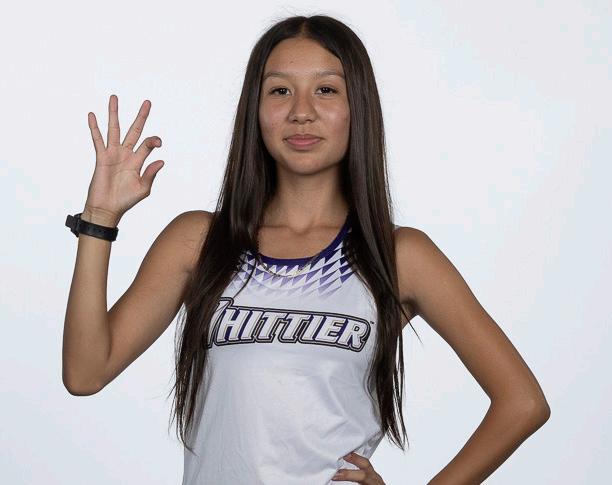
Samantha Avila has dominated Whittier College’s Cross Country program only two months into her season. She is already making a name for herself through her numerous recognitions as a firstyear. Avila established herself as a top finisher at the Mark Covert Classic on Aug. 30, recording the sixth fastest 6k time in program history. She placed in the top 10 at the Oxnard Invitational on Sept. 5, completing the 5k in just over 19 minutes, becoming the first student-athlete since 2017 to be a top-10 finisher in any race. Most impressively, she has become the College’s sixth fastest runner in program history!
Avila has acclimated well to the life of a collegiate athlete thanks to her past experience. During her time in high school, Avila became the fifth fastest runner in her city of East L.A. As a new member of the team, Avila did not expect to make such a breakthrough but has always maintained a strong approach to her sport.
“My goals are always to over achieve, not only for myself but for my place on the team,” Avila says. “I’ve kept the mindset that we’re gonna be a strong team and do good.”
Avila’s typical training schedule includes practice in the
mornings with the team on all ranges and environments to better prepare themselves for upcoming races. When practicing on her own, she puts an emphasis on her stretching and exercises so her body is prepared for any workout.
Avila admits that receiving the recognition from the athletics program fuels her competitive flame.
“It makes me want to keep pushing and striving knowing that I can achieve the impossible or achieve what seems so distant,”
Avila says. “[I’m] pushing for little advancements in each race.”
Avila keeps a calm mentality throughout her races, trying to refrain from the anxiety that comes with racing competitively. While the middle of the race tends to be the most daunting for Avila, she remains strong by pushing herself to not give up. She reasons that everyone else on the track is also tired—a no excuse mentality.
“I block out all noise and strategize what I am going to do,” says Avila. “There is a purpose to everything and that I have come this far for a reason.”
Avila’s future athletic goals are to take care of her body, become physically stronger, and develop her mental fortitude. The past five years of running has shown her the possibilities are endless if you push yourself to new limits. The perseverance and consistency she
carries with her each race is what has allowed her to make a name for herself so early on. Remaining passionate about a physically demanding sport has propelled Avila to continue cross country.
“All my life lessons that I have learned [are] through running,” Avila says. “Staying consistent, having discipline, or having patience or anything like that[…] it’s been learned through running.”
Avila gives a lot of credit to her family’s support and her team’s uplifting spirit to gain more accomplishments. As a first generation college student, Avila’s family is proud of all her achievements and are supportive of all that she wants to do. Seeing her attend college has been exciting for them, and seeing her receive all of these accolades feels even more remarkable. Cross Country and Track and Field Coach, Kathy Graham, values the importance of a strong team. She continues to grow the team on a strong mentality, seeing the potential in every young student athlete.
“We’re looking to build a culture of success because that culture of success plays out everywhere in life: in relationships and raising families, and scholastics, in their, and of course, we have in the application of athletics,” Graham says.
Graham has been building the program for the past two
seasons, emphasizing that being a well-rounded athlete takes lots of effort, which is not a strength this team lacks. She looks for specific characteristics when recruiting for her team, and she recognizes those important qualities in Avila. Graham looks at character and how well the athletes will adjust to life here at the College. Mentoring all incoming students is not a role Coach Graham takes lightly. She builds relationships with the students to show them how they can make an impact here which will follow them the rest of their lives.
“[I’m] not looking for one
standout person, but for [their] success to play out everywhere.” Graham says. “That’s what we do here—is teach young people to figure out how to be an athlete but really how to be a student, how to be a teammate.”
Coach Graham is excited to see all of the accomplishments and goals Avila will reach in the future. There is no question that this team continues to build its program with runners striving for excellence no matter the challenge. Avila and the rest of the team will meet their next challenge on Oct. 4 at the Pomona Pitzer Invite starting at 9 a.m.
Monze Meraz-Lerma SPORTS EDITOR
Whittier College’s Volleyball team has had two thrilling backto-back weekends early into their season. The Poets had an exciting cross-country trip playing four games in Washington, D.C. on Sept. 19 and 20 at the Annual Worthington Classic. Their team chemistry developed in this tournament, preparing them for an impressive homecoming of their first official games of SCIAC this past weekend. The team finished their D.C. trip with a resilient 2-2 record after playing some of the toughest schools in the nation. After some east coast volleyball and sightseeing, they’ve proved that they’re more than prepared for the difficult conference matches that lay ahead.
The Poets came out of the east coast tournament with several commendations. Alyssa Gonzalez, a second-year libero, received her first SCIAC recognition as Defensive Athlete of the Week. In their two winning games, Gonzalez managed over 20 digs, boasting her strength and readiness against her opponents’ kills. She prides herself on her steady mentality during high pressure situations like these, but this comes after persistent dedication and hard work.
“Having a morning lift and then a practice in the evening and school all day definitely wears you down a little bit, especially as the days go,” Gonzalez says. “When it
gets super hard, that’s when I need to push the hardest.”
First-year outside hitter, Lola Padilla, also made a name for herself in D.C. Her impressive stats included an accumulated 29 kills with a 0.300 hitting percentage, earning her an All-Tournament recognition. Padilla appreciated the opportunity to play such prominent schools, one of which being No. 18 Hope College. This daunting school made it to the NCAA final eight just two seasons ago, which presented as an exciting challenge for Padilla.
“Having people around me
that are playing at such a high level makes me want to rise to their level or even above,” says Padilla.
The team’s captain, fourth-year outside hitter Sofia Zazueta, sees this trip as an insightful learning experience to prepare the team for their challenging conference season. She also presented stunning stats, including 30 kills across the four games. When playing against top-ranked schools like Hope College, Zazueta recognizes that her team must trust and maintain their established systems while adapting to different types of teams and styles. They have proven that
they can keep up to these big name schools.
“I don’t even think the losses were bad losses for us,” Zazueta says. “We came out of it learning more about each other and learning more about what we need to clean up going into conference.”
The Poets had the pleasure of exploring museums, botanical gardens, and the Capitol. Most importantly, their perseverance and newfound playing experiences upped their confidence as they returned home to be faced with the toughest match of their season.
On Sept. 26, the team hosted their
SCIAC opener against No.1 La Verne, which they knew wouldn’t be an easy feat. Despite their formidable opponent’s ranking, the players looked towards this game with aspiration.
”We’re the team that’s expected to lose,” Padilla says. “But at the end of the day, they’re still a beatable team if you really have the right mindset.”
Padilla and the team certainly carried the right mentality in what turned out to be their first five-set game of the year. The Poets and Leopards switched off winning sets until their final set, where La Verne took the win. The teams had no more than five points apart in each set, which kept the fans in the Graham Athletic Center at the edge of their seats all game. Despite this loss, the Poets maintained a high performance as Zazueta contributed nine kills and 16 digs, Padilla earned 9 kills, and Gonzalez controlled 21 digs and 6 assists.
While the players attribute their D.C trip for their extra confidence and preparedness, the team has been on the uphill since the season started. On Sept. 2, the AVCA (American Volleyball Coaches Association) announced that the College received 13 votes towards a top 25 Division III national ranking. With this national ranking at arm’s length, the Poets continue headstrong into conference. They stand at an 8-4 overall record with their next home game being on Oct. 7 against Pomona-Pitzer.
Angelica Hennessey OPINIONS EDITOR
Want to know what our Opinions Editor recommends this week? Read on!
Anime:
If you ask me, The Summer Hikaru Died has undoubtedly been the best anime released this year. It’s a psychological horror masterpiece, detailing the inherent terror of being a closeted teenager while growing up in a small, homophobic town. The visuals are stunning and the story is phenomenal!

Book:
You may know Jonathan Sims from his work on the popular horror podcast The Magnus Archives, but he has since released two truly excellent horror novels: Thirteen Storeys and Family Business. If you love queer, anti-capitalist horror that doesn’t rely on shock value while still managing to be terrifying, check out his work!

Courtesy of Gollancz
Music:
I adore the band The Crane Wives, their music leaving me incredibly impressed and emotional every time. Their talent is astounding and seeing them in concert was probably one of the best days of my life! I wish I could listen to them forever!

Courtesy of Bandcamp
Comic:
Matt Fraction’s new Batman series has just started being released and has already got me obsessed. It feels super refreshing compared to other DC comics being released right now and as a major Batman comics fan, I’ve been really happy with the characterizations and story so far. I have very high hopes for this series!

Emma Cianciola FEATURES EDITOR
The Whittier Film Festival debuted this year with a lively display of student creativity, community energy, and cinematic celebration. The event brought together filmmakers, volunteers, and attendees for an evening that combined the glamour of Hollywood with the intimacy of a student-led showcase. The gala was held at Whittier College's very own Ruth B. Shannon Center and the festival itself was held at Starlight Cinemas. The venue was buzzing with excitement as guests arrived in elegant fashion, the Shannon Center's air filled with conversation, anticipation and film appreciation. Between the screenings, raffles, and guest appearances, the night felt very high profile yet deeply personal, perfectly reflecting the growing strengths and community of the film department at the College.
For fourth-year Film major Meredith Lee, the evening was especially surreal. Her film, Things of Beauty, inspired by 1920s and 1930s silent fantasy cinema, was featured in the event. “It feels really weird, especially since I made this film back in my sophomore year,” Lee said. “It’s very whimsical, based on fairy tales and early fantasy films. I didn’t think it would follow me around this much, but I’m happy it’s had this sort of life beyond what I imagined.”
Lee’s project, filled with whimsy
and magic, captured the spirit of a bygone era while showcasing her unique and creative voice. She admitted that the process was not without challenges, citing scheduling conflicts, unexpected weather delays, and even having to replace an actor. Still, the experience proved worth it. “I’m just excited for people to see it,” she concluded.
Behind the scenes, Blake Hunter, a third-year Film major, played a key role in organizing the festival. For Hunter, the event symbolized not just a celebration of student work, but also the growth of the film department itself. “This event feels like a big token of what’s being built here in the film department,” Hunter said. “It’s fancy, almost high profile. Seeing so many people invested in film here is meaningful, and I’m really glad to help actualize this event.”
Hunter emphasized the importance of community in making the festival a success, noting how pleased they are with seeing students, faculty, and film enthusiasts gather together to support the work of emerging filmmakers at their own college. The attendees shared that same enthusiasm. Ty Carlson, a fourthyear double major in Integrated Math and Physics, was struck by the large amount of attention the event had caught from the Whittier community. “There’s so many people it’s incredible,” Carlson said. “I’m grateful to be here. Professor McCarthy did a great job.”
Raffles and prizes added another layer of excitement to the evening. Attendees had the chance to win memorabilia, such as a San Diego Chargers signed frame, Dodgers autographed framed photos, Disney backpacks and apparel, and a range of signed posters from film classics like Titanic, Pulp Fiction, The Lord of the Rings, and Edward Scissorhands
The festival also featured insights from special guests such as Robert Carradine, who reflected on his long and successful career in film. With humility and humor, he joked about his first role in Tabasco Road at age 16, calling it “embarrassing,” but used the anecdote to highlight the unpredictable paths of creative careers. His reflections gave students a glimpse into both the struggles and successes of an actor's life.
By the end of the night, it was
very clear that the festival had reached more than just its goal of showcasing amazing student films. It had created a space where students could see their hard work recognized, faculty could celebrate the department’s growth, and audiences could relish in the excitement of storytelling brought to life on screen while also admiring the venue brought to them by Whittier College.
McCarthy boasts, “Our students have a lot to be proud of, and so does Whittier College for nurturing and supporting our student filmmakers as creative artists.” She goes on to say the students who both worked the festivals and participated made the festival and the gala and overall success.
With its mix of artistry, prizes, and community, this year’s film festival proved that the campus Film Department is not only thriving, but also provides a great opportunity to show off Whittier College’s students and administration to the public!
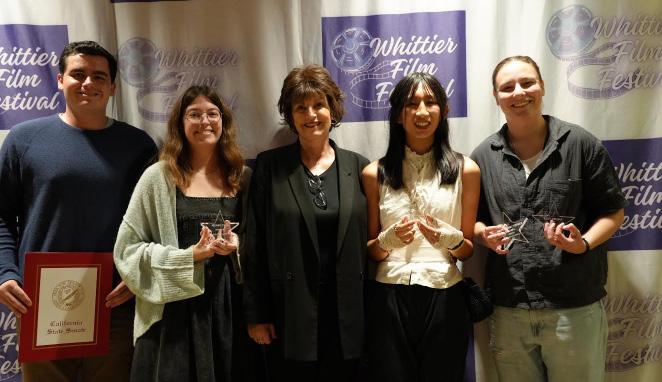
Angelica Hennessey OPINIONS EDITOR
“Why do so many celebrities end up being horrible people?” is a question that most of us have likely pondered at least once or twice. The answer to this is simple: fame is power, and many of those with power tend to enjoy exerting it over others for their own benefit. Celebrities get away with causing harm because, to an extent, their fame, and all it entails, protects them.
Fame typically means wealth and influence, which makes it exponentially easier for them to escape the consequences of their actions.
Countless celebrities have been accused or convicted of sexual assault and other abusive behavior: P. Diddy, R. Kelly, Marilyn Manson, Bill Cosby, Kevin Spacey, Melanie Martinez, Chris Brown, just to name a few. The music and film industries also do very little to punish them, still employing and awarding celebrities who have accusations or have even been found guilty.
Fame, and the fanbase that tends to come with it, also means that even if someone has done something truly awful, there will always be at least one person willing to die on the hill of their innocence.
Whenever another celebrity is revealed to be a predator or abuser, the internet seems to have three primary reactions: acceptance, denial,
or defense. Some immediately stop supporting the celebrity in question, accepting the possibility that they may be guilty.
Then, there are those who will insist the celebrity is innocent, even if evidence suggests otherwise. And lastly, those who will justify and make excuses for that celebrity’s abusive behavior. Why do so many people jump to the defense of celebrities who have been accused or even confirmed to have committed heinous acts? Why do they refuse to even entertain the notion that a celebrity they admire may not actually be a good person?
In the modern day, parasocial relationships with celebrities have practically become the norm. Celebrities are strangers to us; all we know about them is the facade they put on for the camera. But we admire their art, we watch their interviews, and we look at their social media posts. We find them entertaining, we find them relatable. We will never actually know these people, but we like to pretend that we do.
When someone is a fan of a celebrity, they don’t want to believe that the person they looked up to, who they saw themselves in, that they have spent so long supporting, could possibly be capable of abusive behavior. To some, critiques of the celebrity they so heavily admire begin to feel like an attack against them personally.
The reality can be hard to accept,
resulting in some people simply labelling all allegations against that celebrity false. This is one of the many reasons why parasocial relationships can be so dangerous, as it completely dismisses the experiences of victims and causes them to be treated like liars for daring to speak about the trauma they endured.
This makes other victims even more scared to come out about their experiences in the future because it poses the risk of them not being heard.
This is hardly any better than those who take the route of acknowledging and then justifying a celebrity’s abusive behavior. Victim blaming is unfortunately very common, with many trying to find any possible way to push the blame onto the victim rather than the aggressor.
They may claim that the victim was “asking for it,” or they acted in a way deserving of a violent response from the aggressor. These shameful attitudes are especially harmful
when it comes to sexual assault cases, most recently observed in public reactions to the allegations against musician d4vd, whose streams peaked even after being accused of sexually assaulting and murdering a fifteen year old girl.
Having unwavering trust, in any celebrity, is dangerous. Allegations should always be taken seriously, even when your favorite celebrity is the one being accused. They are just as capable of violence as anyone else, and by making excuses for them, you are directly contributing to the silencing and harassment of victims.
Victims of abuse are already mistreated in our society, and our legal system does little to deliver justice for them, especially those who have suffered at the hands of someone famous.
These celebrities may be able to avoid facing any legal consequences, but that does not mean that they are innocent or deserving of fan's defense.

Ethan Airada COPY EDITOR
Twenty years ago, the United States was graced with the satirical documentary about people in the American Workplace; their jobs, their struggles, their drama, and whatever else happens as their overly-involved boss inflicts chaos upon them.
The Office ran for nine seasons and continues to remain popular today. Some time after its conclusion, the same documentary crew returned to Scranton, Pennsylvania to find that the paper company they spent all that time filming was bought out by a company in Toledo, Ohio, where the crew finds a struggling local newspaper.
The Paper premiered exclusively on Peacock on Sept. 4, designed to be a direct spin-off to The Office. Since the latter debuted back in 2005, the show remains the most popular sitcom in the “mockumentary” genre.
There have been talks of reviving The Office since its return to the spotlight around 2018, but not every actor in the original cast was willing to return (Oscar Nuñez is the only actor to come
back). Thus the producers decided to move towards a spin-off instead.
The show is about a local newspaper, the Toledo Truth Teller , which is a shadow of its former self. Its head office operates on the same floor as a toilet paper company, the articles are recycled (or clickbait commercials), and the bosses are obsessed with maintaining their money schemes. In an attempt to return it to its former glory, a man passionate about journalism inserts himself and struggles to make a good issue as problems pop up left and right.
The tone of the show is reminiscent of the first season of The Office : one that is more grounded in reality. In this show the de facto protagonist, Ned (Dohmnall Gleeson), is a regular guy who wants to do good journalism.
Mare (Chelsea Frei) just wants to be an upstanding journalist, Managing Editor Esmerelda (played by Sabrina Impacciatore) is self-absorbed and does everything for her benefit. Oscar is reluctant to get involved, and all these characters are juggling their personal lives with their work, operating the same way The Office did at its advent.
Most of the comedy is similar
to The Office , as a lot of it is either about crazy people in a sane world or vice versa, extremely awkward situations, or cringe comedy, all of which the original series specialized in.
Just as a disclaimer, sometimes Esmerelda’s schemes and the actions and conversations the characters partake in can make you physically recoil—the scene with Esmerelda trying to be a part of a commercial is designed to be so awful, you can’t help but laugh at it. The Paper thrives on this comedy.
This is good for die-hard fans of The Office since it feels like the magic of the series simply went somewhere else and was rediscovered. The focus on a new cast prevents new fans from being alienated. There are some easter eggs for returning fans too, such as Oscar mentioning “an idiot boss” he once knew, presumably Michael Scott, played by Steve Carell.
The Paper is already a good show. There isn’t much wrong with it, but one of its primary flaws is that the series premiere only has ten episodes. There is a problem with shows on streaming sites having very few episodes in
general, but it’s hard to say if this tradition will continue, as The Office had only six episodes in its first season.
The other aspect is that this version of comedy is divisive in and of itself. With a show focused on awkward moments and cringe comedy, a person might experience frequent bouts of second-hand embarrassment, especially if the joke is similar to
an experience they might have had. The fact that these are the only notable flaws is very telling, about the overall quality of the show.
As a spin-off that is fundamentally connected to the source material, The Paper lands on its feet spectacularly as its own creation. You don’t have to know the original series, you don’t need to know the lore, you can simply enjoy it.

Madyson Escobedo STAFF WRITER
Fans, listeners, and consumers have hit a new barrier when it comes to purchasing tickets to see their favorite artists. As of late, fans have been missing out because of ticket scalpers reselling them for a higher value.
It was revealed that Live Nation and Ticketmaster contributed to this unfair process by knowingly allowing scalpers to resell the tickets on their own resale platforms, and raised the prices as high as possible.
Lawsuits from the Federal Trade Commission have been issued to both Live Nation and Ticketmaster, but it does not detract from the atrocities they have caused.
Both ticket companies value the opportunity of profit from artists and fans. Naturally, they are willing to find any way to continually make more profit, which often comes in the form of some questionable business practices.
Jon Blistein of the Rolling Stone also noted that the ticket seller and event promoter engaged in three practices: utilizing hidden fees, creating max ticket overrides for brokers, and allowing the reselling of tickets that were bought through the circumvention of scalping prevention measures.
As the issue with scalpers continues to come up for every event, fans have continually felt discouraged from purchasing tickets—or even attending any events—out of anger and a sense of defeat.
Scalpers don't just affect


Live Nation and Ticketmaster
the people. Their cons lead to venues and stadiums holding plenty of open seats, losing money, or even failing to meet the minimum ticket sale goal, disappointing more than the fans but the artists as well. In the face of the lawsuit, it was revealed that using hidden was a common tactic during sales, charging additional expenses when the final total presents itself.
The FTC argues that Live Nation and Ticketmaster have used a “triple dip” method that rakes in money, ticket fees, and relist ticket prices.
Vivian
Ho from The Washington
Post also commented, “Between 2019 and 2024, Ticketmaster earned more than $11 billion from mandatory fees charged to consumers and brokers, according to the lawsuit.”
The violations that both Live Nation and Ticketmaster have carried out were not only a clear evasion of the consumer protection law, but they also served as a business incentive; They profited off of steep, scalper-controlled resale prices, harming artists in a loss of revenue and their relationship with their fans, and the pockets of consumers.
Despite Live Nation and Ticketmaster claiming they utilize
a ticket-limiting system, it was not enough action to convince the public to see a beneficial change made to protect them from the scam of overpriced tickets.
The Department of Justice is also suing Live Nation for the misuse of conduct towards the performance industry. This has caused the entire ticket selling world to reshape itself putting forth an emphasis on valuing the consumer and accountability.
The U.S. Department of Justice also announced, “The lawsuit, which includes a request for structural relief, seeks to restore competition in the live concert industry, provide better choices at lower prices for fans, and open venue doors for working musicians and other performance artists”
The DOJ is charging Live Nation over promotional agreements that prevent any promoters from using a venue owned by the company. This creates monopolization of each venue, which is only profitable for Live Nation, who already rules over 80 percent of the market.
According to the University of Washington, the complaint made by the DOJ is stated to be, “well over 100 pages long, cites all sorts of examples of what the Department believes is anticompetitive conduct.”
Can artists do anything? Singer Ariana Grande has recently seized control of the tickets on sale through Ticketmaster for her most recent tour. Despite fans rushing for their chance to buy a ticket to see their favorite artist, most of the tickets were immediately purchased by
scalpers, with little left for fans.
Once it was revealed that the scalpers could be from Ticketmaster, Grande responded via Instagram, speaking on how disheartening and unfair it was to see this. She promised that her team would fix the issue and ensure the tickets are returned to the fans, guaranteering they will soon be available for purchase.
While fans are glad that Ariana Grande took action against scalpers, it is common for artists to feel like they have no say in the matter of the ticket purchasing world.
Overall, the corporations of Live Nation and Ticketmaster have done so much to damage the entertainment market. They've cheated promoters, artists, and fans by abusing their power to give back to the biggest investors, in hopes of adding even more to the billions already in their pockets.
Prices of tickets and the business of ticket resale as a whole will be reviewed and watched closely in the future as a way to ensure scalpers and any other big corporations do not take further advantage of the public. Artists already feel angry with ticket prices, and this will give them the leverage to decide how their tickets should be priced and sold, on their own terms.
The FTC is taking further action and challenging Live Nation and Ticketmaster, and it will impact not just the event world, but also prove that consumers are still the most important. Without the continued fan support, these events would not be possible.