QUAKER CAMPUS
Sept. 18, 2025
Sept. 18, 2025

Paola Ruiz NEWS EDITOR
Whittier College’s former Associated Student Senate Vice President says the body’s biggest recent win was not a single bill or event; it was a culture change. In an interview recounting his tenure from September 2023 through May 2025, the two-time VP, Evan Josten described an organization that moved from low expectations and uneven participation to clearer standards, near-perfect attendance, and tighter communication both internally with Senate and with externally senior administrators. “We implemented more accountability policies […] keeping people accountable in their positions because they are elected by the student body,” he explained, noting that the Senate clarified absence rules and normalized proactive communication around emergencies and mental health needs.
Josten's path into student government began with a narrow defeat during his first semester. “I lost the presidency by one vote […] 16 to 15,” he recalls. He went on to serve as Secretary and Treasurer of the Freshman Class Council after the elected treasurer dropped out. This became his first taste of campus leadership. He later became involved with the Whittier Student Worker Alliance (WSWA) during campus labor actions and eventually ran for Academic Affairs Representative, winning the position. When a leadership shift elevated the Vice President to President, he stepped into the Vice Presidency and served two terms. The motivation, he said, was rooted in a campus mood that felt “very down” during his first year, when students feared the college might close. “I did not want that to happen,” he explains. “I have developed a lot of emotional attachment to this school […]
knowing the students, knowing faculty.”
The accomplishments of his tenure, he says, were as just as focused on shifting culture as about concrete wins. He credited the executive board, faculty advisor, and full Senate with creating clear internal norms and delivering “100 percent or nearly 100 percent,” meeting attendance across his term. Senators also received a longoverdue pay increase to recognize the workload and offset inflation. He oversaw the cleanup of the Senate Constitution and budget request guidelines to make them more accessible to the student body. Perhaps most significantly, he described strong collaboration with President Kristine Dillon, who served first as interim and then as President, and other senior leaders, who often invited the Senate into decision-making processes before major announcements. “That is the standard,” he comments, “they should communicate, they should listen, they should ask.”
One of the most visible moments of his Vice Presidency came during the controversy over moving the graduation ceremony from the stadium back to the amphitheater. Many students felt blindsided, and some feared the decision mirrored earlier program cuts. The Senate invited President Dillon and Vice President for Academic Affairs Sal Johnston to a public meeting to hear concerns, including a petition calling for a return to the stadium. Administrators also hosted open office hours to discuss the issue. “We will take some of the credit for helping cultivate that conversation and making students feel comfortable enough to come to us,” he reflects. Although he admits feeling blindsided himself, he later attended the ceremony and said he found the amphitheater “a nice spot [and] cozy,” and appreciated that
administrators had communicated more openly once they realized the concern.
Chairing Senate meetings also brought challenges. One contentious moment came when Senators debated whether one student could represent two positions, one voting and one nonvoting. Ensuring respectful debate while upholding Quaker values required careful mediation. More broadly, he described the constant tension between what the Senate wanted to accomplish and what its bylaws allowed. “A lot of times, unfortunately, what is best for the student body is not allowed by the Senate,” he replies, adding that his role required finding alternate routes to achieve student goals while staying within procedural bounds.
The decision to step down at the end of Spring 2025 was not sudden. “I love Senate […] but I was beginning to understand my own capabilities,” he states. After two years, he felt his voice had been “heard plenty” and wanted to make room for new leadership. He also admitted to feeling burned out. “Senate is a lot of work, a lot of meetings, a lot of late nights,” he says, adding that campus issues often “seep into” his personal life. Balancing that load with academics, graduate school applications, and personal time became increasingly difficult. Leaving, however, was not easy. “I really enjoy being Vice President. I have good ideas and I like being able to get my good ideas out there,” he adds. “I am someone who usually does not like change.”
Ultimately, he concludes the choice was the right one, saying he now feels excited to see what the next generation of Senate leaders will accomplish.
Beyond the Senate, he juggled leadership and academic roles as lead Student Ambassador in the Admissions office, a writing tutor at
the Writing Center, a Mellon Mays Fellow, and an active participant in Model United Nations. Last semester, he was inducted into the political science honor society, Pi Sigma Alpha, and elected as its president. As a double major in Political Science and Sociology, Josten said he will continue to be engaged in student life and academics during his senior year, even without the demanding schedule of the Senate.
Reflecting on his two years, he avoided regrets but admits he learned important lessons about inclusion and communication. He says he would have been more proactive in asking for feedback earlier and in thinking carefully about language in policies.
“I do not like to look back and regret,” he reflects, “but I did learn more.” For the current Senate, he offered advice centered on patience and perspective. “Take everything with a grain of salt […] A lot of these issues are bigger than just one person,” he consults, cautioning new leaders not to absorb too much of other students’ frustrations as their own.
Ultimately, he hopes his legacy will led to a Senate that is empowered, effective, and unafraid to speak up. “I hope that students […] feel empowered to make change, to have their voices heard, to be loud, be present, be involved,” he states. “I never took a single day in my office for granted […] I am so appreciative and grateful to have had the opportunity to serve for two academic years as vice president.”
As for this academic year, there are current elections open for Senate positions: Non-Traditional Representative, Freshman Class Council, and Vice President. The voting will take place on Sept. 15 to 19. To vote visit the Senate’s Instagram page at @aswc_senate and see the candidates that are currently in the running.
• The United Nations (U.N) has deemed Israel's action in Gaza as genocide. According to AP News, the report was issued on Tuesday, Sept. 16. This report asks for countries to send aid and help end the genocide.
• The former Brazilian President Bolsonaro has been sentenced to over 27 years in prison. This comes as a result of the coup attempt in 2022 after he lost the Presidential election. According to New York Times, the coup consisted of "disbanding courts, empowering the military and assasinating the presidentelect."
• According to The Wall Street Journal, citizens in Poland are in fear of being involved in the Russian-Ukrainian war. On Sept. 10, Polish citizens found themselves between a crossfire of Russian drones and NATO jet fighters. "The country has already been the target of Russian sabotage operations."
• On Sept. 15, Mexican President Claudia Sheinbaum was the first woman president to peform the grito. According to Los Angeles Times, "the grito, the shout of independence comermorating the country's break from colonial rule." Shienbaum has maintained a high approval rate of 70 percent for her year in presidency.
• On Sept. 16, China stated they have fired water cannons at Philippine ships according to Reuters There was only one person injured, but the incident invloved the destruction of 10 Philippine ships. The ships were accused "of having illegally invaded China's territorial waters of the Scarborough Shoal from different directions."
• According to Reuters, the death rate in Nepal has risen to 72 admist of the anti-corruption protests. Many young citizens of Nepal were protesting throughout the capital and various cities. This led to the resigniation of prime Minister K.P. Sharma Oli. Now, Chief Justice Sushila Karki is interim prime minister and is the first woman to led the country. The current prime minister's office is closed because it was set on fire during the protests.
Paola Ruiz NEWS EDITOR
Whittier College is taking steady steps to manage the surge of COVID-19 cases on campus, but its protocols now intersect with decisions made by Health Secretary Robert F. Kennedy Jr. Between funding cuts to mRNA vaccine projects and new restrictions on who can access COVID-19 boosters, students and staff have to navigate these new public health policies.
The College’s procedures are straightforward. Students who test positive for COVID-19 are asked to contact the Student Health Center, while faculty and staff are asked to contact Human Resources. They receive tailored advice on how long to isolate, monitor symptoms, and when to return to class or work.
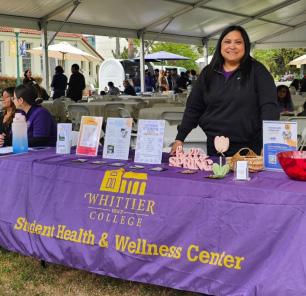
Following Los Angeles County guidelines, anyone may return to campus once they are feverfree for 24 hours without feverreducing medications. Those with worsening symptoms are urged to seek emergency care. Unlike in the early pandemic, testing requirements have eased. Home tests are accepted, although officials at the Student Health Center acknowledge that not every student reports results. For those who do, staff can offer personalized advice. “If they contact us, we can talk to them, like, are you feeling better? We can give them recommendations,” Dr. Tracy Ocampo (Director of Student Health Center and Nurse Practitioner) explains, adding that their role is also “to let them know, because with anything, whether it is COVID, the flu, if they have a strep infection, if you are having fevers, you should be staying home.”
The Student Health Center emphasizes accessibility. “We are here, we are here for you, the visits are free, just call,” Ocampo stressed. Virtual visits are available through the “UWill” platform, which provides 24/7 physician access. “Obviously we do not want them coming in here with other students that are not having COVID,” Ocampo explains, so virtual care allows sick students to get advice and, if necessary,
prescriptions without risking further spread. On campus, the center offers free over-the-counter medications in small packets, as well as full “care packages” for students who fall ill. “We even have a care package for students that are not feeling well,” Ocampo says. Two wellness vending machines that are located inside the 24-hour lounge and in Turner Hall carry items like Tylenol, allergy medicine, pregnancy tests, and sometimes COVID-19 kits. “So if we are closed, [students] can always check down there and see what is available,” Ocampo adds.
The College does not stock COVID-19 vaccines itself, but helps ensure students can access them.
“Our priority is the health and wellbeing of everybody on campus,” Ocampo explains, noting that new students are contacted as early as May or June to meet immunization requirements. “We send them a letter so they are aware of health care requirements […] we provide them a phone call, just reach out to them as much as possible, let them know to give them plenty of time to get records from their doctor.” For students missing vaccines, the center has multiple options. “We do have all of the required vaccines here so they can come and get it here or they can go to [a local pharmacy]. If they have the student health plan that Whittier [College] offers, then their vaccines are 100% covered.” Flu shots are a regular offering, though staff said they are “waiting for the new shipment for this year.” In the meantime, health officials encourage students to get coverage elsewhere if needed.
Whittier’s steady approach contrasts sharply with the turmoil in Washington D.C. In August, RFK Jr. announced the cancellation of $500 million in federal funding for mRNA vaccine projects, affecting 22 initiatives with companies like Pfizer and Moderna. He claimed mRNA vaccines “pose more risks than benefits for these respiratory viruses.” Doctors and health experts reject this. “mRNA vaccines were remarkably safe” and essential in reducing severe illness,” says Dr. Paul Offit of the Children’s Hospital of
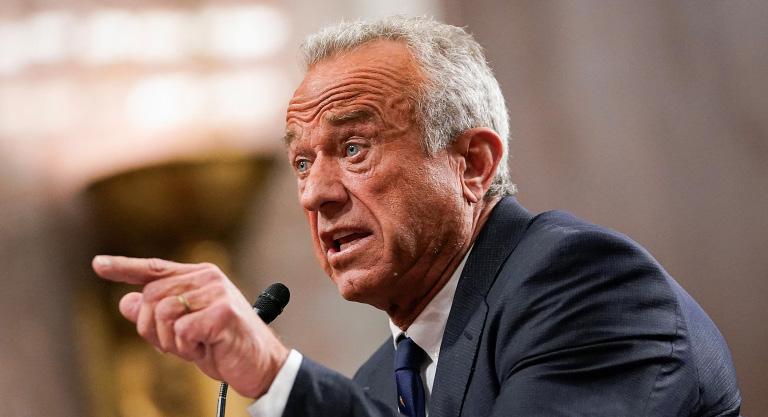
Philadelphia. Peter Lurie, a former FDA official, told the BBC that the U.S. was “turning its back on one of the most promising tools to fight the next pandemic.”
At the same time, vaccine access is narrowing. The FDA recently restricted COVID booster eligibility to those 65 and older or individuals with health conditions.
Kennedy defended the move by claiming “everybody can get” the vaccine, but PolitiFact rated that statement "Mostly False." In reality, younger healthy people may now need a doctor’s prescription, face out-of-pocket costs of around $142, or find that pharmacies in certain states cannot administer the vaccine until the CDC updates its immunization schedule. Senator Elizabeth Warren pressed Kennedy on the contradiction, pointing out that “if you do not recommend, then […] you can not walk into a pharmacy and get one. It means insurance companies do not have to cover the $200 or so cost.”
For Whittier students living and learning in close quarters, national policy shifts could ripple directly onto campus. Students who want vaccines may find them harder to access or more expensive than before.
As Ocampo points out, insurance coverage often depends on CDC recommendations: “If they are not protected, then we will recommend
EDITOR-IN-CHIEF Paige Meyer-Draffen
DePUTy eDiTOr eMMa galvan
Managing eDiTOr
PenelOPe TUrgen
neWS eDiTOr PaOla rUiz
OPiniOnS eDiTOr
angelica HenneSSy
SPOrTS eDiTOrS
aTTicUS cHaiDez
MOnze Meraz-lerMa
caMPUS life
eDiTOr
naDia Miller
FEATURES EDITOR eMMa cianciOla
a&e eDiTOr eliaS lOya
HeaD cOPy eDiTOrS clOver MOraleS
SOcial MeDia MOnze Meraz-lerMa
STaff WriTerS allara Baker
eTHan raMillanO
MaDySOn eScOBeDO OSWen MarTinez
Mickey rHODUS JayDen garreT
cOPy eDiTOr eTHan ariaDa
graPHic
DeSignerS naDia Miller
carTOOniST neMi
facUlTy aDviSOr JOSePH DOnnelly
getting [vaccinated] […] but sometimes they just choose to pay cash because of insurance deductibles.”
Despite these challenges, the health center continues its outreach.
“We had a tabling event. We are going to have weekly tabling […] promoting our events and wellness stuff,” Ocampo emphasizes. “Some students, because we asked them where we were located, they did not know. So we are trying to educate more and more students.”
Thanks to Whittier’s proactive communication and practical
support, it may help buffer the uncertainty caused by national vaccine cutbacks. But as experts warn of diminished readiness for future pandemics, the college’s health center can only do so much if federal policy makes vaccines less available to those who want them.
To find the Student Health Center, "look for a house," teases Ocampo. It is located near Ball Hall, the Counseling Center, and Campus Security. Ocampo suggests to follow the Student Health Center on Instagram @wc.healthcenter
Submissions may be emailed to qc@poets.whitttier.edu in .doc or .docx format. Submissions must include the author’s name and year of graduation or position at the college in the signature. Letters are due by Monday at 5 p.m. to make it into that week’s issue. Submissions should be no more than 500 words. Submissions will undergo the same editing process from our production pipeline if selected. All stories must follow the same journalistic standards.
Due to the high cost of publication, members of the Whittier College community are permitted three copies per issue. Additional copies may be purchased with prior apporval for 50 cents each by contacting the Quaker Campus. Newspaper theft is a crime, and those who violate the three copy rule may be subject to civil and criminal prosecution.
The Quaker Campus does not change material posted on online articles once they have been published in the paper — with the exception of an error being found. Only then will a correction be made to the online version. The Quaker Campus is a publication of Whittier College. Columns and Signed editorials do not necessarily reflect the opinions of Whittier College or its affiliates.

Over the past nine months of President Donald Trump’s second term, his poll numbers have declined due to a series of controversial policies and decisions. The people have eroded enthusiasm for Trump’s agenda since his inauguration, which is currently sitting at a rating of 42 percent in a recent Reuters poll. Among these unpopular policies has been the "One Big Beautiful Bill Act." According to Pew Research Center , 55 percent of Americans are not confident in Trump’s ability to make good economic policy, in comparison to 44 percent who are somewhat confident in his decisions.
While opinions on Trump’s performance remain polarized between hyper-critical Democrats and extremist Republicans, a major breakpoint in support from Trump’s base has been the handling of the Jeffrey Epstein case. Having campaigned on the promise of a full release of the Epstein files, he faced universal scrutiny when the Justice Department announced a lack of conclusive evidence on Epstein's case or any client list back in July. He has condemned his “past supporters” for falling for a “hoax” on TruthSocial, and even gone as far as suing longtime ally Rupert Murdoch over the Wall Street Journal’s story linking Trump to a suspicious birthday card for Epstein.
There also is an impending likelihood of losing an alreadyslim Republican majority in the House of Representatives, During the 2026 midterm elections, Trump’s administration turned to Texas, proposing that Governor Greg Abbott call for a special redistricting of the state. While initially hesitant, Abbott was ultimately persuaded after a call with the President, according to Texas Tribune, and announced a special session in July to redraw the state’s congressional districts. Redistricting normally occurs every ten years in accordance with the U.S. Census, and is frequently rife with the majority party redrawing lines to maintain
their hold over the state otherwise known as gerrymandering. This is especially apparent in Texas’s proposed district maps, which will pack Democratic voters into the fewest number of districts. While opening five districts in which Republicans have a safe majority to ensure more Republican seats in the House. Democratic state legislators in the Texas State Legislature briefly fled the state in Aug. to temporarily stall Abbott’s quorum to vote on the new map, sparking arrest warrants and threats of forfeiting their seats.
The legislators returned weeks later, allowing Abbott to sign the bill to redraw the districts on Aug. 29th.
This move has sparked immediate action from Democrats across the country, particularly California's Governor, Gavin Newsom. Warning publicly that “two can play at this game” on X with Abbott’s redistricting announcement in July, he immediately began meetings to plan for California’s own redistricting in retaliation. Unlike Texas, California has its own independent Citizens Redistricting Commission, which was approved by state voters in 2008 to prevent unfair gerrymandering of congressional districts.
Although there is a growing redistricting arms race, with Republican-majority states like Florida and Indiana considering redistricting. Newsom has repeatedly framed California’s response as being a temporary sidelining of the commission, to counteract Trump’s current agenda for the 2026 midterms, which he lambasted as an “affront to American democracy” in a letter to the President, according to Politico
Many Californian delegates, predominantly Democratic, agree with Newsom’s position, one of which is Representative Dave Min, who told NewsNation, “When the other side is cheating over and over […] I think Democrats need to stop bringing a butter knife to a gunfight. We need to fight fire with fire and not unilaterally disarm.” Others, like California Assemblyman Alex Lee, wrote on Facebook, “Trying to save democracy by destroying democracy is dangerous and foolish. By legitimizing the race to the bottom of gerrymandering, everyone will ultimately lose.” Republican delegates
have been the most vocal in their opposition, an “unconstitutional power grab” in a joint statement, following the California Supreme Court’s ruling to dismiss an attempt to delay voting on the bill.
Within the California State Assembly and Senate, the bill to pause the independent commission swiftly passed through its Democrat supermajorities, and would be signed by Newsom the same day on Aug. 21 as the “Election Rigging Response Act”, which California voters will vote on as Prop 50 on Nov. 4. If passed, the new congressional districts will be temporarily set, ensuring five districts in which Democrats are likely to win seats in the House. By 2031, the Citizens Redistricting Commission would then resume redistricting the state following the 2030 US Census. Uniquely, the ballot language for Prop 50 frames itself in relation to the redistricting struggle. Displayed as authorizing “temporary changes to congressional district maps in response to Texas’ partisan redistricting”, Chris Figueredo of the left-leaning Ballot Initiative Strategy Center described to NPR that this explicit wording is crucial in allowing voters to best understand the context and impact of what they’re voting for. However, there’s a risk of alienating California voters unaware of the redistricting battle across the country, to which Figuerdo would encourage voter education that is done by “community-led, community-driven organizations […] [to] explain what’s happening in states like Texas.”
Through California’s pending redistricting ballot, Newsom has increasingly presented himself as the national face of Democratic resistance against President Trump, which many view as part of bolstering a likely run for the presidency in 2028. This is most apparent in a sudden shift in Newsom’s social media posts, mimicking the style of sensationalism and crass messaging used by Trump since his first 2016 campaign. With the format of all-caps rants, crude nicknames (like J.D. “Just Dance” Vance or America’s Favorite Governor G.C.N.), and A.I.-generated images,
Trump supporters have been quick to call him "unoriginal" and "weird".
But this has boosted Newsom's popularity and recognition among Democrats. Democratic strategist Alex Hoffman described it best in The Washington Post: “Democrats are so desperate for leadership right now that they’ll take anything they can get. Gavin is filling a void.”
Ultimately, the redistricting efforts in Texas and California highlight escalating partisan tensions over how congressional maps are drawn and who controls them. Supporters argue these measures are necessary to defend representation and counter GOP efforts. According to AP News , former President Barack Obama called Gavin Newsom’s proposal a “responsible approach […] designed to address a
very particular problem in a very particular moment in time.” On the other side, critics warn that redrawing maps mid‐decade and overriding independent commissions risks undermining democratic norms. According to CalMatters, Assemblyman Carl DeMaio of California stated, “Gerrymandering is wrong no matter who’s doing it, whether it’s done by a red state or a blue state. Politicians manipulate the lines of their districts, it’s wrong.”
As both states prepare for voter approval and legal challenges ahead of the 2026 midterms, the outcomes may not only decide control of the U.S. House of Representatives but also test how far the public will accept partisan mapmaking as part of American political strategy.
Stay up to date on events! For further info, visit https://whittier. campuslabs.com/Engage/
Poet Pantry
• Thursday, Sept. 18 at 12:30 p.m.
• Campus Center Room 141
Purry Furry Thursdays
• Thursday, Sept. 18 at 3:00 p.m.
• Dezember House
Knitting/Crochet Night
• Thursday, Sept. 18 at 4:30 p.m.
• Hoover 108
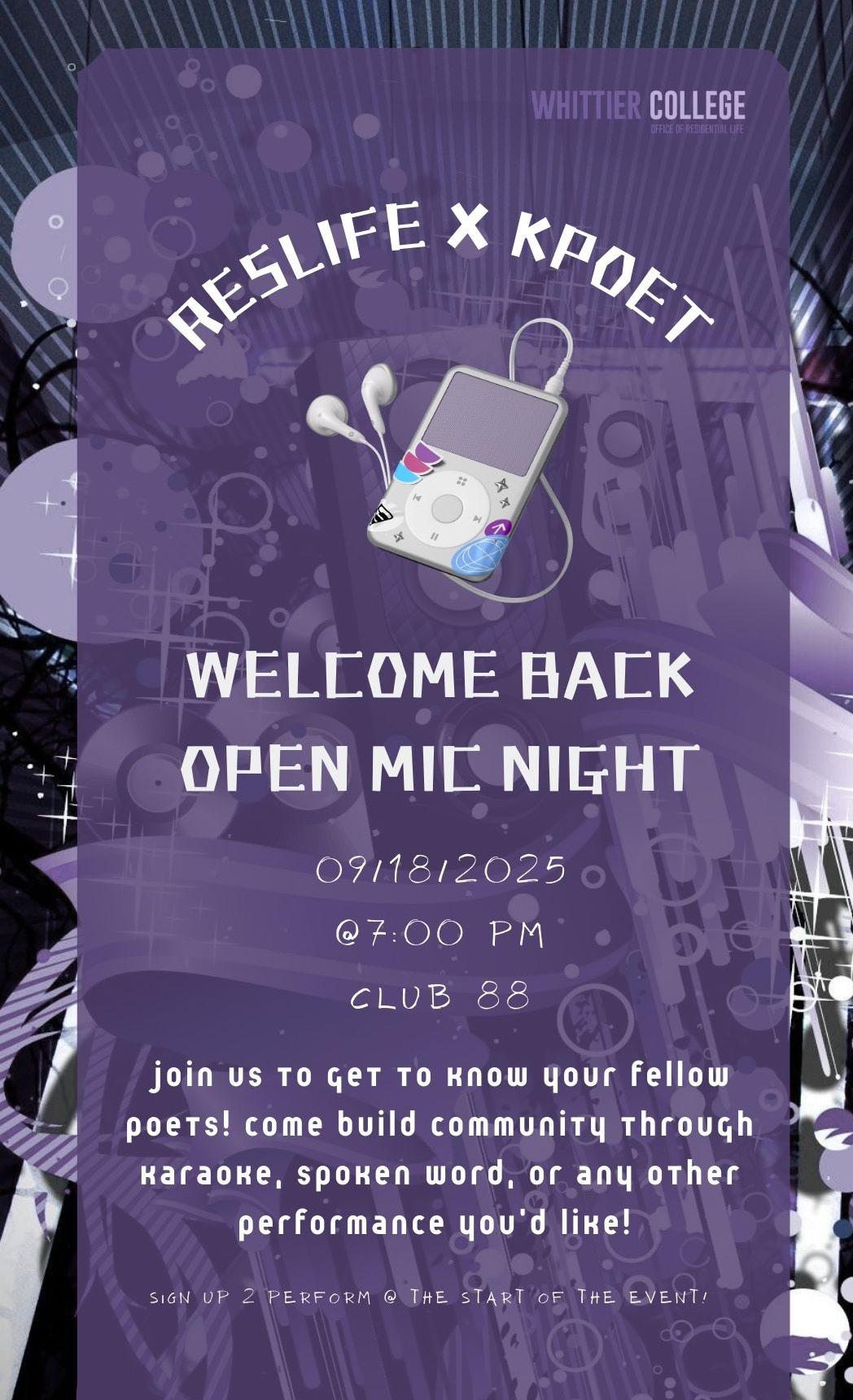
Reslife x KPOET Welcome Back Open Mic Night
• Thursday, Sept. 18 at 7:00 p.m.
• Club 88
De-Stress Journaling
• Friday, Sept. 19 at 3:30 p.m.
• Campus Center Courtyard
Pre-Rosh Hashana Shabbat Dinner
• Friday, Sept. 19 at 6:00 p.m.
• Dezember House
Whittier Film Festival Gala & Film Festival Kick-Off Event!
• Friday, Sept. 19 at 6:00 p.m.
• Ruth B Shannon Center for the Performing Arts
WHITTIER FILM FESTIVAL
• Saturday, Sept. 20 at 12:00 p.m.
• Starlight Whittier Village Cinemas
Bug Club Meeting!
• Monday, Sept. 22 at 12:30 p.m.
• Campus Center Courtyard
ASWC Senate Meeting
• Monday, Sept. 22 at 7:00 p.m.
• Villalobos Hall
Sustainability Club Bi-Weekly Meetings
• Tuesday, Sept. 23 at 12:30 p.m.
• Founder's Hill
Palmer Society Rock Lunch
• Tuesday, Sept. 23 at 12:30 p.m.
• The Rock
Howl's Moving Castle Movie Night
• Tuesday, Sept. 23 at 5:00 p.m.
• Deihl 004
Outdoor Flu Vaccine Clinic
• Wednesday, Sept. 24 at 9:30 a.m.
• Deihl Hall at Naylor Patio
Fantastic Mr. Fox Movie Night
• Wednesday, Sept. 24 at 6:00 p.m.
• Hoover 100
ASWC Senate Night Market Mixer
• Thursday, Sept. 25 at 5:00 p.m.
• Upper Quad
Oswen Martinez STAFF WRITER
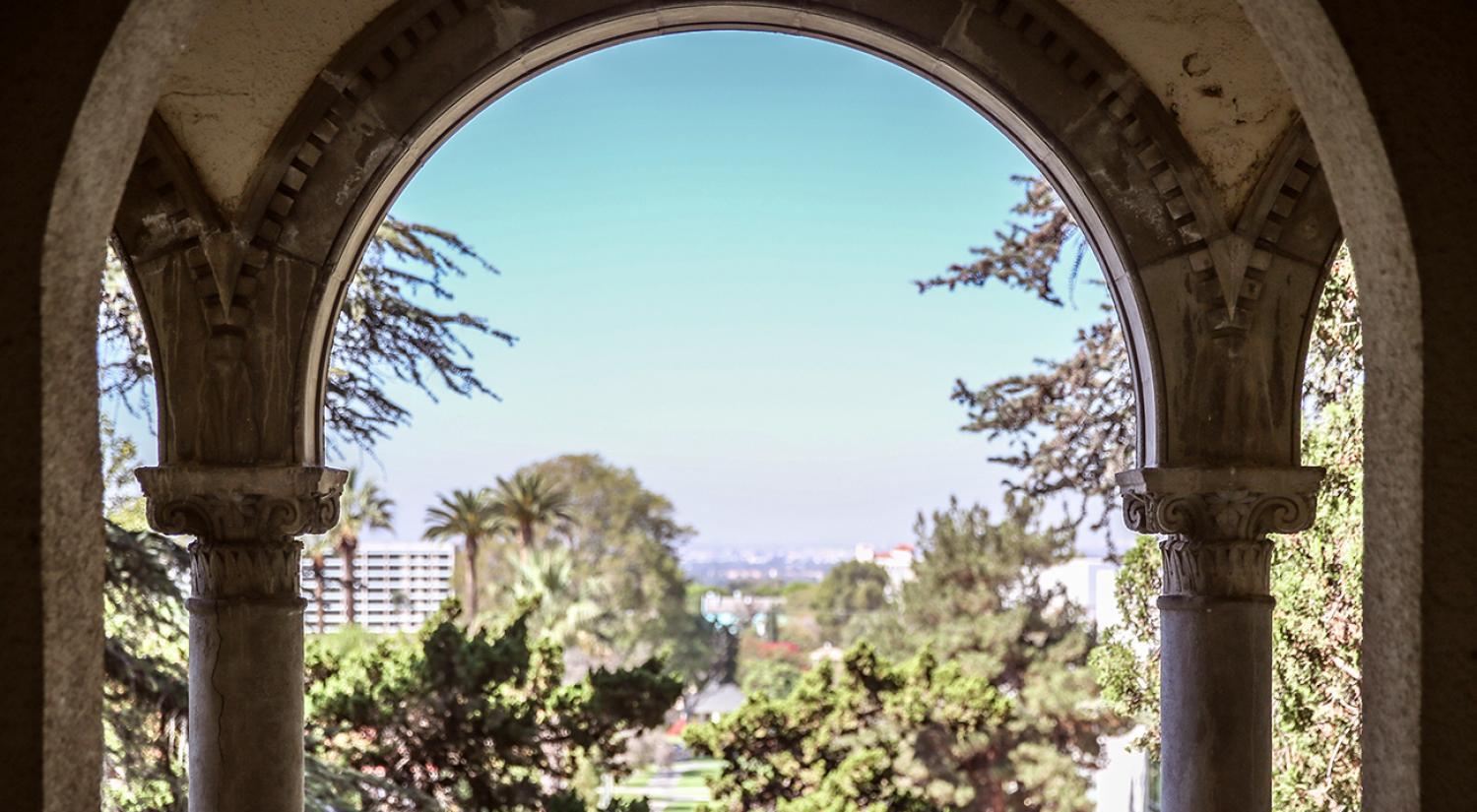
Hidden away between Upper and Lower Campus stands Wardman Hall, a 1924 building once designed as a dormitory. Today, it no longer rooms residential students, but instead serves as a home for ideas of the Whittier Scholars Program (WSP), one of Whittier College’s most unique academic opportunities.
Often reduced to its simple slogan, “Design Your Own Major,” WSP is much more than that. It’s a program that allows students to step outside the boundaries of traditional majors, weaving together disciplines and crafting an education that reflects their unique passions and career goals. Walking up the formidable steps and through the heavy metal doors of Wardman, visitors are greeted not by residents, but by the WSP council of faculty and student advisors, eager to help lost or curious students find their way.
The program reflected this personal approach at their most recent open house on Wednesday Sept. 10. From the start at 3 p.m. until nearly the end of the open house at 4:30 p.m., the room was quiet and practically empty but that ended up working in the program’s favor. Rather than a crowded, generic presentation, the event created space for real conversations. For students like first-year student Connor Udhus, who walked in unsure of whether their goals fit within traditional academics, the one on one setting allowed for a back and forth dialogue that felt more like advising
than recruiting. That intimacy mirrors the essence of WSP, each student’s path is individualized and so is the attention they receive. At this same open house, Udhus stepped into Wardman with one big question: Could his dream of tour management become a major?
With prior experience traveling with bands, he wanted to know if WSP could help turn that passion into a degree.
After a conversation with Associate Director of WSP Scott Creley and Associate Dean of Interdisciplinary Programs dAvid pAddy, Udhus learned that not only was it possible, but his future band tours could even count as internships for class credit. The key, they explained, is to build a program that’s both unique and academically rigorous. For example, while students can pursue interests like interior decorating,
they can’t simply copy a named degree from another university; they must craft something distinct.
pAddy described the program this way: “It’s a self-design program. Students either choose an existing major like psychology or business, or if what they want doesn’t quite fit, Whittier Scholars becomes that opportunity. They can piece together different majors or really craft a whole new thing.”
He also stressed that WSP is not an honors program. Despite the name, it’s open to anyone. “For some students, it won’t make sense,” he admits. “But for others, students who keep connecting art with science, psychology with music or who can’t stop thinking across disciplines, we help them articulate and build that path.”
WSP traces its roots to a wave of developmental programs that began in the 1970s, when colleges across
the country started experimenting with interdisciplinary education. The idea was simple but radical. Don’t confine students to a single discipline, let them find ways to weave fields together. While many of those programs have faded, WSP remains, continuing that legacy at the College.
Wardman Hall may no longer be a dorm, but it’s become something equally as important: a space for students who think differently. Whether it’s blending interior design with cultural studies, merging psychology with music, or creating a pathway in tour management, WSP gives students the chance to shape an education as unique as they are. As pAddy emphasizs, the program isn’t for everyone, but for the students who find their way to Wardman, it offers the rare chance to turn curiosity into a degree.
Angelica Hennessy OPINIONS EDITOR
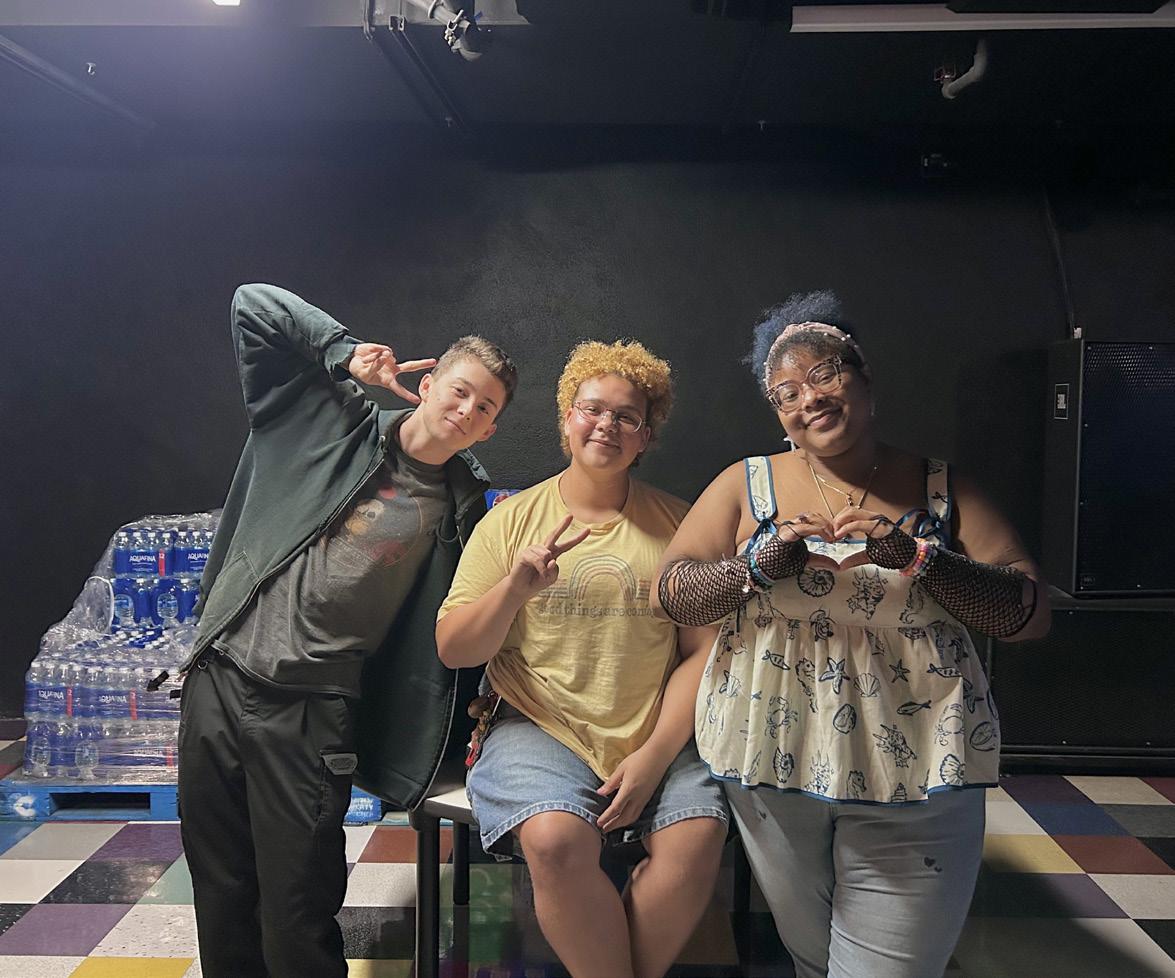
Last week at 6 p.m. on Sept. 11, the Black Student Association (BSA) hosted Voices Unveiled: Black Poetry Night in Club 88. The event was advertised as a place for students to come share their truth and celebrate the beauty of Black expression through words, a goal which was certainly achieved.
Students of many backgrounds were in attendance, many coming to show their allyship with the BSA and also enjoy a night of poetry. The event was small and personal, but the crowd was full of energy. Everyone was incredibly supportive of their peers, who shared poems and appreciated each other's creativity and hard work.
The first hour of the event was dedicated to celebrating the students’ original works and sharing love for poetry as an art form. A multitude of different students read their own original poetry to the crowd, while other students did readings of pieces of poetry which they felt had spoken to them.
BSA’s Diversity Council representative and second-year Darreionna Roche shared some of her own poetry at the event.
When asked about her writing, Roche discussed how she believes poetry is an incredibly important outlet as it gives so many people a judgment-free space to share their emotions and pain, especially their mental health struggles, with others. The process of sharing one’s poetry allows writers to know that they are not alone and that a large number of people are struggling with similar things.
President of Transgender, Other-Identified, Bisexual, Gay,
Lesbian, and Allies for Diversity (TOBGLAD) and thirdyear Tyler Johnson, also read a few powerful pieces of his own poetry. Johnson stated that the main message he wanted his poetry to get across was, “Even though things seem hopeless, we as individuals are not helpless,” a message that is especially relevant in our current political climate, where a notable percentage of young people feel as if things may never get better.
In times like these it is so
important for young people to be aware that we can create change in our own lives and on a larger scale. Johnson’s poetry represents a positive and hopeful perspective that the cycle of misery and hopelessness a lot of us feel it will not last forever.
Co-President of the Asian Student Association (ASA) and fourth-year, Laurens Chao, also shared some of his poetry at the event. Chao spoke about how much of his poetry is dedicated to exploring themes of identity and the impact of family on one’s perspective of self, something which many other young people can heavily relate to. The last hour of the event shifted to students having a blast performing karaoke and socializing with their peers. Overall, this event was a fun way for students to get together and share their creative works, while also showing allyship with the BSA. If you were unable to attend, you should attend a BSA event in the future, not only to support the organization but to also just have a good time. If you’re a fan of poetry specifically, you should keep an eye out for other poetry night events happening on campus, as they tend to take place multiple times throughout the semester!
Atticus Chaidez SPORTS EDITOR
For over 90 years, the Lancer Society has sought to represent the true spirit of Whittier College. Whether it's through benevolent acts of service to the community, lending a helping hand to new students, or by helping organize and maintain activities for the betterment of campus life, the Lancer Society has and continues to be there for all.
As the new academic year rolls in, so do new students and what better way to introduce the society founded in 1934 than to host an open house for people to learn about the Lancer's, their history, and to have an amazing pizza dinner. At the beginning of the week on Sept. 8, the Lancer Society held their open house at the top of the Science and Learning Center (SLC) in room 509 at 6 p.m. As you walked in, you were immediately met with the smell of Costco pizzas and the sound of Monday Night's Football game of Minnesota Vikings vs. the Chicago Bears. You were encouraged to grab a slice, a soda, and enjoy the game with some Lancer alumnus!
As a winded man with a purple shirt walked into the room, Hal LaBore, the oldest Lancer alumni at the open house, asked, “Did you take the elevator?” To which Dimas Diaz, the man in the purple shirt, replied shockingly, “There’s an elevator?!” LaBore and Diaz are brothers in the Lancer society, along with their other brothers being James Marshall, Ricky
Ortiz, Matthew Dargas, who run the Lancer’s social media, and our very own Director of Housing and Residential Life, Joseph Melendez–who is the Lancer Advisor.
As we all enjoyed the football game and pizza, other students interested in the society also came to sit down, chatted, and enjoyed the game. When asked what they stand for, Dargas replied, “Brotherhood. We value initiative and that’s something you carry forever [...] Telling the truth, and that leads to trust with your brothers.” These brothers also have a history of inclusion of people from different backgrounds and interests.
Everyone is welcome regardless of ethnicity or sexuality. They are also a mix of all academic backgrounds.
While the William Penn Society are mainly filled with students in senate and the Orthogonians are mostly athletes, the Lancers pride themselves on having a healthy mixture of cultures and backgrounds. Lancers, in the past, were found taking part in our student Senate, representing the purple and gold out on the field, in our theater performing a play or musical, or in the library studying and helping others make sure they ace their next exam.
Like many other soceties
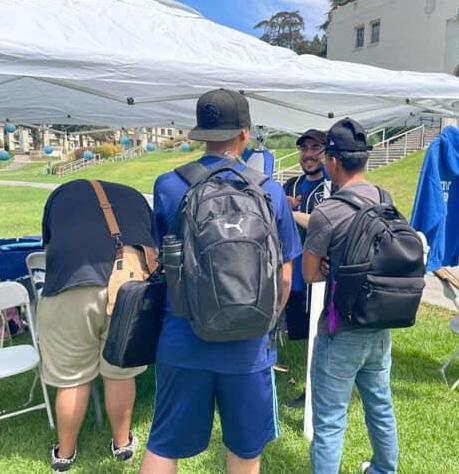
Get to know the Lancer Society and their brotherhood.
the Lancer's offer scholarships of varying sizes to their brothers. The largest scholarship given to a Lancer brother was for $10,000. They are always looking for new members to receive their scholarships. In addition to benevolent services to the community, the Lancers have a history of throwing a campus wide luau that is called the Mona Kai, which has been know to be of grand and plenty of fun.
The Lancer society has been one of the more inactive societies on campus, largely due to the COVID-19 virus putting a halt to a lot of activities on campus–
including societies. The Lancers alumni are dedicated to making their society active again. Just from enjoying pizza and the football game with the Lancer alumnus, six proud Lancer brothers were looking to bring back a society they all have a deep and personal connection with.
Bids for those interested in societies closed on Wednesday, Sept. 10. Coke Acceptance for new members took place on Friday, Sept. 12, 2025. If there is a new class for Whittier’s benevolent Lancers, we will find out near the end of the semester.
Ethan Airada STAFF WRITER
Picture this: you get home and you have an assignment due in less than a minute. It’s worth 100 points and your professor does not allow late submissions. You already did the assignment, you just have to submit it, and you’ve been trying all day but distractions hit you left and right. You finally log on to turn it in, but Whittier College and all of its affiliated websites have implemented a new feature. As you are redirected to other log-in pages, they inform you that you need a new app. Unfortunately, as you are installing the app and logging in again, you miss the deadline.
Now imagine you die and go to Heaven. As you’re about to walk through the pearly gates, God asks you to log in. You don’t have your phone on you, so he just sends you to Hell instead. That is how this ridiculous process feels.
Over the summer, Whittier implemented a new log in procedure on the new My.Whittier website intended to make logging in more secure for students and staff.
It requires the user to authenticate their identity by requiring their phone, their password, or even their fingerprints. In order to log on, it must be directly connected to your school account to work properly, and it also requires a new process altogether to log in. This process does keep you signed in for all Whittier College-related sites though, preventing multiple signins, assuming you’re using the same device.
When you open Moodle, the front page is normal, except for the “Whittier College Log on” proudly displayed in purple under the regular log in option. You could ignore it and log in normally, but eventually if you go to any Whittier College-related site, it will ask you to use the Microsoft authenticator. From there, you put in your username again, put in your password, input a two number code sent to your phone, then put in your phone password, and only then will the website let you log in. Yes, it is more secure. It is also infinitely more tedious. What if your phone is dead, or unavailable? What if you need to pull it out
during a class with a professor that hates phone usage of any kind? What if the internet is unavailable and it doesn’t send to your phone? What if, God forbid, you close the browser and you have to start the process all over again?
To add insult to injury, the log-in process is different for some devices. Some people have to enter a six digit code instead of a single number, and even then it’s ridiculous if the requirements are different for each device type. Drinking sulfuric acid is less painful than this. In the same vein is the My.Whittier website overhaul. The old site needed updating, but one issue seems to have only gotten worse--nobody can find what they’re looking for. Sometimes students go to upload
their timesheets, only to double back twice before finally realizing the function to report timesheets is not in the “reporting” section or, perhaps, the “work” section either, but the “community” section.
But the labeling isn’t as bad as how the website functions in general. It features a bunch of tabs displaying parts of the Whittier College website, and navigation is cumbersome. Logging into My.Whittier may as well bring us to the public website, especially if some of the tabs are just repeated over again in different sections.
These changes may or may not have been necessary to improve the quality of the platform. However, how improved is it, really, when running until your legs collapse is better than logging in again?

Courtesy of My.Whittier
The new My.Whittier is incredibly difficult to navigate.
Editorial Commision QUAKER CAMPUS
On Sept. 10, right-wing influencer Charlie Kirk was shot in the neck while debating college students at Utah Valley University. His gruesome murder was recorded, posted, and immediately went viral. The vast difference in online reactions to his death has become a hot topic. Reactions ranged from glorifying Kirk to celebrating his death, reactions that left many, particularly non-digital natives, perplexed and shocked.
If you are familiar with the work of Charlie Kirk, you are likely less surprised by these reactions, as he was an intentionally polarizing public figure who used his platform to promote white-supremacy, antiLGBTQIA+, anti-gun control, and sexist positions and propaganda. Kirk built an audience by spreading misinformation and inflammatory, often hateful rhetoric which has caused direct harm to marginalized communities in this country. He had a massive social media following, his words also having widespread influence. Despite having no elected political power, Kirk was one of the largest conservative mobilizers of young people in this country, even being endorsed by Donald Trump and other government officials.
(The White House lowered its flag to half mast after his murder.)
Kirk’s role as an influencer, combined with Gen Z’s desensitization to gun violence and graphic imagery, has unfortunately turned his murder into digital fodder–-a subject of celebration for some, revenge pledges for others, and a deep well of memes for too
many. Kirk was certainly no saint and death does not absolve him of the real harm he caused, but that does not mean that his murder should be glorified. Nor should it have been turned into instant internet content fodder that does little to address the real issues Kirk’s murder represents but does a lot to further divide us.
Gen Z has grown up in a culture of violence, from kindergarten on we have been aware of the real possibility that our school day could end in a shooting. School shootings are treated as an inevitability. Another fact of life. Many of us know people who have been in school shootings. We watch mourning parents and shellshocked students tell their stories knowing that it could have just as easily been us. This shooting happened on a college campus where hundreds of students witnessed the gory consequences of gun violence firsthand. Online, severely graphic videos of the event are being shoved in the face of the generation whose lives have been the most impacted by school shootings.
To many of us, the most shocking part of the shooting at Utah Valley University was that no innocent students were also killed, but an influential public figure who we recognize. The victims of gun violence are typically strangers to most, whose deaths we will say are tragic, but what we will quickly move on from. This was not the first act of political violence this year, just the one with the most name recognition. In June, Minnesota State Representative Melissa Hortman was shot in her home, targeted, ostensibly, for being a Democrat. This murder has received a fraction of the media coverage of Kirk’s. Kirk is the one
whose death has caused the most outrage and discussion, primarily due to his large online presence, popularity with conservative youth and proximity to powerful Republican politicians including the president. When the murders of innocent students and lesser known political figures in this country get swept under the rug, we are left to ponder whether we have started to conflate social media presence and value in our society.
This generation is heavily desensitized to politically charged violence in general. The deadly January 6, 2021 attack on Congress was livestreamed. We regularly see content from the battlefields in Ukraine. If you are remotely tapped in politically, for the last two years you likely have seen graphic, gut-wrenching images and videos coming from the genocide happening in Gaza. We watched the security footage of Luigi Mangione killing the United Healthcare CEO without even blinking. This type of content is constant and nearly impossible to avoid. For those who have grown up online, it has become almost a normal part of one’s social media experience. At what cost? After repeatedly being exposed to so much violence online, we are at risk of becoming accustomed to such events. The online commodification of such events risks leveling it all to content, not tragedy. As such, there is no incentive to address the symptoms.
Because of the harmful ideas promoted by Charlie Kirk, some young people think that making light of Kirk’s death is acceptable. But this attitude can easily become dangerous, especially when violence is turned into something to be laughed at. Many of us have seen the clip of him getting shot dozens

Dear Poets, Classes are picking up, what’s the best energy drink to help me stay focused/awake? - An Exhausted Poet
Jane: Nothing like a good Monster to keep that monster in you going! Pacific Punch or Viking Berry are my go-to flavors.
Jo: There’s actually a couple ways you could approach this. You could eat some dark chocolate, eat a Clif Bar, brew some coffee or tea, or maybe even take some caffeine pills. Me personally though, I think injecting caffeine straight into your bloodstream will get the job done more efficiently than anything else. I mean, if there’s a faster way to get somewhere, wouldn’t you use that route?
of times, much of which has been edited into memes, creators not bothering to even censor out the gore before turning it into humorous content. People are watching the graphic sight of blood spilling out of Kirk’s neck after the shot and swiping away afterwards like it is nothing.
This desensitization and urge to turn political violence into internet spectacle could have devastating consequences. Political violence, especially gun violence, should always be taken seriously, even when the victim is someone whose views you might find reprehensible. Many people believe that the system is so broken, that the only way to spark real change is through violence, but that violence would destroy the very thing most worth saving: the rule of law under which we are supposed to be equally protected. The Second Amendment does not give anyone the right to play judge, jury,
Johnny: Sorry Poet, but I don’t drink energy drinks. But, I would definitely recommend coffee drinks for my fellow non-energy drink consumers! There’s some fun coffee shops around Uptown such as Bark Coffee and Lift that are a quick walk away to and from campus.
The Poets
and executioner, no matter how vitriolic we may find the speech of influencers exploiting the First Amendment for profit and gain. We are living in a scary and precarious political era, full of instability that is accelerating each day. The last thing we need right now is for gun violence to become even more normalized, and our generation certainly should not be treating these acts of violence like the punchline to a joke.

Madyson Escobedo STAFF WRITER
Professor Glenn Piner has been an educator here at Whittier College for over 24 years, and today, he reflects on his time spent here and tells the story of how he got here. Piner attended the University of Maryland as a first-generation College student where he received a B.A. in Astronomy and Physics, a Masters degree in Astronomy, and a PhD in Astronomy, all from the same institution. After receiving his PhD, Piner moved to California to work in a post -doctoral research position as a Caltech Postdoctoral Scholar at the NASA Jet Propulsion Laboratory (JPL) in Pasadena. While he loves conducting research, he didn't find it enjoyable since the findings had been very technical, making it hard to explain to anybody outside his field of study. This led Piner to become a professor because he wanted to become a generalist in teaching astronomy rather than being isolated in academia. Piner knew he wanted to teach at a Liberal Arts college to continue doing research at a smaller scale simultaneously.
Piner doesnt need to completely abandon his research since the College is the perfect place for professors to continue their own research while simultaneously being an educator. His research is centered using data from the National Radio Astronomy
Observatory’s Very Long Baseline Array (VLBA) of radio telescopes will allow for data collection to be streamlined. However, while balancing being both a professor and researcher does become tedious as both jobs are time consuming. Despite the balance of being both can be diffictult at times, Piner has seen that starting earlier on research does tend to help with the workload. Piner has also been a contributor to numerous astronomy journals and papers. One of the most impactful papers he was a contributing author for was published in 2012 and was a collaboration with three to four students, the U.S. Naval observatory in Washington, and other Countries. “This paper took over 3,000 hours to process”, Piner confesses. "They were developing photos that took an hour long on each one”. The piece became the biggest data set of that time as it was an accumulation of 20 years worth of data. Professor Piner presents this research to his students as a way to motivate them and show them how working hard is impactful to their lives.
Piner says, “I continue to return to Whittier, as I love the close-knit college community, and small faculty togetherness you can only get at a small Liberal Arts college." As the College itself is home to many first generation students, Piner is able to connect with students while also being able to branch out and teach a variety of classes such as research classes and even first-year writing seminars.
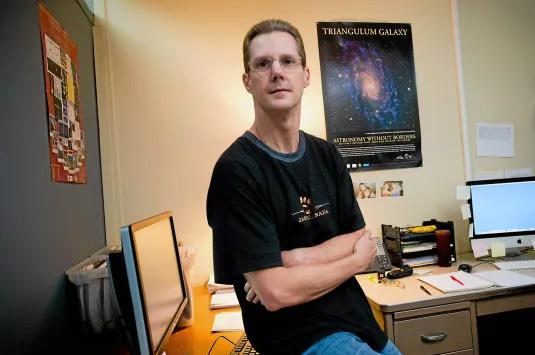
Spending much of his own time working with Astronomy and Physics, Piner has grown to have favorite occurrences or lessons with each field. Piner expresses that teaching class outside while using telescopes or viewing bright planets with the naked eye, has always been his favorite as he is able to show his students first hand experiences. Piner states, “I am able to show my students first hand experiences when looking out to planets." When he is teaching physics, the lessons that are hands-on are more enjoyable for both himself and the student
as he can demonstrate magnetism and other fields of physics which keeps students engaged and interested. Communicating with several other departments and gaining different points of views broadens and deepens the way he sees things compared to his time researching with Jet Propulsion Laboratory.
The ability to participate in a variety of courses is also what allowed him to co-create a new Data Science major at the school.
Piner voices, “Whittier College has given me an appreciation of community that I wouldn’t trade
for anything else." The institution has also become a family to him as even his own twin daughters attended school here, graduating in 2023. Whittier is a firm part of his life and the time he has spent here has truly impacted him, he hopes to continue meeting new students as well. Despite living in California for so long, Piner hopes to move somewhere where the weather is less hot with his Pennsylivanian born wife once he retires. According to Piner, his wife misses the cold, but for now, sunny Whittier, California is the way for him.

Women’s Volleyball @ Mary Washington University
Location: Fredericksburg, VA
• 1 p.m.
• September 19
Women’s Volleyball vs. University of Mount Union Location: Fredericksburg, VA
• 3 p.m.
• September 19
Men’s Water Polo vs Fresno Pacific University
Location: Whittier, CA
• 5 p.m.
• September 19
Men’s and Women’s Cross Country @ UC Riverside
Location: Riverside, CA
• 9 a.m.
• September 20
Women’s Volleyball vs. Hope College
Location: Washington, D.C
• 9 a.m.
• September 20
Women’s Volleyball @ Gallaudet College
Location: Washington, D.C
• 1 p.m.
• September 20
Men’s Soccer vs. UC Santa Cruz
Location: Whittier. CA
• 7 p.m.
• September 20
Men’s and Women’s Soccer @ Occidental College
Location: Los Angeles, CA
• 7 p.m.
• September 24
Women’s Volleyball vs. University of La Verne
Location: Whittier, CA
• 7 p.m.
• September 26
Men’s and Women’s Cross Country @ Cougar Challenge
Location: San Marcos, CA
• 9 a.m.
• September 27
Men’s Water Polo @ Cal Lutheran University
Location: Thousand Oaks, CA
• 11 a.m.
• September 27
Women’s Soccer vs. Chapman University
Location: Whittier, CA
• 11 a.m.
• September 27
Women’s Voleyball vs. Occidental College
Location: Whittier, CA
• 7 p.m.
• September 30
Elias Loya A&E EDITOR
During the 2023 off-season, the Los Angeles Dodgers spent millions of dollars in free agency, signing new players, which included the additions of starting pitcher Yoshinobu Yamamoto, outfielder Teoscar Hernandez, and, of course, the two-way star Shohei Ohtani. Through a renewed sense of team chemistry, valuable trade deadline acquisitions, and a historic performance by 2024 MVP Ohtani, the Dodgers propelled themselves into a successful postseason, culminating in an eventual landslide World Series win over the New York Yankees. The offense was definitely important, especially that noteworthy World Series performance by first baseman Freddie Freeman. However, something else that really helped bolster the team’s performance was the bullpen, which broke a postseason record for consecutive scoreless innings pitched. This arguably ended up being one of the biggest factors in the team’s postseason success.
Heading into the 2024 offseason, the Dodgers played into the “rich get richer” motif by adding even more big names to the roster, such as young pitching sensation Roki Sasaki, 2023 Cy Young winner Blake Snell,
relievers Tanner Scott and Kirby Yates, and Korean second baseman Hyeseong Kim. The organization sought to become the MLB’s next “Evil Empire”; many Dodgers fans were happily awaiting another successful campaign. Now that we are a few weeks away from the 2025 postseason, how is this team faring?
They have faced some challenges, to say the least. At the time of writing, the Dodgers lead the National League West division by a close two and a half game margin, with the San Diego Padres in pursuit. LA has gone on a couple of losing streaks, one of which tied their longest winless streak from 2017. On top of this, the team seems to be having a down year statistically; none of their players are hitting over .300 while the pitching staff holds a 4.04 team ERA.
One of the most glaring issues lies in the team’s overall performance. According to ESPN, the Dodgers currently rank fifth in Batting Average, fourth in On Base Percentage, third in slugging percentage, and third in runs. They seem to be hitting the ball somewhat well, and they’re getting on base, so why are they struggling? Their pitching stats tell a bit of a different story; they rank 18th in Earned Run Average, 15th in Walks and Hits per Inning Pitched, sixth in Batting Average
Against (BAA), and 22nd in Quality Starts. The bullpen is also ranked 13th in all of MLB. It seems as though the pitching, while heating up more recently, is allowing more baserunners and harder contact, while at the same time failing to gain much run support from their position player teammates.
Another thing this team has had to face is the injuries. Over the years, the Dodgers’ pitching staff and position players have battled countless stints on the Injured List (IL), and this year is no exception.
For instance, starting pitchers Roki Sasaki, Tyler Glasnow, and Blake Snell have all suffered from shoulder inflammation. Key relievers such as Brusador Graterol and Evan Phillips are facing inflammation and surgery recovery, while position players like Max Muncy and Will Smith are recent additions to the IL. While injuries are becoming more common throughout the league, they still has detrimental effects on a team’s overall performance, since that team will be missing some key contributors.
Since the turn of the century, no MLB team has won back-toback championships, with the last team to do so being the infamous “Evil Empire” New York Yankees team from the late 90s/early 2000s. With the regular season coming to an end, is it still possible for the
Dodgers to repeat their postseason success from last year? When the injuries and overall lower team production is taken into account, it can be really difficult to build a case for a repeat championship for LA. However, there is still hope. Recently, the Dodgers seem to have regain their footing a bit more, with a couple of nohit bids, players coming off the IL, and outstanding second-half production from players like Mookie Betts, Will Smith, and Yoshinobu Yamamoto. If this newfound success carries into the postseason, another ring could very well be theirs.

Atticus Chaidez SPORTS EDITOR
Now more than ever, professional athletes are looking to get paid what they are worth. A player who scores at the top of the league, hits the most homeruns, or even just a veteran and respected player deserves to be paid more than one might typically sign said player for. However, to combat wealthier teams from monopolizing all of the league’s talent, leagues implement a “first dibs” system when it comes to young players coming out of a contract. Many leagues, such as the National Basketball Association (NBA), National Football League (NFL), and the National Hockey League (NHL) implement systems like this. These players are referred to as restricted free agents (RFA).
Mason McTavish’s career so far has been spent with the Anaheim Ducks. In his four years in the league, he is one of the many young players making headlines in the NHL. At just 22 years old, McTavish has 140 points in 229 games played—finding a way to make an impact on the game in more than half of the games he plays. In addition, he’s not afraid to get his hands dirty, being a physical presence on the ice and seemingly hoping his opponent will drop the gloves and take him on in a fight. As a physical presence on the ice and proven goal-scorer, McTavish is something every team can only hope for.
However, this summer, McTavish has made headlines
for some rather “boring” reasons. That being, contract negotiations. McTavish is a restricted free agent, meaning the Anaheim Ducks have “first dibs” in negotiating a contract with him. As the summer continous, there has been no news regarding a McTavish re-signing in Anaheim. McTavish wants to get paid what he believes he is worth and sign a long-term contract. On the other side, the Ducks want to make sure this contract is cap friendly—meaning they’re not spending too much on a player who, although looks very promising, is still unproven in a sense that he is still young. His development could hit a rut or he just develops in the wrong way, leading to him not being that star player everyone expects him to be. These negotiations beg the question, should RFAs be obligated to hold out negotiations for a better, more fair deal, or should they be happy with any contract they receive from their team?
It is often reiterated that playing sports is a privilege, not a right. This means that at any point while playing, your coach or league’s commissioner can take away that privilege if you are not playing well. In some extreme cases, you can even be banned from the league. From that perspective, a player should be grateful to even have the opportunity to play—let alone play and make a living off of it. By that logic, it is clear that McTavish, or any player in the same situation, should go ahead and sign the contract their team
offers them. But it’s not a black and white problem.
In addition to teams getting their first dibs on their RFAs, it’s also supposed to be a teaching moment for these young players. In the NBA, NFL, and NHL, once you hit a certain age or games played, you no longer qualify to be an RFA once your contract expires. This leads to players having no job security when their contract ends. Even as an RFA that is inclined to re-sign, having negotiations with the team you want to resign with can be considered a healthy relationship. In the current McTavish and Anaheim Ducks contract negotiations, one could see that as McTavish exercising his right as a player to learn how contract negotiations can and should go. However there’s one more factor that cannot be ignored, which is the salary cap. In most leagues, the NHL, there is a salary cap system implemented so teams don’t sign the league’s top talent
for more than competing teams can. This issue may not seem like much of a problem, considering they have a projected $20.5 million in cap space, but it does when you realize the RFAs they want to resign next season.
The Anaheim Ducks will have five more RFAs they will have to figure out how to re-sign and fit into their cap space. Of those five, Leo Carlsson, a second overall pick in the 2023 NHL entry draft, is one that the Ducks will for sure want to re-sign was he is considered to be a core piece of their future as a team. But so is McTavish. Does McTavish continue to ask for a higher paying contract—an offer he seemingly hasn’t received yet—or does he take the next fair contract he receives in order to help set up his team in contract negotiations next off-season? And should other athletes in the same situation follow his example by sacrificing personal revenue they believe to have earned in order to help their team in the long term?

Monze Meraz-Lerma SPORTS EDITOR
Whittier College’s Women’s Soccer team is one month into their season with a strong 3-0 record. This includes their numerous shutouts in each game, showing the power and discipline of their defense. The team retired 11 fourth-years last year, but their defense has maintained mostly returning players, who create a moving wall that stops any shot in its tracks. Despite their striking performance, statistics don’t often reflect how successful a defensive line is besides shutouts and assists. However, the team’s defense is what has earned them such prominent wins.
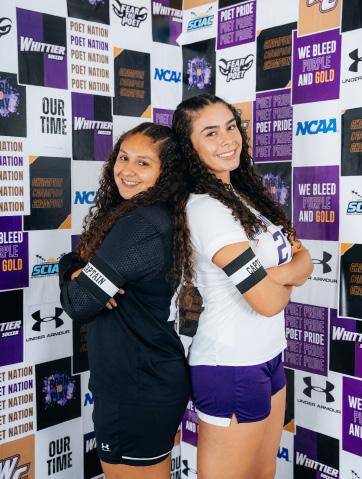
Emma Tumbarello, the fourthyear centerback captain, started the season with a recognition she has been aspiring for since her first year. She recounts earlier this month, her coach sent her the news through a video of his daughter announcing, “Congrats on SCIAC Defender of the Week!” This award is the first time in the College’s history that a defender, not a goalkeeper, has received this title. Although there aren’t enough stats to credit defense players for all of their hard work, Tumbarello has been performing at a high caliber throughout her four years. She acknowledges that it only takes one slip-up to be scored on,
so she and the rest of the defense must always be prepared for that likelihood.
“We always talk about defense being a mentality,” Tumbarello says. “You have to be very pessimistic; you have to expect that the person next to you isn’t going to get the ball.”
The defense line is trained to travel through the field as one. Tumbarello illustrates this as if they are all holding onto a rope. When one player moves up, the rest of the defense must, too. This mentality extends to the whole field; it takes a team effort to make the magic happen. Tumbarello feels confident in the safety net she provides for the rest of her team, but she emphasizes that everyone also helps her when needed.
“They always know I’m going to be there behind them, no matter what,” she says. “I always tell them ‘I don’t care if you mess up, just come back and help me because I’m going to be there to help you.”
Mya Rodriguez, another fourth-year captain, serves as the team’s goalkeeper. She has received SCIAC Defensive Player of the Week twice, and has the second highest save percentage in the conference (falling short to No. 10 Pomona-Pitzer). Even with these impressive stats, she credits the whole defensive line for these recognitions.
“That’s not just because of me, that’s because of [them],” Rodriguez says. “[They’re] saving everything; [they’re] taking these girls out on the line and pushing them out for me.”
Rodriguez compares herself to a traffic-director; she lets her teammates know when a shot is coming, when they can shoot, or when they have a man on. Once that ball gets past the defenders, it’s up to her to block the ball. Rodriguez chuckles as she explains that she acts crazy in order to be a successful goalie.
“I’m gonna get in your face, I’m gonna jump over you, I’m gonna take you out, I’ve taken out my own players to get the ball,” Rodriguez says. “You have to do what you have to do.”
As a collective, the team’s defense has some of the most powerful players with a variety of skill sets to contribute to the game. Rodriguez sees it all from the net.
“We’ve got Emma, who’s so so smart with the ball and knows when to dive in, knows where the player’s going to go before they even know probably,” Rodriguez says. “We’ve got a girl on the left side who can chip it over somebody so gracefully, and we’ve got another girl on the far right who is just muscle and fast.”
Coach Derek Hanks notes that a strong defense is one of the main
focuses that the team works for in order to be competitive against tough games in SCIAC. As topranked athletes among the whole conference, these Poets continue
to prove that their defense is what shapes the team as a whole. They say the best defense is a good offense, but maybe the best offense is a good defense.
Monze Meraz-Lerma SPORTS EDITOR
Men’s soccer and water polo have their obvious differences; one is played on land and the other in water. However, these teams are showing their similarities in potential for success. There are new faces on each team from all over the world, which each bring a new perspective of the sport to Whittier College.
The men’s soccer team is composed of 38 players, 24 of which are underclassmen, and 20 international students from 13 different countries. Men’s water polo shares a similar mixed demographic: with 18 players, 11 are international from six different countries, and half of the roster are underclassmen.
Although both teams lack seniority with only three seniors on each team, their mix of international flair and perseverance has proved that they shouldn’t be underestimated. Coach Harwell’s men’s soccer team currently boasts a 5-0 overall record, and he knows his international players are a major contributor.
“A lot of these international guys have just been around football, as they call it, their whole lives,” says Harwell. “There’s not all these other sports that they could have played in this mix.”
Harwell emphasizes the importance that the team places on bonding and mixing the team’s customs while maintaining a high achievement level. He feels that with a strong team culture, the performance is better, making the
overall experience for the players more enjoyable.
Rowan Slater, a fourth-year cocaptain, is the team’s only player who has been at the College for all four years. As a veteran player, he explains that throughout his time at the College, the players always work to make everyone feel accommodated. While he is not international—as Slater is from Colorado—he knows the importance of feeling welcomed.
“Every year, the day before report day, we’d do like a six hour Target trip,” Slater says. “We’d get all their dorm stuff, just kind of try to show them around, go to the beach, do a lot of activities outside of school[…]make them a little less homesick.”
Men’s water polo Coach Preslov feels similarly. As an

international coach himself, he sees the importance of recruiting international players. He acknowledges that American players bring a strong skillset, but international players bring a different mentality into the game that American players can learn from.
“Just practicing with those people that play at the highest level, either in Europe, or whether that might be Australia, South Africa, these water polo places, definitely help build up a very solid strong program,” Preslov says.
The team’s co-captain, secondyear Noah Bigara, comes from Capetown, South Africa and has become a powerful asset to the team. After his first season in 2024, he was recognized as the SCIAC Newcomer of the Year for his impressive records, including a whopping 52 goals in his first season. He enjoys the bond the team has created through its diversity, and like Preslov, he recognizes how important it is for everyone to share their culture for the better of the game.
“[A first-year] is a goalkeeper, and he’s got two insane goalkeepers from Italy and Brazil that are like mentors to him,” Bigara says. “I’ve seen it in the pool that they’ve been teaching him a lot and guiding him and telling him what’s right and what’s wrong.”
Among diversity of nationality in the teams also lies youth. However, captains Slater and Bigara see these fresh faces as powerhouses that are capable of
making a big impact on their team. According to Harwell, Slater is a “lead by example” type of captain, who has already set high standards for his team with his recent recognition of SCIAC Offensive Player of the Week after his record breaking hat trick made within three minutes. Slater understands the responsibility he has to guide his young team to success, and he recognizes the talent they have.
“[I’m] just trying to set an example for them and trying to lead them,” Slater says. “If some mistake happens, I encourage them, but also push them to where we keep the standard the same.”
Bigara leads by example, too. As a second-year, he has a closer connection with the underclassmen, allowing his influence to effectively spread throughout the entire team. Their team culture prides itself on not having a hierarchy, which was a problem in the past. This chemistry has allowed everyone to gel closer and play hard together.
“I just go and play,” Bigara says. “I feel like that gives everyone else the confidence because they see that I give 150%, and they all go and try their hardest.”
Both teams will begin their conference games with men’s soccer on Sept. 17 here at home and men’s water polo on Sept. 27 at Chapman University, putting the budding players from around the world to the real test. Their diversity, new-found chemistry, and younger players will be a testament to their skills.
Penny Turgen MANAGING EDITOR
Want to know what our new Managing Editor recommends this week? Read on!
Album:
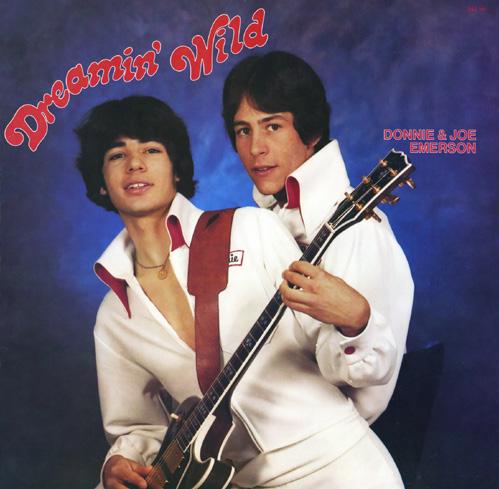
Dreamin’ Wild is an album by brothers Donnie and Joe, whose music from the 70s was only picked up by a record label a few years ago. I love the guitar and their story. It’s an album you should listen to, beginning to end; A yacht-rock/soul vibe that makes me cry with every listen. Their single, “Thoughts in My Mind”, is just as killer.
Book:
A Room With a View, by E.M. Forster, is a book about a young girl in Victorian England. I love how it uses a bunch of perspectives from different characters, and how the settings mirror the characters' feelings. Very Wuthering Heights in that way. I can comfortably say this is my favorite book, even with many months left until 2026.

Movie:
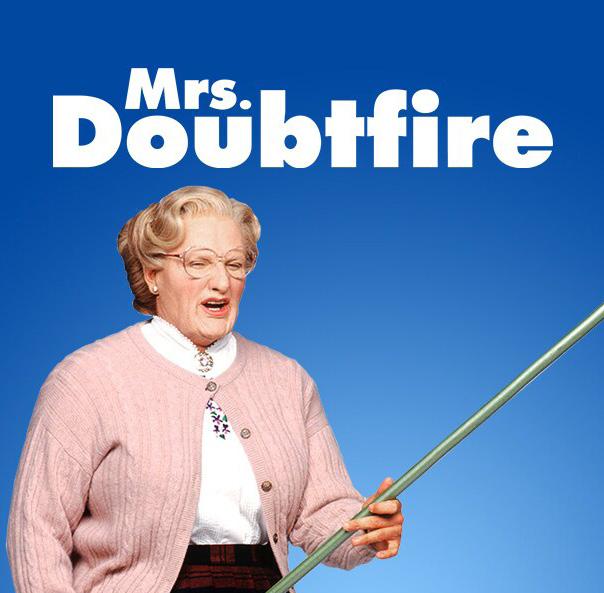
Mrs. Doubtfire - I really just can’t stop laughing when Robin Williams does that voice, and an impression of it is almost as funny. I just love a dead-beat dad redemption arc. I love the mom’s football helmet hair, it adds realism to the insane plot. This movie walked so White Chicks could run.
is by far my favorite igneous rock. Great for bouldering and there is lots of it in California. It's speckly and sparkly, just an all around solid rock. It's formed from magma, and I can’t help but love something with a storied past.

Courtesy of National Park Srvice
Ethan Airada COPY EDITOR
A tradition as old as cinema and recognized since Jaws, the summer blockbuster has always been crucial to Hollywood movie studios like Walt Disney Studios, Universal, Warner Bros, or just about everyone capable of making them. Most of them will be remembered on video and streaming sites like Fantastic Four: First Steps, or Naked Gun, and others will still arrive at homes across the world to far less fanfare. Which ones are just summer blockbusters, and which ones will people be watching years from now?
Easily one of the most popular movies of the year, Superman flew into theaters this July. The Man of Tomorrow has returned once again, and was met with resounding success worldwide, spreading discussion like wildfire around the world.
The core themes of the movie struck a chord with the audience, mainly that kindness and empathy, in a bleak and uncaring world, is an inherently rebellious concept. Superman is characterized as a regular guy who has the ability to do anything but chooses to do the right thing. A mind-boggling
characteristic to some, but an inspirational trait to others. It’s important for characters like him to exist because people are always influenced by what they consume. If the most powerful person in the world was this kind and humble, how could he not be inspirational? It’s why there are so many interpretations of the character since he was made nearly 90 years ago.
What’s especially appealing is how this version of all the stories and characters appear to be a return to form. Superman's civilian identity, Clark Kent, is just a regular journalist who wants to do the right thing. Lois Lane is an intrepid reporter who constantly risks her life for the truth. Lex Luthor, the central antagonist, is infuriatingly smug and is one-hundred percent motivated by pure, unadulterated hatred for Superman.
Audiences agree that this version of Superman is refreshing to see, especially with many comic adaptations in the last five to ten years, with TV shows like The Boys or Invincible popularizing the “Evil Superman” archetype. Superman returning to his “Boy Scout” portrayal has audiences optimistic again, instilling the hope that
people can choose to be better.
One of the best parts, unequivocally, has to be its insistence to remain faithful to the source material.
Watching the movie feels like watching an actual comic book in progress. The Daily Planet actually has a giant globe on it, there are superheroes most people have never heard of but whose presence are enjoyed regardless (Mr. Terrific, Guy Gardner, and Hawk Girl are more popular than ever), and even the parts that feel a little corny are made near perfect
because of the sincerity behind it— Superman looks best when he wears the trunks. Our hero must be good and unashamed to be as such, so his audience can feel the same.
Superman captures the hearts of many through its comic accuracy, its return to form, its characters, and how it reaffirms how the character Superman is and always will be an inspiration for people to be better. With more Superman movies like this, we'll be in for the flight of our lives. With all that said, what was the worst movie of this summer?

Jayden Garrett STAFF WRITER
This summer I’ve watched Shelton Jackson Lee, more popularly known as “Spike Lee” amongst the general public, go from his highest to what is absolutely his lowest. If there was a directors' Justice League, he almost certainly would have his monument standing proudly next to the other film giants in the Hall of Justice. He is responsible for Black cultural phenomenons such as: Malcolm X (1992), He Got Game (1998), Do the Right Thing (1989), and countless other historical landmarks burned into the face of film reels in theaters across America.
Spike Lee not only brought about more representation, but motivational guidance to a fresh medium in a masterful way for a historically under advocated group of marginalized people. He told stories of struggle with purpose, strife with meaning and life with art.
Now with both him and actor Denzel Washington on the tail end of what were both magnificent careers, they’ve fallen to an unimaginable low with Spike Lee’s retelling of Akira Kurosawa’s High and Low, which was originally based on Evan Hunter's 1959 novel King's Ransom. The plot within Spike Lee’s version of the film was purely an afterthought, only a curtain to cover up the film's true identity.
This can only be classified as blacksploitation in its most potent form. Spike Lee took his name and good rapport within the Black community and paired it with Denzel Washington's legendary
status within the same space to drive members of the Black Community into theaters... to dupe them into supporting what many thought would be another beautiful and comprehensive project made by two masters of the craft.
Instead, what we received was a sloppily crafted, poorly shot, generically casted two hours and thirteen minutes of Black History Month propaganda. The movie follows Denzel Washington's character David King, a very clear euphemism for the Black community’s use of the word “king” as a term of endearment. David was the CEO of what was once the top Black record label around, along with his deuteragonist Paul Christopher, a formerly incarcerated Black man who found Islam in prison, and is now King’s security guard.
Christopher's entire backstory can be assumed from the moment he enters the screen. While everyone else's clothes change, they keep Christopher inside two different color pallets of Nike & “Stackin Hits” sweatsuits alongside a Kufi.
The film’s main antagonist is “Young Felon” (played by rapper A$AP Rocky), whose name in itself would have almost any respectable African-American up in arms over the lazily chosen stereotypical name if this movie was made by a white man instead of Spike Lee.
A$AP Rocky is a face known to many younger audiences as a key figure of hip hop within recent times, though he wasn’t the only New York rapper to appear; the movie also included a 10 second Ice Spice cameo. The film itself profits
off of Black figures, with random historical Black figures plastered across the set as pictures in a frame or paintings on a wall.
There are points in the movie where the film transitions to a new setting will focus on a picture of a random Black figure that has nothing to do with the scene at the moment just for the sake of them being Black and historical. Paintings of Basquiat being a conversational topic to showcase “Black Wealth.”
The movie itself doesn’t even keep track of what narrative it wants to pretend to push, jumping from: AI vs. Creativity, to the empowerment of Black spouses, to what's best for your family vs what's best vs another, all the way to Capitalism vs Art.
These are just a few of the many random topics that feel shoehorned into the movie for the sake of having a “purpose” in a purposeless movie. The entire film feels like I’m staring at a body without a soul. What really drove this home for me, was at a certain point in the
movie when faced with what to do about paying a ransom for his close friend and security guards son, King breaks down and starts screaming at a multitude of images of Black legends such as Jimi Hendrix, Stevie Wonder, Michael Jackson, among others, asking them what they would do.
The mentioning of these legends providing nothing to the film other than “Look at these Black people, that you know and probably think extremely highly of that I’ve now just tied to my film”.
As an African-American, the entire film screams “watch this Black film, made by Black people, solely because you're Black.” There is no substance, no identity to it. Highest 2 Lowest, from top to bottom, is nothing but a cash grab built off the backs of great people, who contributed great things to the world. Spike Lee creted a film, aimed at the identities of Black people across America, to fundraise a bigger budget for his very own retirement fund.

Elias Loya A&E EDITOR
I don’t know if you’ve heard, but President Trump just impregnated Satan… in South Park, that is. That has to be a commentary on something, right? South Park is no stranger to pulling publicity stunts like these, and they’ve made it a point of taking shots at highprofile social figures and politicians, ever since the show’s creation in 1997. Some of the show's most famous and memorable moments come from them targeting and mocking topics like the Church of Scientology, 9/11 conspiracies, and as of late, incumbent US President Donald Trump.
This level of commentary is also bipartisan, and showrunners Matt Stone and Trey Parker do not shy away from picking on both ends of the political spectrum. While their satire has been positively received by a wide array of audiences, there is, of course, plenty of backlash to follow in suit, as is the case with many other politically-charged pieces of media today.
For context, it’s important to know what even qualifies as political satire. It can be seen as a merging of comedy and opinions on the
political state of the world; it is meant to attack and bring attention to what the creator believes to be a governing body’s weakness, and thus hold accountability over the heads of those in power. Defining characteristics of satire include wit, sarcasm and irony, exaggeration, and a moral critique.
Political satire is not a new concept, and it can be seen on almost any type of platform and across various forms of media. Some famous examples you may know of include skits and stories, like in The Daily Show, Saturday Night Live and Borat, satirical news publications like The Onion, the George Orwell’s Animal Farm, the many caricatures and other cartoons in newspapers, and so many others.
But how effective is it really?
According to the Center for Arkansas History and Culture, this mode of critique helps to “cut through the clutter” and “[provide] a clear narrative for the reader to explain what is to blame.” Arifur Rahman of Toons Mag also sees humor as a big part of why satire can make complex sociopolitical topics more digestible.
In short, political satire can help spread a clearer, albeit humorous, means of learning about the political
and economic state of the world.
Despite its ability to bring widespread awareness through palatable means, political satire does have its shortcomings. For instance, it can dehumanize its target and damage reputations, as the people being critiqued can often be minimized to that of their blown up and exaggerated caricature counterparts.
In addition, the act of satirizing certain topics like religion, politics, and other fields can be triggering for some members of the audience and viewership. This can provoke the audience, and in general this form of media can be skewing information and perceptions of the topic at hand.
Regardless of whether you agree with the information, people or ideologies being poked at, it is important to recognize political satire as one of the many facets of freedom of speech.
In this day and age where the constitutional rights to our own bodies, our rights to due process, and access to education are constantly being put into question, it’s that much more important for you to utilize media to make your voice heard through any means necessary.

Clover Morales HEAD COPY EDITOR
The song of the summer is an annual, long-standing debate, with thousands of fans deliberating over which songs encapsulate the vibe of summer the best. Despite this, it has been tough for many to choose a song which defined the season this year. Deciding on the song of the summer this year has been a daunting task, due to the sheer amount of singles and albums released, making it hard to pinpoint an undisputed cultural phenomenon.
This is, in part, due to the wide variety of music listened to over many different platforms, different trends spiking the amount of streams of songs on different platforms like TikTok, and the general energy of most songs released over the summer not having as big of an impact as last year’s hits. This has made it hard for some people to pinpoint a song which accurately reflects the feel of summer.
Some of this summer’s hits include “Ordinary” by Alex Warren, which has been under fire for being significantly more mellow and laidback; Some people argue Warren's song does not fit the summer vibe compared to other songs.
Another choice for song of the summer is Sabrina Carpainter’s “Manchild” from her latest album Man’s Best Friend, taking aim at immature men while using Sabrina’s iconic sweet and colorful sounding synth-pop.
Finally, in competition with “Ordinary” and “Manchild” were the many songs from the

Is there really no agreeable "song of the summer" this year?
hit summer Netflix movie K-Pop Demon Hunters, with “Golden” by HUNTR/X dominating the top of the charts for 11 weeks.
Many listeners are noting that many of this summer’s top charted releases aren’t encapsulating the same energy and hype as last year’s hits such as “365” by Charli XCX, “Not Like Us” by Kendrick Lamar, and “Espresso” by Sabrina Carpenter.
Although the songs on today's charts certainly have had some influence in the broader scope of summer music, none of them have been able to be as culturally dominant. Compare
this to phenomena such as “Brat summer,” which embodied the energy listeners expected this year’s songs to have. Although there might not be a definitive answer on what the song of the summer is, many members of the Quaker Campus were quick to chime in. Here are their favorite picks, as well as why they considered their pick to be their song of the summer.
Paige Meyer-Draffen (EditorIn-Chief): "My song of the summer is 'Destroy' by shedfromthebody. This song was there to push me through reading academic articles as I continued my
research this summer. I also try to listen to new releases when I go to new places (such as the New York subways and cathedrals) to keep the songs close to my memories."
Emma Galvan (Deputy Editor):
"So, honestly, I don’t listen to a lot of modern music. BUT! I absolutely love the artist MARINA and I feel like her songs 'I <3 U' and 'Digital Fantasy' from her recent Princess of Power album were my songs of the summer. They’re absolutely amazing and on repeat in my room for several hours on end."
Paola Ruiz (News Editor):
"'NO ME SOPRENDE' by Rauw Alejandro. I love any song by Rauw, but he knows how to make a summer album and THE song of the summer. The song makes me feel like I am sitting on the beach with the wind running through my hair. This song is always on repeat in my car or in the office when I have my headphones on!"
Nadia Miller (Campus Life Editor):
"My song of the summer is 'Golden' from K-Pop Demon Hunters. I really like this song because it is such a positive piece of music. It also plays on repeat in my head all the time."
Emma Cianciola (Features Editor):
"My song of the summer is 'Better in the Dark' by TV Girl. The whole album is somewhat based in the summer season. The upbeat tempo is perfect, balancing the electric/ synthesized beat with Jordana’s angelic vocals. Overall a very timeless song."
Atticus Chaidez (Sports Editor):
"My song of the summer is 'Catalina' by Descendants. Nothing like driving down Pacific Coast Highway, wind blowing in your hair, and some good pop punk to take your mind off things. The song is all about getting away and that’s what some people need sometimes."
Elias Loya (A&E Editor):
"I would have to say that my song of the summer is 'So Be It' by Clipse. There are so many things to love about it, like the many hard hitting lines, the cold deliveries from Pusha T and Malice, and not to mention that dope sample Pharrell used! That beat and chorus have been stuck in my head all summer."
Ethan Ariada (Copy Editor):
"My pick for song of the summer is 'Don’t Tap That Glass' by Tyler, The Creator. It was the most fun song in the entire album. I love songs that are like ‘shut up, all you people suck if you don't like me.’"
Ethan Ramillano (Staff Writer):
"'Lover Girl' by Laufey. I just found it super catchy and kept replaying it the entire summer. Laufey has a bunch of other amazing songs that I've been replaying for a while, too but 'Lover Girl' especially."
Overall, the vast variety of songs chosen by our staff at the Quaker Campus demonstrates how the song of the summer isn't determined by one factor.
A song of the summer isn't just categorized by energy, virality, or cultural relevance, it is also something that holds personal value, relatability to the listener, and the laid-back and freeing vibes that seems to embody summer so well.

Emma Galvan DEPUTY EDITOR
From Sept. 19 through Sept. 21, the city of Whittier and the College will be collaborating together to host the first ever Whittier Film Festival. Happening in Uptown Whittier, the festival will be a weekend full of films from directors and students, with various other events occurring throughout.
The Whittier Film Festival is intended to “promote young artists, film makers, writers, designers and future directors from Whittier College, Rio Hondo Community College, Cal State Fullerton, Cal State Los Angeles, Cerritos College, and Biola University” accordng to the festival website. There will also be guest appearances from Robert Carradine, Mark Hamill, Patrick Warburton, Carolyn Hennessy, Paul Rodriguez, Mayor Joe Vinatier, and other various politicians and celebrities.
The idea first emerged from Whittier resident Fred Zermeno, who approached the College last May to use the Ruth B. Shannon Center for Performing Arts as a festival venue. By then, he was in the early stages of development with film professors Patti McCarthy and Jennifer Holmes after receiving support from the Whittier City Council and Mayor Vinatier.
According to McCarthy, her and Holmes “were both excited to work with Fred as a college partner and [we] soon learned [that] he needed a lot of help setting up the festival and screening venues, soliciting films, running the festival, in judging the films, working with the filmmakers, creating a screening schedule, and hiring student volunteers, among many other hundreds of things needed to do to create a successful festival event.”
The festival will be commencing on Friday Sept. 19 with a red carpet gala at the Ruth B. Shannon Center. From 6 p.m. to 8 p.m. the patio will be open for all to come and enjoy appetizers, but 8 p.m. to 10 p.m. is when the night truly begins.
The gala event will feature the majority of the special guests who will be speaking.
There will also be live entertainment from Frazer Smith of 95.5 KLOS and Johnny Vatos—the drummer for Oingo Bingo— who will be playing with the Wiseguys Big Band Machine. The next day, Sept. 20, will begin at the Starlight Whittier Village Cinemas while industry panels will be occurring at the Double Tree Hilton
Hotel. According to Whittier Daily News, the city of Whittier will also be having a free community street festival in Uptown from 12 p.m. to 8 p.m. Saturday’s line up begins with the showcase of student short films in both theater rooms, where Theater 1 will run them from 12 p.m. to 1:30 p.m. and Theater 2 will show from 12 p.m. to 1:45 p.m.
These films include some from Whittier’s own students such as My Dearest Jane from fourth-years Cielo Valenzuela-Lara and Wren Paul, Adam’s Choice from fourthyear Nathan Carrasco, and Do You Copy? from Luke Agajanian. There will then be a 15 minute Q&A panel discussion after the showcases.
Beyond the student films, the two theaters' rooms will be split and will be showing different films at various times. Starting with Theater 1, which will be showcasing the Jose Ramos Documentary from 2:15 p.m. to 3:15 p.m. Following that will be the comedy film Holy Cash, with director Paul Rodriguez in attendance, from 3:35 p.m. to 5:15 p.m., and afterwards will be the feature film They Can’t Kill Us from 5:25 p.m. to 6:45 p.m. Finally, the night will conclude with Carlos Through The Tall Grass, a Whittier alum film that features numerous students and produced by Holmes and McCarthy. Happening from 7:30 p.m. to 8:55 p.m., main actor, Miguel Angel Garcia, will be in attendance and do a Q&A with McCarthy.
Theater 2 will feature the sci-fi thriller film Symbiant from 2 p.m. to 3:30 p.m. Afterwards is the war drama feature The Big Red One from 4 p.m. to 5:30 p.m., where actor Robert Carradine will be at the showing and do a 20 minute Q&A session. From 6:15 p.m. to 7:30 p.m. will be the Alonzo Williams Documentary before Theater 2 finishes their night with the thriller-horror film St. Agatha from 8 p.m. to 10 p.m.
The festival will conclude on Sunday, Sept. 21 with the two theater rooms at Starlight Cinemas showing the remaining films before the concluding ceremony. Theater 1 will be showing more student short films from 12 p.m. to 5 p.m., with two Q&A sessions as a break between the showcases. Some of these films will include Things of Beauty from fourth-year film student Meredith Lee, The Sign by Cara Reyes, Hispanic Outreach Taskforce (H.O.T.) directed by Keidan Chavez, and In Another Place from Emerson Little.
Theater 2 will begin their lineup with the documentary feature Street Smart: Lessons from a TV Icon from 12 p.m. to 2 p.m. and then showcase another documentary, Squatchers: The People Who Believe in Bigfoot from 2:15 p.m. to 4 p.m. The final film of the night will be from 4:15 p.m. to 5:30 p.m. and it is the drama Chicas, a film executively produced by Whittier natives Anthony Ortiz and Reyna Torres. The movie was filmed partially in Whittier itself, described by Torres on Whittier Daily News as a “downtown L.A. version of Sex in the City,” and features an all-female Latina crew. After the showing of Chicas, attendees will be invited back to Theater 1 for the Filmmakers Awards and the closing ceremony where the films that are selected in their respective categories—Best Comedy and Best Documentary—will be awarded and honored. Best Comedy will be awarded to Carlos Through the Tall Grass and Best Documentary will go to Sasquatchers: The People Who Believe in Bigfoot There will also be awards for Best Student Short Films, Best Short Films, and an Honorable Mentions category. Only the Best Comedy and Best Documentary winners have been revealed, but the remaining categories stay a mystery until that night where one student’s dreams will come true.
Although this festival is the first of its kind, McCarthy hints that the city and College will make this an annual tradition for the film department. “We hope that like other successful film festivals, that [the] Whittier Film Festival will become a destination and showcase for local and international talent and a space that will nurture filmmaking talent and artistry,” McCarthy explains. She goes on to note that, “Not only will the Whittier Film Festival shine a positive light on the College as a film festival partner, but will also showcase our film and theatre students whose films have, and will continue to be, selected to screen in the festival.”
McCarthy also expresses the possibility of the future for the students after they have graduated. “As the festival’s success grows, so will our students’ reputation in the film industry. This week our students may win an award at the Whittier Film Festival, next year, who knows, maybe it’s Sundance or Cannes!” For now, the City is waiting for the ambitious festival to commence before discussions of future events will take place.