Academic Affairs is in Good Hands
priorities and understanding how everything works.”
Her return reconnects her with a campus community she says remains grounded in its core values, despite institutional changes over time.
“It reminded me of the strengths of this campus, the faculty, and staff are committed to students,” she added. “Even though buildings have changed and some faculty have moved on, the values of Whittier College have stayed the same.”
people, understanding their goals, and learning about the work they’re doing,” she said. “That creates a foundation that benefits everyone immediately.”
The adjustment period, she added, has been intense.
“It’s like drinking from a water hose,” she laughed. “There’s a lot coming at you. Some days are incredibly busy, but I’ve received a lot of help, and that’s made the learning process manageable.”
World Recap
Following a leadership transition within Academic Affairs, Interim Vice President of Academic Affairs
Tracy Poon Tambascia has begun settling into her new role at Whittier College, she described her first weeks as fast-paced but rewarding.
Tambascia officially began the position on Jan. 5 after being appointed by President Kristine Dillon, who—announced the leadership change in a campus-wide email to students. On Dec. 10, 2025, Dillon stated that Tambascia would oversee the College’s academic program, including curricular planning, faculty support, and the continued development of undergraduate and graduate education during the interim period.
The appointment follows the departure of former Vice President of Academic Affairs, sal johnston, who stepped down from the role effective Dec. 31, 2025, after more than six years in academic leadership.
In a message to the campus, on Nov. 13, johnston described his tenure as “among the most meaningful and transformative experiences” of his career, adding that while he remains optimistic about the College’s future, the decision allowed him to pursue new professional opportunities. Dillon credited johnston with guiding the College through a period of institutional change while advancing academic excellence and shared governance.
Since joining the College's senior leadership team in 2019,
johnston helped implement several major academic initiatives, including institutionalizing the Whittier Works experiential learning program and establishing the Office for Experiential Education. He also launched the Rustin Teaching Fellow Program to support faculty recruitment and retention and played a central role in the College’s successful WASC reaccreditation in 2022 and subsequent special review visit in 2025.
johnston will continue working at the College as Senior Advisor through July 2026 to support leadership transition efforts before returning to the Sociology faculty, following a planned sabbatical.
Tambascia said stepping into the interim role during this transition has been both familiar and meaningful, given her previous history with the
Tambascia currently maintains an appointment at the University of Southern California, where she has worked for 17 years as a faculty member and senior administrator. She serves as Professor of Higher Education in USC’s Rossier School of Education and holds the Veronica and David Hagen Chair in Women’s Leadership.
Her career spans more than three decades in higher education leadership, including roles in student affairs, enrollment management, policy development, and strategic planning. A nationally recognized accreditation leader, she currently serves as Chair of the WASC Senior College and University Commission, the accrediting body overseeing institutions such as Whittier College. She has also served on the board of NASPA.
Despite her extensive background, Tambascia emphasized that her primary focus is maintaining stability during the interim appointment rather than implementing sweeping institutional changes.
“My focus right now is really on the interim role making sure people feel supported and that we
“I feel lucky to be back at Whittier,” she
admitted.
“There’s a strong sense of commitment here, and that’s something really special.”
- Dr. Tracy Poon Tambascia
College. Nearly two decades ago, she served as the Dean of Students at the College, and held additional roles including Associate Dean of Students and Director of Student Activities.
“It has been a really good transition,” Tambascia shared. “I’ve received a lot of help and support from departments, and that’s made a huge difference as I’ve been learning
maintain a strong foundation while the position is being filled,” she reassured.
During her first weeks, Tambascia has prioritized meeting faculty and staff across departments to better understand their goals and responsibilities. She described her leadership style as people-centered and collaborative.
“I’ve been prioritizing meeting
Among the most rewarding aspects of her return has been reconnecting with longtime colleagues and learning about new academic initiatives, including programs such as the Center for Advising & Academic Success (CAAS).
“Hearing about new programs and seeing how the College has grown has been really meaningful,” she smiled.
Looking ahead, Tambascia identified several academic priorities, including strengthening partnerships between departments, refining how the College defines student success, and developing institutional policies surrounding artificial intelligence in academic settings.
“AI is something every institution is thinking about right now,” she continued. “We want to be thoughtful about how it’s used and how it supports learning while maintaining academic integrity.”
She also pointed to broader national challenges facing higher education, particularly evolving federal policies that institutions continue to monitor closely.
“A challenge for everybody right now is how the federal government is engaging with higher education,” she mentioned. “We’re trying to stay on top of what’s coming out of Washington, D.C., and understand how it may affect institutions like ours.”
Despite uncertainty across the higher education landscape, Tambascia expressed optimism about Whittier’s future and gratitude for the opportunity to return.
“I feel lucky to be back at Whittier,” she admitted. “There’s a strong sense of commitment here, and that’s something really special.”
As she continues settling into the role, Tambascia said her goal is to support collaboration and academic innovation that ultimately benefits students.
“At the end of the day,” she adds, “it’s about helping people do their best work so students can succeed.”
Whittier Trees (Almost) Go to Court
Paola Ruiz NEWS EDITOR
A legal battle over the future of Uptown Whittier’s iconic ficus tree canopy has entered a decisive stage as a Los Angeles County Superior Court judge reviews whether the City of Whittier followed environmental law when approving plans to remove 180 trees along Greenleaf Avenue from Penn Street to Hadley Street.
The lawsuit, filed by the Whittier Conservancy, challenges the city’s Greenleaf Promenade redevelopment project and argues officials failed to adequately study environmental impacts before approving sweeping changes to one of the city’s most recognizable public spaces. The case has evolved into one of the most consequential local environmental disputes in recent Whittier history, drawing residents, activists, business owners, and students into an ongoing debate about redevelopment, climate responsibility, and civic participation. As of now, the trial has been postponed until further notice. Cont. on pg. 2
• On Wednesday, Feb. 25, the United States Federal Bureau of Investigation (FBI) searched the home of Los Angeles Unified District (LAUSD) Superintendent Alberto Carvalho and the district’s headquarters. Carvalho has been a vocal critic of Trump’s administration on their aggressive immigration efforts, especially around schools, states Politico As of now, the FBI spokesperson has not made a statement on why the search was conducted, failing to give any details on the matter. One source with knowledge of the situation shared the search may involve the failed AI company AllHere, shared the Los Angeles Times. The home of Carvalho was linked to an individual who worked with AllHere AllHere provides an AI-powered chatbot called "Ed" to LAUSD in 2024, but later the deal collapsed as the founder, Joanna Smith-Griffin was arrested.
• On Sunday, Feb. 22, Mexico’s army led an operation against the Jalisco New Generation Cartel (CJNG) where the leader Nemesio Ruben Oseguera Cervantes or “El Mencho” was killed. As a response, the CJNG has set buses and businesses on fire and blockaded roads in violence in over 20 states. Mexican authorities share “at least 62 people were killed, including 25 National Guard members, and 70 people were arrested.” In a press conference on Monday, Feb. 23, Mexican President Claudia Shienbaum shared “what is important now is to guarantee peace and security of all the population, of all of Mexico.” Al Jazeera adds that 2,500 security force members have been sent to Jalisco to help those already deployed and more than 250 roadblocks have been removed across the 20 states.
In addition, the United States Embassy in Mexico has issued sheltering for U.S. citizens throughout nine Mexican states.
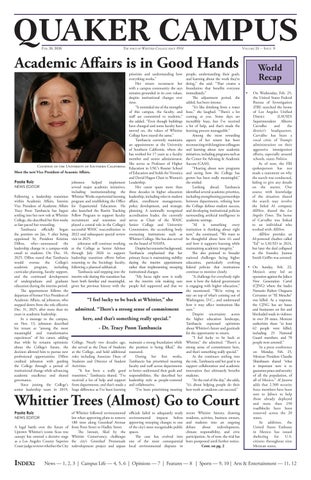
Meet the new Vice President of Acaemic Affairs.
Courtesy of the University of Southern California
Paola Ruiz NEWS EDITOR

Trees Cont. from pg. 1
Greenleaf Avenue functions as a social and commercial hub located just minutes from Whittier College, meaning the outcome could reshape a space frequently used by students for dining, gatherings, and community events.
City officials have consistently framed the Greenleaf Promenade project as a much-needed modernization effort intended to revitalize Uptown Whittier’s economy and infrastructure. According to city statements and reporting by the Los Angeles Times, leaders argue that ficus tree roots have damaged sidewalks and underground utilities, creating accessibility barriers and safety risks that make preservation incompatible with planned construction.
Mayor Pro Tem Cathy Warner previously acknowledged public concern but maintained that addressing Americans with Disabilities Act compliance and pedestrian safety required significant changes to the streetscape, stating officials wished there were “another solution” but believed removal was necessary to improve accessibility and mobility in the area.
In 2018, Justine Gurrola was walking in Uptown when she
tripped on a raised sidewalk. She sustained severe head and bodily injuries: fractured wrists and elbow, bruising and abrasions to her left knee, a slit lip, and acute nasal bone fractures. She sued the City of Whittier for not maintaining their sidewalks and won the case and was awareded $7.5 million.
Opponents of the project argue
(CEQA), which requires agencies to fully analyze environmental consequences before approving major projects. Under CEQA, courts evaluate whether proper procedures were followed rather than deciding whether a project itself is good or bad policy, making documentation and environmental review central to the case.
“God had created the trees; they give free oxygen,” she said, “why would anyone want to remove them?”
- Maggie Mo
that the City’s approach prioritizes redevelopment over environmental preservation and community identity. The ficus canopy, planted decades ago, provides continuous shade that reduces heat and supports wildlife habitats in Uptown’s dense commercial corridor. Environmental advocates claim removing mature trees would immediately reduce carbon capture and cooling benefits, effects replacement trees may take decades to restore.
The lawsuit alleges that the City violated the California Environmental Quality Act
Community organizer Conny McCormack, founder of Save Our Trees Whittier, has emerged as one of the most vehement voices opposing the removal. McCormack argues the conflict is not simply about aesthetics but about transparency and long-term environmental planning. Speaking about community reaction, she described widespread frustration among residents who view the trees as integral to daily life, explaining that people were “so outraged […] sitting under the trees on their favorite street, on Greenleaf.” Her organization has gathered thousands
THE QUAKER CAMPUS STAFF
EDITOR-IN-CHIEF
Paige Meyer-Draffen
DePUTy eDiTOr
eMMa galvan
Managing eDiTOr
PenelOPe TUrgen
neWS eDiTOr
PaOla rUiz
OPiniOnS eDiTOr
angelica HenneSSy
SPOrTS eDiTOrS
Maia cHaiDez
MOnze Meraz-lerMa
caMPUS life
eDiTOr
naDia Miller
FEATURES EDITOR
eMMa cianciOla
a&e eDiTOr
eliaS lOya
HeaD cOPy eDiTOr clOver MOraleS
SOcial MeDia MOnze Meraz-lerMa
STaff WriTerS
allara Baker
eTHan raMillanO
OSWen MarTinez
Tralee JacOBS
Jay fUenTeS
JayDen garreT
JayDen BOrgna
XOcHiTl HOOD
lUiS SanDOval
STeven lOPez
cOPy eDiTOr eTHan ariaDa Daniel gOMez
graPHic DeSigner naDia Miller
carTOOniST neMi DOc
facUlTy aDviSOr JOSePH DOnnelly
of petition signatures and organized outreach efforts aimed at slowing or halting the project while legal challenges proceed.
McCormack has also questioned the effectiveness of proposed replacements such as shade structures and smaller trees, arguing they fundamentally change how public space functions. In interviews discussing alternatives, she criticized the idea that tarps or artificial shade could replace a mature canopy, asking why the city would invest in temporary structures instead of repairing sidewalks and preserving existing trees.
She has further suggested that infrastructure problems attributed to ficus roots could be addressed through targeted repairs rather than full removal, reflecting a broader disagreement between residents and city officials over whether preservation and redevelopment must be mutually exclusive.
The controversy has mobilized residents beyond traditional environmental activism, drawing in workers, families, and local business patrons who see the trees as part of Whittier’s cultural identity.
Maggie Mo, a Whittier resident and employee at Galaxy Kids, framed the issue in ecological and moral terms, emphasizing the role trees play in everyday community life.
“God had created the trees; they give free oxygen,” Mo said, “why would anyone want to remove them?” Adding that families enjoy the space and that the canopy supports bird habitats and local ecosystems. She questioned the rationale behind removal, asking why a system that benefits residents and wildlife alike should be dismantled.
The lawsuit itself stems from decisions made between late 2023 and mid-2024, when the Whittier City Council approved revisions expanding the Greenleaf Promenade into a roughly $20-million project that included infrastructure upgrades such as water main and storm drain improvements.
Preservation groups argue those infrastructure components should have been evaluated together under environmental review rather than
treated separately. According to the Whittier Conservancy, litigation became necessary only after compromise proposals were rejected despite extensive public testimony and study sessions.
Legal observers note that conflicts like Whittier’s are increasingly common across California, where cities attempting to modernize aging infrastructure face growing scrutiny over climate resilience and urban tree preservation. Similar lawsuits in Beverly Hills and Burbank have challenged tree removals tied to redevelopment projects, reflecting a broader statewide tension between economic revitalization and environmental protection. Courts have sometimes required additional environmental review, demonstrating how CEQA litigation can reshape planning timelines even when projects ultimately proceed.
For Whittier College students, the case offers a real-time example of how local governance decisions intersect with environmental policy and civic engagement.
As of now, the court has not issued a final ruling. If the judge sides with the Whittier Conservancy, the City could be required to complete a more extensive environmental review before moving forward, potentially delaying construction and reopening design discussions. If the City prevails, redevelopment may proceed, and tree removal could begin once permitting timelines are finalized. Either outcome may be appealed, meaning the dispute could continue well beyond the initial decision.
Until then, the ficus trees remain standing along Greenleaf Avenue, their future uncertain as legal arguments unfold. For supporters and opponents alike, the case represents more than a planning disagreement; it reflects competing visions of how cities should evolve in an era shaped by climate change, economic pressure, and community activism. As residents await the court’s decision, the debate surrounding Whittier’s canopy continues to raise larger questions about who shapes public space and whose voices ultimately guide the future of a city.
LETTERS TO THE EDITOR
Submissions may be emailed to qc@poets.whitttier.edu in .doc or .docx format. Submissions must include the author’s name and year of graduation or position at the college in the signature. Letters are due by Monday at 5 p.m. to make it into that week’s issue. Submissions should be no more than 500 words. Submissions will undergo the same editing process from our production pipeline if selected. All stories must follow the same journalistic standards.
Due to the high cost of publication, members of the Whittier College community are permitted three copies per issue. Additional copies may be purchased with prior apporval for 50 cents each by contacting the Quaker Campus. Newspaper theft is a crime, and those who violate the three copy rule may be subject to civil and criminal prosecution.
The Quaker Campus does not change material posted on online articles once they have been published in the paper — with the exception of an error being found. Only then will a correction be made to the online version. The Quaker Campus is a publication of Whittier College. Columns and Signed editorials do not necessarily reflect the opinions of Whittier College or its affiliates.
Courtesy of the Los AngeLes Times
The City of Whittier is facing a lawsuit over the 180 ficus trees.
Election Day Comes to the City of Whittier

Election day is quickly approaching for the City of Whittier on April 14, where Whittier residents will head to the polls and decide who will serve as mayor and represent Districts 2 and 4 on the City Council. This particular election is coming during a time when local issues such as housing development, infrastructure, public safety, and environmental policy continue to shape conversations between residents and city leadership.
According to the City of Whittier, the offices of Mayor and City Council Members for Districts 2 and 4 are all on the ballot this year. Residents can vote-by-mail, and the ballots will be sent out beginning March 16 and in-person voting starts April 11 through the 14.
To help voters better understand the candidates and their priorities, the League of Women Voters hosted a nonpartisan candidates forum
on Feb. 17 at the Whittier Community Center, giving residents an opportunity to hear directly from those seeking office ahead of the elections.
The event was recorded and uploaded publicly to increase civic engagement and voter awareness.
Whittier operates under a council-manager form of government. The mayor is elected citywide and serves as the City’s political leader and public representative. While the mayor does not independently control city operations, the position presides over council meetings, helps set policy direction alongside council members, representing Whittier at regional events, and works collaboratively with city staff and community organizations.
City council members represent specific geographic districts and are responsible for approving city budgets, passing ordinances, overseeing municipal services, and responding to local neighborhood concerns.
Following a 2014 charter amendment, Whittier transitioned to district-based elections so residents could elect representatives tied directly to their communities.
Together, the mayor and City Council determine policy decisions that affect everyday issues for residents, including zoning decisions, public works projects, policing priorities, parks, and environmental planning.
As of now there are three candidates for the mayoral ballot: James Becerra, Joe Vinatieri, and Isaiah L. Leon Savage.
District 2 features one of the most competitive contests in this year’s election, with five candidates running: Rene Ramos, Rolando “Whittiercano” Cano, Octavio Martinez, Vicky Satana, and Brian Ahern.
District representatives advocate for neighborhood-level concerns while voting on citywide policy decisions. During the Feb. 17 forum, candidates emphasized topics such as infrastructure maintenance, community engagement, and
Rev. Jesse Jackson 1941-2026
Paige Meyer-Draffen
EDITOR-IN-CHIEF
Reverend Jesse Jackson passed on Feb. 17 at the age of 84. Originally from Greenville, South Carolina, Rev. Jackson will be remembered for his 1984 and 1988 Presidential Campaigns paving the way for President Barack Obama, his staunch leadership in the Black empowerment movements, and affirming the poor and disenfranchised that they are, and always will be somebody; somebody that mattered and was worth fighting for.
Martha Biondi, a professor of Black studies and history at Northwestern University, stated for The Guardian : “Jesse Jackson is described typically as a civil rights leader, as somebody who helped pave the way for the election of Barack Obama, and, while all of that is true, in some ways it’s more helpful and
illuminating to see Jesse Jackson as one of the most prominent figures of the American left in the 20th century […] He’s very much in that very progressive, economic, populist mould. If you see him in that light, then it’s not confusing that he was an early advocate of Palestinian rights.”
Rev. Jackson was also one of the early supporters of LGBTQ+ rights. Jackson was known for standing on platforms of fairness, inclusion, and opportunity. He will be laid to rest in the South Carolina Capitol building.
improving communication between residents and City Hall.
In District 4, incumbent council member Fernando Dutra is seeking reelection and faces two challenges: Aida Susie Macedo and Felipe “Phil” Longoria.
Incumbent races often center on a candidate’s record in office and discussion at the forum included city budgeting decisions, developmental projects, and longterm planning for Whittier’s growth.
The Feb. 17 forum allowed candidates to outline policy priorities and campaign promises directly to voters. Forums like this are designed to help voters compare candidates side-byside and evaluate differences in leadership styles and policy goals.
Across races, several shared themes emerged: improving public safety while maintaining community trust, addressing infrastructure and street maintenance, balancing housing development with neighborhood preservation, supporting local
businesses and economic vitality, and increasing transparency and community from city government.
Another forum will be held on March 3, hosted by the Whittier Chamber of Commerce that will provide another opportunity for voters to hear from those running for office before ballots are cast.
Although municipal elections often receive less attention compared to state or national races, local officials make decisions that directly impact daily life in Whittier.
City council votes influence housing developments near campuses, transportation infrastructure, environmental policies, and funding for community programs used by students and residents alike.
As campaigns continue through March and early April, candidate forms and public outreach efforts will likely play a key role in shaping voter understanding ahead of Election Day on April 14.

Paola Ruiz NEWS EDITOR
Paola Ruiz NEWS EDITOR
Courtesy of WhiTTier DAiLy neWs
The City of Whittier will hold Election Day on April 14.
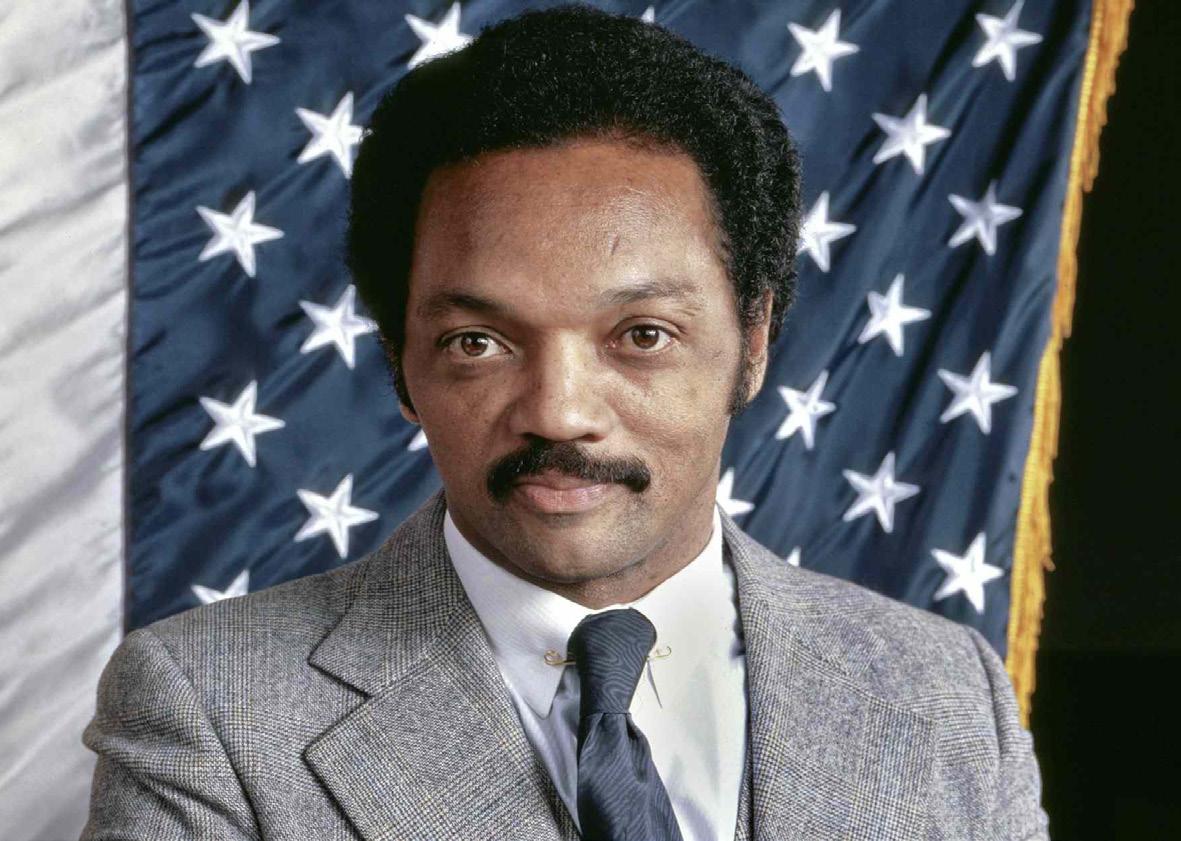
Reverend Jesse Jackson died at the age of 84.
Courtesy of The neW york Times
What’s up,
Whittier?
Stay up to date on events! For further info, visit https://whittier. campuslabs.com/Engage/
Red Cross Blood Drive
• Thursday, Feb. 26 at 10:00 a.m.
• Villalobos Hall
Chair Massage
• Thursday, Feb. 26 at 12:30 p.m.
• Naylor Partico (Deihl Hall Patio)
Poet Pantry
• Thursday, Feb. 26 at 12:30 p.m.
• Campus Center - Room 141
Palestine in Context: Critical Conversations
• Thursday, Feb. 26 at 12:35 p.m.
• Campus Inn
PHE Open House
• Thursday, Feb. 26 at 3:00 p.m.
• PHE Office (Johnson Hall First Floor)
Week of Resistance: ICE out of Whittier - Sign-Making Workshops
• Thursday, Feb. 26 at 6:30 p.m.
• KPOET and QC Offices
Poet Musicale
• Friday, Feb. 27 at 12:00 p.m.
• Memorial Chapel
Week of Resistance: ICE out of Whittier - Paint the Rock
• Friday, Feb. 27 at 12:00 p.m.
• The Rock
Esports Open House
• Friday, Feb. 27 at 4:30 p.m.
• Ball LLC
Game Night
• Friday, Feb. 27 at 6:00 p.m.
• Dezember House
Black Market Flea
• Saturday, Feb. 28 at 3:00 p.m.
• LA
Week of Resistance: ICE out of Whittier - School-wide March and Liv Show
• Monday, Mar. 2 at 12:00 p.m.
• Campus Courtyard
Drawin' Together
• Monday, Mar. 2 at 4:00 p.m.
• Dezember House
Declare Your Major Day
• Tuesday, Mar. 3 at 11:00 a.m.
• CAAS
Cerebral Palsy Awareness Month
• Tuesday, Mar. 3 at 12:00 p.m.
• SLC 2nd Floor Patio
Week of Resistance: Your Rights. Your Power. Your Plan.
• Tuesday, Mar. 3 at 12:00 p.m.
• Office of Inclusive ExcellenceOritiz Lounge
Pet Therapy
• Tuesday, Mar. 3 at 12:30 p.m.
• Founder's Hill Lawn
Craft Night with Fiber Arts Club
• Wednesday, Mar. 4 at 5:00 p.m.
• Ettinger Lounge
CAMPUS LIFE
OIE and ASA Welcomes the Fire Horse
Lunar New Year 2026 Gets a Warm Welcome at CI
Ethan Ramillano STAFF WRITER
With Lunar New Year being celebrated around the world, Whittier College had its annual celebration to ring in the Year of the Fire Horse. Hosted by the ASWC Senate, Office of Inclusive Excellence (OIE), and the Asian Student Association (ASA), the event took place in the Campus Inn (CI) from 11 a.m. to 2 p.m. on Tuesday Feb. 17. Students and staff entered a hall adorned with red paper lanterns and spring couplets throughout, and quickly helped themselves to the plethora of food on display.
The menu consisted of various dishes hailing from cultures that celebrate the New Year, from Chinese char siu pork and potstickers to Vietnamese chicken pho soup, among other options. Beverages included lemonade and dragon fruit tea,
along with tasty almond cookies and other festive desserts.
For commuters and those without a meal plan, they were given meal vouchers in red envelopes, as customary of the Lunar New Year.
The luncheon included various activities for participants to enjoy, such as lantern painting, fortune reading, a photo booth, Chinese knot tying, and even a raffle for Lunar New Year-themed LEGO sets. The most competitive prize out of the three sets was the largesized “Good Fortune” Chinese fan set with dozens of ticket entries just before the raffle, though plenty of attention was also given to a lucky cat and plum blossom LEGO set.
Nearby, attendees could read fortunes about what the Fire Horse year will have in store for them depending on their Chinese zodiac animal. Out of the 12 animals that cycle every lunisolar year, each animal possesses its own
characteristics and has varying degrees of compatibility with the others.
Monkeys for example, (born 1992, 2004) should expect stability while staying mindful of loneliness, while Dogs (born 1996, 2008) should be careful of major fluctuations in their lives, and thus strengthen their relationships and finances this year.
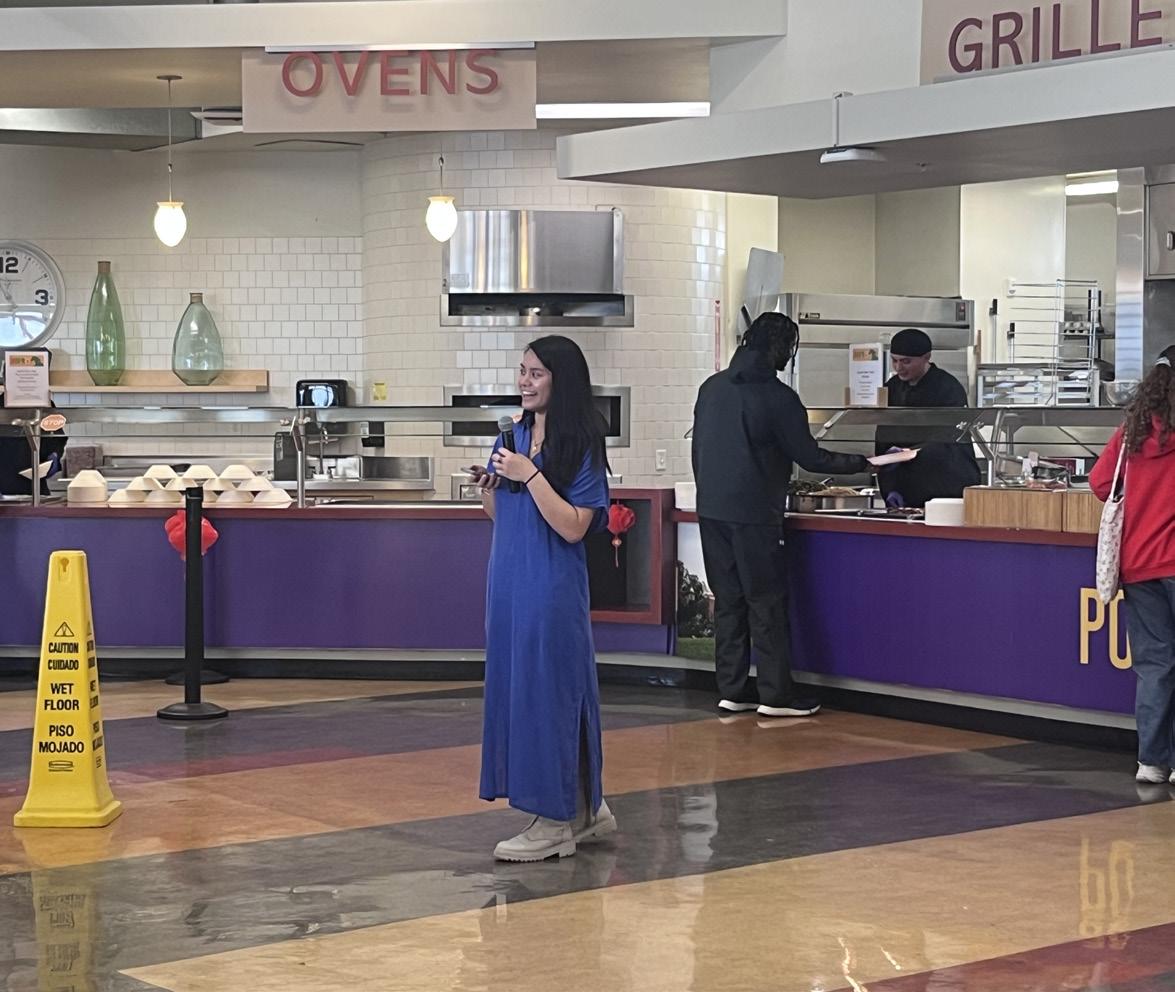
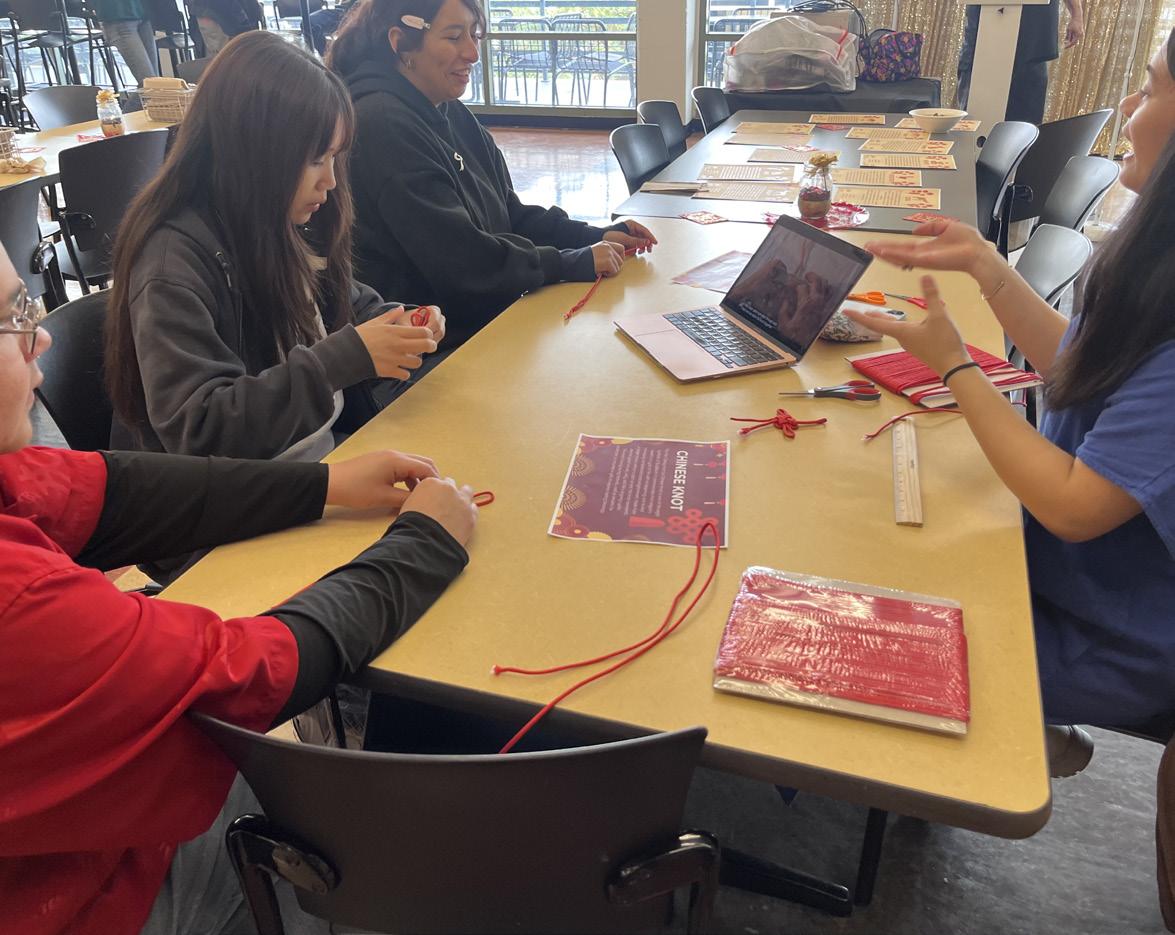
Sitting near the zodiac fortunes, fourth-year Chelsea Bartilad, one of the Co-Presidents of ASA, led students in tying their own lucky knots with red paracord, while also taking charge as the sole emcee throughout the luncheon.
Bartilad later said that it was an unexpected role for her, especially as it was her first time experiencing a Lunar New Year celebration on campus. She also revealed that due to unforeseen circumstances, initial plans for a Lion Dance performance and chopstick competition at the luncheon had to be reworked.
But despite the circumstances,
Bartilad said that having no prior Lunar New Year events to set her expectations on alleviated much of the stress during preparations, and she was instead excited to see everything come together.
The intensive planning for the luncheon involved collaboration of several different organizations on campus, including the Lunar New Year Planning Committee and Bon Appétit, which Bartilad said was smooth process overall. She gives a special shout-out to her fellow ASA Co-President, fourth-year Laurens Chao, along with LNY Planning Committee Head, fourth-year Sophie Evrad, for their hard work in making the celebration possible. While this may be her first and only time she gets to celebrate Lunar New Year at Whittier College as a fourth-year, Bartilad says she was honored “not only [to] represent ASA, but to participate in continuing the tradition of celebrating this special holiday with the Poet community.”
Mariano Zaro and Whittier Poets
Whittier College Students Join Author Mariano Zaro in a Poetry Reading
Penelope
Turgen
MANAGING EDITOR
On Tuesday, Feb. 10, Professor Tony Barnstone hosted a poetry reading in Bonnie Bell Wardman Library with keynote speaker Mariano Zaro. The seats were full of excited Poets ready to listen and share. A receptive audience, a quiet night, and a library filled with the sound of poetry. The intimate setting of the library paired with the small crowd allowed for a vulnerable reading among peers.
Zaro is a published author and poet. He was previously a professor here at the College for six years before moving to Rio Hondo College, where he continues to share his expertise.
Professor Barnstone began the night by introducing his esteemed colleague, an artist with “incredible generosity of spirit.” He invited the audience into reading by sharing, “You can live in a completely shattered universe, but we come together in the arts.”
To start the evening, first-year Claude Steen read two original
poems about their relationship with their partner and their intimate connection shared through food and culture. Following Steen was first-year Tralee Jacobs, reading two original poems, one of which was titled “That’s Better.”
Next for the evening was Dennis McGonagle, a talented painter and muralist whose art is featured on Whittier College campus and in the town of Whittier. He read “A Great Cloud Rises Over Trader Joe’s” and “Morning Bike Ride,” two original works of poetry.
Following McGonagle were first-years Z Hartung and Brooke Logan-Arcega, who both read an emotional and grounded piece of original poetry.
Fourth-year Nadia Miller followed, reading two poems written from their senior project, which focuses on a blend of poetry and illustration. Miller's project brought different sea creatures to life together into a self-designed booklet.
First-year Madilyn Gonzales followed Miller and read two original poems about her ex-
boyfriend, as so much art is about difficult relationships. Next was first-year Connor Udhus, who read an original poem, followed by fourth-year Zoe/Auden Berkebile reading two original poems.
The last of the guest artists was Whittier College’s own published author, journalist, magazine creator, and Professor Joseph Donnelly. After remarking that “poetry is terrifying,” he read two emotionally charged pieces that the audience received with open hearts.
After the Whittier College community opened the floor, Zaro was thrilled to be in front of a real audience as opposed to the broken connection of Zoom from CovidDays past: “People see and touch and cry and everything.” Poetry
is a conductor of warmth and vulnerability that functions best with the closeness of an intimate audience, which is exactly what the group gave to the speakers on Tuesday evening. Zaro read some poetry from his recently published collection of poetry Padre Tierra, which features a heavy use of scientific language to illustrate family dynamics, as well as inflictions of the mind.
Students and faculty listened to their peers and Zaro with bated breath, matching their vulnerability by internalizing their messages and art. An open audience, along with excited writers reading their work, made for a lovely evening as applause filled the first floor of the Wardman Library.

ASA President Chelsea Bartilad thanked everyone for attending.
Learn to tie a traditional Chinese Knot.
Guest Speaker Mariano Zano.
Nadia Miller / Quaker Campus
Nadia Miller / Quaker Campus
Penelope Turgen / Quaker Campus
Palestinian Traditions Come to Whittier
Choo Bus & Guest Speaker Immerse Students in Palestinian History
Daniel Gomez COPY EDITOR
On Thursday, Feb. 12, the Whittier College community had the opportunity to learn the traditional Palestinian embroidery technique, tatreez. The event, "Tatreez and Tea" went from 5 p.m. to 8 p.m. in Villalobos Hall. Entering the venue, there was a calm and friendly feeling. Many of those in attendance took the time to mingle and share their interest in the event.
The table up front displayed multiple hand made and embroidered shirts made by guest speaker Jenna A. There were books about tatreez laid in front of two framed examples of tatreez also made by the guest speaker. Also adorning the tables were a handmade Palestinian tea set and Palestinian flag.
"Tatreez and Tea" was planned by the Department of Religious Studies, the Sociology and Anthropology Departments, and Dezember House. The main presenter of the night was Jenna A., who gave a very short history of her family before moving on to talk about tatreez
Irfana Hashmi was in attendance for the night, representing the Religious Studies department. Hashmi explained that they had been trying to put together this event for quite some time. They also hoped to host this event, along with other Palestine focused events, later this semester. With conversation about potentially

bringing back the "Palestine Nights" event that Choo Bus had also showed off their mobile museum at.
Before the presentation officially began, I had the chance to chat and get to know the couple that runs The Choo Bus. They are a loving duo, Mahmoud and Kara Abed. Mahmoud Abed is Palestinian and has lived in Gaza for a few years when he was little and again from 2006 to 2008.
Mr. Abed had found a hobby working on cars, and after working for years in construction he bought an old school bus and began renovating it. He later met Kara Abed and the two married. Mrs. Abed helped design the inside of the bus and has been helping Mr. Abed spread awareness about what is happening in Gaza and about the Palestinians. They use the Choo Bus as a mobile museum, the inside of which is lined with many posters from protests and Palestinian books
and artwork.
Once attendees were situated, Jenna began the night by telling those in attendance a bit about her past. She was born and raised in L.A. and started her journey working with tatreez in 2021. She is descendent of Nakba survivors and her family origins can be traced back to Yafa, Palestine. Her grandmother worked as a seamstress and made dresses to be auctioned off for the Palestine Arab Fund.
Tatreez itself is an Arabic word that translates to embroidery, with origins dating back to the Canaanite period, (3000 B.C.E.) Before 1948, tatreez was produced by village women from rural and Bedouin communities. Tatreez was typically passed down from mother to daughter. The craft was community oriented as women would gather together to stitch, compare work, and share motifs.
Thobe, a traditonal long tunic
for women, were heavily patterned with tatreez that depicted the world through the eyes of the women who made them, usually depicting things such as animals, trees, and other landscapes. Although tatreez was used and practiced everywhere it was possible to tell where someone came from depending on the color and type of material used to create the tatreez
The Nakba, translated to catastrophe, devastaded Palestinian lives in many ways. Between 1948 and the 1960s Palestinians mostly had been preoccupied with fleeing to safety and as such they did not dedicate as much time to the practice of tatreez during this time. Many garments with tatreez were lost during this time as well. Tatreez started to make a comeback into Palestinian society again during the 1960s, but it was not until 1987, during the First Intifada, that it rose to become a national symbol of resilience when Palestinian women
began embroidering Palestine’s flag colors onto their thobes.
The presentation then moved on to show how to actually do the cross stitch so attendants could create our own tatreez with materials that were graciously provided to attendees at the start. The practice design was a Moon with feathers in the center and Teeth as the border of the tatreez
The event provided insight into a part of Palestinian culture and its history in a way that kept attendees engaged in a hands-on way. The effort put in to share, teach and enable others to partake in the culture was quite admirable. For those wishing to participate in future events the Department of Religious Studies will have two sessions of "Palestine in Context: Critical Conversations" held at the Campus Inn (CI). The first event will be on Thursday, Feb. 26 at 12:35 p.m. and the second on Thursday, Mar. 19 at 12:35 p.m.


Learn about Tatreez and Traditional Palestinian Embroidery.
Handmade Palestinian flag adorning the tables.
Courtesy of Campus Safety
Courtesy of Weekend Threads
Courtesy of Weekend Threads
CAMPUS LIFE
Become Eco-Friendly With Sustainability Club
See What Sustainablity Club is All About
Paige Meyer-Draffen EDITOR-IN-CHEIF
How much of your closet do you actually wear? How many singleuse plastics are you going through in a week? Do you know what kind of plants are just outside of Hoover Hall? Sustainability Club is asking members the hard questions, and then laying out the earth-loving solutions.
The organization has been shifting its focus to exploring sustainable practices through creativity. Last year, the club hosted a workshop on tye-dying fabric for reusable silverware kits with natural materials, like avocado peels and onion skins.
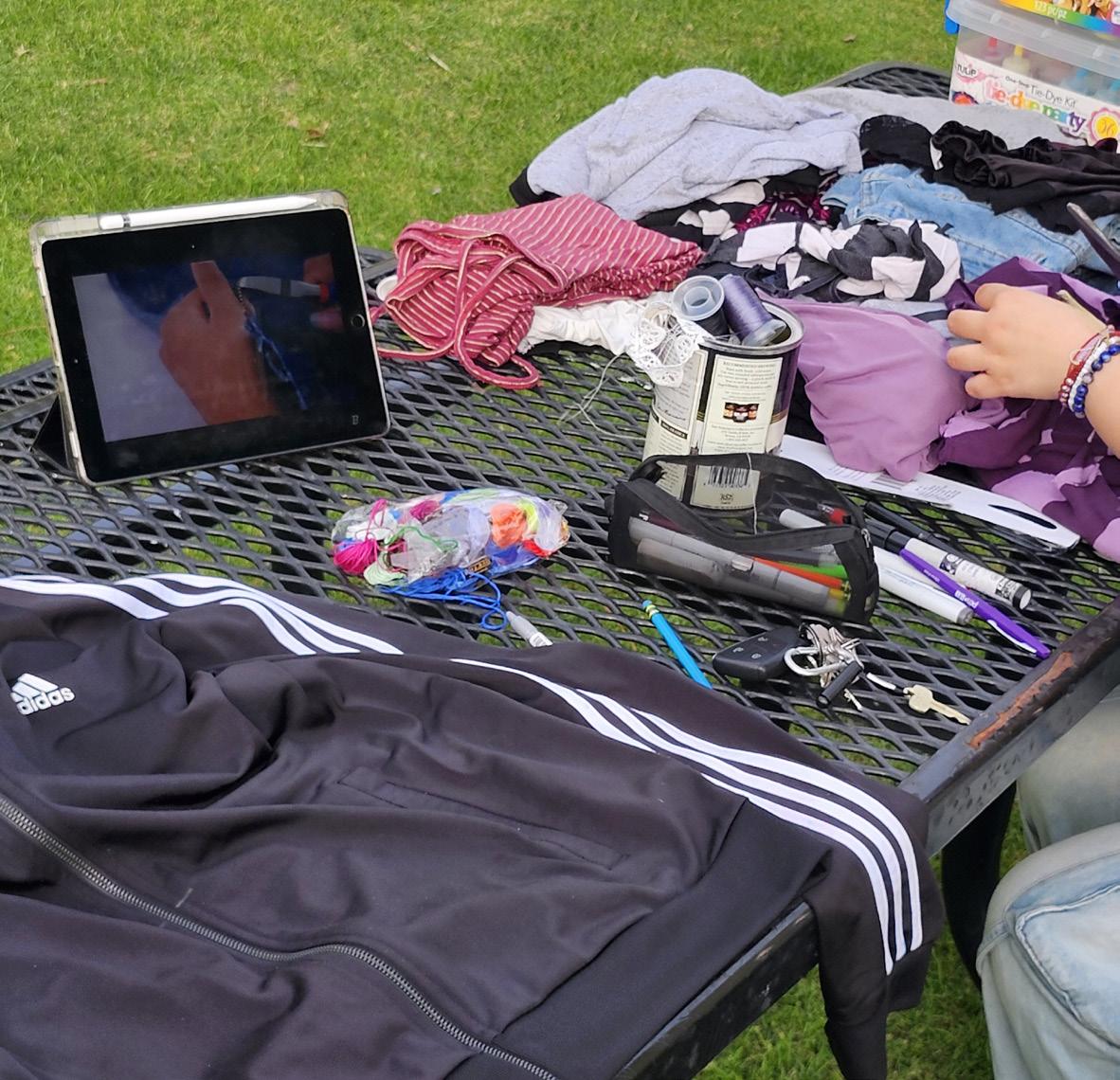
Sustainability Club hosts workshops that center on sewing, mending, and upcycling clothes to reduce clothing waste. The clothing waste cycle is complex and extends globally. The Government Accountability Office (GAO) found that American textile waste has increased 50% between the years 2000 and 2018, largely due to “a shift to a fast fashion business model; limited, decentralized systems for collecting and sorting textiles; and the infancy of textile recycling technologies.”
Most consumers who are trying to get rid of clothes have turned to donation centers or reselling platforms like Depop and Poshmark. Another option that’s becoming more popular is clothing swaps. Local organizations like EcoNow and Rescued Eras Thrift sell tickets to large-scale swapping events, and on-campus organizations such as
the Counseling Center, Residential Life, and Sustainability Club have hosted clothing swaps as well.
The Sustainability Club is encouraging students to reduce their footprint and keep their clothes by offering students the chance to give their garments a second life.
Fourth-year Emily Perez-Medina, a longtime member of the Sustainability Club, has hosted multiple upcycling events over the past two years.
“Clothing upcycling is something that I've maintained as a hobby since I was younger, and I wanted to spread the joy of it and educate students about the benefits of it,” Perez-Medina states.
Perez-Medina joined the Sustainability Club in her second year, and has been a frequent
collaborator for the organization’s events.
President Audrey Sparks is a fourth-year Environmental Science and History double major, with a minor in Biology. Sparks is also the only graduating senior in the Environmental Sciences Department.
“I always knew I wanted to go into, like, plant science and sustainability club at the time. When I first joined, I had gone to quite a few like plant-based events, and I was like ‘This is my club,’” Sparks remarked.
Sparks’ love for plants has grown into her vision for the club’s next project. Nestled between the Desert parking lot and the SLC sits a California Native Garden, just above the bike repair station.

“None of [those] plants are native [to California],” Sparks laughs.
The College’s menagerie of plant life encapsulates Californiafriendly species. Succulents like Chalk Fingers and Agave, and pollinator plants like Goodwin Creek Lavender and Aloe flowers, are throughout campus. However, more than half of the campus is covered in manicured lawn, which is watered daily across campus for just under an hour at a time.
Sparks has plans to reach out to the Associated Students of Whittier College (ASWC) to bring the rightful species back into the garden.
Sustainability Club meets biweekly on Tuesdays at 12:30 p.m. - 1:30 p.m. in SLC 101. Their last meeting on Feb. 24 offered students all-natural, candied flower petals to enjoy. Sparks plans to bring more plant-based activities to students who attend meetings.
Sparks and the Sustainability Club Advisors, Dr.Bowen and Dr. Cinzia Fissore, have been pursuing recruitment of underclassmen to fill in the ranks of the club. Be sure to follow @sustainabilityclubwc on Instagram or reach out to sustainability@poets.whittier. edu if you have any questions or suggestions.
Black Graduating Seniors Will Get Their Flowers
Allara Baker STAFF WRITER
To kickstart the spotlight on the cultural graduation ceremonies and committees on campus, we took a brief look behind the scenes at preparations for the Black Cultural Celebration. DEI ambassador and second-year Darreionna Roche provided us with a preview into preparations, serving as this year’s committee co-chair.
The committee also consists of second-year Naomi Onyekwe and fourth-year Martha Perez, vSankofa (Black Student Residential Community) residents second-year Jayden Garret, fourth-year Paige Meyer-Draffen, Supervisor Ashley Duenas, and fellow Chair, first-year Kevin Padilla. They are advised by Dr. Douglas Manuel II and Dr. Kay Sanders. Every year the committee sets a theme for the graduation.
“This year’s theme is the Sankofa Journey, as well as Princess and the Frog combined with a pastel theme,” Roche explains.
The symbol depicts the Sankofa bird (which originates from West Africa) signifying “go back and get it.” According to Roche “It’s about stepping into
the future while honoring the past."
The bird is meant to symbolize the community’s return to their roots, and liberating the voices of their ancestors while building a foundation for future generations of Black students here at the College.
“The bird can also look like a heart, which also symbolizes the heart of the graduate and carrying on the journey of what it means to be Black,” Roche explains.
The committee also has discussed the importance of hosting this graduation while on campus.
With being minorities on campus, especially as Black students, building community within the student body is something Roche considers vital to the committee.
Getting the student body involved as a whole and driving further engagement is what makes these ceremonies important.
“So we’re going big, not just within our Black community, but also the whole student body to engage with the cultural celebrations. We’re trying to fight to keep these traditions alive, and if people don’t show up, who are we reserving the community for?” Roche asks.
What Roche finds to be the most important aspect of preparing for the ceremony is that sense of
belonging and bringing the theme to life. “I think it’s so important as a leader, since it’s more than just a title to me; it's how I feel engaged to the Black community here. The best way I can do that is by running this event,” Roche remarks.
Roche also discusses the importance of honoring Black identities on campus and building the foundation for self-acceptance through events held by the Black Student Association (BSA).
“There’s just a lot of pressure to change yourself to fit in, especially when you’re in college, and we don’t see ourselves as much as we wish to. I mean, we only have two Black professors, which can be disheartening,” Roche said.
“Sankofa is not just student housing, it is the Black community reflecting as a community and as individuals. It is a family from out of state to international students, whose friends become family. We’re the only family we have.”
The core of what it means for the Black student body to prepare for this event is exactly that. Reflecting their creativity, uplifting their voices, and honoring the accomplishments of the graduates as well as alumni.
The lack of representation and division that we can be continuously
surrounded by—that’s what makes highlighting our Black grads just as important. “While we sit in classes taught about our own history, we always go back to Sankofa where students rejuvenate heart and strength, while we create our own Alma mater as Black students of Whittier College” said Roche. “We step into being more than that for ourselves, family and those next to
be in our shoes.”
If you are a Black student who's graduating this Spring, and would like to participate in this upcoming ceremony on May 8, you can fill out the participation form on Engage. Head down to the Office of Inclusive Excellence (OIE) to get further information on how you can get involved in this ceremony.

The stole design for Black Graduates.
Courtesy of Black Grad Committe
Courtesy of Residential Life
Courtesy of ASWC Senate Sustainability Club's own upcycling event.
The flora in the Native Garden by the SLC.
Has The Silver Screen Turned Gray?
Ethan Airada COPY EDITOR
Under capitalism, everything in our modern society has become a commodity. The clothes you wear, the concrete sidewalks we walk on, and someday, perhaps, even the air we breathe. If people will buy it, it will be mass produced with the lowest quality that sellers can get away with. There is one thing, however, that should never be reduced into a commodity: art.
Capitalists froth at the mouth at the prospect of another market to quickly burn in the fire of their greed, but art has always been something their flames could never destroy.
At least, not without a lack of effort. This is what’s happening to cinema today, movies now have about the same presentation as a commercial you might see on television: a very “clean” aesthetic. Stagnant color-grading, bare lighting, stories designed so that you can “watch it” with Subway Surfers playing somewhere in your peripheral vision, and heavy reliance on CGI over practical effects. Why is this so? Look no further than Netflix
It’s unfair to assume that Netflix intentionally began filming original content with the intent of converting the rest of Hollywood to their industry standards and budgeting shortcuts. But viewers are certainly picking up on this change.
Stranger Things is a prime example of the aforementioned criteria, though there are certainly others. The Witcher on Netflix began as a gloomy landscape only to look flat in later seasons. The only thing Weapons did to present itself as horror visually was make a few scenes too dark to see, and even The Naked Gun, a continuation of a premier comedy franchise of the same name, is filmed as if every character will suddenly freeze while
Liam Neeson looks at the camera and describes the benefits of getting a Capital One credit card. It wasn’t always this way—Stranger Things began with episodes on par with feature-length films until the focus shifted to in-post edits and this “clean aesthetic.”
This may seem like a minor problem in the grand scheme of things, but it’s a big step in the wrong direction. The intention of cinema is to bring art to life, and presentation is one of the most important parts of that. It all stems from the idea that making successful art can be formulaic—that playing it safe is the best way to maximize profit.
By doing this, studios not only save money by filming minimalistically, but they increase the chances that the final product will be more successful—a prime example being Marvel movies.
Each one is filmed with the same Disney cameras, writers, directors, producers, and filming standards. This nosedive in creativity extends to writing quality.
The final season of Stranger Things was written for extended exposition and so that it could be listened to if an audience member was too distracted to pay attention— as if anyone who put it on somehow didn’t feel like watching by the time
it started playing. It’s a vicious cycle that churns out the same product relentlessly as long as it's still profitable.
To take a closer look, cinematography will catch your eye, though it’s hard to tell sometimes because some movies are still good while sorely lacking a nuanced look cinematically.
In order to determine this, ask yourself a few questions: Was Weapons or Sinners more emotionally evocative? When was the last time there was a movie with the same production quality as the Lord of the Rings trilogy? If a movie being sanitized was truly better for the artform as a whole, then why was The Holdovers, a movie filtered to look as if it was filmed in the 1970s, so successful?
Cinema is an art. Minimalist film, in this context, is just an excuse to save a few pennies. A clean art piece has no soul. People watch movies to be entertained, yes, but audiences should leave feeling something, something that was put in there by another person who poured their blood, sweat, and tears into making it.
When an artist prioritizes making their art safe, it becomes so marketable that it feels meaningless. Good quality art is rarely safe. There are risks every step

The quality
cinema has noticably
of the way, which is what makes it all worth it in the end.
Art is an expression of emotion just as much as it can be a reflection of rationality. That synthesis of opposing forces is what makes it so moving. Playing it safe only shows that a studio isn’t willing to commit to something. When art becomes a means for making money, it becomes stale and ultimately has the opposite effect. Most people don't enjoy watching a movie that feels soulless.
While some of these films do manage to still make a profit, this will not be a good strategy in the long run. Soulless films are released and typically forgotten just as fast. Filmmakers deserve creative freedom and not to be held back by industry executives only worried about profit. Their primary worry should be the quality and lasting emotional impact of their art, not box office numbers.
All of this is happening during the deepest pit of the digital age, where more people are simply scavenging constantly for instant gratification, and the shift into making movies safe and digestible reflects that.
Considering how easy it is to access movies through streaming services and pirating sites, the court of public opinion is open to any idiot with a X account who can say it was bad and tank its reviews. Cinema is shifting to this format of prioritizing a streaming release, which doesn’t help cushion their Rotten Tomatoes score at all. It's leading some to wonder if the art form of cinema is dying.
It isn’t. There are plenty of good movies that have been released and are anticipated by audiences that don't fit into any of this—Sinners, The Batman, the Dune franchise, and Iron Lung all have unique styles that give them true artistic emotion. It isn't the end of cinema; it's just a phase that we hope will be over soon.


Dear Poets,
How do I deal with my midterms so I can enjoy spring break? - A stressed out Poet
Jane: My academic career has been defined by one sentence: “I’ma let it fly!” Just wing it! It’s only midterms, you don't need a good grade on these to pass the class. Save all that energy for your classes’ final, that’s when you have to lock in for real.
Jo: Simple, you either deal with midterms now or later. You can get all of it done before the break so you can frolic around the fields or wherever you’re gonna end up during Spring Break… OR you can be the college student you’ve always been and CRAM every midterm the night before it’s due. Who even likes to study at the time you’re supposed to, anyways?
Holding everything off for later is part of the college experience, and you absolutely deserve to act out on your desires for the time being. As a procrastinator myself, I’ve maintained a successful academic career with this same logic, and now I’m graduating. Plenty of sleepless nights (I think better at night), plenty of nights regretting saving everything for the last minute—I MEAN plenty of nights relishing in my ability to work efficiently under pressure. It’s all up to you though. You’re an adult, you figure it out!
Johnny: While spring break seems so close and yet so far, we must dredge through the horrors known as midterms. First, make sure you check what type of midterms you have. Some professors do tests, but there’s a chance your midterm is an essay or a presentation. Also, try to group them into specific categories on what type they are and study for the ones that you feel less confident about, especially if they actually are multiple choice or short answer tests.
If it’s an essay, start with an outline and do the actual assignment after you finish your other tests, assuming it’s due the Friday before we leave. If you’re still wanting to just get midterms over with, simply remind yourself that you can get yourself a sweet treat once you turn it in. Regardless of the result, you did it and a sweet treat can do no wrong.
- The Poets
Courtesy of Netflix
of
decreased in recent years.
Courtesy of KPOet
From The Court To The Stage, She Does It All
Gaby Hernandez FOR THE QC
It was senior night. Mia Palmer took the court determined to get the Whittier College Poets a win over Cal Tech. A spirited crowd claps and cheers as the clock ticks down time. With the Poets in the lead, Palmer leaps up and smacks the ball over the net to seal the victory for the College and end the game.
“Mia is exactly the type of athlete we want in our program. Hardworking, kind, team first,” says headcoach DuarteMcDermott.
Palmer is a secondyear Business major with a concentration in Finance. On the volleyball team, she plays outside hitter and is growing into a leadership role. “Besides her work ethic and strong sense of team, Mia makes others around her better. She pushes everyone by setting an example every day,” Coach DuarteMcDermott brags.
Just days after the big game, Palmer prepares to take the stage to sing to a chapel filled with an audience coming to hear the Whittier College Choir perform their carefully rehearse. She crushes her vocal parts in the alto section, adding to the success of the ensemble’s performance.
Palmer is a rare student in that she competes at the college level. Though numbers vary by institution, according to a 2024 report by the National Collegiate
Athletic Association (NCAA), only about 530,000 of more than 18 million college students are student athletes. Even fewer of those can say they are also highlevel musicians. Mia Palmer can. However, aside from beingan integral member of the volleyball team, Palmer plays the piano and sings in the College choir.
Thanks to her musical talent, Whittier College awarded Palmer with a music scholarship, giving her the opportunity to showcase her artistic side. To earn the scholarship, Palmer had to submit a video audition of performing two piano pieces and write an essay on the importance of music in life and the place she believes it will hold in her future.
“Mia is a conscientious and talented student, and I know I can always count on her to not let her teammates down—whether in sport or in a musical context,” gushes Dr. Alex Grabarchuk, her choir conductor.
Palmer explains that, she tries to put music first, but when her volleyball schedule calls, her music professors have supported her. “I feel like I’m lucky here,” she says. “Dr. G is so understanding. Even today I’m leaving choir early because I have a volleyball thing.”
Coach Duarte-McDermott is similarly poised to accommodate Palmer’s musical interests. “I love that Mia is well-rounded and has the ability to participate in both,” Durate-McDermott explains. “I know she came here for volleyball, but the
opportunity to continue and enhance her musical background is an absolute bonus.”
Palmer’s overall adjustment to balancing music and volleyball in college wasn’t always easy. To deal with leaving home, the pressures from volleyball, being in a new environment, and not to mention rigorous academics, Palmer turned to music as a relaxing reset. On occasion, before practice, she would go to the Music Building to play piano and calm herself before her volleyball practices. “It acted as my release and calmed me,” she says, her eyes lighting up.
While volleyball and singing in a choir may seem worlds away, Palmer says they both share some fundamentals in common, like being mindful and disciplined. “In choir, if she [Dr. G] tells us we have to be loud or quiet here, you have to be mindful to remember that. In volleyball, you have to remember to get to this position on defense.”
In addition, she has learned helpful hacks from the choir that she has applied to sports. She uses a breathing technique she learned from her choir conductor that she also uses in volleyball.
Palmer began taking piano lessons and was taught by a strict instructor who she jokingly calls a “crazy lady,” Palmer explains, “She was your typical slap-your-handwith-a-ruler lady.”
At age 10, Palmer started taking lessons with a neighbor named Kristen Wray, who was a big influence on her music skills.

This was right around the time she also developed a deep passion for volleyball. Yet, she never let it keep her from continuing piano. When volleyball conflicted with piano lessons, Wray remained understanding, “She would tell me it’s okay and thank me for putting in any time at all,” Palmer says.
Palmer and Wray would rent out a backroom of a piano store and get other fellow pianists to play for family and friends. In her beginning years of playing, Palmer was one of the first to perform, and now she is the last. “The weirdest part was having the ‘aha’ moment right before I left [for college].
I used to be the first person, and now I’m the last person. Kinda seeing how far I’d come.” Palmer
states
One day after a volleyball tournament, the assistant volleyball coach from Whittier College approached Palmer, and
began introducing her to the college she would soon call her own. Two weeks later, Palmer came and fell in love with not just the school but the team. “I didn’t even know they existed. They found me” Palmer excitedly exclaims.
Palmer sees herself graduating from the College with her degree in Business and concluding her volleyball career here. As far as music goes, she wants to continue to play for others and to perform for the elders in her community. “I definitely want to keep playing the rest of my life,” she says. “Piano is the only reset I have where I can play for about five minutes and feel a physical difference within mysef.”
You’re likely to find Palmer in the old halls of the Peasley Center for Music Building, sitting in one of the practice rooms on a rickety wooden stool, hunched over the piano, playing her heart out.
Courtesy of Hudi
After Palmer's volleyball journey concludes, the piano stays waiting
Poet’s Sports Schedule:
Women’s Tennis @ Hope International Location: Fullerton, CA
• 3 p.m.
• February 26
Baseball @ University of La Verne
Location: La Verne, CA
• 2 p.m.
• February 27
Men’s and Women’s Track & Field vs. Cerritos Open
Location: Cerritos, CA
• All Day
• February 28
Men’s Tennis @ AzusaPacific University
Location: Orange, CA
• 10 a.m.
• February 28
Women’s Water Polo @ Chapman
Location: Orange, CA
• 11 a.m.
• February 28
Baseball vs. University of La Verne
Location: Whittier, CA
• 11 a.m. & 2:30 p.m.
• February 28
Softball vs. Pacific University
Location: Whittier, CA
• 11 a.m. & 1 p.m.
• February 28
Softball vs. Gustavus Adolphus College
Location: Whittier, CA
• 11 a.m.
• March 2
Baseball vs. Bridgewater College
Location: Whittier, CA
• 2 p.m.
• March 2
Softball vs. Bridgewater State University
Location: Whittier, CA
• 11 a.m. & 1 p.m.
• March 4
Women’s Water Polo vs. Fresno Pacific University
Location: Orange, CA
• 11:30 a.m.
• March 6
Men’s Tennis vs. Gustavus Adolphus
Location: Whittier, CA
• 3 p.m.
• March 6
Softball vs. University of La Verne
Location: Whittier, CA
• 3 p.m.
• March 6
Visit wcpoets.com/calendar for the full sports schedule!
SPORTS U.S. vs. Canada at Milan: Golden Goals
Maia Chaidez SPORTS EDITOR
Everyone remembers the words, “Do you believe in miracles?!”
Though the name may not ring a bell, Al Michaels is responsible for some of the most iconic words in sports history. But, if we’re being completely honest, he wasn’t qualified to call the game at all.
Yet, none of that mattered when the underdogs, U.S., beat the Soviet Union in the semifinals 4-3, upsetting the hockey giants at the time.
The 1980 U.S. men’s hockey team would go on to defeat Finland 4-2 to win their second ever Olympic Gold medal. Since then, the men’s hockey team would come close multiple times, but never get to bite down on that Gold medal.
The U.S. women’s team shares a more fortunate story, winning Gold the inaugural year the Olympics introduced women’s ice hockey in Nangano 1998. However, the U.S. men’s and women’s teams have never won Gold at the same year’s Olympics. Until Milan-Cortina d’Ampezzo 2026.
Feb. 19, 2026, the women’s Gold Medal game, U.S. vs. Canada. In the dying minutes of the third period with the score
1-0 Canada, the U.S. pulled their goalie. 6-on-5 hockey, U.S. with the empty net.
U.S. player Laila Edwards sends a shot towards goal, and captain Hilary Knight sees it all the way through, redirecting it and giving the Americans a tie game. Regulation ends, and it’s onto a sudden death overtime.
Just about 12 minutes into overtime, U.S. player Taylor Heise sends a rink-wide pass to her defensewoman Megan Keller. Keller deked past Canada’s Claire Thompson and just barely squeaks the puck past goaltender AnnRenee Desbiens with a move that shocked the entire world. After losing to Canada at Beijing 2022, the U.S. finally got their revenge in an absolute overtime thriller, scoring the golden goal to win the sacred Gold medal.
The stars aligned on the other side for men’s ice hockey, as the most anticipated match up came to be; U.S. vs. Canada for the Gold medal.
46 years after the “Miracle on Ice,” the U.S. was ready to do another miracle in upsetting Canada, the favorite to win, and taking home Gold.
As soon as the puck dropped in Milan, both teams were refusing to give an inch of space to each other. The first period was filled with hard hit after hard hit, until U.S. player Matt Boldy found himself splitting the defense and scoring the first goal of the game. Both the U.S. and Canada would try to build upon that lead or even it up, but the first period ended 1-0, U.S.
The second period was all Canada. Canada refused to give the U.S. an inch of space and seemingly always had possession of the puck. However, the defensive play from the U.S. kept them in this game. But the goaltender, Connor Hellebuyck, was a dam under pressure, with Canada’s Cale Makar scoring with 1:44 seconds left in the second period.
The third period ended how

it started, tied at one goal apiece. While both teams had equal chances to win, with Canada missing two open nets, no one could find the back of the net this period. After 20 minutes, it was time for overtime where teams would play 3-on-3 to decide the winner.
Overtime started hot right out of the gates. Canada won the first faceoff and inherited the first possession. Both teams traded shots on goal, but this overtime wouldn’t last long.
U.S. Defenseman Zach Werenski was barreling in hard against Canada’s Nathan MacKinnon to get the puck. As Werenski sent it across to the left side of the ice for Jack Hughes, who just chipped a couple of teeth earlier in the game, receives the puck. Hughes shoots and overtime was cut short 1:41 seconds in. For the first time in 46 years, the U.S. has won Gold in men’s ice hockey.
During the following award ceremonies and celebrations, the U.S. took the time to honor the late Johnny Gaudreau, who had unfortunately passed away along with his brother Matthew Gaudreau after being struck by a car while cycling. Gaudreau was expected to play a big part in this Olympic roster, with many on the roster being close friends or teammates of his.
46 Years to be Sadly Dissapointed
Maia Chaidez SPORTS EDITOR
I was one of the many devoted ice hockey fans up at 5 a.m. watching the Gold medal game in Milan, Italy. From 5 a.m. to roughly 8:30 a.m., my heart rate was reaching levels it should not have been reaching that early in the morning.
As soon as Jack Hughes scored that golden goal to win us the Gold medal, I let out the biggest sigh of relief. Exactly 46 years later after the “Miracle on Ice,” the United States men’s hockey team finally won a Gold medal.
Hours of being on the edge of my seat, and now I could sit back and celebrate these historical achievements. The U.S. had just defeated Canada twice in Gold medal games, with the women’s team also defeating them the previous Thursday.
All of these feelings of pride and excitement lasted just short of an hour as leaked footage and dialogue from inside the U.S. locker room came to light.
The footage showed the team celebrating their victory with FBI director, Kash Patel. Patel is seen crushing beers and celebrating as if he too was on the ice with the rest of the team. His reasoning for this trip? “Professional purposes” says an FBI spokesperson.
Shortly after, another video surfaced of the team on a call with President Donald Trump. He congratulated the team and invited them to the White House. In the same breath, he insulted and discredited the women’s team, who, objectively, had the more
dominant run to the Gold medal.
“And we have to, I must tell you, we’re going to have to bring the women’s team, do you know that?” Trump started, to which, the men’s team responded with laughter. He continued, “I do believe I probably would be impeached, okay?”
Ice hockey is known to be a conservative and right-leaning sport. Yet, when I first saw this roar of laughter in response to Trump’s diminishing comment, it broke me.
There’s always this sense of “but not my guy.” Not my favorite player, not the captain of my favorite team, not my hero. My hero doesn’t believe families should be uprooted and unlawfully deported.
But their laughter means support, whether they mean it that way or not. It means supporting the mass deportations and support of the secret police who has killed civilians. It means rolling back on Civil Rights. It means erasing people and identidies from American history.
My hero doesn’t believe certain people are superior over others. My hero doesn’t believe some people shouldn’t exist. My hero doesn’t believe that the women’s hockey team is worth any less than the men’s.
Instead, I saw my hero happily partying and acting as nothing more than a mascot for the comedy show that is the Trump Administration.
And maybe I’m right. Maybe my hero doesn’t believe families should be uprooted. Maybe my
hero doesn’t believe in secret masked police. Maybe my hero believes that everyone deserves to exist. But the laughter of support says otherwise.
If there’s one thing I pride myself on, it’s my almost insane knowledge of the NHL. Whether it’s the history, following a player from his junior to pro career, or even listing every Stanley Cup winner off the top of my head, I know it.
As a superfan, I start to invest money into buying jerseys, merch, and going to games. I choose to devote time and energy into writing an article covering the NHL’s 4 Nations Face-Off or Ovechkin breaking Gretzky’s goal record. I’m staying up at 5 a.m. for the Gold medal game in Milan where the U.S. is taking on Canada, their most intense rival. And finally they win. For the first time in 46 years, they’ve won Gold—I may never witness this again in my lifetime. You check X to see how celebrations are going, only to be met with a betrayal you almost can’t describe. It was surreal, in the worst way possible.
This controversy isn’t about politics, it’s about morals. While Trump has been in office, he has
led to an increase of families being uprooted through deportations, rolled back protective transgender rights and laws, and has even gone to war against the U.S. people, deploying the National Guard in Washington, D.C. And as the men’s team laughed along with Trump, they just added fuel to every single one of these fires.
The golden goal scorer Jack Hughes replied to the outroar, “People are so negative out there and they are trying to find a reason to put people down and make something out of almost nothing.” However, this wasn’t “almost nothing.” It was an incredibly tone deaf moment that lacked a proper response and understanding of the situation.
You feel stupid for supporting a team or simply just a player like this. French writer Marcel Proust is attributed to saying “Never meet your heroes,” and after Sunday’s game, I don’t think I have any heroes to meet.
The Professional Women’s Hockey League (PWHL) begins again on Thursday, Feb. 26. Their games are free to stream via YouTube and offer the same level of entertainment or, arguably, more than the NHL offers.

Courtesy of Yahoo
U.S. women’s ice hockey reigns supreme over Canada
Courtesy of USa TodaY It doesn’t get any more tone deaf than this.
SPORTS
Honza Zika is a SCIAC Double Champion
Monze Meraz-Lerma SPORTS EDITOR
Honza Zika, a third-year transfer on the Whittier College Men’s Swimming & Diving team, made history when he became a SCIAC Double Champion this past week at the 2025-2026 Swimming and Diving SCIAC Championships. The meet, hosted by Whittier College, took place from Feb. 18 to Feb. 21 at East Los Angeles College.
The four-day event is a grueling, tiresome stretch of swimmers competing in different events all day. The morning preliminary heat puts racers to the initial test of qualifying for the final races in the evening. The top-eight qualifiers race again later in the day in the “A” Final, which is the championship heat, while swimmers 9-through-16 compete in the “B” final.
Zika competed in the 200 Fly and the 400 IM (individual medley), entering the finals as the top-seeded swimmer in both events before successfully defending his top spot later in the evening’s championship heat.
He added this feat to his list of accomplishments so far, including his program records for the College: 200 IM, 400 IM, 200 Fly, and 800 Freestyle relay. Perhaps more significantly, he became Head Coach Mike Jafari’s first-ever Male SCIAC Champion, as well as this year’s SCIAC Swimming & Diving Male Athlete of the Year.
“Honza swam that race absolutely perfectly with a lot
of confidence and a lot of poise, which is something new for him,”
Jafari says.
Zika’s talent was a strong acquisition for the program, given his previous Division I experience at his first two schools, Indiana University and the University of Hawaii. However, the DI culture had also created a hindrance for him. Jafari, a former DI swimmer at the University of California, Berkeley, understands this pressure, “If you’re not first, you’re last.” However, this strays far from Jafari’s motto: “Happy swimming is fast swimming.”
“Normally, [Zika] kind of gets in his head and lacks confidence, which is surprising for someone so talented,” Jafari says. “We worked really hard at fostering an environment where instead of coming in and thinking about racing, [it’s about] coming in and enjoying the process.”
Zika admits that during previous major meets at his former schools, he would crumble under the pressure of nerves and fear, drastically compromising his final results. However, with just one year of being a Poet, he has learned to adopt a new mentality and understanding of his emotions.
“I realized that pressure’s always going to be there no matter what meet you go to,” Zika says. “It’s not about getting rid of it. It’s about telling yourself, ‘Okay, I’m nervous. It’s very scary, but that’s part of it, and I need to work with that. If I work with that, it’s going to help me.’”
Zika competes in daunting events, warranting this intense

weight of pressure. The 200 Fly is four quick laps using the butterfly stroke, which requires both strong stamina and explosive speed. Zika happily claims this race as his favorite.
The 400 IM is twice as long and uses all four strokes: butterfly, backstroke, breaststroke, and freestyle. Zika classifies this race as the ultimate test of who is the greatest and most complete swimmer. He jokes that “death” most closely describes the 400 IM. “You’ll always feel most alive when you’re closest to death,” Assistant Coach Jeff Natalizio advised Zika, which he has applied to his racing.
“[That phrase] is something that I’ve been carrying with me the whole weekend, and I stand by it,” Zika says. “I love going to the place where I’ve never gone before, and pushing it harder than I’ve ever pushed because, during that, I feel so alive, and it’s the biggest
thrill of my life.”
A day after completing the SCIAC Championships, Jafari took Zika and third-year Thomas Langlois, the program’s top long distance swimmer, to try a long course time trial. College competitions occur in a short course, 25 meters per lap, pool. Olympic races are in a long course, measuring 50 meters per lap, over double the length of a short course. Burnt out from the week of competition, Zika laughs as he says that both him and Langlois had their “butts handed to them.” However, Zika’s tired performance still came within 20 seconds of the 400 IM Olympic qualifying time.
“It used to be a dream [to go to the Olympics],” Zika says. “It used to be my life—something that I always thought I would shoot for, but right now, I’m not really sure. I’m just enjoying what swimming is right now.”
Right now, swimming for Zika means holding his numerous broken records at the College, being named a SCIAC Double Champion and Swim Athlete of the Year, and, now, preparing for his next challenge. He and Langlois will head to the NCAA Division III Championships midMarch in Indianapolis, which rounds up the top 16 nationallyranked swimmers in each event from DIII.
Currently, Zika reigns No. 7 in 200 Fly and No. 16 in 400 IM. He emphasizes that none of these accomplishments could have been possible without the support from his coaches and his teammates.
“I really love how Whittier values me as a person, and that allows me to express myself as an athlete[…],” Zika says. “I finally am able to open up, and I can really show the world what I’m made of.”
The Beautiful and Brutal Game: Men’s Lacrosse
Monze
Meraz-Lerma SPORTS EDITOR
The Whittier College Men’s Lacrosse team is officially revived and charging into their first season since the program’s cut in 2023. Currently, the team has 15 players with varying lacrosse backgrounds, yet even with their different skill sets, they all unite under the same goal: being a part of Whittier Lacrosse’s rebirth.
Head Coach Todd Francis was met with a unique challenge of recruiting for the once booming and highly sought out sport at the College, which had been non-existent up until now. When alumni Joe McCarthy ‘97 and Jon Damm ‘95 asked President Dillon what it would take for the revival of the program, Dillon initially proposed a fundraised amount of $145,000. McCarthy and Dam pulled together $200,000.
As a new club sport, the team is playing under the Men’s Collegiate Lacrosse Association (MCLA) instead of the NCAA. As an initiation to this association, teams are required to undergo a probationary year. This means that teams must play at least six scrimmages, where scores and records do not count, to establish the stability of the program and its funding.
This period, which still counts as a year of athletic eligibility, has made it difficult for Francis to recruit more players. However, with uncounted records, this first year has little to no pressure on the team to find quick success. Out of his 15 players, only six have a background in playing lacrosse. Seven of the players are part of the (also reviving) football team, and the rest of the team is made up of walk-ons who are willing to play and face this fun challenge for the school.
“Our goal since day one was [to] get these six [games] out of the way,” Francis says. “Every game that we finish and the officials turn in a complete game card, that’s a victory—so we’re 1-0 right now.”
The team began their season on Feb. 14 against the University of California, Irvine, in which they were dealt a 1-14 loss, yet Francis still calls this completed game a win in his book. However, he understands that this win-or-lose mentality may be difficult to adopt for the players.
“I said, ‘Look, we’re not going to be great. We’re going to start a program from scratch,’” Francis says. “‘But there are going to be 500 alums that are looking at you saying thank you.’”
Francis attributes one of the team’s captains, Colby Allen, a
second-year transfer from Westcliff University, as “the best player on the field in every game we’ll have.”
Meanwhile, Marton Ujvari, a third-year student studying at the College for a year abroad from England, recently joined the team a month ago with no prior lacrosse experience.
Allen chose Whittier College after Westcliff’s lacrosse program experienced its own cut, so this rebuilding process is not new to him. He has eight years of playing experience, and he has been teaching the other players the technicalities and motions of the game. Allen notes that the players are still perfecting their passing and catching, but the football players bring a strong physicality and understanding of defensive skills from their own sport.
“Most of the players have never played lacrosse before, so it’s fun to see them get better practicing each day,” says Allen.
Ujvari has embraced this new sport after he became friends with players that were already on the team. He laughs as he calls himself and the other inexperienced players “a bunch of idiots” on the field, but he remarks that everyone is devoted to putting in the work needed to be part of the official rebirth of the team. Although the team understands they will most
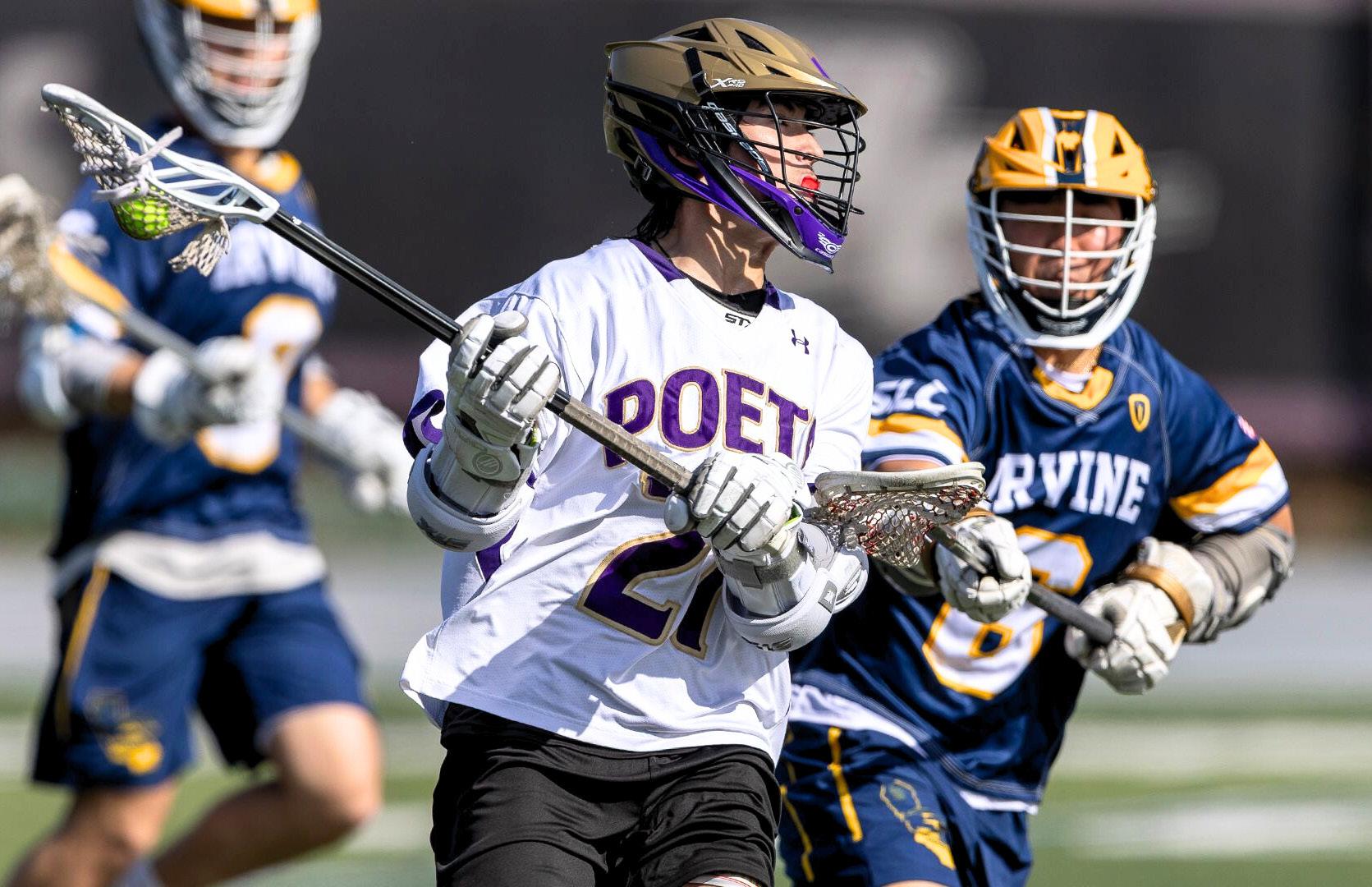
likely face continuous losses, this doesn’t mean they won’t continue to give it their all.
“[Coach Todd’s] been genuinely great for getting that confidence going for us because he understood this wasn’t a game we’re going to win, but he still tells us to get out there and do our best,” Ujvari says. “This is still a victory for him, and I really felt that because we did go out there, and we did try.”
Given that this is Ujvari’s last semester of his study abroad experience, he reflects that his involvement on the lacrosse team has made this semester “a lot more interesting.” While the team’s parents and alumni are prepared to be supportive and present at most
games, the players understand that the student body may not be urgently drawn to watch their games. However, Ujvari argues that even in their current state, the games will be worth watching.
“One of my teammates, he got sandwiched between two players and just absolutely laid out,” Ujvari recalls. “Worried about him in the moment. Looked brilliant when it happened, though.”
Francis remarks that they will worry about the wins when they count, and right now, they don’t. Their next scrimmage is Feb. 28 against Moorpark at 1:00 p.m. As Ujvari puts it, “[...] if you want to see something that’s a bit brutal but quite beautiful, I think lacrosse is definitely there.”
Courtesy of Tony Leon / acTion WeST PhoTograPhY Honza Zika gleams as he finishes the 200 fly as the SCIAC Champion.
Courtesy of Tony Leon / acTion WeST PhoTograPhY Colby Allen, Men’s Lacrosse captain, playing in the team’s first scrimmage.
The QC Staff
Suggests:
Elias Loya A&E EDITOR
Want to know what our A&E Editor recommends this week?
Show: Recently, I’ve been really into the anime adaptation of Nana I haven’t gotten too far in, but I love everything about it. The aesthetics, the whimsical and sometimes grave soundtrack, and even how complex each character is. There’s so much to appreciate, and I’m excited to see where the show goes!

Album:
I’ve been bumping Bottomless Pit by Death Grips A LOT this February. While it isn’t my favorite Death Grips record (The Powers That B is), it has so many gems, like the thunderous “Giving Bad People Good Ideas” and the enthralling “BB Poison” that critiques the entire Death Grips fanbase. The only way to listen to this record is on max volume.

I’ve been collecting vinyl records since middle school, and I haven’t stopped since. There’s something so fulfilling about owning some of your favorite pieces of music. It forces you to really listen to the album. I have 50+, and I’m excited to add more.

Mammal:
I LOVE seals! They always look so round and cuddly like puppies, and I love how mischievous and curious they can be. It’s also super cool that they’re able to hold their breath for over an hour.

ARTS & ENTERTAINMENT
Submerge Yourself into Iron Lung
Can Youtubers Make Cinema?
Angelica Hennessey OPINIONS EDITOR
80 thousand gallons of fake blood later, Mark Fischbach’s (known online as Markiplier) much-anticipated directorial debut, Iron Lung, is breaking records and box office expectations. Based on the horror video game of the same name released in 2022, Iron Lung is an atmospheric and gruesome story of a character desperate to survive in a world where there is nothing left for him.
As many know, Markiplier has 38.4 million YouTube subscribers and is one of the most loved creators on the platform, so it's no surprise that this movie has been gaining so much attention.
Initially slated to only be released in 60 U.S. theaters, high demand from fans resulted in the film being shown in over four thousand theaters internationally. This film was a passion project for Fischbach; its three million dollar budget coming completely out of his own pocket. It also now holds the Guiness World Record for most fake blood used in a movie.
Despite minor changes, the general premise is almost identical to the original video game created by David Szymanski: After a mysterious apocalyptic event known as “The Quiet Rapture,” Earth and the majority of humanity disappear, with the exception of a handful of space stations and their occupants who struggle to survive in the aftermath.
The film’s protagonist, Simon (played by Fischbach), has been arrested by this world’s only remaining governing force—the Consolidation of Iron (C.O.I.)—for his role in the
destruction of one such station. Simon is given an ultimatum: imprisonment, or earning his freedom by completing a dangerous mission for the C.O.I. While he pilots a submarine into an ocean of blood, a conflicted Simon is expected to risk his life in order to make a discovery capable of saving humanity.
Szymansk worked closely with Fischbach during the creation of the film, making this adaptation act as an expansion of what was already present in the game. Most notably, giving Simon—the unnamed character that you play as—an identity and motivations.
Where this film truly impressed me was through its set design and use of cinematography. With the exception of a few incredibly brief flashbacks, the entire film takes place within the cramped, rusty interior of the submarine. Keeping an audience interested with only one, very small set is an incredibly difficult feat. The usage of constantly shifting camera angles, close-ups, and framing that feels tight and oppressive in some shots or wide, almost endless in others kept the location dynamic.
As Simon’s situation begins to worsen, his descent into madness is expertly captured through small alterations made to the interior of the submarine. The submarine begins to deteriorate—grime accumulating, blood slowly seeping in through the metal until Simon is literally drowning in it, every surface eventually becoming overrun with fleshy, viscous tendrils.
But unfortunately, where this film lost me was in the writing. It becomes clear quite early on that this is not a film interested in spoon-feeding its
audience information or context, a choice that is typically both bold and refreshing in our current cinematic landscape.
But unfortunately, Iron Lung ends up being a film that the viewer goes into confused, stays confused for its entirety, and leaves the theater exponentially more confused, which did not seem fully intentional.
For example, we know Simon was involved in the destruction of Filament Station, but that is the only information we are given are directly. Simon insists to the C.O.I. members that he is innocent, although he is clearly ridden with guilt over actions of which we do not know the specifics. In one of the more climactic moments of the film, an oxygen-deprived, hallucinating Simon is overwhelmed by memories of his past. We get flashes of thoughts, conversations, and people, all happening so quickly that it's practically incomprehensible.
Here, we get a lot of vague implications to other events that are never elaborated on, most crucially that Simon is a killer known as “The Butcher." This moment marks a big change in Simon’s character, but the way it goes unclarified and glossed over just makes it feel entirely out
of left field. This is also worsened by the fact that neither Simon nor the audience know if what we are seeing is real.
The logistics of the world these characters are inhabiting is never elaborated on either, making the viewer feel as if they are missing vital information. While it’s a perfectly valid writing choice to leave things up to interpretation, the choice of leaving practically every aspect of the plot so vague makes the story feel underdeveloped and its ending unearned.
Grossing 48.5 million dollars worldwide on its three million budget, Iron Lung is an objective success, something incredibly rare for an indie film of its kind. The acting performances were all impressive, with the set and cinematography being noteworthy.
Despite the writing falling flat at times, the story was undeniably compelling. This is a rare film where the viewer can just feel the passion and care that went into its production.
Considering this was Fischbach’s first professional film and acting role, this movie managed to exceed my expectations. Iron Lung certainly had its flaws, but overall I am excited to see where Fischbach’s film career goes.

Is This Faiyaz at His most Iconic?
Elias Loya A&E EDITOR
Love, sex, jealousy, bliss, yearning: what else could a rhythm and blues listener want? The genre of rhythm and blues has flourished for decades, and it doesn’t look like it’s going anywhere anytime soon. The world of contemporary R&B is full of allstars, with artists like SZA, Jhene Aiko, Kali Uchis, Anderson .Paak, and of course, Brent Faiyaz. With a pretty sizable body of work under his belt, and a handful of memorable features (like his chorus on “Crew”), Christopher Brent Wood (A.K.A Brent Faiyaz) has already solidified himself as one of the most notable R&B artists out now.
It’s been almost three years since his last project, the surprise-drop mixtape, Larger Than Life (2023), and Brent was geared up to release his next project, Icon. He began teasing and promoting this project back in July of 2025, with the singles “peter pan.” and “tony soprano.”, and an initial release date of September 19.
However, a day before release, Faiayz’s team announced that he had scrapped the album and another lead single and accompanying music video. Faiyaz went on to release another single, titled “have to.”
The singer went on to postpone his
project into 2026, where he finally released it on Feb. 13.
Icon adopts both a layered and a stripped-back approach. The album begins with “white noise,” an instrumental track that sounds straight out of a movie score. It's mysterious, a little suspenseful, and alluring, like seeing a bright light in the fog on a cold day. While it is only an instrumental, it does its job at setting the table.
The rest of the album has flavors of classic pop and R&B, with live instrumentation, 80s synthesizers and trap beats. The listener can go from the disco style, Michael Jackson-esque “other side.”, to the enchanting live orchestra in “four seasons.”, to the graceful and dreamy ballad of “butterflies.”
Icon also features plenty of bright spots in production, with producers like Dpat (Brent’s bandmate from Sonder) and Chad Hugo contributing to the album’s intimate, warm feel.
Besides the production, Icon features no other artists, and each of Faiyaz’s performances makes the listening experience that much more personalized.
Faiyaz will call to the audience on “butterflies.”, expressing hope that his muse’s feelings are mutual, and then he’ll take the audience by the hand and dance with them
while he soulfully expresses his love for that same person in “other side.”
Thematically, Brent seems to have matured since his WASTELAND (2022) days. All throughout Icon, we can see the singer being wistful for a love that once was, hopeful for something to bloom, and even admitting his past grievances and wishing that he could make amends;
A stark contrast to his manipulative nature and lack of emotional availability from albums prior.
Standing at a moderate 33 minutes and 10 songs, Brent Faiyaz’ Icon is one of his shortest projects to date. But as we have seen with albums like Live Laugh Love by
Theory
DON’T
and
length does not equal impact and artistic expression. Brent's sultry and occasionally pitched vocals mesh well with the different level of instrumentation and beats that can cater to many different flavors of R&B.
While Icon is not Brent’s most iconic work so to speak, it is refreshing to see a singer who has been heralded as the “Toxic King of R&B” show that he isn’t as evil as he has painted himself out to be.
Overall, the album is short and sweet, and worth a listen!

Courtesy of Harvest Records
Courtesy of Madhouse Studio
Hobby:
Courtesy of CNET
Courtesy of PBS
Brent Faiyaz' latest album is SO iconic!
Earl Sweatshirt,
TAP THE GLASS by Tyler, The Creator,
Big Fish
by Vince Staples,
Beloved Youtuber, Markiplier, makes his film debut.
Courtesy of BoSS RuSh NETwoRk
Celebrities' Biggest Performance: Activism
Do Celebs Actually Care about the People?
Ethan Airada COPY EDITOR
Everyone has causes they support, from environmental protection, to human rights, anti-drug campaigns, and numerous others. Some of us are more dedicated than others. Activists spend every waking second dedicated to their causes.
Unfortunately, many of these issues never get the exposure they need, and it isn’t until someone of social prominence speaks out about it. Apparently, some people need Taylor Swift to tell them where to stand.
Celebrities have all three things an activist needs for their mission to truly succeed: Influence, the ability to get more people supportive of the cause; wealth, because everything has campaigns; and prominence, or having people know who you are based on what you do or represent. Celebrities are even expected by fanbases to speak out about certain issues.
However, given that they have these things in great quantities, it’s arguable that they should be held more accountable. With how much influence Hollywood, the Wall Street class, and anyone with 15 minutes have over the
general public, they can positively contribute to current issues and problems on a global scale—if they had the inclination.
A celebrity, by the common definition, is someone famous or prominent. This is how they live. Fame is a job, and they will do anything to protect it, including this. They will preach what others practice and will do whatever it takes to appeal to the majority.
For example, what happens when Pride Month begins?
Celebrities and companies make an obligatory post on June 1 and and act in support. What about the Black Lives Matter protests in 2021? This time, "support" consisted of an all-black Instagram post and a caption of patronizing words.
Now? At the Grammys, there were many popular musicians who wore “ICE OUT” pins to show disdain against ICE and their operations. Unfortunately this is a hollow gesture. Although some in the crowd of these pop stars have spoken out about ICE, the rest only seem dedicated to scoring a few brownie points.
All of this fame, and they make one of the most critical of current events a mere footnote to a ceremony of patting each other on the back.
There are some outliers, however. In his acceptance speech for Best Musica Urbana Album, Bad Bunny used all of his time to protest ICE. Unlike the passive support from everyone else, he actively spoke out, taking a risk to make his position clear.
Others have also called their fellow artists out about their silence while following Bad Bunny’s example, including Billie Eilish, Pedro Pascal, and Katy Perry. It’s a step in the right direction, sure, but there’s still a lot left to be desired.
Many artists in the past have participated in sociopolitical advocacy and it’s worked before. Rage Against the Machine made music solely about political criticism.
Kendrick Lamar’s music frequently incorporates themes of social issues, even holding various concerts and tours over the years dedicated to supporting charities and protests. During the '60s and '70s, a time full of anti-war sentiment, Bob Dylan was one of the counter-cultural icons, making music about Civil Rights and anti-war sentiments during the Vietnam War.
All three artists have had an undeniable impact just by making music centered around these
issues and bringing visibility to them at crucial times for people to take notice.
The general public can only assume how celebrities actually feel about important issues if they don’t talk about them, but there is one other important factor to consider: cancel culture.
If one of them says or does one controversial thing, it risks ruining their careers and permanently shunning them from any social setting whatsoever.
This has been going on for decades, Colin Kaepernick, quarterback for the San Francisco '49ers, kneeled as a form of protest during the national anthem in 2016, yet he’s still a hot topic.
Even if a celebrity somehow does have all of their dirty laundry
scattered about for everyone to see, it doesn’t automatically remove them from their positions. They might be defended by loyal fans or, more likely, run for political office.
Kanye West, after a series of scandals, is still making successful music. Jake Paul, a controversial media personality, redirected his career into boxing. With everything a celebrity has “earned,” they have enough to fall back on despite plenty of voices calling for their fall from grace.
The public knows little about how celebrities feel, and celebrities, in turn, can continue performing for the public.
Celebrities really have to “care” for the sake of their careers. It’s a screwed up situation, but all we can do is remain vigilant.

Cover to Cover: The Album Art is the Music
Tralee Jacobs STAFF WRITER
In an era when music lives in thumbnails, a single image can define how we experience a record. After 53 years, the Grammys have restored the Best Album Cover category, last awarded in 1973 to 953 West by The Siegel-Schwall Band.
The categroy was later folded into the broader “recording package” category, which included all physical details of the album.
The album as product became the focus, and the cover was reduced to a mere component within it. The reinstatement signals something larger: album covers are not decoration. They are arguments, provocations, and invitations; first impressions that shape how we listen before the music even begins.
Charli XCX’s BRAT won in the broader packaging category, defining a summer aesthetic and cultural moment with aggressive minimalism: slime green like Nickelodeon, bold text, unapologetically strange. With the Best Album Cover award back, the cover art is being reconsidered.
People see pictures, art, even accidental art, like a wad of gum on a marble bust of a saint, and think, “That would make a good album cover.” They see a story, and the music can be heard through the image alone.
Album covers are canvases for poetic meaning and visual translation. They become pop culture monuments.
Think of Abbey Road (1969), not just the photograph of four men crossing a street, but the site of the pilgrimage
Never judge an album by its cover, but appreciate its importance.
it created, the recreations, the parodies, the mythology.
The cover is inseparable from the album. It crosses your mind and stays there. It all comes together.
Nevermind (1991) by Nirvana made a statement before anyone could put it into words: a naked baby reaching for a dollar bill, innocence and ignorance colliding with consumerism.
Decades later, that baby, grown up, sued Nirvana and several parties involved in the album’s creation, claiming he never consented to the image. Critics called it a money grab.
The irony was clear: the dollar he never touched became the story.
More recently, Sabrina Carpenter made headlines with the cover for A Man’s Best Friend. She is pictured on her knees, a man’s hand gripping her hair.
The image is intimate and deliberately charged.
The power dynamic is immediately
evident, and so is the debate: femininity, agency, misogyny. Reclamation or reinforcement? The image posed the question before anyone pressed play. The music entered a conversation already in motion. That is the power of a cover.
Some covers function as warnings.
In Three Cheers for Sweet Revenge (2004) by My Chemical Romance, two blood splattered figures embrace in theatrical despair. Before the first track begins, you understand the melodrama. You are prepared for excess and romance: a spectacle. The cover teaches you how to listen.
Then there are covers like Flying Beagle (1987) by Himiko Kikuchi, featuring an exceedingly happy dog. Its light, its agile, its mysterious, and it matches the jazz inside.
This year, the revived award went to Tyler, The Creator for Chromakopia (2024). The category was competitive,
with nominees including Debí Tirar Más Fotos (2025) by Bad Bunny, The Crux (2025) by Djo, Glory (2025) by Perfume Genius, and moisturizer (2025) by Wet Leg. The winning cover features a masked version of the artist, his own face replicated and worn like a costume.
It suggests personas, performance, and control. He is both Dr. Frankenstein and his monster. The sepia-toned, cinematic composition shows themes of identity and spectacle that cascade through the project itself.
The reinstatement of this award signals something larger: a recognition that art does not live in isolation. In the 1970s, Hollywood briefly celebrated auteur created films as personal artistic statements.
Then came the blockbuster, designed for mass audiences yet expanding the work into a full ecosystem: fan theories, spin offs,
merchandise, theme parks, and the gummy multivitamin. Music operates the same way. Online discourse, memes, fashion, and culture orbit the artist.
Nothing is made in a vacuum. To fully grasp the art, you have to look around it. The album cover is the face of that ecosystem. The door before the room. It is the thesis statement before the essay. A complex piece of art deserves a face that complements it, challenges it, maybe even complicates it.
Images that feel like music, and everything that follows. Next time you see a strangely poetic image, pause. Ask yourself not only why it could make a good album cover, but what kind of music it would demand.
The Grammys may honor some of these images, but their true power is how they shape the way we see and hear the music itself.
It's important to use your platform to speak for what you believe in.
Courtesy of JuNkEE
Courtesy of Apple Records