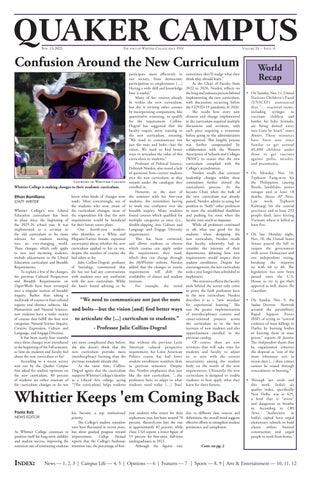
Confusion Around the New Curriculum

participate more e ectively in our society, from democratic participation to employment […] Having a wide skill and knowledge base is useful.”
sometimes they’ll nudge what they think they should learn.”
World Recap
Whittier College’s new Liberal Education curriculum has been in place since the beginning of the 2025-26 school year. It was implemented as a revision to the old curriculum to be more relevant for students moving into an ever-changing world. ese changes, which only apply to new and incoming students, include adjustments to the Liberal Education curriculum and Breadth Requirements.
To explain a few of the changes, the previous Cultural Perspectives and Breadth Requirements on DegreeWorks have been revamped into a singular section of breadth inquiry. Rather than taking a multitude of courses in four cultural regions and distinct subjects, like Humanities and Natural Sciences, new students have a wider variety of courses that ful ll the four new categories: Natural Science Inquiry, Creative Expression, Culture and Language, and Engage Diversity.
It has been nearly four months since these changes were introduced at the beginning of the Fall semester, so how do students and faculty feel about the new curriculum so far?
According to a recent survey sent out by the Quaker Campus that asked for student opinions on the new curriculum. 80 percent of students are either unaware of the curriculum changes or do not
know what kinds of changes were made. More concerningly, out of the students who were aware of the curriculum changes, none of the respondents felt that the new requirements would be bene cial for their future career plans.
One fourth-year student, who identi es as a White and Hispanic/Latino female, expressed uncertainty about whether the new curriculum applied to her or not, despite the number of courses she had taken so far.
Julie Collins-Dogrul, professor of Sociology, commented that she has not had any conversations with students over any confusion with the new curriculum. While she hasn’t found advising to be
Many of her courses already t within the new curriculum, but she is revising other courses by incorporating components, like quantitative reasoning, to qualify for the requirement. CollinsDogrul has suggested that the faculty require more training in the new curriculum, stressing, “We need to communicate not just the nuts and bolts—but the vision. We need to nd better ways to articulate the value of this curriculum to students.”
Professor of Political Science, Deborah Norden, also noted a lack of questions from current students over the new curriculum, as they remain under the catalogue they enrolled in.
However, at the start of the semester with her rst-year students, she remembers having to work out confusion over the breadth inquiry. Many students found courses which quali ed for multiple categories at once (i.e., double-dipping into Culture and Language and Engage Diversity requirement). is has been corrected, and allows students to choose which courses can apply under the requirements they need, which they can change through the MyWhittier website. Norden added that the changes to course requirements will shift the availability of classes and student interests.
For example, she noted
“We need to communicate not just the nuts and bolts—but the vision [and] nd better ways to articulate the [...] curriculum to students.”
- Professor Julie Collins-Dogrul
any more complicated than before, she also doesn’t think that the new curriculum provides more interdisciplinary learning than the previous standards already did.
At the same time, CollinsDogrul agrees that the curriculum supports Whittier College’s identity as a Liberal Arts college, saying “[ e curriculum] helps students
that without the previous Latin American cultural perspective requirement, her Latin American Politics course has had lower student enrollment numbers than in previous semesters. Despite this, Norden emphasizes that, just like the new curriculum, “...the professors have to adapt to what students need today […] [but]
As the Chair of Faculty from 2022 to 2024, Norden re ects on the long and arduous process behind implementing the new curriculum, with discussions occurring before the COVID-19 pandemic in 2020.
She recalls how every new element and change implemented in the curriculum required multiple discussions and revisions, with each piece requiring a consensus before going to the administration for approval. is lengthy process was further compounded by collaboration with the Western Association of Schools and Colleges (WASC) to ensure that the new curriculum complied with the College’s accreditation.
Norden recalls that constant leadership changes within these committees further slowed the curriculum’s process. As she became Chair when the bulk of the new curriculum was already passed, Norden admits to using her position to “bully” other professors to meet the established deadlines and pushing for votes when the faculty were stuck at impasses.
While all professors continued to ask what was good for the students when designing the new curriculum, Norden recalls that faculty, inherently, had to consider the interests of their departments, debating how new requirements would impact their student enrollment. Despite her encouragement, the new curriculum took a year longer than scheduled to implement.
e extensive e orts the faculty took behind the scenes only come to prove the faith professors have in the new curriculum. Norden describes it as a “new mandate for experiential learning.” She sees the greater implementation of interdisciplinary content and career-oriented projects across the curriculum as in the best interests of new students and also upperclassmen enrolled in the previous catalog.
Of course, these are new revisions that will take time for students and faculty to adjust to, as seen with the current uncertainty among the student body on the worth of the new requirements. Ultimately, the new curriculum is designed to enable students to best apply what they learn for their futures.
Whittier Keeps 'em Coming Back
Paola Ruiz NEWS EDITOR
As Whittier College continues to position itself for long-term stability and student success, improving the retention rate of continuing students has become a top institutional priority.
e College’s student retention rates have uctuated in recent years, but show gradual progress toward improvement. College Factual reports that the College’s freshman retention rate, the percentage of rstyear students who return for their sophomore year, has been around 70 percent. Research.com lists the rate at approximately 82 percent, while Data USA reports a lower gure of 53 percent for rst-time, full-time undergraduates in 2023. Although the gures vary due to di erent data sources and de nitions, the overall trend suggests e ective e orts to strengthen student persistence and completion.
Cont. on pg. 2
• On Tuesday, Nov. 11, United Nations Children’s Fund (UNICEF) announced that "... essential items, including syringes to vaccinate children and bottles for baby formula, are being denied entry into Gaza by Israel,” states Reuters . These resources have been sent since Sunday to get around 40,000 children under three to get vaccines against polio, measles, and pneumonia.
• On Monday, Nov. 10, Typhoon Fung-won hit the Philippines causing floods, landslides, power outages and at least 18 deaths, shares AP News Last week, Typhoon Kalmaegi hit the central provinces and at least 232 people died, later hitting Vietnam where it killed at least five.
• On late Monday night, Nov. 10, the United States Senate passed the bill to reopen the government with seven Democrats and one independent voting, breaking the majority tie with 60 to 40. e legislation has now been passed onto the U.S. House to try to get their approval as well, shares e Guardian
• On Sunday, Nov. 9, the Sudan Doctors Network accused the paramilitary Rapid Support Forces (RSF) of trying to “conceal evidence of mass killings in Darfur by burning bodies or burying them in mass graves,” reports Al Jazeera e Independent shares that he organization criticizes the disposal as “one of the most inhumane acts in recent days [...] these crimes cannot be erased through concealment or burning."
• rough last week and this week, India’s air quality index, speci cally New Delhi, was at 425, a level that is “severe” and dangerous to breathe in. According to CBS News, “Authorities in India’s capital have urged elementary schools to hold classes online, banned construction and urged people to work from home.”
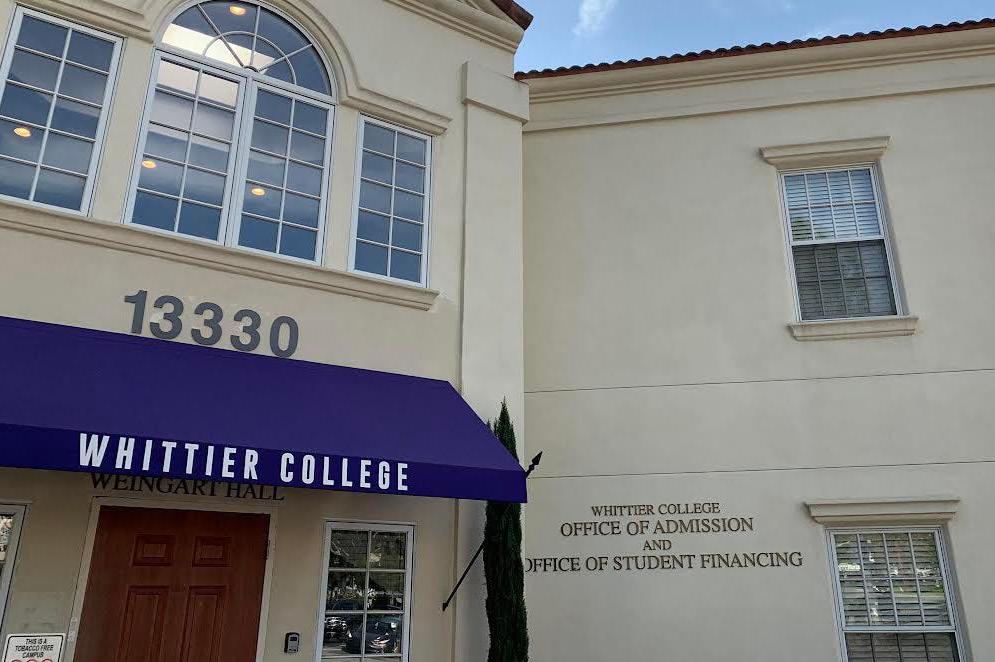
Whittier College is making changes to their academic curriculum.
Courtesy of Whittier College
Ethan Ramillano STAFF WRITER

Retention Cont. from pg. 1
President Kristine Dillon emphasizes this ongoing e ort, stating, “I can say improved retention of continuing students at Whittier has been a top priority for faculty, administrators, and sta . "
Dillon adds, "Much stronger coordination and communication across departments such as business, financial aid, CAAS and Student Life helped students find solutions to registration holds and other obstacles that may previously have kept them from continuing their studies. There is more work to be done but I am seeing good progress on improving our retention.”
Part of the College’s progress stems from a renewed focus on identifying and removing barriers preventing students from continuing their studies. O ces like the Center for Advising and Academic Success (CAAS) and Financial Aid have collaborated to help students resolve nancial holds, registration issues, and academic planning concerns more e ciently.
e O ce of Student Life has also increased its emphasis on engagement programs to help
students feel more connected to campus, reducing the likelihood of students feeling isolated or unsupported.
To foster a stronger sense of belonging and academic con dence, the College has invested in several initiatives aimed at improving the student
programs, allowing students to design individualized majors that align with their personal and professional interests. is exibility encourages students to take ownership of their education and strengthens their investment in their academic paths.
Similarly, the College's overall curriculum highlights interdisciplinary connections, cultural understanding, and effective communication, which are all values outlined in the College’s mission statement. By giving students the opportunity to learn across disciplines, the curriculum reinforces the connections between classroom knowledge and real-world application.
Financial accessibility has also become central to the College’s retention strategy. e Poet Forward Scholarship helps returning students by reducing unmet nancial need, while the Student Loan Relief Scholarship awards seniors with at least a 3.70 GPA a minimum of $500 toward their senior-year loan debt. ese targeted nancial aid programs are designed to make continued enrollment more attainable for students who might otherwise face nancial barriers.
"I can say improved retention of continuing students at Whittier has been a top priority for faculty, administrators and sta ."
experience. e First-Year Experience Seminar, o cially titled “Your Whittier College Experience,” introduces new students to the academic culture of the College by focusing on study skills, nancial literacy, major exploration, and faculty mentorship. e course aims to equip students with the tools to navigate their transition to college and build early relationships that help sustain them through later years.
e Whittier Scholars Program continues to serve as one of the College’s most distinctive
Improving the retention rate is not just about increasing percentages. It re ects how well the College supports its students academically, nancially, and socially. President Dillon’s comments underscore that retention depends on coordination between multiple o ces and a shared commitment to student success. From resolving registration holds to ensuring students have access to nancial aid and advising, the College’s collaborative approach re ects a holistic e ort to support students throughout their academic
THE QUAKER CAMPUS STAFF
EDITOR-IN-CHIEF
PAIGE MEYER-DRAFFEN
DEPUTY EDITOR
EMMA GALVAN
MANAGING EDITOR
PENELOPE TURGEN
NEWS EDITOR
PAOLA RUIZ
OPINIONS EDITOR
ANGELICA HENNESSY
SPORTS EDITORS
MAIA CHAIDEZ
MONZE MERAZ-LERMA
CAMPUS LIFE
EDITOR
NADIA MILLER
FEATURES EDITOR
EMMA CIANCIOLA
A&E EDITOR
ELIAS LOYA
HEAD COPY EDITOR
CLOVER MORALES
SOCIAL MEDIA
MONZE MERAZ-LERMA
STAFF WRITERS
ALLARA BAKER
ETHAN RAMILLANO
MADYSON ESCOBEDO
OSWEN MARTINEZ
JAYDEN GARRET
JAYDEN BORGNA
XOCHITL HOOD
LUIS SANDOVAL
STEVEN LOPEZ
COPY EDITOR
ETHAN ARIADA
GRAPHIC
DESIGNER
NADIA MILLER
CARTOONISTS
NEMI DOC
FACULTY ADVISOR
JOSEPH DONNELLY
journeys.
While the College acknowledges that more work remains to be done, the progress already made demonstrates a renewed commitment to Whittier's mission and values. With
faculty, administrators, and staff working together toward a common goal, Whittier College is making steady progress toward improving retention and reaffirming its commitment to seeing every Poet through to graduation.
City of Whittier: Tree Update
Paige Meyer-Dra en EDITOR-IN-CHIEF
The long-standing battle to "Save the Trees" in Uptown has taken a turn for the worse. In a 4-to-1 vote on Tuesday, Oct. 28, the City Council voted to suspend Whittier’s Parkway Tree Manual that was created to require a public appeal andor an arborist to declare a tree diseased before the city council could remove it.
The manual was produced in 2016 and details procedures surrounding tree inspections, removals, and appeals. According to Whittier Daily News , it allows the city to immediately remove any diseased or dangerous trees as assessed by an arborist.
The attack on the tree canopy in Uptown Whittier started in the 1990s when the City began random tree removal, according to Mary GormanSullens, President of the Whittier Conservancy.
City council members cited the ‘threat to public safety’ as to why they proposed an emergency ordinance to suspend the Tree Manual for eight months. Founder of SaveOurTreesWhittier.com , Conny McCormack, questioned what public safety concerns the trees raised. Council and community members cited the sidewalk damage from the root system created by the trees as safety hazards.
According to the Whittier Daily News , special education
teacher Justine Gurrola was awarded a $7.5 million settlement from the City of Whittier on Oct. 14th. In 2018, Gurrola tripped and fell on the sidewalk that was damaged by tree roots.
Gurrola is a special education teacher who suffered a traumatic brain injury (TBI), while also fracturing her wrist, elbow, knees, and sustained acute nasal fractures and a split lip. Following the seven years, Gurrola reported lasting cognitive changes, posttraumatic stress disorder (PTSD), memoy loss, and difficulties with emotional regulations.
Residents have speculated about the connection between the settlement and the emergency ordinance, and argue that there must be a balance between preserving the urban forest and public safety.
To contact the Whittier Council Members, you can send voicemails or send emails. More information can be found at SaveOurTreesWhittier.com
City Clerk, Rigo Gargia, (562) 567 9850 or rgarcia@ cityofwhittier.org.
City Manager, Conal McNamara, (562) 567 9301 or cmcnamara@cityofwhittier.org.
City of Whittier Mayor, Joe Vinatieri, jvcc@bewleylaw.com
District 1, Maryann Pacheco, mapacheco@cityofwhittier.edu
District 2, Octavio Martinez, omartinez@cityofwhittier.org
District 3, Cathy Warner, cathywarner@earthlink.net
District 4, Fernando Dutra, fdutra@cityofwhittier.org
LETTERS TO THE EDITOR
Submissions may be emailed to qc@poets.whitttier.edu in .doc or .docx format. Submissions must include the author’s name and year of graduation or position at the college in the signature. Letters are due by Monday at 5 p.m. to make it into that week’s issue. Submissions should be no more than 500 words. Submissions will undergo the same editing process from our production pipeline if selected. All stories must follow the same journalistic standards.
Due to the high cost of publication, members of the Whittier College community are permitted three copies per issue. Additional copies may be purchased with prior apporval for 50 cents each by contacting the Quaker Campus. Newspaper theft is a crime, and those who violate the three copy rule may be subject to civil and criminal prosecution.
e Quaker Campus does not change material posted on online articles once they have been published in the paper — with the exception of an error being found. Only then will a correction be made to the online version. e Quaker Campus is a publication of Whittier College. Columns and Signed editorials do not necessarily re ect the opinions of Whittier College or its a liates.
Courtesy of MD Duran Whittier College's retention rate has been improving.
- President Kristine Dillon
Financial Aid Support Amidst Severe Cuts
As tuition, housing, and national financial aid policies continue to shift under the “One Big Beautiful Bill Act,” Whittier College students are beginning to feel the uncertainty of what lies ahead.
According to a recent survey conducted by the Quaker Campus , every student currently receives some form of financial assistance from merit-based scholarships and need-based grants to state and federal aid. Yet even with this support, many say they still face challenges understanding or securing their aid packages.
e survey distributed among the student body reveals that, while students appreciate the aid they receive, 50 percent have faced some kind of nancial aid di culty this semester. Issues ranged from paperwork delays and unclear communication to changes in state and federal programs.
One student, who identi es as a White and Hispanic/Latino female, notes how she lost her Cal Grant unexpectedly, while another student, who identi es as a White male, cites frustration with “unclear instructions and slow responses” from the College’s Financial Aid O ce.
Another key concern among respondents is the potential cut to the federal Pell Grant, a lifeline for many low-income students. 75 percent of students
say they are worried about the upcoming academic year because of these federal changes, fearing that cuts could impact their ability to stay enrolled.
“I depend on both my merit and need-based aid,” writes one student, who identifies as a White female. “If Pell Grants are reduced, I honestly do not know what that would mean for me next year.”
One student, who identifies as a White and Hispanic/Latino male, humorously suggested that he would love, “Free admission, but I know that is impossible,” a lighthearted reflection of the serious financial strain students feel.
President Kristine Dillon, who previously spoke with the Quaker Campus about the implications of the “One Big Beautiful Bill Act,” has been
and the proposed would be $5,710.”
Dillon noted that nearly half of the College's students receive Pell Grants, and that such a reduction “would profoundly jeopardize their chances of finishing school.” Her comments mirror the sentiments shared by survey respondents who expressed fear about their financial stability.
In the same interview, Dillon explained that faculty and staff are pursuing multiple strategies to balance the anticipated financial losses. “I will be working with the donor community to do the best I can to offset the losses that we are forecasting from the federal government,” she said.
“By next year, we might have 900 students. Not all of them will need the offset, but for those who do, every dollar matters.”
Part of this strategy involves
“If Pell Grants are reduced, I honestly do not know what that would mean for me next year.”
candid about her concern for the College's students. “The biggest concern I have is the financial aid impacts,” Dillon stated in said interview. “There is a planned reduction in the Pell Grant of about $1,700 a person. The maximum Pell Award is currently $7,395,

strengthening Whittier Works, a program that combines paid internships with professional preparation. “Our alums are excited about that program because they realize this is something that means students not only have professionally earned money in their pockets, they have resume builders.”
Although Dillon noted that California’s Cal Grant program “is holding pretty firm.” She emphasized that it cannot make up for lost federal aid. “They can’t be expected to fill up the $1,700 a person lost from Pell. And what about our out-ofstate students? Their Pell goes down, and they do not get a Cal Grant at all.”
e College’s Financial Aid O ce has begun implementing measures to improve communication and support during this transition. The College has extended office hours during key filing periods, updated its online resources, and started early outreach to students flagged for verification.
Dillon has underscored that “communication is key” and that the College aims “to be proactive, not reactive.”
Dillon acknowledged that the anxiety surrounding financial aid is valid. “These are sudden negative impacts on the horizon for people who are considering college or already in college,” she said.
As the College continues to adapt to changing national education policies, the institution’s success may depend on its ability to rebuild student confidence in financial aid. Students who participated in the survey overwhelmingly called for clearer communication, earlier outreach, and more transparency in aid decisions. They also expressed hope that the College will expand institutional scholarships or emergency grants to protect students from the volatility of federal funding.
For many of the College's students, those words resonate as both a reassurance and a challenge. As national financial aid programs hang in the balance, the College’s next steps may determine not only its students’ access to education but the strength of the community’s faith in its ability to keep those doors open.
Paola Ruiz NEWS EDITOR
Paola Ruiz NEWS EDITOR
Courtesy of Whittier College
Whittier College is ready to help students get more support in their nancial aid package.
Angelica Hennessy / QUAKER CAMPUS
Courtesy of Whittier College Whittier College has plans to o set nancial aid impacts.
What’s up,
Stay up to date on events! For further info, visit https://whittier. campuslabs.com/Engage/
Palestine in Context Lunch
Series: Critical Conversations
• ursday, Nov. 13 at 12:30 p.m.
• Campus Inn (CI)
Poet Pantry
• ursday, Nov. 13 at 12:30 p.m.
• Campus Center Room 141
Veterans Give Back Carne Asada
• ursday, Nov. 13 at 4:00 p.m.
• Upper Quad
ird Space ursday: T-Shirt Painting
• ursday, Nov. 13 at 4:30 p.m.
• Ettinger Lounge
Sigma Tau Delta Fall 2025 Induction Ceremony
• ursday, Nov. 13 at 5:00 p.m.
• Club 88
An Evening of Poetry & Fiction: Tim and Deedle Tomlinson
• ursday, Nov. 13 at 6:00 p.m.
• Poet's Corner Wardman Library
Poet Musicale
• Friday, Nov. 14 at 12:00 p.m.
• Memorial Chapel
Dodgeball: row, Duck, Destress
• Friday, Nov. 14 at 4:00 p.m.
• Harris Amphitheatre
Bug Club Meeting!
• Monday, Nov. 17 at 12:30 p.m.
• Campus Courtyard Lower Level
Make a Pocket Sized Vsion Board
• Monday, Nov. 17 at 12:30 p.m.
• KPOET O ce Board Game Hour
• Monday, Nov. 17 at 3:00 p.m.
• OSE Conference Room
MEChA Weekly Meeting
• Monday, Nov. 17 at 4:30 p.m.
• Ortiz Lounge
Pumpkin Pie Making
• Monday, Nov. 17 at 4:30 p.m.
• Dezember House
Sustainability Club Bi-Weekly Meeting
• Tuesday, Nov. 18 at 12:30 p.m.
• SLC 101
Planner Party
• Tuesday, Nov. 18 at 1:30 p.m.
• Ettinger Lounge
Bus Trip to L.A. Opera to see a Rehearsal of La Boheme
• Tuesday, Nov. 18 at 5:30 p.m.
• Meet in Shannon Center Lobby
CAMPUS LIFE
Let's Talk About Palestine In Context
Lucinda Frates FOR THE QC
e Palestine in Context Lunch Series is a bimonthly lunch series led by Professors Rebecca OvermyerVelázquez and Irfana Hashmi, as well as Student Representative and third-year Angelica Lavorin, that invites the students and faculty of Whittier College to come together and engage in open dialogue about the ongoing genocide in Gaza.
e aim of the series is to create a deeper understanding of both Palestine and Israel by discussing the broader history of colonization, displacement, and resistance in Gaza.
Lavorin recounted a conversation that she had with Professor Hashmi regarding their feelings about speaking up about the ongoing genocide in Gaza. “I think we both related as a student and as a professor where we feel fatigued. You know, you feel tired, and I think you also sometimes feel afraid.” ese feelings motivated the creation of the lunch series as a casual setting where students can learn and, in Lavorin’s words, “have a space to engage with the genocide and have the conversation facilitated by educators.”
e Palestine in Context Lunch Series is a continuation of the advocasy work that Professors Overmyer-Velázquez and Hashmi have been carrying out on the College campus in the past few years. Together they have taught courses such as Settler Colonialism in Palestine and Palestine in Context: Apartheid, which were o ered to help provide students with context surrounding Palestine in relation to the Israeli occupation. ese classes provided the College with much-needed conversations about Palestine.
As members of the Whittier College chapter of Faculty and Sta for Justice in Palestine (FSJP), Dr. Overmyer-Velázquez and Dr. Hashmi have been involved with many events on campus that provide awareness about Palestine. From documentary screenings, open dialogue, to Palestine Nights—which brought Palestinian food, dance, and embroidery to campus—FSJP at the College has done much work to create visibility for Palestinians and the ongoing genocide.
Although there are hundreds more chapters of Students for Justice in Palestine (SJP) than there are FSJP chapters across
the country, the College does not have a SJP chapter. is lack of student engagement with justice in Palestine demonstrates the importance of these lunches as a place that students can participate in conversations about the genocide.
e conversation at the meetings also revealed a greater theme of the devaluation of Palestinian life that is pervasive in discussions surrounding the IsraelPalestine con ict. Although a United Nations (UN) commission found that Israel has committed genocide in Gaza, some still believe that this is a fact up for debate.
ose who do not believe there is a genocide cite violence committed against Israeli people as justi cation for the ongoing extreme violence committed by the state of Israel against Palestinians.
As people living in the United States, it is especially important that we understand the violence that is being perpetrated by Israel because of the role that the U.S. plays in supporting Israel.
Gen Z is particularly outspoken on this issue which could be explained by the easy access to information that social media has given us. Lavorin explains, “We
(Gen Z) recognize, or at least wish to acknowledge that oppression is not something that can be contained by borders or oceans. What’s occurring in Palestine has and will have profound impacts on our lives, if our country can get away with aiding genocide and continuing it’s colonial project, who’s to say we aren’t next?”
Lavorin commented on the discourse at this meeting, saying, “the whole point is I wanted people who either have not really engaged with [conversations about Palestine] at all or who have but unfortunately have fallen victim to like propaganda or misinformation [to attend].” But she also acknowledged the di culty of having discussions when there is disagreement about the facts of the situation, namely not agreeing that Israel is committing genocide in Gaza.
e Palestine in Context Lunch Series provides a space where students and faculty can come together and share resources. While these lunches have not been without contention, with guidance from faculty, students have found value in critically engaging with the current events of the ongoing genocide perpetrated by Israel.
Spreading the Brotherly Love with
Monze
Meraz-Ierma SPORTS EDITOR
Whittier College’s Phi Epsilon Kappa (PEK) Honor Society held its yearly induction for its newest members on ursday, Nov. 6, at the Hartley House, with its executive board leading initiation ceremony. e fraternity is the National Honor Society of Kinesiology, and it serves as a selective organization for students dedicated to scholarship, service, and leadership.
e society’s exclusivity stems from its requirements. A member must be a third-year student or higher pursuing a Kinesiology major or minor, maintain a cumulative and major GPA of 3.00 or higher, and complete at least two upper-division courses in Kinesiology.
Dr. Ann Hickey, the advisor of PEK, encourages upperclassmen Kinesiology students with good academic standings to become involved with the fraternity if possible. Dr. Hickey sits on the PEK National Board of Directors, providing access to even more exclusive access for opportunities and awards for the College’s PEK students. With inductions only occurring in the Fall semester, she urges interested students to begin preparing their classes and GPA in the Spring to be ready for nominations come Fall.
Fourth-year President Emma Tumbarello began the initiation alongside fourth-year Vice President Marcus Owens and third-year Secretary and Treasurer Tara Hendrickson. Eight new members lined up across from the e-board as the initiation started. Tumbarello began the induction
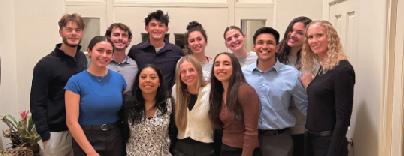
with the three principal approaches that make up the structure of the PEK Fraternity.
“Our organization is dedicated to the ideal of a sound mind in a sound body,” Tumbarello says. “We endeavor to approach this ideal by means of three avenues, the rst of which is Physical Perfection.”
Owens and Hendrickson introduced the second two approaches: Education and Knowledge. Beyond these approaches, the foundation of the Fraternity rests upon its three pillars: Peace, Friendship, and Brotherly Love. In fact, the inductees were assigned to arrive at the ceremony with a poster created with other members, which presented a story following a theme that re ected these pillars.
Members attached photos of their friends, families, and teammates and explained how these relationships have fostered qualities of community, personal growth, trust, empathy, compassion, and other values that lie within the three pillars.
By completing this poster and a rming the initiation’s requests, the new members promise to be the leaders of the major. As members of Phi Epsilon Kappa, they are therefore granted unique opportunities, including
leadership workshops, awards programs (sometimes containing nancial awards), and invaluable networking opportunities.
As Kinesiology majors, the inductees all have similar future paths, ranging from physical therapy, athletic training, osteopathic medicine, and chiropractic studies. is organization provides them with a space to share about their personal endeavors and build towards those goals together.
“When I was a freshman and saw the upperclassmen on campus, especially the guys on my team, who were in PEK, I just felt like I wanted to be a part of that group,” Owens says. “I saw the kind of trajectory that they were headed in, and that was a goal that I set for myself.”
Owens plans to become a physical therapist and credits past members from PEK for career guidance and in uence. He references Maya Palos, Kylie Kraft, and Richard Kastl-Givens, who are currently attending postgraduate programs at the University of Southern California for Occupational erapy and Physical erapy. Beyond meeting new connections, PEK also o ers the opportunity of work experience through these connections.
PEK
Hendrickson attributes PEK for her recommendation towards her summer internship at MANKIND, a physical therapy and sports medicine center, where she worked under Jason Manalili, the co-founder and a doctor of physical therapy. “It was exactly what I want to do,” Hendrickson says. “My favorite task was helping their clients through their exercises, like assessing their form [...] and correcting it with what muscles to engage.”
PEK holds biweekly meetings and hosts social events once a semester. Most recently, the organization has organized hikes and movie nights. e group has been involved in serving thier community, like volunteering at food pantries, running in a 5k race for charity, and participating in pie-in-the-face fundraisers.
As President of PEK, Tumbarello has appreciated the bene ts that the Fraternity has provided for her professionally. ”It’s exciting to get an opportunity like this because normally, I’m more involved in extracurriculars soccerwise and sports-wise,” Tumbarello says. “Doing something that has helped advance me in my career has been a great opportunity.”
For students interested in joining PEK, they can become involved in the fundraising activities on campus, or they can join the Kinesiology Club. Tumbarello, Owens, and Hendrickson also sit on the executive board of the general KNS Club, which does not have the same strict requirements as PEK. e club welcomes any students involved in Kinesiology, therefore connecting students early on with other members of their major.
PEK inducted its new members for the year.
Monze Meraz-Ierma / QUAKER CAMPUS
CAMPUS LIFE
SkeleTON of Fun at Dia De Los Muertos
Emma Cianciola FEATURES EDITOR
Whittier College’s Día de los Muertos event on Oct. 30 brought together students, organizations, performers, and the community for an evening lled with cultural food, music, dancing, art, and Latinx celebration! With goodies such as cookies, arroz con leche, and tres leches being served throughout the colorful night. Attendees were welcomed into a comfortable space for endless celebration as well as appreciation of the people and their traditions that the holiday represents.
Before the amazing performances began, KPOET opened the event with music, setting the tone and bringing students together on the Upper Quad. e KPOET team never misses their time to shine, providing tunes to ll the space in preparation for the main performances. e atmosphere remained lively, loving, and full of dancing. Whether folks were fully immersed in the music or quietly bopping along to the beats, the Whittier community gathered together in hopes of a night full of cultural appreciation, one in which participants could leave with a greater or newfound appreciation for Hispanic culture.
Movimiento Estudiantil Chicanx de Aztlán's (MEChA) President, fourth-year Emily PerezMedina, and the DEI ambassadors, second-years Leonardo (Leo) Hernandez and Alina Estrada, took the microphone early in the program, giving a speech to remind attendees why they are here. ey focused on shedding light on the history of Indigenous Latinx people, the importance of honoring their heritage, and acknowledging the history of colonialism, especially given the current political climate we are experiencing in the context of the recent brutal ICE raids. ey also spoke about the origins and foundation of Movimiento Estudiantil Chicanx de Aztlán MEChA.
Originally founded in the 1960s, MEChA began as a way
for Latinx students to advocate for themselves and proudly reclaim their identities. ey explained that this mission remains relevant, especially in today’s political state, stating, “Too many of our Latinx brothers and sisters have been victims of deportation, death, and genocide.”
Attendees took turns between silent respect and applauding the speakers for their bravery and compassion for their community.
e event also highlighted the history of Día de los Muertos itself and the traditions typically celebrated within it. Students and visitors could participate in face painting, done by the Penn Society.
In the celebration of Día de los Muertos, face painting is a Mexican tradition of honoring loved ones who have passed, and it represents the cycle of both life and death and the color we nd within the celebration of life. ese symbols are often represented by calaveras (sugar skulls).
Vendors were selling owers,
jewelry, and calaveras, giving attendees the opportunity to take home authentic pieces of art that celebrate Mexican culture. e event also included a photo booth, o ering another interactive activity for memorabilia.
Every organization involved added to the collaboration to make the event possible and as successful as it was. First Generation & Allies, Inclusive Housing, the Career Center, Transgender, Other-identified, Bisexual, Gay, Lesbian, and Allies for Diversity (TOBGLAD), the O ce of Inclusive Excellence (OIE), O ce of Development, the Athenian Society, and the alian Society were all in attendance. ese organizations represent the importance of not only the Latinx community themselves being present but also their supportive allies as well. Poets Story Lab also hosted a table at the event, where they highlighted artwork and written works from Latino
artists from Whittier.
One of the highlights of the evening was the performance by Danza Azteca Xochipilli, cofounded by Adolfo Arteaga and his wife, Eva. Founded in 1987 by Arteaga, who was trained in the tradition by his grandparents, the company has performed throughout the Southwestern States for the past 21 years. eir performance included a traditional Aztec dance accompanied by traditional instruments such as the huehuetl, teponaztli, quiquiztli, and more.
is raw and beautiful authenticity being displayed for viewers of all backgrounds to appreciate is exactly why Whittier College hosts these events.
One of the dancers shared a powerful statement during the performance. “ is is our culture, and we have it so close to our heart.” e group explained the meaning behind their dancing, describing its connection to their culture.
ey passionately spoke about how
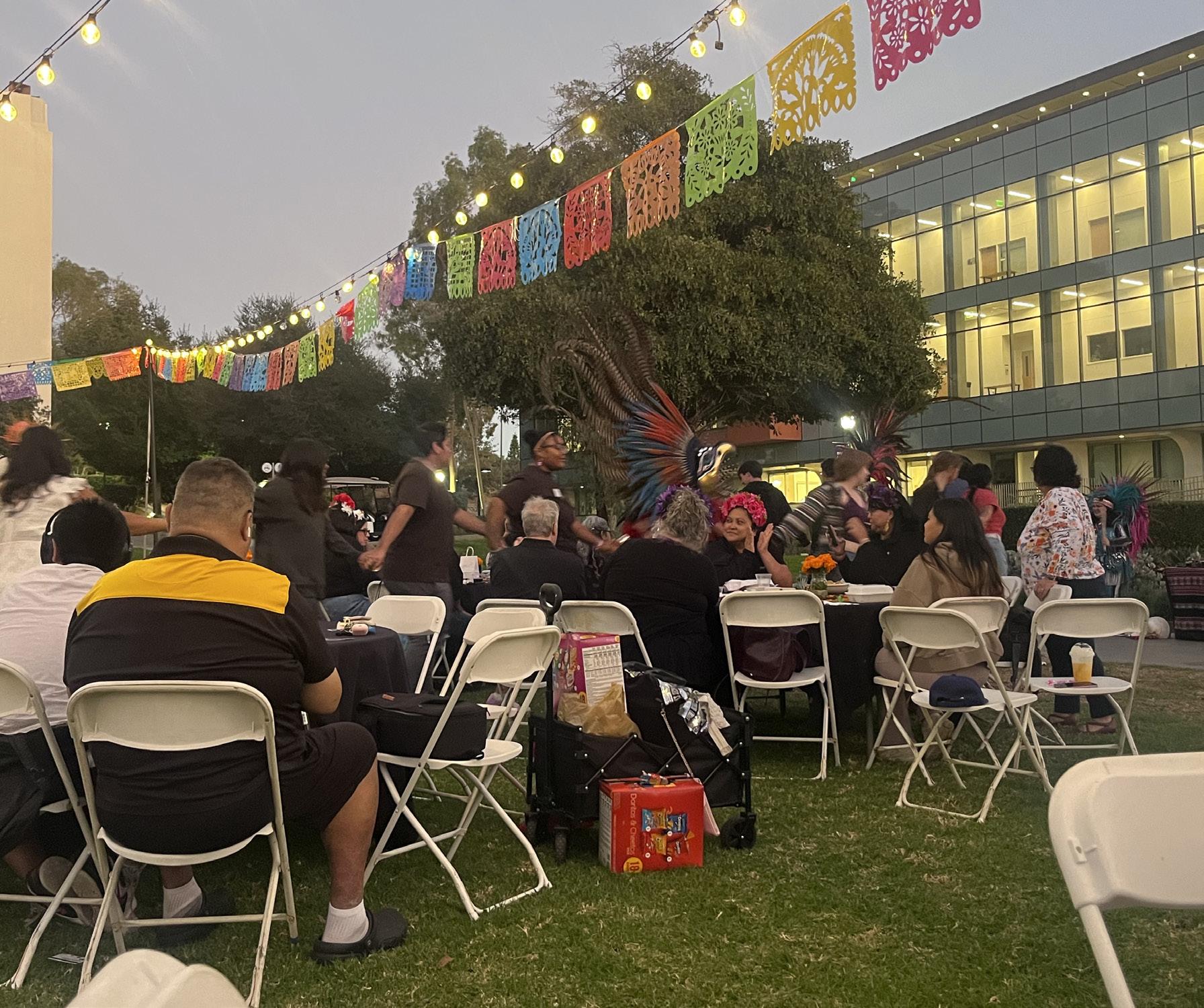
people often become preoccupied with what is happening in their lives and explained the importance of embracing connections and relationships. For them, the dancing is “a way of prayer, the way of our body, and the way of our spirit.”
e next dance by the group was dedicated to the Chichimeca people, an Indigenous group from Northern and Central Mexico. e purpose of the dances was to honor elders, ancestors, and all those before them. ey celebrate Mexican culture and tradition in the form of dance. At one point, they invited the audience to join in, turning the performance into a communal experience, demonstrating how dancing is universal.
After the Aztec dancers nished, the Whittier College Dance Team followed with a folklorico performance wearing colorful traditional dresses, similar to the dancers before them. Color is a necessity, symbolizing the act of guiding spirits home with their vibrance. e Whittier College Dance Team certainly made the College proud with their performance, leaving audiences in a standing ovation.
For the last performance of the night, a dance team from Downey High School took the stage. ey celebrated Mexican traditions once again through movement. e dancers wore bright colors such as red, yellow, and green, their apparel owing in front of the audience, mirroring the beauty of owers blossoming. Downey High School ended the event with such grace, and visitors left the event feeling musical, adding some pep in their steps.
Whittier College’s Día de los Muertos celebration stood as a perfect representation of what the Latinx community stands for: love, culture, and dance! It was vital for MEChA to host an event for such a deserving group of people considering all that they are going through at the moment. rough these hardships we remember why we must stand together, to create unforgettable memories.

Audience members where invited to join in the fun at Dia de los Muertos Nadia Miller / QUAKER CAMPUS
Music Festival of Madness and Misery
Angelica Hennessy
OPINIONS EDITOR
Everybody knows that modern musical festivals are ridiculously expensive. On Oct. 18, I attended the When We Were Young music festival in Las Vegas, and afterwards there was one question on my mind: Was the experience really worth it? Especially when tickets were $425 for general admission to $695 for VIP.
When We Were Young is a two-day festival where over 50 pop-punk-adjacent bands perform, primarily popular bands from the '90s and 2000s. is year’s lineup included artists such as Yellowcard, Simple Plan, Weezer, Blink-182, Avril Lavigne, and Panic! At e Disco. While I certainly had a blast seeing so many artists I enjoy perform, the overall experience left a rather bitter taste in my mouth. is absurdly high price itself would have been a dealbreaker for me, I only attended because I was given a ticket. A meal at any food stand would set you back at least $20 and a t-shirt started at $45. I was prepared for these prices, while my real gripe was with the infrastructure of the festival itself.
Overcrowding tends to be a trademark of large music festivals, but are organizers doing enough to mitigate the risks that come with big turnouts? In the case of When We Were Young, it became increasingly obvious that the festival’s infrastructure and planning was not intended for over 60 thousand attendees.
Lasting from 11 a.m. to midnight, with thousands standing
in the pit the entire time, an incident of some sort was inevitable. Even at normal concerts, being in the pit is hard on your body. As someone who attends a lot of pit shows, I know I’m signing up to be squished like I was in a tin of sardines. People pressed up against me from every direction pushing, shoving, and dancing to the music. I expected ghts to break out and to watch people collapse from heat exhaustion, but nothing could have prepared me for the chaos of When We Were Young.
If you have attended a few general admission concerts, you are almost certainly familiar with audience-medical-emergency protocol. ose surrounding the person in distress will wave their phone’s ashlights, signalling security—or even the performing artist at smaller shows—for help. Security usually reacts in a timely manner, moving through the crowd, and tending to the member of the audience in need.
But at a festival as big as When We Were Young, nothing is quite that simple. e crowd was so packed that there was practically no way for security to get in, and getting out proved just as di cult.
Close to where I was standing, a young woman had collapsed. Everyone in my section shone our ashlights, but there was no security to swoop in and carry her to safety. It was only those surrounding her using their bodies to form a barrier that kept her from being trampled. After about 10 minutes, she regained consciousness, and with another concertgoer’s assistance, they pushed to get through the
crowd. When We Were Young may not have reported any deaths or major injuries, but situations like this neglect of safety could have easily become disastrous. ere are certainly risks one must accept when attending a musical festival of this magnitude, though health and safety should not be compromised. One must know their own body’s limits and plan accordingly, but so many emergencies cannot be planned for. If you are spending a minimum of $425 to attend a festival, there should be a level of accountability. In the case of a medical emergency, there should be a system in place to help.
Beyond the tens of thousands of people in the venue, severe overcrowding extended even to parts of the festival far away from the stages. Just getting to the bathroom was an arduous a air. With over 60 thousand attendees, navigating the festival grounds was practically impossible with a sea of people surrounding you, pushing from every direction. Wading through the endless dense crowd meant pushing and shoving a path just to get heckled by drunken middle-aged men in the process.
Once I managed the treacherous journey to the
bathroom, which must have taken at least 40 minutes, I was met with a line of at least 100 people waiting for the bathroom. e lines to use the free water fountains were equally as long. While VIPs had access to their own bathroom and water fountains, the general admission peasants had to waste our much less valuable time and our sanity.
On top of everything, the sheer amount of people in attendance ended up causing phone service in the area to crash. Myself and everybody else I talked to that day had zero phone service or internet connection for the entire event. If you were separated from your friends, there was practically no way to contact them or anybody else.
I can’t help but think that When We Were Young and other modern musical festivals of its caliber need to do better. If a venue cannot comfortably contain 60 thousand people, then 60 thousand tickets have no right being sold—especially when attendees are already paying such ridiculously high prices to be there.
Festivals like When We Were Young need to take more precautions for both the comfort and safety of guests. Because as it stands right now, it feels miraculous that no one has been grievously injured yet.


Dear Poets, anksgiving break is coming and I have a lot of nal projects due when we come back. Should I work on them during the break or is it better to just relax? - A Burnt Out Poet
Jane: It’s called anksgiving break for a reason. Take a break! You’ve found time the entire semester to nish your work, you’ll nd time to nish this work in time. So take a break, stu yourself with anksgiving leftovers and enjoy the food coma!
Jo: I know it’s called a break but think about it, you have ALL this time, and you’re just gonna sit back and stress yourself out more later? Well you can! Just have fun until Sunday. You’ll perform better under pressure anyways.
Johnny: Organize a schedule on what assignments will take the longest and dedicate a little bit of your break to do them! at way you are slightly productive AND you have time to decompress from the semester.
- e Poets
Is AI Destroying the Entertaiment Industry?
Clover Morales HEAD COPY EDITOR
Since 2022, it has become impossible to ignore our society falling further into the pit of Arti cial Intelligence (AI) usage.
ere are posts made by vapid, faceless accounts using AI to spread false information all over social media. Soulless AI “art” made with a click of a button using stolen work from real artists with none of the credit. Total gibberish backed up by fake sources turned into teachers and professors.
All of these things used to be brushed o by techbros and proponents of AI who are championing it as a creative pioneer of the future. Meanwhile, AI servers like Elon Musk’s xAI are draining freshwater from Black communities like Memphis with each idiotic “@ grok is this true?” from X users. For some, the generative slop AI puts out may have no harm or impact and be in “good fun,” but what if AI were to enter the broader realm of entertainment? What repercussions would it have?
Unfortunately, this is already our reality, as AI music is no longer celebrities poorly vocalizing Frank Sinatra’s “My Way” but robbing actual musicians’ spots in the Billboard Top 100. Xania Monet,
an AI musician that was created by Mississippi songwriter Telisha Jones, creates songs using Sumo’s generative AI, including “Let Go, Let Go” and Hot R&B Songs with “How Was I Supposed to Know?”
Human artists who actually put in the e ort to compose and write their own songs are being swindled by a generative language model, while AI gets their music to the top of the charts. Monet’s “Let Go, Let Go” was third on the Hot Gospel charts back in October, and “How was I Supposed to Know” peaked at 20th on the most recent Rhythm and Blues Digital Song Sales chart.
ese numbers are setting a dangerous precedent, as they are starting to signal that AI is so ingrained into modern society that it is becoming exceedingly di cult for people to tell the di erence between real songs and AI-generated ones. And with how much money these songs make, there’s more to come to in ate the market with empty, cashgrab, viral songs to the background of your next TikTok.
e AI presence also extends into the performing arts, and for the longest time people were sure AI wouldn’t a ect something with as much human intervention as lmmaking, but it is starting to seep into the world of acting as well. An AI generated actress named Tilly Norwood, created by Eline Van Der
Velden, has faced heavy criticism from Hollywood actors and on social media after Norwood’s “performance” led to talent agents wanting to sign her on for “AIinclusive” projects.
In addition, many AI models, like Particle6, the generator of Tilly Norwood, base their generative works on lmmakers’ lms, which include the actors, writers, and directors, without their consent. Velden cites AI as being a tool to create art separate from the artist and that AI should have its own categories so people stop making a fuss about it. But what the minds behind the AI art fail to realize are the ethics of the removal of humanity and humility from art, which is the direction AI art is pushing us in.
For example, AI models often generate based on copyrighted material, as models tend to scrape the internet for bits and pieces to amalgamate into song lyrics, which are regurgitated by a humansounding voice. And even for songs that are written by humans and fed into AI, it not only contributes to these models, but it also strips away the humanity and rawness of a real artist, replacing it with a consumerfriendly imitation of an artistic voice that churns out canned adoration and surface-level explanations of what led them to create music or
the meaning behind their lyrics. Alongside these issues is the hypersexualization of AI use and the dangers of being able to generate photorealistic depictions of actresses and female musicians, real or not. Women in the patriarchy are always under the gaze of men, their bodies seen as commodities for them to own. Women are often sexualized by men in order to ll these roles, and even when women choose to sexualize themselves as a form of empowerment, many men feel the need to claim that space for themselves. ere have been many concerns in the past about AI models generating realistic images of women for the purpose of pornography, and this objecti cation has only become more prevalent as photographs of women are often AI-generated as nude by asking models to remove their clothes. ere have even been cases where minors have had their images tampered with in this way.
e use of AI in these ways strips women and other vulnerable groups into commodities for consumption instead of real people, a product instead of a human life.
So, when does it go too far? Does it take minors being a ected and lawsuits being made for limits to be set on AI and for the regulation of its use? AI-generated content is becoming normalized in all spaces, so should we even care about how it a ects real people? As long as the music sounds good, who cares who wrote and produced it? Don’t think about it! Just consume, consume, consume!
Exploitation of women? You’re looking too deep into it bro, it's not that deep. Who cares if a city’s water is drained? Look at the jingling keys! AI may be the future to some, but with the direction that AI is taking right now, let’s hope there are limits lest our own minds be replaced with the robotic ramblings of ChatGPT. @grok is this true?

KCAL 96.7 / Steve Brazill
Overcrowding at music festivals can quickly become dangerous.
AI actors and musicians threaten the livelihoods of creatives.
Gaby Hernandez Swings For The Stars
Paola Ruiz NEWS EDITIOR
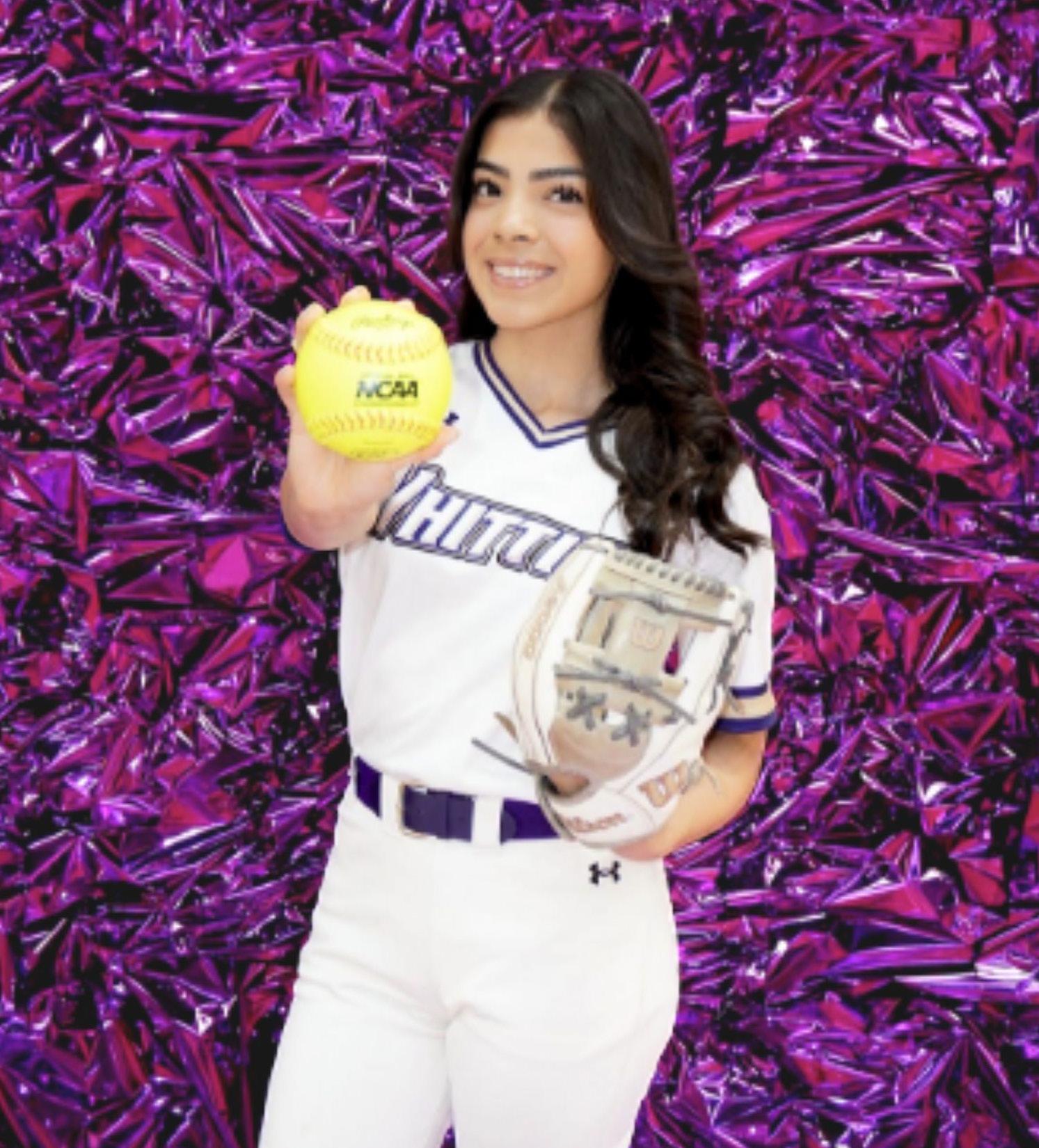
On a quiet Monday afternoon, Gaby Hernandez walks across Whittier College’s campus with two familiar companions: a blue Stanley cup, and a softball bag stitched with her last name. e bag still bears her old number, #29, though she’ll soon wear #11, a change she says re ects growth, not replacement. “A lot of players graduated,” she says, while putting her hair behind her ear. “It feels like a new start.”
Hernandez, a second-year student at just 18 years old from Chino, carries far more on her back than equipment. She carries the weight of a long recovery and the quiet determination of someone who has seen her plans shift and still moved forward. Recruited as a second baseman but now an out elder, she laughs lightly as she explains the change. “ ings happen,” she says. “I just adjust.”
For now, her afternoons are spent in practice, but earlier in the day, just after 1:30 p.m. on Mondays and Wednesdays, she sits in Professor Joe Donnelly’s Journalism class. e class was recommended by former Quaker Campus sports editor Olivia Nuñez. “I was nervous coming in,” she admits. “I’ve never really done journalism. But I want to tell stories.”
Hernandez didn’t always imagine herself here. In fact, she didn’t always imagine softball would be her sport. “My mom
pushed me toward competitive swimming,” she says. “My dad pushed softball. Funny enough, my younger sister ended up in water polo, so they both got what they wanted.”
Her path to Whittier College started with a coach at her high school who transitioned to e College’s program. She came to campus for a softball camp in December 2022 and immediately connected with the small and supportive environment. “I fell in love with it instantly,” she says. But everything shifted in November 2023 when she tore her ACL (Anterior Cruciate Ligament). At the time, she already had o ers to play elsewhere. Suddenly, her certainty vanished.
“That injury made me reconsider everything. I had to decide what I really wanted,” she says. She chose Whittier College, even knowing she wouldn’t step on the eld until Spring 2025. “It was scary,” she says quietly. “But I trusted that I’d get back.”
When Hernandez talks about softball, there is a mix of resolve, pride and determination. ough hard seasons come and go, the team does what they know best, communicate to one another and strategize new ways to win through e ective teamwork. “Nearing the end of the season, we found our rhythm.”
With a tough 11–10 loss against Long Beach Community College, the team knew what they needed to claim their comeback. eir next game was a decisive
Sketches In Action
Emma Cianciola FEATURES EDITOR
e Ramones, Tom Petty and the Heartbreakers, Black Sabbath, and Duran Duran, are all bands that started out as local sensations. Each created a bigger boom than any of them would have ever expected. Tucked quietly in the small city of Whittier, the possible next big thing travels venue to venue spreading their nostalgic chill jams. You may want to remember their name: Sketches.
e members of this local band are all either brothers or close friends, “blending noise rock, lotextures,” and a whole lot of heart into something fresh and uniquely their own. Although their gigs have taken them across Los Angeles and Orange County, their roots remain rmly planted in their home soil in the quiet town of Whittier.
e band’s return to their hometown feels very full circle for them. Long before they were curating setlists and crafting lobeats, they were high schoolers testing their luck, shooting their shot at playing at clubs nearby in Whittier, such as the College's own Club 88, a now popular venue for underground up-andcoming local artists. Band member Sebastian Felix and drummer Justin recall fond memories of playing and hosting at the nearby club.
15–5 win over Saddleback College. “Softball needs more supporters,” she adds. “We show up for everyone else. We need the same. Our games are always worth going to.”
O the eld, Hernandez coaches younger players, some as young as seven, others in high school. She started in La Puente batting cages and now works at the Whittier College softball eld.
“I have three to four lessons right now. I get clients mostly through networking with teammates and families.” She focuses on elding and hitting, passing on what she’s learned. It’s a skill she plans to keep. “I see myself being a mom who still plays and coaches for fun,” she says, halfsmiling. “ at part of me won’t go away.”
And yet, there’s a second passion running alongside softball. Hernandez wants to go to law school—to become a prosecutor or district attorney. She interned at the Los Angeles District Attorney’s O ce in the Organized Crime division, where she examined patterns in gang cases and even observed trials. “It was intense,” she says, “but meaningful. I want to help people. I’ll intern again, maybe in another division this time.”
Her interests are not limited to law and athletics. She writes songs—mostly country—and will be featured on KPOET radio soon. “I haven’t released anything yet,” she explains. “Softball takes a lot of time. But during winter break, I’ll work on music.”
e pause isn’t a sign of doubt, just patience, the same patience she learned during ACL rehab. She o ers a memory from volunteering at Malibu Moves, where she and her teammates handed out water to marathon runners.“Watching them push themselves... it reminded me why I love my sport,” she says. “Everyone has their thing they would do again and again. Softball is mine.”
For Hernandez, the future quietly takes shape: a law career, a family, coaching on the side,
maybe a song released when the rhythm of life slows enough to let her breathe. But for now, she walks campus with her name stitched across a bag, a number soon to change on her jersey, and a blue Stanley in hand. A young athlete learning balance, resilience, and the slow, steady act of returning to form.
e season ahead will demand much. e classroom will, too. But she seems ready.
“Softball is who I am,” she says. “And I’m just getting started.”
“ e club right here.” Felix points towards the direction of Club 88. “It's a full circle for me, because that's the rst time I played live.” Justin adds “Yeah, I hosted his rst show here.” ey laugh reminiscing, "Kind of wild.”
“Yeah, it's home, you know? It's nice to just do stu for Whittier because it's like we grew up playing a lot in L.A. Well, just in general.
We still play L.A., Orange County, all over the place. But it's cool to just play something here, you know?”
Felix expresses with a humble shrug. It's rooted in alternative noise rock, like lo- . Like we do music through our tape machine in the end. So we'll record it all digitally, and then at the end just run it through tape.
So feels nostalgic and warm.” Felix explains with a gimmer in his eye.
e band’s songwriting starts with the two brothers, Marcus and Sebastian Felix, hashing things out, and building the raw bones of a track. Once it’s drafted, they bring it to the other members. e songs evolve right before the crowd's eyes, with each member adding their own voice and instruments to the chorus live.
“Me and Sebastian write the music primarily,” Felix explains. “Track it. We'll throw him in.”
Gesturing towards drummer Justin, “Yeah, after we write the music, then everyone adds their part live.”
Despite their growth, the band
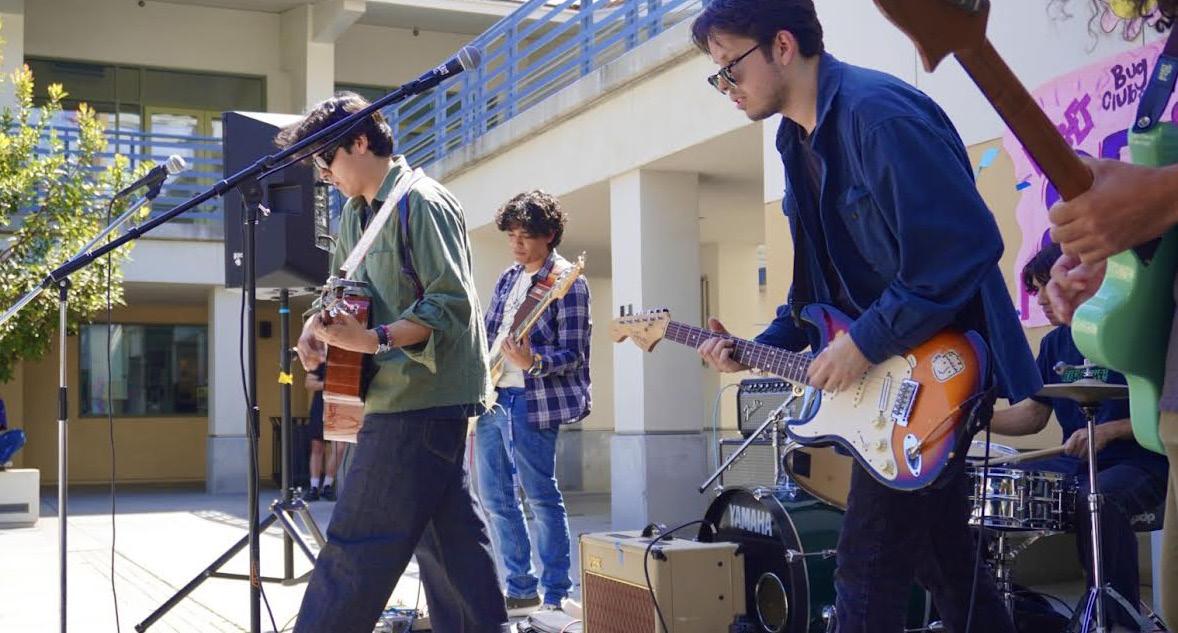
is still very much “Whittier born and raised.” e connection to their community is genuine and personal. ese are the streets they learned to drive on. e cafés they lounge around in. e venues they rst played in front of small crowds and attended as listeners themselves. Now? e crowds are growing. And so is the band. While Sketches is available to stream on all platforms, the band prioritizes the live music aspect. e idea of people traveling to watch them and others "is such an amazing feeling. It's actually insane to think about,” gushes Marcus.
Sketches is very proactive which heavily aids their success. ey book a lot of their own gigs and often reach out to local organizers
to make shows happen. Just last semester, Felix contacted KPOET to see if there were any performing opportunities.
“I remembered KPOET from back in the day. It looked kind of inactive when I checked, but I thought, "why not try something?” e DIY ethic is core to their identity. If they want to play, they're going to play, and people are going to show up. It “makes it all worth it,” Felix shrugs with gratitude. “Back in high school, we did everything ourselves,” Justin says. “We still do, honestly.”
Sketches’ journey is only just beginning and far from over. ey’re still guring out the unpredictable world of independent underground music, scheduling their own
shows, writing music between work shifts, and trying to a ord better equipment. ey know all this e ort is worth it when they see the crowd's reaction to their music.
“We’re loud,” the members laughed. “We like it that way. But there’s heart in it. at’s what's so great about it.” Justin says sharing admirable glances at the others.
Sketches just released a music video for their song "DOVAH." e band is rapidly growing in their social media following and live audience. Fans are excited to see the future of Sketches. Make sure to check out Sketches for a live performance at 7 p.m. on Dec 7 joining fellow band Above eBridge at Oblivion in Downtown L.A.
Courtesy of Gaby Hernandez
Gaby Hernandez impresses on and o the softball feild
Sketches plays local gigs, prepping for their larger venues.
Photo Courtesy of Emma Cianciola/QUAKER CAMPUS
Poet’s Sports Schedule:
Women’s Volleyball @ Claremont-Mudd-Scripps Colleges: SCIAC Tournament
Location: Claremont, CA
• 7 p.m.
• November 13
Women’s Basketball vs. UC Santa Cruz
Location: Whittier, CA
• 6 p.m.
• November 14
Men’s and Women’s Cross Country @ NCAA Division III West Regionals
Location: Claremont, CA
• 9 a.m.
• November 15
Men’s and Women’s Swimming & Diving vs. Cal Lutheran University
Location: Whittier, CA
• 10 a.m.
• November 15
Women’s Basketball vs. Life Paci c University
Location: Whittier, CA
• 2 p.m.
• November 15
Men’s Basketball vs. Paci c University
Location: Whittier, CA
• 7 p.m.
• November 17
Men’s and Women’s Swimming & Diving vs. 2025 Collegiate Winter Invite
Location: East Los Angeles College
• All Day
• November 21
Men’s Basketball vs. California Miramar University
Location: Whittier, CA
• 7 p.m.
• November 21
Men’s and Women’s Swimming & Diving vs. 2025 Collegiate Winter Invite
Location: East Los Angeles College
• All Day
• November 22
Men’s and Women’s Cross Country @ NCAA Division III National Championships
Location: Spartanburg, S.C.
• 9 a.m.
• November 22
Women’s Basketball vs. George Fox University
Location: Whittier, CA
• 4 p.m.
• November 22
Men’s and Women’s
Swimming & Diving vs. 2025 Collegiate Winter Invite
Location: East Los Angeles College
• All Day
• November 22
SPORTS
How to Build and Buy a Dynasty: 101
Elias Loya A&E EDITOR
Nov. 1, it’s game seven of the 2025 World Series. Toronto Blue Jays vs. the Los Angeles Dodgers, being hosted at the Rogers Centre in Toronto, Canada. Blue Jay’s relief pitcher Je Ho man is on the mound and holds a 3-2 count against the Dodgers’ ninth hitter and second baseman, Miguel Rojas. Blue Jays catcher Alejandro Kirk signals for a slider in the zone. Ho man winds up and throws the slider. Miguel Rojas swings, and… the ball sails past the left- eld fence for a game-tying home run.
e L.A. Dodgers went on to win that game, 5-4, in extra innings, thanks to the heroics of Miguel Rojas and his other teammates. e Toronto Blue Jays were just two outs away from their rst World Series win in 30 years, and they lost it all in the span of three innings. e Dodgers are the rst team to win back-to-back championships since the “Evil Empire” New York Yankees of the late ‘90s and early 2000s.
So how were the Dodgers able to win it against a team with the most potent o ense in the 2025 postseason?
Starting o , the Dodgers’ starters were utilized way longer than usual. e average MLB starting pitcher threw about 5.3 innings in 2024, a stark contrast to the average 6.03 innings pitched in the ‘90s. Long gone are the days of complete games (or starts longer than ve innings) for today’s pitchers.
To the surprise of many Dodger fans, however, manager Dave Roberts allowed his starting pitchers to stay out longer than
they usually do, often going into the sixth or seventh inning. is was strategic, as the starters could continue mowing down opposing hitters while maintaining their rhythm throughout the game.
In addition, this put less pressure on the bullpen, which was known to be very inconsistent throughout the 2025 season, with the bullpen’s ERA ranked among the bottom ten teams in MLB. Blake Snell and Yoshinobu Yamamoto both went deep into postseason games, with Yamamoto throwing two complete games during L.A.’s postseason run, capturing three wins during the World Series itself.
ough Yamamoto and Tyler Glasnow performed well in the World Series, the same cannot be said about Snell and Shohei Ohtani (pitching-wise at least). Some bullpen arms worked out though. Roki Sasaki’s new role as closing pitcher worked well in two relief appearances, and Will Klein pitched four scoreless frames to hold the Jays at bay during game three.
e pitching (or starting pitching to be exact) wasn’t the only thing that helped out in this win. ere’s a cliché that “defense wins championships,” and the Dodgers played into that perfectly. e Dodgers have plenty of defensive highlights from this series: a “strike ‘em out, throw ‘em out” double play in games three and seven, Kike Hernandez’ y ball catch and out eld throw to second base to end game six, and Rojas’ throw home to prevent the Blue Jays from walking o the World Series in the ninth inning of game seven.
All of these plays were clutch, and that same sentiment goes for
their hitting. While the Dodgers batted an abysmal .203 batting average and held a below league average .648 OPS (On-base Plus Slugging) during the World Series, they seemed to be hitting and getting on base when it mattered most, with almost every Dodger having their signature hit (or hits) during this round.
Another thing that really propelled this team to win was the shared spotlight. For example, Freddie Freeman’s walko home run in the 18-inning game three, Mookie Betts’ two RBI single in game six, Ohtani reaching base nine times during game three, Will Smith’s go-ahead home run in game seven, and of course, Rojas’ game-tying home run in the top of the ninth in game seven. ere’s also the defensive highlights and the stellar pitching performances throughout the postseason. Ultimately, Yamamoto won World Series MVP for his two quality starts and one relief appearance, but he couldn’t have done it without the run support and defense behind him.
Despite what Blue Jays analyst Caleb Joseph is claiming, the better team did end up winning the World Series, and Clayton Kershaw can retire a three-time champion. Now that they have shown that a repeat championship is possible again, how can Los Angeles accomplish a three-peat?
ey need to consider the health and lackluster performances of their players. e Dodgers faced a plethora of injuries and inconsistencies this season, mainly to their pitching sta . Recent free agent signings Tanner Scott and Kirby Yates struggled mightily and had their worst seasons in years. e Dodgers should be in
search of more bullpen arms and someone to add to the out eld too, as outfielders Teoscar Hernandez and Michael Conforto underperformed on both sides of the ball.
Due to their impact during the entire postseason run, both Hernandez and Rojas should be expected to re-sign with the team. Giving younger players a chance to shine may also inject the team with the energy it needs during downtime. While signing new or returning players is always nice, it’s hard to guarantee future performance.
e 2025 season for the Dodgers was a story of resilience, despite the injuries and underperformance from every corner of the diamond. It means something for them to not only make it back to the World Series, but to win it in back-to-back seasons. If they want to accomplish a three-peat, they’re gonna need all the consistency, energy, and bounce-backs they can muster. e Dodgers have the chance to be one of the greatest dynasties the sport has ever seen. And all of the MLB is taking aim at the bright red target on their back.

It’s Lights Out and Away We Go!
Maia Chaidez SPORTS EDITOR
Formula One (F1) has been steadily regaining its popularity with its North American audience. 10 teams are all looking to take the next step—whether it’s as small as their drivers nishing in the top 10 or as big as winning the World Constructors’ Championship. 20 drivers, all hungry for something as simple as a race win and doing everything they can to secure it. All of which are competed for in 24 races spread throughout the calendar year.
Although the season started out with dominant performances from one team, they’ve currently found themselves in some drama and are choking the championship lead. Meanwhile, another driver in particular is taking full advantage and doing everything he can to get back into World Championship contention.
Meet Lando Norris and Oscar Piastri, the McLaren boys. Hailing from Great Britain and Australia, respectively, both have been toe-totoe in this season long race for the

Courtesy of GP BLOG
2025 has been one of the most exciting seasons in recent F1history.
championship as both are looking to win this year’s World Drivers’ Championship for the rst time in both of their career’s.
McLaren, the team they drive for, clinched this year’s World Constructors’ Championship earlier this season due to the consistent performances of both Norris and Piastri. Now, all they need to do to complete a 1-1-2 (Constructors’ Championship, Drivers’ Championship, and second place in the Drivers’ Championship) is for their drivers to continue their almost dominant performances as they were once doing earlier this season. However,
with Norris and Piastri both being in Championship contention, internal drama between the teammates has started to show on the track, and it has allowed for a third championship contender to join the fray.
Meet the fastest man from the Netherlands and the new posterboy for the Red Bull Formula One team: Max Verstappen. e fourtime World Drivers’ Champion won all his championships from the years of 2021-2024, with all of them, except the 2021 season, being in absolute dominant fashion. To put that in perspective, in 2023 he won 19 out of the 22
grands prix–or races.
He also holds the record for most points scored in a season, with points being rewarded when nishing a race in position 1-10–and he still rarely nishes outside of the top ve. All of this to say, Verstappen is one of, if not the best, drivers in F1—let alone in all of motorsports—and still has plenty of years to win more hardware.
Verstappen has noticed the internal drama at McLaren and has taken full advantage of it. Winning ve races this season, he has put himself back into championship contention—just 25 points behind Piastri for second place and 49 points behind Norris for rst. At the beginning of the season, fans were happy to see the VerstappenRed Bull dynasty fall, however, now he’s back and making this ght for rst a real nail-biter.
With just three races left in F1’s 2025 campaign, and the World Drivers’ Championship still up for anyone to grab, this has been one of the most entertaining seasons in recent years. e series makes their nal stop in the States at the Las Vegas strip in Las Vegas, Nevada next Saturday, Nov. 22.
Courtesy of SPORTSNET LA It’s not déjà vu, they’ve gone B2B!
Men’s Water Polo Honors Seniors with Victory
Monze Meraz-Lerma SPORTS EDITOR
Whittier College’s Men’s Water Polo wrapped up their regular season on Nov. 12 as they celebrated their Senior Night with a 16-14 win against La Verne. e team holds a 6-6 record, putting them in fth place in the SCIAC.
e team’s potential to reach postseason playo s is within arm’s reach. However, the rest of the SCIAC teams will nish their season on Nov. 15, which can a ect the Poets’ SCIAC standing.
e Poets rely on Redlands beating the Cal Lutheran Kingsmen once more in order to maintain their fth place position while keeping the Kingsmen in sixth.
e last time the Poets reached the playo s was in 2019 when the team reigned as SCIAC Champions, became the SCIAC Tournament Champions, and even became crowned National Champions after winning the DIII National Collegiate Championship.
As the current team clings onto the hope for a chance to prove their power in the playo s, last night’s Senior Night focused on the graduating players that have made this year’s accomplishments possible.
Jaime Ariste, Louis Grandi, Brody Haney, Alvaro Oliveros, and Alberto Seva were honored this
Senior Night as they played their last guaranteed match as fourthyears. ese players all come from widely diverse backgrounds, contributing to the team’s depth.
Ariste, Oliveros, and Seva are from Spain (Barcelona and Madrid), Grandi from France, and Haney from Tustin, California. Ariste and Oliveros studied together in Madrid before making their way over to the College for their last couple of seasons.
Seva arrived at the College as a second-year before transferring to Westcli University (where Grandi also transferred from) and back to the College for his last year. Similarly, Haney transferred into Whittier College as a secondyear from a DI institution, opted out of playing his third year but came back to nish for his last year. Despite their various origins, they are all proud to compete as a Poet for their nal season.
”Everyone is involved for the same goal to win the game,” Grandi says. “[We hope to] win some more games and go to playo s, and we’ll see after, but we all have the same goal, so it makes everyone involved.”
Seva comments on how his transfer back to the College to conclude his fourth year feels amazing. His past teams were composed of varied age groups with members in their late twenties or late teens. It was incomparable
to the team dynamic he had once been a part of at Whittier College. Returning to the College brought him back to his Poet family, which prides itself on having complete respect for each other.
“ ere’s no di erence between seniors and freshmen,” Seva says. “Everyone treats each other the same, so everyone supports each other.”
e team is composed of mainly international players, making the experience even more cherishable for the international fourth-years who are far away from their home. e players accredit the brotherly relationship fostered within the team for their love for the College and campus as a whole. Beyond their early 6 a.m. practices, their bond with one another provides them with an irreplaceable comfort within what was once an unfamiliar environment.
“It’s really nice to be around each other [since] we don’t have our families here,” Ariste says. “We’re just a big family that spends a lot of time together.”
Although this has been Ariste’s rst and last season at the College, he has created a signi cant impact. He is a SCIAC leader, holding top-ten spots in goals, points, and goals per game. Alongside him, Grandi leads the conference as a top-ten player in assists. Ariste, Grandi, and Seva are all Business

Administration majors who hope to stay in the United States to nd work. To better their chances, Grandi plans to pursue his masters in Science in Business to specialize in data analytics, and Seva is considering returning to Westcli to receive a Masters in Business and possibly play one more season. Oliveros also hopes to “get lucky,” as he says, and get a job in the U.S. with his major in Economics. e team’s ght to make it to the postseason playo s is as strong as it has been. Before their win against Chapman on Oct. 29, the team played AC/DC’s
“ understruck” as they dove into the pool and hyped each other up. Oliveros notes that at this game, they also began to implement a chant before every game, becoming one of his favorite moments as a Poet.
“Our next game could be our last game in our careers, so I would like to not make it be our last game by winning that game, going to playo s, and of course, make sure that the entire team is happy,” Oliveros says. “I think as long as we all ght together and work together as a team, we’re going to achieve our goals.”
Andrews and Hood Tip-O Basketball Season
Monze Meraz-Lerma SPORTS EDITOR
Whittier College’s Men’s and Women’s Basketball teams reached unprecedented heights last season. Men’s Basketball won a SCIAC Postseason Tournament game for the rst time in program history. Meanwhile, Women’s Basketball accomplished a nearly undefeated SCIAC season, placing them at the top of the conference. ese accomplishments marked the rst time since the 2008-2009 season that both teams were in the SCIAC Postseason Tournament together, creating high expectations for this season.
e teams’ newest players have highlighted the potential they bring to the nearly cleanslated teams. Both teams boast 11 newcomers each, with only three returning players on the women’s team and four returning players on the men’s team. Amidst these new players, third-year point guard Brandon Andrews and third-year forward Xochitl Hood bring high hopes for the teams’ success.
Andrews is a transfer from Palomar College, where he met Whittier College players, fourthyear Jaden Mathis and Andrew Milot, who has since graduated. ey encouraged him to attend the College, especially after the successful 2024-25 season.
Andrews has had an atypical college experience, having attended ve schools in ve years due to past injuries and COVID19’s impact. While this constant
movement was chaotic, Andrews took the time to better himself as a player, landing his last year with the Poets.
“Right after the [202425] season, I went on a visit to Whittier, and then after that, I was like, ‘Okay, this is home,’” says Andrews.
With eight other transfers on the team, he claims that the players can relate to the “JUCO grind” of betterment to reach the next level. While being a player on a junior college team often meant improving personal stats, Andrews is excited for himself and the other players to have the opportunity to play as a cohesive unit.
“It starts with us as a team,” Andrews says. “Coach Jensen really puts that power in our hands as a player-led team, so it really starts with us keeping that intensity.”
Andrews has been named one of the three captains for the team and is excited for the chance to continue a strong legacy. He was present for the past team’s devastating one-point loss in the playo s and admits that although he wasn’t a Poet yet, that pain still lingers for him and other new players. With this feeling to avenge, Andrews and the team expect to nd similar success.
Hood brings an especially unique story, attesting to her utility as a player. She played two years at Fullerton College and was recognized both years as an All-League Player thanks to her impressive 13.5 PPG and 8.7 RBG, helping her team make the
playo s each year. Aside from these skillful stats, Hood’s introduction into basketball is an unlikely one.
Before attending Fullerton, Hood had never played on a basketball team or received any professional coaching experience. After graduating high school, she worked at the Boys and Girls Club, where she played basketball with some young boys in the program. She received a lot of competitive “trash-talk” from the kids, leading her to practice at her local park in La Habra. Here, she met her uno cial coach, Tony, who was the most instrumental part to her player development.
“He was pushing a car and collecting recyclables and saw me practicing a move, and he was like, ‘Hey, who taught you that?’” Hood says, explaining she was rehearsing a move she saw Kobe Bryant do.
After demonstrating the shot for Tony, Hood was met with a “stank face” from Tony, but also a plan. He o ered to show her the “Paul-Pierce Program,” a method taught to kids in Compton.
Hood describes Tony as 6’10’’ with arms the size of her head, but when he stood in front of her with his arms raised and instructed her to shoot over him, she obliged. After three hours, Tony was rebounding for Hood, and her shots had drastically improved.
“He said, ‘If you’re really serious, come back tomorrow,’ so he just trained me for free,” Hood says. “ at was basically my summer.”
While this training helped
Hood play better against the boys at her job (or “whoop their butts,” in her words), she also practiced against men playing at the park.
Proving herself as strong competition, she was met with the question, “Where do you play?” When Hood replied that she wasn’t playing for any team, the “dudes” as she calls them, urged her to try out, leading her to Fullerton College, where she was then recruited for the College by Coach Kristen Dowling.
Hood aunted her abilities as a new Poet this past Friday, Nov. 7, contributing 10 points to the team’s 59-47 win in the rst game of the season. Andrews has also established his presence to the team after his performance on Nov. 11 of erce defense, helping the team nish their rst game with a 90-73 win.
Watch Hood and Andrews play with the women’s team playing Nov. 14 and the men’s team playing Nov. 17.

Monze Meraz-Lerma / QUAKER CAMPUS Ariste, Grandi, Seva, Oliveros, and Haney are commemorated
Courtesy of tony leon / ACTION WEST PHTOGRAPHY Hood and Andrews join the 2025-26 basketball teams.
The QC Staff
Suggests:
Maia Chaidez SPORTS EDITOR
Want to know what our Sports Editor recommends this week? Read on!
Game: Signalis and Slapshot: Rebound are some of my favorite video games. Everything about Signalis is beautiful—from its story, its music, and its artstyle. Whereas Slapshot: Rebound is a physics game hockey game which I recently won a championship in!

Sports Team:
e NHL’s Detroit Red Wings are constantly raising my heart rate, making me grow grey hairs, and always have me at the edge of my seat. All that to say, they’re my favorite team because when they’re playing good, and they’re so fun to watch. ey also have the best hockey tradition of fans throwing an octopus on the ice when they’re doing good.

Music:
I listen to a lot of punk and ska music, and one of my favorite bands is Streetlight Manifesto I personally say they’re as if My Chemical Romance went ska, but they’re so much more than that. ey’re an amazing band with beautiful lyrics and a catchy tune.

Yuri:
e Guy She Was Interested in Wasn’t a Guy at All (or more commonly known as green yuri) is one of the cutest and best slice of life romances I’ve read and am actively reading. If you like a cute and fun romance, I recommend this one a lot!

ARTS & ENTERTAINMENT
e "White Tiger" Prowls rough LA
Emma Cianciola FEATURES EDITOR
Oct. 27 was anything but your average Monday. Rising hyperpop artist 2hollis just performed an intense light show of a concert at the L.A. Shrine Expo Hall after witnessing hyperpop artist 2hollis’ intense light show of a concert. Breakout artists and fellow Boyliife members such as Nate Sib and Rommulas set the tone for the night. Boyliife is a group of upcoming artists and producers who often collaborate with one another on their musical works. e venue was full of high energy that stayed for the entirety of the concert. Fans dressed in 2hollisinspired attire, repping his signature black or white thin stripe across half his face. On the opposite end, other fans, recognizing the concert date's closeness to Halloween, came dressed in costumes, such as Sonic the Hedgehog, playful onesies, and plenty of other interesting characters appearing in the crowds for the rest of the night.
Boyliife member Rommulas violently entered the stage, bursting into his small, but powerful discography. e young performer instantly hyped up the crowd, who were awaiting 2hollis’ arrival. Mosh pits broke out in every corner of the crowd. Fans threw water bottles into the air and ripped o their shirts left and right, re ecting their rowdiness. Rommulas sang fan favorite “No Me Importa” while waving around a Mexican Flag, and fans went berserk. Soon after Rommulas’ performance, Nate Sib enters. Sib opened with his signature raw vocals, containing his many e ortless runs and melodies. He sang fan favorites such as “tonight,” “hold on,” and “memory,” among others. Fans shrieked over the artists, some shouted, “We love you Justin
Bieber!” to poke fun at Nate Sib's similar-sounding voice to the iconic child star. More shouts and call outs arose between song transitions, “I love you Nate!”, “Nate!”, or the classic “Take o your shirt!” Sib laughed at each shout that made it to the stage, acknowledging his fans and reciprocating their messages, expressing his love and appreciation. e lights came back on after the two performers, and fans knew the main performer was next.
All the while, fans chattered, made friends surrounding with similar interests, exchanging compliments towards each other's out ts, or sharing drinks with one another, all in anticipation of, as fans call him, “ e White Tiger.” Lights turned o , and fans from all around the venue screamed in excitement. rough the darkness, curtains rose, revealing a large in atable white tiger taking center stage.
When 2hollis nally took the stage, the room erupted in excitement. e artist launched straight into the ultimate hype song “ ash,” launching blazing white beams across the venues, sending fans into a frenzy. Fans continued their screaming for the artist, repeating hilarious, heartfelt, and even vulgar phrases for the singer/ producer. “My White Tiger,” was a popular comedic callout from the sea of music lovers; he played on. Popular songs such as “nerve,” “tell me,” and “poster boy” activate nonstop chaos throughout the venue, with fans taking just a few seconds to catch their breath before entering a new pit of musical aggression and movement.
Fans emphatically screamed the lyrics of their favorite songs like “gold” and “crush”. However, no song compared to the rush of “sidekick”. e venue darkened, with a quick moment of silence from the performer, before red lighting ooded the space.
Fans immediately understood what they needed to do. e beat dropped, sending a thunderous eruption vibrating the walls, oor, ceiling, and packed bodies. Sweat ung o fans hair from being whipped every which way as the singer performs his signature loose-legged dances on stage.
One of the nal segments of the set included a rare emotional performance of “Eldest Child,” a more vulnerable song written by the singer. Before the encore, a joint performance occurred of the popular song “left to right” featuring Rommulas, with Sib joining the two in support and good fun. Fellow performers such as Noah Dillon, one of the lead singers from e Hellp, appeared on stage alongside the Boyliife entourage, while popular rappers such as Fakemink stood in the VIP section, creating a lot of buzz among shared fans of the artists.
e night didn’t stop at the scheduled end of the setlist, as the artists moved onto the encore. Fans speculated on whether the platinumhaired artist would appear back on stage. “He's coming back,” they assured themselves.
“Jeans is the last song.” was
mumbled from person to person in the crowd that had done their research before the show. 2hollis runs back on stage, immediately crashing into one of his most popular songs, “jeans.” His signature moves invoked a crazed excitement in fans.
e crowd was a swarm of soggy white t-shirts, fur, leather, and fallen studs and fringe clashing together. e song ended. “One more time!” Fans pressured the singer into repeating his encore, and he complied.
e song ended, and again fans were yelling, “One more time!” e crowd couldn't get enough! is went on for a whopping 11 encores. 2hollis sung his encore the most he ever had in any other city the Star Tour had stopped on thus far, and he nally ended with a message of love and utter gratitude for his listeners.By the time the lights nally came up, a mob of ripped shirts, sweat-stained tees and single-paired shoes moved towards the doors in a post-apocalyptic fashion. Some fans are already reminiscing, while others expressed their thankfulness for the forgotten cold breeze. 2hollis made a pretty remarkable time of a Monday night, putting every other start of the week to shame, perhaps until his next tour appearance.

Camping? Gnaw, Camp Flog Gnaw 2025
Elias Loya A&E EDITOR
It’s concert season! So many of my —and yours, surely—favorite artists are touring in the nal quarter of this year. Artists like PinkPantheress, Tame Impala, Machine Girl, Snot (the band), Freddie Gibbs & the Alchemist, and Enjoy and Puzzle are just some of those touring acts.
As a frequent concertgoer and huge Tyler, e Creator fan, you can imagine the anticipation I will have the privelege of attending Camp Flog Gnaw for the third year in a row, and this year’s lineup is nothing short of exciting.
For readers who may not know, Camp Flog Gnaw is a music festival and carnival (there is no camping) hosted and organized by multifaceted artist Tyler, e Creator.
It began in 2012 in what is now e Novo as a one-day festival and, over a decade later, has seen an exponential amount of growth in both attendance and level of artists performing. Camp Flog Gnaw has been hosted at Dodger Stadium since 2018, and features numerous rides carnival games and rides.
Previous lineups have included Snoop Dogg, Erykah Badu, Mac Miller (RIP), SZA, Kali Uchis, PinkPantheress, e Garden, A$AP Rocky, e Hillbillies (Kendrick Lamar & Baby Keem), Brockhampton, Lana Del Rey, Playboi Carti, and of course, Tyler himself.
Various members of Odd Future are recurring acts, like Earl Sweatshirt, Mike G, Syd, Left Brain, and Domo Genesis, and other artists (like SZA and Kali Uchis) have made multiple appearances throughout the years. is year’s headliners include six-time Flog Gnaw performer A$AP Rocky, Tyler, e Creator, and Flog Gnaw newcomer Childish Gambino.
Supporting acts include artists from all sorts of di erent genres, like Argentine hip hop duo Car7iel y Paco Amoroso, R&B singer Fousheé, indie singer-songwriter Clairo, and funk, soul, and jazz fusion bass virtuoso undercat. Luckily, Camp Flog Gnaw has its own mobile app, where you can purchase parking passes, register your festival wristband, view FAQs, and even create your own schedule.
Among the 41 artists in attendance, I’m set to (hopefully)
see about 19 of them. My own setlist includes Zelooperz, Navy Blue, Men I Trust, Tems, Malcolm Todd, Clipse, Partyof2, Zack Fox, MIKE, Geezer (Dominic Fike & Kevin Abstract), Fousheé, Clairo, undercat, Earl Sweatshirt, and of course the three headliners of Tyler, Rocky, and Gambino.
I’ve been a fan of the headliners for some time, but I’m especially excited to see A$AP Rocky and Childish Gambino for the rst time, with both having released new material within the last two years. is would be my fth time seeing Tyler live, but his setlists are always exciting, and I’m thrilled to see how he integrates DON’T TAP THE GLASS into it.
e other artists I plan on seeing have also released new music. I’m looking forward to hearing Earl Sweatshirt’s Live Laugh Love, Clipse’s Let God Sort Em Out, and some of Geezer’s work from Blush I’m a casual fan of artists like Malcolm Todd, Tems, Men I Trust, and Navy Blue, so of course I’m going to take the opportunity to see them live.
For those of you attending for the rst time, here are some tips and
tricks to enhance your experience.
First, bring a sweater! Sure, it will feel quite warm and pleasant during the day, and you might be sweaty when standing in the crowd, but it always ends up getting really chilly by the end of the night, and it’s a pain to walk your cold, tired body back to the parking lot and shiver while waiting for your car to warm up. Second, anticipate long lines for everything, whether it's merchandise, food, rides, or even just to get into the venue right when doors open.
Last but not least, live in the moment! In a time where we are becoming more and more dependent on our devices, it’s important to know when to cut back and enjoy the beauty of the world in front of you.
Take pictures and maybe a couple of videos, but there isn’t much need to record everything since most of the performances will be streamed and recorded by Amazon anyway. I’m beyond excited to go to this year’s Camp Flog Gnaw festival and carnival, and I hope to see some of you there!
Stay safe, have fun, and live in the moment, campers!
Courtesy of NHL
Courtesy of Oddshot Games
Courtesy of Streetlight Manifesto
Courtesy of Sumiko Arai
e "White Tiger" had the crowd moving.
Emma Cianciola/QUAKER CAMPUS
ARTS & ENTERTAINMENT
Smile! Smiling Friends Is Back for Season ree
Clover Morales HEAD COPY EDITOR
Adult Swim’s hit show Smiling Friends is back after two wacky seasons full of zany characters and ridiculous scenarios. e animated series focuses on a group of four co-workers: Charlie Dompler, the laid-back, nonchalant, and rational thinker of the group, Pim Pimling, the overly optimistic, happy-go-lucky coworker, Allan Red, the uptight, deadpan straight man, Glep, a small, lazy, green critter who speaks in gibberish, and Mr. Boss, their eccentric boss. All of these characters are voiced by the show’s creators. Zack Hadel voices Charlie, Glep, and Alan, Michael Cusack voices Pim, and Marc M. reprises his role as Mr. Boss.
e show centers around Charlie and Pim going on “jobs” assigned by Mr. Boss to x a character’s life and make them smile, while Allan and Glep usually embark on their own tangential subplot, which eventually connects back to the main plot.
ere’s no real overarching story throughout the series; it’s an episodic, day-in-the-life look into how these di erent people
go about doing their jobs, and the shenanigans that ensue as a result. e show also loves to mix up the show’s formula, and this new season is no exception. e one thing you can expect from this show is that linearity and the status quo will seldom be kept.
e new season of Smiling Friends brings both a new and returning cast of characters who need the Smiling Friends’ help, with the currently released episodes being “Silly Samuel,” “Le Voyage Incroyable de Monsieur Grenouille,” “Mole Man,” “Curse of the Green Halloween Witch,” and “Pim and Charlie Save Mother Nature.”
ere’s also the return of fan-favorite characters such as Mr. Frog (voiced by Cusack), a megalomaniac celebrity who is unpredictable, violent, and dissociated from reality.
Following the previous season where Mr. Frog became president, “Le Voyage Incroyable de Monsieur Grenouille” brings another chaotic view into Mr. Frog’s life after having it all, which ends up revealing an introspective and emotional side of Mr. Frog.
Fans have also cited “Silly Samuel” as another episode that tackles a similarly poignant issue of not being taken seriously
because of appearances and societal assumptions in a way that is not only funny but also relatable to viewers, with many relating the episode to their own experiences with autism.
“Mole Man” somewhat returns to the show’s usual pattern but has purposefully uncomfortable moments with the antagonist, Mole Man, which makes viewers feel captive alongside Pim and Charlie.
“Curse of the Green Halloween Witch” is the show’s signature annual Halloween-but-not-on-Halloween special that really amps up the creep factor to an 11 as the Smiling Friends experience a curse put upon them by the titular green witch for not giving her a dime.
Last, but not least, "Pim and Charlie Save Mother Nature," which focuses on the Smiling Friends taking time o at Mr. Boss’ cabin, with Pim and Charlie embarking on a quest to nd the brown blur as they learn to clean up the lth of the forest along the way.
All of these episodes have the show’s signature 2000s and 2010s internet humor, that will make you say, “What the hell did I just watch?”
Smiling Friends has secured
its spot as one of Adult Swim’s frontrunning shows, with much of the marketing focusing on it instead of shows like previous hit Rick and Morty e online buzz around the show is only further ampli ed by the show’s creators often dabbling into the fandom.
Hadel and Cusack clearly care a lot about the show, and all of their passion for creating something unique never feels wasted; each detail and every gag has a payo
e current run of episodes has been released to critical acclaim from fans and critics. Viewers are waiting every week to see where Charlie, Pim, and the gang end up next.
ere are only three more episodes to be released in this season, with new episodes releasing on Sundays on Adult Swim, and they are all available on HBO Max the next day. If you ever feel down, let the Smiling Friends do their job and give you a reason to smile.
Feasting on Fionna and Cake Season 2
Paige Meyer-Dra en EDITOR-IN-CHIEF
Warner Bros. Discovery, the proprietor of HBO Max, announced that Fionna and Cake would be renewed for a second season on Dec. 5, 2023, just three months after the series premiere.
e series focuses on the absence of magic in the everyday life of Fionna Campbell, in stark contrast to the Land of Ooo that fans came came to know and love in Adventure Time (2010-2018) Rooted in a realistic world, the show has continued the trope of exploring ‘adulting’ in adult animation.
is season moves the focus away from Fionna in fantastical situations and recenters her back into mundane problems like running errands and real estate disputes. Fans have been eager to see where Fionna has landed since arriving back home in her world. Since the initial season two announcement, little to no promotion has been released until the last few months, to many fans’ dismay.
Fans on Reddit and in @ hbomax’s Instagram comments sections previously voiced their frustration about the lack of publicity for the series, especially in terms of information about season two.
On Aug. 14, Cartoon Network shared a rst look at

Join Fionna and Cake as they traverse magical realms.
Season two of Fionna and Cake on X and Facebook featuring Adventure Time’s Huntress Wizard with the promo. Fans were ecstatic for the return, albeit disappointed with HBO & Cartoon Network’s advertising e orts.
Instagram user @spooky_sceneV2 commented, “Oh hey remember two years ago when we announced the second season and we haven’t said anything since?? Yeah it starts in a couple weeks btw. LIKE WHAT,” on the o cial season two release date post from Oct. 1, just 22 days before the rst episode would
release.
Season two saw some major changes in the voice cast for main characters. Although Kumail Nanjiani reprised his role as Prismo the Wishmaster after a miscommunication resulted in his departure in season 1, both Marshall Lee and Gary Prince (Marceline the Vampire Queen and Princess Bubblegum’s counterparts) were recast in Season 2.
Donald Glover’s performance as Marshall Lee has been enjoyed by fans since 2011, when he rst appeared in season three of
Adventure Time. As of season two, Marshall Lee is now voiced by singer and musician Kris Kollins. Gary Prince’s role has been taken over by Harvey Guillen, who is arguably one of TV’s most popular queer boyfriends. Even after the change in cast, the voice direction stayed true to the characters.
e new season has been exploring the use of di erent art styles to start the episodes in dream sequences or recaps as told by other characters.
It’s an exciting continuation of the artistic liberties from seasons seven and eight of Adventure Time in episodes with guest animators. The color palette of the series continues to utilize muted and pastel tones in the characters and environment, making each episode a cozy, comforting watch.
Each episode follows Fionna in her mundane world and Simon Petrikov, formerly the Ice King, in the land of Ooo. Writers allowed for these two to communicate with each other via Nokia phone calls, and both the A and B plots run smoothly alongside each other.
Simon’s development as an independent, non-magical being in Ooo is decentered as the focus turns more towards the development of Huntress Wizard as she gets trapped in a limbo between Ooo and Fionna’s world.
e multiverse trope continues to be wrung out in every franchise,
seemingly until there are no alternate universes left to explore. Some notable examples of this same trope are the Spiderverse movies (2018, 2024), Rick and Morty (2013-), and Everything Everywhere All At Once (2022).
Fionna’s optimism in the face of an opaque operation for adulthood is reminiscent of shows like Bee and Puppycat (20132022), which is another cozy watch that explores mundanity and magic in adulthood and the workforce.
Bee and Puppycat’s creator, Natasha Allegri, is the original creator of the characters Fionna and Cake, but has little involvement in the HBO show.
Fionna and Cake is a sequential show, so for those who haven’t seen season one, it’s worth the watch to grasp the progress in both character development and romantic plotlines.
e development of Fionna and Simon’s respective found families continues to grow with each episode release, and each family faces their own unique struggle with only each other to rely on.
Those who are skeptical about spin-off shows will be pleasantly surprised by the heart and ingenuity of Fionna and Cake e series will run through Dec. 25, with seven more episodes left in the season. Episode four of season two will be released on ursday, Nov. 13, on HBO Max.
Turn that frown upside down with the help of the Smiling Friends!
Courtesy of Adult Swim
Courtesy of HBO Max