
Global Trade Trembles Under Tariffs

In the latest of a series of unprecedented actions, President Trump announced on Wednesday that he is pausing reciprocal tariffs on global trading partners for 90 days. This news came less than 24 hours after Trump argued on Tuesday that he “know[s] what the hell [he’s] doing,” but acknowledged that the tariffs have been “somewhat explosive.” The base rate of 10 percent tariffs on all imported goods will remain, as well as a 125 percent tariffs on goods from China, according to The New York Times.
Trump’s fluctuating tariff policy has had an immediate ripple effect on Wall Street, impacting the millions of Americans with wealth tied to the stock market. The S&P 500 stock index—a portfolio of 500 major U.S. corporations— ticked upward by 9.5 percent following Trump’s announcement on Wednesday. In stark contrast, it saw one its steepest declines in recent history earlier this week.
According to Vicky Pryce, the chief economic adviser at the Center for Economics and Business Research, the S&P 500 fell almost 11 percent in just two days, a performance rivaled only by “Black
Monday” in 1987, the 2008 financial crisis, and the 2020 COVID pandemic.
Compared with rates from November—around the time of the presidential election—the S&P 500 was down 20 percent before Wednesday. A drop this steep is referred to as entering “bear market” territory, where investors are encouraged to sell, and the supply-demand equilibrium becomes volatile. Other major stock indexes, such as the Dow Jones Industrial Average and the Nasdaq Composite, are oscillating significantly, as well.
Persisting tariffs and a potential trade war with China, whose
government has imposed retaliatory tariffs on the U.S., continue to influence investment, and government bonds are still in flux.
Earlier this week, the NYT reported that the U.S. Treasury’s 10year yield witnessed sharp sell-offs. When investors sell bonds, interest on mortgages, business loans, credit cards, and other borrowing rates increases. Jamie McGeever, a financial journalist for Reuters, argues that “bond tremors could easily erupt again” despite Wednesday's uptick, as recent swaps “were not reflective of a liquid, well-functioning market.”
This article continues on pg. 3.
Administration For A Healthy America
The U.S. Department of Health and Human Services (H.H.S.) is going through substantial shifts in funding and initiatives. Under the leadership of Secretary Robert F. Kennedy Jr., the department is cutting around 10,000 jobs and making its divisions smaller. However, a new division, Administration for a Healthy America, is being created to focus on preventing chronic illnesses and helping low-income communities.
These changes were made to comply with Kennedy’s “Make America Healthy Again” agenda, which is aiming to improve health across the 50 states and focused on improving the wellness of the country without reliance on medications. As a result, the $11.4 billion funding that supports addiction and mental health programs was cut.
In response, 23 states and Washington, D.C. are suing the federal government, saying these cuts are harmful and illegal. They argue that these grants were helping

people with long-term needs and shouldn’t be pulled so suddenly. These changes are simultaneously happening as the country deals with a mental health crisis among young adults. According to the Center for Disease Control (C.D.C.), four in 10 students say they’ve felt persistently sad or hopeless over the past year. Furthermore, two in 10 students considered attempting suicide, while one in 10 have attempted suicide. Anxiety,
depression, and thoughts of suicide are becoming more common, especially for young adults aged 18–25.
According to the American Psychological Association, feelings of “persistent sadness and hopelessness” grew by about 40 percent between 2010 and 2020, a rate that only increased during the COVID pandemic. This rise in mental health issues can be linked to social media pressure, academic stress, and isolation.
Courtesy of RTÉ News
Some students and young adults still do not have access to affordable care. In 2022, the Kaiser Family Foundation calculated that roughly 26 percent of young adults have reportedly received counseling and/or prescription medications for mental health conditions in the past year, indicating a significant portion did not receive the care needed.
This article continues on pg. 3.
• U.S. House Speaker Mike Johnson delayed a vote on the president's tax and spending package on Wednesday evening amid far-right Republican holdouts, the New York Times found. Opponents of the bill argued that budget cuts included in the legislation were not steep enough.
• An attack by Israeli forces on a residential commuity in northern Gaza killed 35 people and wounded dozens more on Wednesday, Al Jazeera updated. According to Palistinian health officials, the casualties add to the more than 1,400 people who have been killed since Israel resumed fighting in the region on March 18. The Israeli military asserts that this raid was aimed at a senior Hamas fighter, but did not provide his name.
• Russian offensive forces continue to advance across the front lines in Ukraine, soldiers told CNN on Wednesday. Although Kyiv is publicly committed to a lasting ceasefire, Moscow announced the largest conscription drive in more than 10 years, despite pressure from Washington, D.C.
• The Internal Revenue Service (IRS) finalized a deal on Monday agreeing to share immigrant tax data with ICE. According to Reuters, IRS commissioner Melanie Krause, along with other top officials, have since resigned.
• NASA terminated a contract on Wednesday with ICF international, the consulting firm that oversees the National Climate Assessment, Politico reported. Compiled by scientists every four years, the assessment provides a comprehensive report on climate change and its impact across the U.S.
• Ecuador is set to hold its second round of presidential voting on April 13 after an election cycle characterized by violent drug cartels. The conservative incumbent Daniel Noboa admitted earlier this year that $30 billion in illicit goods pass through his country each year, according to the Buenos Aires Times. Despite largely unsuccessful policy approaches to bottlenecking, Noboa is tied in the polls with progressive candidate Luisa Gonzáles.
Piper Guinn NEWS EDITOR
Paola Ruiz STAFF WRITER
“Liberation Day” led to a steep decline in investment for major U.S. stock indexes.
Courtesy of ABC News
R.F.K. Jr. serves as the newest Director of Health and Human Services.
International Perspectives: Trump And Democracy
Anna Gaber EDITOR-IN-CHIEF
Reporting by Piper Guinn
The accelerating shift toward democratic decline and populist regimes has become the source of political turmoil and instability worldwide. This transition is felt among various international students at Whittier College, especially those who come from countries like Hungary, where the government has taken an authoritarian turn under Prime Minister Viktor Orbán, and Ethiopia, where Abiy Ahmed Ali’s leadership has generated polarization and ethnocentrism.
Like President Trump, Hungary’s Vikton Orbán has taken a hard stance on migration, implementing measures like border fences and laws that criminalize aiding migrants, which has led to clashes with the EU. He has also been criticized for undermining democratic institutions, centralizing power, and curbing media freedoms, which has led the European Parliament to denounce Hungary to a title of “hybrid regime of electoral autocracy.” Additionally, Orbán’s close ties with Russia, particularly surrounding the war on Ukraine, and his opposition to EU policies have made him a divisive figure in Europe.
The commonalities between President Trump and Orbán have been cited numerous times. AP News details that both have taken steps to consolidate power, erode democratic structures like the judiciary and media, and align with autocratic regimes such as Russia, all while shaping a political landscape that challenges democratic norms. Both leaders have taken a “strongman approach,” reshaping their respective systems to maintain power and control, with Orbán’s influence over Hungary’s elections mirroring President Trump’s efforts to reshape the U.S. government to his benefit.
An anonymous international student from Hungary expands on the effects of Orbán’s incessant strive for total political power. He decided to come to the U.S. for education
primarily due to economic reasons, but also because “[he] does not see a future [in Hungary],” and “there is more opportunity here.” In the long term, “[he] just do[es]n’t see it getting better.” Steering the view more towards post-grad life, the student explains that he intends to stay in the U.S. and work in the field of accounting or financial analytics.
For him, living under Orbán’s leadership “[has] been a lot.” According to Eurostat’s monthly data, Hungary ranks first in the EU for the highest inflation rate, currently at 5.7 percent. Hungary also has one of the lowest salaries (with the minimum wage at HUF 290,800) among EU countries.
The anonymous student notes the Fidesz party’s “overwhelming majority in Parliament—they have two-thirds—means everything is getting passed.” He adds, “the crazy thing is, [in] the last election’s overall votes they got like 48 percent, which is not two-thirds, but they made it two-thirds. Kinda similar to how the U.S. splits up electoral votes […] I don’t think that’s fair.”
The student also indicates a similarity between the Hungarian government and that of the U.S. as “obviously moving to the far right. Both of them are just straight up lying to

Trump’s leadership style and that of Mr. Abiy. “They both have a desire for power,” she describes. “The more aggressive they [both] get, the more power they think they have.”
Prior to the current administration’s leadership, Ethiopia held regular elections under a federal democracy. During COVID, Mr. Abiy’s new Prosperity Party postponed the
“Both [Trump and Orbán] are just straight up lying to the media, which can be easily fact checked, but if you say [something] confidently enough people will believe it.”
the media, which can be easily fact checked, but if you say [something] confidently enough people will believe it.”
Similar sentiments about democracy are shared by Ethiopian students on campus. An anonymous first-year student from Ethiopia identifies her prime minister, Abiy Ahmed Ali, as a “dictator.” Mr. Abiy has held Ethiopia’s highest office since 2018, but because the government does not have term limits, he could “corrupt his way into [power]” for “the rest of [his] life.” This student sees similarities between
national elections, which was met with indignation from minority ethnic groups, such as the Tigrayan People’s Liberation Front (T.P.L.F.), the group that had previously held power. The T.P.L.F. held their own elections at this time, which the Prosperity Party identified as illegal.
These opposing forces came to a head during the Tigray War. According to the BBC, this was an armed conflict rooted in both sides’ desire to be in power, as well as ethnic discrimination against the Tigrayan population. One of the Ethiopian students compared this conflict to
THE QUAKER CAMPUS STAFF
EDITOR-IN-CHIEF
AnnA GAber
MAnAGInG eDITOr
JOnAThAn berMuDez
neWS eDITOr
PIPer GuInn
OPInIOnS eDITOr
Lucy cAMPbeLL
SPOrTS eDITOr
OLIvIA nuñez
cAMPuS LIFe
eDITOr
eMMA GALvAn
FEATURES EDITOR
eMMA cIAncIOLA
A&e eDITOr eMMA GALvAn
heAD cOPy
eDITOrS eMMA GALvAn SArA MArTínez
SOcIAL MeDIA LexIS brATTAIn
STAFF WrITerS
ALLArA bAker
ATTIcuS chAIDez PrIScILLA cOrOnA MIcheLLe cOrTeS JAyDen GArreT erneSTO hernAnDez
PAIGe Meyer-DrAFFen
cLOver MOrALeS
PAOLA ruIz
cOPy eDITOr
eLIAS LOyA
GrAPhIc
DeSIGnerS
ArySSe GrInDuLO
nADIA MILLer
cArTOOnIST neMI
ASTrOLOGIST vIA
FAcuLTy ADvISOr
JOSePh DOnneLLy
Trump’s expressed desire to “get Greenland” in his quest for power.
According to another anonymous Ethiopian student, Mr. Abiy’s government has similar “othering” tendencies to that of President Trump. “You know how Trump is saying immigrants shouldn’t be here, or should be deported […] stuff like that? When it comes to our administration, it’s not about immigrants… it’s more [about] one race versus the other.”
Neither Ethiopian student feels their home country is a functional democracy. One student, a Political Science major, “thought the U.S. would be different” and expected more Americans to stand up for themselves. “You have the rights, so why don’t you use them?” she asks, referring generally to the American public.
The other student reaffirms, “For a country that claims there is democracy and everybody is treated equally, there’s been some questionable [actions]” taken recently. She agrees that democracy is declining in the U.S., partially because of Trump’s leadership. However, the student adds, “At the end of the day, people voted for this system […] so maybe it’s also the people” who have contributed to decline.
The already-tense political climate in Ethiopia has been recently exacerbated by cuts to the U.S. Agency for International Development (U.S.A.I.D.). According to NPR, Trump’s administration has cut over 4,000 operations that administer aid to foreign nations since taking office. To make up for these losses, the Ethiopian government raised taxes on citizens. “The economy in Ethiopia is [already] bad,” one of the students details. “What people need versus what they’re asked to pay [...] it doesn’t add up.”
The other student contributes, “Now that [aid] is being cut, it will mean farmers have to produce more food,” which she fears “will lead to food scarcity.” Prices of grains, such as wheat and barley, have already gone up, even in urban areas where aid is not directly administered. While she did not know much about U.S. politics before coming here, this Ethiopian is “pushed to follow the news” because “this is something personal.” With radical shifts in policies surrounding immigration, government departments, and economic measures, the student finds herself “walking on eggshells” as she navigates a decisive moment in U.S. history alongside her fellow international students.
LETTERS TO THE EDITOR
Submissions may be emailed to qc@poets.whitttier.edu in .doc or .docx format. Submissions must include the author’s name and year of graduation or position at the college in the signature. Letters are due by Monday at 5 p.m. to make it into that week’s issue. Submissions should be no more than 500 words. Submissions will undergo the same editing process from our production pipeline if selected. All stories must follow the same journalistic standards.
Due to the high cost of publication, members of the Whittier College community are permitted three copies per issue. Additional copies may be purchased with prior apporval for 50 cents each by contacting the Quaker Campus. Newspaper theft is a crime, and those who violate the three copy rule may be subject to civil and criminal prosecution.
The Quaker Campus does not change material posted on online articles once they have been published in the paper — with the exception of an error being found. Only then will a correction be made to the online version. The Quaker Campus is a publication of Whittier College. Columns and Signed editorials do not necessarily reflect the opinions of Whittier College or its affiliates.
Hungary’s Prime Minister, Viktor Orbán, is frequently compared to Trump. Courtesy of ReuTeRs
Tariffs Shake Consumer Costs
Cont. from pg. 1.
Andrew Ross Sorkin, a Wall Street correspondent for the NYT, explains the relationship between tariffs, supply and demand, and economic uncertainties. U.S. corporations that source products from around the world now “have to charge the American consumer 50 percent more” and risk a decline in demand. Alternatively, businesses can “eat some of that cost, which ultimately cuts into your profit” and can reduce
implications. “To make [this] feel personal, let’s just say you had a portfolio, and you were a retiree, and 20 percent of your wealth went poof overnight,” illustrates Sorkin. “And it went poof overnight because of a man-made crisis.”
The U.S. stock market is increasingly reliant upon willingness to invest among the wealthiest Americans. The Wall Street Journal estimates that the top 10 percent of earners in the U.S. account for nearly half of nationwide spending. In

supply. Brands that provide services rather than goods are impacted by tariffs, as well. “Even a McDonald’s or a Starbucks” is forced to rethink their role as a U.S. company in the global economy.
For individual Americans with wealth tied to these companies, the current market trends have serious
addition to swelling property assets, the strength of the stock market is the source of buying power among these wealthy Americans. The recent market volatility is indicative of a decline in American consumer spending and a broader recession.
Typically, the U.S. Federal Reserve cuts interest rates to balance
the market when sell-offs are high to avoid inflation. However, this may not be the case under Trump. Treasury Secretary Scott Bessent told NBC News, “I’m not worried about the markets. Over the long term, if we put good tax policy in place, deregulation and energy security, the markets will do great.”
In addition to the potential for high interest and inflation rates, tariffs have a direct impact on the cost of goods in the U.S. Commodities that rely on shipping or manufacturing parts from other countries—cars, homes, and cell phones, for example—are expected to increase dramatically. The market price of a car could increase by more than $3,000 alone, according to a CarGurus analysis. Aware of this possibility, Trump told NBC News, “I couldn’t care less if they raise prices, because people are going to start buying American cars.”
The price of groceries, which Trump vowed to lower during his campaign, is expected to increase, as well. The U.S. Food and Drug Administration estimates that 15 percent of the overall food supply in this country is imported. Universal tariffs will increase the cost of “32 percent of the fresh vegetables, 55 percent of the fresh fruit, and 94 percent of the seafood that Americans consume annually.”
While it appears Trump has conceded on high tariff rates for trading partners like the European Union, Japan, and India, fluctuations in the market and price increases for consumers persist. The rate for Canada and Mexico—with whom the U.S. trades frequently—are set at 10 percent as well.
H.H.S. Hindered
Cont. from pg. 1.
In many cases, college students are vulnerable to mental health issues.
A recent report from the American College Health Association, found that 30 percent of students felt overwhelming anxiety which negatively impacted their academics. In addition, more than 75 percent reported getting less than eight hours of sleep over the last two weeks.
R.F.K. Jr. proposed several ideas that could shape the future of mental health and addiction care. One of the ideas is to build “wellness farms” where individuals who are struggling with addiction can go to live and work without interruptions from technology. The farms will try to help people without the need for psychiatric medications, as Kennedy believes that reconnecting with nature and community can help people heal from trauma and addiction.
However, public health experts do not agree with this approach. Many are worried that it would not follow proven medical practices and that the staff cuts will interfere with mental health and addiction services.
Kennedy has also been openly skeptical of psychiatric medications—antidepressants in particular—claiming that these drugs are overprescribed and very addictive. Many mental health professionals say these claims are misleading and could scare people away from getting the proper treatment they need.
In addition, Kennedy’s reorganization of H.H.S. includes merg-
ing key agencies like the Substance Abuse and Mental Health Services Administration (S.A.M.H.S.A.) into larger units. Critics are apprehensive that this will reduce focus on mental health and addiction programs, especially for vulnerable populations like young adults.
These major views and changes could have a big impact on younger generations. “These cuts directly impact services that young adults rely on,” says Mina Schultz, the Health Care Policy and Advocacy Manager for Young Invincibles. “If we want to prioritize the health of Americans we must invest in communities by providing essential services and resources, not spend precious dollars to reinvent the wheel by studying already accepted science.”
Despite uncertainty at the national level, Whittier College offers strong support for students’ mental health. The Whittier College Counseling Center provides free, confidential therapy for students. Whether you are dealing with stress, anxiety, relationships, or other issues, trained counselors are available to help.
Whittier also offers UWill, a free online platform where students can meet with licensed therapists or life coaches remotely and at any time. The College also hosts regular wellness activities like yoga, chair massages, and pet therapy events to help students relax and manage stress.
As national programs face uncertainty, maintaining strong local and campus-based services becomes even more important for students.
Promising Renovations For The Poet Pantry
Piper Guinn NEWS EDITOR
Proper nutrition is critical for nurturing the developing brain of a college student. However, 3.8 million U.S. college students are food insecure, and 2.2 million of these students “reported multiple instances of eating less than they should or skipping meals because they could not afford enough food,” according to the U.S. Government Accountability Office.
The Poet Pantry, located beneath the Campus Inn, helps alleviate food insecurity and financial stress for Whittier College students. Food and toiletries are available free of charge from 12:30-4:30 p.m. every Wednesday and Thursday. In affiliation with the Whittier CARE program, the Pantry has been in operation since 2017, and serves 150-200 students on a weekly basis. Last week, the College celebrated the approval of a $10,000 grant awarded to the Pantry from the PIH Health Foundation for renovations.
Frances Romo, the Assistant to the Vice President and Dean of Students, also works with the CARE program and provided insight on the renovations. “I saw students wait outside [the Pantry] for 20 minutes only to find the refrigerator empty,” she reveals. “I

knew we had to be better.” 80 percent of the grant went to purchasing a new fridge and freezer, and the remaining funds will be used for the usual food and supplies.
The $10,000 grant was written last Fall by students in Professor Jonathan Burton’s “Introduction to Professional Writing” course, which requires students to draft a
full grant proposal over the course of the semester. Students in the course were divided into four groups and tasked with creating a mock proposal for either the PIH Health Foundation or the Adaptive Freedom Foundation, according to Malika Tadesse, a second-year double majoring in Economics and Business Administration.
Two groups drafted their proposals for PIH Health as mock representatives for the CARE program. The team approached the proposal “as a real-world task, not just a class assignment,” which Tadesse feels contributed to the success of the grant. “Our team worked through multiple rounds of revision, sometimes clashing
over ideas,” she explains. “Looking back, I’m proud that we stuck with it and got it done.”
Tadesse was inspired by “personal observations and direct student feedback” to develop the grant proposal alongside her classmates. As a Peer Health Educator (PHE) on campus, Tadesse “work[s] closely with the Dean of Students Office and the Pantry,” and “witnessed how many students depend on the space, not just for food access, but for stability, dignity, and a sense of community.”
Work-study students like Tadesse help keep the pantry running each week. Romo insists, “I could not do this if it wasn’t for my students.” As part of their job, these students unload the delivery truck, stock the pantry, and handle face-to-face interactions with fellow students.
In addition to the grant, the Pantry receives funding from the Big Poet Give and the Whittier Area Community Church (WACC). Thanks to donor support, the Pantry “has had a major impact on maintaining dignity” for students juggling work, school, and home life, Romo comments. “A constant theme we see is the desire to just be a student.”
If you would like to donate to the College, you can do so at https://givingday.whittier.edu/.
The White House released their calculated tariff formula. Courtesy of BBC
The Poet Pantry offers a variety of food and resources for students. Piper Guinn/QuAkeR CAmpus
What’s up,
Whittier?
Stay up to date on events! For further info, visit https://whittier.campuslabs.com/Engage/
Chair Massage
• Thursday, April 10 at 11:30 a.m.
• Naylor Portico (Deihl Hall Patio)
UCI Specialty Masters
• Thursday, April 10 from 12:30 p.m. to 1:30 p.m.
• Club 88
Beat The Finals Heat Workshop
• Thursday. April 10 at 12:30 p.m.
• SLC 204
QSC-Alumni Panel
• Thursday, April 10 at 12:30 p.m.
• Hoover Hall 100
TOBGLAD Community Day
• Thursday, March 10 from 10 a.m. to 3 p.m.
• Upper Quad
Black International Night
• Thursday, April 10 from 7 p.m. to 9 p.m.
• Club 88
Camp Whittfest
• Friday, April 11 from 4 p.m. to 8 p.m.
• Upper Quad
Game Night
• Friday, April 11 at 6 p.m.
• Ball LLC
Pollinator Garden Playing Day
• Saturday, April 12 at 10 a.m.
• Founder Hill Lawn Craft Hour
• Monday, April 14 from 1 p.m. to 2 p.m.
• Ettinger Lounge (Next to the Spot)
6 on 6 Spring Dodgeball 1 Day Tournament
• Monday, April 14 at 6:30 p.m.
• Graham Athletic Center (Basketball Court)
Pet Therapy
• Tuesday, April 15 at 11:30 a.m.
• Founder's Hill Lawn (in front of Deihl Hall)
Student Life Awards
• Thursday, April 17 at 5
p.m.
• A.J. Villalobos Hall
Spring Clear Your Minds tabling
• Friday, April 18 at 11:30 a.m.
• In front of SLC
De-Stress with Fiber Arts Club
• Wednesday, April 23 at 12 p.m.
• SLC 111
KPOET Blossoms Into Spring Fair
Emma Cianciola FEATURES EDITOR
On Friday, April 4, Whittier College students gathered at the Campus Courtyard for a loud and lively Spring Festival hosted by KPOET
The event was full of heightened energy, lots of fun, and creativity, as students enjoyed live music, exciting crafts, and refreshing drinks. According to first-year Sasha Crabtree, a member of KPOET, “We wanted to do the Spring Festival because we wanted to bring our campus community closer together, and we wanted to plan something fun for all the students to enjoy,” and that's exactly what the Spring Festival brought to the Whittier College campus.
The festival included multiple tables full of crafts where the students found themselves designing colorful newspaper collages, or crafting insect art. The grass was adorned with competitive games like bean bag toss, which evoked cheers and laughter among the students participating. Others decided to just take advantage of the patches of open grass. They were setting up picnic blankets, taking in the perfect 70 degree weather, laying back, and enjoying the music while sipping on their cold lemonades, ranging from mango to blackberry flavors. Students hopped from table to table, chatting, laughing, showing off their crafts and enjoying the music while soaking in the first of many sunny Californian days spring has to offer here at Whittier. “It's great, it's just to celebrate a nice day.” added first-year Devin Tovar, a member of KPOET. “It's also
great timing, because we have campus tours happening. So, we get to kind of boost our school spirit for the afternoon,” giving visitors a glimpse into one of the many eventful Whittier College days.
The music started with the first of three live bands, The Kins, a laid back groovy band that had everyone gently swaying and bobbing their heads in enjoyment. The mood was light and peaceful. The energy shifted though when local LA band Clarion began their set. Their fast punk sound brought a contrasting, but just as pleasing, burst of excitement. The lead singer's thunderous vocals blended with the drummer's passionate beats and had people head bobbing and dancing together overall, incredibly amused.
Lastly, Sketches, th e fi nal band, began their set. “I actually used to perform right here back in high school,” said Marcus Felix, the lead singer of the band. “This place means a lot to me. When I found out KPOET was doing events again, I reached out.” Marcus and his brother Sebastian lead the band, which is made up of their close friends and fellow "Whittierites." “We write the songs together,” he explained. “Then we record everything digitally and run it through a tape machine so it has this warm, nostalgic sound. It’s loud, lo-fi, and super cool.”
Students fell into a rhythm-infused trance, soaking in the warmth of both the beats and the sun rays that washed over the Campus Courtyard. “It's home, you know? It's nice to just do stuff for Whittier because it's like we grew up playing a lot in LA. But it's cool to just play
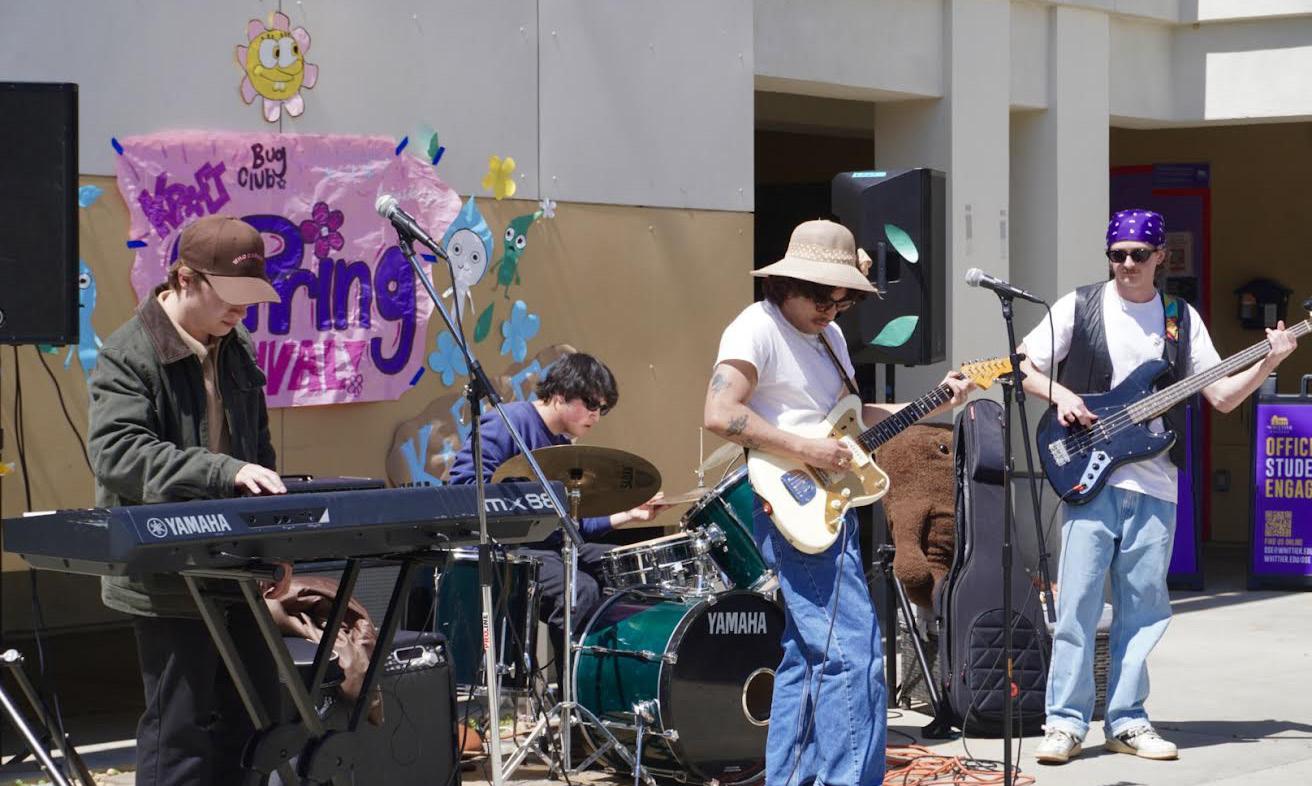
something here, you know, especially, because that's where I used to play. The club right here. It's a full circle for me,” bandmate Justin expressed. “We love Whittier,” the whole band chimes in, “Been here our whole life. We want to put it on the map, you know?” These events help show off all the talent Whittier holds while opening new doors of opportunities for amazing local bands such as The Kins, Clarion, Sketches, and many more. KPOET is to thank for working behind the scenes and making this beautiful day happen. Thirdyears Emily Perez-Medina and Paige Meyer-Draffen (also known by many as PMD) explained how the Spring Fest all came together. “Sketches actually reached out to us,” explained Perez-Medina. “They were like, ‘We want to do a show on campus, let us know what we can arrange.’” They also brought in what Meyer-Draffen calls “bro bands”, which curated the perfect lineup. Meyer-Draffen and Perez-Medina joke that they found their “strong balance” with-
in one another. Thanks to KPOET’s creativity and love for the Whittier College community, a regular sunny Friday on campus was transformed into an afternoon full of live music and fun crafts for everyone to enjoy.
The Spring Festival closed with an electric performance from the Whittier College dance team. If you missed this Spring Fest, worry not, KPOET’s plans are just getting started. “We’re definitely doing more,” Perez-Medina preps us for more exciting future events. “We want to get a Tamborazo night going on, some more Latinx music nights as well as jazz nights.” Meyer-Draffen adds that she wants, “More of this,” referencing the band's sound checking in the background, “More loud!” They continue to sum it up best: “As April winds down, so will we.” But according to KPOET, “We have plenty more new things coming.” We are left excitedly looking forward to the future Whittier College events KPOET has in store.
Whittier Welcomes Bach The Alumni
Priscilla Corona STAFF WRITER
Nadia Miller GRAPHIC DESIGNER
Every year the Music Department hosts what is known as the Bach festival, a we ekend-long ev ent sharing the journeys of music as a form of art from current students. Started in 1938 by former Dean of the Music Department Margaretha Lohmann, the Bach Festival highlights specific music pieces that the College’s orchestra and choir spend all semester preparing. This year's Bach festival was split between two days; April 4, leading with the Bach Poet Musicale, and ended on April 6 with the Festival Concert. As a way to celebrate the 85th Bach Festival, the College was given the opportunity to collaborate with a band named Chorale Bel Canto.
Chorale Bel Canto was formed in 1982 “When a group of Whittier College Music Department Alums decided that they would like to keep singing challenging music together. Our first concert was Handel's 'Messiah’ in December, 1982, and we have been presenting choral music concerts ever since,” as stated by Linda Brown, the director of Chorale Bel Canto. “Al-
though not every member of our choir is a Whittier Alum, we still feel strong ties to the Whittier College campus.”
Chorale Bel Canto holds about fifty members at this time and “To become a member, you must pass a singing audition.” Brown says that in 2018, she took over as Music Director after Dr. Stephen Gothold, who was the director and whom Brown was taught under. “I was also the first accompanist for the Chorale back in 1982, and eventually served as Assistant Director as well. I graduated from Whittier College too, and it was a very important influence that continues to shape my adult life.”
On opening day of the Bach Festival Musicale, students from Broadoaks filled the seats and other supporters of the Music Department sat down in left over free space. Dr. Teresa LeVelle introduced the start of the Bach Festival thanking those who came out to see what students had been working on.
After an introduction, the Chamber Orchestra on campus took the stage and played a Viola Concerto in G Major by Georg Philipp Telemann with Lucinda Frates as the viola soloist and Professor Samvel Chilingarian
conducting. Finishing their performance, the stage was then reset with a piano at center stage. Inviting the next performer, Edgar Soriano, who played three separate Minuets. Following Soriano’s performance Alexander Lee, piano, and artist-residence Lyubov Solovyova on Cello played Arioso From Cantana BWV 156. After this performance the stage was then reset for the College Choir and Dr. Alexandra Grabarchuk spoke on Bach and the translation of the songs the choir would be singing. When Dr. Grabarchuk finished speaking she lead the Choir through three songs from the Christ lag in Todesbanden, BWV 4. At the conclusion of the choir performance, the audience was then thanked again for coming out to support the Music Department and the first performance of the Bach Festival. As for the Festival Concert on April 6, the
event was very much lively and full of eager listeners. Dr. Grabarchuk says, “[I expect] a wonderful showcase of the original baroque work that Bach was writing and to see how it has kind of resonated through the ages and how Bach’s writing has affected lots of different composers from lots of different times and places.”
On Sunday, April 6, the choir and Chorale Bel Canto filled the Memorial Chapel. The two groups performed an Easter-related song titled "Christ Lag Ein Todesbanden." According to a choir member, "The audience were ethusiastic even with an intermission, the choir collaboration made the cramped space sound beautiful."
After two successful nights, the Bach Festival concluded. Whether or not the two groups will collaborate in the future, the music was still adored by all.

Emma cianciola/Quaker Campus KPOET helps ring in the new season.
Courtesy of Bach cantatas
The 85th Bach Festival brought students and alumni together.
CAMPUS LIFE
Get Ready To Camp At Camp Whittfest
Emma Galvan CAMPUS LIFE EDITOR
Camping is an in-tents amount of fun, especially when Camp Whittfest is just around the corner.
Every S pring s emester, a s students start preparing mentally for their upcoming finals and fourthyears are preparing for graduation, the Program Board brings out the most anticipated events of the year. Whittfest is a festival where several organizations come together and host several games for students, families, staff, and faculty to unwind before the chaotic storm that is the end of April.
The carnival is set to happen on April 11 from 4 to 8 p.m. in the Upper Quad. For this year’s Whittfest, P rogram Board i s bringing the great outdoors to the Whittier College campus with Camp Whittfest. According to second-year and executive coordinator Yen Tran, “We thought of the camp theme during our weekly Whittfest meetings last semester. Among the themes that were proposed, camp[ing] was the general favorite among the Whittfest committee and Program Board team.” She confirms that the decor and set up for the festival will reflect a camping aesthetic, with the iconic photo booth embracing the theme as well.
While last year’s Whittfest was a trip back to the ‘70s and had the popular Poet Prom attached, there is still much to be excited about with this year’s carnival. “Whittfest will be even bigger than it was last
year,” Tran says, “we have more food vendors and a live band that will be performing for us. Later in the night, there will also be a karaoke and dance battle that clubs and organizations can compete in for a grand prize of $500.”
Every Whittfest, there is live entertainment whether that was two-timing Grammy winning artist, T-Pain back in 2017, or the College’s own KPOET station playing pop-culture classics for all to enjoy last year. This year though, Program Board was able to secure Mike Staggs & The Souls, a rock and roll band that will bring out the high energy that everyone needs. Tran expresses how wonderful it has been with the band, “Our entertainment coordinator, Madyson Escobedo found them while looking for Whittfest’s enter tainment. They
have been delightful to work with.” The band will be performing from 4 to 6 p.m. before taking a short intermission, and they will do an encore performance from 7 to 8 p.m. to tie everything together. There is always something to do at Whittfest, you rarely ever see anyone bored. According to Tran, “There will be 10 carnival games–including dunk the duck, basketball toss, and ring toss–as well as five food vendors.” Some of the food that will be served include burgers, vegan burgers, hot dogs, boba, and funnel cakes. Many clubs and organizations will be involved and provide numerous games for attendees to enjoy, these organizations include the Arthurian Order of the Knights of Pendragon (AOKP), the Athenian Society, the Palmer Society, the William


Penn Society, the Metaphonian Society, the Thalian society, and the Quaker Campus. Also present will be a “photo booth bus, petting zoo, bouncy obstacle course, s’more and tie-dye stations, a performance by the Whittier College cheer and dance team, and a karaoke/dance battle.”
As the event creeps closer and closer, Program Board is working hard to get everything ready for the big day. Tran and her team have sorted out their specific roles and responsibilities, “Devin [Tovar], a first-year is our entertainment coordinator, Madyson [Escobedo], a first-year, is our entertainment coordinator,
and Jessica [Rodriguez], a thirdyear is our decoration coordinator. Planning for this day began last semester [...] so ever since [then] we have been contacting vendors, gathering quotes, and working with Brittney from the Office of Student Engagement [OSE] to make sure everything goes smoothly.” Tran also expresses that she is looking forward to seeing Whittfest in its glory, “seeing all of our hard work realised will be nice.”
Soon, the Upper Quad will transform into a campground of fun for all. Make sure to come by, roast some s’mores, listen to some rock music, and overall take a moment to relax at this year’s Whittfest.
Going Beyond The Binary With Slam Poetry
Atticus Chaidez STAFF WRITER
On April 3, Villalobos Hall held the intersectionality poetry slam. The theme of this poetry slam was “Beyond Borders, Beyond Binaries.” This student-run event had a mocktail bar provided by the Office of Equity and Inclusion (OEI) student-employees Leonardo Hernandez and Johnny Serbin, serving everything from root beer floats to Shirley Temples. In addition, there was also a dessert table with well-beloved treats such as cupcakes to slices of cheesecake.
The students running the event were Alina Estrada and Darreionna Roche, both DEI ambassadors at Whittier College. Following a statement from both, thanking all who showed up while also stating the purpose of the event, Professor of Sociology Dr. Bernabe Rodriguez gave an opening speech.
Dr. Rodriguez's speech was heavy yet welcoming, during which he talked about the importance of events like this given the state of the country and the rise of imperialism in the U.S. “[...]The arts is usually a popular target for facism, right?”
After Dr. Rodriguez's speech, there was an intermission period where people were able to introduce themselves to one another."
After that, it was time for
the first performance by Professor Douglas Manuel II. Professor Manuel performed his poem “Loud Looks” from his first book, Testify His poem talks about intersectionality and serves as an introduction to Professor Manuel himself. “A mentor that I had in grad school told me your first poem and your first book should be like a handshake,” said Dr. Manuel, and “Loud Looks” does that beautifully. Dr. Manuel’s works are available through Zyzzyva, the New Orleans Review, the Poetry Foundation, or you can find them at the Whittier
College bookstore.
Next was a poem titled “Bringing Out the Chicana in Me” by first-year student Samantha Nieves. Nieves delivered a strong and emotional poem dedicated to her community of East Los Angeles. she also performed another poem that she wrote titled, “Chicana Chingona."
"Chicana Chingona” delivers another strong and emotional piece talking about the struggles of being Chicana and how institutions don’t want to see people like her thrive.
The third performance of the evening belonged to Tyler Johnson,
also known as Ty. His first poem talks about the fear of being trans in the U.S. while still trying to maintain happiness. “There are 830 anti-trans bills in the U.S., and I am still afraid, I am still joyful.”
Johnson's second poem, “Not Helpless”, delivers a more optimistic message, “There are a lot of things happening in the world and it’s very easy to feel helpless… but we are not, because there are things that are in our hands.”
The last scheduled performance belongs to first-year student Ken Kennedy. His poem, "Your voice,

your voice, your voice," “takes place in like [after] a long day, you’re just tired y’know, external and internal struggles. And then there’s just a voice that makes things a little better […]” Kennedy delivers a strong and relatable message of everyone having a voice inside them–for whether that voice be a person, a pet, a hobby, it makes our day better.
After all the performances were done, the mic was open to anyone to perform. After a while of people chatting, finding poems, or creating their own, first-year Devin Tovar was the first to perform.
Following his short yet powerful piece, a second-year student came to deliver another short but love-infused poem. Then, Kennedy` performed another powerful poem.
To finish things off, exchange student and third-year Mac Joseph read a poem titled “If Sharks Were Men” by Bertold Brecht–a powerful and relevant poem to today's politics.
As the event concluded, students and faculties alike swarmed to take what was remaining at the table of desserts and rushed to finish what was left of the mocktails.
With the successful turnout and participation from this event, the OEI looks to hopefully host another poetry slam space for people to put aside their boundaries and binaries.
Students share their life stories through poetry.
Courtesy of Global Poets
Come one, come all to Camp Whittfest.
Courtesy of Program Board
Enjoy some rock and roll and s'mores.
Courtesy of Program Board
OPINIONS
Turns Out All I Needed Was A Walk
Driving is the default mode of transportation all across the U.S. We love our cars, and it is no surprise that our nation’s infrastructure has been specifically designed to allow us to drive them wherever we want. Public transportation in this country is laughable, particularly in less urban areas. Our roads are not pedestrian-friendly, and neither are our drivers–I dare you to try to get an L.A. native to yield for a family at a crosswalk.
A Frontier Group report reveals that the U.S. has the highest number of per-capita passenger miles traveled among 38 developed countries. According to the Federal Highway Administration, the typical American over the age of 15 drives 13,476 miles per year. I think it’s safe to say that we Americans learn to drive young, and it seems we never stop.
Like a true American, I got my driver’s license on the morning of my 16th birthday. The freedom I felt behind the wheel of my first car was undeniable. I’ll admit, I was not what you would call an exceptional driver, but my parents worked and I had no other way to get around. With a car, I could go anywhere.
The ability afforded to young drivers in a town like mine—one where a crazy Saturday night consisted of watching the sunset and sitting in the Sonic parking lot— only exemplifies the dependence on driving in the U.S. Places like Dripping Springs, Texas (that’s the actual name) are far from walkable. My neighborhood didn’t even have sidewalks.
Of course, suburban and rural areas are more spread out than urban ones, making cultivating a pedestrian-friendly community challenging. It is more sensible for me to drive 10 miles to my friend’s house than walk or ride a bike there.
While driving is the more convenient, and sometimes the only way to travel, walking is a severely underrated practice—both as a

mode of transportation and a method of mindfulness. Mayo Clinic attributed 150 minutes of moderate exercise per week to decreased risk of heart disease, obesity, diabetes, high blood pressure, and depression. Walking is an easy and low-impact way to get that movement in.
Especially when done outdoors, walking further stimulates a mindbody connection and improves creativity. A Stanford University study reveals that “100 percent of [participants] who walked outside generated at least one novel high-quality analogy compared with 50 percent of those seated inside.” Experts recommend a daily goal of 10,000 steps to reap these benefits, especially for those who do not play a sport or participate in vigorous exercise.
“Increasing daily step count is associated with lower mortality risk, improved cardiovascular health, and better metabolic function,” says Dr. Kelly Sturm, a physical therapy doctor specializing in cancer research.
Not only is walking good for our health, it’s better for the environment. Cars are infamous pollutants. America Walks reports that the transportation sector accounts for 29 percent of all greenhouse gas emissions in this country, more than any other industry. To lower my carbon footprint, I’ve made a deliberate effort to drive less and walk more, and I don’t shut up about it. I walk to the gym, school, and anywhere else I can…
The effect walking has on my mental health is undeniable. It’s almost like the experts know what
they’re talking about. I have never returned from a walk thinking, “Oh boy, I am so much more stressed out than I was before. I wish I had continued doom scrolling on TikTok instead of moving my body.”
There are other young people similarly disgruntled by the constraints of car culture. In Jan. 2021, then-college senior Mia Lind coined the term “hot girl walk” on social media, a movement whose “spunky” name inspired a nationwide fitness trend. Lind picked up a deliberate walking habit to alleviate “negative self-talk that had developed during the pandemic that was just getting louder and louder,” she explains in an interview with CBS News. The “hot girl walk” quickly became a part of Lind’s routine. She identifies it as a way to “build confidence and tak[e] time for yourself.”
By sharing her practice, Lind hopes to encourage healthy habits online. “Our generation sees walking, or at least did [...] as not really a valid form of exercise,” Lind elaborates. “For some people starting out, (those) can be really scary, and walking is a very accessible form of exercise. You can be at any fitness level to begin (and) it’s completely free.”
The #hotgirlwalk has been used more than 170,000 times on TikTok since Lind’s first video on the subject. Like-minded creators continue to promote low-impact exercise as a way to get fit.
Despite the recent celebration of the “hot girl walk” and its benefits, the Mayo Clinic estimated that
most Americans do not achieve the 10,000-step goal. Instead, the average American takes between 3,000 and 4,000 steps—one and a half to two miles—daily. Part of this can be attributed to the aforementioned infrastructural challenges.
However, even when traveling short distances, or if there are sidewalks, Americans still choose to drive. A 2017 U.S. National Household Transportation survey found that 13 percent of all car trips that year were one mile or less.
According to the U.S. Environmental Protection Agency, each mile driven in a car emits 400 grams of CO2. I’m not a math major, but if everyone chose to walk rather than drive that one mile, we would save a lot of CO2. Plus, we’d all be a little less anxious about the enviornment.
We don’t need to drive as much as we do, especially while living somewhere like Whittier Our college campus is tiny; there’s no reason for an able-bodied young person to drive up the hill from the Campus Inn to Turner. Uptown is easily accessible, too. Occasional homeless interaction aside, the streets of Philadelphia and Greenleaf are virtually made for walking.
Forcing myself to walk has allowed me to appreciate the subtle beauty of the town of Whittier. I’ve watched the trees change color with the seasons and stumbled upon strangers making snow cones. Part of me used to resent this town for being so small; but now, I feel blessed to exist here.


Dear Poet,
My crush is graduating this year, so should I confess my love while I still have the chance?
-A Pining Poet
Dear Poet,
Jo: Yes! In fact, make the most of it! As your loved one receives their diploma, now is your chance to strike! Run to them, get down on your knees, and profess your undying love. They’ll be completely starstruck and have no choice but to accept your love! Feel free to leave and enjoy your new life with your Whittier graduate love.
John: Honestly, since they’re graduating, your time must be up. Think about it. You had all this time to confess, but you didn’t. Honestly, there’s a good chance they might’ve friendzoned you solely because they’re moving on to a new chapter in their lives. And you should, too! When high school students graduate, do they go back after someone in high school? No! A new window of opportunity for them is also a new opportunity for you! Focus on getting money, meeting new people, and focusing on yourself! Don’t get drunk off the past; have a toast to your future. Get your money up, not your funny up.
Johnny: Well, the first thing to reflect on is your interactions with them. Do they seem genuinely into you? Or are you being delulu? Don’t worry; we all become delulu over something or someone at some point. Just remember, if you confess, there is no going back. You need to realize that this can go very good or very bad.
Sincerely,
The Poets
Walking offers significant benefits for both physical and mental health.
Courtesy of henryford
Piper Guinn NEWS EDITOR
Lucy Campbell / Quaker Campus
Cory White Is Bringing Back Football To Whittier
Allara Baker STAFF WRITR
As you step into the mysterious double doors of the Graham Athletic Center (GAC) and look over to the right of the faculty office, you’ll see the work space belonging to Cory White, Head Coach of Whittier College’s newly reinstated Football Team. His room, while new, embodies the things that are currently weighing on his mind. His cork board filled with family pictures, his whiteboard detailing his recent games and meeting schedule, and his copper-colored trophy of shoes titled “The Shoes” are all nestled next to a San Diego cap and a coffee maker. Prior to receiving a visitor, he had been watching a recent football game.
White grew up in San Diego, and for a large chunk of his life was initially set toward becoming an educator and high school history teacher. He attended Humboldt State University, now known as Cal Poly Humboldt, where he ended up meeting Coach Bob Owens, who had previously worked as head football coach for Whittier at the time. There, Owens saw potential in him as a future coach. Currently, Owens is the head coach at Chapman, where White got his first football coaching position at.
“So, he had hired me at Chapman for my first full-time position after I had said I was interested in coaching and wanting to incorporate my education background into it. I’m connected to him in a lot of ways. He’s great. If you were to put together a coaching tree, I would definitely say I’m at the bottom of his coaching lineage,” White says eagerly.
After graduating from Humboldt State and becoming a student-teacher at Whittier as a graduate student, White started teaching courses in the Kinesiology department as well as being a high school student-teacher. With balancing these positions along with classes, he believes that it was the kind of work that made him feel like a more balanced person. “It was a very busy time in my life. There’s a lot of things I learned there. But it definitely made me a better, more well rounded person,” White remarks confidently.
White has encountered many challenges throughout his work, especially having to transition from university to university with different resources and ways to go about things. With prior experience with San Diego, University of Illinois, and Chapman University, Due to the struggles regarding such differing program environments, it was difficult to get new enrollment numbers in the programs. “So, no matter where you go, you are always going to run into things that make each place challenging, but at the same time, every place is gonna have some awesome benefits to it, like Whittier,” White expresses. “Sometimes, you have different resources that are available to you so you have to come up with ways to make more out of less sometimes.”
White not only wants to get the absolute most out of the program, but also wants that eagerness and determination to be a reflection of himself.
What he considers his best quality is his ability to stay organized and focused, as well as his loyalty, “And the ability to see things through, see the promise in it,” he said proudly. What drives White is his desire to

create a program that develops players into the best individuals that they can be. “I would like to be a source of pride for the program, and someone that they feel represents the College well.”
White is a father to three boys, with a fourth child on the way in September. He considers his family very important to him. One of the main reasons he pursued coaching, despite moving from place to place, was so that he could be closer to them.
White also enjoys snowboarding and spending time with his family during trips in his spare time, despite not having a lot of time to go nowadays, “My wife and I also have Sea-
World season passes. We like to go there and bring the kids, we really enjoy that.” He continues, “We’ve been paying for those even when we were in Illinois last year so that we could use them more. (You’ll definitely see them [his children]) around campus if you haven’t already,” White beams.
A very central object in his office, “The Shoes” trophy, had been passed down to White after he got his position here at Whittier. To him, it’s of great importance since it symbolizes the match between Whittier and Occidental College.
Dating back from 1946 to 2019, the trophy lists all the games that Whittier had played against Occidental, which is the result of a
Trophy Game. “In college football, you pick one other college to have a trophy game with and you can have multiple, but this was one of the oldest trophies still in use for a long time, and it actually was on ESPN.” White continues his description, “Myron Claxton, the name engraved on it, was an Orthogonian, and Occidental ended up stealing his shoes and it became a big deal, hence the name. Now it’s just a big conversation piece in my office. I would love for Occidental to start playing football again so I could show off these shoes.” He explains proudly holding up the sacred trophy. White is excited to be here and is excited for football to make a comeback at Whittier.
Noehmi Tena Serves As An Inspiration To Whittier
Sara Martinez CO-HEAD COPY EDITOR
Around campus, students may spot a Poet with a roller backpack, her cacao brown locks tied in a ponytail, heading towards the stairs of the Science and Learning Center. This Poet is Noehmi Tena, a third-year student majoring in Business with a concentration in Accounting. A California native, Tena grew up in the nearby city of Norwalk, where she attended Santa Fe High School. It was there during her senior year of high school when she decided she would join the military, “It was July 7, 2009, two weeks after my high school graduation, I remember.” Tena enrolled in the Navy as an electrician and expresses her time in the military as having both pros and cons. Some of the highlights from her experience include learning the ins and outs of being an electrician for a Navy ship. As an electrician, Tena worked hands-on in maintaining the power running smoothly on the ship to aircraft runway lighting. Her ship would also deploy to various countries where Tena was able to learn about other communities and world cultures. Tena’s homebase was in Norfolk, Virginia, where she also had the opportunity to volun-
teer with various organizations such as the Red Cross. On one noteworthy occasion, Tena volunteered as a judge for a local highschool science fair competition in Banger, Washington. Reminiscing about the event she laughs, “I was surprised at how advanced the projects were, and how smart the students were. It blew my mind.”
While Tena’s military service provided her with new and exciting moments, it also had its fair share of downfalls, “Growing up, I was raised in a Christian household, so when I first deployed I remember thinking of the culture shock.”
During her enlistment in the Navy, Tena was a victim of sexual assault.
“After that, I started volunteering on base as a sexual assault volunteer advocate. I would have this cell phone on me 24/7 that was linked to a sexual assault hotline number.
I remember one time someone called it and I was able to connect that person with resources and help them through that experience.” In spite of the traumatic event, Tena’s voice remains undeterred as she recalls her experience.
Aside from that dark moment, Tena also felt that some of the activity she saw on the base was a sign for her to move on. She left the military
after nine years and came back to California. Originally, she wanted to pursue a career as an electrician but was upset when the nine years of electrician experience in the military, becoming a journeyman—a skilled electrician—would set her back to a year one apprentice. Although upset, Tena continued to look for work when she came across an opportunity at the Navy Federal Credit Union. It was there that an experience with the Federal Bureau of Investigation sparked her interest in accounting. Tena recounts the case excitedly, “I remember the FBI came in to investigate, and as a teller, I happened to assist a man who was accused of money laundering. They showed us a video of money laundering and I found the several methods of money laundering interesting. People think fraud is only through cash apps, but in actuality there is foster care fraud, and even elderly abuse fraud. Since I have children, I knew I wanted a job where my life was not on the line and accounting met my interests.”
While there, Tena decided to return to Long Beach City College before transferring to Whittier College. As an older student, Tena’s experience at campus is different compared to her younger peers. She

Noehmi balances motherood and working towards her degree.
laughs as she talks about interacting with younger classmates saying, “I feel that at first glance students think I’m a teacher but when they see me in class and interact with me, I can share tidbits about me and they teach me too. I get along with staff on a different level because they get adulting, or caregiving, and parenthood.” At Whittier, Tena is also proud of her work done with the Ahmanson Veteran Fellowship. The grant gave her the opportunity to engage in a research project with Professor Rick Ichio as her mentor during the 2024 semester. Tena decided to help Hathaway Ranch
in Santa Fe Springs with allocating funds through Grants writing. Overall Tena felt proud of helping the organization advocate for growing money and the impact that the money will have on the surrounding community.
Set to graduate in Spring 2026, you can still catch Tena on campus, repping her rollerback and signature ponytail. If you do see her, don’t be afraid to say hi, or ask her for help in grant writing. Also, don’t forget to congratulate her as she is welcoming another child. Overall, as a veteran, mother, and student, Tena proves that she can do it all with a
Photo Courtesy of Whittier College
Whittier is excited to welcome back the newly reinstated Football Team Fall 2027.
Photo Courtesy of Whittier College
Poet’s Sports Schedule:
Men’s Tennis vs Hope International University (Calif.)
@ Whittier, Calif.
• 3 p.m.
• April 10
Baseball at California Institute of Technology @ Pasadena, Calif.
• 3 p.m.
• April 11
Softball at California Lutheran University @ Thousand Oaks, Calif.
• 3 p.m.
• April 11
Men’s Tennis vs Chapman University
@ Whittier, Calif.
• 10 a.m.
• April 12
Women’s Water Polo vs University of Redlands @ Whittier, Calif.
• 11 a.m.
• April 12
Women’s Lacrosse at Occidental College @ Los Angeles, Calif.
• 11 a.m.
• April 12
Baseball vs California Institute of Technology
@ Whittier, Calif.
• 11 a.m. & 3 p.m.
• April 12 Softball vs California Lutheran University
@ Whittier, Calif.
• 12 & 2 p.m.
• April 12
Men’s & Women’s Track and Field at Cerritos College Invitational
@ Cerritos, Calif.
• All Day
• April 12
Men’s Tennis vs Stanton University @ TBD
• 3 p.m.
• April 15
Women’s Water Polo at Occidental College
@ Los Angeles, Calif.
• 7 p.m.
• April 16
Women’s Lacrosse vs Chapman University @ Whittier, Calif.
• 7 p.m.
• April 16
Baseball vs California Lutheran University
@ Whittier, Calif.
• 3 p.m.
• April 18
Softball vs Claremont-Mudd-Scripps Colleges
@ Whittier, Calif.
• 3 p.m.
• April 18
SPORTS
Women’s Tennis Season Cancelled
Olivia Nuñez SPORTS EDITOR
Following the revival of the Football program and the Men’s Lacrosse team, Whittier has seen two legacy sports make a return amid leadership changes across men’s and women’s sports. One of these new additions is Head Tennis Coach Ronald Kang, who was recently named Director of Tennis after being a part of the coaching staff at Occidental College. His experience at multiple levels of collegiate athletics primed him to lead the Poets this season.
The Men’s Tennis team is just about wrapping up their season with an unfortunate 0-5 record in conference play despite their team being compiled with single and double match-ups. They are set to continue conference play in addition to a regular season match against the Hope International University Royals.
Notably absent this season however is the Women’s Tennis team.
Monze Meraz-Lerma, a third-year student at Whittier College, was a part of the tennis team during the ‘23-‘24 season. She was surprised to learn, however, that she would be unable to participate during the ‘24-‘25 season.
The Women’s Tennis team faced an unfortunate setback during the start of the ‘23-‘24 season when former Head Coach Aaron Hayes announced that after receiving a promotion, he would no longer be able to head the tennis team. This left the Poets under the command of two assistant coaches who were

the same age as most of the players on the roster.
Meraz-Lerma attributes an overall lack of respect between the players and the staff as a shortcoming that resulted in many of the international students transferring out of the College itself. She spoke specifically about her teammates from countries including Spain, India, Sweden, and Germany, whose last season left them feeling discouraged, “They sacrifice a lot to come here. This goes for the boys as well. We had a team of eight last year with two graduates, that leaves us with six, and three of them […] which were unfortunately my best friends, transferred. So, that left us with three girls.”
The difficulty of tennis is that it is both an individual and a team sport. There are single and double matchups that are combined to form a cumulative score. While many individuals experienced success in the Southern California Intercollegiate Athletic Conference (SCIAC), which is a notoriously
difficult conference, the team itself was losing.
While the damage of the ‘23’24 season was done, many of the girls on the tennis team assumed that with a coaching change and new girls arriving, there would be a different trajectory. Unfortunately, little to no recruiting was accomplished during the off-season, leaving the team stranded.
According to NCAA regulations, a tennis team must have a minimum of six players to complete a team. This leaves out the extra players that are characteristic of a team with depth, which is a safeguard for injury or sickness. Meraz-Lerma states, “You need subs. You have to have at least one. I just came back from a really major surgery this summer and I’m still in pain every day.” It was her opinion that “scraping by” with the bare minimum to play the court (as was suggested by their head coach) would not be conducive to their season. Furthermore, the strategies proposed were to incorporate
athletes from other sports who had never touched a tennis racket before in order to complete the team. In comparison to other teams in SCIAC, like the nationally ranked Athenas at Claremont-Mudd-Scripps College who typically carry 18-20 girls, the Poets did not look forward to losing often.
For fourth-year Manasvi Vardham, the future was too bleak for her to continue on. Meraz-Lerma spoke about her teammate who had lots of individual success but could not bring herself to participate this season, “[Vardham] decided to quit because she wanted to save her year of eligibility just because she did not have high hopes that our coach was going to recruit anybody else.” Though high spirit and camaraderie previously characterized this closeknit women’s team, Meraz-Lerma says her third-year has been very different, “[It’s] not fun. Imagine your team being cut in half.”
In the end, the decision was made to seem entirely their own. But when looking at the circumstances, the team was sidelined due to events that were out of their control. Meraz-Lerma articulated the conundrum, “It was essentially on our own terms but at the same time it wasn’t.” For Meraz-Lerma, the decision was easy because of the love she has for the sport. It was her fear that participating this season would, “take the love of our sport away.” She and her teammates, however, remain hopeful that their final season in Purple-and-Gold will be as enjoyable as it was when they started.
Coach White’s Plans For Revitalization
Emma Galvan CAMPUS LIFE EDITOR
Earlier this academic year, the Whittier College Board of Trustees approved the return of the Football program after alumni raised over $814,000 to help hire new coaches and recruit athletes. Then, on Feb. 10, seasoned-coach Cory White was revealed to be the new Head Coach for the team, quickly building a foundation for the upcoming season.
Although the playing season does not start until Fall 2026, Coach White confirmed that the department has started recruiting. “We got some success in our early recruiting, we’ve got five committed players for next Fall. Our goal is 15, so we’re on our way,” White explains. The Football department will also be holding a recruiting event on campus this upcoming Saturday. “Our goal is to get 25 potential freshmen in here, we’re currently standing at 19 [ interested students] so we’re feeling good about it,” he expresses. Although the number of recruitments has looked promising, White mentions that it has been a bit challenging, “I didn’t start until a month ago, and that’s pretty late to start the process for the 2025 class […] but we’re going to be okay.”
On April 1, the Football department hired Mark Odin as the new Assistant Head Coach and Defensive coordinator. They also
welcomed Lucas Govan as Offensive Coordinator. White has stated that the three have been getting adjusted together and have been forming plans for the future season.
The positive reception from alumni and staff has motivated White: “A lot of alumni have reached out and want to help. I mean, the President, Vice President, and the directors have given me what I need to be successful early on.” He continues, “You know, the folks at the Admissions Office, the other assistant coaches, and even the folks down at the CI [Campus Inn], everyone is welcoming and trying to help and get us what we need. Everyone sees it as a positive way to increase the campus community and help achieve our goals.” The current goals White is committed to fulfill are to find players and establish a good foundation for the team set to begin in the Fall, “Even though we’re not playing football, we will still do weight training, de-
velop, and get stronger. Get ready to play.”
As excitement of the returning sport still lingers, one question that remains is the state of the Graham Athletic Center (GAC). Football was a huge part of the athletics department in the past, but since its cancellation there has been an emphasis on the other sports that could lead to trouble. These concerns include how much attention athletic trainers will need to give to the football program and how the weight training spaces will be impacted as more players get recruited. However, White is not worried and actually sees a positive impact for the athletics department. “I think it’s going to be a return to normal. Obviously there’s less student-athletes and everyone’s had a lighter load, but I think the College recognizes our need for enrollment. We want those people back. Everyone used to handle football, no problem, they’ll just take it as a return to normal.”
Currently, the department is

still accepting as many donations as they can. “I mean, you’re never going to turn away donations, right?” White jokes. He reflects on the possibility of attracting more donations, “A lot of it is going to be for us to go out and meet folks. I’ve had quite a few early meetings with different alumni groups who want to get involved from the outside. Over the summer, there’s events I plan to go to, like an Orthognian society reunion where they want me to go meet some people.” He also plans to travel to meet other alumni in different states, “We have alums from like San Diego, Seattle, or Hawai’i; I will try to meet with these alums and talk to them about future plans that have to do with fundraising aspects.”
As the ‘24-’25 academic year starts to close, White is looking far ahead into the possible number of players that the campus could be expecting. “We’re going to train them all for the Fall 2025 semester, it’ll probably be around 20 or 25 players. Then, ideally, we’re going to add 25 more players for the Spring of 2026 and that’s when we’ll actually have football practice.” According to White, once the season actually starts, he is “hoping to gain another 25 for the Fall 2026 semester so by our first season of competition, we’ll ideally be around 75 or 80 players at that rate.” While Fall 2026 seems too far away, it’s only just the beginning for White and his upcoming team.
Courtesy of TONY/ACTIONWESTPHOTOGRAPHY
The Women’s Tennis team has faced unfortunate setbacks.
Coach White prepares his team for the upcoming season.
The Dodgers Defer Their Way Into A New Dynasty
Elias Loya COPY EDITOR
It was March 27, a cool 70 degrees with partly cloudy skies. Hundreds of people rushed to their seats as rapper, Ice Cube drove into Dodger Stadium (residing in Chavez Ravine). He rode in a blue Chevy Impala, with the 2024 World Series trophy sitting in the passenger seat. After he parked the car, part-owner Magic Johnson took the trophy out of the seat and handed it to Ice Cube, who placed it on a blue pedestal and shook hands with Dodgers manager Dave Roberts. The crowd roared as photos were taken of the team and the Commissioner’s Trophy.
It has been several months since the Dodgers defeated the New York Yankees four games to one during the 2024 World Series, marking their eighth championship for the organization overall. The victory’s remnants remain prevalent in the 2025 season. The team was stacked, supported by good draft picks, trades, refurbished careers, and notable free-agent signings. After years of first-place finishes in their division and 12 straight postseason appearances, with a couple of World Series appearances along the way, many have said that the Dodgers are the most successfully run organization in the MLB. But why is that?
Before the Dodgers got to where they are now, however, there were the Oakland Athletics (A’s).
In the “live ball era”, or the post1920 modern approach to playing baseball, money has been the most powerful tool in creating a potent organization. It was previously theorized that only teams with a lucrative history (like the Yankees) could succeed and that poorly funded teams, like the Oakland Athletics (pre-2002), would never catch up. However, in the early 2000s, A’s General Manager Billy Beane reinvented how data analytics were used, and the A’s were able to identify high performing, undervalued players. Through this new tactic, the team was able to compete with the highest spending teams for a fraction of the cost. This is what we now know as “moneyball,” and it has revolutionized the way organizations scout and develop their players, as well as how they build their front office staff, and it’s clear how much of an influence this had on the Dodgers.
For starters, the Dodgers are notorious for their player development for both draftees and major leaguers alike. Due to their consistent spending habits over the past decade, the Dodgers have had to choose players late into the draft, but that doesn’t make these picks from being any less productive; scouts are often instructed to prioritize players who they think are capable of mentally adapting to the major leagues. According to MLB. com, the Dodgers rank fourth in farm systems heading into the 2025 season, and they have been within or near the top 10 farm systems for the last decade.

Courtesy of Carrie Giordano/LOS ANGELES DODGERS
The Dodgers are the new villains in baseball, or are they just smart?
To add on to this, the Dodgers invest millions into player development through scouting reports, experienced coaching staff, and data analysts, all of which help the players develop a plan rather than just tweak their approach to
praised the program, saying how the lack of an egotistical coaching staff really turns development into a more collaborative effort. There is also, of course, a financial aspect to this. In 2013, the Dodgers came to an agreement
led the league in home game attendance, averaging 42,493 attendees per game. The Dodgers are able to use these funds (and also the support from their ownership group) to reinvest in their organization. While successful development
After years of first-place finishes in their division and 12 straght postseason appearances, with a couple of World Series wins along the way, many have said that the Dodgers are the most successfully run organization in the MLB.
hitting and pitching. The Dodgers have also used these techniques to revitalize and improve the careers of veteran players, including the likes of Max Muncy, Chris Taylor, Tyler Anderson, Michael Kopech, and many more. Notable Dodgers Alum Walker Buehler has even
with Time Warner Cable (now Spectrum) on a 25-year-long, $8 billion TV deal. The team is also based in Los Angeles, which comes with a plethora of other perks like marketability, opportunities for sponsorships, and high rates of attendance. According to ESPN, LA
and financial management are key, the leadership is nothing to be scoffed at. With Guggenheim Baseball Management acquiring the team from Frank McCourt in March of 2012, along with the appointment of Andrew Friedman as President of Baseball Operations

in 2015, the team has gone in a completely new direction. Under this front office, the Dodgers have been able to use their highly developed prospects to make trades for established major leaguers like Mookie Betts and Tyler Glasnow, sign big value contracts more frugally than other teams might have (J.D. Martinez), and have even been able to sign some of the most prominent players in the sport like Shohei Ohtani, Freddie Freeman, Blake Snell, etc. These deals have caused an uproar within the baseball community.
Furthermore, many of these contracts feature deferrals, bringing down the annual average value (AAV) of several contracts, giving them more room to sign even more players (a feature not exclusive to just the Dodgers). For those unaware, deferrals in sports reduce the annual income of a player’s contract but teams still have to pay the rest at a later time. Recently, the Dodgers have been getting a lot of heat for utilizing deferrals in many of their players’ contracts, notably Shohei Ohtani’s contract. Ohtani signed a 10-year, $700 million deal, featuring $2 million annual payments from 2024-2033, and $68 million annual payments from 2034-2043. Ohtani’s contract is structured to offer payroll flexibility and lower the burden of MLB’s luxury tax on the team, with many fans claiming that the large deferrals are harming the competitive balance of the sport as a whole.
Last but not least, the organization has been consistently successful over the last decade. The team has made 12 straight postseason appearances, making four World Series appearances between 2017 and 2024, and has two championships to show for it (2020 and 2024). Even though the Dodgers did not always go very deep into the playoffs, their consistent regular season success and positive, cohesive clubhouse atmosphere have cemented them as one of, if not the greatest, organizations in baseball. They’ve established a winning culture, something that has attracted so many other players, that some have even signed with the Dodgers for less money solely for the opportunity to win more often and develop their skills.
As the new season progresses, the Dodgers have continued to show off their elevated style of play. Will they break the all-time regular season win record? Will they be the first team in the 2000s to win back-to-back championships? Many comparisons have been drawn between the current Dodgers team and the ‘90-‘00s Yankees, with many seeing today’s Dodgers as the new “Evil Empire.” There’s a long way to go before they reach that level of infamy, but it’s clear that they’re establishing (or getting very close to) a dynasty. There are still many games left in the 2025 season, so who knows where the team will end up. No matter what happens, the Dodgers seem prepared for it and will remain a force to be reckoned with for years to come.
Shohei Ohtani is one of the most famous baseball players to have a deferred contract.
Courtesy of TRuEBLuELA
The QC Staff
Suggests:
Emma Ciannciola FEATURES EDITOR
Want to know what our new Features Editor recommends this week? Read on!
Food:
It’s the best surprise to come home to the sweet and specific smell of my grandma making her Chocolate Chip Rosemary Cookies. Those rectangular sweet treats are genuinely one of the best flavors that have ever touched my taste buds, and are unfortunately rarely made, making me cherish them when they do make an appearance in the oven.

Movie:
Recently I’ve been pretty fixated on the 2016 film, based on the 2011 Novel, Miss Peregrine's Home For Peculiar Children written by Ransom Riggs, Directed by Tim Burton. The eerie abnormalness of the film is what originally caught my attention, mixed with the morbidity of the characters and plot, creating the perfect aesthetically pleasing thriller fantasy.

Music:
TV Girl’s 2014 LP French Exit will forever be one of my favorite collections of music.
In my opinion French Exit is a timeless piece that I can listen to in any mood. I like to describe it as extraterrestrial parisian music, due to the french spoken word intros, outros and interludes mixed with its looped and layered percussion, creating an out of this world unique sound.

Art:
I've always been a fan of stop motion, whether it's watching or creating it. I used to make stop motion short films with my dolls and action figures when I was younger. On top of my fascination with making it, I grew up obsessing over stop motion films such as Coraline, Paranorman, Corpse Bride, Flushed Away and more.

ARTS & ENTERTAINMENT
Jack Black Flint And Steels The Show
Piper
NEWS EDITOR
Spoiler warning!
To the untrained eye, A Minecraft Movie is your classic cash grab blockbuster with a narrative structure that’s 49 percent hero’s journey, 49 percent buddy comedy, and 2 percent musical. Oh, there’s also the forbidden-lovers-from-two-different-worlds B-plot. For a true film analyst like me, A Minecraft Movie provides a layered critique of late-stage capitalism and rampant consumerism. Steve, the iconic Minecraft avatar, is portrayed by Jack Black and born to invent. His creative destiny is solidified by his daily uniform, which all great inventors must have (think Steve Jobs’ turtleneck). Steve’s closet consists of numerous identical blue collared shirts, and nothing else. This could be interpreted as a method of conformity and lack of creativity, but it is actually a defiance of consumer society. Rather than succumb to the constant pressure to buy more clothes and never repeat an outfit, Steve is content with few material goods.
At the beginning of the film, Steve is working a 9-5 in a dead end town called Chuglass, Idaho. As a child, he yearned for the mines nearby, but was thwarted by his elders. To appease his inner child, Steve escapes the clutches of corporate America by heading down the mine shaft, where he finds the Orb of Dominance and Earth Crystal. Steve creates a portal to the Overworld and flourishes under the creativity allowed to him. For companionship, Black’s character domesticates a wolf named Dennis. Steve’s freedom is halted when he and Dennis wind up in the Nether, a place so dark and soulsucking you might mistake it for an Amazon warehouse, if not for the pig population. The piglin Nether queen, Malgosha, enslaves Steve, but Dennis miraculously escapes with the Orb and Crystal, which he hides under Steve’s bed in the real world.

runs a petting zoo out of her car as a side hustle. Her career-juggling illustrates the never-ending “hustle culture” forced upon today’s entrepreneurs–capitalism breeds us to always work harder and make more money, rather than focusing on one's passion. Henry stumbles upon Garrett’s store before his first day of school. The young boy’s optimism clashes with the former champion’s nihilism. However, Henry returns to Garrett after crashing a makeshift jetpack into the Chuglass chip company while his sister is working. Already fed up with his school, which stifles creativity even in art class, Henry is drawn to the orb in Garrett’s shop. With the Garbage Man in tow, young Henry follows the orb to the mine-portal. Concerned that he never came home from school, Natalie and Dawn follow Henry to
On their journey to replace the broken crystal, each individual discovers a new capacity for creativity and a passion that was stifled under corporate America. By returning to a primitive society, Henry harnessed his natural skill for invention, Natalie learned to stand up for herself, Dawn slowed down to focus on one talent (animalwhispering), and Garrett began to let down the faux-macho mask. The team also encounters their share of obstacles. Malgosha’s piglin army is in relentless pursuit of Steve, and tracks him down several times. Soon after arriving in a quiet community populated by plant-based (and totally nonbinary) villagers, the piglins have the squad surrounded. In their battle, the men and women are separated from one another, and there are far too many
exploring his creative spirit. By the end of the film, however, both Henry and Garrett grow as men who are unafraid to express themselves. Garrett even joins Steve in song (twice), fights a chicken-jockey, and sacrifices himself in a classic he’sdead-no-wait-he’s- still-alive fakeout. Although their alpha mentalities clash, Garrett and Steve do away with their heteronormativity to form a budding bromance. After their separation from the men, Natalie and Dawn serve little purpose but to domesticate more wolves, which is disappointing news for feminism. Fortunately, the movie does pass the Bechdel Test, but leaves much to be desired in the realm of female character development.
"If I had a nickel for every time Jack Black gave an impromptu musical performance in a movie, I would be able to buy the lavachicken stand and turn it into a lava-tofu vendor."
the mines, where they are all transported to the Overworld.
An undisclosed amount of time later, Garrett “The Garbage Man” Garrison, a small business owner and self-identified alpha male, inadvertently purchases the orb at an auction. Played by Jason Momoa, Garrett is a former video game champion. He has not accomplished much since and is probably deficient in fiber, as his diet consists of whey protein isolate and potato chips. He serves as the perfect example of capitalism’s shortcomings: his business is failing, and so is his liver.We also meet Henry and Natalie at this time, whose mom recently passed. Although she looks 16, Natalie manages to get a job managing socials for the Chuglass Chip company, the town’s most profitable business. The pair move into a small home with the help of Dawn, a realtor who also
Once in the Overworld, the crew’s survival is quickly challenged–night comes every 20 minutes. Thanks to his creative spirit, Henry learns to build a fortress, but his novice is no match for creepers and zombies. While fighting (poorly) for his life, Garrett destroys the Earth Crystal, which is necessary to return to the real world. The team is saved by the arrival of Steve, who was released by Malgosha to track down the orb. Here the exposition ends and the true conflict ensues: Malgosha hopes to use the orb’s power to black out the Overworld and abolish creativity. Steve later explains that, as a child, the Nether queen aspired to sing, but was bullied so intensely that she now despises ingenuity. The team must find a way to return home before Malgosha acquires the orb.
villager casualties, an ode to all the unnecessary wars that have been fought in pursuit of riches and land over time.
One good thing does come out of this battle: the lava-chicken stand that Steve established in the village is likely demolished. Steve had no right or chance of profit selling chicken in a vegetarian commune. Plus, the jingle he created and shoved down our throats is insufferable. No one asked Jack Black to sing in this movie, but he did it anyway. If I had a nickel for every time Jack Black gave an impromptu musical performance in a movie, I would be able to buy the lava-chicken stand and turn it into a lava-tofu vendor. Singing aside, Steve is a necessary component to enlightening his team in the Overworld. He mentors Henry and is often at odds with Garrett, who is more concerned with finding diamonds than
Near the end of the film, the men and women reunite for a final battle with Magosha and her minions. The Lord of the Rings parallels are loud: the pigs are basically Orcs, the orb lights up the sky at the top of a structure closely resembling the Eye of Sauron, and good fights evil for the right to rule the Overworld. Steve even refers to Henry as a “Frodo-type figure,” and while the Orb is no Ring of Power, it does have corruptive capabilities. I wouldn’t quite call Steve a Gandalf-type, but I could see Garrett turning into a Gollum-type if left alone. The team succeeds in their fight against Malgosha and all return to the real world to share their new, anti-capitalist dreams. With some convincing, Steve returns too, and helps Garrett transform his shop into a beacon for creativity among the youth.
Natalie starts teaching self-defense, Dawn finally opens up her own zoo, and no one even questions the blocky wolf roaming around suburban Idaho. Oh, and Henry finally gets his jetpack to work, which is a real ladies magnet.
While A Minecraft Movie falls short in many capacities—most notably its musical element—it is a beacon for the future of anti-capitalist propaganda on the big screen. As this is A Minecraft ovie and not THE Minecraft movie, I hope for a MCU-level franchise expanding upon the primitive lives of the Overworld’s villagers.
Courtesy of 20th Century Fox
Courtesy of Candy Jar Chronicles
Guinn
It's time to mine and craft in new Minecraft movie.
Photo Courtesy of warner Bros. Pictures
Courtesy of Mary Lee Gowland
Courtesy of Adobe
Summer Slasher Is A Hell Of A Bummer
Ernesto Hernandez STAFF WRITER
Among the horror community and among the slasher genre, arises one of the most iconic installments of “Summer Horror". Films like, Friday the 13th (1980), Sleepaway Camp (1983) and I Know What You Did Last Summer (1997) initially gave birth to this subgenre, creating an immense fanbase for future films. Hell of a Summer (2025), debuts Finn Wolfhard’s first directed feature film that merges both aspects of old-school horror with the incorporation of Gen-Z.
This campy horror film revolves around Jason Hochberg, played by Fred Hechinger, who gets the ability to relive his childhood nostalgia when offered to work at his old summer camp with a fresh group of camp counselors.
However, all hell breaks loose as a devilish-masked murderer sets off to kill these individuals one by one, until there is no one left alive.
To start off, I had really high hopes with this film from seeing the trailer alone. I went in expecting an awesome horror-comedy since the company NEON is known to debut many films like this, but I was

quickly let down within the first 20 minutes of the film. This film, in my opinion, tried really hard to get the audience to like these “likeable” characters and spent the majority of the time trying to sympathize with the fact that Jason was being an outcast 24-year-old in a group of 18to-19 year olds. Billy Bryk did an
astounding job with his character as Bobby, which I believe was the only person who did not seem to be forcing his role on screen. The vast majority of the characters felt very random and almost out-oftouch with the film's concept.
However, I will say that there were a couple comedic moments
that made me laugh but, nevertheless, the aspect of horror really was a let down. Though this film had a rated “R” rating, it felt more like of a PG-13 film from the lack of horror it demonstrated in the kill scenes.
I know that many might be excited for this film given the fact that
it was directed by Finn Wolfhard, but I most definitely recommend you sit this one out until it is on streaming platforms. If you pay close attention to all the horror-cliches, it may be very EASY to put the puzzle pieces together to get the killer’s identity… just saying.
SouthofMidnight Attacked By The Right
Jonathan Bermudez MANAGING EDITOR
When we think about video games, most of the time we think about them being in the interest of men. With games like Grand Theft Auto or Call of Duty, a lot of people argue that games not only promote violence but also give in to the “male fantasy,” according to the meme of the BuzzFeed video “Feminists Play Grand Theft Auto For The First Time.” But like this meme, the argument of inclusivity in video games is not taken seriously and has been ridiculed and attacked by far-right “gamers”. It has gotten to the point that any new game that doesn’t feature a strong male protagonist is seen as part of the “woke agenda”, especially when games feature a strong female lead.
For the longest time, women have been outcasts in the gaming world. Any time they have been included, they were overly sexualized. For example, Lara Croft from the Tomb Raider series, and her very small shorts and tank top, which is supposed to help her explore ancient cities. But nothing has done more damage to women in gaming than the Gamergate movement.
For those fortunate enough not to know, the Gamergate was a movement pushed by the alt-right to get women out of the gaming industry. It all started when a man spilled personal information about his ex, a game developer. People on the internet twisted his words and created a fake story about his girlfriend sleeping with journalists to get her games better coverage. Of course, all of it was fabricated, but it

never went away even after the truth was revealed.
Almost 10 years later, the effects of Gamergate still taint the gaming industry. With the new game South of Midnight, which features a female protagonist and is set in a fantasy version of the Louisiana Bayou, many people on the internet have come to call it "woke". Mark Kern, who goes by Grummz on X, has been attacking the game for its “forced” Diversity, Equity, and Inclusion (DEI) practices. Since he
game community.
has some years working as a game developer for the company Blizzard, some people on the internet accept his word as fact but most call him a scammer and a fraud for some of his failed projects.
Another game that has been in the target of right wing gamers is the new entry of the Assassin Creed franchise, Shadows. The game not only depicts a woman as the lead but also an African-American samurai who is based on the real historical Samurai Yasuke. De -
partment Of Government Efficiency (DOGE) Chief, Elon Musk, commented about the game on X, “DEI kills art.”As someone who has been playing video games since they could basically walk, “DEI” is nothing new. There are so many games that would fall under this idea of “wokeness” that many right wingers would consider a problem to today's standards such as Medal Of Honor: Underground (2000) that follows the story of a French woman fighting Nazis in France. Or Dr.
Neo Cortex crossdressing in Crash Bandicoot: Twinsanity (2004). However, these right wing gamers are making it everyone’s problem and ruining the industry of video games. Games are better when we treat them as sacred things and not something that is “woke”, whether it has a women lead, or gay couple, or anything that doesn’t fit the right standards. Video games are meant to be enjoyed by everyone and we should stop allowing these right wing people to say otherwise.
Finn Wolfhard's director debut is a lackluster blockbuster.
Photo Courtesy of Neon
South of Midnight is a victim to the far right video
Photo Courtesy of Complusion Games

