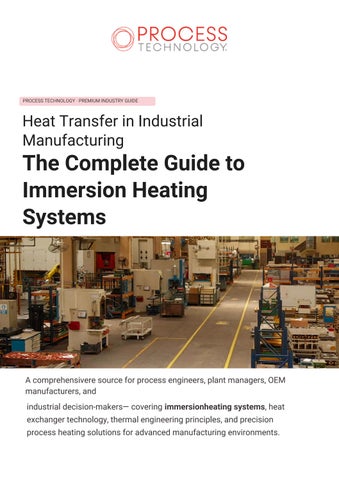

The Complete Guide to Immersion Heating Systems
A comprehensivere source for process engineers, plant managers, OEM manufacturers, and industrial decision-makers— covering immersionheating systems, heat exchanger technology, thermal engineering principles, and precision process heating solutions for advanced manufacturing environments.
Understanding Industrial Heat Transfer
Heat transfer is the foundation of every industrial thermal process In manufacturing environments, energy
The Three Modes Industrial Heating Challenges
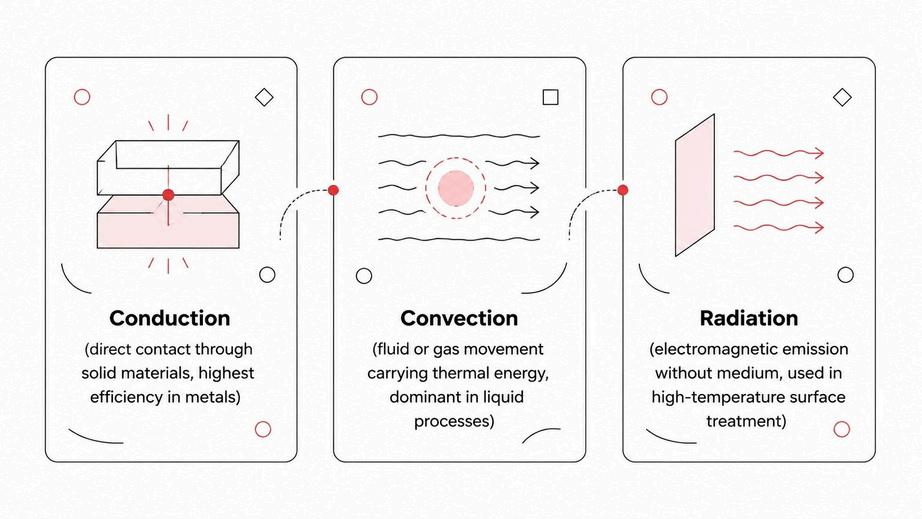
Conduction Direct molecular contact through solids and stationary fluids
Convection Heat transfer via fluid or gas movement
Radiation Electromagnetic energy transfer without a medium
Maintaining uniform temperature distribution across large process volumes
Managing corrosive or aggressive chemical environments
Achieving rapid thermal response with minimal overshoot
Reducing energy consumption while maintaining process integrity
Selecting materials compatible with specific process f luids
Thermal efficiency in industrial processes is directly tied to correct heater selection, material compatibility, and system design Optimizing these variables reduces energy costs by up to 30% in continuous-process operations

Why Immersion Heating Delivers Superior Performance
An immersion heater transfers thermal energy directly into the process medium liquid, gas, or semi-solid eliminating intermediate heat transfer surfaces This direct-contact approach achieves near 100% energy conversion efficiency, making it the preferred solution for industrial immersion heater applications requiring precision, reliability, and rapid thermal response
Direct Energy Transfer
Heating elements are fully submerged, delivering energy directly to the process medium with minimal thermal loss and maximum efficiency
Thermal Response
Low thermal mass enables fast heat-up and cooldown cycles, reducing process dwell time and improving throughput
Precise Temperature Control
Integrated thermostats and sensors maintain ±0 5°C accuracy, critical for semiconductor and chemical processing applications
Footprint
Immersion heaters install directly into tanks, vessels, and pipelines no external heat exchanger loops required
From small-tank immersion heater for water applications to large-scale industrial immersion heater installations, immersion heating technology serves virtually every process industry delivering consistent, controllable, and cost-effective thermal performance
CHAPTER 03 HEATER SELECTION
Selecting the Right Immersion Heater
Heater selection requires careful evaluation of process fluid chemistry, operating temperature, wattage, and application requirements. density, sheath material, and mounting configuration The four dominant metal heater and specialty configurations each address distinct engineering requirements
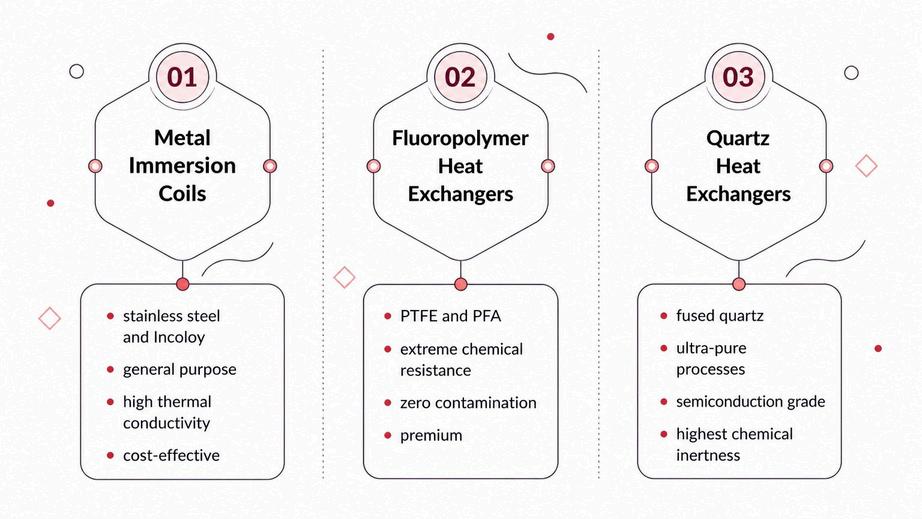
Stainless steel, Incoloy, and titanium sheaths for general- purpose and corrosive applications Robust, cost-effective, and widely specified across process industries View Product Details
Threaded metal screwplug heater designs for direct tank or vessel mounting. The electric immersion screwplug heater enables rapid installation and removal without draining the process. Explore Related Solution
The flanged immersion electric heater suits large tanks and highwattage applications Bolted flange mounting allows full element bundle removal for inspection and maintenance Learn More
Fused quartz sheaths provide exceptional chemical inertness for ultra-pure processes The quartz heating element is ideal for semiconductor, pharmaceutical, and highpurity chemical applications Discover More
Metal Heaters Screw Plug Heaters
Flanged Heaters Quartz Heaters


Heat Exchangers & Immersion Coil Technologies
When direct immersion is impracticalor fluid contamination must be prevented, immersion heat exchanger systems provide indirect thermal transfer Immersion coil heat exchangers and fluoropolymer heat exchangers serve aggressive chemical environments where metallic surfaces would corrode, contaminate, or fail prematurely.
Immersion Coil Configurations
Serpentine Coils Maximum surface area in compact tank footprints
U-Coils Simple installation for standard rectangular and cylindrical tanks
Helical Coils Optimized for agitation and fluid circulation
Panel Coils Wall-mounted for specialized vessel geometries
View Heating Coil for Water Heater Solutions
Fluoropolymer Advantages
PTFE and PFA construction for extreme chemical resistance
Non-stick surface prevents scale and deposit buildup
Operational temperatures up to 260°C (500°F )
Ideal for acid baths, plating solutions, and ultrapure water
Zero metallic contamination risk
CHAPTER 05 · WATER HEATING SYSTEMS
Water Heating Technologies for Industrial Processes
Industrial water heating demands solutions ranging from small laboratory tanks to deep-process vessels holding thousands of liters Selecting the correct water tank immersion heater configuration ensures efficient heat-up, stable temperature maintenance, and long service life under continuous-duty conditions.
Small Tank & Laboratory Systems
Compact immersion heater for water designs serve laboratory baths, small process tanks, and pilot-scale operations Low wattdensity elements prevent localized overheating and extend service life Learn More
Multi-Element Tank Heating
The immersion heaters for water in multi-element configurations deliver distributed heating across large tank volumes, eliminating cold spots and ensuring uniform process temperatures Explore Related Solution
Deep Tank & Vessel Heating
Vertical water tank immersion heater assemblies are engineered for deep vessels, electroplating tanks, and large-format process baths requiring full-depth thermal coverage View Product Details
Watt Density Rule: Always match element watt density to the process fluid Water tolerates up to 60 W/in²; viscous oils and aggressive chemicals require significantly lower densities to prevent element failure
CHAPTER
Heating Elements & Intelligent Thermal Components
The heating element is the core of every immersion system Element material, sheath construction, watt density, and termination design directly determine thermal performance, chemical compatibility, and operational lifespan Advanced heating element for immersion heater designs incorporate intelligent thermal management features for maximum reliability.
Element Technology Overview
QM Series Heating Elements
Precision-engineered water heater immersion element assemblies with optimized watt density for extended service life in continuous-duty water and chemical heating applications

Quartz Sheath Elements
The immersion water heater heating element with fused quartz sheathing delivers zero contamination for semiconductor wet benches and ultrapure water systems Discover More
Inline Heater Systems
The inline immersion heater heats process fluids within a flow-through chamber ideal for closedloop systems, recirculation circuits, and continuous-process operations Learn More
Thermal Reliability Factors
Correct watt density for fluid type and flow conditions
Sheath material compatibility with process chemistry
Adequate element immersion depth at all times
Proper termination sealing and environmental protection
Regular inspection and preventative maintenance schedules
Industrial Applications of Immersion Heating
Immersion heating technology serves the most demanding process industries worldwide From semiconductor cleanrooms to aerospace composite curing ovens, precision thermal management is a critical process variable not an afterthought Each application demands specific materials, configurations, and control strategies to meet rigorous quality and safety standards.
Semiconductor Manufacturing Chemical Processing
Ultrapure immersion water heater heating element systems maintain precise temperatures in wet benches, etch baths, and RCA cleaning processes Quartz and PTFE materials prevent metallic contamination at the molecular level
Corrosive acid baths, caustic solutions, and reactive chemistry demand fluoropolymer heat exchangers and chemically resistant metal alloys Inline and immersion configurations serve batch and continuous processes
Surface Finishing Aerospace & Advanced Manufacturing
Electroplating, anodizing, and conversion coating lines rely on precise bath temperature control Water tank immersion heater systems maintain uniform temperatures across large plating tanks for consistent deposit quality
Composite curing, adhesive bonding, and thermal forming require precise ramp- and-soak profiles. Power rectifiers and programmable controllers deliver repeatable thermal cycles for certified aerospace processes.

Future Trends in Industrial Heat Transfer
The next decade of industrial thermal engineering will be defined by sustainability mandates, digital integration, and intelligent process control Manufacturers investing in Industry 4.0-ready thermal systems today will achieve measurable advantages in energy efficiency, process quality, and operational agility
Sensors
Connected thermal sensors enable real-time monitoring, predictive maintenance, and remote diagnostics across distributed manufacturing facilities

Next-generation sheath alloys and fluoropolymer compounds extend service life while reducing environmental impact and lifecycle costs
Virtual thermal models enable process optimization, what-if scenario testing, and commissioning validation before physical installation
1 2 3 4 5
AI-driven controllers adjust power output dynamically based on process conditions, reducing energy waste and improving thermal consistency
Industrial heating accounts for up to 30% of total manufacturing energy consumption. Optimizing immersion heating systems with intelligent controls and high-efficiency elements can reduce energy costs by 20–35% delivering rapid ROI alongside measurable sustainability improvements.
Integrated heat recovery systems capture waste thermal energy, redirecting it to pre-heat incoming process fluids and reduce total energy consumption
Modbus and Profibus communication protocols
SCADA and PLC integration capability
Cloud-connected remote monitoring
Automated alarm and reporting systems
Cybersecurity-hardened industrial networks

Immersion
Immersion
Inline
Power
out today to discuss your process heating requirements