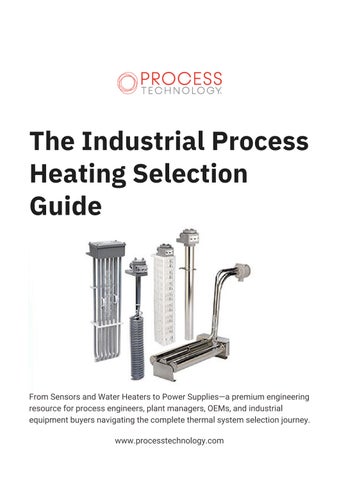
The Industrial Process Heating Selection Guide
From Sensors and Water Heaters to Power Supplies—a premium engineering resource for process engineers, plant managers, OEMs, and industrial equipment buyers navigating the complete thermal system selection journey. www.processtechnology.com
Why Industrial Heating Starts Before the Heater Before selecting any industrial heating equipment, experienced process engineers evaluate the full system context. The right solution depends on process media, operating temperature, chemical compatibility, tank geometry, flow requirements, and thermal accuracy — not just wattage. Understanding these variables upfront prevents costly redesigns and ensures long-term process reliability.
Process Media
Operating Temperature
Water, acids, solvents, and plating baths
Target temperatures and allowable
each demand different materials and
tolerances define watt density limits,
configurations. Chemical compatibility
sensor requirements, and control strategy
determines heater sheath selection and
— directly influencing the application
longevity.
heater selection.
Tank Configuration
Flow Requirements
Tank size, geometry, and access points
Static vs. recirculating flow affects heat
determine whether an over-the-side, screw
transfer efficiency and dictates whether
plug, or inline solution fits the installation.
immersion or inline industrial heaters are appropriate.
www.processtechnology.com
STEP 01 — MEASURE
The Role of Accurate Temperature Measurement Effective thermal management begins with precise measurement. Without reliable process feedback, even the most sophisticated heating system operates blindly. A thermistor or RTD sensor provides the realtime temperature data that drives control logic, safety interlocks, and process documentation. In semiconductor wet benches, electroplating lines, and chemical processing systems, temperature deviations of even ±1°C can affect product quality, yield, and bath chemistry. Selecting the right sensor means matching probe material, response time, and accuracy class to the specific process environment.
±0.1°C Accuracy Critical for plating
Chemical Resistance
and semiconductor
Stainless steel,
processes
PTFE, or quartz probe options
Fast Response Minimizes thermal lag in dynamic processes
www.processtechnology.com
STEP 02 — SELECT
Tank Geometry Changes Everything Thephysicalconfigurationof yourprocess vesseldirectlydetermineswhichimmersionheater type delivers optimal performance. There is no universal solution — each configuration addresses a distinct set of installation constraints, maintenance requirements, and process demands.
Over-the-Side Immersion Heater
Portable Immersion Heater
Screw Plug Immersion Heater
An over the side immersion
A portable immersion heater
A screw plug immersion heater
heater mounts directly to the
provides on-demand, flexible
threads directly into a tank
tank wall without drilling or
heating
fitting, creating a sealed,
permanent modification. Ideal
processes, laboratory use, or
permanent installation. Best
for retrofit applications,
multi-tank operations where a
suited for pressurized vessels,
maintenance flexibility, and
dedicated heater per vessel is
high-cycle applications, and
tanks where permanent
not economical.
processes requiring consistent,
installation is impractical.
for
temporary
repeatable positioning.
www.processtechnology.com
STEP 03 — HEAT
When Water Heating Becomes a Process Engineering Challenge Process water heating differs fundamentally from commercial or residential applications. Industrial systems demand continuous flow capability, precise temperature control, chemical compatibility, and integration with existing process infrastructure. Selecting the right electric water heater requires evaluating flow rate, inlet temperature, target outlet temperature, and available power. Inline water heaters and industrial water heaters are engineered for continuous-duty operation in demanding environments — from rinse tanks and process wash systems to closed-loop thermal management circuits. Unlike tank-style water heater systems, inline configurations heat fluid on demand, eliminating standby losses and reducing footprint.
Continuous Flow Design Heats fluid in real time as it passes through the chamber
Compact Footprint Inline installation eliminates large storage tanks
Process Integration Compatible with recirculation loops and automated controls
www.processtechnology.com
STEP 04 — MATERIALS
Selecting Heater Materials for Demanding Environments Processchemistry istheprimary driverofheatermaterialselection.Incompatiblematerialslead to premature failure, contamination, and safety hazards. Engineers must match heater construction to the specific chemical, temperature, and purity requirements of each application.
Quartz Immersion Heater
Heating Coil
A quartz immersion heater offers
An immersion heating coil provides
exceptional chemical resistance
distributed surface-area heating for
and high-purity performance. Fused
large tanks and vessels. Coils are
quartz is inert to most acids,
available in stainless steel, titanium,
making quartz heaters the
Incoloy, and PTFE-covered
standard for semiconductor wet
configurations — enabling
benches, ultrapure water systems,
engineers to match material to
and aggressive chemical baths
process chemistry while
where metallic contamination is
maximizing heat transfer efficiency
unacceptable.
across the full tank volume.
Material Selection Rule: Always cross-reference heater sheath or tube material against the full chemical profile of your process media — including concentration, temperature, and dissolved gases — before finalizing your specification.
www.processtechnology.com
STEP 05 — ADVANCED APPLICATIONS
Thermal Systems for Semiconductor and Critical Manufacturing Fab Heater Solutions Semiconductor fabrication demands thermal systems that meet the most stringent purity and precision requirements. A fab heater is
Critical Process Requirements
1
engineered for ultrapure chemical delivery, photoresist processing, and wet etch applications where particle generation and metallic contamination must be eliminated. These systems integrate directly into recirculating chemical loops with tight
Ultrapure Compatibili ty
2
Particle Control Integrated
Materials
filtration
certified for
eliminates
semiconducto
contamination
r-grade
sources
chemicals
temperature tolerances.
LTFH Filter Housing The LTFH Filter Housing combines precision filtration with inline heating in a single compact assembly. This integrated approach reduces footprint, minimizes dead volume, and maintains fluid purity — critical for high-purity manufacturing where particle counts and chemical consistency directly impact yield.
3
Thermal Precision
4
Compact Integration
±0.5°C or
Minimal
tighter for
footprint for
process
cleanroom
repeatability
and fab
www.processtechnology.com
environments
STEP 06 — POWER
Why Heating Performance Depends on the Right Power Architecture Eventhemostprecisely specifiedheaterunderperformswithout aproperlymatchedpowersupply. In electrochemical, plating, and precision thermal processes, the quality, stability, and controllability of electrical power directly determines process outcomes, energy efficiency, and equipment longevity.
Controlled Power for Process Reliability Industrial power supplies and rectifiers deliver the stable, regulated output that electrochemical and thermal processes require. Whether managing current density in an electroplating bath or maintaining consistent heater output across variable line conditions, the right power supply ensures repeatable, documented process performance. Kepco and Dynatronix power systems are widely specified in surface finishing, electroplating, and anodizing applications for their precision current control,
remote
programmability,
and
rugged
industrial construction. These systems integrate seamlessly with PLC-based automation and process control networks.
Constant Current / Constant Voltage
Remote Interface Ready Analog, digital, and PLC-compatible
Programmable modes for electrochemical precision
www.processtechnology.com
control options
STEP 07 — PROCURE & OPTIMIZE
Making Industrial Process Equipment Easier to Access Oncetechnicalrequirements aredefined, theprocurement process should beas streamlinedas the engineering. Working with an experienced electric heater supplier means access to application expertise, configuration guidance, and a product range spanning immersion heaters, inline systems, sensors, and power equipment — all from a single qualified source.
The Selection Framework
Streamlined Procurement
01
For standard configurations and replacement components, the plating online store provides
Measure
direct access to configured products, accessories,
Define process media, temperature, and flow
and replacement parts — reducing lead times and
requirements
simplifying reorder processes for maintenance teams and procurement professionals.
02
For complex or custom applications, Process
Match
Technology's engineering team provides
Select heater type, material, and configuration
guidance, and system integration assistance —
specification support, material compatibility ensuring the selected solution performs reliably
03
from installation through the full service life.
Heat Specify wattage, voltage, and control method
Pro Tip: Document your complete thermal system specification — including heater type, material, wattage, voltage,
04
sensor type, and power supply — to
Control
streamline future reorders and maintenance planning.
Integrate sensors, thermostats, and safety systems 05
Power Match power supply to process and heater demands 06
Optimize Monitor performance and refine for efficiency
www.processtechnology.com
Connect With Process Technology Fromapplication engineering supportto configured product solutions, Process Technology partners with process engineers, OEMs, and industrial teams worldwide to deliver reliable, precision thermal systems for the most demanding manufacturing environments.
Explore Solutions Browse the full product catalog and technical resources www.processtechnology.com
Online Store Order configured products and replacement parts directly store.processtechnology.com
Connect With Experts Application engineering and technical support available Engineer Better Outcomes
Global Headquarters
India Office
The Tom Richards Building
AAC Protec India Private
38809 Mentor Ave.
Limited
Willoughby, OH 44094 USA
Plot No. 129G/17 NSEZ
Operations Center
Noida–Dadri Road, Phase 2 Noida, Uttar Pradesh
7010 Lindsay Ave. Mentor, OH 44060 USA
201305 India
India Phone
Phone +91-1203116349 +1 (440) 974-1300
Connect LinkedIn · Facebook · YouTube