The cookie craze is Glāzed … pg. 5 Cozy is the main act… pg. 10 Ohio SNAPs back at hunger … pg. 15
ELECTION DAY IS TUESDAY, NOV. 4
NOVEMBER 4, 2025
VOLUME 116, ISSUE 12
TODAY
THEPOSTATHENS.COM
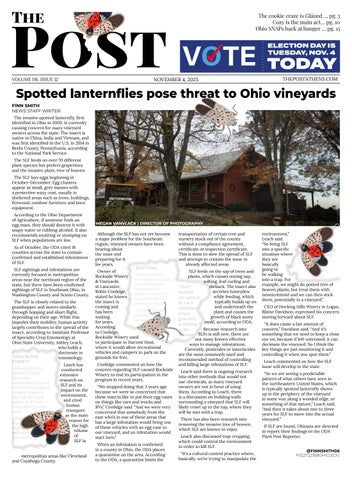
Spotted lanternflies pose threat to Ohio vineyards FINN SMITH NEWS STAFF WRITER The invasive spotted lanternfly, first identified in Ohio in 2020, is currently causing concern for many vineyard owners across the state. The insect is native to China, India and Vietnam, and was first identified in the U.S. in 2014 in Berks County, Pennsylvania, according to the National Park Service. The SLF feeds on over 70 different plant species but prefers grapevines and the invasive plant, tree of heaven. The SLF lays eggs beginning in October-December. Egg clusters appear as small, grey masses with a protective waxy coat, usually in sheltered areas such as trees, buildings, firewood, outdoor furniture and lawn equipment. According to the Ohio Department of Agriculture, if someone finds an egg mass, they should destroy it with soapy water or rubbing alcohol. It also recommends swatting or stomping on SLF when populations are low. As of October, the ODA cited 18 counties across the state to contain confirmed and established infestations of SLF. SLF sightings and infestations are currently focused in metropolitan areas near the northeast region of the state, but there have been confirmed sightings of SLF in Southeast Ohio, in Washington County and Scioto County. The SLF is closely related to the grasshopper and moves similarly through hopping and short flight, depending on their age. While this impedes their mobility, human activity largely contributes to the spread of the insect, according to Assistant Professor of Specialty Crop Entomology at Ohio State University, Ashley Leach, who holds a doctorate in MAN IN THE entomology.
STREET?
Athens County Sheriff’s Office deputies responded to a call from New England Road in Stewart after receiving a report of a man lying down in the road. Deputies and the Ohio State Highway Patrol searched the area, but neither gro
Leach has conducted extensive research on SLF and its impact on the environment, and cited human transport as the main reason for the high volume of SLF in
metropolitan areas like Cleveland and Cuyahoga County.
MEGAN VANVLACK | DIRECTOR OF PHOTOGRAPHY
Although the SLF has not yet become a major problem for the Southeast region, vineyard owners have been hearing about the issue and preparing for it for years.
transportation of certain tree and nursery stock out of the county without a compliance agreement, certificate or inspection certificate. This is done to slow the spread of SLF and attempt to contain the issue in already affected areas.
Owner of Deputies with Rockside Winery the Athens County & Vineyards Sheriff’s Office in Lancaster, responded to Robin Coolidge, state Route 329 in stated he knows Guysville after an the insect is open line 911 call. coming and On the scene, has been deputies made waiting contactaccidentally for years. According to Coolidge, Rockside Winery used to participate in Harvest Host, where it would allow recreational vehicles and campers to park on the grounds for free.
SLF feeds on the sap of trees and plants, which causes oozing sap, wilting, leaf curling and dieback. The insect also SNAP secretes honeydew benefits while feeding, which are utilized typically builds up on by 1 in 8 and underneath the Americans plant and causes the to buy growth of black sooty groceries, mold, according to ODA. according
BUTT DIAL
Coolidge commented on how the concern regarding SLF caused Rockside Winery to end its participation in the program in recent years. “We stopped doing that 3 years ago because we were so concerned that these insects like to put their egg cases on things like cars and trucks and RVs,” Coolidge said. “And we were very concerned that somebody from the east who’s in one of these areas that has a large infestation would bring one of these vehicles with an egg case to our vineyard, and an infestation would start here.” When an infestation is confirmed in a county in Ohio, the ODA places a quarantine on the area. According to the ODA, a quarantine limits the
Because research into SLFs is still new, there are not many known effective ways to manage infestations. Currently, pesticides or insecticides are the most commonly used and recommended method of controlling and killing large infestations of SLF.
to the associat
Leach said there is ongoing research into other methods that would not use chemicals, as many vineyard owners are not in favor of using them. According to Leach, there is a discussion on building walls surrounding a vineyard that SLF will likely crawl up to the top, where they will be met with a trap. There has also been research into removing the invasive tree of heaven, which SLF are known to enjoy. Leach also discussed trap cropping, which could control the environment in order to kill SLF. “It’s a cultural control practice where, basically, we’re trying to manipulate the
environment,” Leach said. “So bring SLF into a specific COPS AND situation where ROBBERS they are Athens basically County going to Sheriff’s be walking Office into a trap. For example, we might do potted tree of heaven plants, but treat them with neonicotinoid and we can then stick them, potentially in a vineyard.” CEO of Hocking Hills Winery in Logan, Blaine Davidson, expressed his concern moving forward about SLF. “It does cause a fair amount of concern,” Davidson said. “And it’s something that we need to keep a close eye on, because if left untreated, it can decimate the vineyard. So I think the key things are just monitoring it and controlling it when you spot them.” Leach commented on how the SLF issue will develop in the state. “So we are seeing a predictable pattern of what others have seen in the northeastern United States, which is typically spotted lanternfly shows up in the periphery of the vineyard in some way along a wooded edge, or something of that nature,” Leach said. “And then it takes about one to three years for SLF to move into the actual vineyard.” If SLF are found, Ohioans are directed to report their findings to the ODA Plant Pest Reporter. @FINNSMITH06 FS227223@OHIO.EDU