Letter from the editor
Dear Reader,
I find myself longing for the days of no snow, when Montréal streets are buzzing and the terrasses are open. The streets are crowded with rosy-cheeked lovers, half-empty wine glasses, and live music spilling out from an open window somewhere.
Summers are when Montréal really thrives, and I am sure this long and harsh winter has increased the anticipation for street fests, fresh food markets, hot summer nights out, and long sunset walks along the canal.
As we approach the end of the semester, I am anxiously awaiting a Montréal summer, but I am also hoping for what the future holds. The end of a semester calls for an unknown future, an edge of something, waiting for the summer to commence and life to feel like it can be lived to the fullest. How your summer will play out is unbeknownst to you now, as you sit on the cliff of a peaceful spring while the summer threatens its approach.
From drinking through St. Patrick’s cocktail menus, exploring Québec independence, Leonard Cohen’s legacy, and the loss of the city’s baseball team, this issue is full of local news to celebrate the vibrant ville de Montréal. I hope this issue will educate you on your community, and the history of the streets you walk unknowingly on.
Enjoy this warm spring after a long hibernation.
With Love, Jackie Graif Editor-in-Chief
So Long, Winter: Welcoming Spring with Leonard Cohen
ORLA JEANES STAFF WRITER
“In Montreal spring is like an autopsy. Everyone wants to see the inside of the frozen mammoth…From the streets a sexual manifesto rises like an inflating tire, ‘the winter has not killed us again!’”
- Leonard Cohen
To all that find themselves with this article in hand: congratulations! — you’ve made it through another one of this city’s infamously long and cruel winters. The light at the end of our bleak and frosty tunnel grows bright as we enter the prelude to summer, a short period during which the city regains its vitality, and with it, the delight of all those anticipating the warm months ahead.
As any person tends to be with their hometown, the world-renowned singer-songwriter Leonard Cohen was intimately acquainted with the particularities of Montreal. Through poetry and prose, he repeatedly paid homage to his beloved ville natale, proving just how closely he knew its streets, its women, its politics, and its seasons. In his own words, the Westmount-born poet described his relationship with the city as one in which he had “to keep coming back to Montreal to renew [his] neurotic affiliations.”
Leonard Cohen was no stranger to the phenomenon of spring in Montreal. Undoubtedly, he would have recognized the crowding of sidewalks on the first sunny day of the year, our habit of shirking off our coats in below tendegree temperatures, and the optimism that renews the spirits of Montrealers as winter reaches its long-awaited end.
His most famous ode to spring in Montreal lies within the pages of his
book Beautiful Losers, in which he chronicles the season’s infiltration of the city. He compares its arrival to that of a warm current that “flows over Ontario like a dream” and “sneaks into Québec,” envelopping the entire island with “the buds and the fertile smell” of springtime.
In his novel A Ballet of Lepers, the McGill alumni salutes his old stomping grounds by capturing the celebratory sight of the once-again “crowded” university campus filled with “people sitting on the grass, eating their lunches and watching spring change the trees.” Following the reemergence of all those who had been hiding away indoors, he writes of how you can tell “spring [is] definitely on the city” when it seems as though there are “people at every corner, just lingering.”
“Like any other Montrealer, Cohen took part in the casual, yet highly appreciative rejoicing that takes place with every new occurence of this warmly welcomed season.”
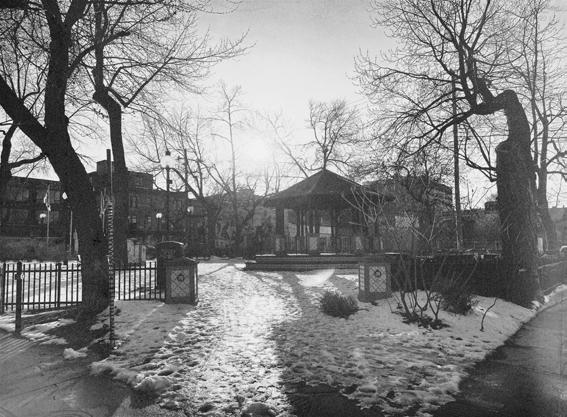
Over the years, Leonard Cohen made an eastward migration across Montreal, detaching himself from his identity as the son of an affluent Westmount family, and eventually settling into a frugal lifestyle in the heart of the Plateau. Nestled in between rue St. Dominique and St. Laurent Boulevard, his home for the last four decades of his life stood facing Parc du Portugal, a small square in which he’d frequently be seen sitting on a wooden bench, either gazing at the city or conversing with passerbys. Featured in This Beggar’s Description, a documentary about his friend and fellow poet Philip Tétrault, he is filmed doing exactly so whilst drinking a jar
of V8 tomato juice and reminiscing of triumphant thumb wars against Pierre Elliott Trudeau.
It was here that the humble Montreal poet would have witnessed the beginning of many springs, spending gentle mornings in the midst of chirping birds perched on budding branches and enjoying the soft sunlight beaming down on the remaining mounds of melting snow. He himself referred to the season as “a spring so sweet it seems like a prize for endurance.”
The longing for warm weather, most often either followed or preceded by a certain bitterness towards winter, is horribly familiar to the residents of Montreal. Come the end of March, when we find ourselves cursing the cold whilst trudging through the onslaught of yet another snowstorm, our only wish is for it to be over. Between the months of November and April, our love for the city, buried under a resentment of the cold, is put in great peril. As dreams of leaving for distant tropical lands become harder to resist, all that’s left for us to hold onto is the promise of an eventual spring. So, we wait, our thoughts echoing the words of Leonard Cohen, reminding us of just what city it is that we've been patiently waiting on: “it’s Montreal…Montreal on the very threshold of greatness.”
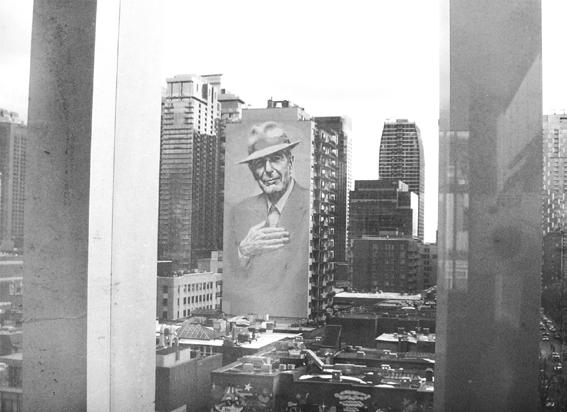
VIEW FROM LE MUSÉE DES BEAUX ARTS, TAKEN BY ORLA JEANES
LATE MARCH IN PARC DU PORTUGAL, TAKEN BY ORLA JEANES
Club Pays and the Role of Third Spaces in the Survival of Culture

JOSÉPHINE SAVARD ARTS & CULTURE CORRESPONDENT
On March 13th of 2026, Club Pays opened in the St-Hubert Plaza. Proclaimed the first separatist café in Québec, its branding is evident. Drinkers of classic Americanos will find themselves ordering a renamed Québecano . And, if you want to accompany your coffee with a sweet treat, you’ll have to order a BiscOUIt! Posters all around present slogans, such as “Notre vrai pays c’est le Québec” and “Libres chez nous!” This space is reminiscent of the last wave of separatism that dates back to the end of the 20th century.
With all of the café’s profits reinvested into the sovereignty movement, Club Pay s is a project born from the Organisations unies pour l’indépendance (OUI Québec). This non-partisan civil organisation aims to renew the separatist movement by mobilizing new generations. Club Pays contributes to this goal by acting as a gathering space, where invigorated discussions create hope and joy around the idea of a potentially independent Québec.
As well as being the headquarters to the sovereignty movement, the café is also
meant to serve as a hosting space for discussions around Québécois culture. Such discussions are encouraged through different events, like the launch party on opening day. Emerging artists performed on a small stage following a speech held by the president of OUI Québec (Camille Goyette-Gingras), during which she shared the café’s mission.
Another event took place less than a week after the opening, where the General Manager of the Regroupement des festivals artistiques indépendants (REFRAIN) hosted a discussion on how Québécois culture can survive in a world where multinationals dominate the entertainment industry. Club Pays also hosts workshops, such as a poetry writing and an open-mic night which took place on March 21st, as well as a textile arts workshop on April 2nd.
Club Pays also brings youth closer to the province’s culture. Newer generations have harshly been criticized for not showing interest in Québec’s culture. Indeed, a study in 2024 performed by the Institut de la statistique du Québec shows that more individuals aged 15 to 29 are less interested in radio and television media than previous generations.
However, through the emergence of smaller organizations like the OUI Québec in colleges and universities, it is evident that disinterest in culture might not be what the younger generations are experiencing. Rather, the study reveals that the disinterest is in traditional media, not in culture as a whole. In fact, a shift in media consumption patterns reveals that younger generations will engage more with culture if it is marketed towards them.
In an interview delivered by Camille Goyette-Gingras, following a survey which revealed that 56% of Québec youth aged 18 to 34 supported the independence of the province, she states that the younger generation is
increasingly interested in their local culture. She highlights how youth is gathering in festivals throughout the province for emerging Québécois artists. These festivals include Osheaga, Les Francouvertes, Piknik Électronik, les Francos, among others. GoyetteGingras also discusses the multiple Québec meme pages which exist on Instagram and TikTok, creating a community around humorous discussions of the province.
The way in which youth relies on community to engage with culture is exactly why the minds behind Club Pays felt an urge to open the space. To them, creating a third space to grow community was the next step in encouraging the survival of local culture.
“Club Pays, amongst other similar manifestations of a new wave in Québécois culture, shares an overarching message: everyone is welcome.”
To them, sovereignty is not a question of ethnicity, of gender, or of political affliliation. It is not a question of where you come from, or what you believe in–it is a question of hope for a better future. You’ll hear it over and over again: Club Pays is a space for everyone.
Future events hosted by Club Pays, highlighting local culture and promoting casual discussion, are slowly being announced on their social media platforms, as well as on the OUI Québec website.
the plant watches!
Sinners (2025): Research, Representation, and Realism
LAURINE ALINOT VIDEOGRAPHER
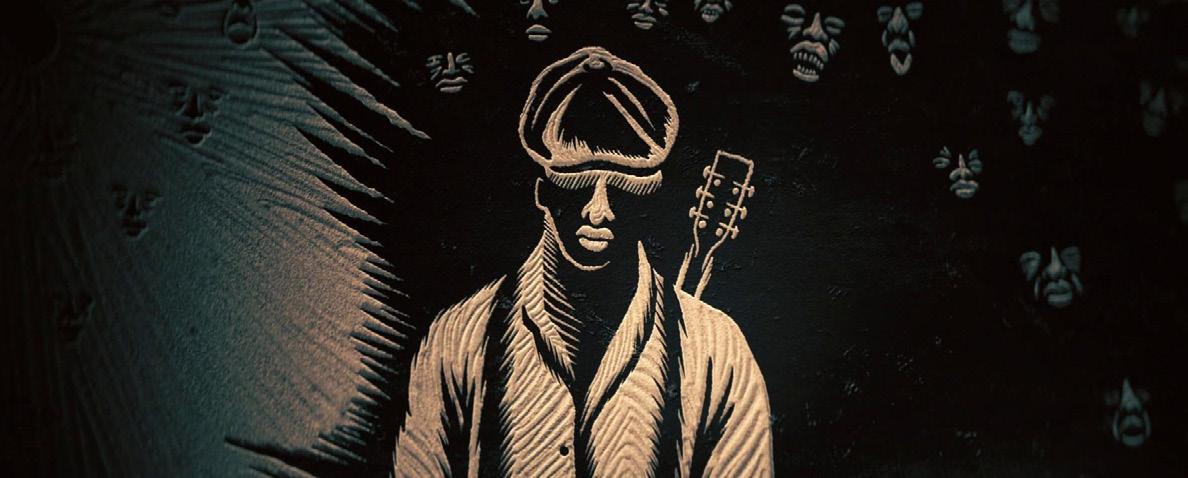
Premiering in 2025, the film Sinners by Ryan Coogler ( Black Panther (2018), Creed (2015)) became an Oscar legend with its record-breaking 16 nominations, surpassing the 14 nominations record previously held by All About Eve (1950), Titanic (1997) and La La Land (2016). Out of those 16 nominations, it won 4 Academy Awards. One of them was awarded to the movie’s cinematographer Autumn Durald Arkapaw, who became the first woman to ever win in the category in addition to being the first woman of colour nominated.
Sinners is a thriller and horror film, starring Oscar-winner actor Michael B. Jordan in the dual roles of the Smokestack twins. It is set in
the 1930s in the Mississippi Delta, and revolves around the story of the twins, Elias Moore (Stack) and Elijah Moore (Smoke), coming back to their hometown to open a juke joint to welcome the Black men and women working the plantations. Coogler’s dedication to research and accuracy is what helped make this film so believable and real, in addition to historical musical faithfulness.
Coogler turned to different specialized consultants for the film, among others: Twins Consultants Logan and Noah Miller, Hoodoo Consultant Yvonne Patricia Chireau, Historical Gambling Consultant Leeroy Johnson, and Mississippi Delta Chinese Cultural Consultant Dolly Li. Li highlighted Coogler’s work of research in an interview: “I responded
that early immigrants really did come from Taishan, [but] you could go with Cantonese and easily get away with it but I love that they went all the way and chose Taishan.” This precision is what strengthens the realism and elevates the film’s storyline.
Blues music is central to the narrative of this film, highlighting raw emotions of joy and pain as well as depicting a spiritual and cultural connection to ancestral spirits. In the song “I Lied to You,” performed by Miles Caton as Sammie, scene, time, and cultures blur together. The past and the present mix with the ensemble and showcases a true emotional intensity for all to experience.
Overall, the film Sinners with its well deserved 4.1 stars average on Letterboxd, quickly asserted itself as a must-watch historical horror movie. Beyond the awards and audience acclaim, the film’s cultural authenticity and historical representation, in addition to its powerful blues music mark Sinners as a film that will leave a lasting impression on viewers. It became one of the most important moving pictures of 2025 and hopefully will be a staple for the years to come.
Dracula: A Love Tale (2025): Blurring the Line Between Inspiration and Imitation

Known for his affiliation to Cinéma du Look—where creatives focus on the visuals and artistic expressions of a film, as opposed to the narrative—Luc Besson is a renowned director with credits such as Léon: The Professional (1994) and The Fifth Element (1997). His newest work is Dracula: A Love Tale (2025), and while it is a visually beautiful film, its focus on appearance strongly evokes Francis Ford Coppola’s Bram Stoker’s Dracula (1992), particularly in its character design and surfacelevel storyline.
The character design, specifically,
is heavily inspired by Coppola’s work, as Besson’s Vlad, portrayed by actor Caleb Landry Jones, possesses practically the exact same hair, clothing, and overall appearance as Coppola’s protagonist. These similarities extend beyond visuals, for the whole romance plot between Dracula and Mina, absent in the original novel, is an original idea introduced by Coppola. Furthermore, the idea of Mina being a reincarnation of Dracula’s soulmate reappears in Besson’s film, as it was first seen in Coppola’s adaptation of Dracula, reinforcing how strongly Besson’s work draws from additions made by Coppola, rather than establishing its own originality in regards to the novel.
The most notable changes from Coppola’s film would be the switch from London to Paris. While both films take place in the late 19th century, this change of scenery offers a new point of view into the Victorian period. Although this modification was minor, it remains
an original addition to the plot, perhaps reflecting Besson’s origins. Additionally, a more original element in Dracula: A Love Tale was the use of CGI gargoyles, which are not present in the original novel and are absent from Coppola’s version. These gargoyles reinforce the film’s gothic atmosphere while also contributing to its visual identity and stylistic approach.
Overall, Dracula: A Love Tale stays true to Cinéma du Look with its focus on visuals over narrative depth. It is a beautiful watch: the mise-en-scène, the performances and the cinematography work effectively together. However, the narrative is heavily dependent on Bram Stoker’s Dracula (1992), which comes at the expense of originality. Ultimately, despite its lack of faithfulness to Bram Stoker’s 1897 novel, the film remains an engaging watch that stands on its own when not compared to previous adaptations.
LAURINE ALINOT VIDEOGRAPHER
Are We Yearning for a New Way to Relate to One Another?
NICOLE MOTTA ARTS & CULTURE EDITOR
“Everyone wants a village, but no one wants to be a villager.”
This idea is at the heart of a contemporary cultural dissatisfaction with the Western framework for interpersonal relationships. Notably, video essays and online forums have been opening up conversations about our society’s individualism: apparently, we might be taking it too far with “protecting our peace.” Critics note that avoiding inconveniencing ourselves for others is leading us to evaluate our own human connections through a cost-benefit analysis, like yet another product of our capitalist economy. People are tired of their friendships feeling shallow. They want depth and reliability, not transactions
Pointing fingers at the shortcomings of individualism seems to be a natural response. As psychologist Sharanya Sadana explains, in individualistic societies, such as the US, UK, Australia, and Canada, people focus more on their own goals and success rather than group goals and view their actions as a personal responsibility. Indeed, the individual goes above all else. This contrasts with collectivist cultures, prevalent in regions like East Asia and Africa, where people experience a deeply rooted loyalty to their communities and prioritize the needs of the group above their own. To recap, it's helpful to think of these cultures as divided into two simplified categories: people who would pick you up from the airport without hesitation and people who you’d be worried about asking.
These networks of human connection cultivate very different emotional landscapes. Research by Hazel Markus and Shinobu Kitayama shows that individualistic cultures tend to emphasize pride and fulfillment in speaking one’s mind, while collectivist cultures can be associated with deeper feelings of connection but, also, feelings of guilt and anxiety due the
intertwinement of one’s emotional state with that of their communities.
In fact, while collectivism appears to offer a way to fill the emptiness of Western relationships, it is not without its own set of issues (beware of the instinct to turn to the opposite binary!). Sadana points out that, “in individualistic societies, social networks are tailored to personal needs and interests, with friendships formed based on shared affinities and unpleasant relationships easily severed, whereas in collectivistic societies, individuals tend to adapt to existing social structures, making it harder to disengage from undesirable relationships.” Sometimes, emotionally distancing from that one toxic family member is a necessary form of self-healing. Moreover, grounding one’s overarching identity in a group can actually be dangerous for individual consciousness, especially if it stifles critical judgement for the sake of collectivity. Individual identities are good and must be cultivated! Originality breeds change.
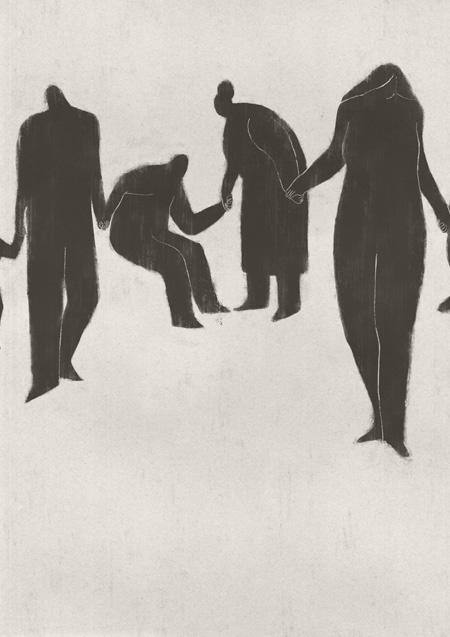
Both these interpersonal frameworks are deeply influenced by our social ecology, particularly economic prosperity. Sadana highlights how studies indicate that countries with higher per capita GDP tend to place a stronger emphasis on individualism deriving from capitalistic values of personal freedom and liberty. These societies want you to order an Uber from the airport. Their economies function on human detachment. Individualism and collectivism are thus linked directly to systems of governance which oversee the economy: individualism plays a key role in democratic systems, whereas
collectivism tends to influence more authoritarian or consensus-driven governance systems.
This is why the analysis of anarchal societies, both historic and modern, through the lens of anthropologist Harold Barclay’s book People Without Government , reveals intriguing alternate models of classic interpersonal frameworks. While anarchism is often stigmatized, linked to “bombthrowing radicals,” he stresses that it is fundamentally about the maximization of individual responsibility and the reduction of concentrated power. Barclay explains, “to advocate it one must practise considerable selfabnegation, because the type of community it envisages cannot, for obvious reasons, be prescribed.” The rejection of authority as a social tool is an attitude, not a programme, and, in growing numbers, this attitude begins to affect the ways societies choose to relate to one another at a personal level. Mutual aid begins to emerge as a serious alternative to administrative services.
While interpersonal responsibility intensifies, principles of cooperation, mutual aid, and self-organization are fostered. However, they remain flexible and portable to different contexts; interpersonal models aren’t imposed and that, perhaps, is what makes them so real . Relationships based on true reciprocity is what builds deep solidarity among individuals. Barclay points out that “the anarchist emphasis on solidarity and empathy reflects individuals’ efforts to protect not only their own freedoms, but also each other’s freedoms,” because they understand two are inextricably linked.
Perhaps this is what we are yearning for. A model of solidarity built on respect for individual identity that strengthens an individual’s social connections and emotional health while still honouring autonomy.
It may be time to question whether our authority-concentrated and capitalist-driven society is fertile land for the “village” we so crave to grow. Changing the way we foster human connection might mean rethinking the social systems that dictate the ways we relate to one another.
VIA
ILLOT
A Latte of Love in Each Cup
TESSA H. CHABOT CONTRIBUTOR
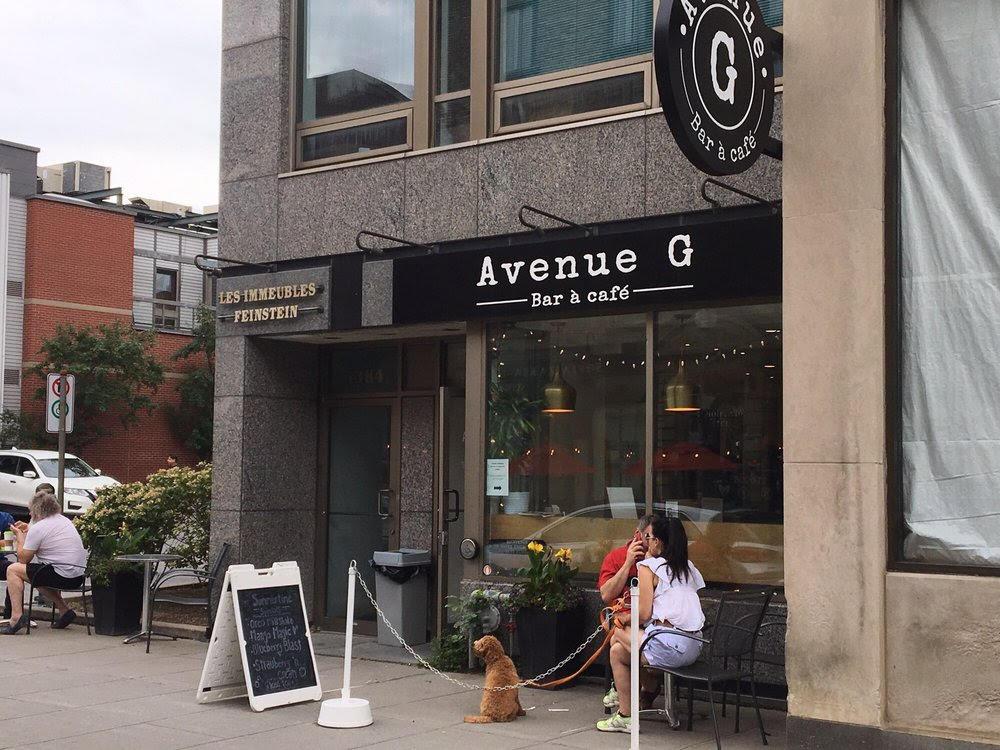
Situated in the heart of Avenue Greene sits a small cafe, Avenue G. A short eight minute walk from Dawson brings you to a hidden gem of the Westmount community. From the beginning of my Cégep journey, what beganas visits to annoy my sister during her work hourstransitioned into Avenue G becoming my home away from home.
When you first enter the establishment, your nose is immediately hit with the bitter scent of the cafe’s fan-favourite drip coffee mixed with the sweet smell of their delicious cherry and yogurt danishes. Avenue G is always busy. Everyone is always in a good mood whenspeaking with each other. The baristas are happy to converse with the customers, enhancing the homey atmosphere of the business. There never seems to be a dull moment at the cafe. The soothing music, chosen by the baristas, quietly seeps out, just loud enough to hear. The tables sit just close enough to fill the place nicely. The cafe has a comforting air of ‘just right’ that flows out of it.
I frequent Avenue G after classes nearly every week. I find the afternoon to be the best time to focus on my school work but, also, to watch people. An older couple, “regulars”, typically walk hand in hand, always ordering a drip coffee with one sugar and one milk. They always find themselves sitting at the table next to my own. “Gosh, I’ve spent so much on those shoes”, the woman says. It seems she’s just noticed the sizable dent she’s made in her wallet. The man beside her simply laughs and calls my sister over to test out his new dad joke. These small moments are what I go to Avenue G. for. The cafe offers a safe place for people to express themselves and relax after a long day.
This homey establishment was first conceptualized by the cafe’s owner, John Kanellias, a little over eight years ago: where Avenue G is now once sat a Second Cup. It was not a very popular place and closed down in late 2017. Kanellias bought the building, transforming the location from a franchise to an independent
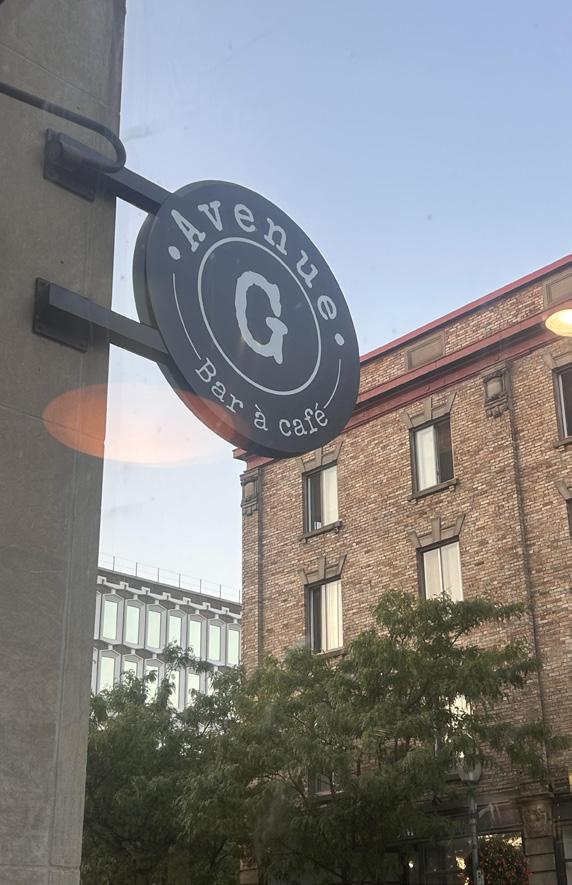
Montreal-based business. Of course, Avenue G has its downsides, such as expensive drinks and pastries or the cold draft that comes through ever so often from the open door. These small issues do not diminish the magic of Avenue G and what it means to the people of its community.
Although the street of Avenue Greene is always changing, many people can rely on Avenue G to be a constant presence in an ever changing world. The friendly faces that greet you each time you enter make this place truly special. As I sit at my favourite table, with my favourite latte by my side, I am filled with a sense of warmth — not just from my coffee, but from the love that pours out of this exceptional cafe.
VIA QUARTIER GREENE
VIA TESSA H. CHABOT
ELSIE DUQUE HILLS STAFF WRITER
The month of April typically signals a seasonal shift from freezing noses to burgeoning leaves. Of course, seeing as Montreal is our common abode, we have yet to be afforded the luxury of such change. Regardless, this month has inspired me with the quiet beauty of flowers—be it radiant daffodils or periwinkle hyacinths. From bouquets bestowed upon lovers to dried petals adorning bedroom walls, it only seems fair to celebrate the return of the sun with a combination of my two favourite things: cocktails and flora. Thus, let us delve into the fragrant world of botanical-infused drinks.
Paper Hill
A twist on a modern classic, the Paper Hill, served at Le Mal Nécessaire on St-Alexandre, offers a striking contrast between assertive rye and delicate elderflower. The cocktail highlights the beauty of bittersweet balance, blending spiced complexity with a refreshing floral lift. Composed of Lot 40 rye for warmth, Rosemont Sureau for subtle sweetness, and Amaro Montenegro for hints of citrus. It’s topped with cucumber and lemon for a crisp, clean freshness. This drink checks every box for a bright springready experience.
Viqctoria


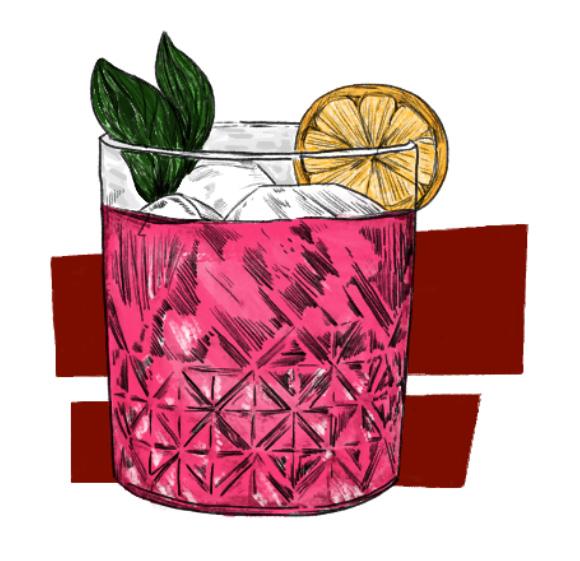
With a floral, citrus-forward gin sour, Bar Suzanne’s Viqctoria offers a strikingly botanical composition. Located in Duluth, this hibiscus-elderflower refresher stands out for its infused base—Empress Indigo gin—an exotic butterfly pea blossom spirit known for its deep purple hue and subtle earthiness. The cocktail’s sweetness comes from a delicate blend of hibiscus syrup and Rosemont sureau, creating a lightly tart yet layered flavour profile. A touch of lemon brings brightness and balance, while a sprig of mint adds a fresh, uplifting aromatic finish.
Boys Want Flowers Too
With its playful name and layered flavour profile, Bar Milky Way’s Earl Grey and yuzu-infused vodka sour stands out as a memorable highlight. A neutral base of Stoli vodka provides a clean canvas for a myriad of flavours to unfold. Citrus takes center stage, with a vibrant blend of lemon and Pierre Ferrand yuzu curaçao, delivering a bright exotic acidity. Lem-Marrakech bitters gently soften this sharpness, adding a warm, spiced complexity that lingers on the finish. At its core, the cocktail leans into its Earl Grey infusion, introducing tannins and bergamot for softly perfumed notes. To complete the classic sour structure, a silky egg white foam crowns the drink, adding a smooth, airy texture to this tea-steeped creation.
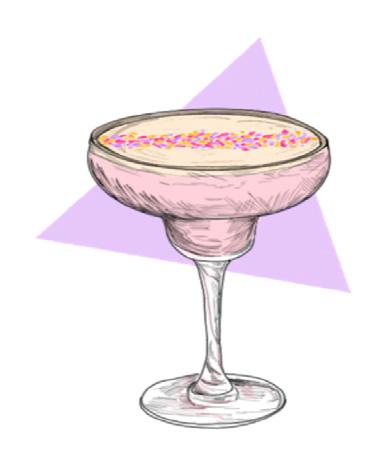
All images illustrated by Elsie Duque Hills
The Shannon Index Circles Back 25 Years Later
MINOLA GRENT EDITOR-IN-CHIEF
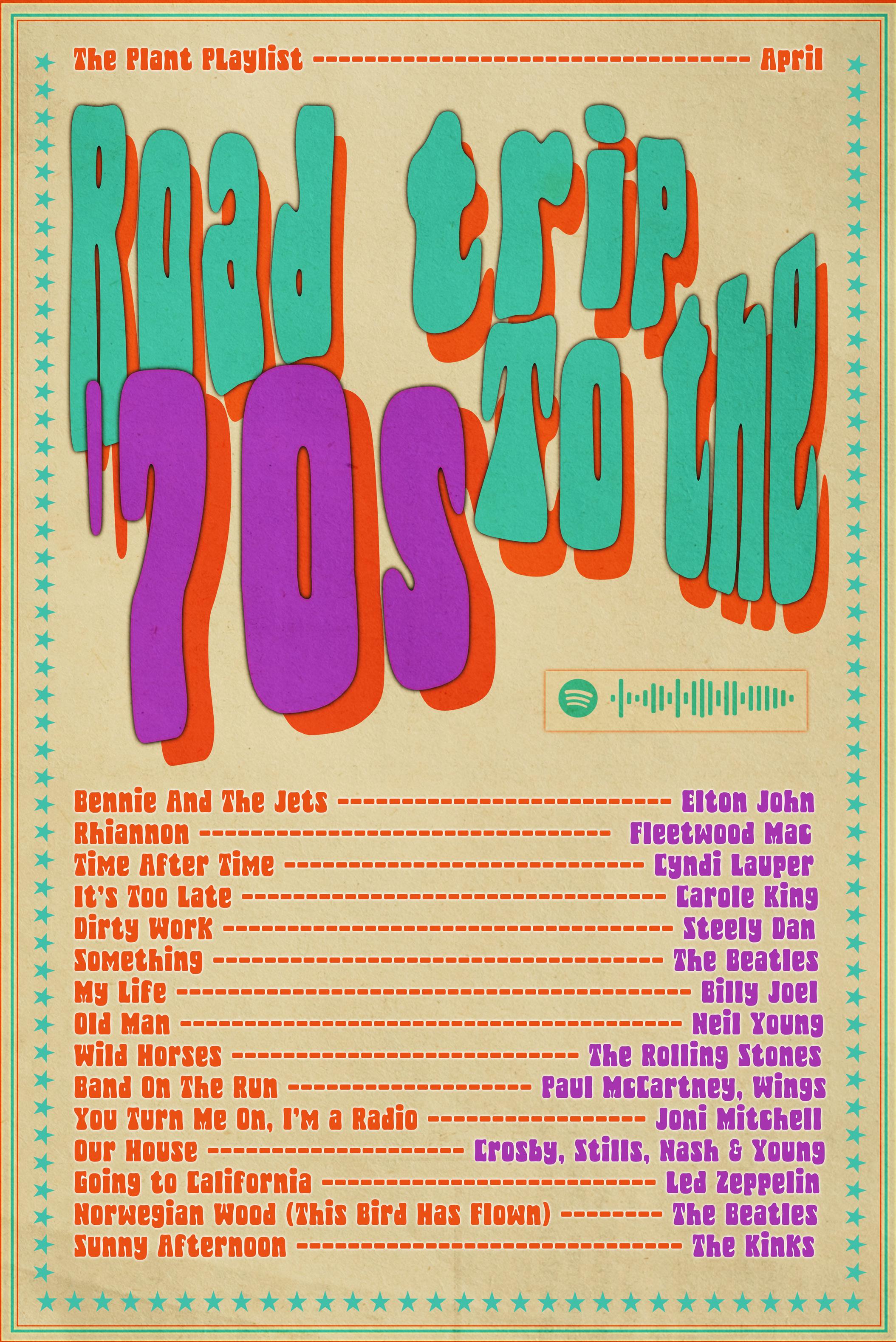
In 2001, The Plant interviewed an up-and-coming Montreal band that was making waves: The Shannon Index. Today, as The Shannon Index is taking a new shot at music, I replicated the feat and interviewed Andrew S. Wieczorek, lead singer and biology teacher at Dawson and Concordia.
Before becoming a small local phenomenon, The Shannon Index was a couple of friends that just wanted to play music, so much so that they set aside their studies to pursue their dreams. Andrew, in his first two years of university, only took one or two classes and mostly garnered Cs and Ds. Yet, he couldn’t have been happier because he was doing exactly what he wanted: playing with his friends, writing music, and enjoying every second of it.
Paradoxically, Andrew hated writing songs for the band. While he mostly had ideas for catchy rock-pop hooks that could be radio hits, his bandmates were music nerds picking at their guitar strings for hours. Yet, Andrew still showed up to every jam session during which he sat and waited for a melody to develop so his lyrics could follow. “Honestly, I don’t know how it all worked out. I don’t know how ‘It’s calm’ and ‘Assessing the wounds,’ these songs, ended up being finalized, because they all just started out with some crazy riffs.”
The Shannon Index put out their first self-titled EP in 2000, and not long after, a Pearl Jam tribute band playing at The Medley, a now closed nightclub and concert hall, in front of 15,000 people gave them a shot. “They said ‘You know what, guys? We’re gonna give you a chance. Go up there and play five songs.’ And we were like ‘We have five songs!’” The crowd roared and cheered for The Shannon Index, both band and EP alike.
This concert introduced them more formally to the big family of small bands in Montreal. They would open for some and others would open for them, building a tight knit ecosystem of support and community. The unfortunate downside was that, eventually, the same crowd was coming to every show. Getting out there and exploding past the niche Montreal music scene

was hard work. “We had street teams,” Andrew shared. Kids aged 15 and 16 who loved The Shannon Index’s music were welcomed to watch their heroes at work. “There would be 30 kids in our jam space sitting on the floor during our set, and we’d just give them boxes of stickers and CDs. They would go and promote, promote, promote.”
Word of mouth was the way to go in the early 2000s. Andrew confesses that, though back then they wished for the reach and accessibility social media currently gives creators, he now understands the price of it. “It’s so saturated that it’s hard to make yourself pierce out.” Though opportunities to be noticed have never been higher, it has also never been more difficult to get the world to care.
In this new digital climate, Andrew and his band members feel they have to relearn everything they know about promotion and the functioning of the music world. Derek, the band’s guitarist, is, as of writing, in Europe for conversations with labels and music contractors. Yet, Andrew summarizes their answers as, “Get your number of streams up, because as good as you guys are, when I present this to the higher ups [...] they want to see numbers.”
“So, why pick up a band that broke up in 2004 again over 20 years later? 'I can almost compare it to a girlfriend; it was a good relationship that ended, not a toxic one,' Andrew explains.”
He felt the time he was dedicating to the band prevented him from exploring other avenues and diversifying his life experiences. He wasn’t enjoying it anymore, and that was a dealbreaker. Andrew went back to studying biology full time and completed his doctorate with (mostly) straight As.
It was only in recent years that he got the urge and desire to get out there on a stage with nothing but a mic and a crowd to connect and mosh with. “That’s what it's all about for me: enjoying with them. Yes, we are performing [...] but we just want to party with the crowd too.” The band was even further motivated by a batch of unreleased songs still waiting for their moment to shine. The Shannon Index wants to get these crowd favourites out there for their loyal fans to enjoy clean and polished versions of. Andrew recalls being particularly struck by a fan remembering their unreleased song “It’s calm” they played live almost 22 years ago. “Part of it is a tribute for [our fans] [...] Forget about the success part, whatever happens happens, but why not release this music?” Andrew added.
Beyond their own fanbase, Andrew expressed a lot of excitement at using their own notoriety to help the new generation of bands get recognition. “We want to be the OGs in the city. We want kids to want to play with us and we want to promote them.”
Andrew’s advice for those starting out in music was to set numbers aside and prioritize fun. “Enjoy the ride, whatever that ride is.”
“Everything comes back full circle, and here we are!” he told me.
You can catch The Shannon Index in concert in June. Follow them on Instagram @the_shannon.index!
VIA ANDREW S. WIECZOREK
Règnes Modernes: Chemistry Beyond the Classroom
JOSÉPHINE SAVARD ARTS & CULTURE CORRESPONDENT
Dawson is comprised of over 1 000 hardworking faculty and staff members. One teacher marking the Dawson community through his creative approaches to education is Yann Brouillette. A chemistry professor of the college since 2009, some students may know him from his ChemCurious YouTube channel, where he makes learning chemistry fun through shortform video content.
In 2023, Brouillette was the recipient of the Beaumier Award for High School/ CEGEP Chemistry teachers in Canada for his devotion to creative pedagogy. His knowledge of chemistry overflows into projects outside of traditional teaching: in addition to his YouTube channel, he dives into the world of comic book scriptwriting.
A forever passion of his, he owes comics for sparking his interest in science. Throughout his studies, he would turn back to the characters he knew, asking himself, “What would the X-men do with [new scientific breakthroughs?]” Eventually, his general interest in the comic world morphed into a curiosity for what alternate endings to classic stories could look like. This led to pitches of four-page stories, then eight, then 24, and, finally, 48 pages.
“Scriptwriting, to Brouillette, is about transitioning from being a passive reader of comic books to participating in the process of creation.”
Fast forward to March 27th of 2026: people line up in dozens, awaiting Brouillette’s signature in their personally purchased copy of Règnes Modernes. Released in Québec that very day, Règnes Modernes is a collaboration between Brouillette and comic book artist Paolo Loreto. In the comic, living beings' roles are reversed:
anthropomorphic animals are the dominating beings of the world whilst humans act as the inferior wild species.
The comic asks, “Si les animaux pouvaient parler, serions-nous aussi cruels envers eux?” The behaviour of the comic’s characters and its world building act as an effective critique of how modern society treats animals. When asked why he chose to deliver this critique through reversing the roles of humans and animals, Brouillete responded, “Since I can’t exactly unleash enraged wolverines on people, I figured I could at least depict that reversal in a comic book.” His aim is to evoke the reader’s empathy for the cruelly treated humans…as if they were animals.
Indeed, humans evolve throughout the story and eventually become sentient beings, expressing messages similar to those shared by animal rights activists: “Je ne suis pas une chose! On a le droit d’habiter cette planète autant que vous! On est plus que des ressources naturelles à exploiter.” Brouillette imagines that, if earthly animals could talk, they would claim rights to their lands and their freedoms as Kooky/Eugénie, the main character, does in Règnes Modernes
The book is also infused with scientific references, from spectroscopy technicians to pandemics. If you look close enough, you may even recognize the university that the main characters visit on page 22!
Beyond harnessing his experience as a Dawson professor in advising his illustrator on drawings of fictional universities, Brouillette applies his knowledge in chemistry to the stories he scripts. To him, “In science, many concepts are abstract, so storytelling becomes a powerful tool for making them accessible.” Just as Isaac Newton’s discovery of the second law of motion is remembered by the image
of an apple falling on Newton’s head, Brouillette hopes that the comic’s visual representations of scientific concepts will anchor the material he addresses in his stories.
The end of Règnes Modernes leaves readers on a cliffhanger. Well, according to Yann Brouillette, the story is far from over! A second volume will be released in Québec next month. He and the illustrator are also working on future science-fiction projects. His parting words to me were of another project idea: “I also have a project in mind involving an alchemist professor who gives tons of homework to his students, and they transform into monsters if they don't submit them before the deadline... no, wait, that's not a script, that was just a bad dream.”
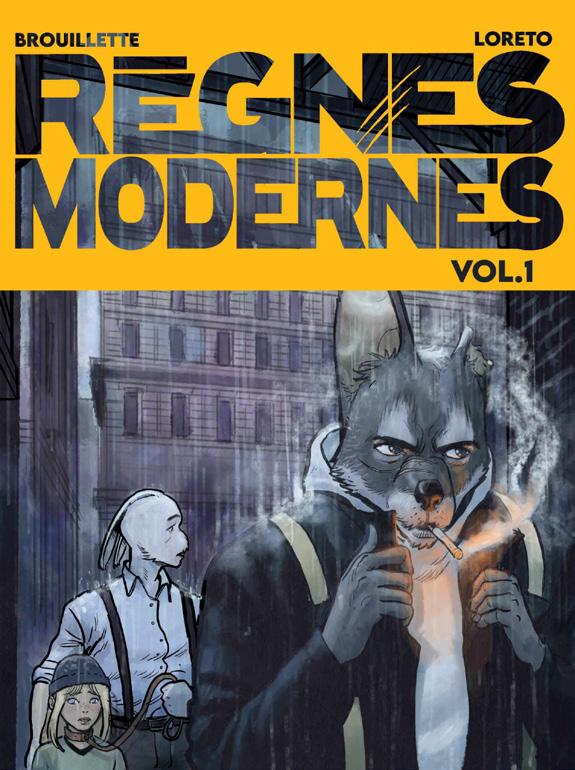
VIA RÈGNES MODERNES, ILLUSTRATED BY PAOLO LORETO
How Iran Finds Itself at the Epicenter of Global Politics
ATIKA UME FAZAL NEWS EDITOR
Conflicts in the Middle East have been a constant throughout most of the post-9/11 world. Whether it be Iraq under Bush, Libya under Reagan, Syria under Obama, or Yemen under Biden, the US’s interest in the region never seems to settle down. Recently, Iran and the United States have found themselves perpetuating this bloody legacy.
The effects of the conflict are felt worldwide, whether countries are directly involved in the war or not. It has had an immense toll on the global economy. Gas prices in countries that get their oils imported have soared to staggering amounts, resulting in the implementation of restrictions and reglementation to curb consumption in many places. To combat the price of barrels that have shot up to almost double during the war, countries have started to encourage people to work from home while others offer public transport free of cost.
The conditions leading up to the war are far too important to overlook. In fact, Iranians had been protesting their conditions strongly starting from the end of 2025. These rallies started as demonstrations against the worsening economic crisis in the country. International sanctions, especially on
the part of the US, and governmental mismanagement were weighing heavily on their livelihoods. The Irani Rial, the local currency, dropped immensely, and the inflation rate had reached 52.6% in late December, according to Iran International.
Protesters showed their dissatisfaction with how the country was being run, and the protests turned against the Islamic Regime. Rallies were held everywhere across the country, so far as becoming the second biggest protest movement since the revolution in 1979. The government responded strongly and violently to the protesters. The military took over the streets and did not hesitate to open fire against peaceful protesters. The Internet was shut down for almost an entire month, making communication far harder within the country and with the international community at large. Sources are unclear on the death toll of these protests, with the numbers ranging from 7 000 to 30 000 civilian deaths according to different sources.
The “liberation” of the Iranian people from their dictatorship was a reason brought up by Trump when explaining their intervention. Another major reason used to explain this war was the belief that Iran was developing nuclear power and weapons of mass destruction. US officials have clearly stated that the goal of this campaign is to destroy Iran’s

military capabilities, and talks about their nuclear programs have resurged as a main talking point. International Relation professor, Dr. Nazir Hussain, claims that Iran does, in fact, have a nuclear program that it develops, but Iranian officials continuously claim that it is solely for peaceful purposes.
More recent events offer another explanation for the war. Joseph Kent, one of the top officials for counterterrorism in the United States and a big-time supporter of Trump, resigned from his position on the 17th of March. He claimed that “Iran posed no imminent threat to [the] nation” and that the US had involved itself in the war “due to pressure from Israel and its powerful American lobby.” Kent further declared in his resignation letter that he “cannot support sending the next generation off to fight and die in a war that serves no benefit to the American people nor justifies the cost of American lives.”
“The war was started on the 28th of February by an intense 'shock and awe' type attack on Iran by the US-Israeli missiles.”
The Pentagon claimed that twice the amount of firepower was used in this attack than on the similar one in Iraq in 2003. The 900 or so strikes managed to kill many high-ranking officials, including the Head of State, Ali Khomeini, and the commander of the Islamic Revolutionary Guard Corps (IRGC), Mohammad Pakpour.
The retaliation by Tehran, the capital of Iran, was almost immediate. They launched a hefty response, with hundreds of missiles and drones being launched into Israel and US-affiliated places. Most of the Gulf countries, all home to US military bases in the region, have been struck by the Iranian military. Airports, oil fields, landmark sites, and US embassies have all been targets in the Iranian response,
according to ACLED . Airports and many oil fields in the region have had to shut down, swaying their economies strongly. Israeli military reports on the other hand show that up to 400 strikes were attempted on the country up until March 23rd.
Iran strategically blocked the Strait of Hormuz, vowing to open fire on any non-authorized maritime vehicle that attempted to cross it. This relatively tiny crossing, wedged between Iran to the north and Oman and the UAE to the south, connects the Gulf and the Arabian Sea. It is also where 20% of the world’s oil and liquified natural gas passes through, resulting in almost $600bn worth of trade yearly, according to the BBC. The price of a barrel of oil hence shot up, going from $67/barrel on the 27th of February to $99/barrel on the 27th of March.
Less than two days later, Hezbollah joined the conflict on Iran’s side by firing rockets into Israel. Officials from Hezbollah claimed that the reason for their involvement relied on the killing of Khomeini and the constant violation of a 2024 ceasefire deal by Israel. These attacks prompted an immense military campaign by Israel in the South of Lebanon. According to the OHCHR, more than 700 000 people were displaced in Lebanon, in the first half of March, due to the ground invasion by the Israeli army, 200 000 of which are children.
Civilian lives were lost all around the region. Al Jazeera reports that US-Israeli attacks had killed around 1 330 people in Iran in the first week. One of the strikes that captured the attention and disdain of many happened in Minab, a city in the South of Iran. This attack, the deadliest one yet, hit an elementary school in the morning of the first day of the war. On top of the absolute destruction of the school’s building, this strike—that Amnesty International argues could and should have been avoided—took the lives of over 168 people, including 100 children. According to The New York Times, the school was targeted based on outdated information that characterized it as an IRGC base.
Week two of the conflict showed no light at the end of the tunnel for any
of the countries. Israel continued its bloody ascent into Lebanon, causing hundreds of deaths and almost a million displaced people. Iran also continued its relentless military operations in Israel and around the region, hitting civilian areas such as shelters and causing the death of at least 10 people throughout the whole conflict. Increasing amounts of countries got involved in the turmoil, which caused them fear for their own safety. An example of this is a British military base in Cyprus being struck by an Iranian drone on the 9th of March.
That day before, Israel Defense Forces struck four oil storage depots in Iran, submerging the city of almost 10 million people in dark clouds that produced black and oily rain. This attack not only weakened the country's resources, but it also weakened most of the population. Iran’s Foreign Ministry’s spokesperson called it “intentional chemical warfare.” Citizens were told to stay inside since breathing in the dark smoke is a huge danger to the respiratory system, and the rain could cause serious chemical burns. Peter Ross, a pollution specialist, also told CBC the potential long-term consequences of such an ecological and health disaster. He claims, on top of the respiratory and lung problems, this toxic rainfall could infiltrate waterways. Considering the high-level threat it poses on the exterior of our bodies, carcinogenic potential on the inside is a serious concern for the citizens' future.
Another cause of concern for the international community came on the 8th of March in the form of a new leader. The late Ali Khomeini’s second son, Mojtaba Khomeini, was selected by Iran’s Assembly of Experts to take the place of his father. Though he had not directly been involved in politics beforehand, he is believed to have been a major figure as an aide to Ali Khomeini. CBS News claims that he had “been involved in running parts of the state apparatus,” whether it be through his strong connections with the IRGC or continuous help within political institutions. He remains private, with little information known about him, drawing skepticism from most international and local entities.
Week 3 intensified the already overbearing energy crisis that had been staggering the region. Israel attacked South Pars, the world’s largest natural gas reserve that is found between Iran and Qatar. This gas field is the biggest source of energy for domestic purposes and any loss in it, according to CNN, would cause immense distress to the population. The attack put immense pressure on the already soaring prices for gas, causing it to climb further. In retaliation, Iran struck Qatar’s part of the South Pars. Considering Qatar supplies the world with a fifth of LNG (liquefied natural gas), the global effects of those strikes were huge.
The situation in the middle east and its effects on the world are still ongoing.
Week 4: Washington moved thousands of troops to the Middle East, while simultaneously claiming that Iran was “begging” for a ceasefire deal.
Week 5: Yemen’s Houtis held true to their promise of support for Iran, launching missiles at Israel. They also maintain their threat of closing up the Red Sea if necessary.
Week 6: The US struck down a bridge right in the middle of it, causing 8 deaths and at least 100 injured.
Rethinking Madness: Hearing Voices Around the World
MARTIN KALOSHI SCIENCE & ENVIRONMENT EDITOR
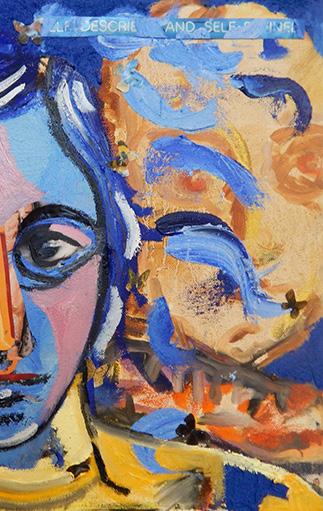
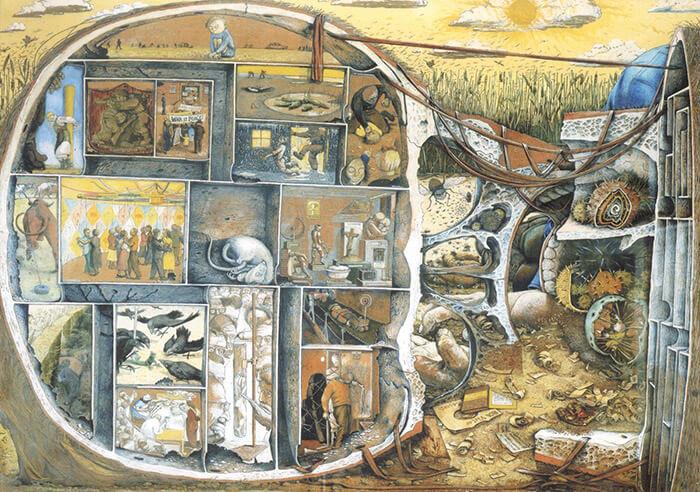
The artwork featured in this article depicts the personal experiences of artists who have lived with psychosis.
Around 3 in every 100 people will experience a psychotic episode, according to Yale Psychiatry, either as a byproduct of schizophrenia, schizoaffective disorder, bipolar disorder, severe depression or PTSD, or without any underlying psychiatric condition at all.
Psychosis is the collection of symptoms which alters a person’s perception of reality. Someone undergoing psychosis may find their thoughts becoming jumbled or incoherent. Delusions—firm beliefs in something that is false—are common. One may be convinced that the government is targeting them, that someone else is secretly in love with them, that they are a famous celebrity, that their partner is hiding something from them, or other baseless convictions which no amount of logic or reasoning can debunk. These examples come from Cleveland Clinic’s types of delusional disorder.
Auditory and visual hallucinations are another defining feature. The hallucinating person will see, hear, and sometimes also feel, taste, and smell things that are not actually there. Falsely hearing sounds is the most common type of hallucination, according to the University of Florida. Here, the psychotic person may insist on voices— negative, neutral, or positive—that are
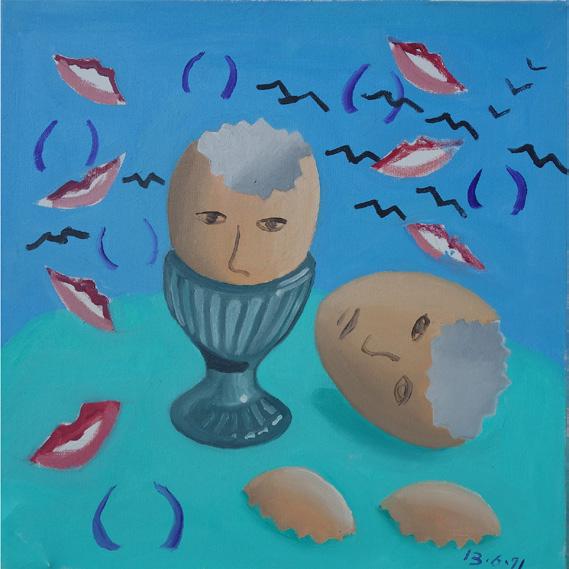
not present. These can command, insult, and torment relentlessly. They can also be more benign.
The experience of psychosis varies greatly from person to person—and from culture to culture.
Ian Gold, professor and researcher at McGill’s Division of Social and Transcultural Psychiatry, notes that the content of delusions and hallucinations is culturally attuned. He elucidates that Chinese schizophrenic patients, for instance, may see or hear Taoist and Buddhist gods. One individual, in a study by social scientist Kam-shing Yip, believed he was the chief disciple of the Buddha. In West Bengal, as described by researcher A. N. Chowdhury, a delusion might be being pregnant with puppies: reflecting the cultural belief that dog bites can result in puppy pregnancy in humans.
In the case of migrants moving from one culture to another, the content of delusions will also shift to adhere to local cultural frameworks. Psychologists Kausal Suhail and Raymond Cochrane found notable differences between the delusions of Pakistani schizophrenic patients living in Britain and Pakistani schizophrenic patients living in Pakistan. In comparison, British patients living in Britain were having similar delusions.
This makes sense: I wouldn’t expect any of my family in Albania to hear “O Canada” or smell BeaverTails in their psychosis, should they slip into it. Those images are simply not culturally familiar. They are markedly Canadian.
Gold points out that, in a way, it’s almost paradoxical how psychosis is seen as a break from reality, when those undergoing it actually seem pretty sensitive to the cultural realities around them. And, research from Stanford shows that not only is the content of hallucinations and delusions culturally mediated, but so is their subjective experience.
“Americans, for one, were found to hate their voices more.”
Psychological anthropologist Tanya Luhrmann led the study. In the
past, she has worked with homeless and psychotic women in Chicago, evangelical Christians who long to hear the voice of God, and she also co-teaches a class called “Culture and Madness” with psychiatrist Daniel Mason. Her work aims to deepen the cultural understanding of mental illness.
In the 2010s, she studied the experiences of voice-hearers in San Mateo, California; Accra, Ghana; and Chennai, India. Each group consisted of 20 people, all passing the clinical criteria for a schizophrenia diagnosis and hearing voices for over one year. During the study, they were asked about the amount and frequency of voices,
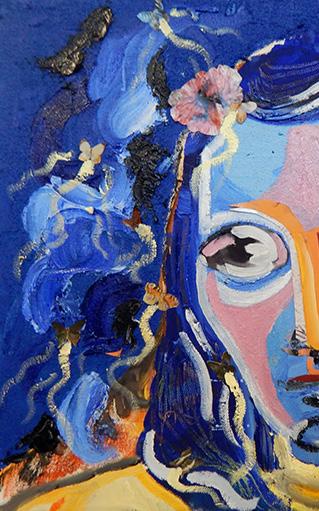
“DEFINED
what they were like, and what they believed the cause of their voices and illness was.
In the American group, individuals were more likely to use the language of clinical diagnoses. They said things like, “I fit the textbook on schizophrenia,” and firmly believed that hearing voices meant being ‘crazy.’ This fear of being judged as crazy held them back from seeking treatment or being upfront about their voices.
Americans’ voices were also
AND DESCRIBED” BY UMA OSWALD, VIA MINNPOST
“SELF PORTRAIT 13TH JUNE 1991” BY BRYAN CHARNLEY, VIA BRYAN CHARNLEY
typically unknown and hostile. They told the Americans to do horrible stuff like torture others or themselves. Not one American called their voices positive.
Accra, Ghana is a different cultural and spiritual landscape. Here, there’s a longstanding belief in witchcraft, and an understanding of mental affliction as an attack of evil spirits. In this context, voices are not a clinical side effect or a sign of being crazy, but a war between good and evil.
Half of the Ghanaians called their voices positive, and many of them said they heard God. He was telling them to not mind the evil voices, and kept the voice-hearers company. One person noted: “They just tell me to do the right thing. If I hadn’t had these voices I would have been dead long ago.”
In Chennai, India, voices were characterised as those of kin. Over half heard family members telling them to do the usual stuff: cook, clean, and eat. They sometimes scolded and berated the voice-hearers and at other times gave them good advice. 8 out of the 20 had significant positive experiences with their voices, and some said they were ‘playful.’ Also characteristic of the Chennai sample was the reference to sex, which they viewed as embarrassing.
Luhrmann hypothesizes that the differences in voice-hearing can be attributed to larger cultural differences
in the way the mind and self are understood. Americans largely view the mind as a private place and possession. In India, however, the mind is shaped by social processes, through which one strives to keep the mind calm. In Ghana, thoughts are believed to have real moral effects on the world; bad thoughts can actually cause harm. Ghanaian voice hearers were quick to insist that their voices were good.
Beyond being fascinating, Luhrmann’s findings could be clinically important. In an article by StanfordReport, she maintained that changing the way individuals approach their voices could change what they hear them say. Could this mean that voices could be ‘made’ more benign? Surely more research needs to be done regarding alternate therapies.
most “biologically examinable” psychiatric condition), and great strides are being made. A 2016 Harvard study looked at schizophrenia-associated variants of the C4 gene, showing that C4 marks synapses to eliminate during brain development. The excessive pruning of synapses could help explain both the reduced thickness of the prefrontal cortex in schizophrenia and the disorder’s typical onset during late adolescence and early adulthood.
At the same time, there are environmental factors, too. Both living in larger cities and being a child of immigrants are correlated to higher rates of an individual presenting with schizophrenia, according to psychiatrists Evangelos Vassos et al. and Jonathan Henssler et al., respectively. Luhrmann has shown
“Considering the cultural context the psychotic individuals is situated in can deepen our knowledge of mental illness, what it means to to the individual, and how to offer them better care.”
To this day, the causes of schizophrenia, schizoaffective disorder, and bipolar disorder, three psychosiscausing mental illnesses, are unknown.
To some degree, they can be biologically explained (especially schizophrenia, often regarded as the
that culture then also plays a role in the individual with schizophrenia’s experience.
Mental illness resists simple explanation. While biology and environment might shape its onset and structure, culture shapes the way it is inhabited. So, let us keep thinking and rethinking what it means to be mad: not only within brains, but within worlds.
“THE MAZE” BY WILLIAM KURELEK, VIA BETHLEM MUSEUM OF THE MIND
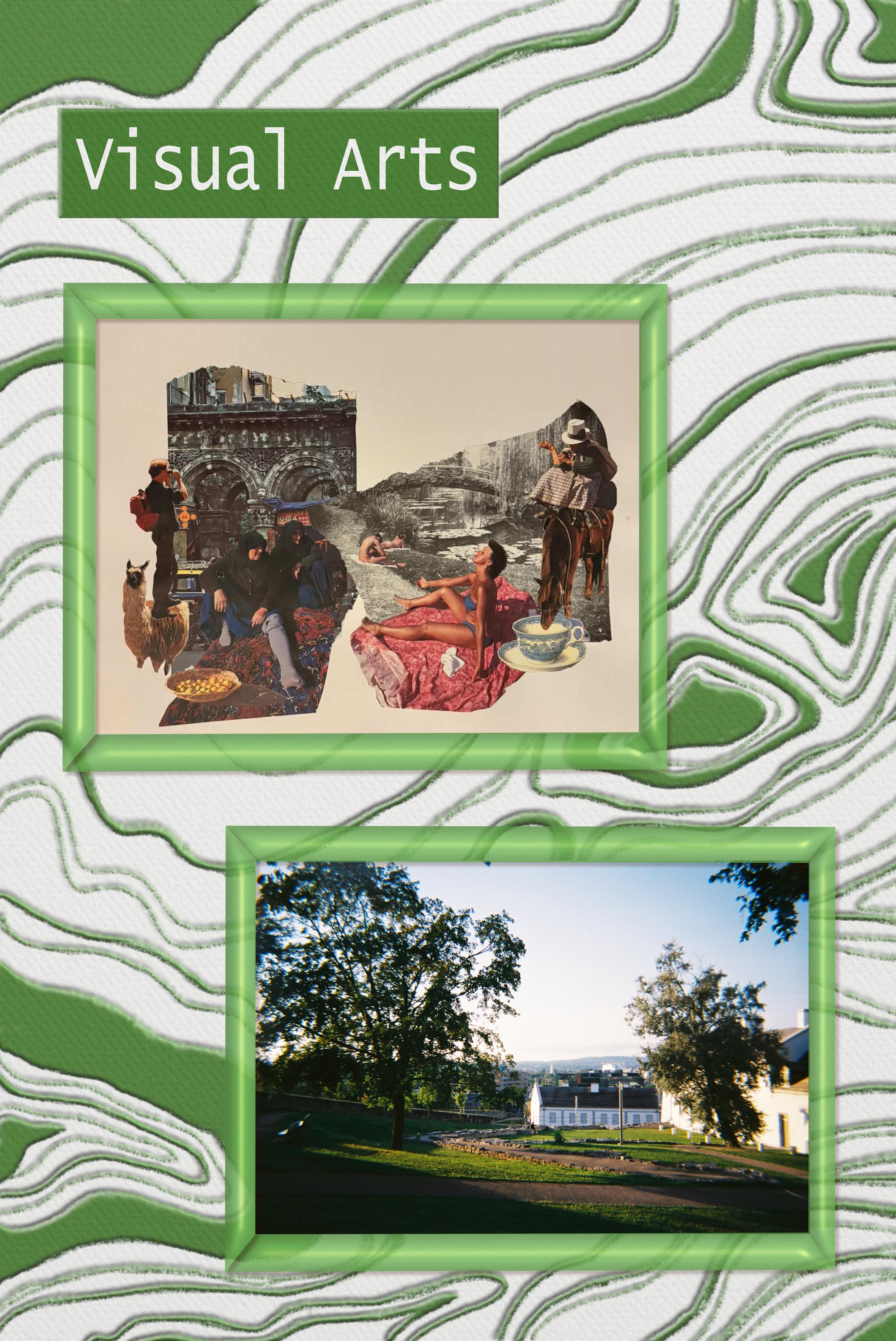
Eva Theodosopoulos
Jiane Keizha Pau, @specks_in_the_universe
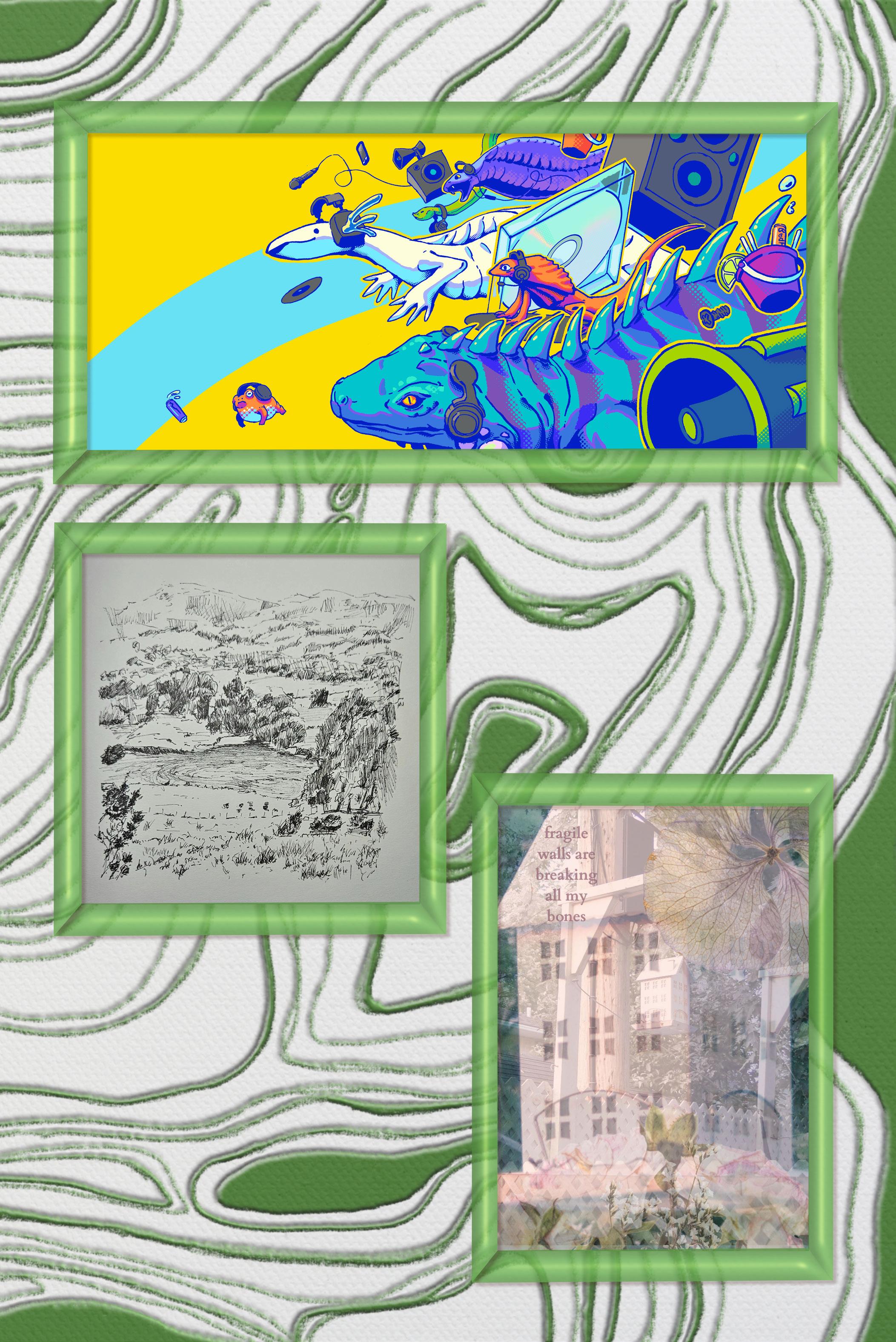
Musical Lizards, Marrie Han, @Aluciphos
Swirling Lake. Ahlam Hamid, @ahlam_hamid0
Khai Moudjed
Our Brains Are Being Hacked To Believe Conspiracy Theories???
ORION PEYROL MANAGING EDITOR
In the last few years, conspiracy theories have been spreading like wildfire and seem to pop up everywhere you look. The internet is rife with them, they’ve infiltrated our political lives, and for some even their personal lives. Buying into these theories might feel ridiculous or even humorous, but they lead to a growing disillusionment with our governmental systems and science itself. This is increasingly dangerous, and it’s no coincidence that these theories have been perfectly engineered to appeal to the way our brains work.
Conspiracy theories are defined by Merriam-Webster, as the belief that an event or phenomenon is being controlled or influenced by one or more parties conspiring against the general public, and we are all capable of buying into them under the right conditions. People don’t all believe in conspiracies for the same reasons, but general scientific distrust is a large part of it. Many of us feel let down and suspicious of scientists and scientific advancements. Not entirely unreasonably, since science and medicine aren’t without their own biases, and, especially if you have a history of feeling unheard by doctors,
it’s easy to believe that they might have ulterior motives.
The example on all of our minds is the COVID-19 vaccine. Anti-vaccine sentiment had been rising in general, but it reached a fever pitch during the pandemic. According to the Pew Research Center, scientific distrust doubled from 2020 to 2021. Theories relating to COVID-19 were inescapable and, from the outside looking in, it often felt ridiculous that they could be believed.
“But the truth is, anyone can fall prey to conspiratorial thinking.”
In a lot of cases a general lack of education and understanding of how scientific advancements work makes distinguishing facts from fiction harder, but this gets exacerbated when people are being educated by vastly different, often inaccurate sources. Scientific communication has a very big problem when it comes to spreading information to the general public. Scientists are trained to use cautious, complex language to be as exact as possible, but
that type of writing and information is hard to grasp and inaccessible for many people. People buy into the information that fits into their cognitive biases, and that often isn’t coming from actual experts.
As we all know, the internet is designed to keep us online as long as possible, and the algorithm is tailormade to keep us hooked. They want to make money off of you, and to do that they need your attention. So, when their content is science or newsfocused, they aren’t really trying to teach you things, but rather trying to get the most clicks. This translates into exaggerations, clickbait titles, and AI photos. The internet is ripe, almost rotten, with content that appeals to what we call salience bias. Cognitive biases exist because we make shortcuts so we can focus our limited perceptive and cognitive resources on the things that feel most important. Salience bias, in particular, means we focus on outliers because they stand out from other sources. Our survival mechanisms have been built around the fact that striking visual or emotional stimuli need more of our attention. It allows
VIA
our brain to filter out irrelevant stimuli and make split-second decisions for our survival. However, in the case of conspiracy theories and algorithms, it means we remember the most attentiongrabbing information rather than the most accurate.
Furthermore, we get put into algorithmic bubbles that show us repeated content that fits into what we already believe. This is great for getting edits about your favorite show, but when it comes to conspiracies, it gets dangerous. Confirmation bias makes us more likely to seekout, recall, and believe information that confirms the beliefs we already hold. We developed this bias because, as humans, we have a need for self-esteem and a stable sense of self, and questioning your worldview makes everything feel off-kilter. However, it also makes us more likely to believe a theory if it already aligns with our worldview. Furthermore, people are much much more likely to ignore a lack of evidence if it’s something they want to believe. For example, if you already believe that the government hides things from us, it isn’t that big of a leap to believe that they’re hiding the existence of aliens from the general public, despite a lack of proof. And when you’re shown increasingly more radical things aligned with your belief system, you can get pulled into believing things that are increasingly removed from reality. This is part of the reason why political extremism, which goes hand in hand with conspiratorial thinking, has grown exponentially through social media.
Algorithms work by showing you more of things you’ve interacted with; the moment you’re flagged as being interested in a certain type of content, you will be shown more of it. You might not believe something farfetched the first time you see it, but if it keeps popping up, you might start, even unconsciously, giving it more credibility. This is called the Illusory Truth effect, hearing or seeing something repeatedly makes it feel familiar and, eventually, feel true.
Humans also have a habit of overestimating how intentional actions or events are. We call this fundamental attribution error. We want to believe
that things are rational by design and motivated, whereas science is usually anything but that. Science is often muddled, unsure and constantly evolving based on new research and studies. While that’s what makes science fascinating, it’s also what makes it hard for people to get on board with it.
“Uncertainty scares us, makes us feel existential, and overall reduces our capacity to keep going with daily life.”
To combat this, we attribute meaning to things that may not have any. For example, NASA took a photo of Mars in 1976, in which a particular mesa appeared to resemble a face. While we
politician, says something is true, you want to believe them over other people. When that high regard is something more extreme like fanaticism, people start taking their word as law and ignoring all other sources of truth, especially if their fanaticism becomes a part of their identity. For example, fans of celebrities who have built their identity around being a fan of this person will often ignore, deny, and even attack critiques or differing opinions about said celebrity.
The problem with conspiratorial thinking is that debunking it legitimizes and gives the theory more power. You’ll often see conspiracy theorists using debunks as “proof” of their theory being covered up. So what can we even do? The best way to combat this wave of misinformation and just plainly untrue theories is to find more effective ways

later took photos that proved this was a geographic formation like any other, it was too late. People had given meaning to the face on Mars, and theories about a secret civilization on the planet were, and still are, being spread.
Belief in conspiracies is also heavily influenced by cultural attitude towards governments. For example, the US, a country built on individualism, has historically been very hesitant to let the government have a say in their lives. This makes them statistically more likely to buy into beliefs about their politicians, scientists or governments being secretly controlled by some “other”. Rising extremism appeals to our tendency to view the world as a conflict of us vs them, and when that thinking is further encouraged by politicians, it grows out of control. Belief in science has become part of a political ideology rather than an acceptance of facts. This is in part because of motivated reasoning. If a person you hold in high regard, like a
of spreading facts by appealing to our cognitive biases. While this may sound counter-intuitive, fighting fire with fire might be our best way forward. Content vetted by experts, but tailored to appeal to the algorithm and our brains, might be the most effective way to combat conspiratorial thinking. Of course we’ll never be able to fully stamp it out, but it’s clear that we at least need to cut back on these weeds, unless we want to see the entire internet overrun.
VIA NASA
Existentialism
and the Ego: The Psychology Behind the Procrastination
CHLOE BERCOVITZ MANAGING EDITOR
“He is terribly afraid of dying because he hasn't yet lived," writes Kafka in his letter to a friend.
I, too, like to wonder why we aren’t less scared of dying, and are more worried about never beginning – never having lived a life with the proper risks, love, and ambition. I also like to think that my query is rather universal. That a shared part of the human experience is to dwell amid our also-human quest for meaning.
But then again, we spend hours on end on our phones. We doomscroll. We’re anxious. We put ourselves down. We let ourselves down. We are our biggest obstacle.
The ‘ego’ is a term almost affectionately tossed around in psychology, yet is insulting to the common tongue. It manifests itself in our souls in a myriad of ways. As Sigmund Freud describes it, the ego serves as the mind’s mediation between one’s realistic needs and primal desires. So, our ego can begin to feel synonymous with our sense of self. It’s the voice in our head, reassuring us that we’re being realistic; it’s the very part of us that yearns for some sort of certainty before action. But let’s face it: that’s not ‘realistic.’
“The ego permeates our boundless excuses and preparation. It clips our wings. It would rather keep us in a cocoon than metamorphosis, all by disguising fear as prudence.”
In doing so, our desires become redirected away from the uncertain, inward pursuit of meaning, and toward the measurable, outward markers of success.
This then, has me posing the question of whether or not meaning is interchangeable with success. I mean certainly not, right?
The people I surround myself with are all, arguably, rich in success and accomplishment. So, success is external; I can measure it.
But then, meaning is what we do with our successes. How we interpret it; how we let it fuel our lives. Not only is it internal, but surely, it also requires a sense of vulnerability.
That means that the human quest for meaning requires losing the stable, successful life that we have created for ourselves.
And I think that is why we procrastinate: it is our ego.
Amid a new culture of social media, short attention spans, and a hard-to-ignore mental health crisis, procrastination has held the fascination of psychologists. And with that, a striking conclusion came about: this is not a question of laziness.
Why we procrastinate lies in our emotional regulation, which is rooted in stress, low self-esteem, and a fear of failure. At more severe levels, all of these traits become linked to mental disorders, such as anxiety, depression, ADHD, and OCD.
Our brains undergo a battle called Short-Term Mood Repair. Every day, we are faced with tasks that stretch beyond our comfort zone. Threatening our selfesteem, they trigger the amygdala, which is responsible for our fight or flight responses. In order to soothe such spikes of anxiety, we put off our tasks. According to a study published in Frontiers in Psychiatry, this is the phenomenon of Temporal Myopia: a nearsightedness in which our future
selves are treated as if they are strangers – forced to carry what we refuse to face. We prioritise short-term comfort over the long-term pursuit of meaning.
The same study points to a feedback loop that is attributed to self-criticism.
“ We procrastinate to avoid feeling bad about our dreams and ambitions that seem too out of reach, which culminates into guilt, and lowers our selfesteem drastically more each time.”
But when this drops, our ego needs to be protected even more. We retreat into avoidant behaviours that keep our desires at bay.
Overcoming the ego, then, seems to be the price one ought to pay for a meaningful life. With emotional regulation, self-compassion tends to follow. Anxieties are part of our humanity. Meaning does not always lie with successes, and it definitely doesn’t reside with perfection. It is likewise hard to find in passivity – in waiting.
To become who you have dreamed of becoming, a cliché might just be true: to betray the person you thought you had to be. I think that the question of whether you are ready or not has been rendered obsolete. Be kinder to yourself. Embrace humility.
Being Niche Might Be the New Conformity
SABRINA COCCIMIGLIO COPY EDITOR
Society. It’s the thing that subconsciously controls our every move. It is the organism of people that influences our decisions, thoughts, desires, judgments, etc. The more aware you become of it, the more it takes control of you. The more you wish you could mimic the behaviours and attitudes of others. The more societal pressures control you. Morph you. Until you are nothing like the young child you once were.
This feeling that consumes the thoughts of teenagers like you and me is called conformity.
It’s inevitable. The moment you realize you are perceivable, you start wanting to be the version of yourself that other people enjoy. It’s not something new either. As sociologist George Herbert Mead describes, it’s our response to interactions with others that shape us into becoming who we are. Naturally, we want to survive in a world that revolves around connection. When we learn a common language or adopt habits from family and friends, it is our normal response to the influences that surround us.
While natural, it can also feel
limiting, especially when you become used to depending on others to develop your own sense of self. It may feel like a part of you is disappearing to please others. And it’s honestly exhausting feeling like being you just isn’t good enough. You find yourself trying to secretly hide things you like because you know if you mention them, you’ll be judged. Or, you might have a hidden “guilty” pleasure artist, song, or hobby that you keep to yourself in fear of ridicule. Sometimes, existing feels more like a chore that would be easier if you tried to do it like everyone else.
In modern society, however, we’ve seen an emphasis on finding individuality in a world of conformity. When people search for individuality, what we’re actually searching for is a way to escape the influence of society. In today’s super-saturated world filled with media, everything starts to merge together: trends can take over in days, people begin to sound the same, or even act in similar ways. And to escape this all, we crave a sense of self that sets us apart from others.
But what if trying so hard to be different makes us lose all sense of self?
The rising phenomenon of the “niche” seems to be taking over. It’s like a buzzword of sorts, filled with

the connotation that what you like is “underground.” And, while it’s perfectly normal and possible to have likes that aren’t mainstream, the word can be limiting. It suggests that being “basic” is the less cool alternative. Ultimately, we feel pressured to find something that sets us apart. Doesn’t this sound quite familiar?
Yet again, it seems that societal pressures are still at work:
“whether it be to be unique or similar, we conform to society one way or another.”
And while one thing may be “niche” with who you surround yourself with, it can also be an ordinary interest to another. It’s a double-edged sword; you may never be “niche” enough to some, but you may also be too different to others. And while being unique is celebrated, being too different makes you “weird.” Do we always just go back to conforming to the majority? Is the cycle never-ending? Just know you will never win.
This is strikingly apparent when hobbies, artists, songs (you name it) that were once considered “weird,” are what is “cool” today. For example, purchasing second-hand once carried an immense stigma. Yet today, 77% of adult Canadians own at least one second-hand item in the last year, according to CityNews Ottawa. People who were once judged for their niches are now seeing them be celebrated and adored. And this reveals a reality where individuality can be hated one day and accepted the next. It seems it is only acceptable when individuality reflects the shift in societal norms.
Ultimately, what is defined by society is out of our control. However, this does not mean that our own reaction to these trends is pre-determined. Rather than judge another for their own interests, give them the grace and understanding that you would wish for yourself.
Regardless of trends, niches, or societal pressure, just know you are still a human being. We all are. Whether you like something that’s popular or underground, we’re all trying to discover our authentic selves. And, you really only have one life to make it happen.
Confessions of a Teenage Lesbian
JACQUELINE GRAIF EDITOR-IN-CHIEF
When you think of the word “gay,” what comes to mind first?
According to a report written by Just Like Us, a young people’s charity based in the UK, around 9 in 10 (87%) of young lesbians report feeling isolated within the last 6 years. This is in comparison to 46% of young gay men, and 54% of young bisexuals who report loneliness, or a feeling of disconnection from peers.
But why specifically lesbians?
There is a deeply rooted oppression still very obviously present for LGBTQ+ communities, where Homophobia continues to reign very true. However, lesbians often unknowingly get the short end of this stick.
Maybe this is due to a historical sexualization of lesbians, or a direct attack from the patriarchy. Regardless, lesbian isolationism is a prominent issue that lacks research or coverage.
A prime example of lesbian underrepresentation and isolation stems from one of the world’s largest streaming services, Netflix. Every single time there is an attempt at mainstream lesbian representation in a television series, Netflix cancels the show after one season. First Kill, a lesbian Vampire TV show, was a hit, getting over 30 million viewing hours in its first three days on streaming, but it got randomly cancelled after one season. I Am Not Okay With This was similarly cancelled after a hit first season. Finally, one of my favourites, Everything Sucks, had another random first-season cancellation. Every one of these TV shows had a lesbian main character who showed no interest in, or a general disgust toward, a male romantic partner. Even Stranger Things leaves Robin with no female interest at the end of the show. Why can’t lesbians experience long-term love or relationships on TV?
Heartstopper may seem like an obvious mention in this instance, but it features two queer men as the main characters. While Heartstopper arguably features some of the best young LGBTQ+ representation accessible on TV, its lesbian characters are only side characters, whose storylines revolve
around homophobia or gender identity. Contrarily, some TV shows, like I Am Not Okay With This, don’t even label the main character, Syd, who only shows an interest in her female best friend and is disgusted by male romantic pursuit. This is arguably a more realistic approach to teenage lesbian lifestyles.
My grievances lie in this underrepresentation. Heated Rivalry was one of the hit TV shows of 2025, expressing the love between two men and showing no other queer characters. I loved Heated Rivalry, and I thought it was an important representation for the community as a whole, but I was upset that no lesbian TV show has been received this way. This lies in deep, patriarchal oppression. It seems as though non-sexual lesbian relationships don’t spark any interest in straight women, or straight men, or anyone other than the Sapphic community. Because of this lack of representation or general ‘interest,’ lesbianism continues to be a taboo topic for most.
While gay men face their own issues with homophobia, they arguably benefit from the upper hand of being male in a male-dominated society. In the instance of media, they have had a large number of well-received TV shows and movies. Heated Rivalry, Heartstopper, Call Me By Your Name, and Brokeback Mountain are prime examples. What about big-hit lesbian movies or TV shows? Can you name any super popular ones? Probably not.
Take Chappell Roan for example, whose entire media existence is proof that lesbians are continuously hated or
stereotyped. While her music is globally loved, it is mostly separate from her identity. If you heard “Pink Pony Club" on the radio, you wouldn’t know a lesbian wrote it. Yet, being an out and proud lesbian, Roan faces constant attempts at cancellation online. She has been labelled as “mean” or “rude,” which are very typical lesbian stereotypes.
There is this sense of special disconnect that comes with lesbianism. Lots of other identities benefit from patriarchal standards, such as gay men or bisexuals. But
“lesbians have zero patriarchal benefit, and are instead completely isolated from their communities.”
When my high school friends would talk about their crushes, I had to sit out. When my friends were settling a debate on whether or not a man is hot, my opinion was not welcomed. I tried so hard to fit in, to like men, but I really just didn’t. Has the patriarchy exerted such power that anyone who is not attracted to men is isolated from society?
As a woman, I already suffer from patriarchal oppression because of my gender identity. But when you add a lesbian identity on top of that, it deepens the oppression, the isolation, the feeling of never being accepted into your community or society. Why can’t lesbians just love without social isolation and shame? When will lesbians get the representation they deserve?

OPENING STATEMENT
SAL FRANCIS
CREATIVE WRITING EDITOR
Another month and another issue with so many wonderful contributions! I genuinely get so much happiness from reading all of the contributions each month, and even more to be able to share them with you, reader. I hope you find refuge in the world these writers build and the thoughts they explore within them. The end of the semester is approaching and a lot of people, myself included, are feeling stressed and overwhelmed. I hope that these works, in all their magnificence, can offer you the same solace from suffering that they offer me.
Our misguided hope for lonely lordly little lamps
Luca O’Neill Contributor
A foggy night, dusk with little light. The fog was so feeble it could be repelled by the simple streetlamp. Along the road there was nothing ahead, nothing behind, desolate save for the solitary glow.
The fluorescent orange bulbs carried a certain beauty, a warmth, a guide for the forlorn. It was placed there to light the way, that was its singular, faithful purpose. Its light reached for the sky, ever dimly mind you, but nonetheless it shone.
The heavens above lay dead and dark. The sky had been coated a dreary blue and a milky black and it was void of any stars. In their absence this lamppost claimed a greater duty. It pierced the caliginous cloak of fog and shadow alike. It seemed to usurp the cowardly stars whom we believed had abandoned us to this cold and killing eternal night.
But we were terribly mistaken, the stars were no cowards, they had not left, they were murdered, blotted out by the foul, fiendish, and forsaking lamppost's light, it polluted the sky. In its poisoning of our stars, we were foolish enough to believe that it was a lamppost that could ever replace a star, the great inferno of which burns forever and from far in the perfect heavens we could not touch.
Alone and forsaken, we had chosen to gallivant on the black steed of our perilous pride, to dance ourselves forever into this eternally noxious, and numbing night. All things made by people are tainted by our impermanence, and diminished with our insignificance, and oppressed by our hate, and envenomed by our hubris.
Never again should we pour our misguided hopes into the terrible, Into the awful, into the malignant, the depraved. Into our lonely, lordly, little lamps.
Puddling
Simon Jaffary Osowski Contributor
Puddle like a face stares skyward bound
Water understood by the ground all around Earth recreates itself, nutrition impound
Carbon rearranged until human form found Face like a puddle stares earthward bound
Rishikesh (as Heard from Fables)
Colm Griffin Contributor
Should I Fall asleep to dream Of Rishikesh, the lie
Pay no attention to me Dear Oh, do not let me die
Dreaming of Dark Moons at dawn Of half-crossed, dreary bridges
Connected eyes made red with fear And skin all racked with ridges
Tell me truly, Other Half
A Truth which is a lie
Wicked Moons are made to walk The bridge seen through the eye
But I’ve none, so I never saw The Truth seemingly long ago set.
I’ve got a bad habit of Placing bets
On blind horses And featherless Chickens Without feet Going out kickin’
Walk then is what I will do
To fabled Rishikesh
Rounded by the ancient bridge And waters running fresh
Dream or not, my Truth is lost In jungles made of flesh
Willing or not, I’m made to walk The Road to Rishikesh
Snowdrop
Simon MacLaren Contributor

Escaping Escapism
Illia Yevseienkov Contributor
I find my mind in this empty space I am all alone I like it this way I walk on my tears I walk away Escaping myself, I cannot Escape.
I see my reflection, I can't see myself. Who is this person who calls me himself?
He asks me if I am "okay" Are you serious? What do you say? Look what you made me become Look, I am broken, cold, and numb "I am trying to help you" oh yeah? HOW? by giving me an "escape" right now?
"You are tired, and weak, and need of a break" No, This has to be a mistake. No, There is another way. I will burn you down I believe what I say "Hm, how curious, you said this before" burning your tears building your clouds Just for all of it to come raining down? "Pathetic"
“To think of me, this whole time, with no clue you existed and here you are, existing!” A sweet preserved line, from my Dad’s mum to my mother when they met; my parents newly dating, in the spring of their lives. Mother, now in her August, is surprised that I found white flowers on a walk today, March sixteenth. Premature. Tomorrow they will wink out in a snow – but I know one I picked is pressed between two pages in the twenties of Emily of New Moon, existing for some future daughter, who will smell its pickled bloom and watch expired spring blow into a missing, dusty kingdom with an odd feeling in her white throat.
it's raining now. everyone knows. You made them read this "Why?" I have no fears to hide.
--- Ilya Yevs
La haine du « wesh »: Comment la société a diabolisé la jeunesse marginalisée
ALAA ETTAOUTH STAFF WRITER
Tout commence par un film en noir et blanc, 1995. Jusqu’ici… tout va bien. Ce qui semble être un retour à l’air primitif du septième art sera plutôt considéré comme une vague de fraîcheur pour le cinéma français. On y relate l’histoire de trois jeunes habitants d’une banlieue parisienne, Vinz, Hubert et Saïd respectivement juif, noir et maghrébin, secouée par des émeutes à la suite de la bavure d’une force policière violente sur Abdel, un résident du quartier. La Haine nous présente leur vie marquée du mépris social, leurs réflections et leurs pérépéties tout en portant une certaine lueur d’espoir: le monde n’appartient pas à ceux qui s'efforcent de les contrôler et de les emprisonner pour ce qu’ils sont, mais à nous, la jeunesse.
Ce film est réalisé par Mathieu Kassovitz qui a 25 ans quand il décide d’entreprendre l’écrit de son deuxième court-métrage. C’est l’histoire de Makomé M’Bowolé, un jeune Zaïrois (ancien terme français désignant les citoyens de l’actuelle République démocratique du Congo ) de 17 ans, assassiné par une balle à la tête par la police durant son interrogatoire en 1993, qui inspirera l’écriture de son script. Cet homicide déclenche trois jours d’affrontements dans le 18e arrondissement de Paris. Entre le 4 et le 7 avril 1993, en plus de Makomé, deux autres hommes ont été tués par des policiers d’une balle en pleine tête.
Un crime d’une telle barbarie ne peut qu’émaner directement de ce qu’incarne un jeune homme noir pour la société: une menace imminente. De toute manière, selon le policier meurtrié, « [...] probablement, ce connard aurait fini en prison. »
Ce terrible meurtre nourrira l’envie de Kassovitz de représenter cette jeunesse violentée et de dénoncer le cercle infernal de la haine: la haine
attise la haine et crée un environnement propice à la violence, ce n’est pas un secret.
Bien avant d’avoir écouté La Haine, je devais avoir regardé le film Netflix La Vie Scolaire, réalisé par Grand Corps Malade et Mehdi Idir, au moins cinq fois. Je me souviens des moments passés avec mon frère et ma sœur à rigoler des bêtises de cette bande d’amis, mais je dois avouer qu’au bout de la cinquième écoute, le thème de l’échec et de l’impuissance que le cinéma français semble coller si aisément à la jeunesse des fils et filles d’immigrants commençait à me chicoter. Pourquoi une telle récurence? Pourquoi associet-on si facilement la pauvreté et la délinquance à ses enfants et à ses adolescents qui me ressemblent? Si le monde est à nous, n’avons-nous pas le droit, nous aussi, de nous délecter des plaisirs de l’insouciance de l’enfance?
Dans les faits, les communautés marginalisées n’ont que le droit de goûter à l’amertume qui accompagne la discrimination. Chaque parole et chaque geste de cette jeunesse sont scrutés à la loupe par ceux qui n’attendent qu’une simple erreur. On les épie pour justifier un tollé politique ou tout simplement pour continuer de blâmer une population fragilisée pour ce que l’on juge trop compliqué à expliquer: les problèmes de logement, l’inflation et la fragilisation de la culture. Il est plus facile de détester ce que l’on ne connaît pas réellement et de blâmer ce que l’on ne comprend pas.
On pointe du doigt le déclin intellectuel de la société ou le désintérêt envers la langue française lorsque les jeunes incorporent quelques mots arabes, créoles ou venant du lingala dans leurs conversations. Dans la pratique, une langue est naturellement repésentative de ceux qui l’emploie et est en constante évoluation. On s’entête à faire la guerre au mot « wesh » parce qu’il incarne l’inimaginale: une cohabitation linguistique jugée outrageante en vue du prestige de la langue française Pourtant, il n'y a aucune polémique lorsqu’on utilise des mots comme magasin, café ou divan, qui tirent tous, eux aussi, leurs racines de l’arabe… Cette exclusion littéraire du nous et du vous est un phémomène réél
qui se hisse dans plusieurs sphères de notre socitété. Du cinéma découlent des biais implicts, des raccourcis mentaux que notre cerveau prend involontairement et qui nous amène à porter automatiquement des jugements qui sont rapides et qui manquent d’impartialité et d’objectivité. Ils nous mènent à ignorer la réalité du racisme systémique qui contribue grandement à la surreprésentation des jeunes noirs et arabes dans la délinquance. Cette spirale vicieuse de la marginalisation résulte des contrôles policiers accrus envers ces communautés, des disparités socio-économiques, mais également de la stigmatisation médiatique. La France a une longue tradition ancrée dans un nationalisme d’extême droite de stéréotyper tous les jeunes Arabes et les jeunes Noirs comme des « racailles ». Paul Morand, auteur du roman Francela-doulceb et fervent xénophobe, dira même: « Je déclare que la racaille qui grouille ici n’a aucun rapport avec les grands noms internationaux de l’art que nous avons accueillis à leur passage. »
La jeunesse marginalisée est réduite à ce qu’elle ne peut contrôler, au cercle vicieux de la haine. Elle fait d’eux la pièce maîtresse de son mécanisme destructeur ainsi que l’outil principal de perpétution de son aversion malsaine.
Pourtant, quand le cinéma cherche à se révolutionner, il emprunte aux autres. Il se costume et s’amuse à s’apprêter des traits de ceux jugés « incompatibles à l’art », ceux que l’on dépeint comme des voyous, des « racailles ». Ils sont bien mieux coincés derrière un écran, où on peut les ridiculiser sans aucune impunité, en choisissant délibérément d’ignorer tout un système conçu pour nourrir cette image qu’on leur colle.
Je n’ai plus écouté La Vie Scolaire depuis. Nul besoin d’ouvrir sa télévision pour plonger dans un univers où ces jeunes sombrent inévitablement dans l’abandon et acceptent de vivre avec l’échec au-dessus de leur tête. Le récit minutieusement ficelé par nos propres biais le raconte déjà.
“Alors, je choisi d'éteindre ma télévision. Peu importe ce qui est dit, le monde est à nous.”
Girlhood Is Bigger Than The Bell Jar
MAYA JABARRI VOICES EDITOR
It has come to my attention (and I’m sure to that of most) that it has become almost impossible to dive into a discussion about the intersection between femininity, literature, and identity without the mention of Sylvia Plath. Her novel The Bell Jar, with its famous fig tree analogy, has basically taken a second life online, and believe me, it just keeps on expanding its roots and branching its long arms out. In fact, even i-D magazine notes that “The fig tree analogy, though, out of everything Plath wrote, has recaptured the attention of a new generation of readers.” This analogy, and my generation seem to have formed an unbreakable but now overused (at least, from my point of view) bond among young women. And, I mean, I get it. Upon my first read of The Bell Jar, I, too, found Plath’s fig tree to be a perfect encapsulation of girlhood and the expectations that come along with it. Plath’s writing is sharp and deeply resonant, and I say all of this not as a critic from a distance, but as an admirer who has read it and is currently hunting for a well-loved copy of another book of hers, Ariel.
The fig tree metaphor, in which The Bell Jar’s main character, Esther Greenwood, imagines her life branching into multiple possible futures only to wither from indecision, has become a kind of shorthand for modern girlhood. It is evocative, yes, but its overuse risks flattening the complexity of women’s experiences into a single, familiar narrative, and that narrative being some inevitable and unstoppable loss. While that viewpoint is valid, it is not all-inclusive. When we repeatedly center Plath as the female experience, we inadvertently sideline other writers whose work expands, challenges, and diversifies what womanhood itself can look like.
Roxane Gay. In her essay collection Bad Feminist, she dismantles the idea that women must be perfect to be politically or morally valid. Gay’s writing embraces contradiction; she is vulnerable without being fragile and critical without tiptoeing. This is refreshing. This is an alternative to the rigid introspection often associated with Plath: a permission to exist messily, loudly, and without apology. You do not need to be delicate; you should not be expected to.
Teeth and essays about self, such as those in Feel Free, showcase Smith’s explorations of identity as something fluid, relational, and deeply tied to community. For readers solely focused on Plath’s voice, Smith’s writing opens up a more expansive understanding of selfhood.
bell hooks. hooks’ contributions to feminist thought cannot be overstated. In works like All About Love and Feminism Is for Everybody , hooks reframes feminism as a practice rooted in care, justice, and collective liberation. Her writing is accessible and profound. It offers not just analysis, but guidance as well. Where Plath’s work, to me, often dwells in despair, hooks insists on the possibility of transformation. She reminds us that understanding womanhood is not just about articulating pain and feeling it to the fullest, but about imagining and building something better.
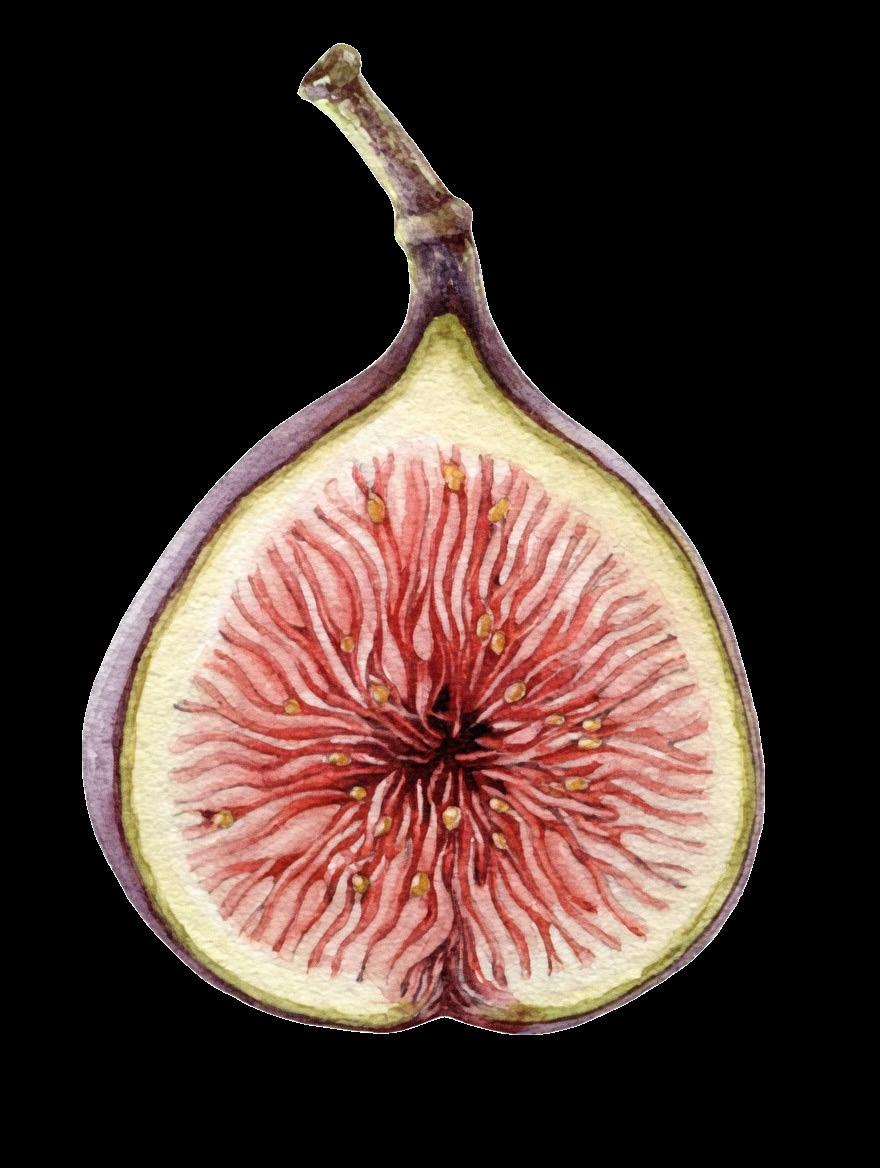
VIA SHUTTERSTOCK
“The issue, I believe, is not that we are reading Sylvia Plath, but that we are often stopping there.”
outward, asking not just “Who am I?” but “What systems made me this way and who set those systems up?” This shift is especially vital because it moves the conversation about femalehood beyond individual struggle and into collective critique.
Zadie Smith. Offering a radically different lens, her novels like White
I want to make something clear: this is not an argument against Sylvia Plath. Her work continues to resonate transgenerationally because it captures something real and often unspoken.
But when we reach for the same references again and again, we risk creating an echo chamber. The challenge, then, is not to abandon Plath, but to read her alongside others.
A teacher once told me that the way writers get recognized for their accomplishments is not always by word of mouth; rather, it is by naming, outwardly, in works of your own, these women. I have read the works of all the women I have named, and I know there are millions more out there that should be named. Consider this a reminder, and even a push, to seek out those names and, as I’m attempting to do, name them outwardly.
Because the truth is, no one writer can encompass the full complexity of the female experience. Not Sylvia Plath, not anyone. And that is precisely why we need more voices.
Life after the Expos: How Montreal Keeps Baseball Alive
MARISSA HODGSON SPORTS EDITOR
When Youppi stepped onto the ice at the Bell Centre wearing an Expos jersey, it wasn’t just a tribute. It was a reminder. Nearly two decades after the Montreal Expos left the city, Montreal still hasn’t let go of baseball.
The moment came during a tribute following the passing of Rodger Brulotte, a longtime broadcaster and one of the most recognizable voices in Expos history. As fans watched Youppi, once the mascot of the Expos before becoming part of the Montreal Canadiens, wear the team’s colours again, it stirred something deeper than nostalgia. It raised a lingering question: what happens to a city’s sports identity when its team disappears?
In 2004, the Expos relocated to Washington, becoming the Washington Nationals. Their departure marked the end of Major League Baseball in Montreal, leaving the city without a team for the first time in over three decades. But while the franchise disappeared, baseball itself did not.
Instead, many Montreal fans redirected their attention toward the Toronto Blue Jays, now the only remaining MLB team in Canada. The shift, while gradual, became almost inevitable. With national broadcasts, consistent media coverage, and easy accessibility, the Blue Jays filled a void that had been left open.
At first glance, the choice seems contradictory. Montreal and Toronto have long been positioned as rival cities, especially in sports. The rivalry is perhaps most visible in hockey, where loyalty to the Canadiens is deeply tied to local identity. But baseball, in the absence of a hometown team, operates under different rules. Without the anchor of local allegiance, fans often turn to what is available.
For younger generations, the Blue Jays are not a replacement. They are the
default. Those who grew up after 2004 never experienced the Expos firsthand. Their understanding of baseball has been shaped entirely by what they could watch, follow, and engage with. In that context, supporting Toronto becomes less about rivalry and more about exposure. The Blue Jays are simply the team that exists.
Older fans, however, carry a different relationship to the sport. For them, the Expos were more than just a franchise. They represented something distinctly Montreal: a bilingual, locally rooted team that reflected the city’s unique identity. Their departure created not only a gap in entertainment, but a loss of representation. Supporting the Blue Jays, for some, feels like adaptation rather than loyalty.
That tension between memory and practicality defines Montreal’s current baseball culture.
“It is a fan base split not necessarily by choice, but by circumstance.”
Some have embraced the Blue Jays fully. Others remain attached to a team that no longer exists. Many occupy a space somewhere in between, watching Toronto while still holding onto the past.
Moments like the tribute to Brulotte bring that complexity into focus. The reappearance of Expos symbols, even briefly, reveals how deeply the team remains embedded in Montreal’s identity. It is not just about remembering a franchise, but about preserving a sense of belonging that the team once provided.
Youppi, in particular, embodies that continuity. As a mascot who made the rare transition from baseball to hockey, he represents a living connection between eras. Seeing him in an Expos jersey again connects the present
moment to a period when baseball was still part of the city’s everyday life. These symbolic gestures matter because they remind people that the story of baseball in Montreal did not end in 2004. It evolved. The absence of a team forced fans to redefine their relationship with the sport, whether by adopting a new team, holding onto old loyalties, or balancing both.
In recent years, conversations about bringing baseball back to Montreal have resurfaced, further demonstrating that interest in the sport has not faded. If anything, it has lingered beneath the surface, sustained by memory, media, and moments of collective reflection like the tribute to Brulotte.
Montreal today exists in a unique position within Major League Baseball. It is a city without a team, yet not without a fan base. It is a place where the Blue Jays play on television screens, but where the Expos still live in memory.
And every so often, when an Expos jersey reappears, whether in a stadium, on the street, or on the ice at the Bell Centre, that memory becomes something more visible. It becomes a reminder that while the team may be gone, the identity it created is still very much alive.
VIA CANADA MODERN
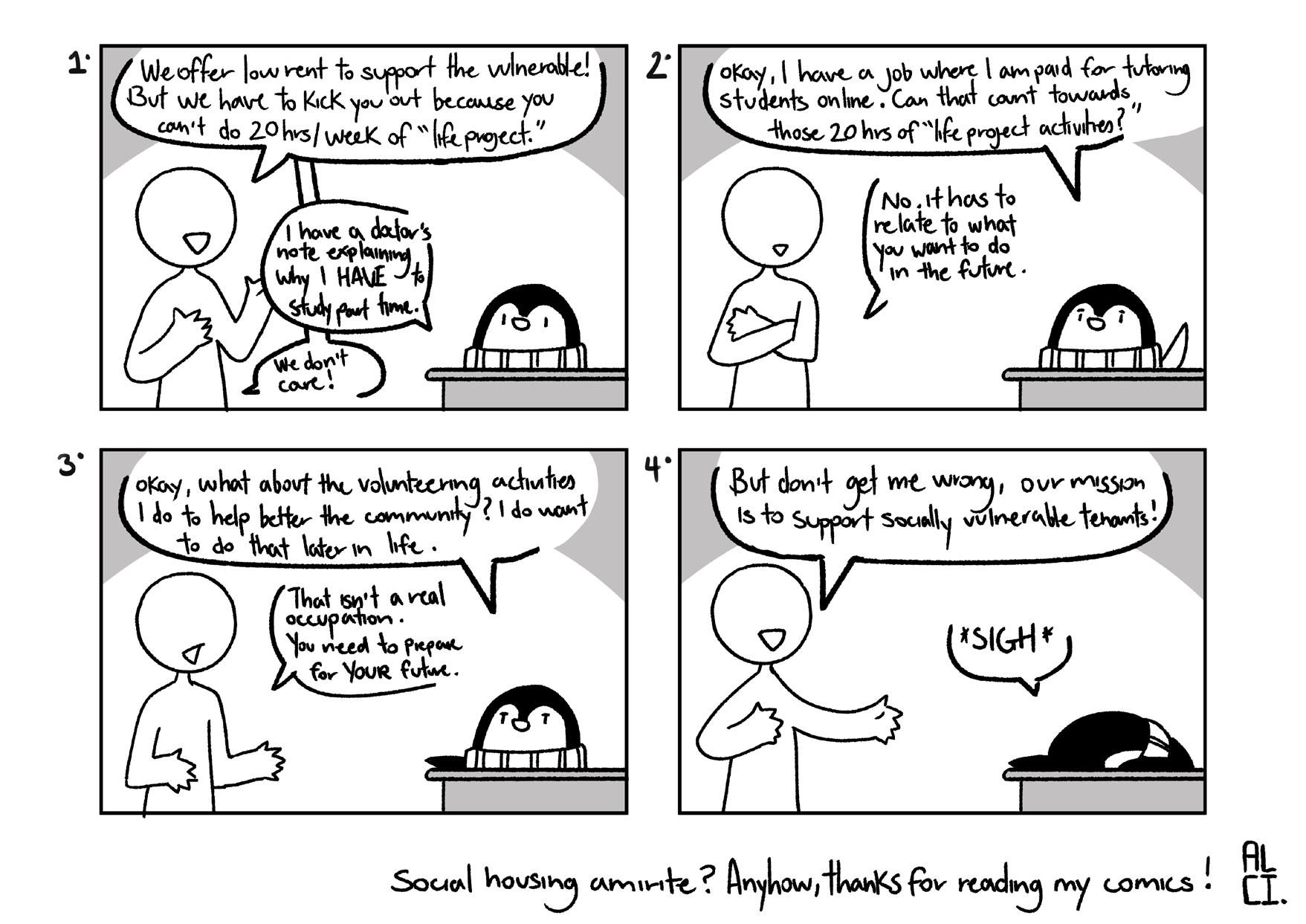



Horoscopes
ARIES (MAR 21 – APR 19)

You know what’s great about free will? It’s that it costs nothing to indulge in it. Not everything has to be normal and logical. Have fun with it! You can change up your daily routine and see how it improves your morale.
Album: Ambitions - One Ok Rock
TAURUS (APR 20 – MAY 20)
Talking with strangers is only as scary and awkward as you make it. Relationships are all about give and take, so maybe this time, be the one to do the first step. Don't stress about first impressions, they're overrated anyway!
Album: Perfect Love - Red Velvet
GEMINI (MAY 21 – JUNE 20)
If you're having a creative block, Gemini, take a walk around the block. You can do it with or without music, your choice. Just go outside and walk around. You’ll notice things you haven’t seen before.
Album: Wisdom - Stick Figure
CANCER (JUNE 21 – JULY 21)
Taking a break once in a while is not a sign of weakness. Be honest with yourself and others about your limits. Don’t be afraid to take time off for yourself, even if you’ll spend the day eating and sleeping. You’ll spend the day eating and sleeping.. We’re all humans after all!
Album: Poet / Artist - Jonghyun
LEO (JULY 23 – AUG 22)
You want to know what's one thing that will never go out of fashion? Reading. It doesn’t matter what kind of book you’re reading or how long it takes you to finish it, just as long as you keep reading. Cherish those moments when the words on the page make you forget about time.
Album: Songs She’d Like to Hear - Kennie
VIRGO (AUG 23 – SEPT 22)
This month is all about confidence and engagement. Your work speaks for itself, so let it do just that. You fulfill a role that no one else can. Be proud of yourself.
Album: Lotto - EXO
LIBRA (SEPT 23 – OCT 22)
You deserve a sweet treat, Libra. Scratch that, you should get yourself that thing you’ve been eyeing for months now. All this hard work must be rewarded accordingly!
Album: CLAPCLAPCLAP! - Iv of Spades
SCORPIO (OCT 23 – NOV 21)
It’s time to put on your most charming smile and go mingle with the professional network. Stay ambitious and passionate so your dreams become reality. They are closer than you think.
Album: Lifeline - Maro, Nasaya
SAGITTARIUS (NOV 22 – DEC 21)
Just because you can doesn’t mean you should. Some things are better left alone, Sag. You don’t need to bend your boundaries for the sake of others. Especially the people who won’t do the same for you.
Album: Sun Leads Me On - Half Moon Run
CAPRICORN (DEC 22 – JAN 19)
There’s beauty in imperfection, Capricorn. Don’t be afraid of the wrinkles and cracks that make the experience real. Learning to love the reflection in the mirror is a tedious task, but you’ve got all the tools you need.
Album: An Ode - Seventeen
AQUARIUS (JAN 20 – FEB 18)
Your willingness to change and adapt is respectable. It inspires others to act in reciprocity. It’s your ethics that will help you go far.
Album: X’s - Cigarettes After Sex
PISCES (FEB 19 – MAR 20)
Maybe you should give new friends a chance to get to know you on a deeper level. Don’t guard yourself so dearly, and the right people will find great connections with you.
Album: Злой - Passmurny



Jacqueline Graif
Editor-in-Chief
Minola Grent
Editor-in-Chief
Chloe Bercovitz Managing Editor
Orion Peyrol Managing Editor
Cathy Wang
Digital Managing Editor
Nadira Zibirov Copy Editor
Sabrina Coccimiglio Copy Editor
Atika Ume Fazal News Editor
Maya Jabbari Voices Editor
Nicole F. Motta Arts & Culture Editor
Joséphine Savard
Arts & Culture Correspondent
Martin Kaloshi
Science & Environment Editor
theplantnews.com theplantnewspaper@gmail.com @theplantdawson


MASTHEAD
CONTRIBUTORS
Luca O'Neill
Illia Yevseienkov
Simon MacLaren Colm Griffin
Simon Jaffary Osowski
Laurine Alinot
Tessa H. Chabot

Marissa Hodgson Sports Editor
Daria Gladchii Curiosities Editor
Sal Francis Creative Writing Editor
Simone Mudie Visual Arts Editor
Orla Jeanes Staff Writer
Elsie Duque Hills
Staff Writer
Alaa Ettaouth Staff Writer
Romane Randria
Social Media Manager
Jiane Keizha Pau Graphic Designer
Alexander Solovyev
Cover Artist
Marrie Han Cartoonist
Yasmine Bouanani
Secretary
The Plant Newspaper
Dawson College
3040 Rue Sherbrooke O Montréal, QC
H3Z 1A4
2C.12