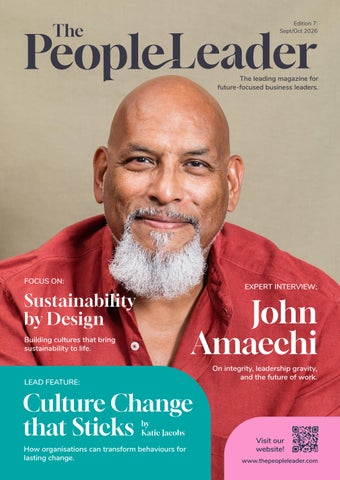
Edition 7: Sept/Oct 2026
The leading magazine for future-focused business leaders.
FOCUS ON:
EXPERT INTERVIEW:
Sustainability by Design
John Amaechi
Building cultures that bring sustainability to life.
On integrity, leadership gravity, and the future of work.
LEAD FEATURE:
Culture Change that Sticks by Katie Jacobs
How organisations can transform behaviours for lasting change.
Visit our website! www.thepeopleleader.com
Editor’s letter Welcome to Edition 7 of The People Leader. I have to admit; I felt more than a little bit proud when I first saw this edition coming together.
culture, and organisational life within one of the world's leading professional services firms. Across the rest of the edition, the range continues research, the Culture Doctor, our People Provocateur, the People Leader Bookshelf, the Acas consultation on conflict resolution, and an exploration of the growing fractional CPO market.
When we launched The People Leader, the ambition was to create something fresh - an independent platform for the ideas, people, research, and strategic conversations shaping the future of work, HR, people and culture, and leadership.
What excites me is the thread connecting all of this. The conversations traditionally associated with HR are moving closer to the centre of business strategy. Culture affects performance. Leadership affects performance. Trust, fairness, inclusion, sustainability, skills, employee experience, and the quality of relationships at work all affect the capacity of an organisation to succeed.
Seven editions in, I think you can begin to see what that ambition might become.
These are business issues: and The People Leader is evolving alongside that conversation.
This is our biggest edition yet, and the calibre of people contributing to it feels significant.
We started with a magazine. What is emerging is something broader - a media platform and growing community bringing together journalism, thought leadership, research, events, podcasts, roundtables, partnerships, and opportunities for people to connect.
I am especially delighted to welcome John Amaechi OBE for our lead interview. John is one of the most distinctive voices working at the intersection of leadership, psychology, inclusion, and organisational performance. An organisational psychologist, Professor of Leadership at the University of Exeter Business School, founder of APS Intelligence, and Sunday Times bestselling author, he brings intellectual rigour alongside a willingness to challenge some of the assumptions that continue to shape organisational life. It is a cracking interview. John talks about integrity, inclusion, AI, dialogue, performance, and his fascinating concept of leadership gravity - the influence leaders create around themselves and the imprint that influence leaves as people move through an organisation. There are ideas in this conversation that I suspect people will return to long after finishing the magazine. John is part of an exceptional line-up. Katie Jacobs explores one of the great challenges facing organisations - how to create culture change that sticks. Natalie Marchant examines sustainability by design and how organisations can bring sustainability to life through their culture. While Phillippa O’Connor, chief people officer at PwC UK, joins us for an important conversation about people,
2
You can see that evolution in this edition. We are highlighting some of the events shaping the profession, including Working Futures, where I will be delivering the opening keynote in November. We are also developing our own programme of intimate People Leader roundtables, creating spaces where senior people leaders can get underneath the issues facing their organisations and learn with their peers. There is a commercial dimension to this growth, and I make no apology for being ambitious about it. I am delighted to welcome new advertisers and partners, including Kogan Page. Their support, alongside our growing family of commercial partners, helps us invest in the quality of the platform stronger journalism, credible writers, important interviews, original thinking, better events, and greater reach. It also creates an exciting opportunity for organisations that want to be part of the conversations shaping the future of work. If you have a brand to build, research to share, an event to promote, a story worth telling, or expertise that deserves a wider audience, The People Leader
can help you raise your profile among a growing community of people, culture, HR, leadership, and business decision-makers. Advertising is part of that. So are sponsorship, partnerships, roundtables, events, thought leadership, research, and other forms of collaboration. Our ambition is considerable. We want The People Leader to become one of the fastest growing and most influential media platforms dedicated to the future of work, people and culture, HR, and leadership. Seven editions in, that possibility feels closer. The quality of this edition shows what can happen when credible journalism, influential voices, practical insight, commercial partnership, and a strong professional community begin to come together. The People Leader is finding its voice. It is growing its reach. And, with the support of our readers, contributors, advertisers, sponsors, and partners, it is becoming a platform through which some of the most important conversations about the future of work can happen. Thank you for being part of it. I hope you enjoy this bumper edition. There is a lot to get stuck into.
Contents 4 News in brief
Culture change that 6 Feature: sticks by Katie Jacobs
9 Interview: John Amaechi OBE On integrity, leadership gravity, and the future of work.
12 Culture Doctor on: Sustainability by 14 Focus design by Natalie Marchant
17 Acas consultation
A defining moment in conflict resolution
19 The People Provocateur 20 In conversation with Phillippa O'Connor
22 Fractional CPOs
by Rebecca Burn-Callander
26 Research round-up
David Liddle David Liddle,
34 The People Leader bookshelf 35 Dates for your diary
CEO of The TCM Group, Editor in Chief of The People Leader Magazine
Email: editor@thepeopleleader.com Connect on LinkedIn: liddledavid
Associate Editor: Erika Lucas erika.lucas@thepeopleleader.com Design by:
www.aubergine262.com Connect on LinkedIn: thepeopleleader
3
LEAD FEATURE:
News in brief Latest news and updates from the world of people, culture, leadership, and learning. Boards underprepared for AI era decision-making
rather than future growth. More than two in five directors (41%) say their board spends at least half of meeting time looking backwards rather than planning future strategy and growth. The findings also point to a growing disconnect inside boardrooms around innovation and transformation. While 27% of CEOs and CFOs say their board strongly enables innovation, only 12% of non-executive directors agree.
Company boards are struggling to adapt their approach to a more complex and technology-driven business environment, according to new research from advisory firm Board Intelligence. The latest edition of the Board Value Index, which surveyed more than 400 non-executive directors, CEOs, and CFOs from companies with over £50 million in turnover, found that 86% of directors say overly rigid or inconsistent decision-making frameworks have contributed to delayed, rushed, or poor decisions in the past six months.
4
While boards recognise that AI and technological disruption will fundamentally reshape the organisations they oversee, many appear far less prepared to transform the way boards themselves operate. Forty per cent of respondents believe there will be either no meaningful change or only minor adjustments to how boards themselves operate over the next five years, while just 8% think boards will need to be completely reimagined. At the same time, many boards are still spending too much time focused on past performance
Meanwhile, boards are increasingly confronting difficult questions about the role of artificial intelligence in leadership and decision-making. More than four in five directors (84%) say their boards have discussed which decisions should remain humanled versus AI-led, while (98%) say quantum computing is already being discussed at board level in some form, most commonly through a risk lens rather than as a strategic opportunity. SOURCE: https://www.boardintelligence. com/board-value-index-report-globalsummer-2026
HR ready to lead the AI agenda Three quarters of HR professionals (77%) are bought in on AI and almost half (47%) say HR leaders should own the strategy for how AI is used by employees - up 10 percentage points on last year. Furthermore, three in four (73%) also see themselves as a champion for responsible AI use in their organisation, with 82% recognising that AI is already delivering value within the business. This is according to new data released by employee experience platform Culture Amp, drawing from its second annual AI in HR survey. The data also found one quarter (24%) of respondents feel
comfortable with AI acting autonomously on their behalf within agreed boundaries (agentic AI), although 52% disagreed and a further 24% remained ‘neutral’ in this respect. The findings do however point to a clear payoff for those HR professionals who are leaning into agentic, with observable impacts being reported: 79% say their teams can now act on insights more quickly, and for 70% of respondents, AI has led to positive transformation of a core HR process. Of those experiencing improved processes, 60% also feel that AI has made them better leaders.
Boomers (born 1946 - 1964) at 9%. The RedArc data shows how each generation can often experience particular pressures according to their life stage. For Gen Z, while mental health may be seen as less taboo, this group deals with the pressures of social media, the long shadow of Covid, and student debt.
Analysis of thousands of referrals from working-age people over a five-year timeframe found that 43% of Gen Z referrals were for mental health concerns, compared with just 22% of Millennials. Gen X (born 1965 - 1980) had the next highest proportion of mental health referrals at 14%, followed by Baby
The data also revealed that the top use cases of AI are essentially unchanged from 2025. HR professionals are still primarily using AI for content creation (86%), brainstorming (83%), and synthesising information (81%). Amy Lavoie, VP of People Science at Culture Amp, says, “What stands out this year isn't just that HR professionals are bought into AI, it's that they're ready to lead it in their organisation.” SOURCE: https://www.cultureamp.com
Gen Z twice as likely to seek mental health support
Gen Z (those born between 1997 and 2012) seek mental health support at almost double the rate of Millennials (born 1981 - 1996), according to data from the nurseled support organisation, RedArc.
See page 35 for details of our AI Summit
Millennials face challenges such as balancing careers with family life, while for Gen X, it is often managing the demands of caring for both children and ageing parents that can bear down heavily on their mental wellbeing. For Baby Boomers, concerns can centre more around retirement, health, and long-term financial security. RedArc consultant Christine Husbands said: “What stands out is the growing willingness among younger generations to talk about mental health concerns and seek support when they need it. That
does not mean other generations are less affected or less in need of help, rather that Gen Z may feel more comfortable accessing support and discussing mental wellbeing.” The data highlights the need for organisations to engage proactively with every generation, including those who may be less likely to actively seek support or talk openly about their mental health concerns. SOURCE: https://www.redarc. co.uk/2026/08/gen-z-seeks-mentalhealth-support-at-almost-double-therate-of-millennials-according-to-redarc/
BONUS CONTENT
Visit thepeopleleader.com for more news updates.
www.thepeopleleader.com
5
LEAD FEATURE
Culture change that sticks: Transforming behaviours for lasting change BY KATIE JACOBS
Katie Jacobs is a workplace, business, and HR journalist and well regarded commentator on HR and the world of work. Previously editor of HR Magazine and other business titles, she also spent five years at the CIPD running its HR leader network.
6
Toxic. Bullying. Defensive. A culture of secrecy. These are among the descriptions that have emerged from public reports and investigations into organisational failures in recent years, involving organisations including Nottingham University Hospitals NHS Trust, the Post Office and McDonalds*. The stories point to deep rooted failures of organisational culture, and senior leaders have had no choice but to accept the need for fundamental change. The problem is, even when promises are made, this keeps happening. The Ockenden Review into maternity care failures at Nottingham University Hospitals NHS Trust noted that the Trust’s “bullying and toxic culture” and poor governance had been a “long running theme”, with incidents dating back more than a decade. McDonald’s has spent three years under scrutiny for the same underlying culture problems – accusations of bullying and harassment throughout franchise restaurants – despite repeated public commitments to fix it. Even with the best of intentions, cultures are evidently hard to shift.
This isn’t a new problem: a 2003 study (published in Leadership & Organization Development Journal) analysed 59 corporate culture change initiatives and noted that “the success rate for culture change was low”. And a 2016 CEB Corporate Leadership Council survey found that only 34% of major change initiatives achieve success, with 50% failing outright. Why do organisations continue to struggle with cultural transformation, and what do they need to do differently? And how can leadership teams transform their cultures before a crisis forces them to?
“Often organisations only take culture seriously when something
Chief People Officer (she has since added transformation to her remit), as the organisation was deep in rebuilding member confidence. Before she joined, HR reported into finance and operations, with a gap around strategic people discussion at ExCo level. (Indeed, the creation of a CPO role was a key recommendation in an external ethical culture review.) The rebuild has required a “culture reframe”, with psychological safety at its heart, the embedding of speak up mechanisms, and broad employee listening approaches. Policies have also been revamped, but – crucially – the focus is on how they are enacted.
has gone wrong,” says Kerri O’Neill, Chief People Officer at market research company Ipsos UK and co-author of Rapid Reculturing. The problem is, she adds, that is often precisely the wrong time to try and change things, “in a system that is under duress”. “You almost always over-engineer the response – a training programme, posters, comms,” she explains. “But performative activities won’t stick. The most urgent time to work on culture is when you feel you don’t have to.” She likens it to physical health: prevention beats cure. Working on strong foundations before you need to will help build a healthy culture that is less likely to be derailed by, or even allow for, poor behaviours. For O’Neill, these foundations are “shared purpose, collective mindset, positive energy, and quality human connection”. Not every organisation has that luxury however. Business membership organisation CBI hit the headlines in 2023 following allegations of sexual misconduct. Asha Musoni joined in 2024 as
“Policies only work if we act on them,” Musoni says. “Are they being used? If you are trying to build a speak up culture, but people are speaking up and you're not acting on it, your efforts are going to go down the pan.” Employee data is tracked closely, particularly anything grievancerelated, and reviewed at board level. ExCo “open doors” encourage direct feedback, which is then visibly acted upon. “The biggest opportunity in a system to make cultural change stick is your leaders,” Musoni reflects. And the key question: “How are our values meeting behaviours?” Musoni's point about leaders as the biggest lever for change is one many CEOs will echo. Katy Taylor, CEO of transport operator Wightlink, agrees that role modelling from the top is what makes or breaks culture change. “If the execs are not role modelling, it breaks down the ability to drive culture consistently,” she says. “One of the best things about being a chief executive is you get to shape the exec team.” And if leaders are not behaving appropriately, taking action is,
again, what counts. “We are clear on our behavioural policies and tolerances,” Taylor says. “If [poor] behaviour is reported and not dealt with, it creates a culture where people stop reporting.” She is clear that as CEO she “absolutely won’t tolerate” a culture where high performers who behave badly are let off the hook: “I don’t care how good your results are if you’re doing it the wrong way.” While Wightlink hasn’t experienced any cultural crises, it, like many organisations, nonetheless continues to work on culture. Actions like redesigning office space so executives are no longer sequestered in private rooms has helped create more openness, says Taylor. “It is easier to speak to management. And we hear things all the time that we didn’t have access to before.” Consistent role modelling is easier to sustain when you have time on your side. But what about when there isn’t any? When Kate Griffiths-Lambeth joined investment management firm Charles Stanley as HR Director in 2015, the firm was, Kate explained, six months from bankruptcy. It was a highstakes turnaround most people didn’t initially see as necessary, as the depth of the challenges had not been widely understood at the time. “There were some difficult individuals,” she says. Quickly removing those individuals sent a “strong message that we were serious”. Other techniques that drove change fast included putting executives in charge of workstreams that weren’t their specialism – the CFO was responsible for communications, for example. Doing so led to more open discussions, GriffithsLambeth explains, as people were more inclined to speak up if they weren’t directly criticising the person in charge of that area.
www.thepeopleleader.com
7
Every change, no matter how small, was reported to show progress. By the time she left the business in 2021, the firm was flourishing, profitable and growing. Andrew Stephenson, a former CPO who now sits in NED and advisory roles, has experienced similar dynamics. “I’m happy with noisy resistors,” he laughs. “If you know what people are moaning about, you can deal with it. Passive resistance is the biggest challenge.” This is where feedback loops and listening tools are critical, as is developing a deep understanding of internal networks and dynamics.
“Most people underestimate the amount of work that goes into culture change,” Stephenson points out. “It is influenced by leaders and followers, and doesn’t necessarily follow the hierarchy. You have to understand the unwritten constitution of your business.” This is where the CPO role can come into its own, able to join the dots across an organisation. “The CPO is owner of the scorecard, not the owner of the culture change,” believes Stephenson. “The whole organisation has to bring change, but the CPO is the person who holds the organisation to account and says ‘are we changing’?” Ultimately, says Musoni, the CPO needs to both set cultural priorities and help people “understand where we're going wrong, where we are misaligned in terms of our priorities, and where we invest”. Thinking more holistically, seeing
The future of HR is People & Culture
culture as a whole system, is what creates sustained change. She adds: “Culture is about how you structure, how you implement new processes, technology, and ways of working. It’s broader than the values that you have on the wall.” And if those values on the wall are undermined by the behaviours that are tolerated, they are not worth the price of the paint – as many high-profile organisations have found to their cost. * SOURCES: https://www.theguardian.com/uknews/2026/jun/24/donna-ockendenreport-mothers-babies-died-harmednottingham-nhs-trust https://www.theguardian.com/uknews/2025/jul/08/post-office-horizonit-scandal-five-things-we-learnedfrom-the-report https://www.theguardian.com/ business/2023/nov/14/mcdonaldsharassment-allegations-uk
People and Culture Global supports HR to transform into a transformational, proactive, strategic and widely trusted people and culture function. We design and deliver: • Strategic people and culture transformation consultancy. • The industry leading Culture Insights® culture audit. • Values, behaviours and capabilities alignment. • Organisation design, change management, conflict resolution and turnaround consultancy. • Fully accredited training for people and culture teams including the new Diploma in People and Culture™
VISIT: peopleandculture.com
8
INTERVIEW
John Amaechi on integrity, leadership, and the future of work
www.thepeopleleader.com
9
But my take is that the problem is more profound than we think, because it’s not a problem of leaders - it’s a problem of what we have decided to value. We are in an environment where integrity is no longer one of the criteria we weigh most heavily when selecting leaders. And no one could tell me right now that we value integrity, because if we did, it would be profoundly evident in our selection processes - not just in business, but in society at large. DL: You’ve suggested that the issue goes beyond individual leaders - that we’re no longer valuing integrity in our wider systems. What does that say about the state of the social contract and how should leaders respond? JA: It is a choice that we have collectively decided to make, and the good news is that we can choose to make a different one. Some of the greatest shifts in society have happened not in moments of intellectual clarity, but in moments of despair - when, in the most dehumanising times, groups of people have said, “This far and no further.” We are in one of those moments now.
Organisational psychologist and leadership expert Professor John Amaechi OBE, talks to David Liddle, Editor of The People Leader, about the erosion of the social contract, leadership gravity, and the role of dialogue in building genuine understanding. David Liddle: Leaders today are facing intense political, economic, and social pressures. How can they retain integrity and make the right decisions when external forces are pulling them in conflicting directions? John Amaechi: Some of us allow ourselves to become like leaves in the wind - blown by whatever environmental factor pushes us hardest. I like to believe that integrity is our ability to identify, examine, and resist the most malign external pressures. CEOs and managers who fail to resist those pressures are often choosing personal comfort, or at least the avoidance of discomfort, over their responsibilities of integrity and dignity to others.
10
The erosion of the social contract is deeply worrying to me. When I sat on the London Mayor’s AI and jobs taskforce, one of the points I made was this: if you tell people that becoming a professional is the route to financial security and respect, and then you use their mouse movements and keystrokes to train the AI that replaces them, that is how you radicalise the quiet professionals and show them the social contract is torn. You’ve argued that the real issue isn’t AI itself, but how organisations choose to deploy it. What do leaders need to understand to integrate AI sensibly and avoid creating new structural problems? JA: Our task force released a paper which I encourage people to look at. It’s a strong report that helps people understand the knock on impacts of all of this. The question I would ask is: are you auditing your use of AI, or are you simply subject to the whims of a board who say, “Our competitor is using it, so we should too”? Instead, leaders need to think on a workflow basis: how could AI augment this particular system to make the job less onerous and less error prone, and how will human beings work effectively with this system? BONUS CONTENT
Read the full interview on thepeopleleader.com
You have described leadership as a gravitational force. What does leadership gravity look like in practice and how can leaders develop it?
affect performance? Even if you’re reckless enough not to care about human dignity, you should care that people who feel excluded will do less good work for you.
JA: In any organisation, there are people clustered close to you who need certainty - they need to know that when they let go, they’ll still come back to earth, back to the central body. And there are others who are further out, doing more ambitious or autonomous work. What they need is confidence that even at a distance, your influence will still be felt.
There’s brilliant research on this. In an online game experiment, individuals who felt excluded subconsciously sabotaged their own teams so the team would lose. It wasn’t conscious malice - it was the natural consequence of internal exclusion. You create a split: a big team, and a small group who look around and think, “Why don’t these people care about me?” Once that happens, they’re no longer part of your team. They can’t operate effectively, and eventually they will find ways to do harm.
As they move through the organisation - as they “travel the galaxy”, if you like - there should be an inexorable pull that brings them back into your orbit, and each pass accelerates their development. You don’t want people so close that they can never leave your orbit, stuck to you like glue. But you also don’t want to be so small that you provide no stability at all. Leadership gravity means being large enough to anchor those near you, and strong enough that those who wander far can still feel your influence and do good work, even miles away. DL: You’ve been a prominent voice on DEI, urging organisations to move beyond performative gestures and focus on genuine inclusion and equity. What does effective DEI leadership look like to you, and where do organisations most need to step up? JA: It’s boring to have to keep saying this, but inclusion is incredibly important - because it’s about whether you want to win. If people only talk to colleagues who sound like them, if conversations hush at the water cooler when someone walks by, if the one woman in the office is always the person who makes the tea do you really think that doesn’t
DL: You’ve spoken about inclusion as essential to performance. What role does dialogue play in building genuine understanding, and what does it take for leaders to engage in that dialogue responsibly - especially when ignorance has caused harm? JA: Dialogue matters, but it isn’t the primary route to understanding each other. Marginalised groups learn about the majority because
they have to. The majority often feels it doesn’t need to learn about anyone else. That’s why so much of what gets called “dialogue” isn’t dialogue at all. It’s the moment when a company sits the one Black person in the office in front of a sea of white faces and says, “Tell us about your experience.” That’s not dialogue - that’s outsourcing education. Real dialogue only happens when people take responsibility for self education. It requires a willingness to learn what you’ve chosen not to know. And once you know, you can’t pretend the harm you caused before that knowledge doesn’t exist. Think of the 55 year old man who suddenly cares about women because he has a granddaughter. For 30 years he’s cut women off, chosen John over Jane, and shaped a workplace around his ignorance. You can’t erase that trail of harm. You don’t punish someone for learning, but you don’t forget what came before. They have to carry that with them. Dialogue is possible - but only after people have done the work to understand the experiences they’ve ignored.
Professor John Amaechi OBE is an organisational psychologist, Professor of Leadership at the University of Exeter Business School, and founder of APS Intelligence Ltd. https://www.apsintel.com He is the author of three books on leadership, including the Sunday Times bestseller 'The Promises of Giants' and 'It's Not Magic: The Ordinary Skills of Exceptional Leaders'
www.thepeopleleader.com
11
Try the new Culture Doctor GPT!
The Culture Doctor
www.culture.doctor
This edition's Culture Doctor question comes from a CEO who wants to unlock entrepreneurial growth in the business: THEY ASK:
“What does a culture that supports intrapreneurial thinking look like in practice, and how can leaders help to build and sustain it?” Rich Jones, Head of Accelerator Programme Exchange: The biggest mistake founders make is believing every decision has to go through them. It can feel responsible at first, but as the team grows, the founder quickly becomes the bottleneck. Founders hire talented people, ask them to bring ideas, and then step back in as soon as something is done differently. After a while, people stop suggesting things because they assume the founder will overrule them anyway. Delegation only works when people know what they can decide for themselves, how much they can spend and when they need to check something. The founder still sets the direction, but they cannot keep rewriting every decision. Leaders also need to respond properly. Back good ideas, explain why others cannot go ahead and be honest when something has not worked. Silence is usually what does the damage. People keep taking ownership when they can see that their judgement is trusted. When every decision is pulled back to the top, they soon learn to wait for instructions instead.
12
Julie Mernagh, Chief People and Culture Officer, Bidvest Noonan: Intrapreneurial cultures don’t happen by chance. They are built intentionally in organisations where people feel seen, heard, and valued, and where they're trusted to act on their ideas regardless of their role or level. At Bidvest Noonan, we've learned that the conditions matter as much as the intent. This means giving people a purpose and enabling colleagues at every level to contribute ideas that shape how we work. Co-creation starts on the frontline. Our colleagues who deliver services every day often have the insights and ideas about what needs to change and how. Build on that foundation. It's ground-up, not topdown, and that distinction matters. For leaders, the practical work is to listen more than you direct, reward curiosity as much as results, and build career paths that recognise innovation as a skill. Sustaining this culture also means investing in your people's capability. Upskilling and reskilling aren't just responses to change, they're signs that you believe in your team's potential. What's been striking is how readily our frontline colleagues have embraced innovation, from robotics to smart building technologies.
Philip Huthwaite, CEO at 5app: A culture that supports intrapreneurial thinking starts with curiosity. The best ideas don't come from having all the answers, but instead come from asking smarter questions.
That means creating an environment where employees feel confident enough to challenge assumptions and ask 'what if?' without fear of being dismissed.
When good consultancy creates its own exit
In my company, this means giving people carte blanche to look beyond their immediate role and responsibilities to find opportunities to improve how the business operates. That starts with me as the CEO, and I always respect thoughtful experimentation, not just successful outcomes, because innovation requires having space to learn and fail fast.
By Sarah Hamilton-Gill FCIPD
Intrapreneurship isn't about expecting everyone to become a founder. For me, it's about sculpting employees who spot opportunities, take initiative, and truly care about making things better. It's my job to encourage my team to explore, try new things and learn from their experiments. Even if something doesn't work out, we can still learn valuable information from trying, and for me, that mindset sits at the heart of intrapreneurship.
I have seen organisations receive a new strategy, operating model, or leadership framework, only to find that the internal team is hesitant to move forward once the consultant leaves. Decisions drift back to the consultant. The thinking behind the work has never really been transferred. Another piece of support is commissioned because nobody feels quite ready to take ownership.
Mark Green, CEO, Change Rebellion: A culture that supports intrapreneurial thinking is one where people feel safe enough to challenge, curious enough to experiment, and trusted enough to act. The irony is that many organisations claim they want innovation, right up until someone suggests changing something. Suddenly, every bright idea needs six steering groups, three approvals, and a PowerPoint deck worthy of its own Netflix series. Leaders create intrapreneurial cultures by making it safe to speak up, rewarding learning as much as success, and treating intelligent failure as feedback rather than a career-limiting event. Intrapreneurship isn't usually about the next billion-pound idea. It's the hundreds of small improvements spotted by the people doing the work every day. The organisations that thrive are the ones that harness those ideas instead of unintentionally filing them under 'too difficult'.
Have you got a culture conundrum? Send your questions to: erika.lucas@thepeopleleader.com and the Culture Doctor will try to help.“ BONUS CONTENT
Visit thepeopleleader.com for more answers to this culture conundrum.
After more than 30 years in consulting, I have learnt that a project can look successful on paper and still leave very little behind.
That is dependency dressed up as successful delivery. I sometimes wonder whether we talk about this enough in consulting. It can be an uncomfortable conversation because repeat work is commercially attractive. There is nothing wrong with a client asking for further specialist support, but there is a difference between returning because new expertise is needed and returning because the organisation cannot continue without you. For HR leaders, the real question at the start of an assignment is bigger than 'What will you deliver?' It is also worth asking: • Who will own this when the consultant has gone? • What knowledge and capability will remain within the organisation? • Will our people feel confident enough to make the next decision? • How will we know, six months later, that the work has genuinely made a difference? Knowledge transfer cannot be left until the final presentation or handover meeting. By then, it is usually too late. It needs to happen throughout the work, with internal people involved in the thinking, the decisions and, sometimes, the difficult conversations. Sarah Hamilton-Gill FCIPD is the founder of the Leap into HR Consulting® programmes and The HR Consultancy Academy® and has supported over 300 HR professionals to build successful consulting careers. Connect with Sarah on LinkedIn: https://www.linkedin.com/in/sarahhg/
www.thepeopleleader.com
13
FOCUS ON:
Sustainability by design Building cultures that make sustainability stick
BY NATALIE MARCHANT
Natalie Marchant is a Manchester-based freelance journalist, writer and editor who focuses on business, climate and sustainability, news, and tech issues for a wide range of clients. She's passionate about finding new and sustainable ways of working and occasionally turns her hand to travel journalism. She's also currently writing a book about coffee.
14
Sustainability is increasingly becoming a business imperative as climate-related disruption becomes a near-daily corporate challenge. But driving sustainability success across an organisation requires more than just strategy; it requires culture change. The 2025 CEO Study, co-authored by UN Global Compact and Accenture, found that 88% of chief executives believe that the business case for sustainability is stronger than five years ago, with 99% planning to maintain or expand their environmental, social, and governance (ESG) commitments. And with global net zero targets set for 2030, well within a typical CEO planning cycle, action on sustainability is already under way. For Michael Pemberton, CEO of BEC, a profit-for-purpose property developer and social impact company working on 'building extraordinary communities' in north-west England, sustainability starts at the top.
“It starts with the chief executive or the leadership that’s guiding the
organisation. It also starts with the ambition or the vision that you’ve got, not just for your organisation, but what your organisation can do for the people that you serve.” However, while sustainability conversations are becoming more common in the C-suite, they tend to focus on strategy, reporting requirements, and carbon reduction programmes. Much less attention is paid to one particular factor that is key to success – that of people, who are ultimately the ones who will implement sustainability efforts across the organisation.
Getting people on board Sustainability strategy “is just ink on paper” unless you’ve got all your employees on board working to deliver it, says Ghinwa Chammas, Global Director of
Group Sustainability at UK national standards body BSI.
“Because it needs to be delivered through thousands of everyday decisions made across the organisation. Things like how products are designed, which suppliers are selected. How organisations, factories, companies operate, how employees travel, how customer commitments are made,” she explains. “It’s these countless decisions across the organisation that really reflect sustainability strategy on the ground, and that’s why sustainability is fundamentally a people and culture challenge, not simply a reporting or compliance exercise.” By leading a company’s corporate culture and talent strategies, a chief people officer plays a crucial role by turning sustainability from a business objective into organisational capability, observes Beatriz Rodriguez, Chief Human Resources, Marketing and Sustainability Officer at flow control and instrumentation solutions provider Rotork.
“The sustainability mindset is ultimately about the impact. And you, as a leader, are making an impact on the people that you are leading. So what is a sustainable leadership practice that you are putting into place? When you think about product-led sustainability or sustainability by design… it almost becomes part of how the organisation operates,” she explains.
Sustainability by design Sustainability by design sees sustainable practices incorporated into core operations, products, and services from their inception and it can arguably apply as much to organisational change as goods. But what does this look like in practice?
Company efforts around sustainability can start at the recruitment stage. “It’s very important to find ways of recruiting people who are going to help with your culture and with the culture you want to establish,” says Chammas. During an interview, recruiters can ask a prospective employee about how they have previously incorporated sustainability into their day-to-day work, be it as an engineer, a procurement professional, or an office manager. Rotork puts a great emphasis on critical thinking skills when hiring at managerial level. “Critical thinking is when you basically have that enterprise view that connects the dots across the different parts of your strategy. When you think about embedding sustainability in culture and strategy, you want leaders that have that ability to bring all of those aspects together,” explains Rodriguez. For both new and incumbent staff, communicating exactly what your organisation is trying to do on sustainability, and why, is also essential.
“If the workforce doesn’t see what’s in it for them, or you fail to articulate a clear message around what sustainability means to them, you’re going to struggle,” says Catherine Jones, Sustainability and Net Zero Lead, Nuclear Operations at EDF UK. To raise internal awareness of company sustainability efforts during Net Zero Week, Jones ran a daily video which featured teams from across the organisation who had implemented initiatives with sustainability benefits.
“It was really important to me that we used people in the videos who others would assume wouldn’t have sustainability in their remit, for example a security guard and
a fuel route operator, so that it opened people’s minds to the thought that sustainability could be for them too.”
Building new skills Successful sustainability requires new skills, knowledge, and a mindset shift from senior leaders and the CPO and HR play a central role in providing the training and frameworks to support that shift, says Professor Matt Gitsham of Hult International Business School. Finance teams, for example, need to know about carbon accounting and climate finance, while marketing professionals should be able to bring sustainability themes into the company’s messaging and brand. At Rotork, sustainable decisionmaking and creating sustainable impact is embedded in its leadership programmes for frontline managers who have “the biggest span of contacts” within the company, says Rodriguez, “so we make sure those leaders, the frontline leadership, understand their role and how they enable those conversations.”
Embedding sustainability into daily practice Meanwhile, incentives can help companies meet their sustainability targets both by signalling a company’s intent and rewarding positive impact. A bonus scheme tied to a sales target based around selling services that help customers meet their sustainability targets is one such example. Innovation challenges and initiatives that identify sustainability champions – and even simple workplace perks such as cycle-to-work or car-sharing schemes – can also help change company culture and conversations around the topic.
www.thepeopleleader.com
15
for sustainability, with one saying the experience had made them “a more vociferous or more educated advocate” for sustainability, and another declaring that they “ended up embedding environmental initiatives as part of my leadership strategy”. But perhaps the most essential assets senior leaders can offer are courage to continue and a refusal to quit.
The most effective corporate sustainability initiatives can keep delivering impact even years down the line – to the benefit of businesses, individuals, and the planet alike.
leadership programme, which sent executives to the Brazilian Amazon to collaborate with local communities, continued to yield positive effects on its participants long after its completion.
Recent research, led by Hult's Gitsham, found that a 2010 Sky
Fifteen years on, many of the participants remain champions
Asked what is required from the C-suite to drive sustainability across a big business, BEC's Pemberton responds: “Tenacity, resilience, a laser-like focus, not letting people get away with it, being a role model, setting the environment and culture, and making sure that you’ve got processes and procedures in place that allow you to achieve your goals”.
Upc Upcoming
training courses
COAC H PEOP ING SKIL LS FO LE PR R OFES Integrat SION e coac ALS™ hing for your HR team as a core ca
National Certificate in Workplace™ Mediation
engage
15 Sept 2026
Coaching Skills for Managers™
15 Sept 2026
Conflict Management for Leaders™
16 Sept 2026
Bullying, Harassment & Diversity™
17 Sept 2026 Psychological Diversity: Strategies for Inclusive Conversations™ 21-23 Sept 2026
Advanced Investigation Skills™
21-25 Sept 2026
National Certificate in Workplace Mediation™
19-23 Oct 2026
National Certificate in Workplace Mediation™
27-29 Oct 2026
Essentials of Mediation™
(2 days ).
coachin
a How to become ted mediator. TCM Accredi
pabilit y
g.com
Team Facilit a
When tea become ms experie nce de dynami divided, da structiv mage c and e confl d an div involv e multip erse workp d dysfunc ict, they ma tional. y lace, co le parti In a es. nflicts This two increa day pro singly and cha gramm
nge age e will equip order nts wit media to res h the olve tea tors, fac skills and pro m con ilitator flicts s, coa cesses The cou across ches that the a divers rse is y nee delive media e range d in red by tors wh of ind The TCM o ustries experie draw . Group’ upon nce to their vas s highly ensure team t depths media experie that del tors. The nced egates of kno coache wledge course becom s and e fac and provid indust a wid ilitator es exp er ran ry sta s with erience ndard ge of the ski interna d media lls and l disput tors, tools es. needed to res olve
Overv iew
Durat ion: 2 days Delive ry: Thi s course delega is ava tes can ilable attend for inan ope house Traine n cou delive rs: De rse at ry or livered the TCM by TCM Academ Suitab ’s exp le for y. ert res : Media olution tors, fac consul Learni ilitator tants. ng out s, coache comes: effectiv s and Learn ely. change how to agents media . te tea m dis putes
tion S kills ™ On att
Benefi
ts
ending the cou rse del egates Under will: stand the nat conflic ure and t within the imp groups act of and tea Facilita ms. te a com with mu plex tea ltiple m con par ties ference and mu Posses ltiple s the issues. key ski need lls and to res olve tea strateg ies the m and y Deleg group ates wh conflic o succes ts. this cou sfully rse are comple thems able to te elves as a TCM refer to Facilita Accred tor. ited
Review s: Ple ase clic TrustP k here ilot rev for det iews. ails of our Cost: £495 + VAT Contac for ope t us for n access our late course course s. st pric s. es for in-hou se
+ to
ns in ersatio g conv ormin s. Transf succes ts for catalys ip.com
leadersh
engage
TO BOOK A COURSE OR SEE MORE DATES, VISIT thetcmgroup.com
A defining moment for conflict resolution By David Liddle, CEO, The TCM Group
The Acas consultation on the Code of Practice for disciplinary and grievance procedures is one of the most important developments in UK people practice for a generation. It is also, in truth, long overdue. For 25 years I’ve been arguing that our traditional approaches to workplace conflict are not only outdated, but actively harmful. This consultation finally signals a willingness to confront that reality. When I founded The TCM Group in 2001, my ambition was simple: to help organisations move beyond adversarial, punitive systems and towards approaches rooted in dialogue, fairness, and human connection. At the time, workplace mediation was still seen as niche. We were one of the first specialist mediation companies in the UK, and we worked hard to establish accredited mediation qualifications, internal mediation schemes, and management training that equipped leaders to hold quality conversations rather than default to formal process. Over the years, our work has been recognised by professional bodies and with numerous awards, but the real impact has been felt inside organisations. Time and again, employers told us the same thing: traditional disciplinary and grievance procedures were creating fear, division, and unnecessary harm. They were eroding trust, damaging wellbeing, and
escalating issues that could have been resolved quickly and compassionately. Those experiences led me to develop the Resolution Framework in 2013 - a proportionate, restorative alternative to the rigid, compliance driven systems that dominate UK workplaces. Today, hundreds of organisations, including the BBC, Aviva, Burberry, TSB, KPMG, NHS England and numerous universities, have adopted a Resolution First approach. They report healthier cultures, faster resolution, fewer formal cases, and stronger organisational performance. Crucially, to our knowledge, none have experienced adverse tribunal outcomes arising from its use. The Acas consultation matters because it acknowledges what many of us have known for decades: poorly designed and poorly applied disciplinary procedures cause predictable and preventable harm. The recent discussion paper from the UK Faculty of Public Health (see story page 32) makes this point powerfully, reframing disciplinary practice as a public health issue. When investigations are mishandled, the consequences ripple far beyond the individual case - affecting colleagues, managers, organisational culture, and ultimately performance. For too long, we have prioritised procedure over people. We have relied on systems built to contain problems rather than resolve them. Wrapped in legacy HR language, these processes have become reductive, infantilising, and adversarial. They pit colleagues against each other and turn workplaces into arenas of fear. The Acas consultation is an opportunity to change that. But consultation alone is not enough. We need a national conversation about how disciplinary investigations are conducted, how leaders are trained, and how organisations can embed approaches that
17
are proportionate, compassionate, and rooted in learning. We need to shift from retribution to resolution. The Resolution Revolution has been gathering momentum for years. This consultation gives us the chance to accelerate it. I welcome it wholeheartedly — and I hope it marks the beginning of a more human, fair, and constructive era for workplace justice.
The consultation is open until 23 September 2026 acas.org.uk
Move from retribution to resolution A multi award-winning, legally compliant alternative to traditional grievance and disciplinary procedures.
Culture Quote "Kindness and hope are the true anchors we need in a world full of rage and division." WOOSH RAZA, CEO OF CONSULTANCY INTO THE ORBIT, AND NO 1 HR MOST INFLUENTIAL PRACTITIONER 2026
Why organisations are choosing the Resolution Framework™ Resolve workplace issues earlier and more effectively Ensure compliance with the ERA (2025) and the Acas Code of Practice Reduce the cost and impact of workplace conflict Improve employee experience and engagement Embed a more productive Resolution First™ approach
Specialists in resolving complex and sensitive disputes with dignity, clarity and care. Independent mediators supporting leaders, teams and organisations to rebuild trust and restore working relationships. To learn more, visit: themediationcompany.com
18
Ready to adopt a Resolution First™ approach to workplace issues? Speak to our team about how the Resolution Framework™ can work in your organisation.
0800 059 0595 info@thetcmgroup.com resolutionframework.com
18
PEOPLE PROVOCATEUR: JAMIE EATON
Why political change tests more than your hiring plan. The UK has gained its seventh prime minister in a decade. For employers, that number alone brings forth a point worth considering - that political change is no longer an occasional disruption to plan around, but in fact, a near constant backdrop that organisations have to learn to operate within. The instinctive response is to focus on the practical questions. Will employment reforms hold? Could spending priorities shift? What does a new government mean for investment and hiring decisions over the coming months, and beyond? These are reasonable concerns, and they, of course, matter greatly - but they only tell half the story. The other half plays out inside the organisations themselves, in the day-to-day tension that political change tends to surface among colleagues. So while workforce planning deserves the most attention, workforce cohesion is worth a moment of consideration and planning too. On the practical side, the instinct to pause hiring and delay investment during uncertain periods that many organisations feel is understandable, but it's rarely the right one. Skills gaps don't wait for political clarity, and organisations that hold back on capability building often find themselves further behind once confidence returns. The businesses that manage this well tend to build flexibility into how they access talent, blending permanent hiring with contingent and flexible models so they can keep moving without overcommitting to decisions they might regret in six months. That means reviewing where critical skills gaps sit, which roles genuinely need long-term investment, and where a more adaptable mix of talent can maintain momentum without adding risk.
On the cultural side, the task is different but just as urgent. Leaders need to create the conditions for employees to disagree, and engage in well meaning, balanced conversations. That means installing genuine psychological safety so that political and social differences can be discussed without curdling into division. It means keeping DEI support consistent rather than treating it as expendable when the mood turns cautious, since it's often marginalised groups who feel the pressure of political upheaval most acutely. And it means leaders modelling the calm, respectful behaviour they want to see reflected across their teams. These two threads, workforce planning and workplace cohesion, are more connected than they first appear. An organisation that's confident in how it manages internal tension is also better placed to make clear-headed decisions about hiring and skills, rather than reactive ones driven by short-term anxiety. Political leadership will keep changing - that's simply the operating environment now. The organisations that navigate it best won't be the ones that wait for stability to return, but the ones that build resilience into both their workforce strategy and their workplace culture, so that whoever is in Downing Street, the business keeps its footing.
Jamie Eaton is SVP and Managing Director, UK & Ireland, at Magnit
19
IN CONVERSATION WITH: PHILLIPPA O'CONNOR, Chief People Officer at PwC UK
Reflecting on her journey, Phillippa shared how her extensive experience advising boards on compensation, regulatory compliance, and performance equipped her with a unique lens to see culture as inherently strategic and commercial. “We are fundamentally a people business,” she explained, “and when your only asset is the talent and capability of your people, culture becomes top-level critical.” PwC UK has articulated four clear cultural priorities: Be Curious, Be Clear, Be Collaborative, and Be Inspiring. These act as everyday signposts embedded into goal setting, recognition systems, learning, and performance reviews. Phillippa describes them as
Cultural priorities: • Be curious • Be clear • Be collaborative • Be inspiring
Leading a strategic culture shift at PwC UK At PwC UK, one of the world’s largest professional services firms, Phillippa O'Connor is pioneering an ambitious shift where culture isn’t adjacent to commercial strategy; it is the very space through which that strategy becomes real.
20
atmospheres, “part of the air the organisation now breathes.” To achieve this, Phillippa and the broader Management Board of PwC UK have strategically integrated these cultural priorities across business operations, including foundational people processes. “Culture must be embedded not as an initiative but as infrastructure,” she said. PwC UK’s recognition platform, historically centred on core values, now explicitly reinforces these priorities, ensuring they become operational rather than aspirational. Curiosity emerged as a powerful behavioural priority. “Curiosity underpins our commitment to continuous learning,” said Phillippa. Supporting PwC UK’s People Value Proposition – summarised succinctly as ‘Grow here, go further’ – curiosity ensures everyone engages as both teacher and learner, fostering a culture rich in innovation and adaptability. Phillippa does, however, acknowledge the inherent challenges in cultural transformation. Overcoming scepticism requires consistently demonstrating authenticity and intentionality. “You have to be laser-focused, because this work can easily become background noise,” she explained.
“Ensuring behavioural specificity across diverse roles is another key challenge. What 'curiosity' means varies across roles, A technologist’s curiosity manifests differently from a marketer’s. Our role is to ensure universal clarity while allowing practical flexibility.” Phillippa is deliberate about managing organisational complexity and prioritising effectively. Her team made a courageous decision, for example, to temporarily pause the formal values within the recognition platform, spotlighting cultural priorities instead. “Clarity mattered more than comprehensiveness,” she said. The benefits of PwC UK’s strategic cultural embedding are substantial, impacting employee engagement, trust, and commercial outcomes. Through data, listening, and continuous dialogue, Phillippa’s team is able to demonstrate direct correlations between behavioural shifts and commercial success: “Our people priorities are commercial priorities. When our people see tangible results from our cultural priorities, it reinforces belief and accelerates adoption.” Phillippa’s vision also addresses traditional HR processes. She described how PwC UK has significantly evolved employee relations, embedding cultural priorities into conflict management: “Managing conflict constructively can turn difficult scenarios into empowering experiences” she said. Looking forward, Phillippa sees continuous evolution as essential. Leveraging advanced data analytics and AI, she intends to proactively refine PwC UK’s people strategies. “The people agenda isn’t pulled behind strategy like a trailer; it moves in synchrony,” she said. “Data helps us predict trends and adjust dynamically.” Reflecting on her vision, Phillippa put it simply: “When culture truly aligns with strategy, organisations don’t just meet their goals - they create the conditions for people to thrive and deliver exceptional results.” SOURCE: People & Culture: A practical guide for HR professionals and leaders by David Liddle
www.thepeopleleader.com
21
YOUR PEOPLE & CULTURE CAREER
The rise of the fractional CPO BY REBECCA BURN-CALLANDER
Rebecca Burn-Callander is a business journalist and former enterprise editor of The Daily Telegraph and Sunday Telegraph. Rebecca has been writing about business, work, technology, and teams for 20 years, interviewing everyone from Sir Richard Branson to Lord Sugar. She is the author of The Daily Telegraph Guide to Investing and hosted the award-winning podcast Sound Advice: Entrepreneurs Unfiltered.
22
‘Fractional’ senior roles have become de rigueur in the last few years. With skilled executives increasingly opting for portfolio careers and organisations battling rising costs, modern organisations now have all kinds of fractional talent in the C-suite, from chief marketing officers to CTOs. The premise is simple: the organisation taps into senior talent over a set timeframe. Sometimes just a day a week. This individual brings all their experience to bear at a fraction of the cost of hiring someone full-time. According to Google, searches for “fractional” roles began in 2022, and 2,000 fractional roles were posted on LinkedIn that year. By 2024, there were 110,000 roles, and Google Trends data shows that searches for “fractional” hit an all-time high in February this year. But can the fractional model work in the world of human resources, where culture can take years to build and moments to destroy? Can
you shape the way talent is utilised and deployed working just a couple of days a week? We speak to the people working in the fractional universe to find out about their experiences.
The way we work is changing Rosamund King has been an HR professional for more than 20 years. Having worked in-house for much of her career, she started her own business, Vela People, in February, offering her services on a fractional basis. “I love my work but wanted more variety,” she explains. “I now work with multiple teams on different business challenges. One day I’m advising a CEO on
unlocking performance in their workforce, the next I’ll help a client recruit a senior executive.” King finds fractional work rewarding and opportunity abounds. “Businesses are increasingly looking to buy in expertise to help them through a key moment,” she explains.
Variety is the spice of life Half of all professionals will have portfolio careers by 2030, according to the OECD. “I spent my career in large organisations but portfolio careers are the future,” says fractional CPO Sandra Beckett, who was previously HR vice president at organisations including Stanley Black & Decker, and building materials giant Cornerstone Building Brands. Over the past decade, Beckett has seen HR rise from a boardroom afterthought to a core strategic pillar. “It’s less about compliance and more about performance,” she says. In the past, HR professionals spent time issuing contracts, getting people paid, and dealing with grievances. Today’s CPOs see the big picture. “In my last assignment, I had a seat at the table from day one,” Beckett says. “It was about assessing the talent roadmap – where are we now and where do we want to be, and what human capital can get us there fastest.” A fractional CPO is different to a consultant although the roles do overlap. “A consultant will outline the problem and tell you what you need to do, but a fractional CPO will be responsible for the delivery as well,” explains King. “One day a fortnight is the absolute minimum for an individual to implement solutions. Any less than that and they are just an advisor.”
This was certainly the case for Darren Labbett, managing director of Woods Foodservice, which supplies fine foods to Michelin-starred restaurants across the UK. Labbett started working at the family business aged 16 before taking over in 2000, growing the company from six to 150 people. Fractional CPO Madeleine Gwynn was his first C-suite HR hire.
“We wanted a capable, experienced, director-level person to come in, resolve the backlog of challenges and deal with the acquisition and subsequent integration.” Labbett was impressed by how quickly Gwynn understood the needs of his business.
“I always do a lot of work up front,” says Gwynn, an ex-corporate lawyer who worked in international HR leadership roles for 15 years before embracing the fractional model. “I tend to do a deep dive and try to understand what’s going on beneath the surface. “The fact that Woods is a family business meant that I knew culture and legacy would be important to Darren. When we met, I saw that we would be able to work together because of mutual respect and the fact I could match his pace.” For Labbett, whose business is growing quickly and already employs a lot of people, it made more sense to hire Gwynn on a fractional basis than pay a similar amount for a less experienced, full-time person.
When ‘fractional’ works best The consensus is that a fractional CPO can add the most value where there is a goal or target; the model works less well for general HR. “When a leader thinks, ‘We’ve got a lot of people so we probably need someone in HR now, a fractional may not be the right choice,” says King. Fractional CPOs can become bottlenecks in businesses where they have to juggle strategy and operations. “If the CPO is working one day a week but your team needs daily decisions, you need a full-time person,” says King. “The pinch points where businesses typically benefit from a fractional CPO occur in times of change: after rapid growth, M&A, restructuring, or to solve culture or leadership challenges.”
Rosamund King
Sandra Beckett
Darren Labbett
Madeleine Gwynn
www.thepeopleleader.com
23
putting in long hours. And then there’s the brain space. I think about my clients all the time.”
Making fractional work in practice “It’s about having the access to expertise you couldn’t afford five days a week,” he says. “I work two days a week at Woods but mentally I’m there a lot of the time,” says Gwynn. “They know not to disturb me when I’m with other clients unless there’s an emergency but they know they can get an answer from me when they need it.” According to King, leaders who opt to work with gifted fractional CPOs are getting a great deal. “There’s a misconception that being fractional means you are somehow less committed to your clients,” she says. “I work really intensively,
Achieving maximum impact from a fractional CPO starts during the hiring process. The first question to ask is: “Have you solved this problem before?” according to King. “How did they resolve similar issues? Can they make an impact quickly and hit the ground running?” It is also important to look at value alignment, says Labbett. “From the outset, Madeleine and I were on the same page. Our view of what’s fair and our expectations of people are completely aligned.” Leadership qualities such as gravitas and empathy should also be in ample supply. “As a fractional, you need to build influence quickly
without being in five days a week,” says King. Trust is key when dealing with fractional talent; they need to be empowered to make decisions and deliver change quickly without constantly checking in. Labbett says this was key to navigating the acquisition of a competitor, John Mower & Co, earlier this year. Alongside her work on the integration of the two businesses, Gwynn has appointed a head of HR and helped to bolster the board, creating a support structure for the next generation rising through the family business. “I’ve gone from being the only member of the board to one of four,” says Labbat. “I now have these senior experienced people beside me and that’s an incredible weight lifted from my shoulders.”
H
WIT
Roundtable
OCT
2027
The new deal for talent Hiring, leading and retaining people in a changing world This intimate, interactive workshop will bring together senior people professionals to explore the changing world of talent and what it means for how organisations attract, hire, lead and retain their people. The session will combine facilitated discussion, practical insight and peer learning. Breakfast and a light buffet lunch included. TICKETS: Deliberately imited to 30 participants to create a highly engaging workshop environment.
PEOPLE AND CULTURE
“David Liddle’s thoughtful blueprint offers insights and tools to make the People and Culture movement happen.” Dave Ulrich, Rensis Likert Professor Emeritus, University of Michigan, and Partner, The RBL Group
DAVID LIDDLE
PEOPLE AND CULTURE
A PRACTICAL GUIDE FOR HR PROFESSIONALS AND LEADERS David Liddle
People and Culture: A practical guide for HR professionals and leaders Reviewed by Sarah Shaw, Wincwire
Most organisations claim that people are their greatest asset. Fewer behave as though this is true when decisions become difficult, performance slips, or conflict appears. That gap between stated values and everyday practice is the territory David Liddle explores in People and Culture: A Practical Guide for HR Professionals and Leaders. His argument is that organisations can no longer afford to treat people strategy and workplace culture as related but separate concerns. They are part of the same system, and both must be connected to how the organisation is led, governed, and measured.
Find your place in the PCI community Be part of developing the future of the people and culture profession.
Liddle is not calling for HR to adopt a more fashionable title while continuing with the same processes. He is proposing a more fundamental shift from traditional HR towards an integrated people and culture function. In this model, the function is not simply responsible for policy, compliance, and resolving problems after they have escalated. It becomes an active partner in shaping purpose, behaviour, performance, and the employee experience. At the centre of the book is the People and Culture Operating Model, a framework designed to align purpose, values, strategy, behaviour, and organisational systems. The ambition is significant. Rather than offering another isolated programme, Liddle asks leaders to examine the way the entire organisation supports or undermines the culture it claims to want. Liddle is particularly critical of systems built primarily around control, risk mitigation, and retribution. Formal grievance, disciplinary, and performance processes may be necessary, but they can become default responses to issues that might have been resolved earlier through dialogue, mediation, and skilled management. This does not mean abandoning accountability. One of the useful tensions in the book is the relationship between compassion and performance. A peoplecentred organisation is not one in which poor behaviour is excused or standards disappear. It is one in which accountability is exercised fairly, consistently, and with an understanding of context. To read the ful review, visit: https://wincwire.com/book-reviewpeople-and-culture-by-david-liddle/
The P C
I Mem
bersh
ips
Studen t Member
Access to and Reg Live Podcast ular Mem s, Boo k Club ber Mee s ts Access to Insig Blogs hts, Res on the PCI Hub earch and Access to Inte rnationa Culture l People Week, and Rev Internat & ional Awa iew rds License Member
Join a professional community where you can connect, contribute and continue developing.
to use
the tag
‘MPCI’
badge
Spotligh t live even speaking opp ortunitie ts and member s at meets Feature d / liste d on PCI website Listed as Spo nso confere nce, awa r / Partner at ann rds and Review ual Introduc ed as Spo member meeting nsor at mon thly s License
to use
the tag
Member
Member PRO
FREE
‘FPCI’
Fellow bad
ge
Every PCI member also receives a complimentary subscription to The People Leader.
Explore the membership options: peopleprofessionals.org/membership
FREE
£55+VA T
(Automa
tic Ann Renewal) ual
Corpor ate Par tne r Member £199+V AT
(Automa
tic Ann Renewal) ual
Fellow
FRE
E (after com the Diplo pleting ma in by Peop P&C le & Cultu re Consultin g)
Research round-up IIP research shows HR leaders overestimate trust HR leaders could be overestimating levels of trust inside their organisations, according to new Investors in People research which reveals a gap between how trusted workplaces appear on the surface, and how employees behave day to day. The research, conducted by Censuswide for IIP, found that trust is widely recognised as critical, with almost all employees and 100% of HR managers saying trust is important at work. Yet the employee behaviour data points to a more complex reality. Some 61% of employees say they regularly “cover themselves” at work, for example by keeping emails or screenshots. Almost two-thirds, 65%, have avoided raising or speaking openly about something at work in the last six months. Almost half of HR leaders say employees raise issues early when things go wrong, yet 25% of employees say they would try to fix a problem or mistake quietly before telling anyone. The Trust Paradox report points to the critical role managers play in shaping whether employees experience trust in practice. One in five employees say trust in their organisation depends heavily on who their manager is, and the same proportion have avoided speaking up about concerns over manager behaviour.
“Employees do not experience trust as an abstract organisational value. They experience it through the person they report to, the decisions that affect them and the way concerns are handled,” said Eddie Salmon, Chief Operating Officer at Investors in People. https://www.investorsinpeople.com/ knowledge/the-trust-paradox/
Skills gap widens as young people remain locked out of work A new report from The Open University reveals a growing mismatch between what employers need and the talent available - with organisations unable to tackle persistent skills shortages while many young people remain shut out of the workforce. The ‘Business Barometer 2026: Harnessing young talent pipeline in a digital world’ is based on a survey of 1,500 UK employers and 1,000 young people aged 16–24 who are currently not in education, employment or training (NEET). It finds that over half (57%) of employers are experiencing a skills shortage, a figure which is up 3% from last year. The report highlights the growing impact of AI with over half (51%) of employers seeing an impact on hiring or recruitment processes. The report shows signs of some businesses decreasing earlycareer roles, with 42% putting this decrease down to AI being used for more entry-level tasks. Not surprisingly, 42% of 16–24-year-old NEETs agree that AI is threatening their future job prospects and careers, despite their strong willingness to work and develop skills. On a positive note, almost half (47%) of employers report they are currently prioritising the recruitment of young people to combat this. However, even though 80% of employers say they are prepared to train young people entering the workforce, their words are not always backed by action. Only 43% offer work experience placements, with around a third offering graduate schemes or paid internships. Just 34% have initiatives for workers under 25, and only 11% target NEETs directly. https://business.open.ac.uk/business-barometer
26
A quarter of managers withhold feedback A new study has found that one in four managers choose not to share performance feedback with the people they supervise – even when the news is positive. The research, published in Management Science, was carried out by teams at the University of Exeter, the University of Portsmouth, and York University. The researchers ran an online experiment with 2,620 participants, who were assigned to “manager” or “worker” roles. Workers completed a short cognitive quiz, where only top performers earned a higher payment. Managers saw each worker’s profile, including their gender, and received either precise, vague, or no information about the worker’s score. They could then pass on the information as given, or partially or fully obscure it. Workers then chose between a smaller fixed payment or competing for a higher reward. In some cases, they received feedback before making this choice; in others, afterwards.
The study found that around a quarter of managers withheld feedback, including positive feedback. A follow up survey showed that managers were mainly motivated by transparency and a sense of duty when they did choose to share information. Negative feedback was more likely to be withheld when it did not affect a worker’s payment decision. The pattern was stronger for female workers. When negative information was imprecise, managers were nearly twice as likely to withhold it from women than from men. The authors recommend building stronger norms around transparency and duty, and standardising feedback processes to reduce personal bias. https://pubsonline.informs.org/doi/abs/10.1287/mnsc.2024.05001
BONUS CONTENT: visit thepeopleleader.com to read more of the latest research.
Research pulse By Erika Lucas
Associate Editor Erika Lucas takes a birds eye view of the latest people and culture-related research. Organisational psychologist Adam Grant ruffled a few feathers recently when he shared research suggesting that the growing number of directives to get people back into the office are ego rather than productivity driven.
actually boost productivity. A study from the Katz Graduate School of Business showed that although employee job satisfaction declines when people are forced to RTO, there is no significant change to financial performance or firm value.
Writing in the New York Times, Dr Grant suggests that although there will be some cases where in-person work delivers value, RTO mandates are primarily a power and status move.
A study from the Federal Reserve Bank of New York does however sound a note of caution. Researchers found that remote work has "substantially" increased isolation and worsened mental health.
“It's a signature strategy of leaders who exhibit narcissistic qualities,” he says. “They see any kind of remote work as a threat to their authority and admiration. They want to be worshipped at the office altar.” There's clear evidence that fulltime, in-person work doesn't
Grant's study raises an interesting question for the future. His research found that younger leaders were less opposed to hybrid and remote work. “Does this mean return-to-work office mandates will go out of favor when the old guard retires,” he asks.
www.thepeopleleader.com
27
peopleprofessionals.org
Celebrating excellence in mediation.
2 DECEMBER LINCOLN’S INN, LONDON BLACK TIE | FORMAL DINNER
- ADVERTORIAL -
Resolving workplace conflict before it reaches the tribunal Employment tribunals are under unprecedented pressure. With over half a million open claims and new employment legislation expected to increase demand further, the conversation about how workplace conflict is managed has never been more urgent. The Civil Mediation Council's Workplace and Employment Working Group has been at the heart of that conversation, engaging with policymakers, academics, and practitioners to make the case for earlier, more constructive resolution of workplace conflict. The evidence is compelling: organisations that intervene early see reduced legal costs, lower absenteeism, and better outcomes for both employers and employees.
28
As Liz Kendall, CMC Fellow and member of the Workplace and Employment Group, puts it: “Workplace mediation is most effective when brought in early. The only way we will achieve meaningful change is by addressing these issues collaboratively across professional disciplines.” This year's CMC Conference, Making Mediation Mainstream, is where that collaboration takes place. Taking place online on 7 and 8 October 2026, with an in-person networking evening in London on 7 October, the conference brings together mediators, lawyers, policymakers, and academics to shape the future of dispute resolution. For HR professionals and people leaders, this is an opportunity to understand where workplace mediation is heading, engage with the practitioners and policymakers driving change, and gain practical insight into how earlier intervention can transform outcomes in your organisation. CMC Conference 2026 | Making Mediation Mainstream | 7–8 October | Online Book your place: civilmediation.org/conference-2026
Movers & shakers Louise Hanson has been appointed as Chief Executive of the Recruitment and Employment Confederation (REC), replacing Neil Carberry who leaves in September to take up the role of Chief Executive of the CIPD. Congratulations to CPO Joyce Idoniboye, who has been appointed Deputy CEO of Oxfam, working alongside Chief Executive Richard Hawkes. (See our interview with Joyce in the March/April issue of The People Leader).
Eugenio Pirri returns to the hospitality industry, with a new role as Chief Culture Officer at Hand Picked Hotels.
A career pivot for Natal Dank, who steps back into an in-house role as Head of People Strategy at Tom Tom.
Subscribers receive: Every edition of The People Leader magazine Exclusive subscriber-only articles, research, case studies, and bonus content Access to The People Leader Summit series Invitations to community events and networking opportunities Exclusive discounts for The People Leader Live Conference 2027
Become one of our founding subscribers and receive your free digital founder certificate.
IN
TH
G
erika.lucas@thepeopleleader.com
More than a magazine, The People Leader is a growing community of chief people officers, CEOs, founders, and senior leaders shaping the future of work.
AP
If you'd like to highlight your achievements, send details of your role, together with some brief biographical information and a head and shoulders photo, to:
The world of work is changing. Leadership is evolving. Culture is becoming the strategic priority. AI is reshaping organisations. Employee expectations continue to rise.
SH
Have you recently moved into a senior people or C-Suite role? Or maybe you’ve been promoted to the top people and culture job in your organisation?
Join The People Leader Community
E
FU
TU
RE
OF PEOPLE LE
AD
ER
SH
IP
Subscribe FREE today www.thepeopleleader.com 29
- ADVERTORIAL -
What is challenging people leaders and what can we do about it? Your problem is not unique. Your answer has to be.
THE CONVERGENCE AGENDA (PART 2) - BY CHRISTIAN MILAM
scarce skills. Building the capability you cannot buy. Leadership, and the manager layer beneath it. Culture, described repeatedly as outpacing strategy. Reward and productivity, set against inflation, higher national insurance and the cost of living crisis. None of that will surprise you. That is rather the point. The headline is not the problem.
Over the past decade Working Futures has put the same question to people leaders every six months: what are your three greatest challenges right now? We ask for one reason so the agenda we build is capable of solving them. This is what you have told us this time, and what happens in November. 30
The latest answers came from chief people officers across Europe and beyond. Sector, size, and geography mattered far less than expected. Aviation and academia, banking and football - the same handful of problems, named independently, again and again. Seven problems, named by the profession. AI, and what it does to organisational design, roles, skills, and HR's own operating model. Transformation: what to centralise, automate, or outsource. Talent acquisition, and the scramble for
Everyone is concerned about AI in roughly equal measure. That tells you nothing useful. What matters is what it means in an organisation of your size, in your sector, with your culture, and your board. That is where the consensus breaks apart - and where almost every event leaves you, handed the headline and sent home to work out the rest. But somewhere in the profession is a people leader of your scale, two years into the thing blocking you now, who can tell you what worked and what it cost. The obstacle has never been knowledge. It is access to something pragmatic enough to use. And where nobody has been there yet - true of much of what AI is
doing - we put you in a room with people meeting the same problem for the first time, and the experts to work it out with you. So we do not present at you. The Strategy Day is built around facilitated debate. Twenty-five world-class facilitators - leaders and practitioners who have done the work - hold thirty-five sessions across the seven themes, structured so you argue your own problem out loud with people who share your context. Not a framework. Not a trend report. A pragmatic next step, pressuretested by people who have already taken it. Two keynotes bookend the day, opening with David Liddle.
“Many companies engage and enlighten. Working Futures helps us enable - that's a huge difference.” PERRY TIMMS
The largest gathering of CPOs, CHROs, and HRDs in the UK
David Liddle Keynote Choose between 35 sessions and we will create a bespoke experience for each attending CPO. Leonardo Hotel St Pauls 24th November 2026 8.30am-4.30pm
For your complimentary People Leaders pass scan the QR code.
This is not a conference.
Come and help us answer it.
A conference agenda is fixed months out, built from availability: who is speaking, who is free, who fills a slot. Ours is still forming, shaped by what people leaders tell us they are carrying when they register. From the end of October our concierge team builds each attendee an individual agenda against what they have told - a specific day, and specific introductions to people already past your problem. Attendance is restricted to CPOs, CHROs, and HR directors, which is what makes those conversations worth having.
The Working Futures Strategy Day takes place on 24 November at the Leonardo Hotel St Paul's. The programme closes at the end of October.
The 2026 agenda, in one room. Working Futures, November 2026. Join us.
Register before then and two things follow. Your challenge shapes the programme itself, rather than the programme shaping your day. And you join as a Founding Alliance Member of the new Working Futures Ecosystem Platform, where the intelligence, case studies, and introductions carry on between events. Complimentary places are strictly limited and reserved for People Leader readers. Use code TPL2026 to claim yours, and tell us what you are up against.
Prepare yourself for the future of work with 30% off all books Award-winning human resources books from global experts, available at koganpage.com
Now available to pre-order
Save 30% with code TPL30
The hidden public health cost of disciplinary procedures The Faculty of Public Health has published a new discussion paper, warning that the impact on health and wellbeing from poorly administered disciplinary investigations should be recognised as an important public health issue. The paper examines evidence that poorly designed and applied procedures are damaging staff wellbeing, weakening workforce resilience, and leading to considerable costs to the UK economy. Acas estimates that UK organisations initiate 1.7 million formal disciplinary cases every year, with workplace conflict costing employers £28.5 billion annually. Nearly 80% of this cost is linked to dismissals and resignations arising from formal procedures.
32
koganpage.com/hr
The Faculty is calling for a national conversation on how disciplinary processes are designed, delivered, and regulated, and is asking organisations to adopt approaches that protect wellbeing, strengthen trust, and support compassionate processes. Professor Tracy Daszkiewicz, President of the Faculty of Public Health, said, “For too long we have prioritised procedure over people and it is important to recognise that the widespread harms caused by poorly considered disciplinary processes are preventable. Just as public health has reframed issues like smoking, obesity, and vaccination as populationlevel priorities, there is now an opportunity to do the same for workforce wellbeing.
“We urgently need a national conversation about how disciplinary investigations are conducted across the UK, and how we can work together to make sure that processes are fairer, safer, and more compassionate.” The paper builds on the avoidable employee harm concept, which has already informed improvements in several NHS organisations. However, the evidence shows the issue extends far beyond healthcare, affecting workplaces across government, education, and the private sector. SOURCE: https://www.fph.org.uk/media/dcrkfiqy/f010726-fphdiscussion-paper-disciplinary-processes.pdf
Influencer of the month AMY EDMONDSON, Professor at Harvard Business School: “Just because a bad work environment is in the past, doesn't mean it stops affecting us, even if we're on a really great team now. But when we become aware of how our experiences have shaped our behavior, we can start the hard but fully worthwhile process of growing into better teammates and leaders.”
Hear more of the original conversation on the ‘happier at work’ podcast: https://happieratwork.ie/bonus-episodewhy-psychological-safety-matters/
Our influencer spotlight column where we highlight some of the topical debates taking place on social media. “This is the part almost nobody talks about. People carry the last bad boss into the next good team, and then wonder why trust feels so hard to give. I see it constantly with leaders …. Someone flinches at feedback or over-controls a project, and it gets read as attitude, when it’s really an old scar doing its job.”
“Our experiences often shape how we show up long after the circumstances have changed. Selfawareness helps us recognise those patterns, while psychologically safe environments create the conditions for people to grow beyond them.”
“The hardest part is that those old patterns are usually invisible exactly when they are driving us, in the moment of a decision or reaction, not afterwards. Naming them, as you say, is what turns them from silent scripts to something we can actually choose about.”
Which posts on social media have captured your attention? Share your suggestions on The People Leader LinkedIn page.
New guidelines launched to support healthier, more productive workplaces The Policy Liaison Group on Workplace Wellbeing has launched Good Work, Good Health, Good Growth: The UK’s Duty of Care Guidelines for Policymakers and Parliamentarians, a new publication designed to help shape healthier and more productive workplaces. The guidelines are the result of two years of collaboration between workplace experts, parliamentarians, and policymakers. They were developed in response to growing evidence that the quality of work plays a central role in national wellbeing, workforce participation, and economic
performance. As the Keep Britain Working Review highlighted, millions of people are now out of work due to ill health and improving working conditions is an important part of addressing this challenge.
Good Work, Good Health, Good Growth
The UK’s Duty of Care Guidelines for Policymakers and Parliamentarians
Supported by:
The publication sets out a practical, evidence based framework covering nine core areas, including job design, management capability, inclusion, worker voice, and the prevention of psychosocial risks. Each section explains what good work looks like in practice and outlines the outcomes that can reasonably be expected when organisations design and manage work well.
1
The guidelines are intended for policymakers, parliamentarians and all those shaping the future of work. Copies are available via: www.plgworkplacewellbeing.org.
33
PODCAST
Hosted by David Liddle
The People Leader Podcast brings David Liddle into conversation with thought leaders, academics, authors, and practitioners from around the world. Free to listen to, each episode combines fresh thinking, practical insight and lively conversation. It is enjoyable, accessible, and sometimes disruptive, while never shying away from the tough questions shaping the future of work, people and culture, HR, and leadership. Listen, watch, share, and return to the conversations as a resource to challenge your thinking and inspire action in your organisation.
Bookshelf
And perhaps you have a story to tell. We are always looking for guests with practical case studies, compelling evidence, fresh ideas, and demonstrable impact. Join the conversation, share your experience, and help shape the future of people and culture. Discover The People Leader Podcast at thepeopleleader.com and across all major podcast platforms.
Executive Eats: The cookbook for a better working life by Adam Kingl and Jakub Radzikowski From sustained energy to improved focus and mood, each chapter in this unusual cookbook pairs the latest nutritional research with practical culinary applications, offering readers scientifically backed recipes designed to address the challenges they face in their day-to-day lives.
A Different Kind of Power by Jacinda Ardern A highly recommended memoir (Sunday Times bestseller) from the former prime minister of New Zealand, who at the time was the world’s youngest female head of government and just the second to become a mother in office. Jacinda Ardern grew up the daughter of a police officer in small-town New Zealand, but as the 40th Prime Minister of her country, she was lauded globally for her empathetic leadership that put
34
Whether it's a morning boost, an afternoon pick-me-up or a calming meal after a stressful day, the book equips the reader with a deeper understanding of why certain foods can enhance our mental and physical states. More than just a collection of recipes, the book is a tool to help readers make mindful, informed decisions about their diet. The People Leader's Associate Editor has bookmarked the 'Affogato' vanilla scones with coffee yoghurt for the next time she needs an extra shot of focus and energy in the morning!
people first. Arden guided her country through unprecedented challenges, from the 2019 Christchurch mosque attacks to a global pandemic. She advanced visionary policies to address climate change and child poverty - all while juggling first-time motherhood in the public eye. The book goes beyond political memoir, offering a real insight into how it feels and what it means to lead – and challenges the reader to ask if they too, are capable of more than they ever imagined.
The Intrapreneur Leader: A playbook for next-generation human leadership by Justin L. Pennington The world of work has changed dramatically, yet many leadership approaches haven’t. In 'The Intrapreneur Leader', Justin Pennington argues that the successful workplaces of the future will be built on individual agency. He explores why the leaders who thrive in today’s AI-driven, fast-changing world will be those who can influence without
authority, embrace complexity, and create meaningful change from within their organisations. Drawing on more than 30 years of international experience working with organisations including Amazon, Apple, Microsoft, Dell, Santander, and Deutsche Bank, Justin combines behavioural science, practical frameworks, and real-world insights to equip leaders with the skills needed to succeed in the modern workplace.
Dates for your diary Key webinars and events to support your professional growth. 16 September 2026
14 October 2026
22 October 2026
Live virtual gathering on Zoom
Roundtable, London
SMP Webinar
The People Leader Summit - AI and the Augmented Human
The New Deal for Talent
Beyond Grievances: Building Better Workplaces Through Mediation
Join us for a live virtual gathering exploring AI and the Augmented Human, and what the rapid rise of AI means for people, leadership, and the future of work. Bringing together leading thinkers and practitioners, the summit will examine how AI can enhance human capability, creativity, and decisionmaking, while also addressing important questions around trust, ethics, and the evolving role of leadership. Discover how organisations can embrace the opportunities AI presents while ensuring people remain at the heart of the future workplace. JOIN: https://thetcmgroup. zoom.us/meeting/register/bjQkQMGRKKsBzMlnOemSA
A People Leader X Love Success Roundtable Led by David Liddle, this intimate, interactive workshop will bring together senior HR, Talent Acquisition, and People professionals to explore the changing world of talent and what it means for how organisations attract, hire, lead, and retain their people. The session will combine facilitated discussion, practical insight, and peer learning, with attendance deliberately limited to 30 participants to create a highly engaging workshop environment. TICKETS: https://www.eventbrite. com/e/the-new-deal-fortalent-a-people-leader-lovesuccess-roundtable-tickets1997559897426?aff=oddtdtcreator
An exclusive online seminar hosted by the Society of Mediation Professionals (Singapore), featuring David Liddle. The session focuses on workplace conflict resolution, grievance management, mediation, organisational culture, and leadership. Key themes to be covered include: • Trends in workplace grievance management.
• Mediation as an approach to resolving workplace conflict.
• Creating cultures of trust and open dialogue.
• Lessons from the UK that may be relevant to Singapore's evolving workplace environment.
BUY TICKETS: https://www. tickettailor.com/events/societyof mediationprofessionals/2353169
35
LEAD FEATURE:
MAY 07 2027 County Hall, London
Conversations that shape the future of work.
EARLY BIRD
thepeopleleade Tickets go on sale r.com
03
Join the people leading them.
SEPT 2026
The People Leader Live brings together global thought leaders, senior people professionals, executive leaders and cultural transformation experts for a day of provocative ideas, powerful conversations and practical insight. Come to connect, contribute, challenge your thinking and help shape what comes next for people, culture, leadership, and work.
Be part of the conversation: thetcmgroup.com/the-people-leader-live-2027 Additional 10% DISCOUNT for The People Leader subscribers. Subscribe today at www.thepeopleleader.com
Please contact us for more information: Call: 0800 059 0595 © 2026 Copyright of The TCM Group. All rights reserved. No part of this publication can be copied or reproduced without permission. TCM® is a registered trade mark of The TCM Group.
+44 (0)20 7404 7011
Business Design Centre, 52 Upper St, London, N1 0QH. Email: info@thetcmgroup.com Website: thetcmgroup.com
TCM is rated excellent on Trustpilot.