The Pen Newspaper

Aplan which has the potential to alter how schools in California are funded is now sparking debate among students and educators. Lawmakers are now considering a change from attendance-based school funding to enrollment-based school funding for K-12 schools. This proposition was originally introduced in 2025 and is currently being debated within the state legislature (EdSource). Currently, most schools in California are based on its Average Daily Attendance (ADA), which means that they are funded according to how many students show up to school every day. If the student does not attend school, the school loses a small amount of money allocated to that student for that day. Since money is being allocated throughout the school year, repeated absences of multiple students causes the school to lose a substantial amount of money. However, under the new law, schools would be funded based on how many students are enrolled in school, even if they are not present each day. The current system can unintentionally punish schools serving communities where absenteeism is higher due to factors outside the school’s control. Thus, California should move toward enrollment-based funding as schools still must pay teachers, staff and maintain programs even on days when students are absent.
Schools across the country face a severe problem with chronic absenteeism because many students miss school due to illness, mental health challenges, transportation difficulties and family responsibilities. Schools located in low-income areas are especially impacted by the current situation as students are often not able to attend school as often as they should due to unreliable transportation, housing instability, limited access to healthcare and family responsibilities. Funding schools based on enrollment will make it easy for schools to manage their finances because they will be able to help students who are in need of extra assistance with attendance (Public Policy Institute of California).
The California Department of Education supports such a change, and many other states such as Oregon and Washington already have this system in place (California Department of Education). Supporters of the change argue that funding should be based on enrollment because it is more fair and will help school districts better plan. Despite having all this support, however, the proposal has not been passed yet as lawmakers are still contemplating whether removing attendance-based funding might possibly diminish incentives for schools to encourage students to come to class. Sophomore Fynn Kassab, who supports enrollment-based funding, shared his perspective on the issue.
“Schools still have to pay teachers and run programs even when students are absent,” Kassab said. “[Enrollment-based funding] would make sure schools have stable funding instead of losing money because of things they [cannot] control, even if one incentive to attend school is missing.”
However, opponents say that removing funding based on attendance will take away from students’ success. Research completed by the Public Policy Institute of California (PPIC) shows that students who experience high rates of school absences tend to perform worse in their studies, critics believe that schools will not only lose their incentive to combat absenteeism if they receive funding based
on their actual attendance numbers, but will also lose their incentives to help students succeed. However, this does not change the fact that taking away funds from schools is still unfair because students might miss school for a reason that is out of the school and student’s control. From this perspective, funding should be based on enrollment so that schools can provide the stable environment they need to maintain programs and staff. Freshman Koko Sohara expressed concern about the possible consequences of changing the funding system.
“If schools get funded the same no matter what, it could just raise our taxes and there would be one less reason for

schools to make sure that students are actually coming to school,” Sohara said. “[Schools could lose motivation] to encourage attendance if funding no longer depends on it, and that could make it easier for students to skip class without consequences.”
While critics contend that there will be reduced incentive for schools to boost attendance due to lack of correlation with funding, it should be noted that in the 2023–24 school year, chronic absenteeism rate in California was estimated at 20.6 percent by the Public Policy Institute of California. The percentage of absenteeism being so high shows that the current methods of discouraging absenteeism are not working, and so switching to an enrollment-based method would be viable. Freshman Drew Dunn stands by the proposal.
“Teachers still make work available when students are absent,” Dunn said. “[If funding was only based on attendance]... schools could lose resources even though teachers are still doing their job. That could affect programs, materials and support for [students] if the school is trying to keep everything running.”
At its core, the debate over school funding is about fairness and consistency. While attendance utilized as a motivator for funding can encourage schools to be accountable, it can also definitely harm schools. Schools funded according to enrollment, however, provide schools with a chance to budget while emphasizing the need for raising attendance through services, not penalties. It is high time for California lawmakers to take a long hard look at enrollment-based funding that will give schools consistent resources while also allocating funds to address the underlying issues of absenteeism. If the intention is to help students succeed, schools must have the resources to support them even when they are not in attendance.
EDITORS-IN-CHIEF
Haylie Kim
Sivan Stoler
HEAD OF DESIGN
Anza Engle-Tseng
HEAD OF BUSINESS
Melina Ajami
EDITORS
Selah Hartman
Mason Kim
Elyssa Lee
Adam Lu
James Pan
Elena Thomas
Simon Vuong
WRITERS
Parisa Bahrami
Ingu Bat-Yeruul
Savannah Diaz
Giana Geerdts
Emersyn Hadley
Billy Houng
Adam Khaja
Colin Kim
Mason Kim
Olivia Kim
Gunnar Lee
Alissa Luna
Sydney Malicse
Kyra McGath
Celanie Neal
Khalil Santiago
Alisa Sekine
Sophia Shen
Briana Ta
Noah Vaidyan
DESIGN
Brian Hong
Jiayu Tang
Matthew Yi
Cayden Speck
Kaelyn Choi
Laila Garibo
BUSINESS
Halynn Kampos-Lara
Allison Kumamoto
Sayuri Shibata
Haley Haley
Elise Vu
WEBSITE
Wendy Hu
Alyssa Kwok
Yully Seo
SOCIAL MEDIA
Asher Brunski
ADVISER
Jaymee DeMeyer
Billy Houng | 10
“Those who can make you believe absurdities can make you commit atrocities,” said famous French philosopher Voltaire over 250 years ago. Spanish-speaking pop singer Bad Bunny first sparked backlash when he declared “ICE out!” at the 2026 Academy Awards (NBCLA). A week later, he controversially performed Latin-American-style music at the Super Bowl halftime show. With immigration being a heavy focus of the Trump Administration, Trump supporters surfaced doubts about the musician’s cultural identity. The conservative call to boycott the Super Bowl’s halftime show in favor of tuning into a more “family-friendly”, ”authentic” and “American” performance not only shuns every nonwhite person from the American identity, but is also childishly racist.
Bad Bunny’s opinion, interpreted as righteous to liberals and outrageous to conservatives, breathed new motivation for debate regarding social equality in America. In the same vein, President Donald Trump heavily criticized Bad Bunny’s performance as “an affront to the greatness of America” and ill-representative of “[America’s] standards of success, creativity [and] excellence” (Reuters). Sophomore Anya Chachra gave her opinion of the show and the ensuing criticisms of it.
“I feel like the arts in general are a place to display your culture and heritage,” Chachra said. “I can definitely understand [how] Latin American people — especially Puerto Ricans — would feel really touched and connected [after seeing] their heritage displayed on such a big stage. I really liked it, even though I couldn’t understand the lyrics; that’s often not a huge part of the Super Bowl halftime show. Obviously, there is underlying intent, because there always is with art. With Bad Bunny specifically, [he’s] always been political. [Republican politicians] are entitled to their opinion, but I don’t think [organizing] the [alternate TPUSA show starring Kid Rock] was necessary.”
Sparked by Bad Bunny’s loud projection of an already widespread criticism, Turning-Point-USA (TPUSA), a conservative organization founded by Charlie Kirk in 2012, organized an alternate halftime performance consisting of four white singers, all of whom specialized in country or rock music. The TPUSA show starred “All-American” singers Brantley Gilbert, Lee Brice, Gabby Barrett and Kid Rock. Regrettably, as reflected by the opinion of Henry Boehm, a contributor to the Oberlin College Newspaper, the all-white cast for the performance was no simple coincidence. “They’re saying the quiet part out loud,” Boehm said. The quiet part being the normalization of white conservatives dominating a picture-perfect America. Republican politicians like Perry Johnson orchestrated an anti-Bad Bunny advertising campaign to direct viewers to this TPUSA-sponsored “All-American” halftime show. Despite this, in the end, the TPUSA show only ended up attracting roughly 5 million viewers — an audience about 25 times smaller than that of Bad Bunny’s,
whose performance was streamed to more than 128 million concurrent viewers worldwide (Fox News). The idea of an “All-American” show to replace Bad Bunny’s performance only illustrates how disoriented people are on the definition of ‘American’. In reality, ‘American’ is not synonymous with ‘white’ or ‘English.’ Some people, such as vocal conservative podcaster Braedon Sorbo, who claimed that, “If we can learn anything from Bad Bunny’s Super Bowl performance, it’s that we should be deporting more people”, do not seem to understand this. The logic behind Sorbo’s statement is faulty and poor — there are plenty of Spanish-speaking people who are undoubtedly American. It is bigoted to point a finger at one ethnic group, such as Latin American, and say that their language ‘affronts’ the ‘American ideal’. The only peoples truly native to America are the Native peoples who came before the Europeans. Europeans are just as foreign to the Americas as Asians and Africans are, and one may even argue that Latin Americans are more ‘native’ to America than the former three due to the geographical proximity of their motherlands in respect to that of the United States’. Additionally, it is an undeniable fact that Spanish and Spanish peoples are a predominant part of the American culture and economy. Statistics reflect that a sizable 20% of the total population of America are of Latin American origin (Pew Research Center). Around 63.7% of the Latin American population is employed, in comparison to the 59.6% employment rate among white Americans — with the percentage disparity being much larger in favor of the Latin Americans in previous years (U.S. Bureau of Labor Statistics). The backlash Bad Bunny received following his performance stemmed from nothing short of racism; the show could not have possibly been considered unpatriotic to those who remember that Puerto Rico is U.S. territory. With anti-patriotism out of the picture, it is obvious and disappointing that fingers are being pointed solely based on the color of Bad Bunny’s, as well as many other immigrants’, skin. The United States of America, whose land was taken over from its native inhabitants, is not to judge who is more ‘native’ or ‘authentic’ to the region. The U.S. is a nation of diverse peoples, for freedom in the form of cultural diversity is one of the principles on which the country has been built upon. It is unfortunate that this principle is being contested. Junior Tyler Clark reflected on the extent of inclusivity of the TPUSA’s definition of “All-American.”
“In the past years of [the Super Bowl], we have literally had halftime singers that weren’t American,” Clark said. “Just because you grew up in an isolated town where it is all [southern] country and country singing — just because you have not had interaction with all these other [what you would call] ‘non-Americans’ doesn’t mean that America is just that small town. It is everyone from the West coast to the East coast. I don’t think [the TPUSA show] was ‘All-American.’ I think it was ‘All-a-certain-typeof-American.’”
Outside of political vendetta, “family-friendliness” became a concern for many parents who just
wanted to watch America play football, without having some eye-opening hip gesture make its negative impact on their children’s innocent minds (Grand Pinnacle Tribune). In retrospect, though their intentions were not bad, this widespread concern hinted at an impaired mentality shared by millions of everyday Americans. An implication of tuning out of the Super Bowl show in favor of the TPUSA show is that worried parents across the nation would directly or indirectly take part in the censorship of ‘alien’ culture. One could argue that the filtered and beaten-down perspective acquired from only being exposed to a single, white culture has a stagnant effect on the development of young minds. On the grounds of what is ‘best for their children,’ parents must concern themselves with what they are sacrificing in favor of ‘family friendliness.’ In light of maintaining societal decorum, exposing children to heavy metal similar to the music performed by the TPUSA show would not be a logical step toward maintaining innocence, as the nature of heavy metal is skewed toward the extreme. Parents, acting in strict accordance to the orders dished out by anti-Bad Bunny Republicans, made their children avoid the ‘appalling’ Super Bowl show as well as the appalling reality in America: the fact that it is full of children, Latin American, immigrant or alien, who are the victims of deserting or deported parents, left to survive alone in a country that sees them as nothing but irregulars. The irony of this is that children sitting on American sofas are not able to see, or hear about, how children like themselves — besides the color of their skin — are going about life in America. The biggest mistake made by the American public was letting this out-of-sight-out-of-mind sentiment become normality.
Sophomore Thesini Rupasinghe retold her own dealings and feelings regarding the current reality of immigration enforcement.
“There is injustice toward immigrants and people [of] color,” Rupasinghe said. “I don’t understand why [people] are boycotting something showing the other side of America — the beauty of culture and the beauty of who [immigrants] are as human beings. My friend — from my old middle school — was taken away, even [though] she was a U.S. citizen. Her parents weren’t. And seeing her being taken away and separated [from family] — it shows how ICE [lacks] any remorse. ICE [believes] we should take away immigrants that are illegal because they are all bad, when [in reality] they help build our nation[s’ communities], and taking them away breaks [all of] that down. I still call her, and she feels distraught because she has lost her father and mother, and now she is literally in foster care. It is a traumatizing event.”
The country that claims to protect the life, liberty and equality of all people is being run by an administration that beats those without a piece of paper to prove their humanity. Bad Bunny should be applauded for his willingness to take action against injustice. It seems that not even the Superbowl can hide how politically, as well as socially, divided America is as a nation.
Emmersyn Hadley | 9
Historically, letter grades have been used to determine the ability of a student, but many educational researchers have argued that letter grades do not accurately measure the ability of a student to learn (National Institute of Health). Rather, letter grades have been seen to measure the ability of a student to utilize organizational skills, behavioral skills and access to academic resources. Proponents of traditional letter grading have argued that letter grades enable students to set their goals, exhibit their ability and effort toward their academic performance (CBE). Despite the fact that the use of letter grading has been a traditional way of measuring a student’s ability, a large body of educational researchers has argued that the sole use of letter grading is an incomplete way of measuring a student’s intellectual development and ability to learn.
One of the reasons why letter grades do not show the true picture of a student’s learning is that academic achievements are also influenced by factors that are not related to a student’s intelligence and their understanding of the material taught in class. Research has revealed that a student’s level of achievement, such as their letter grade, is also influenced by other factors such as their organizational skills, responsibility and persistence, which are more related to good grades than their intelligence (American Psychological Society). Although such factors are important for a student’s academic success, they do not show a student’s true intelligence and their understanding of the material taught in class. For example, a student who is good at organizing their work and submitting their assignments on time may receive a higher letter grade than a student who is good at understanding the material taught in class but is not good at organizing their work and submitting their assignments on time (Association for Supervision and Curriculum Development). As a result, grades may reflect a student’s academic habits and external circumstances more than their actual mastery of the material.
cultural experiences that students from a particular culture may find more familiar. Such discrepancies indicate that factors often linked with academic achievement, including test scores and grades, may not necessarily measure differences in ability but rather in opportunity. As a result, the grading system may not necessarily measure the potential of students but rather the opportunities that they have had access to in their academic careers.
Teacher grading practices may also play a role in the inconsistent use of letter grades. This is especially true when there is no standard measure for grading students’ performance. Grading practices differ considerably among teachers, schools and classrooms across the United States, as revealed by the Brookings Institute. For instance, when grading students’ performance in writing, history or art, teachers’ perspectives on grading students’ performance may differ. A teacher may focus on creativity or expression of idea rather than a more concrete rubric. Further, even when grading students’ performance
conventional multiple-choice tests. The conventional system of student grading often fails to provide an accurate and comprehensive representation of student performance and abilities. This is because student portfolios allow students to showcase their development and growth over time instead of basing student grades on the outcome of a single test. By assessing student work over a period of time, educators are able to gain a more comprehensive understanding of student abilities and performance. This makes student performance assessments a more accurate representation of student performance and abilities than the conventional system of student grading.

<https://creativecommons.org/licenses/by-sa/4.0>,
These concerns about fairness in grading are also seen in discussions about standardized testing, which also try to measure academic ability based on a few key criteria. Even though a Scholastic Aptitude Test (SAT) is intended to measure academic readiness as opposed to performance, studies have revealed that SAT scores tend to correlate with grades. However, such a correlation also reveals inequalities within the educational system. According to reports by the National Education Association, there is a close relationship between test results and family income levels, educational opportunities and opportunities to prepare for tests. Students who have more opportunities to pay for tutoring or test preparation tend to achieve higher scores than students who do not. Another argument is that some questions on a standardized test are based on
in math or science, teachers’ grading practices may differ based on partial credit, late work or class participation. Therefore, students who have performed equally well in a particular assignment or course may receive a different grade based on teachers’ grading policies. Thus, this raises an issue regarding the reliability of grading as a consistent measure of students’ ability, especially with the volatile nature of grades.
Another set of alternatives to the conventional letter grading system is student portfolios and performance assessments. The New York Performance Standards Consortium is a good example of an institution that uses performance-based assessment tasks instead of most standardized tests. These performance tasks include research papers, science experiments and math presentations. The Learning Policy Institute has provided research to support this system of student performance assessments as a more valid measure of critical thinking skills than
Advocates of traditional grading systems suggest that letter grades provide colleges and potential employers with a clear, objective representation of the student’s ability to understand content; they argue that A’s provide an indication of complete proficiency and that grading motivates students to put forth more effort and remain focused. According to these advocates, without grades, students would not be held accountable for their academic performance and, as a result, would perform poorly. This viewpoint disregards the research that supports the notion that grading occurs through a variety of different influences and is therefore subjective. If grades were a precise indication of intelligence, one would expect the same grade for a student regardless of the class they were enrolled in and the student would not be impacted by their parent’s income, private tutoring or other teacher grading policy. However, data clearly illustrates that no single student is graded alike in two different classrooms and that a student’s resource base or support system has a dramatic effect on their grade. Although grades can create competition among students, motivation from fear of failure does not always genuinely reflect a student’s understanding of the material.
Grades are straightforward and are a well-known method of evaluating students, but the simplicity of grades does not mean that they are an accurate measurement of intelligence. Intelligence contains many elements such as creativity, problem-solving, communication and many other types of skills. These elements are often not demonstrated through a student’s GPA or through a student’s grade received on an assessment or evaluation. Educators have been using letter grades for centuries, but perhaps it is time to make a change. If schools truly want to evaluate student understanding, they will need to be creative with evaluations to go beyond report cards.
When freshmen walk into high school, chances are the first thing they feel is afraid. Afraid of this seemingly giant new school, afraid of the unfamiliar people and afraid of all the possibilities to come. In a fitting full circle moment, seniors departing high school, more often than not, spend far too much of their last year in high school afraid as well. Obviously, teenagers being afraid or hesitant is not an unheard of concept. However, even so, that does not mean that this fear should be allowed to grow. TikTok videos of students presenting in class garner millions of views and ridicule and there is a constant sense that a camera prepared to catch someone’s most embarrassing moments is just a mere second away.
With this in mind, it is understandable why students would avoid joining clubs, activities or classes they are genuinely interested in because of the fear of how they may be perceived. Whether this fear makes students avoid theater or a new sport, it stops them from doing something over fear of failure or embarrassment. Even something as simple as openly showing excitement over a hobby can suddenly feel socially dangerous. High school creates an environment where everyone feels pressured to appear effortlessly cool, where caring “too much” or “too little” about something risks embarrassment. Yet, in trying so hard to avoid this, many people end up preventing themselves from discovering communities they may have genuinely loved. Fear is limiting. It convinces people that rejection or judgement is somehow worse than regret.
Of course, even when high school begins to conclude, this fear does not cease to exist. First, there is the actual concern of getting into a college: the endless supplemental essays and documents that need to be sent and $15 charges on College Board that make up the joys of first semester senior year for the many Peninsula students who apply to college each year. This period is, of course, infamously anxiety-inducing. Reportedly, 89% of students applying to a four year college experience moderate to severe anxiety over their applications (Lumina Foundation). This anxiety is surely only exacerbated by the ever-looming pull of social media surrounding applying to colleges. There was a period, sometime in December, when every swipe on TikTok or scroll on Instagram revealed a video of a middle-aged college counselor pointing at college statistics while staring unblinkingly at the camera. These videos shared that a student with an impossibly high GPA got rejected from just about every school they applied to. They included lists of college essay topics sure to get anyone rejected everywhere and made it seem as though college applications had to be complete by September or a life of failure was essentially guaranteed. These videos were so constant that it became hard to think that what they said were not some universal creed for how to get into college, that without the help of a college counselor that cost nearly as much as one semester at the colleges they promised acceptances to, it would be impossible to
get in anywhere.
Meanwhile, “Applying to College”, a popular subreddit visited by over 400k people a week, is filled with anxious students lamenting how their perfect SAT scores or well thought out “passion project” (a term once used by retirees about photo-books of their birdwatching exploits that has since been co-opted by the sort of businesses and subcultures that are responsible for so much of this anxiety surrounding college) still did not get them into a Top-20 school. Another page, “UC Admissions” and its even more neurotic sister page “UC Astrology” divulged into what could best be described as mass-hysteria in March when University of California decisions began to come out. UC application portals, these subreddits and various social media posts claimed, held the secret of whether a student was accepted or not. A Student-ID number on the Berkeley portal meant that a student was accepted, a certain banner on the portal homepage about San Diego’s “Prestige” was also a sure sign of an acceptance. The rumor about the latter became so prevalent that UC San Diego, itself, had to release a statement that there was no hidden meaning in the portal and removed the banner from portals altogether. Whether or not this so called “astrology” was true, the obsessive, anxious nature with which people posted about them and believed them illustrates how dangerous and unhealthy this fear over college admissions can become. At some point, such obsession became somewhat mundane as students routinely checked social media for the next best update. When this is combined with the constant pull of comparison on social media, it becomes especially insidious.
Online communities, such as these and the perpetually-dead-eyed college counselors that are always just a scroll away on TikTok or Instagram, are markers of a larger issue with how fear governs so much of how high schoolers operate. Fear begets fear. Students who are already naturally anxious about the pressures of applying to college are shown social media posts, assuring them that they are not getting into a college if one factor in their application is “wrong” or if the spacing on their application portal is off. They are shown instances of students with “stats” (another word that the online college admissions space has taken ownership of) they could only dream of achieving and thus must compare themselves to them. In this way, the original stressors of college applications are only strengthened by the fear-driven posts that social media serves up to them.
Worst of all, perhaps, the fear does not go away once college decisions come out. On the contrary, it worsens. The fear of getting rejected is replaced by the fear of getting judged. There are class of 2026 pages to post on, where high school peers can see exactly what college everyone in their class got into and make assumptions based on that and class of 2030 ones where hopeful, incoming freshmen post bios and pictures of themselves in the hopes of securing a roommate, or even just a friend. Oftentimes, these posts will lead to the nefarious sort
of cyberbullying that social media bots have not yet been taught to catch. Such posts often escape the containment of the target audience, gaining hundreds of thousands of likes and thousands of comments. It is understandable why the possibility of being ridiculed on this massive scale creates yet another thing for high schoolers to fear as the school year comes to an end.
Fear also keeps people from fully enjoying the life they are currently living. High school students are constantly reminded that every grade, extracurricular and test score supposedly determines the entire trajectory of their future. As a result sleep, hobbies, relationships and even mental well-being is sacrificed in pursuit of academic perfection. Of course, working hard and caring about one’s future is important, but there comes a point where ambition turns into self-destruction. Students spend hours memorizing every word of a textbook or obsessing over decimal-point differences in their GPA while convincing themselves that one bad grade will ruin their lives forever. In reality, most people will never remember the score they received on a chemistry test five years from now. What they will remember, or regret, are the moments they were too afraid to enjoy because they were so consumed by the possibility of failure.
This fear is everywhere, it is both aided by and created by impossible social media standards about academics and it stops people from applying to a certain college because after all, if the genius on “Applying to College” who has a 5.0 GPA and is the founder of multiple non profits could not get into a given school why should anyone else even bother? This fear stops people from doing what they want to do in high school, from auditioning for a musical or trying out for a sport because what would happen if they got rejected? The fear that stops someone from posting on an Instagram page designed specifically to help people make new friends. Fear has become so embedded within the high school experience that many students begin organizing their entire lives around avoiding embarrassment, rejection or failure rather than actually pursuing what they want.
But perhaps the problem is not fear itself. Fear is unavoidable. The issue is allowing fear to govern every decision. Somewhere along the way, many students became convinced that embarrassment is catastrophic, that rejection is life-ending and that every moment must be optimized for success. But, experiences that matter the most in life almost always require vulnerability and have the possibility of failure.
High school students should be allowed to care deeply without fear of ridicule. They should be able to apply to ambitious colleges without assuming rejection prematurely. They should be able to try new hobbies, meet new people and exist online without the constant pressure of judgment shrouding every interaction. Fear will forever be a barrier, but life is too short and far too meaningful to spend living it in fear. Teenagers must stop giving into fear, only then will it be possible to see everything that high school and life as a whole has to offer.
Empty reservoirs, brown hillsides and strict water restrictions once defined life in California. However, for the first time in 25 years, the state is completely drought free according to data from the U.S. Drought Monitor. This marks a significant historic shift in the state’s long-term water shortage. After many years of experiencing dry conditions, water restrictions and devastating wildfires, dangerously low reservoirs are now filled, rivers are flowing and nature across California is now thriving (ABC7 News). The end of this drought was no coincidence. The biggest reason for its termination was a series of atmospheric rivers, long bands of moisture in the sky that carry huge amounts of water from the Pacific Ocean, during the winter of 2022-23 and into 2024, dumping weeks worth of rain in just a few days (according to the National Oceanic and Atmospheric Administration and the National Weather Service). While the heavy rainfall caused temporary disruptions such as flooding and travel delays, the storms ultimately restored ecosystems and greatly improved daily life for Californians, including students.
A greener campus may also improve students’ attitudes toward school. Research shows that exposure to greenery and natural spaces can reduce stress and improve attention and well-being among students, which can make learning environments feel more positive and engaging (ScienceDirect).
With the increase in rainfall, the greenery in California has improved significantly and many areas that were once dry are now full of plant life. According to the United States Drought Monitor,

However, the drought isn’t gone forever. Scientists say that California’s climate is becoming more extreme due to climate change, which warms the atmosphere and allows it to hold more moisture while also drying out land faster according to the National Aeronautics and Space Administration and the National Oceanic and Atmospheric Administration. This can lead to longer dry periods followed by intense storms. Natural patterns like El Niño and La Niña can make these swings even stronger, meaning the same climate that caused the drought could return in the future, according to the National Oceanic and Atmospheric Administration and the (NASA).
Nevertheless, the end of the drought has brought several benefits to student life, particularly in California where many schools rely on outdoor spaces for sports, recreation and learning. After years of dry conditions that left grass fields brown and campuses restricting water use, increased rainfall has helped restore greener school grounds. While heavy storms sometimes cause flooded walkways, muddy fields and canceled outdoor activities, these short-term disruptions are outweighed by the long-term improvements to campus environments and water availability for schools and communities.
much of California moved out of severe drought conditions after several years of above-average rainfall, allowing vegetation and ecosystems to recover. This improvement is not only visible in forests and neighborhoods but also around schools and community spaces. Along with the campus environment improving, nature around homes is blooming. Junior Roma Baeza mentioned that her backyard is blossoming into a community of flourishing wildlife.
My yard is greener, and my trees are happier,” Baeza said. “Now that the sun is shining after all this rain, my garden is thriving. While driving to school and from school, I’ve noticed that everything seems more alive and it brightens my mood. Being in cheer, the sunny weather and the green grass improves the moods of my teammates and unites us because we are all so happy and chipper.”
On the other hand, the heavy rain that helped end the drought has also had some negative effects on student life. Hallways without covering were difficult to walk through, flood-prone areas of campus became hard to navigate and the gloomy weather left many students feeling less motivated to complete their work. Furthermore, roads flooded and traffic jams increased leading to students showing up late to school. In
addition, outdoor activities were canceled due to muddy fields and wet conditions. Sports such as soccer, football and track practices often had to be postponed because the fields became too slippery or damaged from the rain. Physical education classes, recess and other outdoor school events were also sometimes moved indoors, limiting students’ opportunities to exercise and spend time outside. As California enjoys full reservoirs and greener landscapes, schools and students have to adapt to the changing climate and new challenges included. Sophomore Maddie Envangalista stated that while Peninsula was flooded, life became unpredictable.
“While our school was flooded, it was hard to walk around a lot,” Envangalista said. “Every single time I was walking to my next class I kept getting rained on. During lunch we had to go inside the library and it was super loud and crowded there. Also, living in San Pedro, my route to school became all jammed up because the rain made everyone drive slower. Every day it rained, I was late to my zero period class.”
As high school students, having a social life is very important. The rain kept people inside and prevented them from engaging in outdoor activities. Flooded streets and foggy weather postponed social gatherings. In California, where outdoor activities such as surfing, running and spending time outside are a major part of daily life and the sudden increase in rain disrupted many routines. Unlike states that experience frequent rainfall, California’s infrastructure and lifestyle are often not built to handle long periods of wet weather.
Sophomore Lauren Fujinaga expressed disappointment with the changes in her schedule due to the rainfall.
“I stayed home instead of going surfing because the rain causes bacteria to form in the ocean which is harmful to surfers like me,” Fujinaga said. “My mom wouldn’t let me drive on the roads because the car could skid or hydroplane. I couldn’t go on a run with my friends because the mud could have injured us.”
After years of water shortages, the heavy rains helped refill reservoirs and restore ecosystems across California. These changes have led to greener landscapes, healthier environments and improved outdoor spaces for students at school and at home. Although the storms brought shortterm challenges, such as staying indoors, traffic delays and muddy fields, the end of the drought has both restored California’s environment and reshaped Californian’s lives.
Sophia Shen| 9
Robots moved and pivoted across the floor, their wheels spinning and doing inconceivable tricks as the annual “Over the Peninsula” Robotics tournament began on Feb. 14. Thirty teams from all across Southern California participated in the tournament. This year, the event was hosted by the VEX Robotics, the smaller of Peninsula’s two robotics teams, and was held at Peninsula High School for the first time, unlike other years which events like this were held at schools like Mira Costa High School, Lakeside High School and El Rancho High School. The tournament showed how robotics competitions help students build teamwork, creativity and problem-solving skills.
Before the tournament began, the VEX Robotics team spent hours getting ready. They worked on building and testing their robots, making sure everything ran smoothly. During the competition, the teams used sensor driven robots to complete different challenges to earn points. These challenges can include moving pieces around and placing objects in certain areas. Because the matches move quickly, the teams must communicate with each other, think fast and use some strategies. For team captain Aiden Tolentiono, these challenges gave him opportunities to grow in several different ways.
teamwork and clear communication, since everyone had to work together to solve problems. Even with these setbacks, the team kept going and used each problem as a chance to learn and improve for the competition. Sophomore Yuika Miyahira, the underclass president of the robotics team, explained some of the challenges that she faced.
“We faced challenges with programming, building and making sure our robots worked the way we wanted it to,” Miyahira said. “We also dealt with the lack of volunteers. Only the Vex members and a few other adults signed up to help put together the event. So, we made volunteer sign up sheets, google forms and other ways to
who might not be familiar with the program. Senior Shuka Miyahira, the media manager for VEX explained another benefit of hosting “Over the Peninsula”.
“Hosting this kind of event allows us to create a lot of connections,” Miyahira said. “For example, Rolling Robots is another VEX team outside of Peninsula and events like this help us connect with them. It also gives middle schoolers or anyone new a chance to get to know VEX robotics better. On this campus, FRC usually represents robotics, so when people ask about robotics, they often mean FRC. Hosting a VEX event at our home campus is really beneficial because it lets others who aren’t familiar with VEX come watch and learn about what we’ve got.”

have people sign up to help.”
“The most beneficial skill that I learned through this experience was how to critically solve problems that happen during engineering,” Tolentiono said. “[I also began] to develop a scale of staying calm in order to get whatever needs to be done, done. To do this, I have a good overview of everything so that I make sure everyone’s doing what they are supposed to be doing.”
Beyond preparation efforts alone, they faced several challenges that made the process of getting ready significantly slower. With limited time to meet and work on the robot, the team had to plan carefully and use their time wisely. They also faced technical problems, like parts not fitting or code not working the way they expected, which meant they had to fix mistakes and change their designs. These challenges required patience,
Hosting the tournament at Peninsula for the first time was a major milestone for the VEX Robotics team. Bringing the event to their home campus gave the team a chance to showcase their skills and the work they have done this year. It also introduces VEX robotics to students
The most beneficial skill that I learned through this experience was how to critically solve problems that happen during engineering . “
- Aiden Tolentino | 12
Events like the “Over the Peninsula” tournament also help others, especially younger students, to see what robotics is really about. Many of these visitors are in elementary or middle school and are curious about engineering. Watching the teams work together, solve problems and compete gives them a better idea of what robotics can teach and how it may be the path they want to continue on in the future. Through this, they are able to understand how teams build, program and control their robots during competition. For many of them, it was their first time seeing robotics up close, which helped them better understand engineering and the teamwork that comes with it.
VEX team member and junior, Koen Asano, explained that the event helped interest younger students in robotics and showed them what they could do in the future if they join a robotics program at Peninsula.
“Many of the people who come are middle and elementary school students, so they get to see what really happens in robotics,” Asano said. “A lot of people hear about robotics, but they don’t really understand what it is about. This event gives them a chance to see the teamwork, problem-solving, and creativity behind the robotsic teams and hopefully inspires them to get involved with the program too.”
Noah Vaidyan | 9
After half a century in the South Bay, Mayers Bakery officially closed, leaving a big hole in the community. For so many people, it represented more than just a spot to grab a loaf of bread or a quick pastry; this place was woven into everyday life through morning coffee runs, pastries before school, birthday cakes and wedding desserts. Families kept coming back, year after year, generation after generation. Senior Emile Perkins, explained what the bakery meant to people in Palos Verdes.
“What made it so special for everyone is that it was family-run, and it was always the same faces that you would see going in,” Perkins said. “They would memorize your order, remember your name and even ask about your day. For me personally, I think it’s just the fact that it got really personal because I knew people that worked there, and then it closed down so suddenly. It’s really sad.”
Back when Gerry and Dorothy Mayers opened the bakery, it did not take long before people
started coming to purchase cakes for their special day or party desserts and to order items like croissants and danishes. After a while, however, the Mayers family sold the bakery and customers began to notice a change. The bakery lost some of its charm over time and many daily customers began to notice the gradual change. Even so, Mayers Bakery remained a community social hub that connected generations of Peninsula families. Senior Ashe Currence described the popularity of the bakery among her and her fellow classmates at Peninsula.
“I know a lot of people that went there, especially before school on Wednesdays,” Currence said. “It’s been there forever. My dad went to school here in the 90’s and it was there when he was here in Palos Verdes. I remember telling him and he was also really shocked because it not only meant something to us, but meant [a lot] to generations of Peninsula students.”
This mindset seemed to be shared amongst the community. In part, people were so stunned by the bakery closing because there seemed to not be any announcement or noticeable clues that it
was going to shut down this winter of Freshman Ethan Lawrence recounts the day he found out the bakery would be closing.
“I went there on a Wednesday before school,” Lawrence said. “I was walking toward the bakery when the door was locked. There wasn’t even a sign up or anything. I thought maybe it was just a fluke. But then, an hour later, I came back and there was a moving truck outside. It still makes me really sad to think about that.”
For a lot of families and students, Mayers Bakery was the driving force behind countless memories and experiences. Even people outside the South Bay knew about the place. Back in 2008, Lenny Rosenburg, one of their bakers, even made a cake for the Emmy’s Academy of Television Arts and Sciences. That kind of reputation does not come easy.
For decades, Mayers Bakery was a community landmark that connected generations of Peninsula families. From simple morning croissants to elaborate cakes served at major events, the bakery left a lasting imprint on the community that many residents will not soon forget.

Parisa Bahrami| 11
Families have excitedly anticipated Picture Day as a way to celebrate the start of a new school year for their children, but recently things have taken a turn. It was discovered that Leon Black, the Chief Executive Officer (CEO) of the private equity firm that owns Lifetouch, the largest school photography company in the United States, has been mentioned in the Epstein files over 8,200 times (NBC News). The Epstein files are a multitude of documents that relate to the sex trafficking investigation on financier Jeffrey Epstein and his accomplice Ghislaine Maxwell. Although Epstein died in 2019, the investigations have continued. Most information on Epstein and Maxwell’s crimes were largely concealed from the public until Dec. 19, 2025, when Congress passed the Epstein Files Transparency Act, which forced the Department of Justice (DOJ) to release the files. In accordance with this, the DOJ released around 500,000 heavily redacted documents consisting of emails, photos and interviews relating to Epstein, and three million more by Jan. 30 (Britannica). These documents support the accusations of Epstein’s sexual abuse toward what may have been over 1,000 people, many of them being children (NPR). Now that the Epstein files have mentioned Black, whose company has access to the pictures of around 25 million students at over 50,000 schools, families and students have begun to worry (Lifetouch).
Many school districts have responded to Black’s relations with Epstein, with at least 10 districts across four states either canceling or pausing their contracts with Lifetouch. Families
her reaction to Lifetouch’s association with the Epstein files.
“I was really shocked and disturbed [to find out] I grew up getting my school pictures taken by Lifetouch,” Chaudhri said. “These were the photos that my family [continuously] bought to frame at home, and I find it extremely concerning that people like Epstein might have been able to access pictures of mine and so many other students’ faces that should have only been kept for [sentimental] purposes.”
Although both high schools in PVPUSD use PSS Imaging for school photos, other PVPUSD schools like Ridgecrest Intermediate School still use Lifetouch. This could change in the future as schools across the country have received backlash for staying with the company, but Lifetouch has nonetheless been present in PVPUSD, highlighting the district’s proximity to the situation.
But, Lifetouch vehemently denies any complicity in Epstein’s operations. Lifetouch Group CEO Ken Murphy asserts that the company has been a trusted partner to schools for over 90 years and is committed to protecting the privacy of the students they photograph. Murphy also claims that every picture is safeguarded for families and schools only (Lifetouch). But people question the validity of their statements, including junior Connor Rubin, who shared his opinion on the company’s response.
“Of course [Lifetouch] isn’t going to admit to any wrongdoing right away, they will likely deny anything happening at first,” Rubin said. “However, I am unsure if I believe them or not due to the fact that the people who work for [the company] would have to be complicit in knowing that
that receive traction in minutes. Digital media influences a person’s view on a plethora of topics, especially when it comes to serious ones like Lifetouch’s connection to the Epstein files (American Public University). However, this becomes an issue when evaluating the fact that Lifetouch has never been explicitly named in the Epstein files, nor have they claimed to ever use student photos for illicit purposes (Lifetouch). As small accusations lead to large scandals, companies who may not even be guilty of aligning themselves with people like Epstein must know how to handle these situations for the sake of their business and their reputation. In reaction to Lifetouch receiving negative feedback online, junior Philippa Stavrakis explained the effects social media can have on a company’s public image.
“Social media allows people to access information quickly and effortlessly,” Stavrakis said. “Now that we can look things up online, it’s much easier to fall down different rabbit holes of information that companies like Lifetouch [who are involved in scandal] don’t want you to know, leading to [higher chances] of people turning their back on them.”
Even though Lifetouch is facing controversy, many schools will continue to use them for photography purposes (NBC News). Their connections to Epstein have resulted in a decrease in business; however, the situation is nuanced. Although Lifetouch’s name has never been directly mentioned in the Epstein files, it is enough by association through Black that people are willing to stop buying from them. The Americans who support the release of the Epstein files wish to seek justice for Epstein’s victims and expose those

Celanie Neal | 10
In the Milano Cortina 2026 Winter Olympics, Palos Verdes-born Bea Kim represented both her hometown and Team USA in the women’s snowboarding halfpipe event. Born and raised in PV, she became close with many residents through school and sports teams. Kim’s success gave residents a sense of pride, inspiring those who dream of one day being in her shoes to chase their dreams.
To have an Olympian come from home is not a common experience. And for PV residents, being able to root for Kim knowing she grew up in a familiar place is a big deal. Junior Ivy Somers shared her reaction to finding out Kim is competing in this year’s Olympics.
“When I was younger, I was on the same softball team as [Kim],” Somers said. “When my mom told me she is now an Olympian, I was shocked. It made me feel even more proud to be from PV, knowing that someone I once knew is now so successful.”
More importantly, Kim’s success shares a message to athletes who were once like herself: that says great athletes can come from anywhere. It is especially important to see representation in big events such as the Olympics, as it inspires those who see their communities represented. An Olympic athlete is a representative of greatness for their sport. Kim’s presence inspires many to dream big, just as she did.
Further, as the granddaughter of immigrants, Kim’s success shows that Olympic athletes can come from all walks of life. In addition to her own talents, she is a testament to the hard work and sacrifices her family made for her dreams. Being an Olympian represents the American dream they hoped for her. Junior Hazel Smith spoke about how Kim inspires her.
“Having an Olympian come from where you live is definitely motivating for athletes as it shows that great athletes can come from anywhere,” Smith said. “Kim’s success will definitely motivate people to try her sport, [and] even I have considered trying snowboarding. Seeing her do it makes me want to [try] even more.”
As an Olympic athlete, Kim knows what it takes to achieve greatness. She has reached the top, training for eight to nine months of the year across Switzerland, Japan, Australia and Colorado, and competing in front of the world in the highest level of competition (Kim). Her success brings experience, and with this experience she is able to help athletes who dream to be like her. Kim shared her best advice for aspiring athletes.
“[Always] remember to have fun. In the lead up to the Games, I started to forget why I was snowboarding and wasn’t having fun,” Kim said. “The way you feel doing your sport truly shows through your performance.”
Outside of snowboarding, Kim is involved in climate activism. She was led to snowboarding from being outdoors with her family. She wants future generations to be able to enjoy them outdoors as much as she does. In the past, Kim spoke at the White House in front of the United Nations about the impacts of climate change. She also currently works with the nonprofit Protect Our Winters, where she is most known for her climate activism. In addiiton, Kim will be starting her first semester at Columbia University this fall as a climate and sustainability major.
PV is without a doubt a small city, and the community’s shared identity and culture is what makes it special. Despite her grand achievements on a global scale, Kim is a part of its community. She carries PV with her as she travels through Milan and all other parts of the world. As the Olympics comes to an end, she will return home to PV where she will continue to use her voice to advocate for what she loves, inspiring others to chase their dreams. Kim explained how the opportunities that snowboarding offered her informed her dedication to activism.
“I have gotten to see so much of the world, however in turn, I have seen climate change firsthand,” Kim said. “Climate action is simply doing what I can. [The outdoors] have given me so much and it is only right that I try to give back in any way that I am able to.”

Every four years, people from around the world join together for a special event — the winter Olympics. Athletes from all over represent their countries and compete to win gold, silver or bronze, proving that sports can capture global attention like nothing else. Around five billion people tune into the Olympics, which is 84% of the globe. This shows that success at the Olympics is a huge deal for certain parts of the nation and there is a lot of devotion in an athlete’s performance. However, the Olympic games also stir a big amount of drama when things do not go the right way. For instance, the American ice dancing and the French teams’ results formed controversies in the media and doping accusations were made. There was also an unexpected 8th place from Ilia Malinin, an American ice skater who was a favorite for a gold medal. Sophomore Isabel Tsai shares her opinion on why controversies are so rife in the Olympics.
“Events like the Olympics are much more opinion-based rather than numbers-based,” Tsai said. “People will have different perspectives on how it should have gone, including the internet. All we can do is hope those controversies don’t affect what really goes on inside the events.”
Ilia Malinin, otherwise known as the “Quad God”, placed 8th at the Olympics after many people predicted he would win the gold medal. In the figure skating portion of the Olympics, skaters are scored on technical elements, program components, the total segments, and watched for any deductions needed. Malinin, an American figure skater, had a streak of fourteen wins starting in late 2023 to when it was broken in the 2026 Olympics. He nicknamed himself “Quad god” when he became the first figure skater to land a quad axel at seventeen years old in 2022. It was in the free skate part of the competition when Malinin had his first fall. He was attempting his famed quad axel but fell at the landing. Following that, he had another great fall coming out of a quad lutz, preventing him from finishing a second jump that was part of the combination. In another round
of free skating, Malinin refrained from doing a quad axel, which got him a spot in leading the United States to a potential gold medal (ESPN). There was a suspicion that something was wrong with the ice, thus deeply impacting Malinin. When it comes down to skating, the tiniest mistake can [ruin] your entire routine and that’s what makes ice skating so unpredictable.”
Another portion of the Winter Olympics is ice dancing, another form of figure skating with teams consisting of one man and one woman. The American team consists of a married couple, Madison Chock and Evan Bates. The French team contained Laurence Fournier Beaudry and Guillaume Cizeron. The American team, as the commenters noted, had flawless movement and no mistakes, yet they won silver. The French team, with noticeable mistakes like synchronization issues seen by the judges, had won the gold
Chock and Bates were shocked and said multiple times that they felt they had skated their highest level. Many conversations online talk about the potential unfairness and the inconsistencies that came from mistakes in Fournier Beaudry and Cizeron’s performance. Chock said that she believed there were many skaters out there giving
“ ”
All we can do is hope those controversies don’t affect what really goes on inside the events
-Isabel Tsai | 10

medal. This raised some questions and confusion from viewers around the world. A French judge, Jezebel Dabouis, was accused of being biased toward the French team. In the free dance, she gave the French a 137.24, three points higher than the average score, and the American team a 129.74, the lowest score out of all nine judges. Both
it their all and that they deserve for the judges to give them their all as well. Freshman Ashley Fisher explains why it is unfair if judges are biased.
“I was a little upset because I believe that bias should not be involved in sports,” Fisher said. “It is unfair to the athlete when the judge is biased. I feel that if these athletes are working so hard to perform as well as they can, the judges owe it to them to perform their job correctly and judge their performance correctly.”
Many unexpected results came out of the 2026 Winter Olympics, but all participants have learned that loss does not change outcome. Rather, failure is often the catalyst for success. When people treat failure as a step in the process that leads to success, it becomes a powerful tool for growth. Progress rarely happens without setbacks, and regardless of the outcome, athletes and viewers alike can learn from loss.
Olivia Kim | 10
During debates, competitors practice to point out contradictions in the opponent’s argument to weaken their case. Yet, ironically, senior Sterling Utovac’s successful journey with debate mirrors a contradiction. Utovac began debate in ninth grade with reluctance, only joining after being encouraged to do so by his lawyer uncle and friends. Initially, he struggled to understand the material and felt out of place. Utovac felt discouraged as it seemed his peers could easily grasp concepts, while he was left trying to comprehend the new material. However, a hard loss at a tournament sparked his motivation; Utovac spent hours in his room studying the effective strategies used in debate arguments and practiced thorough research for collecting strong evidence during winter break. These hours of practice and his newfound drive to improve led him to become the skillful debater he is.
“ “
The most important lesson that debate has taught me is to be open to the possibility of being wrong. [Additonally,] while it is pretty cool to be able to say I am good at debate, it is even cooler to be able to say that others have looked up to me and that there will be others who will be even better one day at least partially because of my help.
- Sterling Utovac |
12
Competing in the one-on-one competitive Lincoln-Douglas debate format, Utovac has won many distinguished accolades, some being the very first for Peninsula, including winning the Harvard Westlake tournament and the Barkley Forum at Emory University. Utovac’s meticulous research has helped him win these prestigious awards. By spending lots of time reading and extracting quotes from articles, he is prepared to combat arguments his many opponents can make. Debate mentor and Peninsula alum Alex Borgas detailed what makes Utovac a successful debater.
“[He] has an extremely comprehensive grasp on all parts of debate,” Borgas said. “He knows how arguments interact with each other and in what ways. Both in round and before the tournament has even started, [he] has thought most things through
and knows what the best arguments to make are, and how he can set himself up to be best positioned
“ “
[Utovac] has an extremely comprehensive grasp on all parts of debate. He knows how arguments interact with each other and in what ways.
- Alex Borgas | Peninsula Alum
against his opponents.”
Utovac’s success in debate tournaments is the result of hours spent on extensive preparation. The most beneficial component in his preparation process is scouting, the practice of analyzing an opponent’s past arguments and evidence from previous tournaments that have been disclosed to the public. Scouting allows Utovac to identify where his opponent typically finds evidence and how they present their arguments, allowing him to refute any possible opponent he may encounter. In order to counteract the typical debate strategies of his opponent, Utovac researches numerous sources, utilizing hundreds of pieces of evidence to substantiate his argument. He stores and organizes his evidence in a Microsoft Word document and sections them by what argument it is going to be used for. Although the process is detailed and time-extensive, Utovac finds joy in knowing that he is confident and well prepared going into a tournament. Aside from competing, he has found a new source of pride in his debate journey: teaching.
Utovac has found passion in teaching debate to other students, striving to create an inclusive environment where everyone feels accepted. Utovac coordinated the debate team’s summer boot camp, worked with middle schools and currently runs the first part of debate practice every week. He loves being able to help guide students and open their horizons to new perspectives on different arguments. He wants to help students become more informed on political topics in debate and make sure they receive thorough teaching and support that Utovac did not have when he started debate. Sophomore Adam Khaja described how Utovac impacted him
“He always [encourages us] to consider all the different opinions on an argument,” Khaja said. “I thank him for his commitment to the activity and to other people. He sticks with you through thick and thin. [For example,] when people are upset after their rounds, he will stay by to talk about it. He
helps me with ideas that I have for new arguments and I always come up to him because gives feedback on why it is good or why it is bad and how it can be improved on.”
After Utovac graduates high school, he plans to continue debate. This summer, Utovac will be teaching at the Debate Intensive in University of California, Riverside for five weeks. The opportunity to continue competing in college debate tournaments excites Utovac, as it represents a chance for further advancement with the activity. As his time on the Peninsula debate team begins to come to a close, Utovac reflected on his journey with debate.
“[Debate made me] open to other perspectives,” Utovac said. “I think that the humility that comes with [debate] is valuable. I have to debate different sides of the argument, it forces me to understand new [perspectives], and the most important lesson that debate taught me is to be open to the possibility of being wrong. [Additonally,] while it is pretty cool to be able to say I am good at debate, it is even cooler to be able to say that others

Ingu Batyerruel | 10
By the middle of March, the excitement of a new semester disappears as students across all grades begin to feel “Second Semester Syndrome:” a strange mix of burnout, stress and exhaustion many encounter in the middle of second semester. As students lose motivation and days start to feel repetitive, going long without breaks makes it hard to focus, leading

freshman Anika Muley shared how she is dealing with this new feeling.
“The middle of second semester is a lot more draining as a freshman,” Muley said. “There is more emphasis on grades and material. Classes become harder with less emphasis on catching up or getting help when you are falling behind. I put on nostalgic playlists of TV shows I watched when I was younger to stay on track. Afterwards I see that I completed so [much] work and feel satisfied.”

environment, sophomores often experience a “slump” of their own. While they are no longer
new to high school, they lack the freedom of upperclassmen. The pressure of classes become more demanding, expectations rise and the need to balance more responsibility than before, making them constantly busy without ever feeling caught up. The transition to sophomore year also comes with new titles to uphold, as many students start to take more rigorous courses, some even taking their first AP classes with heavy workloads. With tougher classes and increasing responsibilities, it can feel like the work is never ending. Reflecting on her experience, sophomore Evangelina Christen shared what she would have done to make her sophomore year easier on herself.
“Some changes I would [have made] to my sophomore year is to lower the pressure to take high level classes,” Christen said. “When I was a freshman, a lot of my older friends told me that I did not need to take harder classes, but my friends around me were already taking advanced math classes and APs, so I kind of felt
high school years, seniors enter hoping that the hardest year is behind them, only to discover that a new kind of struggle is waiting for them. The start of the year comes with a sense of

For juniors, the second semester brings a completely new level of hardships. Known as the most demanding year of high school, junior year comes with heavy workloads, standardized tests and constant reminders of college and the future. What begins in the fall as ambition can slowly turn into exhaustion as responsibilities continue to pile. Between studying for tests, and continuing to keep up with demanding classes, many juniors start to realize why junior year holds its negative reputation. Even a simple evening of homework can turn hours of studying, searching up new concepts and promising themselves that they will definitely start to study earlier. Junior Lia Bacon shared how she feels with this pressure, especially when it seems like no matter how much work you put in, there is always more to do.
“I feel like it is much more difficult now than it was at the beginning of the year,” Bacon said. “In the beginning of the year you still have so much ambition, passion and you [want to] do good and study [right] until the middle of the school year hit. Now I am just stuck with the stuff that I put myself into.”
Once college applications are submitted and graduation seems so close, motivation can quickly disappear. Suddenly, showing up to class and turning in work feels like a major accomplishment, and the “I will do it later” mindset slowly encroaches. Even so, many seniors work hard to finish strong despite the temptation to check out. Senior Sara Kuwasaki reflected on how the pressure of the school year has shifted as graduation gets closer.
“It is more difficult now to manage my energy and stay disciplined with schoolwork,” Kawasaki

With juniors working to overcome burnout and finish the most demanding part of their
each other the most, bonding over shared stress, helping each other through tough times and counting down the days until break. While the horrors of second semester may feel endless, they are only temporary, and with the promise of summer on the way, students can make it.
Whether it be in elementary school, middle school or even high school, a thriving school environment is always fostered in part by the positive traits of students. This February, Peninsula principal Dr. Kyle Garrity decided to highlight the students who exemplify the positive traits of Panther PRIDE by introducing the first annual Panther PRIDE Character Awards. From their first day of school up until graduation, Peninsula students can find posters with the acronym PRIDE, standing for passion, resiliency, innovation, dedication and empowerment all over campus. By highlighting the students who display
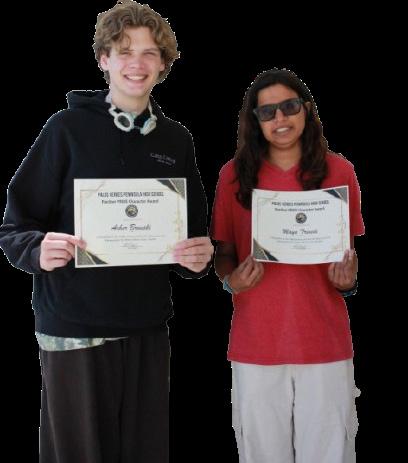
Panther PRIDE awards are meant to reward and encourage these behaviors. When asked about his thoughts when creating the PRIDE awards, Garrity said he wanted to highlight students beyond their academics or extracurriculars.
“There [are] a lot of awards for [athletics], performing arts and academics but there seems to be a gap [in highlighting other achievements],” Garrity said. “I wanted to recognize [students] who were doing great things beyond [traditional achievements] . These students are being good just for the sake of just being good, despite no reward being expected.”
The positive traits that the Panther PRIDE awards display are integral to the Peninsula community, keeping the spirit of academic competitiveness while also valuing compassion and care. Many students, such as freshman Lucas Yang, who received a Panther PRIDE award, feel that the traits represented by Panther PRIDE create a better school environment for all by encouraging compassion among students. “It is really cool to see awards for character,” Yang said. “[Student] interactions and friendships made are what make the [school] experience better. There are plenty of other [students] that could have been nominated for this award, since they all really [display the PRIDE traits].”

There were three other students who received a 2025-26 Panther PRIDE award: senior Asher Brunski, junior Maya Trivedi and
sophomore Alex Brandenburg. All of these students exemplified the positivity and compassion that the Panther PRIDE awards hope to highlight.
In order to qualify for a Panther PRIDE award, a student must go through a selection process with multiple rounds. First, teachers and staff nominate students that they think exemplify the PRIDE traits most. They are asked about what particularly makes the student stand out, including specific stories. Then, student representatives help filter through the nominations, so the perspectives of both teachers and students are considered. One student from each grade level was granted a Panther PRIDE award, along with a hoodie and breakfast at Good Stuff with two guests and Garrity. According to Garrity, the more intimate setting of a restaurant was chosen specifically so that awardees and their families could connect with each other. Brandenberg shared how she recieved the award.
“[The principal] came into my math class and announced that [he] had an award for me,” Brandenburg said. “I was not expecting it, but I was really happy. It was nice to be awarded, especially since I am new to this school.”
While the Panther PRIDE awards were initially announced in the weekly staff newsletter, the Panther View and the school board meeting, Garrity hopes for it to get even more recognition and be in the school’s yearbook and daily bulletin eventually. That way, students will be more aware of the awardees as well.
“The students at [Peninsula] are incredible,” Garrity said. “And I am hoping that [the PRIDE awards] will catch on and become a sort of tradition to honor these students. [The awards] can create a place to celebrate our students and their extraordinary [character].”

The
Giana Geerdts
On Jan. 30, Melania Knauss Trump, the 45th and 47th First Lady of the United States, released an autobiographical documentary entitled “Melania”. The film, which was produced and directed by Brett Ratner, depicts the 20 days before the presidential inauguration of her husband, Donald Trump. The film not only focuses on both Melania Trump’s daily life, but also on preparations for President Donald Trump’s inauguration, her fashion choices and personal reflections on her role. The goal of the movie seemed to be to make Melania Trump more appealing and relatable, but it fell short due to her life on camera appearing artificial. Since the film’s release, it has received an overwhelming number of negative reviews. One critic, Adam Graham of the Detroit News, posted on Rotten Tomatoes that the film’s “defining trait is that it’s numbingly, agonizingly dull.” To add to that, the film was a waste of 104 minutes. Furthermore, despite its perceived success as the highest grossing non-music documentary in over a decade, “Melania” only made $16.6 million with a $35 million marketing budget; overall the movie was an overwhelming disappointment.
The film begins with a voiceover by Melania Trump, in which she states “Everyone wants to know my story. Well, here it is.” However, truthfully, it’s not her story. Rather, it is a highlight reel showing off only what she wants to be seen. There are only a few scenes with actual substance, besides those, the film just feels inauthentic. For instance, when Melania Trump meets with her fashion designer Hervé Pierre at Trump Tower to discuss her attire for President Donald Trump’s inauguration. Additionally, a conversation with an interior decorator is also featured, discussing ideas for the Trump family’s move into the White House. This provides insight that the Trump family had always planned to deck the White House out in gold. The film also features a call between Melania Trump and French First Lady Brigitte Macron, her meeting with Queen Rania of Jordan and of a meeting between Aviva Siegel, a former Gaza war hostage who was advocating for the release of her husband, Keith. These scenes support the film’s portrayal of Melania’s diplomatic commitments and her role as First Lady. Additionally, a more light-hearted scene is featured in which Melania is singing “Billie Jean” by Michael Jackson. However, all of these moments feel very selective. Only showing diplomatic engagements, conversations with war hostages and Melania having a personal concert are putting further emphasis on the fact she has something to prove. “Melania” also features a personal scene in which Melania Trump is seen lighting a candle for her deceased mother, Amalija Knavs, in the St. Patrick’s Cathedral in New York. Other than that, however, the film lacks any real history about her life. She gives audiences absolutely nothing about her previous career as a model
or her time spent as the 45th First Lady of the U.S. It would have been nice to see Melania Trump in a more personal light, such as seeing her daily interactions with her family and her husband, what joining the fashion industry so young can do to a person and growing up in Slovenia. Overall, the film failed to truly introduce the audience to who Melania actually is.
The idea of the film portraying more of Melania Trump’s life was either an idea that was pitched to her by Jeff Bezos or her own idea that she pitched to Marc Beckman, her manager and senior adviser

after President Donald Trump had won the 2024 presidential election (The Ringer). In addition, many notable companies fought for the streaming rights of “Melania”, such as Amazon, Disney, Netflix and Paramount Pictures. Amazon won by a landslide (Fox News). Bidding $40 million, the highest price ever paid for a documentary, to license it and produce a follow-up docuseries on Melania Trump (Fox News). Despite this, Melania Trump only earned $28 million dollars from “Melania” (Vanity Fair). All of these factors have caused the film and Trump to receive criticism. Furthermore, Brett Ratner as director for the documentary is also a controversial pick. This is his first film following sexual assault allegations in 2017 and his name was featured multiple times in the Epstein files. Another well-known
critic, Jimmy Kimmel, called the production a $75 million bribe, proving the point that the film shows only what Melania Trump wishes to be seen. “Melania” features a variety of different artists, songs and genres such as “Gimmie Shelter” by The Rolling Stones,“Everybody Wants to Rule the World” by Tears for Fears, and “It’s a Man’s Man’s Man’s World” by James Brown. These songs help set the mood and reflect the themes of the movie which are believed to be fame, power, public image and tradition. The song “Gimmie Shelter” is especially interesting, as it reflects themes of fear and the instinct to find safety in a violent world. Seeing as nothing in this film hints that she is directly facing any type of threat, it is hard to understand how she can relate to that song and be able to use it in her documentary. Similarly, the song “Everybody Wants to Rule the World” also doesn’t seem to be a proper fit. The film is about the First Lady, not her husband’s failed attempts to take over the world. The songs by African-American artists Boney M., The Crystals, Aretha Franklin and James Brown are also interesting choices. It is offensive to include songs from artists who both President Donald Trump and the administration that Melania Trump supports are directly oppressing. This past February, which was also Black History Month, President Donald Trump had the courage to post President Obama and First Lady Michelle Obama depicted as monkeys on Truth Social. NAACP President Derrick Johnson said in a statement that President Trump’s actions were “blatantly racist, disgusting and utterly despicable (ABC News)”.
The timing of the movie is also not ideal, as there have been many tragedies, such as the murders of Keith Porter Jr., Renee Nicole Good and Alex Pretti by Immigration and Customs Enforcement (ICE) officers. The movie seems largely disconnected from the brutal realities that many Americans are facing as a result of the Trump Administration; it makes one realize that maybe it was not necessary to create.
Just a month after the documentary’s release, “Melania” has vanished from the top of the charts and so has its audience. In the last week of February, ticket sales for the film dropped 68%, while also losing its place in 800 theaters nationwide (National Today). Rather than a movie depicting a purified version of the First Lady’s life, America needs lower gas prices, stricter gun laws and more youth precautions. “Melania” ultimately falls flat because it was lacking in true substance, significance and genuine relatability. The film seems to be designed to show the First Lady from a softer approach, which turned out to be an amateur job at trying to make her seem more down to earth and relatable. The terrible outcome of “Melania” ultimately proved many critics correct as the documentary emphasized the lack of accountability within the Trump administration, truly showing how disconnected both the First Lady and the President are from American citizen’s daily lives.
Colin Kim | 12
Charli xcx has made a whole 360 turn in terms of creative projects — going from music one could play at clubs to darker sounds for an intense film. Artist Charli xcx has come a long way since the release of her album “brat” to her latest soundtrack “Wuthering Heights” for director Emerald Fennel’s movie of the same name. Fennel, creator of the 2023 thriller, “Saltburn”, released the twisted romance film, screen adaptation of the novel by Emily Brontë, on Feb. 13 of this year along with the release of Charli xcx’s album. In the movie, Margot Robbie and Jacob Elordi portray passionate lovers Catherine and Heathcliff in 18th century Yorkshire, England. Charli xcx elevates the storytelling in this film with her 12-track album even though only a limited number of the songs were included in the film. Coming down from the success of “brat” in 2024, Charli xcx was first approached by Fennel in December of that year to compose what was supposed to be a singular song. However, after reading the script, she was intrigued and asked to compose a whole album. This decision by Charli xcx greatly elevated the storytelling and contributed to the ominous tone throughout the fi experimental and electronic sound through-out the album,
takes a moody and cinematic turn compared to her previous work. Track one, “House” featuring John Cale is a haunting single, encapsulating the intense anxiety of feeling trapped and full of despair. This track shows off the album’s outward expressiveness, focusing on the mood it sets rather than catchiness. It also sets the tone for the anxiety-inducing storylines between the two protagonists. In contrast, the majority of songs on this album are calming and make for enjoyable background or car music. This contrast lines up with the film’s emotional rollercoaster of plot points. Tracks like “Dying for you”, “Altars”, “Almost Everywhere” and “Chains of Love” discuss the recurring themes of yearning and dependency of love. Charli xcx manages to seamlessly transition in between her different eras to convey whatever tone or story the artist wants to tell at that moment. Freshman Sadie Wild reflects on her thoughts on Charli xcx’s career.
“I was a big fan of ‘brat’ and I’m happy to see
rounding social status and wealth. “Altars” is used to represent Catherine as an altar, or place of worship to Heathcliff, who feels betrayed by Catherine when she marries Edgar Linton, causing jealousy and vengefulness. In “Dying For You”, Charli XCX states, “you’re the poison I drink” and “favorite jewelry worn just like a noose”. In one scene, drinking poison refers to the willingness of partaking in this toxic relationship, while the line jewelry represents a love that started off beautiful but became restraining like a noose. In a powerful scene, Cathy claims, “I am Heathcliff” meaning she feels emotionally bonded as one with him. Cathy’s attachment to Heathcliff is mutual, as in one of the final scenes, Healthcliff says, “I cannot live without my life” showcasing the codependency he has for her. In some ways they both feel oppressed by the people around them, as they go against the Linton family. Sophomore Sebastian Sugeti shares his thoughts on the characterizations in this film.
listened to her older songs such as ‘boom clap’ and ‘break the rules’. Her sound in Wuthering
s her heavy use of strings. These

with the plot. The opening the Wuthering Heights estate in which Cathy feels the darkness of having to be separated from expectations
“Both Margot Robbie and Jacob Elordi are so talented in this film,” Sugeti said. “They do a really good job at portraying toxic relationships. Heathcliff is written as a tortured soul as he is consistently mistreated throughout the movie”.
“Wuthering Heights” is not the first time that Charli xcx has branched out of creating music. In fact, on May 15, 2025, Charli xcx created 30 songs for the first season of Prime Video’s “Overcompensating”. Further, Charli xcx briefly plays an attitude heightened version of herself in a comedic and satirical manner. Beyond this, Charli xcx released “The Moment” an A24 mockumentary movie playing a younger version of herself preparing for her first tour. On Jan. 30, she will also provide original songs for the film “Mother Mary”, and there are rumors that she will potentially act in “A Tree is Blue”, “Takashi Miike Project” and “Faces of Death” (Australian Broadcasting Corporation). Sophomore Nicole Perez discusses her opinion on Charli xcx’s career transition into movies and TV shows.
“I’ve seen her role in ‘Overcompensating’ and I think she’s a great actress. I think it’s cool she wants to expand her field work into the film industry. After reaching the peak of her career with ‘brat’ it is understandable she may want a change of pace.”
Charli xcx’s album “Wuthering Heights” elevated not only her discography, but demonstrated how music can impact storytelling and be a catalyst for audience emotions. Charli xcx used dynamic sounds and artistic storytelling through instrumentation and lyrics in order to heighten the intensity of Cathy’s and Healthcliff’s love. The soundtrack in this film should inspire other filmmakers to include meaningful and artistic implementation such as this one. “Wuthering Heights” will go down in history being known for its artistic and conceptual sound landscape. Charli xcx’s versatility throughout her career has been shown to be a strength as she has effortlessly transitioned from party music to a sound layered with intense storytelling.
Months of early practices, long afternoons and careful preparation ended in a day of celebration for Peninsula’s Coed Choreo team as they earned multiple first-place finishes at the recent West Spirit Day competition held at West High School on Feb. 21. The team stood out among competitors and delivered one of the program’s most impressive results in recent years.
At the competition, Peninsula competed in several divisions against schools from across California. The varsity All-Female routine secured the top spot in the All-Female category. The routine was also given the High Point Award, which is awarded to the highest scoring routine of the competition. During competitions, teams are divided by size based on the number of athletes: “large” teams have 20 or more members, “medium” teams typically have around 15 members (fewer than twenty but more than a small team) and “small” teams have the fewest members, often representing the most elite group within varsity. In addition, there are two junior varsity (JV) teams: JV Large, which includes all junior varsity athletes (both male and female), and JV All-Female, which includes only the female members of JV across the entire program. There is also a small male team made up of all the male athletes from both JV and varsity combined, because there are not enough male members to form separate male teams at each level. The varsity small co-ed team also topped the leaderboard, while the varsity large co-ed team placed second in the competition. Rounding out the varsity team’s ensemble success, the all-male routine was awarded third place and received the Judges’ Choice Award. Throughout the season, the team spent long hours preparing for competitions, refining choreography during daily practices, providing dancers the chance to improve technique while also strengthening the team dynamic. Much of
that growth came from the detailed and demanding preparation leading up to the competition. Dancers were often found repeating routines and constantly drilling tough sections; often staying overtime, in order to perfect timing and coordination. Samantha Lam, a member of the winning JV team, was thoroughly relieved that all the efforts of the team had paid off.
“It’s really easy to start thinking about something completely unrelated when we’re rerun-
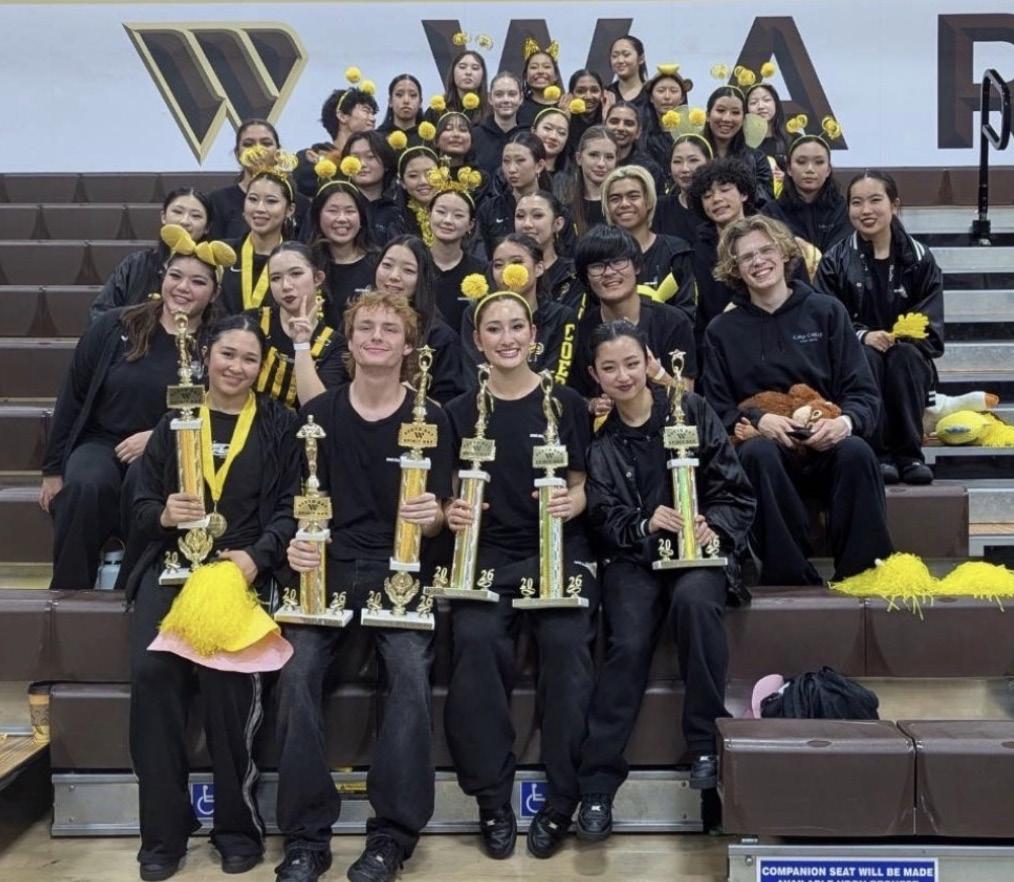
ning sets and going over certain parts over and over again, ” Lam said. “It feels really reassuring knowing that someone else knows how hard we worked on these sets. I’m so glad we practiced and constantly locked in everyday [during] practice so we could get first.”
For JV captain Leia Kim, however, the season’s impact extended beyond just trophies and award placements.
“This competition season has fostered so much growth for every single person on this team,” Kim said. “Not only has everyone improved in dance skill, but we’ve also created a supportive and tight-knit community.”
The Peninsula dancers were also equally successful in the individual and duet events, where competitors had the opportunity to showcase their personal styles and choreography. Senior
and varsity captain Mya Douglas, took first place in the 12th grade hip-hop solo division with her strong movements and incredible body control. She later went on to win second place in the freestyle competition. Additionally, senior Aiko Aguilar earned ninth place in the 12th grade contemporary division, captivating the judges with her emotional storytelling through the contrast of both soft and sharp moves. Furthermore, junior and fellow varsity captain Sayuri Shibata placed third in the 11th grade hip-hop solo division, impressing with her sharp, clean movements and energetic personality onstage. Moreover, a duo composed of Douglas and junior Misaki Yagi took first place in their hip-hop duet/trio division, standing out for their great synergy, as well as expressive expressions and high energy. These achievements were the result of weeks of disciplined preparation. The weeks leading to the tournament were spent on an intense training regimen that included after school practices, assessments of performance and additional practice sessions to fine-tune skills and teamwork. Shibata believes mental preparation was just as important as physical endurance during the long weekend.
“We knew it was going to be such a long weekend, so we really tried to prepare mentally and stay excited even though we knew we’d be physically tired,” Shibata said. “We kept reminding everyone not to forget that your teammates are standing next to you – there are 19 other people going through the same thing. That mindset really helped us stay connected and perform together.”
Following their West Spirit Day triumph, the team is scheduled to compete at the Glendale Games on Feb. 28 and later on at West Coast Elite (WCE) Dance Nationals, the most anticipated event of the season, on March 5-7. With these competitions in mind, the Coed Choreo team is looking to build upon the success they have already achieved throughout the rest of their season.
Alissa Luna | 10
On Feb. 20 and 21, the Peninsula cheer team competed at the USA Spirit National Championships, marking a milestone in their season. This year marks the 40th anniversary of the Championships. Peninsula has been going to nationals for years, and this is not their first time placing. Along with cheerleading, song, pom, mascot and pep flag was included in the competition. The tournament was hosted at the Anaheim Convention Center from Feb. 19 to the 23. Hundreds of teams from across the country came to Anaheim to compete in Nationals. With impressive skills and spirit displayed onstage, Peninsula was able to place second in both the Show Cheer Advanced Large Division and the Super Non-Tumbling Division. Since the national registration began later in the school year, the Peninsula cheer team had to make the transition from cheerleading during games to competitive cheer very quickly. There are major differences between sideline cheer and competitive cheer. Sideline cheer is built on spirit and support for the school, primarily including cheers that elicit excitement and liveliness from the crowd. In competitive cheer, however, the cheer team performs a routine, usually
around two and a half minutes long. It is judged based on the difficulty, execution and timing of the moves performed. For cheer teams, it is important for everyone to rely on each other for their moves. Junior Giselle Gomez shared her opinion on the importance of teamwork.
“Teamwork plays a big role in cheer,” Gomez said. “Stunting relies on everyone in the group, so you have to learn how to work together and communicate [any] issues there may be. It means recognizing when you’re making mistakes and communicating what you think the issue is in a kind and respectful way.”
Before going to nationals, the cheer team practiced twice a week for two and a half hours. However, in the days leading up to nationals, the team practiced Tuesday through Thursday for two hours as well as the Friday before their performance. Upon arrival at the Anaheim Convention Center, it was clear how big the event was. Hundreds of teams were there to compete from all across the United States, totalling thousands of cheerleaders. Senior Danneelle Guevara explained how her and the team felt when arriving at the Anaheim Convention Center.
“I competed in 2025 at Nationals, so I’d been to the Anaheim Convention center before,” Guevara said. “However, this time when I
Kyra McGath | 10
The Peninsula varsity boys soccer team made history on Jan. 30 by playing in their first-ever night game. This game was also the team’s senior night and final home game of the season. Students and parents filled the bleachers to support the boys dressing out in a jersey-themed student section. Before the game, against Amino Leadership, the team’s seniors were called up and recognized, and awarded for their time in the program.
The idea for the night game came from the team’s parents, who hoped it would bring more attention to the team. They communicated this idea to DJ Clovis, the athletic director, who then worked with coaches and school staff to organize the event. Most games are typically played in the afternoon when school gets out, but the night game provided an opportunity for more students and families to attend. The goal for this game and for the jersey-themed student section was to encourage more support and participation from the student body. In addition, they
brought an In-N-Out truck as well as a Handel’s ice cream stand. Senior John Yeargin felt the new approach successfully brought the community together.
“It was cool to see the school try something different to get more people to come out,” Yeargin said. “The jersey theme and the food trucks made it more enjoyable, and it was great seeing so many students there supporting us.”
During the game, the bleachers remained energetic as students and parents continued to support the team throughout the game. The student section was cheering during every moment of the game and reacting to close plays on the field. For the players, the atmosphere felt different from a typical afternoon game, with the lights, crowd and senior night recognition adding to the significance of the moment. The environment created a sense of excitement on the field as the Panthers competed in front of one of their largest crowds of the season. For many of the seniors, the game was less about the result and more about the experience of playing their final home game in a new and exciting
arrived, it felt surreal knowing it would be last time ever competing in that place and as a Pen cheerleader as a whole. I was sad, but came to terms with a chapter of my life ending.”
Despite how much pressure they faced, competing alongside hundreds of other schools, Peninsula remained focused for their performances. Anxiety was especially high this year as just two weeks before nationals, the cheer team’s routine had changed. The changes were made to seem more impressive at the performance. It was difficult to adjust to, but the team was determined to perform to their full potential.
Thanks to cheer’s strong teamwork and impressive routine, they were able to win second place at the USA National Championships. Junior Autumn Dover explained how she felt after Peninsula earned the prestigious award.
“I was very proud of my team when we got second at Nationals,” Dover said. “The moment showed us how much our hard work had paid off. To celebrate we [hugged] our parents and loved ones. We [were also all] cherishing our last few moments together.”
As Dover mentioned, this was one of the final events with the entire cheer team before the seniors graduate, making the team’s success all the more poignant.
setting. Although Peninsula ultimately fell short in a 2–1 loss, the experience of playing in front of a larger crowd at night made the game stand out from the rest of the season. Senior Santiago (Santi) Jacobson noted that the amplified energy completely changed the dynamic of the match.
“Playing at night with the crowd and the student section made the game feel so much bigger than a normal game,” Jacobson said. “It was cool to see so many people come out to support us.”
Before kickoff, the seniors walked onto the field with their families as their names were announced, highlighting the players who have spent the past four seasons with the team. Coaches and teammates acknowledged the seniors’ leadership and contributions, both on and off the field, throughout the season. For many of them, the game represented the end of their time playing at Peninsula and a chance to reflect on their years spent on the team. Regardless of the final score, the night still held a special significance for both the seniors who were playing their final home match and the soccer program as a whole who began a new tradition.