The Pen Newspaper

Emmersyn Hadley | 9
New Year’s resolutions have been a long-standing tradition, but do people actually follow through with them, or do they simply set people up for failure? Some believe resolutions are a positive practice because they provide a clear goal and set individuals on a path to success. On the other hand, many argue that resolutions are an outdated tradition and are not always practical, as jobs, school and other activities often leave little time for personal improvement. While they are often criticized, New Year’s resolutions can encourage accountability, foster personal growth and give people a renewed sense of direction for the year ahead.
One of the main benefits of creating New Year’s resolutions is accountability as they can encourage organized and structured commitment to change (Forbes). People tend to share their New Year’s resolutions with their friends and family, which creates pressure to see changes through. Additionally, the beginning of a new year represents a fresh start and rekindles the determination to pursue such intentions. By taking accountability of a goal publicly, people become obliged to take ownership over their decisions and lifestyle (Medium). However, accountability can also be personal rather than public. Freshman Damien Kaspian summarized how he keeps up with his New Year’s resolutions.
“I like to write [my New Year’s resolutions] down on paper,” Kaspien said. “When I look at it every day, it reminds me that there is an end goal and [I] just have to keep working to achieve that goal.”
New Year’s resolutions promote personal development by encouraging self-reflection and a determination to change (PubMed). Through reflecting on their current state, individuals identify both the skills they are proficient in and the areas in which they need improvement. As people work toward fulfilling their New Year’s resolutions, they often encounter obstacles that require persistence and adaptability. Rising to these challenges helps individuals develop discipline, time management, perseverance and other essential life skills critical to success. Even when a new challenge presents itself, a person’s ability to modify their strategies and continue moving forward ultimately increases mental resiliency and builds self-confidence (PubMed). New Year’s resolutions serve as a tool for long-term personal growth and sustained self-development. Freshman Adam Tamashiro shared his opinions on how resolutions contribute to personal growth.
“I make New Year’s resolutions if there is a goal I want to achieve,” Tamashiro said. “Most of the time I am able to achieve them and it teaches how I can grow and become better if I set my mind toward what I want.”
Tamashiro’s comments affirm that each time one works to achieve a resolution, the experience teaches
them to recognize their own potential and develop a mindset that emphasizes continual growth.
Critics of New Year’s resolutions argue that they are not an effective method for creating change (Psychology Today). However, the issue is not the concept of resolutions themselves, but how they are created. The reason why people give up on their resolutions is because people do not set realistic goals or create a well thought out action plan for themselves (PubMed). People’s failure in achieving their goals should not be viewed as a failure of the entire concept of resolutions, but rather as a result of how and what goals are set. The structure of New Year’s resolutions gives people a place to start, especially for those who find it difficult to create an action plan for improving their own lives regularly. When goals are set appropriately with an actionable plan, New Year resolutions can greatly improve long-term change in people’s lives (PubMed). Even if a person’s resolution is not entirely achieved, the process of developing the resolution encourages self-awareness and self-reflection. The very act of creating resolutions can also be beneficial because failing to achieve resolutions can help individuals learn from their mistakes. Sophomore Rinah Yatman explained how New Year’s resolutions are beneficial to her.

“I usually do not create New Year’s resolutions because I am not the best at keeping up with them,” Yatman said. “However, when I do make goals and accomplish them, it makes me feel good about myself.” Overall, despite New Year’s resolutions not always being recognized for their benefits, they certainly provide a valuable structure for supporting personal development and self-accountability. Setting and reaching goals will help people better discipline themselves and shows persistence. Even minor achievements can promote motivation and increase the chances of having a growth-oriented mindset. The true value of the New Year’s resolution process lies in the attempt to enhance one’s personal quality of life and what that will lead to in terms of further opportunities for continued education, growth and overall improvement.
EDITORS-IN-CHIEF
Haylie Kim
Sivan Stoler
HEAD OF DESIGN
Anza Engle-Tseng
HEAD OF BUSINESS
Melina Ajami
EDITORS
Selah Hartman
Mason Kim
Elyssa Lee
Adam Lu
James Pan
Elena Thomas
Simon Vuong
WRITERS
Parisa Bahrami
Ingu Bat-Yeruul
Savannah Diaz
Giana Geerdts
Emersyn Hadley
Billy Houng
Adam Khaja
Colin Kim
Mason Kim
Olivia Kim
Gunnar Lee
Alissa Luna
Sydney Malicse
Kyra McGath
Celanie Neal
Khalil Santiago
Alisa Sekine
Sophia Shen
Briana Ta
Noah Vaidyan
DESIGN
Brian Hong
Jiayu Tang
Matthew Yi
Cayden Speck
Kaelyn Choi
Laila Garibo
BUSINESS
Halynn Kampos-Lara
Allison Kumamoto
Sayuri Shibata
Haley Haley
Elise Vu
WEBSITE
Wendy Hu
Alyssa Kwok
Yully Seo
SOCIAL MEDIA
Asher Brunski
ADVISER
Jaymee DeMeyer
Mason Kim | 9
The economic stability of California thrives when workers can afford to live within the communities they support, so minimum wage changes directly affect both workers and local economies. On Jan. 1, the minimum wage for California was increased yet again from $15.50 to $16.00 per hour. Many California residents had hoped that this would address the climbing affordability crisis. Those who support this change argue that a higher minimum wage would allow for workers to earn money on par with the rising costs of rent, food and other necessities. Despite this, experts have warned that the increase may actually worsen the affordability of living by causing prices to rise in tandem with the minimum wage, pressuring smaller businesses to raise prices or reduce staff (Los Angeles Times). While raising the minimum wage may seem as if it could assist low-income workers, it would also risk increasing financial stress on families and employees. The businesses react to this by increasing prices and even encouraging some small businesses to reduce their work hours or the number of employees. Although this is a positive trend, it is, however, double-sided as it alleviates and imposes some challenges at the same time. Hence, increasing the minimum wage may have some benefits, as well as resulting in some economic challenges.
Throughout the past decade, California has raised the minimum wage ten times in an attempt to counteract the heavily rising expenses of basic necessities. Many Californians expected that this would help to make living costs more manageable, as the increased wages would bring workers’ earnings closer in line with the increasing costs of housing, food and other living expenses (California Department of Industrial Relations). While beneficial in theory, critics argue that greater wages do not directly translate over to more improved affordability for workers once rising prices are factored in. In an effort to remain financially stable, businesses may raise their costs, reduce employee hours or lay off workers entirely (Los Angeles Times). Added pressures from a period of high inflation, greater interest rates,and a continuing supply chain disruption threaten to push the prices of daily products even higher. If this pattern continues, the financial strain on Californian communities will become extensive. In contrast, sophomore Sebastian Sugueti offered a different perspective on the issue.
“Raising the minimum wage could be a good step as people may need to afford basic things,” Sugueti said. “If the laborers of this community
are paid more, there’s a chance they can keep up with the constantly rising prices rather than falling behind.”
Other proponents of the increase argue that higher pay stimulates economic growth as workers can spend more money locally (Federal Reserve Bank of Chicago). Although this is plausible in the short term, it is more safe to assume that prices will increase following the change. For example, studies have found that when minimum wages go up, businesses such as fast-food chains and other restaurants often
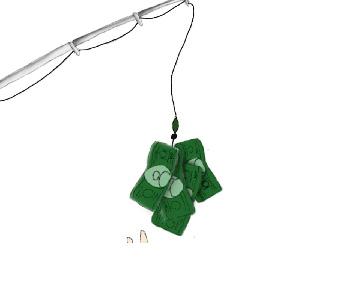

tend to raise their prices to compensate for the increased labor costs rather than bearing the costs themselves (Brookings Institution). This means that even if the minimum wage is raised, employees may not end up being able to afford the increasing cost of living because the prices may have been raised to cover the increased wages. If this cycle continues, the workers may certainly have even greater trouble than before the minimum wage rose.
Additionally, economists warn that raising wages, amid California’s housing shortage and rising commuting and healthcare costs, may fail to deliver meaningful financial stability or improve overall affordability for workers. California continues to raise the minimum wage over the last decade rather than addressing other issues that could help resolve the housing crisis, inflation, or the cost of living, which remains unresolved. By focusing on simply increasing minimum wages instead of actually fixing these larger, systemic issues California only offers temporary solutions to its economic situation instead of a lasting one (Brennan Center for Justice). Echoing this concern, freshman Liam Gedeon expressed agreement.
“Raising the minimum wage doesn’t really
solve the bigger problems,” Gedeon said. “If housing, transportation and healthcare keep getting more and more expensive, then a better paycheck will not make a difference in the long term.”
The people most affected by this raise in wages are those already facing financial hardship. As prices rise, low-income households often experience the most strain as they spend a higher percentage of their earnings on basic necessities such as food, rent and utilities (Los Angeles Times). In some instances, small businesses might respond to increasing labor costs by cutting their employees’ working hours, laying off a part of their workforce or passing on the increased cost to consumers, which might mean that employees might be worse off in two ways: through increased prices and reduced working hours. Offering a critical point of view on the topic, junior Saulius Jurgaitis shared his opinion on the situation.
“I [do not] think that raising the minimum wage actually fixes anything in the end,” Jurgaitis said. “If the businesses will probably just raise their prices, we’re back to square one, but paying more.”
Fair and manageable fiscal policy should prioritize long-term welfare over short-term relief. Californians need solutions which address the cause of the heightened living costs. For instance, California could create more affordable housing, improve commuting services and reduce the costs of essentials. Moreover, the government could implement measures to control inflation, control rent and provide subsidies to the poor for basic needs. By focusing on increasing wages as a primary solution instead of actually working toward these larger issues, lawmakers can contribute to economic inequality through the state. This could result in low-income workers being forced to pay more, work fewer hours or even losing their jobs altogether, which is something that the higher-income workers and the business owners are more likely to withstand. Without addressing these pressing issues first, the economy cannot be stabilized through the use of wage increases alone.
Even though the increase of the minimum wage in California was passed with good intentions, it will worsen affordability by causing prices to rise and placing strain on small businesses. Californians need to keep evaluating whether increasing wages is truly the best response to the crisis of affordability, especially during a period of economic uncertainty. Instead of raising the minimum wage, California should address the underlying issues that cause the high cost of living, such as housing shortages, inflation and the increasing price of basic commodities to provide long-term economic solutions for all Californians.
Billy Houng | 10
Whether it be called an abduction or transfer of custody, Venezuelan President Nicolás Maduro was brought to the United States to stand trial for his involvement in grand-scale criminal activity, including the trafficking of illegal drugs to fuel narco-terrorism (PBS News). President Donald Trump then announced his foreign policy plans to “temporarily rule” Venezuela in hopes to impede the flow of drug trafficking, and has openly extended his appetite to acquiring Greenland for the same purpose — to establish national security. After bitter denial from Denmark to even negotiate a deal for Greenland, President Trump told the press that the U.S. would “have Greenland one way or the other.” Further hinting at potential military action, the president described Greenland’s only defense as “two dogsleds” (NBC News). The immediate reaction from many progressives and critics was to accuse the Trump Administration of suddenly waging a war on Venezuelan drugs in an attempt to steer attention away from domestic scandals such as the ICE incident with Renée Good and the highly sought-after full release of the Epstein Files. Others hurled accusations of imperialism in pursuit of commercial benefit — most notably through the commandeering of Venezuelan oil and the harvesting of Greenland’s abundant mineral deposits (YaleInsights). Though Venezuelan oil may have been a small motivation, the true reasons behind Maduro’s controversial arrest lies in his extensive and problematic history with the U.S., while Trump’s aspirations for Greenland reflect logical concerns for the country’s future in geopolitics; the president’s very transparent statements, often misinterpreted as crude or rash, reflect a foreign policy that is surprisingly calculated.
Contentions have also been raised surrounding the legality of the involuntary extraction of the Venezuelan president. According to the International Court of Justice, venturing out to Caracas, the capital of Venezuela, to arrest and extract the Venezuelan president under criminal charges amounts to extraordinary rendition — the nonconsensual capturing of a suspect upon foreign territory —, which is illegal under international law. Such violations of the law could result in serious fines for the U.S., or even expulsion from future international organizations. With the U.S. still engaging in this banned practice, junior Rafi Shmeal reflected on whether Trump’s actions were reasonable despite these possible repercussions.
“[America] did break [international law] —
100%,” Shmeal said. “But I believe that what happened [in Caracas] was justifiable in every way; through the censorship and crushing of free speech, the people of Venezuela were really oppressed under Maduro. If Maduro was going to get taken out any other way, through a coup or political maneuvering [for example], there would have been many more casualties than [if] the U.S. had [just] invaded [them like they did]. The people of Venezuela have been liberated from the malignant dictator Nicolás Maduro.”
It is critically important to recognize that the U.S. has had a history of intolerance when it comes to terrorism. Whether it be the sinking of a U.S. boat or a plane bombing on U.S. soil, America has not, does not and will not respond lightly to unwarranted provocation. ‘Foreign Terrorist Organization’ — FTO — was the label branded upon the infamous Al-Qaeda conspirators who were behind the dreadful attacks of September 11, 2001. ‘FTO’ also resembles the label accurately bestowed upon Cartel de los Soles by the Department of Treasury in 2025. Designations such as ‘FTO’ are not thrown about loosely; judging from how the U.S. handled key Al-Qaeda conspirator, Osama Bin Laden, one would be inclined to believe similar force should be warranted when it comes to condemning key Cartel de los Soles conspirator, Nicolás Maduro. To understand the true background of Nicolás Maduro is of utmost importance when justifying the action taken to apprehend him.
Maduro’s illegitimate rise to power began in 2014, when Venezuela fell victim to a devastating economic crisis, with the price of oil tumbling from $100 per barrel to a measly $30. Considering how sixty percent of the Venezuelan economy is controlled by oil exports, this was catastrophic to the already debt-ridden country (Council on Foreign Relations). By exploiting the country’s turmoil through corruption, unlawful jailing of political rivals and countrywide censorship, Maduro clawed his way to the top of the Venezuelan government despite the roaring backlash from the Venezuelan people as well as nearly sixty countries abroad. As a testament to his felonious activity, the Department of Justice placed his name on the U.S.’s most-wanted list, officially declaring him a criminal of several federal offenses, offering $15 million for any information that would lead to his arrest in 2020. That bounty would escalate to $25 million and then $50 million in 2025 (Department of State). This price-tag is well-justified: Maduro is a dictator-turned grand-scale narcotics terrorist who has allegedly
been involved in the worldwide illegal distribution of cocaine. He has also been accused of funding military-grade weapons for large forbidden organizations such as Cartel de los Soles, who are responsible for smuggling upwards of 250 metric tons of cocaine into the U.S. per year (Council of Foreign Affairs). Without proper intervention, such a dangerous product would have continued making its way into America, wreaking havoc into the lives of those who fall victim to drug abuse. Though the removal of Maduro does not spell the end to America’s war on drugs, it is a crucial step in the right direc-
tion. Under the Trump Administration, the U.S. has further set the precedent for dealing with national-level threats.
In terms of geopolitics, Venezuela and Greenland are points of great interest to most world powers such as China, Russia and the U.S. Due to the locations of Venezuela and Greenland, both countries hold strategic potential for military establishments, mining operations and refueling stations. Specifically, Greenland holds a rather unique geographical positioning equidistant to Russia and the U.S. — Moscow and New York are within a 2500-mile radius of Summit Station, Greenland. Meanwhile, Venezuela has been known for oil-rich land and major contributions to the oil industry; securing a share of Venezuelan mines would guarantee a significant portion of the profits (U.S. Energy Information Administration). President Trump has already met with oil barons in charge of degraded Venezuelan infrastructure,
promising to invest “billions” into the area to “make money for the country” (Reuters). Critics, however, seem to disapprove of Trump’s “investment,” claiming that the sour history of American imperialization in South and Central America will repeat itself, leaving regions with noncentralized governments robbed of resources and independence (Wikipedia). While it is true that local dependence on U.S.-governed industry will increase, for the U.S. is responsible for reviving such industry in the first place, one could argue that the trillions of dollars of capital brought by American-ran industry alone greatly outweighs any deficit it may bring to hopeful ideals such as independence (Statistica). In the case of South and Central America, its mutual transaction with the U.S. should be viewed as an opportunity, not as a handout. If it is independence that South and Central America seeks, governments of such aspiring nations must take proper measures to secure such an opportunity to ensure a self-sustaining economy — a process made exponentially easier from the hundreds of billions of annual capital obtained from working in unison with America. Countries who claim to have been doomed by U.S. intervention — which constitutes pouring vast amounts of capital into reviving their long-dead industries — seem to be tricked into victimizing themselves in the face of a greater, helping power. Stubborn defenders of anti-American industry may label countries like Venezuela as inadequately prepared to pull their government out of the ditch of corruption, notably through the cartels, and therefore unable to help themselves. Those same, adamant advocates fail to recognize that it is President Trump — not the Venezuelan people themselves — who has taken successful action in eliminating this rotten branch of Venezuelan government. Instead of stuffing pockets with extra or even embezzled cash and choosing successful America as the scapegoat, Venezuelan higher-ups must rely on themselves to gravitate toward reforming their country into one with a more self-sustaining economy. Furthermore, the U.S. has great motive to invest in countries like Venezuela and Greenland, as the U.S. would profit immensely even if fractured regional governments were on the verge of collapse. To the U.S., there is simply neutrality in the notion of helping local governments become self-sustained — it is merely a matter of business. Parallel with profit, Greenland possesses vast untapped oil deposits as well as an abundance of rare earth minerals critical to the manufacturing of computer components, military weaponry and other high-end technology. Experts estimate unharvested resources to be worth around $4.4 trillion (American Action Forum). Theoretically, with all of it extracted, gas prices would be barricaded from skyrocketing for a while, and American welfare would be more heavily funded. However, senior Tommy Nguyen, former U.S. Government student, of-
fered his perspective on President Trump’s logic behind his recent actions.
“Geopolitics is just a convenient side effect that covers up [Trump’s] reason to [imperialize],” Nguyen said. “He’s also friends with a lot of higher-ups who can utilize [transarctic] trade routes and the oil from Venezuela. I don’t believe the oil and money is all [Trump] is after; this all might just be a power play to monopolize and centralize everything under U.S. power.”
Though it is undeniable that Trump has his own network of connections tied to commerce in the Arctic hemisphere — possibly painting him as a conqueror in hopes of hoarding wealth, another perspective views Trump’s actions as necessary preliminary action when debating where to allocate society-transforming amounts of money; to come ill-prepared without professional, already-willing investors would be ludicrous as well as a complete waste of energy. Beyond this, the effects of global warming have done favor in increasing the investment potential of the Arctic region. Many transarctic trade routes previously inaccessible due to ice are now revealing themselves, with Greenland essential to controlling such routes. Long before the ice started melting, China eyed the Arctic with aspirations of creating a “Polar Silk Road”, with Greenland as an essential part to that plan (Transatlantic Dialogue Center). Though they were denied further encroachment onto Greenland by Danish authorities in 2016, China still clutches onto its dream of being an influential figure in the Arctic hemisphere. Additionally, Russia, being the largest, northernmost nation, has been in the Arctic game for centuries. With two other major world powers with their eyes on Greenland, President Trump says that he must “take Greenland before China or Russia [take it first]” — applying a rationale similar to that behind the incident in Venezuela (Reuters). In light of Trump’s words, anti-war protests throughout America as well as abroad
have been waged, with protestors reportedly marching through the streets of Copenhagen, Denmark in numbers as high as 20,000 (Anti-War Committee Chicago). In contrast to the much more radical protestors, sophomore Kaleb Green insisted on a more neutral approach to the situation.
“Obviously, if [Trump] does take Venezuela, he would get [his national] security — China and Russia would be separated [from the U.S.]; they wouldn’t be able to infiltrate us [as] easily,” Green said. “But at the same time, I don’t think China, Russia or America should own Venezuela [or Greenland]. I don’t think the way they [apprehended Maduro] is right; they just kidnapped him. There was no diplomacy. [If I were Greenlandish or Venezuelan], I would feel scared.”
Although Green’s concern of America setting the precedent for aggressive behavior that could be used to justify acquiring Greenland in the future is valid, neutrality — when it comes to geopolitics — is simply not an option. In a relentlessly competitive world, staying neutral will only weigh a country down, leaving other powers to surpass and potentially overthrow that nation. A country would not want to give off the idea that it is unable to compete or easy to take over; hence, the strong opposition to colonization seen in the form of protests by the Greenlandic people. In patriotic desperation, however, most radical protestors end up accusing Trump of imperialism and greed,

mistaking his basic concerns for American national security and survival in a congested and contestive globe. By securing oil, as well as other essential resources, America protects its economy and its geopolitical standing. In theory, by securing lands like Venezuela and Greenland, America will be able to breathe easier, knowing that potential rival fortifications are not brewing on the horizon.
Khalil Santiago | 9
On Jan. 7, Renée Nicole Good had just dropped off her six-year-old son at Southside Family Charter School in Minneapolis when a United States Immigration and Customs Enforcement (ICE) agent fired into her vehicle. She was shot and killed during the encounter (New York Post). According to the Department of Homeland Security, Good attempted to “weaponize her vehicle” and run over an officer. However, she was not a suspect in any criminal investigation or immigration case, had no criminal record and was unarmed (Cable News Network). When immigration enforcement results in the deaths of unarmed, innocent civilians, it becomes clear that ICE’s current practices are unjustifiable and should not be supported.
Good’s case has raised serious questions about the accuracy and transparency of official government statements following deadly encounters. Homeland Security Secretary Kristi Noem claimed that Good attempted to use her vehicle as a weapon while an officer stood near her car on a snow-lined street (CNN). However, witnesses and video evidence suggest otherwise. According to The New York Times, “the visual evidence shows no indication that the agent who fired the shots, Jonathan Ross, had been run over… It also establishes how Mr. Ross put himself in a dangerous position near her vehicle in the first place”.
Later that month, another American was killed during a similar enforcement action. Alex Jeffrey Pretti, an intensive care unit (ICU) nurse who worked for the United States Department of Veterans Affairs, was fatally shot while helping a woman who had been pepper sprayed and shoved to the ground by an ICE agent during an operation (AP News). Within the span of three weeks, two U.S. citizens with no criminal convictions were dead, both shot by federal agents enforcing immigration law (ABC News).
ICE officials have maintained that both shootings were acts of self-defense. In Pretti’s, government officials initially suggested that he approached federal agents with a gun and posed a deadly threat, with some political figures implying that he intended to harm or kill the agents (The New York Times). Federal agencies argue that in high-pressure situations, officers must make split-second decisions to protect themselves and others (ABC News). However, video evidence in both cases have raised doubts.
Reports indicated Good showed no clear hostile intent with her vehicle (New York Times). In Pretti’s situation, multiple videos reviewed by national outlets showed him holding a cellphone while his firearm remained holstered before an agent removed it during a struggle (House
Oversight Democrats). A preliminary federal review did not state that “Pretti brandished his weapon” (CNN). When official statements differ from visual evidence, these incidents begin to look less like unavoidable tragedies and more like preventable failures. Freshman Jordan Chopra described his disappointment after learning about the deaths.
“I believe the killings were cruel and unjustified,” Chopra said. “The unlawful killing of civilians, including one who was trying to help a woman who had been pushed to the ground, is corrupt and unacceptable.”
These incidents are not isolated mistakes, but signs that enforcement encounters can escalate too quickly and with devastating consequences.
Agents show up heavily armed. Someone moves, someone speaks, someone is in the wrong place at the wrong time and suddenly there is a body on the ground and a press release explaining why it was “necessary” (Cal Matters). Chaotic, high-pressure enforcement situations can turn deadly even when the threat is unclear. When operations are designed in a way that creates confusion and fear from the start, the risk of a tragic mistake increases. In those moments, the difference between a routine encounter and a fatal one can come down to a misunderstanding, a wrong assumption or a split-second decision made without full information (American Civil Liberties Union).
ICE was established in 2003 following the Sept. 11, 2001, terrorist attacks as part of a reorganization under the Department of Homeland Security. Through the Homeland Security Act of 2002, the agency combined immigration and customs enforcement with national security priorities and was tasked primarily with identifying and removing non-U.S. citizens who posed threats to public safety or national security (United States Immigration and Customs Enforcement).
However, recent cases raise concerns regarding how enforcement tactics can place innocent civilians in danger. While the agency’s initial mandate focused on high-level security threats, the share of ICE arrests involving individuals with criminal convictions has dropped from 79% in 2016 to just 37% in 2025 (Brennan Center for Justice). ICE often relies on broad enforcement actions rather than narrowly focused investigations, increasing the risk of serious mistakes. These actions include worksite raids and neighborhood sweeps where agents apprehend large groups to verify their status at once, often using administrative warrants that lack the oversight of a neutral judge. Large-scale raids and sweeping enforcement efforts create chaotic and high-pressure situations where agents and civilians are placed in close contact with little clarity about who poses an
actual threat. In these environments, split-second decisions are made with incomplete information (American Immigration Council). Freshman Koko Sohara viewed the recent ICE shootings as more than just a political issue.
“I see these [past] killings by ICE as a problem that goes beyond being a Democrat or Republican, [and instead,] a source of shame for our country and humanity that needs effective action,” Sohara added, “They’ve caused so much pain and division, not just for families who lost someone, but for anyone who feels unsafe just because they weren’t born in the U.S.”
The issue is not about political sides, but about whether enforcement practices can truly protect public safety and dignity rather than compromise them. When deaths linked to ICE enforcement are described as routine or “necessary,” the human impact can be overlooked; grieving families, communities that feel targeted and individuals who begin to feel unsafe simply because of the place where they were born (American Immigration Council).
The killing of Pretti made ICE’s enforcement practices even harder to defend. If someone helping another person during an enforcement action can be killed, it becomes difficult to believe these tactics are fully controlled or safe for the public.
ICE exists to enforce immigration law. However, how can an agency continue to claim it protects public safety while civilians are being killed during enforcement actions? People are questioning this role, with calls to abolish ICE entirely and broader criticism of detention practices, racial profiling and aggressive raids (United States Immigration and Customs Enforcement). Model United Nations advisor James Dimitrou expressed concern over how these incidents reflect on the country’s values.
“They’re stepping on the [very] rights the UDHR (Universal Declaration of Human Rights) promises [to every person]... The U.S. often positions itself as a defender of human rights and the rule of law,” Dimitrou said. “[But] these incidents are a clear violation of human rights.”
Enforcement policies should match the values the country claims to uphold. If ICE cannot carry out its mission without turning neighborhoods into crime scenes, then the agency does not need better messaging. No amount of press releases, statements or explanations can fix that. It needs serious limits and serious change to match. Strict limits on street-level raids, clear use-of-force rules, accountability for shootings and a focus on criminal cases rather than sweeping enforcement that terrorize communities should be enforced. These changes would increase oversight and help ensure that enforcement does not continue to end in preventable deaths. Edited by
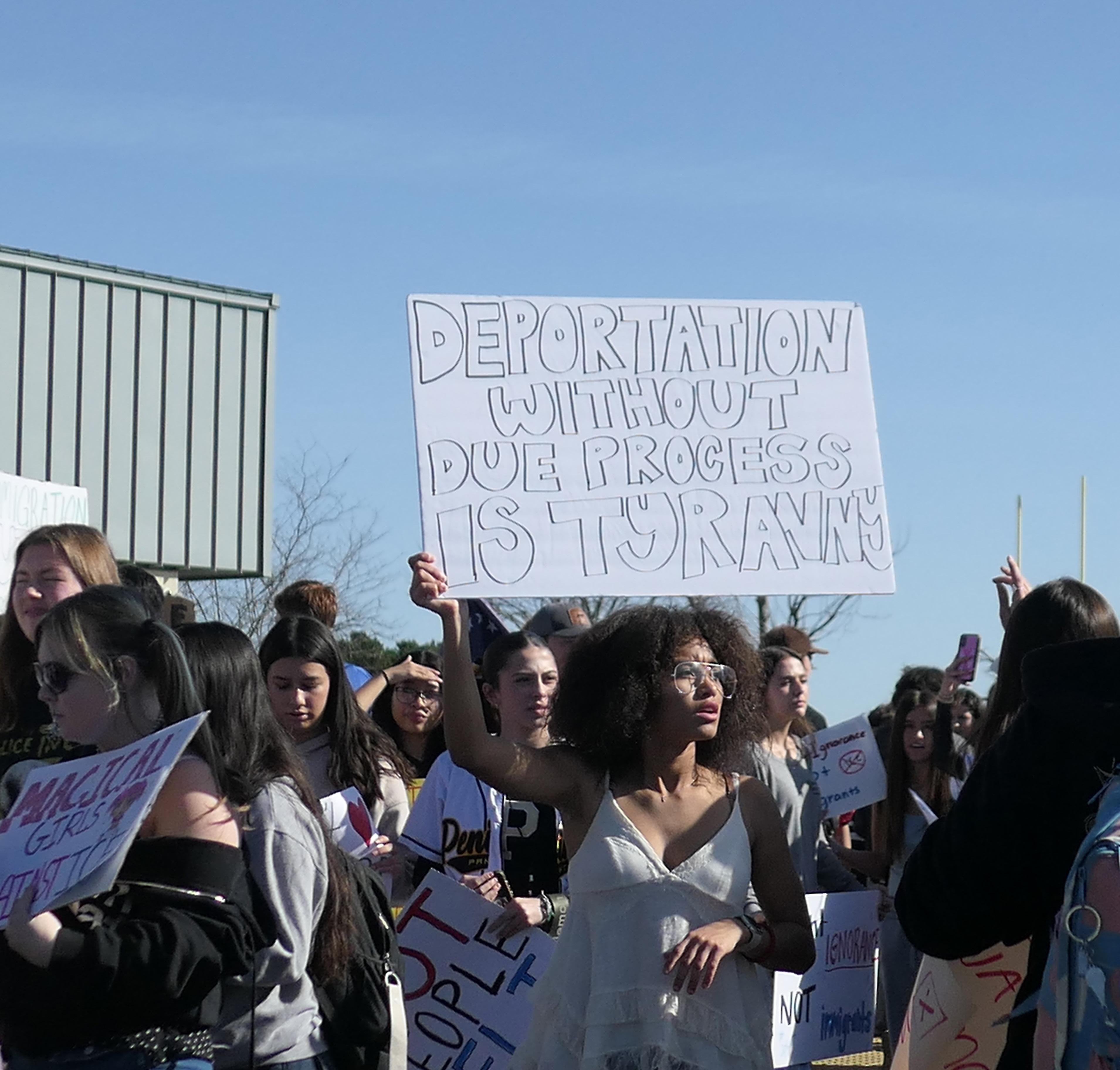
On a bright Friday morning in January, more than 500 Peninsula students streamed on to Silver Spur and Hawthorne, holding colorful signs, wielding megaphones and demanding that their voices be heard. Organized by the student-run, but not school-affiliated, Young Leftists of America (YLA), the Jan. 30 walkout protesting recent Immigration and Customs Enforcement (ICE) actions under the Trump administration became one of the largest student demonstrations Peninsula has seen. The walkout and YLA are both admirable and advocated for a just cause. However, while the demonstration was undeniably powerful in its scale and energy, there has yet to be any tangible change following the walkout. Even so, it remains an impressive feat and highlights an activist spirit in Peninsula’s student body.
Thirty-two people have died in ICE custody in 2025 alone, marking the agency’s deadliest year in over two decades (The Guardian). On Jan. 7, 37-year-old Renee Good was shot and killed by an ICE agent during a Minneapolis enforcement operation, sparking national outrage and intensified criticism of ICE’s use of force (ABC News). In the wake of her death, juniors Alex Wilner, Mayah Singh-Barrett and Nathan Li were inspired to enact change manifested in the form of a coalition called Young Leftists of America (previously named LA Youth Collectivist Coalition and Common Cause Youth). Fueled by a collective anger regarding immigration enforcement tactics, the group began recruiting Peninsula students through flyers posted on campus bulletin boards and social media posts highlighting Good and others killed by ICE.
that Peninsula’s unofficial chapter of Turning Point USA, the conservative campus group founded by Charlie Kirk, was a white supremacist organization and thus should not be permitted on campus. Just two days later, a conversation about immigration enforcement in classrooms and online spaces evolved into plans for a campus-wide walkout. YLA organizer and junior Elise Vu, reflected on how the idea of a walkout came about.
“[Wilner, Singh-Barrett and I] are all in the same APUSH class and we had a conversation about what

policies would apply. Initially, YLA had shared on Instagram that under SB-955 of the California Education Code, any absences due to the walkout would be cleared. However, there were still questions about how exactly this would work. After speaking with YLA organizers, Garrity sent an email to Peninsula students and parents acknowledging that the school was aware of the walkout, followed by another explaining that under SB-955 absences due to participating in a civic or political event would be excused as long as the parent or pupil notified the attendance office ahead of time. YLA organizers were also encouraged to make a separate account on Instagram for the walkout in order to avoid associating closely with YLA’s more radical beliefs.
Although any young person can technically join YLA, the group describes itself as explicitly progressive, leftist and unabashedly radical. YLA officers shared that they feel there is no representation for their true ideological beliefs in today’s government and that existing leftists groups fall short in creating meaningful change. Some members characterized the organization as non-reformist, expressing skepticism that meaningful change could be achieved within existing legal frameworks and emphasizing the importance of disruptive action. Others discussed more traditional approaches, including contacting representatives or creating educational PSAs.
On Jan. 24, the group first gained the larger Peninsula community’s attention with a post claiming
was happening in Minneapolis,” Vu said. “[At one point] we all turned to each other and we all had the same exact thought at the same exact time: we should do a walkout. From there [the idea for thw walkout] spiraled.”
Hoping to build on the momentum generated in class, the group scheduled the demonstration for the end of the week. They would have five days, including that Monday, to plan the walkout. It would be a frenzied, chaotic and nerve-wracking week, but YLA remained steadfast in their plans. Despite this fiery dedication, however, they quickly encountered obstacles in actually organizing the demonstration. With nothing but a date set, the organizers scrambled to spread word about the walkout through social media posts and word of mouth. While all organizers agreed over the necessity of action, a disconnect began to arise between what the organizers wished for the protest and what the school and district expected it to be.
As the day of the walkout grew closer and the student body became increasingly aware of its existence, news quickly spread to school and district administrators. Wilner, in addition to other organizers, spoke to Dr. Kyle Garrity to officially notify him of the walkout and clarify how the attendance
Although the walkout was officially unaffiliated with the school and district, the fact that it was “monitored by school administrators, district officials, counselors, teachers [and] campus security staff” and was “estimated to last approximately one hour” according to emails sent by Garrity on Jan. 28 and Jan. 30, seemed at odds with the inherently disruptive and contrarian nature of a walkout. YLA members had various reactions to this fact. Some felt that the disconnect was simply an issue of semantics; it may be more accurate to call the walkout a demonstration or simply a vehicle for students to express their outrage over the actions of the government. Junior Sophia Muratsuchi, explained that the walkout was a way to bring awareness about ICE’s activity in the U.S..
“I think the goal of the walkout is to, number one, give students an opportunity to practice their right of civil disobedience,” Muratsuchi said. “That feels really good for a lot of students to feel like they are doing something about things that are troubling them. I think a lot of people feel like [they are not] doing enough and there [is] more that [they] should be doing. But, what can I do? I’m 17 and I live in Palos Verdes, in a very privileged area. Hearing [about the walkout] made me feel like there’s something I can actually do. The [second purpose of the walkout] is to bring awareness to the ICE raids and this walk out is part of a national shutdown.”
However, others, such as Wilner, felt that this interpretation of the walkout was a result of the school and district having a more visible presence in it.
“I think when you go [to the walkout], you do it and you come back, it just ends up feeling like a school event,” Wilner said. “I didn’t like that it was school sanctioned at all. That was why I was also
unhappy that the district was alerted in the first place. I don’t think the district should be involved in any capacity, because I think that it does stifle the revolutionary capacity of such a disruptive practice.”
In this sense, Wilner is absolutely correct. The district’s apparent role in the demonstration, whether central or not, did take away from the rebellious nature of a walkout. Further, while the walkout did occur on the same day as the nationwide strike to protest ICE, it is unclear whether this can truly fall under the umbrella of the strike. Since many students returned to their classes after the initial demonstration on silversour Silver Spur, as opposed to actually walking out, and walking and staying out of school. This structured timeline, while logistically necessary, ultimately limited the protest’s ability to function as a sustained disruption. At the same time, school involvement cannot be entirely blamed for the walkout lacking revolutionary ramifications. In order for a protest to be successful, it must have demands. Unfortunately, in the case of the Peninsula walkout, such demands were somewhat unclear. While undoubtedly admirable in action, the promotions leading up to the day were quite vague –perhaps due to the swift nature in which it was organized. Social media posts described the walkout as being for those “Frustrated with the state of American politics and opposed to the federal government
sanctioning domestic terrorism,” but seemed to lack specific goals. While chants such as “ICE out” reflected a clear emotional and political stance, they did not translate into actionable demands, making it difficult to determine what success for the demonstration would look like. As a result, the walkout at times was more focused on expression than on outlining a defined path toward change – which is admirable regardless, but not necessarily indicative of future change. Senior Soha Shah explained her thoughts on this.
“The most important thing [about the walkout] to me is that I want, I hope, that people see this as an outlet for their political frustrations,” Shah said. “It’s very important to me that young people know that their voices matter. That’s ultimately what the walkout is, in terms of the tangible change [that comes from it].”
From this viewpoint, this walkout may be seen as a success. The sheer amount of students and community members that showed up certainly showcased the outrage that so many Americans are feeling. However, when perceiving it as a traditional protest, the real changes it made have yet to be fully realized. Were the shouts heard from Silver Spur enough to soften the frustration and disgust over ICE’s actions? Was the local news outlet’s reporting on the walkout effective in bringing more awareness
to the cause? Does this count as the protest accomplishing what it wanted to? Without concrete demands for the future, it becomes difficult to measure what the walkout ultimately accomplished beyond the moment itself.
This is not to say that the walkout was completely self contained. A similar demonstration, inspired by YLA’s organizing at Peninsula, took place at Palos Verdes High School on Feb. 22. In addition, YLA has said that they are in contact with multiple schools across Southern and Northern California to organize more. They have also expressed interest in taking initiative to create more change such as setting up mutual aid networks across Los Angeles county. Until then, however, we can simply commend the walkout for offering Peninsula students an opportunity to publicly align themselves with a shared political cause and feel solidarity in shared horror over our country’s government. As Vu shared, that holds its own kind of power.
“No matter what you know about the politics of it all and what you feel should be done, I want students to feel like they can speak up,” Vu said. “They can do something. There is action to be taken because when you have [action] in the immediate community, then action actually happens. That affects everyone around us and all the South Bay. Then it gets bigger and bigger and change happens.”
Dear Readers,
Initially we had planned for the theme of this issue to be “Stuck in Place”. It made sense.
There were news stories about the creative atrophy of Hollywood and a sense that many teenagers would never be able to find the part-time jobs that would allow for movie tickets, college funds and new sneakers (page 12). It felt like we were stuck in place, like there was never going to be a way to move forward or become something different. However, on Jan. 30th our resolve changed when over 500 Peninsula students staged a demonstration to protest the actions of ICE. In doing so, they showed that they desired change, that they no longer wanted to be stuck in place. With this in mind, the theme no longer made much sense.
Instead, we hope that rather than languishing over the way things are, this issue helps bring about change, whether it be something as minimal as rejuvenating the tradition of new year resolutions (page 3) or as massive as reconstructing the role private equity plays in our lives (page 9).
We still do not know what change will come from the Jan. 30 walkout, but one thing we know for certain is that as long as young people continue expressing themselves and fighting for things that matter to them, we will never truly be stuck.
Sincerely,
Haylie Kim Sivan Stoler

Editors in Chief

Parisa Bahrami| 11
Booming business and bankruptcy are two sides of the same coin that is private equity, and bankruptcy was exactly the case for companies like Sprinkles Cupcakes. Founded by Candace Nelson and established in 2005, the company was sold to the private equity firm KarpReilly LLC in 2012 after Nelson decided to step away from operating the Sprinkles bakeries. On Dec. 31, 2025, the company abruptly shut down without giving workers proper warning, leaving them bombarded with orders from distraught customers (Los Angeles Times). While this sudden shutdown, and the many like it, may be confusing, understanding the intentions of private equity firms makes them easier for consumers to recognize and to watch out for in the future.
Private equity firms pool capital from investors to buy and gain ownership of a company, improve company sales and eventually sell the company for more than they bought it (Corporate Finance Institute). After these firms gain ownership of the companies, they can no longer be publicly traded or listed on a stock exchange (Morgan Stanley). There are many different kinds of private equity: growth equity invests in com panies that are already stable and have room for improvement, leveraged buyouts allow firms to buy companies through borrowed funds and ven ture capital funds invest in early stage companies with high growth potential (Corporate Finance Institute). While private equity has the ability to improve company performance, it can also pose a high risk of business shutdowns and job losses, as it recently did to Sprinkles Cupcakes, as well as negatively impacting industries like healthcare, food and clothing (Chartered Financial Analyst Institute). The main goal of private equity firms is to acquire stakes of a company, allowing them to enhance performance, profitability and overall value of the company. However, this was not the case with Sprinkles Cupcakes.
Sprinkles Cupcakes originally decided to sell to private equity because ingredient and labor costs were too high for them to afford. However, this decision ended up leading to their demise as private equity firms such as KarpReilly LLC tend to make persistent, profit-driven choices that destroy product quality and can lead to quick, unforeseen shutdowns like that of Sprinkles Cup cakes (Los Angeles Times).
Private equity may not be the best option for profit-starving companies to rely on. In addition to this, economics teacher Allen Aronson shared his opinion on companies’ choices to sell to pri vate equity.
“When companies sell to private equity be cause of the operational improvements that come with it, I’m all for it, but it’s all about the intent [of the private equity firm],” Aronson said. “Brands
[like Sprinkles Cupcakes] may not have known the tactics that the firm would use, and may feel that they made the wrong decision to sell their company to private equity looking back.”
Aronson’s point supports the nuance behind private equity; private equity firms can both benefit and hurt companies with their “get-richquick” strategies. The intent of the firms determines the fate of the companies that are sold to them: profitable success for both the company and the firms, or an inevitable shutdown caused by a firm that overfocused on maximizing profit.
Issues that come with companies owned by private equity are affecting both consumers and workers. For instance, the clothing brand Reformation was known to have high-quality and sustainable products. However, after being sold to a private equity firm called Permira in 2019, customers claimed that the clothing quality at Reformation declined greatly, as prices increased for clothes that were produced with low-quality materials (Vanderbilt Business Review). Junior Lucy Lam described why consumers feel the effects of private equity firms exploiting companies
like anesthesiology, air ambulances and those of hospital-based services are one of the driving factors in the rising cost of health care. Some of these groups rely on aggressive billing strategies in order to maximize profit at the expense of consumers in need of medical attention. Additionally, private equity makes it more difficult for physicians to provide the best care for their patients by limiting the amount of patients they can see a day. Doctors may shorten appointment times to increase patient visits, ultimately in hopes of more profit for private equity firms (AMA Journal of Ethics). Now, the unethical tendencies of private equity are not only affecting the everyday lives of workers and consumers, but are also overcharging people who are actually dealing with emergencies that end up costing them hundreds of thousands of dollars, as well as giving industries like health care an unfavorable reputation in treating patients with less care than they should be (America’s Health Insurance Plans).
Private equity buyouts have increased in recent years, and have already shown the ability to reshape the economy in the United States by

Many people wonder why local Target stores stopped using plastic bags. On Jan. 1, California introduced a law that has placed a ban on plastic bags at store checkouts. The Senate Bill 1053, made it so that stores can only offer recycled paper bags at checkout. Grocery stores, pharmacies, convenience stores, liquor stores and other retailers were affected by this bill. The bill was passed to solve a certain problem in a pre vious bag ban. In 2014, Senate Bill 270, thicker plastic bags were permitted but are rarely recy cled and still end up as waste. Lawmakers and advocates maintained that removing these bags would greatly cut down on plastic waste accumulating in landfills, waterways and the natural environment. As a result, California is working to reduce unnecessary waste, contributing to a more sustainable future for both the environment and future generations.
Over the years, California has put in an effort to protect the environment by reducing plastic waste. In the early 2000s, the concern over plastic waste escalated as studies showed that plastics persist in landfills, waterways and marine ecosystems and harm wildlife. In 2014, California passed Senate Bill 270 which prohibited thin plastic carryout bags and required stores to charge a fee for paper or reusable alternatives. The law was supported by voters and strongly advocated for. Over time, however, a significant loophole occurred. Retail ers began offering thicker plastic bags labeled as “reusable,” which complied with the law, but were rarely reused or recycled. Studies showed that these plastic bags were still being dumped after a singular use and significantly contributed to plastic pollution. Plastic waste continued to increase and Senate Bill 1053 was passed. This was designed to close the loophole and eliminate plastic carryout bags altogether at all grocery store checkouts.
replaced by paper bags. Sophomore Kira Sproat stated that her family has made the shift from using plastic bags to paper bags.
“My family has completely converted by saving our paper bags and demolishing the use of plastic ones,” Sproat said. “Replacing plastic bags with paper bags is great for the environment and is a change that we all need to make. I think it will have a great impact on the environment and reduce
aspect of these bags.
“They are annoying to use because they rip, but what you’re getting is better than what you’re losing,” Sorial said. “Paper bags are helpful for the environment but it’s negatively impacting me. I prefer plastic but I believe that paper is better for the environment because plastic is not biodegradable like paper is.”

the amount of waste. Although paper rips easily, knowing that I am making a conscious effort to help the environment I think paper is better. The landfills are already getting way too full and although paper bags lead to the cutting down of trees, we have more trees than we have room for landfills. I would prefer paper bags.”
Some students think that this law is a step towards the right direction; however, it doesn’t fully address much bigger issues. While using paper bags is a better alternative, students have noted paper bags require more water, trees, and energy to produce. The paper bag “controversy” mirrors the plastic straw bans in the early 2010s. Many states restricted the use of plastic straws in favor of paper straws. The transition from paper to plastic points out the issues of pollution in our environment. Recent environmental policies highlight the growing concern over waste management in modern society. Sophomore Charlise Caoile commented on why this fact makes banning plastic bags a perfectly reasonable choice.
“When I am older, there will be less microplastics in the water and my family and I will be able to have more drinkable, healthy water,” Caoile said.
“Plastic has only been beneficial for a very short period of time before it started ruining and damaging our planet.”
Replacing plastic bags with paper bags at every store in California doesn’t completely solve the problem of pollution but it is a step in the right direction. Supporters argue that the environmental benefits and potential long-term reduction in plastic pollution may outweigh the drawbacks, noting that efforts to limit excessive plastic use could have positive effects on oceans and wildlife
Students mentioned having to convert their entire households from plastic to paper. As plastic bags have been a staple in American households for many years, the transition to paper has been an inconvenience. One student in particular has expressed her opinion on plastic bags being
Jiayu Tang
The introduction of paper bags has students questioning the durability of these bags. Some students have expressed that while knowing that paper bags are good for the environment, they are annoying to use. Plastic bags have been used for so long that people have grown accustomed to their toughness that paper bags lack. With this in mind, junior Jacob Sorial pointed out a negative
Replacing plastic bags with paper bags is great for the environment and is a change that we all need to make. “ “
-Kira Sproat | 10
Sophia Shen| 9
Strike! With bowling pins rattling and arcade games beeping, Level Up Bowl & Bistro, a new bowling entertainment venue in the Palos Verdes Promenade, has become a major hit for teenagers and families alike. Level Up opened on Dec. 22, 2025 as a high-tech alternative to a traditional bowling alley with digital scoreboards, glow-in-the-dark bowling balls and upbeat music playing throughout the alley. As the Peninsula Promenade continues to be revitalized in recent years, with new attractions Photos and an expand selection of restaurants, boba shops and coffee spots, businesses like Level Up are trying to bring an innovative edge to a classic game. Level Up staff member Mandy Rodriguez, expressed her thoughts on why Level Up opened.
“I think [Level Up] opened in the first place because over the years, the Promenade has been less populated, so we wanted families to come back and bring something to Palos Verdes that it hasn’t had in a while,” Rodriguez said. “This is a place where people of all ages can come together, spend time with one another and enjoy a fun, welcoming environment. We hope it helps bring new energy to the area and becomes a spot the community can truly enjoy.”
Rodriguez’s perspective makes sense because several stores in the Promenade have gone bankrupt and more than five have closed down (Palos Verdes Pulse). Since then, the Promenade
has lost a lot of visitors each year (Palos Verdes Pulse). Level Up Bowl & Bistro is determined to change that by giving families and teens something new to enjoy. Along with other successful openings, such as new restaurants and the

throughout the facility, with sleek lane designs, digital scoring systems, large screen displays and vibrant LED lighting that adds a fun atmosphere without making the space too overwhelming.
Despite offering modern technology and updated amenities, Level Up remains more affordable than many traditional bowling alleys. For example, bowling at locations such as Lucky Strike Bowling in Torrance costs about $54, while Level Up Bowl & Bistro which uses high tech charges only $6 more making it a more affordable place.
Because of its affordable prices and variety of features, Level Up Bowl and Bistro has already become a local favorite with a 5.0 star review on Yelp. Claire Aguilar, a repeat Level Up customer who was interviewed while at Level Up, expressed her opinion.
“Level Up Bowl and Bistro is a fantastic place,” Aguilar said. “I think it is very family friendly and it is not dark and dreary at all. It gives a lively and energetic atmosphere. I also think the cleanliness of this place is incomparable to other places. It uses modern technology so it adds less mess to the place which makes the overall experience very enjoyable.”
Now, Level Up is actively working to enhance the overall customer experience and create a more memorable destination.
Aaron Fearnley, another Level Up staff member, stated his feelings on the opening of this new place and the changes it could bring.
“I think what makes this place special is the high tech used here. Because we have really cool digital effects on the screens, it is unlike any other bowling alley,” Fearnley said. “We hope that with the opening of this place, many people will come in, build connections with the people they bring and help revive the Promenade.”

After submitting job application after job application, many Peninsula students begin to wonder if their effort still matters. Seeking employment has become an increasingly difficult challenge for most teenagers, because after showing genuine willingness to put in the work, they are mostly met with silence. They are encouraged to be responsible and put in effort for what they want, but today’s job market seems to be rejecting and ghosting teens who apply for any job (The Pitch). For those who do manage to get hired, their jobs often come from personal connections, such as family or friends who are business owners. Businesses are not replying to teen applicants, and instead handing the job out to adults (The Suffolk Journal). This has created a discouraging and unfair environment for young people. Senior Taylor Wickett explained her experience as a young adult applying for jobs.
“I have applied for [three jobs] and did not hear back from all three,” Wickett said. “I tried applying again and still never heard back and honestly it made me feel insecure and dumb as a teenager. If I was an adult I would have heard back, even though I have the qualifications for working. I’ve worked as a counselor in training at a surf camp which gave me experience for my current job at a swim school. I also am a Link Crew commissioner which helps a lot for jobs
the manager or it being their own company they work at. In this way, even teenagers who are qualified for a given job are at a disadvantage if the adults in their lives do not have a way for them to get a job. Job opportunities have become a question of who has the most familial connections rather than selecting the most qualified candidate. Some argue that since, in an ever-worsening economy, adults rely on parttime jobs to help support themselves and their families, and thus it makes sense for teenagers to get these jobs. Although that is true, it could be seen as completely excluding teens from an opportunity to work. Though, some employers may view older workers as a safer choice, especially in positions where larger responsibility is required. Senior Maya Palinkas had struggled to find a job before her sister recommended her to her former boss. Prior to her ability to get hired at poke me, she applied for a job at Petco, handles, and a few little shops but got ignored each time. Her sister reached out and asked if the restaruant where she once worked had any availability because Palinkas was looking for a job, and two months later, they asked Palinkas if she could sit down with them for an interview. She was hired quickly after that even though they had not asked for her resume.
“For me, a resume was not necessary because they knew my sister, my mom, and the kind of person I was from my interview,” Palinkas said.
applied for the job, result in giving it to someone else instead. Everyone has to start somewhere and gain experience, knowledge and social skills, but without access to that, it can result in teens being unprepared for their future. When opportunities to build skills and independence are taken away from people due to superiority or connections they don’t have, the lack of experience can follow students into adulthood. Without the knowledge earlier on, it could result in a harder competition for future jobs. Even if some teens are not looking to gain experience, they are still working for a responsibility that can not be found without a day job (Forbes). By earning money, they can support themselves financially without having to rely on anyone else. This lack of communication can be discouraging and can cause students to feel lesser and invisible. Senior Sasha Fox touches on the importance of getting a job as a teen.
“Jobs are put on future resumes and college applications, so [not having a job] could affect whether or not they get into a certain college or if they get a job in the future that is vital to their career,” Fox said. “It is very important people get early work experience because they would get to work with actual leaders and managers. They can build connections and experience through work and have the ability to learn to [adapt] to a different structure that they are not used to.”
The struggle PVPHS students face in finding jobs reflects a much larger issue in this economy,

Ingu Batyerruel | 10
The library is home to books, computers and students studying, but recently it became home to something a bit more feathered. Between textbooks and novels, a tiny, fluffy chick was born after an egg, bought from eBay by a student, was brought into the school library in order to be a small educational project for students. The goal was to create a hands-on experience with the opportunity to learn about responsibility, animal care and life cycles. The egg was placed in a warm glass case, with student volunteers and staff working hard to monitor it and ensure that the egg was stored at the perfect temperature in order to
was held to name the chick, ultimately resulting in the name Dr. Omelette Eggleston. Library aide Leslie White described students’ reaction after the chick had finally hatched.
“I have never imagined that we would have our very own chicken in the library,” White said. “We ordered four eggs from Ebay with the purpose of reaching more student engagement. Only one hatched and that was Dr. Eggleston. We get a lot more kids coming in daily to see how the chicken is doing. He brings joy.”
As the news of Dr. Eggleston’s hatching spread, students rushed to the library to see the new resident. He immediately fit right into life in the library, chirping and curling up near the glass of the cage, welcoming any passing student or staff member that offered him a pet or a treat. Dr. Eggleston is cared for by the librarians, who make sure to feed and check up on him throughout the school day and at night he is taken back to the house of a student who bought the eggs in the very beginning. With Dr. Eggleston in the library, students often hear chirps and a steady stream of peeps while they are studying, reading or playing games in the library’s group work space. Sophomore Isabel Tsai, who often visits Dr. Eggleston in the library, shared her reaction when she first saw

“I was curious and wondering why there was a live chicken in the library, but I think it’s very cute,” Tsai said. “It’s interesting how [the chicken’s] presence in the library helps many students to relax and take a break from the
As Tsai implied, Dr. Eggleston has become
so much more than just a chicken, he has become a symbol of community who brings students together through each visit. Students worked together to raise Dr. Eggleston, learning valuable lessons of cooperation. He showed that, in addition to textbooks, learning comes from caring for others, in this case a library chicken. As Dr. Eggleston spent more time in the library, students bonded and created memories that will last well beyond their day to day classes. His presence provided a new and different type of learning by allowing students to interact with things they normally would not. Sophomore Rylie Liu who often visits the library, shared her experience watching Dr. Eggleston grow.
“I have never seen a chicken in real life before,” Liu said. “It shocked me how fast it grew. It was honestly very impactful for me, especially for biology. Watching a living creature evolve was fun.”
Dr. Eggleston’s time in the library came with a lesson and a lot of fun that left memories beyond the book shelves. What started as a way to teach students responsibility, turned into a story that connected everyone involved in Dr. Eggleston’s journey. Even when Dr. Eggleston eventually leaves the library and goes on to live at the student’s house, students will always remember the time when it was home to the welcoming chicken. Not every school can say that it raised a chicken in their library. The fact that Peninsula can certainly makes Peninsula’s library pretty egg-cellent!


While most students used their winter break to relax, a group of seven students spent their break working on producing videos for a new project at Peninsula: “Inside the Zoo”. “Inside the Zoo” is a student run broadcast that covers the “four A’s”: athletics, academics, activities and arts, with the intention of highlighting different events at the school, especially ones that do not get recognized as much. “Inside the Zoo” is heavily inspired by the previous Peninsula broadcast program, “Eye of the Panther” that ran from 2007 to 2020, similarly covering events in depth that are happening at Peninsula such as Willenburg, pep rallies and student achievements. While not yet confirmed, “Inside the Zoo” is projected to be a class students can take next year where they can receive class credit. The broadcast is released biweekly on YouTube and is meant to be shown during third or fourth period.
If we can engage with one person who was not engaged with the school before, I think we have done our job. “ “
-DJ Clovis | “Inside the Zoo” Adviser
The development of “Inside the Zoo” first rooted last spring when athletic director Dr. DJ Clovis suggested the idea of creating a program that highlighted the students, staff and events
at Peninsula to seniors Kiyan Khaleeli and Caroline Fiamengo. After watching an elementary school broadcast program called “TK2 News” directed by Ricky Koga, they were motivated to start “Inside the Zoo”. In October, Clovis initiated the process of creating the program and held a meeting, asking students that he has worked with from the Athletic Advisory Committee to bring friends who were interested in joining. The small group of students who attended the meeting established the groundwork of the broadcast by developing the structure and advertisement for the episodes before releasing the first one. While “Inside the Zoo” is still in its initial phases, Fiamengo described how the program is already a special aspect of Peninsula.
“I think the biggest difference is that we call ourselves a broadcasting program just as a title, but our main goal is to highlight parts of Peninsula in an exciting way,” Fiamengo said. “How I described ‘Inside the Zoo’ to new people joining [is that it is like] taking the Peninsula Instagram and mixing it with the Daily Bulletin in a fun way to watch. We really just wanted to focus on things happening at school and showcasing student stories and their passions.”
Unlike the text-based Daily Bulletin or the Panther View and the static posts of the Peninsula Instagram, “Inside the Zoo” presents information through video in order to keep students engaged. Rather than simply listing dates and brief descriptions of multiple events, “Inside the Zoo” makes a few detailed segments describing the events and featuring students. In order to keep students engaged, it also features athletes and peers participating in short games or challenge segments. Despite these clips only being a few minutes long, they are only possible due to hours worth of production. Just as they worked throughout their winter break, students involved with “Inside the Zoo” give up many Panther Times and lunches to plan, film and edit new episodes.
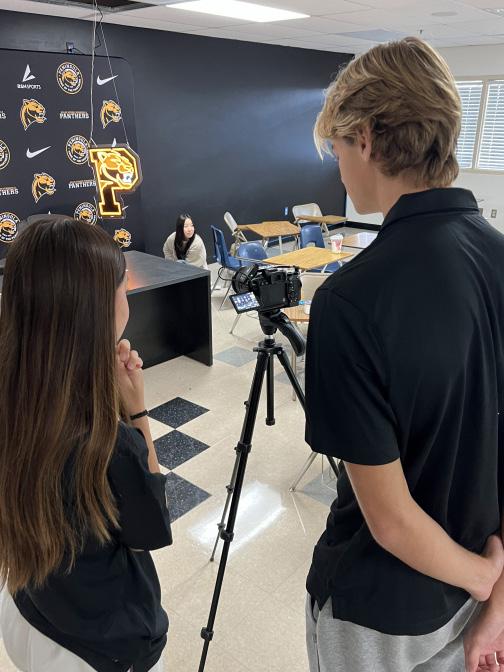
originally was an empty classroom given to Clovis. The producers transformed the bare classroom to a lively filming room with light fixtures, backdrops and a teleprompter for the hosts. Originally starting with seven people, the “Inside the Zoo” team has now expanded to 32 people divided into six groups including the on-camera crew, film, communications, marketing, scriptwriters and graphic design teams to spread out the work, produce videos faster and bring forward more new creative ideas. Sproat described how the team’s growth has impacted “Inside the Zoo”.

Before each episode, the team must decide which of the many school events they will cover. The team brainstorms what they want to include in each video on a shared Google document, writing down the various current events at school. Then, the directors and Clovis pick one event for each category – athletics, academics, activities or arts – based on which ones seem most engaging for students and need more coverage. The entire production process for a video takes about two weeks: one week for planning and another for filming and editing. Filming for the hosts, sophomore Kira Sproat and senior Benson Webster, takes place in room 205 and other footage taken outside the room is filmed by the on-camera team. The “Inside the Zoo” filming room
“We have a lot more time now because there are other people working on [the broadcast], and it has become more inclusive and collaborative,” Sproat said. “We work better together because there are so many people in the room with so many different ideas. It has also created a bigger community and an environment that [‘Inside the Zoo’] is becoming a real thing. The whole point of ‘Inside the Zoo’ is to highlight that anyone can be a part of anything.”
As they continue to learn about video broadcasting and release more episodes, Khaleel and Flamengo’s aim to create an impactful broadcast program that can continue for years after they graduate. Expanding on this, Clovis described the purpose of “Inside the Zoo” and the message they wanted to send out.
‘Inside the Zoo’ is a way for students, parents, alumni and community members to see what we are doing here at Pen,” Clovis said. “We do a lot of fun, different things. The kids here are so gracious, thoughtful and kind, so let us show that. We all have our merit, we all have our place and if we can engage with one person who was not engaged with the school before, I think we have done our job.”
Nine years, five seasons and intricate storylines have all led up to the recent conclusion of Netflix’s hit show “Stranger Things” – written, directed and produced by twin filmmakers Matt and Ross Duffer. Beginning on Nov. 26, 2025, multi-episode installments of the new season were released up until its seventh episode on Christmas Day. Then, the season’s finale was released on New Year’s Eve. Over the years, “Stranger Things” has remained an enormously popular series, gathering over 1.2 billion views across all five seasons for numerous reasons (Variety). Whether it is the small-town, cozy mystery style that intrigues viewers or the gleaming nostalgia of the 80s, “Stranger Things” has undoubtedly become a pop culture cornerstone over the past decade.
From a quiet town in Indiana, to another dimension known as the “Upside Down”, “Stranger Things” has explored various locations, characters and stories. The narrative begins with a group of nerdy, outcast middle schoolers who, after their friend Will Byers goes missing, finds a young girl, named Eleven. It is revealed that she was escaping from the corrupt Department of Energy which houses a mysterious gate to a dimension of ominous creatures. As the series progressed, audiences see these characters explore, advance and uncover the mysteries surrounding Eleven and the “Upside Down”. The uncanny, faceless monster known as a “demogorgan” introduced in season one, would soon lead to a web of obscure creatures being introduced. The two most recent seasons, four and five, introduced the main antagonist of the series, Vecna. Although terrifying in the fourth season with a molten face and obscured voice, his intimidating presence began to wane this past season due to a lack of character deaths by his hands to how quickly he was defeated in the final battle. This is just one of the many instances of this season paling in comparison to its predecessors that actually captured the charming, ‘80s coming of age movie style.
Not only has there been a shift in genre that seems modernized, physically actors appear more
been changes in the quality of performances. In the latest season, viewers have noticed a significant growth spurt within the actors, straying away from the characters’ in-show ages. The series ends with the many of the main characters graduating high school while the cast remains in their early 20s with noticeable changes in their appearance. Actress Millie Bobby Brown has been criticized for noticeable cosmetic enhancements which fans claim to have obstructed her most recent performance in season five, hindering facial expressions. Another former child actor, Noah Schnapp, has been criticized for his decline in portraying a range of emotion. From once showcasing an impressive range of skills, to monotone performances that fall flat, fans are disappointed. Choices in writing and the plot also affected the quality of the show. Protagonist Mike Wheeler’s little sister Holly becomes the focus of the children’ s storyline despite being an extremely minimal character in the first four seasons. Due to this drastic change, audiences lacked enough time to truly connect with the character, making her plot feel flat and detached. Sophomore Sebastian Sugeti shares his thoughts on this topic.
“Honestly I didn’t have too many gripes about [Holly Wheeler] being super important because [the actress] did okay and I liked the Vecna backstory and the Mr.Whatsit stuff. It helped seeing that he was not totally evil,” Sugeti said. “In season four, his only motivation being that El attacked him, even though he was killing everybody.”
The inconsistencies and weaknesses in the story led to fans debating whether the Duffer Brothers were even competent writers in the first place. Over the course of getting to know the complex and fantastical world of “Stranger Things”, we have been introduced to various creatures such as, Demogorgons, Demobats, Demodogs, The Spider Monster, sentient vines and flesh. Despite the abundance of creatures, the final battle took place in the “Abyss” with only the entity controlling the hivemind of monsters known as The Mind Flayer and Vecna. For a final battle, it was lackluster and very rushed, lasting around just six minutes. Other inconsistencies, such as mistakes in plot information and mischar-
acterizations of the main group, led to the creation of a popular theory made by fans across social media platforms nicknamed “Conformity Gate”. This viral fan theory comes from the idea that the events of season five’s finale, is a false perception created by Vecna and a real finale would be released on January 7th with a ninth episode. Senior Dakota Pfligder shared his thoughts on this wild fan theory.
“Although the theory is incredibly well put together, I don’t think it’s true,” Pflidger said. “I think it says a lot that if a finale is so unsatisfying, audiences feel the need to come up with an alternate ending. Sometimes I read fan theories online and they’re more interesting than actual plot points in the show.”
“Conformity Gate” was elaborately planned out by fans - showing off the dedication audiences have to fulfilling and satisfying endings, however was highly unlikely from the start. As “Conformity Gate” has proven to be false with no surprise release of an episode, fans are left with the ambiguous final minutes of “Stranger Things”, leaving Eleven’s fate up to interpretation. While some may deem this narrative as pandering, the impact of this final scene adds to the discourse necessary for television shows. Many fans, alongside the teenage characters, choose to believe that El is still alive. Yet, the hopeful outcome is not shared by everyone. Senior Diego Hollerbach stated his opinion on this heated matter of discussion.
“I find it difficult to believe that the sister [Kali] survived through the gunshot wounds for an hour and held the blood in while passed out,” Hollerbach said. “Personally I don’t know or care if she’s still alive because the show’s over.”
Filled by the hope that the once beloved show would integrate interesting, witty and mindboggling twists, audiences were left largely disappointed by the season’s poor writing that impacted the dialogue, characterization and plot inconsistencies. The fifth season felt like a parody of the previous more engaging ones, as it had predictable writing and bad pacing. Despite this, the series’ legacy of nostalgia and magic will remain in people’s hearts for decades. Ultimately, the show’s earlier success ensures that its cultural impact and emotinal resonance will endure far beyond its imperfect conclusion.

After a three year hiatus, the latest and highly anticipated movie in the “Avatar” franchise, “Avatar: Fire and Ash” has finally been released. Directed by Canadian filmmaker James Cameron, the movie has an interminable running time of three hours and features the return of popular actors Zoe Saldana as Neytiri and Sam Worthington as Jake Sully. So far, the film has been a hit in the box office, garnering over one billion dollars in just 18 days (The Hollywood Reporter). However, the action-packed storyline always makes up for the running time of the film. “Avatar: Fire and Ash” has the longest running time than any of the other movies in the trilogy, three hours and 15-17 minutes. The plotline is overwhelming as expected in addition to the improvement in the technical softwares that make up the movie with excellent features, no use of artificial intelligence at all and the Spider subplot was a nice addition to the movie even though it’s mainly defined as a filler.
“Avatar” is centered around the idea that due to Earth’s overpopulation, humans wanted to invade Pandora, a planet containing an abundance of rich materials that could be used to improve life on Earth. In order to successfully invade this planet, the military created technology that allows soldiers to take on “avatars”, disguising themselves as the Nav’i (the tall, blue aliens who occupy Pandora). The main character of the first movie, Jake Sully, is a former marine who does not have the capability to walk due to sustaining a spiny injury in combat. Along with his other colleagues, he infiltrates Pandora in his avatar disguise but falls in love with a fierce Nav’i warrior, Neytiri. This causes Sully to rebel against his military commander, Colonel Miles Quaritch, and ultimately choose to remain in Pandora indefinitely.
In the most recent movie, Sully and Neytiri have three biological children and one adopted child, Spider. While coping over the loss of their oldest son, they encounter a new Nav’i tribe, the Ash People. This tribe becomes the main antagonists of the film. While fighting with the Ash People, The Nav’i must also work against the Resource Development Administration’s advances (RDA), an organization run by humans with a goal to exploit Pandora’s resources. Although the film included amazing CGI and stunning performances by these returning actors, its prolonged running time is tedious to sit through. The long run-times have also discouraged many first-time watchers from watching the franchise, highlighting a way that they are detrimental to the franchise (Quora). However, junior Kaori Figueroa explained the merits of longer films.
‘Avatar’ and am used to excruciatingly long movies. I believe that many people [get discouraged] by the long running time is because ‘Avatar’ has overwhelming plotlines and sometimes people can get annoyed having to intake so much information. It really depends on the person, but there’s a lot of quick analysis videos on Youtube that break down the plotlines easily.”
In “Avatar: The Way of Water”, the story introduces Spider, and his life growing up surrounded by the Nav’i. He received criticism from the fandom for acting as a largely out-of-place theatrical element to the story, especially as many had not anticipated his return in the latest movie. Despite this, Spider’s
Neytiri was justified for trying to kill Spider.”
Zoe Saldanas did an amazing job as Neytiri, perfectly capturing the anger of a mother through the screen, even with the Computer Generated Imagery (CGI) applied to her body. Acting while using CGI can be an awkward and difficult experience as the actors must be wearing special types of suits or headgear in order to transfer their movements fluently to the artists who create the appearances. The tools had to be reviewed daily to make sure there were no errors or glitches (Entertainment Weekly). Even through the difficulties of CGI performance, Saldana’s performance is remarkable during her battle against the leader of the Ash people, Varang/ The fighting choreography flowed so smoothly and Saldana was completely in the moment. Viewers could not see any mistakes with the applied CGI.

“Avatar: Fire and Ash” Poster, from Lightstrom Entertainment and 20th Century Studios | Cropped from Original
subplot was generally enjoyed by a lot of the viewers even though the director feared that it was a filler in the movie. It is surprising that the director thought Spider’s subplot would crash and burn even though he made Spider a likeable character. And yet for being a filler, the subplot is quite enjoyable to watch. Sophomore Aadya Kasiredy agreed with the statement.
What added onto the appeal of “Avatar: Fire and Ash” was the nonexistent use of artificial intelligence (AI) in the making of the film, which many fans were grateful for. Hearing this news is like a breath of fresh air and a huge relief. In an age where AI is starting to infect almost all creative, humanistic pursuits, it is refreshing to see a movie that so easily could have relied on it using the arduous process of CGI. Choosing to use CGI instead of AI was not just a moral decision on the part of “Fire and Ash”’s filmmakers, though. While AI videos can often appear uncanny and include mistakes, using CGI ensures that every movement has been double checked by human eyes, allowing the film to require capturing the right shots, expertly animate movement, transferring movement to animation and design teams. It is commendable that the director didn’t go down the “easy” route of using AI, and instead relied on human creativity which is the very base of what makes being human so beautiful. Sophomore Malia Hanada expressed her appreciation with how well the movie was put together without the usage of AI.
“The CGI was on point and it’s refreshing to get away from AI slop,” Hanada said. “I haven’t really seen AI used in movies but I’ve heard that they will start to initiate that into the film industry, which is heart breaking. I’m [satisfied] that the director of ‘Avatar’ didn’t go that route.”
“Yes, the movies are extremely long, but I wouldn’t say ridiculously long [even though some fans] would say so,” Figueroa said. “I grew up with
Edited by Elena Thomas |
“I liked Spiders subplot; it wasn’t anything groundbreaking but it reinforced the theme of family. Though it was [obvious] how things would turn out and it was an already [packed] movie. I do think that it was overall important for the plot to move forward and see his side of things and to sympathize with him and root for him to be with the rest of the family,” Kasiredy said. “However, I do not believe
The ending to “Avatar: Fire and Ash” was enjoyable and beautifully satisfying. With “Avatar”’s improvement over the year with CGI and storyline, beginning the latest film with a bland plotline would have destroyed how well the story has developed over the past seven years. When this is combined with Cameron’s masterful use of CGI specialists to truly make the story come to life keeping the complicated plotline afloat and Saldona’s powerful performances, “Fire and Ash” marks itself as a triumph within the “Avatar” franchise.
Alissa Luna |
The Peninsula girls’ soccer team turned this past winter break into a celebration when they were named the champions of the 2025 Pirate Cup Tournament, an annual tournament hosted in the SoCal area. The games took place at the high schools that participated in the tournament. Coached by Allie Ruvalcaba and Magali Blazevic, the team played four games, in which they won all four. The first game was against King Drew Magnet High School on Dec. 26. Thanks to goals scored by senior Nala Baker, sophomore Charlise Caoli, junior Kaili Nishikawa and senior Arlette Ocampo, the team won this game with a final score of 5-0. This game would set off Peninsula’s winning streak. Baker shared her view on how this first victory encouraged the team for the rest of the tournament.
“Winning 5-0 [and] getting those two goals, it was really exciting,” Baker said. “I was really proud of myself and our team. It got our spirits up high. I think it definitely drove our confidence up for the rest of [the tournament].”
Following the victory, spirits were high for their next game against Lakewood High School. This game was much closer than the one against King Drew High School, ending with a final score of 1-0 thanks to a goal from junior Kealani Vega. Due to this win, Peninsula was able to progress through the tournament, subsequently competing against Banning High School on
Dec. 29. This game was more tense than the previous one as no goals were scored by either team until after halftime. Despite the absence of many players due to vacation and illness, the girls were determined to persevere. However, the team stayed optimistic for the finals. Freshman Lara Adoric scored the winning goal, once again achieving a final score of 1-0. Ruvalcaba reflected on how the team worked through these difficult challenges.
“We had a limited roster during winter

break,” Ruvalcaba said. “So I think what kept us going [were] the players working hard for each other and staying focused on their job on the soccer field.”
In spite of their dwindling numbers, the team
In May of 2025, it was announced that longtime Peninsula boys and girls varsity tennis head coach, Mike Hoeger would be retiring. Hoeger served as a coach for both the boys and girls varsity team for 23 years before deciding to step down at the conclusion of the boys’ 2024-25 season. The change saddened many returning players, who would be entering the new season without the stability and guidance of their longtime coach. However, much to the surprise of individuals in the Peninsula tennis community, Hoeger decided to come out of retirement just a few months later to return as the boys varsity head coach. However, he remained involved in supporting the girls throughout this past season. Varsity girls tennis player senior Emma Gonzalez shared how her experiences with Hoeger have shaped who she is as a player.
“He was a very passionate and understanding
leader who we all felt comfortable going to whenever we needed him,” Gonzalez said. “Even for things that are not tennis related he was always there for us for whatever we needed of him. Since he’s been in the game for so long he really knows how to organize everything and has definitely been a big part in maintaining our structure and organization as a team this past season.”
Hoeger has tremendous success and longevity as the boys and girls varsity in his 23 year tenure with the program, although Hoeger has not come back as a head coach for the girls’ varsity team, he has fully returned to his previous longtime role as head coach of the boys varsity team. Boys varsity tennis player
Junior Evan Chien reflected on his feelings regarding Coach Hoeger’s return to the court.
“When I found out he was making a comeback I had some mixed reactions, to be honest,” Chien said. “I was excited, but also shocked that he was coming back. Coach Hoeger just has a ton of experience, so
was still determined to win the tournament. In the final game, Peninsula competed against La Selle High School in a heated finale. Once again the winning goal was not made until near the end of the game, which gave anxiety to the girls. The team was victorious once again with a final score of 1-0. The goal was scored by the soccer captain, Ocampo. In addition to this impressive achievement, the team had no goals scored against them throughout the entire Pirate Cup. After the team returned to Peninsula with a new Pirate Cup trophy, they celebrated the huge victory. Ocampo reflected on how she felt winning the tournament.
“It felt really good to win because I’m a senior, so it’s my last time doing this tournament,” Ocampo said. “I get to do it with a bunch of the girls on the team, who I’m very close with. I think it feels really good [to win], especially because that was my goal.”
Overall, the Peninsula girls’ soccer team had a successful winter break. Throughout four games at the Pirate Cup, they remained undefeated with no goals scored against them. Despite the challenges, the team always remained focused on the field. Their excellent performance earned them the title of the 2025 Pirate Cup Champions. It signifies that the team will continue to succeed.
he knows his opponents and their own tendencies very well.”
Hoeger mentioned that the various commitments and rigorous schedule that came with his role left him feeling “stretched thin,” a challenge he attributes to his initial decision to retire. Despite factors like these that made him step away, he pointed out that he has no second thoughts about returning this season. In particular, he felt a strong responsibility to continue guiding this year’s senior class — a group he has coached and supported throughout all four years of their high school careers — which ultimately became one of the primary factors in his decision to come back. Fully devoted to continuing his role, he had some things to say about his team.
“Some teams you have to work harder at team building because it seems like a bunch of individuals,” Hoeger said. “But with 7 starters returning after a CIF top 4 finishes, I believe they are all about the tennis team.”