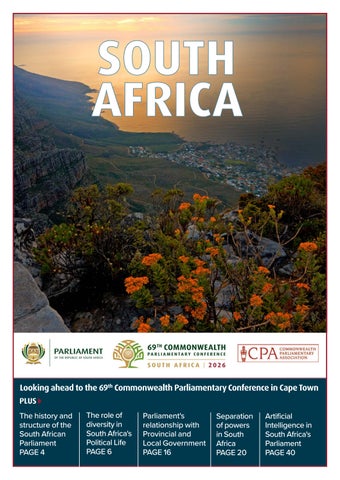
SOUTH AFRICA
Looking ahead to the 69th Commonwealth Parliamentary Conference in Cape Town PLUS The history and structure of the South African Parliament PAGE 4
The role of diversity in South Africa's Political Life PAGE 6
Parliament's relationship with Provincial and Local Government PAGE 16
Separation of powers in South Africa PAGE 20
Artificial Intelligence in South Africa's Parliament PAGE 40
69th COMMONWEALTH PARLIAMENTARY CONFERENCE CAPE TOWN, SOUTH AFRICA 13 to 19 September 2026 (inclusive of arrival dates)
Image credit: Shutterstock_2388251379_credit_Sunshine_Seeds.
CONFERENCE THEME: ‘STRENGTHENING INTERNATIONAL LAW AND PARLIAMENTARY DEMOCRACY IN A CHANGING WORLD ORDER: COMMONWEALTH LEADERSHIP'
Ū One of the largest annual gatherings of Commonwealth Parliamentarians. Hosted by the Parliament of South Africa and the CPA South Africa Branch. Ū Over 500 Parliamentarians, parliamentary staff and decision-makers from across the Commonwealth for this unique conference and networking opportunity. Ū CPA’s global membership addressing the critical issues facing today’s modern Parliaments and Legislatures. Ū Benefit from professional development, supportive learning and the sharing of best practice with colleagues from Commonwealth Parliaments together with the participation of leading international organisations. During the 69th Commonwealth Parliamentary Conference, there will also be several additional conferences and meetings including: 42nd CPA Small Branches Conference; 10th Commonwealth Women Parliamentarians (CWP) Conference; meetings of the Commonwealth Parliamentarians with Disabilities (CPwD) network; 2026 CPA General Assembly and debate; meetings of the CPA Executive Committee; presentation of the 2026 Commonwealth Parliamentarian of the Year awards; the 4th Lifaka Lecture; and the 60th Society-of-Clerks-at-theTable (SoCATT) meeting. At the 69th CPC, six learning and development workshops will be held during the main Conference plus a Youth Roundtable with four addtional workshops during the CPA Small Branches Conference and four additional workshops during the Commonwealth Women Parliamentarians Conference.
Visit the 69th CPC Hub for more information - www.cpahq.org/69-cpc or email cpc@cpahq.org. Commonwealth Parliamentary Association (CPA) | Email: hq.sec@cpahq.org | Tel: +44 (0)20 7799 1460 www.cpahq.org | Twitter @CPA_Secretariat | Facebook.com/CPAHQ | Instagram @cpa_secretariat | LinkedIn | Flickr
The Parliamentarian: South Africa Profile 2026: ISSUE THREE CPC SUPPLEMENT
CONTENTS
South Africa: Host of 69th Commonwealth Parliamentary Conference (CPC) Significance of the Pan-African Agenda
Parliaments in the CPA Africa Region
Page 2
Page 28
Recreating the Present and Future of the Commonwealth
South Africa, Botswana and Kenya
From colonial rule to constitutional democracy
From charity to International Organisation
The history and structure of the South African Parliament
A new beginning for the CPA
Page 4
Page 30
The role of diversity in South Africa's Political Life
Enforcing Accountability and the Budget Process
The Government of National Unity as a Strategic Mechanism for Strengthening Constitutional Democracy
Page 7
The South African experience
Page 33
When Coalitions Collide
The role of the South African Parliament in the development of legislation
Page 10
Page 35
Strengthening the Democratic Compact
Charting the transition in South Africa’s Constitution since 1994 and the relationship between Parliament and the President
Lessons for Parliament from South Africa’s Budget 2025
How the Parliament of South Africa reaches out to its citizens
Page 12
Beyond a Senate: the unique role of the NCOP Examining the role of the National Council of Provinces
Page 14
Three Spheres, One Constitutional System
The South Africa Parliament's relationship with Provincial and Local Government
How legislation in created in South Africa
How has this affected the legislative process and the relationship between the Executive and the Legislature?
Page 38
The use of Artificial Intelligence in Parliaments South African case study
Page 40
Page 16
Advancing Gender Equality in Parliaments
Advancing South Africa’s democratic values through parliamentary diplomacy
Page 43
The role of Parliamentarians in addressing global challenges
Page 18
Separation of powers, parliamentary accountability and the Commonwealth Latimer House Principles Reflections on South Africa
The experience of the South African Parliamentary Women and Gender Rights Forum (WGRF)
Strengthening Parliamentary Oversight of Climate Finance South Africa's Just Energy Transition Investment Plan
Page 46
Extracts from the CPA Archives
Exploring the history of South Africa’s involvement with the Commonwealth Parliamentary Association
Page 20
Strengthening inclusive democracy in South Africa
Page 49
The role of Parliament in advancing the rights of women, young people and persons with disabilities
A new era of remembrance
The role of municipalities in responding to climate change
Page 52
Page 23
The case of eThekwini Metropolitan Municipality
The Commonwealth War Graves Commission’s NonCommemorations Programme and the new Cape Town Memorial
South Africa: Key Facts Page 55
Page 25
The legislative process in South Africa’s Parliament and the differences with other
South Africa and the Commonwealth Parliamentary Association Page 60
Publication editing & design: Jeffrey Hyland, Editor of The Parliamentarian editor@cpahq.org Front cover image: Shutterstock/Sunset from Table Mountain in Cape Town, South Africa.
The Parliamentarian | 2026: Issue Three | 69th Commonwealth Parliamentary Conference | 1
THE COMMONWEALTH AND AGENDA 2030
SIGNIFICANCE OF THE PANAFRICAN AGENDA Recreating the Present and Future of the Commonwealth This article presents an opportunity to position African Parliaments not merely as participants in the Commonwealth, but as an active social force in shaping our common future. Its deliberate intent is to direct our energies towards reshaping the nations of Africa and improving the lives of their people as part of the global community, working collectively towards a more sustainable future. The historic 69th Commonwealth Parliamentary Conference (CPC), held on African soil, is premised on rebuilding our institutions, sharing best practices and promoting dialogue across Parliaments. The injunction to recreate the present and future of the Commonwealth requires us to draw on the legacy of the Commonwealth Parliamentary Association (CPA), while generating new modes of inter-parliamentary relations within and beyond the Commonwealth. Established in 1911, the CPA is one of the Commonwealth’s oldest institutions, serving as a global community of Parliaments and Legislatures committed to advancing the highest standards of democratic governance, parliamentary practice, dialogue and cooperation. In the context of post-colonial Africa, following protracted struggles from colonialism to democracy, the Commonwealth has an opportunity to reconfigure a politics of transition, both in form and content, towards a more transformative order that promotes mutual cooperation and equality among its member states. As a Parliament in Africa, shaped by the historical experiences of our people, our role and participation seek to advance the African agenda of social redress and to strengthen global cooperation towards a better Africa and a better world.
The present a n d Hon. Refilwe Mtshwenifuture relevance of the Tsipane is the Chairperson of the National Council of Commonwealth depend Provinces (NCOP) in the on its capacity to meet the South Africa Parliament demands of contemporary and the President of realities in ways that the Commonwealth are responsive to the Parliamentary Association rebuilding of more just social (2026). She became Chairperson in 2024 systems. Africa’s growing following South Africa’s demographic, economic national and provincial and geopolitical significance elections. She previously requires us to reassess the served as Premier of Commonwealth’s priorities Mpumalanga Province (20182024) and a Member of the through a Pan-African lens. Provincial Legislature from The Commonwealth should 2014. embrace its evolution from an association into a transformative platform that strengthens parliamentary influence, democratic governance, solidarity and global justice. The fundamental question is not whether Africa’s Parliaments should adapt to the Commonwealth, but rather how the Commonwealth can adapt to a rising Africa, as encapsulated in Agenda 2063. It is a necessary platform through which the residues and remnants of colonial violence can be interrogated and confronted. It is a space for Parliamentarians to embark on what the Cameroonian historian Achille Mbembe refers to as "the voyage of the mind", ready to allow ideas and possibilities to unfold in unforeseen directions.
“The CPA provides a unique space for dialogue, consensus-building
and cooperation on shared global challenges, including trade, development, technological advancement, climate change, migration and global peace. Our Commonwealth networks should support Africa’s efforts to move from fragmentation towards greater political, economic and strategic cohesion.”
2 | The Parliamentarian | 2026: Issue Three | 69th Commonwealth Parliamentary Conference
THE COMMONWEALTH AND AGENDA 2030
Through the Commonwealth Charter, an opportunity is provided for an effective multilateral system based on equity, inclusiveness, justice and international law. Our advocacy should focus on reforms to institutions such as the United Nations in order to improve legitimacy, accountability and representation. Contemporary geopolitical tensions require stronger cooperation among developing nations. The Commonwealth can serve as a bridge between regions, generations and political systems while advancing consensus on key global challenges. The present and future Commonwealth must therefore be shaped by the principles of solidarity, equality, shared prosperity and mutual respect. Africa brings valuable historical experiences and rich intellectual and cultural traditions that offer the world the promise of a more humane future. The 69th CPC in Cape Town this September, under the theme of ‘Strengthening International Law and Parliamentary Democracy in a Changing World Order: Commonwealth Leadership’, presents an opportunity to re-articulate a renewed vision anchored in the socio-historical experiences of member states and beyond. As Commonwealth leaders, we are reminded of the provocation posed by the renowned Ghanaian writer Ayi Kwei Armah in his novel, ‘The Beautiful Ones Are Not Yet Born’. Perhaps the answer lies in the wisdom of the feminist movement, which insists: ‘we are the leaders we have been waiting for’. Another world is possible! Below: The Chairperson of the National Council of Provinces of South Africa, Hon. Refilwe Mtshweni-Tsipane spoke about the Africa Agenda 2030 at the recent 19th Conference of Speakers and Presiding Officers of the Commonwealth (CSPOC) Africa Region, jointly hosted by the Parliament of South Africa and the Gauteng Provincial Legislature in June 2026. Image credit: Parliament of South Africa and the Gauteng Provincial Legislature.
Post-independence African democracies continue to grapple with the structural continuities of colonialism, unequal development, economic exclusion and unequal global power relations. Representative democracy must go beyond periodic elections. While elections remain important, Parliaments must also become effective instruments of accountability, good governance and the deepening of social justice. In this way, African Parliaments can translate the aspirations of citizens into public policy and improved living conditions. These are Parliaments rooted in the African experience, the African personality and African values that promote liberation, agency and self-assertion. In this regard, the CPC offers an opportunity to reflect on how parliamentary democracy can help address the persistent challenges of poverty, unemployment and inequality across the continent. Parliaments are invited to a festival of ideas and a space for parliamentary diplomacy in a world facing geopolitical fragmentation and declining multilateralism. African Parliamentarians should utilise the Commonwealth to champion progressive shifts in global governance institutions towards a more humane international order. The CPA provides a unique space for dialogue, consensus-building and cooperation on shared global challenges, including trade, development, technological advancement, climate change, migration and global peace. Our Commonwealth networks should support Africa’s efforts to move from fragmentation towards greater political, economic and strategic cohesion. Our shared belief is that Africa cannot remain divided into small political and economic units and hope to command its rightful place in the world or effectively redress its historical challenges. The current challenges of migration and coexistence, as global and continental phenomena, are manifestations of unresolved historical questions and enduring inequalities.
The Parliamentarian | 2026: Issue Three | 69th Commonwealth Parliamentary Conference | 3
HISTORY OF THE SOUTH AFRICA PARLIAMENT
FROM COLONIAL RULE TO CONSTITUTIONAL DEMOCRACY The history and structure of the South African Parliament Introduction South Africa’s Parliament has undergone profound transformation over the past century. Once an institution that upheld colonial administration and Apartheid rule, it is now the democratic national legislature responsible for making laws, scrutinising Executive action and representing the interests of all South Africans. This evolution reflects the country’s broader constitutional journey from exclusion and racial discrimination to democratic governance founded on equality, accountability and the rule of law. Parliament under the Union of South Africa (1910-1948) The modern parliamentary system was established following the creation of the Union of South Africa on 31 May 1910. The South Africa Act 1909 united the Cape Colony, Natal, Transvaal and Orange River Colony into a single political entity governed according to the Westminster parliamentary tradition. The Union Parliament consisted of two Houses: the House of Assembly and the Senate.1 Although this bicameral structure reflected established parliamentary practices within the Commonwealth, political participation was largely confined to the White minority. Most Black South Africans, together with many Coloured and Indian citizens, were excluded from meaningful political representation. Parliament functioned primarily as an institution of minority rule rather than a representative Legislature. During the first half of the twentieth century, Parliament enacted legislation that progressively curtailed the political, economic and civil rights of the majority population. These measures strengthened segregation and established the legislative framework upon which Apartheid was subsequently constructed. Parliament and the Consolidation of Apartheid (1948-1984) The National Party’s electoral victory in 1948 marked a significant constitutional turning point. Parliament became the principal institution through which Apartheid legislation was enacted and implemented. Among the most significant statutes were the Population Registration Act 30 of 1950, the Group Areas Act 41 of 1950, and the Promotion of Bantu Self-Government Act 46 of 1959. Together with legislation regulating inter-racial marriages, land ownership and political participation, these measures institutionalised racial classification, residential segregation, forced removals and
systematic political exclusion. Although Parliament retained the formal characteristics of a Westminster Legislature, its democratic legitimacy was fundamentally undermined by the exclusion of the majority of South Africans from the political process. Legislative authority served to preserve minority rule rather than promote representative governance.
Hon. Thoko Didiza, MP is the Speaker of South Africa's National Assembly in the Seventh Parliament. A veteran politician and former anti-apartheid activist, she was one of the youngest members of the first democratic Executive appointed by President Nelson Mandela in 1994. She later held several Ministerial roles and also served as House Chairperson of the National Assembly.
The Tricameral Parliament (1984-1994) In 1984, the Apartheid government introduced the Tricameral Parliament as part of a programme of constitutional reform.2 The new system established separate parliamentary chambers for White, Coloured and Indian South Africans, while Black South Africans remained excluded from national political representation and were assigned to the so-called homelands or Bantustans. The reform failed to secure political legitimacy because it did not address the exclusion of the majority from the national political system. Rather than resolving South Africa’s constitutional crisis, the Tricameral Parliament intensified internal resistance, increased international isolation and highlighted the limitations of incremental constitutional reform within an Apartheid framework. The Democratic Parliament The democratic transition of the early 1990s transformed South Africa’s parliamentary system. Following the release of the now late Mr Nelson Mandela in 1990 and the unbanning of liberation movements, constitutional negotiations established the foundation of a democratic State based on equality, representative government and universal adult suffrage. South Africa’s first democratic elections in 1994 created a Parliament elected by all citizens. When the new Parliament first met in May 1994, it marked the beginning of a constitutional democracy founded on human dignity, equality and the rule of law. The first democratic Parliament also served as the Constitutional Assembly responsible for drafting the Constitution of the Republic of South Africa, 1996.
4 | The Parliamentarian | 2026: Issue Three | 69th Commonwealth Parliamentary Conference
HISTORY OF THE SOUTH AFRICA PARLIAMENT
Image credit: Parliament of South Africa.
Left: The Speaker of the South African National Assembly, Hon. Thoko Didiza, MP spoke at the opening of the 11th G20 Parliamentary Speakers’ Summit (P20) which was held in Kleinmond outside Cape Town from 29 September to 3 October 2025 under the theme of 'Harnessing Parliamentary Diplomacy for the Realisation of Global Solidarity, Equality and Sustainability'.
In a striking mark of the new order, the Constitutional Court initially refused to certify the draft and sent it back to the Assembly for amendment before the Constitution took effect in 1997.3 The Constitutional Structure Established in 1996 The 1996 Constitution fundamentally reshaped Parliament’s constitutional role and institutional structures. It replaced parliamentary sovereignty with constitutional supremacy: Parliament’s powers are now defined and limited by the Constitution, and its legislation may be tested against the Constitution and struck down by the courts.4 Parliament’s Two Houses: The National Assembly (NA) and National Council of Provinces (NCOP) Chapter 4 of the Constitution established Parliament as a bicameral Legislature comprising the National Assembly and the National Council of Provinces.5 The National Assembly is the principal legislative chamber and directly represents the people of South Africa. It consists of between 350 and 400 Members elected through a proportional representation electoral system.6 Following reforms for the 2024 general election, independent candidates may also contest seats.7 The National Assembly’s responsibilities include passing legislation, electing the President, holding the government to account and representing the public in national governance.8 The proportional representation system was designed to reflect South Africa’s diversity and promote inclusivity in the democratic era. The Constitution replaced the Senate with the National Council of Provinces (also known as the NCOP), which
represents the interests of South Africa’s nine Provinces within the national legislative process. Each Province appoints a delegation of ten delegates to participate in parliamentary proceedings. 9 This structure helps balance national decision-making with Provincial interests and reflects South Africa’s system of cooperative governance. Parliamentary Committees and Oversight One of the key developments after 1994 was strengthening of the Parliamentary Committee system. Portfolio Committees, Select Committees and Joint Committees play a central role in legislative scrutiny and Executive oversight. They have authority to summon witnesses, request reports and documents, conduct oversight visits, examine government expenditure and facilitate public participation.10 Committees have become an essential mechanism for accountability, allowing detailed examination of government programmes, policies and spending. Transformation and Representation A defining feature of the democratic Parliament is its commitment to representativeness. The first democratic Parliament included significantly higher numbers of women, Black South Africans and members from diverse political backgrounds. The election of Dr Frene Ginwala as the first female Speaker of the National Assembly in 1994 symbolised this transformation.11 Representation continued to improve in subsequent parliamentary terms, as increased participation by women, young people, persons with disabilities and historically marginalised communities strengthened Parliament’s democratic character and legitimacy.
Continued/...
The Parliamentarian | 2026: Issue Three | 69th Commonwealth Parliamentary Conference | 5
HISTORY OF THE SOUTH AFRICA PARLIAMENT
Parliament in the Twenty-First Century Since 1994, Parliament has continued to evolve in response to changing democratic and governance priorities. Significant developments include the adoption of the Oversight and Accountability Model in 2009,12 the establishment of the Parliamentary Budget Office,13 the expansion of public participation programmes such as Taking Parliament to the People, the increased use of digital technology and virtual proceedings during the COVID-19 pandemic, and stronger engagement with international parliamentary organisations and through parliamentary diplomacy. These developments have enhanced Parliament’s accessibility, accountability and responsiveness as a people-centred institution. Conclusion The history of South Africa’s parliamentary structure mirrors the country’s wider political transformation. Parliament evolved from the exclusionary Legislature of the Union period, through the discriminatory structures of Apartheid, to the representative constitutional institution established after 1994. Today, the National Assembly and the National Council of Provinces fulfil a constitutional mandate that extends beyond law-making to include oversight, accountability and meaningful public participation. Although challenges remain, Parliament continues to strengthen its role as a representative institution committed to democratic governance and constitutional values. More than three decades after South Africa’s democratic transition, Parliament remains central to promoting accountable government, safeguarding
constitutional democracy and responding to the evolving needs of the people. References: 1 The Union of South Africa was established under the South Africa Act 1909 and came into being on 31 May 1910. Section 19 of the Act vested legislative power in a Parliament consisting of the King, a Senate and a House of Assembly. 2 The Tricameral Parliament was established under the Republic of South Africa Constitution Act 110 of 1983. 3 Certification of the Constitution of the Republic of South Africa, 1996 [1996] ZACC 26; 1996 (4) SA 744 (CC); 1996 (10) BCLR 1253 (CC); (1996) 17 ILJ 821 (CC) (6 September 1996) para 484. 4 Sections 1(c) and 2 of the Constitution of the Republic of South Africa, 1996. 5 Section 42(1) of the Constitution. The Constitution was adopted in 1996 and took effect on 4 February 1997. 6 Section 46(1) of the Constitution, which provides for a National Assembly of between 350 and 400 Members elected by proportional representation. 7 Following New Nation Movement NPC and Others v President of the Republic of South Africa and Others [2020] ZACC 11; 2020 (8) BCLR 950 (CC); 2020 (6) SA 257 (CC), which declared the Electoral Act 73 of 1998 unconstitutional to the extent that it required election to the National Assembly and Provincial Legislatures only through party membership. The Electoral Amendment Act 1 of 2023 introduced independent candidates, who first contested the 2024 election. 8 Sections 42, 55 and 86 of the Constitution. The National Assembly elects the President under section 86. 9 Section 60(1) of the Constitution: each Province is represented by ten delegates – six permanent and four special. 10 Sections 56 and 69 of the Constitution empower the National Assembly and the National Council of Provinces to summon persons to give evidence and to produce documents. 11 Parliament of the Republic of South Africa, Parliament’s 30-Year Review of South Africa’s Democracy, Cape Town, 2024: Dr Frene Ginwala served as Speaker of the National Assembly from 1994 to 2004. 12 Parliament of the Republic of South Africa, Oversight and Accountability Model, Cape Town, 2009. 13 The Parliamentary Budget Office was established under section 15 of the Money
Image credit: Parliament of South Africa
Bills Amendment Procedure and Related Matters Act 9 of 2009.
Above: A recent sitting of the South Africa National Assembly. 6 | The Parliamentarian | 2026: Issue Three | 69th Commonwealth Parliamentary Conference
DIVERSITY IN SOUTH AFRICA'S POLITICAL LIFE
THE ROLE OF DIVERSITY IN SOUTH AFRICA'S POLITICAL LIFE The Government of National Unity as a Strategic Mechanism for Strengthening Constitutional Democracy Introduction On 27 April 1994, millions of South Africans stood in patient, snaking queues to cast a vote that ended three centuries of minority rule. Thirty-two years later, our democracy faces a different and subtler test: not whether power can change hands, but whether power can be shared. Since June 2024, South Africa has been governed not by a single dominant party but by a Government of National Unity bringing together ten political formations from across the ideological spectrum. This is no historical accident, nor a departure from our democratic story — it is that story's logical continuation. From the negotiated settlement that produced the first Government of National Unity in 1994, through more than two decades of single-party dominance, to the coalition era now taking root in our legislatures and municipal councils, diversity has remained the thread that runs through South Africa's political life. This article examines that thread and argues that diversity - properly organised through multi-party cooperation - is not a threat to be managed but the very mechanism through which our constitutional democracy renews, tests and protects itself. The Evolution of South Africa's Political Landscape The first phase of our democracy can be summed up in a single word: reconciliation. Rather than adopt a winner-takesall model, South Africa chose a Government of National Unity (GNU), as provided for in the interim Constitution. Its mandate was unambiguous: draft a new Constitution, begin repairing a fractured society and reintegrate South Africa into the community of nations. Diversity, in this founding phase, was accommodated through deliberately inclusive governance rather than treated as an obstacle to it. Following the adoption of the 1996 Constitution, the first Government of National Unity was dissolved. The African National Congress (ANC) secured commanding majorities both nationally and across most Provinces, ushering in more than a decade of single-party dominance. Opposition parties existed, but meaningful political contestation remained limited. The decade from 2009 to 2019 brought heightened contestation within the governing party and the rise of new political formations, including the Economic Freedom Fighters, established in 2013. Civil society engagement intensified, while allegations of state capture, systemic
corruption and faltering Hon. Poobalan Les service delivery eroded Govender, MP is the Deputy Chairperson of the National public trust. The 2016 Council of Provinces in the municipal elections proved South Africa Parliament. He a watershed: the ANC was previously a Member of lost outright control of the KwaZulu-Natal Provincial South Africa's three largest Legislature and has held metropolitan municipalities, many leadership roles in public life, human rights and and coalition government charity. became, for the first time, an institutionalised feature of local governance. From 2021 to the present, South Africa has entered a settled era of coalition governance spanning both the local and national spheres. The electorate has sent an unambiguous message: no single party holds a monopoly on solutions to the country's challenges. That message, however, carries its own contradiction. The Government of National Unity formed in 2024 is itself a mirror of the compromises that define this political moment — a coalition of parties that campaigned against one another, now required to govern together. The Government of National Unity in Action Judged against its own founding conditions, the Government of National Unity has already registered a milestone that merits recognition in its own right. Ten political parties - the African National Congress, the Democratic Alliance, the Inkatha Freedom Party, the Patriotic Alliance, GOOD, the Pan Africanist Congress of Azania, the Freedom Front Plus, the United Democratic Movement, Al Jama-ah and Rise Mzansi came together within a fortnight of the 2024 elections to form a functioning Executive, a pace of government formation that many established democracies would struggle to match. That, alone, demonstrated that competing parties could subordinate electoral rivalry to a shared constitutional mandate. However, the more instructive test of the mechanism did not come from consensus - it came from conflict. In March 2025, the Minister of Finance proposed a 0.5 percentage point increase in VAT as part of the national Budget. The Democratic Alliance, the Government of National Unity's second-largest partner, opposed the increase, first in negotiation and then in the Western Cape High Court, arguing that the process by which it had been adopted was procedurally unlawful. In April 2025, the court set the VAT Continued/...
The Parliamentarian | 2026: Issue Three | 69th Commonwealth Parliamentary Conference | 7
DIVERSITY IN SOUTH AFRICA'S POLITICAL LIFE
Future’. The more demanding achievement of the past two years is not that ten competing parties produced unanimity - they did not and should not be expected to - but that they produced a government capable of checking itself when they disagreed. Public Confidence in Government Institutions No honest assessment of diversity as a governing mechanism can ignore what South Africans themselves make of it. The trust data is not a single verdict; it is a trajectory, and that trajectory tracks the GNU's own conduct closely enough to be instructive rather than merely descriptive. The 2025 Edelman Trust Barometer, fielded in the early months of the Government of National Unity, found South Africa to be one of only two countries, among thirteen surveyed nations that had changed governments the previous year, to register a significant positive shift in public trust - a shift Edelman linked directly to the formation of the coalition itself and to a more stable electricity supply. That optimism was recorded before the Government of National Unity had faced a real internal contest. It had one within weeks. The VAT dispute described above pushed the coalition to what commentators openly called the brink of collapse, playing out in public through court papers, joint press briefings and mutual recrimination between coalition partners. Measured against that backdrop, it is
Image credit: Parliament of South Africa
increase aside; the Treasury withdrew it, and Parliament was required to reopen the Appropriation and Division of Revenue Bills to close the resulting revenue gap. Other coalition partners accused the Democratic Alliance of using the Budget to extract concessions on unrelated legislation, including the National Health Insurance Act and the Expropriation Act; the Democratic Alliance maintained it was defending Parliament's constitutional authority over taxation. Both readings can be true at once, and neither undoes the underlying point: a minority partner inside government, rather than an opposition party shut outside it, was able to halt a fiscal decision it judged unconstitutional. That is what internal, diversity-driven accountability looks like in practice - not the absence of conflict, but conflict resolved through negotiation and the courts rather than through one party simply imposing its will. The disagreements over the National Health Insurance Act and the Expropriation Act remain unresolved for the same reason: the parties inside the Government of National Unity have not converged on a single ideological position, and the Constitution does not require them to. It requires them to keep governing while they disagree. In June 2026, thirty years after the adoption of the Constitution, government launched the Milestones of Freedom campaign to mark this and other defining anniversaries in South Africa's democratic journey, under the theme ‘Honouring the Past, Delivering the
Above: A recent sitting of the South Africa National Council of Provinces. 8 | The Parliamentarian | 2026: Issue Three | 69th Commonwealth Parliamentary Conference
DIVERSITY IN SOUTH AFRICA'S POLITICAL LIFE
unsurprising that the South African Reconciliation Barometer, published by the Institute for Justice and Reconciliation and fielded a year into the Government of National Unity, found only about a third of South Africans expressing confidence in the coalition's effectiveness, with distrust in the country's four largest parties running from roughly half to just over half of respondents. Read in sequence rather than in isolation, this is not evidence that multi-party government has failed to earn trust; it is evidence that South Africans are watching the mechanism itself, not just its outcomes. Trust rose when parties came together; it came under pressure when those same parties visibly disagreed in public, even though that disagreement was resolved through Parliament and the courts rather than through collapse. The task facing the Government of National Unity is not to eliminate visible disagreement — that would defeat the purpose of a multi-party government — but to keep demonstrating that disagreement, resolved constitutionally, is worth more than the false calm of one party governing unchecked. Diversity, Multi-Party Government and the Strength of Our Constitutional Democracy Our Constitution begins with a promise: that South Africa belongs to all who live in it, united in our diversity. Thirty-two years into democracy, that principle is being tested - and, in important respects, proven - in the way South Africa is governed. South Africa's political life has always been diverse: diverse in race, language, religion, class, ideology and lived experience. Managed effectively, this diversity does not undermine stability; it becomes a strategic asset for democracy. It encourages open debate, compels compromise and ensures that no single group can claim a monopoly on truth or on power. The Government of National Unity is more than a transactional political pact. It is a constitutional assertion that political power and the popular will are not the exclusive property of any single party. Within it, diversity is operationalised: ideological divergence is expected and, in a healthy democracy, necessary. This is also why a multi-party state matters beyond the arithmetic of any single election. A political system built around genuine multi-party participation - rather than the
dominance of one party or a narrow duopoly - distributes representation across the full range of South Africa's social and ideological diversity, from parties rooted in specific regional or cultural constituencies to those built around particular economic or policy positions. It gives smaller and minority interests a formal seat in shaping national policy, rather than leaving them to be absorbed or ignored by a dominant majority. Diversity in South African political life is not merely desirable - it is necessary. The Government of National Unity demonstrates this in practice, bringing competing voices into a single government rather than confining them to opposition benches. In doing so, it serves as a strategic mechanism to broaden representation, entrench accountability and protect the constitutional democracy that thirty-two years of struggle and negotiation built. Conclusion Political diversity is not an abstract ideal to be tolerated; it is a functioning democracy's most practical asset. South Africa's Government of National Unity did not emerge from consensus but from necessity - and in that necessity lies its deepest lesson: that a country as diverse as ours governs best not when one voice dominates, but when many are compelled to reason together. A government formed in a fortnight, and a tax increase halted by a coalition partner acting through Parliament and the courts rather than through rebellion, are the same story told twice: diversity, properly structured, produces friction that resolves through institutions instead of through force. That this has coincided with fragile and conditional public trust is not a contradiction to be explained away. It is confirmation that South Africans are judging the Government of National Unity on whether disagreement is handled constitutionally, not on whether disagreement exists at all. Both the friction and the scrutiny are signs of a democracy working, not one failing. That is the work now before us. South Africa must continue to build the institutional architecture in our Electoral Act, in Parliament's rules, in the practice of coalition government at every sphere - that turns diversity from a source of fragility into a source of resilience. South Africa has the opportunity, and the constitutional obligation, to get it right.
“Political diversity is not an abstract ideal to be tolerated; it is
a functioning democracy's most practical asset. South Africa's Government of National Unity did not emerge from consensus but from necessity - and in that necessity lies its deepest lesson.”
The Parliamentarian | 2026: Issue Three | 69th Commonwealth Parliamentary Conference | 9
COALITION GOVERNANCE IN SOUTH AFRICA
WHEN COALITIONS COLLIDE Lessons for Parliament from South Africa’s Budget 2025
When South Africa's 2025 national budget was postponed, challenged in court and barely salvaged by the legal deadline, it revealed that while our laws and parliamentary rules anticipated robust budget debates, they did not foresee the operational complexity of coalition politics. For the first time in our democratic era, a budget speech required postponement because parties in the Government of National Unity (GNU) couldn't agree on a proposed valueadded tax (VAT) increase from 15% to 17%. The delays and court challenge showed that coalition governance requires more than legal frameworks: it demands new ways of working, explicit procedures for multi-party negotiation and a political culture of structured compromise. Parliament and the Budget Parliament plays a critical role in the budget – the blueprint for how taxpayer money funds public services. Without it, policies remain empty promises. In South Africa, when budgets are delayed, the Public Finance Management Act of 1999 allows government to keep funding existing services based on the previous year’s budget allocations, although spending is strictly capped. Parliament’s timeous passage of the budget therefore matters for service continuity. Parliament is the public's watchdog over this money. Its constitutional duty includes imposing taxes, allocating budgets and scrutinising spending for transparency and accountability. This power is detailed in the Money Bills Amendment Procedure and Related Matters Act of 2009 (henceforth Money Bills Act), as amended in 2018, which gives Parliament's Finance and Appropriations Committees authority to amend the budget and affect government priorities.1 Only the Minister of Finance can introduce the budget and related money Bills, but Parliament can change them. Parliament must process budget instruments sequentially within four months after the financial year starts on 1 April: the fiscal framework and tax and revenue proposals, the Division of Revenue Bill, and the Appropriations Bill. Each has a legislated deadline and must be completed before the next begins. According to Section 8 of the Money Bills Act, the fiscal framework must be considered by the Finance Committees of the National Assembly (NA) and National Council of Provinces (NCOP) within 16 days or as soon as reasonably possible. Section 8(4) requires the Finance Committees to state formally
whether they accept or wish to amend it. This first stage is Parliament's primary legal mechanism for changing the budget after tabling – and where the 2025 crisis unfolded.
Hon. Dr Annelie Lotriet, MP is the Deputy Speaker of the South African National Assembly. Elected to Parliament in 2009, she has a background in academia and politics with qualifications in languages, education and law.
A Crisis Unfolds Troubles began on 19 February 2025, when the Cabinet postponed the Budget Speech to 12 March 2025 amid GNU disagreement. When the Minister of Finance tabled the budget on 12 March, the core dispute remained: whether VAT should increase from 15% to 17%, or at all. This analysis focuses only on National Assembly processes. The National Assembly approved the fiscal framework on 12 March after contentious Committee and House debates through an apparent compromise: a 0.5 percentage point VAT increase in May 2025 and another in April 2026, instead of an immediate two-point increase. Opposition parties argued that this decision was procedurally flawed because proper amendment processes had not been followed and there was no clear Section 8(4) decision to accept or amend. They approached court, citing procedural irregularities. On 27 April 2025, the Western Cape High Court vindicated these concerns by making a settlement agreement between the parties an order of court. It suspended the VAT increase and set aside the South Africa Parliament’s resolutions approving the fiscal framework, forcing the Minister to re-table the budget on 21 May.2 Parliament could then restart the process and address the deadlock’s procedural concerns. All budget instruments were eventually adopted by 31 July, barely meeting the legal deadline. This crisis exposed Parliament’s unpreparedness for coalition decision-making. Procedural failures The crisis stemmed from three procedural failures in the National Assembly's Standing Committee on Finance, revealing deeper institutional gaps. Firstly, the Committee seemingly overlooked the Money Bills Act requirement to state explicitly whether it accepted or wished to amend the fiscal framework. Opposition parties
10 | The Parliamentarian | 2026: Issue Three | 69th Commonwealth Parliamentary Conference
COALITION GOVERNANCE IN SOUTH AFRICA
argued that the Committee never agreed to an accept/ amend resolution when finalising its report. Secondly, despite no such resolution, Committee Members received a final report stating they had accepted the fiscal framework. This statement was added after the meeting concluded, was not in the draft that Members discussed, and no vote had taken place to confirm it – raising serious questions about transparency and proper process. Thirdly, the Committee tried to satisfy all parties without following the law. Some parties disagreed with the VAT increase, which legally required the Committee to propose a formal amendment via the Money Bills Act’s prescribed process. Instead, the Committee appeared to adopt the framework while simultaneously making non-binding recommendations that the VAT proposal should change – an apparent legal contradiction. Evidently, tax and revenue changes in the fiscal framework risked becoming binding through the Minister's speech without proper parliamentary approval. When prescribed procedures are bypassed, parliamentary decisions become vulnerable to court challenges, as happened here. Essential Reforms The 2025 Budget crisis exposed critical capacity gaps that must be addressed to avoid similar crises in future. Firstly, MPs need capacity-building on legislative budget processes. About 60% of National Assembly Members are serving their first term and require deeper understanding of the frameworks governing money Bills. Committee Chairpersons need stronger skills in mediation and managing diverse party perspectives within constitutional bounds and compressed timelines. MPs also need stronger fiscal literacy to engage meaningfully on fiscal alternatives: the Constitution and Money Bills Act empower Parliament to amend budgets and propose alternatives, not simply approve Ministerial proposals. Secondly, Parliament's legislative framework and Committee arrangements must adapt to coalition realities that require time for negotiation. The Money Bills Act requires Parliament to process budget instruments sequentially within four months, from 1 April to 31 July. After tabling, the Standing Committee on Finance must report on the fiscal framework within 16 days or as soon as reasonably possible, but this flexibility is limited because the Appropriations Bill must be
adopted by the end of July. The May re-tabling left Parliament barely enough time to meet the July deadline and disrupted its programme for the rest of the year. Moreover, no formal mechanisms exist for coalition consultation before or during Committee meetings. Disagreements weren't resolved through transparent institutional channels. Instead, informal negotiations outside Parliament – and outside the governing GNU – filled the gap, undermining procedural integrity and public accountability. Current arrangements, designed for a predictable majorityversus-opposition model, cannot accommodate the iterative negotiation coalition governance demands. Thirdly, Parliament needs clearer dispute-resolution mechanisms operating within compressed timelines. Although the Standing Committee on Finance may establish mediation Subcommittees, none was formed despite clear Budget 2025 disagreements. This raises questions about whether coalition partners knew the option existed, or whether it would have taken time Parliament lacked. Parliament needs protocols on when mediation is triggered, who initiates it, applicable timelines and whether it may run parallel to Committee work. It must also decide whether disputes should be resolved transparently within institutional structures, or through confidential negotiations with public outcomes. A Turning Point The Budget 2025 crisis should be viewed as a crucial turning point. Coalition governance is now South Africa’s reality, and Parliament must become proactive, adaptive and procedurally resilient, grounded in collaboration, transparency and compromise. By aligning its operational and procedural processes with the realities of coalition governance, Parliament can ensure that robust debate strengthens, rather than stalls, its constitutional power of the purse. The views expressed are those of the author and do not necessarily represent that of Parliament.
References: 1 Republic of South Africa, Money Bills Amendment Procedure and Related Matters Act, No. 9 of 2009, as amended by the Money Bills Amendment Procedure and Related Matters Amendment Act, No. 13 of 2018. 2 Democratic Alliance v Minister of Finance and Others, High Court of South Africa, Western Cape Division, Cape Town, Case No. 2025-045530, order of 27 April 2025. 3 Payne, Suné, and Nonkululeko Njilo. “Budget deadlock – is ActionSA the ANC’s saviour and what does it mean for the GNU?” Daily Maverick, 2 April 2025.
“Coalition governance is now South Africa’s reality, and Parliament
must become proactive, adaptive and procedurally resilient, grounded in collaboration, transparency and compromise.”
The Parliamentarian | 2026: Issue Three | 69th Commonwealth Parliamentary Conference | 11
PARLIAMENTARY PUBLIC ENGAGEMENT
STRENGTHENING THE DEMOCRATIC COMPACT How the Parliament of South Africa reaches out to its citizens Parliament is far more than the institution where laws are debated and adopted. It is the principal democratic forum through which citizens influence public policy, hold government accountable and shape the direction of their country. For representative democracy to remain credible, Parliament must maintain an active and meaningful relationship with the people it serves. Public participation is therefore not merely an administrative requirement but a cornerstone of democratic legitimacy. South Africa's Constitution places significant emphasis on participatory democracy by requiring Parliament to facilitate public involvement in its legislative and oversight processes. This reflects the understanding that democracy extends beyond periodic elections. Citizens are expected to participate actively in public life by contributing their experiences, concerns and aspirations to parliamentary deliberations. In response, Parliament has developed a range of mechanisms designed to ensure that its work remains accessible, responsive and inclusive. Within the portfolio of the House Chairperson: Committees, Oversight and Public Participation, particular emphasis is placed on strengthening the relationship between Parliament and the public. The objective is to ensure that citizens are active participants whose voices inform legislation, oversight and democratic accountability. Public Participation Framework South Africa has developed a comprehensive public participation framework that combines formal parliamentary processes with innovative engagement platforms. Public hearings on legislation, oversight visits, stakeholder consultations, petitions, constituency work and sectoral Parliaments provide opportunities for citizens to engage directly with Members of Parliament. These mechanisms recognise that meaningful participation requires Parliament to reach communities rather than expecting communities to navigate parliamentary processes independently. Working jointly with the Deputy Chairperson of the National Council of Provinces, Parliament has established sectoral Parliaments as dedicated platforms through which specific constituencies engage legislators on issues affecting their lives. These forums acknowledge that different sectors of society experience public policy differently and therefore
require opportunities to present their perspectives directly to Parliament. Such engagements provide legislators with valuable insight into the practical implications of legislation and government programmes while strengthening citizens' understanding of parliamentary processes.
Hon. Cedric Thomas Frolick, MP has been a Member of the National Assembly of South Africa since 1999 and is the House Chairperson responsible for Committees, Oversight and Public Participation. He is recognised for advancing accountable governance, institutional innovation, and citizen-centred parliamentary processes both nationally and internationally.
Youth engagement The National Youth Parliament is one such platform. Convened every two years, it enables young South Africans to engage directly with Parliament on issues affecting their future. The 2026 Youth Parliament was particularly significant as it commemorated the 50th anniversary of the 1976 June Uprising, recognising the historic contribution of young people to South Africa's democratic journey. Although today's youth face different challenges, including unemployment, inequality, digital transformation, climate change and social exclusion, the underlying principle remains unchanged: young people are leaders of today and active participants in democracy. By fostering dialogue between young people and policymakers, the Youth Parliament promotes civic education, strengthens democratic culture and reinforces participation beyond the ballot box. Women’s representation The Women's Parliament provides another important platform through which women from across South Africa engage with Parliament on issues affecting their communities. Also convened every two years, it enables participants to raise matters relating to gender equality, economic empowerment, access to public services and the persistent challenge of gender-based violence and femicide. By placing lived experience at the centre of parliamentary engagement, the Women's Parliament strengthens Parliament's oversight priorities and legislative responses. Climate response The South Africa Parliament has also responded to emerging global challenges through innovative engagement initiatives.
12 | The Parliamentarian | 2026: Issue Three | 69th Commonwealth Parliamentary Conference
PARLIAMENTARY PUBLIC ENGAGEMENT
Image credit: Parliament of South Africa.
Left: Youth engagement and outreach are ways that the South Africa Parliament engages with public groups. The 2026 South African Youth Parliament was particularly significant as it commemorated the 50th anniversary of the 1976 June Uprising.
Recognising the growing importance of climate governance, the House Chairperson has convened a series of climate change webinars bringing together Members of Parliament, subject matter experts and stakeholders to examine the implications of climate change for South Africa's legislative and oversight agenda. These engagements enhance Members' understanding of complex policy issues and better prepare parliamentary delegations participating in the United Nations Climate Change Conferences (COP). By investing in continuous learning, Parliament is strengthening its capacity to respond to global challenges that increasingly influence domestic policymaking. Media relations An effective public participation system also depends upon informed citizens. Parliament's relationship with the media is therefore fundamental to democratic accountability. Journalists provide an important link between Parliament and the public by reporting on parliamentary proceedings, explaining legislative developments and scrutinising institutional performance. Regular cluster briefings allow Committee Chairpersons from both Houses to communicate progress on legislation, oversight activities and public participation initiatives while responding directly to media questions. These briefings are complemented by the work of the Parliamentary Communication Service, whose communication officers accompany Committees on oversight visits, support Committee communication and ensure that parliamentary activities reach citizens through timely, accurate and accessible reporting. Together, these initiatives strengthen transparency, accountability and public
understanding of Parliament's constitutional responsibilities. Parliament has further expanded opportunities for public engagement through its state-of-the-art Parliamentary Television Studio. The facility provides a dedicated platform for interviews with Members of Parliament, panel discussions on legislation before Parliament and conversations on issues of national importance. By communicating its work directly to the public, Parliament can explain legislative processes in accessible language and encourage informed public debate. Utilising Technology Digital innovation has also become an important enabler of public participation. Parliament's Public Participation Portal serves as a central repository for documents relating to public participation processes. As the platform continues to evolve, it will provide citizens and stakeholders with improved access to information while strengthening institutional recordkeeping. Effective records management is essential to preserving institutional memory and enabling Parliament to evaluate and continuously improve its participation practices. Technology is also strengthening the connection between citizens and their elected representatives. Through the South Africa Parliament's website, citizens can access the Parliamentary Constituency Office Locator to identify Members of Parliament and constituency offices within their communities. This reinforces the principle that public participation is not confined to the Parliamentary precinct or formal hearings, but forms part of an ongoing relationship between representatives and the communities they serve. Civil society organisations remain indispensable partners in strengthening public participation. They frequently bridge the gap between Parliament and communities by contributing research, technical expertise and grassroots perspectives to parliamentary processes. To deepen this partnership, Parliament established the Public Participation Working Group, an advisory forum on matters relating to Continued/...
The Parliamentarian | 2026: Issue Three | 69th Commonwealth Parliamentary Conference | 13
PARLIAMENTARY PUBLIC ENGAGEMENT
public participation. Co-chaired by Parliament and civil society, the Working Group reflects the principle that effective participation is strengthened through collaboration with those working most closely with communities. South Africa's experience demonstrates that meaningful public participation requires continuous adaptation. Sectoral Parliaments, partnerships with civil society, engagement with the media, digital innovation and modern communication platforms illustrate how Parliament continues to broaden opportunities for citizen involvement while strengthening transparency and accountability. Although every Parliament operates within its own constitutional and political context, one principle remains constant across the Commonwealth: representative democracy is strengthened when citizens are afforded meaningful opportunities to participate in the work of their Legislature. Public confidence depends not only on the quality of legislation, but also on the extent to which citizens believe their voices are heard and valued. U l t i m a t e l y, P a r l i a m e n t 's responsibility extends beyond representing the people, it must remain in continuous dialogue with them. By embracing innovation, strengthening communication, fostering partnerships with civil society and creating meaningful opportunities for participation, the Parliament of South Africa continues to build a more inclusive, responsive and accountable democracy. These experiences demonstrate that meaningful public participation is not simply good democratic practice, but it is essential to the legitimacy and effectiveness of modern Legislatures across the Commonwealth.
South Africa’s rebirth in 1994 marked
a shift from the colonial past to a newly imagined, inclusive and democratic state, and on 27 April 1994, as tens of millions of South Africans voted for the first time, the Interim Constitution came into effect, giving birth to the 9 Provinces that comprise South Africa. The celebrated 1996 Constitution reaffirmed the structure of South Africa in its opening chapter: the country is a single, sovereign, democratic state with national, Provincial and local spheres of government that are "distinctive, interdependent and interrelated". Yet within the unitary state, Provinces and municipalities retain constitutionally prescribed functions, real Legislatures and real interests that can diverge sharply from the national government. However, South Africa misses the opportunity for genuine federalism within a unitary state. The three spheres of government have clear distinctions and mandates, and oversight over the Executives in each sphere happens at their own level. So Councillors have oversight of the Mayor and their Executive. Members of Provincial Legislatures have oversight over the Premier and their Executive, and Members of Parliament have oversight over the President and their Executive. Importantly, the Constitution also created an institution constitutionally tasked with conducting oversight on intergovernmental relations between the three spheres and seeking solutions over which sphere is best placed to deliver a specific mandate. It is tempting, and common, to describe the National Council of Provinces (NCOP) as South Africa's ‘Upper House’. The comparison is not wrong so much as insufficient. Like upper houses in other bicameral Parliaments across the world, the NCOP retains a Senatorial role and exists to provide a second review of legislation passed by the National Assembly (NA), but it is also Constitutionally required to bring regional interests into national law-making, a
14 | The Parliamentarian | 2026: Issue Three | 69th Commonwealth Parliamentary Conference
balance that ensures both Houses of Parliament do not work in isolation from one another. A second Chamber is not intended to be a second opinion. It exists to represent interests that the popular Chamber cannot. The world's Senates are remarkably diverse, but they have one thing in common: they exist to provide constitutional balance. While most upper houses share at least some oversight of the Executive the NCOP goes beyond that. Its constitutional design is more deliberate, and considerably more interesting, than that. Two mandates, not one Section 42(4) of the Constitution is precise about what the NCOP is for: to represent the Provinces and ensure that Provincial interests are taken into account in the national sphere of government. It does this primarily through participation in national legislation, and by providing a forum for public consideration of issues affecting the Provinces. Nowhere does the Constitution explicitly grant the NCOP an oversight mandate over the national Executive. This is a role that has been allocated to the National Assembly under sections 42(3) and 55(2). This is not an oversight gap. It is a division of labour. The National Assembly conducts oversight for accountability: holding the Executive to account for the exercise of its national functions alone. The NCOP conducts oversight for a different purpose entirely, and one that is implicit in its role in the legislative process, and that emerges when sections 66 and 92 are read together with section 42(4). Its focus falls specifically where national government's work touches on the functions of Provincial and local government and their capacity to deliver services. As the 1999 report on Speeding Transformation put it, the NCOP exists "to contribute to effective government by ensuring that Provincial and local concerns are recognised in national policy making, and that Provincial, local and national governments work effectively together."
SOUTH AFRICAN PARLIAMENT'S 'SECOND' CHAMBER
BEYOND A SENATE: THE UNIQUE ROLE OF THE NCOP Examining the role of the National Council of Provinces
Put simply: beyond the Senatorial role, the NCOP's core mandate is twofold: oversight of intergovernmental relations, and representation of Provincial interests within the national sphere of government. It is the constitutional home of cooperative governance, and the highest-level forum in the country for bringing all three spheres of government into a single conversation. Solutions, not combat This distinction matters because it dictates a different style of oversight. The Westminster model that South Africa inherited is naturally adversarial, with oversight wielded as a partisan tool and its value measured in political points scored against the government of the day. That model belongs, if anywhere, in the National Assembly, but has no place in the National Council of Provinces. Parliamentary oversight over the Executive requires agreeing and approving a departmental action and performance plan, and appropriating a budget for its achievement, and then monitoring the expenditure, performance and achievement of the planned outcomes. The NCOP's oversight on the other hand must be collaborative and solutions-oriented, not combative. Its Committees are not there to catch national, Provincial or local government out; they are there to identify where implementation is failing in Provinces and municipalities, and to work with the national government towards a fix. This is oversight designed for diagnosis and repair, not oversight geared for prosecution. The result is that through a solutions-orientated approach lies an additional, constitutionally prescribed mandate that the NCOP rarely gets credit for: identifying where legislation or regulation itself impedes effective governance. NCOP Committees are positioned to review section 76 Acts (legislation relating to concurrent functions between national, Provincial and, by extension, local government) together with their ongoing implementation. Unlike the National Assembly, whose primary concern is Executive accountability, the NCOP is also able to evaluate whether the legislative framework itself continues to meet the needs of Provinces and local government. Where one size does not fit nine Climate change and environmental regulation are, constitutionally, a national competence. However, the presentations that inform NCOP Committee work routinely surface how differently that single national policy lands across nine Provinces. A drought-adaptation strategy calibrated
for the Northern Cape has little to say to KwaZuluNatal's flood resilience. A Hon. Dennis Ryder, MP serves coastal municipality's climate as the House Chairperson exposure and fisheries policy responsible for Committees looks nothing like mining and Oversight in the National regions across the North. Council of Provinces (NCOP). National policy, however well- With a long career in public service, he is committed to intentioned, cannot see this strengthening parliamentary variation from the national processes, ensuring effective government alone; the oversight and enhancing NCOP, built from Provincial the role of Committees delegations, can. This is in legislative scrutiny and precisely the "bridge between governance. Provinces and the national sphere" that the 1999 Corder, Jagwanth and Soltau report described, and precisely why a function can remain constitutionally national while still needing a Parliament House attuned to Provincial differentiations. Picking up on changing circumstances Perhaps the clearest expression of the NCOP's purpose is its capacity to notice when legislation implemented decades ago, no longer fits present conditions. Policing was centralised as a national function in 1994 as a deliberate choice to curb localised violence at a moment when Provincial and local structures could not be trusted with that power. More than thirty years on, Provinces differ enormously in their governance capacity, and a growing number of voices from metros with functioning metro police services to Provinces requesting greater operational authority are asking whether the current legislative framework serves the realities today. Whether or how policing should be devolved is a legitimate, live debate. What matters here is process: the NCOP is precisely the institution constitutionally designed to surface that debate, test it against evidence from all nine Provinces, and route it towards legislative review rather than let it fester as a grievance or ongoing intergovernmental dispute. This is the NCOP's unique contribution to South African democracy. Not a lower-house lookalike playing regional politics from a different chamber, but a purpose-built mechanism for keeping the country's Provinces inside national decision-making, for resolving intergovernmental friction before it becomes dysfunction, and for noticing, earlier than most, when yesterday's laws no longer match today's Provinces and local governments. That is a role no Senate, in the conventional sense, was ever asked to play.
The Parliamentarian | 2026: Issue Three | 69th Commonwealth Parliamentary Conference | 15
PARLIAMENT'S RELATIONSHIP WITH PROVINCIAL AND LOCAL GOVERNMENT
THREE SPHERES, ONE CONSTITUTIONAL SYSTEM The South Africa Parliament's relationship with Provincial and Local Government As delegates gather in Cape Town for the 69th Commonwealth Parliamentary Conference, they meet in a country whose constitutional system offers a distinctive approach to relations between national, Provincial and local government. Rather than creating an administrative hierarchy, South Africa's 1996 Constitution establishes three ‘spheres of government’ defined as distinctive, interdependent and interrelated. This model gives effect to cooperative government: while each sphere possesses protected powers, effective public administration depends on collaboration rather than competition. This design gives South Africa's Parliament a mandate extending beyond national law-making. While Parliament legislates nationally and holds the national Executive to account, its responsibilities remain linked to the Provincial and local spheres. Intergovernmental dynamics are embedded across Parliament's three principal constitutional functions: representation, legislation and oversight. Parliament as a Representative Institution The national sphere comprises Parliament and the national Executive. The Provincial sphere consists of nine Provinces, each with a Legislature that elects a Premier to head the Provincial Executive. Members of Provincial Legislatures (MPLs) are elected concurrently with Members of Parliament (MPs), but on separate ballots, securing an independent democratic mandate. At local level, municipalities are governed by a Mayoral Executive, responsible for administration and service delivery and elected by a municipal council. Although each sphere exercises autonomous constitutional authority, South Africa is not a federation in the traditional sense. The Constitution requires the spheres to coordinate actions and respect one another's status and functions. Parliament therefore operates within a broader system of intergovernmental relations, reflected in its bicameral composition. While the National Assembly represents the nation as a whole, the National Council of Provinces (NCOP) ensures Provincial interests are integrated into national decision-making. Unlike upper houses focused exclusively on legislative review, the NCOP serves as an institutional bridge between spheres of government. Each Province is represented by a ten-member delegation: six permanent delegates and four
special delegates, including Hon. Werner Horn, MP is one the Premier. This composition of the Presiding Officers of the National Assembly of allows Provincial Executives South Africa, having served and legislators to participate as the House Chair (Internal in deliberations affecting their Arrangements) over the last two years. While practising territories. Organised l o c a l as an attorney, he served as a municipal councillor, before government maintains being elected as a Member a statutory voice within of Parliament in 2014. the national Legislature. The South African Local Government Association (SALGA) appoints ten non-voting representatives to participate in NCOP proceedings, ensuring municipal realities inform national policy development. Parliament's representative function also extends to local communities. Although MPs are elected through party-list proportional representation rather than geographical constituencies, political parties allocate members to specific constituency offices nationwide. During constituency periods, MPs meet local communities, receive representations from residents, and collaborate with Provincial and municipal representatives. Parliament as a Legislative Institution While Parliament holds national legislative authority, lawmaking occurs within a framework that respects sub-national competencies. The Constitution distributes legislative powers between the national and Provincial spheres, while granting municipalities authority to enact by-laws. Parliament must therefore legislate with due regard to this constitutional distribution of powers. The NCOP is the primary vehicle for Provincial input, and its voting mechanisms vary depending on the constitutional classification of a Bill: • Section 75 Bills: These concern matters falling within the exclusive legislative competence of the national sphere. They are considered by both Houses, with NCOP delegates voting as individual Members. • Section 76 Bills: These cover areas of concurrent national and Provincial legislative competence such as healthcare, education, housing and local governance. Each Provincial delegation casts a single collective vote mandated by its Provincial Legislature. This mechanism
16 | The Parliamentarian | 2026: Issue Three | 69th Commonwealth Parliamentary Conference
PARLIAMENT'S RELATIONSHIP WITH PROVINCIAL AND LOCAL GOVERNMENT guarantees that sub-national Legislatures shape national laws, impacting their jurisdictions. The legislative process prioritises participatory democracy. The Constitution requires Parliament to facilitate meaningful public involvement. Parliamentary Committees routinely invite written submissions, conduct public hearings and engage with interested stakeholders before legislation is finalised. Provincial governments, Legislatures and organised local governments use these channels to express their views. When legislative conflicts arise, the Constitution provides override clauses to maintain national standards, economic unity or national security, balancing regional autonomy with cohesive state governance. This encourages institutional engagement before laws are enacted. By their final stages, many Bills have undergone extensive consultation, strengthening cooperative government and reducing the scope for post-enactment disputes. Parliament as an Oversight Institution Parliament’s oversight mandate requires it to hold the national Executive accountable, scrutinise departmental spending and ensure public funds are managed lawfully. Because national policies are also executed by Provincial departments and municipalities, effective oversight cannot rely on reports alone. While Provincial Legislatures and municipal councils oversee their respective Executives, Parliament monitors how national legislation is implemented and whether national programmes achieve their objectives nationwide. This scrutiny relies on the Portfolio Committee system. Committees responsible for cooperative governance receive briefings from national departments, Provincial Executives and municipalities. They conduct on-site oversight visits and coordinate with oversight counterparts in Provincial Legislatures to identify implementation challenges and hold the national Executive accountable for addressing them. The NCOP reinforces this through its ‘Provincial Week’ initiative. During these periods, Provincial delegations return to their home Provinces to inspect projects, meet local councils, and engage Provincial and municipal authorities to assess service delivery challenges. Their findings are reported to Parliament, informing Committee agendas’ and future oversight activities. Financial oversight extends beyond the national sphere. Parliament's Standing Committee on Public Accounts (SCOPA) promotes sound financial governance throughout the public sector. While focused primarily on national expenditure, Committees also examine AuditorGeneral findings concerning major metropolitan municipalities where public finance concerns warrant parliamentary scrutiny. Constitutional Interventions and Safeguards The closest structural relationship between the spheres occurs when a higher tier of government intervenes in an administration that fails to fulfil its statutory obligations. Sections
100 and 139 of the Constitution provide for such interventions under strictly defined circumstances. Under Section 100, the national Executive may intervene in a Provincial administration that cannot or does not fulfil an Executive obligation. Section 139 empowers a Provincial Executive to intervene in a municipality experiencing serious governance or administrative failures, including persistent financial mismanagement or inability to provide essential services. These interventions are exceptional measures aimed at restoring effective governance while respecting regional autonomy. The NCOP provides an important democratic safeguard. It considers, approves and monitors national interventions in Provinces, and may recommend amendment or termination. The NCOP also oversees provincial interventions in municipalities, ensuring extraordinary Executive powers remain subject to parliamentary review. Intergovernmental Disputes and Parliament South Africa's constitutional framework recognises that institutional disagreements are inevitable. The Constitution requires organs of state to make every reasonable effort to resolve conflicts through political engagement and established intergovernmental mechanisms before approaching the courts, prioritising cooperation over litigation. Although Parliament is not ordinarily a party to these disputes, it remains an organ of state. Constitutionally South Africa’s courts enjoy the authority and responsibility to determine the lawfulness of any exercise of public power when called upon. Any interested party, or government institution may therefore dispute the validity of any action by Parliament affecting the other spheres of government. Conclusion South Africa's Parliament occupies a distinctive position within the constitutional system. Although it is the national Legislature, its representative, legislative and oversight functions are intertwined with the Provincial and local spheres, ensuring their voices and interests of Provincial and local governments are incorporated into national governance while preserving the integrity of the constitutional order. Although South Africa's constitutional arrangements are unique, the questions they seek to answer are familiar across the Commonwealth. How should national unity be reconciled with regional autonomy? How should responsibility be shared across different orders of government? What mechanisms best ensure accountability while respecting democratic mandates? South Africa's cooperative governance does not claim to definitively answer these questions. However, it offers a distinctive constitutional framework through which Parliament balances national leadership with meaningful Provincial and local autonomy. In this respect, Parliament's relationship with the other two spheres is not a peripheral constitutional role; it is fundamental to South Africa's multi-sphere democracy.
The Parliamentarian | 2026: Issue Three | 69th Commonwealth Parliamentary Conference | 17
PARLIAMENTARY DIPLOMACY
ADVANCING SOUTH AFRICA’S DEMOCRATIC VALUES THROUGH PARLIAMENTARY DIPLOMACY The role of Parliamentarians in addressing global challenges Introduction As the global parliamentary community gathers for the 69th Commonwealth Parliamentary Conference (CPC) in South Africa in 2026, the occasion coincides with a defining national milestone: the commemoration of the 30th anniversary of the Constitution of the Republic of South Africa. For South Africans, this anniversary is not merely a celebration of a legal document. It is a reflection on three decades of democratic governance, constitutionalism, human rights and the ongoing pursuit of social justice. It is also an opportunity to reaffirm the values that continue to shape South Africa’s domestic governance and its engagement with the international community. Adopted in 1996, following one of the most inclusive and consultative constitution-making processes in modern history, South Africa’s Constitution emerged from a national commitment to overcome the divisions of the past and establish a democratic society founded on human dignity, equality and freedom. Over the past three decades, the Constitution has served as the supreme law of the land, guiding the country’s political, social and economic transformation while safeguarding the rights of all who live within its borders. South Africa’s Constitution and International Obligations At the heart of the Constitution lies the Bill of Rights, often regarded as the cornerstone of South Africa’s democracy. The Bill of Rights guarantees a broad range of civil, political and socioeconomic rights and affirms the principle that every individual is equal before the law. Importantly, the Constitution recognises that democracy must extend beyond political participation and must also address material inequalities inherited from the country's past. As South Africa reflects on thirty years of constitutional democracy, it does so with an appreciation that national progress is intrinsically connected to international cooperation and shared democratic values. The Constitution does not only define the rights and responsibilities of citizens and institutions within South Africa. It also influences how the country engages with the world. South Africa’s approach to international relations, including parliamentary diplomacy, is deeply informed by constitutional principles such as human dignity, equality,
accountability, transparency and social justice. These values guide the Parliament of the Republic of South Africa in its interactions with Legislatures and parliamentary organisations across the globe.
Hon. Zandile Majozi, MP is a Member of the National Assembly of South Africa, serving as House Chairperson for International Relations and Co-Chairperson of the Parliamentary Group on International Relations.
The importance of Parliamentary Diplomacy In an increasingly interconnected world, parliamentary diplomacy has become an essential dimension of international relations. Traditionally, foreign policy and international engagement were regarded largely as the prerogative of the Executive branch of government. However, the forces of globalisation, technological advancement and growing interdependence among nations have expanded the responsibilities of Legislatures. Parliamentarians today are expected not only to represent their constituents within national borders but also to contribute to discussions and decisions that shape global governance. Parliamentary diplomacy provides an important platform through which elected representatives can exchange experiences, share best practices and collectively address issues that affect societies across regions and continents. Through bilateral engagements and participation in multilateral parliamentary forums, Parliaments contribute to building mutual understanding, fostering cooperation and strengthening democratic institutions. Rather than replacing traditional government diplomacy, parliamentary diplomacy complements and enhances it by bringing the perspectives of citizens directly into international discussions. By participating in international parliamentary forums, South African Parliamentarians ensure that the voices and aspirations of their constituents are represented in global conversations on development, governance and human rights. South Africa’s participation in the CPA South Africa’s involvement in the CPA is closely aligned with the values enshrined in its Constitution. The Association
18 | The Parliamentarian | 2026: Issue Three | 69th Commonwealth Parliamentary Conference
provides a platform through which Parliamentarians from diverse political, cultural and geographic backgrounds can collaborate on issues of shared concern while strengthening democratic institutions. The CPA’s commitment to inclusivity, respect for the rule of law, individual rights and democratic accountability reflects principles that are deeply embedded in South Africa’s constitutional framework. The hosting of the 69th Commonwealth Parliamentary Conference in South Africa therefore carries particular significance. It offers an opportunity to showcase the country's democratic journey while contributing to collective discussions about the future of parliamentary governance in a rapidly changing world. It also highlights the importance of cooperation among Legislatures in addressing challenges that transcend national boundaries. The contemporary global environment presents Parliaments with complex and interconnected challenges. Climate change, widening socioeconomic inequalities, threats to peace and security, weakening trust in public institutions and pressures on democratic systems continue to shape the international agenda. These challenges cannot be addressed by governments acting alone. They require coordinated responses that involve Legislatures, civil society, international organisations and citizens. Parliamentarians have a particularly important role to play in this regard. Through their legislative, oversight and representative functions, they help shape national responses to global challenges. They develop and pass legislation that supports sustainable development, scrutinise Executive actions and ensure that public resources are utilised effectively and transparently. They also serve as advocates for communities whose voices may otherwise be overlooked in policymaking processes. The implementation of the United Nations Sustainable Development Goals (SDGs) and the Paris Agreement on Climate Change illustrates the indispensable role of Parliaments in advancing global commitments. Achieving these objectives requires policy coherence, legislative reform, budgetary oversight and inclusive governance.
Image credit: Parliament of South Africa.
PARLIAMENTARY DIPLOMACY
Above: Parliamentary diplomacy in action: The Speaker of the National Assembly of South Africa, Hon. Thoko Didiza, MP met with Canadian Parliamentarians from the Canada-Africa Parliamentary Association (CAAF) during a bilateral mission to South Africa from 16 to 20 February 2026. The Canada parliamentary delegation was led by CAAF Co-Chairs Senator Hon. Amina Gerba and Hon. Michael Coteau, MP, joined by Senator Hon. Manuelle Oudar, Hon. Dan Mazier, MP and Hon. Sébastien Lemire, MP. The purpose of the visit was to renew dialogue, exchange perspectives on governance, trade and economic development, and further strengthen the bonds of friendship between South Africa and Canada.
Parliamentarians are uniquely positioned to ensure that international commitments are translated into practical measures that improve the lives of citizens while promoting accountability and transparency. The importance of parliamentary cooperation in addressing global challenges was underscored during the P20 Summit hosted by South Africa in 2025. On that occasion, United Nations Secretary-General, António Guterres emphasised the need for responses that are people-centred, cooperative and global in scope. His message resonates strongly with the principles of parliamentary diplomacy and the belief that contemporary challenges demand multilateral solutions grounded in solidarity and shared responsibility. Conclusion As Parliamentarians gather at the 2026 Commonwealth Parliamentary Conference, this message remains highly relevant. The challenges confronting nations today are Continued/...
The Parliamentarian | 2026: Issue Three | 69th Commonwealth Parliamentary Conference | 19
PARLIAMENTARY DIPLOMACY
Image credit: Parliament of South Africa.
increasingly interconnected, requiring collective action and sustained dialogue among democratic institutions. Parliamentary networks such as the CPA provide invaluable platforms through which legislators can exchange experiences, identify common solutions and strengthen the resilience of democratic governance. The thirtieth anniversary of South Africa’s Constitution offers a powerful reminder that democracy is not a destination but an ongoing journey. The Constitution has provided the foundation upon which South Africans have sought to build a society based on justice, equality and human dignity. While significant progress has been achieved over the past three decades, the pursuit of these ideals remains an enduring responsibility. As Presiding Officers and Parliamentarians reflect on this milestone during the 69th Commonwealth Parliamentary Conference, they are reminded of the critical role that Legislatures play in safeguarding democracy, promoting accountability and advancing the interests of the people they serve. The values that underpin South Africa’s Constitution, including respect for human rights, the rule of law, equality and participatory governance, are equally relevant to the broader Commonwealth community. In a world characterised by uncertainty and complex global challenges, parliamentary cooperation remains an essential instrument for advancing peace, development and democratic governance. South Africa is honoured to host the Commonwealth Parliamentary Conference at this historic moment and looks forward to working with parliamentary colleagues across the Commonwealth to strengthen democratic institutions, uphold constitutional values and build a more equitable and sustainable future for all.
Above: The 30th Inter-Parliamentary Meeting (IPM) between the Parliament of South Africa and the European Parliament took place in Cape Town on 24 and 25 June 2026. The landmark session marked three decades of sustained parliamentary dialogue focused on reinforcing bilateral cooperation and democratic partnership. The South Africa Parliament’s Portfolio Committee on International Relations and Cooperation Chair, Hon. Supra Mahumapelo, MP and Hon. Udo Bullmann, MEP (Germany) signed the joint declaration.
Introduction South Africa’s democracy was born from the painful experience of concentrated, unaccountable and exclusionary power. For that reason, separation of powers is not an abstract legal phrase; it is a democratic promise that public authority must be exercised under constitutional control and in service of the people. As a Member of Parliament, this reflection begins from a simple position: the Constitution must remain the supreme guide of our national life, and every organ of state must be answerable to the citizens whose hopes and struggles give meaning to democracy. Parliament, the Executive and the Judiciary must therefore work with independence, respect and accountability, not for institutional rivalry, but for the protection of freedom, equality, development and human dignity. Separation of Powers in South Africa’s Democracy The South African Constitution creates three arms of the state with different but connected responsibilities. Parliament represents the people, makes laws, approves national budgets and oversees the Executive. The Executive develops policy, administers the state and implements programmes that must improve daily life. The Judiciary interprets the Constitution and the law, resolves disputes and protects rights. This system does not require these branches to operate in isolation. It requires each to perform its own constitutional mandate while respecting the mandates of the others. In practice, section 92 (2) of the Constitution of South Africa, 1996 enjoins Members of the Cabinet to account collectively and individually to Parliament for the exercise of their powers and performance of their functions. Parliament must legislate and oversee responsibly, and courts must act independently when constitutional limits are breached. The Relevance of the Commonwealth Latimer House Principles The Commonwealth Latimer House Principles remain highly relevant to South Africa because they speak directly to the relationship between the three arms of the state. They emphasise judicial independence, parliamentary democracy, Executive accountability, transparency, ethical conduct and mutual respect among institutions. These principles are consistent with South Africa’s constitutional settlement after 1994. They remind us that democracy is weakened when one branch dominates another, when oversight becomes ceremonial, or when courts are attacked for performing their constitutional function. They also remind us that accountability must be constructive.
20 | The Parliamentarian | 2026: Issue Three | 69th Commonwealth Parliamentary Conference
SEPARATION OF POWERS
SEPARATION OF POWERS, PARLIAMENTARY ACCOUNTABILITY AND THE COMMONWEALTH LATIMER HOUSE PRINCIPLES Reflections on South Africa's Three Branches Parliament must hold the Executive to account without paralysing governance, and the Executive must respect oversight without treating it as hostility. Parliamentary Accountability and Oversight Parliamentary accountability is one of the central pillars of South Africa’s democracy. Section 55 of the Constitution requires the National Assembly to provide mechanisms to ensure that Executive organs of state are accountable to it and to maintain oversight over the exercise of national Executive authority. While section 69 of the Constitution enjoins the National Council of Provinces (NCOP) or any of its Committees to require any institution or person to report to it. This obligation is not optional. It is a direct constitutional duty. Through Parliamentary Committees, questions to Ministers, budget debates, public hearings, constituency work, oversight visits and reports of the Auditor-General, Parliament must test whether government is delivering on its promises. Oversight must ask whether policies are implemented, whether money is spent lawfully, whether communities are reached and whether weaknesses are corrected. The Public Finance Management Act strengthens this accountability by requiring efficient, effective and transparent management of public resources in national and Provincial government. The Money Bills Amendment Procedure and Related Matters Act also strengthens Parliament’s role in considering fiscal policy and budget decisions. These laws show that accountability is not only about political debate; it is also about public money, service delivery and measurable results. When Parliament scrutinises a department’s annual performance plan, questions irregular expenditure, or demands progress on water, roads, schools, clinics or safety, it is exercising democracy in a practical form.
South Africa’s Progress Hon. Bheki Abraham Radebe, MP is a Member of the Since 1994 National Council of Provinces South Africa has made representing the Province major progress since 1994 of Free State. He is a House in building institutions that Chairperson responsible support the separation of for Members Support and powers and accountability. International Relations. He was previously a Member of The adoption of the 1996 the South African National Constitution placed all public Assembly from 1999 to 2024. power under constitutional supremacy and the rule of law. The creation of an independent judiciary gave citizens confidence that government action can be tested against the Constitution. Chapter 9 institutions, including the Public Protector, the Auditor-General, the South African Human Rights Commission and the Electoral Commission, were created to strengthen democracy and protect the public interest. Committee structures have been put in place by Parliament, along with processes of public involvement and oversight to put into practice the notion of representative democracy. Committees summon departments and institutions, examine budgets, examine legislation and engage with communities. Public hearings enable citizens, the civil society, trade unions, traditional leaders, private sector players, youth organisations and community groups to contribute to law making. These processes are an embodiment of the democratic principles of transparency, accountability and responsiveness. They reaffirm the notion that Parliament is an institution of the people. Challenges That Must Still Be Addressed In spite of all the above-mentioned achievements, South Africa should be frank about those difficulties which hinder accountability process. In many cases, there are such weaknesses in the process of oversight as a lack of followup, poor research assistance, shortage of technical expertise and insufficient follow-through in cases when results are obtained. The problems can be detected, but departments might put off their implementation and make repetitive statements without offering any solutions. There is also a need to strengthen ethical leadership across the state. The lessons from corruption, maladministration and failures in public entities show that laws alone cannot protect Continued/...
The Parliamentarian | 2026: Issue Three | 69th Commonwealth Parliamentary Conference | 21
SEPARATION OF POWERS
democracy if leaders lack integrity. Parliament must be sufficiently empowered to track recommendations, monitor remedial action and insist on consequence management. Members of Parliament must place the public interest above narrow institutional comfort. Oversight is not disloyalty to government; it is loyalty to the Constitution, to the people and to the democratic mandate. The capacity of Parliament must also continue to improve. Complex budgets, infrastructure projects, procurement systems and state-owned entities require specialised support. Members and Committees need strong research, legal, financial and monitoring capacity. A capable Parliament is essential for a capable state. Public participation must also become more meaningful, especially for rural communities, women, young people, workers and poor households whose voices are often distant from formal institutions.
References 1. Commonwealth Parliamentary Association. (2023). Commonwealth Latimer House Principles on the Three Branches of Government. London. 2. Parliament of the Republic of South Africa. (2009). Oversight and Accountability Model: Asserting Parliament’s Oversight Role in Enhancing Democracy. Cape Town. 3. Republic of South Africa. (1996). Constitution of the Republic of South Africa, 1996. Pretoria: Government Printer. 4. Republic of South Africa. (1999). Public Finance Management Act 1 of 1999. Pretoria: Government Printer. 5. Republic of South Africa. (2009). Money Bills Amendment Procedure and Related Matters Act 9 of 2009. Pretoria: Government Printer.
Image credit: Shutterstock_1865129821
Way Forward The way forward is not to weaken any branch of government, but to strengthen all of them within their constitutional roles. South Africa needs a Parliament that oversees with courage, an Executive that implements with integrity, and a Judiciary that remains independent and impartial. The Commonwealth Latimer House Principles and the South African Constitution
point us toward the same democratic lesson: power must serve the people and must always be accountable. Separation of powers must therefore be understood as a living political commitment. It must help us build a developmental state that is ethical, responsive and capable of transforming people’s lives. Our task is to defend the Constitution, deepen accountability and ensure that democracy delivers dignity, justice and development for all. That responsibility must guide every law, budget, Committee report and public decision taken in the name of the Republic of South Africa today.
Above: The Supreme Court of Appeal in Bloemfontein is the secondhighest court of appeal in South Africa. 22 | The Parliamentarian | 2026: Issue Three | 69th Commonwealth Parliamentary Conference
STRENGTHENING INCLUSIVE DEMOCRACY
STRENGTHENING INCLUSIVE DEMOCRACY IN SOUTH AFRICA The role of Parliament in advancing the rights of women, young people and persons with disabilities Introduction As South Africa hosts the 69th Commonwealth Parliamentary Conference, the year 2026 also marks 70 years since the historic Women’s March of 1956. On 9 August 1956, nearly 20,000 women gathered at the Union Buildings in Pretoria to protest against apartheid pass laws. The march was a defining moment in both the women’s movement and the broader struggle against apartheid. This powerful act of collective resistance helped lay the foundations for the democratic South Africa that emerged in 1994. The values of equality, inclusion and human dignity championed by the women who marched in 1956 are now embedded in South Africa’s constitutional democracy and continue to shape the work of Parliament. The Parliament of South Africa plays an important role in advancing the rights of women, young people, persons with disabilities and other marginalised groups. South Africa’s Constitution, recognised as one of the most progressive in the world, is based on the values of human dignity, equality and freedom. Section 9 of the Constitution states that ‘the state may not unfairly discriminate directly or indirectly against anyone on one or more grounds, including race, gender, sex, pregnancy, marital status, ethnic or social origin, colour, sexual orientation, age, disability, religion, conscience, belief, culture, language and birth’. Guided by these constitutional values, Parliament works to protect, promote and uphold the rights set out in Chapter 2 of the Constitution, the Bill of Rights. Parliament's Institutional Role in Advancing Inclusion The Parliament of South Africa uses several mechanisms to promote inclusion and diversity while fulfilling its mandate of lawmaking, oversight, public participation, international participation and cooperative governance. Through this mandate, Parliament seeks to ensure that the voices, experiences and realities of women, young people, persons with disabilities and other marginalised groups are heard and addressed. In the 7th Parliament, women hold 45.1% of seats in the National Assembly (NA) and 39.6% of seats in the National Council of Provinces (NCOP). Members of Parliament aged between 18 and 34 hold only 8.5% of seats, which remains far from the equitable representation sought.
The Portfolio Committee Hon. Liezl Linda van der on Women, Youth and Merwe, MP is the Chairperson of the Portfolio Committee Persons with Disabilities on Women, Youth and addresses m a t t e r s Persons with Disabilities in relating to women, young the National Assembly of the people and persons Parliament of South Africa, a with disabilities. It holds position she assumed on 24 October 2024. A Member of government accountable, Parliament since 2012, she monitors and evaluates the has served as Deputy Chief implementation of legislation, Whip and on Committees drives mainstreaming and including Home Affairs, Social checks compliance with Development, and Ethics and relevant international and Members’ Interests. regional frameworks. One important process undertaken by the 7th Parliament through the Committee was the appointment of Commissioners and board members to the Commission for Gender Equality and the National Youth Development Agency, both of which report to Parliament. While these appointment processes have presented certain challenges, they have also demonstrated Parliament’s commitment to deepening democracy and strengthening inclusion. The diversity of MPs has supported robust public participation and helped develop good governance infrastructure. In 2008, Parliament established the Multiparty Women’s Caucus (MPWC), which consists of all women Members of the National Assembly and all women Permanent Delegates of the National Council of Provinces. The MPWC is the largest Committee in the Parliament of South Africa. It advises, influences and consults on matters affecting women. Its establishment created a collective advocacy space that could engage with issues raised by the women’s movement outside Parliament and bring those matters into the legislative environment. The MPWC therefore continues part of the advocacy work that began in 1956 by helping to retain a gendered lens in Parliament’s work. The Caucus works to sustain gender responsiveness and to support other Committees in the work of Parliament. Strengthening Accountability through Public Participation In 2025, the National Assembly of South Africa mandated a joint public participation programme involving the Portfolio Continued/...
The Parliamentarian | 2026: Issue Three | 69th Commonwealth Parliamentary Conference | 23
STRENGTHENING INCLUSIVE DEMOCRACY
Image credit: Parliament of South Africa.
Left and below: The Women’s Parliament took place on 13 and 14 August 2026 in Kimberley, Northern Cape. South African Minister in the Presidency for Women, Youth and Persons with Disabilities, Sindisiwe Chikunga (pictured left) gave a keynote address.
Conclusion Parliament has made important progress in strengthening inclusion and deepening democracy, although more work remains. The interconnected nature of inequality and identity is central to understanding peoples’ lived realities and to building a proactive and responsive Parliament. These interconnected experiences also create opportunities for meaningful engagement with civil society, other Legislatures, organised movements, research institutions, traditional communities and other actors who recognise the complex realities many South Africans face. This work supports Parliament’s aim to be a responsive and accessible institution where meaningful participation contributes to a stronger democracy that reflects the South Africa we are and the country we strive to become. References: • Constitution of the Republic of South Africa, 1996. Pretoria: Government Printers • Parliament of the Republic of South Africa. (2009). Oversight and accountability model: Asserting Parliament's oversight role in enhancing democracy. • Joint Rules of Parliament, 7th edition.
24 | The Parliamentarian | 2026: Issue Three | 69th Commonwealth Parliamentary Conference
Image credit: Parliament of South Africa.
Committees on Social Development, Education, Health, Justice and Police. The process gathered submissions, reviewed existing legislation and recommended amendments to enforce mandatory reporting of statutory rape by educators and healthcare workers. The Portfolio Committee on Women, Youth and Persons with Disabilities led this joint process. Key recommendations were referred to the relevant departments for consideration and implementation. This was an example of collaborative oversight and responsive law-making aimed at strengthening the protection of children and improving accountability across sectors. Parliament also promotes participatory democracy through platforms such as Sectoral Parliaments. These forums provide structured opportunities for women, young people and other sectors of society to engage directly with Parliament. They enable citizens to share their experiences, priorities and policy concerns, to ensure that diverse perspectives inform legislative deliberations, oversight and policy development. By supporting dialogue between Parliament and society, Sectoral Parliaments strengthen democratic governance and improve the responsiveness of public institutions. Together, the Women’s Parliament and Youth Parliament show Parliament’s commitment to institutionalising citizen participation and ensuring that the voices of key sectors of society are reflected in legislative processes and democratic decision-making. By creating sustained opportunities for dialogue, reflection and policy engagement, these platforms strengthen the relationship between
Parliament and the public while advancing South Africa’s constitutional commitment to equality, inclusion and participatory democracy.
LOCAL GOVERNMENT RESPONSES TO CLIMATE CHANGE
THE ROLE OF MUNICIPALITIES IN RESPONDING TO CLIMATE CHANGE The case of eThekwini Metropolitan Municipality
Introduction Climate change is increasing temperatures and intensifying extreme weather events across the world. In South Africa, these impacts are becoming more visible through floods, droughts and storms that threaten lives, infrastructure and economic development. Municipalities are at the forefront of responding to these risks because they are responsible for service delivery, infrastructure planning and disaster management. This article examines municipal responses to climate change through the case of eThekwini Metropolitan Municipality located in KwaZulu-Natal Province. It highlights key climate risks facing the Province, reviews policy and governance responses, and identifies measures that can strengthen local resilience. Continental Impact Although Africa contributes relatively little to global greenhouse gas emissions, it remains one of the regions most vulnerable to climate change. The continent has experienced more frequent and severe floods, droughts, heatwaves and storms, causing significant environmental, social and economic losses.1 Flooding across West and Central Africa in 2017 displaced communities, damaged infrastructure and increased the spread of waterborne diseases. At the same time, prolonged droughts and rising temperatures intensified water shortages, reduced agricultural production and increased food insecurity across many African countries.2 Climate change has also heightened public health risks. Rising temperatures and changing rainfall patterns have expanded the range of vector-borne diseases such as malaria into areas that were previously unaffected. Many countries face additional pressure because limited resources and infrastructure reduce their capacity to adapt. Recent disasters illustrate the scale of the challenge. Landslides in Uganda in 2010 caused more than 300 deaths and displaced thousands of people. In 2018, severe flooding in Kenya killed 183 people and displaced more than 225,000 others. Floods in Niger affected more than 206,000 people, damaged homes and farmland, and caused significant livestock losses. In 2020, unusually wet conditions contributed to a devastating desert locust outbreak across East Africa, threatening regional food security.
Climate change is not only an environmental concern, but also a development, governance and public health challenge that requires coordinated policy responses and stronger resilience planning at all levels of government.
Hon. Thomas Mxolisi Kaunda, MP is a Permanent Delegate to the National Council of Provinces (NCOP) in South Africa representing the Province of KwaZulu-Natal. He serves as Chairperson of the Select Committee on Cooperative Governance and Public Administration. He began his political career as a Ward Councillor in eThekwini Municipality and later served as a Member of the KwaZuluNatal Provincial Legislature and then Mayor of eThekwini.
KwaZulu-Natal Province Although climate change affects all South African Provinces, KwaZulu-Natal is particularly vulnerable because of its location along the Indian Ocean coastline and its subtropical climate. The Province is frequently exposed to intense rainfall events, flooding, landslides and coastal storm surges, while its extensive river systems and densely populated coastal settlements increase disaster risk. These geographic and climatic conditions, combined with changing rainfall patterns linked to climate change, make KwaZuluNatal one of the Provinces most vulnerable to climate-related impacts in South Africa.5;6 As one of the largest metropolitan municipalities and home to one of Africa's busiest seaports, eThekwini's vulnerability to climate-related disasters has far-reaching implications for national economic stability, service delivery and municipal governance. Heavy rainfall has also triggered destructive mudslides that have damaged roads, bridges, buildings and other critical infrastructure, highlighting the cascading effects of extreme weather events on urban resilience.7 The increasing frequency of disasters highlights the need for local government to strengthen climate adaptation, improve disaster risk reduction measures and invest in resilient infrastructure. Municipal governments play a central role because they are responsible for spatial planning, service delivery, environmental management and emergency response. National policy response8 South Africa strengthened its climate governance framework to support adaptation and resilience across Continued/...
The Parliamentarian | 2026: Issue Three | 69th Commonwealth Parliamentary Conference | 25
LOCAL GOVERNMENT RESPONSES TO CLIMATE CHANGE all spheres of government. A significant milestone was the enactment of the Climate Change Act No. 22 of 2024. It provides the framework for climate adaptation and mitigation and requires climate risks to be integrated into planning, decision-making and development processes.9 The Act also promotes a coordinated national response and provides a basis for evidence-based adaptation planning. To support implementation at local level, the South African Local Government Association (SALGA), in partnership with the African Climate Foundation, launched the Climate Action Planning Support Project, which has been expanded to all 44 district municipalities in the Province.10 This initiative provides technical assistance to municipalities to strengthen climate action plans, improve adaptation planning and align local responses with national climate policy and South Africa's Just Energy Transition objectives. Further, it developed technical guidelines to assist municipalities with climate vulnerability assessments, adaptation strategies and integrating climate considerations into infrastructure planning, disaster risk reduction and service delivery.11 While this has strengthened the policy environment for climate action, many municipalities continue to face financial, institutional and technical constraints that limit implementation. Strengthening municipal capacity, improving access to climate finance and enhancing intergovernmental coordination remain critical to building resilient communities and responding effectively to the growing impacts of climate change. eThekwini Municipality: Responding to Climate Change eThekwini Metropolitan Municipality has emerged as a leader in climate adaptation and resilience planning in South Africa and is widely recognised as one of Africa's leading municipalities in local climate governance. The municipality adopted the Durban Climate Change Strategy
to mainstream climate change adaptation and mitigation into municipal planning, spatial development, infrastructure investment, environmental management and service delivery. The strategy seeks to strengthen municipal resilience by integrating climate risks into decision-making processes, ensuring that development planning is informed by climate considerations and supports sustainable urban development. The municipality has pioneered innovative approaches to climate adaptation, including ecosystem-based adaptation,
26 | The Parliamentarian | 2026: Issue Three | 69th Commonwealth Parliamentary Conference
LOCAL GOVERNMENT RESPONSES TO CLIMATE CHANGE integrated municipal climate planning, and communitycentred resilience programmes. These initiatives have positioned eThekwini as a model for climate-responsive local governance and provide valuable lessons for municipalities across South Africa and the Commonwealth facing similar climate-related challenges. To enhance resilience, eThekwini has implemented a range of adaptation interventions, including the upgrading of stormwater infrastructure, restoration of wetlands and coastal ecosystems, improved catchment management, and the strengthening of disaster preparedness and early warning systems. The municipality has also undertaken climate risk and vulnerability assessments to identify highrisk areas and inform targeted adaptation measures aimed at reducing exposure to climate-related hazards. Collectively, these interventions demonstrate eThekwini Municipality's commitment to building climate resilience, protecting vulnerable communities, and promoting sustainable and adaptive urban development. A cornerstone of eThekwini's climate response is the Transformative River Management Programme (TRMP), which applies an ecosystem-based adaptation approach to restoring and managing river systems. Its aim is to reduce flood risk, improve water security, enhance biodiversity, create green employment opportunities and strengthen community resilience.12 The Metro’s Municipal Forum for Climate Change brings together municipal departments, academic institutions, civil society organisations, traditional leaders and private-sector stakeholders.13 It promotes knowledge sharing, stakeholder participation and coordinated action across sectors. eThekwini continues to invest in environmental education and public awareness programmes that encourage sustainable waste management, recycling, tree planting and environmental stewardship.14 Through community participation in climate action, the Metro is building local resilience and fostering a more sustainable and climateresponsive urban environment.
Conclusion The experience of eThekwini Municipality demonstrates that municipalities are not merely implementers of climate policy but are key actors in shaping resilient and sustainable futures. As South Africa and the Commonwealth confront the growing impacts of climate change, local government must remain at the centre of climate governance, supported by strong legislative frameworks, adequate financing and meaningful partnerships across all sectors of society. References: • eThekwini. 2022. Durban Climate Change Strategy. • eThekwini. 2026. Ethekwini Municipality responds to the global call for climate action. • Igamba, J. 2023. Floods and Landslides in South Africa: Two Sides of a Catastrophic Coin. www.greenpeace.org/africa/en/blog • Intergovernmental Panel on Climate Change (IPCC). 2022. Climate change in Africa findings of the latest IPCC AR6 Reports. • ScienceDirect. 2024. Trends and impacts of climate-induced extreme weather events in South Africa (1920–2023) • South African Government News Agency. 2026. SA moves to strengthen climate response across municipalities. SAnews 1 Igamba, J. 2023. 2 Ibid. 3 Ibid. 4 Ibid. 5 eThekwini. 2022. 6 Intergovernmental Panel on Climate Change (IPCC). 2022. 7 Igamba, J. 2023. 8 Ibid 9 South African Government News Agency. 2026. 10 Ibid. 11 Ibid. 12 Ibid. 13 Ibid. 14 Ibid.
“Although Africa contributes relatively little to global greenhouse
gas emissions, it remains one of the regions most vulnerable to climate change. The continent has experienced more frequent and severe floods, droughts, heatwaves and storms, causing significant environmental, social and economic losses.”
The Parliamentarian | 2026: Issue Three | 69th Commonwealth Parliamentary Conference | 27
COMPARING THE LEGISLATIVE PROCESS IN CPA AFRICA REGION
THE LEGISLATIVE PROCESS IN SOUTH AFRICA’S PARLIAMENT AND THE DIFFERENCES WITH OTHER PARLIAMENTS IN THE CPA AFRICA REGION This article compares the parliamentary legislative process in South Africa with that in Botswana and Kenya, focusing on the structure of each Parliament, pre-introduction and public consultation requirements, and mediation procedures South Africa The Constitution of the Republic of South Africa, 1996 (RSA Constitution), and Parliament of the Republic of South Africa’s (RSA Parliament’s) Rules of the National Assembly (NA) (9th ed, as amended), Rules of the National Council of Provinces (NCOP) (10th ed) and Joint Rules of Parliament (7th ed), regulate the processes of the South Africa Parliament. The South Africa Parliament has a bicameral structure, consisting of the National Assembly (representing the South African people), and the National Council of Provinces (representing Provincial interests). Executive, Committee and Private Member’s Bills are distinguished based on the introducing authority. In practice, Executive Bills may only be introduced after Cabinet approval has been granted and SocioEconomic Impact Assessments have been undertaken.1 Prior to introduction, the intention to introduce must be published in the Government Gazette. Specific consultative steps must be taken before a Constitution Amendment Bill may be introduced. Some national legislation requires specific preintroduction requirements, mainly consultative in nature, to be met regarding certain Bills. The Office of the Chief State Law Adviser (for Executive Bills), and the South Africa Parliament’s Constitutional and Legal Services Office (for Committee and Private Member’s Bills) are tasked with certifying Bills as being constitutional, in the correct format and style, and in line with existing legislation, before introduction. Draft Executive and Private Member’s Bills may be submitted to Parliament to allow Members and Provincial Legislatures to acquaint themselves therewith and to develop positions on the policy contained therein. Bills follow one of three legislative processes depending on their classification (Bills amending the Republic of South Africa’s Constitution, ordinary Bills not affecting the Provinces (including money Bills), and ordinary Bills affecting the Provinces). Such prior notice also assists Committees to plan accordingly. The Joint Tagging Mechanism, consisting of the Speaker and Deputy Speaker of the National Assembly and the Chairperson and permanent Deputy Chairperson of the National Council of Provinces, classifies all Bills, and rules whether a Bill or an amendment thereto is constitutionally or procedurally out of order. It also rules whether a Bill affects
Mr Xolile George is the sixth Secretary to the Parliament of South Africa since 1994. He previously served as Chief Executive Officer of the South African Local Government Authority for many years.
traditional or Khoi-San communities or contains provisions pertaining to customary law or customs of such communities – such Bills must also be referred to the National House of Traditional and Khoi-San Leaders in terms of the Traditional and Khoi-San Leadership Act, 2019. The Republic of South Africa Constitution obliges the South Africa Parliament to engage the public in its work. It is a very litigious aspect of the Parliament’s work, and although the method and scope of consultation is left to the discretion of the Parliament, the Constitutional Court has provided guidance on what is expected of it. The Republic of South Africa Constitution provides for a mediation process to ensure that legislative disagreements between the two Houses are resolved in a collaborative and consultative process. The Mediation Committee (consisting of Members of both Houses) can agree on a version of certain Bills. The Bill will lapse if mediation fails; however, in some instances, the National Assembly can still pass the Bill with a supporting vote of two-thirds of its Members. Botswana The Constitution of Botswana, 1966, and Parliament of Botswana’s Standing Orders of the National Assembly, 1966 (as amended), regulate the processes of the Parliament of Botswana. The Parliament of Botswana has a unicameral structure. It consists of the President and the National Assembly. The National Assembly is the sole legislative body. However, the Parliament of Botswana also has an advisory body, Ntlo Ya Dikgosi (the House of Chiefs, with tribal chiefs as members), which advises Botswana’s National Assembly on constitutional, customary and land issues, and submits resolutions on Bills referred to it. Government and Private Member’s Bills are distinguished and based on the introducing (presenting) authority. The Botswana Cabinet must approve the publication and introduction of Government Bills.2 The public must be notified in the Government Gazette prior to introduction. Specific requirements are set for Constitution Amendment Bills. Certain Bills require the President’s recommendation References: 1 Socio-Economic Impact Assessment System | 2 Botswana Attorney-General | 3 Botswana Speaks | 4 How the Kenya Parliament Works
28 | The Parliamentarian | 2026: Issue Three | 69th Commonwealth Parliamentary Conference
or referral to the Ntlo Ya Dikgosi prior to introduction. The Speaker must determine whether a Bill conforms to the requirements set out in the Botswana Constitution and the Standing Orders. Most Bills are published in the Gazette after being presented. In practice, the Kgotla system facilitates community consultations. Botswana Speaks is a web-based parliamentary initiative through which the public makes submissions on various matters, including Bills before the Parliament of Botswana.3 As Botswana has a unicameral structure, it does not require a mediation process. Kenya The Constitution of Kenya, 2010, and Parliament of Kenya’s National Assembly Standing Orders (7th ed), and Senate Standing Orders, 2022, regulate the processes of the Parliament of Kenya. The Parliament of Kenya has a bicameral parliamentary structure, consisting of the National Assembly (representing the constituencies), and the Senate (representing the counties). The Parliament of Kenya distinguishes between Public Bills (intended to affect the public generally, or a section of the public) and Private Bills (intended to affect or benefit a particular person, association or corporate body). Members or Committees may introduce Bills. Prior to introduction, a Bill and its memorandum must be published in the Gazette. Specific pre-introduction requirements apply to Constitution Amendment and Money Bills. Special arrangements also apply to Private Bills (including a pre-introduction petition that must be presented to Kenya’s National Assembly or Senate). The Clerk is mandated to consider the classification of a Bill (distinguished in Kenya’s Constitution), and whether it is a draft money Bill, conforms to Kenya’s Constitution and current law, and is in the correct format and style. The Clerk submits the Bill and their comments to the Speaker, who decides on how the Bill will be dealt with. In some instances, pre-publication scrutiny is done by the relevant Committees (which must engage government bodies, e.g. the Attorney General and constitutional commissions and offices). If the Speaker certifies that the legislative proposal is accepted, it is published as a Bill. The Speakers of the National Assembly and the Senate jointly resolve questions relating to the classification of Bills. Kenya’s Constitution requires public participation in the legislative process – the relevant Committees must consider the views and recommendations of the public in their reports to the House. Advertisements/ notices calling for comments are published in major newspapers and on the parliamentary website.4 When the two Houses disagree on a Bill, a mediation process is followed. The Mediation Committee consists of representatives from both Houses. The mediated version of the Bill is debated upon a motion moved by the respective Co-Chairpersons in both Houses. If the Mediation Committee
Image credits: Parliament of South Africa/Parliament of Botswana/Parliament of Kenya.
COMPARING THE LEGISLATIVE PROCESS IN CPA AFRICA REGION South Africa
Botswana
Kenya
fails to agree on a version of the Bill, or the version proposed by the Committee is rejected by either House, the Bill is defeated. Conclusion In all three Parliaments, a structured legislative process has been developed to ensure both internal consultation and external consultation with the public – before introduction and during deliberations. All three Parliaments are operating within a constitutional regime, and the fact that such inclusive legislative processes, which ensure that law-making is never far removed from the people that will be affected by it, was thus to be expected.
The Parliamentarian | 2026: Issue Three | 69th Commonwealth Parliamentary Conference | 29
EXAMINING THE CPA STATUS AND CONSTITUTION
FROM CHARITY TO AN INTERNATIONAL ORGANISATION: A NEW BEGINNING FOR THE CPA Introduction As the 69th Commonwealth Parliamentary Association Conference (CPC) approaches, the Commonwealth Parliamentary Asscoaition (CPA) is on the cusp of a fundamental change in status. This will only materialise if the CPA General Assembly succeeds in adopting a Constitution that seeks to change the status of CPA from a charity registered in London to an internationally recognised institution with diplomatic immunity. Should it be realized, it would be one of the objectives that has taken time to achieve. It may, however, be argued that this necessary transformation has not been within the reach of CPA alone while still registered in London as a charity. It required the co-operation of the UK Parliament to pass legislation to recognise CPA as an international organisation. It further required legislation by the UK Parliament to clothe it with privileges and immunities to enable it to operate as an international organisation. It may be argued that CPA had the power to move its Heardquarters from London to another country in order to rid itself of a state of charity and therefore has no one to blame. Instead, the question of status became a permanent agenda item postponed from one annual General Assembly to the other without resolution. The default reason proffered to validate its resolution was that some delegates to the annual General Assembly were not conversant with the issue of status because they did not attend the previous Annual Conference. This was said to be due to the elections in other countries having taken place in-between the Conferences. This argument had the effect of undermining the continuous existence of the CPA. This was because the succeeding Conference is bound by the resolutions of the preceding Conference irrespective of who had attended. Because it remained unresolved for many years, the issue of status became a ground for campaigning with some candidates elected to the position of Chairperson of the CPA Executive Committee being elected merely because they promised to change the status of CPA. While this still remains a dream, one hopes that the 69th CPC will settle this question once and for all with the necessary fanfare. For that, the 69th CPC would have achieved a historic mission on South African soil where the movement to transform CPA into an international organisation had its original genesis.
Amendment of the Adv. Modibedi Phindela is the Secretary to the National Constitution Although its Constitution Council of Provinces in South Africa. He was first does not say so, the CPA was appointed to Parliament registered as a charitable in 2007 and previously organisation in accordance held roles in academia, with the laws of the UK. the legal profession and In terms of the Preamble public arbitration as well to its Constitution, it was as Senior Legal Adviser to the Mpumalanga Provincial founded by Commonwealth Legislature. Parliamentarians. It has as one of its aims the promotion of knowledge of the constitutional, legislative, economic, social and cultural aspects of parliamentary democracy, with particular reference to the countries of the Commonwealth of Nations. This it does by, among others: (a) arranging Commonwealth Parliamentary Conferences, and other conferences, seminars, meetings and study groups; (b) publishing material relevant to the aims and activities of the Association, which shall include the regular publication of a periodical devoted to constitutional and parliamentary affairs; (c) maintaining at the Secretariat of the Association a centre for the dissemination and exchange of information, best practice and experiences on parliamentary matters. Had it been the intention that CPA should be a charitable organisation, its founding provisions or the Preamble would have said so. Other than in clauses 36 and 38 dealing with the dissolution and amendment of the Constitution respectively, nowhere does the word “charity” appear in any provisions of the Constitution. From their reading, these provisions sit uncomfortably among other provisions of the Constitution which deals with an association that seeks to champion a parliamentary rather than a charitable cause. They bear no relation to any of the provisions of the Constitution. For the sake of convenience, the clauses provide as follows, respectively: 36. Dissolution of the Association: In the event of the dissolution of the Association, any surplus funds shall be transferred either: (a) to such other charity or charities having objects similar to that of the Association as the Association shall nominate at a meeting summoned to determine the matter at or before the time of dissolution, or
30 | The Parliamentarian | 2026: Issue Three | 69th Commonwealth Parliamentary Conference
EXAMINING THE CPA STATUS AND CONSTITUTION (b) to such charity or charities as shall be determined by the Charity Commissioners for England and Wales or a body exercising a similar function in the jurisdiction in which the Secretariat of the Association is established at the time of dissolution. 38. Amendment of the Constitution: (1) This Constitution shall only be amended by a valid proposed amendment adopted at a meeting of the General Assembly. (2) A proposed amendment shall be valid if: (a) it does not have the effect of causing the Association to cease to be a charity according to the law in the jurisdiction in which the Secretariat of the Association is then established, and either (b) it is proposed by a Branch and submitted in writing to the SecretaryGeneral sixty days prior to date of a meeting of the General Assembly, or (c) it is proposed by the Executive Committee. (3) A valid proposed amendment shall be placed on the agenda of the next meeting of the General Assembly following its proposal. (4) A valid proposed amendment shall be adopted if it is supported by the votes of two-thirds of the delegates present and voting at the General Assembly.
Although I do not possess the drafting history of the Constitution, it appears that these clauses were inserted in the Constitution as amendments. While clause 36 seeks to deal with the consequences of dissolution, clause 38(2) (a) seems to entrench the charitable status of CPA in that it prohibits any amendment that would “have the effect of causing the Association to cease to be a charity according to the law in the jurisdiction in which the Secretariat of the Association is then established”. The Secretariat is still established in the UK. It is not clear why the drafters of the Constitution, in the event of the dissolution of the Association, found it necessary to distribute the surplus funds to a charity rather than to the membership of the Association in proportion to their contributions. Moreso, that the surplus would be borne out of the contributions of that membership. In any event, it is inconceivable that there would be any charity with similar objectives as Parliaments, for Parliaments are creatures of Constitutions. Nor is it clear why the determination of a charity to which the surplus funds were to be distributed was to be left to the untrammeled discretion of the Charity Commissioners for England and Wales. By their nature, Parliaments are not charity organisations. They cannot be transformed into charities merely because they belong to CPA. They are institutions created by the Constitutions of their own countries. As creatures of Constitutions, they can only exercise powers assigned to
them by the Constitutions of their countries, and being charitable or philanthropic is not one of them. For their existence and functioning, Parliaments rely on money appropriated to them. This is the same money that they contribute to the CPA. To donate it to charity in the event of the dissolution of the Association would be in contravention of the objective for which such money was originally appropriated to them. It is the interplay between clauses 35 and 38(2)(a) that seemed to deter Member Parliaments from transforming the CPA into an international organisation. The argument was that if the CPA is transformed and in the event that it ceased to be a charity, member Parliaments were bound to forfeit the surplus funds to charity or charities registered in the UK. It was at the CPC held in South Africa in 2013 where the CPA Executive Committee was ultimately persuaded that an organisation cannot prohibit its members from amending their Constitution. A consensus emerged from members of the CPA Executive Committee that the Constitution must be amended so as to delete article 38(2)(a) therefrom. This would be done without attracting the provisions of clause 35. The 58th General Assembly in Sri Lanka in 2012 resolved to do away with the charity status. This was, however, not possible without amending the Constitution. It was at the 59th General Assembly in 2013 that Gauteng intended to table a simple motion to amend the Constitution. The Motion was however deferred in order to give some Branches an opportunity to consider it. The Motion read in relevant parts: ‘To amend the Constitution so as to delete article 38(2)(a).’ Having been accepted as a valid proposed amendment in accordance with clause 37, the Motion was placed on the Agenda of the 60th General Assembly in Cameroon in 2014. The 2014 General Assembly resolved that Motion be dealt with and voted on at the 61st CPA General Assembly in Pakistan in 2015. This Conference was unfortunately postponed. Inevitably, consideration of the Motion was once again postponed to the 62nd CPA General Assembly 2016 which were to take place in London. Pursuant to the Motion, the CPA General Assembly resolved to form a Committee of Experts to look at the ways and means of finalising the change in status. In 2017 in Bangladesh and on the recommendation of the Committee of Experts, the CPA General Assembly resolved that the status of the Association must change from charity to Continued/...
“For that, the 69th CPC would have achieved a historic mission on South African soil where the movement to transform CPA into an international organisation had its original genesis.”
The Parliamentarian | 2026: Issue Three | 69th Commonwealth Parliamentary Conference | 31
EXAMINING THE CPA STATUS AND CONSTITUTION an international diplomatic association. The recommendation read in relevant parts: (a) That the Association be reconstituted . . . as an Inter-parliamentary institution with an international remit, with functional privileges and immunities to reflect its appropriate status; (b) That the Chairperson of the Executive Committee obtains legal, financial and other advice to determine the feasibility of reconstituting the association including exploring with Government of the United Kingdom the enactment of the relevant UK legislation that would provide functional privileges and immunities to the reconstituted organisation.
To this end, the UK CPA Branch undertook to facilitate the introduction of legislation to this effect. We are informed that this legislation has been passed by Parliament of the UK. It is this question of status from a charity organisation to an international organisation that has occupied CPA for a very long time.
The consequences of the chnage in CPA Status The change in status is not intended to be formalistic or procedural in nature. Much as it is procedural, it must also be substantive in its content and character. CPA Regions must now determine the type of an organisation they desire, set in motion the preparations for the creation of such an organisation and endeavor to align its operations with the anticipated changes. The change in status necessitates, a change in among others, (a) the current Constitution; (b) symbols and colours; (c) the aims, objects and values; (d) strategic plan with objectives and outcomes; (e) organisational structure; (f) human resources; and (g) the content of the annual conference programme;
Whatever it does, the content of the new Constitution must reflect CPA as an interparliamentary organisation with internationally recognised status. The preamble to the Constitution must emphatically establish it as such. This must also be reflected in its aims and objectives. The organisation may also have to consider the formation of Committees based on certain themes like human rights, migration, democracy and governance, peace and security, conflict resolution, promotion of gender equality etc. Debates would then take place in these Committees rather than in workshops. The organisational structure must be reflective of the Regions. The Regions may continue to exist, have their own conferences, deal with matters affecting their regions/ continents and adopt positions with an intention to influence international policy development. The intention is that such organisation must be able to influence policy development at international level and seek recognition from other organisations like the United Nations. The new organisation will have to determine its own identity with new symbols and colours. It will have to shed the current identity and adopt one that is representative of all Member States. The new organisation may be required to fashion a strategic plan to
give effect to its objectives. The new organisation will have to be results-driven rather than process- or activity-oriented. The focus will have to be on the impact it intends to make on an international level rather than the number of conferences or workshops it will hold. This must be supported by appropriately skilled personnel that is representative of the Regions. The new organisation may also have to reconsider the content of the Conference programme. More time would have to be dedicated to substantive debates on matters of both national and international relevance. Relationship with SoCATT It has been argued that the change in status of the CPA will have no bearing on the Society of Clerks-at-the Table (SoCATT). I disagree. The change in status of the CPA is likely to result in the CPA operating differently. Inevitably that may affect the operations of SoCATT. In terms of the current arrangements, except that it meets on the sidelines of CPA, SoCATT bears no relation to CPA. It has its own budget and CPA does not contribute to that budget. Comparably, article 29 of The Statutes of InterParliamentary Union established the Association of Secretaries General of Parliaments (ASGP) as its consultative body. According to this article the activities of the ASGP and those of the organs of the Inter-Parliamentary Union are complementary. They are coordinated by means of consultations and close collaboration at the stages of preparation and implementation of projects. The ASGP is however administered autonomously, but its Rules are approved by the Governing Council of the Inter-Parliamentary Union. The Inter-Parliamentary Union makes an annual contribution to the budget of the ASGP. The new organisation may adopt the same or similar model. Conclusion Although the change in status has been a topic that occupied the CPA for a long time, it gained unstoppable speed at the 59th CPC held in South Africa. The Motion gave momentum to the move to change the status. Member Parliaments could no longer accept that they belong to a charity organisation and that they have prohibited themselves from amending their Constitution. Further, that, in the event that they decide to dissolve their own organisation, they stand to be punished with the forfeiture of the surplus funds to a charity or charities unknown to them. Coincidentally, it was at the 59th CPC in South Africa that the first concrete step was taken to remove the impediment towards the changing the status of the CPA. Once again, should the amendment to the Constitution be adopted, it would be at the 69th CPC on South African soil that the CPA will commence its transformation journey from a charity to an organisation with a different status. Although that will be the beginning, it will finally bring the curtain down on the question of the change in status. A historical moment it would be, indeed.
32 | The Parliamentarian | 2026: Issue Three | 69th Commonwealth Parliamentary Conference
THE SOUTH AFRICAN PARLIAMENT'S BUDGET PROCESS
ENFORCING ACCOUNTABILITY AND THE BUDGET PROCESS The South African Experience
Inquiry into Allegations of Mr Masibulele Xaso has been State Capture, Corruption the Secretary to the National Assembly of South Africa and Fraud in the Public since 2013. He first joined Sector including Organs Parliament in 1994 first as a of State, as established by Committee Clerk and later as the President (the State a Senior Clerk at the National Capture Commission)6 also Assembly. advocated for a more proactive and consistent approach to oversight and the imposition of what the Corder Report had called “amendatory accountability”7 – which required that, where Government defects were uncovered, they be corrected. One of the key initiatives that emanated from the OVAC Model was the enactment of the Money Bills and Related Matters Act (Act 9 of 2009) (the Money Bill Act),8 which gave the Legislature the means to amend budgets and thereby, in the event of sustained shortcomings by the administration, enforce accountability. Accountability and amending Budgets In terms of the Constitution (1996), the power to amend budgets was subject to enabling legislation. Parliamentarians,
Image credit: Parliament of South Africa.
Introduction - Oversight and Accountability South Africa became a democracy almost three decades ago when it adopted the final Constitution (1996).1 Over this period, Parliament – comprised of the National Assembly, directly elected by the citizenry, and the National Council of Provinces (NCOP), elected to represent the nine Provincial Legislatures – has developed its procedures and practices including those associated with oversight and accountability over the Executive. There has nevertheless been a perception that the Parliament has, over time, not always held Government to account in a compelling way. In 1999, law experts issued the Report on Parliamentary Oversight and Accountability (the Corder Report).2 Based on this study, and the subsequent analysis by Parliament, an Oversight and Accountability Model (the OVAC Model) was developed.3 The Model highlighted the need to further empower Parliament to ensure the Government remained responsive. An independent assessment of Parliament in 2009,4 and the High-Level Panel on the Assessment of Key Legislation and the Acceleration of Fundamental Change in 2017, made similar observations.5 In 2018, the Judicial Commission of
The Parliamentarian | 2026: Issue Three | 69th Commonwealth Parliamentary Conference | 33
Image credit: Parliament of South Africa.
THE SOUTH AFRICAN PARLIAMENT'S BUDGET PROCESS
however, maintained that such power was indispensable to safeguard the public interest. By way of illustration, the South Africa Parliament has continued to decry public sector waste which crossed R1.3 trillion between 2019-2024, albeit that most occurred in municipalities. At the same time, the Money Bill Act accorded with the Executive’s prerogative to formulate policy.9 The Act therefore located Parliament’s role within the context of its mandate. (i.e. amendments to Money Bills should not seek to introduce new policies, or be ad hoc in nature, but rather informed by ongoing oversight activities). These principles meant that Parliament’s role in the prebudget process became paramount. Among the most important tools that Parliament uses for this purpose are the Budgetary Review and Recommendation Reports (BRRRs). The BRRRs require Oversight Committees to annually assess government performance and audit outcomes. Parliament is also required to engage with the Government’s MediumTerm Budget Statement (the MTBPS). Recommendations arising from these reports, once adopted by the House, typically in late October, are sent to the Minister of Finance for consideration when developing the next Budget, typically tabled in February the following year. The Minister is also obligated, when tabling the Budget, to report on whether these recommendations were taken in account and, if not, the reasons for not doing so.10 The Budget itself is comprised of different Bills and fiscal instruments. Once introduced, they are referred to the relevant Committees – the Standing Committees on Finance (in both Houses), and the Standing Committee on Appropriations in the National Assembly. Portfolio Committees are also expected to scrutinise the Budget Votes of the department they oversee and report thereon. The 2026/27 Budget had 42 separate votes. Parliamentary procedure envisages a process of consultation between
Committees so that they can influence the budget of their respective departments. In the case of the National Assembly, the rules allow the House to debate – using special debating forums called mini-plenaries - each Committee report before the Budget is finalised. The NCOP holds policy debates on key votes. The Act does, however, prescribe that Parliament must consider and adopt the different budgetary instruments sequentially all within tight timeframes. Such timeframes are necessary but onerous. The entire Budget must be passed by Parliament within four months of the start of the financial year to which it relates. Parliamentary Interventions National budgeting is a complex issue, and many countries face a constrained fiscus and rising costs. South Africa is no different although the legacy of apartheid and structural inequalities pose specific challenges. In this context, it is imperative that Parliament can intervene when necessary. Through the institutionalisation of reforms such as the Money Bills Act, the Legislature has increasingly become a more active player in the allocation of resources. While extensive amendments to Budget Bills have yet to occur, the 2025/26 Budget had to be withdrawn and reintroduced because of a lack of support. The increasing participation of Parliament in the preparation of the Budget has also fostered Government responsiveness. Additionally, the prospect of amendments has meant that Ministers cannot assume that their proposals will be accepted without convincing plans and argument, and that continued inefficiencies will not be met with political resistance. While the Legislature has not yet made full use of its powers, and some institutional challenges remain to doing so, legal and procedural developments have set a strong foundation for Parliament and will aid in the pursuit of accountability and democracy. References: 1 Constitution of the Republic of South Africa (1996). 2 Report on Parliamentary Oversight and Accountability (Corder, Jagwanth and Soltau) (1999). 3 The Oversight and Accountability Model, Parliament of the Republic of South Africa (1999). 4 Report of the Independent Panel Assessment of Parliament (2009). 5 Report of the High-Level Panel on the Assessment of Key Legislation and the Acceleration of Fundamental Change (2017). 6 Report of the Judicial Commission of Inquiry into Allegations of State Capture, Corruption and Fraud in the Public Sector including Organs of State, 2022. 7 Report on Parliamentary Oversight and Accountability (Corder, Jagwanth and Soltau) (1999). 8 Money Bills and Related Matters Act (Act 9 of 2009) (as amended). 9 Section 85 of the Constitution. 10 Such responses and be found in the Budget Review (Annexure A), an explanatory analysis issued by the Minister of Finance with the Budget. This can be found on National Treasury’s website.
34 | The Parliamentarian | 2026: Issue Three | 69th Commonwealth Parliamentary Conference
DEVELOPING LEGISLATION
THE ROLE OF THE SOUTH AFRICAN PARLIAMENT IN THE DEVELOPMENT OF LEGISLATION Introduction Section 42 of the Constitution of the Republic of South Africa, 1996 (‘Constitution’), provides that the Parliament of the Republic consists of two Houses, namely the National Assembly and the National Council of Provinces . National legislative authority vests in Parliament and the Constitution stipulates the legislative powers of each House. Although Parliament has plenary power, section 44(2), read with Schedule 5, limits this power on matters that are identified as exclusive Provincial legislative competence. On such matters Parliament may only pass overarching legislation in specific circumstances, including when necessary to maintain national security, economic unity and essential national standards.
Image credit: Parliament of South Africa.
Types of Bills The Constitution identifies four types of national Bills, namely Bills that:
Adv Charmaine van der 1. amend the Constitution Merwe leads the legislative (section 74); drafting team in the South 2. don’t affect Provinces Africa Parliament’s Legal (section 75); Services Office, supporting 3. do affect Provinces Committees and MPs. She is a legal professional with (section 76); and extensive experience in 4. impose or abolish public sector law. taxes, or deal with appropriation or direct charges (“Money Bills” (section 77)). Each has a constitutionally determined legislative process. All Bills are considered by both Houses, except amendments to the Constitution that do not relate to the National Council of Provinces or Provincial matters (which are only considered by the National Assembly). Money Bills follow the same process as Bills that do not affect Provinces, namely, a section 75 process.
Figure 1: Executive Bills
Continued/...
The Parliamentarian | 2026: Issue Three | 69th Commonwealth Parliamentary Conference | 35
Image credit: Parliament of South Africa.
DEVELOPING LEGISLATION
Figure 2: A simplified pictogram developed by the South Africa Parliament, depicting the legislative process
Introduction of Bills in each House In practice, most Bills are introduced in the National A s s e m b l y. C o n s t i t u t i o n a l amendments, Bills that do not affect Provinces and money Bills must be introduced in the National Assembly. All Bills that affect Provinces may be introduced in the National Assembly; however, section 76(3) of the Constitution provides a closed list of Bills that may also be introduced in the National Council of Provinces. A few Bills that affect Provinces are specifically required to be introduced in the National Assembly, including section 44(2) Bills referred to above, or Bills that deal with the Financial and Fiscal Commission. Who may introduce a Bill A Minister, Deputy Minister a Member or Committee of the National Assembly may introduce Bills in the Assembly; with the exception that money Bills and Bills dealing with the allocation of revenue may only be introduced by the Finance Minister. As Ministers and Deputy Ministers are Members of the National Assembly and not of the National Council of Provinces, all Bills introduced in the National Council are either a ‘Committee Bill’ (introduced by a Committee of the National Council), or a ‘Private Member’s Bill’ (introduced by a Member of the National Council).
36 | The Parliamentarian | 2026: Issue Three | 69th Commonwealth Parliamentary Conference
DEVELOPING LEGISLATION
Executive Bills and Private Members Bills Bills introduced by the Executive or a Member of either House follow the same process: A policy is developed, interrogated and tested, before a Bill can be developed. Policies and Bills developed by the Executive also undergo consultation and approval processes in Cabinet. In 2007, Cabinet decided that the assessment of the socio-economic impact of policy initiatives, legislation and regulations must be consistent. Since then, a Socio-Economic Impact Assessment Unit was established in the Presidency, and from 2015 an impact assessment, vetted by this unit, must accompany any Cabinet Memorandum seeking approval for draft Bills and regulations. See Figure 1 re Executive Bills. Members of Parliament are assisted by researchers appointed by their political parties to develop policy, and by the Legislative Drafting Unit within the Constitutional and Legal Services Office of Parliament to develop legislation. A socio-economic impact assessment is not required for a Private Member’s Bill, although the Legislative Drafting Unit has developed questions that could assist Members to consider the possible impact of legislation developed, as this may affect the desirability of their Bills. Once the Bill is developed, the Standing Rules of Parliament require that an intention to introduce a Bill must be advertised in the National Government Gazette. The constitutionality of these Bills must be certified by either the Office of the Chief State Law Adviser (OCSLA) (Executive Bills), or by the Legislative Drafting Unit (other Bills). The Bill is then introduced by submitting these documents, together with the draft Bill, to the Presiding Officer of the relevant House in which the Member is competent to introduce. Once introduced, a discretion to have a First Reading on the Bill is allowed. After the First Reading, or if no First Reading was opted for, the Bill is referred to a Portfolio or Ad Hoc Committee of that House for processing. Committee Bill By contrast, a Committee Bill commences its legislative process in the Committee. The process starts either by a House resolution referring the development of a Bill to a Committee, or a request to the House from the Committee for permission to develop legislation. The process in the Committee is very similar to the process for a Bill after it was introduced by the Executive or a Member. The difference is that introduction only occurs after the Committee has completed its process.
constitutional requirement and failure to adequately facilitate such involvement can result in a Bill being declared invalid. In the National Council of Provinces, section 76 Bills that affect Provinces have an additional process in each Provincial Legislature: Each Legislature is also briefed on the Bill and must facilitate their own public involvement. The Committee will consider the briefing, submissions by the public and advice from Parliament’s researchers, content advisers and legal advisers and may then adopt, amend or reject the Bill. In the National Council, this process is regulated by the Mandating Procedures of Provinces Act, 2008 (Act No. 52 of 2008), for section 76 Bills. This Act provides for a negotiating mandate, through which the delegate for a Provincial Legislature expresses the view of that Legislature (which may include proposed amendments). A final mandate approving or rejecting the Bill is then provided in respect of a Bill that was considered by the National Council Committee (referred to as a Select Committee), before it is referred to the National Council for a decision. The principal differences between the section 75 and 76 processes relate to the methods to amend the Bill and to vote in the National Council of Provinces. The National Council can only make proposals to amend a section 75 Bill, which the National Assembly may accept or reject. On a section 76 Bill, the National Council may effect changes and after the National Council passes that amended Bill, it is then referred back to the National Assembly for consideration. The Constitution, in sections 76 and 78, provides for a mediation mechanism should either House disagree with the amendments made to the Bill. As for voting, on section 75 Bills each delegate in a Provincial delegation has one vote. In respect of section 76 Bills, each Province has one vote (section 65). After a Committee has deliberated on a Bill, a Bill is adopted or rejected, or an amended Bill is adopted – this is then tabled in the House with a report on the Bill. A Bill passed by one House is referred to the other for consideration, and once both Houses have adopted the Bill, the Bill is referred to the President for assent. References: • Constitution of the Republic of South Africa, 1996 • Parliament of the Republic of South Africa, ‘How a Law is Made’ - Figure 2: • Policy And Research Services, the Presidency, ‘Socio-Economic Impact Assessment System (SEIAS) Application Manual’ (April 2020) • Rules of the National Assembly, 9th Edition (2016) • Rules of the National Council of Provinces, 10th Edition (2021)
Committee process The Standing Rules of Parliament provide for the process in Committees: Committees are briefed on the content of the Bill by the person who introduced the Bill and then facilitates public involvement on the Bill. Public involvement is a
The Parliamentarian | 2026: Issue Three | 69th Commonwealth Parliamentary Conference | 37
RELATIONSHIP BETWEEN PARLIAMENT AND THE PRESIDENT
CHARTING THE TRANSITION IN SOUTH AFRICA’S CONSTITUTION SINCE 1994 AND THE RELATIONSHIP BETWEEN PARLIAMENT AND THE PRESIDENT How has this affected the legislative process and the relationship between the Executive and the Legislature? Introduction 2026 marks exactly 30-years since the adoption of South Africa’s watershed Constitution, denoting a radical shift from a history of systemic oppression and racially designed economic disparities. In seeking to chart a new path towards reversing the impact of the country’s history of imposed racial hierarchies, the hopes of a new South Africa were founded on the transformative principles of freedom, social justice, economic inclusion and substantive equality, as enshrined in the Constitution. South Africa’s Constitution has therefore played a critical role in delineating the country’s transformation agenda, by rewriting a compelling agenda towards achieving substantive change. Hailed globally as an ambitious sociopolitical and economic transformation project, South Africa’s landmark Constitution emerged on the global arena as a radical instrument to advance substantive change. To provide context and content for the perspectives shared in this article, the backdrop will focus on the precepts of transformative constitutionalism. This article shares perspectives on the strategic relationship between the Legislature and the Executive, particularly as it relates to the legislative process, legislative oversight and Executive accountability, while highlighting compelling limitations and delimitations imposed by the parliamentary system of governance. Contextualising Transformative Constitutionalism in South Africa In 1994, South Africa charted a new course for its development, advancing efforts for positive change through the country’s transformative constitutionalism development agenda. The concept of transformative constitutionalism was first articulated by Karl Klare, who described it as a “longterm project of constitutional enactment, interpretation and enforcement that is committed to transforming political and social institutions in a democratic, participatory and egalitarian direction.” Given South Africa’s history of inherited inequalities which emanated from legislated racial disparities, it was well understood from the onset, that the country’s transformation agenda would require a solid constitutional foundation, from which to rebuild the country. In concurrence with Klare’s sentiments on the concept of Transformative Constitutionalism, the former Chief
Justice of South Africa, Dr Sebolelo Mvulane is the Justice Pius Langa in his Manager in the Office of the Deputy Chairperson of the paper titled ‘Transformative National Council of Provinces Constitutionalism’ makes in the Parliament of South reference to the Postamble Africa, a position she has to the interim Constitution, held since November 2014. as a means to define the She has made significant contributions in knowledge pinnacle objective of South and institutional programmes Africa’s Constitution. His in the NCOP and on various supporting views assert that strategic platforms in the the underlying imperative of Parliament. South Africa’s Constitution is to provide "A historic bridge between the past of a deeply divided society characterised by strife, conflict, untold suffering and injustice, and a future founded on the recognition of human rights, democracy, a peaceful co-existence and development opportunities for all South Africans, irrespective of colour, race, class, belief or sex." These perspectives give credence to the imperatives of a binding and inclusive developmental agenda, grounded in shared constitutional imperatives, to effectively build bridges towards a reimagined egalitarian reality, where all South Africans can enjoy equal rights and equal status, under the supreme law of the Constitution. Albertyn & Goldblatt also support these sentiments, further stating that South Africa’s transformation process would "require a complete reconstruction of the state and society, including a redistribution of power and resources along egalitarian lines. This, they stated, would require the eradication of systemic forms of domination and material disadvantage based on race, gender, class and other grounds of inequality." South Africa’s democratic project has hence, from its foundational stages demanded a firm grounding in a reparative justice agenda, to ensure that the law is repositioned as an enabling instrument to protect human rights and facilitate cohesion amongst communities, rather than serving as an instrument of division and systemic oppression. These principles and qualities have also found expression in the process of repealing the country’s unjust laws, to enact restorative justice legislative instruments, while advancing policies and programmes that are centered around healing the divisions of the past.
38 | The Parliamentarian | 2026: Issue Three | 69th Commonwealth Parliamentary Conference
Image credit: Parliament of South Africa.
RELATIONSHIP BETWEEN PARLIAMENT AND THE PRESIDENT
South Africa’s Development Policy Trajectory as Aligned to the Constitution While great strides have been made towards achieving the precepts of the Constitution, particularly as it relates to putting in place the necessary democratic institutions and providing a safety net for the poor, many scholars including ordinary South Africans agree that limited progress has been made in the eradication of material disadvantage based on race, gender and class. South Africa has since 1994 put forwards a series of progressive and transformative macroeconomic policy instruments such as the Reconstruction and Development Programme (RDP), the Growth, Employment and Redistribution Strategy (GEAR), the Accelerated and Shared Growth Initiative for South Africa (AsgiSA), and the National Development Plan (NDP). However, despite the progressive nature in the form and content of these development policies and their associated legislative instruments, they have yet to achieve the desired impact on society. It is clear that while South Africa has managed to adopt compelling policies and key pieces of legislation, implementation challenges have prevented substantive progress, inadvertently eroding public trust in the ability of democratic processes to yield a better quality of life. Some scholars have also attributed implementation challenges to weaknesses in legislative oversight and Executive accountability, which may have deepened perceived unequal power relations between the Legislature and the Executive, due to the design of the parliamentary system of government. The Two Models of Representative Democracies In further contextualizing perceived weaknesses in the legislative and oversight process, it is imperative to clarify
Above: South Africa’s current President, His Excellency Mr Cyril M. Ramaphosa, has frequently subjected himself to the South African Parliament’s existing mechanisms of oversight, particularly through parliamentary appearances where he participates in scheduled question sessions. On 25 June 2026, the President appeared before the National Council of Provinces to answer direct questions from Members of Parliament. On this occasion, the President traded his usual suit for a green and yellow 'Bafana Bafana' jersey and scarf in support of South Africa’s football team at the 2026 FIFA World Cup.
that “in representative democracies there are two major models of government: Presidential and Parliamentary Government. These two models have different methods for dealing with the legislative and oversight processes. Literature also confirms that this function is more effective in Presidential systems than in Parliamentary systems, since the Presidential model provides a stronger constitutional framework for legislative oversight,” including the legislative process. As a young democracy, South Africa’s supreme legislature is still navigating this challenging terrain, however it continues to make sustained progress towards building strong, credible and capable democratic institutions. Parliament Diffuses Power with the Executive In concurrence, (Steytler, 1995) also asserts that “as the supreme Legislature, Parliaments defuse state power between itself and the Executive. The Executive has only delegated power to pass legislative enactments. Similarly in the United Kingdom (UK), the Executive holds a lot of power within the UK system. Most legislation is introduced to Parliament by the Government, which to a large extent controls the agenda and time of the UK House of Commons. True to form in Parliamentary Government Systems, Continued/...
The Parliamentarian | 2026: Issue Three | 69th Commonwealth Parliamentary Conference | 39
RELATIONSHIP BETWEEN PARLIAMENT AND THE PRESIDENT Parliaments in principle are supposed to function to scrutinise and exert control over the formulation of policy and the execution of laws and policies.” However, these processes are inherently guided by internal party cohesion systems and mechanisms, which are designed to advance party political agendas, in line with duly supported developmental electoral agendas that must find expression in the parliamentary platform. Due to these posited realities, legislative processes including the legislative oversight processes of Parliaments are often influenced by party agendas across the multiparty spectrum. Political Party Cohesion and Discipline: Its impact on the legislative process and Legislative Oversight This hence lends credence to the notion that parliamentary systems of government even in other parts of the world such as the UK, by nature and design, can be prone to creating inherent legislative and oversight weaknesses, due to the domination of functional party-political hierarchies, party-political mechanisms of cohesion, as well as excessive forms of party discipline. Perceptions of ‘parliamentary weakness’ are therefore not only prevalent but are particularly inherent due to the institutional architecture of the parliamentary system of government, where political parties necessarily survive on the strength of their cohesiveness in Parliament. The absence of standards of accountability and the fact that Portfolio Committees are not always independent, is often cited as one of the key reasons why Parliaments could be perceived to be considerably weaker in their legislative and oversight processes. To this end, party cohesion and party discipline mechanisms cannot be viewed as functional tools and characteristic of specific political parties, but instead, they arise as a set of effective tools emerging from the design imperatives
of the parliamentary model of government. These limitations and delimitations can be viewed as critical determinants, which considerably impact relations between the Legislature and the Executive, particularly as it relates legislative and oversight process in Parliament. Establishment of the Committee on the President: the relationship between Parliament and the President Since the inception of South Africa’s constitutional democracy, all former Presidents, including South Africa’s sitting President, His Excellency Mr Cyril M. Ramaphosa, have consistently subjected themselves to Parliament’s existing mechanisms of oversight, particularly through parliamentary appearances where they participate in scheduled question sessions for oral reply. The President has consistently subjected himself to processes of deeper scrutiny, providing political parties across the political spectrum an opportunity to directly engage the President on pertinent developmental matters. Furthermore, the National Assembly has also taken additional steps in 2025 to strengthen Executive oversight over the President by adopting several amendments to the Rules of the National Assembly, including the establishment of a Committee on the Presidency. This is another mechanism that will be utilised to strengthen Presidential oversight and accountability. In conclusion, the precepts of accountability in South Africa’s democratic dispensation have their origin in the Constitution of the Republic of South Africa, 1996. As South Africa’s young democracy continues to evolve and mature, there is great expectation that in the continuum of legislative oversight over the Executive and the President, much more progress will be made towards addressing the perceived systemic weakness shaped by the parliamentary system of governance.
40 | The Parliamentarian | 2026: Issue Three | 69th Commonwealth Parliamentary Conference
Introduction Artificial Intelligence (AI) can enhance parliamentary research, administration, records management, communication, public engagement and oversight by improving access to information and supporting evidence-based decision-making. However, AI also presents risks relating to bias, privacy, transparency, cybersecurity, misinformation and accountability. Generative AI further raises concerns about inaccurate content and deepfakes that may undermine public trust. Parliament therefore has a dual responsibility: to use AI responsibly within its own operations and to oversee its use across government. In South Africa, AI adoption should align with constitutional values, The Protection of Personal Information Act, 2021 (POPIA), and The Promotion of Access to Information Act, 2000 (PAIA) through a human-centred, risk-based, transparent governance framework. AI and the Modern Parliament Parliaments process extensive information. AI enhances search, document management, summarisation, translation and data analysis to improve efficiency.1 Generative AI supports research, Committees, communication and administration through drafting, summarisation, pattern detection, translation and natural-language queries.2 AI improves parliamentary efficiency by automating administration and enabling faster analysis of legislation, policy, research and public submissions.3 AI-enabled transcription, translation services, chatbots and virtual assistants can enhance access to parliamentary information and support multilingual communication and public engagement.4 AI can strengthen public participation by analysing submissions and
ARTIFICIAL INTELLIGENCE AND PARLIAMENTS
THE USE OF ARTIFICIAL INTELLIGENCE IN PARLIAMENTS identifying themes, while human oversight ensures inclusion. AI-assisted translation can improve multilingual access, provided accuracy is verified. South Africa’s Parliamentary Context South Africa is advancing AI governance through national initiatives, while Parliament explores chatbots, AI-assisted translation and Microsoft Copilot for research and drafting. These tools can support research, public participation, oversight and administration, but should complement human judgement. Effective adoption requires secure systems, skilled personnel, clear governance and alignment with constitutional values.5 Parliament’s Oversight Role Parliament’s responsibility extends beyond its own AI use as the government increasingly adopts AI. Oversight Committees should require disclosure of AI systems, data sources, safeguards and regular reporting on procurement, bias, cybersecurity,
risk management and data protection to strengthen accountability and identify systemic risks. While AI o f f e r s Dr Agnetha Arendse is a opportunities for parliamentary Researcher for the Portfolio Committee on Higher modernisation, it also presents Education and Training in risks. Algorithmic bias can the South Africa Parliament. reinforce inequalities, while Since joining Parliament opaque ‘black-box’ systems in 2010, she has served in may reduce transparency, a range of parliamentary portfolios, contributing more explainability and than 15 years of experience accountability.6 Privacy and in legislative research and cybersecurity concerns are oversight support. equally important because AI systems often process large volumes of personal and sensitive information.7 Generative AI has further increased the risks of misinformation, deepfakes and manipulated content, which can distort public debate, misrepresent parliamentary proceedings
Continued/...
The Parliamentarian | 2026: Issue Three | 69th Commonwealth Parliamentary Conference | 41
ARTIFICIAL INTELLIGENCE AND PARLIAMENTS
AI use in Parliament
Potential benefit
Key risk
Recommended safeguard
AI transcription and
Faster records and
Inaccurate or
Human review by
translation
wider language
misleading records
language and subject specialists
access Bill summaries and
Improved efficiency
Oversimplification,
Legal and research
research support
and quicker access to
omissions or
verification before use
information
fabricated content
Public submission
Identification of themes
Exclusion of non-
Representative data
analysis
and trends in large
digital or minority
checks and Committee
datasets
voices
oversight
Chatbots and
Improved
Incorrect advice
Approved knowledge
public information
citizen access
or unauthorised
base, disclaimers and
tools
to parliamentary
disclosure
escalation to officials
information Cybersecurity
Early detection of
Overcollection of
Privacy impact
monitoring
threats and anomalies
data or surveillance
assessment and access
concerns
controls
and erode trust in democratic institutions.8 These challenges highlight the need for strong AI governance. Parliament should establish clear policies on AI use, data protection, procurement and accountability, while promoting AI literacy.9 Procurement should address data ownership, confidentiality, cybersecurity, audit rights and limits on external use of parliamentary data. Risk classification and safeguards A risk-based approach helps Parliament distinguish between low- and high-risk AI uses, ensuring appropriate governance, oversight and accountability mechanisms. International Lessons The United Kingdom Parliament is exploring AI for research support, document summarisation and citizen engagement through its Digital Innovation Lab.10 Canada uses AI for translation, accessibility services, intelligent search and cybersecurity.11 Across Africa, Namibia is exploring AI-assisted transcription, chatbots and legislative research tools, while Kenya has announced plans to use AI for parliamentary reporting and Hansard production.12 The key lesson from these experiences is that successful adoption depends on combining innovation with governance, staff training, transparency and ongoing human review. Australia and New Zealand emphasise research support and ethical, human-centred AI, while Singapore’s framework promotes transparency, accountability and risk management. These experiences highlight the importance of governance, training, public trust and parliamentary oversight.13 AI Governance Frameworks for Parliamentary Institutions Successful AI adoption in Parliament requires governance frameworks that balance innovation, accountability,
transparency, human rights and democratic integrity. International experience highlights the value of riskbased, human-centred approaches that promote fairness, ethical AI use and oversight.14 Effective governance requires accountability, risk assessments, data protection, cybersecurity, bias mitigation, auditing, monitoring and capacity-building for Members and staff.15 Equally important is maintaining public trust through transparency and responsible implementation. Human oversight remains essential. AI can support research, administration and analysis, but cannot replace human judgement, ethical reasoning or democratic accountability.16 Recommendations The following figure presents eight key principles for responsible AI use in Parliament, including governance, human oversight, implementation, legal compliance, capacity building, public participation, oversight and transparency. This is to ensure ethical, accountable, inclusive and rights-based AI adoption in support of democratic governance.
Conclusion Artificial Intelligence (AI) offers significant opportunities to improve parliamentary efficiency, legislative research, public engagement and evidence-based oversight. International experience shows that AI can enhance parliamentary effectiveness when supported by strong governance, transparency, accountability and human oversight.17 AI presents risks relating to bias, privacy, cybersecurity, misinformation, transparency and accountability. In South Africa, AI adoption must align with constitutional values, POPIA, PAIA and inclusive participation. The key challenge is not whether Parliament should use AI, but how to govern it responsibly. AI can support information management, communication and oversight, but cannot replace human judgement. A human-centred, riskbased approach with clear governance, transparency and oversight is essential. References: 1 IPU (2025).
11 Fitsilis, von Lucke and De Vrieze
2 UK Parliament (2023); IPU (2025).
(2024).
3 IPU (2025).
12 Ntaba (2024).
4 Stuurman and Lachau (2022); IPU
13 Digital Transformation Agency.
(2025).
(2023); Infocomm Media Development
5 South Africa Department of
Authority [IMDA] (2020).
Communications and Digital
14 African Union (2024); South Africa
Technologies (2024); Fitsilis et al.
Department of Communications and
(2024).
Digital Technologies (2024).
6 Licht (2025).
15 Fitsilis et al. (2024); IPU (2025).
7 European Parliament (2020).
16 Connally (2025); IPU (2025).
8 Read (2023).
17 IPU (2025).
9 Connally (2022); Fitsilis et al. (2024). 10 UK Parliament (2023).
42 | The Parliamentarian | 2026: Issue Three | 69th Commonwealth Parliamentary Conference
EMBEDDING GENDER EQUALITY IN THE WORKPLACE
ADVANCING GENDER EQUALITY IN PARLIAMENTS The experience of the South African Parliamentary Women and Gender Rights Forum (WGRF) Introduction Gender equality is both a constitutional requirement and a national priority in South Africa. The country’s Constitution,1 1996 guarantees equality, dignity and freedom, while the National Development Plan 20302 highlights the need for a more inclusive society. Despite this progress, many women and gender-diverse people continue to face barriers to equal participation and opportunity. Parliament has a responsibility not only to make laws that promote equality but also to reflect those values in its own workplace. The Parliamentary Women and Gender Rights Forum (WGRF), established in 2020, helps Parliament meet this responsibility. Its experience shows how a legislature can turn policy commitments into practical action. Establishing the WGRF The Forum was established as more than a support network. It helps Parliament strengthen employment equity, build a more inclusive workplace and promote organisational transformation. It also provides a safe space for women and gender-diverse employees to discuss challenges and seek support. Forum functions based on its constitution that formalises its governance arrangements and confirms its semi-autonomous status within Parliament.3 Mandate and Governance The WGRF is guided by the view that policy commitments alone cannot achieve gender equality. Lasting progress requires changes to policies, systems, workplace practices and organisational culture. The Forum works to mainstream gender considerations
across policy development, Ms Berenice Paulse serves p l a n n i n g , p r o g r a m m e as a Senior Researcher in the Parliament of South Africa. implementation a n d In addition to her research workplace practices. It role, she is the Chairperson combines support for of the Parliamentary Women individuals with efforts to and Gender Rights Forum address wider institutional (WGRF), where she provides leadership and advocacy on barriers. matters relating to the forum's Six principles guide its activities and initiatives. work: • Equality • Dignity • Diversity • Ubuntu4 • Inclusivity • Intersectionality These principles recognise that people's experiences are shaped by a range of factors, including race, disability, age, class, culture and sexual orientation. A key strength of the Forum is its democratic structure. Membership is open to women and gender-diverse employees who support its objectives. Members elect an eight-person Coordinating Committee every three years. This gives the Forum credibility and accountability. Supporting structures include a Gender Desk, Gender Champions and independent disciplinary and appeals Committees. The Gender Champions play an important role. They work across parliamentary business units, identify emerging issues, support employees and promote gender mainstreaming. This decentralised approach helps the Forum remain visible and responsive throughout the institution. Continued/...
“Parliament has a responsibility not only to make laws that promote
equality but also to reflect those values in its own workplace. The Parliamentary Women and Gender Rights Forum (WGRF), established in 2020, helps Parliament meet this responsibility. Its experience shows how a legislature can turn policy commitments into practical action.”
The Parliamentarian | 2026: Issue Three | 69th Commonwealth Parliamentary Conference | 43
Image credit: Parliament of South Africa.
EMBEDDING GENDER EQUALITY IN THE WORKPLACE
Driving Institutional Change The WGRF focuses on practical action rather than awareness raising alone. One of its main achievements has been promoting the integration of gender considerations into parliamentary policies and planning processes. To date, the Forum has contributed to the review of more than 20 institutional policies.5 It participates in organisational redesign, employment equity planning and change management initiatives. These efforts help ensure that gender equality forms part of routine decision-making. The Forum invests in building capacity. In 2024, it facilitated Parliament's first accredited gender mainstreaming programme.6 This training provided participants with practical tools to apply gender-responsive approaches in their daily work. Additional training has covered labour legislation, disciplinary processes, gender-responsive budgeting and workplace inclusion. The WGRF also creates opportunities for dialogue. Through awareness campaigns, regular discussions and themed engagements, it encourages open conversations about workplace culture and gender equality. At the individual level, the Forum supports employees who experience discrimination, harassment, bullying or exclusion. By identifying common concerns, it advocates for broader reforms that address underlying problems rather than individual cases alone. Accountability and Partnerships The WGRF emphasises accountability. Its work is guided by strategic plans, annual targets, regular reporting, annual general meetings and democratic elections. These mechanisms help ensure transparency and accountability
Above and opposite page: Members of the South African Parliamentary Women and Gender Rights Forum (WGRF) at a recent meeting in the South African Parliament.
to members. The Forum has built partnerships with organisations such as the Commission for Gender Equality, civil society organisations working on gender-based violence and the Inter-Parliamentary Union. These partnerships provide access to expertise, training opportunities and international experience. The Forum's long-term goal is to make gender mainstreaming a routine part of parliamentary governance, planning and organisational culture. What makes the WGRF different? Many Parliaments have structures that promote gender equality. These include women's caucuses, gender Committees and workplace equality networks.8, 9, 10 Most women's caucuses focus on elected representatives. Staff networks often focus on employee support and awareness raising. The WGRF combines these functions in a single structure. First, it is employee-led while receiving formal recognition and resource support from Parliament. The Forum has a dedicated budget. Second, it operates under its own constitution and has elected leadership, strategic plans, accountability processes and clear governance arrangements. Third, it works on both individual and institutional levels. The Forum supports employees facing discrimination or harassment while also helping Parliament review policies, strengthen employment equity and improve
44 | The Parliamentarian | 2026: Issue Three | 69th Commonwealth Parliamentary Conference
EMBEDDING GENDER EQUALITY IN THE WORKPLACE organisational practices. Fourth, its network of Gender Champions helps embed gender equality across the institution rather than concentrating responsibility in a single office or Committee. Finally, the Forum reflects South Africa's constitutional values and African perspectives through its emphasis on Ubuntu, inclusivity and intersectionality. These features make the WGRF more than a staff network or advocacy group. It acts as a representative body, a support mechanism, a capacity-building platform and a driver of institutional reform. Few parliamentary structures combine all these functions within a single governance model. The WGRF offers lessons beyond South Africa. While many international legislatures have established women's caucuses, gender Committees and staff equality networks, available evidence suggests that the WGRF is unique in bringing together an employee-led structure with elected leadership, constitutional governance and a formal role in organisational reform. This makes it a potentially replicable model for legislatures seeking to strengthen their commitment to gender-sensitive governance.
References: 1 Republic of South Africa. 1996. 2 National Planning Commission. 2012. 3 Parliamentary Women and Gender Rights Forum. 2024a. 4 An African worldview which recognises that individuals thrive through their relationships with others, and emphasises compassion, mutual respect and collective responsibility. 5 Parliamentary Women and Gender Rights Forum. 2025 6 Ibid. 7 Parliamentary Women and Gender Rights Forum. 2021 8 Inter-Parliamentary Union (IPU). Gender Equality. 9 Inter-Parliamentary Union (IPU). Women's Caucus Database (Parline). 10 UK Parliament. Workplace Equality Networks.
Image credit: Parliament of South Africa.
Conclusion The WGRF has helped move gender equality from policy into practice by strengthening accountability, building capacity, supporting employees and influencing organisational decision-making. Its experience shows that meaningful change requires more than formal commitments. Institutions
need leadership, resources, accountability mechanisms and opportunities for employees to participate in shaping reform. The WGRF also shows the value of employee-led initiatives. By combining democratic participation, institutional support and strategic independence, it has created a practical model for advancing gender equality from within a parliamentary administration. As Parliaments seek ways to become more inclusive and representative, the WGRF offers a distinctive example of how employees can help drive lasting institutional transformation. Continued support for the WGRF reflects Parliament’s bold and innovative leadership, a willingness to test new approaches to gender-sensitive governance and recognising employees as active partners in organisational transformation.
The Parliamentarian | 2026: Issue Three | 69th Commonwealth Parliamentary Conference | 45
PARLIAMENTARY OVERSIGHT OF CLIMATE FINANCE
STRENGTHENING PARLIAMENTARY OVERSIGHT OF CLIMATE FINANCE South Africa's Just Energy Transition Investment Plan Introduction South Africa’s Just Energy Transition Investment Plan (JET IP) is a major climate and development intervention. It responds to the need to reduce greenhouse gas emissions while addressing unemployment, inequality, poverty and energy insecurity.1 Because South Africa’s electricity system has historically depended on coal, the transition to renewable energy is not only a technical reform. It is also a social, economic and political process that will affect workers, households, municipalities, industries and coal-dependent communities.2 Coal-based power has supported industrial activity and employment, but it has also contributed to high emissions, air pollution and environmental harm. The official Just Energy Transition platform notes that electricity generation accounted for 43% of South Africa’s greenhouse gas emissions in 2000 and 45% in 2020, largely from Eskom’s coal-fired power stations.3 At the same time, South Africa continues to face load-shedding, transmission constraints and pressure to expand new generation. The transition must therefore reduce emissions, stabilise electricity supply, attract investment, create employment and avoid worsening inequality. The JET IP estimates that South Africa requires about R1.5 trillion between 2023 and 2027 to transition to a lowcarbon and climate-resilient economy. This shows that the transition is a major economic restructuring programme, not a small policy adjustment. Its success will depend on how finance is structured, who benefits from investment, and whether affected workers and communities are meaningfully included in decision-making. A transition can only be just if it protects livelihoods, supports local economic diversification, improves energy access and ensures that vulnerable people do not carry the costs.4 Financing the transition A major concern about the JET IP is that large portions of international finance are not grant funding, but concessional loans, guarantees, commercial debt and blended finance. Loans, even on favourable terms, still need to be repaid.5 If the transition is financed mainly through debt, the public may carry long-term obligations while private investors
benefit from renewable Nondumiso Dumakude is energy, transmission, green a Researcher in the South African Parliamentary hydrogen and electric Research Unit, where she vehicles. supports the Portfolio As of August 2024, South Committee on Forestry, Africa’s JET Grants Register Fisheries and the showed US$821 million Environment. With more than 12 years’ experience pledged as grants and across local, provincial US$613 million allocated to and national government, local projects, roughly R15.05 she brings a strong billion and R11.24 billion, commitment to climate respectively, at the 2024 change, environmental average exchange rate. 6 governance, biodiversity conservation and sustainable Although JET-IP pledges development. increased from US$8.5 billion in 2021 to US$11.7 billion by August 2024, grants remain a small share of the overall package.7 The finance question is also a governance question: who decides which projects are funded, and do funds support social protection and local development rather than only large infrastructure? A just transition requires transparent, accountable decision-making, consistent with the Presidential Climate Commission’s emphasis on procedural justice and effective governance.8 The meaning of justice in the transition The Presidential Climate Commission’s Just Transition Framework emphasises distributive, procedural and restorative justice. Distributive justice asks whether benefits and costs are shared fairly.9 Procedural justice asks whether affected people are included in decisions. Restorative justice asks whether the transition addresses historical and environmental harms, especially in communities affected by mining, pollution and exclusion.10 For coal workers and communities, justice means more than promises of future green jobs. It requires income protection, retraining, skills recognition, local employment plans and investment in alternative industries. Coal value chains support contractors, transport services, local businesses, household income and municipal revenue.11 If
46 | The Parliamentarian | 2026: Issue Three | 69th Commonwealth Parliamentary Conference
PARLIAMENTARY OVERSIGHT OF CLIMATE FINANCE
vehicles may help protect and reposition South Africa’s automotive sector as global markets shift to lower-emission transport. Green hydrogen could support industrial decarbonisation and exports. However, both raise questions about ownership, water use, infrastructure costs and whether benefits will reach ordinary people. A just approach requires local content, skills pathways, safeguards, consultation and transparent cost assessments. Risks and limitations The JET IP is ambitious, but it faces several risks. Reliance on loans could increase debt pressure. The transition could focus too heavily on large infrastructure while neglecting social protection and local development. Private actors may capture benefits while the public sector carries risk. Weak State capacity, especially at municipal level, could slow implementation and limit community benefits.17
coal declines without replacement livelihoods, the transition could deepen unemployment and social distress.12 Whilst municipalities are central to providing basic services, electricity distribution and local economic development, many face financial and administrative constraints. Strengthening municipal capacity, planning and finance should therefore be treated as a core part of the transition. Priority portfolios in the JET IP South Africa’s JET-IP identifies six priority portfolios: electricity, Mpumalanga Just Transition, municipalities, skills, new energy vehicles and green hydrogen.13 These show that the transition is intended to go beyond electricity generation. The electricity portfolio focuses on renewable energy, transmission expansion and energy security, but renewable energy should also support local ownership, job creation and affordable access.14 The Mpumalanga portfolio is especially important, considering the Province’s centrality to South Africa’s coal economy.15 A just transition here must focus on economic diversification, land rehabilitation, small business development and social support. The skills portfolio is closely linked: training will only be meaningful if new industries are located near affected communities or if workers are supported to access jobs elsewhere. The new energy vehicles and green hydrogen portfolios present industrial development opportunities. Electric
The role of Parliament Parliamentarians have a key role in making the Just Energy Transition accountable and inclusive. Through oversight, law-making, constituency work and Committee processes, they can help ensure that JET finance is transparent, affected workers and communities are heard, and implementation is measured not only by emissions reductions but also by decent work, local development and social protection outcomes.18 Monitoring should thus distinguish between climate and social outcomes. Parliamentarians should: • Determine whether budget allocations adequately support climate adaptation and mitigation across departments instead of confining oversight to environmental portfolios. • Exercise oversight of all aspects of climate finance. This includes whether climate finance reaches intended beneficiaries, projects achieve measurable outcomes and governance arrangements minimise waste and corruption. • Motivate that climate finance is tracked transparently within the budget cycle, with clear accountability for spending. • Provide formal platforms for community input in matters concerning them. The Parliament of South Africa uses stakeholder engagements, oversight visits, petitions and submissions to facilitate public involvement in its oversight of climate governance. Conclusion South Africa’s Just Energy Transition Investment Plan is an opportunity to address climate change, energy insecurity and inequality together. Its strength lies in recognising that the transition is not only about replacing coal with renewable Continued/...
The Parliamentarian | 2026: Issue Three | 69th Commonwealth Parliamentary Conference | 47
Image credit: Shutterstock_2112047564_South_Africa_power_station
PARLIAMENTARY OVERSIGHT OF CLIMATE FINANCE
energy, but also about building new industries, protecting vulnerable groups and supporting a more inclusive economy. Parliament plays a pivotal role in translating climate ambition into measurable national outcomes. Through its legislative and oversight mandate, Parliament can ensure that climate considerations are integrated across sector Committees, public resources are allocated efficiently and equitably, climate finance is transparently managed, and that both public and private sector actors are held accountable for delivering on climate commitments. Robust parliamentary oversight is essential to ensuring that climate investments generate tangible benefits for communities while safeguarding public resources and maintaining public confidence. If South Africa secures these conditions, the JET IP can become a pathway towards a more equitable and sustainable development model. References: 1 The Presidency, South Africa’s Just Energy Transition Investment Plan (JET IP) for the Initial Period 2023–2027, Government of South Africa, 2022. 2 Fine, B. and Rustomjee, Z., The Political Economy of South Africa: From MineralsEnergy Complex to Industrialisation, Westview Press, 1996. 3 Just Energy Transition, Just Energy Transition: Driving South Africa’s Low-Carbon Future, no date. 4 The Presidency, South Africa’s Just Energy Transition Investment Plan (JET IP) for the Initial Period 2023–2027, Government of South Africa, 2022. 5 The Presidency, South Africa’s Just Energy Transition Investment Plan (JET IP) for the Initial Period 2023–2027, Government of South Africa, 2022.; 8 Selvaraju, S.,
Research Institute on Climate Change and the Environment, London School of Economics and Political Science, 2025. 6 Exchange-rates.org, USD to ZAR exchange rate history for 2024, Exchangerates.org, 2024. 7 The Presidency, The Presidency Publishes Second Instalment of the Just Energy Transition Grants Register, Government of South Africa, 7 August 2024. 8 Presidential Climate Commission, A Framework for a Just Transition in South Africa, Presidential Climate Commission, 2022. 9 Ibid 10 The Presidency, South Africa’s Just Energy Transition Investment Plan (JET IP) for the Initial Period 2023–2027, Government of South Africa, 2022. 11 Fine, B. and Rustomjee, Z., The Political Economy of South Africa: From MineralsEnergy Complex to Industrialisation, Westview Press, 1996. 12 The Presidency, South Africa’s Just Energy Transition Investment Plan (JET IP) for the Initial Period 2023–2027, Government of South Africa, 2022.; The Presidency, Energy Action Plan: 18 Month Progress Report, March 2024, Government of South Africa, 2024. 13 The Presidency, South Africa’s Just Energy Transition Investment Plan (JET IP) for the Initial Period 2023–2027, Government of South Africa, 2022. 14 Ibid 15 Fine, B. and Rustomjee, Z., The Political Economy of South Africa: From Minerals-Energy Complex to Industrialisation, Westview Press, 1996.; The Presidency, South Africa’s Just Energy Transition Investment Plan (JET IP) for the Initial Period 2023–2027, Government of South Africa, 2022. 16 The Presidency, South Africa’s Just Energy Transition Investment Plan (JET IP) for the Initial Period 2023–2027, Government of South Africa, 2022. 17 Selvaraju, S., Pratiwi, A. I., Sabogal Reyes, L. and Ahlgren, V., Just Energy Transition Partnership Grants and Country Platforms: Lessons from Indonesia and South Africa, Grantham Research Institute on Climate Change and the Environment, London School of Economics and Political Science, 2025. 18 Parliamentary Monitoring Group, Just Energy Transition Plan and Implementation Plan: Committee Briefing, Parliamentary Monitoring Group, 2024.
Pratiwi, A. I., Sabogal Reyes, L. and Ahlgren, V., Just Energy Transition Partnership Grants and Country Platforms: Lessons from Indonesia and South Africa, Grantham
48 | The Parliamentarian | 2026: Issue Three | 69th Commonwealth Parliamentary Conference
EXTRACTS FROM THE CPA ARCHIVES
EXPLORING THE HISTORY OF SOUTH AFRICA’S INVOLVEMENT WITH THE COMMONWEALTH PARLIAMENTARY ASSOCIATION
In 1911, the Commonwealth Parliamentary Association (then the Empire Parliamentary Association) was founded in the UK House of Commons Committee Room 15 in the Palace of Westminster. South Africa was one of the six (then dominion) Parliaments in attendance at this meeting and remained a member as the Commonwealth Parliamentary Association replaced the Empire Parliamentary Association in 1948. This article explores South Africa’s involvement with the CPA from the 4th Commonwealth Parliamentary Conference in 1954, to its later departure in 1961, before rejoining in 1994, and the last time that South Africa hosted a CPC, in 2013.
Image credit: CPA Secretariat Archives.
South Africa’s Participation in the 4th Commonwealth Parliamentary Conference in 1954 The 1954 Commonwealth Parliamentary Conference saw Kenya, Rhodesia (now Zimbabwe and Zambia) and the Union of South Africa jointly host the 4th CPA annual conference. The proceedings themselves took place in the Kenyan Parliament in Nairobi, with South Africa extending an invitation of visitation to the delegates of ‘all self-governing territories’ following the conference.1
Image credit: CPA Secretariat Archives.
As South Africa prepares to host the 69th Commonwealth Parliamentary Conference (CPC) , thirteen years since the country last hosted the annual conference, this article explores the nation’s involvement with the CPA over the years, through materials from the CPA’s archives.
Proceedings revolved around the global affairs at the midpoint of the twentieth century. This included the end of the Korean War just the year prior, between the Indochina Wars, the Nuclear Arms Race was continuing to reach new heights, and the establishment of the People’s Republic of China. The tone of the conference was perhaps best summarised by the then Chairman of the CPA General Council (later Australian Prime Minister), Hon. Harold Holt, MP in his opening speech – “There is no atmosphere of stagnation here”.2 The desire to drive progress in multiple, and sometimes opposing, directions drove the discussions throughout the conference. South Africa’s primary contributions to the conference were through calls for continuity as an ‘antidote…to revolution’, concerns regarding housing shortages and concerns regarding defence.3 Hon. Jozua François ‘Tom’ Naudé, MP spoke to the latter issue, specifically the case for prioritising the defence of South Africa, in a scenario of global tensions escalating.4 Naudé argued that South Africa would ‘be one of the most important countries in any future war’, pointing to its possession of a key shipping
The Parliamentarian | 2026: Issue Three | 69th Commonwealth Parliamentary Conference | 49
EXTRACTS FROM THE CPA ARCHIVES
South Africa’s departure from the Commonwealth The 1960 South Africa Republic Referendum saw 52% voting in favour of a republic. The following March, the South African Prime Minister, Hon. H. F. Verwoerd, MP travelled to the 1961 Commonwealth Prime Minister’s Conference, with both a notice for the upcoming constitutional change, as well as a request to remain a member of the Commonwealth.11 Following two days of argument and debate, the Prime Ministers and Presidents in attendance decided that ‘the Commonwealth stood for equality among men of different races and colours’.12 This statement was then put forward to Verwoerd to either accept or reject, a statement which directly contradicted his own racial policies and pursuit of apartheid. Many nations represented expressed direct opposition to South Africa’s request, with many African states being joined by India and Canada.13 Following these discussions, Verwoerd withdrew South Africa’s application for and current membership of the Commonwealth, citing it to be ‘in the interests of South Africa’s honour and dignity’.14 Two days after the withdrawal, Verwoerd spoke to The South African Club in London, stating that other Commonwealth nations had failed to support South Africa due to ‘their immaturity’ and that ‘a witch hunt was more to their liking’.15 On 30 May 1961, the Union of South
Africa and its membership with the Commonwealth would come to an official end. South Africa - Rejoining the Commonwealth Throughout the next decades, there were to be two Commonwealth missions sent to South Africa to investigate the then political climate and the apartheid system. Following the declaration of the Nassau Accord, which stated, ‘that the system of apartheid will be dismantled’, the first Commonwealth Eminent Persons Group (COMGEP) was established.16 The group would visit South Africa three times throughout the first half of 1986, with the group splitting their time by working with other nations such as Zambia, Zimbabwe and Lesotho. The final report established that ‘the South African government was not yet ready to negotiate genuinely the establishment of a non-racial and representative government in South Africa’.17 The Second Mission to South Africa was conducted by the Commonwealth Parliamentary Association from 15 to 19 November 1993.18 In the seven years that had passed since the last mission, the political landscape of South Africa had completely changed, with the political horizon promising even more progress. Image credit: The Parliamentarian/CPA Secretariat.
route – the Cape Route.5 Naudé emphasised the value of this shipping lane in times of crisis with the Suez Canal.6 The enormous value of South Africa’s gold and coal mines was also highlighted, as well as its high levels of chromium and manganese production, both elements being vital in the production of military hardware. Naudé stated that South Africa is both ‘a rich prize to win by the enemy’ and ‘a valuable target to destroy’, illustrating the importance of defending South Africa whilst attempting to secure more concrete military support.7 The afternoon session continued defence discussions, with South African MP, Hon. Arthur Hopewell emphasising the need for improved communications and rail infrastructure across Africa.8 Hopewell highlighted the huge agricultural potential of African nations, in particular Kenya, and how improving distribution would not only unlock the continent’s economic potential further, but also allow for greater defence strategy – especially when considering the movement of troops.9 Both speeches illustrate the atmosphere of the global arms race at the time, with the threat of nuclear warfare present throughout conference proceedings. Many countries attending used the discussions as a platform to highlight the value of their nation on a global scale. The conference closed with remarks of a ‘higher or more informative level of debate’ observed throughout and affirmations of the cooperation of the Commonwealth.10
EXTRACTS FROM THE CPA ARCHIVES
Weeks prior to the Mission, South Africa had been invited to rejoin the Commonwealth, effective from January 1994. Therefore, the mission’s two main aims were to contribute to the new interim constitution and facilitate the upcoming election and its aftermath, with the CPA stressing their expertise ‘in organising Post-Election Seminars’.19 South Africa’s rejoining of the Commonwealth would be celebrated in Westminster Abbey on 20 July 1994, with Archbishop Desmond Tutu conducting the service and CPA Patron, Her Majesty Queen Elizabeth II in attendance Writing for the October 1994 issue of the CPA’s Journal, The Parliamentarian, Cyril Ramaphosa (then a Member of Parliament and now South Africa’s President) discussed the future for South Africa and specifically the ways in which the new Parliament would navigate this new era.20 Ramaphosa outlined the ‘punishing schedule in the years that lie ahead’, largely caused by shaping the new constitution by the deadline of May 1996.21 The election had set the wheels in motion for South Africa to embark on their new era. 59th Commonwealth Parliamentary Conference in 2013 The 59th Commonwealth Parliamentary Conference was held in South Africa for the first time, with the proceedings based in Johannesburg. Throughout the conference, the health of Nelson Mandela was in every delegate’s mind, as the former President remained in hospital at the beginning of proceedings. In the opening speech of the conference, then CPA Secretary-General, Dr William F. Shija, expressed the well wishes from all the delegates for an ‘icon of African democracy and peace’.22 The conference itself saw discussions centre around progression for gender representation, the separation of powers between the Executive, the Legislature and the Judiciary, and achieving the Millenium Development Goals (now Sustainable Development Goals), with the
Image credit: The Parliamentarian/CPA Secretariat.
Right: Then CPA SecretaryGeneral, Dr William F. Shija (Tanzania) spoke at the opening of the 59th Commonwealth Parliamentary Conference in South Africa in September 2013.
overarching theme of the conference being ‘Effective Solutions to Commonwealth Developmental Challenges’. South Africa’s host branch topic for the first workshop at the 59th CPC was regarding land access and ownership. The role of land to many in South Africa is a vital part of one’s identity and therefore, when approaching the land reform topic, there is a level of sensitivity required. The discussions that followed included the relatively slow progress of gender equality as part of the MDGs and looking past ‘just numbers’ to promote women’s empowerment. Technology and its role in agriculture to ensure food security was considered, as was the importance of the separation of powers. New demographic issues facing many countries within the Commonwealth were discussed too, such as how to care for ageing populations. The Final Plenary at 59th CPC - ‘A Parliamentary Response to the Commonwealth Charter’ - commended jurisdictions who uphold the values in the Commonwealth Charter, whilst also noting that nations could use the Charter to further their own conversations on issues such as sexual orientation, women’s rights, HIV and educational and economic inequalities. Upcoming 69th Commonwealth Parliamentary Conference in South Africa in 2026 This year’s 69th Commonwealth Parliamentary Conference returns to South Africa but is to be held in Cape Town for the first time. The Conference period will span from 13 to 18 September 2026 and will include a number of elements such as the General Assembly, the CPA's supreme authority constituted of delegates from each CPA Branch. There will
EXTRACTS FROM THE CPA ARCHIVES
also be several additional conferences throughout the period – the 42nd CPA Small Branches Conference, the 10th Commonwealth Women Parliamentarians Conference and the meetings of the Commonwealth Parliamentarians with Disabilities network. The upcoming 69th CPC will mark a new milestone in South Africa’s ongoing relationship with the Commonwealth and the CPA. This article was written and researched by Elizabeth Stanton during her King's College internship with the CPA Headquarters between January and April 2026.
References:
1 A Survey of Race Relations in South Africa 1953-1954, ed. by Muriel Horrell (Johannesburg: South Africa Institute of Race Relations, 1954), p. 31 2 Report of Proceedings of the Commonwealth Parliamentary Conference Held in the Legislative Council Chamber Parliament Buildings Nairobi, ed. by Howard d’Egville and Hilda Blattner (Houses of Parliament, London: Commonwealth Parliamentary Association, 1954), p. 8 3 Report of Proceedings of the Commonwealth Parliamentary Conference, ed. d’Egville and Blattner, p. 60 4 Report of Proceedings of the Commonwealth Parliamentary Conference, ed. d’Egville and Blattner, pp. 236-238 5 Report of Proceedings of the Commonwealth Parliamentary Conference, ed. d’Egville and Blattner. p. 237 6 Ibid. 7 Report of Proceedings of the Commonwealth Parliamentary Conference, ed. d’Egville and Blattner, pp. 237-238 8 Report of Proceedings of the Commonwealth Parliamentary Conference, ed. d’Egville and Blattner. p. 273 9 Ibid. 10 Report of Proceedings of the Commonwealth Parliamentary Conference, ed. d’Egville and Blattner, p. 302 11 South African History Online, ‘South Africa Withdraws from the Commonwealth’, South African History Online, 2019 12 Boyce Richardson, ‘The Commonwealth Conference’, Africa South in Exile, 5.4 (1961), 7 13 South African History Online, ‘South Africa Withdraws from the Commonwealth’ 14 Padraig O’Malley, ‘1961 South African History Timeline’, O’Malley: The Heart of Hope, 2007 15 Hendrik Verwoerd, ‘Speech to the South African Club’ (The Savoy Hotel, London, 1961). 16 Southern Africa - the Commonwealth Accord, Prime Minister’s Transcripts (Canberra: Department of the Prime Minister and Cabinet, 21 October 1985) 17 Stuart Mole, ‘Negotiating with Apartheid: The Mission of the Commonwealth Eminent Persons Group 1986’, The Round Table: The Commonwealth Journal of International Affairs and Policy Studies, 101.3 (2012), 253–60, p. 258 18 1993 Reports: The 2nd CPA Mission to South Africa, ed. by Andrew Imlach and Diana Reynolds (London: Commonwealth Parliamentary Association Headquarters Secretariat, 1993), p. 18. 19 1993 Reports: The 2nd CPA Mission to South Africa, ed. Imlach and Reynolds, p. 18 20 Cyril Ramaphosa, ‘South Africa: A New Parliament for a New Nation’, The Parliamentarian, 75.4 (1994), 216–19. 21 Cyril Ramaphosa, ‘South Africa: A New Parliament for a New Nation’, The Parliamentarian, 75.4 (1994), 217 22 William Shija, ‘Democracy and Development in the Context of the Commonwealth Charter and Achieving the Millenium Development Goals’, The Parliamentarian, 94.4 (2013), 246–49.
In January 2025, the Commonwealth War Graves Commission
(CWGC) unveiled arguably one of the most important memorials in its estate: the Cape Town Labour Corps Memorial in South Africa’s historic Company’s Garden. So much more than just a new monument to the war dead, it demonstrates the outcomes of the organisation’s ongoing efforts to correct longstanding historical injustices in commemoration. For many people, the CWGC is associated with the immaculate sites that honour the 1.7 million Commonwealth service personnel who died during the two world wars. Since its foundation in 1917, the organisation has been guided by the principle that all the war dead should be commemorated equally, regardless of rank in social or military life, ethnicity or religion. Yet research conducted over recent years has shown that this ideal was not always achieved in practice, particularly in parts of Africa, Asia and the Middle East following the First World War. The Cape Town Labour Corps Memorial stands as a meaningful testament to how the CWGC has been addressing these historical inequalities through its Non-Commemorations Programme. The forgotten labour units The First World War in Africa looked nothing like the war on the Western Front. While European soldiers played their part in military campaigns on the continent, hundreds of thousands of Africans also served in fighting and supporting roles. In particular, they provided the backbone to the logistical efforts that supported these theatres of war, carrying supplies and equipment, building infrastructure, and undertaking essential labour tasks that enabled military operations. Without them, these campaigns could not have been fought, let alone won. Among these men were thousands of Black and Coloured South Africans who served in a variety of labour units, including as the Military Labour Bureau in East Africa. Unlike their comparatively famous compatriots of the South African Military Labour Contingent who went to Europe, those who served in the theatres of Africa – principally in German South West Africa (Namibia) and East Africa – were, until recently, largely written out of this global story. Many of these men died from disease, exhaustion and the hardships of service, some at sea but most far from home and with no known grave. Despite their sacrifices, they were never formally commemorated by the Imperial War Graves Commission, as the CWGC was then known. Research undertaken by the CWGC and its partners identified more than 1,700 South African labour casualties who had remained unrecognised for over a century. The discovery provided an opportunity not only to restore their names to the historical record and rebalance this history, but also to create a lasting place of remembrance.
52 | The Parliamentarian | 2026: Issue Three | 69th Commonwealth Parliamentary Conference
COMMONWEALTH WAR GRAVES COMMISSION
A NEW ERA OF REMEMBRANCE The Commonwealth War Graves Commission’s Non-Commemorations Programme and the new Cape Town Memorial in South Africa
Image credit: Commonwealth War Graves Commission.
A new kind of memorial The result is the Cape Town Labour Corps Memorial, unveiled by HRH The Princess Royal, President of the Commonwealth War Graves Commission, on 22 January 2025. Located in Company’s Garden in central Cape Town, the memorial commemorates 1,772 servicemen whose names had previously been absent from official records and the commemorative landscape. Unlike traditional, monolithic stone memorials, the design is strikingly contemporary. It consists of 1,772 individually engraved timber posts, each representing a single life lost. Crafted from African iroko hardwood, every post bears a name and date of death, reinforcing the CWGC principle that each individual deserves personal recognition, but also that these men were all denied a known grave, at least in some cases because of treatment and policies at their time of death. Visitors can walk amongst the posts, creating an experience that is both personal and reflective. The design evokes a landscape shaped by loss while encouraging people to engage directly with the stories of those commemorated. Rather than presenting history as something
distant, the memorial places visitors in its midst. Pulling the site together Dr George Hay is the Official Historian at the and speaking to its difficult Commonwealth War Graves history is a specially Commission (CWGC) commissioned inscription created through a collaboration between poets Koleka Putuma and Daljit Nagra. Their work provides a contemporary voice that connects the experiences of the First World War with present-day South Africa and the continuing importance of remembrance. Addressing historical inequalities The Cape Town memorial is closely linked to the CWGC’s Non-Commemorations Programme, established in the wake of the organisation’s 2021 Special Committee report into historical inequalities in commemoration. That report concluded that tens of thousands of African, Asian and other colonial casualties had either not been commemorated at all or had been commemorated differently from their European counterparts. It identified structural inequalities and discriminatory attitudes within parts of the imperial system as major factors behind these failures. The findings were challenging but important. Rather than ignoring uncomfortable aspects of its history, the CWGC instead committed to investigating the full extent of these issues and taking practical steps to address them. The Non-Commemorations Programme was created to attempt the recovery of the names and burial locations of those who had been excluded and to ensure all those who served and died receive the recognition they were promised. This work has involved extensive archival research Continued/...
The Parliamentarian | 2026: Issue Three | 69th Commonwealth Parliamentary Conference | 53
across multiple countries, collaboration with historians and local communities, and detailed investigations into military and colonial records. Researchers often work with fragmented documentation to identify individuals who have effectively disappeared from official memory.
Image credit: Commonwealth War Graves Commission.
Progress and impact When the formal five-year programme came to an end at the end of March 2026, it had achieved some significant results. This included the recovery of more than 20,000 names previously missing from CWGC commemorations – or to put it another way, that is more than 20,000 personnel who served and died under a British flag during the First World War who had, before now, never been given the recognition they deserved. The Commission has also developed a much fuller understanding of these issues, their causes and their impact, estimating that in excess of 114,000 First World War servicemen were omitted from formal commemoration. It is this context that makes the Cape Town Labour Corps Memorial one of the Programme’s most prominent and visible achievements, but it is not the end of the story. The CWGC continues to work in other parts of Africa and beyond and has plans for new memorials and commemorative projects that will recognise previously overlooked service personnel. This currently includes sites at Freetown in Sierra Leone and Nairobi in Kenya. The impact of this work also extends beyond historical research. For descendants and local communities, the restoration of names can be deeply meaningful. Families who knew only fragments of their relatives’ stories can finally learn where and when they died. In some cases, these
Right: The President of the Commonwealth War Graves Commission, HRH The Princess Royal unvelied the new Cape Town Labour Corps Memorial in South Africa on 22 January 2025.
commemorative efforts provide the first official recognition of sacrifices that families have remembered privately for generations.
Image credit: Commonwealth War Graves Commission.
COMMONWEALTH WAR GRAVES COMMISSION
Remembering for the future The significance of the Cape Town Labour Corps Memorial lies not only in what it says about the past but also in what it means for the future. It demonstrates that commemoration and remembrance are not static activities. As new evidence emerges and historical understanding evolves, commemorative organisations have a responsibility to reassess the historical record and ensure it reflects the experiences of all who served. In so doing, they will be enabling all to engage with this history and these sites of memory and mourning, welcoming and helping them to connect with their own past. By naming and honouring 1,772 South African servicemen who were once excluded from formal commemoration, the CWGC has made good its promise to these men and their families. The memorial serves as both a tribute and a reminder: a tribute to those whose contributions were unjustly overlooked, and a reminder that history is most powerful and meaningful when it is inclusive. The Cape Town Labour Corps Memorial represents far more than a new landmark. It is a symbol of recognition, reconciliation and historical truth. It returns honour, dignity and equality to men who had faced discrimination in life and death. It ensures that men who once stood in the shadows of history are now remembered – individually and in perpetuity. To find out more about the work of the Commonwealth War Graves Commission please visit www.cwgc.org.
54 | The Parliamentarian | 2026: Issue Three | 69th Commonwealth Parliamentary Conference
South Africa: Key Facts
South Africa: Key Facts
Geography South Africa comprises of nine Provinces, and is bounded to the south by 2,798 kilometres (1,739 miles) of coastline that stretches along the South Atlantic and Indian Ocean; to the north by the neighbouring countries of Namibia, Botswana and Zimbabwe; and to the east and northeast by Mozambique and Eswatini. South Africa also encloses Lesotho.
Covering an area of 1,221,037 square kilometres (471,445 square miles), South Africa has a population of over 63 million people, making it the sixth-most populated country in Africa, and 24thmost in the world. Political system South Africa is a parliamentary republic, but unlike most such republics, the President is both head of state and head of government and depends for their tenure on the confidence of Parliament. The Executive, Legislature and Judiciary are all subject to the supremacy
of the Constitution of South Africa (1996), and the superior courts have the power to strike down Executive actions and Acts of Parliament if they are unconstitutional. The National Assembly, the lower house of Parliament, consists of 400 Members and is elected every five years by a system of party-list proportional representation. The National Council of Provinces, the upper house, consists of ninety Members, with each of the nine Provincial Legislatures electing ten members. After each parliamentary
election, the National Assembly elects one of its Members as President; hence the President serves a term of office the same as that of the National Assembly, normally five years. No President may serve more than two terms in office. The President appoints a Deputy President and Ministers (each representing a department) who form the Cabinet. The National Assembly may remove the President and the Cabinet by a motion of ‘no confidence’. In 2022, South Africa was placed sixth out of 48 subSaharan African countries Image credit: Shutterstock_1371077915
Introduction South Africa, officially the Republic of South Africa (RSA), is the southernmost country in Africa.
The Parliamentarian | 2026: Issue Three | 69th Commonwealth Parliamentary Conference | 55
Image credit: Parliament of South Africa.
South Africa: Key Facts
Above: On 4 June 2026, the South African Parliament held a rare joint sitting of the National Assembly and the National Council of Provinces in Cape Town to mark the 30th anniversary of the adoption of the 1996 Constitution. The event was held at the temporary National Assembly Chamber (The Dome) in Cape Town.
Capital city South Africa has no legally defined capital city. The fourth chapter of the Constitution states that "the seat of Parliament is Cape Town, but an Act
of Parliament enacted in accordance with section 76(1) and (5) may determine that the seat of Parliament is elsewhere." The country's three branches of government
Image credit: Shutterstock_169160459.
on the Ibrahim Index of African Governance. South Africa scored well in the categories of Rule of Law, Transparency, Corruption, Participation and Human Rights.
are split over different cities. Cape Town, as the seat of Parliament, is the legislative capital; Pretoria, as the seat of the President and Cabinet, is the administrative capital; and Bloemfontein is the seat of the Supreme Court of Appeal, and is regarded as the judicial capital (although the highest court, the Constitutional Court of South Africa has been based in Johannesburg since 1994). Most foreign embassies are located in Pretoria. Foreign relations As the Union of South Africa, the country is a founding member of the United Nations (UN). South Africa is one of the founding members of the African Union (AU) and Left: Former President of South Africa, Nelson Mandela is commemorated across South Africa. This metal sculpture of Nelson Mandela can be found at the site where he was arrested in 1962 by the apartheid government in Howick, KwaZulu-Natal.
56 | The Parliamentarian | 2026: Issue Three | 69th Commonwealth Parliamentary Conference
Image credit: Shutterstock_161779871.
South Africa: Key Facts
The official seat of the South African Government and the President's Office in Pretoria are housed in the historic Union Buildings.
has the largest economy of all the members. South Africa is a member of the Group of 20 (G20) and chaired the organisation in 2025. South Africa is also a member of the Southern African Development Community, South Atlantic Peace and Cooperation Zone, Southern African Customs Union, Antarctic Treaty System, World Trade Organization, International Monetary Fund, G77, G8+5, and the Port Management Association of Eastern and Southern Africa. Economy South Africa has a mixed economy characterised by a large services sector, diversified industrial base
and abundant natural resources. It is the largest economy in Africa and is widely recognised as the continent's most industrialised, technologically advanced and diversified nation. As of 2026, South Africa has a nominal gross domestic product (GDP) exceeding US$450 billion, making it the world's 39th-largest economy and one of the highest GDPs per capita in sub-Saharan Africa. The South African rand (ZAR) is Africa's most traded currency, while the Johannesburg Stock Exchange (JSE) is the continent's largest stock exchange and ranks among the world's
20 largest by market capitalization. Languages South Africa has 12 official languages: Afrikaans, Zulu, Xhosa, English, Pedi, Tswana, Southern Sotho, Tsonga, Swazi, Venda and Southern Ndebele (in order of first language speakers), as well as South African Sign Language, which was recognised as an official language in 2023. While all the languages are formally equal, some languages are spoken more than others. According to the 2022 census, the three most spoken first languages are Zulu (24.4%), Xhosa (16.6%), and Afrikaans (10.6%).
Although English is recognised as the language of commerce and science, it is only the fifth most common home language, that of only 8.7% of South Africans in 2022; nevertheless, it has become the de facto lingua franca of the nation. Estimates based on the 1991 census suggest just under half of South Africans could speak English. It is the second most commonly spoken language outside of the household, after Zulu. Human rights The Bill of Rights is the cornerstone of South Africa’s democracy. It enshrines the rights of all
The Parliamentarian | 2026: Issue Three | 69th Commonwealth Parliamentary Conference | 57
Image credit: Shutterstock.
South Africa: Key Facts
Above: Table Mountain in Cape Town is one of South Africa's most famous landmarks.
Image credit: Shutterstock.
people in South Africa and affirms the democratic values of human dignity, equality and freedom. The Bill of Rights also binds the legislature, the executive, judiciary and all organs of state. The rights contained in the Bill of Rights are subject to the limitations contained in or referred to in Section 36 of the Constitution, or elsewhere
in the Bill of Rights. In 2006, South Africa became one of the first jurisdictions in the world to legalise same-sex marriage. Tourism South Africa is one of Africa's leading tourist destinations, with tourism forming an important component of the
wider services sector and national economy. The sector contributes approximately 5.8% of its GDP and supports around 1.8 million jobs, representing more than 10% of national employment. In 2024, South Africa welcomed approximately 8.9 million international visitors through its various ports of entry, while in 2025 it was ranked among the world's leading travel destinations and the highest-rated destination in Africa and the Indian Ocean region. South Africa is renowned for its diverse landscapes, abundant wildlife and rich cultural heritage. The country is home to some of Africa's most recognisable natural attractions, including
Kruger National Park, one of the continent's largest and most visited game reserves; Table Mountain, one of the New Seven Wonders of Nature; the Garden Route; the Drakensberg mountain range; Blyde River Canyon; and the beaches of the Western Cape and KwaZulu-Natal Provinces. Safari tourism remains one of the country's principal attractions, supported by an extensive network of national parks, private game reserves and marine protected areas. South Africa has twelve UNESCO World Heritage Sites, reflecting its exceptional natural and cultural significance. These include Robben Island, the Cradle of Humankind, iSimangaliso Wetland Park, the Cape
Left: Safari trips are one of the most popular tourist activities in South Africa. 58 | The Parliamentarian | 2026: Issue Three | 69th Commonwealth Parliamentary Conference
South Africa: Key Facts
Symbols of South Africa The flag The national flag of South Africa was designed in March 1994 and adopted on 27 April 1994, during South Africa's 1994 general election, to replace the previous flag used from 1928–1994. Three of the flag's colours were taken from the flag of South Africa (1928–1994), itself derived from the flag of the Netherlands, and the Union Jack, while the remaining three colours were taken from the flag of the African National Congress.
The Coat of Arms The coat of arms of South Africa is the main heraldic insignia of the country. The present coat of arms was introduced on Freedom Day, 27 April 2000, and was designed by Iaan Bekker. It replaced the earlier national arms, which had been in use since 1910. The motto is written in the extinct |Xam, a member of the Khoisan languages, and translates literally to "diverse people unite". Other official emblems The other symbols of South Africa are: • National anthem: ‘National Anthem of South Africa’ • National dish: Bobotie - a baked dish made from spiced minced meat (beef or lamb), dried fruit like raisins, and a creamy
golden egg-and-milk. • Floral emblem: King Protea (Protea cynaroides) • National bird: Blue crane (Grus paradisea). Sources: South Africa Government and Wikipedia
Below: The Cape Town Stadium is a football and rugby stadium in South Africa, that was built as part of the country's hosting of the 2010 FIFA World Cup. The stadium had a seating capacity of 64,100 during the World Cup, later reduced to 55,000. Cape Town Stadium is the fifth-largest stadium in South Africa. Image credit: Shutterstock 2485314389/credit/ByDroneVideos
Floral Region Protected Areas, Mapungubwe National Park, the MalotiDrakensberg Park, and the Richtersveld Cultural and Botanical Landscape.
The Parliamentarian | 2026: Issue Three | 69th Commonwealth Parliamentary Conference | 59
CPA South Africa Branch
South Africa and the Commonwealth Parliamentary Association
Above: A special supplement to The Parliamentarian was published in 2013 to mark the CPA South Africa Branch hosting the 59th Commonwealth Parliamentary Conference. Below left and right: In May 2026, the CPA SecretaryGeneral, accompanied by the CPA Deputy SecretaryGeneral Jarvis Matiya, visited South Africa as part of preparations for the 69th Commonwealth Parliamentary Conference. They met with CPA President, Hon. Refilwe Mtsweni-Tsipane and the Speaker of the Parliament of South Africa, Hon. Thoko Didiza to discuss plans for the upcoming conference as well as meeting with parliamentary staff and visting the Cape Town International Convention Centre.
Image credits: Parliament of South Africa.
• South Africa was one of the six original founding Members of the now Commonwealth Parliamentary Association in 1911. The CPA South Africa Branch was first established in 1912 and later re-joined the CPA in January 1995 following a period of absence. • The CPA South Africa Branch is one of the 63 Branches of the CPA Africa Region. • The current Joint Branch Presidents of the CPA South Africa Branch are Hon. Refilwe Mtshweni-Tsipane, Chairperson of National Council of Provinces and Hon. Thokozile Didiza, MP, Speaker of the National Assembly. • Hon. Refilwe Mtshweni-Tsipane also became the CPA President (2026), on behalf of the CPA South Africa Branch, ahead of the 69th Commonwealth Parliamentary Conference. • The CPA South Africa Branch supports initiatives including the Commonwealth Women Parliamentarians (CWP), the CPA Small Branches and the Commonwealth Parliamentarians with Disabilities (CPwD) network. • The CPA South Africa Branch previously hosted the 59th Commonwealth Parliamentary Conference in 2013. • Recently, the 2026 Commonwealth Women Parliamentarians Africa Region Gender Sensitisation Workshop took place in July 2026 and the Commonwealth Parliamentarians with Disabilities (CPwD) Forum took place in May 2026, both in Cape Town, South Africa hosted by the Western Cape Provincial Parliament. • Read more about the CPA South Africa Branch and its history with the Commonwealth and the CPA on pages 49-52 through extracts from the CPA archives.
60 | The Parliamentarian | 2026: Issue Three | 69th Commonwealth Parliamentary Conference
Image credit: Shutterstock.
Commonwealth Parliamentary Association
The Parliamentarian Journal of the Parliaments of the Commonwealth This series of articles from the CPA South Africa Branch is published as a supplement to: Vol. 107 2026: Issue Three The Parliamentarian ISSN 0031-2282 Issued by the Secretariat of the Commonwealth Parliamentary Association, CPA Headquarters Secretariat, Richmond House, Houses of Parliament, London SW1A 0AA, United Kingdom Tel: +44 (0)20 7799 1460 Email: hq.sec@cpahq.org www.cpahq.org Publisher: Stephen Twigg CPA Secretary-General Editor and designer: Jeffrey Hyland editor@cpahq.org With special thanks to contributors from South Africa who have contributed to this issue and to the South Africa Parliament for assisting with sourcing these articles. Thanks also to the Commonwealth War Graves Commission for their article. Images: Parliament of South Africa, Shutterstock and CPA Headquarters Secretariat. Printed in: United Kingdom by Warners Midlands, PLC; and Singapore by Times Printers Private Limited.
The Union Buildings in Pretoria, South Africa.
Published in August 2026 as a supplement to The Parliamentarian, the Journal of Commonwealth Parliaments. Available at www.cpahq.org and ISSUU.
THE PARLIAMENTARIAN
PREVIOUS CPC HOST BRANCH PROFILES
To subscribe to The Parliamentarian, please email editor@cpahq.org Members of Parliament: Please contact your CPA Branch Secretary for print and digital copies. Individual subscriptions also available.