TheParliamentarian JOURNAL OF THE PARLIAMENTS OF THE COMMONWEALTH | 2026 | Volume 107 | Issue Three | Price £14
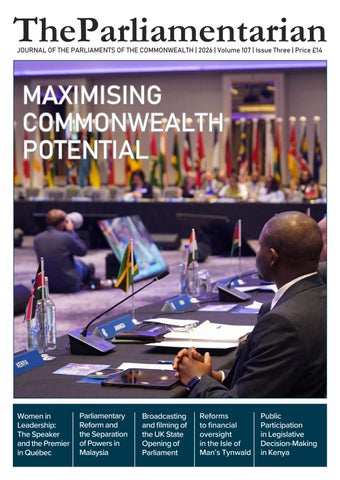
MAXIMISING COMMONWEALTH POTENTIAL
COMMONWEALTH LEADERSHIP
Women in Leadership: The Speaker and the Premier in Québec
Parliamentary Reform and the Separation of Powers in Malaysia
Broadcasting and filming of the UK State Opening of Parliament
Reforms to financial oversight in the Isle of Man’s Tynwald
Public Participation in Legislative Decision-Making in Kenya
THE PARLIAMENTARIAN 2026 ISSUE THREE
Note from the Editor
I
CONTENTS REGULARS
FEATURES
2 | View from the CPA SecretaryGeneral
14 | Promoting Democracy through Equality
31 | Parliamentary Broadcasting
Canadian MP's view
Filming UK State Opening of Parliament
16 | Transforming Children’s Lives
34 | New diplomatic toolkit in India
Commonwealth Leadership in a changing world order
4 | Q&A with former Ontario Speaker Hon. Ted Arnott
8 - 13 | Image Gallery
Activities in Commonwealth Parliaments
52 - 54 | Legislative news
Reports from the CPA's membership
56 | Celebrating Commonwealth Lives
Former CPA Chairperson, Rt Hon. Lord Haselhurst (United Kingdom)
Child protection in Punjab, Pakistan
18 | Women in Leadership roles
The Speaker and the Premier in Québec
20 | Women's Representation in Wales Following the 2026 Senedd Election
22 | Bangladesh Moves Ahead with Constitutional Reforms
Established in line with July Charter
24 | Parliamentary Reform in Malaysia Asserting the separation of powers
27 | Empowering the Backbench
Backbenchers’ Committee in the Ghanaian Parliament The Parliamentarian: Journal of the Parliaments of the Commonwealth | Volume 107 | 2026: Issue Three | ISSN 0031-2282 | Published by the Commonwealth Parliamentary Association, CPA Headquarters Secretariat, Richmond House, Houses of Parliament, London, SW1A 0AA, United Kingdom.
Plural Statecraft
36 | Parliamentary financial oversight Isle of Man’s Budget Process Reforms
39 | Artificial Inteligence and Disinformation
Pakistan's response
42 | Maximizing Commonwealth Potential
Lessons from Pakistan
45 | Public Participation in Legislative Decision-Making
Parliament of Kenya
48 | Responsible Investment in Food and Agriculture
Examples from ASEAN
50 | Media Freedom Commonwealth Media Principles
Tel: +44 (0) 20 7799 1460 Email: hq.sec@cpahq.org www.cpahq.org Stephen Twigg, CPA Secretary-General and Jeffrey Hyland, Editor, The Parliamentarian - editor@ cpahq.org
Cover image: © Commonwealth Secretariat/Commonwealth Sports Ministers' Meeting in Glasgow, July 2026.
n this issue of The Parliamentarian, the CPA Secretary-General looks at Commonwealth leadership in a changing world order ahead of the 69th Commonwealth Parliamentary Conference in South Africa. Our latest Q&A examines decorum in Parliaments with former Speaker of Ontario, Hon. Ted Arnott and we take a ‘behind the scenes’ look at the filming of the UK State Opening of Parliament. This issue looks at how MPs can maximise the Commonwealth's potential with lessons from Pakistan; the role of public participation in legislative decision-making in Kenya; how parliamentary reforms in Malaysia are ‘correcting’ the balance of power; how the India Parliament has adopted a new diplomatic toolkit; how a new Backbench Committee in the Ghanaian Parliament is empowering MPs; the legislative role in child protection in Punjab, Pakistan; the progress on women's representation in Wales; how the Bangladesh Parliament is bringing in Constitutional reforms; a Canadian MP promotes democracy through equality of opportunity; the UN-FAO and ASEAN share the importance of responsible investment in food; reforms to the Isle of Man’s Budget Process bringing enhanced financial oversight; how the ethical use of Artificial Intelligence is impacting on gender-responsive and inclusive governance in Pakistan; and the importance of MPs upholding media freedoms in their jurisdictions. The Agent-General of Québec also highlights that the roles of Premier and President of the National Assembly in Québec are both occupied by women for the first time. This issue also shares tributes to the former CPA Chairperson, Rt Hon. Lord Haselhurst (United Kingdom) who passed away in June aged 88. This issue brings you legislative news from Parliaments across the CPA’s membership. We look forward to your feedback and future contributions. Jeffrey Hyland, Editor, The Parliamentarian Email: editor@cpahq.org
Annual subscription: Four issues per year including supplements: UK: £44 World: £46. Agency discount 15%. Disclaimer: Opinions expressed in articles published in The Parliamentarian are those of the individual contributors and should not be attributed to the Association.
Contributors: Thank you to all contributors for this issue. Print: Warners Midlands UK and Times Printers Singapore. Limited print run - contact Editor for details of print copies for CPA Branches.
The Parliamentarian | 2026: Issue Three | Over 100 years of publishing | 1
VIEW from the CPA SECRETARY-GENERAL
COMMONWEALTH LEADERSHIP IN A CHANGING WORLD ORDER
The Secretary-General of the Commonwealth Parliamentary Association, Stephen Twigg E: Stephen.Twigg@cpahq.org
The 69th Commonwealth Parliamentary Conference (CPC) will be held in Cape Town, South Africa, in September 2026. I am immensely grateful to the Parliament of South Africa for hosting the 69th CPC and I look forward to seeing participants from all nine of the CPA regions. I first visited the beautiful city of Cape Town in 1999 when I was a first term Member of Parliament in the UK House of Commons. I was there to discuss constitutional reform and exchange ideas, including learning more about the Constitution of the Republic of South Africa which had been adopted in 1996. In this thirtieth anniversary year of the post-apartheid South African Constitution, it seems highly appropriate that the CPC theme will be Strengthening International Law and Parliamentary Democracy in a Changing World Order: Commonwealth Leadership. At the World Economic Forum earlier this year, the Prime Minister of Canada, Rt Hon. Mark Carney, MP said, “Today, I'll talk about the rupture in the world order, the end of a nice story and the beginning of a brutal reality where geopolitics among the great powers is not subject to any constraints. But I also submit to you that other countries, particularly middle powers like Canada, are not powerless. They have the capacity to build a new order that embodies our values, like respect for human rights, sustainable development, solidarity, sovereignty and territorial integrity of states.” Canadian Prime Minister Carney’s words serve as a compelling reminder of the significant challenges we face together and of the potential to reassert our shared values during these difficult times. For the Commonwealth, these values are set out in the Commonwealth Charter from which I am pleased to quote some excerpts on the page opposite. These words had huge relevance when they were adopted in 2012 by Commonwealth Heads of Government and they resonate even more powerfully today. Commonwealth Leadership will be most effective if it is a collective effort – the Commonwealth Secretariat, governments, Parliaments, judicial systems, civil society – and, of course, the citizens of the Commonwealth. 2 | The Parliamentarian | 2026: Issue Three | Over 100 years of publishing
Democratic resilience is one of the pillars of the Commonwealth Strategic Plan and it lies at the heart of the CPA’s mission as an organisation. It is why the CPA’s membership and staff have worked together over decades to develop and nurture a range of tools designed to assist Parliaments to be effective and inclusive – these include our Recommended CPA Benchmarks for Democratic Legislatures, work on gender sensitive Parliaments, our Commonwealth Parliamentarians with Disabilities Capital Investment Fund to promote accessibility and inclusion for persons with disabilities, our online CPA Parliamentary Academy and the work of our CPA Small Branches network. In Cape Town, we will discuss how we can best accelerate the CPA’s contribution to Commonwealth Leadership across a wide range of issues including peace, climate change and Artificial Intelligence. These are important themes which the CPA is keen to give greater priority to following the creation of our new Peace & Human Rights Committee, the Green Mace Initiative recognising Parliaments work on sustainability and our work with partners on Artificial Intelligence including last year’s adoption of the Kuala Lumpur Declaration on 'Parliaments and responsible AI'. An important item on the 69th CPC agenda in Cape Town will be to agree on the host for the 70th CPC next year. I am delighted that we have received an application from the Parliament of Canada to hold the 70th Commonwealth Parliamentary Conference in Ottawa. In November 2026, Antigua and Barbuda will host the Commonwealth Heads of Government Meeting (CHOGM) at which the CPA will hold a Parliamentary Forum to provide an opportunity for further discussion and engagement for Parliamentarians with Governments and civil society on key areas of shared concern. The Forum will include panel discussions and a fireside chat. We also aim to participate in the Commonwealth Women’s and Commonwealth Youth Forums, the Implementing Disability Rights Symposium and the dialogue meeting with Commonwealth Foreign Affairs Ministers. I look forward to seeing readers of The Parliamentarian either at 69th CPC or CHOGM 2026 in the coming months.
“
COMMONWEALTH CHARTER
We the people of the Commonwealth...
Recognising that in an era of changing economic circumstances and uncertainty, new trade and economic patterns, unprecedented threats to peace and security, and a surge in popular demands for democracy, human rights and broadened economic opportunities, the potential of and need for the Commonwealth – as a compelling force for good and as an effective network for co-operation and for promoting development – has never been greater, Recalling that the Commonwealth is a voluntary association of independent and equal sovereign states, each responsible for its own policies, consulting and co-operating in the common interests of our peoples and in the promotion of international understanding and world peace, and influencing international society to the benefit of all through the pursuit of common principles and values,
DATES FOR YOUR DIARY Updated as at 17 August 2026
2026 August
• 9 to 15 August 2026: 55th CPA Africa Regional Conference, Lilongwe, Malawi • 12 August 2026: International Youth Day • 30 August to 5 September 2026: 48th CPA Regional Conference and 19th Presiding Officers and Clerks Conference of the Caribbean, Americas and the Atlantic (CAA) Region, Kingston, Jamaica (including Regional Executive Committee, 16th CAA Regional Conference of the Commonwealth Women Parliamentarians (CWP) and 19th CPA Caribbean, Americas and the Atlantic Regional Youth Parliament)
September
• 13 to 19 September 2026: 69th Commonwealth Parliamentary Conference, Cape Town, South Africa including 42nd CPA Small Branches Conference; 10th Commonwealth Women Parliamentarians (CWP) Conference and Commonwealth Parliamentarians with Disabilities (CPwD) meetings; 2026 CPA General Assembly; CPA Executive Committee meetings; and
Affirming that the special strength of the Commonwealth lies in the combination of our diversity and our shared inheritance in language, culture and the rule of law; and bound together by shared history and tradition; by respect for all states and peoples; by shared values and principles and by concern for the vulnerable, Affirming that the Commonwealth way is to seek consensus through consultation and the sharing of experience, especially through practical co-operation, and further affirming that the Commonwealth is uniquely placed to serve as a model and as a catalyst for new forms of friendship and co-operation in the spirit of the Charter of the United Nations, Affirming the role of the Commonwealth as a recognised intergovernmental champion of small states, advocating for their special needs; providing policy advice on political, economic and social development issues; and delivering technical assistance, Welcoming the valuable contribution of the network of the many intergovernmental, parliamentary, professional and civil society bodies which support the Commonwealth and which subscribe and adhere to its values and principles, Affirming our core Commonwealth principles of consensus and common action, mutual respect, inclusiveness, transparency, accountability, legitimacy, and responsiveness. We aspire to a Commonwealth that is a strong and respected voice in the world, speaking out on major issues; that strengthens and enlarges its networks; that has a global relevance and profile; and that is devoted to improving the
”
lives of all peoples of the Commonwealth.
the 60th Society of Clerks at the Table (SoCATT) meetings.
• 15 September 2026: International Day of Democracy • 20 to 24 September 2026: Commonwealth Magistrates and Judges Association (CMJA) Conference, Kingson, Jamaica https://cmja.biz/
October
• 2 to 5 October 2026: Commonwealth Women Parliamentarians (CWP) Asia Regional event - Khyber Pakhtunkhwa Assembly, Pakistan • 5 to 9 October 2026: 153rd IPU Assembly, Arusha, Tanzania • 12 to 16 October 2026: CPA Parliamentary Academy Residency Programme for Members (Practice & Procedure), Guernsey • 21 to 23 October 2026: CPA Post-Election Seminar for the National Assembly of Seychelles • 24 October 2026: UN Day • October 2026: CPA Crown Dependencies Network, Sark
November
• 1 to 4 November 2026: 28th Commonwealth Heads of Government Meeting (CHOGM), Antigua and Barbuda • 9 to 11 November 2026: 41st CPA Australia and Pacific Regional Conference, Hobart, Tasmania, Australia • 9 to 13 November 2026: Commonwealth Women Parliamentarians (CWP) Workshop, Nadi, Fiji • 9 to 20 November 2026: 2026 UN Climate Change Conference (UNFCCC) COP31, Türkiye • 10 to 13 November 2026: Comprehensive and Progressive Agreement for Trans-Pacific Partnership (CPTPP) Workshop, (CPA UK/CPA Canada), Vancouver, Canada • 16 to 17 November 2026: 3rd Global Parliamentary Summit Against Hunger and Malnutrition, UN Food and Agriculture Organisation (FAO), Nairobi, Kenya (hosted by the National Assembly of Kenya) For further information on any events, please email hq.sec@cpahq.org or visit www.cpahq.org.
The Parliamentarian | 2026: Issue Three | Over 100 years of publishing | 3
Q&A with Hon. Ted Arnott from ONTARIO, CANADA
BRINGING COURTESY AND DECORUM TO OUR PARLIAMENTARY CHAMBERS The former Ontario Speaker and CPA award winner reflects on his time in office and the changes seen in the Legislative Assembly. Hon. Ted Arnott is the former Speaker of the Legislative Assembly of Ontario in Canada. He was first elected to the Legislative Assembly on 6 September 1990, representing the riding of Wellington-Halton Hills in western Ontario. He would become one of the longest serving Members after serving continuously until 2025. Ted Arnott served as Speaker during the 42nd and 43rd Parliaments of Ontario. He was awarded the 2025 CPA Parliamentarian Life-time Achievement Award in recognition of his 35 years of parliamentary service and his commitment and contributions to the Legislature during that time. Praised for his encouragement to colleagues and an ability to inspire greater decorum and less divisiveness in the Chamber, Hon. Ted Arnott was also the Dean of Presiding Officers in Canada, sharing his knowledge and expertise with new Speakers from across the country. Q: Please can you tell us about your experience of the Commonwealth, living and working in a Commonwealth country like Canada? When were you first aware of the Commonwealth? How is the Commonwealth viewed in Canada today? A: Throughout its history, the Commonwealth has been a central focus of Canada’s international relations. As a Westminster-style parliamentary democracy, a constitutional monarchy and a federation, Canada’s system of government is the institutional foundation upon which our country was built and one of the principal reasons it has flourished. We owe a debt of gratitude to the United Kingdom and all other Commonwealth counterpart nations around the world for their cooperation and friendship, which has helped to support and sustain us through every challenge Canada has faced. Living and working in a Commonwealth country like Canada is, of course, a wonderful privilege that we should never take for granted. We are very proud of our country’s accomplishments and achievements, and we honour the memory of the generations of Canadians who came before us. I first learned of the existence of the Commonwealth in the 1970s, while attending elementary school in Arthur, Ontario. It was part of the Ontario civics curriculum that we studied. Later on in the 1980s, I vividly recall Canada’s then Prime Minister Brian Mulroney urging Commonwealth members to take a strong stand against apartheid in South Africa. Their collective efforts made a difference; indeed, they made history. 4 | The Parliamentarian | 2026: Issue Three | Over 100 years of publishing
Q: You were a Member of Parliament for 35 years and Speaker for almost eight years. Can you highlight some of the challenges and lessons you have learned from your time in the Ontario Legislative Assembly? What best practices do you think other Commonwealth Parliaments could learn from your Legislature? A: When I was first elected to the Legislative Assembly of Ontario in 1990, it was a very different world than the one we live in today. Our constituency offices were equipped with typewriters, fax machines and paper files. The Internet, email and social media were virtually unheard of. As these new technologies were gradually adopted, they brought notable change to the way Parliamentarians did their work. However, for the people I was elected to serve and represent, some things have not changed at all over the past three decades. Now, as then, their expectations for their elected representatives are quite straightforward. They insist that we be honest and truthful. Always. They expect our very best efforts on their behalf. Always. And, they want us to take their views and concerns to Parliament, not just bring our Party’s views and concerns back to them. Always. When serving in the Assembly as Speaker, I was extraordinarily proud of the work of our staff. Teamwork, dedication and professionalism were very much the ‘order of the day’, every working day. They never rested on their laurels, and always kept raising the bar of achievement higher. Our Parliamentary Protocol and Public Relations Branch has been particularly outstanding, initiating practices and programmes which have opened the doors of our Assembly and effectively explained its relevance to the hundreds of thousands of visitors we have welcomed. Q: Parliaments across the world continue to face a ‘trust deficit’ with many citizens questioning the role of Legislatures and the work of Parliamentarians. How can we ensure that Parliaments are trusted to be at the forefront of democracy and representation as well as being accountable to their citizens? A: The ‘trust deficit’ is in no way the fault of the parliamentary system. It is instead the fault of some individual Parliamentarians who mistakenly concluded that voters could be fooled, and that deceit was the surest path to continued electoral success. How wrong they were! Political parties in all jurisdictions need to do a better job of vetting candidates to ensure that integrity and character are fundamental prerequisites, alongside competence and
Image credit: Ontario Legislative Assembly.
Left: Hon. Ted Arnott served as Speaker of the Legislative Assembly during the 42nd and 43rd Parliaments of Ontario. The Speaker’s Chair in use today dates from 1874 and once belonged to former Speaker Rupert Wells. Until the 1940s when the gift of a portrait was introduced, each Speaker was able to take their Chair home at the end of their term. This Speaker's Chair was returned to the Legislature by his family.
another Member may have committed, and a public report of the findings is released. The Office of the Integrity Commissioner also maintains a public lobbyist registry.
a genuine commitment to public service. In Ontario, the Office of the Integrity Commissioner exists to address the trust deficit. Members of Ontario Provincial Parliament are required by law to submit an annual financial disclosure, listing all assets and liabilities, and meet with the Commissioner to discuss it. Upon receipt of a complaint from a Member, the Commissioner has the power to investigate a potential ethical breach that
Q: Politics today has also become more divisive, both in our Parliamentary Chambers and generally in public life. In July 2019, your office released the ‘Rules of Respect and Courtesy in the Chamber’ which urged Members to set a higher standard of behaviour in their dayto-day activities in the Legislature's Chamber. Why did you need to issue such guidance and do you think it has had any effect on proceedings? A: Our ‘Courtesies’ document, as it came to be known within our Assembly, was inspired by a similar publication released to UK MPs by the former Speaker of the UK House of Commons, John Bercow. And as was the case with everything we did during my tenure as Speaker, it was a group effort. Its contents were intended to explain in direct terms the basic expectations for behaviour in the Legislative Chamber and Committees, and persuade Members that we all had an interest in improving decorum during debate. We were helped by the Toronto Star, Ontario’s largest circulation quality daily newspaper, which gave the The Parliamentarian | 2026: Issue Three | Over 100 years of publishing | 5
Q&A with Hon. Ted Arnott from ONTARIO, CANADA
‘Courtesies’ document favourable news coverage. But perhaps most importantly, Ontario’s respected Integrity Commissioner, Hon. David Wake, encouraged every Member to read the ‘Courtesies’ document and carefully consider how they might take action to improve their behaviour, individually and collectively. What followed was a general improvement in decorum in the Assembly, and I hope the ‘Courtesies’ document was a contributing factor in this development.
Image credit: CPA Secretariat/Jeffrey Hyland.
Q: Given your experiences in political life, how do you view the role of women in politics? Do you think that women politicians are often subjected to a level of scrutiny that male politicians are perhaps not? How can male politicians help to break down the barriers facing women coming into politics? A: During the time I served as Speaker of the Legislative Assembly of Ontario, women constituted approximately 40% of the membership of the House (currently, women make up 35% of Members in Ontario). However, until April of 2025, there had never been a female Speaker in the Province’s history. That changed when Hon. Donna Skelly was elected as my successor by a secret ballot vote of Members. Speaker Skelly has been remarkable, ruling over debate in the House with a balance of firmness and fairness. She has developed positive working relationships with the House Leaders of all parties, and is viewed as non-partisan in her decisions and management of the Assembly.
6 | The Parliamentarian | 2026: Issue Three | Over 100 years of publishing
The Speaker has looked for ways to make the Assembly more ‘family friendly’, especially for Members with young children. There is now a designated Family Room, which Members can access for some private time with their little ones. Ontario MPPs are also playing leadership roles in the CPA. Waterloo MPP, Hon. Catherine Fife has been elected as the International Chairperson of the Commonwealth Women Parliamentarians (CWP) network, and is the first Canadian to serve in this capacity. In my time in the Assembly, it seemed that all Members faced similar challenges in finding an appropriate ‘work/life balance’. All Members are subjected to excessive demands on their limited time, the public scrutiny that goes with being an elected public servant, and increasing attacks and abuse on social media. However, many female Members over the years shared with me their unique challenges that male Members typically would not have faced. I always sought to support my female colleagues, and be a friendly, kind and encouraging presence when needed. We should strive to be there for each other.
Below: The Legislative Assembly of Ontario is located at Queen's Park in Toronto, Canada. The main block of the building was completed in 1892 with the first legislative session held in Queen's Park on 4 April 1893.
Q: The Commonwealth is facing many challenges and questions over its role in geo-politics. Canada has faced existential threats from its southern border, with Ontario at the heart of these discussions. Is this the time for the Commonwealth to assert its influence around the work as a global organisation that doesn’t include the USA, China or Russia as part of its membership? How do you see the future for the Commonwealth? A: This is absolutely the right time for international organisations like the Commonwealth to revitalise and reassert their values and influence around the world. As Speaker Juliet Holness of Jamaica recently wrote in these pages, the Commonwealth “promotes democracy, good governance, development cooperation, and people-to-people exchange through its programmes and organisations.” It is difficult to think of a time in recent history when this was more needed than it is today. Based on this commitment to shared values, to me the future of the Commonwealth seems very bright, indeed, brilliant. The sovereignty and independence of Canada are not negotiable. We seek to maintain friendly relationships with all members of the international community, and strong and fair economic partnerships with our neighbours and other like-minded countries. We in Canada appreciate the support we have received in recent months from our Commonwealth friends. Thank you. Q: As we look to the future, the focus must be on young people - 60% of the Commonwealth’s 2.7 billion population is aged under 30. How can the Commonwealth and Parliamentarians engage with young people? How can we involve more young people in politics? A: Young people need to be invited to be part of the discussion about the future of our respective countries. Whatever the process, they need to feel that it is meaningful and their elders are listening. From these efforts, the next generation of leaders will emerge. At the Legislative Assembly of Ontario, we have organised several programmes to encourage youth
Image credit: Ontario Legislative Assembly.
Right: As part of his duties as the Speaker of the Legislative Assembly of Ontario, Hon Ted Arnott often undertook ceremonial roles on behalf of the Province. He is pictured at the swearing-in of Ontario’s Information and Privacy Commissioner, Patricia Kosseim, at the Legislative Building in June 2020.
engagement. A few examples: our Youth Arts Award has provided a showcase for the visual artistic talents of participants. Our Speaker’s Award for Young Writers has been very well appreciated. In addition, our annual Model Parliament programme is a forum for enthusiastic and energetic young people to learn more about and participate in the parliamentary legislative process. The theme of our Women’s Forum this year is ‘Pathway to Parliament’, and is targeted to women aged 18-30. Q: Now that you have retired from political life, how do you reflect on your time in the Legislature and the future of politics in Ontario and Canada? A: I departed elected public service in 2025 with an overwhelming sense of appreciation to my wife Lisa, our families, and my constituents, who supported me faithfully over the years and gave me the chance to serve in the Assembly. Fortunate to work with wonderful and dedicated staff colleagues, my work as Speaker was supported and enabled by Clerks Todd Decker and Trevor Day, Speaker’s Office staff Rachel Nauta and Monica Weber, and Clerk’s Office staff Grace Bento. My appreciation to them and all the other staff in the Ontario Legislative Assembly knows no bounds. And, considering the young people who I have come to know and have worked with, I have every confidence that the future of Ontario and Canada will be in good hands. Visit www.ola.org to find out more about the Ontario Legislative Assembly's work
The Parliamentarian | 2026: Issue Three | Over 100 years of publishing | 7
Right: The Legislative Assembly of Manitoba welcomed young women from the Province for a two-day mentoring programme on 21 to 22 May 2026. The programme was held with funding from the Commonwealth Women Parliamentarians (CWP) Gender Strengthening Funds.
Image credit: Legislative Assembly of Manitoba.
Image Gallery: Parliamentary Diplomacy
Opposite page - Above: Parliamentarians attended the CPA UK and UNESCO Caribbean AI Workshop hosted by the Anguilla House of Assembly and ParlAmericas from 20 to 25 June 2026. Opposite page - centre left and bottom left: On 13 May 2026, the Speaker of the Parliament of Ghana, Hon. Alban K. S. Bagbin, MP, in his role as President of the African Parliamentarians Network Against Corruption (APNAC), met with the President of the Rwanda Senate, Senator Kalinda François Xavier and the Speaker of the Rwanda Chamber of the Deputies, Hon. Gertrude Kazarwa, MP. Opposite page - bottom right: The President of Kenya, Hon. William Samoei Ruto addressed the Parliament of Tanzania in Dodoma on 5 May 2026 and was received by the Speaker of the Parliament of Tanzania, Hon. Mussa Azzan Zungu and the Clerk of Parliament, Baraka Leonard. 8 | The Parliamentarian | 2026: Issue Three | Over 100 years of publishing
Image credit: Gibraltar Parliament.
Bottom right: Commonwealth MPs and parliamentary staff from 10 Parliaments in the CPA British Islands and Mediterranean (BIM) Region attended the 55th annual Regional Conference in Gibraltar from 18 to 20 June 2026.
Image credit: Trinidad and Tobago Parliament.
Centre right: The Commonwealth Association of Public Accounts Committees (CAPAC) hosted its annual conference from 9 to 10 June 2026 at the Parliament of Trinidad and Tobago with delegates from 30 Legislatures.
The Parliamentarian | 2026: Issue Three | Over 100 years of publishing | 9
Image: Commonwealth Secretariat.
Image credit: Rwanda Parliament.
Image credit: Parliament of Tanzania.
Image credit: Rwanda Parliament.
Image credit: CPA UK/Anguilla House of Assembly.
Opposite page - Above: Parliamentarians from the Pacific and Australia Regions met for the 55th Presiding Officers and Clerks Conference (POCC), hosted by the Parliament of Western Australia from 6 to 10 July 2026 in Perth. Opposite page - centre left: A five-member delegation from the Anguilla House of Assembly attended a Public Accounts Committee (PAC) Induction Programme from 16 to 18 June 2026 provided by the CPA UK Branch. Opposite page - centre right: The CPA Northern Ireland Branch held its AGM on 16 June 2026, reflecting on the past year’s work and priorities for the year ahead. Opposite page - bottom: Building on more than 60 years of strong bilateral Australia–Kenya relations, the President of the Western Australia Legislative Council, Hon. Alanna Clohesy, MLC welcomed a delegation from the National Assembly of Kenya to Perth on 25 May 2026, led by Hon. Jeremiah Milemba CBS, MP. 10 | The Parliamentarian | 2026: Issue Three | Over 100 years of publishing
Image credit: Parliament of South Africa and the Gauteng Provincial Legislature.
Below right: The CPA India Regional Chairperson and the Speaker of the Lok Sabha at the Parliament of India, Hon. Shri Om Birla inaugurated the 2nd Annual Conference of the CPA India Region Zone-II hosted by the Haryana Legislative Assembly from 8 to 10 June 2026 in Chandigarh, India.
Image credit: Haryana Legislative Assembly.
Right and centre right: Delegates from CPA Africa Region met for 19th Conference of Speakers and Presiding Officers of the Commonwealth (CSPOC) Africa Region, jointly hosted by the Parliament of South Africa and the Gauteng Provincial Legislature. The South African Minister of International Relations and Cooperation, Hon. Ronald Lamola (centre right) delivered the keynote address.
Image credit: Parliament of South Africa and the Gauteng Provincial Legislature.
Image Gallery: Parliamentary Diplomacy
The Parliamentarian | 2026: Issue Three | Over 100 years of publishing | 11
Image credit: Parliament of Western Australia.
Image credit: Northern Ireland Assembly.
Image credit: CPA UK/Anguilla House of Assembly.
Image credit: Parliament of Western Australia.
Right: Members of the Joint Public Accounts Committee (JPAC) of the National Assembly of Belize took part in a three-day capacity-building workshop on parliamentary financial oversight and accountability from 27 to 29 July 2026 delivered by the CPA and the Canadian Audit and Accountability Foundation (CAAF).
Image credit: National Assembly of Belize.
Image Gallery: Parliamentary Diplomacy
Opposite page - Above: The 62nd CPA Canada Regional Conference took place in Victoria from 4 to 10 July 2026 hosted by Hon. Raj Chouhan, MLA, Speaker of the Legislative Assembly of British Columbia and Kate RyanLloyd, Clerk. Opposite page - centre left and centre right: On 1 July 2026, a parliamentary delegation from Trinidad and Tobago, led by Hon. Jagdeo Singh, Speaker of the House of Representatives, visited the Speaker of the UK House of Commons, Rt Hon. Sir Lindsay Hoyle, MP and also met with CPA Deputy SecretaryGeneral, Jarvis Matiya. Opposite page - below left: In June 2026, the New Zealand Parliament welcomed Hon. Esafe Latu, MP from Tonga as well as Inter-Parliamentary Relations Officers from Tonga, the Solomon Islands and Vanuatu. Opposite page - below right: The CPA joined with InterParliamentary Union and UNDP at Geneva AI Governance Week in July 2026. 12 | The Parliamentarian | 2026: Issue Three | Over 100 years of publishing
Image credit: CPA Secretariat/Jeffrey Hyland.
Bottom right: The CPA Secretary-General, Stephen Twigg met with a delegation of MPs and Clerks from the Parliament of Sri Lanka on 18 June 2026 who were visiting the UK Parliament for a bilateral programme with the CPA UK Branch.
Image credit: Legislative Assembly of the Northern Territory.
Centre right: The CPA Advanced Professional Development and SkillsBuilding Residency Programme for MPs was hosted by the Northern Territory Legislative Assembly from 22 to 26 June 2026.
The Parliamentarian | 2026: Issue Three | Over 100 years of publishing | 13
Image credit: Inter-Parliamentary Union.
Image credit: New Zealand Parliament.
Image credit: CPA Secretariat.
Image credit: UK Parliament/Speaker's Office.
Image credit: Legislative Assembly of British Columbia.
PROMOTING DEMOCRACY THROUGH EQUALITY
PROMOTING DEMOCRACY THROUGH EQUALITY A Canadian MP shares how providing equality of opportunity for all will result in greater democracy
I was 12 years old when I immigrated to Canada with my family. I was born in Pakistan and grew up in England. In the former, even as a young girl, I felt inferior to my brothers. In the latter, as a young brown girl I was often called a ’Paki’ and bullied, in school and on the streets. So when I moved to Canada, the first thing I noticed about my newly adopted home was that none of my neighbours looked alike. We all belonged to different ethnicities, practiced different religions, spoke different languages – yet we coexisted in one of the most peaceful countries in the world. As a 12-year-old girl who had faced misogyny and racism since birth, I wondered: why is that? I’ve been trying to answer this question ever since. It was that question that led me to volunteer for so many different causes throughout my youth. I volunteered at food banks, shelters, art galleries, libraries, student advocacy organisations, and more. It was that question that ultimately led me to run for office when I was 29, after I had graduated from law school. Running for office and eventually being elected as a Member of the Canadian Parliament cemented a lesson I’ve been slowly learning
my whole life – women of colour are subjected to uniquely layered, multidimensional discrimination. As a young, racialised, immigrant Muslim woman entering politics, I faced vitriolic harassment that many of my colleagues didn’t. While other groups, including non-racialised women and men of colour, face their own significant struggles, the intersection of race and gender often marginalises women of colour to the degree that they find themselves barred from participating in the democratic process altogether. Early this June, I had the privilege of representing Canada at the InterParliamentary Union (IPU) Global Conference of Women Parliamentarians in Belgrade, Serbia held on a theme of ‘Advancing parity: Breaking the barriers of gender stereotypes and negative social norms’. I joined women leaders and Parliamentarians from over 60 countries to discuss women’s political participation and gender equality in democracy, among other pressing issues. It was the perfect opportunity to reflect on both that first political curiosity of my childhood and the issue of intersectionality I came to grapple with as an adult.
Hon. Iqra Khalid, MP has been a Member of the House of Commons of Canada since 2015 and is a Vice-Chair of the CPA Canada Federal Branch.
What I’ve come to understand through my decade in office is that democracy is, at its core, about balancing power. That is what the collective good should be about – providing equality of opportunity. As Members of Parliament, we must understand the power imbalances that our constituents face because it is our job to ensure that power is distributed equitably. Average Canadians – young girls like myself at 12 and their parents – are just trying to build stable, meaningful lives. They want to achieve their goals, grow businesses and retire with security. They want to know that their differences will not be held against them as they try to live their lives with dignity. True democracy balances power by providing that equality of opportunity to all citizens. How that balance is maintained may differ depending on the cultural context of a community, but the reality is that the Western world does not have a patent on how democracy – or that balance of power – should function. Putting things on paper is not enough. As facilitators of democracy, we as Parliamentarians are charged with building bridges and maintaining
“True democracy balances power by providing that equality of
opportunity to all citizens. How that balance is maintained may differ depending on the cultural context of a community, but the reality is that the Western world does not have a patent on how democracy – or that balance of power – should function.”
14 | The Parliamentarian | 2026: Issue Three | Over 100 years of publishing
PROMOTING DEMOCRACY THROUGH EQUALITY
Images credit: Inter-Parliamentary Union (IPU).
COMMONWEALTH WOMEN PARLIAMENTARIANS ATTEND IPU GLOBAL CONFERENCE OF WOMEN MPs IN SERBIA
Women Parliamentarians met in Belgrade, Serbia for the Inter-Parliamentary Union (IPU) Global Conference of Women Parliamentarians from 2 to 4 June 2026. Members of Commonwealth Parliaments attended the event from Botswana, Canada, UK, Eswatini, Ghana, Kenya, Lesotho, Malawi, Mozambique, Namibia, Nigeria, Pakistan, Rwanda and Tanzania for discussions on gender equality, online harassment, gender-sensitive Parliaments and advancing parity. The Commonwealth Parliamentary Association’s Gender Lead, Bénite Dibateza, attended the IPU Conference to conduct interviews and bilateral meetings. She also met with representatives from UN Women to discuss ongoing gender work in both organisations. Above: Hon. Iqra Khalid, MP (Canada) spoke at a panel discussion at the Inter-Parliamentary Union (IPU) Global Conference of Women Parliamentarians in Serbia on ‘Advancing parity through diversity: Intersecting stereotypes and norms’. The panel was chaired by Rt Hon. Karen Bradley, MP (UK), IPU Executive Committee Member, and included Hon. Jelena Žarić Kovačević, Minister for Family Care and Demography (Serbia); Hon. Mabel Memory Chinomona, President of the Senate (Zimbabwe); Hon. Julieta Sierra, MP (Uruguay); Hon. Fatma Öncü, MP (Türkiye); and Mr Calixte Bloquet, IPU consultant on diverse women’s representation.
trust. We are charged with collaborating with all levels of government, civil society, grassroots organisations, and citizens themselves so we can come together and foster mutual respect. That includes creating equal representation in all of our democracies. In Belgium, women comprise at least 50% of electoral candidates and a staggering 55% of junior and senior Ministerial positions. France introduced a legal reform in 2025 which requires gender parity in the candidate list of every municipality in the nation, regardless of population size. Spain enacted the Equal Representation Law in 2023, which mandates that at least 40% of candidate lists are women – currently, women make up 44% and 39% of Spain’s Congress and Senate, respectively. When we talk about the intersectionality of race, gender,
sexuality, disability, financial struggle – we also have to act by ensuring that all of our citizens are heard. Our Charter of Rights and Freedoms is the power source for the protection of equality in Canada. The government uses that power source to create actionable programmes that ensure the fulfillment of the purpose of the Charter. Some examples in Canada are the Women Entrepreneurship Strategy, which provides vital matching funds to women entrepreneurs who want to grow; the Black Entrepreneurship Program, which aids Black business owners in overcoming systemic barriers; and the Court Challenges Program, which provides financial support to Canadians who bring human rights cases of national significance before the courts. In 2015, when I was first elected, we saw the first gender-balanced
federal cabinet in Canadian history. A decade later, we maintained gender parity in the Cabinet, a testament to the importance of equal representation in our country. These initiatives redistribute opportunity where it has historically been deeply limited. My own community in MississaugaErin Mills speaks over 40 different languages. This diversity means that many of my constituents have experienced the systemic consequences of historical inequity – from weak political institutions to racial discrimination to financial struggle – firsthand. Redistributing opportunities for our citizens requires not that we speak each of their languages, but that we collectively make sure that we address their challenges, we understand their concerns and we advocate for their needs. Continued/...
The Parliamentarian | 2026: Issue Three | Over 100 years of publishing | 15
PROMOTING DEMOCRACY THROUGH EQUALITY
That’s what ultimately unites us as Canadians. We commit to unity and equality, to the rule of law, to our Charter of Rights and Freedoms, and to continuing to build those bridges amongst each other. But these bridges, in Canada and across the world, are under threat from misinformation, disinformation and hate speech, which are weaponised against minorities of all kinds. It’s up to us to address this challenge. The next steps for us, collectively through organisations like the CPA and the IPU, and individually for Canada, are to strengthen the regulation of social media companies and invest in education and awareness. To protect the strength of our democracies, we need to monitor how misinformation is spread, how disinformation is weaponised for power and control within communities, and how these platforms are leveraged for personal interest. We can’t rely on regulation alone; social media companies and their users are notoriously noncompliant with existing legislation. Virulently racist anti-immigrant sentiment floods the Internet, easily evading reporting mechanisms despite rulings against hate speech and discrimination. During the 2016 ‘Brexit’ referendum in the UK, thousands of bot accounts on Twitter (now ‘X’) made hyperpartisan, often nationalistic and xenophobic posts to bolster support for Britain leaving the European Union – a move through which the campaign succeeded in influencing the public enough to win the vote. Though the UK Electoral Commission issued fines to multiple organisations after the fact, ‘Brexit’ was a rude awakening to the pervasive nature of online misinformation. Beyond that, social media can be weaponised without any actual legal violations. US President Trump routinely blasts misinformation, incendiary remarks about other public figures, and Artificial Intelligence-generated caricatures of his ideal world order. When these platforms are abused at such a large scale, reaching millions of viewers, it’s imperative to reach past regulation and arm ourselves with education. We have to give our communities, and particularly our youth, the tools they need to critically consider the information presented to them. We have to strengthen our education systems, and fortify them against the risks posed by today’s digital landscape. We have to cultivate the skill of nuanced, analytical thinking in our schools, our workplaces, our institutions and our homes. More than anything else, we have to ensure that every person in our community is heard, respected, represented and protected. We can’t take the balance of power for granted – we have to nurture it.
Child Protection in Punjab Pakistan's Punjab Province is home to over 110 million people and some of the most complex child welfare challenges in South Asia. The Child Protection Bureau Punjab is the only government department in Pakistan dedicated to rescuing, rehabilitating, educating and empowering destitute and neglected children. Established in 2004 under the Punjab Destitute and Neglected Children Act, the Bureau operates as an autonomous statutory body under the Home Department of the Government of Punjab. I have served as Chairperson since 2019. The Bureau I inherited was under-resourced and operationally limited. The Bureau that exists today covers 17 districts, operates a ‘round the clock’ response infrastructure and has enacted the most comprehensive child protection legislation in Pakistan's history. That transformation did not happen by itself. When I took office, the Bureau operated in ten districts. Through governance reform, renewed public credibility and strategic partnerships with philanthropists and non-governmental organisations, we established seven new child protection centres across the Province. We now operate in 17 of Punjab's 36 districts. Within the next two years, we expect to be in every district in the Province, making Punjab the first in Pakistan with a Province-wide child protection infrastructure. The numbers reflect that expansion. In the last year alone, we rescued 10,820 children from across Punjab. The majority were reunited with their families after assessment and rehabilitation. The cases included children trapped in street begging, children who had gone missing and were later traced, those engaged in hazardous waste picking, runaway children and those fleeing abusive homes. At present, 1,500 children reside in our facilities, where they receive education, healthcare, psychological support and structured skills training. The Lahore Child Protection Bureau is the flagship facility and is recognised as a benchmark institution across South Asia. The campus spans 50 kanals (kanal = approx. 500 square metres) and was purpose built for children's physical, emotional and developmental needs. It houses schools, residential hostels, medical units, recreational spaces and a Skill Development Unit where children train in cooking, tailoring and plumbing. A multisports complex, built through philanthropic support, gives children access to structured physical activity that builds discipline and confidence. The facility also houses a child protection court, the first of its kind in South Asia. A sessions judge sits on site and resolves child custody and protection matters without delay. Children who pass through legal proceedings at this court are spared the secondary trauma of repeated court appearances at distant locations. That single innovation has changed the experience of justice for hundreds of children. In 2026, the Government of Punjab enacted the Punjab Child Marriage Restraint Act. It is the most comprehensive child protection legislation Pakistan has produced. Offences under the Act are non-bailable, non-compoundable and cognizable. Cohabitation arising from a child marriage is classified as child abuse. Taking a child across provincial boundaries to evade the law constitutes child trafficking. Punjab was not alone: Sindh,
16 | The Parliamentarian | 2026: Issue Three | Over 100 years of publishing
LEGISLATIVE ROLE IN CHILD PROTECTION
TRANSFORMING CHILDREN’S LIVES How the Child Protection Bureau in Punjab is changing the future for children the Islamabad Capital Territory and Balochistan passed similar legislation in preceding years. A National Framework to End Child Marriage now exists. Enforcement, not legislation, is the remaining test. The Government of Punjab also approved Pakistan's first Child Protection Policy in this period, making Punjab the first Province with a formal, institutionalised framework governing child protection across all sectors. The Bureau played a central role in drafting that policy and will be accountable for its implementation. Institutions are only worth what they produce. Children who were destitute when they arrived at our facilities now work in multinational companies. Some joined the Pakistan Army. Others trained as nurses. Several run small businesses, including bakeries and home-based enterprises. Rizwana arrived at our facility critically injured from a high-profile abuse case. She is now healthy, enrolled in school and training in culinary arts. Her case
became a reference point for how our rehabilitation model works in practice. The Bureau's Child Protection Units run awareness campaigns across Punjab. We engage parents, teachers, law enforcement and children. We train children to recognise inappropriate contact and to report it. We train police officers and judicial staff to handle abuse cases with the competence those cases require. We also established Pakistan's first Interfaith Child Protection Committee, bringing together religious leaders from across faiths. Awareness sessions have been held in mosques and churches. Child protection is a moral responsibility that cuts across denominational lines. That Committee formalises what should have been obvious for decades. For immediate intervention, the Bureau operates the 1121 helpline around the clock. Reports of abuse, child marriage, missing children and neglect trigger rapid response teams. The helpline is active, staffed and
Hon. Sarah Ahmad, MPA is the Chairperson of the Child Protection and Welfare Bureau in Punjab and is a Member of the Punjab Provincial Assembly in Pakistan. She is a recipient of the Tamgha-e-Imtiaz (T.I.) and the US International Women of Courage Award.
consequential. In the past year, it handled tens of thousands of calls. Punjab's experience carries practical lessons for any Commonwealth Legislature working on child protection. Autonomous statutory bodies with clear mandates outperform departments that absorb child protection as a secondary function. Integrating welfare, justice and skills development under one institutional roof reduces attrition and trauma. Legislation must be specific: vague provisions invite inaction. Community and interfaith engagement sustains protection far beyond what government infrastructure can reach alone. Child protection in Punjab is no longer aspirational. It is operational, funded and expanding. The work ahead is harder than what has come before: reaching the remaining 19 districts, enforcing new legislation at scale and sustaining quality as the system grows. The Bureau has the institutional foundation to do it. Punjab's children have already waited long enough. References - Punjab Destitute and Neglected Children Act 2004, Government of Punjab, Pakistan. - Punjab Child Marriage Restraint Act 2026, Government of Punjab, Pakistan. - Child Protection Bureau Punjab, Annual Performance Report 2025 to 2026, Government of Punjab.
The Parliamentarian | 2026: Issue Three | Over 100 years of publishing | 17
WOMEN IN LEADERSHIP ROLES IN QUÉBEC
WOMEN IN LEADERSHIP Both highest offices in Québec held by women for the first time
In April 2026, a remarkable moment happened in Québec: the election of Hon. Christine Fréchette, MNA as Premier of Québec coincided with the tenure of Hon. Nathalie Roy, MNA as President of the Assemblée nationale du Québec. For the first time in Québec’s history, two women are holding the highest offices in government and in Parliament. This moment vividly illustrates how far Québec has come in its efforts to achieve gender equality. 2026 marks 65 years since the election of the first woman Member of the Assemblée nationale du Québec (Québec National Assembly), Marie-Claire Kirkland. While Nathalie Roy and Christine Fréchette may not be the first women to hold these offices, they are part of an extremely select club. Nathalie Roy is only the second woman President of the Assemblée nationale du Québec, after Louise Harel held the position in 2002-2003. Christine Fréchette, elected leader of the Coalition Avenir Québec after a leadership race triggered by the resignation of previous Premier, Hon. François Legault, is also only the second woman Premier of Québec, 14 years after the election of Pauline Marois, who led the Province from 2012 to 2014. In a nation where women only obtained the right to vote in 1940, they have since taken their place in politics and contribute actively to the legislative agenda. Since the 2022 elections, women represent 46% of Parliamentarians in Québec. Even though enormous progress has been made, both President Roy and Premier Fréchette strongly believe in the importance of acting as role models for women and girls. Commenting
on her election as President of the Assemblée nationale du Québec, Nathalie Roy said “It tells women it’s possible. If you want to go into politics, yes, it’s possible. And, you can reach the highest offices; you can preside over an Assembly.” In her inaugural speech as Premier of Québec, Christine Fréchette described her election by the Members of her party as “a highly symbolic choice, which proves that nothing is out of reach for our young girls". The importance of mentoring Both women are well aware that despite their appointments at the highest levels and the fact that gender parity in Parliament is within close reach, women interested in a political career can face several obstacles. To support women taking up their roles as Parliamentarians, the Assemblée nationale du Québec created, in 2015, the Women’s Caucus. It is the only initiative of its kind in a Canadian Parliament, whether at the Provincial, Territorial or federal level. As a non-partisan group, the Women’s Caucus brings together women Parliamentarians of all allegiances, offering a space for sharing experiences and raising awareness of issues impacting women. One of the notable initiatives of the Women’s Caucus is its mentoring programme. Despite their experience and skills, newly elected women often face a double challenge: to acclimatize to the political world like any new Parliamentarian and to learn to navigate a historically masculine environment. The mentorship programme pairs new Parliamentarians with experienced former Members of the Assemblée
18 | The Parliamentarian | 2026: Issue Three | Over 100 years of publishing
Geneviève Brisson took up her position as Agent-General of Québec in London in October 2025, after serving in this capacity in Brussels. She previously held roles in Canada’s House of Commons and at the Assemblée nationale du Québec (Québec National Assembly), as well as in government and the private sector.
nationale du Québec, creating an opportunity for networking and fostering leadership and confidence. Increasing women’s visibility Being a role model extends beyond the walls of the legislature, according to President Nathalie Roy. Noting that one of her functions is to award the President’s medals, she decided to take advantage of this role to give women more recognition outside the Parliament. She created the “Femmes engagées” (Women of Impact) award to recognise women, including young women under 18, who are involved in their community and making an impact. Nathalie Roy explained that she has created these new distinctions, to be awarded annually, “for women who are making a difference in our daily lives in the community and who are often overlooked.” She added that she “wanted to ensure fair, and perhaps even slightly better, representation of women, because for too long women have been forgotten at award ceremonies for their community involvement.” The importance of international networks Achieving gender parity, and recruiting and retaining women as elected officials, represents a challenge in most countries. This is where the power of international networks such as the Commonwealth Parliamentary Association and its
Image credit: Assemblée nationale du Québec/Emilie Nadeau.
WOMEN IN LEADERSHIP ROLES IN QUÉBEC
network of Commonwealth Women Parliamentarians (CWP) takes on its full significance. At the initiative of President Nathalie Roy and the Women’s Caucus, the Assemblée nationale du Québec runs a twinning programme between young women and women Parliamentarians. The first two editions of this successful initiative were funded through the CWP Regional Strengthening Fund. The programme provides effective mentoring and helps a younger generation understand the work of Parliamentarians. International networks have proven invaluable to create alliances worldwide, to share best practices, and to draw inspiration from initiatives put in place in other Parliaments. The Assemblée nationale du Québec has chosen to play an active role internationally, through networks as well as bilateral relations.
Above: The President of the Assemblée nationale du Québec, Hon. Nathalie Roy, MNA (left) and the Premier of Québec, Hon. Christine Fréchette, MNA (right).
For President Nathalie Roy, being a role model for women and girls does not stop at the domestic level. She is determined to play that role on the international scene as well, and has recently been elected President of the Assemblée parlementaire de la Francophonie (APF). Such a prominent role will create an opportunity to share successful initiatives supporting women’s participation in Parliaments. As Agent-General of Québec, and, might I add, the second woman AgentGeneral in London since the opening of the office in 1962, I take great pride in witnessing the achievements of outstanding women such as Nathalie Roy and Christine Fréchette, and helping promote those internationally. Québec has built a network of 39 representations across four continents,
to help create long-lasting partnerships with other nations. The productive relationship we enjoy with the Assemblée nationale du Québec allows us to support each other’s efforts on the international stage. Nathalie Roy and Christine Fréchette will not be the last women in their positions, but it is our collective duty to keep building on the legacy of the trailblazers who opened the doors of Parliaments to women. As Nathalie Roy so clearly puts it, “Now, it is our duty as women in positions of power to ensure that the glass ceilings that have been broken stay shattered. The door that was opened, the door through which we passed, must remain open for other women. It’s our duty to remember that.”
The Parliamentarian | 2026: Issue Three | Over 100 years of publishing | 19
WOMEN'S REPRESENTATION AND ELECTION OUTCOMES
The 2026 Senedd Election: Progress and Challenges The 2026 Senedd election will be remembered as one of the most significant and challenging elections in the history of Welsh democracy. It was an election unlike any before it. Wales saw major constitutional and electoral changes introduced simultaneously: new constituency boundaries, a new voting system, an expanded Senedd with 96 Members and even a new parliamentary chamber. For candidates and voters alike, it represented a period of immense change and uncertainty. For those of us who stood for election, it was also an intensely personal experience. Campaigning was demanding, often exhausting and at times deeply unpleasant. Social media and online discourse created an environment where misinformation spread quickly, while much of the media narrative focused on portraying many contests as a simple “two-horse race”. Such narratives can discourage voters from considering the full range of candidates and can make it harder for newer or less established voices to be heard. Despite these challenges, I was delighted to be re-elected. As a woman returning to the Senedd, I recognise both the privilege and the responsibility that comes with representing my constituents. While elections are always competitive, they also remind us of the importance of ensuring that people from all backgrounds feel able to put themselves forward for public office. Women standing for election continue to face barriers that are often different from those experienced by men. Female candidates sadly are more likely to face abuse online, scrutiny of their appearance or family life, and disproportionate levels of personal criticism. The increasing prevalence of intimidation and misinformation
can deter capable women from ever considering a political career. For many, balancing campaigning with work, caring responsibilities and family life creates additional obstacles that cannot be ignored. The 2026 election also marked the departure of many experienced women who had served Wales with distinction. A number chose to retire after long and successful careers, creating significant changes across the political landscape. Others, despite years of dedicated public service, were unsuccessful under the new electoral arrangements. Among them was Hon. Rhiannon Passmore, MS, a long-time supporter of the Commonwealth Women Parliamentarians (CWP) network, whose loss illustrated how dramatically the new system reshaped representation across Wales. Their contributions should not be overlooked, and the experience and knowledge they
20 | The Parliamentarian | 2026: Issue Three | Over 100 years of publishing
Hon. Natasha Asghar, MS has been a Member of the Welsh Parliament (Senedd Cymru) since 2021.
brought to Welsh politics will be greatly missed. Historically, Wales has often been recognised as a leader in women's political representation. In 2003, the Senedd became one of the first legislatures in the world to achieve an equal gender balance, with 30 women and 30 men serving as Members. While the 2026 election did not return to parity, it nevertheless resulted in 44 women and 52 men being elected. Although there remains progress to be made, women now make up almost half of the Senedd, ensuring that female voices continue to play a significant role in shaping Welsh democracy. One of the greatest strengths of the Senedd is its Women's Caucus, which has developed considerably over the past five years. Bringing together women from across political parties, the caucus has demonstrated that collaboration can transcend political differences when working Image credit: Senedd_Wales_Election_2026.
FUTURE OF WOMEN'S REPRESENTATION IN WALES
towards shared goals such as improving representation, tackling abuse against women in politics and supporting female leadership. As the expanded Senedd establishes its new structures following the 2026 election, the continued development of the Women's Caucus offers an important opportunity to build on that work. Encouraging more women to stand for elected office must remain a priority across all political parties. My own party firmly believes that candidates should be selected on merit, while also recognising the importance of actively encouraging talented women to come forward. Across Wales, parties have introduced mentoring schemes, training opportunities and support networks to widen participation, and these efforts should continue. Looking ahead, there are several practical steps that could help increase women's representation even further. • Expanding mentoring programmes that pair experienced politicians with prospective candidates can build confidence and provide valuable guidance. • Greater flexibility around campaigning, with better support for parents and carers. • Improved action against online abuse.
The main Chamber of the Senedd Cymru/Welsh Parliament is known as the Siambr.
• Increased political education within schools and communities would help remove barriers to participation. Wales already has strong foundations on which to build. The Welsh Youth Parliament provides young people with meaningful opportunities to engage with democracy, develop leadership skills and gain confidence in public life. Organisations such as ElectHer continue to inspire and support women considering political careers through training, networking and practical advice. By strengthening partnerships between educational institutions, political parties, civic
Image credit: Senedd Cymru/Wales Chamber/Matthew Horwood.
WOMEN'S REPRESENTATION AND ELECTION OUTCOMES
organisations and community groups, Wales can continue to nurture the next generation of women leaders. The 2026 Senedd election demonstrated both how far Wales has come and how much work remains. Change inevitably brings uncertainty, but it also creates new opportunities. By continuing to support women at every stage of their political journey, challenging misinformation and abuse, and fostering a culture where public service is accessible to everyone, Wales can build on its proud tradition of democratic innovation and ensure that future Senedds reflect the diverse society they are elected to serve.
How can you make your Parliament a gender-sensitive institution? • The Commonwealth Women Parliamentarians (CWP) network is an active advocate for women's representation in Parliament, seeking to ensure Parliaments are gender-sensitive institutions. • The CWP network has produced two complementary publications to help Parliaments through the gender-sensitisation process.
The Parliamentarian | 2026: Issue Three | Over 100 years of publishing | 21
CONSTITUTIONAL REFORMS IN BANGLADESH
BANGLADESH MOVES AHEAD WITH CONSTITUTIONAL REFORMS New Body for Parliamentary Reform established in line with July Charter The party that won the first parliamentary elections in Bangladesh since the downfall of the authoritarian government in August 2024 has formed a high-powered Special Committee to prepare amendment proposals for the existing Constitution of Bangladesh, which two leading opposition parties describe as promoting authoritarianism. On 13 July 2026, the country’s unicameral legislature, led by the ruling Bangladesh Nationalist Party (BNP) headed by Hon. Tarique Rahman as Prime Minister, who returned home in December 2025, ending a 17-year exile in Britain - constituted the 12-Member Special Committee under Rule 266 of the Rules of Procedure by voice vote after the Government Chief Whip, Hon. Nurul Islam Moni made the proposal in the Assembly. The Minister for Home Affairs, Hon. Salahuddin Ahmed heads the Special Committee comprising several MPs belonging to the ruling BNP and some smaller alliance parties. The Government Chief Whip, Hon. Nurul Islam Moni; Law Minister, Hon. Md. Asaduzzaman; Hon. Andaleeve Rahman (Bangladesh Jatiya Party); the State Minister for Social Welfare, Hon. Farzana Sharmin; the State Minister for Expatriates' Welfare and Overseas Employment, Hon. Md. Nurul Haque (Gono Odhikar Parishad); the State Minister for Finance and Planning, Hon. Md. Zonayed Abdur Rahim Saki (Ganosamhati Andolon); Hon. Md. Oli Ullah (Islamic Movement Bangladesh); Hon. Md. Mahmudul Hoque Rubel; Hon. Zainul Abedin; Hon. Mir Mohammed Helal Uddin; and Hon. Shakila Farzana have all been elected as Members of the Special Committee.
Chief Whip Moni told the House that the opposition parties - mainly Bangladesh Jamaat-e-Islami and National Citizens’ Party (NCP) - did not send their nominations. He said the Committee would be reconstituted with five opposition MPs when their names are available. This means that the Special Committee, as of this writing, has no opposition MPs who, along with the BNP and its allies, participated in the prolonged anti-Hasina movement, the last phase of which was led by students. The official figure puts the number of people killed in the JulyAugust 2024 upheaval at 836, although the UN probe earlier reported “up to 1,400 people might have been killed” in the government crackdown to stop the movement that toppled former Bangladesh Premier, Sheikh Hasina. Two Commissions for Constitutional Reform In the wake of the ousting of Sheikh Hasina on 5 August 2024 through a mass upsurge, Bangladesh's political landscape underwent a significant transformation. Diverse stakeholders, encompassing political parties, civil society organisations and intellectuals, backed Chief Adviser and Nobel Laureate Muhammad Yunus, who embarked on an agenda to reform state institutions and the Constitution, which critics argue had enabled authoritarian governance. To drive reform, Professor Yunus's government, established six commissions on 3 October 2024, including the Constitution Reform Commission headed by an American national of Bangladeshi origin, Professor Ali Riaz. Out of the
22 | The Parliamentarian | 2026: Issue Three | Over 100 years of publishing
Kamran Reza Chowdhury is a journalist and political commentator based in Bangladesh.
54 registered political parties, the Commission, at the time of its formation, logged recommendations for reforming the Constitution from 20 registered and 13 non-registered smaller parties. On 12 February 2025, Yunus subsequently formed a National Consensus Commission, which spent months consulting with the same 33 parties and alliances to finalise a political consensus document styled the July National Charter 2025. The Charter has outlined 83 proposals, including 26 broad constitutional reform proposals. The July Charter recommended the establishment of a Second Chamber of Parliament to be known as the Senate (as reported in The Parliamentarian 2025 Issue Three), the restoration of the non-party caretaker system for holding the next general elections, the introduction of a referendum for amending selected articles, striking a balance between the power of the Prime Minister and the President, and lifting the mandatory provision for MPs to vote for their respective parties, among others. To accommodate differing viewpoints, the Charter allows parties to register notes of dissent on any reform proposal, stating that any party can pursue alternative measures mentioned in its own electoral manifesto, if elected in the next general elections. Notably, the BNP submitted notes of dissent on numerous sections of the July Charter. The BNP agreed with the aforesaid suggestions, with some notes of dissent on the implementation procedure. The party, in July 2023, had unveiled nearly similar reform measures when the Awami League was in power. On 17 October 2025, the BNP, Jamaat and other political parties,
CONSTITUTIONAL REFORMS IN BANGLADESH
Disagreement over Implementation: Amendment vs Reform The Election Commission of Bangladesh said that nearly 70% of voters voted 'Yes' on the implementation of the July Charter in the referendum. The Bangladeshi Prime Minister, Hon. Tarique Rahman told Parliament that his government would implement every provision of the July Charter. However, the ruling BNP and the opposition Jamaat-NCP alliance remained on opposite sides over the implementation of the July National Charter. The dispute arises from an official gazette promulgated by the Yunus government through a Presidential Order on 13 November 2025, more than a month after the signing of the Charter. The gazette, titled ‘The July National Charter (Constitutional Reform) Implementation Order, 2025’, included a section stipulating that a Constitutional Reform Council comprising the MPs elected in the next general elections would be formed. This Reform Council would exercise all powers and authority regarding the reform of the Constitution. Before the elections, the BNP objected to the idea of forming the Constitutional Reform Council as stated in the official gazette, terming it unconstitutional. In the February 2026 general elections and referendum, the proposal for the establishment of the Constitution Reform Council was approved. The elected MPs belonging to Jamaat-NCP took their oaths as Members of the
Image credit: Shutterstock_290988302 Bangladesh Parliament.
along with Professor Muhammad Yunus, signed the July Charter with the promise of a ‘New Bangladesh’. The NCP signed the Charter on 16 February 2026, three days after the election. The parliamentary elections and the referendum on the implementation of the July National Charter took place on 12 February 2026. The BNP won more than two-thirds of the seats. It now has 247 seats in the 350-strong unicameral legislature, the Jatiya Sangsad, while the main opposition Jamaat commands 77 seats, followed by the NCP with eight seats.
Above: The Parliament building in Bangladesh.
current Parliament and as Members of the proposed Constitution Reform Council. On the other hand, the BNP Members only took their oaths as Members of the current Parliament. Jamaat’s parliamentary spokesperson Muhammad Nazibur Rahman has given the following comments for The Parliamentarian: “People have given their verdict to implement the July National Charter, and the voters have legitimized the Order according to which the referendum takes place concurrently with the general elections. The Order clearly states that the verdict of the referendum will be implemented through a Constitution Reform Council. As we are oath-bound as the Members of the Reform Council, we cannot join the Special Committee to amend the Constitution and disregard our oath. “Second, the July Charter was adopted after a thorough discussion with stakeholders, and it was validated through the referendum. Initiating a fresh round of dialogue on the same issue is tantamount to undermining the previous discussions at the Constitution Reform Commission and the National Consensus Commission. Therefore, there is no scope to initiate fresh dialogues with stakeholders. “Third, they (BNP) have a brute majority in Parliament. The only role we can play on the Special Committee
is to record notes of dissent; we, the five Members, cannot stop them from taking decisions. “We want a thorough revision of the present Constitution through reform, not amendment. That is why we need to form the Constitution Reform Council. We do not want to undermine the verdict of the people in the referendum.” Conversely, the BNP maintains that creating the Council was never even discussed by either the Constitution Reform Commission or the Consensus Commission, nor was it included in the July National Charter. Furthermore, the ruling party asserts that the President cannot issue any ordinance that contradicts constitutional provisions. Therefore, the Constitution Reform Council cannot be established without first amending the existing Constitution to include those provisions. The BNP and its allies now want to go ahead with the plan to amend the Constitution in accordance with the recommendations prepared by the Special Committee, which held its first meeting on 4 August 2026. They think that any reform of the Constitution must be carried out in Parliament through amendment proposals. The debate over reform vs amendment is meaningless as they hope that the opposition will send their nominations in the coming days.
The Parliamentarian | 2026: Issue Three | Over 100 years of publishing | 23
PARLIAMENTARY REFORMS IN MALAYSIA
PARLIAMENTARY REFORM IN MALAYSIA Correcting the Balance of Power and asserting the separation of powers
A New Chapter in Malaysia’s Parliamentary Reform Currently, the Parliament of Malaysia is placed under the administrative authority of the Prime Minister’s Department, with its management and operations being jointly administered by the Malaysian civil service. Previously, the Parliamentary Service Act 1963 had provided Parliament with its own independent administrative framework; however, the Act was later repealed, resulting in Parliament being placed under Executive administration. This development subsequently raised concerns regarding the separation of powers and the institutional independence of Parliament within Malaysia’s constitutional framework. In line with the constitutional principle of the separation of powers, the Parliamentary Service Act 2025, which was passed by both the House of Representatives and the Senate in March 2025, represents a significant milestone in Malaysia’s legislative institutional reform agenda. The introduction of the Act reflects a deliberate effort to strengthen the independence of the Parliament of Malaysia by restoring its autonomy as a separate and independent legislative institution, distinct from Executive control within Malaysia’s constitutional democracy.
The Parliamentary Service Act 2025 was subsequently granted Royal Assent by His Majesty the Yang di-Pertuan Agong and gazetted on 18 July 2025. The Act is currently within a two-year interim period before its expected enforcement in July 2027. This interim period is not merely administrative. It is a critical phase to build the governance structure, service framework and institutional culture required to give real effect to parliamentary autonomy. In this sense, the reform is not simply about changing administrative arrangements, but about correcting the balance of power and strengthening Parliament as a truly independent, professional and functional legislative institution. Institutional Reform and Political Courage Parliamentary reform in Malaysia is not merely about changing administrative arrangements. It is about correcting the institutional balance of the nation. At its core, the implementation of the Parliamentary Service Act 2025 represents a decisive step towards restoring Parliament as an independent legislative institution within the Malaysian democratic system. True institutional reform requires more than intent. It demands political will, administrative preparedness and
Dato’ Dr Ahmad Husaini Abdul Rahman is the Chief Administrator of the Parliament of Malaysia
the willingness to confront structural limitations within the existing system. This reform compels us to ask a deeper question: are we truly prepared to build a Parliament that is independent, professional and fully functional, or are we merely adjusting to the existing system without addressing its structural limitations? This is not a minor administrative matter. It is a fundamental question about the architecture of the state. Correcting the Structure of the State For almost 32 years since the repeal of the Parliament Service Act 1963 in 1992, the Parliament of Malaysia operated within a framework that remained highly dependent on the Executive branch, particularly in matters concerning administration, human resource management and institutional governance. Under such circumstances, the doctrine of the separation of powers, which is a cornerstone of any functioning democracy, could not be fully realised. A Parliament that depends on the Executive to manage its own service structure will inevitably face limitations in carrying out its constitutional role as an effective check and balance mechanism.
“True institutional reform requires more than intent. It demands political will, administrative preparedness and the willingness to confront structural limitations within the existing system.”
24 | The Parliamentarian | 2026: Issue Three | Over 100 years of publishing
Image credit: Malaysia Parliament.
PARLIAMENTARY REFORMS IN MALAYSIA
Above: The Parliament building in Malaysia.
This is why the current Parliamentary reform must be understood not merely as an internal administrative adjustment, but as a structural correction in the governance of the country. The Parliamentary Service Act 2025 clarifies one fundamental principle: the Parliament of Malaysia is no longer to be viewed as an administrative entity operating under the Executive. Rather, it is the legislative institution of the nation, with its own constitutional position, responsibilities and institutional identity. Parliament as a Legislative Institution Having a distinctive separation of powers is crucial. The Parliament of Malaysia cannot continue to be managed using the same mindset, systems and administrative frameworks designed primarily for the Executive branch. If current practices continue, reform will remain merely superficial. The reformation will amount to a change in terminology rather than a transformation in structure, culture and institutional practice. The Parliament of Malaysia cannot be equated with other government
agencies within Malaysia. This is because enforcement bodies, technical agencies and regulatory institutions all operate within the Executive framework. Parliament, however, stands as the legislative branch of the state, entrusted with drafting legislation, scrutinising public policy and ensuring that governmental power is exercised responsibly. For this reason, officers serving Parliament must no longer be seen merely as ordinary administrative officers or personnel temporarily placed within the parliamentary system. Substantially, they are Parliamentary officers serving a legislative institution that requires a distinct level of professionalism, institutional independence and specialised competence. Parliamentary officers must understand democratic processes, legislative procedures, public policy and the principles of accountability. More importantly, they must possess the professional capacity to provide impartial and institutionally sound advice without being bound by the
interests of any particular branch of power. The Parliamentary Services Council The establishment and empowerment of the Parliamentary Services Council within the Parliament of Malaysia is of critical importance. The Council must not be treated as just another Administrative Committee. It must be recognised as the core mechanism through which the Malaysian Parliament’s autonomy is translated into practice. If the Council does not have meaningful authority over appointments, promotions and disciplinary matters, then the autonomy of Parliament will remain merely rhetorical. Institutional autonomy cannot survive as a slogan. It must be reflected in real decision-making power. The Hybrid System The Parliamentary reform must be implemented with pragmatism. This is why a hybrid approach has been introduced as a transitional mechanism. Continued/...
The Parliamentarian | 2026: Issue Three | Over 100 years of publishing | 25
PARLIAMENTARY REFORMS IN MALAYSIA
The hybrid approach has, at times, been misunderstood as a compromise. In reality, the hybrid approach is a controlled transition strategy. Existing systems cannot be dismantled abruptly in a manner that could disrupt institutional stability. However, the old system cannot be allowed to dominate to the point of undermining reform. Under the hybrid approach, certain areas of human resource management, administration and finance will continue to receive support from the Executive branch through the existing public service framework. Meanwhile, the management of the Senate and the House of Representatives will be strengthened through the establishment of a new Parliamentary Service Officer scheme under the implementation of the Parliamentary Service Act 2025. Simultaneously, the Parliament of Malaysia will also engage directly with the Ministry of Finance on matters relating to budgetary allocations and financial requirements. This is an important step towards ensuring that the Parliament of Malaysia is empowered to plan and manage its institutional needs with greater clarity and independence. Nevertheless, it must be emphasised that the hybrid model is a transitional phase and not the final destination. Building Parliamentary Expertise Institutional reform will not succeed without the continuous development of specialised expertise. The creation of a new Parliamentary Service Officer scheme for the Parliament of Malaysia is therefore no longer optional. It is a strategic necessity. The existing service schemes within the Parliament of Malaysia were originally designed by the Malaysian Civil Service primarily to serve the administrative and operational needs of the Executive branch. Parliament, however, requires legislative specialists, high quality policy researchers and officers who are deeply competent in law making
processes, democratic governance and parliamentary procedure. If the Parliament of Malaysia continues to rely solely on generic service schemes, it will not be able to develop deep institutional expertise. The existing system will merely rotate officers without building continuity of knowledge, experience and institutional memory. Career progression must also be addressed. The relatively small organisational structure of the Malaysian Parliament means that conventional promotion opportunities are limited. Without a structured time-based career advancement mechanism, the Parliament of Malaysia risks losing its best parliamentary officers simply because their experience, expertise and contributions are not systematically recognised. A time-based system does not mean automatic promotion without merit. Rather, it is a mechanism that recognises experience, competence and contribution, while maintaining strong performance assessment standards. Attracting the Best Talent A modern Parliament cannot rely solely on internal talent development. The world today is shaped by increasingly complex and interconnected issues, including rapid technology advancements, Artificial Intelligence, big data governance, fiscal policy, digital economy, geopolitics, cybersecurity threats, international agreements, misinformation and disinformation as well as emerging regulatory and ethical challenges. Without a structured mechanism that enables the Parliament of Malaysia to recruit specialised expertise through lateral entry or targeted talent acquisition policies, the institution risks responding more slowly than the rapidly evolving and high technical issues it is constitutionally required to scrutinise and regulate. The entry of specialised external talent can accelerate institutional
26 | The Parliamentarian | 2026: Issue Three | Over 100 years of publishing
capacity building and improve the quality of national checks and balances. A Courageous Decision Ultimately, the question is no longer whether this reform is necessary. The real question is how much longer we are prepared to delay it. Every delay carries institutional consequences. The Parliament of Malaysia will remain dependent on the Executive. The function of checks and balances will remain constrained. Public confidence in democratic institutions will continue to be tested. The reform of the Parliament of Malaysia is not a reform for parliamentary officers alone. It is a reform for the integrity of the national system, the balance of power and the future of Malaysia’s democracy. Malaysia now stands at an important point in its institutional history. We may choose to preserve the old system with minor adjustments, or we may choose to build a Parliament that is truly independent, professional and fully functional. Both cannot happen at the same time. The choice must be clear and the decision must be transformative in addressing future challenges. This article is based on an article previously published in the Malaysian local newspaper, The Star on 14 May 2026.
References 1. Husaini, A. H. A. R. (2025). Akta Perkhidmatan Parlimen 2025: Reformasi dalam Institusi Parlimen Malaysia / The Parliamentary Services Act 2025: Institutional Reform in the Malaysian Parliament. Journal of the Malaysian Parliament. 2. Akta Perkhidmatan Parlimen 2025 [Akta 869]. Laws of Malaysia. 3. Memorandum Jemaah Menteri. (20 June 2024) 4. Keputusan Mesyuarat Jemaah Menteri. (21 Feb 2025) 5. Mesyuarat Jawatankuasa Kabinet Pembaharuan Perkhidmatan Awam (JKK-PPA). (3 Disember 2024)
PROCEDURAL INNOVATION IN GHANA'S PARLIAMENT
EMPOWERING THE BACKBENCH The Committee on Backbenchers’ Business in the Ghanaian Parliament — A Procedural Innovation for Embracing Backbench Initiatives
The 2024 Standing Orders of the Parliament of Ghana introduce a Committee on Backbenchers’ Business as a dedicated procedural channel for the legislative and deliberative initiatives of non-frontbench Members. This article examines the composition, mandate and working procedure of the new Committee, situates it within wider Commonwealth practice and assesses whether its design is adequate to the institutional purpose it is intended to serve. A Reform Long Overdue Across the Westminster-derived Parliaments of the Commonwealth, one of the most enduring procedural challenges has been the question of how to reconcile the legitimate priority that the Executive enjoys in the parliamentary calendar with the equally legitimate claim of ordinary Members to a meaningful role in the legislative and deliberative work of the House. The Executive, charged with the responsibilities of governance, will always require predictable access to the Order Paper; but a Parliament whose timetable is wholly absorbed by Government Business risks becoming an instrument for the ratification of Executive proposals rather than an autonomous deliberative institution. The Parliament of Ghana has grappled with this tension for the entire span of the Fourth Republic, and in its 2024 Standing Orders has, for the first time, addressed it through a dedicated procedural reform: the creation of a Committee on Backbenchers’ Business under Order 236, complemented by the introduction of a designated ‘Backbenchers’ Time’ under Order 73.1
The reform belongs to the wider Commonwealth tradition of procedural innovation in favour of the backbench. It draws conceptually upon the work of the United Kingdom House of Commons’ Wright Committee of 2009, which led to the establishment of the Backbench Business Committee in 2010,2 and it stands alongside longestablished analogues such as Private Members’ Business in the Canadian House of Commons and the elaborate Private Members’ procedures of the Indian Lok Sabha. For the Ghanaian Parliament, however, it represents a significant departure from earlier practice, under which backbench initiatives — though formally permitted — were rarely scheduled, seldom prioritised and effectively dependent upon the goodwill of party leadership. This article examines the design of the new Committee, situates it within Commonwealth practice, and offers some reflections on the conditions under which it is most likely to fulfil its institutional promise. Who is a Backbencher? The Conceptual Architecture of Order 6 A consideration of the Committee must begin with the conceptual foundation laid down in Order 6 of the Standing Orders, which defines two terms of art that govern the operation of the new procedure. A ‘Backbencher’ is defined as “a Member who has served not more than two Parliamentary terms and is not a Minister of State, part of Leadership of the House or Leadership of a Committee.”3 ‘Backbenchers’ Time’, in turn, is defined as “a time set aside for Backbenchers to make Statements, present Petitions, move
Ernest Darfour (PhD) is the Head of the Parliamentary Training Institute of the Parliament of Ghana. He writes on Ghanaian parliamentary law and practice, with particular interests in legislative reform, Parliamentary Committees and procedural innovation in Westminsterderived Parliaments.
Motions or initiate Private Members’ Bills.”4 The Ghanaian definition is doubly restrictive. It combines an officeholding exclusion - common to most Commonwealth jurisdictions, which uniformly exclude Ministers and senior frontbench office-holders from ‘Backbench’ status - with an unusual tenure ceiling that confines the protected status of Backbencher to Members who have served no more than two Parliamentary terms. The tenure element is a distinctive feature of the Ghanaian design. The closest Commonwealth analogue - the United Kingdom Backbench Business Committee - operates with no tenurebased qualification at all: ‘Backbench’ status there is determined exclusively by reference to office, with Ministers, Parliamentary Private Secretaries and principal Opposition frontbench spokespersons rendered ineligible.5 The Ghanaian choice to layer a seniority restriction onto the officeholding rule reflects, perhaps, a wish to channel the new procedure towards relatively junior Members for whom alternative procedural avenues are least accessible. It is, however, a choice that experience may need to revisit. Members in their third or subsequent term who hold no front-bench office often retain a deep interest in legislative and deliberative initiative, and a definition that excludes them from the new procedure forecloses, by operation of definition rather than Continued/...
The Parliamentarian | 2026: Issue Three | Over 100 years of publishing | 27
PROCEDURAL INNOVATION IN GHANA'S PARLIAMENT
choice of policy, what might otherwise be one of the procedure’s most natural constituencies. Composition and Mandate of the Committee The Committee on Backbenchers’ Business, established as a Standing Committee under Order 206(s) and given its substantive provisions in Order 236, comprises a Chairperson who is a Backbencher together with not more than fourteen other Members.6 The composition is procedurally and symbolically significant: the requirement that the Chairperson be a Backbencher read together with the Order 6 definition - entails that the Chair is necessarily a Member of fewer than three Parliamentary terms who holds neither Ministerial nor House nor Committee Leadership office. The Committee is therefore protected from capture by the Executive or the shadow Executive. In its symbolic message, the design is unambiguous: this is a Committee of, by, and for the Backbench. The Ghanaian configuration is more numerous than the comparable Backbench Business Committee at Westminster, which comprises a Chair and seven other Members.7 A larger membership accommodates a wider span of constituency and caucus interests, particularly in a Parliament with two principal parties, but it places a correspondingly greater premium on disciplined working procedures if the Committee is to discharge its functions efficiently. The Committee’s mandate, set out in Order 236(2), is principally agenda-setting in character. The Committee must (a) determine the business of Backbenchers for each Meeting; (b) propose the business for Backbenchers’ Time and the order in which it shall be taken; and (c) in consultation with the Business Committee, present to the House for consideration a statement on Backbenchers’ business. The substantive scope of ‘Backbenchers’ business’ is supplied by the Order 6 definition of Backbenchers’ Time, and so extends across all four procedural
avenues identified there - Statements, Petitions, Motions and Private Members’ Bills. The Committee’s function is, in this sense, curatorial and programmatic rather than adjudicative: it does not pronounce on the substantive merits of the matters placed before it but determines which among them shall be allotted parliamentary time and in what sequence. This is, however, a far from trivial grant of authority. The practical capacity of an ordinary Member to influence the work of the House depends, ultimately, upon access to the Order Paper; and the Committee is the principal institutional channel through which that access is mediated. Backbenchers’ Time: The Procedural Heart of the Reform If the Committee on Backbenchers’ Business is the institutional vehicle of the reform, ‘Backbenchers’ Time’ under Order 73 is its procedural heart. Order 73(1) provides that “the House shall allot one hour on the last Wednesday of a month for the consideration of determined business for Backbenchers.” Order 73(2) supplements this with a discretionary safety valve: notwithstanding the standing allocation under rule (1), the Speaker may, having regard to the state of business of Backbenchers in the House, extend the period for the consideration of Backbenchers' business.8 Backbenchers’ Business is, in addition, formally embedded as item (w) in the standard Order of Business at every sitting under Order 67(1), placed after Decision Day and before the Presentation of Petitions.9 The institutional significance of dedicated time is twofold. In practice, it creates an avenue through which individual Members may directly shape parliamentary deliberation, free from the contingency of Executive sponsorship or party leadership endorsement. Symbolically, it reinforces the principle that Parliament is not merely an instrument for the approval of Executive proposals but a deliberative institution composed of individual representatives with independent constitutional mandates. The decision to fix the
28 | The Parliamentarian | 2026: Issue Three | Over 100 years of publishing
temporal allocation by Standing Order, rather than leaving it to be negotiated session by session, is an important guarantee of the procedure’s autonomy. That said, the Ghanaian allocation is comparatively modest. Sixty minutes once a month - twelve hours in a typical calendar year, or roughly four hours per Meeting - stands in stark contrast to the United Kingdom’s thirty-five days per session, of which at least twenty-seven are sittings in the Commons Chamber and the remainder in Westminster Hall;10 and to the Canadian provision of one hour of Private Members’ Business on every sitting day of the House.11 Whether the Ghanaian allocation will, in practice, prove sufficient to accommodate the volume of Statements, Petitions, Motions and Private Members’ Bills that the procedure is designed to channel is an open question. Much will turn upon the disciplined exercise of the Speaker’s extension power under Order 73(2), which functions as the principal safety valve in the system. Should experience demonstrate that the monthly hour is structurally inadequate, the appropriate response will be amendment of Order 73 to enlarge the standing allocation, since reliance upon ad hoc extensions places the temporal scope of an entire procedural stream in the hands of a single officer. Comparative Lessons from the Commonwealth A Committee in its formative phase is well advised to draw upon the experience of its Commonwealth peers. The two most instructive comparative reference points are the United Kingdom Backbench Business Committee and the Canadian system of Private Members’ Business. The United Kingdom model is essentially deliberative. The Backbench Business Committee, established in 2010 on the recommendation of the Wright Committee, operates a public application process under which Members lodge a written application - identifying the title and form of debate, the requested duration and a list of supporting Members - and attend a public sitting of the
Image credit: Ghana Parliament.
PROCEDURAL INNOVATION IN GHANA'S PARLIAMENT
Above: The Parliament building in Ghana.
Committee on a sitting Tuesday to make brief oral representations in support of the application. The Committee considers, among other things, the breadth of crossparty support and the topicality of the subject. The Chair is elected by the whole House by secret ballot and is required, by resolution of the House, to come from a party not in Government. The Committee’s decisions are published on its website and in the Order Paper.12 The Canadian model is, by contrast, principally randomised. Eligibility for Private Members’ Business is established at the beginning of each Parliament by a random draw: the names of all eligible private Members are placed on a List for the Consideration of Private Members’ Business, and the first thirty names are transferred to the Order of Precedence on the twentieth sitting day following the draw. Items are presumptively votable unless designated otherwise by a Subcommittee on Private Members’ Business, whose determinations are reasoned and subject to appeal to the Standing Committee from which it derives.13 One hour is set aside on every sitting day for Private Members’
Business, at fixed times stipulated by the Standing Orders. Each model has its strengths. The British system promotes deliberative engagement and rewards the formation of cross-party coalitions, while the Canadian system insulates selection from partisan judgement and gives every Member, regardless of seniority or political weight, an equal chance of advancing an initiative. There is no reason in principle why the Ghanaian Committee, having absorbed the experience of both, should not develop a hybrid approach in due course combining deliberative selection for matters of significant national importance with a balloted mechanism for ordinary backbench debates. Whichever path is adopted, two procedural practices are essential to the legitimacy of selection in any of these models: the publication of decisions, and the giving of reasons for adverse determinations. Designing the Working Procedure As a new institution without an established body of internal precedent, the Committee will be required to develop its working procedures over its
formative meetings. Those procedures should, it is suggested, rest upon four organising principles: fairness, inclusiveness, transparency and nonpartisanship. First, the Committee should ensure equitable opportunities for Members of both the Majority and the Minority caucuses to bring forward business for consideration. Selection should be governed by objective procedural criteria rather than partisan advantage. Although the criteria need not be exhaustive, comparative experience suggests they should include: the constitutional and procedural admissibility of the proposed business; its national or constituency importance; the breadth of support it attracts among Members; whether the subject has recently been considered by the House; and the availability and appropriateness of alternative procedural avenues. Second, clear procedures should exist for the submission, selection, classification and scheduling of business - ideally documented in an internal Manual of Practice that is itself published. Continued/...
The Parliamentarian | 2026: Issue Three | Over 100 years of publishing | 29
PROCEDURAL INNOVATION IN GHANA'S PARLIAMENT
Third, the Committee should verify that proposed matters satisfy applicable constitutional and procedural requirements before they are placed on the Order Paper; the Sponsor and, where appropriate, the relevant Ministry should be available to be heard. Fourth, the Committee should publish its decisions, and where business is declined, the giving of brief reasons will dispel suspicion of capricious or partisan determination. Relationship with the Business Committee The Committee on Backbenchers’ Business does not operate in isolation; its work is, by design, integrated with the wider programming function of the Business Committee constituted under Order 216. Order 236(2)(c) requires the Committee, in consultation with the Business Committee, to present to the House a statement on Backbenchers’ business. The practical mechanism of integration is supplied by Order 71, which requires the Chairperson of the Business Committee to present to the House every Friday a statement on the business arranged for the following week, with provision for supplementary statements as the Committee may determine.14 The relationship between the two Committees is therefore one of functional complementarity rather than subordination. The Committee on Backbenchers’ Business curates the substance and ordering of backbench initiatives; the Business Committee, exercising its omnibus scheduling function, integrates that curated programme into the comprehensive scheme of parliamentary business, ensuring temporal coherence with Government Business, Committee work, statements and questions. Such coordination is essential to avoid procedural conflicts and duplication, while still preserving the integrity and independence of Backbench initiatives. Conclusion: The Institutional Promise The Committee on Backbenchers’ Business represents an important stage in the procedural evolution of the
Parliament of Ghana. Together with the Committee on Private Member’s Bill and Private Member’s Motion under Order 233, it reflects a deliberate effort to deepen parliamentary democracy by expanding opportunities for legislative initiative beyond the Executive. The reform acknowledges that a vibrant legislature depends not only upon strong leadership and efficient Government Business, but also upon the meaningful participation of ordinary Members whose voices collectively constitute the representative foundation of Parliament itself. Whether the Committee succeeds in transforming backbench participation from a peripheral activity into a structured and consequential feature of the Ghanaian parliamentary process will depend less upon the text of Order 236 than upon the working conventions the Committee establishes in its formative years - and, in particular, upon its willingness to embed transparency, equity and procedural rigour at the heart of its operations. It will also depend, materially, upon the readiness of the House (or, in the interim, of the Speaker) to enlarge the temporal allocation of Backbenchers’ Time should the volume of business so require, and upon the resolve of the Committee’s leadership to insist that Backbenchers’ Business is not progressively displaced by competing demands on the parliamentary calendar. For the broader Commonwealth, the Ghanaian experiment is of more than parochial interest. Many of the legislatures of the Association particularly in Africa and the smaller jurisdictions - share the structural features that have, in Ghana, prompted this reform: a strong Executive, a parliamentary timetable dominated by Government Business and a Backbench whose procedural avenues are formally available but practically constrained. The success or otherwise of the Committee on Backbenchers’ Business will, in due course, supply a useful body of comparative experience for sister legislatures considering analogous reforms. For now, the reform deserves to be welcomed as a serious and considered attempt to give
30 | The Parliamentarian | 2026: Issue Three | Over 100 years of publishing
procedural reality to the constitutional ideal that every Member of Parliament irrespective of office or party - is, in the words of Erskine May, "a representative of the whole nation." References: 1. Standing Orders of the Parliament of Ghana, 2024, Orders 73 and 236. The Standing Orders were adopted on 2 January 2024 and represent the most comprehensive revision of the procedural rules of the House since the inception of the Fourth Republic in 1993. 2. Select Committee on Reform of the House of Commons, Rebuilding the House (HC 1117, 2008–09) ("Wright Committee Report"). The Backbench Business Committee was established by resolution of the House of Commons on 15 June 2010. 3. Standing Orders, 2024, Order 6 (definition of "Backbencher"). 4. Standing Orders, 2024, Order 6 (definition of "Backbenchers’ Time"). 5. United Kingdom, House of Commons, Standing Order No. 14(4); Erskine May: Parliamentary Practice (25th edn, 2019) para 38.74. The UK Backbench Business Committee comprises a Chair and seven other Members; Ministers, Parliamentary Private Secretaries, and principal Opposition frontbench spokespersons are ineligible. 6. Standing Orders, 2024, Orders 206(s) and 236(1). 7. United Kingdom, House of Commons, Standing Order No. 14(4). 8. Standing Orders, 2024, Order 73(1)–(2). 9. Standing Orders, 2024, Order 67(1)(w). Backbenchers’ Business is placed in the standard Order of Business after Decision Day (item (v)) and before Presentation of Petitions (item (x)). 10. United Kingdom, House of Commons, Standing Order No. 14(3B); see also House of Commons Library, The Backbench Business Committee (Briefing Paper CBP-7225, 2025). 11. Standing Orders of the House of Commons of Canada, SO 30(6) and SO 30(7); House of Commons of Canada, House of Commons Procedure and Practice (4th edn, 2025) ch 21. 12. See generally Erskine May (n 5) para 38.74; House of Commons Library, Assessing the House of Commons Backbench Business Committee 15 years on (2025). 13. Standing Orders of the House of Commons of Canada, SO 86–99; House of Commons Procedure and Practice (n 11) ch 21. 14. Standing Orders, 2024, Orders 71, 216 and 236(2) (c).
PARLIAMENTARY BROADCASTING
PARLIAMENTARY BROADCASTING Reflections on the filming of the State Opening of Parliament by UK Parliament’s Parliamentary Broadcasting Unit, the historical context and how the changing nature of broadcasting is putting pressure on traditional public service broadcasters, and what that means for Parliaments In 1958, the BBC televised the United Kingdom’s State Opening of Parliament for the first time and thirty years before cameras were allowed into the UK House of Commons, lucky viewers who had a television were able to enjoy the full splendour of a key constitutional moment in the British parliamentary and royal calendar. A young Queen Elizabeth II, resplendent in furs and full regalia, processed into the House of Lords, escorted by the HRH The Duke of Edinburgh, and accompanied by the venerable commentary of Richard
Dimbleby, the patriarch of the family broadcasting dynasty so familiar to British viewers and many others around the world. For many years this historical gem was hidden in the archives – now anyone can watch it with a couple of clicks on YouTube. This year, sixty-eight years after that initial broadcast, for the first time, the BBC did not film the coverage of this seminal event themselves. That, coupled with the 1958 version being so readily available, sums up the seismic changes taking place in broadcasting, driven by technology
Michael MacFarlane is the Director of the UK Parliament’s Parliamentary Broadcasting Unit (PBU).
developments and financial pressures on broadcasters themselves. And it throws into question how Parliaments and other institutions ensure coverage of their proceedings. There can be an expectation of everything being instantly available, yet many of the traditional mainstream broadcasters no longer – for a multitude of reasons – provide coverage of major State events, when for decades that was their natural role. For my in-house broadcasting team at Westminster, these big questions were a secondary concern – when it
Image credit: UK State Opening 2026/copyright UK House of Commons.
Below: The broadcast and photography teams record the ceremonial procession as it moves through the Palace of Westminster.
The Parliamentarian | 2026: Issue Three | Over 100 years of publishing | 31
Images credit: UK State Opening 2026/copyright UK House of Commons/UK Parliament’s Parliamentary Broadcasting Unit (PBU).
PARLIAMENTARY BROADCASTING
was confirmed that the BBC would not be providing coverage and we were asked to step in, we had less than eight weeks to the event. The scale of the challenge was huge: how to integrate an additional 10 temporary cameras into the 15 we already had covering both Chambers; establishing fibre connectivity between parts of the Palace of Westminster where it had never existed or been required before; finding and hiring the additional technical expertise that didn’t exist in our core team; and building an additional temporary TV control room that would allow us to produce the event and distribute it to the myriad of outlets who expect access to parliamentary proceedings. We wanted to avoid some of the disruption and security challenges that comes with inviting an outside broadcast team into a listed building, which was never designed with modern broadcasting in mind. We also wanted to begin establishing an infrastructure that would make these events easier to stand up, and less expensive to produce. The big difference between the in-house operation and the traditional coverage was that the primary aim was to produce one programme, on one channel – we wanted to ensure that every aspect of the ceremonial and political event would be available to the many outlets both in the UK and abroad who might wish to use it. With the clock ticking we got to work. Some new fibre routes were established and, working closely with our excellent colleagues in the maintenance team, were laid down over the Easter recess. Although that sounds straightforward it is anything but – parts of the basement of the Palace of Westminster dates to the time Top left and centre left: The UK Parliament’s Parliamentary Broadcasting Unit (PBU) test camera angles and equipment set-up in the days before the ceremonial takes place. Left: On the day, the live broadcast of the State Opening is watched across the Palace of Westminster.
32 | The Parliamentarian | 2026: Issue Three | Over 100 years of publishing
PARLIAMENTARY BROADCASTING
Parliament. We had the challenge, but also the advantage, of not incorporating a studio discussion, and so every aspect of the ceremonial that could be captured on camera was able to be shown. Many of the camera cuts involved split second timing and some deft work by our brilliant lead director, Linda Nash, to make sure, for example, we left the Yeoman of the Guard lining up at the Sovereign’s entrance just in time to catch The Speaker’s procession from his apartments to the House of Commons. State Opening is a key political moment as well as a ceremonial event, so we had to ensure proper coverage of the UK Prime Minister, Leader of the Opposition and MPs. We were conscious of the fact that the procession of Members from the Commons to the Lords and back again can provide many iconic shots that are used by news broadcasters over and over again. In the end, it all worked and we were able to provide the fullest possible coverage including some ceremonial details not seen before to over 20 broadcasters and agencies. All the news channels in the UK who had had limited access in the past were now
able to, and did, show the full splendour of the occasion. And we were able to put all the material on Parliament’s digital and social media outlets which had record engagement. So what lessons were learnt? Institutions such as Parliament and the Monarchy have traditionally depended on national or state broadcasters to carry their events to the public - however, that model is becoming increasingly unsustainable. A combination of financial pressures, structural changes in the media industry, and shifting audience behaviour means that such institutions can no longer assume that broadcasters will prioritise – or even maintain – comprehensive coverage of important State events. The rise of digital-first outlets, social platforms and on-demand consumption has weakened the central role of traditional broadcasters as gatekeepers of public information. If you want to get it out there, you have to do it yourself. And in a world where broadcast technology is undergoing a revolution, that also presents an investment challenge, particularly in venerable buildings not designed for the 21st century. Image credit: UK State Opening 2026/copyright UK House of Lords.
when Guy Fawkes was hiding barrels of gunpowder down there. Since then, all sorts of other challenges have been added – modern plumbing, air conditioning, digital services, and not least in the last century, asbestos, which clearly has to be identified and dealt with safely. The temporary cabling, which before had gone from the ceremonial areas of the House of Lords to an outside broadcast vehicle parked at the back of the building, now had to go in the opposite direction to the control rooms of the Parliamentary Broadcast Unit. These are away from the Palace itself on the opposite side of the Westminster estate. In the tradition of all major broadcasting events, there was some last-minute connectivity issues being sorted late on the Tuesday night with less than 12 hours to transmission, just to add some extra tension to proceedings, but all that came good in the end. Next, we had to ensure we had the necessary additional technical expertise to deliver the event. Our in-house contractor, NEP Bow Tie, are well versed with the challenges of broadcasting in Parliament. However, this event requires some skills not normally needed in day-to-day coverage, in particular a steady cam, (for sports fans the mobile camera carried in a harness that you often see at the end of football matches when players are being interviewed on the pitch). This was needed to capture the iconic walk of Black Rod, the King’s representative in the UK Parliament, as he marches from the Lords to the House of Commons, bangs on the door of the Chamber and summons MPs to hear His Majesty’s speech. Finally, we had to compose a new shooting script for an event that lasts nearly two hours, and has myriad elements, often happening at the same time and in different parts of Right: The spectacle of the State Opening of the UK Parliament is watched by millions across the world in the final broadcast.
The Parliamentarian | 2026: Issue Three | Over 100 years of publishing | 33
PARLIAMENTARY DIPLOMACY IN INDIA
A NEW DIPLOMATIC TOOLKIT IN INDIA Parliamentarians and the Institutionalisation of Plural Statecraft India's approach to parliamentary diplomacy has undergone a considerable structural transformation. What once comprised largely ceremonial exchanges between Legislatures has evolved into a formalised channel of foreign policy, one that operates in coordination with Executive institutions rather than merely alongside them. This shift has gathered pace following Operation Sindoor, when New Delhi deployed coordinated, multi-party parliamentary delegations to more than twenty countries to project a unified national position on terrorism and regional security. According to official government briefings, seven all-party delegations comprising approximately 59 Members of Parliament were dispatched from the Parliament of India to engage governments, think tanks and multilateral forums across the United States, Europe, West Asia and Africa. The delegations were tasked with articulating India's stance on cross-border terrorism and demonstrating that domestic political consensus on national security extended well beyond the ruling coalition. This exercise was subsequently reinforced by a broader institutional initiative: the Speaker of the Lok Sabha announced the formation of parliamentary friendship groups covering more than sixty countries, aimed at deepening inter-parliamentary ties and widening India's engagement with democratic Legislatures internationally. For students of Commonwealth parliamentary practice, the Indian experience raises questions of wider relevance: how Legislatures can serve as credible diplomatic actors, how political pluralism can be converted into diplomatic advantage, and what
institutional frameworks best sustain interparliamentary engagement over time? The Strategic Utility of Cross-Party Representation The parliamentary outreach following Operation Sindoor represented a meaningful departure from India's prior engagement of legislative actors in external affairs. The seven delegations were structured diplomatic missions, not ceremonial visits, tasked with presenting India's position on terrorism and regional stability to foreign interlocutors across diverse geopolitical contexts. The delegations were led by senior Parliamentarians drawn from both the ruling coalition and the principal opposition, among them Shashi Tharoor, Supriya Sule, Kanimozhi Karunanidhi, Baijayant Panda, Ravi Shankar Prasad and Shrikant Shinde. The inclusion of opposition figures was deliberate and central to the exercise's strategic design. By fielding a politically diverse representation, India signalled to foreign audiences that its position on terrorism reflected genuine national consensus rather than the messaging of a single governing party. This proved particularly significant in engagements with Western parliamentary democracies, where cross-party legitimacy carries considerable institutional weight. Tharoor's fluency in diplomatic discourse made him effective in Western capitals. Asaduddin Owaisi's participation lent credibility in West Asian contexts, where cultural familiarity shaped the terms of reception. Senior figures such as Salman Khurshid and Anand Sharma contributed the institutional memory of former Ministers with direct experience in external affairs.
34 | The Parliamentarian | 2026: Issue Three | Over 100 years of publishing
Ashraf Nehal has worked with a number of organisations in both New Delhi and London. He is the Focal Point for the Eco-Faith, Children and Youth Major Group to the UN Environment Programme (UNEP) and is a Regional Lead for the Commonwealth Youth Climate Change Network (CYCN).
The communicative advantage of this model was structural. Foreign counterparts were engaging not with the voice of a governing party projecting state interests but with a composite democratic representation spanning the political divide. This plural framing widened access to political networks that a more homogeneous, Executive-led delegation would have found considerably harder to reach. There was, too, a domestic dimension: by incorporating opposition Parliamentarians into official diplomatic outreach, the government converted political critics into temporary co-authors of India's external narrative, serving the coherence of its foreign policy messaging while leaving internal political competition formally undisturbed. Building an Institutional Framework for Sustained Engagement The post-Sindoor delegations were mission-specific instruments whose effectiveness depended on timeliness rather than continuity. Recognising the inherent limits of episodic engagement, India has moved to institutionalise its parliamentary diplomacy through the Lok Sabha Speaker's initiative to establish friendship groups with more than sixty countries, embedding interparliamentary engagement within a standing framework rather than relying on adhoc deployment in moments of strategic necessity. Unlike crisis-driven delegations, these friendship Committees are designed for sustained, longitudinal engagement. Their stated purposes, deepening
PARLIAMENTARY DIPLOMACY IN INDIA
legislative cooperation, promoting the exchange of democratic practices, and cultivating bilateral understanding between Parliaments, reflect an institutional logic oriented toward relationship-building over time. This is a model familiar to many Commonwealth Legislatures, which have long used inter-parliamentary bodies, including the Commonwealth Parliamentary Association, as vehicles for structured cross-border engagement. The composition of the friendship groups mirrors the cross-party principle that defined the delegation model, with leadership roles assigned to senior Parliamentarians whose experience equips them to sustain productive long-term relationships with foreign Legislatures. Several figures prominent in the post-Sindoor delegations, including Tharoor and Owaisi, have been incorporated into the friendship group structure, reflecting a conscious effort to channel individual diplomatic experience into institutionalised roles. The friendship Committees, viewed in this light, function as the stabilising layer of a broader parliamentary diplomacy architecture, providing the continuity and sustained dialogue that missionspecific delegations are structurally illsuited to deliver. Controlled Pluralism and Its Implications The convergence of these developments illuminates a broader reconfiguration in India's approach to statecraft. Parliamentary diplomacy is emerging as a distributed system in which the Executive defines strategic priorities, the Ministry of External Affairs operationalises policy, and Parliament provides representational legitimacy and narrative reach. This arrangement reflects what might be described as controlled pluralism: a system in which political diversity is preserved in form while being carefully managed in the interests of external coherence. Opposition Parliamentarians are not autonomous diplomatic actors advancing independent positions; they are selected representatives operating within a coordinated framework whose
Above: An Indian All-Party Parliamentary delegation visiting the European Union.
parameters are set by the Executive. The range of voices is wide; the message they carry is, by design, consistent. The criteria for selection reveal a functional logic. The Parliamentarians chosen possess, in varying combinations, articulatory capacity, international familiarity and credibility with foreign interlocutors, qualities that enhance India's diplomatic reach in ways that a more uniform, Executive-led representation could not replicate. India's domestic political diversity is, in effect, being converted into an external strategic resource. The model does, however, raise questions that Commonwealth parliamentary practitioners may find worth considering. The same political system that is openly adversarial in its domestic operations proves capable, within this framework, of producing unified external messaging through coordinated institutional management. Parliamentary diplomacy becomes a space where political competition is temporarily suspended and reconfigured in the service of state strategy. The implications for the autonomy of participating Parliamentarians, and for the norms governing the relationship between Legislatures and Executives in democratic systems, merit careful reflection. The Projection of Democratic Identity India's experience offers a timely case study in the adaptation of parliamentary institutions to the demands of contemporary international affairs. The
post-Operation Sindoor delegations demonstrated the diplomatic utility of cross-party legislative representation under strategic pressure. The expansion of parliamentary friendship groups has carried that model beyond the exceptional and embedded it within a standing institutional framework. What emerges is a hybrid system in which foreign policy is distributed across parliamentary structures rather than concentrated solely within Executive agencies, one that has enhanced India's communicative credibility abroad and enabled it to project domestic political pluralism as evidence of democratic vitality. For the Commonwealth parliamentary community, the Indian model raises broader questions about the evolving role of Legislatures in international affairs, and about the relationship between diplomatic effectiveness, Executive authority and parliamentary independence. At its core, India's approach reflects a form of democratic projection: the use of parliamentary diversity not merely as a domestic political fact but as a constitutive element of the country's international identity. In an era where the credibility of a state's voice in international affairs is shaped as much by its democratic character as by its material capabilities, parliamentary diplomacy has become a serious instrument of statecraft, and one whose significance for Commonwealth Legislatures extends well beyond the Indian case.
The Parliamentarian | 2026: Issue Three | Over 100 years of publishing | 35
PARLIAMENTARY FINANCIAL OVERSIGHT IN THE ISLE OF MAN
PARLIAMENTARY FINANCIAL OVERSIGHT The significance of Isle of Man’s Budget Process Reforms
In June 2026, The Isle of Man’s Parliament, known as Tynwald, approved a series of recommendations of a Committee which had been established in December 2024 to look at the role of the legislature in the Budget process. Implementation will require new primary legislation and Standing Orders as well as administrative action by both the Isle of Man Treasury and the Office of the Clerk of Tynwald. Nevertheless, the June 2026 debate was a significant milestone in the journey towards a major strengthening of parliamentary financial oversight in the Isle of Man. By endorsing almost all the Committee’s recommendations, the legislature has taken a decisive step towards a Budget system that will give Members earlier sight of proposals, better information and more meaningful opportunities to influence public spending and taxation decisions. These are not merely procedural changes. They go to the core parliamentary function of controlling public finances and, in doing so, have the potential to redefine the balance between Government decision-making and democratic accountability. Giving Parliament a ‘finger on the tiller’ Until now, Tynwald has been presented with the Budget at the end of an Executive-led process. By the time Members have received the Budget document, the key decisions have already been taken, leaving Tynwald with a narrow choice: approve the package as presented or reject it in full.
Historically, the Budget remained confidential until delivery, followed by a short debate and a single vote on the whole package. That model limited detailed examination and left little room for the legislature to shape the outcome. The reforms begin to correct that imbalance by providing more time for scrutiny, earlier publication of information and mechanisms through which non-Government Members can engage before final decisions are locked in. Moving from Formal Scrutiny to Meaningful Scrutiny A central weakness of the existing system has been that scrutiny is compressed and reactive. Members receive complex financial information shortly before the debate, limiting the scope for analysis, consultation or challenge. The reforms address this by extending the time available for scrutiny and introducing earlier stages in the process. This includes measures such as: • publishing Budget information earlier; • introducing a pre-Budget statement to outline priorities; and • creating structured opportunities for review by Parliamentary Committees before final decisions are taken. For Parliamentarians, the significance lies in the quality of scrutiny. More time and better information allow Members
36 | The Parliamentarian | 2026: Issue Three | Over 100 years of publishing
Hon. Dr Alex Allinson, MHK has been a Member of the Isle of Man’s House of Keys since 2016 where he has held several Committee roles including Chair of the Select Committee on the Role of the Legislature in the Budget Process.
to test assumptions, assess trade-offs and engage with the public. Scrutiny becomes a substantive exercise in accountability rather than a formal stage in a predetermined process. Creating the Conditions for Parliamentary Influence Perhaps the most consequential change is the move towards enabling amendments to the Budget. Under the current approach, Members have little practical ability to alter financial proposals once they are presented. The approved changes introduce the principle that the Budget should be amendable, subject to safeguards. This has several important implications: • it gives Members a direct mechanism to propose alternative priorities for spending and revenue decisions; • it strengthens the legitimacy of the final Budget by reflecting parliamentary input; and • it aligns the Isle of Man with practices in comparable jurisdictions. This does not mean uncontrolled change or fiscal instability. Safeguards, including cost neutrality and a minimum level of support, are intended to ensure that amendments are responsible, transparent and workable. The result is a balanced reform: Parliament gains influence, but within a disciplined framework that protects the overall fiscal strategy.
PARLIAMENTARY FINANCIAL OVERSIGHT IN THE ISLE OF MAN Image credit: Tynwald - Isle of Man Parliament.
Enhancing Transparency in DecisionMaking The current process also gives limited visibility of how funding decisions are made. Departmental bids are assessed within Government and final allocations emerge with only partial explanation of the reasoning behind them. The approved reforms improve this by: • clarifying roles and responsibilities in the Budget process; • requiring more detailed reporting and justification; and • strengthening the flow of financial information to Tynwald. Although the proposal to publish departmental business cases at submission stage was not approved, the broader direction is clear: more openness about what is being put forward, why it has been put forward, and how those taxation and spending choices align with strategic policy priorities. For Members, that transparency is essential. Effective oversight depends not only on seeing the final figures, but on understanding the assumptions, trade-offs and risks that sit behind them. Strengthening Ongoing Financial Oversight Budget accountability does not end when the Budget is approved. A recurring difficulty has been tracking how funds are used during the year and whether expenditure remains aligned with what Tynwald has authorised. The reforms place greater emphasis on in-year accountability. Key measures include: • enhanced quarterly financial reporting; • clearer information on reallocations of funds; and • stronger oversight of liabilities and financial commitments. This will enable the legislature to move from a once-a-year focus on the Budget to continuous oversight of public finances. It also reinforces the principle that approval of spending
Above: The Tynwald Parliament building in the Isle of Man.
must be matched by ongoing accountability for delivery. Building Capability within Tynwald Effective scrutiny depends not only on better processes, but also on Members having the capability and confidence to use them well. Many Members do not come from financial backgrounds, and Budget documentation can be highly technical. The reforms recognise this by proposing: • ongoing training and support for Members;
• improved access to financial expertise; and • a more structured role for Committees in Budget scrutiny. This is where the reforms carry an important reciprocal obligation. If Members are to be given stronger tools to scrutinise, challenge and amend financial proposals, they must also accept a heightened responsibility to use those powers carefully. Greater influence over public money brings greater accountability for the quality of parliamentary engagement. Continued/...
The Parliamentarian | 2026: Issue Three | Over 100 years of publishing | 37
PARLIAMENTARY FINANCIAL OVERSIGHT IN THE ISLE OF MAN Image credit: Tynwald - Isle of Man Parliament.
Left: The Chamber of the House of Keys at the Tynwald Parliament in the Isle of Man.
Continuous training, access to independent financial expertise and stronger Committee support are therefore not optional extras; they are essential safeguards. They will help Members test proposals constructively, understand consequences, avoid unintended fiscal risks and exercise scrutiny in a way that is both robust and responsible.
with limited visibility of how decisions affect future outcomes. The changes introduce: • stronger links between the Budget and medium-term plans; • clearer alignment with Government objectives; and • requirements to assess long-term risks and impacts, including on future generations.
Improving Public Understanding and Engagement The Budget process also has a public dimension. At present, it can appear opaque and inaccessible, with limited opportunity for public engagement. The reforms aim to address this by creating opportunities for public input and by using Committees as a channel for gathering and reflecting public views. Greater public engagement strengthens legitimacy. It allows Members to draw on a wider range of perspectives and ensures Budget debates are informed by the priorities and concerns of the community.
This shifts the emphasis from shortterm adjustment to strategic planning. Public spending decisions become better connected to long-term goals, fiscal sustainability and the interests of future generations.
Embedding a Longer-Term Perspective The reforms also strengthen mediumand long-term planning. Traditionally, the Budget has been an annual event,
Conclusion During the debate on 17 June 2026, as Chair of the Select Committee on the Role of the Legislature in the Budget Process, I emphasised that the reforms represent a fundamental strengthening of parliamentary democracy: “For too long, the Budget has reached Tynwald at the end of the process, with limited opportunity for Members to influence its content. These reforms restore Parliament to its proper role at the heart of financial decision-making - ensuring scrutiny is
38 | The Parliamentarian | 2026: Issue Three | Over 100 years of publishing
informed, meaningful and capable of shaping outcomes.” I also highlighted the importance of aligning the Island with recognised standards of good governance: “We have drawn on international best practice from the CPA, IMF, OECD and others. By adopting these proposals, Tynwald is taking a significant step towards a more transparent, accountable and effective system of public financial management.” Hon. Juan Watterson, MHK, who at the time of the debate was the Speaker of the Isle of Man House of Keys and a long-standing advocate of Budget reform, framed the changes as part of a broader shift in how Parliament engages with public finances: “The power to approve public spending is one of Parliament’s core responsibilities. These reforms recognise that scrutiny must be more than a single debate on a finished document. It must begin earlier, involve Members more fully and allow for genuine influence over the choices being made.” He also underlined the practical benefits for both Members and the public: “With greater ability to scrutinise comes greater responsibility. Members will need the training, independent advice and Committee support to use these powers well, so that challenge is informed, amendments are responsible, and the public can have greater confidence in how the Island’s finances are managed.” Taken together, the reforms are a deliberate reassertion of parliamentary authority, a commitment to openness, and a move towards a Budget process that is more participative, more accountable and better equipped to serve the Island’s long-term interests. A copy of the full report can be found at https://www.tynwald.org.im/business/opqp/ sittings/20212026/2026-PP-0060.pdf
ARTIFICIAL INTELLIGENCE AND PARLIAMENT
ARTIFICIAL INTELLIGENCE, DISINFORMATION AND PARLIAMENT
Nighat Paristan is a Director (Library & Research) at the National Assembly of Pakistan.
Pakistan’s response to technological developments
Artificial Intelligence (AI) is rapidly transforming the way Governments and Parliaments process information, draft legislation, manage documents, conduct research and engage with citizens. While AI has revolutionized the way information is created, accessed and shared, it has also significantly increased the speed and efficiency of our work. It has lowered the barriers to creating and disseminating deepfakes, synthetic media and automated propaganda. These developments have placed both personal and institutional integrity at risk and introduced new vulnerabilities into democratic systems with the potential to distort political debate, influence electoral processes and erode public trust. AI has therefore emerged as a significant challenge for democracy, placing Parliament in an increasingly complex position. The spread of disinformation therefore presents a direct institutional challenge to Parliament itself. False or manipulated narratives can target political leaders, parliamentary proceedings, Committee work, elections and the credibility of representative institutions. When citizens can no longer trust the
authenticity of the information surrounding Parliament or the political process, confidence in legislative institutions and democratic decision making can also begin to erode. Parliament must therefore navigate two interconnected responsibilities: protecting democratic institutions and citizens from deliberate digital manipulation while ensuring that laws designed to address disinformation are not themselves used to suppress legitimate political criticism, independent journalism, satire or dissent. The challenge is ultimately one of balance. Pakistan’s response Pakistan's information environment makes this challenge particularly difficult, given the relatively low levels of digital literacy and a deeply polarized political landscape, where information can quickly become a tool for shaping public perception. The Constitution of the Islamic Republic of Pakistan has already set important guardrails around the fundamental rights most directly implicated by the use and misuse of Artificial Intelligence. Article 19 protects freedom of speech and expression, and freedom of the press subject to
reasonable restrictions imposed by law. Whereas Articles 14 and 25 provide constitutional protections relating to human dignity, privacy and equal protection of the law. These provisions provide an established constitutional context within which the risks posed by AI-driven disinformation, synthetic media, surveillance and potential breaches of privacy can be assessed. The emerging challenge is therefore not the absence of constitutional principles but how to apply these protections to technologies that are rapidly changing how information is created, manipulated and consumed. As the line between legitimate expression, harmful manipulation and violations of individual rights becomes increasingly blurred, Parliament must ensure that constitutional rights remain protected. The rise of generative AI and election Politicians and Parliamentarians are usually the main target of manipulated videos, fabricated audio, synthetic images and misleading narratives which can make it increasingly difficult for citizens to distinguish authentic political communication from deliberate disinformation. Continued/...
DATA CHECK: According to the 2024 AI Index Report by Stanford University, the global legislative landscape has witnessed a significant increase in Artificial Intelligence-related laws in recent years. Between 2016 and 2023, Parliaments in 127 countries passed a total of 123 Parliamentary Bills referring to AI. These laws address a range of issues, including education reform, non-discrimination in AI algorithms and the establishment of AI training programmes. This trend reflects the growing recognition of the need for regulatory frameworks to ensure the responsible development and deployment of AI technologies. The Parliamentarian | 2026: Issue Three | Over 100 years of publishing | 39
Image credit: Shutterstock_2284088327_AI.
ARTIFICIAL INTELLIGENCE AND PARLIAMENT
Pakistan held its 12th general elections in February 2024 where 60.8 million people exercised their right to vote. During the elections, there was an avid use of online spaces, particularly social media platforms and digital tools for campaigning.1 In the 2024 general election, politicians explored the use of digital tools and AI-generated content to communicate with supporters and audiences. Right before the election, multiple deepfake videos were circulated across social media
platforms throughout the country. These included videos of politicians falsely declaring boycotts of the vote, potentially undermining the fairness of the electoral process. Gendered disinformation Gendered disinformation is another particularly dangerous frontier. Women politicians and activists are disproportionately targeted with AI-generated deepfakes that are sexually explicit or aimed at damaging
their honour, mental and emotional wellbeing.2 In the 2018 general elections of Pakistan, a study analysed 216,849 Facebook comments directed at women politicians and 843,943 at three male politicians. It was seen that women politicians received harmful content at a greater extent including sexist comments whereas abuse faced by men is directed more towards their political integrity.
DATA CHECK: Verify Pakistan, a fact checking initiative supported by the United Nations Development Programme (UNDP) and implemented by the Centre for Excellence in Journalism (CEJ) at the Institute of Business Administration (IBA) monitored 1,026 potentially false or misleading claims between December 2023 and November 2025. Of these, 513 were investigated in depth, while the rest were discarded due to lack of verifiable evidence or potential harm in amplifying unproven material. 40 | The Parliamentarian | 2026: Issue Three | Over 100 years of publishing
ARTIFICIAL INTELLIGENCE AND PARLIAMENT
Parliament's Emerging Role in the AI and Digital Governance Landscape: A legislative and institutional response The rapid spread of AI-generated content, deepfakes and disinformation poses a growing challenge for the Parliament of Pakistan. These technologies not only undermine public trust in democratic institutions and distort political discourse but also make it increasingly difficult for citizens and electoral institutions to distinguish genuine political communication from deliberate manipulation. The spread of disinformation presents a direct institutional challenge to Parliament. False or manipulated narratives can target political leaders, parliamentary proceedings, Committee work and the credibility of representative institutions themselves. Taken together, these developments place the Parliament of Pakistan at the centre of a complex and evolving debate – namely that of how to harness the transformative potential of AI while responding to the risks it poses to social cohesion, democratic participation, electoral integrity and institutional trust all within the constitutional boundaries that protect freedom of expression and legitimate democratic discourse. Pakistan is pursuing greater adoption of Artificial Intelligence and strengthening its digital governance framework. The National Artificial Intelligence Policy 2025 reflects the country’s growing recognition that Artificial Intelligence is no longer a distant technology but an important part of our future. It seeks to use AI to improve public services, strengthen governance, support economic growth and create new opportunities for our people. At the same time, it acknowledges the need for responsible and ethical use of AI, with due attention to privacy, security, transparency and fundamental rights. The policy also places importance on developing local talent, encouraging research and building stronger links between government, academia and industry. For Pakistan, the real value of AI will ultimately depend on how effectively we can turn this technology into practical solutions for our citizens and
institutions. Against this backdrop, Parliament's response to the digital environment has evolved through legislation, regulatory measures and institutional mechanisms. These include the Prevention of Electronic Crimes Act, 2016 (PECA), its subsequent amendments and related policy initiatives. In particular, the 2025 amendments have brought into sharper focus the challenge of distinguishing deliberate and harmful disinformation from legitimate political opinion, satire, journalistic error or criticism and determining when online speech should attract criminal liability. The Pakistan Parliament’s engagement with the international community also forms part of this broader debate. At the multilateral level, Pakistan has participated in international discussions concerning disinformation, digital governance, human rights and platform accountability. Such engagement demonstrates that the challenges created by AI and digital misinformation cannot be addressed solely through domestic regulation. They require international cooperation, particularly because digital information flows across national borders. Conclusion Pakistan's digital future will depend not only on how quickly the country adopts Artificial Intelligence but also on how responsibly it governs the technologies that increasingly shape public life. Parliament must therefore confront two related responsibilities of protecting democratic institutions from deliberate digital manipulation while ensuring that laws designed to combat disinformation are not used to suppress legitimate political criticism, journalism, satire and freedom of expression.
NATIONAL ASSEMBLY OF PAKISTAN LAUNCHES FIRST AI-ENABLED PARLIAMENTARY SYSTEM AND AI-POWERED TRANSFORMATION The National Assembly of Pakistan is moving towards an AI-enabled, paperless and digitally integrated parliamentary model aimed at improving institutional efficiency, transparency and legislative decision-making. The initiative seeks to streamline parliamentary workflows, improve Members’ access to information and strengthen coordination across parliamentary functions. It is a secure, fully on-premises AI platform that ensures parliamentary data remains hosted within Pakistan and under the control and custody of the National Assembly, reinforcing data sovereignty, institutional security and operational independence while supporting a more efficient and technologyenabled Parliament.
References: 1 Digital Rights Foundation report ‘Gendered Disinformation during elections in Pakistan’, March 2025 - https://digitalrightsfoundation.pk/wp-content/ uploads/2025/03/Gendered-Disinformation-DuringElections-in-Pakistan.pdf 2 Ibid
The Parliamentarian | 2026: Issue Three | Over 100 years of publishing | 41
COMMONWEALTH POTENTIAL
HOW PARLIAMENTARIANS CAN MAXIMISE THE POTENTIAL OF THE COMMONWEALTH
Syed Hasnain Haider is a Secretary in the Pakistan Senate Secretariat
Lessons from Pakistan The Commonwealth is a dynamic political community of approximately 2.7 billion people, over 60% of whom are under twenty-nine, and an increasingly significant economic actor, with a combined US$13.1 trillion in 2021, projected to reach nearly US$19.5 trillion by 2027. Its relevance today is reflected in the commitment of member states to translate shared democratic values into outcomes that strengthen governance and improve citizens’ lives, with Parliamentarians playing a central role in advancing these principles through accountable and effective reforms. For Pakistan, this underscores the strategic value of engagement with the Commonwealth as both a valuesbased association and a platform for sustainable growth, trade expansion and democratic stability. Firmly committed to the Commonwealth Charter, Pakistan views it as a vital forum for advancing climate resilience, economic cooperation, inclusion and the strengthening of democracy, human rights and respect for diversity. Pakistan's parliamentary experience, alongside broader trends across Asia, illustrates how ground-level initiatives can enhance the Commonwealth's collective potential. CPA-Pakistan Collaboration: Lessons in Maximising Commonwealth Potential Pakistan is a long-standing and active member of the Commonwealth Parliamentary Association (CPA), engaging in numerous initiatives aimed at strengthening democratic
institutions, promoting good governance and addressing regional and global challenges like climate change and gender equality. Pakistan's participation in the CPA is robust, involving the National Assembly, the Senate, and its four Provincial Assemblies (Balochistan, Khyber Pakhtunkhwa, Sindh and Punjab). Pakistan has hosted major CPA events, most recently, the first-ever joint CPA Asia and South-East Asia Regional Conference in February 2025 hosted by Provincial Assembly of Punjab, focused on ‘Parliamentary Strategies for Inclusive Growth and Sustainable Futures in Asia and South-East Asia’, which culminated in the adoption of the Lahore Charter for regional cooperation. Pakistan also hosted the 7th CPA Asia Regional Conference and 2nd Joint CPA Asia and South-East Asia Regional Conference at the Provincial Assembly of Sindh in February 2026, reaffirming its commitment to advancing forwardlooking parliamentary discourse. Pakistani Parliamentarians participate in various workshops and seminars, often in collaboration with the Pakistan Institute for Parliamentary Services (PIPS), to enhance legislative practices, oversight functions and adherence to the CPA Benchmarks for Democratic Legislatures. Previous CPA engagements, such as the CPA Post-Election Seminar for the Senate of Pakistan (2015) and the CPA Roadshow and Parliamentary Staff Development Workshop (2016), demonstrated how timely CPA support strengthens parliamentary effectiveness during political transitions and institutional consolidation.
42 | The Parliamentarian | 2026: Issue Three | Over 100 years of publishing
In Pakistan, both the Federal Parliament and Provincial Assemblies have focused on strengthening democratic governance through practical institutional measures. Parliamentary Committees have become a cornerstone of this effort. At the federal level, Standing Committees regularly examine legislation, scrutinise public expenditure and review policy implementation by Ministries. Provincial Assemblies in Punjab, Sindh, Khyber Pakhtunkhwa and Balochistan have similarly expanded Committee engagement on issues such as health, education, local government and disaster management. These practices reflect lessons drawn from Commonwealth parliamentary exchanges, adapted to Pakistan's federal structure and governance needs. Public engagement and accessibility have also emerged as important ground-level priorities. Pakistani Legislatures increasingly rely on stakeholder consultations during legislative processes, inviting civil society organisations, experts and community representatives to Committee proceedings. Such engagement has been reinforced through national-level parliamentary dialogues, including the commemoration of Commonwealth Day in Pakistan through inclusive seminars bringing together Parliamentarians, academia, youth and civil society, highlighting the role of civicparliamentary interaction in democratic legitimacy. Across the Asia Region, where public trust in institutions remains a common concern, such participatory practices underscore how Parliaments
Image credit: The Provincial Assembly of Sindh.
COMMONWEALTH POTENTIAL
can serve as effective bridges between citizens and the state. Capacity-building for Parliamentarians and parliamentary staff remains a shared challenge across Asia. Pakistan has benefited from training initiatives supported through CPA networks, focusing on legislative drafting, budget oversight and Committee effectiveness. These efforts have strengthened institutional memory and improved legislative quality. Similar capacity-enhancement initiatives across Asian Commonwealth countries highlight the importance of peer-topeer learning, especially for Parliaments operating in resource-constrained environments. Women's parliamentary participation provides a particularly strong example of localized impact. Pakistan's Legislatures have institutionalised women's representation through reserved seats and women's parliamentary caucuses at both national and Provincial levels. These platforms have contributed to legislation on social protection, workplace safety and access to justice. CPA-facilitated study visits and exchanges, including engagements between Pakistan's Women's Parliamentary Caucus and the UK Parliament, have strengthened the understanding of gender-responsive legislation and parliamentary scrutiny, translating Commonwealth
Above: The Provincial Assembly of Sindh in Pakistan hosted the 7th CPA Asia Regional Conference and 2nd Joint CPA Asia and South-East Asia Regional Conference in February 2026,
cooperation into tangible institutional outcomes. Comparable initiatives across the Region demonstrate how Commonwealth cooperation reinforces gender-responsive parliamentary practices while respecting national, legal and cultural contexts. By forming cross-party groups on minorities, women, youth and persons with disabilities, MPs are sharing comparative good practices, reducing polarization by ensuring that Commonwealth advocacy on democracy is matched by inclusive politics at home. Youth engagement initiatives further illustrate how Parliaments can invest in democratic sustainability. Pakistan's Legislatures have introduced youth internship programmes, educational visits and parliamentary fellowships aimed at fostering civic awareness among young citizens. Given Asia's large youth population, such initiatives resonate strongly across the Region. Commonwealth platforms amplify these efforts by facilitating the exchange of effective models for youth inclusion in parliamentary life. Digital modernisation of parliamentary processes has also gained momentum. Pakistan's
Parliament and Provincial Assemblies have adopted e-office systems, digital record-keeping and online access to proceedings to improve transparency and efficiency. Commonwealth Legislatures in the Asia Region share similar experiences, particularly in balancing technological innovation with accessibility and data integrity. Parliamentary dialogue within the Commonwealth has proven valuable in sharing lessons on responsible digital transformation. Similarly, Artificial Intelligence (Al) offers transformative opportunities to improve public services and healthcare and to enhance parliamentary transparency and citizen participation, while also posing risks to equity, privacy and employment if not responsibly governed. The Senate of Pakistan is in the process of integrating AI to enhance the effectiveness and responsiveness of parliamentary operations. In this context, Commonwealth parliamentary dialogue is essential to promote human centred, accountable AI, anchored in robust oversight and international legal frameworks that safeguard democratic integrity while enabling responsible innovation. Continued/...
The Parliamentarian | 2026: Issue Three | Over 100 years of publishing | 43
COMMONWEALTH POTENTIAL
Image credit: The Provincial Assembly of Sindh.
Left: Discussions took place at the 7th CPA Asia Regional Conference in February 2026 in Sindh, Pakistan.
promoting tolerance and interfaith harmony. Together, these measures present Pakistan as a compelling case of how Commonwealth values can be internalised through sustained parliamentary action and institutional commitment. Climate change and sustainable development constitute another area where parliamentary action is increasingly visible. Parliamentary Committees in Pakistan review climate adaptation policies, disaster preparedness frameworks and development projects affecting vulnerable communities. Across the Asia Region, where climate risks are acute, coordinated parliamentary advocacy within the Commonwealth strengthens the collective voice of affected states and reinforces the organisation's relevance to pressing global challenges. Pakistan's Legislative and Institutional Alignment with Commonwealth Values Pakistan's connectivity with the Commonwealth is deeply reflected in its constitutional, legislative and policy reforms that mirror the organisation's core values of democracy, rule of law, human rights, inclusion, transparency and sustainable development. The 18th Constitutional Amendment in Pakistan strengthened democratic governance by devolving powers and enhancing provincial autonomy within the federal framework. Landmark rights-based legislation includes the Protection Against Harassment of Women at the Workplace Act, 2010, the Right to Information Act, 2010, the National Commission on the Status of Women Act, 2012, the National Commission for Human Rights Act, 2012 and the National Commission on the Rights of Child Act, 2017,
collectively reinforcing gender equality, transparency, accountability and protection of vulnerable groups in line with Commonwealth principles. The Elections Act, 2017 further advanced political inclusion by mandating a minimum 5% representation of women candidates on general seats in national and Provincial Assemblies, strengthening democratic participation. Pakistan has also demonstrated strong alignment with the Commonwealth's commitment to sustainability, climate action and futureoriented governance. The Pakistan Environmental Protection Act, 2012 and the Pakistan Climate Change Act, 2017 established robust institutional mechanisms for environmental governance, climate adaptation, and mitigation. In a significant constitutional milestone, the 26th Constitutional Amendment enshrined the fundamental Right to a Clean and Healthy Environment, affirming every person's entitlement to a clean, healthy and sustainable environment. Pakistan adopted the 2030 Agenda for Sustainable Development as its national development framework through a unanimous Parliamentary Resolution in 2016, supported by active parliamentary taskforces at federal and Provincial levels overseeing SDG implementation. Recently, the Senate of Pakistan institutionalised inclusion through the establishment of a Minority Caucus on 11 August 2025, tasked with safeguarding minorities' constitutional rights and
44 | The Parliamentarian | 2026: Issue Three | Over 100 years of publishing
Policy Takeaway The Commonwealth, a voluntary association of 56 nations, remains uniquely positioned to respond to an increasingly fragmented global order through its shared commitment to the principles of the Commonwealth Charter. Yet an effective Commonwealth does not function by consensus alone; it is sustained through parliamentary leadership that gives practical meaning to democracy, the rule of law, human rights and good governance. Pakistan's experience, alongside that of other Asian Commonwealth members, demonstrates that these Charter values are most impactful when translated into action through strong Parliamentary Committees, inclusive participation, capacity-building, women’s and youth engagement, digital modernisation and robust parliamentary oversight. Looking ahead, the Commonwealth's relevance will depend on collective parliamentary action grounded in the Commonwealth Charter’s principles of sustainable development, equality and respect for human dignity, particularly in responding to climate change, public health and education gaps, women's rights, decent work, food security and the governance of Artificial Intelligence. These challenges demand deeper inter-parliamentary cooperation, shared policy learning and coordinated legislative scrutiny across the Commonwealth. When Parliaments lead in this way, shared values evolve into shared solutions.
PUBLIC PARTICIPATION IN PARLIAMENT
PUBLIC PARTICIPATION IN LEGISLATIVE DECISION-MAKING Perspectives from the Parliament of Kenya Introduction The Constitution of Kenya declares that sovereign power resides with the people and is exercised either directly or through elected representatives. This principle puts citizen engagement at the centre of public decision-making and regards public participation not merely as a procedural formality, but as a constitutional obligation. More than a decade later, Kenya continues to refine the mechanisms and standards of public participation. A combination of evolving policy frameworks, legislative efforts and growing jurisprudence continues to shape a more coherent and enforceable structure for participation engagements. Together, these developments offer essential lessons for Commonwealth Parliaments navigating similar challenges in deepening public engagement and strengthening public trust. Constitutional and Legislative Foundations Kenya’s Constitution embeds a strong participatory mandate across governance. Article 35 guarantees access to information, Article 55 promotes youth involvement and Article 69 links environmental stewardship to citizen participation. Parliament’s roles under Articles 94 and 118, financial governance under Article 201(a) and public service obligations under Article 232(d) all require meaningful public engagement. This framework ensures participation across all state functions. Supporting statutes, especially the Statutory Instruments Act, Cap 2A, operationalise these obligations by requiring regulators to consult affected persons, document input and prepare
Regulatory Impact Statements where significant effects are expected. Several other Acts of Parliament have reinforced this by advocating the involvement of the Kenyan people in decision making, among them the Urban Areas and Cities Act, Cap 275, the Public Finance Management Act, Cap 412A, and the Independent Electoral and Boundaries Commission Act, Cap 7C, which obligates public consultation, among other Acts of Parliament. International Legal Instruments that Promote Public Participation Kenya’s commitment to participatory governance is reinforced by international human rights instruments that recognise the significance of citizen engagement in democratic processes. Key among these are: • Article 21 of the Universal Declaration of Human Rights (UDHR), which affirms that “the will of the people shall be the basis of the authority of government” and guarantees every individual the right to take part in the governance of their country. • Article 25 of the International Covenant on Civil and Political Rights (ICCPR), which provides that every citizen shall have the opportunity, without unreasonable restrictions, to participate in public affairs directly or through freely chosen representatives. As a State Party to various international and regional human rights instruments, Kenya is obliged to ensure that public participation is meaningful, inclusive and accessible, explicitly incorporating Special Interest Groups (SIGs) such as the elderly, persons
Abigael Muinde is a Research Officer with the National Assembly in the Parliament of Kenya
with disabilities (PWDs), ethnic and marginalised communities, women, youth, minority groups and children. Frameworks including the Convention on the Rights of the Child (CRC), the African Charter on the Rights and Welfare of the Child, the Convention on the Elimination of Discrimination against Women (CEDAW), and the Convention on the Rights of Persons with Disabilities (CRPD) underscore these obligations by recognising the rights of women, children, PWDs and other marginalised groups to participate fully in cultural, political, social and economic life on an equal basis. Judicial Interpretation: Clarifying and Deepening the Standards for Public Participation Despite this legal foundation, the absence of a unified national policy has led to inconsistent implementation and frequent litigation over the adequacy of participation. In recent times, Kenya’s courts have clarified the scope, quality and evidentiary standards of public participation, with the aim of ensuring that it is purposeful, inclusive, welldocumented and linked to legislative or policy outcomes. A key reference point is the South African Constitutional Court’s landmark decision in Doctors for Life International v Speaker of the National Assembly (2006), which has notably influenced Kenyan courts. In this instance, the court emphasised that public participation is an integral part of participatory democracy, and that it must be reasonable, effective and contextual. The Court held that: “The duty to facilitate public involvement is not satisfied by a mere mechanical ticking of boxes… It requires creating genuine Continued/...
The Parliamentarian | 2026: Issue Three | Over 100 years of publishing | 45
Image credit: Shutterstock_782842519 Kenya Parliament.
PUBLIC PARTICIPATION IN PARLIAMENT
Above: The Parliament building in Kenya.
opportunities for participation that may influence decisions.” Other key judicial decisions include: (i) British American Tobacco Kenya, PLC (formerly British American Tobacco Kenya Limited) v Cabinet Secretary for the Ministry of Health & two others; Kenya Tobacco Control Alliance & another (Interested Parties); Mastermind Tobacco Kenya Limited (the affected party) [2019] eKLR The case challenged the legality of the Tobacco Control Regulations, 2014, on grounds of inadequate consultation. In resolving the dispute, the Supreme Court of Kenya clarified what constitutes meaningful public participation. It affirmed that public participation is a constitutional requirement binding all public bodies, including those responsible for developing subsidiary legislation. The Court further stated that public participation must be genuine, not superficial, and written submissions may be sufficient when processes are fair and accessible. (ii) Mugo & 14 others v Matiang’i & another; Independent Electoral and Boundary Commission of Kenya & 19
others (Interested Party) (Constitutional Petition 4 of 2019) [2022] KEHC 158 (KLR) (12 January 2022) (Judgment) The petitioners argued that the State had failed to meaningfully involve the public in administrative and policy processes that directly affected their rights and interests. The Court held that every affected individual or group must be given the opportunity to participate, and that the government or Parliament must proactively engage with stakeholders. The Court also emphasised the importance of targeted engagement with marginalised groups. Kenya’s Journey to Establishing a National Framework Since 2010, Kenya has made several attempts to establish a coherent national framework for public participation, reflecting the Constitution’s strong emphasis on inclusive governance. The first major effort was the Public Participation Bill, 2016, followed by the Public Participation (No. 2) Bill, 2019, both of which – though not enacted – highlighted the need for a unified approach.
46 | The Parliamentarian | 2026: Issue Three | Over 100 years of publishing
This persistent gap led to the development and parliamentary approval of The Kenya Policy on Public Participation (Sessional Paper No. 3 of 2023), the most comprehensive policy effort to date, outlining principles, institutional roles and minimum standards for participation across all branches of government. To translate this policy into law, the Public Participation Bill, 2025, which is now undergoing consideration in the National Assembly of Kenya was published. The Bill seeks to provide for the general guidelines and standards for the conduct of public participation by responsible authorities and to give effect to the constitutional principle of participation of the people. Crucially, the Bill proposes clear, enforceable procedures to harmonise public engagement and to promote and facilitate participation of the people in governance. It is however noteworthy that even as the country awaits the enactment of a legal framework on public participation, the rules of the Houses of Parliament of Kenya have elaborate provisions on public participation. Additionally, from practice, the Parliament of Kenya has embraced robust public participation processes that have ensured meaningful participation by the people of Kenya. In particular, the National Assembly of Kenya has robust public participation processes which include the following: (a) inviting the public for submission of memoranda in local newspapers of national circulation across the country; (b) giving the public adequate time to respond and give views on Bills; (c) providing an easy and interactive parliamentary website where the public has access to Bills; Reports; Order Papers; and other relevant information on the proceedings
PUBLIC PARTICIPATION IN PARLIAMENT
and business of the House and Committees; (d) holding structured public hearings and for the business of the House with huge public interest such as impeachment motions; Bills to amend the Constitution and related business, the National Assembly holds public hearings in all the 290 constituencies and 47 counties of Kenya to ensure that each and every Kenyan including citizens in marginalised areas have opportunities to participate and give views on the business being considered; (e) consultation of relevant stakeholders in sectors and technical experts on matters being considered by the House and Committees; (f) publishing explainers on Bills in print and social media for use by the public on technical Bills such as tax related Bills to ensure the public can easily understand the contents of the Bills. This usually takes the form of simple and concise briefs which provide clarity on the Bills; (g) designated e-platforms weblinks where the public can access and submit their views on Bills and any other business of the House; (h) use of e- public participation tools such as use of social media to inform the public on the business of the House including upcoming business to allow the public to participate; (i) provision of dedicated social media handles where the public is informed round the clock on every business of the House including on Committee proceedings; (j) provision of a designated YouTube channel for Parliament that broadcasts House proceedings on every sitting and relevant Committee proceedings; (k) publishes weekly newsletters that inform the public about the business of the House for the week, for the information of the public; (l) providing QR scan codes and weblinks where the public by a click of their phones and wherever they may be in the country, can easily access Bills and submit
views on matters being considered by the National Assembly and its Committees; (m) allowing live interaction with the public during vetting and approval processes, where the public can send questions via social media handles and the YouTube channel, for the Members on the Committee on Appointments to ask and engage the nominees proposed for appointment, hence allowing the public to directly participate in the vetting processes; (n) providing updated and easily accessible Bills; Motions; and Petitions trackers on the parliamentary website where the public can track the progress and status of any business before the House; (o) providing and uploading all concluded Committee Reports on the parliamentary website for access by the public; (p) applying rigorous report writing procedures that analyse every submission from the public; and capturing the observations and recommendations of the Committees on every submission that was made by the public; (q) the National Assembly has a pool of experienced media experts as parliamentary officers who provide daily media briefs on the business of the House and its Committees in print and on social media; (r) having a dedicated media centre for use by journalists of local media houses who cover House and Committee proceedings; (s) holding annual open days for the public to engage with Parliament and participating in national public shows where the National Assembly interacts with the public by conducting mock proceedings for the public to easily understand the workings of Parliament; (t) holding regular consultative meetings with journalists working in mainstream media with a view of creating synergy on enhancing public participation;
(u) having a designated Committee on Petitions where the public can submit petitions and appear to prosecute any matter of concern to the public; and (v) embracing and applying efficient administrative procedures that ensure timely response to any inquiry from the public through the Office of the Clerk. From the foregoing, undoubtedly, the National Assembly of Kenya has made great strides in facilitating public engagement which has ensured impactful public participation. By adopting an integrated digital public participation model, the National Assembly has further fostered data driven democracy which has created a House that is accountable to the people of Kenya. The enactment of a legal framework on public participation will further boost the gains already made in promoting participatory democracy. Conclusion Kenya’s pursuit of public participation demonstrates a progressive constitutional democracy continually refining the mechanisms that give substance to citizen sovereignty. Collectively, these legislative and policy milestones demonstrate Kenya’s progressive commitment to establishing a robust, enforceable and standardised framework for public participation in governance. The National Assembly of Kenya continues to lead the way by embracing robust public participation processes and strategically leveraging on technology to ensure a more inclusive, transparent and vibrant legislative future for its citizens. References 1. Constitution of Kenya, 2010. 2. Kenya Law, Case Laws: retrieved from https://new. kenyalaw.org 3. Parliament of Kenya, National Assembly, Committee Reports: Retrieved from https:// www.parliament.go.ke/the-national-assembly/ committees/12/justice-and-legal-affairscommittee. 4. https://www.parliament.go.ke/the-nationalassembly
The Parliamentarian | 2026: Issue Three | Over 100 years of publishing | 47
RESPONSIBLE INVESTMENT IN FOOD, AGRICULTURE AND FORESTRY
FROM PRINCIPLES TO PARLIAMENTARY ACTION Advancing Responsible Investment in Agrifood Systems across ASEAN Regional commitments can set the direction, but Parliaments help turn them into reality through national legislations. Across ASEAN, this principle has guided a growing collaboration between the ASEAN Inter-Parliamentary Assembly (AIPA), the Food and Agriculture Organization of the United Nations (FAO) and partners to advance responsible investment in food, agriculture and forestry sectors. At its core, responsible investment is about ensuring that investment reaches people and communities in ways that are inclusive, sustainable and aligned with national development priorities. It is about increasing productivity, creating decent employment opportunities, strengthening value chains, improving nutrition and helping communities adapt to climate change. UN FAO estimates that transforming agrifood systems in low- and middleincome countries requires an estimated USD $680 billion annually.1 In South and South-East Asia alone, another estimate puts smallholder financing needs at USD $163 billion annually, yet over 60% if it remains unmet.2 The quantity of investment is alone by itself not enough - Quality matters. Without appropriate safeguards, transparency and accountability, investment may fail to deliver lasting and equitable benefits to reach those most in need of it: our small-scale farmers. This is where Parliaments have a distinctive role to play. Through legislation, oversight, budget scrutiny and direct accountability to the peoples as well as engagement with stakeholders, Parliamentarians help shape policies conducive to responsible investment. They help ensure that public and private investments support food
H.E. Dr Chem Widhya is the Secretary-General of the ASEAN Inter-Parliamentary Assembly (AIPA) and Mr Rajendra Aryal is UN FAO Representative in Indonesia and Timor-Leste.
security, protect communities and natural resources, and contribute to long-term sustainable national development. Translating principles into actions The regional foundation was laid in 2018 with the adoption of the ASEAN Guidelines on Promoting Responsible Investment in Food, Agriculture and Forestry (ASEAN RAI). Inspired by globally agreed principles endorsed by the Committee on World Food Security,3 the Guidelines provided ASEAN Member States with a common vision to encourage investments which support food security, environmental sustainability and inclusive economic development. The challenge, however, is clear: how could these principles be translated into parliamentary action at the national level? In response to this challenge, AIPA and UN FAO, with technical support from partners, including the International Institute for Sustainable Development (IISD), are equipping Parliamentarians with the tools, knowledge and regional spaces for dialogue. This first manifested in the publication of the Practical Handbook for ASEAN Parliamentarians on Promoting Responsible Investment in Agriculture and Food Systems in 2023.4 It quickly became one of first tools to help Parliamentarians in the region identify concrete entry points in promoting responsible investment through lawmaking, oversight, budget processes and engagement with stakeholders. The following year, we facilitated dialogues among Parliamentarians and parliamentary staff from across ASEAN in Vientiane, Lao PDR, and further with representatives from Government Ministries, the private sector, academia,
48 | The Parliamentarian | 2026: Issue Three | Over 100 years of publishing
civil society organisations and regional institutions in Bali, Indonesia. Together, participants worked not only to promote the ASEAN RAI Guidelines, but also to identify the specific actions that Parliaments could take to accelerate implementation. These consultations contributed to the development of the ASEAN RAI Parliamentary Implementation Framework 2024-2030, a roadmap containing 23 concrete actions organised across five pillars of parliamentary engagement. The Framework was not merely another statement of intent. It was rather designed as a practical instrument to help Parliamentarians assess progress, strengthen accountability and contribute directly to national implementation efforts. The 45th AIPA General Assembly in October 2024 eventually adopted a resolution on Parliamentary Roles in Supporting the Implementation of the ASEAN RAI and endorsed the Parliamentary Implementation Framework. This signalled a collective commitment by ASEAN Parliaments to move from dialogue to action. Fostering local actions In a region where around 100 million people and almost 10% of its GDP depend on the agriculture, forestry and fishing sectors,5 these global principles cannot remain as mere commitments. It is through implementation that they ultimately make a difference. Soon after the resolution was adopted, Parliamentarians and partners met to discuss how the Framework could be applied in different national contexts. AIPA introduced the concept of “pathfinder Parliaments”: National legislatures willing to champion particular dimensions of the Framework
Image credit: AIPA/UN-FAO.
RESPONSIBLE INVESTMENT IN FOOD, AGRICULTURE AND FORESTRY
and share lessons with their regional peers. This approach recognised that implementation is most effective when it is driven by national ownership while remaining connected to a broader regional vision. The Parliament of Malaysia hosted a National Parliamentary Briefing focused on parliamentary oversight in February 2025. The event brought together legislators, government officials, regional institutions and experts to examine how oversight mechanisms could be strengthened to help advance responsible investment objectives. Discussions explored policy coherence, accountability, coordination across relevant House Committees and Ministries, and evidence-based decision-making. The dialogue showed that by promoting responsible investment, the Parliament can also strengthen oversight on broader food systems issues. Meanwhile, the Legislative Council of Brunei Darussalam convened a national parliamentary dialogue dedicated to stakeholder collaboration in June 2025. The event gathered Parliamentarians, government representatives, academics, private-sector actors and development partners to explore how stronger partnerships can support responsible investment and national development objectives. The discussions highlighted an important lesson: sustainable food systems cannot be achieved by any single
institution acting alone. They require collaboration across sectors and levels of governance. The partnership has continued to evolve. In Indonesia, a technical workshop was held in May 2026 to adapt the ASEAN RAI Alignment Assessment Tool into a Legislative Assessment Tool tailored to the needs of Parliamentarians. Participants examined legislation and policy issues related to food security, food safety and nutrition, and identified opportunities to align them with responsible investment principles. By developing practical tools for legislative review, the initiative is helping Parliamentarians move beyond advocacy into evidence-based policymaking. Charting a more sustainable future, together Looking back, the most significant achievement may not be a single framework, workshop or resolution. Rather, it is the creation of a process that connects global principles, regional commitments and national parliamentary action. In just a few years, ASEAN Parliamentarians have helped transform responsible investment from a primarily technical concept into a practical agenda for legislative institutions. AIPA’s added value lies in its ability to connect national Parliaments around shared regional priorities while respecting the specific political and legislative context of each Member
Parliament. UN FAO brings the technical expertise, global experience and policy support to help ensure that parliamentary action is informed by evidence and aligned with international commitments. This collaboration offers a feasible partnership model for Parliamentarians worldwide. As AIPA continues to advance the realisation of the Parliamentary Implementation Framework and expand activities to more Members of Parliaments, the objective remains clear: to ensure that investments in food, agriculture and forestry contribute to stronger agrifood systems, healthier populations, more resilient communities and sustainable development. References: 1. UN FAO Investment Centre https://www.fao.org/ investment-centre/solutions/public-investment/3/en 2. Was the year 2016 an Inflection Point? - Pathways to Prosperity https://pathways.isfadvisors.co/report/ was-the-year-2016-an-inflection-point/ 3. Committee on World Food Security - Principles for Responsible Investment in Agriculture and Food Systems https://www.fao.org/cfs/policy-products/ voluntary-guidelines-and-policy-recommendations/ principles-for-responsible-investment-in-agricultureand-food-systems 4. UN FAO: Promoting the application of the Association for Southeast Asian Nations (ASEAN) Guidelines for Responsible Investment in Food, Agriculture and Forestry: A practical handbook for ASEAN Parliamentarians https://openknowledge.fao. org/items/e4db94c7-cf19-4bdc-b8fe-53790a6923d0 5. ASEAN RAI Parliamentary Implementation Framework 2024-2030 https://aipasecretariat.org/ aseanrai/
The Parliamentarian | 2026: Issue Three | Over 100 years of publishing | 49
COMMONWEALTH MEDIA PRINCIPLES
HOW CAN PARLIAMENTS ENSURE THAT MEDIA FREEDOMS ARE UPHELD? Ensuring that Parliaments uphold the principles of media freedom and expression help to promote good governance in the Commonwealth. It is vital that Parliamentarians take a stand. Published to mark World Press Freedom Day, this article explores recent developments and the role that MPs can play. The international conference for 2026 World Press Freedom Day was held in the Zambian capital, Lusaka, on 4 to 5 May 2026 on the topic of ‘Shaping a Future at Peace’. The gathering explored ways to strengthen protections for journalism and its role in preventing conflict, informing public debate, and safeguarding democratic governance. How can Commonwealth Parliamentarians advance that goal to match international expectations? The need is urgent because of today’s destructive threats to the watchdog role of the media, but also to honour the public commitment made by political leaders at the Commonwealth Heads of Government Meeting (CHOGM) in Samoa in October 2024 to take effective steps to protect the role of journalists as the fourth estate. The latest UNESCO World Trends Report on Freedom of Expression and Media Development reveals a dramatic global contraction of media freedom and civic space. It finds a 48% increase in moves by power-holders to control or restrict the work of the media between 2012 and 2024 and a more than 60% increase in self-censorship by journalists, driven by “fear of reprisals, online harassment, judicial intimidation and economic pressures”. It highlights persistent levels of violence against journalists and the appalling statistic that as many as 85% of such killings routinely go unpunished.
The latest audit by Civicus of media freedom and civil rights in Commonwealth countries places half in the ‘Open’ or ‘Narrowed’ categories but the rest in the list of those described as ‘Closed’, ‘Repressed’ or ‘Obstructed’. Civicus deplores trends showing the habitual use of arbitrary detention and violence by police against journalists and activists, and spotlights the latest cases of states imposing “intense restrictions” around elections in Cameroon, Tanzania and Uganda, which saw unrestrained violence by security forces against journalists and others. An 8-year campaign by six Commonwealth-wide professional associations* – including those representing journalists, lawyers, Parliamentarians, the Commonwealth Human Rights Initiative (CHRI) and the Institute of Commonwealth Studies (ICwS) – bore fruit at the 2024 CHOGM when heads of government adopted the Commonwealth Principles on freedom of expression and the role of the media in good governance.** The 11-point ‘Media Principles’ are not legally binding, but the leaders’ Communique called on member states to take “concrete and meaningful steps to implement the Principles in their domestic frameworks”. Among the most salient articles in these ‘Media Principles’ are those calling on member states:
50 | The Parliamentarian | 2026: Issue Three | Over 100 years of publishing
William Horsley is a former BBC journalist, represents the Commonwealth Journalist Association’s Executive Committee and is a Senior Research Fellow at the Institute of Commonwealth Studies.
• to repeal or amend domestic laws which unduly restrict freedom of expression; • to ensure that law-enforcement and other public officials respect international obligations to protect the safety and independence of journalists; • and to take “decisive action” to end impunity by guaranteeing that journalists’ killings are thoroughly investigated and punished. Crucially, the text affirms that Commonwealth Parliaments and legislators have a duty to hold governments to account to fulfil those international obligations. To inform and promote reforms, in September 2025, three Commonwealth organisations (CHRI, CJA and CLA) published a comprehensive research report ‘Who Controls the Narrative? Legal Restrictions on Freedom of Expression in the Commonwealth’. The chief findings were that: • more than two-thirds of Commonwealth states still retain punitive criminal laws on defamation, sedition and blasphemy which should be amended to align with international standards; • journalists from across the Commonwealth testify to widespread patterns of targeted intimidation of journalists, covert state surveillance and prosecutions on trumped-up ‘fake news’, cybersecurity or terrorism charges.
Image credit: Shutterstock_62264485.
COMMONWEALTH MEDIA PRINCIPLES
The analysis of each region of the Commonwealth finds that many governments slyly misuse the authority of would-be independent media regulators to exclude or curb critical voices. The report also highlights positive developments such as the repeal of criminal defamation legislation in 15 Commonwealth jurisdictions since the 1990s. February 2026’s peaceful elections in Bangladesh offer the chance of a new chapter of democratic government there. A welcome indication of that intent would be to release the thousands of innocent people, including prominent journalists, who have been detained on spurious charges since the mass protests and mob violence in 2024. The common thread in all the violations cited above is when state authorities overstep the proper limits of Executive power that define a functioning democracy. Ways in which Parliamentarians can secure effective protections include:
• Exerting parliamentary pressure on governments to prevent unlawful surveillance, online harassment of journalists, and misuses of law that penalise and deter public interest journalism. • Reviews of domestic laws including those on defamation, national security and blasphemy, and amending them to comply with international legal obligations, as per UN Human Rights Council Resolution on the safety of journalists of 7 July 2025. • Promoting initiatives to ensure free and fair elections in which the safety of journalists is assured, parties and candidates have equitable access to the media, and the public receives accurate and impartial information on which to decide how to vote. Parliamentarians are the national authorities best placed to prevent violations of human rights and the rule of law; Commonwealth civil society voices its appeal for “Action to mark World Press Freedom Day”.
*The Commonwealth Journalists Association (CJA), Commonwealth Lawyers Association (CLA), Commonwealth Parliamentary Association (CPA), Commonwealth Human Rights Initiative (CHRI) and the Institute of Commonwealth Studies (ICwS) led the initiative that led to the adoption by heads of government of the Commonwealth Media Principles in 2024. ** The official title is Commonwealth Principles on Freedom of Expression and the Role of the Media in Good Governance (as revised by the Member Country Expert Working Group), 2022.
The Parliamentarian | 2026: Issue Three | Over 100 years of publishing | 51
COMMONWEALTH
Image credit: UK Parliament.
UK HOUSE OF COMMONS APPOINTS FIRST WOMAN AS CLERK
Image credit: Australian Parliamentary Library.
LEGISLATIVE NEWS
Eve Samson has been appointed as the next Clerk of the UK House of Commons in succession to Tom Goldsmith from late October 2026. She will be the 53rd (and first female) Clerk of the UK House of Commons – meaning that the Clerks of both UK Houses are for the first time both women. The announcement was made on 29 June 2026 following approval from The King. Eve joined the UK House of Commons staff in 1986, and she has held various procedural and Committee posts including as Government Adviser on Parliamentary Procedure. In 2019, she became a Principal Clerk in the Committee Office and since 2020 she has been Clerk of the Journals where she has served as the Principal Adviser to the Clerk of the House and the Speaker on matters of privilege and procedure. Eve studied English at the University of Cambridge and completed a Graduate Diploma in Law in 2019. She said: “The House of Commons is the central institution in the constitution of the United Kingdom and it is an honour to lead the team who make the House happen as the 53rd Clerk of the House – and the first woman Clerk. It needs the skills and expertise of many people to make sure that the House can function and MPs are effectively supported.” The Speaker of the UK House of Commons, Rt Hon. Sir Lindsay Hoyle, MP said: “I would like to congratulate Eve, who has been in the House for nearly 40 years, and who has
many outstanding qualities to bring to this important role and will be a distinguished successor to Tom Goldsmith.” The Clerk of the House is the principal constitutional adviser to the House, and adviser on all its procedure and business, including Parliamentary privilege, and frequently appears before Select and Joint Committees examining constitutional and Parliamentary matters. As with all the members of the House Service, the Clerk is politically entirely impartial and is not a civil servant. Source: UK Parliament.
CPA MEGHALAYA BRANCH IN INDIA SHARE BEST PRACTICE ON HANSARD REPORTING The Meghalaya Legislative Assembly in India have published an updated
52 | The Parliamentarian | 2026: Issue Three | Over 100 years of publishing
Above: MPs and parliamentary staff at the Australian Parliament marking 125 years of Parliamentary Library Committees.
edition of ‘Reporter’s Table – A Chronicle of Parliamentary Voice, Memory and Craft’ which chronicles their Hansard procedures and parliamentary reporting. The publication provides a study of the role and practice of parliamentary reporting within legislative institutions and highlights the responsibilities, skills and procedures involved in recording and preparing the official debates of the House. Drawing upon practical experience from the Meghalaya Legislative Assembly, the publication also examines how parliamentary reporters contribute to preserving the authenticity, accuracy and continuity of legislative proceedings. The publication features messages of support from the Speaker of the Meghalaya Legislative Assembly, Hon. Thomas A. Sangma; the SecretaryGeneral of the Commonwealth Parliamentary Association, Stephen Twigg as well as the Editors of Hansard in the UK and Australian Parliaments. Email bannyjyrwa@gmail.com to request a copy.
AUSTRALIAN PARLIAMENT MARKS 125 YEARS OF PARLIAMENTARY LIBRARY COMMITTEES On 26 June 2026, the Australian Parliament marked 125 years of Parliamentary Library Committees
COMMONWEALTH LEGISLATIVE NEWS
Image credit: Legislative Assemblies of the Yukon, Northwest Territories and Nunavut.
Left: The Speakers of the Legislative Assemblies of the Yukon, Northwest Territories and Nunavut signing a Memorandum of Understanding (MoU) formalising collaboration for the Legislatures across Canada’s North.
in one form or another. For more than a century, Parliamentary Library Committees have reflected successive Australian Parliaments’ commitment to trusted, independent information, analysis and advice. During the 125-year history, 379 Parliamentarians have served on Library Committees, 20% of all Parliamentarians since 1901, highlighting the importance of the Committee and the Australian Parliamentary Library. The President of the Australian Senate, Senator Hon. Sue Lines and the Speaker of the Australian House of Representatives, Hon. Milton Dick, MP, joined the Joint Standing Committee on the Parliamentary Library to celebrate the milestone together with former Committee Members. Find out more about the Parliamentarians who have served on Library Committees in the Australian Parliamentary Handbook – see link: https://handbook.aph.gov.au/.
Development Programme (UNDP) under the ‘Strengthening Parliaments programme’, with support from the PNGAus Partnership.
CANADA’S NORTHERN SPEAKERS SIGN MEMORANDUM OF UNDERSTANDING TO STRENGTHEN DEMOCRATIC INSTITUTIONS PAPUA NEW GUINEA PARLIAMENT LAUNCHES NEW WEBSITE
The National Parliament of Papua New Guinea has officially launched its new website in July 2026, a major step towards creating a more open, accessible and digitally connected Parliament for its citizens. The redesigned platform provides citizens with easier access to parliamentary proceedings, legislation, Committee information, publications, news and educational resources through a modern and user-friendly digital gateway. The launch reflects the Parliament’s continued commitment to strengthening transparency, public engagement and access to information through digital innovation. The project was delivered through the collaborative support of the Papua New Guinea Parliamentary Service with the United Nations
On Nunavut Day (9 July 2026) and in the margins of the CPA Canadian Regional Conference in British Columbia, the Speakers of the Legislative Assemblies of the Yukon, Northwest Territories and Nunavut signed a Memorandum of Understanding (MoU) that formalises their commitment to collaboration in support of strong and resilient parliamentary democracy across Canada’s North. Hon. Shane Thompson, MLA, Speaker of the Legislative Assembly of Northwest Territories, Hon. Yvonne Clarke, MLA, Speaker of the Legislative Assembly of Yukon and Hon. David Joanasie, MLA, Speaker of the Legislative Assembly of Nunavut signed the MoU which establishes a framework for the three territorial Speakers to meet regularly, share knowledge and best practices, and collaborate on issues of common interest. The agreement reflects a shared commitment to promoting safe, respectful, and effective legislative institutions while protecting the integrity of Canada’s democratic traditions. The signing on Nunavut Day underscores the unique relationship among Canada’s three northern legislative assemblies and their shared responsibility to advance good governance in the Northern Regions of Canada.
The Parliamentarian | 2026: Issue Three | Over 100 years of publishing | 53
COMMONWEALTH KING CHARLES ADDRESSES ISLE OF MAN’S PARLIAMENT TYNWALD
King Charles III visited the Parliament of the Isle of Man on 14 July 2026 as part of a historic first visit since becoming Lord of Mann. The title is unique to the Isle of Man and reflects a special constitutional relationship between the island and the sovereign. The visit to the Isle of Man marked his first official trip to the island since he became monarch. Dignitaries including the President of Tynwald, Hon. Laurence Skelly, MLC; the Speaker of the House of Keys, Hon. Juan Watterson, MHK; Chief Minister, Hon. Alfred Cannan, MHK and the Clerk of Tynwald, Jonathan King welcomed the King wearing their ceremonial robes, before the King addressed Tynwald Court at a special sitting of the island’s Parliament. In his address, the King said it was “a very special moment in history” to take part in the proceedings as “only the second Lord of Mann to do so since this chamber was constructed”. “As the world’s oldest Parliament in continuous operation, Tynwald holds a remarkable distinction. This longevity speaks not only to the strength of your institutions, but also to the enduring partnership between the Crown and the people of this island. I cannot help but reflect upon the long association between my family and this ancient Parliament. My grandfather, King George VI, became the first reigning sovereign for many centuries to preside over the Tynwald Day ceremony. When he visited Ellan Vannin in 1945, his and my grandmother’s first sea crossing after VE Day. Ten years later, as a young boy, I accompanied my late mother when she herself came here for the first time as Queen and Lord of Mann. That is a very special memory I have always treasured, and it gives me particular pleasure and a deep sense of continuity to return again to this wonderful island. On this occasion I am proud to be continuing the tradition of visits by my family.” Following the address, the King was presented with the scroll of the loyal address, signed by both the President of Tynwald and the Speaker of the House of Keys.
Image credit: Australian Parliamentary Library.
LEGISLATIVE NEWS
CAMEROON’S LONGEST SERVING PRESIDING OFFICER JOINS LIST OF NOTABLE COMMONWEALTH SPEAKERS
The National Assembly of Cameroon elected a new President (Speaker) on 17 March 2026 with Hon. Théodore Datouo securing 133 out of 147 votes during a plenary session in Yaoundé. He succeeded one of the longest serving Presiding Officers in the world, Hon. Cavaye Yeguie Djibril, who held the position for 34 years from 1992 to 2026. A member of the Cameroon People’s Democratic Movement (CPDM), he was the Member of the National Assembly of Cameroon for Mayo-Sava from 1983 until his sad death in May 2026. The longest serving female Speaker in the Commonwealth was Hon. Alix Boyd Knights, who was the Speaker of the House of Assembly of Dominica serving from 2000 to 2020 when she was named as Speaker Emerita. She was recognised as a pioneering
54 | The Parliamentarian | 2026: Issue Three | Over 100 years of publishing
Caribbean woman jurist and advocate for family and children’s laws. She also served as a Chairperson of the Commonwealth Women Parliamentarians (CWP) network. The longest serving Speaker of the UK House of Commons was Hon. Arthur Onslow who presided continuously from 1727 to 1761 (33 years).
Above: Former President of the National Assembly of Cameroon, Hon. Cavaye Yeguie Djibril
Register for the CPA Parliamentary Academy Now
Free courses for CPA Members
The CPA has designed a curriculum of online courses specifically for Parliamentarians and parliamentary officials. Our courses are intended to strengthen your capacity to fulfil constitutional and statutory obligations as well as to enhance your knowledge and understanding of the role of Parliament in the democratic governance process. These accessible courses offer an adaptive and flexible learning approach, with both written and visual content along with access to a variety of useful resources. To register for the CPA Parliamentary Academy, please email hq.sec@cpahq.org or visit our website: www.cpahq.org/parliamentary-academy
THE PARLIAMENTARIAN COMMONWEALTH LIVES Former CPA Chairperson 2011-2014: Rt Hon. Lord Haselhurst (United Kingdom)
Lord Alan Haselhurst was a British politician who served as the Member of Parliament for Saffron Walden from 1977 to 2017 in the Parliament of the United Kingdom. He previously represented Middleton and Prestwich as an MP from 1970 to 1974. He was also Chairman of Ways and Means (Deputy Speaker of the UK House of Commons) from 14 May 1997 to 8 June 2010. In May 2018, he was appointed as a life peer to the UK House of Lords as Baron Haselhurst of Saffron Walden. He was born at South Elmsall, near Hemsworth, Yorkshire on 23 June 1937 and was educated at King Edward’s School, Birmingham then Cheltenham College in Gloucestershire before going to Oriel College, Oxford. He was elected President of the Oxford University Conservative Association in 1958 and, for two years, served as Secretary and Treasurer of the Oxford Union from 1959. Before his election to Parliament, he worked in management in the chemicals industry and became an unremunerated director when his father’s pharmacy was incorporated. In July 2010, Haselhurst became the Chairperson of the CPA UK Branch, before being elected as the Chairperson of the Commonwealth Parliamentary Association’s Executive Committee in the following year at the 57th Commonwealth Parliamentary Conference in London, UK in July 2011. He held the position of CPA Chairperson until October 2014. Lord Alan Haselhurst was married to Angela Margaret Bailey and the couple have two sons and a daughter. He was a supporter of community-based projects and was for a time a Director of Turning Point, a charity working with socially excluded young people. He was knighted in 1995 and sworn into the Privy Council in 1999. He was the Secretary of the UK All-Party Parliamentary Group on Cricket and wrote a number of publications on cricket. He died on 1 June 2026 aged 88. The Speaker of the UK House of Commons, Rt Hon. Sir Lindsay Hoyle, MP said: “I am saddened to hear of the passing of Lord Haselhurst, a distinguished Parliamentarian who served for decades, including as my predecessor as Chairman of Ways and Means and as Chair of the Commonwealth Parliamentary Association. My thoughts are with his family and friends.” The Leader of the Opposition in the UK House of Commons, Rt Hon. Kemi Badenoch, MP said: “It was with great sadness that I learned of the passing of Sir Alan Haselhurst. Sir Alan served the Saffron Walden constituency for 40 years. He held senior roles in Parliament, including Deputy Speaker of the House of Commons and later Father of the House, and was widely respected for his integrity, experience and calm authority.As his successor, I have the privilege of representing the same constituency, and I know how deeply he cared about North West Essex. He had an encyclopaedic knowledge of its villages, its people and its issues, and a genuine affection for those who live here. My thoughts are with Lady Haselhurst and his family at this very sad time. Sir Alan will be remembered across North West Essex with great fondness, as well as respect for all he gave to public life.” CPA UK Chair, Hon. Kate Osamor, MP said: “Lord Haselhurst was a hugely respected Parliamentarian and gave many years to help the Commonwealth prosper. I feel enormously privileged to follow in his footsteps. I know he believed in the unique strength of the Commonwealth
and helped Parliamentarians play their part in promoting democracy across nations. CPA UK is hugely grateful for his many years of dedicated and hands-on service. We will miss him, and our thoughts are with his family.” Matthew Salik, former Head of Programmes at CPA Headquarters and previously at CPA UK said: “Lord Haselhurst, or Sir Alan as I always knew him, was a true internationalist, a gentleman, a raconteur, patient diplomat who always recognised the importance of the Commonwealth and appreciated the values and cultural complexities that were inherent in its community. He was a passionate champion of youth engagement and of the next generation championing the Commonwealth Youth Parliament. He advocated for the establishment of the Commonwealth Women Parliamentarians Regional Strengthening Fund. It goes without saying that he believed in the CPA and was a dedicated advocate, not just for the CPA internationally but also CPA UK as Chair of both entities. He always listened to advice but was his own man, he always displayed courage under fire and could remain in good humour even when he got frustrated. He was energetic, innovative and considered. He was a true Parliamentarian and put the P in CPA. Anyone that got to spend time with him would learn about Stansted Airport and UK aviation, cricket, Saffron Walden, the cut and thrust of conservative politics, the importance of a personalised letter, but most of all his love of his family.” Sources: The Daily Telegraph, BBC News Essex, The Independent UK, CPA UK
56 | The Parliamentarian | 2026: Issue Three | Over 100 years of publishing
Parliamentary Conversations in the Commonwealth A podcast by the CPA that gives a voice to Parliamentarians, civil society experts and activists across the Commonwealth to discuss common democratic challenges and share their ideas on what can be done to solve them. Listen now to new episodes on all major podcast platforms or visit www.cpahq.org/knowledgecentre/cpa-podcast
SUBSCRIBE TODAY
THE PARLIAMENTARIAN
To subscribe to The Parliamentarian, please email editor@cpahq.org Members of Parliament: Please contact your CPA Branch Secretary for print and digital copies. Individual subscriptions also available.