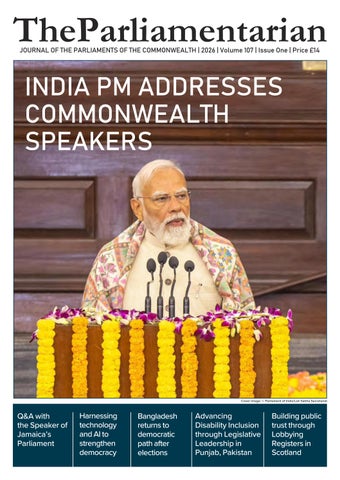
INDIA PM ADDRESSES COMMONWEALTH SPEAKERS
Q&A with the Speaker of Jamaica’s Parliament Harnessing technology and AI to strengthen democracy Bangladesh returns to democratic path after elections
COMMONWEALTH LEADERSHIP
Advancing Disability Inclusion through Legislative Leadership in Punjab, Pakistan
Building public trust through Lobbying Registers in Scotland

THE PARLIAMENTARIAN
2026 ISSUE ONE
CONTENTS
REGULARS
2 | View from the CPA SecretaryGeneral Unlocking opportunities for the Commonwealth
4 - 7 | Q&A with the Speaker of Jamaica Reflections on the role of the Commonwealth
8 - 11 | Image Gallery Activities in Commonwealth Parliaments
40 - 43 | Legislative news Reports from the CPA's membership
44 | Celebrating Commonwealth Lives
Sri Lanka Parliament's longserving SecretaryGeneral
FEATURES
12 | Harnessing technology to strengthen democracy
The Speaker of the Parliament of India
14 | Representative democracy
The first FilipinoCanadian woman as Speaker of Yukon's Legislative Assembly
16 | Democratic buffers against rising authoritarianism
View from CPA UK Chair
17 | Bangladesh Returns to Democratic Path Analysis following the recent elections
18 | Advancing Disability Inclusion through Legislative Leadership
A Member from Punjab, Pakistan
20 | Parliamentary innovation using technology and AI Anguilla's Speaker on latest innovations
The Parliamentarian: Journal of the Parliaments of the Commonwealth | Volume 107 | 2026: Issue One | ISSN 00312282 | Published by the Commonwealth Parliamentary Association, CPA Headquarters Secretariat, Richmond House, Houses of Parliament, London, SW1A 0AA, United Kingdom.
22 | Moving beyond technological tools
Applying Artificial Intelligence to legislative scrutiny
24 | Strengthening Public Accounts Committees
Role as guardians of public trust
27 | Reconciling Parliamentary Privilege and Judicial Independence
Sri Lanka's ruling
29 | MPs role in Agrifood Systems
Protecting production
32 | Building public trust through Lobbying Registers Scotland's case study
34 | Supporting women into leadership roles
Canada's outreach
36 | Are we failing on gender equality?
Citizen News Service
Tel: +44 (0) 20 7799 1460
Email: hq.sec@cpahq.org www.cpahq.org
Stephen Twigg, CPA Secretary-General and Jeffrey Hyland, Editor, The Parliamentarian - editor@ cpahq.org
Note from the Editor
In this issue of The Parliamentarian, the Speaker of the Parliament of Jamaica reflects on the role of the Commonwealth and supporting young people in our latest Q&A.

Following the 28th CSPOC in New Delhi, the Speaker of India’s Lok Sabha shares how we need to harness technology to strengthen democracy and our Parliaments. The Speaker of Anguilla also shares how one of the smallest Parliaments in the Commonwealth is leading the charge on the digitisation of the Legislature and a WFD expert looks at how to successfully integrate Artificial Intelligence into Parliaments.
This issue explores how the Commonwealth can be a democratic buffer against rising authoritarianism, Bangladesh’s return to democracy following the recent elections and referendum, advancing disability inclusion through legislative leadership, Sri Lanka’s landmark ruling on the relationship between the Judiciary and Parliament, what we can learn from introducing a Lobbying Register in The Scottish Parliament, strengthening Public Accounts Committees in Pakistan and other jurisdictions and how to put Parliamentarians at the heart of Agrifood Systems Transformation.
Ahead of International Women’s Day 2026, we also share how women MPs are supporting women into leadership roles in Canada and what the election of the first Filipino woman Speaker in Canada’s history demonstrates about representation in Yukon.
The CPA Secretary-General reflects on the 2026 Commonwealth Day theme of 'Unlocking opportunities together for a prosperous Commonwealth’ as well as recent visits to India, Fiji and Pakistan. This issue of The Parliamentarian also brings you legislative news from Parliaments across the CPA’s membership.
Jeffrey Hyland, Editor, The Parliamentarian
Email: editor@cpahq.org
Annual subscription: Four issues per year including supplements: UK: £44 World: £46. Agency discount 15%.
Disclaimer: Opinions expressed in articles published in The Parliamentarian are those of the individual contributors and should not be attributed to the Association.
Contributors: Thank you to all contributors for this issue.
Print: Warners Midlands UK and Times Printers Singapore. Limited print run - contact Editor for details of print copies for CPA Branches.

UNLOCKING OPPORTUNITIES FOR THE COMMONWEALTH
The CPA Secretary-General reflects on his recent visits to India, Fiji and Pakistan.
During the first six weeks of 2026, I have had three important opportunities to engage with CPA Members and partner organisations at meetings hosted in Delhi, India; Karachi, Pakistan; and Nadi, Fiji. Each meeting had a specific focus and agenda but there was a common thread running through them – that multilateralism is in serious trouble and that the Commonwealth has a historic opportunity to be a bold, proactive and influential voice at this difficult time.
This theme shone through in contributions at the 28th Commonwealth Speakers and Presiding Officers Conference (CSPOC) in Delhi in January; from Speakers and Parliamentarians at the 2nd Joint Regional Conference of the CPA Asia and CPA South-East Asia Regions in Karachi in February and from Ministers and the Commonwealth Secretary-General at the Commonwealth Law Ministers Meeting in Fiji also in February.
As the Commonwealth Secretary-General, Hon. Shirley Botchwey, said in Fiji – “History will remember not the turbulence of our times, but whether we had the courage to rise above the chaos and build a better world together.”
Democratic resilience is a priority theme in the new Commonwealth Secretariat’s Strategic Plan and it, of course, lies at the core of the CPA’s purpose as an
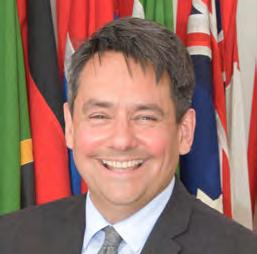
The Secretary-General of the Commonwealth Parliamentary Association, Stephen Twigg E: Stephen.Twigg@cpahq.org
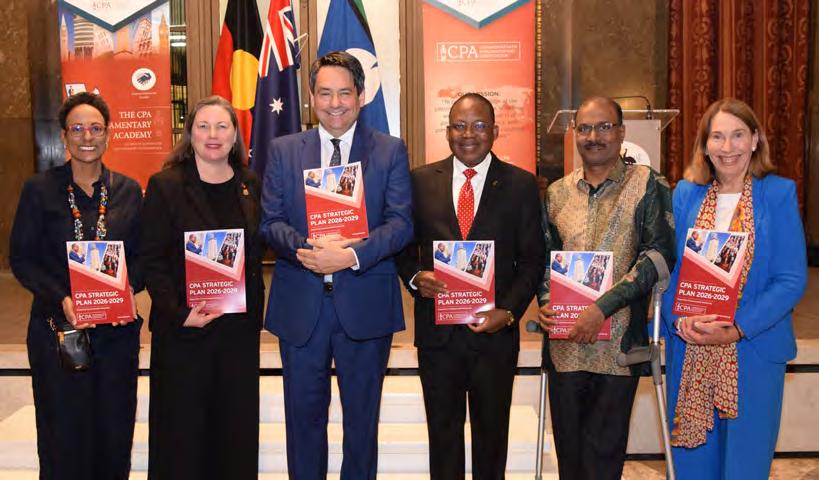
organisation. This core mission informs our new CPA Strategic Plan 2026-2029 which was adopted by delegates at the CPA General Assembly in Barbados at the 68th Commonwealth Parliamentary Conference (CPC) in October 2025. The Plan was launched in London in February at an event hosted by the Australian High Commission and attended by the CPA Chairperson, Dr Christopher Kailia MP and other CPA Officers.
The CPA’s strategy sets out the three clear objectives of our organisation:
1. To strengthen Parliaments
2. To support professional development of Members and parliamentary staff
3. To promote Commonwealth values
These key objectives will be informed by six crosscutting themes, - gender, disability, small jurisdictions, youth, technology and sustainable development/climate change.
CPA Branches have been sent a link to the new CPA Strategic Plan, but it is also available online at: www.cpahq. org/about-us/our-governance/strategic-plan/
In recent years, the CPA’s work on disability has grown. This includes the Commonwealth Parliamentarians with Disabilities (CPwD) network and the Capital Investment Fund which has enabled Parliaments across CPA Regions to address exclusion and improve access. In 2026, we are determined to build upon this progress.
The CPA has launched a campaign to mark the 20th Anniversary of the UN Convention on the Rights of Persons with Disabilities with a focus on encouraging all legislatures to adopt comprehensive and effective
Left: The launch event for the CPA Strategic Plan 2026-2029 with the CPA Coordinating Committee and the CPA Secretary-General which took place at Australia House in London on 24 February 2026.
legislation on disability rights.
We are also supporting the Commonwealth Disabled People’s Forum’s campaign for a Commonwealth Disability Inclusion Action Plan. I was encouraged to see that this important issue had prominence at the Commonwealth Law Ministers Meeting (CLMM) in Fiji.
In May, we are planning a CPwD forum hosted by the Western Cape Provincial Parliament. Drawing on lessons learned from Nova Scotia's 2017 workshop, the event will be aimed at Parliamentarians who may be less familiar with the network's purpose and activities, while also involving expert organisations such as Sightsavers and the Global Disability Innovation Hub
The CPA networks play a vital role in our work. As well as the CPwD forum, we are planning for our regular CPA Small Branches and Commonwealth Women Parliamentarians (CWP) workshops with the former being hosted by the Parliament of The Maldives in April.
People sometimes ask me about the relevance and impact of the Commonwealth. In answering, I often refer to the experience of Small Island Developing States and the focus that both the Commonwealth Secretariat and the CPA rightly give to them. In recent years, this has included a renewed focus from the CPA on work in the Pacific using the CPA Recommended Benchmarks for Democratic Legislatures. It is work that we aim to deepen and develop in the coming years.
Similarly, our work on gender and women’s representation goes from strength to strength. Good evidence for this has been the huge popularity of the Gender Strengthening Funds with a wide range of exciting and innovative proposals from CPA Branches and Regions.
In July, the New South Wales Parliament will host the biennial Commonwealth Youth Parliament, the 13th time that we have organised such an event, providing a great opportunity for young people from across the Commonwealth to learn more about Parliamentary practice and develop their skills whilst learning from each other.
I took part in an inter-generational event at the CLMM in Fiji and I was struck that many of the concerns raised by young people there echoed those I might hear in the United Kingdom or that I have heard from young people in other parts of the Commonwealth.
In September of this year, we will have the 69th Commonwealth Parliamentary Conference in Cape Town, South Africa. The theme and topics will be decided in the coming months, but I have no doubt that the Conference will address the challenges I have written about here as well as many others – providing a powerful platform for parliamentary voices ahead of the Commonwealth Heads of Government Meeting (CHOGM) in Antigua and Barbuda in November.
So, I am expecting a busy and challenging year ahead, but I know that the CPA membership is ready to address these challenges together. In doing so, we will echo the theme for Commonwealth Day 2026 – ‘Unlocking opportunities together for a prosperous Commonwealth’.

DATES FOR YOUR DIARY
Updated as at 27 February 2026
2026
March
• 8 March 2026: International Women's Day
• 9 March 2026: Commonwealth Day - 2026 theme: 'Unlocking opportunities together for a prosperous Commonwealth.’
• 9 to 13 March 2026: 74th Westminster Seminar on Effective Parliaments, London, UK (CPA UK event)
• 9 to 20 March 2026: 70th Session on the Commission of the Status of Women (CSW70), New York, USA
April
• 15 to 19 April 2026: 152nd IPU Assembly, Istanbul, Türkiye
• 27 to 29 April 2026: CPA Small Branches Workshop, The Maldives
May
• 12 to 14 May 2026: Mid-Year CPA International Executive Committee meetings (virtual)
• 25 to 29 May 2026: 16th CPA Canadian Parliamentary Seminar (open to all CPA Branches), Ottawa, Canada
• 26 to 28 May 2026: Commonwealth Parliamentarians with Disabilities (CPwD) Forum, Western Cape, South Africa
June
• 17 to 20 June 2026: 55th CPA British Islands and Mediterranean Regional Conference, Gibraltar
• w/c 22 June 2026: CPA Parliamentary Academy Residency Programme for Members (Professional Development and SkillsBuilding), Darwin, Northern Territory, Australia
• 30 June 2026: International Day of Parliamentarism
July
• 4 to 10 July 2026: 62nd CPA Canada Regional Conference, Victoria, British Columbia, Canada (plus the CWP Canada Regional Conference)
• 23 July to 2 Aug 2026: 23rd Commonwealth Games 2026, Glasgow, Scotland - www.glasgow2026.com
• 27 to 29 July 2026: National Conference of State Legislatures, Chicago, United States
• 26 to 31 July 2026: 13th Commonwealth Youth Parliament #CYP13, Sydney, New South Wales, Australia
August
• 23 to 29 August 2026: 48th CPA Regional Conference of the Caribbean, Americas and the Atlantic (CAA) Region, Kingston, Jamaica
September
• 13 to 18 September 2026 - 69th Commonwealth Parliamentary Conference, Cape Town, South Africa - including 42nd CPA Small Branches Conference; 10th Commonwealth Women Parliamentarians (CWP) Conference and Commonwealth Parliamentarians with Disabilities (CPwD) meetings; 2026 CPA General Assembly; CPA Executive Committee meetings; and 60th Society of Clerks at the Table (SoCATT) meetings.
November
• 1 to 4 November 2026: 28th Commonwealth Heads of Government Meeting (CHOGM), Antigua and Barbuda
For further information on any events, please email hq.sec@cpahq.org or visit www.cpahq.org
REPRESENTING SMALL STATES ON A GLOBAL STAGE
The Speaker of the Jamaica House of Representatives reflects on Jamaica's place in the world and the relevance of the 'modern' Commonwealth in our Q&A.
The Most Hon. Juliet Holness, MP, is the Speaker of the House of Representatives at the Parliament of Jamaica. She is the Joint President of the CPA Jamaica Branch, along with the President of the Jamaican Senate. She became the 16th Speaker of the House of Representatives on 26 September 2023, having been first elected as a Member of Parliament on 3 March 2016, for the constituency of St Andrew East Rural, where she was re-elected in 2020 and 2025.
A product of Spanish Town in Jamaica, Juliet attended St Catherine High School and Wolmer’s Girls' School before graduating with a bachelor's degree in accounting and economics as well as a master's degree in accounting from the University of the West Indies. She began her professional career working for international accounting firms KPMG and PricewaterhouseCoopers (PwC) before becoming a successful real estate developer and subsequently entering politics. She is a fellow of the Association of Chartered Certified Accountants. Juliet has been married to Andrew Holness, the current Prime Minister of Jamaica, for 28 years. She has launched the ‘Save Our Boys and Girls Foundation’, which aims to improve the lives of marginalised young men and women in Jamaica.
Q: Tell us about your experience of the Commonwealth, living and working in a Commonwealth country like Jamaica? When were you first aware of the Commonwealth? How is the Commonwealth viewed in Jamaica and the wider CPA Caribbean, Americas and the Atlantic Region? ?
A: Growing up in Jamaica, we are introduced to the Commonwealth from childhood as a positive community of nations bound by shared history, values and institutions. In school, the Commonwealth is presented not as a relic of the past, but as a living network that promotes democracy, good governance, development cooperation and people-topeople exchange through its programmes and organisations.
For me, living and working in a Commonwealth country has reinforced that sense of community and shared purpose. Jamaica benefits from technical assistance, parliamentary strengthening, youth and women’s programmes, and peer-learning opportunities facilitated by Commonwealth institutions, including the Commonwealth Parliamentary Association (CPA). These platforms create space for collaboration, mutual respect and the exchange
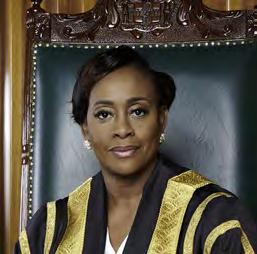
The Most Hon. Juliet Holness, MP is the Speaker of the House of Representatives at the Parliament of Jamaica
of best practices among Parliaments of diverse sizes and capacities.
In Jamaica and across the CPA Caribbean, Americas and the Atlantic Region, the Commonwealth is generally viewed as a constructive and supportive network, particularly valuable for small and developing states. It offers a forum where our voices can be amplified, our shared challenges discussed openly, and our unique contexts understood.
Importantly, the Commonwealth is seen not merely as a historical association, but as a community of equals grounded in common ideals, parliamentary democracy, the rule of law, respect for human rights and sustainable development. For small states, this sense of belonging to a wider family of nations strengthens our capacity to influence global conversations and pursue collective solutions to our shared challenges.
Q: You have been a Member of Parliament for 10 years this year and Speaker for almost three years. Can you highlight some of the challenges and lessons you have learned from your time in the Parliament of Jamaica? What best practices do you think other Commonwealth Parliaments could learn from your Legislature?
A: Having been a Member of Parliament for ten years and Speaker for almost three years, I have concluded that leadership in a modern Parliament requires a balance among firmness and fairness, tradition and reform, and efficiency and inclusion. As the third woman Speaker and the fourth woman Presiding Officer in the history of an independent Jamaican Parliament, I have found that women in leadership face high expectations. We are expected to demonstrate exceptional competence and impartiality. This has reinforced for me the importance of conducting myself with integrity, consistency and respect for the institution of Parliament.
Among the key challenges I have faced are managing the increasingly polarised political discourse, maintaining order and decorum in the Chamber while ensuring that Parliament remains relevant and accessible to the public. Another challenge is balancing the heavy legislative and oversight workload with the need for meaningful engagement with constituents. My tenure has underscored that strong institutions depend on respect for the rules, continuous capacity building for Members and staff, and a commitment to transparency.
As a former accountant, I strongly advocate for the development of our Parliament, envisioning its transformation into a modern, purpose-built institution that truly reflects our national identity. This transformation is essential for strengthening our democracy and ensuring operational efficiency and accountability. Central to this vision is the support for the authority and role of the Clerk, who plays a vital part in maintaining the integrity and functionality of our parliamentary processes. By empowering the Clerk, we enhance the institution’s ability to serve the public and uphold democratic values effectively.
Best practices from Jamaica that may be of value to other Commonwealth Parliaments include public education initiatives to demystify parliamentary processes, strengthened Committee oversight of public expenditure, and partnerships with organisations such as the CPA to build legislative and procedural capacity. Promoting gender sensitive leadership and inclusive parliamentary practices is also critical. Ultimately, Parliaments must continuously modernise while preserving the constitutional principles that underpin democratic governance.
Q: The Commonwealth is facing many challenges and questions over its role in geopolitics and reconciling its modern role with its past history. Is this the time for the Commonwealth to assert its influence around the work as a global organisation that doesn’t include the USA, China or Russia as part of its membership? How do you see the future for the Commonwealth?
A: The Commonwealth’s strength lies in being a voluntary association of equals, grounded not in hegemony, but in shared values and mutual respect. In a complex geopolitical environment dominated by major powers, the Commonwealth provides a distinctive platform for dialogue among diverse nations, large and small, developed and developing, without the pressures of bloc politics.
This is indeed a moment for the Commonwealth to assert its relevance by leveraging its moral authority and convening powerful, practical programmes. Its credibility rests on its promotion of democracy, good governance, climate action, youth development and respect for human rights. The Commonwealth can play a bridging role by fostering dialogue across regions and advancing cooperative solutions to global challenges such as climate change, social security inequality and disparities in development financing.
For small states, the Commonwealth offers an invaluable
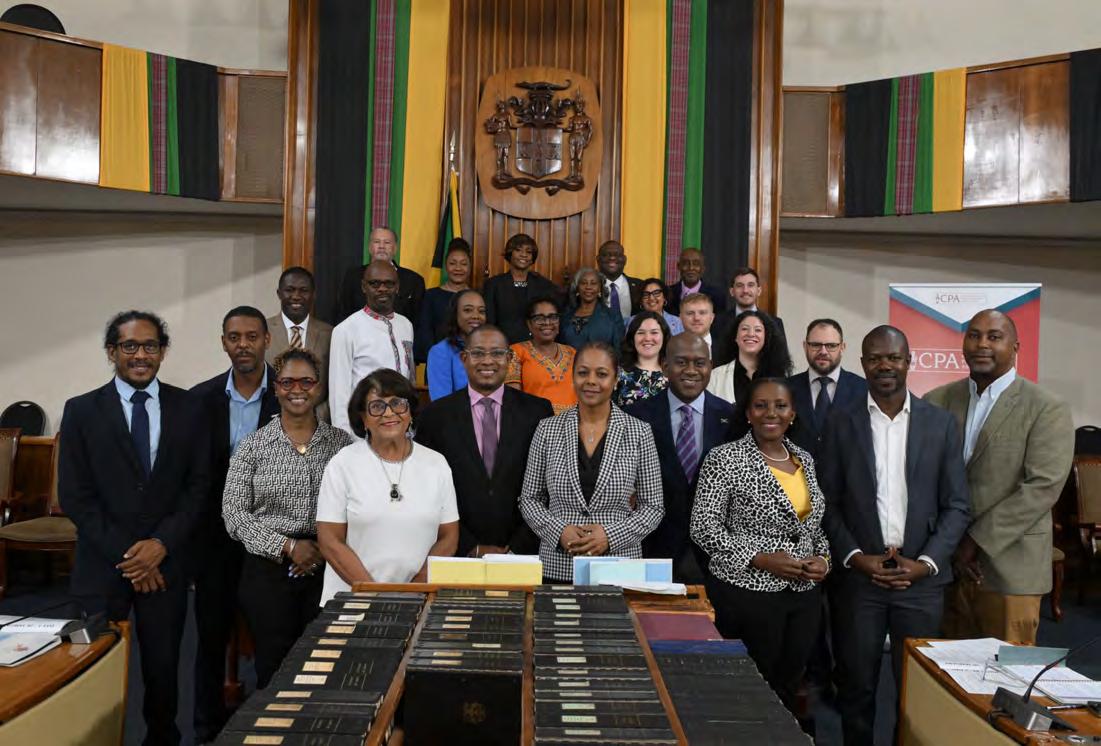
Above: From 28 to 30 January 2026, the Commonwealth Parliamentary Association (CPA) and ParlAmericas held a Post Election Seminar for the Parliament of Jamaica. The Seminar followed the Jamaican General Election, held in September 2025 and was designed to provide new and returning Parliamentarians with improved knowledge and skills to undertake their parliamentary duties. The sessions covered topics such as the role of Presiding Officers in Parliaments and public financial management.
Image credit: Parliament of Jamaica.
multilateral space where our voices can be heard and our shared vulnerabilities, particularly to climate change and external economic shocks, can be collectively addressed.
Looking to the future, the Commonwealth must continue to modernise its engagement with citizens, particularly young people, in demonstrating its tangible impact. Its future role will depend on practical cooperation, supporting institutional strengthening, advocating for climate justice and amplifying the concerns of small and vulnerable states on the global stage. The Commonwealth’s values-based identity, rather than power politics, remains its greatest comparative advantage.
Q: Given your experiences in political life, how do you view the role of women in politics? Do you think that women politicians are often subjected to a level of scrutiny that male politicians are perhaps not? How do you view this dynamic, and can you share with us your experiences? What are the main barriers facing women coming into politics and how can we overcome this?
A: I am proud to report that, for the first time, women Parliamentarians constitute 30% of the membership of the House of Representatives and 33% of the Senate. In Jamaica, women have historically been well represented at grassroots levels but underrepresented in leadership positions. Significant progress has been made in recent years, with more women being nominated, elected and appointed to leadership roles in Parliament. Trailblazers such as the Most Hon. Portia Simpson Miller, Jamaica’s first female Prime Minister, and leaders like Hon. Olivia Grange, Minister with Responsibility for Gender Issues, as well as Senator Hon. Kamina Johnson Smith, Jamaica’s first female Minister of Foreign Affairs and Fayval Williams, Jamaica’s first female Finance Minister, exemplify what is possible when women are empowered to lead.
The political space is demanding and highly public. Women often face scrutiny beyond their performance or policy positions, with attention to how they speak, carry themselves or balance public and private life, pressures that are less commonly experienced by male colleagues. In my own journey, I have learned that navigating this requires purpose, resilience and confidence in one’s competence and values.
The perception that politics is unforgiving, the intensity of public debate and social expectations that women shoulder primary family responsibilities often serve as barriers discouraging capable women from stepping forward.
Increasing women’s political leadership requires a collaborative and multifaceted approach. Personal mentorship from experienced Parliamentarians is essential, guiding new women leaders with advice, support and encouragement. Active participation in networks or Associations that foster and promote women’s participation and leadership, and initiatives that provide leadership training for young women, so that they view political participation as achievable and worthwhile. In Jamaica, we are working within Parliament, through the Bicameral Caucus of Women Parliamentarians, to provide a formal avenue for cross-party collaboration, mutual support and the advancement of issues that affect women and society holistically.
Q: The challenges facing the Commonwealth’s smallest jurisdictions were highlighted at the recent COP30 in Brazil - how can Parliamentarians in the Commonwealth work together to bring effective responses to these issues? How is Jamaica responding to these challenges?
A: Small island developing states (SIDS) are disproportionately vulnerable to climate change, despite contributing minimally to global emissions. Jamaica’s experience, particularly following the devastation caused by Hurricane Melissa in 2025, highlights the urgency of climate justice. At COP30, Jamaica advanced advocacy for predictable, accessible finance for adaptation, resilience and loss and damage, while defending the 1.5°C limit as a lifeline for vulnerable states. Jamaica engaged multilaterally with partners, including the Fund for Responding to Loss and Damage, the Climate
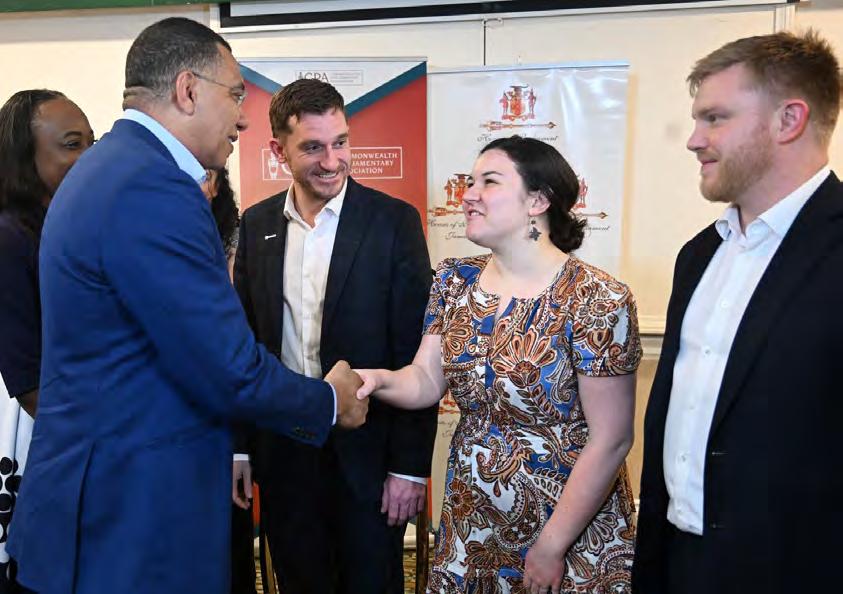
Left: The Prime Minister of Jamaica, Hon. Andrew Holness, MP, met with participants and the resource team from the Commonwealth Parliamentary Association and ParlAmericas following the recent Post Election Seminar for the Parliament of Jamaica.
Parliament of Jamaica.
Investment Funds, the Global Environment Facility, the Caribbean Development Bank, the NDC Partnership, the Coalition for Disaster Resilient Infrastructure, and the Green Climate Fund, to secure financing and technical support for post-disaster recovery and long-term resilience.
In this era of geopolitical instability, Commonwealth Parliamentarians should collaborate to ensure that climate change remains a focus of the multilateral community. Commonwealth Parliamentarians should collectively advocate for simplified access to climate finance for SIDS, share legislative frameworks that support climate-resilient development and strengthen parliamentary oversight of climate funding and adaptation programmes. Parliamentary diplomacy within the Commonwealth can amplify calls for grantbased financing, technology transfer and recognition of the special circumstances of SIDS and least-developed countries.
Climate justice is not abstract. It concerns protecting livelihoods, communities and the right of small states to a sustainable future.
Q: 60% of the Commonwealth’s 2.7 billion population is aged under 30. How can the Commonwealth and Parliamentarians engage with young people? How can we involve more young people in politics?
A: With 60% of the Commonwealth’s population under 30, the Commonwealth’s future relevance depends on meaningful youth engagement. Young people must see politics and parliamentary democracy as relevant to their lives and aspirations.
In Jamaica, initiatives such as the National Youth Parliament, undertaken in partnership with the Ministry of Education, Youth, Skills and Information, provide young people with practical exposure to parliamentary processes and leadership. We have pursued initiatives that give the
youth a voice in policy decisions, and we have a plethora of programmes to promote youth action and advocacy.
As Parliamentarians, we should engage the youth through mediums which already fascinate them - social media and digital platforms such as Instagram, TikTok, X, YouTube, podcasts and other online forums. We should also encourage youth-led initiatives, such as youth-focused civil society groups and youth manifestos, to ensure that young voices are part of the discourse, including on critical issues like climate change.
I also support the reintroduction of civic education in schools. This training in political literacy and governance within school curricula helps bridge the generational divide and motivate early civic participation. Public education programmes led by Parliament can also foster civic awareness. In this way, young people are encouraged to become active participants rather than observers in political life.
As Parliamentarians, we should make young people feel that their opinions on the decisions we make matter to us. It is also important that young people understand that political participation extends beyond voting or holding office. It includes civic engagement, advocacy and community leadership. When young people perceive Parliament as accessible and responsive, political participation becomes more attractive.
To find out more about the work of the Parliament of Jamaica please visit www.japarliament.gov.jm
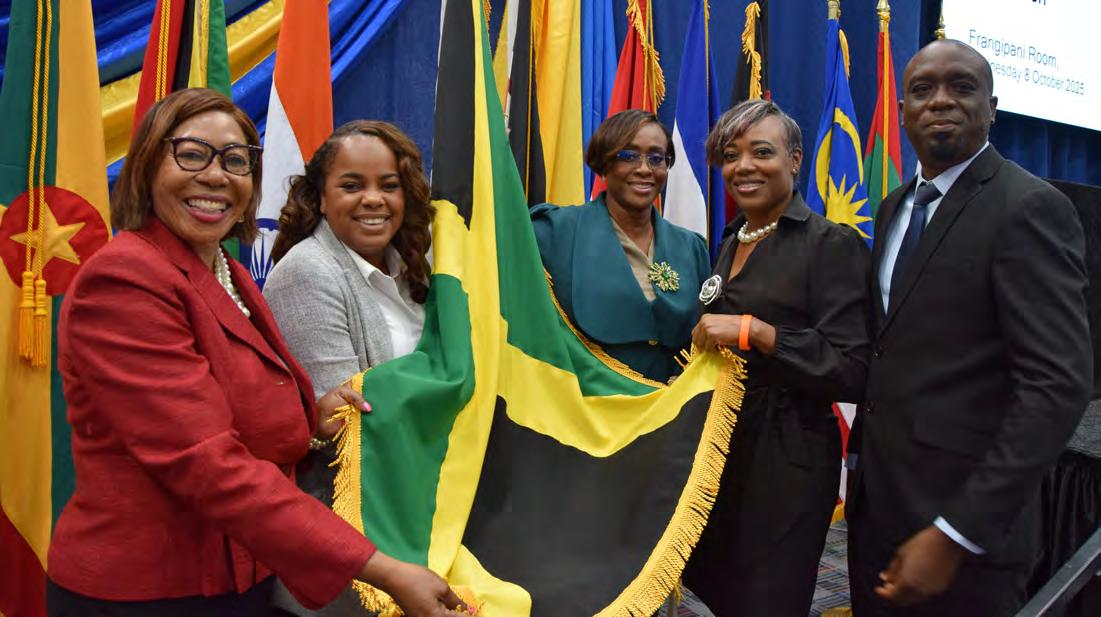
Above: The Speaker of the House of Representatives, Most Hon. Juliet Holness, MP (centre) with the Parliament of Jamaica's delegation to the 68th Commonwealth Parliamentary Conference in Barbados in October 2025.
Image Gallery: Parliamentary Diplomacy
Right: Speakers and Presiding Officers join the formal procession in India for the 28th Conference of Speakers and Presiding Officers of the Commonwealth (CSPOC) held from 14 to 16 January 2026.
Centre right: The CPA Parliamentary Academy Residency programme was hosted by the Parliament of Trinidad and Tobago from 8 to 12 December 2025 and attended by MPs from Anguilla, Australian Capital Territory, Cayman Islands, Eswatini, Kenya, The Maldives, Nova Scotia, Pakistan, Tasmania and Trinidad and Tobago.
Bottom right: The Speaker of the Canadian House of Commons, Hon. Francis Scarpaleggia, MP (centre left) and Canadian MPs met with the CPA Secretary-General, Stephen Twigg during a visit to Westminster on 13 November 2025 organised by CPA UK Branch.
Opposite page - Above: The Jersey States Assembly’s Public Accounts Committee hosted representatives from across the CPA British Islands and Mediterranean Region (CPA) on 7 November 2025.
Opposite page - below left: The President of the Cyprus House of Representatives, Hon. Annita Demetriou led a Cypriot deleation to the Parliament of India on 27 November 2025 where they met with the Speaker of the Lok Sabha, Hon. Shri Om Birla.
Opposite page - below right: The Vice-President of the Inter-Parliamentary Union (IPU), Senator Hon. Gabriela Morawska-Stanecka (Poland) met with CPA SecretaryGeneral, Stephen Twigg on 27 January 2026 to discuss CPA’s work in human rights and development. The delegation from the Polish Parliament was on a bilateral visit to the UK Parliament organised by the British Group of the IPU.
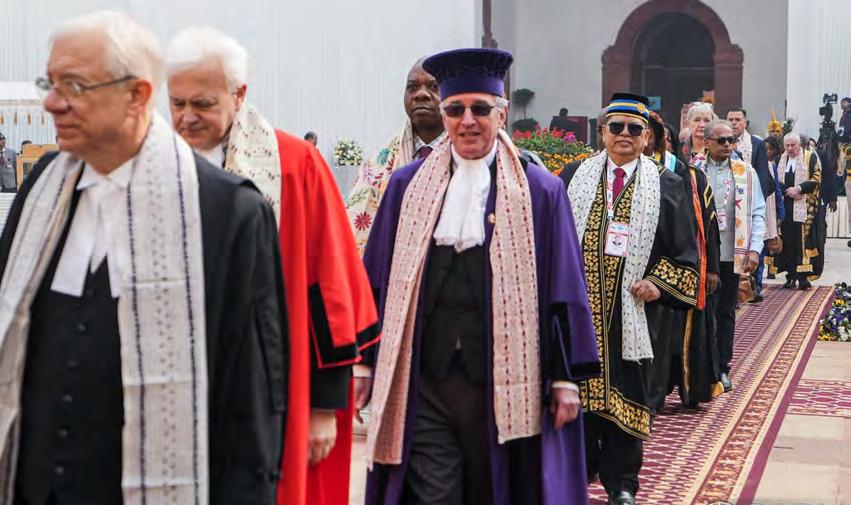
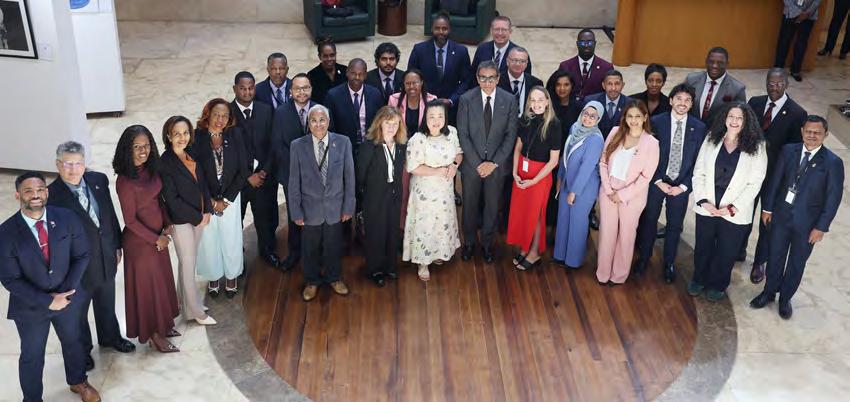
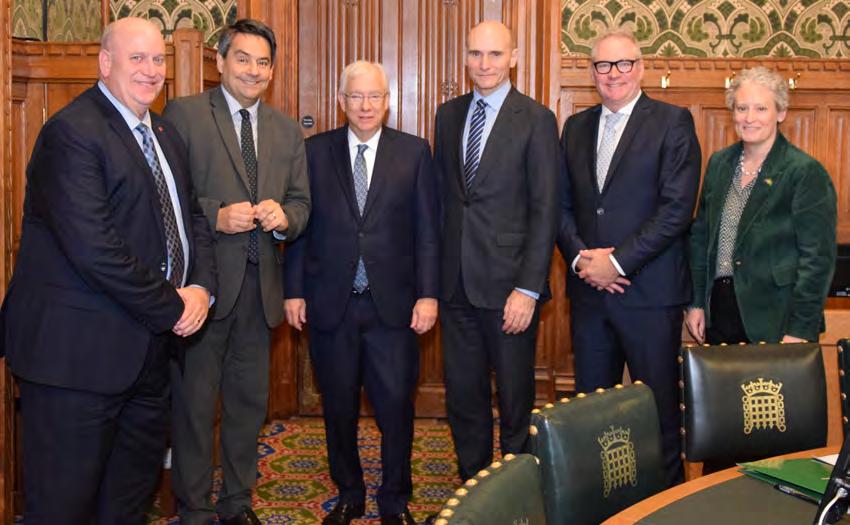
Image credit: Parliament of Trinidad and Tobago.
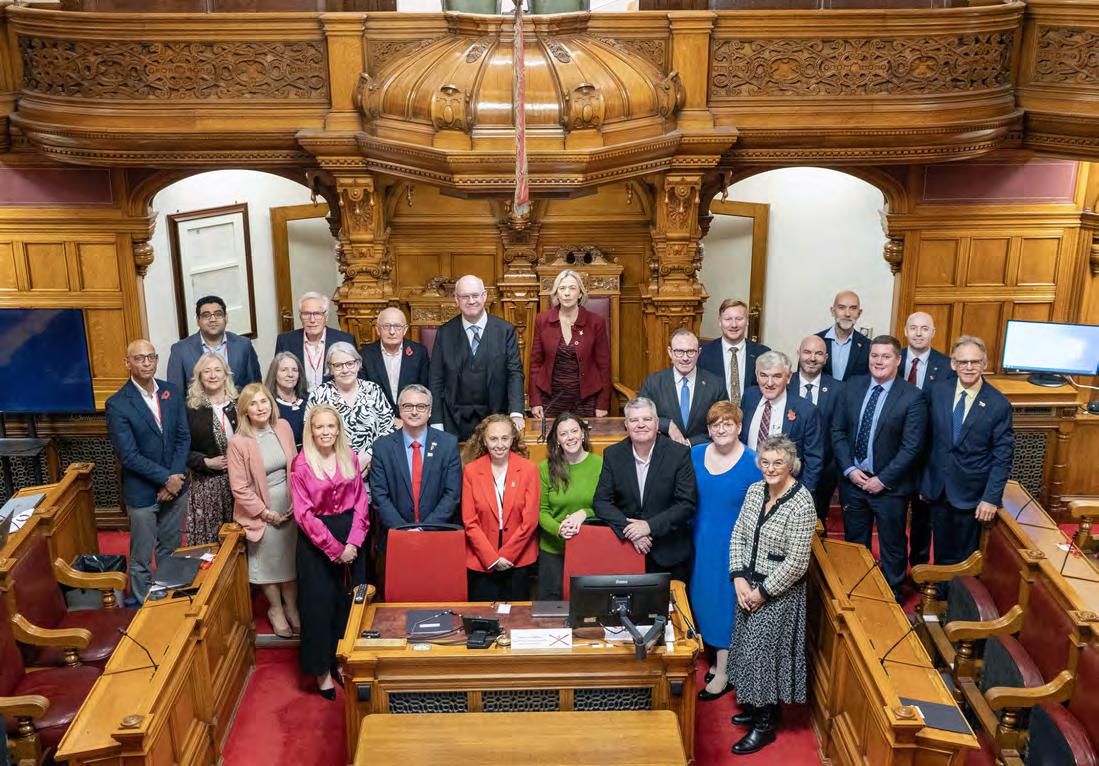
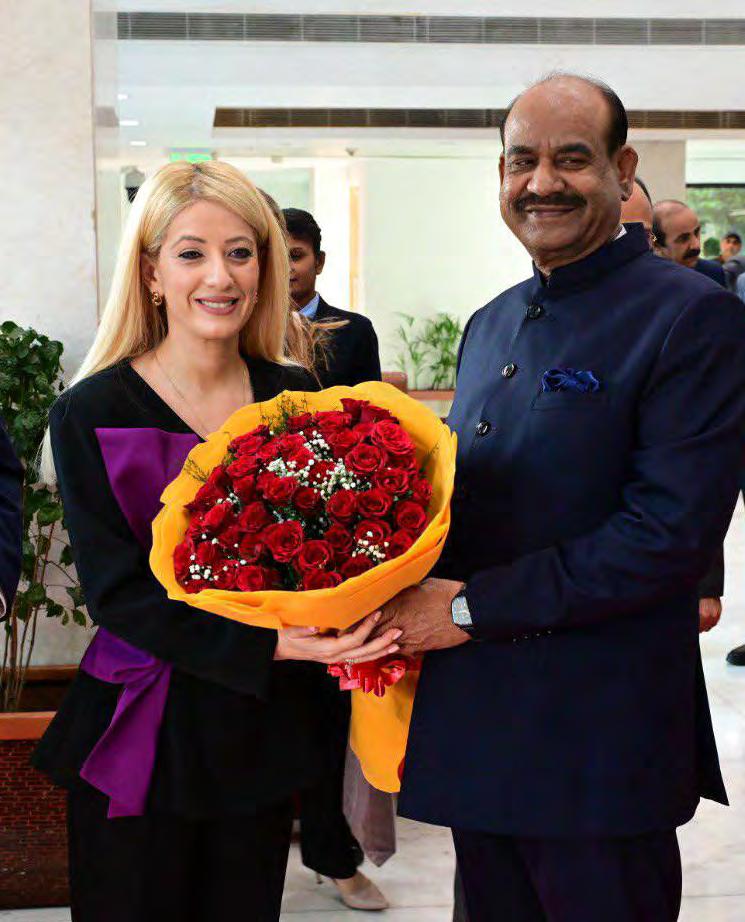
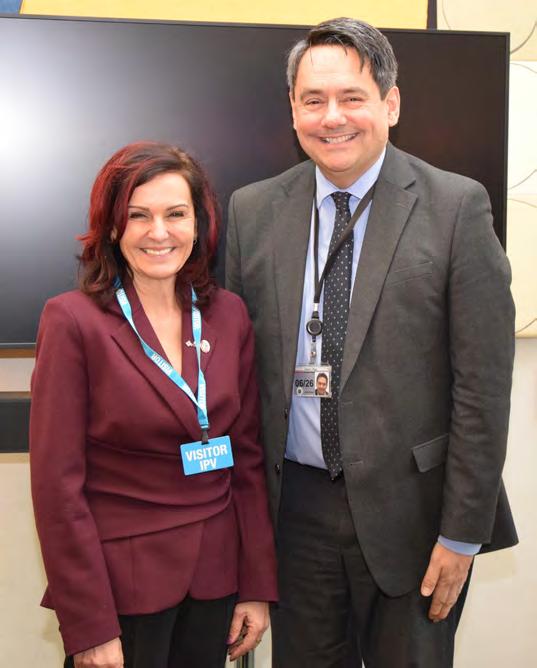
Image Gallery: Parliamentary Diplomacy
Right: The Speaker of the National Assembly of Botswana, Hon. Dithapelo L. Keorapetse (right) welcomed the President of India, Her Excellency Droupadi Murmu (left) to the Parliament of Botswana on 12 November 2026 during her three-day visit to the country.
Below right: Speakers from across Canada met from 28 to 31 January 2026 for the 42nd Canadian Presiding Officers Conference in Edmonton, Alberta. Delegates were welcomed by the Speaker of the Legislative Assembly of Alberta, Hon. Ric McIver, MLA.
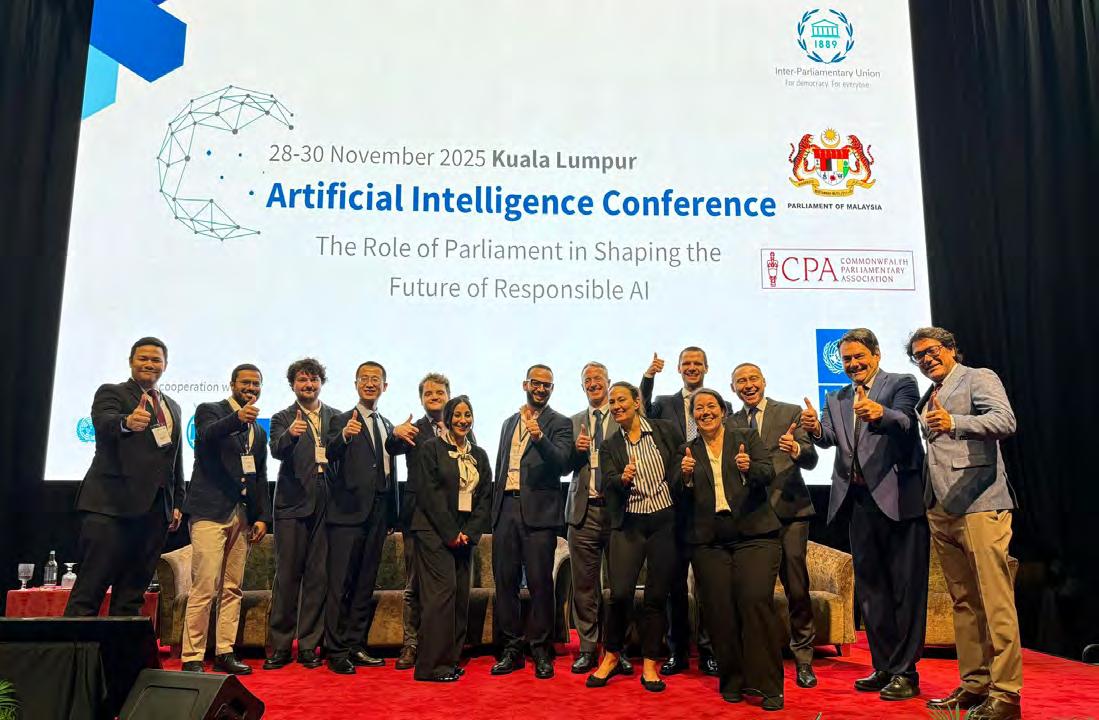
Opposite page - Above: MPs, parliamentary staff and experts convened in Malaysia from 28 to 30 November 2025 for the Conference on 'The Role of Parliament in Shaping the Future of Responsible AI', co-organised by the CPA, the Parliament of Malaysia, the UNDP and the IPU.
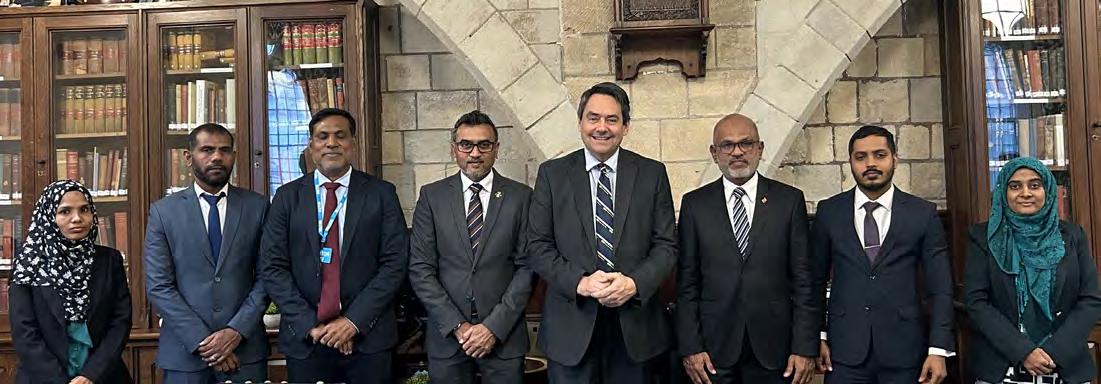
Opposite page - centre: The Deputy Speaker of the People’s Majlis (Maldives Parliament), Hon. Ahmed Nazim, MP and his delegation met with the CPA SecretaryGeneral, Stephen Twigg, at the UK Parliament in London on 4 December 2025.
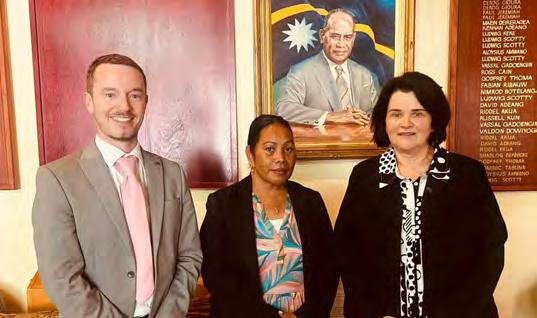
Opposite page - bottom left: A delegation from the CPA Secretariat and the Parliament of Victoria met with the Parliament of Nauru from 19 to 23 January 2026 as part of a CPA Benchmarks selfassessment exercise.
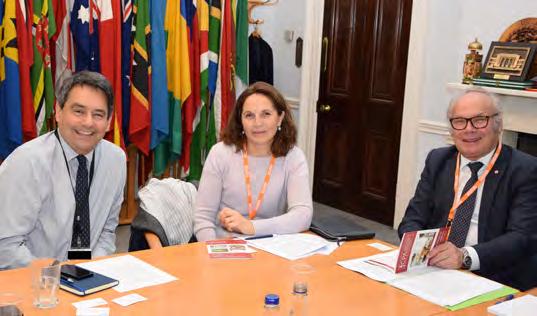
Opposite page - bottom right: Two Members of the Assemblée National de France – Hon. Pierre Pribetich, MP and Hon. Liliana Tanguy, MP - met with the CPA SecretaryGeneral, Stephen Twigg on 13 November 2025 during a fact-finding mission to the UK Parliament to identify good practice in parliamentary strengthening.
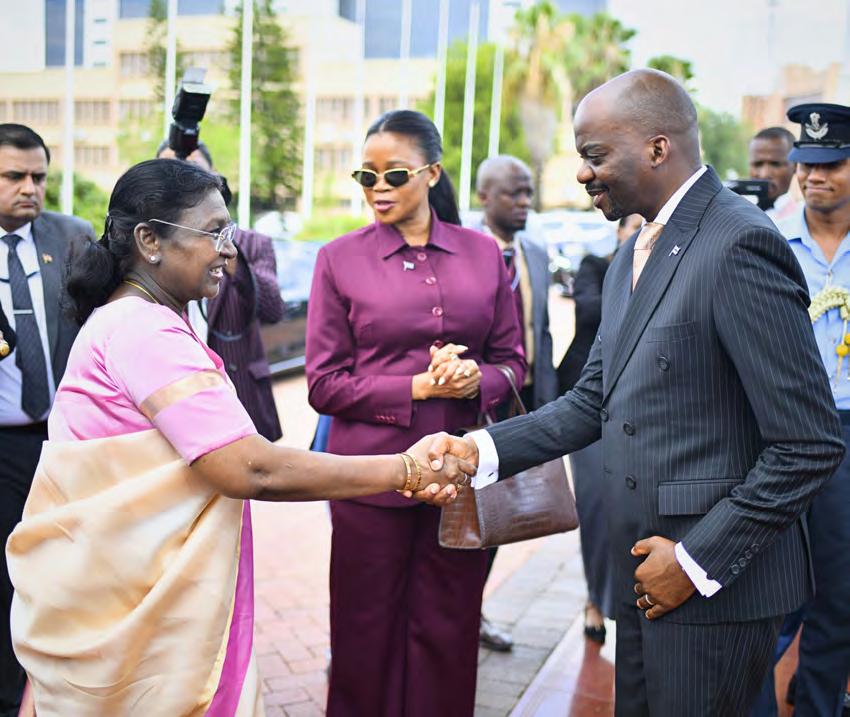
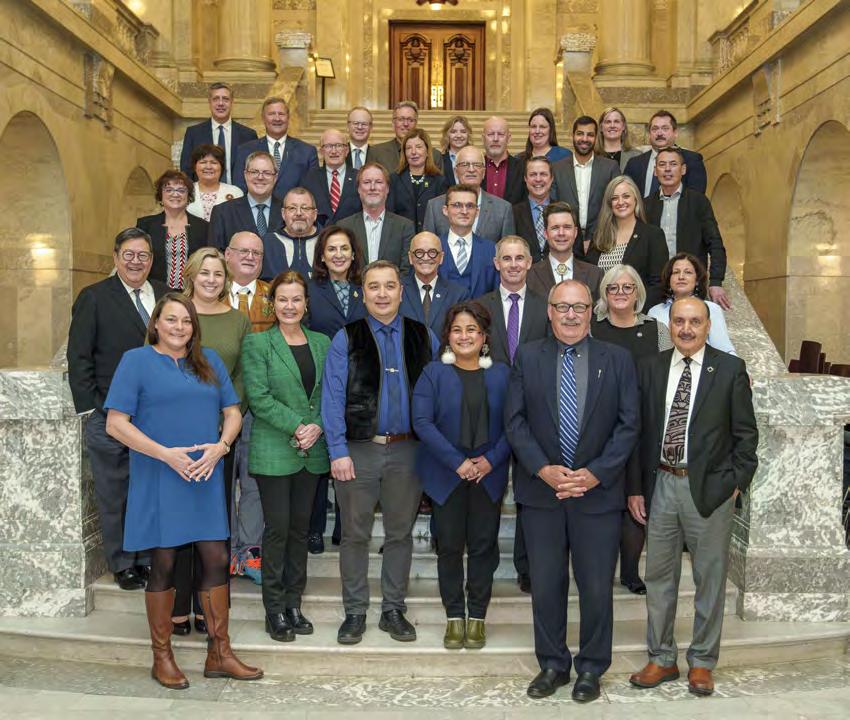
Image credit: Parliament of Botswana.
Image credit: Legislative Assembly of Alberta, Canada.
HARNESSING TECHNOLOGY TO STRENGTHEN DEMOCRACY
A call from New Delhi to strengthen democracy through the harnessing of emerging technologies
In January 2026, as the winter mist settled over New Delhi, the historic Samvidhan Sadan (Old Parliament House in New Delhi, India) hosted the custodians of the Commonwealth’s parliamentary traditions. It was with a profound sense of responsibility and pride that I welcomed my fellow Speakers and Presiding Officers for the 28th Conference of Speakers and Presiding Officers of the Commonwealth (CSPOC).
We met at a time when the very nature of our work is being reshaped by forces our predecessors could scarcely have imagined. The gavel and the rulebook, which have long represented our authority, must now work alongside algorithms and Artificial Intelligence (AI). It was fitting, therefore, that we chose to focus our deliberations on themes that are of contemporary relevance.
India’s enduring role in parliamentary diplomacy
It is with a sense of profound legacy that we recall the genesis of our
fraternity in 1969, when CSPOC was established through the vision of Hon. Lucien Lamoureux, Speaker of Canada’s House of Commons (1966 to 1974) to foster impartiality and the development of parliamentary institutions independent of Executive influence. Since its inception, with a permanent secretariat in Ottawa, the CSPOC forum has stood as a guardian of our shared democratic values. India has always been a pillar of this tradition, having had the distinct honour of hosting the Commonwealth family for CSPOC on three previous occasions: the second CSPOC in 197071, the eighth in 1986, and the 20th in 2010.
We then convened the 28th CSPOC in January 2026 — marking the fourth time that New Delhi welcomed this prestigious gathering, ensuring that our parliamentary institutions continue to evolve in the service of our citizens.
Honouring traditions and shaping tomorrow
The choice of our venue was deliberate. The Samvidhan Sadan is not merely a building; it is the hallowed ground where India’s Constitution was debated and drafted. It represents the soul of the ‘Mother of Democracy’. By convening there, we affirmed that while our tools may modernise, our foundational values of sovereignty, representation and debate remain immutable.
Yet, we cannot govern the future with the tools of the past. During the CSPOC Standing Committee meeting in Guernsey last year, I emphasised that India’s emergence as a global hub for technology offers a unique opportunity for the Commonwealth family. We are witnessing a digital turn in democracy, and it is my vision that New Delhi serves as the platform where we forge a consensus on how to navigate this transition.
‘Digital Sansad’: Enhancing transparency and outreach
I was eager to share with my colleagues the strides India has made through our ‘Digital Sansad’ initiative. We have moved beyond mere digitisation to true digital empowerment. In the Lok Sabha (Lower House) of the Parliament of India, we are deploying advanced Artificial Intelligence (AI) tools to break
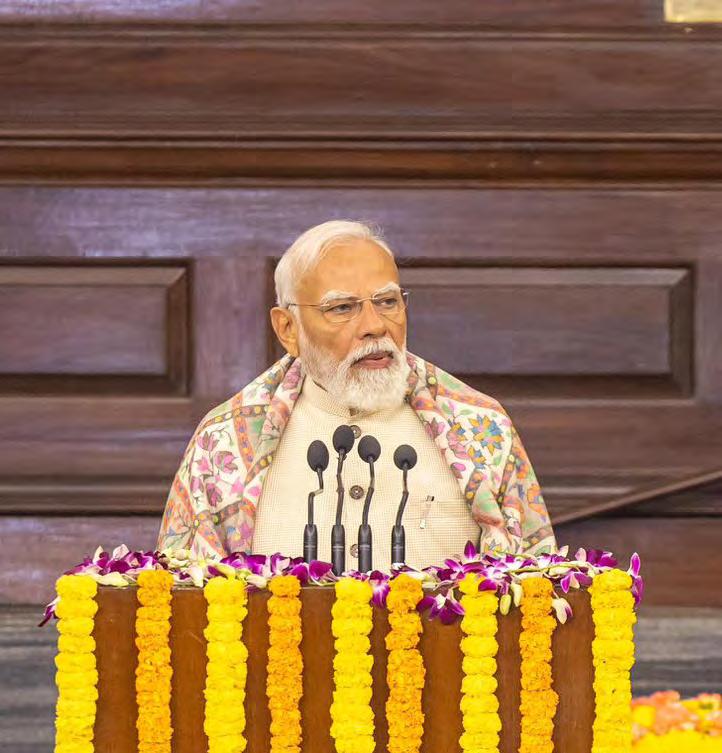
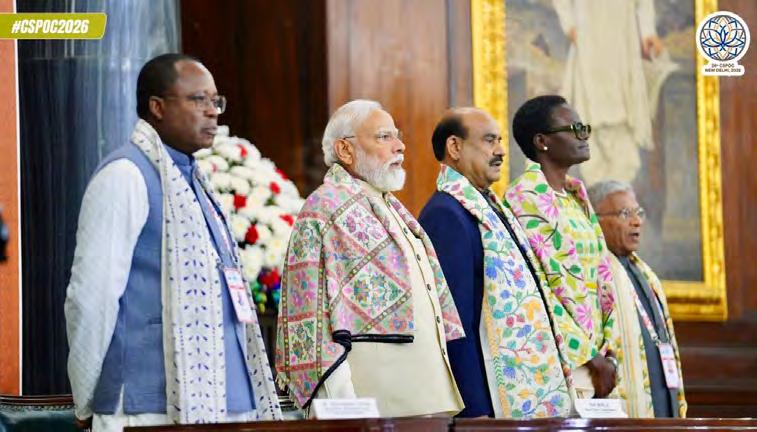
The Prime Minister of India, Hon.
Narendra Modi
opened the 28th CSPOC, whose aim is to strengthen parliamentary institutions by bringing together Speakers and Presiding Officers from across the Commonwealth.
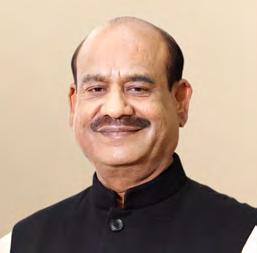
Hon. Shri Om Birla, MP is the 17th Speaker of the Lok Sabha at the Parliament of India.
Left:
Shri
(centre)
CPA Secretary-General, Stephen Twigg.
down the barriers that distance citizens from their representatives. Foremost among these is the ‘Sansad Bhashini’ project. In a Commonwealth defined by its rich linguistic diversity, language should never be a gatekeeper to democracy.
By utilising AI for real-time interpretation and transcription, we can ensure that a Member of Parliament can speak in their mother tongue and be understood instantly by their peers and their constituents. Once developed fully, this technology will be in the service of inclusion - a principle I believe is vital for the 2.7 billion citizens of our Commonwealth nations.
A force multiplier for the global south I am aware of the capacity constraints faced by many of our sister nations, particularly across the Global South. In many of these jurisdictions, the imperative to undertake high-quality legislative research is often hampered by limitations in time, expertise and
financial resources. Therefore, a cornerstone of my vision for the 2026 CPSOC Conference was to demonstrate how AI can act as a transformative force multiplier. By supporting critical functions - ranging from intricate legislative drafting to the comprehensive analysis of complex budget documents, we can empower our Parliaments to operate with greater efficiency, ultimately advancing the welfare of our people with renewed vigour.
In the spirit of ‘Vasudhaiva kutumbakam’ (the world is one family), India stands ready to share its digital public infrastructure with the Commonwealth. We do not see technology as a proprietary asset but as a public good that strengthens democratic resilience across the globe.
Navigating the challenges
However, our optimism must be tempered with vigilance. The rise of social media has brought the Parliament
closer to the people, but it has also introduced new vulnerabilities. We must have a candid dialogue about the security and well-being of our Members in an era of online harassment and deepfakes. It is the duty of the Speaker to protect the dignity of the House, and today, that perimeter extends into the digital realm.
Conclusion
The 28th CSPOC represented a convergence of India’s democratic heritage and its technological future. I invited the Speakers of the Commonwealth to New Delhi not just to observe our progress, but to partner in it. Together, let us ensure that the Legislatures of the future are efficient, inclusive and above all, anchored in the trust of the people we serve.
The views expressed are personal. This article was also published in The Hindustan Times on 14 January 2026.
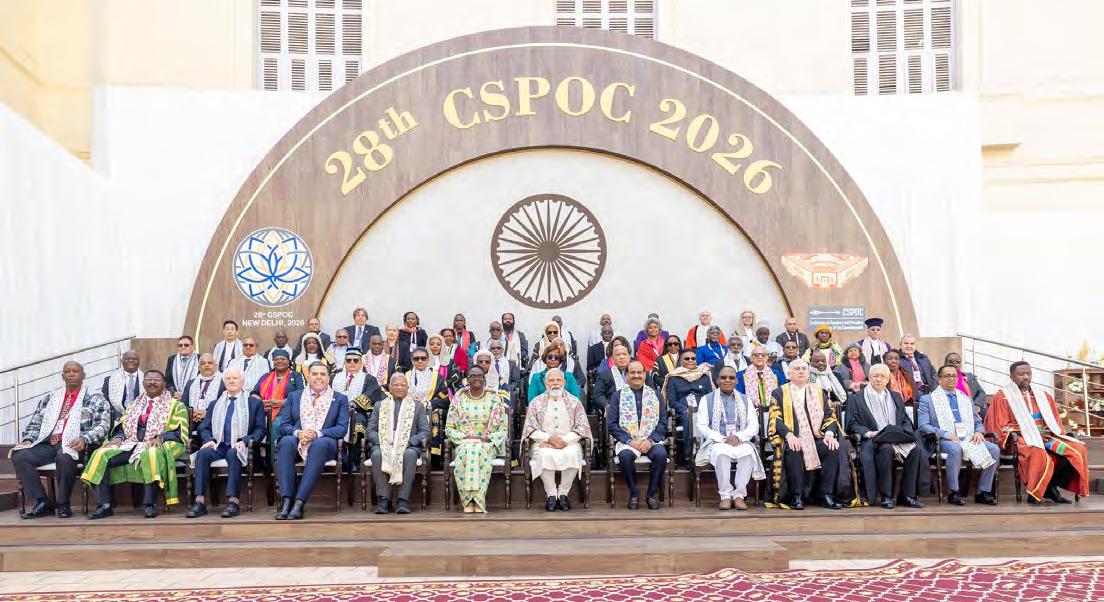
Above: Speakers and Presiding Officers from across the Commonwealth met in New Delhi, India for the 28th Conference of Speakers and Presiding Officers of the Commonwealth (CSPOC) from 14 to 16 January 2026. Sixty-one Speakers and Presiding Officers from more than 45 Commonwealth Parliaments attended the event along with the Chairperson of the Commonwealth Parliamentary Association, Hon. Christopher Kalila, MP (Zambia) and the
REPRESENTATIVE DEMOCRACY
The newly elected Speaker of Yukon is the first Filipino-Canadian woman in the Commonwealth to hold the role and she shares her aspirations for the Legislative Assembly in Canada

Hon. Yvonne Clarke, MLA is 27th Speaker of the Yukon Legislative Assembly, first elected in 2021 as the Member for Porter Creek Centre and re-elected in 2025 as the Member for Whistle Bend North.
On 8 December 2025, the Yukon Legislative Assembly in Canada made history. For the first time in the Commonwealth, a Filipino-Canadian woman was elected as Speaker of the House. That milestone does not belong to me alone, it belongs to every Yukoner who has ever stepped forward with courage, to every immigrant who arrived with hope in their pocket and to every person who believed that our beautiful territory in northern Canada could be their home, their future and their place to serve.
It is a powerful reminder that our democracy grows stronger when more voices, from more journeys, cultures and histories, have a seat in decisionmaking. Representation is not symbolic; it is structural. It shapes how we see one another, how we govern and how we build trust as a society.
What Led Me Here
I am an immigrant, a mother of three, a former small business owner and a long-time community volunteer. Those identities have helped shape how I understand leadership, responsibility and service.
I have had the privilege of serving as a Member of the Yukon Legislative Assembly since I was first elected in the general election on 12 April 2021. My path into politics was not a straight line. It was built gradually through public service, community work, family life and a deep belief that democracy works best when it reflects the people it serves. Before entering politics, I spent 17 years in the Yukon public service, nine years running my own business and more than 26 years volunteering with non-profits. Much of that time
overlapped with raising three children, including seven years as a single parent. Those years taught me resilience, crisis management and adaptability.
Like many women, I balanced professional responsibilities with caregiving, community commitments and financial realities. These experiences grounded me in the everyday challenges faced by so many people.
When I eventually decided to put my name forward as a candidate, I did so with a clear understanding of who I was representing, and why that representation mattered.
Building Connections
For me, everything starts with relationships. Whether we’re talking about staff, colleagues, partners across the country, constituents, or even the neighbour you meet at the grocery store, our work is stronger when those relationships are strong. When we take the time to connect with people, we build trust, and that trust carries us through difficult negotiations just as much as it carries us through everyday conversations.
Those moments of connection are where I feel most at home: at the door, at community events or in conversations that require clarity, patience and honesty. As a FilipinoCanadian and an immigrant, I bring a perspective that resonates with many people whose stories are not always visible in political leadership. Representation, for me, is not just about presence; it is about participation, influence and trust. When people see leaders who understand their lived
realities, confidence in democratic institutions grows.
The Yukon is a territory defined by strong relationships and closeknit communities. That closeness creates opportunity, but it also brings responsibility. Representation here is deeply personal. People expect to see themselves reflected in their institutions - and rightly so.
Advancing Women’s Equality
The last two elections brought in the highest percentage of women elected in Yukon’s history. Today, a majority (52%) of the Members of the Yukon Legislative Assembly identify as women. This progress did not happen by accident; it is the result of sustained effort, mentorship and women supporting one another across partisan lines.
My commitment to advancing women’s equality began long before I entered elected office. Prior to becoming an MLA, I served as Chair of the Yukon Advisory Council on Women’s Issues, where I worked to advance legal, social and economic equality for women across the territory. During that time, I helped co-author the third edition of Splitting Up, a legal resource designed to support women navigating family breakdowns by providing clear, practical information at a critical moment in their lives.
My work has also extended beyond the Yukon. I served as the Yukon representative on the Royal Canadian Mounted Police (RCMP) Commissioner’s National Advisory Committee on Visible Minorities, contributing to efforts to strengthen relationships between law enforcement and diverse communities across Canada.
Currently, I sit on the Steering Committee of the Commonwealth Women Parliamentarians (CWP) Canadian Region, collaborating with women legislators nationwide to build leadership capacity, expand mentorship opportunities and strengthen gender representation within parliamentary institutions.
On 29 January 2026, I participated in my first Canadian Presiding Officers’ Conference, where it was an honour to meet Speakers from across Canada. While there were only a few women in attendance, me included, I learned a great deal throughout the conference. On the first day, at the opening session, I was invited to chair a panel of experienced Speakers, an experience that required me to learn as I went and one in which I truly thrive.
I also had the opportunity to connect with other women Speakers, which proved especially valuable. Through those conversations, I gained insight into how they operate, engage and conduct outreach. Outreach is my passion, and I look forward to benefiting from their thousands of hours of experience and research.
Perspective from a Small Assembly Serving in the Yukon Legislative Assembly offers a perspective that is shaped by scale, geography and proximity. In a small Legislature, relationships are closer, roles are more visible and institutional capacity is limited. Members, staff and Presiding Officers often wear multiple hats, and there are fewer opportunities to test ideas internally before implementing change. This reality makes external networks not just beneficial, but essential.
Engagement with parliamentary colleagues across Canada and the wider Commonwealth provides access to shared experience, tested practices and institutional memory that small assemblies cannot generate on their own. For Speakers in particular, these connections offer invaluable insight into managing procedural challenges, supporting evolving expectations
around accessibility and inclusion, and sustaining public confidence in parliamentary institutions.
For jurisdictions like Yukon, participation in CPA programmes helps ensure that geographic remoteness does not translate into institutional isolation. Instead, it strengthens our ability to adapt, modernise and uphold the highest standards of parliamentary practice, while remaining grounded in the unique needs and relationships that define our territory.
The Importance of the CPA for our Territory
The Yukon Legislative Assembly has benefited significantly from programmes offered through the Commonwealth Parliamentary Association. Over the past five years, meaningful accessibility improvements have been made thanks to funding from the Commonwealth Parliamentarians with Disabilities (CPwD) Capital Investment Fund. These renovations have included installing automatic doors, adding an accessible all-gender washroom and improving the sound system for individuals requiring hearing supports.
Other CPA programmes have also had a direct impact. The Environmental Impact Fund was instrumental for recent upgrades to our Chamber lighting, and
the Women’s Caucus is about to start an exciting project promoting the role of female Parliamentarians thanks to CWP Gender Strengthening Funds.
For remote jurisdictions like the Yukon, travel expenses can be disproportionately high for politicians and legislative staff. The Yukon Branch of CPA has been grateful to receive financial support so its Members could travel to participate in CPA events that would otherwise have been beyond the Assembly’s budget.
Getting to learn from the experiences of Parliamentarians across the Commonwealth is all the more important for small Assemblies where there are fewer Members to experiment with new ways of doing things or to share their wisdom with new MLAs. The network of connections and knowledge spread through the CPA is invaluable.
Conclusion
Through hard work at the Yukon Legislative Assembly and our engagement with the CPA, we are building an Assembly that is more accessible, more connected and more reflective of the people it serves. The progress we have made shows what is possible when inclusion is intentional, and it challenges us to keep moving forward.
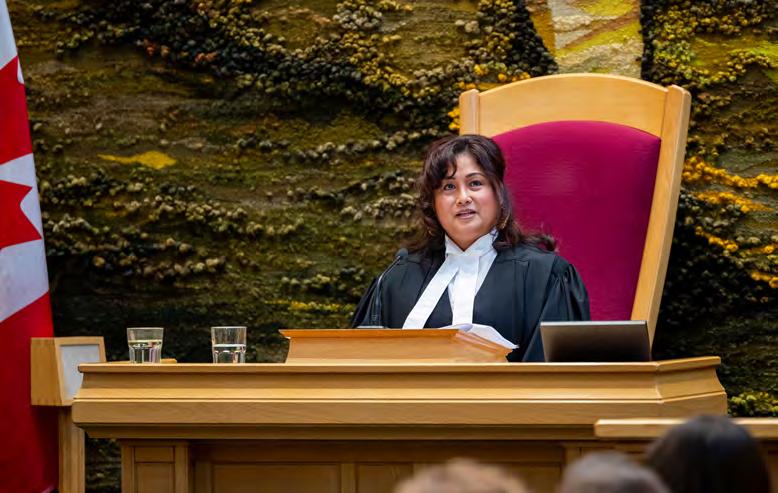
Above: Hon. Yvonne Clarke presides at the Yukon Legislative Assembly.
‘THE COMMONWEALTH CAN BE A DEMOCRATIC BUFFER AGAINST RISING
AUTHORITARIANISM’
A UK MP examines the role of the Commonwealth
The Commonwealth Parliamentary Association (CPA) UK Branch has been working at the heart of the UK Parliament to strengthen relationships between Commonwealth Parliaments since 1911. I know that many UK Parliamentarians have taken part in programmes organised by both the CPA UK Branch and the CPA International Secretariat, met visiting delegations to Westminster or even joined an overseas delegation themselves.
I’m delighted to have been serving as Chair of the CPA UK Branch for over a year now, since being elected towards the end of 2024. I am committed to helping steer our work, making us a relevant and useful resource for all Parliamentarians, and championing the work that we do. As the child of Nigerian immigrants who were invited to the UK in the 1960s, post-Second World War, to help rebuild the country, I am proud to be a voice for those whose close connections to the Commonwealth are core to their very identity.
In the UK, we are seeing antiimmigrant sentiment on the rise, so we must affirm that migration over many decades from West Africa, the Caribbean, South Asia and many more places is a real strength. The world is changing, with the relative power of Europe and the West on the decline and with the influence of countries in the Global South such as India and Nigeria on the rise and only set
to become more significant during this century. The global nature of our population is an advantage for the Commonwealth as we engage with countries around the world.
Being part of the CPA membership means that we can tap into the expertise of Commonwealth partners, drawing on their understanding of trade opportunities, economic challenges, and issues related to democracy and security. Peer-to-peer learning between Commonwealth Parliamentarians is central to this approach. Sharing experiences and best practices strengthens governance and builds trust across borders.
With the CPA firmly committed to democracy, the rule of law and human rights, the CPA UK Branch helps to promote these values by working alongside other groups based in over 60 countries and jurisdictions across the Commonwealth. We are seeing a resurgent global authoritarianism with significant influence from China and Russia who are engaging across the world, and we must seek to match these efforts in our own way.
Contrary to common assumptions, the Commonwealth is not a static group of countries, but an evolving partnership committed to innovation and inclusivity. This openness reflects a shared desire to strengthen relationships, foster mutual understanding and build a more connected global community.

Despite arguments from some quarters in the UK that delivering Brexit would be the start of a new era of engagement, the perception of disengagement persists among many Commonwealth countries. We must change this, and it can start at the parliamentary level with bilateral engagement through the CPA. Personal ties are central to politics, and the importance of delegations meeting fellow Parliamentarians in finding areas of mutual interest cannot be underestimated, nor can the soft power of welcoming delegations of Commonwealth Parliamentarians to London, a world-class city with so much to offer, and to Westminster, a world-famous historical treasure of a Parliament.
Like many jurisdictions across the Commonwealth, the CPA UK Branch is reliant on funding from the UK parliamentary authorities and at a time of funding constraints across government, the sustainability of the breadth of our work has shown that the CPA can pivot and continue to deliver programmes that best suit our Commonwealth family. The CPA UK Branch is committed to working with Commonwealth partners to provide innovative and engaging programmes for the benefit of the wider CPA membership.
This article is based on an article previously published in The House Magazine - 12 Jan 2026.
“ The Commonwealth is not a static group of countries, but an evolving partnership committed to innovation and inclusivity.”
Hon. Kate Osamor, MP is a Member of the UK Parliament and the CPA UK Chairperson.
BANGLADESH RETURNS TO DEMOCRATIC PATH WITH CONSTITUTIONAL REFORM PLEDGE
Following the recent elections, a Bangladeshi journalist examines the outcomes
Nobel Laureate Professor Muhammad Yunus - the head of Bangladesh’s interim administration that took office in early August 2024 following the ousting of authoritarian ruler and Prime Minister, Sheikh Hasina through an unprecedented mass upsurge - handed over power to an elected government in Dhaka on 17 February 2026.
He left office after ceremonial President Mohammed Shahabuddin administered the oath of office to Hon. Tarique Rahman as Prime Minister of Bangladesh. Rahman’s centre-right Bangladesh Nationalist Party (BNP) won a landslide victory on 12 February 2026 in the general elections and concurrent referendum.
Rahman, whose father Ziaur Rahman was a military-general-turned-President (until his assassination in 1981) and late mother, Khaleda Zia, who was a threetime Premier, is the first male Prime Minister of Bangladesh in 35 years. His election and appointment marks the end of a political era dominated by two women who had alternated as Prime Ministers since 1991.
In 1991, Bangladesh switched from a Presidential form of government to a Westminsterstyle parliamentary system following the overthrow of military ruler General H.M. Ershad by a popular uprising in December 1990. At that time, both the ruling and opposition parties (except Ershad’s Jatiya Party) reached a national consensus to restore the parliamentary system through the necessary constitutional amendments, which were later approved in a 1991 referendum.
In his maiden press conference on 14 February 2026 in Dhaka,
new Prime Minister-elect Rahmanwho had been in exile in London for over 17 years - reaffirmed his party’s commitment to implementing the reform proposal known as the ‘July Charter’. This signifies Bangladesh’s transition from a 350-strong unicameral Legislature to a dual-chamber system. The Charter proposes the introduction of a 100-Member upper house, to be called the Senate. Additionally, the BNP, in its own 31-point reform pledge, had also promised to introduce a second chamber. (see The Parliamentarian 2025 Issue Three ‘Bangladesh Moves Closer to Transition to Bicameral Legislature’)
The 2026 general elections herald a new political era, with more young people engaging in politics - a path previous generations had often snubbed. The 12 February polls were mainly peaceful and credible; nearly 60% of the 127.7 million registered voters cast their ballots without
significant incidents of violence. The Commonwealth Election Observer Group commended the peaceful conduct of the elections and referendum, while highlighting areas where further progress on inclusion and accessibility could strengthen the democratic process.
Official results show the BNP and its allies won 212 seats out of the 297 constituencies contested. In the referendum held to seek public opinion on the ‘July Charter’ - a document outlining reforms to the current constitution, including the introduction of a bicameral Parliament to balance the power of the lower house - the Election Commission reported that over 48 million voters voted ‘Yes’ for the reform proposals. Meanwhile, nearly 23 million people cast ‘No’ votes in the referendum, as some parties raised questions regarding its legality and objectives. Furthermore, over 7.4 million referendum ballots were cancelled.
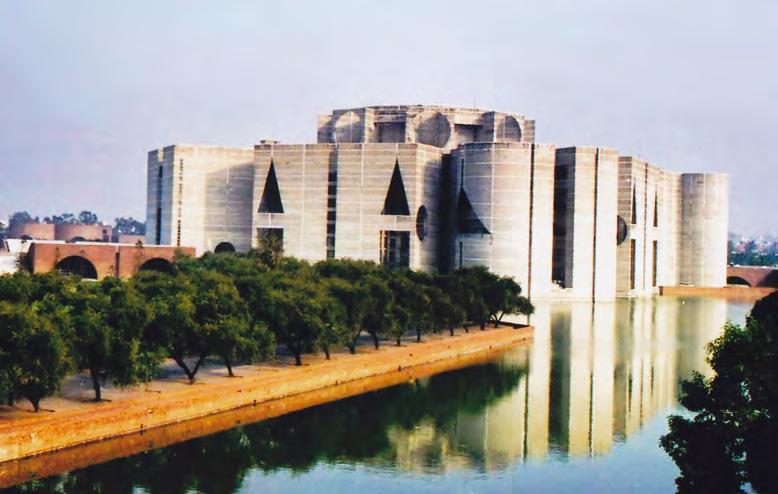
The Parliament of Bangladesh has reopened to newly elected Members.
Kamran Reza Chowdhury is a journalist and political commentator based in Bangladesh.
BANGLADESH ELECTIONS
The first competitive parliamentary elections in over a decade have restored democracy to Bangladesh after eighteen months of rule by an unelected interim government. Led by Yunus, the interim administration had initiated the task of reforming the country’s constitution and electoral system.
Holding the first competitive general election since 2008 restores the people’s sovereign right to elect a government dedicated to welfare and good governance. A significant number of voters, especially from Gen Z, had previously been unable to exercise their franchise, as Sheikh Hasina’s rule was largely characterised by ‘constitutional autocracy’ maintained through rigged elections.
Six Gen Z leaders were elected as MPs and will serve as members of the Constitution Reform Council. In terms of gender representation, 85 women candidates contested the elections, although only seven emerged victorious.
The polls under Yunus were largely participatory. Nevertheless, questions remain regarding their credibility, as the interim administration barred Sheikh Hasina’s party, the Bangladesh Awami League, from contesting. The party, which played a key role in the 1971 War of Independence, had traditionally commanded at least 30% of the popular votes. Religious minority groups and small ethnic communities historically support the Awami League due to its secular political ideology.
Hasina’s overthrow by the GenZ-led ‘July Uprising’ has created a new political reality. Young voters, in particular, remain sceptical of the country’s long-standing duopoly dominated by the BNP and the Awami League. Leaders of the 2024
movement formed a new political party - the National Citizens’ Party (NCP)which contested the polls in an 11-party alliance with the Bangladesh Jamaate-Islami and other conservative, faithbased parties.
In past elections, Jamaat-e-Islami’s popular vote share typically stagnated in the single digits; their previous high was 18 seats in 1991 while allied with the BNP. Their historically poor performance was often attributed to their controversial role in the 1971 war of independence, during which the party sided with the Pakistan Army that committed genocide, war crimes and crimes against humanity.
However, the NCP-Jamaat alliance stunned observers in the 2026 elections. Combined, they won 77 seats with nearly 32% of the popular vote, trailing the BNP’s approximately 50% share. Jamaat’s growing influence has drawn global attention, with some international observers describing it as a major resurgence in Bangladeshi politics.
The Jamaat-led alliance is likely to pressure the ruling BNP to execute the ‘July Charter’ proposals. The NCP has already announced its intention to build a ‘Second Republic’ through an entirely new constitution.
Conversely, while the BNP and its allies respect the spirit of the uprising, they are reluctant to adopt every proposal in the ‘July Charter’, having registered notes of dissent during its drafting. While the BNP advocates for amending the existing constitution, the NCP and Jamaat are pushing for a completely new constitution. With more than two-thirds of the seats, the BNP will now play a pivotal role in deciding whether Professor Yunus’s reform agenda is fully realised or stalled by these legislative disagreements.
“ Holding the first competitive general election since 2008 restores the people’s sovereign right to elect a government dedicated to welfare and good governance.”
In recent years, disability inclusion has moved steadily from the margins of public debate to the centre of parliamentary responsibility. This shift reflects a growing understanding that inclusive governance is not achieved through intent alone, but through sustained legislative attention, oversight and public engagement. For Legislatures, the question is no longer whether disability inclusion should be addressed, but how effectively it is embedded within law-making and democratic practice.
Within the Provincial Assembly of the Punjab, the rights and needs of children with disabilities have increasingly informed parliamentary discussion. As legislators, we are conscious that exclusion at an early stage of life often leads to lifelong disadvantages. Addressing this reality is not only a social obligation; it is a legislative duty grounded in principles of equality, dignity and representation.
Disability Inclusion as a Legislative Matter
Disability is often misunderstood as a matter to be resolved solely through service delivery. From a legislative perspective, however, it is fundamentally a question of rights, access and accountability. Laws shape priorities. Parliamentary debate shapes public understanding. Oversight ensures that commitments are not reduced to statements of intent.
In the Punjab Assembly, disability inclusion has been approached as a cross-cutting concern rather than a standalone issue. Members have repeatedly stressed the importance of ensuring that legislation relating to education, social protection, public access and child welfare reflects the realities faced by children with disabilities. This approach recognises that exclusion is rarely caused by a single gap in
ADVANCING DISABILITY INCLUSION THROUGH LEGISLATIVE LEADERSHIP
policy; it is usually the result of systemic oversight.
The role of the Parliamentary Caucus for Children with Disabilities
The Parliamentary Caucus for Children with Disabilities was formed to provide focused legislative attention to an area that is often underrepresented in parliamentary discourse. As a cross-party forum, the Caucus allows Members to engage beyond political divisions, share perspectives and keep the issue of children with disabilities firmly on the legislative agenda.
The work of the Caucus is rooted in parliamentary functions - advocacy within the Provincial Assembly, contribution to legislative debate and sustained attention through Committee engagement. Its purpose is not administrative. Rather, it exists to ensure that the voices and concerns of children with disabilities are reflected in the laws that we debate and the questions we raise as legislators.
Parliamentary Awareness and Public Engagement
Legislation does not operate in isolation from society. Recognising this, the Caucus undertook a parliamentary-led awareness initiative to reinforce the link between law-making and public understanding. This initiative was designed and led by Members of the Provincial Assembly, reflecting a belief that Parliamentarians must also act as advocates for inclusion.
The initiative included a series of seminars that brought together legislators, legal scholars, educators, civil society representatives and families of children with disabilities. These discussions were practical and grounded, focusing on lived experience, legislative gaps and the responsibilities of elected representatives.
In addition, awareness walks were organised to signal publicly that disability inclusion is a matter of legislative concern. These walks were not symbolic gestures alone; they were deliberate efforts to affirm that the rights of children with disabilities belong within the democratic space and deserve visible parliamentary support.
Legislative Oversight and Accountability
Oversight is one of the most powerful tools available to a Legislature. In the context of disability inclusion, it allows Parliamentarians to examine whether existing laws and policy commitments deliver meaningful outcomes.
Members of the Punjab Provincial Assembly have raised issues relating to accessibility, inclusion and service provision through parliamentary questions and debates. Such engagement ensures that disabilityrelated concerns remain part of the formal legislative record and subject to public scrutiny. Oversight, when exercised consistently, reinforces accountability and strengthens public confidence in democratic institutions.
Children with Disabilities as a Legislative Priority
Children with disabilities face distinct and layered challenges. From a legislative standpoint, addressing these challenges requires sustained attention rather than episodic concern.
Parliamentary discussion in Punjab has increasingly reflected the need for child-centred legal frameworks that prioritise access, quality and equity.
The Caucus has consistently emphasised that inclusion is not achieved by recognition alone. It requires laws that are responsive, oversight that is vigilant and a willingness to revisit legislative
Hon. Salma Saeed, MPA is a Member of the Provincial Assembly of the Punjab, Pakistan and Chairperson of the Parliamentary Caucus for Children with Disabilities.
approaches when outcomes fall short of expectations.
Looking
Beyond Borders
Globally, a number of countriesincluding China, Saudi Arabia and the United States - have adopted comprehensive approaches to disability inclusion through law and long-term policy planning. While political and legal systems differ, these examples demonstrate that progress depends on sustained legislative commitment. For Punjab, the task is to move steadily towards stronger, more coherent legislative frameworks that reflect both international standards and local realities.
Conclusion
The experience of the Provincial Assembly of the Punjab demonstrates that Legislatures have a central role to play in advancing disability inclusion. Through debate, oversight and public engagement, Parliaments shape both policy outcomes and public attitudes.
As Chairperson of the Parliamentary Caucus for Children with Disabilities, I remain convinced that inclusive legislation is not an abstract ideal but a practical responsibility. When Parliaments place children with disabilities at the heart of their work, they strengthen not only individual rights but the democratic fabric of society itself.
Selected References:
• Commonwealth Parliamentary Association, Guidelines for Disability Inclusive Parliaments
• United Nations Convention on the Rights of Persons with Disabilities (CRPD)
PARLIAMENTARY INNOVATION USING TECHNOLOGY AND AI
Celebrating 50 years of parliamentary democracy - Anguilla advances parliamentary accessibility through innovation
Anguilla's parliamentary history began with the 1976 Constitution, which established the first Legislature where laws were made with the advice and consent of the Assembly. This year, Anguilla's House of Assembly celebrates its 50th Anniversary of Parliamentary Democracy.
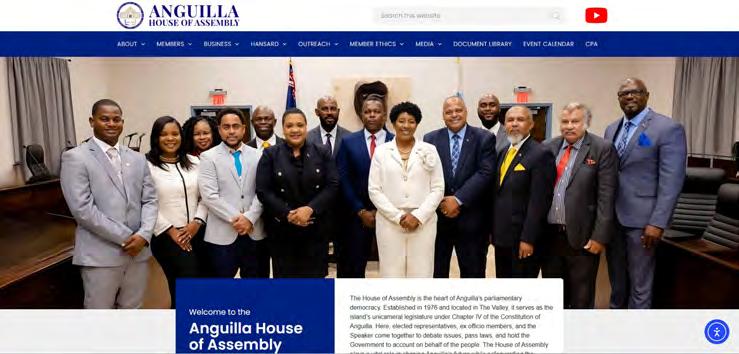
In July 2025, the Administration Committee of the Anguilla House of Assembly successfully applied for a grant from the Commonwealth Parliamentarians with Disabilities (CPwD) network to fund the development of its website: www.houseofassembly.ai, which was developed by the Anguillan company Design Elements (www. digitalelements.ai). The new website ensures that constituents with visual, auditory or other disabilities can access information about their Parliament's work with the same ease as any other citizen. In a small community like Anguilla, where personal relationships matter deeply, it was particularly important that its digital presence reflected its commitment to inclusion.
Anguilla's commitment to continuous improvement was reinforced by its participation in the CPA’s Benchmarks
for Democratic Legislatures assessment in February 2020. This comprehensive review of its parliamentary practices identified areas where it excelled and, more importantly, highlighted opportunities for development. The assessment report's recommendations on transparency, accessibility and the need for better record-keeping resonated strongly with its aspirations for the House of Assembly. One particularly pressing recommendation concerned the considerable backlog in producing official records of parliamentary debates. This challenge became a catalyst for innovation.
Building on this foundation, the Anguilla House of Assembly took an even bolder step and engaged the services of another local company, Evoluut AI (www.whosaidwhat.ai), to develop and implement an AI-driven transcription platform, known as the Hansard AI Together with the audio recording services of For The Record - FTR (www. fortherecord.com), the Hansard system works in real-time. As debates unfold on the floor of the House, audio is captured and immediately transcribed. An editor/ transcriptionist receives this live feed on
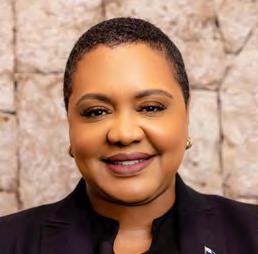
Hon. Tara K. Carter is the Speaker of the Anguilla House of Assembly and was appointed on 11 March 2025. She is a distinguished barrister and solicitor.
their platform, allowing for verification and quality control even as the words are being spoken. Simultaneously, every Member of the House of Assembly has viewer access to the transcription on their own devices, enabling them to follow the debate with unprecedented clarity.
Most remarkably, the AI platform automatically generates the Hansardformat transcript immediately upon conclusion of proceedings. What once took days or even weeks can now be accomplished in hours, providing constituents with rapid access to the official record of their Parliament's work.
This innovation carries particular significance for Anguilla on two fronts. First, Anguilla is known as the birthplace of the .ai internet domain. While many around the world now recognize .ai as synonymous with Artificial Intelligence, it was originally, and remains, the Country Code Top-Level Domain for Anguilla. Anguilla's implementation of sophisticated AI technology in its Parliament demonstrates that Anguilla is not merely the custodian of a valuable digital asset, but an active participant in the technological revolution it represents.
Second, and perhaps more importantly, this system advances the core values that must underpin any healthy democracy: accountability, transparency and fairness. When citizens can access the record of parliamentary debates immediately, when Members can review their own contributions and those of their colleagues in real-time, and when the process of creating the official record is both rapid and reliable, democracy is strengthened.
In December 2025, the Anguilla House of Assembly was honoured to
Left: The new Anguilla website
host a formal launch of this innovative system, attended by CPA SecretaryGeneral, Stephen Twigg and former CPA Head of Programmes, Matthew Salik. Their presence underscored the significance of this achievement not just for Anguilla, but as a potential model for other small Legislatures facing similar challenges. The launch represented the culmination of Anguilla's efforts to address the recommendations of the benchmarks assessment while positioning Anguilla at the forefront of parliamentary innovation.
For small Parliaments like Anguilla that operate under resource limitations, the AI transcription system addresses a practical challenge. With limited staff managing multiple competing demands, traditional manual transcription had created significant backlogs that undermined transparency and accountability. The new system has proven effective: a single transcriptionist can now produce in hours what previously took weeks, while retaining essential human oversight for accuracy and parliamentary conventions.
Anguilla was honoured to share its experience at the CPA UK PostElection Seminar in Bermuda from 26 to 28 January 2026. The session on exploring the use of AI and technology in Parliaments provided an excellent forum for exchanging ideas with colleagues from across the Commonwealth,
including representatives from Turks and Caicos Islands, Jersey and the Isle of Man. The Anguilla delegation included the Speaker of the House of Assembly, Hon. Tara K. Carter and the Clerk, Mr Lenox Proctor, who both made presentations on the advancements in Anguilla.
The Anguilla House of Assembly's journey does not end with this achievement. In November 2025, the Commonwealth Parliamentary Association co-hosted, with the InterParliamentary Union and UNDP, a landmark conference in Malaysia on 'The Role of Parliament in Shaping the Future of Responsible AI'. The resulting Kuala Lumpur Declaration provides a comprehensive framework for parliamentary action on AI, with thirteen specific recommendations
covering everything from AI readiness assessments to the establishment of oversight mechanisms and the promotion of responsible AI use within Parliaments.
The Administration Committee in Anguilla’s Legislature is committed to conducting regular assessments of the AI transcription system while ensuring clear ethical boundaries and governance. The recommendations from both the CPA Democratic Benchmarks assessment and the Kuala Lumpur Declaration will guide Anguilla's ongoing work to ensure that its use of AI remains responsible, transparent and firmly in service of democratic values.
The Commonwealth Parliamentary Association has been instrumental in supporting this development, both through direct funding and through the networks and knowledge-sharing it facilitates. Anguilla encourages other Parliaments to embrace new tools to advance technology in the parliamentary process. Anguilla's Parliament is small, but it continues to advocate for transparency, accessibility and effective democracy with the same fervor as any large Parliament in the Commonwealth. Through the combination of CPA support, Government of Anguilla investment, local innovation and a commitment to its values, Anguilla has proven that size need not limit impact.
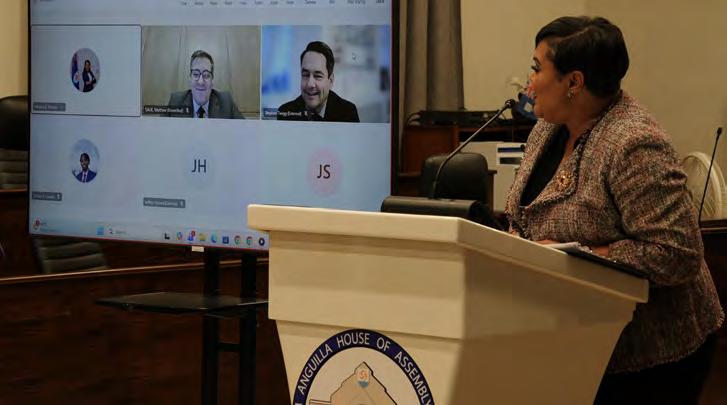
Above: CPA Secretary-General Stephen Twigg and former CPA Head of Programmes Matthew Salik at the launch of the new Anguilla website via video link.
Image credit: Anguilla House of Assembly.
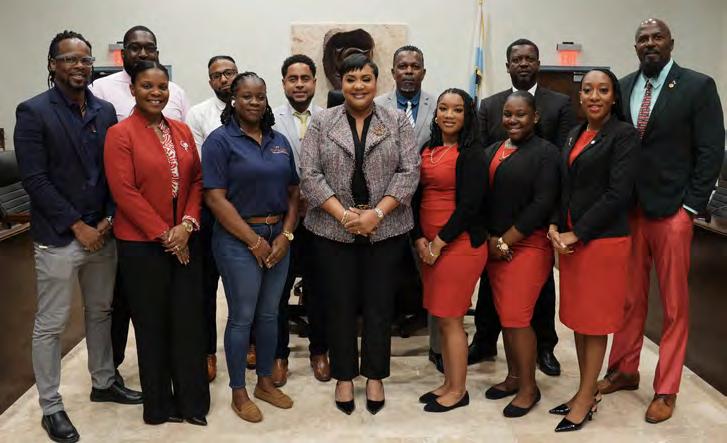
Below: The Administration Committee and Project Developers for the project.
MOVING BEYOND TECHNOLOGICAL TOOLS
An expert from WFD shares what he discovered about the application of Artificial Intelligence in legislative scrutiny
Across democratic systems, Parliaments are facing a paradox. Never before have there been so many technological tools promising to improve legislative scrutiny, evidence use and public engagement. Yet never has the gap between the pace of technological change and the capacity of democratic institutions to respond felt so wide. This is not simply a story about adopting new software or experimenting with Artificial Intelligence (AI); it is about institutional transformation. The application of technology and AI in legislative scrutiny requires a fundamental change process in Parliaments: one that reshapes data practices, organisational culture and even how we conceptualise lawmaking itself.
The pacing problem: when democracy moves slower than technology
The ‘pacing problem’ captures the growing mismatch between rapid technological innovation and slower institutional adaptation. Westminster Foundation for Democracy (WFD) and POPVOX Foundation distinguish three interlocking layers of this challenge.
First, the external pacing problem: Parliaments struggle to keep up with technologies already embedded in society. Secondly, the intra-government pacing problem: Executives are often early adopters of AI for service delivery, policy design or enforcement, while Legislatures lag behind in their ability to scrutinise these tools effectively, reinforming existing patterns of Executive dominance. Thirdly, the internal pacing problem: parliamentary ICT systems, data structures and workflows frequently remain fragmented, paper-based or incompatible with modern analytical tools.
The risks of inaction are not abstract. According to the Inter-Parliamentary Union (IPU) World e-Parliament Report 2024, over 70% of Parliaments globally now publish legislative information online, but fewer than half report having interoperable legislative data systems capable of supporting advanced analysis. As AI adoption accelerates in the Executive and private sectors, these internal weaknesses can translate into real power asymmetries, further weakening legislative oversight and checks and balances.
From experimentation to practice: how Parliaments are already using AI Despite these challenges, Parliaments are not starting from zero. A growing number are experimenting with AI across administrative, legislative and participatory functions.
On the administrative side, AI is increasingly used to automate transcription, translation, document classification and summarisation. The European Parliament, for example, deploys eTranslation, speech-to-text systems and automated indexing to manage multilingual debates and documents at scale. Similar AI functions are noted in the Canadian House of Commons.
Legislatively, AI tools are being applied to amendment analysis, legal consistency checks and information retrieval. Italy’s Parliament has piloted AI-supported compliance checking of amendments against constitutional and legal constraints. The National Assembly of France has created tools using open data to model fiscal and social impacts and to compare draft Bills with existing legislation.

Perhaps the most comprehensive example is Brazil’s Ulysses Suite, an integrated parliamentary AI ecosystem supporting everything from Bill analysis to citizen interaction. These cases reflect a broader trend: many Parliaments are piloting AI for legislative research, amendment tracking and Committee support.
Yet experimentation alone does not equal transformation. Many pilots remain isolated, dependent on individual champions, or constrained by legacy systems or procurement rules. A challenge is sometimes found in pathdependence, which explains how past decisions or events constrain future choices, creating inertia that makes it difficult to switch paths or actively break paths to create new ones.
Technology across the legislative cycle: from drafting to post-legislative scrutiny
The potential of AI becomes clearer when viewed across the full legislative cycle. As highlighted in the Course Manual for the Certified Course on Legislative Scrutiny and Technology (2026), technology is already reshaping each phase of lawmaking.
• During legislative drafting, AI-assisted tools can analyse vast corpora of statutes and case law, suggesting language aligned with existing norms and reducing ambiguity. This supports consistency without replacing human judgment.
• In ex-ante impact assessment, predictive modelling and data analytics allow Parliaments to interrogate the likely economic, social or environmental consequences of proposed
Franklin De Vrieze is Head of Practice Accountability at Westminster Foundation for Democracy.
legislation. Such tools can surface unintended effects earlier in the process, strengthening evidencebased scrutiny.
• Citizen engagement is also being transformed. Digital platforms enable large-scale consultations, while AI can help analyse submissions, identify patterns and surface underrepresented perspectives. This is particularly valuable as consultation volumes increase beyond what manual analysis can reasonably handle.
• Finally, in post-enactment analysis, data analytics can track implementation and outcomes, support post-legislative scrutiny and close feedback loops between lawmaking and lived experience. These applications demonstrate that AI does not sit at the margins of parliamentary work. It intersects with core legislative functions.
Opportunities, risks and the centrality of explainability
The opportunities are significant, but so are the risks. AI evolves faster than parliamentary cycles, creating persistent regulatory lag. Existing Standing Orders and parliamentary procedures rarely anticipate automated analysis or algorithmic support. Capacity gaps mean expertise is often concentrated in a handful of staff or external vendors, raising dependency risks.
There are also well-documented technical and ethical challenges: bias in training data, errors and ‘hallucinations’ in generative AI, data protection concerns when handling sensitive parliamentary or constituency information, and the growing threat of AI-enabled disinformation through synthetic submissions.
Across all these risks, one principle stands out: explainability. As Bruce Schneier and Nathan Sanders have argued in their book ‘Rewiring Democracy’, democratic institutions cannot rely on systems they do not understand. If MPs and staff cannot interrogate how an AI tool reached a conclusion, its outputs cannot legitimately inform legislative scrutiny.
Explainability is therefore not a technical luxury but a democratic requirement.
Why AI adoption is a change process, not a tech project
Too often, AI adoption is framed as a procurement or IT challenge. In reality, it is an institutional change process. Deploying tools without addressing underlying data quality, governance, skills and culture will at best produce marginal gains, and at worst undermine trust.
Effective change requires attention to at least six interlinked elements: strategy, prioritisation, implementation, governance, training and coordination. It involves iterative piloting rather than ‘big bang’ rollouts; cross-parliamentary governance bodies rather than siloed initiatives; and continuous learning rather than one-off training.
Data governance is foundational. Without legislature-wide data maps, data management plans and interoperable systems, AI outputs will be unreliable or biased. Treating data as a strategic asset is a precondition for any meaningful AI readiness.
Crucially, this change process also invites deeper reflection. Rethinking lawmaking in terms of ‘law as code’, exploring how digital tools reshape legislative design, and reimagining human oversight so that humans remain firmly “in the loop” are all parts of the transformation.
Frameworks to guide the journey
Parliaments do not have to navigate this alone. The Guidelines for AI in Parliament, published by the Westminster Foundation for Democracy, provide a practical framework covering ethics, governance, capacity and implementation. Complementing this, the IPU’s Maturity Framework for AI in Parliaments offers a self-assessment tool across six levels, from ‘initial’ awareness to ‘leadership’, where Parliaments act as global benchmarks.
The Kuala Lumpur Declaration providing 13 recommendations on 'Parliaments and responsible AI' was issued recently following an international conference co-organised by the Commonwealth Parliamentary
Association (CPA), the Parliament of Malaysia, the United Nations Development Programme (UNDP) and the IPU. The UK Parliament has also issued guidance to its Members on the use of generative AI tools.
Together, these frameworks suggest a pragmatic path forward: start with pilots, invest in data foundations, prioritise explainable systems, learn from peers and embed AI within transparent, ethics-driven governance structures.
Bridging expertise: lawmaking, technology, and parliamentary strengthening
Finally, successful transformation depends on people as much as systems. One of the clearest lessons from comparative practice is the need to connect three communities that too often operate separately: lawmaking experts, technologists and parliamentary strengthening practitioners.
This was the guiding logic behind the January 2026 Certified Course on Legislative Scrutiny and Technology, which deliberately brought these perspectives together. Hence, it was co-organized by leaders in each of these three fields: Institute of Advanced Legal Studies (IALS) of the University of London, POPVOX Foundation and Westminster Foundation for Democracy (WFD).
Legislative quality scholars, parliamentary officials, technologists and democracy practitioners all contributed to a shared understanding: the rise of AI and legislative technology is not merely an administrative upgrade. It is a fundamental institutional challenge.
If Parliaments fail to adapt, the pacing problem will deepen, oversight will weaken and democratic accountability will erode. If they succeed, AI can become a powerful ally in strengthening scrutiny, transparency and public trust.
• Find out more about WFD’s work in Postlegislative scrutiny (PLS) by visiting www.wfd. org/accountability-and-transparency/postlegislative-scrutiny
• Find out more about POPVOX Foundation’s resources on AI for Parliaments at www. popvox.org/blog/ai-resources-for-mps-andparliament-staff
STRENGTHENING PUBLIC ACCOUNTS COMMITTEES AS GUARDIANS OF PUBLIC TRUST
An expert from Pakistan writes about the important role of Public Accounts Committees in parliamentary democracies
Public Accounts Committees (PACs) are recognised worldwide as guardians of public trust in democratic accountability as Parliament’s supreme controlling body to conduct objective assessment of audit reports as identified by the Auditor-General.
Public Accounts Committees are not only expected to undertake scrutiny of expenditures but, more imperatively, the Committee also exercises final judgement in holding Government officials to account for any anomalies in the public exchequer. The concept and tradition of Public Accounts Committees date back to the British parliamentary system in 1861 where they were set up to ensure that public funds were being spent within the remit of authority granted to the Government by the elected Parliament, which later became part of the core of legislative oversight.1
Today, Public Accounts Committees are an integral part of accountability in Parliament, ensuring that taxpayers' money is spent prudently, and that public institutions are transparent, especially where governments are accountable for their financial dealings. However, Public Accounts Committees are far from operating in the same way across the Commonwealthsome are highly independent and
influential, while others remain hemmed in by political interference and low enforcement.
This article explores the need for strengthening Public Accounts Committees through international good practice, institutional reforms and a new culture of non-partisan oversight. Based on the experiences of the United Kingdom, Canada, New Zealand, India, Ghana, Malaysia and Pakistan, it identifies the structural innovations and cultural transformations that give effective oversight its template. Finally, it argues that if democracies want to deliver and build upon the trust of the people, then Public Accounts Committees should be shaped into professional procedural bodies and catalysts of positive fiscal integrity.
Role of Public Accounts Committees
At their best, Public Accounts Committees are bipartisan, evidencebased and transparent - making sure that Government Ministries and departments not only spend money well within the limits approved by the Parliament but analysing if citizens get value for money for the services that Ministries claim to have provided. However, the potential of many democratic states is not fully leveraged
Abdul Majid is a Parliamentary Researcher (Economy and Budget Desk) at the Pakistan Institute for Parliamentary Services (PIPS) and has provided technical assistance to the Public Accounts Committee (PAC) Secretariat at the National Assembly of Pakistan.
owing to chronic political polarization, lack of resources and weak institutional mechanisms for follow-up.
In a formal financial year of any country, strong Public Accounts Committees are the backbone of democratic resilience as they review every budget line earmarked by the Auditor-General for any disagreement with the spending department in relation to the process, financial limits or any blatant violation of rules, laid out jurisdictions, policy directives and statutes.
The Commonwealth Parliamentary Association (CPA) has long understood that it is particularly important in the post-pandemic era to support the work of a Public Accounts Committee, especially where fiscal discipline, transparency and trust in governments are more important than ever as states’ financial space and spending budgets have shrunk globally.2 Public Accounts Committees are empowered by the Rules of Procedures or Standing Orders of Parliament, which authorise them to:
• Study reports of the AuditorGeneral and review the department-wise lines of objection
• Suggest remedial actions
• Ensure the implementation of Public Accounts Committees' decisions/verdicts including
“ At their best, Public Accounts Committees are bipartisan, evidencebased and transparent - making sure that Government Ministries and departments not only spend money well within the limits approved by the Parliament but analysing if citizens get value for money for the services that Ministries claim to have provided.”
any directions of penalties and recoveries by governments.
Key Obstacles for Public Accounts Committees in Emerging Democracies
Though important, Public Accounts Committees in developing democracies are often unable to play an effective role as they lack technical resources in the form of experts or limited autonomy and authority to perform as independent audit bodies. Key obstacles include:
• Politicization of the processwhen impartiality is affected by the overwhelming control of the majority party
• Lack of proper regulation of Public Accounts Committees by the Auditor-General's Office
• Public Accounts Committees' authority and control with regards to follow-up mechanisms to confirm that the audit recommendations are adhered is weak
• Technical expertise amongst or available to Members of Parliament is limited.
Global Variations in Public Accounts Committee Practices
A number of countries have introduced new mechanisms and best practices to consolidate existing Public Accounts Committees to perform robustly in undertaking oversight on public spending and to vindicate public trust in democratic accountability as a means to recover precious funds.
• United Kingdom: Individual Sovereignty and Political Neutrality
- The UK Parliament's Public Accounts Committee, which is traditionally chaired by a senior Member of the main Opposition Party, is a model of neutrality. Its proceedings are open, its conclusions are much commented and its recommendations are both moral and political. The design of the system is such that oversight is inter-party, which strengthens the trust of citizens in fiscal oversight.1
• Canada: Open Transparency by Live Media Coverage - Important features of the Public Accounts Committee in Canada are open
hearings and the timely publication of reports. The Auditor-General directly engages in discussion in order to deepen accountability links. Further, parliamentary television enables citizens to observe debates as they happen, which increases transparency.3
• New Zealand: Link with Performance Audits - The Finance and Expenditure Committee at the New Zealand Parliament closely works with the Office of the AuditorGeneral that not only carries out financial audits but also performance and environmental audits in New Zealand. Hence, the integrated approach ensures coordination between fiscal oversight and the need for the effectiveness of policy and sustainability.4
• Pakistan: e-PAC & Bipartisan leadership - The Public Accounts Committee at the National Parliament in Pakistan draws its authority from the National Assembly Rules of Procedure.5 In the last decade, it has made progress towards greater efficiency, transparency and public participation. The Public Accounts Committee Secretariat has been professionalized, audit backlogs reduced and co-operation with the Auditor-General increased. The recent adoption of e-PAC (digital recording and monitoring system) by the Committee is a significant modernisation. Pakistan's Public Accounts Committee is chaired by a senior MP from the Opposition, following the UK example. The Committee now has Members of the Senate as well and it enjoys an enhanced mandate for reviewing performance audits, particularly those of national social security programmes such as the Benazir Income Support Program (BISP). This integration manifests a greater understanding of accountability in numbers, but also in social outcomes. However, limited technical assistance, insufficient media coverage of proceedings and a weak enforcement of recommendations are some gaps
PUBLIC ACCOUNTS COMMITTEES
that need improvement. The Public Accounts Committee of the National Assembly of Pakistan is working with professional zeal on backlogs and the digitisation of records, yet enforcement on its final directions/ decisions is still seeing delays in implementation as cases of recovery are forwarded to the department concerned or agencies such as Federal Investigation Agency or the National Accountability Bureau.6 Addressing these weaknesses requires consensus with regards to political will, better coordination with the Auditor-General and institutional independence for the Public Accounts Committee Secretariat.
• India: Analysis by Professional Auditors – the Public Accounts Committee is composed of political representation backed by administrative support, as it examines not only financial irregularities, but also systemic weaknesses in governance with the help of a group of professional researchers and auditors.7
• Ghana and Malaysia: Public hearings and the AGD - In Ghana, the Public Accounts Committee has institutionalised ‘Public Hearings’ (which are usually televised) to make sure that accountability is both transparent and direct.8 The Malaysian Public Accounts Committee has introduced modern tools, namely the AuditorGeneral's Dashboard (AGD) and is championing legal reform under Section 9A of the Audit Act 1957 to enhance audit findings and follow-up with the support of the Office of the Auditor General.9 These innovations have resulted in substantial improvements in the tracking of governmental compliance, and have resulted in significant recoveries of public money.
Lessons from the Commonwealth Public Accounts Committees in the Commonwealth have demonstrated best practices and key lessons learnt, which provide a guide to all developing Parliaments to improve the authority,
PUBLIC ACCOUNTS COMMITTEES
independence, professionalism, performance and political will within their respective Public Accounts Committees. These set of ‘lessons learnt’ comprise of:
• Institutional Independence: Public Accounts Committees should be insulated from political influence. Opposition Chairs, fixed tenure and dedicated staff can enhance credibility.
• Professional Support: Evidencebased decision-making is possible with presence of audit experts and data analysts to support the Committee’s work.
• Follow-Up Mechanisms: Recommendations are meaningless without enforcement. The Malaysian model that monitors compliance should be emulated.
• Public Communication: Civil participation can be promoted by broadcasting Public Accounts Committee hearings and online publication of reports.
• Awareness in coordination with Supreme Audit Institution: Close working relationships with auditors help ensure Public Accounts Committees look at systemic
problems and not just accounting mistakes.
• Leveraging Technology: Digital dashboards, online archives and data analysis with the help of modern tools can modernise the scrutiny processes.
• Capacity Building: The Commonwealth Parliamentary Association’s online training modules and peer-exchange programmes can help in developing parliamentary oversight capacity in developing democracies.
In a nutshell, Public Accounts Committees are the financial watchdogs in Parliament and democracy's insurance policy, ensuring that precious taxpayers’ money is appropriately spent without fail for the well-being of the people. The global experience reveals that whenever Public Accounts Committees are autonomous, resourceful and transparent, they lead as catalysts for good governance.
In the context of the Sustainable Development Goals, and specifically SDG 16 on peace, justice and strong institutions, the reinforcement of Public Accounts Committees is at the core of the agenda of the Commonwealth.
Citizens look towards their Parliaments for the transformation of oversight into affirmative action and of accountability into long-term public confidence.
References:
1. UK House of Commons, Public Accounts Committee https://committees.parliament.uk/ committee/127/public-accounts-committee/role
2. CPA, Parliamentary Financial Scrutiny and Oversight: A CPA Best Practice Guide (2023), www.cpahq.org
3. Parliament of Canada, ‘Standing Committee on Public Accounts: Mandate and Procedures’, www. ourcommons.ca/Committees/en/PACP/About
4. New Zealand Parliament, ‘Finance and Expenditure Committee’, www.parliament.nz/ en/pb/sc/scl/finance-and-expenditure/
5. National Assembly of Pakistan, ‘Rules of Procedure and Conduct of Business in the National Assembly’, https://na.gov.pk/uploads/ publications/
6. National Assembly of Pakistan, Public Accounts Committee Annual Reports www.na.gov.pk/
7. Parliament of India, ‘Public Accounts Committee (Lok Sabha)’, https://sansad.in/ls/
8. Parliament of Ghana, ‘Committees: Public Accounts Committee’, www.parliament.gh/ committees
9. Malaysia, Auditor General’s Dashboard (AGD).
RECONCILING PARLIAMENTARY PRIVILEGE AND JUDICIAL INDEPENDENCE
The Speaker’s Rulings in
Sri Lanka’s Constitutional Framework
The constitutional principle of the separation of powers in Sri Lanka has been shaped not only by judicial pronouncements but also by authoritative rulings delivered by successive Speakers of Parliament.
This article undertakes a comparative analysis of two landmark Speaker’s rulings: the 2001 ruling by Hon. Anura Bandaranaike, which affirmed parliamentary autonomy against judicial interference, and the 2026 ruling by Hon. Dr Jagath Wickramaratne, which protected judicial independence against parliamentary encroachment. Although these rulings appear to pull in opposite institutional directions, this article argues that they are doctrinally complementary and together reinforce a coherent constitutional equilibrium grounded in Articles 3 and 4 of the Sri Lankan Constitution.
I. Introduction
Sri Lanka’s constitutional framework vests sovereignty in the People and distributes governmental power among the Legislature, Executive and Judiciary. Articles 3 and 4 of the Constitution establish this allocation while implicitly recognising the necessity of institutional restraint. From time to time, however, tensions have arisen when one organ of government has appeared to encroach upon the constitutionally protected domain of another.
Two such moments - separated by nearly a quarter century - resulted in Speaker’s rulings of exceptional constitutional importance. The ruling delivered in 2001 arose from judicial intervention in parliamentary impeachment proceedings. The ruling delivered on 9 January 2026,
by contrast, addressed parliamentary intervention in judicial administration through the Judicial Service Commission (JSC). Though distinct in context, both rulings illuminate the constitutional boundaries governing the relationship between Parliament and the Judiciary.
II. The Speaker’s Ruling of 9 January 2026: Reaffirming Constitutional Boundaries
On 9 January 2026, the Speaker of the Parliament of Sri Lanka delivered a landmark ruling declining to permit a motion seeking the appointment of a Parliamentary Select Committee to inquire into matters relating to the Judicial Service Commission. The Speaker ruled that the motion was out of order, as it would amount to parliamentary intrusion into an area constitutionally reserved for the independent functioning of the judiciary.
In his reasoning, the Speaker reaffirmed the doctrine of separation of powers, emphasising that while Parliament exercises legislative authority on behalf of the People, that authority is circumscribed by the Constitution. Parliamentary supremacy, he observed, cannot be construed as a license to supervise or interfere with the constitutionally entrenched powers of independent commissions, particularly those safeguarding judicial independence.
The Speaker also referred to the historic ruling delivered by then Speaker Anura Bandaranaike in 2001, but carefully distinguished it on the basis that the earlier ruling arose in a fundamentally different constitutional context. Unlike the present case,
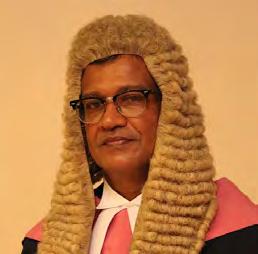
Justice Neil Iddawala is a distinguished jurist of Sri Lanka who served the Parliament of Sri Lanka for 17 years as Assistant Secretary-General, Deputy Secretary-General and its first Chief of Staff.
the 2001 ruling was concerned with protecting Parliament from external restraint during an impeachment process, rather than scrutinising the internal powers of a constitutional judicial body.
This ruling stands as a contemporary reaffirmation that sovereignty ultimately resides in the People, is exercised through distinct constitutional organs, and must be exercised with restraint, respect, and fidelity to constitutional limits.
III. The 2001 Speaker’s Ruling: Parliamentary Autonomy and Judicial Non-Interference
The 2001 ruling delivered by Speaker Anura Bandaranaike responded to a Supreme Court restraining order preventing the Speaker from appointing a Parliamentary Select Committee in relation to the impeachment of the Chief Justice. The Speaker categorically rejected the jurisdiction of the courts to interfere with parliamentary procedure.
The ruling affirmed that Parliament, as the body exercising the legislative power of the People, enjoys exclusive authority over its internal proceedings, privileges and processes. Judicial intervention by way of stay or restraining orders was held to be incompatible with parliamentary autonomy.
A central proposition of the ruling was that courts have no authority to issue injunctions or restraining orders preventing Parliament from proceeding with matters falling within its exclusive jurisdiction and internal procedure. This position reflects a long-standing common-law tradition, rooted in parliamentary privilege, that
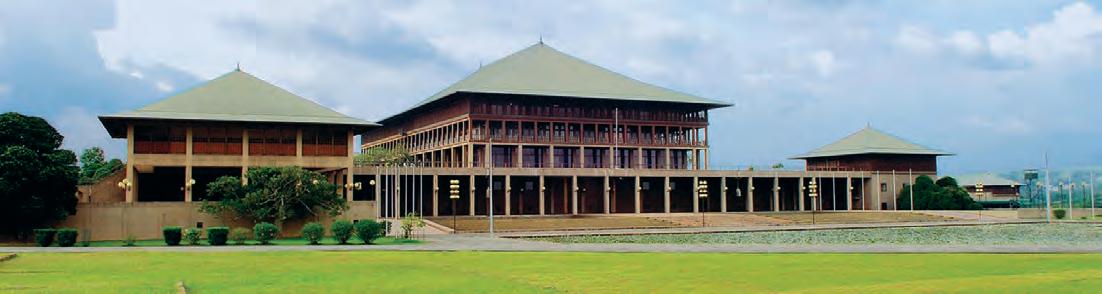
parliamentary proceedings are nonjusticiable.
Importantly, the ruling did not assert parliamentary supremacy as unchecked authority. Rather, it conceptualised supremacy as institutional autonomy within a constitutionally defined sphere, shielding Parliament from judicial control over its internal processes.
IV. The 2026 Speaker’s Ruling: Judicial Independence and Parliamentary Restraint
In contrast, the 2026 ruling addressed a motion that sought to extend parliamentary oversight into the domain of judicial administration. Central to the ruling was the constitutional characterisation of the Judicial Service Commission (JSC) as an integral component of the judicial branch, exercising the People’s judicial power under Article 4(c) of the Constitution.
The Speaker emphasised that the JSC is not an administrative body subordinate to either the Executive or the Legislature. Relying on Articles 111D, 111H, 111K, and 111L of the Constitution, the ruling highlighted that interference with the JSC is not merely constitutionally impermissible but expressly prohibited.
The Speaker further clarified that Parliament’s control over public finance and accountability mechanisms does not translate into hierarchical supremacy over other constitutional organs. Custody of the public purse, he observed, carries fiduciary responsibility, not institutional dominance.
Accordingly, the ruling rejected the proposition that parliamentary mechanisms such as Select Committees could be employed to scrutinise or
supervise judicial appointments, transfers or disciplinary processes.
V. Comparative Analysis: Apparent Tension and Doctrinal Unity
At first glance, the two rulings appear to pull in opposite directions. The 2001 ruling restrains the Judiciary from interfering with Parliament, while the 2026 ruling restrains Parliament from interfering with the Judiciary. However, this apparent tension dissolves upon closer examination.
Both rulings apply the same foundational constitutional principle: no organ of government may encroach upon the core functions of another. The divergence lies not in doctrine, but in the identity of the institution that was perceived to be overreaching.
In 2001, Parliament was the institution under threat and judicial restraint was imposed. In 2026, judicial independence was at risk and parliamentary restraint was required. Far from contradicting each other, the rulings together articulate a balanced and principled understanding of constitutional governance.
VI. Separation of Powers as a Functional Doctrine
These rulings underscore that the separation of powers in Sri Lanka is not symbolic but functional. Each branch is supreme within its constitutionally assigned sphere, yet restrained from intruding into the domain of the other.
The 2026 ruling expressly reaffirmed established constitutional jurisprudence that one organ of government should not control or interfere with the powers and functions of another. It further warned that subjecting judicial
administration to political scrutiny would undermine public confidence in the judiciary - an outcome incompatible with democratic governance.
VII. Checks and Balances Without Institutional Domination
Neither ruling denies the existence of checks and balances. Instead, both insist that such checks must operate within constitutionally sanctioned channels. The 2026 ruling noted that the Constitution provides a specific avenue for challenging JSC decisions - judicial review through fundamental rights jurisdiction - thereby excluding political oversight mechanisms.
This approach preserves accountability while preventing institutional capture or politicisation.
VIII. Conclusion
The Speaker’s rulings of 2001 and 2026 constitute constitutional landmarks that define the outer limits of parliamentary and judicial power in Sri Lanka. Together, they affirm two essential propositions: that Parliament is supreme in regulating its own proceedings free from judicial interference, and that the Judiciary is independent in exercising judicial power free from parliamentary oversight.
Far from being antagonistic, these rulings are doctrinally complementary. They collectively safeguard the sovereignty of the People by ensuring that each branch of government operates within its constitutionally demarcated sphere, thereby preserving democratic legitimacy, institutional dignity, and public confidence in governance.
The Parliament of Sri Lanka
PUTTING PARLIAMENTARIANS AT THE HEART OF AGRIFOOD SYSTEMS TRANSFORMATION
Ending hunger begins in Parliaments. Across every region of the world, it is Parliamentarians that decide whether the right to food is protected in law, allocate and scrutinise the budgets, and hold governments accountable for the promises they make. This is why, over the last fifteen years, FAO has shifted from ad-hoc engagement to sustained partnerships with Parliaments and parliamentary alliances. Without committed, informed lawmakers, lasting policy reform and long-term consistent financing will never be possible.
The argument for urgency – what the latest evidence shows
Recent global assessments are a stark reminder that progress on food security and nutrition is fragile. Latest estimates show that 673 million people faced hunger in 2024, while 2.3 billion experienced moderate or severe food insecurity. The cost of eating well is rising, with 2.6 billion people unable to afford a healthy diet – a trend driven in part by food prices that have consistently increased faster than overall inflation in recent years.
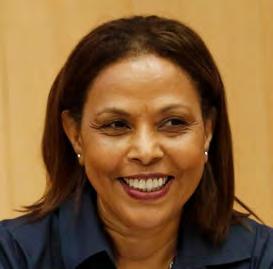
Fatouma Seid is Deputy Director of the Partnerships and UN Collaboration Division at the Food and Agriculture Organization of the United Nations (FAO).
Mounting pressure on natural resources is steadily eroding productivity and weakening the resilience of agrifood systems. Land degradation is accelerating, cutting into yields across production systems and calling for stronger governance of soils, tenure and land use.
Recent analyses reveal more than US$10 trillion in hidden environmental, social and health costs embedded

Below: Soil doctors training with the Global Soil Doctor Programme in Chile (UN FAO).
MANAGING THE RIGHT TO FOOD
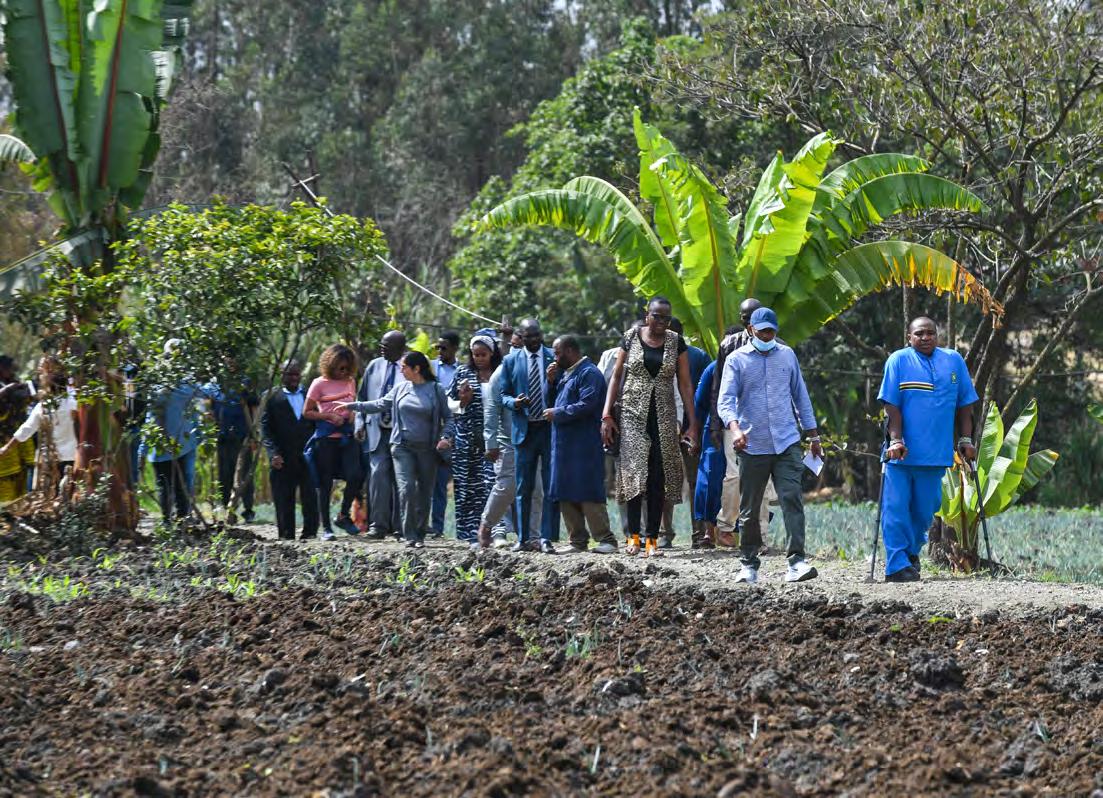
in today’s agrifood systems, much of it driven by dietary patterns that heighten both disease burdens and environmental stress.
Across the wider food system, further pressures are surfacing. Aquatic foods could meet a growing share of global demand, yet the sustainability of fishery stocks remains uncertain, calling for better management, stronger data systems and long-term institutional commitments. Forests, meanwhile, continue to provide irreplaceable carbon storage, biodiversity protection and rural livelihoods, but climate pressures and ecosystem decline threaten their capacity to support resilient agrifood systems without innovation and enabling policies. Resource scarcity is emerging as an even sharper constraint. Land, soil and water systems are under increasing strain, with agriculture alone accounting
for over 70% of global freshwater withdrawals. Reversing these trends will require integrated approaches that link natural resource management, food production and climate resilience.
Trade is both an opportunity and a risk. Global markets can diversify diets and reduce consumer prices, but without coherent nutrition and public-health policies they can also accelerate the spread of ultra-processed, low-nutrient foods.
The evidence is multifaceted, but it points to a single conclusion. Hunger, malnutrition and environmental degradation are converging, and only strong, informed and coordinated political leadership can alter current trajectories. For Parliamentarians, the data underscores both the urgency and the opportunity to drive reforms that deliver healthier diets, more
resilient ecosystems and fairer, more sustainable agrifood systems for all.
From commitments to capabilities
Since the first parliamentary fronts against hunger and malnutrition were established in Latin America in the late 2000s, FAO has steadily expanded its support to Parliamentarians. This has helped them to come together, mobilise stakeholders and strengthen their capacity to advance evidence-based reforms and initiatives aligned with the international commitments endorsed by governments in global forums such as the Committee on World Food Security (CFS).
Above: Parliamentarians from the Eastern Africa Parliamentary Alliance for Food Security and Nutrition undertake a field visit in Ethiopia in December 2025.
FAO has now built active collaborations with national and international parliamentary organisations across every region, directly contributing to an estimated 100 parliamentary-led legislative processes. Alongside national legislation, this work has also included the development and adoption of several model laws by bodies such as the Latin American Parliament and the Pan-African Parliament. Although non-binding, these model laws provide legislative standards that countries can adapt to draft bills and guide reform efforts.
At global level, FAO has convened two Global Parliamentary Summits against Hunger and Malnutrition, held in Spain in 2018 and in Chile in 2023. By elevating the role of Parliamentarians within the global food security agenda, these summits have created the foundation for deeper, more strategic engagement worldwide.
Building on the Global Parliamentary Pact against Hunger and Malnutrition adopted at the 2023 summit, FAO has intensified its efforts to help turn parliamentary commitments into practical capabilities. In 2025 alone, FAO delivered training to more than 200 Members of Parliament from over 30 countries, published new e-learning materials, handbooks and legal briefs tailored specifically for parliamentary use, and worked to ensure that legislators were meaningfully represented in major agrifood policy dialogues.
These efforts, supported by key partners including Spain and Germany, aim to equip Legislatures with the knowledge, tools and confidence to shape coherent laws, scrutinise credible budgets and provide robust oversight, all grounded in the latest evidence.
Looking ahead: the Third Global Parliamentary Summit Momentum is now building towards the Third Global Parliamentary Summit against Hunger and Malnutrition, which will be hosted by the Pan-African Parliament in Midrand, South Africa on 16 and 17 June 2026. Following
a Pre-Summit consultation with parliamentary representatives and experts, the agenda of the Summit is set on ambition, actionability and transformation, around three key thematic blocks:
1. Developing efficient, inclusive, resilient and sustainable agrifood systems
2. Promoting access to and consumption of healthy diets
3. Realising the Right to Food through inclusive development and social justice
A legislative agenda for the parliamentary community
Drawing on current evidence and emerging trends, FAO highlights several areas where parliamentary engagement can make a meaningful contribution to more resilient and equitable agrifood systems. Many Legislatures are already strengthening the legal foundations for the right to adequate food and for more sustainable agrifood systems, often by clarifying institutional responsibilities across agriculture, health, social protection, trade and the environment. Incorporating insights on the true costs of food production and consumption is also helping some countries address the health and environmental impacts embedded in existing systems.
Nutrition remains a central budgetary concern. Parliaments that track investment in school meals, maternal and child nutrition, and diversified, climate-resilient production are better able to align spending with national priorities, particularly in contexts where affordability pressures remain acute.
Across natural resources, the need for updated governance frameworks is becoming more visible. As degradation and scarcity intensify, several countries are revisiting legislation on land tenure, water allocation, forestry and fisheries to ensure that legal systems reflect current realities and long-term sustainability goals.
Trade policy is another area where coherence matters. Ensuring that tariff regimes, standards, labelling and marketing rules support public-health
MANAGING THE RIGHT TO FOOD
objectives can help expand access to diverse, nutritious foods while limiting the spread of unhealthy dietary patterns.
Finally, many Parliaments are exploring ways to strengthen accountability through improved reporting and open data on hunger, diet affordability and the condition of natural resources. Enhanced monitoring across fisheries, forestry, land and water can support more informed debates and evidence-based oversight.
Taken together, these approaches illustrate how Parliaments worldwide are engaging with the complex interplay of food security, nutrition and natural resource management, and how continued collaboration can help advance more resilient and sustainable agrifood systems.
Partnership, not parallelism
No single actor can end hunger alone. FAO continues to deepen collaboration with inter-parliamentary bodies, development partners, academia, farmer organisations, civil society and the private sector, to help ensure that Parliaments have access to high-quality technical support when they need it.
Looking ahead to the Third Global Summit, there is a significant opportunity to translate emerging evidence into laws, budgets and measurable improvements to people’s lives. It is also a moment to further affirm the central role of Parliamentarians in advancing agrifood systems transformation and strengthening governance at every level.
FAO welcomes the continued engagement with the CPA and looks forward to the participation of its members at the Summit in Midrand.
• For more information contact PSPParliamentary@fao.org or visit www.fao.org. Discover more about:
• FAO’s flagship publications for latest data related to food security, nutrition and agrifood systems – visit www.fao.org/ publications/fao-flagship-publications/en.
• FAO’s parliamentary engagements - www. fao.org/partnerships/parliamentaryalliances/en/.
BUILDING PUBLIC TRUST THROUGH LOBBYING REGISTERS
The Scottish Parliament share their experience of introducing a Lobbying Register and its role in increasing political transparency
We are all too aware of the image around public trust in politics. It is an issue familiar to readers of The Parliamentarian. There is also an evergrowing personal concern for many of us about trusting what we see and read online.
One approach to help tackle some of those dual concerns, could be for other Parliaments and countries to develop Lobbying Registers.
Ten years ago, the Scottish Parliament passed the Lobbying (Scotland) Act 2016. This set in motion the development of a public register to record instances of lobbying made to Members of the Scottish Parliament (MSPs) and the Scottish Government’s Ministers and key advisors.
The Scottish register, online at www. lobbying.scot, publicly provides details of instances of lobbying, with those decision-makers, which took place face-to-face. Face-to-face lobbying means lobbying conducted through in-person meetings, discussions and speeches, including instances made by video conference. As well as the traditional meeting settings you would expect, the law applies to face-to-face lobbying that takes place anywhere
(planes, trains, automobiles and many other locations!).
As such, you will see on the register varied lobbying from companies, charities, trade unions, representative bodies, think tanks, religious organisations and many others. It applies to most organisations which engage in face-to-face lobbying, regardless of whether they are based in or outside of Scotland.
The register has grown year-onyear since it went live on 12 March 2018. Organisations register online and submit information returns for each lobbying instance. In our eight years, over 1,700 organisations have registered, resulting in over 50,000 information returns.
Our team based in the Scottish Parliament is responsible for administering and developing the Register. We provide impartial and confidential advice to those lobbying, those being lobbied and those interested in scrutinising that lobbying. As parliamentary officials we are apolitical - embodied in our values and part of our DNA.
By collaborating effectively with all types of users over the last eight years,
“ Starting a lobbying register is not as complicated as it sounds, but it does need a strong will and a clear vision. At its heart, it is about building a simple, public system that shows who is trying to influence political decision makers and about what.”
the register has become home to a growing and substantial resource that can be relied upon, a key place of trust in the sprawling digital age we now find ourselves.
You will find many definitions out there about what lobbying is, for example “trying to influence political decision makers.” So, where does a Lobbying Register come in?
Starting a lobbying register is not as complicated as it sounds, but it does need a strong will and a clear vision. At its heart, it is about building a simple, public system that shows who is trying to influence political decision makers and about what. For any Lobbying Register there are some key ingredients you will need.
Firstly, you need a clear piece of legislation. It should unambiguously explain what counts as lobbying, who must record their lobbying and which public officials are covered. In Scotland, this legislation is the Lobbying (Scotland) Act 2016
A lobbying register does not run itself. You need a small team or office that looks after the system, helps people understand the rules and checks that information is reported properly. Our team within the Scottish Parliament does exactly this.
You need rules and guidance to spell out what kinds of communication count as lobbying and how it should be conducted. In Scotland, this is provided through parliamentary guidance to the Act and a Code of Conduct for those who lobby MSPs.
Our legislation was introduced by the Scottish Government, but it is the responsibility of Parliament to discuss any significant changes. This should
Billy McLaren is the Lobbying Registrar at The Scottish Parliament.
be kept under review. Reviews are a chance to take stock and to suggest improvements and we look forward to a postlegislative review of the legislation in Scotland, early into our next parliamentary session, following our Elections in May 2026.
That is important as it is amazing what can change in even a brief period of time. Before the COVID pandemic, we only had five single information returns for lobbying conducted by video conference, hidden amongst the many other thousands. Today, lobbying by video conference accounts for around one in every five returns, a seismic change to how lobbying used to operate.
Those who lobby need to be able to submit information easily. Quite simply, a lobbying register is a database making details of lobbying available to the public, to build transparency and confidence in our politics. A good register lets organisations log in and record activity in a straightforward way, it publishes information openly and it keeps clear records for easy scrutiny. The premise being that simple reporting also helps to encourage participation.

our first significant upgrade since 2018 due to come online after our Elections in May.
To keep things fair, there must be enforcement consequences when rules are not followed. Our Act has powers of scrutiny for an Ethical Standards Commissioner to investigate and report to Parliament and there are potential fines for serious non-compliance. There is of course the impact on an organisation’s reputation, if it is found to be wilfully not complying, and that is a crucial factor in keeping compliance levels high.
In this day and age, you will need a website for submitting information. It must have an effective public search tool and you need secure systems for storing all the data. In Scotland, we provide that facility through www. lobbying.scot. You will need to invest in your IT, as registers need to be developed as better digital tools become available. We are in the middle of a large project to do just that, with
Finally, all of this requires ongoing and effective communication. When a register launches, organisations will be new to it. You need to keenly develop your stakeholders before you launch. Then, you need clear guidance, helpful examples and ongoing support. In 2017, before launching our register, we got immense value from working with a cross-section of key users to develop parliamentary guidance, FAQs and Common Scenarios. This is the guidance still in place today, which indicates its sturdiness. Our team have a dedicated number and email for anyone to get in touch (lobbying@ parliament.scot), and we run outreach sessions to help users when they need it. In short, our door is always open. We are not alone; the use of Lobbying Registers continues to grow globally. Over thirty countries worldwide now operate some form of lobbying register or are planning to do so. The Organisation for Economic Co-operation and Development (OECD) in particular helps to promote the
use of lobbying registers worldwide. They see it as one key method to help strengthen trust in public institutions, by demonstrating that political decision making is open.
To sum up, lobbying registers can be a cornerstone of political transparency, offering insight into who influences policy. Yet their effectiveness depends on the strength of their designcovering scope, data accuracy, enforcement and public accessibility. Registers that follow best practices - like Canada's federal and provincial models - offer strong frameworks. Very clearly, transparency boosts accountability, but only when backed by effective regulation and enforcement systems.
Given the range of Parliaments under the umbrella of the Commonwealth Parliamentary Association, and our common goal to improve trust through transparency, is it time that a lobbying register in your country or jurisdiction becomes a reality? As I have said, our door is always open.
To view the Scottish Parliament’s Lobbying Register visit www.lobbying.scot
The Scottish Parliament in Edinburgh
SUPPORTING WOMEN INTO LEADERSHIP ROLES IN CANADA
Hon. Janet Routledge, MLA is a Member of the British Columbia Legislative Assembly and Chair of the British Columbia Branch of the Commonwealth Women Parliamentarians (CWP) Canadian Region. INCREASING
It was the pleasure of the British Columbia Branch of the Commonwealth Women Parliamentarians (CWP) Canadian Region to host an Outreach Programme from 20 to 21 January 2026. The purpose of the programme was to build a connection between current women Parliamentarians and women who want to play a larger role in politics which may include running for office or influencing government decisionmaking through their community leadership. Despite dense winter fog that delayed or cancelled flights to Victoria, a core group of women leaders in education, healthcare, environmental and legal advocacy, and workplace organising came together with CWP Canada Steering Committee members from across Canada and women Members of the British Columbia Legislative Assembly.
To officially open proceedings in a respectful way, Elder Mary Ann Thomas of the Esquimalt Nation welcomed us to her ancestral land, pointing out that the provincial Parliament Buildings today occupy the spot where her people once lived in a thriving village. Drawing on lived experiences, she cautioned programme participants to be mindful that anger can take a toll on our physical health and to not let “flying talk” rule us.
Hon. Rachel Notley, former Premier of Alberta, was our keynote speaker. She spoke about the barriers that can keep, or drive, women out of politics. She reminded us that most 800-yearold parliamentary traditions were not shaped by women’s experiences or even created to help us. She pointed out that improvements have been inconsistent and that the playing field is still uneven. Therefore, women Parliamentarians need to be proactive and do more to encourage other
women to step into political life. She reminded us that if women are less equal in their daily lives, they are less likely to step up to run.
One of the highlights of the programme was an impromptu discussion/presentation during lunch featuring Hon. Jennifer Blatherwick, MLA from the Provincial Government and Hon. Elenore Sturko, MLA from the Opposition about how women Parliamentarians can work together across the aisle to advance the rights of women. They agreed that animosity gets in the way of solving problems for our electorate.
After lunch, a panel of MLAs and MPs reflected on their personal experiences that prepared them for politics in perhaps unexpected ways. A question from one of the participants encouraged women to consider how our roles as parents and caregivers prepare us to be politicians.
A second panel of the day was composed of women Parliamentarians who are members of historically under-represented and marginalised groups. They shared personal, and sometimes painful, experiences of the additional burden of having to navigate systems shaped by racism, ableism and exclusion. This topic generated significant discussion and candid sharing of personal experiences by many women, illustrating a broad range of personal challenges overcome through incredible resiliency.
The following day opened with an opportunity for participants to introduce themselves and share some reflections about their relationship to politics and what being part of the CWP Canada Outreach Programme meant to them.
Our final presenter was Bridgitte Anderson, President and CEO of the Greater Vancouver Board of Trade.

Her theme was ‘Tools, Tenacity and Community’. As a former legislative reporter and senior political staff, she reflected candidly on the experiences and choices that prepared and motivated her to step up into a leadership role.
We concluded the formal session with an overview of the role of the Commonwealth Women Parliamentarians network led by Hon. Catherine Fife, MPP, Chair of CWP International (Ontario), Hon. Susan Leblanc, MLA, Chair of the CWP Canada (Nova Scotia) and Andrew Lauzon, Executive Director of the CWP Canadian Region. The afternoon concluded with a site visit to the Victoria Native Friendship Centre, providing CWP delegates with an opportunity to learn about the extensive outreach and programming work done in Victoria, as well as funding and service delivery challenges typically encountered by non-profit organisations.
The power and relevance of CWP is best expressed in these concluding comments made by Hon. Harwinder Sandhu, MLA (British Columbia), when she wrapped up her panel presentation:
“When people see me as an MLA, they often see the title before they see the journey. But the truth is, I did not arrive here without resistance. I arrived here through it. I have navigated leadership as a woman of colour in spaces that were never designed with me in mind, facing misogyny, racism, discrimination and stereotypes that attempt to decide who belongs at decision-making tables. And yet, I am here. Not because those barriers disappeared, but because I refused to
INCREASING THE NUMBERS OF WOMEN IN PARLIAMENTS
BRITISH COLUMBIA HOSTS 13th COMMONWEALTH WOMEN PARLIAMENTARIANS CANADA REGIONAL OUTREACH PROGRAMME
The Legislative Assembly of British Columbia hosted Commonwealth Women Parliamentarians from across the CPA Canada Region for the 13th CWP Canada Regional Outreach Programme from 20 to 21 January 2026. Delegates were welcomed by the British Columbia CWP Representative, Hon. Janet Routledge, MLA to the programme titled ‘Women Leading: Reflecting on Public Office’.
Keynote speakers included Hon. Rachel Notley, former Premier of Alberta, the first Canadian CWP International Chairperson, Hon. Catherine Fife, MPP (Ontario) and the CWP Canada Chair, Hon. Susan Leblanc, MLA (Nova Scotia). The two-day in-person programme included panel discussions with women from across Canada who serve in public office including Bridgitte Andrson, the first woman to lead the Vancouver Board of Trade in its 139-year history.
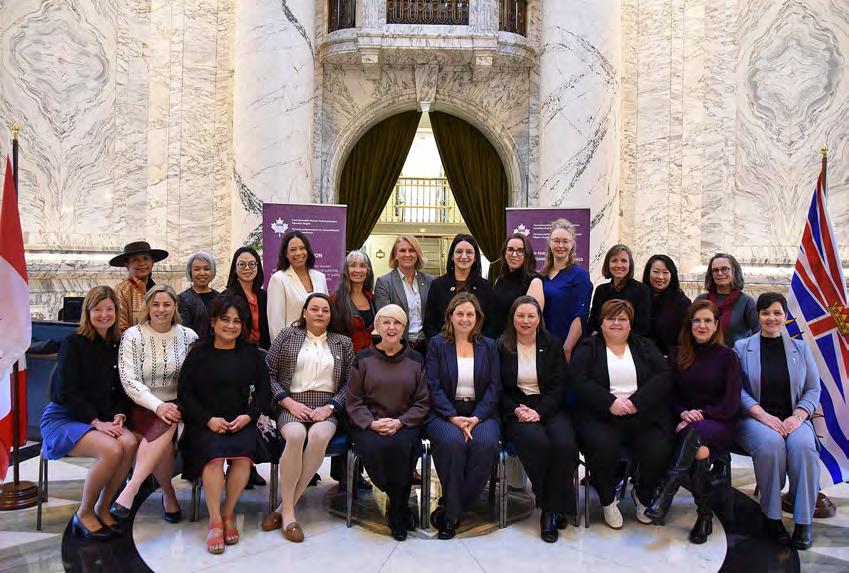
The CWP Canada Outreach Programme is an annual event in the Canadian Region that allows women Parliamentarians to engage with other women and girls in the community. The goal is to educate them about the political process and encourage them to get involved in politics and run for office. This is the first year that the programme has been held since 2019. The Programme complements the CWP mission, “to promote the representation of women in CPA Branches and women's full and equal participation in political and parliamentary leadership at all levels", and the 2026 CWP Workplan objectives on disseminating opportunities and information to support women's political participation in politics.
disappear. I stand on the shoulders of women who came before me, women who were told to be quieter, smaller, more grateful. Women whose names history does not always record, but whose courage carved a path forward anyway. Their resilience lives in every step I take.
I am also inspired every single day by the women around me: by my mother, whose strength shaped my values; by my daughters, who remind
me why representation is not symbolic, it is essential; and by the countless women in our communities who lead with care, conviction and courage, often without recognition, but never without impact.
To me, leadership is not about power over others. It is about responsibility to others. It is about showing up authentically, challenging systems that exclude and leaving the door wider than you found it. Today is
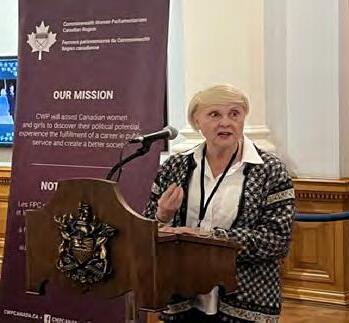
not just about celebrating progress. It is about telling the truth. Because women and girls around the world are still being killed by domestic violence. Still punished for speaking up. Still denied education. Still targeted for simply existing online, in public, in pursuit of their rights. So, the question before us is not whether progress has been made. The question is: Who is still being left out? And more importantly, what are we willing to change to bring them in?"
Images:
WHY ARE WE STILL FAILING ON GENDER EQUALITY DESPITE YEARS OF PROMISE?
Examining the campaign for gender equality, ending violence against women and health discrimination against women GENDER
As we started 2026, we reminded ourselves of some of the prominent promises (including some legally binding ones) which our governments have made since 1945 to advance progress on gender equality and human rights. The Preamble of the United Nations Charter adopted by all governments in 1945 begins with the three words: "We the peoples…" and not "We the men..." Equal rights of men and women are further reaffirmed in the UN Charter Preamble 1945.
Shortly after 1945, gender equality was also enshrined in Universal Declaration of Human Rights 1948. Gender equality became the core driver of the legally binding UN Treaty (formally called the UN Convention on the Elimination of all forms of Discrimination Against Women or CEDAW in 1979). CEDAW also promised to address gender-based violence. Then, at the UN General Assembly in 1993, world leaders passed a resolution to eliminate gender-based violence.
In 1995, the UN World Conference on Women in Beijing and its landmark Beijing Declaration (1995) and Platform for Action committed governments to addressing violence against women.
The UN Sustainable Development Goals were then adopted by all world leaders in 2015 with a promise to achieve gender equality "where no one is left
behind" by 2030. However, are we on track or are we struggling to deliver on these goals - or even sliding back?
What is holding us back from keeping the promise?
Despite considerable and at times, historic progress on gender equality, progress is miles away from being acceptable. Rather in recent times, anti-rights and anti-gender pushbacks have not only threatened the fragile gains made on gender equality but also undoing the good that had happened after quite a fierce community-led feminist struggle.
For example, should not we all be asking why is there almost no change in violence against women and girls since 2000? In the last 26 years, the annual decline in intimate partner and sexual violence is abysmally low at 0.2%. This is so very unacceptable, says Shobha Shukla, SHE & Rights (Sexual Health with Equity & Rights) Coordinator. "If we are to walk the talk on ending sexual and all other forms of gender-based violence, we have to translate words into stronger actions – dismantle patriarchy, and rethink, and rebuild feminist health and development systems."
It is high time for accountability "Despite so many agreements and declarations to end violence against
Shobha Shukla is a feminist, health and development justice advocate, and an award-winning founding Managing Editor and Executive Director of CNS (Citizen News Service).
women and girls, the question remains - why the rates have not declined. Violence against women and girls is a violation of human rights, rooted in gender inequality and an impediment to sustainable development," said Dr Pam Rajput, a noted feminist and gender justice leader and former Chairperson of Government of India's High-Level Committee on the Status of Women. "Despite all the efforts over decades to end gender-based violence, the painful reality or truth is that we are far behind from the goal of ending all forms of violence against women and girls."
"Over 840 million women have faced violence globally. The number of women who have faced violence in conflict settings is double. In the past 12 months, 316 million women have faced physical violence or sexual abuse by the intimate partner, and 263 million women have faced it by non-intimate partner. Over 51,000 cases of femicide have been reported," added Dr Rajput.
Even women Parliamentarians are not free of violence, says Dr Rajput. 73% of women journalists reported facing online violence, and 20% of them have even suffered offline attack by antigender groups.
Earlier this year, Commonwealth Parliamentary Association (CPA) and the Inter-Parliamentary Union (IPU)
“ The UN Sustainable Development Goals were then adopted by all world leaders in 2015 with a promise to achieve gender equality "where no one is left behind" by 2030. However, are we on track or are we struggling to deliver on these goals - or even sliding back?”
published a study that revealed 60% of women MPs from Asia-Pacific reported online gender-based violence. The main findings included:
• 60% of women Parliamentarians surveyed have been targeted by hate speech, disinformation, image-based abuse or unwanted disclosure of personal data (doxing) online. This is the highest rate for this type of abuse (compared to other IPU regional studies).
• 76% of women Parliamentarians and 63% of parliamentary staff have experienced psychological violence.
• Sexual violence is also prevalent, with 25% of women Parliamentarians and 36% of parliamentary staff reporting such incidents.
• Economic violence or damage to women’s belongings has affected 24% of women Parliamentarians and 27% of parliamentary staff, while physical violence was reported by 13% and 5% respectively.
Certain groups - women under 40, women from minority backgrounds and unmarried women - face disproportionately higher rates of violence. Opposition women MPs also
report higher rates of psychological and sexual violence.
High time to dismantle barriers that fail us on gender justice
"We need to address structural inequalities, patriarchal norms, ‘normalisation’ of gender-based violence, consumerist neoliberal models of development, gender insensitivity of the enforcement agencies (such as police or judiciary) and under-investment in gender equality, if we are to address violence against women and girls," said Dr Rajput.
"The agreed conclusions of UN Commission on the Status of Women every year and its Political Declarations every four years must get fully implemented by the countries. Promises made at the global level must translate into local realities," she stressed.
"How can we talk about sustainable development where no one is left behind, when millions of women and girls are not free of economic violence, social violence, sexual violence and other forms of gender-based violence?" said Dr Pam Rajput.
"We demand zero tolerance for violence against women and girls,
both in policy and practice. Violence against women and girls is not something where governments can get away by saying 'oh it is inevitable,' because it is NOT inevitable" she emphasised. "Alongside global campaigns to end violence, we also need local campaigns to end violence against women and girls. We need accountability from global to local and local to global for a safe healthy environment for each human being on this Earth."
Gender-based violence also fails us on HIV
"Gender-based violence not only violates human rights of women and girls but also exposes them to risk of acquiring HIV and other infections. Gender-based violence and HIV creates a nexus or a cycle of violence, stigma and discrimination. Unequal power and harmful gender norms further ups the risks and vulnerabilities for women and girls for suffering violence as well as HIV," said Esther Asuquo, gender and peace advocate of African Girls Empowerment Network in Nigeria.
"Gender-based violence increases risk for women and girls of forced sex, physical trauma, sexual violence,
GENDER EQUALITY TARGETS
including intimate partner violence, rape and physical trauma. Genderbased violence also increases the inability to negotiate safer sex among young women and girls," added Esther while addressing a SHE & Rights workshop session.
Why is ending period poverty elusive?
Period poverty is the lack of access to menstrual products, sanitation facilities and hygiene education, forcing people to use inadequate substitutes (rags, leaves) or miss school/work, impacting health, dignity and education due to stigma and cost. It affects millions globally, including in developed nations, leading to missed classes, poor health and hindering women's rights and economic independence.
"Ending period poverty and stigma is important if adolescent girls and young women need to live a dignified life with rights. Period poverty and stigma are affecting so many girls across Africa. Many of them are lacking safe absorbent materials – essential for menstrual hygiene, and are thus forced to use unsafe absorbent materials, for example soil, sand and in extreme cases cow dung. These
absorbent materials end up increasing their susceptibility to reproductive tract infections. Sometimes they are forced to go for transactional sex which increases the risk of sexual violence and increases their risk of HIV, teenage pregnancies and sexually transmitted infections (STIs)," said Angel Babirye, Emerging Women Deliver leader from Uganda and President of the African Youth and Adolescent Network East and Southern Africa (AfriYAN ESA).
"Menstruation is largely shrouded in myths and misconceptions. We must normalise conversations around menstruation because it is normal. Girls need to have safe spaces to speak up about menstruation, and also need to have access to clean water, sanitation and hygiene too. Girls and women must have safe and private facilities to change absorbent materials as and when required as well as spaces to dispose off the used absorbent materials," she added. "In Uganda, 1 in 4 girls drop out of school once they begin menstruating. Absenteeism triples during their periods. Let us address menstrual hygiene, period poverty and stigma in a comprehensive
way so that girls can have safe and dignified lives."
Would 2026 see ending anti-rights pushbacks and full force progress on gender equality and human rights?
Let us hope that 2026 dawns on all of us why gender inequality is in its nexus (by design) with patriarchy, capitalism, fundamentalism, militarisation, debt and shaky progress against many of the SDG goals and targets - and sparks united action to deliver on SDG-5, SDG-3 and all other goals, targets and promises made by our governments for a better tomorrow.
The only possible socially just and ecologically sustainable world order is a feminist world order where health, gender, social, economic, climate and redistributive justices along with accountability to peoples take centre-stage. That is the rainbow highway to the SDGs, or so we believe. #RethinkRebuildRise should be our mantra.
This article was previously published by the Citizen News Service in December 2025 and made available for international media. Visit www.citizen-news.org
Register for the CPA Parliamentary Academy Now

Free courses for CPA Members
The CPA has designed a curriculum of online courses specifically for Parliamentarians and parliamentary officials.
Our courses are intended to strengthen your capacity to fulfil constitutional and statutory obligations as well as to enhance your knowledge and understanding of the role of Parliament in the democratic governance process. These accessible courses offer an adaptive and flexible learning approach, with both written and visual content along with access to a variety of useful resources.
To register for the CPA Parliamentary Academy, please email hq.sec@cpahq.org or visit our website: www.cpahq.org/parliamentary-academy
COMMONWEALTH
AUSTRALIAN SENATOR CONDEMNED FOR ‘BURKA STUNT’ IN PARLIAMENT
An Australian Senator has provoked anger for wearing a burka in Parliament, after pushing for a ban on the Muslim garment. Senator Pauline Hanson was condemned by fellow Senators in the Chamber and proceedings in the Australian Senate were halted as she refused to remove the item on 24 November 2025.
The Queensland Senator, of the One Nation party, was seeking to introduce a Bill that would ban full face coverings in public – a policy she has long campaigned for. It is the second time she has worn the garment –which covers the face and body – in Parliament, and said her actions were in protest at the Senate rejecting her Bill.
Shortly after the Senate voted against the introduction of the Bill, Senator Hanson returned wearing a black burka. She previously wore a burka to Parliament in 2017, also calling for a national ban at the time.
The Australian Foreign Minister, Senator Hon. Penny Wong, who serves as Leader of the Government in the Senate, condemned the stunt as “disrespectful” saying: “We represent in our states, people of every faith, of every faith of all backgrounds. And we should do so decently.”
Source: BBC News online.
UK HOUSE OF LORDS ELECTS
NEW LORD SPEAKER
The UK House of Lords has elected Rt Hon. Lord Forsyth of Drumlean as the fifth Lord Speaker for a five-year term from 2 February 2026. Lord Forsyth was elected by Members of the House of Lords following the announcement that Rt Hon. Lord McFall of Alcluith, the current Lord Speaker, will step down at the end of January 2026.
The Lord Speaker has a number of roles in the UK Parliament including chairing business in the House of Lords chamber; playing a key role in the Administration of the House of Lords; acting as an ambassador for the House in the UK and abroad; and representing the House at ceremonial occasions. The Lord Speaker is politically impartial.
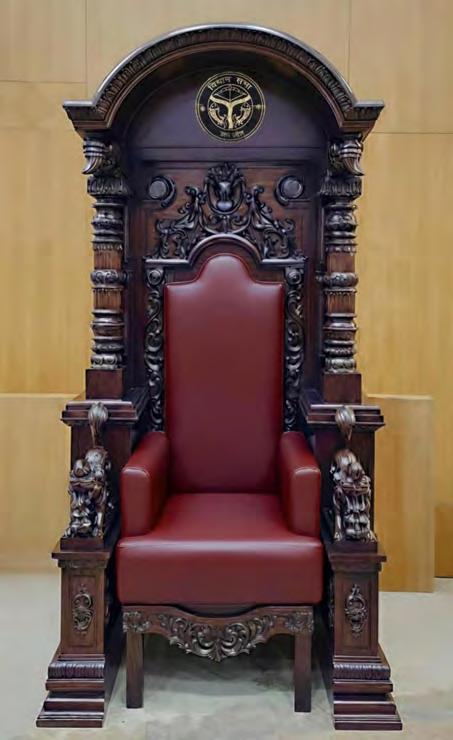
The Constitutional Reform Act 2005 ended the Lord Chancellor’s combined role as head of the judiciary, a member of the government and Speaker of the House of Lords – separating the role of Presiding Officer of the Upper House. In 2006, the House of Lords held the first election for a Lord Speaker and there have been four Members elected to the office - Baroness Hayman (2006-2011); Baroness D’Souza (2011-2016); Lord Fowler (2016-2021); and Lord McFall of Alcluith (2021).
Lord Michael Forsyth of Drumlean was appointed to the House of Lords in 1999. He was previously a Member of the UK House of Commons for 14 years and served in the UK Government for a decade as a Minister of State in the Home Office and in the Department of Employment

before joining the Cabinet prior to devolution as Secretary of State for Scotland.
Source: UK Parliament.
NEW SPEAKER’S CHAIR FOR UTTAR PRADESH, INDIA’S LARGEST LEGISLATIVE ASSEMBLY
When the Uttar Pradesh Legislative Assembly, the largest in India with 403 elected Members, began its new session on 9 February 2026, it displayed a new item with its origins in the State of Karnataka.
A new, ornate and canopied Speaker’s Chair, with a special carving of the Uttar Pradesh State emblem, was unveiled that had been handcarved in Karnataka. The seven-foottall Speaker’s Chair had been carved out of rosewood by ten artisans under the supervision of the Karnataka State Forest Industries Corporation before being dispatched to Lucknow from Bengaluru.
The Speaker of the Uttar Pradesh Legislative Assembly, Hon. Satish Mahana, MLA, was in Bengaluru to attend the 11th CPA India Regional Conference in September 2025 and was impressed with the Speaker’s Chair in the Karnataka Legislative Assembly. The visit inspired a new Chair to be created for the Uttar Pradesh Legislative Assembly.
Above: The new Lord Speaker of the UK House of Lords, Rt Hon. Lord Forsyth of Drumlean.
Left: The new Speaker’s Chair for the Uttar Pradesh Legislative Assembly in India .
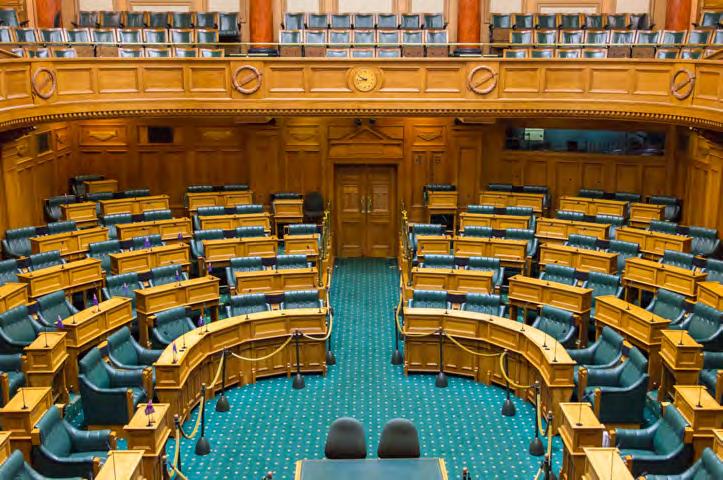
Many Commonwealth Legislatures feature Speaker’s Chairs and other items gifted from other Parliaments within the CPA membership.
Source: The Hindu, India; ETV Bharat India
NEW ZEALAND PARLIAMENT BILL PASSES
The New Zealand Parliament Bill was read for a third time on 6 November 2025. The Bill consolidates and modernises the law about the New Zealand Parliament relating to funding of the parliamentary agencies, Members’ travel and work-related expenses, and the powers of security officers at the New Zealand Parliament. It also replaces four earlier Acts relating to parliamentary operations.
Hon. Chris Bishop, MP (National) talked about the constitutional significance of the Bill, saying, “This does represent a constitutional moment - not one that Parliament often engages in in our largely unwritten constitution.” He outlined that the Bill provides greater support for the families of Members of Parliament: “Members of Parliament have a variety of living circumstances, and the Bill is intended to better support for Members to balance parliamentary duties with family commitments. For example, the Bill gives greater flexibility for travel services so a caregiver can accompany a Member’s dependent family members to Wellington.”
that the Bill implements a new funding model for the agencies responsible for the day-to-day running of Parliament, the Parliamentary Service and the Office of the Clerk, giving these agencies greater independence from the Executive. He said, “The place in which laws are made, and Government is scrutinised should not have its ability to do that undermined because the Government of the day feels it’s short of cash. So we have now, not entirely, but, at least, in part, said that those decisions are now going to be made by Parliament. So Parliament will have a say over its own funding - will, in fact, have the determinative say over its own funding… Making sure that that isn’t subject to the whims of Government is of critical importance.”
The Bill gives Parliament’s security officers greater powers, such as the ability to search, to seize items, to deny entry and to detain. Hon. Ricardo Menéndez March, MP (Green) said, “The Green Party initially had some concerns around the safeguards in relationship to the greater powers that would be given to security.” However, he added that “We feel confident that there are adequate safeguards so that the additional powers that security have are adequately scrutinised, but also so that we protect security officials themselves... I think the provisions in this Bill will be important, and the safeguards will be something
that the Green Party will continue keeping an eye on to ensure that they are sufficient.” Speaking in the Bill’s Second Reading, Hon. Andy Foster, MP (NZ First) said, “We’re one of the most open, accessible Parliaments in the world, and also one of the most accessible groups of Parliamentarians. That’s something which we should be treasuring and that is not something which we should take for granted.”
Hon. Mariameno Kapa-Kingi, MP (Te Pāti Māori) supported the Bill, but added that “what remains missing, we would say, and that we continue to hope for, is explicit recognition of the Treaty of Waitangi. I was present as the Committee considered including a Treaty clause but chose not to, suggesting it might alter constitutional arrangements. I’m sure that’s true. Yet, Te Tiriti is the foundation of those arrangements. Its recognition would not undermine this House, it would strengthen it.”
Following the Committee of the Whole House stage, the Parliament Bill was split into the Parliament Bill and the Parliament (Repeals and Amendments) Bill. Hon. Cameron Luxton, MP (ACT) said, “I would also like to give my support to the idea that we are splitting this up to tidy up a Bill into having a Repeals Bill and a piece of legislation that actually has a clean start.” The Bill was passed without opposition and received the Royal Assent on 12 November 2025.
Report by Lizzie Hendy, Parliament of New Zealand
SOUTH AFRICAN PARLIAMENT MOVES TO ‘TEMPORARY’ CHAMBER
Following the 2022 fire that damaged parts of the parliamentary precinct, the National Assembly of South Africa now has a refurbished space to host its sittings until reconstruction work on its permanent home is complete. The Speaker of the National Assembly of South Africa, Hon. Thoko Didiza, MP, and the Minister of Public Works and Infrastructure, Dean Macpherson, inaugurated the refurbished
Hon. Duncan Webb, MP (Labour) explained
Image credit: Parliament of New Zealand.
Left: The main Chamber of the New Zealand Parliament in Wellington.
COMMONWEALTH
Nieuwmeester Dome in Cape Town on 6 February 2026.
Improvements to the Dome, which was originally used for the funeral of former South African President Nelson Mandela in 2013, mean that it will now be able to withstand Cape Town’s winds. Previous sittings in the Dome had posed a number of challenges such as its inability to withstand Cape Town’s notorious wind and its inadequate sound quality. As a result, several sittings had to be moved to either a hybrid or virtual format. The Dome will be used for National Assembly sittings, including the debates and replies to future State of the Nation Addresses, which have taken place at the nearby Cape Town City Hall. The refurbished Dome can seat 500 Members of Parliament, including the 400 National Assembly Members and delegates from the National Council of Provinces. There are 165 seats in the gallery.
Following the devastating fire on 2 January 2022, in which the National Assembly and parts of the Old Assembly burnt down, the South African Parliament has been trying to find alternative venues for sittings, including the City Hall or the Cape Town International Convention Centre, while the rebuilding takes place. Reconstruction work is expected to be complete by 2027.
Source: South Africa Daily Maverick.
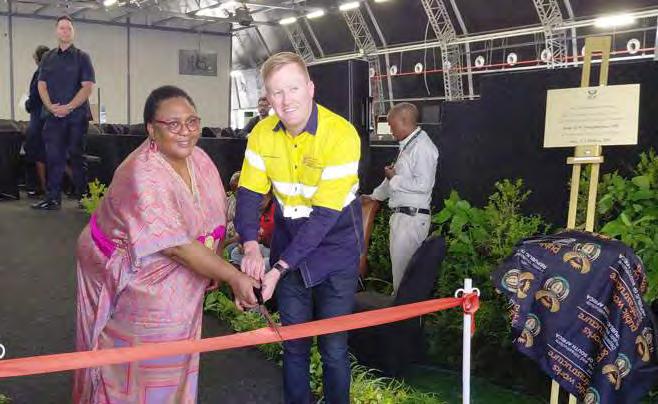
TOBAGO ASSEMBLY HOLD FIRST INTERNATIONAL MEN’S DAY DEBATE
The Tobago House of Assembly created history in the Chamber on 10 November 2025 by hosting its firstever all-men’s International Men’s Day Debate which discussed issues plaguing men’s mental health and identity. The debate saw men and boys from all sectors of society in Tobago assume the role of Assembly Members and councillors for a lively session.
One of the event’s coordinators, Justin John said that the idea for a men’s debate was proposed some time ago by Youth Parliamentarians and Legislature staff. The Legislature
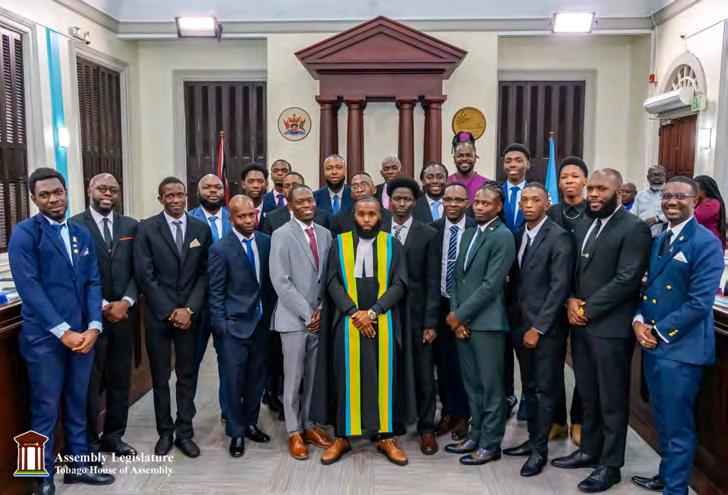
had previously organised events to mark International Women’s Day and the idea of a men’s debate followed. “We realised that within the conversations we are having that there is a lot of gender disparity when it comes to gender-based programmes. There are a lot of women-based programmes but not for men, particularly in the Tobago space.”
The Tobago Government has introduced some programmes targeting men, such as the Division of Health, Wellness and Social Protection’s Blue Room initiative, but there are local concerns over the issues of mental health and suicide affecting men and boys.
Tobago House of Assembly Presiding Officer at the time of the debate, Abby Taylor welcomed the initiative and the positive response from stakeholders and participants saying: “Giving the greenlight for the first-ever International Men’s Day Debate was about legacy and responsibility. The Assembly must lead conversations that shape the future of Tobago, even when they are uncomfortable. The public response was powerful and affirming, with many praising the Tobago Assembly for addressing men’s mental health and identity head-on via social media commentary
Above: The Speaker of the National Assembly of South Africa, Hon. Thoko Didiza, MP, and the Minister of Public Works and Infrastructure, Dean Macpherson, inaugurated the refurbished Nieuwmeester Dome in Cape Town on 6 February 2026
Left: Participants in the first Men’s Debate held at the Tobago House of Assembly.
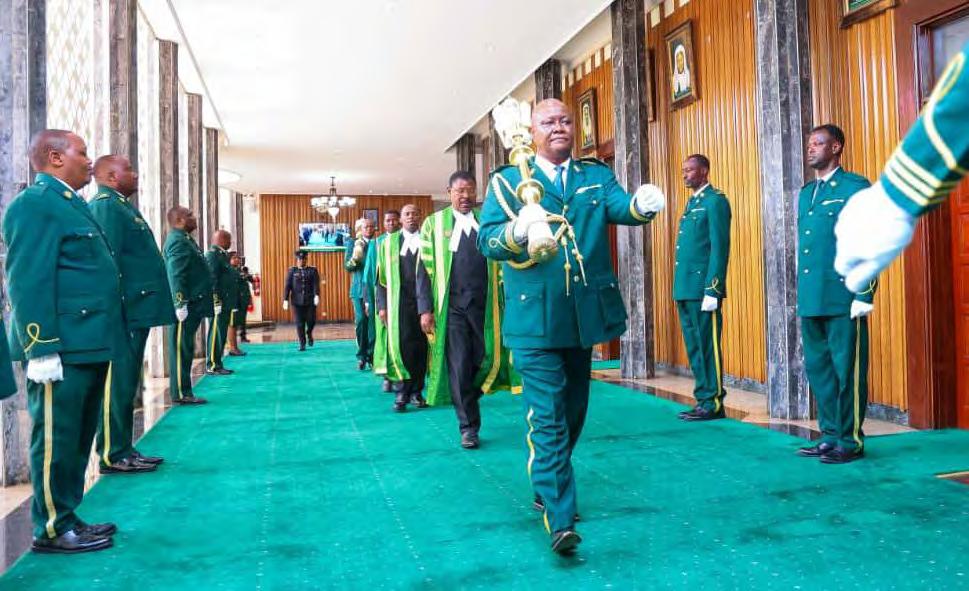
and posts, newspaper articles and national discourse. This debate placed humanity at the centre of governance, and that is exactly where it belongs.”
In addition, as a result of the debate and the issues raised, a Government Minister has announced new legislation will be introduced to expand maternity benefits and paid leave for fathers.
Source: Tobago Assembly, NewsDay.
KENYA NATIONAL ASSEMBLY HONOURS RETIRING CHIEF SERJEANT-AT-ARMS
The Kenya National Assembly accorded a special recognition in November 2025 to the retiring Chief Serjeant-at-Arms, Aloisio Nterepu Lekulo, OGW, marking the conclusion of his two-decade tenure in the Parliamentary Service Commission.
Mr Lekulo commenced his service in Parliament in 2006 as a Senior Serjeant-at-Arms, diligently rising through the ranks to assume the mantle of Chief Serjeant-at-Arms/ Director. His time in this pivotal role has been defined by significant advancements in institutional capacity.
The Speaker of the National Assembly, Hon. Moses M. Wetang’ula, EGH, MP, noted that “He has been instrumental in enhancing specialised training for staff such as VIP training which has equipped them with skills of dealing with emerging trends in institutional security and events
management. These skills have gone a long way in enhancing security within the precincts of Parliament, estate management and supporting the coordination of orderly proceedings in plenary.”
Mr Lekulo demonstrated leadership and commitment to the professionalisation of the Serjeantat-Arms service and he spearheaded the initiative to register officers with international associations, including the Commonwealth Serjeant-AtArms Association and the National Legislative Society of Serjeant-at-Arms Association-America (NLSSA).
Sources: Uzalendo News Kenya
RENOWNED COMMONWEALTH EMINENT PERSON LAUNCHES NEW BOOK IN NEW SOUTH WALES
Commonwealth eminent person and former Australian High Court Justice, Hon. Michael Kirby, AC, CMG launched a new book at the Supreme Court of NSW Banco Court in Sydney in January 2026.
Parliamentarians and leading figures from law and academia joined the Governor-General of Australia, Her Excellency Hon. Sam Mostyn, AC; the
Chief Justice of the Australian High Court, Justice Stephen Gageler, AC; and the Chief Justice of New South Wales, Andrew Bell, AC at the launch of ‘Law, Justice and Other Challenges: Selected Speeches and Papers of Michael Kirby’.
Drawn from Michael Kirby’s life and work as a jurist, reformer and global human rights advocate, the works have been edited by Dr Paul Vout, KC and span law, love, prejudice and social change, distilled from more than 3,180 writings from 1975 to 2025, tracing his journey from young law clerk to the Australian High Court. The Australian Governor-General wrote a foreword to the book, having begun her legal career as an Associate to Michael Kirby when he was President of the New South Wales Court of Appeal in 1989.
Hon. Michael Kirby was a member of the Commonwealth Eminent Persons Group who examined the future of the organisation in 2011/12 and has worked with the Commonwealth Parliamentary Association several times including delivery of the second CPA Lifaka Lecture on the role of Parliamentarians in protecting human rights in the margins of the 67th Commonwealth Parliamentary Conference in Sydney in November 2024.
Publisher: Federation Press: ISBN: 9781760025373. Visit https://federationpress. com.au/product/law-justice-and-otherchallenges/.
Below: Australian Governor-General, Hon. Sam Mostyn (left) congratulates Hon. MIchael Kirby on his new book launch.
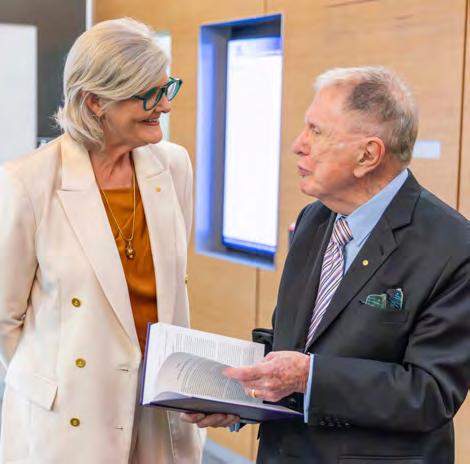
Image credit: Parliament of Kenya.
Above: Retiring Chief Serjeant-at-Arms, Aloisio Nterepu Lekulo, leads the Speaker of the National Assembly’s procession at the Parliament of Kenya.
COMMONWEALTH LIVES
The passing of Mr Nihal Seneviratne, former SecretaryGeneral of the Parliament of Sri Lanka, brings to a close a life devoted - quietly, steadfastly and with rare distinction - to the service of parliamentary democracy. His death has been deeply felt not only within Sri Lanka, but also among those who value the traditions and institutional integrity of Commonwealth Legislatures. Although I did not have the privilege of serving under him during his official tenure - he had retired before I entered parliamentary service in 2003 - my own professional journey in Parliament was shaped in no small measure by his counsel. On numerous occasions, I sought his advice on matters of parliamentary procedure, constitutional propriety and institutional ethics. What remains most striking is that Mr Seneviratne never allowed rank, generation or position to stand in the way of mentorship. Though I was then a comparatively junior officer, he treated me with the affection, concern and patience of a father toward a son. His advice was always candid, carefully reasoned and entirely free of self-interest. It was advice grounded not merely in rules, but in values - respect for Parliament, fidelity to constitutional boundaries and devotion to public trust.
A Career Anchored in Institutional Loyalty: Mr Seneviratne served the Sri Lankan Parliament for 33 years from 1961 to 1994, including 13 years as Secretary-General, one of the longest and most consequential tenures in that office. Entering parliamentary service in 1965, he rose through the ranks at a time when parliamentary administration demanded not only procedural competence, but courage, discretion and resilience. Educated at Royal College, Colombo, and trained in law at the University of Peradeniya, his entry into parliamentary service was almost accidental - yet providential for the institution. He had secured opportunities elsewhere, but chose the Legislature, accepting the discipline and anonymity that parliamentary service often demands. That choice resulted in decades of loyal service during periods of constitutional transformation, political turbulence and national crisis. Unlike some who wield high office, Mr Seneviratne exercised authority without ostentation. He believed that the strength of parliamentary administration lay in its invisibility - allowing elected representatives to perform their roles without obstruction, while ensuring that the institution functioned with precision, continuity and dignity. In this sense, he exemplified the finest traditions of Commonwealth parliamentary administration.
Stewardship During Historic Moments: Mr Seneviratne’s tenure coincided with some of the most dramatic moments in Sri Lanka’s parliamentary history. These included constitutional crises, changes of government, impeachment proceedings and even violence within the precincts of Parliament. As Secretary-General, he bore responsibility not merely for procedure, but for the institutional stability of
the Legislature itself. In his memoirs, ‘Memories of 33 Years in Parliament’, he recorded these events with restraint and fidelity to fact, offering future generations a rare insider’s account of parliamentary life under pressure. His writing reflects the same qualities that defined his service: balance, discretion and an unwavering respect for democratic institutions. He understood that the Secretary-General’s foremost duty is not to personalities or political interests, but to the House as an institution.
A Commonwealth Parliamentarian in Spirit: Though his service was national, Mr Seneviratne’s outlook was unmistakably Commonwealth in spirit. Trained in the traditions of Westminsterstyle parliamentary practice, deeply familiar with Erskine May and respectful of convention as a living constitutional safeguard, he embodied the values that bind Commonwealth Legislatures together - impartiality, continuity and institutional memory. His career illustrates how professional parliamentary administrators serve as the custodians of democratic continuity, ensuring that political change occurs within stable institutional frameworks. This lesson remains of enduring relevance to Commonwealth Legislatures navigating constitutional stress and political transition.
The Man Beyond the Office: Affectionately known as ‘Galba’ to friends and colleagues, he combined professional excellence with exceptional humanity. As an All-Island Justice of the Peace, he served countless individuals - often travelling to their homes to attest documents, never expecting convenience or recognition. These quiet acts of generosity, repeated over decades, speak volumes about his character. He remained deeply devoted to Royal College, serving as Secretary of the Royal College Union and later as Vice-President Emeritus. He also took great care to preserve the intellectual legacy of his late brother, Professor K. N. Seneviratne, through annual commemorative orations. Within his family, he was a devoted husband, father and grandfather - roles that brought him evident joy and pride. Those who spoke at the launch of his final book bore testimony not only to his public achievements, but to his warmth as mentor, seeya and friend.
A Personal Reflection: For me, Mr Seneviratne represented the ideal parliamentary officer - learned yet humble, authoritative yet gentle, principled yet practical. His guidance helped shape my understanding of parliamentary service not merely as a career, but as a vocation. That he offered such guidance generously, long after retirement, is perhaps his greatest gift to those of us who followed. Parliamentary institutions are often judged by their visible actors, but they endure because of individuals like Mr Seneviratne - those who work quietly, uphold standards faithfully and pass on wisdom without expectation of reward. Mr Seneviratne wore an important title for many years, yet never wore it heavily. His life reminds us that institutional greatness does not require loud authority, only integrity, patience and devotion to duty.
Nihal Seneviratne (29 May 1934 – 6 January 2026).
Tribute written by Justice Neil Iddawala, who served in the Parliament of Sri Lanka from 2003 to 2020 and was elevated as a Judge of the Court of Appeal of Sri Lanka.
Mr Nihal Seneviratne: A Life of Quiet Authority in Parliamentary Service in Sri Lanka
Parliamentary Conversations in the Commonwealth
A podcast by the CPA that gives a voice to Parliamentarians, civil society experts and activists across the Commonwealth to discuss common democratic challenges and share their ideas on what can be done to solve them.
Listen now to new episodes on all major podcast platforms or visit www.cpahq.org/knowledgecentre/cpa-podcast