MAY/JUNE 2026


Shakesha Holmes
Josh Squire
Sidney Starkman


Rob McConnell
![]()
MAY/JUNE 2026


Shakesha Holmes
Josh Squire
Sidney Starkman


Rob McConnell

Jeshua Pringle,
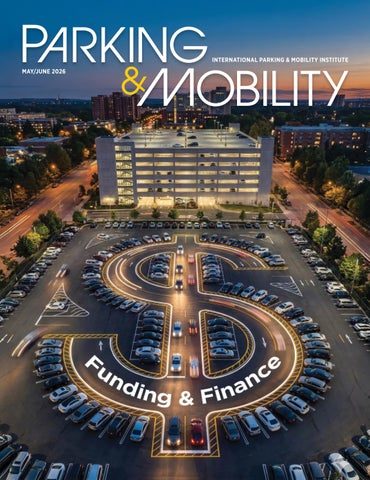
WHEN EXAMINING THE FUNDING AND FINANCES of today’s parking, transportation, and mobility operations, one thing becomes clear: the financial conversation is no longer just about operations. Investment, strategy, and the industry’s future are all driving the money conversations. And those are not easy conversations to have.
In this May/June issue of Parking & Mobility, we have those difficult conversations. While parking has been a reliable source of revenue for many organizations, the steady predictability we have always relied on to support public budgets and institutional operations seems to be wavering. The financial landscape is shifting, and new, creative solutions are required to stay solvent.
The question is no longer simply how we fund parking, but how parking helps fund mobility.
We hit this topic from many directions this month.
● Changing Financial Landscape: Success requires a shift from traditional revenue models (parking fees, enforcement revenue) to more diversified revenue streams, and we identified non-parking event revenues as an example.
● Innovation in Funding Models: How modernizing payment methods with outside-the-norm solutions can lead to lower fees and faster payouts.
● Technology as a Financial Multiplier: How scaling parking operations with the most modern tech can impact the bottom line. How do we gauge ROI when considering investments in new parking tech?
● The Push and Pull Between Revenue and Public Good: How do we fund systems that serve everyone without pricing people out? We examine Parking Benefit Districts as a solution.
● …and more!
In the end, funding and finance are about more than just budgets. Our approaches show what we value as an industry and a community. As you read through this issue, we ask you to consider not just how to earn revenue and fund your organization, but how the decisions you make impact your broader goals. The approach is evolving, but the opportunities in parking and mobility remain, ensuring that our financial strategies support a stronger tomorrow — for everyone

Melissa Rysak, editor rysak@parking-mobility.org
PUBLISHER
Shawn Conrad, CAE s.conrad@parking-mobility.org
EDITOR-IN-CHIEF
Melissa Rysak rysak@parking-mobility.org
MANAGING EDITOR
Courtney Turner turner@parking-mobility.org
TECHNICAL EDITOR
Rachel Yoka, PTMP, LEED AP BD+C yoka@parking-mobility.org
ADVERTISING SALES AND SUBSCRIPTIONS
Tina Altman, CEM taltman@parking-mobility.org
PUBLICATION DESIGN
BonoTom Studio info@bonotom.com
For subscription changes, email editor@parkingmobility.org
Parking & Mobility (ISSN 0896-2324 & USPS 001436) is published bi-monthly by the International Parking & Mobility Institute P.O. Box 3787 Fredericksburg, VA 22402
Email: info@parking-mobility.org Website: parking-mobility.org
Send address changes promptly via email to editor@ parking-mobility.org
Interactive electronic version of Parking & Mobility at parking-mobility-magazine.org
Copyright © International Parking & Mobility Institute, 2026. Statements of fact and opinion expressed in articles contained in Parking & Mobility are the sole responsibility of the authors and do not necessarily represent an official expression of policy or opinion on the part of officers or the members of IPMI. Manuscripts, correspondence, articles, product releases, and all contributed materials are welcomed by Parking & Mobility; however, publication is subject to editing, if deemed necessary to conform to standards of publication.
The subscription rate is included in IPMI annual dues. Subscription rate for non-members of IPMI is $500 per year (U.S. currency) in the U.S., Canada, and Mexico. All other countries, $750.
By Robert Ferrin, PTMP, and Alex MacIsaac, PTMP

IN TODAY’S RAPIDLY EVOLVING URBAN LANDSCAPE, parking professionals must navigate a complex matrix of ever-evolving customer demands and market externalities. The recent focus on the world of hockey, and both the U.S. and Canadian successes at this year’s Olympic Games, got us thinking of how this challenge closely mirrors the economics of minor hockey organizations.
These organizations operate community arenas with fixed infrastructure, limited capital, and fluctuating demand. For parking professionals managing municipal, university, hospital, airport, and commercial parking systems, creating sustainable and profitable revenue models — much like sustaining a minor hockey program — is paramount. This article explores key aspects of funding and finance for the parking industry through the lens of return on investment (ROI), budgeting, strategic investment, innovation, and the broader economics of parking and mobility.
ROI measures how effectively an investment generates profit relative to its cost. In parking, ROI is driven by occupancy, pricing, and operational efficiency — the same variables that shape financial decisions in minor hockey.


For example, a minor hockey association may invest in new ice-resurfacing equipment or upgraded locker rooms. While the upfront cost is significant, the investment can reduce maintenance expenses, improve ice quality, attract more tournaments, and increase ice rentals, resulting in stronger long-term returns.


From Ticketed to Ticketless - Gated to Gateless, built for the way you operate
API Flexibility
Integrates seamlessly with technology that aligns with your operational goals


Intuitive User Interface
Reduced friction and confusion from management to end-user
Managed Services
Optimize your operations while reducing organizational complexity
Simplified
Similarly, parking operators that invest in parking management systems, automated payment platforms, or enhanced security may initially see higher capital costs. Over time, however, these investments can increase space utilization, reduce labor requirements, and improve customer satisfaction, ultimately improving ROI. In both cases, success depends on evaluating long-term value rather than short-term expense.
Effective budgeting is the foundation of resilience for both parking operations and minor hockey programs. Minor hockey organizations carefully forecast revenue from registrations, ice rentals, sponsorships, and concessions, and budget for fixed costs such as utilities, staffing, insurance, and facility maintenance.
They also plan for uncertainty, such as unexpected equipment failures or seasonal demand swings, by building contingency funds. Parking operations face similar challenges. Monitoring occupancy trends and revenue streams helps build realistic budgets, while allocating funds for unexpected repairs or regulatory changes protects financial stability.
Just as minor hockey organizations often rely on grants, sponsorships, or municipal support to fund major upgrades, parking programs can reduce budget pressure by securing external funding or public-private partnerships for largescale projects.
Minor hockey organizations must be strategic with limited capital. Investments are carefully evaluated based on their ability to generate future revenue or reduce operating costs. For example, installing energy-efficient arena lighting may not directly increase ticket sales, but it lowers utility costs and frees up resources for programming that attracts more participants.
Parking professionals face similar decisions. Investments in mobile payment platforms, real-time occupancy tracking, or license plate recognition can streamline operations and enhance the user experience. Infrastructure upgrades, such as adding EV charging stations or constructing multilevel garages, parallel a rink adding additional ice time or modernizing facilities to meet changing community needs.
In both cases, the goal is to invest in assets that support long-term sustainability rather than short-term gains.
Minor hockey organizations rarely rely on a single revenue source. Beyond league play, they develop new products such as skills clinics, summer camps, adult leagues, and tournament hosting. They also revise existing offerings, introducing flexible registration options or bundled programs to attract a wider audience.
Parking programs can apply the same strategy. Offering premium services like reserved spaces, valet parking, or bundled parking-and-transit options creates new revenue streams. Revising traditional products, such as shifting from daily rates to subscription or pay-per-use models, helps accommodate evolving user preferences.
Just as minor hockey adapts programs to different age groups and skill levels, parking operations benefit from tailoring products to diverse customer needs.
Minor hockey arenas are classic examples of creative asset utilization. When ice is not in use for games, rinks host birthday parties, public skating, figure skating, community events, and non-hockey programming. Sponsorship boards, naming rights, equipment rentals, and concessions further diversify revenue.
Parking facilities can adopt the same mindset. During off-peak periods, underutilized lots or garages can host farmers markets, food truck rallies, or pop-up retail. Leasing space for advertising, cellular infrastructure, or solar panels mirrors how minor hockey leverages sponsorships to generate steady income.
By treating parking facilities as multi-purpose assets rather than single-use infrastructure, operators can unlock revenue opportunities without major new investments.
The broader economics of parking and mobility reflect the same principles that govern minor hockey operations. Ice time is a fixed resource, and demand varies by time, season, and user group. Minor hockey organizations price ice rentals differently for peak and off-peak hours to maximize utilization and revenue.
Parking systems operate under the same economic constraints. Dynamic pricing allows rates to reflect demand, encouraging turnover during peak periods and improving occupancy during slower times. Understanding elasticity — how users respond to price changes — helps


optimize both participation in minor hockey and parking utilization.
Much like changing participation patterns affect youth sports, moblity trends also affect parking economics. As alternative transportation options grow, parking operators — much like minor hockey organizations responding to shifting demographics — must rethink how space is used and consider repurposing underutilized assets.
The financial resilience of parking operations depends on the same principles that sustain successful minor hockey programs: disciplined budgeting, thoughtful investment, diversified revenue, and adaptability. By focusing on ROI, understanding demand patterns, and creatively leveraging assets, parking professionals can remain financially stable in a changing environment.
Innovation, flexibility, and community-oriented thinking will be critical for long-term success. Like minor hockey arenas that serve as vital community hubs, parking systems positioned at the intersection of mobility and urban infrastructure can lead with resilient, economically sustainable strategies for the future.


ROBERT FERRIN , PTMP , is a Mobility & Parking Senior Project Manager with KimleyHorn and Associates, and a member of the IPMI Board of Directors. He can be reached at robert. ferrin@kimley-horn.com
ALEX MACISAAC, PTMP , is the Director of Parking & Transportation for the University of Toronto and the International Representative on the IPMI Board of Directors. He can be reached at a.macisaac@utoronto.ca


By Rob McConnell
PARKING TECHNOLOGY HAS ADVANCED RAPIDLY in recent years. Camera-based systems, mobile payments, EV charging, parking guidance, and AI-driven analytics platforms are transforming how parking facilities operate. For owners and operators, however, adopting new technology is rarely just about innovation. The central question is always the same: will it deliver measurable value and a clear return on investment (ROI)?

Determining the ROI of parking technology requires more than simply comparing a system’s cost to the revenue it generates. Many of the most valuable technologies influence occupancy, operational efficiency, labor costs, and customer experience. Those improvements often translate into revenue growth and cost reductions, significantly improving a facility’s financial performance.
Understanding how to evaluate those impacts — and how to build a strategic implementation plan — is essential for parking owners who want to modernize their facilities without overinvesting in unnecessary technology.
To appreciate the value of parking technology, it helps to understand the economics of parking facilities themselves. The cost of constructing structured
parking continues to rise, with the national median cost of building a single parking space now approaching $35,000. In dense urban areas or complex mixed-use developments, costs climb even higher.
Against that backdrop, many parking technologies represent a relatively modest incremental investment. Even systems considered relatively expensive, such as individual space-occupancy parking guidance, typically add only about a 2% premium to the overall cost of constructing a parking facility.
Because the underlying asset is so expensive, even small improvements in utilization or operational efficiency can produce meaningful financial returns. For example, increasing occupancy from 85% to 95% in a high-demand facility can represent hundreds of additional transactions per day in a large garage. That additional revenue can often offset the cost of new technology relatively quickly.
This relationship between infrastructure costs and
operational performance is why many parking owners now view technology as an essential component for maximizing the value of their parking assets.
One of the clearest examples of technology delivering measurable ROI is parking guidance.
Before the widespread introduction of parking guidance systems, many operators assumed that facilities would effectively “top out” at about 85% occupancy. Beyond that level, drivers begin to experience frustration searching for spaces. Long search times can lead some customers to abandon the facility entirely and seek parking elsewhere.
Parking guidance systems change that dynamic by identifying available spaces and quickly directing drivers to them. Sensors or cameras detect open spaces and communicate that information through dynamic signage and, often, red and green LED lighting inside the garage. By reducing the time drivers spend searching for parking, these systems can push occupancy to 95% or higher. In busy facilities, that improvement can translate directly into increased revenue.
Guidance systems also improve customer satisfaction by reducing stress and uncertainty during the parking process. In environments with large numbers of occasional users, such as airports, hospitals, and shopping centers, this convenience can significantly influence a facility’s reputation and repeat usage. The technology tends to provide the greatest value in larger garages, particularly those with more than three parking bays, where drivers may miss available spaces in their search.
The external signage that’s typically associated with parking guidance technology can also deliver measurable ROI. Dynamic signage located outside a garage can display real-time information about available parking spaces. When integrated with a city’s broader parking ecosystem, these systems help drivers identify available parking before they even reach the facility. This visibility can attract drivers from nearby streets who might otherwise assume the garage is full and choose another location.
For garages in dense urban districts or near major destinations, external guidance systems function as both a customer service tool and a marketing platform. By capturing demand from passing drivers, these systems can increase facility utilization and generate additional revenue that might otherwise be lost.
Another technology-based operating approach that’s gaining significant traction is “free-flow” or “frictionless” parking, which typically eliminates traditional gated systems and replaces them with license plate recognition (LPR) cameras. In conventional gated facilities, entry and exit gates require ongoing maintenance and repair. Hardware failures, ticket jams, and equipment wear can create operational disruptions and recurring maintenance costs. Ungated frictionless systems remove those mechanical components entirely.
LPR cameras record the license plate of each vehicle entering and exiting the facility. The operating software determines whether the vehicle is authorized to be there and whether it has overstayed its allotted time. For certain operations, the software can automatically open a parking session on entry, calculate the duration of the stay, and automatically process payment on exit. The integration of mobile apps and online payment platforms provides convenience and comfort for most users. While frictionless systems require investment in cameras and software, they can reduce long-term maintenance costs. These systems are usually coupled with directed or automated enforcement capabilities, which can also reduce the need for enforcement personnel to manually patrol garages and check vehicles for compliance. LPR can also quickly identify black-listed vehicles entering a facility, and when integrated with law enforcement databases, identify stolen or otherwise flagged vehicles.
In effect, these systems streamline operations, improve enforcement effectiveness, and provide significant information on occupancy, customer habits, and other data points.
Mobile payment platforms and online prepaid parking reservations are other areas where parking operators can realize both operational and financial benefits. Traditional payment systems require hardware such as pay stations, ticket dispensers, and cash handling equipment. These systems carry capital costs, maintenance requirements, and operational risks associated with handling cash.
Mobile payment systems allow drivers to pay for parking via smartphone apps, while online platforms enable customers to prepay prior to parking. When customers adopt either system, operators can reduce their reliance on physical payment equipment. Eliminating or reducing cash payments also improves security and reduces revenue leakage associated with cash handling. Prepaid reservations also enable operators to forecast occupancy and adjust rates, as well as the amount and location of preferred parking spaces and other variables accordingly.
Similarly, in on-street parking environments, the shift toward mobile payment reduces the cost of maintaining and collecting revenue from parking meters. Mobile platforms and online prepaid reservations enable cities and operators to collect parking fees digitally, eliminating the need for frequent meter collection.
Perhaps most importantly, these systems often require relatively modest investment compared with traditional hardware-based payment infrastructure.
Another way parking owners can increase revenue is by utilizing third-party reservation and marketing platforms. These platforms allow owners and operators to market and sell parking spaces in advance, often through online marketplaces, travel websites, or sports and entertainment venues. By making inventory visible to a wider audience, operators can fill spaces that might otherwise remain unoccupied during certain times of the day or year.
Airports, cruise ship terminals, and event venues have particularly benefited from reservation platforms, which allow travelers or event attendees to secure parking in advance, often with their ticket purchase.
But really, any garage or parking lot that serves transient parking customers can benefit from them. These platforms provide a relatively low-cost way to increase utilization and revenue without requiring significant infrastructure changes.
The rapid adoption of electric vehicles (EVs) is creating new opportunities for parking operators to generate revenue through EV charging infrastructure. Many drivers now expect charging availability as part of the parking experience, particularly at destinations where vehicles remain parked for several hours. Airports, hospitals, office campuses, and universities are particularly well-suited for this type of charging environment. Parking operators can generate revenue by marking up the cost of power, charging convenience fees for equipment use, charging valet fees for charging after a long-term stay (e.g., at airports), or charging premium rates for EV charging spaces.
While EV charging infrastructure does require upfront investment, demand for these services continues to grow as EVs become more common. Additionally, there are often subsidies and incentives to offset the cost of EV charging infrastructure, particularly for facilities near highways. As EV adoption increases, this infrastructure can become both a customer amenity and a revenue generator.
Beyond customer-facing technologies, a new generation of back-office platforms is emerging, focusing on data integration and operational analytics. These systems collect and aggregate data from parking transactions, occupancy sensors, payment systems, and other operational sources. Using advanced analytics — and increasingly artificial intelligence — operators can identify patterns in demand, pricing sensitivity, and operational performance.
These insights can help operators determine whether their facilities are running as efficiently as possible. For example, analytics platforms may reveal opportunities to adjust pricing, improve enforcement strategies, or reallocate parking inventory.
Some large parking operators have developed proprietary platforms for this purpose, while independent software companies offer systems designed to work across multiple parking environments. In many cases, the insights generated by these platforms can lead to operational improvements that increase efficiency, profitability, and customer satisfaction.
While the potential benefits of parking technology are substantial, successful implementation requires careful planning. Parking owners must weigh the cost of new technology against the value it is expected to deliver. Not every facility requires every type of technology.
Facilities serving primarily monthly parkers or employee parking may not benefit as much from revenue-generating technologies designed for transient parking environments. Conversely, facilities serving large numbers of occasional users — such as airports, hospitals, and retail centers — often benefit the most from technologies that improve customer experience and capture additional demand. Facility size also plays a role. Larger garages tend to see greater benefits from technologies like parking guidance because of the complexity of navigating the facility.
Timing is another important factor. Installing technology during new construction is typically far less expensive than retrofitting existing facilities. Owners planning new garages often incorporate technology infrastructure during the design phase to reduce installation costs later.
Ultimately, the most effective technology strategies focus on solving specific operational challenges rather than simply adopting the newest innovations. By identifying areas where technology can improve occupancy, reduce costs, enhance customer service, or generate new revenue streams, parking owners can build a technology implementation plan that delivers measurable value and long-term ROI. As the parking industry continues to evolve alongside advances in mobility, digital payments, artificial intelligence, and vehicle technology, facilities that strategically integrate technology will be best positioned to maximize the performance and value of their parking assets. ◆

ROB MCCONNELL is VP, Parking Solutions for WGI Inc and a member of the IPMI Planning, Design, and Construction Committee. He can be reached at rob. mcconnell@wginc.com


By Jeshua Pringle, AICP, PTMP
PARKING BENEFIT DISTRICTS (PBDs) have long been viewed as an innovative mechanism for funding neighborhood improvements. Championed by the late Donald Shoup, PBDs are designed to create a virtuous cycle in which parking fees are reinvested directly into the streets and neighborhoods where the revenue is generated. These investments improve the public realm, attract additional visitors, and in turn generate more parking revenue to support further public improvements.
PBDs have been implemented successfully in cities across the United States, including Austin, TX; Pittsburgh, PA; Pasadena, CA; Columbus, OH; and Portland, OR. While PBDs have supported revitalization efforts and transportation demand management, an underlying question remains: do PBDs inadvertently perpetuate imbalances in how localized improvements are funded? PBDs are typically established in areas with high parking demand, often defined by on-street occupancy rates exceeding 85%. Reaching this threshold generally requires the presence of existing attractions, strong local businesses, and established on-street parking infrastructure. These conditions reflect a baseline level of investment and readiness that may itself be the result of historical inequities, where certain neighborhoods have been prioritized for public improvements and economic development over others.
To avoid reinforcing existing disparities and further stratifying neighborhoods, the implementation of PBDs should be accompanied by a deliberate equity examination. Three key questions warrant careful consideration when implementing a PBD:
PBDs reinvest parking revenues in the areas where those funds are generated; however, there is often a limited understanding of who contributes those revenues. In cases where parking fees are primarily paid by individuals who do not reside in the neighborhood, an origin-source analysis should be conducted to assess whether users are coming from underserved areas and whether driving and parking represent their only viable access options.
To better understand the sources of parking revenues within PBDs, mobile transaction data should be analyzed to identify parking users and evaluate whether funding contributions are
Public improvements attrach more people, generating additional parking revenues.
02
03 Charge for parking in high-demand areas.
01
Reinvest parking funds for public improvements in areas where they are generated.
disproportionately borne by certain communities. In parallel, mobility options connecting feeder neighborhoods to PBDs should be assessed to determine whether parking expenditures are a discretionary choice or an unavoidable consequence of limited alternative transportation options.
In many PBDs, funding decisions are made by local committees or governing bodies. As with any governing body, outcomes reflect the composition and perspectives of its members. When forming neighborhood committees for PBDs, it is important to intentionally evaluate representation and seek a broad crosssection of community voices. In parallel, the range of projects eligible for funding should be assessed using objective criteria that explicitly incorporate equity. Ultimately, PBD investments


should prioritize projects that improve access, enhance safety, advance equity, and deliver a measurable return on investment.
PBDs are often implemented alongside the introduction or expansion of paid parking. While paid parking can generate important resources for local improvements, its impacts do not stop at district boundaries. Paid parking frequently results in spillover effects, such as displaced parking demand and increased traffic, in surrounding neighborhoods. If the impacts of paid parking extend beyond a PBD, the benefits generated by PBD investments should extend beyond it as well.
Projects funded through PBDs should therefore not be planned or implemented in isolation, with transportation investments ending abruptly at neighborhood lines. To better advance goals of access, safety, and equity, PBDs should be grounded in a broader neighborhood
context that accounts for both the spillover effects of paid parking and the opportunity for shared benefits across adjacent communities.
Cities should also establish a baseline level of mobility infrastructure that connects PBDs to surrounding and feeder neighborhoods. Corridors leading into PBDs should be evaluated to ensure that nearby communities, particularly those experiencing parking spillovers, have safe, reliable, and equitable transportation options that allow people to access destinations without bearing disproportionate costs. In this way, both the burdens and benefits of PBDs are more evenly distributed, reducing the risk of reinforcing neighborhood boundaries or inequities. ◆

JESHUA PRINGLE , AICP, PTMP , is a Parking Planner with Kimley-Horn and a member of the IPMI Allyship & Equity Committee. He can be reached at jeshua. pringle@kimley-horn.com
Low speed crashes. Disputed claims. Clashing stories. Our camera-based parking guidance system with Park Surveillance delivers real-time space occupancy data, monitors space by space, and records HD video to resolve incidents quickly and confidently. Visit tkhsecurity.com/US


ENTRY DETECTION


By Todd Helmer, PE, SE
IN THE HEART OF PITTSBURGH’S REVITALIZED STRIP DISTRICT lies 3 Crossings, a thriving innovation campus where history meets progress, developed and managed by Oxford Development Company.
Amidst high-tech office spaces, public plazas, and riverfront trails, The Hive stands out, not just as a modern 600-space parking garage, but as a beacon of sustainable urban mobility. Designed to support the vision of a greener future, The Hive proudly holds a Parksmart certification, a national standard recognizing high-performance, sustainable parking structures.
The Hive isn’t just a place to park; it’s part of a multimodal transit vision that seamlessly blends convenience, technology, and environmental stewardship. Strategically located near the 31st Street Bridge and connected to the bustling Smallman
Street corridor, it provides easy access to downtown Pittsburgh, Liberty Avenue, Penn Avenue, and the Penn Avenue bike lane — ensuring strong connectivity for commuters and visitors alike.
Achieving Parksmart certification means that The Hive goes


● Project Type: Multi-Modal Parking Garage with Retail Space
● Project Completion: 2022
● Total Cost: $23.5 Million
beyond functionality to deliver meaningful environmental benefits. A single-stream recycling program handles everything from aluminum and paper to PETE and HDPE plastics. This initiative is harmonized with Oxford’s broader recycling contracts, ensuring compliance with all local, state, and federal laws. The garage is maintained using environmentally friendly cleaning products, reinforcing its commitment to sustainability at every level.
Electric vehicle (EV) infrastructure is a key feature. The Hive is equipped with ChargePoint-connected EV charging stations and a smart idle-charging fee system that encourages turnover. While charging itself is free, vehicles that remain after receiving a full charge incur a fee, promoting responsible use. Garage staff actively monitor EV and low-emission vehicle spaces, issuing warnings as needed to ensure these preferred stalls remain available for green transportation users.
The garage also promotes a high-efficiency traffic flow through license plate recognition (LPR) technology, which minimizes vehicle idling by granting seamless entry for monthly leaseholders. A pay-on-foot system in the main lobby allows visitors to pay parking charges before returning to their cars, reducing exit congestion and emissions.
One of the most innovative aspects of The Hive’s Parksmart design is its shared-use strategy. Oxford has intentionally oversubscribed the garage by 15%, leasing spaces to traditional 9-to-5 users while making off-peak hours available to retail and fitness patrons. This approach maximizes efficiency, reduces the need for excess capacity, and supports the area’s dynamic mix of uses.
The Hive is more than a parking facility; it’s a reflection of 3 Crossings’ broader mission to integrate technology,
● Gross Retail Square Feet: 12,150 RSF
● Parking Spaces: 600
● EV Parking Spaces: 10
● Location: 115 28th Street, Pittsburgh, PA 15222
● Notable Tenants: Hayner Dental, Clearview Federal Credit Union
● Developer & Manager: Oxford Development Company
● Site / Civil: Langan
● Architect: Indovina Associates Architects
● Contractor: Mascaro Construction
● Parking Consultant: THA Consulting, Inc.
community, and environmental responsibility. It underscores Oxford’s commitment to sustainability, alongside other campus initiatives, including LEED-certified buildings, WELL Health + Safety standards, and ongoing participation in the Pittsburgh 2030 District.
As Pittsburgh continues its evolution into a national model for post-industrial innovation, The Hive serves as a reminder that infrastructure can be both smart and sustainable. It’s not just where the city parks; it’s where the city progresses. ◆

TODD HELMER, PE, SE , is the Chief Executive Officer of THA Consulting. He can be reached at thelmer@thaconsulting.com.
By Captain Nick Nicholas, PECP
IN PART 1 OF THIS ONGOING COLUMN on frontline safety, we established that situational awareness is not just “paying attention.” It is a loop: notice, interpret, act — a process that helps you stay ahead of danger rather than be surprised by it. In Part 2, we learned that de-escalation is not a magic word; it is about distance, tone, boundaries, and choices. It starts with de-escalating yourself so you can respond rather than react.
This installment moves into what I call “advanced concepts.” “Advanced” does not mean tactical or aggressive. It refers to high-consequence moments that are rare but predictable in pattern. These are moments in which a small mistake can carry a high price. These moments test judgment, not just training.
Here is the mindset shift. Advanced safety is often boring. It is seatbelts. It is standing at the right angle. It is using plain English on the radio. It is leaving when the situation is turning. The goal is not to be fearless. The goal is to be deliberate.
Being deliberate starts with a simple question you can ask yourself in any tense moment: What is the safest next move that still lets me do my job? Not the fastest. Not the most satisfying. The safest.
De-escalation is powerful, but it has limits. You cannot de-escalate a distracted driver. You cannot reason with physics. In many frontline roles, vehicles are the most persistent hazard, and they show up in ways that feel routine right up until they are not.
A parking structure on a calm Tuesday can turn into a fast-moving risk environment the moment a driver becomes frustrated, fails to see you, or decides to “just squeeze through.” Streets, alleys, loading zones,
and garages are dynamic systems. Sightlines change. Noise masks cues. Drivers make unpredictable decisions.
A few habits reduce risk immediately:
● Assume you are not seen. You are invisible. Act like the driver has no idea you are there until you confirm otherwise.
● Create buffers. When possible, work from positions that give you space — space to move, space to step back, space to escape.
● Never get boxed in. Avoid standing between a vehicle and a fixed object where you could be pinned.
If “advanced concepts” sounds dramatic, consider a hard truth: many serious injuries happen in preventable driving and traffic-related incidents.
Seatbelts save lives, but “advanced” also means avoiding common driving mistakes — following too closely, backing up without a plan, rushing through lots and garages, or letting routine dull attention.
If your team drives marked vehicles, carts, or patrol units, your habits behind the wheel are part of frontline safety. Driving is not between calls. Driving is the environment.
The truth of the matter? You’re more likely to be injured in a traffic collision than to be injured by an aggressive person.
Now for the other half of “advanced.” Being filmed. If vehicles test your awareness, filming tests your self-control.
A First Amendment audit is when someone intentionally records public employees, often in public-facing government spaces such as lobbies, counters, sidewalks, or parking facilities, to test how staff respond to being filmed. Sometimes the person is genuinely focused on civil liberties and wants to document whether employees respect lawful recording in public spaces. Other times, the goal is not education or accountability at all, but rather content.
Here is the reality. Some auditors are trying to capture a reaction. They may ask repetitive questions, refuse to explain their purpose, crowd personal space, or narrate in a provocative way because conflict performs well online. Viral videos can generate money through YouTube ad revenue, channel growth, sponsorships, and donations. In that sense, escalation is not an accident. Escalation is the business model.
Whatever the motive, your safest approach is to be consistent. Do your job calmly, stay professional, and do not get pulled into an argument you cannot win in the moment.
The camera adds stress. It can trigger ego, defensiveness, or the urge to teach someone a lesson — that is the trap. Reset yourself: slow your breath, lower your tone, keep your words simple and neutral. Remind yourself of the mission: you are not here to win the internet. You are here to serve the public — and to go home safely.
Staff often ask, “Are they allowed to film me?” The most useful way to think about it is in terms of environment. Areas open to the public generally carry little to no expectation of privacy. Some areas, such as restrooms, changing areas, medical spaces, and private residences, are more protected. The practical takeaway is simple: Do not guess and do not debate constitutional law in real time. Follow your policy, keep the focus on the task, and use your established process for restricted areas or disruptive behavior, including requesting supervisory support when needed. When you do your job professionally, the person behind the camera will often get bored and move on.
Many agencies are adopting body-worn cameras (BWCs) across non-sworn frontline roles. Used correctly, BWCs support transparency, protect staff from false claims, and often change behavior on both sides of the interaction. Used inconsistently, they create confusion and mistrust. Best practices are straightforward:
● Follow your agency’s policy on activation, labeling, and restrictions.
● Record early to capture context, not just conflict. Starting late makes every video look worse.
● Position the camera correctly and keep it unobstructed so it documents what happened.
● Narrate key actions when appropriate, briefly and professionally, because video does not always capture what you perceived or why you made a certain decision.
● Avoid private or casual conversations while recording. Assume everything is reviewable.
Most importantly, do not let the camera change your tone. The camera is not your audience — the person in front of you is.
“Advanced concepts” are not about adding tools that increase conflict. They are about increasing judgment and reducing exposure. That is why I emphasize a core principle: parking and code enforcement roles are compliance and service functions, not force-based roles. When encounters begin to turn into power struggles, the safest and most professional move is often disengagement: create space, end contact, and request assistance through your established procedures.
Plan your disengagement routes the same way you plan your customer service scripts. If you do not plan how to leave, you will hesitate when disengaging is the right answer.
Some teams still handle cash meters or collections. Even where cash is rare, predictable routes and routines can create risk. If your role involves cash or equipment that looks valuable, your safety benefits from simple operational discipline:
● Vary routes and times when possible.
● Work in pairs when feasible.
● Limit dwell time at any one location.
● Keep cash handling discreet and secure.
● Trust your instincts and disengage if something feels off.
Again, “advanced” is boring — it’s about reducing opportunity.
If Parts 1 and 2 were about noticing sooner and responding smarter, Part 3 is about surviving the moments where the margin for error is thin. Vehicles and cameras are two environments in which stress rises quickly, and consequences can be severe. The solution is not bravado. The solution is deliberate habits: create buffers, approach vehicles with a plan. wear your seatbelt, keep your communication professional, follow policy, record early when required, and disengage before a situation turns into an incident.
“Advanced concepts” are not advanced because they are complicated — they are advanced because they require discipline, especially on the days when you are tired, rushed, or already having a bad day. That is the point of this series: build habits that hold up on hard days, so safe days become the norm. ◆
Disclaimer: This column shares general safety concepts and does not replace agency policies, procedures, or training. Strategies are not universally applicable; assess local conditions and adapt to your jurisdiction, facilities, staffing, and agreements. Behavioral descriptions are for situational awareness, not diagnosis or legal advice. When in doubt, choose distance, dignity, and policy compliance.

NICK NICHOLAS , PECP , is a Captain with the City of Seal Beach, CA, Police Department and a member of IPMI’s Policy & Legislative Cohort. He can be reached at nnicholas@sealbeachca.gov


By Angela Sanchez
URBAN LIVING IN MIAMI IS VIBRANT. Miamians have embraced the amenities of living at the heart of culture, the arts, fine dining, and world-class sporting events. Naturally, parking plays an essential role in making that effervescent lifestyle possible.

Too often, parking is seen as little more than concrete, paint, and signage. Yet behind every space, structure, and app is a person making thoughtful decisions each day — decisions that quietly shape how a city moves and how people view and experience it. Nowhere is this more evident than through the Human Resources Director’s leadership lens at the Miami Parking Authority (MPA), where I constantly remind myself that mobility isn’t just about parking cars; it’s about supporting people and their daily lives.
Parking professionals, at their core, are public servants. They show up on the front lines as enforcement ambassadors, customer advocates, problem-solvers, technologists, and even peacemakers, sometimes all within the same shift. Their work requires patience, empathy, and flexibility, and when done well, it creates moments of connection that help build trust between the community and the people who call it home.
Human Resources plays a pivotal role in shaping how parking professionals serve the public, as the internal culture determines public experience. When
employees are valued, trained, and empowered, communities take notice.
The HR Director’s philosophy centers on a simple yet powerful idea: when employees understand their purpose and the impact they have on people’s lives, performance follows. Parking staff aren’t merely enforcing policies; they’re enabling access to jobs, medical appointments, commerce, neighborhoods, and civic life. Framing the work this way changes everything. A citation becomes an opportunity for public engagement. A customer complaint becomes an opportunity to build trust. A long day on the street serves something larger than the task at hand.
This community-centric approach extends beyond staff to encompass the broader responsibility parking agencies have to the communities they serve. Social responsibility in parking manifests in practical, often overlooked ways, such as the recent MPA launch of loading zone pilot programs to improve public safety, reduce traffic congestion, and increase efficiency for the business community. By rethinking curb space to better accommodate commercial deliveries and pickups, MPA is supporting local merchants,
protecting pedestrians and cyclists, and improving neighborhood livability. These initiatives require not only updated policy but also staff who understand the “why” behind the work and can communicate it with transparency and empathy.
Recruitment and retention are also evolving. Today’s workforce wants more than a paycheck; they want purpose and impact. Forward-thinking parking HR leaders emphasize professional development, crosstraining, and wellness, recognizing that exhaustion in public-facing roles is real. A workforce that believes in the impact they make on people’s lives keeps employees engaged and proud of their role in the organization.
Community impact also means mirroring the community. In a city as diverse and dynamic as Miami, cultural competence and language access aren’t
optional; they’re essential. HR leaders help ensure teams reflect the populations they serve and are equipped to interact with empathy, understanding, and respect. That alignment builds trust and improves compliance far more effectively than enforcement alone.
Ultimately, parking is human-centered. Systems matter, but people make them work. When HR leaders champion dignity, purpose, and mission, they don’t just build better workplaces; they help create cities that move more smoothly, feel more welcoming, and work better for everyone. ◆

ANGELA SANCHEZ is the Director of Human Resources for the Miami Parking Authority. She can be reached at adsanchez@miamiparking.

What does a “resilient revenue model” look like in 2026?
What
does a “resilient revenue model” look like for parking, transportation, and mobility organizations in 2026?

Christopher Jones, PECP
Operations Manager
YYC Calgary Airports
A resilient airport revenue model in 2026 means keeping parking steady with dynamic, demand-based pricing, solid forecasting, and tight cost control. It also means bringing in revenue from the curb, commercial vehicle activity, partnerships, and mobility options that are shifting. It all depends on good data, reliable day-to-day operations, and tech that helps us run more efficiently.

Matt Darst Head of Professional Services
Trellint
A resilient revenue model uses data to identify where enforcement, pricing, and processes are misaligned — and then seeks to fix those leaks. By optimizing shifts and zones, prioritizing violations that improve safety and congestion, reducing errors, improving notices, and moving valid cases to collections faster, cities increase speed, certainty, and deterrence. When enforcement is better targeted, revenue becomes more predictable, and equity often improves as a result. Smarter, fairer systems generate revenue without increasing enforcement resources.

Maria Soto, PTMP
Parking Manager
City of Las Vegas
To ensure long-term profitability and resilience, our parking revenue models need to progress beyond traditional approaches. By diversifying revenue streams through dynamic pricing, flexible permits, and premium services such as fee-based EV charging, rideshare staging, and micromobility hubs, we can create value for our customers. Sustainability-driven incentives, such as tiered EV charging fees and overnight fleet charging discounts, align with environmental goals while increasing utilization. Converting underused spaces into logistics hubs or micro-retail warehousing unlocks new revenue streams. Looking forward, premium pricing for autonomous fleets, dynamic EV charging rates, and advertising on digital garage signage will transform parking into a future-ready, revenue-generating ecosystem.

Rick Neubauer Founder and CEO Umojo
In 2026, a resilient revenue model doesn’t come from parking alone — it comes from mastering the curb. Whether it’s on-street or off-street, at a university, a stadium, or an airport, the curb is no longer static. It’s a constantly shifting mix of parking, loading, ride-hail, micromobility, and commerce. The organizations that win treat every foot of curb as a real-time asset, priced and managed dynamically using live data. Resilience isn’t about protecting old revenue streams — it’s about adapting instantly as demand evolves.
HAVE A QUESTION? Send it to editor@parking-mobility. org and watch this space for answers from the experts.


Jason Jones
Director, Parking and Mass Transit Services
University at Albany – SUNY
A modern parking, transportation, and mobility operation should be building revenue around service, not enforcement. Clean, safe, hassle -free services are what keep your revenue steady during economic ups and downs. Good customer service is the most underrated revenue strategy in the industry.

Chris Scheppmann
Co-Founder and Managing Member
Ensight Technologies
A resilient revenue model in 2026 starts with a clear understanding of what is happening operationally. Many organizations lose revenue not because demand is weak, but because they lack visibility into occupancy, turnover, compliance, and usage patterns. When that clarity exists, organizations can align pricing, access, and enforcement with real demand.

Dr. George J. Mclean, PTMP
Senior Operations and Data Insight Manager
Miami Parking Authority
In 2026 and beyond, revenue resilience will no longer be about extracting additional value from meters or enforcement. It will depend on whether an organization’s technology can translate activity into insight, insight into sound decisions, and decisions into stable, durable revenue without dependence on any single behavior or demand cycle. This resilience will be achieved through integrated systems, clear policy governance, and technology relationships structured to distribute risk rather than concentrate it.

Shakesha Holmes Consultant
Walker Consultants
In 2026, a resilient revenue model recognizes that not every parking or mobility asset must stand alone financially; resilience comes from diversified, systemwide portfolios that balance high -performing assets with mission - driven infrastructure. Organizations that combine event-based pricing, flexible permits, and technology- enabled operations with long-term capital planning are better positioned to absorb demand volatility, interest-rate risk, and changing travel behavior. Ultimately, resilience is less about maximizing revenue at one location and more about sustaining mobility access, economic activity, and public value across the system.

Dr. Greg Hladik
Executive
Director,
Auxiliary Services
University of Texas at Arlington
If we want a resilient revenue model in 2026, we must stop managing parking and transportation like a campus office and start running it like a business. Every space is an asset. Every permit is a product. Every shuttle seat has real cost and real value. Having an entrepreneurial spirit in a parking and transit setting will elevate the resiliency of the entire operation. You will have to ask hard questions about pricing, demand, empty spaces, and return on investment before asking for new garages or higher fees. It means you will test small ideas, adjusting quickly, protecting margins, and setting prices based on convenience, not because “it is the way it has always been.” Stability does not come from hoping demand stays strong. It comes from building a system that can flex when it doesn’t.

Vice President, State and Local Market Development
Flash Parking Inc
Resiliency means the ability to recover quickly from and adapt to significant change. Diversified sources of revenue are key to this ability — traditional monthly parking down? Add more event parking, reservations, monthly hybrid, overnight limo parking, boat parking, non-parking uses like storage, detailing, courier services — the sky is the limit. Flexibility and creativity are must-have attributes for any parking manager or organization seeking to achieve resilience.

Associate Director for Data and Administration
Old Dominion University
A resilient 2026 revenue model for parking, transportation, and mobility organizations uses technology and automation to boost efficiency, applies dynamic pricing to match demand, and expands services such as EV charging, mobility hubs, and data-driven solutions. The model integrates multimodal options, leverages AI-powered insights, and diversifies income to reduce reliance on traditional parking. Organizations balance portfolios across different facility types and proactively manage economic and regulatory risks to maintain stability.
By Northford Structural Connections (NSC)
Northford Structural Connections (NSC), a leading developer and manufacturer of advanced connection systems, has stepped forward with innovative solutions designed to eliminate these chronic issues. Their flagship products—the Double-Tee Flexible Connection (DTFC) and the Double-Tee Connection (DTC)—represent the next generation of resilient, field-ready technology for both retrofit and new construction.
In the world of precast concrete construction, structural connections are the unsung heroes that determine a parking structure’s long-term performance. Over time, the industry has seen a recurring challenge—shear connection failures in single- and double-tee flanges that compromise safety, durability, and seismic stability.


Precast-tee flange connections often fail for three fundamental reasons:
• Corrosion of embedded or exposed reinforcement
• Restrained tension during temperature changes, especially in colder months
• Fatigue loading from daily vehicular traffic
The results are familiar to engineers and owners alike—joint movement, bouncing at the seams, and water infiltration. These visible symptoms often mask a deeper problem: once the flange connection fails, the cantilevered precast elements become unsupported, compromising the deck diaphragm’s seismic integrity and overall safety of the structure.
For decades, repair approaches have focused on addressing the symptoms, not the cause. Spall repairs attempt to bond new concrete to a stressed substrate—a losing battle from the start. Likewise, weld repairs at fatigue fractures simply restart the clock without resolving the underlying issue of cyclic stress and tension restraint.
The result? Short-lived fixes that delay, rather than prevent, structural deterioration.
Recognizing that rigid connections were part of the problem, NSC’s engineers sought a new path—a connection that could move when the structure moved.
The result was the Double-Tee Flexible Connection (DTFC), an underside-mounted, stainless steel system designed specifically for retrofit applications. Its flexible geometry allows controlled movement across the joint, relieving tensile stress while maintaining shear integrity.
The DTFC’s corrosion-resistant stainless steel design and fatigue-resistant construction ensure that it performs reliably under the demanding conditions of parking decks, all while allowing installation without garage closures or traffic disruption—a critical advantage for owners and
Building on the success of the DTFC, NSC developed the Double-Tee Connection (DTC)—a modern evolution of the traditional slug weld used in precast fabrication. The DTC’s refined geometry enhances fatigue resistance, reduces stress at the weld interface, and significantly improves out-of-plane bending performance.
Designed for new precast production, the DTC not only simplifies fabrication but also extends the service life of the structure, representing a proactive rather than reactive approach to connection design.
Both the DTFC and DTC were developed in collaboration with industry experts, laboratories, and field professionals who understood the practical realities of parking structure performance. This partnership-driven approach allowed NSC to bridge the gap between theoretical engineering and real-world construction demands, creating products that are both technically advanced and field-friendly.
NSC is committed to collaborating with engineers, architects, and contractors on the evolving science of connection performance. Through its AIA Continuing Education (CES) program, NSC offers accredited webinars and presentations that explore fatigue behavior, connection mechanics, and modern retrofit strategies—empowering design professionals to make informed, durable choices.
From restoring aging garages to constructing the next generation of precast decks, NSC’s mission is clear: build stronger, smarter, and longer-lasting connections.
To learn more about the DTFC and DTC systems, access technical data sheets, or schedule an AIA-CES presentation, visit nscclips.com or contact admin@nscclips.com.
PARKING FACILITIES are not low-risk environments. According to the National Safety Council, tens of thousands of crashes occur each year in parking lots and structures, resulting in thousands of injuries. Many of these incidents involve distracted drivers traveling at low speeds in confined spaces.
Distracted driving remains a widespread safety issue. The National Highway Traffic Safety Administration (NHTSA) reports that distracted driving contributes to thousands of fatalities and hundreds of thousands of injuries annually in the US. While most attention focuses on highway crashes, the behaviors - texting, interacting with navigation systems, or adjusting music - don’t stop once drivers enter a garage.
With tight turning radii, pedestrian traffic, limited sightlines, even low-speed impacts can lead to disputes, insurance claims, and frustrated customers. Without documented video evidence, operators and parkers are often left relying on conflicting accounts.
Safety and security in parking facilities isn’t only about reducing incidents. It’s about verifying events quickly, minimizing liability exposure, and supporting investigations with clarity. When a driver reports a door ding, a pedestrian claims they were hit, or a vehicle is damaged overnight, a prolonged dispute vs a quick resolution often comes down to one thing: documented evidence.
“The difference between guessing and knowing is significant. Operators face increasing pressure to improve safety while managing limited staffing and budgets. That’s where our parking guidance system and Park Surveillance software can make a crucial impact – HD cameras that can continuously record what’s happening in each monitored parking space,” said Jeff Sparrow, Director of Sales, TKH Security. “Operators save so much time, learning quickly what occurred, when, and where.”
Additionally, when customers and employees know their activity is being monitored by cameras, their behavior shifts, and their confidence in the facility increases. A garage that feels unsafe, poorly lit, or unmonitored can deter repeat visits just as quickly as poor signage or confusing circulation.
As parking facilities grow larger and more complex, traditional security measures are no longer sufficient. Periodic patrols and perimeter cameras leave gaps in monitoring coverage,

particularly at the individual space level where many incidents and disputes originate. To truly reduce risk and improve response times, operators need continuous visibility across the entire garage, not just at entrances and exits.
An automated parking guidance system (APGS), called the Park Assist Solution, can combine space-level monitoring with integrated surveillance capabilities. Camera-based smart sensors positioned throughout a garage monitor space by space, delivering real-time occupancy data, and streaming HD video to a central platform, which creates a comprehensive view of facility performance and safety.”
“Monitoring at the space level delivers both occupancy intelligence and visual confirmation – two critical tools for modern parking enforcement,” said Sparrow.
“Parking is an extension of the customer experience or the workplace; it’s not separate. Parking facilities are no longer passive concrete structures. They’re active environments where safety, traffic flow, and customer experience intersect. And operators can’t manage what they can’t see,” said Sparrow.
The parking experience often forms a visitor’s first and last impression. A delayed response to an incident can quickly turn a bad experience into a damaged reputation and increased exposure to liability.
Sparrow added, “With our parking guidance system and Park Surveillance software, operators can leverage a single ecosystem, reviewing crisp HD video evidence of what’s happened in their garage for efficient incident resolution.”
When parking is treated as a critical extension of the facility rather than an afterthought, operators not only vehicles but their brand, their people, and their bottom line.


IPMI’s Elite Partners invest $50,000 or more in supporting IPMI’s programs, events, and initiatives.
Interested? Email sales@parking-mobility.org

IT’S 8:17 A.M., and rain is pouring. The gate arms are gone. Commuters enter a “smart,” gateless garage as license plate recognition (LPR) cameras scan plates through glare and water streaks. Most reads are clear; a few aren’t. One driver taps to pay, while another mistypes a card number in a mobile app.
The system captures entries, flags anomalies, and reconciles sessions. Smooth mornings depend on whether technology is modern, interoperable, and automated enough to resolve friction before it reaches a human queue.
In 2026, parking programs scale or stall on that capability alone. This is no longer a story about gadgets or features. It’s about platforms — payments, vision AI, shared data standards, and energy infrastructure — working together, supported by governance and analytics that keep operations compliant, predictable, and profitable.

By Shakesha Holmes

Tap-to-pay has escaped the kiosk and is moving into phones, handhelds, and vehicles. Software Point of Sale (SoftPOS) adoption is accelerating, allowing event staff, ambassadors, and attendants to accept payments directly on mobile devices.
The magnetic stripe is on its way out. Mastercard has announced that U.S. issuers will no longer be required to include magnetic stripes starting in 2027, signaling the end of fallback payment methods. Card networks confirm similar global timelines, accelerating EMV (Europay, MasterCard, and Visa) and NFC (Near Field Communication) adoption. For parking operators, this reduces exposure to counterfeit fraud and expands contactless acceptance across daily operations. EMV liability rules remain critical: where chip payments are supported, the risk of counterfeiting largely shifts away from the operator.
Tap-to-pay has escaped the kiosk and is moving into phones, handhelds, and vehicles. Software Point of Sale (SoftPOS) adoption is accelerating, allowing event staff, ambassadors, and attendants to accept payments directly on mobile devices. Transactions that once required fixed terminals can now be handled on mobile devices, reducing costs and increasing flexibility during peak periods. Embedded, in-car payment experiences are maturing as OEMs and networks invest in native, secure flows that eliminate friction from apps, kiosks, and manual entry. Drivers are responding positively, signaling growing demand for simple, in-vehicle payment experiences.
As payment friction disappears, however, the next operational bottleneck emerges. The challenge is no longer authorization — it’s identity and session integrity. When payments become ambient, the system must still answer harder questions: Which vehicle is this? For how long? Under what rules? That handoff — from payment certainty to identity confidence — is where vision-based systems move from optional to essential.
Operators should prioritize deploying EMV/NFC at unattended locations, validating PCI DSS v4.0.1 compliance, and piloting SoftPOS or in-vehicle payments in high-friction environments, such as during firsttime visits and event peaks.

Computer vision continues to improve and become more affordable at the edge. New deep-learning models run in real time on low-power hardware, delivering better performance in rain, glare, and low light. Vendors advertise higher read rates through improved optics and adaptive illumination, often at similar or lower per-lane costs.
But license plate recognition remains a probabilistic sensor, not a source of absolute truth. Temporary tags, unusual formats, oblique angles, and motion blur still produce ambiguity. The most successful operators design workflows around confidence thresholds, fuzzy matching, and near-miss reconciliation — not rigid pass/fail logic.
The hardest cases aren’t normal commuters, but rather temporary tags in rear windows, dealer plates with nonstandard fonts, steep-angle exits, or partially blocked plates. These situations generate duplicate sessions, false overstay flags, and manual reviews.
This is where confidence scoring and exception rules decide whether an operation scales — or drowns in reconciliation.
“LPR is an incredible efficiency multiplier, but it doesn’t change the objectives of curb management — making accurate compliance determinations and properly informing vehicle owners to influence future behavior. With guardrails such as confidence scoring and human verification to protect accuracy and public trust, LPRs can help achieve these objectives while offering clear efficiency advantages over traditional field enforcement. Employed correctly, parking operators can spend more time managing the curb and less time chasing exceptions.”
— Marc Lucey, CEO, Park Loyalty
Many operators underestimate the amount of staff time spent chasing anomalies that could be resolved automatically. Configuring confidence thresholds and near-miss rules allows teams to focus on complex cases such as unusual vehicle types, ambiguous permits, or edge-case enforcement issues — improving efficiency, reducing errors, and limiting frustration. Operators report that automating even 60-70% of exceptions allows staff to proactively manage traffic flow, curb access, and handle peak events, rather than perform repetitive back-office reconciliation. Benchmarking vendors on real-world edge performance and requiring confidence scoring and APIs for automated exception handling ensures the technology resolves most issues before human intervention is needed. But perception without integration

Technology
stacks don’t scale without interoperability. That’s why data standards now sit at the center of modern parking platforms.
still creates back-office drag. That’s why data standards now determine scalability.
Vision systems can identify vehicles and generate confidence scores, but without shared data standards, those insights stay trapped inside individual tools. A near-miss plate read, a payment session, an enforcement event, and an EV charging record often live in separate systems, forcing staff to reconcile what technology already knows. This is where many parking platforms stall: not because perception fails, but because data is never connected. Scalability depends less on better sensors and more on whether systems can speak the same language.
Technology stacks don’t scale without interoperability. That’s why data standards now sit at the center of modern parking platforms.
The Alliance for Parking Data Standards (APDS) has emerged as the global vocabulary for parking data covering locations, rates, transactions, and occupancy, reducing integration costs and vendor lock-in. APDS has become the connective tissue between systems that once operated in silos.
At the curb, the Curb Data Specification (CDS) 1.1 adds richer definitions, enforcement events, payment metadata, and realtime activity tracking. Cities leveraging federal SMART grants are using CDS to standardize curb rules and telemetry, allowing parking programs to plug into shared infrastructure rather than build bespoke integrations.
Together with the Mobility Data Specification (MDS), these standards enable operators to assemble modular platforms — PARCS, LPR, payments, permits, curb management, and enforcement — that all speak the same language.
Interoperability is no longer optional; it is essential to scalable, flexible operations. Operators should bake APDS and CDS compliance into procurements and require standards-compliant APIs for rates, rules, sessions, payments, and events.
EV charging has moved from an amenity to a core parking function. As utilization grows, interoperability matters more than brand.
To avoid stranded assets, operators should require OCPP 2.0.1–compliant chargers and backends. This version introduces stronger security, improved device management, smart charging, and alignment with ISO 15118 — the foundation for “Plug & Charge” experiences. Charging sessions, parking sessions, and payments should live in a unified data model to prevent blind spots in utilization, pricing, and customer experience.
As parking, payments, vehicle identity, and energy systems converge, visibility improves — and so does responsibility. The same integrations that enable smarter pricing, load management, and flow optimization also expand the risk surface. When trust erodes, operations slow.
As technology advances, so does scrutiny. In the U.S., particularly in California, ALPR use is governed by statute, requiring publicly posted use policies, access controls, logging, and retention limits. Even where regulations are less prescriptive, consumer expectations for privacy continue to rise.
Forward-looking operators embed governance into procurement. Policy templates, role-based access, retention controls, and audit exports are included out of the box. Trust has become a measurable operational metric.
Being “rich in data” is no longer impressive — what matters is action.
High-performing programs use analytics to trigger real-time decisions: exception spikes that reveal user interface (UI) issues, curb violations that prompt temporary rule changes, or dwell anomalies that reshape enforcement routes. Automation handles the first response; humans intervene only when necessary.
“For downtowns, curb management isn’t a nice-tohave — it’s economic infrastructure. When systems
can see demand and trigger the right actions, you keep streets usable for customers, deliveries, and residents.”
Jason Sutton, PTMP, EVP Municipal & Institutional Services, Reimagined Parking
Instrumentation should focus on KPIs that drive operational decisions, not vanity metrics. By linking exceptions to automated or semi-automated playbooks, teams can act quickly and prevent disputes before they escalate.
Long-term ownership of systems is often overlooked. Platforms aren’t deployed for a single year — they remain in garages, campuses, and municipalities for a decade or more. Every technology decision compounds over time, shaping integration, data access, compliance, and adaptability.
Closed systems create friction, drive up integration costs, and make future migrations costly. Standards-based platforms enable operators to evolve without starting over — adding new payment methods, updating LPR software, integrating EV charging, or connecting analytics dashboards without disrupting operations.
Resilient programs focus on designing systems that endure modular architecture, clear data ownership, auditable logs, and portable integrations. This ensures innovation adds value without creating technical debt and that daily operations run predictably even as vendors, leadership, or technology requirements change.
A mixed-use garage retires gates and deploys edge-based LPR. Payments run on EMV/NFC, with SoftPOS for peak periods. Exceptions meeting confidence thresholds auto-resolve; ambiguous cases trigger notifications to the parker.
Stall availability and rules are published via APDS/CDS. EV chargers operate on OCPP 2.0.1, and parking and charging are combined into a single journey. Operations teams monitor a focused set of KPIs — exception rate, auto-resolution rate, dispute aging, and curb violations — tied to predefined playbooks.
The result: faster flow, higher compliance, fewer disputes, and calmer peak hours.

SHAKESHA HOLMES is a Parking & Mobility Consultant with Walker Consultants. She can be reached at sholmes@walkerconsultants.com.

over the past decade. Once a largely cash-based, manual business, it now runs on software and digital payments. Operators use reservation apps, payment kiosks, and license plate recognition (LPR) systems for seamless entry and exit, while artificial intelligence increasingly helps adjust pricing in real time based on demand. Operationally, the industry has come a long way. Financially, however, much of the infrastructure still looks the same as it did years ago.
Behind the apps and automation, most parking operators continue to rely on traditional banking rails to process payments and move funds. Those systems were built for general retail commerce, not for the high-frequency, low-dollar transactions common in mobility. As a result, the financial layer of parking remains slower and more expensive than it needs to be.
If the industry is going to fully modernize, payments and settlement need to evolve alongside the front-end technology.
Most digital parking transactions run through established card networks such as Visa and Mastercard. Behind the scenes, those payments move through issuing banks, acquiring banks, processors, and gateways — each adding cost along the way.
Credit card pricing typically combines a percentage of the transaction amount with a fixed fee. A common structure might look like 2.9% + $0.30.
That model works reasonably well in retail. If someone buys a $100 pair of shoes, a $0.30 fee barely registers. Parking is different.
When the transaction is $5 or $6, that same fixed fee suddenly becomes meaningful. A $0.30 fee on a $5 parking session represents about 6% of the total before the percentage fee is even applied. After accounting for interchange, processor markups,


By Josh Squire

and gateway costs, operators can lose close to 10% of revenue on smaller transactions just to process the payment.
In many ways, parking is a micropayment business running on infrastructure designed for department stores.
Reservation platforms have unquestionably helped the parking industry. They expand distribution, help operators monetize unused inventory, and give drivers confidence that a parking space will be waiting for them upon arrival. For many garages and lots, these platforms have become an important source of demand. But that distribution comes with trade-offs.
Between card processing fees, platform commissions, and customer acquisition costs, total reservation fees can approach 35%. Operators generally accept those costs in exchange for incremental business, but the impact on margins is significant.
Settlement speed is another challenge. Traditional banking systems rely on reconciliation processes and hold periods designed to manage chargeback risk. Because of this, operators often wait 30 to 45 days to receive funds from reservations. In some cases, particularly for large events, revenue may be collected months in advance while payouts arrive well after the event.
The operator provides the space, infrastructure, and service in real time, yet the revenue from those transactions can remain locked in delayed settlement cycles. That lag constrains cash flow and limits flexibility for payroll, maintenance, and reinvestment.
Recent consolidation among reservation platforms could place even more pressure on operators in the years ahead.
Stablecoins, digital dollars designed to maintain a 1:1 peg to U.S. currency, introduce a different model for settlement. Instead of moving funds through multiple banking intermediaries, transactions are recorded on blockchain networks and can settle within seconds or minutes.
Stablecoin transaction volume has grown rapidly in recent years, with tens of trillions of dollars processed annually. At the same time, regulatory frameworks in the United States now provide much clearer guidance for businesses exploring this infrastructure.
For parking operators, the implications are relatively straightforward:
● Lower Transaction Costs
Blockchain-based transfers remove several intermediary layers. As a result, transaction costs can fall to fractions of a cent, significantly reducing the burden of fixed per-transaction fees that disproportionately affect smaller payments.
● Faster Settlement
Rather than waiting weeks for payouts, funds can settle in near real time. This improves liquidity and allows operators to access revenue as it is earned rather than weeks later.
Parking has become a micropayment business running on infrastructure designed for retail, where fixed transaction fees and slow settlement erode margins and limit operators’ ability to access revenue efficiently.
Importantly, adopting this type of settlement infrastructure does not mean abandoning reservation platforms. Stablecoins can function quietly behind the scenes as a business-to-business settlement layer, allowing platforms to continue handling customer acquisition while routing funds to operators more efficiently.
● Built-In Rewards Without the Complexity Payments are only part of the story. Customer engagement is another area where infrastructure plays an important role.
Today, reservation platforms often control the primary customer relationship. That can make it difficult for individual operators to develop their own loyalty programs without having to build additional systems.
Blockchain introduces the concept of programmable rewards — incentives that can be issued automatically upon transaction settlement. Within the Ride Ecosystem, this is known as Universal Ride Token (URT). URT is issued at a fixed exchange rate relative to Ride USD (Stablecoin), creating predictability in value and allowing operators to convert rewards back into settlement assets.
This approach allows operators to encourage repeat visits, increase utilization during slower periods, and partner with nearby retailers or employers on shared incentives. Because the rewards are digital and interoperable, they can extend beyond a single garage and potentially support broader city or district-level incentive programs.
Parking systems are becoming increasingly automated and connected. AI-driven dynamic pricing is already common. As vehicles become more connected, payments
will increasingly happen automatically without the driver needing to initiate a transaction.
Organizations such as the Open Mobility Blockchain Initiative are exploring standards that enable vehicles to pay directly for services such as parking, tolling, and charging.
In that kind of environment, micropayment economics become even more important.
Infrastructure designed for manual retail payments may struggle to support high-frequency automated transactions. Lightweight, programmable settlement systems are better suited for this type of machine-tomachine economy.
Operational technology in parking has advanced quickly, from LPR cameras to real-time pricing engines. Yet the financial infrastructure underneath much of the industry has changed very little. Modern settlement rails offer an opportunity to reduce processing costs, accelerate payouts, and integrate rewards directly into the payment flow.
For operators, that can translate into:
● Higher net margins
● Improved cash flow
● Reduced back-office complexity
● Greater control over customer engagement
As parking continues to evolve alongside broader mobility systems, modernizing the financial layer may prove just as important as upgrading gates, sensors, and reservation apps.

JOSH SQUIRE is the Founder and CEO of Metroblox. He can be reached at josh@ metroblox.io.


By Scott Sedlik and David Strathy-Miller, Leaders in Urban Mobility Technology at Trellint
For decades, parking operations were built around discrete systems such as enforcement, permitting, payments and analytics to name a few. These systems delivered value, but they often operated in silos.
Today, that model is no longer sufficient.
Cities are facing a level of operational complexity that outpaces the tools they’ve relied on for decades. Mobility patterns are shifting, curb demands are intensifying, and data now plays a central role in daily decision‑making. In this environment, traditional system by system approaches struggle to keep up.
“The question cities should be asking is how their entire curb management ecosystem can work together to support the outcomes they are trying to deliver,” says Scott Sedlik, General Manager at Trellint.
Historically, agencies assembled their technology stacks vendor by vendor. A best of breed enforcement tool here. A payment gateway there. A separate analytics solution layered on top. Over time, the architecture became more complex, integrations became harder to maintain, and reporting required manual reconciliation across systems that did not share a common data model.
“Operators shouldn’t have to chase their own data,” says David Strathy Miller, Director of Product at Trellint. “When systems don’t speak the same language, you end up spending more time reconciling information than acting on it.”
The consequences are immediate and operational. Decisions are made on partial insights and behavior patterns can go unnoticed. Policy adjustments lag behind real‑world
capabilities to be added without disruption.
This creates operational clarity. Agencies gain real‑time visibility across revenue, compliance and customer interactions, which accelerates decision‑making and makes it easier to integrate new partners or technologies without destabilizing the environment.
This adaptability is increasingly important as cities respond to rapid shifts in electric vehicles, curb allocation, multimodal travel and urban growth. Future‑proofing is no longer about predicting every change. It is about designing systems built to evolve as mobility evolves.
Operators shouldn’t have to chase their own data.
conditions and integrations break or become expensive to maintain.
An ecosystem approach fundamentally changes the dynamic.
Instead of treating applications individually, it connects them through shared services and a unified data foundation. Applications become extensions of the same architecture, allowing new
Speaking to Trellint’s customers, Scott observes, “What we hear consistently is that complexity is becoming unsustainable. Cities want technology that stays coherent as their responsibilities expand, not a collection of systems they must hold together.”
Trellint’s ecosystem direction is grounded in that reality. The focus has been on how systems communicate and how information moves across the operation. It

Cities need a well designed ecosystem that gives them room to evolve without starting over.
also focuses on how the overall experience supports the increasing complexity cities face.
One example of this expanding complexity is the rise of automated enforcement, particularly in bus lanes, bike lanes and other priority corridors. Cities are looking to these programs to improve safety and maintain transit reliability, but they only deliver their full value when the data feeds cleanly into the wider operational environment. Bringing these signals into the ecosystem helps agencies spot patterns earlier, coordinate responses and manage compliance more effectively.
A connected access point is a central focus of this approach. Bringing enforcement, permitting, analytics and curb rules into a more coherent environment simplifies navigation and removes much of the fragmentation that slows day‑to‑day work. The aim is a single operational experience that feels consistent, intuitive and easier to build on over time.
A more flexible integration model also plays a central role. With a standardized approach to how systems connect, cities can use the tools they prefer while maintaining stability across their wider environment. As David explains, “Cities need a well designed ecosystem that gives them room to evolve without starting over”
Data is another critical element. A unified structure helps reduce reconciliation work, minimize exceptions and provide a complete operational picture that is useful in real time. Rather than treating intelligence as an addition, the aim is to make insight a natural part of the workflow.
Trellint’s analytics reflects this philosophy. It helps agencies surface behavioral patterns, identify performance pressures and recognize signals that may point to emerging challenges. As David puts it, “Insight loses its value if it arrives after the moment has passed. Operational intelligence must be immediate enough to matter.”
“A good ecosystem shows respect for people’s time. If a system creates friction, it becomes one more barrier to getting work done,” Scott notes.
City teams expect tools that are intuitive, efficient and respectful of the pressures they work under. That expectation reflects a broader shift happening across the industry, where the focus is moving beyond isolated tools and toward systems that work as one. Fragmentation may have worked when responsibilities were narrower, but it cannot support the operational pace or complexity cities now face.
What we hear from cities is consistent. They want clarity, not complication. They want systems that can evolve without requiring them to start over. And they want technology that strengthens decision‑making rather than scattering it across disconnected platforms.
This is the direction shaping Trellint’s work. The focus is on cohesion, integration, better data foundations and experiences that reduce friction for the teams doing the work. Ecosystem thinking is not about adding more, it is about making everything work better together.
As the industry gathers at IPMI, the conversation must shift toward building the architectural foundations that will support cities through the next decade of mobility, parking systems, curb management and digital transformation.
The organizations that embrace this shift will be best positioned to lead what comes next.

Scott Sedlik is the General Manager at Trellint, bringing over 20 years of global leadership experience in technology, mobility, and smart city solutions. He takes a customer‑focused approach, working directly with agencies and users to shape priorities and strengthen relationships. He blends strategic vision with practical execution to drive Trellint’s growth and build a more cohesive, outcomes‑driven product ecosystem.

David Strathy-Miller is the Director of Product at Trellint. With a decade of product experience, he leads the evolution of Trellint’s ecosystem. This includes modernizing the UI, strengthening product functionality, and expanding data driven capabilities that help cities improve operational outcomes.


CALGARY, the third-largest municipality in Canada, sits about 200 miles north of the U.S. border. Winters are long and cold, but with more than 300 days of sunshine each year, residents are used to getting outside regardless of the temperature.
As in most cities, parking is a frequent topic of debate in Calgary. Underutilized lots often draw familiar critiques:
It should be redeveloped.
We need more density.
It’s ugly.
To bring new energy to these spaces, Calgary Parking launched an event rental program a decade ago, allowing third parties to use parking facilities for nonparking purposes.
Over the past ten years, the program has evolved and been refined. The lots have hosted food festivals, art installations, music events, fitness classes, car shows, TV/movie productions, weddings, and
more. Scheduling these activities during off-peak periods, typically evenings and weekends, not only adds vibrancy but also creates an additional revenue stream, generating hundreds of thousands of dollars annually beyond traditional parking operations.
Today, the program operates across three main areas:
● Event Codes
● Event Parking Only
● Event Rental
Event Codes allow an organizer to provide guests with a code to park their vehicle in a specific parkade (parking
garage) at no cost to the guest. After the event concludes, the organizer is invoiced for the number of times the code was used. We ask the event organizer to estimate the number of vehicles they expect, but stalls are not reserved and are available on the day of the event only on a first-come, firstserved basis.
Event Parking Only reserves a whole surface lot (or part of one) for event parking. The vehicles using the space must fit within the regular parking stall lines and use the lot as it would normally be used for public parking. We facilitate closing the space prior to the event, but the event organizer must staff the access

By Sidney Starkman

points to ensure the space remains closed during the rental period. These rentals are typically for staff or volunteer parking adjacent to a larger event (often held in a park). Event organizers are invoiced based on the amount of space they require and the length of the event.
Event Rental covers everything that isn’t the parking of a typical-sized vehicle. Food festivals, art installations, music festivals, fitness classes, car shows, TV/movie productions, and weddings are included in this category, along with construction laydown and bus parking (offstreet). Any request in this group requires, at a minimum, a full legal agreement and proof of insurance, with our organization listed as an additional insured. Insurance amounts can vary depending on the request details. Typically, we require at least $2 million, but for construction and

events that include a dangerous element (fireworks, burning effigy, etc.), we increase the ask to $5 million. Depending on the request, there may be additional requirements added to the approval process, including:
● Events with more than 100 people occurring in a parking structure must provide a signed and stamped letter from an engineer confirming that the proposed event layout will not affect the structure. Most parkade structures

have weight limits, and densely packed people can weigh more than cars.
● Other permits:
● A development permit may be required for tents or other structures constructed on a parking lot. The event organizer is responsible for acquiring any necessary permits for the elements they plan to include.
● A permit from the health authority for any food or drink offerings.
● A permit from the Liquor and Gaming Corporation for any alcohol service.
● A permit for any cannabis consumption areas. We do not assist the event organizer in obtaining these permits. It is their responsibility to ensure all required approvals are in place for their event.
● Security on site. For large events, we require the event organizer to hire private security to manage access points and control noise. We find that many large events (music festivals, TV/film productions) already have security for other reasons, and this ask becomes most necessary for car shows, where guests are tempted to drive quickly and rev their engines. When a facility (either a surface lot or a parkade) is rented for an event, we provide the event organizer with only the facility. There are no bathrooms, and there is no access to water or power. Once we close the rented area, the space is the event organizer’s responsibility until their event period concludes. If any damage occurs
during the event, the costs are added to the invoice and billed to the event organizer. In our experience, damages are rare. Most often, we are charging for excessive cleanup. If our crews need to spend hours collecting garbage in a lot after the event organizers have packed up and moved out, we charge for that time. Additionally, if a food-related event has left grease stains on a facility’s paved surface, we will charge for the time required to clean or repair the area. Out of the 150+ events we host each year, we charge for damages in fewer than 5% of cases.
Have I sold you on implementing your own program?
Here are a few important steps to get you started:
1. Talk to legal. You will need to understand what you are legally allowed to do on your properties and what liabilities need to be considered under an event agreement.
2. Draft an event agreement. Depending on the rules in your area, this may be a License of Occupation or a Temporary Use Letter. Having a set agreement with blanks for the event specifics (date, time, organization name, lot number, fee) will speed up your processing time.
3. Decide which lots you are willing to offer as event spaces. Different types of facilities may be more suitable for hosting events than others. Parkades have weight restrictions and exiting limitations. Surface lots tend to have more flexibility.
4. Set rates. We are bound by a City Council policy around event rates, so our rates are publicly listed on our website. We set regular rates, but offer slightly lower rates for charities and non-profits, and even higher rates for construction. Check requirements to ensure your rates align accordingly.
5. Build an application form and process. At the beginning, leadership may want to review each application, but over time, hopefully, they will become comfortable with building a list of events that the program’s administrator(s) can approve without additional permissions. There will always be requests that ask you for something you’ve never been asked before — the burning effigy took some time to get approved — and we find those are best reviewed by leadership.
Not only are we providing interesting spaces for local events and filling otherwise empty spaces during off-peak times, but we have also created another lucrative revenue stream for our business.


6. Closure processes. If you have a team responsible for physically closing a space, you will need to establish a process to notify them and any other internal teams who need to be aware. For example, we use mobile licence plate recognition to notify our enforcement team when a facility is closed for an event, so they can redirect their staff accordingly.
7. Open up for applications!
While this program started accidentally when a local business asked to use one of our lots for a non-parking event, it has grown into something wonderful. Not only are we providing interesting spaces for local events and filling otherwise empty spaces during off-peak times, but we have also created another lucrative revenue stream for our business.
Ten years in and our top three learnings are:
● Resourcing. It can take a lot of people to make this work! What started as an “off the side of the desk” program is now
administered by three people who dedicate up to 20% of their time to the program.
● Leadership support. We have added to our list of “events we don’t approve” over the years based on community feedback, facility damage, and leadership’s comfort levels.
● More than just parking. There is constant pressure to redevelop surface parking — the event rentals program demonstrates how these spaces can be shared and how vital they are to the fabric of our city, both for parking and for more creative activities!
More information about the program: https://www. calgaryparking.com/about/event-rentals.html

SIDNEY STARKMAN is a Parking Programs Strategist with The City of Calgary, Calgary Parking. She can be reached at sidney.starkman@calgary.ca.

By Matt Darst and Mike Brown
City officials are often uncomfortable talking about parking citation revenue. While parking compliance funds transportation, safety, and public services, many agencies hesitate to treat revenue as a performance metric, concerned that it may appear punitive or misaligned with equity goals.
Yet being blind to revenue altogether doesn’t reflect reality. Across the country, cities are carrying millions of dollars in unpaid parking citations. Low effective collection rates and aging accounts receivable balances quietly undermine transportation and general fund budgets. These challenges are increasingly visible in public reporting and media
coverage as municipalities confront structural deficits and the winding down of federal support that helped stabilize budgets.
Further, when revenue is not measured or is measured in isolation, cities lose visibility into whether enforcement systems are functioning as intended. Persistent gaps between citation issuance and realized revenue rarely result from noncompliant motorists alone. More often than not, they reflect operational misalignment across enforcement, deployment, and collections.
When viewed alongside compliance, safety, and equity indicators, revenue becomes a powerful signal. It reflects whether rules are clear, enforcement is predictable, communication is effective, and follow-through is timely. Cities that recognize this are closing revenue leaks not by increasing penalties, but by optimizing compliance programs.

Revenue leakage occurs when effort does not translate into outcomes. Citations are written but not paid. Notices are sent but ignored. Enforcement activity increases, but recovery stagnates. These leaks accumulate quietly across the citation lifecycle, inflating administrative cost, reducing staff effectiveness, and eroding public confidence, often without appearing in budget line items at all.
Importantly, fiscal inefficiency is not inherently a failure of collection. Collectability is shaped long before an account ever reaches a collection agency. In parking, the collections cycle is less a handoff and more a continuum of decisions that either preserve or erode the probability of payment. Measuring revenue alongside other indicators allows cities to identify breakdowns and correct them.

The first step in closing revenue gaps is understanding enforcement probability by location and time of day. Traditional reliance on historical citation counts can mask inefficiencies, sending officers to places where tickets were previously written rather than to locations where enforcement presence is most likely to change behavior.
Cities that reduce loss use proxy data to estimate where and when enforcement matters most. This includes information such as meter utilization, curb regulations, land use, crash indicators and severity, and public complaints. By analyzing this data, cities can avoid spending too much time issuing lower-priority citations, many of which have collection rates less than half those of more serious violations, even when the fines are the same.
Once the probability of infraction by location and time of day is
understood, cities can address one of the most persistent sources of revenue inefficiency: poorly designed citation enforcement zones. In many jurisdictions, zones reflect historical boundaries or administrative convenience rather than real-world curb behavior. As a result, enforcement efforts are often spread across areas with vastly different likelihoods of violations, public impacts, and compliance responses.
Cities optimize revenues by redesigning their citation zones using probability and impact as organizing principles. By incorporating expected violation frequency, severity, demand, safety, complaints, and payment behavior, cities can distinguish high-impact corridors and commercial districts from lower-yield residential areas. This helps enforcement focus on areas where it can improve compliance and public outcomes, such as keeping bicyclists safe or ensuring buses run without interruption. It also prevents over-enforcement in places where citations are unlikely to be paid, fail to change behavior, or disproportionately impact disadvantaged motorists.
Chicago’s citation zone optimization illustrates this approach. By rethinking how zones were defined and prioritized, the city clarified enforcement intent and reduced reliance on historical issuance patterns that had reinforced inequities. Improved citation performance, as measured by citation redistribution to congested neighborhoods, indicated that enforcement was better aligned with policy objectives.

Static enforcement schedules create another form of revenue loss when they fail to align with temporal demand. When officers patrol during low-violation periods, productivity drops and opportunities for compliance are missed.
Indianapolis used temporal analysis to realign enforcement schedules with projected violation patterns, increasing parking enforcement officer productivity by 69% without adding staff. The improvement occurred because, prior to this alignment, a significant share of patrol time was spent during low-violation windows. Relatively small scheduling changes produced outsized gains as enforcement activity shifted into periods when violations were most likely.
Results of this magnitude highlight how much latent capacity exists in traditional enforcement models — and how much value is routinely lost to misalignment rather than understaffing.


Figures 1, 2, and 3. Chicago’s zones were roughly the same size and shape and had not been reviewed in years. Data scientists created new zones (center graphic) based on citation likelihood and road miles. The downtown inset (right graphic) demonstrates how an area that was once made up of just four zones now comprises 19 zones.
Revenue measurement becomes especially powerful when combined with noticeresponse and payment-timing data. Blanket outreach strategies often hide inefficiencies, increasing costs without improving recovery.
Oakland addressed this by prioritizing outreach to citations most likely to be paid and redesigning notices to improve clarity and encourage action. Reduced notice costs and faster payments improved delinquent collection revenues by 3.8% in the calendar year.
Delays compound these challenges through the time value of money. A dollar collected months — or years — after a citation is issued is not equivalent to a dollar collected promptly. Inflation erodes purchasing power, administrative costs accumulate, and the likelihood of recovery declines as balances age. Aging receivables also distort performance, creating the appearance of enforcement activity without corresponding fiscal impact. From a governance perspective, slow collections are not a neutral outcome; they represent a real loss in value.
Cities that act earlier and more

Figure 4. Data scientists helped Indianapolis rethink enforcement by using accident data, complaints, parking meter usage, and historical issuance data to estimate the probability of infractions (as indicated by the blue line). Shifts (the orange line) did not align well with potential citations, as indicated by overworked morning hours and underworked lunch and evening hours.

Figure 5. The blue line represents the estimated probability of infractions across the day. By reallocating staff (red line), Indianapolis reduced the gaps between enforcement and likely citations relative to the orange line in Figure 4.
strategically — by using data to determine when and which tickets are referred — improve revenue and the effectiveness of compliance programs.
The same logic that governs enforcement zone design and scheduling applies downstream. When cities redirect officer deployment toward

Figure 6. By restructuring the notice to provide clear, actionable information, avoiding jargon and legalese, incorporating white space and notice psychology, and adding visual cues and QR codes, Oakland increased delinquent collections revenue.
higher-probability corridors, they generate more citations in the areas that matter most — but only if the escalation tools that follow, including booting, are designed with equal precision. Without that alignment, collection holes simply move further down the collection chain.
Booting programs can create significant revenue leakage when zones are defined by staffing assumptions or historical practice rather than where boot-eligible vehicles are most likely to be found, and recovery is highest. When limited booting resources are spread evenly across large or poorly bounded areas, crews spend time in locations with low recovery potential while missing areas where persistent nonpayment is more concentrated. This misalignment not only reduces collection efficiency but can also amplify inequities by repeatedly working zones that yield little revenue while imposing greater hardship on disadvantaged communities.
Chicago illustrates what targeted redesign can accomplish. Despite non-resident motorists owing nearly twice as many tickets as Chicago residents per booted vehicle, the city’s booting activity was disproportionately concentrated in marginalized communities. Chicago reversed this pattern by redesigning boot zones using enforceable curb miles, clear arterial boundaries, and data showing where boot-eligible motorists, both residents and non-residents, were most likely to be found. They also applied a hardship scale that shifted enforcement toward business districts with higher transient curb use. Following implementation, productivity (measured by the number of vehicles booted) increased 13% while seizures shifted away from disadvantaged communities.
This is what equity-aligned optimization looks like in practice: not expanding enforcement, but ensuring that it is targeted, proportional, and directed where it is most effective and least harmful. Cities adopting this approach have seen increased scofflaw enforcement and payment rates, without adding staff or raising penalties.
Treating revenue as a performance signal does not mean treating it as the sole objective. On its own, revenue can mislead. But when measured alongside compliance rates, safety outcomes, geographic distribution, and equity indicators, it provides essential feedback about whether a system is functioning as intended.
Higher recovery rates can indicate clearer rules, better communication, and predictable, proportional enforcement. Declining revenue, when paired with rising citation volume, can reveal leaks that demand attention. And when disparities in issuance, payment rates, or escalation persist across neighborhoods, revenue data can surface them long before they become a public issue.
The cities making the most progress are not doing so by adding compliance staff or raising fines. They are measuring probability, aligning deployment, redesigning zones, and treating enforcement as an integrated system rather than a sequence of disconnected handoffs. Indianapolis increased officer productivity through scheduling realignment. Oakland improved delinquent collections through clearer notices and smarter outreach targeting. Chicago improved both booting productivity and equity outcomes by redesigning zones around where violations occur and where recovery is possible.
These results share a common thread: each city found significant value not in new resources, but in better use of the ones it already had.
The tools exist. The data exists. The real question is whether cities are prepared to use revenue as a signal of whether policy intent is translating into real-world outcomes, or whether they will continue running systems that quietly fail while inefficiencies build up.


MATT DARST is the Head of Professional Services at Trellint and a member of IPMI’s Allyship & Equity Committee. He can be reached at matt.darst@trellint.com
MIKE BROWN is a Senior Parking and Curbside Data Specialist at Trellint. He can be reached at michael. brown@trellint.com

By Hannah Adeponu, MA, PTMP
EXPERIENCE HAS SHOWN that embracing change is vital to success. There are different levels of change, and we know that uncertainty can breed discomfort, but with the mentality that so many in the parking and mobility industry have adopted toward change management, innovation, and organizational development, we are setting ourselves up for success. The experiences I have had over the last two and a half decades do not make me an expert in this arena, but, like many of you, they have molded my approach to personal and professional goals and the actions I have taken in my life. Observations of the organizations I have been part of were a key consideration for me in preparing to write this article.
What is an organization? Dictionary definitions classify a group of people with a common purpose as an organization. Looking broadly at this definition helps me evaluate the characteristics needed for success in a group setting. These characteristics can vary by industry, size, and purpose; there is no single set that fully defines organizational success, though similarities can be observed in what catalyzes versus what stunts growth and opportunity. So, what are these characteristics? And how can you develop your organization with a focus on leadership, personnel, process, and policy?
Over the past decade, we have all witnessed immense change. The COVID-19 pandemic reshaped my perspective on Benjamin Franklin’s famous remark about the newly formed U.S. Constitution: “... nothing is certain except death and taxes.” ¹ I often wonder — if Franklin were alive today, whether a conversation with him would reveal a broader truth: that change, in this world and in this life, is inevitable.
As I see it, our response to change is what we can control. Organizational development can help us proactively adapt by implementing strategies within our municipalities, universities, airports, privately held companies, and other organizations that anticipate the inevitable. This approach prepares us to respond not to a fire, but to an eventuality. Having the foresight to develop
these strategies now — without an urgent need — is a key indicator of success. Other indicators include how comprehensively we incorporate various aspects of our organization into these strategies, particularly in the areas outlined below.
Let’s examine the first aspect of an organization and our first focus area: people
Without effective personnel development, success would be very difficult. Furthermore, ineffective management of people in an organization would likely create an environment that leads to more frequent turnover than one that focuses on cooperation, personal growth, and communication.
In an article written by Dr. Michael O’Malley in the Harvard Business Review, these focus areas are mentioned as principles of effective organizations. Cooperation is vital to this effectiveness. Dr. O’Malley states, “Friends cooperate more than strangers… group activities that forge strong interpersonal connections may seem superfluous… They are effective bridges back to the organization that positively build relationships and influence performance.”2 This practice makes a lot of sense to me. One way we at Park Omaha have developed this cooperative approach is through a series of check-ins among teams (planning, management, operations, etc.) and between individual staff members and their managers. Additionally, a focus on team building through short, voluntary activities has encouraged cooperation within our organization. We can communicate on a
personal level and show genuine interest in our co-workers’ success.
This leads to the second focus area: personal growth
Personal growth is important at all levels of an organization, but especially in leadership roles. A focus on goal-setting and on identifying training opportunities within an organization can facilitate this growth. Many of the practices we have developed at my current organization combine cooperation and personal growth. Specifically, there is a team-building exercise during our bi-weekly staff meeting to set individual and team SMART goals and identify training opportunities for staff. I discuss and reinforce these goals and opportunities in monthly one-onone meetings with my direct reports and periodically check in on their progress throughout the year. I have observed that these thoughtful, yet simple steps can help create the effectiveness I would venture to say we all desire in our workplace.
Finally, the first two focus areas would not be very effective without the overarching importance of the third: communication.
Communication is a tool to build trust and transparency. Using communication to collaborate with my team and advance my goals, both personally and organizationally, is a practice I have adopted. I encourage others to do the same, both with respect to individuals within an organization and across the projects an organization undertakes.
The second aspect to examine in an organization is the processes and policies established to improve efficiency, effectiveness, and overall financial strength. At a municipality, processes and policies further guide and define the purpose and authority that departments

Personal growth is important at all levels of an organization, but especially in leadership roles.
— and, in our case, divisions — hold. Over time, these processes and policies are clearly defined and become more efficient through the use of technological tools and employee actions.
One way that I have found to ensure that these efficiencies are realized is to periodically review how our processes are working, paying particular attention to how staff interact with the task at hand and the technological tools that support it. Specifically, I think of efficiency as reducing the time it takes staff to perform a particular process, but I also feel it is important to look at the process end-toend. This has brought up questions in the past about how customers and vendors interact with our internal processes. If the process we are performing is not welltuned and efficient, it will likely impact these two stakeholder groups as well. This will negatively impact our organization’s effectiveness and financial strength.
In practice, this speaks to another point that Dr. Michael O’Malley makes in his Harvard Business Review article on the “10 Principles of Effective Organizations.” In point four, he states,
“This ability to situationally morph in response to customer/market demands is typically achieved through improved automation and additions to staff in number or function in the attempt to align the technology and people with what customers want, when they want it — while avoiding costly utilization errors like being understaffed at peak times.”3 In my time at the city we have encountered situations in which volume, changes in technology, expansion of our system, and frankly, upending environmental conditions, namely the COVID-19 pandemic, have made it clear that flexibility in our processes and policies is needed. When these situations present themselves, we have been able to act quickly with minimal impact on our organization because we have planned for flexibility. This has made us more effective.
Finally, through process and policy development, we have strengthened our finances. This has come with an intentional and consistent approach to parking and mobility management. Speaking of the interconnectedness of
the aspects considered in this article, I have seen that within this piece of the process and policy, staffing development has been vitally important. Planning for process development with strategic staffing, hiring the skill sets that are needed to develop the organization, and focusing on training staff in the development areas in which their interests lie has helped us to accomplish our goals and build the organizational and financial strength to continue to be successful into the future as the scale of our organization increases.
This type of intentional, consistent review of processes and policies, with built-in flexibility as environmental circumstances change, is a great tool for others to begin to appreciate the sophistication of processes and policies that can benefit organizations in the long term.
The final aspect of organizational development to highlight is leadership. Organizations that fail due to poor leadership are numerous. Common signs of poor leadership are outlined in a blog post by the Center for Management and Organization Effectiveness, Inc., in which its founder and president, Dr. Steve Stowell, discusses five common problems in organizations.4 The problems in this post that I have encountered in my career include communication issues and a lack of direction. Communication is a topic so complex that it warrants a separate article. The complexity is why special attention must be paid to the many forms and processes of communication at all levels of an organization. As leaders, it is critical that we care about what we say, how and when we say it, and who we say it to. I will likely spend the rest of my life improving my communication skills. I think continuous improvement is beneficial in communication, as people and circumstances change. Leaders should develop, at a minimum, communication protocols for the following:
Through communication and the establishment of processes within an organization, a leader should be able to provide clear direction to staff and customers, creating a positive and meaningful experience for those affected by the organization’s work. It is important to put in the effort to communicate directly, consistently, and continuously so that the people and customers of your organization feel supported and can accomplish their goals, whether performing the organization’s work or interacting with its services.
Through communication and the establishment of processes within an organization, a leader should be able to provide clear direction to staff and customers, creating a positive and meaningful experience for those affected by the organization’s work.
Is organizational development a “science”? That depends on how you develop your organization. Merriam-Webster’s dictionary defines science as “such knowledge or such a system of knowledge concerned with the physical world and its phenomena.” By this definition, if your organization is developed with a systematic approach, as described above, then you are practicing science. How interesting! The parking and mobility industry is much more than “parking cars.” There is science, strategy, and professionalism in this industry. By adopting a strategy in your business that addresses your personnel, processes, policies, and leadership, you can increase your effectiveness and become more successful.
I would challenge you to use some of these strategies and see if they work for you and your organization. Let’s practice “science” and improve the experience our teams and customers have in the work we do.

HANNAH ADEPONU, MA, PTMP , is the Parking and Mobility Manager of the Parking and Mobility Division (Park Omaha) for the City of Omaha, Nebraska, Public Works Department. She can be reached at hannah. adeponu@cityofomaha.org.
● Personnel: Training, process, policy, change management, and workload management.
● Programs/Projects: Stakeholder engagement; documentation and operational updates; vendor management; contracting; implementation planning; and closeout procedures.
● Customer Service and Feedback: Issue reporting and management; process and organizational improvement.
1. NCC Staff. 2023, Nov. 13. “Benjamin Franklin’s Last Great Quote and the Constitution.” National Constitution Center. https://constitutioncenter.org/blog/ benjamin-franklins-last-great-quote-and-the-constitution 2,3. O’Malley, Michael. 2022, Aug. 8. “10 Principles of Effective Organizations.” Harvard Business Review. https://hbr. org/2022/08/10-principles-of-effective-organizations
4. Stowell, Steven, Ph.D. 2014, July 17. “5 Most Common Organizational Problems.” Center for Management and Organization Effectiveness. https://cmoe.com/blog/ organizational-problem/


Take the next step in your career path as a parking enforcement professional today!
This online, on-demand micro-credential is designed to advance your knowledge and skills and provide you with the foundation for greater advancement in the parking, transportation, and mobility industry. Take seven job-specific courses on-demand, on your schedule, and pass the assessment to earn this valuable new micro-credential.
PECP™ is open to all industry professionals with a minimum of one year of employment in the industry. This micro-credential is ideal for frontline and enforcement personnel, and specifically tailored to the needs of your sta .
Course Credit: 9 Certification Points.
Register Now.


June 14-17, 2026
WELCOME TO MILWAUKEE, WISCONSIN — where craft beer flows, Harleys roar, cheese delights, the lakefront shines, and festivals never stop! We are excited to host you in Milwaukee at the 2026 IPMI Parking & Mobility Conference & Expo at the Baird Center.
Milwaukee is a city that perfectly blends rich heritage with innovation and character. While here, explore the city’s history, stroll along Museum Row, and savor local favorites like cheese, craft beer, and hearty Milwaukee-style cuisine. Don’t miss


Networking and Community Connections
Experience the largest and leading event in parking, transportation, and mobility. There’s simply no substitute for being in person and connecting with thousands of professionals. From the coffee bar to the education sessions to the expo floor, you’ll meet the people who make our industry innovative, successful, and forward-thinking.
Unmatched Expertise
Learn directly from the innovators, operators, policymakers, and technology leaders shaping the future of mobility.
Actionable Takeaways
Walk away with strategies you can implement immediately — from revenue optimization and curb management to emerging technology, EV infrastructure, AI integration, data analytics, and customer experience.
Future-Focused Insights
Stay ahead of regulatory shifts, technology disruption, workforce evolution, and changing transportation behaviors.
Solutions for Every Role
Whether you manage operations, lead strategy, oversee enforcement, design mobility systems, influence policy, or consult for those who do, the education program delivers targeted content designed to drive your impact.
These sessions spark the ideas, partnerships, and innovations that will shape what happens next.
If you are a parking, transportation, and mobility professional, this is your place. The #IPMI2026 education program is where bold ideas meet real-world applications. Join us as the industry’s brightest minds share breakthrough strategies, proven solutions, and forward-thinking insights you can put to work immediately.
This isn’t theory.
This isn’t surface-level learning.
This is practical, powerful education — designed for professionals who are driving change.
With sessions offered in a variety of formats, you’ll have maximum flexibility to learn in the way that works best for you.
General Sessions Education Sessions Learning Labs


Panel Discussions Facility Tours

Be sure to earn Certification points by attending sessions! Don’t forget to scan your badge for credit at applicable education sessions.
It’s all here: parking enforcement technology, integrated AI, curbside management applications, real-time data platforms, micro mobility providers, transit solutions, and so much more… Visit IPMI.parking-mobility.org to view the full schedule.
Strong connections drive progress across the parking, transportation, and mobility industry, and #IPMI2026 is where these connections come to life. IPMI’s Conference networking is not incidental — it is intentional. We gather with purpose, network as a community, and learn together as professionals.
#IPMI2026 is an opportunity to engage with the right people, in the right setting, at the right moment. From leadership and operations to technology, consulting, planning, and policy, you’ll meet professionals who understand your challenges and are eager to exchange ideas. From high-energy expo floor conversations to focused breakout discussions, from spontaneous hallway brainstorms to curated networking events designed to spark meaningful dialogue — every interaction is an opportunity. You’ll connect with peers who inspire collaboration, solution providers introducing what’s next, and experts who can help inform your next strategic step. #IPMI2026 is where the industry converges, and where new ideas, partnerships, and opportunities begin. Don’t miss:
● Parking & Mobility Classic Golf Event: Support the IPMI Certification Scholarship while enjoying a memorable day at The Bog Golf Course. All skill levels welcome; no prior golf experience required. New to the game? Optional lessons are available. Registration includes transportation, beverage carts, lunch, and prizes, with all proceeds benefiting the Certification Scholarship Fund and IPMI’s certification program.
● Shoptalks: Take a seat and join the conversation. These interactive, peer-led forums bring together professionals from specific industry sectors to share challenges, exchange solutions, and learn from real-world experiences. Connect with colleagues who face similar obstacles, gain practical insights, and build a professional network that will support you throughout your career. Please note we have moved these sessions to Wednesday and pre-registration is required — plan your travel accordingly.
● The IPMI Expo. The Expo floor is where innovation takes center stage. Explore the industry’s largest Expo floor, showcasing the latest parking and mobility technologies, products, and services. Engage directly with leading suppliers and consultants, see solutions in action, and discover the tools and partners that can help move your organization — and the industry — forward. Visit the Start-Up & Innovation Pavilion, where the industry’s most promising startups gather to showcase bold ideas, breakthrough products, and game-changing technologies. (See p. 60, 62 for a complete list of exhibitors).
● General Sessions. Experience the energy of the full IPMI community during these can’t-miss plenary sessions. Connect with colleagues from around the world while gaining inspiration from a powerful keynote, celebrating this year’s award winners, and sharing moments that set the tone for an impactful and unforgettable conference experience.
Whether you’re attending your first IPMI Conference or returning as a seasoned professional, a little planning goes a long way. These insider tips will help you navigate the program, make the most of networking opportunities, and leave the Conference energized with new insights and meaningful connections.
1. Download the Conference App.
The #IPMI2026 app puts everything you need in one place: your personalized schedule, floor plans, room locations, session and event details, exhibitor listings, and more. Take time to explore the education sessions in advance and map out a Conference experience that works for you.
2. Join the conversation.


Start connecting before you arrive. Follow along on IPMI’s social channels and use the hashtag #IPMI2026 to stay up to date on announcements and happenings. IPMI members attending the Conference are automatically added to the IPMI Forum Online Community to ask questions, share ideas, and connect with fellow attendees before the event.


3. Pack smart.
Milwaukee in June typically offers warm, pleasant days (highs in the mid-70s) and cooler evenings (lows in the mid to upper-50s) — great for exploring the city after Conference hours. Inside the Convention Center, temperatures can vary, so layers are your best bet. Comfortable shoes are also a must, especially with full days on the Expo floor and between sessions.
4. Be ready to connect.
Networking is at the heart of the IPMI Conference & Expo. Bring business cards or share contact info digitally — it’s all about making connections that last well beyond the Conference. With so many opportunities to meet peers, speakers, and solution providers, being prepared makes connecting effortless.
#IPMI2026 is where the industry gathers: where introductions turn into collaborations, conversations turn into action, and momentum to innovation begins. We can’t wait for you to get started.
IPMI’S STRATEGIC PARTNERS open the door to new opportunities for the parking and mobility community, helping move the industry from everyday solutions to exceptional progress. With their continued support, we can grow, innovate, and advance the parking and mobility profession. Explore why these companies stand among the industry’s most forward-thinking and influential providers.

HUB Parking Technology powers municipalities, airports, universities, and more with solutions that keep parking assets moving into the future. With the JMS Platform, operators gain full visibility, smarter revenue strategies, and the flexibility to scale as needs evolve. Our Digital Solutions Portfolio and open partner ecosystem deliver seamless, mobile-first experiences while unlocking innovation across every operation. HUB in Motion transforms parking operations into an engine of efficiency, profitability, and community impact.
Booth #835 & #935
Arrive is a leading global mobility platform with the mission to ease movement in cities. Through its family of brands, including EasyPark, Flowbird, RingGo, ParkMobile and Parkopedia, the company is present in more than 20,000 cities across 90 countries, helping people and decision-makers make smarter choices about urban travel. Arrive makes cities more livable through delivering core competencies from smart payments and optimizing parking solutions, to data-driven traffic reduction measures and refining public transport networks.

Whether you run garages, surface lots, valet, or event parking, TIBA puts you in full control. Our solutions deliver the modern consumer parking experience while future-proofing your operation—so you stay optimized, profitable, and ready for what’s next. Through our SPARK platform, digital solutions, and ecosystem of best-in-class technology partners, TIBA offers a wide range of free flow parking solutions designed to solve realworld challenges—from traditional gated systems to ticketless, AI-powered environments.

Communities are evolving - and so should the technology that keeps them moving. At IPS, we don’t just build parking solutions. We build partnerships that deliver reliability, transparency, and measurable results. Since 2000, we’ve led the way, introducing the world’s first smart single-space parking meter in 2005 and growing into a fully integrated smart parking ecosystem that unifies hardware, software, data, and services in one platform. A thoughtful, modular suite that’s not only designed to address our customers’ changing needs but is also backed by the knowledge and trustworthiness of our dedicated team. Because communities are always evolving. And IPS is always innovating to help transform them for the better.
Booth #920

LAZ Parking is the largest, fastest-growing privately owned parking operator in the United States and a pioneer in digital parking technology. LAZ has been providing parking management and transportation services since 1981 and operates over 1.5 million parking spaces in over 3,700 locations in 42 states and 472 cities in the U.S. We leverage our national network of parking facilities to offer cutting-edge, tech-enabled solutions, working across a variety of industries.
Booth #1004

Metropolis is an artificial intelligence company for the real world. Its computer vision platform eliminates friction from daily life, powers checkout-free payments, and unlocks seamless, predictive, and personalized interactions everywhere consumers transact.
Adding more than 1 million members each month, it is one of the fastest-growing technology companies in the United States and envisions a future where transacting in the real world is even easier than online. Following its take-private acquisition of SP+, Metropolis is now the largest parking network in the U.S., with 4,200+ locations, and operates in 40 countries worldwide. Its proprietary AI technology touches 50 million customers and processes over $5 billion in payments annually. To learn more, please visit www.metropolis.io.
PayByPhone
Booth #1111

PayByPhone is a global leader in mobile parking payments, simplifying journeys for millions of drivers with smart, intuitive technology. Trusted by more than 1,300 cities and operators in six countries, including some of North America’s largest and most complex municipalities, higher education institutions, and public agencies, our platform meets the highest standards of data security with PCI-DSS Level 1 and SOC 2 Type 2 compliance. In 2024, we processed over 248 million transactions worldwide. More than 110 million drivers have downloaded our app to simplify their parking payments to date.
Booth #1020


Scheidt and Bachmann, a global supplier of parking systems offers an open digital solutions platform for parking and mobility hub management with entervo. With a multitude of APIs, entervo offers individual possibilities and options for innovative, future-based and investment-safe business models. The parking management system can be smartly integrated into existing systems, in-house or third-party, and thus becomes part of crossindustry concepts. For more information visit https://www. scheidt-bachmann.de/en/parking-solutions/.
Booth #1043
SKIDATA is a global leader in smart access and revenue management, driving innovation in vehicle access solutions. With decades of expertise, we redefine parking and mobility through cutting-edge technologies such as license plate recognition, cloud-based platforms, and mobile-first solutions. SKIDATA’s systems provide seamless, contactless entry and exit for drivers while delivering real-time data insights and operational efficiency for operators. From cities and airports to shopping centers, event venues and beyond, SKIDATA transforms traditional car access into a connected, digital experience. By continuously pushing industry standards, SKIDATA empowers customers with future-ready solutions that enhance convenience, security, and profitability.
Booth #1103
T2 Systems, a Verra Mobility Company, is the largest provider of parking and mobility solutions in North America with 30 years serving the industry. T2 maintains the largest customer community with more than 2,000 customers and upwards of 8,000 active members. T2 helps universities, municipalities, operators, healthcare campuses, and transportation hubs generate revenue, enhance parker experiences, and operate efficiently with a comprehensive, integrated suite of solutions featuring touchless and contactless capabilities.
Inc.


“PTMP is an investment in your education that pays off every day.”
Douglas Hausladen, PTMP
Executive Director, New Haven Parking Authority

Scan the qr-code to find out why Doug earned his PTMP and how it impacted his career.


What’s Your Next Step?
“Earning the PTMP credential has been a pivotal step in my professional growth. The PTMP journey provided the foundation and confidence to implement parking best practices, equipping me to lead complex parking operations.”
Gina L. Hurny, PhD, PTMP
Director-Parking Services
University of Maryland Baltimore County (UMBC)


Scan the qr-code to find out why Gina earned her PTMP and how it impacted her career.
By Bill Smith

IN RECENT YEARS, digital marketing has become a dominant strategy for promoting companies operating in the parking and mobility industry. For many, LinkedIn campaigns, email newsletters, webinars, search optimization, and targeted digital advertising have become the default playbook for reaching customers. These tools are powerful and efficient, and they have helped many organizations build strong brand recognition in the parking industry.
But overreliance on digital marketing carries a hidden risk. When organizations focus almost exclusively on digital channels, they often end up speaking primarily to audiences that already know who they are.
In other words, they are marketing inside their own network.
Digital marketing works best when it reinforces existing relationships. Followers on LinkedIn, subscribers to email lists, and attendees of company webinars are typically already aware of the company, its products, or its leadership team. They may be current customers, industry peers, or prospects who have previously encountered the brand at trade shows, through industry associations, or via professional networks.
That makes digital marketing excellent for nurturing relationships and maintaining visibility with an established audience. But it is far less effective for introducing a company to entirely new sectors or decision-makers who are not already part of the parking and mobility ecosystem. This is particularly limiting in an industry like parking and mobility, where customers, strategic partners, and other vital constituencies often come from outside the traditional parking world.
Many of the most important decision-makers influencing the adoption of parking technology or the hiring of parking and mobility consultants aren’t parking professionals. They are real estate developers, hospital administrators, university facilities leaders, airport executives, city planners, and corporate
campus managers. These professionals rarely spend time reading parking-focused newsletters or following parking technology or consulting companies on LinkedIn.
As a result, a marketing strategy built principally around digital channels can unintentionally create a closed feedback loop. Companies publish content, run campaigns, and measure engagement metrics that appear strong, but their audiences largely consist of the same industry insiders already familiar with the brand.
Breaking out of that cycle requires expanding beyond digital-first thinking.
One of the most effective ways to reach new audiences remains traditional public relations. Earned media coverage in trade publications and professional journals serving adjacent industries can introduce parking innovations to entirely new groups of decision-makers. Articles placed in publications focused on healthcare facilities, commercial real estate, airport management, university operations, or municipal planning often reach readers who would never encounter a company through digital marketing channels — or even traditional parking industry channels.
Public relations also carries a credibility advantage. When a publication covers a company’s technology, project, or innovation as part of an editorial story, it provides third-party validation that marketing content alone can’t replicate. For organizations trying to introduce new technologies — such as AI-driven parking guidance, curb management platforms, or EV charging infrastructure — credibility can play a critical role in building trust with new audiences. The same holds true for companies seeking to establish expertise in creative design or planning approaches, or to introduce new building materials for use in the design of parking facilities.
Conference speaking opportunities offer another powerful avenue for expanding reach. While many parking companies regularly present at the IPMI Conference & Expo and other parking industry conferences, the real opportunity often lies in presenting at conferences serving the industries that own and operate parking assets. And there are a lot of them!
Airports, universities, healthcare systems, commercial real estate developers, and municipal governments all host major conferences focused on infrastructure, facilities management, sustainability, and urban planning. These events attract decisionmakers who control parking assets but may not identify themselves as part of the parking industry.
Presenting case studies, operational insights, or technology strategies at these events enables parking organizations to engage directly with leaders overseeing large parking portfolios. More importantly, it positions parking professionals as infrastructure experts contributing to broader conversations about mobility, sustainability, and property value.
None of this suggests that digital marketing should be reduced. Digital channels remain essential for maintaining visibility, supporting thought leadership, and nurturing relationships with existing audiences. The key is balance.
Organizations that combine digital marketing with public relations and conference outreach create a more diversified communications strategy. Digital marketing sustains engagement with established networks, while media coverage and speaking engagements introduce the company to entirely new audiences.
For parking and mobility organizations seeking long-term growth, the goal should not simply be to communicate more frequently with the same audience. It should be to expand the circle of people who understand how parking technology, operations, and infrastructure contribute to the broader mobility ecosystem.
That kind of growth rarely happens inside a digital echo chamber. It requires stepping beyond familiar networks and bringing the parking conversation to industries that may not yet realize how central parking is to their operations.

BILL SMITH is the President of Smith Phillips Strategic Communications. He can be reached at bsmith@smith-phillips.com
By Melody Romeo
THE PARKING AND MOBILITY
INDUSTRY isn’t something most people plan to work in (we all seem to say this). For me, it was an opportunity that showed up before I fully understood it. At the time, I was coming from nearly a decade in the recruiting world, where my work centered on people — helping them navigate the job market, align opportunities with their career goals, and move forward even when the path ahead wasn’t entirely clear. Human connection was my superpower, so I led with it.

Stepping into parking without direct industry experience meant learning as I went, often in real time, but that part felt familiar. Recruiting had taught me how to listen, ask the right questions, and build momentum without having all the answers upfront. I learned pretty quickly that you don’t need to have the whole map to start moving forward.
Lacking industry experience can be uncomfortable, especially early on. But it also creates space to approach things with curiosity instead of assumptions. A few things helped me find my footing:
● Getting Clear on What I Did Bring. I didn’t know parking, but I knew how to communicate, listen, adapt, and solve problems. Those skills carried over more than I expected. When paired with curiosity and follow-through, they opened doors faster than expertise alone.
● Asking Questions and Actually Listening. Conversations, whether quick chats, conferences, or one-on-one time, became my best education. Most people are willing to share what they know if you show genuine interest and respect their experience.
● Learning by Watching. Paying attention to how people navigated challenges, made decisions, and worked through uncertainty helped me understand the industry in a practical way — what works, what doesn’t, and why/why not.
Walking into a space where people have been doing this work for years, some even decades, can feel intimidating at first. Instead of trying to prove I belonged, I focused on being present, prepared, and engaged. Confidence came gradually, built through small wins, consistent effort, and learning from missteps. Community mattered, too. Connecting with people who were open to sharing insight and perspective turned what could have felt isolating into something collaborative. Having those touchpoints made growth feel less like guesswork and more like momentum.
Breaking into the parking industry without a traditional background isn’t a disadvantage; it’s a different starting point. In an industry built as much on relationships and trust as it is on infrastructure and operations, not knowing everything gives you permission to ask better questions, listen more closely, and see challenges with fresh eyes without being boxed in by “how it’s always been done.”
You don’t need to arrive fully formed. You just need to stay curious, keep learning, and trust that forward motion, even without a map, still counts.

MELODY ROMEO is the Director of Account Management for Honk. She can be reached at melody. romeo@honkmobile.com
MAY 5
Free Member Roundtable
Cities & Municipalities
The Role of Parking in a Growing City: Managing New and Old Expectations
*Open to members from cities and municipalities
MAY 13
Webinar
Strategic Thinking: Taking Operations to the Next Level
MAY 19
Free Industry Event
Global Enforcement Technologies: A Look at the Most Innovative Enforcement Tech from Around the World and What We Can Adopt
JUNE 3
Free Member Chat
Conference & Expo First-Timers Chat
JUNE 3
Frontline Fundamentals
Designing Your Career with Intention: Strategies for Sustainable Success
JUNE 14–17
IPMI Parking & Mobility Conference
2026 IPMI Parking & Mobility Conference & Expo Milwaukee, WI
JUNE 25
Free Member Chat
New Member Chats

JULY 1
Free Member Roundtable
Higher Education
Transportation Demand Management (TDM): Behavioral Strategies to Reduce Single-Occupancy Vehicle Use
*Open to members from academic institutions
JULY 7, 9, 14, & 16
Online, Instructor-Led Training
2026 Parksmart Advisor Training
JULY 8
Webinar
The Full Lot: How Your Leadership Capacity Impacts Team Flow
JUL. 15 – AUG. 12
IPMI Call for Volunteers Submit to participate in committees.
JULY 16
Free Member Chat APO Chat
AUGUST 12
Frontline Fundamentals
Stronger Together: Building Solid, Supportive, and Successful Teams
AUGUST 13
Industry Chat
How to Respond to #IPMI2027 Call for Presentations
AUG. 17 – SEPT. 10
IPMI Call for Presentations
Submit to present at the 2027 Conference & Expo.
AUGUST 20
Free Member Chat New Member Chat
AUGUST 27
Free Member Chat
PTMP Chat
SEPTEMBER 1
Free Member Roundtable
Cities & Municipalities
Staffing, Recruitment, and Retention: Overcoming Challenges to Build a Great Lasting Team
*Open to cities and municipalities
SEPTEMBER 8, 10
Online, Instructor-Led Training
APO New Site Reviewer Training
SEPTEMBER 9
Webinar
Leading with Authenticity: The Power of Introverted and Extroverted Leadership
SEPTEMBER 10
Free Webinar
Prepare a Winning Entry for the Awards of Excellence
SEPT. 14 – OCT. 15
IPMI Call for Award Submissions Submit for Awards of Excellence, Professional Recognition Awards.
SEPTEMBER 15
Free Member Chat
Advertising & Sponsorship Chat
SEPTEMBER 17
Free Webinar
Best Practices for Winning Entries for the Professional Recognition Awards

OCTOBER 6, 8, 13, & 15
Online, Instructor-Led Training
2026 Parksmart Advisor Training
OCTOBER 14
Frontline Fundamentals
Ask, Observe, and Improve: The Power of Curiosity on the Frontline
OCTOBER 15
Free Member Chat
New Member Chat
OCTOBER 19–30
IPMI Call for Content
Submit ideas for 2027 Webinars, Frontlines, and magazine features and columns.
NOVEMBER 3
Free Member Roundtable
Cities & Municipalities
Using the Data You Already Have to Improve Operations
*Open to cities and municipalities
NOVEMBER 12
Free Member Chat
APO Chat
NOVEMBER 18
Webinar
Communicating Through Change: Leading Teams and Customers with Clarity and Confidence
DECEMBER 1
Free Member Roundtable
Higher Education
Preparing Your Campus and Team for 2027: Anticipating Trends and Challenges
*Open to members from academic institutions
DECEMBER 3
Free Member Chat
PTMP Chat
DECEMBER 9
Frontline Fundamentals
See Something, Do Something: Empowering Frontline Staff to Protect and Enhance Facilities
DECEMBER 10
Free Member Chat
New Member Chat
STATE & REGIONAL CALENDAR
MAY 26–29
Parking & Transportation Association of Pennsylvania (PTAP) Annual Conference & Trade Show Bethlehem, PA
JULY 21–22
Midwest Parking & Mobility Association (MPMA) Annual Conference & Trade Show Des Moines, IA
SEPTEMBER 15–18
Carolinas Parking & Mobility Association (CPMA) Greenville, SC
SEPTEMBER 28-30
New England Parking & Transportation Council (NEPTC) Annual Conference Providence, RI
OCTOBER 5–7
New York State Parking & Transportation Association (NYSPTA) Annual Conference Niagara Falls, NY
OCTOBER 13–16
Mid-Atlantic Parking & Transportation Association (MAPTA) Fall Conference & Trade Show Williamsburg, VA
OCTOBER 18-21
Campus Planning & Transportation Association (CPTA) Annual Conference Columbia, SC
OCTOBER 20–22
Pacific Intermountain Parking & Transportation Association (PIPTA) Conference & Expo Spokane, WA
OCTOBER 26-28
Southwest Parking & Transportation Association (SWPTA) Annual Conference Las Vegas, NV
NOVEMBER 2-6
California Mobility & Parking Association (CMPA) Annual Conference Los Angeles, CA
NOVEMBER 30–DECEMBER 4
Mid-South Transportation & Parking Association (MSTPA) and Florida Parking & Transportation Association (FPTA) Joint Conference & Tradeshow Miramar Beach, FL
Stay up to date on industry events and activities! Visit parking-mobility.org/calendar for the latest updates.