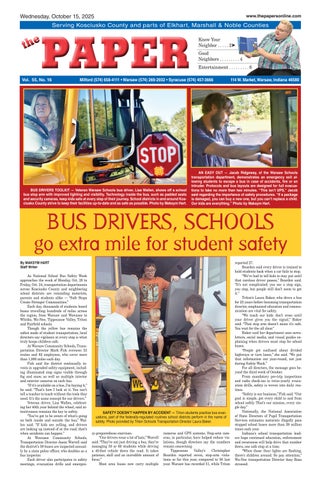
AN EASY OUT Jacob Ridgeway, of the Warsaw Schools transportation department, demonstrates an emergency exit allowing students to escape a bus in case of accidents, fire or an intruder. Protocols and bus layouts are designed for full evacuations to take no more than two minutes. “This isn’t UPS,” Jacob said regarding the importance of safety procedures. “If a package is damaged, you can buy a new one, but you can’t replace a child. Our kids are everything.”
BUS DRIVERS, SCHOOLS go extra mile for student safety
By MAKSYM HART Staff Writer
As National School Bus Safety Week approaches the week of Monday, Oct. 20 to Friday, Oct. 24, transportation departments across Kosciusko County and neighboring school districts are reminding motorists, parents and students alike — “Safe Stops Create Stronger Communities.”
Each day, thousands of students board buses travelling hundreds of miles across the region, from Warsaw and Wawasee to Whitko, Wa-Nee, Tippecanoe Valley, Triton and Fairfield schools.
Though the yellow bus remains the safest mode of student transportation, local directors say vigilance at every stop is what truly keeps children safe.
At Warsaw Community Schools, Transportation Director Mark Fick oversees 53 routes and 82 employees, who cover more than 1,000 miles each day.
Fick said the district continually invests in upgraded safety equipment, including illuminated stop signs visible through fog and snow, as well as multiple interior and exterior cameras on each bus.
“If it’s available on a bus, I’m buying it,” he said. “That’s how I look at it. You can’t tell a teacher to teach without the tools they need. It’s the same concept for our drivers.”
Veteran driver, Lisa Wallen, celebrating her 40th year behind the wheel, said attentiveness remains the key to safety.
“You’ve got to be aware of what’s going on both inside and outside the bus,” Wallen said. “If kids are yelling, and drivers are looking up instead of at the road, that’s when accidents can happen.”
At Wawasee Community Schools, Transportation Director Jason Worrell said the district’s 59 buses are inspected annually by a state police officer, who doubles as a bus inspector.
Each driver also participates in safety meetings, evacuation drills and emergen-
cy-preparedness exercises.
“Our drivers wear a lot of hats,” Worrell said. “They’re not just driving a bus, they’re managing 50 or 60 students while driving a 40-foot vehicle down the road. It takes patience, skill and an incredible amount of focus.”
Most area buses now carry multiple
cameras and GPS systems. Stop-arm cameras, in particular, have helped reduce violations, though directors say the numbers remain concerning.
Tippecanoe Valley’s Christopher Bearden reported seven, stop-arm violations so far this year, compared to 56 last year. Warsaw has recorded 51, while Triton
reported 27.
Bearden said every driver is trained to hold students back when a car fails to stop.
“We’ve had to tell kids to stay put until that careless driver passes,” Bearden said. “It’s not complicated; you see a stop sign, you stop, but people still don’t seem to get it.”
Triton’s Laura Baker, who drove a bus for 23 years before becoming transportation director, emphasized education and communication are vital for safety.
“We teach our kids: don’t cross until your driver gives you the signal,” Baker said. “That stop arm doesn’t mean it’s safe. You wait for the all clear.”
Baker said her department uses newsletters, social media, and visual guides explaining when drivers must stop for school buses.
“People get confused about divided highways or turn lanes,” she said. “We put that information out year-round, not just during Safety Week.”
For all directors, the message goes beyond the third week of October.
From mandatory pre-trip inspections and radio check-ins to twice-yearly evacuation drills, safety is woven into daily routines.
“Safety is our business,” Fick said. “Our goal is simple, get every child to and from school safely. That’s our mission, every single day.”
Nationally, the National Association of State Directors of Pupil Transportation Services estimates motorists illegally pass stopped school buses more than 39 million times each year.
Indiana’s school transportation leaders hope continued education, enforcement and awareness will help drive that number down, one safe stop at a time.
“When those (bus) lights are flashing, there’s children around. So pay attention,” Wa-Nee transportation Director Amy Rosa stressed.
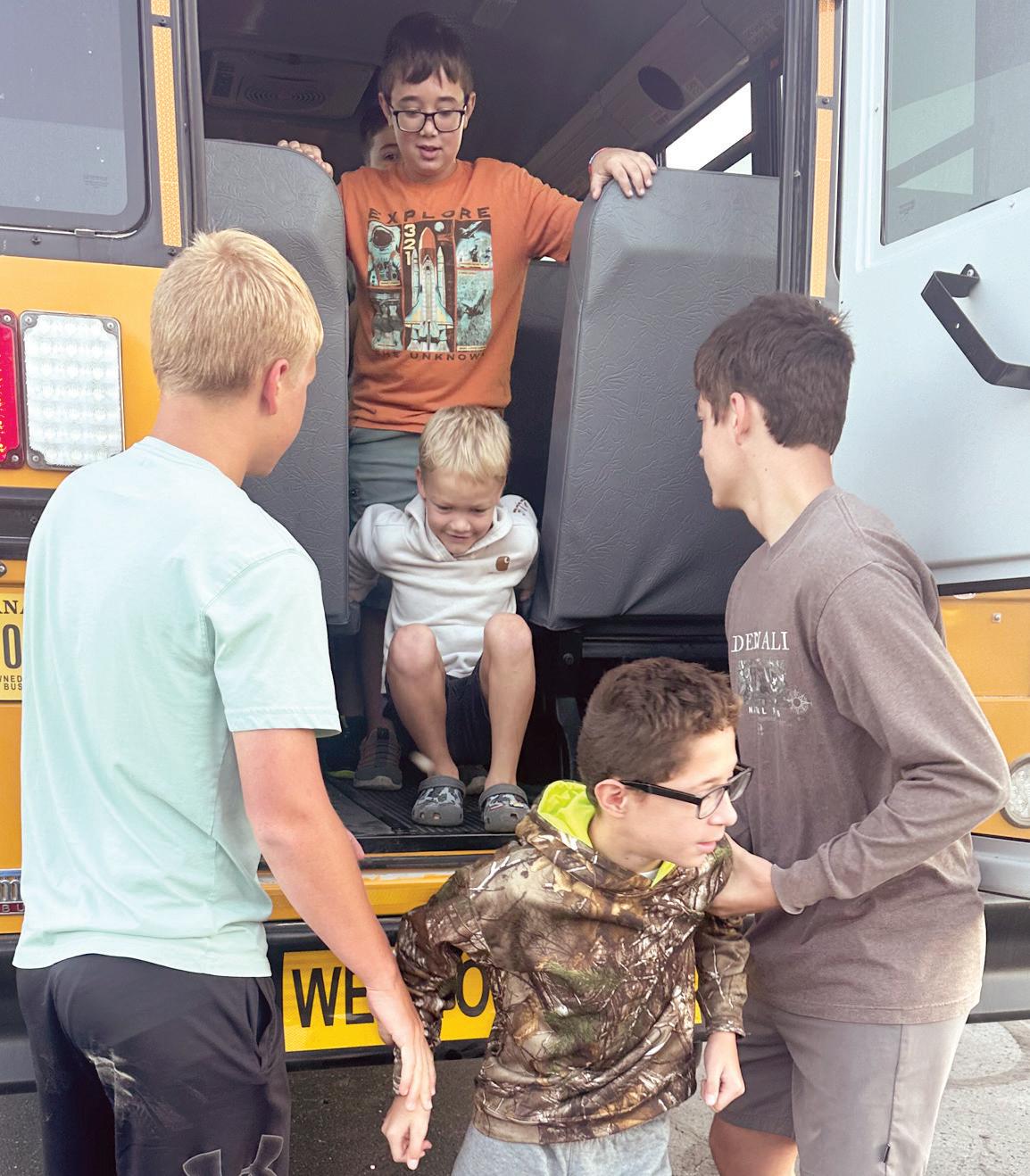
SAFETY DOESN’T HAPPEN BY ACCIDENT Triton students practice bus evacuations, part of the federally-regulated routines school districts perform in the name of safety. Photo provided by Triton Schools Transportation Director Laura Baker.
Photo by Maksym Hart.
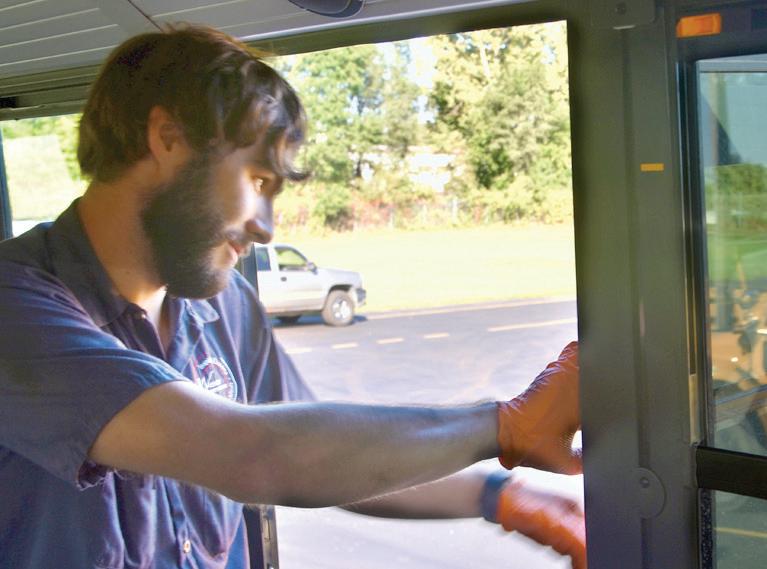
BUS DRIVERS TOOLKIT Veteran Warsaw Schools bus driver, Lisa Wallen, shows off a school bus stop arm with improved lighting and visibility. Technology inside the bus, such as padded seats and security cameras, keep kids safe at every step of their journey. School districts in and around Kosciusko County strive to keep their facilities up-to-date and as safe as possible. Photo by Maksym Hart.
By LILLI DWYER Staff Writer
After 16 years at the Warsaw Community Public Library, Duane Herendeen is growing used to visits from middle and high school students who used to attend his preschool story times.
“I really appreciate it when they like to share what’s going on in their life,” he said.
Herndeen is a community outreach assistant who creates children’s programming at WCPL.
A Warsaw Community High School graduate, he was reluctant to pursue higher education.
“Working with children and teens now, I tell them, I did not take my education seriously enough,” said Herendeen. “I didn’t think I was a very good student. It’s funny, because I took a spiritual gift test years after I got out of high school, and it came back that education was my gift. I was like, ‘I hate school; no, that’s not right.’ But what I found is that I
love to teach.”
He started working at Headstart Preschool, and through the Dekko Foundation, took evening classes at North Webster Community Center to earn a degree in childhood development.
“I love those early years where we’re helping them with their ABCs and the 123s and their color.s It’s just really exciting when you see them get it,” he said.
When Herendeen moved on to WCPL, he started out shelving books, then manning the children’s reference desk and eventually working his way up to the head of the children’s department. After realizing he preferred creating programming to being in charge, he stepped down and has continued as a community outreach assistant ever since.
Organizing programs is no small task. In August, Herendeen was already in meetings with the Warsaw Parks and Recreation Department to discuss programming for 2026.
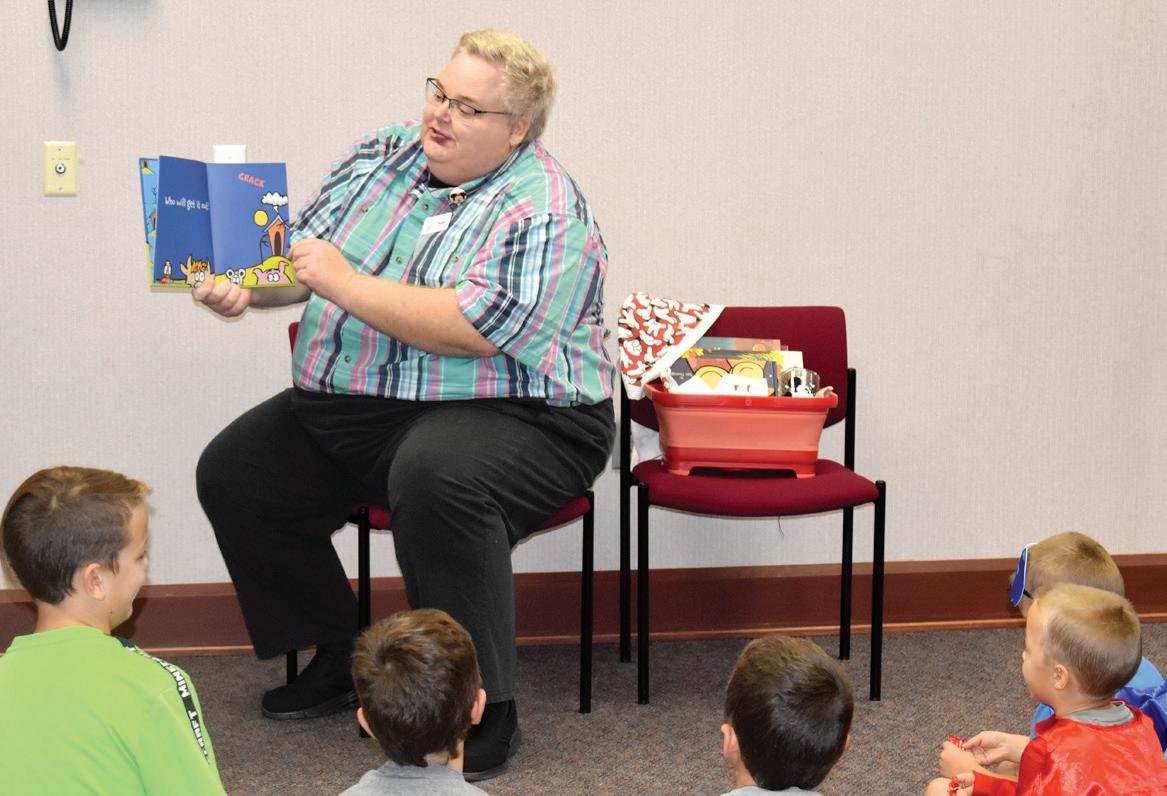
FRIEND TO KIDS Community outreach assistant, Duane Herendeen, reads to kids at one of Warsaw Community Public Library’s family events. Herendeen helps create children’s programs, like Stories in the Park, come-and-go Lego building days and more. After 16 years with WCPL, he sometimes chats with middle and high schoolers who used to come his preschool story times. Photo by Lilli Dwyer.
The Stories in the Park series of events was a success over the summer, he noted, as well as puppet and magic shows. During the school year, he also reads at two different preschools each month.
Herendeen said getting out into the community and partnering with other organizations is important to the library. To that end, he joined the Warsaw Noon Optimist
Club, which focuses on volunteer projects benefiting children. The club, along with Warsaws Kiwanis Club, helped WCPL bring its StoryWalk project at Pike Lake to fruition.
Hernedeen explained all children’s programs need an educational aspect and an entertainment aspect.
“When I’m thinking of a story time, the first 30 minutes is an actual rug time, so we’re practicing for them going to preschool. When we’re done with that, I have tables set up with activities and fine motors and a touch table. It’s not structured; they can wander around with their parents and play with different things. And while they’re playing, they’re also learning,” he said.
The way he and the children’s department staff organize events has changed over his tenure at WCPL.
“Everybody is so busy,” he remarked. “In the past, we had a tendency to say, ‘okay, we are doing this program from this time to this time.’ And as a society, we’ve changed to where we’re so busy, that I’m seeing come-and-go programs work a lot better.”
When doing his own reading to children, Herendeen’s favorite books to read are funny, interactive stories like the “Pete the Cat” series.
“I want the kids to help me. Even if they can’t read, they can make sounds or try to guess what’s happening in the story,” he explained.
In his interactions with kids, Herendeen strives to be like his hero, Fred Rogers of “Mr. Rodger’s Neighborhood” fame.
“I try to be like Mr. Rogers and make sure the boys and girls know how important they are to me, and I respect them and I’m genuinely interested in them,” he said.
That effort has paid off, he said, in the rewarding relationships he’s been able to build with families.
“I’ve watched children grow up,” he said. “I want to make a difference, and so I love it when a middle schooler comes up to me and wants to have a chat because they used to come to my preschool story time.”
Herendeen’s love for literature extends outside his time at the library. He especially enjoys reading nonfiction and feeding the birds.
‘Pumpkin Drop’ teaches Claypool students about engineering
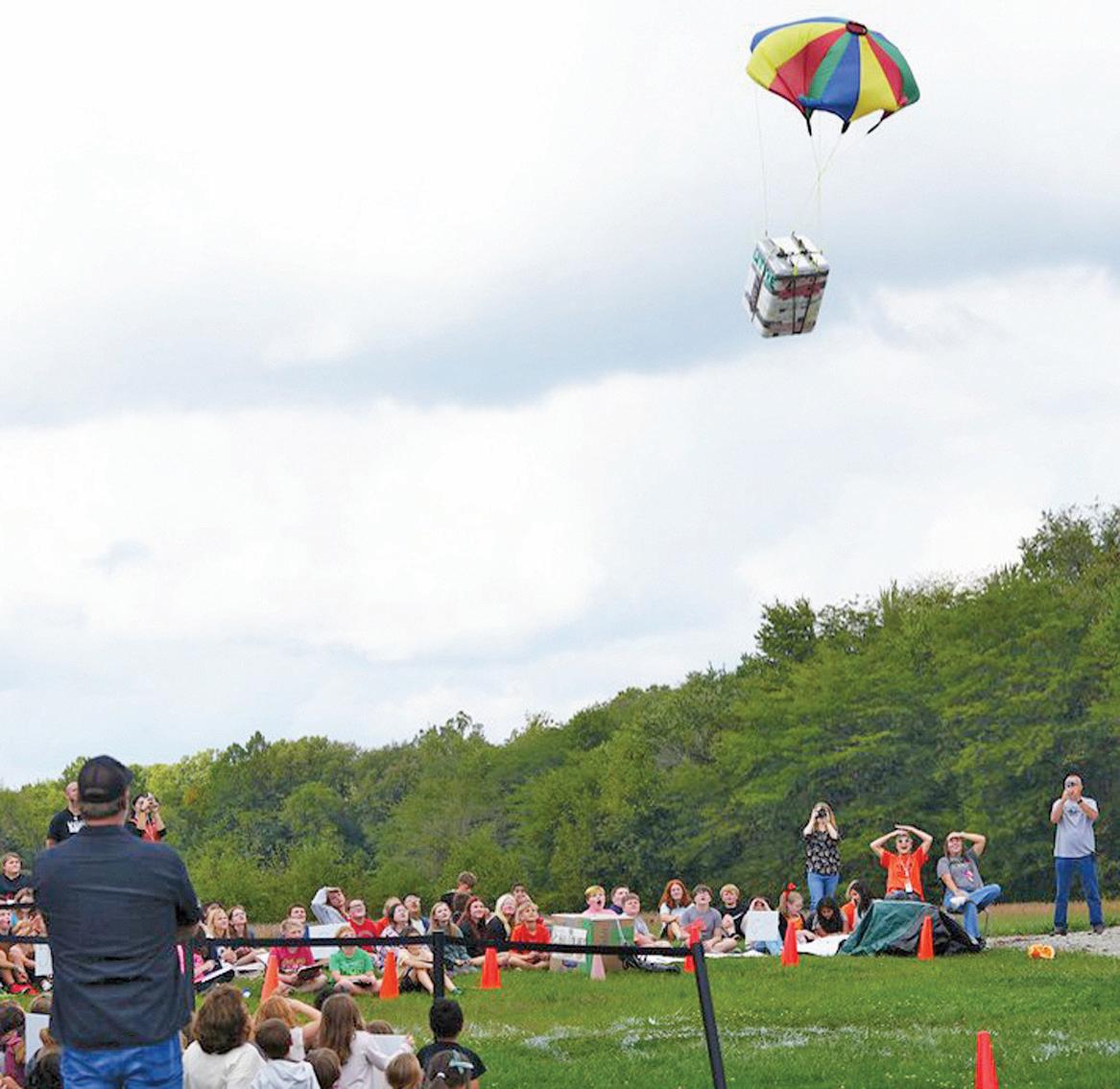
Claypool Elementary School students recently participated in a school-wide science, technology, engineering and math project called the “Pumpkin Drop.” Leading up to the final showcase, students engaged in the engineering design process for several weeks (identifying the challenge, planning in groups, creating prototypes, testing, redesigning and finally building one classroom model) to protect their pumpkin for Drop Day.
The unit began with a kick-off in the gym, where students watched pumpkins dropped from an 8-foot ladder. One pumpkin was dropped without protection, while others were shielded with a shirt, bicycle helmet and life jacket to demonstrate varying levels of protection.
Each classroom was then given one pumpkin and challenged to engineer a protective cover. Over the course of a month, classes designed and tested smaller prototypes using rocks, Sphero minis or eggs before finalizing their classroom designs.
“The purpose of this challenge was to give K-6 students experience working through the engineering design process (plan, build, test, redesign, test again),”
said Derek Pike, S.T.E.M. instructional coach. “Students were so excited to open their box and see if their pumpkin was still together.”
On Drop Day, Kosciusko REMC brought a bucket truck to raise the stakes by dropping pumpkins from 40 feet above the drop zone.
After each drop, pumpkins were unboxed and examined to see if they had survived. Out of 13 classes, six successfully protected their pumpkins.
Fifth-grade teacher, Brock Rhodes, highlighted the skills his students demonstrated.
“Fifth-graders at Claypool showcased the results of spending years in a S.T.E.M. school,” said Rhodes.
“They used robots with accelerometers to test the g-force and velocity of different prototypes and discovered a tube design with a parachute was most effective at re-
ducing the velocity and most efficient at absorbing and redirecting the kinetic energy from the fall.”
The event brought excitement across the school, with every kindergarten through sixth-grade student participating.
“All Claypool students, K-6, had the opportunity to showcase their engineering and design skills today,” said Principal Kristi Lucht. “This school-wide initiative was a great way to kick off the year with S.T.E.M. learning and connect with our community partners.”
Claypool Elementary was grateful to Kosciusko REMC for providing the bucket truck, as well as the Claypool and Silver Lake fire departments, Claypool Police Department and Claypool community partner, Jolie Miller with Miller Cattle Co., for supporting the event.
Local student named to dean’s list
The following local student was recently named to the dean’s list of their respective colleges/universities:
University Of Maryland Global Campus Warsaw — Cameron Gibbs
Indiana House Republicans seeking interns for 2026 session
Indiana House Republicans are seeking student interns for the 2026 legislative session, according to State Reps. David Abbott, R-Rome City, and Craig Snow, R-Warsaw.
These paid, full-time internships are open to college students, recent graduates and students in graduate and law school. Abbott said the internship is an opportunity to gain practical knowledge of state government through active participation in the legislative process.
“The House Republican Internship Program offers students a hands-on experience to explore government and understand how laws are made,” Abbott said. “It’s a rewarding opportunity that can positively shape your career.”
Snow said interns will work in the Statehouse in downtown Indianapolis full time Monday through Friday during the legislative session, which starts in January and concludes
in March.
“Now is the time for college students and recent graduates to apply for a House internship and benefit from this unique program,” Snow said. “I hope to see students from our area work with me and other lawmakers during the next legislative session.”
Positions are available in legislative operations, policy and communications.
Abbott said interns will be paired with a staff member to work directly with an assigned group of state representatives. During this spring semester internship, students will have opportunities to interact with state legislators, state agencies and private sector organizations, as well as participate in a weekly speaker series featuring Indiana civic leaders.
Applications are available online at indianahouserepublicans.com/internship and are due by Friday, Oct. 31.
SOFT LANDING? Kosciusko REMC brought a bucket truck from which the protected pumpkins were dropped from a 40-foot height. Photo provided by Warsaw Community Schools.
Good Neighbors is a column in which readers share friendly advice. To ask or answer questions, write the Shopping Guide News, Good Neighbors, P.O. Box 188, Milford, IN 46542; fax 800-886-3796; or e-mail abias@the-papers.com. Please no phone calls.
Editor’s Note: The Good Neighbors column is for people looking for hard-to-find or old items or for people seeking advice, not for items you can find in a local store or sell through the help of a classified ad. This column will now run every other week.
Variety of fabric
Good neighbors: I am looking to re-home some fabric of multiple types, such as cotton, polyester blends, corduroy, double knit and netting, just to name a few types. There are some larger pieces and also smaller ones. If anyone would be interested, please reply in this column. — A reader
American Sign Language
Good neighbors: If you are interested in getting together once a month for informal coffee and conversation in American Sign Language, please
contact Pat Woodward at (740) 513-9516, text or call. Beginners to fluent users welcome.
New questions
Jet ski trailer — I am looking for a jet ski trailer, any condition. Call (765) 730-6315.
Bible storybook set — Does any good neighbor have a Bible storybook set called “My Bible Friends?” Call (574) 773-7736.
Washer — We are looking for a washer with the spin cycle still working to use as a laundry spinner. If anyone has one they would like to get rid of, please call (574) 354-0250; located in Etna Green.
Syracuse Ghost Tour set for
Saturday, Oct. 18
By ERIN LOMAX Chautauqua-Wawasee Board Member
EDITORIAL OFFICES, CIRCULATION, DISPLAY AND CLASSIFIED ADVERTISING
WARSAW OFFICE MILFORD OFFICE
SYRACUSE OFFICE
114 West Market St. 206 S. Main St. 102 East Main St. Warsaw, IN 46580 P.O. Box 188, Milford, IN 46542 Syracuse, IN 46567 Phone (574) 269-2932 Phone (574) 658-4111 Phone (574) 457-3666 Fax 888-371-2934 1-800-733-4111 Fax 800-886-3796
‘the PAPER’ reserves the right to refuse for publication any advertising that is considered offensive, misleading or detrimental to the public, the newspaper or another advertiser and to edit advertising at its discretion.
Publisher, Ron Baumgartner rbaumgartner@the-papers.com
Business Manager, Annette Weaver aweaver@the-papers.com
Editor-In-Chief, Deb Patterson dpatterson@the-papers.com
Editor, Phoebe Muthart pmuthart@the-papers.com
Warsaw Office Manager, Mary Beth Spalding warsaw@the-papers.com
Director Of Marketing, Kristin DeVittorio kdevittorio@the-papers.com
Advertising Representative, Carl Lauster clauster@the-papers.com
Advertising Representative, Susan Stump sstump@the-papers.com
Circulation Manager, Jerry Long jlong@the-papers.com
Commercial Printing Sales Representative
Rodger Salinas rsalinas@the-papers.com
Commercial Printing Customer Service
Katie Hurley khurley@the-papers.com
Rich Krygowski rkrygowski@the-papers.com
What do a silent film star, John Dillinger, firefighting heroes and Andrew Carnegie have in common? Well, the history of Syracuse, that’s what! Chautauqua-Wawasee invites guests to step back in local history but with a twist. At multiple stops throughout downtown Syracuse, guests will meet the “ghosts” of Syracuse’s past in this one-of-a-kind, one-night-only walking tour.
Volunteer storytellers portray notable figures (and a few notorious ones) and will regale guests with strange tales, spooky legends, and dramatic moments
from Syracuse’s history, all in the very places they once unfolded.
Hear from a Syracuse bank president, who was once tied to a tree and watched helplessly as robbers robbed Syracuse State Bank. Learn how Andrew Carnegie helped to fund the Syracuse Public Library’s construction 100 years ago. Listen as a silent film star tells of his time on Wawasee (and how an early Nickelodeon turned Syracuse onto movies).
Meet firefighters who fought multiple blazes in the Pickwick block, along with schoolteachers, who were educational trailblazers and so many more.
Guests are highly encouraged to buy tickets and reserve a tour time in advance at ChautauquaWawasee.org.
Each tour lasts about an hour and the total walking distance is roughly a half-mile on flat surfaces (mobility-device friendly). Tours run from 6-9 p.m. Saturday, Oct. 18, and depart every 15 minutes with a dedicated guide from Moore’s Affordable Furniture, located caddy corner from the Syracuse Public Library. All ages welcome. Children 10 and under are free, while ages 11 and older and adults are $3.
This unique event is sponsored and led by Chautauqua-Wawasee and combines historical research, theatrical performance, and Halloween spirit into one unforgettable evening.
For more information, visit chautauquawawasee.org/syracuse-ghost-tour-2025.
Kosciusko County highway superintendent receives statewide award
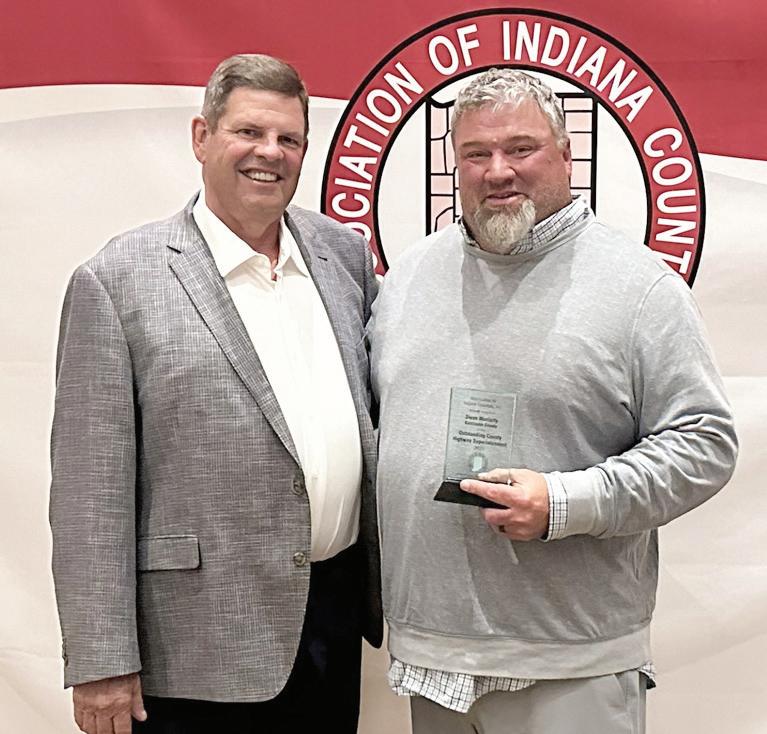
The Association of Indiana Counties announced that Kosciusko County Highway Superintendent Steve Moriarity received the 2025 Outstanding Highway Superintendent Award. The award recognized Moriarity’s contributions to county government throughout his years of public service.
Moriarty started at the highway department in 1998 while in school at Purdue University. He earned his teaching degree at Purdue but decided to remain at the Kosciusko County Highway Department. Moriarty was named superintendent in 2020.
Some of the highlights of why Moriarty was recognized include:
• He is aggressive in applying and receiving grants and matching funds for road projects.
• He is known as a supportive and encouraging leader to his employees, maintaining a great work environment and always taking time to listen.
• He serves on the county safety committee and has imple-
mented improved safety protocols throughout his department.
• He communicates regularly and meets with the commissioners and county auditor to keep everyone informed and to answer any questions.
• He serves on the Indiana Association of County Highway Engineers and Supervisors and the AIC’s Legislative Committee.
• He has worked with state legislators and has testified in front of Indiana legislative committees concerning issues affecting highway funding.
• He participates with the Indiana Department of Transportation’s Local Public Agency Collaboration Committee to engage with local transportation leaders to improve levels of service.
• Because of his expertise, he is often called upon to participate as trainer for the local technical assistance program and has been an LTAP trainer since 2015. He has trained 37 local agencies in drainage and 137 in snowplow safety.
• He achieved his LTAP road builder certificate in 2012 and his LTAP master road builder certificate in 2016.
• He extends his natural leader abilities in his community as head coach of a high school football team.
The award was presented during the Association of Indiana Counties’ 67th annual conference in Orange County. The AIC’s annual conference is the largest gathering of county officials in the state. Representatives from public agencies, private entities and local elected officials addressed issues, such as Social Security, human resources, artificial intelligence, cost-saving strategies, managing growth, cybersecurity, economic development, state and federal funding projects and Senate Enrolled Act 1 and the changes to local government finance.
For more information about the AIC or the annual conference, contact Elizabeth Mallers at emallers@indianacounties.org.
‘Pamper Me’ returning to Warsaw this Christmas season
The “Pamper Me” experience will be back from 11 a.m. to 3 p.m. Saturday, Dec. 13, in the Lakeview Middle School commons, hosted by award-winning inspirational country artist, Susie McEntire, and Keenie Word.
The event pairs a holiday program of music, guest speakers, stories, laughter and inspiration with a lively vendor market de-
signed to celebrate community with a public shopping experience showcasing local makers and merchants.
This year’s shopping experience and vendor market will be open to the public; no ticket required for the vendor area. Guests can browse a curated selection of artisans and small businesses offering boutique wear, jewelry and
accessories; seasonal decor and home goods; handcrafted gifts and stocking stuffers; wellness, beauty and self-care items; baked goods, sweets and specialty foods.
That evening, “A Country Christmas Concert,” featuring McEntire, Keenie and other artists, also takes place at Lakeview Middle School. New, unwrapped toys will be collected
for Toys for Tots.
“We love celebrating the season in Warsaw,” said McEntire. “’Pamper Me’ is our way of bringing encouragement and joy — plus a little holiday sparkle — to this wonderful community.”
“Come shop, laugh and be lifted up,” added Keenie. “Bring your friends, support local vendors and treat yourself; it’s the holidays.”
Pamper Me tickets go on sale Nov. 1 and can be obtained at countrychristmaswarsaw.com or susiemcentire.com. Potential vendors can visit countrychristmaswarsaw.com for more information.
Also, for additional information, send an email to mike@ seven25events.com or ffpaula@ comcast.net.
STATEWIDE AWARD Pictured are Brian Dixon, left, Clark County engineer and president of the Indiana Association of County Highway Engineers and Supervisors, and Steve Moriarity, right, Kosciusko County highway superintendent. Photo provided by the Association of Indiana Counties.
Kosciusko Shrine Club Turkey Shoot gun winners announced
Gun winners for the 25th annual Kosciusko County Shrine Club Turkey Shoot were recently announced.
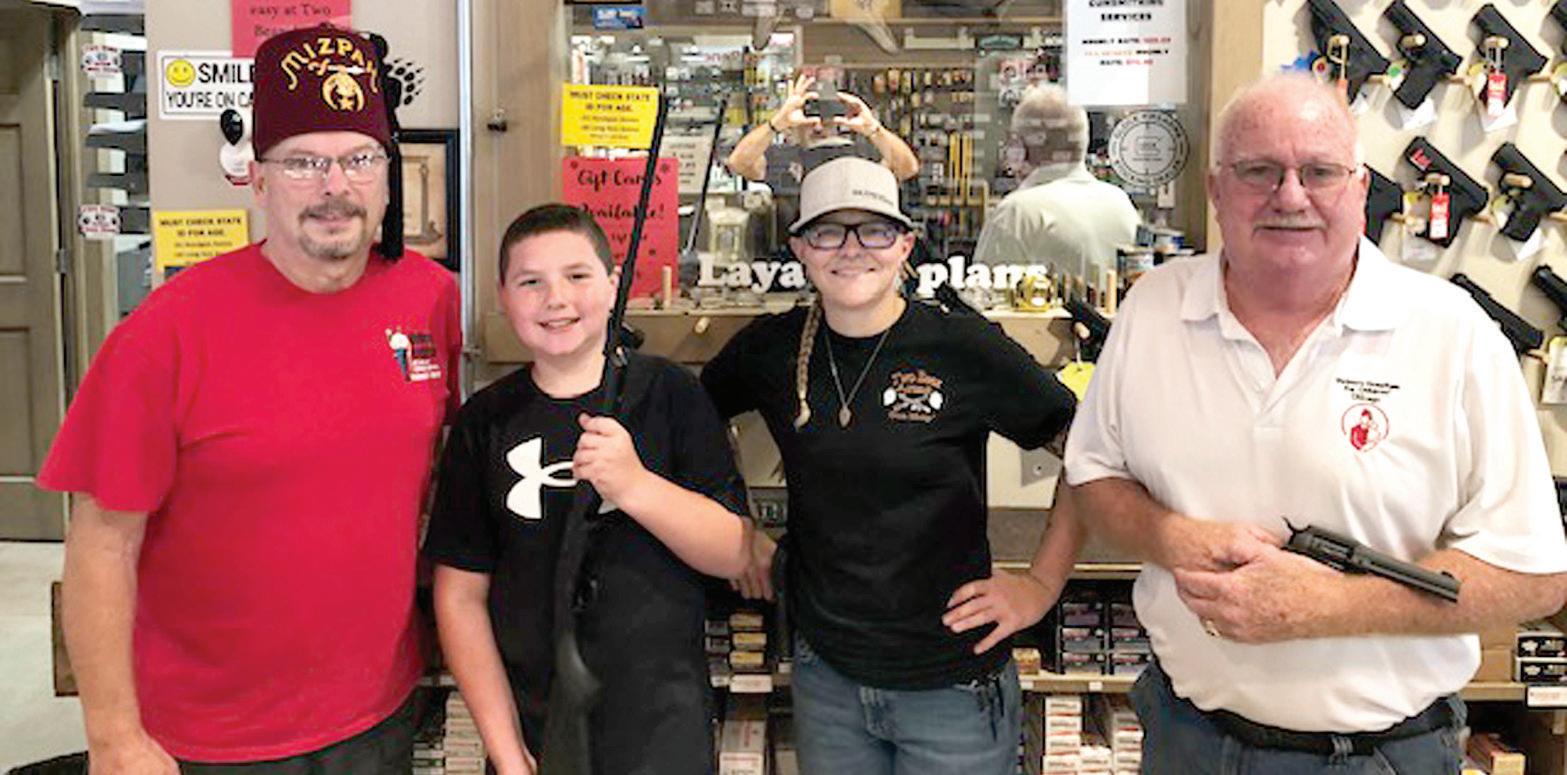
Riley Sparkman was the winner of the youth .410 shotgun which was donated by Two Bear Arms. David Derry was the winner of the .22/.22 Mag pistol, donated by McHatton-Sadler Funeral Chapels. Kenton Shepherd won the .22 Mag rifle, donated by McHatton-Sadler.
More than 1,000 shooters participated in the event and more than $10,000 was raised for the philanthropic mission of the Shrine to support its children’s hospitals, which serve children with orthopedic conditions, burns, spinal cord injuries and craniofacial conditions, such as cleft lip and palate.
The Kosciusko County Shrine Club was grateful to all the sponsors, sportsmen, Ladies of the Shrine and volunteers who made the event possible and the most successful event held to date.
Summit City Aerospace Modelers hosts monthly launches
The Summit City Aerospace Modelers holds monthly launches from October through April at the Milford Field, 9301 N. 100E, Milford, or 9801 N.
100E, Milford. Launches are from 10 a.m. to 4 p.m. on the following days:
• Saturday, Oct. 18.
• Saturday, Nov. 15.
• Saturday, Dec. 20.
• Saturday Jan. 17, 2026.
• Saturday Feb. 21, 2026.
• Saturday March 21, 2026.
• Saturday, April 11, 2026 (second Saturday of April).
The public may observe at no cost. If a hobbyist wishes to fly
using club equipment, the cost is $10 for the day if flying up to “G” motors, or if launching an “H” motor for Level I qualification. Launch fee is $20 if flying motors “H” and above.
This is a large field on a farm that a landowner has graciously given them permission to use
during these months. The field is normally driveable so vehicles can be driven up close to the launch pads. If not, prepare for a walk from the road to the pads.
December, January and February are the coldest months, so dress warmly.
Note: launches may be can-
celed because of weather. Launch Go/No Go information is distributed via email and the Summit City Aerospace Modeler’s Facebook page prior to a launch date. If you are new to the club, go to the contact page, fill out your information and you can get on the mailing list.
Local cast member, Bonifield, in ‘Murder on the Orient Express’
Trine University Theatre has announced the cast and crew for its upcoming production of “Murder on the Orient Express,” by Agatha Christie.
The play will be performed at 7 p.m. Thursday and Friday, Nov. 6 and 7, and at 2 p.m. Saturday, Nov. 8, in the Ryan Concert Hall of the T. Furth Center for Performing Arts.
detective Hercule Poirot to identify the murderer before he or she strikes again.
Appropriate for all ages, the play contains the suspense of Christie’s novel, while incorporating humor throughout.
Tickets are $10 each for the general public, $5 for students ages 5-17, and free for Trine students and employees. They will be available at trine.edu/furthtickets or at the door.
Adapted for the stage by Ken Ludwig, “Murder on the Orient Express” takes place on a luxurious train which is stopped by a snowdrift. When an American tycoon is found dead, it is up to
The Trine Theatre program is part of the university’s Department of Humanities and Communication.
The Ryan Concert Hall of the T. Furth Center for Performing Arts is located at 500 W. Maumee St., Angola.
Local cast member includes Macy Bonifield, an elementary education/special education major from Warsaw, as Countess Andrenyi.
Winners of Nappanee
Apple Festival parade announced
The winners of the Nappanee Apple Festival parade have been announced. The festival was Sept 18-21. The grand prize for best theme went to Coppes Commons. The other winners are:
Animal
First — Miniature Horses.
Second — Sashi Buro. Auto
First — Hoosier Old Wheels.
Second — Michiana Jeep. Commercial
First — Main Street Coffee.
Second — Kountry Cabinets. Non-Commercial
First — New Beginning AG.
Second -— Northwood FFA. Tractor First — Jake Jackson Family.
Second — Jonny Poppers.
GUN WINNERS Pictured from left are Randy Riner, co-chairman of the Kosciusko County Shrine Club; Riley Sparkman, winner of the youth shotgun, donated by Two Bear Arms; Skyler Miller of Two Bear Arms; and
David Derry, winner of the pistol, donated by McHatton-Sadler Funeral Chapel. Not pictured: Kenton Shepherd, who won the rifle donated by McHatton-Sadler. Photo provided by Kosciusko County Shrine Club.
C ounty R epo R t
Court News
Small Claims
The following small claims have been awarded in Kosciusko Superior Court III, Judge Chad Miner presiding: Aegis Dental Group Warsaw PC v. Tina Bullington, $1,071.90; v. Jordan I. Caudill, $850; v. Kaleb S. Dausman, $790; v. Casandra Diaz, $731; v. Ethan McGillen, $790
Aegis Trusted Dentistry PC v. Cassandra Cantrell, $1,205 Lake City Animal Health & Wellness Center v. Melissa Kelly, $279.50 Vanderpool Law Firm PC v. Ashley Learned, $205; v. Colt Lemaster, $940 CommunityWide Federal Credit Union v. Amanda L. Medley, $5,004.77 Snow and Sauerteig LLP v. Lynnae Miller, $3,850.28
Civil Collections
The following civil collections have been awarded in Kosciusko Superior Court IV, Judge Christopher D. Kehler presiding:
LVNV Funding LLC v. Amy Adams a/k/a Amy Williams, $3,806.40; v. Jessica Coquillard, a/k/a Jessica Yoder, $1,498.74; v. Michael Hill, $1,101.08; v. Michael Hill, $1,173.99; v. Timothy Housman, $3,382.15; v. Jack Huber, $2,722.47; v. Chanque Jones, $1,114.86; v. Chanque Jones, $2,410.89; v. Emily Kelly, a/k/a Emily Jones, $1,319.49; v. Christopher Legus, $5,206.34; v. Jacob A. Lively, $5,158.67; v. Galen Sopher, $1,487.82; v. Douglas K. Werker, $1,143.96; v. Rhonda Williamson, a/k/a Rhonda Brown, $1,558.33
Lake City Bank v. Mario Enrique Atlixqueno, $3,663.08
JP Morgan Chase Bank NA v. Tom Bays, $8,251.96
SAC Finance Inc. v. Antoinette M. Brown, $8,763.18
Interra Credit Union v. Joseph H. Cutler II, Joseph H. Cutler III, $8,501.02; v. Yuri Y. Ochoa Aguirre, $13,450.56; v. Tammy L. Taylor, $6,484.52
Glenbrook Credit Acceptance Corp. v. Jeffrey Michael Fuller, $13,559.73
Jefferson Capital Systems LLC v. Chanque Jones, $868.64
Portfolio Recovery Associates LLC v. Brandon Roberts, $3,364.59
Three Rivers Federal Credit Union v. Shane Seekins, $9,920.74
BCG Equities LLC v. Elizabeth Seward, $1,598.10
Capital One NA v. Diann F. Slaymaker, $3,951.83; v. Allen J. Weaver, $12,057.30
Evictions
The following evictions have been awarded in Kosciusko Superior Court III, Judge Chad Miner presiding: Mecks Whispering Pines v. Jammie Briley, $2,708.38
Canterbury House Apartments v. Lillix Cook, Seth Hill, $2,035.55; v. Evelyn Trusty, $2,977.26
Real America LLC/The 2525 v. Morgan Eck, $2,764.86
Yes Communities Merrywood v. Neeley Schwinnen, $162.36
Windstar Park Inc. v. Jenna Shriver, $9,000
Mortgage Foreclosures
The following mortgage foreclosures have been awarded in Kosciusko Superior Court III, Judge Chad Miner presiding: WBL SPE III LLC v. 3D Recreation LLC, Craig D. Ducey, $99,928.03
Nationstar Mortgage LLC v. Crystal Lee Guthrie, $195,643.90
Superior Court III
The following fines and costs for infractions have been assessed in Kosciusko Superior Court III, Judge Chad
Blackout license plate sales surpass 40,000
The Indiana Bureau of Motor Vehicles announced Oct. 9, sales of the state’s new popular Blackout license plate have surpassed 40,000, generating more than $1.3 million in revenue to reinvest in better BMV services for Hoosiers.
The new plate, featuring a black background with white text, has quickly become one of Indiana’s most popular plates. In the first month of sales, Indiana drivers purchased nearly 22,000 plates, outpacing first month sales in similar states.
“This is an excellent example of our state agencies finding creative, entrepreneurial ways to provide value to Hoosiers while generating revenue to better serve them,” said Gov. Mike Braun. “I applaud the BMV’s efforts and look forward to seeing how the funds from these sales are used to make the BMV a better, more convenient one-stop shop for Hoosiers.”
In support of Braun’s Executive Order 25-41, a portion of the revenue generated from Blackout plate sales will be used to modernize the BMV’s digital tools, expand self-service options and streamline transactions across the agency. These upgrades are part of a broader strategy to enhance customer service for Hoosier drivers.
“This new Blackout plate is a win-win for Hoosiers,” said BMV Commissioner Kevin Garvey. “Hoosiers have a stylish new plate they are very excited about and, as an added bonus, the revenue generated from their purchase is going right back into im-
Miner presiding: Speeding — Neil A. Drudge, Silver Lake, $164.50;Bradley M. Bergman, Silver Lake, $164.50; Holden E. Ihnen, Warsaw, $140.50; Timothy J. Arndt, Milford, $164.50; Mitchell E. Feldman, Warsaw, $164.50; v. Alejandra Delcid, Warsaw, $164.50; William P. Lehman, Warsaw, $164.50; v. Jeffrey A. Virgil, Etna Green, $164.50; James L. Helmuth, Milford, $164.50; Marcia M. Cole, Akron, $164.50; Henry R. Kidd, Warsaw, $164.50; Marcus L. Fry, Syracuse, $164.50
Open alcoholic beverage container during operation of a motor vehicle — Barbara J. Lockhart, North Webster, $164
Driving while suspended, suspension not result of conviction, operating a motor vehicle without financial responsibility — Luis R. Duenas, Winona Lake, $239.50
Failure of occupant to use a safety belt — William E. Hough, Warsaw, $25; Jazmin A. Hidalgo, Claypool, $25; Christopher R. Monroe, Cromwell, $25
Disregarding an official traffic control device — Brandon J. Lopez, Warsaw, $164.50
Driving left of center — Andrea Martinez, Pierceton, $164.50
Improper display of license plate — Austin R. Valentine, Claypool, $164
Driving while suspended, suspension not result of conviction
Shannon L. Webb, Warsaw, $189.50
Disregarding stop sign — Aiden S. Foreman, Warsaw, $164.50
Towing without an observer — Gary I. Bailey, Warsaw, $164
Speeding, learner’s permit violation — Luis Gonzalez, Warsaw, $189.50
Littering within 100 feet of body of water under jurisdiction of Department of Natural Resources or Army Corps of Engineers — Kip D. Allen, Warsaw, $239; James D. Byrd, Syracuse, $239
proving future BMV experiences, not only for themselves, but for all Hoosiers. We pride ourselves on the service we deliver, and we will continue to look for new opportunities to provide Hoosiers with a fast, easy and reliable experience when they transact business with us.”
Of the $45 fee associated with the plate, $34 from each sale goes directly to the BMV and its efforts to serve Hoosiers. Standard registration fees still apply.
Hoosiers can purchase an Indiana Blackout plate:
• Online during a new registration or renewal transaction via myBMV.com.
• At a BMV Connect kiosk during a new registration or renewal.
• In person with a representative at any BMV branch.
Hoosiers can also swap an existing plate for a Blackout plate before its expiration by going into their local BMV branch and paying a $9.50 replacement fee.
For a complete list of branch locations and hours, to complete an online transaction or to find a 24-hour BMV Connect kiosk near you, visit in.gov/bmv.
tion — Ethan P. Sanders, Leesburg, $189.50
Operating a motorcycle without a proper permit or endorsement — Trevor M. Carty, Syracuse, $164.50
Operating a watercraft with expired registration — Kathryn C. Stutzman, Syracuse, $164
Failure to carry registration, off-road vehicles and snowmobiles — Jared A. Stephens, Mentone, $164
David Edward Wright, 38, Claypool, and Nicole Marie Calaway, 37, Claypool Hacker-Miller
James Andrew Hacker, 23, Crossville, Tenn., and Jessica Dawn Miller, 20, Milford
Zachary-Munson
Michael Robert Zachary, 37, Warsaw, and Darci Lacher Munson, 33, Warsaw Stephens-Marroquin
Adam Stephens, 47, Warsaw, and Tiffany Marroquin, 37, Warsaw Robles Flores-Ventura Serrano
Nayeli Robles Flores, 25, Warsaw, and J. Ventura Serrano, 26, Warsaw Craig-Watson
Amy Craig, 38, Claypool, and Garry M. Watson, 37, Florence, Ala. Snavely-Kerby
Lisa Snavely, 38, North Webster, and Michael Kerby, 39, North Webster Kelly-Brown
Ryan James Kelly, 31, Syracuse, and Victoria Thatcher Brown, 31, Syracuse Page-Stinfer
Hannah Rose Page, 19, Warsaw, and Tanner Jordan Stinfer, 21, Warsaw Miller-Mullet
Carl Dean Miller, 24, Middlebury, and Julia Diane Mullet, 33, Nappanee
Marriage Dissolutions
The following couples have filed for a marriage dissolution in Kosciusko Superior Courts I or IV: Heckman — Michael Heckman, New Paris, and Kaylyn Heckman, Warsaw. They were married Sept. 9, 2023, and separated July 31, 2025. One minor child.
Fair — Stacy Fair, Warsaw, and Jerry L. Fair Jr., Granger. They were married June 4, 2022, and separated Sept. 12, 2025. No minor child(ren). Schmitt — Susan D. Schmitt, Warsaw, and Joseph F. Schmitt, Warsaw. They were married July 7, 2014, and separated March 29, 2025. No minor child(ren).
Hall — Gretchen Hall, Warsaw, and Brett Hall, Warsaw. They were married May 22, 2021, and separated June 23, 2025. No minor child(ren). Bartley — Larry Bartley, Claypool, and Christy Bartley, Claypool. They were married Dec. 15, 2018, and separated Oct. 8, 2025. No minor child(ren).
IN THE KOSCIUSKO CIRCUIT AND SUPERIOR COURTS
121 N. LAKE STREET, RM D162 WARSAW, IN 46580 574-372-2334 CAUSE NUMBER: 43D04-2310-DN259
IN RE THE MARRIAGE OF: Sarah M. Jones
Petitioner, and Shaun R. Jones
Respondent
SUMMONS
This Summons is to the Respondent above named and to any other person who may be concerned.
Melanie can brighten up the Interior of your home.
Melanie can brighten up the Interior of your home.
Melanie can brighten up the Interior of your home.
Walls
Walls
Ceilings
Walls
Ceilings
Window And Door Trim
You are notified that you have been named as a Respondent in the Kosciusko Circuit/Superior Courts, Kosciusko County, Indiana, 121 N. Lake St., RM D162, Warsaw, IN 46580 in an action entitled In Re the Marriage of Sarah M. Jones, Petitioner and Shaun R. Jones, Respondent, Cause Number 43D042310-DN259, by the person named above as Petitioner. This summons by publication is specifically directed to Shawn R. Jones, whose whereabouts are unknown.
Ceilings
Window And Door Trim
Stairways
The named Petitioner is proceeding with this action pro-se.
Stairways
Window And Door Trim
Woodwork Staining
Stairways
Woodwork Staining
Garage And Workshop Floors And Walls
Garage And Workshop Floors And Walls
The nature of this proceeding is the Petitioner’s request for Dissolution of Marriage.
Woodwork Staining
Small Patch Repair
Small Patch Repair
Drywall Repair
Garage And Workshop Floors And Walls
Drywall Repair
Small Patch Repair
Great Service – Reasonable Rates
Drywall Repair
Great Service – Reasonable Rates
References Available Upon Request.
References Available Upon Request.
574-304-5075
Great Service – Reasonable Rates
574-304-5075
References Available Upon Request.
574-304-5075
An answer or other response in writing to the Petition must be answered either by you or your attorney on or before 30 days after the publication of the third notice of this petition, and if you fail to do so, a judgement by default may be rendered against you for the relief demanded by the Petitioner.
Dated: 10-3-25
Melissa Boggs, Clerk Kosciusko County Circuit Court
10 a.m. Thursday, Oct. 16. Located at 401 S. Oakland Ave., Nappanee. Furniture, trunks, crocks and jugs, quilts, copper and graniteware. Hahn Auctioneers, hahnrealtyandauction.com.
Online Auction
Bidding open until 6 p.m. Thursday, Oct. 16. Preview 11 a.m. to 2 p.m. Wednesday, Oct. 15 at 2552 N. 325E, Warsaw. Bid online at bid.kraftauctions.com.
Raber Public Auction
3:30 p.m. Tuesday, Oct. 21. Located 7 blocks east of the four-way stop in Shipshewana on Middlebury Street to Union Street, north 1 block to 155 Union St., Shipshewana.
Online Real Estate Auction
Bidding open until 6 p.m. Tuesday, Oct. 21. Open house 5:30-6:30 p.m. Tuesday, Oct. 14 and 1-2 p.m. Sunday, Oct. 19. Property located at 1501 Fisher Ave., Warsaw. Executive home with walk-out basement, pond, elevator on 9.3 acres. Metzger Property Services, metzgerauction.com.
Oldguitarswanted!Gibson,Fender,Martin,Etc.1930’sto1980’s.Topdollarpaid. Call866-433-8277 Musical Merchandise P100 Wanted To
Real Estate And Personal Property Auction
3 p.m. Thursday, Oct. 23. Located at 1905 Leiter Drive, Warsaw. Commercial garage property on 1/2 acre. Tractor, forklift, trucks, vans, trailers, hoist, shop tools. Hahn Auctioneers, hahnrealtyandauction.com.
Online Only Public Auction
Bidding open until 6 p.m. Thursday, Oct. 23. Preview noon to 5 p.m Wednesday, Oct. 22 at 1420 Bike St., Bremen. Bid online at bid.kraftauctions.com.
Real Estate And Tool Auction
10 a.m. Saturday, Oct. 25. Lo-
cated at 3758 W 1400N, North Manchester. Two country homes and pole barn on 7 acres. Vehicles, tractor, skidloader, dozer, life, tools, trailer and camper. Metzger Property Services, metzgerauction.com.
Online Equipment
And Vehicle Auction
Bidding open until 1 p.m. Tuesday, Oct. 28. Pickup at 1582 W. SR 114, North Manchester. Tractors, farm and livestock equipment, vehicles, fleet liquidations, trail-
2 p.m. Tuesday, Oct. 28. Located at 716 S. Old SR 13, Pierceton. House, pond, pole barn, woods and pond on 20 acres. Hahn Auctioneers, hahnrealtyandauction.com.
Online Only
Equipment Auction
Bidding open until 6 p.m. Tuesday, Oct. 28. Pickup located at
1582 W. SR 114, North Manchester. Shop and power tools, pallet racking, scaffolding, shelving, job boxes, torch sets, generators, lawn and garden equipment, livestock gates, feeders. Metzger Property Services, metzgerauction.com.
Online Real Estate Auction Bidding open until 6 p.m. Wednesday, Oct. 29. Open house 5:30-6 p.m. Wednesday, Oct. 22. Located at 111 N. Main St., Milford. Two-story brick Victorian with wrap-around porch. Metzger
Property Services, metzgerauction.com.
Charlotte Sigfried Estate Online Auction
Bidding open until 6:30 p.m. Wednesday, Oct. 29. Pickup in Milford. Tri-color coverlet and quilts, antiques, primitives, framed art, mirrors, crocks, advertising, vintage clothing and fur coat, toys and comic books, appliances, home and holiday decor. Metzger Property Services, metzgerauction.com.
Warsaw Education Foundation to host first 5K fundraiser Nov. 8
The Warsaw Education Foundation will host its inaugural Warsaw Education Foundation 5K from 9 a.m. to noon Saturday, Nov. 8, at the Warsaw Community Schools’ cross-country Course, 1 Tiger Lane, Warsaw.
The registration deadline is Monday, Oct. 20.
This community run/walk event is designed to bring together individuals, families, and businesses in support of the WEF’s mission to enhance educational opportunities and provide classroom innovation funding through programs,
such as the Red Apple Grants.
“We are excited to launch this first-ever 5K event and to see our community come together in support of Warsaw Community Schools,” said Courtney Sale, executive director of WEF. “The funds raised will directly support our teachers and students, ensuring that creativity and innovation continue to thrive in our classrooms.”
The registration fee is $25 per person or $50 for “Zero-K” participants. The registration fee includes a 5K T-shirt. “Zero-K”
HELP WANTED HIGH SCHOOL STUDENT
School Student To Work After School During School Year And During Summer Plus Some Saturday Morning Hours
Approximately 12-15 Hour Work Week Should Be At Least 15 Years Old
participants get the T-shirt but don’t have to run.
Participants can register on-
line at warsawedfoundation. org/warsaw-education-foundation-5k.