O XFORD S TUDENT
University of Oxford’s Student Newspaper, est. 1991
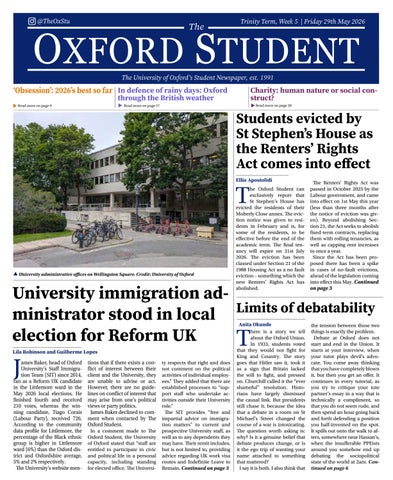
James Baker, head of Oxford University’s Staff Immigration Team (SIT) since 2014, ran as a Reform UK candidate in the Littlemore ward in the May 2026 local elections. He finished fourth and received 210 votes, whereas the winning candidate, Tiago Corais (Labour Party), received 726. According to the community data profile for Littlemore, the percentage of the Black ethnic group is higher in Littlemore ward (6%) than the Oxford district and Oxfordshire average, 5% and 2% respectively.
The University’s website men-
tions that if there exists a conflict of interest between their client and the University, they are unable to advise or act. However, there are no guidelines on conflict of interest that may arise from one’s political views or party politics.
James Baker declined to comment when contacted by The Oxford Student.
In a comment made to The Oxford Student, the University of Oxford stated that “staff are entitled to participate in civic and political life in a personal capacity, including standing for elected office. The Universi-
ty respects that right and does not comment on the political activities of individual employees.” They added that there are established processes to “support staff who undertake activities outside their University role.”
The SIT provides “free and impartial advice on immigration matters” to current and prospective University staff, as well as to any dependents they may have. Their remit includes, but is not limited to, providing advice regarding UK work visa routes and Indefinite Leave to Remain. Continued on page 3
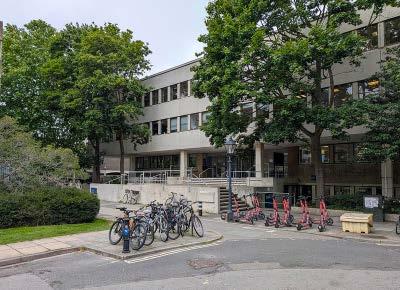
The Oxford Student can exclusively report that St Stephen’s House has evicted the residents of their Moberly Close annex. The eviction notice was given to residents in February and is, for some of the residents, to be effective before the end of the academic term. The final tenancy will expire on 31st July 2026. The eviction has been classed under Section 21 of the 1988 Housing Act as a no fault eviction - something which the new Renters’ Rights Act has abolished.
The Renters’ Rights Act was passed in October 2025 by the Labour government, and came into effect on 1st May this year (less than three months after the notice of eviction was given). Beyond abolishing Section 21, the Act seeks to abolish fixed-term contracts, replacing them with rolling tenancies, as well as capping rent increases to once a year.
Since the Act has been proposed there has been a spike in cases of no-fault evictions, ahead of the legislation coming into effect this May. Continued on page 3
There is a story we tell about the Oxford Union.
In 1933, students voted that they would not fight for King and Country. The story goes that Hitler saw it, took it as a sign that Britain lacked the will to fight, and pressed on. Churchill called it the “ever shameful” resolution. Historians have largely dismissed the causal link. But presidents still chase it, because the idea that a debate in a room on St Michael’s Street changed the course of a war is intoxicating. The question worth asking is: why? Is it a genuine belief that debate produces change, or is it the ego trip of wanting your name attached to something that mattered?
I say it is both. I also think that
the tension between those two things is exactly the problem. Debate at Oxford does not start and end in the Union. It starts at your interview, when your tutor plays devil’s advocate. You come away thinking that you have completely blown it, but then you get an offer. It continues in every tutorial, as you try to critique your tute partner’s essay in a way that is technically a compliment, so that you do not seem rude, and then spend an hour going back and forth defending a position you half-invented on the spot. It spills out onto the walk to afters, somewhere near Hassan’s, when the insufferable PPEists around you somehow end up debating the sociopolitical state of the world at 2am. Continued on page 6

Scan this code to listen to our weekly podcast on Spotify!
In the sweltering heat of our lay-in room, inspiration for my editorial is scarce. at’s not to say the past two weeks have been uneventful at the paper. Sitting through a Conference of Common Rooms meeting was not my ideal Tuesday evening, but the e ort was worth it when we broke the news of the upcoming referendum to leave the NUS. Students will get the chance to vote on the issue in Michaelmas. In other news, the OxStu continues its streak of impactful journalism in this print, reporting on a senior University administrator who, for the local council elections, doubled as a Reform UK candidate. We also bring you an exclusive story on St Ste-
























In a week where this city is nally experiencing some sun (PLEASE put your shirts back on), the real heat of Oxford’s trinity term is heating up. Finals are underway, prelim revision for the
phen’s House, a former PPH that now has observer status with the University. In February, St Stephen’s sent its residents Section 21 no-fault evictions, just two months before they were banned in the Renter’s Rights Act.
I’d like to highlight our Sports section this week, where our writers will be hard at work covering Summer VIIIs. is is the pinnacle of Oxford’s sporting calendar, and I will myself be cheering on St John’s from the boathouse. Keep an eye on our website and Instagram for the best coverage in town. I wish you all a fantastic two weeks, and trust that you took care of yourselves amidst the inescapable week 5 blues. e weather made it a lot easier for me, and if you have the time I suggest you make your way up to Port Meadow or Hinksey, before the glorious British weather turns on us again.

Hello from the disgustingly hot and sweaty room in the SU, where we are working hard to bring you our week ve print. e sun is shining, my nals are nished, and it’s print week - what a time to be alive! Or not, unemployment looms... If, like me, your exams are over or you are fresh out of mods, then enjoy being Trini-free. Choose drinking on Broad Street at 2pm. Choose swimming in the rivers (but don’t choose disease). Choose G&D’s. Or, if the heat is too much, simply lock yourself in your room with the curtains closed, waiting for this heatwave to pass. e world really is your oyster! We are soon about to start re-
1st years should (and de nitely won’t) be started, and one of Oxford’s nest traditions, Summer VIII’s, is underway. ere is so much, probably too much, to do in Oxford. For instance, you’re probably reading this editorial while workload, societies, rowing, or that all-inviting sun could be calling your name. At the OxStu, we are extremely thankful you’ve decided to spend some time with us, and we know this print is worth your time. Make sure to check out my opinion piece on American college
football culture and what the UK can learn from it, as well as Anita Okunde’s article on the limits of debatability. Our opinion writing has been on top form this term, covering many Oxford/university related topics while also adding to the discussion of larger, national news stories. We have been especially proud of our news reporting this term, breaking important stories across Oxford, most interestingly the turbulent and ever-changing Union stories. While my focus on the paper
cruiting for our next executive team for Michaelmas, and the notion of time ying by when you’re having fun has never seemed truer. Whilst I won’t be around this term, I look forward to being part of recruiting the next team who will take the OxStu to even better levels! So, watch this space... In this week’s edition, you can nd news on a new Ebola vaccine being developed at Oxford, an exclusive about St Stephen’s House (yeah, I had never heard of them before this either), reviews of student productions that our culture writers have been working hard (and having fun) to write, and a re ection on to what extent Instagram is the new LinkedIn. For our multi-media endeavours, this week, I enjoyed speaking to the Access Fellow at Jesus College about the successes and failures of access work, keep an eye on our Spotify for that! Enjoy this edition of the OxStu, it’s a good one!
has been more on the opinion side, I want to highlight our insightful news reporting this term. Working within the limits of Oxford student journalism, we have had multiple breaking, impactful, and eventually national news stories broken by our sta . is includes culture reporting, reviewing Oxford student plays combined with larger, professional productions.
Continued from Front Page...
They claim to do so “in good faith” and free of charge.
Approximately 40 percent of Oxford’s research and teaching staff were not born in the UK. There exists no such publicly available data for non-academic members of staff, but the University boasts that they employ “over 18,000 staff from around the world.” International students (those on study visas) make up 43% of the student population, a total of 12,565.
Indefinite Leave to Remain (ILR) refers to an individual’s right to live, work, and study in the UK for as long as they wish. Eligibility can be determined by the nature of one’s work, familial relationships, time spent in the UK, or refugee status. The SIT details
“ Approximately 40 percent of Oxford’s research and teaching staff were not born in the UK
that “visa holders who have spent five or more years under the Skilled Worker visa or previous Tier 2 visa” could be
“
Reform UK [...] would abolish migrant’s right to apply for ILR
eligible to apply for ILR.
Reform UK, if able to form a government at the next general election, would abolish migrants’ right to apply for ILR. Instead, they would implement a visa system where migrants must reapply every five years, even for those who were previously granted ILR. Specific criteria would be introduced, such as a minimum salary, fluency in English, and “good character requirements.” Furthermore, “shortage visas” would be issued “only when there are clear and acute shortages in national-critical roles”, where the sponsor will also be mandated “to train up a British worker.”
International students (on study visas) make up 43% of the student population. Any time spent in the UK on such a visa does not count towards the five-year minimum that one must spend in the UK to qualify for ILR.
The Oxford East branch of Reform UK has been approached for comment.

Continued from Front Page...
In March this year, for example, the Guardian reports that Citizens Advice were approached by 16% more people experiencing no-fault evictions, compared to the same time the year before.
Amidst this situation, according to a resident there, St Stephen’s House’s move to evict Moberly Close residents has affected several University of Oxford students, all of whom have private
tenancy agreements. The College, which used to be a Private Permanent Hall (PPH) of the University until 2023, now maintains an observer status and is a registered charity. This means that the College still sees some students (primarily in the subjects of Theology and Religion, and Philosophy and Theology) matriculate as students of the University.
An insight from an insider has suggested that
St Stephen’s House has, since its loss of the PPH status, been downsizing in terms of the number of students matriculated, especially for non-Theology degrees.
“ ...there has been a spike in cases of nofault evictions
The Oxford Student understands that Moberly Close, the aforementioned building from which the residents are being evicted, has been listed to be sold. The reasoning behind this move remains unclear, despite some suggestions of repeated budget deficits for the College.
St Stephen’s House has refused to comment on the matter.
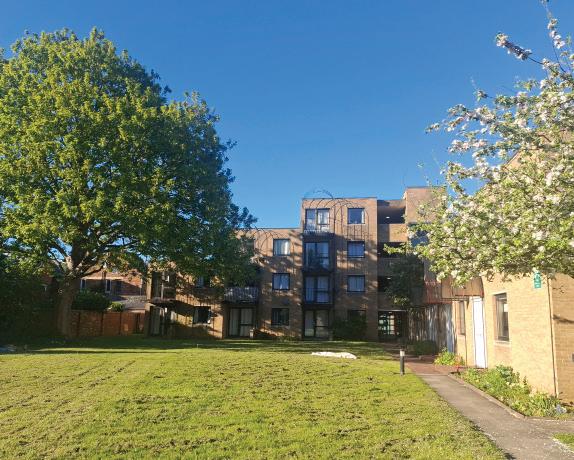
University of Oxford scientists are spearheading efforts to develop a new vaccine in response to the recent Ebola virus outbreak in the Democratic Republic of the Congo (DRC).
Scientists from the Oxford Vaccine Group (OVG), based at the Churchill Hospital in Headington, aim to have the vaccine ready to enter clinical trials within the next two to three months, according to the WHO. On 17th May, the body declared the DRC outbreak a “public health emergency of international concern,” while nonetheless stressing that it was not a pandemic, and that the global risk was “low”. This outbreak is particularly concerning due to the involvement of a rare variant of the Ebola virus, known as the Bundibugyo variant (BDBV), for which there is no vaccine currently in production. Thankfully, the strain is less lethal than other variants of the virus but still kills around a third of those it infects, with the two previous outbreaks resulting in a total of 66 deaths
out of 206 confirmed cases.
While Ebola is perhaps most infamous for the epidemic in West Africa, which lasted for 3 years between 2013 and 2016 and killed over 11,000 people, the DRC has a long history of outbreaks – including the first one in which the virus was identified in 1976. This has been worsened by the rapid urbanisation in the nation, which has drawn more people into at-risk areas, as the boundaries of cities begin to overlap with the natural environments in which Ebola is harboured. Compounding this is the fact that the DRC, and in particular the area in which the latest outbreak has occurred, is a hotbed for violent conflict. This makes it extremely difficult for adequate aid to
“ This outbreak is... concerning due to the involvement of a rare variant of the Ebola

be delivered to the area, worsened by the reluctance of the central government in Kinshasa to support what it views as a hostile region.
In a release to the press, the OVG stated: “In response to the current Bundibugyo Ebolavirus outbreak in the Democratic Republic of the Congo, the OVG is working urgently [...] to
rapidly produce and scale doses of our ChAdOx-based monovalent Bundibugyo Ebolavirus candidate vaccine, ChAdOx1 BDBV. At the same time, we are working with our global partners to accelerate the generation of supportive preclinical data for the clinical development...” Read the full article online at www.oxfordstudent.com
On May 16th, Prince Rostislav Rostislavovich of Russia, descendant of the last ruling dynasty of Russia, along with his wife Princess Rostislav (née Foteini Georganta) visited Oxford for the annual celebration of Emperor Nicholas II’s birthday, hosted by the Oxford Russian Club. Present at the event was Lady Colin Campbell, a television star and royal biographer who spoke at the Oxford Union’s Week 4 Debate ‘This House Believes the Monarchy died with the Queen,’ as part of the opposition.
Prince Rostislav was elected president of the Romanov Family Association in 2023, though his placement within the line of succession to the Head of the Family is disputed based on different interpretations of the laws of succession. Outside of his ties to the former imperial dynasty, Prince Rostislav is a painter, who has participated in numerous exhibitions internationally. Meanwhile, Princess Rostislav is an alumna of the University of Oxford,
having studied modern languages at St Anne’s College.
The event was also an annual charity fundraiser, whose proceeds go to the Romanov Philanthropy and St Gregory’s Foundation. St Gregory’s Foundation, supported by HRH Prince Michael of Kent, the royal patron of the Russian Club, works to assist children and families in poverty across the Russian Federation, Georgia and Moldova.
“ Prince Rostislav was elected president of the Romanov Family Association in 2023
The organiser of the event was the Oxford Russian Club, which was founded in 1909 by Prince Felix Yusupov when he was a student at the University, the aristocrat best remembered as one of
Rasputin’s assassins and husband to the Tsar’s niece. In its own mission, the Russian Club states it “aims to promote Russian culture and the study of Russia, Russian history, Russian language, and Russian current affairs at the University of Oxford.” St Gregory’s Foundation itself supported the annual event, and continues to support the
society more widely. The club’s other charity partners include (as stated on their website) the Russian LGBT Network, which works to support LGBTQ+ individuals within the Russian Federation, and the Naked Heart Foundation, a charity which focuses on the prevention of children with disabilities ending up in orphanages.


Overheard pages on social media began in 2015, initiated by a single, absurd conversation overheard at an LA grocery store. The format is simple – anonymous, user-submitted snippets of overheard conversations or their own dark confessions are held up for collective amusement.
The trend soon became a phenomenon, migrating across cities and eventually creeping into the lives of university students.
In the UK, university overheard pages began emerging after the pandemic. “Overheard at Oxford” can be traced to December of 2023, and Cambridge’s “Camunimemes” followed with similar content at Cambridge around April 2024.
In Oxford, what started as light campus comedy has drifted into a vehicle for vulgar and gratuitous confessions. Scroll long enough and you will find sexual fantasies involving teaching staff and language that is explicitly racist, classist, or ableist, all under the cover of anonymity. Yet, occasionally, these accounts have also served as one of the only unfiltered
public forums capable of exposing institutional harm that Oxbridge routinely downplays or ignores. To dismiss overheard pages as trivial student gossip would be naive, yet to write them off as purely toxic also overlooks their unique role in campus accountability.
The Psychology of Anonymous Submissions overheard accounts’ dual function of both toxic bigotry and vital whistleblowing illustrates the paradoxical nature of anonymity. Both moral disengagement and
as a central mechanism that separates personal identity from real social consequences. In the case of overheard accounts, harmful disinhibition can be seen in the proliferation of racist, classist, and sexually explicit confessions. For instance, Camunimemes posted a xenophobic confession in April 2026, “the uni theatre stuffing a Chinese play among gatsby and little women as if people care is hilarious.”
Black, Asian, and Minority Ethnic (BAME) communities as “highly tribal,” alleged links between a former Union president and the Taliban, and attributed the growing presence of ethnic minority figures in the Union to a racialised logic of historical retribution. Here, shielded from risks of interpersonal confrontation and bureaucratic attrition, anonymity acts as a fertiliser for moral courage, where institutional harm could be challenged without retaliation.
Anonymity, therefore, is not inherently liberating nor corrosive. Its effects depend entirely on who wields it and to what end. To fully understand the power of overheard accounts, it is important to interrogate the politics behind these accounts.
The Politics of Platforming Inner Thoughts: A Case of Pseudo-free speech. Oxbridge has long positioned themselves
“ These pages have also served a whistleblowing function. “ It is important to interrogate the politics behind these accounts.
courage can be facilitated. The theory of online disinhibition effect posits that the psychological barriers regulating our behaviour are significantly weakened in cyberspace. While various platform affordances (such as asynchronous communication and proximity between users) contribute to such an effect, anonymity serves
On other occasions, the same account has posted anonymous students describing their sexual reaction to their supervisor, and complaining about being deemed as racist for having racial preference in dating. Here, freed from in-person consequences, anonymity provides a safe space for moral disengagement, where individuals have the audacity to express unethical thoughts and behaviours whilst bypassing feelings of guilt. Conversely, these pages have also served a whistleblowing function in exposing racism and classism. The most recent example is the role Overheard@Oxford played in exposing former Oxford Union Librarian, Brayden Lee, whose covertly recorded remarks described
as guardians of free speech. Despite student protests against the platforming of controversial figures like Kathleen Stock and Tommy Robinson, the Oxford and Cambridge Unions continue to defend the debating chamber as a space where even the most contentious ideas are heard. The overheard accounts in many ways mirror this ethos, where
any political idea holds an equal chance of getting featured. In a way, overheard accounts honour free speech, enabling whistleblowing. However, what makes verheard accounts fundamentally different to Union debates, is the complete removal of personal accountability. While comments are open, the brevity of the posts inherently discourage the interrogation of statements submitted. In addition, these accounts position themselves to hold the role of the messenger not the perpetrator. This positioning further insulates harmful contents from meaningful challenges. For instance, Overheard@ oxford posted in May 2024 – “St Anne’s is the ghetto of Oxford.” Here, a historically racialised and derogatory term is applied to an Oxford college with a comparatively high proportion of state school and international students, displaying a classic case of racialised classism. It is possible that the person who submitted this statement may have done so because they found it absurd. However, the overheard format does not distinguish between endorsement and exposure, the lack of context or intent makes it difficult to determine whether the submitter intended the post to be a genuine expression of prejudice or a satirical critique. Ultimately, this post received less than ten comments, allowing harmful stereotypes to circulate without sufficient counter-argument. Read more online at www.oxfordstudent. com
Students at Oxford will have the chance to vote on whether the SU should disaffiliate from the National Union of Students (NUS), after a Conference of Common Rooms (CCR) decision to hold a referendum on the issue. The NUS represents student unions across the UK. The CCR motion, proposed by Luke Liang, Part-Time Officer for BAME Students, resolves “to mandate Sabbatical Officers to organise a student referendum on disaffiliation from NUS UK, to be held in Michaelmas Term 2026.” It passed with 24 votes in favour, 4 against, and 4 abstentions. All students affiliated with Oxford SU will be eligible to vote in the referendum, which will put to students the title “Should the Oxford SU disaffiliate from NUS UK,” with responses being “Yes” or “No.” Oxford SU pays £17,500 every year to NUS. The motion argues that “Oxford students’ interests are better served by redirecting capacity towards bodies that demonstrably represent them, and redirecting funding to initiatives that support students” such as the community fund, established this academic year for societies to access centralised SU funding.
During discussion at the week three CCR meeting, it was noted that Oxford SU maintains links to other universities through its Russell Group Student Unions association, as well as maintaining a working relationship with Oxford’s MPs.
The motion was tabled as a “Conference Mandate,” meaning the SU Presidents are obliged to follow its resolutions.
What is our time here, if not an extended debate? at is the culture. A culture that produces something genuinely valuable, a generation of people who are comfortable with discomfort, who can argue a position they do not hold, who know how to sit amongst a di cult conversation without walking out. But here is what it does not necessarily produce: people who have lived experiences in the debates they are so uent in.A room full of Oxford students debating colonialism, or poverty, or race, is a room full of people who have read more on those subjects than most. It is also, more often than not, a room full of people for whom those subjects are theoretical. e ‘colonial lens,’ or the ‘feminist critique,’ become marks of intellectual sophistication
rather than lived reality. We reward nuance of argument without always asking whether the person making it has any skin in the game to understand its realities. e Union is the sharpest expression of this. As presidents chase the headlines, the provocative invite, the viral clip of a speaker being “destroyed” in cross-examination, the chamber increasingly becomes a content vehicle. And the content vehicle has a very speci c logic: controversy generates clicks. Clicks justify each invite made in poor taste. e next invite generates more controversy. At no point in that loop does anyone ask whether the debate moved anything, or whether anyone in the room left with a di erent understanding of the world than they started with. As a former president of the Oxford Union myself, I guess I never stopped chasing the high of creating an impact
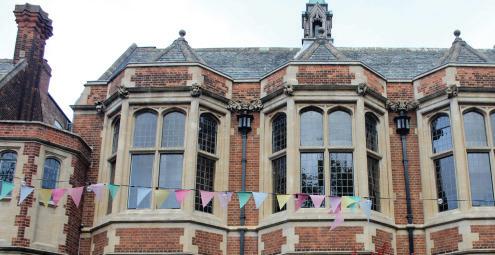
with debate that would be as remembered as the King and Country debate. Even knowing the historical record does not support the myth, because the myth is more impactful than the truth for a wideeyed student from Manchester looking to create change. What changed my thinking was not only the debate in the great chamber, but rather what happened to the people who were not in the room. e young people who will never pay £300 for a Union mem-
bership. e ones who do not know they are allowed to have political opinions, because no one ever told them that their opinion counted. e ones who sit in citizenship lessons that are underfunded and under-resourced, and come out no more equipped to engage with democracy than when they went in. e limit of debatability is not a philosophical question about which topics are too sensitive to discuss. Read more online at www. oxfordstudent.com
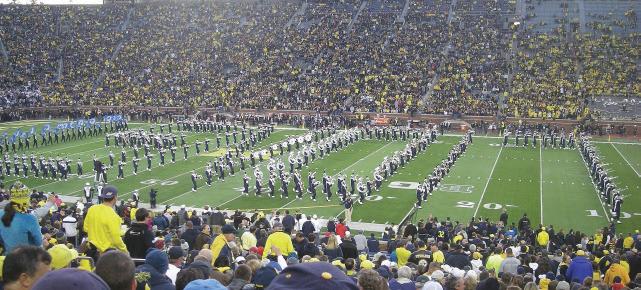
When I think of what I’ve missed by coming to Oxford, there is one thing that stands out: college football. On any given Saturday, over 1.5 million Americans drive into college towns, le into stadiums larger than the student population, and watch some 20 year old college students play football. From the Penn State White Out to Florida State’s War Chant, the size and magnitude of this tradition isn’t
really comprehensible to Europeans.
Of course, you have your football culture, reminiscent of college football in more ways than one. But, college sports, speci cally football played by student-athletes, is an almost uniquely American concept. Why, the Briton might ask, would so many people care so much about the result of a football team associated with their university?
“I may have studied English there, and I enjoyed Professor Brown’s lectures, but why should I care about Coach Saban’s football team?”
Why is college football so dominant in America? It must be noted that college football predates any form of professional football in the United States. e sport has its own history, tradition, and legacy.
Similarly, I believe the development of “college towns” in the US was very impactful. e largest universities in America, and especially the largest football towns, are not in large cities. Instead, they are in these so-called “college towns”, areas with a very young, energetic population and no competition for Saturday afternoons.
e closest NFL team to the University of Alabama, in Tuscaloosa, is a three and a half hour drive north (180 miles) to Nashville, Tennessee. Even the University of Tennessee, in Knoxville, is an over two and a half hour drive from Nashville. Next to the lack of competition, there is a hereditary aspect to college sports.
If you went to Penn State, and your father did, and his father did, then it’s a family a air, one that brings you together. is is very similar to British football, except the tie of attending
In 1660, Charles II o cially returned to the throne, which marked the end of England’s republican experiment under Oliver Cromwell and the beginning of the Restoration era. Charles II had spent nearly nine years in exile after the execution of his father, his return restored the monarchy in England, Scotland, and Ireland and brought major cultural changes, including the reopening of theatres and a revival of the arts.
In 1953, Edmund Hillary and Tenzing Norgay reached the summit of Mount Everest, and subsequently became the rst con rmed climbers to stand atop the world’s highest mountain at 8,849 metres (29,032 feet). e expedition was led by John Hunt and used supplemental oxygen to survive the extreme altitude and freezing conditions.
the university makes that bond even stronger. Not to mention, especially in the college football crazy southern US, just being born close (and I really mean within a few hours drive) to the university is enough to make you a die-hard fan. us, you get a sport which has its roots in late 19th century American university culture, has less competition due to the American “college town”, and collects fans throughout generations of students.
No wonder it dominates Saturdays in autumn. UK universities tend to be in large towns with football, rugby, and various other weekend distractions. What is the need for a 100,000 seater stadium used on six Saturdays a year? Americans feel a bond with their university that moves beyond a simple business transaction.
ey look back at it with longing, and the connection to the college football team gives them a lifeline back into that world. No matter how long ago they may have graduated, they still have that last connection to the school, and, possibly more importantly, to their youth.



The first time I saw Our House, I was ten years old, eyes filled with awe and pride as I watched my sister take to the stage in a school performance. So arriving at the Oxford Playhouse last week to watch the show – this time with my sister at my side as we visited the theatre during her trip down to see me – was a full-circle moment.
This circularity feels particularly appropriate to the play itself, which ends where it began.
The lead characters Joe and Sarah have to decide (for the third time) whether to go dancing instead of breaking into a newly renovated block of flats.
This is, then, a sliding-doors drama set in the 1980s. The main body of the show re-

volves around the two pathways that Joe Casey’s life takes after initially choosing to commit the break-in. The first path witnesses Joe’s life, should he run away when the police show up, gradually being led down a path of criminality supported by a superbly slimy Reecey (courtesy of Rebecca Harper).
The alternative path sees Joe stay and face the police, placed into a young offenders institution before being released to face societal disdain and erasure.
In an impressive feat, Cross Keys Productions and director Madison Bouchta (you can read my preshow interview with Bouchta here) have decided to maintain the same cast across the two diverging paths.
Many productions choose the simpler option of using a different cast for the two storylines. Using the same cast undeniably adds to the
Oliver Weston
Small brown birds
toy in the sludge and bracken.
difficulty of the production, ensuring that Alex Innes (who takes on the role of Joe), alongside those playing his group of friends, rarely have a moment to catch their breath off stage.
This certainly doesn’t come across in the performance, though, which only seems to accumulate energy as the show goes on.
It’s easy to see why Bouchta would want to maintain the same cast across the different paths, given the fantastic nature of their performances.
Lottie Hutchinson and Imogen Bowden are particularly standout as friends of Sarah, while Sarah herself, played by Maya Flint, delivers a number of exceptional solos, demonstrating the power of her vocal range.
Joe’s friends Emmo and Lewis, played by Peter Hardisty and Luke Carroll respectively, are a joy whenever they’re on stage, with ‘My

Girl’ deservedly receiving one of the audience’s most resounding laughs.
What makes the cast particularly special, though, is the believability of their closeness, emanating all the chemistry and tightness of a close-knit group of school friends.
It’s a testament to the social side of Cross Keys Productions – as Bouchta told me, the cast were not only together during rehearsals, but also spent time punting, going to karaoke and taking plenty of well-deserved trips to the pub.
The quality not only of this core group of friends but also all of the supporting roles is the glue that holds the show together.
One standout is a fantastically loathsome Mr Pressman, played by Beth Hunt, who conveys all the horrors of this slimy capitalist developer without sacrificing credibility – and who, in a brilliant detail of the choreography, does a phenomenal wobbly-kneed dance across the stage.
Read more online at www. oxfordstudent.com
Sophia Yvonne Hall
I am an anthropologist of the almost— My field site: a crowded terminal that never arrives.
The coal bodies of dead shrubs.
An aftermath of wine in the early evening. Ethical hallucinations.
Nightmares of mulch. Short sentences
break up the quagmire of headswimming thoughts.
A clamour or catastrophe: Foxes pawing at the dusk.
My subjects: the businessman mid-stride, mouth moving faster than feet, children chasing the escalator, a tardy man racing what has left him behind, the timid push of a child guiding a loved one in a wheelchair, unhurried and cautious— as few things are here.
The speaker booms its forbidden word: delayed. And the gate agent sighs.
I find a family of thirty-five, two dogs, five cats— aunties orbiting little ones like nervous moons. I construct a narrative: a wedding, surely. Perhaps it is the dogs who are to be wed.
Read the full poem at www.oxfordstudent.com
The Crucible Performed in the Michael Pilch Studio from 27th30th May.
Backrooms
This film is showing in cinemas from 29th May.
The Haunted House Performed in Christ Church gardens from 2nd-3rd June.
The Effect Performed in the Burton Taylor Studio from 2nd6th June.
Completely Bloody Incoherent
Performed in the Michael Pilch Studio from 2nd-6th June.
The Moro Affair Performed at the North Wall from 4th6th June.
Elliott Wang reviews the Magdalen Players’ staging of ‘Jerusalem’.
In fictional Flintock of real England, in a clearing in the woods, there sat the wreckage of a miniature civilisation: the wyvern of the old Wessex flag sprawled across a sagging sofa, under tri-coloured bunting flags, by white plastic lawn chairs and a valiant barbecue with its top knocked off.
On a foldable table there’s a broken clock and other half-dead appliances. There is rubbish all over the copse land, corpses in the aftermath of a pathetic party, or a spiritual Bacchanal ritual. In Act Two, a spray-painted banner will be drawn up by teenagers Pea (Hannah Suckling) and Tanya (Sanaa Pasha): “Fuck the New Estate”.
Fifteen-year-old Phaedra (Maisie Thorn) walks out in the Prologue and beautifully
sings a rendition of William Blake’s ‘Jerusalem’. She is the village’s reigning May Queen but her wings look slept-in and exhausted. She’s supposed to pass the crown on St George’s Day but instead she seems desperate to hide from everyone – except the legendary wastrel Johnny ‘Rooster’ Byron (Adoloras).
Rooster has been living in his caravan in the copse for decades now, but the Kennet and Avon council (Fawcett and Parsons played by Maddy Howarth and co-director Billy Skiggs) has been trying to evict him for his feckless hedonism.
Both Phaedra and Rooster wish to stay Adoloras plays the perfect ‘Rooster’ Byron. He is more drunk and more pagan in appearance than Mark Rylance’s interpretation of the character. His delivery has the intoxicated drawl of a Norm Macdonald shaggy-dog routine
and the repetitious wit and rhythm of Stewart Lee. But it is played with conviction. The character is half-submerged in myth and alcohol when he tells unbelievable stories of meeting giants with kettle drums as ear-rings, or being a resurrected daredevil who jumped over double-decker buses.
In a somewhat infamous scene, when Rooster and Phaedra dance in the moonlight, there’s a nervous excitement in the audience. It
appeared that we were finally going to find out whether Rooster was an exploiter or a saviour of children, yet the moment is interrupted, and we never do.
The scene is played with a perfect balance: Adoloras is kind and protective, but we feel an unease that he has been hiding a fifteen-yearold girl from her father, Troy, played terrifyingly by co-director Billy Hearld.
Read more online at www. oxfordstudent.com

Elliott Wang reviews Curry Barker’s brilliant comedy-horror.
If I could make one wish, it would be a version of The Drama that has much more drama and much less controversy. Now, it’s come true. Scoot aside, Project Hail Mary, it’s Obsession’s turn to sit on the left of filmmaking success. Directed by hilarious internet sketch-comedian Curry Barker, Obsession is a monkey-paw story about the disastrous consequences that follow a man’s supernatural wish to make his crush to love him more than anyone in the world. The synopsis is deceptively simple, but the execution is wickedly good.
Obsession’s ‘jumpscares’ are some of the most effective in recent horror film memory. A lot of it has to do with Curry Barker’s experience as a sketch comedian in the duo that’s a bad idea. You may have come across the duo’s
sketches on TikTok, and if so, you will notice the DNA of their absurdist, observational comedy all over the film. Sure, the film is funny, featuring a mystic, supernatural store where its employees are AirPods-wearing millennial tropes, but it is also devastatingly horrifying.
Barker successfully employs the art of subversion and timing from his situational comedy to his situational horror. Indeed, ‘jumpscares’ is almost the wrong word; the film rarely relies on conventional ‘smash-cut-andsound-effect’ scares at all, but rather perfectly-timed reveals of terrifying situations.
The last time a horror film was so effective at doing this was in Jordan Peele’s Nope (another sketch comedian), where we hear the overhead screams of Jean Jacket’s victims being slowly digested by stomach acid.
If there’s one ingredient to Obsession’s success, it is subversion. Just like
“ Obsession is a well-executed horror film that aims firstly to scare
his sketch comedy, Barker finds a situation and twists it again and again until its head pops off. Fear inflates and suddenly deflates into comedy, and once you’re done laughing, the film hits you with another devastating realisation; it is a tonal whiplash done deliberately and more successfully than The Drama. On the surface, both films revolve around men who find themselves dealing with ‘scary women’, but only Obsession manages to kick its characters down from the superficial to the disturbed.
The villain, ‘Nikki’, played spectacularly by Inde Navarrette, manages
to evoke so many different reactions from the audience – from fear, to laughter, to pity – that it is, in my opinion, award-calibre.
Navarrette delivers a performance that finally transcends a trend in 2020s horror flicks of having allegorical villains. While critics repeatedly praise the ‘thinking man’s horror film’ (as dismissive a proposition as the ‘cheerleader who gets good grades’), Obsession is a well-executed horror film that aims firstly to scare, and this is likely to be a welcome retreat for audiences who just ‘didn’t get’ Sinners, The Menu, or The Heretic
Perhaps Obsession is not written with as much thematic depth, but its writing has an abundance of relatability and wit. Many of Nikki’s and Bear’s lines and mannerisms will be familiar to people who have been in a toxic relationship.
Read more online at www.oxfordstudent.com
On Friday 8th, the Oxford Fashion Society hosted two of the most influential female leaders in the industry today. Seated in the bright and airily modern space of Christ Church College’s Research Centre were Julia Hobbs, Contributing Senior Features Editor for British Vogue, and Daisy Hoppen, Founder and Director of her eponymous agency DH-PR.
Two topics seemed foremost in everyone’s mind as the panel commenced: the persistent gender discrepancy in fashion leadership roles, highlighted by Society president Jaami Al-Choudhury in his opening speech, and the consequences of generative AI on journalism. Yet the questions posed by vice presidents Anaiya Patel and Rokia Herat were also more human than that. They sought to demystify the lives and minds of these remarkable businesswomen. Julia and Daisy gave rich, honest answers on everything from their unlikely entry into the fashion world, to the job’s gruelling work-life ratio, to the intimate bonds that form and endure under such pressure.
Below are the main talking points.
Julia shared the mechanics of making a great pitch as an editor. “To any budding writers in the room: begin with your headline, it’s the essence of what you’re saying to your editor.” Then get as detailed a picture as possible of what the story will ultimately look like: how long it is, who the writer will need to speak to. Then you sell it. “You want it to have amazing storytelling. You get your editor excited, then you go back to the writer. And with them it’s similar to what Daisy does in PR. You have to nurture a relationship – tell them if you read an interesting arti-
cle in the New York Times that might shed another light on what they’re working on.”
She stressed having the lightest possible touch: “You want this particular writer to have their voice, and to feel all the colour and texture that they have witnessed. I don’t want a piece from another writer to sound like it’s coming from me. Otherwise, I’d have done it myself.”
Daisy noted the significant
“ You have to be your own champion and create a culture around you…
coordination between their two roles. “So much of my job is working out the puzzle of when, say, a big-name designer has joined a house, and newspapers have been in touch to say ‘We want first run!’” She has to decide exclusivity, to judge who can mention what and when, while Julia says that “from an editor’s perspective, you’re looking for the most human, intimate angle that has proximity.”
Getting that balance right between connection and privacy is “why the relationships between PR and editors are so crucial,” explained Daisy. This was possibly one of the most valuable aspects of the panel: the storyteller and the supervisor being able to talk about how their work comes together.
Staying Alive
Julia: “Fashion was cutthroat. You had to be very resilient. I was a terrible assistant when I started at Vogue, probably the assistant I would dread having
right now. It was a baptism of fire.”
From understanding timing in a conversation to the art of picking your battles in an industry of daily crises, both women spoke about perfecting soft skills while staying tough. Julia touched on the non-negotiability of real confidence. “You have to be your own champion and create a culture around you… Fashion was pretty ruthless back in the day,” she concluded with a laugh.
“And still is,” continued Daisy. “I mean, it’s a business. It’s got this glossy façade to it, but the magazines have to generate money, the websites have to generate money.”
This shifted the conversation towards work-life balance. As a mother and expecting, Daisy emphasised having “at least one day a week where I try and forget my phone” and spend real time with her family.
Julia is also no stranger to pressure from those close to you: “You drive your friends mad by missing birthdays and cancelling on dinners and things like that because you’re always working”. Yet she takes a tough-love approach to it. “I think that’s how you manage to grow,” she concluded.
Histories
Julia had been on track to practise law before realising “Hang on a second. Is that what I want my life to look like?” Fashion writing made sense as an alternative. “I had always been writing, I had entered the Vogue talent contest, I was obsessed with Vogue from the age of eleven – but I didn’t know anyone who worked in fashion.”
She worked at the Financial Times for a stretch, and when their fashion intern didn’t show up one day, Julia was in the right place at the right time. “That was a space where
they looked at my qualifications [as a lawyer] and didn’t rule me out, where a pure fashion space would have.” She took on the role of fashion intern.
The jump to Vogue would happen later, via the editor of a magazine she had been freelancing for. It called for plenty of her own gumption, though.
Julia: “I wrote a blind application and drove to Vogue House at midnight one night. I gave it to the doorman and said ‘Please will you give this to the managing editor?’ He went ‘Yeah, yeah,’ probably thinking ‘Lunatic,’ and I went ‘No, no, promise me.’ Four months went by, I thought nothing had come of it, and then they emailed me saying ‘Will you come in for an interview?’ And that was that.”
Daisy studied medieval history at Leeds University. After graduating she worked at a jeweller’s, eventually arranging to supply Vogue with pieces from their store. She was
“ Fashion was cutthroat. You had to be very resilient.
then approached by the nowhuge agency Purple before transferring to another major player in the PR industry, but the environment was incredi-
bly taxing.
Daisy: “It was a very stringent, specific way of working. About thirteen years ago I kind of just burned out, to be honest. I decided to go freelance, and I didn’t really know what I wanted to do.”
What she did do was make a logo and found her own agency. The luxury emporium Dover Street Market, now with stores in New York, Tokyo, Paris, LA and more, was only her second client.
In the Media
Daisy: “People think fashion PR is like Ab Fab, but actually there’s the business of getting someone’s collection in a magazine, there’s the features, there’s the profiles, the runway shows and the events. You’re a sounding board, you’re essentially your client’s therapist. You have to be a great keeper of secrets. It’s a lot more than just drinking champagne and going to Harvey Nicks.”
Julia chipped in with a possible reason for this misrepresentation of the industry.
“The thing I’ve learned is that good PR is in many ways invisible. Bad PR is when you notice it! There are so many things [Daisy] will do across a project to nurture a brand and bring that world to life that go unnoticed precisely because they’re so excellently executed.”
Read more online at www. oxfordstudent.com
Julia Hobbs and Daisy Hoppen. Credit: Jaami Al-Choudhury


When I was asked in a mock university interview whether I thought the mythology boom in modern culture was a good thing, I was rather at a loss. The Percy Jackson series was, in a depressingly typical fashion, a formative influence on my academic trajectory, and I am certain I would not be here without it. Considering the impending Nolan Odyssey, and the huge success of Madeline Miller, perhaps now is a good time to think about the use of mythology in modern creative output.
There are certainly good things to be said about the rise of myth in the media. I am pleased about the attention that the divine wrath of Achilles is receiving, about the interest pouring forth

concerning the Trojan war, the journey of Odysseus, the defeat of Medusa. I know, because I have lived it, the fervent adoration for lesser known gods and myths referenced in the Riordan books that inspires research and learning and obsession and delight and eventual torment, head in hands, bent over a laptop asking why I’m sitting here writing a mediocre essay on the Paradox of Inquiry in the Meno. These books do introduce a way of reading the ancient stories in new ways that fit with contemporary culture.
An Instagram reel I saw the other day condemned the ‘accessible start to the classics’ that these books are branded. It lamented that these stories are being watered down to the barest
“Tape yourself to this white page. Say it’s about time that you leave your trace”.
I first heard Anna Erhard playing live on Radio 6Music at the exact moment I was driving past the Salford studio in which she was performing. Since then, her music has been following me round like a friendly shadow, providing something of a soundtrack to my student experience. When I went to see Erhard live for the first time two years ago, the Swiss singer-songwriter dedicated this line, from her 2021 album Short Cut, to freshers arriving in Manchester for their first week of university.
While I wasn’t a fresher myself at the time, this dedication was still front of mind a year later. Head-
reflections of themselves, encouraging not the picking up of classical studies but mindlessness and materiality repackaged as literary greatness made new. Those who complain of this are branded elitist, and out of touch. There is a certain truth to her words – though I enjoyed The Song of Achilles, it certainly does not do justice to the story of Patroclus and the best of the Greeks. Homer’s Bronze Age culture surrounding women is shallowed, diluted. The great heroes of the Iliad are mere shells of themselves. But what this story is, at its core, is a great love story. A tale of tragedy and woe, desolation and heroic barbarism. It could never be the Iliad. But it is worth reading. Similarly, the great power and religious authority of the gods are missing from the Ri-
ing to Oxford for my own freshers week, I stopped for a night in Coventry to watch her perform again. The relatively niche nature of Erhard’s music ensured a varied crowd, a mix of locals who’d stumbled across posters for the gig and devoted fans like myself eager to sing along with every lyric.
This mixed audience embodies the togetherness that radiates from her music, which is both universal and unifying in its goofiness. On stage, she’s one of the most personable artists I’ve seen, spontaneously striking up conversations with the crowd which she happily follows up afterwards when signing t-shirts and records at the merch stand.
That second gig saw her playing what was, at the time, her new album Bo-
ordan books. Comparing the Battle of Manhattan to the fields of Ilium is laughable, and the soft-drink-guzzling Dionysus of Camp HalfBlood is a far cry from the great force of divine order (please no one disagree with me on this, I shed blood, sweat, and tears over that particular essay last Michaelmas) that is the Dionysus of Euripides’ Bacchae. But it is, for its faults, an accessible start to the classics.
I read Emily Wilson’s Odyssey over lockdown, before I had set my mind on Classics here, or read anything at all of classical literature. That was also more accessible than the older translations of Rieu and West. There are ways of getting young people into classics without losing the Greek culture. But it is undeniable that Percy Jackson had an effect on me like
tanical Garden. Released in September 2024, it’s an immediate mood-booster which anyone experiencing the nerves of moving to a new city for the first time needs to blast through their headphones.
Since seeing her perform the tracks nearly two years ago, I’ve become increasingly familiar with the album, practising the songs religiously on my guitar – a birthday gift which matches the model of Erhard’s own.
It’s this bright red electric that has settled my unwavering fandom once and for all. It not only reminds me of her joyful music every time I strum a few chords, but also of the generous woman herself, who, fully invested in my surprise present, kindly responded to my dad’s messages asking after the make and model (a Jolana Star).
nothing else. Teenagers my age (or a bit older) fighting monsters, children of the gods, training at a summer camp for demigod warriors.
Even now, I am rather envious of Percy’s natural ability to translate Greek (more, in fact, now that it’s a mandatory component of my degree).
People complain about the historical inaccuracy present in Nolan’s trailer. Keyboard warriors rail over feminist retellings of Medusa, Penelope, Clytemnaestra.
These things are perhaps different to the stories of 800BC. They are more indicative of our culture, more suited to our lives – easier to digest.
But these are stories. The great epics of Greece and Rome are just that – of Greece and Rome.
Read more online at www. oxfordstudent.com
Flowing seamlessly from a playful take-down of the Blue Men Group in ‘BMG Academy’ to a description of a particularly ‘Hot Family’ she spots walking down the street, Botanical Garden demonstrates Erhard at her peak.
Never shy of trying something new, Erhard’s experimental approach to sound seeps through in every track, reaping its rewards in songs like ‘Spa’, where the unique electronic introduction offers an almost bubbling backing track that perfectly matches the narrative setting of the lyrics.
The titular track ‘Botanical Garden’ offers a brilliantly observed description of a visit to some gardens which she rates “two out of five stars”.
Read more online at www. oxfordstudent.com
Imogen Forrest reflects on the difficulty of posting on Instagram.
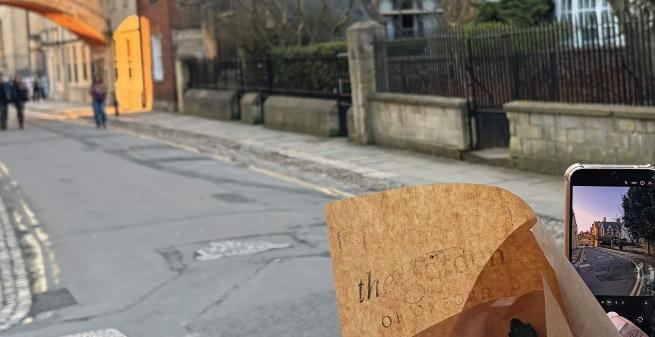
Since its humble beginnings back in 2010, Instagram has shape-shifted drastically over the years, always trying its best to keep up with ever-changing times and to give its loyal users exactly what they want. When the app was first launched in October 2010 by Kevin Systrom, he actually gave it the name Burbn, rather innocently after the Kentucky Whiskey. People quickly took to its unique photo-sharing feature and before long, the number of its users grew massively.
“ Having a well-curated and active Instagram account is a modern-day necessity.
In December of 2025, it was estimated that the app was home to around three billion monthly active users. Yet, whilst it grows more popular by the year, Instagram is becoming increasingly dif-
ficult to post on. Certainly not physically, but mentally. And this is a matter that extends beyond the usual weight of self-consciousness. The core of the issue is that Instagram is no longer an app for sharing happy moments with friends and family: it has now become a portfolio through which one develops their own personal (and, in many cases, professional) brand.
Those with public accounts are actively seeking attention from people outside of their social circle, most likely with professional motives.
In the creative industry, for instance, this is increasingly prevalent – having a well-curated and active Instagram account is a modern-day necessity when it comes to networking, and career seeking.
Many artists, musicians and poets use the platform regularly to share their creative processes and to promote their own products. Even those outside of the creative industries, in finance, law and teaching for instance, still have to be conscious of the image they put out there. Because of this, even informal content on the platform is starting to feel as though it has to be
ly performative, requiring a distinct level of curation, especially through the form of the ‘insta dump.’
The Instagram dump originated in 2017, when a feature was introduced to the app which allowed its users to post multiple photos instead of the one singular picture. It wasn’t until a few years later, however, that the casual Instagram dump really took off. Initially, as I’m sure many of us remember, it came as an opportunity to post slightly shabbier and more informal pictures. The ‘behind-the-scenes.’
BeReal had a good attempt at remedying this issue of online inauthenticity, but its global use was short lived, and it seems to have lost popularity over the past few years, at least amongst UK students.
Recently, Instagram has tried to remedy its own demise through the introduction of ‘instants,’ a feature
pristine, aesthetic and presentable. A digital extension of ourselves, available to the world.
This issue has only recently been exacerbated by the introduction of the ‘friends’ tab in reels, a feature that allows followers to actively see the type of content their friends are engaging
“ Is Instagram just LinkedIn in disguise?
with on a daily basis. Many might now feel that even the content they ‘like’ has to be niche, aesthetic, or even intellectual in order to further permeate the image created by their accounts.
This excessive level of performativity bears the question, is Instagram just LinkedIn in disguise? Perhaps not exactly. Posting on Instagram is still more subtle, and there are many people who use it to simply stay in touch with their friends and family; sharing trips out to the pub, holidays and such. But particularly for Gen Z, the app is becoming increasing -
It wasn’t overly thought through or composed, and it was somewhat commonly recognised as less important than the singular main posts that made up an account. However, in the past few years, almost all posts now take the form of an Instagram dump. And there is nothing casual or thrown-together about it.
In its very essence, the ‘insta dump’ is the opposite of what it seeks to promote. It wants to come across as informal, chic, superfluous, and yet beneath it all there is a directly contrasting air of precision, of meticulous artistic curation. Even the addition of music, the perfect thirty to ninety seconds of some niche song adds a certain theatricality to the whole performance.
And why is it that we do this to ourselves, knowing that the large majority of our followers will scroll quickly through the first three photos, maybe double tapping or ignoring it altogether?
Perhaps there is something about it that feeds into the ever-growing human need to exchange little snippets of our lives with the world in return for a brief dopamine hit.
Who knows what all this means for Instagram going forward. Perhaps there will come a point where the app feels impossible to post on, and we will become attracted to some different, slightly simpler option. For a time,
“ Something about it feeds into the human need to exchange little snippets of our lives with the world.
that encourages users to take quick unfiltered photos that appear in their DMs. Much like Snapchat and BeReal combined, they delete once opened, or after 24 hours. However, the update has already caused controversy online, with many worried they will accidentally hit the button and share unwanted photos.
Despite all these complaints, Instagram still can’t be pushed to the side as an entirely negative app. It strengthens connections both socially and professionally, and, as we saw during the pandemic, it helps us stay in touch with people we might have otherwise lost contact with. Fundamentally, it also keeps us updated, informed and aware of what’s going on beyond the bubble of Oxford, and our hometowns.
Perhaps it is just important to remind ourselves every once in a while, that the seemingly ‘effortless’ posts are often not as simple as they seem, and that we mustn’t be defined solely by these exaggerated online personas. Beauty is all around us in the real world too!
All the world’s a stage, and nowhere is that clearer than in an Oxford library.
e stage in question: deathly quiet, sombre, hallowed. Stress permeates the air.
e props: laptops and tablets, notebooks lled with question marks, past papers lined with about ten di erent colours of highlights, a pencil case left on a desk that’s been empty for hours.
We all know the cast: people who haven’t left their chairs for ages (too intensely focused to so much as look up), people who have fallen asleep in front of laptops that shut o an hour ago, and people surreptitiously glancing around to check if anyone can see that they’re on their third Instagram break within the last thirty minutes.
In a place like Oxford, where performing productivity is almost as important as being productive, libraries play an important role in curating this narrative. ey reveal a culture beneath the surface that is far more integral to being a student here than it seems at rst glance. ere is the natural stress that accumulates during exam season anywhere, and then there’s the Oxbridge-speci c pressure of the tutorial system. is typically means every student has multiple things to prepare and submit within any given week: there is always something else.
What does this look like in the library? Whispers amongst coursemates, asking how many words they wrote for the essay, or exclamations of despair that they had barely made a dent in the reading list for tomorrow’s tutorial. More subtly, people glued to their seats for ten hours without interruption, convinced that if they just stare at the screen for long enough and refuse to take rest, the work will eventually get done.
throat, and the ve milliseconds of crinkling made not one, not two, but three people swivel in their seats to stare at me as though I had keysmashed all over their work and emailed it to their tutor.
is raises the question of how much of this performance is actually about doing that work, and how much is about feeling like you’ve done it. Being in the Law Library until closing time seems like a badge of honour, even when the work you’ve produced could have been done in two hours. Not because it couldn’t have been done from a café or your room, but in part because you can say that you made the e ort to go somewhere (deeply unpleasant, as in the case of the Law Library) and didn’t leave until you were forced to do so. is performance of dedication and utter seriousness is central to the library experience at Oxford. I will never forget the time I opened a lozenge for my sore
e apparent necessity of this performance is exacerbated by the fact that much of the University’s prestige is symbolised by its libraries. Sitting in the Old Bodleian Library, it is hard not to share the awe of the tourists looking around and wondering what it would be like to study in it, recognising it to be the very same wonder we shared at the prospect of being here. So, we put on a show for them. We pretend like we are not at all distracted by the crowds, and are in fact very locked in on the essay or problem sheet artfully sprawled out on the desk.
is isn’t to say that there is no value in this performance at all. It would not even be fair to say that every person is putting on an act when, for most of us, libraries are genuine places of work. Even for those who are performing a level of productivity they haven’t quite attained yet (looking at you, Michaelmas-me), fake it until you make it does work sometimes. ere is merit in creating a routine, having the discipline to stick to it, and making studying more appealing through constructing some kind of aesthetic around it. Moreover, libraries serve a purpose beyond
productivity. In a place where it’s possible to go days without ever seeing another person, speci cally for courses with fewer contact hours, libraries o er the low-level comfort of not feeling alone. A knowing glance at the person opposite you when someone who has just disappeared for two hours leaves again after having returned for twenty minutes. A tic-tac-toe game forever preserved in OneNote. A gestured request to plug a charger into a port a few seats over that actually works. ese experiences all remind us that we are not as isolated as our courses sometimes make us feel. Even beyond the people in them, we are genuinely lucky to have the libraries we do: the Bodleian Libraries are incredible places, and many of the college libraries are similarly storied. It’s easy to think of them as just settings in this play, but libraries might just be the main characters.
ese libraries form such a central part of the story of what it means to be a student at this university. ey are the most real manifestation of the fact that we are all doing our best impression of someone who knows what they’re doing. Is it a performance at times, a show put on for validation and reassurance? Of course. But maybe that’s ne. After all, the show must go on. Read more online at www.oxfordstudent. com

At the top of Cowley Road, Tick Tock Café is unmissable.
Located at 3–5 Cowley Road, the café has long been known for all-day breakfasts, sandwiches, jacket potatoes, and Turkish and Mediterranean dishes.
But Tick Tock’s appeal is not just culinary. e family behind the café opened it in 1994 after moving to Oxford, with the name emerging from customers saying they worked “like a clock.” Over time, customers began bringing in clocks from di erent countries, turning the café’s walls into an archive of Oxford’s internationalism.
When its bright red doors rst opened, the café solely served breakfast. e owners later introduced jacket potatoes, burgers, paninis, cakes, and daily meals like lasagne and chicken curry.
“What has not changed is our working around the clock,” Magdalena Kurt, co-founder of the café, said. “ e expanded menu assures that there is something for everybody and every budget.”
At the centre of the café is a framed e Oxford Student article from 2012, written by Sanjeeta Jackson. Jackson reviewed the Light Breakfast, Tick Tock’s full English without bacon and sausage.
Keeping with OxStu tradition, I ordered the Light Breakfast, which remained largely unchanged from the dish Jackson ordered in 2012.
Within 10 minutes, a smiling waiter brought me a heaping plate. ough the price tag has increased from £5 price to £11.95, the dish still included two eggs, two hashbrowns, a pile of fried peppers, baked beans, and mushrooms. e meal was brimming with avour and provided a strikingly generous amount of food, as it came with a glass of fresh orange juice and a basket of golden brown toast, butter, and jam. Both eggs were perfectly cooked and the food well-seasoned. e service was similarly excellent – friendly and quick. Overall, the meal was a 10/10.
Tick Tock remains charmingly unfussy: breakfast is hearty, time is everywhere, and somehow it is still easy to lose track of it.

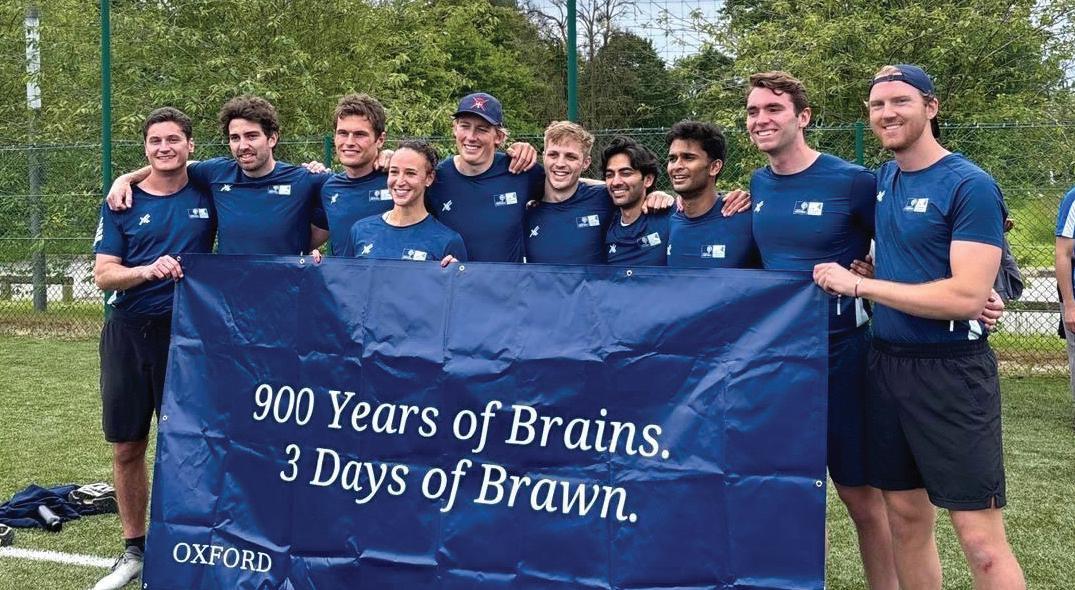
Each year thousands of MBA students from across Europe gather at Hautes Études Commerciales (HEC) Paris to compete in a contest of physicality, strategy, and a glory recognised by almost no one. e MBA Tournament, as it’s called, claims to be “the largest gathering of MBAs in Europe” and promises a weekend of “competitions, networking and social activities”. Referred to colloquially as the ‘MBA Olympics’, it’s a three-day tournament-style competition in which MBA students from across Europe compete for a prize that, for the uninitiated, is almost entirely irrel-

evant.
And yet, for Oxford’s Saïd Business School it seems nothing could matter more.
“MBAT was always on my radar as I had heard incredible stories from previous years’
dent at Saïd. “ e very rst day during the girls football game it started to rain, which was followed by hail and not a single player mentioned stopping the game as we were sliding across muddy elds. [...] at is when I knew that everybody that showed up meant business”.
egy? “Show up, kick a**, bring the trophy home”.
students about camaraderie, excitement and intensity of the competition”, says Nino Gvalia, a current MBA stu-
Direct con ict has paused, but US and Iranian naval blockades still remain in force. Shipping through the Strait of Hormuz, a waterway encircled by the Gulf states and Iran, continues to be disrupted.
Hormuz transports over a fth of the world’s maritime oil trade. Food-insecure nations in Sub-Saharan Africa are reliant on fertilisers
e tournament features more than 30 events, ranging from football and touch rugby to Geoguessr, an online geography game, and Mario Kart. Over the past ve years, Saïd has beaten all other business schools in attendance, winning the trophy four times, including at this year’s competition, where more than 150 Oxford MBA students travelled to HEC and returned with 16 gold medals and 48 medals overall. Oxford’s strat-
to maintain su cient crop growth throughout the year, owing to non-ideal climates and little (often overworked) farmland. Much of this fertiliser, re ned from crude oil, ows through Hormuz. According to the UN Conference on Trade and Development, around a third of seaborne trade in fertilisers passes through Hormuz. Acute shortages are now appearing in fertiliser-dependent regions. Trans Nzoia, Kenya’s “breadbasket”, predicts a 30 percent decline in yields this season alone. Many food-insecure regions are reliant on imports to ensure subsistence levels of
Brandishing signs, sponsored by Canva, with phrases such as “ at’s what she Saïd” and “900 years of brains, 3 days of brawn”, Oxford students who weren’t competing spent most of their time sprinting from events to support their fellow cohort members.
Past competitors have cast Oxford as the school everyone wants to beat. is year Saïd brought an Olympic rower, a body builder, and a former NFL cheerleader. As one IE MBA student put it, “MBAT is the Hunger Games, and Oxford’s MBAs are the Careers.” at status, however, does not come cheap. For a weekend in suburban Paris, costs come close to €700 per student, with Saïd covering only a
nutrition. Sudan — already in the midst of a three-year conict that has claimed the lives of over 150,000 people — imports 80% of its wheat in any given year.
Pre-existing fertiliser shortages also incapacitate countries that export their surplus crop to other regions — Brazil, Argentina and India are at risk of having to ration their exportable crop. What this means is that crop prices are surging globally similar to the record in ation observed in the West in the wake of the 2022 Ukraine con ict. e average family in food-insecure regions will
portion of the fee for registered students. For most MBAs the balance is paid out of pocket. In 2023, HEC reportedly budgeted about $500,000 for the event, including nightly parties, food trucks, and a gala in Paris.
Dina Teilab, Saïd’s MBAT nance o cer, says the win “instilled a strong message of unity in us as a cohort and in the other schools: that this school and this team is unbeatable.”
e next time you see an MBA limping through Oxford in a branded quarter-zip, congratulate them. ey may have spent three days chasing a prize that means very little to the outside world, but inside the strange, muddy, sleep-deprived universe of MBAT, it meant everything.
see at least one child die before their fth birthday. Life expectancies in Sub-Saharan Africa are roughly 25 years below European levels and deaths from hunger are greater than AIDS, malaria and tuberculosis combined. e coming few weeks are going to be vital in understanding how this tragedy will further develop. Rumours of an easing of blockades are circulating and language from the US suggests a possibility of thawing tensions. ese con icts may feel distant, but their e ects are measured in hunger levels not seen for more than a century.

Gabriella Bedford unpacks the FCA’s controversial car finance redress scheme and the consumer-firm clash behind it.
Consumer lending in the UK has lurched from one major misselling scandal to the next - bank charges in the late 2000s, payment protection insurance (PPI) in the 2010s, and now motor vehicle finance. However, this scandal has one major difference, the Financial Conduct Authority has set up a mass redress scheme promising to automatically repay consumers.
This marks a major departure from previous scandals, where the onus was on consumers to complain actively in order to secure compensation. In the case of PPI, they did so with the help of some slightly creepy FCA adverts
featuring a beheaded Arnold Schwarzenegger. For motor finance, by contrast, the FCA has set out a scheme that aims to pay consumers automatically.
So, how did we get here?
In January 2024, the FCA launched an investigation into discretionary commission arrangements (DCAs) in car finance, a practice that allows car dealers to inflate interest rates to earn more commission. Then, in October 2024, the Court of Appeal ruled that brokers could not lawfully receive commission from lenders without the customer’s informed consent, a decision later challenged in the Supreme Court.
contractual ties between the lender and dealer. For example, where a consumer was told their application would be sent to a panel of lenders to secure the best deal, but one firm in fact had first refusal.
Following these court cases, the FCA consulted on a mass redress scheme, which it announced in March of this year. Now, car finance firms have to actively identify consumers who have been missold and compensate them directly. However, external influence has led to payouts being reduced from what consumers are owed. Consequently, the FCA is subject to multiple lawsuits, which will delay payouts, and the scheme may still fail to adequately aid consumers.
Before the scheme was designed, both the government and car finance firms lobbied to reduce the size of payouts, and as a result the scheme will now give consumers only up to two-thirds of the commission they paid, with interest on the compensation at Bank of England base rate plus 1% with a minimum of 3%.

At this point, Chancellor of the Exchequer Rachel Reeves said she was considering overruling the initial court decision, however the Supreme Court blocked her attempt to intervene.
In August 2025, the Supreme Court handed down a ruling that reshaped the scope of the motor finance scandal. Although the Court rejected some of the broader claims against lenders, the FCA’s subsequent redress scheme extended potential compensation beyond consumers with DCAs. It also included consumers who were charged an “excessive” amount of commission, or whose finance deals were affected by
potentially going to change how the scheme functions, it also is highly likely to delay payouts further for consumers, who have already been waiting at least a year for the scheme to be designed and implemented.
In response to the legal action, the FCA released a statement in which it promised to “defend the scheme robustly as lawful and the best way to resolve such a widespread, long-running and complex issue” and reiterated that “not everyone would get everything they would like, [....]The final scheme is fair to consumers and proportionate for firms”.
However, the FCA’s statement seemingly exemplifies the problem further, in trying to please both the firms and consumers neither are satisfied, leading to some questioning whether the FCA may have leaned too much into the interests of firms over consumers.
This is less than what consumers received in previous misselling incidents. For example, in the PPI scandal consumers received the total cost of their PPI back plus 8% simple interest. The FCA’s attempts to avoid legal challenge have failed on both counts as the mass redress scheme is currently facing lawsuits from consumers seeking higher payouts, and three lenders who claim the scheme is unfair.
Consumer Voices, a group which helps consumers get compensation from “rule-breaking businesses”, has launched a challenge against the level of payouts awarded in the redress scheme arguing that the FCA’s calculated level of compensation is too low and does not accurately reflect the impact that missold car finance inflicted on consumer finances.
Additionally, the mass redress scheme is subject to legal action from three lenders - CA Auto Finance, Mercedes-Benz Financial Services, and Volkswagen Financial Serviceswho are not disclosing the reasons for their legal action. Not only is this legal action
Even in the scheme’s current form, it may fail to protect the interests of consumers, not just in the amount of compensation that is available.
Firms may not actually be able to identify the consumers who should be compensated. The cases under the scope of the mass redress scheme date back to 2007, and it is highly improbable that firms have customer data from that time (as they would have been destroyed for data protection purposes). Even if they did, consumers may have moved house, changed their name, or passed away, making it incredibly difficult for firms to track them down.
The second issue is that the mass redress scheme does little to stop the problem of claims management companies (CMCs). These are firms which help consumers with their claim, and take around 30% of their payout. With a plethora of free tools online to help consumers make complaints easily, these firms offer a highly expensive but redundant service, one which is also entirely nullified by the existence of a mass redress scheme.
Read the full article online at www.oxfordstudent.com


James Stratmann discusses how life as an international student can be viewed through the lens of the British
“Rainy”, “dark”, “cold”. As an Australian in Oxford, I’ve become all too familiar with my compatriots’ views on my temporary home. From tales of torrential showers to rumours of inescapable darkness, the outline of my time here was coloured in well before my arrival. Beyond just friends and family, I was regaled by all with anecdotes ranging from a drizzly layover in Heathrow to near flood-like conditions while sightseeing. Even those who’d never had the chance to visit chimed in with shockingly detailed portrayals of downpour and deluge.
Likewise, my homeland’s perception among students in this town is defined by descriptions which are physical and sensory: “dry”, “sunny”, and “hot”. This story of two is-
land nations got me thinking. Why do we reflexively grasp for environmental clichés?
“ From tales of torrential showers to rumours of inescapable darkness, the outline of my time here was coloured in well before my arrival
What does this say about our conceptions of self and national identity?
One of my first classes here, a seminar on nationality in
investigating the historical, political, and philosophical overlook the simple, binding power of complaining about the weather. Although my classmates tended towards romanticising and those back home towards disparaging caricature, what links them is an unconscious bias for the tangible. Perhaps our identities, considered in relation to our nationalities, are much less founded in ideals than in our environment.
The daily, concrete world we interact with has a vital role to play in our conception of self. At least in my own experience, homesickness is rooted in longing for familiar sounds, smells, and yes, weather. It’s smelling something recognisable on the stove, hearing familiar birds chirping in the morning, and seeing the sky illuminated in the same way it always was.
tured. I’d be lying if I claimed the world of Hogwarts wasn’t my own image of England before I arrived – and Oxford has happily supplied that exact backdrop for decades.
The simplicity of discussing the environment around us is deceptively its greatest explanatory strength. Our sources of national identification are more often than not numerous and convoluted. Picking them apart, as much as we try, seems a daunting task indeed. Perhaps the best we can do,to capture the inexpressible and impossibly multifaceted ‘vibe’ of a place is to simply have a chat about the rain.
literature, led me towards the same question. As an opening exercise, we were each asked what came to mind upon thinking about England. To my surprise, each member of my class in turn listed “rolling hills”, local weather, pastoral scenes and the like. What I found particularly notable was that, even while seeking to interrogate the myriad forces underlying identity, my new classmates reached for the sensory and tangible before the abstract. Just like my friends back home, we looked towards cliché. Both in casual and critical discussions, across continents and contexts, I witnessed the same pattern. To me, this suggests that maybe the environments within which we find ourselves matter on a level often overlooked. Discussions
As a crucible in which the quintessentially English and unapologetically international interact, Oxford is uniquely placed. One of my major observations from that first tutorial was the slipperiness of defining national character, and identity more broadly, through abstractions. It seems instilled in us to ground ourselves physically. Intellectual developments, cultural output, and religion appear tempting when describing more exotic destinations. Yet, when the question of our own country’s identity draws closer to home, so too do our descriptions. Whether we define our nationalities in opposition to the environment of another country (in the case of my fellow Aussies) or by buying into popular conceptions of our own landscape, the tangible is a conduit for the usually inaccessible.
More than just observing the tension, Oxford actively contributes to it. Its formal halls, sub fusc, and dreaming spires export a particular version of Englishness around the world. The very rooms in which I sit critically discussing identity are those same rooms in which a certain vision of England was and is manufac-
“ One of my major observations from that first tutorial was the slipperiness of defining national character, and identity more broadly, through abstractions.
Our unconscious bias for describing the ineffable through that which surrounds us exists for good reason. Something about our shared sensory experiences is pre-linguistic and, in some sense, transcendent. The contested grounds of politics, religion, and culture are artfully circumvented. Regardless of background or belief, the concrete world around us provides both a literal and metaphorical touchstone.
In conversation with my Scottish grandmother, the famous quote, “There’s no such thing as bad weather, only unsuitable clothing once came up. True as it may be, perhaps the more pertinent question might be to ask how the weather provides us with our cultural clothing.
Gabriella Bedford
Oxford’s political societies - Oxford Labour Club (OLC), Oxford Students Liberal Association (OSLA), and Oxford University Conservative Association (OUCA) - are a unique part of our social scene. On three nights a week, the politically inclined in Oxford descend on a random room to discuss motions concerning the issues of the day or things which are supposedly funny.
These societies are somewhat one of a kind in a range of ways, both in terms of the number of events, and the commonality of the members of these societies. It is not uncommon for students to be members of all of OSLA, OLC, and OUCA despite having their political allegiances with only one of the parties represented.
This is something which my friends from other universities find baffling, the fact that committed party members who go out canvassing would openly be members of the societies of political parties that stand for the opposite of their views. Having thought about this, I think the reason we are members of all the political societies isn’t because we are unsure which party we align with. This is far from the truth, many members of these societies are highly committed members of their parties, travelling the length and breadth of the country to canvass. Instead, it is because these political societies provide a social space unlike anything else, and if your friends to go to all three events, then you probably go to them all too, even if you disagree with the party in question.
This brings me onto the second way that Oxford’s political societies are unique - they host weekly debate and drinking events each with some alliterative title combining an alcoholic drink with a politi-
cal word (Beer & Bickering for OLC, Port & Policy for OUCA, and Liquor and Liberalism for OSLA) every week.
Having spoken to politicos at other universities, this is not the case. Cambridge and Durham Labour Clubs host their B&B (called Pints & Policy) only two or three times a term, and neither hold their event in a university building, perhaps making it less attractive proposition.
B&B and L&L are very similar in nature, with a range of motions at each event which the same people give their opinions on, and a very similar range of drinks from Tesco served in the corner of a seminar room (at some points this year, that was the same room). P&P is a very different experience, as the debate is not front and centre, and the event is a glorified networking/union-hacking event with port.
The fact that the same people attend all three societies (or at least two of them), I think, has a few consequences (which depending on your view will either be pros or cons): that the societies have amalgamated into a giant social group, that diversity of opinion is limited, and that it is dominated by centrists and union hacks.
The first consequence, that the events have turned into a giant social clique, is one which I am unsure if it is a positive or negative. These political societies have heavily shaped my Oxford experience, almost all of my close friends are members of at least one of them, and one of the highlights of my week is seeing the familiar faces that dominate B&B and L&L.
However, I have been involved in these societies throughout my time at Oxford, going to my first OLC event in freshers’ week and my first L&L the week after, so my social life is concentrat-
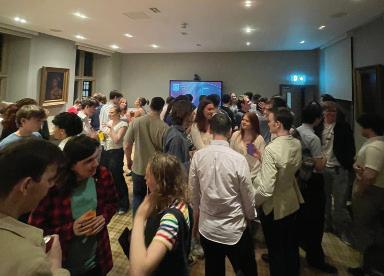
ed in these societies, but for people on the outside looking in, or trying to get involved, I can see the tight-knit nature of these societies somewhat offputting.
“
Perhaps as a result of the same people attending all of the societies, there is a degree of group-think present, with most giving speeches which are roughly in the same vein
The reasoning for this is twofold - firstly the need to give speeches to be known, and secondly the ambiguous processes of running for commit-
tee. On the first point, standing up in a room full of highly intelligent and highly political individuals to give a speech outlining your position on a contentious issue is definitely a barrier to entry, especially when you are met with people who will definitely end up in the House of Commons one day.
Each of these societies have their own electoral processes, each unique in their own way, each tailored to producing a committee which supposedly aligns with the political party they represent - or how that party is perceived within Oxford.
Perhaps as a result of the same people attending all the societies, there is a degree of groupthink present, with most people giving speeches which are roughly in the same vein with a little bit of centre left and centre right divergence. This, perhaps, perpetuates the first problem where the same people dominate the societies because (in the main) those with opinions which diverge from the popular consensus don’t voice them.
Lastly, we need to talk about the Oxford Union (sorry). Unsurprisingly, an event which attracts most of Oxford’s political scene attracts its fair share of union hacks, with a great number turning up every week, especially as we get closer to the election. Whether they are part of the Oxford political society clique is up for discussion, as is whether they are a positive or negative addition.
But for all the flaws, cliquiness, and potential groupthink of Oxford’s political societies, they are an integral, formative part of my Oxford experience and I wouldn’t have them any other way.
It goes without saying that Oxford’s political societies are one of a kind, and, saying this, as a proud member of all three major political societies, that despite their oddities, political posturing, and homogenous opinions, they aren’t that bad really. Why don’t you see for yourselves? We’d be happy to have you.


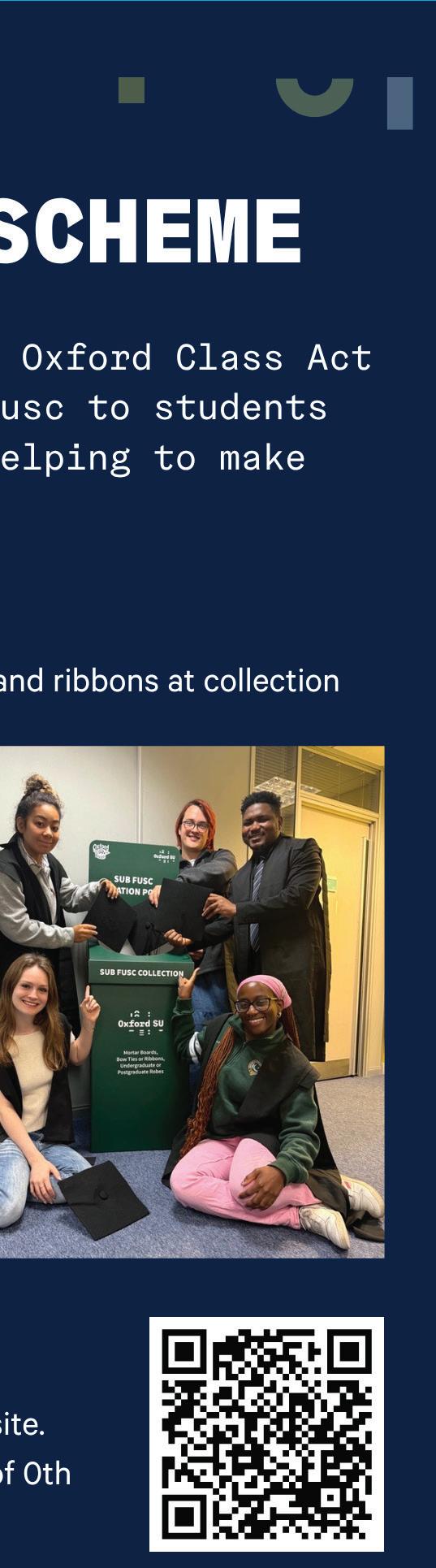
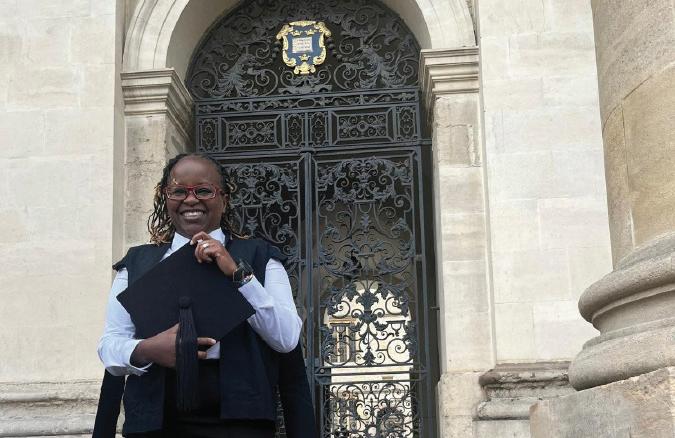
how we live out love in the world. Oxford has given me both the language and the conviction to act. Academic and real-world exposure have collided.
Can you describe a moment from your experience that has stayed with you? What made it significant?

Lydia Kibaara moves through the world with a kind of forward motion –the same steady, determined rhythm that carries her along the trails she loves to run. Now a student at the University of Oxford, reading theology at Wycli e Hall, she brings that momentum into every part of her life. Her work as Volunteer Engagement Manager for e Salvation Army, her training as a mediator, and her formation as an ordinand all speak to the same truth: she carries an innate, ignited passion for helping others.
Loving thy neighbour is a default setting not a sideline for her; the pulse beneath everything she does. What made you interest-
ed in charity work during your time at Oxford?
My interest in charity work was not something that began suddenly at Oxford –it has however deepened and grown here. Charity
involvement is something that is innate for me. ‘Charity begins at home’ is what I grew up hearing. Working at USPG (United Society Partners in the Gospel) exposed me to the structural
realities behind poverty, inequality, and exclusion whilst volunteering to walk the Camino Frances from St Jean Pied-de-Port to Santo Domingo de Calzada for Refugees grounded that awareness in lived experience. Refugees, asylum seekers and immigration discussions is divisive at the moment, and I feel drawn to explore how best the public can best understand what the differences are. Charity is not about responding to immediate need, but about understanding systems, dignity, and justice. My personal faith is growing, and I am beginning to see service not as an optional extra, but as something intrinsic to
Walking the Camino, I met other pilgrims and we walked together in silence for a while before they began to share their story as to – anxieties, loss, worries, but also the hope they sought. There was shared humanity. I was not there as a “helper” or “professional”, just as another person walking alongside others. It reminded me that charity at its most meaningful is not transactional – it is relational. Walking with my family also meant building stronger bonds to sustain me when the road ahead seems tough. Most refugees do not have that support. These moments stayed with me because it reframed what it means to serve: sometimes it is simply to be present.
Why the Camino?
I spend a lot of time encouraging others to give their time in service. The Camino walk felt like an opportunity to live that out personally – to slow down, listen and walk with intention. The pilgrimage was undertaken in support of USPG’s refugee appeal, a cause close to my heart as I am constantly trying to reconcile how faith and the church should respond to the current debate on migration. In the questions of belonging, identity and hospitality that occupy the public debate, how should religious communities respond? The experience also resonated with my theology training, pilgrimage is understood not simply as movement across geography, but as inner formation. I walked the Camino to re-enter the world more attentively. The idea of being a sojourner became central
to the experience. As Cicero said: “Not for ourselves alone are we born”. Working in volunteering reminds me that society is still capable of kindness without transaction. Time is a precious commodity as the only non-renewable resource we have. Volunteers give of it generously. In many ways, the journey was less about arriving in a destination and more about rediscovering what charity, faith, and community look like when reduced to their simplest form: walking together
How has your involvement, particularly through or alongside Wycliffe college, shaped your understanding of helping others?
Training at Wycliffe Hall has deepened my understanding of charity by grounding it in something far richer than goodwill alone. It has introduced
me to the biblical narrative of justice, mercy, and reconciliation, where helping others is not about hierarchy, but about restoration and community. It has challenged me to ask harder questions: Are we empowering or unintentionally disempowering? Are we addressing causes or symptoms? It has also reminded me that every person carries inherent dignity, being made in the image of God ( Imago Dei ) which transforms how we engage with those we seek to support. “It’s less about what I do for others, and more about how I recognise Christ in others.”
Studying scripture has shifted my focus from “helping” to “accompanying.” Read the full article online at www.oxfordstudent. com

Looking back at the path that led you to the MPhil and DPhil, which moments – major or barely noticeable – first pushed you toward ques tions of justice, responsibili ty, or global inequality?
I grew up in Bristol, a city that was shaped by the legacies of slavery and empire, and was riven with inequality in the 1980s and 1990s. I was brought up in a single-parent household by a mother who went to university for the first time in her 40s, and raised me on a combination of benefits and student grants. But I also received a government-funded assisted place to attend an excellent school, and my father, although not living with us, was a university lecturer. All these contradictions were probably the starting point for me asking ques -
tions about social justice.
As an undergraduate I had an unexpected opportunity to spend part of my summer vacation doing voluntary work in a reception centre for asylum-seekers in the Netherlands. It was the time of the Kosovo crisis and refugee issues were very visible in the media, but I knew very little about refugees. I had gone there
“ [...]what I discovered was a source of inspiration [...]
expecting to feel a sense of pity but what I discovered was a source of inspiration – people with skills, talents, and aspirations. A Bosniak lawyer taught me the basics of public international
intimidated me, and I assumed everyone would be much clever than me. When I finally got here, I found ‘my people’ and that enabled me to thrive. For me, that was St Antony’s College, very international and diverse, and full of idealists hoping to solve big global challenges. I also got involved with competitive debating, travelling to World and European debating championships. So my graduate student experience of Oxford was international and outward-looking, and I was privileged to be taught and mentored by academics I found relatable and engaging.
If you could speak to your twenty‑year‑old self, stepping into the Oxford courtyards for the first time, what would you say about purpose, courage, and the kind of work that truly matters.
ever, the times when I have struggled the most have been when I have been uncertain of the right thing to do. Many of these have come as a policy-engaged academic, being asked for input by governments and international organisations in a field clouded by moral ambiguity. The 2015-16 European ‘refugee crisis’ was one of those moments for me, when my work received significant media and policy attention. The challenge for me was in trying to find the right path between idealism and pragmatism in how best to frame research insights in ways that would expand rights and opportunities for refugees against the backdrop of increasingly illiberal politics.
law, an Iranian Olympian tried to teach me table tennis. And yet, people were denied the right to work, stuck in limbo, and in many cases faced deportation. This ignited my interest in understanding the politics of why governments would stop people fleeing persecution from accessing socio-economic rights, and in the economics of how refugees can contribute to host societies.
How did you imagine Ox ford before arriving, and how did the reality, the atmosphere, the people, and the rhythm change or deepen that expectation?
I was actually rejected by New College to read PPE as a 16 year-old interviewee. The college wrote to my school saying that I was too shy and intellectually immature. Partly as a result of that experience, Oxford
Finding a ‘why’ was really important for shaping my experience of Oxford. My practical experiences of working with refugees had given me a sense of direction. At the time, there was so little research on the politics and economics of refugee protection that I had a really clear vision for what I wanted to do. I certainly wasn’t the brightest or the best social scientist in Oxford, but committing to trying to do something that I believed was worthwhile and could make a difference gave me the motivation to persevere. With hindsight, I also got breakthroughs when I tried things that were probably a little bit audacious – being prepared to ask people for opportunities or introductions, or being willing to try something new.
There are times when one person feels responsi ble for almost everything happening in the world. Was there a period, before or during Oxford, when you felt such a burden, and how did you learn to live with it without losing meaning or direction?
I have learned to let go of what I cannot control. How -
You completed your doc torate in less than eigh teen months while work ing at UNHCR in Geneva. How did that period shape your understanding of humanitarian work and shape you personally?
“ I have learned to let go of what I cannot control.
I had a relaxed supervisor, who let me take a job at UNHCR alongside my DPhil because it enabled me to access archival material and interviews. I finished quickly because it was motivating to be reminded daily of why the research mattered for practice. I was working on initiatives to create solutions for Somali refugees in the Horn of Africa. While I met many inspiring people, I was confronted by the limitations of the UN system, including risk aversion and an unwillingness to engage with the underlying politics that ultimately shapes international protection. The recognition that humanitarian work is deeply political has been an enduring theme in my work ever since. Read the full article online at www.oxfordstudent.com


Huzzah! Huzzah! After nearly 1,000 years of waiting, this bastion of intellectual excellence has nally got around to a solution for Oxford’s dire summer heat. While it may not come around often, when the great young minds of this city are forced to deal with any inconvenience of the most mild heat, all hell breaks loose. ese old buildings, constructed with the brutal cold of Oxford winters in mind, simply weren’t able to accommodate this new technology, until now! AC, a new technology which has been enjoyed by our lovely friends across the pond for decades, is nally making its way into England. You know that deathly feeling when you walk into your college room, so heavily insulated that it has turned into a cauldron of boiling heat ready to evaporate you? Never fear again! For the Gods of air conditioning have shined down upon Oxford. Finally, we won’t have to go about our heavy academic workloads with the dreading fear of heat stroke. We can now focus on being killed in other ways. Whether that be from a particularly intense tutorial, a bus driver with a death wish, or being crushed by the tourists walking down St Giles, we can now rest easy knowing
that we won’t be taken down by feeling like we live in the devil’s armpit! Has this been an invention known to the rest of the world for decades?
Yes. Should you still say, “well it’s only hot like this for two weeks, so who cares?” Of course. Who wants to be comfortable in their own room? Who wants to not feel like Apollo is taking out his anger on us lowly Englishmen? Maybe Reform and their climate change experts can explain this one… Maybe we deserve to su er in this heat and despair. Maybe our egos at this university are so large that they are making us a target for the great orange orbs wrath. But I don’t really care. No, I will not stop complaining about this 3rd world country and its lack of modern technologies. And, yes, you will be subject to my complaining at all times. Until this country decides it doesn’t want thousands of its citizens dying every year of heat stroke, you’ll have to put up with me.
I nally get it, Britain, your country can’t handle the heat.
Read more online at www.oxfordstudent.com
We asked you, our beloved readers, to send in your worst tute experiences. We were expecting a few blunders, some misremembered quotes, maybe even some tutors who told you your work was shit, but how, where is the University nding these people to employ!? However, take comfort in the fact that whilst
these experiences were bad, really bad, there are people out there who have ‘supervisions’ at Cambridge. What an odd word! Tute supremacy, always. All jokes aside, we really appreciate everyone who wrote in and can’t wait to hear what you have to say next. Keep an eye on our Instagram so you don’t miss out. v
“Faced an AI accusation in my first ever tute (it was proven false do not worry)”
Don’t worry, I wasn’t worried. But good for you! ese tutors and their pessimism will be the death of us, if the environmental e ects of AI don’t get us rst...
“Got asked if i had felt unheard or neglected as a child because of my tendency to overexplain”
Ouch! Were you? Come on, give us the juicy details here. Sounds like your tutor is projecting, because what else does do they really do other than overexplain?
“Wrote the wrong essay”
We’ve all been there.
You’re already doing better than the students who wrote 0 essays. But really, how do you do this? Sounds like somebody needs a planner, or just a night o from drinking...
“one time i forgot to read the set text for my tute, had to bluff my way through the entire thing”
it, right!?
“my tutor called themselves mommy in an email telling us that we still had to come to our tute even though it was hot”
Oh! I hope Tesco’s had enough bleach in stock... e heat gets to us all, sure, but this feels inexcusable. If you didn’t turn up to that tute, I’m positive that email could be used as evidence in an academic disciplinary meeting.
“a tute got terminated by the dean in less than 10 minutes because one person turned up late and two came with no laptop ”
Wow. ese are supposed to be the brightest people in the country and they can’t even remember their laptops. Let me guess, PPE students?
Wake up, 8:30am, game starts at 11am. 10am meet. Feel horrendous, sweating, head pounding. Is it prematch nerves? Or the eight pints at Lamb and Flag the night before? Hard to tell. Full ablution follows, walk out of college and on to Sainsbury’s. Electrolytes to be acquired. Only thing I can stomach is two small pork pies and a Lucozade sport. Feeling great now.
Open google maps, see that Iffley Road is 25 minutes away. Sigh. Flag down taxi. 15 quid gone – must remember to put that on the club tab. Get to Iffley Road, see the shining lights and the pitch inside
the running track. This is why I came to Oxford. Walk into changing room. Wrong one. Opposition look good. One of them has a beard, must be a postgrad. Shit. Walk into the other changing room, my changing room. See the boys. Wow. The Boys. Fresh from team breakfast and a drinking ban the night before. One of them has shaved his head for a laugh. Patriot. One of them is eating a banana, staring blankly at the wall. Athlete. Another’s in the stalls, groaning. Substitute. I take my place. Strike partner is next to me. “Nice to meet ya,” he says. A good omen. I strip off, rustle through my bag for shorts and socks. Socks
and shorts on, shin pads loaded. Boots on, laces tied. Get a shirt from the kit bag: No. 17. Not ideal: Nani’s and myplay styles arenot that similar. Oh well, it will have to do. Shirt on, chit-chat with the boys. Rustle further into my bag. Eureka. ‘Deep Heat’. Shorts back off. Spray loins religiously, begin to choke on the fumes. Centre mid chirps up, “Is that Deep Heat?”. I nod. “I’ve run out of Voltarol, back’s killing.” Spray centre mid’s entire back. Very large surface area. Warm up time. Walk outside, the soft crunch of studs on tile music to my ears. Almost trip over that weird white rail separating the running track from the grass. Great start. Begin

running about, kicking balls. Shooting drills. Strike partner and I don’t score one between us. Game ready. Look to the stands, few familiar faces, all looking glum. Head back inside.
Team talk. Stench of Deep Heat hits the nostrils and
then the throats of every team member walking back in. Coughing starts. Warming up the lungs. El Capitán rouses the team...
Read the full article online at www.oxfordstudent.com
On May 23rd, Iffley Road played host to this year’s Varsity athletics match. The track, which was newly resurfaced last summer, was ‘opened’ by the Vice-Chancellor Professor Irene Tracey in the morning. Each event saw two Oxford athletes go head-to-head against a brace of Cambridge athletes, with five points awarded to the winner, three points to second, two points to third and one point to fourth place; a points system
aiming to reward the winning university in each event. Each university entered a pair of two-person teams per event (the main Blues team and a IIs team), meaning that there were four team trophies on offer (men’s and women’s Blues, men’s and women’s IIs), as well as the para-match, which saw 100m, 400m and 800m races take place. By the time the first event (the non-scoring ‘open’ mile) got underway soon after 10.30am, it was already well over 20
degrees. Heat played a factor throughout the day, with the sun beating down heavily. This made the performances all the more impressive, starting with young GB athlete Rebecca Flaherty, who under the midday sun broke the Varsity 5000m record in a time of 16 minutes 5 seconds (in a race where the heat wreaked notable havoc). She lapped both of the Cambridge athletes along the way. By this point, we had already seen a Varsity record in the men’s Blues high jump,
as Oxford’s Tom Blackburn cleared 1m 95, a 10cm PB. Tom Barrett had won both the 2024 and 2025 Blues 800m, but this year was on the IIs team. He led the quartet out and was ahead for most of the race but lost out to Cambridge’s George Warren at the end. In the men’s Blues 800, Jack Organ was heavy favourite and had not hidden in the lead-up to the race that he was targeting the Varsity record of 1:48.5. The athlete who missed last year’s Varsity match be-
cause he was competing for GB led from gun to tape, running most of the second lap completely on his own, and came away with a time of 1:49.08, extremely close to the record. Despite missing it, this was a fantastic solo effort from the second-year undergraduate student, who will hopefully have next year’s event to have another crack at the record...
Read the full article online at www.oxfordstudent.com