

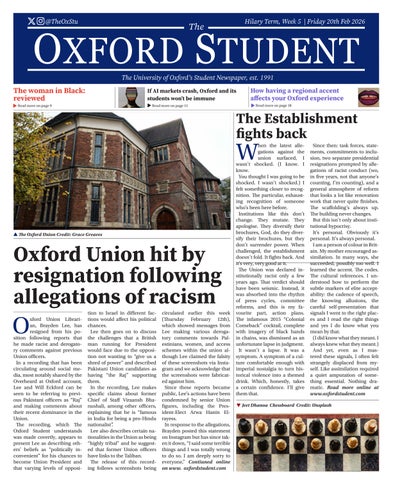
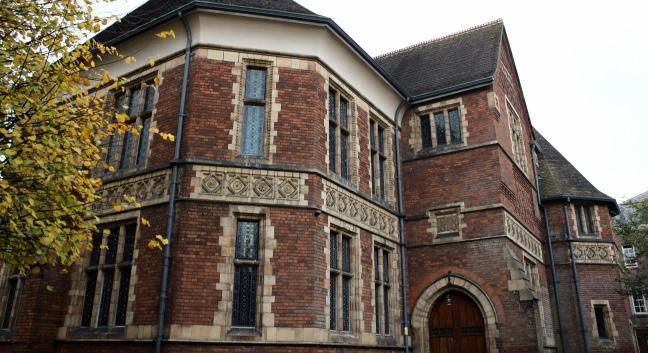
Oxford Union Librarian, Brayden Lee, has resigned from his position following reports that he made racist and derogatory comments against previous Union officers.
In a recording that has been circulating around social media, most notably shared by the Overheard at Oxford account, Lee and Will Eckford can be seen to be referring to previous Pakistani officers as “Raj” and making comments about their recent dominance in the Union.
The recording, which The Oxford Student understands was made covertly, appears to present Lee as describing others’ beliefs as “politically inconvenient” for his chances to become Union President and that varying levels of opposi-
tion to Israel in different factions would affect his political chances.
Lee then goes on to discuss the challenges that a British man running for President would face due to the opposition not wanting to “give us a shred of power” and described Pakistani Union candidates as having “the Raj” supporting them.
In the recording, Lee makes specific claims about former Chief of Staff Viraansh Bhanushali, among other officers, explaining that he is “famous in India for being a pro-Hindu nationalist”.
Lee also describes certain nationalities in the Union as being “highly tribal” and he suggested that former Union officers have links to the Taliban.
The release of this recording follows screenshots being
circulated earlier this week (Thursday February 12th), which showed messages from Lee making various derogatory comments towards Palestinians, women, and access schemes within the union although Lee claimed the falsity of these screenshots via Instagram and we acknowledge that the screenshots were fabricated against him.
Since these reports became public, Lee’s actions have been condemned by senior Union figures, including the President-Elect Arwa Hanin Elrayess.
In response to the allegations, Brayden posted this statement on Instagram but has since taken it down, “I said some terrible things and I was totally wrong to do so. I am deeply sorry to everyone,” Contiuned online on www. oxfordstudent.com
When the latest allegations against the union surfaced, I wasn’t shocked. (I know. I know.
You thought I was going to be shocked. I wasn’t shocked.) I felt something closer to recognition. The particular, exhausting recognition of someone who’s been here before.
Institutions like this don’t change. They mutate. They apologise. They diversify their brochures, God, do they diversify their brochures, but they don’t surrender power. When challenged, the establishment doesn’t fold. It fights back. And it’s very, very good at it.
The Union was declared institutionally racist only a few years ago. That verdict should have been seismic. Instead, it was absorbed into the rhythm of press cycles, committee reforms, and this is my favourite part, action plans.
The infamous 2015 “Colonial Comeback” cocktail, complete with imagery of black hands in chains, was dismissed as an unfortunate lapse in judgment.
It wasn’t a lapse. It was a symptom. A symptom of a culture comfortable enough with imperial nostalgia to turn historical violence into a themed drink. Which, honestly, takes a certain confidence. I’ll give them that.
Since then: task forces, statements, commitments to inclusion, two separate presidential resignations prompted by allegations of racist conduct (wo, in five years, not that anyone’s counting, I’m counting), and a general atmosphere of reform that looks a lot like renovation work that never quite finishes. The scaffolding’s always up. The building never changes. But this isn’t only about institutional hypocrisy.
It’s personal. Obviously it’s personal. It’s always personal. I am a person of colour in Britain. My mother encouraged assimilation. In many ways, she succeeded, possibly too well. I learned the accent. The codes. The cultural references. I understood how to perform the subtle markers of elite acceptability: the cadence of speech, the knowing allusions, the careful self-presentation that signals I went to the right places and I read the right things and yes I do know what you mean by that.
(I did know what they meant. I always knew what they meant.)
And yet, even as I mastered these signals, I often felt strangely displaced from myself. Like assimilation required a quiet amputation of something essential. Nothing dramatic. Read more online at www.oxfordstudent.com
Jeet Dhanoa Chessboard Credit: Unsplash





It’s big blue week 5, and things are busier than ever. For the finalists, dissertation deadlines loom, and for others, election season is close at hand. In terms of OxStu goings on, things are also pretty busy. We’re so excited for our week 6 panels, one on Wuthering Heights and one multimedia extravaganza! I’ve been hurtling around like a headless, journalistic chicken. I must admit that the opportunity to speak with the former editors of NME and Vogue has rendered me a bit starstruck, so nerves are high. It’s the first time in a while that the OxStu has brought panels to the forefront, so dusting off the cobwebs and flexing the networking muscle has been a

Well, well, well… what a week! I say that, but as I am writing this, it is only Tuesday; I’m sure there is much more to come. As somebody who has never stepped foot in the Ox-
Editorial Board
Ava Doherty and Hannah Stewart (Editors-in-Chief)
Lila Robinson and Tamar
Okunhon (Associate Editors)
Will Lawrence (Director of Business Strategy)
Opinion and News
Gabriella Bedford (News Editor)
Audrey Miu, Christine Savino, Lydia Willmott Day, Nayel Huda, Marcus Swinerd, Olivia Miller (News Section Editors)
Marcus Swinerd (Opinion
Editor)
Sehr Laiba, Arun Lewis, Guilherme Lopes, Saara Lunawaat,
hell of a process. Admin bores me so, and my article writing hand grows rusty. I have many articles loaded into my journalistic chamber and floating about in my brainscape. Articles on plant based food, avant-garde music and vampires are all on the horizon, however, with all of the ongoing Oxford drama, I guess that’ll have to wait. So sit back and enjoy this print edition of the OxStu. We’ve got loads of scandal this week, so hopefully it’ll take your mind off the week 5 blues.

This week everyone is either resigned, outraged, or rereading Victorian trauma for fun.
ford Union, apart from browsing the plant and poster sales, it is great to sit back and laugh with some popcorn. Anyway, before my high horse hits the clouds, let’s look to the print and the week ahead! Welcome to week five, where colleges and departments do everything to ‘welfare’ us; throwing farm animals, craft nights, and free food in our faces to distract us from the fact that they are not too bothered about our welfare that they would ease our workload or be more understanding when they re-
Audrey Miu, Saba Ahmadzadeh Noughani, Tiffany You (Opinion Section Editors)
Investigations
Jason Manning (Deputy Editor)
Daniela Braw Smith, Sam Drury, Baybars Charkas, Ananya Bhatia, Bianca Orphelia Molinet, Stefano Bates (Section Editors)
Culture
Ivett Berenyi (Deputy Editor)
Elliot Wang, Flora Molnar, Elizabeth Gammaidoni, Isaac Hole, Nora Jessie Mackay (Section Editors)
Jasmine Joyan (Poetry Editor)
Let’s begin with Peter Mandelson, a man who has had more reinventions than my situationship. His latest political pirouette proves that in British public life, resignation is not an ending. It is more of a costume change. The man leaves, the headlines scream, and somehow he remains exactly where he always was: hovering, influential, faintly Machiavellian. You almost have to admire the stamina. Closer to home, the Union Librarian has resigned amid allegations of racism, which feels less like a plot twist and more like a reminder that
ceive badly-written emails in the early hours of the morning begging for extensions. If your tutors are not prepared to do anything to support your welfare, let this week’s print soothe your troubles. We have everything from Hungarian politics to Mandelson’s creased loafers and double oven, so there really is something for everyone. So sit back, try to relax, enjoy the contents of this paper, and try not to explode when thinking about the state of the world.
Features
Luke Erly (Deputy Editor)
Ansu Bhattarai, Aamina Thava, Izzy Goldberg, Honcques Laus, Emily McPhee (Section Editors)
Business and Finance
Guilherme Lopes (Deputy Editor)
Gabriella Austin, Faris Firoozye, Leila Hoffpauir, William Lawrence (Section Editors)
Identity Emily Cunnington (Deputy Editor)
Celine Leung, Becca Bushee, Frieda Fahrenholt, Neha Ganvir, Maryam Bhatti (Section Editors)
even in spaces devoted to books, people still struggle to read the room. Universities love to brand themselves as bastions of enlightenment. And yet. It turns out you can alphabetise oppression but that does not mean you have dismantled it. Accountability should not be radical. It should be basic admin. And then there is Wuthering Heights by Emily Brontë, which we insist on calling romantic, as if locking someone in a house on the moors is just a quirky love language. Heathcliff is not a boyfriend. He is a warning. The novel is less passionate yearning and more generational trauma with impressive wind conditions. This week’s theme? Power lingers. Prejudice festers. And the moors are never just scenic. See you next issue. Ava
Lila Robinson University College
Profile
Vincent Chang (Deputy Editor)
Himasweeta Sarma, Hannah Ison, David Binns (Section Editors)
OxYou
Kit Renshaw-Hammond(Deputy Editor)
Tea Sand, Ivaana Mitra (Section Editors)
Sport
Charles Prestwich (Deputy Editor)
Tod Manners, James McInerney (Section Editors)
comment@oxfordstudent.com | Deputy Editor: Marcus Swinerd
Section Editors: Sehr Laiba, Arun Lewis, Guilherme Lopes, Saara Lunawat, Audrey Miu, Saba Ahmadzadeh Noughani, Tiffany You
In January, 49 BC, Julius Caesar led a Roman legion south, crossing the Rubicon River. Caesar was allowed to command troops in his province, but only elected magistrates could do so in Italy. By traversing the northern boundary with his men, Caesar committed an act of treason, making conflict inevitable and plunging Rome into civil war. Legend holds that as he forded the river, Caesar declared, ‘alea iacta est’— ‘the die is cast’.
Today, we refer to ‘crossing the Rubicon’ as ‘reaching a point of no return’. People have ‘crossed the Rubicon’ when they do something irrevocable. A movement’s ‘Rubicon’ is its tipping point, when it becomes irredeemable.
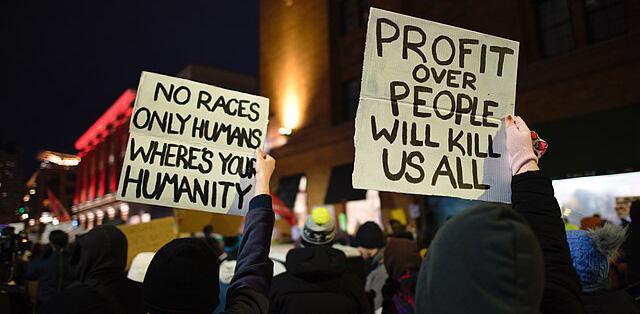
This January, US citizens Renée Good and Alex Pretti were shot and killed in confrontations with ICE. Operation Metro Surge, the deployment of ICE in Minneapolis, has brought thousands of agents into the neighbourhoods of a major American metropolis. ICE agents have revelled in filling out their massive quotas with a wanton use of force. Outraged by scenes of people being beaten, pepper-sprayed, shot with rubber bullets,
and dragged from their cars, Americans have flooded the streets in protest, creating battlegrounds as federal enforcers and protesters collide. Some citizens have joined Signal groups to track agents and warn their neighbours. Chilling cries of “They’re here!” and “Lock your doors!” fill suburban streets as ICE Trucks roll in.
This goes well beyond immigration. It is political the -
“ Truthfully, you don’t have to cross the river quickly – just steadily, so that each previous step feels inevitable and the next one immaterial.
atre against ‘disloyal’ blue cities—a test of the government’s power to use force against its own citizens and violate their constitutional rights. When Trump calls witnesses and protesters criminals, he is threatening the First Amend -
ment. When the head of the FBI says that bringing a gun to a protest is a pretext to be treated as a terrorist and shot, he is threatening the 2nd. When ICE agents stop or arrest people without any cause but their skin colour, or search them without a warrant, they violate the 14th and 4th.
There is a sense that something irreversible has happened in plain sight.
Many will feel the urge to speak out—to unpack and understand every statistic, statement and meaning. I do not wish to do that today. All I wish to do, dear reader, is ask you a simple question: When do we cross the point of no return?
This is not an easy question. After all, the Rubicon is not the Nile River; it is a small stream resigned to history. It is rare to know that something was decisive until it has already come and gone. We search for the riverbank and pray that we didn’t cross it sometime back.
Maybe we are not standing at the north bank, judging the distance. Maybe we are ankle deep in the water – or waist deep, or just feet away from the southern shore.
Read more online at www. oxfordstudent.com
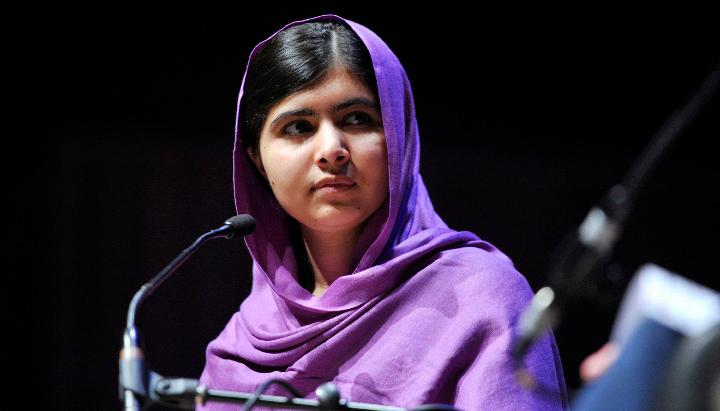
Nobel Laureate and Oxford alumnus Malala announced on Wednesday that applications are open for her new Malala Yousafzai Scholarship for Pakistani Women. Eligible applicants are Pakistani nationals or British Pakistanis pursuing Oxford University Master’s degrees (MSt/ MPhil) with strong academic records and leadership potential, particularly from remote or disadvantaged regions. The scholarship is housed within Lady Margaret Hall and provides full-tuition support for the entire duration of recipients’ programs. Lady Margaret Hall also unveiled a portrait of Malala at its Founders and Benefactors Dinner on 11th February, commissioned from artist Isabella Watling.
In an online statement, Malala wrote: “[w]hen I graduated from Oxford, it was really important to me to do something for girls like me who fight for their right to school to be able to pursue higher education.”
The Oxford University Ukrainian Society are hosting a peace rally in Radcliffe Square on 22nd February. The rally will include speeches from students, volunteers, supporters of Ukraine, veterans, and a lawyer to call on politicians to take action regarding the ongoing conflict.
The members of the Oxford Union have voted in widespread reforms to the appointment of unelected officials and those who are eligible to stand for President. The reforms reduce the term that unelected officers, such as the Senior Treasurer and Senior Librarian, are in office from three years to one, and mandates a fallow term between being a member of Standing Committee and running for President.
The motion was originally carried in last week’s (Thursday February 5th) main debate, but was delayed until this week’s after debate to be voted on.
Oxford Labour Club hosted Higher Education Minister, Jacqui Smith, for an event discussing the future of higher education. Discussion topics ranged from the sustainability of funding for higher education institutions and the recent controversies surrounding student loans.
Oxford University Liberal Association hosted their annual dinner, with Max Wilkinson MP as their guest speaker. OSLA also hosted the Liberal Democrats’ Higher Education spokesperson, Ian Sollom MP, earlier this week. Additionally, nominations are open to stand in the next OSLA election.
Oxford University Conservative Association have continued a term with many speaker events, hosting Caroline Nokes MP and Steve Baker in recent days. Additionally, nominations are open to stand in the next OUCA election.
Oxford Reform Society hosted their first speaker event last week with David Starkey CBE on ‘Mandelson and the Rise and Fall of the New Labour Syste, of Corrupton’ discussing the history of Labour and Mandelson.
In a time of extreme political turmoil and division fracturing the US and the rest of the world, many choose the safety of silence. But silence and apoliticism is never neutral. We are living in a climate where ICE raids, deportations, and anti-immigration policies are tearing families apart.
To remain ‘neutral’ amidst this landscape is merely a polite way of sliding with the status quo and the oppressorthose currently attempting to dehumanise and diminish the marginalised.
But neutrality is an impossibility for some. For artists like Bad Bunny - artists of colour, queer artists, indigenous art-
ists - existence itself is a political act. Their lived experiences simply don’t permit a neutral existence, because the world has already politicised the colour of their skin, their language, and their love.
Bad Bunny’s recent performance at the Super Bowl halftime show wasn’t even remotely divisive: he came to the stage with a simple message of unity. The performance and the visual storytelling was one big love letter to his native Puerto Rico, an unincorporated territory of the US.
Despite this, President Donald Trump announced on his social media platform Truth Social that Bad Bun-
ny’s set was “absolutely terrible, one of the worst, EVER!”. Floods of messages from ‘Make America Great Again’ (MAGA) and right-wing conservatives echoed this sentiment, labelling
“
Bad Bunny’s Super Bowl performance wasn’t remotely divsive
the performance as ‘anti-American’ and ‘divisive’.
This all stems from the current era of MAGA politics which actively seeks to narrow ideas about who truly ‘belongs’ in
America, alienating Latinos among a broader spectrum of those deemed ‘other’ from its sense of national identity.
But there is a profound irony in calling a message of unity ‘divisive’. This backlash revealed an uncomfortable truth: to a certain demographic of the population, the mere presence of a Spanish-speaking artist on an American platform is an act of aggression.
Yet, the fact that Bad Bunny stood on stage performing only in Spanish was not a radical act. He was unapologetically himself, refusing to compromise on his cultural truth.
Continued online on www.oxfordstudent.com
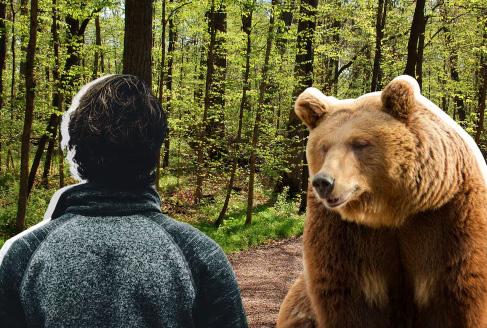
In 2024, a TikTok trend asked women “if you were alone in the woods at night, would you rather encounter a man or a bear?” My first response was to say “bear”. At worst, a bear would eat me. But at worst, a man couldI didn’t even want to imagine it.
I thought again, if I see a man, there’s a more or less 50% chance I’d be in danger, but if I see a bear, there’s probably a 100% chance I’d be in danger. Surely it would make more sense to choose the man and bet on that 50%? I choose a man then. I didn’t think much of it.
But after noticing that most women on TikTok were also choosing the bear, I questioned what exactly we as women
have endured, to fear men as a population this much. That in a dangerous situation, we wouldn’t feel relieved to see a man, we would rather see a wild animal. In such situations, choosing the bear means choosing a death sentence, and in most cases, myself included, women chose this first over seeing a man. At the time, I felt we were being perhaps a little harsh to the trustworthy men in our lives.
This is despite the fact that I have also been harassed by men. When I was 13 and walking home from school, a shirtless man came waving his shirt at me and shouted “I’m going to pull your hijab off”. It bothers me to this day that in that moment, I felt more ‘grate-
ful’ that he didn’t follow through with his threat, than angry that he felt comfortable enough to verbally abuse a schoolgirl in uniform.
During my year abroad, a taxi driver who made me feel extremely uncomfortable during a ride came back to my accommodation at the same time the next morning. I was shaken to realise that since he dropped me off
to university from my accommodation once, he now knows my whereabouts and schedule. He was now keeping track. Even if he was not being outwardly dangerous, he was still attempting to intimidate me. As if to warn me: I am watching. Most recently, I was walking alone down a residential road.
Continued online at www.oxfordstudent.com
On 11th February in Bicske, Hungary, Tisza Party leader and prominent politician
Péter Magyar kicked off his 2026 election campaign. Magyar’s Tisza Party is the only viable opposition to the currently governing Fidesz, led by Viktor Orbán. Magyar gained momentum in 2024 after a quick and severe succession of corruption, clemency, and child abuse scandals.
Back then, Magyar seemed to be the voice of reason against a government whose reign crippled the country financially and rendered countless young people in foster care extremely vulnerable. Fidesz’s reputation is at its worst, and people are beginning to put their faith in Magyar. This, however, should not protect him
from scrutiny when he accuses Filipino guest workers of eating “ducks” and “goldfish” in zoos.
The two-hour-long event was livestreamed on his official Youtube channel. In his speech, he addressed some of Hungary’s most controversial and problematic current affairs. In general, he spoke in his usual, measured, tasteful, yet unflinchingly critical tone. He addressed corruption, the government’s failure to protect children in foster care, and János Lázár’s blatant anti-Roma racism.
Needless to say, all these issues deserve discourse at the very least, considering that Fidesz is failing not only in legal retaliation or meaningful action, but also in the simple act of transparently addressing their wrongdoings. In light of Fidesz’s governance (and lack thereof), I expected better from the
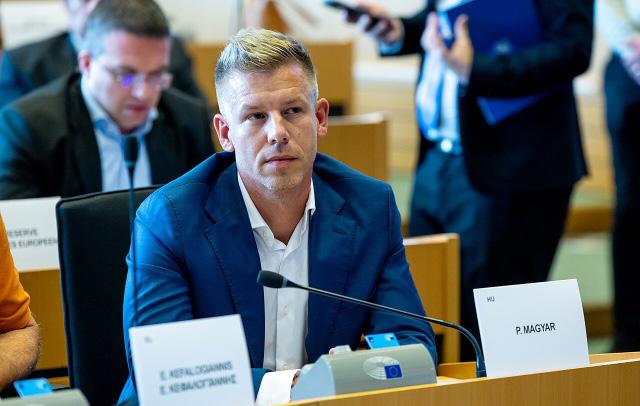
opposition. However, at approximately fifty minutes into the livestream, Magyar made an extremely controversial statement.
Magyar expressed dissatisfaction about the ratio of Hungarian to Ukrainian and Filipino employees in the Göd Samsung plant. For context, I recommend this English-language summary of Telex’s in-depth investigation of the environmental pollution and workers’ mistreatment at the plant.
Considering Fidesz’s extreme anti-migrant rhet-
The Oxford SU has released results for its leadership elections, which have taken place over the past week. 2862 students cast their votes, representing a 90 per cent abstention rate.
oric, the country has an interesting history of employing Filipino guest workers, predominantly in the agricultural and industrial sectors.
This matter is by no means uncontroversial, meaning Magyar’s statement invited the criticism of Telex journalist Ferenc Barkó-Nagy. In his short-form ‘Zacc’ [equivalent of ‘Satire’] article, he quotes the politician (translated by me): “All the employees at the Samsung Read more online at www. oxfordstudent.com

At 9am on the 15th June 2024 I took a break from my A Level revision and huddled with over one hundred Labour activists outside Parsons Green Tube Station in West London. We were there to listen to the then Shadow Attorney, General Emily Thornberry, launch a door-knocking session in support of Ben Coleman,
the Labour candidate for Chelsea and Fulham (a seat which, just a decade ago, had been among the most Conservative in the country). That morning, I felt a real sense of excitement at my ability to make a difference. This was vindicated when, at 6am on election night, Coleman was announced as having won the seat by just 152 votes. Beyond the local triumph I had renewed hope in the
future. I spent that summer smugly infuriating my friends by parroting Labour talking points to them, safe in my conviction that positive change was coming. The prospect of a Labour government excited me.
When I saw Sir Keir Starmer speak about votes at 16, economic growth or a green electricity grid, I believed him. While the lack of policy detail worried me as no amount of excitement could make the Labour leader appear charismatic, the idea that little would actually change did not cross my mind.
Now, I wonder if that hope was just youthful naivety. Did all my pleas for people to vote really matter? I’m no longer sure. Change has not come. Instead, the Mandelson scandal is just another in a host of events that make this government seem like
more of the same. Perhaps I should have known this would be the case. Excitement about the Labour government was not something I shared with many of my peers. Apathy and cynicism about politics among young people is well documented.
While I was busy extolling the virtues of Great British Energy, over half of 18-24 year olds did not vote in the 2024 general election. Even of those that did, I wonder how many felt any faith that anything would change. As I think more deeply about my experiences that summer, I realise the cause of my mistaken hope.
I recall the conversations I had with fellow activists. Much of it centred on the glee with which we anticipated the fall of major Tory figures Read more online at www.oxfordstudent.com
Roxi Rusu will be the next President for Communities and Common Rooms. Rusu will be joined on the Sabbatical team by Catherine Kola-Balogun, who won the Welfare, Equity & Inclusion contest. Representing Undergraduates next year will be Zagham Farhan, while the Postgraduate Presidency will be held by David Quan (who edged out incumbent Wantoe Teah Wantoe).
Rusu was uncontested in her race for President. Farhan faced off against Digby Gough-Boyack. Welfare and Postgraduates were the most heavily contested, with four candidates each. Kola-Balogun defeated Henry Morris (who ran their campaign alongside Farhan and Quan), as well as Fitzroy (Pablo) Wickham, and Khansa Maria. Quan not only won against the first incumbent to be allowed to re-run, Wantoe, but also topped India Kelly and Mergen Dorjnamjil.
As for Part-time Officers, Sthapatya Saketh Kotamraju won the International Students’ Officer election against Ayaz, Shkolnikov, and Pan. The next LGBTQ+ Officer will be Valerie Mann, and the Disabled Students’ Officer will be Regn Pooley. The next Societies Officer will be Janet Wang. All three faced no opposition.
A by-election will be held “in due course” for the remaining parttime officer roles, according to an SU spokesperson.
The three elected Student Trustees are Alisa Brown (outgoing President for Welfare), Honcques Laus, and Isabel Hetherington. In a statement, the SU emphasised that “We have been delighted to see so many students engaging with the SU Leadership elections and thank all students who took the time to run for and vote for all roles, at a time where democracy and representation matter more than ever.”
news@oxfordstudent.com | Deputy Editor: Gabriella Bedford
Section Editors: Audrey Miu, Christine Savino, Lydia Willmott-Day, Nayel Huda Marcus Swinerd, Olivia Miller
On 24th May 1956, the first Eurovision Song Contest took place in Lugano, Switzerland. The contest was built around the idea of unity: that all participating nations could come together, present their musical talents, and unify through music. The contest has been able to endure Franco’s Spain, Gorbachev’s Soviet Union and even the dissolution of Yugoslavia. However, as of late, Eurovision’s original message of unity has appeared to deplete as politics has become undeniably linked with the workings of the contest.
The European Broadcasting Union’s (EBU) decision to allow Israel to continue participating in the contest amid calls for the country to be excluded over the war in Gaza has caused major backlash and uproar. The continuation of Israel’s participation in the contest has even resulted in the boycott of four countries: Spain (a ‘Big 5’ country), Ireland, the Netherlands and Slovenia. This leads me to question, has Eurovision ever been truly ‘apolitical’? And, how does the future of the contest look whilst Israel is allowed to continue its participation?
Modelled on the famous Italian Sanremo Music Festival by TV writer Sergio Pugliese, the concept of Eurovision was then developed in January 1955, with the first contest staged in May 1956. Despite the original message of peace and unity, evidence of politics can even be traced back to the very first contest of Eurovision.
The song ‘Im Wartesaal zum großen Glück’, Germany’s 1956 entry by German Jew Walter Andreas Schwarz critiqued the country’s handling of its Nazi past. Portugal’s 1973 entry by Fernando Tordo, with
the song ‘Tourada’, subtly attacked Salazar’s dictatorship in the country during the dying years of the regime.
From the early years of Eurovision, politics has both provided a backdrop for the inspiration and artistry of entries. But it has also often become complex, notably in the 1969 contest that took place in Spain during Franco’s dictatorship.
In 1968, Spain won the contest for the first time with the song ‘La, la, la’ by Massiel. This meant the contest would be hosted in a Francoist Madrid the following year. Rumours of vote-rigging started to surface
“ the active, continued inclusion of Israel [...] is not an act of defiance, but of submission and denial.
after Spain’s win, with Germany’s decisive vote in favour of Spain being seen as a bribe to get the Spanish government to adopt the Phase Alternating Line (PAL) system for its colour television transmission.
In the 1990s, new countries entered the contest. Croatia, Estonia, Hungary and Russia were a handful of countries that would enter during this period as public broadcasters tried to shift the contest towards apoliticality, reducing the perceived ‘need’ for political discourse. However, this couldn’t be any further from the truth.
Since Armenia and Azerbaijan entered Eurovision in the late 2000s, the political tension in the Nagorno-Karabakh
region has entered into the dynamics of the contest.
In the 2009 contest, Igna & Anush represented Armenia with the song ‘Jan Jan’, receiving 43 televotes from the Azerbaijani audience. After voting results had been announced, the Azerbaijani government contacted those who had voted for Armenia, and several individuals were questioned on charges of ‘treason’ and ‘endangering national security’.
Widespread public fear emerged following these investigations into political views and national loyalty regarding voting for songs in future competitions.
For the 2015 contest, the Armenian participating broadcaster, the Public Television Company of Armenia (AMPTV) requested for its 2015 entry (by group Genealogy) to have its titled changed from ‘Don’t Deny’ to ‘Face the Shadow’, in light of claims that the title was a call for recognition of the Armenian genocide (from 1915 to 1923).
Tensions between Russia and Ukraine on the political stage remained largely amicable until the Russian annexation of Crimea in 2014 and the war in Donbas that followed.
In 2016, the Ukrainian entry (Jamala, ‘1944’) contained lyrics that referenced the deportation of the Crimean Tatars. Many viewed this song and performance as a political statement against Russia following the events in Crimea. Jamala was permitted to compete with her song, given the historical nature of the song, despite backlash from the Russian delegation and won the contest that year.
Despite the historical quality to Jamala’s song, it has been able to gain more impact and relevance in the current climate of Russia’s invasion of Ukraine.
In the 2022 contest, Ukraine


won with their entry ‘Stefania’ by Kalush Orchestra, with many viewing it as a sympathy vote due to recent Russian advances in its invasion of Ukraine.
Ukrainian broadcaster, National Public Broadcasting Company of Ukraine JSC (UA: PBC), was initially allowed to host the 2023 contest in Ukraine. However, due to the Russian invasion, the EBU decided that the country wouldn’t be able to host.
In 2023, the UK, which came in second place in 2022, was allowed to vote, and the contest felt like a warm hug to the country of Ukraine in light of recent political events. With
“ Biased, politically based voting has always been a silent assassin in the contest’s history.
the slogan of the 2023 contest, ‘United by Music’, this warm hug felt like an even stronger hug to Ukraine. Ukrainian president Volodymyr Zelenskyy requested to address the audience during the 2023 final, but was rejected by the
EBU, as not to politicise the contest.
The EBU decided to disallow the Russian Television and Radio Broadcasting Company (RTR) from competing as a national broadcaster in Eurovision from 2022.
Since Russia’s ban from Eurovision, Russian president, Putin, has decided to host his own version of Eurovision in Russia, called Intervision. With countries like Belarus, China and Vietnam competing, it is not surprising that Putin has viewed Eurovision as a political event, creating his version of the contest with countries that are his political allies.
Parallels between political situations in Russia and Israel can be drawn; whilst Russia has been excluded from the contest, it concerns me that Israel is still allowed to compete. Supposedly a contest of ‘apoliticism’, the active, continued inclusion of Israel in the contest is not an act of defiance, but of submission and denial.
Ahead of Israel’s participation in the 2024 contest in Malmö, Sweden, the outbreak of the conflict in Gaza in October 2023 was a clear backdrop to the event.
Firstly, the 2024 Dutch entry, Joost Klein (with his entry ‘Europapa’) was disqualified from Eurovision.
Read more online at www. oxfordstudent.com
Ava Doherty
If someone else, someone poor, someone brown, someone without a title or a column in a broadsheet, had done even a fraction of what Peter Mandelson has done, we would not be debating nuance. We would be using the word “traitor.”
Instead, he gets a rehabilitation tour. A glossy spread in The Sunday Times. Access to lawyers. A polished PR machine. And, let’s be honest, the quiet insulation that comes from being part of Britain’s old, pale establishment.
The public conversation about Mandelson drifts toward titillation, his association with Jeffrey Epstein, what he knew, who he met, and whether he understood the full horror of the abuse. Those questions matter. But they are not the only ones. What seems oddly absent is sustained outrage about the broader issue, repeated breaches of trust and the extraordinary elasticity of accountability when the right people are involved.
This did not begin with Epstein.
In 1998, Mandelson resigned as Trade and Industry Secretary over an undisclosed £373,000 loan from a fellow minister. In 2001, he resigned again, this time as Northern Ireland Secretary, after controversy surrounding a passport application linked to Indian billionaire Srichand Hinduja. These were not minor administrative oversights. They were judgment calls, the kind that would permanently stain most political careers.
Anonymous
There is nothing special or virtuous about being lonely. It just is.
We like to imagine that our loneliness means something, that it signals sensitivity, intelligence, or moral depth. We romanticise the image of the solitary writer, the gifted child, the misunderstood thinker. But most of the time, loneliness has no symbolism. It isn’t beautiful or tragic or profound. It’s just the background hum of being alive.
I used to believe otherwise. I thought my solitude made me exceptional, that it proved I was thinking more deeply than others, feeling more fully, existing more truthfully. When I was younger, loneliness was the only thing that felt certain, so I turned it into meaning. If I couldn’t make it go away, I would make it significant. My father once said that life begins with loss, that our first act is leaving the womb. From there, everything we love, we lose in increments: people, places, versions of ourselves. Loneliness isn’t a condition to
Yet it did not end.
Years later, as scrutiny mounted over his links to Epstein, Mandelson stepped back from public roles again, including his appointment as Britain’s ambassador to Washington. Each time, the pattern repeated: scandal, resignation, rehabilitation, return.
Even journalists have noted that those responsible for vetting him for a senior diplomatic office may not have asked enough probing questions. Advocacy groups often point out that minority candidates, by contrast, are frequently over-scrutinised, interrogated not only about competence but also about loyalty. We have seen how quickly suspicion hardens into accusation when the person in question does not fit the traditional mould of British power. The disparity is hard to ignore.
Take one example. In 2006, as police in Florida were reportedly recommending charges against Epstein for unlawful sexual activity with minors, Mandelson sent him a message of support: “I am following you closely and here whenever you need.” That line lingers. It may not constitute criminality. But it reveals something about judgment, proximity and comfort.
Or consider reports that, during his time in government, Mandelson sought Epstein’s assistance in facilitating discussions around financial matters connected to UK taxpayer-owned banking assets in the aftermath of the financial crisis. Again, perhaps legal. Perhaps explainable. But
when powerful men with global networks move quietly between public office and private influence, citizens are entitled to ask uncomfortable questions. Why does outrage burn hotter for some than for others?
We have watched whistleblowers, activists and public figures from minority backgrounds be branded disloyal for far less, for speaking about racism within institutions, for controversial comments, for associations that are speculative rather than substantive. Suspicion seems to attach more readily to certain faces. Scrutiny becomes character assassination. Meanwhile, the well-connected glide through storm after storm with reputations dented but intact.
Abuse of power is not limited to villains in distant countries. It happens at home if we are not vigilant.
In this case, it happened across borders. And perhaps what unset- tles
be cured; it’s part of that pattern. To exist is to be separate. The poet Gerard Manley Hopkins wrote about how children mourn before they know what mourning is, that they cry for leaves falling but really grieve their own future losses. Loneliness is like that. Not a flaw, or a punishment, or a mark of genius. Simply awareness. I often think of my younger self, the girl with cornflakes on her chin and a grey jumper on an autumn morning, walking to school. She was precocious, eager to be seen as clever, because cleverness felt safer than softness. When you are bright, you can hide behind your own language. Later, when the world turned colder and the teasing began, I learned to wear intellect like armour. Being “weird” or “pretentious” became a way of surviving being unseen. If people laughed, I told myself I was different, not deficient. That my isolation was proof of some inner worth. But precocity, I’ve realised, is rarely a gift of confidence. It’s a defence against intima-
people most is not only what Mandelson did or did not know, but what his survival says about the system that continues to accommodate him.
Anger is not the problem. Selective anger is.
Read in full at www.oxfordstudent.com

cy. When you don’t know how to be loved for who you are, you try to be admired instead. You convince yourself that being alone means being special. There’s a trap in believing that your pain is exceptional. You start to think: I am lonely because I am different, and I am different because I am lonely. It becomes a self-sustaining myth, a way to turn emptiness into identity. For years, I used intellect to justify my isolation. I quoted theories and built elaborate defences for feelings that needed no explanation. I told myself that solitude was the price of sensitivity, that if I could name my loneliness, I could control it.
I used to believe that books could save me from it, that if I filled my mind with enough words, I’d never feel empty. But reading, like intelligence, can be another form of hiding. It lets you engage with emotion at a distance, safely, without the risk of being known. You can’t think your way out of loneliness. You can only live
through it.
My mistake was believing mine mattered more. Loneliness doesn’t make your inner world deeper or richer than anyone else’s. Just because someone laughs easily, surrounds themselves with friends, or seems untouched by solitude doesn’t mean their world is any less vivid or tender. The presence of others doesn’t prove a lack of depth, just as loneliness doesn’t prove the existence of it.
There is nothing transcendent about loneliness. It doesn’t make you better, or deeper, or more real. It just makes you human. And perhaps that is what I missed for so long, that meaning doesn’t have to be found in suffering. That the truest thing is sometimes to stop interpreting, to stop narrating, to stop trying to prove that your isolation is beautiful.
Loneliness just needs to be accepted, quietly, without ceremony. Not as a mark of anything. Simply as a passing part of being alive. Read the full article online.
culture@oxfordstudent.com | Deputy Editor: Ivett Berenyi
Section Editors:
The Woman in Black (2012) starring Daniel Radcliffe was probably the first horror film I ever watched, and the story has stayed with me since. Based on Susan Hill’s 1983 novel, it is a masterclass in the Gothic genre with a deceptively simple premise: a desolate marshland, an isolated house, and a figure in your peripheral vision, gradually getting closer. How does one transform such a solitary tale into a public spectacle in the theatre?
Stephen Mallatratt’s long-running stage adaptation, viewed by over eight million people worldwide, makes light work of it. Complicating questions of identity, the metatheatrical approach to “acting” could risk being heavy-handed, but ultimately works through the effect of a never-ending loop

of hellish repetition. Where Susan Hill imagined a handful of characters, Mallatratt narrows down to two. Originating as a budget requirement, this alteration proves a dramatic win that both concentrates the action and enables a versatile Mackay to regularly change hats. The strength of the performances carries. Burke is charismatic and compelling; the kind of person you imagine – naturally, and long before becoming an actor –has what you might call stage presence.
If the frame narrative is a common denominator of much Gothic fiction, it comes as little surprise to see The Woman in Black open with a story within a story. Traumatic repetition and reconstruction reanimate the horrors from which Kipps is unable to escape, and might just implicate The Actor in the process.
One might wonder, though, what the place of women can
Louise Guy
be in this show which features two male voices, besides being the object of fear. Yet, The Woman in Black deserves more credit than its reading as a commentary on supposedly horrifying femininity would allow. The play provides a space, like the best horror, for pushing boundaries and interrogating norms. Interrogating the strange or uncanny, Mallatratt ultimately reveals the social horrors at the heart of Hill’s story: a single mother forced apart from her child, infant mortality, ostracisation and loneliness.
One of the risks of presenting ghosts onstage is that the sheer crudity of that depiction will make the illusion fall apart. Rattling chains, stage makeup and blood-smeared costumes tend to simply look too staged. If so many theatre practitioners across the ages chose to confine horrors to the offstage space, it is because they are more effective in our
When almost-lovers carelessly inflict Wounds that scar in melody’s dying fall, When words no longer heal, only depict Trivial heartbreak; the piper’s haunting call
Summons friends over the hills and far away, Not meaning to leave, just drifting apart, Like flotsam; when scholars gone before weigh Heavier on my mind than a broken heart;
Whenever my ocean is tempest-tossed, Even when I doubt you can understand, While you’re here my barque will never be lost: You are the starlight guiding me to land.
No, stars are too distant, words are too small To hold what we are to each other - all.
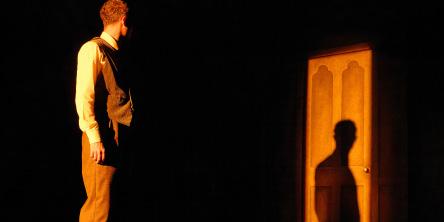
imagination. The Woman in Black artfully maintains a less-is-more approach. At the end of the night, what have we seen? Very little. But we are inclined to mirror something of the actors’ fear as they witness up close what we cannot quite make out for ourselves. We take their word for it. Meanwhile, the slow, drip-fed appearances of the woman in black are such that, when we finally view her contorted, agonised face for ourselves, the sight is earned, shocking, and grotesque. So can The Woman in Black
achieve its aim and scare you, especially in our increasingly desensitised era? Perhaps the secret lies in its theatrical form. Unlike prose or screen, there is no barrier between the spectator and the action, giving theatre a quality which is altogether more visceral, immediate and immersive. Wandering home through the streets of Oxford, perhaps glimpsing a black-clad figure (a scholar’s gown), you might just laugh at how your heart skips a beat.
Read the full article at www. oxfordstudent.com
Martha Kiyan
Amongst the crows in the sky, And sweet silver dew on leaves, The city’s bustling side, And the country’s blissful trills, My eyes will seek The face of my beloved.
In crowded halls and vacant streets, In whispered winds and thunder’s cry, In fleeting glances at passing souls, And stars that scatter through the night— My eyes will search relentlessly, Until they find the face of my beloved.
And one day, and suddenly the face of my beloved will appear before me.
My eyes will recognise what they have been searching for.
A current will pass between us.
Slipping beneath the skin, crackling with love, binding our souls and our dreams together.
The loving face of my beloved will be forever imprinted in my soul.
Cross Keys and 2046 Productions are bringing us Little Shop of Horrors in Keble College’s O’Reilly Theatre between Wednesday 18 and Saturday 21 February.
At the BT Studio, you will have the chance to attend Brew Hill by Pecadillo Productions between Tuesday 17 and Saturday 21 February
Also at the BT Studio, Crazy Child Productions in staging Dreams between Tuesday 17 and Saturday 21 February.
Picnic Productions is staging Monstrous Regiment at the Pilch between Wednesday 18 and Saturday 21 February
At Jesus College, you will be able to attend Much Ado About Nothing, put on by Jesus College Shakespeare Project between Friday 20 and Saturday 21 February
The Oxford Revue is bringing us The Oxford Revue Makes Perfect Sense at The Old Fire Station between Friday 20 and Saturday 21 February.
Later, the BT Studio is staging House of Improv between Tuesday 24 and Saturday 28 February
Marmalade Orbit Productions is putting Perudo on at the BT Studio between Tuesday 24 and Saturday 28 February.
Over at the Pilch, you will have a chance to attend Full Moon Theatre’s Translations between Wednesday 25 and Saturday 28 February
Lastly, Cartesian Productions is bringing us Noether at the Mathematical Institute between Wednesday 25 and Saturday 28 February
Susan Yu reviews the live performance of an up-andcoming band.
Only the Poets are a fourpiece pop-rock band from Reading. Fresh off the release of their debut album And I’d Do It Again on 30 Jan, they sizzled on stage at O2 Academy Brixton in London, with a set infused with pop-rock, indie pop, alt-pop, and the occasional R&B and punk inflections. After eight years of making music together as “best friends,” frontman Tommy Longhurst and his band enchanted the sold-out crowd of five thousand people at “their dream venue.” They have previously supported the likes of Bastille, Yungblud, and Lewis Capaldi. And are set to continue their European tour in Germany, Belgium, Poland, Czechia, and the Netherlands. Only the Poets showcased fan favourites from their previous EPs along with exciting
material from And I’d Do It Again. The audience sang raucously along to the old and the new, and the party mood ensued throughout the show. Anthemic indie-pop numbers like ‘Over and Over,’ ‘God Knows Where You Were,’ and ‘Bad’ ignited the audience, sending feet bouncing in unison. Meanwhile, the cheekily infectious chorus of ‘Don’t Wanna Know’ kept heads nodding and arms waving as energy crackled through the venue like live wire - perfect antidote to the Monday blues. Confessional songwriting sat at the heart of the set. Nostalgic songs like ‘Every Song I Ever Wrote,’ the neon-soaked ‘You Hate That I’m In Love,’ and the R&B-tinged ‘Thinking About Your Ex’ were delivered with heartfelt intensity. Longhurst’s rich and gravelly vocals were soulful and poignant, akin to Ed Sheeran’s at times. Momentarily, the audience paused from the
dancing and were subdued in collective reverence. From shimmering melodic guitars riffs, heady hooks, to drum crescendos and unforgettable refrains, the sonic landscape was indeed varied track by track. In particular, the prominent brooding bassline in ‘Gone by Now,’ a song channelling the emotional conflict of lingering heartbreak, allowed bassist Roo a moment to shine, quietly showcasing his technical prowess.
Importantly, Longhurst en-
Credit:
Jordan Logan
couraged the audience to “keep up the conversation that live music should be accessible”, as it offers “escapism” and ultimately brings people together; “nothing beats being in a room together.” This was met with a rapturous ovation as the crowd lapped up his message for accessibility and human connections via live music.
Read the full article at www.oxfordstudent.com

Elizabeth Gammaidoni reads Colleen Hoover’s newest release.
In recent years, Colleen Hoover is an author whose career is well-known to have been somewhat controversial. She gained fame over the period of 2012 to 2022, during which time she published multiple novels and novellas most years. A period of over three years in which she forayed more into screenwriting became overshadowed by the negative reception of the film adaptation of It Ends With Us. Is this novel the one which will reignite her career to its previous heights of fame, or does it fall short of this aim?
Just as Hoover experienced in her life, Woman Down follows an author, Petra, who
is recovering from a failed film adaptation of her popular book, A Terrible Thing. To achieve this, Petra leaves her home to write in a secluded cabin, where she meets the enigmatic cop Saint. A thrilling, forbidden and sometimes dangerous relationship ensues, in which Saint pushes Petra’s boundaries to their limits, to which her response is to continually forgive him or explain away his actions. The request for readers not to consider any parallels between her life and her novel only draws, if possible, more attention to these links. The pacing and suspense of the book are also things to be remarked upon. Woman Down’s plot relies on the intrigue of the relationship between Petra and Saint. This,
“ A thrilling, forbidden and sometimes dangerous relationship ensues
in turn, relies on Petra knowing nothing about Saint, and the reader knowing nothing about either Petra or Saint. The decisions they make and the events of the novel are therefore driven solely by an almost overly slow reveal of facts about each of them, as well as (violent) decisions Saint makes which are necessarily a complete surprise to both Petra and the reader because neither knows anything about him at all.
The development that feels wanting is for Petra to realise that she should write for herself and not for her audience, whereas the happiness she gains at the end of the novel is due to the return of positive responses to her writing. Ultimately, it seems to me that Hoover overly relies on information that is withheld and then revealed to encourage pages to keep being turned. Because of this, she somewhat ignores other plot elements such as character development. This can only lead to one conclusion: suspense can be artfully done and create a page-turner for the ages, but it cannot be the entire novel.
Read the full article at www.oxfordstudent.com
Ava Doherty discusses Roy’s complicated relationship with her mother and homeland, reflecting on identity and sociopolitics.
Arundhati Roy returns not to fiction but to the fraught terrain of her origins. Her memoir, Mother Mary Comes to Me, (2025) discusses her often tension-filled relationship with her mother, Mary Roy. She is the founder of Pallikoodam school in Kottayam, the woman who successfully challenged Kerala’s Syrian Christian inheritance laws in the Supreme Court, and as a parental figure whose favourite word, Roy tells us, was “leave.”
The book opens with a sympathetic description of her mother’s death, immediately provoking a question voiced through her brother that haunts the entire work: Why, after a relationship Roy describes as troubled at best and abusive at worst, does she write a book generous enough to paint a sympathetic portrait? Roy’s answer is not just based on sentiment, but rather a recognition of the complexity of human nature. To reduce Mary Roy to villainy would be to simplify the conditions that produced both of them. The daughter’s autonomy is inextricably linked to the mother’s defiance.
to recognise danger, to seek refuge. But Roy is clear-eyed about the paradox: the independence Mary Roy could not have on a tea plantation in Assam, Arundhati claimed, using her mother’s own tools, the writing, the reading, and being provided with an English education. The daughter’s departure is both rebellion and inheritance. Mary Roy fought battles she could not fully win, and in trying to make up for the nature of her circumstances, she took it out on the children she did not want.
“ I wish for Roy’s India, the India she carved out in The God of Small Things “ Leave the marriage. Leave the plantation. Leave what constricts you.
Mary Roy’s instruction was singular: leave. Leave the marriage. Leave the plantation. Leave what constricts you. The child absorbed this not as comfort but as a survival strategy, an unspoken inheritance lodged in her subconscious. Throughout the memoir, we see a daughter taught to flee,
One of the memoir’s most striking moments is Roy’s candid acknowledgement of her abortion, an autonomy her mother never exercised. The generational contrast reveals not moral superiority but historical shift. Roy’s life expands because her mother fought first.
For diasporic readers, the memoir operates on a double register. Roy shows India as a land of mothers, not always good, not always faithful to the ideal of parenthood we yearn for as children. However, it is a country held together by wives, sisters and mothers who have been the invisible hand of labour for generations. I wish for Roy’s India, the India she carved out in The God of Small Things and conjures again here: messy, chaotic, contradictory. Full of hyperpluralism and feuds, a place that breaks with the colonial while carrying its hang-
over. This is not the narrow, sanitised India co-opted by bad faith actors. Roy refuses that binary, insisting on India’s plural reality. Her writing articulates what it means to be an outsider yet socially legible. I am an Indian Catholic, white-passing, unable to speak Hindi, much like Roy when she started. I will never be brown. But Roy shows how the colonial hangover perforates the subaltern subconscious: the desire for whiteness, the dismissal of one’s own culture alongside recognition of its beauty. Her writing insists we are more than the sum of our parts. This vision of plural belonging does not obscure the darker realities Roy confronts. She heralds an India of alternatives, where we can all be who we want to be, but she does not shy away from the violence that shapes women’s lives. She moved through the railway system with a knife in her bag as a single woman, alone. It is frightening to think about how vulnerable she was during the eighties, and more frightening still to recognise that violence against women has not abated in the decades since. In fact, it has intensified as partisan attitudes became more entrenched. The figure that she cuts here is one of immense bravery shaped by necessity and circumstance, and a frightening portrait of what Indian masculinity can do if unchecked and untempered by restraint.
Perhaps the monsoon rains do not wash away the sins committed by the men who lurk in the shadows. All of Roy’s words circle back to female disempowerment, how women make do despite repeated subjugation by governments, lovers and systems. This is what she means when
she insists her stories recognise the form they hold, that resistance requires not just confrontation but mockery, shame, a siege that deprives the empire of oxygen. Roy does not write perfect characters. She describes herself, with characteristic self-awareness, as “a hooker with a booker”, able to laugh at herself amidst days of conflict and imprisonment. This irreverence extends to everyone in the memoir. The trust issues, the larger-than-life figures, the class and caste hierarchies that structure every interaction, all are rendered without sentimentality. In one recollection, she describes receiving praise for academic success while her brother was beaten for mediocrity. The observation is devastating: achievement carries guilt, no success exists without collateral. What is conspicuously absent is her mother’s love life, her struggles with religion, and any perfect ideal of motherhood. No character is one-sided. No one conforms to Western or Eastern stan-
“ achievement carries guilt, no success exists without collateral
Credit: official book cover
dards of virtue. When Roy describes Kerala’s forests and plains, she leaves space for readers to imagine their own India, to project their own wishes onto a blank canvas. She refuses the essentialist view that excludes.
“ complexity, contradiction, impossible mothers and motherlands
Mother Mary Comes to Me offers no redemption narrative, no catharsis, no reconciliation. Roy asks for neither forgiveness for her mother nor absolution for herself. What she offers is recognition of complexity, contradiction, impossible mothers and motherlands. As a child of diaspora, of hymns undone by the heat of solemn prayers for a land I have not known for many moons, this book awoke a yearning I had not felt for years. For those of us searching for an India that holds space for plural, messy, unresolved selves, Roy has written something urgent and necessary. It insists on difficulty. And for that refusal to simplify what cannot be simplified, it deserves to be read.
Read the full article at www.oxfordstudent.com

By the time I got to watch Emerald Fennell’s “Wuthering Heights” on Valentine’s Day, I already had an idea of what I should think. I’ve seen headlines and comments on social media. The Guardian called Fennell’s interpretation “a luxurious pose of unserious abandon” as well as “quasi-erotic, pseudo-romantic […], a club night of mock emotion.” The Independent considered the director a “figurehead” of “our modern literacy crisis”. Much online discourse consists of iterations of what is wrong with Wuthering Heights, sprinkled with sparse praise every now and then.
Admittedly, I had a similar mindset going into the film. I did not expect accuracy – the quotation marks around the film’s title forbade that. I expected it to be fanfiction, a fourteen-year-old’s wishful thinking mixed with a fortyyear-old’s money and fantasy. I also suspected I would not manage to suspend disbelief seeing Jacob Elordi as Heathcliff or Margot Robbie as Catherine.
Aside from “the enormous amount of sadomasochism,” the film is incredibly interested in fragmentary narration. Fennell demarcates the novel’s chronology using transitory montages, momentary absence of key characters, and flash-forward timing. In terms of genre, this is where she completely abandons the Gothic suspense in favour of glitzy glamour.
The further Fennell strays from the novel, the more sure I become of the conviction that she was less interested in adapting a novel and more so in capitalising on a Brontëan brand. Sex sells, especially in a high brow masquerade. A fragmentary vision could be
viewed through this cultural capitalistic lens. Marketable elements, such as costuming, makeup, and montages are not entirely meaningless, but they seem to engage less with the novel than with the construction of a specific twenty-first century narrative of Emily Brontë. Fennell did not aim for accuracy, and it is not her responsibility to engage with the pedagogy of the original Wuthering Heights, but she does profit off of the classic, even as she obfuscates its depth.
At fourteen, Fennell learnt from Brontë the confluence of torture and pleasure; at forty, she unleashed its contemporary sadomasochistic potential to be witnessed by a generation often obsessed with yearning. Indeed, Fennell’s Catherine and Heathcliff yearn for each other viscerally, verbally, visually – and unlike the book, the director allows their lust and love to materialise. With an approximately twenty-minute long steamy, yet not too risky sex montage between the protagonists, the pleasure is granted.
“ Fennell seems to sacrifice the psychological depth of Brontë’s Victorian Gothic novel
We have Catherine’s character who comes to represent the greatest degree of emotional torture. Though Heathcliff’s abuse is rendered visual by virtue of his back scars, he represses most of his sentiments (aside from sexual arousal) in his adulthood. Catherine, on the other hand, epitomises Charli xcx’s ‘House.’ Distract-
ing as her other tracks may be, the opening ‘House’ is excellent. “I think I’m gonna die in this house,” the artist says, and the lyrics haunt us whenever we witness Catherine’s emotional turmoil within the confines of both her homes. What this song emphasises is the vicarious flirtation with death, the grandeur of our ostensible willingness to die and kill for our love, a desire best left immaterialised and metaphysical.
While the collaging of scenes and the fragmented narrative could have been intended to mirror Catherine’s capricious and tempestuous psychological landscape, as well as the director’s (and the reader’s) fleeting memories of the novel, I think the film could have benefitted from a readjustment of pacing. I would have loved to spend an extended period of time with either protagonist in their deepest moments. Modern sensibility and vocabulary of mental health could have elicited a greater degree of empathy for these characters than what a Victorian readership would have felt.
Despite the immense potential this conflict holds, Fennell seems to sacrifice the psychological depth of Brontë’s Victorian Gothic novel for flashy, Hollywood-style aestheticisation and a Met-Gala worth of costuming. This is where I think the fanfiction aspect comes into play. Each adaptor may pick and choose what aspects they seek to enhance and stylise, which elements to parody or romanticise. Fennell’s interest in colour may strike us as superficial at times, but Catherine’s bedroom in Thrushcross Grange (the Lintons’ mansion) is an effective deconstructive example. Viewers share Cather-
ine’s subtle disdain of such a shallow show of affection. In a household where Catherine’s picked apart, and her body reinscribed on the walls, dolls and in picture books, it is difficult not to miss Heathcliff.
“ Isabella transgresses narrative bounds at every opportunity
Fennell’s awareness of the overarching fanfiction is palpable in the conflicting ethos of the narrator. As readers of Brontë’s Wuthering Heights may be aware, it is the nurse Nelly who conveys most of the story. In Victorian fashion, she censors certain aspects, tries to mediate the chaos, and passes on moral judgements. This is effectively conveyed in Hong Chau’s portrayal. Isabella Linton (Alison Oliver) provides a perversely playful contrast. Isabella, under Heathcliff’s instruction, writes letters to Catherine – Nelly burns them. Nelly tries to plot, to contain the narrative to secure her position – Isabella transgresses narrative bounds at every opportunity. Her evocation of Romeo and Juliet early on offers an interesting metacommentary on the film. I wish I could say the same about the relationship of Heathcliff and Catherine.
Credit: IMDb
Wild as our perception may be of the pair, Fennell tones down much of their Gothic torment. The frequent ‘I love you’-s simplify much of the unspoken, spiritual tension between the intertwined souls of the protagonists. They mellow out Heathcliff as well, painting an unexpected picture of the protagonist readers know all too well.
I am concerned about the repercussions of creating a brand for Wuthering Heights. For a culture ever so caught up on yearning, obsession, and loneliness epidemics, the darkness may seem like a necessary counterpart to companionship. Fennell’s “Wuthering Heights” markets the intrigue of darkness without exploring its consequences in an incisive manner. I wonder how different the film would be under a different title, with other characters. It could utilise and play with dense allusions to Wuthering Heights without depending on its prestige.
Either way, my impression was that Margot Robbie’s corsets were not tight enough to convey the Gothic suffocation of Brontë’s novel. More crucially, I fear the Yorkshire winds stand no chance against the sweeping forces of consumerist intrigue.
Read the full article at www. oxfordstudent.com

Section Editors: Ansu Bhattarai, Aamina Thava, Izzy Goldberg, Honcques Laus, Emily McPhee

If I wasn’t dead set on a career in law, I think my ideal profession could be summed up as a “professional side quest enthusiast”.
Oxford has a curious relationship with growing up, one that Peter Pan himself would question. From the moment you arrive, you are not so gently thrust towards seriousness, with University seen as a stepping stone to the future, rather than an incredible experience to savour. It was this silent pressure that inspired me to adopt what I now call the Peter Pan mindset.
Oxford has a reputation for being a serious place, with serious traditions, for some very serious people. Essays have to be churned out like butter, and by your third week of Michaelmas you encounter a PPE student who brings up the dreaded spring week discussion. As a fresher last year, this was quite an assault on the senses.
While the workload is hard, the social aspect is arguably harder. What made it even more difficult for me was the rather peculiar situation I was in. A mere 17 years
young, I was old enough to move into my dorm room, but not old enough to actually go out. Everyone around me seemed to be racing to grow up, while I seemed to stay in the same place. This didn’t mean that my Fresher’s week was dull but merely that it required some creativity.
What prompted this creative realisation was a fairly simple mathematical calculation. The average Oxford term lasts approximately 60 days, giving you 180 days of term in a year, and 540 days for your entire undergraduate degree. While three years sounds like an incredibly long time, 540 days doesn’t seem nearly long enough to enjoy what are supposedly the “best years of your life”.
After coming to this realisation, I decided to capitalise on my situation. My age ended up being an incredible conversation starter, with a few people asking me if I was some sort of child genius. One bad pun later, and they realised I was not in fact a genius, but a professional nuisance. Instead of forcing myself to grow up quicker, I decided to resist the rush towards
and ask me if I wanted to get into their college. I made friends across year groups, degrees, postgraduates, and college staff. The highlight of this challenge was making friends with Tony, one of the Porters at St John’s who remembers me to this date.
venues, I gifted The Other Place’s law society a giant rubber duck, as an act that I guarantee has improved diplomatic relations between our societies.
seriousness.
The side quests began. I found myself inducted into a secret society which revolved around the construction of Keble college, as well as successfully racing a drunk stranger down St Giles.
My magnum opus arose when I was at a Christ Church formal and my friends were discussing the classic Oxford challenge of eating at every college formal. Attending every college formal sounded quite ridiculous to me, but it did not sound as ridiculous as taking a photo with a yellow wet floor sign at all 42 Oxford colleges.
After wrapping up my law moderations in Hilary, I found myself with a significant amount of time on my hands. I embarked on the first ever Oxford Sign Challenge, with the goal of taking a photo with a yellow wet floor sign, at every college, in one term.
This mildly absurd idea slowly became the best part of my day, and that term. Throughout Trinity, I found myself welcomed into colleges I had never been to. People who I had never met before would message me
Not all approved of my challenge, including a variety of confused tourists, certain fellow students, and one of the scariest Porters Exeter College has to offer. However, what this challenge did was strip away some of the seriousness that envelopes Oxford, gave me the chance to talk to at least 42 new people, and make some incredible friends. When you are walking around a college with a wet floor sign, people will stop you, and they will talk to you.
“
At the end of your 540 days, you will have lots of memories, and the best ones will be ones where you were true to yourself, and embraced your own unpolished version.
There are worse icebreakers!
The sidequests only escalated. In a moment of questionable judgment, and with the help of my very dear friends, I moved my bed from my accommodation to my college’s main quad. Was it a smart idea? Probably not. But, I guarantee there is nothing cooler than sleeping under the stars in a quad that is older than you are.
Taking the silliness to the next level, at one of the world’s most historic legal
Peter Pan is often criticised for refusing to grow up. I believe that he was not refusing to grow up, but refusing to rush his transition to adulthood. At Oxford, there is a subtle expectation that you should already be assembling the adult you are supposed to become. The Peter Pan mindset does not promote immaturity, but resists the unnecessary urgency to grow up. We should all absolutely grow up, but we should make sure to take a piece of our childhood self with us, and enjoy the process.
I like to ask myself whether my nine year old self would be proud of the person I am today. At the tender age of nine, we aren’t always bothered by what other people think of us, or what we do. A nine year old, while impulsive, always displays their true self, regardless of what other people think.
University tends to force us to portray ourselves in a particular manner. At the end of your 540 days, you will have lots of memories, and the best ones will be ones where you were true to yourself, and embraced your own unpolished version.
You don’t always need elaborate sidequests, although they do add to the experience. Sometimes it’s simple enough to lower the walls a little. Make that unnecessary joke, speak to the stranger next to you at a lecture, and allow yourself to be slightly unpolished.
The pressure we attach to social interaction often makes the interaction harder than it needs to be. The Peter Pan mindset takes some of that pressure away. Not rushing to grow up isn’t exactly the same as refusing to grow up.
The City will always wait for you; Memories do not.
Communication, consent, and protection: the reality behind a night of music, an open bar, and an aesthetic worthy of deleting half your camera roll is far less glamorous than the final product suggests. It’s latenight planning, clothes permanently stained with paint, endless emails with site managers, insurance forms - and the list goes on..
With college ball season officially upon us, it feels like the right moment to peek behind the wizard’s curtain. Society balls are a different beast entirely. We don’t have the same financial backing as colleges but compensate with audacity. While college balls can set you back anywhere between £150 and £500 a ticket, society balls rarely creep above the £100 mark. They’re the perfect way to tick something off the Oxford bucket list without resigning yourself to ramen for the final weeks of term.
Perk of being on Committee- Being on committee means you get free entry, but it also means you have to balance the mayhem of Oxford deadlines alongside the craze of communicating with suppliers, and trying to schedule a meeting is like playing an impossible game of Tetris. But honestly? It’s all worth it. Worth it for those three hours of pure joy when you watch people step into a world you’ve built from scratch. You see core memories forming in real time: conversations that turn into BRIDGE dates, nightclub confessions, and- of courseAunty Seema’s matchmaking service, which may lead either to mutual
ghosting (speaking from experience) or, if you’re lucky, the love of your life Theme- The first mission of any Ball committee is picking a theme. For the Desi Ball we chose Lights, Camera, Action. I’d like to add that I am the “genius” behind the wildly original, never-before-seen theme but there’s a reason it endures. Film is one of the few mediums capable of holding an entire culture at once: music, family, fashion, comedy, politics, food. The full breadth of human experience can live on screen, and there’s no better way to share it.
The night will transport you onto the red carpet and into the world of Desi films: velvet glamour and cinematic excess where every entrance feels choreographed and every glance lingers a second too long. Think flashing lights and mirrored floors, silk and sequins catching the glow, the hum of anticipation rising like the opening score of a film long awaited. It’s a space where drama is indulgent rather than dangerous, where romance hangs thick in the air, and where, for a few hours, you are not a student rushing between deadlines, but a protagonist-dressed immaculately, moving through a world built for spectacle, music, and the quiet belief that anything might happen before the credits roll.
Entertainment- There is the foundational DJ and dancefloor, but the entertainment doesn’t just vibrate through the air, it is brought to life. The entertainment is driven not by a single committee, but by the wider Oxford Desi community itself. Student-led Desi dance soci -
eties from across the University bring the night to life, turning the event into a collective celebration rather than a curated performance. It’s this shared ownership that gives the
“ Communication, consent, and protection: the reality behind a night of music, an open bar, and an aesthetic worthy of deleting half your camera roll is far less glamorous than the final product suggests.
ball its energy: guests, performers, and organisers all shaping the atmosphere together. The result is a space where culture is lived and shared- through dance, music, and movement- open to anyone and everyone. From Oxford
students to guests travelling from across the UK, the night becomes a meeting point.This isn’t just an event you attend, but one you help bring into being.
Food- Food is at the heart of Desi culture. It’s family-style eating, comfort, and communication. It’s your mum making your favourite food in the middle of the silent treatment- a sign of diffused tensions, of care that exists even when words don’t. Especially when you’re so far from home, food becomes grounding offering familiarity, warmth, and reassurance all on one plate. It’s also one of the easiest and most generous ways to share culture with others.
Catering for the night will be provided by Dosa Park, a small local business supporting the community. Students are essential to Oxford’s economy, and working with local restaurants is one way of giving back. The menu reflects the breadth of Desi cuisine, with a range of curries from butter chicken to the chef’s special vegetarian curry, alongside pakora, chilli paneer, lamb biryani, tandoori naan, steamed rice, and raita. To
finish, classic desserts like gulab jamun and payasam bring everything together. So how do you handle your balls?
Communication, consent, and protection: skills you learn on committee - and lessons some people could really use on the dancefloor. You plan obsessively, panic quietly, send one too many emails, and trust that the chaos will somehow cohere. You learn that communication, consent, and care matter just as much as the champagne and choreography. That the best events are never built alone. Society balls, at their best, aren’t just about spectacle: they’re about community, generosity, and creating space for joy in the middle of an often exhausting term. For one night, you build something that outlasts the glitter on the floor and the photos on your phone: a shared memory, a shared culture, and the quiet satisfaction of knowing that behind the magic was a group of students who dared to make it happen (mainly for the free ticket and to pad the CV).


In December 1996, Federal Reserve Chair Alan Greenspan warned of “irrational exuberance” in financial markets. The phrase would later become synonymous with the dot-com collapse. Equity prices (the market value of a company’s shares) rose astronomically during the bubble years before ultimately unwinding in 2001 in one of the most dramatic market corrections in modern history.
Nearly three decades later, markets are once again being propelled by a transformative technological narrative. This time, it’s artificial intelligence, rather than the internet. AI-linked US mega-cap stocks (those with a market value over $200bn) have driven a disproportionate share of global equity returns, pushing valuations to levels some policymakers and central bankers describe as historically stretched.
The Bank of England has cautioned that valuations in AIlinked stocks appear elevated, particularly given the concentration of market gains in just a small number of firms. The Bank highlights the risk that expectations around future earnings may prove overly optimistic. While some of the large public companies driving AI investment are highly profitable, parts of the broader AI ecosystem remain dependent on projected growth and future revenue streams that have yet to be fully realised.
The Bank points to the Shiller CAPE ratio as evidence that the “exuberance” may in fact lack some rationality. The CAPE ratio compares how expensive stocks are today to how much companies have earned on average over the past decade. When that ratio is unusually high, it suggests investors may be paying a lot for future growth that hasn’t actually materialized yet. In recent months, CAPE ratios reached levels not seen since the late 1990s and early 2000s.
nancial and Insurance activities.
A further 19.6% entered Professional, Scientific and Technical industries, which includes consulting, research and engineering services. In total, nearly 38% of Oxford graduates enter sectors closely tied to technology, capital markets, and corporate investment cycles, meaning they might have outsized exposure to the impact of market downturns.
“ CAPE ratios reached levels not seen since the late 1990s
There’s little doubt that the AI-boom, particularly in US mega-cap stocks, has driven a disproportionate share of global equity returns. But does this signal a bubble? And, if so, what would a market reversal mean for Oxford students and graduates? If the AI rally were to reverse sharply, Oxford students would feel it not just through global markets, but through graduate recruitment, university income, and research funding.
Oxford graduates overwhelmingly enter high-skilled professions, many of which are in finance, consulting, research and technology. According to HESA Graduate Outcomes data for 2022-2023, approximately 9.2% of Oxford graduates entering work were employed in the Information and Communication sector, while 8.7% entered Fi-
While detailed UK graduate labour market data from the dotcom crash era are limited, more comprehensive statistics exist for the 2008–2009 financial crisis. UK Labour Force Survey data show that during the crisis period, unemployment among recent graduates nearly doubled from 5% in Q3 of 2007 to 9% by Q3 of 2009. But beyond unemployment, underemployment, where workers either hold jobs below their skill level or below their desired hours, also showed a marked increase in the aftermath of the crisis. The proportion of recent graduates working in non-graduate roles rose from 43% in 2007 to 48% in 2012, which indicates that recessions may weaken graduate outcomes not only through unemployment, but through slower career progression overall.
However, the implications of a downturn would extend beyond individual career outcomes. Oxford itself would not be immune. Investments comprised nearly 7% of the University’s overall income in 2024-2025 according to University-published data. Oxford’s most recent annual report described the income as
“an important component of the University’s financial resilience.” According to the annual report, nearly £400M is funneled into third-party managed funds including, “the Sequoia fund, which provides access to a global pipeline of high-growth technology companies.” While Oxford’s portfolio is certainly diversified, it is not insulated from an AI-related market meltdown. Oxford’s research funding structure also links it indirectly to market cycles. The University reported £801.3m in research grants and contracts in 20242025, including partnerships
“
Oxford students sit at the intersection of global capital
with industry and corporate collaborators. Corporate research and development spending is typically pro-cyclical, expanding in boom periods and tightening during downturns. A sustained correction in AI-driven markets could therefore affect the flow of industry-backed research projects.
However, not everyone is convinced that elevated AI investment is irrational. Unlike the late 1990s, today’s AI ecosystem is not composed solely of speculative startups with little to no revenue. Several of the large, publicly listed firms driving AI infrastructure investment, including major hyperscalers and cloud providers, are highly profitable. At the same
time, many high-profile private AI firms, such as OpenAI and Anthropic, are not. They rely heavily on venture capital, strategic partnerships and future revenue expectations. The Bank of England’s recent analysis reflects that the concern is less about the failure of individual firms and more about systemic concentration such as when a narrow group of stocks carries a disproportionate share of market valuation, meaning volatility can amplify if expectations adjust.
Oxford students sit at the intersection of global capital, technology and elite recruitment pipelines. If AI proves overvalued, the consequences would filter through job offers in finance and technology, the pace of corporate partnerships, and the broader research funding environment. But if current investment levels reflect durable profitability and transformative technological change, Oxford and its students can continue to benefit through sustained hiring in high-skill sectors, stable industry collaboration and continued capital flowing into scientific enterprise. Greenspan’s “irrational exuberance” is a warning that sometimes markets can price the future with too much confidence. Whether today’s AI-driven optimism proves excessive or prescient is unclear right now. What is evident, however, is that when enthusiasm becomes concentrated in a narrow segment of global markets, both risks and rewards are amplified.
In my first article for this publication, I outlined some of the key issues facing economics as a discipline, and passionately called for key changes to how it is taught. The innocent optimism of first-year me, however, is mostly gone. The sobering reality is that economics faces an existential threat, driven by the contradiction that has been created at its very heart: it purports to be the key to understanding the world, and yet fails to even describe it. Economists present themselves as having the unbiased, ‘grownup’ solutions to global problems from health to poverty, and yet economics is only ever called upon to defend the status quo.
On November 30, 2025, Zack Polanski appeared on The Rest
is Politics, a popular centrist podcast that supposedly offers insights from within the halls of power, and effectively argues that everything should broadly stay the same.
Polanski clearly has to develop his economic thinking. He failed to recall, for example, the difference between the deficit (the government’s shortfall each year) and the national debt (total stock of debt accumulated over time). However, criticisms of Polanski for not having all the facts in his head, even relatively basic ones, miss the point entirely. The Greens have an economic programme, and Polanski is inspired and advised by ‘real’ economists (if there is such a thing), regardless of Rory Stewart’s (one of the
omist out there. Thomas Piketty has been defending for years a radical reform of our institutions to combat inequality. Paul Krugman, a Nobel Prize Laureate, is perhaps the strongest voice in favour of running deficits and using the government to reinvigorate national economies. These suggestions do not come from the fringes of the discipline. They are simply ignored by Stewart and others like him because they offer a way forward for the discipline that does not justify the way things are, instead seeking to change them.
How did we get here? History offers some clues. On 12 February, I had the pleasure of attending a talk by Clara Mattei, Professor of Economics at the University of Tulsa, Oklahoma.
Mattei argues that the shift towards economics as applied mathematics, almost a sibling of the natural sciences, is not an ‘evolution’ of the discipline. The expulsion of history from economics was no accident, because history reveals what mathematics hides: the assumptions.

hosts) claims to the contrary. The real criticism of Polanski is not that he lacks economic backing, but rather that he is not using the correct kind of economics – that which appears in our textbooks, lectures, and policy papers.
Stewart is representative of an overall ‘discourse’ on economics that has, in my view, killed the discipline. Economics is portrayed as fundamentally neoliberal, and to suggest otherwise is to be irresponsible or unrealistic. Fundamentally, this is about who gets to be a ‘Very Serious Person’, and to be seen as such by the political establishment one must reproduce the economic thinking that has landed us in this mess.
There is a different type of econ-
tellectualism’, can be debunked. Here is my conviction: economics can be a force for change. Not in City of London skyscrapers or Whitehall offices, but through a new, popular economics that actually addresses the issues we face day-to-day. In Oxford, a group of students is trying to enact this new way of thinking about economics, centering history and recognising the inherent political nature of economic knowledge.
Rethinking Economics Oxford (REO) relaunched this term, with Clara Mattei being their first speaker. Sitting in a full lecture theatre listening to Mattei’s words, I felt excitement and hope. It is now crucial to take this inspiration and turn it into action.
The focus of neoclassical economics on models instead of history was born at a time many were heavily contesting capitalism (the early 20th century), and successfully finding alternatives. By removing history and depoliticising economics (which since then has no longer been called political economy), capitalism and the austerity measures that support it are frozen and made unchangeable.
History allows us to call out this ‘purity’, and prod at the assumptions underpinning so much of modern economic theory. Furthermore, an economist that takes a step back from their models and considers the context in which they work will be a better economist. This is because economists are not disinterested observers, immune to political and social questions. Mattei acknowledged this head-on in her talk: “I do not live above the economy, merely observing it. Rather, like all citizens, I live within it.”
Economics has in recent years restrained our sense of possibility. Any proposition, even by serious academic heterodox economists, is dismissed as being unfeasible or unrealistic. However, there are no ‘eternal truths in economics’. Those that appear to be so, enforced by political power, snobbery, and high-brow ‘in-
Mahnoor Kamran, one of the co-founders of REO, stressed this point, telling me that the project is “not just about running a seminar series”. They plan to bridge the divide between economic theory and activism by working with renters unions, mutual aid societies, and encouraging local engagement with the discipline. Only through this ‘popular economics’ can we begin to break down the walls of the discipline, something that current university curricula do not do.
Through framing economics as a discipline that observes its subject at a distance, supposedly without the complications of political bias, the economic structure it is defending is obfuscated and made into unquestionable ‘common sense’. Furthermore, as Peter, a student involved in kickstarting REO, put it, “this picture often omits what is most important in our current age: the experiences and needs of women and carers, the complex interplay of economy and ecology in the changing climate, and the social networks and structures within the Global South.”
Economics has not been killed by capitalism, it has been weaponised. If we want to think of alternatives, or even changes, to the current system, then we need to begin by changing how we think about economics. Above all else, we must turn this theory into praxis, working towards an economics that is not just for economics students. Instead, economics must engage real people and strive to enact real change.
identity@oxfordstudent.com | Deputy Editor: Emily Cunnington | Section Editors: Celine Leung, Frieda Fahrenholt, Hayden Bhatti, Neha Ganvir, Rebecca Bushee, Lila Robinson | Columnists: Sharon Chau, Will McCaffery
Tamar Okunhon explores the challenges of coming from an under-represented background to an elite institution like Oxford.
One of the most common questions any northerner or ‘non-southerner’ will receive during their time here at Oxford is ”You’re not from down here are you?”, most notably within the first few weeks here.
Accent has long been a divider at Oxford. From the way you say “glass” or “grass” and when and where you drop your t’s, or say the word “work”, people make assumptions about you from the first sentences that leave your mouth. Yet something so seemingly harmless can have large consequences.
With at least 50% of the university’s intake coming
from London and South east England, and northerners making up comparatively just 15% of students, not sounding southern automatically groups you as ‘other’. Sometimes this can
“ those from a lower socio-eco
-
nomic class have a particularly unique experience at the University.
be a conversation starter, something positive and
southern, Welsh or Scottish, telling someone to guess where you are from is like asking them to pick a needle in a haystack. You may receive responses ranging from Birmingham to Durham because to many, the North is simply an unknown monolith which might as well be Scotland itself. People even remark that anything beyond Oxford, and in some cases beyond Watford, is the North of England. Maybe this in itself is a reflection of the national focus on London and the Southeast, such that anywhere else is just a distant and fundamentally foreign concept.
highlights the intricacy of accents. As a northerner, I was shocked to discover that there isn’t just a Southern accent or London accent, there’s “Buckinghamshire”, “cockney” and so the range goes on. I didn’t even realise southerners distinguish themselves from other southerners.

interesting that sets you apart, and other times it can serve as a means of discrimination, a way to dismiss someone’s intellect or character before you get to know them.
It would be a lie to say no Southerner, for instance, has ever mimicked or found another accent ‘funny’, but perhaps we need to ask ourselves why we put certain accents on a higher pedestal than others. Could it be class, or a signaller of environment? It’s a question that runs deeper than just how you pronounce the ‘swan and castle’.
It’s interesting poor Londerners’ geography of Britain is as a whole. If you aren’t
Regardless of someone’s regional origins, many people at Oxford experience the phenomenon of their accent changing. Over the 3, 4 or more years that someone spends here, being around a particular accent can often change how someone sounds. All too often have I heard stories of people going back home for the vacation and being told they sound different, or ultimately “Posh”. This created a territory I would call “No man’s accent”. It is a particularly unique situation to be in, where you don’t sound posh enough for Oxford and yet too posh for your old friends back home. In some ways, it can be rather isolating in, not belonging anywhere entirely, like being stuck in between two realities and yet part of neither. It can make it difficult to feel a sense of belonging anywhere. And yet, you still worry about how your accent affects job prospects and whether you need to change or if you’re perfectly fine the way you are.
Something I’ve learnt here is that class has an even stronger placeholder and affect on accent than region. Concepts such as ‘the private school accent’ illuminate this. Someone could come from the far north and still sound ‘Southern’. This
It is worth considering the perspective of people from the midlands, Scotland or Wales. They too may feel similar to a Northerner at Oxford, where their accent isn’t the ‘default’. But often this can create a sense of comradery. It has been joked that all Northernerners talk about is the fact they are northern, but I believe this is an attempt to find comfort in another individual who understands your roots and the alienation of studying in Oxford and not coming from the South. When you are ‘othered’ it
“ fundamentally, everyone just wants to belong, and that socioeconomic background can affect anyone’s perceived ability to belong where they are.
is refreshing to meet someone like you. It is at times like this that I’ve never felt so patriotic about being a mancunion or a northerner in general.
With this being said, in an ideal Oxford, and further in an ideal world, we wouldn’t use accents to divide people. We ought not to use people’s differences against them but rather to increase our own understanding of the world that exists outside of Oxford
Read more at www.oxfordstudent.com
Tamar Okunhon
As someone from a working class background, I wasn’t quite sure what to expect when I came to Oxford. A myriad of people from all different backgrounds would lay before me. I’m sure this would have been the case for anyone reading this. But class at Oxford has more to it than what first meets the eye.
If anyone was the first in their family to go to University or Oxford itself, it certainly comes as a shock to know that some individuals have numerous generations that have already studied here. For me, this lack of legacy creates a feeling of imposter syndrome. Coming as even more of a shock, people that come to Oxford from certain elite schools seemingly already know each other. These students come here already acquainted with smaller class sizes, the confidence to ask one-on-one questions with the professor during tutorials, knowing which cutlery to use, with some people even able to understand Latin during ceremonies like matriculation.
However socioeconomic background has a larger impact than just the atmosphere. Academically, there is a gap in Prelims results from those who attended private schools and those that went to state school. There are people at Oxford who don’t use SFE (Student Finance England) or have never heard of Crankstart or worry about finances at all. In the recent uptake of Oxford students, only 8% were eligible for free school meals compared to 25% of Britain overall. Whether this is a reflection of Oxford’s admissions system or more so related to systemic barriers that exist beyond Oxford is another question entirely. However what this establishes is that at
least in the first year at Oxford, there is a clear divide between different people’s individual results.
Even financially, being able to afford formals, extravagant balls, a union membership and clothes for special events including matriculation itself, poses itself as a challenge to those who come from socioeconomic disadvantage. All of these hidden costs, on top of the fact that Oxford students are prohibited from working a part-time job during term, mean that those from a lower socioeconomic class have a particularly unique experience at the University.
Socioeconomic background also affects one’s experience socially. For instance, certain cliques form which are heavily state or private school-dominated. This means that even within a college, individuals are separated on the account of class. In colleges, where accommodation costs vary depending on room, clusters of people from similar back-
“ People even remark that anything beyond Oxford, and in some cases beyond Watford, is the North of England
grounds end up in the same staircases. That brings about the question, “what good is there from people who only associate themselves with those from the same backgrounds?”. What I myself have noticed is there are even cultural differences between
those that have attended grammar schools and those that attended state comprehensive despite both being classed as ‘state schools’, a difference perhaps not emphasised enough.
An interesting phenomenon observed at Oxford is how sometimes individuals from certain backgrounds cosplay one another. Those with more wealth sometimes try to conceal it, and those with less try to fit in. This exposes that fundamentally, everyone just wants to belong, and that socioeconomic background
Bridge of Sighs. Credit: Pixabay.
“ You don’t sound posh enough for Oxford and yet too posh for your old friends back home.
can affect anyone’s perceived ability to belong where they are.
However, there are plenty of places for working class indi-
viduals in Oxford to find their people, from Class Act to 93%. Even events such as Opportunity Oxford support students before they get here. These are all attempts to ensure background does not limit anyone’s experience at Oxford. Working class, upper class or somewhere in between, all Oxford students are bright and keen to know more. Despite the fact that progress still needs to be made, all Oxford students are fundamentally more similar than they are different in character. Read more www.oxfordstudent.com
by Vincent Chang
profiles@oxfordstudent.com | Deputy Editor: Vincent Chang
Oliver Douglas answers the same question differently. For him, the future became real not through geopolitics but through proximity: to peers, ideas, and the expectation of the Rhodes opportunity.
Arriving at Oxford,” he says, “being around so many people who are passionate about their particular interest… has forced an intense level of introspection about what really resonates with me, and what is genuine and authentic” .
When he first arrived, he was uncertain whether to pursue a DPhil. Immersion in academic questions of liberal democracy, radicalisation, and political stability changed that. If one is serious about grappling with such problems, he reflects, “completing a DPhil… suddenly becomes the logical choice” .
It is easy to imagine that the future feels abstract when you are twenty-something and studying at Oxford. It might be easier still to imagine that, upon selection as a Rhodes Scholarpublicly affirmed, formally endorsed - the horizon might appear unusually clear.
I approached four current scholars with this hypothesis in mind, and asked them for their perspectives.
This article forms the first part of a broader project exploring how the current Rhodes cohort at Oxford thinks about the future. Alongside these in-depth interviews, a second instalment will present aggregated survey findings from across the
in-resident cohort, and Rhodes alum, offering a wider quantitative
me,” he says, “is not really the technological advances, but the change in the political sort of climate” . He describes a shift away from ideological contest towards what he calls an “economic win–loss perspective”: a world in which profitability increasingly overrides moral alignment .
Oliver intends to continue his service in the Australian Defence Force - a commitment he describes as one of the defining contributions of his life. His sense of direction is inseparable from inheritance: a mother raised behind the Iron Curtain in Czechoslovakia, a father from a coal-mining community in north-east England. The Rhodes Scholarship, for him, is not merely opportunity. It is obligation. He speaks of “a deep debt of obligation” to Australia - to the systems and values that enabled his trajectory - and of a lifetime spent seeking to repay it .
Frances Wright thinks to a future of internal balance:
side - or be sacrificed toprofessional mobility . Since arriving at Oxford, she says, the distance from her communities in New Zealand has “distilled what I really care about in terms of my personal values as opposed to my career values - not that they’re mutually exclusive” .
Magdalene Mawugbe’s answer begins in a laboratory and ends in a nursery. “For the next two to three years, I’m going to be doing my DPhil here in Oxford,” she explains. “Fortunately, I’m going to have my husband here, we’re expecting a baby” .
Her research, disability studies and communication technologies for deaf patients, sits at the frontier where healthcare and AI intersect. She anticipates that artificial intelligence will “heavily infiltrate that space” . For Magdalene, the future feels most real in the reconfiguration of her own life: beginning motherhood in a foreign country.
Section Editors: Darcey Harris, Isla Jenman, Himasweeta Sarma, Audrey Miu, David Binns With special thanks to Oliver Douglas for logistical arragements, and all participating scholars for their time.
“I am sometimes worried and concerned about what kind of world my child is going to grow up in,” she admits, citing war, political volatility, and global instability.
“ I. When you think about the future right now, what feels most real to you personally? “ II. Do you feel that being selected for this scholarship has changed how you think about responsibility, either to others or to yourself?
snapshot to sit alongside the individual voices featured here.
For Shahmir Aziz, the future weds technological advancement with politics in ways unanticipated before.
“What feels most real to
Artificial intelligence hovers in the background - omnipresent, but indistinct. “I’ll be the first one to admit that I am not an expert in AI… I’m really not sure what all is going to be transformed… to what extent, I don’t know” . What feels concrete instead is the question of direction: if productivity accelerates, “it’s going to be much more focused on where we want to head” .
“What feels most real to me personally,” she says, “is very much prioritising or deciding where my values lie, and where opportunity is, and those two being in a constant balance” .
This balancing act is not theoretical. It is about whether to remain close to family or pursue corporate training overseas; whether relational commitments will sit along-
Hannah Stewart
If I were a new-labey baby, I would set about being a far more dodgy incarnation of Sir Robert Chiltern. As the main protagonist of Oscar Wilde’s An Ideal Husband, Chiltern made his fortune from scandalously selling cabinet secrets. Who knew that Peter Mandelson would be this generation’s Chiltern, albeit one that appears in The Sunday Times in creased loafers, with a double oven to boot. Surely, if you were involved with a massive nonce and wanted to keep it under wraps, you wouldn’t make it worse by leaking a secret political document to them. Big pede-y scandelson, Epstein’s self-described ‘best pal’, is one of

the most embarrassing bearers of political scandal yet.
If running for Oxford’s hands-ellor was a competition, big Pete surely was qualified. Dodgy by name and dodgy by nature, Scandalson made an art of dodging questions at miscellaneous ‘Fireside Chats’. While the songs of the day implicate Univ as a toucher hotspot, St Catz’s own has a place in the spotlight nowadays. Far less An Ideal Husband and far more a tragedy in several acts, Scandalson’s relationship with Epstein is a unique act of almost literary levels of stupidity. Like an Icarus, who flew too close to some sons. My stepdad always told me that his hometown of Hartlepool would elect anyone if they were zany enough. Who knew ‘Zany’ wouldn’t even begin to cover it?
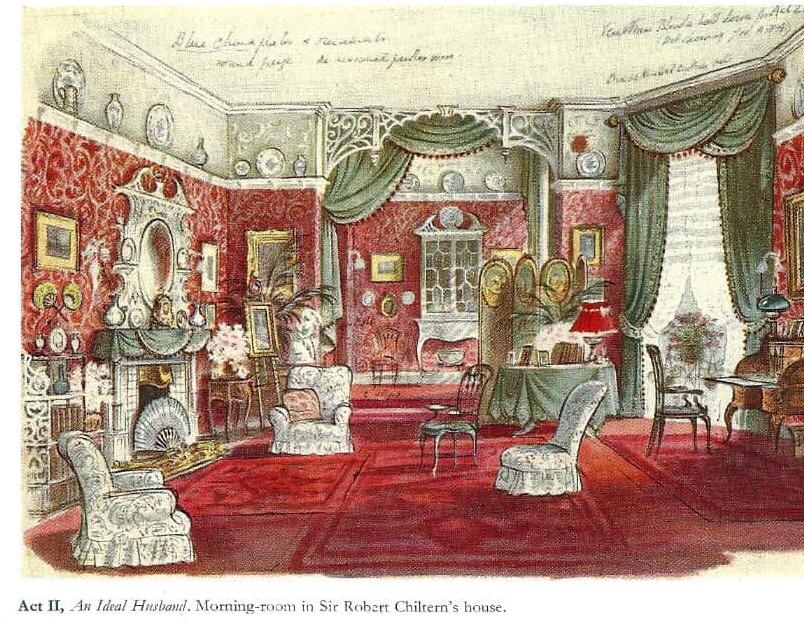
AThe jokingly titled ‘Prince of Darkness’ is far from a blood-sucking, Christopher Lee-esque vampire. He just straight up sucks. What’s disappointing about the Epstein sitch- is that it’s equally as unglamorous as it is embarrassing.
s a Londoner, I’m proud to say that I come from one of the less gentrified areas of London (if they even exist). On all levels but physical, I am far away from a Gail’s. Hence, I am better than all of the other people who come from ‘deprived areas’. I’m the type of Londoner who sees postcode discourse on Twitter and remarks that the poster wouldn’t last a day in ‘SE’. Nevermind DL or TS, my postcode in London, one of the richest cities in Europe, is the infrastructural equivalent of a Hieronymous Bosch painting. All other Brits, stand back and take note, a real povvo is talking. Nevermind TfL, and my easy access to some of the wealthiest areas in the UK. I am more oppressed and cool than you. My access to a wealth of employment opportunities, rich culture and interconnectedness renders me stuck in the mud of my own overstimulation. Those of you who have booked a ticket on the brain drain train, consider yourself lucky; at least you don’t have to deal with the competition that comes from
clever people moving to YOUR area from the North. North Easterners? Nah. Welsh people? Nah. Scottish people? Nah. Behold, gaze upon my oppression as a white middle-class Londoner. But don’t get it twisted, I’m not as middle class as the people a few streets over from me. I have the moral high ground, so listen up, provincials. Prepare to have your experience invalidated, and become rendered obsolete under my lofty victim complex. Having trouble with getting sent back to your down and out ex-mining town after uni? Small fry in comparison to not living in Pimlico. Terrified of the oblivion that is unemployment? Living next to the Guardian offices doesn’t really soften the blow. I’m literally the equivalent to one of the children featured in the (1968) musical adaptation of Oliver Twist. My semi detached house in Hackney is a microchasm of the Victorian slums. And you, the sick northerner, sit and critique from your Ivory Tower of a lack of opportunities and poor infrastructure.
By Luke Erly
Afew weeks ago, I sat down with Benji Naesen, a childhood cycling fan turned Tour de France winning advisor. His place in the world of professional cycling is unique: now one of the biggest English-speaking journalists, he spoke to me about a sport which is engrained into the culture on the Continent, with races that have more than a century of history, ridden and enjoyed every year by generations of professional cyclists and fans alike. Naesen, born and raised in Flanders, understands this culture more than most, but he is also unafraid to challenge the sport in certain areas.
Luke: You’ve worked in professional cycling, not just media. Can you talk about that?
Benji: I was in the Ardennes for a holiday in early 2020, when I got a phone call from Merijn Zeeman, team manager of Jumbo Visma. He asked me to do video analysis, specifically tactical analysis, for the team. My first reaction was to ask if I could still say whatever I wanted on Twitter! So that ended up being in the contract. Patrick did it with me, and we analysed historical races to find where Visma could make a difference. We found a few tactics that weren’t being used, especially when it came to numerical advantages and not responding
to useless attacks.
Luke: This culminates in the 2022 Tour de France, specifically the Col du Granon stage. Visma managed to do something that most viewed as impossible prior to the Tour: crack Tadej Pogacar.
Benji: It was a coming together of multiple aspects. Patrick and I looked at Tadej and noticed that before 2023, he had a pattern in his power curve on hard stages with long climbs, high energy expenditure. We saw Granon on Stage 11 and thought it may be suitable for this kind of raid. Then, we devised the race plan, specifically around satellite riders. Of course, road cycling is not a video game,
and we must take the human side into account as well. But sometimes people protect the human side too much to the point that they don’t dare to try new stuff in the first place. I think Patrick and I were the ones knocking a few barriers down in terms of daring to try strategies because, otherwise, you’re going to lose anyway! That’s the logic.
Luke: You’re from Flanders, where cycling is ingrained into the culture much more than it is in Britain. Do you think there’s something to say about this difference?
Benji: It’s a generational thing. I think it all comes down to the fact that in Belgium, and even in Flanders,
football is first, and cycling is second. In the UK, maybe it’s 6th or 7th… I think water polo may even be bigger!...
For the full version of the article, head to www.oxfordstudent.com
“Ayrton has a small problem; he thinks that he can’t kill himself. I think that’s very dangerous”. Those were the words of Alain Prost, Senna’s main rival, four years before Senna would lose his life at the San Marino Grand Prix in 1994. Many of Senna’s fans, particularly in Brazil, felt that he was immortal. Did his crash at Tamburello corner prove otherwise? No. This is the myth of Ayrton Senna: a uniquely talented driver whose death led to him becoming the most immortal of all sporting greats. A death that some Brazilians say he himself wanted. A death that only added to his impenetrable mystique.
Senna always had a link with God thanks to his deeply religious nature. He was very open about his Catholic beliefs and regularly spoke of the presence of the Holy Spirit in his life. He also believed that God had given him the gift of racing and felt that by pursuing success in motorsport, he
was fulfilling God’s will. Yet to his adoring Brazilian fans, Senna did not simply
Credit: Instituto Ayrton Senna
live through God; he was revered as one. Many of his performances were otherworldly – take his ‘Lap of the Gods’ at the 1993 European Grand Prix when he overtook five cars in the space of a few corners to take the lead – but there was something equally supernatural about the human being.
At the 1992 Belgian Grand Prix, Senna played a key role
in preventing serious injury to Eric Comas. In fact, the French driver himself admits that Senna probably saved his life. He had crashed at high speed in front of Senna, who ran over and turned off Eric’s engine to avoid a potential explosion, as the unconscious Comas still had his foot on the accelerator. Senna was a very humble and human man, yet so ruthless on track…
At the 1988 Monaco Grand Prix, Senna held an enormous lead over teammate Prost, lapping much faster than the reigning World Champion in the same machinery. Ayrton only had to coast to the finish. Yet Ayrton knew nothing but driving on the limit. He pushed harder and harder until he hit the barrier and crashed out of the race. “He didn’t just want to beat me; he wanted to humiliate me”. Prost’s words sum up Senna well. Sadly, perhaps the words with which Prost followed do so, too: “But I was not willing to die in a race car”…
Senna’s description of the feeling he had in the laps leading up to his Monaco crash demonstrates the cryptic driver that he was. “I suddenly realised that I was no longer driving the car conscious and I was in a different dimension. I was way beyond my conscious understanding. I was driving it by a kind of instinct.”
Sometimes it seemed he himself believed he had something divine and supernatural deep within.
On that fateful weekend at Imola, Senna was not the only driver to lose his life. On the Saturday in qualifying, Roland Ratzenburger had slammed into the concrete wall and was killed instantly. Senna debated with his team on the Saturday night whether he would even race on the Sunday – he had a premonition, demonstrating Senna’s typical spiritual nature. He of course ultimately started the race, with Senna’s close friends suggesting that he felt that it was God’s desire that he take part
in the Grand Prix. Senna’s sister has explained that he read his favourite passage from the Bible on that Sunday morning, which said that he would receive the greatest gift of all, which was God himself.
Senna did not know that he would die that day, but what he believed was that death is not the end, it is just the beginning of eternal life. Perhaps he felt that, despite his young age, his purpose on earth was fulfilled. He had made a career in F1, always sticking to his principles of hard, uncompromising racing whilst standing up for himself and others. He had proven his selfless nature off track. He had reconciled with his greatest rival, Prost. He was a three time World Champion. He had become Brazil’s hero. All that remained for him was to meet with God in heaven. He did so doing what God had wanted him to do.
On the 1st of May 1994, Senna indeed received the greatest gift of all – immortality.