

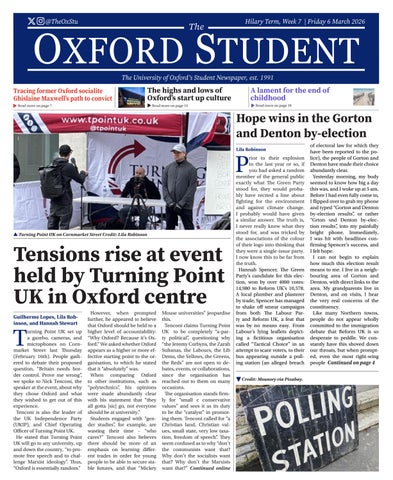


Guilherme Lopes, Lila Robinson, and Hannah Stewart
Turning Point UK set up a gazebo, cameras, and microphones on Cornmarket Street last Thursday (February 16th). People gathered to debate their proposed question, “Britain needs border control. Prove me wrong”, we spoke to Nick Tenconi, the speaker at the event, about why they chose Oxford and what they wished to get out of this experience.
Tenconi is also the leader of the UK Independence Party (UKIP), and Chief Operating Officer of Turning Point UK. He stated that Turning Point UK will go to any university, up and down the country, “to promote free speech and to challenge Marxist ideology”. Thus, “Oxford is essentially random.”
However, when prompted further, he appeared to believe that Oxford should be held to a higher level of accountability:
“Why Oxford? Because it’s Oxford.” We asked whether Oxford appears as a higher or more effective starting point to the organisation, to which he stated that it “absolutely” was. When comparing Oxford to other institutions, such as “polytechnics”, his opinions were made abundantly clear with his statement that “they all gotta [sic] go, not everyone should be at university.”
Students engaged with “gender studies”, for example, are wasting their time – “who cares?” Tenconi also believes there should be more of an emphasis on learning different trades in order for young people to be able to secure stable futures, and that “Mickey
Mouse universities” jeopardise this.
Tenconi claims Turning Point UK to be completely “a-party political”, questioning why “the Jeremy Corbyns, the Zarah Sultanas, the Labours, the Lib Dems, the Yellows, the Greens, the Reds” are not open to debates, events, or collaborations, since the organisation has reached out to them on many occasions.
The organisation stands firmly for “small c conservative values” and sees it as its duty to be the “catalyst” in promoting them. Tenconi called for “a Christian land, Christian values, small state, very low taxation, freedom of speech”. They seem confused as to why “don’t the communists want that? Why don’t the socialists want that? Why don’t the Marxists want that?” Continued online

Prior to their explosion in the last year or so, if you had asked a random member of the general public exactly what The Green Party stood for, they would probably have recited a line about fighting for the environment and against climate change. I probably would have given a similar answer. The truth is, I never really knew what they stood for, and was tricked by the associations of the colour of their logo into thinking that they were a single-issue party. I now know this to be far from the truth.
Hannah Spencer, The Green Party’s candidate for this election, won by over 4000 votes: 14,980 to Reform UK’s 10,578. A local plumber and plasterer by trade, Spencer has managed to shake off smear campaigns from both The Labour Party and Reform UK, a feat that was by no means easy. From Labour’s lying leaflets depicting a fictitious organisation called “Tactical Choice” in an attempt to scare voters, to their bus appearing outside a polling station (an alleged breach
Credit: Mounsey via Pixabay.
of electoral law for which they have been reported to the police), the people of Gorton and Denton have made their choice abundantly clear.
Yesterday morning, my body seemed to know how big a day this was, and I woke up at 5 am. Before I had even fully come to, I flipped over to grab my phone and typed “Gorton and Denton by-election results”, or rather “Grton snd Denton by-election results”, into my painfully bright phone. Immediately, I was hit with headlines confirming Spencer’s success, and I felt hope.
I can not begin to explain how much this election result means to me. I live in a neighbouring area of Gorton and Denton, with direct links to the area. My grandparents live in Denton, and on visits, I hear the very real concerns of the constituency.
Like many Northern towns, people do not appear wholly committed to the immigration debate that Reform UK is so desperate to peddle. We constantly have this shoved down our throats, but when prompted, even the most right-wing people Continued on page 4

comment@oxfordstudent.com | Deputy Editor: Marcus Swinerd Section Editors: Sehr Laiba, Guilherme Lopes, Saara Lunawat, Audrey Miu, Saba Ahmadzadeh Noughani, Tiffany You

How the new western entrance to Oxford Station will look. Credit: Network Rail
Oxfordshire County Council has announced its plans to improve rail services in the county, in a bid “to achieve a greener and more connected Oxfordshire, placing rail at the centre of thriving, accessible communities”.
OxRAIL 2040: Plan for Rail, which should be fully completed by 2037, will include the addition of four new stations in the county, upgrades to all 23 existing stations and measures to decarbonise the rail system. With 6.79 million annual passengers, Oxford Railway Station is the heart of the county council’s plans to improve rail transport in the county.
However, these plans are only due to commence in 2031, and the current fractured state of the Oxford Station leaves me wanting more. Although the expensive OxRAIL 2040 promises great things for the future of rail travel in Oxfordshire, it leaves me questioning whether these plans will be truly effective.
Opened in June 1844, Oxford Station was originally built in Victorian England, and is arguably too small and outdated to be sufficient for an internationally-visited
modern-day university city. Neale Coleman, Chair of the Oxford Growth Commission has argued that, in its current state, Oxford Station is “pretty lousy” and needs more public money than the intended £161m to ensure a “first class entry to the city”. I echo this statement, and here’s why.
OxRAIL 2040 contains three core phases to its improvements of the Oxfordshire rail network. Announced last No -
“ Oxford Station [...] is arguably too small and outdated to be sufficient for an internationally-visited modern-day university city.
vember, the major changes to the Oxford station come in Phase 1 (2025-2030), including the realisation of a regular Bristol to Oxford rail service (P1.04) and creation of a new Oxford Station Platform 5 and western concourse (P1.07).
Phase 2 (2031-2037) includes an ‘Oxford Station Master-
plan’ (P2.08), which included four new trains an hour direct to/from Cambridge planned with East West Rail. In its current state, the Oxford Station is frankly too small and too crowded. My typical journey home via London often includes a frustrating five minute hiatus waiting for late travel-goers to run onto the Oxford to Paddington service. There are currently only two direct trains from Oxford to Paddington per hour, and the slower Marylebone service only runs twice per hour too. This means that journeys from Oxford to London are often overcrowded, meaning many passengers have to stand up for the whole journey.
On December 9th, the UK Transport Secretary (Heidi Alexander) echoed these realities of British rail travel when unveiling the new nationalised Great British Rail model in London Bridge. Alexander referred to “every cancelled service, every cramped carriage, every dodgy wifi connection” that represents “a transport system, economy and indeed a whole country that is in desperate need of renewal”.
Read more online at www. oxfordstudent.com
Eileen Gu, former visiting student at Magdalen College, won two silver medals and one gold medal in freestyle skiing at the 2026 Winter Olympics in Italy, making her the most decorated freestyle skier in Olympic history.
She scored her silver medals in the women’s Big Air and slopestyle events on 16th February and gold medal in the women’s halfpipe on the final day of competition, 22nd February.
Gu is now also a two-time Olympic torch bearer. She carried the Olympic torch for the Milano Cortina Games, stating: “Grazie mille [thank you very much] for the opportunity to be a part of it all!” Gu also carried the torch in the Paris 2024 Games.
In 2024, Gu studied at Magdalen College for a term through the Stanford Bing Overseas Studies Program, during which she lived on-campus. Gu is pursuing her Bachelor’s in International Relations at Stanford University, and Stanford’s Bing Program.
Oxford University has dropped a bid for anonymity in an employment tribunal in which a senior proffesor is alleged to have harassed a junior female colleague.
In October, the University was granted this order to protect senior academic figures involved but has since dropped this due to claims it prevented open justice.

The members of the Oxford Union have voted in widespread reforms to the appointment of unelected officials and those who are eligible to stand for President. The reforms reduce the term that unelected officers, such as the Senior Treasurer and Senior Librarian, are in office from three years to one, and mandates a fallow term between being a member of Standing Committee and running for President.
The motion was originally carried in last week’s (Thursday February 5th) main debate, but was delayed until this week’s after debate to be voted on.
Oxford Labour Club hosted Higher Education Minister, Jacqui Smith, for an event discussing the future of higher education. Discussion topics ranged from the sustainability of funding for higher education institutions and the recent controversies surrounding student loans.
Oxford University Liberal Association hosted their annual dinner, with Max Wilkinson MP as their guest speaker. OSLA also hosted the Liberal Democrats’ Higher Education spokesperson, Ian Sollom MP, earlier this week. Additionally, nominations are open to stand in the next OSLA election.
Oxford University Conservative Association have continued a term with many speaker events, hosting Caroline Nokes MP and Steve Baker in recent days. Additionally, nominations are open to stand in the next OUCA election.
Oxford Reform Society hosted their first speaker event last week with David Starkey CBE on ‘Mandelson and the Rise and Fall of the New Labour Syste, of Corrupton’ discussing the history of Labour and Mandelson.
In my family fail to construct a valid argument as to why mass-deportation is essential. Or rather, they do not know the intricacies of the cause they are supposed to be fighting for; they only know that something in this country is wrong. We have been constantly

told that this is the fault of the UK’s immigration
For the fourth year running, central London is illuminated with lights marking Ramadan, the holiest month in the Islamic calendar. The Ramadan lights project, featuring over 30,000 sustainable LED lights, has become an annual event, with Mayor Sadiq Khan officiating the switch-on. The project was founded by Aisha Desai, and funded by Asif Aziz; London is the first major city in Western Europe to host such a display for Ramadan. This means a lot to me. My grandfather survived the riots of the 70s and 80s, also known as “Paki bashing”. My mother grew up in London having her hi-
system by millionaires who seem desperate to divide a population fucked over by austerity.
I am, like many others, more concerned about the cost of living than I am about my neighbours who were not necessarily born here, but are nonetheless part of my community. Gorton and Denton, like many places across Greater Manchester, is a diverse constituency, but many are united over similar concerns. Many people are too busy struggling to feed themselves, feed their children, afford to pay their bills, and survive under a government that is not for the common person. These concerns are shared up and down the country by families
like my own. However, I will admit my privilege in this aspect. Whilst I still consider myself working-class, I have found temporary refuge from these anxieties in my time at uni-
“
Something in this country is wrong.
versity; I receive a good income through student finance and bursaries, I can afford to indulge in leisure activities, and manage to feed myself well. Nevertheless, in moments like these, I am reminded of the concerns I could face in the future, as well as those
shared by my neighbours.
But for now, I feel hope. Hope that this “Green Menace”, a nickname that members of the party have taken in their stride, can inspire a wider trend of rejecting Reform UK, deeming the Labour Party unviable, and electing individuals who can make real change. An individual who, clearly, is equally familiar with the experiences of the working-class voting block. Her authenticity and strong links to the local community, unlike a certain Reform UK candidate’s lack of, put hope in the people of Gorton and Denton, and I can only hope that we can Read more online at www.oxfordstudent.com
jab pulled off by teenage boys, sworn at by strangers on the street, and recalls that she had to resort to eating the same school meals every day because halal options were non-existent. Therefore, I am not surprised when people, (especially from that generation), celebrate Ramadan lights in London, Ramadan decor in highstreet shops, or London having its first Muslim mayor. Nor am I surprised that people celebrated Rishi Sunak putting out Diwali Candles outside 10 Downing Street, the first Prime Minister to do so. Visibility and recognition, while it can be performative, can arguably also be
some sort of progress.
As someone who grew up visiting the Christmas lights on London’s Oxford Street, now seeing my faith and traditions reflected in such a prominent public space in the same way, feels like a long-overdue acknowledgment of belonging.
I greatly appreciate and
applaud Asif Aziz and Aisha Desai for their efforts. As I welcome this religious recognition, I can’t help but ask what it means to celebrate Muslim identity in public spaces while prejudice, discrimination, and hostility toward Muslims Read more online at www.oxfordstudent.com

Miller
Malala. Michelle Obama. Hillary Clinton. International Women’s Day at school always highlighted these women. When reading a book about inspirational women, these three names appeared again, and most recently, someone I know was gifted Michelle Obama’s autobiography (Becoming) as an International Women’s day present. I can’t help but feel disappointed. Let me explain. Let’s start off with white feminist narratives and Malala, whose selective feminist narratives don’t address the anti-imperialist perspectives of many marginalised women in the Global South. Critics, myself included, argue that Malala has been used as a figurehead by Western governments to justify their own political agendas.
Western media has latched on to Malala and her selective advocacy, and subsequently framed women in the Global south as victims in need of “saving” by the “civilised” West, instead of viewing these women as independent agents of change.
These orientalist tropes feed into political agendas, namely that Western countries, including our own, are justified in their interventions, expansions, invasions, bombings, and lootings of countries in the Global South, all in the supposed name of saving “victimised brown women”. But only to result in the killing of hundreds of thousands of people, disproportionately women, in their wake.
In Afghanistan alone, Human Rights Watch and the United Nations have documented that civilian deaths, caused by US-NATO airstrikes
and ground fire, number over 46,000. In 2021 alone, reports indicated that women and children accounted for nearly half of all civilian casualties.
In Iraq, over a million civilians were killed from direct violence arising from the 2003 US Invasion. Women relied on many of the men killed – these were our fathers, brothers, sons, and husbands.
Subsequently this dismantled the social fabric that women depended on for their safety, livelihood, children’s upbringing, and family stability.
In Gaza, the daily death rate (averaging 250 people daily in 2024) exceeded that of all other major conflicts in the 21st century. This February’s Lancet Global Health study found that women, children, and the elderly comprise over half of violent deaths. Estimates from UN Women indicate that at least 33,000 women and girls


have lost their lives, with an average of 37 mothers being killed a day. These only include recorded deaths.
Of women survivors, the UN has described their conditions as “hellish” and “catastrophic” They have resorted to using tent scraps in place of sanitary towels and orced to give birth amid filth and rubble without trained medical professionals.
I remember when someone I knew was making an Interna-
tional Women’s Day presentation for their school, and how disappointed I felt that they chose Kamala Harris for their slide. The same Kamala Harris that has repeatedly expressed support for the Israeli government, responsible for murdering, unleashing hell onto, and reducing the lives of so many women to rubble.
And despite all this injustice Read more online at www. oxfordstudent.com
This past Tuesday, Chancellor Hague awarded eight honorary degrees to mark the one year anniversary of his chancellorship. Some more famous than others, the recip-
ients ranged from former US Secretary of State John Kerry to the aptly named conservationist Isabella Tree and even (my personal favourite) podcaster Dominic Sandbrook.
The Sheldonian Theatre was overrun with security, visitors, and media as the ceremony

slightly disrupted the normal flow of the Oxford world. While most students probably barely noticed the event, it deserves to be lingered upon for just a moment. It is a core part of what can be described as the Oxbridge system of patronage; something that may equally annoy students as much as it, almost invisibly, enriches the Oxford experience.
The concept of honorary degrees is nothing new; almost every University confers some amount of honorary degrees, inviting famous and accomplished individuals to a ceremony and bestowing them with a useless title of incredible honor. Whether it be Taylor Swift at NYU or Muhammed Ali at Columbia and
Princeton, they are heavily utilised. Even my own college, Regents Park, awarded the late Jesse Jackson an honorary fellowship.
As students, we may have reactions towards honorary degrees ranging from totally uninterested, to mildly amused, and even rather angry at the idea of someone getting a degree without doing any of the work.
However, these displays of pomp and circumstance are a part of a wider network of patronage within the University system. Oxford, as the oldest English-speaking university in the world, holds a unique place within this system. It can wield its age, grandeur, and status in ways hard for us stu-
dents to detect. Yet, we should be conscious of why this is being done, and why it is not just important, but necessary.
Just like honorary degrees, the use of the high table at formals is an extremely useful tool for Oxford principals, fellows, and tutors to take advantage of. The moment when those attending a formal are forced to stand up and watch twenty random people process behind your college principal towards the high table is usually forgotten once the starters are wheeled out. However, what goes on beneath the surface is more interesting.
Those seemingly random, Read more online at www. oxfordstudent.com
investigations@oxfordstudent.com | Deputy Editor: Jason Manning
Section Editors: Daniela Braw Smith, Sam Drury, Baybars Charkas, Ananya Bhatia, Bianca Orphelia Molinet, Stefano Bates |
Christine Savino
On 9th February, Ghislaine Maxwell invoked the Fifth Amendment right against self-incrimination before the US House Oversight Committee, declining to answer questions but stating that she would “speak fully and honestly” if granted clemency by US President Donald Trump. Her cut-glass accent, reminiscent of her affluent upbringing in South East England, posed a sharp contrast to her dull prison garb. Maxwell is currently serving a 20-year sentence at Federal Prison Camp Bryan, a minimum-security women’s federal prison in Texas, following her 2021 conviction in New York on charges related to the trafficking of minors by Jeffrey Epstein.
But decades before her conviction, Maxwell was known in Oxford not as a convict, but a striking, socially magnetic undergraduate moving within the university’s most elite circles.
Maxwell grew up in Oxford, where her father, media magnate Robert Maxwell, owned Pergamon Press and resided with his family at Headington Hill Hall – then a 53-room mansion with a built-in swimming pool known for housing opulent parties. Today, the building houses Oxford Brookes University’s School of Law.
Robert Maxwell was a significant benefactor to Balliol College, reportedly donating £60,000 in the 1960s – equivalent to roughly £1 million today. His name, “Ian Robert Maxwell,” appears among major donors commemorated in the Balliol Bidding Prayer, which is reserved for special occasions. His first legal name in Britain
was “Ian,” although he was publicly and professionally known as “Robert Maxwell.” Likewise, Balliol has the eponymous Robert Maxwell Fellowship in Politics.
The Maxwell family maintained deep academic ties to Oxford University: Ghislaine’s sister Isabel studied at St Hilda’s College, Philip and Kevin Maxwell at Balliol College, and their mother, Elisabeth Maxwell, earned a doctorate from Oxford University.
According to the 1983 Balliol College Record, Maxwell attended Headington Girls’ School before attending Balliol in the early 1980s. She matriculated just a few years after Balliol began admitting women in 1979. Maxwell graduated in 1985 with a degree in History and Modern Languages.
Journalist Michael Crick, who served as President of the Oxford Union in 1979, tutored Ghislaine Maxwell through Greene’s Tutorial College before her admission to Oxford University.
He stated that her family pronounced her name as “gih-LEN,” contrary to the mainstream pronunciation “gih-LAYN.”
“She hadn’t done as well in her A Levels as she should have done, and that’s where I came in,” he said. At the time, Crick was living in the Oxford Union’s Steward’s House and taking on private tutoring work to supplement his income.
He described Maxwell as “highly, highly intelligent” and “exceedingly good-looking – intimidatingly beautiful.” However, he added: “her essays were a bit skimpy, shall we say the least… two-thirds of a side, handwritten. She never seemed to do a great deal of work. She was busking it.”
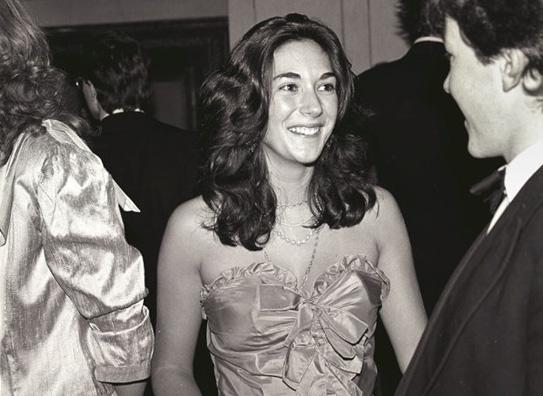
Crick recalled that she was always 10 to 15 minutes late to lessons and appeared under pressure as the youngest and reportedly favourite child of Robert Maxwell, one of nine siblings.
“Her father was extremely keen for her to go to Oxford because several of her siblings had already gone to Oxford… she was under huge pressure from her father to get her A Levels right this time,” he said.
He noted that her father’s longstanding relationship with Balliol likely shaped perceptions of her admission. However, he noted that to assume preferential treatment might be “terribly unfair.”
“I think I’m right, though,” he added. Photographer Dafydd Jones, who photographed Maxwell starting in 1980, stated: “I knew of male students who everyone said that they got in because their fathers donated. That was the sort of thing that happened at that time. I can’t say whether that is how Ghislaine got in.”
Balliol College has been approached for comment.
Former students say that, in the early 1980s, Oxford University was socially intense and class-conscious – a “Brideshead Revisited atmosphere,” as Crick described it, referencing Evelyn Waugh’s novel of aristocratic student life. He described Oxford University in the 1970s and 1980s as a place where students could “party hard” and still perform well academically – an environment he said gave the university a notable party atmosphere.
Maxwell quickly became a visible presence in that social scene.
In 1980, Dafydd Jones shot a series of pictures about Oxford University’s social scene, which included then 19-year-old Ghislaine Maxwell who had not yet been accepted but was active in the university’s party culture.
“She seemed like a nice young girl, and the sad thing is she was a bit older than Virginia Giuffre
at the time that I photographed her, so I didn’t have reason to think bad of her,” Jones stated. The late Giuffre long held that Epstein and Maxwell began trafficking her when she was 16. She later became an advocate for sexual abuse victims, and she died by suicide in April 2025. Post-matriculation, Maxwell’s time at Oxford University overlapped with famous figures such as David Faber, former Conservative Member of Parliament, and former Prime Minister Boris Johnson.
Rachel Johnson, sister of Boris Johnson, recalled encountering her in Balliol’s Junior Common Room: “As a fresher, I wandered into Balliol JCR… and found a shiny glamazon with naughty eyes holding court astride a table, a high-heeled boot resting on my brother Boris’s thigh.” Johnson added that she eventually “managed to snag” an invitation to one of Maxwell’s parties at Headington Hill Hall. The full investigation is continued online at: www.oxfordstudent.com.
Director Mark Tweddle’s Who’s Afraid of Virginia Woolf? marks the Oxford Playhouse’s first inhouse production in decades, and it was well worth the wait. There is a strange sense that nothing about this adaptation is coincidental: Tweddle first saw Edward Albee’s magnum opus at the same Playhouse when they staged it twenty-five years ago. The play’s return this year is therefore at once this full-circle moment and a complete reinvention; both true to the dazzling, damning play of 1962 and remarkably resonant in 2026.
Designer Liz Ascroft’s set phenomenally captures this duality, as both a realistic, domestic space with livedin furniture, and a pointedly performative, curtained platform with a series of receding

Jasmine Joyan Poetry Editor
frames culminating in a door upstage. Even the smallest details encapsulate this: for example, over 300 real books were borrowed to reflect the characters’ backgrounds in academia. These are strategically placed on shelves that outline the backdrop, creating such a theatrical frame.
“ There is a strange sense that nothing about this adaptation is coincidental
In contrast to this constancy though, somehow the set still feels very far from static, partly due to the characters’ interactions with it. The evening begins with the couple, Martha (Katy Stephens) and George (Matthew Pidgeon) arriving home. The fact that it
Juno
Christina Robinson
is Martha who switches on the many table-lamps one by one in front of the audience makes it feel like we are still pre-performance, preparing for the real show which will be to the guests of the younger couple, Nick (Ben Hall) and Honey (Leah Haile).
The other place colour plays a key role is in the costumes, with, again, Martha as the most volatile character being the only one granted a whole costume change, switching a green and gold dress to a striking red blouse with matching heels already in Act 1. Stephens delightfully leans into the costume’s seductive power, but as we see her character progress, Martha’s dress interacts with us at her lowest moment in Act 3. Here, she is at her most captivating: her shoes are off as she talks into one as if it were a telephone, her hair unravelled, her makeup smudged – a new detail comes to light with every line.
Over lunch today I considered your eyes,
Less white than they were a while back
Yet brighter than they looked
Backlit by the corridor light
Standing in the doorway; hair halo-ed Every time you tucked me in.
Every morning, you’d come striding down the stairs
Covered in feathers
Peacocking around the room
In a scarf or three or two
They used to be arranged to frame your face
Now fluff grows from your ears
And you cough with every third step.
You were once a bride
In that off-white dress.
I wore it to the club the other night
It felt a sort of heresy.
But with every half night’s sleep, Forgetfulness creeps
And wrings the memory out of my brain.
Read the full poem at www.oxfordstudent.com
culture@oxfordstudent.com | Deputy Editor: Ivett Berenyi
Section Editors: Elliot Wang, Flora Molnar, Elizabeth Gammaidoni, Isaac Hole, Nora Jessie

Credit: Craig Fuller
On the topic of memorising long speeches, the other standout performer has to be Pidgeon as George – whereas Martha’s strength is motion and she oscillates on and offstage, George is almost always on-stage (for, I repeat, three hours!) and is given some of the most tongue-twister lines (“you just finished saying that the things that motivated you were the same things that motivated me”). His chemistry in these verbal matches with every character, not just Martha but also Nick and Honey, is admirable.
Martha Kiyan
Let’s break away.
Let’s take the first step forward.
All in all, the cast and crew therefore have truly taken all of Albee’s potency on the page and translated it in delightfully unexpected ways to the stage – an interpretation that I cannot unsee. When the most intense last act finishes and the actors come out to take their bows, I am in awe not only of their technical mastery, but also dedication and emotional strength as they live through the rollercoaster of their characters.
Read the full article at www. oxfordstudent.com
Toward the life we’ve been afraid to claim.
Let’s break away.
No time to waste.
Forget the ‘what-ifs?’.
The ‘maybe-nots’.
Let’s break away.
Our thoughts pressed into borrowed shapes.
Be damned the rusted paradigms.
Be damned the quiet cages.
Let’s break away.
I cannot wait to dance and laugh with you again.
One day.
Let’s break away.
Let’s watch the sun.
The moon.
The stars.
The blue sky wide above us.
Read the full poem at www.oxfordstudent.com
Things I Know To Be True will be brought to us by Lighthouse Productions in Grove Theatre, between Tuesday 3rd and 7th Saturday March.
Dirty Dog Productions is staging Crisp Sketches in BT Studio between Tuesday 3rd and 7th Saturday March
At the Keble O’Reilly, you’ll have the chance to attend Prince Consort Ladygirl between Wednesday 4th and Sunday 9th March
Pembroke College is bringing Little Women to the Pichette Auditorium between Tuesday 3rd and Friday 6th March.
At St. Peter’s Chapel, Cross Keys Productions is adapting Macbeth between Wednesday 4th and 6th Friday March
Rosebud Productions is staging A Life’s Tale at BT Studio between Tuesday 3rd and Friday 6th March
The OUDS Centre Stage Festival is happening at the Pilch between Wednesday 4th and Friday 6th March.
At the JDP in St Hilda’s, the College’s Drama Society is staging Blue Stockings between Thursday 5th and Saturday 7th March
Marmalade Orbit Production’s Perudo is brought to us at BT Studio between 3rd Wednesday and Friday 6th March.
Fennec Fox Production’s The Flick is happening at BT Studio, between Tuesday 10th and Saturday 14th March
Lastly, you will have the chance to attend The White Devil by 2046 & Analogia Productions at St John’s Auditorium between Wednesday 11th and Friday 13th March
ergetic indie sets whetted the audience’s appetite and set the tone for the night.
Good Neighbours are an English indie rock duo, Oli Fox and Scott Verrill, hailing from London. The band name was, as they have said, “originally just a joke.”
The pair had been “neighbours in the studio,” collaborating on various projects together before deciding to test the music industry by sending out demos under the name Good Neighbours. “When they all replied,” the duo recalled, “it was as though our band pseudonym worked.”
What began as an inside joke quickly became something much bigger.
On a wintry Tuesday evening, the O2 Forum Kentish Town, with its 2,300 capacity and art deco charm, proved the perfect setting to find out.
Support came from Jack Gray and Master Peace, whose en-
Earlier this month, Good Neighbours released Blue Sky Mentality (Complete Edition), an expanded version of their 2025 debut album. To the crowd’s delight, the duo delivered many intoxicating highlights from this deluxe release.
The dynamic introduction to ‘Suburbs,’ paired with bursts of golden light and flashing blue spotlights, injected immediate adrenaline into the room. The anthemic opener, reflective yet urgent, captured the longing to break free from small town limitations and chase something greater. “Leave the pack / Cold feet in the summer (Yeah, yeah) / You’re a runner (Yeah, yeah) / And you’re fast.” The crowd responded in kind, singing along with fervour.
Joined by a live band throughout the evening, the duo delivered a rich and lay-
ered sound. Fox alternated between drums, guitar, and synthesiser while maintaining heartfelt, expressive vocals. ‘Found U/Me’ shimmered with sweetness, its melody elevated by his tender delivery.
A surprising standout moment arrived during ‘Walk, Walk, Walk’ when Fox leapt from the stage to join the audience, bouncing among the crowd as fists pumped and voices rose together.
The evening reached its euphoric peak with ‘Home.’ The
Credit: Susan
audience knew every lyric, clapping and singing with gusto. “Darling, won’t you take me home? / Send me shivers somewhere I used to go.” Any doubts about whether viral fame could translate into tangible, communal energy were firmly dispelled. The final moments felt like the first hint of spring after a long winter. Good Neighbours truly delivered a home run in Kentish Town.
Read the full article at www.oxfordstudent.com

Ethan Nestle-Fox chats with ude Holloway about founding an orchestra.
So yeah, I’m Jude. I am an aspiring conductor, and I currently work in classical music administration whilst I aim to become a conductor.” He studied music at Durham — “not Oxford!” he quips — and moved back to Oxford after graduating in 2024.
After applying for conductorships with various orchestras around Oxford, Jude decided that he was instead going to start one. Of established amateur orchestras, he says there’s “always a slightly different dynamic.” Amateur orchestra memberships are often much older, and many members have been in the
orchestra for many decades. He enjoys how Oxford Concert Orchestra spares him from the battles that can form when you “set into an amateur orchestra that does some things a certain way, and people have played in it for forty years. It can be quite a tricky thing to do.”
“I would like to vary the repertoire a little bit. We haven’t done anything radical at all. I guess we did the Coleridge-Taylor [The Bamboula] in the first concert, but that’s performed all the time now.” Coleridge-Taylor was a British composer of mixedrace heritage active in the early twentieth century. His works are increasingly widely performed.
How we engage with classical music by underrepre-
“ You can have incredible modern and incredibly advanced music that is still really appreciated.
sented groups is an ongoing debate. “It would be nice to have a piece by someone less well represented in classical music as the staple of a concert, as the title. It’s difficult to manage that, as there are a lot of difficulties about what music people want to play and what music audiences want to listen to.” These pieces often have to be a smaller part of the concert because the orches-
tra needs the better-known works to attract players and audiences. “But Four Black American Dances [by Carlos Simon] is a piece I really want to do.”
In terms of the distinction between “high-brow” and “lowbrow” music, Jude makes his position clear: “that margin needs to go. It doesn’t need to be better or worse music, it’s about how it is appreciated. You can have incredible modern and incredibly advanced music that is still really appreciated. It needs to attract an audience in some way. It needs to have some form of artistic expression.”
Read the full article at www.oxfordstudent.com
Within seconds of me setting pen to paper for this review, an immense burden of responsibility weighed down on my shoulders. What headline do I give the article? Do I go down the usual route to find something rousing, scandalous, and apt for clickbait? Saara El-Arifi’s book is filled with references to infuriating depictions of the Pharaoh, ranging from antiquity to Shakespeare’s early-modern Antony and Cleopatra. I could easily quote any of those phrases, but El-Arifi’s protagonist would be extremely cross with me. Not only her, but all the women who have been misconstrued, silenced, and slutshamed across history. Not just historically, but still in our present day.
“ I found it productive to read Cleopatra as a speculative memoir.
In a recent interview for The Guardian, El-Arifi explains that Cleopatra started as “historical fiction,” but quickly turned into a memoir due to a lack of illuminating historical sources. Over the course of her research – one that involved a postgraduate degree at SOAS University of London – the author was confronted by “a cesspit of propaganda and ancient court gossip” about the Pharaoh. Reading the book, I myself felt the relative lack of historical specificity. However, that is true for other renditions, especially in the early-modern period. Instead, I found it productive to read Cleopatra as a speculative memoir.
all time.
Cleopatra never really left us. Her iconicity ingrained several myths in popular consciousness. That is the precise reason why we must be sensitive as we propagate or challenge those narratives. The novel itself interrogates the way in which we tell and interpret history. Cleopatra’s commentaries and pithy phrases abound over the course of the text, reminding the reader of metatextual factors that have shaped her reputation. Like many other readers, I came to Cleopatra with certain expectations. I wanted to see an unwavering female ruler. Ever since I read Shakespeare’s Antony and Cleopatra, I wished to see a fearless embodiment of that figure. I needed to see Cleopatra liberated from “th’ posture of a whore”, someone who writes back to the “saucy lictors” of Rome. Caught up in those desires, I forgot the potential that her “infinite variety” held in Shakespeare’s play. El-Arifi did a stellar job in illuminating the layers beyond the gold ornaments, purple sails, and perfumed winds; these things were previously taken for the Pharaoh’s decorated sexuality. Due to these expectations,
“ “as true as any other biography of Cleopatra VII.”
I challenged myself to come to terms with the vulnerability Er-Arifi weaves into her story. She unsettles not only myths of misogyny, but also the deified image of the ruler. Throughout the novel, the author reminds us that no one is protected by the gods, no woman is ever safe from the
perils of war and slanderous men around her. On multiple occasions, El-Arifi’s Cleopatra will tell us that she “was not ready to be Pharaoh.” Among others, the death of her sister, her love of freedom, and complicated relationship with Isis, all contribute to her doubts. She wavers between self-assurance and fearful uncertainty, much like any person would do under such a heavy weight of responsibility. At times, I would have loved to learn more about how El-Arifi imagines Cleopatra’s psychological landscape. One such instance includes the birth of Cleopatra’s and Caesar’s son, Caesarion. Just as rulers are not impenetrable to danger without and within, no mother is ever safe from deep anxieties of parenthood, especially if those children are to become Egypt itself. Cleopatra must trick the gods by marking his son with the eye of Horus (a requisite for Egyptian rulers in the novel). We learn that she “felt his pain like it was my own, and I wept for the both of us.” At such plot points, I was eager to read more, to dive deeper into Cleopatra’s persona. But after all, whatever persona is on this page or on any other, it will only be “as true as any other biography of Cleopatra VII.”
Cleopatra’s sexuality is as canonical as her name. Indeed, Part Two of the novel is titled ‘The Whore,’ detailing the events after the death of Julius Caesar, and Cleopatra’s passionate relationship with Marcus Antonius. “I have always been blinded by love. That was one thing your histories got right,” Cleopatra says. I think there’s great force in bringing the Pharaoh’s emotions and romantic relationship to the limelight. In this novel, those
relationships are handled with dignity, grace, and intimacy. The two love interests are distinct and easily recognisable, even if a little reminiscent of certain masculine tropes of our day. However, that confluence
“ we find a woman who may help us grapple with a myriad of preju-
between past and present is the backbone of this novel –not only in terms of content, but also in its structure. El-Arifi’s Cleopatra gains a sardonic, yet witty and lively voice in the novel’s paratexts. The author uses footnotes to explicate certain historical references in the main text, or to let Cleopatra respond to miscon-
Credit: official book cover
structions her figure has been cast under.
I wish I could praise the ending in detail; El-Arifi’s background in fantasy novels shines through with exceptional delight in the final twist. It is unexpected yet makes perfect sense in the oeuvre of Cleopatra retellings. However, the cruelty of spoiling that chapter would align me with… the Romans.
I think Saara El-Arifi commenced a crucial project at this junction of historical fiction, life writing, and magic realism. We all know her name, and we’ll never truly know her. However, in El-Arifi’s rendition, we find a woman who may help us grapple with a myriad of prejudices that have survived thousands of years.
Read the full article at www.oxfordstudent.com

Elliott Wang previews a new student adaptation of Jordan Tannahill’s Late Company and its “distinctly Singaporean” elements.
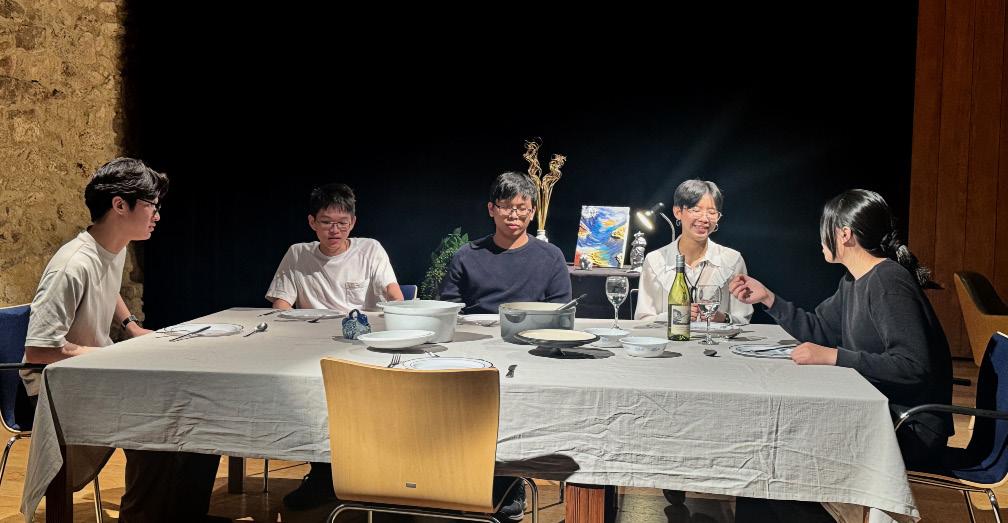
The Oxford University Malaysian & Singaporean Students’ Association (OUMSSA) is probably best known as that mysterious organisation that your Singaporean or Malaysian friends run off to in the dead of night. This year, second-year students Garion Sim and Natalie Tan founded OUMSSA Theatre, a student production team composed entirely of Malaysian and Singaporean Oxford students. It certainly intrigued me when I found out that their inaugural production would be of Jordan Tannahill’s Late Company, a Canadian script with LGBTQ+ themes and mentions of hockey parents, Jewish latkes, and Christie Blatchford.
In 2014, when Late Company premiered in Toronto, it was lauded for its exploration of the devastating impacts of cyberbullying. It has since had multiple productions in London and Poland. However, Natalie Tan, a co-director, told me that this play had “distinctly Singaporean themes”. The narrative deals with the tragic death of a boy, Joel (Gyan Seah), and its aftermath. Joel’s upper-middle-class parents, Michael (Max Yeo) and Deborah (Meira Lee), invite another family, Bill (Hong Yi Lim), his wife Tamara (Nicole Tan), and their strangely aloof son Curtis (Zachary Wong), to dinner. From the very start, Deborah feels wronged by the other family’s lack of punctuality. Once they finally arrive, what follows is a masterclass in awkward humour and hair-pulling frustration. Both families hold a barely hidden resentment for each other, and each person must confront their responsibility for Joel’s death.
The play’s brilliance lies in its ability to elicit excruciat-
ing discomfort. According to co-director Garion Sim, the play “bridges the gap with what we want to do in a Singaporean story that is easily understandable by Western audiences”. Late Company’s original script is barebones in terms of stage directions, leaving a wealth of space for experimentation. The first half of the play starts off on an awkwardly comedic foot, in a manner akin to The Office. The second half takes a dark turn – everyone grows weary of the niceties, and their repressed emotions explode to the surface. According to Garion, “When Tamara and Bill first come in, they’re trying to connect with Michael and Deborah, and that’s why they are trying to crack jokes [...] Michael and Deborah don’t find it funny, and that’s why it’s funny for the audience.”
“ The play’s brilliance lies in its ability to elicit excruciating discomfort.
Deborah feels the most wronged by her son’s death, but she must keep up the facade of niceness. Her repressed rage is almost palpable. Her actress, Meira Lee, notes that “[Deborah’s] clearly holding a lot of grief, and she tries to approach this constructively, but at certain points she gets a little unreasonable when she is unable to cope with her own role in her son’s death.”
While Deborah strains to get the other family to admit guilt through smiling, bared teeth, her husband Michael is much more reserved. There is much potential for OUMSSA Theatre
to explore the nuances of his character. Although undoubtedly angered by the death of his gay son, Michael is a conservative politician who is conscious of his image. Actor Max Yeo notes: “Michael is one of the characters that’s a little more reserved throughout the play. The thing about Michael is that while he’s generally a mediating character, there are moments where he gets irritated [...] and I think that’s when his own culpability as a parent comes up.”
Someone’s always trying to blame someone else, but it’s all too late. The damage is done, and what everyone has left is a fragile delusion of their own purity. This drives the comedy of the play’s first half, as each character continuously escalates the level of passive aggressiveness until its breaking point. The actor for Bill, Hong Yi Lim, notes how “Bill says some lines about how Joel was neglected and how his parents should have done a better job of parenting him. Is he entirely wrong? No. Should he be saying that to grieving parents? Absolutely not. [...] [Bill] feels like he wants to be the smartest in the room, but he’s also very protective of his son [Curtis]”.
Curtis is perhaps the richest character for interpretation.
“
“It’s not a happy ending by any means,” says Grace, “I don’t think we ever advertise it as such, because it’s really, really not, but it’s a play that really makes you think.”
He is the delinquent son of Bill and Tamara, yet he keeps a hermetic silence in the play. When he does speak, it’s a laughably awkward and outof-place line. His mother Tamara insists that he is a natural-born comedian, but as a participant of the dinner he is entirely humourless. According to assistant director Grace Yu, Curtis’s character is deliberately kept ambiguous. Is he nervous or indifferent to the whole grieving ritual? Is there any truth to his hatred of Joel for his sexuality? “I think one theory we found very intriguing,” says Grace, “is that Curtis was actually heavily closeted.”
Credit: Elliott Wang
OUMSSA Theatre has adapted Late Company into a Singaporean context. So, how much knowledge do audiences need to know of Singapore? According to assistant director, Grace Yu, not much at all: “You don’t really need [much] prior knowledge. Or if so, I don’t think it has to be very deep. It could be very superficial. As long as you know who Lee Kuan Yew is.” Beyond minor script alterations (swapping “Christie Blatchford” to “The Straits Times”), what truly enriched the play was the cast’s grasp of Singaporean social attitudes. There is that annoyingly Singaporean instinct to mask grievances behind polite smiles and pointed comments, or a studied and artful coyness in Michael’s case. The Singaporean mantra, “Act blur, live longer”, is in full force. Can audiences expect a happy ending? “It’s not a happy ending by any means,” says Grace, “I don’t think we ever advertise it as such, because it’s really, really not, but it’s a play that really makes you think.”
Read the full article at www. oxfordstudent.com
Editor:
Section Editors: Ansu Bhattarai, Aamina Thava, Izzy Goldberg, Honcques Laus, Emily McPhee
Life is Not Fair, But it’s

Throughout my childhood, a certain quote was drilled into my head over, and over, and over again. Usually deployed during some trivial tantrum, it never managed to make me feel better. Instead, it tended to drive eight year old me into a period of insatiable anger. GiGi would say it, my mother would say it, even my older sisters. And yet, I get it now. After living in a city where reminders of privilege and inequality plague every quad, library, and classroom, I’m starting to understand: “Life is not fair, but it’s always good”. My first conversation in Oxford spawned by keeping my door open while unpacking my suitcases in my accommodation. Truly alone for the first time in my life, on a foreign continent, I was greeted by a tall, friendly man with a buzz cut. Stepping inside, he radiated a sense of confidence that my comparatively short, meager self had no chance of matching. We exchanged pleasantries, and before long I asked him where he’s
from. “Central London, but I didn’t go to school there.” Quite innocently, I asked, “where did you go to school then?” He winced, almost afraid to
“ But, in the meantime, prosecuting them under this guise of “getting back at the privileged” doesn’t help anyone. It demonises those who just so happened to receive this leg up, and doesn’t do anything in addressing a problem.
tell me, “Eton”. Hiding my smirk, I couldn’t help but mes -
friends’ backgrounds came out much later than you’d think due to this odd culture of embarrassment. Privilege is a topic widely discussed at this University, and for good reason. But persecuting students with even partial amounts of this privilege is equal parts cruel and useless. Just as the disadvantaged among us, they didn’t pick that life. Their
sage my parents back home saying, “you won’t believe this, but the first person I’ve talked to went to Eton!” I’ve become numb to these kinds of interactions, where somebody’s parent, family friend, or ancestor has a Wikipedia page. But, what has surprised me more than most is how these facts are usually teased out of people. In Week 3 of Michaelmas, I was in my accommodation block’s kitchen, where an impassioned conversation was going on about a girl in my corridor’s father. “I’m such a massive fan of his!”
Someone else chimed in, eyes glittering with something bordering on starstruck. “I’ve watched all of his work.” While the fanboying ensued, the girl in question, very nice and outgoing otherwise, retreated into a shell. “Yes, well, he just happens to be my father. It’s not anything very special, but I’m happy you like his stuff.” The embarrassment was painted over her face in bright streaks of red. These instances are not isolated. Some of my best
“ This life is too good to waste it with the useless squabbling which sometimes plagues our hall dinners or bar discussions.
parents are independent of themselves. Just like the rest of us, they should be able to feel a comfortable pride, not embarrassment, in their roots. It creates an atmosphere of restraint, where those who have privilege are so bothered by the prospect that they hide their background. This is not to say that they should flaunt these facts; we all know someone like that at this University, and it is incredibly frustrating. However (as someone who went to a rural state school), an Eton or Harrow boy should not be wincing when asked what school he went to. Secondly, it is entirely useless. Just as my grandmother would tell me, “Life is not fair”. It never has been, it probably never will be. Of course, this is not to argue we shouldn’t try and make it fairer. In fact, that has rightfully been an emphasis from the University in the past few decades. But, in the
meantime, prosecuting them under this guise of “getting back at the privileged” doesn’t help anyone. It demonises those who just so happened to receive this leg up, and doesn’t do anything in addressing a problem. When I was throwing a tantrum about my brother being able to stay up an extra hour with the adults, my GiGi would start her quote once again, “life’s not fair”. Then, as my mother tried to calm me down, she would respond, “but it’s always good”. It’s this second bit that we Oxford students miss. We know life isn’t fair, but do we remember that it’s always good? All of us have this incredible privilege, unfathomable opportunity, to live and study in Oxford. Why should we waste our time trying to demonise and put down those who happen to come from a life different than ours? Instead of worrying about how much money their father makes or which Oxford college their mother went to, we should worry about enjoying the experience of enjoying this environment together. This life is too good to waste it with the useless squabbling which sometimes plagues our hall dinners or bar discussions.
As I leave my childhood behind in this city, I don’t want to forget the many lessons I have learned over my years. The adults in my life sometimes give poor, contradictory, and sometimes downright useless advice. However, this should not detract from the true pieces of wisdom and lessons from many, many years on this earth. And so, I think it’s important for everyone in this city to take away this one lesson, accept it, learn from it, and apply its virtue: “Life is not fair, but it’s always good.”
Prior to or upon arriving here for your first term, you quickly learn that central Oxford has only a few small supermarkets. They are the kind that I would only go to at home when it is 11 pm, and I am prepared to pay over the odds for some snacks. Unless you are from a small village in the middle of nowhere, these shops are not what most are used to. Thus, here I rate what Oxford has to offer in the way of places you can do your weekly shop, and the pros and cons of each.
Magdalen Street Tesco’s (5/10)
A solid and safe choice. The iconic Tesca-lator adds joy and whimsy to your weekly shop. However, I have many qualms with this place. Firstly, they love to rearrange the shop layout bi-weekly. There is nothing worse than finally getting used to getting in and out in less than 20 minutes. Then, on the next visit, you spend 20 minutes wandering the aisles, wondering where they moved the oat milk to. Secondly, their strained relationship with stocking hummus has caused much stress for many people. One day, hummus disappeared from the shelves, sending all woke minds across Oxford into panic. In response to this, Sainsbury’s next door put their prices up, from 99p to £1.40. Months later, it reappeared en masse with ‘New in’ stickers rubbing its former absence into our faces. The audacity! Thirdly, the lack of signal, like most places in Oxford, proves troublesome. There are few things more embarrassing than standing at the self-checkout whilst the queue builds behind you when you realise you forgot to transfer money from your savings pot to afford your shop, or that you forgot to download your Clubcard vouchers. For a small shop,
it is surprising how many times I have lost my friends in there, and the inability to message them often makes for a stressful experience.
Various shops on Cowley Road (9/10)
You love to support local businesses at a bargain cost, and also love telling everybody about it. I am guilty of this. There’s nothing like coming home carrying your pride and a huge bag of jumbo-sized bay leaves for 99p. However, you cannot shop on Cowley Road without popping into Truck Records or one of the many speciality coffee shops (shout out to Peloton), spending double the amount you could have spent in Tesco’s, but at least you can say you buy your food from Cowley! Yes, I am speaking from experience here. It’s the best kind of reward.
Town centre M&S (6/10)
Another solid option, but certainly not budget-friendly. In my first term, I was so excited to be living away from home and had more money in my bank account from student loans and bursaries than I had ever seen in my life. Thus, I decided to treat myself. £70 later, and I was happier than ever. Walking home with my bags, I excitedly messaged my mum to talk about how much I loved living on my own. She could only laugh and warn me that I would not be saying this in a few weeks’ time when my student loan had disappeared, and I would be shocked at having spent so much money on one week’s worth of food. I, in turn, laughed it off, so proud of my first adult experience of ‘budgeting’. However, as promised, by week 6 I had run out of money. What else could one expect from such a shop? M&S’s one redeeming quality is that the fresh produce is undeniably
better than any other option in the centre: Tesco’s fruit and vegetables go off in 24 hours, so I am partial to popping in every once in a while.
Westgate Sainsbury’s (7/10)
Recently, I described this
“
So, take heed of what I have said, or don’t. It’s your bank account that is at stake here, and I won’t be held responsible for that.
shop as the ‘big Sainsbury’s’ to a friend who lives in Headington and was met with much ridicule. The version of me I become when I move home probably would have done the same, for, in reality, this is still a small shop. And yet, it is ‘big’ compared to the one on Magdalen Street. This is perhaps my favourite place to go in the city centre. It has everything I could ever need, and the prices are reasonable. The reduced section does not compare to that of Magdalen Street Tesco’s,
but I have still managed to find some good bits in there. Its location inside the shopping centre has led to some spontaneous and unnecessary purchases, and for this, I will rate it accordingly. As previously suggested from my M&S spending habits, I do not often exercise self-restraint, so I have been avoiding the general area recently.
Botley ALDI (10/10)
In my first year, I missed budget supermarkets so much. This is the shop my dad takes me to every time he drops me off, and it took me until my second year to realise that it is really not that difficult to get to. Yes, it may be farther than the conveniently situated Tesco’s that is less than ten minutes from your college. However, if you want the widest variety at the best prices, you have to be prepared. The route is lovely and calm if you walk down the canal path, and there is even a Pets at Home on the same retail park if you need your fill of hamsters and rabbits for those week seven blues. From the surprisingly good quality fruit and vegetables and the familiarity that I feel seeing the logo, to the middle aisles filled with things you definitely do not need but will want as soon as
you see them, ALDI tops this list for me. Furthermore, in Home Bargains, you can get all of your other essentials at the lowest prices.
Templars Square LIDL: 8/10
I made my first journey over to Templars Square recently, in my third year in Oxford, and I wish I had gone sooner! Situated on a large retail park directly opposite a shopping centre, this is not just a food shop, but a day out. The shopping centre contains five different charity shops, and whilst it is lacking in the Oxford aesthetic, it makes up for it in reminding me of normalcy and that not everywhere will have grand libraries and cobbled streets. LIDL Bakery, of course, boosts this shop far above many options in the city centre. And no, popping into one of Oxford’s many coffee shops on the way home as a little treat is not the same when you are spending £3 on one single cookie; not when you can get four for the same price in LIDL.
So, take heed of what I have said, or don’t. It’s your bank account that is at stake here, and I won’t be held responsible for that.


Walk through the Oxford Saïd Business School or the Weston Library café on a weekday afternoon, and you will hear a new kind of ambition. Tutorials still happen, but so do pitch decks, MVPs and seed-round anxieties. According to the University’s office for innovation, researchers have started over 140 spinout companies to date, showcasing dozens of labled ventures under the “Started in Oxford” banner. Start-up culture, once peripheral to Oxford’s traditional identity, now occupies a visible and increasingly institutionalised space within the University.
Regionally, independent data show that the county has produced 205 spinouts (new, independent companies that are formed from a pre-existing organisation) since 2011, with nearly half of those remaining in the Oxford area. Observers also note that Oxford’s annual spinout formation has roughly doubled compared with a decade ago, indicating a step change in commercialisation activity. Venture capital flowing into Oxford-linked ventures has similarly surged, with capital deployed rising by over 600% compared to the mid-2010s.
Clearly, Oxford has not been slow to formalise innovation.
According to Oxford University Innovation (OUI), the University’s commercialisation arm,
more than 20 new companies are formed each year from Oxford research, and the University consistently ranks among Europe’s leading institutions for spinout formation. Collectively, Oxford-affiliated companies have raised billions in external investment, with headline successes such as Oxford Nanopore Technologies, listed on the London Stock Exchange in 2021 at a valuation of £3.4bn.
These are not student ‘side-hustles’; they are deep-tech ventures built on research commercialisation. Oxford’s ecosystem is particularly strong in biotech, AI,
“ Oxford-affiliated companies have raised billions in external investment
materials science and quantum technologies; sectors requiring high capital intensity and long development cycles.
The visible culture among undergraduates is subtly different. Alongside formal spinouts sit student-led ventures, hackathons, accelerator programmes and pitch competitions. For previous generations of Oxford students, entrepreneurship was marginal. Today, it is mainstream. Societies dedicated to venture capital, crypto, AI and climate tech are well attended. LinkedIn profiles announce start-up involvement.
This Oxford shift mirrors broader generational trends, where analyses of 2024–25 trends argue that
Gen Z and millennials are disproportionately driving start-up formation. But popularity is not the same as probability. Critics of the start-up trend warn that society does a disservice by urging youth into start-ups without acknowledging disparities in risk tolerance and social capital. Indeed, the rising fascination should not be considered without its sobering statistical backdrop. Globally, around 90% of start-ups fail. In the UK, Companies House records show that a significant proportion of new firms dissolve within five years. Even among venture-backed start-ups, only a minority achieve substantial exits. Oxford’s deep-tech spinouts have a stronger survival profile than the average lifestyle start-up, partly because they are built on defensible intellectual property and often supported by patient capital. But they are also expensive and slow to mature. The path from lab to liquidity can take a decade or more. In a worryingly competitive labour market, where graduate starting salaries average around £32,000-£35,000 nationally, and Oxford graduates report median earnings of roughly £35,700 fifteen months after graduation, these linear career paths can feel slow relative to the potential upside of equity ownership. This tension between the mythology of rapid success and the economic reality of long, uncertain gestation is a gamble which attracts more and more young people, and defines much of modern start-up culture.
However, Oxford’s start-up ecosystem is scaffolded by a growing array of institutional support, equipping students for life as founders as much as for academia or traditional professions. Enspire Oxford is a university-affiliated initiative that runs accelerator programmes, bootcamps, and pitch events specifically for student and early-career founders. It aims to demystify entrepreneurship for people coming out of academic environments who may otherwise lack practical business training. Enspire’s approach emphasises rapid prototyping and
“
The path from lab to liquidity can take a decade or more.
investor engagement as early as possible in the founding process. Meanwhile, the Oxford Saïd Entrepreneurship Centre, housed within the Saïd Business School, bridges academic research and business leadership development. The Centre runs courses, research initiatives and mentoring schemes, and publishes analysis on innovation ecosystems. Its programming is designed to equip students and alumni with frameworks for scaling ventures in sectors from tech to healthcare.
Oxford is not Silicon Valley; but it has certain structural advantages. Firstly, intellectual capital. Research-intensive universities produce patentable science at
scale. Secondly, credibility. Oxford’s brand reduces information asymmetry when pitching to investors. Thirdly, clustering effects. The Oxford–Cambridge–London corridor has become an active venture capital region. Strong IP pipelines, incubators and increasingly sophisticated local capital markets mean some ventures can scale fast.
From a macroeconomic perspective, entrepreneurship is essential. Innovation drives productivity growth, and the UK has long struggled with stagnant productivity relative to other countries. Encouraging high-skill venture creation, particularly in science and technology, is economically rational. Yet the individual demands are not light, including long hours and tolerance for uncertainty. For students that successfully become founders, this may mean putting their degrees on pause. They also amplify inequality: those with financial safety nets can afford to fail. Students without family support may find the risk costly. When success stories, such as Zuckerberg’s Facebook, or students reaching the prestigious Y Combinator, are amplified, and failures disappear quietly, expectations in the bubble become distorted. The challenge is not to dampen ambition, but to contextualise it. Oxford’s start-up culture reflects genuine institutional strength in research commercialisation, fuelled by a generation seeking agency in an unstable economy.

If you can’t beat them, copy them
vestors betting on the U.S.
Last week, during President Trump’s State of the Union address, one moment drew a rare standing ovation from both sides of the aisle. The president urged Congress to pass legislation barring lawmakers from profiting off of insider information, reviving a long-running debate over whether elected officials in the U.S. should be allowed to trade individual stocks at all.
The proposed measure, a congressional stock-trading ban known as the Stop Insider Trading Act, cleared a House committee in January but is still far from becoming law. Supporters argue it would restore public trust in government. Critics say the current version raises structural and
constitutional concerns.
Under existing law, members of Congress are permitted to buy and sell individual stocks. However, the 2012 STOCK Act requires lawmakers to publicly disclose their trades within 45 days, but it does not prohibit active investing while in office. Spouses and immediate family members are also allowed to trade.
This lack of oversight has faced renewed scrutiny in recent years, particularly after multiple high-profile trades sparked public backlash. Former Speaker Nancy Pelosi (D-CA) and her husband, Paul Pelosi, who manages an active investment portfolio, became a focal point of the criticism.
In 2022, Paul Pelosi purchased
who disclosed them denied any personal control over how their portfolios are invested. However, lawmakers’ perceived informational advantage can be enough to distort public trust.
This new bill would go further than existing disclosure requirements. In its current form, it would bar lawmakers from purchasing additional individual stocks and impose stricter transparency rules, including a seven-day reporting requirement when members of Congress or their family members sell holdings. It would not force lawmakers to immediately divest stocks they already own.
House Speaker Mike Johnson (R-LA) told Bloomberg News last week that a vote will happen “soon,” signalling renewed momentum behind a reform effort that has repeatedly faltered.
Yet, as Washington debates whether lawmakers should be allowed to trade individual stocks at all, a growing number of retail investors have taken a different view: if Congress appears to outperform the market, why not use it to benefit their own portfolios?

call options in semiconductor giant Nvidia ahead of a House vote on a multibillion-dollar subsidies package for the chip industry. Although no wrongdoing was alleged or proven, the timing fueled public perception that lawmakers may benefit from access to policy-sensitive information before the broader market can react. Nancy Pelosi has long-maintained that she doesn’t own any stocks herself and is not involved in any of her husband’s transactions.
A recent CNN analysis found that at least ten lawmakers reported stock trades last year that overlapped with their committee work. The trades made in the analysis are legal according to CNN and the lawmakers
rors trades disclosed by Pelosi’s household, reports returns of more than 200 percent since inception, including roughly 27 percent over the past year. According to the Pelosi Tracker website, more than 15,000 investors are copying her trades. Autopilot is not alone. Asset managers have begun packaging similar concepts into exchange-traded funds. Subversive Capital, through its Subversive ETFs platform, has launched politically themed products, including funds designed to track securities favored by Democratic and Republican lawmakers respectively.
A wave of stock-tracking platforms has emerged to monitor and mimic congressional disclosures. Capitol Trades, a data platform founded in 2020, aggregates and visualizes congressional trading activity, allowing users to track which lawmakers are buying and selling specific stocks and transforming public filings into searchable financial data.
Around the same time, entrepreneur Chris Josephs launched what began as a social media account tracking Pelosi’s trades. That project evolved into Autopilot, a copy-trading app that allows users to automatically mirror the disclosed stock activity of lawmakers by linking their brokerage accounts. Rather than simply displaying data, Autopilot constructs model portfolios based on STOCK Act filings and executes similar trades on behalf of subscribers.
The strategy relies on public disclosures that can lag by as much as 45 days due to reporting requirements. That delay presents obvious challenges: by the time a transaction becomes public, market-moving information may already be priced in.
Even so, the funds have shown decently strong long-term performance. Autopilot’s “Pelosi Tracker” portfolio, which mir-
So while Congress considers banning stock trading outright, financial markets are increasingly building products around it. The stated goal of Josephs’ Pelosi-tracking account was once “to get [politicians] banned from trading.” Now, the aim is to highlight “politicians’ trades so we can invest alongside.” As the reality of a potential trading ban looms, those that have capitalized on the investments of politicians may now have to find new ways of beating the market. Banning individual congressional stock trading may restore trust in elected officials, or it may simply redirect investment strategies deeper into index funds, family members’ accounts, or less visible channels.
From the House floor, President Trump demanded that lawmakers “pass the Stop Insider Trading Act without delay.” Whether that call results in meaningful reform remains uncertain. What is clear, however, is that in the time it has taken Washington to debate the mechanisms of congressional trading, a small but growing industry has emerged around it. Data platforms, copy-trading apps, and politically themed funds now derive value from the very transparency and relative trading freedom the current law permits.
What began as an accountability measure, requiring lawmakers to disclose their trades, has made those trades more visible, more searchable, and in some cases, more investible. The longer reform remains stalled, the more normalised that dynamic becomes, and the less incentive there is to push for increased regulation.
profiles@oxfordstudent.com | Deputy Editor: Vincent Chang
Section Editors: Darcey Harris, Isla Jenman, Himasweeta Sarma, Audrey Miu, David Binns

Article by David James Binns
Tucked away in the corner of the Bodleian is the old Schola Musicae. If you were to poke your head in, you would find that it is no longer used to teach music, but is rather the Bodleian’s own workshop dedicated to traditional printing methods, the Bibliographic Press. You might also find — amongst case upon case of type, reams of printing paper, presses from various centuries, and an uncountable array of other extraordinary analogue devices — a tall, white-haired, moustachioed figure expertly laying out a row of 14-point blackletter, or demonstrating how to pull a good print from a centuries-old wood engraving to a group of engrossed students. This fascinating
gentleman is Richard Lawrence: superintendent of the Bibliographic Press, letter-
“ It seems to be forgotten by modern designers...that there is a difference if you’re putting ink on paper
press printer, and excellent teacher of all things print.
Richard graduated with a degree in Natural Sciences from Cambridge in 1980 and, after answering a small ad in
School. I went to a very minor public school, and one of the ways they used to occupy horrible little oiks was with a printing press. It seemed to get me out of some of the hideousness of competitive sport, which I loathe absolutely and completely. I took to printing instead. Much more fun. It seemed to me to be useful and interesting. And absorbing. That’s where I learned, to begin with. When I left school, I bought a printing machine and type and carried on. I also had about nine months to fill in between school and university, so I wrote — I think it was fifteen or twenty letters — to all the local printing companies in Cambridge. Two of them interviewed me. The rest ignored me. Bastards. I think one of them interviewed me purely out of curiosity, and the other one gave me a job.
Q: What was the first machine you bought yourself? Do you still have it?
ask me: “What do you do about spare parts?” And I say, “Never had to buy one!” They are just astounding.
Q: What type of press is it?
It’s a letterpress machine. If you can imagine sort of automating one of these hand presses to the point where it feeds paper itself and inks itself, that’s what you end up with. Entirely mechanical. You can power them from anything. There’s a preserved printing works in the borders of Scotland — Smales — and they have a big water wheel. That’s what drives their machinery. It works. Despite being a scientist, I have no affinity or interest in computers and electronics and all that twaddle. So having a machine that is entirely mechanical is lovely. It’s very clever. It’ll work its way through two or three thousand sheets of paper, and as soon as it’s printed the last one, it stops itself.
the back of New Scientist, got a job as a copy editor for Oxford University Press, later becoming production editor. While at the OUP, he specialised in scientific and medical manuals: “To this day, it astounds me that I edited lots and lots and lots of medical books, and I didn’t even do O-Level biology. It didn’t seem to matter.” After twenty years, he ended up doing an MA in Print History at Reading. He now runs several classes with the Bodleian on traditional printing methods for all who are lucky enough to have him as their instructor. I caught up with Richard at the Press last week, shortly before one of his classes.
Q: How did you first get interested in printing?
A Heidelberg Platen. It’s an automatic printing machine. If you were the sort of town printer in a small or medium-sized town in nineteen-fifties Britain, the thing you would aspire to was a Heidelberg Platen, because they’re remarkable machines. You can print almost anything on them: letter headings, business cards, invitation cards, invoice sets, and everything else you can think of that business used to consume. I traded that one in for a slightly newer model about thirty years ago, but yes, I have one just like it.
Q: Is it your favourite bit of kit?
Yes. They’re utterly remarkable machines. What you can do with them is remarkable, and they’re extraordinarily well-built. It’s German engineering at its absolute best. They’re just wonderful. People come and stare at it, and they sort of goggle at it, and then they
Q: What does a good print look like to you?
There are two answers to that. One is a print that does what it should. It might be as simple as a direction sign, or an invoice set. If it works, it’s great. The other sort of print that looks good is one that someone has clearly spent time and energy producing: beautiful density of black and the right balance of this and that, nice paper and so forth. But I’m a great fan of stuff that works. It seems to be forgotten by modern designers, who are mostly trained to work with computers and screens, that there is a difference if you’re putting ink on paper and pasting it to a notice board or something.
You need a different arrangement of information, possibly even a completely different set of information.
identity@oxfordstudent.com | Deputy Editor: Emily Cunnington | Section Editors: Celine Leung, Frieda Fahrenholt, Hayden Bhatti, Neha Ganvir, Rebecca Bushee, Lila Robinson | Columnists: Sharon Chau, Will McCaffery
Friendship groups shifted and my relationship fell apart. The result: unsettlement and, at times, the feeling of isolation. So, why am I not going to look back at this year as a complete car crash? Here are a couple of things which have kept this year bearable despite the chaos.
Upon coming to university, faith was possibly the last thing on my mind. Whilst I had attended church for a couple of years during secondary school, I had resisted trying out the active youth churches that Oxford offers. It wasn’t a conscious decision to avoid going during the first year, I simply felt no need to, considering that nothing in my life had felt difficult or challenging. Why try to seek faith and refuge when I was having such a great time?

The challenge of socialising whilst keeping up with work was the main thing on my mind last year. In retrospect, I have no regrets; my first year of university was undoubtedly the best year of my life thus far, a statement which I am beyond fortunate to be able to say. Whilst I had heard horror stories of acute loneliness, stress, and isolation during first year, I thought I had defied the odds by managing to float blissfully through from the first week of freshers all the way through to prelims without any major disaster. I was surrounded by a huge circle of friends, felt popular, and entered a relationship with a dream guy. By the end of the year, all I was
thinking about was my utmost excitement and anticipation for second year. What could be better? I looked forward to a year which was meant to be a repeat of my first year, only with better accommodation,
no initial awkward scramble to find friends, and no exams.
However, it became starkly obvious from the first few weeks of Michaelmas that this year was perhaps not going to be the dreamy, stress-free experience I had hoped for. There seemed to be a change in atmosphere; the excitement of coming to Oxford had long died, people’s motivation to socialise had been dampened by the lack of urgency to make friends and the accommodation, as beautiful as it is, made people feel far away and distanced. The college that had once felt like my home started to become a place of stress, loneliness and a reminder of the good times that had seemed to disappear.
However, on the very first Sunday of second year, my college wife was on her way and asked if I wanted to join. Without thinking deeply about it, I decided to go with her, to see what the hype was about. If anything, I just wanted to find out what this place, that people seemed to talk about so much, had to offer. Needless to say, an hour and a half later I felt like I had found that which I had been missing. Having never experienced a community of young people of faith, I was taken back by the live music, vibrant atmosphere, and the lack of formality.
The space felt welcoming and non-judgemental; I had never attended a church before and not been surrounded by 90-something year olds.
Since then, faith has carried me through some of the lowest moments, a source of constancy in the rollercoaster of emotions. I am not suggesting that everyone should turn to religion to deal with their problems, but rather highlighting the benefit of finding something steadfast to focus on during times of rockiness, whatever that may be.
Upon coming to university, I thought to be socially successful your friendship group must have at least 20 members and be meeting up everyday. As obvious as it may sound, this is far from the truth. Personally, second year has been the year of blossoming one-on-one friendships, something I didn’t have a lot of last year. Getting to know someone individually, rather than at an overwhelming pub or club trip, and actually being able to hear each other can lead to deeper connections. . These connections are not restricted to your college, so branch out!
Whilst the college system can be fabulous, it can also be socially restrictive, creating a school-like atmosphere rather than a traditional university. Second year had broadened my horizons beyond college
“ Whilst the college system can be fabulous, it can also be socially restrictive, creating a schoollike atmostphere rather than a traditional university.
life through multiple connections, found through theatre, lectures, and newspaper work. If things aren’t going swimmingly within your college walls, remember there is a whole university outside of them.
My final thought is simply on mindset. University is not one long party. Student life is romanticised, especially at Oxford.
Read more www.oxfordstudent.com
Rebecca Bushee
How does one write a lament? Laments are reflections, an ardent resistance to forgetting. Ancient poems speak of destroyed temples, city-gods tumbled down from their sacred seats and shattered into pinpricks of light. They speak of empty markets, and vacant streets, of exile and silence, and more importantly, memory. Deep yearning suffuses these verses, such acute suffering. I wonder, then, if a return to better times is not unique to abandoned cities and desecrated holy sites. Can one write a joyful lament?
My imagined city goddess does not cry for a place or a king. She weeps for those sweet bright skies, those carefree days passed under endless blue. Her skin has become grey with grief, cracked from the passage of time. Colors have faded from her world. Her passion has been ground to nothing, rich red earth turned dark. No one walks those hidden wooded paths. They’ve forgotten the stories of their youth. The songs which once buoyed her heart high above the clouds fall flat and metallic in her ears. Sound and noise, she cries for the old times. It was simpler, then. Mind cast to creating worlds of different creatures, basking contentedly between the couch cushions.
I remember the way those sunlit windows cast long shadows on beechwood floors. Days felt longer then. Toeing off my shoes and wandering barefoot through those echoing hallways, I lay on the creaking wooden deck in the warm afternoon light. My childhood summers were marked by birdsong and quiet evenings. The line at the ice cream shop wound in endless circles around the parking lot, but the wait was always worth
it. Brine clung perpetually to my skin, my hair, my clothes. I could smell the ocean even in dreaming, imagining the soft waves lulling me to sleep. Mourning doves always greeted me upon waking. They had so much to say. Hidden away inside the spruce tree by my window, I could never seem to spot them. Red faded into yellow as the years passed and I snuck quietly down those beechwood steps. Crying gulls and tittering warblers would guide me past the paving stones and down to the water. The cool, dark lagoon cradled my body as I surrendered to its gentle whims. I would tilt my head to the sky, and allow the sun to warm my face for a time.
My grandfather would often take me on his tiny sailboat. The wind would push us across the bay, choppy currents rippling to and fro. We were beholden to it, that inexplicable power – wherever the air wished for us to go, we followed. We passed ospreys,
“ I remember the way those sunlit windows cast long shadows on beechwood floors.
roosting atop buoys and tide markers. Sometimes we’d make it past the lighthouse, surrounded by brilliant blue. The mast would dip and rise, and we’d become nearly vertical as the sail caught a particularly powerful gust. He let me steer, even as a little kid.

Marsh Landing, FL, USA. Credits: pontevedrafocus.com
Placing a gnarled, sunkissed hand upon mine, he guided tiny, unformed fingers across the rudder. I learned much about the wind, fickle mistress as she was.
My grandmother and mother would take me to paint my nails, and I remember that cute clothing shop which boasted of blue bows and summer dresses. I remember learning to ride a bike that one fateful summer, scraping my knees more times than I can count. My father must have bribed me with a thousand little toys for me to keep trying.
“ Sometimes we’d make it pass the lighthouse, surrounded by brilliant blue.
My brother and I always had one inventive game or another: we imagined summoning dragons and monsters, ice and fire.
Beach Haven, NJ, USA. Credits: Stefanie Flodmand
On occasion, I traipsed through the marshes. Egrets made their nests in the most curious places. Fish crows and tiny chickadees swooped in and out of the low grasses. The brackish water was dark and still. I liked the smell of it, sort of fresh and green. When I returned home at the end of the day, I would kick off my muddied boots and shower outdoors.
Read more www.oxfordstudent.com

Editor: Kit Renshaw-Hammond Section Editors: Tea Sand, Ivaana Mitra
A reflection on the performativity of Oxford’s bureaucrats, gone are the days of matcha. Politics are in.
There exists a certain type of man, distinctive in outlook and questionable in aesthetic judgment, who, armed with a clipboard and a custom-made yellow stash jacket, devotes himself to the noble pursuit of bureaucratically bullying ordinary members, particularly women. Now, dear reader, far be it from me to comment on any individual’s grasp of bureaucracy or manhood as qualifications for public life or romantic partnership; yet some of these gentlemen resemble robots that were programmed for compliance but never installed with empathy. They watch elections, lovers, and perhaps even job opportunities drift away from them and respond with studied detachment. People cry; they blink. People appeal; they consult sub-clauses. They do not care, and that is precisely the point. Rules become weapons, context becomes inconvenient, and humanity becomes optional. Titles matter more than people, and the smallest scrap of procedural authority is clutched like Excalibur.Worse still, they enlist other men to assist in the professional ruination of women they have already sidelined. There is, one senses, a faint relish in it: a bureaucratic banquet where justice is not invited. Fairness is too unruly; harm, by contrast,

can be meticulously minuted. The irony, of course, is exquisite. These are invariably the same men who make solemn pronouncements about progressive values and the advancement of women, draped in the comfortable vestments of liberalism, forever championing equality in principle while practising something rather different in the parish hall. Such declarations ring hollow, rather like a charming fellow insisting that his enthusiasm for your company is, in fact, a feminist act. One learns, in time, to distinguish liberation from opportunism. Their “clubs” (and one hesitates to use the word in the grand sense of Annabel’s or the Garrick) convene instead in draughty back rooms and municipal meeting halls, where the bookshelf displays dog-eared copies of The Guardian and Paddy Ashdown’s memoirs, and the conversation returns, reliably, to proportional representation and the 2010 coalition as though recounting a personal golden age. The rosette, much like the moral compass, is reliably yellow. The principles, considerably less so. And what curious figures they are: forever insisting on their reasonableness, their openness, their commitment to a kinder politics, while operating with the warmth of a planning committee and the flexibility of a by-law.

Ifeel a bit bad for Tweedledee and Tweedledum at the minute, as power slowly seems to be dribbling out of their hands like draining pasta through a colander. Swanking up to whatever committee it may be, ready to shout at anyone who may disagree with them and clinging on to relevancy by any absurd means necessary. While Oxford is no Hague, our dodgy De Witt brothers seem to be on the chopping block in our own studenty, piddly version of the Rampjaar. In a manner that is very familiar to those on the OxStu team, those who have had their time in positions of power seem to chuck all of their toys out of the pram when asked to resign from said power. Spitting venom at the poor secretary in a Union incarnation of the Dilophosaurus scene from Jurassic Park, Batman and Robin were producing more strawmans than Ty Inc. Amidst the fallout from an article by the other side, the Reds, Oxford’s favourite centre of controversy has been alight with drama. Fear of the student press seems to be at an all-time high, so don’t risk inflating our egos even further. Referring to the EiCs as ‘The Press’ has the paper feeling a bit like
the Men in Black, like arbiters of the hard, cold truth, and on a less impressive note, that one really annoying journalist from the fourth instalment of Harry Potter.
When people refuse to play by the rules, the sticklers of the institution are befuzzled when rule ABCDEFG becomes obsolete in the face of extensive hodditery and dodditery.
As seen in previous instalments of the student politics canon, bureaucratic bullies are rarely called out adequately. Although L&L seems to be going through its own debacle that could be explained in terms of sexual jargon, sexual jargon including ‘rigging’, ‘tribbing’ and ‘degradation’. The Onion seems to be sick of the tomfoolery that the Chuckle Brothers have brought down upon its head and is attempting to break free from this state of chucklery. While all of this is very impressive and melodramatic, one has to sit and wonder, do people forget that this is a student society? Is it worth busting such a gut over what is essentially roleplay? One must ponder the logistics of ‘putting the fries in the bag’.