@TheOxStu
Michaelmas Term, Week 1 | Friday 16th October 2026
OXFORD STUDENT The
The University of Oxford’s Student Newspaper, est. 1991
For You, Link in Bio Read more on page 12
On Missing (Oxford)
Inside Young Ventures, the student-run fund aiming to reinvent venture capital Read more on page 17
Read more on page 18
We are all Jane Doe Katrina Roach
I
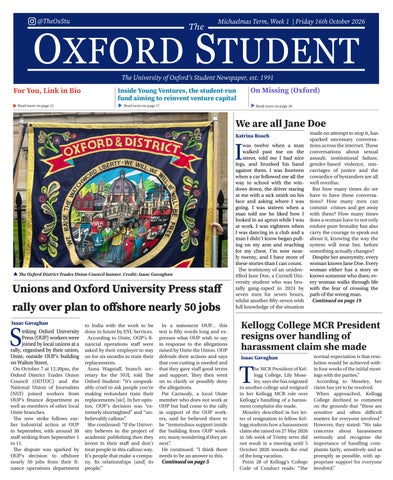
The Oxford District Trades Union Council banner. Credit: Isaac Gavaghan
Unions and Oxford University Press staff rally over plan to offshore nearly 50 jobs Isaac Gavaghan
S
triking Oxford University Press (OUP) workers were joined by local unions at a rally, organised by their union, Unite, outside OUP’s building on Walton Street. On October 7 at 12.30pm, the Oxford District Trades Union Council (ODTUC) and the National Union of Journalists (NUJ) joined workers from OUP’s finance department as well as members of other local Unite branches. The new strike follows earlier industrial action at OUP in September, with around 30 staff striking from September 1 to 11. The dispute was sparked by OUP’s decision to offshore nearly 50 jobs from their finance operations department
to India with the work to be done in future by EXL Services. According to Unite, OUP’s financial operations staff were asked by their employer to stay on for six months to train their replacements. Anna Wagstaff, branch secretary for the NUJ, told The Oxford Student: “It’s unspeakably cruel to ask people you’re making redundant train their replacements [sic]. In her opinion, OUP’s decision was “extremely shortsighted” and “unbelievably callous”. She continued: “If the University believes in the project of academic publishing then they invest in their staff and don’t treat people in this callous way. It’s people that make a company. Its relationships [and] its people.”
In a statement OUP… this text is fifty words long and expresses what OUP wish to say in response to the allegations raised by Unite the Union. OUP defends their actions and says that cost cutting is needed and that they gave staff good terms and support. They then went on to clarify or possibly deny the allegations. Pat Carmody, a local Unite member who does not work at OUP but had come to the rally in support of the OUP workers, said he believed there to be “tremendous support inside the building from OUP workers, many wondering if they are next”. He continued: “I think there needs to be an answer to this.
Continued on page 5
was twelve when a man walked past me on the street, told me I had nice legs, and brushed his hand against them. I was fourteen when a car followed me all the way to school with the windows down, the driver staring at me with a sick smirk on his face and asking where I was going. I was sixteen when a man told me he liked how I looked in an apron while I was at work. I was eighteen when I was dancing in a club and a man I didn’t know began pulling on my arm and reaching for my chest. I’m now nearly twenty, and I have more of these stories than I can count. The testimony of an unidentified Jane Doe, a Cornell University student who was brutally gang-raped in 2024 by seven men for seven hours, whilst another fifty-seven with full knowledge of the situation
made no attempt to stop it, has sparked necessary conversations across the internet. These conversations about sexual assault, institutional failure, gender-based violence, miscarriages of justice and the cowardice of bystanders are all well overdue. But how many times do we have to have these conversations? How many men can commit crimes and get away with them? How many times does a woman have to not only endure pure brutality but also carry the courage to speak out about it, knowing the way the system will treat her, before something actually changes? Despite her anonymity, every woman knows Jane Doe. Every woman either has a story or knows someone who does; every woman walks through life with the fear of crossing the path of the wrong man.
Continued on page 19
Kellogg College MCR President resigns over handling of harassment claim she made Isaac Gavaghan
T
he MCR President of Kellogg College, Lily Moseley, says she has migrated to another college and resigned in her Kellogg MCR role over Kellogg’s handling of a harassment complaint she made. Moseley described in her letter of resignation to fellow Kellogg students how a harassment claim she raised on 27 May 2026 in 5th week of Trinity term did not result in a meeting until 5 October 2026 towards the end of the long vacation. Point 28 of Kellogg’s College Code of Conduct reads: “The
normal expectation is that resolution would be achieved within four weeks of the initial meetings with the parties.” According to Moseley, her claim has yet to be resolved. When approached, Kellogg College declined to comment on the grounds that “these are sensitive and often difficult matters for everyone involved.” However, they stated: “We take concerns about harassment seriously and recognise the importance of handling complaints fairly, sensitively and as promptly as possible, with appropriate support for everyone involved.”
Friday 16 October 2026 | The Oxford Student
2 | Editorials
Editorials
Contact us at oxstu.editor@gmail.com outdone themselves this week: week on Edwardian social welA Note from the Oxfare policy, these have made for from analysis on the ‘Follower an incredible read… Bubble’ to discussions around stu Team Similarly, if you turn this print entrepreneurship at Oxford, The Oxford Student is an infully over, you’ll notice an exto an introduction to Young dependent, fully student-run clusive interview with the BalliVentures, Oxford’s student-run newspaper that has been ol IIs top bagsman: their nightventure capital fund. It is a great providing truthful, open, porter. Though the article is introduction if you are an aspirand free journalism to all of humourous in nature, it touching finance bro, or still trying to Oxford for over 30 years. This es on some more serious points figure out what on earth a venincludes important investigaof mental health and sport, a ture capital fund actually does. tive journalism, holding the There is serious- With lectures and tutorials Just as I thought the OxStu’s topic very close to my heart. Do University, its colleges, and ly no break from the Stu. now back in full swing, it might merciless train of Freshers Week give it a read, and maybe if you institutions accountable every Amidst the exhaustion from dai- be time to lock in. Or not. I’ve commitments was going to slow show Sean a copy of this print, term. Our work also provides ly clubbing, collections no one made it this far without at- down, our Week 1 print came he’ll let you into Balliol BOP. a training ground for some of revised for, and freshers flu (be- tending a single lecture since right up the tracks. But fear not! “The world ain’t all sunshine the most successful journalists cause apparently you can get it first year, and I’m hardly going After our Freshers Guide was and rainbows”, but we hope the around the world, including even when you’re not a fresher), to start preaching academic warmly received within these start of your year at Oxford has Stephen Bush, Lewis Goodwe are delivering another print. discipline now. There is, af- dreaming spires, attention has been! Everyone has been movall, Anoosh Chakelian, and I want to draw special attention ter all, only so much time one turned to our more traditional, ing back into Oxford, grabbing many more, as well as leading to our Op-Eds section – particu- can spend staring at a reading yet just as exciting, coverage. As a pint, and falling back into all figures in politics, business, larly The Grapevine, our brand- list before something more in- a broken Rocky Balboa told us, those old habits and traditions technology and creativity. The new gossip column. Because if teresting comes along. And if “It ain’t about how hard you hit, that may have served you so Oxford Student – supported there is one thing all of us love you’re going to procrastinate, it’s about how hard you get hit, well in years past. At the same time, Michaelmas is now in full by an engaged alumni comto do is be involved in everyone you might as well do it with and keep movin’ forward!” munity - plays a key role in else’s business. Remember, if the OxStu. Enjoy reading, and I would first like to draw your swing, and you can’t ignore that building the next generation you have any scoops (or scoop- avoiding whatever it is you attention to page 3, where a new essay anymore. 20th century set of OxStu columns have been British history will find you, of journalists, holding our ettes), email them at oxstu.edi- should probably be doing. introduced. These will focus pri- whether you like it or not! But society, economy, and democ- tor@gmail.com. Anonymity is marily on current events, with you can procrastinate it, ideally racy accountable. We need assured, discretion is advised, our first print focusing on the by reading our Week 1 print! your Common Room’s support and absolutely no one is above controversial policy of the Trito keep this going. a little friendly scrutiny. As for Ellie Apostolidi ple Lock on old-age pensions. Our work is mainly fundmy personal favourite, BusiLuke Erly Balliol College Coinciding with my essay this ed through JCR and MCR ness and Finance have really Regent’s Park College subscriptions, which gives er, after a moment of intro- sion Fresher me made. A huge congratulations to Common Rooms access to the spection, I concluded that I Of course, unlike previous Luke and Ellie, our EiCs, and newest student journalism in can squeeze one LAST term terms, this week 1 print is not Isaac, Christian, Ellie, Flora, the city. Every 2 weeks, The of OxStu in (I promise, mum). the first time you’re holding a Martha, Leila, Katrina, and Oxford Student delivers a 24The truth is I’ve become abso- copy of the Stu. During fresh- Charles, as well as all SecEds page print to every Common lutely addicted to journalism, er’s week, our team success- and contributors for a fantasRoom with a subscription. and seriously care about this fully delivered almost 10,000 tic inaugural print. This Freshers Guide, funded student paper. It was here that copies of our guide, one to solely through ad sales, is a I realised this career might every new student at the Uni. great example of what you just be the right one for me. If If you haven’t found one yet, can expect if you bring the paAnd just like that, summer writing, pitching, editing, or check your pidge rooms, per into your common room, is over and I’m entering my helping with our multimedia JCRs, or MCRs. Now, you’re at low costs, helping to keep student journalism flourish- final year at Oxford. Finals offering in any way sounds seeing the paper in its full gloloom in the no-longer dis- appealing to you, I strongly ry, bringing you the hard-hiting in the city. tant future, and every tute es- encourage you to give it a shot ting reporting, reflective writGuilherme Lopes say suddenly takes on a new, and contribute to the OxStu ing, and engaging visuals that St John’s College greater, importance. Howev- this term. It was the best deci- make up the OxStu.
Contents News Opinion Culture Features Business Identity Profiles Sport
Editorial Team
Editorial Board Ellie Apostolidi and Luke Erly (Editors-in-Chief) Elliott Wang and Gabriella Bedford (Associate Editors) Guilherme Lopes (Managing Director)
4 6 8 12 16 News Isaac Gavaghan (Deputy Editor) 18 Abdul Olagunjuadekunle, Samuel Govier, Ansu Bhattarai, Tristan 22 Clark Lam, Greta Pezzolato, Singh, Leen Almasri, Saba 24 Diya Ahmadzadeh Noughani, Christine Savino, Bay Ross (Section Editors)
Opinion Christian Wang (Deputy Editor) Antonio Reis, Eleanor Harris, Yiran Su, Leen Almasri, Zar Motik Adisuryo, Samuel Govier, Greta Pezzolato, Abdul Olagunjuadekunle, Tristan Clark Lam, Joannie Lao, Yiran Su, Lucy May, George Murphy, Freddie Russell, Features Ellie Pemberton (Deputy Editor) Ben Futter, Hannah Ison, Phoebe Payne, Carolina Perotto, Richard Kühl, Yiran Su, Aaron Butters (Section Editors) Business and Finance Leila Hoffpauir (Deputy Editor) Akheel Kale, Chauncey Robinson, Claire Frost, Zar Motik Adisuryo (Section Editors)
Investigations Ivett Berenyi (Deputy Editor) My Anh Ngoc Nguyen, Hannah Ison, Ava Doherty, Abdul Olagunjuadekunle, Mimi Berridge Shea (Section Editors) Culture Flora Molnar (Deputy Editor) Jasmine Joyan (Poetry Deputy Editor) Aamina Thava, Aidan Kane, Carolina Perotto, Kadija Owusu-Kabba, Siena Tracey, Phoebe Payne, Lucia Clark, Ruhi Visaria, Isaac Simeon Sinclai, Richard Kühl, Joseph Walford, Sofia Di Stazio, Sarah Chew, Georgia Kennedy, Cerys Williams (Section Anja Woosnam, Oliver Weston, Christina Robinson, Anya Tindall,
Aamina Thava, Carolina Perotto, Ben Futter, Briann Stephens (Poetry Section Editors) Identity Katrina Roach (Deputy Editor) James Stratmann,Ben Futter, Joseph Walford, Nguyen Thi Ngoc Mai, Yasmin Morgan (Section Editors) Profiles Martha Kiyan (Deputy Editor) Diya Singh, Saba Ahmadzadeh Noughani, Ansu Bhattarai, Richard Kühl, Georgia Kennedy (Section Sport Charles Prestwich (Deputy Editor) Ruhi Visaria, Siena Tracey, Finn Perry (Section Editors)
The Oxford Student | Friday 16 October 2026
Op-Eds | 3
Op-Eds oxstu.editor@gmail.com | Columnists: Alex Evans, Antonio Reis
Triple-Lock Trouble Alex Evans
Antonio Reis
here has been much commentary recently regarding the triple lock and reform to it. In my view, calls for the abolition of the triple lock are not merely economically misguided, but the result of nothing more than a repeat of “Benefits Britain”: class warfare targeted at many of the most vulnerable in society. The purpose of the triple lock is very simple – to increase the level of state pension relative to the cost of living over time, and thus to tackle poverty of some of the most vulnerable people in society. A pervasive narrative has developed, disguising itself in internet memes, where ‘Simon & Linda’ are living it up on cruises at the expense of the working man. But the reality could not be further from the truth for many - the situation for many pensioners, especially after Russia’s invasion of Ukraine, has only been getting worse. And yet we are led to believe that it is the claimants of state pension, who have dutifully worked for years and years, that are to blame for the woes of Britain? They are by no means getting something for nothing - they have had to work many years to be able to claim this benefit! We are now in the position where millions of ordinary people - retired roofers, nurses, and teachers - are being demonised for claiming what they are owed for their hard work and contribution. But what of the pensioners who are wealthy? Very well, this is why we have income tax - to which state pension is subject – and why we ought to, in my view, instead enact property tax reform as proposed by Jonathan Hinder, rather than blaming struggling people for the consequences of a decade and a half of austerity and poor growth. And if you really are so desperate to gain from wealthy pensioners, why not start with the £48 billion a year – much larger than the triple lock – spent on private pension relief? It is a grave mark on our political discourse that many of those who claim to defend the welfare state have bought into a cheap narrative, recycled from the days of “scroungers”, Read more online at www. oxfordstudent.com
he spectre of gerontocracy is haunting Britain. Modern British politics lies spread-eagled between various priorities, but eventually the chips fall, and for a generation the winners have been pensioners: as a voting base, they pushed through the Brexit vote and kept the Conservatives in power. Yet, their crowning achievement may be the ‘triple lock’. Since 2011, the state pension has risen each year by the highest of CPI inflation, average earnings growth or 2.5%. Touching it has been taboo for the obvious reason: pensioners vote, and vote more than other groups – no party wanted to be first to tell them the deal was over. Yet, at Labour conference on 29 September, Andy Burnham took the plunge. From April 2030, the pension will become a ‘double lock’, rising by only inflation or 2.5%. Burnham intends to use these savings to fund a national care system, but the money matters less than the precedent: a policy once thought immutable may be given the axe. It is understandable why the plan was introduced. After the 1980 Social Security Act the basic state pension slid from ~26% of average earnings to 16% by 2008. In 1996, ~30% of pensioners were in poverty. So the Conservatives and Liberal Democrats both pledged to restore it, and did so whilst in coalition. For twenty years prior, earnings had also beaten the other two measures every time, so the 2.5% floor seemed inconsequential. That assumption did not survive the last fifteen years. The triple lock is a ‘ratchet’: when prices outrun wages, the pension follows prices, and when wages recover it follows them back up. The pension wins every year and surrenders nothing. Now, the state pension is 45% of welfare spending, and the IFS puts the lock’s extra cost at £16 billion a year, rising to as much as £40bn by 2050. It is rare to find a policy mathematically guaranteed to eat away at the budget. The country cannot afford this: with gilt yields above 5.3%, their highest since before the financial crisis, Britain perpetually spends more than it has, Read more online at www.oxfordstudent.com
T
T
The Grapevine Oxonians, lend me your ears! I bring you the biggest scoopettes from the past week. Touriga Nacional
Reform backs out of Greens debate
In a turn of events that perhaps surprises no-one, the Reform Society has backed out of a debate with the Greens, after the event was announced. The newly established societies were set to debate on Friday week 4, hosted by Oxford Politics Society. It seems many dates were proposed until agreement was reached, and Reform then cited ‘another event’ as the reason for the cancellation. In a recently published termcard, ReformSoc confirmed Neema Parvini will be speaking that day. In an exclusive September interview, Greens President Nidal Shah told this paper, “I doubt they will ever take [a joint event] up.” He may have been temporarily vindicated, but I hear the event will be rescheduled for week 5 (indeed, “it will take place”).
Greens Termcard woes worsen
In an email to members sent on Tuesday morning, the Oxford Student Greens shared that their inaugural landmark speaker, Mothin Ali, has had to cancel his engagement due to “last-minute obligations.” A rescheduling has been promised.
Exeter is funding WHAT?!
In the past week, some papers in Oxford have run headlines claiming Exeter College is funding a £900m data centre development near Oxford Parkway. This is not the case. Whilst devel-
opment will go ahead pending approval from Cherwell District Council, Exeter’s main equity in the project is the land, Frieze Farm. Commercial partners and occupants are being engaged to provide project financing over its 12-year construction. Exeter is also seeking to leverage public sector grants, and is currently in discussions with 1Energy, a low-carbon heating provider that has won £21m from government, to use the waste generated by liquid cooling to create a citywide heat network. Whilst there should be no doubt where this author stands on data centres, I do insist that accuracy must be above sensationalism.
Oxford Labour throws shade over ‘Zionism is Racism’
The leader of Oxford City Council Susan Brown sent around a press release condemning the recent ‘Zionism is racism’ motion passed at Green Party conference. She calls on the local Oxford Green Party to confirm how the local party voted at conference, condemn the motion and “call for it to be repealed,” and confirm that the Oxford Greens are committed to fighting antisemitism. This author thinks it’s absolutely crucial that the LEADER of the Council is immersing herself in internal Green Party debates. Surely there are no other pressing issues in Oxford. And nevermind this is national level policy, voted on by members, and really very little to do with Oxford’s Green Councillors.
Friday 16 October 2026 | The Oxford Student
4| News
News
oxstu.news@gmail.com | Deputy Editor: Isaac Gavaghan Section Editors: Saba Ahmadzadeh Noughani, Bay Alexandra Ross, Leen Al-Masri, Ansu Bhattarai, Tristan Clark Lam, Sam Govier, Freddie Lewis-Hedley, Abdul Olagunju-Adekunle, Greta Pezzolato, Freddie Russel, Christine Savino, Diya Singh
Unions and Oxford University Press staff rally over plan to offshore nearly 50 jobs
Isaac Gavaghan Continued from front page
W
e are going to see a jobs crisis and people need to fight.” Pól Ó Ceallaigh, secretary of the ODTUC questioned why OUP had made the decision and told The Oxford Student that “people who are doing productive jobs are being made redundant.” Whilst we spoke to him, a member of OUP’s security team came out of the building and asked Pól to move his banner so that it was not sitting on OUP’s fence. “The level of pettiness has been absolute class” Naomi Gravett, Unite regional officer told The Oxford Student. She described a series of small but repeated instances which illustrated this claim. Before the first round of strike action from September 1 to 11, Gravett claimed OUP moved “Unite mugs and coasters from desks into the kitch-
en cupboards.” According to Gravett, OUP CEO Nigel Portwood asked for a display of “OUP published books about offshoring, employment law, and miners strikes” to be taken down on the grounds that, Gravett claimed, the library should be impartial.
“
They’re robbing people of their livelihoods and all they care about are book displays and coasters. Gravett summed it up: “They’re robbing people of their livelihoods and all they care about are book displays and coasters.” She continued: “In OUP’s opinion they’ve given them this gold plated deal. It doesn’t replace the fact that they’ve taken away their job. No amount of money is going to make that sit well with people.”
Oxford Saïd opens £70m Global Leadership Centre at Osney Power Station
Said Business School Credit: N. Chadwick, CC BY 2.0, via Wikimedia Commons
Ansu Bhattarai
S
aïd Business School at the University of Oxford has opened a £70 million Global Leadership Centre, (GLC), at the former Osney Power Station, creating a new residential hub for its Executive Education programmes. The School describes it as a “dedicated environment and residential accommodation for teaching, learning, research, and academic exchange”. The centre is located in the historic Osney Power Station, just a few minutes’ walk from Oxford railway station and Saïd Business School’s main campus. Designed by John McAslan + Partners, the project has transformed the former power station into a modern learning and residential centre while retaining the character of its industrial past. A spokesperson for Saïd Business School told
The Oxford Student that the GLC had been developed to “support the School’s academic mission”, bringing together Executive Education participants, faculty and visiting academics for “teaching, learning, research, and academic exchange” The GLC has 120 bedrooms alongside flexible teaching and meeting spaces, allowing executives to stay and learn in the same location. It also includes a dining room, gym and a terrace overlooking the Thames. Asked how the £70 million development was financed, Saïd Business School told The Oxford Student that it was funded through “a mixture of philanthropy and support from the University”. The GLC also marks a shift in how Saïd can deliver its Executive Education programmes.
Previously, Oxford Saïd ran a mixture of residential and non-residential programmes across its Egrove Park and Park End Street campuses. The School told The Oxford Student that the new centre would allow it to provide “immersive, residential Executive Education within the School’s city centre campus and University ecosystem”. It added that the GLC had been designed as a “learner-centric facility”, bringing teaching, networking, dining and accommodation under one roof. The centre opens at a time when rapid advances in technology, evolving research and growing demands for more sustainable and adaptable businesses are transforming the corporate environment. Read more online at www.oxfordstudent.com
Oxford City Council clashes with EHRC Abdul Olagunju-Adekunle
O
xford City Council has approved a motion recommending new legislation regarding the inclusion of trans and non-binary individuals. The decision is in response to the Equality and Human Rights Commission (EHRC)’s 21 May updated Code of Practice in respect to single-sex services. The motion, passed on 5 October and publicly announced the next day, was proposed and seconded by Green Councillors Max Morris and Chris Jarvis respectively. The public release of the motion, published 6 October, detailed objections by LGBT groups such as Stonewall to the Code of Practice update which confirms that single-sex services should be provided to Trans and non-binary people in line with what the EHRC terms “biological sex” and “sex at birth”.
On 22nd May, the University of Oxford announced that it was reviewing their policies and practices and was committed to being an “inclusive University”. The University updated its “Toilets and changing facilities” guidance in August, affirming the CoP update, laying out that transgender and non-binary people should use facilities based on their “biological sex.” This led to an open letter from 330 members of the University, calling on it to reject the updated Code. In a September 2026 open letter, 14 Green councillors echoed this sentiment, calling on the University to challenge the EHRC’s interpretation in respect to single-sex spaces. The motion argued that these terms used in the Code of Practice had “no agreed identification to substan-
tiate them” and that they were not based on widely agreed medical or scientific consensus. It also highlighted the potential for the update to create “gaps” in equalities, in the relation to the provision of services for Trans and gender non-conforming people. As part of the recommendations, the Council resolved to write to Bridget Philipson MP, the Minister for Women and Equalities, to draft legislation that would extend and confirm trans and non-binary people’s right to access services. They also called on the leader of the council and its cabinet to work with Oxford business and trans rights groups to affirm that the “dignity and privacy of trans and non-binary residents of Oxford are supported to the maximum extent permitted by law.”
The Oxford Student | Friday 16 October 2026
News | 5
Epstein’s lawyer at the Union: is it a genocide, should ‘Jane Doe’ exist, and the Tories Luke Erly and Agastya Rao lan Dershowitz, formerly part of Jeffrey Epstein’s legal team, has claimed everyone deserves a defence, that Israel’s actions in Gaza are proportionate, Jane Doe, alleged victim of the Cornell seven, should not be allowed to remain anonymous forever, and that, according to him, the British Conservative Party hold the views he is most aligned with in British politics. In an event held on 13th October by the Oxford Union, Alan Dershowitz, former professor at Harvard Law School and defense attorney for many high profile clients, was interviewed before answering questions by students. After being made an assistant professor at age 28, Dershowitz, now 88, has defended many celebrity clients such as Julian Assange (charged for distributing classified documents), O. J. Simpson (charged with murder of ex-wife), and Jeffry Epstein (charged with soliciting sex from minors). He was also on Harvey Weinstein’s defense t e a m (charged with sexual abuse) in 2018, as well as President Donald J. Trump and Bill Clinton during their impeachment trials. Dershowitz has regularly commentated on politics and international relations, often on Israel. The Dershowitz event’s format was announced in the Union’s termcard. Advertised in the termcard as a “reversal of roles for one of America’s most famous and controversial defence lawyers”, the event was described as Dershowitz, “facing the questions himself… challenged head-to-head by members across the despatch box.” While those asking questions could ask a single follow-up, many attendees were unsure about the accuracy of the debate’s ad-
A
vertisement. During the interview section of the event, Dershowitz talked about the start of his career, and recounted how he had finished in the bottom half of his class at Brooklyn Talmudical Academy before coming first at Yale Law School. Dershowitz grew up in New York and was raised by two Orthodox Jewish parents before studying Political Science at Brooklyn College. Dershowitz faced many questions regarding his connection with Jeffrey Epstein. Dershowitz explained that he is still Epstein’s lawyer, and that he is still covered by privilege when talking about him. However, he finds no issue saying bad things about Epstein, his client, as Epstein said bad things about him. This includes Epstein saying that Dershowitz was “a few feet further but not by much” from the border of insanity. However, Dershowitz explained, he stopped being friends with Epstein after he was found guilty. Dershowitz claimed that his belief that everyone deserves a defense inspires many of the decisions he has taken to defend the individuals Dershowitz has counselled over his career. When asked if he believes the Epstein Files should be released in full, Dershowitz agreed that all names should be released. He added that an additional reason would be to release the name of a woman who claimed Dershowitz gave her a massage on Epstein’s plane. Dershowitz then commented on the recent “Cornell Seven” alleged gang rape case. Dershowitz said that, in principle, an accuser like Jane Doe in the Cornell case should not be allowed to stay anonymous forever. Read more online at www.oxfordstudent.com
Bodleian updates AI policy after Guardian Exposé Freddie Lewis-Hedley
O
n 29 September, the Bodleian Libraries issued a statement updating their AI policy. This update to existing University guidelines around AI details the Libraries’ commitment to increased access to their archives through AI, and ethical concerns around the technology. It comes after a 26 September exposé by The Guardian which revealed that the University had granted OpenAI access to parts of its archives. Ethan Penny and Dan Milmo reported in The Guardian that the Bodleian Library’s decision to let AI lab OpenAI train its AI models on thousands of images from its archives, including old dissertations and literary artefacts such as Dorothy Hodgkin’s penicillin notebooks. The University of Oxford launched its partnership with the AI company in March 2025, which among other things yielded free use of ChatGPT for Oxford students. The University did not, however, publicly state that it would allow OpenAI to train its AI models on texts from the Bodleian. University of Oxford meeting minutes seen by The Guardian and The Oxford Student include attendees’ concerns around the partnership’s potential threat to privacy for students and faculty, and reputational damage to the University and compromising of its sustainability aims. The Bodleian’s new 29 September policy seems to address some of these concerns. In an eight-point plan, the University of Oxford stated its commitment to ‘[applying] ... human oversight’ when dealing with AI, ‘[upholding] academic integri-
ty’, and guiding staff and students to become competent and responsible users of AI. The statement also stresses the compatibility of its partnership with OpenAI and its environmental sustainability obligations. The University recognises the energy-intensive nature of the technology and suggests that it would look for alternatives to deploying AI, like in administration, were a more environmentally friendly option available.
Bodleian Library Image Credit: Txllxt TxllxT, CC BY 4.0 via Wikimedia Commons
In a statment to The Oxford Student, the Bodleian emphasised its strict discernment between ‘open access collections … heavily scraped by AI bots’, and ‘[copyrighted] material … subject to archival or legal restrictions’ which it says will not be used to train AI. The Library restated its desire to ‘make [digitised collections’ as openly available as responsibly possible for … humans’
Council approves Wellington Square redevelopment Isaac Gavaghan Oxford City Council voted to approve the redevelopment of 25 Wellington Square, demolishing the current building, which was built in the 1970s. Oxford University Development (OUD), who is leading the scheme, plans to build a new 65,000 sq ft building which is to accommodate new teaching spaces and academic offices. Building work is scheduled to start in 2028. The existing building is currently home to cafe Common Ground and events space The Nest. These plans pro- The University of Oxford has accommovide an opportunity dated Common Ground since 2018 at a to make Wellington low rent. A spokesperson for OUD told Square a greener, The Oxford Student: “This arrangement more welcoming and was time-limited and while the Univerenjoyable place sity recognises the positive contribution Common Ground has made to the local community, there has never been a commit-
“
ment to provide them with space permanently at the site.” The current building housing Common Ground also includes 99 graduate rooms, all of which are currently empty due to the condition of the building. Whilst an OUD spokesperson said “significant effort” was put into trying to find a way to renovate the building, this effort was not successful. The spokesperson continued: “We are continuing to assist Common Ground with their search for alternative premises. We reached a separate agreement much more recently with The Nest for very short-term occupation of the property they are in.” Anna Strongman, OUD CEO, said: “Wellington Square is the city’s only garden square, and these plans provide an opportunity to make it a greener, more welcoming and enjoyable place, while strengthening its connection with Little Clarendon Street and the wider city.” The development will also see the renovation of the terrace housing at 32-42 Wellington Square, which will in future provide 99 student rooms for graduate accommodation.
Friday 16 October 2026 | The Oxford Student
6 | Opinion
Opinion
oxstu.comment@gmail.com | Deputy Editor: Christian Wang Section Editors: Leen Almasri, Eleanor Harris, Tristan Clark Lam, Greta Pezzolato, Freddie Russell, George Murphy, Georg Haslam, Joannie Lao, Lucy May, Zar Motik Adisuryo, Antonio Reis, Yiran Su
Ed Sheeran is not the first to profit off of our culture but look away when we are being killed Saba Ahmadzadeh Noughani “They love my culture in pieces, but not the woman who carries it whole” -Harman Kaur
D
espite raising millions for Ukraine, Ed Sheeran dismissed Macklemore from his tour and drew his line at “free Palestine”. As someone with Middle Eastern heritage, it was yet another reminder that white artists will take and use from our art, culture and language, yet turn a blind eye as we are, in every sense, being torn to pieces. Last year, Ed Sheeran released his song Azizam, which debuted at number three on the UK Singles Chart and was recognised as one of the year’s most-performed pop songs. Azizam means “my dear one” in Persian, and while the word is commonly featured in Persian songs, this was the first time many heard a white man singing it. Unlike some with Iranian heritage who celebrated this, I remained indifferent to the spotlight; that was until the12-day US and Israel war on Iran, which began not long after the song’s release. Days went by without any sign of fundraising or aid for the Iranian people from Sheeran, let alone a single word of compassion or solidarity. Furthermore, when the 40-day US-Israel war on Iran broke out, Sheeran still did not share a single word of compassion for the children of Minab whose school was bombed by the US on the first day of the war, nor condemn their murder. And as the US bombed Iran, Ralph Lauren, a US brand, covered its catwalk in Persian
rugs, and articles covering the show highlighted one key point: Gigi Hadid walked on a “Persian rug-covered runway.” Ralph Lauren Home’s Harper and Imogen rugs are also a ersatz of Persian carpets. Considering that Iran is heavily sanctioned and cannot easily export rugs as a result, Ralph Lauren copying and profiting off of Persian-style rugs is all the more exploitative. While the Iranian Red Crescent was pulling children’s limbs from rubble, not a single percentage of their profits from these rugs was given to any charity sending aid to Iran. As a fashion brand that appreciates art, one would think that Ralph Lauren would, at the very least, condemn the large-scale destruction of historical and cultural sites destroyed in Iran, even if they do not want to condemn our killings. At the London photocall for The Odyssey, American celebrity Zendaya, wore 2,700year- old gold earrings made from ancient Iranian medallions looted from Iran in the 1960s. Zendaya had no problem wearing stolen jewels and had nothing to say about the looting, let alone about the US killing Iranians. You simply cannot say that you are celebrating or embracing the beauty of our civilisations while remaining indifferent to the lives of the people who come from them. Like many British children with Middle Eastern heritage,
I grew up hearing that part of my identity only spoken about in terms of war, violence, destruction, and turmoil. We grow up so starved for representation that it’s easy to be deceived into thinking that an American actress wearing looted jewels, a runway show, a brand selling an imitation of Persian rugs, or Persian words sprinkled into an English song is appreciation or solidarity. It is not. When Western artists or brands use and take from our culture while not even standing up for the lives of the people whom they owe that art to, it’s nothing short of exploitation. It goes beyond these two recent examples. I have encountered people at Oxford who will happily sit and eat with me at a Lebanese restaurant, but comment that they ‘don’t do politics’ as Israel bombs Lebanon. Once, such a person at Oxford remarked that the Palestine protest of simply reading the names of the dead outside the Sheldonian was a “noisy” disturbance.
also requires a certain level of entitlement and arrogance to study the language, literature, and culture of a people and feel no need to stand up for their lives. When these same classmates, as well as others from years above, went on their year abroad, which has for some consecutive years now often been cut short due to multiple different wars and bombings in the Middle East, they came back and wrote articles about how terrified they felt, emphasising that they had experienced hearing the sound of drones, shaking chandeliers and so on, as if this is not the daily lived experience of Palestinians, Lebanese and Iranian children and families. As someone with Middle Eastern heritage, reading such biased and sensational articles felt like it was a white person’s desperate attempt to gain attention and sympathy. It felt painful that these students were somehow finding ways to make these tragic situations about themselves. It’s easy to tell that not one person on the editorial team was Middle Eastern. The attention-seeking and lack of self-awareness are nothing but disrespectful and degrading. I do not single any student
author out, as I read more than one article of such a nature across different Oxford student publications, and likewise many Instagram influencers who lived in the UAE at the time were also cosplaying victims in this way. The reality is that these students not only could flee these dangerous situations, but didn’t hesitate to do so. Only to come back and write sensational, inaccurate, and biased articles about how scary it was and how brave they were. Their outlook cannot be separated from the broader Western sense of entitlement to profit off of Middle Eastern culture and civilisations but remain silent at the sight of our suffering and murder, in a way that they have never done when those being killed look like them, as we saw with Ukraine. This is why I hate to hear “Azizam” come out of the mouths of those who have no problem fundraising for Ukraine but refuse to hear, let alone say, “free Palestine”. Anyone with any respect for the Middle East, before they take pleasure in studying or making money off of its language, literature, or art, would start by fighting for the lives of its people, who have nurtured that region and whom that region is home to.
you not disturbed “Are by the killing of Palestinians?
When I shared ‘Islamic history and culture’ classes with some students, I watched as not one but multiple people who studied the Arabic language ate food products that were widely known to be on the BDS list; even after I pointed it out to them, one replied, “but it tastes so good”. Only a Middle Easterner knows the feeling of watching people study your language while funding the killing of those like you through their comforts and what they eat. It
Demonstration in solidarity with Palestine. Credit: Lua Eva Blue via Wikimedia Commons
Opinion | 7
The Oxford Student | Friday 16 October 2026
Although found that whilst 27% of the Is it an issue that the sitting Prime Min- support. a personal mandate electorate would vote Labour, may strengthen Burnham’s authority, in an increasingly divided Great Britain, a new General Election would only increase political instability and deepen divisions. Burnham seems to be on a mission to usher in a new era of politics. His embracement of ‘Manchesterism’ and commitment to better ties with the EU are a clear breakaway from previous PMs. The continuous political disregard for the North coupled with the disastrous handling of Brexit and its aftermath only served to alienate the British public further. Yet, Burnham’s approach to the issues might be just what the country needs to not only break the mold that has been set over the British government, but also to bolster faith in politicians. Although there are doubts as to how well he will be able to do this, his lack of mandate is certainly not his biggest worry. Crucially, Reform UK continues to trail closely behind Labour in polls. In fact, Ipsos
ister has no mandate from the voters? Greta Pezzolato
M
andates are crucial for any elected political figure, but especially those in exceptional positions of power. They not only strengthen legitimacy, bolstering the authority to rule. Indeed, they are also an important democratic indicator, as the ability to legitimise rulers rests exclusively in the hands of the electorate. Yet, in a time when politics is increasingly polarised and the electorate ever more fragmented, mandates no longer automatically legitimise the actions of those who possess them. In recent years, politicians have risen to the position of Prime Minister without their own mandate. In the last twenty years, six PMs rose to power with no mandate of their own, with three calling an election in an (at times futile) attempt to gain personal legitimacy.
This issue is pertinent in the case of Labour PM Andy Burnham. Originally from Lancashire, the Cambridge-educated politician’s working-class origins mark a significant step away from our more recent Prime Ministers. Meanwhile, his reputation as ‘King of the North’ certainly bolstered his persona of a ‘down-to-earth Northern bloke’, rendering him more amicable in the eyes of many. His premiership seems to be a breath of fresh air, not least for being the first Cambridge-educated PM in sixteen years, following six Oxford-educated PMs. It is undoubted that mandates strengthen political legitimacy. Yet, the use of First Past the Post (FPTP) dramatically reduces their reliability. The electoral system favours main parties concentrated in areas of the country, whereas minor parties with more sparse support tend to be left behind.
Given the fragmented electoral landscape, results created by FPTP are increasingly volatile and disproportionate. Indeed, in the 2024 General Election, Labour earned 33.7% of the national vote but 63% of the seats in the House of Commons. To make matters worse, we often forget that in General Elections the electorate votes for a local representative rather than the PM: on a national scale, only a small fraction of voters genuinely vote for the PM. As such, the mandate obtained by a PM in General Elections is not necessarily a strong indicator of their ability to lead the country once in office. It is thus no surprise that faith in the British government is so low. As of October 5th, the approval rating stands at 22% according to a YouGov poll. The electoral system is clearly unfit for the modern political landscape, making for weak mandates based on low
Reform stands at 22%. The rise of extremist trends puts traditional parties in a precarious spot, marking a significant challenge for Burnham. In addition, although lauded for his successful role as mayor of Manchester, governing a city can hardly be compared to governing a country. His affable persona may have won him the by-election and premiership, but personality is far from an accurate telling of performance once in power. We have already seen charismatic and amiable characters rise to premiership only to fail spectacularly to deliver on their promises. Regardless of the possession of a mandate, a PM’s credibility is built in office. The same is true for Burnham, who has certainly made a positive impression on the British public. Although mandates can be a helpful starting point, they are by far not a determining factor in successful premierships.
This visibility it is normalcy, and thus their confidence in their own In Defense of the Oxford Bubble then presents a belonging is absolute. Whilst the bubble is visible to Georg Haslam
T
he “Oxford bubble” is often criticised as disconnected and elitist. It is an insulation from wider society that I am sure most of us feel at some point during our time here. Certainly, for many of us, we spend most of our time in Oxford-based circles. For some of us, this even comes at a cost to our friendships back home. I saw this first-hand with friends who came to Oxford before me, and it was not something I understood until experiencing it myself. Yet, despite the Oxford bubble’s flaws, I am determined to defend it. We have the privilege to study at a centuries-old institution, engage with its traditions, and speak with some of the greatest academics of the modern day. In recognising this privilege, which we must do, we cannot afford to forgo these opportunities in fear of becoming part of this so-called bubble. The bubble phenomenon is not unique to Oxford. All universities can be identified in part by tight-knit groups and the social traditions that shape them. Student communities inevitably create their own worlds. Insularity exists wherever people organise around shared experience or common pursuits: a physicist at CERN and an actor on the West End will be just as embedded within an “in-group” as an Oxford student. In the local supermarket, GP surgery, or office, similar groupings emerge. The difference then is not the bubbling itself, but that, through media scrutiny and a public perception as to what “Oxford” is, this bubble is rendered visible.
paradox: the Oxford bubble is simultaneously one of the most publicly scrutinised in British society, yet also something that those who benefit from most are often the least aware of. This irony cuts to the heart both of what makes the bubble distinctive and what complicates its defence. The CERN physicist, the West End actor, and the local supermarket worker each exist within bubbles that are either professional, geographical, or specialised enough not to garner too much national attention. Oxford, by contrast, is something of a fascination in the public eye. After all, most of us have encountered tourist groups eagerly buying overpriced merchandise, taking tours of the Bodleian libraries, or snapping photos of Oxford’s renowned architecture, and within it, its students. In part, this public attention is deserved. Oxford has produced a disproportionate share of both British and international political, cultural, and technological leaders. Though the “PPEist to Prime Minister” pipeline is clichéd, it is nonetheless reflected in 31 PMs to date who have been Oxford graduates. Undeniably, the bubble’s output directly impacts national policy. The Oxford student then does not merely exist within this insularity, but also is being prepared in some way, whether they recognise it or not, to exert influence over those outside of it. The most privileged within this bubble are often those who recognise it the least. The stereotypical Oxford student – private school educated, with Oxbridge-educated parents, often white and male – does not experience this bubble as privilege. Instead,
outsiders, for those in the centre it is hidden. Meanwhile, for those less represented by the Oxford stereotype, whose parents did not attend university, who never imagined they could go to Oxford at all, this bubble is constantly visible. They see its structure, its tradition, and its exclusions, and the bubble feels oppressive. Yet their understanding of it as something constructed and contingent often goes unspoken or is dismissed as a failure to fully integrate into the Oxford system. The cruelty of this arrangement is clear, as visibility and awareness are inversely distributed. Those who benefit most from privilege are often the least equipped to recognise it. Conversely, those who see it clearly are often less able to access its opportunities, as they spend much of their time learning its traditions and its structures first-hand, rather than simply inheriting them. Those in a position to graduate from Oxford still unaware of its privilege, who cannot see how their confidence, their cultural fluency, and their financial access to networks and unpaid internships have paved their path to success, are protected by this bubble not just from the outside world, but also from self-reflection. In contrast, those hyperaware of its mechanisms will often graduate with clarity, but with substantially less advantage. The asymmetry itself is a kind of injustice that forces some to see what others can afford to ignore. This privilege cannot remain unspoken if we are to truly defend the bubble. We cannot defend it as a neutral institution ; it is a mechanism that... Read the full article online at www.oxfordstudent.com
8 | Culture
Culture
Friday 16 October 2026 | The Oxford Student
oxstu.culture@gmail.com | Deputy Editor: Flora Molnar Section Editors: Lucia Clark, Isaac Hole, Aidan Kane, Richard Kuehl, Kadija Alisha Owusu-Kabba, Phoebe Payne, Natalie Perera, Carolina Josephine Perotto, Christine Savino, Aamina Thava, Siena Tracey, Ruhi Visaria, Joseph Walford
Method Dressing: A Love Letter to the Past Phoebe Payne notices the recently heightened phenomenon of method dressing
I
n 2026, film fashion exploded out from the silver screen and decorated premiere red-carpets worldwide in a phenomenon known as method-dressing. From Lili Reinhart’s love letter to rom coms on her The Love Hypothesis press tour, to Zendaya’s ode to the gods during her promotion of The Odyssey, this embrace of fashion-based storytelling has transformed press-tours into experiences of beauty, artistry, and homage, and transported viewers into mystical lands, and times long forgotten. Lili Reinhart pays homage to an array of classical romantic movies, and their leading ladies, in her 2026 promotion of The Love Hypothesis, a romantic comedy set for release on Prime Video on 23rd September. From Jawbreaker, to How to Lose a Guy in 10 Days,
to Atonement, and Ever After: A Cinderella Story, Reinhart is using fashion to transform herself into ghosts of movies past, in doing so transporting her viewers to old, beloved romantic scenes. Reinhart and her stylist, Ib Abdel Nassar, started off strong on 6th September by referencing a hugely adored (and a personal favourite) rom-com, How To Lose a Guy in 10 Days. The actress delighted Instagram fans by posting a photo of herself in a backless butter-yellow dress, honouring the Carolina Herrera gown worn by Kate Hudson in the 2003 romantic comedy. The silky pastel gown mimicked the shape and style of Hudson’s dress, with the eye-catching open-back stealing the spotlight, just as in the movie. Nassar has spoken about her intentions for the press tour, aspiring to create a nostalgic pastiche of the ‘Golden Age’ of romantic movies, and honouring previous
leading ladies through these outfits. However, the intrigue of Reinhart’s method-dressing derives not just from the outfits themselves, but from the feeling they create. In this How to Lose a Guy in 10 Days Instagram post, Reinhart poses just as Hudson did 23 years ago, glancing over her shoulder on an ornate staircase, and accompanies the picture with a snippet from Carly Simon’s 2015 remaster of ‘You’re So Vain’, a song that frequently appears in the movie. Hence, fans feel at once transported back to 2003, watching these two characters fall in love for the first time amidst butter-yellow dresses, basketball games, and iconic karaoke sequences. Reinhart has also paid homage to the 1999 classic, Jawbreaker, with a pastel, preppy look from Leo Lin’s 2027 Resort Collection, which Nassar named ‘Olive’s soft launch’. The baby pink embellished cardigan worked in perfect har-
Parting Memories Ben Futter
Poetry
Jasmine Joyan Poetry Deputy Editor
Zendaya for ‘The Odyssey’. Credit: PhilipRomano via Wikimedia Commons.
mony with the simple, white crop top, and the blush pink floral skirt. Atonement was another film the actress chose to honour, replicating the classic green dress with a billowing green Tory Burch gown. The actress’ dress mimicked the plunging V-neck of the original dress and the subtle tied detailing, however the particular green shade was changed, with Reinhart adorning an olive hue, a subtle nod to her new character, Olive Smith, as opposed to Knightley’s original emerald. My favourite of her looks so far, however,
must be her dreamy, detailed, ethereal look, honouring Ever After: A Cinderella Story. This outfit was custom made by Rodarte and inspired by Drew Barrymore’s finale look from the film. Again, Nassar focuses more upon the feeling this look creates than the accuracy with which it mimics the original. This dress draws inspiration from the off-the-shoulder neckline and romantic detailing of Barrymore’s look, yet takes creative liberties, such as creating translucent sleeves. Read more online at www. oxfordstudent.com
Still no.4 Oliver Weston
It is often a chance meeting which leaves the biggest mark. When sentiments are commonly fleeting, those that stick tend to be stark. It is not only the words that are said that cause a change in heart, but the situations into which we are led that stay with us even after we part
…in the bottom of a dusty draw you find a photograph of your mother your fingers swipe at the gloss of her face.
a tear rolling down her cheek, the sight of her dancing, finding exactly what I went to seek though I may be romancing. Though we may have gone our separate ways, I’ll heed your advice and seize each of my days.
her face is radiant. outside the starlings swirl and dive.
you are seated on her lap, five, maybe six years into the world, and she is flipping through a catalogue of tropical birds.
The Oxford Student | Friday 16 October 2026
Culture | 9
I walked to Santiago to see what the fuss was about Guilherme Lopes reflects on his travels Along the Camino route. Credit: Guilherme Lopes.
T
ravelling through Northern Portugal and Galicia, in Spain, you’d never notice the unassuming stone pillars with a yellow arrow, pointing pilgrims towards Santiago de Compostela, that dot the region’s streets. When you become one of those pilgrims, however, and each marker provides the only small boost of adrenaline you’ll get on your walk, you soon notice they are everywhere. Every 300 metres or so, local authorities, parishes, and selfless volunteers make the effort to maintain a route that spans over 250km, from the wine cellars of Porto to the cathedral sitting at the centre of Compostela’s old town. Those bright yellow arrows were the first thing I noticed when I started walking the Camino, or Way of St James,
as it is known in English. Being a historian, my second question was: how long has this been around? The arrows themselves originated in the mid 80’s, but it turns out that the pilgrimage to Santiago has been a common, even important practice, since the 9th Century. I had 124km ahead of me in six days, but I found great solace in being part of something that spans so far back, and in knowing that many who walked these exact paths before me had much more arduous journeys, from much more obscure corners of the late antique world. I did not intend to do the Camino even two months ago; I was persuaded by my partner, who is much more into this sort of thing than I am. When we reached Santiago and laid down in front of
A
Holywell
Credit: Official Album Cover
Lucia Clark on Phoebe Bridgers’ album ‘Lost Weekend’.
ny great art needs time to settle with the recipient before it is fully understood. Phoebe Bridgers’ new album, Lost Weekend, released August 16th, has sat with me for almost two months. I’ve taken her on my corporate commutes, grocery shops, park runs, and (in true Phoebe style) general crashouts. You heard it here first - Bridgers’ album offers something for every occasion. This is Bridgers’ first release in six years, since her 2020 lockdown album Punisher. In contrast, Taylor Swift, Bridgers’ close colleague in the music industry, has released ten albums in six years, driven by what many perceive as a capitalistic impulse, as she continuously adds to her already multi-billion fortune. In the
that towering cathedral, I felt an immense gratitude that I let her talk me into it. It was an ecstatic, emotional experience, knowing that I had accomplished something that, for an urban kid who spends a lot of time sat down thinking about modern European history, seemed an enormous task. I’d be lying if I said there weren’t moments on the journey where I faltered, even where the thought that I wouldn’t make it crept into my mind. But I did, and that is the relatively obvious take away from this article: doing things that are physically exhausting is also a mind game with yourself. I’m so glad I persevered, and I would encourage you, reader, to try something like this for yourself. Upon reflection, however, the Camino is in very little part about me. Indeed, there are so many stories of people
who have done much harder, much more impressive things, that writing that sort of article felt not only redundant, but also ridiculous. I’ll keep my emotions and self-discovery to myself. Instead, I want to tell you that the Camino is worth doing because of the curious characters that form everyone’s unique experience. As we walked through the fortress walls of our starting point Valença, a small town on the Portuguese-Spanish border, I already had one such character in mind. The night before we had had a very mediocre, but very Portuguese dinner - white wine, bread, olive oil, pregos (small steaks), and battered fish. Our waiter struck up a conversation, as all do in this part of Portugal, and soon we were receiving tips for our journey. He was talking like an expert, telling us about the biggest
challenges, how to navigate a steep downhill slope (walk in an S-shape to reduce speed build-up), and how, on the second day, there is an uphill climb that apparently his car couldn’t muster. “What? How do you mean?” I said, regretting the decision already. “Oh, you see, my car is very old and automatic, so it can’t really get into gear…” The universal human practice of exaggeration was well evident in our late night conversation. Prodding, I asked how many times he’d completed the trek, and our flustered waiter revealed twice. The five different Camino apps he had shown us on his phone suddenly seemed overkill, and he soon wrapped up the conversation. To be fair, that is double as many as I’ve done. Read more online at www. oxfordstudent.com
context of this consumerist attitude towards music production, it is refreshing to see the standard of Bridgers’ new album, the emotional intensity of six years of life experience distilled into a mere 16 tracks, less than an hour of listening. Quality, not quantity, seems to be Bridgers’ attitude towards songwriting. It’s been a summer of decentering men! This album, however, hasn’t quite got the memo. Lost Weekend cannot be understood without reference to Bridgers’ relationships with three men: her father, whom she lost in 2022, Paul Mescal, with whom she had a long-term relationship which ended in 2021, and Bo Burnham, her current boyfriend. It is with this structure that we need to approach her titular song, ‘Lost Weekend’, which
confronts the depth of her emotion for each of these men in turn. In the song’s middle, Bridgers writes that she’s “supposed to be married but [she] called it off”, a confirmation of her rumoured engagement to Mescal, which she broke off before quickly getting together with Burnham. The song’s ‘Reprise’, however, focuses solely on the death of her father, with the repeated lyrics “he’s not coming back as a bird, he’s not coming back”. The song’s steady repeated chord that acts as a backdrop for these lyrics serves to underline a sense of deadened grief. While many of Bridgers’ songs are accompanied by acoustic guitar, this song is backed by the sound of a synthetic organ, instilling a sense of funereal mourning to the track. It is with this
meditation that the album closes. ‘Bobby’, in contrast, is a love anthem to Burnham. Bridgers presents an alarming codependency to this new love, writing that “if [he] didn’t like even one of my friends, I’d kill them”. However, Bridgers has confirmed that she wanted this song to have a naive, lovesick tone that was joyful rather than concerning, saying in an interview that this track aimed to capture the feeling of “love at first hookup” and having her life “totally turned upside down by someone in a good way”. “Thank you Bobby!”, she exclaims. Though never one for sexual detail, Bridgers adds an insight into more intimate details of their relationship. Read more online at www. oxfordstudent.com
10 | Culture
What’s On? The Seagull
Performed in the Oxford Playhouse from 21st24th October.
Sense & Sensibility This Austen adaptation is showing in cinemas now.
Hadestown
Performed at the New Theatre Oxford from 19th-23rd October.
Klara and the Sun
This Ishiguro adaptation is showing in cinemas from 23rd October.
The Gang of Three Performed in the Michael Pilch Studio from 27th-31st October.
Aphrodite: The Making of a Goddess
This Ashmolean exhibition runs from 8th October 2026 - 11th April 2027.
Friday 16 October 2026 | The Oxford Student
“It’s the best possible time to be alive”: Tom Stoppard’s ‘Arcadia’ Hazel Morpurgo reviews Tom Stoppard’s ‘Arcadia’ at the Old Vic, London.
W
alking into the dress circle of the Old Vic’s studded Georgian interior, the first thing I’m struck by concerns the audience. The fold-down seats are too high and every adult in my row sits with their legs flailing comically. As the play takes off, I quickly gather that this unnerving sense of groundlessness is perfectly apt for the performance. Tom Stoppard’s 1993 Arcadia leaves mind and (as it turns out) body floundering for assurance. Each time you think you’ve grasped one of his endlessly dense conceits, be they scientific analogues or the intricacies of 19th century landscape gardening, you’re soon ousted by another barrage of delightful puzzlement. Arcadia takes place in one room: the study of Sidley
Park, a Derbyshire country manor house. Concentric floor tiles and an elliptical lighting installation bracket oaken furniture and paraffin lamps. This odd mesh of timbered Georgian schoolroom and sleek minimalist framing gradually justifies itself. The play moves between two time periods. In 1809, the 16-yearold Thomasina Coverly (Isis Hainsworth) is receiving lessons from her young tutor Septimus Hodge (Seamus Dillane). He picks up on and encourages her genius for physics whilst also playfully keeping her in the dark about the multiple scandals taking place in the household. Her questions about ‘carnal embrace’, for example, are puckishly sidestepped by the claim that it means nothing more than ‘the practice of throwing one’s arms around a side of beef’. Hainsworth performs delightfully as Thomasina, capturing the coy naivety of a
child on the brink of discovering a world beyond their schoolbooks, whilst retaining a frank enthusiasm for rice pudding and rabbits. The scene changes to the present day, as two researchers with unlikely fields of interest meet at the manor house. Hannah Jarvis (Leila Farzad) is determined to resolve the mystery of Sidley Park’s unidentified hermit in the garden, whereas Bernard Nightingale (Prasanna Puwanarajah) is intent on filling in a
specific gap in Lord Byron’s biography: his brief sojourn at Sidley Park in 1809. Puwanarajah delivers a witty parody of an academic anxious to carve out a unique area of expertise, as he sets about making this brief chapter of Byron’s life his intellectual property. One of his colleagues has recently uncovered an unattributed short story by D.H. Lawrence, so competition is high for deep cut projects. Read more online at www. oxfordstudent.com
‘Arcadia’ at the Old Vic. Credit: Hazel Morpurgo.
Ways of Seeing: Venice Film Festival Sophia Verai recounts personal highlights from this year’s line-up at the Venice Film Festival
I
n Venice, the old town is uncharacteristically empty by early September. With would-be tourists drawn away by work hours and term dates, the bistros quieten down and the narrow medieval warrens open up. La Serenissima is once again living up to her name. This leaves us, an ambling pair of Oxford students, plenty of time to throw around anti-determinist sentiments over pizza and argue about what happens when someone becomes their ideal over tiramisu. Unlike the rest of Venice, the Film Biennale unfolds in an exhilarating buzz. The trick to survival is always assuming your plans will change. Bookings are difficult to secure but easy to cancel, resulting in a last-minute flurry for tickets several times a day, with some people happy to remain standing
for two hours if it means seeing Guy Pearce in his latest role. Missing our first booking gave us the laissez-faire attitude to brave the rush line for the film everyone had their eye on this season: Danny Boyle’s Ink. Following a two-minute silence, my first words to my comrade were “It’s very good. I hated it.” Most films in the line-up premiere months before their theatrical release, giving you an unreal sense of exclusivity as you become one of the first people in the world to pass judgement on them. Below are my summarised thoughts on some of the screenings I went to. Discipline - 4/5 Choreographed and silent except for a jarring soundscape of metallic bangs and children laughing, Mona Fastvold’s short film makes innovative use of puppeteering as a visual language. The dolls are life-sized and physically secured onto the puppeteers’ bodies. Broaching the well-explored theme of
“Following a two-minute
silence, my first words to my comrade were “It’s very good. I hated it.” gender-based social restrictions and rebellion against them, the film is original and suitably discomfiting in the way it represents this. The ‘girlhood’ of each puppet-puppeteer can reside neither in the doll, whose actions are not its own, nor in the masked puppeteer who executes these actions mechanically and to perfection, abiding by a standardised practice. The mood is deeply dissociative, one in which the body is a proxy that cannot speak for the mind. The ending leaves open to interpretation whether it is possible to break out of this disciplined, dual, puppet-puppeteer state, or whether
it is simply inauguration into another ‘discipline’, giving the work a haunting circularity. In this sense it is also a strong commentary on the insidious nature of dogma. Flesh Impact - 4/5 Whatever reservations I may have had about the short film genre, Maggie Gyllenhaal proved me wrong with this gem. Ellen Burstyn plays a version of Monroe that never was, an aged superstar who enters an audition without being recognised. Before commencing her lines as Carol in Tennessee Williams’s Orpheus Descending, she talks to the casting directors about the role she played in real life, as a young woman determined to succeed in Hollywood, chuckling as she declares “You didn’t even have to do ‘it’. You just had to promise it.” Dakota Johnson fades in and out as the young Marilyn. Read more online at www.oxfordstudent.com
Friday 16 October 2026 | The Oxford Student
Culture | 11
‘Enola Holmes 3’ and ‘Heartstopper Forever’: growing up and getting old Joseph Walford reviews the continuations of two young-adult Netflix franchises, ‘Enola Holmes 3’ and ‘Heartstopper Forever’
S
chool’s back in, and for most, the long university summer is drawing to a close. Only for Oxford students is September yet another full month of ‘vacation’. But let’s cast our minds back to those magical school summers, when the impossible strictures of our world made a picnic at the common with friends or a lone swim on a family summer holiday feel like true realisations of freedom. What would this summer’s teen flicks have taught us about life, and can we still learn anything from them as young adults? First beckons a trip back even further than the school halls: the Enola Holmes franchise transports us to the Victorian era once again. If it has run out of capers for its heroine to run into at home this time, the franchise hopes at least to guarantee some success by following a trialled and tested sequel premise – the holiday. The film has been criticised for using its Malta vistas as a shiny foil for a lacklustre plot, but, personally, I couldn’t resist the summer romance of the Mediterranean setting (even if it was laid on thick in postcard aerial shots of Valetta). Beneath Millie Bobby Brown’s perpetually arched brow and all-too-lined lips for a young Victorian woman, the obligatory first chase sequence and brewing thriller plot, the beginning seems to take on the burdens placed on a young woman-to-be-wed. And it does so from a perspective that feels refreshingly subtle and human compared with the recent history of mainstream television shows preaching either feminine self-sufficiency or submission. Enola, too occupied with her brother’s mysterious disappearance, jilts her wet flannel fiancé Tewkesbury, but before at the engagement party, it is Sherlock himself who
criticises the lead for taking the Tewkesbury name. Enola’s response that she’s not so proud as to not indulge in society’s traditions for once was to me the most revealing line of the whole film, and ushers in a new way of thinking about female emancipation – a new way for young teenage films, that is. That Enola is truly responsible for her failing Tewkesbury and that she takes his name of her own volition are two clev-
“A heroine not
because she embodies a constant opposition to patriarchy, but because she’s a formidable human er signposts towards the franchise’s new and subtler moralising tone: Enola is a heroine not because she embodies a constant opposition to patriarchy, but because she is a formidable human with her own errs and contradictions. But this new film soon strays even further from its predecessors, addressing an issue central to its setting but perhaps just outside of the franchise’s comfort zone: the British Empire. The imperial mammoth can loom over any British (or any other nationality) story set before the 1950s, even more ominously if left unaddressed. Today it might even feel odd, conspicuous for a period production not to acknowledge empire in some way, even when it takes place exclusively on British soil (let alone in a Crown Colony). Malta was a pointed decision, a vehicle to introduce a young audience to an ugly British history that could still convey its injustice but spare the fourteen-year-
olds the total brutality and racism of other non-European colonies (although there is a heart-to-heart aside between a devastated Tewkesbury and Dr Watson in which the latter explains his indoctrination into the Raj’s armed forces). As a Victorian heroine, if Enola is to live up to her name and live an honest narrative livelihood, it is only right that she be confronted with her country’s wrongdoing. Enola Holmes 3 sacrifices its typical themes of feminine force to segue into a kind of classroom interdisciplinarity. The result is a film that feels like it is in the middle of renovations, tweaking itself to stay up to date with current discourse. But when that discourse is centuries-old history so often ignored and papered over in school curricula, it seems respectable that a Netflix franchise should give the best part of its third film to uncovering it, and, in an adolescent way, making its reality known. Though this new film might seem like an odd departure from the girl-kicking-ass scenario that has buoyed the other two, the Enola of Enola Holmes 4 – if the funding reaches – will thank it for allowing her to mature. Equally as attuned to the cultural now as Enola Holmes only on a much smaller, more local scale is the Heartstopper series. Unlike the big Victorian bonanza of Enola Holmes 3, Heartstopper has always mastered capturing real teenage experiences in all their confusion and complexity. Although the screenplay also runs like an adolescent handbook on how to be a respectable person – each character’s line speaks more to the kids watching than to the friends they are counselling or partners with whom they are reconciling – the conflicts that precede each resolution and then complicate it again are
frequent enough for the show to be believable, and specific enough to merit some real praise. Consistently mocked for its cringeworthy sequences of breathy “hi”s exchanged between Nick and Charlie, as Heartstopper has matured and its themes grown darker, so has the protagonists’ delivery. With the show’s 13-16-yearold target audience in mind, the relatively one-dimensional acting seems not to matter when the show is dealing with such difficult themes as eating disorders, depression, anxiety, homophobia and transphobia, to name just a few. If anything, a teenage show whose moral persuasions are made totally transparent by its script and acting is refreshing in a market of others that often glorify drug addiction, mental health problems, unsafe sexual practices and abuse, under the veil of artistic licence and portrayal of the ‘real’ chaos of the teenage experience. Because although there is a place for shows like
“This summer’s two British teen releases both deal with tides of change Skins, Euphoria, Baby and Elite, let’s not fool ourselves by denying that they exacerbated and inspired some of our teenage-insecurity-driven an-
tics (I, at least, wanted to be Effy Stonem). Heartstopper takes place in parks, at the school gates, in kitchens and now, in its final iteration, at house parties. It feels ten times more representative of the ‘average’ teen experience than most of its peers. In fact, the total credibility of its situations makes its conflicts even more dramatic, their resolutions more impactful. It is the show’s gooey mundanity that makes it so magical: while this domestic world is perhaps recognisable to the all-purpose teen I mentioned above, to a young queer person, it is positive fantasy. That Heartstopper combines this ‘queer escapism’, as Yasmin Finney describes it, with awareness of the general turmoil of adolescence and the darkening political landscape for queer people, makes it a true cultural milestone that will remain relevant for years. This feature-length cherry on top of the series is perfectly up to date and on form for the show. It is neither a wild declaration of adulthood nor is it stuck in the 16-year-old slightness of previous instalments. The obvious development is that Nick and Charlie start having sex, the scenes of which are appropriately tender and tame (for those complaining about their sanitisation, of all shows, this was hardly going to be a teenage Fifty Shades of Grey). Read more online at www. oxfordstudent.com
Credit: Official Series/Movie Posters.
12 | Features
Features
Friday 16 October 2026 | The Oxford Student
oxstu.features@gmail.com | Deputy Editor: Ellie Pemberton Section Editors: Ben Futter, Carolina Perotto, Hannah Ison, Yiran Su, Joannie Lao, Aaron Butters, Richard Kühl, Phoebe Payne, Cerys Williams
The Perspective of Oliver’s Oxford
Gabriella Bedford
O
liver Carter, known by his hundreds of thousands of followers as Oliver’s Oxford, is not your typical Oxford content creator. He dropped out of his masters degree in law to pursue a career in content and has recently written a book, Inside Oxford, which gives readers a warts-and-all look at university life. Oliver is not a creator who gives viewers an unrealistic “almost perfect day in the life video”, instead he shows Oxford for what it really is - impressive in many ways, but equally lacking in others. This is conveyed in the tone of the book, described by Oliver as “quite a lighthearted book for the most part as when it’s written a bit more conversationally, I think it’s easier to digest, particularly because there are some heaver topics in the book. So the comedic interjection from time to time will hopefully give a bit of levity.” Inside Oxford charts a stu-
dent’s journey through Oxford life, from applications, to both the academic and social side of studying at the University, what happens post-degree, and lastly the wider role the university has in Oxford and society. He hopes that “it would be really interesting to current students. I have this romantic idea that students might read the book as they go through each relevant stage of their time here and annotate their copies with their own experiences.” Throughout this deep dive into the University, the returning theme of those ‘heavier issues’ is the persistent inequality that touches almost all areas of Oxford life - starting in admissions, then affecting students’ financial support while studying, and perhaps even affecting academic outcomes. If Oliver were in charge of admissions, the main change he would make is to standardise the admissions process, eliminating variations in interview
For You, Link in Bio Joannie Lao
W
hen I was six, I requested that my dad pick up a copy of the local paper every morning. Over breakfast, I’d flip through the pages, traces of ink rubbing off the woodpulp pages onto my fingertips, flipping past mind-numbing business-finance-global pages, flipping, flipping, until the very end. On the last page, a crossword. On the penultimate page, my real treasure, the daily horoscope. I took my horoscope to heart. I skipped cracks on sidewalks and looked both ways on bad days. I tackled minute-math worksheets with verve on good ones. I studied the night sky searching for signs of some retrograde I had read about that morning, fancying myself an astrologer in the making. The paper was discontinued
when I was nine. I didn’t think much about my horoscope again until I was eighteen. I had been broken up with by my high school boyfriend, and to cope, I had taken to mind-numbing, analgesic doomscrolling. Half-asleep, in the middle of the night, I stumbled upon a… tarot reading? And a few scrolls later, a… horoscope prediction? Slowly, my For You Page was consumed by self-proclaimed astrologists and seers promising emotional repair — the return of my teenage boyfriend, new romantic prospects, good months ahead. The same happened again when I applied to my first job: my algorithm flooded me with promises of career advancements, new opportunities, some general “positive news” about “something weighing heavy” on the
style and technique which exists between colleges. “Every college operates their interviews differently, and there’s not really thorough training to reduce bias. “For example, I know there are some science degrees that are very maths-focused in the first year, and what you end up seeing is that the students who perform best at interview are the very mathsheavy students, even though they’re doing a different science degree. They do well in their first-year exams because they’re maths-heavy, but then they drop compared to the rest of the university. “It’s not always the case, but there’s a trend of them dropping in second and third year. That’s one niche example, but it brings out the point that there are going to be biases in the people conducting the interviews. “We could get into cognitive biases like racial or gender stereotyping, but people are going to argue about that sort of thing. This is just an objective idea that we can look at,
and from it we can see that if there’s bias there, there’s likely to be bias elsewhere.” Another area of problematic inequality concerns the level of funding and wealth which different colleges have. It is relatively common knowledge between students that Christ Church, St John’s College, and Magdalen College are the wealthier colleges within the university, but that information is often unknown to applicants. Oliver explained that, “My biggest issue, which I think could be fixed quite simply, is being more upfront and transparent about the fact that different colleges have different levels of funding. You can find that information if you search enough for it, but how many people who are barely confident enough to apply to Oxford as it is are going to invest a lot of time working out the inner workings of the university, when it would be a perfectly reasonable assumption that the college you went to didn’t really impact your finances?” This lack of transparency regarding funding discrepancies has impacts upon applicants,
as it is often the case that the poorer colleges accept more students from state-educated backgrounds. Oliver said, “Proportionately, if we take extremes, Mansfield has 93 to 96% state-school-educated students and Christ Church has 55% privately educated students, I think. It might be 45%. But the disparity is clear, and Mansfield is one of the poorest colleges and Christ Church is one of the richest. “I do think that’s a shame, because Christ Church has a lot of money to provide access schemes. I know a lot of people who’ve benefitted greatly from their low-income household schemes, where students get up to 50% off both rent and meals. And it’s a shame that the students of Mansfield can’t benefit from that, when statistically they have to be poorer on average than the students of Christ Church, because there are way more state school kids. It’s a shame that Mansfield has no money.”
mind. I would like to clarify: my high school boyfriend did not come back, and I did not get the job. #tarot has amassed 21.9 million posts on TikTok and 35.3 million on Instagram. Viral videos rack up millions of views.Popular creators have amassed followers in the six figures and charge hundreds of dollars for personalized readings. Most videos go the same: first, a claim that this video is meant for you, that the spindle of life, the Norns, the Gods — whatever you might believe, really! — have led you here. “Why does tarot always find me when it feels that my life is going to complete shit?” asks one viewer. Creators throw out initials (half the alphabet), zodiac signs (nine of the twelve) as a sign of some great foresight into your particular situation, but, of course, the
message is on your For You Page by some divine intervention, so this message is still for you even if the reading is not explicitly for a Leo with a J name. Then, some promise of good fortune coming your way: career opportunities, academic success, romantic endeavours; buzzwords ahoy, twin flames, towers, reversals, pentacles. “I don’t usually believe these,” comments another viewer. “But this message really resonates with me.” Last, some call to action. Sealing your fate is simple: a like, a comment, a share, and maybe, if this really spoke to you, booking a £150 personalized reading — link in bio. “My delusion is growing! I’ll claim it!” Echo chambers on social media platforms have been well-documented: sites like Facebook are known to show inflammatory, provocative
content as engagement-bait (colloquially, ragebait), and engaging tells digital algorithms to show us more. It seems engagement-bait has found another emotion to exploit… hope-bait, anyone? TikTok or Instagram might latch onto user activity — searches for job hunting advice, listens to Phoebe Bridgers and other certifiedsad-girl-pop, frequent visits to the @oxford_uni page — and pick up on desires to tap into. And, somehow, this feels more nefarious than ragebait. It’s one thing to post a video of a cooking video involving a block of cream cheese, three cans of beans, and spaghetti pierced into hotdogs to farm comments about American cuisine and food waste.
Read more online at www. oxfordstudent.com
Read more online at www. oxfordstudent.com
The Oxford Student | Friday 16 October 2026
Features | 13
Notes from the North East
This summer I ended up in India for around two months, mostly in and around Guwahati, Assam, which is the largest city in Northeast India. The Northeast is linguistically, culturally, and physically separated from the rest of India in several ways: Hindi takes a backfoot to regional languages like Assamese, Naga, Khasi, and many others; Christianity plays a much larger role than in the rest of India, particularly outside of Assam; and the region is still home to a number of insurgent separatist groups, although activity has fallen in recent years. This is all driven in part by the Northeast’s physical isolation – a small corridor called the “Chicken’s Neck” connects Assam on one side to West Bengal and the rest of India on the other. Despite this, the Northeast is also unmistakably Indian – rapid recent urbanisation, the continued prevalence of subsistence farming and some quite exceptional driving are all visible in the Northeast. I hope the photos below which cover Assam, Meghalaya, and Kolkata (admittedly not in the Northeast) help give a sense of that. Angus Lusty (Bottom Middle) Junction – Vehicles lined up a junction in Beltola. One (Top Left) Roof in Kaziranga – The roof of a small hut outside Kaziranga. The huts are halfway up the side of a hill surrounded by rice paddies. There’s no running water or even really walls – the bottom floor is open on all 4 sides, whilst the top floor, where families sleep, has a thatched roof. Small, portable solar panels provide a limited supply of electricity which is used for simple LED bulbs. (Bottom Left) Gorav – Gorav stands in front of three girls at the sinks. Gorav “sir” is a teacher at the Akshar Forum. This photo was taken at on “Teacher Day”, which is a far bigger deal than anything we have in the UK. All the girls come to school wearing traditional Assamese dress, (the boys don’t try as hard – there’s a lot of football shirts). The three girls in the back are wearing mekhela sador, which is a uniquely Assamese style of clothing.
of the biggest bits of culture-shock for me was how different driving is in Guwahati compared to Oxford. This is one of the few intersections in the city with street lights, and you can see the cars, motorbikes, and tuk-tuks anxiously waiting for their turn to drive manically. An enterprising set of Indian drivers can fit at least 4 or 5 vehicles across a 2-lane road. (Top Right) Splashdown – An idol is dropped into the River Hooghly. In the bottom right, a man is carrying a Sprite bottle. As the idols were being immersed, several people were taking the opportunity to fill bottles in the river. Once the jerry cans are filled, any available containers including Sprite and Coca Cola bottles are used to collect the holy Hooghly water. Read more online at www.oxfordstudent.com
14 | Advert
Friday 16 October 2026 | The Oxford Student
The Oxford Student | Friday 16 October 2026
Advert | 15
16 | Business & Finance
Business & Finance
Friday 16 October 2026 | The Oxford Student
oxstubusinessfinance@gmail.com | Deputy Editor: Leila Hoffpauir Section Editors: Akheel Kale, Michelle Ma, Zar Motik Adisuryo, Claire Frost, Chauncey Robinson
The Follower Bubble
Credit: Mariia Berezovsky, Unsplash Chauncey Robinson is a section editor of the Business & Finance Section at The Oxford Student.
S
Founders who don’t found
hae Omonijo has 278,000 Instagram followers. So far, one of her recent videos attracted 4,455 views. Another reached 210,000. Omonijo, a Harvard PhD candidate who creates content about artificial intelligence, has built a substantial audience. Whether those followers watch a particular video is another matter. Caitlin Mellor, an AI researcher with 58,700 Instagram followers, shows similar variation. One of her videos reached 4.9 million views,
while many recent posts have attracted between 3,000 and 8,000. Brands pay creators to reach potential customers, and follower counts remain a convenient way to assess the size of that opportunity. Instagram’s
“
researchers also found that 21 percent of posts in their dataset had been deleted from creators’ profiles recommendation systems influence which posts appear in users’ feeds, including content from accounts they do
E Claire Frost on how ETA became a crowded trade.
ntrepreneurship through acquisition (ETA) is becoming a victim of its own success with too much capital chasing and too few businesses, which are pushing up multiples and compressing returns. ETA has become a fast growing MBA exit opportunity pursued by founders who don’t actually want to found anything. Put simply, the “entrepreneur” acquires either one business or a collection of businesses to then integrate and run better than the previous owner (usually archetyped as a retiring boomer who didn’t know how to use Xero). The model is scalable, relatively capital-light (thanks to
not follow. A creator can accumulate followers over several years without knowing how many will see the next video. A 2023 study published in the Journal of Marketing examined 802 Instagram advertising campaigns involving 1,738 influencers. Researchers found that engagement initially increased with follower count before declining among the largest accounts. Their modelling suggested that campaigns involving creators with 100,000 to 500,000 followers could generate the lowest cost per like for a fixed advertising budget. The largest accounts were not necessarily the most cost-effective the rise of vendor-financing) and largely considered a socially acceptable way to become a “founder” (the holy grail of a capitalist social media feed). Despite the popularity of the model, the architecture of ETA has existed for a long time, in two major ways: 1. Large corporates that compounded through acquisitions into multi-billion dollar businesses; and 2. Private equity firms that used LBOs to replicate the same strategy at a much larger scale than the average twenty-something San Francisco Bay Area graduate. In fact, ETA became so successful that an entire ecosystem emerged around it. To-
at generating likes. The researchers also found that 21 percent of posts in their dataset had been deleted from creators’ profiles. Those posts attracted less engagement than the content that remained. An advertiser examining a creator’s public profile may therefore see a more favourable performance history than the complete record would show. Creator earnings tell another part of the story. CreatorIQ’s 2026 State of Creators white paper, based on a survey of 5,095 creators, found that 67 percent earned less than $10,000 annually from content creation. The report also day, dedicated search funds back aspiring operators to spend years hunting acquisition targets in exchange for a share of the upside after a successful turnaround. Unsurprisingly, this model flourished during the zero-cost-of-capital, low-interest-rate era of the early late 2010s and early 2020s. So what’s the problem? With the influx in buyers for small to medium size enterprises (SMEs) across much of the developed world, and increasing popularity of “roll up” models, opportunities at the smaller end of private markets are becoming increasingly contested. This reinforces a broader theme: growth is becoming
found that follower counts were more closely associated with earnings than engagement. CreatorIQ’s findings suggest that follower counts still carry considerable weight in how creators earn money. The Journal of Marketing research raises a separate question about what advertisers receive in return. A brand paying for access to a large audience may find that a smaller creator generates more engagement for the same budget. The number of followers remains useful, but advertisers need to know what that audience actually does.
more and more expensive to buy. As entrepreneurs abandon the quest to build their own businesses and instead pile into an already crowded SME marketplace, premiums continue to rise despite little change in the underlying economic value of the assets themselves. Whether this represents a genuine productivity problem remains open to debate. Some argue that replacing retiring baby-boomer owners with younger, more AI & technologically literate operators unlocks meaningful productivity gains. Equally, others say market pricing has run too far ahead of the actual transformational potential of many of these businesses.
The Oxford Student | Friday 16 October 2026
Business & Finance | 17
Credit: Sofya Donets
Inside Young Ventures, the student-run fund aiming to reinvent venture capital Leila Hoffpauir on a new student-run VC fund betting that those embedded in university ecosystems can find promising founders earlier, connect them to global networks, and potentially identify strong investments before traditional VCs arrive.
A
t 13, Davide Franchini became fascinated by a strategy game called Civilization VI. Players build a civilisation from a small settlement into a global power, with different routes to victory, including military dominance, cultural influence, and technological superiority. What caught Franchini’s attention was the possibility of getting there early. In the game, technological progress could put humanity on the moon decades before it happened in real life. For Franchini, the game offered an illustration of a broader idea: technological progress does not have to follow a fixed timeline.
Years later, Franchini appears to be applying that inspiration to venture capital. His new fund, Young Ventures, is a student-led VC platform launching across a broad network of universities including Oxford, Cambridge, LSE, Stanford, Harvard, NYU, Bocconi, Caltech, and ETH Zurich. Its premise is that students embedded in these universities can find founders and university-originated technologies earlier than conventional investors. But Franchini’s ambition goes beyond simply finding companies early. Young Ventures says it will focus primarily on deep-tech companies working across medical
technology, biotechnology, frontier digital technologies, advanced materials, and environmental technology. Its website describes the gap it is trying to address simply: “Talent tends to arrive early, and capital tends to arrive late. We exist to close that distance.” The first real-world test of that philosophy is Cortirio, a Cambridge medtech startup developing portable brain imaging technology designed to diagnose stroke. “The problem we’re trying to solve is kind of like the current holy grail of stroke care,” founder Patrick Beldon says. “As soon as you’re having a stroke, your brain is dying, and we need to get you treatment
as quickly as possible.” Beldon describes the process of bringing on investors as a kind of dating: “You start with something like, what’s your favourite colour? And you get deeper and deeper questions from that.” Those conversations eventually brought Cortirio and Young Ventures together. According to Franchini, Young Ventures secured an “early-bird” valuation of around €5.6 million after beginning discussions with the company months before the fund’s formal launch. Young Ventures later announced that it had invested €100,000 in Cortirio, describing it as the fund’s first flagship investment. This investment will be a test of Young Ventures’ central value proposition. Can a student-run fund actually reach university-born companies earlier, or engage with them differently, than conventional venture capital? Franchini thinks so. Part of what he sees as Young Ventures’ advantage is not simply finding companies early, but how the fund relates to its founders. “You actually feel like a peer,” Franchini says. “And that’s where Young Ventures comes in. We’re in the same boat.” Young Ventures did not necessarily discover Cortirio before every other investor. The company was already fundraising, but Beldon says Young Ventures moved quickly and came in at the right time. “It’s one of the standard founder gripes that you’ll hear,” Beldon says. “VCs will say, ‘Oh, yeah, we go early,’ and then what does early mean?” By his account, Young Ventures’ involvement was genuinely early. “They’ve moved quickly,” he says, “and they’ve been coming at a really good time for us.” For all its emphasis on student networks and relationships, Young Ventures’ investment process is not simply a matter of spotting a promising founder and writing a cheque. Young Ventures divides its diligence between industry-specific and financial analysis. Potential investments are matched with team members whose academic and professional backgrounds fit the
sector, while the financial and commercial case is assessed separately. Young Ventures also deliberately avoids leading most seed rounds. Franchini describes the fund as a “follower” at that stage, investing alongside a larger lead investor rather than setting the terms of the round. The strategy gives Young Ventures a way to participate in companies that have already attracted a lead investor while using its university networks to assess opportunities and fill out the remaining capital. Franchini sees his own role as maintaining founder relationships. He stayed close to Beldon throughout the process, maintaining the relationship while additional team members worked through the details of the investment. “My job […] was to keep the relationship with the founder.” For Cortirio, that meant a process that was, according to Beldon, “always clear about what the next thing being asked was.” Young Ventures first worked through the basic questions of the business, including its customers, the problem it was solving and the size of the potential market, before moving into the mechanics of the round. This involved questions about how much money Cortirio was raising, what it would be used for and whether that funding would take the company to a meaningfully more valuable stage. Cortirio is only the first test of a model Young Ventures now hopes to reproduce across its university network. At Oxford, the fund is beginning the same process of trying to find promising ideas before they become obvious investment prospects. Sofya Donets, Young Ventures’ Oxford representative and an experimental psychology student at St John’s College, believes the university is producing more investable companies than are visible from the outside. Over the next year, she hopes Oxford will contribute a “disproportionate share” of the roughly ten investments the fund is targeting. Read more online at www.oxfordstudent.com.
Friday 16 October 2026 | The Oxford Student
18 | Identity
Identity
oxstu.identity@gmail.com | Deputy Editor: Katrina Roach Section Editors: Anya Tindall, Joseph Walford, Yasmin Morgan, Ben Futter, George Murphy, Mai Nguyen
On Missing (Oxford) Rebecca Bushee
I
climbed out of the sea some time ago, lashes crusted with salt, all shining tears and sun-gilt hair. Who I am and who I was merged into some strange jumbled self, like my body doesn’t quite fit anymore. Sometimes I feel like I’m drifting between worlds, anchored by moments, flashes of a camera lens. How can someone know the whole of me, when I feel like I left such an important piece of myself across the ocean? I was walking in the quiet dusk, a premature New England chill settling beneath my clothes. It was odd, my returning. Walking paths which had once been so familiar, filled with old anxieties and fears. I was assailed by the strength of my feelings for people who had faded from my mind over the long year. It felt wrong. Like the person’s skin I was inhabiting wasn’t quite the person I’ve become.
Some of it was the sense of loss – such a large part of my life was now, once again, utterly inarticulable. But it was also the deep longing to return to those warm nights under dim pub lighting, laughing in Peter’s bar, or drinking more Balliol blues than was probably advisable. I kept expecting to see familiar faces across the street, as if rushing down Cornmarket on one of those less dreary days. It was so quiet here – it felt as if time had moved on without me. Is it possible to so acutely miss a place? Especially one you spent so many nights cursing on the phone? A place you once screamed into the night about – the unfailing grey, the unsmiling faces, the crushing weight of all there was to do. It was hard to remember the light when you were surrounded by it. Ephemeral, joy always seemed just out of your grasp, slipping through your fingers like sand.
As Michaelmas starts, I’ve only just completed my first full month back home. I dreamed of this day, my return, so many times: when I was stumbling to my accommodation in a warm haze, running on too few hours of sleep and burning with misplaced anger. When things were hard and I was sick, when I was missing my parents and my friends and things were going unaccountably wrong. Overall, returning has felt less like a homecoming than I imagined. Now that I’ve crossed the Atlantic, surrounded by sun and stately red brick, I can’t help but wish I was back in the city of dreaming spires. I can’t seem to shake those foggy mornings, the cool mist which used to hang off of my coatsleaves, the cloying lavender coffee which drew me to waking, and the twisting canals which lead from my accommodation. My mind returns to those well worn paths.
Image Credit: Rebecca Bushee I guess there’s a lesson in here somewhere. Or perhaps multiple. The grass is always greener, maybe. You don’t know how much something means to you until it’s gone; absence makes the heart grow fonder and all. I’m not sure it can be boiled down to any one of these, maybe it’s all of them. But it’s more than that. I think
I’m not sure how to reconcile these different versions of myself. Beginnings are hard. Change is hard. Starting over is hard. And putting roots down across the ocean was certainly a recipe for a broken heart. Read more online at www. oxfordstudent.com
The soul of Brick Lane: what it means to be a Bengali Brit Isheta Ahmed
M
y Bengali roots are undeniably entwined with the earth of London’s ‘East End’. The historical melting pot of this little industrial part of London paved my way to Oxford. How? A generation of people migrated to London for work, established food places for convenience, and brought their families over too. I am often reminded that if it wasn’t for the sacrifices my family members made, the struggles they endured as ‘first gen’ Bengalis in Britain, I would not be living the fortunate life I have today. The leisurely reading time in
the Radcliffe Camera, or so they think, is a blessing that people work all their lives for. There are many reasons why that reminder is true. Learn a Language To some, the scattered remnants of a culturally diverse past can still be found in its entertainment, thrift shops, deserted curry houses and graffiti. In one car drive with my father, as we wound down one of Brick Lane’s streets, he peered over a curry house with nostalgia and mulled over ‘the times’ he had. Back in the 90s, Brick Lane thrived in the colours of its heritage, unlike today. French Hu-
guenots in the 17th century, Irish settlers and Ashkenazi Jews in the first part of the 20th century, and Bengali Muslims (predominantly from Sylhet) in the latter, had coursed through Brick Lane’s fibres. Each community added a different fold to the history of the East End and each left with a semi-permanence. The tidal wave of Bengali immigrants that found a new home in Brick Lane and Spitalfields typically came from the North-Eastern region of Sylhet. This region became part of a country called Bangladesh, born in 1971, and ceased to be referred to as
East Pakistan. Of the few communities that came from Sylhet and installed humble beginnings in Brick Lane was my own, Biswanath. The frequent stopovers of workers in the East End from the British empire in India (founded in Bengal) increased a demand for food places. Here, in the heart of commercial East London, a curry house empire of its own. The development of Anglo-Indian cuisine in England was intensified by these Bangladeshi families; tales from my relatives who visited these restaurants attest to its
greatness. The names of places in East London, besides Brick Lane, such as East India Docks, are a monumental witness of East London’s immigration. Brick Lane reflects the cultural aftershock London faced after an industrial boom that was made possible due to colonialism. In spite of the slow ticking of time, Brick Lane continues to be a commercial hub, a refuge for those considered different from the rest of society. It is the epicenter of food outlets, dissatisfied Brits and change. Read more online at www.oxfordstudent.com
The Oxford Student | Friday 16 October 2026
Identity | 19
We are all Jane Doe Katrina Roach Continued from front page
T
he police officer who raped and murdered Sarah Everard. Members of a rugby team spiking university students in Bath. The young boy who stabbed the girl that rejected him. And there are so many more stories that don’t make the front page news; not a single one of mine did. Stories of the women who said no but weren’t listened to, the women who were silenced by individuals and institutions alike, the women who cannot bear to relive their experiences under the scrutiny of her actions, her choices, her ‘mistakes’. Every single one of these women will fade into the background. The news cycle will move on, social media will find a new source of anger and controversy, and men will breathe a sigh of relief that they can relax back into their privilege. The only reason we are hearing about the Cornell case is because the victim has fought to be heard. Not because the university condemned sexual
violence, not because any of the men in that groupchat spoke up, not because anybody fought for justice except the woman who was violated. Cases like this one make it clear to me that a violent man’s status is worth more than a woman’s trauma. The risk of damaging his reputation is weighed against the possibility of justice for her, and the former comes out on top. I cannot express the respect I have for every single woman who speaks up, tells her story, and advocates for change, but the next time you try to tell me that sexual assault allegations ruin a man’s life, or that it’s not all men, don’t be surprised if I don’t react well. “But he’s a straight-A student! But he’s captain of the football team! But I know him, and he’d never do that! What about his future?” What about her future? Her health? Her happiness? Her belief that she has the right to live in a world she feels safe in, where she is protected and where she can speak
Image Credit: Fmtechgirl via Wikimedia Commons
her mind and live her life without the fear that a man will turn to sexual violence in response? I started carrying a rape whistle when I was thirteen. The right to feel safe had been taken away from me even then, and I’m starting to wonder if I’ll ever get it back. A lot of people think feminism has gone too far. A fellow student called the paper I took last term “super woke”, for the sole reason that it was centred on women’s history. During conversations in my JCR, I have been labelled overly woke, sensitive, too emotional, angry, and annoying for calling out predatorial behaviour and pointing out the miscarriages of justice women face every day. I’ve been told I’m provocative, that I’m bringing the mood down, that I’m just too political. I’m sorry if this makes you uncomfortable, if the suffering of millions of women is inconvenient to you. But the World Health Organisation found that one in three women around the world will be raped during her lifeime. UNICEF reported that one in eight girls under the age of eighteen will experience sexual assault. Women in Palestine, Ukraine and the Democratic Republic of Congo live with the constant threat of sexual violence as a weapon of war. Black women are almost twice as likely to be sexually assaulted. The President of the United States of America was found liable for sexual abuse. And still, people ask what she was wearing. They ask if she drank too much, if she flirted with him, say she wanted it, that It was her fault. That’s what they told me when I was twelve. And fourteen. And sixteen. And eighteen.
Fear is the soundtrack to my life as a woman, playing softly in the background and reaching a crescendo when I walk down the street with my keys between my finger and only one earphone in, volume turned down.
“
What about her right to live in a world she feels safe in and where she can live without fear? When I toe the line between being polite enough not to antagonise and distant enough not to lead on. When I wake from nightmares in which I do not have autonomy over my own body and am not seen as a human being by a man. With every man I meet, I am a chameleon. I watch, I listen, I gauge the situation. What’s he like? How does he speak to women? To other men? Should I say what I’m really thinking, or should I be careful, watch my tone and be polite? I walk down the street deciding whether to smile at the man across the road and risk confrontation or ignore him and…risk confrontation. I make sure that I am never walking alone in the dark. I don’t leave my drink unattended and I watch the bartender make it. I like to think no one could ever stop me from speaking my mind, but I find that I censor myself in conversations because I am scared of how
the men around me will react. I sometimes think that the older I get, the more of myself I trade for my safety. No decision I make is truly mine, danger weighed against independence and choices made for me, not by me. Rape culture changes the way that I live my life. So yes, I’m angry. I’m angry that Jane Doe’s trauma resonates with too many of us, that men who perpetuate sexual violence and harassment are facing fewer legal and social consequences than their victims. But this case will eventually close, and the world will move on with the empty and half-hearted promise of change echoing in the distance. Things will not improve, and this system will prevail. There will always be another Jane Doe. All women are Jane Doe. These conversations cannot be allowed to fade into the background. This outrage cannot be smothered by men who fear the consequences of their actions or who feel uncomfortable facing our reality. I imagine telling twelve-year-old me that the experience she had was not a one off, but the script to my everyday life. What happened to justice? But if it must be fought for, I am willing to fight. I just have a feeling it’ll be a long war.
20 | Advert
Friday 16 October 2026 | The Oxford Student
The Oxford Student | Friday 16 October 2026
Advert | 21
Friday 16 October 2026 | The Oxford Student
22 | Profiles
Profiles
profiles@oxfordstudent.com
Image credit: the courtesy of Professor Matt Jarvis
Habitus and Hierarchy “I object to the system, so why would I support it?” In conversation with Saba Ahmadzadeh Noughani, astrophysicist and St Cross Vice-Master Professor Matt Jarvis on state education and Oxford University.
W
hen Matt Jarvis first visited Oxford’s colleges with a few other friends, their grand surroundings did little to impress him. Having grown up in Swadlincote, a former coal-mining town in Derbyshire, and attended state schools, he remembers feeling “quite uncomfortable in that kind of grandiose environment”. The college system, he says, “seemed a bit off to me”. Three decades later, Jarvis finds himself firmly inside that world: Vice-Master of St Cross College and an Oxford astrophysicist. Britain’s elite are five times more likely to have attended a private school, and 21 times more likely to have gone to Oxford or Cambridge than
the general population. The privately educated make up only seven percent of the UK population but around one third of Oxford’s home undergraduate intake. Behind these numbers, however, lies a more personal question:
The rules of engagement are a bit different ... what is it like to teach at one of Britain’s most historically exclusive institutions, after coming through the state system yourself? For Jarvis, that divide is not abstract. It is something he has experienced first-hand. He became the first mem-
ber of his family to attend university when he began studying Physics with Astrophysics at Birmingham, graduating in 1993, before coming to Oxford in 1997 for his DPhil in Astrophysics. Upon starting university, the experience was unfamiliar, but Jarvis recalls being “more excited than anything”. He moved into a hall of residence where he met others who also came from state school backgrounds. With a group of friends around him, fitting into university life was “actually quite easy”. Oxford however, was a “weird leap”. The departmental environment made the transition “relatively straightforward to settle
into”. Science graduate students and researchers, he notes, tend to spend more time in their department than their colleges, and everyone was “doing similar things and came from a range of backgrounds”. It was the college environment, rather than the academic department, that felt unfamiliar, and something he “never really got used to”. Jarvis laughs as he recalls selecting his college, Linacre, “on the basis of how good their football team was”. “There are certainly strange things that I wasn’t used to when I came to Oxford,” Jarvis says, including the differences in communication style. He observed that “the rules of engagement are a bit different to what I was brought up with”, and found himself more forthright and direct in his speech, compared to other Oxford academics, “I’ve never quite got my head around that” he comments. There may be differences in the habitus (the habits and assumptions we absorb from our surroundings) between private schools and state schools, and I ask Jarvis whether the greatest advantages of attending a private school lie in what they provide students academically, or instead in the social environment they create. “I think it’s really hard to disentangle,” Jarvis explains that if a student attends an outstanding state school that has a history of sending students to Oxbridge, they may be socialised into seeing higher education as an attainable path. By contrast, a student attending a state school with far fewer opportunities and resources, and without a history of sending students to university, is less likely to feel confident that higher education seems attainable to them, “[...] so I think there’s an aspirational aspect which is hard to decouple, but also the environment”. The same, he argues, applies at home: “If you’re from
a family where you have a history of going to university, then it seems a natural thing to do, rather than you’re the exception to the rule”. For Jarvis, educational inequality cannot be reduced to a classroom, but also extends to the expectations surrounding students and what they are taught to imagine for themselves. When asked whether he has ever considered sending his children to private school, his answer is immediate: “I object to the system, so why would I support it?”. His position is that “[...] given the right support at home and at school, everyone can succeed”. He also challenges the idea that sending one’s child to private school means “I have ambition for my child”. Jarvis describes this framing as a dialogue and a rhetoric that is “really unhelpful”, because “the vast majority
“
... given the right support, everyone can succeed. of parents have ambitions for their kids”. He stresses that “just because you have the money to send them to a private school does not necessarily make you more ambitious for your children than anyone else, or more aspirational”. We also spoke of the recent changes to the law under which private schools must now pay 20% VAT on fees. For Jarvis, the principle is straightforward: “If parents paying for private school spent that cash on state schools, then all the state schools would improve because they’d have more money,” and therefore resources and learning opportunities outside the classroom. Read the full article online at www.oxfordstudent.com
The Oxford Student | Friday 16 October 2026
Profiles | 23
“Being
underwater felt like entering an alien world, but strangely [...] completely comfortable.
Image credit: the courtesy of Maxwel Hohn
Beneath the Surface Martha Sinclair talks to underwater cinematographer Maxwel Honh about life beneath the surface, patience, and making people care about a world they cannot see.
M
ost of us know the ocean only from its surface but never truly see or touch the heart of it. Maxwel Hohn has spent his working life beneath it. An underwater cinematographer, producer and director based on Canada’s Pacific coast, he has filmed for some of the biggest natural-history productions of recent years, including Our Planet II, and Disney and National Geographic’s Secrets of the Octopus. His route was anything but conventional, and his answers reveal a filmmaker, and a human being, deeply passionate about the ocean, a world that is as much our home as the land we live on. Let’s dive deep into his filmmaking, the realities of working underwater, and the responsibility that comes with showing audiences places they may never see for themselves. What first drew you to the underwater world? Was there a particular childhood experi-
ence that sparked that connection? I was really fortunate to grow up in a small town surrounded by wilderness, right on the ocean, with plenty of lakes and rivers nearby. I always had this draw to nature, but especially to being in the water. One of my earliest memo-
“I loved that feel-
ing of discovering a habitat [...] hidden from everyone ... ries is from when I was four or five years old. Our dog would swim in the ocean, and I would put on a life jacket and a scuba mask, hold on, and let the dog tow me around. It was basically my own little motorboat. In the summers I would spend hours in the lakes, diving down looking for crayfish and exploring.
Being underwater felt like entering an alien world, but strangely it was also somewhere I felt completely comfortable. I loved that feeling of discovering a habitat that was hidden from everyone standing on shore. You originally planned to study film. How did travelling and diving change that path, and how did your family respond? When I was 17, I had actually signed up for a film school in Vancouver. I had done well in high school and received some bursaries and scholarships, particularly for film and art. Before the course started, I decided to reward myself with a two-month trip to Central America. That two-month trip turned into about ten years. I became a scuba instructor and realized I could travel the world while working in the water. It was never a way to make a huge income, but it gave me an incredible education in life. I travelled, taught
diving and worked my way through different disciplines, including technical, cave and rebreather diving. Film was always in the back of my mind, and along the way I started teaching myself how to use cameras. There was a lot of trial and error because I didn’t have a mentor or much money for equipment. I started with compact cameras and some of the earliest GoPros. Eventually, I moved into commercial diving because I wanted more financial stability and a way to invest properly in camera equipment. I worked around Canada doing everything from underwater welding and seafood harvesting to environmental surveys and work alongside scientists and Fisheries and Oceans Canada. I would bring cameras and, when drones first became available, a drone with me to remote locations. I was getting paid to be in places that filmmakers might spend a fortune to reach, so whenever I wasn’t working I was filming. My family was very supportive. They initially wanted me to go to the [film] school, of course, but after about a year they came to visit me in Utila, Honduras. I picked my parents, brother and sister up from the airport in a two little golf cart and showed them the life I had built. They loved it. I was very fortunate that they supported the unconventional route I had chosen. I don’t see that route as being against education. It was simply a different education than the one I had planned. Diving, travelling, teaching and working commercially eventually became the foundation of the filmmaking career I had wanted in the first place. Who inspired you early on, both in diving and filmmak-
ing? When I was in Honduras, a lot of my diving courses were taught by a New Zealander named Orlando. He really inspired me to pursue that lifestyle and took me under his wing, teaching me the ropes of diving and how to teach other people. About ten years later, I visited him in New Zealand. By then, he had moved home, was working in construction and raising a family, and he told me that hearing about my adventures had become inspiring to him. It was pretty
“
I travelled, taught diving and worked my way through different disciplines... cool to see that relationship come full circle. I didn’t really have personal connections with anyone in natural-history filmmaking when I was starting out. My inspiration came more from the films themselves. Productions like Blue Planet were things I watched and dreamed about being part of one day. I didn’t know the filmmakers behind them personally, but seeing what they were putting out into the world made me want to do the same. The diving community also became a huge part of my life. Nobody else in my family really took it up, but through diving I’ve made friends all over the world. It becomes a small world very quickly, and those friendships often follow you from one country and one ocean to another. How did your years as a recreational and commercial diver prepare you for underwater cinematography? My first ten years or so were largely recreational diving and teaching. I worked at resorts and on liveaboards, taking people on guided dives and teaching new divers. Read the full article online at www.oxfordstudent.com
24 | Sport
Friday 16 October 2026 | The Oxford Student
Sport
sport@oxfordstudent.com | Deputy Editor: Charles Prestwich Section Editors: Finn Perry, Ruhi Visaria
Footballer by day, Porter by night.
A chat with the Balliol porter who is shining in college football. By Finn Perry
S
ean Qualter is a remarkable man. At 56 years old he is the top goalscorer for the Balliol football 2s team and has a handful of first team appearances. Sean is one of the first faces you meet when you start at Balliol, as the dependable night porter. If you ask any Balliol undergraduate, they will tell you how important Sean and the other night porters are to keeping the college safe. Yet Sean has also saved the college football club from defeat on many occasions, including in a win over our sister college St John’s Cambridge last year, and has recently been appointed to the honorary role of Balliol Football Club Chairman.
Upbringing in Oxford Sean grew up in the Rose Hill council estate near Iffley. A “pretty rough, pretty tough” environment but one with a “strong community”. His mother worked in the Magdalen College School in the kitchen and Sean, from childhood, interacted with both the Town and Gown sides of Oxford. “From a young age I realised there was a different side to Oxford, one behind the wall. I could never understand why students or children were living in schools and not with their parents”. Oxford has often had a reputation for its elitism, Qualter noted, but being on the inside “it’s not as elite as people make out”. “I think that’s why football is really good, alongside all the other external things you do: it gets you all together.”
Relationship Football
with
Sean’s relationship with football began as a child playing for the Rose Hill Football Club. “We had a lot of talented kids, a really good team, we won everything.” At this point, Sean casually notes that Martin Keown (of Arsenal fame) spent a year at the club. “There’s a lot of talent on estates and in those days, some of that talent’s missed. Nowadays there’s more academies and there’s better support for young people.” Sean’s career began to take a turn at 13 when he got involved with partying, and he only returned to football in his 30s. “I’d be on the touchline, watching my mates, many who were quite successful locally, thinking I was enjoying myself, but in reality inside I was crying. I was screaming wanting to play but because of my lifestyle I didn’t. It’s one of the biggest regrets of my life”. Sean returned to playing football when he was working as a psychotherapist. “I got us a little team there with the clients and now I’m 56 and I haven’t stopped since”. Sean returned to Oxford in his 40s after living in Somerset for a while and made his return to the Rose Hill Football Club. “All my mates had stopped playing, but I was with the younger lads, 10 or so years younger than me, and I still got top-scorer first year back. They gave me a trophy for doing that and it is now my prize possession because I had made amends to myself for
something I missed out on.” After that, Sean began his career as a Balliol footballer. He spent weeks convincing the then 2s captain to give him a game until eventually he got his opportunity. “I used to get comments like oh grandad’s playing, we’ll take it easy on you, and on my debut I scored a brace.” “It’s brilliant to be honest, because after 20 years working in a stressful career, the time I have on the football pitch is the only time that I don’t think about anything else”. “I’ll probably have arthritis when I’m older, but it’s the price I pay to make up for those lost years.” Club President and former Captain Alfie Moore said that “it’s a pleasure having Sean, he’s a lovely man and a lovely player on the pitch. He brings everyone around him up wherever he goes. He’s very good when you have a cold morning where no one can be bothered - he’ll be ready to go”.
Credit: Sean Qualter
It’s not just football Sean Qualter has impacted. Will Gulliford, Balliol Bar manager and former Rugby Captain, said that “Sean is the beating heart of college life and is in many ways the ultimate symbol of college sport to me.”
Football as a mental health tool and the role of a night porter Being a night porter is a very complicated role. You are a security guard, a friendly face and in many ways a counsellor. I was interested to ask Sean about how his past difficulties link up with his role now as a porter and when he was playing at Rose Hill again. “I can see the problems I had from miles off. I can’t dictate or tell people what to do, but what I do is share my experience.” “My motto for the students is to do the work then party after. Trying to party first and do the work after, it doesn’t work”.
“I try to unite people. One of the big problems is lack of communication. Growing up in the 70s, it’s all pull your socks up, get on with it, don’t talk about how you feel. I encourage people to be honest”. “Football is popular for a reason. The underlying fundamental reason is connection. It’s about belonging and having an outlet. Football is a common animal; it provides the icebreaker that brings people together.” In your writer’s personal opinion, the college system is great for bringing people together. In other Universities, where you are dealing with a cohort of 10s of thousands instead of a few hundred, it’s harder to break into sport and to make friends. Sean is the epitome of this. In the words of a few of my peers discussing what how this article should be framed, we all agreed that the best way to sum it up is that, ultimately, “Sean is the college”.