
Porter trial delayed again
Insufficient number of jurors causes mistrial in murder case
By Nicole DeCriscio Executive Editor
No testimony was heard, no witnesses were called and no evidence was presented before a mistrial was declared in what was expected to be an eight-day murder trial
in Owen County. The trial, which was slated to begin Jan. 20, halted during jury selection after the court was unable to seat enough jurors and has now been rescheduled for July 21. Quentin Lamont
Porter, Jr. is charged with the murder of Malik Darea Sims, whose body was discovered July 15, 2024, off Stephenson Road near the OwenMonroe county line. Porter was arrested later that month and has been awaiting trial since.


Owen Circuit Court I Judge Don VanDerMoere II declared a mistrial during jury selection after the court was left with two open juror seats and only one potential juror remaining — a shortage he says mirrors the court’s previous two jury


NATURE ON ICE
FROM TOP: The East Fork of the White River at Spencer, transformed into a bridge of ice and snow on Feb. 1, 2026. //
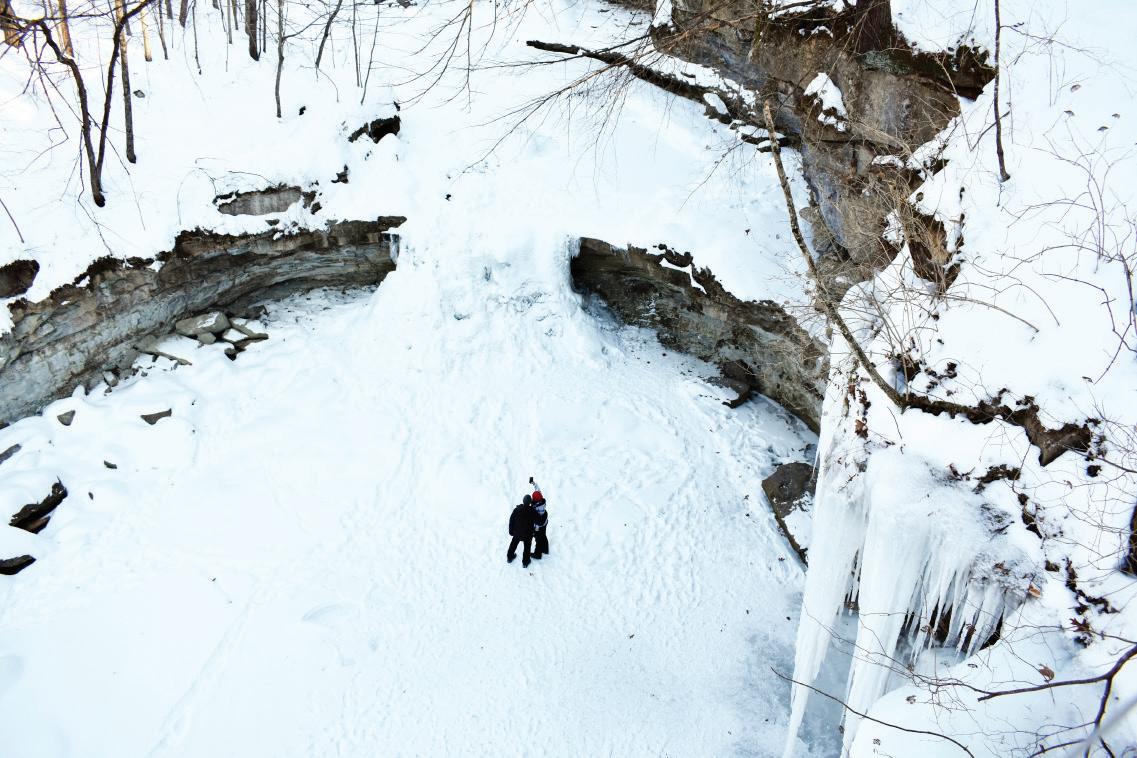
A couple pauses for a selfie on Feb. 1 in the heart of a frozen canyon at McCormick’s Creek State Park. The dramatic ice falls and snow-dusted limestone cliffs created a stunning backdrop for a wintery adventure. TRAVIS CURRY | THE OWEN NEWS
By Travis Curry Senior Correspondent


A couple was caught by the camera Feb. 1st capturing a memory in front of the frozen falls at McCormick’s Creek State Park (MCSP) east of Spencer. The month began with the scenic park encased in an icy cathedral following a month of volatile winter weather.
In January 2026, “Sweet” Owen faced a series of intense weather events, including a major winter storm from Jan. 24 to 26 that dropped between six and 13 inches of heavy SHIVERS | PAGE 8
Redistricting, priorities shared at Legislative Breakfast
By Nicole DeCriscio Executive Editor
In addition to sharing information about the legislative priorities, Indiana’s attempt to redistrict ahead of the 2026 midterm election was also the center of conversation during the first of two legislative breakfasts hosted by the Owen County Chamber of Commerce. The event took place on Jan. 24.
The January legislative breakfast was sponsored by BBP Water Corp. and was hosted at Owen Valley Christian Fellowship. Main Street Coffee served as the event’s coffee sponsor.
District 46 State Representative Bob Heaton and District 37 State Senator Rod Bray were in attendance. District 39
trials in 2025. While juror shortages marked the court’s previous trials, this is the first case in which the issue resulted in a mistrial.
VanDerMoere explained that his staff typically sends out 120
Candidates
for primary election
By Travis Curry Senior Correspondent
Candidates continued to file this week for the May 5th primary election in Owen County.
Here’s a rundown of those who have filed to run for office as of 4 p.m. on Wednesday, Feb. 4: Circuit Court II Judge, 78th Judicial Circuit
Kelsey B. Hanlon – R Prosecuting Attorney, 78th Judicial Circuit
Ashley M. Fleetwood – R
Benjamin C. Kim – R Assessor
Dustin (Dusty) White – R Circuit Court Clerk
Diane Stutsman – R Commissioner, District 1 (Harrison, Montgomery, Taylor or Wayne Township residency)
Norman C. Warner – R
By Nicole DeCriscio
The Environmental Protection Agency (EPA) hosted an open house last month to meet with citizens concerning the progress of the remedial investigation
Contamination in Spencer. The site was added to the national priorities list EPA | PAGE 11 CANDIDATES | PAGE 19
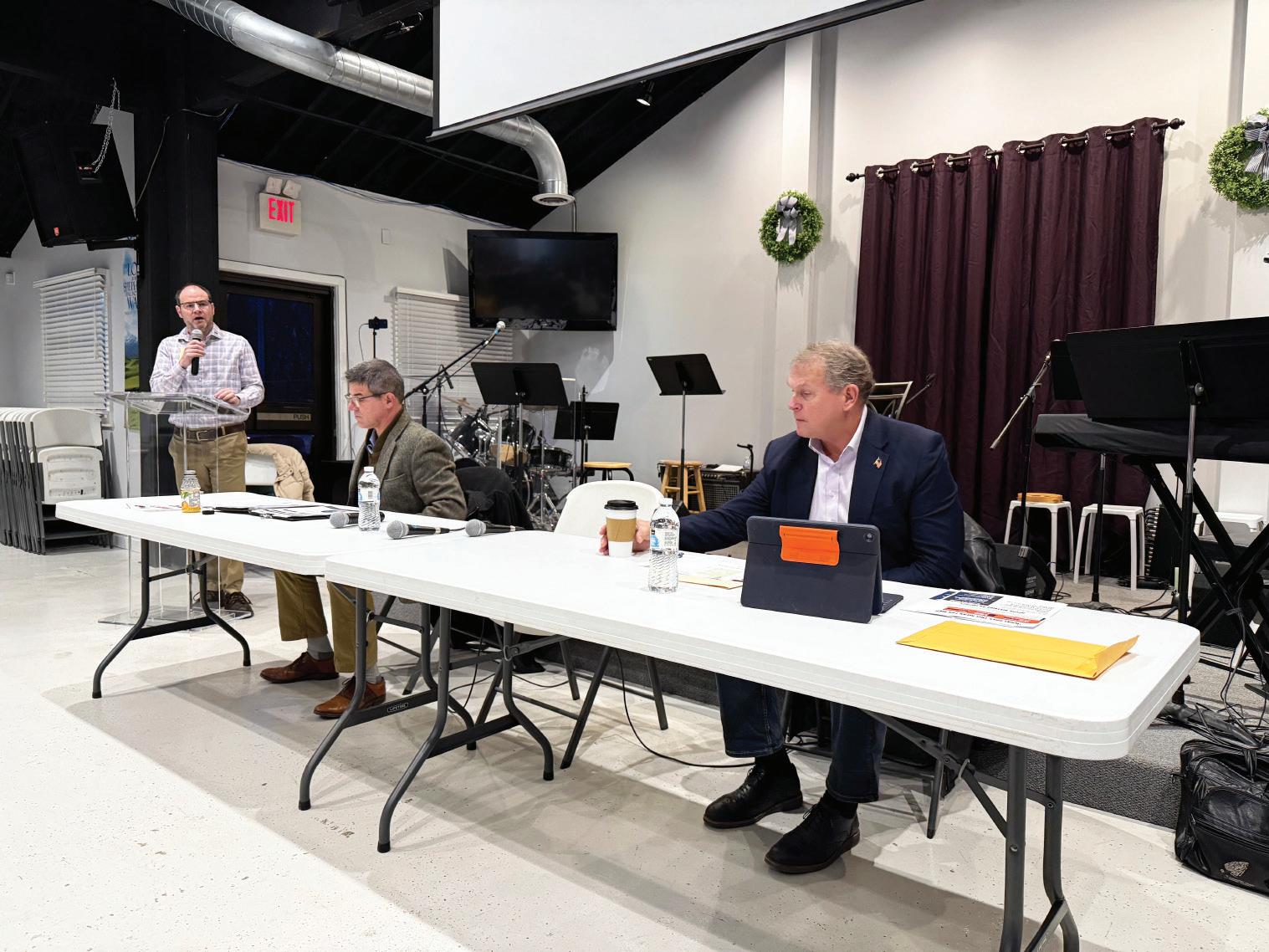
From left, Legislative Breakfast moderator County Councilman Anton Neff introduces Senator Rod Bray and Representative Bob Heaton at the January event. The event is an opportunity for constituents to meet with their legislators. NICOLE DECRISCIO | THE OWEN NEWS

TRUSTED NEWS FOR A THRIVING COMMUNITY
HOW TO CONTACT US
PHYSICAL ADDRESS:
114 S. MAIN ST. SPENCER, IN 47460
MAILING ADDRESS: P.O. BOX 64 SPENCER, IN 47460
EMAIL:
INFO@THEOWENNEWS.ORG
OFFICE HOURS STARTING IN 2026: TUESDAYS 9 AM TO NOON THURSDAYS 1:30 PM TO 5 PM
WWW.THEOWENNEWS.ORG
OUR BOARD
PRESIDENT
TRAVIS CURRY VICE PRESIDENT
AARON LAGRANGE TREASURER
KURT ROSENBERGER BOARD MEMBERS
JESSICA BRINSON
SUZANNAH COUCH
TYLER DEFORD
CAROLINE RILEY
STEFAN WELSH
OUR STAFF
EXECUTIVE EDITOR
NICOLE DECRISCIO ADVERTISING & BUSINESS MANAGER
LOLA GARRISON
PICKUP LOCATIONS
BABBS SUPERMARKET MILLGROVE COUNTRY MART SPENCER PRIDE
CORRECTIONS POLICY
WE AIM FOR AS CLOSE TO PERFECTION AS HUMANLY POSSIBLE. PLEASE SEND CORRECTIONS TO INFO@THEOWENNEWS.ORG.
LETTERS TO THE EDITOR
WE WELCOME LETTERS TO THE EDITOR UP TO 300 WORDS. OUR FULL POLICY CAN BE FOUND ON OUR WEBSITE.
HOW TO DONATE
WE BELIEVE THAT OUR COMMUNITY DESERVES ACCESS TO RELIABLE, RESPONSIBLE AND ETHICAL NEWS. OUR MODEL IS RELIANT UPON DONATIONS MADE BY OUR READERS. ONLINE DONATIONS CAN BE MADE THROUGH OUR WEBSITE, BY USING THE QR CODE BELOW OR THROUGH THE OWEN COUNTY COMMUNITY FOUNDATION. CASH OR CHECK DONATIONS CAN BE MAILED TO US AT THE ADDRESS ABOVE.
ABOUT THE OWEN NEWS
THE OWEN NEWS IS THE PRINTED NEWSPAPER OWNED BY THE OWEN NEWS PROJECT, INC, A NONPROFIT 501(C)3 ORGANIZATION. AT THE OWEN NEWS PROJECT, WE ARE COMMITTED TO DELIVERING RELIABLE AND UNBIASED LOCAL NEWS AND INFORMATION TO EMPOWER OUR READERS AND BUILD A STRONGER COMMUNITY.
THE OWEN NEWS IS A MEMBER OF THE HOOSIER STATE PRESS ASSOCIATION (HSPA). SINCE 1933, THE HSPA HAS BEEN INDIANA’S TRADE ORGANIZATION ADVOCATING FOR THE FREE PRESS, PROMOTING HIGH STANDARDS OF JOURNALISM AND PROVIDING SUPPORT AND SERVICES TO ITS MEMBER NEWSPAPERS. THE OWEN NEWS IS ONE OF THE FIRST NON-PROFIT NEWSPAPERS TO JOIN THE HSPA.


Caleb Hutchison named District 5 Officer of the Year
Staff Report
Indiana Conservation Officer Caleb Hutchison, who serves Owen County, has been selected as the 2025 District 5 Officer of the Year.
“Across Indiana, conservation officers are on the front lines promoting public safety in the outdoors and protecting our state’s vital natural resources,” said Governor Mike Braun. “I congratulate the officers from each of the 10 districts who have earned this distinguished honor for their exceptional service on behalf of Hoosiers in 2025.”
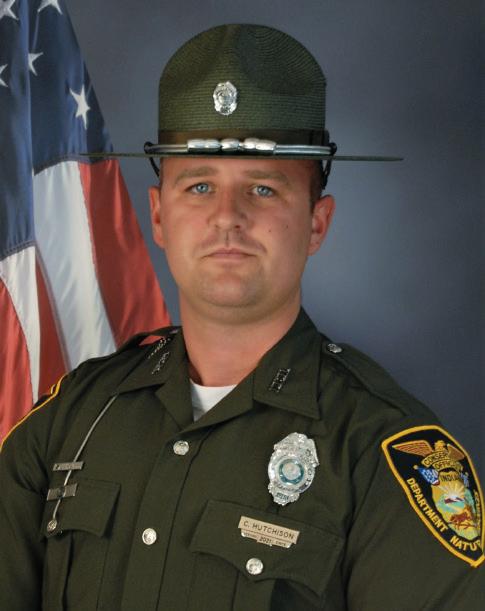
High School, has served as a conservation officer for four years. Prior to that he served as a deputy with the Owen County Sheriff’s Department for seven years.
In addition to his normal duties as a field officer, Hutchison serves as a field training officer, sonar operator, and emergency vehicle operation instructor for the Department of Natural Resources Division of Law Enforcement.
District 5 includes Greene, Sullivan, Parke, Clay, Vigo, Vermillion, Putnam, and Owen counties.
The district award puts Hutchison in the running for the Pitzer Award, which is presented to the top overall conservation officer in the state and is selected from the 10 district winners.
Hutchison, a 2010 graduate of Owen Valley
The Pitzer Award is named after Conservation Officer James D. Pitzer, who was fatally shot while investigating illegal hunting activity on Jan. 2, 1961, in Jay County.
Government Meeting Calendar
Feb. 9
Owen County Council, 6 p.m., Commissioners’ Room, Owen County Courthouse, 60 S. Main St., Spencer.
Owen Valley Fire Territory Board, 6 p.m. at the Owen Valley Volunteer Fire Department, 401 Walnut St., Spencer. Cloverdale Community Schools Board of Trustees, 7 p.m. in the Arthur L. Johnson Administration Building, 310 E. Logan St., Cloverdale.
Feb. 12
Spencer-Owen Community Schools Board of Trustees, 7 p.m. in the Mike Wells Memorial Board Room at Central Office, 205 E. Hillside Ave., Spencer.
Owen County Board of Zoning Appeals, 7 p.m., Commissioners’ Room, Owen County Courthouse, 60 S. Main St., Spencer.
Feb. 16
Owen County Public Library Board, 5 p.m. in the OCPL Vault Room, 10 S. Montgomery St., Spencer.
Spencer Town Council, 6 p.m. in the Spencer Municipal Building, 90 N. West St., Spencer.
Feb. 17
Owen County Advisory Plan Commission, 6:30 p.m., Commissioners’ Room, Owen County Courthouse, 60 S. Main St., Spencer.
Correction
In last month’s article about the Board of Zoning Appeals, Richard Lorenz was quoted as working for BBP Water Corp. While the quote was reported accurately as stated during the meeting, a board member of BBP Water Corp. has since clarified that Lorenz does not work for the corporation.
Feb. 19
Owen County Board of Commissioners, 6 p.m., Commissioners’ Room, Owen County Courthouse, 60 S. Main St., Spencer.
Feb. 23
Spencer Parks and Recreation Board, 6 p.m. in the Spencer Municipal Building, 90 N. West St., Spencer.
Feb. 24
Spencer Plan Commission & BZA, 6 p.m.
in the Spencer Municipal Building, 90 N. West St., Spencer.
Mar. 2
Spencer Town Council, 6 p.m. in the Spencer Municipal Building, 90 N. West St., Spencer.
Mar. 5
Owen County Board of Commissioners, 9 a.m., Commissioners’ Room, Owen County Courthouse, 60 S. Main St., Spencer.

Caleb Hutchison
Community Events Calendar
Feb. 6
American Red Cross Blood Drive, 9 a.m. to 2 p.m. in the Open Class Building at the Owen County Fairgrounds, 364 S. East St., Spencer. Register online at redcross. org to select a time for your donation. Use 47460 to select the Owen County site.
Feb. 7
Take Your Child to the Library Day, 10 a.m. to noon at the Owen County Public Library, 10 S. Montgomery St., Spencer. Crafts, free books for children, and free popcorn. Storytime begins at 11 a.m. Each child who signs up for a library card will receive a free Wendy’s Frosty coupon.
ROK: Reimagining Opera for Kids, The Lunchbox Project, 2 p.m. at the Historic Tivoli Theatre, 24 N. Washington St., Spencer. Featuring music from six contemporary composers, this 30-minute show brings variety, fast pacing, and audience interaction that kids (and adults) will love. Free admission.
Feb. 8
Soup-er Bowl PitchIn, noon at the Gosport Christian Church, 121 W. Main St., Gosport. Food will be served by the church youth. Donations will be accepted to benefi t Winter Jam.
Super Bowl Party, 4 p.m. to midnight at the Spencer VFW Post #1405, 78 E. Franklin St., Spencer. Open to the public. Super Bowl Pitch-In Party at the Spencer American Legion Post #285, 154 S. Main St., Spencer. The game kicks off at 6:30 p.m., but make plans to arrive early!
Feb. 9
Jolly Homemakers meeting, 1 p.m. at the Freedom Community Center, 5558 Freedom-Arney Rd., Freedom.
Nature Art, 5:30 to 7 p.m. in the Activity Room at the Owen County Public Library, 10 S. Montgomery St., Spencer. Make cards or gifts with pressed fl owers and nature items. Open to all ages.
Feb. 10
Braysville Homemakers meeting, 5:30 p.m. in the upstairs meeting room at the Historic Tivoli Theatre, 24 N. Washington St., Spencer. Elevator access is available. For more information, call 812-8295020.
Feb. 11
Harrison Homemakers meeting, noon at the Purdue Extension-Owen County offi ce, 180 S. Washington St., Spencer. Unbound Recovery
meeting, 7 to 8:30 p.m. at Access Church, 499 N. Main St., Cloverdale. This faithbased, 12-step recovery community meeting is held every Wednesday evening at 7 p.m..
Feb. 12
White River Beekeepers meeting, 6:30 p.m. in the Community Room at the Owen County Public Library, 10 S. Montgomery St., Spencer. Current and prospective beekeepers are welcome to attend.
Spencer Masonic Lodge #95 stated meeting, 7:30 p.m. at the Lodge, 361 N. Harrison St., Spencer.
Feb. 13
Walk for Peace: A Culmination Celebration, 5 to 7 p.m., at the Spencer Pride commUnity center, 17 E. Franklin St., Spencer. Hear from local faith and community leaders Rev. Bill Breeden, Rev. Karen Williams, and Wendy Wonderley, along with the Venerable Lobzang Dorgi, as they refl ect on the urgent need for peace in our world. The event will include a special performance by soprano Amanda Lawson and close with a silent walk around the courthouse square, standing together in solidarity and intention.
Valentine’s Day Formal Dance fundraiser, 7 to 10 p.m. at the Christian Life Center, 157 S. Montgomery St., Spencer. Open to ages 15 and older. Ticket cost is $25 per person. First-come, fi rstserved. Light refreshments are included in the ticket price; other refreshments will be available for purchase. Proceeds benefi t the New Beginnings Pregnancy Resource Center. For more information, call 812-8292229 or email director. nbcpc@gmail.com.
Feb. 14
Children’s book sale, 9 a.m. to 2 p.m. in the Youth Services Department (upstairs) at the Owen County Public Library, 10 S. Montgomery St., Spencer. Each item will be priced at 10 cents each or three for 25 cents.
Parents’ Night Out, 5 to 8 p.m. at the Spencer First Church of the Nazarene, 126 E. Market St., Spencer. Free child care so parents can enjoy a night out. Hosted by the Spencer First Church of the Nazarene.
Adult Prom Night, doors open at 5:30 p.m., dinner begins at 6 p.m. at the Spencer VFW Post #1405, 78 E. Franklin St., Spencer. Purchase tickets ($25 or $15 per person depending on dinner choice) at the Post. DJ starts at 8 p.m. Ticket price includes dinner, drink and access to the digital photo
booth. For more information, call 812-829-9005.
Feb. 17
Spencer Lions Club meeting, 6:30 p.m. at the Lester F. Litten Community Building, 59 N. Main St., Spencer.
Feb. 19
Spencer Exchange Club meeting, noon at the Owen County Family YMCA, 1111 W. SR 46, Spencer. Calico Homemakers meeting, 2 p.m. Meetings are held at a diff erent restaurant each month. For more information, call 812-8295020.
Trivia Night with host Rance Fawbush, 6 to 8 p.m. at the Owen Valley Winery & Bistro, 491 Timber Ridge Rd., Spencer.
Feb. 20
Elementary Sweetheart Dance, 6:30 to 9 p.m. at the Owen Valley Sports Complex, 575 Fifth Ave., Spencer. Open to Spencer-Owen Community Schools’ students in grades fi rst through third. Supervision provided. Cost is $7 at the door.
Feb. 21
Elementary Sweetheart Dance, 6:30 to 9 p.m. at the Owen Valley Sports Complex, 575 Fifth Ave., Spencer. Open to Spencer-Owen Community Schools’ students in grades fourth through sixth. Supervision provided. Cost is $7 at the door.
Feb. 23
Seventh Grade Launch, 6 p.m. in the Owen Valley Middle School cafetorium, 626 S.R. 46W, Spencer. Learn more about scheduling, expectations and opportunities, athletics and more.
Feb. 24
Owen County SWCD Board of Supervisors meeting, 4:30 p.m. at the SWCD offi ce, 788 Pottersville Rd., Spencer. Open to the public.
Feb. 26
Owen County Soil & Water Conservation District annual meeting and dinner expo, 5:30 p.m. in the 4-H Building at the Owen County Fairgrounds in Spencer. Indiana State Department of Agriculture Director Don Lamb will be the guest speaker. Tickets are $10 for adults; free admission for children ages 12 and younger. For more information, call 812-606-6505 or email owenswcd@gmail.com.
Feb. 27
Whitehall Heritage Celebration, 7 p.m. at the Whitehall Pentecostal Church, 8006 S.R. 43, Spencer.




Celebrate the history and impact of Whitehall Church in message and in song with Pastor Anthony Warner, Pastor Bruce Kelly, Pastor Nate Stewart, and many others. Bishop Phil Cook will deliver the keynote message.
Feb. 28
Legislative Breakfast, 7:30 a.m. at Owen Valley Christian Fellowship, 338 S.R. 43S, Spencer. Sponsored by South Central Indiana REMC.
Mar. 1
Spencer Pride general meeting, 4 p.m. at the commUnity Center, 31 E. Franklin St., Spencer.
Mar. 3
Owen Valley High School band concert, 6 p.m. in the OVHS Auditorium, 622 S.R. 46W, Spencer. Spencer Lions Club meeting, 6:30 p.m. at the Lester F. Litten Community Building, 59 N. Main St., Spencer.
Mar. 4
Freshman Kickoff Night, 6 p.m. at Owen Valley High School, 622 S.R. 46W, Spencer.
Mar. 5
Tea & Seeds, hosted by the Owen County Garden Club, beginning at 10 a.m. at the IGA Fellowship Hall, 95 W. Franklin St., Spencer. Make plans to attend this annual gathering of garden enthusiasts for tea, seed catalog sharing, and conversation. There will be special information sessions on milkweed, companion planting, and monarch butterfl y tracking.
Spencer Exchange Club meeting, noon at the Owen County Family YMCA, 1111 W. SR 46, Spencer. Gosport Lions Club meeting, 6:30 p.m. at the Gosport Community Building, 301 N. Ninth St., Gosport.
Mar. 6
Owen Valley High School Air Force Junior ROTC Military Ball, 6 p.m. at OVHS, 622 S.R. 46W, Spencer.
Mar. 7
Seven Oaks’ Battle of the Badges, 5 p.m. in the gymnasium at Seven Oaks Classical School, 200 E. Association St., Ellettsville. Come support your favorite team - Team Fire or Team Police. Admission is $5 or a donation of fi ve nonperishable food items. All proceeds will benefi t Pantry 279.
Mar. 9
Jolly Homemakers meeting, 1 p.m. at the Freedom Community Center, 5558 Freedom-Arney Rd., Freedom.



Jail Bookings
EDITOR’S NOTE: Booking information is provided by the Owen County Security Center. These are preliminary charges and may change as cases are processed through the circuit court system. To follow a court case, search the state’s court records at mycase.in.gov. This information is public record. All people are presumed innocent until proven guilty.
1-1
Mauricio Peralta, 33, Spencer, preliminary charge of operating while intoxicated endangering a person. Arrested by Spencer Police Department (SPD) officer Ben Muncie.
Collin Brandenburg, 25, Camby, preliminary charges of burglary (two counts) and probation violation.
SPD officer Bryce Brock was the arresting officer.
1-2
James Hayden II, 37, Bowling Green, preliminary charges of probation violation and nonsupport of a child. Arrested by SPD officer Ben Muncie.
1-4
Zoe Burchfield, 22, Spencer, preliminary charge of battery. Owen County Sheriff’s Department (OCSD) Sergeant Torrey Wallace was the arresting officer.
Jacob Summitt, 26, Spencer, preliminary charges of domestic battery, intimidation, and interference with the reporting of a crime. Arrested by OCSD Sergeant Torrey Wallace.
1-5
Ivy Utley, 31, Gosport, preliminary charges of theft; receiving stolen property (two counts), unauthorized entry of a motor vehicle (three counts), and theft.
OCSD Deputy Brennan Clark was the arresting officer.
Paul Hepner, 34, Bloomington, preliminary charges of failure to appear and driving while suspended with a prior charge. Arrested by OCSD Special Deputy Levi Miller.
1-6
Robert Christenberry, 39,
Spencer, preliminary charge of writ of attachment. OCSD Lieutenant Clint Wampler was the arresting officer.
Daniel Weaver, 38, Bloomington, preliminary charges of criminal mischief, unlawful possession of a syringe, possession of paraphernalia, criminal trespass (two counts), theft, and pretrial release violation. Arrested by SPD officer Bryce Brock.
1-7
James Corns, 55, Ellettsville, preliminary charges of possession of methamphetamine, possession of paraphernalia, and resisting law enforcement. OCSD Deputy Jordan Hardey was the arresting officer.
1-8
Robert Christenberry, 39, Spencer, preliminary charge of driving while suspended with a prior charge. Arrested by OCSD Deputy Tony Stevens.
1-9
Gretchen Carlisle, 60, Freedom, preliminary charge of criminal trespass.
OCSD Deputy Tony Stevens was the arresting officer.
Nicky Wright, 57, Freedom, preliminary charge of criminal trespass. Arrested by SPD officer Seth Givans.
David Padgett, Jr., 31, Freedom, preliminary charge of writ of attachment. SPD officer Bryce Brock was the arresting officer.
Douglas Escobar, 26, Bicknell, IN, preliminary charge of driving without a license.
Arrested by OCSD Deputy Luke Wright.
1-10
William Russell, 44, Spencer, preliminary charge of operating while intoxicated. SPD officer Ben Muncie was the arresting officer.
Michelle Lawrence, 36, Terre Haute, preliminary charge of operating while intoxicated. Arrested by SPD officer Bryce Brock. Jeremy Devylder, 47, Gosport, preliminary charges of invasion of privacy and probation violation.
OCSD Deputy Jacob
Williamson was the arresting officer.
1-11
James Featherston, 58, Spencer, preliminary charge of domestic battery. Arrested by OCSD Deputy Stephen DeWitt II.
Joseph Fair, 45, Gosport, preliminary charges of driving while suspended with a prior charge and failure to appear.
OCSD Sergeant Brandon Gasparovic was the arresting officer.
1-12
Brent Sowers, 62, Bowling Green, preliminary charge of possession of marijuana, hash oil, hashish, or salvia. Arrested by OCSD Deputy Cory Poland.
1-13
Allen Gipson, 23, Indianapolis, preliminary charges of domestic battery, criminal mischief, interference with the reporting of a crime, and disorderly conduct. OCSD Deputy Elijah Volrich was the arresting officer.
1-14
Joshua Awbrey, 35, Bowling Green, preliminary charges of public intoxication and battery resulting in bodily injury. Arrested by OCSD Deputy Luke Wright.
Jerry Poindexter, 49, Indianapolis, preliminary charges of auto theft and probation violation. SPD officer Chester Richardson was the arresting officer.
1-15
Tanner Van Ermen, 21, Munster, IN, preliminary charge of operating while intoxicated. Arrested by SPD officer Ashton Banks.
Joshua Shumaker, 43, Quincy, preliminary charges of failure to appear and theft.
OCSD Major William Snodgrass was the arresting officer.
Larry Tussey, Jr., 48, Freedom, preliminary charges of unlawful possession of a syringe and probation violation. Arrested by OCSD K9 Deputy Charles Hallam.
1-16
Vicki Mitchell, 71,
Poland, IN, preliminary charge of residential entry. OCSD Major William Snodgrass was the arresting officer.
Bradley Baugh, 25, Seymore, IN, preliminary charges of burglary and probation violation. Arrested by OCSD K9 Deputy Charles Hallam.
Christy Truax, 52, Spencer, preliminary charges of driving while suspended with a prior charge (two counts) and failure to appear (two counts).
OCSD Deputy Jordan Hardey was the arresting officer.
Paul Cazee, 45, Spencer, preliminary charges of failure to appear and driving while suspended with a prior charge. Arrested by OCSD Deputy Brennan Clark.
1-17
James Shelburne III, 31, Lyons, preliminary charges of probation violation and operating a vehicle while intoxicated endangering a person.
SPD officer EJ Westgate was the arresting officer.
Larry Patterson, 63, Poland, IN, preliminary charge of residential entry. Arrested by OCSD Deputy Cory Poland.
1-20
Daniel Stewart, 47, Poland, IN, preliminary charges of possession or use of a legend drug or precursor, auto theft, possession of methamphetamine, possession of paraphernalia, and possession of marijuana, hash oil, hashish, or salvia.
OCSD Deputy Jordan Hardey was the arresting officer.
1-21
Christina Jackson, 45, Gosport, preliminary charges of theft (two counts). Arrested by OCSD Special Deputy Levi Miller.
1-22
Rusty Button, 29, Crystal, MI, preliminary charges of possession of methamphetamine, unlawful possession of a syringe, and probation violation.
OCSD Special Deputy Levi Miller was the arresting officer.
Robert Adams, 52, Bloomington, preliminary charges of driving while
suspended with a prior charge and failure to appear. Arrested by OCSD Deputy Luke Wright.
1-27
Brian Wininger, 41, Indianapolis, preliminary charges of possession of paraphernalia, possession of a controlled substance, and possession of methamphetamine.
OCSD Special Deputy Levi Miller was the arresting officer.
Brandie Rogers, 45, Gosport, preliminary charge of conversion. Arrested by OCSD Sergeant Brandon Gasparovic.
Shane Terrell, 43, Spencer, preliminary charge of conversion.
OCSD Sergeant Brandon Gasparovic was the arresting officer.
1-28
Jack Cameron, 56, Spencer, preliminary charge of domestic battery. Arrested by OCSD Deputy Jacob Williamson.
1-29
Kyle Hanna, 36, Bloomington, preliminary charges of operating with a blood alcohol content (BAC) of .08 to .14, violation of specialized driving privileges, and probation violation. OCSD Special Deputy Levi Miller was the arresting officer. Justin Delp, 37, Vincennes, preliminary charges of probation violation and operating a vehicle as a habitual traffic violator (HTV). Arrested by OCSD Lieutenant Clint Wampler.
1-31
Jeremy Kilgore, 48, Spencer, preliminary charges of strangulation, domestic battery, and resisting law enforcement. OCSD Deputy Brennan Clark was the arresting officer.
2-2
Jhonatan Guillen, 28, Spencer, preliminary charges of operating while intoxicated, driving without a license, and operating with a blood alcohol content (BAC) of .15 or more. Arrested by OCSD Sergeant Torrey Wallace.
Food Inspections
Routine food inspections were conducted by the Owen County Health Department during the month of January 2026. Reported below are the no violation, critical and
non-critical comments left for these establishments: 1-12 Bivi’s Tamales, 554 Paradise Point Rd., Spencer.
inspection. No violations 1-15 Spencer Elementary School – basketball concession stand, 151 E. Hillside Ave., Spencer. Routine inspection. No violations.
CCSC Board reorganizes for 2026
By Travis Curry Senior Correspondent
The Cloverdale Community School Corporation (CCSC) Board of School Trustees met Jan. 12th to elect officers for the 2026 calendar year, approve routine matters, and to address several items under the new business portion of the meeting.
Three community members were also in attendance to address the recent departure of Cloverdale Middle School (CMS) special education teacher Jill Schreiber.
Under board organization, Vivian Whitaker was elected to continue in her role as board president for 2026, while Mike Rightmyer II was nominated and approved to serve as vice president, and Donna Fidler as board secretary.
The board also voted to continue holding regular board meetings on the second Monday of each month at 7 p.m. in the Arthur L. Johnson Administration Building.
Board member compensation was set at $2,000 a year, with an additional compensation of $75 per board member for each meeting held outside of the regular board meetings.
Noting board compensation has remained unchanged for more than 20 years, Whitaker said a change in state law would have permitted the board to increase the per person compensation amount to 10 percent of a beginning teacher’s salary, which would amount to $4,830.
“We thought that to be an excessive jump, but due to the fact that
we will be hiring a new superintendent and we have a couple of work sessions on items that are coming up, we are going to add a stipend for those meetings, so that is our rationale,” Whitaker explained.
Next, the board voted to appoint Mendy Shrout as corporation treasurer, Sara Zaring as deputy treasurer, and Michelle Cooper with Lewis & Kappes Law Firm and Tim Shelly with Warrick & Boyn as corporation attorneys.
Under routine matters, the board voted unanimously to approve meeting minutes for executive and regular sessions held Dec. 8, 2025, as well as the latest claims and financial reports, which CCSC Superintendent Greg Linton advised totaled $2,455,061.71 (including two payrolls).
Regarding communications, the board recognized the corporation’s latest Student of the Month honorees, which included Cloverdale Elementary School (CES) student Lily Flinchum, Cloverdale Middle School (CMS) student Macy Mescall, and Cloverdale High School (CHS) student Zaydin Knight.
Jessica Fidler, fifthgrade math teacher at CMS, was honored as the latest CCSC Staff Member of the Month.
Cloverdale Police Department Sergeant Wade Warren had the honor of recognizing the department’s latest Citizens of the Month, which included CES third-grader Liam Bernard and CMS student Alea Crecelius.
Addressing new business, the board voted 7-0 to approve hiring a temporary transportation director assistant while fulltime director Joel Kennelly is on family
medical leave (FMLA).
The board also voted 7-0 to approve updating the corporation’s mileage reimbursement rate to match the updated federal rate for mileage reimbursement of 72.5 cents per mile, which went into effect on Jan. 1st. The corporation’s previous mileage reimbursement rate was 70 cents per mile.
Next, the board cast separate votes to approve the Chromebook responsibility and financial liability policy, the 2025-27 Title II Grant in the amount of $47,563.48, and compensation for students who work in the Clover Student Café.
“We have a small group of students who have agreed to learn the coffee industry in our Cloverdale Student Café and in order to encourage more participation Mr. (Sonny) Stoltz has requested $30 for each student for each time they complete a shift in our café of an evening during a school sporting event or other ECA (extracurricular activity),” superintendent Linton explained.
The board also voted unanimously to accept donations for CES and CHS, and one cash transfer-in for CHS.
In addition, the board approved the following professional leave, field trip, and facility use requests:
Professional leave requests
Jan. 2 – Brian Siddons, girls’ sectional wrestling, Ben Davis.
Jan. 7 – Kenzie Pigg, legislative lobby meeting, Indiana Statehouse.
Jan. 13 – Kim Bailey, Advanced Classroom Management, Area 30, Greencastle.

Jan. 21 – Drew Boyette, MI-BAT Beginning Ag Teacher Workshop, Trafalgar.
Jan. 22 – Kenzie Pigg, IAAE Winter Workshop, Indiana FFA Leadership Center.
Jan. 30 – Jessica Fidler, Strategies for Preventing and Eliminating Chronic Disruptive Behaviors, Greencastle West Central.
Feb. 10 – Chelsey Meluch, School Culture Workshop, West Central.
Feb. 17 – Chelsey Meluch, Proactive Leadership Workshop.
Feb. 20, Mar. 13 and Mar. 16 – Kenzie Pigg, conventions and conferences of Serving the Indiana Farm Bureau State Committee for Young Farmers & Ag, French Lick, IN, Anaheim, California, Indianapolis, and Portland, Oregon.
Feb. 24 – Chelsey Meluch, Teacher Retention Workshop, virtual.
Mar. 13 – Karl Turk, JAG competition, Ivy Tech, Greencastle.
Field Trips
Dec. 22, 2025 – CHS varsity girls’ basketball team and families, Coachman Fairground.
Jan. 13 – CMS fifth grade class, Putnam County Courthouse, Greencastle.
Jan. 20 – CMS fifth grade class, Putnam County Courthouse, Greencastle.
Mar. 6 – Bring Change 2 Mind, Eagle Creek Reservoir.
Mar. 13 – CHS Jobs for America’s Graduates (JAG), Ivy Tech, Greencastle.
Facility use
Jan. – May – Girl Scout Troop 1142, Girl Scout Juniors working on Bronze Award, Mrs. Vaughn’s kindergarten classroom.
Jan. – Apr. – 4-H Club, 4-H meetings, CHS ag room.
Jan 25 and Jan. 31 –Cloverdale Community Youth League (CCYL), softball/baseball open gym and evaluations, CHS auxiliary gym.
Feb. 7 – CHS class of 2027, fundraiser for prom, CHS auxiliary gym.
Feb. 21 – Softball clinic, CHS auxiliary gym.
Apr. 17 – FFA, District VII Leadership Contest, CHS gym, auxiliary gym, cafetorium, and media center.
Additional personnel matters receiving board approval included:
Employment
Amy Bates – bus aide.
John Brush –CHS part-time AEPdiscipline assistant.
Cyndi Byrer – CHS custodian, moving from part-time to fulltime.
Seth Geiger – CMS long-term substitute.
Coaching resignation
Seth Geiger – track coach.
Coaching hire
Martha Miles – CHS winter cheer coach. Ken Schnepp – CHS assistant track coach.
Coaching volunteer Brantson Scott – CHS assistant basketball coach.
The Cloverdale Community School Board will meet again on Monday, Feb. 9 beginning at 7 p.m. in the Arthur L. Johnson Administration Building, 310 E. Logan St., Cloverdale. Members of the board include Vivian Whitaker, Katrina Lewis, Donna Fidler, Melissa Carrell, Emily Haltom, Joe Mann, and Mike Rightmyer II.


Cloverdale School Board votes to cancel teacher’s contract
By Travis Curry Senior Correspondent
The Cloverdale Community School Corporation (CCSC) Board voted 6-0 to approve the cancellation of Ms. Jill Schrieber’s teacher contract at a special meeting held Jan. 19th in the Arthur L. Johnson Administration Building. Schrieber had previously served as a special education teacher at Cloverdale Middle School. Board member Mike Rightmyer II made the motion to
approve the contract cancellation, with Emily Haltom seconding the motion prior to the 6-0 board vote. The entire meeting lasted just four minutes. The contract cancellation was effective as of the Jan. 19th board meeting.
“I believe it is necessary to explain the process used and the legal responsibilities of this board,” explained board president Vivian Whitaker. “As school board members we are not allowed to talk about personnel matters as individuals or as a board in order
| FROM PAGE 1
approved last month by the Spencer-Owen School Board.
Patriot fans will no doubt remember Burgess, who guided the varsity Patriots to a 33-9 overall record from 1998-2001, highlighted by a pair of undefeated regular seasons and three West Central Conference titles.
Burgess, who currently serves as athletic director at South Putnam High School, owns a 121-92 career record across 20 seasons. He last coached at Frontier (201719) before returning to South Putnam where he was head coach from 2006-13.
OVHS is where Burgess began his career, first as an assistant, then as head coach before assistant Duane Potts took over the reins for the next 19 years. Potts, who came back as an assistant last year for coach Eric Crouch, will remain on staff as defensive coordinator. Potts also serves as assistant principal at Owen Valley Middle School.
Burgess was recently added to the Wabash Valley Football Coaches Association Hall of Fame. His coaching career has included two sectional championships
to protect the privacy of the person or persons involved. This evening, we cannot divulge the reasons for (Cloverdale Middle School Principal) Ms. (Chelsey) Meluch and (CCSC Superintendent) Mr. (Greg) Linton determining the termination and cancellation of Ms. Schrieber’s contract. I personally attest that the legal counsel has been involved in the entire process. All laws and policies have been followed by our administrators and the board.”
Ms. Whitaker continued by saying,
at South Putnam. He later led Evansville Central to the Class 4A title game in 2018, losing in a memorable four overtime showdown.
In high school, Burgess was Steve Alford’s backcourt mate for two seasons at New Castle. He later played football for two years at Purdue before transferring to Ball State, where he was strictly a student.
PES hosts Hunter’s Education course
Patricksburg Elementary School (PES) hosted a Hunter’s Education course on Jan. 31. Nearly 70 participants received instruction in the areas of safe firearm use and handling while hunting, as well as in the home, hunter ethics and responsibility, game identification, and conservation management.
PES partnered with Indiana Conservation Officers Caleb Hutchison and Matt Mauder, along with Daniel Rhienhart and Mitchell Fleetwood to provide this valuable community service.
Officer Hutchison (an alumnus of PES) and Officer Mauder led the daylong Hunter’s Education instruction, while Rhienhart
Youth Soccer
“People have been allowed to state their opinions at our December and January board meetings. Many opinions have been expressed on social media, much of which was directed at our middle school principal, superintendent, and the board. Hate mail was received. Threats to vote out the entire board was stated on more than one occasion. It is sad that some in our community have shed such a negative light on our school corporation. Every person on this board
and Fleetwood guided participants through the medical and safety portion of the training.
State law requires all hunters born on or after Dec. 31, 1986 to complete hunter education certification before purchasing a hunting license in Indiana.
Owen-Putnam State Forest 50/50 Trail Race
The annual Owen-Putnam State Forest 50/50 Trail Race will take place Saturday, Mar. 21. Participants will tackle a demanding mix of hiking trails, horse paths, and service roads throughout the state forest. Distance options include 50 miles, 50K, 14 miles, and a 10K.
For course information, complete details, and to register, visit www.ops5050. com.
The Owen-Putnam State Forest office is located at 2153 Fish Creek Rd., Spencer.
Indiana CCAA recognizes Judge Hanlon
Owen County Circuit Court II Judge Kelsey Hanlon was recently honored by the Indiana Commission on Court Appointed Attorneys (CCAA) for her eight years
swore an oath to support the laws of the State of Indiana and its constitution. I believe each of us have done so in every action we have taken during my tenure of service. In addition, I wholeheartedly believe that each of us put the wellbeing of each child at the center of our decisions. To think that any of us hold personal biases against this teacher is both absurd and absolutely not true. The decision we made tonight is based upon evidence provided in the hearing, nothing else.”
of service to the CCAA. Hanlon received a plaque of appreciation from CCAA Chair Mark Rutherford and CCAA Executive Director Derrick Mason.
Since 1989, the Indiana CCAA has existed to recommend standards for indigent defense in capital cases, to adopt guidelines of salary and fee schedules for individual county reimbursement eligibility, and to review and approve requests for reimbursement in capital cases. In 1993, the responsibility of the Commission was expanded to include the adoption of guidelines and standards for county reimbursement eligibility in non-capital cases.
The Commission is comprised of 11 members: three are appointed by the Governor; three by the Chief Justice; one by the Indiana Criminal Justice Institute; two are members of the House of Representatives appointed by the Speaker of the House; and two are members of the Senate appointed by the President Pro Tempore of the Senate.
To learn more about the CCAA, visit www.in.gov/ccaa.


BRIEF
Spencer Council approves purchase of police vehicles
By Travis Curry Senior Correspondent
Spencer Town Council members Jon Stantz, Evan McKalip, and Ginger Kohr met in regular session Jan. 20, along with clerk-treasurer Cheryl Moke and town attorney Richard Lorenz.
Following approval of the Jan. 5th meeting minutes, the council heard from Steve Withem of Spencer Main Street concerning memorial benches being considered to honor Spencer attorney John Fuhs and former town council member Mike Spinks, both of whom passed away in 2025. Although the exact locations have yet to be determined, Withem noted the benches would be purchased and installed at no cost to the town.
Next, the council received an update from Lorenz concerning three town contracts/agreements he was working to finalize for 2026, including with the Owen County Humane Society, Economic Development
Corporation and Rural Transit.
The council also approved a public hearing for Tuesday, March 10 to consider the adoption of local sewer rates. The hearing will begin at 6 p.m. in the Spencer Municipal Building at 90 N. West St.
In departmental reports, Spencer Chief of Police Terry Sips announced the resignation of reserve officer Sam Robinson due to personal reasons. Sips also noted the appointment of reserve officer Jeremy Burke to serve as president of the department’s reserve officers’ division.
The council later voted 3-0 to approve the purchase of two 2026 Dodge Durango police vehicles for the department from the John Jones dealership. The total cost approved was $149,345.20.
Sewer Department superintendent Ryan Klaassen later provided the council with an update regarding site visits that were being scheduled with contractors and
subcontractors related to obtaining quotes for the town’s planned sewer improvement project.
Klaassen also indicated he was still awaiting a quote for a second pump for the State Road 43S lift station, though he was tentatively anticipating a cost of around $10,000.
Klaassen also indicated a desire to have around 60 feet of sewer main replaced on W. Wayne Street near Riverside Cemetery due to deterioration of the existing sewer main and the presence of tree roots that have infiltrated the damaged line. Klaassen said he had received a quote from HFI (Harrell-Fish, Inc.) of Bloomington for the replacement of 60 feet of PVC sewer main, three new taps, and a new cleanout. The quote was for about $20,000. He noted additional quotes would be obtained.
Street department superintendent Tony Floyd provided the council with an update concerning the installation of new banners
on light poles in and around downtown Spencer. He said during periods of colder weather, the staff had been working to clean and organize the street department building, as well as repainting traffic barricades in preparation for spring.
Floyd noted the department had recently purchased a load of salt, bringing the department to the halfway point of the amount budgeted for the purchase of salt this winter.
Lastly, Floyd spoke of the need to post signage at the new pickleball and basketball courts on Spencer’s south side advising park patrons of the park’s hours of operation, suggesting dawn to dusk. Councilman McKalip noted he would bring the issue to the attention of the Spencer Parks and Recreation Board.
The Spencer Town Council will meet again on Monday, Feb. 16 at 6 p.m. in the Spencer Municipal Building, 90 N. West St.
Care Partner Support Group meets at OCPL
Staff Report
Dementia Friendly Owen County, in conjunction with Area 10 Agency on Aging, has partnered with the Alzheimer’s Association to facilitate care partner support group meetings locally in 2026. Support groups are held at the Owen County Public Library (OCPL) on the fourth Thursday of each
month. Questions should be directed to Amy Guerrettaz by calling 812-935-2582 or emailing aguerrettaz@ area10agency.org.
The meeting schedule for January through April 2026 is as follows:
- Thursday, Feb. 26, 11:30 a.m. to 12:30 p.m.
- Thursday, Feb. 26, 5 to 6 p.m.
- Thursday, Mar. 26, 11:30 a.m. to 12:30 p.m.
- Thursday, Mar. 26,
5 to 6 p.m.
- Thursday, Apr. 23, 11:30 a.m. to 12:30 p.m.
- Thursday, Apr. 23, 5 to 6 p.m
Become a Dementia Friendly Business
Many Owen County organizations have completed Dementia Friendly Business training already, including McCormick’s Creek State Park, Owen County EMS, Owen Valley Fire
Territory, Owen County Public Library, Babbs Supermarket, Owen County Health Department, and Spencer Pride. Recently, staff from Area 10, Home Instead and Owen Valley Memory Care each participated in Dementia Live®! By simulating sensory and cognitive changes, participants experience what it may feel like to live with dementia
- deepening empathy and improving how we communicate, care, and connect.
Schedule a complimentary training, education event, or Dementia Live® experience for your business or group by contacting Area 10 Agency on Aging Dementia Outreach Specialist Amy Guerrettaz at 812-9352582 or aguerrettaz@ area10agency.org.
Tivoli plans adventure-themed fundraiser
Press Release
The Historic Tivoli Theatre is inviting the community to take part in a one-of-a-kind fundraising event that blends adventure, storytelling, and generosity. Inspired by classic cinematic adventures, the event will guide guests through an immersive experience designed to raise funds for free community movie screenings, operational cost, and the projector replacement at the Tivoli.
Attendees will begin their journey at Base Camp, where they will collect a map and set out to explore the theatre in search of “relics” hidden throughout the building. These relics include auction
items available for bidding as well as movie sponsorship opportunities that directly fund free movie experiences for the community. From there, guests are encouraged to venture onto the stage, where lost artifacts and hidden treasures await among coils and shadows. Additional discoveries can be found high above in the balcony, while the Den of Viquesney houses a carefully guarded collection of rare finds, some available through spirited bidding and others offering the chance to sponsor free movie nights. The adventure continues through the halls, where participants will help maneuver a rolling

boulder challenge, with every donation moving it closer to the finish and unlocking additional free movies for local families.
“This event is about more than fundraising - it’s about access,” said theatre director Andrea White. “Every artifact discovered, every bid placed, and every sponsorship
claimed helps ensure that movies remain a shared experience for everyone in our community.” The event will feature both inperson and online auction participation, allowing supporters near and far to join the expedition. Proceeds will directly support the Tivoli’s
mission to provide free and affordable movie programming while preserving the historic theatre as a community gathering place.
More information, including event details and online participation options, can be found at www. spencertivoli.org.
OCCF launches $1 for $1 match campaign for 32nd anniversary
Press Release
In celebration of its 32nd anniversary, the Owen County Community Foundation (OCCF) is thrilled to announce the return of the $1 for $1 Anniversary Match Campaign, building on the incredible success of last year’s 31st anniversary event. In 2025, nearly $200,000 was raised to support local nonprofits serving Owen County. This year, OCCF invites donors and nonprofits to make an even greater impact.
Running now through Feb. 28, this match campaign offers a $1 for $1 match for donations made to Agency and Designated funds established at OCCF. These funds specifically support the work of nonprofits serving Owen County, providing them with both immediate resources and long-term sustainability.
“Establishing a designated fund with the Owen County Community Foundation marks an important milestone and long-term commitment for Compass Rose Farm Sanctuary,” said Nancy Marshall, Founder and Executive Director of Compass Rose Farm Sanctuary. “This fund allows us to plan more intentionally for the future and strengthens the sustainability of our work, providing lifelong care for rescued animals, expanding educational opportunities and practicing responsible stewardship of our land and resources. We are deeply grateful for OCCF’s collaboration and for the donors who are investing in a future rooted in compassion, connection, and shared purpose.”
How the match works
For every dollar donated to an eligible fund, OCCF will provide a matching gift, which is designed to strengthen nonprofits in two ways:
- 70 percent of OCCF’s match will go into the fund’s permanent endowment, ensuring sustainable, ongoing support for the organization.
- 30 percent of the match will be immediately available to address pressing needs or launch new initiatives.
SHIVERS | FROM PAGE 1
snow across portions of Indiana. Temperatures during the month plummeted well below freezing, reaching a bone-chilling low of -9°F on January 28, leaving the park’s famous falls encased in thick,

This model allows nonprofits to meet immediate needs while building a stable financial foundation for the future.
Participating Funds
Only Agency and Designated funds are eligible for the match. These funds support a wide range of causes, including youth development, historic preservation, animal welfare, community health and more. A full list of participating funds is available on the OCCF website bit.ly/ donate2occf or by contacting the OCCF office directly.
How to Donate
Organizations can accept donations in the following ways:
- Online Donations: Donors can contribute directly to their favorite fund online during the match
shimmering ice. Despite the month of January bringing heavy snow and bone-chilling cold, the park’s beauty remained a significant draw. Winter transformed the Indiana landscape into a serene sanctuary, where the typical rush of the falls was replaced by the delicate tinkling of “ice
period at bit.ly/donate2occf.
- Mailed Donations: Donations sent via mail must be postmarked between now and Feb. 28 to qualify for the match. Donors should list the fund name in the check memo.
Join us in building a brighter future
“The continued success of OCCF’s matching campaigns reflects the deep generosity and shared commitment behind local philanthropy,” said Karah Bobeck, OCCF’s Director of Programs and Communications.
“As we celebrate the 32nd anniversary of the Owen County Community Foundation serving this community, we’re excited to once again amplify the impact of local giving and strengthen the nonprofits serving Owen County.”
Nonprofits interested in
bells” and the sculptural beauty of snow-laden hemlocks. The lack of foliage offered hikers a unique, unobstructed view of the park’s rugged geology, proving that the limestone canyons of Owen County are just as breathtaking draped in snow as they are in summer green.
participating in this campaign and establishing a fund at the OCCF, should contact the OCCF’s office at 812-8291725.
About the OCCF
The OCCF is a public charity founded in 1994 as a resource to connect caring individuals with causes they support, enabling them to make a charitable impact on the community. Since its founding, OCCF has been able to grant more than $12 million to area nonprofit and charitable organizations in our community. OCCF is committed to enhancing the quality of life for all citizens of Owen County, now and for generations to come. For more information, visit owencountycf.org or call 812829-1725.
The sheer volume of recent visitors was also evident in the snowpacked trails; a vast tapestry of overlapping shoe prints and boot treads created a silent ledger of the thousands who braved the recordbreaking cold to witness the falls in its frozen state. While the bitter cold
of January kept many indoors, the hushed beauty of the limestone canyons and the sculptural ice formations proved an irresistible draw for those seeking the serene “hushed” majesty of Indiana’s first state park in winter.
DELAYED | FROM PAGE 1
jury questionnaires for each case ahead of potential trials. He said that other counties send out large blocks of more than 500 questionnaires for a six month period, during which those who have filled out the questionnaire could be called.
“We’re actually sending out more questionnaires in a six month period than some of these surrounding counties,” VanDerMoere said. “The jury rules specifically require us to go through the Supreme Court’s approved list of potential jurors. Now that draws from all kinds of state agencies and web based programs — drivers license, voting rolls, taxpayer rolls, those sorts of things. So there’s a group of potentially vetted people with contact information and those sorts of things. Some folks ask, ‘Well why don’t you get some folks off the street?’ Well there’s a jury rule that prohibits us from just getting bystanders. That’s not an option to us by law.”
After the questionnaires are sent out, the bailiff goes through the returned questionnaires, screening those who will be summoned for jury duty. Individuals aged 75 and older are screened out but can opt in to jury duty, and the court can excuse individuals from being summoned for various reasons.
Naturally some are sent back as undeliverable.
“Those are few and far between,” VanDerMoere said.
With Porter’s case, 120 questionnaires were sent out and a little more than one-third of the questionnaires, or 42, were not returned at all, whether by the post office as undeliverable or by the individual.
“We are under the impression at this time that the folks got the mailers and did nothing with it. So that’s a huge block. I mean, that’s nearly a third of our jury pool, so we’re operating under that, plus dealing with all the paperwork associated with the folks that did show up or did respond,” VanDerMoere said. “The court can take some responsibility for those 42 people, and we are going to implement changes in the future that if after the second notice, in a short period of time, if we don’t get a response, then we’re going to need to send the sheriff out to serve people directly.”
Then, as with any case, only a fraction that are not initially screened out are asked to appear through a summons or court order.
In Porter’s case, there were 41 potential jurors summoned, and only 31 appeared.
“So now we’ve got
the block of 42 that didn’t respond plus now we’ve got 10 that have already acknowledged the process and then those folks don’t show up, and then that is where the contempt comes in. Once the summons, which is a court order to appear at a certain time, at a certain location on a certain date, those folks are potentially subject to a criminal contempt,” VanDerMoere said.
He added that the 42 who did not respond to the questionnaire is not as clear cut as to the consequences for not following through.
“That’s kind of a gray area as to whether or not those individuals could be held in contempt. It’s still part of the system, but because it’s a questionnaire versus a summons, we have to deal with that. So that’s where we’re going to have to adjust in the future,” he said.
Throughout the process of void dire otherwise known as jury selection, each side, both the state and the defense have 10 peremptory challenges.
Peremptory challenges must be race neutral, but it allows each party in a trial to remove a prospective juror without stating a reason. Discrimination based on ethnicity or sex is also prohibited. But with peremptory challenges no particular reason has to be given.
“It could be any number of things based on their training or experience, maybe the statements that a potential juror has given,” VanDerMoere said. “That’s what voir dire is about, trying to figure out, of those folks that show up, who doesn’t have an interest, who understands the process, who’s willing to have an open mind, who’s willing to be fair to the state and the defense.”
This does not include the fact that an unlimited number of jurors can be dismissed for cause, which requires proving that a juror is biased. Other for cause reasons can include stated refusal to follow the law, contradictory statements between the questionnaire and what is said during jury selection or being related to one of the witnesses in the case.
“So of the 31, in a particular case, now you’re narrowing it down to a very small group of folks. In our most recent case, we had two seats open, and we had one potential juror left,” VanDerMoere said. That case was the Porter case, and it did not include having any alternates, which is risky for an eight-day trial.
“I hate to do cases without alternates,” Owen County Public Defender Megan Schueler said.
Schueler explained that without an alternate, if a juror has
““It literally takes weeks, months to prepare for a trial, but you do a lot of preparation at the last minute just to make sure that you’re teed up.”
— Megan Schueler, Owen County Public Defender
an emergency and is no longer able to hear the case, a mistrial is declared and they have to try the case again.
Taken together, the numbers left little room for error.
Shortage strains resources
“There’s always a financial cost,” VanDerMoere said of trials.
And with a mistrial, many of the costs will be incurred again when the case goes to trial in July.
VanDerMoere said for his office there is the cost of man-hours, paper, and postage for the juror questionnaires.
In addition, his office still has to reimburse the jurors who showed up for their mileage, pay them for the majority of the day and compensate them for lunch since they were there until the early afternoon.
For the court, just the juror mileage and compensation for the mistrial declared in Porter’s case, the known expenses total $1,242.
In addition, those that appeared for their summons are now deferred from jury service for one year, having fulfilled their service obligation.
VanDerMoere, who previously served as Owen County Prosecutor, also addressed the time, energy and resource cost to the attorneys.
“Think of preparing for a big case as the prosecutors. You may take a month or more to really focus on getting all of your witnesses and subpoenas and all of these things together, prepared for trial, and then when somebody’s life is potentially hanging on the line, defense attorneys have to do the exact same thing,” VanDerMoere said.
He added that it doesn’t include other trial preparation such as depositions and discovery motions.
“There’s a lot of hours, and then those hours aren’t wasted in the investigation, but when you get ramped up, you’ve spent nearly a month preparing for an eight-day trial, and then it becomes a dud. That’s a lot of wasted time,” he said.
Schueler also spoke to the time it takes to prepare for trial.
“It literally takes weeks, months to prepare for a
trial, but you do a lot of preparation at the last minute just to make sure that you’re teed up,” she said, which includes going over exhibits, preparing outlines and reviewing juror questionnaires.
And ahead of the new trial date, a lot of the preparation will have to be repeated.
“This isn’t something that you do right before trial and then you never have to do again. If the trial doesn’t go, that same kind of prep is going to happen again. Now, maybe it won’t take as long because you’ve done the nitty gritty once, but you’ve got to go through that process again,” Schueler said.
Prosecutor Ben Kim also explained the challenges the prosecution faces.
“A mistrial resulting from the lack of a sufficient jury panel results in both financial and time-related costs for the State. In major cases of this size and complexity, trial preparation involves significant coordination and resources. This can include arrangements for expert witnesses, travel and scheduling assistance for witnesses and logistical preparation by law enforcement and office staff. When a trial does not proceed as scheduled, some of those resources must be expended again at a later date,” he wrote in an email. “From a time standpoint, this case has required substantial preparation. Prosecutors, investigators and staff have devoted many hours reviewing reports, evidence, recordings and other materials to ensure readiness for trial. Law enforcement officers and analysts from multiple agencies have also adjusted their schedules in anticipation of trial. Witnesses, including civilian witnesses, likewise made arrangements to be available to testify.”
In addition, some expert witnesses charge for their testimony and their fees will still be incurred, even when the trial is canceled or postponed.
Schueler also pointed to another cost.
“It’s also a huge cost to me for the defendant and their family,” she said. “It’s the waiting period, the ‘Hey your day in court keeps getting delayed.’ And if it’s not delayed because your
case isn’t ready because you and your attorney have made this decision, if it’s delayed because of things you can’t control, that’s really difficult. And it’s also really difficult for the defendant’s family because they’re taking days off work. They’re trying to be there for their kid or their nephew or their person.”
VanDerMoere said that there are trials that he believes will move forward in February, March, April, May and June, which is why the earliest it could be scheduled is in July, which pushes out other cases that may have otherwise been scheduled for that month.
And now, while the parties are available in July, each party has to ensure that all of their witnesses are available for July.
“We could run into issues then,” VanDerMoere said.
This was something Kim also cited.
“When a trial is delayed, additional challenges can arise. Rescheduling witnesses, re-coordinating agencies, and re-preparing the case all require significant additional effort and time. Delays can also complicate scheduling and availability issues that affect all parties involved in the process,” he wrote in the email.
In addition to creating congestion in the court system, memory deterioration also impacts cases.
“It’s a case with age on it. Some folks like that. Some folks don’t like that. For the average lay witness, it’s only fair that we get the case tried within a year. That is the best case scenario for memories. The longer you go, it could hurt both sides,” VanDerMoere said.
It was a concern that Schueler also raised.
“If things are pushed out and pushed out, it could be a huge disadvantage to one side or the other, and sometimes it’s great for the defendant if you push things out, and other times it can really cut the other way. You just never know,” she said.
She added that for law enforcement officers, it also poses a challenge for them to remember other details that are not in their reports that otherwise would be fresh in their minds.
“Our goal is to move cases forward efficiently and fairly in accordance with the law. Delays unrelated to the merits of a case can make that process more difficult for everyone involved, including the court, the parties, witnesses and the broader justice system,” Kim said.
In addition, the sheriff’s department has its own expenses with transporting the accused. It also has the challenge
of altering the schedule, which can include overtime, in order to ensure coverage for officers called to testify.
“It’s a cascading effect that really the width and breadth, I think would be hard to calculate what that is, but it’s significant,” VanDerMoere said in summary.
Shortage signals broader trend
VanDerMoere pointed to the last three jury trials in his court, which included a Level 4 felony, a Level 1 felony and a murder trial.
Last June, the Level 4 felony had only three potential jurors left after selecting the 12 jurors and two alternates.
In December, a Level 1 felony had only two potential jurors left at the end.
“And then in this most recent case, we had a deficit of jurors. We had no jurors left. We couldn’t even fill the 12 slots that were mandatory,” VanDerMoere said.
From what he knows, other counties face issues with jury responses too.
“This isn’t just an Owen County problem. It seems like a statewide issue, but it’s really left to individual counties to figure out a way around that,” he said.
In the meantime, his staff will be sending out 200 questionnaires for all Level 1 and 2 felonies and murder.
VanDerMoere sees the lack of response as the biggest challenge.
“That’s where I feel like the breakdown is, and I don’t have a good answer as to why that’s occurring,” he said.
He also doesn’t think the deficit of jurors in the most recent case, the Porter case, was just bad luck or an unfortunate coincidence.
“I would say it would be [bad] luck that we have that few unavailable in this particular case if our last two juries didn’t also have those same number of deficits,” he said. “There’s something that I’m missing, and I wish I had the answer. But now we’re going to spend more money sending more juror questionnaires out to try to get
““It’s a cascading effect that really the width and breadth, I think would be hard to calculate what that is, but it’s significant.”
— Don VanDerMoere II, Owen County Circuit Court I Judge
a larger audience. But again, we could run into the same situation.”
Shortage spurs possible changes
In addition to sending more juror questionnaires out, there are other changes in the process that VanDerMoere plans to implement to avoid repeating this situation.
“There’s not an easy answer, but I think we’re going to have to be a little more proactive in shaking the bushes and figuring out why are 42 of you not responding,” he said.
He also said there is the potential for delaying the trial by a few hours and sending out officers from the Owen County Sheriff’s Department to have those who fail to appear for their summons called in.
“Yes, technically, there is a rule that if you’ve been summoned and you have that in your hand and you fail to show up, yes, you could be held in contempt,” he said.
But he also called it a tenuous situation.
“Do you want to bring in jurors and hold them in contempt and potentially sentence them to 180 days in jail or fine them these exorbitant fees and these sorts of things to just gain compliance with the judicial process? I’m not saying that that would never be available as an option, but it seems like that would be a last resort,” he said. “I’m hopeful that tweaking our mechanism for how we bring jurors in will gain some compliance. We certainly don’t want to go to that last round of issuing writs for folks, but I’ve not had this occur in the
20 some odd years that I’ve been an attorney. In my experience, and I’ve tried a lot of cases in a lot of different counties in the state, this is maybe a more modern problem, and I don’t understand why that is. I fail to understand that, and the burdens that you’re putting on all these other folks to just not respond to a jury questionnaire or summons, I’m missing why you would choose to do that.”
VanDerMoere said he had to research it, but someone who knowingly misrepresents a material fact on a jury qualification form for the purpose of avoiding or securing service as a juror commits a Class C misdemeanor, which is punishable by up to 60 days in jail.
“I’ve never heard of somebody doing that and being prosecuted under that, but I’m kind of having to relearn or figure out exactly what the width and breadth of my power is to gain compliance, and in no job do you want to go to the extremes to get that done,” he said.
VanDerMoere is reluctant to go to that extreme and hopes that the solution lies in informing the community about why jury service is essential.
“I don’t want an article written where the tenor is that VanDerMoere is going to start issuing writs and he’s going to have sheriff’s officers knock on doors and knock down doors to drag people out. That’s not it. This is an effort to educate the public on the importance and necessity of complying with the process,” he said.
Schueler also shared her thoughts on why it is important.
“When you’re part of society,
there are rules. And society provides things to you, you need to give back, and whether you like some aspects or not is not really the question…You also kind of have to follow through on the duty to be a juror in a case so that other people have their rights protected. That’s kind of the way I feel like people need to look at it, and it’s just a shame that we’re not getting that,” she said. “Jurors are the backbone of the justice system. I mean, if we don’t have enough jurors, we can’t have jury trials, and that means we can’t dispense justice. Our system will collapse if we do not have jurors. That’s how it’s set up, at least in the criminal side. So while you may think it’s stupid or it’s boring or I don’t want to do this, you’re actually the backbone of a system.”
At the end of the day, VanDerMoere hopes that this situation will serve as an educational opportunity for the community to understand the importance of jury duty.
“I think the general public should realize that that is a significant impact on the entire group that’s trying to just provide justice in a single case on a single day in single Owen Circuit Court I. We’ve got another court. We’ve got other cases… we’ve got other victims, other defendants that are counting on the court’s time to get their cases processed. Everything is important to that person, because that’s their case,” he said, “and it’s a shame that we’re finding ourselves in a position— again, it doesn’t seem like other counties aren’t experiencing these issues, so I feel good in that respect. But I always like to hold Owen County up to a little higher standard that, yeah, we don’t have as many of the big county problems because we’re a pretty cohesive county. So I don’t want to lose that fabric of, in my mind, that it’s a cohesive county that’s willing to work and do their part to make sure that the county works, but the recent past is starting to just eat at that hope.”
Prosecutor Kim issued a reminder that all defendants are presumed innocent unless and until proven guilty in a court of law.

FRIDAY, FEB. 6, 2026
in May of 2018, but work on the site, which starts with the remedial investigation, did not start until the fall of 2023.
The contaminant tetrachloroethene (PCE) was first detected by the BBP Water Corp. in 2011 and has been completely removed from the treated water since 2017. Even at the initial detection the contaminant’s levels were 1.2 parts per billion (ppb), which is under the maximum contaminant level set by the EPA at 5 ppb.
PCE is also sometimes referred to as PERC.
According to the National Institutes of Health (NIH), PCE “is a manufactured chemical that is widely used for dry cleaning of fabrics and for metal-degreasing,” and “it appears as a clear colorless volatile liquid.”
PCE is both a known and probable carcinogen, and it can harm the nervous system.
PCE is also a volatile organic compound, meaning that it easily can go from water to vapor. It is also more dense than water, meaning it sinks.
PCE can contaminate drinking water, indoor air quality through soil vapor intrusion, and groundwater.
“We’re the ones that found the problem in the first place because we do annual water testing,” BBP CEO Todd Gardner previously told The Owen News.
“Even though the finished water was under the guidelines set for the chemical [PCE] the BBP Water Corporation Board of Directors decided to be proactive and in 2014 designs for treating and removal of all PERC from the finished water was being engineered,” BBP’s 2022 annual water quality report explains.
In addition to a new well being added, BBP added air strippers and reverse osmosis filtering units
PCE has not been found in BBP’s finished water since the air strippers were turned on at the water treatment plant in May of 2017, completely removing it from the finished water.
Dion Novak, Remedial Project Manager for the Franklin Street Groundwater site, shared information about the site’s progress.
“The good thing is we’re not finding as much contamination in this town as I originally thought we would, based on the type of site that we have here, which is old dry cleaners.”
— Dion Novak , EPA Remedial Project Manager for the Franklin Street Groundwater site “
“Over the past couple of years, the bulk of the field work sampling has been done,” he said.”Because of the (federal government) shutdown, I’m still waiting on a lot of the results because our labs shut down, obviously as well.”
The shutdown also impacted plans to have a fall open house.
“We were supposed to be here in October, and we couldn’t because of the shutdown,” he said.
There is still some additional work to be done in 2026, as they continue to monitor 25 to 30 wells in town to test the groundwater. They take samples quarterly and must have eight samples.
“We may do some additional source characterization, which is sampling where sources of contamination might be. We’ve already done some of that, like at the Pride Center and around McDonald’s,” Novak said. This testing has been done because they are known locations of former dry cleaning businesses, which the chemical is commonly used in.
He also said they plan to do another meeting, presenting what they know so far in March.
“We may do some additional source characterization to help us put the puzzle together,” he said.
He added that there will be a report of the indoor air sampling as well, though the EPA cannot share who had their property sampled and what the individual results were for each property.
They have tested approximately 100 properties.
They will release a summary of the information without the personal information, in addition to the soil and groundwater information, which is releasable.
“I will be putting that out just to kind of give people a picture of what we’re finding
we’re not finding as much contamination in this town as I originally thought we would, based on the type of site that we have here, which is old dry cleaners. I think the good thing is that the dry cleaners are old enough that if there was contamination coming from them, it’s long gone,” he said. “So 40 or 50 years ago, I mean, there would probably be more contamination there than there is now.”
here in town, and then my contractor will start working on the overall investigation report, which is a huge report that summarizes everything that’s been done,” he said. “A big component of that is what we call a risk assessment. We take the sampling information and then we run it through and determine if there’s excess cancer risk based off of exposure to the contamination that we’re finding in soil or groundwater or whatever.”
Novak reiterated that nobody is directly drinking the groundwater (untreated) in town, which limits a lot of the exposure.
“This risk assessment will be done on all of that sampling data that we’ve collected including the indoor air sampling that we’ve done, and then we’ll determine if there’s what we call unacceptable excess future cancer risk,” he said. “We’re overly conservative. We assume you’re eating dirt from a contaminated area every day for 25 years. What is your excess chance of getting cancer over and above your normal chance, which unfortunately is pretty high these days.”
He stressed the extra caution taken as to the need for remediation taken by the EPA.
“That is the reason we have to collect all that information so we can make a statistically, conservative based decision. We want to be overly protective. We want to overly design something to provide more protection just to be on the safe side. That’s how we run the Superfund program,” he said.
Novak anticipates that the final investigation report will be complete in 2027 because of the need for additional groundwater sampling.
“The good thing is
comments, questions and input. Those comments are then used to determine a final course of action, and Novak said the EPA has to show how it considered the public comments when making a final remediation decision.
Novak also addressed how the Franklin Street Groundwater site compares to other similar sites.
“For an old dry cleaner site like this, and there’s a lot of these across the state. There’s a lot of these across the country,” he said. “You will typically have what we call a plume, an area that’s contaminated within this whole area. That’s normally what we find. We’re not finding that. We’re finding blobs of contamination here and there, but we don’t have that big area.”
He added that the State had originally assumed the entire town was the Superfund site, based on the information that was available at the time, before the remedial investigation began.
“I can tell you that it’s not the whole town,” he said.
Novak continued.
“You’re in a river valley, so there’s a lot of sand under the town and groundwater flows through the sand pretty quickly. So the fact that there’s not as much contamination as I thought means that Mother Nature has kind of done her thing. It’s not surprising that we’re finding what we’re finding based on the age,” he said.
It has been roughly 40 to 45 years since there was a dry cleaner in Spencer. Novak also noted that older systems required taking the clothing, wet with the solution, and placing it in a dryer, leading to the chemicals dripping onto the floor and seeping into floor drains and cracks in the flooring itself. Now, newer technology has the entire process done in one system.
After the report is released, an interim decision will be made on how to remediate the contamination and there will be a public meeting with a proposed solution. That meeting will allow for public
Options for remediation vary based on what is contaminated. With soil vapor intrusion, the health risk is when that vapor is inside buildings. Systems similar to those used to remove radon to move the vapor intrusion outside to be disbursed into the atmosphere can be installed.
For contaminated groundwater, the water can be treated using air strippers or bioremediation techniques such as using bacteria and other chemicals to eliminate the PCE from the water.
For contaminated soil, it can be removed and taken somewhere else. It can also be treated in place or a cover or cap can be placed over the contaminated soil to prevent it from recontaminating the ground water.
“There’s a number of different ways that we can treat the contamination in the soil or in the water,” Novak said.
The report will include a feasibility study to look at alternatives and what is most effective.
Once a final decision has been made, the site has to wait in line for EPA to provide funding for the remediation efforts.
That is, unless responsible parties can and will provide funding for remediation.
“Our objective is to get the companies responsible for the pollution to pay for the cleanup,” Novak said.
However, when it is not possible because the party will not take responsibility or the business is no longer open, the funding does come from the EPA budget, eventually.
Novak said he may break the remediation into two parts, one for soil vapor intrusion and one for the soil and groundwater contamination. The advantage to this is that the site can get in line for part of the funding earlier.
More information about the Franklin Street Groundwater Superfund Site can be found on the EPA’s website, www.epa.gov.



































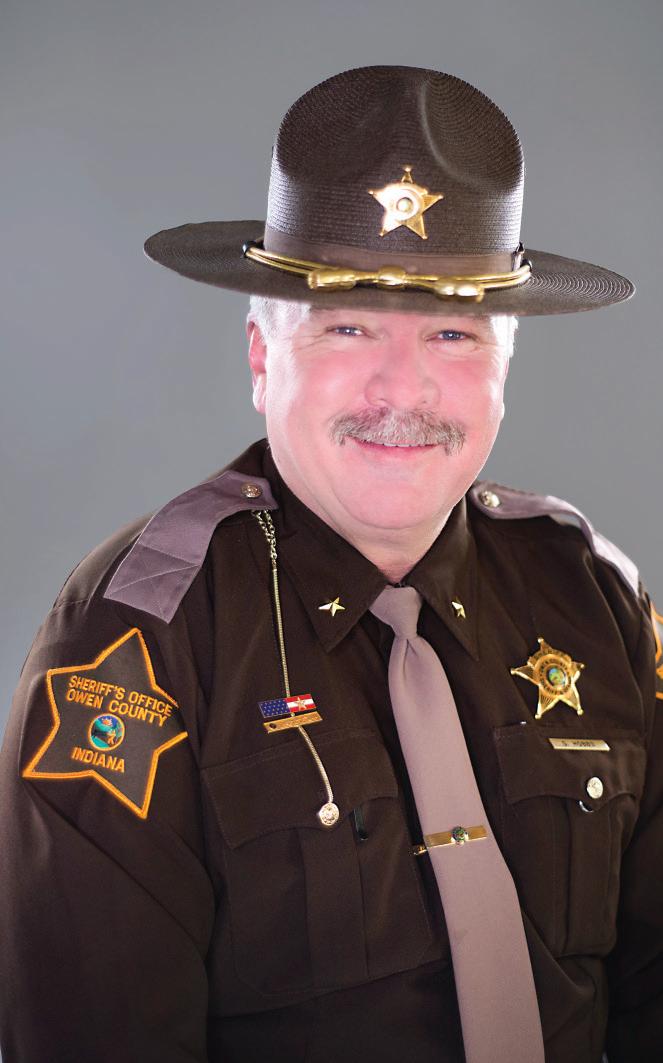
S-OCS introduces Synchronous Learning to keep students connected, learning
By Kris Samick S-OCS Director of Communications
Spencer-Owen Community Schools
(S-OCS) Corporation continues to look for ways to support student learning while balancing safety, flexibility, and the realities of our community. One such effort is the implementation of Synchronous E-Learning, a structured approach to online instruction that allows teachers and students to connect in real-time when inperson learning is not possible.
S-OCS firmly believes that in-person instruction is the best environment for student learning. Faceto-face interaction, hands-on activities, and daily personal connections remain the foundation of effective education. However, there are times (such as hazardous weather or unsafe road conditions) when school must be canceled to ensure the safety of
students and staff. In those situations, synchronous learning provides a valuable alternative that allows learning to continue without disruption.
What is Synchronous E-Learning?
Synchronous E-Learning involves live, scheduled online lessons where teachers and students interact at the same time. During these live lessons, teachers provide direct instruction, explain concepts, answer questions, and guide students through learning activities. Teacher support is built into the day, giving students the opportunity to receive help just as they would in a traditional classroom setting.
In addition to live instruction, students are given independent work time to practice skills, complete assignments, or apply what they have learned. This balance of live teaching and independent work helps maintain structure while allowing flexibility for
students and families at home.
Why Synchronous Learning matters
When hazardous conditions force school closures, synchronous learning allows S-OCS to continue providing meaningful instruction without extending the school calendar. This approach eliminates the need to add make-up days at the end of the year, helping families avoid changes to summer plans, including summer school, camps, vacations, and childcare arrangements.
For families in Owen County, this flexibility is especially important. With rural roads that can become unsafe during winter weather or other hazardous conditions, many students would otherwise be absent. Synchronous learning ensures that students can still participate in lessons safely from home.
Benefits for parents and students
Parents have shared that live

lessons make E-Learning more manageable for students. Seeing their teacher, hearing explanations in realtime, and having a set schedule helps students stay engaged and focused. Live instruction also reduces confusion, as students can ask questions immediately
rather than struggling independently.
Synchronous learning also helps prepare students for the future. By participating in virtual meetings, students practice skills that are increasingly important in college and the workforce, such as online communication, S-OCS | PAGE 24

The K-6 Synchronous Learning schedule has live 30-minute sessions at 10:30 a.m. and 12:15 p.m. GRAPHIC SUBMITTED BY S-OCS.
Owen Valley High School Sports Calendar
Feb. 10
6 p.m. – Junior varsity boys’ basketball vs Eastern Greene at Owen Valley.
7:30 p.m. – Varsity boys’ basketball vs Eastern Greene at Owen Valley.
Feb. 12
6 p.m. - Freshman boys’ basketball vs
Edgewood at Owen Valley. 6 p.m. – Junior varsity boys’ basketball vs Cascade at Owen Valley.
7:30 p.m. – Varsity boys’ basketball vs Cascade at Owen Valley.
Feb. 16 6 p.m. – Freshman boys’ basketball vs Bloomfield at Owen
Valley.
Feb. 19
6 p.m. – Junior varsity boys’ basketball vs South Putnam at South Putnam.
7:30 p.m. – Varsity boys’ basketball vs South Putnam at South Putnam.
Feb. 21
6 p.m. – Junior varsity boys’ basketball vs
Cloverdale High School Sports Calendar
Feb. 7
1 p.m. – Junior varsity boys’ basketball vs Shakamak at Shakamak.
3:30 p.m. – Varsity boys’ basketball vs Shakamak at Shakamak.
Feb. 12
7:30 p.m. – Varsity boys’ basketball at County Tourney at Greencastle.
Feb. 13
7:30 p.m. – Varsity boys’ basketball at County Tourney at
Greencastle.
Feb. 17 6 p.m. – Junior varsity boys’ basketball vs West Vigo at West Vigo.
7:30 p.m. – Varsity boys’ basketball vs West Vigo at West Vigo.
Greencastle at Owen Valley. 7:30 p.m. – Varsity boys’ basketball vs Greencastle at Owen Valley.
Feb. 26
6 p.m. – Junior varsity boys’ basketball vs Shakamak at Owen Valley. 7:30 p.m. – Varsity
Feb. 20
6 p.m. – Junior varsity boys’ basketball vs Sullivan at Cloverdale.
7:30 p.m. – Varsity boys’ basketball vs Sullivan at Cloverdale.
Feb. 21 6 p.m. –
Owen Valley Middle School Sports Calendar
Feb. 7
9 a.m. – Girls’ basketball at Patriot Invitational at Owen Valley.
Feb. 9
6 p.m. – Boys’ wrestling vs Edgewood at Edgewood.
Feb. 10 6 p.m. – Girls’ basketball vs North Clay at North Clay.
Feb. 11
6 p.m. – Girls’ basketball vs Greencastle at Greencastle.
Feb. 12
6 p.m. – Boys’ wrestling vs Cloverdale at Owen Valley.
Feb. 17
6 p.m. – Girls’ basketball vs Edgewood at Edgewood.
Cloverdale Middle School Sports Calendar
Feb. 9
5:30 p.m. – Boys’ wrestling vs North Putnam at Cloverdale.
6 p.m. – Girls’ basketball vs North Putnam at North Putnam.
Feb. 10
6 p.m. – Girls’ basketball vs Southmont at Southmont.
Feb. 12
6 p.m. – Girls’ basketball vs North Clay at Cloverdale.
6 p.m. – Boys’ wrestling vs Owen Valley at Owen Valley.
Feb. 17
6 p.m. – Girls’ basketball vs
Greencastle at Cloverdale.
6 p.m. – Boys’ wrestling vs Seven Oaks Classical School at Seven Oaks Classical School.
Feb. 19
6 p.m. – Girls’ basketball vs South Putnam at Cloverdale.
Feb. 23
6 p.m. – Boys’ wrestling vs South Putnam at Cloverdale.
Feb. 28
9:30 a.m. – Boys’ wrestling at Super 16 Wrestling Invite at Southmont.

Feb. 18 6 p.m. – Boys’ wrestling vs South Putnam at South Putnam.
Feb. 19
6 p.m. – Boys’ wrestling vs Sullivan and North Knox at Owen Valley.
Junior varsity boys’ basketball vs Eminence at Cloverdale.
7:30 p.m. – Varsity boys’ basketball vs Eminence at Cloverdale.
Feb. 24 6 p.m. – Varsity
boys’ basketball vs Shakamak at Owen Valley.
Feb. 27
6 p.m. – Junior varsity boys’ basketball vs North Central-Farmersburg at Owen Valley.
7:30 p.m. – Varsity boys’ basketball vs North Central-Farmersburg at Owen Valley.
boys’ basketball vs North Putnam at North Putnam.
7:30 p.m. – Varsity boys’ basketball vs North Putnam at North Putnam.
Feb. 21 9 a.m. – Boys’ wrestling at Madam Mayhem at Owen Valley. 10 a.m. – Girls’ basketball at WIC at Owen Valley.
Feb. 25 6 p.m. – Boys’
wrestling vs North Clay at Owen Valley.
March 2
6 p.m. – Boys’ wrestling vs Bedford at Owen Valley.


Trailing or Leading: What is next for trails in Indiana?
By Kyle Hannon Project Manager, MYPath Trail System

Even with McCormick’s Creek State Park (MCSP), Cataract Falls, Owen-Putnam State Forest, and Green’s Bluff Nature Preserve, Owen County still has less access to trails than many other Indiana counties. MYPath Trail, the latest addition to the trail mix, is very popular, but it is still nearly two miles from reaching the MCSP gatehouse.
With the end of Governor Eric Holcomb’s administration came the end of the Next Level Trails (NLT) program. Until Gov. Mike Braun announces something new, trail advocates are working hard to keep trails moving.
Only one-third of the applications for the NLT program received funding (including MYPath). That means twothirds of the communities have had to look for other ways to build trails.
Even though the NLT program is gone, the Indiana Department of Natural Resources still funds the Indiana Trails Program (ITP). MYPath has an application under consideration right now. With NLT gone, you can imagine how competitive the ITP grant is. Wish us luck.
The Indiana Greenways Foundation awarded $92,000 in grants in 2025. MYPath has received grants from the Greenways Foundation, including for our trail counters. This is a great organization, and I’m not just saying that because I served on their
board for four years. They get funding from the Indiana automobile license plates you see that say, “I Support Trails.” One of those would look nice on your car.
The Indiana Trails Community and the Hoosier Rails-to-Trails Council are other organizations that support our trails. Indiana Trails Community is advocating for Indiana state parks to be connected to nearby communities for recreational and economic benefits. I completely agree with them because that is exactly what MYPath has been trying to do since 2014. While NLT focused on the Department of Natural Resources (DNR), Indiana Trails Community proposes using funding from the Indiana Department of Transportation (INDOT). Trails are active transportation alternatives used by a lot of people



and are worthy of INDOT support.
Bicycle Indiana is another organization that receives funding from a specialized license plate. They hosted Bicycle Indiana Day at the Statehouse on January 22. Many other bicycle organizations joined them and advocated for legislation to improve safety and access. This is not a state budget session, but there are still many issues that impact alternative transportation.
The national Rails to Trails Conservancy (RTC) has a big dream of connecting a trail from the Atlantic Ocean to the Pacific Ocean. Indiana has made significant progress on its section of this trail. While the proposed trail will not go through Owen County, the RTC advocates have been very supportive of legislation that supports us.
Understandably, a national organization can seem very far away. Even the Indiana Statehouse seems, at times, like it’s on another planet, even though local lawmakers have been very supportive.
For real, measurable trail progress, we need to turn to local and regional sources.
The Regional Trail Advocates is a group of trail builders from MYPath, Owen County, Ellettsville, Monroe County, and Bloomington. We meet monthly at McCormick’s Creek State Park. Stay tuned for updates.
The Owen County Chamber of Commerce and Economic Development has always included MYPath in their plans and discussions. Regional Opportunity Initiatives (ROI), through promoting quality of place and workforce
attraction, has been supportive of our efforts.
And, of course, the Owen County Community Foundation has been vital. They created the MYPath Trail System and they have supported the trail every step of the way. They remain the main organization that others use to support MYPath. Without a large pot of trail money, like NLT, we have to work harder and be innovative to complete trails. Walk on a trail because it is good for your physical and mental health. Advocate for trails, because that helps others too.
Kyle Hannon is the Project Manager for the MYPath Trail System. He has served in many community development and trail connection roles throughout the state. On many weekends, he serves as an Interpretive Specialist at McCormick’s Creek State Park.















m a l l t o n , S a l l s c h o o



























B I G I M P C
C







Outdoor Type: All about birds
By Larry LaGrange Guest Columnist

I’ve never been what you would call a bird watcher, unless that applies to observing our amusing summer hummingbirds jockey (fighting) for position on our feeders. There’s also a mockingbird pair that frequents our neighborhood, and one of them always selects the tallest perch he or she can find. I figure it’s a male since that high spot indicates ego is involved. Their loudspeaker voices immerse the area in song. These are birds with attitude, even chasing away squirrels that get too close.
As a member of the Hoosier Outdoor Writers, I get their publication. The editor is a big-time bird man. He makes special trips to photograph them and publish his work in our magazine. OK. That would be a nice hobby. I love watching eagles. There’s a private lake near the Patoka River that frequently rewards me with an eagle sighting. This
majestic bird also inhabits an area I fish on the White River near Shoals. My son likes to photograph an eagle group near his cabin on Beaver Lake near Jasper.
Sad to say, when growing up I used to kill umpteen sparrows, starlings, and blackbirds near my Perry County home. Dad told me that these targets were acceptable to shoot, but that I shouldn’t bother more “desirable” birds, such as redbirds, wrens, and robins. Bluejays were iffy, but they were pretty, so I didn’t bother them. I don’t know what made sparrows and such undesirable, but I learned how to shoot by hunting these guys. I even had a scope on my potent BB gun.
In the old days I hunted quail, a most enjoyable sport depending on how the dog worked. Mr. Bobwhite has largely disappeared, since their habitat of brushy fencerows and unused weed fields have decreased. I used to crow hunt, first using a mouth call and then a taped distressed crow sound on a portable player. It seemed wasteful though. I would kill a crow, and then what would I do with it? I figured then the only living things I would ever shoot would
be something I could bring to the table.
An issue with birds is the potential for human disease. In addition to avian flu, histoplasmosis is a serious respiratory illness that results from a fungus growing in bird droppings.
Encephalitis is spread by mosquitoes which have fed on infected birds carrying the virus. Dust from droppings can be sucked through ventilators and air conditioners, contaminating food or cooking surfaces.
So, I knew birds have some downsides, but I found out some positives when I recently read an article by Barry Yeoman entitled “What Do Birds Do for Us?” Some highlights:
*An estimated 1,300 bird species face extinction over the next century, and many more are suffering from extreme habitat loss due to human activity.
*Healthy bird populations are essential to human welfare. Birds help keep farmers in business; they help protect our drinking water by preventing erosion; they help keep the furniture industry supplied with timber; they provide critical environmental data. Insect eaters protect
apple orchards in the Netherlands and safeguard Missouri white oaks, which are highly prized by furniture makers. They reduce losses at wineries by consuming the larvae of pests.
*When the Mormons settled Utah in the 19th century, the first two crop seasons were destroyed by western crickets. One historian wrote that the people were in despair until sea gulls came by the thousands.
Before the next season’s grain could be entirely destroyed, they devoured the insects so that the fields could be mostly free of them.
The settlers regarded this as a heaven-sent miracle.
What about those crows that I used to hunt? There’s a huge amount of roadkill on our highways. Things would get pretty nasty if we didn’t have scavengers around to clean up the mess.
In India, Hinduism prohibits the slaughter and consumption of cows, so livestock dies out in the open. Vultures arrive, and in short order they finish everything perishable— no mess and no stench.
In the ‘90s researchers noticed a drop in the population of oriental vultures. Today their numbers have been
reduced by 99 percent. The cause has been traced to an antiinflammatory called diclofenac, which is used as a painkiller for aging cows but triggers fatal kidney disease in vultures. Without vultures, carcass disposal has been left to feral dogs, who now roam India’s trash dumps looking for piles of dead cattle. With this came more dog bites and instances of rabies. Between 1992 and 2006, dog bites resulted in 48,000 additional deaths. The vulture-dog connection produced health costs of $34 billion over 14 years.
Most of us have heard of canaries in the coal mines reacting to poisonous gas, but have you heard that pheasants were used in World War I to detect oncoming hostile aircraft? They gave the alarm through insistent cries. How about carrier pigeons? They dodged bullets to transport messages that helped the Allies capture German submarines.
Birds alone can’t tell scientists everything they need to know about ecosystem health, but if there are major problems with the environment, one researcher says, “We’re going to pick it up through birds.”
New nature preserve dedicated in Owen County
DNR Press Release
The Natural Resources Commission recently approved the dedication of Barnebey Woods in Owen County as a nature preserve and an expansion of Hoosier Prairie Nature Preserve in Lake County.
“Nature preserves represent Indiana’s most unique and significant natural areas, which is why we’re committed to continuing to work with partners to protect them,” said Governor Mike Braun. “These new
Beth Ascher Licensed Sales Agent
TTY 711
and expanded protected natural areas in Owen and Lake counties now have Indiana’s highest level of protection, conserving them for future generations.”
A nature preserve is an area of high natural significance that


is representative of what Indiana would have been in the presettlement period, and it is given the highest protection possible by state law.
Barnebey Woods Nature Preserve is owned and managed by Sycamore Land Trust, which acquired the property last year with funding from the President Benjamin Harrison Conservation Trust. It features 141.5 acres of mature upland forest with excellent tree species composition. It has moderate slopes with deep drainages interspersed among long ridges. A small bedrock overhang creates a waterfall when it rains and is a habitat for rock dwelling species such as
walking fern.
There are currently no trails at Barnebey Woods Nature Preserve, but Sycamore is considering future trail additions as part of its longterm planning for the property. The preserve is not open to the public at this time to protect the sensitive natural area.
The expansion to Hoosier Prairie Nature Preserve is known as Sundew Prairie and adds 24.77 acres of wet sand prairie and oak savanna to one of the largest tracts of its type in the state. Many rare species such as northern bog clubmoss, paper birch, and several sedges can be found on the addition.
The preserve lies within the boundary of Indiana Dunes
National Park and is owned by the Indiana Department of Natural Resources. Sundew Prairie is not open to the public at this time.
To support the conservation of land like this across Indiana, consider purchasing the blue Environmental Plate when it’s time to renew your license plate. All funds received from plate sales are used to protect the land, waters, and wildlife of Indiana through the President Benjamin Harrison Conservation Trust.
Learn more about nature preserves at IN.gov/dnr/ nature-preserves. Learn more about the blue Environmental Plate at on.IN.gov/ enviroplate.
Driftwood Outdoors: Sinking brush to build fish habitat
By Brandon Butler Guest Columnist
Winter is prime time for building fish habitat. Cedar trees are one of the best options, and you can find them popping up in forests and pastures all over the place. Most landowners want them gone, so to collect a few, all you’re probably going to need to do is ask for permission to help remove them from the landscape. They’re easy to come by, so gather a few, sink them in waters you own or have permission to do so in, and you’ll build habitat to hold fish all year long.
Anglers have been sinking brush piles for generations to create fish-holding covers. Cedar trees are perfect for the job because they’re abundant, easy to handle, and their wild branching structure creates ideal cover.
Sunken brush provides shelter not only for fish, but also for all sorts of underwater forage those fish depend on. Minnows rely on vegetation and woody cover to escape predators, and predator fish know it. Crappie, bass, and other game fish often stage along limbs and branches, waiting for an easy meal to swim by. When you add structure, fish respond quickly. When placed in ponds and small lakes, these become go-to fishing spots.
you know where a few have been dumped off, that could be a gold mine for brush to sink. We used to cruise the neighborhood with a flatbed trailer behind my uncle’s van, picking up trees from the ends of driveways until the trailer was stacked so high we couldn’t take any more. Back at the garage, we’d get to work preparing them for sinking.
I grew up on a lake in a large subdivision. My grandpa and uncle were two of the most consistent fishermen on those waters. Their success didn’t come from fancy gear or cutting-edge technology. It came from winter weekends spent building brush piles. Most of them were made from old Christmas trees, but cedars work just as well. It’s a little late to find a lot of discarded Christmas trees at the end of driveways, but if
We prepped trees two ways. Most often, we’d lash a few together into a bigger pile, wrap a chain around the bundle, and thread it through a couple of cinder blocks. For a single-tree structure, we’d drop the trunk into a small bucket, usually an old ice cream tub from Schwan’s, and fill it with concrete. Both methods are easy and cost-effective.
Our favorite spots were deep water in front of docks and along sharp drop-offs. We used a Jon boat to place the trees, and since this was long


before GPS mapping apps, we kept a paper map marked with every brush pile. Today, you can just mark them on your sonar or onX. Big piles went in open water. Individual trees lined docks and edges where fish naturally traveled.
As the trees break down, they attract invertebrates, which draw in small fish. Small fish bring bigger fish, strengthening the entire food chain. When spawning season arrives, young fish use those trees as nursery cover, increasing survival rates and improving the fishery for years to come.
Sinking brush isn’t a secret. Plenty of anglers do it around their own docks. Fewer people take the time to think bigger to improve habitat across an entire pond or lake. Those who do gain an advantage that lasts through every season.
Some of my best outdoor memories haven’t come from the moment of the catch or the shot, but from the preparation that made it possible. I’ll always remember the excitement of loading up Christmas trees with my family, and the satisfaction that followed months later as we gathered for another fish fry. In the outdoors, effort has a way of paying you back. See you down the trail…
For more Driftwood Outdoors, check out the podcast on driftwoodoutdoors.com or anywhere podcasts are streamed.
Manmade ponds and reservoirs often lack the natural structure found in rivers and lakes. If you want good fishing, someone must create that structure. Wintertime brush building is good for the fish and is one of the most effective tools available for improving your fishing opportunities while benefiting the entire lifecycle of the body of water.


Feeling the ‘winter blues?’ Help is close to home
By Jamie Jo Lowder Health and Human Sciences Educator, Purdue Extension-Owen County
Let’s be honest — by the time winter hits its stride, many of us are ready to trade gray skies and icy sidewalks for sunshine and sandals. If you’ve found yourself feeling a little more tired, less motivated, or just blah this time of year, you’re not imagining it. The “winter blues” are real — and the good news is, you don’t have to face them alone.
Hi! I’m Jamie Jo Lowder, your Purdue Extension-Owen County Health & Human Sciences
Educator
and
helping individuals and families feel their best — physically, mentally, and emotionally — is what I do. From food and finances to health and family, Extension research gives us practical tools that work in real life, even during the coldest months of the year.
What are the ‘winter blues?’
According to Purdue Extension, the winter blues often show up as lower energy, changes in sleep or appetite, trouble concentrating, or a general feeling of sadness when daylight hours are shorter. In some cases, these symptoms may be linked to Seasonal Affective Disorder (SAD), a form of depression associated with reduced sunlight and seasonal changes.
The shift in daylight can disrupt our internal body clock and affect chemicals in the brain that regulate mood — which helps explain why
winter can feel harder than other seasons.
Light matters — even on cloudy days
One of the most effective ways to fight the winter blues is increasing exposure to natural light. It is recommended that you spend 15–30 minutes outside daily, even when it’s cold or overcast.
A brisk walk, playing with kids or grandkids, or bundling up for a short stroll can make a noticeable difference.
When outdoor time isn’t possible, open curtains, sit near windows, and consider light-therapy lamps — which research shows may help improve mood and energy during darker months.
Move your body, lift your mood
Physical activity is a powerful mood booster. Research shows regular movement — even moderate exercise like walking or stretching — can reduce stress,
increase energy, and support emotional well-being. Keeping a consistent routine for meals, sleeping, and daily activities also helps your body stay balanced when winter disrupts normal rhythms.
Connection is key Winter often means more time indoors — and sometimes more isolation. Extension educators encourage making intentional connections with others. Whether it’s meeting a friend for coffee, calling a family member, or joining a local program, social interaction plays a big role in emotional health.
Here in Owen County, Purdue Extension offers programs, workshops, and gatherings throughout the year that provide learning and connection — two things that matter deeply during winter months.
Self-care isn’t selfish
Self-care doesn’t have to be fancy. It can
be as simple as reading a good book, journaling, cooking nourishing meals, practicing gratitude, or enjoying a warm cup of cocoa. Small, consistent habits help build resilience and support mental wellness all season long.
Local support is available
If winter blues linger or begin to interfere with daily life, it’s important to reach out for help. Purdue Extension encourages seeking support from healthcare providers or mental health professionals when needed.
And remember — local resources matter. As your Purdue ExtensionOwen County educator, I’m here to help connect you with programs, education, and trusted information that support your well-being all year long. Call 812-829-5020 or email lowder0@purdue. edu to learn more about our programs.
4-H calls for volunteers to share their skills
By Cassie Linville 4-H Youth Development Educator

community connection, and youth leadership – and the need for passionate volunteers continues to grow. As more young people join 4-H each year, the Purdue Extension–Owen County office is inviting community members to step into roles that help shape the next generation of leaders, creators, and problemsolvers.
Volunteers are the heart of 4-H. They guide clubs, teach project skills, assist at events,
and serve as mentors who help youth discover their strengths. In Owen County, those roles are as varied as the interests of the youth who participate. While agriculture remains a beloved cornerstone, today’s 4-H members explore everything from photography and fine arts to robotics, wildlife, foods, sewing, and leadership development.
Because of this wide range of interests, the Extension office is especially excited to welcome volunteers who want to run project workshops or lead clubs based on topics they genuinely care about. The idea is simple: if someone in Owen County has a passion, there is likely a young person eager to learn it.
A gardener might lead a summer plantcare series. A baker could teach cake decorating. A local mechanic might


introduce youth to small-engine repair. A crafting enthusiast could host a weekend workshop. When volunteers bring their own enthusiasm into the room, youth feel it – and that spark often becomes the beginning of a lifelong hobby or even a future career.
Extension staff emphasize that volunteers don’t need to be experts. What matters most is a willingness to share, encourage, and guide. Some of the most memorable 4-H experiences come from adults who simply enjoy helping kids try something new.
While Owen County 4-H is eager to welcome new volunteers, the application process is intentionally thorough. Indiana 4-H follows a detailed screening procedure to ensure the safety and well-being of every child involved. Prospective volunteers

complete an application, provide references, undergo background checks, and participate in required trainings that outline statewide youth protection guidelines.
The process can feel lengthy, but it reflects 4-H’s commitment to creating safe, supportive environments where young people can thrive. Volunteers who complete the steps often say they feel more confident stepping into their roles because they understand expectations, policies, and best practices before working with youth.
Despite the time investment, the rewards are significant. Owen County volunteers frequently describe their involvement as one of the most fulfilling parts of their year. They watch young people grow in confidence, develop new skills, and build friendships.
They become part of a community tradition that has shaped generations of local families.
As the county prepares for another busy season of club meetings, workshops, camps, and the Owen County Fair, the need for caring adults remains strong. Anyone interested in volunteering – or simply curious about what opportunities exist – is encouraged to contact the Purdue Extension–Owen County office or email Cassie Linville, 4-H Educator, at cassiel@ purdue.edu.
In a community like Owen County, where neighbors support neighbors and traditions run deep, 4-H continues to thrive because of the adults who step forward. For anyone with a passion to share, now is the perfect time to get involved.

OCPL: Winter is the perfect season to read
By Brittany Van Hook OCPL Director
As winter settles in and the days grow shorter, many of us naturally slow our pace. While colder weather can keep people indoors, it also creates the perfect opportunity to rediscover one of life’s simplest pleasures: reading.
CANDIDATES
| FROM PAGE 1
Coroner
Shelby Hershberger
– R
Timothy R. Wright – R County Council, District 1: (Harrison, Montgomery, Taylor, part of Washington, or Wayne Townships residency)
Loretta Foster – R
Walter Newman – R
Lori L. Warner – R
Sandra K. Calvert – D County Council, District 2: (Part of Washington Township residency)
Anton Karl Neff – D County Council, District
3: (Jackson, Jennings, Lafayette, part of Marion, or Morgan Townships residency)
Don Bingham – R
Lynda Sands – R
Mark Anthony Searcy – R
Mark Snapp – D County Council, District 4: (Clay, Franklin, Jefferson, or part of Marion Townships residency)
Andy Wood – R
William D. Fulk – R
Recorder
Nicole VanDerMoere – R
Joseph Newman - D
Sheriff
Sam Hobbs – R
Ryan T. White – R Surveyor
Reading during the winter months offers more than just a way to pass the time. Studies consistently show that reading helps reduce stress, improve focus, and support mental wellbeing. When seasonal routines change and daylight is limited, spending time with a good book can provide a much-needed sense of calm and comfort. Winter can also be a challenging time for mental health. Limited sunlight and increased isolation can impact mood, but reading keeps the mind active and engaged. Stories allow
Amy L. Meier – R
Treasurer
Shelly Townsend – R Township Trustee – Clay
Debbie Keith – R Marjorie Ann Clouse – R
Township Trustee –
Franklin
Leroy Gentry – R
Township Trustee –
Jefferson
Daryl Kasper – R
Township Trustee –
Jennings
Susan M. Huftel – R
Township Trustee –
Lafayette
Doris Scully – R
Township Trustee –
Marion
James Elliott III – D
Township Trustee –
Montgomery
Amanda L. Huntington – R
M. Sue Carpenter – R
Township Trustee –
Morgan
Dave Davies – R
Collin Rotella – D
Township Trustee –Washington
Patty Edwards – R
Phillip O’Neil – D
Township Trustee –
Wayne
Linda Ann Studer – R
Township Trustee Board – Clay
Jacob Balash – D
Township Trustee Board – Franklin
Denise Line – R
Bruce McCallister – D
Township Trustee Board
readers to escape the gray days, connect with new ideas, and experience a sense of companionship through characters and shared experiences. With outdoor activity often reduced, reading is an excellent way to stay mentally sharp. It strengthens concentration, builds vocabulary, and keeps the brain engaged without relying on screens. Reading before bed can also promote better sleep habits, especially when it replaces evening screen time.
For families, winter is an ideal season
– Harrison
Catherine Richardson – R
Clarence Walls – R
Township Trustee Board
– Jefferson
Athena Goulet – D
Township Trustee Board
– Lafayette
Kenneth Sebastian – R
Township Trustee Board
– Montgomery
Douglas K. Carpenter
– R
Janet Long – R
Ermond V. Poore – R
Township Trustee Board
– Morgan
Rita Shunk – R
Sharon Close – R
Ronald A. Jackson – R
Stephanie Barlow – D
Township Trustee Board
– Washington
Suzanne Simmerman
– R
Susan A. Ciresi – D
Ruth A. Jones – D
Precinct Committeeman – Clay
Jacob Balash – D
Precinct Committeeman
– Franklin
Bruce McCallister – D
Precinct Committeeman
– Montgomery
Sandra K. Calvert – D
Precinct Committeeman
– Morgan
David Henk – D
Precinct Committeeman
– Washington 1
Anton Karl Neff – D
Jane Rubeck – D
Precinct Committeeman
– Washington 2
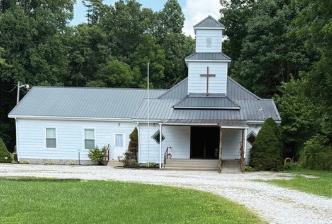
to build meaningful reading traditions. Reading aloud, sharing favorite stories, or setting aside quiet reading time together creates lasting memories while reinforcing literacy skills for children and teens. Those looking for their next cozy winter read are encouraged to visit the Owen County Public Library (OCPL). From bestselling novels and timeless classics to audiobooks and digital titles that can be enjoyed from home, the library offers something for every reader. Staff members
Jo Ann Neal – D
Democratic Convention
Delegate
Jo Ann Neal – D
Jacob Balash – D
David Henk – D
Stephanie Barlow – D
Collin Rotella – D
Aliyah Keuthan – D
Jane Rubeck – D
Jonathan Balash – D
Republican Convention
Delegate
Verl Keith – R
Andrew Horning – R
Denise Line – R
Lori L. Warner – R
Norman Warner III – R
United States Representative, Eighth
District
Mark Messmer – R
Mary Allen – D
Mario Foradori – D
Christopher Rector – D
State Senator, District 39
Tanner Bouchie – R
Jeff Ellington – R
Kristi Risk – R
Joseph Baughman – D
State Representative, District 46
Thomas L. (Tom)
Arthur – R
Bob Heaton – R
James H. Pittsford (Jimmy), III – D
The deadline for filing a candidacy is today, Friday, Feb. 6 at noon. Primary Election Day is Tuesday, May 5. General Election Day is Tuesday, Nov. 3.
are always available to provide personalized recommendations and help readers find books that fit their interests and comfort level.
As the cold months continue, making time to read can help make winter feel warmer and more fulfilling. A good book has the power to brighten even the darkest days, and the library is the perfect place to begin that journey.
The OCPL is located at 10 S. Montgomery St. in Spencer and can be reached by calling 812-829-3392.
Vote Centers will be located at:
- Faith Baptist Church (11612 State Road 243, Cloverdale)
- Millgrove United Methodist Church (11151 Millgrove Rd., Quincy)
- Lighthouse Fellowship Church (5392 S.R. 67, Gosport)
- Clay Township Fire Department (5663 S.R. 43, Spencer)
- Freedom Community Center (5552 FreedomArney Rd., Freedom)
- Jefferson Baptist Church (4019 Main St., Coal City)
- Garrard Chapel Church (7410 W. S.R. 46, Bowling Green)
- Spencer First Church of the Nazarene (126 E. Market St., Spencer)
For all election-related questions, contact Linda Roy, Owen County Deputy Clerk of Elections, at 812829-5028 or email linda. roy@owencounty.in.gov.
For up-to-date candidacy filings, visit in.gov/sos/elections/ and click on 2026 Primary Candidate List.
A final list will be published on The Owen News’ website, theowennews.org, following the filing deadline.
State Senator Eric Bassler was not at the event. County Councilman Anton Neff served as the moderator.
He began by introducing Bray and Heaton.
“The other thing I’d like to mention, if you’d like to follow along on certain subjects or certain legislation is to follow the state’s website with their bill tracker and the resources that are available there,” Neff said in his opening remarks. The website that Neff was referring to is www.iga. in.gov.
Neff also explained that this year is a shorter session because it is not a budget year for the state. Indiana’s legislature drafts a two-year budget on odd numbered calendar years. During those years, the legislative session is approximately one month longer than the nonbudget years.
This year, the session started early in December instead of its typical start in January.
Bray was the first to introduce himself. He said that the “short” session years, or non-budgetary years are typically finished by Mar. 15.
“This is not exactly a shorter session. We just started a different time,” he said. “We came in in December to address the issue of redistricting and spent about two weeks in session then. Because of that, we’re basically taking two weeks off at the end of the legislative session. So we will be finished with our work by about Feb. 27 of this year, which is approximately two weeks earlier than we would be in a short session.”
He then highlighted the priorities of the Senate. Bray, who is a Republican, is the President Pro Tempore.
One of those priorities was Senate Bill 1.
“It works in the space of Medicaid and SNAP (Supplemental Nutrition Assistance Program) trying to make sure that that program is executed with integrity and fidelity so that the people that need those programs are
getting those programs,”
Bray said.
He said that the state has had issues with folks receiving the benefits despite making more than the allowed income threshold.
“Medicaid is a fantastic program, but it’s been growing at an unsustainable rate, so we want to make sure that we’re executing that with as much fidelity as absolutely possible,” Bray said. “This bill does a couple of other things, and it kind of works with the federal Big Beautiful Bill. It passed over the summer, last summer.”
Bray also highlighted the effort to improve healthcare across rural Indiana.
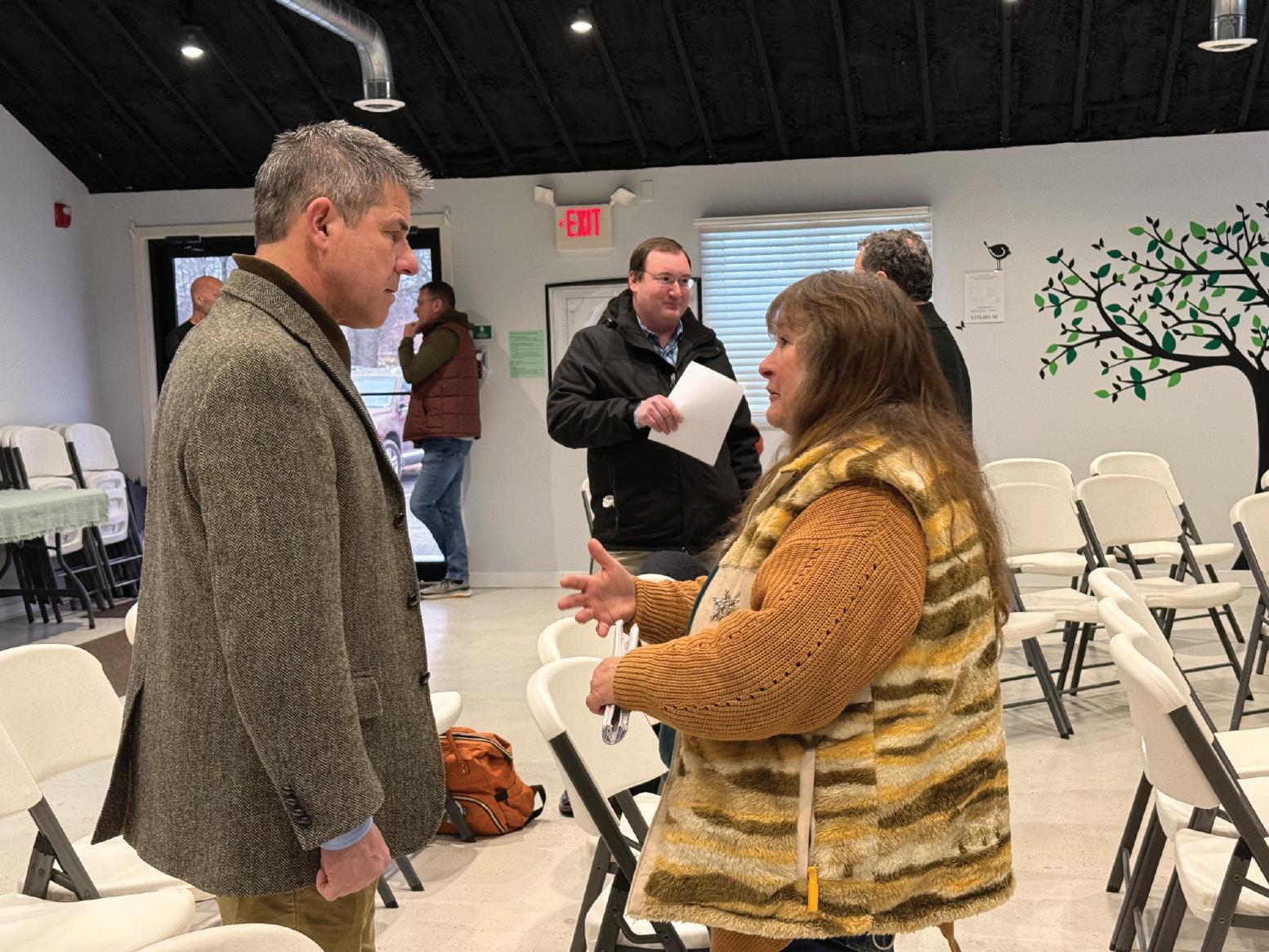
He also highlighted a constitutional amendment resolution which would be placed on the ballot in November’s general election if it passes both the Indiana House and Senate. That amendment would expand the reasons that a judge could hold the accused without bail. Currently, judges can only hold those accused of crimes without bail if they are accused of murder or treason. The amendment would allow for judges to hold the accused without bail if there is strong, clear and convincing evidence of both the person’s guilt and that there is no condition of the bond that can be placed that will help keep society safe. Hearings would still be required for this to ensure due process.
“So those are the couple things that I’ll highlight as our priorities. I’m sure we’ll talk about lots of other things because as I’ve said before, when we come here to Owen County, we talk about an array of different things. That’s one of the reasons I enjoy coming here so much,”
Bray said.
Heaton then took a moment for his opening remarks, starting with saying that it is an honor to serve with Bray and recalling an experience of the two walking in the parade at the Gosport Lazy Days festival.
“Rod and I were there, and I think your son and you brought your dog with you,” Heaton began.
“She’s much more popular than I am,” Bray said.
Heaton continued setting the scene in which someone yelled out, “Hey, Tom Cruise.”
“And I look back and he’s talking to Rod about that. So I tell you what, Rod Bray, Tom Cruise, whatever, it’s good to serve with you,” Heaton said.
He then talked about the difference in topics that come up when he visits the various counties in his district.
“Everybody’s got their different viewpoints and issues within their county and district,” Heaton said.
He said that addressing the medicaid spending is also a priority for the House. Heaton, who is also a Republican, serves as the majority whip for the Indiana House of Representatives.
He said that 22 percent of the $44.5 billion two-year budget goes to Medicaid.
“Twelve years ago, that was about 10 percent,” he said.
covered a myriad of topics.
At one point, redistricting and the fact that it did not pass the Indiana Senate came up. It did pass the Indiana House of Representatives. Bray addressed the matter and why he did not vote in favor of redistricting, despite pressure from the federal government.
“It didn’t feel like the right thing to do for Indiana for a couple of reasons. First of all, I’ll say that the idea that we could go from seven to two, where we are right now, and then just simply flip a switch and go to nine to zero is fiction. I don’t think we can get that done,” he said.
He explained why he believed it to be fiction.
of the reason.”
Bray also said that he was contacted by many of his constituents and that for every 10 that were against the mid-cycle redistricting, he only had one that was in favor of it.
“That was a big part of my decision as well,” he said. He then addressed the notion that he rallied the Indiana Senate and the Senate Republicans against redistricting.
“With regard to ‘I put my caucus against it,’ that is inaccurate. The people who made that allegation, including the (U.S.) Vice President (JD Vance), I’ve spoken to him a couple of times about this issue, and that’s not how I lead my caucus,” he said. “It’s the honor of my life to be the President Pro Tem in the Senate. I lead by consensus. We work together to figure out what the right thing to do is. The people that decided they were for it were for it. I gave them no pressure or punishment whatsoever. The people that weren’t for it, it was their decision completely, and that’s where the Senate landed.”
— Rod Bray , Indiana Senator District 37 and President Pro Tempore of the Senate “
Heaton also brought up House Bill 1414, which deals with cutting trees in the state forests and bills to cut or eliminate township government. There was a bill that originated in the House as well as a suggested point system proposed in Senate Bill 270
“The idea that we could go from seven to two, where we are right now, and then just simply flip a switch and go to nine to zero [through redistricting] is fiction. I don’t think we can get that done.”
“It’s trying to make local government more efficient. It’s not eliminating all townships and that type of thing. It really affects my district, maybe two or three townships,” he said. He added that he has approximately 23 townships throughout his district.
After the opening comments, the event went into questions and comments from constituents, which
“You’d have to take the Democrats that are concentrated in Marion County and Lake County and disperse them around into other congressional districts. So you would, by definition, weaken every other congressional district in the state, and you would make those people, those concurrent sitting congressional delegations, to run in districts that they have never run in before. And then you presume that you’ve got people that are going to sign up and run for Senate congressional district one and seven, which are the two that are held by Democrats right now. There’s no preeminent candidate for that. Even today, there’s not a preeminent candidate to run for those two seats. They haven’t walked in a parade. They haven’t gone to a fair. They haven’t eaten a tenderloin with constituents in any part of the district at this point. They haven’t raised a dollar of money,” he said.
“So I think it’s fiction to think that all of a sudden we can turn that into nine zero, and that’s a big part
Other topics addressed during the legislative breakfast included: concerns about the legislation proposed to eliminate several elected county offices to be appointed by county commissioners; Senate Bill 182, which is known as the birth certificate bathroom bill; increasing beginning and overall teachers pay; extending the deer shotgun hunting season; repairs to the McCormick’s Creek State Park campground; and forestry management at Indiana state parks and forests, especially at Owen-Putnam State Forest.
The next legislative breakfast will take place at 7:30 a.m. Feb. 28 at Owen Valley Christian Fellowship, 338 S.R. 43S, Spencer.
Senator Rod Bray, left, speaks to Lora Kemp following the Legislative Breakfast held on Jan. 24. The event is an opportunity for constituents to connect with and voice concerns to their legislators. The next Legislative Breakfast will take place at 7:30 a.m. Feb. 28 at Owen Valley Christian Fellowship. NICOLE DECRISCIO | THE OWEN NEWS
United Way offering free community tax service
Press Release
Tax season is here, and United Way of South Central Indiana (UWSCI), in partnership with local organizations, is offering free in-person and online tax preparation through its 2026 Free Community Tax Service. Beginning Tuesday, Jan. 27, IRS-certified volunteers will serve community members at eight in-person sites across Brown, Monroe, and Owen counties.
Hoosiers earning $67,000 or less annually may qualify for free assistance with filing both federal and Indiana state tax returns.
Tax preparation is provided at no cost, with trained volunteers working one-onone with clients to help ensure they receive every dollar they’re eligible for, including the Earned Income Tax Credit (EITC).
One site managed by the AARP Tax-Aide Program, located at Endwright East at the Bloomington College Mall, does not have income or age requirements for service.
In addition to in-person assistance, residents with a combined Adjusted Gross Income (AGI) of $89,000 or less can file their taxes online for free from home or anywhere with an internet connection.
Community members can learn more about both inperson (Owen County Public Library) and online options at www.unitedwaysci.org/ FreeTaxes.
2025 Impact
During the 2025 tax season, the Free Community Tax Service brought together 78 volunteers to help local residents file 851 federal tax returns, saving clients
more than $200,000 in tax preparation fees and returning over $1 million in refunds and credits to the community.
United Way managed seven full-service tax sites, with AARP managing two additional locations.
Nearly $250,000 in Earned Income Tax Credits was claimed, with 128 filers receiving EITC and working families receiving $112,097 in Child Tax Credits. Approximately 64% of clients were seniors, many of whom reported using their refunds to cover essential expenses such as food, housing, medical care, transportation, and savings.
Supporting ALICE Families
The Free Community Tax Service is part of UWSCI’s broader strategy to advance stability and opportunity for ALICE families - working households who earn too much to qualify for assistance but not enough to meet the cost of living. Alongside grantmaking, UWSCI directly invests in programs such as the Financial Stability Alliance, Bank On Bloomington, Truancy Case Management, youth mentoring, Dolly Parton’s Imagination Library, and more. Together, these initiatives strengthen financial security, improve health outcomes, and expand opportunities for young people—ultimately connecting more families to possibility.
Carmen Chamorro Avilés, Community Impact Manager at United Way of South Central Indiana, said, “With the help of our dedicated volunteers, United Way is proud to continue offering this critical service to help community members receive their full refunds and avoid costly preparation fees. Now
more than ever, these dollars make a real difference in strengthening financial stability for families in our region. We’re grateful for the trust our clients place in us.”
To learn more about the Free Community Tax Service, visit www.unitedwaysci.org/ FreeTaxes.
Low Income Taxpayer Clinic
New this year: Indiana Legal Services’ Low Income Taxpayer Clinic (LITC) will offer walk-in tax consultations at the Bloomington City Hall site during regular operating hours.
The LITC assists Indiana residents experiencing taxrelated issues with the IRS by providing education, advocacy, and, when appropriate, representation. While the clinic is funded through an IRS grant, it operates independently of the IRS and does not typically provide tax preparation services.
Earned Income Tax Credit (EITC)
The Earned Income Tax Credit (EITC) can provide a significant boost - up to $8,046 for those who qualify. The EITC is a refundable federal tax credit for low- and moderateincome working individuals and families. Because it is refundable, eligible taxpayers may receive a refund even if no taxes are owed.
Despite its impact, one in five eligible individuals does not claim the credit. Filing a tax return is required to receive the EITC, even for those who are not otherwise required to file. United Way’s tax volunteers are trained to help ensure eligible residents can access the EITC and other available credits.
Bilingual Tax Preparation Assistance
United Way is again partnering with the City of Bloomington to offer a fullservice Spanish-language tax site. Spanish-speaking residents can file their taxes with certified bilingual volunteers. Appointments can be made in Spanish by calling 812-349-3860.
Nonresident Taxpayers
Free Community Tax Service locations are not certified to prepare returns for nonresident taxpayers. Nonresidents affiliated with Indiana University may contact the Office of International Services for assistance at www. ois.iu.edu.
Partners
United Way of South Central Indiana serves as the lead convener, working alongside a strong network of partners to deliver the Free Community Tax Service. Partners include 2-1-1, AARP, Area 10 Agency on Aging Endwright East Community Center, Brown County Public Library, City of Bloomington, Financial Stability Alliance of South Central Indiana, First Financial Bank, Indiana University Maurer School of Law, Indiana Legal Services – Low Income Taxpayer Clinic, Ivy Tech Community College–Bloomington, MCCSC Broadview Adult Learning, Monroe County Public Library – Ellettsville Branch, Owen County Public Library, and dedicated community volunteers.
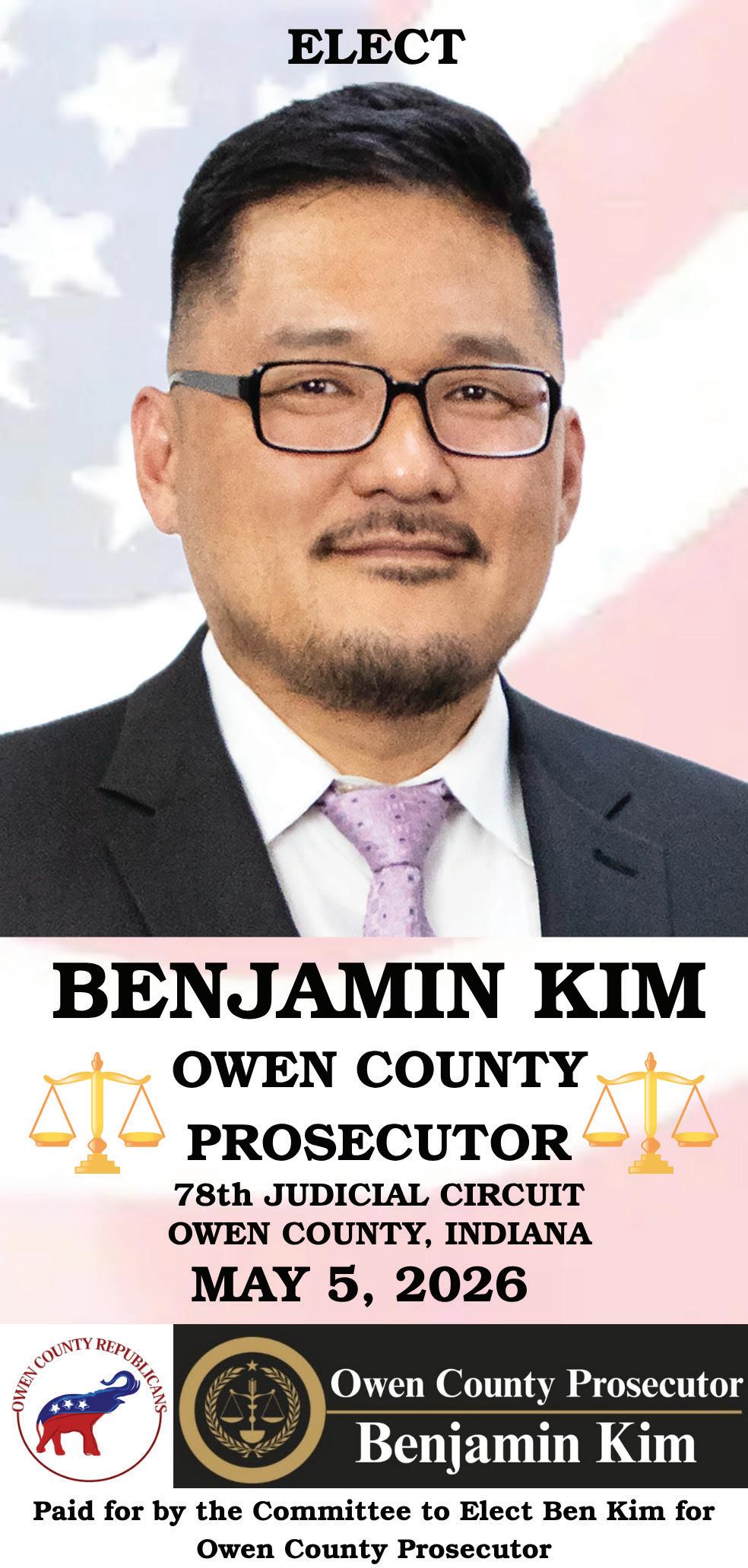
Ramblings: Welcome February
By Annie Bright Guest Columnist
Dateline, January 23, 2026: A huge winter storm approaches. The weather forecasters do not agree on the finer points of the storm. It may be 12 inches of snow, or the storm may only dump six inches of snow on southern Indiana. One thing they do agree on - the temperature will dive below zero. They also agree we should get prepared for the storm. They do agree our part of Indiana will escape the ice storm. The poem, “A Winter
Piece” by William Cullen Bryant explains why some appreciate the beauty of an ice storm:
Come when the rains Have glazed the snow and clothed the trees with ice,
While the slant sun of February pours Into the bowers a flood of light. My mind goes to the many birds that depend on the bird feeders that I fill daily.
The small one in front gets refilled twice a day at least. That won’t be too much of a challenge to fill. I may need snowshoes to make it to the one that hangs in the back yard.
The enjoyment I receive from watching the variety of birds that dine here is worth every dollar I spend on bird seeds. Small red finches, many varieties
of sparrows, blackcapped chickadees, tufted titmice, and gold finches share my offerings with blue jays. The birds share their dining table with a pair of squirrels. These squirrels, like most, are fantastic acrobats and empty the feeders quickly. They are experts at stealing the suet hangers. I know spring is coming soon, the male gold finches are already beginning to get their mating colors.
The larger feeder that hangs from the old pine tree in the backyard attracts more blue jays, crows, and an occasional starling or dove. They are cautious about getting their lunch there, because a young redtailed hawk likes to sun itself on the limb of the old pine tree that fell
last summer. When the cold winds blow across the field that stretches over to the river, he fluffs up his feathers to retain some warmth. The sun shines on his pale breast as he scans the empty field for a mouse or? What a joy it is to enjoy nature surrounded by human activity. The wild creatures have learned to accept and adjust to the invaders of their homes.
February marks the end of winter here. Time to plan the gardens we will plant come warm weather.
I am reading the Old Farmer’s Almanac my sister gave me for Christmas. Many memories from childhood flood my brain as I turn the pages. My Mother always had one of these little yellow books. She “planted by the stars and moon.” It has changed since I last held one. The front third of the book is mostly ads printed on slick paper. The almanac portion is still on newsprint paper. I found a recipe for a hot toddy buried in the pages. I giggled a bit as I read it. Our mother kept us healthy in the winter with hot toddies. The first sniffle was a sign we needed one. The recipe in the current book advised the reader to substitute lemon juice for the bourbon when making one for a child. Now I support that advice. The hot toddies we drank contained Kentucky bourbon along with ginger and cinnamon.
‘til next time, Annie
It’s Just a Country State of Mind: Cross this bridge at a walk
By Susan Anderson Guest Columnist

history as a people is important. It’s often left up to those of us who are here now to make sure that history is passed on to the next generation. Some pieces of history that I’m happy to say are still here are covered bridges.
Presently, there are supposed to be around 90 covered bridges still standing in our state and many of those were built in the late
1800s or early 1900s. Considering there used to be about 600, that’s still a good number.
Indiana’s first covered bridge was completed in 1835 in Henry County when the National Road first crossed the state. Those early bridge builders were men of vision. Two such builders were J.J. Daniels and Joseph A Britton. They both resided around the Rockville area, which explains why there are so many bridges in Parke County to date. There are about 30 covered bridges left in Parke County. Another builder, M. Kennedy, lived in Rushville. Between the three men, they built a total of 158 bridges during their lifetime.
One of my favorite bridges can be found at Cataract Falls in Owen County. This is the only existing covered bridge in Owen County that I know about. It was built in 1876 and was not closed to traffic until 1988. It was built over Mill Creek by the Smith Bridge Company. It’s located north of Spencer in Jennings Township at Cataract Falls and is 140 feet long. This past fall, I made a trip up to this bridge to take some photos. I soon found myself fascinated by the old structure.
There was a quiet serenity about the place. It was as if time was standing still, and I felt transformed to another place and time. A time
remembered. The only sound I could hear was the sound of water downstream from me, rushing over the edge of the falls to the rocks below. That, coupled with the wind blowing through the trees, made for a soothing symphony of nature. It was autumn and the bright red paint that covered the bridge against the backdrop of the earthtone colors of fall, made a beautiful palette that would inspire any artist.
Of course, the county that really stands out in my mind for bridges is Parke County. It’s known as the “Covered Bridge capital of the world.” It currently boasts 31 bridges that have been preserved and
are on the route for several tours during the Covered Bridge Festival and throughout the year. There are a few other bridges in the area that are within an hour’s drive if you are so inclined. There are a couple in Brown County and some in Greene, Putnam, and Vigo counties. To me, these bridges are like a piece of artwork from the past. Like any other artwork, they were made by human hands, but the idea and the dream was first formed in the human heart. That’s what makes preserving history so important to us as a people.
These early bridge builders could see far off into the future. They knew that someday we would have to get
from one side to the other. They built the best that they could come up with to make sure the future generations would be sure to get there.
Yes, it’s important to preserve our history. And it is up to us to make sure we pass ours on to others. And as long as there are a few covered bridges around, we are sure to get there.
A quote that I found that seems to fit: “Somewhere along your journey, you are going to realize that, after facing so many obstacles, you were always brave enough to cross the bridge.” –author unknown
Just remember to cross that bridge at a walk!
— Susan

S-OCS | FROM PAGE 13
time management, and digital responsibility.
Appropriate online learning expectations
To create a productive virtual learning environment, students are expected to follow clear online meeting guidelines:
- Microphone muted unless speaking.
- Use the hand icon when you have a question or need help.
- Camera on to promote engagement and accountability.
These expectations mirror professional virtual meeting standards and help ensure that live lessons run smoothly.
Strong participation and positive results
Building administrators across the district were pleased with the
high level of student engagement during synchronous learning days. The majority of our students across the district attended live lessons, demonstrating strong participation and commitment to learning despite challenging conditions.
S-OCS staff and administrators continue to emphasize that in-person instruction remains the priority. At the same time, the corporation appreciates the flexibility that synchronous learning provides when circumstances require an alternative. By combining safety, structure, and live teacher support, Synchronous E-Learning ensures that students remain connected, learning, and moving forward… no matter the conditions outside.
FROM TOP: Owen Valley Middle School and Owen Valley High School follow an abbreviated schedule during synchronous learning with 25-minute classes for each period with a five-minute transition period between classes. // K-6 Synchronous Learning is focused on five simple steps that include live teacher-led lessons and built-in support for students needing extra assistance. GRAPHICS SUBMITTED BY S-OCS.