THE OSPREY
The International Journal of Salmon and Steelhead Conservation
Declining Yukon River Chinook
Lasting impacts on Alaska Native Communities


The International Journal of Salmon and Steelhead Conservation
Chinook
By Kayla Heidenreich
By Jim McCarthy
By Kristie Klose
Joseph Bogaard
Chair
Pete Soverel
Interim Editor Jim Yuskavitch
Associate Editor Sarah MacKenzie Lonigro
Editorial Committee
Brian Braidwood •Rich Simms
Ryan Smith • Guy Fleischer
Scientific Advisors
Rick Williams • Jack Stanford • Bill McMillan • Bill Bakke
Design & Layout
Jim Yuskavitch IT
Andrew Keating
The Osprey is published by: Wild Salmon Rivers 16430 72nd Avenue, West Edmonds, WA 98026
Letters To The Editor
The Osprey welcomes letters to the editor and article proposals.
The Osprey P.O. Box 13121 Portland, OR 97213 jyusk@bendcable.com
General business and change of address: https://www.ospreysteelhead.org/contact
The Osprey is a joint publication of not-for-profit organizations concerned with the conservation and sustainable management of wild Pacific salmon and steelhead and their habitat throughout their native and introduced ranges. This unique partnership includes The Conservation Angler, Fly Fishers International, Steelhead Society of British Columbia, SkeenaWild Conservation Trust, Wild Salmon Center, and Wild Steelhead Coalition. Financial support is provided by partner organizations, individuals, clubs and corporations. The Osprey is publishes three issues per year: Winter, Spring/Summer and Fall. All materials are copyrighted and require permission prior to reprinting or other use.




The Osprey © 2026
by Jim Yuskavitch
It’s been a little more than 26 years since I was hired as editor of The Osprey over lunch at Kells Irish Pub & Restaurant in Portland, Oregon. It’s no clever observation to say that things have changed tremendously in the world of wild salmon and steelhead conservation in the intervening years.
Backing up to the late 1980s, when I began working for Trout Unlimited, the wild fish conservation landscape looked quite different. It was driven mostly, although not exclusively, by conservation minded catch-and-release-oriented fly anglers. The focus was almost exclusively on wild trout.
While there were many established conservation non-profits, both national and local grassroots, they largely ignored the decline of native coldwater fish species. In fact, around that time a prominent Pacific salmon scientist told me that the big conservation organizations “didn’t give a [expletive deleted] about fish.”
Hatcheries and habitat were the primary targets of wild trout advocates. Although scientific research was increasingly identifying threats that stocking artificially-raised fish posed to wild populations, state fish and wildlife agencies continued to dump hatchery fish willy-nilly into streams and lakes regardless of genetics, broodstock origins or even if they were a native species. Habitat restoration was in it’s early stages, and the dynamics of water, woody debris and fish habitat wasn’t fully understood. Lacking funds for heavy equipment, local fishing club volunteers, working with state and federal agencies, muscled logs, stumps and boulders into streams, securing them with rebar and cable.
Things change, albeit slowly. Hatchery managers adopted reforms under pressure from advocates, habitat projects became better funded, larger and more effective, salmon and steelhead entered the conservation picture, more organizations joined the fight and even the early “pipe dreams” of dam removal is becoming reality. Things were improving from the early days.
We now seem to be at another inflection point, although one that trends in the opposite direction. But it’s not over yet.
For inspiration I look to the spring Chinook salmon that have repopulated the Klamath River in the absence of the four lower dams in larger numbers than anticipated. Those wild fish maintained the resilience, adaptability and strength to return to a former realm as soon as the opportunity arrived. Wild fish advocates need to follow the wild Chinooks’ lead. The barriers that have been put up for us are temporary, and will eventually come down.
I’m fortunate to have been able to work in wild fish conservation for so many years with so many good, dedicated people. I’m grateful to have served as Editor of The Osprey and watch it grow in reputation and reach. And I am especially grateful to all of our readers who have supported us and kept us in business for these many years. My heartfelt thanks.
And before I fly off from this perch for the last time, I want to welcome Daniel Ritz, incoming editor of The Osprey Daniel brings expertise as a journalist, science communicator and wild salmon and steelhead conservationist. Rest assured, he will continue The Osprey’s long legacy of unwavering wild salmon and steelhead advocacy.
The Osprey has been bringing the latest science, policy, opinion and news stories to its readers supporting wild Pacific salmon and steelhead conservation and management for 37 years. But we are much more than a publication that you subscribe to because of your own interest in wild fish conservation. The funds we receive from our subscribers allows us to send The Osprey to wild fish conservation decision-makers and influencers including scientists, fisheries managers, politicians and wild fish advocates.
So when you subscribe/donate to The Osprey, you not only receive a subscription yourself, but you also help us put The Osprey into the hands of the people we need bring to our side to save our wild fish.
Please go to the subscription/donation form on page 23 or on-line at www.ospreysteelhead.org/donation and donate whatever you are able. Thank you.
Jim Yuskavitch Editor, The Osprey
By Pete Soverel
As has become a sad routine, I start this Hits & Misses column with a remembrance at the passing of an important friend of wild salmon and steelhead — Ted Turner.
Ted Turner and Soverels were linked initially by sailing. My late brother, Mark Soverel, was a respected naval architect with many world class, winning race sailboats to his name including JB Express, CAVU, Moody Blue, Locura and Shaddow. Additionally, Mark was an exceptionally skilled yachtsman. Many prominent sailors considered Mark the best off-the-wind US helmsman in the world. Ted Turner was, himself, a world class champion sailor — 1966 winner Southern Ocean Racing Circuit champion (Vamp X), 1977 America’s Cup winner (Courageous) and 1979 winner Fastnet Race (Tenacious).
In 1983, Locura was named to the US Team for The Admiral’s cup race series in Europe. Mark was the naval architect, builder, and skipper. He lured Ted out of sailing retirement to serve as tactician on Locura for the race series during which I became acquainted with Ted.
Fast forward to 1995. I was invited to tour, dinner and fund-raising for a
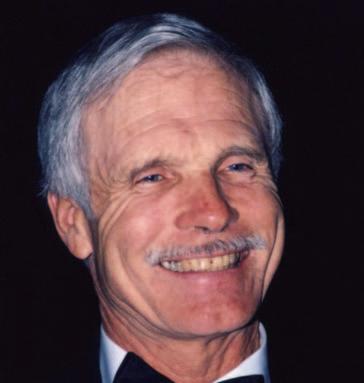
Greater Yellowstone Ecosystem event at Ted’s Flying D Ranch in Gallatin, Montana. For the ranch tour, I was paired with Jane Fonda and several wives of prominent funders. About half way through the tour, Jane asked me what I did. I responded with an outline of The Wild Salmon Center and our flagship Kamchatka Steelhead Project. She asked what we needed. The answer was simple — money. When we got back to the ranchhouse, Jane dragged me over to Ted, who recognized me as Mark’s brother from Admiral’s Cup
Jane Fonda gushed about our conservation work, telling her husband he should support our efforts. Without hesitation Ted asked, “How much?”
days. She gushed about WSC and the KSP telling Ted that they should support our work. Without hesitation, Ted asked, “How much?” I replied, “How about $25K for three years?” Said Ted, “Done.”
A couple of years later, I encouraged Ted to visit our programs in Kamchatka. He came for two weeks of trout fishing on Zhupanova River — arguably the best big rainbow river fishery in the world. He spent a week floating the upper river; a week at Cedar Lodge catching the river’s famous huge rainbow trout. Ted’s early support changed the course of the Wild Salmon Center and me. Thanks! Smooth sailing, Ted!!
Olympic Peninsula Steelhead — Where is the “Careful Monitoring?
On August 1, 2022, The Conservation Angler petitioned the National Oceanic and Atmospheric Administration (NOAA) to list Olympic Peninsula steel-
head as endangered under the federal Endangered Species Act. After a review process long exceeding the statutory requirement, NOAA rejected the petition as unwarranted on January 14, 2026 while promising to “carefully monitor” steelhead populations with state and tribal authorities.
I have reached out to federal, state and tribal authorities responsible for implementing NOAA’s promise to “carefully monitor” OP steelhead. What measures have been taken, what management shifts are contemplated, changes to hatchery/harvest regimes, etc. has NOAA implemented with WDFW and tribal partners? About a month before the NOAA rejection of the ESA petition, the Washington Department of Fish and Wildlife closed the Queets River to recreational angling due to exceptionally low returns. The tribes kept fishing.
So far, more than four months following NOAA’s decision not to list, there is no public evidence that any of the responsible agencies have initiated any definitive steps to halt the continuing decline of these populations. It’s a mystery and a disappointment.
I am pleased to announce that The Osprey Editorial & Management Committee has offered, and Daniel Ritz has accepted, editorship of The Osprey effective immediately. Congratulations, Daniel!
Finally, Jim, The Editorial & Management Committee as well as all readers of The Osprey appreciateyour willingness to step in as interim Editor, foregoing retirement on short notice to help us get back on an even keel. Your steady hand, extensive contacts and long editorial experience were critical. Warmest wishes for a richly earned resumed retirement. Please stay in touch.
Pete Soverel is Chair of The Osprey Editorial and Management Committee, and founder of The Conservation Angler and Wild Salmon Center.
The Osprey
On August 1, 2022, The Conservation Angler and The Wild Fish Conservacy submitted a petition to the National Oceanic and Atmospheric Adminstration (NOAA) to list the Olympic Peninsula Distinct Population Segment (DPS) of steelhead as threatened or endangered under the federal Endangered Species Act. Then, on November 7, 2024, those two organizations filed a 60day notice of intent to sue NOAA for violations of Section 4 of the ESA that require federal agencies to, within 90 days of receiving a petition to list a species, determine whether the petition presents “substantial scientific or commercial information indicting that the petitioned action may be warranted,” and further to make a decision within 12 months of receiving the petition, which NOAA had failed to do.
Eventually — on January 14, 2026 — NOAA issued its decision to reject the petition, publishing their decision in the Federal Register on that date.
In fact, NOAA’s inital 90-day review did conclude that Olympic Peninsula Distinct Population Segment steelhead was most likely at moderate risk of extinction.
NOAA found that Olympic Peninsula DPS steelhead abundance has declined in total run size by 42% from 1991-1995 to 2018-2022. These declines were especially notable in the four largest Olympic Peninsula river basins — Quillayute, Quinault, Hoh and Queets. The Washington Department of Fish and Wildlife had changed harvest regulations to catch-and-release and lowered harvest rates, but that failed to stem declines.
In addition, it was found, that summerrun steelhead abundance across the DPS is very low. And, along the Strait of Juan de Fuca, winter-run steelhead also exhibit low abundance levels.
NOAA’s Status Review Team also found that harvest rates within the peninsula’s four largest river basins were too high, contributing to negative population growth of winter-run steelhead.
Hatchery practices were also determined to be a contributing factor for declining Olympic Peninsula steelhead populations. Despite changes in some hatchery practices to reduce genetic exchange between hatchery and wild
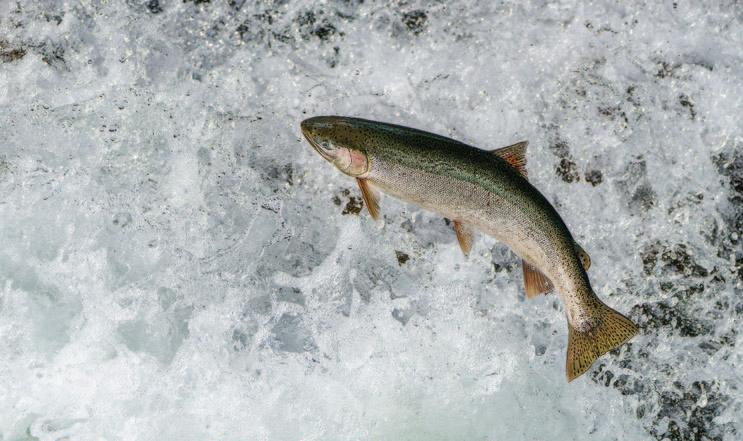
Despite the significant evidence presented in The Conservation Angler and Wild Fish Conservancy petition to list Olympic Peninsula Distinct Population Segment steelhead under the ESA, NOAA rejected it. Photo by John McMillan.
steelhead, deficiencies remain — especially the continuing practice of using hatchery broodstock that originate outside of the Olympic Peninsula region.
Current hatchery management strategies assume that all hatchery fish spawn before March 15 and natural-origin fish spawn later. However, the Status Review Team found that current information does not support that assumption. This means that using March 15 as the cut-off date could result in excessive harvesting of wild steelhead that arrive to spawn prior to March 15.
Finally, the initial assessment recognizes that climate change over the next half-decade will likely harm Olympic Peninsula steelhead, especially lessabundant summer-run populations.
NOAA’s reasons for rejecting the petition included determining that habitat and connectivity was good, spatial distribution of steelhead was good, and the fish were befitting from current management and harvest reduction strategies.
More detailed information can be found in the Federal Register at: https://www.federalregister.gov/documents/2026/01/14/2026-00581/endangered-and-threatened-wildlife-and-plan ts-12-month-finding-on-a-petition-tolist-the-olympic
— Jim Yuskavitch
Daniel Ritz is a recovering journalist turned science communicator and an experienced wild fish advocate.
After graduating with Journalism and Philosophy degrees from Salisbury University in 2009, Daniel found his voice as a newspaper reporter, feature writer and editor. Most recently, Daniel was the Campaign Coordinator of the For Tomorrow’s Fish Campaign, a federal advocacy campaign for climate resilient fisheries management. He is the editor of Swing The Fly Magazine, and the River Steward Program Director for the Native Fish Society.
For Daniel, The Osprey is the nexus of his passions for objective reporting, Place-based storytelling and fishing. He lives in the Columbia River Gorge, in Oregon, with his wife, two dogs and a tall cat.
Says Daniel, “It’s my honor to serve as editor of The Osprey, and continue its nearly 40-year-old legacy of advancing informed scientific dialogue, showcasing the vanguard of conservation research, and elevating interdisciplinary understanding of wild steelhead and their ecosystems.”
By Jenny Bacon, Nicole Herman-Mercer, Peyton Thomas and Keith Musselman
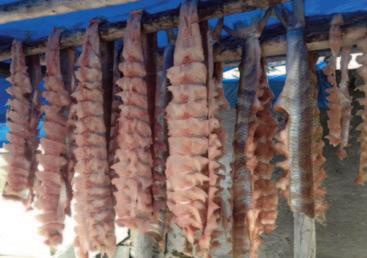
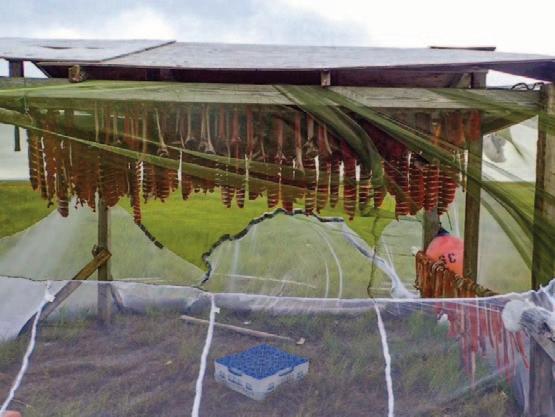
“All the fish racks used to be so full. So red all over. That red fish hang… Once the fish are dried— air dried—… they bring them into the smokehouse. Then, you could smell that aroma. Everywhere you go, you can smell it. Even boating, while you’re going out in the river you pass fish camp, first thing you do is smell that wood smoke and that fish. Smokin. Man, that just—it just smells so good. Now you don’t see none of that. You can’t smell that no more.” — Elder in Saint Mary’s, Alaska
The Yukon River is the longest river in Alaska, traversing nearly 2,000 miles from its headwaters in Canada before emptying into the Bering Sea. The river is home to the longest salmon migration in the world, providing dietary and cultural sustenance to over forty-two Alaska Native Villages and several Canadian First Nations (Figure 1). However, western Alaskan salmon populations have been declining in abundance, condition, and reproduction for several years (Schoen et al., 2023). The low abundance of Chinook salmon (often referred to as King salmon) has had a major impact on Yukon River Basin (YRB) residents’ ability to meet their subsistence needs (Brown and Godduhn, 2015). Additionally, and most no-
tably for the lower Yukon River communities, commercial salmon fishing was a vital component of the local economy. The recent closure of the commercial and subsistence fishing industry has had large economic impacts on several of those communities (Choiniere, 2025).
The total halt of subsistence fishing for Chinook salmon on the Yukon River has caused serious, lasting impacts on Alaska Native communities.
such as establishing and adjusting subsistence fishing schedules and limiting gillnet mesh sizes to prevent the accidental catch of Chinook when fishing for other species (ADF&G, 2023).
Historically, the Chinook salmon population in the Yukon River numbered in the hundreds of thousands, providing enough salmon to fulfill subsistence needs, support a commercial fishery, and still allow tens of thousands to cross the border and spawn in Canada. The Yukon River salmon fishery in Alaska is regulated by both state and federal entities, including the Alaska Department of Fish and Game (ADF&G) and the U.S. Fish and Wildlife Service (USFWS). In Canada the fishery is managed by Fisheries and Oceans Canada. Both countries manage the fishery under the Yukon River Agreement, an international agreement to collaboratively conserve and manage salmon stocks spawning in Canada. As populations have continued to decline since the first designation of concern in 2000, ADF&G began conservation measures
Following dramatic declines during the period of 2020-2024 with Chinook populations falling to nearly 80% below average (Jallen et al., 2025) the Chinook salmon fishery was closed for both commercial and subsistence fishing on the Yukon River. The last commercial harvest was allowed in 2008 and the last subsistence harvest in 2021. In 2024, a 7-year moratorium agreement was signed by ADF&G and Fisheries and Oceans Canada with the goal of stabilizing populations and achieving escapement goals for salmon that spawn on the Canadian side of the Yukon (ADF&G, 2024). This agreement mandates the closure of subsistence fishing for Chinook salmon in the mainstem Yukon River and Canadian tributaries for 7 years unless the in-season estimate of Canadian-origin international border passage exceeds 71,000 based on sonar at Pilot Station (Figure 2). ADF&G fisheries managers estimate roughly 25,000 Canadian-origin Chinook will return in 2026 (Kuhn, 2026). If this estimate is correct, 2026 will be another year of subsistence closures.
To better understand Arctic ecosystems and the impacts of climate change on Indigenous communities in Alaska and western Canada, the interdisciplinary Arctic Rivers Project sought to combine regional climate, hydrologic, and fish modeling with narratives of community experiences. First, a regional climate model was co-designed with the project’s Indigenous Advisory Council (Herman-Mercer et al., 2023; Cheng et al., 2025) and results from a survey of Tribal and First Nation decision makers across our study area (Herman-Mercer, 2021). This climate model (Newman et al., 2026), first calibrated to local snowpack and streamflow observations (Cheng et al., 2023), served as input for a streamflow and river temperature model (Blaskey et al. 2024). Using these models in combination with a simulation of fish bioenergetics, insights were gained on
Continued on next page
The Osprey
potential changes to fish growth across major rivers in the YRB (Thomas et al., 2025). The model was run for a historical period (1990-2020) and a mid-century future (2034-2065). Next, semi-structured interviews were conducted with individuals from the Yup’ik communities of Saint Mary’s and Aniak in western Alaska (Figure 2) in January and February of 2025 (Bacon et al., 2026) to contextualize the impacts of environmental events, like salmon declines, on local people. Saint Mary’s is in the lower Yukon region, on the banks of the Andreafsky River, roughly five miles upstream from its confluence with the Yukon River and roughly 400 miles northwest of Anchorage. Aniak is in the Kuskokwim River Basin, located on the south bank of the Kuskokwim River, near the confluence of the Aniak River, 317 miles west of Anchorage. These, and most communities in the YRB, are only accessible by plane or boat. Twenty-four interviews were conducted: 11 in Saint Mary’s and 13 in Aniak. The interviews were audiorecorded, transcribed verbatim, and thematically coded (Bacon et al., 2026).
“I see a lotta young people still wanting to do it, but there’s nothin’ to catch out there anymore. We’re so restricted there. Authorities are just keeping us on land, not even allowing us there. And they’re blaming it on the returns, that they need ‘em up there. You know, we share the Yukon River with Canada so it’s international waters and international treaties that they gotta abide by” - Elder in Saint Mary’s, Alaska
The total halt of subsistence fishing for Chinook salmon on the Yukon River has caused serious, lasting impacts on Alaska Native communities across the YRB. Culture, livelihoods, and health within these communities have been bound to the salmon harvest since time immemorial (Carothers et al., 2021). For generations, subsistence salmon fishing has taken place at fish camp, a traditional, seasonal, riverside camp often featuring cabins, fish racks, smokehouses, and, in the upper Yukon River, fish wheels. In our interviews, participants described leaving the village in early May, as soon as school was out for the summer, and not returning
to the village until school resumed in the fall. Families would spend the summer at fish camp, harvesting, cutting, and preserving salmon. At fish camp, multiple generations spent long uninterrupted time working together. A National Park Service Traditional Use Study (Deur et al., 2018) describes how much more than fishing happens at fish camp, “Shared labor affords space to catch up on family and community news, and to teach children fishing skills and other traditional knowledge. Intergenerational reminiscing and the sharing of family lore and history take place, as well as public displays of humility, respect, and thanks-giving for food received— food that will sustain families in the year ahead as it has sustained the ancestors for generations.”
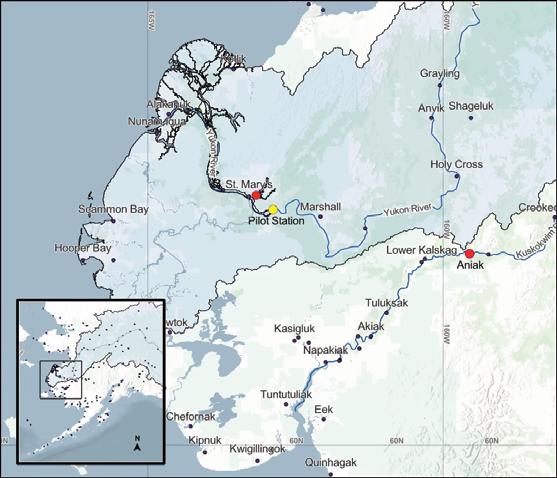
Figure 2 - Map of communities in western Alaska. Yukon River Basin is denoted by dark shading. Black dots in inset denote the locations of Alaska Native Village. Red dots denote interview locations; yellow dot denotes location of ADF&G fish sonar.
Sources: State of Alaska | Esri | TomTom | Garmin | USGS | FAO | NOAA | EPA | NPS | USFWS | U.S. Geological Survey, National Geospatial Program, 20220712, USGS National Hydrography Dataset Best Resolution (NHD) - Alaska (published 20220712): U.S. Geological Survey. | Esri Inc. | Bureau of Indian Affairs, Branch of Geospatial Support.
Expanding through the 1980s, commercial fishing provided income to families across the YRB that was necessary to support modern subsistence harvesting and to participate in the growing cash economy in the villages. Interview participants discussed how the need for cash income has increased with the loss of commercial fishing. As the cost of living continued to grow, many families began spending less time at fish camp, prioritizing jobs in the village instead. Today, without the opportunity to harvest Chinook, we were told by interviewees that most families no longer go to fish camp and instead take shorter day trips to catch other species, when financially able.
Many community members we interviewed also expressed concern that without fish camp, younger generations are missing the opportunity to gain the traditional knowledge needed for survival. There was also worry about younger generations not feeling the same connection to the land and culture, as they are not able to participate
in these activities and eat traditional foods. Chinook salmon and other traditional foods are seen as a core piece of identity in communities across the YRB and a necessary part of a healthy diet.
“One summer I came out here and I only caught a total of seven king salmon due to closures, and the fish—salmon running low, everything was pretty much closed. I usually try to put away a hundred salmon, and it was a blowout to be able to catch and take home only seven. I feel for those people on the Yukon that have closures.” — Community member in Aniak, Alaska
Determining one specific cause for the low productivity of Chinook salmon populations is difficult. Climate impacts in both the marine and freshwater environments, such as increasing water temperature and variable streamflow, are included in the list of contributing factors (Feddern et al., 2024). The success of salmon in early life stages is critical for future productivity. Ex-
Continued on next page
treme river water temperature events negatively impact populations and increase mortality rates during these life stages.
In Saint Mary’s, community members spoke of 2019 as an abnormally hot summer where they experienced very warm river water temperatures and observed significant fish kills. von Biela et al. (2020) found evidence of heat stress in Chinook in the Yukon and Kuskokwim Rivers during heatwaves, including the 2019 heatwave described in interviews. Fish kills are predicted to continue with projected warming.
Through our modeling, we found that pre-smolt sizes may increase with warming, with significantly larger salmon in the colder years by mid-century (Thomas et al., 2025). However, in the warmest years, our modeling also indicated that higher metabolic demand may result in smaller fish, particularly in the warmer tributaries of the Yukon River (Thomas et al., 2025). Additionally, consumption and respiration rates increased with higher river water temperatures, young of year Chinook will have to consume more food and respire more oxygen to stay at or above current sizes under predicted mid-century water temperatures. (Thomas et al., 2025).
Changes in food supply, predation, disease, and ocean competition also contribute to the abundance and size declines seen in western Alaska salmon (Schoen et al., 2023). Interview participants in both communities discussed how, in the past, Chinook could be five feet long and approach or exceed 100 pounds. Now, they describe Chinook as being less than half the size. Additionally, they shared that other species of salmon and fish caught for subsistence are smaller and more frequently diseased than in the past.
Many community members we interviewed also expressed high concern over what they perceive as negative effects of industrial fishing on Chinook. Interview participants see industrial ocean fishing as driven by greed and the bycatch as wastefulness that disrespects the lives of the salmon, causing a decline in returns. There is a 45,00060,000 hard cap on Chinook bycatch in the Bering Sea Fishery depending on the previous year’s Chinook population. This Fishery is managed and moderated by the North Pacific Fishery Management Council, which developed a management system that, in addition to
hard caps on bycatch, includes incentives for fleets to avoid salmon bycatch and penalties when it occurs. Every pollock fishing vessel has an on-board observer to maintain accurate counts for a complete census on salmon and genetic testing to determine their origin. In 2022, 6,337 sub-adult Chinook salmon were taken as bycatch in the Bering Sea Fishery, (Witherell, 2023). For context, in 2012, the subsistence harvest was the largest in over a decade, but still half the number of the total number of salmon allowed as bycatch (Choiniere, 2025).
“In the last ten years… our economy here in Saint Mary’s, it’s survival… That’s our economy. That’s what we gotta do to live here. Try to survive somehow nowadays. Nothing to look forward to anymore. No salmon fishing. No more firefighting. Price of fuel is $9.84. You go down to the AC store, 10 items to little over $100,” —Elder in Saint Mary’s, Alaska
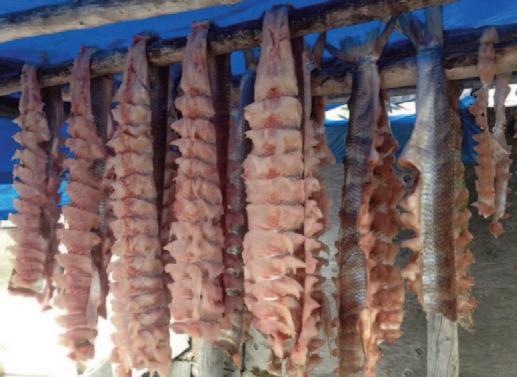
Individuals and communities are adapting to declining salmon populations in a variety of ways. Because Chinook salmon was a primary source of food, families have had to shift diets. Interview participants told us that they are increasingly relying on moose meat, as moose have been in higher abundance in the YRB than in the past due to habitat changes. In Saint Mary’s, this has also included catching other species of salmon, such as humpies, pinks, or chum, and other fish species, such as whitefish, burbot, and pike (Figure 3).
The modeling we conducted on young of year Chinook was also done for juvenile Dolly Varden, an alternative species harvested in some communities. We found that Dolly Varden may fare better than Chinook in warming waters, doubling in growth, on average, by mid-century (Thomas et al., 2025). Still, switching to other species of salmon and non-salmon fish does not solve all problems. Interview partici-
pants described shifting weather patterns with colder, wetter summers than in the past impacting their ability to dry fish using traditional methods. Additionally, because fishing for other species of salmon, notably chum, is dictated by openings from ADF&G, fishers cannot plan ahead and take advantage of good weather.
Interview participants shared that many community members cannot afford the risk of going out and not having a successful harvest. Subsistence fishing and hunting in Alaska Native Villages can be very expensive due to high prices of gas and other equipment and a very limited job market, especially since the closure of commercial fishing. Thus, more people discussed turning to store-bought foods due to their reliability, despite negative opinions held on the quality and health of purchased foods as compared to traditional foods. Store-bought foods are very costly in the communities due to their remoteness, making healthy options difficult to obtain.
With these current financial strains on many families, it is more difficult to provide for others. Reliance on social relationships is a core tenet within these communities, however the manner of helping each other has changed over the years. For example, instead of the direct gifting of goods and subsistence foods, people are now focusing on sharing skills and supplies. One person may own a boat, while someone else can afford to pay for gas, so they will go fishing together.
Another way communities are adapting is by getting involved in discussions and panels that make recommendations
Continued on next page
on regulations. Community members participate in policy advising forums such as the North Pacific Fishery Management Council meetings, the Yukon River Panel, and through advocacy nonprofit organizations like the Tanana Chiefs Conference, the Yukon River Drainage Fisheries Association, and others to ensure their perspectives and Traditional Knowledge are included in the decision-making process.
Scientists continue to study the effects of climate change on Chinook salmon to inform decision makers on what steps can be taken to help the population rebound. Based on the results of our models, community members may want to consider alternative subsistence species. Furthermore, results suggest there may be value in prioritizing the conservation of cold-water river reaches that can serve as thermal refugia for juvenile salmon.
In the meantime, YRB communities are experiencing profound and widespread impacts as a result of declining Chinook populations and resulting regulations. Chinook salmon remains an extremely culturally important species. Community members are invested in helping Chinook salmon populations return to their previous numbers and are working to share their concerns and Traditional Knowledge with policy makers.
Jenny Bacon is a Research Assistant and Oak Ridge Institute for Science and Education Fellow with the US Geological Survey, Southwest Climate Adaptation Science Center.
Nicole Herman-Mercer is a Research Social Scientist with the US Geological Survey, Southwest Climate Adaptation Science Center.
Peyton Thomas and Keith Musselman are assistant professors in Environmental Studies and Geography, respectively, and Fellows at the Institute of Arctic and Alpine Research, University of Colorado Boulder.
To learn more, visit the Arctic Rivers Project website at https://geonarrative.usgs.gov/arcticriversproject/
Alaska Department of Fish & Game, Subsistence Section. (2023). Yukon Area. Storymap. https://storymaps.arcgis.com/stories/d3ec172782cb4d4aacc88a4cd05100d5 Accessed May 5, 2026.
Alaska Department of Fish & Game and Fisheries and Oceans Canada. (2024). Agreement of April 1, 2024 regarding Canadian-origin Yukon River Chinook Salmon for 2024 through 2030. https://www.adfg.alaska.gov/static/home/news/hottopics/pdfs/yukon_river_chinook_salmon_7_year_management_2024_2030.pdf
Bacon, J., Minium, A., Ebanks, D., Thomas, P., Musselman, K., & Herman-Mercer, N. 2026. Arctic Rivers Project: Storylines – Topics and analytical codes from semi-structured interviews conducted in Western Alaska 2025. https://www.sciencebase.gov/catalog/item/6973f1f3d4be02601819fe3e
Blaskey, D., Gooseff, M. N., Cheng, Y., Newman, A. J., Koch, J. C., & Musselman, K. N. (2024). A highresolution, daily hindcast (1990–2021) of Alaskan river discharge and temperature from coupled and optimized physical models. Water Resources Research, 60(4), e2023WR036217.
Brown, C.L. and Godduhn, A.R. eds., 2015. Socioeconomic effects of declining salmon runs on the Yukon River. Alaska Department of Fish and Game, Division of Subsistence. https://www.adfg.alaska.gov/techpap/TP398.pdf
Carothers, C., J. Black, S. J. Langdon, R. Donkersloot, D. Ringer, J. Coleman, and A. Whiting. (2021). Indigenous peoples and salmon stewardship: a critical relationship. Ecology and Society 26(1):16. https://doi.org/10.5751/ES-11972-260116
Cheng, Y., Herman-Mercer, N., Newman, A., Musselman, K., Woelfle-Hazard, C., Blaskey, D., … & Toohey, R. (2025). Toward co-designed Earth system models: Reflecting end-user priorities in local applications from a modeler’s perspective. AGU Advances, 6, e2025AV001921. https://doi.org/10.1029/2025AV001921
Cheng, Y., Musselman, K. N., Swenson, S., Lawrence, D., Hamman, J., Dagon, K., ... & Newman, A. J. (2023). Moving land models toward more actionable science: A novel application of the community terrestrial systems model across Alaska and the Yukon River basin. Water Resources Research, 59(1), e2022WR032204.’
Choiniere, A. (September 3, 2025). Alaska Natives, barred from king salmon fishing, fight for their right to manage the Yukon River. Prism. Alaska Natives fight for right to fish salmon, manage Yukon River
Deur, D., Evanoff, K. and Hebert, J., 2018. Respect the Land-It’s Like Part of Us: A Traditional Use Study of Inland Dena’ina Ties to the Chulitna River & Sixmile Lake Basins, Lake Clark National Park and Preserve. https://www.nps.gov/lacl/learn/upload/Respect-the-Land-It-s-Like-Part-of-Us.pdf
Feddern, M. L., Shaftel, R., Schoen, E. R., Cunningham, C. J., Connors, B. M., Staton, B. A., ... & Howard, K. G. (2024). Body size and early marine conditions drive changes in Chinook salmon productivity across northern latitude ecosystems. Global change biology, 30(10), e17508.
Herman-Mercer, N.M., 2021. Guiding the arctic rivers project climate model development: Results from the climate information survey. USGS Report, https://www.colorado.edu/research/arcticrivers/sites/default/files/attached-files/arp_modelsurveyresults_report_final.pdfhttps://www.colorado.edu/research/arctic-rivers/sites/default/files/attached-files/arp_modelsurveyresults_report_final.pdf P.41
Herman-Mercer, N., Andre, A., Buschman, V., Blaskey, D., Brooks, C., Cheng, Y., & Musselman, K. N. (2023). The Arctic Rivers Project: Using an Equitable Co-Production Framework for Integrating Meaningful Community Engagement and Science to Understand Climate Impacts. Community Science, 2(4). https://doi.org/10.1029/2022CSJ000024
Jallen et al., 2025 Yukon River salmon stock status and fishery overview: A report to the Alaska Board of Fisheries, November 2025.
Kuhn, J. (2026, April 27). Yukon River Chinook salmon face steep decline amid disease surge and environmental challenges. Alaska News Source. https://www.alaskasnewssource.com/2026/04/27/yukon-river-chinooksalmon-face-steep-decline-amid-disease-surge-environmental-challenges/ accessed May 5, 2026
Lingnau, T., and P. Salomone. 2003. Preliminary 2003 Yukon Area Chinook and Summer Chum Salmon Fishery Summary. Alaska Department of Fish and Game, Division of Commercial Fisheries, Information Letter, Anchorage.
Newman, A.J., Cheng, Y., Blaskey, D., Herman-Mercer, N.M., Craig, A.P., Koch, J., Toohey, R., Mutter, E., Carey, M.P., Gooseff, M.N. and Swanson, H., 2026. Long-Term Regional Hydroclimate Modeling for Communities and Decision-makers Across Alaska and Northwestern Canada. Bulletin of the American Meteorological Society, pp.BAMS-D.
National Oceanic and Atmospheric Administration, Fisheries, Species Directory: Alaska Pollock. https://www.fisheries.noaa.gov/species/alaska-pollock/overview Accessed May 11, 2026.
Schoen, E. R., Howard, K. G., Murphy, J. M., Schindler, D. E., Westley, P. A. H., & von Biela, V. R. (2023). NOAA Arctic Report Card 2023: Divergent Responses of Western Alaska Salmon to a Changing Climate. https://doi.org/10.25923/f2hv-5581
Thomas, P. A., Blaskey, D., Cheng, Y., Carey, M. P., Swanson, H. K., Newman, A. J., Brooks, C., Herman-Mercer, N. M. & Musselman, K. N. (2025). Warming Alaskan rivers affect first-year growth in critical northern food fishes. Scientific Reports, 15(1), 28834.
von Biela, V. R., Bowen, L., McCormick, S. D., Carey, M. P., Donnelly, D. S., Waters, S., ... & Zimmerman, C. E. (2020). Evidence of prevalent heat stress in Yukon River Chinook salmon. Canadian Journal of Fisheries and Aquatic Sciences, 77(12), 1878-1892.
Witherell, D. (August 2023). Salmon Bycatch Frequently Asked Questions. North Pacific Management Council. https://files.npfmc.org/bycatch/SalmonBycatchFAQ.pdf
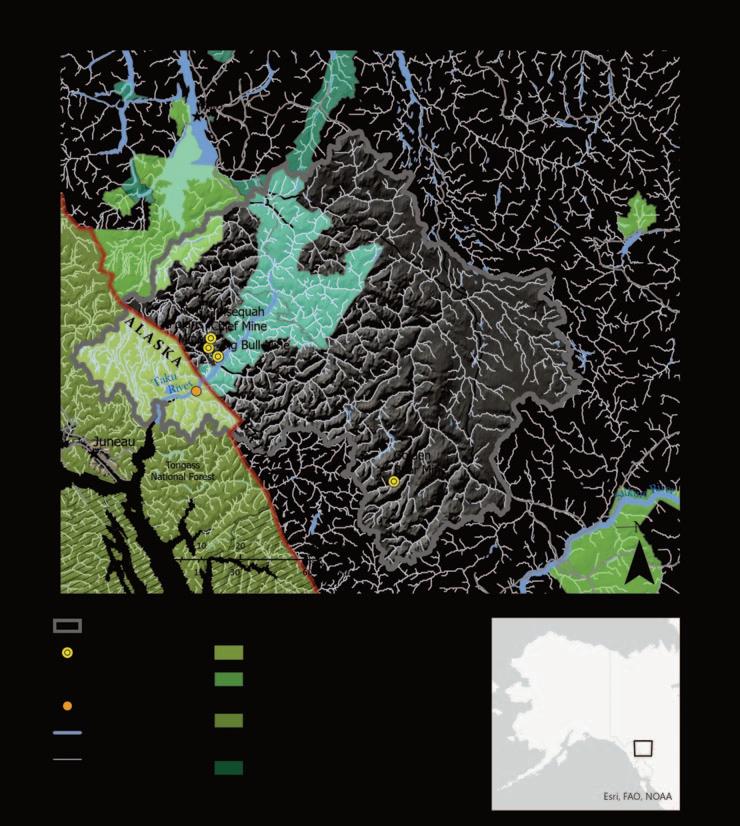
Braided channels snake and twist across a broad floodplain, weaving through siltheavy glacial runoff before spilling into wetlands that seem to breathe with the tide. This is the Taku; a 4.5-million-acre transboundary watershed stretching from the boreal forests of northwest British Columbia to the temperate rainforests of southeast Alaska. It is immense, dynamic, and increasingly rare: a river system with no roads, no dams, and no significant industrial development. On the Pacific coast of North America, it stands alone as the largest intact watershed of its kind.
To understand the Taku is to understand movement. Snowmelt gathers high in the Coast Mountains, coursing past jagged peaks and retreating glaciers before braiding into countless channels that shift with each season. These waters eventually fan out into a rich estuary just south of Juneau, where fresh and saltwater mingle in a nutrient-rich exchange that sustains life at every level. The river does not simply flow; it shapes and reshapes the land, carrying sediment, nutrients, and stories downstream.
For the Tlingit people, those stories stretch back to time immemorial. The Taku River Tlingit First Nation in Atlin, British Columbia, and the Douglas Indian Association in Juneau, Alaska, have long lived in relationship with this watershed. Their histories, cultures, and subsistence practices are inseparable from the river’s rhythms. Salmon runs, seasonal migrations, and the health of the land itself are not abstract environmental indicators here; they are the foundation of identity and continuity.
The Taku River Tlingit First Nation declared an Indigenous Protected and Conserved Area (IPCA) that protects 60% of the Taku watershed.
Flannigan Slough, the Taku’s most significant salmon spawning and rearing habitat, is a classic maze of winding streams and backwaters straddling the international border. It serves as a vital ecological, cultural, and economic re-
By Kayla Heidenreich
source for all who depend on it. Lifeblood to commercial and sport fishing, the Taku is typically the top salmon producing river system for southeast Alaska.
But the Taku is more than a salmon river. It is a mountains-to-sea ecosystem of extraordinary biodiversity. Brown bears forage along its banks, moose browse in its wetlands, and wolves and wolverines traverse its forests. Mountain goats cling to steep alpine slopes while migratory birds fill
In an era defined by ecological decline, the Taku offers something increasingly precious: resilience. As climate change accelerates, the watershed functions as a biorefugia.
the skies overhead. Beneath the surface, steelhead and all five species of Pacific salmon navigate complex currents shaped by millennia of glacial movement. Downstream, the estuary supports whales, porpoises, sea lions, and otters, linking inland ecosystems to the broader Pacific.
In an era defined by ecological decline, the Taku offers something increasingly precious: resilience. As climate change accelerates, melting glaciers, warming waters, and disrupting salmon runs, the watershed functions as a biorefugia, a place where intact processes and habitat diversity provide species with a better chance to adapt and endure. Preserving the Taku is not only about protecting what exists today; it is about safeguarding a living system capable of sustaining life into an uncertain future.
Yet even here, far from highways and
cities, the impacts of industrial activity are impossible to ignore.
Just upstream from the Alaska border, along the Tulsequah River, sits the abandoned Tulsequah Chief mine. The mine operated for only seven years, extracting copper, lead, and zinc before closing in 1957. Since then, it has continued to produce something else: a steady flow of pollution.
For nearly seven decades, acid mine drainage has seeped from the site into the surrounding watershed. This process occurs when sulfide minerals, exposed to air and water, generate sulfuric acid. That acid, in turn, leaches heavy metals such as arsenic, copper, and lead from the surrounding rock, carrying them downstream and, ultimately, into the Taku itself.
The implications for salmon are profound. Even small amounts of dissolved copper, levels that may fall within regulatory thresholds, can disrupt a salmon’s ability to navigate, impair its sense of smell, and reduce its chances of returning to spawning grounds. Sublethal effects accumulate: altered behavior, weakened immune systems, developmental deformities. In a river system where life cycles depend on precise timing and navigation, these disruptions ripple outward through the ecosystem.
The location of the Tulsequah Chief mine compounds the risk. It sits just upstream from the confluence of the Tulsequah and Taku rivers, near the highly productive habitat of Flannigan Slough. Pollution released here does not dissipate harmlessly; it enters one of the most critical salmon nurseries in the watershed.
Calls to clean up the site have been consistent and widespread. The Taku River Tlingit First Nation, the Douglas Indian Association, the Southeast Indigenous Transboundary Commission, commercial fishing interests, and elected officials at both the state and
Continued on next page
federal levels have all urged action. There is no opposition to remediation. The issue is not whether the mine should be cleaned up; it is why it has taken so long.
In 2015, the government of British Columbia committed to addressing the problem. Since then, there have been incremental steps: site stabilization, limited containment efforts, and planning processes that have gotten the ball rolling. Yet nearly a decade later, there is still no comprehensive cleanup, no firm timeline for completion, and no end to the ongoing discharge of contaminated water. Questions surrounding long-term remediation also continue. A recent presentation hosted by Teck Resources indicated that 2026 field work objectives include collecting the geotechnical, geochemical, and environmental information needed to evaluate remediation options for acid rock drainage. Teck and the Taku River Tlingit First Nation are currently developing a draft remediation plan focused on source control, targeted for completion by the end of 2026.
For many Alaskans, the Tulsequah Chief mine has become symbolic of broader failures in mining regulation and reclamation, particularly in transboundary watersheds where upstream decisions have downstream consequences. The continued pollution represents not only an environmental failure, but a breach of trust.
That trust is further strained by proposals for new mining development in the same watershed.
Just two and a half miles downstream from Tulsequah Chief, Canagold Resources is advancing plans for the New Polaris project, a proposed underground gold mine. The site itself is not new; mining operations there date back to the early 20th century, when a barge carrying its gold concentrate sank during a storm, effectively ending the Polaris-Taku gold mine’s production. Today’s proposal envisions a “modern” operation, but one that raises familiar concerns.
Unlike minerals deemed essential for renewable energy or critical infrastructure, gold occupies a different category. The vast majority is used for jewelry or investment, while only a small fraction serves industrial or technological purposes. The project’s recent inclusion on
Canada’s fast-tracked critical minerals list stems largely from the last minute addition of antimony to the project, a mineral considered strategically important for industry and defence. Antimony is often found alongside gold.
Canagold Resources submitted its environmental assessment application for the proposed New Polaris gold mine on March 30, 2026. Public comments on the application was open through June 11.
According to the environmental assessment application, potential interactions with infrastructure and services in Juneau include increased aviation activity at Juneau International Airport and increased marine traffic associated with landing craft operating from Juneau. During operations, the project is estimated to generate approximately 3,206 trips to and from Juneau annually. Predicted impacts identified in the application include increased air traffic volume and additional demand on airport infrastructure and airspace management.
A mile-long airstrip would also be constructed in Flannigan Slough, considered one of the most significant spawning and rearing habitats in the Taku watershed.
The logistical challenges of developing New Polaris add another layer of complexity. The site is remote, with no road access. Construction would rely heavily on a self-propelled landing craft transporting equipment and materials up the Taku, a river known for shallow channels, shifting gravel bars, twentyfoot tide swings, and unpredictable conditions. These same characteristics that make the Taku ecologically rich also make it difficult to navigate safely.
According to the application, the U.S. Coast Guard, along with Tribes, fishermen and cabin owners have raised serious concerns about navigation safety and environmental risks associated with landing craft traffic on the Taku.
The self-propelled landing craft the company plans to use this summer, the 92-foot Inlet Raider, is expected to
begin test runs on the Taku in June. These field trials will help determine the final number of upriver trips required. According to the environmental assessment application, Canagold currently anticipates approximately 75 trips per season (June–September) during the three-year construction phase.
Previous operators associated with the Tulsequah Chief mine struggled with the economic and environmental viability of barging on the challenging Taku river. Concerns persist that renewed industrial traffic could damage sensitive habitat, disrupt salmon migration, put humans at risk, and introduce additional risks into an already dynamic system.
New Polaris is projected to require three years of construction, operate for roughly a decade, and then undergo only two years of reclamation and closure activities. This juxtaposition raises legitimate questions about regulatory capacity, accountability, and long-term stewardship. If an abandoned site cannot be fully remediated after decades of known impacts, what assurances exist that a new project will be managed, and eventually reclaimed, without similar consequences?
For many downstream Alaskans, the timing is difficult to reconcile. British Columbia has yet to fully remediate an abandoned mine that continues to pollute a major transboundary river, yet it is simultaneously considering approval for a new mining operation just miles downstream.
For the Taku River Tlingit First Nation, whose traditional territory much of the watershed, these decisions carry particular weight. Their voices and sov-
ereignty must be central to any determination about the future of the river. At the same time, the transboundary nature of the Taku means downstream communities in Alaska, especially Tribal governments and commercial fishing sectors, also have a direct stake in the outcome. The Douglas Indian Association, which has not received formal consultation, is unequivocally opposed to the New Polaris project.
Public attention to transboundary mining issues has intensified in recent months, highlighted by a hearing before the Alaska House State Affairs Committee. Testimony was provided by Salmon Beyond Borders, Rivers Without Borders, the Central Council of the Tlingit and Haida Indian Tribes of Alaska, Dr. Dave Chambers, President of the Center for Science in Public Participation, and Linda Behnken, Executive Director of the Alaska Longline Fishermen’s Association. Speakers consistently called on the State of Alaska to stand up for the transboundary region, prioritize cleanup of the Tulsequah Chief mine, and provide technical comments on mining projects affecting Alaska waterways.
During the hearing, Rep. Kevin McCabe (R-Big Lake) made remarks suggesting Alaska fishermen have caused more damage to waterways than Canadian mines, and stated, “I used to swim in the tailings ponds and I’m all right.” The comments were criticized as dismissive of Alaska fishermen and inconsistent with an “Alaska First” approach to protecting the state’s fisheries and watersheds.
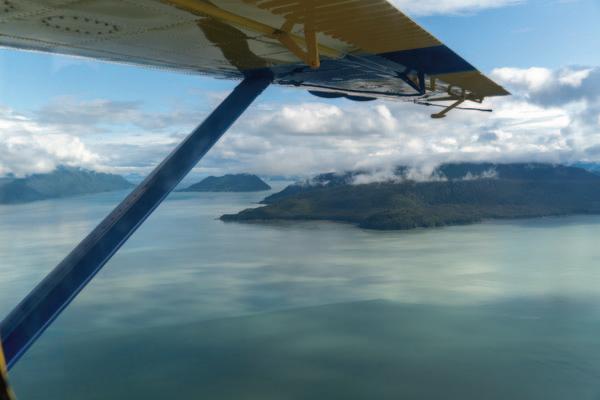
The Taku does not recognize political borders. Its waters flow freely from one jurisdiction to another, carrying with them the cumulative effects of upstream actions. This interconnectedness demands a level of cooperation and precaution that is often difficult to achieve, but essential to pursue.
There is, however, a clear and
achievable starting point: the cleanup of the Tulsequah Chief mine.
Addressing this long-standing source of pollution would do more than improve water quality. It would signal a commitment to responsible stewardship, demonstrate the effectiveness of modern reclamation practices, and begin rebuilding trust between governments, communities, and industries. It would also provide a concrete example of how legacy impacts can be resolved before new risks are introduced.
Most importantly, this work continues because of people who embody the spirit and inspiration of the Taku. Among them was Clarence “Butch” Laiti, former President of the Douglas Indian Association and a steadfast advocate for the Taku and Southeast Alaska. Butch was a strong, grounded, dignified presence, and when he spoke, there was always something thoughtful and important to be heard.
“We’re not gonna back down or give way, because there’s too much at stake here,” Laiti stated at Canagold’s New Polaris hearing in Juneau. “If we lose the Taku, then that’s it — it won’t come back. And that’s the bottom line, right there.”
We have an extraordinary opportunity, in our time, to not only keep the Taku intact, but to help return a 4.5 million acre watershed to truly pristine condition. Cleaning up the Tulsequah Chief mine and allowing the river system to fully heal would benefit everyone, from Tribal communities, commercial fishermen, and the mining industry, to future generations wh deserve the chance to experience a wild and thriving Taku.
The Taku River is not simply another watershed on a map. It is a rare and irreplaceable system: ecologically intact, culturally significant, and economically vital. In a world where such places are increasingly scarce, its value extends far beyond regional boundaries.
Kayla Heidenreich is Taku Watershed Conservation Campaigner for Rivers Without Borders.
Learn more about their work at https://www.riverswithoutborders.org
By Jim McCarthy
Wins keep coming in the WaterWatch-led campaign to remove Winchester Dam and put an end to the biggest fish killer on Oregon’s North Umpqua River. Recent dramatic progress on this issue is a credit to the statewide grassroots coalition of fishing, conservation, and whitewater groups formed several years ago to end the ongoing harm caused by this 136-year-old dam, which serves only to provide private flatwater recreation for approximately 110 surrounding landowners. Members of our coalition live, work, fish, and recreate in and along the North Umpqua above and below Winchester Dam, including in coastal communities. Our coalition’s members depend upon the salmon and steelhead runs from this river for our livelihoods, for world-class recreational opportunities, for the economic well being of our communities, and for cherished traditions. Our coalition was formed to bring the rule of law to Winchester Dam, until such time as the structure can be removed for the benefit of the North Umpqua and the people who love and depend upon it.
Our biggest recent win came on May 15, when the Oregon Fish and Wildlife Commission denied the dam owners’ petition requesting stay of a final order requiring demolition of the inadequate north side fish ladder and construction of new fish passage facilities on the south end of the dam, nearer the natural travel corridor for migratory fish. The Commission found that “staying the Final Order would result in substantial public harm… because allowing continued inadequate passage at the Dam is both contrary to State policy and particularly harmful to the summer steelhead and spring Chinook in the North Umpqua River.” The Commission also noted that the “recent increase in documented injuries to native migratory fish (since the 2023 repair project) is concerning.”
Previously, on February 20, the Commission approved the final Winchester Dam fish passage order by a 6-to-1 vote.
These Commission actions have been necessary because dam owners Winchester Water Control District chose to fight, rather than to comply with a September 2024 ODFW proposed order for new fish passage, and then chose to fight, rather than comply with a subsequent administrative law judge’s ruling against the dam owners’ original challenge to ODFW’s straightforward enforcement of state fish passage law. With counsel from Earthjustice and Crag Law Center, WaterWatch and Steamboaters have been intervenors in support of the Oregon Department of Fish and Wildlife throughout this process.
The days are numbered for Winchester Dam as conservation wins — and costs — mount.
Unfortunately, instead of finally complying with ODFW’s order benefitting the North Umpqua, the District has petitioned the Oregon Court of Appeals, asking the court to overturn the Commission’s final order. The dam owners are expected to lose this appeal, as they have lost at every previous step. The District’s legal maneuvers have already delayed compliance with state fish passage law for nearly two years. Indeed, the District’s unwillingness to improve passage for migratory fish at the dilapidated structure goes back further. In 2019, the dam owners rejected our coalition’s offer to contribute $10,000 in engineering services to improve fish ladder function at Winchester Dam. WaterWatch and Steamboaters are opposing both the dam owners’ appeal of the fish passage order and opposed their failed stay request. We will remain intervenors throughout this case to support ODFW and the North Umpqua’s invaluable fish runs.
ODFW’s issuance and subsequent defense of its passage order is a great credit to the agency, and promises transformative change and improvement at Winchester Dam after years of needless harm to the North Umpqua’s water quality, aquatic life, and habitat. Construction of legally compliant fish passage at the dam is expected to cost upwards of $70 million. It is almost certain that the dam owners will opt to remove the dam rather than build new fish passage because of this cost. If the dam owners do not comply with the final fish passage order, the state has the authority to remove the dam at the District’s expense under ORS 509.625(4). Of course, this is not the preferred outcome, and the District has another alterative — WaterWatch’s standing offer to remove the dam for little to no cost to the owners.
A subgroup of our coalition recently won a second time in our ongoing effort to counter the dam owners’ careless disregard for water quality protections. In March, a state administrative law judge upheld $104,767 in fines issued by the Oregon Department of Environmental Quality against the dam owners and TerraFirma Foundation Repair, Inc., for water quality violations during summer 2023 repairs at the dam. TerraFirma is a basement repair company owned by the Winchester Water Control District Board President which served as the primary contractor for the 2023 repairs. This ruling was necessary because the District and TerraFirma chose to fight rather than comply with the DEQ fines. WaterWatch, Steamboaters, Umpqua Watersheds, Native Fish Society, and Oregon Wild intervened in the case on behalf of the river, water quality, fish, and wildlife, and were represented by Crag Law Center.
The ruling marked the second time in under five years that a judge has upheld state fines for water quality violations during botched Winchester Dam repairs after the same five organizations intervened in support of the fines. This time, the judge upheld DEQ fine
enhancements due to the dam owners’ and TerraFirma’s “reckless” and “flagrant” conduct resulting in water quality violations. The ruling also found that the District has a “history of hiring contractors inexperienced with complex in-water work” and demonstrated a “general disregard” for water quality protections during the 2023 repair work. The judge found that “TerraFirma did not have a background with in-water projects with respect to dams or otherwise” and that the dam owners demonstrated a pattern of “choosing expediency and low cost over qualifications and experience when selecting a contractor for the 2023 repair project.”
Even in the face of this scathing judgement, the dam owners and TerraFirma are continuing to fight, rather than pay the DEQ fines. They recently asked the Oregon Environmental Quality Commission, which oversees DEQ, to overturn the fines issued by DEQ and upheld by the administrative law judge. WaterWatch and our co-intervenors will be filing a brief in opposition, and will remain in this case until the end.
The dam owners’ disregard for the rule of law extends to water storage. Trial is set to begin on June 8, 2026 in the lawsuit brought by the dam owners in another bid to delay state enforcement through costly litigation. The District’s lawsuit came after the Oregon Water Resources Department found in January 2023 that the water stored behind the dam exceeded the owners’ water right claim by approximately 29.7 million gallons or 1.1 feet in reservoir pool elevation. Previously the judge in this case dismissed every
claim brought by the dam owners against the state — except one.
The District could solve their unlawful storage problem, as they were informed by state officials in writing in January 2023, by applying for a new water storage right for their currently excess water storage. Instead, the dam owners chose to litigate. Some observers believe the District took this action because issuance of a new water right at the dam would come with a mandatory requirement under state law for construction of new legallycompliant fish passage.
WaterWatch and our allies continue to support ODFW as amicus parties represented by Crag Law Center in the ongoing court case over the $27.6 million fine against Winchester Water Control District, TerraFirma, and DOWL Engineering resulting from the massive fish kill during the 2023 repairs [Editor’s Note: See “Special Report: Disastrous Dam Repair on North Umpqua Sparks Massive Fish Kill,” by Jim McCarthy, The Osprey, Fall 2023]. As part of this case, TerraFirma recently sued their subcontractor Mount Hood Environmental, LLC for alleged failures during the fish salvage effort leading up to the 2023 fish kill, demanding damages in the amounts of any ODFW fines imposed against TerraFirma.
stream to drop 16 feet onto a concrete and bedrock shelf.
Meanwhile, the dam owners continue to delay completion of work to permanently address water flowing through voids under the southern end of the dam — work which was supposed to be part of the 2023 repairs. The engineering firm the District retained for the 2023 repairs, DOWL, designed a solution to the south end leakage that involved, among other elements, driving sheet pile into the bedrock on the south end of the dam and extending the wall 25 feet outside of the river channel to prevent water from migrating under or around it. This engineered solution was submitted to, approved by, and permitted by the relevant state and federal agencies. But the District’s contractor, TerraFirma, did not construct this approved and permitted design during the 2023 repairs, and instead injected foam in various places in and under the south end of the dam. The foam failed soon after.
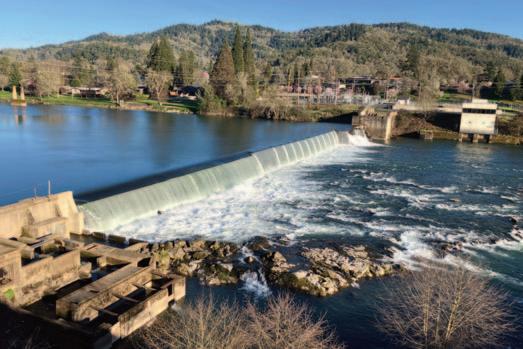
Winchester Water Control District has also contracted with Mount Hood Environmental in the past as an expert witness for their defense in federal court against allegations that Winchester Dam violates the Endangered Species Act by causing harm to federally-listed coho salmon. In the most recent development in that case, WaterWatch and Steamboaters, with Earthjustice as counsel, filed an appeal in September 2025 to the 9th Circuit Court of Appeals requesting review of a lower court ruling finding that the dam does not violate the ESA. The lower court reached this conclusion after finding that dam has significant issues, including many false attraction flows causing salmon to waste critical time and energy jumping where there is no passage, an inadequate and poorly placed fish ladder, and a design that forces fish migrating down-
Since then, the dam owners did not comply with a December 2023 order from state dam safety officials requiring annual “underwater camera inspections” of the dam and to finish “work to mitigate the voids within the dam” by 2024. The dam owner’s failure to comply with safety officials simultaneous order to take immediate corrective actions to address other issues causing the dam to be “unsafe or potentially unsafe” resulted in issuance of a proposed final order on March 2024 seeking to declare the dam a nuisance and removed at the dam owner’s expense. The dam owners first requested a contested case to oppose this order before entering into a consent order with the state in December 2024 regarding specific corrective actions.
Even so, the dam owners did not comply with a subsequent December 2024 order requiring annual “underwater camera inspections” of the dam and to finish “work to mitigate the voids within the dam” by 2025. Indeed, according to Winchester Water Control District’s 2025 financial report, the dam owners spent $0 for “repairs and maintenance” during the 2025 fiscal year. Most recently, in September 2025, dam safety officials ordered WWCD to “Repair the void [under the south end of the dam] or have an engineer assess the void and provide documentation to the state that the void is not a safety issue.”
Dam safety officials have annually asContinued on next page
sessed Winchester Dam to be in “poor” condition since at least 2019.
Despite their unwillingness to undertake necessary fish passage improvements, safety repairs, or water quality protection measures at their 136-yearold dam, the dam owners have been willing to fund multiple legal battles to challenge state enforcement actions intended to protect the public, native fish, and the North Umpqua. These legal fights come at significant cost to Oregon’s taxpayers. According to their annual financial reports, the dam owners spent $219,694 on legal fees in fiscal year 2025, $271,662 in fiscal year 2024, and $91,126 in fiscal year 2023. In total, over the last three fiscal years alone, the dam owners spent $582,482 on legal fees.
The District’s strategy of ignoring or challenging the state’s authority at every opportunity and embroiling the state in costly litigation at every turn rather than complying with state laws is doomed to fail. Insisting on owning a dam on one of the world’s most spectacular wild steelhead rivers without heeding the laws and responsibilities all other dam owners must follow is offensive to Oregon values and has done real harm to the North Umpqua River and the people who depend on it.
get too high for them to move through the watershed. If water temperatures warm too quickly, migrations will stop, preventing fish from accessing cold water habitats. Additionally, coho and fall Chinook typically migrate in the fall when water cools. Warm water temperatures will delay their migration timing, shifting run timing and possibly decreasing successful spawning. If salmon are delayed in their migration, risk increases that the fish will not reach suitable habitats in time to spawn. Delayed migration also increases the risk of pre-spawn mortality due to excessive temperatures, predation, or angling.
to restrictions on spring Chinook fishing with more restrictions likely as the season progresses. Spring Chinook salmon are being regulated on the North Umpqua at the “moderate” level on the sliding scale, allowing harvest of one fish a day and ten for the 2026 season. Last year, ODFW took the unprecedented step to restrict harvest to hatchery fish only in the North Umpqua, preventing the harvest of wild fish and eliminating a large portion of the opportunity for anglers. It is well known that if river conditions rapidly decline and low numbers of summer steelhead return to the basin, ODFW will close the summer steelhead fishery on August 1, something ODFW did in 2021 and 2023. These management restrictions will likely continue in future years. Migration delay and harm to fish caused by Winchester Dam is only increasing the threats to these fish, contributing to future restrictions.
In these poor river conditions, it is critical that migrating salmonids not have to endure additional stress due to manmade barriers to migration with inadequate fish passage such as Winchester Dam.
Fish species in the North Umpqua including steelhead, Pacific salmon and Pacific lamprey face multiple threats to their survival and successful migration and spawning. They are particularly at risk this year, and will continue to be at risk in years to come, due to drought conditions, climate change, and adverse river conditions. Winchester Dam will exacerbate these impacts to fish due to the delay and harm that it causes during migration.
Water temperatures are getting warmer, leading to lower dissolved oxygen levels which cause additional stress to migrating salmonids. This makes fish more vulnerable to multiple threats such as predation, disease, and decreased energy to access habitats.
Because water temperature is a key factor in triggering migration timing for salmonids, warmer than average water temperatures also disrupt migration. Unique life history strategies of salmon trigger different species to migrate during different seasons. Spring Chinook salmon and summer steelhead of the North Umpqua migrate early in the spring before water temperatures
Low river flows also make migration more treacherous for salmonids. River channels become shallower and narrower, leading to overcrowding, and increased stress. Fish are also more visible in shallower water, increasing the risk of predation.
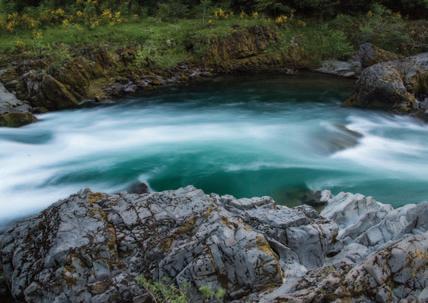
Low flows and warm water temperatures mean that deeper pools of cooler water that are critical for resting disappear. The combination of low flows and warm water temperatures will shift the thermal barrier to migration earlier in the year and prevent fish from migrating. An example of this was in 2021 when the Pacific Northwest saw the “heat dome” elevating air temperatures and water temperatures in June. When this occurred, the North Umpqua River saw a return of only 450 wild summer steelhead, less than 50% of their critical abundance threshold (the point at which a population is at high risk of extinction over a short period, or where conservation of the population could be in jeopardy if a downward trend continues) as defined by ODFW.
The negative impact that these river conditions have on fish has already led
Delaying installation of adequate fish passage at Winchester Dam, as the dam owners are doing with their repeated appeals, will only compound the harm the dam is causing every day to multiple species, including state “sensitive species” such as summer steelhead, spring Chinook, and Pacific lamprey.
The Winchester Dam owners cannot have a dam exempt from the rule of law. If the dam owners cannot tolerate the straightforward responsibilities of dam ownership, the only reasonable option is removal. Over the last five years, WaterWatch has offered twice in writing to the dam’s owners to remove the dam for little to no cost to them. Our hand will remain out to work cooperatively with Winchester Water Control District, state and federal government, and private organizations to accomplish successful dam removal and site restoration at Winchester.
Jim McCarthy is Southern Oregon Program Director for WaterWatch of Oregon and a member of Steamboaters Board of Directors.
Learn more at https://waterwatch.org and https://steamboaters.org.
By Kristie Klose, PhD
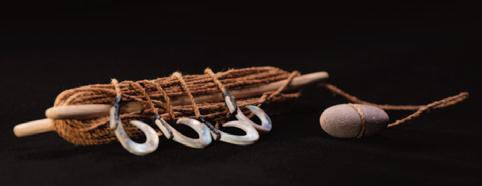
In the 16th century, Spanish explorers noted the fishing skills of indigenous Chumash, who used seines, gill nets, hook and line, fish traps, spears, bows and arrows, and natural fish poisons to capture fish along the Santa Barbara California Coast (Figure 1) (Alagona 2012). Smithsonian linguist and ethnologist John Peabody Harrington recorded Chumash elders and viewed tools specific to harvesting fish in streams and rivers, indicating that the Chumash exploited marine and freshwater habitats (Harrington 1942). Samala, language of the Santa Ynez Band of Chumash, included words for resident rainbow trout (‘oncho’) and salmon (‘okowoch’), and anecdotal accounts in Spanne (1975) describe dozens of salmon dead or dying in shallow water along a few hundred feet of the Santa Ynez River in the late 19th and early 20th centuries. It appears that Southern California steelhead trout (Oncorhynchus mykiss) were sporadically caught by indigenous peoples in the Santa Ynez and Ventura rivers prior to Spanish colonization, depending on flow patterns and run sizes. Historical distributions of the Southern California steelhead distinct population segment (DPS) extended north from the Santa Maria River south to northern Mexico (NMFS 2012). Southern California steelhead and resident rainbow trout are two life history forms of the same salmonid species (O. mykiss). Southern California steelhead spawn in freshwater gravel from December through April. Eggs incubate for 3-4 weeks, hatch, and juveniles spend 1-3 years in streams. The fish then migrate to the ocean as smolts, maturing for 1-3 years, before returning to
their natal spawning streams. This cycle can repeat multiple times. The average lifespan is 5-8 years but the species can live up to 11 years (NMFS 2012). The genetic population structure of the two life history forms, including those above and below barriers to migration, shows high divergence of loci located on the Omy5 chromosome (Pearse et al. 2016). Although the forms of the Omy5 chromosome are related to anadromous versus resident life history
Southern California steelhead and rainbow trout were some of the most abundant fish in southern California coastal streams.
forms, the two forms can interbreed and produce both resident rainbow trout and anadromous steelhead progeny (Sloat et al. 2014, Abadia-Cardoso et al. 2016).
Southern California steelhead and resident rainbow trout were some of the most abundant native fish in coastal streams of Southern California. They were abundant before 1) years of protracted drought (1943-50, 1952-56 and 1962-65); 2) multiple large fires that swept through the area (i.e., Kelly Fire (1922), 1923 Fire, Aliso Canyon Fire (1928), Matilija Fire (1932), Indian Canyon Fire (1933), Big Dalton Fire (1953) and the Refugio Fire (1955)); and 3) the onset of the 1950s Big Dam Era (Moyle et al. 2011, Alagona et al. 2012), which affected steelhead runs in the Santa Maria River (Twitchell Reservoir), Santa Ynez River (Bradbury, Gibraltar and Juncal Dams), Ventura River (Matilija and Robles Diversion Dams, and Casitas Reservoir) and Santa
Clara River (San Francisquito Dam (failed in 1928), Vern Freeman Diversion Dam and Santa Felicia Dam) systems (Moyle et al. 2008). These dams were erected primarily to sequester water for human consumption and mitigate the effects of floods, but some were also constructed to support a robust agricultural economy. Apart from the Vern Freeman Diversion Dam (1991), none of these dams accommodate fish ladders, and the fish ladder on Vern Freeman Diversion has not undergone structural modifications to facilitate fish passage, exacerbated by insufficient water releases through the Santa Clara River. Steelhead primarily used the broad and braided Santa Maria River as a migration corridor from the ocean to spawning and rearing tributaries in the Cuyama and Sisquoc Rivers. Few details exist on run numbers for the Santa Maria River system; however, hatchery-planted O. mykiss numbered 20,000 in 1930 and 8,000 individuals in 1932, 1939 and 1944-1947 (Titus et al. 2010). Run sizes for the Santa Ynez River were estimated at 13,000-14,500 individuals, 4,000-5,000 individuals for the Ventura River, and 9,000 O. mykiss for the Santa Clara River system (CDFG 1946, Moore 1980, Becker and Reining 2008). Despite substantial hatchery-planted O. mykiss during the 1930-40s, the Santa Maria, Santa Ynez, Ventura and Santa Clara River watersheds are still dominated by native coastal steelhead ancestry and not hatchery genotypes (Abadia-Cardoso et al. 2016). By the mid-20th century, dams on these rivers greatly reduced the habitat available to Southern California steelhead and populations declined exponentially (Titus et al. 2010).
The Los Padres National Forest (LPNF) extends from the Carmel River in the north to the Santa Clara River in the south, and is largely protected from extensive water diversions, irrigation intakes, wells and anthropogenic development and contains most of the historical and current spawning and rearing habitat for Southern California steelhead in the Monte Arido Highland Biogeographic Population Group (BPG)
Continued on next page
(i.e., Santa Maria, Santa Ynez, Ventura and Santa Clara Rivers). The LPNF also manages the headwaters of the Conception Coast BPG of Southern California (NMFS 2012). These BPGs encompass most watersheds with the greatest chances of Southern California steelhead recovery.
The lower sections of coastal streams and rivers of Central and Southern California, however, primarily run through private, state and county lands, with interior and headwater streams flowing through national forests. These unfavorable configurations create a migratory disconnect for anadromous species that not only rely on the inconsistent breaching of the flood tide shoal at the river mouth to access rivers and streams, but then must exert a Herculean effort to surmount numerous impediments (e.g., dams, debris basins, water diversions, road crossings) on rivers flowing through lands downstream of the national forest system, often lacking riparian cover (e.g., on agricultural lands), to reach natal spawning grounds within the LPNF interior. For example, before two concrete low-water crossings that blocked steelhead migration were removed by the LPNF in 2022 and replaced with two clear span bridges on Davy Brown Creek in the Upper Sisquoc River Basin, juvenile Southern California steelhead were unable to complete their life history cycles by passing to the Pacific Ocean. The successful navigation of the approximately 53-mile “root to fruit” mission further hinges on whether there is sufficient flow in the Santa Maria River and if the sandbar at the mouth near the town of Guadalupe is breached. The persistence of steelhead in this system attests to their impressive flexibility and resilience.
Today, Southern California steelhead are facing extinction, despite protections afforded by the highest levels of federal and state Endangered Species Acts (1997 and 2024, respectively). Data compiled from monitoring efforts and observations of Southern California steelhead over a period of 25 years (1994-2018) documented a mere 177 adult anadromous Southern California steelhead over approximately 500 km of the Pacific Coast from the Santa Maria River south to the Mexican border at Tijuana (Dagit et al. 2020). Annual rates of return of Southern California steelhead from the ocean to natal streams are estimated at less than
1% of historical levels. Correspondence from the California Department of Fish and Game in 1946 estimated Southern California steelhead run size at 4,000-5,000 individuals per year with adults averaging 24-26 inches in length and 5-6 pounds in weight (CDFG 1946). Historically, the most productive spawning habitat in the Ventura River watershed (26.6 stream km, 591 km2) occurred along Matilija Creek, running through private and USFS lands (Figure 2); however, in 1948 the Matilija Dam was constructed without a fish ladder, cutting off access to the majority of Southern California steelhead spawning and rearing habitat in the upper watershed (See the 2014 documentary film DamNation: The Problem with Hydropower produced by Patagonia Films and directed by Ben Knight and Travis Rummel for more details on the construction and history of Matilija Dam (https://www.youtube.com/watch?v=laT IbNVDQN8)). The Matilija Dam Ecosystem Restoration project is in its final design and permitting phases, with dam and sediment removal anticipated in 2030. Further downstream, Lake Casitas and the Robles Diversion Dam, completed in 1959, eliminated migration from Coyote Creek into the upper watershed, and created a barrier to steelhead migration in the Ventura River mainstem, cutting off access to important spawning and nursery grounds and the downstream migration of smolts. Although the Robles Diversion Dam fish passage facility (stream km 23.3) was constructed to facilitate migration of Southern California steelhead within the watershed in 2005, this did not provide access to most of the historical spawning and rearing habitat within the Matilija and North Fork Matilija Creek watersheds. Major impediments to migration such as dams and diversions have contributed greatly to severe steelhead population declines in Southern and Central California, but these negative consequences have been exacerbated by a variety of other factors. The combined effects of alter-
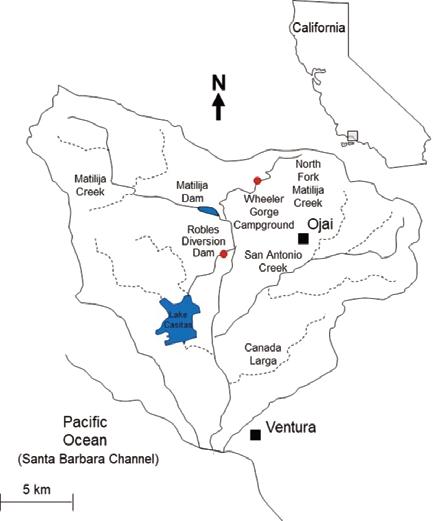
Figure 2. Ventura River watershed including Matilija Creek, Matilija Dam, Robles Diversion Dam, North Fork Matilija Creek, and the Wheeler Gorge Campground, north of the City of Ojai. Figure Courtesy Dr. Kristie Klose, Los Padres National Forest.
ations in natural flow regimes, ground water pumping, habitat degradation, aquatic invasive species introductions, wildfires and changes in weather patterns and precipitation have imperiled Southern California steelhead to the point of federal (1997) and state (2024) listing as an endangered species under federal (62 FR 43937; 67 FR 21856; 71 FR 834) and state (California Regulatory Notice Register 2022, No. 19-Z, p. 541) Endangered Species Acts (ESA).
The USFS Wheeler Gorge Campground on North Fork Matilija Creek, a tributary to the Ventura River, was originally built by the Boy Scouts in the 1920s and later developed as a public campground by the Civilian Conservation Corps in the early 1930s. In 1968, the campground was expanded, but much of it was destroyed in the flood of 1969. As-built drawings indicate that two concrete stream crossings were constructed on North Fork Matilija Creek and two on Bear Creek within the campground in 1977-78. Following decades of sediment aggradation upstream and significant down-cutting downstream, one of the two crossings on North Fork Matilija Creek had created a 4.5 m drop completely blocking Southern California steelhead upstream migration (Figure 3).
After a decade of forming partner-
Continued on next page
Continued from previous page
ships; developing lengthy conceptual and final design plans; permitting under the federal Clean Water Act 401/404, National Environmental Policy Act (NEPA), ESA and State Historic Preservation Office heritage/cultural consultations; and fundraising efforts by partner organization South Coast Habitat Restoration — which yielded funding from the Wildlife Conservation Board ($1.9 million), the California Department of Fish and Wildlife ($4.1 million), National Fish and Wildlife Foundation ($50,000) and Patagonia ($6,000) — the Wheeler Gorge Campground Aquatic Organism Passage and Restoration Project was completed in December 2025 at a total cost of just over $6 million. The project included the demolition and removal of four concrete low-water stream crossings, as well as the planting of 1,000 locally sourced riparian shrubs and trees, providing steelhead access to 26.2 km (over 32 km if unnamed intermittent and ephemeral tributaries are included) of high-quality perennial stream habitat. To examine the effectiveness and
impacts of this project on local steelhead populations, USFS and CDFW monitoring will include a combination of snorkel (quantitative) and eDNA (qualitative) annual surveys of NFMC and its tributaries (i.e., Cannon and Bear creeks). The first eDNA samples will be collected during spring 2026.
Currently, of the four primary river systems historically supporting Southern California steelhead, none have been provided with sufficient and consistent water releases from dams to support anadromy and the return of a recreational fishery. The goal of aquatic organism passage projects is to remove migration barriers, eventually resulting in self-sustaining anadromous fish populations and a viable fishery, provided sufficient water can be supplied. Further, headwaters are crucial refuges protecting aquatic biota from catastrophic events, but it is only by removing barriers to migration along the entire stream longitudinal profile that O. mykiss can complete its life history cycle. Humans should make every attempt to open stream corridors and sustain refuges by protecting or restoring native riparian vegetation, preventing or decreasing water abstraction, and removing barriers to migration, including manmade bathing pools that can trap migratory species.
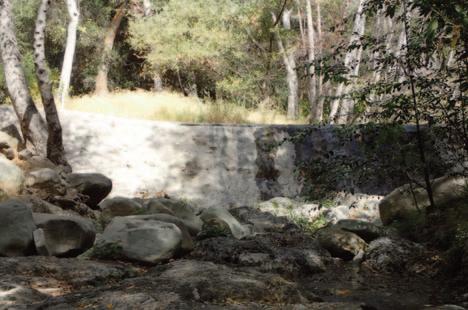
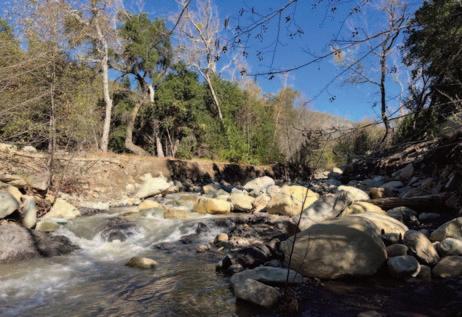
Klose, Los Padres National Forest (top) and Mauricio Gomez, South Coast Habitat Restoration (bottom).
Southern California steelhead populations can rebound, but it will take compromise and a collective effort across federal, state and local government agencies and disparate land use groups to get there.
Dr. Kristie Klose is Forest Fisheries Program Manager on the Los Padres National Forest where she uses scientific approaches to address watershed and river management issues, She received the Congressional Award for Outstanding and Invaluable Service to the Community from Congressman Salud Carbajal for the Wheeler Gorge Campground Aquatic Organism Passage and Restoration Project. To learn more about the LPNF visit:
https://www.fs.usda.gov/r05/lo spadres
Abadía-Cardoso, A., D.E. Pearse, S. Jacobson, J. Marshall, D. Dalrymple, F. Kawasaki, G. Ruiz-Campos, and J.C. Garza. 2016. Population genetic structure and ancestry of steelhead/rainbow trout (Oncorhynchus mykiss) at the extreme southern edge of their range in North America. Conservation Genetics 17: 675-689.
Alagona, P.S., S.D. Cooper, M. Capelli, M. Stoecker and P.H. Beedle. 2012. A history of steelhead and rainbow trout (Oncorhynchus mykiss) in the Santa Ynez River watershed, Santa Barbara County, California Bulletin of the Southern California Academy of Sciences 111: 163-222.
Becker, G.S. and I.J. Reining. 2008. Steelhead/rainbow trout (Oncorhynchus mykiss) resources south of the Golden Gate, California. Cartography by D.A. Asbury. Center for Ecosystem Management and Restoration. Oakland, CA
California Department of Fish and Game. 1946. Field Inspection Trip to the Matilija-Ventura Watershed in Relation to the Construction of the Proposed Matilija Dam. Report by D.A. Clanton and J. Willard Jarvis.
Craig, S. 1967. The basketry of the Ventureño Chumash. UCLA Archaeological Survey Annual Report, 9: 78-149.
Dagit, R., M. Booth, M. Gomez, T. Hovey, S. Howard, S. Lewis, S. Jacobson, M. Larson, D. Mccanne and T. Robinson. 2020. Occurrences of steelhead trout in southern California, 1994-2018 California Fish and Wildlife. 106: 39-58.
Garza, J.C. and A. Clemento. 2008. Population genetic structure of Oncorhynchus mykiss in the Santa Ynez River, California Final report for contract with the Cachuma Conservation Release Board.
Harrington, J.P. 1942. Culture element distributions: XIX: Central California Coast University of California Anthropological Records. 7:1–42.
Moore, M.R. 1980. An Assessment of the Impacts of the Proposed Improvements to the Vern Freeman Diversion on Anadromous Fishes of the Santa Clara River System
Moyle, P.B., J.A. Israel, and S.E. Purdy. 2008. Salmon, steelhead, and trout in California: status of an emblematic fauna Report commissioned by California Trout, San Francisco, CA. UC Davis Center for Watershed Sciences, University of California, Davis, CA. 316 pp.
Moyle, P., J.V.E. Katz, and R.M. Quinones. 2011. Rapid decline of California’s native inland fishes: a status assessment Biological Conservation 144: 2414–2423.
National Marine Fisheries Service (NMFS). 2012. Southern California steelhead recovery plan Southwest Regional Office, National Marine Fisheries Service, Long Beach, CA. p. 562.
Normandeau Associates, Inc. 2015. Steelhead Population and Habitat Assessment in the Ventura River Matilija Creek Basin Report prepared for the Surfrider Foundation, Ventura, CA.
Pearse, D.E., M.R. Miller, A. Abadia-Cardoso and J.C. Garza. 2014. Rapid parallel evolution of standing variation in a single, complex, genomic region is associated with life history in steelhead/rainbow trout Proceedings of the Royal Society B 281: (1783): 20140012.
Sloat, M. R., D.J. Fraser, J.B. Dunham, J.A. Falke, C.E. Jordan, J.R. McMillan, and H.A. Ohms 2014. Ecological and evolutionary patterns of freshwater maturation in Pacific and Atlantic salmonids. Reviews in Fish Biology and Fisheries 24: 689-707.
Spanne, L. 1975. Seasonal variability in the population of Barbareño Chumash villages: An explanatory model. Papers on the Chumash, San Luis Obispo County Archaeological Society Occasional Paper 9:61–87.
Titus, R.G., D.C. Erman, and W.M. Snider. 2010. History and status in California coastal drainages south of San Francisco Bay In draft for publication as a Department of Fish and Game, Fish Bulletin.
By Joseph Bogaard
President Joe Biden was sworn into office in 2021 at a time when the Northwest’s longstanding approach to Columbia basin salmon recovery was on the front end of a promising realignment. Decades of litigation combined with a dearth of political leadership had produced six inadequate, illegal and costly federal salmon plans, and steadily declining wild salmon and steelhead populations. In response to years of intransigence by the Bonneville Power Administration and Army Corps of Engineers, the U.S. District Court in Portland in 2005 began ordering modified operations of the federal hydro-system’s eight dams and reservoirs in the lower Snake and Columbia rivers to boost the survival of gravely endangered wild salmon and steelhead populations. “Spill” sends water — and juvenile fish — over the tops of dams rather than through the turbines during spring and summer to deliver critical survival benefits to salmon and steelhead migrating to the Pacific. By accelerating the young fishes’ journey to the ocean and reducing powerhouse encounters, spill has proven to be a lifeline for the nine imperiled populations that must migrate twice through some or all of these dams and reservoirs in order to complete an astonishing lifecycle that takes them from freshwater to saltwater and back again.
Spill to aid salmon has been ordered by the court in one form or another every year since 2005. By itself, however, spill is insufficient to recover these imperiled fish — and especially those that return to the Snake River Basin. Much more is needed. Roughly six years ago, after seemingly endless litigation, more than $25 billion in spending and still-declining fish populations, a few regional policymakers came to accept that a new approach was urgently needed to protect salmon from extinction, spend taxpayer dollars responsibly, uphold our nation’s promises to Tribal Nations, support struggling fishing communities and provide greater certainty for everyone.
Republican Representative Mike Simpson, a conservative lawmaker from the conservative state of Idaho, delivered the first swift kick to the status quo in February 2021. After hundreds of meetings with leaders, tribes and stakeholders, he proposed an expansive salmon recovery initiative for the Columbia Basin that included removal of the four lower Snake River dams (Ice Harbor, Lower Monumental, Little Goose and Lower Granite) and replacement of their services.
President Biden’s Administration marked an historic turning point for native fish restoration in the Columbia-Snake River Basin. President Trump is working hard to reverse it.
While Representative Simpson’s specific proposal was not ultimately embraced, his visionary approach and commitment to finding real and lasting solutions brought other politicians into a much-needed conversation about the necessity — and great opportunity — of restoring the lower Snake River and its imperiled fish populations through dam removal. In the often-contentious regional dialogue that ensued, other policymakers planted stakes as well. Notably in Washington State, Senator Patty Murray (D-WA) and Washington Governor Jay Inslee (D) teamed up to examine issues and options and in summer 2022 they published their Lower Snake River Dams Benefit Replacement Report. It marked an important milestone for the Snake River and its imperiled native fish. The report found
that protecting these fish from extinction requires a restored, freely flowing lower Snake River, and that the four dams’ services were fully replaceable though it would require time, planning and funding.
Washington State legislators were also paying close attention and they leaned in after the release of the Murray-Inslee report. In three separate sessions, legislators in Olympia approved funding to support dam service replacement planning for energy, water supply, transportation and recreation to gather information and develop robust action plans in preparation for dam removal. The Biden Administration also took note of the growing regional engagement by Tribes, stakeholders and policymakers. It saw both a favorably changing political landscape and a leadership opportunity to bring people together to address a set of thorny problems that have vexed the Northwest for decades.
Many months of conversation and collaboration involving the administration and regional leaders culminated with several big announcements in December 2023. First, an historic new alliance — the Six Sovereigns — went public. It included four Tribes and two states: the Nez Perce, Yakama, Warm Springs and Umatilla Nations, and Washington and Oregon. The “6S” had spent months jointly developing and then pressing the Biden Administration to embrace its holistic plan — the Columbia Basin Restoration Initiative (CBRI) — to rebuild salmon abundance in the Basin and invest in the region’s communities and energy system. [Editor’s Note: See “A New Way Forward for the Columbia and Snake Rivers and Their Endangered Native Fish” by Joseph Bogaard, The Osprey, Spring/Summer 2024.]
The Biden Administration countered with a more modest proposal that drew upon key elements of the CBRI. After months of negotiating, the Administration, 6S and a set of conservation and fishing NGOs agreed upon the Resilient Columbia Basin Agreement (RCBA) in late 2023.
Continued on next page
The Agreement signaled for the first time federal government support for breaching the four lower Snake River dams and included a critical set of steps to move down this path. It aimed to funnel more than half a billion dollars in funding to the region for the alternative power sources, irrigation, transportation and more that would be needed in order for the dams to be removed. Breaching them, however, will still require an act of Congress. The historic agreement also included a pause in the long-running litigation for at least five years, and interim operating guidelines for hydropower at the dams.
In addition to the significant funding, the initiative committed the Department of Interior to analyze the dams’ impact on tribal treaty rights and provide “a comprehensive acknowledgment from the federal government of the dams’ profound negative effects on every aspect of these tribes’ ways of life.” This report, Historic and Ongoing Impacts of Federal Dams on the Columbia River Basin Tribes, was published in June 2024. While the important report has been recently scrubbed from federal websites, it is still available at: http://bit.ly/4n0B0Ib
Columbia Basin tribes and other signatories were hopeful that the new initiative would help salmon rebound across much of the Columbia Basin, including on the Snake. “For too long we have seen the federal government try to do the minimum amount necessary to pass legal muster,” said Jonathan W. Smith Sr., the chairman of the Warm Springs Tribal Council. The tribe, he said at the time, is optimistic that the agreement “will chart a new course for the federal government that will lead to true restoration of our fisheries. There is no time to waste.”
Then on Nov. 5, 2024, Donald J. Trump was elected President and everything changed. It took six months for the new administration to focus on the RCBA and in mid-June 2025, President Trump announced the sudden unilateral termination of this historic agreement establishing a first-ever partnership between the federal government and a set of Tribes, states and stakeholders in the Pacific Northwest to work together to protect and recover imperiled fish populations in the Columbia-Snake River Basin and invest in communities, clean energy and other important regional infrastructure.
For salmon and fishing advocates, the
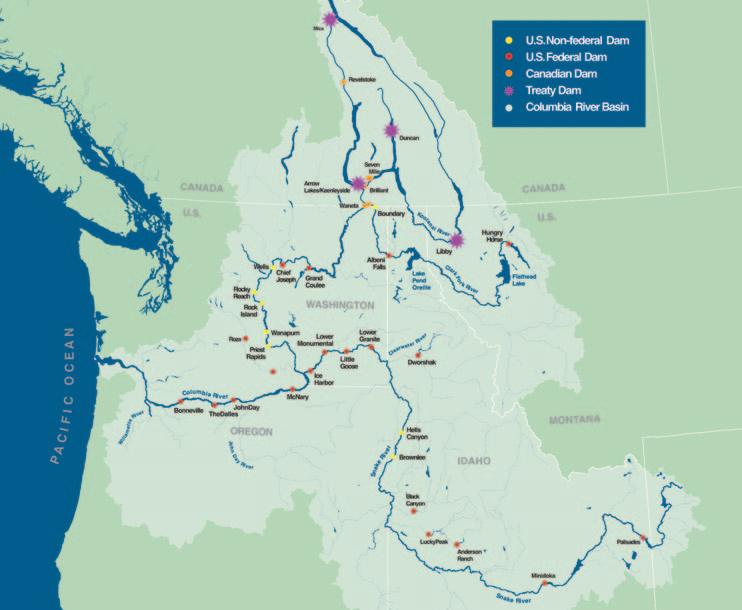
There are more than 169 dams within the Columbia River basin including 14 on the Columbia River mainstem and 20 on the Snake River. Map courtesy Bonneville Power Administration.
administration’s decision to cancel the agreement was disappointing but not surprising. Previous funding commitments were rescinded. Federal agency partnerships with regional interests ended. While the Northwest’s collaboration with the federal government may have disintegrated, salmon recovery relationships, commitments and momentum that had grown over the previous 4-5 years among Northwest states, tribes and NGO partners remain strong. Regionally-based collaboration, advocacy and salmon recovery projects continue today despite a highly antagonistic administration in Washington D.C.
With the administration’s termination of the RCBA, salmon and fishing advocates were left with no choice but to return to court and continue fighting for the Northwest’s endangered native fish and their rivers. Litigation got restarted last September when an expanded set of allies (Nez Perce and Yakama Nations, Oregon and Washington State, and salmon and fishing NGOs led by Earthjustice) asked the U.S. District Court in Portland to lift the litigation stay. Soon afterward, the previously-paused lawsuit to invalidate a woefully inadequate 2020 Federal Salmon Plan (Biological Opinion) was re-filed with the Court, and accompa-
nied by a request for preliminary injunction to modify lower Snake and Columbia river dam and reservoir operations starting in 2026 in order to boost the survival of ESA-listed stocks that migrate through them each year. After a quick exchange of briefs by both plaintiffs and defendants, and inperson oral arguments in Portland in early February 2026, the judge granted key elements of the plaintiffs’ request, including ‘max spill’ at all eight dams from early April to the end of August. As expected, the federal government has challenged the U.S. District Court ruling in the Ninth Circuit Court of Appeals. Thanks to the court order, the dam agencies are providing ‘max spill’ at all eight dams now while the feds’ appeal moves through the courts.
And while the above court action may be the most impactful near-term action advocates can take in the current environment to deliver much-needed survival benefits to endangered salmon and steelhead as they migrate through the federal hydro-system, we’re also working together in other policy venues to fight for the fish and secure key funding and programs needed to keep important projects and processes moving forward.
Coordinated and sustained advocacy
Continued on next page
in Congress led by the Six Sovereigns and supported by many conservation and fishing NGOs in 2026 secured Fiscal Year 2026 appropriations for important salmon recovery programs such as the Pacific Coast Salmon Recovery Fund at funding levels quite similar to 2024. This hard-won victory rejected the administration’s proposal to effectively eliminate federal spending for salmon recovery in the Pacific Northwest. These efforts in Congress were spearheaded by Senator Murray — ranking member of the Appropriations Committee — with strong and active support from many other members of the Northwest Congressional Delegation. A similar coordinated effort is now underway as the 6S and NGO community seek critical funding to support recovery in Fiscal Year 2027 appropriations.
One more example of regional leadership and progress at this challenging time: the Washington State legislature approved a budget for 2026/2027 that includes funding to keep the lower Snake River dam services replacement planning processes moving forward. Two replacement planning processes, water supply and transportation, are fully funded and will soon be completed. Two others, energy and recreation, are moving forward albeit more slowly and additional funding from the state legislature was crucial for continued progress. Thanks are due to current Washington State Governor Bob Ferguson (D), who included these line items
in his budget proposal last December, and to legislative leaders who ensured they were included in the final state budget approved in April.
While it is important to celebrate these important salmon recovery wins — including the still-new restoration of a freely-flowing Klamath River — let’s also acknowledge the larger political dynamic that salmon, orca, and river advocates are operating in today. The Trump Administration and the current Congress has brought a wrecking ball to nearly all conservation policy debates including de-staffing agencies, defunding programs, repealing and re-
It’s more important than ever that salmon and fishing advocates focus on our shared values, areas of agreement and common ground.
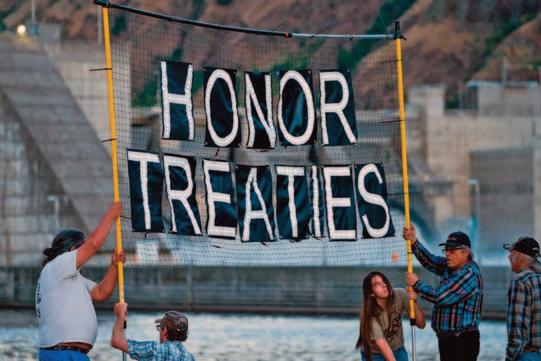
Nez Perce Tribal members raising a banner in 2024 near Lower Granite Dam on the lower Snake River to remind people and policymakers of our nation’s 160 year-old promises in its treaties with many Northwest Tribal Nations that guarantee healthy, abundant and harvestable populations of salmon now and in the future — forever.
ESA-Listed Columbia and Snake River Salmon and Steelhead
[Snake River Sockeye Listed November 1991
[Snake River Fall Chinook and Spring/Summer Chinook Listed April 1992
[Lower Columbia River Chinook Listed March 1999
[Upper Columbia River Chinook Listed March 1999
[Columbia River Chum Listed March 1999
[Upper Columbia steelhead Listed August 1997
[Snake River Basin Steelhead Listed August 1997
[Lower Columbia River Steelhead Listed March 1999
[Middle Columbia River Steelhead Listed March 1999
scinding long-standing policies, ignoring the intensifying impacts of accumulating greenhouse gasses and climate change, and so much more. Salmon and fishing advocates across the region are deploying all-too-limited resources working to slow and defeat the relentless attacks on our lands, waters, fish and wildlife, and communities. These are especially challenging times and we have lots of hard work ahead including educating the public, mobilizing our supporters, supporting allies who are fighting in court, engaging our decision makers, and building real people and policymaker power. It’s more important than ever that salmon and fishing advocates focus on our shared values, areas of agreement and common ground. And while the RCBA may have been
terminated by the administration, the CBRI developed by the Six Sovereigns remains as a North Star to guide the work of our region’s salmon, orca, clean energy and community advocates in the months and years ahead. In order to protect and rebuild abundant native fish populations and the many gifts they bring to the Northwest and nation, we must work together in coalition and collaboration.
We saw the power of solidarity when diverse advocates joined forces last year to kill the proposal to sell off public lands. There’s no doubt that we’ll face many more challenges with this Congress and administration. We’re always stronger together. Let’s keep this fact front and center in the weeks, months and years ahead. Let’s never forget that we are always stronger when we are working together to defend and protect the things that make our home lands and waters special — and that we depend upon for our own health and happiness.
Joseph Bogaard is Executive Director of Save Our Wild Salmon. Learn more about their work at: https://www.wildsalmon.org.
Over the past several decades, Indian River pink salmon runs in Alaska’s Sitka National Historical Park have exploded, and in some years cause signficant decreases in the river’s oxygen levels. A recent study by the National Park Service and University of Washington examined the causes and impacts of these increased runs.
Located on the southeast Alaska coast, the 113-acre Sitka National Historical Park commemorates the site of a battle between the Native Tlingit tribe and Russian settlers in 1804. The Indian River, which flows through the park, hosts runs of pink, chum, coho and Chinook salmon.
Pink salmon are the most abundant, and data from the Alaska Department of Fish and Game show that annual pink salmon escapement in the Indian River has increased from a few thousand in 1980 to more than 100,000 today. In addition, the pink salmons’ spawning period appears to have increased from the typical August and September to July though October.
The significant increase in numbers of returning pink salmon along with their extended time in the river can deplete concentrations of in-stream dissolved oxygen, putting additional stress on other aquatic species. The risk is especially great during periods of low water in the river. This ocurred during the large pink salmon run of 2013 that caused a 37-day period when dissolved oxygen in the river dropped far below the level needed for most freshwater species to physiologically function at a healthy level.
A potential culprit for the increasing numbers of pinks salmon may be strays from the fish hatchery at the Sitka Sound Science Center, located adjacent to the park, which uses the Indian River as its water source.
Beginning operations in 1975, the hatchery intially produced one million pink salmon yearly. That number was increased to three million beginning in 2010.
The combination of the nearby hatchery and the propensity of straying in pink salmon populations suggests that hatch-
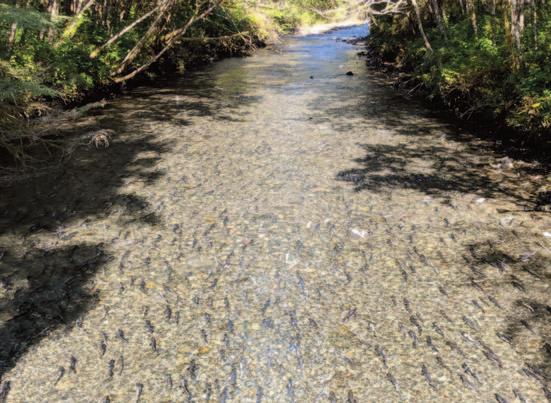
ery strays are a possible explanation. Surveys conduced on the Indian River in 2011 found that fewer than five percent of pink salmon were hatchery strays. By 2015, that number increased to 33 percent.
In a natural situation, ecological process can help modify instances of excessive abundance that exceeds carrying capacity. For salmon, an example would be that female spawners arriving later will dig up the redds of previous females to build their own nests, destroying the eggs already deposited there. This helps regulate a stream’s natural carrying capacity. In addition, hypoxia — the decrease in dissolved oxygen caused, in this case, by a natural population spike — will result in some spawners asphyxiating, further reducing an excessive spawning run. However, these natural carryingcapacity responses my not work as well if a stream is overrun by hatchery fish.
It is also possible that hatchery strays are not the explanation and that the Indian River is returning to its historical pink salmon escapement numbers.
In the early 1940s, the US Navy contracted to dredge the Indian River of gravel and sand to build fortifications and an airport nearby. That dredging led to severe flooding between 1940 and 1960 that did substantial damage to the river’s habitat. Then, in 1960, Alaska banned the use of salmon fish traps, suggesting that salmon populations were at very low levels by that time.
If that is the case, it may be that the increase in pink salmon in the Indian River is a natural response to improved habitat conditions over time and reduced harvest. National Park Service and University of Washington scientists are continuing their research on the Indian River’s pink salmon runs.
Information for this story came from a report published in Alaska Park Science, Volume 24, Issue 1. It is available to download at: https://www.usgs.gov/centers/alaska-sciencecenter/news/alaska-park-science-usgs-and-national-park-service-partners
University of British Columbia scientists studying artificial turn fields in Metro Vancouver have found they leach 6PPDquinone, a chemical known to kill coho salmon, into the municipal stormwater systems. In addition, the artificial turf remains contaminated for a signficant period of time after the fields have been installed.
The source of the lethal chemical is “crumb rubber infill,”which is made from recycled tires and is a common component in the manufacture of artificial turf. A typical field of artificial turf contains some 125 tons of crumb rubber derived from about 20,000 tires.
Scientists have already discovered that 6PPD-quinone leaches off tire debris on roadways during wet weather and washes into streams. Coho salmon mortality has been documented in streams where the chemical has been detected.
The study was initiated when a local Vancouver streamkeepers group reported, in 2023, finding crumb rubber washing from an artificial turf field into an urban stream and dead coho salmon were observed.
Continued on next page Indian River pink salmon runs are exploding. Researchers are trying to figure out why. Photo by Erector, Creative Commons Attribution-Share Alike 4.0 International License.

Crumb rubber infill used in the manufacture of artifical turf can leach chemicals lethal to coho salmon into nearby streams during rain events. Photo by Håkan Dahlström. Creative Commons Attribution 2.0 Generic License
The study found that even after six years, artificial turf fields were leaching enough 6PPD-quinone into streams to be fatal to juvenile salmon. They also found that heavy metals, such as zinc and copper, were also being regularly washed into streams.
Since these turf fields drain through stormwater pipe systems, it is possible to develop treatment strategies. It has been found that running stormwater through a planted soil filter may reduce concentrations of 6PPD-quinone by as much as 10 times.
While researchers note there are safer alternative materials for artificial turf infill they are more expensive, and nat-
ural material like cork is subject to freezing in the winter that would limit the use of fields during cold weather.
Information for this story comes from the article “UBC study links artificial turf fields to lethal chemical threat for salmon” published in UBC News
The study is available at: https://pubs.rsc.org/en/content/articlehtml/2026/em/d5em01016k
The National Oceanic and Atmospheric Adminstration has denied a petition to list Chinook salmon in the Gulf of Alaska under the federal Endangered Species Act. The petition was submitted by the Wild Fish Conservancy on January 11, 2024 requesting that NOAA “delineate and list one or more evolutionarily significant units (ESUs) of Chinook salmon in southern Alaska as threatened or endangered under the ESA.” The petition also requested the designation of critical habitat.
The petition was denied on May 13, 2026. Reasons included NOAA’s opinion that current low run sizes are fluctuations in abundance and productivity and that many Alaska stocks are stable. Also, despite declines in abundance and activity overall populations across multiple stocks are large throughout all ESUs.
The Wild Fish Conservancy says NOAA is lumping all Gulf of Alaska Chinook into three ESUs that doesn’t reflect the true number of distinct stocks and declining numbers. The Conservancy noted that designating broad ESU boundaries would allow smaller, weaker stocks to vanish as long as the larger stocks remained healthy, resulting in a loss of genetic diversity.
See https://wildfishconservancy.org/noaa-fisheries-fails-toprovide-federal-protections-for-gulf-of-alaska-chinook/
To support our conservation mission and receive The Osprey three times per year, January, May and September, please fill out this coupon with your check made out to The Osprey - The Conservation Angler and mail to: The Osprey P.O. Box 13121 Portland, OR 97213
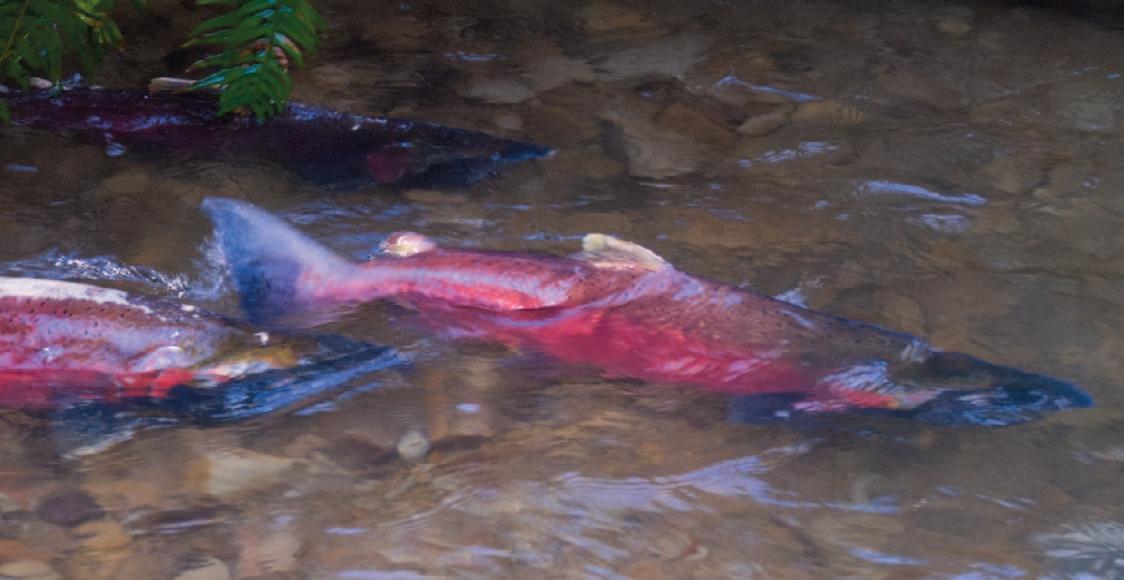
Or donate at: www.ospreysteelhead.org/donation

P.O. Box 13121
Portland, OR 97213