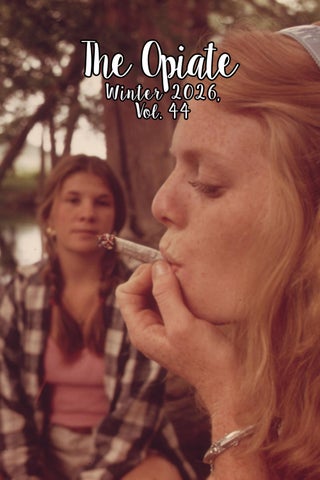
The Opiate Winter 2026, Vol. 44
The Opiate Your literary dose.
© The Opiate 2026 Cover art: Girl smoking a joint while her friend watches, May 1973 by Marc St. Gil This magazine, or parts thereof, may not be reproduced without permission. Contact theopiatemagazine@gmail.com for queries.
“You may think it all very fine... to amuse yourself with rousing my jealousy; but take care you don’t rouse my hate instead.” -Anne Brontë
“Paris is a cunt.” “Paris is my friend.” -Lindsay Lohan
“Girl, it’s so confusing sometimes to be a girl.” -Charli XCX
3.
The Opiate, Winter Vol. 44
Editor-in-Chief Genna Rivieccio Editor-at-Large Malik Crumpler Editorial Advisor Anton Bonnici Contributing Writers: Fiction: Laura Zinn Fromm, “With the Water Comes the Rush” 11 Giulia Carones, “Cranes and Crows” 24 Dylan Ogden, “Storytelling” 30 P. A. Farrell, “Between Silence and Truth” 43 Chiara Maxia, “Destroy Uranya” 48 Lillian Davies, “Nothing At All” 55
4.
Poetry: Edward L. Canavan, “Over Again” 63 John Grey, “In Deadville” & “Souvenir Shopping” 64-65 Susan Shea, “In Focus,” “Spreading Out,” “Family Jewels,” “Composition” & “Chewing On It” 66-70 Diane Funston, “Scar,” “Something Wickedly Different” & “Uncle Lou” 71-75 Dale Champlin, “Cinderella Meets a Salamander at Moonrise,” “Oh! I Lost My Temper” & “My Mother’s Ghost” 76-78 Jessica de Koninck, “1956 Nash Rambler Cross Country Station Wagon,” “Sheep’s Clothing” & “Across the Universe” 79-83 Frankie Laufer, “Veering to the Left” & “Apocalypse Now” 84-86 Ron L. Dowell, “If Daphne Monet were to converse with bell hooks” 87-89 Criticism: Genna Rivieccio, “Sophie Gilbert’s Girl on Girl Methodically Lays Out Why Growing Up in the 2000s Wasn’t As ‘Covetable’ as Subsequent Generations Might Believe” 90
5.
The Opiate, Winter Vol. 44
Editor’s Note
Among some of my many unfortunate core memories is engaging in a chat with a quintessentially bitchy cheerleader on MSN Messenger. I don’t remember what I said to prompt the following statement from her about me, only that the all caps, bright pink letters still occasionally flash violently in my mind’s eye out of nowhere: SHIT TALKIN FATTY. (I might add here that to be “fat” by the standards of the day was to possess anything resembling a non-Paris Hilton figure.) And yes, speaking of shit talking, it was very much the thing to do on MSN Messenger, a still germinal medium when I was using it in junior high. Whatever it was I had said or done to invoke this “branding” from the chilling cheerleader, her reaction to me, I realize now, was part and parcel of what I can presently recognize as a distinctly 2000s form of conditioning on the average girl’s brain. At least, the average girl exposed to/bombarded with pop culture and mass media. And while it’s rare for me to speak in such a candid manner in terms of “dating myself” (even though if you ever ask me, I will consistently tell you that I am twenty-nine, and you can’t tell me otherwise), I’ve lately been having a reckoning with the side effects of coming of age during that time. Then again, let us not forget that MSN Messenger is something that wasn’t out of a “young’un” like Charli XCX’s realm of knowledge either...hence, repurposing her MSN screen name for pop stardom. In fact, the sudden renaissance XCX is having after years of trying to “find her voice” in its most unmitigated form might very well be the result of finally “deprogramming” a bit from the pop culture that she grew up on, including the Spice Girls and Britney Spears. Each “act” having an immeasurable influence on so many hordes of preteen and teenage girls as they were growing up during this era. And while some might offer that the Spice Girls were a positive influence on women and embracing “girl power,” there’s no denying that what the group represented was yet another win for the patriarchy in that the presumed extent of what women could be and do was still limited to one-dimensional tropes and shopping. XCX would comment in 2015 of trying to “overthink” the Spice
6.
Girls in such a manner as follows: “The idea of, like, overanalyzing the Spice Girls is such a sad thing for me because they were just like so celebrated and joyous.” But, as many know by now, experiencing joy of this kind so often comes at a larger cost. In this case, being indoctrinated with a very superfluous view of feminism. And one that was nicked from the more rough-hewn (read: less commercially palatable) form of Girl Power established by Bikini Kill at the dawn of the 90s. Alas, by the late 90s and going into the 2000s, that original messaging had been repackaged, first by the Spice Girls, and then other girl groups that were being propped up as similar models by various record labels. This included the likes of Destiny’s Child, a group that also presented messaging which, on the surface, seemed positive, “self-affirming.“ Take, for example, 2000’s “Independent Women Part I.“ Still heralded to this day as a “feminist anthem,“ it doesn’t take much digging beyond the surface to see that all the song promotes is women modeling themselves after male behavior so that they can keep contributing to the capitalist machine. Because yeah, that’s frankly all anything is ever about. Particularly when it comes to being deemed “worthy” in this society. So it is that Beyoncé proudly sings, “Question, tell me what you think about me/I buy my own diamonds and I buy my own rings/ Only ring your celly when I’m feelin’ lonely/When it’s all over, please get up and leave.” Here, it’s worth interjecting that Beyoncé is reinforcing the then new flex of the late twentieth century, as exemplifed by Carrie Bradshaw in the pilot episode of Sex and the City, during which she spends the duration of it exploring her capacity for “having sex like a man.” This means, from the female viewpoint, being able to effortlessly discard someone after you’re done using their body without being “weak” enough to let emotions get involved. To be sure, one could argue that most of the pop culture to come out of the late 90s and early 2000s was designed to be as desensitizing as possible, particularly in the presentation of women as oiled-up, anorexic creatures from the Planet Spray Tan. All suited and tailored for the male gaze. Yet Beyoncé insisted, “Question, tell me how you feel about this/Try to control me, boy, you get dismissed.” To say the least, this kind of, let’s call it, mixed messaging was among the many conundrums of the day that might
7.
The Opiate, Winter Vol. 44 fuck with an impressionable girl’s head. Not to mention the body image issues that were so casually cultivated thanks to the photos and language of the then still powerful print magazine. Publications like Seventeen, Cosmogirl and YM all had their effect on the still-forming teen girl mind. And what most of these periodicals had to say was that a girl should go out of her way (often literally...as in, being driven to the mall) to look hot, thin and generally pleasing to the opposite sex. This is not to exclude the equally as affecting “peripheral” types of magazines one would come across all the time at various “checkout counters.” Namely, Us Weekly, In Touch and even People (which tried to present itself as the “classiest” of the options, but was also undercover cunty). And sure, we can throw Life & Style in there as well. All magazines that trumpeted which “it” girls of the day were too thin or too fat (ergo, the apropos “Piece of Me” lyric, “I’m Mrs. She’s too big, now she’s too thin”), which ones were supposedly on drugs and which ones had just been dumped by some chiseled actor or boy band member-turned-solo-artist. The schadenfreude being particularly high among readers if the “it” girl had gained weight or been dumped. Better still, if the “it”girl could be described as “crazy” and/or “out of control” (a.k.a. simply going out to a bar or club as any twenty-something with money would feel obliged to do). Britney Spears hit the mark on all of those counts, with her mental health struggles in the mid-00s being not only a source of “delight” to the paparazzi, but also to the readers consuming these grotesque snapshots of her day-to-day existence like “content.” Watching and waiting every week for the next “morsel” of hot gossip. In this regard, tabloid journalism of this nature did presage (or rather, primed) the appetite for the kind of nonstop (and ultimately meaningless) content that has since transferred to the social media sphere. So no, it can’t necessarily be said that things are totally different or “better” since that decade has come and gone. At the same time, there’s no denying that the 2000s signaled a uniquely horrible time to be a woman in the public eye and a woman in general (influenced by the normalized horrors they were seeing inflicted upon the former). Because it was during this socalled blip that women were being treated like “fodder” more
8.
than they ever had before when it came to their representation —their tarring and feathering—in the media during a period when feminism was supposed to have “won.” The mid- and late 90s might have set the stage for this, with such highly vilified and/or slut-shamed women as Tonya Harding, Pamela Anderson and Monica Lewinsky being dragged through the media mud, but in the 2000s, the woman-hating got turned on to full blast with little in the way of mitigation. Yet, despite all this, it’s still so easy, so alluring to romanticize that era. The “golden years” before the internet entirely took over all facets of existence. However, the drawback to the internet’s lack of total pervasiveness then was that women couldn’t have a direct line to their peers or their public to set records straight and speak for themselves. In a sense, one might posit that “it was the best of times, it was the worst of times.” Including the fact that, even though the internet wasn’t on your phone and tracking your every move just yet, it was still modern enough to leave scarring memories. And, speaking of, I don’t know where that fucking cheerleader bitch is now, but I can only hope it’s somewhere cliché, like a trailer park... Obviously, I still have a lot of work to do on myself...on being less catty toward other women. Even the ones who have gone out of their way to make me feel bad about myself. But maybe their cruelty, too, is a byproduct of too many formative years spent in a certain decade.
A shit talkin fatty by 2000s standards (and, who knows, maybe even by today’s), Genna Rivieccio January 2026 P.S. Never doubt that the pop culture you consume, whether directly or indirectly, matters.
9.
FICTION
10.
With the Water Comes the Rush Laura Zinn Fromm
I
tell my therapist I can’t make our Friday appointment and need to reschedule. Frieda says sure, surfing needn’t trump therapy. She gives me Friday, eight a.m., two hours before my lesson. My younger daughter, Samantha, is in rehab. Well, she was. She left Monday night, went back Tuesday and left again Wednesday. Today is Friday. I am trying to surf my way through her addiction. What Dena said about letting go, about letting Samantha have her space so she can make a decision about her recovery, is great advice. Your daughter knows you love her. She knows we all care about her very deeply at Queens House. In many ways, this is a solo journey, and she has to make a decision to commit to her recovery. She told you she loves you and is being honest. That’s progress from last weekend. Now it’s time for you to let go and have faith. We never know when our children are gonna “get it”—it’s usually not in our time, it’s in Gods time. This is from Kath, the woman who runs Queens House, where Sammy was living the past three months. Kath’s mother was an addict, her daughter is an addict and Kath herself is a middle-aged addict in recovery. She’s also a social worker who teaches Pilates. I love her. She lost me at “Gods time” (where is the apostrophe and, more to the point, where is God?), but I got what she was trying to say. Dena is Kath’s caseworker at Queens House. There is another woman, Brid-
11.
The Opiate, Winter Vol. 44 get, who only gets involved when something goes wrong. Kath sent me a list of parent-focused Al-Anon meetings. If you’re interested in Al Anon parent meetings, there are two tomorrow that are good. I think the California one is bigger and more focused on the steps but not 100% sure. I’ve been to both. I text Kath and ask her if we should drive into the city and try to find Sammy. My husband, Dan, said he wants to text her and tell her we’ll take her out for ice cream. I told him this is a terrible idea. “You don’t drive into the fucking city and take someone who
“Alexis is my older daughter. She is gay and going to Harvard Law School in September. I am grateful for her choices. She has given the finger to the patriarchy and is better for it. Sammy, on the other hand, has sharpened every male-appeasing tool I had hoped my daughters would let rust: giggle, flirt, pretend that nothing is a big deal, even when everything is. Sammy has become the woman her father would like to date—beautiful, pliable and party-ready. I know this makes Dan sound a bit like Donald Trump.” has run away from rehab out for ice cream,” I yelled. “That kind of enabling and sugarcoating is what got us into this mess in the first place!” Dan shrugs, says he wants to drive in anyway. I forward him Kath’s texts. If you sent a text and she didn’t answer, she’s an adult so focus on taking care of yourselves. Rest up and stick close to Al Anon. This is often a marathon, not a sprint. It’s hard to think strategically when we’re tired. No word from Sammy since Wednesday night when she texted she was safe and headed into the city. That is code for: Going to stop at a dispensary and probably a liquor store right about now. I tell Dan I’m going to surf and to please not drive into the city without me. He is busy looking at the WHOOP wrapped around his wrist. He measures data constantly. I think he’s trying to calculate how significantly Sammy’s disappearance has impacted his sleep. This is what makes him good at
12.
With the Water Comes the Rush - Laura Zinn Fromm his job. I don’t like studying data. My results are always meh. I sleep like crap and I don’t exercise enough. Dan loves to compare and keep track. I tell myself to stop being critical and practice compassion: Dan is doing what he can to keep busy while checking his phone compulsively. “Anything for breakfast?” he asks. This is code for: Please point me in the direction of food I can eat without thinking about how to prepare it. I tell him the gluten-free blueberry spoon cake I made yesterday while we were sweating over Sammy is in a covered pie plate in the fridge. “Hmm. Do you think it might be too sweet for breakfast?” I say no, sugar is obviously what we need right now. Dan nods. “Where is it, the fridge? Where else would it be, I want to ask, your ass? I hate him right now. I hate all the decisions we have made, separately and together, that have led us to this point where we don’t know anything except that our younger daughter is getting high somewhere in the big, hot city while we are on a small, cool island, trying to be calm as we pursue recreational activities. I have already told Dan I have a surf lesson this morning, so I grab my keys, phone, wetsuit and towel, and drive three miles to the surf shop. It is a dazzling, sunny day and rays of sunshine are beating down through the roof. I slide the windows open to let the air in. This is my first surf lesson of the summer. Last year, I shared a lesson with Dan’s niece, Charlotte (a.k.a. Charley), who, at sixteen, had towered over me and looked fabulous in her fluorescent-orange polka-dotted bikini. Youth is not wasted on Charlotte Greene; she owns it and will barter it when she’s done. Charley and I had parked at the “cash only” bakery, bought a terrible bran muffin, stashed it in the car and walked to the beach to look for the instructor. That day was also blindingly sunny, but we left our sunglasses and visors in the car because we were afraid to leave our stuff on the beach while we surfed. We wandered around, squinting for ten minutes, before the instructor, whose name I can’t remember (Tyler? Dylan?) showed up with a dazed expression beneath his curly dark hair. He handed us two wetsuits, offered to zip Charley into hers and left me to struggle into mine. Charley stood up on her surfboard right away. She had never surfed before, but is one of those kids who knows how to do everything instinctively. She surfed all the way to the shore at least ten times over the course of the hour. I, who looked like a middle-aged beached whale in black rubber, surfed to shore maybe twice. The rest of the time, I couldn’t even stand up on my board. At the end of the lesson, Tyler/Dylan high-fived Charlotte twice, and asked me to Venmo him as soon as we got back to the car.
13.
The Opiate, Winter Vol. 44 This year, Charley is backpacking in Homer, Alaska. I park in front of the shop—the surfing outfit has rented an actual shop on the boulevard—and walk in. A smooth-faced babydoll with a sheet of golden hair, and wearing a turquoise neoprene shirt with little white shorts, stands behind the counter, counting sunglasses. She tells me to go to the beach and find Rich. “Let me give you a wetsuit before I ring you up,” she says. I tell her that I have my own wetsuit. Alexis came with me to buy a used one last week. Little Shorts points me to the “employees only” bathroom and says I can change in there. Alexis is my older daughter. She is gay and going to Harvard Law School in September. I am grateful for her choices. She has given the finger to the patriarchy and is better for it. Sammy, on the other hand, has sharpened every male-appeasing tool I had hoped my daughters would let rust: giggle, flirt, pretend that nothing is a big deal, even when everything is. Sammy has become the woman her father would like to date—beautiful, pliable and party-ready. I know this makes Dan sound a bit like Donald Trump. I go into the dressing room, wiggle into my suit and walk out. While Little Shorts rings me up, I look at the “Surf Captain Surf Etiquette Guide,” which offers the following: Priority: The surfer closest to the peak of the wave has priority. Avoid snaking a surfer by paddling around them to get the peak. Don’t Drop In: Never ruin a wave or risk collision by dropping in on someone who has priority and is already riding a wave. Know Your Ability: Read the waves and know your skill level to surf waves safely and not obstruct more advanced surfers. Communicate: Avoid collisions by communicating your intention to ride a wave and which direction you are going. Paddling Out: Be aware of surfers riding a wave and go around or wait for a surfer to finish the ride when paddling out. Respect Other Surfers: Don’t be a wave hog! Share waves with other surfers. Little Shorts says that Rich is running late. I stare at the Tide Chart; low tide is at 1:33 p.m. and high tide is at 7:45 a.m. It’s 10:02 a.m. I ask if I can leave my phone and keys under the desk. Little Shorts holds out her hand. I head to the beach. The waves are huge, white and foamy. Swells from Hurricane Beryl are visiting us from Jamaica. I see no sign of Rich, but I do see two longboards and two shortboards with the surf shop’s logo spread out in a semi-circle on the sand like flower petals. This must be our meeting place. Three people are out surfing today. On the horizon, Jon Hamm approaches. By that, I mean Rich. Holy guacamole! I took a lesson from him six years ago, when we first
14.
With the Water Comes the Rush - Laura Zinn Fromm bought the house, pre-pandemic. I (kind of) forgot about him, but now here he is: tall, super muscular, distractingly hot and, if I remember correctly, patient and solicitous. In other words, the perfect combination to make a middle-aged, bisexual mom like me stand tall in her wetsuit and stick her chest out. Rich has grown a beard since we last met, which makes him look like a movie star, but without all the strutting about. His pecs and biceps bulge through his wetsuit, with its long sleeves and legs that reach to his ankles—unlike mine, which stops at my elbows and knees (a “spring suit,” they call it). I feel like a small, plump child; Rich looks like a gorgeous, fullyformed Adonis. His eyes are pale blue and his skin is smooth and olive-toned beneath his beard. He has high cheekbones and a full head of hair. I can’t stop looking at him. Why should I? I want to kiss him on the mouth right now. He’s not wearing a wedding ring. I am. “I remember you from before the pandemic,” Rich says, pleasantly, and shakes my hand. Every panic-inducing, my-child-isin-danger-and-I-might-want-to-kill-myself-for-having-allowed-myfamily-to-get-to-this-point-of-acute-distress thought melts away. I am now all pubescent-girl giggles and eye flutters. “Yes,” I say. “I remember. And I apologize: I still suck as bad as I did six years ago. I took a lesson last year with my niece and another instructor but can’t remember anything.” “We’ll fix that,” Rich says. We? We! I feel giddy and decide not to specify that Charley is the niece of my husband, Dan. I decide not to mention Dan at all. One of the things that Frieda has reminded me is that you don’t need to tell everyone, everything, ever. “Do you want to practice getting up on the board?” Rich asks. I nod. Rich points to the board on the left. “Let’s use this one. Hindu push-up first.” He lies stomach-down on the board, faces the ocean and raises himself into cobra pose. “That’s chaturanga,” I say. “What is it?” Is he the only buff man on planet Earth who doesn’t practice yoga? “Chaturanga.” Rich nods, lifts himself higher up onto his palms, pulls his right knee forward, then pulls his left foot forward and places it between his hands. He angles his left foot so it faces the right side of the board, stands up on his right foot, crouches and then jumps off. “You try.” I wrap the leash around my right ankle, lie down in Hindu push-up and try to copy what he did. Rich reminds me to keep my head up and look towards the
15.
The Opiate, Winter Vol. 44 ocean.
“Don’t look down,” he instructs. “Look at me. I know I’m ugly, but look at me.” I stare right into his beautiful face. He seems to have no idea how gorgeous he is, though maybe he’s trying to hide it behind false modesty and a bushy beard. Or maybe he really doesn’t know. Who cares? I know. Rich tells me to hop off, grabs the surfboard (which I’m still leashed to) and walks into the water. I rush to follow him. The icycold ocean hits my uncovered hands and feet. “Ohmigod!” I yell. “It’s freezing!” “The water is sixty degrees. I’m wearing a winter suit.” “That’s what I need,” I say, shivering. There are many people in the water, wearing short wetsuits, laughing and surfing the waves. They all look like teenagers, not moms whose daughters have fled rehab. “Do you want to dunk in the water, get it over with?” “Not really.” Really, I just want to walk around with Rich in the ocean, chatting companionably while he holds my board and waits for me to warm up. When was the last time I was with a man whose only job was to make sure I felt toasty and learned how to do something fun? I try not to flirt, which essentially means not speaking. I look at the waves, crouch down in the water, dunk my head. The water is freezing. And glorious. I bounce around like a little kid. “This is fabulous!” I yell. Being in the cold water with a hot man is fun! Rich pushes our board out towards a wave and tells me to climb on. I slide onto my stomach and grip both sides. One of Rich’s hands rests on my left foot. I relax into the warmth of it. We are heading into the ocean together. The gentle pressure of his hand relaxes my whole body, and I settle into a trance. I haven’t had a man hold me in this way for I don’t know how long. His touch feels protective and paternal, not data-seeking and predatory. Rich keeps pushing me and the board out. The waves are high. I look at a wall of foam rushing toward us. My body feels warm. Only my Rich-less right foot feels cold. There is only the wave in front, Rich in back and the board beneath me. Rich turns my board around so we’re facing the shore. “Okay. You ready? I’m going to say one, two, three. On three, start to get up. One...two...three!” On three, I do what we’ve practiced. I stand up for a nanosecond, I look I-don’t-know-where, then I fall into the water and under the board. I get tossed around for a few seconds, then grab the board and come up for air. I am laughing and Rich is smiling. Dan says that what we are doing now with Sammy is praying and paying. And this is what I am doing with Rich. I am praying he
16.
With the Water Comes the Rush - Laura Zinn Fromm likes me and paying him to do so. Rich tells me to get on the board again, pushes me out, turns me around, counts to three. “Paddle, paddle, paddle!” he yells. Right knee forward, left foot forward, turn, crouch, watch the shore! We do this three times. Every time I stand up, the board flips me over, and every time, I feel exhilarated. With the water comes the rush. “How much time do we have left?” I ask. “I was late so I’ll give you an extra ten minutes.” “I’m fine with a fifty-minute hour. That’s what I’m used to.”
“Everyone who works at Queens House has been through this a million times, and manages people like us for a living. Frieda has urged me to let them do their jobs. We do not know more or better than they do. As Kath has implied, we are not in charge, God is; Sammy is. The staff at Queens House are all in recovery; they know how to handle those who use and can’t stop and the parents who probably installed in them those addictive tendencies. Not that Dan and I aren’t addicts ourselves—Dan is addicted to women and technology; I am addicted to sugar, chardonnay and avoidance.” Rich looks at me blankly. I guess if he doesn’t know what chaturanga is, he’s not going to catch a therapy reference either. “You wiped out! You can’t finish on a wipeout. Let’s try again.” Rich says I’m wiping out because I’m clutching the sides of the board with both hands. He says to keep my hands flat and in front of me. Basically, by clutching the sides, I am angling the board away from the water as I stand up, and causing it to flip over. The sixth time, my board collides with another surfer’s, a teenage girl in a spring suit. “You okay?” she asks. I nod. I’m definitely okay. In fact, there’s nothing I’d rather be
17.
The Opiate, Winter Vol. 44 doing than getting thrown around by the waves and Rich’s smiles. Rich walks over and I tell him, “I suck but this is amazing!” He nods. “You know Chris Hemsworth?” Of course. “His family has a history of Alzheimer’s. Cold water shocks the system, flushes the toxins out of it, supposedly wards it off. Chris Hemsworth swam in like thirty-five degree water in the Arctic.” I love Chris Hemsworth and his Australian accent, his golden hair and muscular body. I picture him swimming and surfing in the Arctic, laughing with joy and loving it. My family does not have a history of Alzheimer’s or surfing, but I know from these past fifty minutes that cold water is a mood lifter. And cheaper than therapy. The lesson goes well past what must be an hour. Once we reach the shore, Rich gives me a high five. I demurely ask if he is free next Friday for another lesson, and he says he is only working today to help the surf school owner out. He has a day job as a data analyst for a liquor company and he usually works in his office on Fridays. I ask him where he works, and he says in Philadelphia and New York. I want to know where, exactly, in NYC...maybe it’s walking distance from our apartment or Alexis’ apartment or anybody I know’s apartment. Perhaps I will have a reason to be in his neighborhood? I want to know everything about him, everything, everything, everything! I ask him more about his job. “We own a hundred and fifty brands. Most of the data analytics is done in India, but I avoid going there. My sleep gets messed up and the food is crappy. I’d rather be woken up at three a.m. every night than have to go there.” Rich says if I want to reserve a lesson with him, I should ask for him on a weekend, not a weekday. Now that is a possibility. We usually have friends visit on weekends, but if surfing trumps therapy, it can surely trump company. “Thank you,” I say. “That was great. I hope I see you again.” Proper little miss. “Same,” he says, smiling back. I skip along on the sand and head back to the surf shop. I try to book another lesson with Rich for tomorrow. As Sammy used to say when Dan swung her over his head, Again, again, again! But Little Shorts isn’t having it. She says Rich doesn’t have any availability, but she can book me a lesson with Rich’s son, Bayou. Bayou! Hi Mindy, this is Bridget from Queens House, we met during the group last week. I’m sorry to disturb you so late at night but if you could please give me a call back when you get this I would appreciate it. Unfortunately, after reaching out to Sammy at curfew for an ETA, she has told us that she will not be returning to the house tonight. I suspect that it is because she is using. I was able to get her on the phone at one point and she said she is in in the city but would not give me any further details. I told her to please return when she is ready and to call us if she needs
18.
With the Water Comes the Rush - Laura Zinn Fromm anything or is unsafe. I also made it clear that I would be notifying you. I drive home in my wetsuit, sun streaming through the sunroof. I blast Panic! at the Disco’s “Death of a Bachelor,” then sober myself up with Celine Cairo’s cover of “By Your Side.” I have a sick child at home. Except she’s not at home. I turn up Bronski Beat’s “Smalltown Boy” and loudly sing the three words I know in the song: Run away, turn away, run away, turn away, run away. The lyrics seem too apt for today. I turn the music down. Dan is sitting in the kitchen, eating boiled eggs I made yesterday when I was cooking everything in sight. He glances up and says he wants to drive into the city tomorrow and take Sammy out for breakfast. “She loves waffles. How can they hurt her?” I remind him that if he drives into the city tomorrow morning, Saturday morning, I will have to find a fourth for our pickleball game. I know that the thought of not being at pickleball, a game he carefully put together and which involves two of the richest people on the island, will be more persuasive than me yelling at him, You have to stop babying our baby, you enabling motherfucker! “Yeah, you’re right. Maybe I’ll go afterwards. We should probably check on her, don’t you think?” Part of me thinks, yes, let’s make sure she’s not dead, and part of me wants to do everything this team of women at Queens House tells us to do because everything we—Dan and I—have done so far has not worked. Everyone who works at Queens House has been through this a million times, and manages people like us for a living. Frieda has urged me to let them do their jobs. We do not know more or better than they do. As Kath has implied, we are not in charge, God is; Sammy is. The staff at Queens House are all in recovery; they know how to handle those who use and can’t stop and the parents who probably installed in them those addictive tendencies. Not that Dan and I aren’t addicts ourselves—Dan is addicted to women and technology; I am addicted to sugar, chardonnay and avoidance. And when my father was dying, I became addicted to Ambien. Our addictions aren’t likely to kill us, but enabling our daughter might kill her. Both my daughters went to the same Ivy League school. Alexis, with her high grades, field hockey prowess and fierce drive, deserved to go. Sammy, less so. Still, Dan was determined that what one daughter had, another must have as well, so against our better judgment, he wangled a spot for Sammy, who had been on the waitlist, at Alexis’ school last July. How much money he had to donate, I can’t say. Sammy was all set to go to a lovely school in the Midwest. Alexis’ school was so above Sammy’s pay grade it was laughable, as in Sammy’s friends laughed at her. But Sammy, in her adorable, self-deprecating way, laughed the hardest. Off to the Ivy League on Daddy’s dime, she posted on
19.
The Opiate, Winter Vol. 44 Instagram. Thanks, Dad. Then she tagged him. Now Sammy is periodically majoring in sociology and going to aerial yoga and Pilates when she’s not also escaping sober living. Dan ambles off to the couch to watch Wimbledon. We have been through so much together. This is just the tip of the iceberg, or to paraphrase the text Charley just sent us, which accompanied her photos of Grewingk Glacier and the little icebergs floating in the frigid lake in front of it, this is what happens when the glacier that is our marriage starts to melt. Pieces calve off. Historically, our marriage—the
“Years ago, when the song first came out, my girls listened to it on repeat, shouted it out the windows of the car, danced to it in their shared bedroom, not even knowing what the word ‘rehab’ meant. They were ten and six, and we let them sing it. Stupid us. Amy Winehouse was alive then, defiant, young, gorgeous, brilliantly successful and briefly outrunning what would kill her in the end. I think my daughters just loved yelling, ‘No, no, no!’ I miss listening to Winehouse, miss her mischievous, intoxicating, alluring presence, her vampy, throaty voice, miss a time when I didn’t understand what she was singing about. I miss being oblivious to what could go wrong, and not knowing how powerless I would be to fix it. ” concept, the idea, the rings on our fingers—was our rock. Sometimes the rock became slippery, but invariably, Dan and I grabbed hands and scrambled up it together. Money and therapy helped insulate us from the pains of infidelity and disappointment. Dan and I both grew up with money problems. We don’t have them anymore and I suspect the collective relief is what holds us together. That and the twenty-five years we have spent loving our daughters. I walk into the kitchen to see what I can make. I take out the cutting board as Dan walks over to the living room window. Together, we watch our neighbor’s grandson glide their sailboat into the dock. Out of nowhere, Amy Winehouse starts to sing, They tried to make me go
20.
With the Water Comes the Rush - Laura Zinn Fromm to rehab, but I said, “No, no, no”/Yes, I’ve been black, but when I come back, you’ll know, know, know/I ain’t got the time and if my daddy thinks I’m fine/He’s tried to make me go to rehab, but I won’t go, go go. “Dan! Stop playing songs that mock us!” Dan turns away from the window and shrugs. “It came up on Spotify.” Years ago, when the song first came out, my girls listened to it on repeat, shouted it out the windows of the car, danced to it in their shared bedroom, not even knowing what the word “rehab” meant. They were ten and six, and we let them sing it. Stupid us. Amy Winehouse was alive then, defiant, young, gorgeous, brilliantly successful and briefly outrunning what would kill her in the end. I think my daughters just loved yelling, “No, no, no!” I miss listening to Winehouse, miss her mischievous, intoxicating, alluring presence, her vampy, throaty voice, miss a time when I didn’t understand what she was singing about. I miss being oblivious to what could go wrong, and not knowing how powerless I would be to fix it. RIP, dear Amy. I set the oven to four hundred fifty degrees, pull two sheet pans out of the cabinet and cover them with foil. I take two lemons, a head of cauliflower and two sweet potatoes out of the fridge and start slicing the cauliflower up with the biggest knife I can find. I’ll roast everything I can, just to stop thinking about where and how Sammy is. I press my AirPods into my ears and listen to Beyoncé and Miley Cyrus sing “II Most Wanted.” I slice the cauliflower nice and thin, spread the pieces out on the pan, douse them with olive oil, shake salt, pepper and turmeric all over, then grate some lemon and squeeze lemon juice and sprinkle the rind. I put the cauliflower in the oven, set the timer to twenty minutes and start slicing the sweet potatoes. Just as I am thinking I should turn on the second oven, Beyoncé and Miley stop singing. My phone is ringing. “Sammy!” “Mom!” My beautiful daughter sounds so excited to talk to me. “Hi Mom!” she shouts. I hear loud music playing in the background. I make out Benjamin Clementine’s “Nemesis,” now better known as the theme song from The Morning Show. “Mom, Mom, Mom!” Sammy shouts. “Hi, hi, hi!” I know this sound; it’s the sound of high. I motion to Dan that Sammy is on the phone, then wave my finger so he doesn’t speak. I will try to do what I’m told, by the queens at Queens House. I will listen more than I speak. I will not probe or challenge. I will be curious. I will ask questions. I will try to understand what it is like to be my daughter—smart and kind and twenty-something, charming and beautiful and in the shadow of her older sister, who doesn’t care to be charming or beautiful. One of the lines in Winehouse’s song is, I just
21.
The Opiate, Winter Vol. 44 need a friend. I will try to be Sammy’s friend. And I will wait for her to ask me one question, before I ask her fifty. “Mom, where are you?” “I’m at the beach,” I say, calm as a cup of warm tea. Dan throws up his hands. “Where is she?” he mouths. I shake my head. “Where are you?” “I’m not going to tell you!” Sammy laughs. “But I am going to play your favorite song for you right now!” All of the sudden, Katrina and the Waves’ “Walking on Sunshine” booms in my ears. We have a family account on Spotify and I’m guessing Sammy is cycling through our “liked” songs, putting together a playlist of “Music to Get High To.” “I love that song,” I say pleasantly. “Mom, can I tell you something?” “You can tell me anything you want as long as you’re honest.” “Like you’re honest with me about why you let Dad’s cheating ass back on the couch?” Sammy says. Well, the good news is she suddenly sounds sober. The bad news is that she doesn’t know that I have a cheating ass too. “Here’s another great song.” Sammy pumps Lizzo’s “Good as Hell” into my eardrums. I start to hum along as Lizzo sings, Just walk your fine ass out the door. “Mom.” “Yes?” “Mom, I have a question.” “Yes?” I glance down at my Spotify list. I want my children to feel loved and supported; I don’t want them to feel pushed or pricked. I remind myself, Lead with love. Bring your professional skills to parenting. Don’t ask Sammy what her plans are. Don’t ask her if she thinks we are going to keep buying tuition insurance every year and pay for rehab. Don’t ask how she plans to support herself if and when she gets sober. Don’t ask why she can’t go for a run and have an iced latte and a donut and get high like a normal person. At the top of our “liked” list are a couple of new songs I don’t recognize, added, probably, by Dan. Is he putting together lists for some new woman he is seeing? I should ask him later. But why bother? In the middle of this crisis, do I really want to take his philandering on? “Nah, I’m good” is what he will say, and “Nah” is the only answer I am seeking. We are in an ancient marriage, where all our past indiscretions and piss-poor decisions are falling by the wayside as we try to figure out how to best support our daughter. I wonder sometimes if Sammy intuits this—if she makes her trouble grow in the foreground, so our troubles will recede in the background. Frieda has suggested this.
22.
With the Water Comes the Rush - Laura Zinn Fromm “What’s your question, Sammy?” “A couple of my friends are coming over. I’m getting ready.” A couple of her “friends” means her drug addict cohorts who were probably counting the days until she ditched rehab again. These are her “friends” who consider drinking a legitimate daytime activity. I stay quiet. “Can you tell me that recipe for guacamole dip? The one with all the avocados?” “That’s like every guacamole dip ever,” I say. “You know, the one that I like.” My daughter sounds so sweet and girlish, so innocent and childish, I could cry. I remind myself that she is probably high on weed and craving guacamole with chips because she has the munchies. “You like the one with Tabasco sauce.” Sammy cries out as if she has been stung. “I don’t have Tabasco sauce!” “Well, that’s the one you like.” “I’ll ask Gayle to grab some.” I hate Gayle. Gayle day drinks, and also mixes weed with White Claw. Unfortunately, Gayle can hold her liquor and her weed, and has graduated college cum laude with a degree in economics. She has a job at a PR firm or an investment bank or a consulting firm; whatever it is, her life is on track; she will end up driving carpools in Connecticut and making partner somewhere, and won’t spend her twenties scaring the bejesus out of her parents. “You’d better ask Gayle to walk her fine ass out the door and grab some avocados, lemon, tomato, red onion and garlic too. The recipe calls for all that and a bag of chips.” Where are you, I want to ask. “Right. I’m writing this all down.” But is she? How much of this is she actually writing down? She asked me to tell her the recipe, not text her, and I don’t want to do what I have historically done, which is to anticipate her every need before she even realizes she has one and then fulfill it for her so she doesn’t have to worry about anything. They call parents like me “hyper-vigilant.” A buzzer rings. “That’s Gayle!” I hear the phone drop. “Hi Victor!” At least I know where she is now. Victor is Alexis’ doorman. Alexis is up in Cambridge this weekend, looking at apartments. Sammy must be crashing there. “Send my girl up, Victor! Bye, Mom!” Bye Mom. That sounds right. A link to a YouTube video pops up on my phone. It’s from Little Shorts at the surf shop. Rich sed 2 send this 2U. The video is from 2018, the year we met. A woman with an Australian accent describes how to pop up on a surfboard, while two attractive young people demonstrate what to do and what not do. Words flash across the screen above them:
23.
The Opiate, Winter Vol. 44 Paddle until you’ve caught the wave. Once you’ve caught the wave, place both hands flat on the surfboard next to your pecs. Do a push-up with your toes tucked on the tail of the surfboard. Slide your back foot first. Slide your other foot forward in between your hands. Keep your hands on the board until you pop up. Keeping your hands on the board helps stabilize the surfboard. Stand up, keep your knees bent. Look where you want to go. Look where you want to go. It’s 1:45 p.m., low tide. Despite/because of my conversation with Sammy (she’s alive!), I am in a fabulous mood. Weirdly ecstatic, actually. I Google the effects of ice baths. Immersion in cold water—fiftyseven degrees, to be exact—raised people’s blood levels of the neurotransmitters noradrenaline (by five hundred thirty percent) and dopamine (by two hundred fifty percent). An ice bath can increase dopamine for up to six hours. Say no more, Google. Out on the beach, Rich is probably finishing up another lesson. Maybe I can catch him and ask him to demonstrate a Buddhist pushup again, hold my foot while I take another ice bath. I tell Dan to listen for the cauliflower. I grab my wetsuit and walk my fine ass out the door. I want to see Rich again, but mostly I want to be out in the water, cold and carefree. My daughter is high and so am I.
24.
Crows and Cranes Giulia Carones
1.
Ornithophobia Who’s afraid of the sparrow hawk? The rules of the game call for a heartfelt shout. No one! I never quite understood why my mother had always been afraid of birds. For years, I thought she was afraid of their ungainly, unflattering panic indoors. Once, a sparrow had accidentally flown into our kitchen and Dad had to intervene. Mom was scared out of her mind and kept saying that she didn’t want to see her, the bird. Dad closed the kitchen door behind him whilst Mom locked herself in the bedroom. Waiting outside the kitchen, I could hear Dad’s soft-spoken spell. He came out shortly afterwards. Now I know that’s the only time I saw my father crying. I never understood my mother’s fear, especially as my most daring wish was for a sparrow to land on my hand and feed from it. I chased them relentlessly, in parks, courtyards, café terraces on the lakefront, and made my persistent offer of breadcrumbs. I should say that this was long before I learned it wasn’t good for them. In retrospect, they charmed me with their distilled proneness to fleeing. The quintessential readiness of their hollow bones and feathers—that absurd pact with aerodynamics. Perhaps I should have guessed it from other signs, other hiccups
25.
The Opiate, Winter Vol. 44 of fate disguised as coincidences. When I was growing up, I often dreamed of flying. It worked like this: you had to take a deep breath and cut through the air with powerful strokes, as if swimming, but upwards, airwards. It was tiring, but it worked. Once you had conquered— though not yet taken off—the flight, the hardest part was to maintain a direction, to direct one’s strokes towards the destination. In dreams, I flew over my parents’ empty room, stormy oceans and gaping books whose illustrations stretched out their sinister claws to catch me. 2. Metamorphosis I didn’t realize it right away. It was someone who I was sleeping with who noticed. One of those late summer thunderstorms was unleashing her anger, pouring it onto the pavement, shattering herself against the cement. They had taken me to the apartment they would move into a few days later. Most of the things that could have turned that apartment into a home—the coffee pot, clean towels, cups—were still at his parents’. I hated the feel of the mattress still wrapped in film against my bare back, the squeak it made, and the squalor of posturing for something so alienating. After that night, they started calling me Birdie. I never understood—and, in fact, I never asked—whether he meant it as a compliment. I should have guessed something then. Over the years, I was nicknamed “Bird” several times, in several languages, in other cities, by other people, with tenderness, humor, even with pride. It still escapes me what there was to be proud of in sleeping with someone whose first instinct is to create distance, to fly away. I had been called a bird so often that I began to fear that clinging to another person’s wrist—or their back—would reveal my claws. That kissing someone would injure them with my blind beak. That if by misfortune—or miracle—I got pregnant, I would have given birth to a harpy. I began to be afraid of shedding feathers if someone held me too tight. The feathers would get caught in their clothes, and I would be cold. To halt the curse, one had to build small, cramped nests where people’s hands could not reach, not even by accident. Birds’ bones are hollow. They are so dependent on each other that they become scaffolding. When I went to the Natural History Museum to feel company, it felt reassuring...that all those skeletons were actually building sites. Inside their hollow bones, birds have a pneumatic vacuum. An aerodynamic magic. And, sure enough, I had started fighting to keep my feet on the ground. I constantly felt drawn upwards. Airwards. Wearing iron-laced shoes helped for a while, and so did the shiny pebbles I started collecting in my pockets. Just in case. On windy days, my grip on the rail and on the hand of those close to me tightened. No one ever guessed there were stones sewn into the lower hem of my summer dresses, anchors. I started adorning my body for those who would dispose of it in
26.
Crows and Cranes - Giulia Carones the end. If I was going to be a bird, at least let it be a bird of paradise. Cheeky, jaw-dropping. One of those animals that must necessarily have been conceived by an assembly of goddesses in a state of intoxication, because you could not otherwise explain their existence, nor their evolutionary survival. If Darwin were able to, he would have swept them under the rug. Then came the voice. It became increasingly more difficult to compose my words into intelligible sounds that would do justice to all the hours spent learning and refining human languages. What I
“Over the years, I was nicknamed ‘Bird’ several times, in several languages, in other cities, by other people, with tenderness, humor, even with pride. It still escapes me what there was to be proud of in sleeping with someone whose first instinct is to make distance, to fly away. I had been called a bird so often that I began to fear that clinging to another person’s wrist—or their back— would reveal my claws. That kissing someone would injure them with my blind beak.” thought was a mere raspy echo at the back of my throat gained traction and prominence, until it was the first—and then, the only—sound that left my now keratin-covered lips. As my walled mouth became a beak, my body gave way to those nightmares in which I would not be able to utter human syllables—or had lost the right to be believed. Wings proved to be the worst. Painful to grow, and even more painful to hide, they ripped my back open in the way I had hoped my last lover would. No mercy, no apology. I started withdrawing and spending most of my waking time at home, only feeding from my mother’s palm. She allowed it, looking away. She would crush food and avert her gaze while I gave in and pecked her skin. Much of the food fell on the floor—her hands were shaking a lot. How was I going to tell her that human food was bad for my hollow bones? How was she
27.
The Opiate, Winter Vol. 44 supposed to tell me that my pupils had swallowed my eyes whole, and turned them into black beads? By the end of it, noises were too loud, lights too bright and people’s movements too sudden for me to bear. As I felt my heart shrinking, I found myself unable to stand other people’s presence without suspicion or fright. One Sunday, after feeding, I flew out. At first, I told myself it was an accident. Then, I had to admit that gravity had simply been spun on its head and the pull I felt had nothing to do with accidents, but rather, with species reassignment. My mother was making coffee. I could hear the roll of the dishwasher, as well as the cars on the street, eight floors below, and the springtime vibrancy of the tree-lined avenue. Poplars—lush and ready. By then, I was ready too. 3. Empty Nesters Memories of those first days are hazy, intoxicated by flight, diving between buildings and honing the focus required to master landing on my favorite branches. I was partial to the branches that offered a view into my parents’ kitchen, and I was never alone, as half a dozen other birds so happened to regularly flock nearby. So much so, that recognizing and interpreting their feathers’ shine and beaks’ clicking and grinding became second nature. Their birdsong was familiar, it echoed through me in ways so intimate it made me blush. As far as the view from the tree afforded me, my parents’ life got quieter, calmer—less fuss around feeding, less mess, less binding my back to tame wings into dresses. Within a few days, my old room was aired properly, sanitized and painted afresh. Mom cried, and Dad tried his very best not to. At the height of summer, my parents left for the holidays; my bird heart cracked and the pain got me into a stupor. For manifest incapacity to properly home in the poplar tree, the other birds from the flock started calling me “Two Nests.” For my nervous flight, fragmentary dives and vanity hunting. Between the two nests, I made space for an ocean of light out of time, a chasm of splendor and clumsy farewells. I kept orchestrating landings and takeoffs, between the kitchen balcony’s rail and what waited beyond. 4. Bird Song From the Family Tree I never understood why my mother had always been afraid of birds until I realized it was fear of that seasonal, cyclical, emancipatory flight. Prescribed by biology and therefore sacred. When autumn came, my parents came back to the city—and I became restless. I stared longingly into the distance, southwards, towards the promise of a continued summer, a concession—a magician’s trick wrapped up as instinct. Although following my parents’ life had proven disruptive to my newly learned aviary rhythms, an all-too-human panic anchored me to the poplar tree facing the kitchen—would they forget about me,
28.
Crows and Cranes - Giulia Carones if I migrated for winter? The other birds from the flock were growing impatient, and tried to reassure me—with nudges, pecks to my feathers and baritonal clicking. All will be well, the tree will be here when we come back. I begged them to wait before flying south, one more day—I did feel the days were growing shorter, I did feel the light growing thinner, but please, one more day. Their bird song—so familiar, with the shine of long-forgotten things—made my bones vibrate. One evening, perched on the poplar, I was looking at my mother cleaning up the kitchen. The air was silky, it soothed the pain and that question—will you forget about me? The others are waiting. And then, I heard it. Under her breath, mother was humming the lullaby she had sung to me on countless nights. The same melody that the flock had unearthed from the recesses of my memory. The same melody we all learned from human voices and transformed into birdsong. I didn’t know my bird’s eye could cry...the pain of tearing up mixed with disbelief. I was not the first daughter to leave that nest, nor would I be the last one. There would be more birds joining our flock on the poplar. We left the next morning.
29.
The Opiate, Winter Vol. 44
Storytelling Dylan Ogden
L
A
ooking out beyond the glass walls, all of that bustling life thirty-eight stories below starts to seems like an abstraction: no more than the idea of cars and people floating past and disappearing out of sight. Keep staring a bit longer, and even the idea begins to dissolve. All that’s left is just shapes, colors, moving to and fro, flickering in and out. I finally lift my head off the couch, neck craning towards the clock at the far corner of the apartment. It’s dark already, the moonlight’s not enough to make out the clock face—only shadows, hazy blue rectangles, vague geometric outlines of modernist décor. The pre-furnished space had once been a machine for living, ready for somebody with a crisp, boldly-colored life to take up residence within. Nowadays, it looks better in this light, without the clinical gaze of the sun to uncover the bloodstain-like splotches of wine on the white shag carpet, or the cup of coffee in the kitchen, partially concealed behind the microwave, that’s been growing a days-old layer of mold. Get up. My body continues to lie in the same position, legs dangling off the edge but not quite touching the floor. Unsurprising. Change in tactics: a countdown from ten to zero. On zero, I’ll straighten myself into a sitting position. Someone once told me that this was supposed to work. Or maybe I saw it online. No matter: ten, nine, eight... no, nothing, why even put myself through this infantilizing horseshit?
30.
Storytelling - Dylan Ogden Seven, six...now something starts to change, a gentle, almost imperceptible force pushing against overwhelming inertia. Five, the force is growing in strength, I’m getting up and carrying some dishes into the kitchen. Four, I feel empowered, like I’m actually in control of my body for once. Three, with the realization of the action fast coming into view, something about it seems artificial, alien. Two, I’m just imagining some other woman getting up off a different sofa, she bears no relation to me or my body at all. One, the plan was doomed from the start. Zero comes and goes with no motion, aside from the regular rise and fall of my chest. I try the countdown again. Nothing. A third time: nada. A familiar sensation’s coming on, a feeling that this haphazard sprawl of chest and limbs in front of me does not, in fact, belong to me at all. It’s a foreign organism. Or rather, not an organism at all: simply a mass of cells, each acting on its own and to no particular end. Unbearable. I break through the windows and dive four-hundred feet down to the pavement below. Perhaps I don’t fall, but instead float upwards, like a balloon disappearing behind the clouds. That would be more dignified. In any case, the glass is effectively unbreakable: I’d already proved the windows’ resilience a few months back, busting a floor lamp in the process. Only chipped the surface. My pocket starts buzzing. Suzy, no doubt. She already called twice and left a number of unread texts. I could continue not answering the phone, but what if it’s an emergency? What if something happened to our parents? What if she already found out about the trip? What if, what if—all of a sudden, there’s a swarm of what ifs closing in, stingers ready to puncture skin. The buzzing continues, now at five or six rings, and oh god the phone is already at my ear. “Hi Suz,” I begin. “Hey hey, sis. Good to know you’re still alive.” “Yeah, sorry, I’ve been getting a spotty signal lately.” Suzy grunts in acknowledgment of the unconvincing lie. “So how’s Jamaica?” I have nothing prepared for this inevitable moment, no string of words to explain why I hadn’t even gotten on the plane despite buying the tickets and booking the hotel, how I went so far as to pack the suitcase, how when it came time to leave for the airport, I just sat there looking at the clock, still believing that I was actually going to head out any moment until it became clear that the time to do so had come and gone. “Uh, good. Yeah, it’s beautiful down here.” “I told you that you needed a change of pace from New York. Took you long enough to finally listen to my advice.” “You always know best.”
31.
The Opiate, Winter Vol. 44 “Have you been to the beach yet?” “Yeah. It was crowded, but, you know, not too bad...” Going on like this is too much. All of this dead, rote language, desperate and soulless, clinging to the languid platitudes for dear life. No doubt Suzy can tell. “Well that’s good to hear. I was worried that you might get overwhelmed with a big mob of tourists wearing khakis and high-end
“Most of the stories don’t turn out— the plot stalls, or you run into a contradiction, or sometimes you just get distracted by some rabbit hole leading nowhere. Whatever it is, the threads usually wind up in an impenetrable tangle that you have to throw away. But that’s okay. You can just start from the top with a new story, and the process continues.” Nikons that they don’t know how to use.” Whether out of compassion or sadism—or perhaps that particular feeling of familial love which necessarily includes both— she’s keeping up the pretense of normal conversation. So I, too, carry on, inventing details about the beach, the locals, the hotel décor (framed prints with abstract, pseudo-calligraphic strokes: maroon on beige). The meandering narrative starts coming out easier, and as I babble on and on, it almost feels true: I can see the ocean outside my window, smell the saltwater. There’s the sunbathing couple on the sand, the children splashing in the shallows and...the chipped glass. The chipped glass in the window. Just like that, Reality rears its ugly head. And like waking up from a dream, I suddenly can’t remember what I was in the middle of saying. Silence. “Listen, I was about to head out for dinner. Do you mind if I
32.
Storytelling - Dylan Ogden call you later?” Suzy pauses before responding. “Okay. I’ve got my phone with me. Call when you get the chance.” “Alright. Thanks, Suz.” “You sure everything’s okay?” “Definitely. Talk to you later.” And now it’s complete: through the process of mitosis, one inexplicable fuck-up transforms into two. How long until this story falls apart? I give it a week, tops, before the cracks start to show through, then I’ll have another ridiculous mess to try and disentangle. Making up that story wasn’t a mistake—a mistake is when you think you’re making a good decision but later realize it wasn’t. So what do you call it when you knowingly make the worst possible decision available to you? How do you explain that line of reasoning to another human being? Of course I won’t have anything to say for myself, just like I never have anything to say for myself when I botch the simplest of tasks time and time again. I stab a knife into my chest—no, not good enough. Too cliché. A hammer to the head. Repeatedly. Skull shattering, blood. Better. It shouldn’t be difficult for a functional person to get to the airport. Or at least a functional person could explain why she didn’t go to the airport, because she would have a coherent reason for not wanting to go. I mean, honestly, nobody’s expecting much from you anymore, and you still find new ways to be a disappointment, even with Suzy trying so hard, being so goddamned patient, but you can’t even manage anything nothing stopping you no excuse you do this all the time why do you keep doing this all the fucking time you’re a leech waste of life kill yourself you’ll always be like this you can’t... *** It’s difficult to tell how long I’ve been sitting on the sofa. No hint of sunrise yet, so it can’t be later than three or four. The call with Suzy already seems distant—not a problem resolved, and the worst is certainly yet to come. But for now, it’s just another itsy-bitsy tumor of a dilemma, easily ignored. If you squint, it almost looks like an innocent smudge on the MRI. Cars still passing by below. With nothing better to do, I sometimes like to imagine the lives of those invisible drivers. A vacation, of sorts, voyaging beyond the borders of this decomposing failed state to temporarily inhabit another consciousness, quietly proud and pragmatic. Like Sweden. But stories are tricky... After all, you can’t just have them go to the grocery, pick up some salmon filets and go home to stare at the TV. That’s not a story. You have to plan it out, figure out the dramatic conflict, set the plot arc in motion. And at the end, the character has to learn something new, experience some sort
33.
The Opiate, Winter Vol. 44 of life-changing epiphany. That’s the hardest part, especially if you’re making up the story as you go along. Narrating in the present tense, so to speak. Most of the stories don’t turn out—the plot stalls, or you run into a contradiction, or sometimes you just get distracted by some rabbit hole leading nowhere. Whatever it is, the threads usually wind up in an impenetrable tangle that you have to throw away. But that’s okay. You can just start from the top with a new story, and the process continues. Here’s a candidate: a black sedan just pulled up around the corner. Must be a no-nonsense kind of guy. A detective, FBI maybe. He’s driving towards the scene of a murder. It starts raining. Thick, heavy rain; the kind that wipes the rest of the world around you out of existence. The detective—Erik Lundqvist—is re-reading the initial crime scene report. Wait, no. How is he reading the report while driving in a rainstorm? He’s in the passenger seat, the driver is his partner, Frank Stone. The local police are treating this like a gangland killing, but Erik suspects that the case might not be so simple. There was no sign of forced entry, for one. Then there’s the fact that the real estate developer had been shot five times in his bed, yet on the surrounding carpet the police collected six bullet casings from a 9mm handgun. No other bullet holes were found in the room. Twenty years with the FBI have taught Erik that every piece of evidence, every single detail, is vital. You might start an investigation thinking you know how the crime went down, but you have to build your case around the facts of the matter. The duo arrives at the mansion’s entrance and, noting with displeasure the lack of any police officers stationed to meet them at the crime scene, park the car in the driveway. Frank starts to explore the perimeter, while Erik pushes open the mahogany double doors leading inside, which give way with a pained groan of the hinges. The victim had been seeing a doctor to help treat his insomnia—it’s unlikely that the front door could have been opened without him hearing it. The entrance hall is a sparsely furnished, wide-open space, leading to a grand staircase at the end that branches off into a “T” before looping back towards the front of the house. On the far wall hangs a giant medieval tapestry, though the colors are far too vivid for it to be an original. The tapestry depicts a triptych tale of some sort, but the narrative link between the scenes is difficult to determine. Starting from the left, a peasant is returning to his village carrying a bucket of fish from the river. Then the next image depicts a scene in hell where people are being flayed and torn apart by demons, a process illustrated in great detail despite the primitive shading and perspective. One figure who’s having his chest ripped open bears some resemblance to the peasant in the first scene, but it’s difficult to say for sure. In the last scene, we
34.
Storytelling - Dylan Ogden see the village evidently in the midst of a holy ceremony. One potential key to the tale is the prominent presence of a pelican that appears in the first and third scenes. According to medieval bestiaries, a pelican would pierce itself in the breast and bleed over its dead children to bring them back to life, suggesting themes of death and resurrection. Or it could be from Psalms: for my days are consumed like smoke, my heart is withered like grass so that I forget to eat my bread, I am like a pelican of the wilderness, I shall know peace nevermore... But where is Erik? He’s already upstairs, past the tapestry, which is frankly of no interest to the case. He crosses the darkened hallway leading towards the victim’s room, footsteps muffled by the olive-green carpeting laid out in a wide strip along the center of the floor. The mounted heads of animals greet him with black marble eyes: deer, lion, shark, hippopotamus, squid... Were they real, or just models? Frank muses over the question absent-mindedly without reaching a definitive conclusion. At last, he comes to the bedroom door and opens it. The corpse had been transferred to the coroner’s office already, but the rest of the room remains as it was just after the murder. A pile of books, old tomes of yore, lay precariously on the writing desk next to the door, above which rests an alabaster bust of Pallas. The scene is littered with evidence markers: four on the floor, three more on the mattress, one in the open drawer of the writing desk shining bright with reflected moonlight. He inches towards the drawer and peeks inside, taking in the glossy pictures—a photograph, cut in half, of a calf in the countryside, a cartoonists’ convention in Colorado, a cask of amontillado cast in the shadow of a chateau. All mere frivolity, lacking evidential qualities, irrelevant to the quest for truth. The true key lies elsewhere, to be found with the due care natural to a master sleuth. But what is this, he pricks his ears. ‘Tis but a tapping that he hears. From the window, tap-tap-tapping, a pelican with fair wings flapping. A clue? A hint? But no, he fears, an evil feeling’s drawing near. “Squawk!” quethes the pelican. He waves off this visitor most unwanted, but the bird remains on its perch undaunted. Seized by its horrible, meaningless stare, he feels now caught in some strange nightmare. And the structure is cracking, the rhymes are creaking—he’s losing the plot, in a manner of speaking. His mind feels weakened, his arms lose their feeling, wings beat in his thoughts, stealing their meaning. “Squawk!” quethes the pelican. He needs something to touch, something to ground him, but his hands don’t budge. The drawer is gone, the case file dissolved into the night. How many bullets were fired? Was it five or six? And the bullet casings: six or five? Nothing coheres, he’s tired, it’s all too much. The center cannot hold, edges drift towards oblivion, tangents intersect
35.
The Opiate, Winter Vol. 44 with nothing. “Squawk!” quethes the pelican. The pelican closes its mouth, hops to the side, pauses, hops again, crooks its neck, then flies off through the window from whence it came, past the courtyard and now above the roofs, casting off into the stage-lit night, where each lamppost is arranged just so for this one moment to capture the solitary ember passing overhead. And the moon, yes, even the moon, in its anointed role, submerges the scene into an infinite, ethereal ocean, cloaking it from time and from the world like a second Atlantis, a second Titanic, but it’s no matter to us now, we are sinking, sunk, slipping into silence...
B From the hotel room window, the sight of waves crashing onto the sand begins to remind you of a video on repeat, something to be played for eternity on the screens inside some interminable waiting room where people sit tight for a doctor who doesn’t exist. The only people you can see on the beach from this vantage point are a sunbathing couple and a group of children playing in the shallows nearby. Above them, a flock of large birds circle endlessly overhead. You make an effort to count their number, but in the fading light you can’t be sure— sometimes it looks like six, sometimes like five. You consider the matter absentmindedly without reaching a definitive conclusion. Having given up on comprehending or even paying attention to the ceaseless motion of the scene outside, you finally lift your head off the couch and crane your neck towards the clock at the far corner of the room. It’s already too dark to make out the time. You try to get up, but your body refuses. Accepting defeat with practiced resignation, you continue to lie there with your legs dangling off the couch but not quite touching the floor. Instead, you glance around the room, hoping to find something else to look at besides the window. The artwork provides little comfort: two paintings on the far wall consist of nothing but abstract brushstrokes, the sort of minimalistchic look that you’d expect to find in a middling hotel chain. You make one last effort to sit up, but the truth is that you’re stuck there. A victim of psychosomatic paralysis. Maybe tomorrow you’ll get up and do something, go swimming in the ocean, learn to appreciate the joys of life...carpe diem and all that. But today’s already come and gone. No use getting up now. You reflexively think about crushing your head against a car door—that’s become your default reaction to just about anything as of late. After a while, these images start to lose their impact. You like to pretend, half-seriously, that this is a healthy coping mechanism, like punching a pillow. Perhaps on rare
36.
Storytelling - Dylan Ogden occasions, you recognize how pathetic it is, these childish outbursts of imagined violence. As if you’d ever really do it. You think once more about calling Suzy. You’ve been thinking about it a lot, though that hasn’t brought the act itself any nearer to fruition. But, of course, you know that you won’t. What would you say to her? Perhaps the Truth: “...not a justification, but at least an
“He waves off this visitor most unwanted, but the bird remains on its perch undaunted. Seized by its horrible, meaningless stare, he feels now caught in some strange nightmare. And the structure is cracking, the rhymes are creaking—he’s losing the plot, in a manner of speaking. His mind feels weakened, his arms lose their feeling, wings beat in his thoughts, stealing their meaning.” explanation,” you nobly begin, with the infinite humility of the penitent criminal. Then what? If you insist on playing this game, then let’s run through your options, shall we? Q: “Why have you been sitting in your hotel room in Jamaica for four days straight when the whole reason for coming here was to try and pull yourself together?” A1: “I don’t know. Everything is just really hard right now.” A delightfully vague formulation. What hardships, exactly, are holding you back other than your own incompetence? This is nothing but a clumsy dodge. Let’s dig a little deeper then. Perhaps your answer is still hiding under some as-of-yet unturned rock. A2: “It’s all because I haven’t sublimated my penis envy through childbirth, thus leading to an internalized death drive that takes the form of a pathological cathexis for neurotic self-narrativization.” The logic seems doubtful, but there’s an undeniable appeal in this promise
37.
The Opiate, Winter Vol. 44 of causal explanation, a lifting of the veil to reveal the hidden Truth underneath, a perfect segue into the final act where the protagonist learns (with the help of her trusted therapist) that she has to face her fears and believe in herself, etc. But do we believe in her, this protagonist? After all, she seems a little fake, hypothetical. And are we sure that her trusted therapist isn’t full of shit? On this point we’re even less certain, but that’s a matter for the experts to settle. A3: “A long-term depletion of synaptic activity in my medial prefrontal cortex has produced certain symptoms of abnormal psychological functioning, including, but not limited to, loss of motivation and suicidal ideation.” Perhaps this version sounds more trustworthy, but it’s still wholly inadequate. It’s too unhuman, like trying to explain love through the interaction of neurotransmitters. Was Hamlet driven to despair because of his neural synapses misbehaving? Of course not...he had his own dramatically satisfying reasons for acting like a twat. You should already know by now that the Truth is nothing without a good story. From this basic fact of life arises such quintessentially human creations as sun gods and shamans, psychology and pundits. And as the Truth is raised to the heavens underneath this dense foliage of stories, elevated beyond the slightest doubt, it nonetheless becomes occluded by the atmosphere, indistinct. Godlike. So you won’t call Suzy, not if you remain fixated on telling her the Truth. Somehow, you haven’t yet accepted that your brain is too far gone for satisfying explanations. As for what you’ll say when you return...well, there’s nothing to be done about it. For now, all you have to worry about is making it through the next few days as painlessly as possible. This task is easier said than done: time passes slowly here. Minutes extend themselves intolerably, hours are torturous and days are so incalculably vast that they can only be contemplated in the abstract, like light years. Wouldn’t it be nicer if you could sleep through it all? A pure, utopian sleep. You once saw a film that depicted heaven as a place where each person lives through one single moment in their life, forever frozen in time. A terrifying concept. But perhaps, if God was merciful, He would allow you to pick a moment of dreamless sleep. Not quite nonexistence...sleep is more comforting, as though your unconscious body could nevertheless feel its unconsciousness, it could delight in the soft, cushioned universe devoid of word or thought. You don’t get much sleep these days. Alcohol doesn’t help. You remain relentlessly conscious even when inebriated, and drunken consciousness is little improvement over its sober counterpart. Thoughts start to shimmer, blur together...but even as their semantic meaning falls away, their boorish hatred endures.
38.
Storytelling - Dylan Ogden The cars down below never sleep either. No matter what time of night, if you peek over the side of the sofa, you’ll always see those red and yellow dots on their endless journey. You can’t hear them, though, not from so far up on the thirty-eighth floor. The only thing you hear is the hum of the refrigerator, blurring into the rhythmic bass rumble of a party happening several floors below. You suddenly get the idea to shout something, if only to confirm that your voice is still there, still under your control, but you don’t. A thin coating of dried saliva has glued your lips shut, and for some reason you are loath to break the seal. And so, your gaze begins to wander once more, in search for anything to hold its attention—not the paintings, not the little evidence markers scattered about, certainly not the chipped glass in the window. Perhaps the nightstand by the bed: the base of it appears to be made from the cross section of a tree trunk, roughly a foot and a half in diameter. Its bark has been removed and the surface varnished and polished, giving the wood an appearance that doesn’t make it look out of place among the other furnishings, while still retaining a faded afterimage of organic life. In the center of the trunk, a drawer has been installed into the wood, but while it is made from the same tree, or at least the same species, the pattern of the grain doesn’t match—a dark brown parabola rises up from the left side of the base, only to be abruptly cut off at its peak by a rectangle of smaller, diagonal lines. You notice as well that the base is nearly a perfect cylinder, without any bulges or deformities that you might expect from a tree trunk. In fact, the longer you look at the nightstand, the less its illusion of a natural essence holds up. Well, that passed the time. Any other insightful thoughts on the furnishings? What about your cars, then, how about one of those? No, you don’t feel in the mood for another car story right now. You don’t have the energy to put the pieces together, to make it structured and meaningful. But maybe we can try a different kind of story this time. Let’s take this one: a beat-up old sedan, probably driving home from work. The driver—who cares what her name is—she usually gets home earlier, but a crisis at work today kept her late. It was her fault, of course: the missing 619-1 forms that everyone was rushing around looking for were on her desk the whole time, just buried under some other paperwork that also should have been processed by now. These sorts of things are usually her fault. She gets home to find a note taped to her door by her neighbor, reminding her that, per the homeowners’ association regulations, she needs to mow her lawn like everybody else (“a disorderly house affects everyone in the neighborhood, you know…”). She crumples the note and sits down on the front stoop to
39.
The Opiate, Winter Vol. 44 cry for five minutes. Then, she walks to the liquor store down the street and splurges on a thirty-five-dollar bottle of Merlot. She returns home and fishes out the half-full bottle of Valium that’s been sitting in her bathroom cabinet for years. She retires to the bedroom, downs the Valium and starts to work on the Merlot. She begins to feel very sleepy. The End. What do we think about this story? Let’s admit: it’s not terribly
“You reflexively think about crushing your head against a car door—that’s become your default reaction to just about anything as of late. After a while, these images start to lose their impact. You like to pretend, half-seriously, that this is a healthy coping mechanism, like punching a pillow. Perhaps on rare occasions, you recognize how pathetic it is, these childish outbursts of imagined violence. As if you’d ever really do it.” satisfying on aesthetic grounds. The main character is neither sympathetic nor interesting, the suicide lacks dramatic motivation and there’s no character arc to speak of, to say nothing of a plot arc. On top of that, the language is pedestrian, utterly lacking in clever metaphors or striking details. Pills and alcohol aren’t even an original way to go. But on second thought, is there not some alluring glimmer of freedom tucked away in this pitiful tale? Some people just aren’t sturdy enough to support a crowd-pleasing tragedy. Their lives are amorphous, mudlike. Any Truth you try to build on that foundation will split apart and slide into the ravine. And while their suffering might, at first glance, arouse some misplaced feeling of pity, soon enough you’ll realize that you’re staring not at a person, but a void. Doesn’t it feel liberating, though, to finally recognize that void as such? Don’t you get tired of all those beautiful, profound stories of melancholy and despair that want
40.
Storytelling - Dylan Ogden to show you the Truth of the matter? This one, on the other hand, makes no effort to please or satisfy, but simply is. An anti-aesthetic gesture more powerful than all of your Young Werthers and Hamlets and the rest of those fuckers. Ah, but there you are, still thinking about what you’ll tell Suzy, struggling in quicksand trying to make it all make sense. Unable to move, sinking deeper, you know how this story goes, why not just let it happen? Just stop trying to clean up your messes, embrace the glorious chaos, the entropy, silence, stillness, nothing...
C From the entryway, the floor-length windows on the right side of the room look out onto blackness. It is impossible to discern what exists beyond these panes of glass, or if there is anything at all. The room itself is hardly better lit than the exterior. To the left, a single blue LED, emanating from the lower-right corner of the minibar, shines a harsh but quickly dimming glow on the surrounding counter space. This illuminated area, extending perhaps five or six feet outwards from the light, reveals a ceramic mug without any visible patterns or logos, half-obscured by the shadow of a stainless-steel microwave. Next to the cup stands a clear acrylic sign holder, no more than a few inches wide. The two flaps jutting up from the triangular prism of its base hold between them a small sheet of paper on which several lines of printed text are faintly visible: a few words per line on the left column, and a series of numbers on the right column, similar to a restaurant menu or, more likely, the price list for the contents of the minibar. Further into the room, a lightly colored, three-cushion sofa with steel legs faces the windows. It sits atop a white shag carpet which has been stained in multiple spots surrounding the sofa by an unknown dark liquid. A body lies sprawled on the sofa, legs dangling off the edge but not quite touching the floor. From this distance, it’s impossible to tell whether the body is dead or sleeping. No matter, the detective will be here soon to investigate. Or perhaps he was here already. In either case, the silent tableau, vivant or otherwise, casts a barely perceptible shadow on the floor at a diagonal pointed towards the entrance, indicating the presence of some unidentifiable light source coming from the direction of the stairway further off. The stairway reaches to the back wall and branches off in a “T” before looping back towards the front. Since there are no visible light fixtures along the walls of the stairwell from the perspective of the sofa, one might conclude that the light is being reflected from somewhere on the second floor, but climbing the stairs uncovers nothing of the sort. There is nothing up here but hallways leading off to the right, left and straight ahead. Like the
41.
The Opiate, Winter Vol. 44 scene below, everything here is faintly lit, hardly enough to distinguish between the borders of the ceiling, wall and floor. The far end of each hallway appears a smidge brighter, as though there were a window just out of sight. This effect dissipates at a closer distance, however, revealing only a right turn and a continuation of the same hallway, seemingly identical to the last section. At first, the surroundings are frightening, conjuring up images of monsters lurking beyond the next turn or sneaking up from behind. But slowly, it becomes clear that there cannot be anyone else, anything else. How long can one spend wandering these hallways? Traveling across the length of each segment, turning towards the next and starting off again, and from there a new direction, new hallway, or perhaps not new at all; there’s no way to tell it’s not all just an endless loop. At what point does one forget about the eternally deferred beacon of light? Carried by inertia alone for hours or eons, the walls become comforting, inscrutable, horrifying, everything, nothing, words don’t stick here, there’s nothing left for them to mean, only the darkness, the thump of footsteps, the tired legs, the smoothness of the wall, the darkness, the carpet under foot, the tired legs, the endless expanse, the light that isn’t a light, the darkness...
42.
Between Silence and Truth P. A. Farrell
“H
ere’s one.” The woman, whose bun was tight and whose clothing was inappropriate for the heat, waved a small index card. On the card was the name of a student, Juan, and the room where I would find his class. “It’s on the second floor,” the woman told me. “There’s a piece of paper covering the glass in the door. Make sure you knock so the teacher opens the door for you,” she continued, focusing on the cards in the drawer. “We can’t be too sure who’s coming into the school.” That struck me as odd because the two women seated at a small table at the front entrance didn’t even bother to ask for my name or why I was visiting. If not for the safety of the children, then why were they there? After they admitted me, I moved around the building freely. I knocked on the door on the second floor, and when I entered the room, the teacher looked at the card with the name on it. “Juan,” she called out. A small boy sheepishly stood up and came forward. He never said a word or asked any questions about why he was being called to the front of the room. He simply obeyed.
43.
The Opiate, Winter Vol. 44 The walls of the classroom were decorated with crayon art. There were pictures of stick figure families and houses with smoke coming out of the chimneys. I kept that in mind. My training had indicated there were reasons for both the smoke and the stick figures, but I kept quiet. When he was called, Juan came walking like a phantom. He was thin and had an unnatural posture, as if he carried a burden. One thing was outstanding about him—he was wearing a neatly pressed shirt and trousers. During my training, other professionals told me that children who are being abused are always well-groomed. The teacher instructed him, “Go with this woman, okay?” As we turned to leave the room, she whispered to me, “He’s a little slow.” I didn’t know if she meant he walked slowly or had learning difficulties. I didn’t appreciate her comment. The nurse’s office, where I was to do the testing, smelled of antiseptic solutions that brought their own concerns. Under the fluorescent lights, Juan sat on a metal chair, and he placed his hands on the desk. That was when I saw circular scars on the back of his hands. Part of the testing required that I ask him to draw whatever he wished. He sketched a monster with teeth like daggers and scales like armor. “My brother told me that it lives under my bed,” he whispered while scribbling with a crimson color under the creature’s feet. “It comes out when I’m naughty.” The details of the injuries were described in my report. When my professor gave it back to me, it was full of red ink and mentioned the test protocols, not the scars that lingered to haunt me. Hadn’t he noticed that part of my report? What was the reason he would ignore that? I was upset as I stuffed the report into my briefcase and went to the local coffee shop. “Sarah?” someone shouted from behind me. I turned around to see that Lisa had entered. Her face had a sick paleness, and the overhead lighting emphasized every line in her face. She approached me and got right to the point. “I need help.” She ordered a coffee but didn’t drink it, her hands shaking while holding the cup. “My client told me something in session yesterday, a murder, he said. A murder five years ago.” While the busy café continued with everyday activities, my life turned upside down. “Have you filed a report?” “I can’t. Professional ethics,” Lisa answered, as if she were saying something illegal from across the table. “I contacted the ethics board. They just quoted guidelines to me and said I had to use discretion. But how do I determine this? They left it up to me.”
44.
Between Silence and Truth - P. A. Farrell For a moment, Juan’s wounded hands reminded me of the truth I had seen and couldn’t tell anyone about. “What are you going to do?” “Keep working with him to make him understand that he has to come forward on his own.” She set her coffee on the table, no longer bothering to pretend like she was going to drink it. “But what if he doesn’t? What if there are other victims’ families out there still searching for the answers?”
“In the darkness of the room, I looked at my own reflection staring back at me from my apartment window. I saw the images of Juan’s drawings in my mind’s eye. There were monsters that lived under the bed, and there were monsters that lived in memories. In between the knowing and the doing, some people live.” I had no reply for Lisa because there was another story that I knew existed in my memory, another crime...a rape. The client told me about his guilt with a broad smile as he related how he stared down the victim in court, who then said she couldn’t tell if it was him or not. The jury found him not guilty, and he was released to commit yet more crimes. My list would expand from there into the future. The following week, I passed Room 212 again to test another student. New drawings adorned the walls, but Juan’s monster was wandering in my thoughts. Lisa and I met often to discuss how we might help each other bear the information we couldn’t fully act on. She worked with her client, building trust while leading him to take responsibility for his actions. I buried myself in trying to understand the legal requirements for reporting, and where the system failed. “He talked about the victim,” Lisa told me one day. Now, she had dark circles under her eyes. “It’s the first time he’s referred to them
45.
The Opiate, Winter Vol. 44 as a person and not as an ‘event’ that took place.” “Progress?” “Maybe. He asked what would happen if someone confessed to a crime.” She took a sip of her coffee and watched the dark liquid circle around the cup, as if it would help her stay centered. As the weeks went by, I was still in the process of completing my proposal that highlighted the gaps in protection protocols. Lisa and I both realized that assisting occasionally meant being uncomfortable while waiting for the truth to surface at its own pace. One Tuesday, Lisa came to our usual coffee spot with tears in her eyes. She took out a piece of paper with a note for her supervisor. The client had decided that she should be free to report his statement to the police, so he released her from her confidentiality requirement. I wondered if there was someone who would speak to Juan and help him tell people what he had to say. Different monsters, different secrets, but the same need to find a place where the truth can surface. That night, I reorganized my research proposal and included new sections about improving the situation for employees who have to deal with ethical issues. I noted that we needed clearer guidelines so that young professionals don’t have to choose between their conscience and the code. Lisa texted me later: We’re at the station with him now. He’s making a statement. In the darkness of the room, I looked at my own reflection staring back at me from my apartment window. I saw the images of Juan’s drawings in my mind’s eye. There were monsters that lived under the bed, and there were monsters that lived in memories. In between the knowing and the doing, some people live. I sent in my proposal and signed up for an ethics seminar the following day. Lisa started working with groups of children who had lost their parents and tried to help her clients get through it with the support of others. We still had coffee together regularly, during which time we discussed the difficulties of our line of work. Some stories had no positive endings, and some monsters couldn’t be slain in a single fight. But we were trying to find a way to work in the shades of gray, in the zones of impossible choices. “Sometimes,” Lisa said, taking a spoon and stirring her coffee, “assisting means giving individuals the time they require to assist themselves.” Yes, now we were getting more philosophical about our work. I remembered Juan’s monster drawing, which I still keep in my files. I thought of Lisa’s client, who had been seeking forgiveness,
46.
Between Silence and Truth - P. A. Farrell and all the truths out there, all the people who would listen when the time came to tell the story. Often, all we can do is be present for the unfolding of the mystery and for facing the monsters, regardless of whether they are hidden under the bed or in the deepest parts of people’s minds. Sometimes, this is not enough...but it’s where the process begins.
47.
The Opiate, Winter Vol. 44
Destroy Uranya Chiara Maxia
I
’ve become an artist in a totally incidental way. It happened at random that one day, don’t know why. I grabbed my father’s old Polaroid camera and shot the tiny self-inflicted cuts on my thigh. I liked the result and, for a while, it calmed me down. It occurred to me that, if I couldn’t beat the pain, I could at least romanticize it. Put like that, it sounds so casual as to perhaps be offensive, but don’t worry: living hasn’t become easier at all. The only thing that’s changed is the cold comfort of being admired, and that the wall I put up between me and other people has become legit, expected...almost attractive. And not at all an embarrassing and unlikable handicap. The Self-Harm Project had a certain success: lines of little squares portraying bleeding wrists, scars, bottles of Jack Daniel’s and empty packs of Marlboro Reds, crumpled boxes of Xanax, Zoloft and generic Prozac. Broken objects, ash and red eyes circled by kajal melted by tears. It got exposed in some galleries, and a few magazines wrote about it. Evidently, the word spread more than I had imagined, because one day my mother called me on the phone, barking that I was unbelievably selfish to do such things without thinking about the embarrassment it would cause her. I didn’t reply. She yelled at me to stop everything. I said I wouldn’t, but, if it made her feel better, I found
48.
Destroy Uranya - Chiara Maxia a stage name. She told me that, after all the money she had spent on me in psychiatrists and therapists, I was now doing this photographic idiocy just to spite her. I hung up and changed my number. We don’t talk anymore. I go by the name Uranya. I wear a blonde wig, big sunglasses and I speak very little. I have no friends, I don’t love anyone. The only more or less human relationships I have are those with my psychiatrist and my agent, J. He would like me to view him as a rock to cling to, a confidant and a fatherly figure (despite him being only twelve years older than me). I can see the skewed film he has in his head, and the frustration in his eyes when, for the umpteenth time, his expectations clash against reality. But he doesn’t give up. The truth is that my detachment, my polite but ungentle tone and my talking solely about work make him even more obsessed. He keeps on proposing himself as my best friend, imagining to one day have a “special relationship” with me. It’s something sick, rotten. But it’s so common as to be considered normal; some people find it even romantic. It’s morning; I get on the subway and the proliferation of people and neon lights make me already crave the moment when I can go back home, shut the curtains and watch two or three films in a row. My heart starts beating hard and my blood courses up and down my arteries. I feel tingles in my head and, with my sweaty palm, I hold tight to the metal bar by the doors. The exit is here, I repeat to myself. I can flee whenever I want, but I won’t. It happened before, it will happen again, and I know I won’t die. If you run away, you feed the monster: your brain learns that danger is real and healing gets harder, says the doctor. Identify a way out, but don’t take it. Stay there, repeat that you’re safe and focus on something else. Something else. Something else. The ending scene of I Spit On Your Grave. Audition. Ichi the Killer. The Texas Chain Saw Massacre. I like splatter cinema and B-movies—the exasperated, cartoon-like violence and fake blood make me feel safe. I scratch my ear and adjust the wig with my right hand. My stop arrives, I get off the train and congratulate myself because I made it again, I am capable of taking the train and going to J’s office. Except he doesn’t actually have an office. Instead, he occupies a fixed table at the co-working space/fair trade cafeteria two blocks away from his apartment building. I spot him in the distance, white shirt and blue jeans. On the table, he had out his laptop, iPhone and a half-empty cup of some overpriced drink. I sit in front of him. “Oh, good morning,” he says, smiling. “Right on time as usual.” “Good morning. So, what did you want to talk about?” He chuckles, as if to say “oh-the-usual-dear-old-Uranya,” then speaks. “The P. Space gives us the big room on Saturday the 26th. They’d be enthusiastic if you brought some new material or, even
49.
The Opiate, Winter Vol. 44 better, a performance. They pay well, too.” “How much?” “A thousand, for four hours. As usual the big part is for you, and fifteen percent for me.” “Okay.” “Do you have anything in mind?” “Yes, a performance.”
“I’ve become an artist in a totally incidental way. It happened at random that one day, don’t know why. I grabbed my father’s old Polaroid camera and shot the tiny self-inflicted cuts on my thigh. I liked the result and, for a while, it calmed me down. It occurred to me that, if I couldn’t beat the pain, I could at least romanticize it.” “Good! Go ahead.” “You know Rhythm 0 by Marina Abramović?” He squints his eyes and looks off in the distance, as if to make me think he’s trying to remember something, but it’s crystal clear he’s never heard of it. “Help me remember, please.” “Marina Abramović placed seventy-two objects on a table, some like flowers and feathers, others like knives and hammers. I want to do the same, with only tools of aggression.” “In other words, you want to kill yourself.” “I don’t want to kill myself, I want to be killed,” I correct, showing my teeth to convey what I hope looks like a smile. “Hardcore, that’s for sure... We need to consider some things, though...” “We don’t need to consider anything at all. I take full responsibility. If you want, I can even sign a form that excuses you
50.
Destroy Uranya - Chiara Maxia from any culpability, if that’s what you fear.” The effect that the word “fear” has on forty-something career men is the same as Kryptonite on Superman. He clenches his teeth, then says his only fear is that I might seriously hurt myself. If that happened, he could never forgive himself, and a lot of other stuff that makes me roll my eyes from behind my sunglasses. When he finishes his rant, I tell him, “The performance’s name will be Destroy Uranya. Deal?” “Alright. Would you like anything? A coffee, tea...” “No, thanks. Do we have to talk about anything else?” “I don’t think so.” “Then have a good day.” I get up and try to leave, but he calls me back. I turn around. “You know, you remind me of a little parrot I had as a child. He would peck and bite everyone. Everyone but me.” “If you want, I’ll bite you next time.” He laughs. I get going before he can keep trying to hint at the “special relationship” we don’t have. Once home, I remove my armor, light a scented candle and lie on the sofa. I grab the remote, go on YouTube and type “Carrie prom night scene.” I close my eyes and savor my solitude. It’s already one p.m., I should probably eat something, but I’m not hungry. Getting out in the morning and going to see J drained all my energy; I feel so weak that, even if I were starving, I couldn’t get up and open the fridge. I snooze for a few minutes, maybe half an hour, and when I wake up the rain is falling hard against the window, mimicking the sound of a machine gun firing. I get up, open the curtains and notice that the moisture has obscured the view, it’s all wrapped in a cloud of shades of gray. I pour myself a cup of coffee leftover from breakfast, light a cigarette. As soon as the caffeine enters my bloodstream, I switch on my laptop and look up P. Space. From the images, it seems like a butcher’s cold storage: the rooms are white, spacious, empty. They exude a sidereal sense that the management calls “minimalist.” The Q and the R rooms each host an exposition of abstract paintings, and one of the photographs on the page is of an artist I’ve certainly seen before, but can’t remember when or where. The P room, the big one, is dedicated to performances and readings. Stay tuned, advises the flickering writing underneath the words, “Upcoming Events.” I close the laptop and think about which tools to bring onstage for the 26th. No whips, masks or any other stuff that makes you think of yet another contemporary female artist who wants to reclaim BDSM as a feminist act. They must be common-use tools, which I have at home already, but that can be wielded to cause pain. I grab a notebook
51.
The Opiate, Winter Vol. 44 and pen, and jot down a list: - scissors - tape measure - glass bottles - wires - a bunch of keys - a pair of five-inch stilettos - a phone - rags - a broom - salt - cigarettes - lighters - ashtrays - candles - a marker - plastic bags - tweezers - knives The list satisfies me. I rewatch Ilsa, She Wolf Of The SS. *** Saturday arrives; me and J get to P. Space one hour before doors open. He came to pick me up in his car and offered to carry the suitcase in which I put all the objects for the show. J had on an Armani jacket and perfumed himself like a whore. He says he’s very curious to see my performance. He insists we agree on a safe word or gesture to stop everything, should the situation require it. I reply that we’re not in a brothel. He keeps going on about how they seriously hurt Marina Abramović, how she found herself in real danger, and I realize he Googled Rhythm 0. “Nothing’s going to happen,” I assure him. “Probably not, but just in case...” “In case I find myself on the edge of death, it’ll certainly show, there’s no need for a safe word.” He agrees. We arrive. “Good evening,” says the curator approaching us. She doesn’t smile. She used to, but then she felt offended and vaguely intimidated by the fact that I didn’t smile back, so she chose to give me a taste of my own medicine. She hopes to make me feel, if not intimidated, at least “in my place.” If she knew how little I care, she would commit
52.
Destroy Uranya - Chiara Maxia harakiri in the Q room. She speaks with J, tells him how we can settle things. I open the suitcase and start arranging the tools in a line on the table standing on the left side of the room. When I’m done, I turn my head, look out the window and see a group of people snapping a selfie under a pharmacy’s illuminated sign that displays twenty-seven degrees Celsius in March. They make me think about when I was a child, and would see on TV those who danced on rooftops while NATO was bombing Belgrade. But the actions of the Yugoslavian youth actually made sense. I see the first guests getting closer to the gallery. They’re the usual ones, those you always see at concerts, protests, literature festivals. One is an older woman who opened the first school of acrobatic rock here in town, and she’s an amazing dancer. Another works at the university library. There’s a man who is a musician and composer, always dressed like a percussionist from Ghana. A theater actor. Three teachers. An illustrator with a bob and bangs. People who manage a shared vegetable garden and organize cultural events and workshops on useful things. They have a purpose, they’re happy with and amongst themselves, they love life. I envy them and I’m afraid. Just like when I was a child, I get out of there and take refuge in the bathroom, closing the stall door with two key turns. After a couple of staff members peek inside and ask, “Everything okay?,”J arrives. In a calm and reassuring voice, he says everyone’s ready, they’re just waiting for me. I reply, “Okay, coming” and hear his steps walking away. I then hear the curator’s voice in the distance, introducing me, followed by a loud applause, and I get out. The audience is large and diverse, they surround the square of white light where the table is, and the stool I’m sitting on. Everybody looks at me, and I look back at them from behind my sunglasses. Silence, a few coughs, whispers, half-laughter. Nobody gets close, everybody is waiting for someone else to kick off. With the spotlights in my eyes, I can’t see how many people are there, or how full the room is. I see something swinging in the distance, people moving like seaweed in the current. A red-headed woman pushes through the audience. She emerges from the group and passes the first line of people. She breathes in and looks at me. The woman breaks the empty space between the audience in the dark and and the illuminated square of light I’m in, gets closer. She moves a tuft of my wig’s hair, bends over me and whispers in my ear. *** Dear Elizabeth, Thank you for your email and your kindness. Excuse the tardy reply, but, as you can imagine, these days have been rather chaotic. But don’t worry, I’m sure everything
53.
The Opiate, Winter Vol. 44 will be alright, eventually. You ask me to tell you exactly how things went at P. Space—I can understand your confusion about it...on the other hand, everybody’s talking about it, and everyone’s got a different take on the matter. It’s pretty simple, actually: the first and only person who approached Uranya was a woman who whispered something in her ear. Then Uranya got up, walked through the audience and left the gallery. We were all a bit surprised, we thought it was part of the performance, but it wasn’t. I realized that too late, and now nobody knows what happened to her. You have no idea how stupid I feel. I wasn’t able to understand that something was wrong, if only I had been more attentive, this mess wouldn’t have happened, and it’s been days. I feel like a complete idiot. She’s not home, not at her father’s or mother’s. She doesn’t have her phone on her, and nobody seems to have seen her. She isn’t in any hospital or morgue, and this should reassure us a little. The police are looking for her, and in the meantime, I enlisted a private investigator to help. And obviously I’m very much on the case as well. I already know what you’re thinking, and I already know what you’re about to say, so I’ll save you the trouble: loving Uranya is suicide, it can’t bring any good, she’s not interested, I’m obsessed by something I cannot have, etc. I know, Elizabeth, and that’s also a reason why I call myself a complete idiot. Whatever criticism you have of me, don’t worry, I’ve already said it to myself. I’m an idiot who loves a disturbed woman. A disturbed woman who I won’t ever be able to help or “save,” whatever this means. I’m an awful friend and an awful manager. The only title that more or less fits me is “kamikaze.” But I’ll work on it in due time. For now, I just have to find her. Chat soon, J
54.
Nothing At All Lillian Davies
C
olette speaks fast and the kids keep interrupting them. “Look Mommy! Look!” But Joan persists, pushing her bare feet into the sand to keep them warm, asking her question again. “But how did she do it? “It’s funny because elle était très chaude. Like she fucked her neighbor when he helped her move in. He got the couch upstairs. And then they did it on the couch. On the couch!” Colette’s laughter wraps around them like the sunshine and the coarse sand, tinted orange by local veins of copper. “There were loads of boyfriends,” Colette continues, “but never, I realize, looking back now, anyone ‘serious.’ Anyone long-term.” “What were her parents like?” Joan asks, wondering what they’d done to prepare that path for their daughter. Or force her to flee there. “They weren’t especially religious. Yes, fine, there were baptisms, confirmations. But...” She shrugs. “They were strict?” “The father was in the military. And it was Rouen, you know.”
55.
The Opiate, Winter Vol. 44 “So you went to school together?” “Yes, all of elementary and high school. Jeanne d’Arc. It was the three of us, with Sophie. Though Sophie got much closer to her when they started fac.” “And that’s when she decided to go? After university?” “No. No. She went to business school. And got a job at a charity organization.” “What sort of charity?” “Secours Catholique.” “Ah. So that was it.” “Well, not really. She was the financial director.” “The offices were in Paris?” “Yeah, in Paris. And she went out all time. She was so much fun. She was always out. She was so much fun.” Joan ignores her own children’s waves of requests—water, her phone, a dry towel!—and so they turn their attention to her husband, who’s decided to haul the bright yellow paddleboard down from his parents’ house. Despite the high winds. Colette’s kids and hers form a sort of circle around him. He’s negotiating an order of turns for a ride. Colette interrupts herself with “Il est beau ton mec.” Joan rolls her eyes, knows Colette loves to finger that seam between sarcasm and sincerity. The sea chops gray, opaque waves. Chalky almost. As if the mass of liquid were turning mineral. The women watch him, surrounded by their children. The chosen one, Colette’s daughter, Louise, is first to push her limbs into the black wetsuit Joan’s husband hands her. He shakes his head when Joan waves the orange tube of sunscreen she brought down to the beach for all of them. He likes when his colleagues notice he’s been away. La bonne mine. “What was her name?” Joan asks a second time. The trio of French syllables are unfamiliar, harder to stick into the plastic folds of her brain. “Eulalie.” “You. La. Lee.” Joan repeats, looking towards the sea’s horizon. It cuts a distinct line—that evening between water and sky—above the kids who’ve stayed onshore, burying each other in the sand. They mold mermaid tails and shape nippled breasts, pressing a piece of the plastic crate they’ve rescued from the breakers onto the torso to indicate scales. Joan tosses a towel toward her son, who’s thrown himself into the waves in his soccer clothes and knee-high blue socks. Eulalie. The name is like a bird’s. Or a grandmother’s. Someone who can fly. Someone who’s gone. There are seagulls floating on hot
56.
Nothing At All - Lillian Davies updrifts and a sailboat catching wind that’s turned shoreward, the billow of canvas bulging towards them like a balloon. “I’m going in. Will you swim?” Colette asks. She had brought up her old friend as Joan locked up the house, pressing the gummy keys of her father-in-law’s security system control panel. In bilingual unison, they reminded the children to put
“Eulalie. The name is like a bird’s. Or a grandmother’s. Someone who can fly. Someone who’s gone. There are seagulls floating on hot updrifts and a sailboat catching wind that’s turned shoreward, the billow of canvas bulging towards them like a balloon.” on the sunscreen, to bring caps and sunglasses. Over lunch plates, the dishwasher, their conversation flowed, arriving at yoga and silent meditation. It brought up how the Sapiens author supposedly spends certain months of each year in speechless retreat. “Did you read that article in The New Yorker?” Joan asked as she pulled the garden gate shut. That’s when Colette mentioned Eulalie. “You know, I have a friend who’s taken a vow of silence.” Joan had stopped then. Stood still. And turned to look at her friend, her brown complexion, her dark curls finally grown back after chemo. Faced her full on. No longer in their conspiratorial shoulder-toshoulder position. This was not a scrap of gossip she’d let slip through her fingers. “A vow of silence?”
57.
The Opiate, Winter Vol. 44
other.
“Well, silent every day except Sunday.” “She’s a nun?” “Yeah,” Colette replied, as if it were a career choice like any
“You have to tell me her story.” Joan’s son screamed before Colette could begin, running towards them, cheeks streaked with tears, and knees with blood. “Adam pushed me,” he wailed. Though Joan had seen it wasn’t that. He’d picked up too much speed on the road that descends towards the water, tangled his feet that he’d dressed in socks and flip-flops with the uneven concrete. “You have to tell me the whole story.” “Eulalie. She’s an old friend. She—” Traffic on the road running along the coast was heavy, and the two women stopped themselves to call after the children to pay attention and stay on the sidewalk. “Do you have a Baaaaand-Aaaaiiiid?” Joseph bawled. “No. But saltwater will help. You can put your legs in the waves.” The boys started to run off again, as if miraculously healed by her suggestion. “Don’t get run over by a car!” she shouted after them, then turned back to Joan. “Okay. So to tell me her story. I want to hear this. When we get down to the beach, you tell me. I want to know about your friend.” Then there was a scramble to take photos, from the promenade with the views, with both of their phones. Were they anxious the other wouldn’t send the image afterwards? Or were they attached to the hazy filter of their own device? Joan’s husband positioned himself in both group shots. It was the two mothers who took turns, posing and then framing the group, snapping multiple views. The light was harsh, freshly emerged through bits of steely clouds still full of rain. “So what was it?” “I don’t know. I think it started with a prayer group. Someone she worked with invited her.” “A prayer group. Of course.” Joan then remembered the prayer group invite she’d once received at the twenty-four-hour grocery in her hometown. It was in the holiday aisle of the supermarket closest to her parents’ house, gone Styrofoam and pastel for Easter. Joan had been looking for Peeps to show her kids. “Can I ask you a question?” a young woman said from behind her red plastic shopping cart. Her face open and earnest. What had that basket been filled with? Joan wondered now. Or was it empty?
58.
Nothing At All - Lillian Davies Joan had replied in the affirmative without thinking. Since her kids asked questions all the time, she had developed a sort of autopilot that would click on sometimes, generating clipped responses. An affirmative always paves the path towards the next. “Would you be interested in a prayer group?” Again, a yes came from somewhere inside her, unhinged from her normal trepidation. She was jet-lagged and dizzy. She felt like her skin was made of cotton balls. It was when the woman took a step closer to her, rattling the chewing gum-coated wheels of the cart, talking about a specific place and time, that Joan reverted back to the negative. “No, actually. I don’t live here. I can’t. I live somewhere else.” Far away. Her dad was waiting nearby. His shopping cart filled with tubs of ice cream and family-sized packs of tortellini for the kids and tomatoes for her mother’s eyes. Joan had hidden a packet of razors and facial hair bleach under the economy pack of Pirate’s Booty she hoped he wouldn’t notice when the products rolled across the scanner pad and he pulled out his credit card to pay. “The prayer group. Then, little by little,” Colette explained, “Eulalie became more religious. I think it was the sense of community, order, in her prayer group that was, maybe, reassuring. It’s not like she didn’t have a ton of friends before, and go out like all the time. But this was different, I think. She had something that was her own.” “But she must have started to change before she began her discernment. Right? That’s what it’s called? The period before you can enter the convent.” “Discernment. Yes exactly.” Colette raised her eyebrows with surprise. Joan knew the term. Even how to say it in French. “She did a year of discernment.” “But she had stopped drinking before that?” “Yeah. I think so,” Colette said, looking up to the sky, noticing a brightening patch between the clouds. She was remembering. “What is the name of the order?” “I can check, but I think it’s Capuchin Poor Clares. That’s where she did her discernment.” “And where’s the convent?” “Just outside Clermont-Ferrand. In the hills there. You can visit. They have a gift shop. With all the crafts the nuns make. I went there with Louise for her cérémonie d’adieu. It was so beautiful and so sad. Like she was going to prison. To her little cell.” “Do you know what her days are like there? What she does?” “It starts at five a.m., every day. Silent prayer. And then they make the crafts that they sell in the gift shop.” “And she’s alone in her room.”
59.
The Opiate, Winter Vol. 44 “Yes. Just her. A window. The bed. There are no screens, no internet or TV. And there are no mirrors. No way to look at your reflection.” Colette savors that last detail. “She’s really happy.” Her speech finally slowed. “She’s really happy,” Joan repeats. Yeah, she’s really happy. Though Colette doesn’t say it, Joan hears
“As she slips her sweater up over her head, she continues, ‘She’s so happy. Like really. She’s happy. I mean she doesn’t have to deal with anything anymore. Anything. It’s just pray. Follow the routine.’” the words of course she is in her friend’s voice. “She’s freed from the obligations. No husband. No kids. No photos. No mirrors. No internet.” Colette keeps talking, still sprinkling her words with French, with flowers: épanouie, a blossoming, a blooming. It’s a word Joan first heard when she was pregnant, a second time, with a baby that stayed stuck, almost too long. Better, she knew, than not long enough. The blooming the French were talking about should be pink, in the baby’s cheeks, not on the bedsheets a godmother gives as a wedding gift. “I remember the crying, though,” Colette says. “They were all in white, with flowers in their hair. And the families were all there. Crying. And saying goodbye.” “Do you still see her?”
60.
Nothing At All - Lillian Davies “You can write an email to the Mother Superior to request a visit. Only she’s connected to the internet and phones; only she can communicate like that. For Eulalie, we send letters. That’s it.” “On Sundays she can speak. On Sundays you can visit her and she can talk.” “Can you go inside?” Joan can see Colette registering her eyes widening as she asks. “No. That’s not allowed. We usually take a walk. But there are gardens where you can sit. It’s beautiful. It’s really beautiful.” Colette unzips her jeans and digs into her canvas bag, fumbling for a towel. As she slips her sweater up over her head, she continues, “She’s so happy. Like really. She’s happy. I mean she doesn’t have to deal with anything anymore. Anything. It’s just pray. Follow the routine.” “Make the crafts for the gift shop,” Joan adds. “It was like a wedding, her cérémonie d’adieu. She’s married to God, you know.” Married to everything, then, Joan thinks. And nothing at all.
61.
POETRY
62.
Over Again Edward L. Canavan life in the way of love and vice versa things gone on and things in need delicate balances harshed mellows secrets kept for no other reason than the keeping as the heart lurks in the shadows of an empty space lost in the ever of longing.
63.
The Opiate, Winter Vol. 44
In Deadville John Grey There’s nothing to buy but grain and farm supplies Toyota has quit. The appliance store has quit. Have to drive twenty miles for groceries and fifty for a new suit or a dress, even to do banking. There’s a gas station but it changes owners more often than a stray cat has kittens. The Chinese restaurant closed. There’s just the diner. Main Street is mostly empty stores, half-hung signs, sagging timbers. Kids stare through broken windows where flash toys once inspired their Christmastime begging. Old men claim the last bench, discuss their backaches, their intestines, and how different things were in their day. The last light rolls softly over the hilly sunset.
64.
Souvenir Shopping John Grey Tourists trudge through the shabby dock marketplace, peruse the usual array of teeth necklaces, chess sets carved from human bone and assorted shrouds. “Everything very cheap,” say the locals in unison. A crowd gathers at a far-end table, where an old, bent-back, gray-bearded man is selling shrunken heads. He, unlike the others, does brisk business. That’s why, on many a mantelpiece back home, shriveled, dark-eyed faces stare back at whoever cares to admire them. The name of the island, its landscape, its people, are long forgotten. Only the smell of tannin survives the long voyage home.
65.
The Opiate, Winter Vol. 44
In Focus Susan Shea She is taken to carrying a handheld microscope with her everywhere she goes so she can see stained glass windows on dragonfly wings she must narrow it all down to expand her lost horizons
66.
Spreading Out Susan Shea He tried to school me told me how to paint over a wide wall starting with Dobermann-sized W’s to bite my way through the job quickly I listened, turned weary wobbly, wistful, witness to the ups and downs of his way, any way it went until I needed a new coat to put on to freshen my patience I found an artist in hiding waiting for me to see the blank canvas with him to choose our colors our pets our letters in tandem making easy-going strokes listening to each other’s songs
67.
The Opiate, Winter Vol. 44
Family Jewels Susan Shea What am I going to do with those balls? my father asked me when my brother left the room after giving him a Newton’s cradle desktop toy that seemed to disgust him watching one ball on each end of the device jump away from the remaining balls over and over again after my mother died he asked me what am I going to do with all those meatballs? I gave him still warm for a holiday meal and my brother whispered a place he thought my father could shove all the meatballs I laughed until I remembered that wasn’t very nice put on alert again to be very careful when choosing any kind of balls
68.
Composition Susan Shea In Prague there is a forty-five-ton kinetic head of Kafka that rotates around in segments allowing the face to keep creating itself to focus on different views of the town square as a fitting tribute to the man who worked right there known for turning a discontented clerk into a bug while he slept he is now stuck in this revolving weight, still showing us transformation has its limitations when someone else decides where we will be when the sun comes up
69.
The Opiate, Winter Vol. 44
Chewing On It Susan Shea I know you don’t like raspberries because the edgy seeds rub you the wrong way but I have urged and bitten the sharpness out of them leaving only the notes of rose and cherry singing sweetly waiting daintily for you on the tip of my tongue
70.
Scar Diane Funston I was standing in line at the science and technology museum, and noticed a petite, attractive woman in a pumpkin-colored, low-cut tank top fingering a raised pink scar above her lean left breast. The scar was a slash— a vertical exclamation without an allotted point. Her lithe, bronzed body, clad in terra cotta colors, nubby, expensive, earthen textures waited in turn while I watched. I wondered about the scar... I pictured a surgeon’s adept fingers instead of a lover’s soft caress; imagined the deepest cut, the penetrating words to follow. Or a possessive man branding her with his unsheathed rage where his fingers earlier stroked her and later, again, after he broke her down. Even a self-applied stroke in a self-loathing moment, controlling the sharp blade and her ability to feel pain. Scarves and necklines concealed, then, after time, declared the wound. I lost the woman in the crowded exhibition hall. Science and technology in shiny displays held my interest dismembered from the scar.
71.
The Opiate, Winter Vol. 44
Something Differently Wicked Diane Funston Night black as crow feather shape-shifts daylight and hovers leaching darkness over a small-town spectacle When did the tents rise like sheets on a wash line hung billowing to the ground captured with a stake the ancient stories of the undead Slowly lights come up vagabond voices rise hurriedly shouting of all the work to prepare for this evening’s deceit A menagerie begins to Shriek Snort Scream it’s way into the arena snaps of whip of sharpened metal tip harsh, dangerous words wound-furred backs men with axes to grind grueling, long hours with scant pay and no respect traveling circus dime a dozen roustabouts working for a few scraps more than the animals they beat
72.
Step right up, brother, step right up See the fat lady dance Hear unnatural tales of two-headed babies, swarthy sword swallowers, a sexy lady with a tail behind the silky curtain The Ferris wheel turns horse-drawn hayrides go around certain paths Then the merry-go-round that benign carousel of all innocence begins to turn backwards slowly faster hats fly skirts raise the whole thing spins like a string top almost off its post and rail then slowly slower slowed it stops The carousel horses camels and jungle animals are empty of riders Wood-carved, serene faces now sneer and smile baring painted teeth stained dark scarlet a few still dripping with stripes of drying blood Scraps of fabric scatter over the floorboards the fur-collared coat one woman wore
73.
The Opiate, Winter Vol. 44 t-shirt remnants of entitled youngsters who acted as if the world bowed to them corporate men and women who erased the progress of animal protection laws to keep circuses running— veal factories going— hunting safaris to put heads on walls as trophies their guns against unarmed sentient creatures the dolphins and the dogs armies use as artillery all rise octopus with all those thinking brains and feeling hearts all rise what’s next to do what’s next
74.
Uncle Lou Diane Funston Unshaven a white-ribbed undershirt peeks out from a maroon nylon button-down swirling with midnight blue paisleys The vacation shirt we called it now barely buttoned over his atrophied frame bubbling belly Brown polyester pants, loose-fitting, sag down long before it became a fashion statement His eyes, formerly unfocused, center on me stalking with my new Polaroid I capture him, pin him to place on a black background and gently close the book That bean bag ashtray red and black plaid piled with Carlton butts burns off his yellowed fingers The insidious glow from cooling ash seemed to linger in the world longer than he did
75.
The Opiate, Winter Vol. 44
Cinderella Meets a Salamander at Moonrise Dale Champlin I left my stilettos under a full moon glittering with cloud-glow. They were silvery, lacy, fanciful. I imagine them lasting only one night. Cedar fronds drape dead branches winter poised to the tip-top. I peer at my bare toes shuffling through duff I have turned holly-berry red— translucent as salmon roe shrunk to the size of a glove-finger. My prince will be diminutive, possessed of spiritual poise to quote a long dead poet— a phenomenon of delicacy— atmosphere at midnight. He trembles, brother to coral, fretful and searching, thoughts bright but nebulous, hide eat sleep. Come to me my beloved. Now I hear him rustle in leaf mold— dart under a rotted-out log— skitter over rocks leopard-spotted with lichen. Don’t fret, little one—I’m forever yours.
76.
Oh! I Lost My Temper Dale Champlin I stormed out in a fit of rage, filled with fury. It was only a tantrum, a bad mood. I sulked, in a huff, a snit, a hissy fit. I was angry, furious, enraged, annoyed, vexed, irritated. I took it out on my cat, my dog, my husband, my neighbors, my mailman and my children. What the hell? Pull yourself together, I thought, my blood boiling. I felt it in my spleen—all the pique, petulance, testiness, touchiness, crabbiness, ire and bile. Stiffen your upper lip—get a grip. I struggled to grasp my composure, equanimity, equilibrium, self-possession, sangfroid, calm, good humor, cool. Calm down, I told myself. Chill! There’s no need to fly off the handle, lose control, go berserk, flare up, boil over, go bananas, go mad or have a fit, see red, blow my top, hit the roof, go off the deep end, flip, freak out, go batshit crazy. The way steel is tempered by heat— I fortified myself, hardened, strengthened, toughened. I modulated. Mitigated. Annealed. Alleviated and self-soothed.
77.
The Opiate, Winter Vol. 44
My Mother’s Ghost Dale Champlin The cold of your breath doesn’t disturb me as I lie here all night while your perfume passes through— incarnated to rock, sand and tide. I sing the song that used to fill you with bliss, wrap you in white linen and carry you until you turn to frost set down gently between the flimsy craft’s gunnels. Now your flaming sails billow toward Valhalla. Your face has lost its deep grooves, smooth as tallow cooled by water. You are the ancestor of future generations. I see my grandmother in your bones the same length and curve as mine. You are my Freyja—Norse goddess of love, beauty, fertility and death. How close we have become at your dying.
78.
1956 Nash Rambler Cross Country Station Wagon Jessica de Koninck Silvery gray steel, shiny white, candy apple green, waxed and shining in the afternoon sun. Fast cars, hot cars, hatchbacks, hard tops, roadsters. Look at me. Look at me. Fire engine red. Lipstick red. Ripe tomato red. Arrest me red, we used to call it. The automobile is the United States of America, Or the United States of America is the automobile Or it was. Or they were. Beautiful once, too, like us, coveted for flash, or horsepower or even usefulness. Troubadours penned songs about their colors and their contours. In the boxes filled with Paul’s notebooks that come with me each time I move there are hundreds of drawings and designs for cars and motorcycles. They smoked. They raced. Tires squealed. Songs about cars were America and the United Auto Workers were America and the Red Scare was America My mother would sooner walk than buy a Ford, Henry Ford, an antisemite and a racist.
79.
The Opiate, Winter Vol. 44 Aging with loose springs and worn suspensions sturdy wagons hauled kids and groceries and dads, home from work. Early in his career Paul designed Auto Show exhibits. Rotating platforms, lights, signs that traveled from city to city. I would join him at the New York show. Until luck brought me a son and I could avoid those hours peering under hoods, opening doors, examining the latest sports cars, hybrids and compacts. They would stay the whole day. I can hardly distinguish one car from another If I am lucky remember the color.
I
Paul could identify any motorcycle
by its sound.
Woodies were a staple of the suburban vista. They disappeared. It took me years to notice. One of Paul’s drawings, a motorcycle in the shape of a heart with a smiling face, hung on the wall for many years. It’s vanished. I continue to wait for the irrevocably lost to reappear.
Our parents survived the Great Depression and the War. We were the promise of the future.
We were Tomorrowland. The automobile would take us there. America has fallen out of love.
80.
Junkyards full of faded metal and clunkers scatter the landscape— sideview mirrors, front end panels, headlight mounts and radiators available. Mustang convertibles, once sexy, now collected by old men whose engines falter. Gone the way of rock and roll, a relic. To the remote places where people abandon what they once loved most, go the wrecks, the broken, the irreparable, the future. Nothing gold can stay, said Frost. Not even the work of our hands, say I. Chrome and steel succumb to the slow fire of rust. Leather seats and vinyl dashboards, like us, peel and turn to dust.
81.
The Opiate, Winter Vol. 44
Sheep’s Clothing Jessica de Koninck The wolf likes to drive fast cars. I climb into the seat beside him, show a little leg as I do. The hunt is on, and two can play. Of course, I knew he was the wolf. Why else would I wear that red coat, carry my basket of bread, cheese and wine, walk alone through the dark woods? I let him take me home. There was no grandma. That’s my cover, just the woodsman, an even more dangerous lover.
82.
Across the Universe Jessica de Koninck Esther reminds me that there is more than one man in the universe. I spend a lot of time thinking about cosmology. Our universe is nearly fourteen billion years old, not that large a number, considering America’s billionaires and their infinite quest for more. Cosmology sometimes gets confused with cosmetology, not unlike the way astronomy and astrology are not the same thing. In the HuffPost I read you may not spend your life with your true love. Probably there were earlier universes or proto-universes or something. John Lennon, young, alive and beautiful, sings “Across the Universe” on TV in the documentary, Let It Be. Twice in my life I have been in love. Neither ended happily ever after. Fifty years later, the break-up of the Beatles interests me less than watching them create and perform. I wake from a dream. Paul McCartney scribbles lyrics while strapped into a seat on a spaceship. I tell myself, Just get to work.
83.
The Opiate, Winter Vol. 44
Veering to the Left Frankie Laufer Angela is now veering to the left. No, not that left, the trending group that calls itself the Rodeo Drive Socialist Party. Although she was tempted as they have catered French food for their picket breaks. Her doctor said the veering was due to an infection in her ear. But she suspects a more likely cause was the trainwreck of online dating. There was Larry—his bio said he lives by honesty and transparency. Being a Boy Scout also meant he was always prepared and had taken some Viagra. The commingling of his bold Merlot with his sex booster had turned his face beet red. Clumsy, sloppy and very loud, he now launched into a story about his three marriages. Divorced from two and now doing the inner work of trying to salvage the third. Check please! Glen had a sweet face and his profile said he was also a writer so this looked promising. Until he pitched her the books he was writing...WHEN THE LIGHTS GO OFF... “They all look like Marilyn Monroe,” he chuckled. And another one called, My Aunt the Pole Dancer. According to him, he had a very short affair with her after she divorced his uncle. But I digress. On the drive home, Angela was cognizant of not over-steering to compensate for the veering. The drive was interrupted by a call from her friend, Frankie. His current girlfriend had been arrested the night before for a failed dash-and-grab at The Dollar Store. Apparently, she had forgotten to take off her name tag from her day job as a barista.
84.
Better days are ahead as she just signed up for another three months on a new site called MiAmor.com. This time, on “What I’m Looking For,” she picked...a man veering to the right.
85.
The Opiate, Winter Vol. 44
Apocalypse Now Frankie Laufer Just like Apocalypse Now, heavy breath 1, 2, 3, controlled and focused. Descending steps sounding loud and crisp, only deep reflection floating on top. In the mind a painting appears, dark, mysterious. Black and Tan. Light too in the center. Don’t disturb this. A heavy white page is now turning. A story that reads front to back and back to front. No explanation or talking needed. Sudden revelations emerge but it’s too sudden and too revealing. Turning another page now.
*Note: a version of this poem was originally published in 2021 via Piker Press
86.
If Daphne Monet were to converse with bell hooks Ron L. Dowell after Devil in a Blue Dress 1 Men love women with French accents. Call me Daphne, a borrowed name Stitched in silk. White beauty is currency Spent by those with power. Call me Ruby, soft as dusk, Southern accent Sharp as a straight razor’s glint. Black as jazz. One drop bleeds from brass throats. I drift through doors with an amethyst talisman, A shadow wrapped in mink, Lined with smoke and want. Lies are a tongue of which I’m fluent —truth is a ghost that rattles and screams. I ain’t your angel, ain’t your villain, But a woman with a gun in her purse And a past sutured in cotton and blood. Love is a dirty game I play to win. But every kiss A nondisclosure contract I never meant to sign. 2 Sister, They made you a woman of smoke, A chimera, a face remembered. But never as Daphne in white disguise Or Ruby in Black guise.
87.
The Opiate, Winter Vol. 44 I see the fire you swallow whole, A naked girl buried in lace and lies. The untamed heart is like fresh tinder. They taught you duplicitous games— Play it quiet, Play it soft, Play it safe. That slipping between shadows Makes you whole. That you could trade yourself And still, belong to yourself. But a love that costs your name It is counterfeit, The pistol’s empty, money’s spent, like cryptocurrency. They told you survival is silence, And a man whose wishes you obey. That freedom is a dress you borrow That passing as white is power. In high-rise hotels and backroom bars L.A. smells of gasoline and cheap wine. Who told you the night could keep you safe In darkness where sheeted fools ride as ghosts? Sister, To the man who calls you a mystery, Who drinks you down like Cuban rum, Who will never know your name, And dumps bodies under a neon glow. Men in suits press too close. But love—the kind that does not break, The kind that does not take— Waits for you like a silent soldier. Not in the midnight shadows. Not in a lie. Not in the hands Of men who want but do not love— Men taught by broken fathers.
88.
The ones who could, who would Love you unmasked, you have been Told to fear them, to despise And go nowhere near them. Sister, Do you think you can outrun fate? Somewhere in the cracks of this city, There’s a place where you can breathe. Where no one tries to shape you Into their dream, where the past Does not slink in like a cat Hair raised and claws bared. Choose yourself. Choose between the woman They think they see, and the woman She knows she is. The streetlights paint her in silver, But she is not theirs to claim. Choose yourself. Now. Before the night swallows The whole of what is left of you.
89.
CRITICISM
90.
Sophie Gilbert’s Girl on Girl Methodically Lays Out Why Growing Up in the 2000s Wasn’t As “Covetable” as Subsequent Generations Might Believe Genna Rivieccio “There’s been some girl-on-girl crime here.” “You all have got to stop calling each other sluts and whores. It just makes it okay for guys to call you sluts and whores.” -Ms. Norbury, Mean Girls (2004)
M
ore and more, those who came of age during the 2000s are looking back on the period with a wiser (yet fresher) set of eyes. Eyes that are not at all outfitted with rose-colored glasses. And the ones looking back at it most especially with a newfound sense of horror are women. Including Sophie Gilbert, author of Girl on Girl: How Pop Culture Turned a Generation of Women Against Themselves. That generation being, in this case, millennials. As for the subtitle of the book, it bears something of a dual meaning. Not just the porn-implying one, but also a meaning that refers to how women not only became more self-hating (whether or not they were aware that pop culture was a direct influence on that self-hatred), but to how they turned on each other as well by taking to heart the misogynistic messaging of music, fashion, film and every other form of media in between.
91.
The Opiate, Winter Vol. 44 And while previous generations of women were also only too familiar with being turned against one another by the patriarchy (whether in a bid for husbands or jobs), what makes the 2000s so markedly outrageous (no Britney reference intended) is that this was supposed to be a time in history when things were truly different for women (shit, it was the twenty-first century now, not the twentieth). But no, as Gilbert accurately points out, the level of misogyny that came to roost at the dawn of the twenty-first century was unlike other strains that had ever been seen before. And again, not just because it was, theoretically, meant to be a moment of “marked progress” in terms of gender parity, equality and harmony. Though that element does contribute greatly to how retroactively shocking the decade looks. Particularly to those who didn’t actually live through it. Even though many of the women who did—namely, those who were in the spotlight at that time—would argue that they didn’t quite come through the other side in one piece (case in point, Britney Spears). But what also made 2000s misogyny unlike previous strains was the rise of the internet and porn on the internet in tandem. Gilbert argues that the “porn-ification” of everything, its aesthetics and “styles” bleeding into mainstream culture like American Apparel ads and Terry Richardson photography, is a major contributing factor to the ways in which men treated women and how women started to see themselves through that male treatment and gaze during this era. As she mentions in the introduction, “The title Girl on Girl was initially supposed to be a joke—a wry nod to all the ways in which women seemed to have been turned against themselves and each other... But the more research I did, the more porn seemed to have filtered its way through absolutely everything in mass media.” Then, in conjunction with this phenomenon, there was the advent of reality TV and TMZ and, with these “gotcha!” type entities, a new lust for the media wanting to debase and degrade women in a public arena. All adding up to a field day for men and women alike to be as openly misogynistic as they wanted. However, to understand how it all arrived at that point, Gilbert explains to her reader the backlash against the real, unfiltered women presented in media—particularly music—that were pervasive in the early and mid-nineties. For, one minute, there was a plethora of “bitches on their periods” (to use a misogynist’s parlance)—from Courtney Love to Alanis Morissette to Meredith Brooks—and the next, all these women were replaced by pop girls. As Gilbert describes, “Women in music in the 1990s were angry and abrasive and thrillingly powerful. And then, just like that, they were gone—replaced by girls. The backlash that banished them would reverberate across all forms of media, so relentlessly and persuasively that people of my generation would hardly think to notice what we’d
92.
Sophie Gilbert’s Girl on Girl... - Genna Rivieccio
lost.” Especially since, while this generation was still not fully “formed,” an act like the Spice Girls arrived. However, to understand what “Girl Power” meant before this quintet showed up, Gilbert reminds that it was, “as an early 1990s ideology,” “intensely, intentionally political.” This included the zines that were disseminated around the “movement,” as it were. A movement that Bikini Kill (with Kathleen Hanna at the helm screaming, “Girls to the front!”) embodied in the early days of what Girl Power was supposed to mean. However, by 1996, when the Spice Girls burst onto the scene with their hit single, “Wannabe,” and debut album, Spice, the meaning was, let’s say, entirely corrupted. And it was in large part due to the “postfeminism [that] emerged in the 1980s and 1990s as a reaction to women’s activism, bolstered by the sense that second- and third-wave feminists were somehow inhibiting our collective freedom.” The postfeminist phenomenon “seemed to define itself mostly in opposition to a boogeyman.” Or rather, boogeywoman. And the ultimate fear, as represented by that unseen boogeywoman, was that women would somehow actually gain true equality. Would be allowed to act as liberally and lecherously as men always had. And so there was a major pushback, insidious at first—but then all-consuming. And part of changing the message about what it “should” mean to “be a woman” meant hammering girls over the head with the idea that “consumerism was the path to self-fulfillment.” A message, incidentally, that had also been drilled into housewives of the post-WWII era. So yes, it was as if the pendulum were swinging back again— even if hidden behind a “progressive” sheen and much less clothing worn by the “seller” of the message in question. The Spice Girls were but a precursor to the much younger batch of pop stars who would soon be selling that message (e.g., Britney Spears, Christina Aguilera, Jessica Simpson, Mandy Moore, et al.). Whether they knew the gravity of what they were doing or not (but of course they didn’t; a teenager can hardly be responsible for adhering to adult advice), it was full speed ahead. With the Spice Girls being an important conduit for this proverbial hurtling of pop culture into the “future”—by way of taking attitudes toward women directly back to the past. To do that, even grown women had to be presented as “sexed-up adult babies.” Or, as Gilbert says, “If the emerging model for pop stars was ‘sexy teenager,’ the Spice Girls were sexy women who behaved like toddlers at a wedding: grabbing things at random, spinning round and round and round, throwing food on the floor. They embodied ‘freedom’ if you understood that concept as ‘total absence of impulse control.’ They made you want to immediately go shopping.” And this is where Gilbert brings up, in a full-circle scenario, just how much “Girl Power” had been bastardized by said girl group
93.
The Opiate, Winter Vol. 44 at the end of the 90s. This was done in an ultimate “slap in the face” way by wielding the very medium that had declared “Girl Power”— first presented in a Bikini Kill zine—to a much different effect. Indeed, in 1997, the Spice Girls opted to release a right proper book rather than a zine “with that very title [Girl Power], a text that borrowed zine aesthetics, but with a more polished production value.” Yet another example of how everything about the Spice Girls’ brand of “feminism”
“...while previous generations of women were also only too familiar with being turned against one another by the patriarchy (whether in a bid for husbands or jobs), what makes the 2000s so markedly outrageous (no Britney reference intended) is that this was supposed to be a time in history when things were truly different for women. But no, as Gilbert accurately points out, the level of misogyny that came to roost at the dawn of the twenty-first century was unlike other strains that had ever been seen before.” had a “more polished production value,” even if hiding behind the “rough-hewn” persona of a group of “rag-tag” British birds. And yes, it was somewhat surprising that a British group, not an American one, was to be the harbinger of what girlhood and womanhood (the two being suddenly sandwiched together) was going to look like in the 2000s. Then again, considering the Brits pretty much invented capitalism as we know it, maybe it’s not surprising at all. However, one major pop culture emblem of postfeminism that the U.S. did give millennials was Sex and the City, with Gilbert remarking on how its lead character, Carrie Bradshaw, is “a defining postfeminist avatar.” Moreover, “a doll-like consumerist with a rainbow-colored shoe collection whose Upper East Side apartment was one big dress-up box.” Funnily enough, Kristin Davis recently confirmed on a November 10, 2025 episode (titled “Do You Even Need a Man?”) of her podcast, Are You A Charlotte?, that Sarah Jessica Parker would frequently play Spice in the makeup trailer while shooting for the series. Spice was released in
94.
Sophie Gilbert’s Girl on Girl... - Genna Rivieccio
late 1996, while SATC first began filming in 1997. This marking what some deem to be the last year (though others say ‘96) when one could be born in order to fall under the category of “millennial.” In other words, just in time to be called “the Spice Girls generation,” as the New York Times billed it in a 2019 article that read, “Members of the Spice Girls generation are the only people in history to have both grown up with the internet and to retain childhood memories that predate it.” Unfortunately, there are other childhood memories, apart from pre-internet existence, that have been retained. Take, for example, some of the films and shows that Gilbert brings up throughout her tome as part of the reams of evidence to suggest how the millennial girl’s mind was utterly warped from an extremely young age. And a key part of that warping is a result of porn seeping into mainstream pop culture. This includes, perhaps most notably and influentially, none other than Britney Spears, who appeared as if straight from one of Lester Burnham’s (Kevin Spacey) wet dreams in American Beauty (this, too, being one of the formative examples that Gilbert cites as an influence on her own teenage mind at the time). Needless to say, it was the sexualized schoolgirl uniform of her debut music video that now forever stands out in people’s minds. Gilbert paints the picture, “In 1998, the tired porn trope of the sexy schoolgirl was defibrillated by the video for ‘…Baby One More Time,’ in which sixteen-year-old Britney Spears thrusts her hips with an intensity that, now, I find more unsettling than her exposed midsection. The video works because Britney seems so earnest, so unaware of how people might be reading her. She looks so young... By 2001, Britney was of age, Snoop Dogg was hosting the top-selling hardcore pornographic video in America, Snoop Dogg’s Doggystyle and no one had to feign innocence anymore.” Hence, Britney’s 2000 declaration, “I’m not...that...innocent!” Was it any coincidence that she announced this at the very dawn of the 2000s, just when the worst kinds of female sexualizations and representations were about to take hold anew? The dilution and dissemination of porn and porn-adjacent visuals collided with the ascension of the internet, reality TV and “citizen” journalism (a.k.a. outlets like TMZ and X17). All of it converging and coagulating to morph into every famous woman’s worst nightmare realized, all day and every day. And it seemed that no one—not even civilian women themselves—had enough of a problem with it to engage in something like “pushback.” As Gilbert tells it, “What I remember most from this period was how little counterprogramming there was. Sexual objectification had been normalized and branded by a fashion industry that profited enormously in return. A 2000 ad for American Apparel was styled to look like a card advertising sex work... In 2003, when Snoop Dogg took two women wearing dog collars and leashes to the
95.
The Opiate, Winter Vol. 44 MTV Video Music Awards, few people protested. ([A] caption simply noted that he was ‘observ[ing] the leash law’ for New York City.)” Fashion, in point of fact, is the industry that, Gilbert argues, most readily embraced porn tropes and aesthetics that then bled into music and film geared toward teenagers. On that note, Gilbert offers an entire chapter (called “Girls on Film,” a nod to that objectifying Duran Duran song of the same name and the video that accompanied it) devoted to the barrage of woman-hating cinema that was greenlit throughout the aughts. However, one movie in particular that she sees as a pre-2000s herald of things to come in moviemaking was 1999’s American Pie, which Gilbert views as “the beginning of a new golden age for what Hollywood dubiously calls the ‘teen sex comedy.’” It also marked the beginning of giving rise to what would later be called the incel, and conveniently coincided with the resurgence of “the teen in pop culture.” This being why Gilbert refers several times throughout the book to the infamous 2003 Vanity Fair cover with the headline, “It’s Totally Raining Teens!” (for whatever reason, it now currently appears on the Vanity Fair website as just, “It’s Raining Teens”—almost as if to attempt to mitigate some of the retroactive embarrassment of presenting teen women in this way). Among the actresses featured— because, yes, it was all girls on the cover—are, from left to right, Amanda Bynes, the Olsen twins, Mandy Moore, Hilary Duff, Alexis Bledel, Evan Rachel Wood, Raven-Symoné and Lindsay Lohan. In 2014, it was Wood who came forward (after a fan posted the cover on Twitter) to say, “I was almost in tears after this shoot. They tried that dress on me, I wasn’t comfortable but they told me there was no time ‘cause everyone else took too much time with their fittings. Then I was given the choice on whether I wanted to wear flats or heels. I chose flats and was immediately handed heels and told they looked better. Then we were all lined up, stared at and approved. I was fifteen and felt for the first time my identity being erased and the pressure to shut up and do what you are told. I felt like meat. Since then, I have found my voice.” As have many of the other women on the cover of that issue (though, tragically, not Amanda Bynes). But in that time and place, it would have been unheard of—“career-ending,” etc.—for any of these teenagers to push back or express themselves in an “unvarnished” manner. And yes, believe it or not, growing up with movies like American Pie would have been part of cementing that fear. To explain where some of this fear might come from, Gilbert writes, “American Pie signaled the beginning of a new cultural fixation with adolescence: with the freedom, friendship and misadventures it affords boys and the sexual vulnerability it enforces on girls. I didn’t
96.
Sophie Gilbert’s Girl on Girl... - Genna Rivieccio
find American Pie anything other than squirm-inducing when I watched it in 1999. Looking back, though, it appeared to connect intensely with the boys I know, who were insistent on losing their virginities and often openly hostile to the girls...they saw as thwarting them. Like Kevin, they seemed willing to scheme and emotionally blackmail and even bully their way toward sexual maturity. An endearing, absurd comedy, despite its best efforts, had helped affirm a culture of sexual entitlement in ways that would curdle and metastasize as the aughts went on.” To be sure, American Pie opened up the floodgates for many such “sex comedies,” including the specific titles Gilbert calls out as “paler imitations” of the Adam Herz-written script: Road Trip, 100 Girls, Tomcats, Sorority Boys and EuroTrip. Then of course there was the entire American Pie franchise that would follow in the 2000s and beyond. However, in terms of distinguishing what also made the first American Pie movie different from previous teen sex comedies of the 1980s, Gilbert further adds, “In his book American Pie: The Anatomy of Vulgar Teen Comedy, Bill Osgerby notes how the movie differs from past generic predecessors, such as Porky’s and Animal House, in that the characters have no institutional enemy, no tyrannical overlord to tear down.” With this in mind, Gilbert argues that the antagonist, in lieu of a “tyrannical overlord,” is women themselves, who, for no “good reason,” are standing in the way of these male “protagonists” and their chief goal in life at this moment in time: to lose their virginity. Put another way by Gilbert, “They are all involuntarily celibate. Sex is the goal, virginity the antagonist and girls the gatekeepers—the ones who are standing in the way of the heroes’ glorious and rightful destiny.” So yes, American Pie offers up a blueprint of the potential incel and served as yet another late 90s “institution” (along with Britney Spears) that would set the tone for the 2000s. One film influence on male youths of the 2000s that did actually arrive onto the scene right at the beginning of the new century was Todd Phillips’ Road Trip. It is Phillips’ oeuvre, too, that Gilbert refers to as being a key part of ushering in the dominance of the “bromance” during the 00s. More specifically, the bromance genre “was so successful during the aughts that it almost obliterated the romantic comedy altogether, edging out the one category of the picture that—often but not always— understood that women had value and offered actresses leading roles. During the rom-com’s golden age during the late 1980s and early 1990s, movies portrayed women as fully realized, flawed human beings whose experiences were centered and whose certainty that they were worthy of love was affirmed by the plot.” Alas, with the rise of the bromance, audiences were now stuck
97.
The Opiate, Winter Vol. 44 watching what Beatriz Oria (mentioned in the “Girls on Film” chapter) called “male characters perpetually stuck in adolescence whose romantic relationships rarely seem as fulfilling as their homosocial bonds.” Worse still, Gilbert notes that “women, even when technically playing the romantic other to their manchild leads, tended to be stereotyped as shrill, sexless nags [e.g., Judith, played by Amanda Peet, in 2001’s Saving Silverman] or trampy, adulterous harpies [e.g., Deborah, played by Téa Leoni, in 2004’s Spanglish].” Gilbert sums up 2000s movies around the midpoint of the chapter on film by saying, “Movies in the aughts hated women. Not all of them, and not all equally egregiously, but most. This was the decade of Shallow Hal, Knocked Up, White Chicks and Bringing Down the House. Women tended to be punchlines or footnotes or both.” So it is that Gilbert can trace a straight line from the consumption of this type of content to the early blueprint for incel culture in the form of Elliot Rodger, the twenty-two-year-old responsible for the 2014 Isla Vista killings. A millennial himself, Rodger was likely exposed (especially as the son of a director) to all the mainstream bromances of the day. Which is exactly why Gilbert chooses an ideal quote from philosopher Marilyn Frye to kick off this chapter: “To say that straight men are heterosexual is only to say that they engage in sex (fucking) exclusively with (or upon or to) the other sex, i.e., women. All or almost all of that which pertains to love, most straight men reserve exclusively for other men... Heterosexual male culture is homoerotic; is manloving.” Hence, movies like Old School and Wedding Crashers ultimately leading incels of the moment to hold Rodger, now an immortal “god,” up on a pedestal. And the floodgate to these movies was American Pie, which features a “rousing” speech from Kevin that urges his fellow friends, “This is our very manhood at stake. This is our day. This is our time. And by God, we will not stand by and watch history condemn us into celibacy.” In retrospect, it’s actually chilling how much this would foreshadow the present moment of incel culture (the crux of which seeks to demonize women, to blame them for all the world’s ills—but most especially not having sex with certain men just because they want it). As a matter of fact, Gilbert’s primary purpose isn’t merely to look back at the decade and criticize it for the faults that now seem so glaring, but to mine it for the very overt clues as to how the culture arrived at where it is today—and point toward a way for self-correction. This, appropriately, is why Gilbert begins the book with a 1972 quote from Adrienne Rich: “Re-vision—the act of looking back, of seeing with fresh eyes, of entering the old text from new critical direction—is for us more than a chapter in cultural history: it is an act of survival.
98.
Sophie Gilbert’s Girl on Girl... - Genna Rivieccio
Until we can understand the assumption in which we are drenched we cannot know ourselves.” In other words, until the men and women alike who grew up in the 2000s can understand just how much the pop culture of that period is ingrained in their “coding,” it might be impossible to “reset.” And it’s all but assured that there are many who grew up in the 00s that, like Gilbert, are still traumatized by it. Appalled by it. As Gilbert reveals herself to be when she mentions,
“...it was somewhat surprising that a British group [the Spice Girls], not an American one, was to be the harbinger of what girlhood and womanhood (the two being suddenly sandwiched together) was going to look like in the 2000s. Then again, considering the Brits pretty much invented capitalism as we know it, maybe it’s not surprising at all.” “I came to this project from the beginning because the cruelty and disdain expressed toward women during the aughts seemed to be more significant than it’s often given credit for. This was a moment in which every woman was presented as being available for critique and public dissection, from teenagers suffering mental health crises to the first female candidate for president... The nature of how women were being treated in mass media wasn’t an aberration. Rather, it was the most logical place for postfeminism’s ideals to lead.” And, for as much as Gilbert reels over how famous women of the day were treated (with the “Holy Trinity” of Paris, Britney and Lindsay being among the most reliable sources for stoking the media’s venomousness), she must also add, “I’m interested, too, in what this moment did to those of us who were simply spectators: curious and even envious of the stars whose degradation was offered up to us as thrilling, perpetual, stakes-free entertainment. How did it condition us
99.
The Opiate, Winter Vol. 44 to see ourselves? And maybe, more crucially, what did it condition us to think about other women and what they might be capable of ?” Yes, there’s no doubt that the way women were presented in media led to their own “girl-on-girl crime” toward one another as the seeds of discord were sown by film, TV and music (all, in some form or another, disseminated on the internet in a 24/7 blitz)—each medium showing and/or instructing the girls watching that other women were the enemy. So it is that, in the present, rather than resetting, it’s as if all the tropes and faux pas of the aughts are merely being refunneled into pop culture via new platforms (that’s shade at TikTok, obviously). To be sure, Gilbert’s book arrives at a time when Gen Z is not only feeling “lustful” toward this bygone decade, but is also ostensibly determined to re-create it in all of the worst ways possible (particularly vis-à-vis championing impossible beauty standards). But if one looks even slightly beneath the surface of the romanticization of a time before the internet and smartphones totally changed the landscape of everything (most especially relationships and partying in public—the things that give Gen Z perhaps the greatest pangs of “nostalgia” [for something they never experienced]), it’s not difficult to see and understand that this was a decade filled with problematic imagery and messaging. Both of which are enduring and reanimating in new and insidious ways today. Take, for instance, witnessing the same pattern, as previously mentioned, that occurred in the 90s. The one that sought to eradicate strong (often associated with “angry”) female voices in favor of more “subdued,” “dulcet” tones by the time the late 90s and early 00s rolled around. As the 00s ended, the early and mid-2010s saw the rise of what Gilbert calls “the confessional auteur.” This in part thanks to the increasing democratization of “putting out” “thoughts and feelings” (sometimes called “art,” depending on who you ask) because “by this point, there were more ways than ever to experiment with form and voice, and fewer gatekeepers or barriers to entry.” Gilbert then lists such websites as The Hairpin and Feministing as neo-versions of the early 90s zines. She also refers to examples of confessional auteurship that are an impressive mix of mainstream (e.g., Taylor Swift and Lena Dunham, who are not so coincidentally friends of the “bestie” variety) and fringe (e.g., Sheila Heti and Marie Calloway, the latter of which still doesn’t get enough acknowledgement for the moment in literature that what purpose did i serve in your life? captured). Of course, all of these examples of the confessional auteur at the dawn of the 2010s endured intense backlash. Because, naturally, what man wanted to hear some “touchy-feely,” “kumbaya” “woman’s story”? Or worse still, a story in
100.
Sophie Gilbert’s Girl on Girl... - Genna Rivieccio
which she talks freely about her sexual encounters (as Calloway did). And so, it appears as though the pendulum has swung back toward the regressive attitudes toward women that dominated in the 2000s. Which, in turn, elicited such an “oversharing” trend among women during the 2010s rise of the “personal essay” and/or “memoir” (undoubtedly combining to lay the groundwork for #MeToo). A phenomenon that, as Gilbert highlights, made plenty of sense in that “so many artists in the 2010s, having experienced a decade in which the most intimate details of women’s turbulent lives were appropriated callously for entertainment, decided to claim ownership of their own narratives before others could do so... the writing of this era was also doing something more productive: contouring reality to try to make space for something else and to imagine all the ways in which things could be, somehow, different.” As we’ve seen throughout the first half of the 2020s, things are “different” alright. If by “different” what is meant is that we’re trapped in an even more warped, horrific funhouse parallel to the 2000s. This possibly best exemplified by a reality TV president convicted of everything from sexual assault to falsifying business records. Crimes that only a man could get away with. Or maybe a “girlboss” (this being another chapter in the book that explores “the making over of female ambition” in the 2010s). Though Elizabeth Holmes didn’t get away with her crimes. But worse than the orange man getting away with his, he got away with them and was still voted in willingly by the public as president. At another point in Girl on Girl, Gilbert recalls, “There was a moment at the beginning of the twenty-first century that felt just as nebulous and inert [as the present], squashed by a cultural explosion of jokey extremity and technicolor objectification. This was the environment millennial women were raised in. It informed how we felt about ourselves, how we saw each other and what we understood women as a collective to be capable of. It colored our ambitions, our sense of self, our relationships, our bodies, our work and our art.” And since/if this is the case, maybe it’s no wonder that so many of us are acting like the frog in boiling water amidst the “modern,” very similar climate (politically and pop culturally), not able to jump out because, at first, the water seemed “fine” enough (back when Bikini Kill was still “to the front”—hell, even when the Spice Girls still were).
101.
If you like The Opiate magazine, you’ll love The Opiate Books. Find our current roster of titles (featured below) online or at your favorite bookstore. Visit theopiatebooks.com for more information.
Brontosaurus Illustrated by Leanne Grabel Released: June 2022 List price: $34.99
Megalodon by Donna Dallas Released: April 2023 List price: $10.99
Yet So As By Fire: A Passion Play in Two Acts by Anton Bonnici Released: December 2021 List price: $12.99
Quasar Love: A Reenactment in Three Acts by Anton Bonnici Released: August 2022 List price: $12.99
Atlas, Bound by Victor Marrero Released: July 2023 List price: $15.99
I Love Paris by Rufo Quintavalle Released: September 2023 List price: $10.99
102.
Lindsay Lohan Stole My Life (A Tate Carmichael Novel) by Genna Rivieccio Released: April 2023 List price: $18.99
Pornotopia: The Incomplete Texts by Anton Bonnici Released: July 2024 List price: $12.99
This Rescue Thing by Penny Allen Released: April 2024 List price: $18.99
The PornME Trinity (2nd Edition) by David Leo Rice Released: October 2022
On the Way to Invisible by Antonia Alexandra Klimenko Released: June 2024 List price: $14.99
The Fire Within by Chiara Maxia Released: September 2024 List price: $14.99
Taillights Disappearing by Steve Denehan Released: November 2024 List price: $14.99
Diary of an Anonymous Midtown Office Worker in the 2010s by Genna Rivieccio Released: January 2025 List price: $23.99
Reprise by Victor Marrero Released: January 2025 List price: $7.99
When the Phone Rang by Anton Bonnici & Youssef Alaoui Released: April 2025 List price: $14.99
Let’s All Be Happy Today by Joel Allegretti Released: October 2025 List price: $18.99
The Verities of Love by Ron Kolm Released: March 2025 List price: $12.99
103.
103.
Restless Demons Sing to Me of Angels’ Wings & Human Claws by William Walrond Strangmeyer Released: October 2025 List price: $14.99
104.
Surreal by Victor Marrero Released: November 2025 List price: $15.99
Storm in a D-Cup by Jimi Dhalluin-Goninan Released: January 2026 List price: $14.99
105.
106.
Winter. A time for hibernation, reflection and perhaps even jealous rage. Whatever your preferred “hunkering down” activity might be, take some time to curl up with The Opiate, Vol. 44 and enjoy fiction and poetry from Laura Zinn Fromm, Giulia Carones, Dylan Ogden, P. A. Farrell, Chiara Maxia, Lillian Davies, Edward L. Canavan, John Grey, Susan Shea, Diane Funston, Dale Champlin, Jessica de Koninck, Frankie Laufer and Ron L. Dowell.
The