

TheSpringOpiate 2026, Vol. 45
The Opiate
Your literary dose.
© The Opiate 2026
Cover art: La morte del pulcino (The Death of a Chick) by Antonio Rotta, 1878 This magazine, or parts thereof, may not be reproduced without permission. Contact theopiatemagazine@gmail.com for queries.
“When you look at a piece of delicately spun glass you think of two things: how beautiful it is and how easily it can be broken.”
-Tennessee Williams
“Please be careful with me/I’m sensitive and I’d like to stay that way.”
-Jewel
The Opiate, Spring Vol. 45
Editor-in-Chief
Genna Rivieccio
Editor-at-Large
Malik Crumpler
Editorial Advisor
Anton Bonnici
Contributing Writers:
Fiction:
Juliette Font, “The Science of Laughter” 10
David Rich, “Just Find Me” 14
Max Talley, “Near Cambodia, 1968” 28
Dee P. R. Kay, “Three White Lights” 36
Non-fiction:
Frank Freeman, “The Big H Krispy Fried Chicken” 42
Geoff Wyss, “Amherst” 49
Poetry:
Meaghan McCoy, “Unfathered Silence” 66
Eric Machan Howd, “Bleed Through,” “Cutter,” “Exhuming Dalí” & “Stalks” 69-72
Gary Keenan, “A Child’s Hellscape of Verses” 73
William Ray, “Catalogue of Pains,” “Plenty” & “Those Boys” 74-76
Gregory O’Neill, “Circle Takes the Square” “The Night Out” & “Hissing of the Feathered Thread” 77-79
Robert Witmer, “What Goes Around,” “The Wisdom of Sex,” “Metaphysics” & “Il Ritorno di Ringo” 80-83
Edward L. Canavan, “Consecration,” “Gone Without,” “Harness and Coronation” & “Here in the Dense Fog Mourning” 84-87
Ron L. Dowell, “Code of Silence,” “Climate Change and Earth Warming Are a Hoax” & “Living With Tinnitus” 88-95
Beau Coursen, “Splintered Streams” 96
Criticism:
Genna Rivieccio, “Perfection: Not So Much an Attack on Millennials as the Things That Shaped Their Formative Years—In Other Words, the Internet” 99
Editor’s Note
While it was always there, “plain as day,” the reality has become harder to...not ignore, per se, but rather, eschew. That reality being just how fragile and ephemeral our political and economic system really is. Not to mention, of course, the planet that suffers daily at the hands of these two separate but intertwined and merciless entities. And it’s all only gotten so much more pronounced under the rough and thuggish hand of a certain Orange Creature. A person(?) whose bid to deflect and deny, by any means necessary, the barrage of evidence that has come out against him anew (thanks to the release of the Epstein files) has cost countless people their lives. “Collateral damage,” as far as he’s “concerned” (a.k.a. not concerned at all). All in the name of “making America great again.” Though, evidently, it’s become so “great” that its residents are leaving in droves as never before. In fact, as reported by the Wall Street Journal in an article from February of 2026, the amount of migration away from the U.S. hasn’t been this high since the Great Depression.
And while, back then, this was largely due to economic reasons, in the present, it’s largely due to a general fear of “who’s next?”on the arbitrary persecution list. Sure, it’s “immigrants” (which, to the white Establishment, generally means brown folks) today, but who knows what that will mean/could look like tomorrow. Usually, in times like these, artists aren’t far behind. Bracing for their own heads to be put on the chopping block when the oppressor starts fiendishly searching for another scapegoat (hence, the way the Hollywood blacklist took off during the Red Scare of the 1950s). After all, “The State” demands, Who wants to hear what those “kooks” are saying and doing anyway? Offering nothing but “lies” and “treason,” as “The State” would have anyone left still even absorbing art believe. Which is, in many ways, part of what makes it so absurd to bother kicking artists when they’re already down. For, honestly, it’s not as if anyone is listening to or reading them anyway. “Watching” them, maybe. If they do something on TikTok (or, if you must, “BookTok”).
And for the small percentage that does still take an ardent and genuine interest in art and “the written word,” it’s not as if they could be convinced that art isn’t truth anyway. No matter what the government says or how it tries to suppress what’s left of it.
“It” being art and the artistic community at large. Nonetheless, censorship remains the tried-and-true tactic of any regime looking to amplify its fascist leanings. To stamp out the last bastion of any “outside the box” thinking whatsoever. Though, again, not that there’s really much of that left to stamp out in the first place, which is what adds to the monstrosity of making such a point to eliminate what remains of it. Especially as ChatGPT dependence begins to eradicate independent thinking in an entirely new way. Much to the delight of governments that get off on ruling over an idiocracy. Or perhaps they would if they weren’t such idiots themselves.
But for anyone left with a shred of will, dignity or intelligence, the desire to escape from America remains more top of mind than fleeing to it ever did for an immigrant of the past. An immigrant sold on the fundamental lie of the “American dream.” Arguably one of the biggest myths of all time. As it is that the U.S. is a place where “freedom of speech” reigns supreme. In the years since the Orange Führer took office for a second term, those First Amendment rights—the ones that Americans have prided themselves on listing as a reason for the country’s so-called greatness, its specialness— have increasingly been imperiled as never before. Though, of course, “free speech” now only applies to the Orange Creature and his various lackeys’ hate speech, the examples of which are too heinous and robust at this juncture to even bother citing.
While the ability to speak freely in the U.S. was always something ultimately imagined, like so many other things, all illusions about it were completely shattered with the advent of this creature into the “highest office in the land.” One now made even lower than what Nixon was capable of doing with it. Which, once upon a time, would have been unfathomable to the baby boomers who grew up during that era. But presently, the Watergate scandal seems positively tame in comparison to, say, being part of a baby-eating cabal.
In any case, it’s the freedom of speech thing---and the feeling free in general thing---that perhaps doesn’t get factored in enough regarding the primary reasons for why people would want to leave the U.S. in favor of greener pastures (or what’s left of them for the time being). For, whether the non-artists and/or potential philistines are aware of it or not, a country is made better and more accepting when it embraces and supports its artists. However, one of the reporters for the aforementioned WSJ article, Drew
The Opiate, Spring Vol. 45
Hinshaw, doesn’t remark upon that as a “speculative” reason for the mass exodus when he’s also shown in an accompanying video that touches on the highlights of the report. A video during which he states, “A new American dream is emerging: to no longer live in America.”
But for those just waking up to the fact that America has been a sham from jump (ultimately a “failed European project” that decimated Native Americans and their land in the process), their sudden desire to get on the bandwagon and emigrate from the U.S. is yet another sign of how Americans haven’t truly shed the idea of their “exceptionalism” at all. Seeing fit to traipse into any country they want and bulldoze the joint with their draining-toothers energy/demands for air conditioning. Their sudden fervor for “living better” inevitably inferring that it will force others into living worse. And, usually, the place Americans have turned to for living better is in Europe...much to many a European’s dismay. Though, by the same token, Europeans are the ones who “started” America as we currently know it, so maybe they’re only just now reaping what they’ve sown on that front. Doomed to “take back” the descendants of their ancestors as recompense for creating the U.S. in the first place.
As for the increasing number of people who are ready and willing to abandon the country they once likely touted as “the greatest in the world,” well, it’s all part and parcel of the fragility of things. How one minute, a person is marveling at the beauty of something, and the next realizing how easily it can be broken (to paraphrase Tennessee Williams). You know, like democracy.
But for those remaining artists out there who are sensitive and would like to stay that way (to now paraphrase Jewel)---fascist boot on face be damned---maybe you won’t be looked upon as so much of a poseur (compared to the others who just want to “live better”) when you try to move to Europe. Where fascism was invented.
A hardened but sensitive émigrée,
Genna Rivieccio
April 2026
FICTION
The Science of Laughter
Juliette Font

Iris stood alone in front of her mirror, a specimen in her own experiment, suspended in the quiet of her room. At fifteen, this shy girl had never laughed. Not once. Laughter eluded her, a strange, bodily riddle that everyone else seemed to unravel so effortlessly. She watched the others revel in its mystery, as if laughter were an essential breath, a reflex woven into the very fabric of their existence. But to Iris, it was an elusive anomaly, a distorted gesture that she could neither comprehend nor mimic—a riddle wrapped in flesh.
Often she would sit, concealed behind a curtain, watching the others as if they were part of some intricate choreography, a spectacle of limbs and faces possessed by something terrifying. Laughter overtook them like a contagion, bodies convulsing, mouths contorting, limbs thrashing in spasms they could not control. From her vantage point, Iris observed them as one might observe the erratic movements of trapped insects. She studied them with a cold precision, brow furrowed in both fascination and frustration.
Eventually, Iris made a decision. If the essence of laughter remained beyond her intellectual grasp, she would train her body to perform it, to simulate this inexplicable action. She became an anatomist of laughter, dissecting it as one would dissect a strange, twitching organism. She took notes, charted observations, compiled data as though
The Science of Laughter - Juliette Font
assembling a map to a distant, unknown land. And this is what she found: laughter originates in the diaphragm—a deep, unseen muscle that trembles involuntarily beneath the ribs. When laughter seizes the body, this diaphragm spasms uncontrollably, a subtle malfunction in the machinery of the self. The tremor spreads outward, causing the abdominal muscles to contract in rapid, almost violent bursts. Iris noted the ripple of tension beneath the skin, the way the entire body seemed to shudder as though some current had passed through it, a vibration she could almost feel secondhand.
“The eyes, too, get caught in the strange me- chanics of laughter. They squint, forming deep lines at their corners—laugh lines. Though, to Iris, they were nothing more than fissures cracking the mask of identity. Sometimes, tears appeared, a bizarre byproduct of the body’s strange rebellion, blurring the vision and flood- ing the cheeks with salt water. Iris could not de- termine whether these tears were caused by exertion or by some hidden emotion, something buried so deep that even the body itself could not interpret its own signals.”
The breath, once steady, becomes erratic. Air escapes not in calm exhalations but in disjointed bursts—gasping, fractured, unnatural. The throat, too, rebels. The vocal cords, stretched tight, vibrate chaotically, producing what Iris clinically noted as “discordant sounds,” oscillating between high-pitched shrieks and guttural growls, as if the body was trying to speak a language of pure instinct Iris could never hope to speak.
The mouth contorts unnervingly, often gaping wider than any normal expression should require. It stretches, grotesquely reshaping the face into a rictus grin. The skin at the corners of the lips becomes taut as it pulls upward, revealing an unnatural exposure of teeth, glistening wet. The tongue flickers out, quick, serpentine, as though tasting the strange phenomenon of laughter itself. The cheeks, stretched to their limits, seem moments away from tearing, yet the muscles endure, locked in a misshapen, unnatural pose.
The eyes, too, get caught in the strange mechanics of laughter. They squint, forming deep lines at their corners—laugh lines. Though, to Iris, they were nothing more than fissures cracking the mask of identity. Sometimes, tears appeared, a bizarre byproduct of the body’s strange rebellion, blurring the vision and flooding the cheeks with salt water. Iris could not determine whether these tears were caused by exertion or by some hidden emotion, something buried so deep that even the body itself could not interpret its own signals.
As the body writhes, the upper torso bends forward, as if the spine were being manipulated by unseen strings. Shoulders jerk upwards, then collapse, in a series of convulsions that seemed to mock any pretense of control. And then, the hands. The hands, which should remain still, move as if animated by some subconscious directive. They slap against the thighs, the table, the chest, as though attempting to ground the body, to bring it back from its ecstatic state. Fingers dig into the belly, where the laughter’s epicenter resides, pressing as if the act of holding could stop the trembling. Sometimes, in moments of restraint, the hands cover the mouth, as though trying to contain the grotesque spectacle of sound and form.
The legs stiffen, awkward in their paralysis. Some people collapse entirely, their knees giving way under the force of their mirth, as though the body were a structure collapsing from within. Iris took particular note of this—how easily laughter could bring a person to their knees.
In her notes, Iris described the body as a marionette of chaos, jerked by unseen forces, its every muscle, every sinew, participating in this rebellion against reason. Laughter, she concluded, was not a sound, nor a feeling—it was a disorder of the self, a physical revolt, a surrender to forces beyond comprehension, a temporary loss of control that stripped away logic and left only the strange, mechanical absurdity of the body’s response.
But when the laughter finally subsided, the body seemed to deflate, spent, exhausted by the violence of its own reflexes. Muscles relaxed, breath returned to its former rhythm and, for a brief moment, there was a lightness—as though something immense had been expelled. But what remained, Iris wondered, in the wake of this? A quiet, hollow residue, a silence that hung in the air like dust.
Alone before her mirror, Iris stood, her lips pulling into what she had come to recognize as the shape of a smile. But no force seized her. No tremors shook her chest. Her laugh, despite all her careful observations, was hollow, a mechanical imitation of something she still could not understand. Her reflection, twisted and absurd, stared back at her, as if mocking her futile experiment.
The
Science of Laughter - Juliette Font
And yet, as she stood there, her chest tightened—not with mirth, but with something unknown. It flickered briefly, a sensation unfamiliar and ungraspable, before it vanished, leaving her standing still, as empty and untouched as before.
Just Find Me
David Rich

Therusting, lime-green van blotted the otherwise reassuring vista of SUVs and sedans outside the hangar at Santa Monica Airport. Most of the eager art fair patrons saw an eyesore, some saw nostalgic kitsch, but no one made an offer—not even to trash it. And no one came close enough to notice the ruby slipper painted on each door.
“Come in with me,” Regan urged.
“Why? You want to show me off to all these wealthy assholes?” Ruby asked.
“Why not?”
What Regan really wanted to say was: “You still have it, they’ll all stare, the artists will want to paint you.” But he knew she’d turn her nose up at that kind of condescension after all these years. Her van had mirrors, yet she was always determined to accentuate the worst. He loved the Ruby he remembered: the “what do I care about tomorrow?” attitude, all shoulders, long legs and smooth, bronzed skin tasting of sweat. She ambushed him two days ago as he came out of a lawyer’s office in Beverly Hills, saying she needed representation. “I’m not a lawyer anymore,” he told her. Ruby ignored this and he should have guessed that she would. And now, with the old, giddy fun still threatening to bubble up, and not complaining that the hard life was no longer easy, he loved her again. She was carefree and paranoid all at once. She
expected the impossible—to keep the world at bay.
“You haven’t seen me in fifteen years,” she said in a way that was more observation than complaint.
“You didn’t have a phone.”
“And you did.”
There was her logic, the logic of the hostess of the never-ending party. Why change anything? Why let the world intrude? And as the years chugged on and the other partiers drifted, she would stay true to herself. She had a phone now, but she wouldn’t give him the number.
“Give me the photo.”
She hesitated, out of practice with trust. “Are you planning on showing it?”
“I don’t know.”
She reached into the pocket of her shorts, pulled out an old snapshot and handed it to him. Three young women walked past. One recognized Regan and spoke low to her friend, who also looked.
Ruby gazed at him expectantly. “You can kiss me. You never used to wait for anything.”
She faced Regan, almost as tall as him, and for the first time, he examined the lines around her eyes and on her forehead. The lips thinner than he remembered. But her dark-green eyes were beautiful as ever with the skin above them weighted now, making her look Delphic. She tasted of cigarettes and gin.
“The same,” he answered, to save her the trouble of asking how he felt about her. Before walking away, he added, “You’ll be here?”
“I don’t know.”
It was preview hour. Two hundred dollars per person and the fair felt like a visit to a more recent past—pre-disbarment. A former client spotted Regan and moved to say hello, but his wife guided him away. Regan knew her, too.
Outside the Crawley Gallery booth, an artist held forth. “If I could say it in words, there’d be no reason to paint.” This was Xander. He bit his lip and let his luscious hair cascade along his shoulders. The small but adoring group of collectors savored the pabulum and washed it down by turning to the five fresh paintings marking Xander’s new style, displayed in the booth just beyond. Three of them with red stickers, already sold.
“I’ll only say that being homeless, as I was, transformed my worldview and I hope that comes across.”
The artist’s disingenuous act and the gushing reception to it stoked Regan’s contempt, but it wasn’t revenge on this stratum that he
wanted. They hadn’t rejected him; he’d just misjudged the elasticity of the rules. It was the same urge that got him into trouble before, the thrill of risking a bite when he reached below the surface.
An attractive woman carrying a loud Valentino bag caught Xander’s attention and the group, seeing they’d been outplayed, dispersed.
Regan took a brochure and read the story of Xander’s resurrection. Early success, important collectors buying the work, drugs, spending, jail, descent into homelessness. And there, wandering
“She faced Regan, almost as tall as him, and for the first time, he examined the lines around her eyes and on her forehead. The lips thinner than he remembered. But her dark-green eyes were beau- tiful as ever with the skin above them weighted now, making her look Delphic. She tasted of cigarettes and gin.”
in the streets, came the encounter with epiphanous visions. Then the return with an entirely new style, and artful humility to go with it.
The gallery owner, Anita, joined Regan and remarked, “Seems you found something you like.” Anita was a carbon copy of Xander— same fine features, same hair. She was his sister.
“Maybe. It’s a fascinating story. I always like a story with the art. Homeless. Jailed. That must have been tough on you, too.”
“Terrible. I never saw it coming. It was...” She trailed off and breathed deeply through her nose to buck up.
“Would you trade it? Seeing what the result is?” Regan looked over the whooshes, swirls and dots in primary colors, sometimes bright.
She didn’t like the question. “This one’s fifteen thousand.”
“I came across this.” Regan pulled out the snapshot and showed it to her.
Her head jerked back, and her eyes narrowed. Her head edged forward again like a turtle testing the waters. The snapshot was old and looked like it had been taken with an Instamatic. She looked up at the painting in front of her—it was the same.
“A man named Nicholas Hutchins took it. He claimed it’s his painting. Claimed there’s thirty more. He was homeless.”
“Claimed...”
“He died a few nights ago. Might have been murder.”
Her eyes darted out past Regan, prompting him to turn and follow her gaze. There was Xander walking away with the woman with the Valentino purse. And there was Ruby on the arm of a silver-haired man. The guy can spot a bargain, Regan thought.
Anita handed the photo back to Regan. “I don’t know what your game is, but I suggest you get out of here before I call security,” she warned, keeping her voice low as she waited for Regan to retreat at the threat.
Ruby left the man and joined Regan. “Well?”
“I don’t think she’s in on it.”
“Maybe you just like a pretty girl too much to see through her.” Ruby held back her smile because she wanted to test Regan, make sure he still understood her.
When they got back to the van, Regan said, “I need to see the other paintings.”
Ruby’s cloak of paranoia had ossified into armor. “I watched him. The artist. He’s greasy. You know the type. I know you do. You have to confront him. Just lay it in front of him.”
“Don’t play with me, Ruby. I just came within an inch of accusing the guy of murder.”
“I remember when you practically drowned that guy who tried to lift my board.”
Regan shook his head and waited. Unlike all the many others who wanted her, he had never begged her for anything.
At last she said, “Nicholas tried to get another lawyer involved...”
“I’m not a lawyer anymore, dammit! I told you that.” References to his demise hadn’t bothered him for a long time. But she could still sting him, and he felt worse about it because he sensed he wanted to let it happen.
“How do you stop being a lawyer?”
“You bribe people. Then threaten. Then lie about it. I don’t know if it works every time, but it worked for me.”
“Well I’m glad to hear it. I was beginning to worry that you’d
changed.” There was the giddiness, and the pleasure at knowing she could get inside him. “He sent a letter to a lawyer. He said she’d believe him. He knew her somehow. Mary Gorman. He sent her a photo, too.”
“You want me to help because you know I’m someone who shouldn’t be trusted. That’s why you have to trust me.” Regan couldn’t suppress a smile, knowing it would work. He should have said it from the start.
Ruby drove, surging and then drifting selfishly, but without anger. “It’s not like they can’t see me.”
Regan wondered if she was drunk but saw no liquor bottles. The van was neat: an air mattress and blankets instead of a sleeping bag, two small cabinets for clothing attached to the frame, no surfboard.
“Have you been back to Brazil at all?” he asked.
“Why would I go there?”
“You told me that’s where you come from.”
“So what?” She cut off a pick-up truck and the driver blasted his horn. “Do you ever think what it would be like without memory? You’d see me and just think, ‘There’s some old homeless chick.’ Well... maybe not chick.” She laughed, but dropped it quickly. “What good does memory do anyway? It waters down time. Paints the decay. One or the other. Think how intense life would be without it.”
“The way it was?”
“I can’t remember.”
She pulled into Better Storage, a yellow building on Culver Boulevard just beyond the Marina Freeway. The fencing looked new, the pavement old and tufted with weeds. Ruby was careful to conceal the entry code from Regan...and the elevator code.
When they reached the second floor, she said, “Nicholas had a storage space closer to Venice but he got caught sleeping there a few times when the rains got bad and they kicked him out. Cameras everywhere. I helped him move here.”
“Have you stayed here?”
“I will if you want to.” Her eyes glistened with hope indulged and hope promised, taunting him with it. She covered the keypad again and opened the locker. The light went on with the door. Ruby groaned. “No, no, no...” Each sound came with less breath.
Frames of different sizes and different styles rested against the walls. A stack of white mats for framing, a bag of tools and a canvas folder lay together in a corner. There was one painting, unframed, on canvas. It matched the one in the photo.
Ruby spun in the middle of the room. Regan thought she was going to accuse him of stealing the paintings. Her lips moved up and revealed her teeth, but the glue couldn’t hold. Her face fell. And then fell further. The pain of the rough years and the confusion they brought
bubbled up and drowned her.
“You don’t believe me,” she whispered, as if that were all the sound she could muster.
She darted past him and out.
Regan didn’t chase her. He picked up the lone painting and the canvas folder and retrieved his car. He stopped at the bank, withdrew a thousand dollars in cash and returned to Better Storage.
The office was small, and the manager sat at a desk working on a computer with his back to a bank of screens. He was young, with short, dark hair and tinted glasses. Regan asked about security and the manager showed him the camera feeds from each hallway.
“When there’s motion, I get an alert,” the manager explained with practiced weariness.
“Are there cameras in the units as well?” He looked around and saw two cameras covering the office.
The manager smiled at that. “Most customers wouldn’t like that. Or microphones.”
The manager led him to the elevator and they went up in silence. They walked past Nicholas’ unit and the manager opened a door down the hall.
“You can make your own passcode.” He stood aside for Regan to enter.
Regan walked to the back of the unit. He looked at the manager and raised a cupped hand to beckon him inside. The manager closed his eyes, feeling foolish for not having guessed he was dealing with yet another problem. But Regan pulled a sheaf of bills from his pocket and spread them out for the manager to see that they were hundreds. The manager came forward cautiously. “You can leave it open,” Regan instructed. They were close enough for Regan to speak softly. “Five hundred. I need the security footage on this hallway for the last two weeks.”
“Do you want just the motion parts? They filter for that.”
Regan handed him a slip of paper. “Send it here. Five more when I get it.”
Regan compared the painting and the photo. They matched. In the folder, he found a pile of sketches in the same style. Tucked deep in a pocket, he found an envelope and, in it, five negatives of paintings in the same style.
Regan did a background check on Xander and found a domestic violence complaint against him, the victim unnamed. And there were two drug arrests for heroin possession. He served four months of a
twelve-month sentence on the second offense. The second offense came a week after the domestic abuse complaint. The temptation to also research Ruby kept tapping his shoulder like a needy wraith, but he had practice at ignoring that companion. On the second call to Mary Gorman’s office, he mentioned that Nicholas Hutchins had died. The secretary came back and told Regan to be there at 3:30.
A Braque painting decorated the office wall, along with a Picasso sketch and a Miro, among others. Regan had gone up against Mary’s father—founder of the firm—once and won. Mary accused Regan of cheating, bringing him further satisfaction. She was an attractive but austere presence, like a strict schoolteacher who taunts the kids with her presence and unavailability.
Regan fought the urge to sit up straighter. He thanked her for seeing him. He said her name had come up twice in an investigation and he wanted her help.
“What firm are you working for? Who is the client?”
“Nicholas Hutchins.”
“You said he was dead.”
“Did I?”
He could see the hatred that she thought she was hiding. And he didn’t bother to hide his own. It didn’t matter what he asked her now. His questions would yield nothing more than hot air. She’d been tipped off by Anita, he was sure of it. She knew Xander. She collected his art. Maybe she had an affair with him. She knew Nicholas. Maybe she introduced him to Xander. Maybe she was in on the theft. Maybe she was in on the murder.
Maybe she wasn’t in on any of it. These weren’t thoughts, they were wishes, speculations. Sitting there surrounded by the showy art—a moat, wide and poisonous—designed to keep him in his place, he regretted coming here. You had to buy it to impress; that was a rule as strict as needing a frame. Regan hated the idea of having to impress, feeling subservient, conscious of the needing part of it. He wanted to be the one who didn’t bother to impress, though he knew no one noticed the effort. The truth couldn’t get in here, either. Or the law. He had been a good lawyer because he understood that. And he was no longer a lawyer because he took it for granted.
He pushed the photo that Ruby had given him across her desk. “Nicholas Hutchins thinks another artist is stealing his work, copying it. He sent you a letter about this, along with a photo of one of the paintings.”
Mary denied having received the same one in the mail. She admitted knowing Nicholas years ago. “Nicholas worked for the framer my father used. He’d take me along and I talked to Nicholas and watched him work. Then one day he wasn’t there anymore. The
owner said he drank. I got a note from him eight years ago when my father died, but no photo.”
He went through the motions, eager to get it over with, but knowing she would take his passivity for defeat. She could give the impression she was in the middle of an important meeting even when alone.
“You said my name came up twice.”
“The artist Nicholas accused, his name is Xander. I’m told you collect his work,” Regan said.
“He went on, spilling the rationalizations and generalizations that filled his head and, probably, his heart. Art belongs to those who take it. The artist owes no one. All art is stolen. The work is in the subtleties. His heart and head are full of great work waiting to burst out, and all part of a continuum that can’t be contained. Regan is too ignorant to understand.”
“That’s correct.” She waited for his next question, but Regan had drifted, unhappy with his intuition, leaving her to ask, “Have you seen these paintings. The one you say Nicholas painted?”
“Have you seen them?” He was ready to be dismissed.
The Bothwell Building occupied a full block on Ninth Street. Originally built to house sweatshops, it was refurbished into furniture showrooms, and when that failed, it was redone to make spaces for artists and galleries: the Crawley Gallery on the second floor and Xander Crawley on the sixth. Carrying the painting, Regan rode a big freight elevator up to six and listened before knocking on the wide aluminum Just
door. Grunts and breathless moans were the reply. Regan tried opening the door, but it was locked. He knocked harder and even kicked at it. Xander finally yelled, “Go away,” but Regan kept it up until the door opened a crack. He put his shoulder into the small opening, knocking Xander back and allowing Regan to burst in, painting in hand. “Is this a good time?”
Xander, shirtless, stood still in the middle of the dim space, his expression made vague by the dusky afternoon light coming from the tall windows behind him. At the far right, a naked woman rose from the couch, grabbed her dress from the back of a chair and held it in front of her. She didn’t seem too upset, though. Regan recognized her colorful Valentino bag from the art fair. He instructed her to go into the bathroom and get dressed.
“Xander, what is this? Who is he?” she asked with more interest than alarm.
“I don’t know,” Xander snapped, but he was staring at the painting. “Go get dressed.”
The woman turned and posed, backside to Regan, and walked slowly into the bathroom. Before the door had closed, Xander charged at Regan. Regan sidestepped him, caught his arm and twisted it behind him, then pushed him to the floor. Regan set the painting down against an easel. He wanted to pull Xander back up and hit him, just for the joy of letting loose. But he didn’t want blood, at least not yet. He told Xander to stay put.
The space looked as murky as a bar after happy hour. The tall windows looked out to other tall windows. Regan flicked on the LED lights. Only two canvases were in progress in Xander’s new, stolen style. A few others, in his former style, were stacked against a wall. One easel was empty and unstained. The large table in the middle of the space had the remnants of their lunch and two empty wine bottles.
The woman came out of the bathroom and began to put on her shoes, with only a glance toward Xander kneeling on the floor. “If you’re unhappy with the painting, I’ll buy it from you for what you paid. But I warn you, the price is only going up.” Xander tried to get back on his feet. Regan barked, “Stay down.”
“In ten years, it’ll be worth twenty times what you paid.” She picked up her bag and started for the door, still ignoring Xander. “He’s just a boy, but he’s got something. If you change your mind, I’m—”
Regan threw up his hand to cut her off. “Maybe you don’t want me to know who you are.”
“Good thinking. Unfortunate, though it is.” She waved and
went out.
Regan found Xander’s phone on the table and tossed it to him. “Call your sister. Tell her I’m here and it’s an emergency. If she wants to call the police, tell her I said go ahead.”
“You’re not too bright, are you? I’ll make the call for sure. But you won’t like it.” He stood up and made sure Regan saw his confidence as he spoke with Anita. When he was finished with the call, Xander put on his shirt and sat on the couch. “If I were you, I’d run now. You broke in here. I have a witness...”
“You don’t have a witness.”
“What are you gonna claim? I stole the painting? Who’ll believe you? And so what? The old man wasn’t doing anything with it.”
“Did you kill him?”
“Oh, fuck you.”
Again, Regan longed to build the scenario: Mary gets the photo and letter from Nicholas, warns Xander; Xander feeds Nicholas bad dope. But that’s all it was, a construction easily toppled. He sat down across from Xander and continued, “Who introduced you to Nicholas Hutchins?”
Xander rubbed his forehead and looked at Regan between his fingers for a moment. “What do you know about art? Someone has an idea and it’s not worth the breath they take until they execute it.” He was conciliatory now, philosophical, his voice soft.
“He executed it. There it is. Believe your eyes. Everyone else will.”
“No they won’t,” Xander insisted. He went on, spilling the rationalizations and generalizations that filled his head and, probably, his heart. Art belongs to those who take it. The artist owes no one. All art is stolen. The work is in the subtleties. His heart and head are full of great work waiting to burst out, and all part of a continuum that can’t be contained. Regan is too ignorant to understand.
“You make some good points. They’re meaningless, but they sound right. I used to be a lawyer and I learned that people say justice is the goal, but it’s really just the result.”
“I don’t know what you’re talking about.”
“I mean, the problem is, you’re talking about guilt. I don’t want you to feel guilt. I want you to feel pain. Guilt is fluff. Pain is art.”
The buzzer rang and Regan unlocked the door. When Anita saw Regan, she said, “Oh...you.” And to Xander, “Are you okay?”
Xander whined, “He hit me.”
“He’s been doing a lot of lying, but I bet you’re used to that. I’ll call the police if you like, or you can. Or you can hear me out, then Just Find Me - David Rich
The Opiate, Spring Vol. 45
either accept my offer or call the cops. Have a seat.”
Anita hesitated. “First of all, I don’t know your name.”
“Regan.”
“Okay, Regan. Should I be calling my lawyer?”
Regan was startled by how similar she looked to Xander; he hadn’t fully realized it before. Yet her manner was the opposite of his— all business. He liked that about her. “Is it Mary Gorman?”
Anita nodded.
“I could betray anyone, he thought. Even her, as I did be-
fore.
He wondered how he did that, and cursed himself uselessly, knowing he’d do it again. But he couldn’t deny the way he felt every time he saw her. ‘You found me.’ That’s all she said when she saw him.”
“I don’t think you’ll want to. You won’t need her. But go ahead if you want.”
Anita moved toward the couch, but when she turned, she saw the painting Regan had brought. Her lips parted and she stepped closer to it and bent down. “This isn’t the one I have. When did you do this?” She turned toward Xander.
“He didn’t. That’s what I was trying to tell you at the art fair.”
“I take inspiration from lots of places. You know that. My god, you deal with artists everyday. Is no one else allowed to use drips or cubes? Explain it to this idiot,” Xander said, the weariness as much a feature as the words.
Anita asked Regan where he got the painting. Regan explained about Nicholas Hutchins. “He was homeless, living in Venice. I think he met Xander that way, possibly introduced by Mary Gorman...”
Just Find Me - David Rich
“No!” Xander took a deep breath to express his exasperation.
Regan ignored his protest. “Hutchins showed him the painting, which he kept in a storage locker. I think he showed him others, but I don’t have those. Maybe he only showed him photos.”
“Tell him he’s got nothing. It’s all meaningless. You can’t copyright a style,” Xander told Anita, making it sound like an order.
Anita stood up and slapped Xander hard on the cheek. “You shit. You think you’re the only person in the whole fucking world. You little shit.”
Xander put his hand to his face, but gave it up when he noticed that no one was showing interest in his pain.
“I don’t see where you come into this,” Anita said, composed again. “Hutchins is dead, right?”
“You’ve got the story. I’ve got the paintings.”
“So you want me to believe that Xander killed Hutchins and you want me to be afraid of that. This is just a shakedown.” She waited for Regan to confirm but he kept silent. “And even if Xander didn’t kill him, you’ll tell the story of the theft and ruin him.”
“That’s about it.”
“What do you want?” Anita plopped back onto the couch, spent and resigned.
She was an ocean breeze after the stuffiness of Mary Gorman. Regan thought she’d be fun away from business, too. “Here’s my offer: Xander can go on painting the imitations in this style all he wants to. You’re going to hand over forty percent off the top of every sale and, in return, no one will see this painting by Nicholas, along with the others he did. That is, if you’re willing to go on selling the work. You’d be selling the story, but with the truth left out.”
“You don’t do anything to make people like you, do you,” Anita replied. It wasn’t a question. “Twenty percent.”
“Thirty.”
“Okay. I’ll sell them,” she agreed.
“He can paint in another style, of course, but if that’s no good, it might crash the value of everything else.”
“You don’t have to explain my business to me. What else do you have besides this one painting?”
Regan handed over the negatives. Anita began looking through them.
Xander got up. “I’m not sitting here for this bullshit.”
Without looking up, she commanded, “Sit down. Now!” He stood beside the couch looking like a scolded child. Anita went on, “There’s five here. Xander has already copied four of them, plus the painting.”
“I have drawings.”
“How many?” Xander asked, careless with his eagerness.
“At least fifteen. I’ll hand them over one at a time.”
Anita stood and looked at Xander. “I suggest you get to work.”
On the third day, he found the green van parked on Third Street in Hermosa Beach with tickets piled on the windshield. He removed them. A few blocks away, he found Ruby and a young man swaying in a doorway to live music coming from The Back Inn. They were both very drunk. The place was a regular stop when they needed to hide from words. And still, ragged and incoherent, she pinged Regan’s heart. I could betray anyone, he thought. Even her, as I did before. He wondered how he did that, and cursed himself uselessly, knowing he’d do it again. But he couldn’t deny the way he felt every time he saw her.
“You found me.” That’s all she said when she saw him.
Regan told the man she was with to get lost and, in response, he tried to punch him. Regan dodged it, causing the man to stumble and nearly fall. A crisp twenty sent him away for good. Afterward, Regan managed to get Ruby to his car and then to a beach hotel where he got them a suite. He dumped her onto the bed and watched her from the couch. Why didn’t he mind her lies? It’s not the story that’s eating at me. It’s her. If it were the story, it would be nostalgia and I’d run away, as I always have. It’s her, and I don’t know where the feeling comes from.
She woke him up early, fresh out of the shower and wearing a robe.
“You get me this big bed and don’t join me,” she cooed, straightening her neck and shaking her head regally, all of it fake.
“I’m afraid of rejection.”
“Regan...I had to, they killed him and stole and I...”
“It’s okay. Don’t...” She had never apologized before, and he never wanted her to start.
“There are no other paintings. There are photos, but he said he sold the paintings and only kept the one.”
“I know. I saw the security footage. I found the negatives.” Regan told her most of what he did. He told her about the money and that it would go into an account for her. She said she didn’t want the money, and he reassured her, “Don’t worry, it’ll dry up soon enough. The money’s yours while it flows.”
“I’ll waste it.”
“Okay.”
She kissed him on the forehead and sat on the couch with him. “You can be beautiful at times. You put that guy through hell, didn’t you? He’ll paint more in Nicholas’ style but not make much from it,
and then he’ll think he can do something else and get frustrated again and go back to this stuff. And it’ll happen over and over until he gives up. You trapped him. All he can do is pretend to be an artist now.”
“That’s all he could ever do. I just opened his eyes.”
“You’re a cruel, evil, bad, bad, man.” Her eyes gleamed and her smile spread, taking the years away.
“There’s something else...”
She waited, bravely forcing her eyes to linger on his, despite sensing what was coming. She shrugged her shoulders. “Did you figure it out yourself or did that bastard Xander tell you?”
“He didn’t say anything. Maybe he’s noble, after all.”
“I...you know how I get. He’s beautiful and I thought it would help him and...I just…wanted to...”
“You wanted to love him.”
She squeezed her eyes to dam the tears. “I always said if you can’t love a shit a few times in your life, where’s the fun? The trick is not getting addicted.”
Regan stood and pulled her up. He kissed her again. He said he had to go and asked for her phone number so he could set up her new bank account.
She shook her head. “Just find me.”
Near Cambodia, 1968
Max Talley

ScottCoburn crawled on his belly, somewhere in Vietnam near the Cambodian border. The exact time of year was vague—winter, spring? After the Tet Offensive, that’s all that mattered. Scott had busted his hump to join the Special Forces, to become a Green Beret. Supermen of the early engagement—the “police action.” Tough, smart and adaptable to whatever conditions existed. And in the jungle, conditions just came in different flavors of horrible.
The Green Berets operated outside the command structure of the Army. This time, Scott, his CO and four other men were sent out by CENTCOM to determine if key South Vietnamese contacts were giving information to the Viet Cong. Attacks on U.S. bases ten miles south had been too precise. If the suspects were traitors, the Berets’ unofficial orders were: terminate with extreme prejudice. The mission didn’t exist and if anything went wrong, neither did they. A ghost patrol.
First, their convoy truck hit a mine, prompting a blinding orange and yellow explosion, with the driver bearing the brunt. Scott was thrown to the road, disoriented, his ears ringing. Still, he heard men coughing inside the billowing smoke.
The driver pushed himself out of the metal wreckage. “I’m hit, but I can move.” He stood and laughed for a moment, then looked
Near Cambodia, 1968 - Max Talley
down at his guts spilling from his stomach and choked. His face went white and he keeled over in shock—dead by the time he hit the ground.
The cab had sunk into the concussion ditch, the truck’s ass jutting into the air, back wheels still spinning. The six ops dove into the brush and scrambled for cover when a machine gun began chattering from a mound of land shaded by palm trees. Ambush. Someone had told Charlie they were coming.
Small, thin determined men and women in straw hats and black pajamas came scurrying up the winding dirt, treading toward the hobbled Army truck.
“Rendezvous at Baja, California post, four klicks north of here,” CO Brock Heston said. “I’ll call in a Chinook for Wilson when it’s safe.” The KIA Express would pick up whatever was left of you and get it home to your relatives for closure. “We’re burning daylight. Let’s move.” Brock pointed each man in a different direction, then tapped their shoulders to launch them.
Scott advanced alone into insanity.
Other Special Force units had established camouflaged shacks in enemy territory for such contingencies. The structures were halfway dug into the soil, their roofs smothered in dirt, banana leaves and palm fronds. The men had memorized map coordinates. Standard separation procedure involved traveling at a consistent three miles per hour toward the destination. Scott checked his watch. They would all reach the vicinity in an hour and twenty minutes. Then bird calls to reunite. Once there, the local Montagnards could provide support. South Vietnamese mountain people the Berets had taught for years to be an efficient guerrilla force.
Nothing in Special Forces training had prepared Scott for this type of travel: scuttling, crawling on his stomach, running in a crouch and even duck-walking like Chuck Berry to keep his head low. An explosion roared somewhere ahead and the machine gun post silenced. Phillips had taken Charlie out with his Colt grenade launcher. The air smelled of cordite and seared flesh. First it disgusted you, then, when that sensation passed, it made you hungry.
The Army had given their unit an experimental amphetamine to keep them battle-ready. Most soldiers had energy pills issued to them in their survival kits, but this stuff was different. It sharpened the reflexes, but after long hours on patrol, it made Scott believe he had infrared vision. And after days without sleep, it caused him to hallucinate demons everywhere.
Scott moved across fields, squelching through wet, muddy rice paddies before angling back toward the low mountains at his right. He peered backward and saw the truck on fire. Strange. The VC usually stole equipment. Too damaged to salvage? Perhaps they wanted to
signal that Americans lurked out in the high grass or in the tangle of jungle near the hills.
No matter how well Scott and his team trained, this alien, wet green, humid world was the enemy’s backyard. And they could be Viet Cong, or Cambodians, or the NVA. Everyone seemed to hate U.S. troops, while the South Vietnamese showed little resolve in defending their own damn country. The enemy was everywhere. Always. Only trust Americans. Unless they’d gone plumb loco from the stress, the drugs and the constant death shoved in their face for their daily bread. And on his fourth tour, Scott felt pretty damn close.
Throw away logic, throw away rationality. Nothing worked that way here. Don’t trust history either. America supported the Geneva Accord, separating the North from South, but that also planted a shadowy, rebel force in the midst of South Vietnam—the Viet Cong. Yeah, that turned out swell. Some villagers were VC too. VC in the NATO phonetic alphabet was pronounced “Victor-Charlie.” Troops just shortened it to “Charlie.”
Ap Bac, Ba Gia, Dak To, La Drang, Dong Xoai, Kantum, Pleiku, Khe Sanh, An Loc, Bien Hoa and Dong Ha. Put all those odd-sounding towns together and maybe you’d put the pieces of this fucked-up jigsaw puzzle of a war together. But even if you could, you’d just go as batshit crazy as the generals in CENTCOM.
Scott would never forget screwing a hooker in a Saigon flophouse when a Vietnamese man with a gun burst into the squalid room. Scott froze, preparing for hot lead to rip through him. Instead the man’s eyes teared as he shot the woman dead, then ran off sobbing into the humid night. For a brief moment, Scott had been a necrophiliac. That’s the kind of thing that Nam could make seem normal after a while: fucking stiffs. Something that all the bombs and missiles did: gang-bang the swampy corpse of Vietnam.
Hold it down, Ralph. Scott’s high school football coach said that when any player got too excited or too angry. Stay focused.
The powder blue sky of dusk darkened, providing more cover and more madness. Residual colors from his Saigon acid trips. Every sound amplified. Vampiric flies buzzed deep into his inner ear. Be ready to fend off an attacker’s throat at any instant. But what rustled through the brush, splashed in the wet grass or tramped down the dirt road could be your own buddy, or just a curious monkey. Far worse was not hearing a sound until a twelve-foot Burmese python dropped from a tree to crush your breath before slowly devouring you.
Mortar fire and the locomotion of machine guns sounded in the distance. Had a Beret been discovered? Killed? No time to think. Maintain speed, reach objective. He ditched his M16; it only slowed him down. His Colt pistol, knife and hands would suffice for close combat. The Opiate, Spring Vol. 45
Near Cambodia, 1968 - Max Talley
Nearby, Heston’s barking voice could be heard. “Large division on our tail. Request immediate support.” He spoke a series of coordinates. Mortar shells exploded and debris rained from the sky. Scott flattened to the loamy ground.
A rumbling noise came, from nowhere, from everywhere, from high overhead. A trio of F-111s sounded above, then the ground shook like the core of the planet was tearing apart.
“Every time he visited on leave, she changed even more. How could he blame her? America seethed with turmoil. A war raged back there too, but of morals, ideas, hair lengths, pol- itics, clothing. Not something a soldier could stab, shoot or strangle. A cultural war.”
The night sky behind Scott filled with a wall of chemical flame. The first time soldiers encountered it, they probably shit themselves. Atheists prayed in tears to any god they could summon. But on his fourth tour in this mess, the airstrike just meant Scott could continue his mission. Soon, he had moved beyond the heat and acrid smell of burning humans.
The darkness brought the phantoms that haunted Scott in America, the ones he hoped to escape thirteen thousand miles away. What had happened to his wife Alison in California? Every time he visited on leave, she changed even more. How could he blame her? America seethed with turmoil. A war raged back there too, but of morals, ideas, hair lengths, politics, clothing. Not something a soldier could stab, shoot or strangle. A cultural war.
Separation wasn’t enough for her; Ali insisted on a divorce.
Damn those San Francisco hippies. They could never fathom the lifeor-death choices that war involved on a daily basis. Self-reliance. Ayn Rand understood it. Every Green Beret lived or died by that credo. This was his last tour, so Scott would make it count.
He heard the familiar bird call from nearby, but only an hour had passed. Another klick to Destination Baja. Maybe a fellow Beret needed help. In a crouch, he scuttled twenty paces west then froze, waiting. As his eyes grew accustomed to darkness, Scott saw motion. No, not a friend.
A wide straw hat moved slowly along the animal trail. The bird call sounded again. The guerrilla fighter must have ambushed a buddy and took his whistle. No mercy. When he drew closer, Scott leapt from the bush, put a chokehold on the small man and stabbed him with a Randall knife. He deposited the body under a mango tree, then continued moving northward, first up a slope before sliding down a damp hill onto a dark flat obscured by tropical foliage.
Something large grunted up ahead. Scott fell to the ground, rolled, then crawled through a thicket. Hearing heavy footsteps by his side, Scott sprang up clutching his knife. Blood pounded in his head. A long-horned ox lumbered by ten feet away before turning his massive head to groan in displeasure at him. Scott tried to relax, to slow his heartbeat. The beast disappeared, but its gaseous backfire flavored the warm night air.
Scott felt calmer until a thick arm encircled his neck, pulling him back down. Damn, Scott stood at six-foot-two, and the attacker seemed bigger and burlier. Were there NVA super-soldiers, Frankenstein monsters created in a Hanoi laboratory? Scott struggled, but the giant’s hand—clamped around his mouth and nose—wouldn’t move. Finally, the assailant threw him into a clearing ringed by bamboo trees.
He flashed a light on Scott then quickly off. “Identify yourself,” said a Southern-accented voice.
“Corporal Coburn, Special Ops.”
“Sergeant Farrell out on recon. We’re in a hairy area. Lots of activity.”
Farrell was a Lurp, long-range patrol, sent out at night to see where Charlie was. Find the best routes for the morning troop advances, map enemy encampments and gauge the VC’s strength—a near impossible task. Maybe an even tougher duty than the Berets’.
“I’m heading north two klicks,” Farrell said, “then I’ll circle west and back to base camp.”
“May as well continue together. Split up when necessary.”
“That works.” Farrell, like Scott, had his face darkened black and green.
Communication came in deep breaths and whispers. Mostly
Near Cambodia, 1968 - Max Talley
signals, pantomime. Farrell tapped Scott’s shoulder and pointed. They moved on opposite sides of a swerving path that headed northeast. Though harder to walk through the welter of foliage, both knew that the paths were booby-trapped. Worse, they feared the camouflaged tiger traps—deep pits with sharpened bamboo sticks smeared in feces.
“Where you from?” Farrell asked.
“Southern California.”
“Nice. Surfing, girls in bikinis. Better than Texas.” When the pathway grew thin and they walked only a few feet apart, Farrell said, “I saw one of your Special Ops. They damn near sliced his head off.”
“I know.”
Farrell worked a wad of chaw in his mouth. “One day I’ll be back in Texas, and it’ll be like it used to be. Barbeques with my sweetheart, Darla, kegs of beer and racing around in my red Mustang.”
“Uh, yeah.”
Nothing would ever be the same as it was. Scott had seen it on furlough. America was changing fast, and the soldiers kept changing, but not in the same direction. Evolution and devolution, matter meets anti-matter, a planet out of orbit, nations riven by revolution and turmoil. Men like Scott and Farrell were probably safer right here, killing and killing until whatever this fucking thing was finally ended.
Scott paused under a beacon of moonlight peering out through a wedge of clouds and tied his boots. Owls hooted nearby. Farrell trudged ahead, forced to walk the slender tread between encroaching banana trees. Scott could hear him talking softly in the distance.
“We’ll be cooking marshmallows and kissing, singing Johnny Cash songs and—”
A flash. The deafening explosion knocked Scott over, but he only suffered minor cuts and momentary blindness. When he reached the crater where the mine went off, he saw Farrell’s flayed body, all reds and pinks, something out of a Francis Bacon painting. But Farrell had lucked out: he lay dead. Actually surviving a mine blast was as bad as it gets—anywhere. Scott made a note of the location to call it in later, then scrambled north before the noise brought Charlie out of their secret tunnels.
Half a klick south of Baja, Scott heard men coming. Their soft tread sounded like the padded slippers some of the enemies wore, not the clump of U.S. combat boots. He edged around a rice paddy into slushy ground. Scott kept quiet, but in the dark, he tripped over strands of vines, landing in a deep marsh. Muddy water rushed up to his chin as his feet failed to find the bottom. Keep your mouth above surface. Quicksand existed in Nam, but more men got lost in rivers or drowned in deep pools. When Scott reached out for support, the long stalks of grass didn’t hold his weight. He couldn’t extricate himself, and needed
to float, not splash about and draw the enemy.
Letting just his face bob above water, Scott heard the patrol pass by, high-pitched voices clucking rapidly, then a silence, until the spooked sounds of nightlife reasserted themselves. Bird songs, monkey chatter and the nasal snorts of feral pigs. Scott reached about in the dark, but the small dirt islands pulled apart when he dragged himself toward solid land. Instead, he prayed, the text growing darker for every
“Nothing would ever be the same as it was. Scott had seen it on furlough. America was changing fast, and the soldiers kept changing, but not in the same direction. Evolution and devolution, matter meets anti-matter, a planet out of orbit, nations riven by revolution and turmoil.”
week, every month he remained.
Our Father, who fell from heaven, hollow be thy name. Thy kingdom scum, thy will be undone, on Earth as it burns in Heaven. And give us this day our daily dead and don’t forgive our trespasses as we won’t forget those who trespass against us. And lead us not into hallucination, but deliver us their evil, for mine is the kingdom, the power and the gory, for never and never, amen.
Scott heard the code bird call. He fumbled in his soaked breast pocket for the whistle and replied. If he stayed submerged much longer, he’d weaken and drown.
A flashlight beam came from the clearing. “Who is it?”
Scott recognized Heston. “It’s Coburn! I’m in a deep pool. No way to pull out. Don’t come closer, sir. The land gets marshy.”
“Can’t leave you alone for a minute.” Heston put the thin
Near Cambodia, 1968 - Max Talley
flashlight in his mouth to keep the beam on Scott. “Reach a hand up.” Heston flung a line toward him. It splashed to the side, out of reach. The captain tried again until Scott grasped it with both hands, and Heston pulled him to the solid edge of land, where he could climb out of the now waist-deep water.
“Thanks, Captain.”
“We’re almost there.” Heston’s face looked like three handsome men mashed together, the separate parts creating a mismatched visage. His mouth twitched. “We lost Rodriguez tonight.”
They both bowed their heads for a moment. Everyone loved Victor.
Scott could read death in many soldiers’ faces, a The Twilight Zone kind of ghost image—as if they’d already croaked, but their bodies hadn’t gotten the memo. However, he never saw that glow in Heston. After they spotted the berm of thatched land ahead, Scott knew, sloshing along in his wet boots, that he would survive—at least for tonight.
A succession of bird calls sounded from separate points in the brush and the other three Berets appeared, followed by several Montagnards. The mountain fighters held one of the suspected informers, but their expressions looked wary as they smoked American cigarettes. Gunfire stuttered in the distance behind, and mortar shell explosions sounded up ahead.
Scott studied them. They’d all become monsters: faces painted grotesque, muscled and scarred, and casual, near indifferent over serving out death to whatever collided with them. How could they ever function again in a world of morals, logic and law?
“I’d really like to hear The Rolling Stones,” Heston said. “‘Street Fighting Man’ gets me in the mood to kill Charlie.”
Jones elbowed Scott. “You’re going on leave soon, you lucky bastard.”
“Yeah, California,” he replied softly.
The other men grinned wide at him in jealousy.
All Scott could think was: their teeth are the only visible part of the human skull. He saw them all as future skeletons, then squeezed his eyes shut until the images faded.
Three White Lights
Dee P. R. Kay

Hitting
every green light through the sketch parts of Columbus, I saw the chicken-head crack whore, who Ace had joked was my girlfriend, walking the blade. She was strutting in a faux mink stole, black leather miniskirt, fishnet stockings and a pink tube top. I swerved to hit an oil-slicked mud puddle and watched a tsunami of melting spring snow and sludge ruin her night. She was yelling and cursing at me in the rearview mirror as I sped off in the beat-up Honda Civic that Ace had sold me. Nothing but dissolving taillights as I turned onto Demorest on my way to train with the night crew at Iron Youth Barbell. She probably at least wasn’t homeless—and here I was living in my car envying a crack whore.
Ace’s two rules: don’t smoke crack and don’t date strippers. I’d never smoked crack...
And I’m pretty sure that I’d busted a rib the night before when I got stuck on a max-effort box squat under nine hundred, or had torn my oblique. Who fucking knows? Nobody cares, work harder. Crawling to the toilet in the a.m. in a post-Robaxin haze feeling like hammered dog shit was just a Tuesday, because Mondays were max effort lower.
Powerlifting is a continuous process of pulverizing athletes into
Three White Lights - Dee P. R. Kay
bone meal. Every six weeks Ace made us “de-load.” Less weight, less reps/sets, less time, but never less difficulty with Ace. I hated de-loading. I hated Ace. De-loading, my ass. Ace had gotten the idea for de-loading (and pretty much his whole evil empire training program, with the exception of box squats and board presses, which he stole from a gym in Cali) from Soviet weightlifting textbooks. A Russian babushka had translated the texts for him in exchange for training her grandson, Val, who was a big, red Viking motherfucker. Val was one of the first guys to squat one thousand solid-ass pounds, and that’s really when Ace’s Soviet methods could no longer be denied.
Val got mixed up with a 304 bitch goddess, OD’d on a speedball and was discovered dead, face down in a pool of blood, because his heart had exploded. Ace didn’t attend the funeral. None of us did. But Val was buried six-feet deep in an Iron Youth Barbell wife-beater tee and, as a send-off, we benched our asses off to AC/DC that night.
Heaven for the weather. Hell for the company. The sadistic sonof-a-bitch, Ace’s favorite quote from Shogun Assassin was: “Join me for a journey into hell.” This motherfucker smelt like horse liniment too, which he used instead of ammonia smelling salts, because it was worse, I reckon, and the shady veterinarian supplying us Tren was giving it to Ace.
Here, you kept your head down and drank your vodka; and initiative was always punished. It was Ace’s way or he’d take your fucking keys to this shithole gym with blacked-out windows in a dying shopping mall next to a greaseball pizza parlor. You didn’t request to train here—you were invited, indoctrinated...and the only evidence of you ever being here would be your picture on the wall in a celluloid necropolis of dead lifters, if you broke records. If not, you simply didn’t exist. And the only gym fees were everything you had, everything you were gonna have and everything you would ever have.
Ace’s gym didn’t look like much, but it was the Shaolin Temple of powerlifting...and you go to the Shaolin Temple, the Shaolin Temple doesn’t come to you. Iron Youth Barbell held over a hundred and forty world records. We were delivering a one-hundred-percent-Alabamaass-whipping 25/8/366 straight outta Ohio, and when we arrived at a powerlifting meet, it was like they’d emptied the federal penitentiary. Three white lights from judges meant no doubt, no hesitation and unanimous approval, except for Monday-morning quarterbacks on holler boards arguing about whether or not your thighs went parallel on a squat. Two-thirds white lights counted...but to us? It was all or nothing, man.
We were fucking insane. We were meatheads. We were the modern-day berserkers. Adding five pounds to your max lift was
worth dying for. Anything to break records. The Russians called juicing “restoratives.” My other “restoratives” were eating Oxy and Robaxin like Pez candy; a witches’ brew of nasty-tasting tinctures from a stripper/health coach; deep-tissue massages (that hurt like fuck) from a former truck driver/Tennessee transplant, who worked outta her shitty trailer in London, Ohio, and had a trash can full of cum-soaked Kleenex from the “happy endings” she charged extra for; sex with just about anything female that moved (sometimes trannies); and ice cream.
A fuck-ton of ice cream. By the way, women don’t care how much you can squat, bench or deadlift. So gym bros, you better get your money right and actually give a fuck about her “feelings” and honoring her femininity. Bulking to jump weight classes was the ticket. One night, Jon had said, “Meet me in the parking lot,” like it was some clandestine North Korea shit. Jon knew I was trying to jump up a weight class to break more records, and told me his “secret” bulking diet:
• Eat a Hershey’s chocolate bar every hour of the day
• Breakfast: eat four sausage egg biscuits from McDonald’s with two hash browns inside and two packets of mayonnaise
• Lunch: eat until the food is up to your eyeballs at an all-you-can-eat Chinese buffet, preferably with max MSG
• Dinner: extra large pizza with everything and dump half of a bottle of olive oil on it
• Do this (I almost said “in remembrance of me”) for thirty days
All food started to taste like gravel. I was hot as fuck sweating all the time, and spending several hours a day on the shitter. Pain pills are like the anti-prunes. The joke about revolution is that it’s a struggle, not a movement, which sounds like a bowel movement. Well, the struggle was real, because I hadn’t taken a shit for about two weeks. I was straining and groaning, trying to blow one out in the gym bathroom, staring at Ace’s super-specific bathroom rules held up with Scotch tape. This was after he’d taken us to Bob Evans for breakfast and held court about the Law of Accomodation, and other Russki sports science shit ad nauseam.
This stool felt like softball-sized concrete lodged in my ass. I had tried everything—Miralax, stool softeners, fucking enemas and that giant Bob Evans breakfast was gridlocked in my rectum. An exploratory finger to break it up on my own? No dice. I gave up, scrawled “FUCK U!” in shit on Ace’s bathroom rules, bit the bullet and took my unhappy ass to the ER. And that’s where I met Cassia. After they had X-rayed me, the doc came back and said, “Definitely a fecal impaction. It’s gonna have to be removed...”
Three White Lights - Dee P. R. Kay
Then he left Cassia and I alone. The doc had more important shit to deal with than my literal shit. I was standing there in a ridiculous hospital gown with my ass hanging out, and Cassia motioned with her beautiful brown eyes to lay down on the hospital bed. She was Shawnee. Straight off the rez. Giant boob job that reminded me of the robot with titty missiles from Tranzor Z, with white lightning highlights in her long, black lioness mane that was flowing free. Veneers whiter than a
“Here,
you
kept
your head down and drank your vodka; and initiative was always punished.
It was Ace’s
way or
he’d
take your fucking keys to this shithole gym with blacked-out windows in a dying shopping mall next to a greaseball pizza parlor. You didn’t request to train here— you were invited, indoctrinated...and the only evidence of you ever being here would be your picture on the wall in a celluloid necropolis of dead lifters, if you broke records. If not, you simply didn’t exist. And the only gym fees were everything you had, everything you were gonna have and everything you would ever have.”
great white shark. Gaudy, jangly golden hoop earrings that screamed, Come fuck me now. She snapped on her latex gloves and said, “Lay on your side.” I felt a cold sensation as she rubbed lidocaine cream on my anus to numb me up, then I heard a percussive fap-fap-fap sound as she rubbed her hands together in glee with lube. This was gonna be the Battle of Little Bighorn on my butt. She jammed her hand up my ass and started fishing around in a come-hither motion with her fingers, busting up the softball-sized impaction, bit by bit, until a shitstorm of everything that’d been backed up for weeks exploded into the bedpan and befouled the room. Worse than an exorcism, some real wolf shit. I laid there. Defeated. Embarrassed. Literally bare-assed.
“Are you fucking crying like a little bitch?” she asked.
I didn’t answer. The relief was unreal. I guess she felt sorry for me or wanted to dominate me more. She didn’t remove her hand from
The Opiate, Spring Vol. 45
my ass and started milking my prostate until my soul left my body and I splooged all over the cheap paper covering on the hospital bed. I heard her rustling around throwing everything into a biohazard bin, then I smelt a whiff of her overpowering Lancôme granny perfume as she left nothing behind but a cool breeze and her name and phone number written on a cafeteria napkin.
Next week we met at her mama’s trailer in Knockemstiff, and I knocked her up. She decided on her own not to go all white elephant, and somewhere in Ohio I have a daughter. Sometimes your legacy of brutality is more than three white lights and meaningless records.
NONFICTION
The Big H Krispy Fried Chicken
Frank Freeman

When I was fifteen, I worked the Christmas holidays at the Big H Krispy Fried Chicken in downtown Houston. I had been born again at age fourteen at a Baptist church and Bob, the owner, was a friend of the family who took me to church. Bob’s face was pasty white and he had very black curly hair. He looked like a leprechaun but without the green clothes. I don’t remember his wife clearly at all, but I think she worked there too. They had no children.
One Sunday, Bob asked me if I would work for him over the holidays. I asked Mom and she said, “You better.” She was a single mother and could use all the help she could get.
So I went to work at the Big H. The restaurant was on the ground floor of an office building on a corner. You came into the restaurant and turned left into the line where there was a theater barricade of metal poles and suspended barriers. Only these weren’t velvet, but some sort of vinyl. On your left, as you moved through the line, was a selection of ingredients to make salad, vegetable or fruit, all nestled into crushed ice. This was a stroke of genius on Bob’s part. Houston
The Big H Krispy Fried Chicken - Frank Freeman
is such a hot, humid city most of the time that just to see that ice and stand next to it was a refreshment.
The line curved right, around to the gleaming metal counter and two cash registers. Behind them was a wall and shelves with biscuits, mashed potatoes and such; and behind the wall, fryolators bubbled with oil. Only Bob could cook the chicken. Bob was real big on cleanliness, which maybe you have to be with a restaurant. He taught me never to mix bleach with ammonia.
“It’ll kill you quick, son. I worked at a grocery store when I was younger, back in Arkansas, and the janitor mixed ammonia and bleach and it liked to kill him.”
“Yes sir.”
“We just use ammonia here.”
“Yes sir.”
News flash: less than a year later, a truck carrying 7,500 pounds of anhydrous ammonia crashed through a guardrail to the Southwest Freeway below, killing six people and injuring many more. People just driving along minding their own business and, suddenly, a truck crashes down in front of them and they can’t breathe. “God Almighty,” as Mom would say.
I learned to count change. You didn’t have registers back then to tell you how much change to give to the customer; you counted it back. Bob warned me about “fast change” guys.
“When they give you the money, you keep it on the till, like this.” The drawer was open and he placed a ten-dollar bill on a ledge between the buttons and the till. “Then count back their change. Do not put that ten in the till until the customer has moved on. Because they will say they gave you a twenty when they only gave you a ten and ask you for change for twenty, not ten.”
“Really?”
Bob smiled. “I bet it happens to you during the two weeks you work here.”
Sure enough. An old white guy, debonair and yet seedy, wearing a long, checkered wool coat and a tweed fedora with a feather in it and chomping on a soggy cigar, claimed he had given me a twenty.
“No sir, you didn’t.” I held up the soft, wrinkled ten-dollar bill he had given me. His chipped fingernails were black crescents.
“Not mine, young man!”
Bob rushed up. “Is there a problem here?”
“Boy won’t give me the right change.” The man’s eyes, yellowish and filmy, glared at me. He breathed noisily through his thin nose.
“I’ve trained him to put the bills here and that’s what he’s done. Haven’t I seen you before?” A little patch of red about the size of a quarter bloomed in the center of each of Bob’s cheeks.
“Could’ve sworn I gave you a twenty.” The man fumbled around in his pockets. “Look, give me that ten, I’ll take my business elsewhere.” He puffed himself up.
Bob gave him the ten back and voided the sale as the man strode out, his head tilted back.
Bob shook his head. “He comes in about once a month.”
So I just worked behind the counter, taking orders, running the register. One day, I was eating my lunch on a long bench they had
“I did not cut my finger off that day, nor any other, so far. But I did slice up one hundred and four chickens. Popping off cartilage. Clumps of yellow fat. The pale, sagging skin. The blood. There was no music, just the whine of the slicer, the thumps of the pieces going into the tubs. Four hours or thereabouts of this. At first it was interesting. How fast could I do it? Make sure you don’t cut a finger off, man. Then there was a period of boredom. How long, O Lord?”
when a middle-aged Black man plopped down heavy next to me and sighed. He smelled like booze. I didn’t know what kind.
“How’s that chicken?”
“Good,” I answered.
“And the mashed potatoes? They good too?”
“Yes sir.”
He smiled. “You don’t need to sir me, young man.”
I kept eating. Stared straight ahead. A drop of sweat trickled from my right armpit down my side.
“Boy, I’m sure hungry. Haven’t had a bite to eat all day. Old lady kicked me out. Got fired from my job. Tell you what.”
What would Jesus do? I asked myself. “Would you like some?”
I looked at him. Black freckles stubbled his dark cheeks, his teeth were yellowed and he smelled, but I liked him better than the fast change guy.
“Well, that would be right nice.”
The Big H Krispy Fried Chicken - Frank Freeman
I gave him a napkin and a drumstick, and he bit into it.
“Mm, that’s good.”
I knew from church that I was supposed to tell people about Jesus. They called it “witnessing.” I glanced over at the counter and Bob was smiling at me. But Jessie Bell, a Black woman who worked for Bob, shook her head and scowled at me.
“Excuse me,” I said to the man.
“Yes, sweetheart?”
That took me aback, but I decided to keep going. “Do you ever think about Jesus?”
He paused in his chewing just a second, then took another bite. “Sure is good chicken.” He swallowed and wiped his mouth with the napkin.
I had about half my Coke left, so I gave it to him.
“Why, thank you.” He took the straw and plastic lid off, then swallowed the soda down to the ice. “What was that you asked me?”
“Um, about Jesus?”
“Yes. I think about him once in a while, but I’m not sure he’s thinking of me.”
“He thinks about all of us all the time.”
“Oh he does?”
“The Bible says he does.”
“That right?” The man stood up.
I looked over at Bob and Jessie Bell. Jessie Bell weighed about three hundred pounds, but I thought she was going to leap over the counter. Maybe that’s why the man stood up.
“Well, I gots to go. Thank you very much for the crispy fried chicken. Tell Jesus we need to talk, him and me.”
“Okay.”
When I came back behind the counter, Jessie Bell laid into me. “What you doing letting that drunk take your lunch away from you? My lands!”
A little later, Bob sidled next to me. “Were you telling him about the Lord?”
“I was trying to.”
“That’s good, son, very good.”
Another time, I was collecting the trash from the barrel next to the front glass doors. A man came in who looked like a younger version of the fast change guy, but he wasn’t seedy. He was wearing a tweed coat over a green turtleneck sweater and black pants. He had a brown scarf around his neck. It was cold for Houston, spitting snow—a oncein-every-ten-years event there. If it snowed an inch or two, the whole city closed down, school let out and cars spun off the road.
So this man came in and there was no one else in line. He
stopped and looked at the watermelon slices and all the rest nestled in the ice, and then he walked down the line and, using his left arm as a scoop, slid everything off onto the floor. I just stood there and stared at him. Down went the watermelon on the floor, a bunch of ice, slices of cantaloupe, lettuce, tomatoes—all on the floor. He didn’t say a word the whole time. Just set about his business very methodically.
I was thinking I should say something to him when I noticed Bob. He seemed concerned, but wary. He glanced back at me and shook his head, so I stayed put. The man reminded me of Jesus sweeping out the money changers from the temple. A man on a mission. When he got to the end of the counter, he stopped as if disappointed. Then, shoulders hunched, eyes stabbing forward, he stalked out.
Bob and I met at the counter and surveyed the wreckage.
“I wasn’t sure what to do,” I said.
“That’s okay. It’s good you didn’t confront him.”
“What do you think was wrong with him?”
“I have no idea. Why don’t you get a trash can and clean this all up.”
“Yes sir.”
Later that day, the man came back and talked with Bob. He looked less hunched over, less tense. At one point in his talk with Bob, he reached for his wallet, but Bob shook his head. They shook hands and the man walked out. Bob came over to me.
“He has epilepsy. I guess not all epileptics have fits where they fall on the ground. Some have fits where they do something weird like he did, but they don’t know why they do it. Later, he remembered and came over and offered to pay for it.” Bob shook his head. “Must be hard to live that way, never knowing what you might do.”
“We’ll have to pray for him.”
“You’re right about that.”
My two weeks were coming to an end soon. I think it was the last Saturday before school was going to start. There was a small basement room where the chickens, flour, spices and cleaning supplies were kept. There was a walk-in cooler down there and a bathroom. You descended to it through a tight, narrow, twisting stairway. I had to go down to that basement room once in a while to bring up supplies, tubs of chicken or jugs of ammonia.
Bob took me down there and we put on our white aprons. “I’m going to teach you how to cut chickens up.”
“Yes sir.”
The big, gleaming silver slicer reminded me of saws in shop class.
“Bring out one of those tubs of chicken.”
“Yes sir.”
The Big H Krispy Fried Chicken - Frank Freeman
I remember now there was something wrong with Bob’s back. I hauled out a tub of chicken, set it on a metal counter next to the slicer and peeled off the lid.
“Okay, first we wash our hands.”
So we did. Then Bob took a chicken out of the tub. The smell of chicken wafted up. The skin on the chickens was white, the muscle pink, the fat yellow. Little white bumps covered it.
“First, you break its back.” Bob took the chicken in both hands, grabbed it with his thumbs in its middle—the chicken being breastup—then wrenched both hands outward until there was a snap.
“Then you get the slicer going. Now, you have to be real careful. This thing will cut your fingers off if you’re not careful. See?”
He held up one of his hands and, strange to say, the top joint of his left index finger was missing. I say strange because I wondered why I had not seen it before, but I’ve noticed since then that people with such injuries are very good at carrying themselves so you don’t see what’s wrong.
“Ouch!”
“Ouch is right, son. It happens before you know it, so you got to be careful.” He faced the slicer and turned on the switch. It whined to life, the metallic sound rising in pitch until it hit a steady hum.
Bob held the chicken by the legs and ran the middle of its body up the blade so that it split in two. He turned to me. “So that’s the first thing. Right down the middle.”
“Yes sir.”
“Then you cut the legs off, like this.” Zip, zip. Off came the legs. “Then the thighs with the wings. And then you’re left with the breasts. Make sure you pull the clumps of fat off them. We’ll get an empty tub for you and you can start filling them up. But first, you try.”
I did it fine. Bob looked at me with a lot of concern on his face. It kind of worried me. But I focused on what I was doing and did all right. He made me do about five chickens, then nodded his head.
“Okay, son, I think you got it. Cut as much chicken as you can.”
“Yes sir.”
“Let me know if you have any trouble.”
“Yes sir.”
He went up the stairs, stopping a couple of times. He’d had about five heart attacks. I pulled a piece of chicken from the tub.
I did not cut my finger off that day, nor any other, so far. But I did slice up one hundred and four chickens. Popping off cartilage. Clumps of yellow fat. The pale, sagging skin. The blood. There was no music, just the whine of the slicer, the thumps of the pieces going into the tubs. Four hours or thereabouts of this. At first it was interesting. How fast could I do it? Make sure you don’t cut a finger off, man. Then there
was a period of boredom. How long, O Lord? Then I passed through that into a phase where I was in the groove, slicing with a certain rhythm, and I forgot my boredom, forgot about school and whether I would do well or get a girlfriend... A Christian girlfriend, of course, for believers were not to be yoked with unbelievers. Forgot about the fast change fedora man and the drunk Black guy and the epileptic. Forgot about who my mom was, and had been going out with—the Lutheran minister, the airplane pilot, the guy from Saudi Arabia who, Mom said, “stunk to high heaven.” Forgot even about God and the Bible and my “Quiet Times” and praying and how He loved me so much He had died for me on the cross. That He was closer to me than my own breathing. I was just a chicken slicer doing my thing. A single, simple action with neither thought nor guile.
Then Bob thumped down the stairs. He was breathing hard and holding on to the railing.
I stood back from the carnage.
“How’d you do, son?”
“Hundred and four!”
Bob gave me a thumbs up. “I’ve done more, but you’re in second place. Now let’s put this chicken away and clean this thing. Get a bottle of ammonia.”
“Yes sir.”
I glanced down at my apron. It was slick with blood and yellow fat and bits of bone.
Amherst
Geoff Wyss

IIspend June reading Emily Dickinson’s poems, July reading her letters and a biography. In August, I board a plane for my NEH institute, “Emily Dickinson: Person, Poetry and Place.”
This is my second visit to Amherst. The first was a day trip thirty years ago as part of another NEH class, a class I applied for because it met in New York. My entrance essay was a rhetorical screen raised to conceal my yearning to go somewhere far away and fun as a reward for surviving my first year teaching high school. I needed the class precisely because I did not deserve it. Only an extravagance, dramatic and unmerited, could restore me to myself after my year of gross incompetence. Probably I hadn’t even taught Dickinson in my sophomore English class. If I had, it was whatever poems the textbook contained—in every textbook, the same poems—deracinated and pressed flat and waiting for a teacher to revive them with air and light. I was not that teacher. My students must have loathed that textbook the way I loathed my own high school English textbooks, those dreary mistreatments of paper designed to deliver their contents with parboiled inoffensiveness. My sophomore English teacher was Mrs. Walker. Mary Margaret Walker, my high school yearbook informs me. Although Mrs. Walker must have sometimes stood, written on the board, even smiled, the Mrs. Walker of my memory sits expressionlessly behind her desk,
every few moments resetting her glasses with a twitch of nose meant to save her the vulnerability of a lifted hand. The only thing I recall from her class was memorizing Mark Antony’s speech from Julius Caesar, rising in my turn to recite lines to a silent classroom. My wish that I could go back in time and thank my teachers for the attention they spent on me is of course a displaced wish that my own teaching might not be entirely lost to time. For Mary Walker, I would not rewind time but fold it, deliver my present self to her in 1984, both of us middleaged and, thus, familiar spirits. Did she ever raise her eyes and find herself, for a long moment, unable to recall the students’ names, this year’s faces fading into the general instance? Did her voice sometimes break against its own waves and crash into nonsense as she spoke? Could she answer the simple question of whether she did more good than harm?
The anxiety I suffer at academic conferences because of my social awkwardness and its analogues in too-cold classrooms, too-small desks is offset by the pleasure of being handed a key to a room that is, for a week, mine alone. At the Amherst College reception table, the preliminaries of deposit and lanyard and map are so delicious that I prolong them, joking with the interns, before climbing to the luxurious third-floor silence of my dorm room. I prefer dorms to hotels because I am never comfortable in the comforts of a hotel room, whereas I identify with the ugly bareness of a dorm room the instant I enter one. Mine here has two rooms, two beds. Atop the nearest, I toss my keys, wallet and backpack in a mess that neatly represents my inner one. The mattress is thin and sheathed in a repellent plastic sleeve, the sheets so synthetic they slide to the floor at the slightest provocation. The walls are scarred, the carpet dank. All of this is highly satisfactory. As Binx Bolling would put it, this room is exempt from the malaise. The lights are too dim to read by and thus fantastic for reading. Wishing not to habituate the room to a notion of ease, I place my clothes not in the dresser but on the floor, in separate stacks of underwear, socks and t-shirts. I will sleep in the second room, never turning on the lights so as to preserve its appeal as a mystical adjunct. My retreat achieves perfection when an afternoon shower sluices the canted windows, panes raised by the crank of a handle to slow the rain and admit its wet smell. I feel protected then, even from the houses across the street, their gaze abstracted by the occult air.
Before dinner, a reception. I roam the room in search of alcohol and learn there is none, the starkest measure yet of how far I am from New Orleans. Wishing in truth to stand mute against a wall, I violate my nature and become instead the person who thrusts his hand at you and declares his name. I fall into conversation with someone named Carmen when my failure to flick a gobbet of brie off a pair of
Amherst - Geoff Wyss tongs attracts her sympathy. Her name means poem. She is brimming with words. When I ask what she teaches, she bounds past the answer (fourth grade) to tell me that she is a published writer, in fact, a poet, conveying this news with a fake-dreamy, offhand reluctance meant to insulate her from the vanity of conveying it, as if she had planned to hide this information until I forced it from her. At this moment, I split into two people: one who wishes to escape the conversation and
“I
have come to Amherst to learn new ways of engaging my students in the poetry of Emily Dickinson, ways that might include rising in front of my class and offering a decontextualized line of Dickinson’s poetry to evoke a choral response. But I distrust by nature, distrusted as a student and still distrust, anything in a classroom that foregrounds itself as technique, that grinds content into grist for ‘teaching,’ rendering subject matter secondary to the goals of order, entertainment or product and not rarely emptying the subject matter of meaning, as happens to Emily Dickinson’s poem
‘I’m Nobody’ when a teacher declaims its first line to an audience and the audience misquotes the second line to make it serve as answer.”
another who thrills at having witnessed Carmen’s moment of weakness and is fascinated to see how she will survive it. And perhaps even a finer, non-contingent third self, who feels an almost religious thankfulness that it wasn’t I who exposed myself so baldly when it was exactly the kind of thing I might have done, and who loves Carmen for suffering in my stead. There is a tiny black flaw in Carmen’s deep-brown right eye that I fixate on to anchor the moment. An action done lovingly not because of Carmen, but because the flaw is in the very location where my cat, Penny, has a similar mark, a pen-tip dot, in her far more beautiful, golden left eye. I continue in this comfortably multiple way— comfortable because I am always divided against myself, it is only a question of how the shards are composed—until Carmen asks how I
spend my summers. The intimacy of the question takes me by surprise. How do I spend my summers? Am I allowed to ask what drawer she keeps her socks in, how often she phones her parents? I am a poor liar always, but especially when I have been hiding in my house for two months and have forgotten that language does not have to signify, so I hear myself saying that I spend my summers writing (a true lie), and then, when she asks what I write, telling her I have published a novel and a book of stories, thus becoming contemptible to myself within the space of two sentences, not only for replicating Carmen’s error, but also because I am bullying her by imitating her fake nonchalance to establish that I am better published. I feel despicable until, standing to introduce ourselves minutes later in the dining hall, Carmen proves I have not in the least dented her self-regard by announcing to the room of fifty people that she is a published poet in exactly the tone she had taken with me and which she has, I realize, been practicing until she is powerless against it. The blueberry pie is excellent.
The program director begins the next morning, as she will each morning, by taking the podium and declaring, “I’m nobody! Who are you?” Without coaching, the room responds, “I’m nobody too!” The air shivers with our pleasure at being ideal students, knowing something and obediently supplying it. My distaste for this ritual and refusal after the first day to participate in it neatly captures how armed against myself I am. I have come to Amherst to learn new ways of engaging my students in the poetry of Emily Dickinson, ways that might include rising in front of my class and offering a decontextualized line of Dickinson’s poetry to evoke a choral response. But I distrust by nature, distrusted as a student and still distrust, anything in a classroom that foregrounds itself as technique, that grinds content into grist for “teaching,” rendering subject matter secondary to the goals of order, entertainment or product and not rarely emptying the subject matter of meaning, as happens to Emily Dickinson’s poem “I’m Nobody” when a teacher declaims its first line to an audience and the audience misquotes the second line to make it serve as answer. I loved many of my teachers with a love undimmed forty and fifty years later, but the ones I loved never committed the sin of teaching. Rather than shepherding students in compliant flocks, my favorite teachers taught in the second-person singular, like the speaker of Emily Dickinson’s poem “I’m Nobody” offering themselves intimately to my person. And so the problem of public and private, understood as the problem of Emily Dickinson even by those who know little of her poetry, is revealed also as the problem of teaching (at least for me) and, more broadly, the problem of rhetoric and writing (at least my writing). My discomfort at writers’ conferences and writing workshops, a discomfort so acute it can only be called existential, springs precisely from the way
Amherst - Geoff Wyss
such events confuse public and private, making me feel invisible when I join the group and watched when I leave it. Either because I have made too many errors like the one I made with Carmen, in panic exposing myself to view, or because publication by definition throws public light into the private workspace, my fiction has lately become mortified by self-awareness and refuses to take a step for fear of stumbling. Better to have failed in my attempts to publish, to have been unluckily lucky, like Emily Dickinson. That is a dishonest statement whose honest version goes like this: Better to have been a person with the courage to keep writing after failing to publish like Emily Dickinson, better to have been a different person.
In 1862, Dickinson sent four poems to Thomas Wentworth Higginson, editor of The Atlantic, asking him to judge whether her verse was alive. This person she had chosen as a synecdoche for the public, for publication, performed surgery on her poems and declined to publish them. She sent three more, four again, and learned that her work was spasmodic and uncontrolled and that she should delay to publish. She pretended to have been misunderstood. The notion of publication, she responded, was as alien to her as firmament to fin. If pretense, it became her truth. Even late in life, when Dickinson was writing little and thus had no creative process to protect, an appeal from Helen Hunt Jackson, a childhood friend and now the most prominent female novelist in America, brought a cordial response but no verses for the poetry series Jackson was editing. Perhaps an older Dickinson was thinking of such matters when she rewrote the fourth line of “I’m Nobody,” whose original opening reads:
I’m Nobody! Who are you? Are you—Nobody—too? Then there’s a pair of us! Don’t tell! They’d banish us—you know.
When I received my class copy of The Poems of Emily Dickinson, I was dismayed to see that R. W. Franklin had accepted Dickinson’s later variant, replacing “banish us” with “advertise.” “Banish us” makes a better poem for sophomores, its romanticizing of social difference speaking to a fourteen-year-old’s feelings of oddness (or wish to be odd). But “advertise” makes a better poem, its threat the darker opposite threat of being retailed, noticed, known.
A young white man in the tavern where I write this has begun yelling the words to a Jay-Z song. At the song’s first notes, he sprinted to the jukebox and reached under its chin to chuck a hidden volume control. He knows the woman tending bar and the man on the stool beside him, whose contrasting quiet ease reveals him as the barkeep’s boyfriend. We are the only people in this big, empty summer drinking
The Opiate, Spring Vol. 45
room, where the bartender’s indulgence of the still yelling man suggests that she expects no other patrons, and properly reads me as standing outside the usual codes of politeness and offense. The man flings gestures at his friends, casting them as antagonists for the lyrics, which are about being misunderstood and the mistake others make in committing this misunderstanding. Just as my interest in his performance stales, so does his own—he falls onto his stool, his friends having ignored him the whole time—and when I can no longer clearly
“...it is probably because I have reduced my own body to a site of gross ruin, but it seems to me (as I make everyone uncomfortable by demanding a definition of ‘project’) that Emily Dickinson’s stuff is consubstantial with her body and that our stirring it around is as grotesque as digging up her bones to knock them together.”
see the words I am writing in this notebook, I walk back to my room at the college that Emily Dickinson’s grandfather founded, wishing that someone from my class, anyone, would have appeared to save me from my loneliness.
After my midnight drinking at Stackers (such was the name of the bar), I obey my alarm at four a.m. because I told Carmen I wake every day at four to write and doing so promises to redeem the stupidity of my boast. By Jane Wald’s mid-morning lecture, “What Happened to Emily Dickinson’s Stuff?,” I am suffering waves of incomprehension, troughs of waking sleep in which Wald’s voice mixes with the fragmentary dreams that play each time I close my eyes, each time falling promptly asleep. In one of those dreams, a trapdoor opens
Amherst - Geoff Wyss
in the ceiling of my dorm room and pours its blackness onto me. In another, my hands rip open enormous dinner rolls, the rolls I had seen through a restaurant window made monstrous in imagination. In a third, I shape the hedges of the Amherst campus with artful shears. I wake with pencil in hand, my classmates laughing at something, and cannot remember where I am. Kenyon? Sewanee? On our afternoon walking tour with Martha Ackmann, Amherst’s green lawns float through the greens of other conferences and colleges, other histories related and forgotten. Even Emily Dickinson’s house and room, so forcefully present in 1995, merely repeats memory the way a photograph repeats life without being alive. Perhaps my failure to feel what I am supposed to feel looking at her desk and pencils and bookshelf is what makes me irritable at the afternoon meeting meant to help us write a Curriculum Project, my distemper attaching to the tacit charge that I should gather a pile of a dead poet’s stuff and put pedagogical brackets around it. According to Jane Wald, most of Dickinson’s stuff is here in Amherst under glass where it can’t escape when we stand over it and stare; and it is probably because I have reduced my own body to a site of gross ruin, but it seems to me (as I make everyone uncomfortable by demanding a definition of “project”) that Emily Dickinson’s stuff is consubstantial with her body and that our stirring it around is as grotesque as digging up her bones to knock them together.
My yearning for the annihilation of everything that must die is the dark side of my dread of death, and a proper night’s sleep restores its lighter face, no less irrational but cheerier, of wishing to preserve under glass forever everything that can be preserved. One need not see Amherst as a mausoleum, I tell myself as I walk the morning hallway to class. Then I look to the right and see bones. On previous mornings, my eyes looked left at the cases of rocks and minerals lining the wall, rocks that belong to the Beneski Museum of Natural History, housed directly across from our classroom behind doors whose glass frames the rearing two-story remains of a dinosaur. I push through toward the skeleton, set into a far wall with jaws hinged open in rage or extremity or the urgency of declaring itself from the past. The pride of the Beneski is its collection of dinosaur footprints, the largest in the world, assembled by Amherst College Professor Edward Hitchcock in the first decades of the nineteenth century. As a student of Amherst Academy, Emily Dickinson attended lectures in which Hitchcock explained such phenomena as volcanoes, earthquakes and photosynthesis. Hitchcock gathered his footprints from around the Connecticut Valley, where word of his interest summoned him to homes and farms and, often, public works sheds where the stones were stacked in readiness to be installed printed-side down as sidewalk pavers. Because these stones began as mud, mud deposed in layers, a knife tapped in at the seams releases them into leaves that hold the impress of a foot sunk in muck
and lifted out. Bound with hinges into “track books,” these leaves can be read for what they say, and the much more they do not say, about life on Pangaea 190 million years ago. For me, the track books are terrifying. They are too, too old, symbols with no referent capable of comprehension. Yet they have awful power precisely because they are not dead, because each track still speaks its life. I have referred herein to the first day, second day and so on, but, in fact, the compressed intensity of the eight days of my NEH class—and the days that have passed since, as I rewrite this—melded the days into one Day laid down in layers. So it is that the eight mornings I entered class are individually lost, but in their aggregate laminae strongly preserved: signing the roster taped to the blackboard (green), ascending to my seat (third chair, third row), setting out my books (the letters, the poems) on the long common desktop, clicking the mechanical pencil I favored that summer (a purple Pentel SmartErase with 0.5 lead). Rising each morning to write with my coffee and cat—it was once a different cat—has likewise compressed thirty years of mornings into Morning. From a vantage, all the breaths of life are one long Breath.
II
The surface of things is shimmering, the layers underneath catching light, when Marta Werner, editor of The Gorgeous Nothings, delivers her essay about Sabra Snell, Emily Dickinson’s contemporary and the daughter of Ebenezer Snell, Professor of Mathematics and Natural Philosophy at Amherst College. For forty-one years, Professor Snell recorded daily observations of temperature, pressure and other matters of sky in the ruled columns of his meteorological journal. Snell’s close-ranked numbers, projected by Werner, would be inert for me were it not for the box at the end of each line where Snell, and later, his daughter, Sabra, appended a phrase or two to sum up the salient qualities of weather as seen from his private meteorological station: Air quite pure. Splendid frostwork on trees. The futility of these phrases as data—each a fistful of words tossed into the infinity of the Connecticut Valley—transforms them into poetry. A half mile from the Snell home, Emily Dickinson had begun practicing her own discipline of Circumference. In 1841, when Professor Snell’s oldest daughter, Rebecca, died at age twelve, Emily Dickinson was eleven and beginning at Amherst Academy. Rebecca’s burial site—her burial— was visible from the back window of Emily’s house on Pleasant Street, which adjoined West Cemetery. Emily’s earliest surviving letter, written to her brother, Austin, in her twelfth year, notes, “We have very pleasant weather now.” I do my documentary duty by reporting that Amherst on this day is clouded gray, the trees stilled in readiness for rain. I have
- Geoff Wyss
uploaded my Curriculum Project to the Cloud. The Cloud is where my project will live unseen by my NEH classmates or anyone ever, residing in an archive infinite and therefore unworthy of the name, where no Marta Werner will search it out nor should she because it is a zombie document written for the living death awaiting it, knew from its conception that it was not a gorgeous something.
I walk to escape thought. I walk to think. The page Werner shared from Snell’s weather journal was so banal and so terrifying, so sensibly insane, that I believed for a moment she had mistakenly projected one of Robert Walser’s microscripts. My false sighting of Walser was a mere glitch of mind; but W. G. Sebald’s remark that reading Walser taught him to grasp how everything is connected across space and time returns to me when a handbill in the door of Amherst Books announces a meeting of the Robert Walser Society of Western Massachusetts. Walser’s microscripts scurry in close hatches across the backs of bus schedules, amidst the giant letters of ads for theaters and furniture stores. The results, held however close to the eye, look like the footprints of the tiniest bird walking across the page. After Walser’s death, study of the five hundred and twenty-six paper fragments he had stacked in a drawer revealed their apparent nonsense to be a cache of essays and stories—in one case, a novel on the back of twenty-four art prints—written in miniaturized German Kurrent, a script designed to save space by removing serifs. Walser had published four novels and hundreds of shorter works—all strange enough to begin with—before going slowly and gently mad and spending the last twenty-seven years of his life in an asylum. Walser’s difficulties as a writer, what compelled him to his secret, tiny unpublishing, began not with his admission to the Waldau Sanitarium in Bern in 1929, but years earlier, with a sudden violent spasm of his writing hand that left him unable to hold an ink pen and produce the beautiful script he had always been proud of. No physiological cause could be found for his disability. Or, as Walser wrote to an editor, A swoon, a cramp, a stupor—these are always both physical and mental. The writer of these lines, he continued, experienced a time when he hideously, frightfully hated his pen. The cramp struck in conjunction with Walser’s inability, after early success, to find a publisher for the increasingly difficult work he produced during the last two decades of what might be called his freedom. The silence from editors and publishers caused a killing self-consciousness, and his hand refused to produce any more of the finely-turned, glib and nearly opaque fiction that gave one the feeling of staring at model pastries under glass, objects delicious but inedible. (As Walter Benjamin puts it, “The only point of every sentence is to make the reader forget the previous one.”) So Walser switched to pencil and learned again, like a little boy, to write. Walser’s microscripts were mistaken by his literary executor
Amherst
for indecipherable code and lay forgotten among Walser’s papers for twenty-five years. The scholar who recognized what they were and undertook the long work of translating them had become aware of Walser only by accident, after purchasing the wrong book when sent by his aunt to the bookstore. This thin bottleneck of time Walser’s microscripts crawled through inevitably recalls the slow, precarious crawling to light of Emily Dickinson’s work from the drawers and boxes where she placed it before she was called back, her literary remains commending themselves first into her sister Lavinia’s hands, then into her sister-in law’s, then into her brother’s mistress’—so many opportunities for the bound fascicles and loose sheets and fragments to be mislaid or misunderstood or simply neglected, even destroyed when Lavinia burned Emily’s received correspondence by Emily’s request, or simply ignored in their first small published edition so that no second was produced and the poems never traveled beyond Amherst. The poems themselves slip through narrow rhetorical passages to the reader, adits of archness or assumed authority, petulance, intimacy, flinted intellect. Emily Dickinson’s poems brought this track book of a town to life for me, the street outside the bar where I sit, Pleasant Street, still adding lines to its accretive verse of human endeavor in the form of cars queuing wetly to its lights. A pedestrian presses the crossing control. Signals hold for the lone walker. I yearn momentarily for the flouted crosswalks and heedless drivers of my home, then climb the asphalt toward Emily Dickinson’s house on an evening cool enough that I have donned long sleeves for the first time this week.
I spend the walk thinking of Sabra Snell in 1876, when her father died and left fifty years of meteorological records without a successor. Sabra’s sister had been meant to take over the work. Rebecca, who from childhood accompanied her father on his daily observations and who in her final illness desired the gage and the rod be brought to her, according to her father, because she did not think another would take the measurements correctly. Autopsy revealed an enlarged heart. Rebecca: like Emily Dickinson, an oldest daughter. Marta Werner, like Sabra Snell, a youngest daughter, on whom, Werner writes, the parents’ full attention can once again fall. Werner’s father told her from childhood that she would become a professor, and she is a professor. Of the Dickinson children, only Emily in her immovable way stood outside her father’s power to define the lives around him: Father and I come into conflict but so far no one has been injured. Of Rebecca’s death, we know only what her father wrote, that the stroke fell like a thunderbolt in the clear noon day. By asking for her father’s instruments on her deathbed, Rebecca affirmed his calling, hallowed it, as it were, with her ghostly stamp. Her death is marked by two days of missing data in the weather journal. The ledger lines for these days are joined with braces to mark the lacuna,
Amherst - Geoff Wyss
inside which Professor Snell provides the following explanation, as restrained as his epigrams on the weather and thus more terrible: This blank was occasioned by the short sickness and death of Prof. Snell’s eldest daughter, Rebecca, in whose care he left the journal, while away from home. The journal resumes without interruption for thirty-six years. Three Snell daughters pass into adulthood and out of our ken before Sabra, the last, begins helping her aging father up the foggy hill. Maybe she liked weather too. We don’t know. But when Ebenezer Snell passed back into the great
“Sabra Snell never married or had children. Nor did Emily Dickinson. Nor did Robert Walser. My own childlessness leaves me unsure what to do with my unpublished writing, the drafts filling my desk and collecting in piles atop it. I am no Emily Dickinson or Robert Walser, no one will come seeking the drafts, but the value of the drafts does not change the value of the problem.”
design of things, Sabra’s entries commenced in perfect fidelity to his method, emulating even the compressed poesis of his commentary: Rainy day. Clouds and sprinkles. As the years passed, she wrote less; finally, only numbers, practicing an even purer form of her father’s discipline. Purer than Emily Dickinson’s, whose poems retreated to scraps and torn envelopes, grew fewer and shorter but never disappeared; purer than Walser’s, which hid itself but kept muttering in the strokes of an archaic alphabet. Sabra kept her journal until 1902, at that point made long obsolete by the building of Hatch Experiment Station at Massachusetts Agricultural College in the late 1880s. For over a decade, Snell’s work enjoyed the freedom of perfect uselessness.
Sabra Snell never married or had children. Nor did Emily Dickinson. Nor did Robert Walser. My own childlessness leaves me unsure what to do with my unpublished writing, the drafts filling my desk and collecting in piles atop it. I am no Emily Dickinson or Robert Walser, no one will come seeking the drafts, but the value of the drafts does not change the value of the problem. Perhaps it would be best, the most fitting accession to the final fate of everything, to destroy the drafts myself so that my wife won’t have to contend with them when I’m gone. Five years ago, in a mood of great, grim calm, I shredded fourteen drafts of a novel, each page of each draft filled with the next draft’s handwritten revisions in the eminently legible mechanical pencil print I have always been vain about, the shape of the signifiers as important as what they signify. The earliest draft, like all my fiction, was written entirely by hand on the backs of administrative memos and printed emails and other pieces of wastepaper rescued from the school recycling bin. Plucking from oblivion and repurposing paper that once served a different textual end satisfies the sense of secrecy I require to make fiction, opens a quiet room whose door is known only to me. Despite a lack of ruled lines, my lettered rows come out perfectly straight. The size of the letters and the space between lines are mechanically regular. The effect of a finished page, all that ordered gray within which wonders hide, is intensely pleasurable. It takes four or five mornings, perhaps eight hours, to fill one eight-by-eleven-inch sheet with my tiny artisanal script. Five or six such sheets make a story that is perhaps two years and twenty drafts away from publication. But sometimes, when I lose faith in the meaning of publication and the handwritten sheets themselves come to seem the point and endpoint of my labor, I return to the first page and undertake a second-order art with the strikethroughs and insertions of a revision, an overwriting of brackets, carats, arrows swooped to the margin, interline writing in text so small it is a physical challenge to execute (requiring me to hold the pencil lead to my eye to find its most chiseled facet) and ghost text ushered past the power of sight by eraser. The appeal of first-draft pages is their sameness, their many-paneled interchangeability; the appeal of an overwritten page is its singularity, hundreds of decisions gathering to a final form I cannot guess until it is finished, since I write with my glasses off and the page held so close to my face that I can see only a few words at a time.
But I have recently found myself where Walser did, hating my hand because it is mine and testifies to my presence in the general failure of my writing, and perhaps that is why, when I discovered the box filled with fourteen drafts of my never-to-be-published novel, some four thousand pages of my work stumbled upon, as it were, like a stack of grotesque self-portraits, I decided to shred them. I wished most of
Amherst - Geoff Wyss
all to obliterate the date marking the earliest draft, which revealed that I had spent ten years on a novel that I let myself believe had taken two or three. The box was too heavy to lift. Or too heavy to lift from the bottom of the closet where I had hidden it, carry to my car, and carry again from my car to the second-floor shredder at work. I arranged the drafts in cross-stacked paper bricks on the floor of my office. Each day I removed the top brick and took it to school. The thought that I was saving my wife from having to sort through the drafts—a thought I used to cover the more terrible thought of her finding the drafts and judging me insane because of them, and the yet more terrible thought that she might not look at the drafts at all before discarding them—was the virtue I congratulated myself on as I fed each day’s draft to the shredder’s teeth, the longest of them four hundred and forty pages of closely edited work.
The notion of Emily Dickinson as uncanny genius is created in part by the editorial dating of her poems, two hundred and twenty-seven of which Franklin assigns to 1862, another two hundred and ninetyfive to 1863, encouraging the illusion that, at her height, Dickinson produced a masterpiece almost daily. In fact, the dates indicate the year of the poems’ fair copying, with untold drafts stretching behind each— drafts that Dickinson disposed of. But one does not need ten years to not-finish a novel. Perhaps a teacher who wants to write should, like Sabra Snell—a teacher for twenty years at Miss Stearns’ School for Girls—writing not novels, but a weather journal. A weather journal cannot be finished. It cannot succeed, but also can never fail. There is only one eternal rough draft, thus no danger of discovering a decade of dead ends and coming to hate the way one’s words look marching along to their own mumble—a discovery that cramped my own hand (for me figuratively) and has me scrawling this document in nearly illegible ink. And has rendered me unable any longer to write fiction.
After his forced admission to the asylum in Herisau in 1933, Robert Walser either gave up writing or didn’t: no writing survives from the last twenty-three years of his life. (I am not here to write, he told a visitor, but to be mad.) We know only that Walser pursued his long discipline of walking, laying daily tracks in the Swiss snow until, on Christmas Day 1956, he collapsed during his hike and died on the roadside. Emily Dickinson bound no fascicles after 1865. Dear to me now, as an older writer, are the loose sheets of long-finished poems that middle-aged Emily pulled from her drawer to trouble with variants. “Two butterflies went out at noon,” from 1863, is transformed by Dickinson’s revisiting in 1878 (the year Dickinson herself gave up pen for pencil) into a dozen poems or, more correctly, since no final version is resolved from the variants, into none, the original poem replaced by the possibilities mapped over it. I like to think of this reworking not
The Opiate, Spring Vol. 45
as failure or disintegration but as a recognition that there is no best poem—that there is no such thing as the poem “Two butterflies went out at noon.” Dickinson’s first terse +, the symbol she uses to signal a variant, appears in line three. Should espied be overtook? Should caught a ride be took a boat? From there the pluses multiply so quickly, the
“I recognize the later poet’s desire to make language say more than it can, a desire that, indulged, only reveals its inability to say anything. Dickinson’s choice in this case not to cancel any variants, which she commonly did, suggests that certainty, knowing one’s direction and destination, is an illusion of youth.”
reader’s eye darting so often to the substitutions, that the overwritten poem seems to be about nothing so much as itself, the folded sheet deciding and undeciding like the butterflies in the poem, like the younger Dickinson and her later self whirling each other off course in their waltz. The next lines, Then lost themselves/And found themselves, are rewritten twice, each new version interlineated with variants as Dickinson attempts to wring more force from the verbs: They chased and caught themselves, flung themselves, spurned themselves. The eddies of the sun become Frenzy, written twice and capitalized. Wrecked deepens to drowned. Till Gravitation missed them becomes Until a Zephyr pushed and then chased and then scourged them, And they were hurled from noon. I recognize the later poet’s desire to make language say more than it can, a desire that, indulged, only reveals its inability
Amherst - Geoff Wyss
to say anything. Dickinson’s choice in this case not to cancel any variants, which she commonly did, suggests that certainty, knowing one’s direction and destination, is an illusion of youth. I think again of Walser, who claimed as a young writer never to revise a word he wrote but who retreated in middle age to the microscripts, which, because they offer a different solution to each pass of the magnifying glass, refuse to yield a final reading. Dickinson was forty-eight in 1878, when she unwrote her poem. Walser was born that year. She died at fifty-five, my own age as I write this and the age at which Walser was transferred to Herisau.
On the last morning of class, we share our Curriculum Projects and walk through the rain to West Cemetery. I have a hangover, again or still, and have vomited in my dorm garbage can. Placed atop the bedside table, its lip came conveniently to my lips and saved me the indignity of kneeling, though it also gave me a closer view of my body’s discards coating the discards of my week, making the garbage doubly mine, a metaphor for me. It is a good morning for a walk to a cemetery, the sky’s gray intensifying all colors. Up Main Street, Emily’s street, then Pleasant Street, the route that even in death she judged too public, requesting that her family’s workmen carry her coffin out the back door of the house and across the fields to the family plot. The Pleasant Street house, where Emily lived from age ten to twenty-five, is gone, in its place a filling station whose asphalt gives way to the grass of the cemetery.
My sentiment won’t heed a summons—it shuts the door when called upon by Life in formal dress—so I was taken by surprise when we reached Dickinson’s marker and my eyes filled with tears. (I here dispense with present tense.) It should not have surprised me. I had spent the summer with Emily Dickinson, had been closer to her during those months than to any living person, and now she was passing away from me. My classmates were taking pictures and didn’t notice my quiet extremity. I wiped my face with shaking hand and settled back into my hangover. I was sick and fragile and alive. Others crowded the iron fence surrounding the stone, so I was denied the graveside communion I might have wished for, the kinship with Emily’s bones, but no matter; it doesn’t pay to make too big a fuss in cemeteries, as if there is really much difference between Us and Them. We formed a circle of quicker shades and recited poems. I squinted at my Franklin edition and read “‘Heaven’ has different Signs—to me—” but must have read poorly because when I finished, it seemed no one had heard. Carmen read one of her
own poems with a desperate, earnest faith that trusted we would see she could not have prevented herself. Goodbyes, shuttles, airports, a day of travel disappearing into other such days. And now I sit with my clipboard and coffee, my cats. Tomorrow to school to prepare for the new year. Summer is over.
*A version of ‘Amherst’ also appeared in the Summer 2025 issue of The Courtship of Winds
POETRY
Unfathered Silence Meaghan
McCoy
Glistening teardrops of hot grease together we drip out of teaspoons trickling
tickling
splat
flung, headlong into the oily run-off sliding down the cutting table, just one more splash caught in the current of all the coagulated cast-off
& I want to tell you it looks like silky sand, slipping through the cracks of the table, stretching between our fingers & our teeth & our neurons & that the sand just settles now— silent & secluded at the bottom of the hourglass abandoned & inaccessible, substandard scraps condemned to the compost pile
I want to say that, to throw those words to you like a lifeline but I am rendered too much like fat—muted melted removed from the part of me you want to keep because you “don’t give a shit about crap like that”
but I do & I want to keep all of you because I remember how it felt when I lost you hurt & hollow & howling wind whistling through my ribs.
I remember when you rock-a-bye baby’d me in your arms & on the treetop, each root, prayer,
each branch, myth, each leaf, our possibilities sweeping across the popcorn ceiling in crooked constellations, but the wind blew, the cradle rocked, the bough broke & no one ever says baby will be caught, tucked away into some soft, reasonable reality.
There is only the eternal tumbling away from you and your arms, cut off from everything but the rushing descent & somewhere down the rabbit hole, you realized: not all rhymes are nursery & I realized: absentee sounds like amputee.
I got caught in midair between bumbling bounces on the neighbor’s trampoline, stuck in that elongated moment when you coming home drunk & sticky-mouthed at two a.m., glassy-eyed & so far away, became you not coming home at all. You turned into a ghost, who left rocks under my pillow & anchors in my knees while I became small in the graveyard of your mistakes & good intentions, lost & left, reaching for you until my bones hurt until they became too long too thin too brittle bird bones breaking cracking & crunching against the glass, which stood between us, vast & impervious, keeping you from me, calling it justice, the court said: he belongs behind this glass & my brain said: I don’t belong anywhere.
The Opiate, Spring Vol. 45
Goodbye skinned my throat as we volleyed words, across the visiting room window, hoping they could carry all the things we never learned how to say, like: I am proud of you & I understand you & I accept you We are lost in our own ineligibility & shortcomings & finity.
Now, I’m in midair again, moving upward & outward & away from you & it looks like I’m the one leaving this time— with punctuated visits, scattered moments greasy & too hot to hold: tender tablespoons, fraying menus, a collection of memories younger than noon.
We said goodbye, but I think we meant hello

Bleed Through Eric Machan Howd
sometimes the words that I use are too heavy for paper and sink beneath the surface
words like beaten suicidal and cut are too dense for fiber to hold together so meanings turn and slump to the empty side of the page hide the blur of an empty father
punctuate smacks slaps and jabs work-stained hands leaving blackness and blue behind my eyes

Cutter
Eric Machan Howd
I look for red to tell me that I’m human. I carry a cartridge of fresh razors wherever I go. People say I have a good sense of humor.
When I’m alone at the theater I like to feel the pain of the characters in front of me so I secretly slice the meaty part of my thumbs as they scream.
My hands and wrists are cross-hatched with stories as old and deep as a dried-up reservoir in August. People tell me that I have a good sense of humor.
One time I shook the hand of a dying man and he turned to look at my grave-like grip and asked how I knew so much about death so young.
People say I have a good sense of humor. I carry a cartridge of fresh razors wherever I go. I look for red to tell me that I’m human.

Exhuming Dalí
Eric Machan Howd
skulls and blood
umbilical cords dangling off an old organ in an abandoned sanctuary
cold blues moaning on a tessellated floor
virgin whites collapsing on a starving landscape
a ruler horizon as straight as the leash on an anteater
a banshee at the bedroom window keeping you up at night
practicing lucid dreaming in the gears of a melting clock
a rhinoceros horn’s perfect curve
a rhinoceros’ perfect curve of horn
a stiff moustache tangled in marionette strings
a coffin buried erect in a forgotten moonlit desert
Lorca’s missing remains all insecurities

The Opiate, Spring
Stalks
Eric Machan Howd
The chaff has been separated from the wheat yet some stems still stand telling their own time across the field in afternoon shadows and wind whispers.
Turkey vultures blur the edges of clouds searching for mice over the acres of fallen crops.
Shadows creep up on me from behind or wait for me on midnight stairways these autumn people watch me from cellar crawlways and corners.
Time moves slowly when lost in the cornfield where every turn brings the same choices and dangers.
I am scarecrow and I know loneliness and shades.

A Child’s Hellscape of Verses
Gary Keenan
Sing a song of sixpence spent on killing
A popular hobby but never quite fulfilling
I wish for day, I wish for might
To survive the drones each night
Round and round in circles, dizzy in despair
Stumble on a landmine and disappear
Little Mohamet sat on a bucket eating a crust of stale bread
Along came a sniper with a .50 cal rifle and shot off Mohamet’s head
Range Rover, Range Rover, a tank ran me over One hot sunny day while I was at play
Wee Samir Foday runs through the town
Crying that his home was bulldozed down
A big black bomb fell on our tent and Usa was its name
Made in U-S-A, Made in U-S-A, Made in U-S-A, and Usa was its name
Peace porridge shot, shot full of holes
Please let us find some food so we can grow old
Now I lay me down to die as smoke and fire fill the sky
If I should wake before I pass, I pray this war will be my last

The Opiate, Spring Vol. 45
Catalogue of Pains
William Ray
1.
Start with interior, Knowing there’s confirmation Of measurelessness.
In essence it’s the nothingness Of solitude.
Night air tinged purple.
Move on to superficial wounds— Emotional and physical. By comparison, a spiritual scratch—a Gray glimpse of a Passerby on a windy day. A swear, an inconvenience.
End with the Countable but infinite, The faces trod, limbs crushed, Burned earth. Crisped brown That turns you back inside:
Vast. Solitary.
2. Take It.
Take Putin. Take Xi. Take Trump. Put them in the sea. You made them. Take them.

Plenty
William Ray
Time yawns over the exhausted linen, at best a tiresome acquaintance.
An ersatz luxury, specious sensuality, the palm of the day opens to you.
The suggestion is space is too grand for error. But
Doubt seizes you by the crotch.
Sunday equals Monday with matching moods of pianissimo air.
Repeating, reciprocating tasks echo.
The charge of bright thought falters at the turn. Emerald theories prove dust-worthy.
One wants an island large enough to think.

Those Boys
William Ray
from Brett Kavanaugh
Those boys of privilege, then and now, Call the shots, Kindly requesting you do this That they “can’t.” Or that which “It wouldn’t do—” They don’t want to stir themselves, just Now, but generally “care a great deal!”
They are after all large, Generous to a fault.
All those generations, the generations Of their making, yield quick hands, Relaxed at the wrist.
(In the paneled room, Amongst college hopefuls, The demure dad pointed to one Confidently conversing, wrists flicking; said to his son, “Yeah, you see—he comes from a long line.” Owning from the start the defeat Of his class.)
No wonder then that an affront To their character is met, one, With awe, confusion. And Two, indignation Fine as finish sandpaper.

After all, “the guys” never saw cause for concern. And Mom and Dad’s was chiefly “Remember who you are.”
We know you won’t falter if attacked— Hysteria or compromise is not your way. No. You go
Straight through to the end
With other boys right with you And so much of the republic Squarely behind you
Circle Takes the Square
Gregory O’Neill
Hard things have their yielding places— granite remembers water’s coursing patience that wears the grit of slow change away with glacial pleasure.
Every mountain bends to the memory of rivers, its silence carved into a hymn of surrender, the stone split into particulate light. It takes grace to free the finer particles— to let them dance like dust in the dark of a difficult question.
Every fortress has its door, stars collapse where their cores can no longer resist, and the bureaucratic bedrock its aggregate of—red tape, gratuitous delay and the distorting mud of routine informational malaise.

The Opiate, Spring Vol. 45
The Night Out
Gregory O’Neill
We leave our souls like luggage— bodies like garment bags. In the bat-black clock hours, we usher meteors, like tiny golden pins up the ivory heights the day calls clouds.
Children’s buckets at our hips jingle when they kiss—dream-power makes us taller. Nightgowns and PJs sweeping like flags. Slippers loosen jangly baubles of frozen rain.
A hundred million assemble themselves into a backup band for the universe. Sounds arrive that other minds might call interference—or harmony.
When we step, at last, on that sister planet, we do not offer fiery trinkets, or buckets silver as stars. We stand, mouths open, to voice the language we own—and cannot sing in it.

Hissing of the Feathered Thread
Gregory O’Neill
it all depends so much on the knowing as if the clinging itself would save you— should holding prove itself inadequate and release prove the impossible whole
a stone falls not demanding its meaning and the bird must be held to the breeze— fingers recalling a charmed slack of thread the light passing through, unraveling vision
ache is your body surrendering its borders open palms, soft geometry, inward home— absence without calculus, knots sans ropes now don the glove; let the snake find your hand

The Opiate, Spring Vol. 45
What Goes Around
Robert Witmer
esteemed elders yakking away all at once losing track of who’s pouring when —T’ao Ch’ien
Neuroscience has shown that memory creates our narrative self by using the same part of our brain for our past as for our future. So where in the brain is the self? It is everywhere and nowhere at the same time.
He began his career playing the Invisible Man, but he disappeared during the making of the film. They looked for another actor. They never found him. Years later someone said they saw him in another film. In the back of a crowd, probably extras hired because they were there anyway. The film was about a ventriloquist who falls in love with a ukulele. At a luau. When the camera zooms in on the fire, which may symbolize something, the crowd can no longer be seen. So they still don’t know where he is. But they have promised a sequel, and if that is a hit, a prequel. Then the Invisible Man could be back.
walking over the moonlight to the other side never stepping in the same river twice the wine long after the failing light a blood-stained cloth hanging on a nail dawn’s weeping eyes the starry dew

The Wisdom of Sex
Robert Witmer
They sing all day. Shrill music to fill the emptiness their transience assures. Cicadas. Cryptic creatures of the trees. Enchanted with their summery music, they feed on dew and amoretti. So when the gates of dawn are thrown open by a goddess all sweetness and soft beauty, whose insatiable desire has brought her little joy, they pour forth their melodies to the rosy arts of love. And so he succumbs to the gift of a god, and so, too, must he endure that gift. Tithonus beautiful, once young, beguiled by the boon of immortality. Aphrodite’s curse. The remorseless never-ending curse of time. At the quiet limit of the world. In the beginning is an end, and in the end a beginning. Saltshakers of death. Nymphs underground, waiting to emerge, infected and disemboweled, genitals replaced with fungal spores, now zombies hypersexualized, their unquenchable thirst for love rains down a burden of fluffy seeds, upon their graves, their hidden homes, their future generations. Restored to earth, and there to rise again.

*While underground, baby cicadas (nymphs) may be exposed to the fungus Massospora cicadina, which destroys the insects’ genitals, replacing their abdomens with a cavity full of fungal spores, manipulating the bugs into hypersexual behavior to spread the fungus further and transforming the cicadas into what some scientists term “saltshakers of death.”
Metaphysics
Robert Witmer
I know I am going to regret this, but I want to say something about death. Not death in general, but my own death. That event of utmost uncertainty. The luck that got me here presumably peters out, drops the ball, as it were, folds, takes one for the team and determines by way of virtually indisputable statistical evidence to give up the ghost. Yeah. I guess. But some people guess wrong. Guess who. Not the band, though remembrance is a link. Think of a chain: the way one link fits with another. And the way they fit car tires in the snow. When it looks almost impossible to get there, you’re rolling again. An occasional slip and a slide, but you get there. The low fence the color of snow, the crosses, the wrought-iron gate, the others holding black umbrellas, whispering things you shouldn’t say aloud. Past the whispers, on the snow, the wheels scrunch to a stop. This time you’re really here. Or am I? That’s the problem. Who’s who?

Il Ritorno di Ringo
Robert Witmer
I keep trying to explain it to Ringo. My dog, a golden retriever. I didn’t mean to leave it behind. Not at first anyway. Ringo’s willing to fetch whatever it is, but I keep trying to explain. We just can’t go there. Private property. The law. The right to bear arms. What’s left be damned. The River Styx in your craw, my pet peeve. The apple of discord, my Venus de Milo, retrieved from a poor farmer’s field. Her arms around another man. He’ll never understand. Ringo. Sniffing the trace of air. The candied root of the sea holly, her aphrodisiac. A golden sun setting in footprints in the sand.

The Opiate, Spring Vol. 45
Consecration
Edward L. Canavan
primal simplicity to compulsory illusion
all movement is mutual in timeless space
we create the past from our present
just a part of the game
there is nothing to lose and no one to blame the only objective is to overcome
what has overwritten our truest nature.

Gone Without
Edward L. Canavan
none the less for less of nothing
mindless souvenirs crowd the streets, the hallways, the everywhere unsaid of dreams
empty metal boxes line the vault of worth
pulled and dumped to scatter dust amidst the shadows we thought we knew only ghosts of wishes once held and forced upon us as unreachable truth
status driven and solace poor
neither pockets lined nor linings silver
spinning still and ever reaching toward the dead light of falling stars.

Harness & Coronation
Edward L. Canavan
obliviously apparent a mirror-cracked silence ensues gone ways revealed the night swerves down darkly welcoming alleys prone to unbecome to break free from certain anchors long past their due time teaches us nothing we are not willing to learn.

Here in the Dense Fog of Mourning
Edward L. Canavan
from certain vantage everything seems gone
which isn’t always a bad thing depending on perspective
the small hours seem at home in the grayness of ache and regeneration
swaying gently to the low steady hum of the soul’s ghostly machinery
tending the trampled gardens of the day.

Code of Silence
Ron L. Dowell
after Compton City Council meetings
“...whenever any Form of Government becomes destructive of these ends, it is the Right of the People to alter or to abolish it...”
—United States Declaration of Independence, 1776
They call it an agreement— a law enforcement contract— but its signature is silence, a covenant with shadows
where justice changes hands behind closed doors, where truth twists knees like Chubby Checker, and asphalt splits like fractured oaths under street burnouts and scorched rubber.
Sheriff badges flash with the grin of Jim Crow. Gangs: Jump Out Boys, Banditos, Reapers. They score-keep bullet-blazed bodies:
M. Hernandez (1), A. Hernandez (1), Aldama (2), Reyes (2), Inzuza (3), Juarez (5), Jove (6), Mabee (6), Ramirez (6), Rodriguez (7), Coberg (8).
Tattooed bullets added with each killing— status symbols.
Killers hired to serve, sworn to protect— but their ink portrays shooting parties and valorized death. Genocide.
These are not shields of protection— but patrols that punish and provoke fear in Black and Brown bodies that remember. The Opiate, Spring Vol. 45
Police are for White folks.
Patterrollers for niggers—Executioners inked in the blood of sons and daughters:
Donta Taylor, Andres Guardado, Avery Cody Jr., Rickie Cornell Starks, Jose de la Trinidad, Antoine D. Hunter, Nicholas Robertson.
They say democracy lives here— but the council chambers echo empty. Their lips lock tight around unasked questions.
The water runs arsenic slick. The sewer gurgles onto sidewalks. Potholes devour the dreams of the waking poor. Silence lingers as the council folds.
They wrote in the Declaration: That to secure these rights, governments are instituted among men...
But who checks Kool-Aid drunkards elected to serve while bodies fall?
That whenever any form of government becomes destructive... the people may rise, may tear down, may reclaim what was stolen.
But what of a city where uprisings drown in White tape? Where gold vanishes into hands that never held a shovel. Where mayors forget their people as easily as rain forgets pavement.
Compton— Your streets whisper rebellion.
Your walls hold stories painted over. Justice won’t be bartered by resolution or bleached in the mouths of men who look away.
It survives in the cracked hands of rebels still walking these unmarked streets, still sipping tainted tap, still daring to call this city home.
Who, like Jasmine Crockett, strike through fake petitions, toss caution like lit matches— and rage like Eaton Canyon wildfires when home is worth burning for.

Climate Change and Earth Warming Are a Hoax
Ron L. Dowell
I. THE STREETS
Cuckoos—once here—laid eggs in another bird’s nest. Now, green June bugs buzz past children’s ears, sweat rising at recreation centers from Koreatown to Manchester Avenue to the I-110 on-ramp, where heat stores itself like a wound.
Jets fly low from Watts to Inglewood, cutting trails of high-frequency whines. Low-frequency roars drop particulate bombs as planes queue for landing; heat shimmers beneath them.
Hearing damage begins at ninety decibels. The Blacker the block, the more flight hours. The more Latine the hood, the thicker the PM showers. Helicopters hover—constant, oppressive, unrelenting.
Women at food stands squint into noon light, sizzle whole chicken on iron grills, serve tortillas, beans, rice— The smoky aroma lingers and carries farther than shade.
Mini bikes roar, fireworks crack, sound systems shake dreams loose. Cars spit curses through glasspacks. Mufflers are worth more than the vehicle.
Street takeovers, rubber dust, gas fumes— trucks growl, rising smoke plumes, wrought iron bus stops with no cover. Each breath, an inhalation of metal, heat and dread.
Cars drunk on oil and gas, unleashed. Waves of noise, a permanent heat bubble, desiccated lizards, collapsing sunflowers— Groundwater basins drained into memory.
The Opiate, Spring Vol. 45
Family savings dry up the same. Marina microplastics cling to every organ, spoonfuls settle inside every brain, signs speaking a truth no ruler wants named.
Even dogs search for shade in this place. A woman opens her bedroom window at night, for the smallest breeze, only to be kept awake by sirens, crossfire and street fights.
The police chief orders trees cut back— His one-sided logic for safety, for night light. She gets no fresh air; the canopy is gone. The heat presses in from every side.
II. THE LIES
Then come the rulers, their voices rising over the scorched
land. King Reprobate declares,
This will be the most fantastic Earth ever— glaciers “shimmering,” skies “so clear.” He says nothing of melting tarmac or sunflowers folding in on themselves.
He cites a “trustworthy source,” a scroll claiming Earth is flat— nothing melting, nothing rising. Never mind the mothers fanning their children with bus schedules soaked in sweat.
Monarch Blunderbuss, endangering anyone who listens, says,
Take me at my word. Read my lips, read my red neon crown—hazard lights flashing.
We’re giving you the best Earth ever. And no, the oceans won’t flood— we’ll build a wall where water falls, cook the books, rewrite the past.
Clouds won’t darken; storms won’t swell. There is nothing to see here but sunshine. Not the wilted trees, not the blistered roofs.
Have you heard? The chorus sings: The Earth is flat— wildfires tricks of the eye, rising heat the people’s imagination.
The Gambino Don boasts,
Line up the strangers and the scapegoats— send them in cages or boats.
We’ll build the biggest vessel ever, big enough to ferry off the rising tide— crafted by proud hands that never question him.
Believe me, he says:
So flat a coastline could never disappear. We’ll bolt on an engine of wrath, rev industrial rage, push outsiders to sea— a one-way ticket east. Tell Black folks to stay woke, sleep with one eye open as storms stalk the coastline and winds lift roofs like brittle shells. But the Don blames the wind instead of the warming waters beneath it.
Twitter Twat insists,
No, dear—the lights aren’t dim. It’s you.
Even as those in white coats loom: Leather straps, gurneys and fat syringes. Even as gridlines falter, cables sag with heat and asphalt warps like soft wax. The asinine Thorazine Shuffle at the YMCA, sanity unravels—
Cuckoo, cuckoo, cuckoo.
Behold the head of a traitor, they chant. Delusions. Choirs of zealotry. Bonfires of rumor—
as wildfires crown mountains, ash drifting like counterfeit snow onto neighborhoods already choking.
Toxic smoke slips through cracked windows. Gaslights flicker. Schizofascists worship fury and catechism. Fanatics hallucinate and misremember— Visions, miracle cures, ritual cabals. Edicts shielding the unhinged even as rivers run low, and seasons lose their names. The Opiate, Spring Vol. 45

Living With Tinnitus
Ron L. Dowell
My neighbors sometimes speak in toxic tongues. Words that bite and float like cannabis smoke, or the dull rumble of airplanes in low flight. Car tires screech in circles to nowhere. My eardrums vibrate, and my gut rages.
Through the air, far below the blackbird’s song, through my floor, ceiling, through half-inch drywall, discordant tones that start with a pronoun. You are, you should, you said, you did, you, you.
Often, several neighbors blare at once. Outside my door, lawnmowers, leaf blowers roar and whine, a Harley thunders old-school soul, muscle cars blast hip-hop, and
misogynous rap like the harsh, grating caws of crows. One woman’s joy is another man’s sorrow. My heart aches, then skips a beat. I toss and turn as quarrels turn to syncopated shouts.
Troubadours once spiked adrenaline, made hearts shake, and heads light. Should neighbors in other units take part, we might harmonize. This may trigger and yoke the refuge next door to holla a backing choir.
Soon, whole blocks will lift every voice. Once we chorus, agitation creates orders to calm minds, relaxed minds, the stealthy silence before an earthquake. Once we balance and fine-tune each scream, we can then ask ourselves,
Can you hear me?
No one listens when everyone talks at once. If no one listens, who will understand? To hear myself think, I screw in earbuds, push play, and listen to white noise—

Splintered Streams
Beau Coursen
The first thing: the fish in the stream by our house dying. A construction worker was looking down at the stream, cluttered with asphalt and whatever else had been broken up that day, with a tightened expression on his face. The stream ran underneath our busy suburban road through a tunnel, and that day the road closed and construction crews paved over where it ran. The stream didn’t look polluted after that, but the fish all rose to the surface anyways and drifted downstream, their bloated corpses expanding with gas and knocking against rocks along the way. The pavement and asphalt floated away or sunk that day, but the stream was never really the same after that. The crawdads, those miniature lobsters, all but vanished. They’d lain underneath the muddy rocks beneath the water, and I’d always hoped that eventually I’d find one near as big as the lobsters in stores. The creek bed, covered in stone and decaying leaves, was still gray and silty with broken rock and ashy sand. The road ran alongside the stream as well as over it, and every few years there would be something wrong with it and construction would begin again and I’d wonder if the bigger fish died each time this happened. Sometimes, I’d hike through the stream in the brackish water, past the backyards that lined its banks, until I came to a sort of swimming hole with a graying boulder perched along the edge. From there, I’d toss frozen corn from a stolen bag into the waist-deep water and feel some sort of satisfaction as the fathead minnows gobbled it up. When we were very young, we’d swim there, wading in slowly from the boulder, but we stopped doing that as well. It’s not that we outgrew it, but rather, that you felt something was wrong when you waded in, something you couldn’t place but could feel in the lack of life, in the sudden thought that you didn’t want to put your head under. No one could say anything was wrong for certain. It was like the fish floating above clear water: eventually they floated away and the water looked fine, but you knew it wasn’t in the way life spurned it, in the way only water spiders skated across its surface and frogs lived upon its banks and nothing lived beneath it. The Opiate, Spring Vol.


CRITICISM

Perfection: Not So Much an Attack on Millennials as the Things That Shaped Their Formative Years—In Other Words, the Internet
Genna Rivieccio
Fromthe very outset of Vincenzo Latronico’s fourth novel (and his first to be translated to English), Perfection, there is a simmering contempt that’s always waiting to boil to the surface, but never does in quite the direct way one might have ordinarily expected before emotional suppression and passive aggression became de rigeur. A description that can, in effect, describe what it means to be alive in the twenty-first century.
This feeling of contempt always waiting and wanting to boil over perhaps really started to percolate more heavily post-9/11. That is, for the American millennial. But, as an Italian, Latronico’s lens homes in on the European one. Only to reveal that it isn’t that much different. And this is precisely because of the “same-ification” (read that as “Americanization” if you prefer) of everything and everywhere, also a direct result of the internet. There are also still those same motifs of “hipsterdom” and gentrification, hypocrisy and emotional impotence that are endemic to a certain era of what it meant to be a millennial in both the U.S. and Western Europe.
But while Latronico might be deft in the art of depicting
ennui and the general “stuckness” of said generation, the problem of “modern” dissatisfaction is not a new one. In fact, Latronico has essentially rewritten Georges Perec’s Things: A Story of the Sixties, and is sure to credit that work by quoting it before his version begins, choosing to highlight the line, “That was where real life was, the life they wanted to know, that they wanted to lead.” But between the “reality” and the wanting to know an “ideal” life lies the dissatisfaction. One that Latronico had been trying to crystallize in writing for several years before the pandemic arrived and gave him the chance to perform the “keeping busy” task of “updating” Perec’s work through the filter of millennial malaise.
As Latronico told The Guardian (itself name-checked in the book with, “Their intellectual horizon was therefore largely formed from headlines in The Guardian or The New York Times”), “I’d been struggling for years to capture the way our inner life is shaped by the flow of images we see online. My sexuality is defined by images I’ve seen of how people have sex; my apartment is defined by images of other people’s apartments... I read Things and immediately saw parallels. Perec was trying to describe the life of someone whose identity is defined by their relationship to objects. He flipped the hierarchy of a traditional novel by putting his characters in the background; the detail of their surroundings becomes the main stage...”
So it is that Perfection begins with an extremely detailed description of the apartment in Berlin where a couple named Tom and Anna reside (their names being deliberately generic, and ones that never even offer a last name to go with them, in keeping with that vagueness, that sense of them being a “cut-out mold” of an average pair of “young creative professionals” living in a major city). And it’s an apartment meticulously decorated to give off that “effortlessly careless” yet simultaneously austere/designed-for-a-Pinterest-board look. This, of course, includes many plants—oh so many plants (after all, Latronico, like Orwell with Keep the Aspidistra Flying, seems to know the symbolic value of them). Such as the “lush monstera stretching its shiny leaves toward the outside world, a fiddle-leaf fig almost touching the ceiling from its faux concrete pot, trailing ivies and hanging peperomia on display across two wall shelves, and string-of-pearls and Chinese money plants whose tangled foliage reaches all the way to the floor.”
As if, by peppering their apartment with this ultra-manicured and controlled form of nature, Tom and Anna can ignore just how unnatural their existence is. What with most of their days spent indoors, essentially “locked up” inside their self-made prison, where they take on various graphic and web design jobs (extending into the field of “marketing” as well) in their roles as freelancers. The word “free” in that job title being somewhat ironic since, despite how this form
Perfection: Not So Much an Attack on Millennials... - Genna Rivieccio
of money-making is constantly sold as a way to be liberated by “choosing your own schedule,” more often than not, it means being chained to a computer inside so that one can fulfill the tasks they’ve taken on. This in addition to perennially chasing down new ones in order to keep the flow of income semi-consistent. As a result, the freelance tendency is to work “24/7” rather than nine to five, the traditional office schedule. In spite of this, by the end of the first elaborately delineated
“This feeling of contempt always waiting and wanting to boil over perhaps really started to percolate more heavily post- 9/11. That is, for the American millennial. But, as an Italian, Latronico’s lens homes in on the European one. Only to reveal that it isn’t that much different. And this is precisely because of the ‘same-ification’ (read that as ‘Americanization’ if you prefer) of everything and everywhere, also a direct result of the internet.”
section (called “Present”), Latronico writes, “It is a happy life.” With the caveat that immediately follows: “or so it seems from the pictures in the post advertising the apartment for short-term rental at one hundred and eighteen euros a day, plus the fee to cover the Ukrainian cleaner, paid through a French gig economy company that files its taxes in Ireland; plus the commission for the online hosting platform, with offices in California but tax-registered in the Netherlands; plus another cut for the online payments system, which has its headquarters in Seattle but runs its European subsidiary out of Luxembourg; plus the city tax imposed by Berlin.”
And thus, in one fell swoop of breaking down just how little of that one hundred and eighteen euros will go directly to Tom and Anna—what with everyone wanting their “cut” in this late-stage capitalism life—Latronico stealthily debunks the myth of “perfection” or a “happy” and “easy” life just because it might appear to be on the readily-poked-through surface. Not only that, but it takes quite a bit of
effort to secure what is still often referred to as “easy money” or, more modernly, “passive income.”
The brief but weighty “Present” section gives way to “Imperfect,” with Latronico unwaveringly reminding the reader in ways both subtle and direct that, “Reality didn’t always live up to the pictures.” For, try as a millennial might to “craft” the perfect image for social media consumption, the behind-the-scenes situation can rarely measure up. Hence, that increasing feeling of “disconnect” by being constantly connected...to the internet. A kind of dysphoria resulting from the unshakeable realization that “presentation” and “curation” can never measure up to “the way it actually is.”
Nonetheless, Tom and Anna are game to keep trying. Especially at first. This is why every last detail is so carefully curated—again, all in a bid to seem “effortless.” Take, for example, “...an LP collection with a few prized pieces facing outwards (a limited edition In Rainbows, a first edition Kraftwerk).” These particular musical choices alluding very much to the “hipster scum” of the era Latronico is spotlighting in this book. That is to say, sometime in the 2010s. To be sure, the further away time has gotten from that decade, the more it appears that millennial nostalgia for it has begun to crop up (see also: Chandler Levack’s upcoming film, Mile End Kicks). For it represents a period when everything still felt fresh and promising. And sure, being “youthful”/“coming of age” is a part of why millennials have started to yearn for that supposedly “simpler” decade (even though it’s the same decade that yielded a certain Orange Creature becoming the president of the U.S.). But it’s more than that. It’s the fact that, during this era, the latest iteration of how the internet was taking shape still felt both innocent (back in those germinal days of Instagram, and when TikTok didn’t even exist yet) and useful (case in point, for Tom and Anna’s Airbnb money-making a.k.a. “passive income” endeavors). As full of promise as the future seemed to be at that moment.
It’s only looking back from the new present that one can see how insidious it was all becoming. As well as being a direct catalyst for the forms of gentrification that Latronico quietly rails against throughout Perfection. Even though, yes, he is keenly aware that only people who cause gentrification tend to use that term. As if, by being “self-aware” about it, there’s some sort of “get out of judgment and criticism free” card to be had.
The same derision materializes when Latronico speaks on the kind of “social media activism” that Tom and Anna become involved with after a refugee crisis gives them the opportunity to “help.” Only to find that the extent of what they can offer is, as usual, posting a picture and hashtagging it with the “appropriate” phrases that might make it more “discoverable,” therefore put a bigger spotlight on “the
Not
issue at hand.” All ultimately in service of the person posting, who can feel good about their “involvement” (passive as it is through the medium of social media) because of how many “likes” or “hearts” that image is getting. And, of course, this is also what separates the millennial generation from its forebears: the latter had to engage with their activism tangibly. Often at great physical and emotional risk.
To this point, what is often said about millennials (apart from them not being able to afford home ownership—hence, Perfection’s final-act nod to “The Great Wealth Transfer” being the lone way for a millennial to gain property) is that they’re the only generation who grew up between the time of “no internet” and the total pervasiveness of it. The only generation whose youth was caught somewhere in between past and present. For even Gen X got to live out their adolescence without fear of it being documented in some destined-to-come-backand-haunt-you way thanks to everything living forever on the internet. Because the closest Gen X had to such a thing was the ability to document with a video camera and some VHS tapes (see: Soleil Moon Frye’s Kid 90). Though, thanks to the wonders of digitization, even those moments can be unwantedly disseminated on the internet.
However, prior to the internet becoming such a scary place, it was a realm designed to carve out an identity, to share resources and information. This is the version of the internet that Tom and Anna grew up with, and the reason they ended up “falling into” their careers. Even if any job that allowed for “working from home” in the 2010s was often still met with upturned noses, suspicion and the general outlook that it couldn’t possibly be called a “career.”
As Latronico recounts of Tom and Anna’s freelance trajectory, “[Their current work] had formed out of their passions, more or less at the same time the internet—their teenage obsession—had crystallized into an industry designed to subsume all others. They had got into music just as online piracy was prompting the rise of peer-to-peer networks. At the end of the school day, their long afternoons would be spent jumping between History and Maths homework and Photoshop and Flash, feeling their way blindly through bugs and mistakes as they tried to improve their GeoCities sites. They would spend hours building personal websites that reflected their tastes and interests, lists of things that made them special. This passion of theirs wasn’t learned. It was a natural consequence of the context in which they had grown up.”
And during this period of their youth, “The web was chaotic and surprising, its elusive resources the stuff of legend.” An unbelievable source of “magic” where everything from Pam Anderson having sex with Tommy Lee to Beanie Babies could be found. Latronico then
drives home the point of how millennials and the internet became so intertwined because, “The internet came of age with them. Like their own entrance into adulthood, it didn’t happen overnight, but gradually [or, as Hemingway would say, ‘Gradually, then suddenly’], in a way that only seemed inevitable after the fact.” And “after the fact,” it was as if “they lived a double life. There was the tangible reality around them, and there were the images, also all around them.”
Among those images—ones that give a particular “time stamp” to when this narrative is meant to be taking place—are “a girl riding a
“That this surfeit of plants as a primary aspect of millennial interior design (a style too often called ‘millennial minimalism’) becomes such a focal point in Perfection is yet another indication of something ‘tragic’ about ‘the millennial experience.’ Firstly, that most of it is rooted (no plant pun intended) indoors and, secondly, that the closest the generation has gotten to ‘taking care of something’ outside of themselves and their own individualistic needs is an easy-to-maintain plant.”
wrecking ball” (Miley Cyrus in 2013) and “a famous woman spraying an arc of champagne backwards over her head into a wine glass balanced on her tailbone” (Kim Kardashian in 2014). That latter image being for a Paper magazine cover with the headline: “Break the Internet.” At the time, it was the beginning of using that phrase to mean garnering so many likes, follows and general “engagement” that the internet might ostensibly “break” a.k.a. crash. But now, it’s a phrase that feels like it ought to pertain more to the notion of disconnecting from it entirely so as to figure out what it might mean to be human again. At the same time, there’s a reason it is said that you can’t put the genie back in the bottle. The internet is the same. And though it seems like many are on the current bandwagon of “logging off,” to live without it now would come at other considerable costs, especially since most of
the way society and infrastructure functions at present is entirely reliant upon it. Something that, of course, has opened humanity up to a very precarious and vulnerable situation, should a Leave the World Behind-type scenario occur.
Besides, Anna and Tom still exist in an epoch of the internet where its sinister effects weren’t fully understood to them. The way that everyone in their “feed” only showed what was best or most beautiful (i.e., most filtered) about their lives wasn’t yet perceived as a way to make those on the outside looking in feel depressed when comparing their own lives to what was shown. Or rather, presented. Always leaving out any unpleasantness. What’s more, “The images followed no logical thread beyond their own splendor: vintage clothes and filtered selfies, apartments, book covers, cupcakes, flowers, wild animals, galaxies, contemporary art shows, feet.” Even so, “Anna and Tom would be captivated. Their interest in plants—a hobby that had never occurred to them when they were students—was likely a result of the neverending stream of pictures they were fed of stunning plants in bay windows, on plywood shelves, against herringbone parquet.”
That this surfeit of plants as a primary aspect of millennial interior design (a style too often called “millennial minimalism”) becomes such a focal point in Perfection is yet another indication of something “tragic” about “the millennial experience.” Firstly, that most of it is rooted (no plant pun intended) indoors and, secondly, that the closest the generation has gotten to “taking care of something” outside of themselves and their own individualistic needs is an easyto-maintain plant. Besides that, “The bright green tropical leaves and the purplish-white dots on the begonias would parade across photo grids as evidence of a rarefied, curated life... Plants appeared out of nowhere, a fully developed skill.” And, through all this posting and scrolling, “Time disappeared.”
For that’s what the internet does: allows hours spent on it to feel like mere minutes as one gets sucked further and further in. And so disappear it does, until Latronico finds his intentionally flaccid protagonists at the end of the 2010s, having tried to stave off their increasing dissatisfaction with and in Berlin by migrating briefly to Lisbon (“the new Berlin”) for another freelance opportunity, and then on to Sicily in search of something else. Something “more.” That vague, unfulfillable word that will always lead to unhappiness because it is synonymous with finding something “better.” Which is why Latronico also commented in his interview with The Guardian, “Once you start saying: ‘This aspect of my life could be optimized’ [that oh so internet-y word—as in ‘search engine optimization’], it immediately
isn’t enough, because anything can be ‘better’ by some definition... Once something enters the domain of optimization, there’s no turning back.” And for millennials, there hasn’t been any turning back since the late 90s and early 00s, when the internet first started really infecting their lives, offering to “optimize” it and, ultimately, doing the opposite. In many regards, the millennial knowledge of what life was like before the internet took hold—thus, before it became omnipresent from the very beginning of one’s childhood—is like salt in the wound of nostalgia. Whereas the current crop of “subsequent generations,” Z, Alpha and Beta, can never know any different. Will never find it truly “odd” or “terrifying” that their time and mind has been enslaved and upended in this decidedly twenty-first century manner. With their own bids for “perfection” mutating into even more horrifying means to achieve it in real life, as opposed to just online (for instance, an unending quest for the kind of facial plastic surgery that will recreate the look of a social media filter).
If you like The Opiate magazine, you’ll love The Opiate Books. Find our current roster of titles (featured below) online or at your favorite bookstore. Visit theopiatebooks.com for more information.

Released: June 2022 List price: $34.99


Released: April 2023 List price: $10.99


Brontosaurus Illustrated by Leanne Grabel
Megalodon by Donna Dallas
Lindsay Lohan Stole My Life (A Tate Carmichael Novel) by Genna Rivieccio
Released: April 2023
price: $18.99
Yet So As By Fire: A Passion Play in Two Acts by Anton Bonnici Released: December 2021
price: $12.99
Quasar Love: A Reenactment in Three Acts by Anton Bonnici Released: August 2022
$12.99
Pornotopia: The Incomplete Texts by Anton Bonnici Released: July 2024
price: $12.99
Atlas, Bound by Victor Marrero
Released: July 2023
price: $15.99
I Love Paris by Rufo Quintavalle Released: September 2023
price: $10.99
This Rescue Thing by Penny Allen Released: April 2024
price: $18.99


The PornME Trinity (2nd Edition) by
On the Way to Invisible by Antonia Alexandra Klimenko
The Fire Within by Chiara
David Leo Rice
Released: October 2022

Taillights Disappearing by Steve Denehan
Released: November 2024
List price: $14.99

The Verities of Love by Ron Kolm
Released: March 2025
List price: $12.99
Released: June 2024
List price: $14.99

Diary of an Anonymous Midtown Office Worker in the 2010s by Genna Rivieccio
Released: January 2025
List price: $23.99

When the Phone Rang by Anton Bonnici & Youssef Alaoui
Released: April 2025
List price: $14.99
Released: September 2024
List price: $14.99

Reprise by Victor Marrero
Released: January 2025
List price: $7.99

Let’s All Be Happy Today by Joel Allegretti
Released: October 2025
List price: $18.99
Maxia

Restless Demons Sing to Me of Angels’ Wings & Human Claws by William Walrond Strangmeyer
Released: October 2025
List price: $14.99

Released: January 2026
List price: $13.99

Released:
List price: $14.99

Released: November 2025
List price: $15.99

Released: March 2026
List price: $14.99

Released: January 2026
List price: $14.99

List price: $20.99
Surreal by Victor Marrero
Storm in a D-Cup by Jimi Dhalluin-Goninan
Victims of Desire by Dale Champlin
Corpus Dei by Anton Bonnici
The Brat of Pop (Volume 1) by Genna Rivieccio
Released: March 2026
The Looking Glass by Antonia Alexandra Klimenko
April 2026
As spring descends upon the world, one can only dare to dream that, with it, so will a dash of hope. After all, they say it’s what dies last. In its own cynical, macabre way, The Opiate, Vol. 45 proves as much with its ardent fiction, non-fiction and poetry from Juliette Font, David Rich, Max Talley, Dee P. R. Kay, Frank Freeman, Geoff Wyss, Meaghan McCoy, Eric Machan Howd, Gary Keenan, William Ray, Gregory O’Neill, Robert Witmer, Edward L. Canavan, Ron L. Dowell and Beau Coursen.
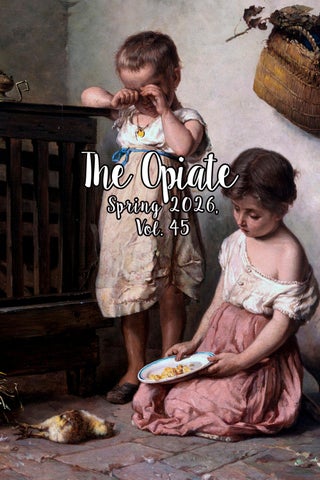

The