
Tribute to the man who created the ‘Guggenheim Effect’ in Bilbao



DREAMLAND


page 36 It’s not just the magical castle that inspired Walt Disney in Segovia
A legion of the world’s best golfers returns to do battle in Spain
Tribute to the man who created the ‘Guggenheim Effect’ in Bilbao
page 36 It’s not just the magical castle that inspired Walt Disney in Segovia
A legion of the world’s best golfers returns to do battle in Spain
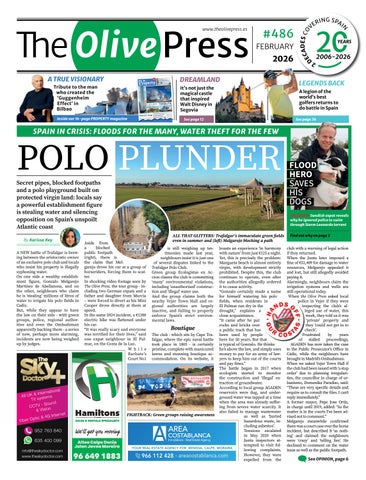
Secret pipes, blocked footpaths and a polo playground built on protected virgin land: locals say a powerful establishment figure is stealing water and silencing opposition on Spain’s unspoilt Atlantic coast
By Karissa Key

A NEW battle of Trafalgar is brewing between the aristocratic owner of an exclusive polo club and locals who insist his property is illegally syphoning water.
On one side a wealthy establishment figure, Gonzalo Melgarejo Martínez de Abellanosa, and on the other, neighbours who claim he is ‘stealing’ millions of litres of water to irrigate his polo fields in Cadiz.
But, while they appear to have the law on their side - with green groups, police, regional authorities and even the Ombudsman apparently backing them - a series of new, perhaps more alarming, incidents are now being weighed up by judges.

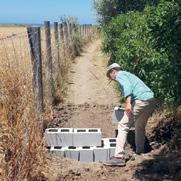
Aside from a blocked public footpath (right), there is the claim that Melgarejo drove his car at a group of horseriders, forcing them to scatter.
In shocking video footage seen by The Olive Press, the tour group - including two German expats and a father and daughter from Murcia – were forced to divert as his Mini Cooper drove directly at them at speed.
In the same 2024 incident, a €1200 electric bike was flattened under his car.
“It was really scary and everyone was terrified for their lives,” said one expat neighbour in El Palmar, on the Costa de la Luz.
is still weighing up testimonies made last year, neighbours insist it is just one of several disputes linked to the Trafalgar Polo Club.
Green group Ecologistas en Accion claims the club is committing ‘many’ environmental violations, including ‘unauthorised’ construction and ‘illegal’ water use.
And the group claims both the nearby Vejer Town Hall and regional authorities are largely inactive, and failing to properly enforce Spain’s strict environmental laws.
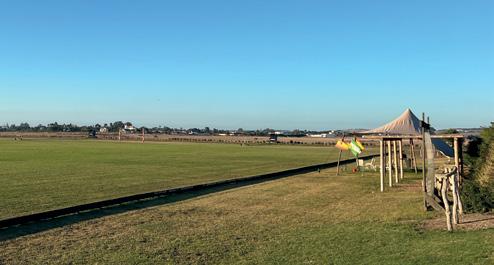
The club - which sits by Cape Trafalgar, where the epic naval battle took place in 1805 - is certainly pristine, complete with manicured lawns and stunning boutique accommodation. On its website, it
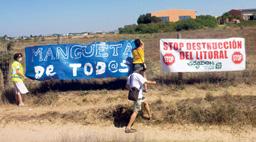
boasts an experience ‘in harmony with nature’ from just €125 a night. Yet, this is precisely the problem: Mangueta beach is almost entirely virgin, with development strictly prohibited. Despite this, the club continues to operate, even after the authorities allegedly ordered it to cease activity.
“Gonzalo certainly made a name for himself watering his polo fields, when residents in El Palmar ran dry in the drought,” explains a close acquaintance.

EXCLUSIVE: Swedish expat reveals why he ignored police to swim through Storm Leonardo torrent Find out why on page 2
club with a warning of legal action if they returned.
When the Junta later imposed a fine of €51,409 for damage to water resources, Melgarejo appealed it and lost, but still allegedly avoided paying it.
Alarmingly, neighbours claim the irrigation systems and wells are still operational today.
“It came after he put rocks and bricks over a public track that has been used by people here for 50 years. But that is typical of Gonzalo. He thinks he’s above the law, and simply uses money to pay for an army of lawyers to keep him out of the courts and pay fines.”

When the Olive Press asked local police in Vejer if they were inspecting the club’s alleged use of water, this week, they told us it was ‘private’ property and they ‘could not get in to check’.
The battle began in 2017 when ecologists started to monitor the construction and ‘illegal’ extraction of groundwater.
According to local group AGADEN reservoirs were dug, and underground water was tapped at a time when the area was already suffering from severe water scarcity. It also failed to manage wastewater
as well as ‘buried hazardous waste, including asbestos’.
Frustrated by years of stalled proceedings, AGADEN has now taken the case to the Public Prosecutor’s Office in Cádiz, while the neighbours have brought in Madrid’s Ombudsman. When we asked Vejer Town Hall if the club had been issued with ‘a stop order’ due to planning irregularities, the councillor in charge of urbanismo, Domenika Paradiso, said: “These are very specific details and require us to consult the files. I can’t reply immediately.”
A former mayor, Pepe Jose Ortiz, in charge until 2019, added: “As the matter is in the courts I’ve been advised not to comment.”


Tensions escalated in May 2020 when Junta inspectors attempted to visit following complaints. However, they were expelled from the
Melgarejo meanwhile confirmed there was a court case over the horse incident, but described it ‘as nothing’ and claimed the neighbours were ‘crazy’ and ‘telling lies’. He declined to comment on the water issue as well as the public footpath.

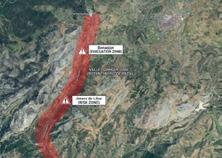
Second Malaga town evacuated as rapidly-filling Montejaque dam approaches critical state –overflow could happen this week
Red alert: Storm Leonardo forces mass evacuations as Costa del Sol faces torrential rains from Wednesday
Coming up in 2026: Spain will enjoy its first total solar eclipse in over 100 years – all you need to know to catch the best view


AN Olive Press investigation into an investment fraud has made it into the infamous ‘Epstein Files’. Our exclusive probe into wealthy aristocrat Baron David de Rothschild (above right), even shocked the disgraced paedophile financier Jeffrey Epstein.
So stunned was Epstein with our 2015 expose that Rothschild had been indicted to face charges over a ‘dodgy’ equity release scheme, he sent emails on to a White House lawyer.
The series of emails about how Rothschild swindled millions out of expats in Spain made it into the files part-released by the US government this month.
The Olive Press worked alongside Marbella firm Lawbird as it took up legal action on behalf of dozens of British clients who lost their dream properties through suspect loans. The revelations sent shockwaves through Spain, with Rothschild forced to return every penny paid by one expat couple after a landmark court ruling in 2020. The battle continues for hundreds more.
See full story online
HE became famous around Spain when he flouted a police evacuation order by swimming across a raging torrent to rescue his dogs.
A video of Lars Walker fighting his way through terrifying floods (below) went viral after first making it onto national television. It didn’t help that the Swedish expat’s local mayor labelled him ‘irresponsible’, while police warned he could be arrested and fined €20,000.

Swedish kayak champion, 63, who braved raging flood waters to rescue his dogs hits back at mayor for labelling him ‘irresponsible’
By Alessio Ghirlanda
have meant ‘certain death’ for his two dogs, Sito and Chavito, stuck at his home in La Corte.
In an exclusive interview, the Swede recalled the harrowing ordeal - and hit back at Jerez mayor

force winds two weeks ago.
But Lars is made of sterner stuff: This brave expat of many decades in Spain decided to strike out on a brave mission to save his rescue dogs and his ‘livelihood’.
Maria Jose Garcia who accused him of ‘endangering the lives of his rescuers’.
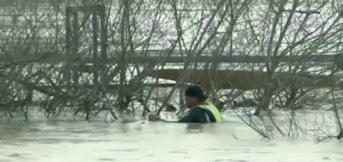
And the 63-year-old viking told the Olive Press week, he would do it again in a ‘blink of an eye’. Talking after he crossed the Riv er Guadalete, near Jerez, after it burst its banks during Storm

Leonardo, he said he was ‘saddened’ by the criticism and threats of fines. He insisted that had he not taken the mission it would
“I am so saddened by all the backlash,” he told the Olivefriend’s home in Cadiz. “People areless, but I did
“My dogs were there, my entire livelihood was in that home,” he added. “What was I supposed to do?”
Walker’s ordeal began as Storm Leonardo, which killed at least two people, lashed the region with torrential rain and gale-
SPANISH reservoir levels are at their highest for 13 years after a month of heavy downpours across the country.
All but two regions are above 50% with most around 80% full.
Asturias comes top at 91% capacity, while Murcia comes bottom at 31%, up just 10% on last year.
Madrid sits at 82%, while Catalunya is at 80%, an incredible 26% up on last year.
Andalucia at 78% has benefitted most with the region’s Guadalteba and Guadalhorce reservoirs both sitting at 98% capacity, meaning Malaga city has drinking water for at least three years.
In Galicia, the levels are up 20% on ten years ago, while Extremadura at 86% is 30% up on 2025.
Valencia meanwhile sits at just 47%.
ONE of southern Spain’s most infamous expats has died at the age of 88.
Rifaat al-Assad, the uncle of exiled Syrian dictator, Bashar, died in Dubai, after sinking tens of millions of stolen ‘black money’ on the Costa del Sol and in nearby Gibraltar.
The money was then laundered through a complex network of offshore shell companies, 29 of which were registered to the Rock.
The Assad family’s ties to Spain date back to 1986, when they purchased 244 parking spaces, before acquiring 507 properties worth
€695 million, including over 80 units in Puerto Banus.
Authorities seized these properties and froze related bank accounts in 2017 while a Spanish judge recommended the case against Rifaat and 13 others in the network continue.
However, no one involved has been convicted yet in Spain and Rifaat evaded the trial on medical grounds.
The professional kayaker and entrepreneur had decided to ride out the deluge with his two dogs in an upper-floor apartment above the headquarters of his watersports business, an adventure outfit offering kayaking trips along the Guadalete. As the river surged floodwaters tore into Walker’s property and swallowed the surrounding fields, threatening to destroy everything in their path. Watching the river rip through the area, Walker realised his two cars parked nearby were at risk of being swept away.
A former competitive kayaker and Scandinavian champion in 1989, Walker was confident he could paddle across the floodwaters to hand his car keys to friends waiting on the other side. He jumped into one of his kayaks and braved the torrent, allowing his friends to drive the vehicles to safety.
But the return journey took a dramatic turn for the worse. As he paddled back toward his property, Walker’s kayak smashed violently into a submerged wooden structure. “I made a bad mistake there,” he admitted. The collision had destroyed the kayak beyond repair, Walker realised - so he made the split-second decision to abandon it and swim back through the churning water. “I needed to get home to my dogs,” he continued. It was this footage of him wading through the raging floodwaters, clinging to branches as he fought his way upstream toward his home, that later went viral. But the Swede insisted every move was deliberate, drawing on years of experience in wild rivers. “People say I was lucky to grab the branches - but I went to them on purpose,” he said. “I know my way around rivers.”
After a harrowing struggle, Walker eventually made it back to his property. Once inside, he rushed upstairs to his dogs – and shortly afterwards, a police boat arrived and ferried the trio to safety. While many hailed him a hero, others were quick to condemn - accusing him of recklessness and of ‘endangering the lives’ of his rescuers. “But I never asked to be rescued,” Walker said. “I did what I had to do and never meant to put anyone else in danger.”


SPAIN has been winning the summer festival war for decades.
But this year the biggest battle will be fought between which city takes



the Limp Bizkit. And the two heavyweights are predictably Madrid and Barcelona with two giant crowd-pullers.
Barcelona fires first with Primavera Sound (June 1 to 7), a global tastemaker with beachside swagger. The best of British music, including the Cure, Gorillaz and Massive Attack are headlining, while The xx, Bad Gyal and Wet Leg also make the cut.
The week-long bash takes place at iconic venues like Razzmatazz, Parc del Forum and the Sala Apolo, while free daytime shows are held at the CCCB.
Tickets weigh in at €350 for the full week or €125 per day, but Primavera’s genre-bending cool, in-
ternational pull and citywide footprint remain unmatched.
Next up, Madrid counters with the Mad Cool Festival (July 8 to 11), celebrating its tenth anniversary in serious style.
Stadium-level legends such as the Foo Fighters and Kings of Leon are rubbing shoulders with indie royalty including Nick Cave, Florence + The Machine, Lorde, Pixies, Pulp, Moby and David Byrne. With over 70 artists spread across four carefully curated days, Mad Cool has the scale and substance to win.
IT’S become a household name in southern Spain for expats, tourists and celebrities alike.
Now entertainment juggernaut La Sala - the prime spot for Premiership footballers, celebrities and captains of industry - has reached its 15th birthday.
The flagship restaurant in Puerto Banus cele brated in classic style with a huge anni

versary bash this month. Since its inauguration in 2010, the hospitality giant has gone from strength to strength, with everyone from England captain Harry Kane (see right) to TV chef Jamie Oliver and boxer Anthony Joshua to business tycoon Alan Sugar celebrating nights out at the venue.




By Karissa Key


And when it comes to price it’s a slam dunk with tickets starting at €95 for a day or €240 for the full four-days, making it easily one of Europe’s best-value major music festivals.
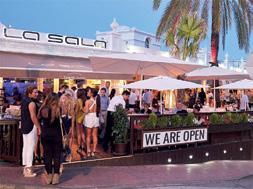
With three venues today, La Sala by the Sea, OAK Firehouse and La Sala itself, it is one of Marbella’s leading businesses.
Hundreds of locals and expats mingled with footballers and businesspeople, including Olive Press columnist Charlie Mullins, Europe’s richest plumber. “It’s been a fun evening and it’s one of those venues that just keeps going and going,” he said. “We come here a lot, at least once a month, if not more.”

La Sala group managing director Wayne Elliot, explained what the milestone meant to the team, as it cemented itself as the ‘iconic venue in Marbella’. Tonight is about celebrating with our colleagues, business partners and everyone who works at La Sala,” he said.
See restaurant review on Page 34

BRITISH pop sensation Robbie Williams will return to Spain this summer as part of his new world tour, with performanc es confirmed at Bilbao’s BBK Live in July and at Sevilla’s Icónica Santa lucía Fest in June 2026. Robbie’s latest tour, The Long 90’s, celebrates his latest album Britpop, an album which pays homage to the musi cal culture of the 90s.





DUAL British nationals could be denied entry to the UK from next week if they are not carrying their British passport, warns the Home Office.
A change in border controls from February 25 means they must show their UK passport or pay almost £589 for a ‘certificate of entitlement’ attached to their second nationality. Without this or a valid passport they will be unable to board a flight, ferry or train heading to the UK.
This new rule is causing distress for many Brits living abroad whose UK passports have long expired.
They are faced with a choice, to reapply for a UK passport, pay the hefty price for the aforementioned certificate, or renounce their British citizenship and visit as a foreign tourist.
British expat James Stuart, based in Cadiz, told the Olive Press his daughters, 21 and 18, will be forced to make this choice as their UK passports ‘sit in a cupboard expired’. Both were born in Spain and always travel on their Spanish passports because ‘they’ve had no problem before’.
“It tends to be easier to travel around Europe on an EU passport,” he explained. The decision has caused them ‘considerable angst’, in particular because the youngest regularly travels to the UK to see her boyfriend.
“They really do not understand the need for
the change,” continued the boss of the Califa Hotel group. See full story online
A TOURIST has called in police after she found herself trapped inside a holiday apartment for eight hours during a catastrophic storm.
Author Camellia Yang, 37, said she became locked inside her rented flat in Granada after the front door’s electric lock malfunctioned during the recent Storm Leonardo.
The property, managed by ChezmoiHomes, lacked a manual override – a shocking safety flaw that could have ended in tragedy.
“It was an absolute nightmare,” Yang, from New Zealand, told the Olive Press. “And infuriating.”
“I cannot believe this company is allowed to operate like this,” she added. “No manual override for the door? No safety mechanisms? So many things could have gone wrong.
“What if a fire had broken out? Or if I’d had a medical emergency? What if the property had flooded like so many others during the storm?”
To add insult to injury,
AN under-fire mayor is facing a five year jail term over allegations he misappropriated public money employing an ex-lover to inspect his town’s famous flowerpots.
Estepona’s Jose Garcia Urbano (right) allegedly slipped thousands of euros to a former lover, who he also put in charge of inspecting the town’s lamp posts.
The employee, Cristina Pulido, was paid €5,376 for just 46 days ‘work’, most of which she didn’t complete.
The Public Prosecutor wants to see the PP mayor also banned from
Cops called in to probe tourist’s eight-hour 'nightmare' after electric lock
By Alessio Ghirlanda EXCLUSIVE
Yang said the firm, which manages 60 properties in Granada, pleaded with her not to call the police during the ordeal, promising a refund of the entire €420 fee.
However, she has still not received it and the company has stopped responding to her.
The writer, based in Lis-
public office for ten years. According to WhatsApps seen by police, the pair had an ‘intimate friendship’, and he even gave Pulido €21,000 of his own money for ‘expenses and rent’. She was handed the job for two months before local elections in 2023. The revelations have prompt-

bon, was travelling solo in Granada, when she found the building’s sliding doors jammed shut at 11.45am. She was told the fault could only be resolved by electricity provider, Endesa, and as there was an ‘orange alert’ there was nothing further to be done.
Despite assurances technicians would arrive by

3.30pm, Yang remained trapped until 7.20pm, when the door was unlocked.
Yang has since called in the Policia Nacional to investigate as well as the Junta’s Ministry of Tourism and Booking.com. Regional officials confirmed the investigation could lead to fines over po-
ed calls for Urbano to resign, with PSOE councillor Emma Molina telling the Olive Press: “Handing out public money to a person he was intimate with - and who admits she never worked there - is enough for him to leave now.”

In the most bizarre set up the mayor was also said to have coerced the woman’s husband, a local policeman, into a relationship. However, complaints of sexual harassment were thrown out of court last year.
tential breaches of tourism regulations. A ChezmoiHomes spokesperson told the Olive Press the incident occurred under ‘extraordinary’ circumstances. “This has never happened before,” the spokesperson said. “And it only happened because of the storm.” He said a ‘full refund’ was under way, plus a €75 travel credit.


A campaigning, community newspaper, the Olive Press represents the huge expatriate community in Spain with an estimated readership, including the websites and social media of more than five million people a month.
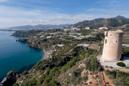
In 1805, off Cape Trafalgar, a British fleet led by Horatio Nelson defeated a larger French and Spanish armada. Nelson paid with his life and today stands immortalised in London’s Trafalgar Square. More than two centuries later, another battle is unfolding along the same shoreline - this time between environmentalists and privilege.
Campaign group AGADEN is taking on businessman Gonzalo Melgarejo, owner of the Trafalgar Polo Club.
The question is stark: how does an exclusive polo complex continue operating beside one of Spain’s most protected stretches of coastline?
The Costa de la Luz is famed for its wild beaches and rolling dunes - not manicured polo pitches. Allegations surrounding the club include environmental infractions, disputes over public access, and footage appearing to show the owner driving his car towards horse riders before blocking a historic footpath used by locals for generations.
With incidents reportedly on video, many are asking why accountability seems slow.
Spain’s environmental laws are clear. They are designed to protect landscapes exactly like Trafalgar. Wealth and influence should not place anyone above them.
Local residents - Spanish and expat alike - alongside green groups have refused to stay silent. They continue filing complaints and demanding action, defending the principle that protected coastline is not for private appropriation.
If local politicians are hesitant, regional or national authorities must step in. The rule of law cannot bend to privilege.
The Olive Press has followed environmental battles across Spain for two decades. This one is far from over.
The new Battle of Trafalgar is not about naval fleets. It is about whether Spain’s natural heritage - and the laws meant to protect it - still stand firm.

PUBLISHER / EDITOR JON CLARKE, jon@theolivepress.es


WALTER FINCH walter@theolivepress.es
ALEX TRELINSKI alex@theolivepress.es
JOSHUA PARFITT josh@theolivepress.es

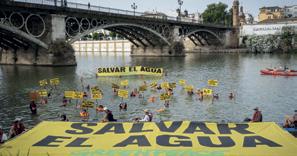
ON a steamy July night in 2023, climate activists broke onto golf courses across Spain. They dug into the greens with their bare hands, planted vegetables and filled holes with cement.
As they worked through the night, protesters put up signs explaining their actions: ‘Drought alert: Golf course closed for climate justice,’ ‘Not a drop for the rich,’ and ‘Luxury leisure, public drought.’
Organised by Extinction Rebellion (XR) and local green group Arran, they took place at 10 courses from Barcelona to Madrid and Valencia to Ibiza.
Spain was in the grip of a severe drought, yet the country’s hundreds of golf courses continued to consume vast quantities of water. More collectively, it was claimed by XR, than the cities of Madrid and Barcelona used combined for a year.
The protests couldn’t have come at a more relevant time, as the planet warms and questions of who should get to prioritise water became increasingly urgent.
For XR, golf represents an ‘elitist leisure pursuit’ that consumes essential resources while farmers watch their crops fail and residents face strict water restrictions.
The protests, activists said, were not directed at the sport itself, but at an economic model that prioritises the interests of a few over the needs of the many.
Originating in Scotland in the 15th century, golf arrived in Spain via British expats in the 19th century, with the country’s first course opening in Gran Canaria in 1891.
The sport expanded rapidly alongside the tourism industry, particularly in the 1990s, and its status as a global golf destination was cemented in 1997, when San Roque’s
famous Valderrama club hosted the Ryder Cup.
Today, Spain has more than 400 courses, largely concentrated along Andalucia’s Costa del Sol, often dubbed the ‘Costa del Golf’, as well as in Murcia and Catalunya.
While golf thrives in Scotland’s wet climate, maintaining courses in Spain’s warmer conditions requires constant irrigation, making it a very water-intensive leisure activity.

Gibraltar and the Guadalhorce valley, agricultural usage was cut by 75%, leaving many farmers without crops or livelihoods.
Environmental groups say that, despite these measures, courses continued to irrigate their greens throughout the drought. XR argues that this contrast lies at the
heart of the controversy.
“Spain is drying up and the rural sector is suffering losses running into millions because of the lack of water for crops – all because of an entertainment enjoyed by scarcely 0.6% of the population.”
Golf federations however claim that golf only uses 1% of Spain’s water and frequently cite the statistic that 59% of
Spanish golf courses use reclaimed water. But that of course begs the question, which of the 41% do not use it and exactly how much recycled water do the others use?
The dirty 40%

FIONA GOVAN fiona@theolivepress.es RACHEL GORE rachel@theolivepress.es
ALESSIO GHIRLANDA alessio@theolivepress.es
MAEVE GORMAN maeve@theolivepress.es BEN PAWLOWSKI ben@theolivepress.es
SALES MANAGER Sam Adams (+34) 951 154 841 sam@theolivepress.es
OFFICE MANAGER Keith Franks (+34) 658 750 424 accounts@theolivepress.es


DISTRIBUTION (+34) 951 154 841 distribution@ theolivepress.es
Environmental groups are understandably then, closely monitoring water use at courses across Spain, with their figures raising serious concerns.
Data shared by Greenpeace with The Olive Press shows that in Andalucía, maintaining just one square metre of grass requires between 1,500 and 2,000 litres of water per year.
The group also claims 109 courses in Andalucía use as much water as one million residents, exceeding the combined populations of Sevilla and Córdoba.
Meanwhile, each 18-hole golf course consumes roughly the same amount of water as a community of between 10,000 and 15,000 people.
These figures come against the backdrop of Spain’s prolonged drought.


While it has rained heavily over the last two months, bringing needed relief to reservoirs and aquifers, southern Spain endured an eight-year dry spell from 2016 to 2024, its longest since 1961.
In response, authorities introduced strict water-use restrictions in 2023, banning the filling of private pools, watering gardens and the use of beach showers, while agricultural water allocations were also reduced.
In some areas, including the Campo de
MOVING house is usually ranked as one of life’s biggest strains, even when one is
After a pair of Olive Press readers lost €25,000 furniture to a bogus removal firm, these are the crucial checks every expat must make before moving abroad
only relocating to a neighbouring town. Add country borders, languages, and cultures into the mix, and moving becomes a whole different challenge. When it's heading to Europe post-Brexit and particularly, stringent Spain, the ordeal is right up there with marriage and divorce.
With companies in the UK rarely being able to ship or even accompany goods to Spain and hefty price tags attached to overseas removals, those dreaming of their move abroad are faced with difficult decisions regarding


By Rachel Gore

their possessions.
As the Olive Press revealed last month (see inset), a British couple ended up losing €25,000 of their possessions after spending close to €5,000 on a removal man who never showed up in Spain.
Caroline and Brendan Bennett are now liaising with police probing conman Jonathan Perry who picked up their furniture from a UK garage but never delivered it to their home in Malaga. As the couple are awaiting further updates from the police, they urge fellow Brits moving to Spain to triple check removal companies, and, above all ‘never pay up front’.
To make things easier for any soon-tobe expats, here’s a simple guide on the different removal options that exist and the accreditation needed to trust a firm to do the job properly.
CHECKLIST FOR MOVING ABROAD
The first thing to check is that the re-
As it emerges 109 golf courses use as much water as a million residents, is it any wonder golf is becoming a climate flashpoint
By Maeve Gorman

The data comes from a study of 408 clubs in 2019 by the Real Federacion de Golf. And when you drill down into the numbers, it appears much worse than it looks, because of the 238 clubs to offer up data only 58% used recycled water.
So what of the other 170 clubs? One must assume they don’t use it.
And meanwhile, Greenpeace insists the golf federations’ commitment to recycled water is nothing more than a ‘bargaining chip’ to get licences to build homes.
The group claims developers fund the modernisation of water treatment plants in exchange for permission to build golf courses and homes.
It wouldn’t be the first time the golf industry has faced accusations of using nefarious means to get around the water problem.
Legal proceedings have been brought against several courses for the illegal extraction of water from wells and the misuse of drinking water.
Murcia’s Lorca Golf Resort came under fire in 2024 when authorities found the club had been extracting groundwater illegally for 17 years. Hidden wells and a network of unauthorised underground pipes were discovered.
Authorities estimate that over 2 million cubic meters of water were stolen causing an
moval company is either a member of the FIDI Global Alliance or the British Association of Removers Overseas Group (BAR OVERSEAS).
The former is accredited by the FIDI Accredited International Mover Standard (AIM) and the latter covered by IMMI (International Movers Mutual Insurance) Advance payment guarantee scheme. Firms under these associations have been independently audited and must follow codes of practice. This means they are regulated and experienced.

estimated €65 million in damage.
Even worse, during the 2023 drought both Anoreta and Baviera courses, in Malaga, were found to be irrigating with drinking water despite a total ban, an issue they later blamed on ‘technical failures’.
Meanwhile, an investigation was launched, after Ecologistas en Accion filed claims that over half the courses in the Madrid region irrigate with drinking water, despite local laws insisting they must use reclaimed water.
However, three years on from the XR Spanish protests, nothing has really changed.
In fact, alarmingly, more courses are under construction.
As reported over recent issues, a 150-hectare site near Nerja, in Malaga, is currently being developed into a luxury golf development drawing criticism from Greenpeace, Ecologistas en Accion and local farmers.
Economic arguments must also be heard and golf is big business generating €5 billion per year and 130,000 jobs in Spain.

They will also have public liability insurance, employers’ liability and goods-intransit insurance.
This cover alone however may not be up to ‘full replacement value’ so it is always recommended you check exactly what each company’s insurance policy is… what is included and if they recommend adding a further policy.
Due to Brexit, all goods moving between the UK and Spain must go through customs so make sure the company you select is prepared for this. Inventory lists are often required, and sometimes need to be translated into Spanish. Other documents may also be needed and the top firms will guide you through the paperwork.
Once you know that your removal company is accredited and insured it's time
Town halls and developers plough on re-
gardless for this reason, while the recent torrential rain brought by storms Leonardo and Marta have largely filled the region’s reservoirs and make it hard for many to imagine another drought.
But if recent years are any indication, Spain could soon face another hot, dry summer followed by another and another. The country experienced its hottest summer on record last year, when temperatures reached 46 degrees in Huelva and desertification spreads alarmingly further and further east across the country. Recent statistics show that 99.8% of Murcia is facing desertification, while Granada and Malaga are highly vulnerable to it. Scientists warn that climate change is intensifying both extremes, heavier rainfall events and longer, hotter droughts, placing increasing pressure on already strained water systems.
As climate change redraws the limits of water in Spain, the battle over golf has become a symbol of a deeper reckoning: how a drying country chooses to allocate its most precious resource. The battle has only just begun.

to pick how you’ll get your goods from A to B.
If time is of the essence, air freight might be the best option, although it is by far the most expensive way to move goods overseas.
A number of Spanish airports, including Barcelona, Madrid and Malaga, offer Air Freight which sees belongings delivered within a week.
Removals by road are the most popular with companies coming to pick up goods and driving them over to Spain. All companies offer different services so it is important to triple check what is being included in your deal.
Shipping containers are chosen by some companies who load belongings into the

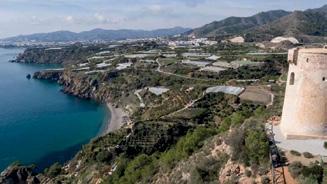
I’m down with the tree-huggers
Explaining why he’s changed sides, our normally business-savvy columnist is opposing a golf mega-project
INEVER thought I’d end up batting for the other side… but it’s like my brain has done a reboot and gone into reverse. And no, I’m not talking about the sudden late-life gender identity crisis!
That said it is something of a radical change as I suddenly find myself siding with a bunch of tree-huggers fighting a golf course developer.
The hard-nosed businessman in my DNA should be 100% behind Sociedad Azucarera Larios’ who are planning a mega-resort with its three luxury hotels and 680 villas, but I’m not.
My sympathies are with the local farmers and expat families who live and work the unspoilt 150-hectare Vega del Maro, near Nerja, on the Costa del Sol. I keep telling myself about all the jobs a project of this scale will bring to the area and not just during the construction stage – golf courses and hotels employ hundreds of staff. A huge win-win for everyone; more shops, more bars and restaurants, more jobs, more business everywhere. A complete no-brainer, or it should be…
So why do I find myself routing for a bunch of semi-commercial banana farmers and a small community of expats, who are getting in the way of progress and prosperity?
But, in truth, the Costa del Sol does not need another bloody golf course!
vessels, seal them up and send them overseas. This option comes with flexibility; you can choose whether your possessions are sent from port to port or door to door. No matter what route belongings take, the most important thing is that they end up at their intended destination and, therefore, it is vital that companies are checked over and goods are covered by insurance.
Do not make the same mistake as the Bennetts and put full trust in a mover without checking the details, even if it is a personal recommendation. Make sure you do your research.
As Caroline Bennett told the Olive Press: “Whatever you do, do not try and cut costs and check ,check, check.”
Mark Twain famously DIDN’T come up with the quip about golf being a ‘good walk spoiled’, but whoever did nailed it, and not just because it’s a stupid game. Vega del Maro is a stunningly beautiful place that has a low population density that produces fruit and vegetables through non-intensive farming. It’s a place to unwind and relax, to live a slower pace of life, unfettered by concrete, glass and acres of green green grass kept alive by millions of gallons of water…Lots of it likely extracted from already failing aquifers.
Golf has so many rules that even seasoned pros don’t know them all, and I think that’s part of why so many people prefer a nice walk in nature.
But it’s golf’s universal rule that makes me stand with the tree huggers.
The rule that says: We don’t care how breathtaking your little corner of the planet is, to hell with its uniqueness, we’re going to bulldoze it over and mangle it to look like 38,801 crimes against nature.


For years, foreign residents in Spain have been atarget of Spain's tax authority, subjected to unlawfuland unjusti ed penalties and false assessments. Hacienda has abandoned the rule of law. Despite constitutional guarantees, taxpayers are treated as guilty unless proved innocent. Your bank accounts can be raided withouta court order. Your private data accessed without proper safeguards. And if you dare to challenge them? You'll face intimidation, punishment audits,and potential criminal prosecution threats.
Enough is enough.
Amsterdam & Partners has published a comprehensive White Paper exposing these systematic abusesand is calling for an independent public inquiry.
We have elaborated a detailed framework for restoring legal certainty, ending the punishment of innocent taxpayers,and bringing Hacienda under proper democratic control. We are taking this case before multiple international bodies and demanding action. Join us in demanding reform. Together, we can restore justice to Spain's tax system.
Visit www.spanishtaxpickpockets.com to learn more.



DOZENS of expats have joined farmers and locals to protest a plan to plough up an area of virgin coastland to build a golf course. They are up in arms that a wealthy landowner plans to evict hundreds of farmers for the mega project of over 600 luxury villas on the Costa del Sol.
Holding placards reading ‘more farms, less concrete’ and ‘save nature’ they made their voices heard at the protest at Maro, near Malaga.
As reported on our front page last issue, they are joined by Greenpeace and Ecologistas en Accion to stop the ‘desecration’ of the Vega de Maro, which has protected status.
The protest comes after landowner Larios demolished at least three properties over the past two months.
It followed an announcement in December that the wealthy family would terminate around 450 long-standing leases in the area to make way for a luxury resort dubbed ‘Maro Golf.’
The project, which includes a golf course, around 680 luxury villas, and three large hotels, is set to turf more than 80 families from their homes.
Organiser Oscar Lobo, of farmers’ group AMA, told the Olive Press: “They need us out of the way to move on with the project. They think they can just have it their way.”
He is furious that one of the homes demolished belonged to Loli Rodriguez, whose belongings and two cats were inside when it was knocked down.
Larios’ ambitions appeared to face a setback on Friday when Nerja town hall announced the land could not immediately be reclassified for development under the current proposals.
The project, which was drafted around six years ago, failed to comply with Andalucia’s latest land-use rules, officials have con-
SPANISH weather forecasters are facing ‘alarming’ levels of hate speech online. It comes amid a growing mistrust in climate experts with scientists also experiencing ‘hate speech, personal attacks and denigration’ across social media.
Spain’s Climate Minister Sara Aagesen insisted the abuse of state weather agency (Aemat) employees is hampering scientific research.
firmed to the Olive Press.
British farmer Jack Whitfield, believes Larios will temporarily plant a damaging ‘high-water use’ avocado crop, while waiting to get a permit for its development.
“Currently we grow a wide variety of crops and have maintained the irrigation channels ourselves and sell locally in Nerja,” he explained. “It is a sustainable system - yet they want to replace it with a water-intensive plantation.”
Valerie Del Bosque, a farmer who has
Protesters vow to fight golf mega-project on last virgin coastal
area on the Costa del Sol
By Alessio Ghirlanda
lived in Maro for 26 years, added: “Tourists come here precisely because this coastline remains unspoiled.
“It is a place where people live in harmony with nature,” she added. “Why turn it into yet another golf course and block of concrete?”
In a new monthly section, from Fran Candelera, we pick a bird of the month.


ONE of the most fascinating birds to spot in February is the Alpine accentor (Prunella collaris). It is one of the last months to see them before they retreat to higher, colder mountains to nest. It means in the Sierra Nevada it can be observed year-round. While in Cadiz’s Grazalema, or
Torcal in Malaga, you might spot one as late as April.


10 February 2026
WITCHES of Eastwick
Susan Sarandon will re ceive an International Goya at Spain's equivalent of the Oscars this month.

The American actress - who also starred in Thelma and Louise and Dead Man Walking - follows in the footsteps of Cate Blanchett, Juliette Binoche, Sigourney Weaver and Richard Gere.
The award, introduced in 2022, was created to recognise figures who ‘connect cultures and audiences
LOOKING FOR MORE CULTURE STORIES?
Scan to visit our website
Karissa Key
BIG HEARTED Flamenco star Estrella Morente has held a sell-out charity concert for homeless people.
The Granada show was organised in just six days and attracted strong public support. Various artists joined her
from Madrid, Extremadura and Barcelona.
Charity Carlor y Cafe was founded in the early 1990s and provides food, assistance and companionship to homeless people in the city, supporting around 200 people each day.
See full story online
IT dates back an incredible half a millennium to a weekend when carpenters decided it was spring.
Valencia’s legendary Fal-

Blame the chipies: Spain’s loudest festival kicks off with its love of fire and fireworks

back out to the districts where they were constructed.
They are then burnt during the so-called 'Cre-
By Eimeer Kempeneer
AN elephant bone could prove that warmonger Hannibal marauded through Spain with help from the giant animals. The bone found during excavations at Cordoba’s Colina de los Quemados park is likely to herald from the Punic Wars. Fought between Rome and the Carthaginian Empire between 264 and 146BC, the bone from the right forefoot is roughly the size of a baseball. Carthaginian general






For many European expatriates, retiring in Spain represents independence, quality of life and the feeling of having finally found balance. Yet ageing abroad also brings practical considerations that are often easy to overlook until they arise. When family lives in another country and local systems feel unfamiliar, maintaining control over one’s finances becomes essential to preserving autonomy and peace of mind. Clear financial organisation and easy access to savings support calm decision-making and long-term independence.
ONE REGISTRATION. MULTIPLE EUROPEAN BANKS. TOTAL CLARITY OVER YOUR SAVINGS
Raisin is an online savings platform that allows customers to access savings accounts
and term deposits from multiple European banks through a single registration and one centralised online platform. Rather than opening and managing separate accounts across different countries, users deposit their money via Raisin and select from a range of products offered by regulated EU banks, including institutions based in Germany, Belgium, Sweden and the Netherlands, among others. This enables expatriates to continue benefiting from the financial conditions of their countries of origin. With one account, customers can manage savings held with different European banks, maintain a clear overview of balances and returns, and handle everything online in one place, without changing their primary bank. Raisin manages the administrative process, while savings are always held directly with the chosen partner bank.


As
Marta Pinedo, Country Manager for Raisin in Spain, explains:
“Many international

customers living in Spain are not concerned about saving more, but about knowing exactly where they stand. Having a clear and organised view of their savings, managed from a single platform, can make a real difference to confidence and peace of mind, particularly later in life.”
YOUR MONEY, PROTECTED AND HELD WITH REGULATED EUROPEAN BANKS
Raisin is not a bank and does not invest customers’ money. Savings are always held directly with the selected partner banks, all of which are regulated within the European Union. Deposits are protected under the EU Deposit Guarantee Schemes Directive, which safeguards up to €100,000 per customer and per bank, regardless of the customer’s country of residence.
Customers retain full ownership of their funds at all times, with complete transparency regarding where their money is held and which national guarantee scheme applies.
For those new to the platform, Raisin’s Cuenta Bienvenida offers a simple and accessible starting point. It allows savers to familiarise themselves with the platform while already earning an attractive return. This commission-free ac-
count currently offers a return of 3.33% AER, combining simplicity with competitive remuneration. It also provides a clear overview of available funds, making it easier to plan and organise savings from the outset. Beyond the initial account, Rai sin offers continued access to competitive savings products from European banks, enabling custom ers to adapt their sav ings strategy over time. Through features such as Cambio Inteligente, savings can be moved be tween products as oppor tunities change, without unnecessary complexity. This flexibility is particu larly relevant for retirees living outside their coun try of origin, whose finan cial needs may evolve over time.
Living abroad in retirement involves planning for chang ing circumstances. While clear financial organisation does not remove every challenge, it supports informed decision-making and helps preserve long-term independence. A QR code in this article provides direct access to Raisin, offering a simple way to organise savings and maintain financial control so retirees can enjoy life in Spain with confidence and clarity.

* Please note that Raisin Spain’s website is primarily available in Spanish. If you need support in English, our Customer Service team will be happy to assist you.” And this same sentence, deleted from the last paragraph of the article.
IT is one of those destinations that takes your breath away - with its iconic Roman aqueduct, impressive gothic cathedral and fairy tale castle all set within a dramatic landscape. Yet few expats make it to Segovia, one of Spain’s most alluring inland cities.
Rising out of the classic Castilian plains north of Madrid it is a place truly steeped in history, yet compact enough to wander around all the monuments and discover its treasures in an overnight stay. Here’s how to spend 36 hours in the Unesco world heritage site.
Arriving mid-morning, the first thing to greet you will be the Roman Aqueduct (right) dominating its main square. It doesn’t matter how many photos you’ve seen, it demands that you stand beneath it, and marvel at its splendour. Built in the late first century, it spans 16,220 metres at a height of 28 metres at its cen tre. Constructed of grey granite blocks, the two tiers of arches carried water from the Rio Frio 15km away to supply fountains and cisterns within the city walls.
By Fiona Govan
tion held within.

Grab lunch nearby to ease into Segovian cuisine. Many restaurants around the aqueduct offer menú del día, a fixed-price lunch that’s both affordable and filling. Start with something local like Judiones de La Granja, a rich bean stew, before wandering deeper into the old town.
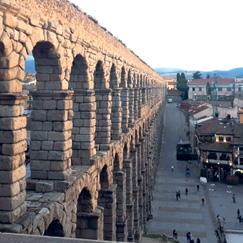
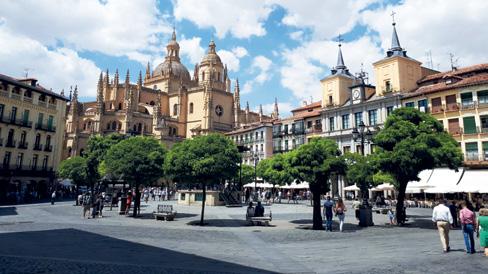
It’s impressive from its base as well as from the viewpoints above, and changes throughout the day as its shadows lengthen across Plaza del Azoguejo. Wind your way up Calle Real, towards Plaza Mayor past honey coloured stone mansions including the impressive Casa de los Picos, with its impressive diamond patterned facade dating from the 15th century. Make sure to visit the free contemporary art exhibi-
Spend the afternoon in the Gothic Cathedral, often called ‘The Lady of Cathedrals’ for its elegance. Step inside to admire soaring vaults and intricate stained glass. Watch the shadows dance within the cloister or climb the bell tower for spectacular views over the terracotta rooftops to the distant mountains.
As the afternoon light softens, make your way to the Alcázar.
Perched dramatically on a rocky outcrop, locals claim this castle inspired Walt Disney’s Cinderella castle, and it certainly wouldn’t look out of place in a fairytale. Take a tour inside, then climb the Tower of Juan II for panoramic views.
Dinner is an opportunity to feast on local speciality roast suckling piglet - cochinillo asado - so seek out one of the historic inns. My favourite is El Mesón de Cándido, a family run restaurant with photos of illustrious diners decorating the walls, where the cochinillo is theatrically carved with the edge of a plate. Don’t miss trying the judiones de la Granja - locally grown fat butter beans served in a rich sauce.
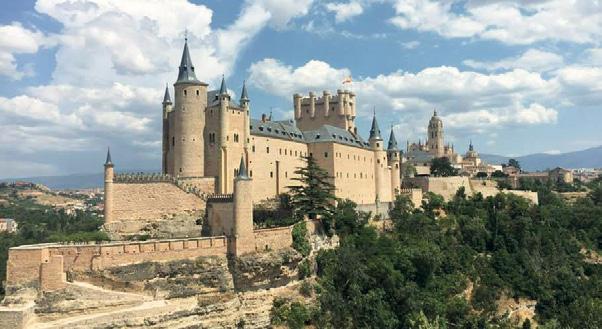
FAIRYTALE: Locals say Walt Disney was inspired by the castle, while (right) snowcapped peaks welcome the visitor in winter time
End your evening with a quiet walk back toward the aqueduct, which is beautifully lit at night or find a dark spot to enjoy the stars.
Start your second day with a relaxed breakfast at a local cafe before spending the early hours strolling around the narrow alleys of the Jewish Quarter, one of the city’s most atmospheric areas. Its winding streets lead to peaceful corners, small plazas, and the former Main Synagogue, now the Corpus Christi Convent.
Late morning is perfect for a visit to the city walls.
“
castle rising above you.
For lunch, bring a picnic and climb a hill opposite the city. Or head back to the centre and find a table outside and opt for a light bite - perhaps a salad topped with local cheese or a plate of croquetas - before squeezing in one final cultural stop: The Esteban Vicente Museum of Contemporary Art, housed in a beautiful historic palace, is a surprising and rewarding contrast to the city’s ancient bones. Before departing, allow time for one last wander. Pick up local treats like ‘ponche segoviano’, a traditional layered cake, from pastelería to take home.
“ The locally grown fat butter beans are served in a rich sauce
Walking along sections of the medieval fortifications gives you a tangible sense of Segovia’s strategic importance and offers lovely views back toward the Alcázar. From here, descend toward the Eresma River valley for a change of perspective. The walk reveals
lush greenery and postcard-worthy angles of the
Don’t miss:
If you are in Segovia over a weekend, El Parral holds a mass in Gregorian chant every Sunday at midday. September sees the city host the Hay Festival Segovia, which brings together world-renowned authors, thinkers, journalists, and artists for debates, workshops, and performances.
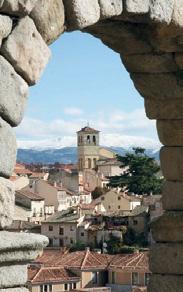
Just 100 km northwest of Madrid, it’s about an 1hr and 15 minute drive from the capital or a 30min hop from Chamartin station on the high-speed train. If coming by AVE you’ll arrive at the station located 7km outside the city. Catch the city bus which drops you off right by the viaduct or if you can’t bear to wait, then there’s usually a line of local taxis outside.
To be right in the centre of it all and awake to the ringing bells of the cathedral, try Hotel Infanta Isabel right in the Plaza Mayor. For the best views of the city and the Alcazar, choose the Parador, which is a modern building offering an unrivalled panorama of Segovia itself. In the summer months you can retreat here and en- joy the openair pool.

by Fiona Govan
SPAIN is home to a staggering 1,600-plus museums, making choosing your culture fix for a weekend away a truly tricky decision.
Now add in the hundreds of weird and wonderful temporary exhibitions gracing the country this year and Spain is a genuine sweet shop for culture vultures.
Everything from centuries-old grand masters to modern-day tapestries and from civil war rescue paintings to works created during apartheid South Africa, the country has it all.
Here are six top exhibitions taking place around Spain in 2026:
Museo de Bellas Artes
Los Becquer, un linaje de artistas (Until March 15)
Now in its last month, the Los Becquer exhibition of 100 works puts the spotlight on the most important artists during Sevilla’s romantic era.
It begins with the work of Jose Becquer be fore moving onto that of his cousin and student Joa quin D. and then, ultimately, fo cusing on broth ers Valeriano and Gustavo Becquer.
The rooms highlight the significance of the Bec quer family on Spanish art, demonstrating the international acclaim of the family’s cre ations. Entry is €1.50 or free for EU citi zens.
From Baroque masterpieces to contemporary tapestries, there is so much going on in Spain this year
By
Rachel Gore
MALAGA
Museo Picasso
Picasso Memory and Desire (until April 12)

The exhibition explores the relationship between memory and desire, focusing on Picasso’s 1925 painting, 'Studio with Plaster Head'. It examines the influence of Picasso's work on contem-
With over 100 works, including interpretations of Picasso's themes by artists

such as Salvador Dalí and Federico García Lorca, the exhibition presents a dialogue between history and the modern era. If you're interested in how art evolved in the 20th century and how Picasso influenced the industry, you should visit before mid April. The entry is €13.
MADRID
Reina Sofia
Viva el arte vivo (February 11June 8)
Here we take a look at the short but influential time in which

artist Alberto Greco produced his work, which was inseparable from the migrant journey he began in 1950. Moving through numerous locations, from Buenos Aires to Rome to New York and Ibiza, Greco’s story is one of numerous journeys and street wandering.
With works produced between 1949 to 1965, the exhibition includes his early writings and paintings and later drawings and novels, making reference to mass media and in-
spiration from local festivals, religious celebrations and day to day life.
General entry to the museum costs €12.
BARCELONA
Museu Nacional D’art de Catalunya
Recuperado del enemigo. Los depositos franquistas en el MNAC’ (February 19 - June 29)
This exhibition looks back to the past, putting the spotlight on the extraordinary effort that went into saving Spanish artwork during the Franco regime. Following the Republican defeat, many people joined forces to protect artworks threatened by the dictatorship. The Barcelona Museum became a place where these pieces were delivered, stored and managed by the Service for the Defence of the National Artistic Heritage (SPDAN). Here are 146 pieces deposited by SPDAN, exploring the themes of political memory and transparency. Entry costs €2.
BILBAO
Guggenheim
up in, which felt the divisions of Apartheid.
He particularly looks at themes of race, religion, sexuality and memory.
Collaborating with the Garage Dance Ensemble, his work also involves dancers moving on canvases placed on the floor. The ‘dance traces’ become symbols of liberation and connection which are used in his work.
The artist’s tapestries and textiles created in Athens in 2024 will be hung from hooks and suspended. The museum costs €15.
Museo de Bellas Artes Magdalena. Santa y pecadora (October 29 - February 14)
Reflecting on the roles assigned to women is 'Magdalena'. Santa y Pecadora.
“
“ It’s shows that a woman could be both beautiful and independent
In situ: Igshaan Adams. Unsettling Dust: The Body’s Archive (May 1 - November 1)
The work of South African, Igshaan Adams, took inspiration from the community he grew
Magdalena was a key figure in Western sculpture and painting because she was presented as a Christian role model. Nevertheless, she did not conform to the established norms, setting an example for how a woman could be both beautiful and independent of men. With almost 70 pieces of art from the Mediterranean Baroque period, this exhibition sparks conversations and discussions about the role of women, which can be related to current debates in modern society. Admission is free.
FROM time to time, I get asked what it took for me to become accredited as a European Financial Advisor and later as a European Financial Planner in Spain.
Seldom do I mention that the European Financial Planning Association (EFPA) sets the standards for financial advisors and planners throughout Europe, or that Spain’s branch is EFPA España. Nor do I discuss the other credentials that EFPA España bestows.
Instead, I tell the story from a client’s perspective and employ an airplane analogy: that a European Financial Advisor (EFA) is like a co-pilot who sits next to you and helps navigate day-today financial decisions safely and competently.
In Spain, that means:
● They have spent enough time in the cockpit - one year in the financial services sector, or six months if they’ve completed a preparatory course at an accredited school (there are currently 16 in Spain).
Comprehensive Cybersecurity
● The educational program should be covered in a minimum of 20 classroom days or 160 tuition hours.
● They are trusted to fly - no criminal record or professional sanctions.
● They have passed the simulator test - a comprehensive 2 ½ hour exam.
● They know the flight instruments - investments, pensions, insurance, regulation, client advice.
When is a EFA in Spain ready to become a European Financial Planner (EFP) and move into the captain’s seat? Typically, once they are capable of:
● Designing long-term, integrated financial strategies for clients
PETER DOUGHERTY
● MBA in finance
● MS in Spanish taxation
● BS in economics
● European Financial Planner in Spain
● Certified Financial Planner ® in U.S.
● Author of two financial planning books
● Handling high-complexity, high-net-worth situations
● Balancing investments, tax planning, succession, risk, and goals—all at once
EFPs need to see the whole flight plan, anticipate turbulence, and make strategic decisions when the stakes (and portfolios) are large. Thus, that means:
They have spent significant time in the cockpit - one year in the financial services sector, or six months if they’ve completed a preparatory course at an accredited EFP school (there are currently only 5 in Spain). The educational program should be covered in a minimum of 40 classroom days or 320 tuition hours.
They are trusted to fly - no


criminal record or professional sanctions.
They already possess a valid European Financial Advisor (EFA) certification or hold one of the following professional certifications/qualifications, provided they were obtained within the last ten years: CFA, CEFA, FRM, CAIA, CIIA, PRMIA, or CFP. They have passed the Top Gun flight test - a comprehensive six-hour exam.
In Spain, European Financial Advisor (EFA) and European Financial Planner (EFP) are not competing certifications but complementary milestones. EFA establishes technical competence and regulatory trust. EFP builds on that
foundation, confirming the ability to integrate, prioritize, and lead. EFPA España requires that its EFA and EFP holders adhere to a strict code of ethics as well as mandatory continuing education obligations: currently 30 hours a year for EFAs and 35 hours a year for EFPs. Final boarding announcement: the EFA and EFP exams given by EFPA España are all-in-Spanish, and every rule, concept, and acronym belongs squarely on Spanish soil. If your financial instincts are jet-lagged from another jurisdiction, they’ll need to adjust before takeoff.

Isolutions.
Personalized User Experience
MAGINE someone out there in cyberspace quietly applying for loans, credit cards and hire-purchase agreements.
Their services include cybersecurity, device maintenance and performance optimization, and malware removal, enhanced
BY FRANCISCO DIAZ
Why Choose AnyTech365?
AnyTech365 adapt its product and technical support solutions to individual needs, offering a safe online experience to any user.
Comprehensive Cybersecurity Their services include cybersecurity, device maintenance and performance optimization, and malware removal, enhanced by AI for faster and accurate solutions.
Not a real person mind, someone entirely made up: no mum, no Netflix subscription, no awkward school photos of his children… yet capable of costing banks tens of millions of euros.
Personalized User Experience
with a name and address that passes UK verification checks) and then pair it with invented elements such as a bogus date of birth or a fake phone number.
Some of AnyTech365 Products and Features
AnyTech365 IntelliGuard
AnyTech365 AI powered unique software can pinpoint the root cause of a problem providing real-time
Because it has no genuine human at its core, there’s often no immediate victim to raise the alarm. Instead, the first hint of wrongdoing might be a maxed-out line of credit buried deep in a database somewhere.
This is synthetic identity fraud, the Frankenstein of the financial world, stitching together stolen and made up data into a creature that, until it spits out bad debt, looks suspiciously like a perfectly normal customer.
AnyTech365 adapt its product and technical support solutions to individual needs, offering a safe online experience to any user.
The result? A ‘person’ who doesn’t exist … until the criminal gang suddenly lends them thousands of euros (or pounds, etc).

At its heart, synthetic identity fraud is a baffling blend of the real and the fictitious. Run by criminals who first unearth someone’s genuine personal details (perhaps a Social Security number,
How the clever long con of ‘Synthetic Identity Fraud’ becomes the Invisible thief in the digital shadows
Atlantic.
For those not working in risk manage ment, this might all seem like a distant problem that lives in the server stacks of big banks.
that differentiate a genuine customer from an electronic mirage. Meanwhile, if you’re a consumer wondering whether this affects you, take heart. Most synthetic identity fraud doesn’t start with your name, but it can incorporate stolen elements of yours (like a long-un-
Some of AnyTech365 Products and Features
AnyTech365
World
This illusion isn’t a fast whim. It’s a long con, a patiently laid trap. The fraudster nurtures this make-believe persona, building up a credit history for him or her so they appear trustworthy to automated systems.
AnyTech365 IntelliGuard
AnyTech365 AI powered unique software can pinpoint the root cause of a problem providing real-time protection and immediate response to suspicious activity. This proactive approach significantly reduces the risk of cyberattacks.
AnyTech365
A
All the while, the banks think they’re dealing with a reliable customer,
AnyTech365 Security World class, cross-platform security platform with advanced scanning techniques to identify potential threats from files, programs and neutralization of viruses, malware, and phishing attempts.
AnyTech365 TotalCare
soon giving them some credit, even setting up loans.
A comprehensive security suite, combining all AnyTech365 premium products together with quick issue resolution by certified technicians without onsite visits anytime, day or night, with AnyTech365’s around-the-clock support services, all offered in more than 15 native languages.
Then: boom. Once enough credit is extended, the identity vanishes into thin air, leaving lenders holding an empty bag and a very real financial loss.
Now, you might assume this sort of skulduggery would be confined to Hollywood thrillers, but in reality, it’s become a fast-growing threat on both sides of the

In the EU alone, research suggests millions of synthetic identities are already in circulation, quietly churning through credit applications and wreaking damage that could run into the billions if left unchecked. Meanwhile, financial security experts warn that as criminals get their hands on ever-more powerful AI tools, they can generate convincing fake documents and even deepfake media to support their schemes,making the fraudsters tougher to spot than ever before.
So why is this invisible menace so difficult to tackle?
Traditional fraud detection systems are built to flag anomalies like stolen card numbers, suspicious logins, or odd transaction patterns, but a synthetic identity is nothing if not patient and calculated.
Unfortunately, the ripples are felt much more widely. When lenders lose money, everyone pays a little extra in inter est rates or bank charg es.
And individuals whose real data has been used, even as only part of a synthetic blend, may find themselves entangled in investigations or cleaning up con fused credit records for months on end.

To keep pace with this chameleon-like fraud, banks and regulators are shifting gear. Artificial intelligence, irony of ironies, is now being deployed to fight back against the AI-enabled fakery. Enhanced verification technologies,
behavioural analytics and cross-industry data-sharing are all parts of a larger defensive strategy designed to spot the subtle clues
Staying vigilant about breaches, monitoring your credit reports regularly, and being cautious about where you share personal details are sensible habits in a world where digital shadows are as real as physical
In a world where even identities can be algorithmically fabricated, the line between reality and
The fraudsters may be clever, but with the right tools, such us our AnyTech365 CyberWarranty plans, and a little scepticism at the digital gates, we can make sure these phantom personalities remain exactly that: fiction.
Grab our exclusive FREE introductory offer below and call AnyTech365 to leave it all to the experts!


ELON Musk claims Spain’s inland rural areas could supply much of Europe’s energy needs via giant solar farms.
Speaking at the World Economic Forum he said regions with low population density, have both the land and sunlight needed for large-scale solar projects. He said the technology already exists and that the main obstacles are political coordi nation and in vestment.

depopulated inland

Large rural areas affected by depopulation, often referred to as ‘empty Spain’, have also helped the country expand solar capacity in recent years.
Musk pointed to China as proof that largescale solar energy production is possible. He noted that Chinese so-
“Relatively small areas of land could generate all the electricity Europe needs,” he said. Spain already plays a key role in Europe’s renewable energy transition due to its high levels of sunshine.
EASYJET has blasted EU proposals to give passengers free cabin baggage on flights, warning the move would push up fares and cause widespread delays. It described the idea as ‘lunatic’ and said poli-
ticians did not understand how aircraft cabins actually work.
The European Parliament last week backed plans to allow all passengers one free underseat bag plus a cabin case weighing up to 7kg.
See full story online
lar farms already generate hundreds of gigawatts each year.
Similar projects here could be developed to meet European demand.
Musk also referenced underused desert regions in the US as examples of land suitable for national energy production.
SPAIN’s beleaguered rail industry finally has something to cheer about after Saudi Arabia struck a multi-billion-euro deal to purchase 20 new high-speed trains. Manufacturer Talgo said the agreement also covers maintenance for the trains bringing the deal to a record total of nearly €6 billion.
See full story online
BENIDORM has asked for a €55 million government loan to stave off the risk of bankruptcy over a €350 million compensation award. The unprecedented sum of €283 million plus interest was granted by the Valencian Supreme Court to the Murcia Puchades family last year over the loss of building rights in the protected Serra Gelada Natural Park.
The family has now demanded the immediate execution of the massive payment which equates to roughly two annual municipal budgets.
See full story online

pdougherty@bissan.es www.financial-planning-in-spain.com
I, Lovepreet, son of Jaswinder Singh, from the village of Sheikpur Chammu, Ajrawar, District Kurukshetra, Haryana, hereby declare that I have changed my name from Lovepreet to Lovepreet Singh (given name and surname). I am currently residing in Torrevieja, Province of Alicante, Spain.

WHAT do the numbers ‘one’ and 485 have in common?
For most people, the answer is nothing. But for the Olive Press, both are rich with meaning... for exactly 20 years apart (in issue 1 and issue 485 last month) we had shocking golf course schemes on the cover.
In our very first issue, back in 2006, our splash (below) reported on a golf course mega-project in Ronda that threatened to carve up a protected area of virgin woodland and disrupt the water supply for thousands of nearby residents.
It meant taking on ‘mafia-style’ developers and led to threats and much acrimony.
But that story set the course for much of our reporting since.
For 20 years now, the
How the Olive Press exposed two shocking golf mega-projects threatening to upend the lives of hundreds two decades apart
environment and the lives of ordinary people on Spain’s many Costas have been at the heart of the Olive Press’ unique brand of fearless independent journalism.
It has often led to threats and even on two occasions thugs visiting our offices.
So be it.
Two decades on, we launched our edition 485 - and it proved to be just as pivotal as the first.

“
“ While decades may pass we remain true to our original purpose
Issue 485 was our first national edition, and has now become monthly.
And call it coincidence or not, with serendipity, it once again
featured a golf course mega-project on its front page. This time, we report on a proposed

The Olive Press’ insightful and incisive podcast, The Rest is Spain is now entering its auspicious 13th episode.
Unlucky for some, but this new one set for this weekend begins our chilling, indepth and eye-opening 3-part series on the Costa del Crime.
Want to know which mafia gangs are on the rise? Who’s dead and buried? Or who’s on their way to prison?
You’ll find us on Apple, YouTube and Spotify among all the world’s best podcasts.


€311 million luxury tourism complex planned for protected farmland and a development that threatens to drive dozens of farmers and expat residents from their homes and carve up, yes, another protected area. Issue one and issue 485 are equally historic - albeit for slightly different reasons.
But, perhaps more poignantly, they show that while decades may pass, we remain true to our purpose. For 20 years, we have done our best to hold the powerful to account. This time it’s the Larios
family, one of the wealthiest landowners in Spain.
From Ronda to Maro, from Madrid to Ibiza, we are there when it mat ters most.
The Olive Press about people. Born in a barn - as our editor Jon Clarke revealed on line last month - we have come a long way since those early days. But who we are has not changed. Our purpose has not changed. And our commitment has never wavered.

Issue 485 (above) marked a momentous milestone for us, and we are excited about what lies ahead.
IT was in February 2007 that we first reported a hairbrain scheme to build a motorway from Marbella to Ronda.
The mega-millions project through the virgin Genal Valley would have saved the journey time by about 20 minutes, entirely missing the point of arriving slowly in the charming mountain town.
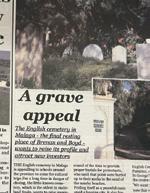
In the same issue (right), we showed our campaigning spirit by publicizing the plight of Malaga’s 200-year-old English cemetery, where dozens of celebrated poets and writers are buried.
We also had our first introduction to the Costa del Crime reporting how an expat couple had used the ‘mother of all ribs’ to import drugs from Morocco.
The boat (below) had an extraordinary
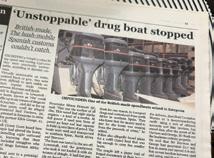
eight 250hp engines, used 900 litres of petrol per hour, and could travel at 115kph, while carrying six tonnes of hash. Neil Davison and his wife Ellen ran their scheme for an incredible four years out of Estepona, until being snared in 2006 accused of netting up to €20 million. Even more remarkable he twice managed to give the authorities in Spain the slip and 20 years on is still on the run.
A few years later in February 2013 we reported that the British couple the Priors, whose home had been knocked down in Almeria in 2008, had been offered a derisory €30,000 compensation offer. Under the splash headline ‘Insult’ Helen Prior told us the offer was ‘ridiculous’. She added: “It’s a horror story. This isn’t justice.”
We also had famous Marbella estate agent Kristina Szekely on the cover after filing for bankruptcy owing €250,000.
The following February we had one of our most seminal covers, after a million people demanded the resignation of president Rajoy when it emerged he had taken regular cash payments in the infamous Gurtel case. Asking the question: ‘Who will cut out the cancer destroying Spain?’ we revealed he was receiving €30,000 a year from a €22 million PPrun Swiss slush fund.

In lighter news (left) in February 2014, we reported how Queen star Brian May had slammed Prince William
We have delivered fiercely independent journalism for two decades - and now we set out to do so on a larger scale than ever before, with Madrid and Barcelona in our sights.
Many of you have been by our side since we published our first issue from that barn.
And we hope you will join us on this next chapter as well.
Please send us your thoughts and what you remember from back then. Send to newsdesk@theolivepress.es

CAMPAIGNING: Against a hairbrain motorway project or for saving the historic English cemetery in Malaga
and Harry for hunting wild boar and stags at the exclusive Garganta hunting estate in Cordoba owned by the Duke of Westminster. “It is the whole attitude of the privileged classes, you can rescue rhinos and elephants in Africa, but kill anything at will in Europe if you’re rich,” he told us.

Spain’sbestpropertymaginEnglish


MUST REMEMBER: Frank Gehry changed the skyline of Spain and turned around the fortunes of Bilbao with his so-called ‘Guggenheim effect’. Following his recent death, we pay tribute to the great architect inside


SPAIN’S property market has kicked off 2026 with a sharp post-Christmas surge pushing prices to their highest level on record.
Asking prices have risen by 3.7% in just three months, taking the national average to €2,650 sqm in January.
That represents an annual jump of 18.4% compared to January
last year, according to the figures from portal Idealista.
The highest prices are being seen in the coastal areas that are most popular with foreign buyers.
Andalucia has seen prices rise by 21.4% over the past year, making it the second fastest-growing region in Spain.
Prices in Malaga province stand at €4,082 per sqm - the fourth high-

Post-Christmas surge in prices with expat hotspots seeing an annual jump of over 25%
By Walter Finch
est in Spain - and where an average two-bedroom apartment now costs €367,380. In Malaga city itself, where prices have risen by 12%, a similar property will set you back a cool €527,490.
Almeria province has also seen prices jump by 19%, despite tradi-

tionally being viewed as one of the last ‘affordable’ corners of Spain.
The highest rises in Spain have been recorded in Valencia province, home to much of the Costa Blanca, which has recorded the single biggest rise in Spain at
25.9%.
Alicante city itself has seen prices increase by 11.2% over the year. In Murcia homes have gone up by 25.8% in just a year.
By contrast, some of Spain’s cheapest provinces remain dramatically below coastal price levels.
In Jaen, used homes cost just €858 per sqm (€77,220 for a two-bed), while in Ciudad Real the figure drops to €779 per sqm (€70,110). The figures point to a market that has started 2026 with strong momentum in the very areas where foreign buyers have been most active in recent years.
Foreign demand for Spanish property reached a new high in 2025, but the final figures from the Land Registrars suggest the boom may have run out of steam by the end of the year.
Sales involving a foreign buyer rose by around 5% over the year to a record total of 97,515 transactions. By any historical measure that is a very strong result, and confirms that international appetite for Spanish property remains broad and resilient. However, the annual headline masks a change in momentum. In the fourth quarter, foreign sales were down 4% year-on-


year, suggesting demand cooled as the year progressed and that 2025 may yet turn out to be the peak of this cycle.
That cooling is also reflected in market share. Despite record volumes, the foreign market share fell from 14.6% to 13.8% over the year. The explanation is simple: Spanish buyers were even more active, with domestic demand up 12%, helping lift
While foreign demand reached new highs in 2025 – it lost momentum by the year end
total market activity by a similar margin. Foreigners did not retreat, but they were outpaced by locals.
Looking at nationalities, the familiar hierarchy remains intact at an annual level. The UK was
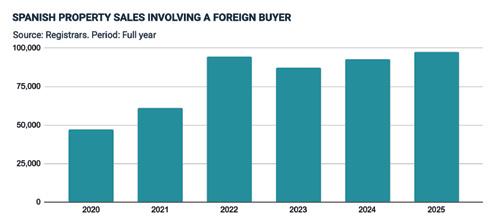
RECORD: For foreign buyers but the numbers of buyers are slowing down
once again the largest foreign market, a position it has occupied almost uninterruptedly since records began, despite a modest decline of just over 3%. Germany
followed in second place, posting a small but steady increase, while France remained in fourth place with broadly flat demand.
The standout story of the year, however, was the Netherlands. Dutch purchases surged by almost 24%, by far the strongest growth of any major market, pushing the Netherlands into third place ahead of France for the first time on record. That momentum was even more striking in the fourth quarter, when Dutch buyers ranked second overall, ahead of the Germans. Since the pandemic, Dutch demand has been one of the quiet success stories of the Spanish property market, and unlike growth from Ukraine or Poland, it cannot be attributed to war-related displacement or regional instability.

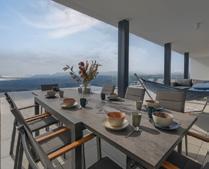

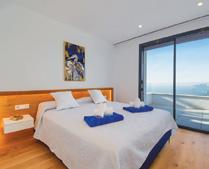
American buyers have also been an important part of the post-pandemic story. Annual purchases rose by around 10% in 2025, continuing a sharp expansion since Covid, often linked to lifestyle migration and political uncertainty in the US. But here too the final quarter told a different story. Purchases by Americans fell by more than 11% year-on-year in Q4, suggesting some loss of momentum. The weakening of the dollar through the second half of the year, which ended roughly 10% lower against the euro, is likely to have played a role.
Put together, the figures point to a market that remains strong, but is no longer accelerating. Foreign demand in 2025 was exceptional by historical standards, yet the decline in market share and the Q4 slowdown suggest the post-pandemic surge may be maturing. If so, last year may be remembered not as the start of a new boom, but as the high point of this one.

By P OO LVILLAS



SHE has been taking photos in the Serrania de Ronda area of Andalucia for over three decades.
Lies Wajer fell in love with the town, while staying in one of its famous historic homes in the charming casco historico, in 1995.
Captivated by its natural beauty, the artist has taken thousands of photos around the town and its nearby hills ever since.
So well known has she become locally that she was made the official photographer of the prestigious
The Valencia region is introducing a new law to significantly cut bureaucracy for building properties on urban land.
Critics fear it will reduce land available for social housing, a concern the government denies.
The current 2014 law, designed to curb previous urban planning excesses and corruption, is being replaced for being ‘excessively rigid and slow’.
The new legislation offers greater flexibility, eliminating building licenses for various projects, including public-private collaborations and work by individual owners, aiming to speed up construction.

ring.
While many of her celluloid sets have appeared in exhibitions, none though are quite like the ones currently on display in the town.
This time, the Dutch expat, 72, has pointed her camera at the ‘quirky’ side of the town, finding beauty in the new bus station (above) and even the industrial estate.
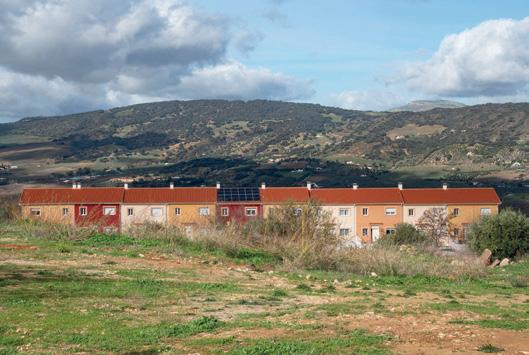
Ultimately, challenging herself to find a new way of looking at Ronda, she has just seen the new collection turned into a wonderful coffee table book, called ‘Urban Safaris’.
Full of unusual and alternative views of the town it shows Ronda’s urban fabric in a very different light. “For 30 years I have mainly focused on the overwhelming nature that surrounds Ronda, but
I also love seeing the quirky corners of the town,” she told the Olive Press. “This book shows off the pleasure I had walking and driving around the industrial area, especially around dusk.
“I often found myself taking pics of electricity and water junction boxes, something that fascinated me because it was so ordinary. Once I was even followed by someone suspicious of my activity, but
when I showed him the images on the camera he was left simply puzzled.”
She calls her forays ‘Urban Safaris’ and they have become a regular outing for Lies and various friends over recent years.
The exhibition can be seen at CHANGUI, Calle Almendra, 47, Ronda. Until February 28. The book is also for sale at lieswajer@gmail.com
FROM sun-drenched mountain villages to sleepy inland towns Spain’s rural property market is fast becoming the country’s hottest ticket.
With a three-bed home undercutting the price of a London parking space and with prices in Madrid, Valencia and Barcelona hovering at eye-watering levels, more and more buyers are looking inland.
Fresh figures from property portal Idealista show that, on average, homes in Spain’s cities now cost almost double those in rural areas.
However, the trend for 2025 showed that buyers have taken note of this disparity, and that now more than half of all demand in the most popular provinces is now focused on
Spain's rural property market is booming as buyers wise up to its bargains to be had - just take Galera, as an example below
rural areas.
Nationally, urban home prices sit at around €2,900 per square metre compared to roughly €1,450 in the countryside – equivalent to around €101,500–€116,000 for a twobed apartment.
But the gap is closing. Demand for village and smalltown homes is rising sharply, especially in provinces that already attract foreign buyers, retirees and lifestyle movers. And in many of the places expats already love, the
MARBELLA will invest €200,000 a year to clean up chewing gum and urine from the pavements. This three-year effort is not limited to street cleaning; a separate contractworth a staggering €4.8mwill focus on damaged and dirty waste containers.
EXPATS now make up a third of the population of a small village in rural Granada, new data shows. While most nearby communities are struggling with serious population decline, around a third of the 1,139 inhabitants of Galera are expats from 32 nationalities.
Over 200 Brits live in the town making them, by far, the largest group, while there are sizable numbers of Dutch, Irish and Swiss.
This economic contribution is particularly welcome at a time when 54% of Andalucian municipalities are experiencing depopulation as young people flock to the cities to work.
In Galera meanwhile some expats are working locally in both agriculture and tourism, while
By Walter Finch
clock is ticking.
Take Malaga province – while its city properties now average over €4,200 per square metre, rural homes still sit closer to €2,800. For a twobed, 70 to 80 sqm home, you are looking at around €201,000 to €230,000.
That can mean a spacious finca with a pool and mountain views for the price of a cramped urban flat. Whitewashed villages like
Gaucin, Casares and Alcaucin offer fresh air, peace, and panoramic scenery, all within striking distance of the coast.
And unlike the packed beachfront hotspots, parking is easy, terraces are quiet, and sunsets feel like private performances. Further east, Alicante province is seeing a similar shift.
While coastal cities remain pricey, inland towns like Pinoso, Villena and Monovar still offer large homes with land for a fraction of the cost.
The average prices for twobeds range from €145,000 to €166,000.
Here, you get vineyards instead of traffic jams, starry skies instead of street noise – and the kind of space most north Europeans can only dream of back home.
GALERA: where hundreds of expats, from 32 nationalities, are driving an inland dynamo battling rural depopulation
By Maeve Gorman

others work remotely and have started small businesses.
The growth began when the town hall launched a ‘Move to Galera’ campaign to turn the tide on rural depopulation two years ago.
The initiative promotes the village’s affordable housing, tranquil lifestyle and proximity to nature.
Brits’ threebed heaven
NEWLY built three-bed penthouses are all the rage on the costas, according to official figures - and British expats are leading the charge.
Analysis of sales in the third quarter of 2025 by Idealista shows that three-bedroom apartments sold faster than any other housing type in Spain, with 37 per cent of them sold within a month. In Andalucia, sales surged by 35.8 per cent year-on-year in Q3, compared with a modest 11.4 per cent uptick in resales, reflecting a growing preference for modern, energy efficient layouts.
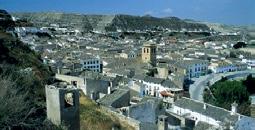
It also stresses the welcoming inclusive attitude to immigrants in the town.
Another key attraction is its casas cueva, traditional Andalucian cave houses built into the mountainside.
The village boasts around 900 of these homes, which are both affordable and sustainable thanks to the natural insulation provided by their cave structure.
By Karissa Key
WHILE Spain is best known for beachside living, demand for property in the country’s ski resorts is quietly rising.
From luxury chalets in the Pyrenees to high-altitude homes in the Sierra Nevada, buyers are increasingly looking to the mountains for homes that offer winter sport, long-term value and year-round lifestyle appeal.
One recent buyer told the Olive Press owning a skiing property has transformed how he and his family use their nearest resort of the Sierra Nevada.
“Having a place where you can leave all your stuff and return on any spontaneous weekend, it becomes a home away from home,” explains Ben Bateman, whose property is conveniently central,
just behind the Kenia Nevada Hotel, in the heart of the resort.
Bateman, 47, the owner of Sotogrande’s long-standing Holmes Estate Agency reminisced on heading to his childhood ski holidays and the thrill that came with it.
“Spending a full day traveling by bus, train, and car just to get to the mountains - then skiing feverishly to make the most of it. It was exhausting ultimately,” continues the father-of-five. It made him realize the beauty of having his own ski lodge to use at his leisure each weekend. And, of course, location is everything. “I’m three minutes to a cable car, an easy walk to the excellent bars and restaurants, and all with incredible views,” he

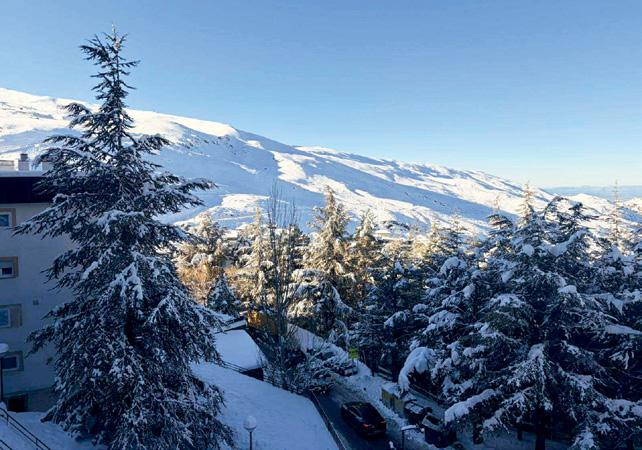

Ben Bateman’s charming chalet in the Sierra Nevada was an ‘excellent investment’ and avoids having to book different accomodation each time he visits
adds. Here the Olive Press slips and slides around Spain’s main resorts.
At the top end of the market sits Baqueira-Beret, in the Catalan Pyrenees. Widely regarded as Spain’s most exclusive ski resort - helped by regular visits from the Spanish royal family - it attracts affluent buyers from Madrid, Barcelona and the Basque Country. Demand here focuses
on high-quality chalets and well-located apartments, with limited supply helping to underpin prices.
Just minutes away from Baqueira-Beret, this elegant townhome offers the complete mountain experience. Three bedrooms, two bathrooms, €1.03m
In the Aragon Pyrenees, meanwhile, Formigal and Cerler have established themselves as popular choices for families and second-home owners. Known for their dramatic landscapes and extensive ski areas, both resorts appeal to buyers seeking properties that can be used personally while also offering solid rental potential during the winter season.

Further east are La Molina and Masella in Girona’s Cerdanya valley, an area great for their accessibility. With good roads and rail links to Barcelona, they are particularly popular for frequent weekend use. The area’s strong year-round appeal includes hiking and cycling in warmer months, which has helped sustain interest beyond the ski season.
A three-bedroom two-bath fully renovated ground floor apartment in the picturesque community of Alp, close to the ski resorts of La Molina and Masella. Cost is €450,000.
Closer to the capital is Navacerrada and Valdesqui in the Sierra de Guadarrama, which continues to attract Madrid-based buyers looking for quick retreat. Properties tend to be traditional mountain homes or apartments in nearby towns such as Ceredilla, prized for more convenience than large-scale resort living.
This spacious four bedroom detached villa located on a 1200 sq meter plot and surrounded by nature, on for €938,000.
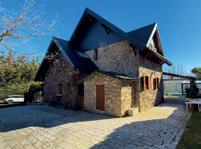
At the southern end of Europe’s ski map lies Sierra Nevada, Spain’s highest ski resort and one of its most distinctive. Snow-sure well into late April and located around two hours from Malaga, it offers a rare combination of winter skiing and east access to the coast. Buyers are drawn to the lifestyle contrast - beaches in the summer, mountains in the winter.
access at 2,400 metres with panoramic views of the national park. €1.5 million
A two-bedroom, one-bath apartment in the ‘Salenques’ urbanisation near to the ski station, is available for just €219,000.













Marbella, a name synonymous with opulence and exclusivity on Spain's Costa del Sol, continues to captivate discerning buyers worldwide.
Within this prestigious locale, Los Monteros stands as a beacon of luxury, offering an unparalleled lifestyle just steps from the Mediterranean.
Altair Estate presents a rare opportunity to own a piece of this coveted paradise, where custom-designed elegance meets natural beauty.
The Los Monteros area boasts a rich history, dating back to 1962 when banker Ignacio Coca established seminal Los Monteros Hotel, instantly drawing global celebrities, with the likes of Antonio Banderos and Melanie Griffiths among the regular roster of famous guests, cementing the area's reputation for glamour and privacy.
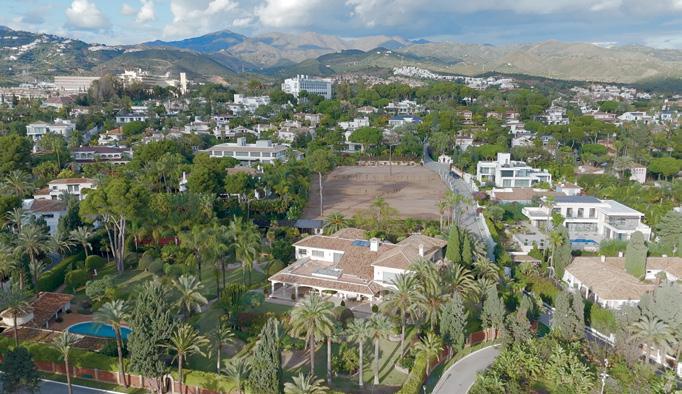

all within just two-minutes’ walk from the beach. All made possible by the vision of investor Charlie Mullins OBE, who has reserved a plot for himself. Yes, truly a once in a lifetime investment opportunity.
This importance of exclusivity endures, with Los Monteros remaining a preferred destination for those seeking privacy and sophistication. The area is renowned for its tranquil atmosphere, pristine beaches, and a lifestyle that combines traditional Andalucian charm with contempo rary elegance.
The Altair Estate’s proximity to this iconic hotel, places the lucky few amid a life of blissful seclusion, inside a gated community, with 24hour security and amazing sea views, and
Residents enjoy direct beach access, worldclass amenities includ ing the renowned La Cabane Beach Club, and proximity to pre mier golf courses and Michelin-starred restaurants.
Altair Estate's vision for Los Monteros is rooted in delivering a truly personal ized luxury experience. This acquisi tion has a very client-centric approach, allowing buyers to actively shape the construction of their dream home from inception to completion.

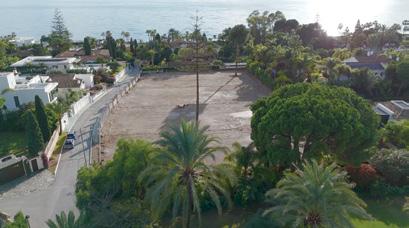
LOOKING FOR MORE PROPERTY STORIES?
Scan to visit our website


This commitment extends to offering a high-end selection of natural, premium materials, enabling a harmonious blend of modern artistry with a natural, artistic style. The focus is on creating homes that are not only aesthetically stunning but also ensure longevity, comfort, and clarity through meticulous execution and

Currently, Altair is offering exclusive plots, each spanning a generous number of square meters, with the option to build on up to 30% of
These properties are designed to feature infinity pools, between five and seven spacious bedrooms, expansive gardens, and an unmatched level of privacy.
Such prime land, so close to the coast, is exceptionally scarce, making these offerings a unique and valuable investment opportunity in a market that continues to show steady price growth and strong rental demand.
Marbella's property market is projected to see price increases of 3.5% to 8% in 2026, indicating a mature yet robust investment landscape. Owning a property in Los Monteros is more than just an acquisition; it's an embrace of a lifestyle defined by comfort,
SEA VIEWS: Each property will have a superb view of the Med, as well as plenty of space for its own gardens and an infinity pool
beauty, and exclusivity.
Altair Estate invites you to explore this extraordinary opportunity to create your custom-designed sanctuary in one of Marbella's most prestigious beachside developments. For more information see contact below




DEMAND to buy a property in Spain is still high and nicely spread out among many nationalities, according to the mortgage experts at the Finance Bureau.
“January was a record month for us and 2025 was a record year, jumping up 35% on the year before,” reveals boss Tancrede de Pola, adding his average loan amount is €527,000.
The mortgage expert, now in his 23rd year helping expats buy homes in Spain, helped ‘several hundred’ buyers get finance last year and he’s not expecting this year to slow down.
“It’s been a hell of a start to the year, even though a lot of the cases we brought to completion in January started negotiating in October or November,” explains de Pola, who now employs six people at his Costa del Sol office.
“We are right at the translation end of the statistics and we are seeing more and more foreigners coming in to buy.”
The team at the Finance Bureau keep seeing more and more expats applying for mortgages… and this year doesn’t look like changing
In particular he says the demand is very high among Dutch clients, Poles and the Swedish, while the British are still top and Americans numbered ‘over 30’ last year.
“We are also getting Germans, French, Middle Eastern and even a few Aussie buyers, although it is tricky as most banks don’t recognise the Australian dollar.”
But this is precisely why certain nation alities like antipode ans, as well as Balkan buyers, from Bulgaria or Hungary,

come to a business like the Finance Bureau.
Because Tancrede and his team have ‘always’ got agreements with one or two lenders for every nationality.

“Countries like Bahrain and Kuwait or Romanians and Hungarians have more problems getting their currencies recognised,” he explains. “But luckily we have got a couple of banks in Spain that will lend to each of these na-
In general though, his company, based in Marbella, uses around

DECADES OF EXPERIENCE: And these days the average loan for The Finance Bureau clients is €5 27,000 euros
half a dozen banks, with a couple of ‘exotic’ ones, as he calls them.
And around half of his clients are buying properties in Catalunya, Valencia and the Balearics.
“A lot of these are the really expensive ones and we have had more million-plus mortgages over the last year than ever before.
“The biggest purchases are generally being made by Americans, Swedish and Polish buyers, and the Ukraine conflict
is bringing a steady stream of Balkan and Polish buyers,” he continues.
Breaking down his client numbers in more detail, he explains that 80% of his clients are between 45 and 55 years old and most get a 25-year mortgage. He even had a client in his late 70s last year and insists he has one specific bank who has lent money to a client over 80 years old. “And he’s already paid off 10 years of that,” quips Tancrede.
LOOKING
As the architect behind Europe’s coolest building dies, the Olive Press pays tribute to Guggenheim creator Frank Gehry
By Alessio Ghirlanda

Fhis crumpled-metal forms began erupting from orderly city blocks, architecture gained its ultimate rule-breaker: a de signer who treat ed buildings like sculpture and skylines like sketch pads.
Gehry’s


signature was unmistakable: swooping steel, titanium scales, gravity-defying curves that seem accidental - until you realise the engineering behind them is more aerospace than art class.
When Gehry passed away in December at the age of 97, the
headlines celebrated his awards and glittering exteriors. But his real legacy was more disruptive: a refusal to let architecture behave itself.
Early critics dismissed him as a showman with a metal obsession. Cities, however, kept hiring him. Gehry understood something that urban planners often overlook: a single iconic building can do more than create a pretty skyline - it can transform an entire city.
The Guggenheim Museum in Bilbao is the perfect example. Gehry didn’t just design a place to display art; he flipped a struggling industrial city into a global


cultural destination.
The ‘Guggenheim effect’ became a blueprint for cities worldwide, proving that bold architecture can reshape both imagination and economy. Gehry’s buildings feel dangerous - loud, emotional, and impossible to ignore. It’s this fearless, transformative vision that makes his work impossible to overlook - and it’s exactly what inspired the Olive Press’ to pick his ten most iconic buildings.
Titanium curves ripple like a futuristic shipwreck on the Nervion River. When the museum opened in 1997, Bilbao went from post-industrial afterthought to global culture magnet almost overnight. Inside, soaring column-free galleries proved Gehry’s wild exterior could deliver serious museum muscle. Urban regeneration suddenly had a poster child.
A metallic explosion in Rioja wine country, its pink, gold, and silver ribbons twist above a medieval village like a tipsy crown. Luxury hotel meets sculptural spectacle. Gehry turned a winery into a global design pilgrimage, where architecture sells wine before guests even reach the tasting room.
Steel sails billow over downtown LA in a symphony of curves (above and left). Years late and wildly over budget, the hall still became an instant icon in 2003. Outside screams spectacle; inside whispers perfection, with vineyard seating and acoustics so sharp musicians call it ‘sonic heaven.’

From previous page
Glass sails billow through the Bois de Boulogne like a crystal ship adrift in trees. Commissioned by luxury giant LVMH, it fuses corporate muscle with cultural ambition. Light slices through layered glass, turning a private art space into a glowing, park-friendly Parisian showpiece.

These twin towers shimmy along the Vltava River - one curved, the other cool and upright. Built in 1996, the Dancing House jolted historic Prague with playful modern swagger. Critics gasped; tourists
8 Spruce Street (New York by Gehry), NYC, USA
A residential skyscraper that refuses to sit still. Its rippling steel skin catches light like moving water, turning rental apartments into skyline theatre. Proof Gehry could bring high drama to high-rise living without losing commercial muscle.
and Maria Stata Center, MIT, USA
Walls tilt, towers lean, and angles argue in this brainy architectural experiment. Designed for comput-
Continues on page 28


SPAIN’S leading surveying firm believes demand to buy properties is likely to slow this year.
However, Survey Spain’s latest market report, published exclusively in the Olive Press, estimates there'll be no ‘bursting bubble’.
This incisive report undertaken over months and with dozens of professional sources, has long been a good prediction of the year ahead.
The key takeaways from the Survey Spain report, compiled by Campbell Ferguson, are:
● Demand is still there but we must be approaching peak value, where buyers decline to purchase due to price and there are too many similar properties seeking a reducing number of buyers willing to pay the price.
● I believe demand will slow, but more quickly than construction can, so there will come a point where supply does exceed demand.
● Prudent promoters will then lower prices and off-plan buyers will find they are locked into a purchase they may not be able to sell on at the same price.
● Rental restrictions will exacerbate that trend as buyers won’t be able to use rents to support the costs of running the property.
● However, there will be a huge demand for lower-priced properties suitable for younger, families and skilled trades people to buy.
“I don’t see a bursting bubble,” explains RICS-listed surveyor Fergu-
But ‘no bursting bubble’, writes Campbell Ferguson on the slowdown his long-running surveying firm expects in 2026
son, who has nearly 60 years experience working in property. “More of a balloon slowly going down, making a rude noise!”
He continues that this scenario is almost certain after large parts of the costas moved upmarket while ‘ignoring the base of the service economy upon which the luxury lifestyle depends’.
That said, the Survey Spain January report insists demand for Spanish property ‘remains strong’, with supply tight but not critical.
It adds that ‘most buyers’ purchase without debt/mortages, so financial risk is low.
In addition the market is ‘very different’ from 2008 when a market crash happened due to an over supply of houses and shortage of buyers.
“Overseas buyers are driving growth, especially cash buyers, while domestic buyers face stricter lending and slower recovery,” writes Ferguson, who moved to the Costa del Sol in the late 1990s.
The overseas sector, he writes, was already in full recovery mode following the 2008 economic meltdown, with over 100,000 foreign buyers in each of the three years before Covid in 2020. The totals for the next two years were distorted by lockdowns and travel bans, but
OPTIMISM:But there is a serious need to build more houses insists Survey Spain’s report


we have now seen three straight years of strong growth in the overseas market.
The result is that between 2023 and the end of 2025, the overseas sector grew by 40% in transaction numbers. “If it is this level of growth why

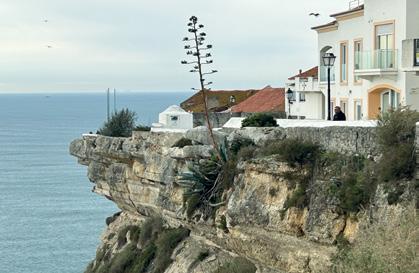
talk of a bubble, an overheating market has emerged?”
The overall total of purchases in Spain is still well behind the 2006 record total, 25% behind according to the latest stats.
It will be 2027, or later, before that 2006 record is surpassed. Today’s market is clearly not a bubble.
Other key factors worth noting include that new-builds make up a much smaller share of the market than in the past due to limitations in construction and infrastructure capacities.
Meanwhile stricter rules on tourist rentals, plus residency requirements, are influencing buyer behaviour.
He adds that locals and workers are struggling with affordability and rental shortages, while labour shortages in construction are causing delays and higher costs, especially for energy-efficient and selfbuild homes.
The numbers speak for themselves. Spain is currently completing around 100,000 units per year, about 40% below what is needed to cover new household needs, never mind demand for second homes from both domestic and foreign buyers.
In October 2024, the Bank of Spain estimated that Spain is lacking 600,000 properties just to cover new household formation since
2021, when it says the demand/ supply ratio became seriously uncoupled.
New household formation is currently around 275,000 annually, a figure predicted to rise to around 330,000 by 2028. In addition, the overseas sector of the market has gone global, with over 50% of foreign buyers choosing to be resident in Spain. Nationalities that hardly registered two decades ago are now buying in their thousands annually. The supply-side shortfall seems set to continue for the foreseeable future. Where’s the bubble?
BARCELONA - CATALUNYA
● In Barcelona and Catalunya, there's little activity in the residential sector due to high prices and uncertainty surrounding the new rental laws.
● However, studies I conducted in the last quarter of 2025, in contrast to these regulations, show that rental offers in Barcelona, and Catalunya in general, with few exceptions, are very close to the average value regulated by the Generalitat (Catalan government) compared to the market value, which is higher, but usually not exceeding the maximum allowed.
● Most purchases at the moment in Barcelona and along the coast, especially in Sitges, are being made by US citizens with
In terms of exciting infrastructure projects, the good news is that the Madrid and Sevilla Governments have at last decided that a Costa del Sol rail line is required. While the scheme will need to be drawn up, contracts
awarded and land rights to be acquired, it’s a start. Here, the Olive Press published an ‘aspirational’ map of how rail lines could be created to serve this area of Málaga Province and nearby. Not official policy, but it’s nice to dream!
high to medium, purchasing power. They are looking for quality homes, but not luxury properties, at mid-
to-high, but not exclusive, prices.
● The rest of the market for buyers from other nationalities, after a boom in recent years, is more stagnant, and the local buyer market is looking for affordable prices or opportunities, prioritising price and not location or quality, and with few transactions in general.
● After the significant increases recorded in previous years, more moderate yet sustained growth is anticipated in 2026.
● Residential property prices are expected to rise by an average of between 4% and 7%. Even higher increases are forecast in prime areas and high-demand coastal locations. This level of growth is regarded as healthy, as it reinforces property values without generating risks of market overheating.
● One of the most decisive factors in 2026 will be the limited supply of housing, particularly in the new-build segment and in coastal locations.
● The primary drivers of this situation include: Limited availability of developable land, Strict urban planning regulations, Lengthy administrative approval processes, A construction pace below market demand
● As a result, well-located properties continue to be absorbed rapidly by the market, maintaining upward pressure on prices and intensifying competition among buyers.

From page 26
er scientists, it looks like ideas mid-explosion. Lawsuits over leaks couldn’t dim its status as one of academia’s boldest buildings.
“
This one looks like a guitar smashed in technicolour. Purple, gold, and red metal collide in a building that feels like frozen feedback. Love it or hate it, Gehry gave pop music a museum that rocks as hard as the exhibits inside.
“ Its rippling steel skin catches light like moving water
Compact but explosive, this 1989 museum stacks white cubes and curves into a frozen architectural detonation. It marked Gehry’s European breakthrough, proving his deconstructivist sketches could survive real budgets, real clients, and real gravity.

INSPIRING:
A carnival of jagged, brightly coloured roofs at the mouth of the Panama Canal. Gehry’s first Latin

FOR years, Spanish banks quietly siphoned money from unsuspecting homeowners using a single line buried deep in their mortgage contracts.
A clause so discreet, so poorly explained, that millions never realised they were paying far more than they should. It was called the ‘floor clause’ - and it became one of the biggest banking scandals in Spain’s modern history. The Trap No One Saw Coming Mortgages were sold as variable-rate bargains, promising payments that would fall as interest rates dropped. But when rates across Europe plunged after the financial crisis, Spanish borrowers were left behind. Their repayments stayed high. Painfully high.
Hidden in the small print was a ‘floor’ that stopped interest rates from ever going down - usually around 3%. No warnings. No clear explanations. Just higher bills, month after month.
Expat Buyers Caught in the Crossfire Thousands of expats who bought property were hit hard. Many trusted the banks, signed contracts in a foreign language, and only discovered years later they had been locked into a rigged deal.
One of them was John Lewis, from Manchester. “I bought an apartment in Calahonda, in Mijas, on the Costa del Sol, in 2001, thinking I’d made a smart investment,” Lewis tells Press. “The mortgage was sold to me as variable-rate. I was told my payments would go down if interest rates fell.” They never did.


American project turns biodiversity into architecture, with bold canopies guiding visitors through the story of life, climate, and continents colliding. And just so you know: if you haven’t experienced a Gehry
masterpiece in the wild, Portugal’s got you covered. From May 2026, the Serralves Foundation in Porto will host a blockbuster retrospective celebrating the architect-genius - and it’s set to be one for the books.
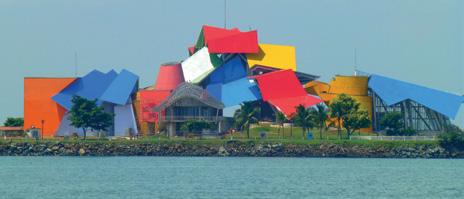
Lewis took out his mortgage with Solbank, later absorbed by Banco Sabadell. When friends back in the UK were celebrating falling mortgage costs, his payments stayed exactly the same. “I honestly thought something was wrong with my calculations,” he says. “It wasn’t until years later that I discovered a floor clause buried in the contract. No one ever explained it to me. Not once.”
By the time he realised, Lewis estimates he had overpaid tens of thousands of euros.
How to Claim Your Money Back: 3 Conditions Not everyone affected can automatically claim a refund. According to legal experts, three conditions must be met to make a successful floor clause claim:
1. Mortgage taken out between 2001 and 2012 – Only loans within this period are eligible


Existence of a floor clause – The mortgage contract must include a clause that sets a minimum interest rate.
Lack of transparency and overpayment – The bank must have failed to clearly explain the clause, and the borrower must have actually paid more than they would have if the interest rate had fallen below the floor.
MORTGAGES AFFECTED = SOLBANK, SABADELL, POPULAR, UNICAJA, ELMONTE, CAJADUERO, CAJAESPAÑA, and MORE

If you want to claim for a mis-sold


Spain’s Mortgage Scandal: The Hidden Clause That Cost Families Millions - and how Fairway Lawyers Fought Back
If all three conditions are met, customers can demand reimbursement of all amounts over paid - and in some cases EVEN IF YOU SOLD YOUR PROPERTY, retroactively for many years. Enter the Lawyer Who Took on the Banks

While banks denied responsibility and insisted customers had signed what they were given, one lawyer began systematically challenging the practice — case by case.
Diego Echavarría, a specialist in consumer law, has helped recover more than €3 million for 150 expat clients affected by unfair floor clauses, through court rulings and settlements with Spanish banks.
“For years, customers were made to feel it was their fault,” Echavarría (left) explains. “But European law is clear: if a clause is not transparent, it cannot stand.”
John Lewis was one of those clients. “When Diego explained the clause to me in plain English, I was shocked,” Lewis says. “It was all there in black and white, but completely hidden in legal jargon. Thanks to him, I finally got my €15000 back.”
Spain’s Banks Prepare to Pay Out
The scandal has hit the banks’ bottom line hard. Spanish lenders have now provisionally put aside €200 million to cover all floor clause claims - a staggering figure that underlines the
scale of the problem.
Despite the payout, the reputational damage is clear. Customers feel betrayed, trust has been eroded, and many are wary of Spanish mortgages even today.
Europe Blows the Whistle
The scandal exploded in 2016, when the European Courts ruled banks must refund all money unfairly charged under non-transparent floor clauses - not just part of it. The judgment sent shockwaves through Spain’s banking sector and forced lenders to repay billions of euros. What banks had long defended as “standard practice” was officially exposed as unfair.
Although compensation has been paid, critics argue the damage goes far beyond money. Years of financial stress, broken trust, and ruined retirement plans cannot simply be refunded. The floor clause scandal remains a bitter reminder that the biggest risks are often hidden in the smallest print.
As John Lewis puts it: “I loved Spain. I just wish I’d known what I was really signing.”




Serenity is a new frontline golf residential resort in Alcaidesa, just 10 minutes from Sotogrande
It offers premium 2–4 bedroom apartments, garden apartments and penthouses with spacious private terraces and views over the golf course, Mediterranean Sea, or mountains.
Set within 10,000m2 of landscaped gardens, residents enjoy an indoor gym, lap pool, beach-entry pool, yoga area, children’s play area, and co-working space.
Alcaidesa also offers shops, restaurants, beach clubs, and two luxury hotels—Fairmont and OKU—for effortless Costa del Sol living.

WHETHER 2026 is the right time to buy property in Spain depends more on your individual readiness than on waiting for the ‘perfect’ moment in the market.
In today’s environment of steady, regionally-varied price trends and clearer financing options, buyers can make informed decisions, provided they have realistic expectations and a solid understanding of their goals. With moderate price rises, ongoing demand, and evolving mortgage conditions, the property market in Spain remains active, though more balanced than in recent years.
What’s driving the market in 2026?
Spain’s housing market has remained resilient despite recent economic headwinds, including rising interest rates and global inflation. As we step into 2026, demand remains strong in key city as well as coastal regions, while new housing supply continues to be constrained due to land use limits and planning delays.
Several factors are supporting the market:
• Spain remains a top destination for lifestyle, relocation, and long-term living
• New housing supply is limited in many cities and coastal areas
• Demand for rental properties is strong, driven by local and international tenants
Property markets in Spain move more gradually than financial ones, and regional variation plays a big role.
What makes sense in Valencia might not apply in inland Andalucía, as each area has its own demand drivers and value potential.
What’s happening with prices in 2026?
While overall trends suggest moderate national growth, price evolution varies considerably between provinces and even neighbourhoods.
According to recent projections, price increases are slowing compared to previous years:
• 2023: +4.0%
• 2024: +8.4%
• 2025: +10.8%
• 2026: +6.3%
This deceleration suggests a healthier, more sustainable market.
High-demand areas with limited supply, such as key cities and coastal towns, are likely to remain stable or show modest gains. Meanwhile, less connected or oversupplied markets may see flatter trends.Higher construction costs are also keeping prices supported. With fewer new homes coming to market and demand still high, especially for rentals, pric-
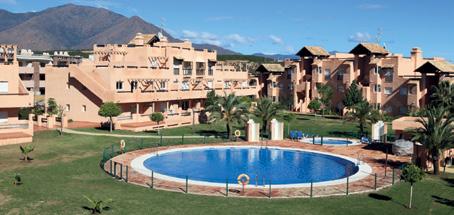
es remain underpinned in many areas.
Mortgage conditions are more predictable For buyers relying on financing, mortgage terms are a key part of the equation.
In 2026, interest rates have stabilised after several years of fluctuations, giving buyers more clarity about repayment commitments. Key points:
• Fixed-rate mortgages offer more stable costs
• Non-resident buyers may face stricter terms, including lower loan-to-value ratios
• Early financial planning remains essential, particularly for international buyers
Understanding your eligibility and having a Spanish bank account, if needed, can streamline the process and help avoid delays.
A positive climate for investment buyers
Spain continues to appeal to property investors, particularly in areas with strong rental demand. Urban centres, coastal towns, and regions popular with foreigners all remain attractive for both domestic and international tenants. That said, success in 2026 will depend more on careful planning than short-
term speculation.
Key things to consider:
• Some regions have paused or restricted tourist rental licences
• Long-term rentals offer steady returns and have less frequent rule changes
• Confirm rental licence is valid, transferable, and permitted under community rules
• Be aware of your tax obligations on rental income, particularly if not a Spanish resident
Is 2026 a good year for relocation?
If you’re moving to Spain or buying a home for lifestyle reasons, 2026 may offer a helpful pause from recent rapid price growth. You’re likely well placed to buy if your finances are organised, your plans are long-term, and you’ve identified an area that fits your lifestyle needs.
Renting first is a wise choice if you’re unfamiliar with the area, allowing time to explore before committing to a purchase.
See full article online, as well as other well researched articles by online property specialists thinkSPAIN


HOUSING policy has become one of the most politically charged debates in Spain today.
But rules vary enormously between cities and regions. In Barcelona, for example, aggressive regulation is protecting residents from rising rents by scrapping short-term rentals by 2028 and dividing the city into controlled zones.
In contrast, Andalucia’s approach mixes investor confidence with selective local action. And resisting controls on rentals makes the region appear much more investor-friendly.
In Andalucia it is up to the town halls to shape rules on rentals, a key part of the real estate sector. In Málaga, for example, new tourist rentals (VUTs) are banned for up to three years in certain saturated barrios while a detailed study looks at the issues of tourism with housing needs.
Similarly, Fuengirola is limiting tourist rental registration after establishing the sector’s strong impact on local housing availability.
By contrast, in nearby Mijas - particularly in hotspots like La Cala - there are
Local tourist rental rules vary greatly between Spain’s regions, writes Chris Fogelberg

fewer limits on tourist rentals, which is keeping the short-term rental market relatively open, appealing to investors seeking returns from tourism-related property.
This variety explains why many investors view Andalucia as less hostile to development than cities like Barcelona. Meanwhile, Madrid’s broader housing initiatives - including rent regulation and classification of stressed housing areas - have been criticized for actually reducing the supply of long-term rental properties, particularly in cities like Barcelona.
However, investor-friendly perceptions come with trade-offs. Local limits on tourist rentals in cities such as Málaga and Fuengirola reflect growing pressure to safeguard housing for residents. The challenge for Andalucia will be balancing investor confidence with real improvements in housing availability, especially as demand from both tourists and long-term renters continues to rise.


























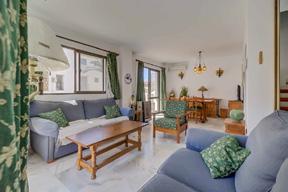
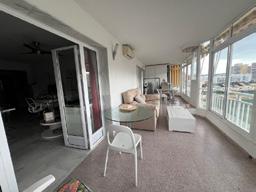
Have a look at our website and find your perfect home. Either second hand or under construction we are going to guide you all the way through your purchase experience.
FUENGIROLA centre, in the popular Puebla Lucia complex, this top floor, duplex apartment offers 2 bedrooms, 2 bathrooms, fully fitted kitchen, lounge and terrace, spacious and bright makes an ideal home and great investment for rental income, community gardens and swimming pools right in the heart of the town!
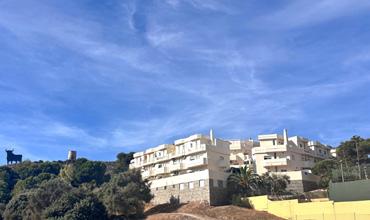
LOS BOLICHES, Fuengirola, spacious bright apartment in great position within walking distance to shops, beach and all kind of services, offering generous 3 bedrooms, 2 bathrooms, fully fitted spacious kitchen, utility room, lounge leading to large terrace, lock up garage and community swimming pool, excellent condition makes a good investment as home and great potential for rental income. Definitely worth viewing!
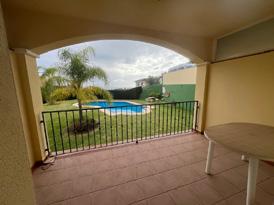
TORREBLANCA FUENGIROLA very spacious townhouse within small complex of 8 houses sharing the garden and swimming pool. Built on 3 levels it offers 3 bedrooms, 2 bathrooms, guest toilet, fully fitted kitchen, utility room, lounge with access to sunny terrace facing south and overlooking the sea and mountains, underground lockup garage and large storage room! Must be seen!
TORREBLANCA Fuengirola, large townhouse in the lower part of Torreblanca just a few minutes walk to the best beaches in the area. Very spacious it makes an ideal family home with 4 bedrooms, 3 ½ bathrooms, fully fitted kitchen, lounge, terraces, jacuzzi and bbq area, some sea view, large lock up garage, community pool in unbeatable location!

MIJAS bright and spacious villa overlooking the mountains and sea, consisting on main house with 2 bedrooms, 2 bathrooms, spacious kitchen, large split level lounge diner and 2 separate guests bedrooms with ensuite bathroom and private entrance, garden and large terraces with barbeque area, al fresco dining, swimming pool, spacious parking area, definitely worth viewing, great as family home and easy access to both Fuengirola and Mijas!

LOS BOLICHES FUENGIROLA very bright and cosy apartment close to services and within walking distance to beautiful beaches and promenade. Comprissing of 2 bedrooms, bathroom, fully fitted kitchen, lounge and southwest facing terrace, low running costs, great investment!
HAVE A LOOK AT OUR WEBSITE AND FIND YOUR PERFECT HOME. EITHER SECOND HAND OR UNDER CONSTRUCTION WE ARE GOING TO GUIDE YOU ALL THE WAY THROUGH YOUR PURCHASE EXPERIENCE. WE NEED PROPERTIES FOR KEEN CLIENTS WAITING TO BUY A HOME OR INVESTMENT PROPERTY. CONTACT US WITHOUT COMMITMENT AND WE WILL PROVIDE VERY INTERESTING AND USEFUL INFORMATION!

SPAIN has cemented its position as the second most visited country in the world with a record 96.8 million tourists in 2025.
Ranking just behind France with 103 million, the figure represents a 3.5% increase on 2024, when Spain received 94 million visitors.
Tourism Minister Jordi Hereu said the results showed Spain’s appeal continues to grow despite economic uncertainty elsewhere in Europe. “Spain is a country that seduces the world,” he said.
British visitors still dominate, while tourists from Europe account for half of all arrivals.
By destination, Catalunya came top with 20 million visitors, who spent a whopping €24.807 billion (a 4.5% jump on 2024).
Across Spain tourists spent €135 billion, an increase of 6.8% year on year.
Tourism now accounts for around 13% of Spain’s entire economy, underlining its importance to jobs, services and regional growth.

The award-winning croquette
IT’S arguably the national dish of Spain, with every family having their own recipe passed down through the generations
By Fiona Govan

and cooked to perfection by ‘abuela’. So it may come as a sur-
ONCE confined to sushi bars and experimental kitchens, seaweed is today emerging as an unlikely star of Spanish cuisine. After a string of celebrity chefs brought algae onto Michelin starred menus and TV shows, it has now gone mainstream.
A seaweed harvester, Antonio Muinos, has seen the market grow by 20% over the last few years.
His company Porto Muinos sells about 32 varieties of seaweed harvested from the Galician coast, where the majority of Spain’s algae comes from.
Some 551,831 kg of seaweed are auctioned in Galician fish markets each year.
prise to learn that an upstart young chef - Alejandro Cano, of Salino in Madrid - has beaten 80 entrants to claim the prize of the best croqueta in Spain.
Spaniards take their croquetas so seriously the nation’s top chefs come together at Madrid Fusion once a year to have their

LIP-SMACKING: That’s the perfect stickness for Cano’s famous Madrid croquette
bite-size morsels judged. They are assessed on creaminess, crunchiness and the combination of flavours.
“There's no trick to it," insisted Cano, 26, who charges just €2.50 per croquette.
“It’s simply a question of having a lot of enthusiasm,
Far from its roots in haute-cuisine, seaweed is now used in pizza and dough, as well as traditional tortilla for a taste of the sea.
Galician schools are also now considering putting algae on menus, in particular for its nutritional and health benefits. It is rich in nutrients including vitamins A, C, E, K and B, potassium and iron.
The ‘vegetable of the sea’ is also high in fibre and is rich in polyphenols and antioxidants, which protect against chronic
illness.
a lot of skill, and above all, a lot of stamina because you have to stir the bechamel sauce many times.”
His recipe involves infusing milk in jamon bones for 24hours before transforming it into bechamel. He said it took him ‘months’ to hone the recipe into the perfect croqueta.

Munois is concerned, though, that climate change could seriously impact the availability of seaweed., with sea temperatures in Galicia reaching 20°C last summer.
As temperatures rise, the number of species decreases and the harvest window shortens.
“It's a tavern-style croquette, very much from Madrid. When you eat it, your lips stick together a little, that slightly edgy taste of ham... that's what I like most about it,” he explained.

IT has been well known for its local wines since the days of Shakespeare, and indeed well before.
But now Jerez de la Frontera’s celebrated sherries are being poured alongside a food scene that has truly come into its own.
If Falstaff once regaled sherry as bringing good ‘humor’, today he would no doubt wax lyrical about the wonderful mix of Andaluz flavours meeting contemporary creativity in the city.
From Michelin-star restaurants to spit and sawdust ‘tabancos’, the ancient city’s exceptional food and wine have rightly earned it the title of Spain’s Gastronomy Capital, this year.
Whether you’re after luxury dining or the charming local tapas, you’ll find it in Jerez.
Here are some of the city’s must-visit
drinking and dining experiences.
Jerez’s standout dining experience easily belongs to the double Mi-
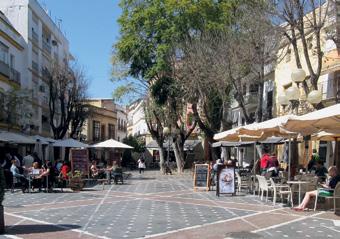
IT’S a rainy night in January, just days after Blue Monday, but La Sala is bouncing…Literally packed, both on the terrace outside and with people on the dancefloor inside, half of them teenagers, much to the surprise of my wife.
But this is, after all, Marbella’s best known foreign restaurant, and its owners, waiters and chefs have been around the block a few times so they know a few tricks or two.
Indeed, this institution in Puerto Banus, has been serving up a diet of fantastic food and fun for an impressive 15 years. And the magic doesn’t seem to be fading.
To help celebrate this auspicious anniversary, I thought I’d better check out the menu, given the Olive Press hasn’t officially reviewed the place for quite a few years.
Initially asked to run a rule over the ‘great value’ midday menu del dia, I insisted it would be far better to actually try the full experience.
By Rachel Gore and Maeve Gorman in Jerez
chelin-starred Lu which offers a world-beating top-tier experience for its diners.
Sitting behind an unassuming

So here we were on a Friday night having to chicane our way past a dozen shimmying dancers making shapes in the main sala in order to get to our table.
Opting for the quieter covered side terrace (not the main one) so we could hear each other, we were immediately impressed by the level of service, but, in particular, the size of the menu.
Now, note well, this is going to take a bit of concentration and likely a phone torch, if you are sitting outside on the terrace.
One entire side is wines - a great selection from around the world, and a big range of prices. Ask any of the staff such as Asier, from Bilbao, who’s been here for a decade and knows
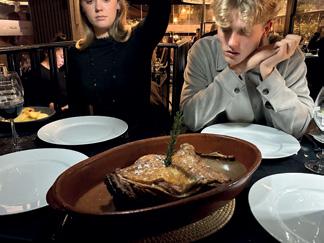
a fair bit about food.
The mix of starters is impressive, but I strongly recommend the crispy duck spring


door in the heart of town, it opens out into a funky interior reminiscent of something like Studio 64 in New York.
You choose from two tasting menus and are taken on a journey through Andalucia’s gastronomical history seeing its dishes prepared before your very eyes. This thanks to an open kitchen in which chefs wander around preparing classics like omelette and gazpacho, all of course with a twist.
The Olive Press loved the reinvention of these historic plates: using French-inspired recipes and Huelva-sourced seafood to create things like a one-bite blue fin tuna sandwich.
One of the most intriguing parts of
magicians, it’s
rolls, which are delicious - just the right crunch - with a great plum sauce and a very generous salad.
The prawn pil pil is also one of the best I’ve had on the coast with the spice having just the right kick.
The chicken wings meanwhile come in two forms; the spicy ones with ‘Shwings Twist’ served with blue cheese dipping sauce. I preferred these to the Honey Chilli ones with ‘Seven Spice’ honey, chili sauce, chives, spring onion and sesame.
Next it’s the mains: with the shoulder of lamb an absolute monster of a dish needing two people to serve it, as it comes out boiling hot from the oven in a giant earthenware dish. This beauty comes straight from Segovia, and while at €80 it might seem toppy, do not be fooled, it is meant for two but can easily serve four, as it did with my family.
Even better, ask nicely and the waiters will
the meal focused on Spain’s 19th century Gañanías, the lodgings that rural workers stayed in, ate in and centered their social lives around.
It meant eating five special dishes, all with a twist, that were eaten back in the day.
We had the wine pairing experience which featured an ‘orange wine’ made from the local Palomino Fino grape. There was a new wine for each courseincluding a wonderful ‘Mosto’, which is exclusive to Lu, poured from a ceramic flask.
Well worthy of note was the wooden trolley that came out with a feast of homemade organic bread and delicious butter

ENTERTAINMENT: Is part of the vibe
happily carve and serve it up and did it brilliantly for us. It was so delicious, tender - and the clever counterpart of salad with baby lettuce and onion worked brilliantly. Almost on queue came out the fire eaters and the most unusual pair on roller skates, looking like aliens. I could have done without them, although a definite plus was magician Alan Mansell, he of the Magic Circle, who performed some extraordinary tricks on our table.
Suddenly we spot a new bunch of teenagers bouncing around the dancefloor, arriving just as the puddings of cheesecake and apple crumble arrive. Delicious and washed down with a glass of Sauterne pudding wine. Not much to fault here.
www.lasalabanus.com for more info
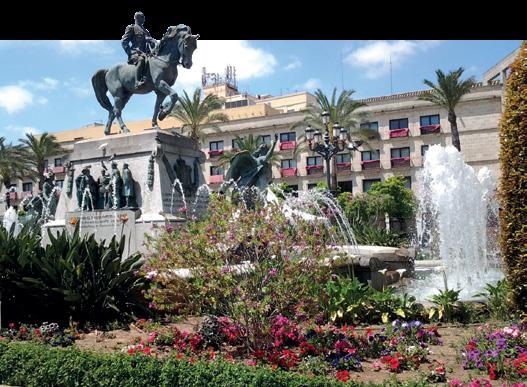

delivered from Normandy weekly and mixed with Lu’s own ‘secret’ ingredients. It serves as the best example of how chef Juanlu Fernandez - or Lu for short - has transformed traditional dishes into flavour packed bombshells.
Lu fell in love with cooking through watching his grandmother in the kitchen. The sauce on the restaurant’s pork dish is based on her recipe.
Our pastry chef for the night, Patri, explained that the ‘mandarins from this citrus-themed course are taken from Lu’s very own back garden’.
Soon after eating this sweet course, diners’ journeys come to a close with a tower of bitesize pastries, sponges and truffles.
Before we left we were handed postcards that detailed each course we had eaten, a memento from a meal we will definitely not forget.
While we didn’t have time to make it this time, we heard lots of good things about Mantua, which won its first and, so far, only star in 2019. We certainly will next time. But, in the interests of keeping our readers informed, Israel Ramos, is from Jerez, having trained locally in Cadiz.
While Lu may be stealing much of the limelight, these days, the city’s many low key tapas spots shine just as brightly.
Take Arima Gastrobar, in a charming cobbled street, opened by Alejandro Bazan and Mariana Sanches in 2024. Serving tapas and sharing plates, the restaurant delivers quality food crafted with fresh ingredients. We particularly loved the anchovies on toasted brioche, while the pavlova as a pudding is a real crowd pleaser.
Arima’s extensive wine list includes Jerez’s famous sherries which go down a treat.
Nearby, look out for Aje Bar which Javier Vadillo recently opened after spending a decade in the Basque Country.
The restaurant’s pickled foods, fermented preserves and salted fish are all made on-site and displayed for customers to see.
Paired with fresh produce, these ingredients come together to create delightful plates designed to be shared among friends.
Albarize en las Venas is another perfect place to enjoy the local wines alongside a range of great snacks.

The staff are very friendly and have good advice on the huge numbers of wines available.
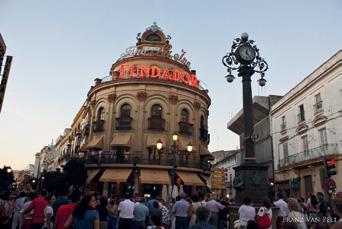
“A good sherris sack hath a twofold operation in it. It ascends me into the brain; dries me there all the foolish and dull
Those searching for evening entertainment should make their way to
Tabanco el Pasaje, a unique space that has been serving wine since 1925.
All ages can enjoy the venue’s flamenco performances and older viewers can try its sherry and ‘Mosto’.
A red flag hangs outside the bar during ‘Mosto’ season so if spotted it’s the best time of year to head inside and try the traditional drink.


JOYOUS:
Last year’s winner Griffiths grabbed a birdie on the last hole to secure victory at Aloha, while (left) Monty at work

The world’s golfing stars are descending on Spain three times this year, starting this month in Marbella
Do you fancy your chances against golfing royalty? Now’s your chance to test your clubs against Colin Montgomerie, Miguel Ángel Jiménez or Paul Lawrie. Or perhaps dive into a three-ball with Michael Campbell, José María Olazábal or Thomas Bjørn.
Some of the world’s best golfers are dropping into Marbella this month to battle it out in the Staysure Legends Tour, before moving on to Murcia and Girona later in the year. The line-up of golfers gracing the fairways at Aloha Golf this week is nothing short of extraordinary. Outside of the Majors, few tournaments boast so many stars, competing for a prize pot that reaches a cool €20 million this season. There is €500k at stake at Aloha alone, where the Tour kicks off this year. Expect to see numerous legends rolling back the years, including Jamie Donaldson, Peter Baker, Stephen Gallacher, David Howell and
By Jon Clarke

Soren Hansen. Even better, spectators will get to see local favourites such as Olazábal, a two-time Masters Champion and the captain who led Europe to one of its most memorable Ryder Cup victories.
Then there is Jiménez, who hails from Málaga - a two-time Senior Major Champion known for his charismatic presence on the fairways. The cigar-chomping legend even designed one of the holes at Aloha, often considered Málaga’s leading course.
One of the biggest draws will certainly be Scotsman Montgomerie - a five-time Ryder Cup victor with 31 European titles to his name. He is understandably popular in Andalucía for his heroics during the final stages of the Ryder Cup at nearby Valderrama in 1997.
It was his incredible last round that saw him halve the match with Scott
Hoch, sinking a 15-foot par putt to seal victory for the Europeans. To compete on the Staysure Legends Tour, players qualify through their performances and earnings on the DP World Tour and in Majors. Those who aren’t eligible that way can earn a card through Qualifying School, which takes place in Turkey in January.
“
“It’s brutal to get in, as out of 110 players entering only the top four make it through – and the standard is seriously good,” explains Marketing Director, Richard Green. “And once you do make it in, you’ve got to work incredibly hard to stay there if you don’t have the career earnings behind you. Fin-
ishing in the top-20 of the Order of Merit is then vital”
He continues: “This week in Marbella is easily one of the strongest fields of the year with Ryder Cup players and captains plus multiple Major winners and Tour stars. This year particularly so, with players like Monty, Jimenez, Olazábal, Howell, Lawrie, Campbell, Gallacher, Donaldson, Bjørn and more – there’s going to be a real buzz around the place.”
“ You can literally walk around with the legends entirely free
One of the best things about the Legends Tour is that golf fans can attend entirely free.
“You can literally walk around with them.
rounds alongside pros, picking up tips, and getting full professional-level access to training facilities and exclusive functions.
Play out of your skin and you might even make the amateur cut - and who knows, you could make the podium at the prize-giving ceremony. Alternatively, you can join a ProAm team, which still offers the chance to play with some of the stars in a more relaxed environment. Both the Legends Experience and the Pro-Am are sold out for Aloha this year and you can secure your 2027 slot by emailing concierge@legendstour.com
For those truly committed, the Legends Club offers the opportunity to play all eight global tournaments in the Legends Experience series.
“That includes 5-star hotels, private Q&As with the legends and even special clinics,” explains Green.



You get so close and see first-hand how good they are - for golf fans it’s an amazing experience to see these legends of the game up close,” adds Green. For super-keen golfers with some spare change, there’s even a chance to play at selected events. The Tour offers opportunities for amateurs to experience tournament conditions and even play alongside the legends themselves -one of the few chances globally where an amateur can compete alongside professionals.
Called the Legends Experience, it includes playing a Pro-Am and at least two tournament
“Imagine doing that in Barbados, Scotland, Greece and beyond. That is a real experience.”
The Staysure Legends Tour, which kicks off on February 20, has been running since the early-1990s and was previously known as the European Seniors Tour.
The 2026 Staysure Legends Tour features a wonderfully diverse set of destinations - from Cambodia to Barbados and Scotland to Greece. It returns to Spain twice more this year at Fontanals in Girona (September) and La Manga (November).
For more information visit www.legendstour.com


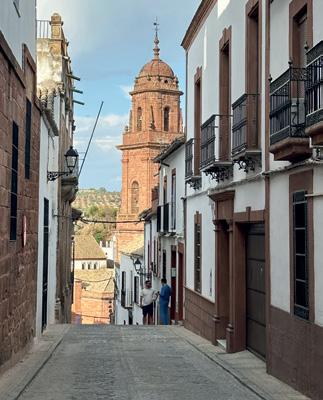


By Jon Clarke
A culinary journey through Cordoba's little-known Valle de Pedroches reveals a region deeply respectful of its history and famous for its amazing pork
HE Valle de las Pedroches, in northern Cordoba, is famed for producing some of Europe’s finest pork. Despite this, finding a truly exceptional place to eat can be surprisingly difficult. However, in Pozoblanco, the home of COVAP (the local association of Jamon Ibérico producers), Karen Bistro is a delightful exception. Indeed, an unexpected gem. Pozoblanco may not be a beautiful town, but the bistro itself is housed in a charming old townhouse. Inside, you'll find a captivating space with vaulted ceilings and Roman brick arches, decorated with boater hats and close-up photos of head chef Carlos Fernandes’ favourite dishes.

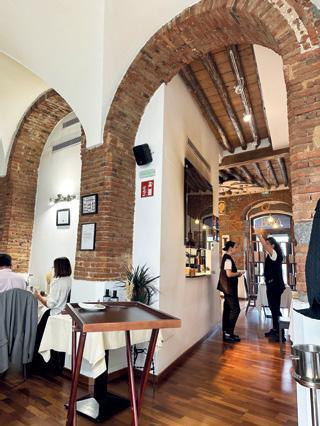
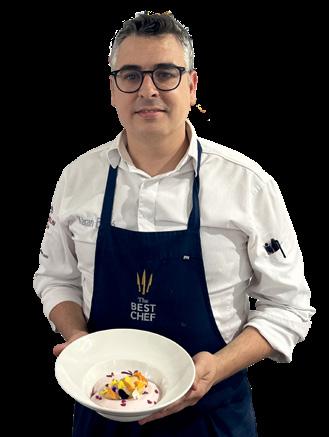
The atmosphere is set with floor-to-ceiling uplighting and modern jazz music, and the sight of sous chefs sporting ‘50 Best Chefs’ jackets certainly raises
The dining experience begins with a ‘false cornetto’ a true tour de force that transitions into an Arabic Mazamorro explosion; a rich blend of almonds, bread, and olive oil dating back to the era of Al Andaluz, when this region commanded a third of the world.
Though a well-priced, seven-course menu del día is offered, arriving late meant being steered toward the a la carte menu. This proved no hardship, as it featured the impressive tuétano (calf shin with steak tartare). Better, the waitress offered sound advice, guiding me away from a heavier mushroom dish to a lighter, more affordable choice of a croquette and a sardine pepper coca with fig chutney.
The black pudding croquette arrived with a handsome slice of ham and a piece of mother dough bread, served with the instruction: "Eat with your hands."
“

The choice was obvious: the roast sucking pig (lechón Ibérica), baked in a delicious sauce with tomato and orange. Its arrival coincided aptly with a group of uniformed COVAP employees finishing their lunch, highlighting the brand's local importance and global respect. The piglet was succulent, rich, and thankfully half the size typically served in the northern mesons of Castilla; the crispy scratching was arguably the best part.
My dessert was a nod to the region's Arabic heritage: an original ice cream made from the local sweet wine of Montilla Moriles, blended with licorice and kefir.
“ The edible flowers struck a perfect balance of sweet and sour
While the rich flavours were rewarding, they did lead to a small casualty on a new pair of shorts.
Next, the Coca - a sort of royal tostada - was a beauty, topped with edible flowers and watercress over fresh sardine and figs. It struck a perfect balance of sweet and sour. The mains predictably focus on meat, sourced primarily from the happy black Iberian pigs that roam the nearby Sierra Morena range. This imperious mountain rangethe border between Castille and Andalucia - is home to the acornfed pigs that produce the world's best ham.
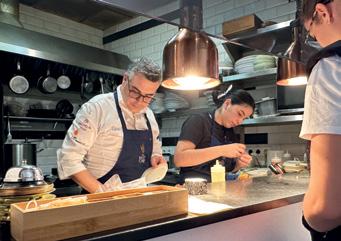
Before leaving, I chatted with Carlos, who has run the bistro for seven years and already holds a Michelin Bib Gourmand (‘red meals’ recommendation). He mentioned his friendship with three-Michelin-star chef Paco Morales of Noor in Cordoba city, but insisted his style aligns more with Benito Gomez at Bardal in Ronda - a commitment to honest, local ingredients I can certainly attest to. Carlos is optimistic about a higher honour: “We’ve had the inspectors at least three times this year so we are definitely on their radar. Fingers crossed a star is en route.” Given the incredible value - €39.95 for a set lunch, or €50 for my three courses - I secretly hope the star doesn't materialise, keeping this steal accessible.
From Pozoblanco, the journey must continue to Montoro, a town renowned as a key place for spotting the once highly endangered Iberian Lynx in the heavily protected surrounding countryside.
For accommodation, I recommend the ancient olive mill, Molino la Nava, nestled deep in the rolling hills and rivers - a truly off-the-beaten-track spot with welcoming staff and comfortable, simple rooms.
Montoro is a little-visited and highly underrated town, easily overshadowed by imperial cities like Sevilla, Cordoba, and Granada, as well as secondary gems like Priego de Cordoba, Écija and Antequera. Yet, this is a pity, as Montoro has witnessed significant history, serving for centuries as a strategic crossing point on the celebrated
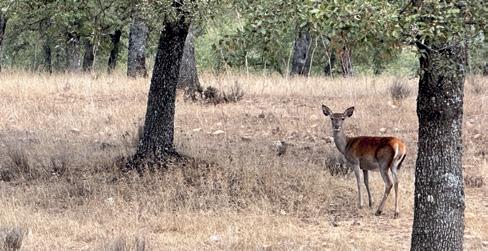
Guadalquivir river.
While it lacks the sheer architectural splendour of its rivals, its fascinating old town is well worth exploring, especially the unique Plaza Espana.
Heading towards lunch, you cross the charming, ancient bridge - said to be Roman - from where Columbus is fabled to have set off to find the New World.
At the restaurant Sol Zapatilla, securing a table overlooking the bridge offers a palpable sense of Montoro’s historical weight.
The menu is an interesting survey of local cuisine, featuring many ingredients from their own ‘huerta ecológica’ (organic garden), which you can
stroll through below the bridge.
Owner Manuel Cabrera proudly pointed out the garden and his free-range chickens, boasting: "It’s full of goodness all year round." In the summer, he even invites clients to collect their own vegetables to be cooked in their unique style.
Vegetable dishes abound, including the cu rious Marrueco con chorizo, a dish passed down in Miguel’s family since Arabic times.

He explained its ‘unique secret spice’, which gave the mostly pumpkin dish a subtle chorizo flavour. When asked if I wanted it spicier, a ‘yes’ resulted in a tiny thimbleful of the secret blend that added real joy - though a single drop more would have been explosive. Montoro’s history predates the Moors.

Known as ‘Epora’ in Roman times, the ancient Via Augusta, which linked Spain and Italy, runs right past the restaurant door. Manuel insists: "We’ve had
Uganda is known as the “Pearl of Africa,” and offers one of the finest topographies in the world for growing quality coffee beans.
From the fertile volcanic slopes of Mount Elgon in the east to the Rwenzori Mountains in the west, each region boasts unique grow ing conditions and flavours.
The coffee grown on its soil has an exquisite taste with the beans having been harvested in the for over 200 years.
The beans are grow-
POPULARITY: Ugandan Coffee is growing in popularity across Spain


ing in popularity in Spain and were showcased last week to 60,000 visitors at the Madrid Coffee Festival.
Uganda’s young generation of pioneering growers are not only dedicated to their craft, but also to driving community uplift, including support for local schools, financial education and youth programmes. Their practices are steeped in sustainability from bean to cup, with agroforestry, climate-smart agriculture and ini-
tiatives such as shade-planting and beekeeping in place. Not to mention many farms have a female-led workforce, who they upskill with
travellers supping here since the days of the Caesars."
It's tempting to wonder if some current menu items were served back then. The
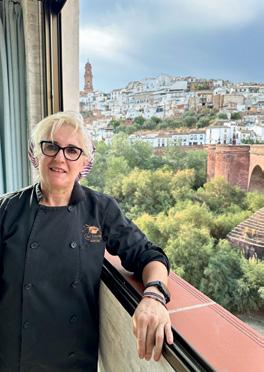
menu features four mushroom dishes, a nice-looking asparagus dish, and a seemingly ancient vinagreta with chickpeas.
Being Cordoba, rabo de toro (oxtail) and plenty of good pork dishes are predictably available. This time, however, I stuck with the vegetables and found the asparagus delicious.
For dessert, the typical Al Andaluz-era Bienmesabe was on offer, but I preferred the sound of
the pear tart with a sprinkling of almonds. While its appearance (above) was unappealing, like the backside of a bus, the flavour was delicious, though it should have been hot, not lukewarm.
Finally, I met chef Mari, who manages the two dozen free-range chickens. She insisted on presenting a collection of eggs (left) - a genuine oil painting of colours - a warm finale before setting off for home.


SUSTAINABILITY: Beans are made sustainably with providers using shade-planting and beekeeping
technical training and fair wages. For example, Ankole Cooperative Union, located in the fertile volcanic soils of Southwestern Uganda, at altitudes ranging from 1400 to 1900 metres above sea

level, is committed to developing local communities and has helped fund schools in the villages they work with.
Ugandan Coffee is making its mark on communities and those who drink it with

Spanish coffee connoisseurs choosing the beans for their distinct taste and brilliant flavour.
COMMUNITY: Ugandan Coffee supports local schools, financial education and youth programmes.
about

SELECTING the right school for your child is rarely straightforward, but for those choosing between an unfamiliar education system and pricey international schools it can be a particularly stressful experience.
“It’s difficult to determine the best option for your kids with each system having different curriculums as well as focus,” one expat parent who is currently searching for the perfect place for her children told the Olive Press. So, for all you overwhelmed parents, we’ve compiled a guide to the Spanish education system, comparing it directly to British international schools.
Spanish primary schools welcome children between the ages of six and 12 years old. These pupils embark on a six year journey divided into three cycles.
The first cycle sees heavy guidance as pupils learn to read, write and count. Then by the second cycle they begin applying these skills independently. Ultimately, in the final cycle, they dig deeper into subjects to prepare for the transition to secondary school.
PROS
3 Your child will be involved in your local community
3 Their friends will live locally
3 They will quickly be fluent at Spanish / bilingual
3 There’s no need to transport your children to school
3 It is free of charge
CONS
2 Rigid structure based on continuous assessment
2 Difficult for parents who don’t speak Spanish to understand what’s going on
2 Not much creative learning, in terms of art, drama, etc.
In contrast, international schools in Spain introduce children to formal learning a little earlier, often starting with reception at four or five.
Students progress through Key Stage One, where they build basic literacy and numeracy skills, before moving to Key Stage Two at the age of seven.
At this point they begin connecting classroom learning to the wider world.
Spanish secondary education, which spans ages 12 to 16, is a structured four year journey divided into two cycles.
The first cycle consolidates core knowledge and introduces students to practical lessons. The second, sees them choose optional tracks that can include languages, music or technology. Assessed continuously, through homework, class participation and exams, pupils develop a variety of skills.
Those who fail subjects can retake over summer, with a second failure leading to repeating the following academic year.
Those who pass all subjects during the course of these
four years earn the Titulo de ESO, Spain’s official secondary school qualification.
In British international schools, secondary education begins with Key Stage 3 where pupils expand their core knowledge while being introduced to subjects like computing and design technology. By 14 they are preparing for IGCSEs, exams which are completed at 16 and see pupils receive individual grades for each subject. Pupils study core subjects but are also able to select others like drama or art.
Containing little, if any, coursework, IGCSE marks are determined entirely by examinations meaning that for those who struggle under exam pressure, the Spanish system may be a better fit.
After ESO, Spanish pupils pursue the Bachillerato, a two-year program that sees them focus on one of three pathways: science and technology, humanities and social sciences or the arts.
With pupils following a fixed track there is little flexibility.
PROS
2 It is relatively easy for your child to repeat a year. Re secondary education, the repetition rate is 5.5% for state institutions combined to 1.4% for independent.
BRITISH schools and universities are being encouraged to open branches around Europe to grow the country’s ‘soft power’.
The UK’s new International Education Strategy hopes to increase ‘education exports’ from £32 billion a year to £40 billion by 2030.
This increase will come from British educational institutions opening campuses in other countries and continents.
Already education is one of the UK’s most valuable exports with it bringing in more
All pupils do however study Spanish, a foreign language and physical education throughout this two year period.
3 Cambridge exams are provided
3 Caters for entry to UK universities
3 International Baccalaureate entry
3 Individualised learning plan
3 Constant contact with parents / partici- pation in the learning experience
3 Speak to educators in English CONS
2 The cost each year
2 Paying for school uniform, that your child must wear
2 Less immersion of your child in their local community
2 Friends might live further away
2 Child is less likely to be fluent at Span- ish
2 The need to transport children to school – possibly at a geographic dis- tance
2 The school holidays do not match Spanish holidays

schools are working towards A Levels.
Typically choosing three or four subjects, students dive into topics that interest them and, over the course of two years, prepare for a series of summer exams.
Spanish schools provide a direct route to Spain’s public universities through the Bachillerato. Bachillerato results are looked at by universities who also take into account the EBAU, Spain’s mandatory university entrance exam. Pupils are prepared for the EBAU, in which they will need strong scores if they want to attend Brit-
For pupils looking for higher education abroad, international schools offer a clearer path. A Level students are better positioned for top UK universities, as well as US Ivy League colleges and leading institutions across Europe.
Those who wish to attend Spanish public universities, however, must demonstrate advanced Spanish proficiency and have their qualifications recognised by Spain’s Ministry of Education.
Aside from their curricula, Spanish and British international schools differ greatly when it comes to student life beyond the classroom. At Spanish
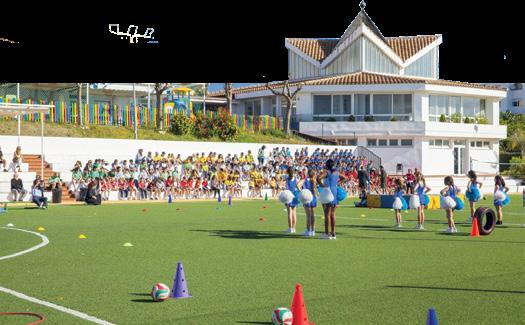
Softly, softly
money than the motor or food and drink industries.
It comes from UK institutions having overseas branches, but also through international students studying in the UK.
Education secretary, Bridget Phillipson, stressed that over 50 current world leaders graduated from UK universities.
Britain’s education export drive sets sights on Spain
By Rachel Gore
There are 620,000 students registered with these higher education institutions overseas with campuses and distance learning across close to 200 countries and territories.
Spain alone has over 100 international schools that base their curriculum on the British educational model.
Next year another school, Brighton College, is set to open in Madrid - and many more private schools are set to follow after Philipson’s guidance.
On the Costa del Sol, Marbella International University Centre (MIUC) also has links to the UK. Degrees awarded at this university are British-accredited due to their affiliation with the University of West London.

By Rachel Gore


schools pupils often move through cycles together and live in the same neighbourhoods.
They attend local clubs and activities and are fully immersed in the Spanish language and culture.
For those with low level Spanish settling in can take some time but being surrounded by the language, in lessons and play, means children find themselves fluent speakers soon enough.
International schools, however, see pupils
from a variety of backgrounds and cultures. This creates diverse classrooms and a welcoming culture which means friendships form quickly.
Despite their quick creation, friendships are transient with pupils coming and going and there is less integration with the local community.
Students tend to have a wider range of extracurricular activities on offer at school and therefore their social lives revolve more around school itself.



SPEAKING multiple languages can keep your brain younger for longer, slow cognitive decline and reduce the risk of dementia, a study has found.
Workout
Multilingualism can ward off signs of brain aging, a process characterised by declines in processing speed, attention span and memory.
The study of 86,000 people in 27
By Maeve Gorman
European countries found those speaking only one language were nearly twice as likely to age fast compared with their bi -


Ready to take your skills global? Step into the wider world with CLIC International House's CELTA teacher training in Sevilla and Malaga
In today's interconnected world, language skills open doors.
At CLIC International House, you join a global network of over 130 language schools, from Seville to Mexico City and beyond.

lingual counterparts.
Speaking three or four languages further increases the brain-protecting benefits, found the report published in Nature Aging.
Switching between languages acts like a daily workout for the brain, strengthening neural pathways that support attention, memory, and mental flexibility.
The implications go beyond sharper thinking: Multilingualism may also help delay the onset of dementia, with risk potentially falling from 4% to 0.4% for bilinguals.
Language learning could be one of the most accessible ways to
CLIC offers language courses in many languages, so you can learn to communicate with confidence, whether you want to master Spanish or another language.
If you're a native English speaker or fluent in English, you can also learn how to teach this highly sought-after language.



LIFE: Getting out and using Spanish in real contexts is key
age well. Lucia Amoruso, one of the study’s authors, says using languages in ‘everyday life’ and ‘real contexts’ is key.
In practice, this could mean speaking to a neighbour, reading, or even just watching TV in a foreign language.
And the good news is, it’s never
too late to start.
Viorica Marian, author of The Power of Language, explains:
“The longer you have experience using two or more languages, the better. But you can begin to reap benefits at any age and after a relatively short time of learning another language.”
This is the most prestigious TEFL qualification, and at CLIC it takes just 4 weeks.
You'll learn in a truly inspiring environ -
CLIC International House offers the Cambridge CELTA teacher training course for those ready to launch a career in this rewarding and expanding field. ment, sharing the classroom with people of different ages, nationalities, and backgrounds.
TOGETHER: The CLIC team enjoy pizza together as they celebrate the power of language learning
Whether you're 20 or 65, Irish or Moroccan, there's a place for you at CLIC.
CLIC also offers online part-time courses via Zoom, so you can fit your training around your lifestyle.
Demand for English has never been higher,across Spain and worldwide, as parents and young people increasingly recognise that strong English skills can be the key to unlocking career opportunities.
As an English teacher, you can work in
language academies or private schools, teach privately in homes or offices, or teach online, building a schedule that fits your life and putting you in control of your career.
A CELTA qualification from CLIC can open doors to living abroad, experiencing new cultures, and building a truly rewarding career. And you couldn't choose a better place
to train than CLIC International House, based in the charming Andalusian cities of Malaga and Sevilla.



NEARLY 35% of adolescents aged 15 to 18 had sexual intercourse, while condom use fell to its lowest level since records began in 2002.
Almost one in three teenagers in Spain had sexual intercourse by the age of 18, according to the latest Health Behaviour in Schoolaged Children (HBSC) study presented by the Ministry of Health.
The survey, carried out as part of a World Health Organization-backed project, tracks long-term trends in adolescent health and behaviour and compares data collected every four years since 2002.
The report shows that 34.8% of adolescents aged 15 to 18 said they had engaged in sex-
One third of teenagers between the ages of 15 and 18 in Spain have had sex - yet condom use is falling
By Eimear kempeneer
ual intercourse, with similar rates among boys and girls, although prevalence rises sharply in the 17 to 18 age group.
More than one in ten respondents reported first having sex at the age of 13 or younger.

Condoms remain the most widely used contraceptive method, but their use has fallen steadily over two decades and now stands at its lowest level since the study began.
In 2002, total condom use stood above 83%, but by 2022 it had dropped to 65.5%.
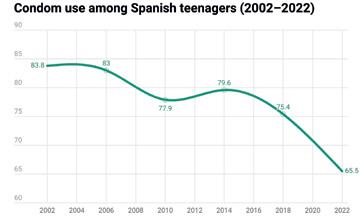
The sharpest fall occurred between 2018 and 2022, reversing the relative stability seen in earlier survey waves.
The decline is more pronounced among girls, widening a gender gap that was virtually non-existent in the early 2000s. By 2022, just over 60% of girls reported using a condom during their last sexual encounter, compared with more than 70% of boys.

Among younger girls aged 15 and 16, the drop in recent years has been particularly marked.
While condom use has decreased, the use of the contraceptive pill has remained relatively stable over the past decade, with around one in five girls reporting its use. The withdrawal method continues to be reported by a notable minority, despite being considered medically unreliable for preventing pregnancy. Emergency contraception is also widespread, with roughly one in three sexually active girls saying they have used the morning-after pill at least once, and a smaller proportion reporting repeated use. Although pregnancy among minors remains relatively uncommon, a small percentage of sexually active girls aged 15 to 18 reported having been pregnant.
The study also highlights clear socioeconomic differences in sexual health outcomes.
Youth from lower-income families are more likely to report earlier sexual initiation, lower condom use and greater reliance on less effective methods.
By contrast, those from higher-income households tend to show stronger prevention indicators and greater access to both regular and emergency contraception.
Note that the data was collected in 2022, meaning behavioural patterns may have evolved since then, particularly given the social disruption caused by the Covid-19 pandemic during preceding years.
READ MORE: Digital sex crimes against children increase in Spain, new report finds
READ MORE: New survey finds one in four people in Spain don’t take any care of their sexual health
full stories online

‘Tyrant’ for tackling TikTok
SPAIN will ban social media for children aged under 16 and order platforms to introduce age-verification systems.
Prime Minister, Pedro Sanchez, says the move is part of a package to guarantee a 'safe' digital environment.
"Social media has failed, where laws are ignored, and crimes are tolerated," he stated.
“Our children are exposed to a space they were never meant to navigate alone and we will no longer accept that.
”We must protect children from the digital Wild West,” he added.
Australia became the first country to ban children under 16 in December.
The government is also introducing legislation to hold executives accountable for illegal and hate-speech on social media. It will also criminalise the amplification of illegal content.
Sanchez added that prosecutors are looking at infractions by billionaire Elon Musk’s artificial intelligence chatbot Grok, as well as social media platforms TikTok, X and Instagram.
Musk took to his platform ‘X’ to brand Sanchez a ‘tyrant’ and ‘fascist’.
February 2026
AFTER a six-year hiatus the Erasmus scheme is finally returning to Britain, allowing university students to study in Europe without extra fees and giving UK universities a boost in international exchange. With Brexit came the UK’s exclusion from Erasmus and the introduction of the Turing Scheme, a UK-only funded programme that offers worldwide outbound funding for those at university.
Unlike Erasmus, Turing Scheme funding is given to universities not directly to students. This
means that each institution decides who gets grants and how much they receive.
“Erasmus funding is more predictable than Turing as the Turing Scheme depends on how much money your university wants to give you,” one UK student told the Olive Press.
At some universities all students receive Turing funding while at others only those from disadvantaged backgrounds or those doing study placements, not work placements, are given money. Under Erasmus there is an automatic exchange for all students going on a year abroad in Europe. Furthermore, as the aforementioned student said, ‘the Erasmus scheme has more long term established relation-
ships with universities’ so students have more options of where they can study. For the last few years study abroad destinations have depended on where a student’s home institution has partner universities. Erasmus’ 2027 return has excited thousands of young Brits who are now setting their sights on semesters abroad.
All you need to know about Erasmus
The name ‘Erasmus’ comes from the 15th century Dutch Renaissance humanist and theologian, Erasmus
Across: 1 Fifth, 4 Dig out, 9 Stand-up, 10 Leapt, 11 Yahoo, 12 Nemesis, 13 Dark chocolate, 16 Fascist, 18 Bosch, 20 Aware, 21 Renders, 22 Dismay, 23 Noses.
Down: 1 Fishy, 2 Feather, 3 Haddo, 5 In limbo, 6 Ovals, 7 To taste, 8 Spin doctors, 13 Defraud, 14 Chimera, 15 Abscess, 17 Soars, 18 Benin, 19 Hosts.
of Rotterdam, who was renowned for traveling throughout Europe to teach and study - it also works perfectly as an acronym for European Community Action Scheme for Mobility of University Students. It was established in 1987 with the aim of promoting closer cooperation between universities and higher education institutions across Europe. Since then it has evolved to become known as Erasmus+.
So far, in just under 40 years, over 16 million people have taken part in the programme.

Svenska Skolan Marbella offers something many families dream of: a secure Swedish school education combined with life in a Mediterranean environment. The school is approved by the Swedish National Agency for Education and follows the Swedish curriculum, with certified teachers trained in Sweden. For parents, this means that their children receive a high-quality education with smaller classes, an international flavour and a fantastic outdoor environment. Svenska Skolan Marbella is an established Swedish school abroad that offers education in accordance with Swedish guidelines in an international environment on the Costa del Sol. For many years, the school has been an important meeting place for Swedish and multilingual families who want to give their children an education clearly based on the Swedish curriculum, while living in a Spanish and international context. The school is characterised by stability, security and high educational quality. The school offers education from preschool to Year 6, as well as tutoring for students studying via Sofia Distans and Hermods Distansgymnasium, both online programs. The student body is composed of children from different backgrounds, some of whom have lived most of their lives in Spain, while others come directly from Sweden. This diversity creates a naturally multilingual and intercultural learning environment, where Swedish, Spanish and English are a natural part of everyday life. In recent years,

the Swedish School Marbella has continued to develop both organisationally and pedagogically. The digitalization of teaching has been strengthened through new technological solutions in the classrooms, and the school is now preparing to begin working with AI as a teaching aid. In addition to academic teaching, the school places great emphasis on traditions and community. Annual activities such as the Lucia procession, Nobel Theme Days and Christmas bazaars create cohesion and give students a clear anchor in Swedish culture, even far from Sweden. The environment is completely different from that in Sweden. The school is small, with around 200 students, which creates a family atmosphere where everyone knows everyone else. At the same time, it offers an unusually generous schoolyard with a swimming pool, palm trees, large lawns, padel courts, a football pitch and a five-minute walk to the sea.
“This means that the children are outside much more. The combination of Swedish pedagogy and the Mediterranean climate makes a big difference,” says Isabel Saunders-Lagrillière, CEO of the school. All in all, Svenska Skolan Marbella offers a safe, structured and inspiring educational environment where pupils are given the opportunity to develop both academically and socially. The school acts as an important bridge between Swedish educational traditions and international everyday life, and continues to play a central role for Swedish families living in southern Spain.

An in-depth feature on a knee operation at a private hospital in Estepona, received a lot of comments from readers. Here, the surgeon himself, who no longer works at Hospiten, has his say.
I wish first to express my respect for both Angela, my patient, and her husband Rod Usher. Throughout the process they were engaged, thoughtful, and cooperative, and I continue to hold them in high regard. In complex revision surgery, it is standard practice to request up to two cones pre-operatively due to variable intraoperative findings; in this case, only one was required.
While working under the Hospiten structure, I had no involvement in pricing, billing, or financial estimates, which are handled exclusively by hospital administration and fall outside the surgeon’s remit. Angela’s current discomfort reflects the consequences of nearly a decade of accumulated joint damage, not a failure of the surgical procedure – a distinction also acknowledged in the article.
Dr Fabian Poletti, FRCS (Eng), FEBOT (O&T), Consultant Orthopaedic Knee and Hip Surgeon, MSc (Imperial College London), DIC GMC (UK) | Colegio de Médicos de Málaga
Dear Olive Press,
I WRITE about the ongoing delays at border control for UK flights at Malaga Airport. It is a long standing problem (for example I waited for two hours in March last year) but in particular there have been numerous complaints this weekend. One lady turned up 105 minutes early and only just managed to get on to her plane. She reported 21 other passengers did not. The problem, as you might expect, was once again border control – there were only three staff in place. Malaga airport is planning big extensions - unwise since it is clearly unable to cope with the passengers it has, now, in low season.
Anthony Smith, Manilva

FURY: At long border queues in Malaga
Dead wrong Hola Olive Press,
I was shocked to find out that Iberian Funeral Plans went bust a year ago.
I bought two plans with them, but now live in the UK. Can you tell me the latest news on the litigation, whether anyone is getting their

money back, or whether the employees such as Jose Luis Rios have been traced? I read
Jon Clarke’s piece with great interest. Thanks if you can bring me up to date.
Peter Little, Marbella
Editor’s note: Hi Peter, we keep a very close eye on the case and are working with both the victims groups and lawyers. Fingers crossed we track down any of the former staff and we will keep all our readers informed.
Just thought I would write in to congratulate you on the new paper edition format & slowly developing a national aspect. Keep up the good work on issues such as the disgraceful Costa del Sol development and financially aggrieved pensioners over




the bombed out funeral plan. I presume your scope and success at signing up new advertisers will develop as you go increasingly national, too. Cheers to your success.
John Price, Javea, Costa Blanca
SIMPLY THE BEST
You are the best (simply). Hope everything goes better with your new look that you are doing, can’t really see it being better. Wishing you lots of luck
Keith and Lynn, via email
Love the new look
We love the new look. The paper is much easier to read with the larger print.
Dave Jarvis, Murcia
www.theolivepress.es








A BRITISH toddler fighting a rare and aggressive cancer has been given a lifeline after his family moved from the UK to Spain for pioneering treatment.
Matias Valentin is currently undergoing treatment in Valencia after his parents quit their jobs and left London in 2024, desperate to find doctors willing to fight for their son.
The family relocated to the Costa Blanca after Matias was diagnosed with a rare kidney tumour.
Since then, the two-year-old has endured six major oper-
ations and more than 450 scans.
By Alessio Ghirlanda EXCLUSIVE
Now living in Alicante, most of Matias’ care is being carried out at Valencia’s La Fe Hospital, where doctors placed him on an experimental drug, Afatinib.
His mother Lucica, originally from Romania, said the contrast with the UK was
SCIENTISTS in Spain are celebrating restoring vision to a blind man whose eye injury was previously thought to be incurable. Boffins in Elche used an implant to restore partial sight to a man who lost his vision in 2018 due to a severed optic nerve. The operation bypassed the damaged nerve, and used an implant with 100 microneedles to directly stimulate the visual cortex in the brain.
Using electrical signals that correspond to lights and shapes, the patient regained
EVERY time several consecutive days of rain arrive, I observe the same pattern in my clinics: physical activity decreases, joint discomfort increases, and that vague sense of fatigue many people attribute to bad weather resurfaces.
But the problem is not the rain. The problem is inactivity.
After the age of 45 to 50, the body does not need rest; it needs stimulus. Aging involves a progressive loss of muscle mass and strength - what we know as ‘sarcopenia’which can reach between 1 and 3% per year if no intervention is made.
This is not a theoretical figure. It is the difference between rising from a chair independently or needing assistance. It is the difference between preventing a fall and suffering a hip fracture.
And it is not determined by the weather; it is determined by movement. There is still a cultural belief at an advanced age one should ‘take it easy’ and avoid exertion. Scientific evidence shows the opposite.
Major reviews published in journals such as The Lancet and the British Journal of Sports Medicine are clear: strength training in older adults is not only safe when properly prescribed, but it significantly reduces the risk of falls, improves bone mineral density, optimizes metabolic control, and lowers cardiovascular mortality. We are not talking about athletes. We are
‘night and day.’
“In London, doctors said the disease was too rare and they were afraid of making mistakes,” she told the Olive Press.
“Here, they fight for him.”
She added: “I want the whole world to know how grateful I am.”
enough vision to identify objects and even read large characters on a screen.
The revelation comes days after a team of Spanish researchers successfully treated pancreatic tumours in trials using mice.
Scientists in Madrid eliminated pancreatic cancer cells by treating the mice with three low-toxicity drugs. The breakthrough opens the door to groundbreaking treatment in humans with the drugs now set to go through clinical trials. Over 10,000 people are diagnosed with the disease in Spain every year - with less than 10 per cent living five years after diagnosis.


NIGHT AND DAY: Contrast between London and Valencia hospital is huge
Over the past 18 months, surgeons have removed six tumours from Matias’ body, including malignant growths in his abdomen and lungs. Lucica believes Afatinib has succeeded where chemotherapy, radiotherapy and
immunotherapy failed. “In London they refused to give it to him. Here, at least he has a chance.” Doctors at La Fe are now conducting advanced tests, including implanting his cancer cells into mice, in a bid to unlock answers.
Despite the uncertainty, Lucica says the family finally feels supported. “I am a mum and a fighter,” she said. “And so is my boy.”
Spain’s national football team doctor
Claudio Vazquez Colomo insists you mustn’t let rain be an excuse not to exercise
talking about ordinary people, at home, using their own body weight. When it rains and going for a walk or jog is not possible, the home becomes the best possible gym. Repeatedly standing up and sitting down from a chair is one of the most effective exercises to maintain lower limb power, essential for functional independence. Performing gentle wall push-ups strengthens the upper body muscles that are crucial for daily tasks such as pushing a door or carrying groceries. Raising the heels while holding onto a kitchen counter improves muscle func-
“
tion and promotes venous return. Walking through the hallway for 15 minutes keeps the cardiovascular sys-
“ The rain may darken the day but it should not darken behaviour





It
is not sophisticated, but it is profoundly effective. From a physiological perspective, exercise acts as a systemic modulator. It reduces inflammatory markers, improves insulin sensitivity, and stimulates the release of neurotrophic factors associated with cognitive protection. We now know that regular physical activity is associated with a lower risk of cognitive decline and Alzheimer’s disease. We also know that it improves sleep quality and reduces depressive symp-
toms.
The rain may darken the day, but it should not darken behaviour. One of the most important aspects is balance training. Most fractures do not occur solely because of weak bones, but because of falls. And balance can be trained.
Standing on one leg for a few seconds near a stable support, walking in a straight line inside the house, or rising from a chair without using the hands are simple actions with proven clinical impact. Programs combining strength and balance reduce fall risk by up to 40%.
As a sports medicine physician, working with Spain’s national football team I always emphasize the same point: age is not a contraindi-
cation to exercise; immobility is.
Of course, you should adapt activity to your medical health, but in most cases, the barrier is more psychological than medical.
The real risk on rainy days is not getting wet; it is sitting down and not getting back up. Every day without muscular stimulus is a small physiological surrender. Every repetition performed, on the other hand, is an investment in future independence. This is not about training to compete. It is about training to live better. Consistency - even in the living room while raining - is one of the most powerful tools we have to age with functional dignity. In the end, the body does not understand seasons. It only understands use.

Siamese success
Healthy Siamese twins Khadija and Cherive from Mauritius have been reunited with the medical team that successfully separated them in Barcelona three years ago.
Piracy push
A €50 reward will be offered by Spain’s La Liga chiefs to anyone who reports a bar streaming football illegally without a license.
Stuck in mud
A hiker was trapped in mud up to the waist for eight hours before rescue teams in Malaga finally saved him.
A SPANISH schoolboy has made headlines in Italy after unearthing a rare Roman coin buried for 1,800 years.
Little Alejandro, 10, from Granada, was exploring the ancient ruins of the Palatine Hill, by the Colleseum, when a glint in the dirt caught his eye.
The youngster, described by his mother Vanesa as a 'little rascal', had been scrabbling in soil softened by recent heavy rains.
What he pulled from the earth was a pristine coin from the reign

of Emperor Aurelian, minted in 270AD in what is now modern-day Croatia.
The family's guide for the day quickly realised the 'little Spanish
THEY say revenge is a dish best served cold - which is what England will need to do when they face Spain twice in a matter of months next season.
The two sides have been drawn in the same group for the UEFA Nations League, set to take place between September 2026 and June 2027.
By Michael Coy

Indiana Jones' had found something significant. A quick photo sent to a numismatic expert confirmed the find, and by the
It will be the first time the two sides have locked horns since the Euro 2024 final in Berlin where a late Mikel Oyarzabal goal broke English hearts.
La Rioja, still under the tutelage of the ever-wise Luis de la Fuente, will make their way to Wembley for the opening game of the group stage. It will come - hopefully for Lions fans - after a decisive World Cup win in America this summer.


coming in 25th at the Winter Olympics.
It came after he was given the green light to use music from the Minions franchise in his debut.
The six-time national
time the tour reached its conclusion, the authorities were waiting.
Rather than a ticking off for digging in the historic site, the Granada lad was met with praise from museum directors and the Italian media.
The coin, worth at least €500 on the open market, was handed over to officials as a gesture of honesty.
In return for his integrity, the youngster has been granted free admission to the Colosseum for the rest of his life.
“And we were allowed to raid the gift shop for free,” Alejandro added with a grin.
champion, 26, was devastated when Universal Pictures banned him using music from the films in his flamboyant Minions dance. But after fan pressure the American film giant capitulated, not that it made much difference to his position.
SPANISH prosecutors have shelved a high-profile sex abuse investigation into Julio Iglesias.
They ruled that the complaints of sexual abuse by two former female staff in the Caribbean could not proceed under the country’s legal framework.