www.theolivepress.es
Olive Press

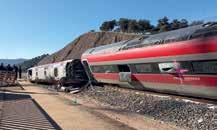
TRAIN TRAGEDY
Family massacre on way back from the Bernabeu

Crash investigation, page 4
CANINE HEROES STAR WARS
The Spanish super dogs making news after training to sniff out cancer
See page 13

Valencia and Anda lucia are neck and neck in the Michelin stakes #485 JANUARY 2026
See page 36




By Alessio Ghirlanda

NO FAIRWAY TO TREAT NATURE
HUNDREDS of residents face losing their homes to make way for a luxury golf development that critics say is an outdated and damaging model of tourism.
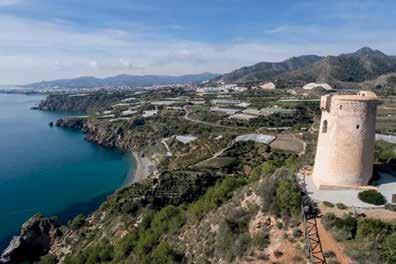
Environmental groups Greenpeace and Ecologistas en Accion have joined forces with farmers and expat residents to oppose the project, which would see up to 680 villas and three large hotels built on fertile agricultural land known as the Vega de Maro (pictured).
The 150-hectare site near Nerja on the Costa del Sol has become a battleground between environmental protection and ‘corporate greed’, with concerns centred on water use, food security and the loss of long-standing rural livelihoods.
Opposition intensified after landowner Sociedad Azucarera Larios (SALSA) confirmed it would not renew nearly 400 long-standing leases, forcing dozens of families to leave land they have farmed - and in

Farmers and expat families are fighting a €311 million luxury golf development planned for protected farmland in Spain
many cases lived on - for years.
“Another golf course is the last thing this region needs,” a Greenpeace spokesperson told The Olive Press, calling the scheme ‘outdated and speculative’.
“If we have to choose between locals growing food and tourism for a lucky few, we stand with agriculture,” she added.
The plans, first revealed by The Olive Press in 2020, would transform the area into a sprawling golf complex despite persistent concerns over water scarcity.
At least 80 families are expected to be uprooted, including around 50 farmers and dozens of expat residents.
One of them, British national Richard Jones, 57, says he could be evicted as early as March.
“When I arrived a decade ago, it was just dust and stones,” he said. “Now there are banana trees and crops everywhere - all planted at my expense. My blood, sweat and tears.”

HAND S OFF OUR COSTAS
as a month to vacate.
The company declined to comment this week, but has previously said the project would introduce ‘more responsible’ farming practices, claiming many plots were used as private vegetable gardens rather than professional agriculture.
a long-standing ‘territorial debt’ between the landowner and the local council.
For the project to proceed, the land must first be reclassified. It is currently protected agricultural land and holds the same cultural heritage designation as the nearby Maro-Cerro Gordo cliffs.



“I cannot accept corporate bullies pouring concrete over this stunning area,” he added. “All to build three luxury hotels? Is that really what this area needs?”
Residents say they were initially reassured by town hall officials when warning letters were sent out in early 2025.
Those assurances were withdrawn last month when Larios confirmed the leases would not be renewed, leaving some tenants with as little

Residents reject that claim. “They are trying to paint us as outsiders who don’t contribute,” said one expat mother of two. “But when I arrived, the local primary school had just ten pupils. Now classes are full, largely thanks to foreign families.”
Campaign group Otro Maro al-
leged the planning agreement underpinning the project was linked to
Ecologistas en Acción confirmed it has submitted formal objections to the town hall and will challenge any attempt to reclassify the land. Nerja town hall has not responded to requests for comment.
See OPINION, page 6

Altea Calpe Denia Jalon Javea Moraira

WHAT YOU´RE READING

Benidorm bankruptcy fears mount after court rejects bid to overturn €330m compensation ruling

Coming up in 2026: Spain will enjoy its first total solar eclipse in over 100 years – all you need to know to catch the best view

VISUALISED: The startling clusters of European expats that form ‘parallel societies’ along Spain’s sought-after coasts
TWENTY YEARS OF THE OLIVE PRESS
— A new Chapter Begins, writes Jon Clarke
Journalism is often described as holding power to account. Occasionally, that becomes literal. Over the past twenty years, The Olive Press has faced legal intimidation, sustained threats linked to environmental reporting, and, at one point, a physical attack in our own office by two masked men. These moments were never sought out, but they reinforced a simple truth: independent journalism matters most when it is uncomfortable.
When The Olive Press first appeared on newsstands in southern Spain in 2006, the media, political, and social landscape looked very different. Spain was in the middle of a property boom, social media barely existed, and few English-language publications were willing to ask difficult questions or dig beneath the surface of life here. The idea itself was modest. The
paper began in a spare bedroom, with an initial plan to spend a couple of days a week on it while continuing to write for national newspapers. It was never intended to become a large operation — simply a serious, independent publication reporting on Spain. From the outset, the principle was clear: readers deserved journalism that was curious, unafraid, and rooted in the public interest. That meant investigative reporting alongside community stories; holding power to account while also celebrating the people, places, and cultures that make Spain such a compelling country to live in.
Dentist
Over the years, that approach has taken us into courtrooms as well as council chambers. We successfully took on a rogue dentist operating in Spain who had already


paign later followed by three UK national newspapers and three major Spanish titles, and one that ultimately helped see the project shelved.
Alongside investigations into corruption and environmental abuse, we have consistently championed causes that matter to our readers — from coastal protection and residents’ rights to transparency in local governance — often long before these issues gained wider attention.
“
been struck off in the UK, winning a landmark legal case that reaffirmed the right — and duty — of the press to protect the public.
We have also challenged large-scale developments that threatened Spain’s natural and cultural heritage. In Ronda, The Olive Press led opposition to a proposed double golf-course macro-project with 2,000 homes in a UNESCO-protected area — a cam-
As The Olive Press reaches its 20th anniversary, it is also worth reflecting on how dramatically the way people read news has changed — and how we have changed with it.

tering a new phase. From this January edition, The Olive Press becomes a national monthly newspaper, with a refreshed design, improved quality newsprint, and a broader editorial scope.
“ The evolution is not about becoming bigger but better
Over the past few years in particular, our digital readership has grown sharply. Today, we have nearly 3,000 paying digital subscribers, approaching 80,000 registered users, more than 7 million monthly views on Facebook, and around 20,000 daily visitors to our website.

From those beginnings in a spare bedroom, The Olive Press now operates from its own newsroom in Marbella, with a team of around a dozen journalists and staff — built steadily, story by story, over two decades.
Now, we are en-

As planning pressure, environmental risk, and political opacity intensify across Spain, the need for patient, independent reporting has never been greater. In this next phase, The Olive Press will be committing more time and space to investigations that demand persistence rather than speed — planning, environment, governance, justice — the stories that shape lives long after headlines fade. If you value journalism that resists pressure, takes its time, and puts the public interest first, we invite you to support us and hold us to account as we enter this next chapter.
This evolution is not about becoming bigger for its own sake. It is about becoming better. In an era of misinformation, shrinking attention spans, and click-driven content, we believe there is still a vital place for considered journalism — reporting that values depth over noise, context over outrage, and facts over spin. Print, far from being obsolete, offers something increasingly rare: space to think.
That commitment continues to be recognised. In 2025, The Olive Press won the UK’s Best Young Trainee Journalist award at the NCTJ Awards, alongside English Newspaper of the Year from the Málaga Diputación at the CUDECA Awards.
Twenty years on, The Olive Press remains proudly independent, reader-focused, and committed to telling the stories that matter. This anniversary is not a conclusion, but a continuation.
Thank you for reading, supporting, challenging, and trusting us. The next chapter starts here.
FIRST AND ONLY: Issue No1 and our unique Spanish anti-Brexit front page in 2016


IT was one of the big hits of 2016, much loved for its breathtaking sets around the Balearic Islands.
And now the second series of The Night Manager has been back in Spain again.
This time though the popular BBC spy drama, starring British heartthrob Tom Hiddleston as former soldier Jonathan Pine, is mostly filmed on mainland Spain.
Many of the indoor scenes were filmed in Barcelona, including at the Torre Melina Gran Meliá hotel used for one of the
Tuscany or Tossa de Mar?
FROM Barcelona’s buzzing streets to the sun-soaked coves of the Costa Brava, Spain is once again stealing the spotlight on Netflix.
Vacation
The streaming giant’s latest hit, People We Meet on Vacation, may whisk viewers from Tuscany to New York, but most of the backdrops are actually Spain.
I-Spy
Revealed: The Spanish locations that feature in the return of the BBC’s espionage hit The Night Manager
most dramatic scenes involving an abduction.

Nearby on the Costa Brava, the Hotel La Gavina (left) doubled up as a Medellin gun club, with shoots also taking place on the plush hotel’s tennis court.
UP: The Hotel La Gavina was blown up
Brandon Cheevers takes a step back in time to the heyday of one of Spain’s cultural phenomenons
IMAGINE going to a nightclub set in olive groves and shaped like a cream cake … and on arrival you’re met by an elephant, a hot air balloon and the fastest, loudest dance tunes you’ve ever heard.
Meanwhile, a short walk away is another nightclub where a live performance features nuns in suspenders, while the music is a mix of heavy rock and trippy acid house.
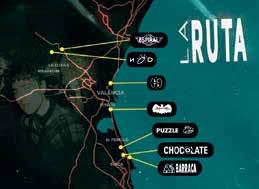
This was ‘La Ruta’ (also known as La Ruta Bakalao), the cultural phenomenon of the 1980s and 90s that propelled Valencia to the forefront of Spain’s dance music scene.
The party may be long over, but an exhibition in the city is offering a glimpse into that strange and magical world, albeit with no danger of being trampled by a wild animal.
The feel-good rom-com follows pals Alex and Poppy as they take a world trip, with sets including beaches on the Costa Brava and many locations in Barcelona.
They are played by The Hunger Games’ Tom Blyth and Emily Bader,
who starred in My Lady Jane.
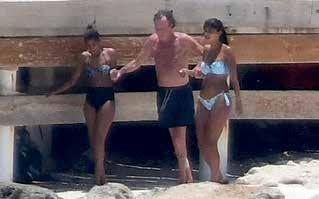
See full story online


Meanwhile, production also headed to Tenerife, where the island’s unique terrain stood in for Syria and parts of Colombia. Also starring Hugh Laurie, Tom Hollander and Elizabeth Debicki, the first season was largely set around Mallorca’s amazing 21-acre Sa Fortaleza estate, owned by a Norwegian real estate mogul.

From the history behind its rise to the people that powered
“This time there have been absolutely no studio shots and every location you see is a real place,” producer Matthew Patnick explained.
“This includes everything from the hotel in Cartagena to Teddy’s Villa.”
it to infamy, it’s an entertaining hour’s visit with an audio visual headset (in English too).
So what was La Ruta? Simply, it was a network of dance clubs located on the outskirts of the city, some along a 30km coastal road.
Many of the people that went existed on the fringes of what was then a deeply conservative society.
With little regulation, clubs stayed open around the clock, growing beyond the gaze of authorities and media.
One celebrated DJ termed it ‘action entertainment’ as everything from fashion to theatre to live music came together under one roof.
At its height it was estimated that 50,000 people were visiting the clubs
every weekend, with half coming from around the country and abroad.
But as media attention grew so did controls; creativity waned and by the late 90s many clubs had closed.
The exhibition is a brilliant attempt to understand what really took place back at the time.
Towards the end of the tour you even get to climb into the front seat of an old Renault and a Talbot that actually drove between the clubs. Imagination was, after all, what made La Ruta so special.
Bombas Gens, Centre d’Arts Digitals, Avinguda Burjassot, 54, Valencia. Ends February
THE lawyer of Spanish superstar Julio Iglesias insists Spain has no jurisdiction over a complaint from two ex-employees alleging sexual misconduct.
Jose Choclan insists any legal action should be taken in the two countries where the alleged offences took place. The veteran singer is being probed by the National Court over the complaints from a domestic worker and physiotherapist who claim they suffered sexual abuse while working at Iglesias’s properties in the Dominican Republic and Bahamas in 2021.
In a criminal complaint submitted to the Madrid court, they said Iglesias subjected them to sexual harassment, regularly checked their phones and restricted their ability to leave the homes where they worked. Choclan has asked prosecutors to 'immediately shelve' the preliminary investigation. One of the women claimed Iglesias would take her to his room almost every day to have sex.
The other accuser said the singer would kiss her and touch her breasts whenever he wanted.
In a statement, Julio Iglesias said: "I have never felt such malice, but I still have the strength to let people know the whole truth and defend my dignity against such a serious accusation."
See Lifelong Legend or Fallen Idol on page 7



IMMERSIVE: The Ruta de Bakalao was a 1980s/90s cultural phenomenon
NO STUDIO SHOTS: Almost every scene was filmed on location in Spain
BLOWN
The exhibition is an immersive deep dive into a cultural icon.
DISASTER STRIKES AT 19.45
The painstaking search for survivors continues in worst train crash in Andalucia’s history
THE gruesome search for survivors continues after a train crash in Andalucia killed at least 43 people, amid fears the death toll will rise.
Rescuers have brought in sniffer dogs, cranes and bulldozers as they race to reach victims still trapped beneath the mangled carriages in Adamuz.
Regional boss Juanma Moreno confirmed fatality numbers are ‘likely to rise’ as efforts continue beyond the immediate crash site.
“The impact was so violent that bodies have been
By Alessio Ghirlanda
found hundreds of metres away,” he explained. “That means people were thrown through the windows.”
The disaster struck at 7.45pm on Sunday after the rear of a Malaga to Madrid service derailed and slammed into an oncoming train, sending it down an embankment.
The first, operated by Iryo, was carrying 317 passengers.
The second, a Renfe Alvia high-speed service bound
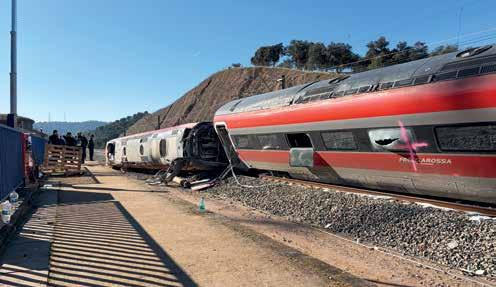
for Huelva from Madrid, had more than 180 people on board.
As we went to press, 45 people remain missing while over 150 were in-
DISPATCH: A heavy silence fills the air… even as Spain’s king and queen arrive to pay their respects to at least 43 dead in Cordoba
THE train carriage lay tilted over the tracks, its windows cracked and its belly split open. Beside it strewn dozens of discarded blood bags and rolls of bandages rescuers had used to attend the injured passengers.
This was the aftermath, 36 hours since two high-speed trains collided on Sunday night, killing a confirmed 43 people and injuring more than 150. It was a harrowing place to visit. As reporters from around the world huddled on a slab of concrete opposite the wreck, a heavy silence hung poignantly in the air.
But it was not the heaps of mangled metal or the dangling lips of crushed glass that took the words from me. My gaze was fixed on a child’s pink colouring book half buried in gravel by the tracks.
That blotch of colour brought home the reality of families heading home after long weekends on the costas or up in the capital of Madrid, where I live.
have been among the 45 still missing (most of them likely dead), the 39 hospitalised, or the 13 fighting for their lives in intensive care.
Looking into the coiled wreckage of the Malaga–Madrid high-speed service, I spotted a blood-stained white winter coat slumped over one of the seats.
Then a ripped blue travel bag, with an orange baseball cap peering through the torn zipper. And a yellow tennis shoe, jutting out from the gravel beside the colouring book.
Those glimpses into the lives of those affected by the tragedy put a lump in my throat. So I turned away. But it’s still there. Lingering.
“ “ Cameras flashed and microphones rose in total silence
I could easily have been on one of those trains. I live and report from Madrid, but I often take the train down to Malaga for work or Granada where my wife’s family are based.
At the exact moment the tragedy unfolded at 19.45 on Sunday, I was driving to Andalucia with her, alongside our cat, and our five-month-old puppy. We decided against taking the train precisely because of our pets. But had I been travelling alone, I could easily
The Guardia Civil had let us through to what they called ‘punto cero’ (or Ground Zero, like the famous twin towers of New York) of the crash just minutes before King Felipe and Queen Leticia were due to arrive.
We saw the royals roll in with their entourage and drifted to the opposite edge of the concrete slab, stopped short by rows of police.
Cameras flashed and microphones rose as reporters began broadcasting - but silence respectfully prevailed.
Felipe and Letizia kept their backs to the press the entire time - though for an excellent reason: They had come to meet the men, women and even teenagers, who worked tirelessly to pull passengers from the wreckage.
Among the rescuers, all lined up to
jured, including 13 fighting for their lives.
Families of missing passengers have meanwhile issued desperate appeals on social media.

meet the King, were firefighters and paramedics, but also local residents of Adamuz. This included a teenager, 17, Julio Rodriguez, who ran to the crash, pulling a small 10-year-old boy alive from the wreck.
“All I could think was that I wanted to help,” he told me. “I heard the child screaming, so I went in and did my part.”
Adamuz parish priest, Rafael Prado, told me he coordinated a group of volunteers to set up a first aid station in the rehearsal room of the town’s church choir in the hours after the crash.
“We gathered food, drinks, and medicine for the passengers who started arriving,” he said. “We helped them get their bearings and treated all the wounds we could.
“They took most of them to hospital later,” he added. “I don’t know how many there were, but paramedics easily filled four buses with victims.”
A local café owner later told me that Prado and Rodriguez were just two of dozens of residents who marched to the crash site after the impact.
“That is what we do,” he said. And it is true. Spaniards pride themselves on coming together when it matters most - and they have good reason to be proud. They united in Valencia after the floods, and they united in Adamuz this week.
After the royals left, police quickly ushered us off the site. As I made my way back to my car, I could not help but think I had chosen a fine place to live.
By Alessio Ghirlanda (pictured)

Three Kings tragedy
Investigators are examining a faulty joint in the tracks as a likely cause of the crash.
Data from the black box of the first train showed the driver requested an immediate track suspension shortly after the incident, before realising the second train had derailed, just 20 seconds later.
Prime Minister Pedro Sanchez visited the site on Monday, announcing three days of national mourning, while King Felipe and Queen Letizia thanked emergency workers on Tuesday.
It is the worst crash for over a decade and the worst in Andalucia’s history.
All high-speed AVE train services have been suspended between Madrid and Andalucia.
WHAT was supposed to be an enjoyable Three Kings outing ended in disaster for the Zamorano-Alvarez family. Pepe Zamorano and Cristina Alvarez (below) were travelling on the Alvia train, with their 12-year-old son Pepe, nephew Felix (both above) and six-year-old daughter. Somehow only their daughter survived, found wandering along the tracks by rescuers on the night of the collision. She had escaped but had no idea where her parents, brother or cousin were until late on Monday afternoon when all were confirmed dead.
Their daughter needed stitches to her head and is now staying with her grandmother. The family had been returning to Huelva after a Three Kings day outing in the capital to see Lion King the musical and visit the Bernabeu stadium.

AT least one person has been killed and nearly 40 were injured after a train derailed near Barcelona on Tuesday.
In Spain’s worst week for crashes, the R4 line commuter service came off the tracks between Gelida and Sant Sadumi after crashing into a wall at 9pm.
The wall appears to have collapsed after heavy rainfall, following persistent downpours from Storm Harry.
The driver was killed, while at least 40 passengers were injured, four of them serious.
Over 30 firefighter crews and 11 ambulances attended the accident 35km west of Barcelona.
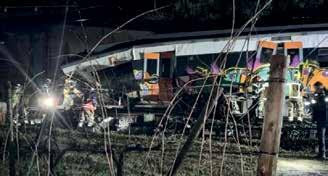
HORROR: The driver died while 40 more were injured in crash
SECOND FATAL CRASH
in Adamuz
Win. Win.

Spain’s Tax System Penalises Fairness
Spain’s tax authority su ers from a fundamental structural flaw: tax inspectors are paid bonuses based on how much money they manage to squeeze out from taxpayers – even when courts later overturn their assessments.
This incentive structure is virtually un known among advanced economies. While other OECD nations deliberately avoid linking inspector compensation to audit revenue, Spain has created a system that rewards aggressive collection, not accurate assessment.
The result is predictable: conflicts of interest, institutional pressure, and rushed investigations that prioritise revenue targets over thorough examination 1
These practices have real world consequences. Countless victims have personally recounted to us stories of destroyed businesses, devastated families, and severe harm to both Spanish citizens and foreign residents.
Spain’s taxpayers aren’t the problem. Spain’s tax inspector incentive structure is.
Lose. Lose.

In Spain, tax inspectors get a bonus whether they win or lose an unfair tax case. Amsterdam & Partners LLP has been authorised on behalf of its clients to post this notice as a public service.
In Spain, unfair tax demands have to be paid immediately.
Fighting for justice costs you even more.
A System Designed to Discourage Justice
The consequences are measurable. Spain records one of Europe’s highest rates of tax litigation and longest resolution times. Independent audits and judicial rulings consistently identify the same problems: byzantine procedures, revenue-driven targets, and a framework that systematically disadvantages taxpayers 2
Before Spanish taxpayers can even exercise their constitutional right to appeal, they must pay their full assessment – regardless of its validity 3. In our experience, those who cannot, face immediate consequences: cross-border asset seizures, compounding interest, substantial penalties, and public shaming for unproven debts 4
Those who do pay face a decade-long ordeal. Many tax cases take ten years to resolve – ten years of uncertainty, legal fees, and financial strain 5
The numbers tell the story.
Over 50% of Spanish tax appeals succeed in court 6. This extraordinary reversal rate reveals a system issuing assessments that cannot withstand judicial scrutiny.
Law. Advocacy. Geopolitics.

No. 16 of 25
NEWS FEATURE
Voted top expat paper in Spain
A campaigning, community newspaper, the Olive Press represents the huge expatriate community in Spain with an estimated readership, including the websites and social media of more than five million people a month.
OPINION
Beam it away, Scotty!
“THE needs of the many outweigh the needs of the few,” said Star Trek’s beloved Dr. Spock in 1982, moments before sacrificing himself to save his crew. We wouldn’t expect the Larios family to risk their lives, like Spock did, to save one of the last stretches of coastline in southern Spain not yet developed with houses and hotels.
But surely they could consider ‘the needs of the many’ before carving a sprawling entertainment playground for affluent golfers into the heart of one of Andalucia’s most beautiful and protected landscapes. Andalucia already has over 100 golf courses.
Meanwhile, the region has suffered recurring water shortages for more than a decade, and the recent housing crisis has sent property prices sky-high, locking vulnerable groups out of the market.
The facts are the region does not need another water-guzzling golf course... nor more rows of luxury villas and five star hotels.
What it really needs is more affordable homes and to respect the traditional ways of life – particularly local agriculture – that has existed since the dawn of time.
The Vega de Maro project is, quite simply, unsustainable and comes from an outdated model of development. And for landowning giant Larios it is hardly going to make a dent to its bottom line.
In Star Trek, Spock was an icon of rationality and courage. He chose the needs of the many. We hope Larios will do the same.
PUBLISHER / EDITOR
Jon Clarke, jon@theolivepress.es


Walter Finch walter@theolivepress.es
Ben Pawlowski ben@theolivepress.es
Fiona Govan fiona@theolivepress.es
Alessio Ghirlanda alessio@theolivepress.es
SALES MANAGER
Sam Adams (+34) 951 154 841 sam@theolivepress.es
Alex Trelinski alex@theolivepress.es
Joshua Parfitt josh@theolivepress.es
Rachel Gore rachel@theolivepress.es
Maeve Gorman maeve@theolivepress.es
Keith Franks (+34) 658 750 424 accounts@theolivepress.es


(+34) 951 154 841 distribution@ theolivepress.es OFFICE MANAGER


As a black American I was horrified our regional chief painted his face to look like King Baltazar, writes Joy E. Glenn
JANUARY in Spain is magical for children.
The Cabalgata de Reyes is one of the most anticipated events of the year. Candy flying through the air, music filling the streets, children’s faces lit with excitement as they wait for the Three Kings to pass by on the night of January 5.
My children love it, just like most kids do. It is joy. It is tradition. It is childhood. And yet, every year, there is a moment of discomfort we cannot ignore.
When the float of Baltazar approaches, and we see faces painted black and brown, exaggerated lips, costumes that turn blackness into something worn for the afternoon, the joy pauses.
My children notice. They ask questions. And I am left navigating a moment that should never be theirs to carry.
This article is not written to attack or shame. It is written to explain why so many people were outraged at President Moreno’s blacking up... because many Spaniards genuinely do not understand why this is painful.
That lack of understanding is not always rooted in hatred, but in ignorance in its truest sense: a lack of knowledge. And knowledge matters.
I understand that portraying King Baltazar is considered an honour in Spain. Many people feel proud to play him. They believe they are paying homage, not mocking.
But intent does not erase impact.
For black people, seeing non-black people paint their faces black, even ‘out of respect’, is painful because our skin is not a costume.
We do not get to take it off at the end of the parade. We live in this skin every day; through admiration, yes, but also through discrimination, judgment, and sometimes dehumanization.
What is worn for celebration by some is lived as reality by others.
Years ago, my son played Zeus in a school performance. He dressed as Zeus. He embodied the character. But he did not paint his face white because that would have been unnecessary and inappropriate.
Black people have never needed to paint our faces to portray white characters. We understand that race is not a costume.
So, when people darken their skin, exaggerate lips, and perform blackness visually, it raises a painful question: Is this how you see us?
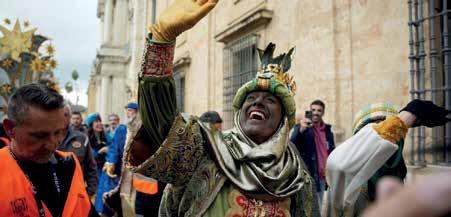
President’s blackface stunt was plain wrong and very insensitive
It originated in minstrel shows, where white performers painted their faces black to mock, dehumanise, and caricature enslaved Africans and their descendants.
These performances reinforced harmful stereotypes that justified violence, exclusion, and systemic racism. That history matters because symbols carry memory, even across borders.
While Spain has a different historical context, the image itself still lands on black people with the weight of that global history. Pain does not stop at national lines.
Spain today is not the Spain of the past. It is increasingly diverse. There are thousands of black and bi-racial children growing up here. Children with one Spanish parent and one black parent, children who are fully Spanish and fully black.
What are they meant to feel when they see their skin colour painted onto someone else’s face for entertainment?
My children love the Cabalgata. I do not want to take that joy away from them. But every year, we experience that moment of quiet discomfort, an unspoken embarrassment when tradition clashes with dignity. Children notice more than we think.
Let me be clear: Black people are proud to be black. We love our skin. Our hair. Our culture. Our history. Our resilience. Even with all the pain the world has placed on us, I would not trade my blackness for anything. Not even for ease.
What we are asking for is not erasure of tradition but evolution with respect. We are not asking to be pitied. We are asking to be seen as human.


Especially when, paradoxically, black features are so often copied and commodified – fuller lips, curvier bodies, black music, black style – while black people themselves are still disrespected, excluded, or ignored.
In the United States, blackface has a long and deeply racist history.
In fact, as I write this, there’s an active petition circulating, calling for an end to blackface in Spain. It’s not just a personal plea; it’s a conversation many are having, and it shows that more and more people understand it’s time for change.
Spain can certainly continue traditions unchanged. That is a choice. But once perspective is shared, once
voices are heard, once black families explain how this feels, then ignorance is no longer an excuse.
Spain is becoming more diverse. That is not a threat. It is, in fact, a beautiful reality. And reality invites reflection. This article is simply an invitation to listen. Because respect does not erase tradition but it strengthens it.
Joy E. Glenn is a screenwriter and U.S. Air Force veteran, who lives in Sevilla. She is a mother of three and author of ‘Spain: Through the eyes of a Black American woman’.
No 'guiri' ghettos in sight
IREMEMBER being driven from Alicante airport down the coastal N-332 on my arrival in Spain some 17 years ago and counting the huge number of immobilised construction cranes. It was the height of the recession and the property bubble had burst, but these days the cranes are back with a vengeance as demand for new homes is soaring - along with prices. Foreigners are easily outstripping domestic buyers in Alicante province but their countries of origin have changed compared to 2009, when I moved







FAUX PAS: Juanma Moreno caused outrage by blacking up at a Reyes parade
Lifelong legend or fallen idol?
THE tan is eternal, the smile unwavering and the voice instantly recognisable.
Julio Iglesias is one of the few Spanish singers to have found global acclaim spanning decades, now even immortalised as a well known social media meme.
But the golden image of Spain’s favourite singer - who has sold 300 million albums worldwide and is estimated to be worth over €700 million - has been tarnished by shocking allegations of sexual assault and human trafficking by two former employees.
The crooner’s status as a national icon is now under threat, and fast becoming the latest battleground in the country’s bitter culture wars.
Ground zero for this clash is Marbella, the playground of the rich where Iglesias has long been a fixture and has a massive €145 million ranch-style home in the nearby hills (Las Cuatro Lunas spreads over 400 hectares straddling Marbella and Ojen).
In the heart of Puerto Banus meanwhile, the Avenida Julio Iglesias stands as a tribute to the singer, inaugurated in 2002.
For many, it now honours a man accused of treating women as ‘slaves’ at his Caribbean mansions.
To make matters worse, it was bestowed by the late, disgraced mayor Julian
Political
row over Julio Iglesias sex assault claims exposes chasmic faultlines in Spanish society
By Walter Finch

Muñoz during the darkest days of the cor rupt GIL administration.

Left-wing party Izquierda Unida (IU) has perhaps understandably wasted no time in demanding the name be erased.
Spokeswoman Victoria Morales has branded the removal ‘urgent’, challenging the ruling PP party and its current mayor, Angeles Muñoz to be truly ‘committed to the fight against sexist violence’.
The wave of indignation rolled quickly up the coast to Malaga city, where the singer also holds the prestigious title of Hijo Adoptivo (Adoptive Son), granted in 2009.
Toni Morillas, also of the IU, expressed ‘absolute repugnance’ at the allegations, arguing that public institutions cannot remain neutral.
"Abusers deserve social repudiation, not applause," she declared, insisting that no
While some parts of the Costa Blanca are now 90% foreign, it’s not bothering long time resident Alex Trelinski who’s delighted the Brits have been replaced by 120 other nations
Trelinski
onto the Costa Blanca.

The British ruled supreme then but now the Low Countries and Scandinavia are dominating, which is a good indication of how the area has changed.
There is little or no talk of foreign or 'guiri' ghettos around these parts, despite the fact that the demographic has changed, with Spaniards increasingly thin on the ground.
Anti-tourism protests could barely muster 1,000 participants on the two occasions they were staged in Alicante - in stark contrast to other parts of Spain.
Tourists and foreign residents are warmly welcomed as, of course, it's good for the local economy.
I live on an urbanisation just outside Torrevieja which recently reported a record population of over 110,000 residents, some 55% who are non-Spanish.
FLASHBACK:

ACCUSED: Iglesias has been accused of sex assault by two former employees
one, regardless of their fame or power, should have impunity.
Yet, as the demands for removal grow in the south, a fierce conservative resistance has mounted in Madrid, transforming a legal scandal into a political standoff.
In the capital, where Iglesias holds the equally gushing title of Hijo Predilecto (Favourite Son), there have been calls to withdraw this title, arguing the distinction is no longer appropriate.
However Madrid’s regional leader Isabel Diaz Ayuso came to the singer’s defence. Framing the accusations as an attack on
But while in 2009, the British were the leading foreign group, that's changed with Ukrainians, Russians and Colombians leading the field.
In fact, Torrevieja boasts 123 nationalities today with Brits numbering just 4,600 residents - a far cry from the almost 13,000 Brits who topped the table in 2009.
It’s now a far more cosmopolitan coast and the change couldn’t be more apparent in my area which was very British-dominated on my arrival.
Within five years, and well before Brexit, those numbers fell to be replaced by people from around Europe. Brexit only increased it.
Younger Brits could not get any work in the early 2010's and therefore could not afford to keep their properties, meaning enforced returns to Blighty. The changes brought a variety of European cultures to the area, each with a different perspective on life, which I've definitely welcomed.
In 2009, nearly all of the foreign-booked advertising billboards adorning key roads were in English, while now a variety of European languages dominate.
Units containing British businesses have been replaced by Belgian and Dutch bars and restaurants along with Scandinavian dentists and medics. Don't get me wrong, British expats and businesses are still very much around, but their domination is long gone across the region.
There are still strong pockets like San Fulgencio's La Marina urbanisation but the picture has changed - and with tougher residency hoops to go through for UK residents - will continue to do so.
With my Polish heritage, I've always regarded myself as a pan-European and I've been delighted to see my part of Spain embrace that, with not a 'guiri' ghetto in sight.
Spain itself, she vowed to ‘never contribute to attacks on the prestige of artists,’ dismissing the outcry as hypocrisy from the ‘ultra-left’.
Her colleague, Madrid mayor Jose Luis Martinez-Almeida, has been equally vocal, stating he has ‘no intention’ of stripping Iglesias of his honours. Almeida defended his refusal to act by appealing to the 'presumption of innocence', arguing that removing honours before a trial would be an attack on the rule of law.
The case is currently in the 'preliminary investigation' phase at the National Court in Madrid. But so far he has not yet been arrested nor formally charged; prosecutors are currently analysing the complaint to decide whether to bring the case before a judge.
If they proceed, the next likely step would be a summons for the singer to give a statement – though a full trial could still be months or even years away.
Another hitch could be that Iglesias mostly spends his time in the Dominican Republic and doesn’t come to Marbella that often.
He may not be back for a while

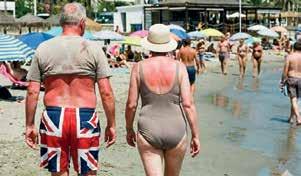
Very welcome…
Despite the large and growing percentages of foreigners on the costas, Charlie Mullins hasn’t felt unwelcome in Spain - but then ‘us expats’ pay a lot of tax
WELCOME to my first rant of 2026, and may I say what an honour it is to be hurling my views to a much broader audience in the Olive Press’ first national edition in its 20th year.
So, it feels quite appropriate to pile into the controversy surrounding the growing number of Spanish becoming readers of this venerable publication.
I don’t get the commotion about which parts of Spain have more expats than locals living there, as reported on your front page in December.
It’s not as if the vast majority of expats don’t pay their way. In fact, the net contribution of the average foreign resident to the economy is far greater than that of a local. We certainly pay a lot of tax.
On top of that we’re far cheaper to have around since most of us don’t qualify, or expect to, get state funded health treatment.
So again, I ask, what’s the problem? We pay our way and we don’t use up public services.
I get that the locals may feel a little bit overrun by loads of newcomers speaking English, Russian and French. And for our part, we should probably try a bit harder to learn the language. Particularly us Brits.
But overall, we put a lot of cash into the economy, in-
cluding paying the local legal experts - and thousands of gestors (come on Spain, are they really necessary?)to sort out all the paperwork needed.
And it’s not just here in Spain that we get a hard time about being foreigners. I’ve been called a hypocrite for migrating to Spain while still taking pot-shots at the UK Government for not stopping the boats full of migrants flooding into the UK. But it’s not the same is it!? Those being smuggled into the UK do not have the legal right to enter the country. If they did, they’d be arriving in a comfortable seat on EasyJet and for a lot less money than the average people smuggler charges to send them dicing with death in the English Channel. Getting back here in Spain I think the issue is getting more column inches than it really deserves since I don’t really get a sense of being unwanted as I go about my everyday life in Marbella. I think most of the noise comes from activists with an axe to grind with their own politicians and taking pot shots at foreigners is an easy way to get their attention. It’s a non-story with very little resemblance to the reality of people’s lives, whatever their nationality or mother-tongue might be.
I love it here and I’m proud to call Spain my home.
Alex
Gross impropiety
THE leader of Gibraltar has been forced to apologise after he was heavily criticised over his actions in an £8million public inquiry into the ‘forced’ retirement of the enclave’s former police chief.
In a stinging rebuke of Fabian Picardo’s leadership, the McGrail Inquiry found he had ‘crossed the line’ and behaved inappropriately on various occasions surrounding the departure of police chief Ian McGrail.
The Chief Minister has since admitted to ‘lapses’ and ‘failing to be at his best’, as he was ruled to have obstructed a criminal inquiry into a close friend over Gibraltar’s sensitive security. His actions were described as ‘grossly inappropriate and improper’ as he attempted to pervert the course of justice over an arrest warrant issued for his former boss and colleague Sir James Levy at Hassans law firm.
STOP THE HUNT
HUNDREDS of people and their pets are set to take to British streets in a series of ‘peaceful protests on January 30 demanding an end to the mistreatment of hunting dogs in Spain. They want to see a ban of the traditional practice involving the use of large packs of the animals to drive prey towards hunters.
See Time to Call off the Dogs on page 11

EXCLUSIVE: Expats left with nothing after removal man disappears en route to Spain with €25,000 of belongings
By Rachel Gore

IT was their dream move to the Spanish sun.
But now British expats Caroline and Brendan Bennett have seen the dream turn into a nightmare after their worldly items were apparently stolen by a removal man.The pair, both 67, from Buckinghamshire, have lost around €25,000, including nearly €5000 paid in ad vance to relo cate their British home.
The NHS administrator and her builder husband have now been forced to call in police to track down Jonathon Perry, who has ‘vanished without trace’.
The couple (above) had met the mover at a garage near their home in High Wycombe where he had picked up ‘about £20,000 worth of belongings’.
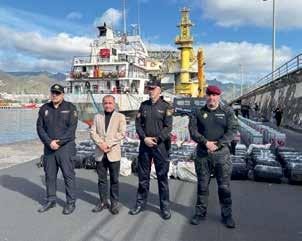
POLICE have seized an incredible ten tonnes of cocaine, one of the largest in their history. It came after Policia Nacional agents stormed a merchant ship 535 kilometres off the Canary Islands. The haul, hidden in
294 bales beneath a cargo of salt, was fittingly dubbed 'White Tide'.
All 13 crew members were arrested and a handgun was seized.
Into thin air! WHITE TIDE!
up in Spain. As well as furniture they have also lost ‘priceless jewelry’, family photos and many mementos from travels around the world.
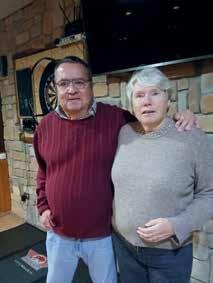
Then, after paying him up front for the service, he ‘never showed’

“We are absolutely devastated,” Caroline told the Olive Press. “We had been so excited about moving to Spain.”
Preparations for their new life in the sun had begun when they bought a home in Alameda, in inland Malaga, seven years ago. When the time finally came to retire they were recommended to Perry – who had a home on the Costa del Sol and had been doing removals from the UK for 25 years.
“He seemed to be the perfect person to bring our possessions over
and we totally trusted him,” continued Caroline.
They paid Perry half of the £3000 (€3450) fee to set up the ferry crossings and general expenses and then, after constant communication, met him on April 20 with their belongings.
Having paid the balance they watched as he and a friend took everything away in a yellow van.
When Perry did not arrive in Spain the following Friday as agreed, they started to worry.
In particular, as they had given all their local Spanish furniture to local charity shops.
When Perry did eventually answer his phone he apologised and they agreed to see him the following Thursday.
But he never arrived and they were left ‘sitting on deck chairs’ with no other furniture.
They finally learnt that Perry had something of a chequered reputation and had reportedly left Benalmadena ‘in a hurry’ last year.
Police
Now, after reporting the incident to the Thames Valley police, officers have informed the couple they believe Perry is ‘living in Harlow’.
A police spokesman confirmed that enquiries ‘are ongoing’ with no arrests yet made.
Having finally contacted Perry in the UK, he told the Olive Press he was ‘confused’ by our questions and asked us to send them via email. However, this bounced back and he didn’t answer any further calls.



Death threat at tomb of executed ‘13 roses’
PEDRO Sanchez has spoken out after a tomb for 13 women executed by a Franco firing squad was vandalised with graffiti including death threats to a female journalist.
The President insisted ‘hatred, machismo and fear will not prevail’ after the desecration of the civil war monument in Madrid. The graffiti at Almudena cemetery targeted 28-year-old Sarah Santoalalla (above), who regularly appears on national TV.
The political journalist wrote: “It is not a coincidence: women murdered for standing up to fascism. I feel genuine terror.” It comes after the journalist was harassed as she left her job at Spain’s national broadcaster RTVE and was followed all the way home.
“It is a perfectly orchestrated plan to intimidate her and everyone who dares to challenge the official narrative,” said a spokesman at the station.
The ‘13 Rosas’ were executed by a Francoist firing squad on August 5 1939 and their remains finally moved collectively to the Madrid cemetery later.
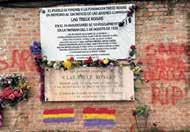

VANDALS: Daubed the tomb with threats to Santoalalla
MOVING TO SPAIN WITH SAVINGS ABROAD: HOW TO MANAGE THEM WITHOUT HASSLE
MOVING to Spain is often a decision filled with excitement. A new country, a new personal or professional chapter and, in many cases, a better quality of life. However, for those who arrive with savings accounts, fixedterm deposits or investments in other countries, one question tends to arise early on and it often brings concern: how to manage their assets correctly within the Spanish tax system. What happens to the interest earned outside Spain? What exactly do I need to declare? When do I have to do it? What documents are required? For many expatriates and retirees, these questions come up far too often and usually when there is very little room to react.
Your taxes don’t travel with you
One of the most common mistakes when moving to Spain is assuming that nothing changes as long as the money remains abroad. From the moment a person becomes a tax
resident in Spain, the situation is different. Spain taxes worldwide income. This means that interest earned on savings accounts and deposits held in other countries must be declared in Spain, even if the bank is located in Germany, France or the Netherlands. And it is not just about paying taxes. There are also reporting obligations that many people are not aware of.
In fact, a significant proportion of errors made by foreign residents in their tax returns are not due to concealment, but simply to a lack of understanding of the system. Nevertheless, not knowing the law doesn't make us exempt from it, so we recommend you keep reading.
WHY SAVINGS ARE USUALLY THE SAFEST ASSETS WHEN MOVING COUNTRIES?
When it comes to taxes, not all financial products create the same level of complexity. Savings accounts and fixed-term deposits are generally among the most straightforward as-

sets to manage when changing tax residence.
Interest income is clearly defined, easy to calculate and follows predictable rules under Spanish tax law. Unlike other investments, there are no complex valuations, market swings


or transaction histories to reconstruct, just interest earned and balances held.
For many people moving to Spain, this simplicity becomes increasingly valuable. Over the years, it is common to build up a fragmented financial structure: a savings account in the home country, a fixedterm deposit taken out at a different time, or an account opened during an earlier stage of working life.
The result is often money spread across several banks, countries and languages, which can lead to additional complications such as interest certificates arriving late, documents in foreign languages or tax calendars that do not always align. Having savings structured in a clear and transparent way can therefore significantly reduce the risk of mistakes and unexpected issues when dealing with a new tax system.
INCOME TAX AND REPORTING FORMS: WHEN DOUBTS ARISE
Over time, many realise that declaring interest in the Spanish Personal Income Tax (IRPF) is not enough. There are also reporting obligations, and the real challenge is often not the tax rate itself but staying organised: knowing where the money is held, how much interest it generates and whether reporting thresholds have been exceeded. When information is fragmented across several banks and countries, keeping track of these details can quickly become overwhelming especially for those unfamiliar with Spanish administrative procedures.
One of the most important reporting obligations is tax Form 720, which requires taxpayers to report bank accounts and deposits held abroad when their combined value exceeds €50,000. This form does not involve paying additional taxes, but it does require precise information such as balances, banks, countries and dates.

For example, Max moves to Spain and keeps €100,000 invested in a one-year fixed-term deposit at a German bank, while also holding €50,000 in a savings account at another German bank. As the combined value of these accounts exceeds €50,000. What does this mean for Max? He must declare all the interest earned in his Spanish income tax return and submit Form 720, reporting both accounts in detail, including balances, banks, countries and dates. The difficulty in situations like this rarely lies in the amounts involved, but in maintaining a clear, consolidated view of savings spread across different banks, languages and documentation formats.
HOW RAISIN HELPS SIMPLIFY EVERYTHING
Moving to Spain should not mean living with the constant worry of whether everything is being declared correctly. Experience shows one thing clearly: the greatest enemy of tax compliance is not legal complexity, but a lack of organization. The more accounts and banks you have, the harder it becomes to maintain a clear and unified view of your savings. Raisin is a platform that provides access exclusively to savings accounts and term deposits from banks across the European Union within a single environment, reducing fragmentation, making it easier to track balances and interest, and offering a clear overview of savings even when money is spread across different countries.
As a new client you can also get the Cuenta Bienvenida, which offers a return of 3.3% AER. It is a completely free, commission-free account designed as an entry point to start organising your savings in a simple and efficient way. Once opened, Raisin allows you to continue investing in competitive savings products from European banks through the Cambio Inteligente, enabling you to move your money into new opportunities without losing control or visibility. In addition to making it easier to compare interest rates and manage savings, Raisin provides customers with access to and a clear overview of their account information and documents (e.g., balances and interest statements) that may be relevant for their own tax reporting, including potential reporting obligations such as Model 720*.
If you live in Spain and have savings in your home countries, scan the QR code below to access Raisin and start managing your savings in a clear, organized, and secure way. Because living in Spain should be an experience of calm, not a constant source of tax uncertainty.
* Please keep in mind that Raisin does not prepare, validate, or submit tax forms on customers’ behalf. Customers remain responsible for determining whether they have a reporting obligation and for filing the relevant forms.

FLOOD AID
FIONA and Steve Kellett were returning home to Spain from the trip of a lifetime when their lives changed in an instant.
As their plane touched down from the Far East, a video call from their housesitters revealed a nightmare in real time.
Floodwaters were pouring into the couple's Andalucia home, where they have lived for six years.
They had become one of the many victims of Storm Francis which devastated the region earlier this month, sending 500 families into temporary accommodation.
The storm brought torrential rainfall with up to 200mm recorded in some towns, including theirs in Jimena de la Frontera.
The local Hozgarganta river reached its highest level ever, bursting its banks and causing chaos.
There was no chance for the couple’s housesitters Abbi and Ed to escape. Nor for their beloved pets as water burst into the home from all
Expat victims of devastating Storm Francis ask Olive Press readers for help to keep their ‘family’ of cats, dogs and donkey together
around.
As they got home, the Welsh couple were desperately trying to save their five cats, while rescue dogs Mylie, Daisy and Marmalade sought refuge on the sofas, which were floating around their sitting room.
Outside, they could see their adopted donkeys, Luna and Seca, wading through flood water.
Destruction
When removal company boss Steve, 62, from Milton Keynes, tried to drive through the surging waters, it was clearly too dangerous.
Finally, Abbi and Ed managed to escape, but were forced to leave the dogs behind.
Miraculously when they returned the following day, all
By Maeve Gorman
their animals had somehow survived.
But the same cannot be said for their home, which has been destroyed. The pair told the Olive Press they have lost all their personal belongings and two vans which they rely on for their livelihoods - Steve owns a removal company and data analyst Fiona, 55, from Warwickshire, commutes to Gibraltar. They were not insured. Their housesitters also lost their car and were flown back to Wales by their insurance company.
Now living in a nearby warehouse, with no hot running water, they are making an appeal to ‘big hearted’ Olive Press readers for help. “Helping us would mean
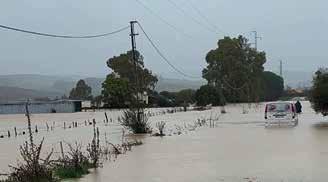
DELUGE: The home and van, while (right) the Kellett’s with their housesitters
more than just money - it would mean hope, safety, and a second chance for our animals,” said Fiona, who has set up a GoFundMe appeal.
In particular they need help for one of their cats, Miso, who is 26 years old and needs extra care.
They also have new unexpected costs including temporary accommodation, food and supplies for the animals, as well as repairs to the vans.
To make matters worse, the couple’s landlord claimed all of the contents of the house were his, despite losing all their electronic devices, clothes and a lifetime of memories.
He insisted they wouldn’t

have to pay rent for the uninhabitable home if the couple returned the keys three days after the flood. They plan to dispute the landlord’s claim, but as they try to rebuild, a legal battle is the last thing they need.
Luckily, for now the couple have somewhere to go - a friend has offered them a property, which currently has no running water or electricity, so they need a new PV solar system, as well as new pipes. They also need some financial help to repair their vans.
“Any little help financially can help us heal and rebuild,” continued Fiona.
STORM Francis has officially ended the drought crisis, replenishing Andalucia and Valencia's reservoirs with enough water for a restriction-free summer.
Andalucia’s reservoirs now sit at a healthy 49% capacity, nearly 15% above where they were at this time last year.
The storms dumped an additional 129 billion litres of water into the network, which is three times what the entire city of Malaga consumes in a year.
Valencia
The most dramatic recovery was at Cadiz’s Guadarranque, which is now full, while Axarquia's Viñuela reservoir, which was nearly empty a year ago, is now at 45% capacity. However, the storms failed to alleviate the crisis in the far east of the region, where Almeria's reservoirs remain critically low at 8.4%. Valencia meanwhile sits at 51%, while Murcia sits at 27% and Catalunya at 78%, while Spain as a whole sits at 57%.

Time to call off the dogs?
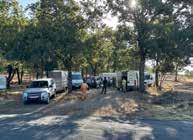
YOU could hear the howling, before being assaulted by the smell.
A random stop on a rural backroad on a chilly day in winter, had Olive Press Editor Jon Clarke quickly reaching for his camera.
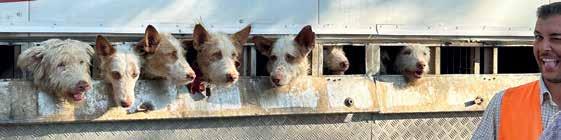

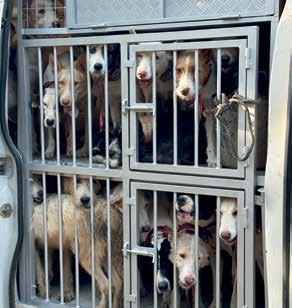
After parking up to investigate what looked, at first, like a car boot sale, he noticed that all the vehicles - mostly white vans - had dozens of dogs either in them or being pulled in trailers behind. These evocative images, recorded in northern Cordoba province, clearly show the cruelty of Spanish hunting dogs at work. As hundreds of demonstrators prepare for a series of protests against the practice in the UK next week, it’s clear these dogs are not being treated as pets. Crammed into cages and trailers, they appeared to be howling
EXCLUSIVE: Our disturbing photos show Spanish hunting dogs in cages – as their grim fate at end of hunting season is revealed
and barking for help.
The Spanish hunting season runs from October until February and sees tens of thousands of dogs - largely podencos and galgos - used to drive prey, including wild boar, deer and rabbits towards the hunters.
The dogs usually spend their working lives ‘on short chains without shelter from extreme weather or crammed into dark sheds,’ insists protest organisers at charity Hope for
Podencos, which rescues and rehomes them. They also participate in controversial sports like hare coursing, where they are let loose in the countryside or an enclosed track to catch a fleeing hare.
Worst of all, each year after the hunting season draws to a close, up to 100,000 dogs are allegedly abandoned or killed with it being ‘cheaper
to get rid of them and breed or buy new ones next season’, adds the UK charity. Photos of them hanging from trees are too grisly to print. Incredibly, in 2023 Spain’s Parliament excluded these hounds from the nation’s new animal welfare legislation meaning that they are legally unprotected.
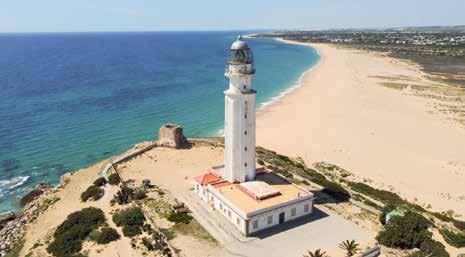
Relaxed vibes, comfort and a new restaurant. Hotel Madreselva, by the Califa Group, is your perfect hideaway in Los Caños de Meca. Open all year-round from 30th January!


PRESSURE: British protesters take to the streets of London to march against Spain’s hunting
HOWLING:Caged dogs crammed into one cage
PICTURE SPECIAL:


ITH a record 3.5 million visitors last year one might have expected bosses at El Prado to have stepped off the gas in 2026. But they have apparently done the opposite, announcing a dozen exhibitions coming to the country’s leading museum this year.
The Prado is certainly utilising its extraordinary collection of over 20,000 works of art to cover everything from 17th century royalty right up to present day photography. Here are six of the shows that you must not miss…
The Prado Multiplied. Photography as shared memory (February 2 - April 5 2026)
Launching next month, the first exhi-
bition of the program begins with an image first displayed in 1899.
This show offers a historical journey by focusing on reproductions of works within the museum’s collection. It highlights the museum’s expanding photography collection, specifically how photographs accurately represent reality and serve as significant historical documents.
Prado. 21st Century (June 9 - September 27)
For those interested in how the museum boosted its visitor numbers, ‘Prado. 21st Century’ will show how the museum has cleverly evolved over the last 25 years.
Using work acquired during this period and a series of comparisons, the exhibition looks at its internation-
OP QUICK CROSSWORD


No putting down paintbrushes
By Rachel Gore

From Austrian queens to early photographers, El Prado steps into 2026 with a bold programme of must-see exhibitions despite record visitor numbers last year
al reach, mission, communicative strength and reception by society as a whole. Homing in on its remarkable collection and ‘close relationship with its visitors’, the spectacle uses a range of acquisitions that reflect different facets of its transformation into the modern age.
If you are also interested in the the day to day operations of a world-leading museum, then this is a must see.
Mariana of Austria (December 1March 28, 2027)
The first exhibition devoted entirely to a female art patron (above) will open on December 1 and put the spotlight on Mariana of Austria, Queen consort of Spain.
Ruling in the 17th century, Mariana was a great supporter of the arts. Through 100 works, the exhibition will trace her life and the power she wielded both in Madrid and in
Spain as a whole.
The way she used iconography to construct her public image only strengthened her authority.
The works by her various court painters will be placed within the wider political context of the time, one of the most decisive periods in the monarchy’s history as the Empire declined.
As the last queen of the Habsburg dynasty, Mariana knew how to adapt the visual legacy that her ancestors created.
Ricardo de Madrazo (1852-1917): drawings and watercolours (October 19 - January 17 2027)
Another first will come with El Prado’s Ricardo de Madrazo exhibition which will be entirely devoted to the artist who has never had his own individual show before.
Opening on October 19, it will look at the youngest son of Federico de Madrazo who is the least known member of this family filled with artists.
A reunion of his sketchbooks, drawings and watercolours will reveal the diversity of his work and highlight his travels across Spain, Europe and North Africa.
Years of acquiring Madrazo’s art has led to this exhibition which will run into 2027.
Hans Baldung Grien (November 24 - March 7 2027)
Despite being born into a family of lawyers, art was Hans Buldung Grien’s calling. He became known for his mythological and historical scenes which were visually and intellectually daring. His paintings will be displayed in an original way exploring the landscape he was in towards the end of his career.
For those intrigued by museum curation there will be a section devoted to the cleaning of these works.
The artist’s world through the camera (April 13 - July 5 2026)
If it’s photography that catches your eye, you must visit this Spring when the work of 19th and early 20th century photographers will be exhibited.
Taken from a time when photography was on the rise, these images trace a map of artists in their domestic contexts, studios and spaces of social interaction and learning. The exhibition features renowned professionals alongside anonymous and amateur works with the intention of paying tribute to creators who represented reality.


INSTITUTION: Museum and one of its most effective patrons, Queen Mariana
SPACIOUS: The giant 20,000 work of art collection includes Grien’s daring tryptich
by
CANINE HEROES

Meet the cancer-sniffing superdogs selected over a rigorous year-long detective-led application process
SPANISH researchers have successfully trained dogs to detect lung cancer in human patients –in a medical breakthrough that could save millions of lives.
In a decade-long Cantabrian study involving more than 5,800 tests, five amazing dogs were trained to sniff out cancer in human breath samples with an accuracy rate of 99.9%.
Remarkably, the dogs were able to distinguish among four different types of lung cancer – ad-
By Alessio Ghirlanda
enocarcinoma, small cell, large cell, and epidermoid – as well as detect colon cancer.
Launched in 2016 by police dog handlers Nuria Gonzalez and Jose Luis Garcia, it has been described as a ‘resounding success’.
“There have been funny moments, difficult moments, and
Moderate in the main
THE regions of Valencia and Asturias have the highest rates of alcohol consumption in Spain. But generally drinkers in Spain are pretty moderate.
While a glass of wine with lunch is often held up as proof of the country’s sensible approach to alcohol, new research shows half the country drink very little if at all.
At the same time, the survey of 22,000 adults found around one in five people consume alcohol several times a week or daily – particularly men and higher-income groups.
A second study of 45,000 adults by the Catholic University of Valencia found that even low levels of alcohol consumption were linked to poorer adherence to the Mediterranean diet – a cornerstone of Spain’s health reputation.
The findings suggest the real risk may lie not in excess, but in the everyday normalization of drinking.

some desperate ones,” Gonzalez said. “But the dogs gave it all their heart and loyalty.
“They love it, they have a great time. They are like children playing.”
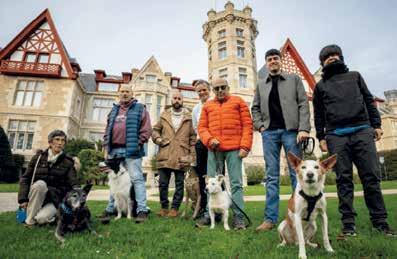
The specially trained dogs –Laia, Dobby, Chester, Iñaki, and Fredi – demonstrated extraordinary precision in sniffing out disease.
The initiative, known as Project Biodogtor, was conducted by the oncology department at Valdecilla Research Institute.
“
just six animals.
A mongrel named Rommel, sadly died just before the final trial stage. Once selected, the dogs underwent six months of specialised training to ensure they could perform a consistent behavioural response.
Each needed to pause in front of a sample – when they detected the specific signature smell of lung cancer.
“ The dogs owners didn’t know which were cancer samples
The dogs were selected after the team issued a call to pet owners four years ago, receiving a notto-be-sniffed-at 150 responses.
After a series of complex behavioural and aptitude tests, this was narrowed down to 30 dogs and finally to
Positive reinforcement through food and play was used to encourage accurate detection.
During the double-blind scientific trial neither the dogs nor their handlers knew which samples were from cancer patients.
This involved 174 breath samples collected by the oncology nursing team. A separate 995 samples came from healthy volunteers.
Each dog analysed 1,169 samples.
“This has become a milestone in Spanish medicine that will save lives,” the researchers said.
Vap attack
Crackdown on vaping AND energy drinks for under 18s in radical new rules in Galicia
By Maeve Gorman
Youngsters caught vaping or consuming energy drinks will face immediate fines starting at €200 and reaching up to €3,000. Meanwhile anyone selling them to a minor could face an even stiffer €15,000 fine.
For the most serious offences, such as failing to comply with orders, fines could even reach €600,000.
The new legislation equates energy drinks with alcohol and vaping with tobacco.
The law also expands smoke-free zones, requiring tobacco and vape use to be kept away from the entrances of public buildings, as well as schools and healthcare facilities.
The measure follows an alarming report showing that 41% of Galician 14 to 18 year olds have tried vaping, a figure that far exceeds the 29% who have tried cigarettes. Vaping poses a variety of health risks, especially for teens. It exposes lungs to harmful chem icals causing a range of lung prob lems, including chronic bron chitis and worsened asthma and is often viewed as a gateway to smoking.
Energy drinks, meanwhile, are linked to mental health and car diovascular problems.
Galicia’s health minister Antonio Gómez praised the move as ‘bold and evidence-based’.


A STRICT new law banning vapes and energy drinks for teens will come into force in Galicia in March.
Sponsored
FAMOUS FIVE: Spanish superdogs Laia, Dobby (also inset), Chester, Inaki and Fredi with their owners in Cantabria
DIET ALARM
The consumption of ultra-processed foods in Spain almost triples in three decades
By Maeve Gorman

FROM protein bars to sugary cereals and ready meals to biscuits, supermarket aisles are filled with more and more ultraprocessed foods (UPFs) in Spain. Now the Spanish government is taking steps in a bid to make the country healthier with a string of new legislation coming in this year.
A study by The Lancet reveals these convenient options account for 32% of daily calories for the average Spaniard, rising from 11% just 20 years ago.
Spain now consumes more UPFs than the European average (27%) while in the UK UPFs now account for 50% of calorie intake and the US a shocking 55%.
They are alarming statistics for the industrially-manufactured

foods made from ingredients you are unlikely to find in your kitchen cupboards. They contain chemical additives including emulsifiers, sweeteners and dyes and are designed to be palatable, convenient and extremely profitable for manufacturers. It can be easy to reach for UPFs, but the experts behind the study warn of adverse health outcomes.
“
eral experts to dub UPFs ‘the new smoking’.
Spain is regularly ranked as one of the healthiest countries in the world but UPFs threaten the health and lifestyle of the nation.
“ These foods will be removed from hospital menus
Cardiovascular disease, type 2 diabetes, obesity, depression and premature mortality are all linked to high consumption of UPFs. These health risks have led sev-
Leading the way
GibMed International Hospital is redefining private healthcare in Gibraltar by delivering a truly comprehensive, locally based medical service built around patient-focused care, quality, accessibility, and clinical excellence.
As Gibraltar’s 1st private hospital, GibMed places GP primary care at the forefront of a fully integrated healthcare system. From everyday health concerns to specialist consultations, advanced diagnostics, surgical procedures, and ongoing follow-up care, patients benefit from seamless treatment. With GibMed, Gibraltar now offers high standards of care without the need for Gibraltarians to cross the border and for ex-pats in Spain, it’s location is also very convenient.
Back with the bulge
Ozempic users who go cold turkey record average weight gain of half a kilo each month, according to new study
IT has been hailed as a ‘miracle’, helping those most in need to shift excess timber quicker than ever. But relying on weight-loss drugs such as Ozempic or Monjauro may not be as effective in the long-term as first thought, a landmark study has warned.
According to academics at the University of Oxford, people who go cold turkey after a spell on the jabs put weight back on at a quicker rate than those on any other weight loss plan.
The life expectancy of an average Spaniard, at 84, is 2.3 years more than the European average and the third highest in Europe.
The good health of Spain is often attributed to the Mediterranean diet, consisting of legumes, vegetables, fish, less red meat and fewer processed foods.
Rich in healthy fats from extra virgin olive oil and oily fish, fiber and polyphenols, this diet boosts heart, gut and brain health.

GibMed is expanding and is now offering Cosmetic Surgery, responding to growing demand for high-quality aesthetic procedures delivered in a safe, regulated, and clinically robust environment. Our surgeons are both renowned UK based surgeons, again, this is unique in private medicine for Gibraltar and southern Spain. This new service will be supported by stateof-the-art surgical suites, designed to meet the highest standards of safety and comfort. Our spacious, modern and comfortable bedrooms, allow patients to recover with confidence under expert medical supervision. GibMed’s facilities already support advanced diagnostic imaging, specialist outpatient care, and surgical capability, with further developments still to come.
All consultations and medical reports are delivered in English and are aligned with UK medical best practice, ensuring clinical clarity, continuity, and confidence throughout the patient journey. With experienced clinicians, advanced technology, and an integrated model of care, GibMed continues to set a new benchmark for private healthcare in Gibraltar. Dr. David Deardon, CEO of GibMed International Hospital said, “We are proud to be expanding our services and to play a meaningful role in supporting the community’s healthcare needs. Our vision has always been to offer Gibraltar a modern, comprehensive private healthcare facility that combines high clinical standards with a warm, patient centred experience”
As UPFs establish themselves as a major part of the Spanish diet, the health of the nation is endangered.
The Mediterranean diet also fosters social connection with friends and family sharing food and enjoying hours-long ‘sobremesas’. The traditional way of life uses ingredients which are seasonal and local, benefitting social health and the environment.
Experts advise marketing restrictions, especially adverts directed at children, and removing the products from school cafeterias and hospitals.
The Spanish government is taking this advice seriously.
Pablo Bustinduy, Minister for Consumer Affairs, introduced a royal decree on December 18 which outlines that UPFs will be removed from hospital menus for children and adolescents. It will only be served to adults in hospital care twice a week and 80% of vending machine stock must be healthy.
He said: “it is incomprehensible that the Administration allows unhealthy food options to prevail, whether in public schools, hospitals, residences or any other space”.
It remains to be seen whether this legislation will stall the rise of UPFs in Spain.
By Ben Pawlowski

In fact, people who stop taking weight loss jabs on average regain all the weight originally lost in under two years.
“These medicines are transforming obesity treatment and can achieve important weight loss,” explained Dr Sam West, who led the study. “However, our research shows that people tend to regain weight rapidly after stopping - faster than we see with behavioural programmes.” He added: “This isn’t a failing of the medicines - it reflects the nature of obesity as a chronic, relapsing condition. It sounds a cautionary note for short-term use without a more comprehensive approach to long-term weight management, and highlights the importance of primary prevention.”
Researchers followed the weight loss journeys of 9,341 participants, with an average follow-up period of 32 weeks after patients had stopped taking the drugs.
On average, weight was regained at a rate of 0.4kg per month, with participants returning to their pre-jab weight an average of 1.7 years after stopping medication.
People on any kind of weight loss medication lost an average of 8.3kg during treatment but put 4.8kg back on within the first 12 months. That is a rate of increase almost four times faster than traditional weight-loss programmes which focus on diet or physical activity.
Previous studies have suggested weight-loss jabs can have a positive effect on a patient’s general health, improving cardio-metabolic health markers such as blood pressure or cholesterol levels. But most returned to their original level within 1.4 years of stopping treatment.
“Weight loss drugs can be effective tools for managing weight and type 2 diabetes risk - but this research reinforces that they are not a quick fix,” said Dr Faye Riley, at Diabetes UK.
“They need to be prescribed appropriately, with tailored wraparound support alongside them, to ensure people can fully benefit and maintain weight loss for as long as possible when they stop taking the medication.”
Weight-loss medications were originally developed as a treatment for diabetes and work by mimicking the GLP-1 hormone which helps people feel full after eating.
Deaths after drug mix up
A PAIR of cancer patients have died at Burgos University Hospital due to ‘human error’.
The cancer patients were given a drug concentration six times higher than the recommended dosage.
The ‘unexpected toxicity’ was found in five cancer patients in December, two of whom havesince died.
The remaining three are still under close monitoring: one
is in A&E, another is in a regular ward, and the fifth has been discharged.
Hospital manager Carlos Carton attributed the deaths to ‘an error in the medication preparation sheet that multiplied the treatment dosage by six’.
The Junta of Castilla and Leon will compensate the affected patients and their families for the deaths.
BREATH IT IN!
ESTEPONA is famous for its golden beaches, bustling marina, and picturesque old town.
But few are aware it is also home to a state-of-the-art facility providing hyperbaric oxygen therapy (HBOT) – a cutting-edge, non-invasive treatment designed to improve health, wellbeing, and recovery.
The Clinica Medica Hiperbarica features two transparent, single-patient Perry hyperbaric chambers, considered among the latest in medical technology.
The treatment involves administering 100% pure oxygen at pressures higher than atmospheric levels inside a pressurised chamber.
At these pressures, oxygen dissolves di-
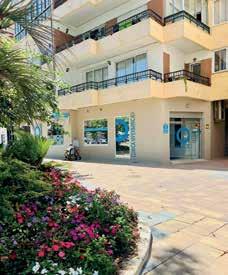
A cutting-edge therapy to boost health and recovery is now available in Estepona - here’s what you need to know
rectly into the bloodstream, significantly increasing tissue oxygenation and supporting healing processes.
THE CLINIC’S HYPERBARIC CHAMBERS ARE EQUIPPED WITH:
● A constant oxygen supply of 150 litres per minute
● Voice communication to maintain constant contact between patient and technician
● Adjustable pressures ranging from 1.8 to 3.0 ATA depending on the patient’s medical condition
HBOT has been shown to accelerate wound and ulcer healing, support pre- and post-operative recovery, reduce inflammation, lower infection risk, shorten hospital stays, and decrease antibiotic use.
ADDITIONAL BENEFITS INCLUDE:
● Improved blood circulation and tissue oxygenation (up to 23 times normal levels)
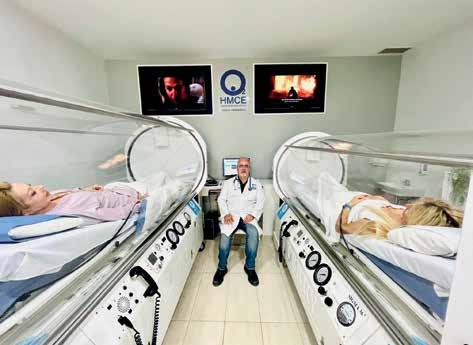
● Faster recovery and consolidation of fractures, including delayed healing and conditions such as osteomyelitis or necrosis
● Enhanced immune function and cellular regeneration
● Reduction of physical and emotional stress
● Improved nutrient absorption and sleep quality
● Support for neurological recovery, including strokes, cerebral palsy, and neurotransmitter reconnection
● Pain relief and inflammation reduction
● Enhanced athletic performance and faster recovery from muscle, tendon, or bone injuries


● Potential effectiveness in sudden hearing loss and sudden vision loss due to central retinal vessel occlusion
● Benefits for diabetic foot patients, helping avoid amputations
● Support for fibromyalgia and carbon monoxide poisoning recovery
● Some studies suggest anti-aging effects and slowed cellular death
Patients interested in hyperbaric therapy can contact the clinic via telephone or WhatsApp at 952 806 796 or 663 418 023, or visit the clinic at Avenida España, 242, Estepona, Málaga. Visit www.centrohiperbarico.com for more information.
ANDALUCIA pharmacies have started to screen for colon cancer.
The Junta took the decision to join other regions collaborating in Spain’s early cancer detection programme and soon after the fallout of a breast screening scandal.
‘This directly connects doctors and pharmacists through a new communication channel that will improve safety, monitoring and treatment,’ explained regional minister Antonio Sanz.
Pharmacists will be able to request the renewal of treatment for chronic patients without the need for health centre visits from March.
Andalucia has the highest number of pharmacists in Spain with 28% of the professionals residing there, so their influence on the national rollout will be very important.
WOMEN fearing a breast cancer diagnosis will now be able to undergo all necessary tests in a single day under a new rapid-response scheme.
Junta health chief Antonio Sanz announced that the 'single procedure' protocol is being rolled out to all 32 breast screening units in the region as of Monday, January 12.
The initiative targets patients with 'suspicious
lesions' or a very high suspicion of cancer – technically classified as BI-RADS (Breast Imaging-Reporting and Data System) levels 4 and 5 – eliminating the agonising wait between appointments.
Previously, patients often had to travel to hospitals on multiple occasions for different stages of diagnosis, but the new system guarantees that mammograms, ultrasounds, and

A for emergency
CALLS are growing for children in Spain to be vaccinated against hepatitis A following a worrying surge in cases.
Cases have risen by 700 per cent since 2020, increasing from eight in 2020 to 64 in 2025, according to Andalucia’s regional health ministry.
Meanwhile, the virus has increased six-fold in Malaga province for under 15s, with
biopsies are all performed in a single visit.
While the service was already available in select hospitals, Sanz described the region-wide standardisation as an 'important step forward' for public health.
"What we have done now is extend this, standardise it and guarantee it in all existing breast screening units in Andalucia," Sanz said.
Calls for children in Spain to be vaccinated against hepatitis A after cases surge six-fold
19 confirmed cases in 2025. The sharp uptick is worrying those in the know, with experts from the Spanish Pediatricians Association (CAVAEP) calling for vaccinations for babies between 12 and 15 months of age, plus others as yet unvaccinated.
Currently, only Catalunya plus the two enclaves of Ceuta and Melilla offer routine vaccination against hepatitis A.
“Until now, Spain was a country with low endemicity of hepatitis A, so vaccination was recommended only for risk groups, with these three exceptions,” explained CAVAEP coordinator Dr Francisco Alvarez.
“However, the increase in cases in the last two years in most regions is forcing us to strengthen epidemiological
By Ben Pawlowski

surveillance and enhance prevention through vaccination.”
Experts blame low child vaccination rates for the existing increase, with transmission occurring more easily among young people thanks to less developed hygiene habits.
The Junta’s health ministry said: “The hepatitis A vaccine is not currently included in the vaccination schedule. However, when an outbreak is declared, the protocol is followed which, among other measures, includes vaccinating close contacts.”
What is hepatitis A?
Hepatitis A is an infectious virus that causes inflamma-
tion of the liver.
According to the World Health Organisation (WHO), the disease can cause mild to severe illness.
Hepatitis A is transmitted through ingestion of contaminated food and water or through direct contact with an infectious person. Symptoms include yellow skin or eyes, no appetite, vomiting, stomach pain, fever, dark urine and diarrhea. Almost everyone who con tracts hepatitis A recovers fully with a lifelong immu nity.
Vaccination is currently rec ommended if you are travel ling to a country where hep atitis A is common, have re cently been in close physical contact with an infected per son, have a long-term liver disease, have a blood clotting disorder such as hemophilia, are a man who has sex with men, or work in a role that puts you at greater risk of in fection.
The disease is more common in parts of Africa, Asia and South America.
The Marbella smile revolution

LOCATED in the heart of Marbella's premier shopping destination, La Cañada, *City Clinic* has redefined the dental experience. It is no longer just a surgery; it is a high-tech sanctuary where the local and expat communities receive world-class care that bridges the gap between aesthetics and total body health. We sat down with *Dr. Said Ramazani*, a Master Dentist with thirty years of clinical expertise, to discuss why modern dentistry is the new frontline of patient wellness.
BEYOND BASICS: THE NEW ERA OF DENTAL TREATMENT
QDr. Ramazani, patients today are more informed than ever. What are the high-demand treatments you are prioritizing at City Clinic?
A"The landscape has shifted from reactive to proactive care. We specialize in the three pillars patients value most in 2026: Dental Implants, Clear Aligner Therapy (nvisible aligners), and Minimally Invasive Veneers Through our advanced 3D digital scanning, we've eliminated the discomfort of traditional, messy molds. For those with missing teeth, we provide 'Full Mouth Rehabilitations'—complex treatments that restore both function and confidence. In aesthetics, our focus is on 'NoPrep' techniques, allowing patients to achieve a Hollywood smile while preserving their natural tooth structure."
THE URGENT CARE FACTOR
Q
In a busy hub like Marbella, dental emergencies can be a major stressor. How do you manage this?
A"Emergency services are a core part of our identity. Pain doesn't follow a schedule. Because we are located in La Cañada with easy parking and high accessibility, we act as the primary response for urgent dental care.


Whether it's a broken tooth or acute pain, we ensure patients are seen and treated with immediate priority."
THE VITAL CONNECTION: ORAL HEALTH & DIABETES
Q
You've been vocal about the link between the mouth and the body, particularly Type 2 Diabetes. Why is this so critical?
A"This is a vital health intersection. There is a proven 'two-way street' between gum disease and Diabetes. Uncontrolled gum inflammation makes it harder for the body to regulate blood sugar, and conversely, high blood sugar makes patients much more prone to severe oral infections. At City Clinic, we don't just clean teeth; we monitor oral health as a pillar of metabolic health. If you are managing Diabetes, your dental check-up is just as important as your blood test."
A GLOBAL CLINIC FOR A GLOBAL TOWN
QMarbella is a melting pot. How does City Clinic cater to such a diverse crowd?
A"Communication is a medical necessity. As a Master Dentist, I know that misun derstanding a procedure causes unnecessary anxiety. I speak Swedish, Spanish, English, and Persian, and our entire team is fluent in English. We've created a calm, welcoming en vironment where the expat community feels 'at home' while receiving the most advanced care available in the region."
Scan here for information

All about

FROM BAMBI TO BOARDING

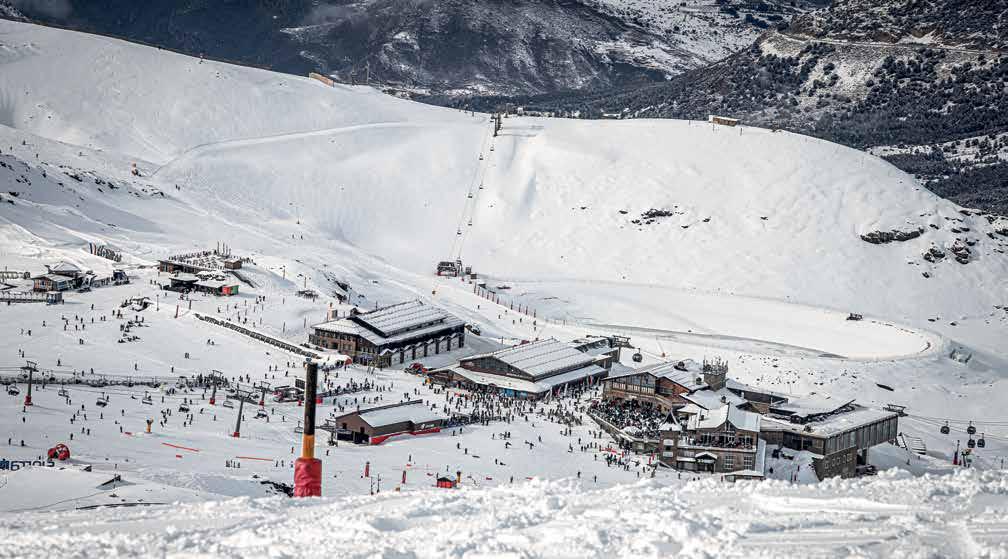
SILENCE. There is not a single peep as I climb upwards through the valley to meet my maker.
I poke my head out of the cable car window and the Sierra Nevada’s fresh alpine air hits my lungs.
Then I hear it – a sweeping crunch down the crisp white piste, as a snowboarder whizzes past below.
Another tears through, and then a third, all weaving down the mountainside at blistering speed.
First-time skier Charlie Smith slopes off to the Sierra Nevada to discover the thrill of deep snow in southern Spain in January
I’m definitely more terrified than the three Spanish guys sharing the carriage with me.
We have left behind the cosy bars and restaurants in Pradollano, the main town of Andalucia’s only ski resort.
We step out at Borreguiles, which sits some 2,700 metres above sea level. It’s a total whiteout.. Some of

the best snow to have fallen over Christmas and New Year for a decade.
This is the basecamp for many of the Sierra’s runs, which range from the green-coloured ‘muy facil’ pistes to those in black, labelled ‘muy dificil’. Blinded by the brilliant white sheen

me over to a small conveyor belt up a very gentle incline slope that is classed as ‘muy facil’. Yeah, yeah.
He puts me through my paces and after an hour of intensive training, I’ve gone from Bambi on ice to actually skiing.
It’s time to hit the slopes, proper.
given off by the snow, I meet my teacher for the day, from the long-established British Ski Center, run by expats Giles and Buzz.
Having only ever skied on the dry slope in Halifax, Yorkshire, on a school trip, some years ago, it’s fair to say I am out of my depth.
But my teacher Giles takes

The pair of us hop onto the Emile Allais ski lift, named after the French alpine ski champion of the 1930s.
And maybe Emile would have been proud – if not a bit bored and bemused – as I safely ‘snow ploughed’ my way to the bottom. It’s a proud moment and we are soon heading up to a longer blue run, which on a weekday in January is surprisingly quiet and empty.
Saying goodbye to Giles, I pop into the cafe at the top of the main ski life for a much-needed and reasonably-priced cafe con leche and bocadillo, while reflecting on my newly-discovered sporting prowess. With the sun now beating down, I take my confidence – or should that be cockiness – back up the slope and prepare for my first solo run.
All goes well until I cross a small but slippery patch of ice – thankfully a rarity on most of the Sierra Nevada
slopes, particularly this year, which are generally icing sugar-soft.
Aside from a series of very heavy snowfalls since Christmas, millions have been spent on hundreds of snow cannons over the last few seasons, which produce the same amount of snow in half the time, meaning the environment benefits as well as the slopes.
As I hurtle over the ice, desperately trying to slow myself, I clip the skis of a youngster sending us both flying.
As I look up I am grateful to discover that he’s fine and laughing and realise his classmates have witnessed the whole thing.
Thankfully they are also all laughing and their teacher, rather than giving me a dressing down, the lad’s teacher imparts some words of wisdom
Continues on next page
WHITE-OUT: The Sierra Nevada has had some of the best early festive snow for decades
The Sierra Nevada’s stunning slopes offer
snowboarding thrills and spills
ALL A-BOARD
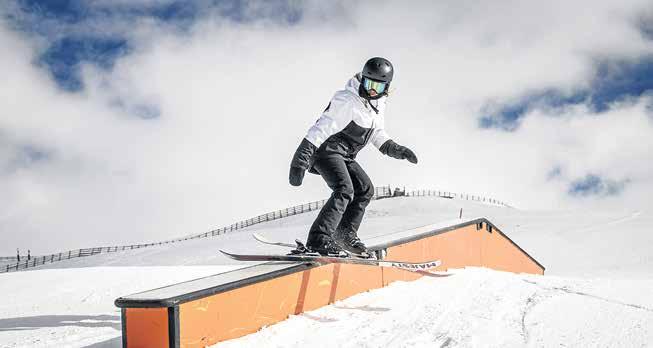
WITH snow like fine powder, the Sierra Nevada is a Mecca for thrill-seeking snowboarders.
For beginners and experts alike, Spain’s highest resort is a glorious setting and gets more and more popular by the year.
Stunning scenery is matched by the top-class facilities, which saw the resort host the Snowboard World Championships in 2017.
Novices should head to Borreguiles, where lifts deposit snowboarders on a smooth and groomed area where they can hone their skills.
Once ready, or for those of a higher standard, they then need to head up to the SuperPark Sulayr, Europe’s largest freestyle snowboard park.
At 2,700 metres on Borreguiles, Spain’s most famous snowboarding park also houses the country’s biggest half-pipe. Measuring an astonishing 165 metres in length with a height of six metres, the special design flattens the snow on the
side of the halfpipe so boarders can jump on both sides. For the best deals in snowboarding equipment and rentals visit South Star, which has three shops in the resort.
From previous page
and encouragement.
This friendliness is a characterising feature of the Sierra Nevada, as locals and tourists – mostly from Portugal and Britain, plus thousands of expats – seem at peace among the tranquility of the idyllic landscape.
Given that my ‘victim’ and I both walk away unscathed with smiles on our faces, all in all, I count my first ever day’s skiing as a roaring success.
The prices for all this fun in the snow are not to be sniffed at either.
My adult’s one-day ski pass was just €55, a real bargain when you
look at what the Sierra Nevada has to offer, with over hundred different runs for every ability. It’s hard to believe that over 100 kilometres of pistes lie just over two hours from sunny Marbella and a little more from Alicante, Madrid and Murcia.
It truly lives up to the marketing hype as a place where you can ski in the morning and sunbathe on the coast, pina colada in hand, by the afternoon.
Expert skiers treasure the snow which, particularly in springtime, is quite unlike the tightly-packed ice found in many European winter sports resorts.
Some ski fans even brave the mountain descent in bikinis for the

CARVE UP: Superpark Sulayr and, below, Jesus and South Star
RANGE: There are near 100kms of runs just two hours from Marbella
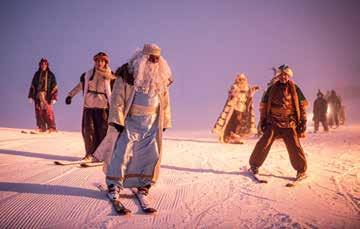
last day of the season in May (la bajada en bikini), an unmissable occasion charged with champagne, hedonism and near-nudity.
Even on my trip in chilly January I spot some shoeless surfer dudes, wetsuits and boards in tow.
“Constant improvements and an ability to produce a lot of snow are just two of the strengths of our resort,” explains Santi Sevilla, who has been working at Cetursa, the resort’s administrator, for nearly two decades.
Santi is far from the only skier smitten by Pradollano’s charms. Well over a million people visit the resort each year.
That is an impressive achievement considering it was only constructed in 1964, making it a newbie in comparison to some of France’s long-established resorts like Chamonix and Courchevel.
But there is much more to the Sierra Nevada than sliding down it on two planks of wood.
You can tackle it by toboggan and snowboard, or on a snowshoe hike (akin to walking with a tennis racket strapped to each foot).
And if that sounds like too much action, you can always swap icy snow for a hot steam bath and soak up some me-time at one of several hotel spas.
But all year round, the Sierra Nevada is paradise for fresh air fiends.
After ‘the melt’, the resort becomes a haunt for walkers, wildlife lovers and mountain bikers.
Get the best views by taking advantage of the ski lifts, which in summer carry both people and bikes to the summit to enjoy the breathtaking routes back down. Back in the icy present, it’s time to sample some of Pradollano’s legendary apres ski scene.
GREAT VALUE RESORT
The Sierra Nevada is incredibly good value, blasting the international competition out of the water. A day ski pass averages at around €55, while Colorado’s Beaver Creek charges often over €250 per day, Whistler in Canada over €100 and Switzerland’s Zermatt costs from €93.75 and Meribel from €69. In terms of ski hire it comes in around €25, while skiwear is found as cheaply as €20 per day, with a small helmet supplement which is a must, regardless of your vanity.
SKIING WITH KINGS

FESTIVE FUN: Sking down slope with the Three Kings is a rite of passage for Spanish kids
For the perfect start, drop into Bar Ski where affable landlord Nichu slings cañas across the counter like a bartender in a western saloon while blasting punters with everything from Michael Jackson to 90s club classics. A hearty pub grub menu – with quality albondigas – is on offer as you scrutinise the history adorning the bar’s walls, including a family photo featuring a fresh-faced King Felipe VI. An equally-tasty post-ski belly-warmer is the lentejas, freshly served up by Jose Carlos and his team at the cosy and modestly-priced Casablanca.
For those with a bit more spending money, La Muralla’s exciting new locationmake sure to visit this high
tech cave - and revamped menu makes that hard work on the slopes all worthwhile. The melt-in-the-mouth carrillada is a must, as is the courgette carpaccio with fig sauce and the peanut tart to finish. And of course, nothing goes down better at this time of year than a steaming glass of tinto de Inviernospiced, mulled wine. Salud!
Apart from the Spanish royal family who are frequently to be found on the Sierra Nevada slopes, if you happen to be around on January 5, you may just see three rather different kings. Yes, that’s because ‘los Reyes’, Melchor, Gaspar, and Baltasar, ski down right down from top, loaded up with presents.Kids will love it.



‘The Finland of Andalucia’
● Angel Ganivet, Spanish Consul to Helsinki, gave birth to the idea of turning Sierra Nevada into a ski resort at the end of the 19th century. He likened his Granada homeland to the ‘Finland of Andalucia’ in a local newspaper.
● 1898 marked the creation of Diez Amigos Limited, a group that led skiing excursions around the area.
● Thanks to their continued success, the organisation was able to create the first youth hostel in the area not long after rebranding itself Sociedad Sierra Nevada in 1912.
● The main road from Granada to Sierra Nevada and a cable car were both put in place at the beginning of the 1920s, which allowed more people to discover the joys of snow-oriented fun.
● The boom years of the resort began in 1964, when Centros Turísticos S.A. (CETURSA), was created, allowing its rapid development.
● Sierra Nevada is the southernmost ski station in Europe and sits at the highest point in Spain.
● The station hosted the World Alpine Ski Championships in 1996. It has also welcomed several Alpine Ski World Cup events, with the first in 1977. In addition, it has been the main venue for the Winter Olympics.
● In 2017, Sierra Nevada hosted the FIS Snowboard and Freestyle World Championships, a major international contest put together by the board of the International Ski Federation.

WHERE TO EAT
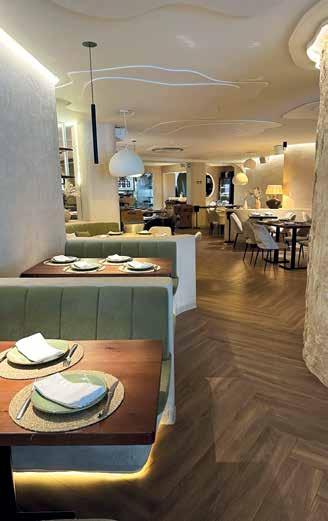
THEY used to spend the morning buying seafood in Motril, the afternoon in Mercadona and the early evening bashing out dough for the pizza oven.
Nowadays the restaurateurs on the slopes of the Sierra Nevada have to think days, often weeks in advance, while sitting back and resting on the laurels will get you nowhere.
And that’s no surprise looking at the quality of the new joints that have opened in the resort over the last couple of years.
Everything from style to comfort and quality to service has gone up 100% in the two decades I’ve been writing about the place.
You literally cannot stand still in Pradollano and you have to be constantly upping your game.

Long time stalwart La Muralla is a great example and one of the most attractive restaurants I’ve seen this year, since moving to a new base 100 metres away.
Partly shaped out of a cave, it has so many amazing touches, like the hidden electric fireplace, that seeing is believing.
One for the stylemeisters, no expense has been spared on the design, and thankfully the kitchen is still up to scratch serving up a great range of dishes with the milhoja of foie gras and the meltin-the-mouth carillada bulls cheek


BRAND NEW: The style of La Muralla and its range of wines is impressive
January 2026 21
The quality of the dining in the Sierra Nevada gets better each year, writes Jon Clarke (right)

HIGH TABLES
among my favourites.
Owner Gonzalo Funes has always focussed on attention to detail and quality meats, thanks to his Argentinian roots, but now he has the venue and a wine list to match. Good luck to him.
Almost as stylish is Tito Tapas, which is a riot of bamboo wooden walls, hip sackcloth chairs and olive wood tables. Getting better by the season, this is the modern domain of mates Luis and Xavi,
INGREDIENTS: The quality of local produce and skills of
who have been grafting in the resort for the last few decades at longstanding Tito Luigi.
Their masterstroke was bringing in excellent Menorca chef Tomeu Carbonell, a pal of Xavi’s, to get creative in the kitchen.
That’s immediately clear, having recruited him from the celebrated three Michelin star cathedral of dining Azurmendi, in Bilbao. Boy, does he know how to cook and, not only do his gyozas (below) taste as good as any you’ll eat in London’s Chinatown, his steak

tartare taco is a true dish of kings.
But it’s his handling of wild local Boletus mushrooms that so impressed me, cooked up with a free range egg and pork jowl.
Meanwhile, his ‘crujiente’ of brie is amazing, while the artichokes with foie worked well.
For pudding you might fancy a tapa of blue Stilton cheese soaked in port, of if you are like me go for the cheesecake, which you will not forget.
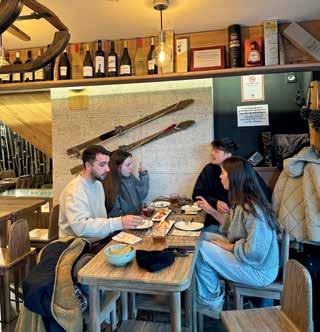
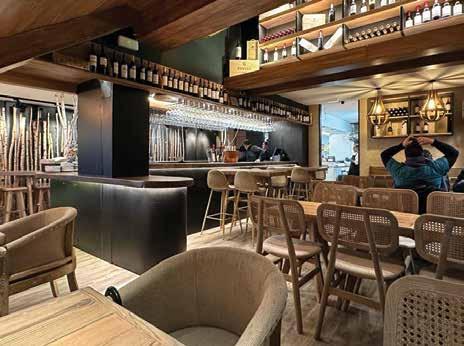


Their sister restaurant, Tito Luigi (actually there are two of them, with another higher up the hill) is a place for royalty with at least two kings of Spain, and three former Presidents having eaten here. The walls pay tribute to them with signed photos-a-plenty from the likes of Jose Luis Zapatero, hidden upstairs coincidentally. You must also look out for the many other international film stars, sportsmen, singers and bullfighters.
There is a cave at the back and it can serve up to 250 people in a busy sitting, so expect to be blown away on busy nights and make sure you book in high season. Expect some of the best pizzas
Continues on next page

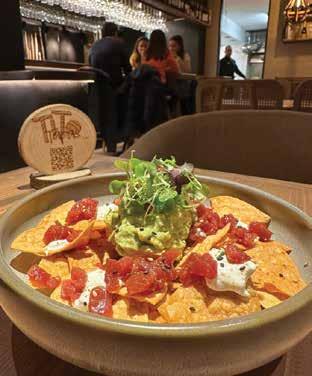
PURE ELEGANCE IN THE SIERRA NEVADA, WINES BY THE GLASS, CREATIVE NEW TAPAS BY THE WEEK
AMBIENCE: and gyozas and tacos at Tito Tapas
Edificio Montblanc – in front of Hotel Melia Sol y Nieve, Sierra Nevada
chef Tomeu (right) are key to Tito Tapas


WHERE TO EAT
From previous page
in the resort, generally splendid Italian fare, while a stand out dish is easily the squidink spaghetti with prawns. Another cool spot is Calambrito, and particularly if Mexican is your thing.
This is the mission of Alexa, who heralds from Malaga, but is a frequent visitor to the central American country, bringing back new flavours and styles, each winter.
It’s a fantastic one for kids who love nachos and tacosand they even have a veggie option
Nuggets de Cheddar, some eight chunks with jalapeno peppers.
An Azteca sopa is a chicken soup with cheese, avocado, tomato and Chipotle. It comes out piping hot and smelling great!
Alexa has worked hard to make this the most exciting joint on the slopes and there are hats to don and games to play (one with electric shocks that the kids will love).
“We have been to Mexico many times looking for new dishes,” she explains. “We

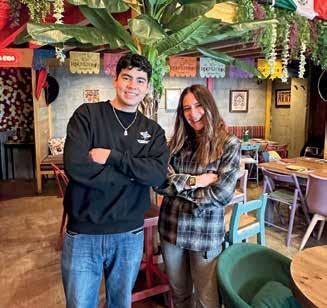
actually went with all the key staff and investors this year and loved it.”
Chema, one of the partners, actually lived and worked in Mexico as a chef and this really shows.
Another great place to eat is
Ci Vediamo, where chef Stevie Silva is constantly coming up with new dishes from his frequent travels abroad in summer.
He’s recently been to Thai-
land and Bali, as well as Japan and South America, so you should get the picture.
He describes it as his ‘rebel food’ and his kitchen and waiting staff are always young and enthusiastic, most of them snowboarders like him.
I always enjoy his dishes like shinbone of beef (tuetano) that comes with a giant bright red langoustine from Huelva, while his ‘Tempura special’, if it’s on the specials list includes prawns, squid, courgettes

RIOT OF COLOURS: Mexican delights at Calambrito

FRIENDLY
FACES: Pizza chef and Xavi, and Luis at Tito Luigi
and aubergine with a Tentsuyu soup (soya, vinegar and dashi). Told you about the Oriental touch. Right next door you will find the resort’s best burger joint, Muralla Burger, run by the Funes brothers, Lu-

ciano and Gonzalo.
January 2026 23

It specialises in quality and the ‘gourmet’ burger is stunning, made from oxtail ‘rabo de toro’ with a thin slice of cheese and mayonnaise and cooked in its own juice.
The pair also run popular Las Gondolas restaurant and cafe just off the slopes and excellent for some apres ski light bites, a hot drink or a beer.
This is one of my favourite spots to take in the sunshine after an afternoon’s skiing and it will be rammed at lunch, that is certain. Also perfect for apres ski and enjoying the sunshine is Tia Maria, where you have the best view of the slopes.
A good place for breakfast, lunch
or dinner, it is normally busy, thanks in part to its great value.
A total institution run by Carlos (part of the Tito Luigi family) this is the spot to chill out and enjoy the sun for the afternoon and early evening. For coffee, breakfast, and in fact just about everything, Vertical is hard to beat and also has a great range of snacks and light bites, including hot dogs for the British clientele.

excellent value and changes by the day.
Another great simple joint, but with great home cooked food, is Telesilla Burger. It is one of the most popular joints with workers in the resort and the menu del dia is
For coffee, breakfast, and in fact just about everything, Vertical is hard to beat and also has a great range of snacks and light bites, including hot dogs for the British clientele.
We are family!
A new generation is slip-sliding into position to take over the famous expat-run British Ski Center in the Sierra Nevada
WITH over 60 years’ experience between them on the famous Granada slopes, it is perhaps understandable that ski dynamos Giles Birch and Jonathan Buzzard are looking at some succession planning.
While Jonathan's daughter Tasha, has been a teacher at their well-established British Ski Center business, his son Harry has now also joined the team. Giles' daughter Carlota has recently begun competing for the UK’s GB Snowsports federation specialising in the Moghuls freestyle discipline and occasionally lends a hand, while his Portuguese wife is a fellow teacher too.
"They were all sliding down black runs by the age of five, so it's no surprise most of them have gone into winter sports as a career," explains Jonathan - better known as 'Buzz' - who spends half the year working for a yacht delivery business.
The pair had first met trying to look cool at the seminal Crescendo bar at the foot of the slopes back in the mid-1990s. Giles as resort manager for Neilson Ski tour operator and Jonathan as an already established instructor working with the International Ski School.

EXPERIENCED: Owners
Jonathan and Giles
Giles then qualified as a ski instructor in 1998 working for the Spanish Ski School where he began putting his previous tour operations experience and web building to good use to source clients for lessons and offer travel packages to
the Sierra Nevada.
Buzz, who had already been running a summer paragliding business along the beaches of Marbella, was looking to expand upon his already well-developed winter client base and between them they developed the British Ski Center ski school and it’s complementary holiday booking agency, Sierra Essence.
Their collision over Glühwein under the Seventies-style glitter balls at Crescendo, quickly led to an alliance to cater for a rapidly growing invasion of British skiers.
Helping them from the airport to the slopes, sorting out accommodation, lift passes and all, ended up being a successful business.
"I was looking for the ideal transport rep to support me whilst working for Neilson Ski" recalls Giles.
"I was told that Crescendo was the place to find the Brits-in-the know... and next thing in walks Buzz with just the right attitude, wearing a long flashers mac, 'big hair' and a friendly, outgoing persona."
Buzz was soon helping to divide and rule the arrival of four full flights from the UK on a Sunday.
"We pooled resources, and we were certainly not treading on anybody's toes, because we were focusing specifically on the English-speaking market.
"Unsurprisingly back then there were hardly any instructors who spoke English, so we found ourselves expanding rapidly with the demand."
Still great mates some three decades on, they now have a fully staffed office next to the popular Tia Maria restaurant right by the main ski lift up from Pradollano, and another office as a meeting point for all lessons up in the Borreguiles ski area. They cater for hundreds of customers a month, as well as sorting out numerous trips, each year.
Visit www.britishskicenter.co.uk for more info.

Organ champions
The ‘opt-out’ donor system helps keep Spain as the world leader for transplants for 34 years in a row
SPAIN fell just short of breaking its own record for organ transplants in 2025, with 6,335 procedures performed nationwide.
The near miss, however, does little to diminish the achievement of being the world’s leading donor country for the 34th consecutive year.
According to the latest stats there are 52 donors per million inhabitants in Spain - more than double the European Union average.
Kidney transplants accounted for the largest share, while heart transplants reached an alltime high.
LBy Karissa Key
Cantabria once again led the country, even though Spain’s lowest-performing regions exceeded donor rates in nearly every other nation.
Spain’s success is often attributed to its donation law, which considers citizens potential donors unless they opt out. An academic review of the Spanish transplant system - frequently cited as a global benchmark - suggests this explanation is incomplete. In practice, donations proceed only after consultation with the deceased
IPEDEMA is a chronic disorder of fatty tissue that causes a symmetrical and disproportionate increase in the size of the legs and, in some cases, the arms.
It often comes with pain, heaviness and frequent bruising. Despite these characteristic symptoms, it remains widely underdiagnosed – largely because it is mistaken for excess weight, obesity or circulatory problems.
“The key is recognising its specific clinical signs: pain on touch, hypersensitivity and a constant feeling of heaviness,” says Dr Lourdes Yagues, head of the new Lipedema Surgery Unit at Quirónsalud Marbella and Quirónsalud Málaga.
A DISEASE WITH ITS OWN CRITERIA
Dr Yagues notes that according to the German S2k guideline, a reference in diagnosis, “there must be symptoms such as pain, heaviness or hypersensitivity, not just increased volume”.
The typical pattern includes legs and arms wider than the trunk, symmetrical distribution, a tendency to bruise and poor response to dieting. “Patients may lose weight in the face or torso, but their legs change very little,” she says.
EARLY DIAGNOSIS IMPROVES QUALITY OF LIFE
Putting a name to what is happening is a crucial first step for many women. Early diagnosis allows conservative measures such as compression, adapted exercise, physiotherapy and pain management –

TRUST: Public confidence helps to create low-refusal rates for transplants from loved ones
person’s family, making trust and communication central to the process.
The study, funded by the Onassis Foundation, highlights Spain’s structured approach: a national authority that sets strategy, regional offices that manage logistics, and hospital-based transplant coordinators trained to identify donors.
Public confidence plays a
crucial role. Surveys show that Spaniards express higher trust in their transplant system than the European average, contributing to low family refusal rates.
Looking ahead, Spain has launched a new strategy through 2030 aimed at expanding donor eligibility and advancing medical innovation, including donation after circulatory death.














Pain and bruising: the overlooked signs of lipedema
all of which help reduce symptoms and improve mobility.
It also helps identify factors that can worsen the condition, such as inactivity or excess weight, and to assess whether surgery could provide further benefit.
“Lipedema does not have to worsen inexorably. It depends on risk-factor management and the care the patient receives,” says Dr Yagues.
LIPEDEMA-SPECIFIC SURGERY: SAFETY AND FUNCTIONAL IMPROVEMENT
The most common intervention is a specialised liposuction, designed not as a cosmetic procedure but to reduce pain, improve mobility and enhance quality of life.
“Surgery is considered when pain and movement limitations persist despite conservative treatment,” explains Yagues. It is carried out in a hospital environment using techniques that protect the lymphatic system and strict safety protocols covering fluid control, thrombosis pre-
vention and pain management.
Studies show significant improvements after surgery: less pain when walking or touching the legs, a feeling of lightness, better posture and greater ease in dayto-day activities. Even so, full results take months to settle, and ongoing self-care remains essential.
A MULTIDISCIPLINARY APPROACH TO A COMPLEX CONDITION
Quirónsalud Marbella has launched a dedicated unit to support patients with an integrated approach. Specialists in plastic surgery, physiotherapy and lymphology, nutrition, psychology, angiology and internal medicine all work together.
“Coordination is essential. It’s not just about operating, but about guiding patients through preparation, recovery and longterm follow-up,” says Dr Yagues.
A key message for patients
The specialist stresses that persistent

symptoms such as pain, frequent bruising, disproportionate limb volume and poor response to dieting warrant medical evaluation. “The sooner lipedema is identified, the sooner the right treatment can begin – and the sooner quality of life can improve.”

EXPERT: Dr. María Lourdes Yagües
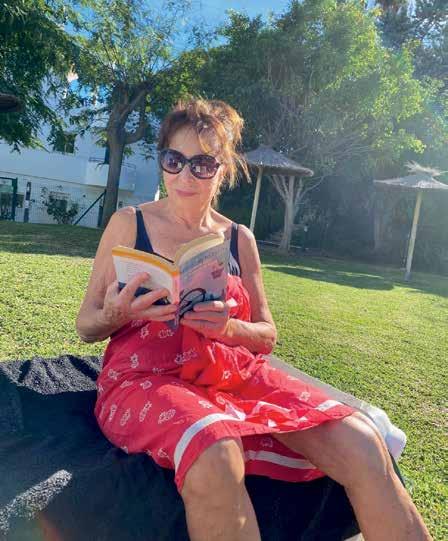
ON BENDED
FIRST, not all knee replacements go badly; something like 90% go very well. After initial pain, most recipients are happy. But when things go wrong… What follows is not an account of medical negligence, something I first encountered as a young reporter covering an inquest after a woman died because a surgical swab was left inside her in theatre.
No, this is a modern tale of what I see as greed, rudeness, and lack of transparency. The players: my wife, Angela, Hospiten, in Estepona, and Asisa, in Málaga. Angela had a knee replacement nine years ago, when we lived in Extremadura. Apart from nonstop pain, the prosthetic knee had problems. Back to theatre (funny name for such a grim place!). A replacement knee was required. These interventions were two years apart at Clideba/ Quirón, in Badajoz.
Worse news: the knee was infected, either in the first or second op, by a variant of staphylococcus bacteria. No one could say

Unlucky Angela still has disabling chronic pain a year after knee surgery. In a personal medical saga, her husband, seasoned journalist Rod Usher, forensically asks some probing questions about the labyrinthine healthcare and insurers in southern Spain
By Rod Usher
stuff you must cut away. Don’t worry, no gory details follow.
We sought opinions: a surgeon in Madrid, one in Barcelona, one from a world-ranked authority in Cardiff. They don’t work with insurers, but all three said, this being third-time-round, Angela would have to have a ‘cono’ or two. These are metal cones that can be put at the end of the femur or tibia bone to reinforce them after so much chopping.
how/why. Angela was bombarded with really heavy antibiotics intravenously, but these bugs rapidly build a plastic-like film so antibiotics can’t touch them.
Meanwhile, we moved to live near Estepona. The second knee had to come out, too.
Infected limbs are specialist territory, a select few surgeons in Spain do them. In part because of a technique called ‘debridement’, a term meaning how much
We found a surgeon at Hospiten, Estepona, Dr Fabian Poletti. He struck us as honest when he said he’d need the counsel of an expert, plus he is known to the world authority in Cardiff. We continue to trust Dr Poletti, who no longer works at Hospiten.
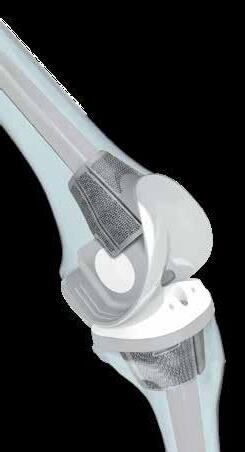

The first two knee replacements in Badajoz were covered fully by Asisa, as you’d expect.
But before Dr Poletti started cutting, we were told by Hospiten that Asisa would not cover the cost of cones.
Never mind that three eminent surgeons told us they might be essential for someone who’s had so much surgery on the same body part.
“ “
Going to court for €2000 is like Russian roulette played slowly
Expert to hand, Dr Poletti replaced the infected second knee with a third. That was in Hospiten in January last year.
Today, exactly a year later, Angela still has disabling chronic pain in her leg and foot, but the knee is no longer infected, and she can bend her leg more than she could after the second one.
That’s a compressed account of nearly a decade of knee trauma.
With the third knee, another drama began.
Angela has been with insurers Asisa since 1996. I dropped out a few years ago because we are old and retired, and my general health is better than hers. I rely on the public system. Yes, I know, a big gamble in today’s southern Spain.
We paid Hospiten €5,940 for three cones that were ordered. Dr Poletti in the end needed just one cone, on Angela’s tibia. The other two were returned immediately to the maker, Waldemar Link, which has an office in Barcelona. Naturally, we asked Hospiten for a refund which we worked out as €3,960 for two unused cones? We also asked for a factura desglosada, an itemised bill.
Hospiten returned exactly €2,000, and a bill reporting; 1 cono femoral (it was tibial) and 1 Palamix cement.
It appeared we were shortchanged, but an itemised bill from Hospiten accounts was never forthcoming, no matter how many times I asked.
The way to get an answer had to be going to the top, the director, Sñr Gerardo Bravo Chaparro. I hand-delivered a letter to him on April 4. No reply. I sent him a certified letter on June 4. Total silence.
The question became, as any unpaid tradesperson knows, is it worth employing a lawyer?
Going to court for €2,000 is, at best, a form of Russian roulette, played very slowly.
However, due to the sheer rudeness of Hospiten’s silence and refusal to provide an itemised bill led me to take a deep breath and contact a lawyer recommended by our bank manager.
ON THE MEND: But Rod’s wife Angela is still very upset at her treatment from insurance company Asisa and Hospiten in Estepona
HIGH TECH: And high cost for cones like these from Waldemar Link that are made in Germany
KNEES
The lawyer wrote. The same silence continued. Finally, he pointed out certain aspects of the Penal Code to Hospiten’s compliance/legal centre, which is in Tenerife.
After further delay and more letters, he received a reply, presumably drafted by the legal office, from Sñr Bravo. His letter is dated October 13, nearly nine months after Angela’s operation.
The letter offers what to me is a limp apology for the ‘inconveniences’, blames Dr Poletti for ‘the confusion’, says Hospiten doesn’t recognize any error in the billing…but will return us another €500. (Which it has now done. Why, if all was clear and correct?) His letter neglects to mention billing for a cone on Angela’s femur when the one used was for her tibia, an error I found scary.
Where was this ‘confusion’ caused by Dr Poletti? He answered all medical questions we had before and after the operation. At our request, he provided the protocol document
showing the cone used is tibial, not femoral. X-rays confirm this. We found Dr Poletti extremely caring. He told us several times that billing is not the surgeon’s business. I asked our lawyer for two more things. Hospiten should pay his own costs, and we should get an itemized bill. They paid half his costs, and… provided a factura desglosada. A real bill!
Cement
Surprise, surprise, it now totals €3,440, which fits with Hospiten paying us the €500 Sñr Bravo implied was generosity.
With the bill in hand, the mystery deepens. Instead of just one cone for €1,980 the bill now has three additional items supposedly not covered by Asisa. (I tried but failed to get Waldemar to reveal what they charge a hospital for a cone. I have an idea it’s about €1,500).
The additional items on the bill are: ‘Component femoral
y tibial, €574,31; Cemento Palafix, €754; Tapon distal, €131,69.’ Add the €1,980 for the one cone: €3,440.
I make no suggestion Hospiten has done anything illegal, but was this final accounting - so many months later - produced only because I engaged a lawyer?
Now, the medical insurer part. In Angela’s case, Asisa. Why, if in the first two operations all was covered, is it not now?
How can Hospiten bill us €754 for antibiotic cement?
Asisa knows that if you don’t put cement into a new knee, well, it will pull out, with disastrous effect.
Why were the other two additional elements in Hospiten’s new bill not covered?
Writing to Asisa Málaga feels like writing to Sñr Bravo. I wrote to the company last January, ten days before Angela’s operation, challenging its policy not to cover cones. If two of Spain’s leading surgeons for post-op knee and hip infections say you need cones, if a world authority based in Wales (who helped invent the cones) says the same thing, how can an insurer not cover the cost?
One year later, still no answer to that letter.
Maybe Asisa would argue, if it cared to reply, that a cone attached to a bone is not part of a prosthetic even though the artificial knee will likely fail without it?
Where lies the benefit of any doubt? Angela has been paying Asisa without interrup tion since 1996, as her credit card shows.
I shudder to look up that total. Asisa might seek to claim she has cost it more than said total because of her vari ous needs over these 30 years. But isn’t that how insurance companies work…the healthy people, I mean clients, compensate the provider for the sicker ones?
Ever heard of a medical insurance company going broke?
I suspect Asisa would dearly love to get rid of my wife. We were shocked when the
When is pain not ‘normal’?
IT is clear that pain is a sensation we have always tried to avoid. It can appear at any age and has accompanied everyone at some point throughout our lives. Most of the time, it is acute, occasional pain that disappears over time. Sometimes quickly without explanation.
In my practice and with my players at the Spanish FA, I always tell patients that a very intense pain that resolves in a short period of time worries me far less than lower level pain that persists for weeks. Recognizing when pain stops being a simple warning and becomes a health problem that requires attention is essential to prevent complications and improve quality of life.
In Spain, chronic pain has ceased to be an isolated complaint and has become a silent epidemic affecting a significant
Spain’s national football team doctor surgeon Dr Claudio Vazquez on the way to tackle acute pain and the warning signs you mustn’t ignore
part of the population. According to the latest Chronic Pain Barometer, produced by the Grünenthal Foundation in collaboration with the University of Cádiz Pain Observatory, more than one in four adults (26.6%) in Andalucia live with pain lasting longer than three months - a figure very close to the national average. This persistent pain does not affect everyone equally: women suffer significantly more, with a prevalence of 31.4% compared to 21.3% in men.

The most affected area is the lower back,
company made a jump of several hundred euros in her premium for 2025 to €4,748. In December we received advice of the bill Asisa had coming for her for 2026: €6,386. That’s a yearly increase of 25%. Inflation’s now about 3%. What’s more, Asisa has co-pago, meaning every time Angela has a medical appointment there’s a small extra charge. The €6,386 alone breaks down to €122 a week, more than many people can spend
After finally receiving Sñr Bravo’s letter and draggedout bill I wrote again to Asisa, about their cover/ lack of and the new bill. I suspect they would like Angela to opt out, no longer the asset client she was 30 years ago.
I imagine Sñr Gerardo Bravo has reason to be proud of his hospital’s balance sheet. I’m sure Asisa will continue its glossy advertising about care.
What I wish is that governments, especially ours in Andalucia, would stop shovelling money to private operators and deliver the funds, staff and, above all, efficient management, needed by Spain’s once-enviable public health system.
Footnote: At the time of writing, Asisa still hasn’t answered why two knee operations were fully covered but the third at Hospiten was not, leaving us to find more than €3,400. My last mail to them was in October.
After my protests re this year’s bill, someone in Asisa in Madrid (I can’t discover who) must have decided a 25% premium increase was a bit steep. So, Angela’s 2026 bill has been lowered from €6,380 to €5,351, roughly an 11% increase on last year. The Olive Press contacted both Hospiten and Asisa for comment.
Rod Usher is an Australian poet and novelist who has been living in Spain for more than 30 years. He is a former chief sub-editor of the Sunday Times in London and a senior writer for TIME magazine.
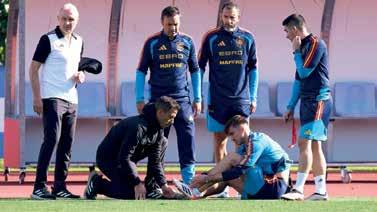
followed closely by the joints of the lower limbs.
Chronic pain has a tangible impact on the daily and social lives of those who suffer from it. Nearly seven out of ten patients (68.7%) report sleep disturbances, a sign that pain not only limits mobility but also disrupts rest and worsens the perception of discomfort.
Managing chronic pain combines several strategies. Pharmacological treatment remains a cornerstone (analgesics, anti-inflammatory drugs, and, in some cases, medications specifically for neuropathic pain).
But medication alone is not enough.
Scientific evidence shows that physiotherapy, functional rehabilitation, adapted physical activity, and cognitive-behavioral therapy reduce pain perception and im-
prove mobility.
Even techniques such as mindfulness or relaxation therapies can decrease pain intensity and improve sleep.
A multidisciplinary approach is especially important.
Patients with chronic pain often require coordinated follow-up by physicians, physiotherapists, psychologists, and sometimes rehabilitation specialists or even rheumatologists.
This comprehensive approach makes it possible to address not only the symptom but also its consequences: anxiety, depression, loss of productivity, and disturbed sleep.
Another fundamental aspect is patient education. Understanding
how pain works, how to prevent it from becoming chronic, and which habits can help - such as maintaining regular physical activity, taking care of posture, and sleeping well - is key to reducing its impact. Ignoring these measures can prolong suffering and limit daily life. Pain is not a punishment, nor something that should simply be accepted.
Learning to listen to it, identify its type, and seek treatment when it persists is the best strategy to prevent a warning signal from becoming a chronic burden. Ultimately, addressing pain early not only alleviates discomfort but also preserves joint mobility, strengthens autonomy, and ensures a better quality of life.
TOP LEVEL: Dr Claudio assesses one of Spain’s internationals while (below left) with superstar Yamal

LOOKING FOR MORE CULTURE STORIES?
NOW the festive season is out of the way, it’s time to plan your fiestas for the year ahead.
From bullrunning to floral patios, from street parties to food fights, there is something for everyone. Here are some of our favourites.
Carnival, February 12 to February 19
Forget about marking the start of Lent with a humble pancake. In Spain, Carnival fever sweeps across the nation. Street parades that rival Rio are held in the Canary Islands, groups of friends plan elaborate costumes for parties in Cadiz and even the little ones at primary schools dress up for the occasion.
Las Fallas, Valencia, March 1 to 19
Head to the eastern city of Valencia for Las Fallas in March where giant papier-mâché models satirizing politicians and celebrating modern icons are displayed across the city. The spectacular climax comes when they are set ablaze to a thunderous firework display in a festival that has Unesco World Heritage status.
Semana Santa (Holy week), March 29 to April 5
Processions are held across Spain during the week running up to Easter with the most impressive Semana Santa celebrations taking place in Andalucia. Expect shrouded penitents shuffling mournfully to beating drums as statues of Christ are slowly walked around a circuit from the church.
Feria de Abril, Se villa, April 21 to 26 2026
Head to Sevilla for the Feria de Abril, held two weeks after Easter when the Andalucian capital is transformed into a celebration of bullfighting cul ture. Women parade in their flamenco finery, horses dance and crowds gath
Fiesta!
The best festivals in Spain for your 2026 travel bucket list
By Fiona Govan

er in colourful tents to eat, drink and dance Sevillanas. It helps if you know people as entry into the casetas is by invitation only. But similar style ferias take place in Cordoba and Jerez which are more open to outsiders.
Patios of Cordoba, May 4 to 17
Each May, the private courtyards of Cordoba are opened to the public in a city-wide competition for the most impressive floral displays. It’s a chance to peek behind doors closed the rest of the year and be inspired by Moorish patios and glorious floral displays. Concerts and flamenco shows also take place in corners during the Fiestas de los Patios and it’s a wonderful time to discover the city.
San Juan, June 23, 2026
Wherever you are in Spain, celebrations of some kind will take place to mark San Juan - which coincides with midsummer or equinox. If you are near the coast, this will mean fires on the beach, fireworks and all night parties. Elsewhere look out for walking over hot coals (Soria) horseriding through flames (Menorca) or waterfights (Alpujarras).

San Fermin, July 6 to
Bull-running fiestas take place all over Spain but by far the biggest and most famous - thanks to Ernest Hemingway - is San Fermin in Pamplona where the Navarran capital is transformed into one hellu -
brave (or foolish) enough to partake in the morning encierros don white with a red sash and neckerchief to race across the cobbles dodging the horns of a pack of bulls. Everyone else just enjoys the fiesta.
La Tomatina August 26, 2026

On the last Wednesday in August, the small town of Buñol near Valencia stages the world’s biggest food fight with some 40,000 people crowding in to throw tomatoes at each other. Trucks bring in the fruit which are hurled at each other in a tradition that has become so popular, tickets need to be bought in advance. Of course there’s also music, food and lots of alcohol in what has become one of the most iconic summer events in Spain.
Wine harvest, September
This is the month where across Spain the grape harvest begins. From Jerez in the southwest to La Rioja in the north, festivals are held to mark the Vendemia. In Logroño this kicks off around September 21st for the fiestas de San Mateo where you’ll find ceremonial grape stomping and of course local wine to

accompany the regional dishes.
National Day, October 12
It’s a bank holiday across Spain on October 12th when the nation marks the Dia de la Hispanidad. In Madrid this is marked by a huge military parade down the Castellana, with tanks on the ground and aerial displays by the Air Force. It’s also the day Zaragoza celebrates its patron saint with the Pilar festival.
All Saints Day, November 1
Another bank holiday across Spain and the day when families traditionally go and visit the family grave yards. Nowadays, the night before has become a big deal with Halloween celebrated with costume parties and trick or treating. For traditional treats try the Huesos de Santo, marzipan filled with an egg yolk cream to represent Saint’s bones.

MUCKY: Tomatina festival is one of Spain’s best known scrum downs with food
COLOURFUL: From Carnival celebrated in Madrid to traditional dress at Feria de Abril
If you’ve searched for news about Spain recently, chances are you’ve already found our website.
In 2025, readers around the world turned to The Olive Press in unprecedented numbers - not because Google told them to, but because this became the place where Spain made sense in English.
Over the past year, The Olive Press was read 8.5 million times, by nearly five million individual readers, with more than 680,000 returning regularly. Articles weren’t just skimmed - they were shared, discussed, argued over and passed on, reaching millions more across social media.
But numbers alone don’t tell the story.
What readers showed, again and again, was a clear preference: they came here for clarity without condescension, insight without hype, and reporting that treated Spain not as a postcard, but as a living, complex place.
What people actually read
The most-read stories of 2025 ranged widely — and tellingly.
Readers followed breaking developments, from national policy changes to regional emergencies.
One of the year’s biggest stories charted the search for a missing former British soldier in Tener-

SEARCH PARTY
Built over two decades and read weekly by millions, the Olive Press is Spain’s leading English publication
ESSENTIAL 2025 STATS
● 8.5 million article reads
● 5 million active readers
● 680,000 regular readers
ife, drawing over 120,000 views as readers tracked each update.
They stayed with in-depth reporting too: coverage of Spain’s decision to raise the retirement age, the summer heatwave, and a nationwide blackout all ranked among the year’s most-read pieces.
And then there were the stories that surprised even us.
The most shared article of the year - with over 10 million views and 1.1 million shares - wasn’t about politics or crisis, but a witty, thoughtful piece linking Cádiz carnival with Stephen Hawking (see above right). It travelled fast because it captured something readers recognised: Spain’s ability to be playful, philosophical and human all at once.
That story now joins this archivenot as an outlier, but as a reminder
TOP 5 POSTS IN 2025
that readers don’t just want information. They want intelligence, curiosity and connection.
A shared place to read Spain

Throughout 2025, The Olive Press was cited and linked by outlets including CNN, National Geographic, the BBC, LBC, El Confidencial, Cadena SER and many others — often because we were first to the story, and fastest with verified updates. But what matters more is this: readers came back. They came back from across Spain — from Andalucía to the Costa Blanca, Gibraltar to the Balearics — and
from far beyond it, reading in over 120 countries worldwide.
For many, The Olive Press became a daily habit.
For others, a place to check what was really going on.
For some, simply a way to stay connected to Spain — whether living here, visiting, or watching from afar.
A new chapter
This national monthly edition marks the next stage in that relationship.
Into the archives

It isn’t about speed. It’s about perspective. It’s about stepping back from the daily rush to look more closely at the stories, places and ideas that shape life in Spain — and why they matter.
This archive is not just a record of what The Olive Press published. It’s a record of what readers chose to read.
And that choice is what made this moment possible.
20 YEARS 20 STORIES
Blue Monday in January
THE start of the year has always been a slow and, often, depressing one, although few worse than the horror crash at the weekend in Cordoba.
Later described by a judge as ‘mafia tactics’, it demonstrated early for us the power of money and levels of corruption at play in southern Spain.

● /spain-news/2025/03/01/ british-ex-soldier-whovanished-in-tenerife-isfound/ (120,000 views)

● /spain-news/2024/12/30/ spain-will-raise-its-retirement-age-this-week/ (85,000 views)
● /spain-news/2025/06/25/ remain-indoors-asmuch-as-possible-newspain-heatwave-couldreach-46c-in-hottestjune-ever/ (55,000 views)
● /spain-news/2025/03/06/ missing-dutch-expat-isfound-in-squalid-pitchblack-basement-in-tenerife-after-unknownman-denied-he-was-inside/ (55,000 views)
● /spain-news/2025/04/28/ breaking-massive-power-outage-strikes-all-ofspain/ (54,000 views)
The so-called ‘cuesta de enero’ is tough in business terms, but we have always soldiered on with the news, covering it as best we can. In our second issue in January 2007 we reported how three expats were being sued a total of 21 million euros for daring to speak out against the disgraceful Los Merinos golf scheme near Ronda. It came after we had quoted the trio (below) in our first issue (followed up in the Times and Telegraph, El Pais and ABC) about how the project was unsustainable and unsuitable for the area.
Having already received threats ourselves, we realised we would need to carefully adhere to strict UK libel laws to avoid being sued. Sticking to this rule has put us in good stead over the decades. This couldn’t have been more important than our other big story that January in 2007 when we reported how a British MP, Margaret Moran, had blocked off a footpath near her home in Granada (see right).
We carefully revealed how neighbours - including one man who only travelled by donkey - were up in arms that they now had much longer round trips. We ended up sitting down with the Luton South MP who blamed it on local ‘anarchists’ which, of course, gave us a great follow up line for February. It also made both the Observer and Mail on Sunday newspapers back home. She was eventually ordered by a judge to reopen the path, which gave us the classic headline: ‘Anarchists teach Labour MP a les-
son in socialism’.
In another depressing January story the following year, expat couple, the Priors had their home demolished, the start of a decade-long awful saga that saw them forced them to move into their garage. We covered it every step of the way, visiting and interviewing them many times, and celebrating when they finally got compensation in 2018.
It was the start of us really finding our purpose in Spain, as the only publication that actually took on investigative cases on behalf of foreign expats.

TOP: We come top on Google for search terms including ‘news in Spain’ and news in Marbella, Costa Blanca and many other areas and towns
OUT OF THIS WORLD: Our Instagram video about a cavalcade of Stephen Hawkins carnival goers gained over 12 million views
From British roots to global horizons
FOR international families, choosing a school is about continuity and preparing children for life beyond school, often across borders.
Shackleton International School, located in Burjassot, Valencia, approaches education as a long-term journey, beginning with solid academic foundations and guiding students toward internationally recognised qualifications and access to universities worldwide.
A British curriculum with an international outlook
Shackleton follows the British education system, offering an academic pathway that combines rigour with flexibility.
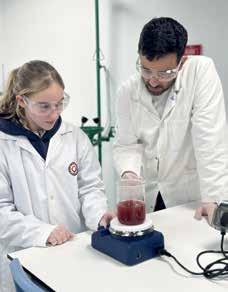
Shackleton International School prepares students for the future
English is the primary language of instruction, while Spanish and German are introduced early, followed by Valenciano and French.
As students progress through the Key Stages, early curiosity develops into analytical thinking, collaboration into leadership, and creativity is channeled into problem-solving and independent learning.
Small class sizes allow teachers to adapt to each student’s pace, ensuring steady academic and personal growth.
Cambridge certification: qualifications that travel well
Recognised qualifications are essential for international families.
At Shackleton, students pursue Cambridge International General Certificate of Secondary Education, respected by education systems globally.
This programme cultivates critical thinking, independence, and communication skills, key competencies for higher education success.
Modern learning, strong values and purpose-built facilities
Shackleton combines traditional British education with modern methodologies,

including project-based learning, collaborative work, flipped classrooms, and meaningful integration of technology.
The school’s facilities support this approach, with science and IT laboratories, multipurpose spaces, independent study areas, a library, sports facilities, and a dining hall.
A dedicated KS4 floor provides age-appropriate study spaces during the GCSE years. Resilience, curiosity, and collaboration are embedded in an international community and strong focus on emotional wellbeing ensure students feel supported.
IB World School: opening doors to global universities
From September 2026, Shackleton will welcome its first Year 12 cohort into the
International Baccalaureate Diploma Programme, widely recognised by top universities worldwide.
The IBDP develops academic, intellectual, and personal skills, fostering global awareness, research ability, and social responsibility while complementing the school’s British curriculum and offering families high-quality international education near Valencia.
Visiting the school
Guided open days on 14 February (English) and 21 February (Spanish) provide families the chance to explore facilities, meet staff, and learn about Shackleton’s project. Registration is available via the school’s website or QR code below. See advert for contact details.

Shining the way!
FOR more than 2,000 years, lighthouses have guided sailors and served as important beacons for navigation and safety.
The earliest known lighthouse, built in ancient Egypt, used polished bronze mirrors to project firelight across the sea to assist mariners on their journey.
In my work as a financial planner at BISSAN Wealth Management in Spain, I often feel like a modern-day lighthouse keeper: guiding expats with their finances and investments, providing a beacon to help them navigate the numerous complexities in the financial waters separating Spain and the United States. The financial plans we construct for our clients at BISSAN provide clarity and direction to families during economic uncertainty, just as lighthouses help ships steer safely through darkness or storms. Additionally, being guided by either a financial plan (or a lighthouse) provides confidence and peace of mind that investments (or ships) are on the right course.
For the more than 50,000 Americans who currently live in Spain,
it is vital that whoever helps them construct their financial and investment plan has a thorough understanding of all the Spanish and American circumstances related to finance.
They do not want to overlook a viable investment strategy or financial product simply because their financial planner lacks knowledge of what is available in both countries.
Additionally, their advisor needs to be up to date on the regulations that restrict investment choices.
A Spaniard living in Spain, for example, can buy most of the European-managed mutual funds available.
For an American in Spain, however, this would trigger unwelcome IRS tax treatment (PFIC).
To ensure that I have the knowledge necessary to assist clients, I rigorously study finance on both
sides of the Atlantic.
In fact, I recently became a Certified Financial Planner® professional in the US. I was already the only American to hold Spain’s top financial planning credential: having earned the European Financial Planner (EFP) certification from EFPA España in 2021.
Our approach at BISSAN Wealth Management is very effective in helping expats in Spain. First, we learn about our client’s financial goals, what they would like to accomplish.
It might be buying a home, financing their children’s education, helping their parents in old age, etcetera.
We then quantify each of these goals in our optimisation model to determine expected future cash outflows and park the moneys that will be necessary for these expenses in safe, short-term investments.


Only after we understand a client’s circumstances – knowing how each separate decision about saving or investing fits into the bigger picture and having created a financial plan of the future they want to build – do we start to advise them on specific investments.
And only after a client’s anticipated future outflows have been safely protected from the market’s ups and downs, do we talk about investing for the long term.
A lighthouse keeper on an island does not shine their beacon for boats approaching in only one direction.
Instead, they make sure that all can be guided by it. Similarly, I strive to help clients with as many facets of their finances in each coun-
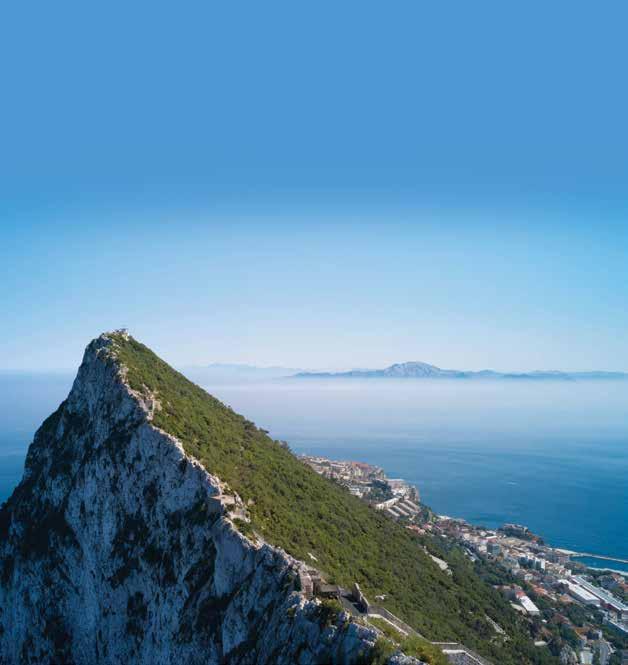


try as I can.
That is the reason I have been awarded both the CFP® certification in the US and the EFP in Spain.
That is also why I’ve earned two master’s degrees: a master’s in taxation in Spain as well as an MBA in finance in the United States.
Additionally, it is a key reason I chose to work at BISSAN Wealth Management, where I am the only employee who is not a native Spanish-speaker.
Working alongside teammates who are well-versed in the peculiarities of financial planning and investing in Spain is of great benefit to any expat living in this country.



BUSINESS
DEAD LOSS
THE accounts at a collapsed funeral planning company have been bled dry, it can be revealed.
Victims chasing compensation from beleaguered firm
Iberian ‘will struggle’ to get compensation, the Olive


Action group finds accounts have been ‘emptied out’ at rogue funeral firm
EXCLUSIVE
By Rachel Gore
Press has learnt.

“There are no funds left in the company’s bank accounts,” insisted one of the victims, Stan West. West, 79, who has set up the Iberian Victims Association, has spent months digging into the suspect ac-
BRITISH pensioners in Spain will benefit from a generous five per cent boost to the state pension.
It will shoot up by 4.8% from April - representing an annual increase of over £500 (€580) for most retirees.
The new flat-rate for those who reached pension age after April 2016 will be boosted to £241.30 a week from £230.25. For expats who reached retirement age before then it will rise to £184.90 per week. Pensioners can thank the triple lock sys-
Scan to visit our website See full story online

counting of the firm, set up by expat Stephen Nelson in 2006.
This comes ten months after we revealed (left) how the business shut without telling its thousands of clients across Spain and Portugal. The company, which van-
Pension boost
tem for the boost, which sees the rate rise due to inflation, wage growth or 2.5 per cent, depending on which is highest. But it’s not all good news as the government is to put an end to ‘buying cheap access to a UK state pension’. Expats will now be blocked from ‘topping up’ on missing years via class 2 voluntary National Insurance contributions (NICs).

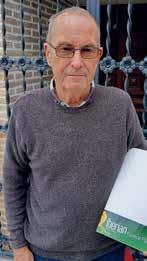
ished overnight on March 3 last year, left expats with no access to their plans which each cost over €3,000 (and as much as €7,500).
Most victims are ‘elderly and can’t afford to purchase a new plan’ explained West, from north east Scotland and now based near Torrevieja in Alicante.
“They are now suffering real anxiety because of the burden they feel they are to their families,” he added.
Despite months of no success, the association - which already has 40 members - is determined to find out exactly what happened to the victims’ hard earned cash.
I’M HERE TO MAKE YOU MONEY
THERE are tens of millions of euros waiting to be claimed from banks in Spain this year from one dodgy now outlawed policy.
Did you have a mortgage with Sabadell, Sol Bank or Unicaja between 2001 and 2011? Or maybe with Caja Granada, Popular, Caja Duero or Caja El Monte?
You could be in for a substantial refund if your mortgage included a so-called ‘floor clause’ (cláusula suelo), a term now widely recognized as abusive and illegal under Spanish law.
This is where my team at Fairway Lawyers steps in.
The floor clause, sneakily embedded in mortgage agreements, prevented interest rates from falling below a certain percentage, even if the Euribor (the primary index for calculating mortgage rates) dropped significantly. For years, Spanish homeowners unknowingly overpaid on their mortgages, collectively losing hundreds of millions of euros to this unfair practice.
While many banks initially resisted refunding these sums, landmark Supreme Court rulings and subsequent European Court of Justice judgments have cemented the illegality of these clauses, forcing banks to repay affected customers.
A Track Record of Success: €3 million already won for Brits all over Spain
My firm Fairway Lawyers has been at the forefront of this legal battle, transforming a com-
Beat the Blue Monday slump by asking lawyer Diego
Echavarria to submit a nowin, no-fee claim against your former or current bank over the dodgy floor clause
After the group’s lawyers discovered there were ‘no remaining funds’ their next step is likely to bring in police and denounce the former owners for fraud.
While Nelson died last year, his ex-wife, her son and a number of former employees may be in the firing line.
It comes despite all contracts misleadingly stating that funds were held ‘safely and securely’ in accounts with BBVA, Santander and HSBC in the UK. Funeral plan companies were not regulated in Spain as they were in the UK by the Financial Conduct Authority.



plex, intimidating legal process into a straightforward, no-risk opportunity for our clients.
My specialized knowledge and tactical approach to banking litigation have resulted in countless successful claims.
But my track record isn’t measured in mere legal victories but in the tangible financial results delivered to my clients - getting an average of €10,000 per claim for hundreds of individuals and families over the last decade.
Above all, my team understands that many potential claimants are wary of legal fees and the stress of litigation, especially against large financial institutions.
This is why we operate on a stringent ‘no-win, no-fee’ basis.
This commitment means that clients face ZERO upfront costs and ONLY pay a final percentage of the recovered money - AFTER - the bank has paid the refund.
If the claim is unsuccessful, the client pays nothing for the legal services, completely removing the financial risk from the equation.
Simplifying the Claim Process
Quarter century in the making
EUROPE has signed a historic trade agreement with the Mercosur block of South America, creating the world’s largest free-trade zone. The deal, covering 700 million people, comes after more than 25 years of negotiations.
It removes tariffs on 90% of goods between the two regions, which combined make up a staggering fifth of the world’s GDP.
EU leaders hailed the pact which still needs to be ratified as a win for businesses and geopolitics.
European manufacturersfrom carmakers to machinery and chemical producers - will gain easier access to South American markets. Mercosur countries, including Brazil and Argentina, will export more agricultural products under strict quotas. Brussels officials also see strategic value in securing minerals from South America. It will help Europe reduce reliance on China for raw materials used in green technologies and high-tech industry.


The process of claiming back the money due to the floor clause can be labyrinthine if attempted alone.
Banks often employ delaying tactics or offer low-ball settlements that barely cover a fraction of what is truly owed.
Fairway Lawyers cuts through this complexity, providing a streamlined, efficient service:
1. Free Initial Assessment: Our team first reviews your mortgage documentation to confirm the presence of an illegal floor clause and accurately calculate the exact amount you are entitled to claim.
2. Professional Negotiation: The firm attempts an initial out-of-court settlement with the bank. Crucially, they negotiate from a position of strength, armed with robust legal analysis, 3. Vigorous Litigation (If Necessary): If the bank refuses a fair offer, we proceed to court. Our specialized expertise in Spanish banking law ensures the case is presented powerfully, leading to court orders that compel the banks to pay the full, legally mandated refund.
If you want to claim for a mis-sold mortgage - NO WIN, NO FEE - or feel you may have been affected, contact diego@fairwaylawyers.com or send a message via


ALREADY SOLD? CLOSED YOUR ACCOUNT?
Don’t Worry. For clients who have already sold their property or paid off their mortgage, the ability to claim the overpaid amounts STILL remains.
We excel at tracing these historical overpayments, proving that even a decade-old mortgage can yield a significant refund.
My firm’s success is built on meticulous preparation and an unwavering dedication to ensuring that banks are held accountable for their past illegal practices.
By consistently achieving positive outcomes, Fairway Lawyers has become the trusted voice for expatriates and residents seeking justice and financial relief from the burdensome floor clause.
Our efforts are directly responsible for putting millions of euros back into the pockets of the people who were wronged.
Fairway
SCAMMED: West (right) and the company’s Alhaurin office shut since April
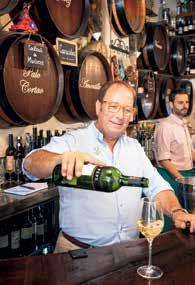
IT is one of Spain’s most evocative cities, known for its horses, flamenco and sherry.
But now Jerez de la Frontera is to become famous for something new: it’s cooking.
The city has become Spain’s official Gastronomy Capital of 2026. Taking over from Alicante, a year of events are being planned to showcase its best restaurants.
BEST AND WORST FOR DELAYS
EYE-OPENING new figures have lifted the lid on Spain’s best and worst airports for delays and cancellations.
Incredibly, more than one in four flights taking off from Spain were either delayed or cancelled in 2025. More than 34 million passengers were impacted by disruption, of whom around 1.25 million were entitled to compensation under EU law, claims data site AirHelp.
Palma was the worst culprit, with around 34% of flights suffering disruption last year.
Heavy rain and storms played a significant part, although Ryanair revealed that six million passengers were delayed due to air traffic control problems. Reus came in second with 30.8% and Murcia came third with 28.5%.
At Spain’s two busiest airports - Madrid-Barajas and Barcelona El-Prat - figures stand at around 23%.
Comprehensive Cybersecurity
FOOD,DRINK & TRAVEL
Sherry to gourmet star
The city is renowned for its fresh local ingredients (think Payoyo cheese and Retinto beef) as well as its sherry, which was named by the British from the local name.
Jerez now has everything from typical tavernas to chic avant-garde Michelin-starred restaurants (the
HOLIDAY rentals are finally falling across Spain after years of explosive growth, with party islands like Ibiza and Mallorca leading the crackdown.
The number of tourist apartments in Spain’s 25 main cities fell by 4.1% in 2025 to 366,000.
It means 15,963 less beds nationwide, according to lobby group Exceltur.
It is the first decline in short-term rentals since the boom began and will help ease local housing problems and congestion.
By Maeve Gorman
city boasts two - see Neck and Neck on page 36). With over 50 food-related events to choose from this year, Jerez is a foodie’s dream. The stand-

outs are the Grape Harvest Festival (August-September) and International Sherry Week (November). Since 2012, the gastronomy capital award has showcased the best of Spanish cuisine to locals and visitors alike. With gastronomy representing 27% of the country’s GDP and sustaining 7.2 million full-time jobs the award is expected to lead to an economic and tourist boom in the city
PARTY OVER?
Holiday rentals drop across Spain with Ibiza the biggest winner – at least for hotel groups
while San Sebastian and Santiago have also recorded steep drops.
Walter Finch
But while some destinations are slashing holiday lets, others are still expanding. Malaga ended 2025 with a record 38,848 tourist rental beds, up 3.3%.
Sevilla also continued to grow, reaching more than 32,000 beds, a rise of 4%.
housing shortages.
Their services include cybersecurity, device maintenance and performance optimization, and malware removal, enhanced by AI for
On the other end of the scale, Asturias was the best-performing airport in Spain with just 11% of flights taking off late. Bilbao had just 14% of departures failing to jet off on time.
Personalized User Experience
Why Choose AnyTech365?
The sharpest drops were found in Ibiza, which now has 80% fewer holiday lets than at its peak in 2017, while Palma has cut supply by 63%.
Barcelona is down 37% compared to its high point,
AnyTech365 adapt its product and technical support solutions to individual needs, offering a safe online experience to any user. Some of
The biggest falls last year took place in Murcia, A Coruna, Valencia, Oviedo, Alicante and Madrid.
The decline is being driven by tougher enforcement, new registration rules for landlords and growing pressure from residents over soaring rents and
Ibiza, in particular, ramped up inspections to weed out illegal listings, while Barcelona plans to ban all holiday homes by 2028.
Owners must now register tourist flats before advertising them on platforms such as Airbnb.
Despite the national slowdown, nearly one-third of tourists still choose holiday homes over hotels, largely due to price.
In Ibiza, where it is much lower, the hotel sector is thriving with the average revenue per room at €170 the highest in Spain.
BComprehensive Cybersecurity
LUETOOTH is one of those modern miracles that feels like it should come with a cape.
Their services include cybersecurity, device maintenance and performance optimization, and malware removal, enhanced by AI for faster and accurate solutions.
Personalized User Experience
AnyTech365 IntelliGuard
AnyTech365 AI powered
Preaching the Blues
Products and Features
AnyTech365 IntelliGuard
How Bluetooth Works (According to Bluetooth Itself)
AnyTech365 adapt its product and technical support solutions to individual needs, offering a safe online experience to any user.
AnyTech365 Security
It connects your phone to your speaker, your smartwatch to your phone, your keyboard to your tablet, and occasionally, for reasons science still hasn’t clarified, it connects you to your neighbour’s soundbar at sunrise. It’s helpful, hilarious, and wildly unpredictable.
World class, cross-platform
AnyTech365 TotalCare
comprehensive
AnyTech365 AI powered unique software can pinpoint the root cause of a problem providing real-time protection and immediate response to suspicious activity. This proactive approach significantly reduces the risk of cyberattacks.
Imagine two tiny invisible hands reaching out, ready to shake.

So, let’s take a friendly walk into the strange blue-toothed universe and figure out why this technology behaves beautifully one moment and chaotically the next.
Some of AnyTech365 Products and Features
AnyTech365 Security
“Hello, I’m a phone.”
“Hello, I’m a headset.”
AnyTech365 IntelliGuard
“Shall we talk?”
Most of the time, they do.
Bluetooth: The mysterious technology that connects everything except when you need it to, writes Francisco Diaz of AnyTech365
World class, cross-platform security platform with advanced scanning techniques to identify potential threats from files, programs and neutralization of viruses, malware, and phishing attempts.
AnyTech365 AI powered unique software can pinpoint the root cause of a problem providing real-time protection and immediate response to suspicious activity. This proactive approach significantly reduces the risk of cyberattacks.
But sometimes, usually when you’re running late or someone is staring over your shoulder, one hand just refuses to reach out, leaving you standing there like you’ve been ghosted by your own devices.
AnyTech365 TotalCare
you barely remember silently jumps in and steals the show.
AnyTech365 Security

alone.
tonishingly effective.
Renaming your devices so they don’t sound like clones and removing ancient forgotten pairings also helps.
A comprehensive security suite, combining all AnyTech365 premium products together with quick issue resolution by certified technicians without onsite visits anytime, day or night,
World class, cross-platform security platform with advanced scanning techniques to identify potential threats from files, programs and neutralization of viruses, malware, and phishing attempts.
Other times, your device simply forgets it ever met the other one. And every once in a while, Bluetooth just wakes up and decides that today is the day everything goes wrong with no explanation offered.
AnyTech365 TotalCare
Why Bluetooth Throws Tantrums
Bluetooth connections are a lot like relationships: sometimes strong, sometimes distant, and sometimes suddenly ‘no longer available’.
The Ancient Fix That Still Works: Restart Everything
If you haven’t used that wireless fitness tracker since 2012, it’s time to set it free.
Bluetooth Fails Happen to Everyone
A comprehensive security suite, combining all AnyTech365 premium products together with quick issue resolution by certified technicians without onsite visits anytime, day or night, with AnyTech365’s around-the-clock support services, all offered in more than 15 native languages.
There’s a reason the classic ‘turn it off and on again’ solution has survived every era of technological evolution. Turning Bluetooth off, then on again on both devices solves almost everything. And if that doesn’t work, restarting both gadgets is basically the tech equivalent of sprinkling magic dust. It’s simple, a little ridiculous, and as-
If your headphones have ever connected to the wrong device during a meeting, or your speaker has blasted music from the phone of someone who isn’t even in the room, congratulations!
You’re part of the universal Bluetooth club. It happens to everyone. Take a deep breath. Try again. You’re not cursed; you’re just living in the modern age.
Whether it’s Bluetooth refusing to pair, your devices slowing down, or your computer drowning in too many open tabs, AnyTech365’s friendly tech experts can jump in and sort everything out. They can check your settings, clear out old connections, stabilize your devices, and restore order to your personal tech universe without you having to lift more than a finger or a phone.
With 24/7 remote support, the moment technology decides to misbehave, you’ve got backup.
If Bluetooth is making you question reality or patience, now is the perfect time to stop wrestling with it.


But if the chaos becomes con -
Problems usually appear when too many nearby devices compete for attention, or when an old gadget stant, well… you don’t have to battle it
Grab our FREE introductory offer and contact AnyTech365 today. Let our experts handle the frustration, so you don’t have to.





ALMOST 100 million international tourists flocked to Spain last year, spending a whopping €126.7 billion, breaking previous records despite over-tourism measures. And nowadays it’s not just beaches and balmy weather enticing the tourists, but also very much Michelin stars and Repsol soles. It comes as the Spanish food scene has gone stratospheric over the last two decades, becoming globally famous for its exciting genera-
SIMPOSIO
Seating just 17 diners, Roger Julian’s Sim posio is an intimate culinary gem not to be missed. Awarded its first Michelin star in November, Simpo sio offers three tasting menus which start at just €68. Each menu reflects a strong connection to the local area and a careful approach to not wasting any of its in



NECK AND NECK
Andalucia wins by a nose, pipping Valencia in the recent gastronomy awards season. But only just, as Maeve Gorman discovers
tion of top young chefs. It has turned the country into a world-leading gastronomic destination, up there with Japan and more recently Lima, Mexico City and Sao Paolo.

Just 15km from Valencia on the motorway, the restaurant could easily go unnoticed. It is well worth the detour.
C. de las Moreras, 2, 46184 Sant Antoni de Benaixeve, Valencia +34 655 38 11 99
www.rogerjulian.es
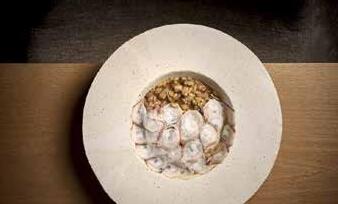
OP Puzzle solutions
Quick Crossword
Across: 8 South American, 9 Screens, 10 Dance, 11 Mime, 12 Eclectic, 16 Systemic, 17 Gnat, 19 Caddy, 21 Spaniel, 23 Against the law.
Down: 1 Isms, 2 Supremes, 3 Sheer, 4 Amps, 5 Bradley, 6 Icon, 7 Undercut, 11 Musician, 13 C P I, 14 Tangible, 15 Defying, 18 Yacht, 20 Dual, 21 Sets, 22 Lows.
Combining innovation with traditional local ingredients, has put many Spanish chefs in the world’s best lists while more and more Michelin stars get awarded each year. The proof is in the pudding and at
ANDALUCIA

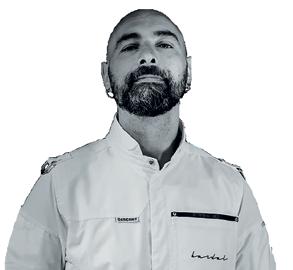

the annual Michelin awards ceremony in November, no less than 25 new restaurants around Spain got their first star.
But what particularly stood out was just how many stars have been created in Valencia and Andalucia over the last few years.
While traditionally it was Catalunya and the Basque Country that got all the plaudits, these days the two southern regions have an extraordinary 73 Michelin stars between them.
After running neck and neck, this
QUIQUE DACOSTA
Quique Dacosta is a pioneer of Spanish cuisine. His eponymous Denia restau rant was awarded 3 Miche lin stars in 2012 and has held onto them ever since (the restaurant also boasts 3 Repsol soles). The Michelin guide recognised him as ‘Chef Mentor 2026’ highlighting his work in team-building in restaurants, his tireless efforts to pro mote gastronomy and his artistic vision of cuisine.
The title of this year’s menu Octavo (Eighth) challenges the seven established fine arts (architecture, painting, sculp ture, music, literature, theatre and cinema) and adds gas tronomy into the equation. There’s no doubt that Dacos ta’s dishes are works of art.
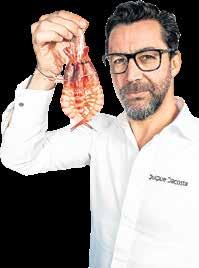

Carrer Rascassa, 1 Urb. El Poblet, 03700 Dénia, Alicante
Tel.: +34 965 784 179 www.quiquedacosta.es

year Andalucia broke the deadlock winning 38 Michelin stars and 96 Repsol soles (Spain’s equivalent) pipping Valencia’s 35 stars and 90 soles to the post. And while both regions still trail Cataluyna’s staggering 80 stars and 124 soles, they are extraordinarily now neck and neck with the Basque region has 36 stars and 89 soles. Here, we highlight some of the top local stars.
LA SALITA
From industrial engineer to re nowned chef, La Salita is the product of Begona Rodrigo’s unexpected career change. After studying at Valencia Polytechnic, Rodrigo ended up working in res taurants in the Netherlands and the UK before returning home in 2005 to open La Salita in Rufaza,
Valencia’s foodie nerve centre.


Rodrigo earned national fame as winner of Spain’s Top Chef TV show and Valencia’s Cook of the Year title in 2014. The accolades didn’t stop there as La Salita was awarded a Michelin star in 2019 and 2 Repsol soles (now she has 3). La Salita offers four set menus and a kids menu priced at €55 for junior foodies.

RICARD CAMARENA
In 2021, Camarena’s ‘green activism’ was recognised with a Chef of the Year award. Sustainability and seasonal produce are at the heart of Camarena’s Valencia restaurant. The majority of the produce comes from his market gardens which are within 8km of the restaurant. With 2 Michelin stars and 3 Repsol soles, Camarena proves that using local pays off.
Av. de Burjassot, 54, La Saïdia, 46009 València, Valencia +34 963 35 54 18 www.ricardcamarena.com
Carrer de Pere III el Gran, 11, Valencia +34 963 817 516 www.anarkiagroup. com

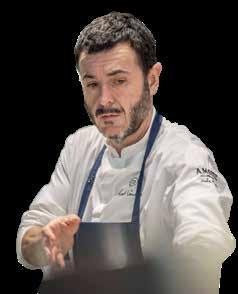
TEAM ANDALUZ: Giovanni, Gomez and Morales and awards (left)
38
TEAM VALENCIA: Rodrigo, Dacosta and Ferruz and tally of Soles and Stars (right)

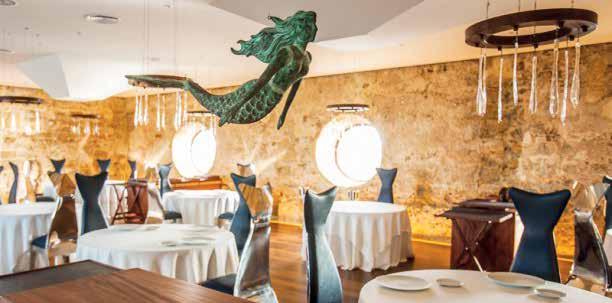
APONIENTE
Angel Leon is known as ‘the chef of the sea’. Born in Jerez, Leon learnt his love of the sea from his father, a fisherman and doctor. He is famous for using plankton as an ingredient, he cooks with saltwater and created a ‘marine sausage’ made from discarded fish. Behind these avant-garde seafood practices is a commitment to sustainability. Discovering new ingredients promotes sustainable practice and reduc-
FARALÁ

es fishing pressure. His marine innovation and commitment to sustainability have earned him 3 Michelin stars and a Sustainability Award Michelin Green Star (Aponiente was the first restaurant to achieve this accolade). Meanwhile he now also has a two Michelin starred restaurant Alevante in nearby Chiclana.
Francisco Cossi Ochoa, s/n. El Puerto de Sta María, Cádiz Tel.: +34 956 851 870 www.aponiente.com
Cristina Jimenez Rueda trained under top chefs throughout Spain. In 2018, she struck out on her own and opened Farala in Granada and this year she gained her first Michelin star. Nestled in the heart of Granada’s old town, Rueda’s cuisine pays homage to the city’s unique heritage. The name Farala references the ruffles on a typical flamenco dress.
The restaurant is located on the first floor, while street level is home to El Quejío Wine Bar, a more relaxed venue where flamenco performances are regularly held. The restaurant itself showcases chef Cristina Jiménez’s modern interpretations of Granada’s traditional cuisine through three carefully curated tasting menus - Susurros del Sacromonte, La magia del Albayzín, and Alborán. These menus offer a culinary journey across the province, highlighting local dishes such as segureño lamb and falafel, a Granada classic. With set menus starting at €76, head to Granada for an affordable and authentic fine-dining experience.
Cta. de Gomérez, 11, Centro, 18009 Gra nada +34 664 08 53 13 www.restaurantefarala.com

NOOR
LOOKING FOR MORE TRAVEL STORIES?
Scan to visit our website
Husband and wife team Paco and Mariana Morales opened the doors to Noor in 2016. A year later, they received a Michelin star and Repsol sol and now they have 3 of each. Noor’s interior design and flavours are influenced by Moorish heritage.
Each season chefs Paco Morales and Paola Gualandi explore a different historical period. This season the theme is Tiempo de Evolucion of Evolution) and there are three menus to choose from: Ruh (Es sence), Fath (Discovery) and Kawn (Universe) and each harks back to the 19th century to explore the Hispano-Arabic roots of Andalucian cuisine.

BARDAL
Benito Gomez grew up around food. He was born in Barcelona to parents who ran a restaurant and later trained in top restaurants throughout Spain. Gomez is another chef to have honed his craft at El Bulli and ning the affection of head chef Ferran Adria, he was sent to open Adria’s Andalucian venture, Hacienda Benazuza, near Sevilla.
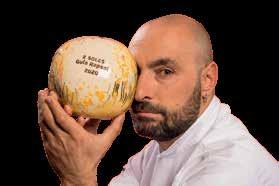
MESSINA

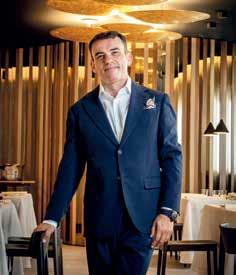
Marcos Granda trained at the Hospitality School of Gijon and then travelled to Madrid to hone his skills as a sommelier. He honed his skills at Costa Brava’s iconic El Bulli where he curated the wine list. The Asturian opened Skina in Marbella’s historic center in 2004 at just 27 years old. Skina only had 4 tables and 10 chairs, but this intimate establishment soon gained a reputation for showcasing Andalucian haute cuisine. Now it has 2 Michelin stars and, with starred restaurants in Madrid, Ribadesella and Gijon, Granda has made it his
Mauricio Giovanni is an Argentinian from Cordoba who started his Spanish career making pasta ‘like many Argentinian cooks do’. In 2003 he opened Messina in Marbella, along with his wife Pia Ninci whose name is an homage to his grandparents who were natives of the eponymous Sicilian town. The restaurant has long been a favourite among Marbella’s din ing cognoscenti although it didn’t earn its first Michelin star until 2016.
Giovanni’s a la carte and tasting menus are based on local prod

mission to export the best of Andalu cian cuisine across the country.
Avenida Cánovas del Castillo, 9, Mar bella +34 604 48 63 03 www.restauranteskina.com

After Benazuza closed, Gomez stayed in Andalucia and settled in Ronda establishing his own culinary identity through Tragata, an elevated tapas restaurant, and later Bardal. Gomez’s fusion of Catalan and Andalucian traditions has earned Bardal 2

Michelin stars and 2 soles. Diners choose between 2 tasting menus (Bardal and Gran Bardal).
C. José Aparicio, 1, 29400 Ronda, Málaga Tel.: +34 951 48 98 28 www.restaurantebardal.com
ucts, particularly fish and shellfish. He combines avant-garde culinary techniques with a simple and elegant presentation.

Av. Severo Ochoa, 12. Marbella, Málaga Tel.: +34 952 864 895 restaurantemessina. com
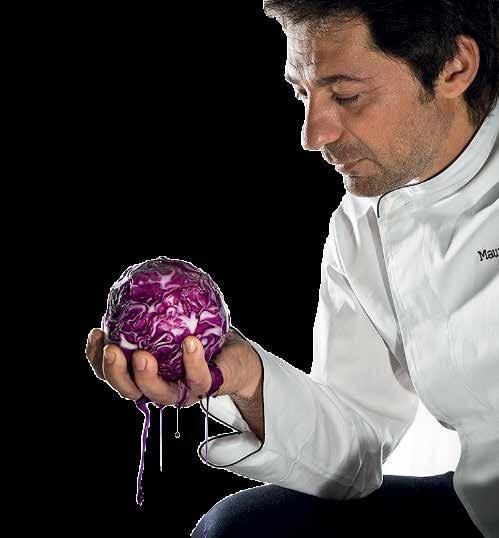
Pablo Ruiz Picasso, 8.Córdoba Tel.: +34 957 96 40 55
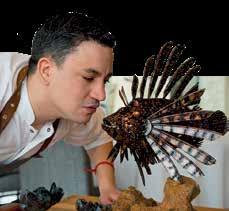
38 FOOD,DRINK & TRAVEL
VALENCIA

From previous page
ANDALUCIA

L’ESCALETA BONAMB
A restored country house overlooking the Mediterranean is the setting of Alberto Ferruz’s BonAmb. Ferruz follows the trend of combining innovation with local ingredients,
A family restaurant that opened in Cocentaina in 1980, it is named after the ladder you had to climb to get into it. It later swapped location and the second generation, chef Kiko Mayo (right) and his cous in Alberto Redrado, took over. Since then, L’Escaleta has accumulated two Miche lin stars and three Repsol Suns.

sourcing fish and seafood from Alicante’s Marina Alta and herbs from the Montogó mountains. Choose between the nine-course menu Recuerdos (Memories) or the 12-course option El Viaje (The Journey). Both promise to take the viewers on
Mayo works with local products to produce tasting menus that change according to the season. He emphasises memory and a cuisine that goes back to forgotten recipes such as chicken crest. When asked to define his cuisine, at a bash last year, he told the Olive Press: “I aim to create a cuisine that is simple, honest and humble in every sense. I want everyone to feel at home from truck drivers to food critics!”
an emotional culinary journey.
BonAmb has 2 Michelin stars and 3 Repsol soles.
Carretera Benitaxell, 100. Jávea, Alicante Tel.: +34 965 084 440 www.bonamb.com

Cocentaina, Alicante Tel.: +34 965 592 100 www.lescaleta.com
SMALL ADS



ADVERT SALES
LÚ COCINA Y ALMA
Juanlu Fernandez grew up in Jerez surrounded by traditional Andalucian cooking, influenced by his grandmother and the ever-present wines and vinegars of Jerez. He worked under Basque chef Martin Berastegui at the world-renowned restaurant Lasarte in Barcelona. After continuing his training in Tenereife, he launched Aponiente with Angel Leon at just 23. Ten years later Fernandez inaugurated Lu Cocina y Alma in his hometown.
The interior invites the diner into the creative process with the kitchen visible from the dining room. Fernandez combines traditional French techniques with the produce of Andalucia to stunning effect. With over 600 wines from Jerez alone, many from wineries which have now closed, Lu Cocina and Alma is a gour met’s dream.
LÚ Cocina y Alma has 2 Michelin stars and 2 Repsol soles.
Calle Zaragoza, 2, Jerez de la Frontera +34 695 40 84 81 www.lucocinayalma.com

www.theolivepress.es

Spanish Speaking PROVIDING LEGAL ADVICE: • Conveyancing • Residency • Wills • Inheritance CONTACT Victoria at: www.britishlawyerspain.com +34 678 826 771 100% organic produce from local farms, directly to your door



For ENGLISH ENQUIRIES contact SAM on +34 634 611 836 to get your advertising started
Para consultas en español llame a ROCIO al +34 629 139 928 para comenzar su publicidad




Subida a la Estación del Norte, 205.

Dying to fly
AN 80-year-old pensioner has been arrested after attempting to smuggle his dead wife onto a flight at Tenerife South Airport.
The bizarre incident occurred when the elderly couple were passing through security control, with the husband pushing his wife in a wheelchair.
Such a boar
FLIGHTS were forced to divert after a sounder of wild boars ran onto the runway.
Galicia’s A Coruña airport had to be temporarily closed after the animals breached the runway’s perimeter.
Two incoming flights from Madrid and Milan were diverted to Santiago de Compostela.
Two outbound flights were also delayed until officials expelled the boars from the airport.
In total, the landing strip was out-of-action for around two hours.
See full stories online
Olive Press
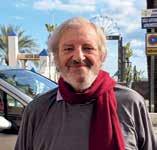
A BRITISH pensioner has ‘gone to war’ with Google after the tech giant ‘stole’ €60 from his account.
Expat Neville Stock (above), 72, is threatening legal action after the tech giant charged him €50, then €10 in two mystery payments last year.
The debits in May relate to a website that was deleted a decade ago, he insists.
The rental site for an Estepona holiday home had briefly used the Google Ads platform in 2015 to entice business.
But the account has been dormant since 2016, when he sold the villa and retired.
“It is infuriating that a big company can just take money from you,” Stock
Searching for justice
Pensioner wages cyber battle with Google over payments taken for long shut website
EXCLUSIVE
By Alessio Ghirlanda
told the Olive Press. “It’s classic bullying and I’m not going to let them get away with it.”
After his bank confirmed the charges were real, Stock tried multiple times to contact the US giant. He even sent two handwritten letters to the company’s headquarters in London and California –but received no response. “Even if they won’t give my money back, they could at least explain why I have been charged,” he contin-
ued.
Google Ads runs on a payper-click model, where businesses pay for each view on their site. A notice on Google’s help centre in January cited a technical issue with a payment partner that may have caused overcharges. Google did not respond to a request for clarification from the Olive Press “I have got all the time in the world now,” Stock said. “And I will not let this one slide.”

of Spain's flag bearers at the Winter Olympic Games opening ceremony in Milan.
The Sheffield lass, 28, became a Spanish citizen in 2017 having previously figure skated for Great Britain between 2010 and 2015.
THIRSTY WORK
A WAITER has been sacked from his hotel job after bosses caught him drinking on the job.
A private investigator hired by the four star Costa del Sol hotel reported he regularly helped himself to booze while fetching drinks for customers from a secluded bar.
He would then neck the drinks in a storeroom or brazenly gulp them down while ‘toasting’ colleagues during his shift. Managers at Hotel Be-
nalma, in Benalmadena, first grew suspicious after noticing sales were not tallying up.
The employee – who had worked there for 13 years – challenged his dismissal, arguing he should have been given a formal warning.
He also claimed the behaviour was tolerated, insisting other staff also drank on the job.
However Andalucia’s High Court threw out his appeal upholding the hotel’s decision.

BRITISH-born ice skater Olivia Smart will be one