The O'Colly, March 6, 2026

Page 1


US, Israel attack Iran as OSU expert warns of ‘tremendous uncertainty’

Editor’s note: This story reflects information available as of publication time. Developments may have changed since.

The United States and Israel are carrying out a major air campaign against Iran, and Iran has responded with missile and drone attacks on Israel and on U.S. military facilities across the Persian Gulf, marking the most intense fighting between the countries in decades.

U.S. officials say American forces are in major combat operations against Iran as part of a joint offensive with Israel that targets Iranian leadership, military sites and nuclear‑linked facilities in Tehran and other cities. The U.S. military has named the operation “Epic Fury,” while Israeli leaders say their goal is to remove what they call an existential threat from Iran’s regime.

Bryson Thadhani CO-EDITOR-IN-CHIEF

and report suspicious behavior immediately.

The incident prompted a campuswide crime alert Tuesday morning. Beckner said the alert is required under the Clery Act when certain serious crimes — including auto theft or attempted auto theft — affect multiple potential victims.

“We had four cars targeted in one area, so we put something out to let people know,” Beckner said. “Hey, pay attention. Lock your doors… park in well lit areas.”

See

on page 4A

In an eight-minute video posted on his Truth Social account at 1:30 a.m. Saturday Central time, President Donald Trump told Americans that major combat operations in Iran had begun. The strikes follow earlier U.S. airstrikes on Iranian nuclear facilities in June 2025 and weeks of threats and warnings from Trump toward Iran’s government. See ATTACK on page 8A

At the door: How Stillwater’s bouncers manage the night

By the time the woman from Kansas got to the front of the line at Tumbleweed Dancehall, Evan Zeleny knew what she was about to hand him.

She averted her eyes. She moved a little too casually for someone who was supposed to be old enough to be there. When she finally produced her ID, Zeleny flipped it in his hand and asked the question he always saves for Kansas.

“What’s the capital of Kansas?”

“Phoenix,” she said. Wrong state, wrong answer, wrong bar.

In the past three years, Zeleny

estimates he has taken more than 60 fake IDs. Most of the time, he said, he can tell before a wallet even opens what kind of card he is about to see.

On Stillwater’s The Strip and at Tumbleweed, bouncers and door staff are the first faces between a night out and a walk back to the car. They are the ones deciding who gets in, who gets tossed and which IDs never see the inside of a wallet again. For patrons, they are a blur of black shirts and flashlights. For the people doing the job, it is a strange mix of nightlife, security work and customer service that can swing from love to hate and back again in a single shift.

See BOUNCERS on page 3A

Courtesy Creative Commons
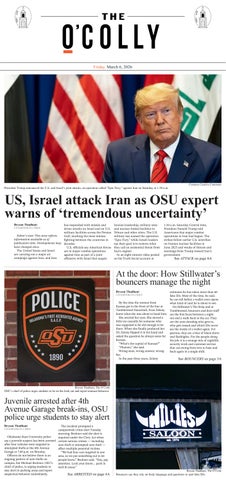
President Trump announced the U.S. and Israel’s joint attacks, an operation called “Epic Fury,” against Iran on Saturday at 1:30 a.m.
Bryson Thadhani, The O’Colly OSU’s chief of police urges students to be on the look out and report unusual behavior.
Bryson Thadhani, The O’Colly Bouncers say they rely on body language and questions to spot fake IDs.
Bryson Thadhani

Review Hollow husk

‘Scream 7’ sells out its own legacy

“Scream 7” scraps everything the series has been building for two movies and instead chases the quickest nostalgia-bait cash grab it can find.

This time, “Scream 7” is about original scream queen Sidney Prescott, played by Neve Campbell, having to protect her family from a new Ghostface killer.

But before getting deep into the many problems with “Scream 7,” it is worth mentioning the few good performances it has.

Courteney Cox as Gale Weathers does a strong job slipping back into Gale, naturally no matter how much the script fights her at times.

Matthew Lillard as Stu Macher also does good work, finally getting more of a spotlight than he usually does. But his performance shows that no matter how good of an actor you throw at a script, it can all fall apart when the foundation is not secure.

To understand what is wrong with this movie, you have to understand what the “Scream” franchise is. “Scream” is a slasher series that works as a satire of other slasher films, laying out the “rules” of the genre and using them as a theme. “Scream” was about slashers. “Scream 2” was about sequels. “Scream 4” was about remakes, and so on. Each entry has something interesting to say and feels like a love letter to slashers and film in general when you watch the franchise.

The problem comes when you make seven of these of movies. “Scream 5” and 6 went the route of making a satire of Scream itself, with limited success but at least some clear affection for what came before, even if you had to squint to see it. Then Spyglass Media Group fired Melissa Barrera over her views on Israel and Palestine, and Paramount teamed up with Meta to promote the movie using Artificial Intelligence tools. At that point, it became clear how little they cared and how much they were using this franchise to squeeze out as much money as possible.

The movie makes that indifference obvious. It builds up Matthew Lillard’s character as the big killer twist and gives him several key moments, only to then write it off as “AI” and reveal two people that had been present for a single scene as the real culprits, expecting the audience to be shocked.

Defenders say the movie is setting up Stu for the next installment, but even if that is true, it does not excuse how much of a letdown this one is on its own.

The last big problem is how blatantly the movie feels like a cash grab. The previous film at least had a coherent theme about franchises and even showcased the gear of past Ghostface killers, building around its then-main character. “Scream 7’s” theme is just “nostalgia” and it sits far too close to the last film without giving viewers anything new to analyze.

Overall, “Scream 7” desperately wants your money but does not have the love or passion that director Wes Craven and writer Kevin Williamson once brought to the series, leaving the franchise as a hollow husk of itself.

OSU officials urge students to prepare as tornado season begins

As tornado season begins across Oklahoma, Oklahoma State University officials are reminding students to review severe weather procedures and prepare for upcoming storms.

Michael Beckner, Oklahoma State chief of police, said preparation is important because tornado warnings can be issued with little notice.

“We have a good system on campus,” Beckner said. “If there’s a tornado warning that’s going to affect campus, the sirens will go off and a message immediately goes out through the Rave system by phone call, text message and email.”

OSU emergency managers monitor developing storms closely and stay in communication with the National Weather Service. When warnings are issued for the campus area, alerts are sent immediately so students can take shelter as soon as possible.

Understanding sirens and alerts

Students should understand how the campus warning system works so they can react quickly during severe weather.

Travis Eastman, associate manager of emergency management for the OSU Police Department, said students should know the difference between lightning and tornado sirens. Lightning sirens typically rise and fall in waves, while tornado sirens are long, steady tones.

Outdoor warning sirens are designed to alert people who are outside. People inside buildings might not hear them clearly, so they should rely on additional alerts.

More detailed warnings are delivered through the Rave Mobile Safety emergency notification system, which sends phone calls, text messages and emails to everyone with an OKey account.

“You don’t have the situation where someone says, ‘I didn’t know I had to sign up,’” Eastman said. “If you have an OKey account, you’re automatically included.”

“The automated system activates when a tornado‑warning polygon issued by the National Weather Service overlaps the campus boundary,” Eastman said.

“Oklahoma is very good at what they do when it comes to weather,”

Beckner said. “They can often tell you the street a storm is heading toward. The best thing you can do is pay attention to warnings and be prepared.”

Knowing where

to take refuge

Students should identify nearby refuge areas before storms develop so they know where to go during a warning.

At OSU, many buildings contain designated refuge areas, which Eastman said are sometimes confused with tornado shelters.

“A refuge is intended for short-term protection,” Eastman said. “A shelter is something that has supplies, food and sleeping areas for long-term stays.”

The OSU‑Stillwater campus does not have public long‑term tornado shelters, but many buildings include refuge spaces such as basements or interior rooms.

Beckner said if students do not have time to reach a designated refuge, the safest place is the lowest interior area of a building, away from windows. In residence halls without basement access, students should stay away from windows and use mattresses or cushions to shield themselves from flying debris.

Students studying late in campus buildings can also notify campus dispatch through the Rave app so responders know where they are if severe damage occurs.

“If it’s midnight and a building is hit, we’re going to check the buildings we know are occupied first,” Beckner said.

Students living off campus should identify nearby community shelters ahead of time. However, Beckner said traveling during an active tornado warning is not safe.

“If your phone is going off with a tornado warning, you need to stay put,” he said. “Tornadoes can move faster than you can drive through city streets.”

Students whose homes are damaged during severe weather can contact the university for help connecting with resources or temporary housing. A map of campus refuge locations is available on OSU’s severe weather website.

How students can prepare Preparation before storms develop can make a big difference.

Students are encouraged to keep basic emergency supplies in their dorm rooms or apartments, including bottled water, flashlights and backup phone chargers in case

of power outages.

“My rule of thumb is to keep your car at least half a tank full,” Beckner said. “If there’s a large‑scale power outage, gas stations can’t pump gas without electricity.”

Eastman said students should also keep medications handy and pay attention to the forecast.

“Keep your phone charged up, keep your medications handy and stay informed about the forecast,” he said. “Just being aware of what the weather might do that day makes a big difference.”

Students should think through where they would go during a tornado warning — in class, studying late on campus or at home.

“Have a plan and know where you’re going,” Eastman said. “The more informed people are, the better decisions they can make in that moment.”

Avoiding dangerous mistakes

Beckner said one of the most common mistakes during tornado warnings is going outside to watch the storm.

“In Oklahoma, my understanding is people like to sit on the porch and watch the storm roll in,” he said. “That’s not the best idea.”

Sheltering in vehicles or under highway overpasses is also dangerous because strong winds can intensify in those locations.

After a tornado passes, students should avoid damaged areas so emergency responders can work safely and assess hazards.

“Everybody wants to see what happened,” Beckner said. “But when something like that happens, we ask people to stay away so responders can do their jobs.”

Inside OSU’s Emergency Operations Center

Behind the scenes, campus officials monitor severe weather from the university’s underground Emergency Operations Center at University Health Services.

“People call it the ‘Bat Cave,’” Eastman said. “They come down here and say, ‘Wow, I didn’t know this existed.’ If I could bring every parent down here and show them how much the university invested in safety, I would.”

Eastman said the center remains in a constant state of readiness, even on quiet days.

“It generally looks pretty quiet,” he said. “But it’s always ready.”

news.ed@ocolly.com

Tribune News Service
Scream 7 was released in theaters Feb. 27.
Courtesy Creative Commons OSU chief of police urges students to look over severe weather procedures in preparation for the coming tornado season.
Lilian Easter STAFF REPORTER
Caden James STAFF REPORTER

Zeleny did not become a bouncer because he was looking for a fight. He was looking for a job. He started at Tumbleweed after wandering in one college night and running into a manager at the front table who asked whether he had thought about being a bouncer. He told her he needed a job and had joked with friends about doing it. He applied and got hired.

For the next two years, he worked concerts and college nights at the country venue on the edge of town before spending time at bars along The Strip. Some nights meant crowds of about 2,500 people under Tumbleweed’s roof for a sold-out show. Others meant a door on Washington Street, a slower weeknight and a couple of regulars.

“It really does a lot mentally,” he said. “You’re just like, ‘I’m so tired of dealing with people that are just not being smart.’”

Down on The Strip, Kaitlyn Cupp came to the door at Willies Saloon from a different kind of security job. Before she started carding people at the bar, she worked for almost two years as a correctional officer at the prison in Cushing.

“I kind of quit that,” she said. “I already spent my time there. Might as well make money doing it.”

She spends her nights on a metal stool just inside Willies entrance, a small flashlight in her hand, IDs stacked beside her and a line of students stretching back to the sidewalk.

On weekends, the door stays open. A DJ thumps over the chatter as people flow in and out, stopping long enough to slide a card across the stand in front of Cupp. Every few minutes she leans into the beam of her flashlight, tracing the edges and pointing out the tiny tells that separate realfrom fake.

One especially bad card, she said, had likely been trimmed with nail clippers. The corners were too sharp, the edges too rough. Sellers, she said, will cut them that way, and under the light the mistakes show. When the holograms glowed in the wrong places or the plastic bled along the border, she slipped the ID into a growing stack of fakes on the shelf to her left. The arguments were brief. Regulars she recognized barely slowed down; she waved them through with a nod and turned back to the line.

“Honestly, it’s just really checking IDs, making sure that everybody’s safe,” she said.

A block down, at Copper Penny, Mason Belle-Isle sits at a host stand near the door. He has only been working The Strip since January, but he already talks about it like he has been there longer. His

friends worked there, and he decided to join them, figuring it would be a pretty good job for a college town. Once he started, he realized he liked it and liked being part of The Strip.

He clocks in at 8 p.m. On weeknights he might spend long stretches talking with the bartender, stocking ice or cleaning up. On weekends, the room fills around midnight, usually for someone’s birthday.

“We’re kind of just the utility guys,” Belle-Isle said. “Sit at the stand the whole night, bar back if it’s a weekday, help close, clean up the whole bar, fix outside what needs to be fixed, just anything and everything.”

Ask any of the bouncers about the job, and fake IDs come up within minutes.

Kansas, Arkansas and Texas licenses are the most common out-of-state IDs Zeleny sees at Tumbleweed. He has developed a few tricks. He will ask for state capitals. He will ask for birthdays again halfway

was a Tuesday night, which is funny in itself, like, why are you coming to the bar Tuesday night?”

Belle-Isle was sitting at the bar when the man handed over his license. He walked back to the stand, checked it under a blue light and watched the wrong parts of the card flare. He told the man it was fake and he had to leave. The man insisted it was the “realest ID he’s ever seen,” Belle-Isle said. Belle-Isle stood his ground.

Another man, he said, tried to take his ID back by force. As Belle-Isle held it, the man grabbed for it, asking for it back. Belle-Isle refused and told him he could leave the bar instead.

For all three, most fake-ID confrontations end there: a short conversation on the sidewalk, a confiscated card, a disappointed 19-year-old walking away.

Ask what the bouncers spend most of their time doing, and none of them start with fights. Instead, they talk about

gone, or they’ve already done something to somebody else and you’re trying to peel them away from each other.”

In his first few months at Tumbleweed, Zeleny remembered one concert night when a man got punched on the floor and fell. It was not a full-blown brawl, only a disagreement that turned into a single punch, he said. Staff got the man who threw the punch out of the building first, then carried the other man outside. He eventually came around, but not before bleeding all over Zeleny’s shirt. After that, Zeleny started keeping an extra staff shirt and gloves close by.

He does not consider that night a loss of control. He thinks of it as a situation he and his coworkers did not see early enough to stop.

The biggest difference between a bouncer and a traditional security guard, Zeleny said, is the state of the people they are dealing with.

“Stillwater’s always notoriously been pretty strict about, under 21. I’ve never had a problem with any of them.”
MASON JAY | OSU STUDENT

through a conversation. Sometimes he watches for body language.

“Most of the time, they won’t make eye contact with you, or they’ll be kind of nonchalant about it,” he said. “If you watch people enough, you observe what normal tendencies are and what’s not a normal way to walk up and be cordial about it.”

Over time, his gut has gotten sharper. On some nights, he said, he decided to take a patron’s ID before it was pulled out.

Cupp’s tools are more literal. She keeps her flashlight close and uses it to pick out small details. If she shines it on a real ID, the holograms glow in specific places. On some fakes, she said, the light bleeds through the outside edges instead, or the wrong parts of the design stand out. She has seen IDs so tampered with they almost fall apart.

Most people give up quickly when she calls a card fake. They try once to get it back; she tells them they cannot, and that is the end of it. When patrons insist their IDs are real, she reminds them they are free to call the police and have officers come look at them instead. Almost nobody takes her up on that.

Belle-Isle is building his mental library of IDs. One of his favorite fakes came on a Tuesday.

“It was a Texas fake,” he said. “This guy came in. It

reading people, talking people down and deciding when someone has had enough.

Belle-Isle has not seen a fight inside his bar. He has kicked out people who got too drunk or too creepy, but he said most nights are straightforward.

“Everybody’s just drinking, having a good time,” he said. “It’s usually fine. I’ve never had a problem.”

Cupp has broken up two fights at Willies since August. She is more likely to be walking the floor checking on regulars, especially women, than dragging anyone out the door.

“We’re the first face you see,” she said. “We’re also the last face you see.” Her approach when something starts to get heated is direct but quiet.

“Typically it is honestly just talking to people like they’re human, treating them like a human being rather than a piece of sh*t,” she said.

To her, the goal is to deescalate a situation before it gets out of hand.

If she has decided someone has to go, she asks that person to step outside for a conversation instead of grabbing an arm in the middle of the dance floor.

“Nine times out of 10, every situation was handled by a conversation,” Zeleny said. “The number of times I actually had to physically remove someone, normally it’s because they are very belligerent or way too far

now that he is of age. An average night for him means barhopping two or three bars and hanging out with friends. He said he did not like the door staff as much when he was younger than 21. Now, he describes them as not that big of a deal and figures they are doing what they have to do so the bars do not get in trouble.

Hinchliffe can think of one bad story, from an outdoor concert at a different venue, where he heard about a bouncer hitting a man on the top of the head with a flashlight. His interactions have been uneventful.

What sticks with the people on the door are not just fake IDs or flashes of violence. It is the nights that feel as if they will never end.

For Zeleny, the hardest shifts are the ones where every small problem seems to show up at once. He has worked concerts where thousands of people came and there was not an issue, and others where it felt as if the crowd brought all of its problems inside. On those nights, closing time does not necessarily mean sleep. Sometimes, after the last patron leaves and the last trash bag hits the Dumpster, staff end up at IHOP or Whataburger, sitting under fluorescent lights and talking through what just happened.

He spends most of his nights talking to people under the influence of alcohol rather than sober employees or shoppers, and he has had to learn how those conversations work differently.

On a busy weekend, The Strip looks like a single, long hallway with different soundtracks. Students pour into Dirty Rooster to dance, then spill onto the sidewalk and cross into The Union or Willies. Some, like Oklahoma State student Mason Jay, make a point of visiting multiple bars before closing.

Jay said he goes out on The Strip once or twice a month. His group used to be “big Outlaw guys,” but with that bar closed, it drifts between Dirty Rooster and The Union.

A normal night, he said, is to preparty somewhere, hit The Strip, hop between a couple of spots and head home.

He said Stillwater’s reputation for being strict on under-21 patrons is deserved.

“Stillwater’s always notoriously been pretty strict about, under 21,” Jay said. “I’ve never had a problem with any of them.”

He remembers one bouncer who returned a credit card he had left behind. Mostly, he said, they are just there.

Asked whether he feels safer because of them, he said he is glad they are around when the bars fill.

Another patron, Jack Hinchliffe, said he rarely thinks about bouncers

Belle-Isle’s most memorable shift so far did not involve a fight or a fake. It involved snow. He was scheduled to work Jan. 31, and Stillwater woke up under several inches of it and was convinced nobody would come in. Instead, the bar was crowded. Students who lived at nearby apartments walked over rather than drive. People went outside to make snow angels on the patio and then came back in. For once, nobody wanted to leave.

For Cupp, the job’s biggest surprise has been how much of it feels like the prison world she left and how much of it does not. The awareness of danger carried over. The music, the regulars and the women who tell her they feel safer when she is working did not. She walks The Strip knowing that on most nights, nothing terrible will happen, and that it always could.

“There’s always probability of danger,” she said. “But it could be any kind of place.”

Most nights, it is not. Most nights, she checks IDs, makes small talk and watches groups stream in and out under the neon Willies sign.

“We’re the first face you see,” she said again. “We’re the last face you see. The women know that I will make sure that they’re safe. The guys, too.”

After the music stops and the lights come up, the people at the door step back into the cold, pockets full of confiscated plastic, ready to do it again the next night.

news.ed@ocolly.com

OSU to host International Physicists’ Tournament

Oklahoma State University will host a world championship for physics in Stillwater next year.

For the first time in the competition’s 18 -year history, the International Physicists’ Tournament will be held in the United States and in the Western Hemisphere. The weeklong event will bring more than 200 physics students from about 20 countries to campus in late May 2026 for head - to - head “physics fights” that blend original research, live debate and Olympic - style judging.

Each country is allowed to send one six‑student team of pre‑Ph.D. students, and the host nation gets two slots: a local host team and a separate national team. That means OSU, which has effectively served as Team USA at recent tournaments, expects to field both the American squad and a host team when the event comes to Stillwater.

“It is really one of the biggest physics tournaments in the world, if not the biggest,” said physics professor Joe Haley, who leads OSU’s team and chairs the local organizing committee.

the event was held in Paris. The group arrived unsure what to expect from an international competition dominated by European universities.

“It was the most fulfilling experience in my professional career at OSU,” he said. “All the other teams were so welcoming. It was so collegial. It was just all these other teams doing the same thing and trying to have fun and do physics.”

The tournament began in Europe and has remained largely Eurocentric, with some countries holding large national qualifiers just to determine who earns their single spot. In France, for example, more than a dozen university teams often compete domestically for the right to advance to the international stage.

By contrast, awareness in the U.S. has grown slowly. Before the pandemic, only a handful of American universities fielded teams, and for several years there was no U.S. representative at all.

Beckner said security video from the 4th Avenue Garage shows a single suspect moving through the structure and breaking windows on several vehicles. The suspect appeared to be searching specifically for Hyundais and Kias, echoing a nationwide trend in which certain models of those vehicles have been heavily targeted after social media videos showed how to steal them.

The person also tried to break into a Chevrolet Impala, Beckner said.

The suspect, who has been tied to similar offenses elsewhere in Stillwater, was arrested by Stillwater police and is being held as a juvenile. OSU police cannot release a name.

Investigators believe the same individual is responsible for all of the attempted thefts in the garage. Beckner said many people were walking through the garage at the time of the break-ins but appeared not to notice what was happening.

“They were all looking at their cell phones, not paying attention,” Beckner said.

Beckner also stressed “situational awareness” — knowing who and what is around you — and encouraged students to call if something does not look right. “Nothing is stupid,” he said.

“If it’s nothing, it’s nothing. But still, we went over there and checked,” Beckner said.

OSU police do not plan to increase staffing or change patrol patterns

because of the incident, Beckner said, but officers will continue regular patrols of garages and parking lots. He said the department will post an update on social media once it can share more about the case, rather than sending a second all-campus email announcing the arrest.

The crime alert also highlighted the Rave Guardian app, which allows students, faculty and staff to text dispatchers, send photos and set virtual safety timers from their phones.

Beckner said the app is free for anyone with an OSU email and encouraged students to use whichever reporting option is easiest for them — 911, the nonemergency line or Rave Guardian.

“The sooner we know, the sooner we get somebody there and see what’s going on,” Beckner said.

For students who feel uneasy walking to their cars, OSU police offer safety escorts from student workers, who carry radios and are trained to use pepper spray. Students can call dispatch to request an escort from a campus building to a parking lot or garage.

Beckner said thefts of and from vehicles on campus are typically crimes of opportunity. His advice for students: lock doors, avoid leaving items like purses and laptops in plain sight and pay attention to what is happening in garages and lots.

“Somebody that wants to steal out of a car, they tend to be lazy,” Beckner said.

“If a door is open, then they go and look at it… If they see a purse or a laptop laying on the seat, then you’re inviting them to steal it.”

Unlike buzzer‑driven quiz bowls, the IPT format is built around 17 open - ended physics problems released each September by the tournament’s executive committee. Teams spend about six months designing experiments and constructing mathematical models to tackle prompts that range from engineering challenges, such as building the most effective plastic - bottle rocket, to questions about fluid dynamics, electromagnetism and materials. The list of problems for the 2026 tournament was published in September 2025.

During the tournament, those months of work are put on public display in a series of physics fights. In each fight, three teams rotate through roles as presenter, opposer and reviewer with the presenting team challenged to defend its solution to one of the year’s problems. Opposing teams critique the methods and results in real time moderators guide a joint discussion and an international jury scores each role on a 1‑to‑10 scale with extra weight on the presentation.

Haley said that structure is what sets the competition apart from more familiar academic contests. Rather than testing who can recall facts fastest, IPT rewards deep investigation, collaboration and the ability to explain and improve research under friendly fire from peers.

He first took an OSU team to the tournament three years ago when

That history helped OSU make its case when it bid to host the 2026 edition. Haley said organizers also argued that bringing IPT to Stillwater would broaden the tournament’s reach beyond Europe and make it more accessible to teams from the Americas. Travel is the largest cost for most delegations, and a European host is typically cheaper for continental teams and more expensive for those from North and South America.

“It’s a pretty big deal that we finally got it to take place here,” Haley said. “Don’t just be European‑centric. Let’s get more awareness over here in the Americas.”

OSU officials estimate the cost of hosting the tournament at about $150,000 and say they are leaning heavily on sponsorships and private donations to keep registration costs low for student teams. Haley called the event a rare opportunity for companies to meet and recruit some of the strongest young physicists and engineers in the world in one place. On campus, university leaders have pitched the tournament as a chance to showcase OSU and Stillwater to a global audience, from lecture halls and research labs to “cowboy country” culture that many visiting students know only from television. Haley said that mix of serious science and cultural exchange is what keeps his students coming back. The current team captain, master’s student and three - time participant Nathan May, is among a small group of veterans preparing OSU’s next squad for the problems released this academic year.

Teams will spend the rest of the year building their cases before arriving in Stillwater for IPT 2026, scheduled for May 25–31.

news.ed@ocolly.com

Not many students would ever dream they would be getting drunk at a police station, but as part of a field sobriety training seminar Tuesday, the Stillwater Police Department served drinks to four volunteers who were invited to participate.

The seminar trained officers in the national Standardized Field Sobriety Tests approved by the National Highway Traffic Safety Administration.

“We needed something that was standardized - that we can teach everywhere,” said Sgt. Paul Bostick. “All law enforcement needs a good tool and this is the best one that’s available.”

Seven volunteers were invited from around the community, including a Daily O’Collegian staff writer. Three were monitors and the other four participated as drinkers. The drinkers were Bethany Krottinger, broadcast journalism junior, Josh Ritchie, international business senior, Leslie Ahrberg, health promotions junior, and Rowdy Settles, environmental engineering graduate student.

Officer Stacy Mason said each of the drinkers would be given alcohol until they reached the old legal limit of .10 blood alcohol content. The legal limit has since been changed to .08 BAC.

File Photo, The O’Colly
The suspect of the car break-ins is tied to similar offenses around Stillater.

Apple’s friendly new hardware arrives as Washington picks its favorite AI lab

Apple wants your upgrade, Washington wants your Artificial Intelligence lab.

Apple’s big news this week was new hardware. The government’s big news was picking which AI lab it wants in the room — and which one to ice out.

Neo and Air: the “student Mac” grows up

The MacBook Neo is Apple’s new entry‑level laptop, and it’s the first “student Mac” in a while that doesn’t feel like an apology. It’s colorful, thin and unmistakably a Mac the second you open it: aluminum body, side‑firing speakers and a deck that looks more playful than anything else Apple sells right now.

The keyboard does a lot of that work. The keys are color‑matched to the shell, the wells are a little more sunken, and from a distance it looks suspiciously like the butterfly era sneaking back in through a side door. Up close, it’s still a scissor design, but the visual throwback is hard to miss. It is absolutely the kind of laptop you’ll spot across a lecture hall, which is probably the point.

Under the hood, the Neo runs on Apple’s A18 Pro — an iPhone‑class chip that breezes through web browsing, note‑taking and basic spreadsheets, even if it’s not meant to chew through 4K video edits all night.

One step up the line, the new MacBook Air quietly becomes the default laptop for anyone who mostly lives in a browser and a notes app. Apple bumped the chip, base storage and memory, and leaned into the “this will survive your 47‑tab meltdown the night before a midterm” pitch. If the Neo is for getting into the ecosystem, the Air is for living there.

The base model will cost

$599, or $499 using the student discount.

iPhone 17e: modern brain, 2022 face

Apple’s first phone of 2026, the iPhone 17e, is a weird mix of progress and pettiness. On the inside, it’s great: current‑gen chip, more storage than older base models, and support for the new on‑device AI tricks. On the outside, it looks like someone raided the iPhone 14 parts closet and told industrial design to make it “vaguely 2026.”

The most obvious sore spot is the display. Midrange Android phones have treated high‑refresh screens as table stakes for years, and Apple is still happy to ship a brand‑new iPhone with a 60‑hertz panel. Most people who buy the 17e won’t know or care what refresh rate their screen is running at. That doesn’t make it less absurd from a company that loves to lecture everyone about ProMotion higher up the line.

Then there’s the front of the phone: big notch, no Dynamic Island. It’s obvious what’s happening here — this is a parts‑bin iPhone built on leftover 14‑era shells, dressed up just enough to call it new. That’s fine if the goal is to squeeze more life out of old tooling. It’s less fine when the marketing story is about how modern and “intelligent” the lineup is, and the phone you’re actually going to see in carrier promos all year looks like it time‑traveled from 2022.

The 17e gets the invisible stuff right: speed, battery, cameras and AI. But the notch and the 60‑hertz screen send a familiar message: at a certain price, Apple is comfortable telling you that you don’t get the full experience.

Shiny consumer AI vs. classified AI

While Apple was polishing hardware we actually touch, a different kind of upgrade was happening in D.C. OpenAI has agreed to put its models to work inside the national security apparatus, after Anthropic

walked away from a similar request over issues like fully autonomous weapons and mass domestic surveillance.

Anthropic wanted hard bans baked into the deal. The government wouldn’t go that far, so Anthropic said no. OpenAI, by contrast, agreed to a looser framework built around “red lines” and review processes — limits that sound firm but can be reinterpreted over time.

Civil liberties groups and AI policy researchers see a clear trade‑off: OpenAI stays in the room on a huge national‑security contract by accepting softer rules, while Anthropic tried to keep its existing guardrails and got frozen out. After Anthropic refused to loosen its policies, the administration moved to label the company a potential risk to the national‑security supply chain and quietly told agencies and contractors to start backing away. On paper, it’s framed as a procurement and reliability issue. In practice, it looks a lot like punishing the lab that wouldn’t give the government as much freedom,

while deepening ties with the one that did. Even that isn’t enough for some defense officials, who are already grumbling that OpenAI’s “red lines” might interfere with missions if they’re interpreted too strictly. So you end up with a strange loop: one lab is punished for being too cautious, another is nudged not to be cautious enough, and the rest of us are told to trust guardrails we’re not allowed to read.

The gap we’re living in Put the two stories side by side and you get a sharp split‑screen. On one half, Apple is shipping color‑matched keyboards, friendly‑looking laptops and a “budget” iPhone that can run the same on‑device AI as the flagship, just with a notch and a 60‑hertz ceiling. On the other, OpenAI is wiring its models into national‑security work, Anthropic is getting slapped for saying no, and the rules for how far this tech can go in war and surveillance are being written in rooms none of us can walk into.

On campus, that gap isn’t abstract. When you buy a MacBook Neo or an iPhone 17e, you’re opting into an ecosystem where AI mostly shows up as nicer autocorrect, smarter photos and essay‑polishing suggestions. When you fire up a chatbot to brainstorm a paper or summarize a reading, you’re also plugging into the same companies deciding how comfortable they are selling those capabilities to the government. You don’t have to boycott new phones or swear off AI tools to see the tension. Hardware is getting cheaper, prettier and friendlier at the exact moment the power behind it is being concentrated in a handful of firms cutting high‑stakes deals over targeting, surveillance and “acceptable risk.” The real question isn’t whether the MacBook Neo looks good (it does) or whether a 60‑hertz iPhone in 2026 is silly (it is). It’s how much say any of us actually have in the future we’re buying into when we tap “Agree” on the software terms and “Pay Monthly” on the upgrade page.

news.ed@ocolly.com

Engineers Without Borders turns OSU students into problem-solvers

Finding a way to help international communities as a college student is not easy.

Engineers Without Borders provides a club at Oklahoma State where students can come together to do that. Open to students of all majors, the club has projects in Stillwater and abroad that students can work on.

The club’s president, Conner Crowl, wants it to be a place where people can come together to make a difference in the world.

“This club makes a difference in the world. It makes a difference in local communities and international communities,” Crowl said. “The group of people that we have here is a fantastic group of people. We’re all like minded in the sense that we just want to help people.”

Students in the club are currently working on two projects, one local and one international. The local project is a partnership with the Payne County Youth Shelter to build garden beds.

“They came to us a couple years ago and said, ‘Hey, we’ve got a bunch of kids, and a lot of them are interested in gardening,’” Crowl said. “And so we said, ‘Yeah, OK, we can help out. What are you thinking?’ They came up with this idea for us to help them design and build multiple garden beds. And we’re finally in the implementation phase of the garden bed. We’re doing a little bit of designing. We’re crunching the numbers for the cost, but mostly we are gearing up to build the garden beds.”

The club plans to build the garden

beds by the end of March with help from Habitat for Humanity, which EWB has been heavily partnering with this year.

“On Saturdays, we go out and help with Habitat for Humanity,” Crowl said.

“And one of the nicest things that I get, personally, out of it is just the chance to do something and see a result.”

EWB has been helping with the housing that Habitat for Humanity provides to people who need assistance

“I helped literally build this house from foundation to what it is now, getting it ready to be livable,” Nester said. “And I know the person who’s gonna live there, and I know how much this means to her. And so it’s just so big. That is one of my favorite things that we do.”

EWB’s international projects are making a difference beyond the roughly 30 square miles that make up

with housing. The program allows people to live in the homes in exchange for volunteering with Habitat for Humanity, and EWB has been partnering to work on those homes and help the people living in them.

The club’s domestic project lead, Raeleigh Nester, met a woman living in the house they have been working on two weeks ago.

Stillwater. The club designed a water pipe to provide clean drinking water to a village in Guatemala. Avery Jones, lead of international projects, helped the OSU chapter work with four other chapters of EWB to bring water to four communities.

“We helped design and fund the pipeline that spanned from the well all the way to the community,” Jones

said. “We designed that whole system, the pressure break boxes, the in‑house taps, and we funded all of that. It was about a $30,000 project on our end, so we helped fund all of that entirely and also funded the construction that went along with that.”

The club is again helping that community in Guatemala by building a schoolhouse for the village.

“Currently, there are 60 families in the community, and only 28 of them can be provided for. So with this new school, we’re hoping to provide for more of the families there and continue our work within that community,” Jones said.

The club recognizes the help that the schoolhouse will provide to the community outside of formal education.

“It affects the community, because their kids aren’t getting quality education,” Crowl said. “They’re not learning social skills. They’re not learning how to deal with this clean water properly.”

Despite its name, EWB is open to students outside engineering or the College of Engineering, Architecture and Technology. It needs people from a range of majors to help projects run smoothly.

“I want everybody to know that no matter what major you’re part of, what degree you are focusing on, we love having help,” Crowl said. “We love having you out here, whether it’s through volunteer work, whether it’s through domestic projects, whether it’s through the international project. There’s a place for you everywhere.”

Apple announced the A18 powered MacBook Neo on Wednesday.
Courtesy Engineers Without Borders Engineers Without Borders aims to make a difference in the world through community and international philanthropy. The club is open to all students.

News

Students juggle full course loads, multiple jobs

Abby Macumber doesn’t walk into her apartment; she drags herself.

After hours of classes, work shifts and nonstop responsibility, she gets home and collapses into survival mode.

“I just get home and I’m crawling into my house because I forgot to eat,” Macumber said. Macumber, a senior at Oklahoma State University majoring in sociology and psychology with a minor in American Sign Language, is carrying a schedule that rarely allows her to breathe.

Macumber is a full-time student taking 18 credit hours while balancing two jobs. She works as an OSU campus tour guide and as a behavioral technician working with children with autism. By the time she is done, Macumber said she is physically and mentally drained, yet she is ready to do it all over again the next day.

Macumber works about eight hours a week as a tour guide and about 20 hours at the behavioral health clinic. At the clinic, she has three clients.

On Mondays, Wednesdays and Fridays, she spends four hours with one of the three clients. If the parents are late, it adds another hour to her neverending schedule.

Macumber said her parents do their best to help but cannot financially support everyone in the family. Originally from California, she said the cost of living there is expensive. Macumber covers her expenses, including rent, groceries, utilities and loan payments.

“I try to be the least amount of, ‘I need money, I need help,’” Macumber said. “If I can do it myself, I’m going to.”

Macumber said she will graduate from OSU in December. Her loan debt is about $20,000 to $30,000, and because she makes monthly interest payments, the balance gradually goes down.

Macumber was able to lock down housing, which made a major difference. After OSU overenrolled students and ran out of dorm space, Macumber and her roommate were offered off-campus housing with a meal plan. She pays $400 a month in rent, not including water and electric. For groceries, she pays $50 a week. Even with careful budgeting, Macumber said there isn’t much left to splurge on herself. Sebastian, her orange cat, is the one exception. Macumber jokes Sebastian “lives better than I do.”

“If I have to choose between me eating and him eating, he’s getting a four-course meal,” Macumber said.

Macumber’s story is far from unique. She isn’t the only one

in her apartment living in that reality. Her roommate, Emma Hastings, understands the grind firsthand.

Hastings, an agricultural education major, works three jobs while taking 18 credit hours. Living with Macumber means Hastings has someone who understands what it looks like when students push themselves to the limit.

Hastings balances three jobs while attending school. She has worked at the veterinary medicine library on campus since her freshman year and has served at Texas Roadhouse for nearly two years. She also babysits for a family she originally cared for back home in California.

“I probably don’t need all three jobs,” Hastings said. “I definitely could stand to quit one, but they all like fill my cup in different ways.”

At the library, Hastings checks out study rooms, manages the color printing services and handles interlibrary loans. The job allows her to work on homework during the slower times, which gives her free time when shes home. She makes $11.25 hourly.

When she serves at Texas Roadhouse, her income is unpredictable. Hastings earns $2.13 an hour plus tips. On an average weeknight, her tips will be about $100.

“Football season is always good because there are so many extra people in town,” Hastings said. “Anytime anything is happening at the college is when you want to work.”

Hastings uses her income to pay for rent, groceries and monthly interest on student loans. As an out-of-state student, she pays about $10,000 per semester, with scholarships. She has about $38,000 in student loan debt.

Despite carefully managing her schedule, Hastings said there are times when everything piles up at once.

“Occasionally, it does kind of feel like I’m just playing catch-up for weeks on end,”

Hastings said. “I just kind of try to remind myself that I’ve done it all before and I know that I’m gonna Be OK, this is just a period of my life that I will get through and be good.”

To stay organized, Hastings relies heavily on her Google Calendar and Canvas reminders.

Despite having a packed schedule, she tries to do everything during the week to have her weekends free.

Hastings said her social life hasn’t disappeared. She lives with friends and their friends have become her close friends as well.

Hastings said balancing multiple jobs has taught her she can handle pressure, which will help her in her future career as a teacher.

The lesson of learning to manage exhaustion while preparing for a classroom is one many education majors share. For some students, the demands increase as graduation approaches.

Lydia Franklin, a senior elementary education major, is living that reality as she completes her student teaching at Sangre Ridge Elementary School.

Franklin spends about 40 hours of student teaching per week in the classroom. On top of teaching, she works 20-25 hours a week as a waitress at Ron’s Hamburgers and Chili’s. Depending on the week, her hours might change.

For Franklin, slowing has never felt like an option.

“What choice do I have?” Franklin said. “I have to.”

Franklin is one of many college students balancing multiple jobs, course loads and financial pressure. Franklin pays for her bills, rent, car payments, insurance, utilities and food, which are about $1,600-$2,000 each month. At times, she also helps her parents pay for their bills.

“Recently, I got a message asking, ‘Hey, can you send me a $200 electric bill so it won’t be turned off?’” Franklin said.

“And I’m like, ‘OK, like, I guess.’ I am not being asked as often as I was at the beginning of my time, but usually it’s just like random bills where it’s like, I need this much money right now, or else this is gonna happen.”

Franklin grew up in Stillwater and lives just off campus, paying $500 a month in rent for her one-bedroom, one-bathroom apartment, which lacks a washer and dryer. Her family also lives in Stillwater, but she would rather live on her own, even though she shows up with a basket of laundry and goes to family game night.

She worked as a resident assistant from Fall 2023 to Spring ‘24 and then Spring 2025, because of free housing and a free meal plan, but her position slowly took a toll on her mental health.

“When I was an RA, I couldn’t escape my job because that’s where I lived,” Franklin said. “People were knocking on my door all the time. It was constant.”

OSU saw Franklin’s efforts.

“Even though I was like freaking out and like doing way too much, I won an OSU student staff award for being like a really good RA,” Franklin said. “Which was crazy because I’m like, these people seem to have no idea that I’m so overwhelmed, but apparently I performed well.”

The workload has caused her to miss out on the typical college experience most students strive for.

“It’s my senior year, but I

didn’t go to a single football game because I was prioritizing making money at my serving job,” Franklin said.

For Franklin, college hasn’t been about tailgates or free weekends. It has been about surviving.

For Dayana de Leon Lopez, the experience looks different but carries the same weight. When most students are getting ready for bed, Lopez is staying up late for her shift.

Lopez, an animal science major on the pre-veterinary track, begins her overnight shift at the Oklahoma State University Large Animal Hospital. As a veterinary assistant, her responsibilities include doing hourly health checks, administering medication and monitoring behavioral changes in animals.

Some shifts, she works 9 p.m.-3 a.m. Others, she works 2 a.m.-8 a.m.

At her second job, at a boarding building called Cohn’s Pet Care, she works weekends. Lopez gets free housing, but she does not get paid.

Lopez is scheduled to graduate from OSU in December. She is taking 17 credit hours and is involved with multiple campus organizations. She is a member of Kappa Delta Chi Sorority, Inc., which is part of the multicultural Greek

council, the Hispanic Student Association and the Pre-Vet club.

“I have all these things to do, but sometimes I forget that I am human and I have to give myself a break, because if I don’t, I feel like I’ll eventually get burnt out or something,” Lopez said.

During her overnight shifts, Lopez assists with critical cases and witnesses the recoveries and losses. Although euthanasia is rare during her shifts, it is a reality she must prepare to face.

“You can’t save every animal,” Lopez said. “In [veterinary medicine], there’s gonna be good things and there’s also gonna be bad things.”

The bad moments don’t bring her down. Seeing veterinarians and fourth-year students perform under pressure keeps her motivated, reminding her of her goal to become a veterinarian.

For the students who balance work, life and school, Lopez offered advice.

“Don’t give up on your dreams,” Lopez said. “Just because someone, discourages you, tells you that you won’t be able to do it... don’t stop, trust your gut. You can do it. Just working hard is what it takes.”

news.ed@ocolly.com

GOD’S VIEW OF US!

“But you are a chosen people, a royal priesthood, a holy nation, God’s special possession, that you may declare the praises of Him who called you out of darkness into His wonderful light. Once you were not a people, but now you are the people of God; once you had not received mercy, but now you have received mercy. (I Peter 2:9-10 NIV)

It is good to stop and see who and where we are. This is what the apostle says of all believers. Those who have turned to Christ and received him as their Lord and saviour. By God’s grace, we have received a new relationship with God. It is quite a step up from where we were before. We have received mercy and are God’s people. We belong to him! However, there is a purpose in all of this.

We are to realize all that God has done for us and praise him who has called us out of spiritual darkness into his wonderful light. He has not only forgiven our many sins, never to be remembered any more, but has brought into a new relationship. We are children of God! We are to live with him forever in his Heaven. The wonderful truth is that all can come to Christ and receive this wonderful relationship with the God of love!. No matter about your past. All are welcome to come. Christ died for all that they might receive this great and eternal blessing.. Wow!

As Christians we can and should share this message with all. I remember first sharing this with two fellow air force men As I begin to share, there was a great joy.that filled my being. No wonder it is called the “Gospel”. It is the “Good News” that is for you and all people.

Courtesy Dayana de Leon Lopez Dayana de Leon Lopez works overnight at OSU Large Animal Hospital as a veterinarian assistant.

Clark Green released his seventh studio album Friday.

William Clark Green’s new album, “Watterson Hall,” out today, leans into his dad era with 14 songs about kids, marriage and loss that mostly land without dulling his Red Dirt edge.

It’s his seventh studio record and finds a Texas Tech kid who cut his teeth at Lubbock’s Blue Light turning a restless touring life into something more settled — husband, father, homeowner — without completely sanding off his bite.

The opener, “Stubborn and Remains,” sets the tone: simple guitars and a big, steady melody framing a guy determined to “get up, put the work in, never give up” and “live up to my last name.” It’s earnest enough to go corny, but his raspy delivery keeps it grounded and highway‑ready.

From there, he leans hard into family. “Where the Wild Things Are” might be the emotional center of the record, a sweet song to his kid who turns the backyard into a bank heist, a Wild West saloon and a rocket launch.

“Dear Life” pushes deeper, turning classic Red Dirt sounds into a letter about losing his dad — “I built a cradle, you dug a grave” and “you took my dad’s last breath … and you never even let me say goodbye.”

“Something You Would Die For” keeps circling the idea that you don’t really understand living until you have something you’d die for.

By the midpoint, the mid‑tempo country‑rock groove starts to blur, but the through‑line is clear: he’s trying to write honestly about the weight — and relief — of having people depending on him. Green hasn’t forgotten how to throw a party. “Good Time” is exactly that: a classic “I ain’t ever had a hard time havin’ a good time” cut built for lake days and tailgates, complete with a fiddle solo and electric‑guitar run that push it into radio‑song territory. “Man on the Moon” brings back that carefree feel with long, drawn‑out lines and an easy Red Dirt groove — both songs function as pressure valves, reminders that the guy writing about diapers and grief still knows how to keep a crowd moving. Place still matters to him, too. “Whole Lotta Lubbock” leans into a traditional Red Dirt feel, all clear drumbeat and fiddle while he sings about living in Fort Worth now — “call it Cowtown USA” — with a wife, a son who just turned 1 and another kid on the way. He swears he’s not raising an Aggie or paying UT

tuition, because he’s “still got a whole lotta Lubbock left in me.”

“Cowtown” flips the focus to his new home, a barroom love song to Fort Worth centered on “God, I love Cowtown.”

Neither track is revolutionary, but together they sketch a guy who actually picked a place and stayed, which quietly separates him from a lot of career‑touring peers.

The most interesting left turn is “Hawks Don’t Fly With Chickens.” The vibe shifts, his vocals get rawer and he leans into ambition: most folks pecking at whatever’s been thrown on the ground while he floats on a breeze, making his name “against the grain.” It plays like a mission statement for how he sees himself in a scene that doesn’t always reward coloring outside the lines.

Green spends a lot of time writing to and about his wife. “I Am the Kite” is a mostly acoustic love song anchored by “she’s the only one that really sees me,” and “Fight to Love Another Day” feels like a mid‑argument peace offering from a guy who knows she’s the one running the house “for better or worse” and is trying to make her feel heard: “It’s two hearts collidin’, it’s dammit I’m tryin’.”

“Let You Go” proves he can still write heartbreak, a piano‑driven breakup song with lines like “the worst part of loving is losing” and “a coward in love dies a thousand regrets.” They’re straight down the middle, but they work, even if stacking so many earnest love songs in a row can make the album feel weighed down by its own sappiness — which might be a feature, not a bug, depending on your tolerance for that.

Closer “Drinkin’ and Drivin’” starts with him almost talking over a beat before easing into more traditional singing, helped by piano and a ’90s/ early‑2000s country feel. It’s a weird fit at first, then slowly turns into a satisfying landing: a nod to the good‑time guy he was, updated for someone who has to be up early with kids.

“Watterson Hall” isn’t a reinvention, and it doesn’t try to be. It’s a solid, often moving, sometimes overly sweet collection from a writer trading circus‑life chaos for golf rounds, backyard fairy tales and the long, slow work of keeping a family together. If you’re in that same life stage, it might feel like he’s narrating your group chat; if you’re not, it still plays as a windows‑down Red Dirt record from someone who knows exactly who he is, even if what matters to him has changed.

William Clark Green returns to Stillwater

Calf Fry is around the corner –but that doesn’t stop the rotation of performers at the Tumbleweed Dancehall & Concert Venue.

William Clark Green came back to Stillwater this past Friday, Feb. 27 and roused up the crowd.

Aiden Logsdon and The Outlaws, coming from Lubbock, Texas, opened the show with their song called “Prove Your Momma Right” getting the crowd engaged and excited for the rest of the night. The set consisted of songs that played to Stillwater’s music scene with instrumentals that matched. Toward the end of their performance, Logsdon and The Outlaws indulged the crowd by throwing out guitar picks and the set list.

Fans stayed loving the music thoughout the set and ended perfectly with a cover of Toby Keith’s, “Should’ve Been a Cowboy.” Logsdon ended his performance by saying, “This has quickly turned into my favorite college town I’ve ever been to.”

Headlining–Green came on stage to an uproar from the crowd, starting his set with the crowd singing along to “West Texas Degenerate.” This was a nod to his feature in Treaty Oak Revival’s album release back in November.

Most of his music came from 2015 album “Ringling Road,” which got the crowd involved in singalongs and dancing. “Sticks And Stones,” “Creek Don’t Rise” and “Ringling Road” were all crowd favorites.

The energy remained high throughout Clark’s set. A universal favorite was a song in honor of his child titled “Where the Wild Things Are,” as Green’s wife is due to give

birth in the spring, which he followed with a joke of “not having a name picked out yet.” He then made a request to fans to send name ideas via email or write ideas on a piece of paper and jokingly mentioning a reward of free merch.

Couples remained on the dance floor dancing hand in hand throughout Green’s set, while other friends and partners formed a kickline to match the tempo of the drums. This went along with Green singing a fan favorite song of his, “She Likes The Beatles,” while mashing it up with iconic songs of The Beatles and The Rolling Stones. The surrounding environment and performance of Green is an experience one would never know by simply listening through one’s device.

Big Joe Walker, touring with Green, later took the crowd on an entirely different route when he began soloing with his piano on stage. The crowd stood listening until Walker hit a long stretch mid song and the crowd erupted with excitement.

The crowd’s energy remained lively and engaged with Green and the band for the duration of the set.

The lights went dim when Green headed backstage and left the crowd wanting more as they chanted “ONE MORE SONG, ONE MORE SONG!” with their fists pumped in the air. The lights came back and shone upon Green and the band while returning to the stage to perform an encore. Green left the crowd in high spirits as fans walked out singing lyrics with smiles on their faces as a reminder of the newfound experience they gained only moments before.

Kaitlyn Robertson contributed to this article.

news.ed@ocolly.com

Payton Little, The O’Colly
William
Caleson Coon & Payton Little STAFF REPORTERS
Payton Little, The O’Colly Fans danced and sang along with William Clark Green during his performance.
William Clark Green leans into his dad era on Watterson Hall

One of the most dramatic developments came when Iran’s supreme leader, Ayatollah Ali Khamenei, was killed in the initial wave of strikes on Tehran, according to Trump and Israeli officials. Iranian authorities initially issued conflicting statements but have since acknowledged his death prompting vows of revenge from Iranian leaders and allied groups.

Randy Kluver, dean of OSU Global and a professor who studies international relations and global media, said the scope of the strikes marks a sharp escalation from past U.S.–Iran confrontations.

“We’ve not done anything like this,” Kluver said. “Last June was a pretty limited attack focused on nuclear facilities. This time, by some counts, more than 40 top leaders were killed on the first day. That’s unprecedented.”

Kluver said each side has viewed the other as a

long‑term threat.

“From Iran’s perspective, they’ve been suffering economically and politically due to opposition from Israel and the U.S. for decades,” he said. “From the U.S. and Israel’s perspective, Iran has been an existential threat for years — funding militia movements and moving toward nuclear weapons — and leaders finally decided, ‘We have to act because they’re getting too close to the capacity to harm us.’”

Iran’s Islamic Revolutionary Guard Corps says it has launched waves of ballistic missiles and drones in retaliation, targeting Israel and U.S. bases in several Gulf countries. Governments and local media report explosions or interceptions around U.S. facilities in Bahrain, Qatar, Kuwait and the United Arab Emirates, including the U.S. Navy’s Fifth Fleet headquarters in Bahrain and Al Udeid Air Base in Qatar. Officials say many incoming missiles were intercepted, but at least one civilian in the UAE was killed by falling debris,

O’COLLY CROSSWORD

and damage near some bases is still being assessed.

The fighting has also produced a rare friendly‑fire incident. U.S. Central Command said Kuwait air defenses mistakenly shot down three U.S. F‑15 fighter jets during the chaos over Kuwait. All six crew members ejected safely and were recovered in stable condition.

Casualty figures are climbing and remain difficult to verify.

Iranian and international reports describe heavy losses inside Iran from U.S.–Israeli strikes, with Iran’s Red Crescent and other tallies citing well over 1,000 deaths and many more injuries, though those numbers vary by source and could change.

Regional coverage confirms at least one death and multiple injuries in Gulf states from debris and missile impacts.

For U.S. forces, the conflict has now turned deadly. U.S. Central Command says six American service members have been killed in action in the first week of Operation Epic Fury, with others seriously wounded, after

Iranian missile strikes on a base in Kuwait and subsequent casualty updates from earlier attacks. They are the first U.S. fatalities of the conflict.

The conflict is already stretching beyond Iran and Israel. Hezbollah, the Iran‑backed group in Lebanon, says it has fired rockets and drones at northern Israel in what it calls revenge for Khamenei’s killing. Israel says it has responded with airstrikes on Hezbollah targets in Lebanon, including around Beirut, raising fears of a broader regional confrontation.

Oil markets and global investors have reacted sharply to the fighting and to threats against shipping lanes near the Strait of Hormuz. Analysts warn that energy prices could remain volatile if the conflict drags on or further disrupts global oil supplies.

Despite the scale of the clashes, the U.S. has not formally declared war on Iran, and Congress has not passed a new authorization specifically for this conflict. Lawmakers are now debating how much

authority Trump should have to continue or expand the operation.

Kluver said the biggest concern among experts and governments worldwide is the high level of uncertainty about what comes next.

“We’re in a position of tremendous uncertainty,” he said. “Nobody really knows what comes next — whether there’s a transition, fragmentation, or even civil war. Students should understand that the biggest concern is we have absolutely no idea what happens after you remove a regime like this.”

He said many Iranian students at OSU are overjoyed to see the regime hit after losing friends and family in recent protests, but they are also very nervous and unable to reach relatives because the Iranian government cut off internet and phone service in response to internal unrest months ago.

Visit www.ocolly.com for the latest updates on the conflict in Iran.

news.ed@ocolly.com

2. Moment when day and night are nearly equal 3. Week off many students have in March

5. Round with 16 teams still alive

9. Time change when clocks spring forward

11. What flowers do in springtime

12. The grid you fill out before the tournament starts

13. Season that begins around late March

14. The NCAA’s big March basketball tournament

• Pruning & Trimming

• Removals

• Stump Grinding

• Firewood Sales

1. Team that ruins everyone’s bracket

4. Day the NCAA announces the tournament field

6. Yellow dust that makes some people sniffle

7. The month that comes in like a lion

8. Play-in games held before the main bracket

10. Sneezing season side effect for many

Friday, March 6, 2026

FAST RISE

How OSU’s Forrest quickly became

top title contender

Jax Forrest wasn’t supposed to be here yet.

A year ago, Forrest expected his immediate future to revolve around finishing his high school season and preparing for international freestyle competition. Instead,

the freshman 133-pounder enters this week’s Big 12 Wrestling Championships as the No. 1 seed — becoming one of the fastestrising wrestlers in the country.

For Oklahoma State, Forrest’s early success has quickly turned a long-term prospect into a key

Akot starring in key post role

Cayden Cox STAFF REPORTER

Question marks filled in who would play in the post for Oklahoma State this season. However, Achol Akot has stepped into the role well. In her first season in Stillwater, Akot is fitting in perfectly with the Cowgirls.

When Akot was at UCF last season, she enjoyed the way the Cowgirls played and found a new home at OSU. “I think the overall culture (brought

me here),” Akot said. “When I first played them, I just felt the community and how they played. They played fast and I think I’m that type of player.” Akot has shown the ability to run in transition, a rarity for post players, and has been extremely effective with the ball in her hands.

Akot is averaging 11.7 points per game on 62% shooting and has added 7.3 rebounds per game.

See AKOT on page 3B

piece of the Cowboys’ current postseason lineup.

Forrest joined the Cowboys in January after graduating high school early. Two months later, he enters the postseason as a national championship contender at 133 pounds.

Although his 10–0 collegiate start and dominant results against conference opponents have drawn attention, Forrest says he has been learning to manage the spotlight for years.

See RISE on page 2B

McLean, Holliday representing OSU in World Baseball Classic

Cayden

When the United States takes the field in the World Baseball Classic on Friday, Oklahoma State will have a pair of representatives in the Team USA dugout.

Former Cowboy pitcher Nolan McLean is apart of the USA pitching rotation alongside reigning Cy Young Award winners Paul Skenes and Tarik Skubal. Matt Holliday, the younger brother of current OSU coach Josh Holliday and son of former coach Tom Holliday, is on the Team USA coaching staff and will serve as hitting coach throughout the tournament.

Matt also served on the Cowboys’ coaching staff from 2019-22.

McLean will play in his first WBC and is coming off a terrific rookie season with the New York Mets. After getting called up on Aug. 16, 2025, McLean pitched 48 innings, struck out 57 batters and finished the season with a 2.06 ERA.

On Tuesday, Team USA manager Mark DeRosa announced the pitching rotation for the tournament. McLean is slated to start in a pool play game against Italy on March 10 and if the Americans advance to the championship game on March 17, McLean would get the start in that game as well.

See MCLEAN on page 5B

Connor Fuxa, The O’Colly
OSU wrestler Jax Forrest left high school early to compete for the Cowboys. Now, he enters this week’s Big 12 Wrestling Championships as the No. 1 seed.
Megan Gibson, The O’Colly Cowgirls forward Achol Akot is shooting 62% from the field.
Tribune News Service
Former OSU pitcher Nolan McLean recorded a 2.06 ERA in his rookie season.
Cox STAFF REPORTER

sports

one just because I came in late and I wasn’t able to wrestle those guys,” Forrest said. “In my opinion, the rankings to me don’t matter. I just want to be number one.

Cowboys look to defend Big 12 title

Six Oklahoma State wrestlers earned No. 1 seeds in the Big 12 Championship brackets released on Monday.

Inside the Cowboys’ wrestling room, however, the focus remains simple. Compete, reset and move on to the next match.

For OSU, the bracket also reflects how much the lineup has evolved since the start of the season, as a young group has developed into one of the conference’s most balanced teams.

Yet for coach David Taylor, the numbers next to each wrestler’s name matter far less than how the team approaches the two-day tournament.

“(We) just got to stay present in the moment,” Taylor said. “Whoever you’re wrestling, make the most of it. Get the opportunity to score some bonus points. It’ll make a difference.”

OSU enters the tournament with No. 1 seeds at 125 (Troy Spratley), 133 (Jax Forrest), 141 (Sergio Vega), 149 (Casey Swiderski), 165 (LaDarion Lockett) and 174 pounds (Alex Facundo).

Landon Robideau (157), Zack Ryder (184) and Cody Merrill (197) are the No. 2 seeds in their respective brackets. At heavyweight, Konner Doucet will be the No. 3 seed.

Together, the seeds position all 10 Cowboys starters to make deep runs in the conference tournament.

The stakes are high for a program that enters the weekend as the defending Big 12 champion after winning the conference title last season for the first time in four years.

But tournaments demand a different mindset than dual competition. Matches come quickly, emotions fluctuate and momentum can change within minutes.

chance to be successful. You get back, you get them ready to go, you run out. Each match is a new match.”

For many on the roster, navigating that environment is nothing new. Most of the Cowboys arrived in Stillwater as nationally accomplished high school wrestlers who grew up competing in large national tournaments.

“These guys have wrestled in tournaments their whole life,” Taylor said. “When you’re recruiting some of the best guys in the country, they’re used to wrestling in big tournaments and world championships and big matches.

“I think the biggest thing, and we messaged the team, is we want to do well as a team. It’s not just selfcentered on one individual. You’ve got 10 guys and we’re focused on all 10 of them.”

The postseason also marks a shift in the season’s timeline. Although dual meets helped shape the lineup and reveal the team’s potential, March tournaments determine how far a program can go.

Taylor said that the Big 12 Championships are an important step toward the larger goal that remains ahead.

“It’s a new year,” Taylor said. “We really haven’t done anything this year. We’ve had some dual meets and we’ve gotten better, but the national tournament isn’t this weekend — it’s the conference tournament.

“You have to have a good tournament to get ready for the nationals.”

That approach has defined the Cowboys’ season from the beginning. Rather than focusing on rankings or individual accolades, the staff has emphasized steady development across the entire lineup.

“It’s something I’ve experienced for a long time, being in high school wrestling at high-level competitions at a young age,” Forrest said. “People are always talking about my age or what I’m doing. So it’s something that I’m used to, and now it’s just trying to focus on the wrestling aspect. When I’m on the mat, that’s all that matters — those seven minutes or less.”

Forrest’s success may seem sudden, but his resume before arriving in Stillwater suggested the potential was already there.

He entered college as the top pound-for-pound recruit in the 2026 class, according to FloWrestling. Internationally, he had already won a U23 world championship and become the youngest American ever to make a senior world team.

Still, Forrest didn’t expect his path to accelerate this quickly.

“I wasn’t expecting to wrestle this year,” Forrest said. “A year ago today, I was just expecting to wrestle the state tournament and then get ready for the U.S. Open. That’s kind of all I was thinking about. I never thought that I was going to be wrestling in college and then more or less going into Big 12s with the one seed.”

OSU coach David Taylor said Forrest’s success doesn’t come as a surprise to the Cowboys’ staff.

“I just think with Jax, he’s got a lot of ways to score,” Taylor said. “It’s just continuing to try and help him have a little bit of guardrails in the chaos. I’d say that’s probably the biggest thing. He’s a guy who doesn’t need to give up any easy points.

“You can see in his matches there’s some really close ways that guys have scored on him and he can wrestle through it and then turn them into his points. He just doesn’t ever stop wrestling.”

That relentless style has helped Forrest dominate Big 12 competition so far this season. In five conference matches, he has earned bonus points every time — including multiple pins and technical falls.

But Forrest insists rankings and seeds don’t carry much weight in his mind.

“I wasn’t expecting to be number

“If I’m not ranked number one, then I’m not happy whether I’m ranked sixth or fifth. Ultimately, if I go to the nationals and take fifth or sixth, that’s not me achieving my goals.”

Forrest’s arrival has also introduced him to something new: competing as part of a major college program’s fan base rather than as an individual star.

“I think the biggest difference is being in college, it’s like a fanbase,” Forrest said. “Now that I’m on the team, they like me because I’m part of the team. Coming through high school, people more just liked the way I wrestled versus being part of the Oklahoma State fanbase.”

Part of Forrest’s rapid development has come from the environment around him. Training alongside former 133-pounder and Cowboy star Daton Fix has sharpened his technique and his mindset.

“He helps me so much with the wrestling piece and just the mental piece because everything that I can accomplish, that I want to accomplish, he’s been there,” Forrest said. “He’s been in that position. He helps me a lot. He’s really smart.”

Even with his undefeated record and top seed entering the conference tournament, Forrest sees his freshman season as only the beginning of a much bigger journey.

“I just want to be the best,” Forrest said. “I want to be the greatest of all time. I want to accomplish what Coach David has. I want to be an Olympic champ, I want to be an NCAA champ.

“I don’t want my career to be normal. I want to go through and just be different and be the best that I can be.”

The next step toward that goal begins this weekend in Tulsa.

Forrest enters the Big 12 Championships as the top seed at 133 pounds, but his focus remains on what comes after — positioning himself for a run at the national title.

“I’m just looking ahead to win the Big 12s and then give myself the best possible chance at a good seed and then win nationals.”

“I think we’re pretty even-keel all the time,” Taylor said. “There’s going to be matches that you’re going to be a little more emotionally driven in, maybe a little more meaningful to each individual wrestler, but you just have to reset quickly after the matches.

“You’ve got to give the guys the best

“I think our staff carries a lot of confidence in this group and carried it from the beginning of the season,” Taylor said. “As each week goes on, it’s another way to keep making improvements.

“I think there’s a bigger vision than just what we’re seeded and who we’re wrestling. It’s about trying to be the best program.”

sports.ed@ocolly.com

Payton Little, The O’Colly
Oklahoma State 133-pounder Jax Forrest is 11-0 on the season.
Bailey Schmitz, The O’Colly
Troy Spratley is one of Oklahoma State’s No. 1 seeds for the Big 12 Tournament.

Despite her effectiveness, OSU coach Jacie Hoyt believes Akot has not received the respect she deserves and is not regarded as one of the Cowgirls’ best players.

“I think that she’s arguably the most underrated player on our team,” Hoyt said. “I don’t think she gets as much credit as she should. I think that a lot of people can be crucial of our team because they say that we don’t have a true post. In my opinion, we played two of the best post players in the country (last) week, and she handled it beautifully.”

According to Akot, she’s “6-foot-2 on a good day,” but that size disadvantage hasn’t mattered. Akot has played a different style of basketball. Unlike most traditional post players, Akot is crafty and fast. Several times this season, Akot has grabbed a defensive rebound or forced a steal and taken the ball coast-to-coast, using her speed to get out in transition. In set plays, she is also crafty at making her way to the basket. She has a spin-move in her post arsenal that shakes defenders and gives her an easy look to score.

“She’s undersized, but we want to play fast,” Hoyt said. “We have a saying in our locker room; the bigger they are, the faster we run, and no one can outrun this girl.”

Akot is also a great ball-handler and can contribute offensively without scoring. She is averaging 1.8 assists this season and has beaten defenses by trusting her teammates.

“She’s on the perfect team because she has shooters all around her,” Hoyt said. “She can expose different defenses in that way.”

After OSU’s win against Kansas on Saturday, KU coach Brandon Schneider said that Akot “filleted us.”

While Akot has shone on the court, Hoyt has been more impressed by Akot’s buy-in. Arriving at a new place and learning a new style of play can be challenging, but Hoyt believes Akot handled it perfectly.

“I’m so grateful for her,” Hoyt said. “I’m so grateful for her buy-in, we are not even close to the team we are without her and the way she’s bought in so quickly. I feel like she hasn’t doubted me, and that’s a really great feeling.”

While Akot is the Cowgirls’ starting post player, she’s not the only post player who plays. Praise Egharevba serves as Akot’s backup and regularly sees minutes.

After the Iowa State game on Feb.25, Hoyt referred to Egharevba as the “Audi (Crooks) slayer” after holding the Cyclone center at bay and believes that she’s one of the most energized players on OSU’s team.

“I think if we took a team vote and they had to vote on who the most passionate player on our team is and who the best teammate is, I think it’s Praise,” Hoyt said. “She’s just so selfless. She’s got the biggest heart ever. She just plays with so much heart and passion. (She) doesn’t have the talent that Audi or Jailya (Davis) have, but she has the heart of a lion.”

While Egharevba has served as a great backup behind Akot, the latter has taken a turn in recent games. Akot posted a double-double against ISU and a near double-double against KU and will look to continue her success when the Cowgirls begin postseason play on Friday.

“I hope people see the value that she brings,” Hoyt said. “She’s a really special player and she’s obviously playing her best basketball right now.”

sports

‘I’m riding with my team’

Hoyt frustrated with Big 12 awards

For the second straight season, Jacie Hoyt was frustrated when she saw the Big 12 Conference awards.

Last season, Hoyt believed Tenin Magassa and Alexia Smith deserved more respect than what they received. This season, it was Jadyn Wooten who Hoyt believes was snubbed.

Hoyt has been pleading her case since January for why Wooten deserved to be the conference’s Sixth Player of the Year.

However, when the awards were announced on Tuesday, it was Texas Tech’s Snudda Collins who was named the Sixth Player of the Year.

The argument for both players can be made. Collins finished with averages of 15.4 points, 2.2 rebounds and 0.9 assists in Big 12 play, while Wooten finished with 12.6 points, 3.2 rebounds and 4.6 assists.

But the Oklahoma State coach wasn’t pleased, and with Wooten sitting to her left, she expressed her dissatisfaction.

“100% (I’m frustrated),” Hoyt said. “No disrespect to anyone who got anything, but the Sixth Woman in the conference is sitting to my left. There’s no doubt about that in my mind.”

Wooten finished with honorable mention honors alongside Achol Akot, while Micah Gray was recognized on the All-Big 12 Third Team and Stailee Heard finished on the All-Big 12 Second Team.

Alongside Wooten, Hoyt felt that Amari Whiting was disrespected; Whiting was completely omitted from the awards list. Her coach and teammates believe she should have been named to the conference’s All-Defensive team.

Wooten served as the primary defender against eight of the guards that took home AllConference honors and held six of them below their season average in points.

Akot was another name Hoyt felt deserved her name on the AllDefensive team with her efforts in the post, but like Whiting, her name was left off the list.

“I think there’s a lot of cases that could be made on our team,” Hoyt said. “I think Amari and (Akot), I think they’re two of the best defenders in the conference. (They) didn’t make All-Defensive team. You look at what Amari has done against the best guards in the conference and it’s pretty dang impressive. I think she’s very underrated in that sense. I think (Akot) is as well. Look at what she’s against the best posts. Everyone has their opinions and that’s fine, but I’m riding with my team.”

Despite their frustrations with the conference awards, the Cowgirls are focusing on their postseason run, which begins with the Big 12 Tournament on Friday.

The Cowgirls have earned a double-bye in the Big 12 Tournament for the second consecutive season, being the No. 4 seed in the conference, and believe they are prepared for the intensity that the postseason brings.

Last season, OSU played three postseason games and lost two of them. But Hoyt believes this season is different.

The Cowgirls are battle-tested this season. They have suffered losses to Baylor and TCU, but were competitive in both of those games, and completed comeback wins against Iowa State and Texas Tech.

“Experience is such a great teacher,” Hoyt said. “We just didn’t have that last year… I think we

were right there last year (to) being in the championship game, losing in overtime (in the semifinals). Those games make you more hungry, and you get better every year with the experience.”

Not only does experience matter in Kansas City, but so does playing in intense games, and OSU has done that this season.

The Cowgirls have battled from start-to-finish against Colorado, and recently defeated Iowa State in Hilton Coliseum, one of the most hostile places to play in the Big 12.

While some players shy away from high-intensity moments, Heard said that those moments are her favorite and looks forward to kicking off the Cowgirls’ postseason run in Kansas City.

“I’m just ready to play,” Heard said. “It’s a different type of season. I can’t wait to play. I just love playing with the people I play with. I love going to war with (them). It’s just fun. It’s fun basketball.”

Despite the fact that many Cowgirls were snubbed of conference awards, Hoyt believes they can use it as fuel and shift their mindset to going on a run in the conference tournament.

“I think we play best when we have a chip on our shoulder, so shoutout to the people who gave us one,” Hoyt said. “We’re focused on us, we’re focused on winning. Faith is a really big part of our program… We’re doing it for the man above, and that’s really the only opinion that we care about and the opinion of the people beside us that we fight with every day. But it’s frustrating, feeling like year in and year out, you get snubbed here or there, but we have that double-bye and that’s what we’re focused on right now.”

sports.ed@ocolly.com

APPLICATIONS INVITED FOR SUMMER AND FALL SEMESTER 2026

EDITOR-IN-CHIEF THE O’COLLY

Applications for Summer Semester and Fall Semester 2026 Editor-in-Chief of The O’Colly will be accepted from now until 12 p.m. (noon) Monday, March 9, 2026

Applications are now available in the Paul Miller Journalism and Broadcasting Building, room 106. Applicants must return their completed applications to room 106 no later than 12:00 p.m. (noon) Monday, March 9, 2026.

To be eligible for Editor-In-Chief, the applicant must be a student on the Stillwater campus of Oklahoma State University, be in good academic standing (i.e., not on academic probation), have a grade point average of not less than 2.5, and have completed at least 60 hours toward a degree.

Applicant must show evidence of having worked one semester in an editor position on The O’Colly. Students serving as an Editor-in-Chief may take up to 6 credit hours of independent study in consultation and approval of their major advisor.

An internship on a newspaper in a newsroom capacity may be substituted for one semester of service on The O’Colly. The internship must meet the requirements of the School of Media and Strategic Communications’ current internship course.

Chance Marick, The O’Colly Achol Akot is averaging 11.7 points and 7.3 rebounds.
Megan Gibson, The O’Colly
Jacie Hoyt disagreed with Cowgirls Amari Whiting and Achol Akot not making a Big 12 All-Defense team.
Andon Freitas, The O’Colly
Oklahoma State infielder Terrance Bowen jumps and attempts to catch for the ball against Sam Houston.
Dominyk Jones, The O’Colly Kollin Ritchie attempts to catch a ball in the outfield.
Connor Fuxa, The O’Colly Ethan Lund throws a pitch against Sam Houston.
Bailey Schmitz, The O’Colly
Oklahoma State outfielder Ezra Essex celebrates with teammates after scoring.
Andon Freitas, The O’Colly
Noah Wech yells after recording the final strikeout to win against Sam Houston.
Andon Freitas, The O’Colly
Oklahoma State coach Josh Holliday talks with young fans before the Cowboys’ game against Sam Houston.
Dominyk Jones, The O’Colly Evan Saunders runs to first base against Sam Houston.
James Whaley, The O’Colly Campbell Smithwick takes an at-bat against SHSU.

sports

Cowgirls to open Big 12 play with weekend series against UCF

Season 1 is over. But Season 2 is on the horizon for the Cowgirls.

After blazing through nonconference play, the No. 12 Oklahoma State softball team (16-5) is gearing up for its first Big 12 Conference series of the season. The Cowgirls will host UCF (20-4) this weekend, with the opener set for Friday at 6 p.m., Game 2 scheduled for Saturday at 2 p.m. and the finale slated for Sunday at 11 a.m.

The Knights joined the conference in 2023 and have continued to make opponents familiar with their style. As OSU heads into another meeting with UCF, it knows it should expect another tough, back-and-forth series.

“It’s gonna be a real test here,” Cowgirls coach Kenny Gajewski said. “And it’s gonna take all we’ve got. They’ve always been tight games with those guys, and I expect that to be the exact same thing (this weekend).”

OSU’s arms vs. UCF’s bats Cowgirl pitchers Ruby Meylan and RyLee Crandall are on a roll. But the Knights’ bats have been red hot this season, making for a great conference-opener matchup.

UCF enters the series No. 2 in the Big 12 in both hits (194) and runs scored (180), while having also plated nine or more runs in eight of its 24

games. The Knights’ formula for wins has been reliant on their offense, too — they’re 11-0 when they score eight or more runs.

Crandall has been a great source for No. 2 pitching this season and will continue to be an important piece to OSU’s rotation in Big 12 play. She’s off to a 6-0 start and has given up more than two runs only once; in games she throws four or more innings.

But against a potent offense like UCF, the Cowgirls should be expected to lean heavily on their ace. Meylan has been red hot in the circle, giving up only one earned run in her last six outings, and threw her firstcareer no-hitter on Feb. 20.

“What’s been working for me lately is throwing strikes (and) getting ahead (in the count),” Meylan said. “And then I can mess with them a little bit and throw my junk at them. I’m just making (hitters) make decisions.”

Timm’s hot start

In 2025, Claire Timm’s season was one that Gajewski said was “really hard on her.”

Timm saw her playing time decrease, and her numbers across the board were down compared to her terrific sophomore season, when she finished in the top five on OSU in batting average, runs scored, hits, doubles, triples, home runs and RBIs.

But through 21 games, it’s safe to say the senior outfielder is having a bounce-back

season, mirroring the sharp plate presence she showed two seasons ago.

Timm is hitting a team-high .420 at the plate and is tied for first among all Cowgirls in hits with 21. She also leads the team in home runs with five and has driven in 22 runs, the second-most on the team.

“It just makes me happy,” Gajewski said. “She’s just a kid I love. ...What’s she’s doing right now, it’s just really cool. She’s elite.”

In OSU’s win against Missouri State on Tuesday, the Cowgirls trailed 2-0 early and were looking for some juice. Timm then stepped up to the plate in the bottom of the first and belted a home run over the center field wall.

And later in the sixth, with OSU leading 5-3, Timm crushed a 3-run home run to right field that served as the separator. The Cowgirls went on to win 8-3.

Freshmen Austin, Jones continuing to grow Gajewski has always given freshmen real playing time. That’s been no different this season, and it’s worked out well for the Cowgirls.

Outfielder Jayelle Austin and shortstop Aubrey Jones have started all 21 games for OSU this season and have quickly become integral parts to the Cowgirls’ success. Austin is second on the team in home runs with four and fifth on the team in RBIs with 12. Jones is third on the team in

three Cy Youngs to the table.

batting average with .353 and has often looked like a veteran when fieldng hard-hit balls and making difficult throws to first base.

Gajewski’s reason for playing freshmen has remained the same, and Austin and Jones are just the latest to do well with their opportunities.

“(Freshmen) don’t really know what is at stake yet,” Gajewski said. “They’re out there playing like the 8. ...I love watching that. They’re not afraid to take risk. They just go for it. I think when you get a little older, it’s a little harder at times or it can be harder. Like,

you’re more risk adverse.” Gajewski said that you can see those traits in Austin when she’s playing center field. And for Jones, she’s already made several plays that have wowed Gajewski.

Both players are still new to the collegiate level, but they’ve already helped the Cowgirls win several games.

“You see things (where) you just go, ‘Whoa,’” Gajewski said. “Like, (Jayelle) can change a game. Aubrey can change a game on the dirt. It’s crazy. I love watching that. They’re not afraid to take risk.”

he wanted to play in the WBC.

“That’s a great honor,” McLean said in an interview with SNY. “There’s a lot of baseball to be played and a lot of really good teams out there. My job is to go out there and compete against Italy and be a good teammate for the rest of the games. Hopefully we make the finals and I’ll get the ball.”

To go along with Skenes and Skubal, elite pitchers fill the Team USA rotation. San Francisco Giants right-hander Logan Webb has finished in the top five in Cy Young voting in two of the last three years and Clayton Kershaw brings

With just 48 innings pitched at the professional level, McLean is looking forward to sharing a clubhouse with highly experienced and successful pitchers.

“I’m super excited to pick their brains,” McLean said. “We have a bunch of Cy Youngs in that building so it’ll be really cool to learn from them.”

With the WBC leading up to the start of the MLB season, players often decline an invitation to avoid the risk of suffering an injury and choose to focus on their big league clubs. However, for McLean, when he received an invitation in December, he accepted it and joined the Hot Stove show on MLB Network, discussing why

“It was a no-brainer for me,” McLean said on air. “(It’s) something I’ve always been passionate about, I’ve always loved watching those guys go out and compete for their country and I thought that was something that fits me well and is definitely something I was interested in.”

The Olympics also put a perspective in McLean’s mind on what playing for the USA was like. In MLB Network’s 30 Clubs, 30 Camps show, he said that watching the USA hockey team in the Olympics reignited his desire to represent his country.

“I was already fired up to begin with, but watching those guys go out there and compete was unbelievable,” McLean said.

The WBC happens in the middle of spring training, and McLean is going from pitching in Mets camp to pitching on the national stage. Although the intensity in those atmospheres is drastically different, none of that matters to McLean.

“I’m uber-competitive,” McLean said. “Rather it’s on the backfields or if it’s in the WBC, I try to treat every start the same. At the end of the day it’s a competition, me versus the batter and I never want to give in and lose any competition that I’m playing in. Obviously, there is an intensity spike… but I just try to treat everything the same and win the competition every time I go out there.”

Laken Chambers, The O’Colly OSU pitcher Ruby Meylan has given up only one earned run in her last six outings. She threw her first no-hitter on Feb. 20.
File Photo, The O’Colly
Former OSU pitcher Nolan McLean will pitch for Team USA in the WBC.
File Photo, The O’Colly
Matt Holliday, the younger brother of OSU coach Josh Holliday, is on Team USA’s staff for the World Baseball Classic and will serve as hitting coach.
Daisy Gower, The O’Colly
Claire Timm runs into home plate with the Cowgirls celebrating her home-run hit during OSU’s game against Missouri State.
Bryson Thadhani, The O’Colly
Ruby Meylan celebrates after a strikeout against Missouri State.
Bryson Thadhani, The O’Colly Tia Warsop slides into home plate and scores a run at Cowgirl Stadium.
Daisy Gower, The O’Colly Kenny Gajewski high-fives Claire Timm after a homer.
Bryson Thadhani, The O’Colly Ruby Meylan tosses a pitch to a Missouri State hitter.
Bryson Thadhani, The O’Colly Claire Timm takes an at-bat against Missouri State.

THURSDAYS IN MARCH

6PM - 9PM

Texas Tech, BYU remain league’s top two teams

Five straight seasons.

That’s the current streak the Big 12 Conference holds for having different winners. The league has become arguably the most unpredictable in all of college football, with widespread parity throughout.

Spring practice is already underway and will soon start for all teams. There were four Big 12 coaching changes and several at quarterback throughout the league, among other storylines. Now, we’re slowly getting closer to seeing it all put on display.

Here are The O’Colly Co-Editorin-Chief Parker Gerl’s way-too-early spring Big 12 football power rankings.

Texas Tech

Joey McGuire’s team is the clear-cut choice for No. 1 in the conference.

The reigning Big 12 champions upgraded at the most important position in football with the addition of Cincinnati transfer quarterback Brendan Sorsby. And although they’re losing defensive stars Jacob Rodriguez and David Bailey, the Red Raiders landed plenty of help to remain stout on that side of the football.

BYU

The Cougars are coming off a 12-2 season and return seven starters off a defense that held opponents below 20 points per game. Quarterback Bear Bachmeier is poised to improve after a solid freshman season, but BYU’s new receiving corps and offensive line will need to do enough to help their young passer.

Utah Kyle Wittingham’s highly-successful 21-season stint came to an end in December when he stepped down before accepting the Michigan job. But the Utes still have enough to compete for the conference title behind dual-threat quarterback Devon Dampier and new coach Morgan Scalley, who served as Utah’s defenensive coordinator for the past nine years and learned from Wittingham up close.

Houston

Willie Fritz has improved UH in each of his first two seasons. That trend should continue in 2026.

The Cougars are welcome back 12 starters from a 10-3 team and brought in transfer running back Makhi Hughes, a former 1,401-yard rusher, to share the backfield with quarterback Conner Weigman. Expect UH to contend for the league title.

Arizona State

The Sun Devils two starters from their 2025 team, but coach Kenny Dillingham has proven that he can win with a team that has questions.

ASU is expected to start Kentucky transfer quarterback Cutter Boley after losing Sam Leavitt to LSU.

Oklahoma State

OSU hasn’t won a conference game in two seasons, but with the arrival of coach Eric Morris, quarterback Drew Mestemaker, running back Caleb Hawkins and a large transfer portal class, the Cowboys should have one of the best offenses in the Big 12 and be highly improved.

Arizona

The Wildcats were quietly one of the most improved teams in 2025, going 9-4 after finishing 4-8 in the season prior. Noah Fifita is back behind center, but U of A has changes on offense and defense to sort out during spring ball.

Kansas State

Dual-threat quarterback Avery Johnson hasn’t quite lived up to expectations the past two seasons, but KSU hopes that with new coach Collin Klein taking over, it will unlock Johnson’s ability to the fullest.

The Wildcats finished 6-6 in 2025 after the starting the season ranked and have had to rebuild their defense.

TCU Gunslinger Josh Hoover departed Fort Worth to go play quarterback for Curt Cignetti at Indiana. Now, coach Sonny Dykes and the Horned Frogs are counting on Harvard transfer Jaden Craig to step in and keep them in winning form.

West Virginia

The Mountaineers will spend spring ball focusing on the quarterback battle between Scotty Fox and Oklahoma transfer Michael Hawkins Jr. If WVU can get solid quarterback play and improve on the offensive line, a step forward is on the table for Rich Rodriguez’s team after a 4-8 finish in 2025.

Kansas Lance Leipold needs to get right in Lawrence after two straight losing seasons. KU will be without playmaking quarterback Jalon Daniels, who departed for the NFL, and is welcoming back Andy Kotelnicki to call plays and revamp the Jayhawks’ offense.

Cincinnati

The Bearcats were a surprise team in 2025 after starting the season 7-1 and finding themselves ranked No. 17 in the AP Poll. But that was on the heels of Sorsby, who threw 27 touchdowns and posted an 81.5 QBR. Now, coach Scott Satterfield will hold a battle between JC French and Samaj Jones to replace Sorsby. Cincy’s offensive line should be a strength, but it will need good quarterback play behind it.

Colorado

Deion Sanders brought in new coordinators on both sides of the ball and seems to have conducted a full retooling through the transfer portal after a 4-8 season. The Buffaloes are hoping that new play-caller Brennan Marion can develop quarterback Julian Lewis and build a highpowered offense.

Iowa State

It’s a total rebuild in Ames after Matt Campbell departed to take the Penn State job. New coach Jimmy Rogers is taking over after one season at Washington State and landed more than 40 players in the transfer portal to build a team that returns zero starters.

UCF

The Knights went 5-7 this past season and put up the fifth-fewest yards per game in the conference. Coach Scott Frost brought in transfers on both sides of the ball and needs to turn things around in Orlando.

Baylor

It’s another high-pressure season for Dave Aranda after the Bears went 5-7. The school put out a statement in November explaining why they retained the coach, citing stability during an athletic director change, keeping top-ranked recruits and maintaining financial stewardship. But all evidence shows that situations like these don’t play out well in college football. It’s tough to see why the Bears won’t struggle again in 2026.

Tribune News Service
Joey McGuire is looking to win a second straight Big 12 Championship.

Turn static files into dynamic content formats.

Create a flipbook