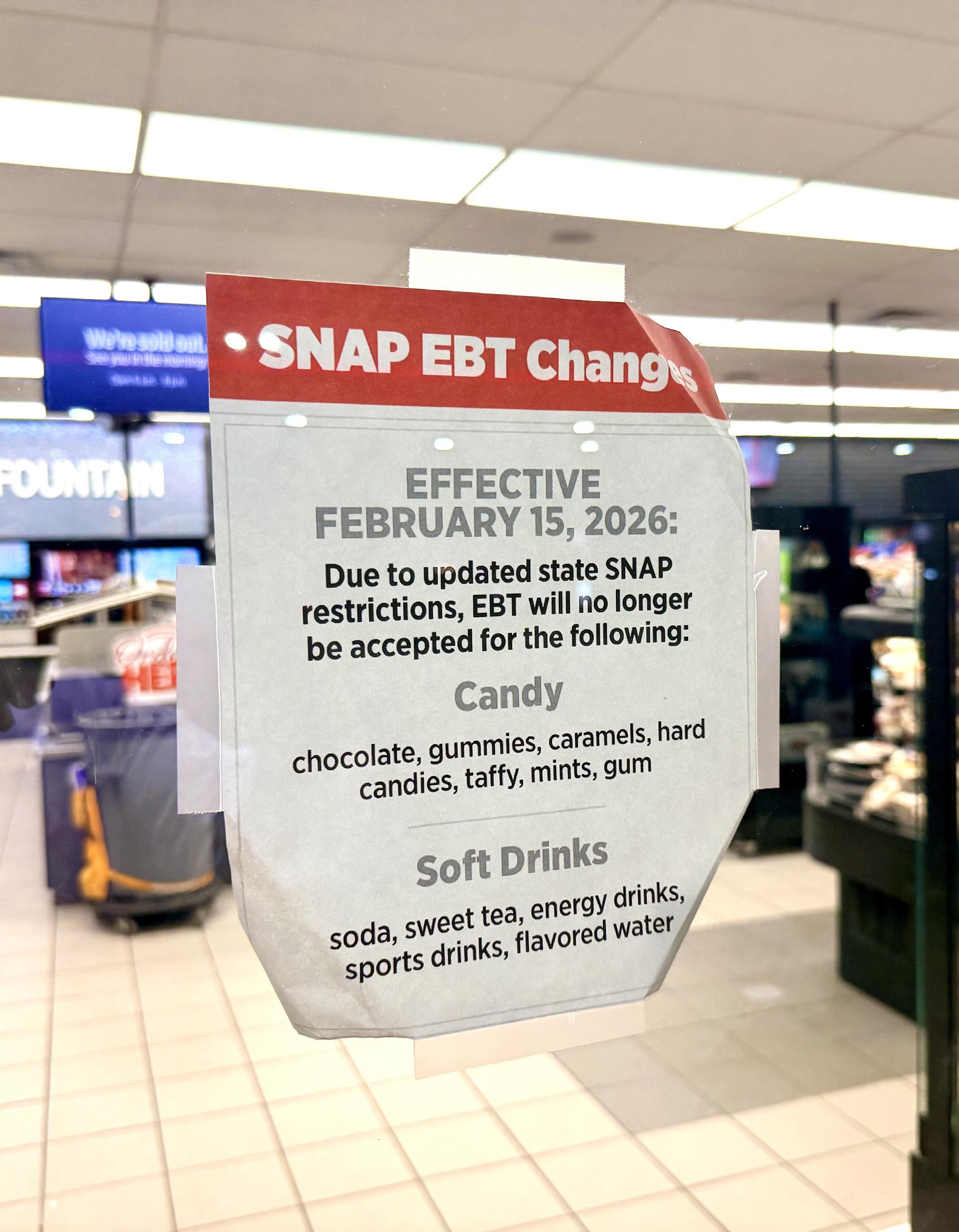
Effective Feb. 15, in Oklahoma, the Supplemental Nutrition Assistance Program (SNAP) Electronic Benefits Transfer (EBT) will have new restrictions regarding purchases of candy and soft drinks. The federal agency that
oversees SNAP, the Food and Nutrition Service of the U.S. Department of Agriculture, approved state requests for new policies with the intention to improve nutrition, according to COSM Commentary.
Oklahoma Gov. Kevin Stitt, along with U.S. Health and Human Services Secretary Robert F. Kennedy Jr., launched the “Make America Healthy Again”
MOHA) initiative at the state capitol back in June.
Stitt announced that as a part of the campaign, Oklahoma formally submitted a federal waiver request on June 10 to prohibit purchases such as soft drinks, candy and similar processed foods with SNAP benefits.

The City of Stillwater has filed a public nuisance lawsuit against Remington Ranch Apartments after months of complaints about prolonged hot water outages and unsafe living conditions at the roughly 300-unit complex on North Boomer Road.
On Feb. 9, the Stillwater City Council voted unanimously to declare Remington Ranch a public nuisance and authorize legal action through Resolution CC-2026-2. The resolution states that the property, located at 1815 N. Boomer Road, violates Stillwater’s Code of Ordinances and the International Property Maintenance Code. It also cites Oklahoma statute 11 O.S. §22-121, which allows municipalities to intervene when dwellings are found unfit for human occupancy.
City staff told councilors the complex, built in 1969, relies on an aging central boiler and recirculation system to provide hot water across multiple buildings. Code Enforcement Supervisor James Moore said the property contains approximately 300 one- and two-bedroom units spread across 12 buildings. At the time of the council meeting, 16 units in one building had passed inspection after installation of individual electric water heaters. About 283 units still required conversion.

BY ADDY BLANKENSHIP O’COLLY CONTRIBUTOR
ou can feel the beat from across the street.
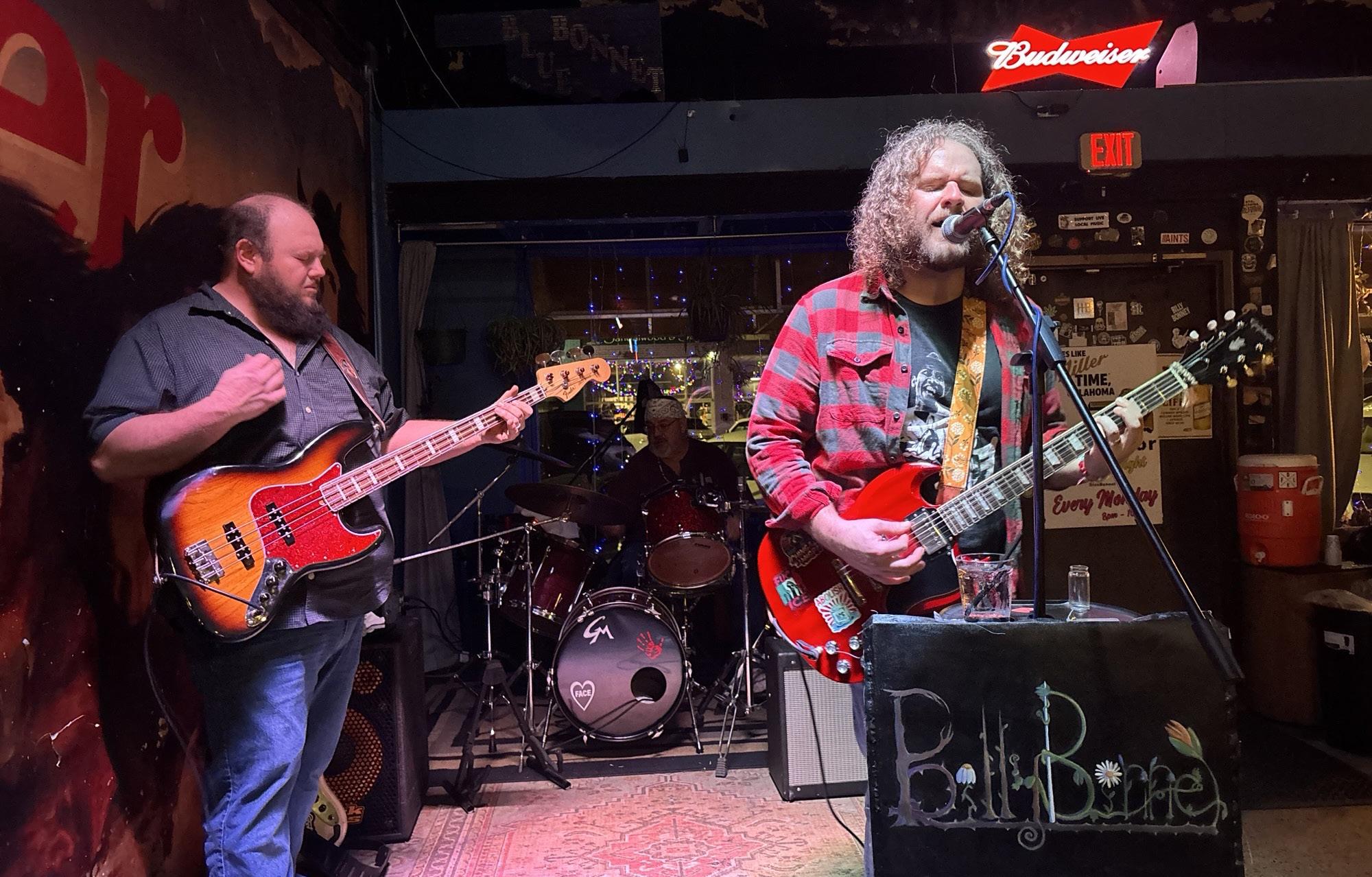
The lights are bright in the corner of the room with a hazy glow surrounding the stage. The room fills with the gritty sound of his electric guitar while the crowd’s whistles and cheers echo. This is what Kurtis Hair experiences every weekend with his band, Billy Bonney.
Kurtis Hair, lead singer and guitarist of blues rock band, Billy Bonney, is not the average musician. He is a videographer, an Oklahoma State journalism graduate and most important, a family man.
His interest and music has always been there. He remembers his mom driving him to school while he listened to music trying to find the chorus and melody each time.
“When I was about 15, I remember hearing [Lynyrd] Skynyrd for [the first] time,” Hair said. “I started getting into music, and granted, my political side of my music comes from Eminem.”
Hair calls himself an “Eminem child.” He was 10 when rapper Eminem released his first album in 1999. His connection with music comes from growing up in a broken home.
See BILLY on page 3A

Moore also reported that Remington Ranch owed nearly $200,000 in unpaid city utility bills.
Residents have reported going months without reliable hot water. Tenants said they boiled water to bathe, went weeks without normal showers and in some cases, temporarily left their apartments when service was not restored. Several tenants also said promised rent credits or reimbursements had not materialized.
The city’s special nuisance counsel, Beth Ann Childs, told councilors that inspections documented intermittent hot water loss, inadequate heating and additional conditions that placed the complex in a state of decay. She said the findings met the legal threshold for declaring the dwellings unfit for human occupancy under state law and local code. Childs recommended a formal nuisance declaration and, if necessary, district court action seeking abatement.
The council had previously continued an initial nuisance hearing in January to allow time for repairs, including installation of individual water heaters. By early February, staff continued reporting widespread hot water issues and other code violations,
along with the substantial unpaid utility balance. The council then voted 5–0 to move forward with legal action.
On Feb. 14, the city filed a public nuisance petition in Payne County District Court. The petition asks a judge to formally declare the property a nuisance and order corrective measures. It alleges that prolonged loss of hot water and other violations render the complex unsuitable for human habitation and endanger residents’ health, safety and welfare.
The city is requesting that the court either require the owners and operators to bring the property into compliance or authorize the city to perform abatement work and recover associated costs.
The lawsuit names several entities connected to ownership and financing as defendants, including Berkley Point Capital LLC, Fannie Mae, Remington Ranch’s Best Living LLC, Vesta Capital LLC and YSA Investments. City materials identify Vesta as the property manager.
City officials have said the objective is to restore reliable hot water and safe living conditions while keeping tenants housed. The case is pending in Payne County District Court. The city has indicated it will continue inspections and communication with management and residents as the legal process moves forward.
In the Feb. 13 print edition of The O’Colly, an article incorrectly stated that the Norman City Council unanimously approved legislation requiring an annual OU–OSU football game and that the measure would move to the Oklahoma Legislature for consideration.
In fact, Mayor Stephen Tyler Holman was describing a symbolic amendment adopted at the Oklahoma Municipal League’s Congress of Mayors mock legislature; the Norman City Council did not vote on the proposal, and no state legislator has filed it as a bill. The O’Colly sincerely regrets this error.
Editorial board
Co-Editors-in-Chief Bryson Thadhani & Parker Gerl editorinchief@ocolly.com
Design editor Katie Lehew design.ed@ocolly.com
Social media editor
Jose Brito news.ed@ocolly.com
Assistant news & lifestyle editor Caleson Coon news.ed@ocolly.com
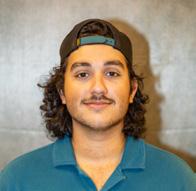
Bryson Thadhani CO-EDITOR-IN-CHIEF
Ten years ago, we were arguing about a headphone jack.
In September 2016, Apple announced the iPhone 7 and removed the 3.5mm headphone jack. The reaction was loud. Critics called it unnecessary. Users called it inconvenient. It felt like change for the sake of change.
At the same event, Apple introduced something else: AirPods.
They looked simple. Almost too simple. But inside was Apple’s W1 chip, which allowed instant pairing and seamless switching between devices. They did not feel like traditional Bluetooth headphones. They felt automatic.
AirPods did not ship until December 2016. Within a year, they were everywhere.
That moment marked a shift. Not just the removal of a port, but the normalization of wireless as the default. In 2016, tech companies stopped asking whether users were ready. They assumed we would adapt.
And we did.
Wireless earbuds became standard. The idea of a phone as the central hub for connected accessories solidified. Today, carrying wired headphones feels almost outdated. The headphone jack did not survive the decade. Wireless did.
But 2016 was not just about audio. It was also the year phones began positioning themselves around artificial intelligence rather than raw specs.
In October 2016, Google unveiled the first Google Pixel. Unlike the Nexus line before it, Pixel was fully Google branded. It had solid hardware, including a Snapdragon 821 processor and a 12.3-megapixel camera, but the real emphasis was software.
Pixel debuted Google Assistant as a core feature. The phone was marketed not just as a device, but as an AI-driven experience. Its camera leaned heavily on computational photography rather than chasing megapixel numbers. The pitch was clear. Intelligence would define the product more than hardware alone.
That framing shaped the next decade.
Today, nearly every phone emphasizes AI features. Cameras are powered by software processing. Voice assistants are built in. In 2016, that direction was still emerging.
The iPhone 7 and 7 Plus reinforced the shift. The Plus model introduced a dual-camera telephoto lens, bringing optical zoom to mainstream users. Water resistance became standard rather than premium. The removal of the headphone jack pushed users toward wireless audio, which conveniently aligned with AirPods.
The phone was no longer just a slab of glass and metal. It was the center of a growing ecosystem.
Around that ecosystem, other devices arrived.
2016 was the first year high-end consumer virtual reality truly reached homes. Oculus Rift, HTC Vive and PlayStation VR made room-scale tracking and motion-controlled experiences accessible. For a moment, it
felt reasonable to say that virtual reality had arrived.
VR did not take over everyday life, but it established a new category. Tech companies were no longer just improving screens. They were building alternate spaces.
That same year, Snapchat released Snapchat Spectacles. The sunglasses recorded short vertical videos directly to the app. They were niche and sometimes mocked, but they hinted at a future where cameras might live on your face rather than in your pocket.
Meanwhile, smart speakers moved from novelty to normal. The secondgeneration Amazon Echo Dot and Google Home made always-listening voice assistants common in living rooms. Saying “Alexa” or “Hey Google” stopped feeling strange. The idea of a smart home hub became affordable and mainstream.
Looking back, 2016 reads like a blueprint.
Wireless audio became default.
AI became central to phone identity.
Voice assistants entered homes. VR tested immersive computing. Wearable cameras experimented with new forms of capture.
What makes 2016 significant is not that every device succeeded equally. Some faded. Some evolved. Some struggled before finding their place. What matters is that the industry moved in the same direction. Hardware stopped being the sole focus. Experience and integration became the priority.
Before 2016, smartphones were judged mostly by specs. Processor speed. Screen resolution. Megapixels. After 2016, the conversation shifted toward how devices worked together and how intelligently they responded.
AirPods removed wires and normalized convenience. Pixel emphasized computational photography and AI. Smart speakers introduced ambient voice control. Even VR and Spectacles, in their early forms, pointed toward a world beyond flat screens.
There was backlash. The headphone jack debate dominated headlines. Privacy concerns surrounded alwayslistening assistants. VR skeptics questioned practicality. But the overall direction did not reverse.
Ten years later, few people question wireless earbuds. AI integration is expected, not novel. Voice assistants are embedded in cars, appliances and watches. VR continues to evolve. The phone remains the center of a connected network of devices.
In 2016, the changes felt incremental. A port disappeared. A new assistant appeared. A headset shipped. A pair of glasses recorded video.
Together, those changes reshaped everyday behavior.
We stopped plugging in headphones. We started talking to devices. We began trusting software to enhance hardware.
We accepted that the phone was just one part of a larger system.
Ten years ago, we were debating wires.
Now, most of us cannot imagine going back.
2016 was not loud about its transformation. It did not feel like a revolution at the time. But it quietly set the tone for the way we live with technology today.
news.ed@ocolly.com
Assistant social media editor Megan Gibson news.ed@ocolly.com
Photo editor Chance Marick photo.ed@ocolly.com
Assistant photo editor Andon Freitas photo.ed@ocolly.com
“I think that’s a big part of why I became a journalist,” Hair said. “Not taking shit and wanting to stand up to people.”
After hearing Lynyrd Skynyrd, Hair picked up the guitar and never put it back down. He fell down the rabbit hole from Zeppelin to Red Dirt.
“As soon as I got the guitar, that became career No. 1,” Hair said. “And it never really left.”
He ultimately aims to support his wife, Emily, and his daughter, Harper, through his music.
“Journalism was a Plan B,” Hair said. “I moved up to Stillwater in 2008 not to be a journalist, but to be a musician.”
During his time in school, he met Emily. They met through mutual friends at Willie’s Saloon on The Strip.
“We were out, and then we started talking,” Emily Hair said. “And I don’t know, fell in love.”
After graduating from school in 2014, with a degree in multimedia journalism, the Hairs made big plans to start their life in Colorado in hopes of Hair being able to make it as a musician, but things changed. A job as a print reporter in Coos Bay, Oregon, was offered to him. He accepted,and they moved. The day the couple arrived in Oregon was the day the couple found out Emily was pregnant.
“It was just kind of one of those things where life hit us really fast,” Hair said. “And I had to put my music career aside because we moved back for my daughter.”
Harper was born with a rare genetic condition that affects about 150 people in the world. She has PACS1 syndrome. This rare neurogenetic disorder results from a de novo mutation in the PACS1 gene.
“She had a lot of health issues,” Hair said. “Especially early on, when she was younger, and I couldn’t be like, ‘Hey, Emily, peace out. You handle the seizures while I go play music in a bar for four hours.’ You know that just wasn’t in the cards, so I could kind of put the music career on the back burner.”
For years, Emily Hair has had a front row seat to his passion for making music. After watching him take a step back from music when their daughter was younger, she saw how this affected him.
“He seemed a little depressed and just not having anything to really pour into,” Emily Hair said. “I feel like that’s his soul, making creative things, and music is his favorite way to do so.”
Hair is using his multimedia journalism degree as the director/producer for SUNUP
TV, an agriculture show focusing on information for farmers and ranchers. His day job consists of writing weekly scripts, filming and interviewing guests.
“I get to get out and film, and do creative stuff during the day,” Hair said. “It keeps that muscle strong. That’s what journalism did.”
After Harper got older and she started doing well, Hair said he knew he had to do something creative. About two years ago, Hair put an ad out in local Facebook groups looking to form a cover band, pulling inspiration from Stevie Ray Vaughan and various American blues artists.
“I just wanted to do a threepiece,” Hair said. “Do covers, play shred blues because I can do that all night.”
Felix Miller, a bassist with a day job in the oilfield, saw the ad on the Stillwater Community page. After taking a couple of days to think, Miller responded to the ad, and they started messaging about getting together to jam.
“Dude, you’re about to sink or swim.”
“Not only do I know it, it is one of my favorites,” Miller said. “And if you mess this up, we’re not finishing the song. I’m loading my stuff and leaving.”
Hair showed some music he had written to Miller, which led to them deciding to perform original music.
After about a year of the two playing together, Greg Miller, a drummer from Shawnee, joined them. The three-piece band was complete.
Before joining the band, Greg Miller had hung up his sticks; he retired from the drums for about 15 years.
Around the pandemic, he dealt with a lot of death in the family and said he got depressed.
“I decided I needed to do something to try to cure that depression, to help it anyway,” Miller said. “Music has always allowed me to forget about everything else in the world while I’m in the middle of playing.”
“Music has always allowed me to forget about everything else in the world while I’m in the middle of playing.”
GREG MILLER | BILLY BONNEY’S DRUMMER
“I actually rolled it around for a couple of weeks and kind of blew him off,” Miller said. “I don’t have time for this, I really don’t want to get into this, and he kind of bugged me until I came over to play with him.”
Hair offered to play the Jimi Hendrix song “Little Wing,” choosing the Stevie Ray Vaughan cover version. Miller said he remembers thinking,
Miller also saw an ad for the band in local Facebook groups and joined from there, thus creating the band, Billy Bonney. About two years later, it released its debut album last month, “As the Canyons Roar.”
Billy Bonney comes from Billy the Kid, an American outlaw and gunfighter of the Old West, his given name.
“I started thinking about that name,” Hair said.

“Just Billy Bonney and the alliteration and the real story behind that.”
He said the overreach of law enforcement in the real story, with a good part of the band’s songs being political.
“Everybody thinks that there’s a dude named Billy,” Hair said. “Or I’m Billy, or something like that, and it kind of makes us laugh. The name’s kind of dumb, but there is meaning behind it.”
Emily Hair said their daughter having special needs cements these beliefs.
“He’s always been a proponent of justice and inclusion and diversity of all the things,” she said.
Norman’s oldest and most historical dive bar, The Blue Bonnet Bar, has become a home for the three-piece act.
“I moved up to Stillwater, I bled orange, I still do bleed orange,” Hair said. “Norman has been the town that has accepted us.”
Norman resident Kendel Posey, a friend and fan of Billy Bonney, said he and his husband discovered the band late last summer. They were in the audience for the bands most recent at the Blue Bonnet.
“As we walked in the front door, Kurtis stopped everything and popped off the stage and gave me a hug,” Posey said The couple always try to visit when Billy Bonney is playing at the Blue Bonnet.
“Anytime we see Kurtis and the band being up on stage,” Posey said. “We make a point to go support them.”
Posey described the band as a blend of old Southern classic rock with somewhat of blue grass lyrics about life’s personal experiences.
Emily Hair saw her husband’s passion come to life while also caring and providing for his family.
“Somehow he writes songs and performs, he calls the places to get gigs and talks to
people,” Emily Hair said. “But then also, shows up for me and Harper, and I’ve been really impressed.”
She said the more passion he is pouring into his music, the more enthusiastic he is about life, and all other areas, too.
“I’ve watched him go through a lot of phases of music that he’s interested in and that he’s listening to,” Emily Hair said. “And then watching him to start to make his own.”
She said he is happier because of his creative outlet.
“I hear the same music constantly,” Emily Hair said. “He’s like, strumming around, playing the same things on the guitar, trying to work out things.”
The band is independent. No label, no agent, nobody but the band is in charge of writing the songs, booking the gigs, promoting social media and making sure its music is available on all platforms.
The band was able to record its debut album, The Church Studio in Tulsa, with only four hours of recording time, in December.
“We recorded seven songs in three hours,” Hair said. He said all the songs were recorded live, and that is where the album came out of it.
“We just needed music out there.” Hair said.
“As The Canyons Roar.” is a blues album with influences of rock and The Allman Brothers Band, with a run time of 33 minutes.
Each member has separate goals for the band, but each shares the dream of being able to do this full time.
“We’re usually playing just about every weekend,” Hair said. “It’s late nights because it’s bars, it’s the only place that has live music, and then you just got to be ready for work on Monday. That’s kind of how it is.”

• Fresh, frozen, or canned fruits and vegetables
• Meat, poultry and seafood
• Dairy products
• Bread, cereal, rice and pasta
• Eggs and plant-based proteins
ITEMS NO LONGER ELIGIBLE FOR PURCHASE WITH SNAP:
• Candy (Chocolate bars, hard candies, gummies, caramels, taffy, licorice, mints, chewing gum)
• Soft Drinks (Carbonated soda, energy drinks, sweetened bottled or canned tea, sweetened bottled or canned lemonade, flavored or sweetened water)
• 100% fruit or vegetable juice
• Plain bottled water
• Coffee and tea prepared at home
to begin the waiver on Feb. 15, 2026.
The Food Restriction Waiver has been approved by the FNS to continue for two years as a part of a federal pilot program to test if the restrictions improve consistency and nutrition while still maintaining access for those with SNAP benefits.
The initial start date was set and approved for Jan. 1, 2026. However, on Sept. 25, 2026, the Oklahoma Department of Human Services requested for the restricted food definitions of candy and soft drinks to be modified. Later, on Nov. 17, 2025, the OKDHS made an additional request to modify its waiver implementation date
Eighteen states will be affected by this decision, however when it goes into effect will differ depending on the state.
The SNAP Food Restriction Waiver is intended to further the purpose of SNAP, which is to safeguard the health and well-being of the nation’s population by raising levels of nutrition among low-income households, according to the USDA.
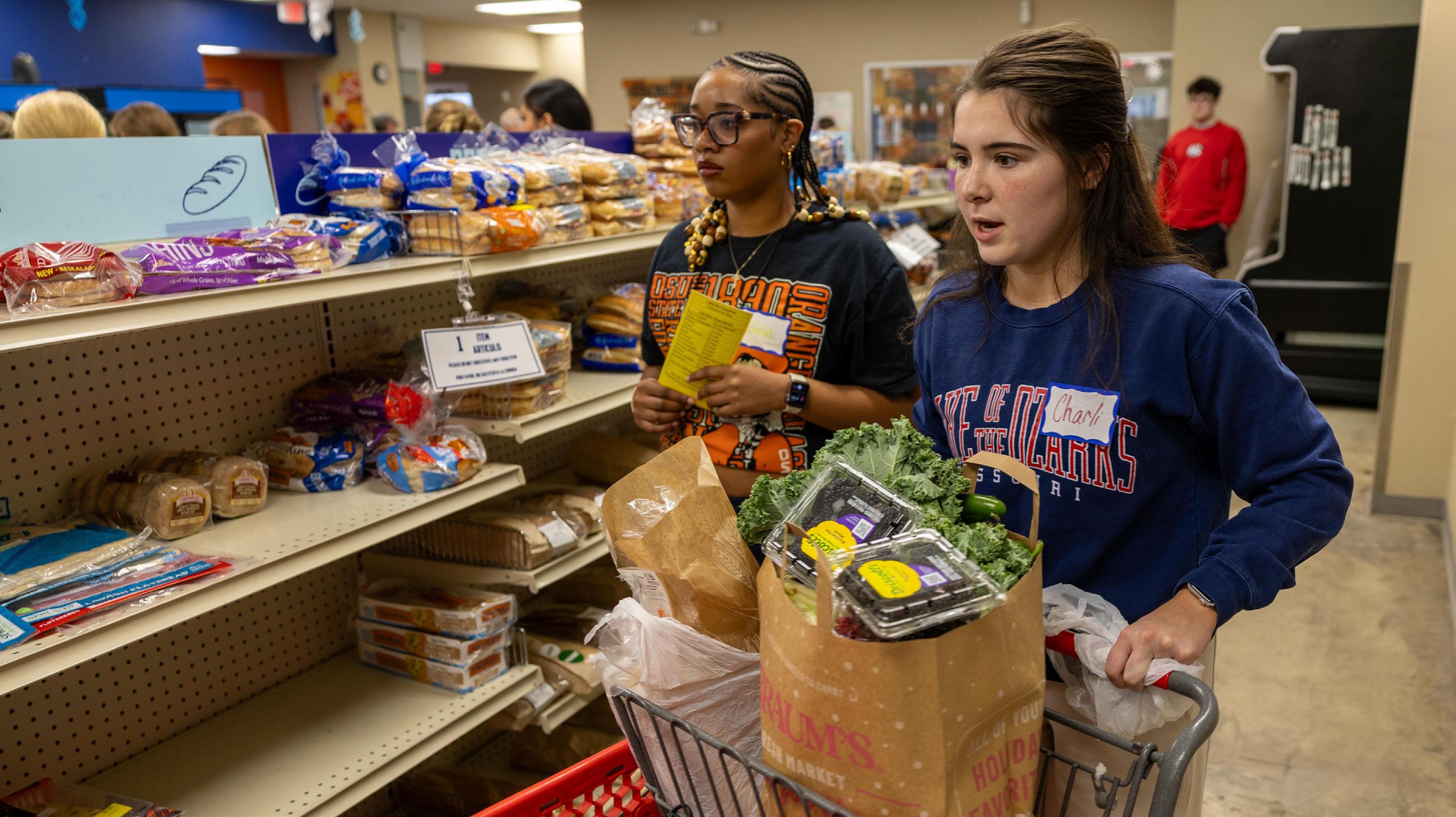
Located at 701 E 12th Ave in Stillwater, Our Daily Bread Food and Resource Center’s internal program director, Kenadie Grimes, said it’s more of a waiting game for their program since the waiver has only just gone effective.
However, as of now, Grimes doesn’t think the program will see a huge increase in guests due their unique pantry at Our Daily Bread.
“And so what that means is because we’re a certified healthy food pantry, we can’t have things like candy and soft drinks on our shopping floor,” Grimes said. “So, guests are very used to not having that choice whenever they come here, we do still provide sweet options, but they’re more like bakery sweets.”
Grimes noted that back in November, when SNAP shut down, they saw a huge increase in numbers–much of that including new faces to Our Daily Bread. The experience left Grimes to believe that could potentially be the case
regarding the new restrictions.
“As far as, like, new people coming and never been being here before, but then just wanting to know what it’s like to see if they could have better options with new restrictions being made,” Grimes said.
Grimes said she is glad that the focus is being geared toward more nutritional foods since that is a part of Our Daily Bread’s mission; to provide nourishing food. But at the same time, restricting people who experience a level of poverty and food insecurity isn’t helpful.
“Restrictions can reduce access in the very practical ways they can make shopping way more complicated for participants just having to try and navigate ‘what is available to me, what isn’t,”’ Grimes
said. “And so whenever they don’t have those restrictions, it does just make the shopping experience feel way more lighter, way more enjoyable, way more free, and you give them their, um, ability to choose whatever they want back.”
However, she said that she would love it if this project turned into something that could improve how people nourish themselves and create a better lifestyle, and while Grimes is unsure if this restriction will motivate people in that direction, she believes there is potential for that to happen.
“Everybody’s idea of what health is, looks different,” Grimes said.
news.ed@ocolly.com
The next time Pistol Pete is in a showdown, he might face
Oklahoma State University is not the only school to claim the mascot. Both the University of Wyoming and New Mexico State University declare Pistol Pete as their mascot and logo.
OSU and Wyoming, who both call themselves Cowboys, registered for trademarks in September 1989 with the U.S. Patent Office, OSU officials said in a news release Tuesday.
While Wyoming applied 11 days earlier, the patent office granted OSU the trademark first, OSU officials said. In October 1990, OSU filed a notice of opposition with the patent office against Wyoming’s application.
Wyoming’s deadline to respond to the opposition was Feb. 13. OSU has not been informed yet whether action was taken, said Judy Barnard, assistant to the OSU Legal Counsel.
Bryson Thadhani CO-EDITORIN-CHIEF
A class ring can cost $959.
That is not a typo. According to pricing listed by Jostens, some college rings range from $538 to nearly $1,000 depending on metal, stone and customization. That is a significant investment for a piece of jewelry, that many graduates will wear only occasionally after commencement.
So the question is not whether class rings are meaningful. The question is whether they are worth it.
To answer that, it helps to understand where the tradition began.
The history of American class rings is often traced back to the class of 1835 at the United States Military Academy. West Point cadets designed rings to symbolize shared experience, loyalty and identity. In that context, the ring was not decorative. It represented brotherhood forged under discipline and service. From there, the practice spread to colleges and eventually high schools. By the early 20th century, class rings had become more common, symbolizing graduation at a time when fewer Americans earned diplomas.
The ring signaled achievement in a smaller, more exclusive educational system.
Education has changed dramatically since then. College graduation is no longer rare. Diplomas hang on walls, graduation ceremonies are livestreamed and degrees are listed across digital platforms. The symbolism of academic completion now exists in many visible forms. Yet the rings remain.
Part of the answer is tradition. There is something tangible about a ring. It has weight. It sits on your hand. It does not disappear into a digital archive or fade in a social media feed. For some families, especially those with generational ties to universities, a class ring becomes an heirloom rather than an accessory. The emotional value in those cases is real. But so is the marketing machine behind it.
Companies like Jostens do not simply sell jewelry. They sell milestones. Rings are presented alongside caps and gowns, graduation announcements and
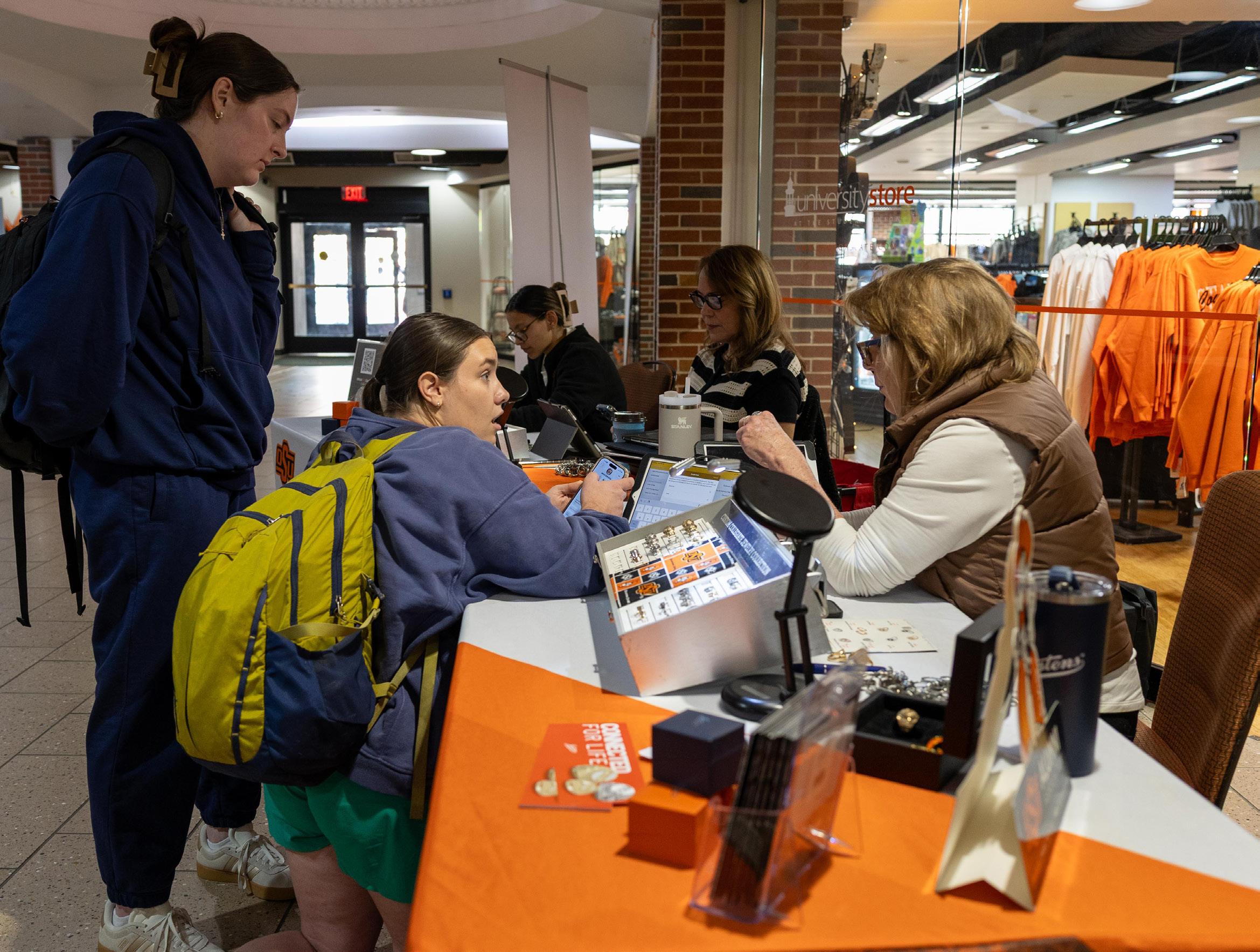
portrait packages, positioned as a natural final step in the college journey. The messaging is subtle but effective: you earned this, and this is how you commemorate it. The design process reinforces that feeling. Students choose the metal, the stone, the graduation year, perhaps a major or organization. Personalization increases emotional attachment, and emotional attachment makes the price easier to justify. Still, the cost deserves scrutiny.
Nearly $1,000 can represent a month of rent in some college towns. It can cover textbooks for a semester, groceries for weeks, a car payment or travel home. For students graduating with loans, the ring becomes less about symbolism and more about financial prioritization. Supporters argue that cost is relative. You are not just buying gold or silver; you are buying memory. A ring can serve as a physical reminder of late nights, final exams and friendships formed over four years. That argument has merit. Memory does matter. But memory does not require a $959 price tag.
Graduation photos exist. Diplomas exist. The
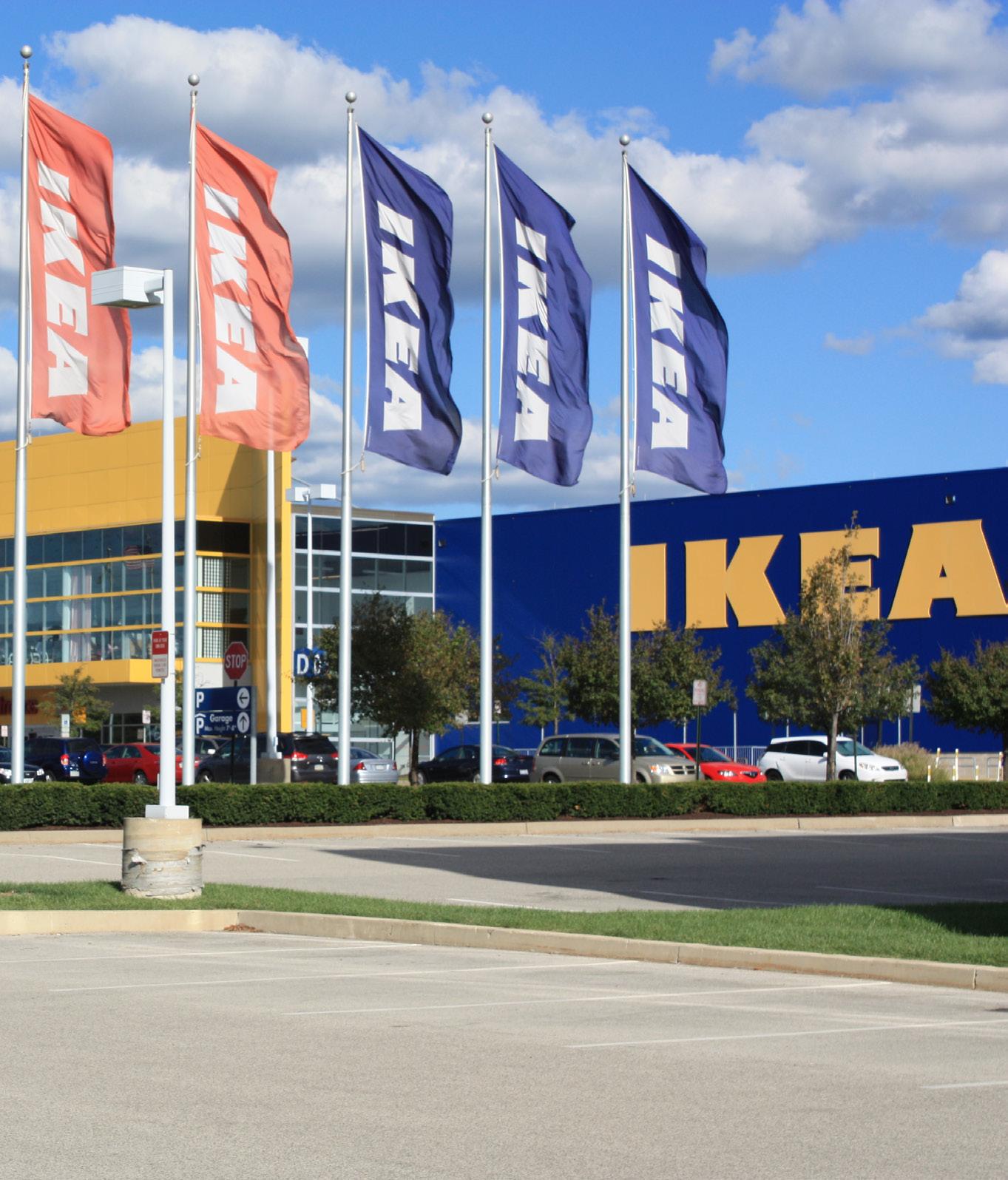
IKEA announced its plan to open four new retail locations, among those is one coming to Tulsa–the first IKEA in Oklahoma.
Although an IKEA pick-up location is located in Oklahoma City, the closest IKEA is Frisco, Texas. The incoming IKEA is intended to be in the Tulsa Hills Shopping Center where Belk formerly resided in the fall of 2026. IKEA was founded in Sweden in 1943 and the first store opened in 1958. The first IKEA store in the United States opened in June 1985 in Plymouth Meeting, PA.
In addition to the four stores in Chicago, Tulsa, Fort Collins, Colorado, and Los Angeles, IKEA plans to build more on six other locations, Huntsville, Alabama; University Park in Dallas, Texas; Phoenix, Arizona; Rockwall in Dallas, Texas; Chantilly/Dulles in the Washington, DC region; and Houston–Webster, Texas.
The new space coming to Oklahoma is meant to house approximately 3,000 items, 200 small furniture options and be 51,000 square feet and will also serve as an authorized pick-up location. A traditional, full-sized IKEA is normally 250,000 to 450,000 square feet with the
degree itself is proof of the accomplishment. There is also a practical reality: many graduates do not wear their class rings regularly. The ring may appear at commencement or family gatherings, then spend most of its life in a box. This is not an indictment of the tradition. It is simply a reflection of modern style and culture. Jewelry trends have shifted toward minimalism. Watches are smart. Rings are often limited to wedding bands or simple designs. Large engraved academic rings are less common as daily wear than they once were.
So what are students paying for?
If the answer is permanence, that makes sense. A ring does not crash like a hard drive or get lost in an algorithm. It is a stable, physical object tied to a specific moment in time. If the answer is status, that is less clear. Outside of certain military or professional circles, class rings do not carry broad cultural weight in 2026. Most people do not recognize them immediately or associate them with prestige. If the answer is tradition, the value becomes personal. Some traditions persist because they continue to mean something
average size being around 300,000 to 320,000 square feet.
IKEA will be an addition to some already large retail stores such as Target, Best Buy, Sam’s Club as well as several restaurants in the area.
Since large projects are economic drivers for any city and incentive packages are used to help move projects to completion, the Tulsa City Council is considering an economic resolution with the retailer (IKEA) in the weeks to come.
Per the City of Tulsa, “bringing world-class retailers to our residents has always been a top priority of mine,” District 2 City Councilor Anthony Archie said. “IKEA’s investment in Tulsa Hills represents jobs and economic growth for District 2. Our economic development team is the best - they are working so hard to make Tulsa the best place to live, work and play!”
This new expansion, digital investments and strengthened sustainability efforts is meant to advance U.S. growth strategies, according to IKEA.
It’s expected that IKEA Tulsa will bring in people from across Oklahoma, Arkansas, Kansas and Missouri, according to the City of Tulsa.
deeply. Others persist simply because they have always been part of the process. The strongest defense of class rings is emotional rather than practical. A first-generation college graduate might view the ring as a symbol of barriers overcome. A parent might see it as a culmination of sacrifice.
An alumni might view it as a badge of shared identity within a tight-knit community. In those cases, the price may feel justified.
However, there is a difference between choosing a tradition and defaulting to one.
The ring presentations, glossy brochures and ordering deadlines are not accidental. Marketing thrives on transitional moments. Engagement rings, senior portraits and yearbooks all cluster around life milestones because emotion lowers resistance to spending. That does not make class rings unethical. Students receive exactly what they pay for: a customized piece of jewelry. But it does raise the question of whether the purchase is framed as optional or assumed.
Calling class rings a scam would be unfair. They are not fraudulent. They are not deceptive. But calling
them essential would also be misleading. A class ring is not required for pride, alumni identity or professional legitimacy. It is a luxury product tied to nostalgia. Luxury products are not inherently bad. They are discretionary.
If a student wants a ring because it carries deep personal meaning, if they plan to wear it or pass it down, the purchase can be worthwhile. If the weight of the ring on their hand genuinely represents four years of effort and growth, that value cannot be measured purely in dollars.
But if the purchase is driven by pressure or assumption, it is worth pausing. The original West Point cadets wore their rings as symbols of unity in a specific historical context. Today, the meaning of a class ring is no longer universal. It is individualized.
That may be the real evolution.
Class rings are no longer cultural necessities. They are personal statements. For some students, that statement is worth $959. For others, the diploma on the wall is enough. Tradition can endure, but it should always be a choice.
BY ALLI THEMER I STAFF REPORTER
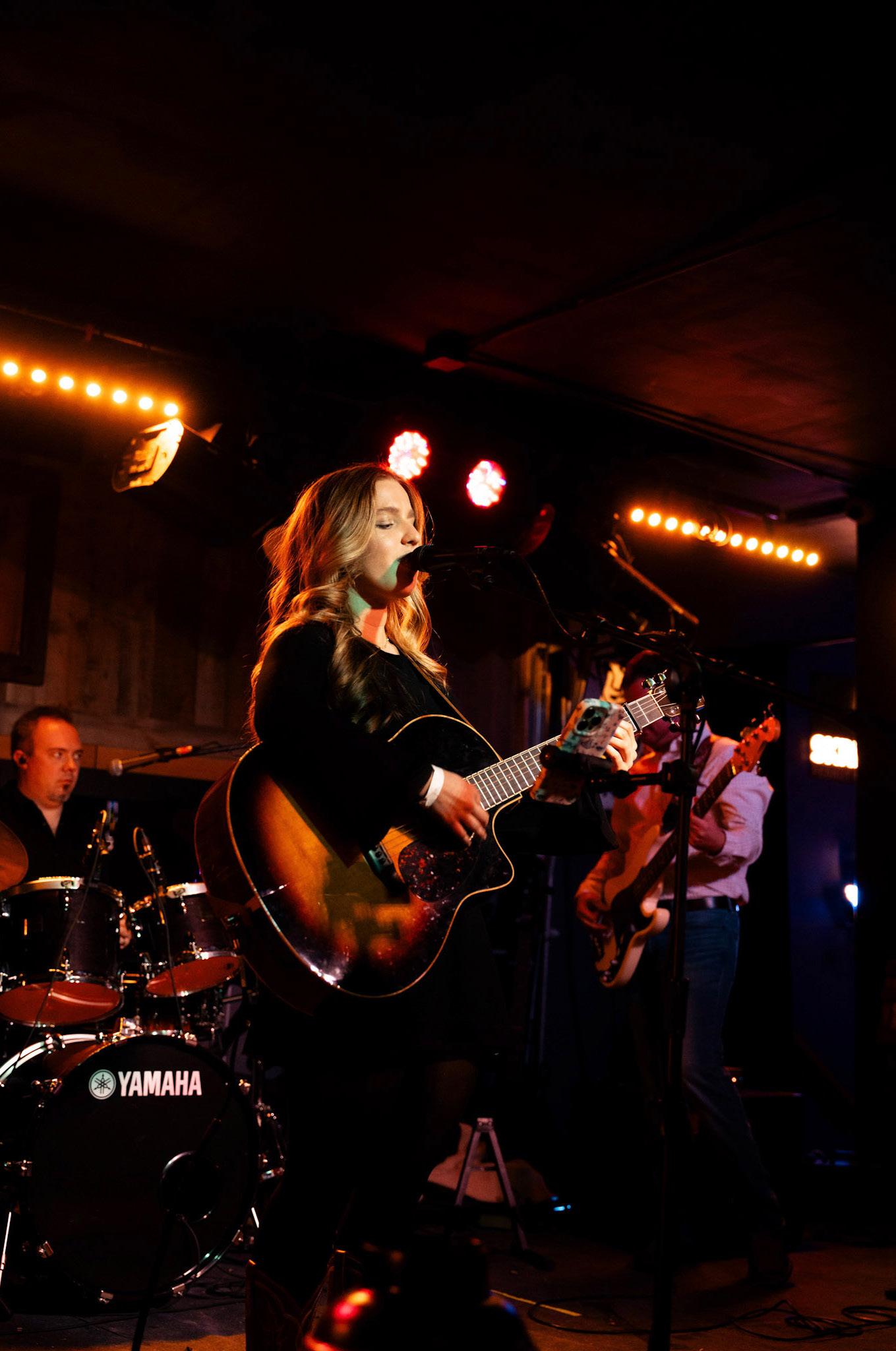
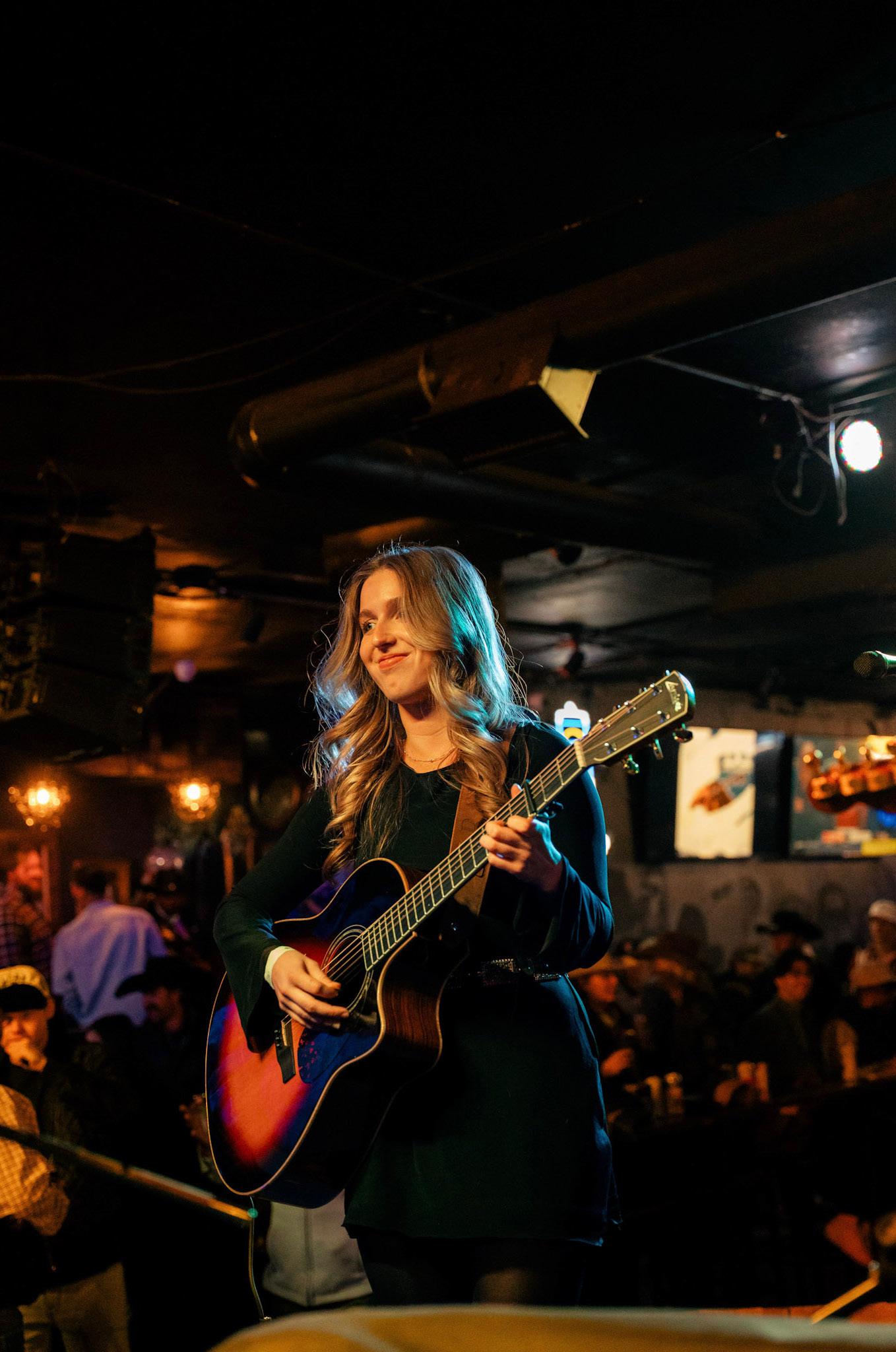
Country music artist Katie Bardwell steps on stage with all she needs: a guitar, a talent for songwriting and her cowgirl boots.
Bardwell is a student attending Oklahoma State University as well as an emerging singer/songwriter with various hit singles including “Don’t Call Me Darlin”, “Butterflies” and “The Lie”.
Bardwell’s musical journey started in the third grade, when she began writing songs.
“I got into songwriting because of Taylor Swift; I wanted to be just like her,” Bardwell said.
She said that she kept writing songs, and got better and better at it as she learned how to channel her emotions into lyrics. One challenge Bardwell overcame was caring about the opinions of others, which disrupted her creative flow.
“It started out with my parents saying, ‘Katie’s a little songwriter’, and evolved to, ‘Katie kind of has a good voice. Let’s nurture that,’” Bardwell said.
Her parents allowed her to grow into her voice, until she was ready to go from practicing in private
to performing. Her first gig was when she was 16 years old, at the Community Grill in Frisco, in front of 15,000 people.
Aubryn Berck is one of Bardwell’s biggest supporters, watching her at nearly every gig.
“She has such a presence on stage,” Bereck said. “She talks between songs, and engages the audience... she comes up with things on the fly and it’s really fun to listen to her in person.”
Bardwell’s favorite part about performing live is attracting new fans, and she also loves the thrill.
“It’s adrenaline high like no other. It’s so fun, I wish everyone could experience it,” Bardwell said.
Her most recent performance was last Saturday at the Rhinestone Saloon, at the Fort Worth Stockyards. Although she enjoys performing in her home state, Stillwater, Oklahoma, has a special place in her heart.
Bardwell said that building her audience locally in Stillwater before expanding outwards has been beneficial, especially since her hometown of Frisco, Texas, is highly saturated. At times, she thinks that

performing in front of her peers can be intimidating, but it’s also a big confidence boost.
The Tumbleweed is Bardwell’s favorite venue to perform at in Stillwater. In May, Bardwell also got the opportunity to take the stage at Oklahoma Calf Fry in front of about 20,000 individuals singing Beautiful Lies with Tanner Userey.
“There are a lot of talented musicians in Stillwater, and it’s helped me lean into other sides of country music I may have never even ventured into, such as red dirt jazz,” Bardwell said. “I’ve been able to incorporate a lot of jazz in some of the new stuff that I’ve been working on, which is kind of cool. I never would have thought to do that.”
One talented musician in Stillwater that Bardwell is referring to is Jake Taylor. Taylor started working with Bardwell about a year ago, and since then, the duo has written and performed together at Coney Island, the Tumbleweed and the Rooster.
Working with Bardwell has helped Taylor grow as an artist. “It’s a mix of competition, and also seeing each
other’s success, and I think that’s a good balance,” Taylor said.
The duo writes and records singles at the Greenwood School of Music. Bardwell expressed gratitude for the music facility at OSU, especially the free recording studio.
Bardwell and Taylor’s typical songwriting process includes developing a chord progression, then finding something catchy and adding lyrics, with Bardwell writing more lyrics, and Taylor working with melodies.
“She’s really driven and doesn’t give up, which is hard when you don’t see much growth,” Taylor said. “She’s still pushed through no matter what, and that’s something I respect about her a lot.”
Bardwell is currently working on future projects, including a song with Taylor called “Sooner or Later.” The release date is still unknown, but one thing is for certain: this will not be Bardwell’s last song.
As Bardwell steps off of the stage to the echo of cheers, the tap of her cowgirl boots remind her of her Stillwater roots, even as her career expands beyond the small town.
news.ed@ocolly.com


Caden James STAFF REPORTER
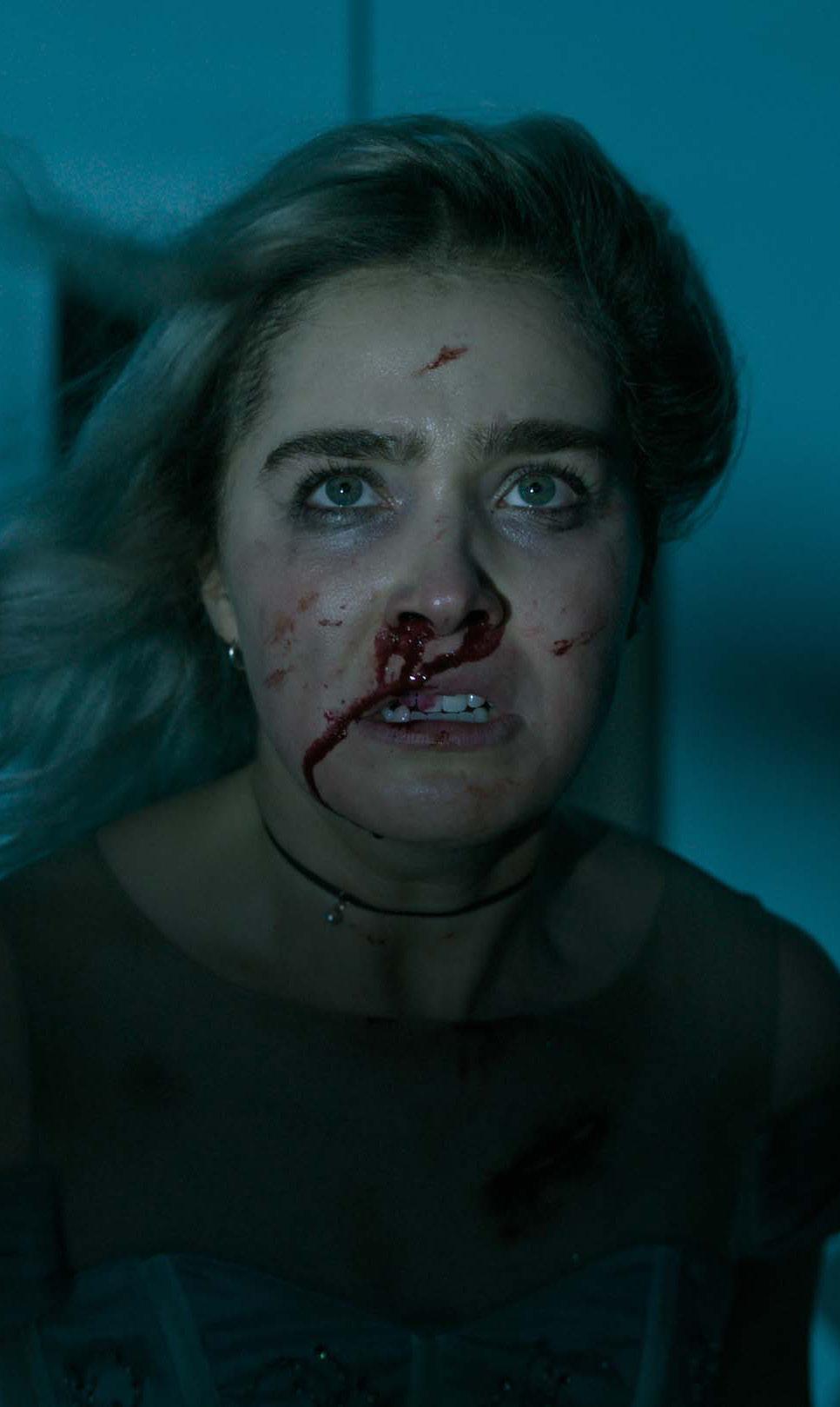
In a world filled with technology that makes people crave another reality or twist reality to their liking, “Good Luck Have Fun Don’t Die” is a movie that makes you think about how much technology can truly affect you.
The premise follows Sam Rockwell’s character, “the man from the future,” as he tries to stop AI. He gathers a team at a coffee shop after attempting this mission more than 170 times, with each loop playing out differently than the last.
Rockwell, who also appeared in “The White Lotus,” does a great job with how he carries himself throughout the film. He delivers the performance with a tone that makes him seem insane at first, but increasingly trustworthy as the story unfolds.
Another performance that stood out was Artie Wilkinson-Hunt’s first major role as the AI boy. Artie portrays a menacing character while also showing the vulnerability of someone who needs people to like him in order to survive. That is a challenging role for a 10-year-old, and he handles it well.
The script is rich with content and themes. It explores how social media can brainwash youth, the unhealthy idea of turning deceased loved ones into interactive AI versions, the addictive nature of virtual reality and the desire to escape into another world, among other issues.
Director Gore Verbinski reinforces these themes in a bold way. He reportedly gave away 2,000 free tickets to viewers whose jobs had been replaced by AI.
Verbinski spoke about AI in The Hollywood Reporter, saying:
“Why is AI helping me write a song or tell a story? I don’t want it to breathe or f*** for me; I want it to solve cancer. Send some s*** through a black hole; do something that we can’t do. Or dig a ditch; do the s*** we don’t want to do. Why is it coming after the stuff that we essentially need to do to be human beings?”
Some criticisms of the film are that it can feel preachy at times, and the comedy does not always land as strongly as it seems intended to. Still, “Good Luck Have Fun Don’t Die” is an exciting ride that makes you look at the world through a different lens, even if only for a moment.
Sawyer DeWitt STAFF REPORTER
Emerald Fennell’s adaptation of “Wuthering Heights” arrived in theaters Friday, Feb. 13, bringing Emily Brontë’s 19th-century gothic romance back to the big screen with a modern creative lens.
The film earned $82 million globally and $30 million domestically during its opening Valentine’s weekend. Warner Bros. and Fennell matched the film’s budget of roughly $80 million, and it is projected to gain more traction in the coming weeks.
While the acting in this film is solid for a major studio production, the portrayal of characters does not fully align with the original novel. One of the most important elements in film is casting, yet many viewers have expressed frustration over the casting of Margot Robbie and Jacob Elordi as Catherine and Heathcliff. Both actors do not fully match the novel’s original descriptions. However, Elordi’s choice to take the role makes sense, as he has been actively reshaping his career. Once widely known as “the guy from Euphoria,” he has since taken on major roles such as the Monster in “Frankenstein,” “Elvis in Priscilla” and now Heathcliff in “Wuthering Heights.”
The cinematography is easily the film’s strongest element. From the delicate candle lighting in the Grange household to the dramatic color shifts
that mirror the emotion of each scene, every frame feels intentional. The contrast between the gloomy, off-kilter shots at the Heights and the warmer, more refined symmetrical framing at the Grange visually reinforces the social and emotional divide central to the story.
The orchestral score, composed by Anthony Willis, carries much of the film’s emotional weight. Pop artist Charli XCX reinterpreted themes from the score into a companion album that is also incorporated into the film. While her additions are not necessary for the film to succeed musically, they bring a contemporary layer that adds something fresh to Brontë’s classic story.
The film has quickly become one of the most polarizing releases of 2026. With reactions still forming, reviews continue to fluctuate. IMDb currently lists the film at 6.1 out of 10, reflecting mixed responses. Rotten Tomatoes shows stronger numbers, with a 71% critic score and 84% audience score. On Letterboxd, the rating sits at 2.9 out of 5 and has trended slightly downward over the past week.
Despite divided reception, the film stands out for its visual ambition and atmospheric execution. It earns a 3.5 out of 5.
For viewers drawn to dramatic romance and striking cinematography, “Wuthering Heights” offers a visually immersive experience that is worth seeing on the big screen.

Applications for Summer Semester and Fall Semester 2026 Editor-in-Chief of The O’Colly will be accepted from now until 12 p.m. (noon) Monday, March 9, 2026
Applications are now available in the Paul Miller Journalism and Broadcasting Building, room 106. Applicants must return their com pleted applications to room 106 no later than 12:00 p.m. (noon) Monday, March 9, 2026.
To be eligible for Editor-In-Chief, the applicant must be a student on the Stillwater campus of Oklahoma State University, be in good academic standing (i.e., not on academic probation), have a grade point average of not less than 2.5, and have completed at least 60 hours toward a degree.
Applicant must show evidence of having worked one semester in an editor position on The O’Colly. Students serving as an Edi tor-in-Chief may take up to 6 credit hours of independent study in consultation and approval of their major advisor. An internship on a newspaper in a newsroom capacity may be sub stituted for one semester of service on The O’Colly. The internship must meet the requirements of the School of Media and Strategic Communications’ current internship course.


Friday, February 20, 2026
Wertzberger STAFF REPORTER
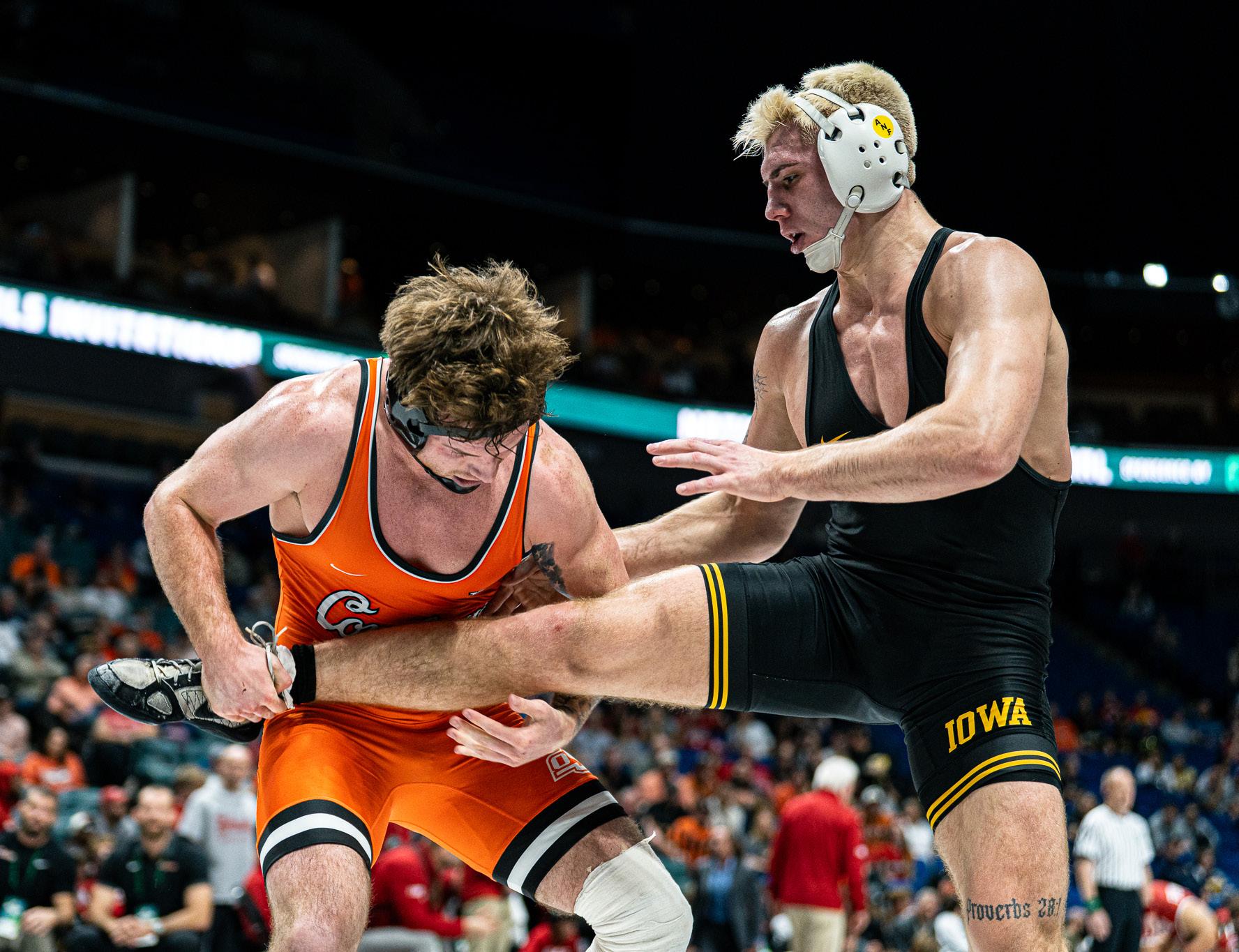
When Oklahoma State and Iowa meet on the wrestling mat, history is never far from the conversation.
The rivalry between the Cowboys and
Hawkeyes, widely regarded as the greatest in college wrestling, dates back to Feb. 22, 1954, when OSU earned a 24–8 win to open a series that has swung back and forth for more than seven decades.
Entering Sunday’s dual, OSU holds a narrow 29–28–2 edge in the all-time
was an unknown
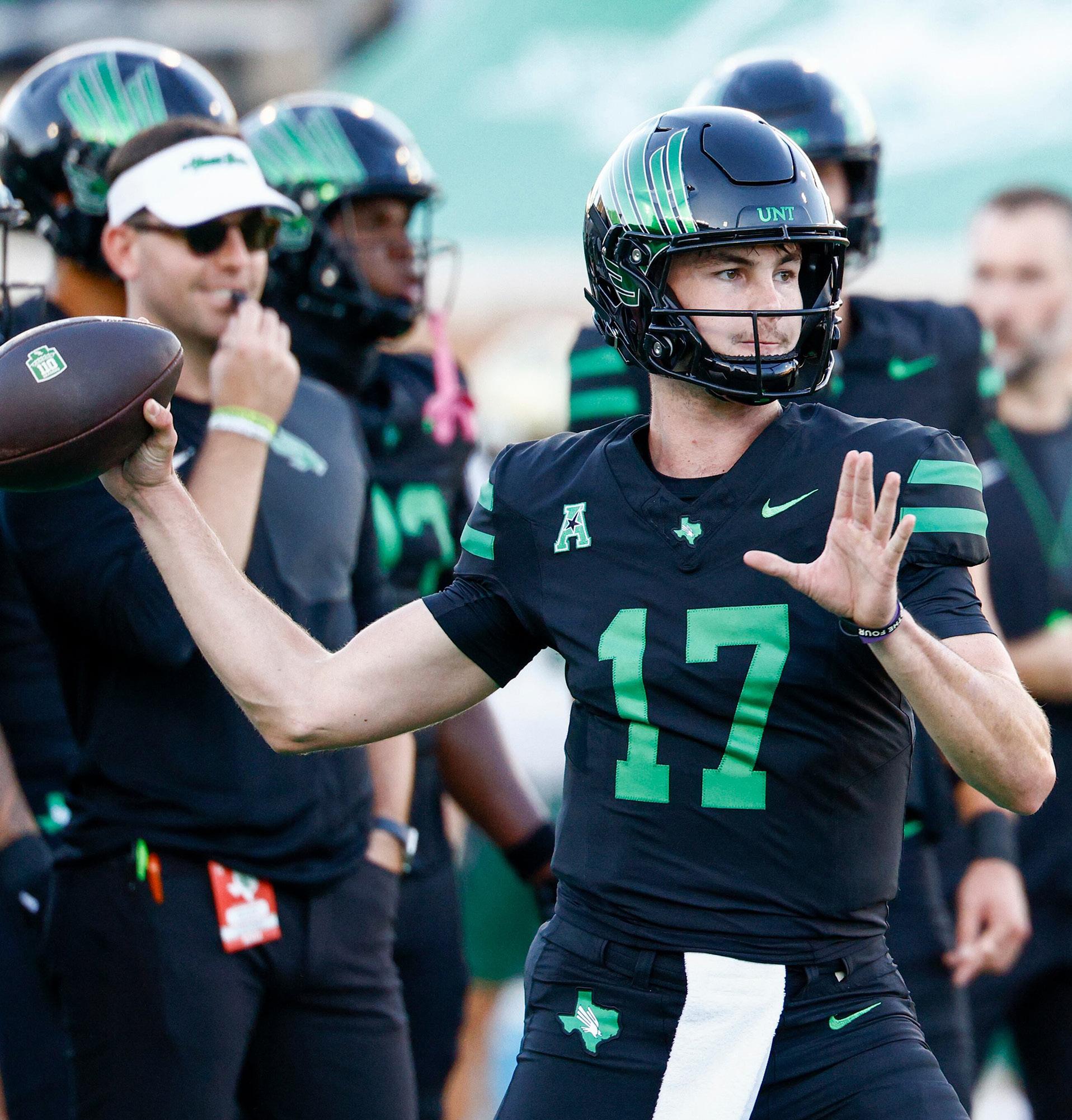
Drew Mestemaker always wanted this
But now that he’s actually here, transitioning to life as the newest Oklahoma State Cowboy quarterback has come with new experiences he never got at North Texas.
“It’s kind of crazy that people like know who I am when I’m walking around (campus),” Mestemaker said.
“… But it’s been cool meeting people through campus, and everyone has been really nice about it.”
Thirteen months ago, Mestemaker
Mean Green quarterback and a former 0-star recruit. He went on to win the starting job for the 2025 season, lead the country in passing and put himself in a position to play for any of the top schools in the market for a quarterback. Now, Mestemaker finds himself as the face of a Cowboy football rebuild, and gives OSU a chance at a quick turnaround after two losing seasons.
He’s quickly gone from unknown to the spotlight and is the reason fans are hopeful for a bounce back in Stillwater.
series, but recent history has belonged to Iowa.
That sets the stage for a premier showdown, when the No. 3 Cowboys (141) host No. 7 Iowa (12-5) at Gallagher-Iba Arena at 5 p.m.
”It’s just business as usual,” OSU coach
David Taylor said. “We’re excited to be back home, excited for the opportunity to wrestle again here at Gallagher-Iba. Obviously, we have a great opponent this weekend and our guys are looking forward to the challenge.”
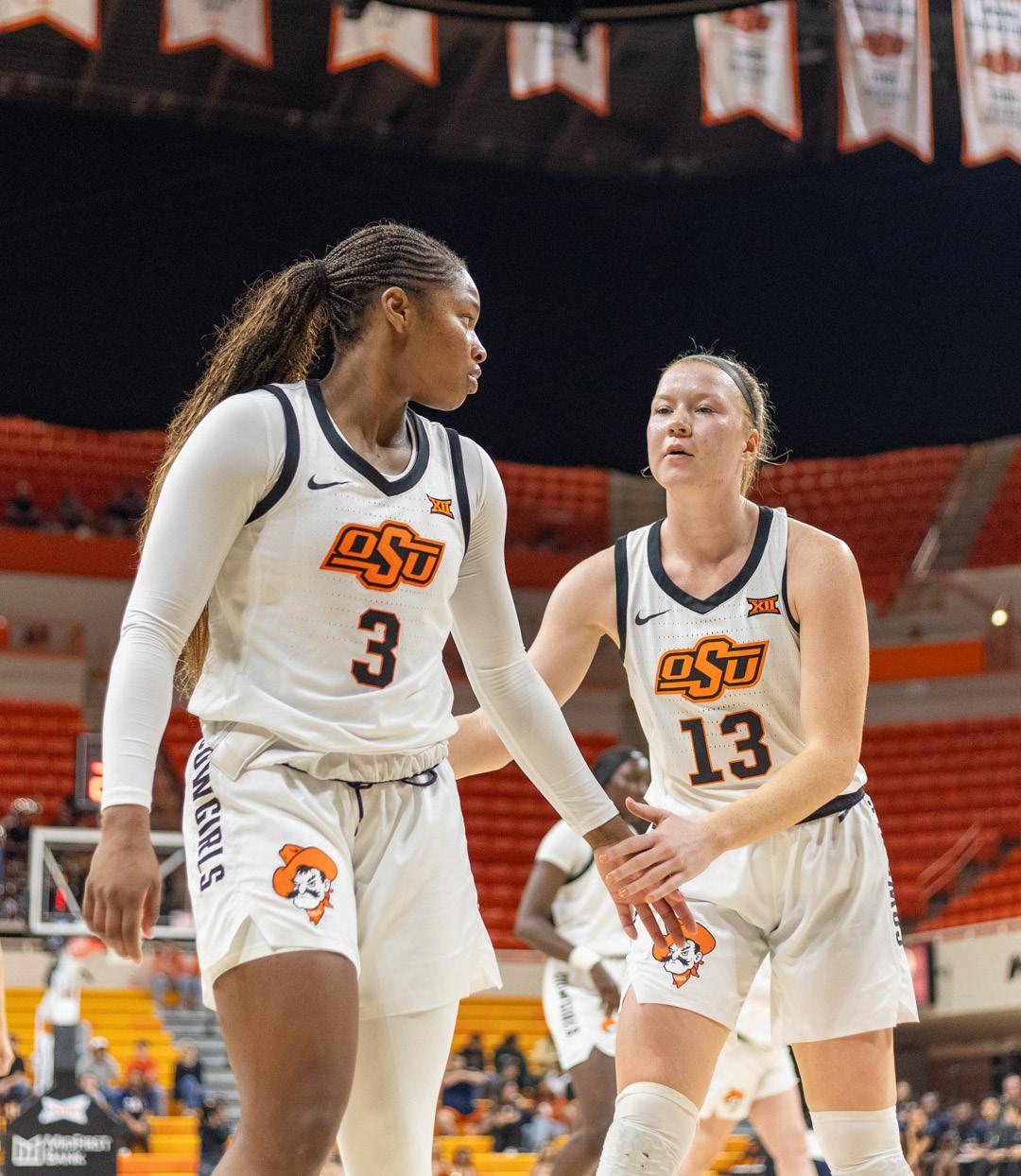
Cowgirls leaning on Timmer, Gray’s leadership down the stretch
Cayden Cox STAFF REPORTER
Jacie Hoyt knows the value of having senior leaders.
Last season, Oklahoma State leaned on Tenin Magassa, Anna Gret Asi and Alexia Smith, three seniors who helped the Cowgirls return to the NCAA tournament.
This season, OSU again finds itself turning to its seniors.
Micah Gray and Haleigh Timmer
have been two of the Cowgirls’ key players, and their experience has been OSU poised for another March Madness trip. Gray and Timmer have combined to play 254 games and each have scored more than 1,500 points in their careers.
With her star players having multiple seasons under their belt, Hoyt believes that having their experience on the court is valuable.
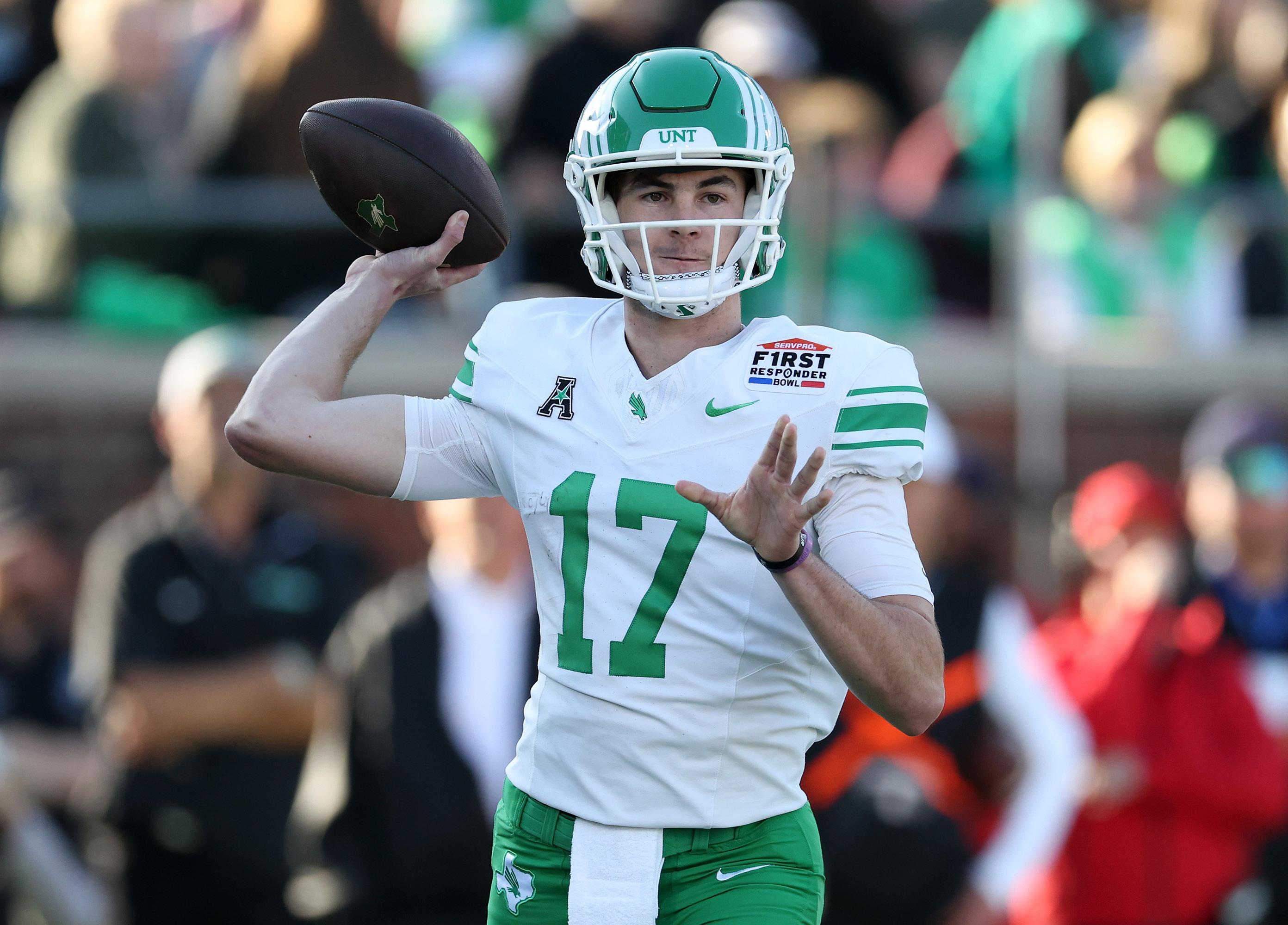
But when it was time to solidify his future, Mestemaker knew he couldn’t go without the man who helped him get to this position.
“My life has done a complete 180,” Mestemaker said. “I’ve always dreamed about being in this position. And for it to happen this fast, I didn’t expect it, but I’ve been ready for it the whole time.”
When Mestemaker entered the portal, schools such as Miami, LSU and Indiana, among others, were searching for a quarterback. Multiple reports suggested the Hoosiers had a strong interest, too.
OSU coach Eric Morris discovered Mestemaker from the Austin, Texas, area and took a chance on him after Mestemaker never started a game behind center in high school. Morris helped Mestemaker sharpen his skills, and together, they guided UNT to a 12-1 season in 2025. Mestemaker put up 4,379 yards and 34 touchdowns in the process. Now, Mestemaker is achieving his longtime goal of playing Power Four football, while he and Morris look to
continue their magic on offense.
“I knew the whole time that Coach Morris was going to be a huge factor,” Mestemaker said. “Wherever he went, that was probably going to be where I was going.”
The Cowboys haven’t won a Big 12 Conference game in two seasons and finished 3-9 and 1-11 in the past two seasons. There were no expectations for the program entering last season. It wound up being the program’s lowest point under former coach Mike Gundy.
But since then, OSU built the seventh-best transfer portal class (247 Sports), reshaped its defense and
The Oklahoma State football team’s 2026 season-opener isn’t at Boone Pickens Stadium, but it may still be the best possible debut game for coach Eric Morris and the new-look Cowboys.
On Sept. 5, OSU will make the short trek East and square off with Tulsa — the same team that upset the Cowboys 19-12 this past season, which sealed the deal on the Mike Gundy era four days later.
Morris gets the chance to avenge that loss for OSU fans in his first game at the helm. That alone makes it exciting.
But last week, TU coach Tre Lamb poured oil on flames. During halftime of a Golden Hurricane basketball game, Lamb and some of his players took the court for a hype video for next season. Lamb then boldly previewed the OSU-TU rematch at the end of all the hoo-rah.
“We’ll beat their ass again,” Lamb said. You can’t knock Lamb for the bravado to fire up Golden Hurricane fans. When you get the win, you get the bragging rights. But that doesn’t mean he didnt’t raise the temperature on what was already an important matchup.
Morris will be looking to start things the right way. Lamb would love to pick off OSU again. The Turnpike Classic is already a great in-state series that dates back to 1914. And now, Morris and the Cowboys have some
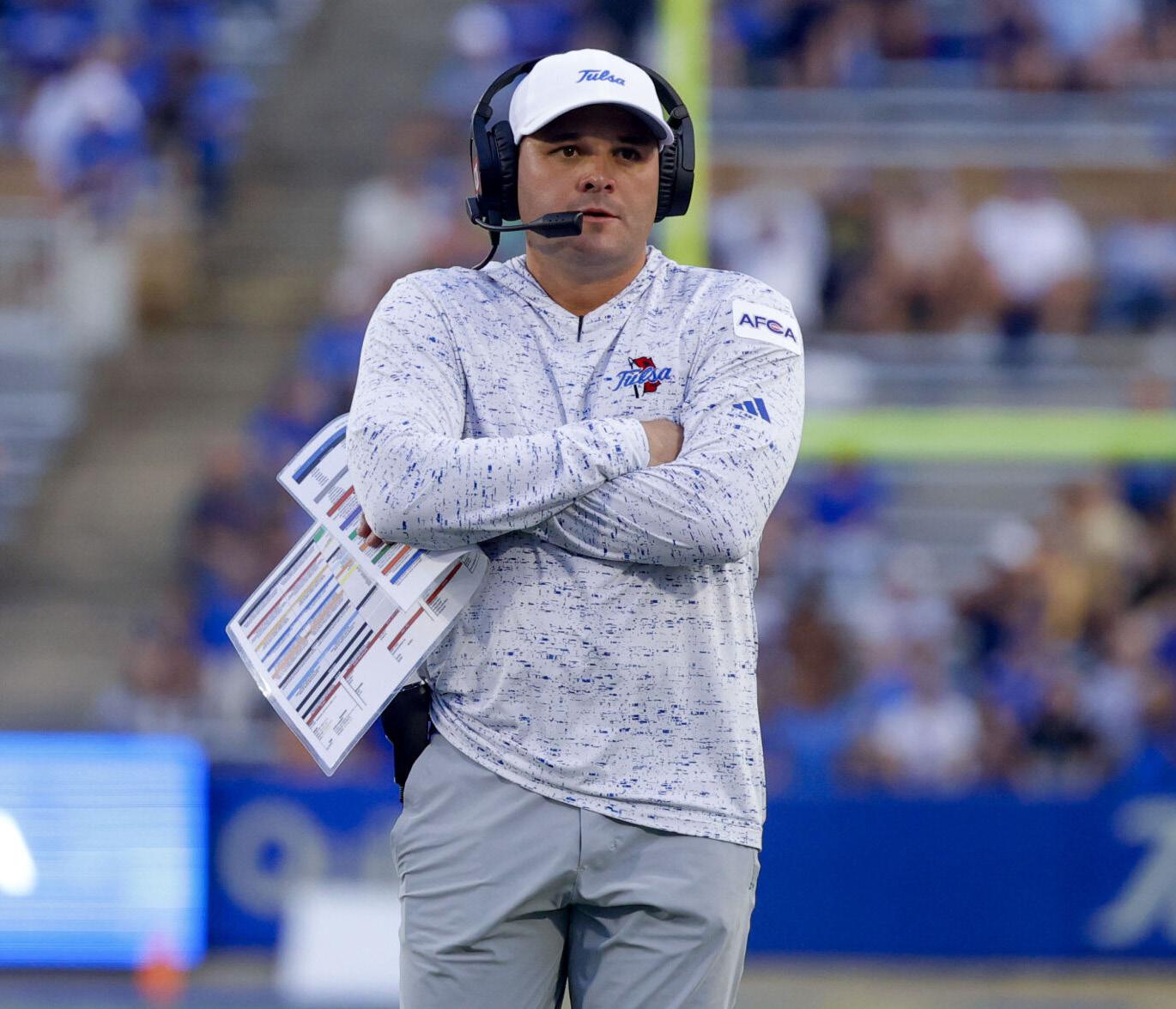
classic “bulletin-board material” to use if they wish. It shapes up as a great opening act for the Morris era in Stillwater. Historically, these games are expected to go in favor of OSU.
The Cowboys hold the all-time advantage at 44-28-5 and entered last season having won the last 10 games by an average of 23 points.
Some of OSU’s recent blowouts include a 59-24 win in 2017 and a 45-10 pummeling on TU’s field in 2023.
But when the clock struck 0:00 on Sept. 19, TU had won its first game in Stillwater since 1951. Golden Hurricane players stormed the field in celebration.
And Lamb emphatically declared, “We’re tired of being the little brother” in a postgame interview with ESPN.
All of that got us to this point: Morris taking over the
reigns in Stillwater, tasked with helping OSU bounce back after two straight seasons without a conference win. The loss to TU was the lowest point in that stretch.
Now, Morris and his former North Texas troops could make that sour taste Cowboy football fans have had go away quickly.
Most of Morris’ Mean Green coaching staff and top players have followed him to Stillwater. Quarterback Drew Mestemaker, running back Caleb Hawkins and wide receiver Wyatt Young, along with the No. 7-rated transfer portal class (247 Sports) is a heck of a way to start.
And on Sept. 5, it’ll be the first chance for Morris and OSU to make a strong first impression. And to have a response to Lamb’s bold gamesmanship.
landed two former UNT offensive stars in running back Caleb Hawkins and Wyatt Young. Morris brought most of his Mean Green coaching staff with him, too. Now there are expectations, and in large part, it’s because all of those factors are surrounded by Mestemaker’s talent.
“When you have a guy that can throw the football like that, you just walk around with a different type of aura,” OSU linebacker Malik Charles said. “You can just feel it. You can see it in the team runs. You can see how he portrays himself (as a leader).”
Sept. 5: at Tulsa
Sept. 12: vs. Oregon
Sept. 19: vs. Murray State
Sept. 26: at West Virginia
Oct. 10: vs. UCF
Oct. 17: at Houston
Oct. 24: vs. Colorado
Oct. 31: at Iowa State
Nov. 7: at Kansas State
Nov. 14: vs. Texas Tech
Nov. 21: at Arizona State
Nov. 28: vs. Kansas



‘We need to dominate’ Cowgirls look to build momentum in Texas
want to think about (the past injuries) much.”
What Cowboy baseball has learned so far
Weston Wertzberger STAFF REPORTER
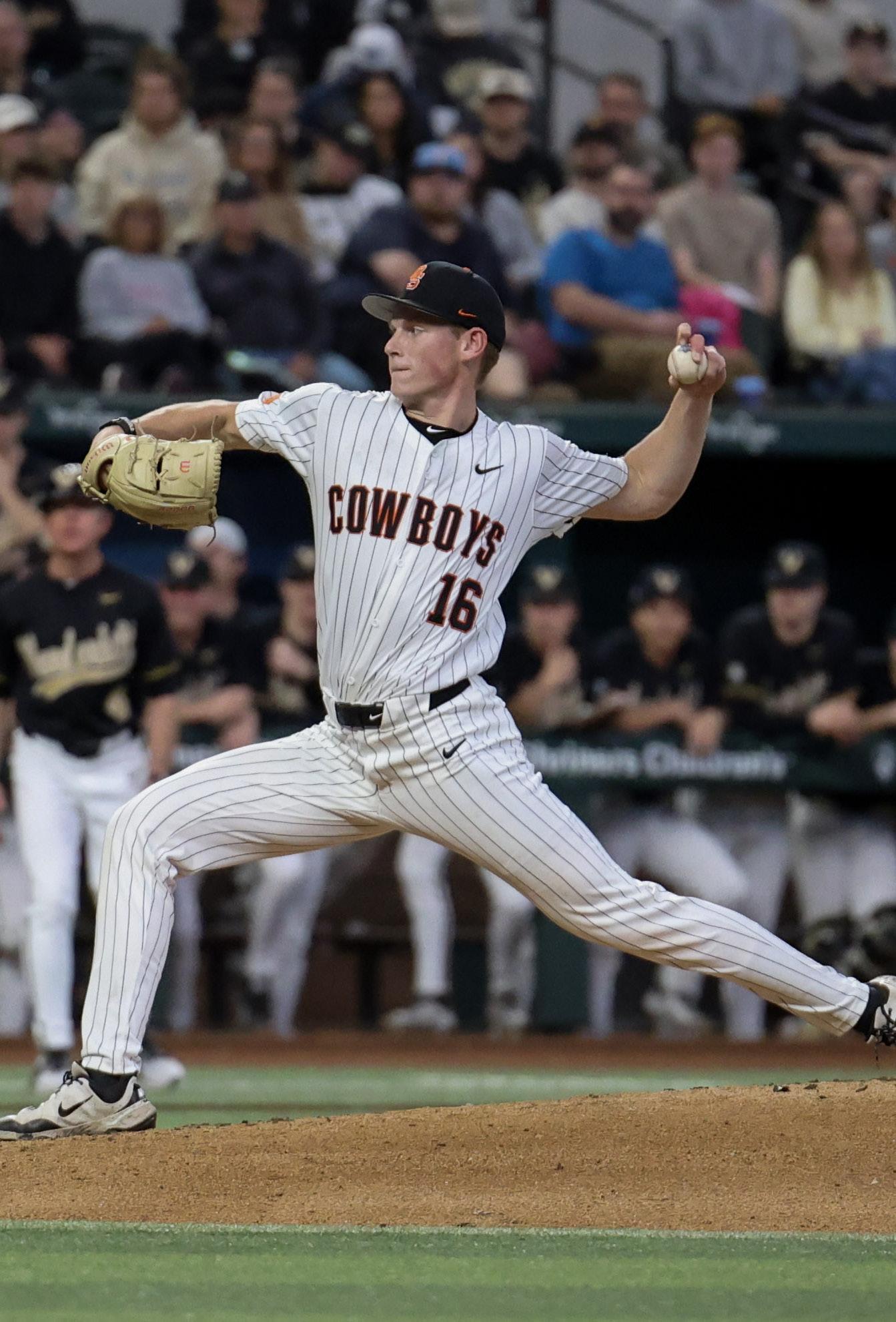
Oklahoma State did not leave opening weekend with the record it wanted, but it left with something just as valuable. Clarity.
Across three games at the Shriners Children’s College Showdown, the Cowboys were tested by elite competition and exposed in key areas before a bounce-back performance reframed the weekend.
The result was a 1–2 finish that revealed where OSU stands and what it must improve quickly as the season moves forward.
“We took a lot away from this tournament,” OSU coach Josh Holliday said postgame on Sunday. “We felt good and saw things that we’ve got to be better at. It’s the only reason you play something like this, see where you’re at.
“I think every team in this event is probably going to walk out with a lot of information and make Monday and Tuesday practices more focused now that we’ve competed.”
That information came quickly.
Clean baseball is a must against top teams
The first two days of the weekend underscored a recurring theme. Against top-tier opponents, mistakes are magnified.
Against No. 7 Arkansas and Oklahoma, OSU struggled to throw strikes, limit free bases and execute defensively.
“That’s not the type of clean, tight game you gotta play against a really good team right now,” Holliday said after Saturday’s loss to Oklahoma. “We’re not playing clean baseball.”
Facing the No. 23 Commodores, OSU leaned on pitching depth and timely decision-making to produce its most complete performance of the weekend in an 11–1 run-rule victory. The turning point came in the fourth inning, when right-hander Noah Wech entered with the bases loaded and two outs and struck out the final batter to preserve a scoreless game.
“Those were gutty pitches,” Holliday said after Sunday’s win to Vanderbilt. “Pitches made early in the season tell you how far those kids have come.”
Despite the overall ERA, the staff showed consistent swing-and-miss potential throughout the weekend. OSU struck out 41 batters and posted an 11.8 strikeouts-per-nine rate.
Ethan Lund’s first start stood out, as the left-hander did not allow a hit while striking out eight. Wech’s ability to escape traffic highlighted the bullpen’s upside and the importance of defined roles in leverage situations.
The early results suggest OSU has options. Sustaining execution and establishing consistency will determine how effective that depth becomes.
Weekends aren’t seasons
Perhaps the most important takeaway was mental.
“Our kids showed some mental toughness,” Holliday said. “They had a lot to go on after those first two days, and they just showed up today and competed. These are three-game series. They’re weekends. They’re not seasons rolled into one game.”
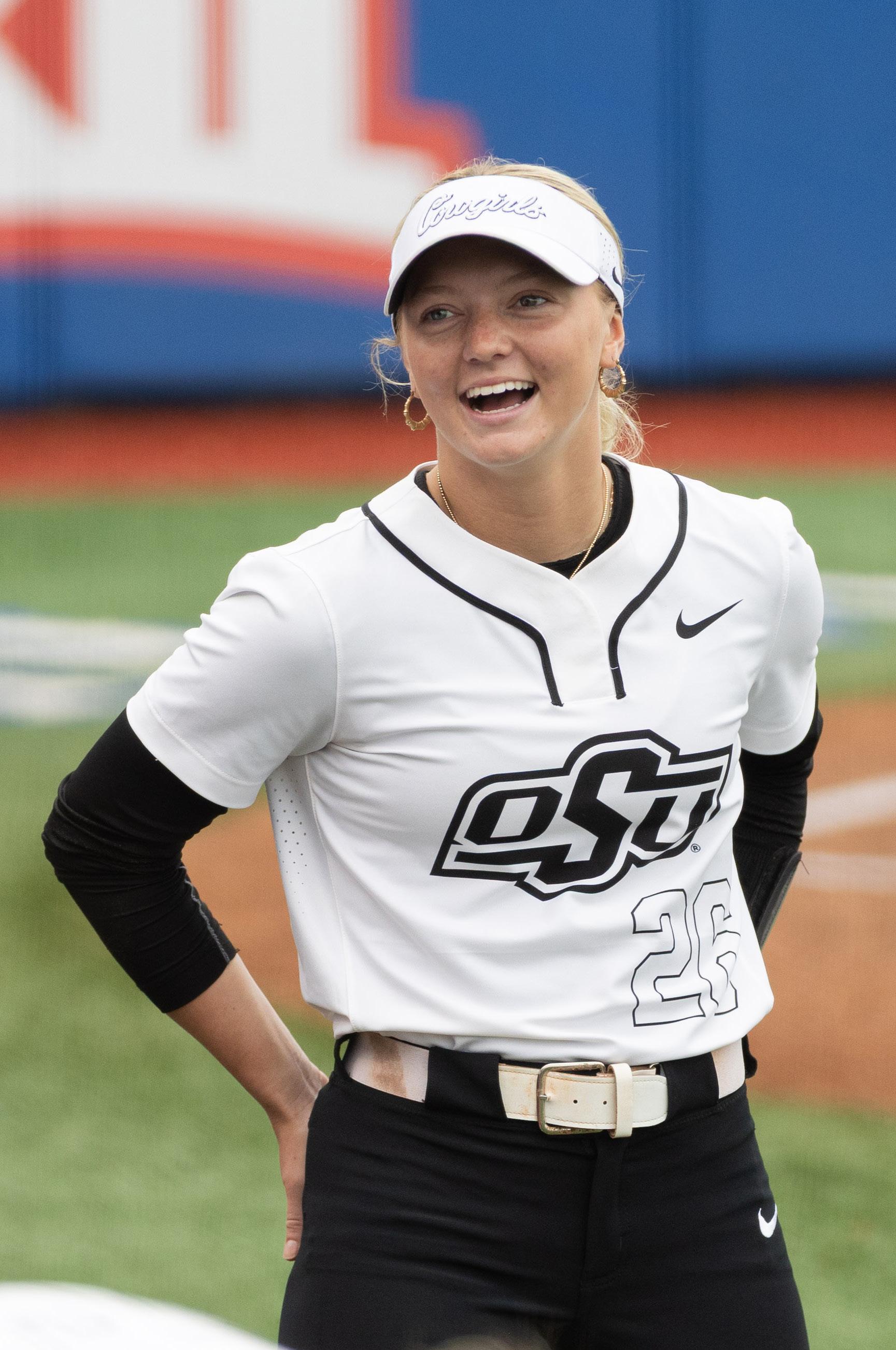
The Oklahoma State softball team is coming off a five-game weekend and has another five-game set underway.
And while the teams the Cowgirls will face Thursday-Saturday aren’t as high-caliber on paper as their competition at last weekend’s Clearwater Invitational, coach Kenny Gajewski is making sure his players don’t treat this weekend differently.
“These five games coming up count just as much as those last five,” Gajewski said Tuesday. “(The previous games), perception-wise, seem to mean more because there is a ranking next to all of those teams. We need to go out, and we need to dominate in those situations.”
OSU is coming off a 3-2 showing in which it picked up three ranked wins and two victories against opponents ranked in the top-10 (Texas A&M and UCLA). There were some positives the Cowgirls can take, and there are some things they’d probably like to have back. Nonetheless, they have another opportunity to build on what they’ve done so far.
On Thursday, OSU opened the River State Classic in San Marcos, Texas, with a 12-1 win against Kansas City and a 5-0 shutout win against Texas State. The Cowgirls will face Brown on Friday at 11 a.m. and Colorado State afterward at 6:30 p.m., before another game against Brown on Saturday at 3:30 p.m.
“We’re playing against the game, and we’re trying to beat the game,” Gajewski said. “We’re trying to dominate the game.”
Early-season pitching
One of the MVPs of the season for OSU so far has been pitcher RyLee Crandall.
In this past weekend’s Clearwater Invitational, Crandall started in the circle against No. 17 Georgia and held the Bulldogs scoreless through the first four innings. She also appeared in both games against the Bruins and the Aggies, allowing only three earned runs in 7 ⅓ innings to help the Cowgirls pick up a pair of upset wins.
The strong start to the season is a great boost for Crandall. She battled a lower-body injury last season and never fully felt like herself. Now, she’s healthy and seeing her offseason progress pay dividends.
“Just figuring out how to make my pitches do what I wanted to do whenever I couldn’t use the parts of my body I needed to use (was difficult),” Crandall said. “... I don’t
For star ace Ruby Meylan, she’s had some well-executed innings, but is still looking to fully hone things in.
Meylan dominated the Bruins, allowing only three hits and one earned run in the final three frames to help OSU get the win. And in the Cowgirls’ 9-6 loss to Duke, Meylan started strong, limiting the Blue Devils scoreless in three-straight innings before giving up a three-run home run in the bottom of the sixth inning that proved to be the difference.
Meylan also gave up six earned runs to Texas A&M and five apiece to Georgia and LSU. On Thursday, she dominated the Bobcats, allowing only one hit and striking out seven in a complete-game shutout.
Despite some of Meylan’s early inconsistencies, the Cowgirls are confident their ace will sharpen things up.
“(Her) stuff is as good as anybody in the country,” Gajewski said. “She’s had innings here this year that were better than any innings she threw last year at all. Not even close. And then she’s had innings this year where (they’re) worse than anything she’s done last year. So it’s like getting her to feel that, understand that, just stay focused on the pitch at hand.”
Davis’ bounce-back
In OSU’s opening-weekend set at the Stanford Invitational, star third baseman Rosie Davis went an uncharacteristic 2-of-14 at the plate. After her stellar offensive season in 2025, it wasn’t the start she would have liked to have.
But just like in 2025, Davis continued to come through when it mattered most. She hit .357 in the Clearwater Invitational and had two multi-hit games against UCLA and Duke — her first-inning three-run homer helped the Cowgirls grab an early cushion against the Bruins, and she scored the game-winning run in extra innings.
Davis has become known for consistently delivering in highleverage moments, and it’s her coolunder-pressure, even-keeled mindset that Gajewski believes puts her over the top.
“The first weekend of the year, I thought I was gonna see some cracks (in her),” Gajewski said. “And when I put my arm around her, she just said, ‘It’s a marathon. It’s not a sprint.’ And I was like, ‘Damn. She doesn’t crack.’
“... You don’t have a more consistent person when things are good or bad. You usually can’t tell if she’s 0-for-3 or 3-for-3.”
The numbers support that assessment. Through three games, the Cowboys issued 11 walks, hit six batters and allowed 49 total bases. They turned just one double play.
OSU finished the weekend with a team ERA of 7.61.
Walks became runs, errors extended innings and the Cowboys often found themselves chasing games early.
Moving forward, that lesson becomes a point of emphasis rather than a critique. Cleaner innings on the mound and in the field represent the most immediate way OSU can translate lessons into results.
Pitching staff has depth, flexibility Sunday’s finale against Vanderbilt provided a blueprint for what improvement can look like.
The Cowboys played freer on Sunday and capitalized on opportunities. While OSU hit just .188 as a team over the weekend, Kollin Ritchie’s breakout performance against Vanderbilt offered a glimpse of what the offense can become when approach and execution align.
“You can’t just become overreactive to a result,” Holliday said. “That’s a normal thing to do. But they started fresh today and had a good mindset.”
That perspective now carries into the next stretch of the schedule.
OSU has a four-game road series this weekend against Grand Canyon, with Parker Jennings, Hudson Barrett, Mario Pesca and Lund expected to anchor the rotation. The Cowboys also will not face another Power 4 opponent until Big 12 play begins next month.
That stretch offers a chance to apply the lessons learned in Arlington before the margin for error tightens again.
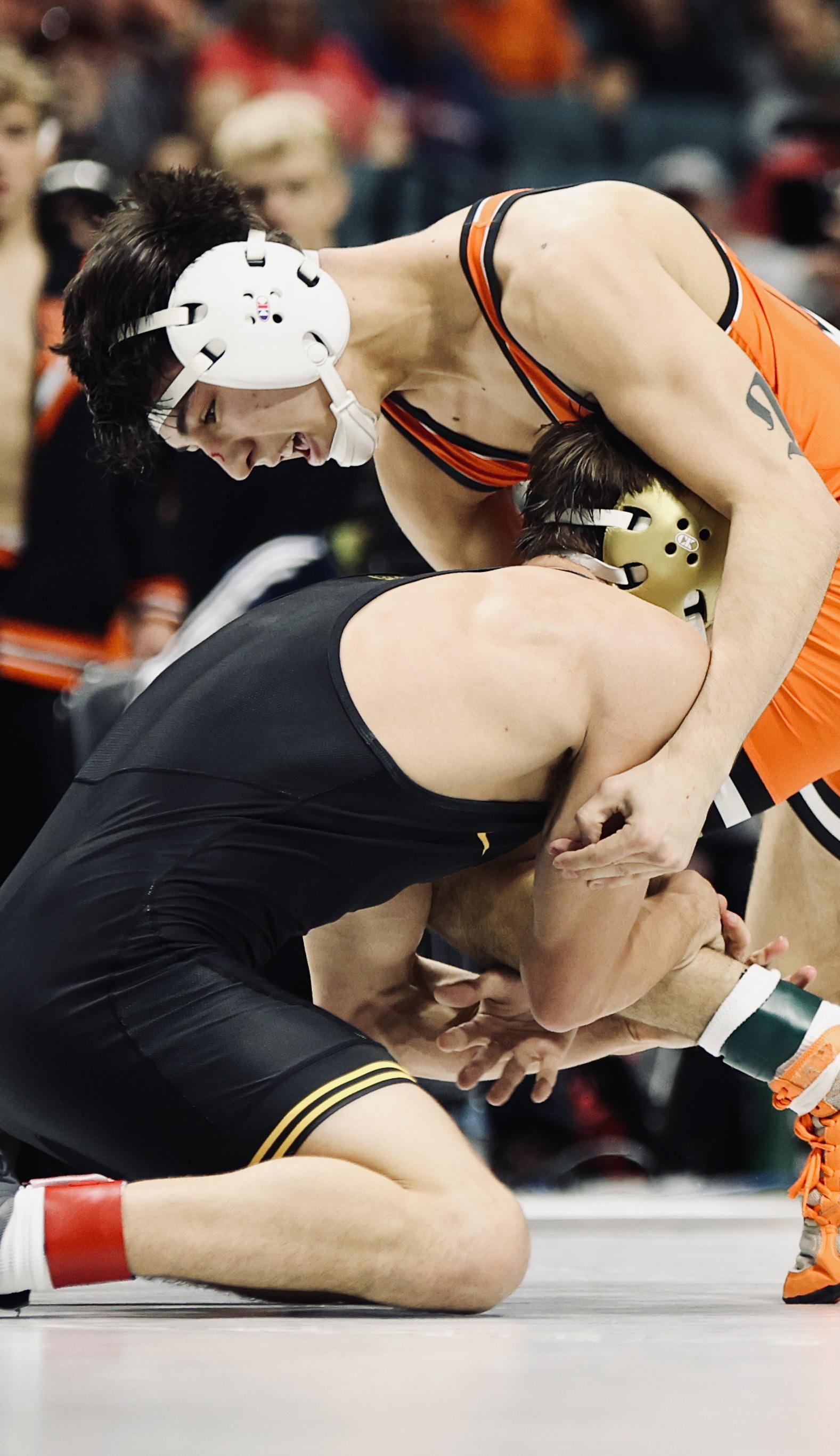
The matchup closes the regular season for OSU. A win would snap a six-dual skid against Iowa, extend the Cowboys’ winning streak to 12 and mark their sixth top-10 victory of the season.
In collegiate wrestling, both programs stand alone at the top.
The Cowboys and Hawkeyes have combined for 58 NCAA team championships and 228 individual national champions — more than half of all NCAA titles ever awarded.
The schools occupy the top two spots all-time in team championships, individual champions and AllAmericans.
Yet despite the historical balance, Iowa has controlled the rivalry of late. The Hawkeyes have won the last six dual meetings, including two against Taylor’s Cowboys.
Taylor suffered his first career dual loss as OSU’s head coach on Feb. 23, 2025, a 21–16 defeat in Iowa City. Earlier this season, the teams met in the semifinal round of the National Duals Invitational in Tulsa, where Iowa edged the Cowboys 21–18 at the BOK Center.
That November matchup came early in Taylor’s second season, at a time when much of his lineup was still finding its footing.

“I think that tournament as a whole, we stepped in there with a young team and maybe we didn’t really know what this season was going to look like,” Taylor said. “You really had one returning starter, the lineup looked very different. Guys were getting tested for the very first time. But they’ve all rebounded well, we’ve continued to make progress, and I think our team is definitely better now.”
Sunday provides a clear test of that growth, as OSU has already stacked 11 wins against ranked opponents and 14 overall. Under Taylor, the Cowboys are 27–2 in dual competition, with both losses coming to Iowa.
For Taylor, the rivalry brings both intensity and opportunity.
The regular-season finale serves as a final measuring stick before the postseason, with OSU looking to protect its home dominance and break through against the Hawkeyes.
“They’re a fun team to wrestle against because their coaches get really excited,” Taylor said. “They’re going to bring their best. People get nervous and get scared about that kind of stuff, but those are the same people who aren’t really strong competitors. You look forward to these opportunities, and we’re excited to go out and compete.”
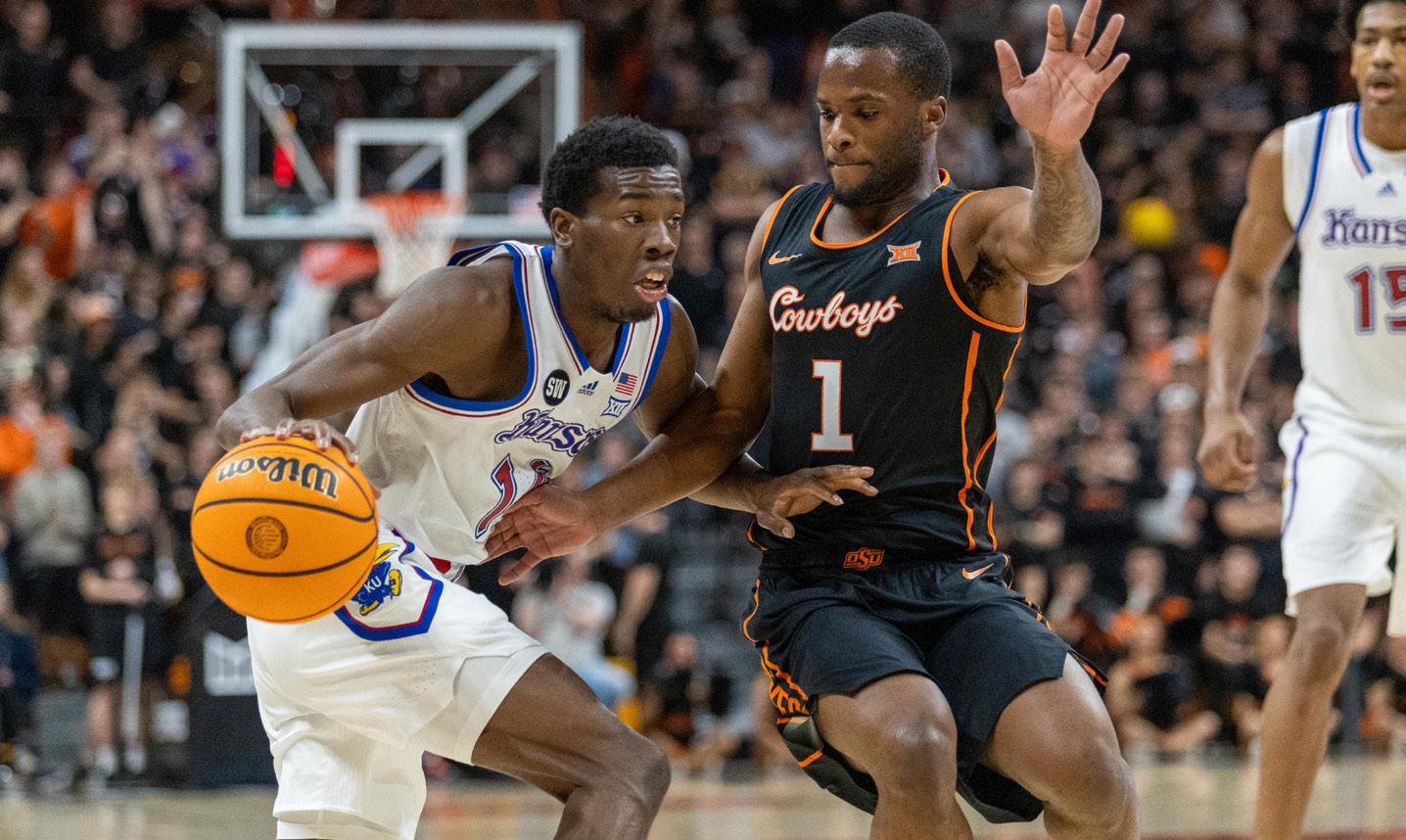
With a chance to put itself back into the March Madness conversation, Oklahoma State failed to seize a muchneeded win on Wednesday night.
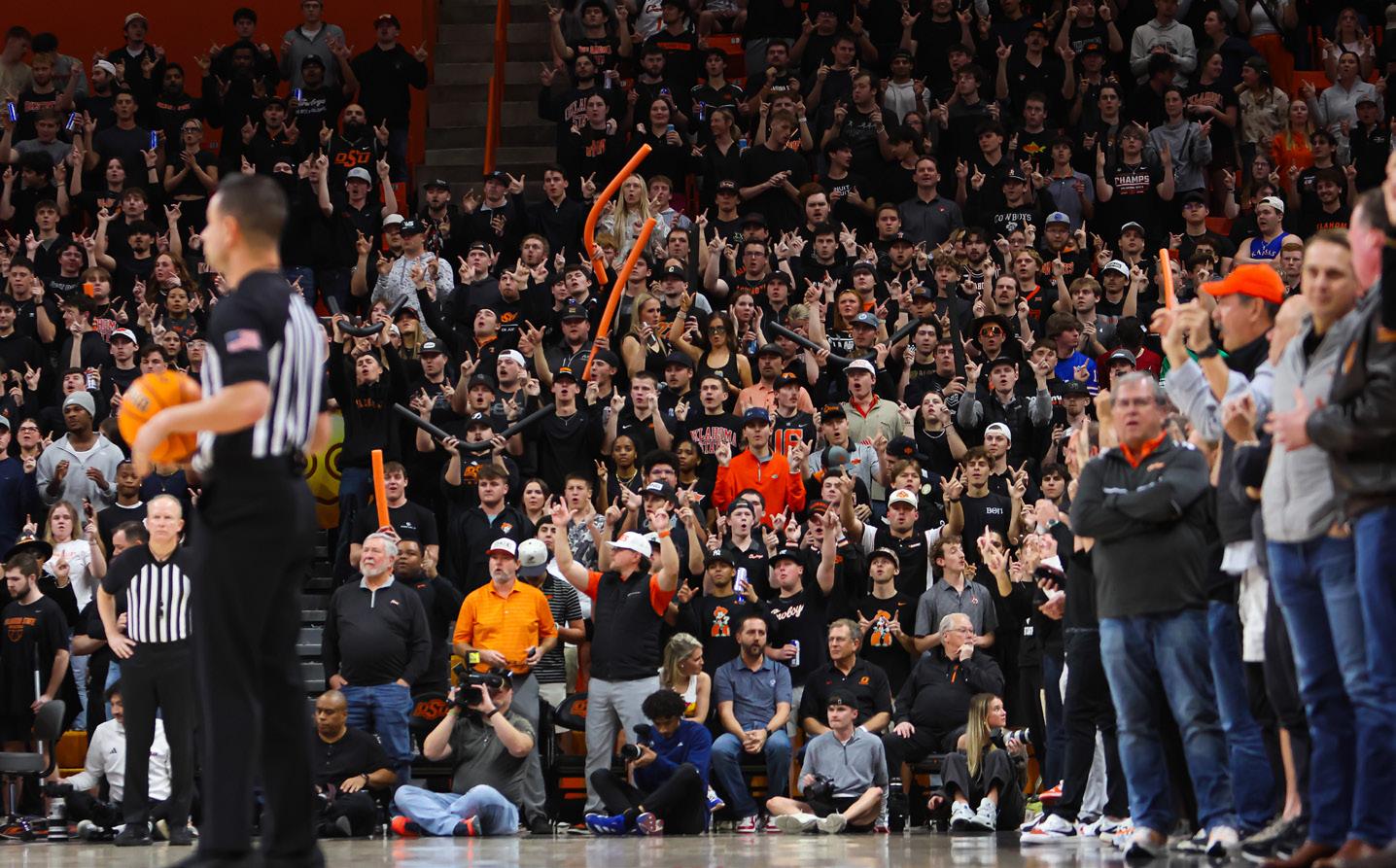
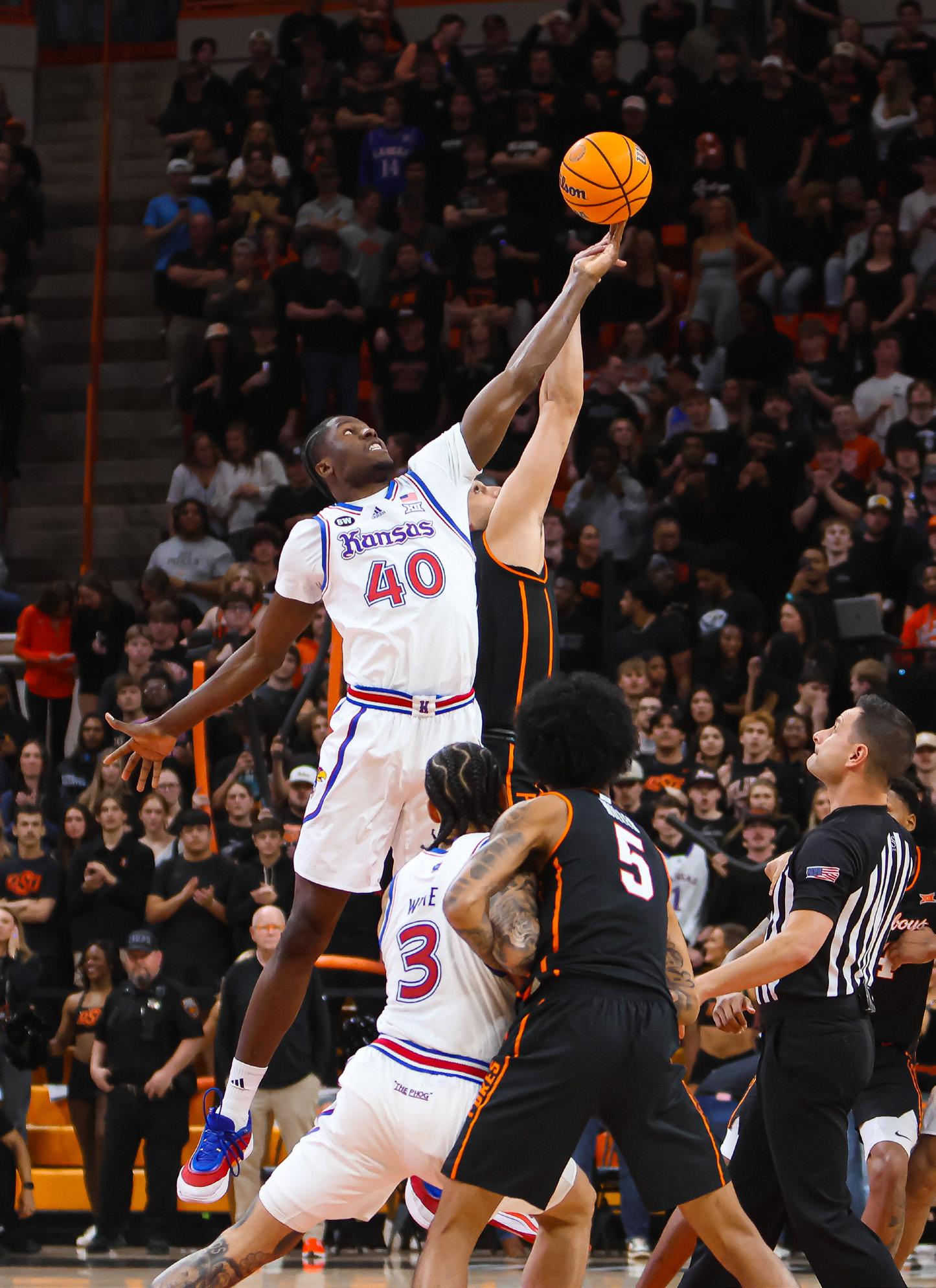
The Cowboy faithful inside Gallagher-Iba-Arena headed for the exit signs before the final whistle in the 81-69 loss to the No. 9 Kansas Jayhawks.
Cowboy fans filled the arena in black for the annual blackout game, but Kansas supporters created a noticeable presence in blue, as the Jayhawks handed the Cowboys their fourth straight loss — their longest skid of the season.
The losing streak comes at the worst time for the Cowboys. Last week, ESPN listed them among the first teams in the field. Now, bracketologists leave the Cowboys out of their projections, and the team’s ranking has fallen into the 76 in the NCAA Evaluation Tool.
“We have obviously fallen off the bubble probably here tonight, or even when we lost the other day,” Lutz said. “But win on Saturday and then you win on Tuesday, against West Virginia, you, you’re back to where you need to be.”
Kansas built its advantage early behind freshman star Darryn Peterson, who scored 20 of his 23 points in the first half. Peterson, a projected top NBA draft pick, shot 7 of 12 from the field, including 6 of 10 from 3-point range before playing limited minutes after halftime.
The Cowboys are now 1-7 versus Quad One opponents. As it stands, the Cowboys will face three quad-one opponents, and likely have to win all three to keep their March Madness dreams alive.
Winning on the road is not something the Cowboys have been good at, but it will have three opportunities to round out its resume. A road trip to Boulder, when the Cowboys face Colorado will be a must-win, as the Buffalo (14-12, 4-9) postseason hopes are nearly crushed after losing two straight.
Potential road wins versus Cincinnati (63 in NET) and UCF (46 in NET) puts the Cowboys back into the bubble conversation.
With two home games remaining, including West Virginia (No. 62 in NET) and Houston (No. 7 in NET), Lutz said the team lost an opportunity tonight, but the Big 12 offers plenty of chances to strengthen its résumé.
“I know I sound like a broken record, but it’s the Big 12,” Lutz said. “You have an opportunity (to get) a Quad 1 win at Colorado on Saturday; you gotta go do it. And then you got West Virginia coming back here... So, we just gotta keep plugging.”
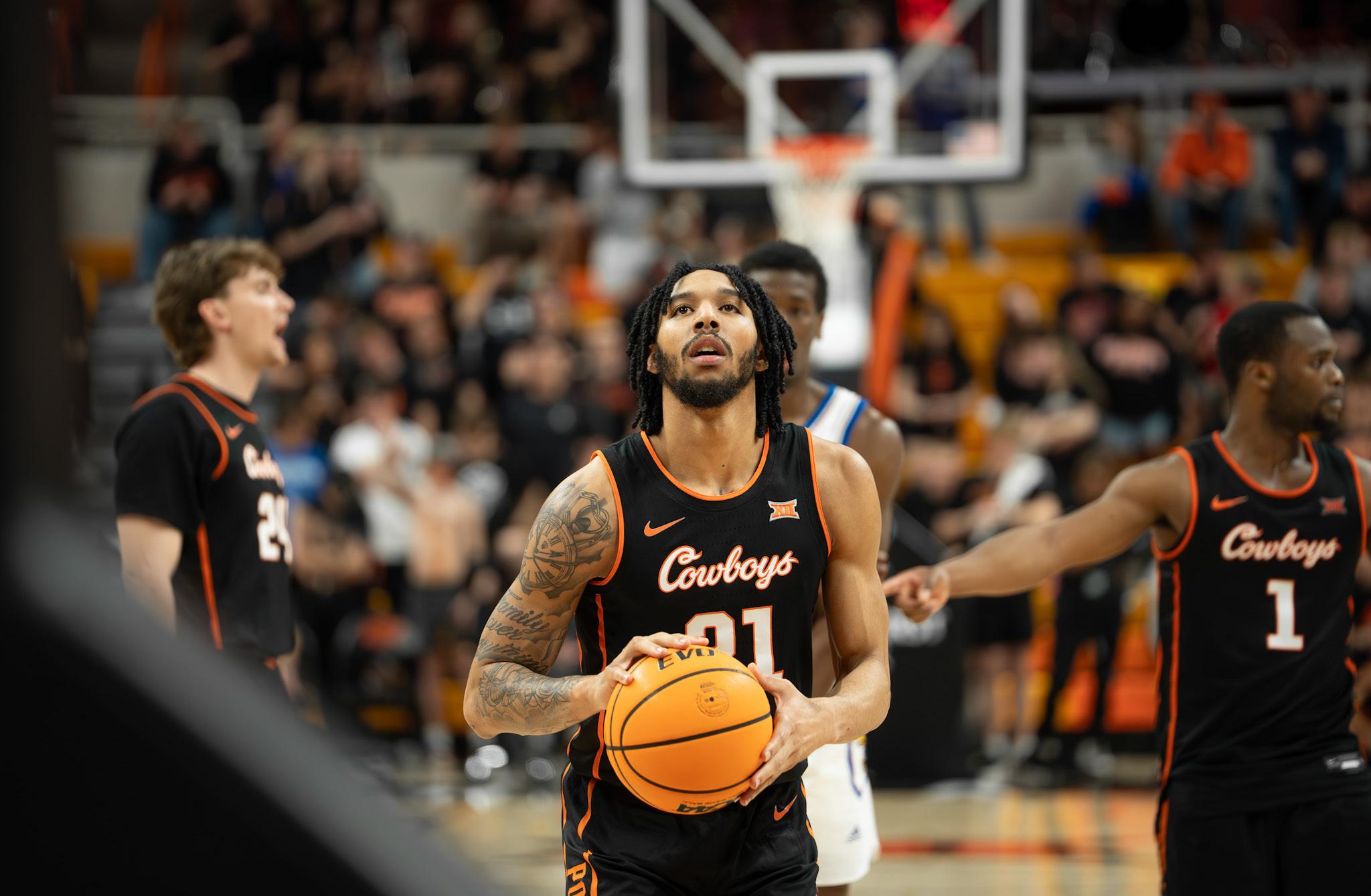
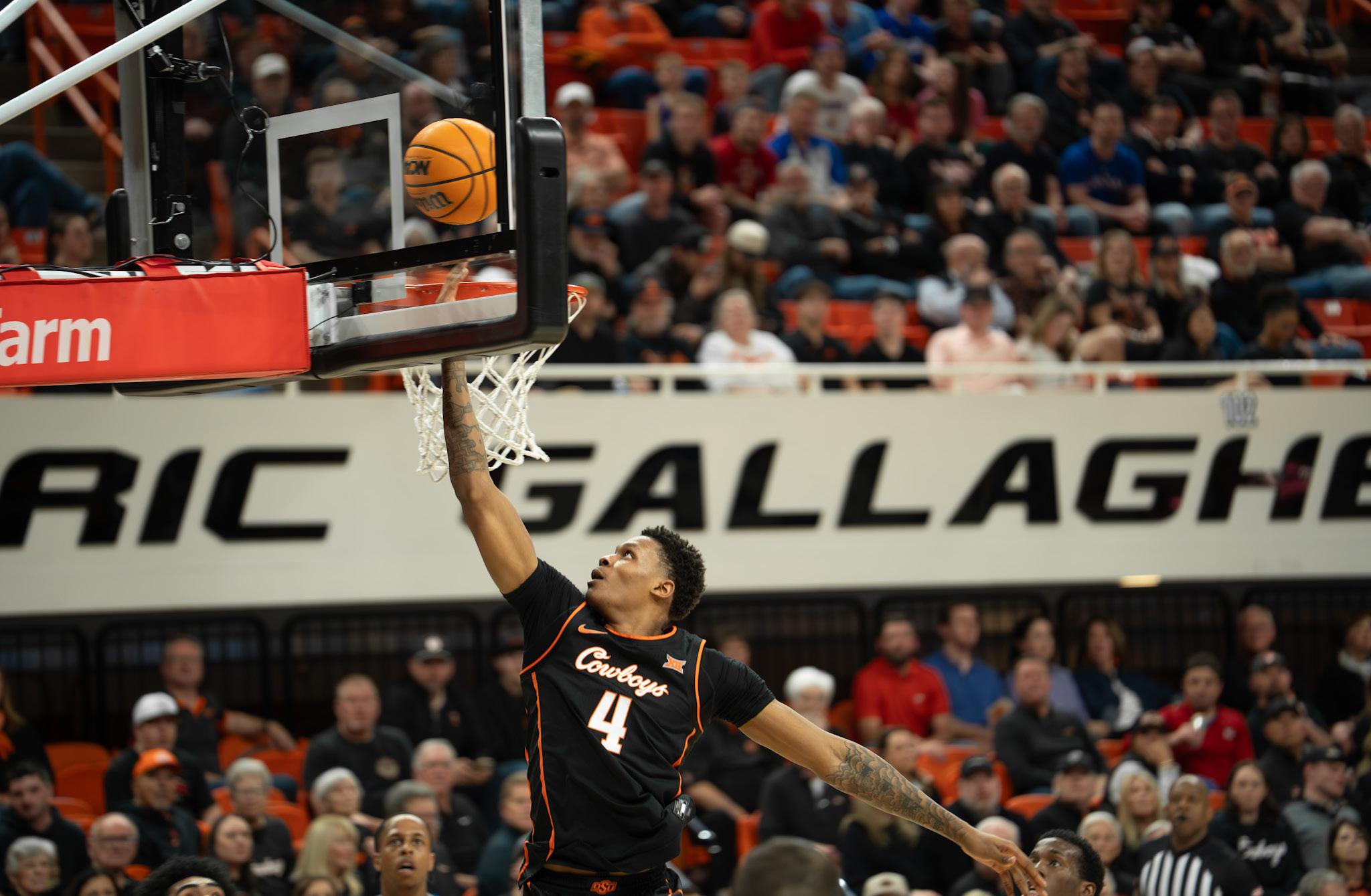
The Cowboys relied on Parsa Fallah, who scored 21 points, and guard Anthony Roy, who put up 16. But they struggled to find their rhythm offensively, shooting 34.8% from the field and 25% from 3-point range.
After a brutal start, the Cowboys trailed by double digits for most of the game. Fallah said slow starts cannot become the norm when aiming to be a tournament team from the Big 12, and said the problem has occurred too often for the Cowboys.
“It’s really been hurting us,” Fallah said. “We did the same thing here versus Iowa State, too. The second half we were pretty good… You can’t play a team like Kansas, which is a great program, first half like that and come out second half and play hard and expect to win the game.”
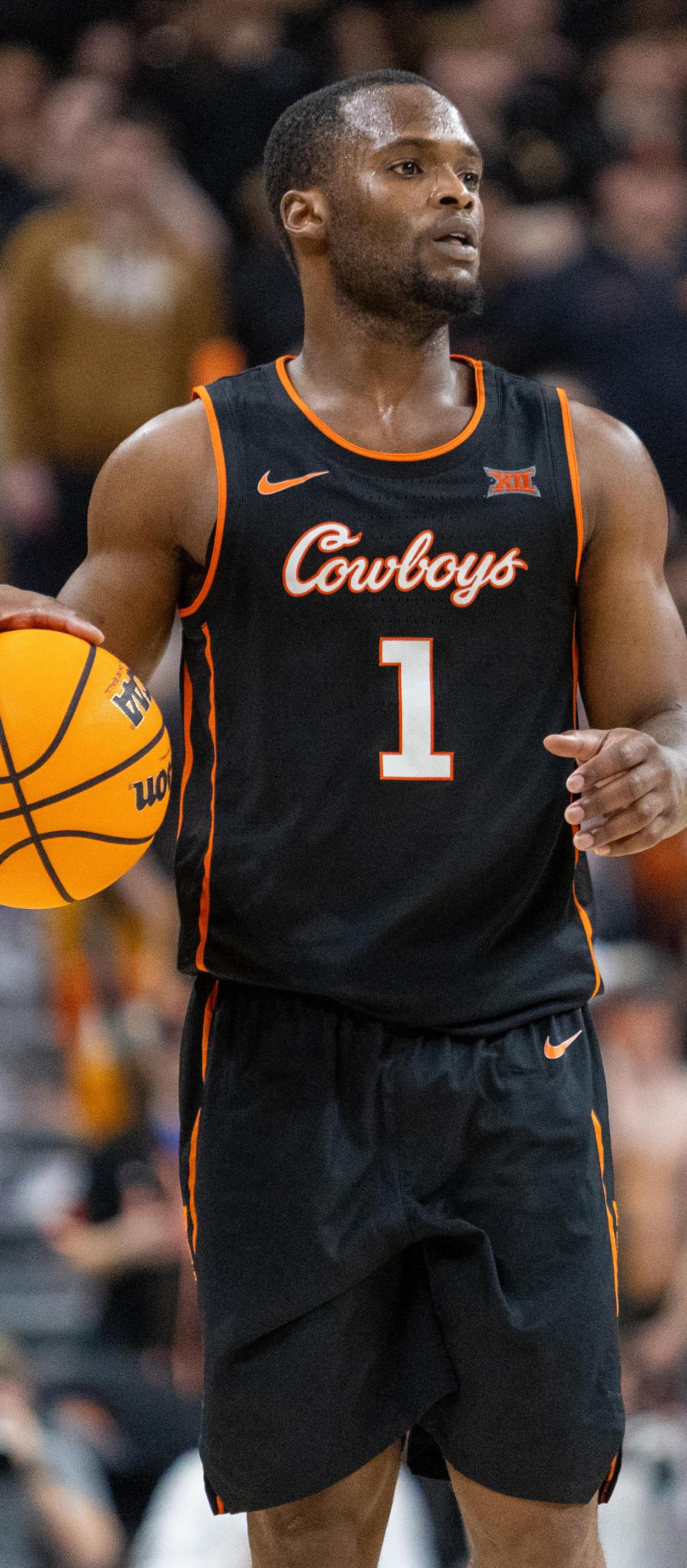
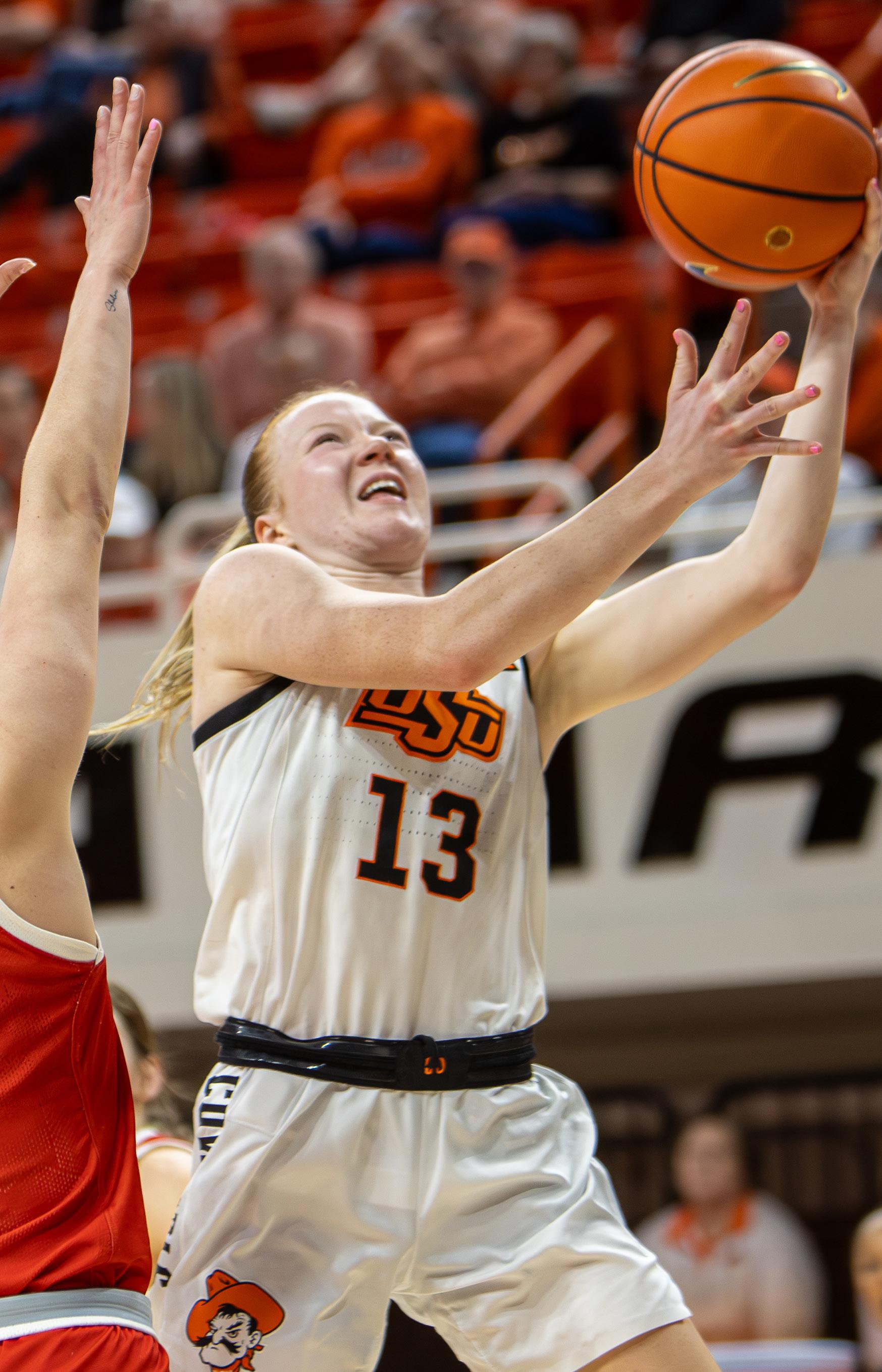
on your side, and you have to kind of figure it out,” Hoyt said. “She carries a heavy load for us and I think she knows that. We’re so reliant on her and what she does for us.”
Cox STAFF REPORTER
Since Jacie Hoyt’s arrival in Stillwater, Oklahoma State teams have been known to light up the scoreboard.
This season is no different, as the Cowgirls have already set two records and are closing in on three more.
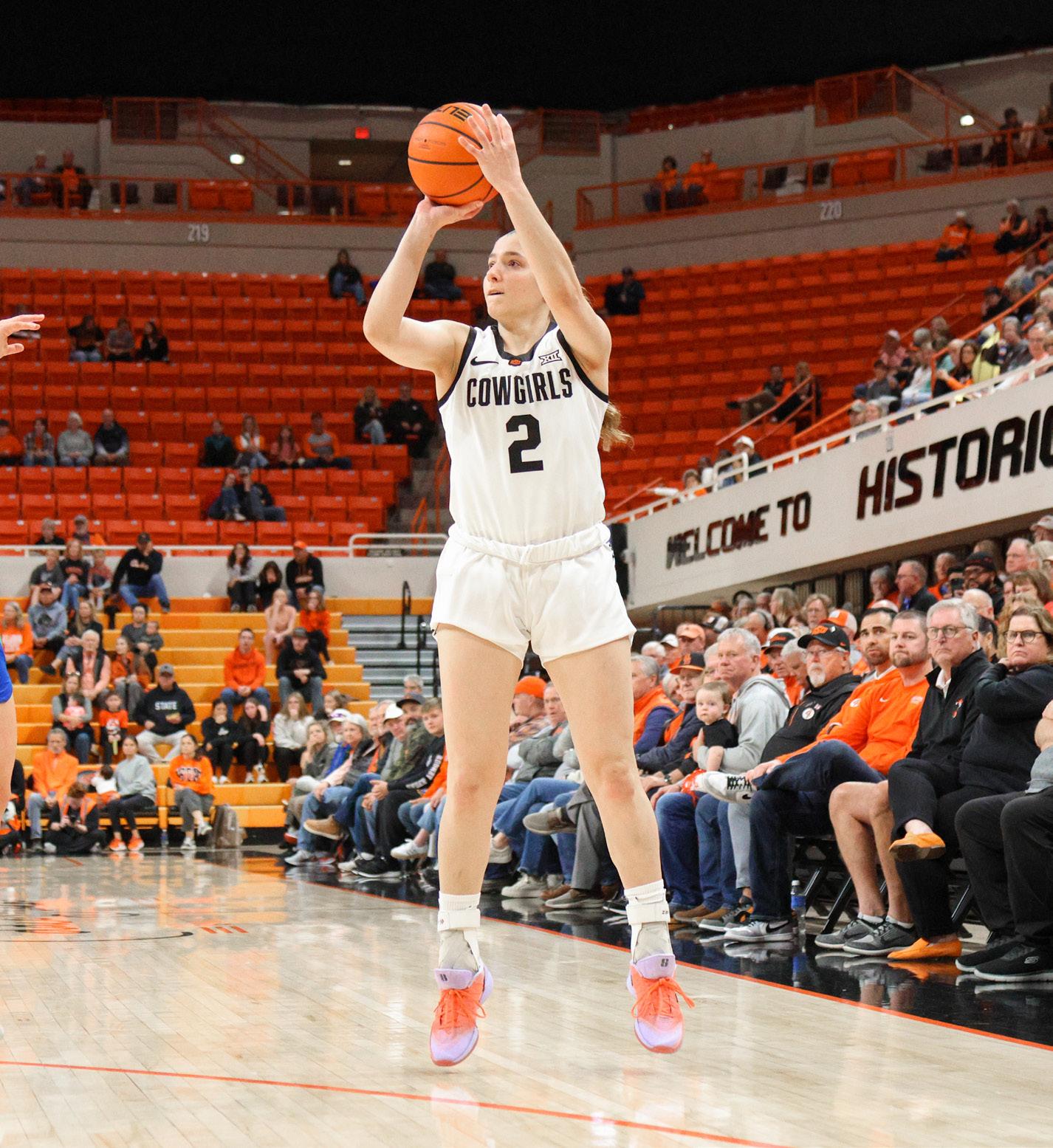
Lena Girardi started the recordbreaking season for OSU when she drilled nine 3-pointers against Langston, a new OSU freshman record. Two games later, she made the Cowgirls’ 72nd 3-pointer of the season, setting a new NCAA record for most 3s in a five-game span to open a season.
The Cowgirls have also built their team around balance and are one of two teams in the country to have six players averaging in double-digits throughout the season.
Micah Gray has been OSU’s leading scorer this season, scoring 15 points per game. Haleigh Timmer and Jadyn Wooten each average around 12. Stailee Heard scores 11.6 points per game, Achol Akot averages 11.2 points and Amari Whiting scores 10 on a nightly basis.
With so many options, Wooten has been able to average 5.1 assists, the most by a player coming off the bench. She believes that has made this season more enjoyable for her.
“For me as a point guard, it’s just fun basketball,” Wooten said. “I can’t imagine how teams prepare for us, because I think there’s so many of us that can have 20-point games on any given night. I think that’s the gift of our team, and it’s what makes us so special. We have so many weapons.”
nationally in 3-pointers per game (9.5) and has four players shooting more than 30% from deep.
With three regular-season games left, OSU has made 267 3-pointers this season and is just five away from setting the program record for most 3s in a season.
Like the Cowgirls, Gray is also closing in on a single-season record. In her first season in Stillwater, Gray showcased her 3-point ability. She drilled 83 3s, a program record, and shot 32.4% from deep.
This season, she is on the verge of breaking her own record. She has 81 3s this season, needing just three more to break her record.
While other teams shy away from shooting 3s, the Cowgirls have embraced it as their strength.
“That’s just kind of what we do,” Hoyt said. “We work on that daily and something we pride ourselves on. I think that’s one of the greatest strengths we have as a team. We just have so many different options from the 3-point line.”
To go along with their 3-point records, the Cowgirls are also in the midst of their best two-season stretch in the 50 seasons they have played at Gallagher-Iba Arena.
On the white maple, OSU has gone 32-2 in the last two seasons, including breaking the record for most wins at home (17) last season.
After 7,098 people showed up for OSU’s upset win over then No.16 Texas Tech, Hoyt praised the fans’ presence.
“The fans were incredible,” Hoyt said. “I felt their energy from start to finish.”
“There’s just an urgency that you can’t coach, teach or explain,” Hoyt said. “You just have to feel it and you can’t simulate it until it’s real. I definitely see that in our seniors.”
The seniors have carried the load for the Cowgirls this season. Gray is averaging 15 points and Timmer is scoring 12.5 points per game.
With the Cowgirls struggling on the road, Hoyt has noticed that Gray and Timmer have motivated their teammates on and off the court, and are making the most of their senior seasons with OSU.
“I’m seeing them wanting to soak up the time they have left with their teammates and appreciate that a little more,” Hoyt said.
With only three regular season games left and the desire to make a deep postseason run, Gray and Timmer have the mindset of finishing the season strong.
“I think it’s a great motivator,” Hoyt said. “It’s great to be in the present. It’s great to appreciate what you have. It’s great to want to win so you can extend it as long as possible.”
After being a secondary scorer for OSU last season, Gray has emerged as the Cowgirls’ leading scorer this season. Last season, consistency was a struggle for her. She shot less than 25% in seven games, and has seen that number drop to just three games this season.
With Gray being a primary option for the Cowgirls, Hoyt has seen a higher level of urgency out of the senior guard.
“You don’t have the luxury of time
While Gray was on the OSU roster that played South Dakota State in the NCAA Tournament last season, Timmer is the only Cowgirl that has advanced in the tournament. She played for the Jackrabbits team that eliminated OSU last season and advanced to the second round of the 2023 tournament.
With Timmer joining OSU’s roster, Hoyt knew she was bringing in a proven winner. While Timmer’s experience is key for the Cowgirls, Hoyt has seen her impact beyond the court.
“We knew the experience that we were getting with her,” Hoyt said. “(With her) experience of winning and scoring. We knew what a special player we were getting when she came to us out of the portal. I’m really happy for her that everything we talked about is coming to fruition and she’s getting a taste of success at the highest level.”
Entering a new scenery for her senior season, Timmer had a goal of making the most of the time she had left and believes her achievements are a testament of that.
“I think my mindset going into this year is just emptying the tank and giving it everything that I have,” Timmer said. “I think it is a cool reflection of all the amazing experiences that I’ve had in college and now being a Cowgirl and finishing it how I want to.”
sports.ed@ocolly.com

The Cowgirls have also been deadly from beyond the arc this season and are closing in on setting the singleseason 3-point record.
OSU currently ranks eighth
While the Cowgirls still have three games left in their season, they have made it one to remember with their record-breaking performances.

“For I am already being poured out as a drink offering , and the time of my departure Is at hand. I have fought a good fight. I have finished the race, I have kept the faith. Finally, there is laid up for me the crown of righteousness, which the Lord, the righteous Judge, will give me on that Day, and not to me only but to all who have loved His appearing.”. (2 Tim.4:6-8 NKJ)
Here is a man who has lived a life in serving the Lord Jesus and others. He is in a prison cell, expecting his execution at any time. According to history, Paul was beheaded at Rome.
In his last words to a young man and minister, Timothy; Paul was looking ahead to greater and lasting judgement that would come from Christ himself. A
well done to a good and faithful servant. We all can take encouragement from his life of service to the Lord and his vision of something much better that awaited him.
As Jesus neared the end of his life. He prayed:to God “I have glorified You on the earth. I have finished the work which you have given me to do. And now, O Father, glorify me...with the glory which I had with you before the world was.” (Jn.17:4-5 NKJ)
Brother and Sister in Christ: Let us set our goal for a triumphed ending by finishing the work God has called us to do. If it be large or small to our eyes; no matter! Let’s