Friday, April 3, 2026

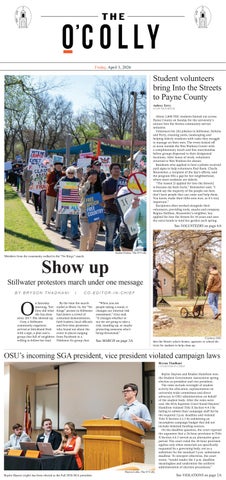
Members from the
![]()

Friday, April 3, 2026

Members from the
BY BRYSON THADHANI I CO-EDITOR-IN-CHIEF
On Saturday morning, Tori Grey did what she has done since 2017: She showed up. Grey, a Stillwater community organizer, arrived at Strickland Park with a sign, a plan and a group chat full of neighbors willing to follow her lead.
By the time the march ended at Block 34, the “No Kings” protest in Stillwater had drawn a crowd of costumed demonstrators, faith leaders, local officials and first-time protesters who found out about the event in places ranging from Facebook to a Pokémon Go group chat.
“When you see people taking a stand, it changes our internal risk assessment,” Grey said. “It changes whether or not we are going to take a risk, standing up, or maybe protecting someone who’s being threatened.”
See MARCH on page 3A
About 2,800 OSU students fanned out across Payne County on Sunday for the university’s annual Into the Streets community service initiative.
Volunteers hit 282 jobsites in Stillwater, Perkins and Perry, cleaning yards, landscaping and helping elderly residents with tasks they struggle to manage on their own. The event kicked off at noon outside the Wes Watkins Center with a complimentary lunch and free merchandise before groups dispersed to their designated locations. After hours of work, volunteers returned to Wes Watkins for dinner.
Residents who applied to host a jobsite received yard signs to help volunteers find them. Charla Branstetter, a recipient of the day’s efforts, said the program fills a gap for her neighborhood, where most residents are elderly.
“The reason [I applied for Into the Streets] is because my back hurts,” Branstetter said. “I would say the majority of the people out here don’t have people that can come and help them. You know, make their little area nice, so it’s very important.”
Recipients often worked alongside their volunteers, providing tools, snacks and company. Regina Halihan, Branstetter’s neighbor, has applied for Into the Streets for 10 years and uses the extra hands to tend her garden each spring.
See VOLUNTEERS on page 6A


CO-EDITOR-IN-CHIEF
Baylor Haynes and Braden Hamilton won the Student Government Association spring election as president and vice president. The roles include oversight of student activity fee allocation, representation on university-wide committees and direct advocacy to OSU administration on behalf of the student body. After the votes were cast, the SGA Supreme Court found Haynes/ Hamilton violated Title X Section 4.4.3 by failing to submit their campaign staff list by the required 5 p.m. deadline and violated Title X Section 4.2.3 by submitting an incomplete campaign budget that did not include itemized funding sources.
On the deadline question, the court rejected the argument that a 24-hour provision in Title X Section 4.4.3 served as an alternative grace period. The court ruled the 24-hour provision applies only when materials are specifically requested by a governing body, not as a substitute for the standard 5 p.m. submission deadline. To interpret otherwise, the court wrote, “would render the 5 p.m. deadline meaningless and undermine the uniform administration of election procedures.”
See VIOLATIONS on page 2A
Bryson Thadhani CO-EDITOR-IN-CHIEF
A Stillwater man was arrested March 24 on suspicion of multiple child sexual offenses after Stillwater Public Schools reported a possible assault to law enforcement, according to police.
Police said detectives arrested Robert Franklin Holbert, 24, at 5:14 p.m. on suspicion of first-degree rape, lewd or indecent proposals or acts to a child, rape by instrumentation and child sexual abuse. At about 1 p.m. March 24, a Stillwater Public Schools official notified a Stillwater Police Department school resource officer about a possible child sexual assault. Detectives
responded and began coordinating with school staff, the Oklahoma Department of Human Services and the Saville Center as part of the investigation.

Stillwater Police Department Robert Holbert, 24, was arrested on March 24. news.ed@ocolly.com

Baylor Haynes (right) has been elected as SGA president, with Braden
SGA President and Vice President Baylor Haynes and Braden Hamilton are Oklahoma natives whose campaign centered on connecting the OSU student body to SGA. They ran under the slogan “#BeHeard,” which the pair said will shape their cabinet and guide their time in office. Their platform focuses on expanding SGA’s communication with students, increasing awareness of campus resources and strengthening two-way accountability within the organization.
Haynes, an accounting major from Washington, Oklahoma, previously served with the Presidents Leadership Council, Freshman Representative Council and Phi Gamma Delta fraternity. He said students can expect a more visible SGA presence.
“The students of Oklahoma State can expect to see more communication from the Student Government Association,” Haynes said. “This may be done through existing channels of communication, such as Instagram, Canvas and TikTok, or by starting something new and unique to reach the students.”
Haynes also pointed to mental health as a priority.
“The students should expect to see changes in programs so they can thrive, and the continuation of programs that are already thriving across campus,” Haynes said. “We will make the reforms necessary to see a real improvement.”
Hamilton, an agricultural business and pre-law major from Durant, Oklahoma, has served as an SGA senator for the Residence Halls Association and as a Freshman in Transition and UNIV1111 Student Academic
Editorial board
Co-Editors-in-Chief Bryson Thadhani & Parker Gerl editorinchief@ocolly.com
Design editor Katie Lehew design.ed@ocolly.com
Social media editor Jose Brito news.ed@ocolly.com
Assistant news & lifestyle editor Caleson Coon news.ed@ocolly.com
Mentor. He said that experience drove him to run.
“I have seen firsthand that too many students feel unseen, especially when it comes to mental health,” Hamilton said. “No student should feel like an ‘other’ for struggling. Every student deserves to feel heard, valued and supported.”
Hamilton said he plans to let the Cowboy Code guide his time in office and intends to push for tangible improvements to student life.
“I will advocate for students in meaningful, tangible ways,” Hamilton said. “Whether that’s improving access to nutrition information in campus dining or expanding awareness of basic needs programs to better serve all students, on and off campus.”
Haynes and Hamilton are set to take office at the conclusion of OSU’s spring commencement ceremony.
news.ed@ocolly.com
Continued from 1A
The punishment issued was a Level Two violation, suspension of active campaigning. Because the ruling came nearly three weeks after Election Day, the penalty carried no practical consequence. A campaign that was already over cannot be suspended.
SGA withheld certification of election results pending the judicial process. Results were certified following the March 30 ruling, and Haynes/Hamilton were declared the winners.
The court declined to disqualify the ticket despite finding two violations, ruling that disqualification authority on budget grounds rests solely with the Internal Affairs Committee under Title X Section 2.1.2.2.2 of the SGA bylaws. That provision states a ticket shall be automatically disqualified if IA finds it did not submit a valid budget by the applicable deadline. The committee never made that formal determination, and without it, the court ruled its hands were tied.
“The role of this Court is to assess violations and impose corresponding levels of sanctions, not to make an initial determination as to whether a campaign budget is valid for purposes of automatic disqualification,” the opinion reads.
The court also noted that the SGA Co-Coordinator had “clearly and repeatedly” communicated all other election deadlines to candidates but had not done the same for the campaign list deadline. The court recommended that either all deadlines be communicated consistently to candidates or none, to ensure uniform enforcement.
Wilson/Hoffee also violates rules
A second presidential ticket, Joshua Wilson/ Kylie Hoffee, was found in violation in a separate opinion issued the same day. The court ruled that Wilson violated Title X Section 4.3.1 by campaigning during an open SGA meeting Jan. 29, when he allegedly told attendees at an informational session in the Student Union Regency Room to “vote
for Josh.” Wilson denied making the statement, but the court ruled the plaintiff met the preponderance of evidence standard.
Associate Justice Luke Tate, while agreeing with the open meeting ruling’s outcome, expressed frustration with how the plaintiff built its case on that question. Tate criticized plaintiff’s counsel for failing to call a single witness “who did not and would not have a vested interest in the outcome of this case,” adding that he hoped counsel would “strive for better behavior and preparedness in their hopeful future legal careers.”
The court also found Wilson/Hoffee failed to report hot cocoa distributed at a campaignrelated event at Patchin Jones Hall on March 5 as either an expenditure or donation, a violation of Title X Sections 4.2.3 and 4.2.4. Tate dissented on that ruling, arguing the majority dismissed a sworn affidavit from Patchin Jones’ board of directors, which stated Wilson/ Hoffee were guests, not hosts, in favor of an Instagram post. “A punchy title should not be taken as dispositive of who hosted a social gathering,” Tate wrote. “Patchin no more cohosted this gathering with Wilson/Hoffee than a gubernatorial candidate co-hosts a regular Rotary Club meeting at which he is invited to speak.”
The court found no violation against Wilson/ Hoffee related to the Hoops for Hunger event held March 6-8 at the Beta Theta Pi basketball court, establishing new precedent distinguishing between a “financial intermediary,” a third party that transfers value to a campaign and triggers disclosure, and a “logistical intermediary,” a third party that participates independently without transferring value and does not require reporting.
Both opinions were signed by Chief Justice Parker Lockhart and Associate Justices Aislyn King and Tate and will serve as binding precedent in future SGA elections. Haynes and Hamilton are set to take office at the conclusion of OSU’s spring commencement ceremony. news.ed@ocolly.com
Assistant social media editor Megan Gibson news.ed@ocolly.com
Photo editor Chance Marick photo.ed@ocolly.com
Assistant photo editor Andon Freitas photo.ed@ocolly.com
Good Trouble Stilly organized Saturday’s march, the third iteration of the nationwide No Kings Day in Stillwater.
Martha Averett and fellow organizer Bonnie Hammond co-founded the local chapter as part of the national Red Wine and Blue network, a grassroots organization of women who share concerns about threats to democratic institutions. The name nods to the late Georgia Congressman John Lewis, whose call to “make good trouble” became a rallying cry for a generation of civil rights advocates.
Averett said she and Hammond drew inspiration from Heather Cox Richardson, a historian whose daily newsletter “Letters from an American” has become a touchstone for politically engaged Americans. After watching Richardson speak with Red Wine and Blue network leaders, the two Stillwater women consulted with organizers in Tulsa, learned the organizational requirements and launched their chapter. They coordinated with organizations, including 50501 and the American Civil Liberties Union. The two earlier Stillwater protests had connected with larger demonstrations in Tulsa and Oklahoma City, but Saturday marked the first time organizers concentrated their energy on mobilizing local residents.
“This is the first time there’s been a really concentrated organization and planning to get local people aware of the fact that they, too, have a voice,” Averett said. “And that they can stand up.”
Saturday’s event reflected months of work. Organizers held sign-making parties in the weeks beforehand.
Participants received printed programs detailing the march route. Speakers included local faith ministers and State Representative Trish Ranson. Attendees wore frog and dinosaur costumes, a tradition
Averett said began in Portland, Oregon, as a way to inject humor and approachability into demonstrations.
Averett said the crowd spanned a wide range of ages, with many people making the physical effort to attend despite challenges.
“There were lots of people who probably would have preferred to stay home but who made the effort to get out and walk and be seen,” she said. “There were a lot of very clever signs. People greeted each other. Do you know this person? Do you know that person? You get to make connections with people in Stillwater that you may never have met.”
She also noted a shift in how passing drivers responded.
In earlier protests, hostile reactions from passing cars were common. Saturday felt different.
“In the past, maybe the last two years, we would have a significant number of people coming by and giving us the finger,” Averett said. “I didn’t see anybody do that this time.”
For Grey, logistics come down to instinct and a 40-50 person group chat she built person by person. When she goes out, whether to a planned march or a solo afternoon at a busy intersection, she sends a message: I’ll be at this corner at this time. Come if you can.
Sometimes she plans a week ahead. Other times she sends the message an hour before she leaves. On a recent morning, Grey stood at the corner of Washington Street and Sixth Street, a stretch of road near Oklahoma State University’s campus, specifically to be visible to students passing between classes.
“I don’t plan on myself to do it rigidly,” Grey said. “That’s the point.”
Grey studies resistance history to sharpen her approach, drawing on the work of scholar Timothy Snyder, who writes about how social conditioning pushes people to obey the unwritten rules of whatever space they enter and how that conditioning can help authoritarian systems take hold.
“As humans, we are conditioned to walk into a space and immediately take in thousands of pieces of information about how to obey in that space,” Grey said. “That’s why we talk about disobeying. That means fighting that human urge to just comply with the pressure around you.”
She said her signs tend toward direct, plainspoken statements for that reason.
“A sign that says this is what is happening is usually what I go for,” Grey said. “It breaks through that hypernormalization.”
James Dixon, a disabled combat veteran who grew up as a dark-skinned, foreign-born kid in Oklahoma, said last year’s No Kings demonstration in Stillwater was his first in-person protest. For years, he had taken his anti-fascist positions online, arguing, posting and debating. He even brought AI into the effort at one point, using it to help frame arguments in Facebook threads. None of it seemed to make a dent.
“It kind of took a toll,” Dixon said. “I quit arguing with them. But seeing the things that they say, this level of cruelty, it still affects me emotionally.”
The streets were new territory, but Dixon said the experience changed something. He brought his dog to Saturday’s march and wore one of the anti-fascist T-shirts he makes, including one that reads “Nazis are the bad guys.” The act of showing up, he said,

does something online activism
cannot
“It was nice to be surrounded physically by people that were like-minded,” Dixon said. “It was good to feel less alone.”
Not every encounter was welcoming. After one protest, Dixon said, a stranger in a car followed him and Grey into a parking lot and screamed at them. That made him more alert, but it did not make him stop.
“I kind of keep my head on a swivel,” Dixon said. “But the support, people rolling down their windows and saying, ‘Hey, we really want to thank you for what you’re doing,’ that makes it worth it. Because I think everybody feels like they’re alone in this.”
Dixon served in the Army infantry and said he joined partly out of curiosity rather than ideology.
“I wanted to see firsthand what the machine looked like from the inside,” he said. “I don’t really have a problem protesting against what the country is doing now because it’s not the same country and it’s not the same military.”
He said he believes the loudest voices today signal a turning point rather than a permanent shift, describing the phenomenon as an extinction burst, a term for when a toxic ideology grows loudest right before it fades.
“I’m choosing to remain hopelessly optimistic,” Dixon said. “And I’m looking forward to what’s on the other side of it.”
Alex, who asked to be identified by a pseudonym due to safety concerns, said they almost missed Saturday’s march as an OSU student attending their first protest.
A message in a Pokémon Go group chat, not a news alert or a political flyer, tipped them off. A fellow player mentioned

attending last year’s Stillwater No Kings march, and Alex filed it away. When planning for this year’s event started circulating on social media, they made sure to attend.
Alex grew up in Tulsa and chose OSU partly because the campus made an active effort to support minority groups. Living in Stillwater as a transgender student, they said, sometimes feels isolating.
“It’s really hard to find people that don’t immediately hate your existence,” Alex said. “Every single person that you see might be voting for legislation that could severely hurt you. When you don’t realize how many other people are like-minded, it starts to feel like you’re just surrounded.”
Grey’s pop-up protest group on Facebook gave Alex a way in. They had seen Grey protesting near a friend’s workplace one afternoon, stopped to hand her a sealed water bottle and struck up a conversation.
“She was super nice, given I don’t know her very well, and very passionate about what she was doing,” Alex said.
The march surprised them. The informational format, with speakers from government and advocacy backgrounds, gave Alex entry points into issues they had not yet researched.
“It gave me branching-off points to go do more research and figure out the best way I can help,” they said.
Terry Low, the Stillwater Police Department’s public information officer, said the department approaches protests with a straightforward priority; protect constitutional rights while maintaining community safety. Stillwater police have no specific protocols for demonstrations. Officers handle staffing decisions case by case, and patrol routes shift based on need. The department
learns about planned demonstrations through special event requests that organizers file with the city and through social media monitoring.
“We provide coverage for the whole community, but we also want to ensure everyone’s safety at protests and can assist if needed,” Low said.
Dixon said he noticed patrol cars pass by during past protests but does not feel threatened.
“I feel like maybe they’re more interested in hopefully protecting us,” he said.
When people ask Grey why she stays in a state where her views put her at odds with many of her neighbors, she does not hesitate.
“I feel entitled to be here to see Indigenous people apologized to for real, and Black people given reparations for real,” Grey said. “I want to be a part of creating safety for them. And I don’t need to leave.”
She also pushes back on the idea that there is one right way to resist.
“It takes all of it,” Grey said. “None of it’s wrong, as long as you’re not endangering people’s lives. Someone makes bracelets, someone goes to the street, someone writes a letter. All of it counts.”
Averett reached for her father’s words when she described what finally pushed her to act.
“He told me: stand up and be counted,” she said. “We cannot watch what’s happening. We have to stand. Our presence in groups of people, especially in small towns in red states, is vital to making a positive, lasting change.”
Dixon put it plainly.
“I think everybody feels like they’re alone in this,” he said. “That’s exactly why we have to keep showing up.”

Marcus Mesis STAFF REPORTER
OSU’s Engineers Without Borders has made an impact in Stillwater and across the world.
Building garden beds at the Payne County Youth Center to installing a water pipeline in rural Guatemala are projects that Engineers Without Borders have done recently.
For club president Connor Crowl, the project itself is never the point.
“The feeling of helping somebody is the greatest feeling in the world, and it’s what Engineers Without Borders is all about,” Crowl said. “It is our mission, and whether we’re in Guatemala, Stillwater, Texas, Germany, India, Russia, wherever. It doesn’t matter, just the feeling of helping people, that is what we’re after.
“We will dig trenches. We will build garden beds. We will build schoolhouses, we will build water pipelines. We will plant flowers. We will demolish buildings, whatever. It doesn’t matter what the project is. What matters is the positive impact that we’re making on these people’s lives.”
Water in Guatemala
During a recent trip to Guatemala, club members had the chance to see firsthand the effects of a water pipeline they designed and funded. International Project Lead Avery Jones said the community’s reaction was unlike anything she expected.
“We were told on our previous trip that they have waited for water for years, and that members of their community have lived and died in the hope that water will be there,” Jones said.
“And so to be able to help this community and see this change in real time, see them before they have the water and the pain that they were going through, and now seeing them with the water and the change that has made in their life firsthand is very impactful.”
While testing taps installed near homes to ensure the water was clean, members spoke with community residents about what the pipeline meant for their daily lives.
“One member of the community we talked to specifically, she had to travel about two miles a day, uphill and downhill, to gather water,” Jones said. “And this water she would collect in a jug that she’d carry on top of her

head, and this would take a significant portion out of her day, and it was very exhausting for her.”
Crowl also spoke with a woman who lived on a coffee farm on a hill and had to leave her three children at home each time she went to get water.
The trip was not only about checking on the pipeline.
The club also gathered measurements and community feedback for a planned schoolhouse.
“The community currently has 60 families, but only 28 of them can send their children to school, just because there’s not enough space,” Jones said.
“We want to be able to increase the space there for all those families to be able to have their children in that school. Most of the grades are combined together in one room, so it makes learning more difficult when you don’t have a group of students dedicated to their learning group and their learning age.”
One of the current school buildings is a single large room divided by sheet metal, which causes sound to carry between both sides.
“I was standing on one half, and Jose was standing on the other half. We were talking almost at a whisper and we could hear each other perfectly clear,” Crowl said.
Community members made clear how much the schoolhouse project meant to them.
“They just kept saying how grateful they were that we didn’t just say we were going to do something,” Crowl said. “We’re actually doing something about it. When we were down there having our first main meeting about the schoolhouse, they really wanted us to understand that their kids are one of, if not the most important part of their community, and their education is just at such a high level of importance for them.”
Garden beds in Stillwater Back home, Engineers
Without Borders designed and built a set of garden beds for the Payne County Youth Center. The project may look smaller on paper, but it gave Crowl a new perspective on what small-scale work can mean.
Hundreds of high school students and their parents flocked to OSU for the first Junior Sneak Peek recruitment event on Saturday afternoon.
The event attracted about 900 people to the campus from surrounding towns and cities as well as from surrounding states.
Dana Killam, a father from Dallas, thought the event was informative and important for parents and students.
“Our daughter hasn’t decided where she wants to go yet,” Killam said.
This is the first recruitment event held for juniors. In the past, OSU has held events for high school seniors, such as OSU Experience, but never something in which the concentration was specifically on juniors.
KACY CARNEY | CONTRIBUTING WRITER, 1996
“It’s all about the little things,” Crowl said. “It’s all about the eggshells in the garden bed. It’s all about the potatoes that they’ll grow. It’s all about the tomato vines that grow up these doors that we think are just not good enough, but are perfect for them.”
Domestic Project Lead Raeleigh Nester said the time spent building mattered as much as the finished product.
“It was really big for one of the boys that lives there to be able to spend time with some other good guys and be around that kind of presence, and get to do guy things and build some stuff,” Nester said. “Getting to spend time with some of the other girls that live there and just joking around and having a good time.”
Club member Ryan Alexander said the moment the first bed came together was enough to make the work worth it.
“When we put on the first doors, everyone started cheering because we could see that the door actually fit, and all the posts were put in right
and all the boards were cut to the right length,” Alexander said.
For some of the youth at the center, the garden beds opened up possibilities beyond just growing food.
“There was a little girl who was over the moon about finally getting to compost her eggshells and put them in the garden bed,” Crowl said.
Club member Jose Munoz said the work is never about what members get out of it.
“I always hate thinking about how it brings me joy,” Munoz said. “We should be doing this for their sake, and whatever comes with that is a bonus.”
Nester agreed, saying the sacrifice is always worth it.
“I don’t think that you are putting yourself out by putting others before yourself and serving others, even if it inconveniences you,” Nester said. “I missed an entire day of studying for exams, but I am okay with sacrificing that time because I got to put other people first and help bring them joy and bring them happiness.”
news.ed@ocolly.com

BY BRYSON THADHANI I CO-EDITOR-IN-CHIEF
Smoke was the first thing Katherine Rouner noticed.
From her north-facing dorm window, Rouner, a psychology major, watched a brown haze creep over Stillwater on March 14 last year as group chats buzzed and gas stations filled with students trying to outrun a fire they couldn’t see. She grabbed her keys and drove south to a friend’s place, only to find empty pumps and long lines.
Rouner remembers the scramble at the pumps more than anything else.
“Everybody was freaking out and the pumps were dry,” Rouner said.
A few blocks away, in a windowless basement most students never see, the day looked different.
The emergency operations center, a hardened “war room” with a generator, independent air system and a conference table that rises to reveal a tangle of power and data ports is in the lower level of University Health Services.
On wildfire days like last March, the center flipped from quiet monitoring mode into full activation. This is where university leaders, police, emergency managers and communicators gather when things go wrong on or near campus, whether it is a wildfire pushing smoke over Stillwater, a tornado warning moving across Payne County or 40,000 people packed into Boone Pickens Stadium for a Boys
From Oklahoma concert.
State and local officials estimated that more than 26,000 acres burned in and around Payne County on March 14 and the fires destroyed or damaged nearly 100 homes in and around Stillwater.
‘Every incident is handled the same way’
For OSU Police Chief Michael Beckner, the March wildfires were his first major activation in Stillwater.
He remembers watching conditions deteriorate through the afternoon, rising winds, smoke pushing toward campus, phone calls from parents across the country who were seeing alarming TV coverage but had no idea where those evacuation maps were.
“We were monitoring it at 3 o’clock and it just progressively got worse,” Beckner said.
Smoke was going to affect campus, Lake Carl Blackwell was in the path, and assisted living centers needed help moving residents.
“Our community needed to get information to understand what was going on,” Beckner said.
From the operations center, staff could pull up fire updates, watch weather, traffic and coordinated with city and state partners. One of the first big decisions involved rerouting OSU buses to help evacuate nursing homes and lake residents, disrupting regular transit service. Officials also ordered an evacuation at Lake Carl Blackwell, knowing some RVs and campers might not make it out in time.
“Every incident is handled the same way,” Beckner said. “The elements are just different.”
Wildfire, tornado, mass-evacuation, the template does not change, he said, only the hazard.
Making calls people don’t like in the moment, like telling them to leave, is the hard part is.
“You can replace property,” Beckner said. “You can’t replace life.”
The basement room built for bad days Capt. Dan Ray has spent 26 years with OSU Police. He runs emergency management and oversees the room. If he had 30 seconds to explain it, Ray said, he would say it is the place where the university’s decision-makers go when they need to manage a major emergency or a big planned event.
On a normal day, the center looks like a slightly overbuilt conference room: a big table, chairs, a wall of screens. Almost everything in it targets a worst-case scenario. There are levels of redundancy for phones and data, including a FirstNet cellular system that would keep critical communications alive even if the campus network went down.
When the operations center activates, the space changes. The table rises, revealing phone lines, power and ethernet ports for each seat. Representatives from police, fire, facilities, student affairs, housing, athletics and communications take assigned spots depending on the situation. If it is a weather day, emergency management and communications are the first in; if it is a concert or football game, athletics and public safety might dominate the room. The setup is flexible enough to handle a wildfire, a tornado outbreak or a stadium show under the same roof.
Ray remembers several moments when it felt like the room performed exactly as intended. There was a multi-day, 24-hour-a-day activation during COVID -19, a tornado outbreak where a meteorologist sat beside them watching radar specific to Stillwater, the wildfires, when every screen seemed to fill at once. He also points to the April 15 Boys From Oklahoma concerts, when the center quietly tracked what was happening inside the stadium and in the city at the same time.
He said people might not expect the tone.
Hollywood likes to show emergency command centers as shouting matches and sprinting staffers. Ray compares the operations center to NASA’s Mission Control instead.
“This area has to maintain a level of calmness,” Ray said. “The chaos stays outside.”
Inside, people have roles, speak in measured tones and try to see the whole picture.
“We are paid to be professional and mitigate the danger,” Ray said. “You don’t see Mission Control losing their shirts, and you’re not going to see that here, either.”
From first ring to ‘chaos coordinator’ If Beckner and Ray are the front-of-the-room faces of OSU’s response, associate emergency manager Travis Eastman is the one keeping an eye on everything in motion. He started in dispatch 18

years ago, supervising the communication center before moving fully into emergency management, and that background shaped the center’s design.
“When something’s happening, a lot of times it’s dispatch that are the first people that receive that call,” Eastman said. “They’re there 24/7.”
When a major call starts, it almost always starts in dispatch: a 911 call about a crash, a smoke report, a medical emergency in a dorm and a storm damage report. On a busy night, dispatchers are juggling officers on traffic stops, reports from residence halls and new calls coming in. In the past, that was also when administrators tended to crowd the room to find out what was happening, a natural instinct that made it harder for dispatchers to work.
The new operations center solves that tension with a single workstation in the back right corner next to Ray’s office. Eastman calls it, with a little reluctance, the chaos coordinator desk.
“I don’t really like the word ‘chaos’ with emergency management, because we want to exude composure and calm,” Eastman said. “But when there’s a lot going on, this is the person that makes sense of it for everyone.”
From that desktop, someone can see the same live computer-aided dispatch screens, unit locations and radio traffic as the call takers. The coordinator can brief administrators, fire questions back to dispatch and relay decisions out to the field, all without anyone looming over a dispatcher’s shoulder. On football Saturdays or concert nights, that desk links three layers: stadium dispatch handling calls inside Boone Pickens, campus dispatch covering the rest of OSU and the operations center watching the big picture.
During the wildfires, that flow of information turned into a life-safety decision. The center had deployed officers into parts of the Lake Carl Blackwell area to evacuate residents. As reports came in from fire crews and multiple radio channels, Ray and Eastman realized flames were starting to encircle some of the officers. From the center, they ordered units pulled out of certain roads and redeployed them to safer spots.
Eastman says weather is his favorite thing. On calmer days, his attention is often on the radar. He went through training with Oklahoma’s Mesonet program, which grew out of a partnership between Oklahoma State and the
University of Oklahoma to scatter instrument stations across the state. Those sites measure soil moisture and temperature, wind speed, humidity and rainfall, and feed into tools emergency managers can use to interpret radar for themselves.
“Fires are, in a lot of ways, the result of a weather event,” Eastman said. “You’ve had very low humidity, very dry air and really strong wind that day. It has ingredients, just like a tornado has ingredients.”
In the center, Eastman can pull up the same radar feeds National Weather Service meteorologists use, then cross-check them with real-time reports coming in from OSU and Stillwater. He watches humidity drop and wind shift on fire days and estimates hail and gusts on storm days.
“Sometimes you’re just making sure a storm does what it’s supposed to do,” Eastman said. “Other times, it’s the difference between a typical spring thunderstorm and a night where sirens and alerts need to sound.”
Either way, Eastman said, communicating in a way that is calm and professional is the goal, even when Oklahoma’s broader weather coverage leans dramatic.
“I want students to know how much the university has committed to safety,” Eastman said. “We’re not often seen, but that doesn’t mean we’re not working behind the scenes.”
Turning bunker chatter into alerts
None of the decisions in the operations center matters if no one knows what to do. That is where the university’s Crisis Communication Response Team comes in.
The group took shape in March 2022, when OSU’s brand management staff started holding lunch-and-learn sessions with people who had led the university through tragedies.
Oklahoma State has seen its share of tragedy, university spokesperson Shannon Rigsby said.
“Those meetings were heartbreaking but immensely valuable,” Rigsby said.
From there, the group dissected what it had heard and “outlined roles and responsibilities and began assigning people in a depth chart.”
The team includes about 18 people with defined roles and backups so they can cover multiday situations. It runs at least three simulations a year, rehearsing scenarios from severe weather to threats and major system outages. Rigsby said team members
rotate on-call and activation shifts so that when the operations center activates, someone from the crisis group can be there around the clock.
When the center activates, one or more of those communicators are physically in the room with Ray and his staff.
“Several members of the crisis communication response team were in the EOC for the wildfires, and we set up shifts to continue communication coverage throughout the weekend,” Rigsby said.
During the Boys From Oklahoma concerts in April, the setup looked a little different.
“I was in the EOC, but team members were on stand-by in case our team was needed,” Rigsby said.
Their job is to turn the fire hose of information in the bunker into something students and employees can act on, Cowboy Alerts, emails, online updates and social media posts that say what is happening, where and what to do. During the wildfires, that meant explaining where the danger actually was, what areas around Stillwater were under evacuation orders and how the wildfires were affecting campus operations. On storm days, it is the difference between a generic “be aware” message and a specific call to move to interior refuge areas when a polygon-based warning tips over OSU.
Behind every buzz of a phone, there is a small crowd in that room arguing over verbs, double-checking locations, translating radio shorthand into something a panicked student in a dorm can understand.
What students never see Students like Rouner do not see any of that. They see smoke, traffic, group chats and a string of alerts.
On March 14, 2025, Rouner watched the sky darken over her dorm, then decided to leave town for a friend’s place to the south. She remembers the way OSU communicated during and after that day felt different from earlier years.
“I think they’re trying to work on their communication,” Rouner said. “They’ve been texting more, trying to be proactive with their updates.”
Ray understands why most students never think about the operations center. On a normal day, it looks quiet. Even during a crisis, the hallway outside can feel uneventful. That is by design.
“We’re very fortunate to have a university that supports emergency management and public safety,” Ray said.

Volunteers with Into the Streets spends the day cleaning and helping out houses.
By Marcus Mesis STAFF REPORTER
Continued from 1A
“Try doing it [yardwork] with a walker, it’s no fun,” Halihan said.
She said the volunteers’ attitude keeps her coming back.
“The fact that everyone is as pleasant as can be, it’s like having my kids help,” Halihan said.
Greek life made up the backbone of the event. FarmHouse brother Griffin Henry served on the organizing committee, where he contacted potential recipients and confirmed what work needed to be done at each location.
“It’s important to remember that no matter how big and how important you become later in life, it’s always a good idea to give back to people that have given you a start,” Henry said.
Holly Hodges, a Sigma Phi Lambda sister, returned for her second year as a volunteer and said her sorority actively recruits participants.
“It’s really fun seeing everyone, like the amount of people,” Hodges said. “I feel like it’s a great way to give back, so I think we definitely push it. We want our girls to help out.”
Student organizations outside Greek life also turned out. Gustavo Rivera, a member of OSU’s hiking club, said the event aligned with the club’s broader mission.
“As a hiking club, one of our main things was trying to make OSU healthier,” Rivera said. “So that also means helping the community around Stillwater be better.”
Kubelka said the work extends beyond the campus gates.
“I think it’s an important role, helping other people, so I think this is a great outlet to really give back,” Kubelka said.
Behind the single-day event is a year-round operation. The executive team meets every Tuesday throughout the academic year, spending the months beforehand confirming applicants, setting up information tables on campus and evaluating past outcomes. This year, president Jace Maddox said the focus was on building a stronger sense of community within the team.
“A big goal that we had this year was to build this really good, strong, tight-knit, community feel,” Maddox said. “We’ve seen a drive in all of our team to continue to pursue their tasks in a way that has a lot of passion. It’s been really good to see that be fruitful.”
Vice president Genevieve Welch said the event’s broad reach across campus was part of what drew her to a leadership role.
“I think it’s one of the only events that everybody participates in, whether that’s faculty, Greek life, student organizations,” Welch said. “I like getting to work with a lot of different types of people and getting to see everyone’s collaboration.”
Jobsite applications open midJanuary and close mid-March and are available to any local resident who needs assistance with yard work or home maintenance.
news.ed@ocolly.com

ACROSS: 2. Pizza chain started in Stillwater
4. Collection of bars and restaurants just off campus.
6. What concert is happening in Boone Pickens stadium next week
7. Name of OSU library 9. What professional sports league recently started its season
10. Yearly musical festival in Stillwater
11. Name of OSU current president

DOWN: 1. Pasta dish beloved by Garfield
3. What OSU sport recently won three individual national championships
4. Popular and historic dance hall in Stillwater
5. What a valedictorian gives at graduation
8. Line from a song

Can action carry a lesser narrative in modern film?
Caden James STAFF REPORTER
“They Will Kill You” brings back the style of 1970s exploitation film, carrying a low-budget charm through impressive action scenes and gore.
But with the genre far less popular than it once was — the closest modern equivalent being Quentin Tarantino and Robert Rodriguez’s 2006 double feature “Grindhouse,” which missed its box office projections by $30 million — it raises the question of whether a movie like this can find an audience today.
“They Will Kill You” follows Asia Reaves, played by Zazie Beetz, who answers an ad to work as a housekeeper at a mysterious highrise. She quickly finds herself entangled with a high-society satanic cult that sacrifices minorities and criminals to maintain immortality. The film follows her attempt to escape.
Beetz, known for playing Amber in “Invincible” and Domino in “Deadpool 2,” holds the movie together. Her dedication is visible in every action sequence, and she told People magazine the shoot was “a constant marathon” given the number of takes required for the more intense scenes.
The film handles its cinematography and pacing well. At an hour and 35 minutes, it never overstays its welcome or feels rushed.
The score, composed by Carlos Rafael Rivera — also known for “The Queen’s Gambit” — has its highs and lows. Some pieces pull you into the screen while others fade into the background, but it does enough to keep viewers immersed.
Where the film shines most is its action sequences and kills.
The filmmakers’ passion is most evident in any scene involving the immortality aspect of the cult’s characters.
Where it falls short is its story.
“They Will Kill You” treads familiar ground, and viewers looking for something new to latch onto may find themselves wanting.
The film was not spared at the box office, earning $9 million worldwide against an estimated $20 million budget in its opening week. Many attributed the underperformance to Warner Bros. releasing it one week after the similarly themed “Ready or Not 2.”
Even if the story has nothing new to say, “They Will Kill You” offers plenty of compelling action. For fans of grindhouse or 1970s exploitation films, it is worth a watch — if only to support more films like it getting made.
news.ed@ocolly.com

Beetz stars in “They Will Kill You.”


Puth changes his sound with “Whatever’s Clever!”
Delaney Waterman STAFF REPORTER
Charlie Puth embraces his cringe past in “Whatever’s Clever!”
Yacht rock never died — it just needed a revival.
In his fourth studio album “Whatever’s Clever!,” which was released on March 27, singersongwriter Charlie Puth puts forth the brassy, breezy sound of the late seventies and early eighties with a modern touch.
Puth, responsible for 2010s mainstream hits such as “Attention,” “One Call Away” and “See You Again,” takes a step away from his traditional sound on his latest project. Similar to the worlds of Andy Grammar, Bruno Mars and Ed Sheeran, Puth’s past music was reliant on booming 808s, quick hi-hats and an electronic vocal style.
Instead of a meticulous, radiofriendly essence, Puth finds embraces the intricate and soulful atmosphere on “Whatever’s Clever!” With eight features across 12 songs, Puth shares the spotlight rather than basking in it.
Puth co-produced this record with Michael Tucker, better known to the world as BloodPop.
Working closely with Lady Gaga and Justin Bieber, Tucker has long been in the world of maximalism and modernity. Yet, the beachy, airy themes of this album make themselves known as soon as you press play.
The opening track “Changes” invites listeners into Puth’s new headspace. It’s cluttered and confused, but it is also raw and emotional. In an interview with Variety about the process behind this project, Puth states that for this album he finally “had just a few months to sit and tell the truth”. This project is meant to encapsulate the wistfulness of growing older while simultaneously reflecting on one’s younger years.
In an interesting ode to his home state, Rayvn Lenae joins Puth for what he says has an “Eazy-E sounding beat,” the fifth track “New Jersey.” A kitschy, slightly nonsensical song about not being able to drive past a certain person’s house is exactly the offset needed between such emotionallypacked songs on this album.
With powerful vocals and striking lyrics in the tracks “Don’t Meet Your Heroes,” “Beat Yourself Up,” “Cry” and “Washed Up,” Puth shows listeners the cards of his life. Elements of lush jazz further support Puth’s delivery, which
is genuine and poignant.
On “Home” Puth duets with Hikaru Utada, one of the most prolific musical artists in Japan. In the chorus, Utada’s lyrics can be translated into “I fear I may even freeze in the summer / Your warmth is home”. In this case, home is not four walls but rather the heart and soul of that special someone. Puth reaches even further into the recesses of his memories in “Hey Brother,” with the backing track featuring yells and taunts from his younger brother, Stephan. A singersongwriter just like Puth, this piece details the often challenging side to siblings. Tinged with regret but sang with even more love, the eighth track on “Whatever’s Clever!” successfully pulls at the listener’s heartstrings. On “Sideways,” his duet with Coco Jones, troubled love is at the forefront. As the sultriest and most subdued song on the album, “Sideways” puts listeners into the world of undeniable attraction and commitment.
Embracing the nostalgic sound, the tenth track, “Love in Exile” features yacht rock legends Michael MacDonald and Kenny Loggins. Apart from successful solo endeavors, MacDonald was the frontman for The Doobie Brothers; Loggins was half of Loggins & Messina.
Immediately following is “Until it Happens to You,” a ballad about staying present in your own life and not taking the things you have for granted. Featuring Jeff Goldblum and the Mildred Snitzer Orchestra, this track is smooth and moving.
In the resolving track “I Used to be Cringe,” Puth takes listeners back in time to when he was doing all he could to fit in with the crowd. In an interview with Adrian Ma of NPR, Puth admits that he is “finally just not trying to be cool anymore”. Instead, Puth is embracing the music teacher within him. On social media, he hosts a “Professor Puth” series where he teaches viewers about chords, production, and other lesser-known details about sound.
In the title track to her 2024 album The Tortured Poets Department, Taylor Swift sings “We declared Charlie Puth should be a bigger artist”. After performing the national anthem at Super Bowl LX in February, the birth of his first child, and now the release of Whatever’s Clever!, it looks like Swift’s wish has come to fruition. For Charlie Puth, it really is just a matter of whatever’s clever.
news.ed@ocolly.com


• Pruning & Trimming
• Removals
• Stump Grinding

• Firewood Sales


Friday, April 3, 2026

Jacie Hoyt is faced with a daunting task — replacing Oklahoma State’s roster.
After it was announced that eight Cowgirls plan to enter the transfer portal, Hoyt is left with a roster that has only one confirmed returner.
With news coming out that several OSU players would be leaving, Stailee Heard took to Instagram to announce her return to Stillwater.
“Loyal and True,” Heard said in the post. “This is home. This is family and we’re not finished yet. I am excited to announce that I will be back in America’s
Brightest Orange next year. Can’t wait to play in GIA again and Go Cowgirls!!!”
Heard has been a mainstay in the Cowgirls’ lineup for the post three seasons, having started in all but one of the 96 games she has played in.
A cruel tease? Good for him?
Brad Underwood. Mike Boynton.
Oklahoma State’s last two coaches are in the Final Four and inching closer to winning a national championship — that creates an interesting rooting dichotomy for Cowboys fans who follow college basketball.
The days of Underwood leading OSU were short-lived and are probably a distant memory for most fans. He coached the Cowboys to the NCAA Tournament in his lone season in 2017, but quickly bolted afterward to accept the Illinois job.
Now, Underwood’s Illini will face UConn on Saturday at 5:09 p.m. for a spot in the title game.
Some OSU fans may resent Underwood for leaving town after one season, while some might hold more of a “What if” sentiment and don’t mind his success.
Boynton is the more beloved coach. He was Underwood’s successor and coached the Cowboys for seven seasons from 2017-24, but only reached one NCAA Tournament in 2021 with star guard Cade Cunningham.
Cowboy fans and students love Boynton for the way he resonated with the fan base. He often visited the student union to pass out tickets, delivered an impassioned message in defense of the school in 2021 when it was penalized by the NCAA, and was known for graceful interactions with fans and students.
Now, Boynton is in his second season as the lead assistant and defensive coordinator at Michigan. The Wolverines will face Arizona at 7:49 p.m. on Saturday. If Illinois and U-M win, Underwood and Boynton would meet in the national championship game.


Parker Gerl CO-EDITOR-IN-CHIEF
The Cowgirls are asking a lot of Ruby Meylan. Their star ace pitcher is delivering.
Meylan picked up her second straight Big 12 Pitcher of the Week award on Wednesday, having gone 8-2 since March 13 with wins against five different teams. She also earned the decision in every game for the Cowgirls this past week, posting a 0.78 ERA in 18 innings pitched.
OSU knows it will continue to use Meylan frequently, so the Cowgirls’ 10 days off before their next game come at the right time. They’ll use the extended bye week for rest and extra practice time before facing Wichita State on Wednesday.
“I think it’s a good little break for Ruby, too,” Gajewski said. “We’ve been leaning on her pretty heavy.”
Meylan’s most recent outings came against Utah this past weekend. She pitched 12.4 innings and limited the Utes’ offense — which averaged 7.83 runs in Big 12 games — to only one, leading OSU to a 3-0 series sweep.
See BYE WEEK on page 6B

Going into her fith season as OSU’s coach, Jacie Hoyt faces one of her largest roster

Less than two weeks ago, head coach Jacie Hoyt had this to say about her squad.
“I think of anyone in the country, if you look at what we’re returning, we’re in a really, really good shape in our league [and] nationally, ” Hoyt said. “I really hope and pray that we can keep them together.”
Fast forward to today, and eight OSU players have entered the transfer portal. Stailee Heard is the only player to announce her return.
And with the addition of three freshmen in Addisyn Bollinger, Annie Kibedi and Bralyn Peck, as well as one DII transfer in Talexa Weeter, the Cowgirls’ roster now sits at five players with a ton of uncertainty.
So, in comes the transfer portal, with hundreds of options for Jacie Hoyt to replenish her roster. It opens on Monday and will remain open until April 20.
Here are players Hoyt and OSU could target for their 2026-27 roster.
Reese Ross, Utah forward Ross is a 6’1 Forward who played for Utah last season. She finished up her Junior year averaging 9.3 points, 8.2 rebounds and 1.9 assists per game while shooting 32.8% from
Achol Akot
Amari Whiting
Jadyn Wooten
Lena Girardi
Macey Huard
Favour Onoh
Faith Acker
Tyla Heard
Continued from 1B
She has emerged as a star player for OSU over the last two seasons. After her sophomore season, she earned All-Big 12 First team honors and followed that up with All-Conference Second team honors in her junior season.
With Heard being the only confirmed returner for Hoyt, the Cowgirls coach will face the challenge of putting together a roster.
Back in November, OSU signed three freshmen, Annie Kibedi, Bralyn Peck and Addisyn Bollinger.
With the trio of incoming freshmen joining Heard, Hoyt will likely look to the transfer portal to fill out the rest of the roster.
Luckily for OSU, Hoyt has made splashes in the portal before, bringing in the No. 7-ranked class prior to the 2025-26 season, and adding former Cowgirls Micah Gray and Anna Gret Asi via the portal.
Hoyt has already made a key addition via the portal.
On Tuesday, former Fort Hays State star and the reigning Division II player of the year, Talexa Weeter, announced that she was headed to Stillwater.
Weeter was a proven scorer with the Tigers, she led all D2 players, averaging 27.5 points. She is also currently on a 41-game streak scoring double-digits, dating back to the 24-25 season.
“We are thrilled with the addition of Talexa,” Hoyt said in a press release. “As we look to reload our roster, it is important to find kids who align with the values we want our program to be built on — hard work, gratitude and a team-first approach that values winning above all else.
“Talexa is a versatile player who was one of the country’s most efficient scorers last year. She can stretch the floor and shoot, but also loves physicality around the rim. She will create mismatches for opponents and brings a competitiveness that our fans will love!”
With the addition of Weeter, Hoyt likely has two of her starters in place for next season with Heard and Weeter.
But for the third consecutive offseason, Hoyt will probably find her starting center in the transfer portal. In the past two seasons, she has had success with a taller, more defensive-minded center in Tenin Magassa, as well as an ‘undersized’ center in Achol Akot.
3-point range. Ross would be a perfect stretch four for the Cowgirls, bringing in some much needed size for the frontcourt while also fitting into the sharpshooting style OSU likes to play.
Aysia Proctor, North Texas guard North Texas’s leading scorer was a versatile offensive weapon for the Mean Green in 2025. Proctor averaged 14.1 points per game while shooting 39.3% from 3 on 4.7 attempts. Her shotmaking ability would be crucial for an Oklahoma State team that is losing its three leading scorers. Proctor was able to score double-digit points in 23 games last season and would fit right into the high-scoring offense the Cowgirls are used to having.
Filipa Barros, California
Baptist guard
Barros can do it all. The 5-foot9 guard averaged 11 points, 9.9 rebounds, 4.7 assists and 2.7 steals per game, and the Cowgirls are also in desperate need of a true point guard to run the offense in the absence of Jadyn Wooten and Amari Whiting, who combined for 8.3 assists per game for OSU last season.
On top of all of that, Barros shot 40.7% from 3-point range on 4.4 attempts per game last season.
Kylie Torrence, Cincinnati Forward Size. Size. Size. That has been the issue for OSU the last two seasons. Tenin Megassa and Achol Akot have been contributors, but there has been a clear lack of depth behind the starting role. The Cowgirls have a hole to fill, and Torrence can do just that. She’s a 6’2 forward and averaged 7.7 points and 6.9 rebounds per game as a freshman.
Torrence is also extremely quick and agile for her height, similar to Akot.
Kenzie Hare, Iowa State guard
One of the most successful transfers last season for the Cowgirls was Haleigh Timmer due to her experience and elite shooting ability. Kenzie Hare fits that style well.
Hare, a 5’9 guard transferring from Iowa State, has four years of Division-I experience and shot 40% from 3 last year. Out of her 153 shots taken, 130 were from beyond the arc. Hare would be a great plugin to any lineup for Hoyt, stretching the floor with consistent shooting.
Overall, the focus for OSU in this transfer portal window is clear: stick to what has worked and build on what you have. The big holes in this roster are currently size in the frontcourt and playmaking in the backcourt.
While there are currently 76 Division I players in the portal that are taller than 6-foot-2, it will be interesting to see what approach Hoyt takes.
With the transfer portal set to open on Monday for D1 players, Hoyt will look to make splashes and rebuild the Cowgirls roster as she prepares for year five at the helm.
sports.ed@ocolly.com


The Big 12 Conference has long valued depth across its sports, and wrestling has been no exception.
That depth, however, took a hit this week.
With conference realignment announced Wednesday, the Pac-12 is adding Air Force, Northern Colorado, North Dakota State and South Dakota State — all of which are departing the Big 12. Combined with the discontinuation of California Baptist’s wrestling program, the Big 12 drops to nine teams in the sport, its lowest total since the 2014-15 season.
On the surface, losing five programs in one year looks like a major blow.
In reality, it may not be.
Despite the departures, the Big 12 is still positioned to remain the second-best wrestling conference in the country — the numbers back that up.
At this year’s Big 12 Championships, four of the five departing teams finished ninth or worse. SDSU was the only exception, placing sixth. None of the five programs produced an individual champion or runner-up, and only two — NDSU and Air Force — had wrestlers finish as high as third.
The trend isn’t new.
Over the past three conference tournaments, CBU finished in the bottom three each year. NDSU placed ninth in each of the last two seasons. Northern Colorado dropped to last place this year with just 15 team points and only one wrestler finishing in the top eight.

Air Force’s impact at the top of the conference has also been limited. In 11 seasons as a Big 12 member, it produced just one conference champion — Wyatt Hendrickson, who later transferred to Oklahoma State and won a national title.
Of the five departing programs, SDSU stands as the most significant loss. The Jackrabbits were a consistent presence in the NWCA Coaches Poll and finished third at the Big 12 Championships in both 2024 and 2025 before placing sixth this year.
Even then, their national impact was limited this season. SDSU scored just five points at the NCAA Championships, finishing
40th, behind NDSU.
In total, the five departing programs sent 15 wrestlers to the NCAA Championships, out of the Big 12’s 81 qualifiers. Little Rock — not one of the departing teams — was the only program among the conference’s future Pac-12 group to finish inside the top 35 nationally, placing 22nd. Meanwhile, the core of the Big 12 remains strong.
Five returning members finished in the top 15 at the NCAA Championships: OSU (second), Iowa State (eighth), Wyoming (12th), Arizona State (13th) and Missouri (14th). As long as that group remains intact, the conference’s national standing is unlikely to shift.
ASU and WVU, along with affiliates Northern Iowa, OU and Wyoming, continue to provide depth across the lineup.
There’s also a structural benefit to the realignment.
With nine teams, the Big 12 can move toward a true round-robin dual schedule, allowing each program to face every other conference opponent during the regular season. That consistency could strengthen competition across the board.
There’s no question the Big Ten remains the sport’s gold standard, with multiple top10 programs and Penn State wrestling continuing its run of national titles.
The revamped Pac-12 gains
numbers with nine members, but depth alone doesn’t guarantee national relevance. Its programs have yet to produce high-level results on the NCAA stage consistently.
The ACC may enter the conversation for the No. 2 spot, but it still lacks depth with just seven teams. This year, the remaining Big 12 programs outscored the entire ACC by 148 points at the NCAA Championships.
For OSU and the rest of the conference, the focus hasn’t changed.
The goal is still to wrestle the best competition possible — and despite the realignment, that standard remains firmly in place.
More than four years removed from their last March Madness appearance, the Oklahoma State Cowboys and coach Steve Lutz have two weeks to end the wait, or extend it.
Welcome to the transfer portal season, where seasons are won and lost. Coaches will begin competing for available players April 7-21.
Lutz faces a challenge after losing two of the team’s top scorers, Anthony Roy (16.9 points per game) and Parsa Fallah (14.7 points per game).
As of April 1, Daniel Guetta is the only Cowboys player to enter the transfer portal.
“We gotta look in the mirror,” Lutz said in March. “We gotta figure out who wants to return, who we want to return, and then let’s go get a team that’s gonna get us to the NCAA Tournament.”
One or two additions can make a big impact for the Cowboys, which boasts the No. 14 high school recruiting class with three signees. This year, quality outweighs quantity.
Here are players who have officially entered the portal and would fit well with Lutz and the Cowboys.
Keanu Dawes, Utah forward
The 6-foot-9 Texas native averaged 12.5 points and 8.3 rebounds, establishing himself as one of Utah’s top players.
Dawes also shot 51.2% from the field and 37.1% from 3-point range. With OSU’s frontcourt a question mark, an athletic big who can score and run the floor would be
a strong addition and a solid replacement for Christian Coleman.
Justin McBride, James Madison forward McBride played for the Cowboys in 2023 but saw limited action.
Two years later, he developed in the Group of Five and has emerged as a Power-Four level starter at James Madison.
In 2025 with the Dukes, McBride averaged 15.3 points and became a threat from beyond the arc, knocking down 40% of his attempts.
He’s always had raw talent but was never considered a threelevel scorer. Now, with two years of development behind him, a reunion makes sense, and McBride is a player the Cowboys should target.
Christian Harmon, Arkansas State guard Harmon dominated at Arkansas State, averaging 15.1 points and shooting 39.3% from deep. The fit makes sense systemically, as Arkansas State pushed pace with the 10th-fastest adjusted tempo, according to KenPom.
The Cowboys ranked in the bottom half of the Big 12 in 3-pointers made and need an efficient shooter to help replace Roy’s production.
Dior Johnson, Tarleton State guard
Few players in the portal match Johnson’s excitement, as he averaged 24 points in 20 games.
The 6-foot-3 guard played at UCF in 2024 and last season ranked among the most electric players in the country.
He posted seven 30-plus-point games, including two 40-point

performances, and draws fouls at an elite rate, averaging just under 10 free throws per game. Johnson will light up the box score wherever he lands, and signing him would give Lutz back-to-back home run portal additions.
Dak could be an interesting fit for the
who know his game well.
He spent three years with the
and in 2025 averaged 11.5 points while starting 30 games. The
Oklahoma State’s path through Big 12 play hasn’t been smooth, but it hasn’t been without lessons. At 3-6 in conference, the Cowboys have faced a mix of close losses, missed opportunities and growing pains. Still, with more than half the season remaining, there’s a clear sense inside the program that the foundation to turn things around is already in place.
“Nothing comes easy, that’s for sure,” coach Josh Holliday said after Tuesday’s win against Dallas Baptist. “We’ve learned that together. We are learning to adapt and adjust. That’s a good life skill to have. We’re growing up in our performance. A lot of young people are growing in the space that they’re in now, freshmen who are not feeling quite so much like freshmen.
“I admire and appreciate their commitment to our team. Staying with them is hard. I think one can play well when you band it from that, that’s an easy place to be in life. You really learn about yourself when things are hard, when you’re on the wrong side. You see what someone’s real character looks like, so I really appreciate what I’ve seen from the kids in terms of that.”
That growth has been tested early.
OSU opened Big 12 play by
getting swept in three games on the road against UCF, dropping two by a single run. The Cowboys followed with a home series-opener loss against Baylor to start 0-4 in conference play — their worst start under Holliday.
More recently, OSU lost two of three at BYU, with both losses ending in walkoff home runs after late leads slipped away. Those results have left the Cowboys at 3-6 in league play and 12th out of 14 teams in the standings, despite an 18-11 overall record.
The inconsistency has shown up most clearly at the plate.
OSU ranks 11th in the Big 12 with a .271 batting average and sits last in the conference with 308 strikeouts — 29 more than the next closest team. Over the past eight games alone, the Cowboys have struck out at least 12 times in five contests, making it difficult to sustain rallies and capitalize on scoring chances.
For Holliday, the path forward starts with tightening those at-bats and finding more ways to generate offense.
“Continuing to reduce strikeouts,” Holliday said. “Continuing to score in multiple different ways. Finish innings instead of starting them, only to leave them unfinished. Hopefully, get a little bit healthier if we can. Keep evolving, growing and learning from

the mistakes so that they don’t keep happening. I think there’s a plethora of things there. It’s been a grind.”
Health has also played a role in the slow start.
The Cowboys have been without junior infielder Avery Ortiz since the second game of the season, when he suffered a lower-body injury at the Shriners Children’s College Showdown. His absence has left a noticeable gap in both production and experience in the lineup.
“We’re optimistic in the near future that maybe Avery can return, and that’d be fun, too,” Holliday said. “That’s a darn good baseball player
we’ve been without since game two. Hopefully, just keep moving in the right direction with everything we’re doing.”
Even with those challenges, there are signs of momentum.
Tuesday’s 14-5 road win over Dallas Baptist offered a glimpse of what the Cowboys can look like when the offense clicks, combining power with patience in one of their most complete performances of the season.
That result could not come at a better time.
With an RPI of No. 57, OSU currently sits outside the NCAA Tournament picture. But a strong stretch
in conference play — starting this weekend — could quickly shift that outlook.
The Cowboys return home to face Cincinnati, which enters the series ranked No. 21 in RPI, making it the highest-ranked conference opponent OSU will face this season. A series win would not only improve their standing in the Big 12 but also provide a significant boost to their postseason résumé.
For a team still searching for consistency, the opportunity is clear. The lessons are there — now it’s about turning them into results.
After a dominant 14-5 win against Dallas Baptist on Tuesday, Oklahoma State will look to keep the momentum on its side when Cincinnati visits O’Brate Stadium for a threegame series that begins at 1 p.m. on Friday.
The Cowboys will be tested by a multifaceted Bearcats team, with aggressive baserunning and a lineup that can produce runs in a variety of ways. Matched with a deep pitching staff, that balance presents a tough three-game series for OSU.
Here are the three things to look for from Cincinnati in the series.
Aggression on the bases
Under coach Jordan Bischel, the Bearcats have been aggressive on the basepath with several stolen bases. The team went 134-of-148 on stolen base attempts last season and finished the year ranked second in the NCAA for that stat.
That success has continued this season, as Cincinnati is 72for-82 on stolen base attempts, with five games of five or more stolen bases.
One of the returning players who excelled in that area last year has done so this year.
Derrick Pitts went 10-for-11 last season and is currently 11-for15 this season.
Newcomers Jack Smith and Conlan Daniel have filled the gap from the departure of Landyn Vidourek, who had 39 stolen bases last year. Smith has 12 stolen bases and has not been caught stealing, while Daniel has 10 and has been caught stealing twice.
Dominance throughout the lineup
Cincinnati has dominated its opponents in about every hitting stat. The large margins have come from extra-base hits (116) and walks (151), and have helped the Bearcats extend innings.
Smith, Quinton Coats and Jack Natili have been the notable players for extra-base

hits. Smith has 16, Natili has 20 and Coats has 29, with 20 of them being home runs. Smith, Coats and Ryan Tyranski draw a lot of walks for this Cincinnati team. Smith has recorded 27, Coats has 19 and Tyranski sits at 17.
In addition to consistently getting on base, the Bearcats have been rewarded for the large number of hits in the majority of games. Cincinnati is 17-4 in games where they outhit the opponent. Similar to the Bearcats,
the Cowboys have seen contributions throughout the lineup.
OSU coach Josh Holliday mentioned the contributions from the whole lineup after the win against DBU. “A lot of good at-bats,” Holliday said. “Some big hits, some timely hits, some home runs, just good contributions one through nine.”
A name that has been highlighted for the Cowboys is Garrett Shull. Kollin Ritchie and Brock Thompson spoke
highly of Shull after the DBU game.
“I think he’s starting to slow down a little bit,” Ritchie said.
“He’s a really important piece, and we’ve known that coming into the season, but he started off a little slow. Once he gets going, he’s gonna be really important for us.”
“It doesn’t matter how you start, it’s about how you finish,” Thompson said. “That’s what he’s doing right now, puts in a ton of work.”
Pitching depth
The Bearcats have many reliable arms from the starting rotation and the bullpen, and their ability to limit runs has shaped the result of many games this year.
For the starters, Nathan Taylor, Logan Knight and Adam Brouwer have been key pieces to a solid rotation that has collected high strikeout numbers.
Taylor has been nearperfect for Cincinnati with 53 strikeouts in addition to 32 hits, 18 runs and 11 walks allowed. His ERA of 3.08 has helped him pick up three wins in seven starts this season. Brouwer and Knight have both pitched well, but they both need to limit the runs allowed. Brouwer has 22 strikeouts, 34 hits, 20 runs, seven walks and a 5.81 ERA, while Knight holds a 6.16 ERA with 34 hits, 25 runs, nine walks and 31 strikeouts. In the bullpen, Chad Brown, Dominic Mauro and Adam Buczkowski are reliable weapons this season.
Brown has been excellent for the Bearcats with 30 strikeouts, 19 hits, eight runs and 11 walks along with a 2.95 ERA. Buczkowski sits at a 4.30 ERA and has eight hits, nine runs, 12 walks and 25 strikeouts to go along with it. Mauro has allowed 15 runs for a 4.91 ERA, but he has responded with limited walks (three) and many strikeouts (27) in 10 appearances.
With these challenges ahead, Holliday emphasizes the importance of the team staying bonded.
“We’re in this together,” Holliday said. “We’re in it together on the good days, and we’re even more together on the hard days. Because that’s where your true team bonds have to be on display, otherwise you’re just a group of people wearing the same uniform.
“We’re there for each other on the good days, and we have to be even more there on the tough days because that’s an easy time to be manipulated in separate directions.”
in.”
DALLAS — Over the past few seasons, the numbers haven’t favored Oklahoma State at Horner Ballpark.
That changed on Tuesday night.
Dallas Baptist led halfway through the game before the Cowboys surged past the Patriots in a 14-5 win, fueled by three explosive innings from OSU’s offense. Tuesday marked the first time since 2018 that OSU (18-11) won at Horner Ballpark and the first time since 2016 that it swept DBU (16-13).
“That was a heck of a ballgame,” OSU coach Josh Holliday said. “Tough conditions to pitch, very windy, very offensive park and a very good opponent. They’re hard to beat here. We’ve walked out of here many times, stung by having lost close games here. It’s a hard place to win.”
Dallas Baptist struck first with a leadoff single from Dylan Cupp, followed two batters later by a tworun home run from Luke Pettitte to give the Patriots a 2-0 lead.
OSU answered in the third after a walk by Ezra Essex and a single from Brock Thompson set up a wild pitch that allowed Essex to score, cutting the deficit in half.
In the fourth, the Patriots strung together two singles and stole two bases before Mac Rose drove in a run on a groundout, pushing DBU’s lead back to 3-1.
Colin Brueggemann cut the deficit to one with a leadoff solo home run to center field — his fifth of the season — making it 3-2.
OSU trailed through five innings but broke through in the sixth.
After Kollin Ritchie struck out in his first two at-bats, he got redemption and tied the game with a solo home run to right field. Ritchie hit just 22 home runs across his first two seasons, but already has 17 this year before April.
The Cowboys kept the pressure on, loading the bases with a single, a walk and a hit-by-pitch. Brueggemann and TP Wentworth followed with backto-back RBI walks, and Garrett Shull added a full-count RBI hit-by-pitch to give OSU a 6-3 lead.
Brock Thompson capped the inning with a two-RBI single up the middle, extending the rally to six runs and giving the Cowboys an 8-3 advantage.
“I wanted to pick up the team with two outs and try to get some runs in for our pitchers,” Thompson said. “I took advantage of it and got the runs
DBU threatened in the bottom half, loading the bases before reliever Kai Fyke struck out Ben Tryon looking on a 2-2 pitch to preserve the lead.
With two outs in the seventh, Brueggemann and Wentworth hit back-to-back home runs to extend the lead to 11-4. It marked Brueggemann’s first multi-home run game of the season.
The last time the Cowboys hit backto-back home runs also came against Dallas Baptist — Brueggemann and Wentworth on March 7 at O’Brate Stadium.
“(Brueggemann) looked really confident,” Thompson said. “That’s probably gonna boost him throughout the season too. DBU has a really good pitching staff; they’re a really good team. That’s probably gonna help him a lot throughout the season.”
Dallas Baptist put two runners on to start the bottom of the seventh, but Fyke struck out three straight batters to end the threat. Fyke would end his night with five strikeouts while only allowing three hits, three walks and an earned run that would result in his second win of the season.
“Kai’s tough,” Holliday said. “There’s nothing about him that’s easy. Him getting here wasn’t easy. School wasn’t easy. Nothing’s been easy for that kid. He’s earned everything. He’s worked for it. He’s taken on every good challenge that gave him a chance to get here, and he said, ‘I can do this.’ And he’s made himself better.”
In the ninth, Garrett Shull added a three-run home run after back-toback walks to push the lead to 14-4 and cap OSU’s fifth home run of the game.
The Cowboys scored just two runs in the first five innings but erupted for 12 over the final four to secure the win.
After a tough weekend series loss to BYU that dropped OSU to 63rd in the RPI, Tuesday’s performance provided a needed boost with one of the team’s most complete offensive showings of the season.
“We’ve faced some challenges that have put us in a position where we’re forced to grow, adjust and adapt,” Holliday said. “If we do that, we’ve got a fighting chance. And that’s what I’ve asked the kids to do, and they’re responding to that. So take it one day at a time. Today’s challenge was a good one, and we handled it.”
sports.ed@ocolly.com


Continued from 1B Poll
So, in a two-day poll conducted on X, OSU fans were given four options when asked who they’re rooting for this weekend: Underwood, Boynton, both or neither.
Out of 220 votes, 73% voted for Boynton, 16% voted for neither, 8% picked both and 3% picked Underwood.
Several fans offered explanations.
“Mike Boynton will always be a fan favorite because he is a solid human being,” one fan commented. “It didn’t work out, but he never stopped loving the university. Underwood is not someone I’d trust. I’d trust (Boynton) without hesitation.”
Other fans who voted for Boynton shared a similar support for the former OSU coach.
“(Boynton) is still a Cowboy in my heart. Hope he’s cutting the nets down soon,” one fan said.
Another fan said they’re rooting for Boynton because he believes the OSU athletic department could have put Boynton in a better position for success.
“Boynton is a good coach. He just never received support from the school.”
For Underwood, most fans voiced displeasure, but one fan said they’re rooting for him because the Cowboys should have prevented Underwood from leaving for Illinois.
“Tough love reasons. Shouldn’t have let him walk. OSU leadership needs to see their mistake play out with the worst consequences. Our basketball program has floundered because of a slew of similar decisions.”
Some fans are still upset with Underwood over the Cowboys’ 2021 punishment, when the NCAA imposed a one-year postseason ban and several scholarship reductions for three seasons on OSU, stemming from Lamont Evans’ role in a 2017 bribery investigation.
Evans was an assistant coach on Underwood’s staff, and his actions occurred before Boynton was hired.
“Brad never had to answer for the (stuff) that he infested our program with,” one fan commented. “The guy is crooked as a politician!” Overall, most Cowboy hoops fans still support Boynton and want to see him do well. Others aren’t big fans of Underwood, given his brief time with the school.
“Well one of those, (Boynton), is a Cowboy for life,” one fan said. “And the other is… Well, not.”
sports.ed@ocolly.com

Parker Gerl CO-EDITOR-IN-CHIEF
Greg Richmond couldn’t help but pick up the phone and call his wife at two or three o’clock in the morning.
The former Oklahoma State defensive end spent the past two seasons on the coaching staffs at Sam Houston State and North Texas, but his wife and three children remained in Stillwater, often going 30 days apart.
It was tough on Richmond. He’s a ‘hands-on’ parent who hated missing out, wishing he could walk through the door after a day at work and come home to his family. Those latenight phone calls were the next best thing for him.
“I know she hated it when that phone started ringing (late at night), but I needed it,” Richmond said. “I needed to talk to her. There was nights where she hung up in my face. I had to be tough.”
But then, home came calling again. Richmond was hired by Eric Morris in December to coach the Cowboys’ defensive line and help kickstart another football turnaround. The job brought him back to his alma mater and back to his family, making it a perfect homecoming for the former OSU standout.
When Richmond got the news, the first thing he did was call his wife, just like all those late nights when he was in Denton and Huntsville. He had to let her know he was coming back for good to be with her and their three sons, Jaylen, Jacoby and Jamar.
“The football gods,” Richmond,” said. “... I always told my wife, ‘Coaching would get us back together.’ I didn’t know back together would be back here at my alma mater. I’m thankful for it.”
This is Richmond’s third coaching stint with the Cowboys. He was on staff as an assistant strength and conditioning coach from 2007-08 and then brought back as defensive line coach from 2018-22 by Mike Gundy. His road back to Stillwater started in 2024 when he worked for new OSU defensive Skyler Cassity at SHSU and both Morris and Cassity at North Texas in 2025. Now, they’re all together in the place Richmond loves.
And so far, Richmond’s defensive line has turned heads through the Cowboys’ first seven spring practices. Morris said Wednesday the edge rushers have been ‘pleasantly surprising’ and could be one of the team’s deepest position groups.
“It’s been tough for us to block them on the edge at tackle at times,” Morris said. “It’s a sign of good things. Coach Richmond has done a phenomenal job with that group.”
Returning to OSU has also allowed Richmond to rekindle previous player relationships. He recruited Cowboys DeSean Brown and Jaleel Johnson out of high school, and since they’ve stuck with the program, Richmond gets to coach them again.
Richmond has also seen his old office and remembers pulling into the parking lot again for the first time — the first ‘pinch-me’ moment, he said.
And having not known if he would get another opportunity to return, Richmond is thrilled to be back home, back with his family and back to coaching the sport he loves at his alma mater.
Everything has fallen back into place.
“The lord had it all laid out for us,” Richmond said.

Richmond was hired in December as OSU’s new


Continued from 1B
But with Meylan having already pitched 134 ⅔ innings, Gajewski and Co. know they’ll need another arm to take pressure off their ace. That’s what made RyLee Crandall’s performances in Utah significant, too.
Crandall pitched a combined seven innings across two outings and held the Utes to two runs, one of her best recent outing. OSU hopes Crandall can continue to build momentum and support Meylan as a No. 2 — along with Preslee Downing as the No. 3.
“If RyLee can just keep going and getting the confidence that she needs, she’ll have the opportunity to do some really good things,” Gajewski said. “I think that will just help Ruby in the long run.”
Godwin, McDonald shuffle for ‘more offense’
Gajewski has made several infield shuffles before. He felt it was time for another one this past weekend.
For parts of all three of OSU’s games against Utah, first baseman Karli Godwin slid over to second base for Jayden Jones, while Lexi McDonald was placed at first. It’s an unorthodox change for Godwin, but she didn’t miss a beat, giving solid defense with two hits in two games.
McDonald did some damage at the plate, too, recording a hit in two games with four RBIs.
“We’re just trying to get some more offense,” Gajewski said. “... (I told Godwin), ‘Just go play and give us your best, and we’ll see how it works. Maybe it’s temporary, maybe it’s long term.’”
Although McDonald’s stats don’t jump off the paper, Gajewski is more
than pleased with her production. She has six hits in 25 at-bats with 11 RBIs, but has hit several balls into play that were close to being base hits if not for a great defensive play.
“(McDonald is) hitting the best .240 that you’ve ever seen, to be honest,” Gajewski said. “We’re getting great at-bats, and she’s had a couple of hard hits.”
Hard decisions
Gajewski is in his 11th season as a head coach. But he’s still learning how to make tough lineup changes in the best manner possible. He didn’t like taking Jones out of the lineup this past weekend. He didn’t like taking catcher Amanda Hasler out earlier this season. He’s never enjoyed doing it in any of his seasons.
Delivering those difficult conversations isn’t easy when his players are bought in, even if the lineup change is best for the team at that time.
“These things are hard on me personally,” Gajewski said.
The Cowgirls’ coach also said he saw an old clip of legendary Indiana basketball coach Bobby Knight talking about the bench being the best motivator.
Gajewski agrees with Knight’s sentiment, but making those lineup changes and having those tough conversations still weigh on him. He said he’s still ‘getting better’ at making those ‘hard moves.’
“(Knight says) the bench sends a signal from your butt to your brain that says, ‘Play better and do these things,’” Gajewski said. “We laugh at that, but it’s so true. And I know it works, but when these girls make deposits with me, I have a hard time pulling them out.”
sports.ed@ocolly.com


A TRIUMPHED END!
“For I am already being poured out as a drink offering , and the time of my departure Is at hand. I have fought a good fight. I have finished the race, I have kept the faith. Finally, there is laid up for me the crown of righteousness, which the Lord, the righteous Judge, will give me on that Day, and not to me only but to all who have loved His appearing.”. (2 Tim.4:6-8 NKJ)
Here is a man who has lived a life in serving the Lord Jesus and others. He is in a prison cell, expecting his execution at any time. According to history, Paul was beheaded at Rome.
In his last words to a young man and minister, Timothy; Paul was looking ahead to greater and lasting judgement that would come from Christ himself. A
well done to a good and faithful servant. We all can take encouragement from his life of service to the Lord and his vision of something much better that awaited him.
As Jesus neared the end of his life. He prayed:to God “I have glorified You on the earth. I have finished the work which you have given me to do. And now, O Father, glorify me...with the glory which I had with you before the world was.”
(Jn.17:4-5 NKJ)
Brother and Sister in Christ: Let us set our goal for a triumphed ending by finishing the work God has called us to do. If it be large or small to our eyes; no matter!
Let’s be faithful to that calling and receive a greatly blessed entery into the eternal presence of God. Remember, this life is not the end. It is only a short beginning that will last for eternity.


