Friday, May 1, 2026
Friday, May 1, 2026
Coon
Caleson
NEWS & LIFESTYLE
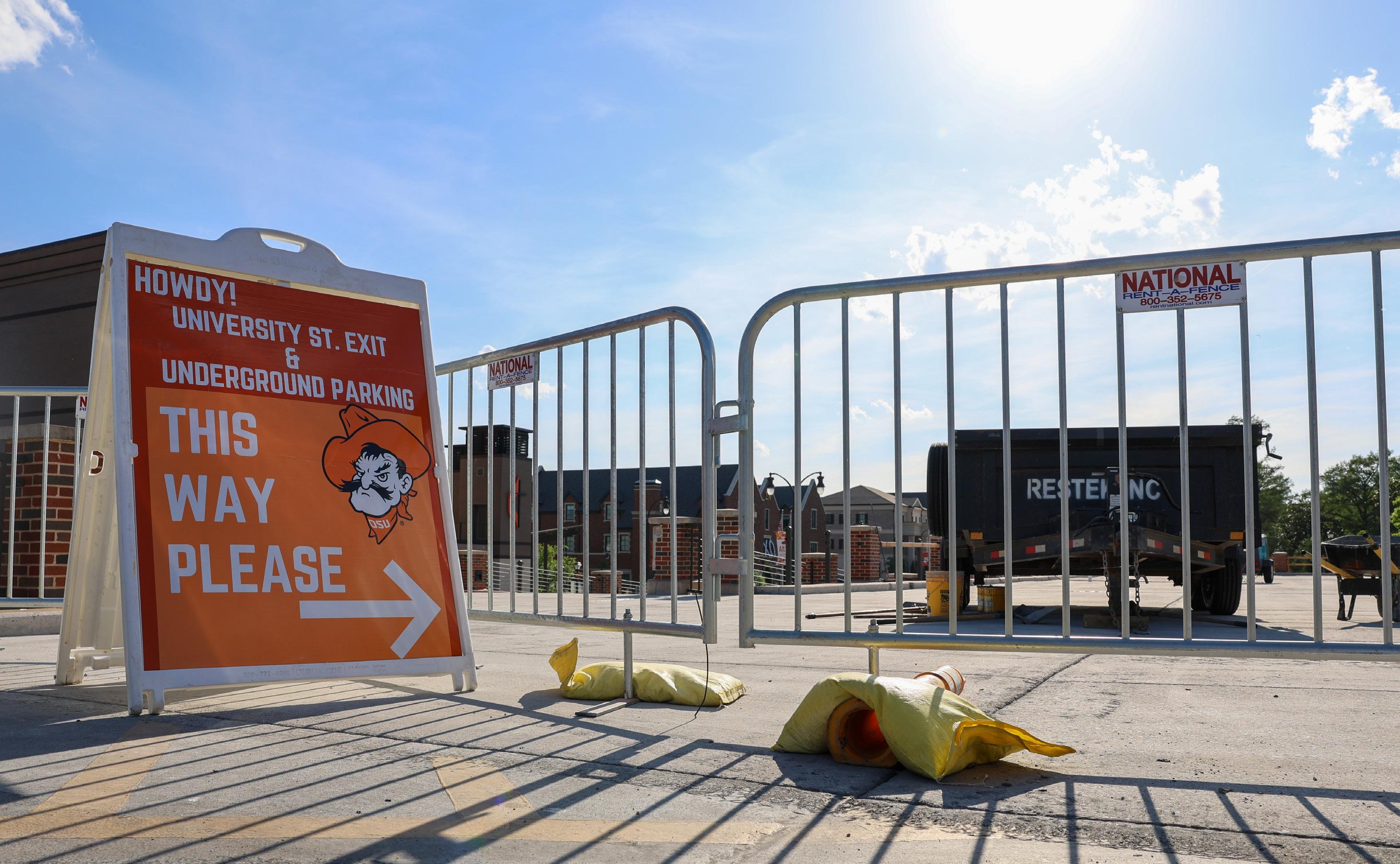
It’s 9:25 a.m., and Tamaiah Koonce stresses to find parking — easier said than done at Oklahoma State University.
Koonce is slowly driving her car, bumper to bumper in what she calls the “death trap” at the Student Union
Garage, where she tries to find parking before her 9:30 a.m. class. As time ticks down, she realizes she is going to be late, and this is a common story for Koonce and many others as the garage is undergoing construction amidst the spring term.
“If you’re in a rush to get to class, and in my case, your class is two steps away
OSU seniors show off
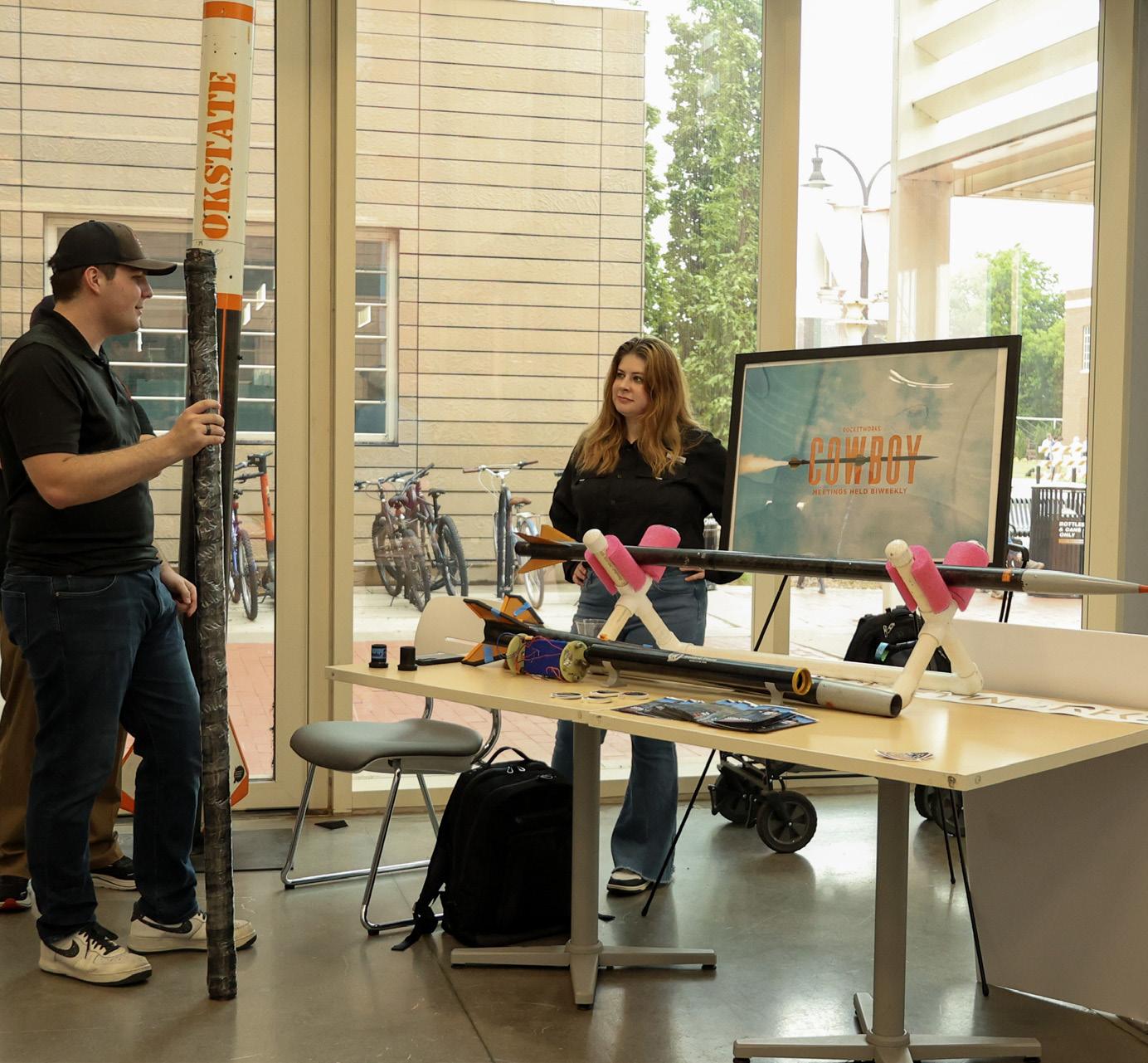
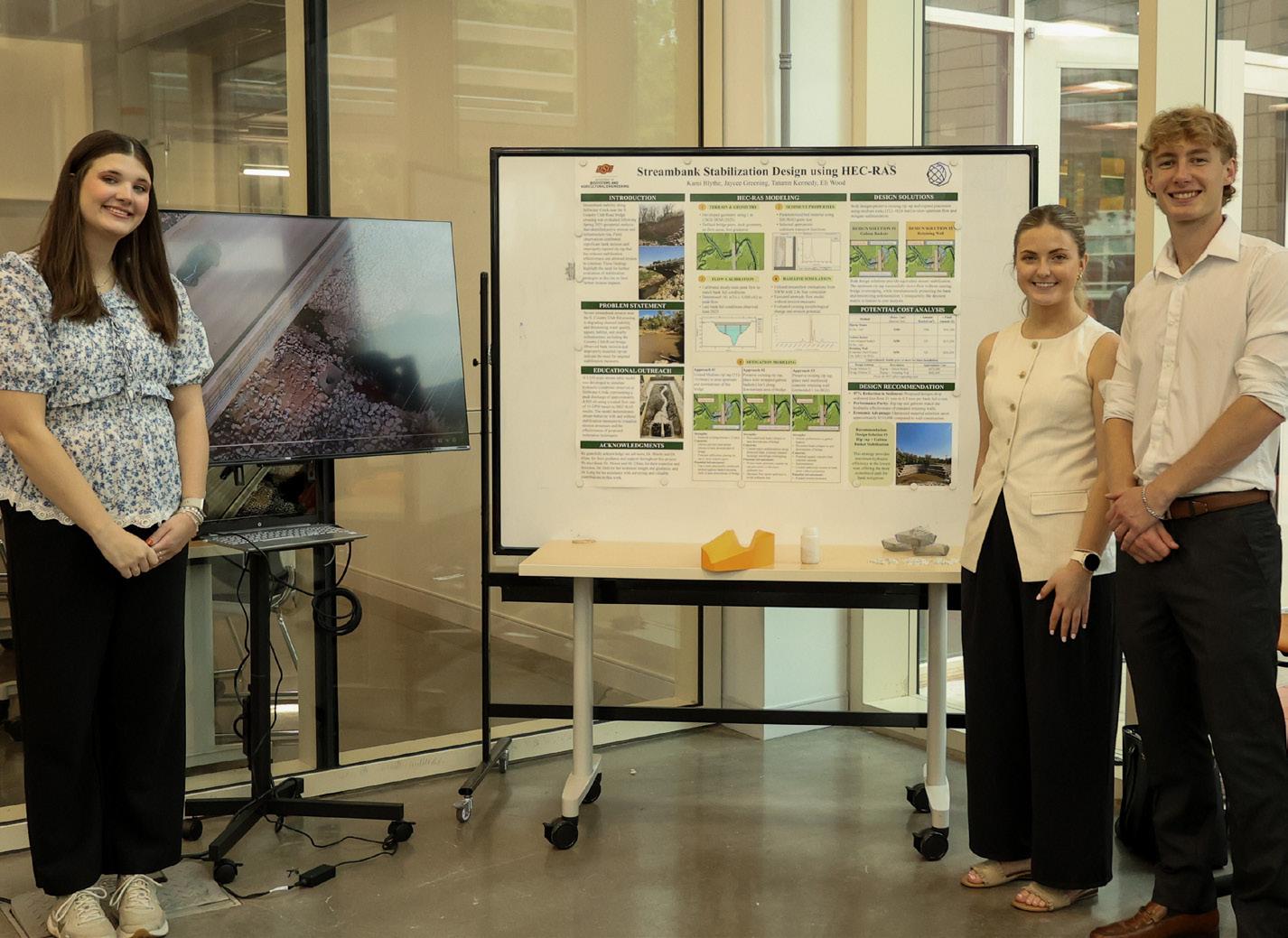
On a sunny Friday at Oklahoma State, a BB-8 droid rolled across the ENDEAVOR lab floor, an “erosion eraser” promised to protect a Stillwater creek bank as a prosthetic hand strummed a guitar chord. These were just a few of the projects on display at the College of Engineering, Architecture and Technology’s senior design expo, where students from nearly every discipline showed off the work that has consumed their semester, and in many cases, their lives.
The expo, held in the ENDEAVOR lab and on the Engineering South lawn, is a chance for seniors to cap off their capstone courses and years in CEAT with something tangible. For many of them, that “something” felt a lot like a full-time job.
Mechanical engineering major Brian Pinto, a member of the Concrete Cowboys research team, said his group had to figure out time management on the fly.
“I would say it’s like a full-time job. Honestly, we probably worked around 40 hours a week working on this nozzle,” Pinto said. “So between four people 160 hours a week.”
See ROBOTS on page 2A
from the garage – you’re still late to class because you can’t find a parking spot,” Koonce said. Construction repairs are expected to cost $2 million in February at OSU’s Student Union Garage, which welcomes an average of 1.7 million guests each year. Construction is in phase one of three, and 68 out of approximately 485
spaces are unavailable right now along with the first level ramp that leads to the lower levels being closed off. The construction is intended to improve the longevity and safety of the garage, and is expected to continue through the spring and summer terms.

People rushed into GallagherIba Arena on Tuesday night for UniteOSU, a worship event that drew college students from across Stillwater.
UniteUS is a national movement of college students united “to lift the name of Jesus,” with past events at Auburn, Florida State and Tennessee. The gatherings focus on inviting students to Christianity and addressing issues like anxiety, depression and suicidal thoughts. The Stillwater event featured worship music from Elevation
Rhythm, a Christian music collective from Elevation Church, and three speakers: Jeanine Ward, Jennie Allen and Jonathan Pokluda. In an Instagram post, UniteUS founder Tonya Prewett said 5,500 people attended the Gallagher-Iba event. UniteOSU partnered with multiple campus ministries to plan the night and get a sense of what OSU students needed spiritually and emotionally. One of those ministries was The Narrative, where campus minister Gavin Greenwood said he was excited to see groups work together instead of in silos.
See FAITH on page 2A
The Concrete Cowboys set out to design a nozzle that could be used to 3D print concrete columns — the kind of technology engineers hope could speed up construction or make it more efficient. Their work earned them third place in the mechanical and aerospace engineering project group.
For other teams, the time commitment looked similar.
Mechanical engineering major Aydan Erwin, part of the Bio-Inspired Guitarist team, said his group spent many late nights in the lab perfecting a prosthetic hand that can play guitar.
“We would meet twice a week. Sometimes we’d meet three times a week,” Erwin said. “And I’d say we’d probably spend anywhere from three to four hours a day just in the lab, discussing stuff, designing things, just whatever needed to be done.
“We probably spent, towards the end, a little bit longer. We had a couple eight-hour days where we just stayed here all day and just kept working until one day, one night, we’re out here till like eight. One of our guys was out here till 4 a.m., overnight, trying to get some of the software stuff done.”
Their persistence paid off. The Bio-Inspired Guitarist project won an electrical engineering interdisciplinary award and the Zink Center award for best video.
Not every project focused on machines or electronics. Some, like Erosion Eraser, tried to solve problems closer to Stillwater’s soil.
Biosystems engineering major Kami Blythe, and her team, identified a stretch of Stillwater Creek where severe bank erosion threatened more than just the landscape. If the bank keeps failing, she said it could undermine the Country Club Road bridge and create a dangerous situation for drivers headed to nearby churches, businesses and Tumbleweed Dancehall.
Her team’s design aimed to stabilize the bank and reduce the risk of flooding and structural damage. The project took home an award in the biosystems and agricultural engineering category.
Some of the most eye-catching projects didn’t start this semester. They were legacy projects — designs passed down from one senior cohort to the next.
The BB-8 robot is one of those handme-downs. This spring’s team was the first to pick it up since 2023, said electrical and computer engineering major Sawyer Hutchison.
“We’re trying to upgrade it to more autonomous mode,” Hutchison said. “So our group is kind of semiautonomous because we wanted to
introduce a vision system, so kind of a head that actually sees, like what BB-8 would see, and then introduce movements based on that.”
Inheriting someone else’s halffinished robot, rather than starting with a blank Computer-aided Design file, came with its own challenges.
“The hardest part was probably trying to figure out where we’re at and solve some of the issues we had no idea were actually a part of it,” Hutchison said. “Since this was a project that’s been around for a few years, people thought it kind of hit a wall, but we’re trying to move past that wall into automation. It’s kind of figuring out, what does this actually look like, and how can we improve on something that we don’t even know if it functions yet?”
Despite those hurdles, the BB-8 project won an electrical and computer engineering award for best electricalonly project.
“I mean, obviously it’s really important overcoming challenges and that kind of thing,” Hutchison said.
“I know a lot of my peers put in some amazing work, and seeing them do great work in electrical and computer fields, that’s not necessarily exactly what ours is. I feel like the work could have gone to anyone, because everyone’s doing really cool work.”
Not all of the projects lived only inside a capstone course, either. Some came out of student clubs that treat the expo as one more chance to show what they’ve built.
The Oklahoma State chapter of the Institute of Electrical and Electronics Engineers brought a robot they call Space Cowboys, designed for a competition that took place March 27. That meant a compressed timeline and long hours before most teams had even started stressing about finals.
“It was pretty much a full-time job for us,” said Alexander Carter, an electrical engineering major and electrical lead for Space Cowboys. “Like, the amount of work that we had to do on this robot and the limited timeframe we had, we were in here almost every day. I know spring break, I spent my entire spring break in the lab.”
By the time the expo rolled around, the lawn and lab filled with the payoff from all those sacrificed weekends and late nights: a guitar-playing prosthetic, a BB-8 rolling under its own guidance, an erosion solution for a busy Stillwater road and dozens of other projects that might never make headlines but could shape the way students see themselves as engineers.
For many of them, the grades and awards matter. But so does the proof that they can take an idea from a sketch to something that moves, strums or saves a bridge.

turn addressing the crowd on issues ranging from faith and doubt to mental health and identity.
“I think there’s been a shift to see different ministries and churches kind of unite on different levels,” Greenwood said. “I think we already see that with our ministries during Holy Week and stuff at OSU. And so I think this is just another great opportunity to maybe even bring in some people that aren’t involved in the ministry.”
The timing, students said, mattered. Finals are around the corner, dorm move-outs and graduation are looming, and stress is high.
“I think it’s really great to have a space where all of us are coming together to worship the Lord and (have) a good reminder for all the distractions that are happening this week,” aviation major Tate Dodson said. “I think it’s very good to come together and worship the almighty Jesus Christ.”
With finals week starting Monday, some attendees described UniteOSU as a spiritual reset.
“I think it could be really relieving and something fun and uplifting right before finals,” said Lauren Day, a dental hygiene major at Rose State College.
For many in the crowd, Elevation Rhythm’s worship set was a highlight. The band, which tours nationally and records with Elevation Church, led students through more than an hour of music.
“Elevation Rhythm was insane,” UniteOSU team member Carter Reed said. “I mean, it was just so beautiful to hear them start off by portraying a message that they’re not trying to just hype people up, but they really are trying to focus on God.”
The three speakers each took a
“I really liked how (Jennie Allen) spoke, with the visuals and everything,” sociology major Reagan Cherry said. “And just like how she wasn’t afraid with controversial topics you don’t really talk about. She was good about addressing those.”
Near the end of the night, UniteOSU issued a specific invitation to students who have struggled with suicidal thoughts. Organizers asked those students to come down to the floor to be prayed for, and later invited anyone who wanted to be baptized to head to the north side of Gallagher-Iba. UniteUS reported that 54 students were baptized after the event.
Even for students who didn’t get baptized, the night prompted personal firsts.
“I mean, I never usually put my hand up in the sky when people are worshiping,” philosophy major AJ Parker said. “I did. Maybe that was them. Maybe it was the Holy Spirit.”
UniteOSU relied on campus ministries to staff and field its leadership team. Reed, who serves on the Greekwide leadership team, said watching the crowd file in was his favorite moment.
“My favorite part was just seeing the overwhelming number of people walk in the doors at the very beginning, and then really just feeling the Spirit move throughout the stadium tonight, during worship and stuff,” Reed said.
As students head into finals, organizers say they hope those moments — the worship, the prayers, the baptisms and even a raised hand for the first time — carry beyond one night in Gallagher-Iba.
Ashley Yarborough STAFF REPORTER
Barista Sara Griffin knows when exams are approaching. Not by the calendar, but the line wrapped around Dutch Bros drive-thru.
“Size definitely changes during finals,” Griffin said. “The night before someone has an exam and they come through and get the largest amount of a Rebel I’ve ever seen in my life and I’m like, ‘Oh my god, hope you’re okay.’”
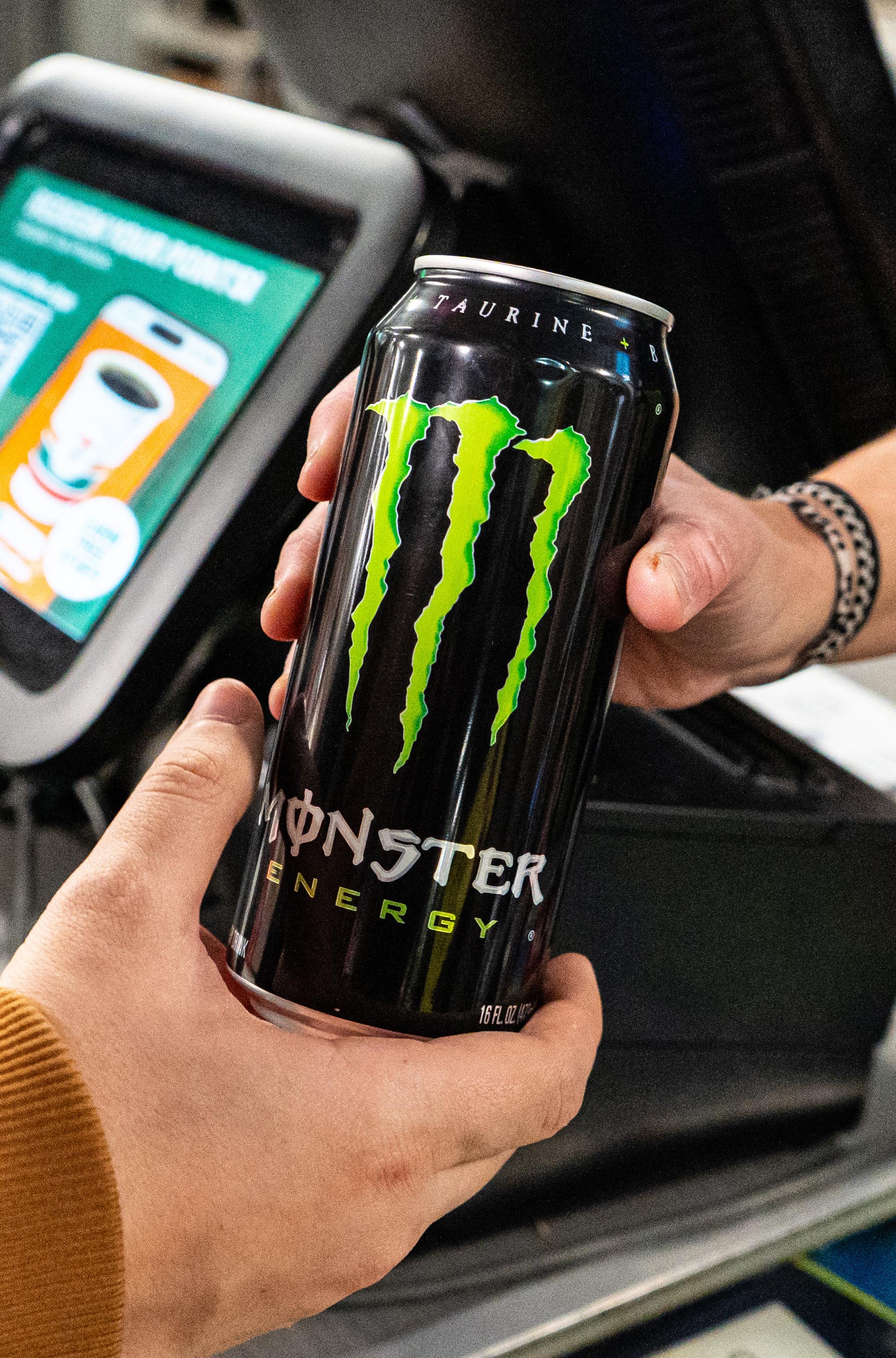
For Oklahoma State University students, a caffeinated drink is no longer just a small pick-me-up; it’s part of a daily routine. A large Rebel from Dutch Bros contains 165 milligrams of caffeine, nearly matching the average daily intake for college students. According to a study from the National Library of Medicine, the average amount of caffeine consumed by college students is 175.2 milligrams, roughly the equivalent of two cups of coffee.
Dietician and OSU professor Jill Joyce works with first responders, as well as her own students, to practice safe caffeine consumption.
“Medications and supplements, including caffeine, hit all of us differently based on how we process it and how tolerant we are to them,” Joyce said.
Freshman Taylor Harlin believes students at OSU know the potential risks, but it’s not enough to stop.
“I feel like we know what too much caffeine is, but we just don’t care,” Harlin said. “As college students, we are just doing so much and I’m exhausted all the time.”
While many students acknowledge the risk, Joyce has found that students are secretive about how much caffeine they really drink.
“Students don’t overly reveal their caffeine practices,” Joyce said. “Unless I see them regularly walking around with them, there’s a few students who I know are going to walk in with a certain caffeinated beverage in their hand.”
Harlin starts every morning with her drink of choice, a Peach Vibe Celsius with 200 milligrams of caffeine, and then decides what she needs for the rest of the day.
“I usually have my Celsius and then sometimes another energy drink, like coffee or even something else,” Harlin said.
Working at Dutch Bros, Griffin has seen many students shift away from the traditional cup of coffee in favor of energy drinks.

“I feel like energy drinks have especially been more popular than coffee recently,”
Griffin said. “With college students specifically, there is kind of a culture between staying up really late to cram and that encourages caffeine overconsumption.”
Joyce believes that the shift from coffee to energy drinks is due to how they are marketed to younger consumers.
“It’s the placement of them in the stores, and the packaging or the marketing displays around them,” Joyce said. “I do feel like the drinks have a very hip look too. The flavors are things like pink Starburst. I mean, come on.
High school students should not be drinking these, so that’s got to point to a college student.”
Freshman Bryce Smith said his caffeine intake increased over his first semester as his schedule became more demanding.
“I don’t think it affects my studying,” Smith said. “I think it’s just like an everyday thing. I’m just like, ‘Okay, it’s time to have a drink.’”
Between studying at the library and working out, Smith gradually increased the amount of caffeine he was consuming daily.
“At the beginning of the last semester, I had about 500 to 600 milligrams a day,” Smith said. “Nothing was stressing me out. I just couldn’t wake up as easily.”
Dieticians such as Joyce warn that at high levels, caffeine can function similar to other substances.
“Technically caffeine is a drug,” Joyce said. “You do become tolerant and addicted to it, and you are going to experience withdrawal. There is no way to stop that.”
For Griffin, working at a place that provides her with
students, as well as first responders, Joyce has seen that caffeine dependence is a common struggle and nothing to be embarrassed about.
“As a practitioner, I never want people to feel ashamed,” Joyce said. “If you’re consuming upward of three,
“With college students specifically, there is kind of a culture between staying up really late to cram and that encourages caffeine overconsumption.”
SARA GRIFFON | DUTCH BROS BARISTA
constant access to caffeine has impacted her own intake.
“I have free access to caffeine at my job, so I’ve kind of got a dependency on it,” Griffin said. “If I really needed to, I would be able to do my job without any caffeine, but it definitely helps.”
From working with
400 milligrams of caffeine a day or more, no shame in that. There are reasons we all need energy.”
Although she supplies students with caffeine, Griffin recommends that if students want to break the habit, they have to stop the constant flow of energy.
“Whenever you are so used


to so much caffeine all the time, you just kind of start to tolerate it,” Griffin said. “And so if you really want it to work, and you care about your heart, I would try to slowly cut back on caffeine.”
Freshman Kylie Blevins has experienced the negative effects of cutting back on her caffeine during the week.
“I get headaches if I don’t drink caffeine,” Blevins said.
“If I drink any amount of caffeine two days in a row, and I don’t the third day, I’ll always have a headache.”
Over spring break, Smith decided to go from 500 milligrams of caffeine a day to zero, but the effects impacted his daily routine.
“The first week when I didn’t have it, I was having pretty bad headaches, and then week two and three, I just could not wake up at all,” Smith said. “I was struggling to wake up even after a good night’s rest.”
To avoid withdrawal symptoms, Griffin tries to intentionally limit the amount of caffeine she drinks.
“Whenever I knew it wasn’t like, actually going to be
studying like that or staying up late, what I would do is I would just get a small,” Griffin said. “Like I wouldn’t get the extra shot. I wouldn’t get the large Rebel, and I’d just get a small one if I really needed it.”
Smith believes that students’ habits contribute to the caffeine culture at OSU.
“I think it’s just the fact that maybe we get too little sleep,” Smith said. “Students just stay up on their phone and then they’re like, ‘Okay, I didn’t get much sleep last night. I need something to substitute.’”
For students wanting to change their caffeine habits, Joyce says that the first step is creating a consistent routine.
“If you can find a way to structure your day, come up with a sleep routine,” Joyce said. “Cut the caffeine off six to eight hours before you go to bed. You’ll get better sleep and that will be massive.”
As finals week returns at OSU, so do the extra large drinks and late-night orders, but at least your local barista at Dutch Bros hopes that you’re okay.
news.ed@ocolly.com

THE LORD! (Part
“Do not let your hearts be troubled. Trust in God; trust also in me.” (Jn.14:1 NIV)
Jesus had just told his disciples of his betrayal. He also told to them of his leaving and they could not go with him. I am sure that it seemed to the disciples that everything was “caving in, falling apart.” The future seemed so uncertain. Then Jesus speaks these words; DON’T BE TROUBLED; TRUST ME!
Jesus tells them that he is going to the Father (God) and in his house there is plenty of room. He tells them that he is going to make a place for them all and he will return to take them there. As we look around us there is much uncertainty about this planet that we live on; safety is a premium, and what about when death comes? What is going to happen to you and me? Many are betting on losing consciousness and never
awakening. They live on that assumption. However, Jesus tells us all are going to experience a resurrection from the dead; some to everlasting life and others to be condemned . (Jn.5:28-29, Dan.12:2)
Again, the Lord Jesus makes things clear to his followers: “I am going to my Father’s house to prepare a place for you. I will return to get you and take you to be with me.” when asked about the way to this wonderful place, Jesus answered, “I am the way and the truth and the life.
Ethan Coughran STAFF REPORTER
With the 31st remembrance of the Oklahoma City bombing, the “Run to Remember” brought thousands of people to downtown Oklahoma City — including members of the Oklahoma State Cowboy family.
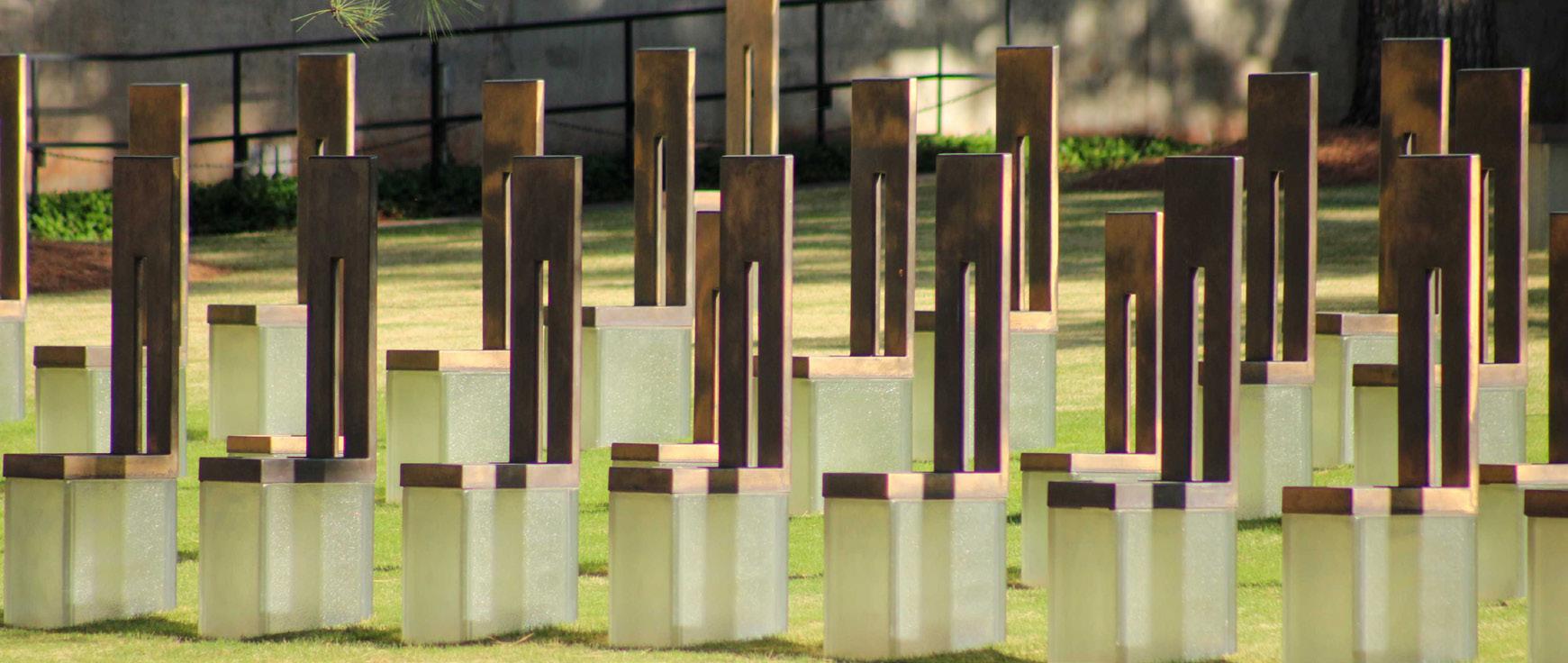
The bombing, a terror attack on the Alfred P. Murrah Federal Building on April 19, 1995, killed 168 people, including 19 children. Timothy McVeigh parked a Ryder truck with 5,000 pounds of explosives outside the building; it detonated at 9:02 a.m. The tragedy later inspired what is now known as the Oklahoma Standard and the annual Oklahoma City Memorial Marathon.
The marathon began in 2001 and has grown into a major remembrance event. This year, about 30,000 runners and walkers took part in the 26th annual race. The weekend included a full marathon, half marathon, relay, kids marathon, senior marathon and 5K, all
held to honor the 168 lives lost. Participants represented all 50 states and 17 countries, showing how people far beyond Oklahoma continue to stand with the city.
Among them was OSU freshman Luke Baustert, a music industry major and trumpet player in the Cowboy Marching Band. Baustert ran the race for the first time.
“I’ve always wanted to say I’ve run a marathon, and I wanted to support this event with it being such an important part of Oklahoma history,” Baustert said.
He hopes more Cowboys will join him on the course in the future.
“More Cowboys should run,” Baustert said. “It’s a super fun experience, and everyone should experience it at least once in their life.”
Freshman strategic communications major Layla Cochran also took part, but in a different way. She volunteered with the kids marathon, serving as a safety net for young runners
and walkers as they completed their shorter route and received medals at the finish.
The kids events give children a way to show their support and be part of the remembrance. For Cochran, this was her second year helping with the marathon. She previously served on the OKC Memorial Teen Board, a group made up of high school students that focuses on leadership and learning from the lessons of April 19.

“I love the memorial and the impact it has on so many people, and what the marathon represents is so special,” Cochran said. “So, I will forever try to be a part of it in some way.”
For many Oklahomans, the marathon and the Oklahoma City National Memorial & Museum are not only reminders of a terrible day, but symbols of how people came together afterward.
The Survivor Tree — a single american elm that withstood the blast and still stands at the memorial — has become a living emblem of that resilience.
As Oklahoma City continues to grow, the tree’s branches stretch over the memorial grounds, representing the hands that helped the city rebuild and the community that still gathers each year to remember, run and uphold the Oklahoma Standard.
news.ed@ocolly.com
pours
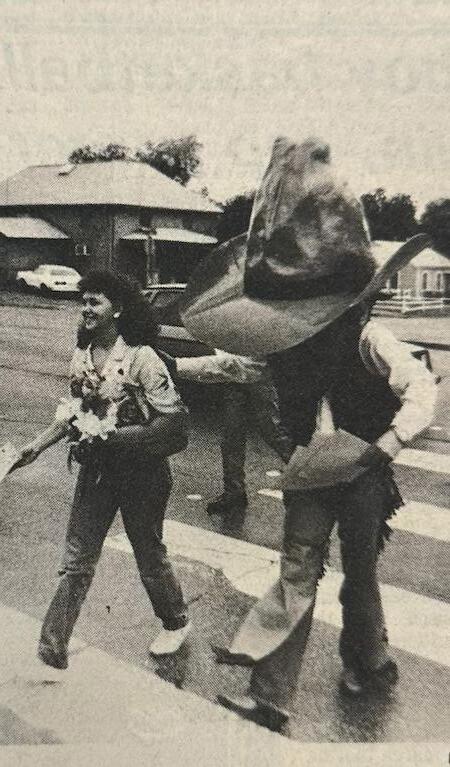
Oklahoma State University police, Pistol Pete and the “Ernie” cartoon character joined forces Tuesday morning at the Bennett crosswalk to promote the Police Department’s crosswalk awareness campaign.
Officers and Pistol Pete handed filers to pedestrians and motorists that depict Ernie at several crosswalks, experiencing the problems caused by motorists and pedestrians who do not obey or are unaware of traffic laws.
Officer Coy Jenkins said his groups have been taking a “hard look” at the crosswalk problem.
The crosswalk located south of Bennett Hall on Hall of Fame Avenue has drawn a lot of public attention to the problem lately because of two pedestrian/motor vehicle accidents that occured this semester, Jenkins said.
Jenkins said Chief Everett Eaton, after viewing the Ernie cartoon in The Daily O’Collegian, “came up with the idea of using Ernie in a public service capacity.” Jenkins said “The idea was to compose a cartoon to educate everyone of the problem in hopes of reducing further accidents in crosswalks.”
you can see they get a smile, but I think a lot of it has to do with peer contact,” he said.
Pete’s Pet Posse invited students to take a “paws” from studying and relax with some furry friends as finals season ramps up.
The Department of Wellness organized the event to bring positivity and mental health awareness to campus with Summer Day, a graduate student at Oklahoma State University, helping table at the event.
Day said she joined the organization to advocate for mental health awareness.
“I did wellness because it helps students that struggle,” Day said. “I feel like it was a hidden thing on campus that not a lot of people knew about.”
Cowboys Care helps bring mental health resources and awareness to the forefront of campus consciousness.
“I feel like when it comes to college students, they try and act like they have it all figured out when they really don’t, so it’s a good thing to let people know, like, I’m here with you,” Day said. “The goal is to allow students to just decompress for a second.”
Pete’s Pet Posse offers a way for students to do that, by providing comfort and a low-stakes space to unwind.
“College students love the dogs, and we have tables which have resources for TimelyCare, Cowboys Care and campus mental health resources,” Day said. “Mental health is real and active in all people, even if sometimes they may not know and it’s underlying.”
One of the most beloved dogs in Pete’s Pet Posse, Disco, made her appearance at the event. Her owner, Rick Eggers, happily shared her history.
“Disco was in the first class of Pete’s Pet Posse dogs and joined the program in the fall of 2013,” Eggers said. “She just turned 13 a couple of months ago and comes to campus about eight times a semester... the library is her favorite spot.” Eggers said he appreciates the joy Pete’s Pet Posse brings to people.
“I’ll see people and they have a reaction to the dog right away, and
For him, the dogs are as much about community as comfort.
“When you have 10 people sitting in a circle and all of them are from different cultures or classes or groups on campus and they’re talking about the same thing... they’ll talk about the dog for a little bit... and before long the students are getting into conversations with each other,”
Eggers said. “This is a way for them to sit down and interact with other students as well as to get a little bit of joy from having dogs.
“I think it really does a lot emotionally for people to pet dogs,” he said.
Mia Lowe, a junior at OSU, would likely agree. She stopped by to take a break and see the dogs.
“The dog definitely brightened my day,” Lowe said. “I really appreciate seeing them, especially before finals.”
The support at the event did not end with Pete’s Pet Posse. Nearby, Wings of Hope tabled in solidarity with survivors. Macayla Smith explained the significance of their presence.
“We are out here for Denim Day, which is where we wear denim to stand in solidarity with survivors of sexual assault,” Smith said. “It comes from a court case where a ruling against someone who raped a young girl was taken back because they stated her jeans were too tight for him to take off by himself, so she must have had to help him.”
With Wings of Hope, Smith said support is available for anyone who needs it.
“I feel it’s important because those who are maybe survivors of sexual assault or even domestic violence need to know that we have resources out there,” Smith said. “We’re always here to help no matter the situation you’re going through, so please give us a call.”
The Department of Wellness, Pete’s Pet Posse, Cowboys Care and Wings of Hope all share the same goal: helping students. Whether it’s a break from finals or support through life’s hardest moments, OSU has resources ready to help.



‘Michael’: A thrilling greatest-hits show that dodges the hard questions
On April 24, the King of Pop moonwalked onto the big screen.
“Michael,” Antoine Fuqua’s longawaited Michael Jackson biopic, runs two hours and eight minutes and aims, in Fuqua’s words, to “remind people about the magic of him” and “the power of the music.” For fans, if not for critics, it largely does.
In his debut role, Jaafar Jackson plays his world-famous uncle, while Juliano Valdi portrays Jackson as a child. Colman Domingo takes on the infamous Joe Jackson with Nia Long as Katherine Jackson. Noticeably absent is younger sister Janet Jackson, whose omission makes the family portrait feel incomplete.
“Michael” balances on a slightly unsteady scale. On one side is Jackson’s childish, Peter Pan-esque persona; on the other are years of abuse and controversy. The film’s producers clearly had to choose a direction. They chose the whimsy.
Spanning 1966-88, “Michael” focuses on Jackson’s adolescence and rise to fame alongside his brothers. It lingers on the era of “Off the Wall,” “Thriller” and “Bad,” staging studio sessions with Motown legend Berry Gordy, producer Quincy Jones and long negotiations with lawyer John Branca. Iconic tracks like “I’ll Be There,” “Thriller,” “Human Nature” and “Bad” turn much of the movie into a concert film, with Valdi’s and Jackson’s vocals blended into Jackson’s original recordings.
The film also gestures at Jackson’s isolation. Constant touring and recording leave him with little company beyond his mother and longtime security guard Bill Bray. Those relationships may seem minor compared to the spectacle, but they are key to understanding the man behind the moonwalk — and the movie is at its best when it lets those quieter moments breathe.
Still, the narrative cuts off sharply
after the Bad World Tour. Just as Jackson becomes truly independent from the Jackson 5, recovers from the 1984 “Pepsi incident” and embarks on a 123-stop record-setting run, the film ends. The abrupt conclusion leaves major chapters — and controversies — untouched, though a planned sequel may eventually pick up those threads.
Like most modern music biopics, “Michael” arrives under a microscope. Since 2018’s “Bohemian Rhapsody,” also produced by Graham King, the genre has been dogged by complaints of sanitized storylines and estateapproved mythology. Michael is no exception. As of late April, Rotten Tomatoes shows a critic score at 37% while the audience score is at 97%, making it one of the most divisive biopics in recent memory.
Fuqua, best known for “Training Day” and “The Equalizer” trilogy, faced several hurdles in production. Jackson’s 1993 allegations are largely absent; Fuqua has said an original ending involving accuser Jordan Chandler had to be dropped because of prior legal agreements with the estate, which prohibited dramatization.
The film’s budget started around $155 million, but roughly 22 days of reshoots pushed costs closer to $200 million. Even so, “Michael” roared out of the gate, opening to about $97 million domestically and roughly $217 million globally — the biggest biopic debut ever, surpassing “Straight Outta Compton” and “Oppenheimer” in the genre record books.
All things considered, “Michael” works best as a lavish, greatest-hits jukebox for fans who want to relive the early musical highs with minimal focus on legal battles or trauma. It delivers slick recreations, strong performances and wall-to-wall hits in a way no real tour ever will again. For viewers seeking a deeper reckoning with Jackson’s misfortunes and darker legacy, though, a documentary
Addy Blankenship STAFF REPORTER
Puff, puff, pass.
At 21, Alexis Steele was recovering from spine surgery and trying to stay off opioids. What finally let her eat, sleep and care for her kids again wasn’t a pill bottle, but cannabis.
Alexis feels pain every day, and medical marijuana is her only form of relief.
“When I switched to cannabis and was using it for the pain, it didn’t dull the pain,” Steele said. “It almost took it away sometimes.”
As a 21-year-old and a young mom, Steele was searching for something that worked. For her, this was a way to find relief. Her pain is one of the hardest things she has to deal with, and it isn’t always visible.
“You don’t have to see it for them to have it,” Steele said.
In 2018, Steele’s life changed forever when she was in a car wreck that led to spinal surgery and nerve damage.
“I got T-boned in Oklahoma City by an older lady who failed to yield at a turn light,” Steele said.
After basic emergency room checks, doctors diagnosed her only with whiplash and sent her home. Two months later, she knew something wasn’t right.
“My legs started to feel weird,” Steele said. “I would get really weak. They would tingle and feel like they were falling asleep, but I could be standing up, sitting down, walking, I could be doing anything and that would happen.”
A chiropractic visit showed just how serious it was.
“She did an X-ray, and at the bottom of the X-ray there was a cloudy feature that she’d never seen before on anyone,” Steele said.
The chiropractor referred Steele to a neurologist, and in April 2019, she had surgery at St. Anthony Hospital in Oklahoma City. During the operation, doctors found a massive cyst wrapped around her spinal cord.
The cyst crushed the nerves of her sacral canal and put intense pressure on them, causing the pain she still feels day to day.
“My surgeon was amazing, but everyone else for pain management, physical therapy and everything else was very crappy in my opinion,” Steele said. “They didn’t really listen to me when I was like, ‘Look, this is severely painful and I’m still feeling extremely weak.’”
Steele tried opioids for the pain, but they left her nauseated and unable to eat.
“I was 21, 22 years old, I have my 10-year-old, who was 2, and I couldn’t pick her up anymore,” Steele said. “I couldn’t do anything anymore;
I was nauseous all the time because of the pills or the pain or both.”
Sometimes, she said, it felt like the medication didn’t even touch the pain. That’s when she turned to medical marijuana.
“When I switched to cannabis and was using it for the pain, it didn’t really dull the pain,” Steele said. “It almost took it away sometimes.”
Now, cannabis is part of her daily routine. She usually uses once in the morning, once at lunch and once in the evening. She prefers hemp wraps because she is allergic to tobacco and tries to use only solventless concentrate products.
Jennifer Toynton also leans on cannabis but for different reasons. She prefers a holistic lifestyle, grows her own food and avoids pills after being diagnosed with alpha-gal.
“I just try to stay very clean with my eating and my lifestyle,” Toynton said. “And weed is the only thing that—I know it’s not good for my lungs. So I’m down to where I just smoke one time in the evening.”
That nightly smoke is what lets her eat.
“I have lots of food anxiety, and I don’t eat breakfast, I don’t eat lunch—in fact, I won’t eat at all unless I smoke weed,” Toynton said. “So, I wait until I’m done working for the day, got everything

reduce her pain and blood sugar, allowing her to come off some medications.
When Brandan Isley opened Doc Green’s Dispensary in 2019, his goal was to build a vertically integrated dispensary chain and manufacture most of the products he sells. The reality quickly proved more complicated.
Isley said Oklahoma let the industry explode, then tightened rules in ways that squeeze legitimate operators.
“The state’s just been decimating the industry and trying to bankrupt us all,” Isley said. “And doing a really good
had to hire someone because the line was out the door,” Isley said. “I was just like, ‘So sorry guys, I am trying,’ two tablets going at the same time, running back and forth.”
He said there’s no typical patient.
“You’ll get someone who comes in, who’s 80 years old, and their grandson got a card and convinced them to get a card, and they’ve never seen weed,” Isley said. “And you’ll get someone that has been in the weed industry in every legal state and has jumped from state to state, and everything in between.”
As of April 23, the U.S. Department of Justice (DOJ) has reclassified cannibis. This move recognizes legitimate medical uses, reduces federal tax burdens on businessmen and facilitates research, but does not legalize recreational use.
done I need to do, then I smoke and then wait for it to kick in for my appetite, because my brain is just so afraid of food.”
Similar to Toynton, Kajesa Best uses marijuana to fight against a body that doesn’t cooperate. She was diagnosed with gastroparesis in 2019, caused by uncontrolled blood sugars from diabetes.
“This is neuropathy of the stomach, so I do not digest food,” Best said. “Flat out, my stomach just does not work. I have a feeding tube.”
She uses medical marijuana to stimulate her appetite and ease frequent nausea.
“There’s so much pain that comes along with this,” Best said. “It’s eating your body, it’s eating your bones, it’s eating everything.”
Best said she has found multiple strains that help
job at it, by the way.”
He points to vague regulations, uneven enforcement and early lack of oversight as constant challenges. Despite that, he said Stillwater embraced his shop.
“It was a really exciting time to be part of the industry,” Isley said. “Everything was fresh and new, and everyone really loved it.”
Born in Oklahoma and raised in Colorado, he moved back in 2018 and found a community in cannabis.
“Everyone I know in Oklahoma, outside of my immediate family members, I know from cannabis in some way,” Isley said. “My friends here are vendors or patients.”
Within the first month, Doc Green’s outgrew its one-man model.
“Within the first month, I

From behind the counter, he sees how medical marijuana reshapes people’s lives. Patients tell him about long lists of prescriptions they’ve cut down and fewer seizures and less pain.
“I mean, it’s wild, the impact medical cannabis has on a community,” Isley said.
Some patients linger 30–40 minutes just to talk with budtenders.
“I’ve developed relationships with people that have come in the first month, seven years ago, and still come in,” Isley said. “We’ve really tried to care about the customer base more so than just making a sale.”
For 19-year-old Oklahoma State University sophomore Heagen Skidgel, relief came early. She lives with Ehlers-Danlos hypermobile syndrome, juvenile arthritis, postural orthostatic
tachycardia syndrome and chronic migraines. Her parents first introduced her to THCinfused topicals when she was 11. At 12, she became one of the first children in the state with a medical card.
“When I very first got my card, Doc Green’s here in town, they closed down shop for a good little hour one night and let my parents bring me in,” Skidgel said. “And he taught me a whole bunch of the basics of weed and what I was putting in my body, and how the different forms of it and all the different things.”
Joint pain is her biggest struggle.
“I swell, I get really swollen,” Skidgel said. “It sounds weird, but some days I feel like my body is 10 times heavier than what it actually is. So when I smoke, it kind of makes my body feel lighter.”
Living as a young adult with chronic pain means dealing with other people’s assumptions.
“In high school, I did experience it when people started finding out that I had my medical card and stuff, they thought I was just using it to be stoned,” Skidgel said. “They don’t see me having POTS episodes every day, or they don’t see me in pain. They’re like, ‘Oh, it’s not really as bad as you really think it is.’ I wish more people had a better understanding of that.”
For Steele, Toynton, Best and Skidgel, the story isn’t really about cannabis. It’s about being able to function after a life-changing injury or diagnosis. For many patients, this plant is the difference between getting through the day and not.
“I’m not 100%; I won’t ever be because of the nerve damage,” Steele said. “But I can at least function enough to where I can eat. I can take care of my kids.”

Tracie Brown, assistant vice president of OSU Student Union Business Affairs, said there is never a convenient time for construction, and she feels they chose the best time to wrap it all up before the fall semester begins.
Brown said the office chose to keep the garage open by working through phases and addressing priority items first, rather than shutting it down entirely.
“This is almost a designated parking garage for visitors, and our [customers] are mixed with everybody,” said Mounzer Al-Harake, assistant director of OSU Student Union Building Operations and Parking. “Alumni, visitors, students, faculty, staff, everybody, so we’re the multi-purpose of the garage and the campus.”
Amidst the students remains Koonce who acknowledges the pros and cons regarding the construction.
“It’s positively affected me in the way that it has made me stop procrastinating,” Koonce said. “And I feel like the negative impact will just be the
stress, like it’ll just be stressful having to kind of adjust my schedule.”
Had construction begun in the summer, it would still be a minimum of five months of work, which brought on the concern of what the busy fall semester holds, including freshman orientation and football games that bring in many alumni.
“We have pain and suffering between now and then in order to make that happen, because there’s no good time to do it,” Brown said.
However, Koonce said that around this time of the semester, more people are taking attendance seriously due to finals and graduation just around the corner.
“I feel like it’s a worse versus worse situation,” she said.
Brown contacted major users in January 2026 to discuss the construction timeline.
Among the major users are potential students coming in for tours, which are hosted by the OSU Office of Undergraduate Admissions. Tours are hosted Monday through Thursday, twice on Friday and one Saturday a month throughout the year, excluding holidays.
As phase one is still ongoing, Koonce said she hopes it leaves parking feeling more efficient for everyone.
“I hope that they’re not just up there painting new lines on the parking spots,” she said. “Maybe they’re adding a couple extra, so that it’s just more available spots for everyone. That’s what I hope comes out of it.”
But aside from additional beams and structures, Brown said the majority of it will go unnoticeable seeing how the repairs are being done for the longevity of the garage.
“We just really solved a problem for (the university) that would’ve been in the master plan – we have now extended the life of that parking garage, at least seven to eight years,” Brown said.
But Al-Harake said it is all for the long run.
“We don’t do anything for today, we do it always ahead of time – for the future,” AlHarake said.
As for now, Koonce plans to put what she’s learned to good use.
“I’m just gonna focus on the time management part of it and just get up a bit earlier,” she said.
news.ed@ocolly.com

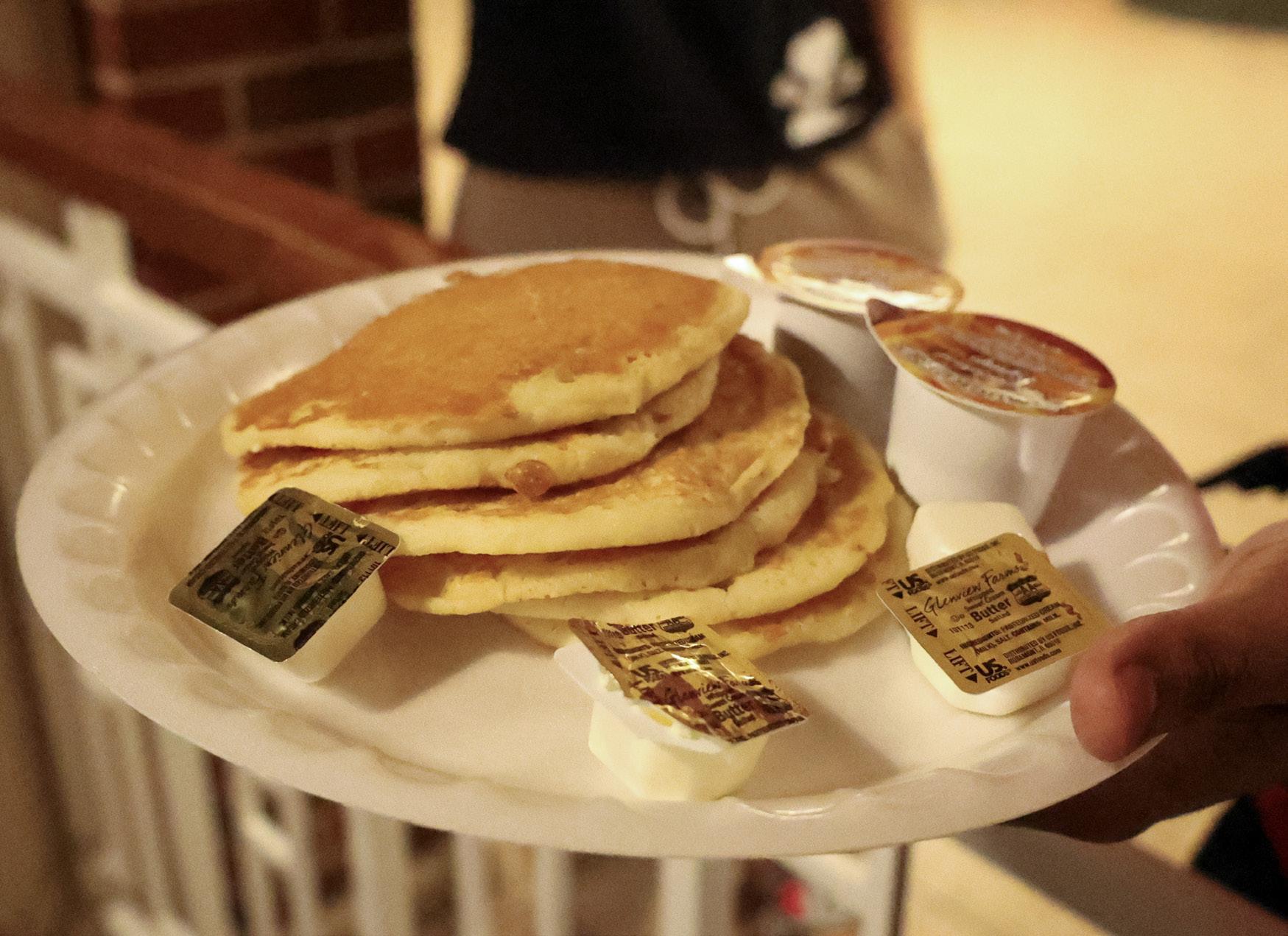
Students gathered at the Oklahoma State University Student Union for a pre-finals pancake night.
The event, hosted by the Student Union Activities Board, gave students free food, hosted bingo and provided a break from studying before finals week. Organizers said the goal was to create a space where students could relax and connect during a stressful time.
Attendees filled both the first and second floors of the Student Union throughout the night. As seating ran out downstairs, many moved upstairs while others gathered around tables to play bingo.
Garrett Hargrove, coordinator of the Student Union Activities Board, said the event takes months of planning.
“I’m the coordinator of the SUAB, and this is actually one of the only events we have per year that I get to host myself,” Hargrove said. “I do the planning, logistics, create marketing and gather volunteers to donate their time for this event.”
Hargrove said the turnout and energy have been strong this year.
“Attitudes seem pretty great so far. I think people always love this event, and of course, the free food always helps,” Hargrove said. “People come in for finals and studying but recently they’ve been super into bingo.”
For some students, pancake night is a tradition they return to each year.
“We used to do this stuff freshman year,” said Holly Goodman, senior sociology major. “I guess we’re coming back for the memories again before we graduate.”
Others said the free food was just as important.
“I mean, who would turn down free food?” said Lena Biamonte, senior biochemistry and molecular biology major. “The pancakes are always good too, so that’s a plus.”
As finals approach, stress levels increase across campus.
Attendees said being around friends helps them push through the week.
“We all kind of bounce off of each other because we’re friends,” Goodman said. “I think it definitely makes me re-energized and gives me a lot of energy to go through the rest of the night, but also just to stay motivated for finals week.”
Many said events like this remind them of their community during finals.
“I think these events are really helpful to remind people that they’re not alone and that there’s all of these other people who are taking

finals too,” Caldwell said. Goodman added that the event allows for students to decompress amidst the stressful studying.
“It’s nice because we’re all coming together to kind of take a moment to slow down. It gives us a place to relax and open up,” Goodman said.
Others appreciated the simple benefit of a free meal.
“I haven’t gone grocery shopping in a while, so I’ll always get free food when it’s offered,” Biamonte said.
Those in attendance said the weeks leading up to finals can be overwhelming.
“Today, I actually defended
my honors thesis, so that was pretty stressful for me,” Goodman said. “I successfully defended it, though, so I’m excited about it now.”
Hargrove said giving students a break is the main goal of the event.
“I think it just gives them a break,” Hargrove said. “When I was a student, all we thought about was studying, and so having the opportunity later at night when they’re more than likely awake anyway to come and get some food and see some people they recognize.”
He said the event depends on campus collaboration and volunteers.
“We have to book the space, work with dining services, and make sure everything’s set up,” Hangroove said. “We also have to purchase the prizes and reach out to people on campus to help because all the staff here are volunteers. They’re donating three hours of their time until 11 p.m., when we still have to go to work the next day.”
Hargrove said seeing students return makes the effort worth it.
“I think honestly, I just enjoy watching all the students come through year after year or semester after semester and seeing similar ones and watching them enjoy it.”
As finals week approaches, events like pancake night continue to give students a chance to step away from their workload and recharge.
news.ed@ocolly.com


Friday, May 1, 2026
Oklahoma
Weston Wertzberger STAFF REPORTER
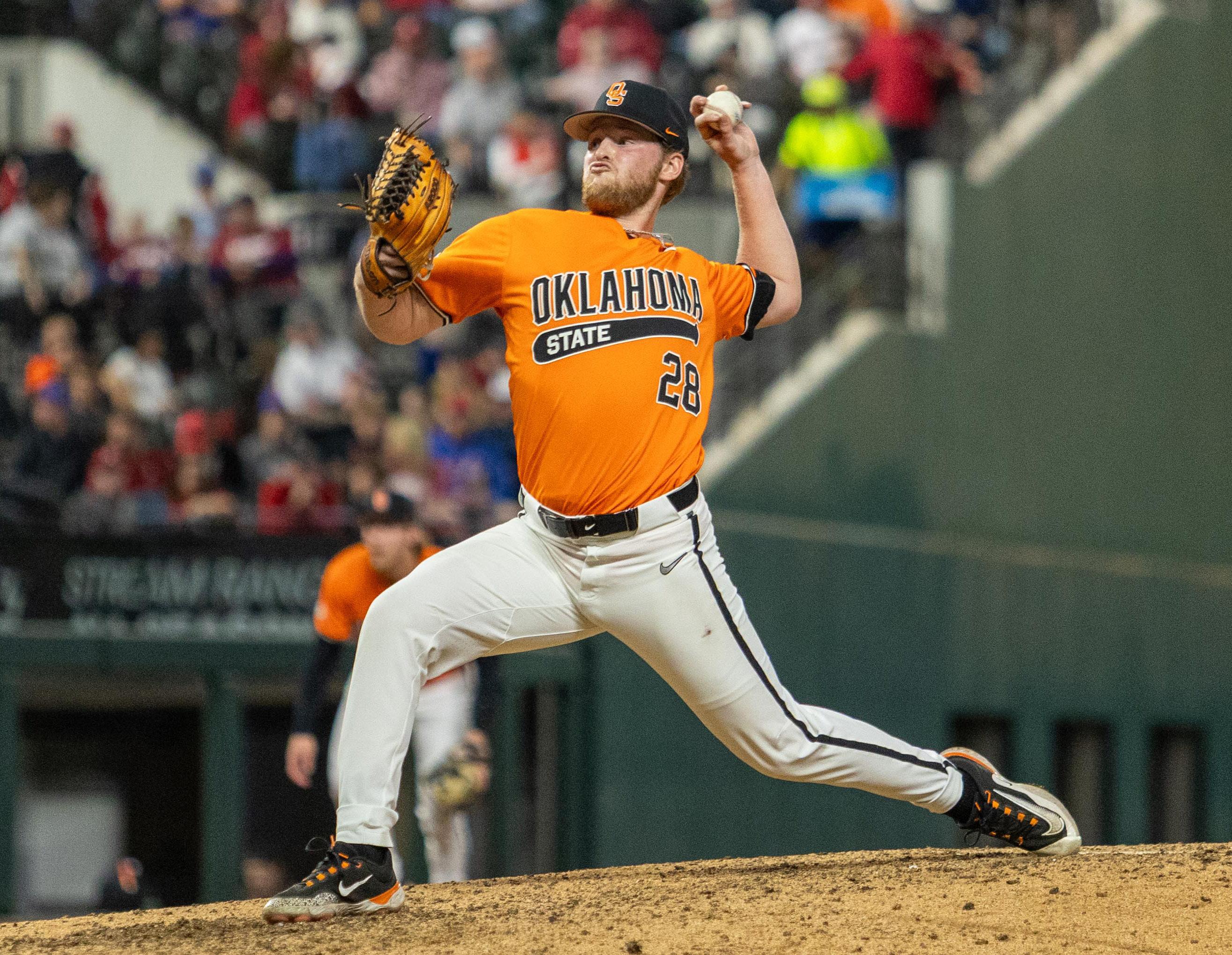
For Brennan Phillips, the early part of the season didn’t look like the version Oklahoma State expected on the mound.
During the first two months of the season, the junior struggled to find consistency. He started as a middleframe reliever, where his numbers were not impressive and he was not considered a favorable choice.
In his first 11 appearances, he pitched
Will
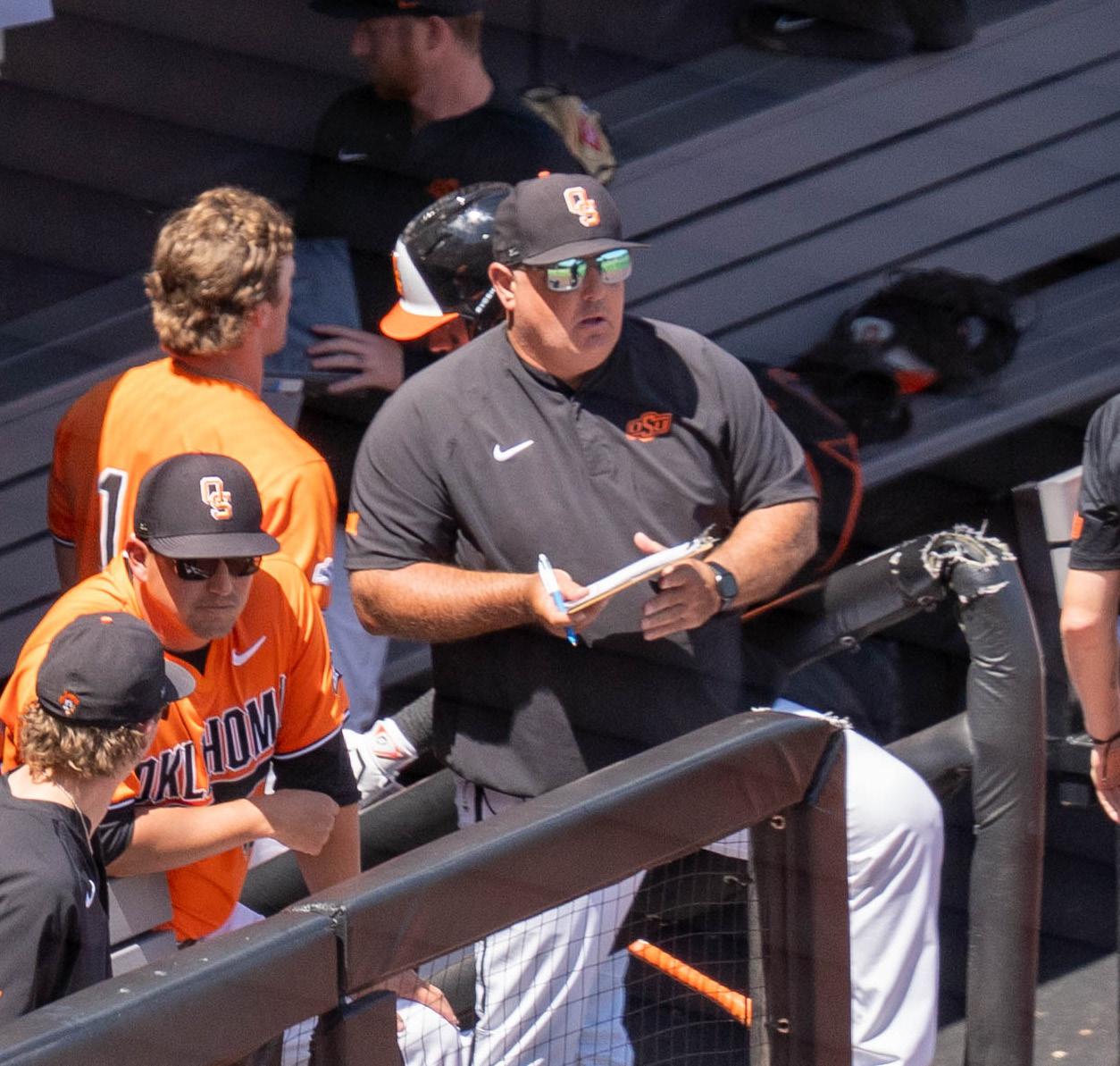
Under Josh Holliday, Oklahoma State has been known to finish the regular season strong with solid performances in May.
OSU has a record of 75-40 in regular season games in May, and has had a losing record only twice since 2013. Some of those strong stretches have led to big moments for the Cowboys — hosting Regionals and a Super Regional, Big 12 Tournament titles and a trip to the 2016 College World Series.
The Cowboys will begin May with a three-game series against TCU, starting on Friday at O’Brate
Stadium. This marks the start of a very crucial part of the season for OSU.
Holliday discussed what his team needs to do in this stretch to finish strong and qualify for a regional.
“Play it one pitch at a time on Friday,” Holliday said. “Just playing one at a time, that’s the key, I think, to being successful at this time of year. Just stick with what got you here, focus on those fundamentals, slow down a little bit and just try to live in the moment. If you can do that over a period of time, you can give yourself the best chance to succeed.”
See HOLLIDAY on page 2B
no more than two innings per game with 14 strikeouts, 22 hits, 22 earned runs and 10 walks for a 12.91 ERA.
But over the past few weeks, Phillips has flipped that script, as his ERA has dropped drastically to 7.88. He has become a steady presence in the
Cowboys’ pitching staff and has slowly moved into the starting rotation. Throughout April, pitching coach Blake Hawksworth helped Phillips rework his pitching style, and that has helped him build more confidence.
A clutch 3, a hustle steal and grit. Those are just a few examples of what role players can bring to a team.
While star players normally take the spotlight, efforts from a role player could be the difference maker in a season.
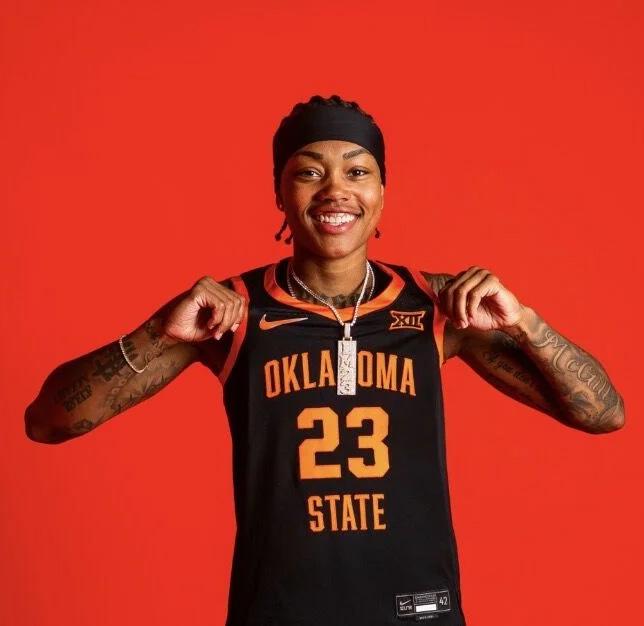
Oklahoma State made headlines during the offseason by grabbing its stars Audi Crooks and Liv McGill in the transfer portal.
Most outlets listed Crooks and McGill inside their top 10 for players
available in the transfer portal, and the two will likely join Stailee Heard in the Cowgirls starting lineup, but one of the six other players the Cowgirls brought in via the transfer portal could be the spark plug for OSU. With Crooks, McGill and Heard projected to be in OSU’s starting lineup, that leaves two spots to fill and Jacie Hoyt will have plenty of options.
Hoyt’s options likely include Ellie Brueggemann, Talexa
and Yuting
See DEPTH on page 5B
Wertzberger STAFF REPORTER
TULSA — Oklahoma State dug itself into a big hole midway through Tuesday’s matchup against Oral Roberts at ONEOK Field.
The Cowboys found life after falling behind 9-0, scoring five runs in the sixth inning. But just like in the first meeting between the two on April 7 in Stillwater, OSU could not complete the comeback.
The Golden Eagles’ relievers allowed just one run over the final innings to clinch the season series with an 11-6 victory, snapping OSU’s fourgame winning streak.
“We did not play well enough to win,” OSU coach Josh Holliday said. “Give ORU credit, they did. They did a nice job of capitalizing on some offensive situations they created for themselves and cut some hits. They were able to put up a big inning in the fifth. Six spots are usually tough ones, so credit to them.”
The first inning was quiet for both teams, but Oral Roberts (26-17) struck first in the second when Cooper Kelly hit a solo home run to right field for a 1-0 lead.
The Cowboys (28-17) nearly responded in the third after back-to-back singles from Terrance Bowen and Alex Conover. But Bowen was tagged out at home while sliding headfirst after a wild pitch by pitcher Brenden Asher.
The Golden Eagles added to their lead in the fourth when Wailele Kane Yates was hit by a pitch, followed by a two-run home run to left field from Cooper Combs to make it 3-0. ORU added more damage in the fifth inning, which proved decisive.
The Golden Eagles opened the inning with two singles and an RBI double, then added a one-out RBI single and a hit-by-pitch to extend the lead to 5-0 before OSU turned to its bullpen.
Freshman pitcher Zane Burns made his first career start and worked a career-high 4 1/3 innings. He was sharp early, retiring nine of the first
10 batters he faced, but ORU broke through in the middle innings. Burns finished with three strikeouts, allowing six hits, eight runs and two hit-bypitches.
“(His performance) was OK,” Holliday said. “He’s a good young pitcher. He did some good things. But in the end, at this level, when you don’t get the ball exactly where you need to get it, strong kids can hurt you. And their kids did that. ... Tonight, he’ll probably learn some things, and that’s a part of this journey.”
Although ORU did not record another hit in the fifth, it continued to build its lead against relievers Bryce LeBlanc and Jake Kennedy with three walks, a hit-bypitch and a wild pitch to make it 9-0 — its largest lead of the game.
With two outs in the sixth, it looked like the offensive struggles would continue. But OSU finally found some momentum.
Aidan Meola started the rally with a solo home run down the left-field line.
With both teams battling for position in the Big 12 standings and on the NCAA Tournament bubble, this weekend’s series could carry major weight heading into the final stretch of the regular season. Weston
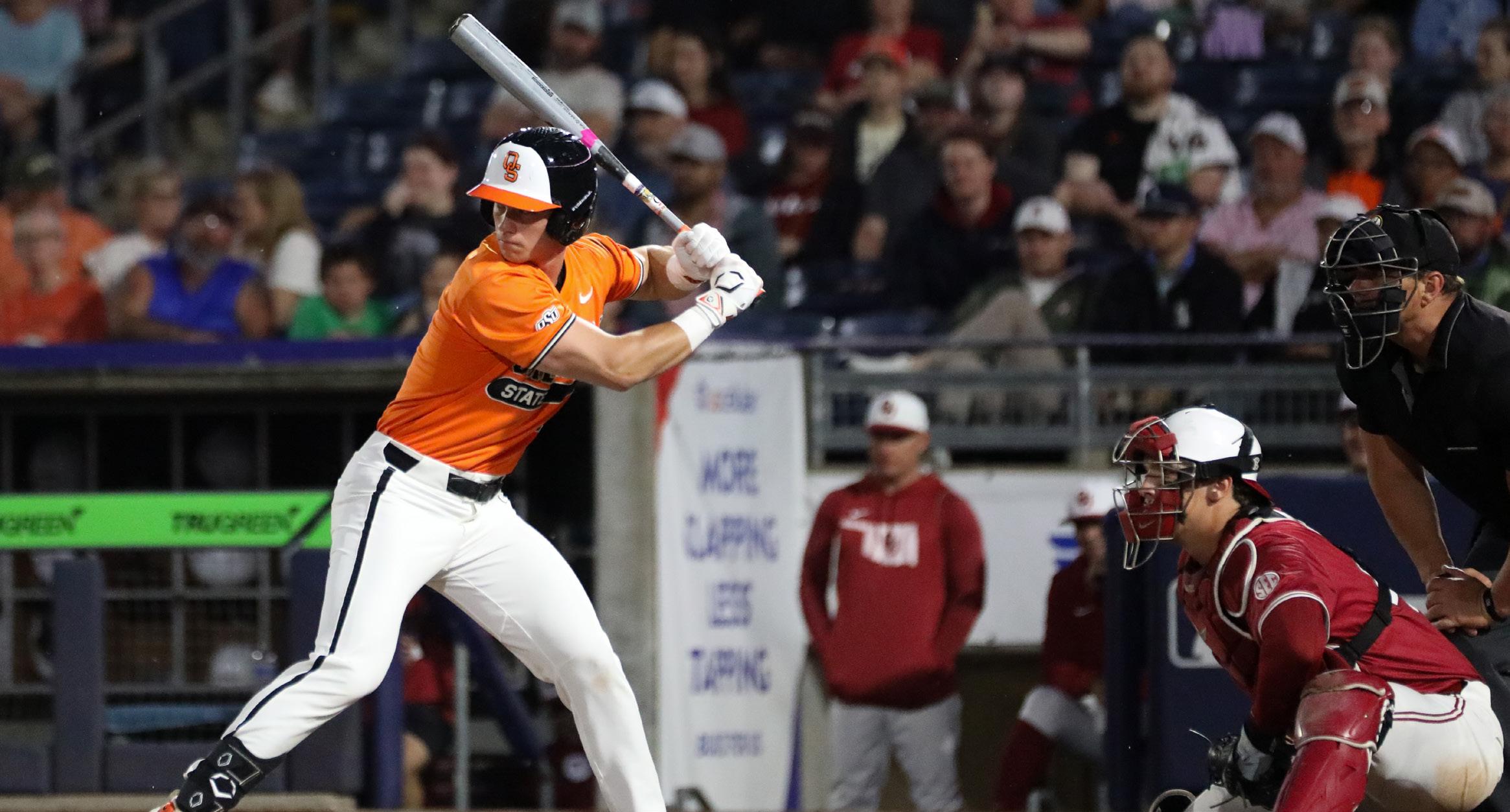
the biggest swing of the inning, launching a three-run home run to right field to trim the deficit to 9-5. The homer marked OSU’s 100th of the season, the third time in the past four years the Cowboys have reached that mark.
The Cowboys added two more singles during the rally before reliever Luke Williams struck out pinch-hitter Deacon Pomeroy to end the inning.
Oral Roberts answered in the seventh with RBI singles from Martell Davis and Hudson Ellis to extend the lead to 11-5.
OSU didn’t have much left offensively, managing only one run in the eighth when Shull scored on a wild pitch to make it 11-6. Over the final three innings, the Cowboys stranded five runners, including three in scoring position, as they suffered their second loss to the Golden Eagles this season.
a lesser effort level but still make contact to get the ball in play. We’ve done some of that better, but we have to continue to work at it in the moment.”
Now, the Cowboys head into May with 10 games remaining before the Big 12 Tournament.
This weekend presents a pivotal home series against TCU, which is riding a seven-game winning streak, highlighted by a series win over Baylor, a 10-inning midweek victory over Dallas Baptist and a series sweep of Houston.
In Holliday’s first year in 2013, OSU was on a roll entering May, having won eight out of its last nine games. The Cowboys began the month with a loss at Texas Tech, but recovered by winning seven out of their last nine.
Despite going winless at the conference tournament, the Cowboys found themselves at the Louisville Regional. They were eliminated by Louisville in the regional final.
The 2014 season saw a big improvement, boosted by a strong May, courtesy of sweeps against Arizona State and Kansas State to go 9-1.
The Cowboys battled to the final of the conference tournament, but finished as the runner-up to TCU. Though their excellent performance throughout the season resulted in them hosting a regional at Allie P. Reynolds Stadium.
OSU later advanced to the Stillwater Super Regional, but its season ended with an 8-4 and 1-0 loss to UC Irvine.
After a drop off in 2015, OSU bounced back in 2016. The 8-3 stretch in May began with a win over Texas to sweep the series. The Cowboys ended the regular season with a sweep of Kansas.
At the Clemson Regional, the Cowboys rolled past Nebraska and Clemson to advance to the Columbia Super Regional.
They cleared the next hurdle by holding South Carolina to
The Cowboys followed with a double from Campbell Smithwick, an RBI single from Colin Brueggemann and a single from Evan Saunders to cut the deficit to 9-2.
Then Garrett Shull provided
“...We had a couple of chances tonight and we didn’t quite finish the job tonight,” Holliday said. “I would’ve liked to have seen 9-6 or 9-7 in the seventh. We didn’t get to contact. As a result, it was 9-5. It’s the ability to lay off close pitches. It’s the ability, I think, to come off a full swing and be able to swing at
OSU is also coming off a sweep in Big 12 play after taking down Texas Tech in Lubbock. The Cowboys currently sit tied for sixth in the conference standings with BYU at 11-10, while TCU sits just ahead in fifth at 13-8. As for the national stage, the two teams are neck and neck in the RPI rankings. The Cowboys dropped two spots to No. 36 after the loss to Oral Roberts, while the Horned Frogs are at No. 40. Both teams are right above the bubble line for the NCAA Tournament, with a series win for either team helping build a case for an at-large bid.
Offensively, TCU holds a slight edge in batting average (.280) over OSU (.277), but the
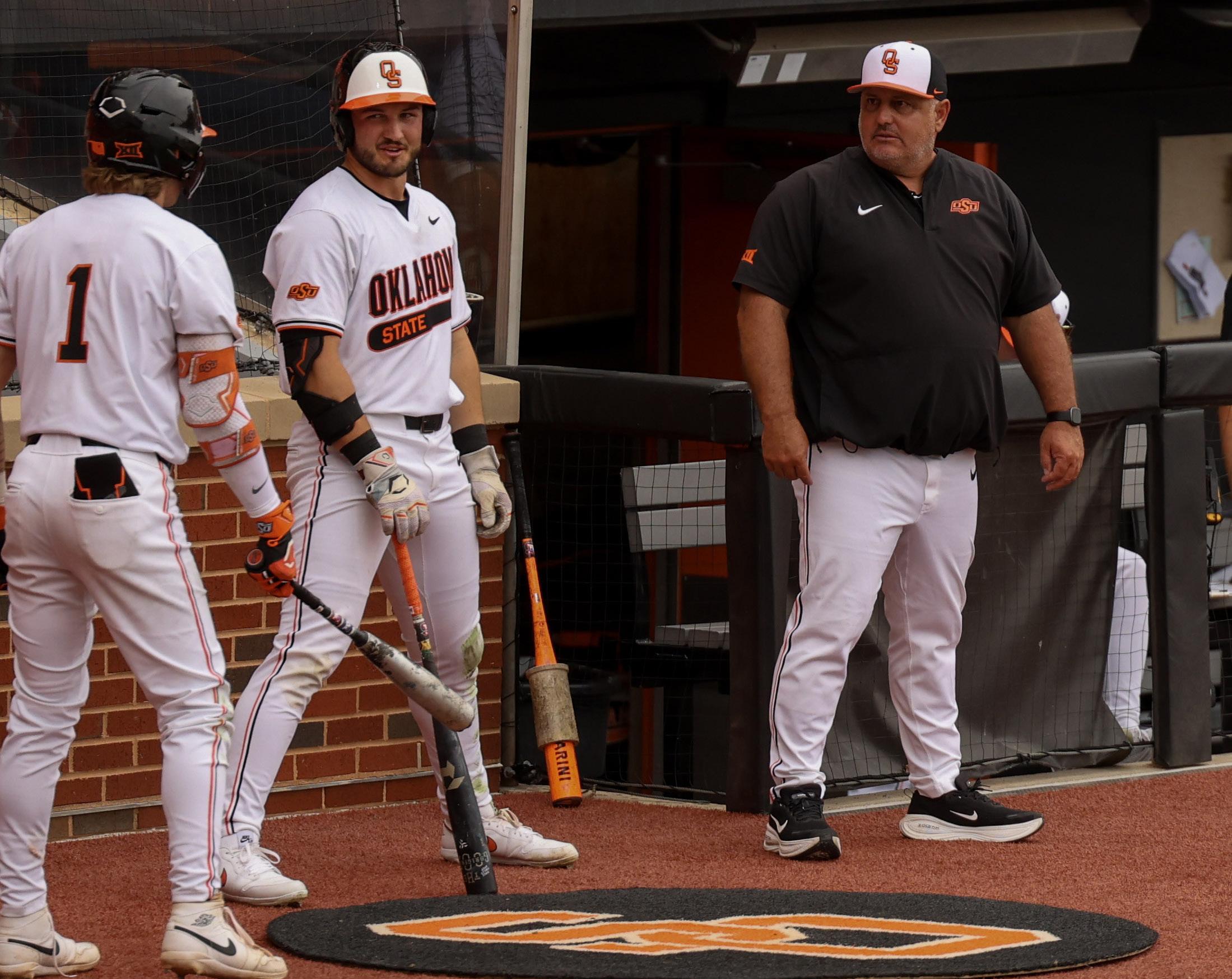
one run in both games, and advanced to their first College World Series since 1999, when Holliday was a player.
The Cowboys opened with wins over UC Santa Barbara and Arizona, but the Wildcats battled out of the losers bracket and ended OSU’s season.
After down years in 2017 and 2018, the Cowboys rose in 2019.
OSU went 7-1 in May, with its only loss coming against Oklahoma. The Cowboys battled their way to another conference tournament championship, and were
selected to host another regional.
OSU opened with wins over Harvard and Nebraska, but ran into a loss against UConn. The Cowboys bounced back to take down the Huskies and advance to the Lubbock Super Regional.
The Red Raiders won the opener, but the Cowboys forced a game three. TTU was not fazed, as it eliminated OSU to go to Omaha.
Series wins over KU, Baylor and New Orleans led the Cowboys to another strong May in 2021. The momentum carried into the conference tournament, and advanced to
the final, where they lost to TCU.
The strong finish to the month earned OSU a spot in the Tucson Regional. It could not continue that performance in the regional, as two losses to UC Santa Barbara ended its season.
Following 2022, the 2023 season saw an improvement in May for OSU, which hosted a regional again. The Cowboys underperformed in the regional with a close loss to Oral Roberts and a blowout against Dallas Baptist. In 2024, OSU opened May with two losses to Texas, but
Cowboys have produced more overall, leading in runs, hits, doubles and RBIs. The biggest difference comes in power, where OSU’s 100 home runs nearly double TCU’s 56. Plate discipline presents another contrast. The Horned Frogs are tied for the conference lead with 253 walks, while the Cowboys are close behind with 247. However, TCU has done a better job limiting strikeouts, averaging 7.88 per game compared to OSU’s conference-high 10.98. On the mound, TCU holds the edge with a 5.33 ERA compared to OSU’s 6.31, giving the Horned Frogs a slight advantage in overall pitching consistency.
Since 2021, TCU has controlled the series with a 10-5 record, though it is even at 3-3 in games played at O’Brate Stadium. OSU has played well at home this season with a 17-5 record, while TCU has gone 7-8 on the road.
sports.ed@ocolly.com
it excelled after that. Series sweeps of Texas Tech and Houston brought the Cowboys a 5-2 mark on the month.
As the No. 2 seed, they cruised through the tournament and won it in style by defeating OU. That momentum continued into their third-straight regional in Stillwater.
OSU opened with dominant wins against Niagara and Florida. But the wheels fell off, as the Gators won twice to eliminate the Cowboys.
OSU was in a bad spot entering May last season, but that month turned the season around. The Cowboys swept UCF and ASU, and won the series at BU to go 8-1 in that stretch.
After the conference tournament, OSU was selected to play at the Athens Regional. It opened with a loss to Duke and a big win over Binghamton. The Cowboys rallied to eliminate Georgia, but blew a 2-0 lead to Duke and got eliminated.
After OSU’s 11-6 loss to ORU, Holliday spoke about what helped that team pick up the pace in May.
“It was probably just overall really good team baseball,” Holliday said. “... I think it requires all facets of the game in order to get on a run late; it can’t just be one dynamic. Good quality starting pitching, protecting leads when you can create them and being relentless enough on offense that you can go out there and win 3-2 or 7-6.”
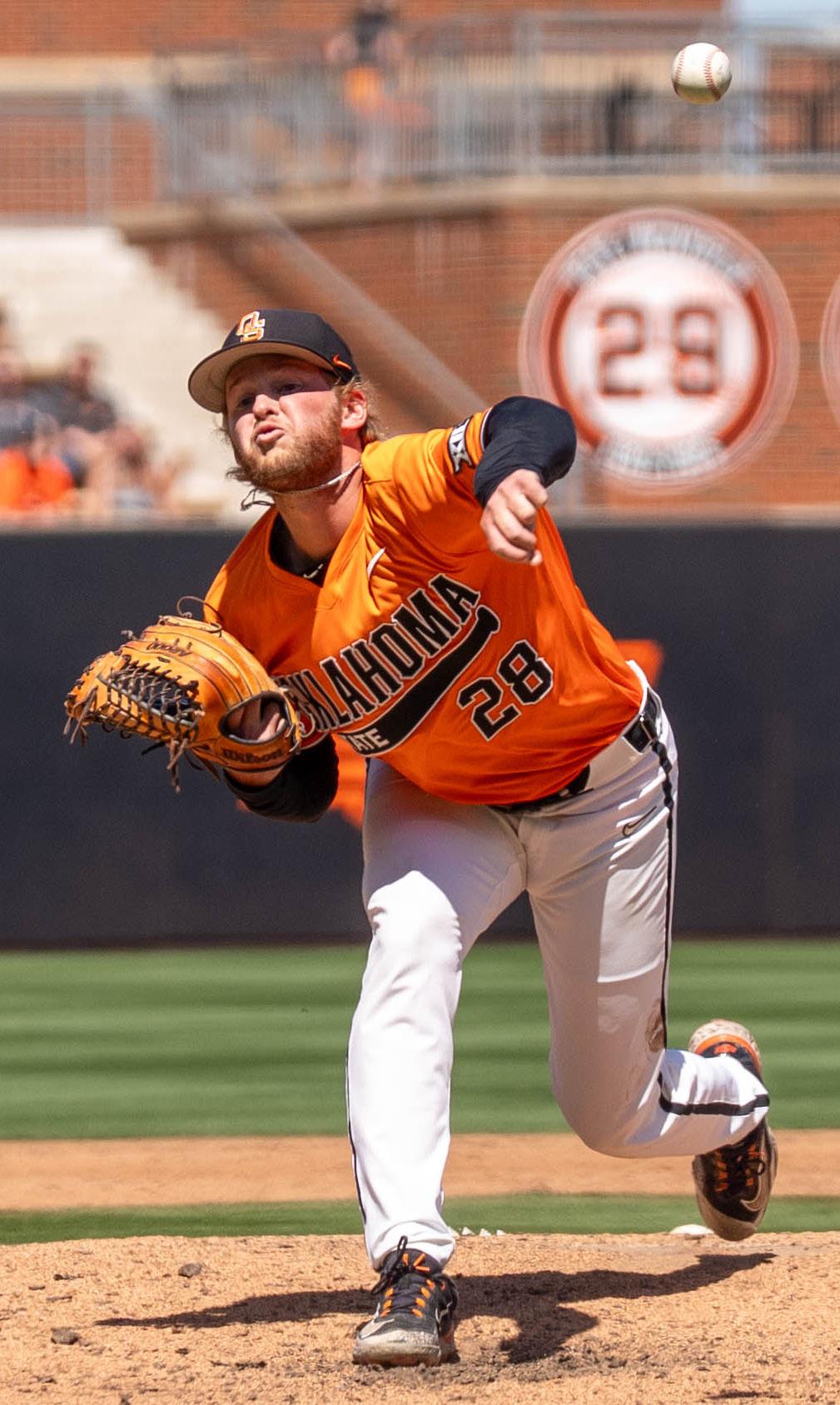
“When he pitches like that as a starter, he certainly gives the bullpen a chance to catch its breath, that’s for sure,” OSU coach Josh Holliday said. “If he comes out of the bullpen, which he has done this year as well, it’s been a long shot in the arm. It’s been longer outings and skilled outings. “He’s done a great job in whatever role we’ve asked him. The start (to the season) was a little slow, but he found himself through hard work and adjustments.”
Coming out to start the season, Phillips struggled to limit damage, allowing multiple runs in short outings while working through command issues and trying to find a rhythm. Without a full preseason to prepare, he entered the year trying to catch up both physically and rhythmically.
“When he was struggling (earlier this season), he did not have the benefit of a full preseason, and he was late to the gate,” Holliday said. “When he came out, he wasn’t quite right, and then he was fighting it, and game success was elusive. But to his credit, he and coach Hawksworth got on the same page and made some adjustments. And, yeah, it’s been awfully helpful.”
Since mid-April, Phillips has looked like a different pitcher.
His command has sharpened, and he has been able to work deeper into games, giving the Cowboys more stability.
Phillips’ latest outing against Texas Tech on Sunday was a clear example, where he delivered a career-best performance, going 8 1/3 innings — the most for any OSU pitcher this season — while allowing just two runs and striking out a seasonhigh six batters.
Over the last three games with two starts, his outings have gotten longer with at least three innings of work each game. During that stretch, Phillips has retired batters 78% of the time, with 14 strikeouts while allowing 15 hits, six earned runs and five walks.
Those recent outings have reflected the adjustments that have taken shape behind the scenes, helping stabilize the pitching staff and giving the bullpen more flexibility late in games.
“(He’s improved on) strike zone, more quality strikes, more speed and changes of speed in the strike zone,” Holliday said. “He’s done a really good job mixing his pitches. He hasn’t let the other team sit on a pitch, so they’re a constant mix of hard, soft and breaking pitches. It’s been a good neutralizer against some pretty aggressive teams.”
sports.ed@ocolly.com
It was the first day of practice back from winter break.
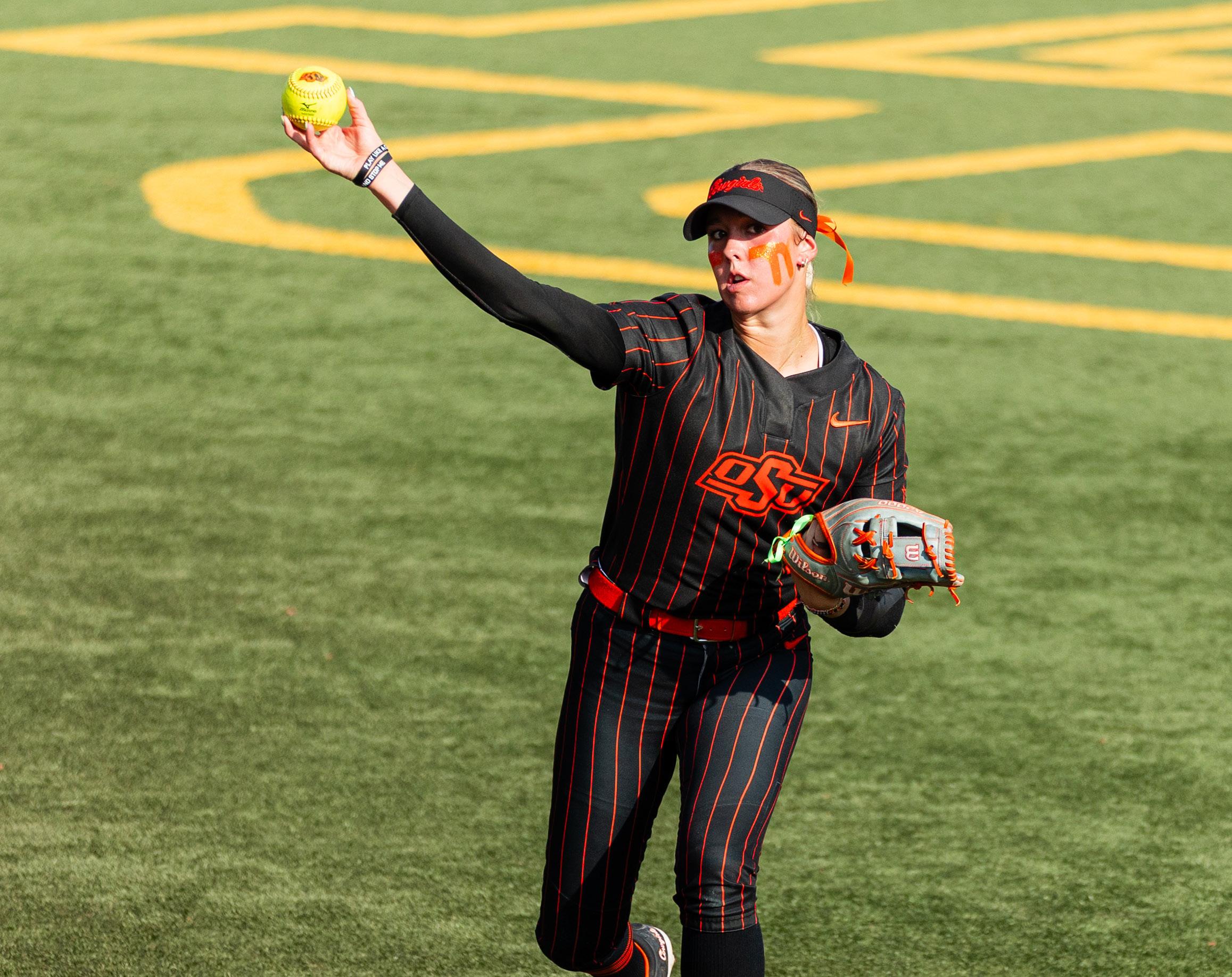
Freshman Madison Hoffman was excited to compete in her first season on the Oklahoma State softball team.
“I remember driving down in January to college,” Hoffman said. “Thinking ‘I’m so excited to play my first (season),’ and then I couldn’t.”
Hoffman tore her ACL in the first practice back from winter break. It was devastating, as she would miss the entire 2025 season and take a medical redshirt.
So, Hoffman had to lean on her teammates in those times of struggle.
“That was pretty rough,” Hoffman said. “But I had the best teammates to support me. I got to live in their house for a month because I couldn’t drive, and so they just loved me so much. And so that made it a lot easier.”
OSU coach Kenny Gajewski calls Hoffman one of the hardest workers he has ever coached, if not the hardest.
“She lives, eats, sleeps this,” Gajewski said. “She cares about this program.”
After taking the medical redshirt and getting off to a bit of a slow start this season, Hoffman has started to make the most of every at-bat she gets.
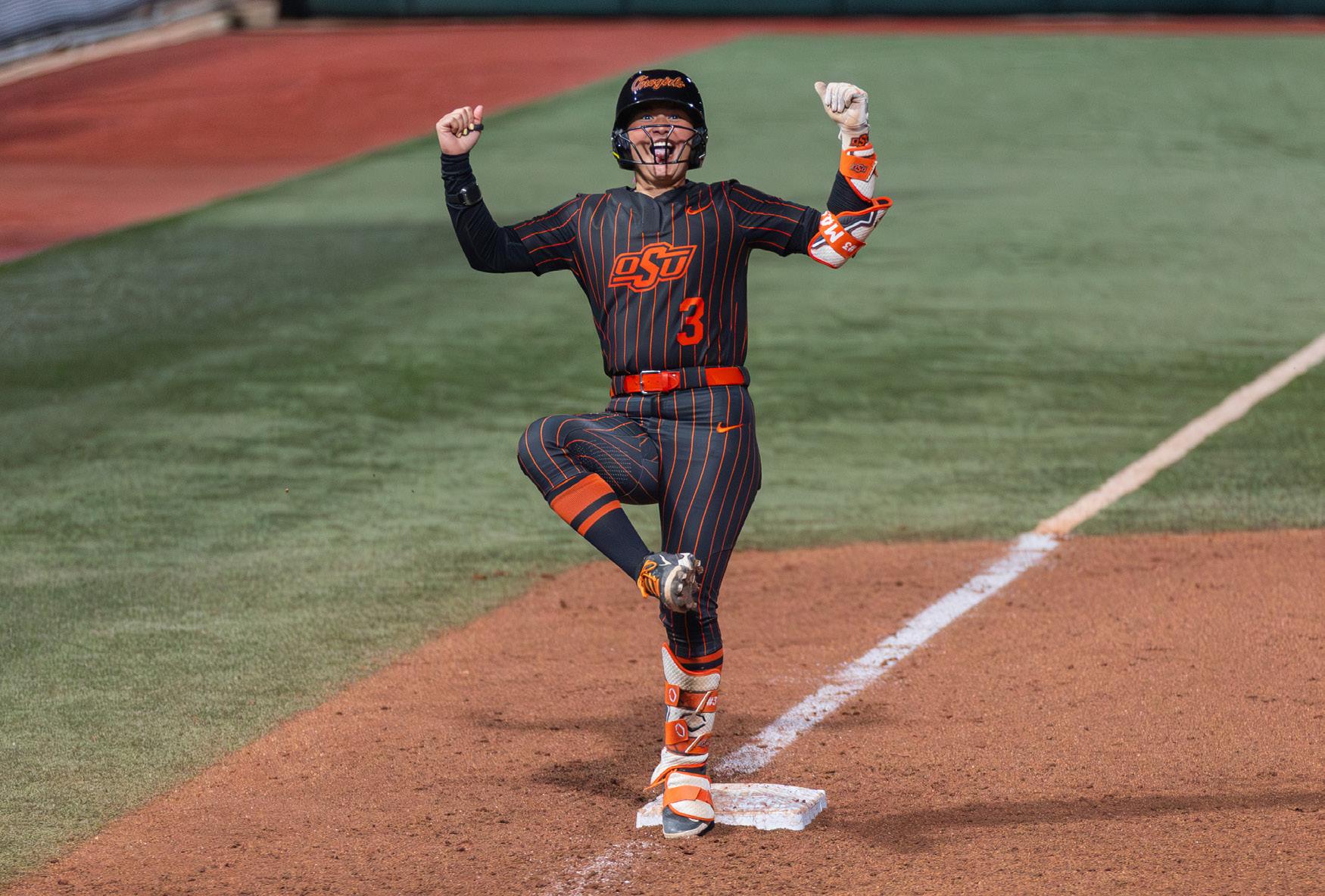
Gajewski gave her a pinch-hit atbat in the seventh inning against Texas on April 22. She answered

with a clutch two-run homer to add on important insurance runs. Hoffman also got a pinch-hit at-bat in every game this past weekend in Waco. She went 0-for-1 but drew two walks.
Gajewski rewarded her again with a start against Tulsa on Wednesday. She made the most of her chance.
Hoffman went 2-for-3 with a two-run homer and an RBI triple, driving in three of the Cowgirls’ five runs in a 5-0 win against Tulsa.
Although it’s a small sample size, with only 16 at-bats this season, Hoffman is now slashing .438/.591/1.000. Twenty-five percent of Hoffman’s hits are extra-base hits.
“I don’t think I can express how happy this whole program is for that kid,” Gajewski said. “She’s gonna do great things here … She cares about this program. She had a really tough start last year when she tore the ACL, and I’m just really, really proud of her. She’s gonna do some great things here, and it’s gonna be hard to get her out of the lineup.”
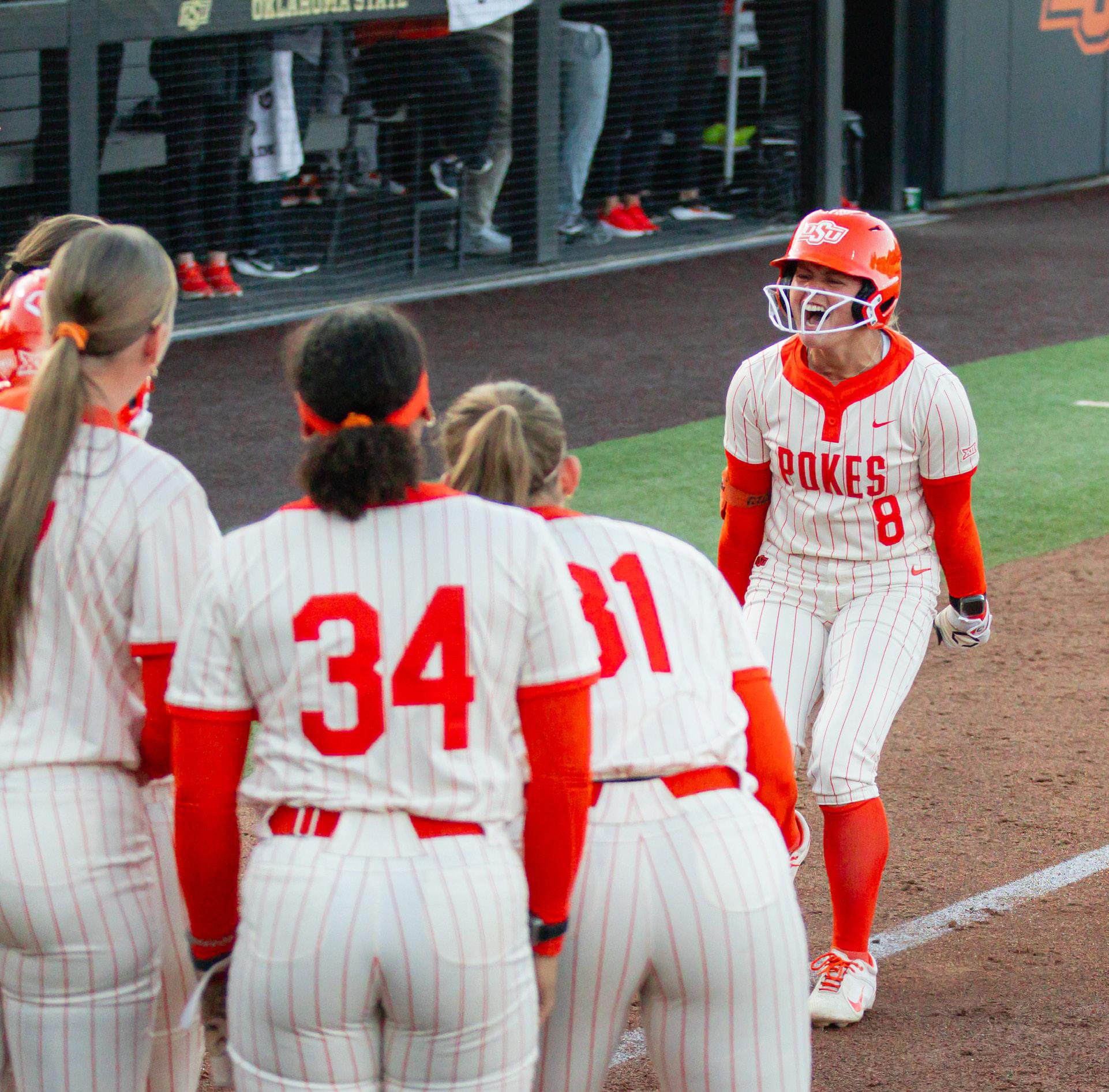
Some of the biggest reactions from the dugout are when Hoffman gets a big hit. On both of her home runs this season, she has sprinted around the bases toward a mob of her teammates at home plate.
“I think they enjoy it more than I do,” Hoffman said. “And they just love me so much and that’s so obvious and I just love them so much, too, but I just am so
overwhelmed with joy with their reactions.”
Freshman shortstop Aubrey Jones has been either on deck or on base for both of Hoffman’s homers. She has been part of both mobs at home plate.
“Obviously, she’s been through some hard things,” Jones said. “So, to see her succeed after going through so much is really awesome. Her last home run was in Texas, and I was on base for her, and as soon as she hit it, I was so excited, yelling for her.”
And same thing today, I got to be right after her, so I got to be right next to her again, so, yeah. I’m super pumped when someone like that is able to do something good for the team.”
Hoffman is starting to find a groove and is making it hard on Gajewski to find as many opportunities to get her at-bats as he can.
“Yeah, it’s pretty rewarding,” Hoffman said. “I remember just last year, I was just telling myself, I got to trust God’s process, and like every day I was just there for my teammates, because all I could do was cheer them on, I couldn’t do anything on the field.”
And so, once I was cleared, I was like, ‘Okay, like now I can contribute on the field,’ so I just got to working all the time and to see it pay off right now is awesome. It was a lot of hard work to get here, and I’m just grateful that I’m able to help our team win.”
sports.ed@ocolly.com

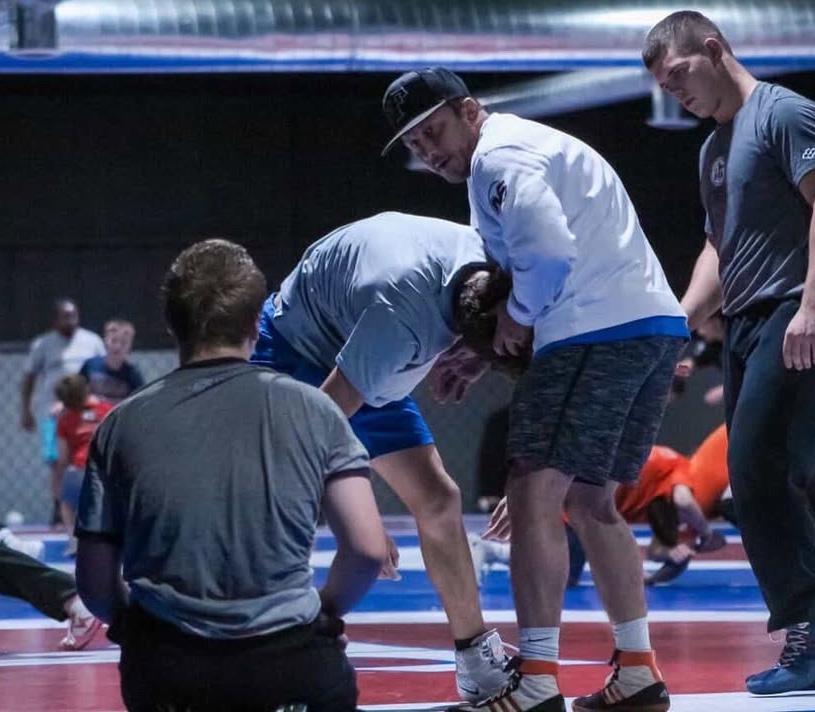
Easter, The O’Colly
Chris Staehlin and his family fell for Stillwater’s wrestling scene enough to leave Las Vegas.
Staehlin bought land. His son, Zane, bought into Coleman Scott’s program at The Farm.
“We signed up for a camp last year in the summer,” Staehlin said. “I met Coleman at Reno Worlds. I had an 8-year-old at the time. We came to a camp, and we wanted to do a couple. We liked Stillwater, and we liked the way the wrestling was here compared to Vegas, and we decided to buy land in the state.”
For the Staehlins, it wasn’t only a move. It was a commitment to a different way of life, one built around wrestling and discipline that starts young.
At 9, Zane keeps it simple.
“Grinding, sprinting, bear crawls, baby bears, pull-ups sometimes, push-ups,” Zane said. “That’s about it.”
The kind of routine Scott set out to build.
On 30 acres, 15 minutes south of Stillwater, Scott turned a piece of land into The Farm, a wrestling camp designed to develop young athletes on and off the mat.
A space more than double the size of two basketball courts came together in half the expected time. The same mindset that earned Scott a bronze medal in wrestling at the 2012 London Olympic Games and set the foundation of The Farm.
“I owned this 30 acres,” Scott said. “My buddy in Pennsylvania, Jody Strittmatter, with Young Guns [Wrestling Club], runs the same concept, similar setup. He’s all in one building; I split it into two. It was right after everything happened up at [Oklahoma State University],
BY SEVE SANCHEZ I O’COLLY CONTRIBUTOR
and I didn’t think I’d be back in the college game, so we just built this.”
The wrestling room and housing weren’t built the traditional way; they came together through long days from anyone willing to help. Scott said the timeline didn’t matter, only getting it done.
“We didn’t move dirt until January of last year, and then we had our first camp in May,” Scott said. “It should be an eight-month project that we shrunk to four, so we cut it in half. We were all hands on deck, the community, the club. We had the kids carrying
the 2008 NCAA champion at 133 pounds. He achieved a 12024 record through his college career before joining the OSU staff as an assistant coach from 2012-14.
After an eight-year stint as coach of North Carolina, Scott returned to OSU as an associate coach with plans in line to take over as coach when legendary John Smith retired after his 33year career in 2024.
The plan didn’t unfold the way Scott expected.
“They kind of pulled the rug on me,” Scott said. “The plan was for John to retire, then I was gonna take over as head
For Nichole Noel and her son, Wyatt, the introduction to The Farm didn’t come with guarantees, only an opportunity to show up and see where it led. That moment came for Noel with a phone call and a young son beginning to understand the sport.
“Wyatt was 5,” Noel said. “We called up here and talked with Coleman, and he was like, ‘Oh yeah, bring him up. I have a kid who is his exact weight.’ I was like, ‘That’s perfect,’”
Much of that experience is how the coaching staff can shape it to the wrestler.
“You want to be a good person, you want to give back, be a christian, have that faith. That’s what we preach here and not just preach, but live by here.”
in the sheet rock. My fatherin-law hung all the [shower stalls] up, which was a pain. My dad was here for two or three months, just helping with whatever.”
After the inaugural camp in May, Scott, 39, could only hope for the investment to pay off. Becoming a strong wrestling club takes time, but Scott focused on building a sustainable culture.
The demand didn’t take long to follow.
“I had 750 [kids] roll through here last year,” Scott said. “We’re expecting 1,0001,200 kids throughout just the summer. Every evening in the winter, there were 200-250 every day because the high school used it as well.”
As a Cowboy, Scott was a four-time All-American, an NCAA runner-up in 2007 and
coach. I was the coach of a power-five school. I would’ve never left [UNC] had I known that I wasn’t going to be the coach. I was pissed off.”
The direction he expected was gone. A new one had to take shape.
Even as the path shifted, Scott’s purpose didn’t. The impact he wanted to leave wasn’t tied to a title or a record. It never was.
“The biggest thing is that we can teach kids how to live the right life,” Scott said. “Winning is cool and the trophies and stuff, but at the end of the day, that’s very minimal in the whole scheme of life and what you want to do. You want to be a good person, you want to give back, be a Christian, have that faith. That’s what we preach here and not just preach, but live by here.”
At 6, Wyatt’s answer is brief, but certain.
“[The coaches] are pretty good,” Wyatt said. “The moves they do and the pins they do, they coach me well.”
A piece of paper hangs over the two water fountains with 10 things that require zero talent.
1. Being on Time
2. Making an Effort
3. Being High Energy
4. Having a Positive Attitude
5. Being Passionate
6. Using Good Body Language
7. Being Coachable
8. Doing a Little Extra
9. Being Prepared
10. Having a Strong Work Ethic
The routine Scott prioritizes reaches far beyond his words.
For these young wrestlers, constant reinforcement helps build both discipline and confidence.
“The biggest thing is finding
out how to get the most out of an individual,” Scott said. “It’s never usually screaming, demeaning, yelling. Build them up, but be honest with them, and that’s what we do. As coaches, we don’t yell at kids, but we hold them accountable, per se. We have a high standard here; we work hard and everything, and that’s sort of all I brought over.”
After one year, Scott has laid the foundation for the future.
That includes housing for 150 overnight campers with Tempur-Pedic beds, as well as a waterproof shower room with 20 showers and 10 toilets. The 60-by-160-foot training space stands out most, housing eight wrestling mats branded with The Farm and Scott’s name. Still, Scott has plans to expand beyond the mats.
“We have kids who come to school class currently,” Scott said. “We have a full-on academy starting in the fall, so we did a little bit of a mock with a couple of homeschooled kids and a teacher. They house out here four days a week in the mornings. They’re here from about 8 [a.m.] to 12 [p.m.] every day.”
What started small has grown quickly, bringing kids from across the country. The numbers continue to climb, with more kids filling the mats each season. For Scott, growth was never meant to come at the expense of connection.
“Let’s give back to the community, let’s figure out how to make great humans on and off the mat,” Scott said. “We got a lot of rules like no cussing, yes, sir, no, sir, yes, ma’am, no, ma’am, please and thank you. You have to go through the food line, you have to say all of that, all of those little things. Shaking somebody’s hand, looking them in the eye.”
Parker Gerl CO-EDITORIN-CHIEF
Texas Tech put up a pretty penny.
It might have caught a bad beat.
The university announced on Monday that quarterback Brendan Sorsby is entering rehab for a gambling addiction, almost four months after Tech signed him to a reported $5 million NIL deal.
Now, Sorsby’s wagers are at the center of an ongoing NCAA investigation that could shake up the landscape of college football. His playing career, and the Red Raiders’ season, are seemingly in doubt.
According to multiple reports, dating back to 2022, Sorsby placed more than 10,000 bets and, at one point, averaged more than 20 bets per day. These included wagers on Indiana football when Sorsby redshirted for the Hoosiers in 2022, along with bets on pitches at Cincinnati Reds games. Some bets were less than a dollar. Most were less than $100.
But in the end, Sorsby’s future in Lubbock is now on the line, as the NCAA forbids athletes from betting on both college and pro sports.
“We love Brendan and support his decision to seek professional help,” TTU coach Joey McGuire said in a release. “Taking this step requires courage, and our primary focus is on him as a person. Our program is behind Brendan as he prioritizes his health.”
Sorsby’s transfer from Cincinnati put the Red Raiders as the favorites to repeat as Big 12 Conference champions. It also allowed him to become one of the faces of college football, as he was widely regarded as the No. 1 or No. 2 transfer quarterback in the country.
A player of his caliber choosing to seek treatment for a gambling addiction while on a roster is unprecedented in
Continued from 1B
Brueggemann started every game of her three-season career at Lindenwood, Weeter started every game at Fort Hays State last season and Ndiaye was in the starting five in all but one game for Rutgers. Deng is the only of the group that didn’t start last season, but she made eight starts during her freshman season at Auburn.
All four could rotate between the starting five. They will all likely impact the Cowgirls this season.
In a 24-hour poll conducted on X, OSU fans were asked who of the four they thought would have the biggest impact.
Weeter received the majority of the votes at 45%, Ndiaye followed with 22% of the votes and Brueggemann and Deng each received 16.5% of the votes.
Advanced metrics would agree with the Cowgirl fans that Weeter is the most valuable.
During this past season, Weeter had a player efficiency rating of 37.6. For reference, Crooks’ efficiency rating was 41.8.
Based off win shares, an analytical stat that measures the approximate number of wins a player produced, Weeter was more valuable than Crooks. Weeter produced 6.7 wins for her team, while Crooks produced 5.8. “Talexa is a versatile player that was one of the country’s

college sports. It’s also raised several questions in the college football world.
How long did Texas Tech know about this?
How did the NCAA learn of this?
What’s Sorsby’s next move if he’s banned from competition?
Now, the Red Raiders no longer loom as a runway favorite to win the league with Sorsby’s status in limbo. Teams in the conference with firepower, such as Oklahoma State, Utah, BYU and Houston, could climb up the ladder.
The Big 12 also was set to have two potential star quarterbacks as faces of the league and potential firstround NFL Draft prospects in Sorsby and OSU’s Drew Mestemaker. If Sorsby is deemed ineligible, it could pave the way for Mestemaker to become the league’s top face, should his success translate.
This is still ongoing, though. The NCAA still needs to conclude its investigation, which would mean it needs to speak with Sorsby. That may
not happen for a while as he’s away at a treatment facility.
But the NCAA’s strict gambling policy includes “permanent loss of eligibility” for those wagering on their own team. Sorsby’s bets on Indiana loom as the largest obstacle for him to return.
Once the NCAA closes its investigation, if it recommends Sorsby be deemed ineligible, the school would then rule him ineligible per normal protocol.
The next step, however, could be TTU filing for his
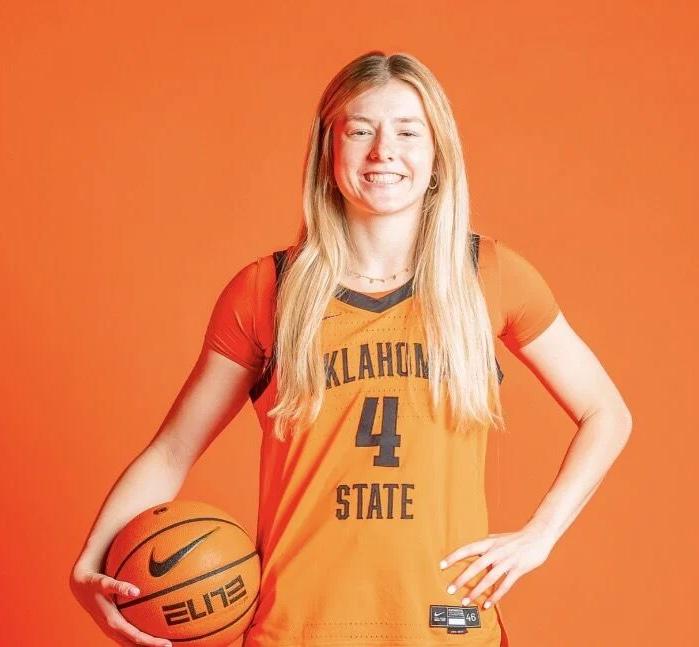
most efficient scorers last year,” Hoyt said in a release. “She can stretch the floor and shoot, but also loves physicality around the rim. She will create mismatches for opponents and brings a competitiveness that our fans will love!”
Although Weeter’s value compares to Crooks, she is transitioning from the Division II level to the Power Five level, so the level of competition could play an effect.
The metrics argue that Brueggemann is comparable to McGill. Their efficiency ratings are nearly identical. Brueggemann had a rating of 26.2 and McGill’s was 26.3. Their win shares were even close, Brueggemann’s was 3.8 whereas McGill’s was 4. Brueggemann did outrank McGill in individual offensive rating, a metric that measures how many points a player
creates per 100 possessions. Brueggemann’s rating was 119.4 and McGill’s was 100.1.
Brueggemann’s efficiency field goal percentage was 63.2%, the ninth-highest in college basketball. Offensively, she ranked inside the top-100 on eight different stats.
“She is one of the best 3-point shooters in the country and has great size and versatility and a hunger and gratitude for the opportunity on this stage in
reinstatement. An NCAA denial could spark a legal case that gets a Lubbock judge involved — similar to what we’ve seen happen in other recent player eligibility cases. There’s still a lot to unpack. The Sorsby saga is nowhere near over.
But it does feel like the star quarterback’s future at Tech is in real doubt due to a gambling addiction, a potential major shakeup to college football and the Big 12.
her home state,” Hoyt said in a release.
As for Ndiaye and Deng, they are both taller than 6-foot and share similar characteristics. Both are exceptional 3-point shooters. With the Scarlet Knights, Ndiaye shot 41.6% from beyond the arc, whereas Deng shot 37% from 3. They were both close in win shares as well. Ndiaye produced 1.8 win shares, and Deng had 1.5. However, Ndiaye’s player efficiency rating was significantly higher. She had an efficiency rating of 21.4, higher than Heard (19.4) and four of OSU’s starters from last season.
“Nene is a huge piece to our puzzle of assembling an elite roster. She is what I would describe as a Swiss Army Knife. She brings a little bit of everything to the table with her game,” Hoyt said in a release. “She can shoot, drive, post up, rebound, defend and is a tremendous athlete with great length.” Deng’s player efficacy rating was 15.7, but her biggest impact came on the offensive end. She had an individual offensive rating of 104.5.
“She can score with the ball in her hand and is exceptional as a catch-and-shoot shooter as well,” Hoyt said in a release. “Her ability to space the floor makes our team more lethal offensively. She has something very few players have, the clutch gene, with her ability to make big shots in big moments in big games.”
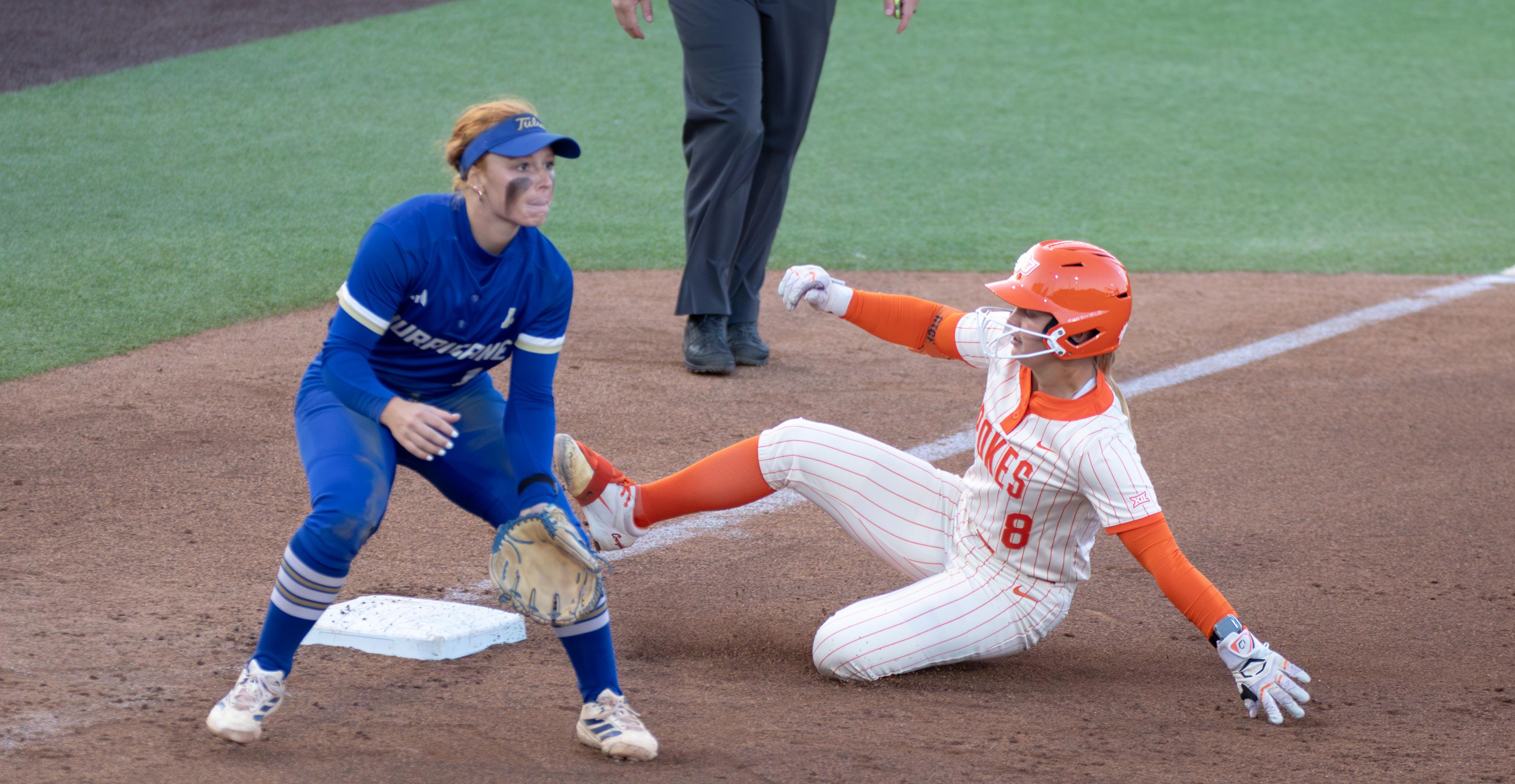
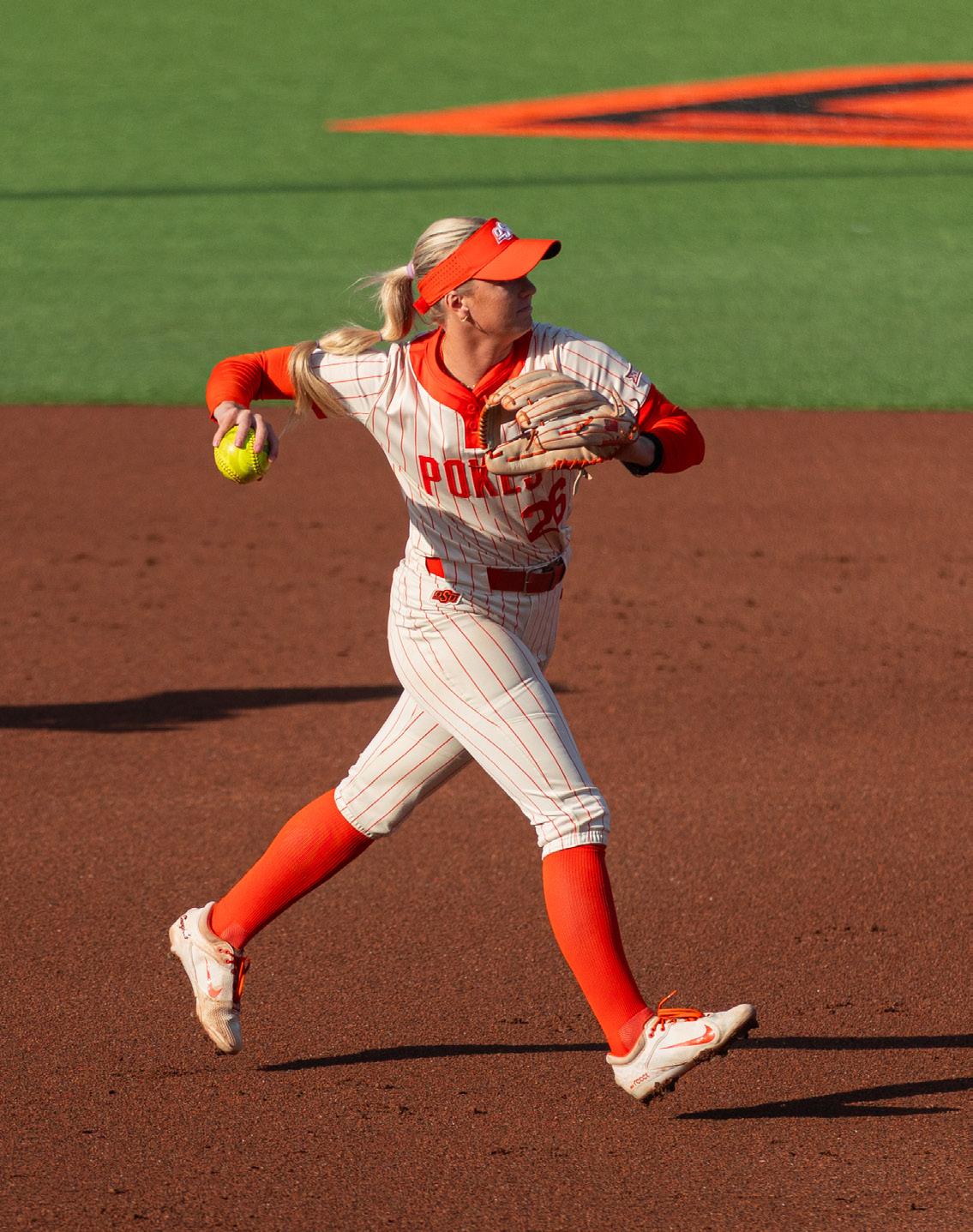
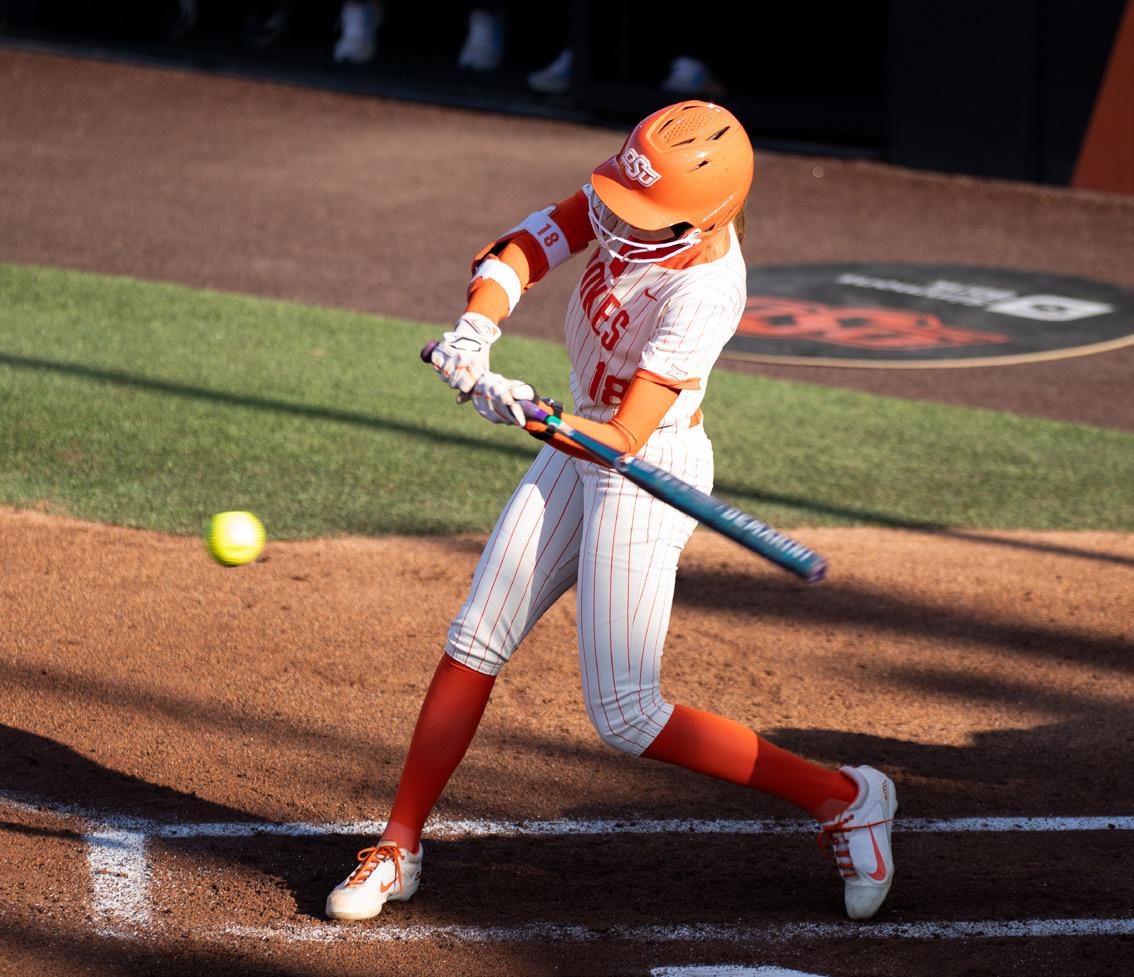
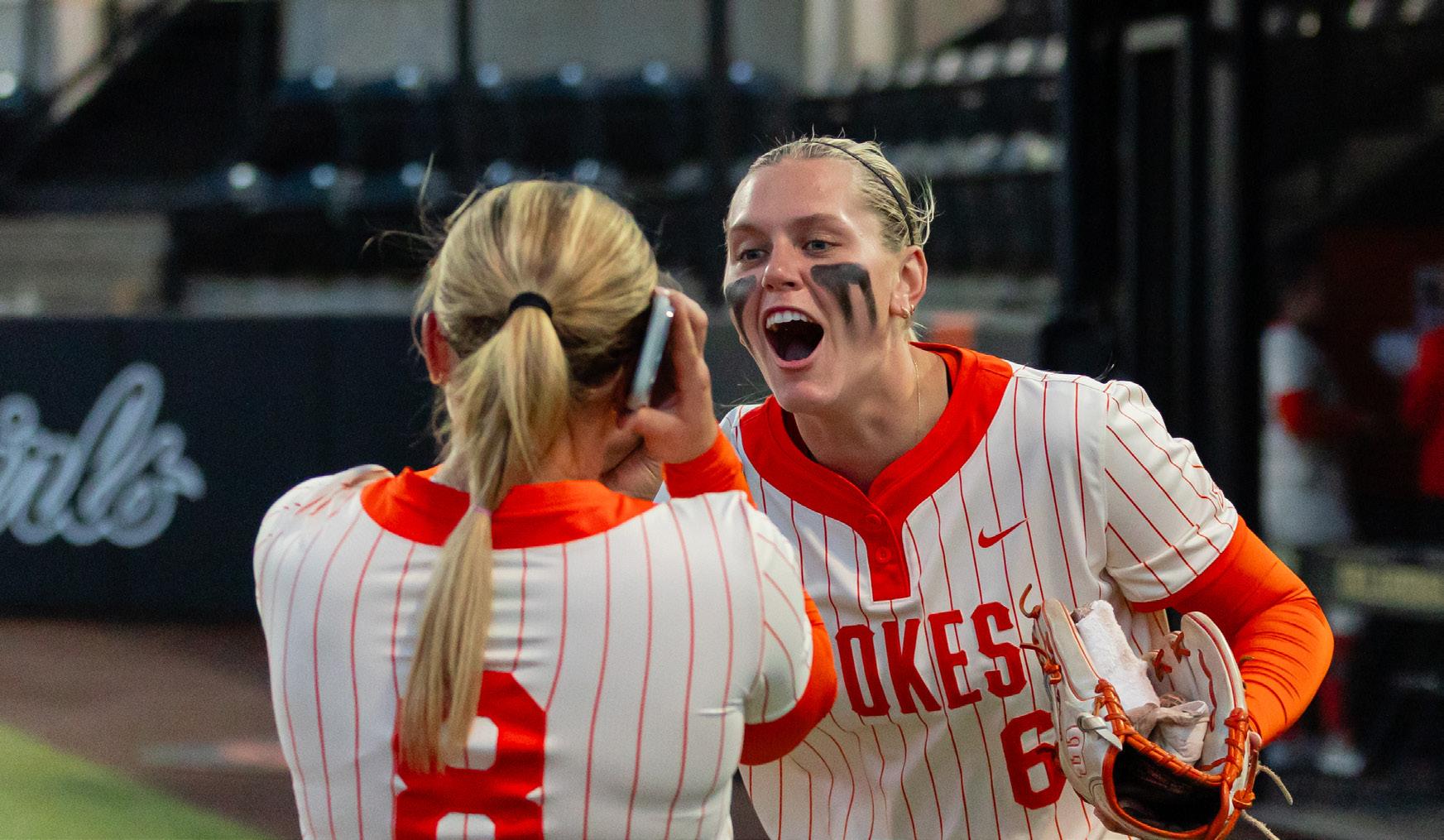
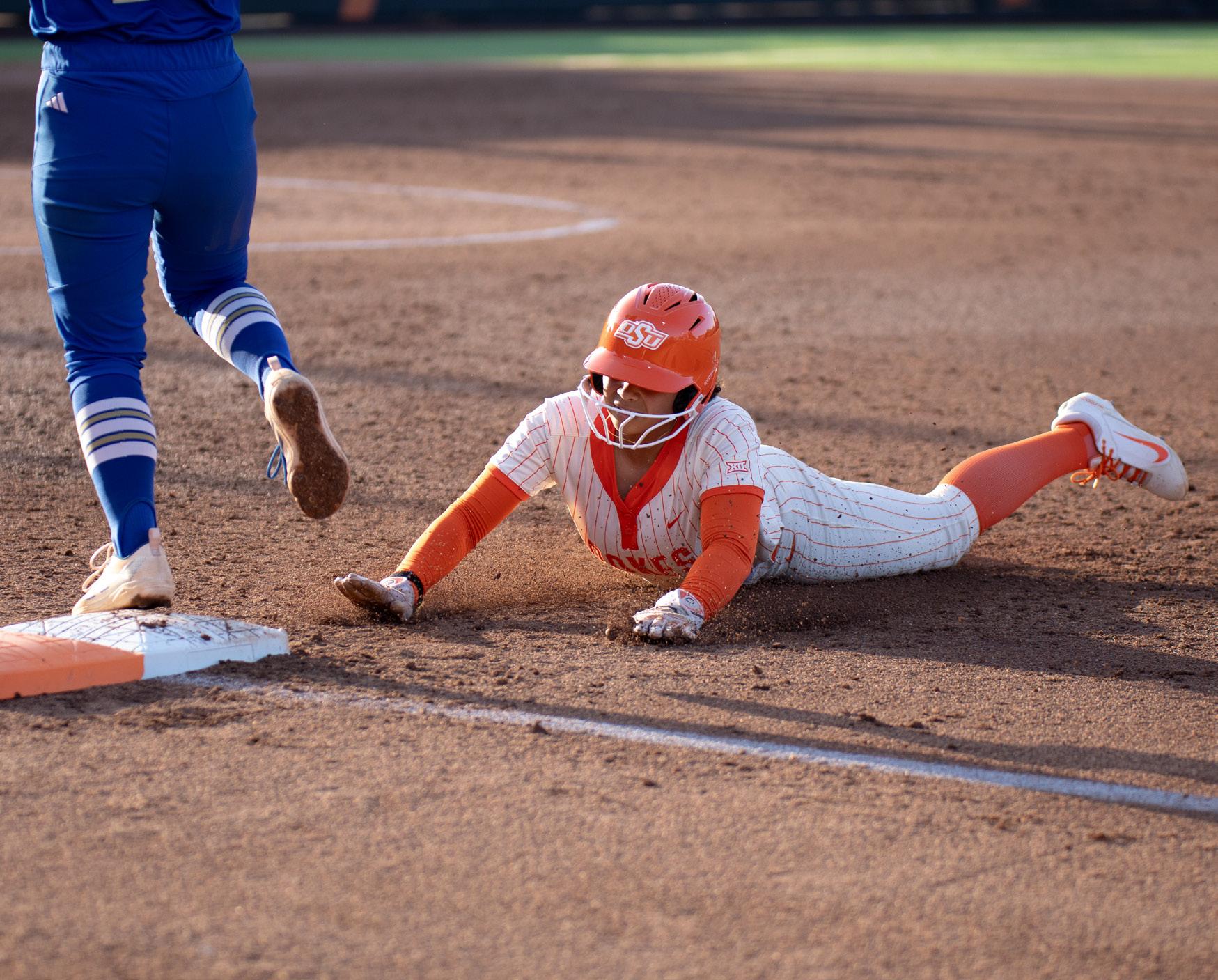


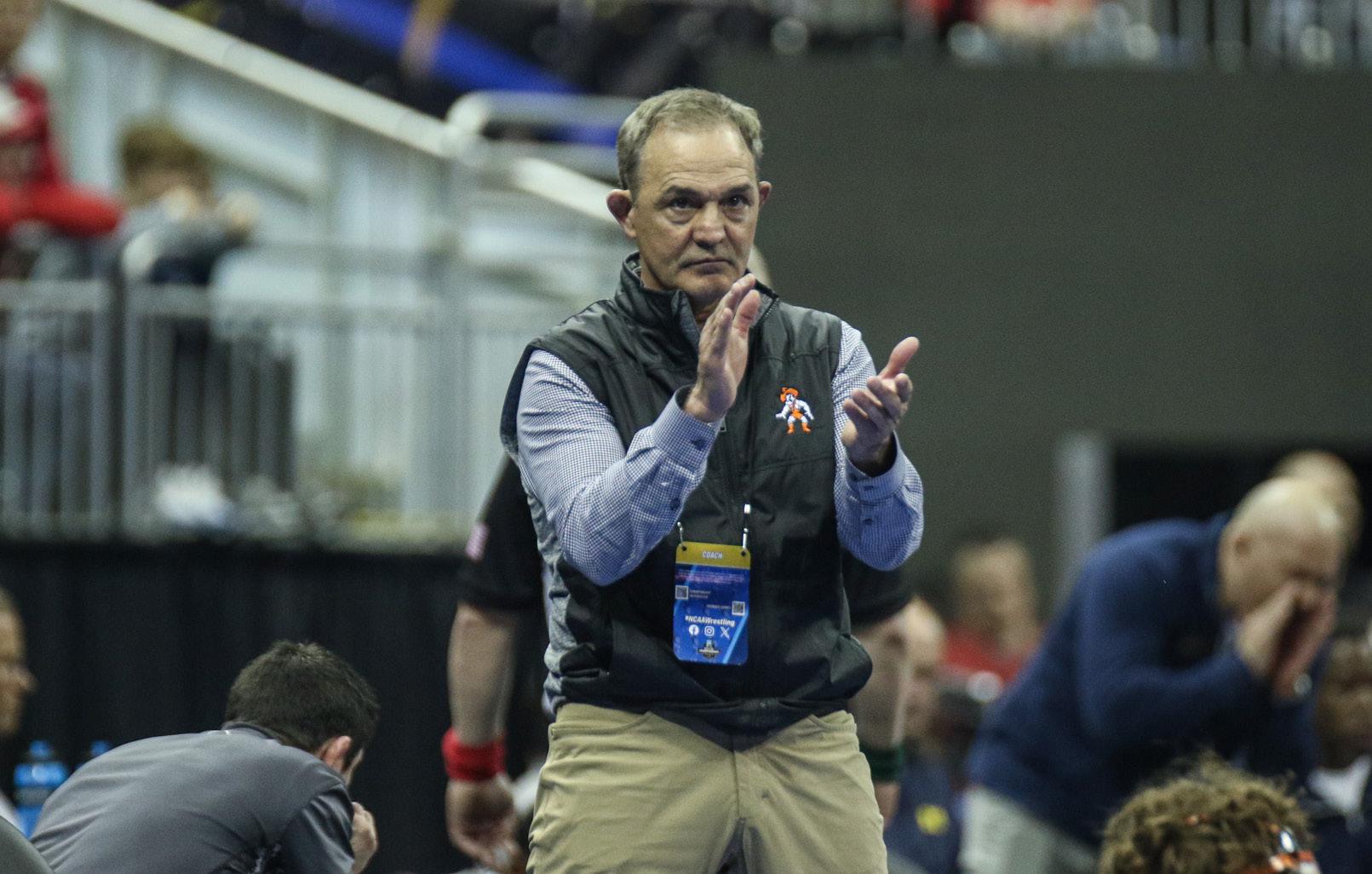
Cowgirl tennis alumna, Katarina Adamovic, is returning to Stillwater as the new women’s tennis head coach.
2017-18 season. She appeared in three games and was a key contributor on a team that won an NCAA Tournament game and went 21-11 for the season.
The most dominant wrestler in American history will become a permanent part of Oklahoma State’s future.
Pending approval by the OSU/A&M Board of Regents, the university announced that the new Cowboy wrestling facility will be named after former wrestler and head coach John Smith. The facility will be built on the north side of Gallagher-Iba Arena.
“It is nearly impossible to overstate what John Smith has meant to Cowboy Wrestling and the sport of wrestling around the world,” OSU athletic director Chad Weiberg said in a release. “There is not a more appropriate way to celebrate all he has done for Oklahoma State than to have his name on the building that future generations of OSU wrestlers will walk into every day.”
During his wrestling career, Smith won six consecutive world championships from 1987 to 1992 and two gold medals at the 1988 and 1992 Olympic Games. His international record was 100-5, and his domestic freestyle record was 77-3.
In college, Smith became a threetime Big Eight champion and a
two-time NCAA champion, winning back-to-back in 1987 and 1988. He went 152-8-2 as a Cowboy.
He also won two Oklahoma state championships at Del City, holding a 105-5 record in high school.
Smith competed in 458 matches across high school, college and freestyle, winning 436 for a 95% win rate.
The former Cowboy wrestler then served as the program’s head coach for 33 years, leading OSU to five NCAA team championships, 23 conference championships and 490 dual wins (third-most in Division I history). Smith coached 33 individuals to national titles, 153 All-Americans, 132 individual conference champions and two Hodge Trophy winners.
When OSU unveiled the Athlete Vision Plan in 2023, the roughly 62,000-square-foot facility was projected to transform Lot 4 into a landscaped plaza. The more than $16 million project will feature a 16,000-square-foot practice gym with six mats, a dedicated training area and grandstand seating.
Construction is expected to take more than 18 months and will begin once funds are fully committed.
The naming further cements Smith’s legacy as one of the most influential figures in the sport’s history.


On Tuesday, it was announced that Adamovic, a former Cowgirl standout, will be the program’s seventh head coach after spending the past two seasons as the head coach at Houston. As she returns home, Adamovic’s accolades have become reminders of her dominance during the 2014-17 seasons.
Her passion and energy on the court led her to earn All-American honors and MVP recognition at the NCAA Tournament in 2016, where she led OSU to a runner-up finish — a best for the Cowgirl program.
In Adamovic’s last two seasons, the team earned back-to-back Big 12 regular-season championships, a Big 12 tournament title, an NCAA runnerup finish and two trips to the NCAA Elite Eight. OSU had a combined 5411 record.
Individually, Adamovic’s collegiate honors are as follows: 2016 Singles All-American; 2016 NCAA Championship Most Outstanding Player; 2016 NCAA Championship all-tournament team in both singles and doubles; 2015 All-Big 12 in both singles and doubles; 2016 All-Big 12 in both singles and doubles; 2017 AllBig 12 in both singles and doubles; 2014 Big 12 position champion at No. 4 singles; 2015 ITA Central Region singles champion and 2016 Academic All-Big 12 second team.
She holds a 75-42 singles record and a 91-23 doubles record for her four years as a Cowgirl. With doubles partner Vladica Babic, they went 32-3 in her junior year. Her singles record in her final two seasons consisted of 15 ranked wins.
Her athleticism and competitive on-court demeanor led to previous women’s basketball head coach Jim Littell offering Adamovic a scholarship to join the team for the
“As a star athlete, Kat embodied what college tennis is all about and was instrumental in helping establish Oklahoma State as a championship level program,” OSU Athletic director Chad Weiberg said in a release. “We are thrilled to now be bringing her back home as the next coach of Cowgirl Tennis.”
Adamovic’s impressive collegiate resume led her to a coaching career that began in 2018 as assistant coach at Cincinnati. She then took the same role at Missouri for one season. She then went to Grand Canyon University where she was the head coach for two seasons before coaching at Houston prior to this new position.
In her previous coaching role at UH, she transformed a 4-16 team in the first season to a 17-6 team in her second year as head coach. Last season, the Cougars ranked as high as No. 29, marking the 11th ITA weekly ranking inside the top 30 for the program since 1990.
As the Cowgirls look forward to the next season with a new leader in position, there is promise for a fresh, healthy start after a year full of adversity.
“Coming back to Oklahoma State means everything to me,” Adamovic said in a release. “This program and this university helped shape who I am, and it’s an honor to return and lead the team that gave me so much. Oklahoma State has a powerful legacy, and I have great respect for the standard that’s been built here.
It’s an honor to carry that forward and build on what so many have created before me. I’m excited to come back, raise the standard even further, and build a program that competes for championships at the highest level. I can’t wait to get to Stillwater and get to work.”