INSIDE
: Celebrating America's 250th in White Lake
REFLECTIONS OF OUR COMMUNITY
Volume 4, Issue 7 July 10, 2026
Total Raised: $113,669 Lead this Legacy SUBSCRIPTIONS AVAILABLE
@echopublishinginc
YOUR YOUR LOCALLY LOCALLY OWNED OWNED ANDAND OPERATED OPERATED NONPROFIT NONPROFIT NEWS NEWS SOURCE SOURCE YOUR LOCALLY OWNED AND OPERATED NONPROFIT NEWS SOURCE
America 250: Faith, family & farming Sign up to keep our By Sharon Hallack
PERMIT NO 62
RESIDENTIAL RESIDENTIAL POSTALCUSTOMER CUSTOMER POSTAL ECRWSS ECRWSS
PRSRT STANDARD PRSRT STANDARD NON PROFIT NON PROFIT U.S. POSTAGEU.S. POSTAGE PAID PAID
BIG RAPIDS, MI 49307 BIG62RAPIDS, MI 49307 PERMIT NO
By 1934 De Groot, wanting to own a house The Oceana Echo Community Correspondent on a lake, had bought herself a 102-year-old home Brothers Larry Byl and and 120 acres of farmland Paul Byl, of Shelby, sons in Rockford, Michigan, of Pieter (Peter) Byl, and which she named Markgrandsons of Sybé Byl, adia Farm and where she who immigrated to Amer- started a dairy operation. By 1938, Welsh was ica from the Netherlands, are honored to share the mayor of Grand Raptheir family’s immigra- ids, a position he would tion story in this second hold until 1948. His life installment of The Ocea- was one of public service, na Echo’s “America 250” holding many prominent positions, and spearheadseries. In 1945 World War II ing many worthwhile had come to an end. But projects. While mayor, the devastation had left a he organized the United permanent mark on much States Conference of Mayof Europe and the world. ors, which he represented As countries, businesses as its president in tours and families worked to re- to war-torn Europe, Asia build their lives, a unique and Africa from 1947-49. set of circumstances be- On one of those tours, at gan to play out, both in the request of De Groot, the Netherlands and in Welsh specifically went to Michigan. Circumstances find a Friesian dairyman that would forever change to run the Markadia Farm. In 1948, Larry and a family’s future legacy and the history of Oceana Paul Byl’s grandparents Sybé and Baukje, and County. Back in the 1920s, a their father Pieter (Peter), single woman pursuing a along with siblings, Aunt degree in business, Mar- Gelland (Jill), Uncle Auké garet De Groot, of Grand (Sy), Aunt Geertje and Rapids, Michigan, met Uncle Gerrit, were living George W. Welsh when in Friesland, Netherlands, she needed a job to pay a province in northern her college expenses. Holland bordering GerShe started as his assis- many. The family had tant, eventually taking on a small farm, and Sybé more managerial roles as worked nearby for anoththe years passed. In 1929, er dairy farmer. However, Welsh offered De Groot his dream was to one day an opportunity to become have a dairy farm of his own. his partner in business. In the midst of war and the aftermath of German occupation, there wasn't much in the Netherlands to look forward to. Devastation was everywhere - people were hungry, everyone was on guard, Jews had to go into hiding, some were found out and innocent people were hauled away or executed. It was a difficult time in history. “Despite all of that, I have to say that all of my relatives on both sides were never mad at the Germans, but they couldn't stand the Nazis. And there's a distinction. The German people and most of the soldiers were ordinary Germans. We’re just so thankful that everybody in our family survived, and most of our relatives, except for only a few, were able to immigrate and become successful American citi-
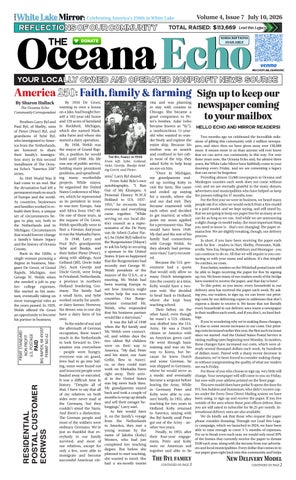
The Byl Family in 1948 From left, Sybé, Gelland, Auké, Geertje, Baukje holding Gerrit, and Pieter.
zens,” Larry Byl shared. From Auké Byle’s own autobiography, “I Ran Out of My Klompen: A Personal History W.W.II Holland to U.S. 19371955," he recounts how everyone and everything came together. “While serving on our local district council as a representative of the De Party van de Arbeit (Labor Party), he (Sybé Byl) talked to the Burgemeister (Mayor) to ask his help in securing a sponsor to the United States. It just so happened that the Burgemeister had recently met George W. Welsh president of the mayors of the U.S.A., at a meeting. Mr. Welsh had been touring Europe to see how America might better help the war-torn countries. Our Burgemeister contacted Mr. Welsh, who responded that his business partner would like a dairyman.” It was the fall of 1948 when the Byl family and Mr. Welsh were connected, and within days the two oldest Byl children were on their way to America. “My dad, Peter and his sister, our Aunt Gellie, flew to America, so they could start work on Markadia Farm right away. Their arrival in the United States was big news back then. My grandparents stayed back and took a couple of months to wrap up details and sell their meager belongings,” Larry said. As fate would have it, on the family’s voyage from the Netherlands to America, they met a young woman by the name of Jakoba (Koby) Westers, who had just completed her teaching degree. But before she planned to start teaching, she wanted to travel. She had a six-month tourist
visa and was planning to stay with cousins in Chicago. She became a good companion to Peter’s brother, Auké (who became known as “Sy”), a rambunctious 11-yearold who wanted to wander freely and explore the entire ship. Because his mother was so seasick and confined to her cabin most of the trip, they asked Koby to help keep an eye on him. “Once in Michigan, my grandparents ended up inviting Koby to visit the farm. She came and ended up staying for a month, where she and our dad met. They became enamored with each other and decided to get married, at which point my mom applied for a permanent visa. That would have been 1949. My dad and the rest of his family had connections with George Welsh. So they already had permanent visas,” Larry recounted. Because the U.S. government had a quota that would only allow so many Dutch immigrants into the country at a time, Koby would have a twoyear wait. She decided to head back to Holland, where she kept busy teaching school. Their father, on the other hand, even though he wasn't a U.S. citizen, was drafted into the U.S. Army. He was a Dutch citizen in America with an American green card. He went through basic training and was on his way to Korea, but because he knew Dutch and some German, he was shipped to Germany, where he would serve as a medic and eventually become a sergeant before leaving the Army. While in Germany Peter and Koby were able to connect briefly. In 1951, after teaching for two years in Holland, Koby returned to America, staying with the Byl family until Peter got out of the Army - another two years. Finally, in 1953, after their four-year engagement, Peter and Koby were on American soil together and able to be
The Byl family continued on page 3
newspaper coming to your mailbox
Hello Echo and Mirror readers! Two months ago we celebrated the incredible milestone of gifting this community with 2 million newspapers, and since then we have given away over 130,000 more. It means more to us than anyone will ever know that we can serve our community in this way. For over three years now, the Oceana Echo and, for almost three years, the White Lake Mirror have faithfully come to your doorstep every Friday, and we are cementing a legacy that can never be forgotten. Providing almost 15,000 newspapers to Oceana and Muskegon counties each week does not come without cost, and we are eternally grateful to the many donors, advertisers and municipalities who have helped us keep the presses rolling for 37 months now. For the first year we were in business, we heard many people ask if or when we would switch from a free model to a paid model, and we kept saying, and still stand by, that we are going to keep our paper free for as many as we can for as long as we can. And while we are announcing a slight change in model today, the most important thing you need to know is - that's not changing! The paper remains free. We are slightly tweaking, though, our delivery process. In short, if you have been receiving the paper each week for free - readers in Hart, Shelby, Pentwater, Walkerville, New Era, Hesperia, Rothbury and Montague - you can continue to do so. All that we will require is you contacting us with your name and address. It's that simple! No catches, no costs. Even better, readers on the Whitehall postal route will be able to begin receiving the paper for free by signing up, too. We know many of our readers south of the bridge have wanted to receive the paper, and that day is here! To this point, as you know, every household in our delivery area has received the paper each week. By asking you, our readers, to sign up, we can lower our printing costs by not delivering copies to addresses that don't express a desire to receive it. We know that not literally every household in our delivery area wants a newspaper in their mailbox each week, and if you don't, no hard feelings. If you're wondering why we're making these changes, it's due to some recent increases in our costs. Our printing costs increased earlier this year, the first such increase since we started. And the United States Postal Service is raising mailing rates beginning next Monday. In tandem, these changes have increased our costs, which were already several thousand dollars each week, by hundreds of dollars more. Paired with a sharp recent decrease in donations, we've been forced to consider making changes without compromising the quality of what our readers see each Friday. For those of you who choose to sign up, very little will change. Your newspaper will still come to you on Friday, but now with your address printed on the front page. This new model does have perks! It opens the door for P.O. box holders and businesses, who didn't receive copies under the Every Door Direct Mailing system we have been using, to sign up and receive the paper. If you live outside of the area where these post offices deliver, then you are still asked to subscribe for $6.25 per month. International delivery rates are also available. We do kindly ask that those who request the paper please consider donating. Through our Lead this Legacy campaign, which we launched in 2024, we have been able to raise enough to cover 3 ½ months of expenses. For us to break even each year, we would only need 20% of the homes that currently receive the paper to donate $100 each year, along with the income from our advertisers and local municipalities. Every dollar that comes in to our paper goes right back into this community and helps
New Delivery Model continued on page 2