
The Oceana Echo - Oceana Conservation District Annual Report - March 6, 2026

Page 1


Letter from the Leadership

Thank you to the Oceana Echo and the community members advertising in this publication for supporting our Annual Report. We are grateful for the opportunity to share Oceana Conservation District’s contributions over the past year and share our commitment to ongoing conservation and natural resources efforts in Oceana County.

I wonder what you love most about this place we call home. The rolling hills of asparagus and orchards feel like an extension of my childhood backyard that provided food for our family. The woods where I lose myself as I follow tracks and mushrooms and birdsong reminds me that I am not alone here. The edge of Lake Michigan, and the calm I find listening to waves on the shore, fills me with the awareness that we all depend on water for our survival. The facets of this place that support every breath I take - this is what I love.

Throughout my first full year as the District Manager at Oceana Conservation District, I found myself weaving deeper into the community and relishing the opportunity to learn what others love about this place we call home. We each have a connection to this land, whether it’s through children running through old-growth forests, aquatic plants and fish-filled streams, or the opportunity to bring in a bountiful harvest and sow native plants that support diversity in our ecosystem from the ground up. These directives from our community are what drive our work at Oceana Conservation District, and we are humbled by the opportunity to serve the land and the wider community it supports.

2025 was a year of building connections and capacity in our work of stewardship, education, and landowner assistance.  Throughout this report, you will read of the contributions of our dedicated team of staff members, who endeavored to create opportunities for our community to engage with and steward the land. Our landowner assistance programs, supported by the MDARD and in partnership with the USDA/NRCS provided technical assistance and funding to growers and landowners. Our programming continues to be informed by the conservation priorities identified by the community in our 2023 needs assessment:

1.    Enhance Water Quality

2.    Manage Invasive Species

3.    Protect and Improve Wildlife Habitat

4.    Improve Forest Health and Management

5.    Maintain and Utilize Greenspace in Oceana County

This year our stewardship and education programs launched new opportunities for youth and adults to connect with the diverse ecosystems of Oceana County and learn the many ways one can be a steward of the land. Our landowner assistance programs expanded to include regenerative agriculture education and services, focused on supporting healthy soil. Our efforts in ecological restoration and greenspace protection were supported by an abundance of community volunteers building trails, planting trees, and collecting waste, as well as generous donors to our Land Preservation Fund, Stony Creek, and Otto Nature Preserves. We celebrated the Grand Opening of our Stony Creek Nature Preserve and the realization of the dream of our donors and supporters to make this magical 40 acres accessible to the public. In 2026, we look forward to continuing the work guided by the conservation priorities established in our strategic plan. We will advocate for invasive species treatment funding and education programs to address both aquatic and terrestrial invasive species and restore native ecosystem functions within our landscape. Our reforestation and education efforts funded by the Great Lakes Restoration Initiative through the USDA Forest Service will continue to address the impacts of the invasive species Hemlock Woolly Adelgid on the Oceana Coastal Conservation Corridor. Together with our Forestry Assistance Program, we continue to gather resources for a technical toolbox to assist Oceana County landowners with HWA in their own forests.

Our landowner assistance programs funded through the Conservation Technical Assistance Program (CTAP) and in collaboration with our partners at the USDA-NRCS, will strive to address the unique needs of Oceana County’s agricultural producers while supporting the implementation of regenerative agriculture practices that focus on improving soil health. Together, we aim to promote environmental and financial sustainability for local farm operations.

Our efforts are greatly supported by numerous local volunteer stewards, generous financial supporters, and dedicated partner organizations. As we continue to build programs to serve the community, I wonder what you love most about this place we call home. Together we have a wellspring of knowledge and passion for this land.

As I reflect on 2025 and look forward to the coming year, I see two hands, holding opposite ends of a stack of matchsticks, trying as hard as they can to break them in half. While it is easy to break a single matchstick, it becomes increasingly difficult as more sticks support one another. It is from our community supporters that we have sourced our strength in this year of growth and change for our district. We look forward to having you join us in 2026!

Board of Directors Staff

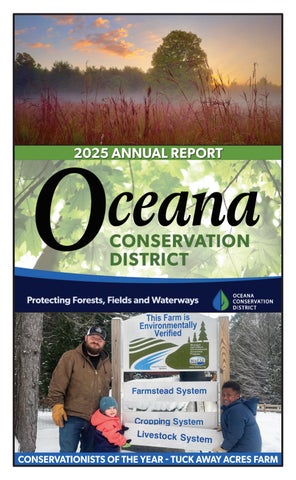
Cover photos: Top, fog is shown over a field during a beautiful sunrise. Credit to JHK Media. Bottom, Nate, Flynn & Jace McMackin of Tuck Away Acres Farm display their MAEAP verifications. The McMackins were chosen as Conservationists of the Year.
Eric Herrygers Chair Garry McKeen Vice Chair Mary Sheppard Secretary/Treasurer
Denny Payne Board Member Larry Byl Board Member Nancy Mathews Associate Board Member John Stephens Associate Board Member
Laura Ackerman District Manager Adam Chandler Conservation Technician Rod Denning Forester
Lynda Herremans CTAP Technician
Emma Waatti Stewardship Coordinator
Kari Wilson Educator Heather Varboncoeur USDA-NRCS District Conservationist
Murielle Garbarino Invasive Species Coordinator, West Michigan CISMA Allissa Hern Produce Safety Technician

MAEAP verifications (new or re-verified in 2025)............. 27

Forest landowners assisted............................................... 172

Acres enrolled into Qualified Forest Program.......... 2,582

USDA funds farmers received for conservation/restoration

........................................................................... $356,066

Tree & shrub seedlings and native plants sold...... 28,946

Acres of pollinator habitat planted.................................... 59

Acres planted with no-till grain drill.............................. 499

Acres of aqautic and terrestrial invasive species treated...29

Number of trees planted to counteract Hemlock Woolly Adelgid ......................................................................................... 10,900

Pounds of hazardous waste collected for proper disposal 34,518

Plastic ag containers collected and recycled...........9,500+

Community members attended educational events... 2,310

Election

to be held

March 19 to fill two seats on the board

Residents of Oceana County have the opportunity and responsibility to elect board members who will guide and oversee the District’s programs that promote the conservation of local natural resources. An election will take place during the Annual Agricultural and Natural Resources Banquet on March 19, from 5 - 8 pm at the West Michigan Research Station, 5185 N. Oceana Drive, Hart, MI 49420. Two candidates—Mary Sheppard and Denny Payne—are running for two available seats on the board. Bios for each candidate are available at oceanaconservation.org/public-notices. Absentee ballots will be available at the District’s office located at 1064 Industrial Park Drive, Shelby, MI 49455.

Primary Roles and Responsibilities of Board Members:

• Attend monthly meetings and District functions.

• Direct the Oceana Conservation District’s strategic aims ensuring that the necessary financial and human resources are in place to meet its objectives.

• Collaborate with fellow Board members in establishing sound business practices and policies required for adequate accounting and financial management of the District’s fiscal affairs in accordance with State Law.

• Advocate for the Oceana Conservation District, its mission, programs and services within the community.

and Natural Resources Banquet scheduled for March 19, 2026

Oceana Conservation District, MSU Extension and the Oceana County Farm Bureau cordially invite you to this year’s Agricultural and Natural Resources Banquet! We will enjoy drinks, hors d’oeuvres and conversation during the social hour, sponsored by Klotz Insurance Agency, starting at 5 p.m.

The evening will include a catered dinner, brief reports from the host organizations and awards. This year our featured presentation will highlight the work of the next generation of agriculture and natural resources supporters. We will hear from Oceana County 4-H youth who participated in the Citizenship Washington Focus, learning to advocate for local issues that matter to their communities, and participate in changes that make a difference back home.

We hope you take advantage of the opportunity to celebrate Oceana County’s agricultural and natural assets while staying up-to-date on current initiatives. Tickets are $25 and must be purchased in advance online at www.OceanaConservation.org or in person at Oceana Conservation District’s office in Shelby or at MSU Extension in Hart. The deadline to register is March 14.

Oceana County Farm Bureau to receive 2025 MAEAP Award

Each year, the Oceana Conservation District (OCD) presents the Michigan Agriculture Environmental Assurance Program (MAEAP) Award to a grower or partner who made extraordinary efforts in achieving MAEAP Verification during the past year or had a legacy of participation with the program during the past many years. This year’s honoree is the Oceana County Farm Bureau (OCFB).

Since 2013, OCFB has collaborated annually with the OCD to host a Farm Field Day. Whenever Natural Resources Conservation Service grants were available through Michigan Farm Bureau (MFB), the partnership successfully applied for and received funding to help cover expenses, while also contributing financially themselves. Over the years, school buses were used for transportation to various farms and forests across the county and provided meals at one of the visited locations.

The partnership’s events have highlighted many farms through the years, including Rabe Orchards Cold Storage, the Fox Barn, Byl’s Lakeview Orchards, Snider Farms, Herrygers Farm, VanAgtmael & Sons, Maple Grove Farms (Shafers), Golden Stock Farm (Walsworths), Wm Burmeister Farms, Earthscape Farm (Bobiers), Holladay Farms, Robert Bush Farms, Todd Greiner Farms, American Apple and more, each showcasing diverse practices on farmsteads and cropland. The primary objectives of these Farm Field Days were to spotlight Oceana agriculture and the sustainable farming practices that ensure safe food production while promoting a healthy environment, as well as to advocate for NRCS and MAEAP initiatives. The field days were organized by MAEAP Technician Lynda Herremans.

In recent years, OCFB joined OCD and MSUE to offer a series of “Farming for the Future” Field Days at the West Central Michigan Extension & Research Center and held the first Beginning

OCD Chairman Eric Herrygers holds cover crops for the presenter Ben Byl (not pictured) during a tour stop at Leroy Glover’s Stony Acres Farm Market. This took place during the first OCD and Oceana County Farm Bureau MAEAP Farm Tour in 2013.

Farmer Field Day last year. This venue provides an excellent location for meals and allows for equipment demonstrations, along with the opportunity to view

various crops and conservation stewardship practices in one location.  County Farm Bureaus serve as the grassroots base of Michigan Farm Bureau. Michigan Farm Bureau was founded in 1919 and has served as the voice of Michigan agriculture for more than a century. They represent Michigan’s agricultural diversity, from field crops and livestock to fruits and vegetables, greenhouses, forestry and more. For more than 20 years, Michigan Farm Bureau and local county farm bureaus have been advocates and supporters of MAEAP and the assistance it provides to farmers towards protecting Michigan’s precious natural resources.

The Oceana Conservation District Board of Directors wishes to acknowledge the Oceana County Farm Bureau for their past and continued support of conservation stewardship in Oceana County. They will be presented with the Oceana Conservation District MAEAP Award at the Agriculture & Natural Resource Banquet on March 19th.

Conservation teChniCal assistanCe Program rePort

The Conservation Technical Assistance Program combines Michigan Agriculture Environmental Assurance Program (MAEAP) and the new Regenerative Agriculture Program (RAP) and is provided through a grant from the Michigan Department of Agriculture and Rural Development (MDARD). MAEAP is a proactive and voluntary program designed to help farms minimize risks to the environment through 1) Education 2) Farm Assessment and Practice Implementation and 3) On-farm Verification by a third party. Farms may be verified in one or more of the following systems: Farmstead, Cropping, Livestock and Forest, Wetland & Habitat. Over 100 farms have been verified in Oceana County.

Primary goals for the CTAP Technician each year are to work with growers to implement environmental stewardship and regenerative agriculture practices that reduce risks to soil and water and improve soil health. Cost-share funds are available to implement practices such as water, soil and manure testing, spill kits, secondary containment, anti-backflow prevention, fuel transfer pads, improvements to pesticide storage for producers interested in achieving MAEAP Verification.  The Technician also helps with water use reporting, writing emergency farm plans, drift management and odor management plans, setting up the district’s no-till drill and other practices relevant to landowners’ current needs and challenges for addressing natural resource conservation and stewardship.

The OCD No-till drill was rented by Four Star Farms to drill oats into wheat stubble this past summer after wheat harvest. The field of oats, volunteer wheat and weeds was used as temporary pasture for beef cows in late summer and fall. Integrating livestock into a cropping rotation is a regenerative agriculture practice that benefits soil health and provides nutrients from cattle manure.

This past field season, the CTAP Technician also conducted Soil Health Assessments with 4 producers who signed up on a first-come, first-served basis. Soil Samples from the assessed fields were shipped to Cornell Soil Health Lab to be analyzed for a number of parameters that help to evaluate soil health. CTAP Technicians attended several training sessions on Regenerative Agriculture practices hosted by MDARD in partnership with Understanding Ag, to provide soil assessment services to local producers.

The CTAP Technician made 77 site visits, working one-on-one with landowners throughout the year. In addition, she participated in the following outreach events:

• Ag & Natural Resources Banquet

• Oceana CD Annual Report

• Oceana Asparagus Day

• West Michigan Geology & Forest Soils Workshop

• MSUE West Central Spring Horticulture Meeting

• Irrigation Workshop - West Central Michigan

Research and Extension Center (WCMREC)

• District-held programming for youth in Oceana County - 3rd grade seedling distribution and 6th grade Conservation Tour

• Beginning Farmer’s Field Day - WCMREC

• Apple/Fruit Regenerative Workshop-WCMREC

• Farming for the Future Field Day - WCMREC

• Pesticide Container Recycling (2 events)

• Pesticide Disposal through Clean Sweep held during Household Hazardous Waste Event

The current fiscal year will continue to provide a combination of MAEAP and RAP assistance to producers. There will be two Farming for the Future Field Days planned to promote Regenerative Agriculture with local partners and many conservation practices demonstrated. In July, we will highlight local farms where guests will see livestock and crops raised using regenerative principles. In August, the setting will be the orchards and asparagus at the WCMREC to see various practices that improve soil health in these perennial crops. Contact lynda.herremans@macd.org for more information about these programs.

Jordan Aebig and Jenna Beckman, owners of Aebig Orchards, successfully completed their MAEAP Re-verification of both farmstead and cropping last April. The farm was first verified with Tad Aebig in 2014.

Have you ever wondered what the sign at the corner of Long Bridge Road and Monroe Road means? This sign recognizes owners that have been MAEAP Verified in the Forests, Wetland & Habitat System and are promoting sustainable forestry, wetlands, and non-forest habitat practices. The site belongs to the DNR Pentwater State Game Area (PSGA) which manages 2,585 acres for game and non-game wildlife species in Oceana County. Wildlife Biologists Pete Kailing and Rachel Kaniziz worked with Lynda Herremans, CTAP Technician and Dan Busby, MAEAP Verifier to complete the Re-verification this past summer.

Alex Svoboda, MDARD Regenerative Agriculture Field Coordinator, used a shovel to pull three soil sample profiles using different field management to look for the absence or presence of soil aggregation and biodiversity. These two simple visual studies are useful when assessing soil health, and the only things required are a shovel and the need to get your hands dirty! The demonstration was done during the Beginning Farmer Field Day at the West Central Michigan Research and Extension Center.

NEW VERIFICATIONS – 7

• JP Farms

(Farmstead & Livestock)

Newaygo County

• McClelland Farms

(Farmstead, Cropping & Livestock)

Elbridge Township

• Tuck Away Acres Farm (Livestock)

Claybanks Township

• VanAgtmael & Sons (Forest, Wetlands & Habitat)

Elbridge Township

RE-VERIFICATIONS – 20 (systems)

• Aebig Orchards - Shelby

• Ben & Amber Byl Farm- Shelby

• DNR Pentwater State Game Area

• L & M Farms - Newaygo Co.

• Lound & Lound Farms - Shelby

• NJ Fox & Sons Aebig Apple - Shelby

• NJ Fox & Sons Bierwagon - Benona

• NJ Fox & Sons Point Farm - Benona

• NJ Fox & Sons Reames Farm - Benona

• Red Oak Farm- Benona

• Tuck Away Acres Farm - Claybanks

Pictured:

Your District Forester and the Forestry Assistance Program

2025 marked the 13th year that the Michigan Department of Agriculture and Rural Development has funded a District Forester to work with the Forestry Assistance Program (FAP). In fiscal year 2025, 172 contacts were made to the District Forester. As a result, 127 site visits were provided, covering 4,070 acres (6.3 sq. miles) throughout the three-county (Oceana, Newaygo, and Muskegon) Region 15 service area.

The FAP provides landowners a free site visit, assistance, and recommendations about forestry-related topics. Questions such as, “What is the status of my woodlot? Is it a good time to harvest trees? Do I have good habitat for deer? What kind of state/federal programs can I utilize? Do I have any insect and disease issues in my woodlot? These questions and many others can be answered with the help of your District Forester.

A major focus of the FAP is the administration and promotion of the Qualified Forest Program (QFP). In FY 2025, 29 new landowners were verified for the QFP, totaling 4.6 sq. miles of property. The program provides a property tax exemption for private landowners who actively manage their woodlots to improve wildlife habitat and for the production of forest products. The goal of the program is to promote active forest stewardship of local woodlots, keep forestlands forest, and to support Michigan’s forest products industry.

The FAP also provides a referral service to help landowners connect with private consulting foresters to write a forest management plan, apply to the Qualified Forest Program, or to administer a timber sale. Overall, 18 landowners used this process in FY 2025. To help evaluate how effective the FAP is the District Forester attempted to estimate the economic value of referral activities. For the Region 15 service area, the results included 16 forest management plans referred to private consultants and public programs, resulting in an estimated $38,000 of economic activity. Also, 17 timber harvests were referred for administration, covering 481 acres with the potential to yield approximately $179,000 worth of forest products.

The District Forester was also involved with 11 outreach and education events during the fiscal year. For example, a “Fall Color Forest Foray” hike for the Oceana Conservation District took place at the Otto Nature Preserve. Other events included a “Forest Pests” workshop held at the Muskegon Conservation District and a “Winter Tree ID Hike” at Henning County Park with the Newaygo County Environmental Coalition.

If you’re a forest landowner and are interested in services that the Forestry Assistance Program offers, please contact District Forester Rod Denning at 616-920-9775 or rod.denning@macd.org.

Old-growth forests typically show no signs of human influence. In general, the forest would have high tree density, advanced age, large-diameter trees, and no evidence of logging. Examples of this forest condition are rare. Probably the best example of old-growth in Michigan is at the Hartwick Pines State Park, where an old-growth white pine forest still exists. That forest is still virgin, never harvested, and has trees ranging from 300 to 400 years old!

It is probably more likely to find late-successional forests with minimal signs of human influence and maybe showing some old forest conditions. It is a maturing climax forest that has advanced age. As it continues to age, old-growth forest characteristics could eventually present themselves.

The opportunity to allow a forest to continue to age and not disturb it, allowing it to eventually approach late-successional and eventually old-growth conditions, is an acceptable long-term management strategy if the current forest offers such a successional trajectory. Why would we want to do that? It is well established that structural complexity of a forest, across the landscape, promotes an abundance of species diversity. Some old-growth forests develop structural features less common in other forests, such as large trees with large cavities.

As an example, in my region of Michigan (Oceana, Newaygo, and Muskegon counties), the beech-maple-hemlock forest is fairly common. Most of these forests have been logged and disturbed over the years, never allowing them to approach even the late-successional stage. However, identifying areas that show old-growth conditions is something I like to point out to forest owners.

How would you know if you were standing in an old-growth or even a late-successional forest? What clues would you look for? Below are some factors to consider.

Forest Structure

Treefall gaps: Look for openings often created by the fall of one or more canopy trees. In these gaps you should see the trees that have fallen, and they are often big-diameter trees. The gaps will have vegetation growing in the opening, encouraged by sunlight now penetrating to the forest floor.

Pit-and-mound microtopography: This feature is formed when a tree falls over, pulling up with it large amounts of soil still attached to the roots. These are often referred to as “tip-up mounds.” As the tree decays, the soil will fall off the roots and form a mound of soil. The hole in the ground where the tree roots once were is now a small pit. After many decades, the tree will decay, but the mound and pit will be visible. A forest with many of these mounds has a very undulating forest floor. This is an indication that many generations of trees, possibly over many centuries, once stood in this forest.

Overstory trees are seeding the understory: In a well-functioning mature beech-maple-hemlock forest

send out numerous (typically three or more) new boles that can form a ring of trees. Seeing this could indicate past harvesting.

Shade-intolerant trees in the overstory: Seeing aspen or paper birch would indicate past disturbance. It could possibly be natural in origin or evidence of harvest activity as far back as 50–100 years ago.

Epiphytes like Mosses, Lichens, and Liverworts

These plants or organisms grow harmlessly on the surface of trees for physical support. When epiphytes are present in large numbers, this can indicate oldgrowth trees. Also, certain species of epiphytes can be used as “indicator species,” identifying old growth and late-successional conditions.

you will commonly see seedlings and saplings of sugar maple, yellow birch, American beech, and eastern hemlock. All very shade-tolerant trees. The density of the regeneration can vary greatly.

Live trees with broken tops: When large branches are broken out of the top of a tree by strong winds or storms, the regrowth will commonly look unique, distorting the canopy.

High density of large-diameter trees: especially growing in productive soils (16” DBH or larger). Note: Smaller diameter trees can be old trees too, especially when growing in wet or dry, poor-quality soils.

Large standing dead trees (16” DBH or larger): Big old living trees will eventually become big dead trees, a sign of a long-age life cycle.

Large downed logs on the forest floor (16” DBH or larger): Old forests have an abundance of these logs.

Harvest History

Sawn stumps are visible: then it is probably not old-growth, but could be late-successional forest if the stumps are heavily decayed. For example, a hemlock stump can take 50 years to decay completely.

Skid trails are visible: Seeing these linear open paths, or if older paths have young saplings, but not large trees, then it has probably been disturbed or harvested in the past.

Stump sprouts are visible: When some hardwoods (especially red maple and red oak) are cut, they can

An organization to be aware of is the Old-Growth Forest Network. To date, they have recognized 26 public areas in Michigan as important current or potential future old forests. The network also wants to “recognize the importance of private landowners who have made the commitment to protect or restore oldgrowth by choosing to preserve portions or the entirety of their forest.”

If you are interested in learning more about your forest, or think you have some advanced-age forest conditions, I encourage you to reach out to your local Conservation District and schedule a site visit with the district forester. It’s possible they will notice something unique that you were unaware of!

Note: Information for this article was gleaned from: Shamgochian, B., J. Hagan, M Taylor, and M. Reed. 2025. LSOG Rapid Assessment Protocol (RAP) for Maine (v2.0). Our Climate Common Report, Georgetown, Maine, 36 pp.

Rod Denning is a Conservation District forester through the Forestry Assistance Program serving Oceana, Muskegon, and Newaygo Counties. He’s an SAF Certified Forester, Certified Arborist, and a Tree Farm Inspector.

Pinesap (Hypopitys monotropa) – a rare perennial forb found in a forest of west Michigan.
Pit and mound microtopography in a forest of Oceana County.
Epiphytes growing on an old sugar maple tree in Oceana County.

Steward Ship report

Invasive Species Updates

As a member of the West Michigan Cooperative Invasive Species Management Area (CISMA), Oceana County leverages state and federal grants to combat invasive species across its forests and wetlands. The Oceana Conservation District collaborates with the Ottawa and Muskegon Conservation Districts to execute these treatments, focusing on an “early detection, rapid response” strategy. By prioritizing high-risk species in small, isolated populations, this approach allows land managers to eradicate threats before they become unmanageable.

During the 2025 field season, CISMA strike teams treated 29 acres of terrestrial and aquatic invasive species on U.S. Forest Service land and private forestland in Oceana County. Target species in 2025 included Autumn Olive, Garlic Mustard, Japanese Knotweed, Tree of Heaven, Invasive Bittersweet, and Phragmites. Oceana and Muskegon Conservation Districts teamed up to host an informative workshop on invasive species educating the community on Michigan’s Watch List invasive species, how you identify them, and what steps you can take when you notice them. Curious about the plants in your yard? Check out MISIN Learn to help identify and manage common invasive species!

To keep the Hemlock Woolly Adelgid (HWA) at bay, the West Michigan CISMA has intensified its monitoring and management efforts across the county. While 2025 saw a rise in infestations among Oceana County’s Eastern hemlocks, specialized strike teams utilized state and federal grants to fight back. By coordinating crews from the Ottawa, Muskegon, and Mason-Lake Conservation Districts, the project successfully treated 8,453 hemlock trees across 368.22 acres, safeguarding these vital giants against further decline. Recognizing the need for awareness and outreach, we hosted a HWA identification hike at Otto Nature Preserve to equip community members with the skills to detect Hemlock Woolly Adelgid in the wild. By empowering the community to act as an extra set of eyes on the ground,

we significantly increase our chances of identifying new infestations early. To further empower the community, regional conservation districts joined forces to provide comprehensive training sessions for both landowners and private contractors battling HWA.

Be on the Lookout!

Japanese Barberry is an invasive ornamental shrub with spiny stems and small, teardrop-shaped leaves. It is dangerous to local ecosystems because it outcompetes native plants and creates a humid environment where disease-carrying ticks thrive. This plant alters the pH and nitrogen levels of the soil beneath it to favor its own growth.

Cinnamon Vine known as Chinese Yam is an invasive plant known for its pointed, heart shaped leaves and small white flowers. It is an aggressive climber with a unique method of reproduction through its aerial bulbils. The sheer weight of a mature Cinnamon Vine infestation can break large tree limbs.

Japanese Knotweed is a fast-growing invasive plant with hollow, bamboo-like stems and large heart-shaped leaves. It is notorious for its aggressive root system that can grow through concrete and asphalt. It forms dense monocultures that shade out native vegetation, reducing habitat for wildlife and pollinators.

Watershed Updates

The West Michigan Watershed Partners (WMWP) serves as a regional alliance of watershed organizations spanning five counties. By convening quarterly, the partnership leverages collective resources and expertise to advance watershed planning. Several impactful projects led by our local partners in Oceana County are featured below.

White River Watershed

Established in 2019 by Trout Unlimited and the White River Watershed Partnership (WRWP), the White River Collaborative (WRWC) brings together a group of 49 partners from local governments, state and federal agencies, non-profits, and community stakeholders. By uniting local business owners and river enthusiasts, the WRWC facilitates data-driven initiatives to restore and protect the White River Watershed. Every partner is committed to creating a practical strategy that balances water quality, temperatures for a thriving fishery, and local economic growth. The WRWC has dedicated extensive resources and planning to establish a strategic roadmap for watershed enhancement and community involvement; they place a special emphasis on the restoration of natural fish passage. Following a major website upgrade in 2025 made possible by grant funding, the WRWP continues its vital conservation work. This includes ongoing macroinvertebrate and temperature monitoring at nine key sites along the White River, as well as Algae sampling to detect Didymo (‘Rock Snot’) for a collaborative study with Trout Unlimited. A field crew from the MDNR Fisheries Division successfully conducted a thorough biological survey below the Hesperia Dam to monitor fish populations and health within the White River ecosystem to be able to compare it to previous fisheries data from 1975. By maintaining a consistent record of observations over many years, this data offers a rare and invaluable window into the White River’s evolution. It allows them to track subtle shifts in the ecosystem, ensuring they can respond effectively to the natural fluctuations that shape the river’s future.

Pentwater Watershed

The Friends of the Pentwater River Watershed (FPRW), a group that was formed in 2021, received the results of their Watershed Planning Survey in 2024 with help from Grand Valley State University’s Annis Water Resources Institute. Based on the results, there is a demonstrated need for increased public education on watershed function and conservation practices. In partnership with Oceana Conservation District, they applied for a grant through Michigan EGLE to fund a watershed awareness educational program aiming to fill in some of the gaps in knowledge and engage residents in local watershed awareness activities. Last summer, the South Branch of the Pentwater River was cleared and opened for kayaking - check out their new river height gauge at 72nd Ave. This gauge helps paddlers identify the ideal kayaking times. Additionally, efforts to improve the Pentwater River continue as Conservation Resource Alliance (CRA) develops restoration solutions for the significant erosion at Sandy Bend on the south branch. Sandy Bend continues to erode and dump over 40 tons of sand into the river each year. FPRW hopes to accomplish the restoration through grants and community support. Lastly, FPRW worked with Progressive AE to evaluate water quality in the Hart Lake tributaries.

Stony Creek Watershed

The Marshville Dam County Park restoration project reached a major milestone in 2025. By removing the aging dam and replacing culverts with a channel-spanning timber bridge, crews restored the creek’s natural morphology for the first time in over 160 years. The initiative revitalized nearly 12 acres of habitat, including planting 2,280 native trees and shrubs to ensure long-term riparian stability. In August 2025, the community gathered for a ribbon-cutting ceremony to celebrate the park’s grand opening, which now features interpretive historical signage and a universally accessible fishing platform.

To protect the creek’s status as a coldwater trout stream, conservation efforts have prioritized the restoration of shaded hemlock groves. Through the Oceana Coastal Conservation Corridor project, we have implemented reforestation and integrated pest management to combat Hemlock Woolly Adelgid infestations. These vital restoration activities have covered 400 acres of riparian land, spanning the entire length of Stony Creek from its headwaters to its outlet at Lake Michigan. Surveying and treatments were conducted by both Muskegon and Ottawa Conservation Districts, and plantings were completed by Oceana County K-12 students, volunteers, and staff.

Join Our Stewards:

Oceana County’s waters, forests, grasslands, and fields thrive thanks to the dedication of our community. We invite you to join our stewardship days to help protect these local treasures. Whether you’re interested in trail building, trail maintenance, beach clean-ups, roadside clean-ups or longterm habitat restoration, there is a place for you alongside our staff and other volunteers. Help us foster a healthy environment for generations to come while connecting with fellow nature lovers. For a full calendar of upcoming events and ways to support, email Stewardship Coordinator Emma Waatti at emma.waatti@macd.org.

A native White Pine seedling planted along Stony Creek as part of a broader reforestation initiative.
Marshville Dam County Park ribbon-cutting ceremony last August.

CONSERVATIONISTS OF THE YEAR - TUCK AWAY ACRES FARM
“The kids love it. We do everything together,” - Nate McMackiN of tuck away acres farM, coNservatioNists of the year

Regenerative Farming & Family Fun

This year the Oceana Conservation District (OCD) is proud to name Nate and Jade McMackin, owners and operators of Tuck Away Acres Farms, located on 56th Avenue in Claybanks-Benona (S) Township, as their Conservationists of the Year.

The McMackins operate Tuck Away Acres Farm, along with their four children, Mekhi, age 8; Jace, age 6; Charlotte, age 5; and Flynn, age 3, farming property once owned by Jade’s grandparents, Bod and Vera Green. The current farming operation specializes in raising grass-fed beef cattle and free-range hogs for a client list of about 40 customers.

“The McMackins have been working with the OCD over the past five years,” said Lynda Herremans, Oceana Conservation District, Certified Technical Assistance Program Coordinator. “In 2020, Nate and Jade’s farm, Tuck Away Acres, was verified for Farmstead & Cropping Systems, and in 2025, the farm was re-verified in Farmstead & Cropping and received a new verification for Livestock Systems. Nate’s regenerative agriculture practices include raising livestock on pasture yearround (rotational grazing during the growing season and “bale grazing” in winter), using cattle manure as his main fertilizer, as well as utilizing free-range chickens and a chicken tractor. These regenerative ag practices benefit soil health by minimizing soil disturbance, increasing the biodiversity of plants and animals, having living roots year-round and integrating livestock. This type of management system can lower input costs and promote more nutrient-dense food.”

The original 120-acre farmstead was mostly woods, with the remaining acreage basically sitting on sand dunes, McMackin said. Light sandy soil is something many ag producers along the lakeshore can attest to. But with careful attention and assistance from the OCD, Tuck Away Acres Farm is turning those sand dunes into more productive farmland.

The OCD is proud to have partnered with many producers over their past 53 years. They’ve helped both large and small farming operations implement important conservation practices in an effort to help turn Oceana’s sandy soils into soils that are more stable and productive.

Nate, originally from Tennessee, is a U.S. Navy veteran. He met Jade, a Whitehall native who was working her way through nursing school, while he was serving in Kittery, Maine. The couple married in 2012 and moved to the White Lake area in 2014, eventually purchasing 40 acres from Jade’s grandparents on which to build their home.

Following his military service, Nate became employed in the engineering field, while Jade worked as a nurse. They both dreamed of one day living on a homestead, growing their own food, and living a sustainable, regenerative lifestyle.

McMackin began reading Joel Salatin’s (Polyface Farms, Virginia) books, which focus on encouraging young people to farm and raise livestock in healthy and

sustainable ways while working with natural animal behaviors. In 2020 he decided to fence off two and a half acres and start with two heifer calves. One could say, “The rest is history.”

By last year, the McMackins had built their beef herd to 28 head using only rotational grazing practices. Rotational grazing involves moving animals between different sections of pasture, or paddocks, every few days to allow grazed areas to rest and recover. By preventing overgrazing and allowing for regrowth, pastures typically show improved pasture health and soil quality.

“Raising grass-fed beef does take longer,” McMackin said. “Anywhere from 24-30 months.”

While they raise their cattle without using grains, the extra time needed to raise them on grass does make the final product a bit more expensive. Some of that expense does get passed on to the consumer, however, McMackin feels they are offering people a good value. And his customers don’t mind paying a little extra. They appreciate knowing where their food comes from and the way it was produced.

McMackin added hog production to his operation a few years ago and currently raises 20 hogs annually in fenced-off woodlots set up throughout the woods on the property. The hogs are fed a non-GMO (genetically-modified organism) ration, and once it is time to finish them, they are moved to adjacent woodlots located under oak trees, where they are able to consume as many acorns as they can find. “Our hog infrastructure is minimal,” McMackin said. “And we prefer to raise heritage breeds we get from Baynes Farm in North Muskegon. From start to finish, the hogs take about 8-9 months to raise, which is longer than conventional hog production as well.

“I’ve really enjoyed working with the NRCS (Natural Resources Conservation Services) partners here in Oceana. Mark Kelly, who retired (recently), was so instrumental in helping us get grants. Even though we have minimal infrastructure and run old equipment, it’s so capital intensive to start a farm. But if someone wants to get into farming, between the people and resources, it’s a great place to start.”

With help from the OCD and NRCS, McMackin has been able to implement numerous other conservation practices as well, including the installation of 5,000 feet of livestock watering pipeline, a watering facility, a stream crossing over sensitive areas to keep livestock out of surface water and new livestock fencing.

“During the growing season, our herd is moved every one to two days to another two-and-a-half-acre paddock for grazing. We take weather and growth into consideration, but generally that is our rotation. At the end of 30 days, the cow pies in the first paddock have dried up and have grass growing up through them, and we start the cycle all over. A heavier animal impact on a smaller area is actually better for the soil than a few animals on a larger area,” McMackin explained.

During the non-growing season, McMackin uses bale grazing to feed the cattle with round bales of hay. He uses a “ball unroller” to roll the round bale all the way out for the herd. “We see three main benefits to us-

ing this technique,” McMackin said. “Because the cattle can eat across a larger area, their manure is spread out. It’s the right level of impact. Some seed does remain on the ground but eventually may grow up into the paddock. You do have to feed a little more, and some farmers would say it’s a waste. But we believe the benefits outweigh the drawbacks. In the winter, we keep bales intact and move feeding areas every day in order to reduce livestock impact. We are feeding the soil in more ways than one, and our soil samples have proved that. We’re not organic; we consider ourselves regenerative farmers. But we want to leave the soils healthier than when we started.”

Tuck Away Acres Farm does not utilize any synthetic fertilizer, opting instead to focus on rotational grazing, bale unrolling and compost application. All of the farm’s slaughtering is done on the farm, and as a result, they retain all of the unusable animal remains and mix them with wood chips. That combination sits for a year, receiving one or two turns before it is spread over the rotational grazing pastures.

“We put up about 180-200 bales of our own hay each year. It’s a balance figuring out how many cattle we can sustainably and regeneratively raise on the acreage we have access to without having to feed hay in the warm season,” McMackin said. “Our main goal is to produce an economical, environmentally-conscious and healthy food for ourselves and our customers. Our hope is to someday be able to raise 40 head of cattle a year on this property.”

The production of food takes hard work and commitment, but it’s one that the McMackins enjoy and have embraced. “The kids love it. We do everything together, and if it took away from family time, I wouldn’t have done it. The thing that really holds it all together is my wife, Jade. Being a stay-at-home mom to four kids is constant,” McMackin said proudly.

When he’s not busy raising livestock and a growing family, McMackin finds time to collect important rotational grazing data for the NRCS. By measuring the height of forage at the beginning and end of grazing and tracking the number of cattle grazing in any one of the farm’s paddocks, as well as the time they are allowed to graze in each, he has been able to figure out how many “cow days” per acre the farm can maintain. One “cow day” equals one cow on one acre. In 2020, McMackin was able to maintain 40 cow days. With time, careful documentation and conservation practices, by 2024 his number of cow days had risen to 103. He hopes this type of data collection will not only help their farm, but will be used to help others as well.

McMackin is looking forward to the future and is hopeful one of his children will be interested in continuing the farm someday. “The next generation will have their own goals, but if I can set them up, that would be great,” he concluded.

Visit Tuck Away Acres Farm on Instagram to see the McMackin’s operation in action. Tuck Away Acres is looking forward to being one of the hosts for the Oceana Conservation District’s “Farming for the Future” Field Day #1 in July, where regenerative ag practices on farms with livestock will be highlighted.

• Contributed Photo
• Sharon Hallack/Echo

It is Winter. High in the canopy of beech and oak, branches clack in the frigid wind. A steady whoosh of breeze, slowed in the lace of hemlock and white pine, blends with the low rhythmic roar of distant waves. The intermittent drum of a pileated woodpecker is wrapped in laughter rising from far below, a melody to this wintry forest beat. After a race up the wooded dune trail, warm but winded, children flop down on the snow. Blinking against spiraling crystals, they watch the dance of branches. A chickadee calls. Then another. “Shhh,” they remind each other, watching in wonder as the curious little birds gather to see what’s up. It’s just another “Fridays in the Forest” hike at Otto Nature Preserve! Throughout the winter months of 2025, families joined Educator Kiki to explore the snowy woods, following animal tracks, sliding down log and slope and listening to the rhythms of the forest.

Spring raindrops slide off the pavilion roof. Kneehigh naturalists, well booted and slickered, watch and wonder, what next? Soon, in go stones with a plop. A dash of sand, a dollop of mud, a quick stir with stick or spoon and soup is served. Knee-high Naturalists forest school for preschoolers is well underway at Doolittle County Park. The rain slows, and children spread out through Base Camp to climb, construct, paint or explore. Logs are rolled. Excited calls ring out, and children come running to spy a tiny critter hunkered down in the leaf litter. Salamanders, sleepy still in early spring,

are an easy catch. At three or four years old, Knee-high Naturalists take their stewardship responsibilities seriously as they visit with these gentle, red-backed forest friends. Carefully tucking their amphibian pal back in bed, it’s time for a hike around Gales Pond to spot other signs of spring. The 2025 sessions of Knee-high Naturalists were filled to capacity with children ages 2-6 and their caregivers enjoying stories and songs, hikes and crafts and time spent with friends in nature.

At last, Summer is here. Farm and forest, meadow and marsh explode with life. The flute-like trill of the wood thrush hints at unseen forest mysteries, while the full-volume bullfrog bass boost is soon silenced by the hellos and hugs that fill the pavilion as excited campers arrive. And so another season of Nature Day Camp begins! At nearby Gales Pond, a sleek muskrat slips underwater to shimmy through emerging cattails. Frogs hide in plain sight, given away only by the occasional gold flash of a blinking eye. Chucking shoes aside, campers test the pond with tentative toes but are soon joyously knee-deep in the muck examining aquatic plants (while keeping a keen eye out for frogs.) At the end of the day, gathered at Base Camp for Closing Circle, children share five-second stories: tiny triumphs, humorous happenings, and, of course, the important ‘frogs caught’ count. In 2025 a partnership with MIWorks enabled the Conservation District to expand opportunities for young teens to serve as camp counselors, while the generosity of Oceana County residents ensured that scholarships were available to fill all requests.

It is Autumn. The birch trees shimmer in their fringe of yellow. Thin bands of sunlight stretch across the trail where groups of children puzzle through a forest emergency rescue. How will they transport an injured friend with just a length of paracord and a tarp? With basic instructions, trial and error and the abundant availability of sturdy branches, ‘injured’ children are soon carried comfortably on woven stretchers. Later, scattered along the creek bank, nature journals open, students observe the busy forest. It is a quiet moment in another lively afternoon of Homeschool in the Woods. Launched in Spring 2025 with 18 students, ages 7-14, this program engages children in hands-on science, bushcraft challenges and stewardship projects. At the close of autumn, the bare birch, now a stark accent to Payne’s gray skies, students practice with ferro rods. Perfecting the wrist flick, sparks fly! Warm snacks are now ensured, but first, stewardship work calls. Students clear and mark a new creekside trail in preparation for winter hikes to come. Back at Base Camp, tired and hungry, everyone enjoys a forest school specialty: fire-roasted banana boats!

Natural Resources Conservation District Report

The Natural Resources Conservation Service (NRCS) is an agency of the United States Department of Agriculture (USDA) working with private landowners to install or implement conservation practices on their land. NRCS partners with, and works directly through, local conservation districts to educate and assist farmers, ranchers, and rural landowners to protect the natural resources with funds available through federal farm-bill programs.

In 2025, USDA-NRCS programs provided $359,066 to landowners in Oceana County to address natural resource concerns. An additional $703,801 was obligated for practices to be implemented in

2026. The top five conservation practices implemented in 2025 were as follows:

• Conservation Cover and Pollinator Habitat Planting 21.5 acres

• Cover Crops 1,021.2 acres

• Irrigation Water Management 582.4 acres

• Nutrient Management 1,194.8 acres

• Tree/Shrub Establishment 10 acres

In addition to these practices, programs provided funding for agrichemical storage buildings, windbreak establishment, critical area plantings, pest management, prescribed grazing, livestock pipeline and watering facilities, pasture planting, stream crossing, grassed waterways, forest management, and more.

It has been a year of transition for the NRCS office in Shelby. In January 2025, Mark Kelly, our District Conservationist (DC) of 34 years, retired from his position of service to the landowners of

Oceana County. Over the decades, Mark became a feature of our office and the community, and the conservation he supported will continue to benefit our county for years to come. We are grateful to Kelly Bishop, who served as our Acting DC from January through September, and to Adam Chandler, our CTAI Conservation Technician, who both stepped in to support our landowners until we were able to welcome our new District Conservationist in September 2025.

Meet our New District Conservationist Heather Varboncoeur is the new District Conservationist for Oceana County in the Shelby field office. She has been with the NRCS for 21 years and has experience with a wide variety of farming operations and land uses.

Before Oceana County, Heather spent 12 years as the District Conservationist

Environmental Quality Incentives Program (EQIP)

The Environmental Quality Incentives Program (EQIP) provides financial and technical assistance to agricultural producers to address natural resource concerns and deliver environmental benefits such as improved water and air quality, conserved ground and surface water, increased soil health and reduced soil erosion and sedimentation, improved or created wildlife habitat, and mitigation of increasing weather volatility.

Conservation Reserve Program (CRP)

The Conservation Reserve Program reduces soil erosion, protects the nation’s ability to produce food and fiber, reduces sedimentation in streams and lakes, improves water quality, establishes wildlife habitat, and enhances forest and wetland resources. It encourages farmers to convert highly erodible cropland or other environmentally sensitive acreage to vegetative cover, such as tame or native grasses, wildlife plantings, trees, filter strips, or riparian buffers. Farmers receive an annual rental payment for the term of the multi-year contract. Cost sharing is provided to establish the vegetative cover practices.

for Ottawa County and the last 4 years at the Lansing State Office as the State Conservation Planning Specialist, where she trained other NRCS employees on how to develop Conservation Plans. She has also worked in several other counties across the state, including Calhoun, Arenac, and Marquette. Heather is excited to learn about Oceana County and how she can help landowners and operators better manage their resource concerns. If you have any questions about Farm Bill programs or conservation on your property, you can reach her at (231) 861-5600 or Heather. Varboncoeur@usda.gov.

Education Report: Snapshots of a Forest School Year Farm Bill Programs

Conservation Stewardship Program (CSP)

The Conservation Stewardship Program (CSP) helps build on existing conservation efforts while strengthening agricultural operations. Whether producers are looking to improve grazing conditions, increase crop resiliency, or develop wildlife habitat, NRCS can custom design a CSP plan to help meet those goals. By identifying natural resource problems and providing technical and financial assistance to solve those problems, higher stewardship levels can be obtained in an environmentally beneficial and cost-effective manner.

Agricultural Conservation Easement Program (ACEP)

The Agricultural Conservation Easement Program (ACEP) helps landowners, land trusts, and other entities protect, restore, and enhance wetlands, grasslands, and working farms and ranches through conservation easements. Under the Agricultural Land Easements component, NRCS helps American Indian tribes, state and local governments and non-governmental organizations protect working agricultural lands and limit non-agricultural uses of the land. Under the Wetlands Reserve Easements component, NRCS helps to restore, protect and enhance enrolled wetlands.

Fridays in the Forest
Knee-high Naturalists
Nature Day Camp
Homeschool in the Woods

Volunteer of the Year Award

Since 2016, Fred and Valerie have been foundational pillars of our conservation efforts, providing a steady, “first to arrive, last to leave” presence. Their commitment is legendary; Fred has never missed a highway cleanup, arriving with his warm presence, and together they have led the change in removing pieces of plastic during coastal clean-up days, rain or shine. As early pioneers of the Christmas Bird Count, their participation in the 2016 trial year was instrumental in officially establishing the count circle in 2017 - their dedication has been expanded over the last 10 years. This same hands-on leadership extends to our Forest School, where they have accompanied three grandchildren through the Knee-high Naturalists program, with Fred clearing snowy trails and Valerie advising on program design through her expertise as an educator. We are deeply thankful for the extraordinary generosity of their time and talent, including vital scholarship contributions that empower a new generation of inspired land stewards while ensuring their own tireless devotion to Oceana County is forever equipped with conservation efforts.

MSU Conservation Stewards Program

In 2025, participants embarked on a transformative journey by joining the inaugural Oceana County cohort of the MSU Extension Conservation Stewards Program (CSP). This comprehensive eight-week certification program represents a significant investment in our local environment, designed to bridge the gap between conservation biology and boots-on-the-ground restoration. Throughout the fall season, participants spent Monday evenings engaged in hybrid learning, tackling complex topics such as forest ecology, aquatic management, and protection of Michigan’s unique coastal communities. The curriculum challenged everyone to look beyond simple conservation and instead focused on holistic ecosystem management, ensuring that every action taken supports the long-term biodiversity of our region.

The true heart of the experience lies in the field instruction, where participants moved beyond the screen to work directly with the landscapes we love. We were privileged to collaborate with an impressive roster of local experts and partners, including MSU Extension, Little River Band of Ottawa Indians, Michigan EGLE, Michigan Natural Features Inventory, GEI Consultants, Wild Ones, and Oceana Conservation District. Saturday excursions took individuals to remarkable sites like Lake Michigan Family Camp to get familiar with critical dunes and a diverse array of agricultural lands in Claybanks and Benona Townships. By studying these topics firsthand, participants gained a deeper understanding of how to balance human use with environmental preservation, learning to identify invasive species, monitor water quality, and implement sustainable land-use practices.

To finalize the CSP certification, participants worked diligently on an Applied Capstone Project - a meaningful volunteer initiative tailored to the specific needs of Oceana County. Whether it was restoring a native plant corridor or developing educational outreach for our neighbors, these projects allowed them to give back to the community. Individuals emerged from this program not just as participants, but as a part of a statewide network of Conservation Stewards who are better equipped than ever to protect the natural beauty and ecological integrity of our home for generations to come.

Our Nature Preserves

We sincerely thank Dick and Lorayne Otto and the Hunter-Hedlund family for their visionary land donations, which created Otto and Stony Creek Nature Preserves. We are incredibly grateful to every volunteer and donor who contributed the time and materials necessary to bring these ongoing projects to life.

Oceana Conservation District is committed to the permanent protection of natural and scenic landscapes that foster education, research, and recreation. Thanks to the generosity of local families, we have established two nature preserves in Benona Township to serve as lasting community resources.

Otto Nature Preserve is sporting a fresh new look thanks to our dedicated board members, who generously volunteered their time and hard work during installation.

Community members celebrating new trails and new beginnings at the Stony Creek Nature Preserve grand opening.

Otto Nature Preserve

Otto Nature Preserve remains as a sanctuary for all who wander its 1.5 miles of winding trails. Throughout 2025, our community gathered to experience the forest’s changing moods - from the thrill of hearing resident calls during Full Moon Owl Prowls to the quiet, crisp mornings of our Fridays in the Forest hikes to the hidden discoveries of fungi during our Mushroom Foray. As the seasons shifted, the Fall Forest Foray allowed us to marvel at the vibrant canopy and the unique forest floor treasures it revealed. Whether joining a guided trek or seeking a moment of solitude, our community continues to find a deep connection within the beauty of this 80-acre old-growth forest.

Stony Creek Nature Preserve

2025 marked a historic milestone for Stony Creek Nature Preserve as we officially celebrated its grand opening in October, welcoming the public to explore this precious parcel. The year was defined by collective care, with community members joining our stewardship workdays to install signage, clear trails, plant trees, create footbridges, and remove invasive species. Our commitment to forest health was further strengthened through a partnership with Ottawa Conservation District, whose strike team treated 1,601 hemlock trees against the threat of Hemlock Woolly Adelgid across 15 acres of the nature preserve. From these critical restoration efforts to the first steps taken by the public on our newly completed trails, it has been an incredible year of transforming this donated land into a thriving community landmark.

Great Lakes Restoration Initiative Grant Update

The Oceana Conservation District has successfully completed its first year of the Great Lakes Restoration Initiative grant from the U.S. Forest Service. This initiative uses an integrated pest management strategy to protect 400 acres of vulnerable forest from Hemlock Woolly Adelgid (HWA). By combining innovative treatment tools, reforestation, and K-12 educational programming, the project aims to create a versatile toolkit for longterm forest resilience.

In 2025, our dedicated staff and partners hit the ground running, bringing a surge of conservation energy to the landscape. To date, we have successfully planted 10,900 tree seedlings, while simultaneously sparking a lifelong passion for the natural world in 1,520 bright-eyed students. Through our immersive Tree Lab program,

K-12 students stepped out of the classroom and engaged in handson STEM activities specifically designed to empower the next generation of environmental stewards. Meanwhile, the HWA crew from the Muskegon Conservation District treated 878 hemlock trees totaling 10,132 inches in diameter to safeguard our coastal habitats.

This year, our reforestation and educational initiatives will reach pivotal milestones beginning with planting 9,100 more seedlings at Camp Miniwanca to restore critical dune habitat along Lake Michigan and 100 more seedlings at Stony Creek Nature Preserve. Complementing these efforts, the Tree Lab aims to engage 480 more Oceana County K-12 students in hands-on STEM career training, empowering

environmental stewards through place-based conservation. Muskegon Conservation District hit the trails and surveyed 240 hemlock trees totaling 2,650 inches in preparation for treatment this summer. We are absolutely thrilled to dive into this final phase of the project and see our hard work come to fruition!

Our new stewardship patches are more than just thread and fabric - they are a distinguished mark of honor for those who volunteer their time to conserving West Michigan’s irreplaceable ecosystems. This patch is designed for volunteers who roll up their sleeves for hands-on restoration or conservation program support, and they serve as a proud symbol of your commitment to the rolling dunes, lush forests, sparkling waters, and clean landscape that define our home.

Throughout the year, you can earn your place in this growing network of conservation leaders by joining us for Highway and Beach Clean-ups, Tree Planting, Trail Maintenance, Scrap Tire Collection, Household Hazardous Waste Collection, and so much more. Every hour spent in the field helps protect over 400 acres of pristine land, ensuring the natural beauty of our landscape remains vibrant for generations to come.

By wearing the steward patch, you aren’t just a volunteer - you are a champion for the future health of our earth. To begin your journey toward becoming a steward, you can register for upcoming 2026 events through our website: www.oceanaconservation.org.

Oceana Conservation District’s Homeschool in the Woods program planting seedlings on critical dune habitat at Camp Miniwanca.
Oceana County cohort of Conservation Stewards at their final program presenting their Capstone Projects.
Become an Oceana Conservation District Steward!
Community volunteers gathering together to take on trail maintenance and building.
Oceana County students learning how to properly cage a tree seedling.
Oceana County 3rd graders planting trees at our critical dune demonstration site.

Jan 31 7 - 8:30 pm

Feb 20

12:30 - 2 pm

March 2

7:30 - 9 pm

March 18

5 pm

March 19

5 - 9 pm

2026 Programs & Events

Full Moon Owl Prowl

Otto Nature Preserve Shelby

Hemlock Woolly Adelgid ID Hike

Otto Nature Preserve ∙ Shelby

Full Moon Owl Prowl

Otto Nature Preserve Shelby

Tree Sale Orders Due

Mail in order form or place order online

Ag & Natural Resources Banquet West Michigan Research Station Hart

March 21 1 - 3 pm Fruit Tree Pruning Workshop West Michigan Research Station Hart

April 13

9 - 11:30 am

April 18

9 am - 1 pm

May 15

1 - 3 pm

May 22 10 am - 3 pm

May 29

8 - 11 am

June 18

Stewardship Day: On the Roadside US 31/Polk Rd Hart

June/July 9 am - 1 pm

July 13 9 - 11:30 am

July 17 4 - 6:30 pm

July / August 10 am - 5 pm

August 15 9 am - 1 pm

Nature Day Camps Gales Pond & Doolittle County Parks ∙ Hart

Stewardship Day: On the Roadside US 31/Polk Rd ∙ Hart

Aquatic Plant Exploration & Paddle Pentwater Lake Pentwater

Farming for the Future Field Days

West Michigan Research Station Hart

Hazardous Waste Collection Hart Dept of Public Works Hart

Spring Ephemeral Guided Hike

Stony Creek Nature Preserve Shelby

Sept 10 6 - 8 pm

Tree Sale Pickup Date! Oceana County Fairgrounds ∙ Hart Oct 29 12 - 3 pm

Birding Field Trip Pines Point Rec Area Greenwood Twp

6:30 - 8 pm Deer, Disease, and Damage Seminar

Sept 18 8 am - 4 pm

Sept 19 9 am - 12 pm

Sept 25 9 - 11:30 am

August 20 4:30 - 6 pm Dec 15 8 am - 3 pm

Conservation Steward Celebration Oceana Conservation Dis trict Shelby

Understanding our Dune Ecosystems Oceana Conservation District Shelby

Dune Grass Sale (pre-orders required) Oceana Conservation District Shelby

Stewardship Day: At the Beach Various Locations ∙ Oceana County

Stewardship Day: On the Roadside US 31/Polk Rd Hart

Stewardship Day: Tree Planting

Stony Creek Nature Preserve ∙ Shelby

Christmas Bird Count

Pentwater, Hart, Mears, Shelby

2026TREESALEORDERFORM

provide an email address so we can send updates and a reminder

Spruce 2-214-20"$34$75$131$224

DECIDUOUSTREESAGESIZE102550100QTYTOTAL

Quaking Aspen 2-024-36"$49$108$189$324

White Birch 1-024-36"

Black Cherry 1-024-36"

American Chestnut 1-018-24" American Crabapple 2-012-18"

Shagbark Hickory 2-018-24"

Red Maple 1-024-36"

Sugar Maple 1-024-36"

Common Elderberry

White Oak

American Hazelnut

Tulip Poplar

Winterberry Holly

Black Walnut

Ninebark

2-024-36"$44$99$173$296

2-024-36"$44$99$173$296

1-018-24"$39$87$152$260

2-024-36"$50$110$193$331

2-024-36"$53$118$207$355

2-024-36"$60$134$234$402

1-024-36"$66$147$257$441

2-024-36"$50$110$193$331

American Plum 2-024-36"$44$99$173$296

Eastern Redbud

2-024-36"$44$99$173$296

SMALLTREES&SHRUBSAGESIZE102550100QTYTOTAL

Sand Cherry 1-024-36"$46$103$180$309

Highbush Cranberry

Serviceberry (Juneberry)1-124-36"$44$99$173$296

Flowering Dogwood

Witch hazel

Common Elderberry

2-024-36"$56$124$216$371

2-024-36"$44$99$173$296

1-018-24"$52$116$202$347

2-024-36"$44$99$173$296

ORDERSDUE: March 18, 2026

American Hazelnut

PICKUPDATE:

Winterberry Holly

2-024-36"$50$110$193$331

April 18, 2026

2-024-36"$60$134$234$402

PICKUPLOCATION: Oceana County Fairgrounds

Ninebark

American Plum

Eastern Redbud

2-024-36"$50$110$193$331

2-024-36"$44$99$173$296

2-024-36"$44$99$173$296

Orders will be filled on a first-come/first serve basis. We will not be responsible for trees not picked up on the assigned date and are not liable for survival after pick up, All sales are final. Thank you for your order! Call (231) 861-5600 for more information.

Sand Cherry

1-024-36"$46$103$180$309

Serviceberry (Juneberry)1-124-36"$44$99$173$296

Witch hazel

1-018-24"$52$116$202$347

Turn static files into dynamic content formats.

Create a flipbook