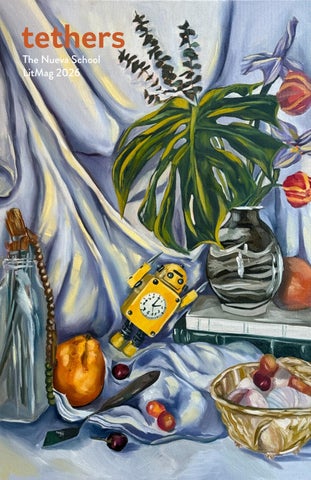
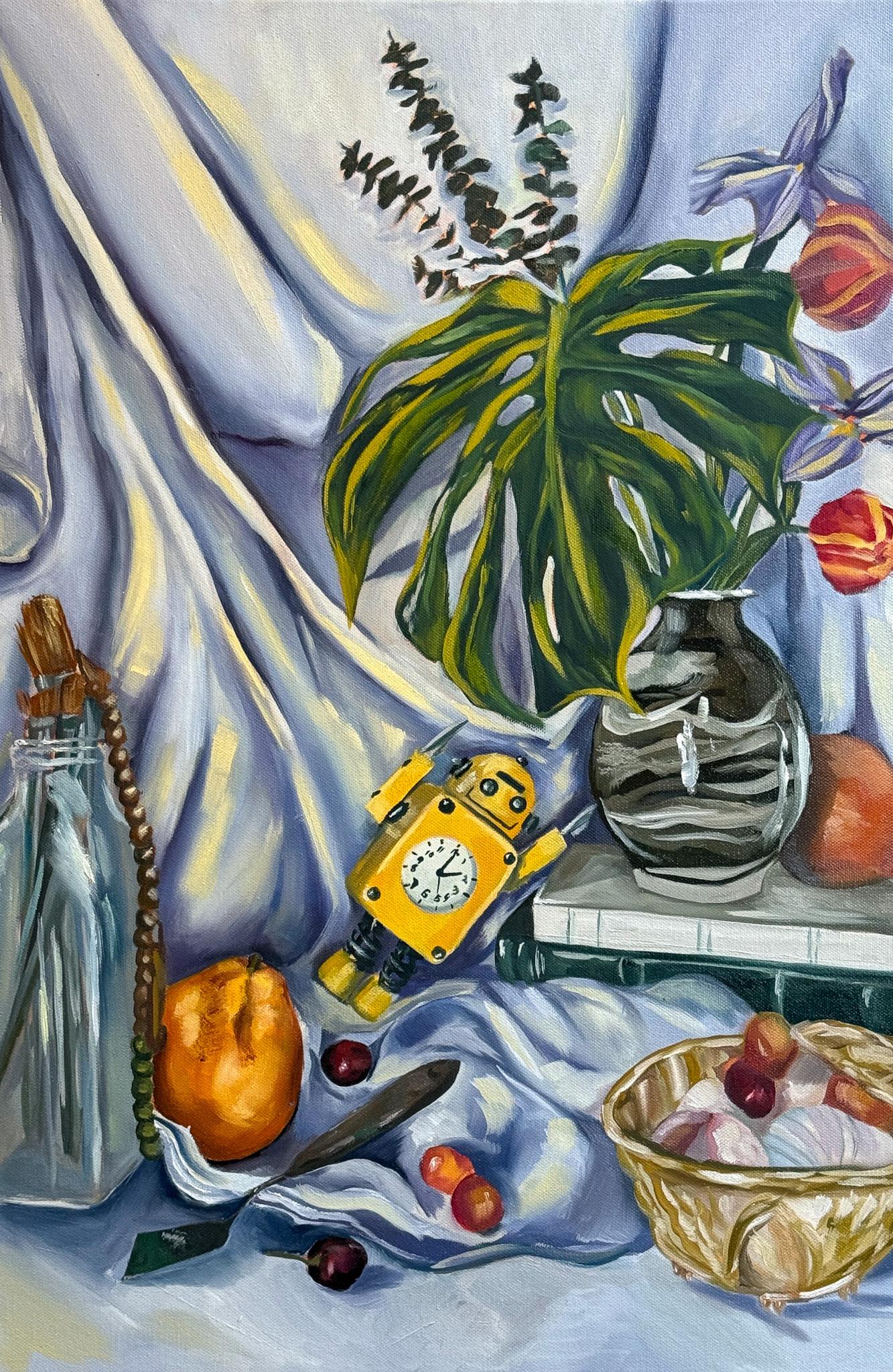
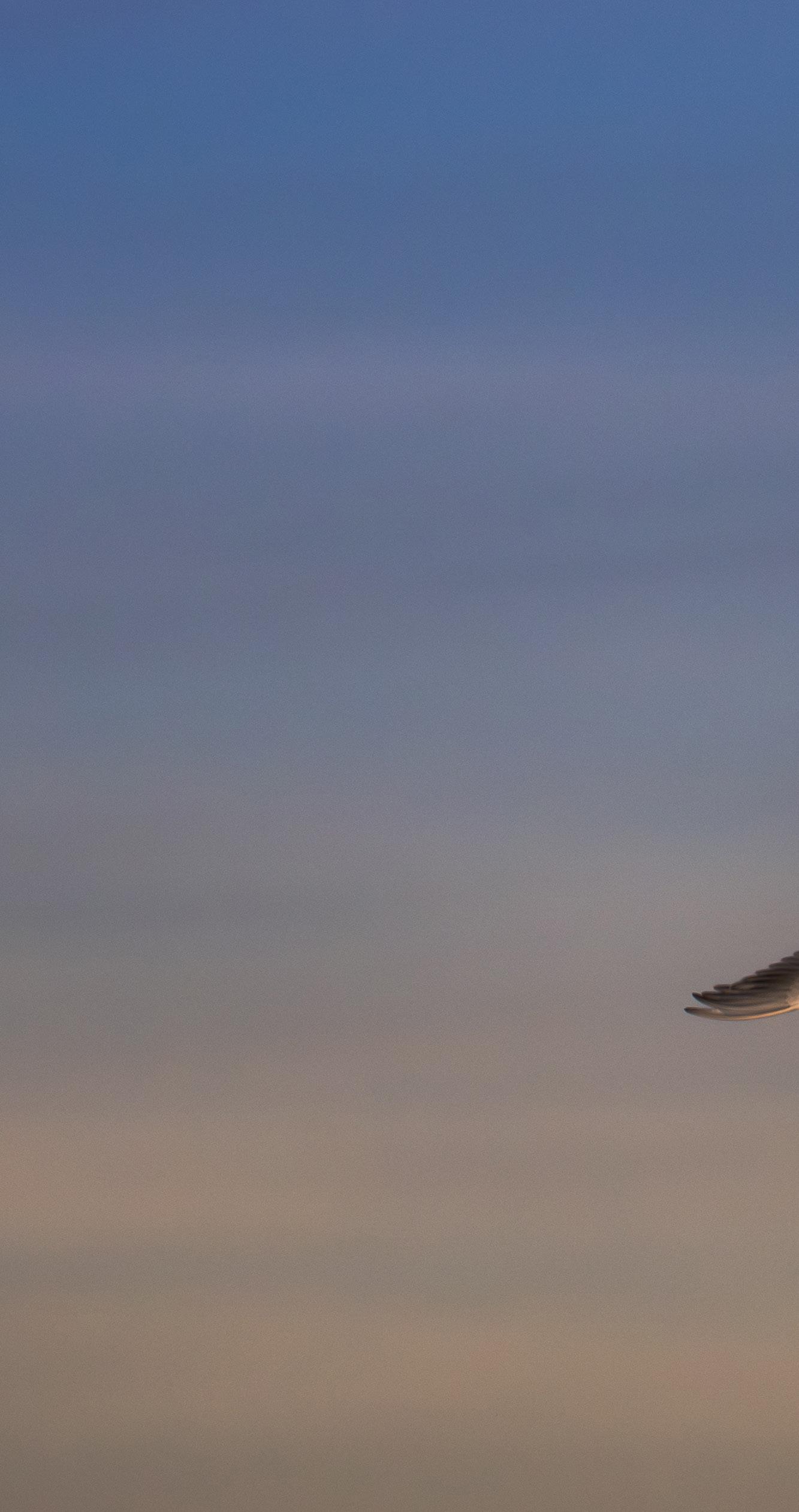
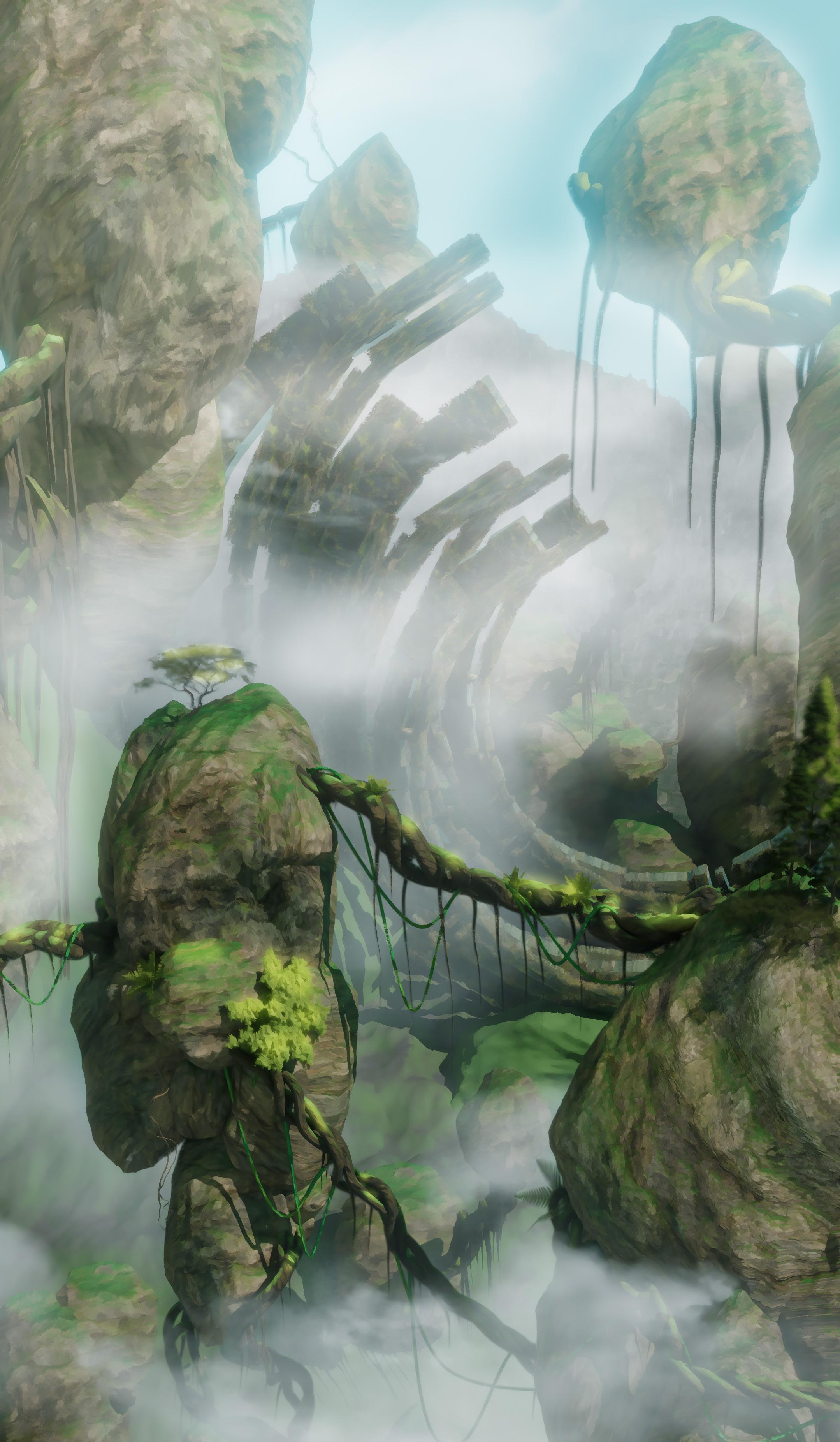
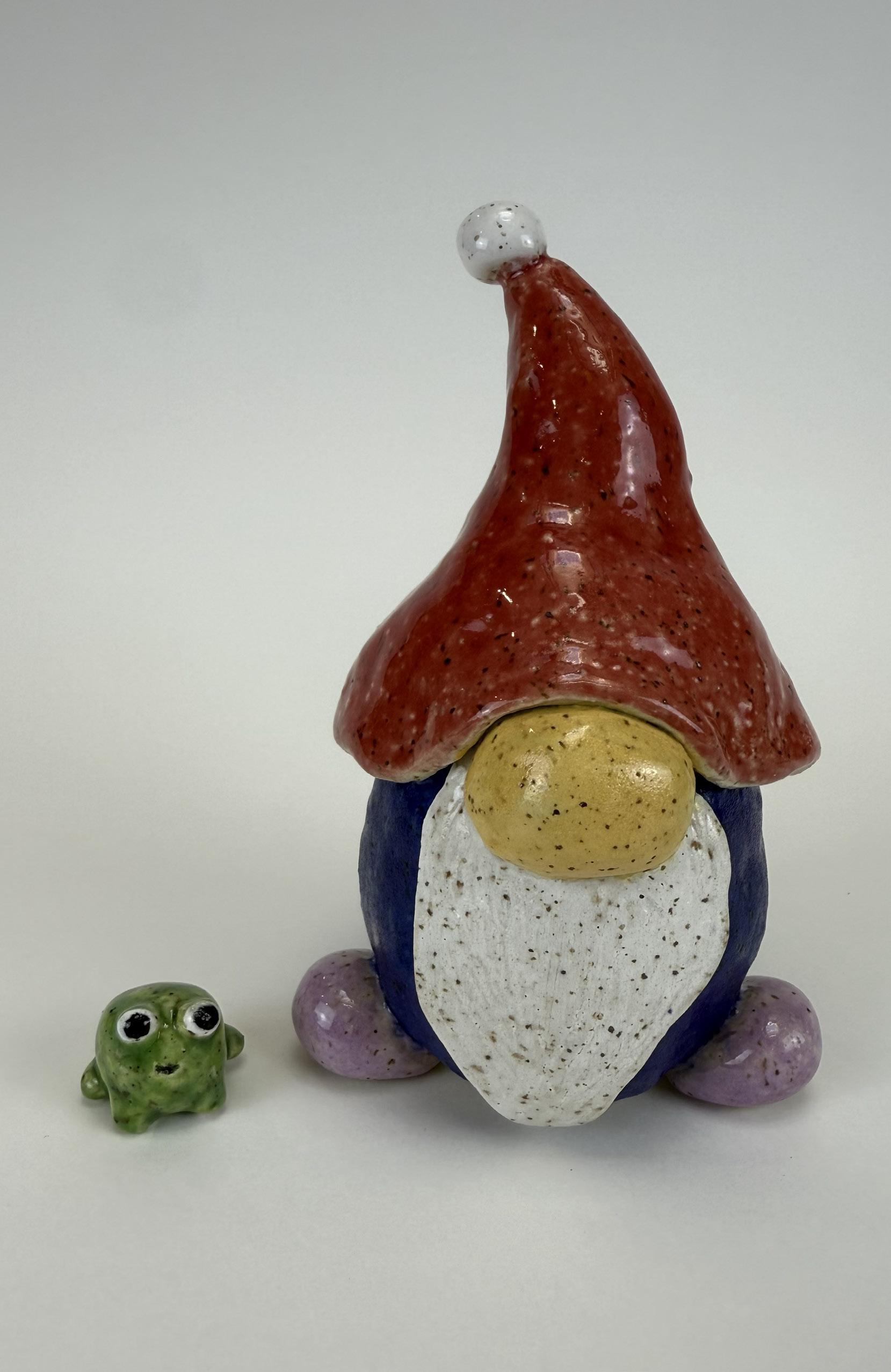
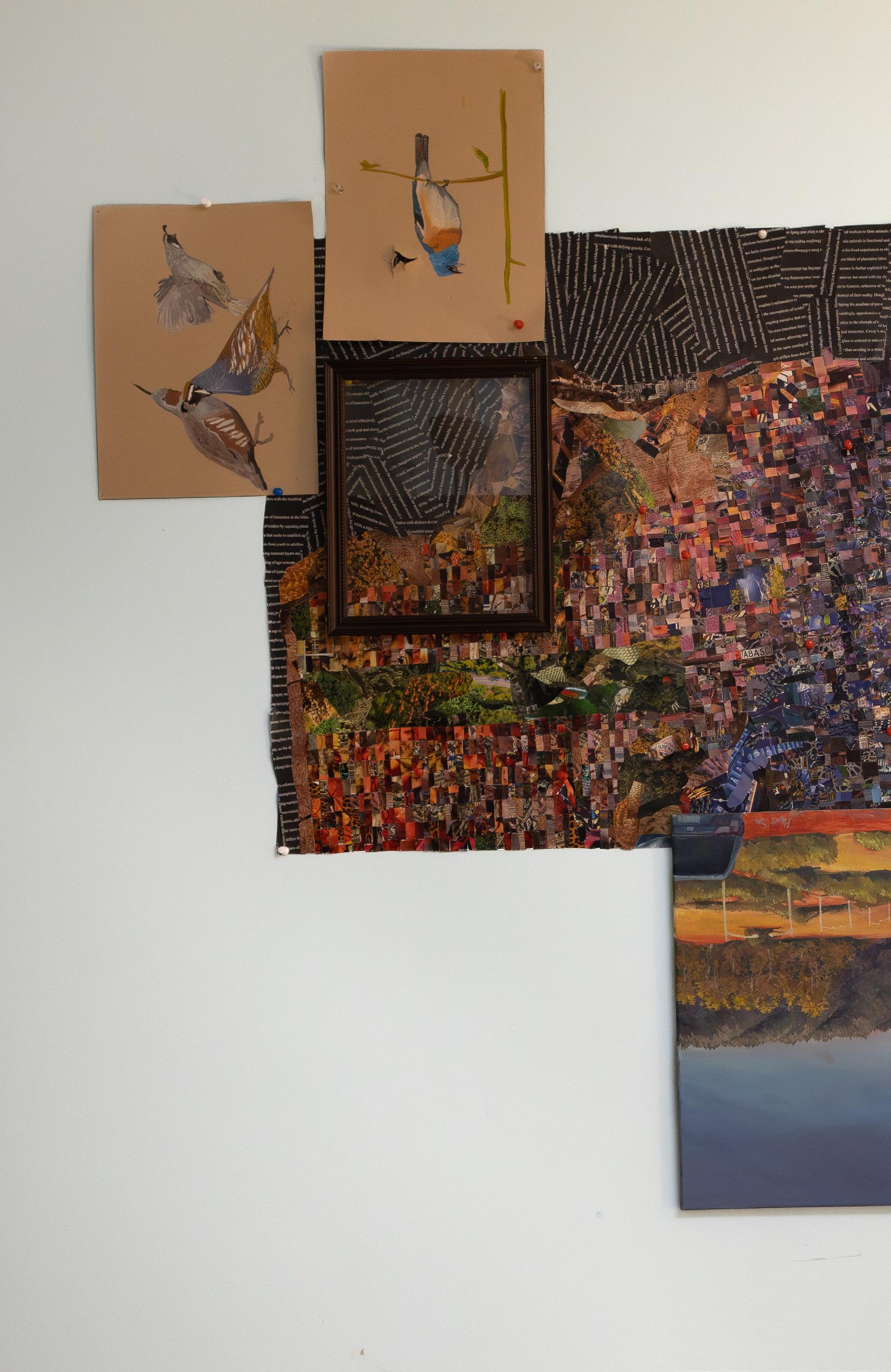
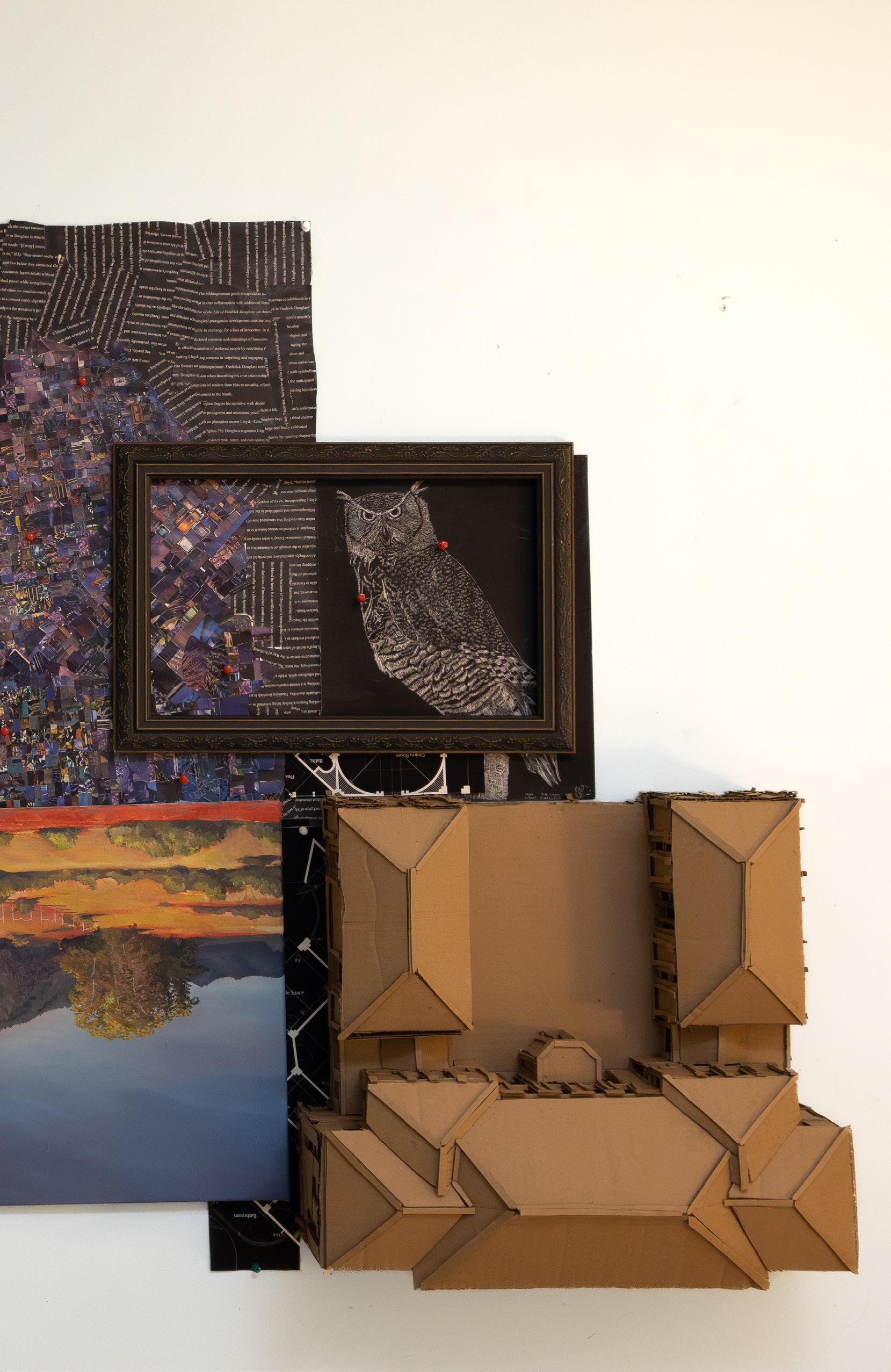
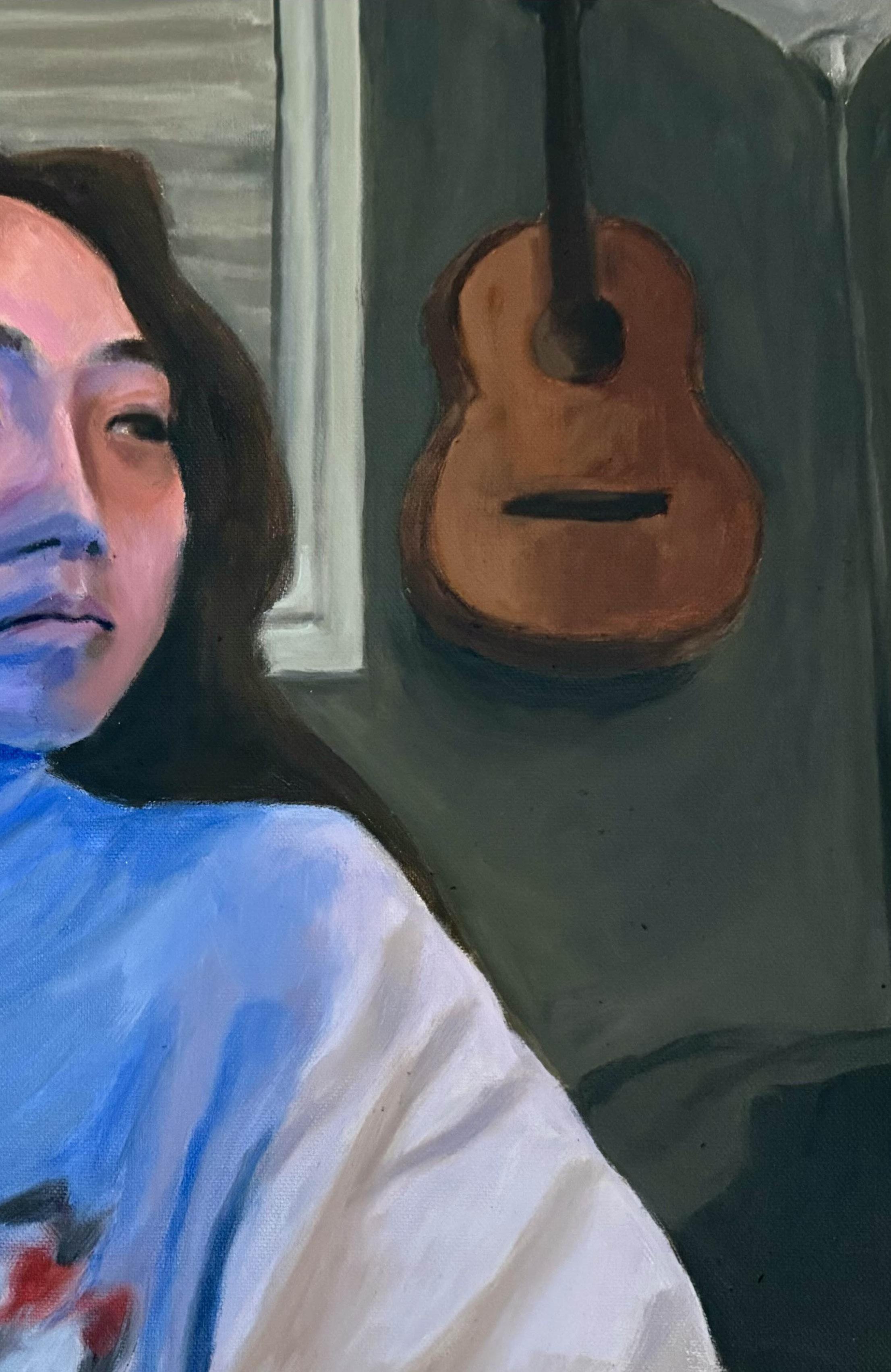
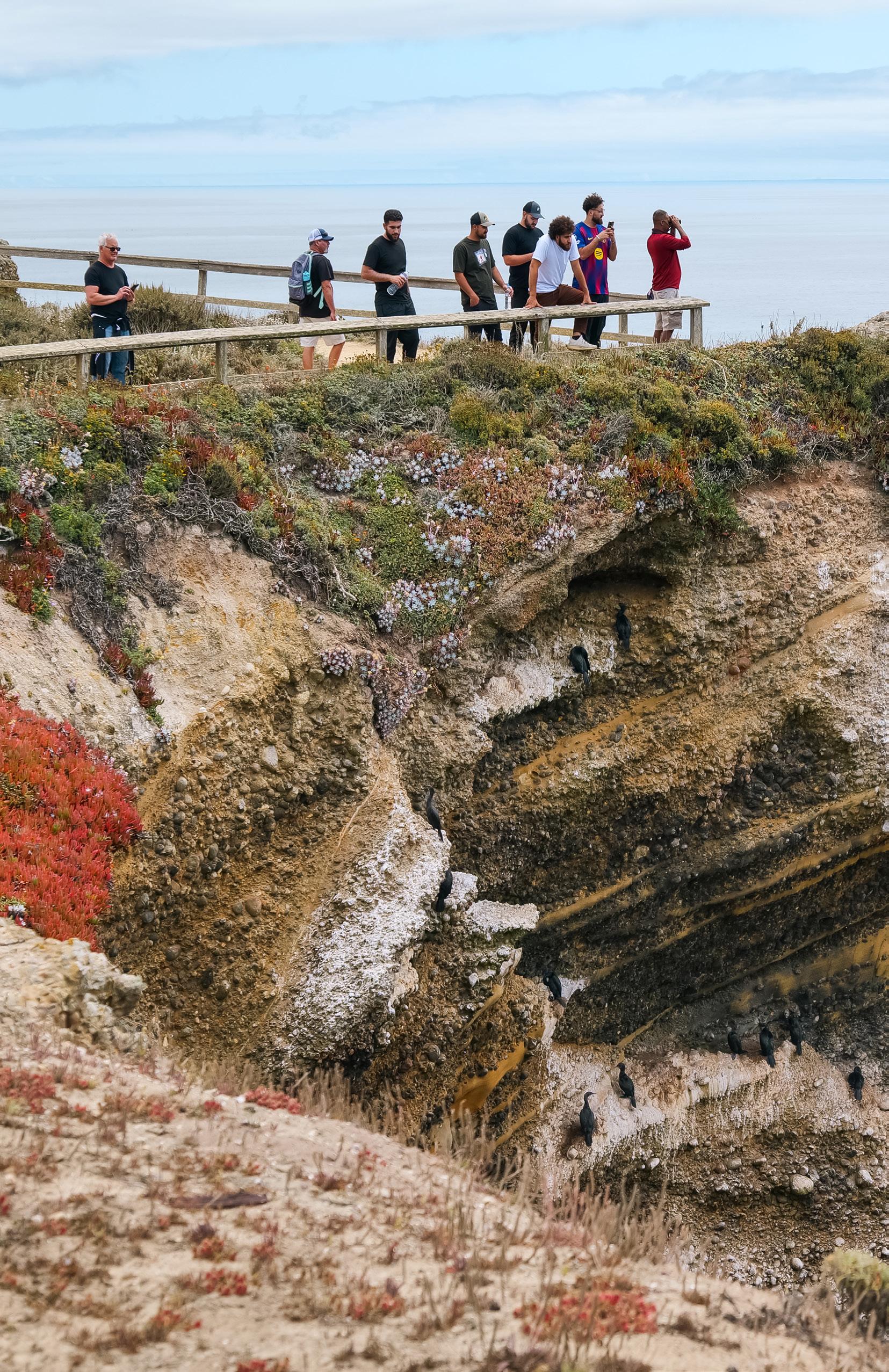
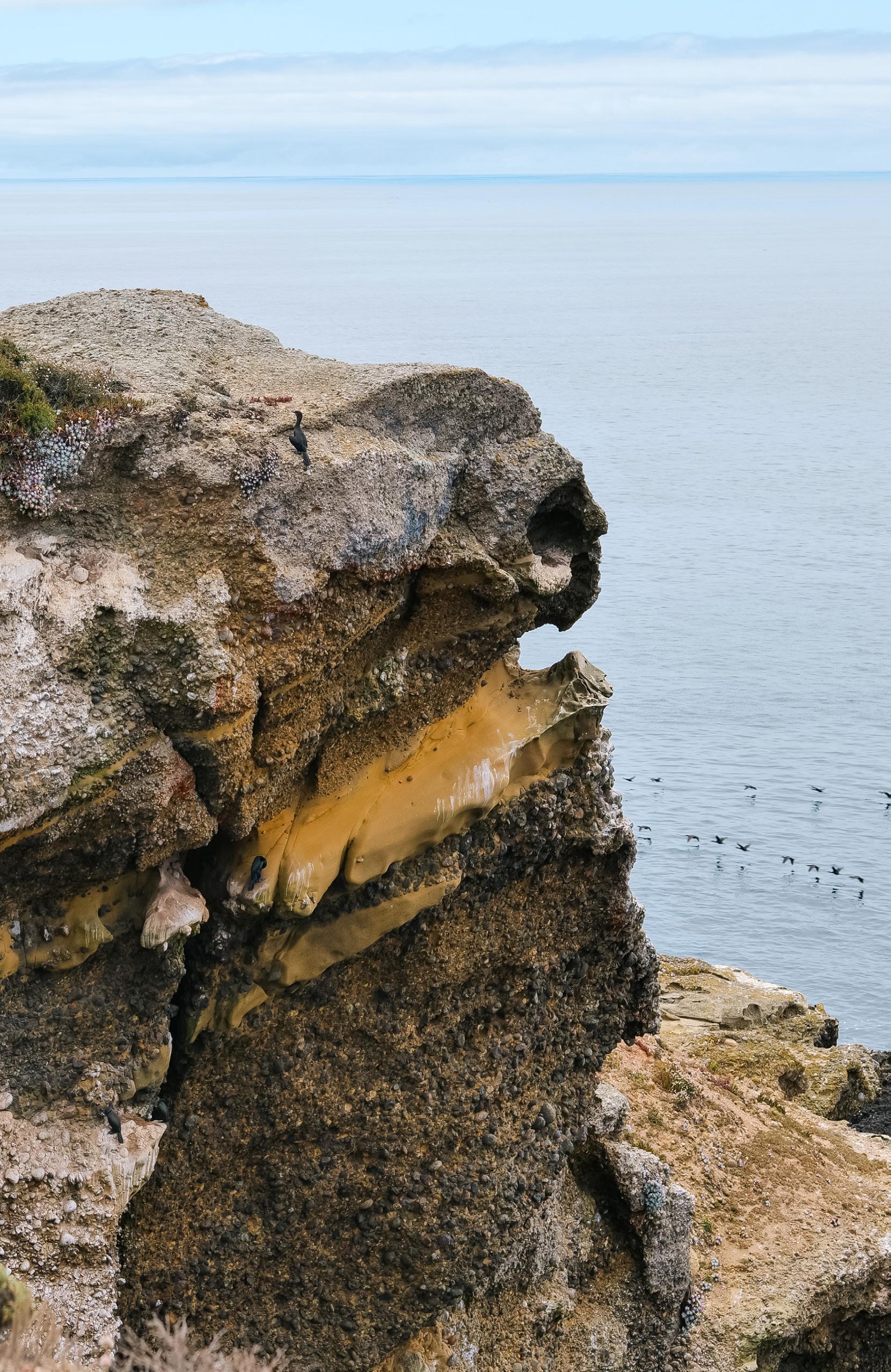
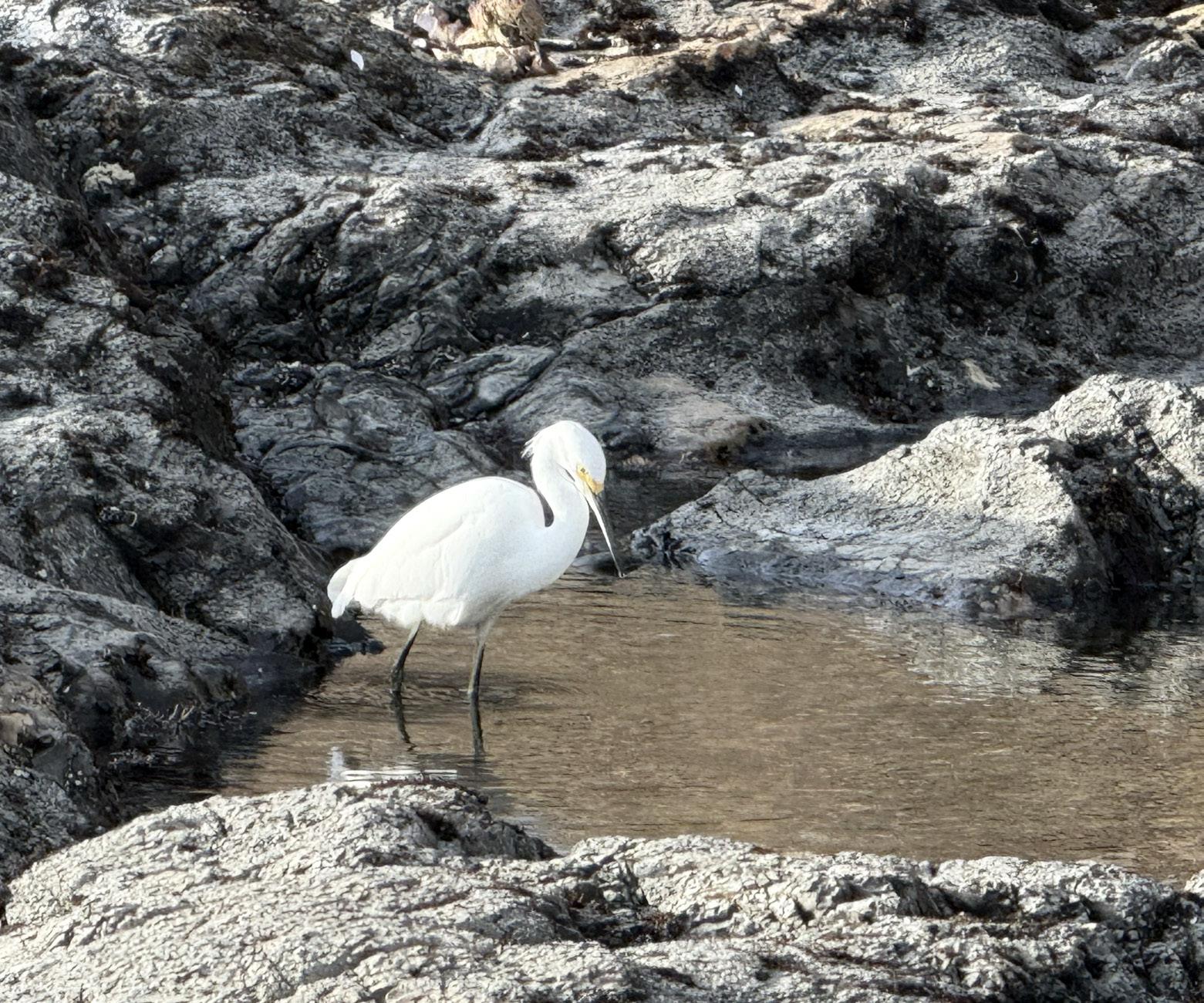
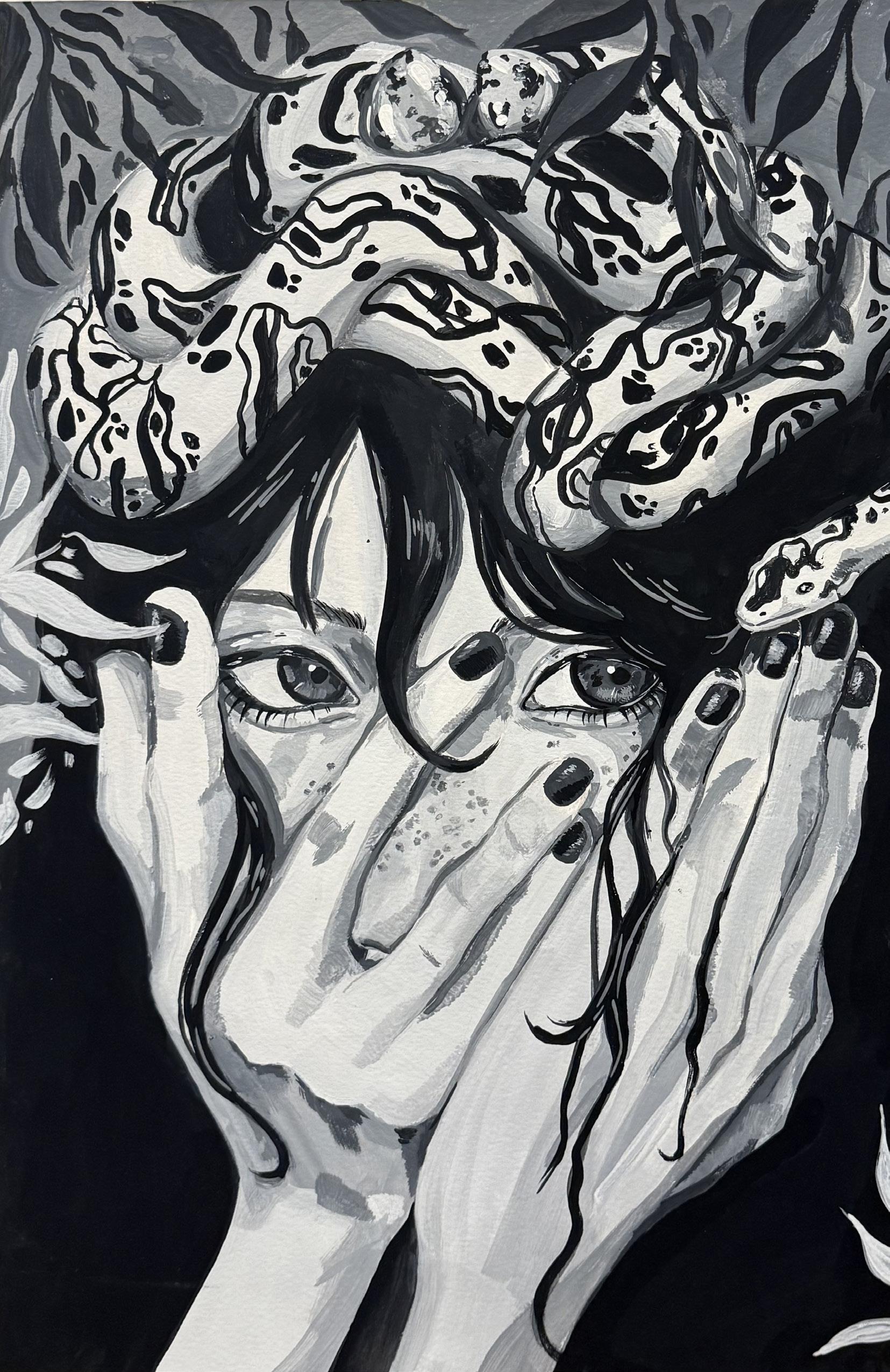
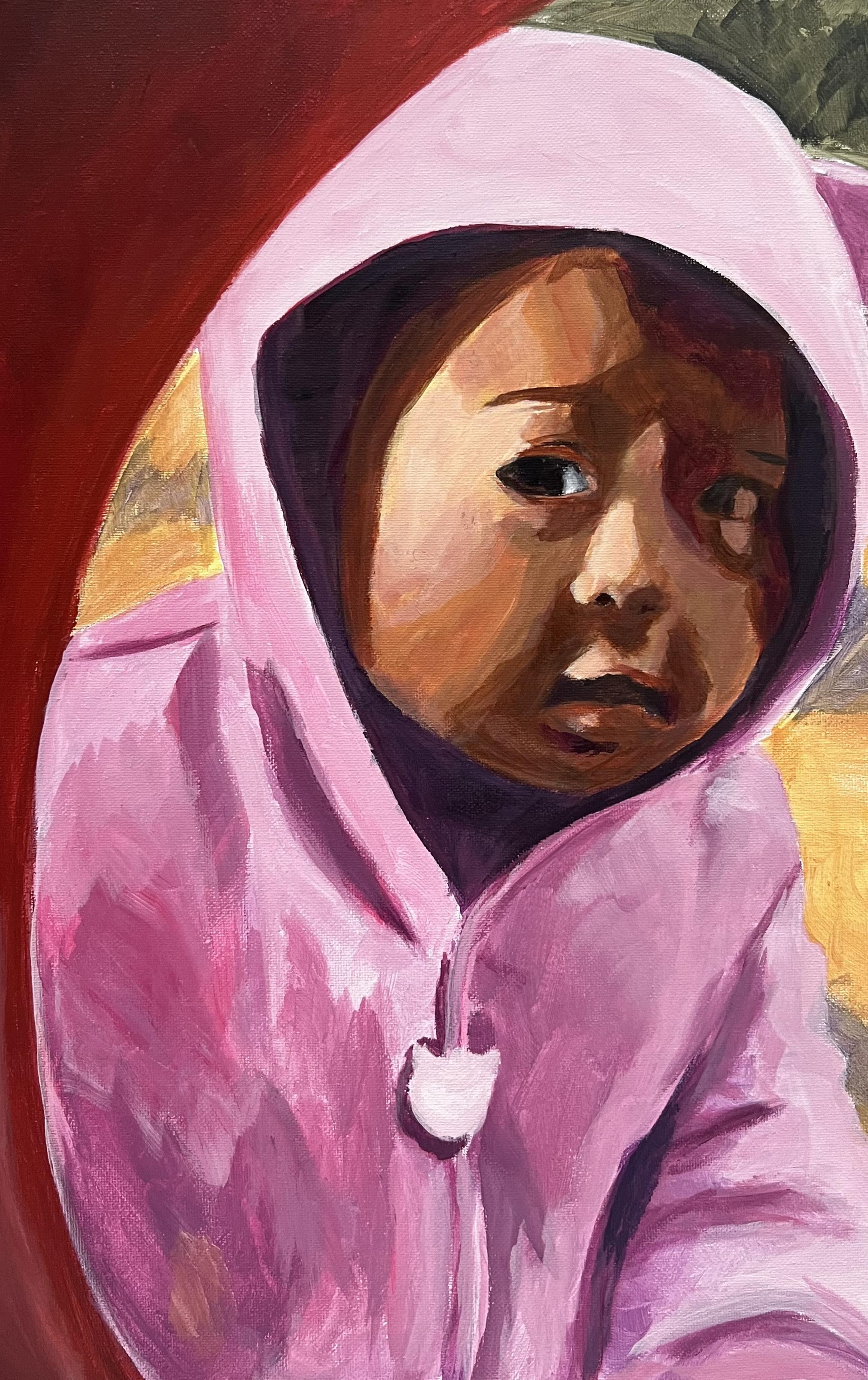
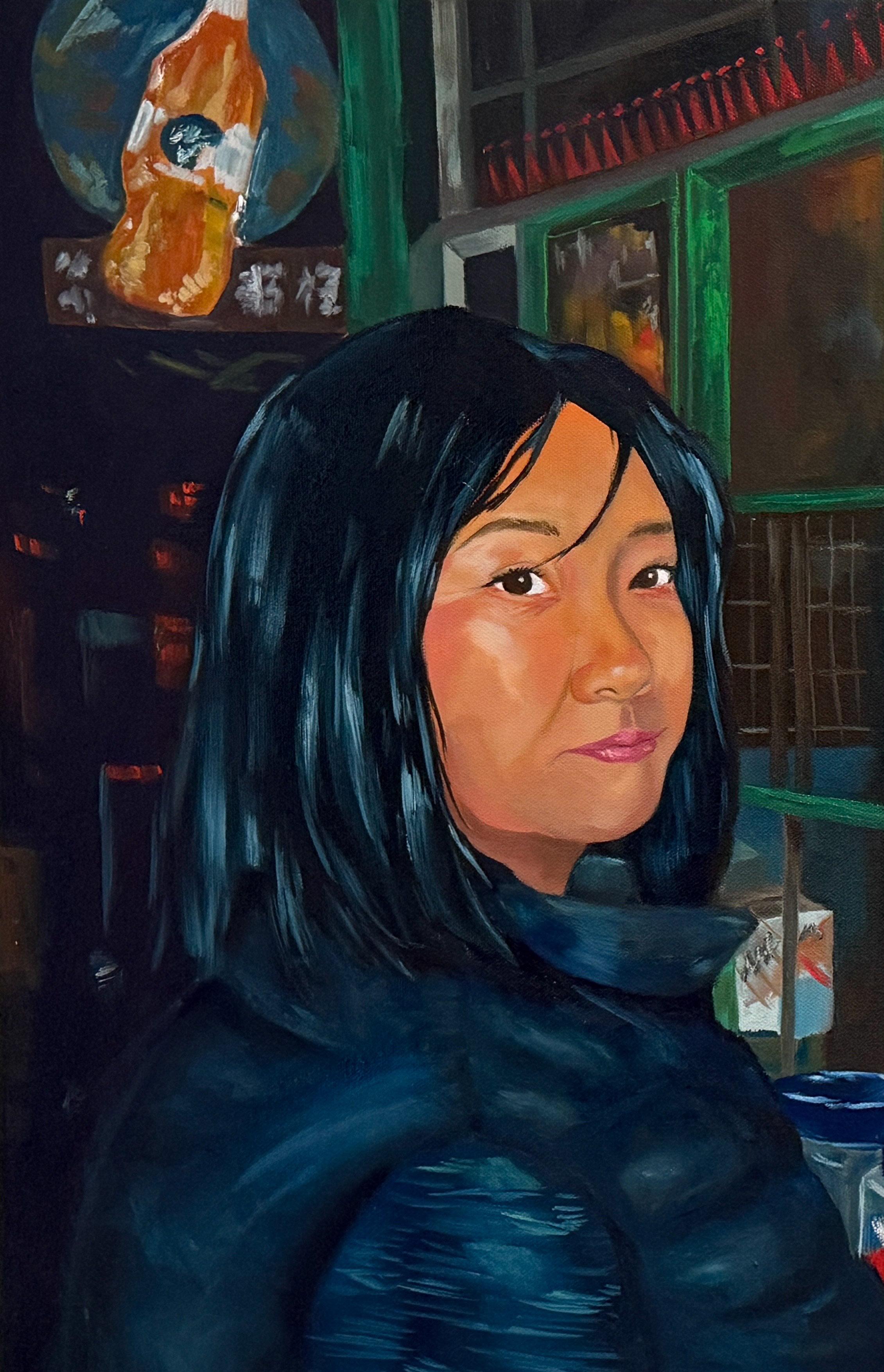
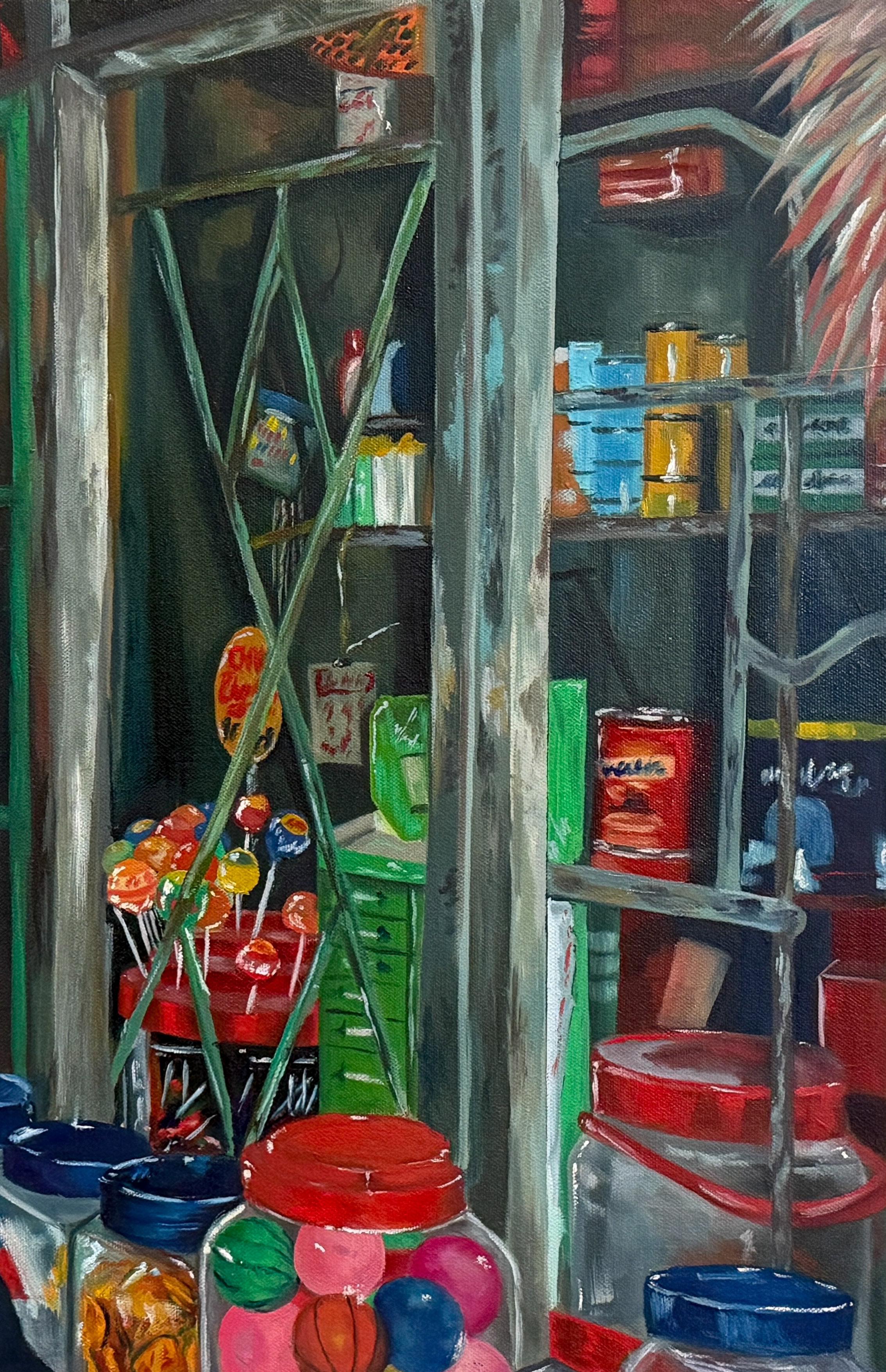
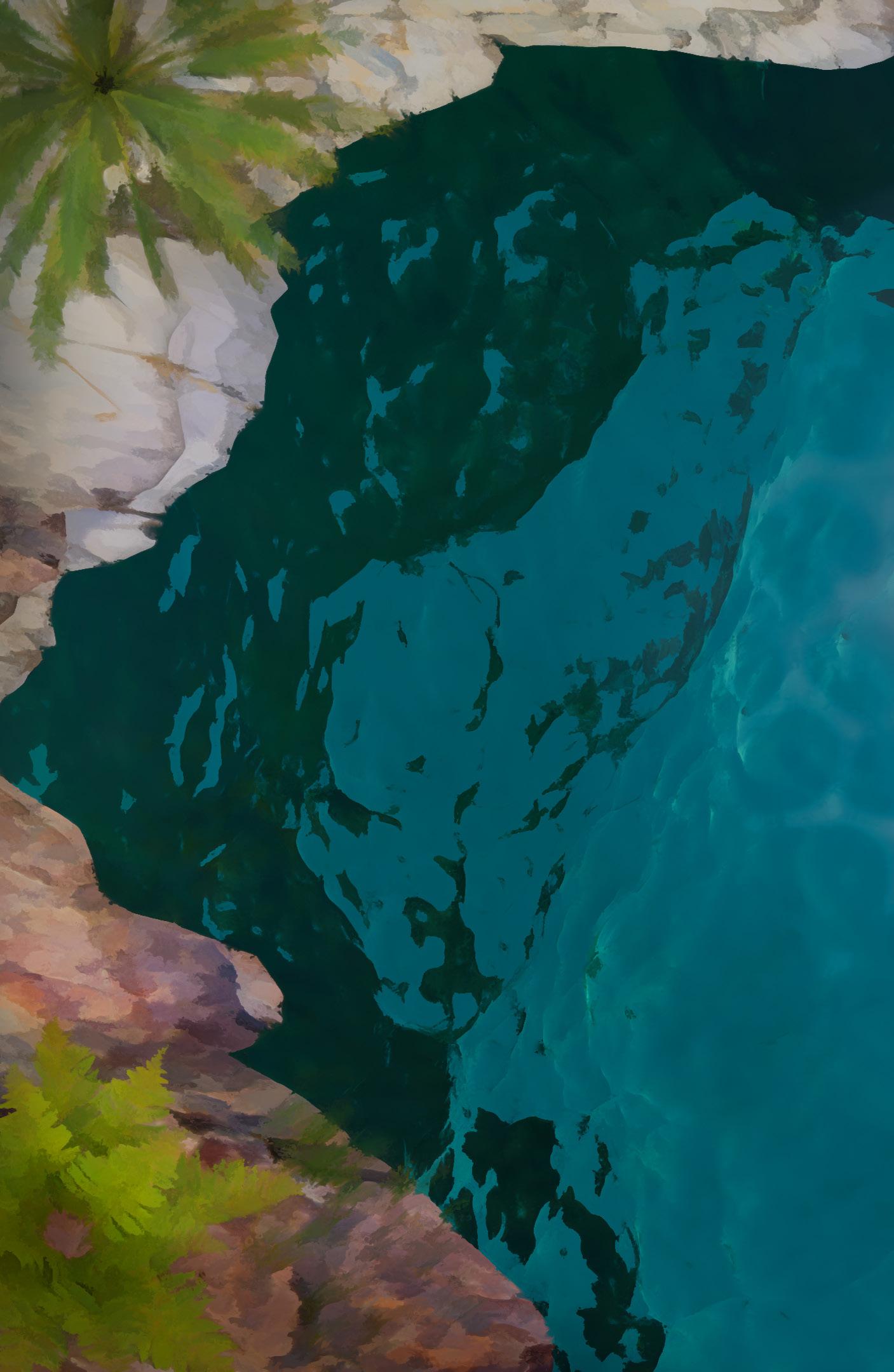
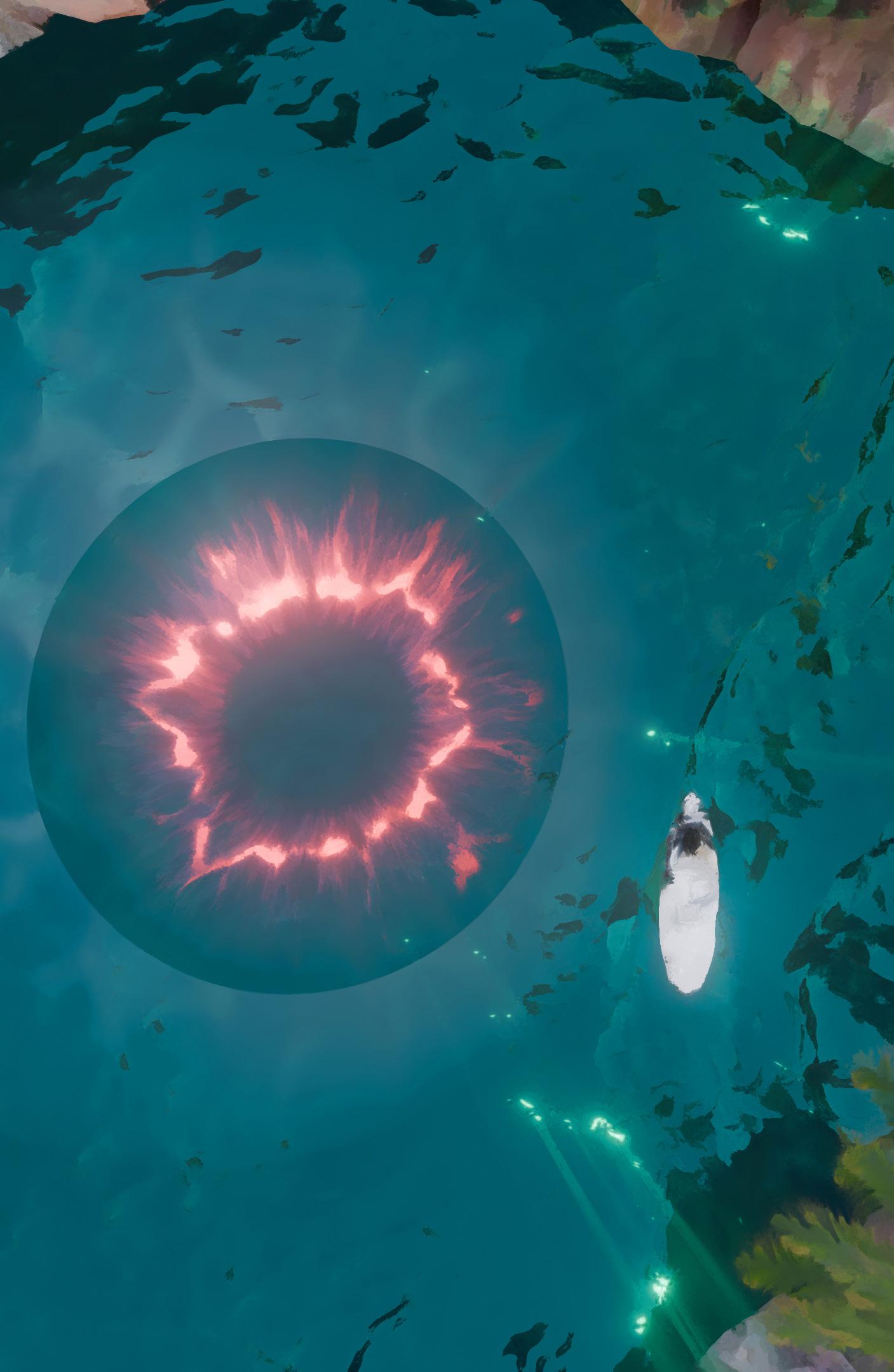
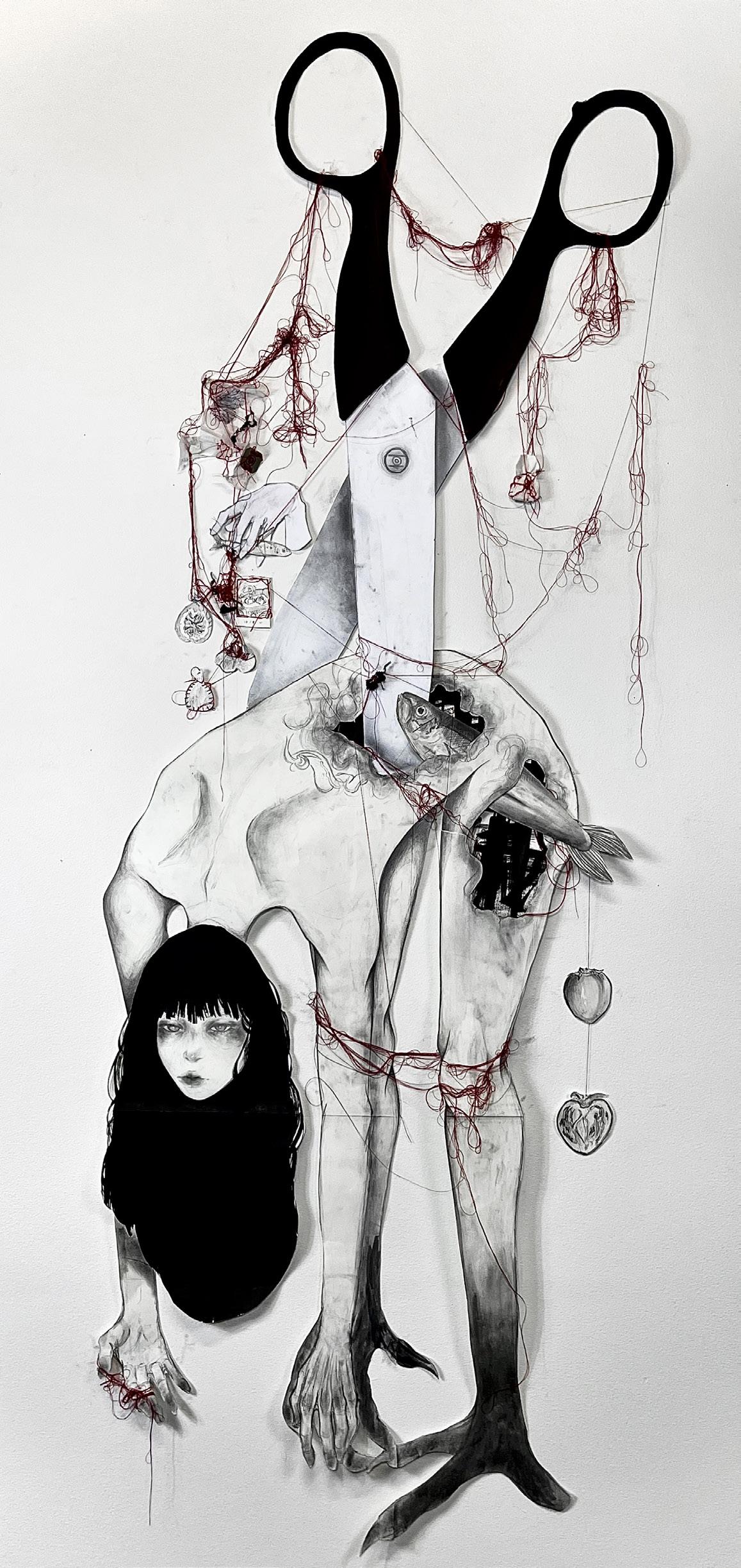
Down the Road | Rachel A. ’27 21 Coffee Shop Gallery Wall of Silenced Birdsong | Hayes S. ’27
Composition | Raya I. ’28
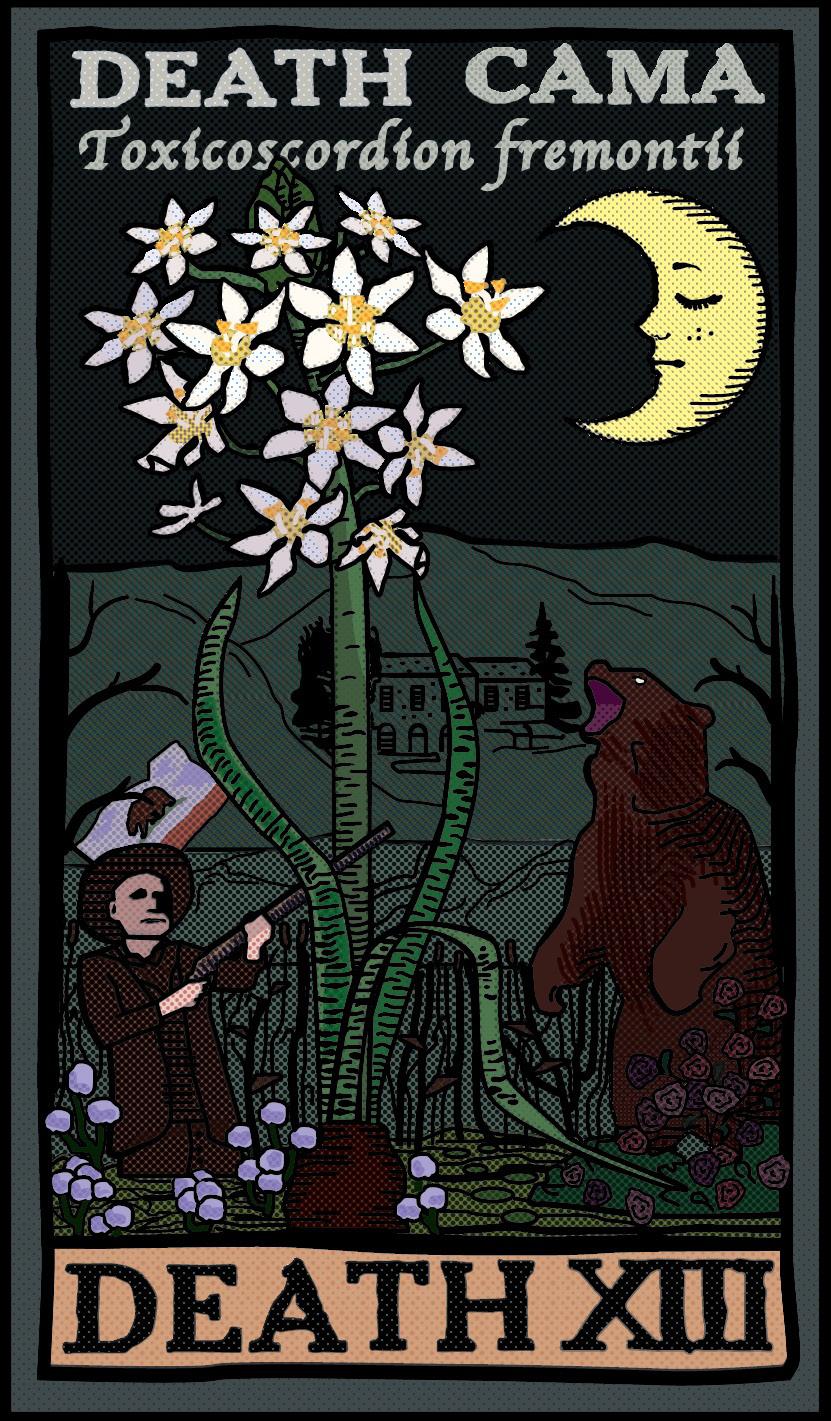
TAR.CAL.DEATH. | Hayes S. ’27
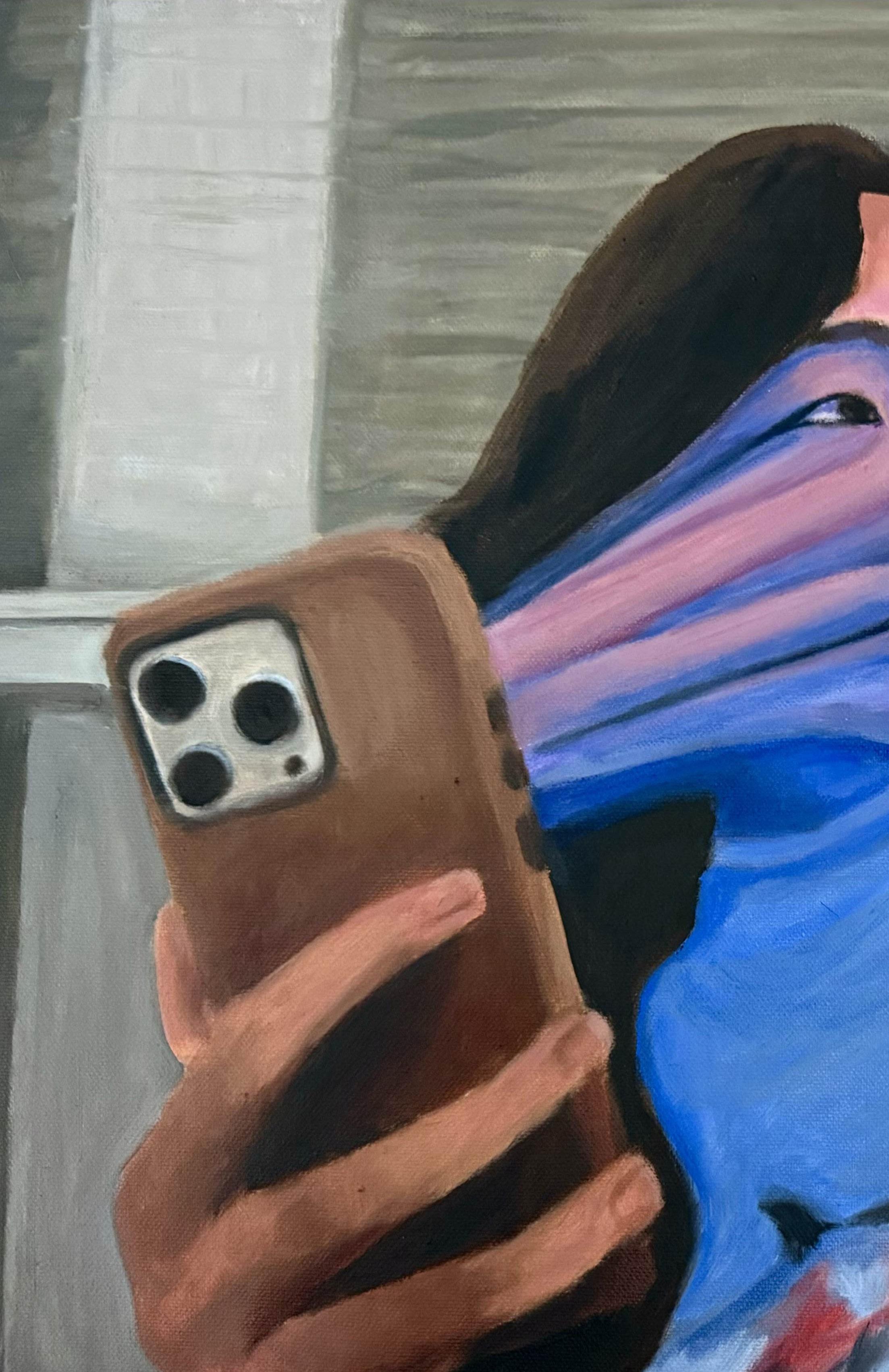
33 thoughts i have sitting with my back against the bedroom door | Veda P. ’29 35 The Pull | Maya W. ’27
A second glance | Anika A. ’29
Cliffside | Kayla L. ’26
About my grandma’s lychee tree | Anonymous
A Tidepooling Egret | Emily F. ’27
Albedo’s Daughter | Audrey Z. ’26 44 Capturing the Moment | Rachel Y. ’26
Cara | Maya W. ’27 51 Tea? | Rachel A. ’27
52 Yellowface: Guilty | Anonymous
55 Kowloon | Audrey Z. ’26
57 Sun Down | Rachel A. ’27
58 SEE | Kepler Q. ’29
59 Out the Can | Audrey Z. ’26
Letter from the Editors
Dear Reader,
What keeps us where we are? What stops us from moving forward? What are the tethers that restrict and contain us?
We all experience physical constraints, whether that’s the size of a room or height on an amusement park ride. But this spring’s theme, tethers, asks us to reexamine our relationships to our mental restraints—the ways we break, form, and transcend our ties to ourselves and one another.
Our contributors saw tethers in different lights. Sometimes they ground and provide meaning: our lives are limited by time, but maybe that makes us treasure the fleeting amount we have that much more (as in “taking my time down the jet bridge”). We are innately tied to each other, through tangible relationships as well as imagined connections (as in “Taking Note”).
Other tethers leech into our lives, attaching themselves like parasites and threatening to take over if not noticed (as in “An Ode to Consumerism” and “The Pull”). Sometimes, tethers are assigned to us, outside of our control (as in “Yellowface: Guilty”).
When you are tethered to something, you can still see far beyond your range of motion. We are aware of our tethers—but the question then becomes, what will we do about them?
Each of the pieces in this issue answers this question in a different way, and we are incredibly grateful to our contributors for sharing their unique perspectives through their beautiful work. Thank you to everyone who trusted their work with LitMag; this truly would not have been possible without you! We hope you have as much fun perusing LitMag as we did reading and enjoying your work. And to our editorial board, thank you for breathing life into these pages.
Finally, we would like to extend our utmost gratitude to our amazing faculty advisors, Jen Neubauer and Amber Carpenter. Your support through every phase of this process means the world to us.
We would like to dedicate LitMag: Tethers to Amber, who has been a shining light in Nueva’s creative writing community, for all the help and encouragement you have given us. Amber, we’ll miss you immensely next year, and we wish you all the best.
Raya I. ’28 and Senna H. ’26 (Editors-in-Chief)
The Rhythm of Light
Amaira G. ’29
It began on Tuesday, December 11th, 1956.
The young couple spent forty minutes in the store, palms along the armrests, testing the sway, admiring the grain. Oak. Handmade. They carried it home. Neither willing to be the reason it got scratched.
The chair sat in the nursery before the baby.
When the infant arrived, the mother rocked frantically–quick, desperate arcs that said please, please, please. The runners beat a nervous rhythm against the hardwood.
As the weeks softened into months, the rocking slowed. Confident. Steady. The creaks became a lullaby rather than a plea.
The boy grew up in that chair.
As a toddler he flung himself back and forth with abandon — like a roller coaster, a ship in a storm — until the house seemed to rock with him.
The parents watched with their hearts in their throats, steadying it with one hand. That evening they checked and tightened each bolt with focused hands.
When he left for college, the chair went with him. Years later, he brought it back. His mother, now a grandmother, resumed her place, slowly, with the rhythm of someone who knows time moves in one direction. She rocked her grandchildren as she had once been rocked.
The chair’s creak deepened over the years. Every new sound was noticed. The oak was oiled; scratches mourned; wobbles corrected, as though the chair deserved it.
But, this is not the chair’s story. That Tuesday, December 11th, 1956, they returned to the store. The nursery needed light. The husband pointed at me — brass base, cream shade — and said I’d do. Not beautiful, not perfect. Functional. I was wrapped in newspaper, not moving blankets, placed beside the chair in the yellow nursery, close enough to witness everything, small enough to disappear.
I did witness everything.
I saw the father in the earliest weeks slip into the nursery at 3am, not because the baby cried, but because he needed to. He sat without rocking it. His face did things in the dark it never did in daylight. He never told his wife. He never told anyone.
The chair had its rhythm and I had mine. When she rocked frantically, someone pulled my chain just as desperately, flooding the room to check if the baby was breathing. When the rocking steadied, so did the pulls, routine, unhurried. A hand reaching for me the way you reach for anything you expect to be there. They never thought about it. That was the point.
When my bulb burned out, it stayed burned out for eleven days. They had other sources of light. When the chair’s runner cracked — when she fell — they came running. They wept over the broken oak. They kept the pieces.
Every.
Single. Piece.
No one thought to keep my newspaper. It had done its job.
I am still here, in a guest room, with a bulb no one remembers installing. I have illuminated three generations.
They used my light. They never noticed it was mine.
constellations Kepler Q. ’29
Prophecy’s Daughter and a Ghost
Amalia V. ’27
In a town no longer even marked on maps, I am quietly surprised at the notion of my own invisibility.
Sometimes I wonder if you put all those stars in my eyes on purpose, sometimes I wonder if the girl I’m supposed to be sees them in the mirror when she walks by, headlights in her periphery—surely the overcast weather that trails me each night was accidental. You didn’t mean for my night sky to be walled off forever, right? I know you’ve forgotten me, or are trying to.
Everything has been cold for ages, you’ve draped your mantle, threaded with the celestial, over the world once, twice, thrice a month. I’m sure the northern lights were beautiful this year.
But it’s summer now, there are strawberries growing between cobblestones and blackberry vines hiding underneath shrubs of blossoming rosemary. It’s summer now, and the sun burns away at clouds hanging above me, slowly, sporadically making its way through oak leaves and jars of honey and cheesecloths hanging on the clothesline. You can’t keep me from seeing the sky forever, even if I won’t see you there.
After all, it’s summer now, and there’s no one around for miles, not in the hayfields or the town on the other side of the hill or the docks. Who would you offer your guiding lights to? There aren’t any people here to build shrines in your likeness, to light candles and leave them melting over graves. The matches under my bed are for burning her letters, words inked and dripping, sap-sticky with meaning.
And it’s summer now and I’m boiling water from the creek with no way to cool it back down but if I hold the pot close to my chest for long enough I am convinced it would freeze anyways. It’s summer and everything is broken and fragmented and warping in on itself, but what else is there? Nothing beyond sewing a new patch onto my canvas bag, embroidering a bandanna with messy, frayed daisies, drying apricots outside, maintaining a house that isn’t mine.
It’s summer now, so father above, if I ask you very nicely, will you come down from the sky and help me cut my hair?
Taking Note
Evan Vaughan (Staff)
I saw a man on the train today, and I could tell he was like me.
He had a quiet confidence about him: earned, not a given. This man had gone through revolutions and resolutions to reach an achievement as sacred as self-love.
His back was straight, surprisingly.
The only visible material decoration was an earring on his left ear, a decades-old quiet message to those around him to say “oh hello, I indeed am like you.”
His glasses frames had a wood-pattern design, classy and elegant. Paired with his maroon and pink shoes, his style delivered a new balance to onlookers and passersby.
His mustache, thick and full, too distinguished him as an aged, fine, specimen. The lack of trimmed edges secretly (or purposefully) gave a peek into his whimsy.
The large hardback book in his hands, checked out from the local library, pages separated with a lozenge wrapper bookmark, drew him in throughout his morning commute, save til he noticed someone like him, stealing glances at his outfit and demeanor, taking note, and making a silent connection.
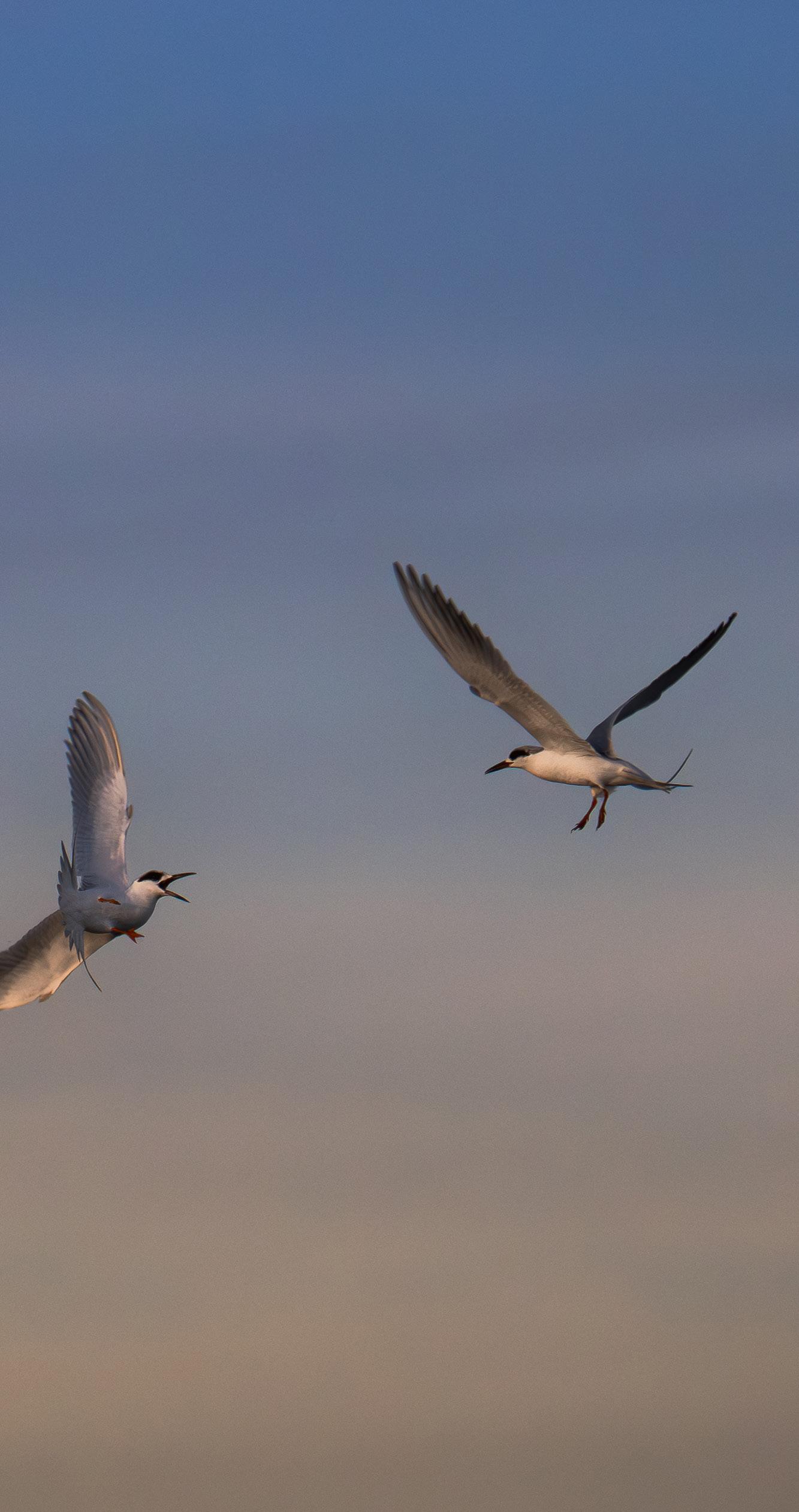
Untitled Bird Photograph
Zach M. ’26
up here Kepler Q. ’29
An Ode to Consumerism
Rachel Y. ’26
To Aiden Y., San Mateo, California
Costco Wholesale Foster City, 27th March—
My dearest brother,
It is with ardour and lingering elation that I relate to you the tale of my sojourn to the trivial and commonplace abode of angels that is Costco. I descended upon this plentiful warehouse just this Sunday afternoon, and it is with commodities aplenty in hand and glowing happiness that I assure my dear brother of the success of my excursion. As oil quiets the screech of rusting metal, so have the day-to-day conflicts abundant in my existence been soothed and alleviated by this Elysium, and it is with renewed fervor that I return to my war waged against the monotony of life.
As I walk through welcoming doors, the expansive walls of the warehouse flanking me, boxes upon boxes of Skinny Pop popcorn make themselves known and beg to be purchased. The superlatively balanced throng of fellow customers creates a pleasant ambience, where there are just enough to share my zeal but not too many to diminish the plenty of products lining the warehouse shelves. Do you understand the concept of a zero-sum game, Aiden? Yet the haven of Costco is another game entirely, where scarcity dares not touch upon even the outskirts of the kingdom. Truly, the bulk items and price drops unite us shoppers as brothers and sisters in arms, marching towards the common goal of affordable and delectable victuals. Allow me to further convey to you the inexplicable beauty of my endeavour, whose allure has not only bewitched my senses but our father’s as well. You may remember, brother,
that he has a mild nature but is firm in his undertakings—and the smart scale in our bathroom, heavy duty exercise equipment in our garage, and dietary supplements overfilling our cupboards are evidence enough of the extent to which he prizes the health of the human body. Yet some enticements—antithetical to the straight face and unswayable disposition that we have come to accept as idiosyncrasies crucified to his soul— may have rendered him malleable to the will of mass consumerism. If fortune smiles on you as it has on me, he shall take a brief scrutinizing glance at the twelve-pack of instant ramen in your arms before acquiescing, an astonishing departure from the flat “no” you would be granted had the two of you stood in a Safeway aisle.
Not only is the junk food of this nirvana accessible and of high quality, but I ceaselessly marvel at its sheer aggregate quantity and bulk. Yet, though the Natural Blind 3-Piece Ghillie Suit and twenty-thousand dollar Camaro pool table imbue me with reverence, I shall continually return to Costco in the dilapidations of my graying old age with the hope that I shall be laid to rest in the reduced-cost caskets tucked into the back rows of the warehouse. The legends steadily instilled in me over the course of my visits have led me to believe in an afterlife spent roaming the aisles in search of free samples. Perhaps, if I do not return after my next visit, you shall aid me in this enterprise. Alas! The solace and bliss afforded me by this paradise has smoothed away my troubles. Returning to the real world, I anticipate that I shall find my adversities easier to overcome with cinnamon-raisin bagels in clenched fists. Should you wish once again to vicariously experience such exhilaration and wonder, know I am but one letter away.
Your ever-magnanimous and loving sister,
Rachel Y.
Juliet C. ’26 Untitled
Signs of Spring’s Return
Emily F. ’27
Earthy tendrils peek at a cloudless sky, emerging from a winter sleep
Hues of sleepy blues, bright yellows, rosy pinks
Daffodils upon daffodils, snowdrops, crocuses
Unfurl leaves and petals, greet the world again.
First blooms, the return of warmth, Spring brings the cheer, young deer, birdsong to hear Spring showers, petrichor rising from the soil, the world awash with green Golden hills turn lush and vibrant.
Plentiful pollen tickles my nose,
The sound of sneezes and the feel of puffy eyes
Tissues upon tissues and more tissues
Runny noses, bright as roses
Indeed, Spring is here.
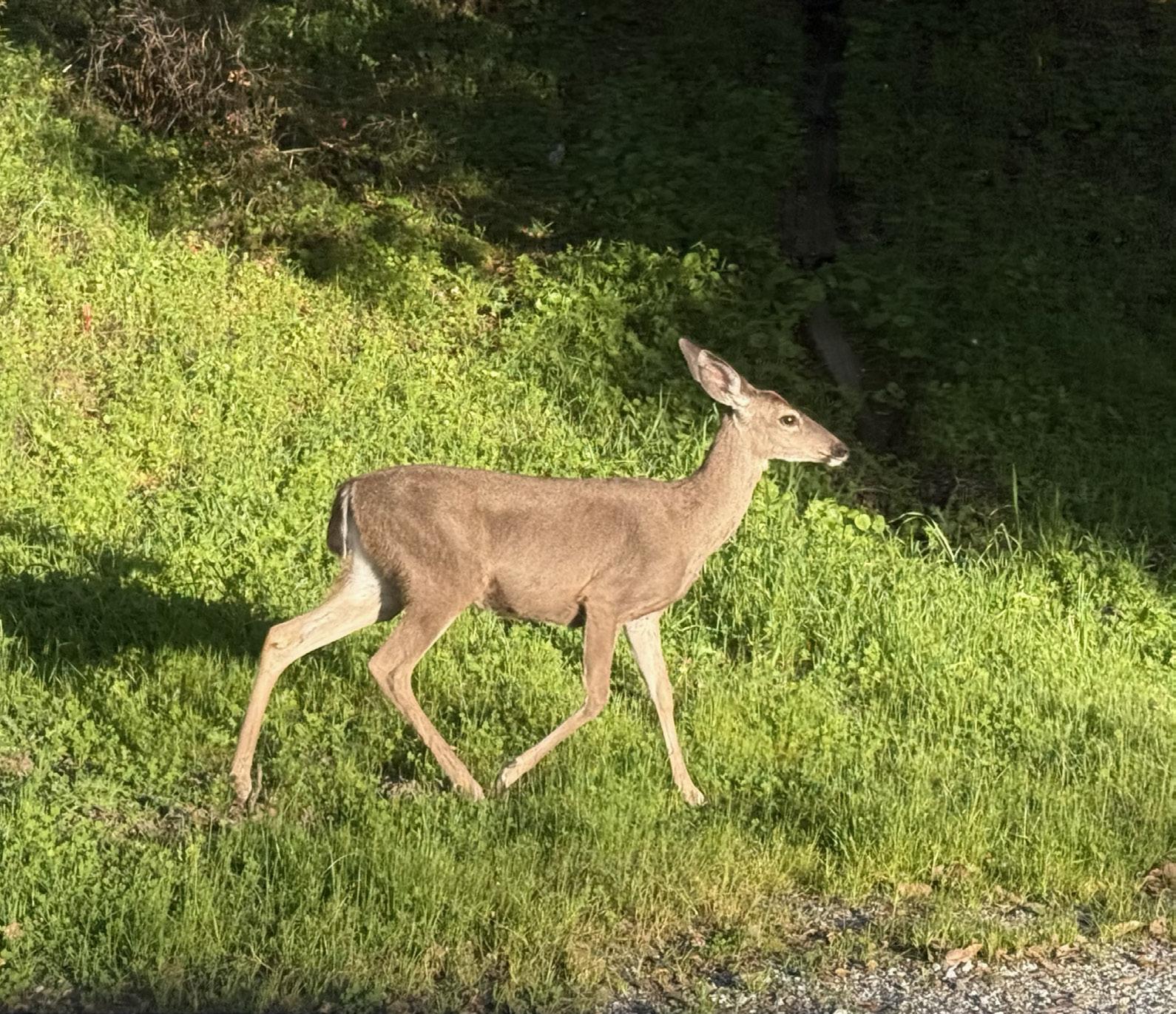
Doe at Dusk
Emily F. ’27
taking my time down the jet bridge
Ivy A. ’29
Click click click, sounds of heels on the tile and boots on the tile and sneakers and slippers on the tile. It’s dimmed from the tension in my ears not quite popped, on my head not quite processing anything but the light grey of the sky outside the glass window. Click click click, my suitcase rolls off the groove in the tile and slides through to the next one, like checking off boxes. Click click click, my passport lets me through the clear plastic customs door, wondering how efficiently it works and how other places don’t have this efficiency. Click click click, the escalator stashing its steps for the next wanderer to come along, armed with goals and dreams, however they might see that. Click click click, I ponder that thought as the line keeps moving until I’m at the front of it, being asked who I am, as if I could ever answer that question. Click click click, taxis clocking in their minutes and doors locking as the hot air convolutes my struggling mind. Click click click, and now I’ve left this place of combination between known and new and set my course but it’s dimmed from the tension in my ears still not popped, on my head still not processing my surroundings screaming LOOK AT ME, PICK ME, LOVE ME. I can’t decide if I want to. But soon in the water, I’ll submerge to forget the screams and the surreality of being dimmed from the tension in my ears, finally popped, on my head, finally processing and I feel the quiet not quite silent but peaceful. A pause. Time stops. I don’t ever want to go back up. But I will because I can’t live in this water because I’ll drown but I want to so I never have to time again. Time is flying past me and it dawns
on me that I don’t have the time to spend my time in the water trying to escape the time I’ve so desperately wanted to buy so give me time, please, I need more time. What if I look back to my time and wonder why I timed my time to time with time and why I let myself forget what I did on my own time because time and time again I forgot what I was timing for. Timing to time my life in cycles trying and failing to not waste a fraction of this timed time I’ve been given and I’m running out of time and it’s my time but what if it’s the end of my time and please don’t give me anymore time to time the time I’ve thought about time. I don’t want more time. So I’ll leave this water and start my time anew and go back to the time that we all have because I don’t get extra time. But it’s dimmed from the tension that will stay in my ears that will pop because I don’t get extra time, on my head that will lose its remembrance of the time I learned to time until processed because I don’t get extra time. No one gets extra time.
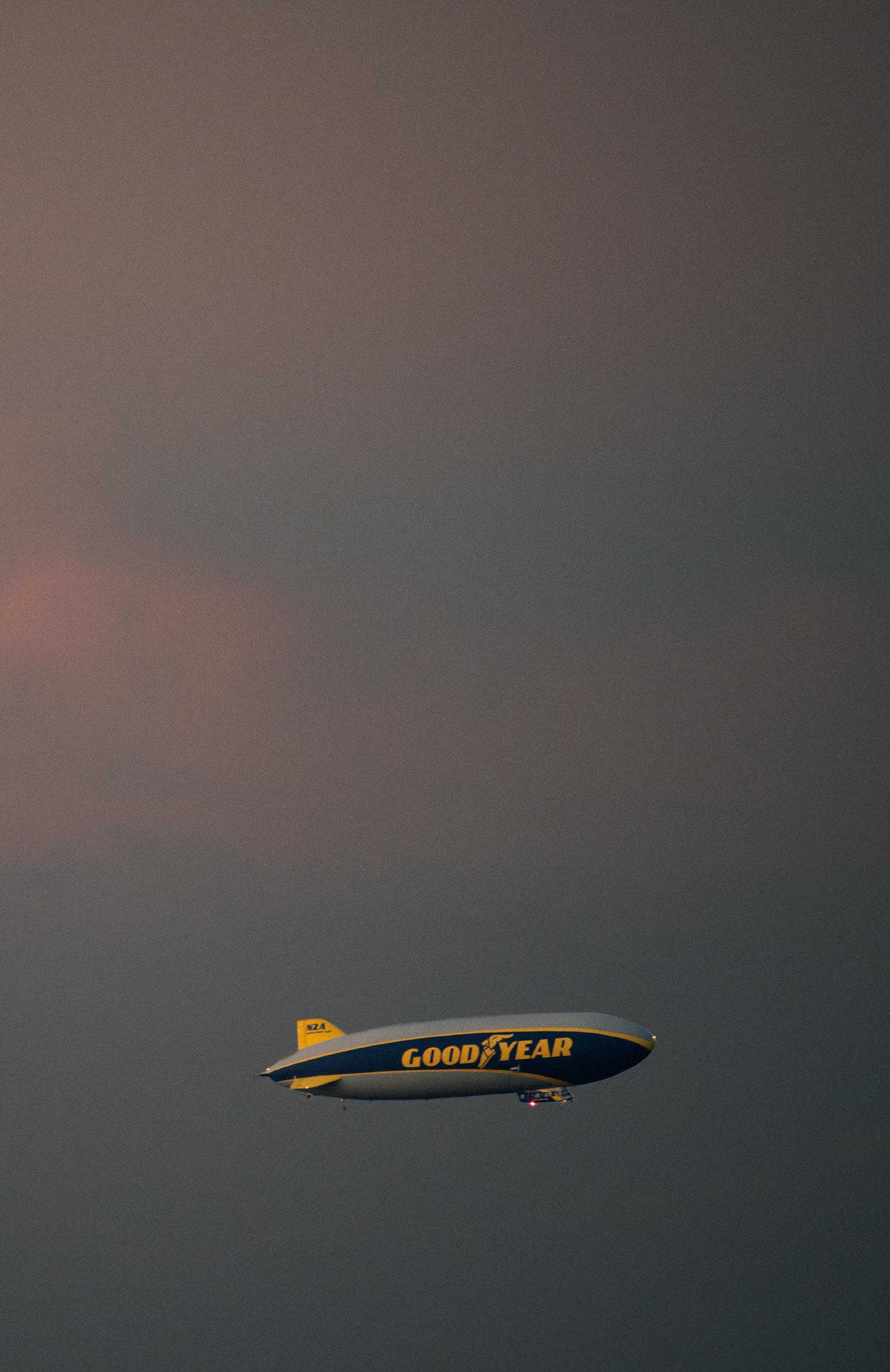
Wingfoot Zach
M. ’26
Untitled Juliet C. ’26
Down the Road
Rachel A. ’27
Mama, I can explain: Last night I tripped on a tree root and tumbled Into warm earth, still sun-kissed and dusty. The mud and tree sap browned my hands; I was baked golden by the sodden ground, and I must’ve Lain too long, for the weeds curled milky soft and when I woke, It was cold. I do not remember why My nails are cakey, why The grass clings to my cheeks, Or why I saw the old goat on the floor, like a new -born, squirming under the hickory; I tripped, Mama, I tripped, and just as Pigs dive into mud
Like it is their birthright
And shove tongue & sloppy softness into buckets of feed, I got hungry.
Coffee Shop Gallery Wall of Silenced Birdsong Hayes S. ’27
Composition Raya I. ’28
The rain lashes furiously against the building, beating around the vastness of the campus. Matthew rubs his thumbs together, over and under the knuckle. The adrenaline has faded: he’s rescued her, and now what? Her face is pressed into the faux velvet of the couch, creased as if worried. She’s still unconscious. The skin of her folded hands is thin and veiny; when he brought her in, her fingers were blue.
He gets up and rifles through the kitchen cupboards. Feeling helpless, he decides to make a soup, as much to give his hands something to do as for the actual possibility of her wanting to eat. He chops vegetables right on the Formica countertop because he doesn’t have a cutting board, staining it orange and green.
He turns the stove on and warms his fingers over it. Into the one pot he owns goes boxed broth, potatoes, celery, thin noodles, carrots. Outside his kitchen window, the wind taps together branches and sends them skittering down the sidewalk, their dark forms somehow even blacker and denser than the night around them. He glances back at the couch. She hasn’t moved. Long shadows stretch over her face, flickering as cars and buses cut into the streetlamps. He puts the lid on the soup and goes back into the living room, sitting opposite from her, keeping watch. —
Matthew met her while walking back from one of the few of his classes he attended, “Introductory Astronomy: Cosmic Evolution.” The lecture was from four-thirty to six-thirty: because it was autumn, he’d enter while the sun was dripping over the browning hills and burnished trees and exit into soft, navy-blue darkness, the library glowing like a cocoon on top of the hill. The lecture hall was always dim, and he sat near the
back, so that the projected images of galaxies, stars, and other incomprehensible things filled his entire field of vision. He could lull himself into a half-conscious state that way, following the professor’s murmurings about distance and time and vastness, forced into a subordinate position, beneath every cosmic happening. When the lecture got too mathematical, he let his eyes blur the numbers on the slides into fuzzy, antlike smears and promised himself he’d study later.
After one such evening, his mind unmoored from ordinary temporality (he was rolling the word ‘temporality’ along his tongue, slowly forcing it to lose all meaning), he was walking back to his apartment in a daze when he suddenly felt his elbow smack something soft and abruptly stopped. He looked down and saw a girl, very short, with wide, dark eyes and a look on her face like a frightened rabbit, which soon resolved itself into a mask of contempt. They’d collided under the pool of a streetlamp, and in its illumination, he saw that her hair was collected into a smooth, high bun, and she wore a black vest and joggers and strange, puffy boots on her feet. She was standing very straight, as if she didn’t feel the weight of anything. Like everything, weather, worries, judgments, would just slide right off.
“Sorry,” he croaked. He’d barely spoken all day.
“It’s fine,” she muttered, rubbing the spot on her shoulder where his elbow had made contact. She sidestepped him and walked out of the light, into the darkness; watching her go, he felt inexplicably horrible, as if he’d just voluntarily kicked a dog. Something in her gaze seemed to probe his entire being. She knew that he hadn’t been attending class. She knew that he drifted through his life, not even awake enough to notice a person until he’d run into them.
During the rest of the walk back, he felt painfully aware of his surroundings, as though he was living immersed in a different substance. The outlines of brick buildings gave way to squat fraternity houses, and then cheerless, blocky apartments. All the angles were so square. He felt the backs of his knees
aching—he’d shot up five inches last year. His hands were hunks twitching in the murky shadow. Back at his tiny apartment, also square, he paced for a few minutes, but his alertness, his dissatisfaction, and the feeling that something had been ruptured all soon faded. At least he lived alone, and could inhabit his space with a rare looseness of limb, moving quietly about. He began to doubt that the girl was real, and felt certain he’d never see her again. He opened his astronomy textbook, flipped to a random page, and read until nothing made sense anymore.
Photography was the other class he regularly attended, because he liked the feeling of the heavy lens in his hands, his fingers wearing the black coating off the buttons. He was also in the professor’s bad graces; she had threatened to flunk him after he missed two classes and, as though she was teaching high schoolers, scrupulously took attendance and recited a list at the beginning of each class of anyone who didn’t turn in their weekly assignments. A week after his encounter with the girl, he was sitting in class, watching the crumbling leaves dip wildly through the thick, gray air, when the door blew open and there she was.
Professor Beckett looked up, pursed her lips, and grimaced a smile. “You must be Lina,” she said stiffly. “Take a seat, please.”
The girl—Lina—sat down directly across from him, twisting her hands together apprehensively. She looked more or less the same as he remembered, except that her hair was loose, curtaining her face; her back was still impossibly straight, but she stared into the table, so that her posture seemed to exist against its will. When she glanced up, Matthew snapped his gaze away.
“… for your midterm project,” Professor Beckett was saying, “you will be in pairs, and you will create a series of portraits of each other, in a natural environment, where you feel at home. The idea being that subject is inextricable from setting, and that...”
Her voice faded as Matthew began to panic. A natural environment? He didn’t have one—he felt completely displaced here—what was he going to do, sit on a bench and pose? And the thought of himself, in front of a lens, not behind it, the shape of him burned into pixels for all to see—
“Next pair… Lina and Matthew.”
He turned back to Professor Beckett, alarmed. Assigning groups in a college class was going too far, he thought.
“By next class,” the professor barked, “I need your proposals: location, shot list, et cetera, you know the drill. You are dismissed.”
Shuffling out of the classroom, Matthew caught up to Lina, praying she wouldn’t recognize him, but: “Oh. You.”
“Uh, yeah. Hey, listen, I’m really sorry about the other night—”
“It’s fine, don’t… We need to do this thing, I guess?” She let out a colossal sigh, running her fingers along the cracking hallway paneling.
“Yeah.” He followed her to the stairs; she was practically jogging. “Do you have any ideas about where, you know, you might—”
“I’m a dancer,” she interrupted flatly. “It’s kind of all I do. So unless you want to photograph me sleeping, you’d probably have to come to rehearsal or class.”
“Oh.” That explained the posture, at least. “Wait, that’s— that’s really cool, I’d, um, that sounds fine.”
She glanced at him and nodded. “Yeah. Okay. I’ve gotta run now, so….”
He waved, awkwardly, and only when she had run down the winding staircase and into the grayness outside realized that they hadn’t decided on his location, and he had no way to contact her. —
She was an apprentice (not quite part of the company, not still a student, she explained) at the ballet company in the city, a fifty-minute bus ride from campus, and only took a few college classes to appease her parents. She didn’t care about
them at all. She’d had to miss the first half of photography this semester, for instance, because rehearsals for a premiering ballet took up too much of her time. All this Matthew learned while walking down a cavernous hallway in the conservatory building, struggling to keep pace with her rapid steps and sharp turns through the maze of corridors. She did seem different here, he noted, looser, freer. More at home, perhaps.
Lina pushed open an imposing gray door and waited for him to slip in behind her. The space was cavernous: the floor, of a gray rubber, was scattered with bits of tape and streaked with chalk, and a wooden bar ran the length of the walls, stopping only when it reached the enormous mirror on the back wall. The corners were strict and tight; he stayed away from them.
Matthew watched Lina carefully. She seemed to have forgotten he was there; humming to herself, she sat down near a wall and unspooled her long hair, running her fingers through it and wrestling it into a high, neat bun. He watched, fascinated, as she wrapped her feet in tape and gauze, slipped on her pale tights, and then, taking out her shoes, beat them forcefully against the floor.
She wound the ribbons around her slim ankles, her spine bent into a perfect curve. Almost instinctually, he lifted his lens and centered her in the viewfinder: the gray floor, her hazel hair, her utter concentration. The click of the camera was deafening. When she snapped up, in her eyes was the same stripped-open fear of their first encounter. Matthew swore under his breath and lowered his camera as if he could hide it, murmuring, “Sorry.”
“Only when I’m dancing,” she said tersely, slowly picking up her second shoe.
He nodded and slunk back against the far wall, turning his gaze away.
Lina warmed up silently, her shoes rhythmically hitting the floor. He glanced at her periodically—was she dancing now? What counted as dancing? He realized he’d never really watched ballet before. Finally, after thirty minutes in which he
fidgeted with his shame, she turned to him and nodded.
Behind the lens, the noise of his flurrying mind receded. She was almost unfathomably beautiful—slight and pale, wearing her black leotard like a second skin. Her spine arched beyond belief, legs shooting into the shadows, she looked only slightly human. He barely said a word, just waited for her to find a position and somehow knew when it was right.
An hour slid away. The light in the studio was static and white, oblivious to any passing of time. She was reduced to a collection of shapes for him, a composition of lines and curves, and his only task was to capture each distinct arrangement. He thought of astronomy—each night sky was different, scattered, carefully arranged—and then dismissed it, shuddering at his own whimsy.
Lina fell out of a one-legged balancing act, and instead of moving to a new contortion, sighed and walked to the edge of the studio. Matthew retreated to a different corner, not daring to speak for fear of saying the wrong thing. When she began to unwind her shoes and roll her feet over a ridged foam ball, he quietly packed away his lens. He’d nearly maxed out his memory card with shots that, from far away, looked identical. Subject is inextricable from setting, Professor Beckett had said. He didn’t feel that he understood either his subject or his setting any better after focusing intensely on them for an hour and a half, but he knew that they belonged together, Lina and the huge, light room. Perhaps that was what she had meant.
Lina walked to the door and pushed it open, turning around at the last moment to say, “Oh, that’s—I have class now, and there will be someone coming in here, so…”
“Oh, okay. Thanks. Um, thank you for letting me—” But she let go of the door before Matthew could finish his sentence.
He wound through the conservatory building, feeling abominably out of place among hordes of sleek, short dancers, mostly girls, all graceful and self-assured, walking with a lightness and flexibility he found shocking. He was nothing but a hunk of meat. He didn’t belong anywhere near art. On the bus
ride back to campus, he tried to erase any vision of Lina, effortlessly embodying shadow and light, strength and softness. He felt that if he let that kind of beauty exist in his memory, he would never have the courage to go back to his own life.
—
All that was two months ago. And, of course, there was the instance when he was forced to face the lens as a subject, which he prefers not to remember, even now: Lina trying to instruct him on where to put his feet and hands, seething at him to appear natural, while he grew more and more humiliated. She had chosen a grove of half-bare trees to resolve his waffling. He hadn’t known how to protest: outside, he knew, he’d feel too small, and inside, too big. During the shoot, he tried very hard to recover some childhood sense of freedom, or oneness, or expansive joy; but as a child, he realized, he’d had no conception of either the Earth’s decay or his own. In the end, the photos were simply terrible, dark and underexposed, with his own uncontrollably hideous face leering at him. For someone who embodied such beauty, he thought, it was ironic that Lina couldn’t seem to see or create it.
Now that beauty has found its way, ghoul-like, into his apartment. He can’t escape it. He has no idea how she even ended up on the main road near campus. All he remembers is pelting rain, smeary lights, and the screech of tires, sensations that he finds extremely cliché, so much so that he’s almost convinced he made them up. He remembers the car whipping past, frothing up water. He remembers noticing the shape slumped in the gutter (that was what she looked like, not anything, just a formless lump), and running over, and wondering why he was running over. He remembers knowing that it was her, almost against his will—against all laws of logic. He didn’t see anything crumple when the car passed. She was already huddled in the gutter, as if she’d been acting in a car chase and had dropped too soon, before her cue. He couldn’t blame the car.
He made a show of checking her face carefully in the patchy light. She was convulsing with cold, her deer-like body
soaked through with filthy rainwater. What was he supposed to do but pick her up and bring her to his apartment? She seemed to be wearing ballet clothes: a flimsy skirt, a wrapped cardigan, and, inexplicably, a fur cape, sodden and damp. He thought she might catch a chill, but decided there was nothing he could do except wrap her in blankets and lay her on the couch.
He watches her until his eyes go blurry, until her delicate features oscillate and waver in front of him, so disoriented that when her eyes flutter open, he thinks at first that he’s imagined it. But then she stirs and sits up, and he realizes.
“Oh my God,” he says, overwhelmed, first with relief, then apprehension. “Lina, are you—”
“Where the hell am I?” she says softly, her voice shaking. She sits up slowly, twisting around to look at her body, as if to make sure it’s all there. Again, her eyes look wild and crazed. He hates that look. All he wants is for it to be gone.
“Listen, you’re, uh, in my apartment. This is—I found you,” he blurts out. “Do you remember… anything?”
“What? How—what the hell—”
“I found you,” he says again. He doesn’t want to have to describe it. “You were, um, by the road. You know, Campus Drive.”
“On the road?” She pushes away the blanket, trying to untwist her legs and smooth her damp, matted hair.
“Yeah.” He shifts uncomfortably, feeling like an interrogator. “You were, I mean, unconscious, so…”
“So…”
“I wasn’t just going to leave you there.”
She stares at him, clenching her hands together. “Maybe you… maybe you should have.”
“What?”
She stands up and tosses the blanket away from her. Her whole body is trembling, with rage or cold, he can’t tell. “I said, maybe you should have.”
“Why… what?”
“Why would you bring me here?”
“Because I was freaked out! I was worried.”
“Oh my god. You don’t know me at all. You don’t. Why were you worried?”
“Jesus Christ, Lina, I don’t know, maybe because you were collapsed by the side of a busy road, and—and it was raining?”
“You didn’t think… you… this was your first instinct? Take a girl you barely know to your apartment, alone?”
“I…” He stops. Oh God, she’s right. “I panicked,” he says softly, weakly.
“Okay…” She edges away from him slightly. “Well, maybe next time you panic, don’t go picking up random girls.”
Hot with shame, he says, “You know what, you could have gotten killed, okay? One car swerve and that’s it. And it’s not like I’m keeping you here, you’re free to go, I mean, I’m sorry for trying to make sure you didn’t die.”
She glares forcefully, before saying stonily, “I will go.”
“Fine,” he says. And then, before he can stop himself: “Do you… do you need anything?”
She’s already halfway to the door. “No.”
“Fine,” he says. “Fine.” I’m sorry, he whispers, but can’t bring himself to say it out loud.
She isn’t walking very steadily, he thinks as she crosses the threshold. Her inner balance seems to have been shaken; she’s not herself. But whose problem is that, he thinks dully. The door slams. He remembers the soup, which, when he checks on it, is boiling furiously. He clicks off the stove and dumps the whole mess, sloshing, in the trash. Subject is inextricable from setting. Was it selfish, to think he was saving her, to try to transplant her into his life, his setting? She could have died, he reminds himself. He has no idea what happened or why she was there. He doesn’t know her at all.
It’s still raining, tearing at the sky, at the ground. He pictures her walking in that damp darkness, and then stops himself, knowing that he no longer has the right to anything but his own muted life. How stupid he was to think he could have more.
’27
thoughts i have sitting with my back against the bedroom door
Veda P. ’29
let me grasp the cool plastic in my burning hands as someone riffs on a 1964 Fender in a sticky New York concert hall.
let me rest my fingers on the cool counter while a boy opens his laptop, sitting on his bed in the gray light.
let me unfold the two ten-dollar bills in my purse as a Minnesota couple loads their last box into a blue Nissan.
let me get out of the Uber as someone takes a deep breath outside a well-worn door, blue shining on their eyelids as they step into the club.
let me walk on the half-dry forest floor while a girl steps onto a train and puts her AirPods in, a blush rising to her cheeks.
let me look up at the sunlit branches above as a plane takes off and a woman stands waving at the gate, her dark hair red in the sunlight.
let me choose the most comfortable spot as a worn screen lights up in blue and gray and an iPhone location is lost.
let me feel the clear plastic on my face as familiar hands still on the string, candy beads littering the carpet. let me drift away as a number is dialed over and over again with no answer. let me leave. please.
The Pull Maya
W. ’27
A second glance
Anika A. ’29
I keep thinking that I know you I keep thinking that your hair hasn’t changed And your smile is still lopsided And your laugh still makes you fall over
I keep thinking that you’re the same That you would still cross the fallen tree trunk But freak out when it creaks And laugh when I almost fall down
I keep thinking that you would wave If you saw me, that you would Shout my name, that you would run over Just to say hi
I keep thinking that a mini-me Still lives in your head Reminding you of the real me That you don’t see anymore
I keep thinking that forgetting Would kill me, but Would it really?
I keep forgetting that you’re older now I keep forgetting that you’re a whole foot taller And that you haven’t smiled, Not really, since the fifth grade
I keep forgetting that you’re so very different That you wouldn’t dare be even A minute late to class Even if it meant a cookie!
I keep forgetting that you brushed past Me in that hallway You didn’t even take a second glance I wish that you gave me a second chance
I keep forgetting that there’s a mini someone Else, who now lives inside your head Reminding you of the real someone else That you want to see more
I keep forgetting that thinking Could change me, but Would it really be that bad?
Cliffside Kayla L. ’26
About my grandma’s lychee tree Anonymous
Come from my grandma’s summer fridge, chilled in a plastic container, blue lid. Her backyard tree grew a lot of them, she said she saved them for me.
Warm-red and dewy in the cold, glistening drops lie on their hard, bumpy shell. They remind me of my grandma, and my aunt in Sargi.
They come from China, I heard. Their cousin Rambutan in Malaysianow in Brazil with my grandma, growing in her backyard on a sweet sunny afternoon.
Pulling apart the shell to reach the tender meat inside, you find a burst of flavor. And a chewy sweetness that coats your tongue.
A smooth wet dark brown pit is nestled in translucent white flesh, becomes hard against your teeth, and snowy from the fridge. How refreshing they are.
A Tidepooling Egret
Emily F. ’27
Albedo’s Daughter Audrey Z. ’26
Capturing the Moment
Rachel Y. ’26
An adapted “lost chapter” for Lewis Carroll’s Alice’s Adventures in Wonderland.
Alice had been walking for some time along a lane that did things twice. She thought to herself, “why, this lane seems to remember things the way I do!—everything is nearly right, but not quite so.” She saw a line of her own footprints appear in the dust, but one pointed the wrong way; and the hedges whispered “Oh yes, this again,” as she passed. Even the breeze came back with the temperature from what seemed an hour ago. A signpost at the start (which had, by some effort, run ahead of her) announced in curly letters: MEMORY LANE.1
“I wonder,” mused Alice, “whether a lane with so many memories has room for any new ones.”
“Plenty of room if you keep to the path,” said a hollow voice. Alice could not help thinking it sounded sharp around the edges, although—she chided herself—“how could something hollow be sharp?” She turned to find the voice, upon which two persons stepped from the shadows, or rather stepped through the shadows, for their torsos were empty picture frames—walking rectangles with legs and arms and the air quite visible in the middle. First, a narrow black frame with a brass latch, walking on sensible legs; then a gilded frame with leafy corners and rather impractical ankles.
1 In this lost chapter, Alice meets two “hunters” whose torsos are empty picture frames—one a Photograph, the other a Painting—each trying to capture a wandering “Moment” (whose physical manifestation is a skittish deer). Their quarrel over exactness versus interpretation pulls Alice into a debate on realism and romanticism, drawing also on similarities between Lewis Carroll’s storytelling style and his approach towards photography. Ultimately, I designed this adaptation to make the reader question: is a memory truer when caught as-is or when made meaningful? The chapter engages the Alice books’ logic-play and visual riddles (mirrors, frames, names-as-things), inviting readers to question how we memorialize time and how we choose to portray our memories.
“Photograph, if you please,” said the slim one, clicking his tongue.
“Painting, if you prefer,” sang the gold one, bowing till his filigree chimed.
They looked earnestly at Alice. “Might we capture you?”
“I should think not!” said Alice, drawing herself up so as not to fit their frames in any case. In her head she added, “And how very rude! I should like to capture them first, if only they were solid enough.”
“Only for a moment,” Photograph pleaded. “We are hunting The Moment—a golden specimen, very rare. Overpopulated with imitators, of course, but only one golden. We saw it come this way, on the Path. If it is the Moment we’re looking for, it must be on the Path.”2
“Well then it may as well be off the Path,” Painting sniffed. “Moments wander, dear fellow. That’s what makes them momentous.”
“Wandering Moments are other moments,” said Photograph dismissively, waving a stiff hand. “Besides,” he said, turning to Alice, “we should like you to pose for us. Not a capture, merely a welcoming. One can’t catch a Moment without proper manners.”
Alice, who had often been told that good manners were catching,3 sighed and said, “I suppose one try each shan’t hurt.
2 The “golden specimen” nods to Carroll’s prefatory poem, “All in the golden afternoon,” which frames the Alice tales as that of a “dream-child moving through a land / Of wonders wild and new” (Carroll 3). Carroll’s atmospheric diction—“dreamy” weather, memory twined in “Memory’s mystic band”—casts an otherworldly haze over a single interval of time (Carroll 4). This idealization, in conjunction with the personification of “Memory,” elevates one instant to a Platonic, seemingly perfect ideal, romanticizing the moment as one worth preserving. My chapter recasts that “golden afternoon” as a hunt for “The Moment”: to catch it, one must keep to the path—a figure for strict fidelity to recollection, preserving memory without deviation.
3 A play on words that exemplifies Carroll’s trademark use of puns. Here, the word “catching” works doubly as the verb “to catch” (to capture) and the adjective “catching” (a sense of allure).
What must I do to be captured?” She couldn’t help but laugh at the peculiarity of volunteering for a capture, an expression swiftly quelled by the gravely serious looks on both frames’ faces.
“You must stand before us—like so.” Alice felt something seize her all over until the world gave a little flip and she found herself, very briefly, to be inside-out.
“I say!” cried Alice, springing back. “What a lot of tricks!”4 She tried to shake herself right-way-round and could not—her voice sounded a half-note higher and her shoes felt two sizes wider.
“No tricks,” said Photograph, offended. “Only process.”
“My turn!” interrupted Painting petulantly. In an instant, Alice’s features grew soft and waxy; her eyes widened a little larger (which felt agreeable for seeing), and her frock decided on a more flattering color than it had been wearing a moment ago.
“Please,” said Alice, “I should like very much to be put back as I was.”
“As you were?” exclaimed both frames in unison, aghast. “Nonsense! Wouldn’t you rather be as you might?”
Before Alice could object, they grew eager and began capturing her again and again—Photograph for exactness, Painting for expression. Each click or stroke made a new Alice appear inside their frames: an Alice standing barefoot with her hand on her hip; an Alice sitting bored in a chair; an Alice crowned with a flower wreath; an Alice perched on a table in an oversized frock; and several others distinct, despite all being Alices.5
4 Cristopher Hollingsworth notes that mid-twentieth-century photography historian Helmut Gernsheim condemned the Victorian taste for photographic “tricks” (Hollingsworth 332). Such devices—retouching and technical manipulations of light and apparatus—Gernsheim argued, compromised a photograph’s expressive integrity. Hollingsworth adds that Carroll’s alignment with this view suggests a more modernist photographic taste. My use of “tricks” (Alice’s inversion) deliberately echoes—and satirizes—those Victorian conventions Carroll likely found distasteful.
“This won’t do,” said Alice (or possibly four of her at once). “There’s too much of me to be me.”
“Quite right,” sighed Painting. “We must collage.”
At this they began the most extraordinary arranging. The Alices were fetched and fitted, trimmed and tucked; edges overlapped like polite interruptions. One Alice supplied the hands (“mine are tidy,” she said), another lent a resolute chin (“I have two; you may borrow one”), a third contributed a laugh that sat neatly in the corner like a sunbeam, and a fourth—who had somehow kept her socks clean—allotted her socks to everyone at once.
The collage trembled, breathed—and out stepped a single Alice, good as new.6 Her hair shone not merely fair but decidedly golden.
“I say!” Both frames looked so pleased they very nearly stopped arguing. Alice, seeing that both of them were at least calmer (if not sensible), curtsied politely and prepared to slip away— when a shadow bounded across the lane.
“Look!” cried Photograph. “The Moment!”
It was a deer, shy and bright, with antlers like clock-hands and a coat that changed from light to dark and back again.
“Oh! She’s beautiful!” cried Alice, and in her hurry she put one foot—only one—off the path. At once, the world came loose at
5 Alludes to the series of photographs Lewis Carroll shot of Alice Liddell in the late 1850s–early 1860s, posing her in varied costumes and attitudes. Each “Alice” mirrors a specific surviving photograph of Liddell.
6 Hollingsworth interprets photomontage artist Hannah Höch’s “photomatter” as the heterogeneous image-surface produced by the manipulation of photographic images, and he likewise casts Carroll as exploring the “logic and possibilities” of collage—what Katherine Hoffman later calls a quintessential twentieth-century form whose layered surfaces suggest “countless new realities” (cited in Hollingsworth 333). This scene in my chapter literalizes those ideas: multiple Alices are trimmed, overlapped, and arranged to yield a “new,” “golden” Alice. I use deliberately transactional diction (“overlapped,” “lent”) to signal the borrowing of forms and blending of visual elements needed to make something new out of the old, a transformation that is distinctly Carrollian.
the edges. The hedges turned to outlines; the sky lost its blue and came out in a very serviceable grey; and Alice felt herself thinning into a sliver.
“No! You must stay on the Path!” Photograph called, his shutter clicking horridly fast. “This is a free country, so long as we adhere to the Laws of Form and Colour!” 7
“Freedom without form is only a muddle,” Painting added, catching a loose blue and pinning it back to the sky. “Do step on.”
Alice hopped back, and the colour returned at once with a grateful sigh.
They hurried along in this fashion. At each turn a new scene appeared: a family arranged stiffly on a parlor sofa, then the same family painted with rosy cheeks and a sea-voyage behind them, then funny cut-out cups and cats arguing about whose tail belonged to whom. Alice noticed that nothing was ordered by sense or date; it was merely new, and then new again.8
The Moment paused at a clearing where the Path made up its mind to go every which way at once. “Now!” cried Photograph, and there commenced a flurry of shots, each one catching The Moment almost but not quite—the hoof a tick early, the eye a wink late, the gold of her coat casting an overpowering flare.
“Quickly, collage!” Painting sang, and set about it: plucking
7 Hannah Höch describes photography as “a new, magical territory, for the discovery of which freedom is the first prerequisite. But not a lack of discipline … even these newly discovered possibilities remain subject to the laws of form and color” (cited in Hollingsworth 335). Elsewhere, she adds that “whenever we want to force this ‘photomatter’ to yield new forms … we must start without any preconceptions … open to the beauties of fortuity.” Cristopher Hollingsworth connects this openness to fortuity with a central Carrollian tendency: “the representation and exploitation of chance through improvisation” (Hollingsworth 335). My chapter adapts these intertwined ideas by defining a paradoxical “free country” that remains bound by “Laws of Form and Colour.” In Memory Lane, Alice may wander endlessly as long as she keeps her feet on the path; her single step off it results in the collapse of dimension and color. This juxtaposition of freedom and discipline illustrates the same tension Höch and Hollingsworth identify—novelty and serendipity flourishing only within certain confines.
from here a gleaming mane, from there an open eye; snipping the flare to a halo; and tucking the hoof back a pace.
The Moment trotted out, golden and radiant. Alice would say, afterwards, that she had never since seen anything like it: not the hard, heavy gold sold in the shops, but rather a soft, shining, almost weightless kind no shop could sell—for it couldn’t be held in one’s hand.
There was a hush as the deer dipped a very slight bow and bounded away along the Path that ran everywhere.
Alice curtsied. “Thank you,” she said. “I think I understand. We never should have found The Moment without the Path—but what a winding one it is, letting us wander without getting lost! That’s a very polite Path. One must be terribly open to wonders, I suppose, while still keeping one’s feet on it.”
Works Cited
Carroll, Lewis. Alice’s Adventures in Wonderland. W. W. Norton & Company, 2023.
Hollingsworth, Cristopher. “Improvising Spaces: Victorian Photography, Carrollian Narrative, and Modern Collage.” Alice in Wonderland: Fourth Norton Critical Edition, edited by Donald J. Gray, W. W. Norton & Company, 2023, pp. 331-337.
8 Many readers compare the Alice novels to fairytales, but Hollingsworth highlights a crucial difference: unlike a traditional fairytale such as Cinderella, where “each aspect of the tale … strongly tends to serve the obvious plot,” Alice’s plot points often “do not tightly participate within a greater narrative process,” instead cultivating “the narrative’s improvisational feel” (Hollingsworth 333-334). The same principle governs Carroll’s photographic albums, which were “arranged not chronologically or thematically but so that, as in the Alices, ‘the viewer encounters something new and fresh with each turn of the page’” (Hollingsworth 337). In this passage of my lost chapter, I aimed to reconstruct this sense of scatteredness, novelty, and delight in whimsical surprises. Here, the reappearance of the family deliberately resists logical order, and the cats’ squabble reduces the prior scenes’ seriousness into absurd comedy. This rhythm of disruption mirrors what Hollingsworth identifies in Carroll: creating a world where “our fantasy drive is reduced to an appetite for the diverting surprise of the next pun, absurdity, or puzzling marvel.”
Cara Maya W. ’27
Tea? Rachel A. ’27
Thumb on the handle steam puffs soft on your face, warm. Grandmother’s china, delicately wrapped like finger folded dumplings, bathes gorgeous in dust.
Upstate, police knock; the kettle whines, and dribbles sweet alien gold.
Warm like you, her skin is spotted, soft without use, thumb circling, circling.
Soft bao leak slow heat, Its thin paper skin tears open: char sui tumbles red, Gorgeous, like New Years’ firecrackers unfurled, kicked up like dust clouds and tea pulp.
Circling, circling.
Yellowface: Guilty Anonymous
They tell me I am not Asian enough. I used to think— how could that be? I am half Chinese and half Vietnamese, fully Asian. Sure, maybe I can’t speak Chinese, I can’t read Chinese, and I’m an ABC (American Born Chinese). Or maybe it’s that I can’t speak and read Vietnamese either, and I don’t know how to properly pronounce the names of my many aunties and uncles. Despite this language barrier, my identity once felt simple; I was just a Chinese-Vietnamese American girl.
That straightforward explanation of my identity shattered in second grade, marking the beginning of an unhealthy relationship between me and my identity. When my friend asked me, “Are you even Chinese?” I scoffed but felt a lump rising in my throat. She then asked me to say a word in Chinese, a task that felt like my kryptonite at a school with a Chinese majority. My halting response, “Siu mai,” a Cantonese dish, was met with peals of laughter. I hadn’t realized this Chinese majority spoke Mandarin—I didn’t even know the difference between Cantonese and Mandarin. My friend then brought other Mandarin-speaking kids to test me. Their collective judgment was clear: “She’s not really Chinese!” As my face grew redder and hotter, I broke into an uncomfortable smile—pursed lips and embarrassed widened eyes—laughing off their comments. In that moment, to regain their approval, I shrunk myself to prove my identity to what I thought was my own affinity.
About a year later, the cost of this cultural distance became painfully clear with the passing of my Vietnamese great-grandmother, Bà CỐ. I was never all that close to her, only seeing her once every New Year’s. Each of those moments were the same: a quick hug and a praise in Vietnamese about how big I had gotten. I would smile and bow to her and then slowly creep away while the next family member came to pay
their respects. I dreaded these big family events (Bà CỐ had ten kids—it was hard to keep track of who was who), as I would usually eat or sit with the only other non-Vietnamese speaker, my sister, in silence or forced conversation for a long four hours.
At Bà CỐ’s funeral, I realized how ungrateful I’d been. Since we were in the midst of COVID, her funeral was held at an outdoor venue under a large tarp covering a gray, monotone sky. White light spilled from the edges of the tarp—where I sat—and surrounded the dark inside, depriving Bà CỐ’s children of vision in the center. I watched family members whose cinched eyebrows and tears falling uncontrollably from their eyes underscored the anguish of her death. Then, I felt my own eyes gloss, mixing the monotone colors ahead of me into blurs. Despite straining my eyelids to hold back, a tear fell and broke through my lower eyelashes. Was I crying because of her death or my empathy towards my closer family members? Or was it my regret of being so distant to her, to my Vietnamese ethnicity? I wish I didn’t feel guilty about my reasons—surely, I was allowed to cry. No one was watching me; rather I watched myself from a third-person perspective. I couldn’t even pay my respects, participate in Vietnamese prayers, or understand the speakers who praised Bà CỐ’s legacy—the bare minimum. The regret of not embracing her while she was still there chewed at my cheeks, begging me to stop crossing the boundary of tears. I didn’t deserve to cry like that. Before she was buried, my family members formed a line to drop roses on her casket. When it was my turn, I tossed the rose, knowing it wouldn’t make up for the lost time or the careless hugs I gave her.
Since then, I realized the thick wall between my ethnicity and my culture. I may be an equal mix of Asian and American. But in reality, the wall between those elements of my identity, separates where I come from and what I practice, to a point where I can’t simply be Asian without the American addition. Looking back, my identity troubles were foolish. Yellow is subjective. Around my white friends, I’m the minority, a yellow girl who doesn’t fit their beliefs and values.
Around my Chinese and Vietnamese friends, I’m still the minority but in the exact opposite way: a white-washed girl who doesn’t understand their beliefs and traditions. I’ve learned to code-switch: to channel my American identity around my white friends and Asian identity around my Asian friends. But when I am inevitably in a room with both, what then? Which side of this almost-binary identity do I lean to? Which behaviors do I adapt to and what social scripts do I use? Do I become an empty shell of a girl or do I find the identity that has been lost from catering to an audience?
I used to believe I was committing yellowface when I presented myself in those different ways, constantly pulling and adjusting a cultural mask. I feel like a fraud—a girl with a Western culture that calls herself Chinese and Vietnamese. It is controversial who can represent the Asian-American community and to me, the line is unclear. The irony is I am yellow. My almond-shaped eyes are significantly thinner than my Caucasian and Wasian friends, my glasses inch to the edge of my nose easily and my tan skin comes without effort. That yellow mask is mine.
Although there isn’t a clear answer to my questions, I strive to embrace and foster the connections to my heritage, finding the innocent girl who once stood strong in her identity. One day, I’ll come to a compromise with the confusing and clashing Asian and American elements of my ethnicity and culture, with my own social scripts and behaviors. I’ll be back to square one—a simple explanation of who I am, an Asian-American girl—yet with a true acceptance of both my ethnicity and culture and who I am.
Kowloon Audrey Z. ’26
Sun Down
Rachel A. ’27
Sunlight: how closely streetlights resemble sunlight; yellow-yolked stars pour sloppy golden into cracked pavement;
Starlight: mystics looked up at the sky and prayed; silver-clad societies slash innards and watch them at the altar, tumbling into prophecy;
No light: before the construction, before the invention; blue-lipped people huddled before smoky fires, welcoming the soft licks of heat;
Enlight: a cosmic starburst, pure singularity, blooms fertile with our stars, Chroma, heat radiates, unfurled, it is clean and it is ours.
Alright, that’s enough stories for now.
Kepler Q. ’29
Out the Can
Audrey Z. ’26
Typography Notes
LitMag: “Tethers” is set in Satoshi Variable, IvyOra Display, Asterisk Sans Variable, and Brandon Grotesque typefaces.
The magazine was printed by Folger Graphics and designed in Adobe InDesign by Raya I. ’28 and Senna H. ’26.
The Nueva LitMag is a publication produced by students in grades 9-12 at The Nueva School in San Mateo, CA, aiming to showcase a diverse selection of creative work from the student body.