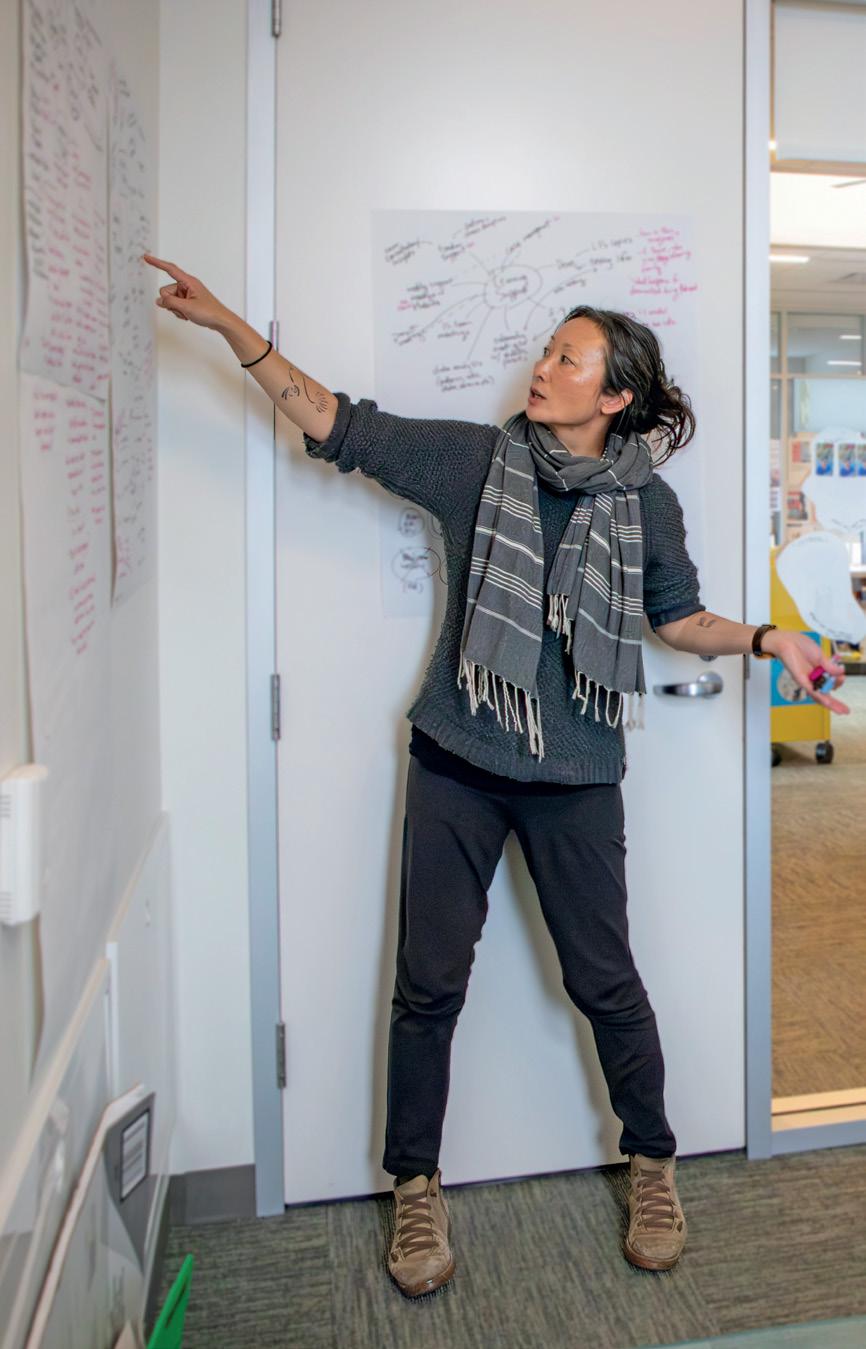
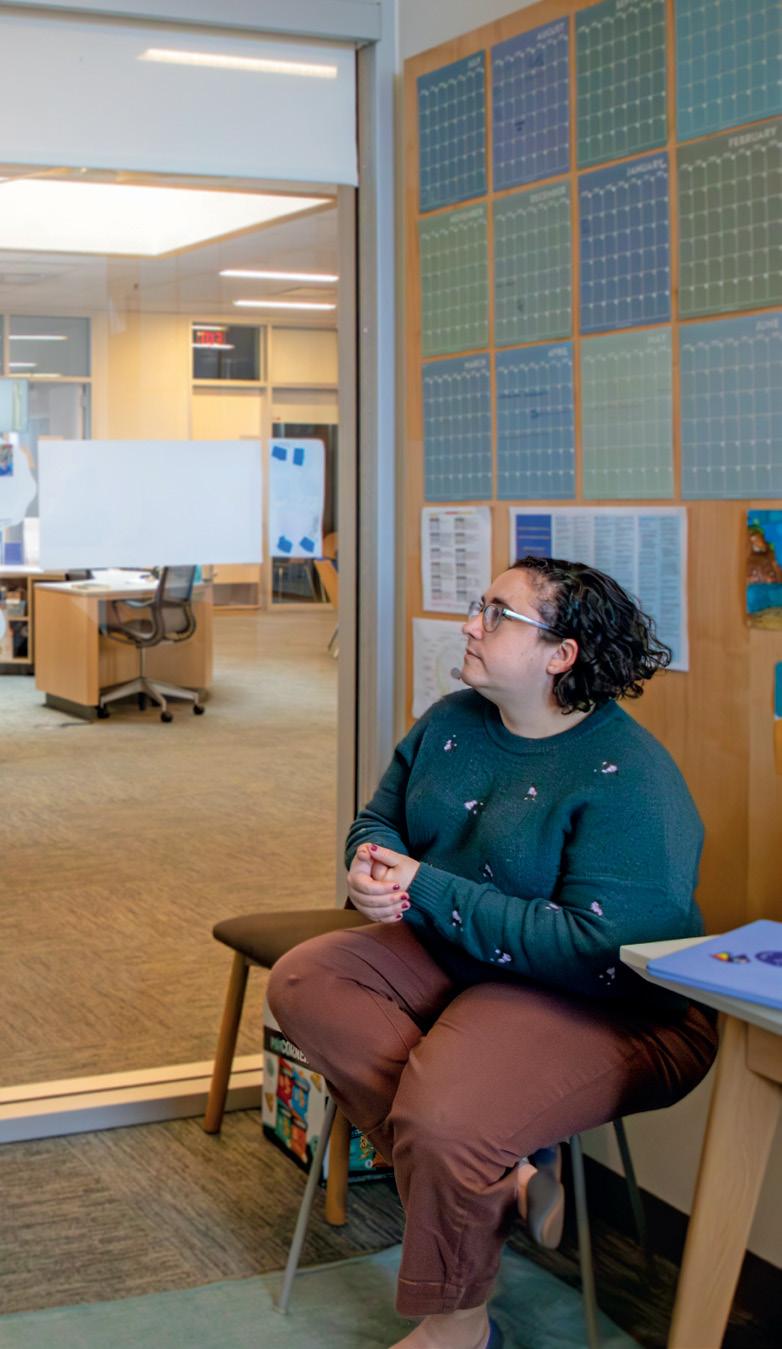
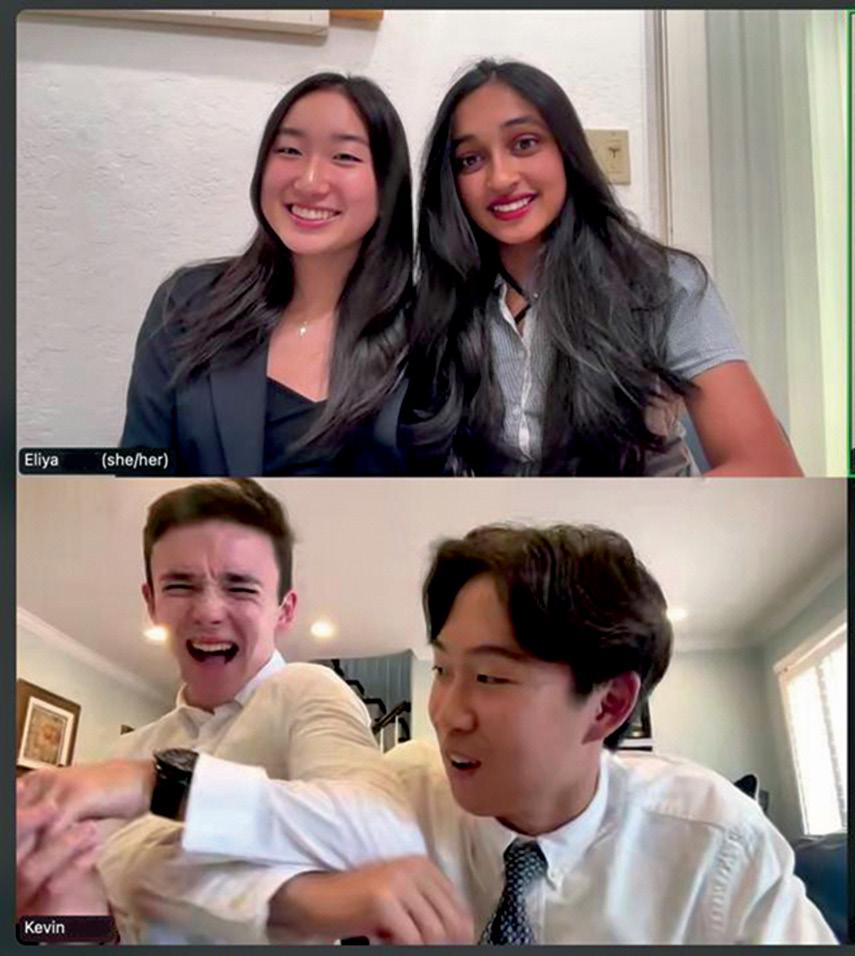
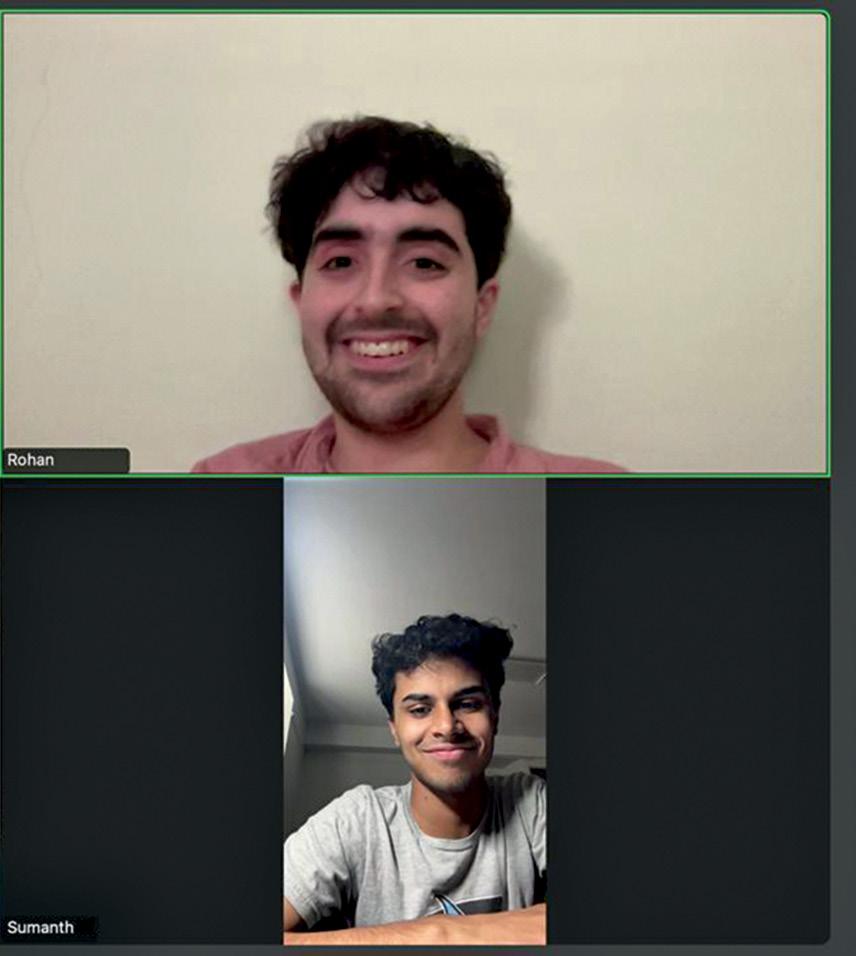
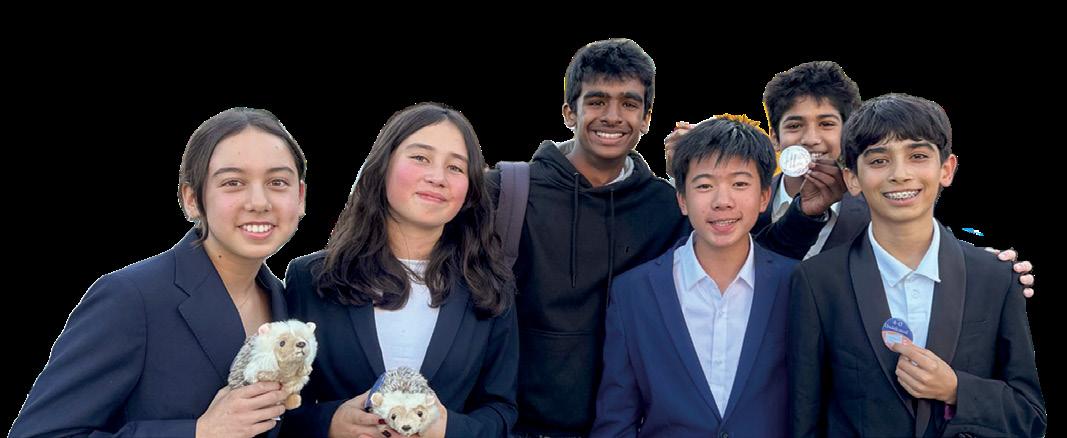
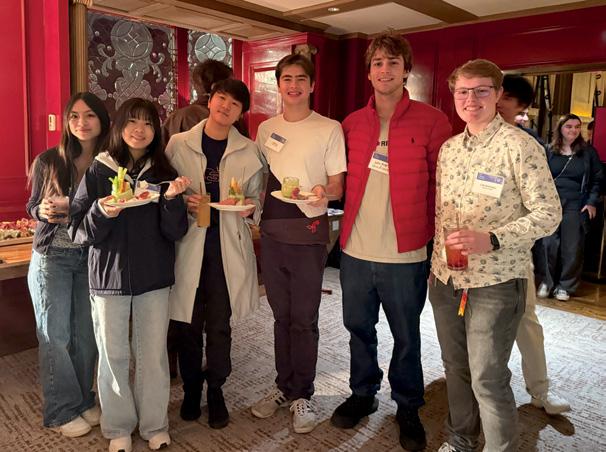
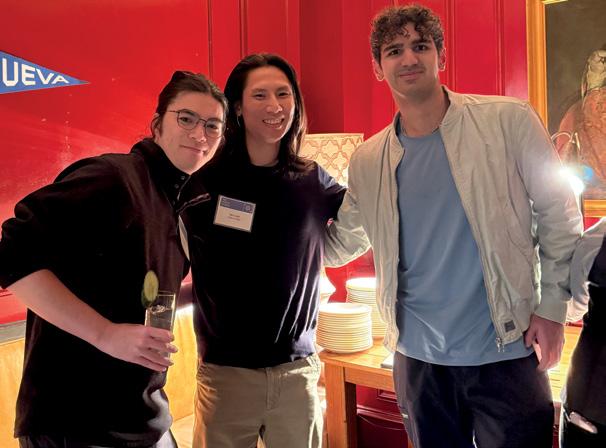
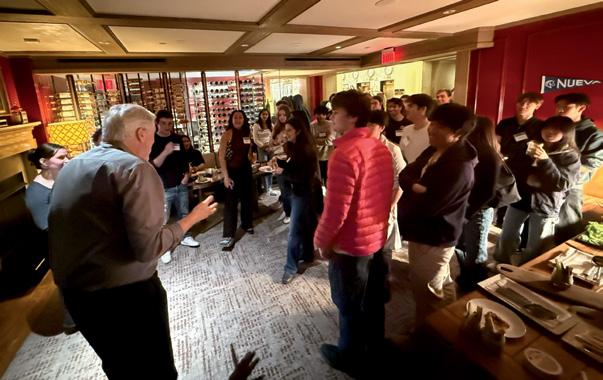
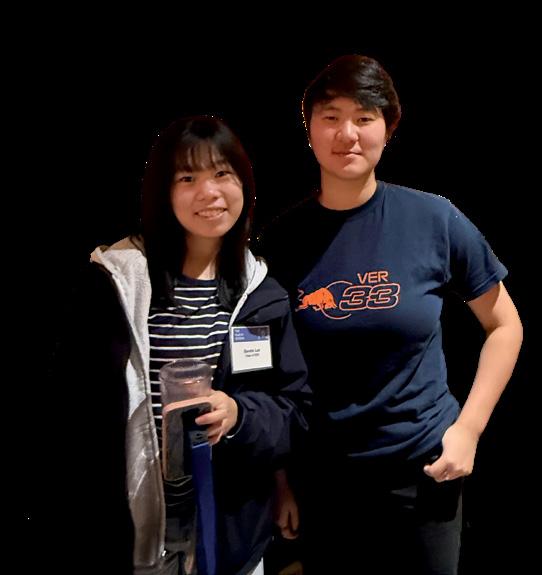
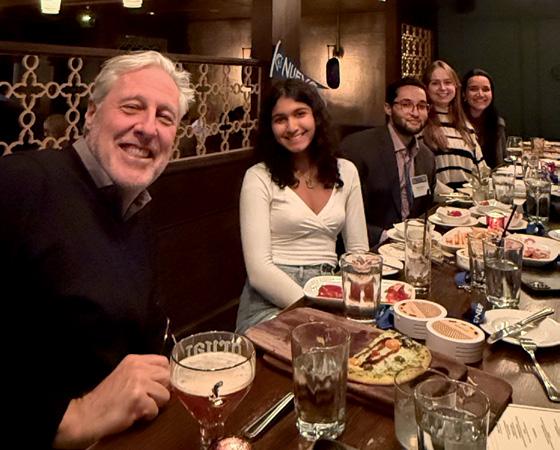
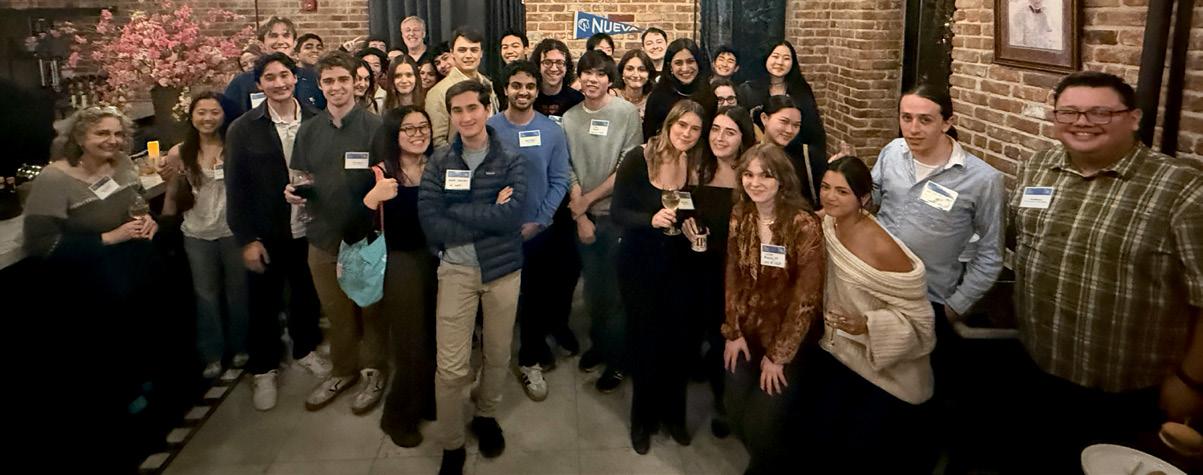
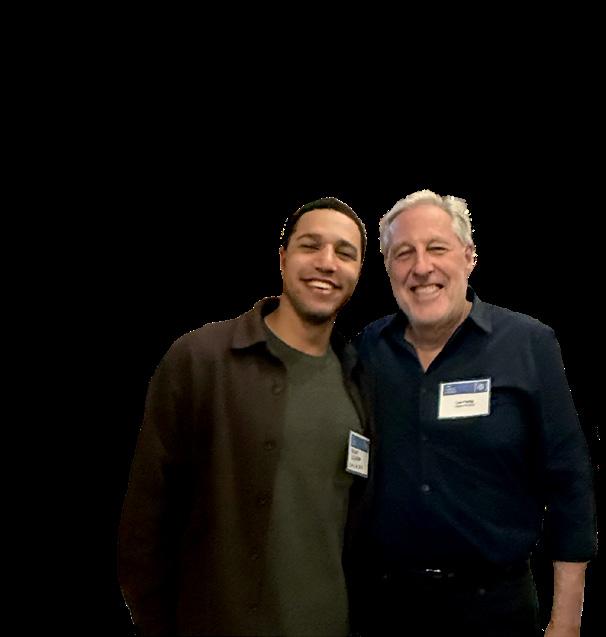
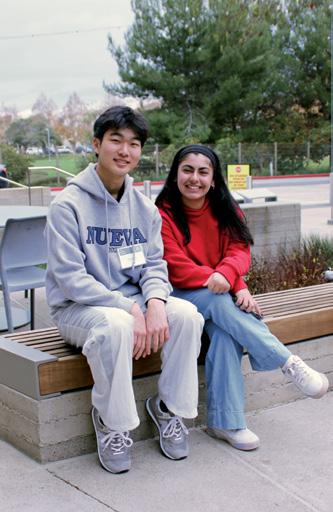
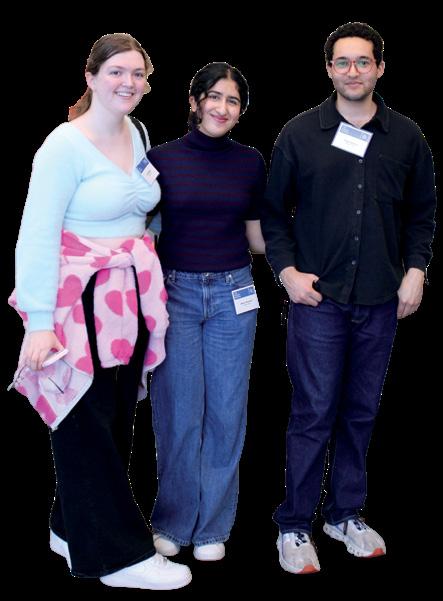
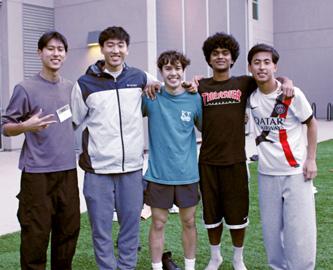
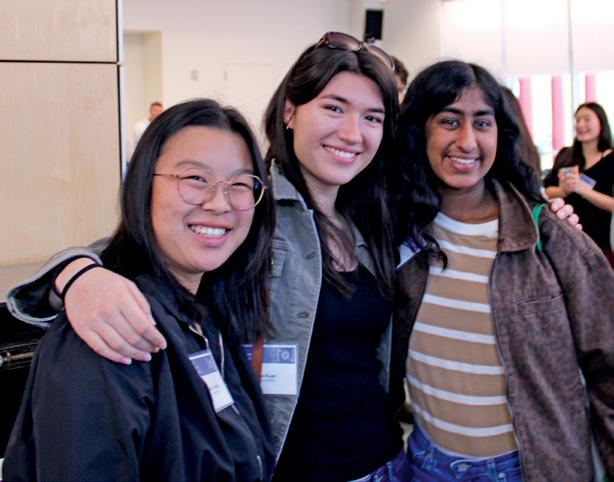
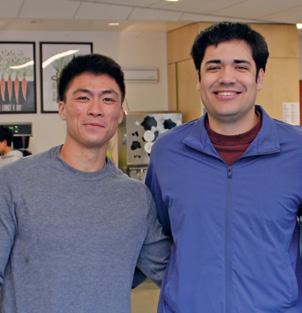
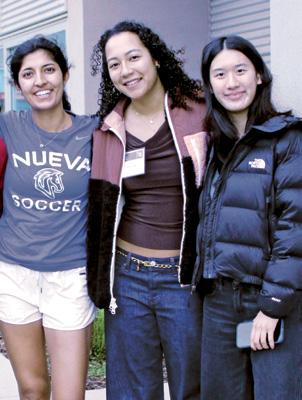
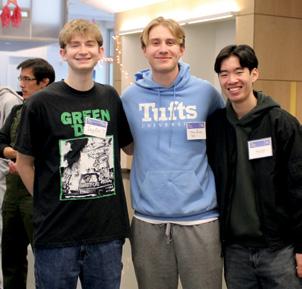
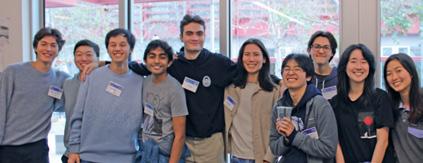
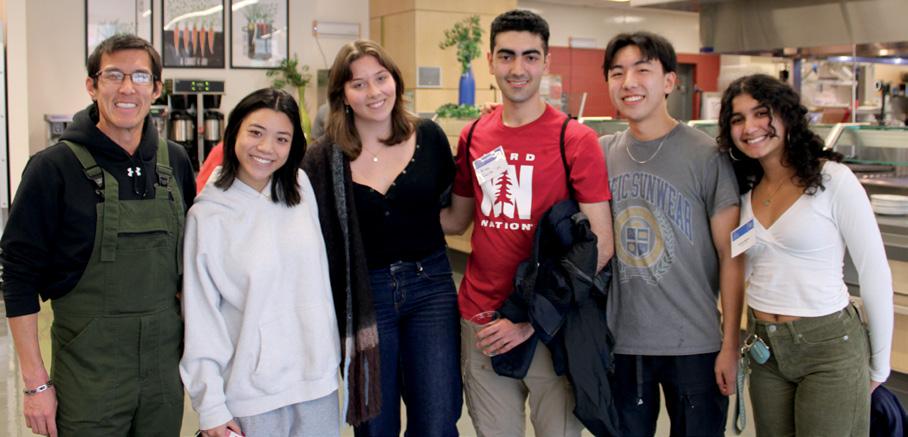
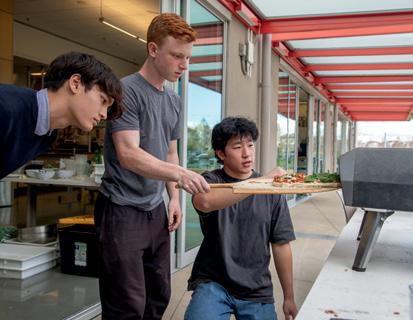
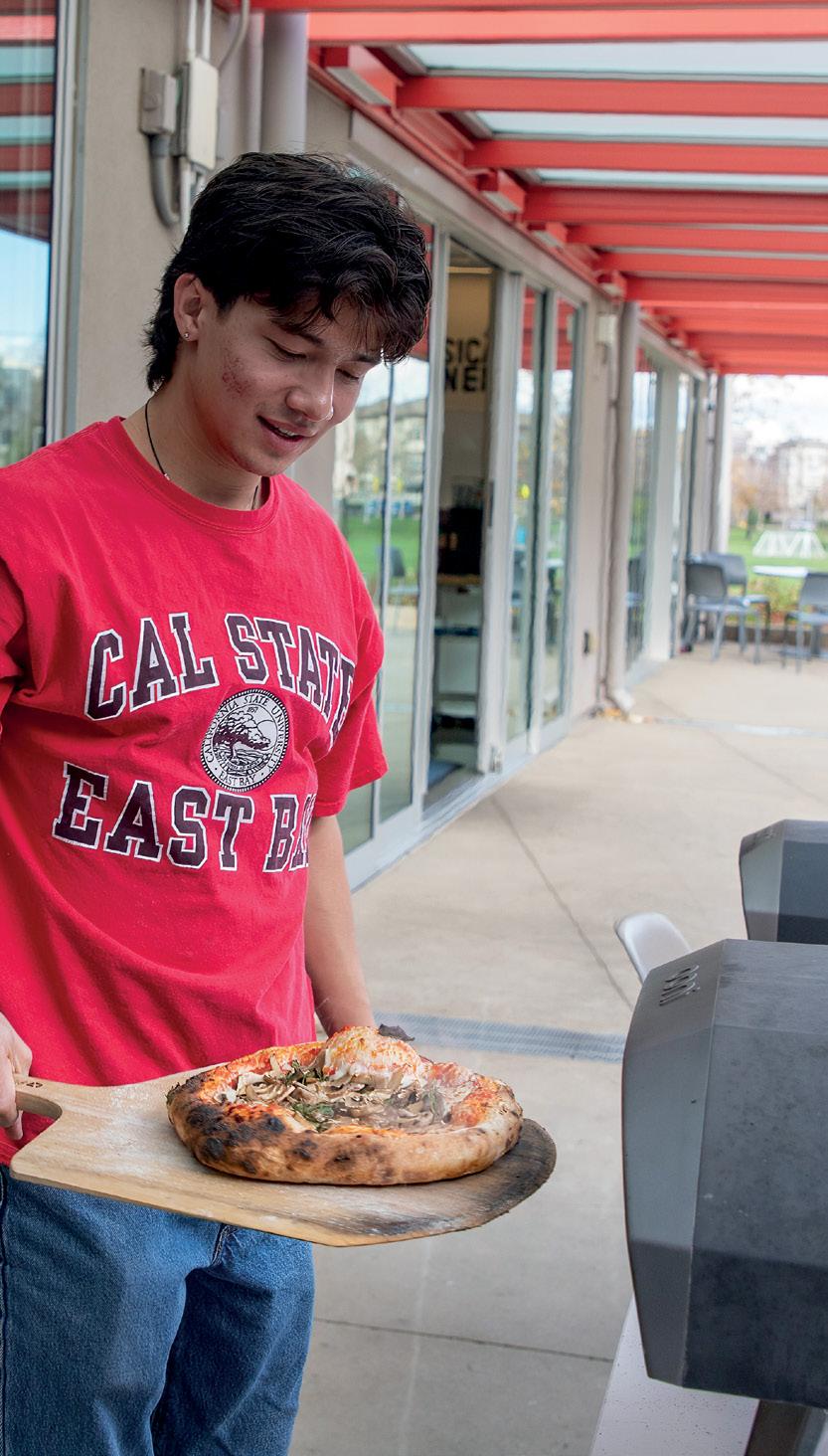
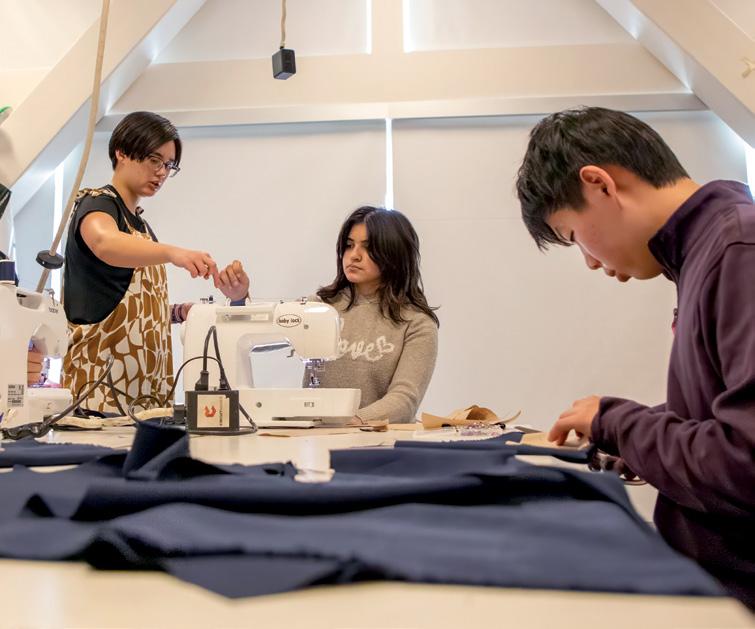
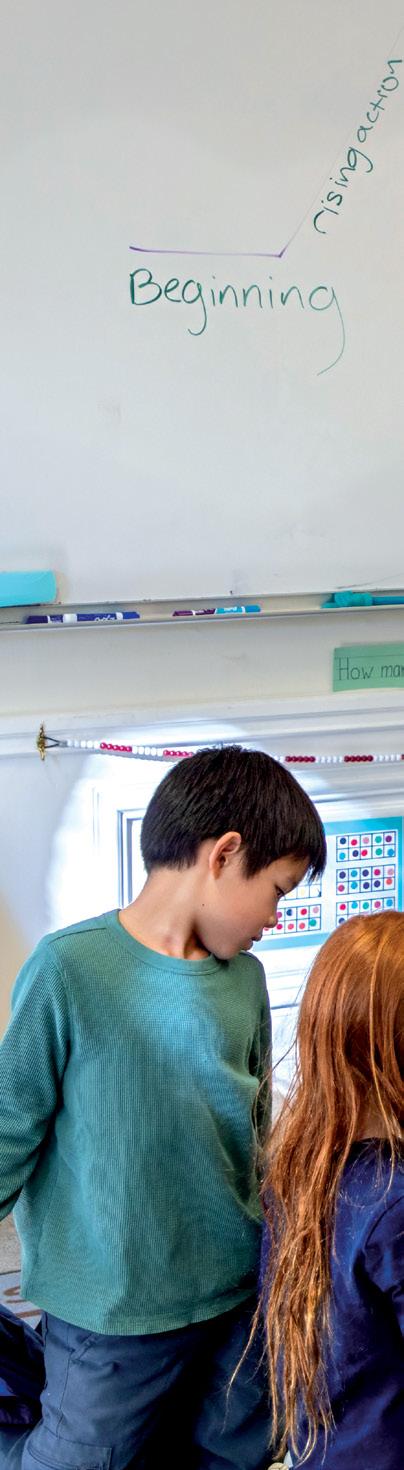
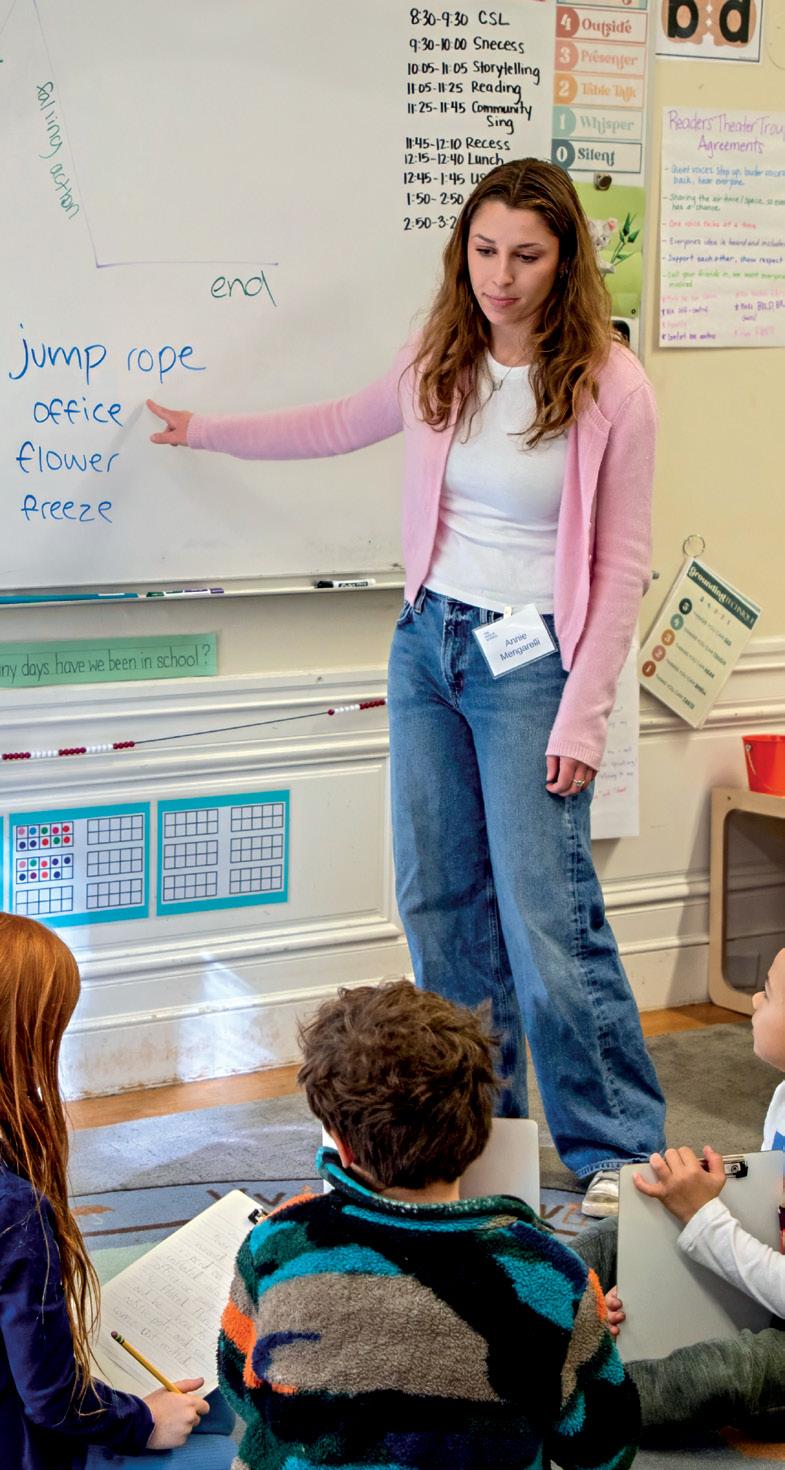
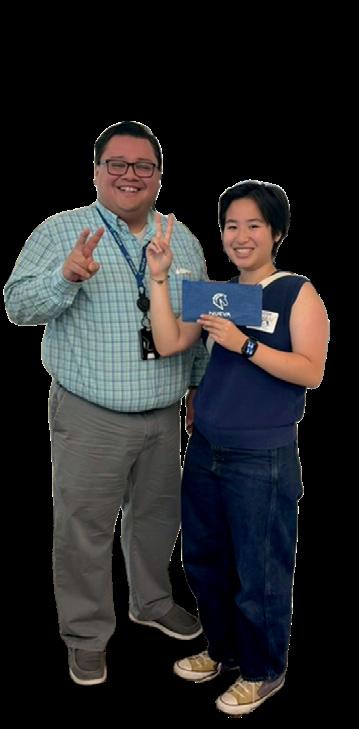
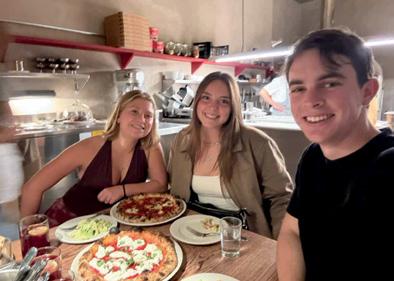
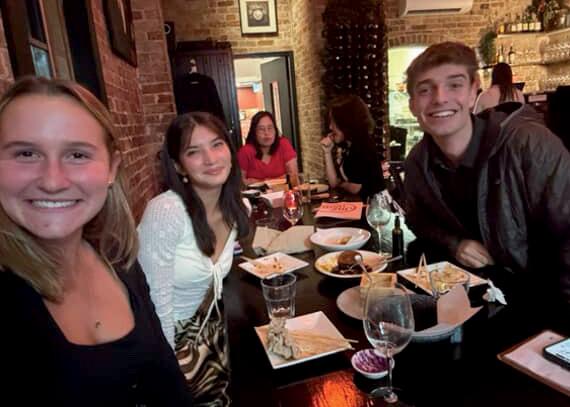
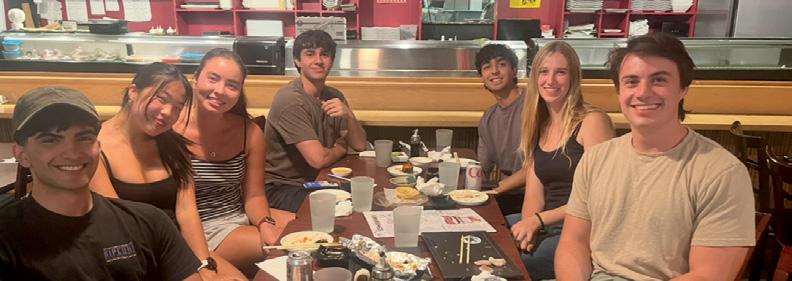
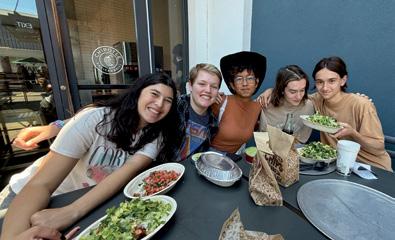
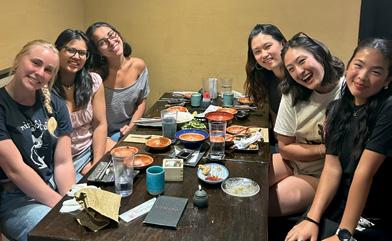
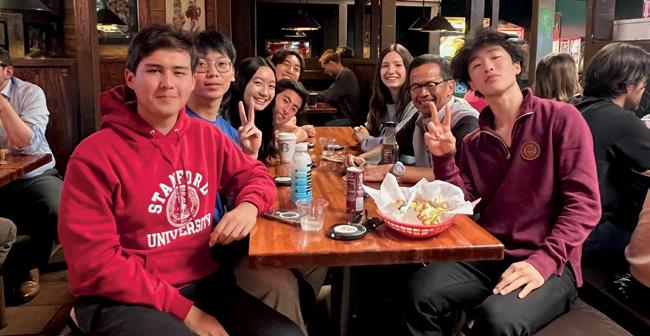
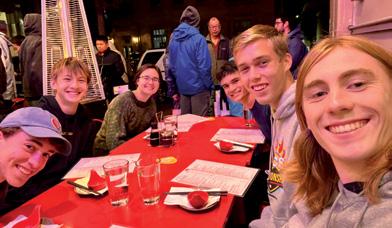
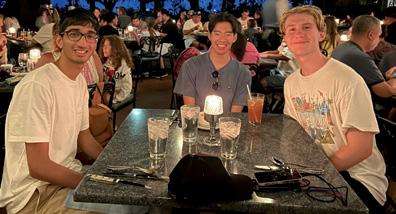
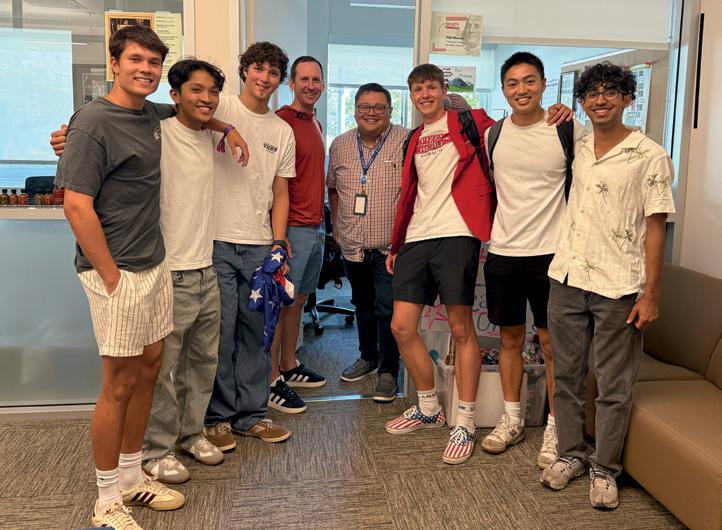
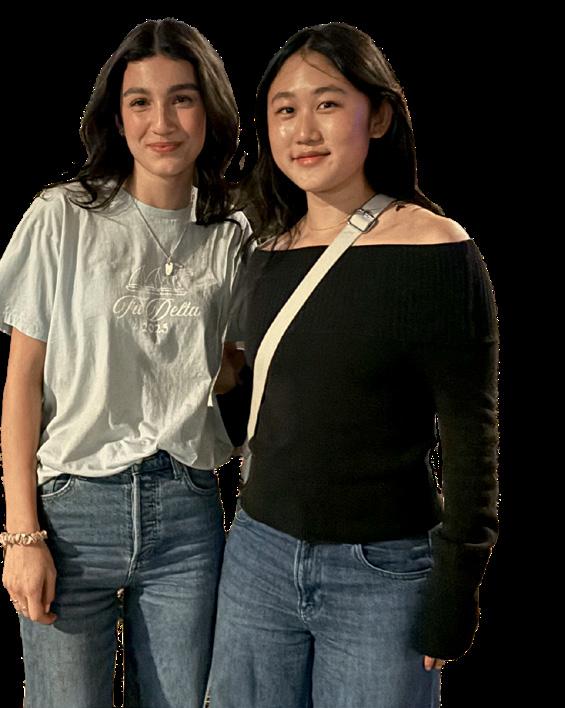
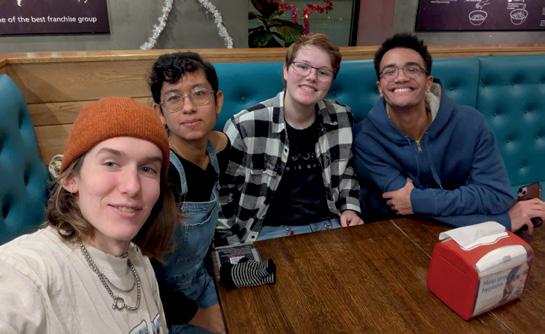
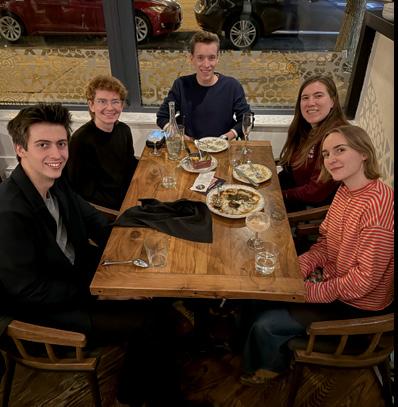
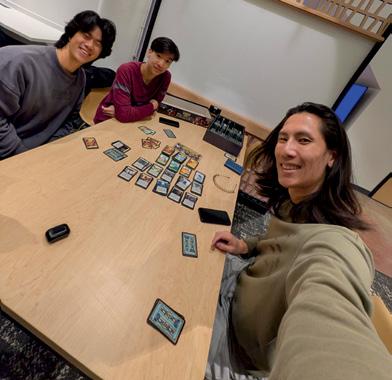
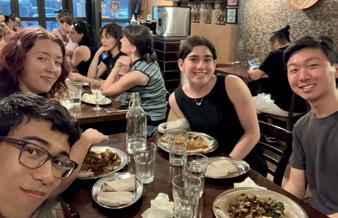
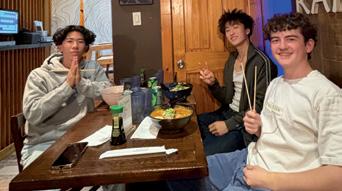
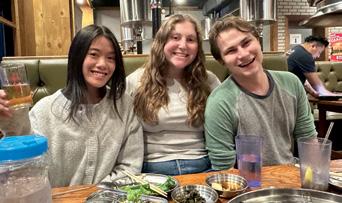
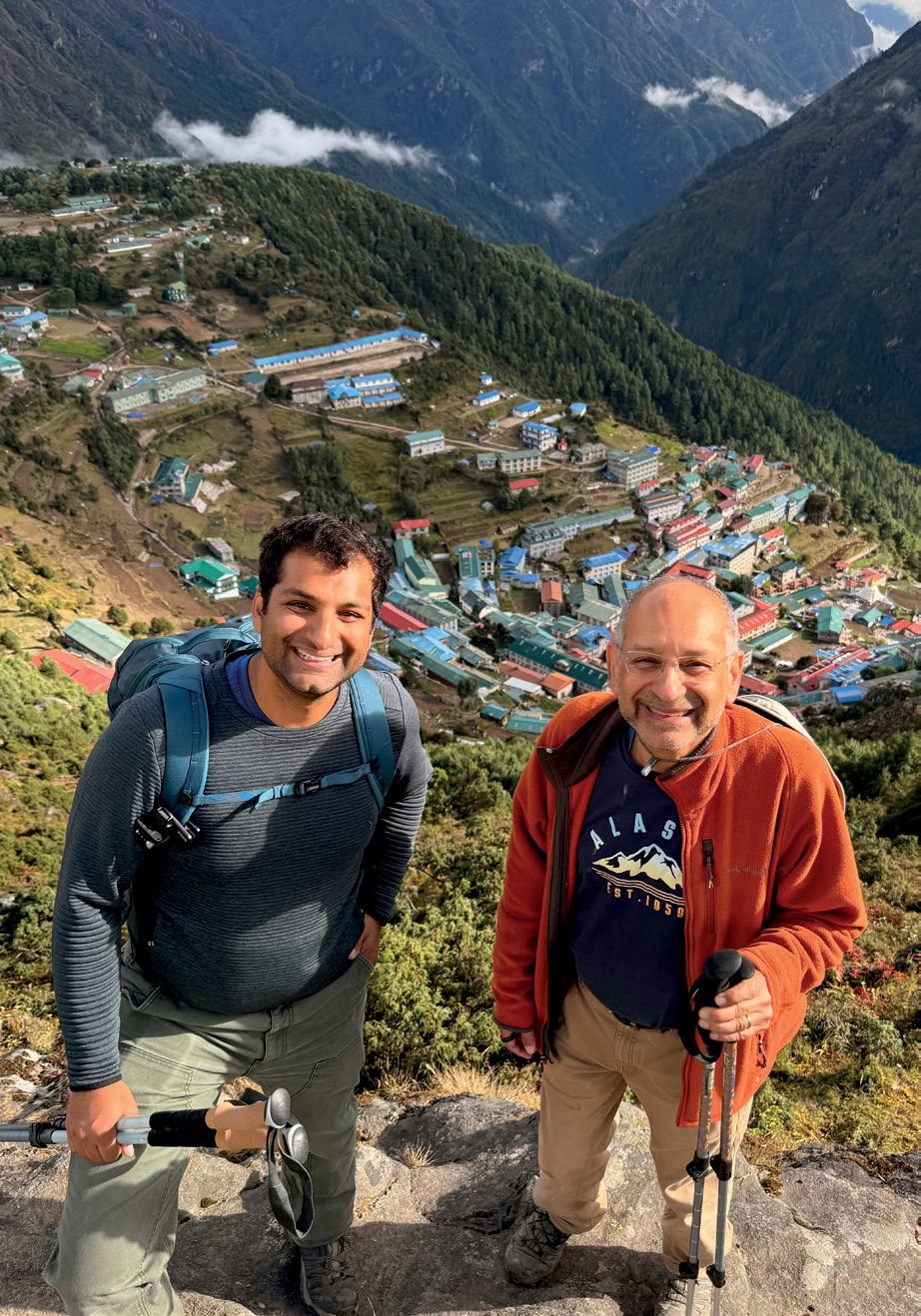
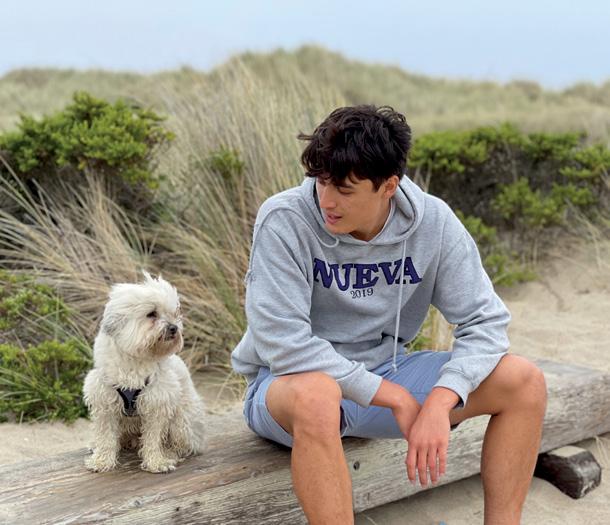
Nueva’s annual student bands showcase returned to the Guild Theatre in Menlo Park this past December, and featured impressive performances from the rock, jazz, and Groove Workshop bands from the Middle and Upper School. Across two shows, 120 students performed in 25 acts, the culmination of a semester of rehearsals focused not only on musical preparation, but also stage presence and performing in a professional concert venue.
PHOTO BY ROBERT EVANS
“Our Nueva musicians performed like true rock stars and conducted themselves with professionalism both on and off the stage. They should be incredibly proud of their work—they made Nueva proud.”
JASON MUSCAT music teacher
FROM THE EDITORIAL TEAM
Design Thinking
There is a peculiar kind of education that announces itself not with a syllabus but with a question: What if ? That question threads through this issue, and in many ways, through the life of our school itself. It is the quiet engine behind a foil picked up by a 9-year-old, behind a fourth-grade ritual that begins with a hurtful joke and ends in a small box of handwritten notes, behind a 6 a.m. flight to a debate tournament and a Saturday night at the Guild Theatre.
Joanne Luong’s story begins with an afternoon and a child curious to try something new at Nueva Summer camp. What followed was anything but ordinary: a long apprenticeship in a sport that rewards patience as much as speed, international competitions, NCAA Division I fencing, and finally a return to camp and Nueva as a teacher. The arc is instructive because it reframes success not as a peak to be reached but as a sequence of returns, small homecomings that reconfigure who we are and what a place can be for us over time.
DEPARTMENTS 04 REFLECTION
Letter from the Head of School
NOTED
News from Nueva
ALUMNI
News from alumni
That spirit of return and ongoing practice is what we see when a classroom library stops being a useful place to read and becomes, instead, an invitation to redesign. The first graders who reimagined their shelves did not treat design thinking as a checklist; they treated it as a posture: to notice, to listen, to prototype, to fail and try again. Paired with social-emotional learning that posture cultivates something rarer than cleverness… it cultivates responsibility: the capacity to see a problem as part of a human story and to act within it.
The same posture appears in other, noiserier corners of campus. Debate at Nueva is at once a craft and a culture—Middle and Upper students measuring evidence with the same exacting care they bring to rhetoric. And then there are the small, improvised ecosystems, like third graders sketching tiles for their own board game on a rug. These are things no transcript could capture, but which tell you everything about how ownership and curiosity conspire to make learning sustainable.
Sometimes the lessons are personal. The Beloved Box began as a response to harm, a class learning to name the hurt and to repair. Guided by teachers, their response evolved into a ritual of appreciation. The box is the size of a tissue box, but contains notes that, in their accumulation, become a ledger of attention: small, community-building acts that say quietly, we see you.
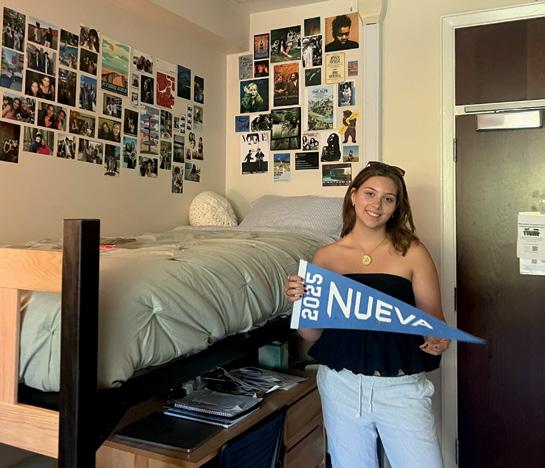
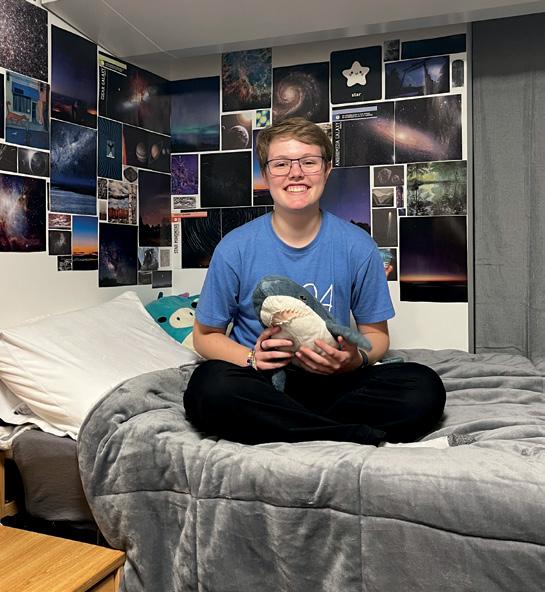
And then there are the ways the larger community folds back into school life: alumni dorm tours, graduates returning to present at Intersession, 120 students filling the Guild with twenty-five acts of rock, jazz, and a Groove Workshop energy—performances that are at once a culmination of practice. These moments are not epilogues; they are evidence of a continuing conversation between past and present.
Editing this issue has felt, in its way, like joining that conversation, arriving at a familiar table and listening until the contours of the place reveal themselves. What binds these stories is less a program than a temperament: it is a willingness to treat curiosity as serious work, to build skills as habits of attention, and to expect the classroom to be a laboratory for life. The Nueva Communications team is honored to be a part of that experiment, and we hope these pages convey, with clarity and affection, why this school can still astonish us.
68 RECESS
Plants of Nueva
FEATURES
14
Design Thinking
Students learn design thinking as an empathetic mindset, building agency, creativity, and confidence by tackling real problems.
26 Rounds, Research, and Resilience
A look inside Nueva debate— where argument, mentorship, and intellectual joy meet.
32
Nueva Niches
When Nueva students are really into something, they make space for it. A look at 17 niche clubs, groups, and communities!
38 Teaching Courage, Noticing Kindness
A small box is making a big difference in the Lower School.
nuevaschool.org
Nueva Magazine is published by the Communications Office for alumni, students, parents, grandparents, and friends of The Nueva School.
EDITORIAL TEAM
Rachael Uriarte Director of Communications
Rachel Freeman
Assistant Director of Communications
LiAnn Yim
Assistant Director of Communications
Holly Nall
Communications Associate
ALUMNI NEWS
Diana A. Chamorro
Associate Director of Development for Alumni & Community Engagement
Elizabeth Gomez
Alumni Relations Manager
DESIGN
Aldeia / aldeia.design
PRINTER
Lahlouh
“My
friends and I sketched ideas, destroyed prototypes, iterated relentlessly, and eventually created a fully functional vehicle we drove around campus. That experience fundamentally rewired how I approach impossible-seeming challenges.”
GABE ADZICH
Designing for Connectivity
Interdisciplinary, Interpersonal, and Intercultural
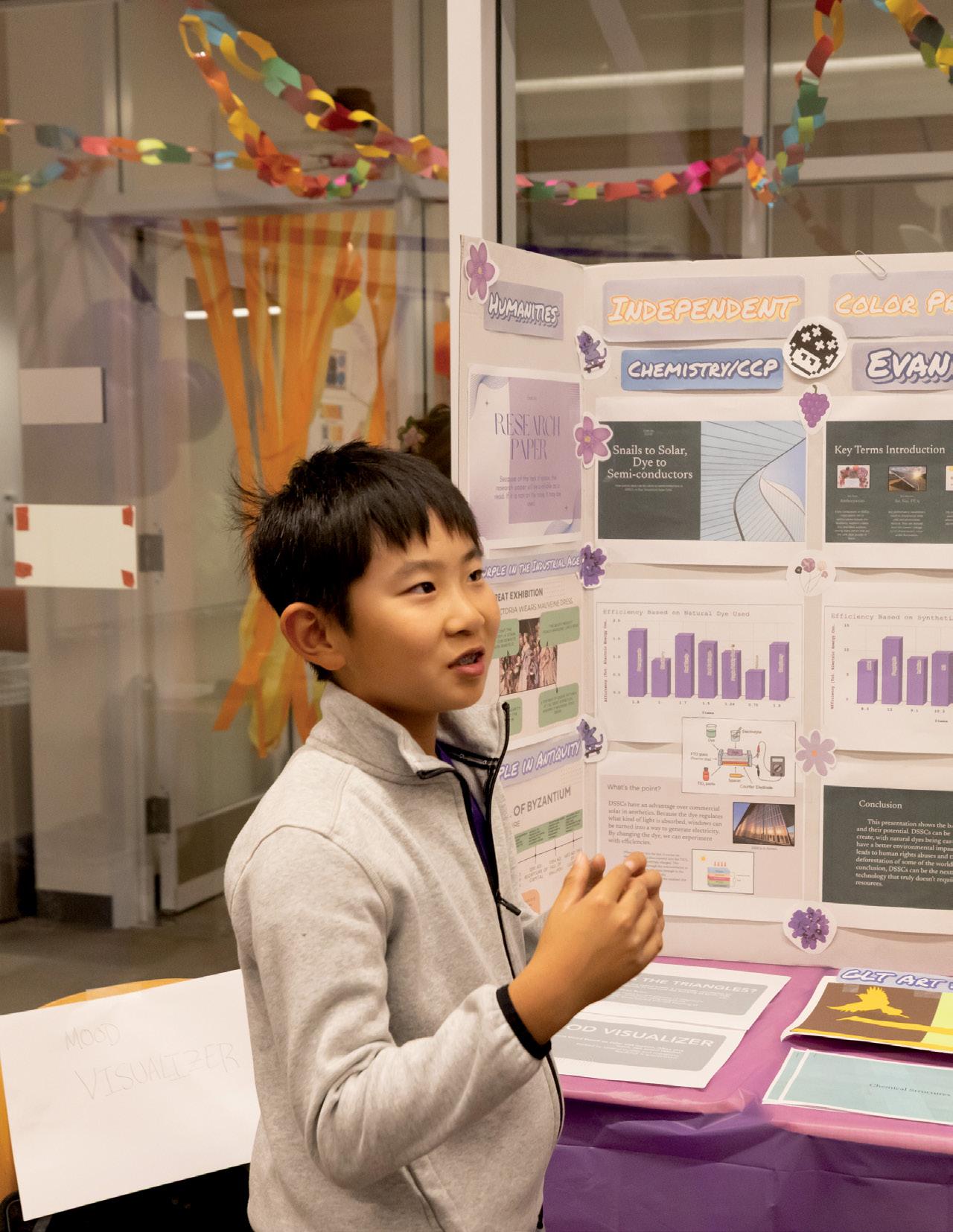
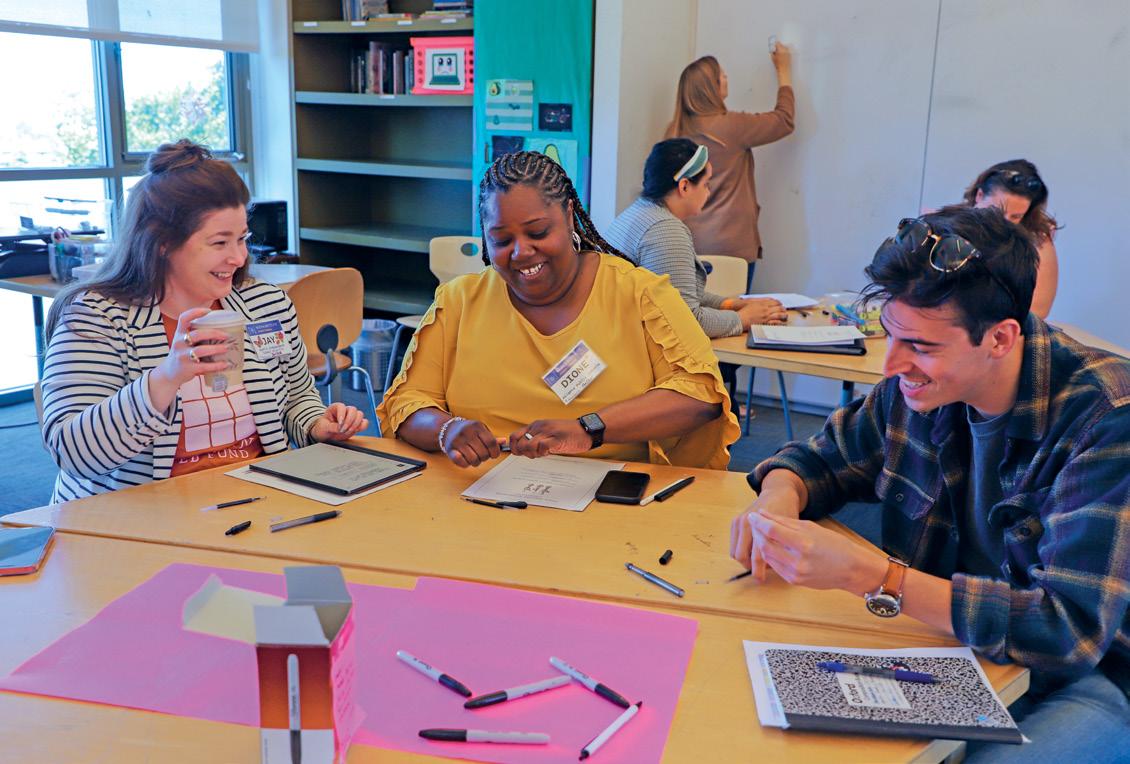
It is no secret that a core pillar at Nueva is design thinking, a problem-solving approach that focuses on ideation and iteration to create innovative solutions. At the beginning of this school year, faculty and staff engaged in purposeful professional development on how to design for belonging. Using a framework developed by author Susie Wise, Nueva employees learned how to leverage space, roles, events, rituals, grouping, communications, and more to foster inclusion and collaboration in our community. Since then, I have been thinking a lot about how we connect with each other across perspectives and how we engage with different domains of knowledge, all of which foster a heightened sense of belonging. I now realize that the way we purposefully design for connectivity in our community is at the core of the Nueva experience. This can be seen within several key dimensions at the school, many of which are evident throughout this issue of the Nueva Magazine. This design for connectivity may be interdisciplinary as we see in many Lower School field trips, Middle School learning activities like the Museum of Color exhibited at one of our winter culmination nights, and Upper School coursework that integrates multiple academic disciplines. The design for connectivity may be interpersonal, as highlighted in the first grade community partners
project, our peer coaching program, and in numerous units throughout the school’s SEL curriculum. And designing for connectivity is intercultural, as evidenced by the choice of texts selected in humanities classes, fine arts performances and exhibits that showcase other cultures, and service-learning initiatives that expose our students to different sets of lived experiences in the larger community. Whether these connections are interdisciplinary, interpersonal, or intercultural, they are all designed with purpose and impact in mind. We design for connectivity to ensure our students are intentionally exposed to difference and diversity in the community members they collaborate with and in the academic knowledge they process. This design process, seamlessly implemented every day, is exactly what contributes to a sense of belonging which, in turn, helps enable our gifted students to make choices that benefit the world.
I encourage you to read through this magazine to learn more about different aspects of the Nueva experience and to think about how designing for connectivity is central to everything we do in our community.
LEE FERTIG Head of School
NOTED
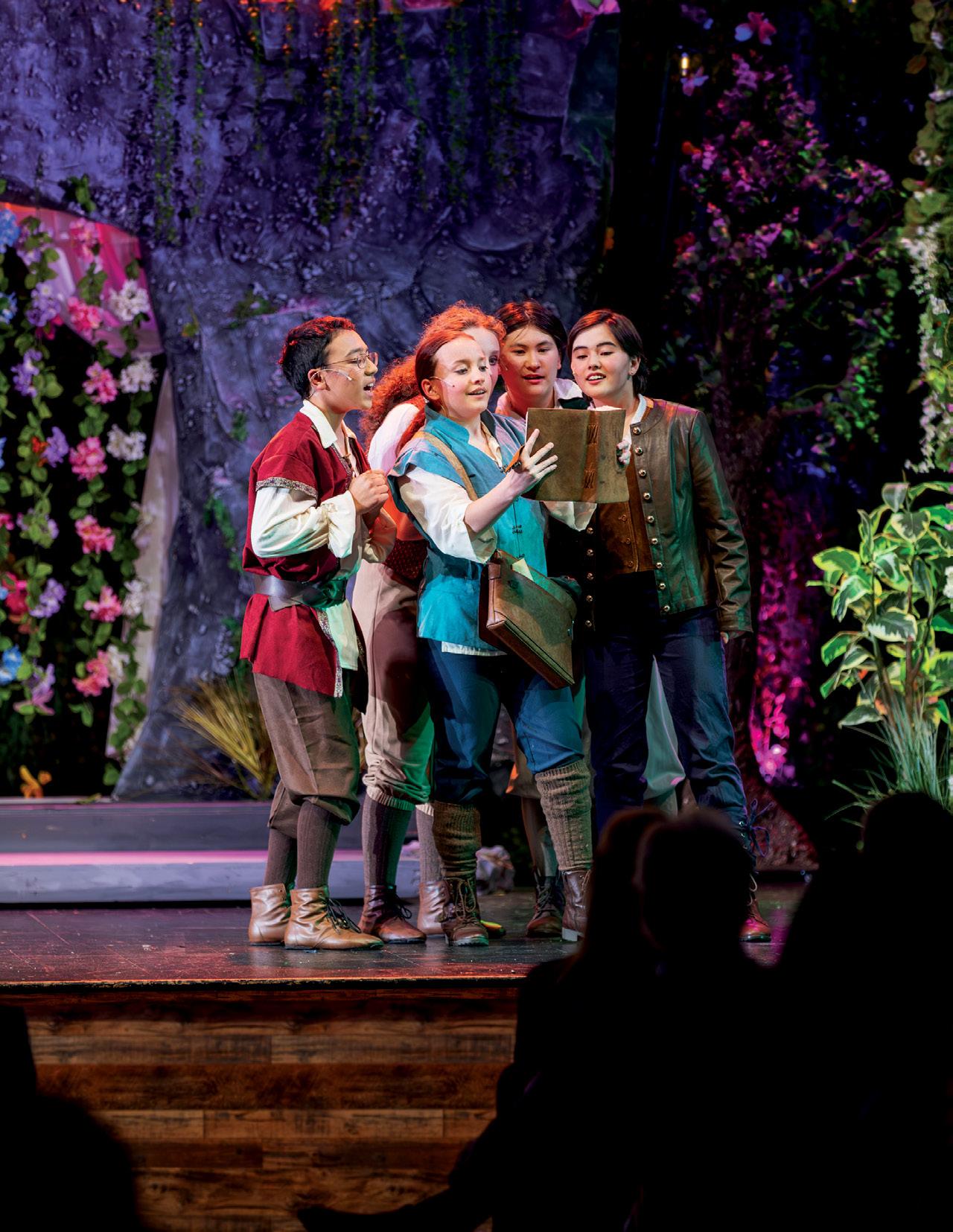
In December, Nueva Upper School students staged a whimsical production of A Midsummer Night’s Dream, performing four shows on the Hillsborough Campus. Shakespeare’s classic comedy, set in an enchanted forest outside Athens, intertwined young lovers, mischievous fairies, and amateur actors as spells and mistaken identities sent the story spiraling under a midsummer moon. PHOTO
En Garde!
Joanne Luong Returns to Where It All Began
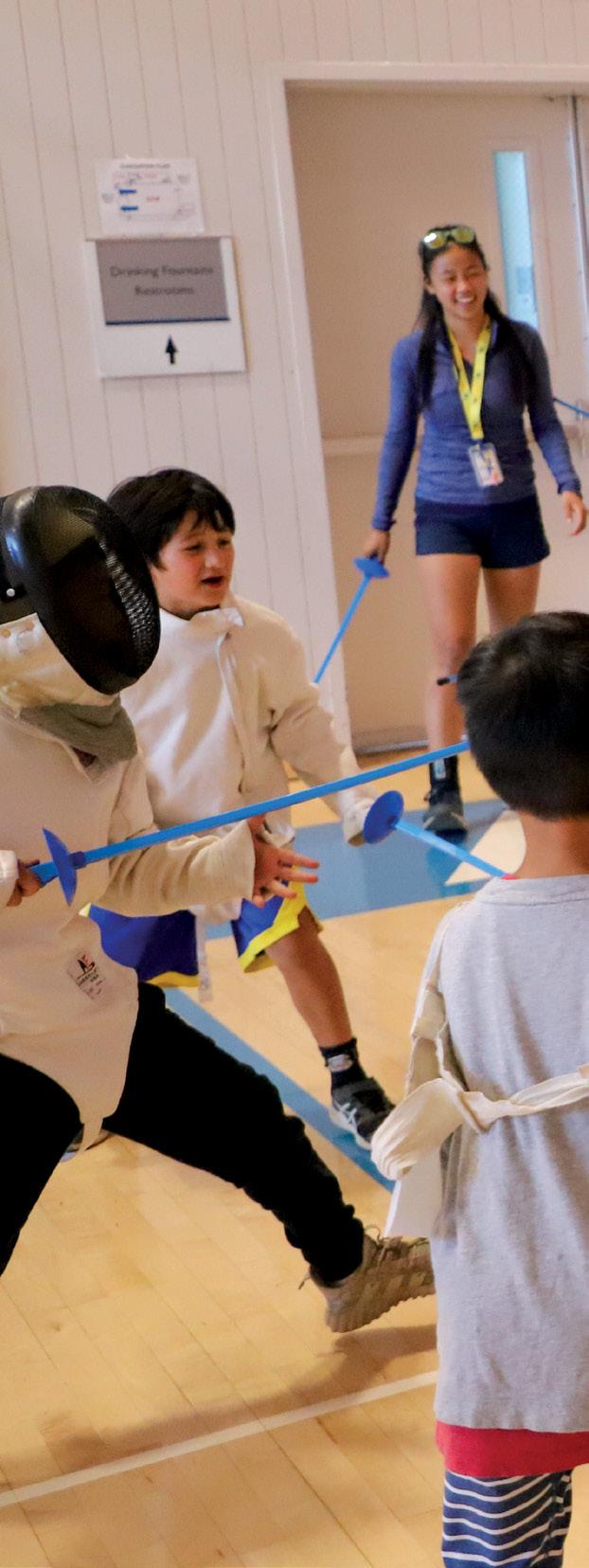
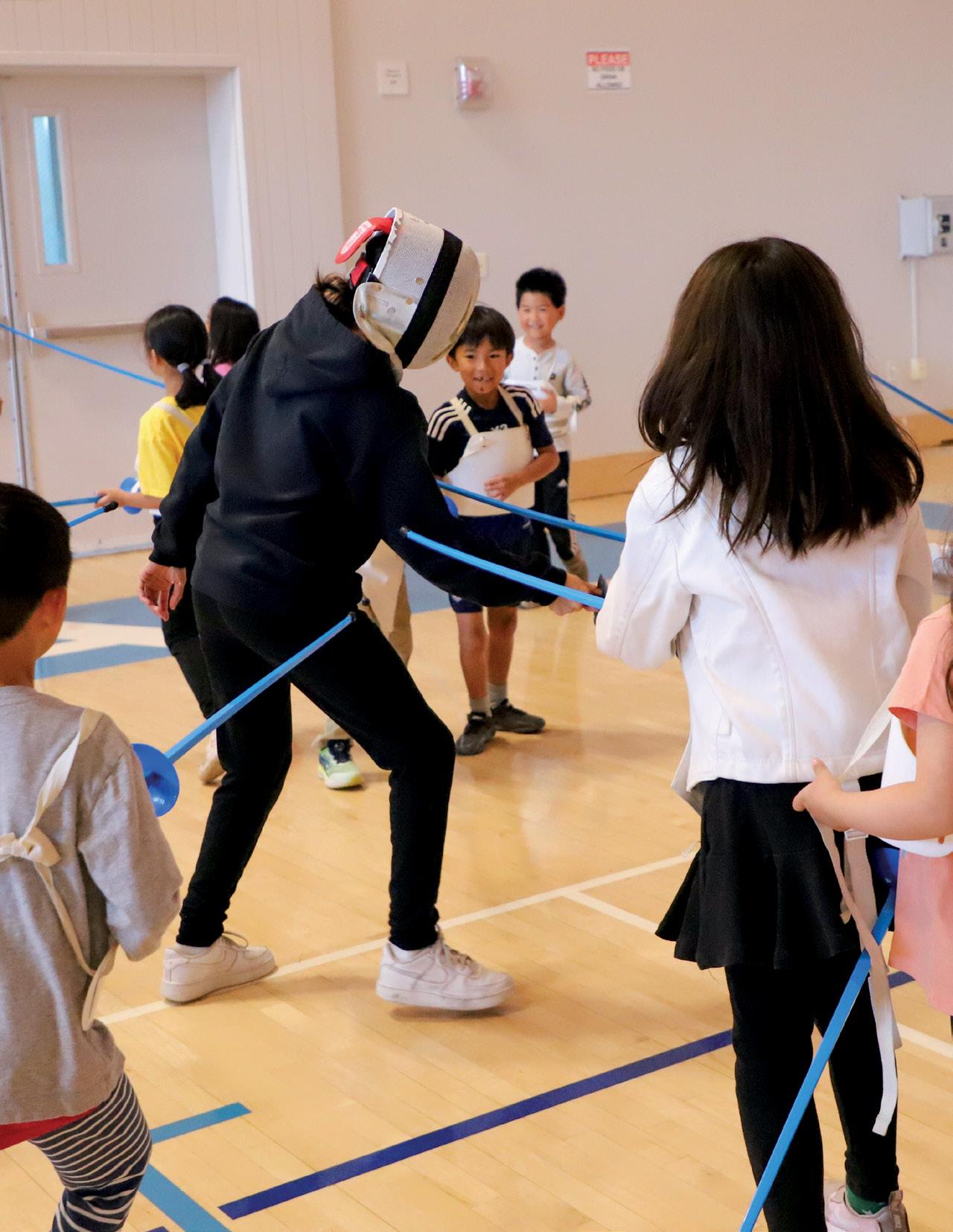
Lower School associate teacher Joanne Luong first encountered fencing under the sun of a Nueva Summer camp. What began as a brief summer class quickly became a defining passion, one that guided her through decades of rigorous training, international competitions, and NCAA Division I fencing at UC San Diego.
This past summer, Joanne returned to where it all began, attending not as a camper but as an instructor—teaching fencing to a new generation of Nueva Summer campers. From the moment she first held a foil at age 9 to guiding young fencers decades later, Joanne’s journey embodies dedication, growth, and the joy of coming home.
Tell us about your introduction to fencing. My mom signed up my twin sister and me for Nueva’s summer camp, and one of the choices we had was fencing. I remember learning about the sword, the gloves, and the movements on the first day. I immediately thought, “I love swords. I’m going to jump right in!”
After the week of camp ended, I begged my mom to let me join an actual fencing club. She signed me up for the San Francisco Fencers Club, where I trained for almost 10 years. Beginning at age 12, we trained at different camps throughout Europe and competed internationally in France and Germany. I was fortunate to fence throughout high school and then in college, too.
Being a Division I athlete takes a lot of talent, hard work, and commitment. What was that experience like? Scary! Fencing is very complicated, especially
collegiate fencing, where you have to work as a team to win. Until college, fencing had been an individual endeavor—you get your own results and are the only one responsible for your successes and failures. I had to learn to work with all different kinds of people; it was no longer just about me. I had to commit fully to my academics as well. While it was hard at times, I am so grateful I had the chance to compete at the collegiate level.
What brought you back to Nueva, and how did you get involved in Nueva Summer?
I studied human developmental sciences in college, intending to do nursing after. But as I was going through the application process, I realized I didn’t want to do this—for me, it was a safety-net career. So, I decided to change my field of study. Because I had experience working with kids, I first worked at a daycare. Then my aunt told me Nueva
had openings in the Lower School, and I knew I wanted to work here. It was such a full-circle moment, after my first year as a Lower School aide, to teach fencing at Nueva Summer since that’s where I first learned how to play this sport I love. I taught two weeks of fencing, and it was so great. The kids loved it and they had an awesome time playing games and—like I did when I was their age— playing with plastic swords.
What do you love about fencing? I love the mind games and strategies you have to come up with on the
spot to beat your opponent. It’s a sport not just of physical energy, but of brain energy, too. Don’t get me wrong, I also love the adrenaline rush of poking somebody.
What advice do you have for parents whose children may want to give up on a hobby or activity? Fencing shaped me in so many ways—discipline, mental focus, patience. To parents, I’d say: Even if your child doesn’t immediately love something, give them time and space to grow into it. Sometimes the things
we’re hesitant to try end up becoming the things that define us.
When I was 14 or 15, I wasn’t seeing the results I wanted. I was ready to give up. But it was my parents who helped me persevere. They said, “Push yourself for another month. If you still don’t like it, then we’ll try something else.” I’m so glad my parents did that for me because when the time was up, I didn’t want to stop. By doing this, my parents also showed me how important it is to develop a sense of commitment and learn how to overcome challenges, both
Nueva Summer is back for 2026 and it’s time to sign up! Visit nuevaschool.org/ summer to see all of the exciting opportunities for students in grades 1 to 12.
physically and mentally. It helped me grow into an adult with discipline and resilience. The biggest thing that I still draw on from my fencing career is how much it has solidified my commitment to working hard, to knowing that when something is hard I can get through it. It’s helped me go from, “This is so hard, I don’t want to do this anymore,” to “But what if I continue pushing myself a little bit more?”
Do you have advice for a kid who may be hesitant to try a new activity? You never know what you’re
going to discover about yourself if you don’t try the things that sometimes you’re put into. There are so many joyous moments that come from committing yourself fully to something. Push past the “I don’t like it, I’m not comfortable” phase. Try it for a little longer. If you know for sure you don’t enjoy it, then it’s definitely a sign to try something else. But if you push past the scared and nervous part, then you may actually discover something great, meet new people, and find a whole community and lifestyle that you didn’t know before.
What do you wish people knew or appreciated about fencing? Fencing is a lot more than slashing and poking swords. It’s complex, and there are a number of strategies involved. The mask adds another difficult element to navigate. You’re hot and sweaty and tired, but at the same time you’re playing this mental game with your opponent: “I know they’re going to do this. Now what should I do? How should I react?” Some of it is intuitive; some of it is planned. It’s also a lot of hard work on your quads and your legs.
NUEVA PACKS THE HOUSE
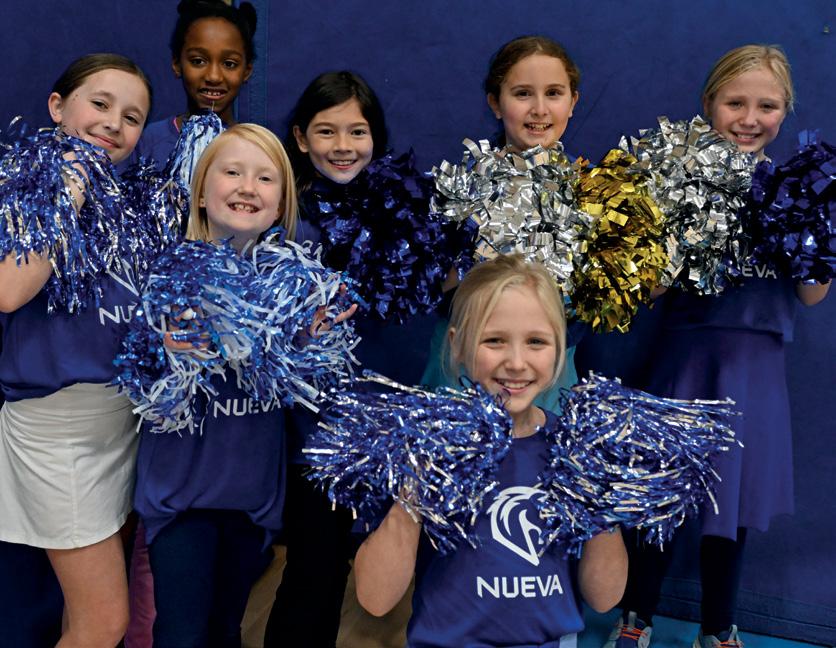
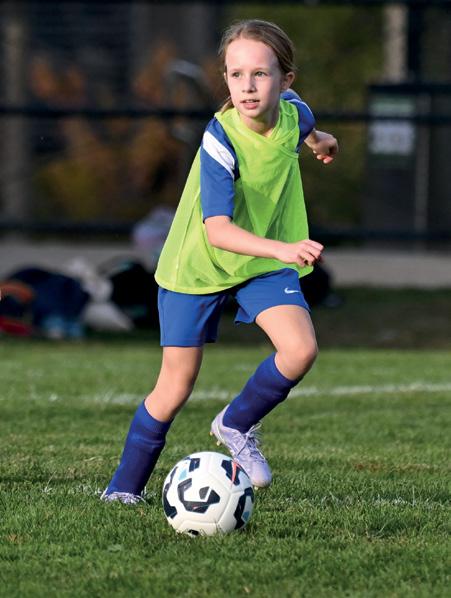
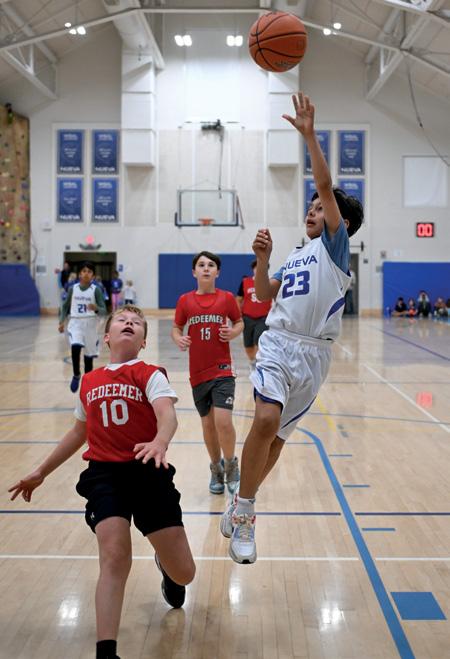
“Our November ‘Pack the House’ night at Hillsborough was an unbelievable success! The preK–8 community packed the gym to standing-room only. Middle Schoolers painted their faces and students waved a homemade ‘Go Mavs’ flag to fire everyone up. A group of Lower School girls formed an impromptu cheer squad that performed at halftime of each game. It was one of the best displays of school spirit I have seen at Nueva. ¶ The best part of the whole night was that the outcomes of the games didn’t matter. It’s amazing what can happen when kids are excited, motivated, and supported in such an electric atmosphere Our athletes fed off the energy, winning two of the three games, with the lone loss by just four points despite missing three starters. ¶ This is the kind of environment we hope to continue seeing at our athletic events—one that brings the community together, supports our student-athletes, and elevates play across our program. A true win-win for Nueva.”
— BRETT MCCABE, Athletics Director
William A. ’31 A Dictionary of the Amuët Language Handmade hardcasebound book, decorative paper and book cloth, marbled paper
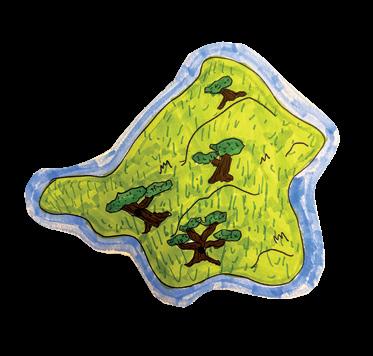
2. Royce Z. ’35 Topo Map (science/ art collaboration) Paper and prismacolor marker
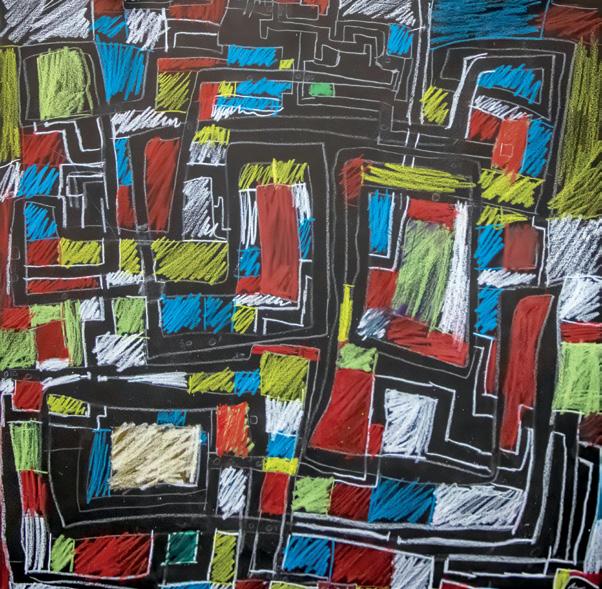
6. Aarav K. ’35 The Maze Colored pencil on black paper
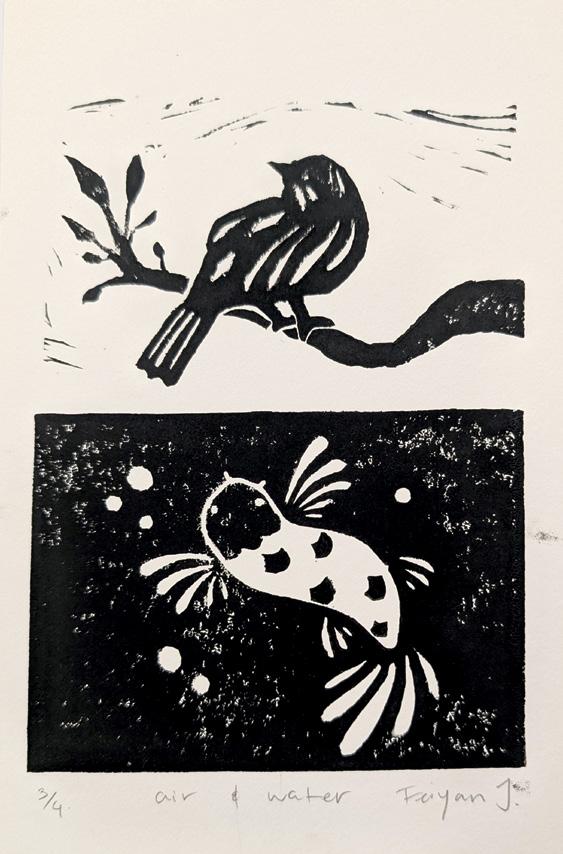
7. Feiyan J. ’30 Air & Water Linoleum cut block print, ink on paper
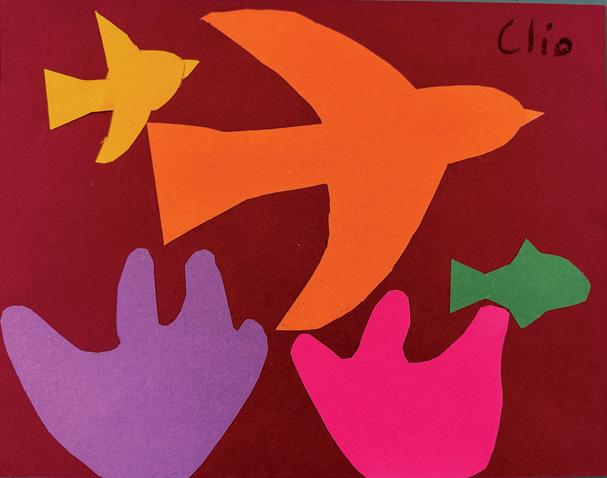
5. Clio
8. Max E. ’26 photograph
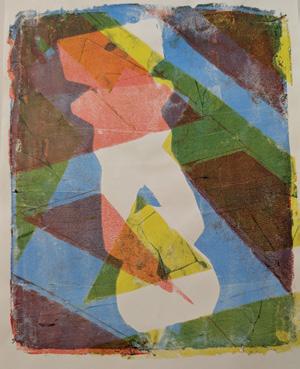
9. Sophia L. ’30 Gel plate monoprint using acrylic paint and transparent gel medium
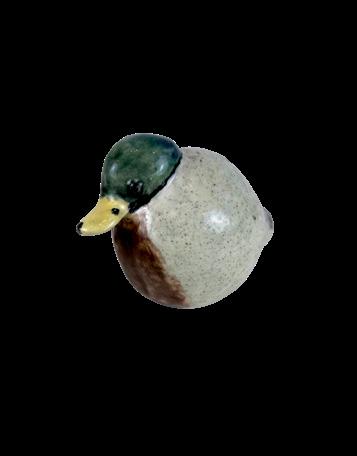
10. Ella Y. ’29 Duck Low fire clay
11. Ellie K. ’28 Untitled Acrylic on canvas
12. Elisabeth S. ’28
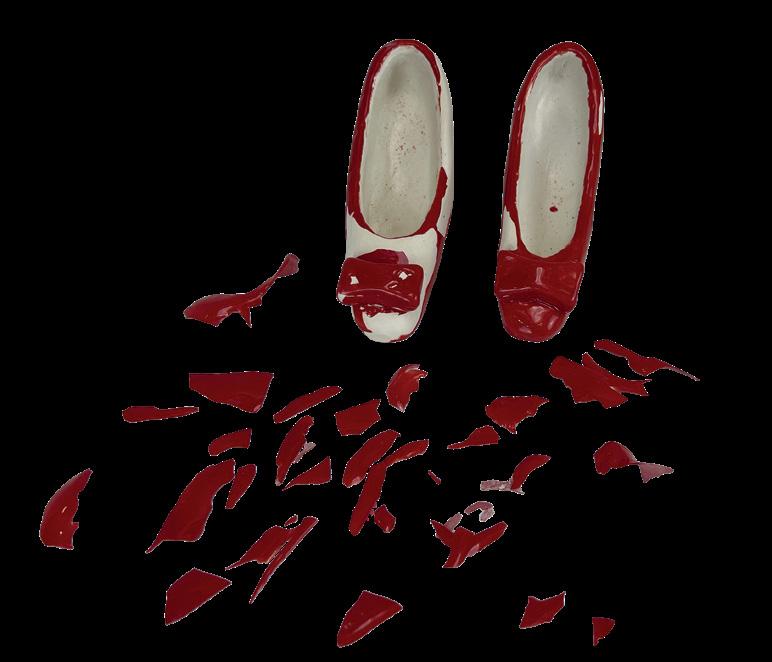
There’s No Place Like Home Low-fire clay and glaze
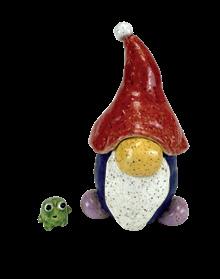
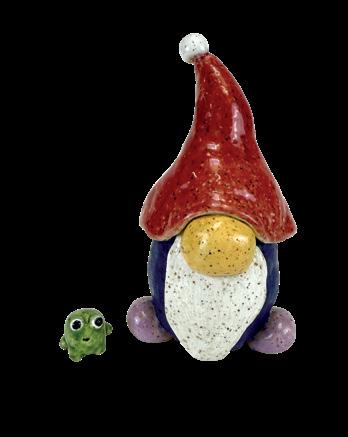
3. Juliet C. ’26 Gnome Midfire clay with specks, underglaze, and overglaze
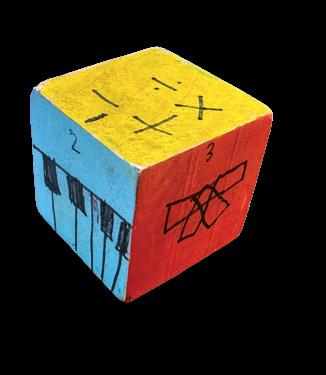
4. Caden L. ’34 Creative Dice Wood block and paint pens
C. ’37 Robins Reef Paper cut
QUOTED
“In a world where dialogue is strained, polarization is common, and new technologies reshape how we encounter information, learning to hold multiple perspectives with both generosity and critical discernment is more vital than ever.”
MEGAN TERRA, LOWER SCHOOL DIVISION HEAD
Excerpted from Megan’s Reflection, “When Maps Shape Meaning.” Visit nuevaschool.org/reflections to read more Reflections from the community.
PRESTIGIOUS NASA GRANT
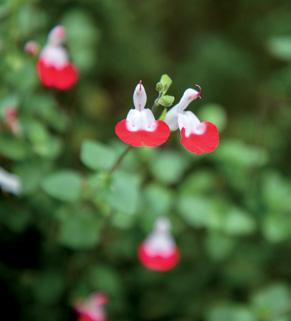
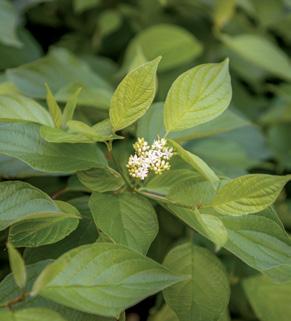
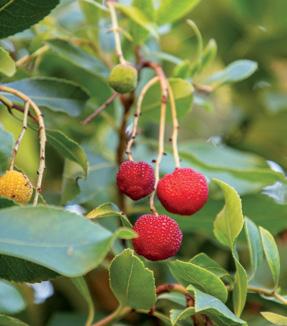
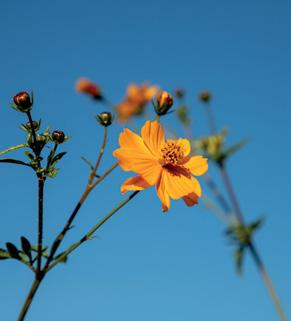
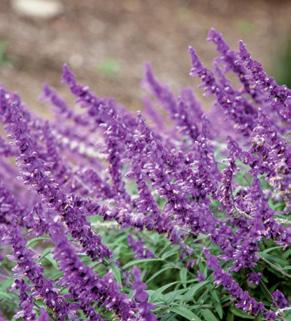
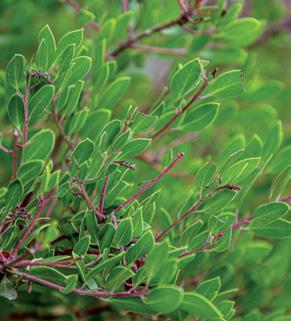
In spring 2025, Nueva received a two-year federal grant supporting the creation of an ozone-monitoring garden—making Nueva the only K–12 school in a national network led by NASA and the University Corporation for Atmospheric Research (UCAR). The project uses specially selected plants that visibly respond to ground-level ozone, allowing students to track air quality through living systems.
Led by Director of Environmental Citizenship Sarah Koning in collaboration with Upper School science teacher Jeremy Jacquot and Lower School science teacher Monique Burtschell, the initiative spans both campuses and engages students from preK through twelfth. The youngest students observe and care for the plants; fourth graders have been tracking leaf damage to determine percentage of deterioration (a tie-in to their math curriculum); and older students collect, analyze, and interpret data—contributing directly to a national, longitudinal research effort.
The ozone gardens are hands-on, interdisciplinary, and deeply human. “This is an exciting opportunity for students to engage in citizen science research and real-world data collection, extending their learning beyond the lab and into the field,” Sarah said. “Students are gaining firsthand insight into the often-invisible impact of ground-level ozone on the environment and public health.”
Spanning disciplines, grade levels, and campuses, the ozone garden project reflects Nueva’s commitment to experiential learning and environmental citizenship, inviting students not just to study climate science, but to participate meaningfully in it as well.
FACULTY BOOKSHELF RECOMMENDED READING
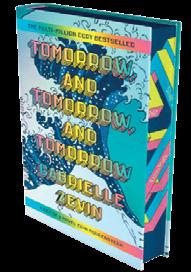
Gabrielle Zevin’s Tomorrow, and Tomorrow, and Tomorrow immerses the reader in a decades-long, complex friendship forged and sustained through a shared love of video games. The narrative dives into the messy realities of intrapersonal and interpersonal dynamics, exploring love and loss, immense capability, and inescapable limitation. Zevin challenges readers to consider where the boundaries of success and failure truly lie and what binds us in commitment to one another.
ANDREA HART
Associate Director of Admissions, Lower School
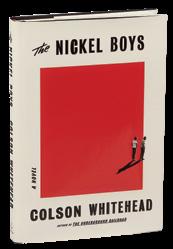
Nickel Boys by Colson Whitehead is a story of friendship and survival, told quietly but with big impact. Set simultaneously in the present day and a 1960s Florida reform school, the book’s creative storytelling helps the reader connect America’s past with its present. I highly recommend this smart, surprising novel that won a Pulitzer and became an Oscar-nominated film in 2024.
MATT FERNALD
Assistant Director of Annual Giving
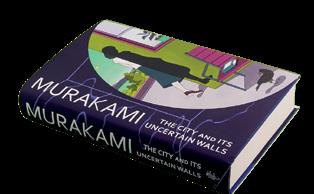
I’ve always been a fan of Haruki Murakami and his latest novel, The City and Its Uncertain Walls, does not disappoint! Murakami is a master of magical realism and evokes a quiet, slightly eerie melancholy while painting incredible images with words. This book harks back to one of his earlier works, Hard-Boiled Wonderland and the End of the World (also recommended!), and if you’ve read that one, there are nostalgic references to it. But you can also jump right into this one, especially if you are looking to cozy up and lose yourself in mysterious disappearances, a world without shadows, roaming unicorns, and dream libraries.
ANGI CHAU
I-Lab
Director
& Middle School Computer Science Teacher
FEATURES
At December’s seventh grade culmination, students presented The Color Museum, in which each student used a single color as a lens to explore history, chemistry, language, and art.
BY TRAVIS WATTS
PHOTO
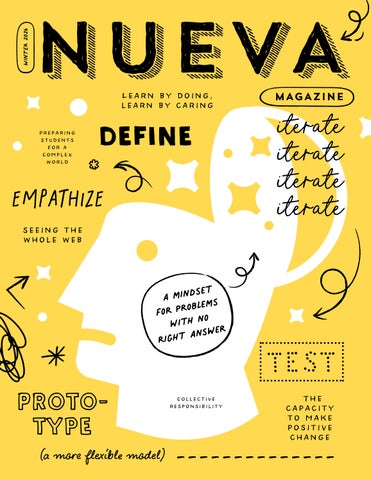
a mindset for problems with no right answer
DESIGN THINKING
Prototype
BY RACHEL FREEMAN
THINK-
It began with a simple question: If we could redesign our classroom library, what would it look like?
First graders took a hard look at their classroom library—overflowing baskets, bent covers, peeling labels. It was not in good shape. Here, they thought, was a problem they could solve. That question launched a design-thinking adventure blending observation, imagination, and teamwork. With guidance from their teachers, students tackled the challenge of transforming their reading space into something that truly worked for them. robot helpers?
We need a userfriendly, amazing library so as to create joy and ease of use.
They began with observation. Clipboards in hand, students watched how classmates chose and then returned books, noting frayed pages, unmarked bins, and too many books for too few baskets. Then they conducted interviews, asking open-ended questions to understand what a “perfect library” might feel like. Their findings led to a collective needs statement: We need a user-friendly, amazing library so as to create joy and ease of use.
Creativity took flight. Ideas ranged from flying books to robot helpers and pulleys that could whisk books away. “A trampoline to reach the high shelves!” one student exclaimed. After dreaming big, the class refined their designs and began sorting, stacking, and labeling hundreds of books into color-coded collections.
At the end of the process, the first grader library was organized and useful, and a source of pride. “It felt challenging and fun,” said class member Laila v. G. “Our solutions were better because we went through the steps.”
That reflection captures the heart of design thinking: by empathizing, brainstorming, testing, and iterating, the students not only solved a practical problem but also reshaped their space in a meaningful way.
Why Design Thinking Matters
Design thinking is one of the foundational pillars of a student’s Nueva experience. Ask any student or teacher on campus what design thinking is, and you won’t hear a narrow answer about science, technology, engineering, or the Innovation Lab (I-Lab).
Instead, you’ll hear something like what I-Lab Director Angi Chau tells prospective families touring campus.
“Design thinking is kind of a hot industry buzzword,” Angi explains. “The way we think about it at Nueva is much simpler: it’s the belief that everybody—kids and adults—has the capacity to make positive change in our world, in our communities, and even in our own lives.”
It’s not a single class. It isn’t limited to engineering projects or robotics. It’s a mindset and a toolkit that shows up everywhere: in second-grade class meetings, in Middle School science, in Upper School English, and even in how administrators design systems and policies for the school.
In other words, if social-emotional learning (SEL) helps students understand themselves and others, design thinking helps them act on that understanding.
And while it often shows up in places with soldering irons and laser cutters, teachers emphasize that design thinking is not a “STEM thing”; it is just as alive in class meetings, writing workshops, humanities discussions, and community partnerships. Even Nueva’s highly successful Design Thinking Institute, a week-long professional learning course for adults, is intentionally held in “neutral” spaces like the library or café— not in the I-Lab—to reinforce the understanding that this mindset belongs to every discipline.
The power of design thinking, says Upper School Division Head Liza Raynal ’95, lies in its stretch. “It’s both a set of practices and an
ethos that can be applied in more places than you might imagine,” she said. “Susie Wise, the founding director of the K12 Lab at the Stanford d.school, met with the Nueva Leadership Team in August, where she led us through a Design for Belonging workshop to consider how a new-to-Nueva teacher might truly feel a sense of belonging. And, of course, you can also use design thinking to create a habitat for a lemur. Not many processes can do both.”
That duality—care for people and curiosity about the world—sits at the heart of the mindset that Nueva hopes students carry forward with them.
A Mindset for Problems with No Single Answer
Upper School English teacher and department chair Allen Frost still remembers the first time he encountered design thinking at Nueva. He attended the Design Thinking Institute the summer prior to joining Nueva in fall 2015, initially skeptical about how design thinking could integrate into how he would teach English. He found himself surrounded by people prototyping ideas and physical products, building programs and things, writing sticky notes, and talking about empathy interviews.
Kim Saxe, Nueva’s former I-Lab director, shifted his thinking, telling him to use whatever pieces of this approach made sense to him. That reframing cracked something open. For Allen, design thinking stopped being a rigid, step-by-step process you “run” with students and became a flexible mindset that could infuse everything from curriculum design to assessment.
Middle School design engineering teacher
Michelle Grau puts it this way: “Design thinking is a way to approach solving any kind of problem that doesn’t have an algorithmic solution. It is for any question that doesn’t have just one right answer.”
So, long division doesn’t need design thinking; there’s already a process for that. But rethinking how juniors demonstrate their understanding of The Crucible? Designing a rubric that parents understand better? Those are open-ended problems with no obvious right answer.
Michelle wants students to leave her classes with what she calls “creative confidence”—the
belief that they can not only come up with ideas, but also turn those ideas into reality.
“We want them to feel like they can take ownership of trying to solve a problem,” she says. “Not, ‘The world is broken and someone else needs to fix it,’ but ‘I am an active participant in problem solving.’”
Teachers are quick to point out that design thinking isn’t just about problem solving; it’s also about problem finding—learning to notice where people struggle, asking good questions, and defining the need before leaping to solutions. At Nueva, students practice this constantly, from interviewing a sibling about why bedtime is stressful to rethinking how classmates access books or navigate an assessment in English.
Designing with Empathy
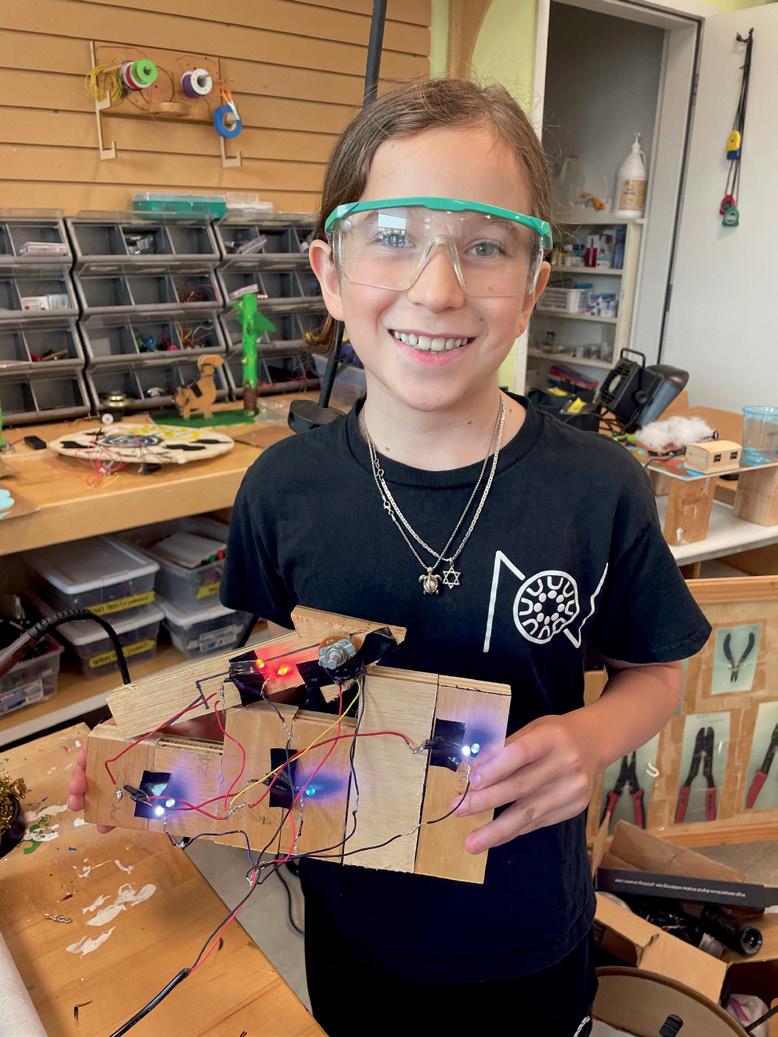
In the spring, fourth graders visit the I-Lab once a week for a design engineering class with Michelle and fourth grade lead teacher Lori Mustille. Their project: solve a real person’s lighting problem by creating a lamp. The word “lamp” is intentionally broad.
“Fourth graders are learning about circuits in science,” Michelle explained. “We build on that by asking, ‘How do you build a circuit to solve this problem? We tell them: your lamp is anything that brings light to a situation where someone in your life needs it.”
One student might notice a parent fumbling in a dark garage. Another might see a younger sibling afraid of the dark at night. A third might watch a grandparent squinting to read sheet music at the piano.
Students go home with homework: observe their families, then interview someone they’d like to design for. Some keep it a surprise; others share what they’re working on. They write multiple “need statements” (“My dad needs a way to keep track of his keys.”) and brainstorm different ways to solve that need.
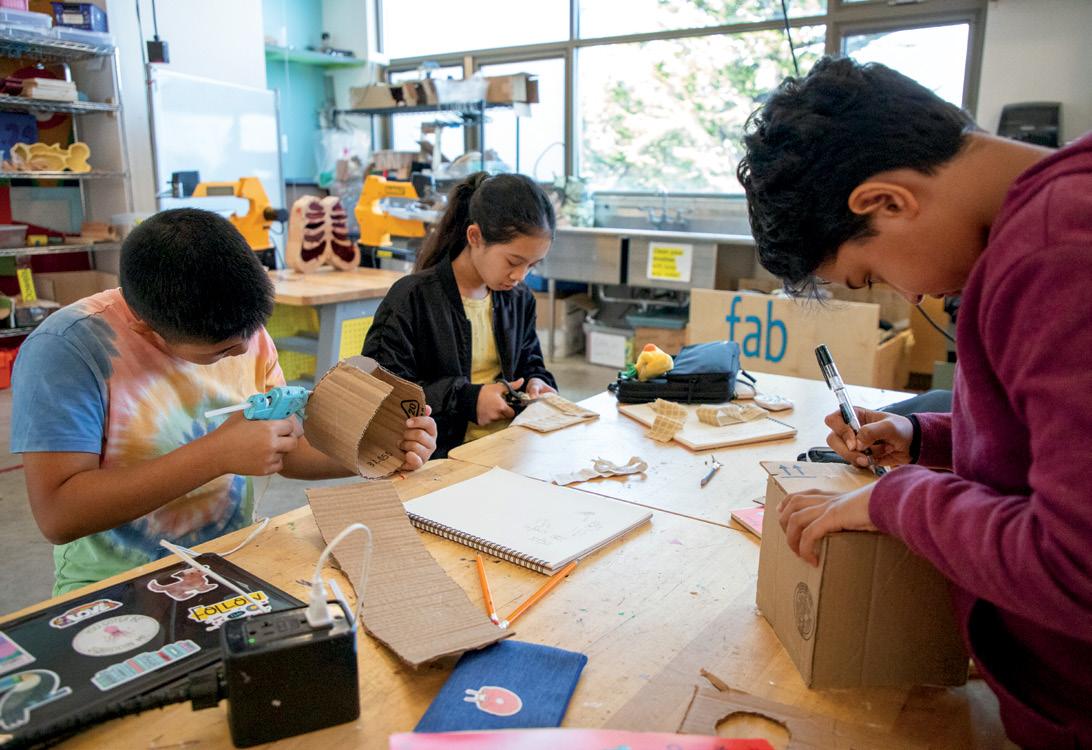
When they get to the “Try It” step, they build prototypes out of cardboard and hot glue, bring them home, and get feedback. In class, they reflect on what they heard, revise their designs, and get to work with circuits and soldering irons.
At the end-of-year culmination event, the lamps look wildly different: a stuffed animal
4th
grade Project
How do you build a circuit to solve this problem? We tell them: your lamp is anything that brings light to a situation where someone in your life needs it.
Zander C. ’33 (top right), Nirvaan J. ’33 (bottom left), and Tess M. P. ’33 (bottom right) hold up the lamps they created for people in their lives who needed light. The project's open-ended nature led each of them to design a very different light source.
with LEDs embedded in its nose and paws to comfort a younger sibling at night; a music stand with integrated lighting for a piano; a key box that lights up red when the box is empty and green when it senses something, like keys, inside.
The project engages multiple dimensions: STEM skills, literacy through writing and storytelling, and SEL through empathy and perspective-taking—culminating in students seeing themselves as real problem-solvers.
By sixth grade, that foundation has grown into something more complex.
For the Health Innovations project, sixth graders also design for someone they know— this time, a person living with a health condition that affects their daily life. The brief is deliberately modest and humane: they are not trying to cure the condition, but to make one small aspect of everyday life easier, safer, or more dignified.
Students begin with focused interviews, asking questions about symptoms, routines, frustrations, and what has already been tried. They synthesize this information into a clear need statement: a grandparent who takes pills three times a day but has no way to track them; a parent with chronic neck pain who can’t get comfortable reading in bed; a family member with severe food allergies who constantly worries about hidden ingredients.
From there, the ideas branch in many directions. One student designed and sewed a custom neck pillow. Another student created a multi-compartment pill box that addressed a gap they noticed: plenty of AM/PM organizers exist, but very few are designed for people who need three or more doses.
Some students’ prototypes are digital apps or interfaces: a simple system that lets a user check whether a packaged food is safe, or a streamlined way to log daily routines and symptoms.
A big part of the work is deciding what kind of prototype makes the most sense for their idea—whether to sketch an interface, build a cardboard model, or simulate a digital alert using a microcontroller, among many other options. Michelle often frames this as a design decision in its own right: students need to prototype a crucial interaction, not an entire complex system. When one student proposed building a self-driving car for a grandparent who could no longer drive, Michelle didn’t shut down the idea; instead, she guided the student to prototype a single essential moment—how the grandparent would safely enter and exit the vehicle—teaching them to focus on what they could realistically create and test.
As in fourth grade, the prototypes vary widely in form and fidelity. Some are fully built physical objects; others are partial or conceptual, focusing on a single critical interaction. All are grounded in empathy, feedback, and iteration.
“We’re very clear with them: you’re not curing cancer,” Michelle said. “But you are learning how to listen carefully, define a problem, and
take concrete steps to improve someone’s life— even in a small way. That’s what we want them to feel capable of.”
SEL: The Invisible Step Zero
If design thinking is one of Nueva’s pillars, social-emotional learning is, in Liza’s words, “step zero”—the foundation under the foundation.
Years ago, she co-led a trip to Spain and offered to run improv games—something her eighth graders at Nueva embraced and enjoyed greatly. But with the Spanish students, the room went quiet.
“It wasn’t that they were less talented or less capable,” she reflected. “They just didn’t have the same culture of trust, safety, and willingness to be vulnerable. It made me realize how much step zero matters.”
She now sees many overambitious projects—at Nueva and elsewhere—struggle or fail not because the idea is bad, but because the social-emotional groundwork hasn’t been laid.
“Design thinking depends on SEL,” she says. “Students have to be able to listen, to work in groups, to take risks, to give and receive feedback. That’s not automatic.”
Angi sees the connection from the engineering side, too. On the first day of DTI for adults, one of the opening slides is about how closely design thinking and SEL are intertwined.
“So much of design thinking is about awareness of self and others,” she said. “If I’m interviewing you as a user, I need to pay attention to your words and your body language. I need to understand my own positionality and bias. I need to care about how my solution affects you.”
Conversely, design thinking makes engineering more human.
In sixth grade, students use the design thinking process to create a solution to a health issue facing a loved one. They interview, brainstorm, prototype, and iterate.
BuildinG Materials
“If you’re learning engineering just to be techie, you’re missing something,” Angi said. “We want students learning these skills because they care about other people and they want to make someone’s life a little better.”
As Angi points out, Nueva’s motto—“Learn by doing, learn by caring”—is essentially a design thinking manifesto: students try things and they care about the people affected by their choices and solutions.
Second grade class meetings are a clear illustration of that blend.
Every Friday afternoon, students in Izzy Mayer's class gather in a circle. They start by sharing appreciations, and then they turn to the “agenda book,” a notebook in which students can write things they notice during the week. One entry might be: “I noticed not all the pencils are sharp enough and I feel frustrated.”
On the board, the class generates observations: how does this feel, what have you personally experienced? Students practice a critical SEL skill of speaking from “I” rather than “you”: “I felt frustrated when I sat down to write and my pencil wasn’t sharp,” rather than “You never sharpen the pencils.”
Once they’ve surfaced multiple perspectives, Izzy invites the “solution monster.” Ideas fly: more sharpeners, fewer pencils, better storage, new jobs. They decide together to prototype a change—perhaps adding more students to the pencil-sharpening job, or redesigning the system entirely—and then see how it goes.
Some entries even lead to I-Lab projects. When a student wrote about the distress of seeing trash blowing out of an unlidded bin, a small group spent recess in the I-Lab designing and prototyping a custom lid that could be installed.
“That’s design thinking, too,” Izzy said. “The empathy, the listening, the students seeing a problem in their environment and feeling empowered to do something about it.”
Systems Thinking: A Seeing the Whole Web
Many of the most pressing issues students care about—climate change, food insecurity, housing, justice—are systems problems. Trying to “fix” them with a single gadget or one-off volunteer effort can be discouraging.
“Most problems that are worth solving are complicated enough that you need some systems thinking,” Angi says.
To build that muscle, she often starts with something simple: a click pen.
In an activity called “Parts, Purposes, Complexities,” participants take apart a pen and list all its parts. They try to infer the purpose of each part and name what they still don’t understand. They discover a tiny spring they’d never noticed or a mysterious gel plug in the ink tube.
Once they’ve practiced with an object, she asks them to apply the same lens to an abstract system: a school, a city, a food system, water access in a community. What or who are the parts? How do they interact? Who is connected to whom? What flows between them?
“The point isn’t the map,” Angi says. “It’s the thinking it forces. You stop seeing everything as isolated.”
A More Flexible Model
Early on, there was a push to run full cycles with students: empathy interviews, need-finding, brainstorming, prototyping, testing, and iteration. Those projects were powerful, but they weren’t the only way to teach design thinking.
Recently, Angi and her team developed a more flexible visual model to reflect the fluidity of the design thinking process: a colorful puzzle with four interchangeable pieces—Explore, Imagine, Try, Reflect—with “Iterate” in the center. Each piece includes concrete skills: interviewing, systems mapping, brainstorming, building prototypes, seeking feedback, and making revisions.
The shape was deliberate. All four pieces are identical, so there’s no correct order. They can be rearranged, zoomed in on, or used in isolation.
"SOLUTION MONSTER" where ideas fly
Lower School Division Head Megan Terra leaned heavily on systems thinking when she and her team launched a multi-year Community Service Learning (CSL) focus on food systems. Angi worked with the team to think through all of the components of a food systems study.
The team started by mapping the system themselves: the Nueva café, local farms, transportation, composting, students’ lunchboxes, family habits at home, existing curriculum units
“The beauty of design thinking is that you can approach it many different ways,” she said. “You can absolutely take students through the whole loop. But you can also do a powerful design thinking project that lives mostly in Explore, or that really focuses on Try. We wanted a model that matched what we were already learning from teachers: there isn’t one rigid recipe.”
“
My daughter came home one evening and described the mapping exercise she did with her class where Angi discussed systems and how interdependent many issues are. As Kayla described all the considerations required when changes or new initiatives are made, I could see a much deeper level of thinking emerging. I could also sense her realization that life is much more complex than ‘right or wrong’ and that there are many more considerations to weigh.”
on farmers and migrants, community partners, and more. They layered on values—collective responsibility, Beloved Community, ethical service learning—and then identified where students already had entry points and where there were “bright opportunities” worth exploring.
They decided to have each class map “the story of an apple,” from preK through fourth grade. The youngest students traced simple sequences: planting, growing, picking, eating, composting. Older students added layers: who planted it, what labor was involved, how water was used, how it traveled, where waste went, and who had access to fresh fruit in the first place.
Even without language to describe systems thinking, younger students began to see themselves within a larger web: as eaters, composters, and designers of the school garden and family habits.
“If we’re not teaching systems thinking alongside design thinking, we risk students locating the ‘problem’ inside an individual or a single community,” Megan said. “We want them to be able to zoom out and see the bigger picture— and still see where they have agency.”
NELLIE LING P ’26 ’28 ’34
mapping the the story of an apple
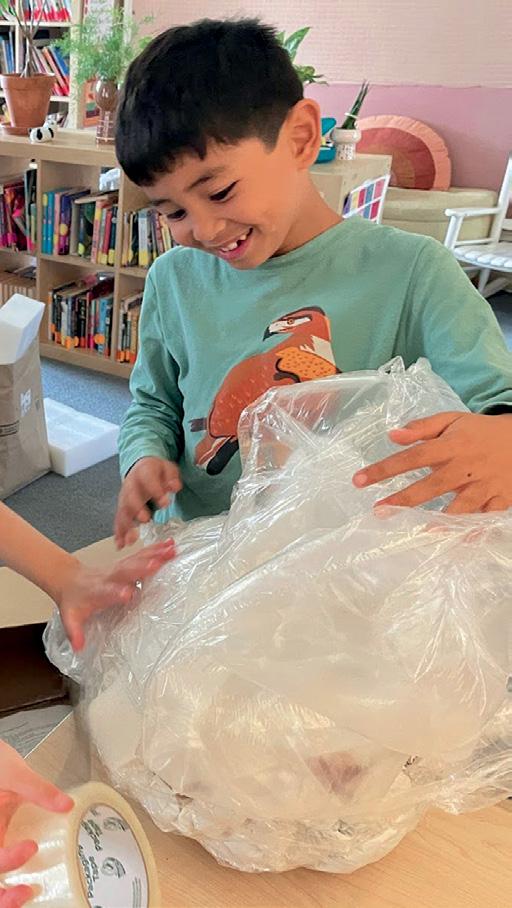
Second graders work on their Pumpkin Protection Device (PPD). The annual Pumpkin Drop is not just a fun Halloween tradition; it is also the culmination of a design thinking activity that challenges second graders to use observation, questionasking, prototyping, and collaboration to build the ideal PPD. The pumpkins are then launched off the Lower School skybridge walkway onto a blue tarp below.
Not Just STEM: Design Thinking in the Humanities
In the Upper School, Allen uses design thinking not just to design curricula, but as a way to help students understand the work of writers.
The first year he taught 11th grade American literature at Nueva, the class centered an unlikely text: President Barack Obama’s eulogy after the 2015 mass shooting at Mother Emanuel African Methodist Episcopal Church in Charleston. Students watched and read the speech, paying attention to structure, rhetoric, and delivery, and then asked design-thinking questions.
“Who were the President’s ‘users’?” Allen asked. “What was the problem he was trying to solve with this speech? What constraints was he working under? How did he prototype—that is, test and revise—his language?”
Students recognized that Obama, like a designer, couldn’t directly fix the underlying problem of racial violence. But he could design an experience—this particular speech in this particular context—to name grief, acknowledge rage, and invite the country into a different way of seeing.
Later, when students read The Crucible, Allen and Assistant Division Head Claire Yeo, then an English teacher as well, used design thinking to reimagine an assessment that had long bothered them: a letter to a character (“Dear John Proctor, here’s what you should have done…”).
“Through the design thinking lens, we asked: ‘What do we actually want them to understand?’” he said. “We wanted them to grasp the way Arthur Miller used the Salem witch trials as an allegory for McCarthyism.”
So they designed a different assessment with these needs in mind. Now, students research a moment in American history that echoes a contemporary issue and then pitch a play, following Miller’s model: What is the historical moment? What is the current parallel? Who are the
AJohn Proctor, here’s what you should have done…
Dear
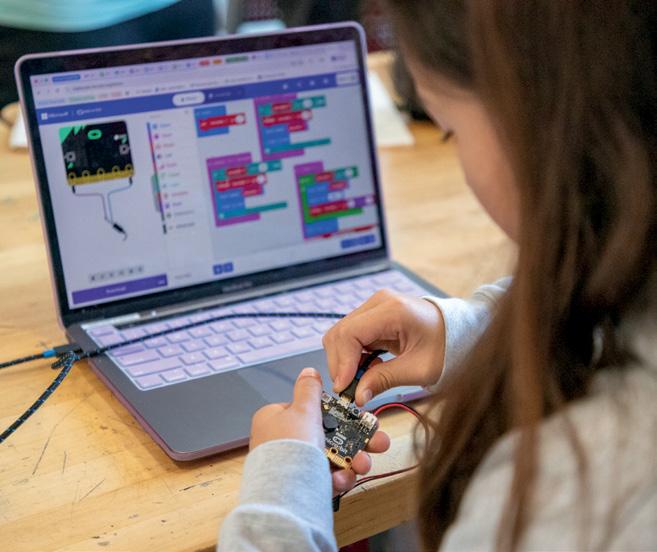
A sixth grade student works on a prototype of a health innovation she programmed to help solve a health issue in a loved one’s life.
characters, and what are the stakes? How would staging and dialogue make the connection clear?
It’s still an assessment, but using design thinking led to “a richer understanding of the play than if they were just writing a letter to a character,” Allen said.
Allen presents these kinds of examples in a DTI session called “Design Thinking in the Humanities,” helping other teachers see that you can use “pieces” of design thinking to make assessments more authentic—even if no one ever touches a soldering iron.
“Not everything has to look like a robotics project,” he said. “You can absolutely do design thinking in English and the humanities without ever calling it that.”
Students as Designers for Social Good
If younger students experience design thinking mostly within classes, many Upper Schoolers dive into it through student-led programs, one of which is Invention Studio, often referred to as iStudio.
Leaders Viola S. ’27 and Evan W. ’26 describe it as “Nueva’s little mini startup accelerator” that is focused on engineering for social good. Each year, small teams of students come in with ideas at various stages: some as vague as “I want to work on climate,” and others deeply rooted in a family member’s experience. Over the course of the year—and often over multiple years—they move from fuzzy problems to
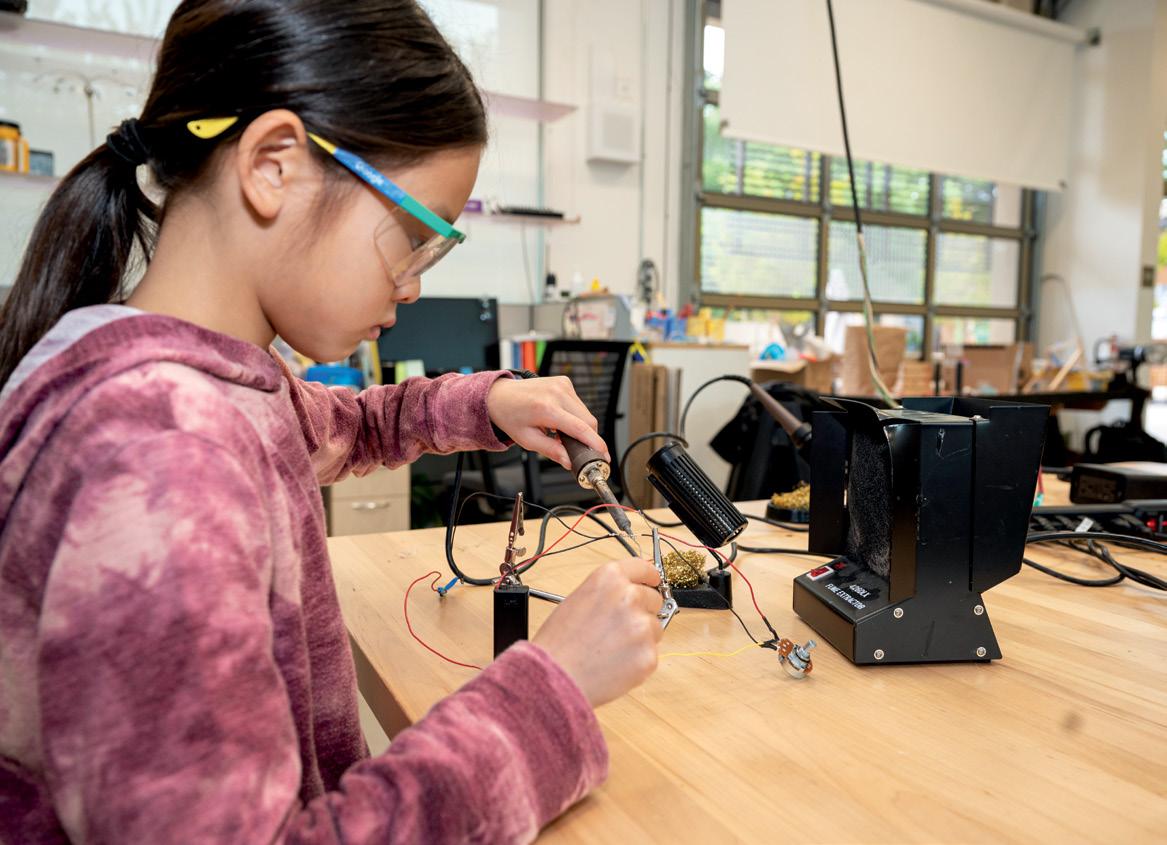
After learning about circuits in their science class, fourth graders gets hands-on, learning to solder so they can build lamps for people in their lives.
focused need statements, from rough sketches to functioning prototypes.
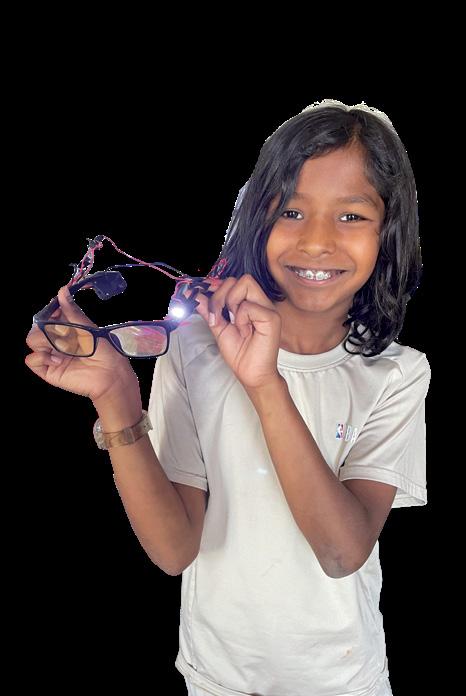
Viola is building an app to help Bay Area homeowners understand wildfire risk and strengthen home safety. Evan and his teammate are developing smart glasses to support dementia patients—starting with his friend’s grandmother, who struggles to remember whether she’s taken medicine, or where she left her keys. The glasses record key daily actions so that when she wonders, she can check a simple log or image.
Both students emphasize that the hardest, and most important, part of their work isn’t the technology—it’s the problem finding.
“Sometimes you want to build something really complex and cool,” Evan said. “But that’s not always what the user needs. Design thinking keeps pulling you back to the user: what’s actually useful in their daily life?”
Viola points to a team that spent two years working on a device for people with foot drop, a neurological condition. Last year, after many rounds of testing and reflection, they made the wrenching decision to pivot to a related but different problem that felt more personally connected and solvable.
“That’s really hard,” she said. “You’ve invested so much. But design thinking makes it okay to say, ‘This is a dead end; what else could we do that would actually help someone?’”
Adults as Designers, Too
For teachers, design thinking is also a tool for professional reflection.
Izzy describes how she and her colleague redesigned their second grade writing curriculum: “We noticed students had lots of words on a page that looked like a paragraph but didn’t read like a paragraph. So we asked: How might we help students write stronger topic sentences and then stronger paragraphs? We reflected, adjusted, and iterated multiple times until we found something that worked.” Their solution included adding scaffolded instruction, taking students from sentence to topic sentence to paragraph in a more gradual way.
The same approach helped transform the second grade Indigenous Peoples unit, shifting it from a past-tense museum model to a
present-tense research project emphasizing modern Ohlone voices and living communities.
“It started with asking how we could align this with our values,” she says. “Design thinking helped us redesign not just materials, but mindsets.”
That’s the real goal, Angi said, of the Design Thinking Institute she runs for teachers and administrators: not to send teachers home with a script, but to give them tools they can use for their own thorny challenges back at their schools.
“Every participant comes with a problem from their own context,” she shared. “Maybe they want to redesign their sixth grade social studies curriculum. Maybe they’re an administrator trying to run meetings in a different way. Maybe they have a reporting system that’s unsustainable. We help them get traction on those things.”
IZZY MAYER “
It started with asking how we could align this with our values. Design thinking helped us redesign not just materials, but mindsets.”
Fifth graders use the design thinking process to create toys for first and second graders— interviewing the younger students, building prototypes which incorporate what they learned, and iterating based on feedback until each toy is ready to be played with.
A History of Design Thinking at Nueva
Upper School Division Head Liza Raynal recalls when design thinking first arrived at Nueva in the mid-aughts. At one of the early all-faculty sessions, David Kelley P ’11, the founder of the Stanford d.school and IDEO, and Kim were introducing what was, at the time, a new language for teachers.
“I remember thinking, ‘This is really cool; this is going to catch on here,’” Liza said. “And at the same time, ‘This encompasses so many things we already do.’”
Nueva’s mission was already steeped in creativity, empathy, and innovation. SEL had been a pillar since the school’s founding. Teachers were used to iterating on curriculum, talking about student needs, and experimenting with new approaches. For these reasons, David and his colleagues thought Nueva was the perfect fit to pioneer the first preK–12 design thinking program.
“So much at the heart of design thinking has always been at the heart of our school,” said Megan Terra, Lower School Division Head and parent of two alumni. “When David saw what was happening in our classrooms—where students were learning tools for pursuing something with curiosity and trying to dig deeper—he made a connection between the work he was doing with college students and the work that we were doing with kindergartners. Our mission speaks to unleashing creative capacity, fostering social and emotional acuity, and learning with tenacity, and design thinking is this beautiful approach that aligns with each of those.”
I-Lab Director Angi Chau (left) works through a systems-thinking exercise with Upper School counselor Aviva Jacobstein. Angi frequently collaborates with administrators, faculty, and staff, using design thinking to surface strategic priorities and guide meaningful change.
“Angi is brilliant, and she is regularly thinking about how to apply design thinking and systems thinking to solve teachers’ and administrators’ real problems,” said Upper School Division Head Liza Raynal.
By building systems maps, shaping “how might we” questions, and prototyping ideas, Angi helps colleagues turn complexity into action.
Preparing Students for a Complex World
All of the adults who spoke about design thinking at Nueva are realistic about the world their students are stepping into: a complex, messy world with a lot of needs.
What educators can do, Angi argues, is equip them with a more hopeful way to meet that reality. Instead of collapsing into helplessness or cynicism, students can learn to say: “Something here is not okay. I don’t fully understand it yet. But I have tools to start exploring, imagining, trying, and iterating. I can make it a little better.”
It may be a better way to store pencils, a more inclusive unit on Indigenous peoples, a smarter pillbox, a rethought rubric, or an app that helps a community prepare for wildfire.
Over time, it becomes a habit of mind. Often, students only realize how unusual that habit is once they graduate. They get to college, notice something isn’t working—a course that should exist but doesn’t, a broken advising system, a gap in equity efforts—and their first instinct is to brainstorm solutions and prototype changes. Their peers are often bewildered.
“Alumni come back and say, ‘I get it now. This is why we do this,’’’ Michelle said. “They say, ‘I didn’t even realize how much design thinking had informed the way I think until I was in a situation with other people who didn’t have this background.”
Rather than think that the way things are done is the only way they can be done, Nueva students ask how things can be different.
That difference—between resignation and agency, between despair and design— is at the heart of why Nueva names design thinking as a pillar.
“It’s an optimistic stance,” Angi said. “It’s not that everything is always fine. But even when things are hard, you still have a way to move, even a little, toward something better.” [N]
Rounds, Research, and Resilience
Two formats, one big community, countless arguments—and a shared love of the craft
STORY BY LIANN YIM
Debate at Nueva is both a discipline and a world: a place where students learn to think with precision, question with curiosity, and adapt with fluency. Whether conducting deep research, practicing with Middle School debaters at the Hillsborough campus, or boarding a 6 a.m. flight to a national tournament, Upper School debaters move through their season with a balance of competitive fire and intellectual joy.
Resolved: is beneficial House supports halt of giant The United should ban through biometric Resolved: should substantially extraction
Resolved: In the United States, social media beneficial for democratic values. This supports a government-mandated giant AI experiments. Resolved: United States Federal Government ban the collection of personal data biometric recognition technology.
Resolved: The People’s Republic of China substantially reduce its international extraction of natural resources. This House
regrets the existence of private collections art, even when the art was freely
Nueva’s Upper School debate program spans two formats—Public Forum (PF) and Parliamentary (Parli)—each with its own rhythms and demands. Though they differ in structure and style, both demand intellectual rigor, extensive research, and an understanding of audience. Students across both events also share the same core experience: long nights spent refining arguments, weekends spent in classrooms both at home and across the country, and friendships formed in the in-between spaces of debate—airport gates, hotel lobbies, hallways between rounds.
Each season covers almost the entire academic year, with regular practices and weekend tournaments, culminating in major state, national, and prestigious events like the Tournament of Champions (TOC). Year after year, both of Nueva’s teams have returned impressive results.
Both formats also rely on a strong team culture: a mentoring ethos, a constant exchange of ideas and feedback, and the belief that students improve fastest by debating, watching one another debate, and then reflecting together on what happened and why.
Public Forum, explained longtime coach Les Phillips, was designed to be “accessible to someone else’s mother.” A PF round lasts about 40 minutes, with two students on each side of a resolution about a current issue—anything from global resource extraction to immigration policy. Unlike other events, PF’s judging pool often includes lay judges, especially at local tournaments. This means the best debaters must learn to speak with clarity, structure, and intention.
“It has taken Nueva a long while to get good at talking to that random lay person,” Les, an eight-diamond National Speech and Debate Association coach, said wryly, “but we’ve gotten much better at it. Nueva students don’t naturally like to make things simpler.”
PF debaters debate the same topic for one to two months, and while students conduct extensive research—complete with evidence files, annotated articles, and shared Dropbox libraries—the pace of topic rotation means they also must learn efficiently. Everyone contributes; even debaters who
won’t compete on a given resolution help generate research and evidence to support the team.
Les points to the program’s strong practice-round culture as a key element of how students improve. Most after-school time is spent in live debates judged by assistant coaches; rounds are followed by feedback, mini-redos, and peer coaching. The coaching team spans multiple states, with assistant coaches joining by Zoom twice a week and even flying in for major tournaments.
Traveling to tournaments from Arizona to the Bronx, the PF season culminates at the Tournament of Champions, where the nation’s top teams gather for a marathon of arguments that demands equal parts stamina and strategy.
Parliamentary debate, led by coach Julie Herman, offers a contrasting rhythm. Parli resolutions are announced just minutes before a round begins, requiring debaters to lean on broad general knowledge, flexibility, reasoning skills, and the ability to analyze unfamiliar problems very quickly.
Rounds are fast and dynamic; the format emphasizes clarity, persuasion, and adaptability in real time. Students learn to collaborate quickly with their partners, build arguments from scratch, and respond in the moment to their opponents’ logic.
“What debate does is create a space where students don’t just learn ideas; they interrogate them, refine them, and test them in real time,” Julie said. “The kind of work they’re doing—high-level analysis, research, and argument—transfers directly into how they think across the humanities and social sciences.”
collections of culturally significant sold by the creators.
Les and Julie both agree that Nueva’s debate program is different from what is seen at most other schools. Part of it is the coach-to-student ratio and the level of adult expertise that students have access to—and the extraordinary breadth and depth that comes from that.
“Our students are working with coaches who understand debate deeply—but also history, economics, and politics— and that allows students to go much further intellectually,” Julie explained. “A huge part of what makes this possible is alumni who come back and reinvest in the program. There’s a real architecture of mentorship here.”
Around 35 students participate in Parli in the Upper School, and 50 in the Middle School. The PF team has 25 students. The significant turnout is unsurprising: debate fits naturally into Nueva’s school culture.
“This is a place that values student voice, opinion, and inquiry, and debate is one of the purest expressions of that,” said Julie, who referred to it as “the ultimate nerd activity.”
While the Upper School focus is on rigor, depth, and competing at the highest levels, the Middle School debate program has a different goal.
“It’s about excitement, about learning that your voice matters and that adults will listen to you,” Julie said. “We want Middle School students to feel empowered
to express ideas, not pressured to be perfect. Depth comes later. Curiosity and confidence come first.”
One of the things Julie works on hardest is making sure that value isn’t defined solely by who wins the most rounds in competition.
“Serving the team—mentoring younger students, judging practice rounds, answering questions—matters just as much as competitive success,” Julie said. “We’re constantly asking: how are students helping build the next generation of this community?”
Both Julie and Les agree that Nueva debate isn’t just about preparation for competitions; it’s preparation for meaningful participation in academic and civic life. The program fosters in students the ability to think deeply, speak thoughtfully, and engage seriously with the world around them.
“Debate forces us to confront power dynamics and equity head-on, and to be intentional about how we value people,” Julie commented. “The result isn’t just trophies—it’s intellectual confidence, curiosity, and a lifelong ability to analyze ideas critically.”
Read on for two pieces that offer student perspectives on these experiences: one from the world of PF, and one about how the Parli team fosters a love of debate in Middle School students. Together, they open a window into the craft, culture, and camaraderie that characterize debate at Nueva.
Upper School students on the parliamentary debate team celebrate a rare “close-out” at the Harvard Season Opener, where two Nueva teams met each other in the final round after advancing through the elimination bracket at the online tournament. Below: Middle School debaters at the Karen Keefer Novice Invitational. All posted winning records, with one team taking home first place in their division.
The craft, culture, and camaraderie
Ten Rounds, Three Days, One Last Flight
BY JACKSON H. ’26
We’re flying in coach, but there’s still business to get done. Before boarding, the team divided up assignments to complete before landing. Some of us are preparing cases to read on the topic, while others are scouting out our potential opponents. Some pay for airplane wifi, some stay offline, and others rely on the vast libraries of PDFs and Word docs stored in the team Dropbox.
It’s April 2025 and we’re en route to Lexington, Kentucky, where Nueva has brought six debate partnerships to the Tournament of Champions (TOC).
Nueva’s Public Forum (PF) team debates on the national circuit, competing against hundreds of school teams at tournaments across the country—from Arizona to the Bronx—over a season that lasts from September to April.
Competing on the circuit is intense: I went to 12 tournaments in my sophomore year, each consuming at least a three-day weekend. But the rigor demanded by national circuit debate also comes with extraordinary opportunities. I am deeply grateful for the ability to travel so much in a year and for the friendships I’ve built with debaters across the country.
For circuit debaters, the TOC is the culmination of our season, hosted annually by the University of Kentucky since 1972. About 120 of the top PF teams in the
country, plus thousands of debaters from other events, flood into Lexington for the weekend.
I’ve come to know Lexington well over my four times there (twice at the TOC, and twice at the Season Opener in September). I know the beautiful rolling green hills that define this part of the state. I am familiar with my fair share of the university’s buildings, from dank Funkhouser to sleek and modern Chem-Phys. I know what to get at the food court and at the hotel breakfast, and I know that the man who works the hotel counter wants me to read Thomas Sowell.
On Friday, we go through the list of judges for the tournament. Each school at the TOC must provide judging proportional to its entries, which results in a range of judges with varied preferences and levels of experience. We need to be prepared to argue in front of layman parent judges, veteran coaches, and everyone in between. Public Forum is a uniquely pluralistic event in the diversity of debates you have to adapt to. In my mind, judge adaptation—learning to strategically and rhetorically adjust to different audiences— is a key skill of this event.
It’s Saturday. The Tournament of Champions, the largest debate event of the year, is about to begin. I had a debate round in my dream last night. The stress of the tournament is unavoidable: your heart beats a little bit faster, there’s a pit in your stomach, and everything in your life that’s not debate fades behind a wall of mental fog.
Our team set up a “war room” in the music building to regroup between rounds. The next debate is always hanging in the air during these moments of relaxation, but it’s important to find them when you can. You learn a lot about your teammates by how they handle the pressure. One of the seniors on our team is somehow able to nap between rounds. Younger teammates return from a loss full of sound and fury, and you tell them to relax— making it to this tournament is already an accomplishment.
It’s impossible to walk around campus without running into someone you know from another school. Over the course of the season, you form longstanding relationships with other debaters on the circuit. They will be at one moment your
close friends and in the next your fierce opponents. It’s not that deep; we’re all here to win.
The TOC has seven preliminary rounds, and teams need to win five to advance. At the end of the first day, two of our teams had a 2–2 record. They would have to “ride the bubble” on Sunday, where a single loss is enough to “pop” their run. It’s hard to overstate how stressful it feels to debate back-to-back bubble rounds. I had to do it at TOC my sophomore year, but this time around I’m returning to the hotel with a slightly more comfortable 3–1 record.
Sunday is probably the longest day of my debate career. We leave the hotel at 7 a.m. My partner Oliver and I win two of three remaining prelims, and another Nueva team also advances to the elimination rounds. As the sun sets, we debate the first elimination round in front of a panel of three judges each. In such a high-level round, the judges often take a very long time to type out and deliver their decisions. Oliver and I, along with our opponents—some of our closest friends on the circuit—were left to sit and wait for what feels like forever, too superstitious to speculate on the result, too nervous to think about anything else.
After a long wait, we win. And we win our next elim, too. We’re through to quarterfinals. This is now the strongest performance for any Nueva PF team at the TOC since 2020. I get back to the hotel at 11 p.m. after more than 12 hours of debating, and all I can focus on right now is a late-night quarter-pounder. Oliver and I go to sleep early while the rest of the team prepare arguments to make against our next opponent, the #1 seed.
Unlike the previous rounds held at University of Kentucky, the late elimination rounds are held in a beautiful hotel just outside of Lexington. Other debaters, now out of the tournament, pour in to watch. We have one of the smaller rooms, so tournament staff have to turn people away at the door.
Sadly, we lose in the quarterfinals in what turns out to be my last round of debate in my career. It’s 11 a.m. on Monday, and our run at the TOC is now over. I debrief the round with coaches and debaters from other schools, many of whom had been turned away from spectating and were eager for the play-by-play.
that characterize debate at Nueva.
They offer encouraging words on what had been a great run, one which I’m still proud of today.
After watching the final rounds, it’s time to fly home. There’s no frantic preparation on this flight; the season is over, and for some of us, our entire debate careers have now ended. Those of us awake swap stories about the weekend’s rounds. We return home from the spectacle of the national championship and the general melodrama of the circuit with horseshaped awards and merch in tow (because it’s Kentucky). The next day, we returned to the normal rhythms of our school lives, ready to make up for the classes we’d missed. The end of a travel tournament is almost always anticlimactic in this sense, but we’re all used to this. And it’s only a matter of time before we take off again.
Passing the Floor
BY MARS R. ’27
“Mars, do you like UFOs?” is a sentence I hear surprisingly often as Middle School debate practices come to a close. Two girls, almost without fail, come up to me every Monday after practice and ask me that same question. On our first encounter, I answered yes, hoping to be friendly and encouraging; they then threw a balled up tissue at me, claiming it was an “unidentified flying object.” Last week I told them no, and they asked me if I liked “IFOs” instead. It was the same crumpled-up tissue—this time marketed as an “identified flying object.” Of all things, I have to commend their creativity, and we’ll see what they throw at me (literally and figuratively) next.
I joined the parliamentary debate team as a freshman, hoping to learn more about current events—and I achieved this tenfold. Parliamentary debate (or Parli) is inherently dynamic, as the topic of debate changes every round. At a single tournament, I have found myself debating everything from whether eels should be designated as an endangered species, to whether the EU should build a “drone-wall” to deter Russia. Resolutions rarely repeat, and in my three years of being on the debate team, I have accrued a vast wealth of knowledge that I use in my everyday life.
However, knowledge isn’t the only part of the game. It is often the case that the way we deliver our arguments is just as important as the arguments themselves. Debate has greatly improved my public speaking, which has aided me not only in rounds but also in interviews and school presentations.
Perhaps the most unexpected way debate has shaped me is through my involvement in the new Middle School debate program. I joined in its second year as an assistant coach, and this year I am a student co-lead, supporting the growing program.
Practices take place every Monday at the Hillsborough campus and begin with a group Kahoot quiz session. There might be questions about current events or content that coaches have been going over (such as weird debate jargon). Sometimes, Middle Schoolers begin practice reading curated news articles that coaches have prepared—some this year have been about the US government shutdown, syndicate cities in Myanmar, and the impacts of tariffs on the Swiss Army Knife.
After the opening activity, students are split up into labs, consistent cohorts formed with attention to experience and grade level. Typically, each lab is taught by the same coach every week, allowing students to form relationships with their coaches in which they receive consistent instruction.
Each lab has a content roadmap, and every week students dive into the material through lectures, drills, and discussions. Coaches develop their own curriculum, which includes content explanations, targeted drills (such as argument generation or mini-speeches), and exit tickets. Above all, the curriculum is participation-focused and student-driven. In November, for example, my students learned about weighing, which they practiced by having a mini bracket-style impact tournament!
An important goal of each lesson is ensuring that everyone shares; my classes probably average around five reminders of “Let’s hear from someone who hasn’t spoken!” I’m happy to share that this year, every single one of my lessons has featured the voices of everyone in the class— whether they ask a question, brainstorm an argument, or make a joke.
The program fosters meaningful connections across divisions and within teams. I like to open each lesson with a pop culture question. One week, I asked students what they thought about Wicked: For Good, which led to a short conversation about our favorite songs, Zootopia 2, and more. During break time, students chatted with me about their Thanksgiving plans, and when I see them at the Upper School campus, I always wave and say hi. Even among the high school coaches, the program has given us new opportunities to connect more during our post-lesson debriefs—sometimes accompanied cookies (brought by me) or the leftovers of the middle schoolers’ snacks.
The Nueva Middle School team has had incredible tournament success, especially considering our students are often debating against much older high school students. The age gap is not to be underestimated—as high school students can dominate a round simply because they’re taller! Despite this, our Middle School debaters have posted winning records at the Notre Dame Invitational, Stephen Stewart, Karen Keefer, and more. One of our teams won the entire Karen Keefer novice division!
As a coach, it has been a joy to watch students grow and push themselves through debate. I am constantly impressed by their clever arguments and their unexpected pockets of knowledge in niche areas— a student once explained China’s monopolies on rare earth metals to the team. It has also been amazing watching students gain confidence in both their ideas and their public speaking.
Nueva Niches
How students build micro-communities of passion, curiosity, and courage
STORY BY HOLLY NALL
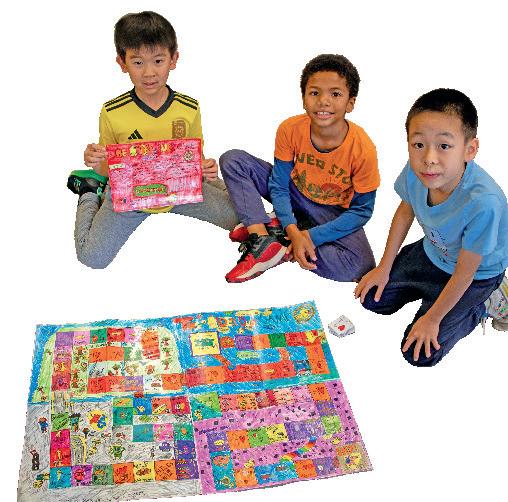
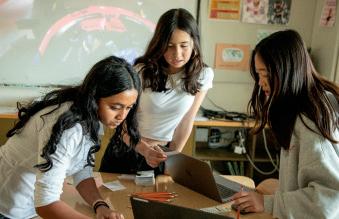
Walk through either campus on any given day and you’ll notice the pockets of Nueva magic that don’t appear in the extensive course catalog. Third graders sprawled across a rug sketching tiles for their next board game. Middle schoolers in animated debate over the week’s F1 standings. A conference room crowded with Mock Trial students, case packets and burrito bowls scattered across the tables. None of it is assigned or done for a grade; all of it exists because a student thought, “I wish there was a space for this”—and then made one. Read on for some of the many student-created niches at Nueva.
Sci-Fi Club
This new space founded by Ayda D. ’28 welcomes anyone— even those who don’t think of themselves as “sci-fi people.” Meetings drift from ethics and AI to time-travel mechanics, often dissolving into philosophical tangents and chaotic whiteboard diagrams. Ayda loves that no one has to be an expert: “A lot of people feel pressure to know everything,” she says, “but you can just gain that by doing something like this.”
Mock Trial Team
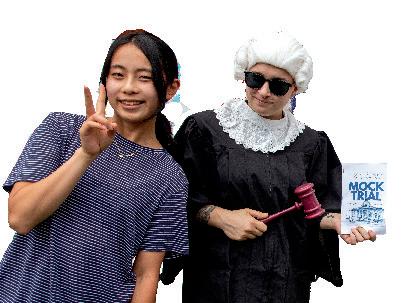
When Sydney L. ’26 and Arishka J. ’26 founded Nueva’s Mock Trial team, they were starting from scratch—navigating San Mateo County’s competition system, recruiting parent attorneys as volunteer coaches, and walking new teammates through cases a hundred pages long. In those early practices, older students explained objections to freshmen, and attorney-witness pairs learned how to tell a story together.
“It’s one of the only places where someone who loves acting and someone who loves political science can collaborate,” Sydney said. In their first season, the fledgling JV team placed fifth in the county. Now the program has grown to nearly two dozen members split into JV and varsity
Student Game Designers
Alden Duck Studios, Inc. is an informal game-design studio launched by third graders Alden L. ’35, Ian J. ’35, and Niles N. ’35. Their sprawling, hand-drawn “Alden Duck Game”—more than 50 squares, nearly all with distinct rules or hazards—has attracted so much interest that they created a waiting list for classmates eager to help build it. Their enthusiasm has already inspired a wave of spin-offs as other students have now begun forming their own “studios” and original games.
F1 Club
Mackenzie H. ’31 had been dreaming about a Formula 1 Racing club since she was in fifth grade, never expecting anyone else would share her passion. This year she finally took the leap—she drafted a proposal, made her pitch, and booked a room. To her surprise, students streamed in, many of them eighth-grade girls eager to talk race strategy, highlight reels, and the latest drama from the Netflix reality show Drive to Survive. “They got more invested and started watching it at home,” Mackenzie said. “I get to share the passion with them.”
Niches
Sailing Club
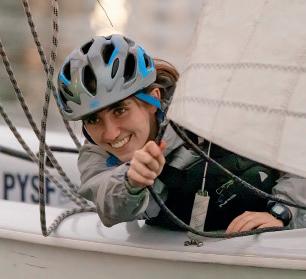
Max K. ’26 and two juniors formed a sailing group in his freshman year, and it has since grown into a nine-student team that trains after school through Peninsula Youth Sailing Foundation in Redwood City. Max and Agata I. ’26 now co-lead the club, where sailors start as crew and gradually take on more responsibility, rotating partners so newer sailors learn from more experienced ones. “We’ve taught half a dozen people how to sail,” Max said. “It’s amazing to watch someone who’s never been on a boat realize how quickly they can pick it up.”
Recess Hiking Club
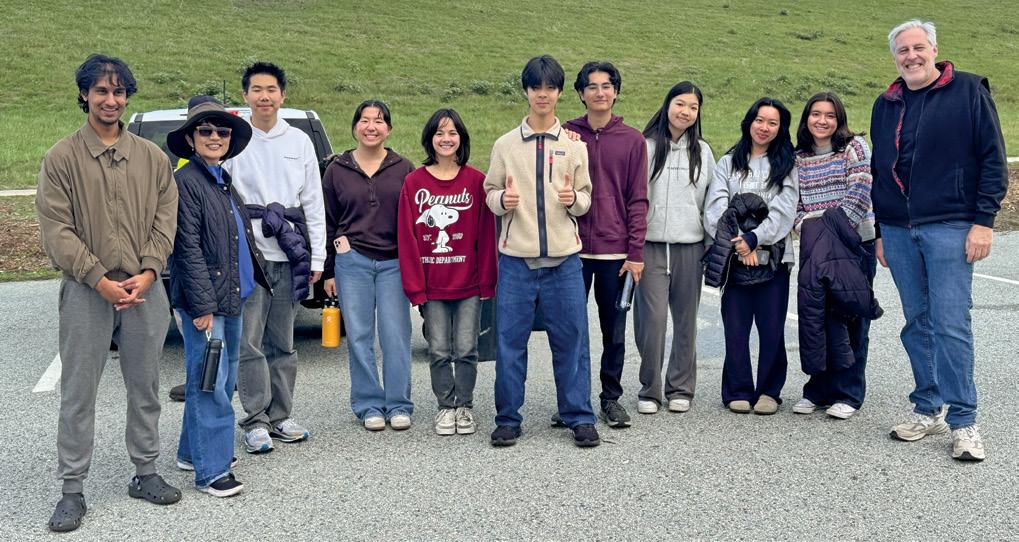
Last year Ruhaan G. ’32, Samit K. ’32, and Atlas A. ’32—all new-to-Nueva fifth graders—quickly noticed the trails around campus and floated the idea of a recess hiking club. By spring, nearly 40 students were showing up on clear days, prompting a waiting list and the search for an additional adult chaperone. The trails became a place for new friendships, sixth graders introducing fifth graders to favorite routes, and a shared Google Form to choose each week’s hike. “The most rewarding feeling is people having fun,” Ruhaan said. “That’s what our club is for.”
The Snoopy Classroom
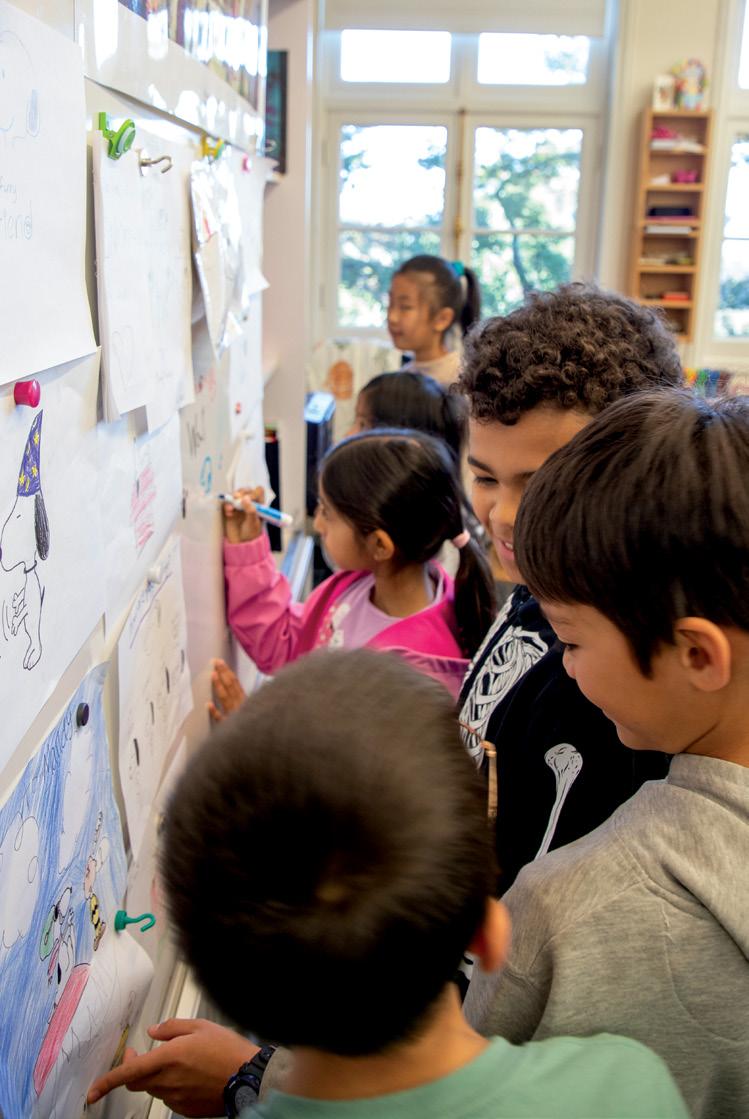
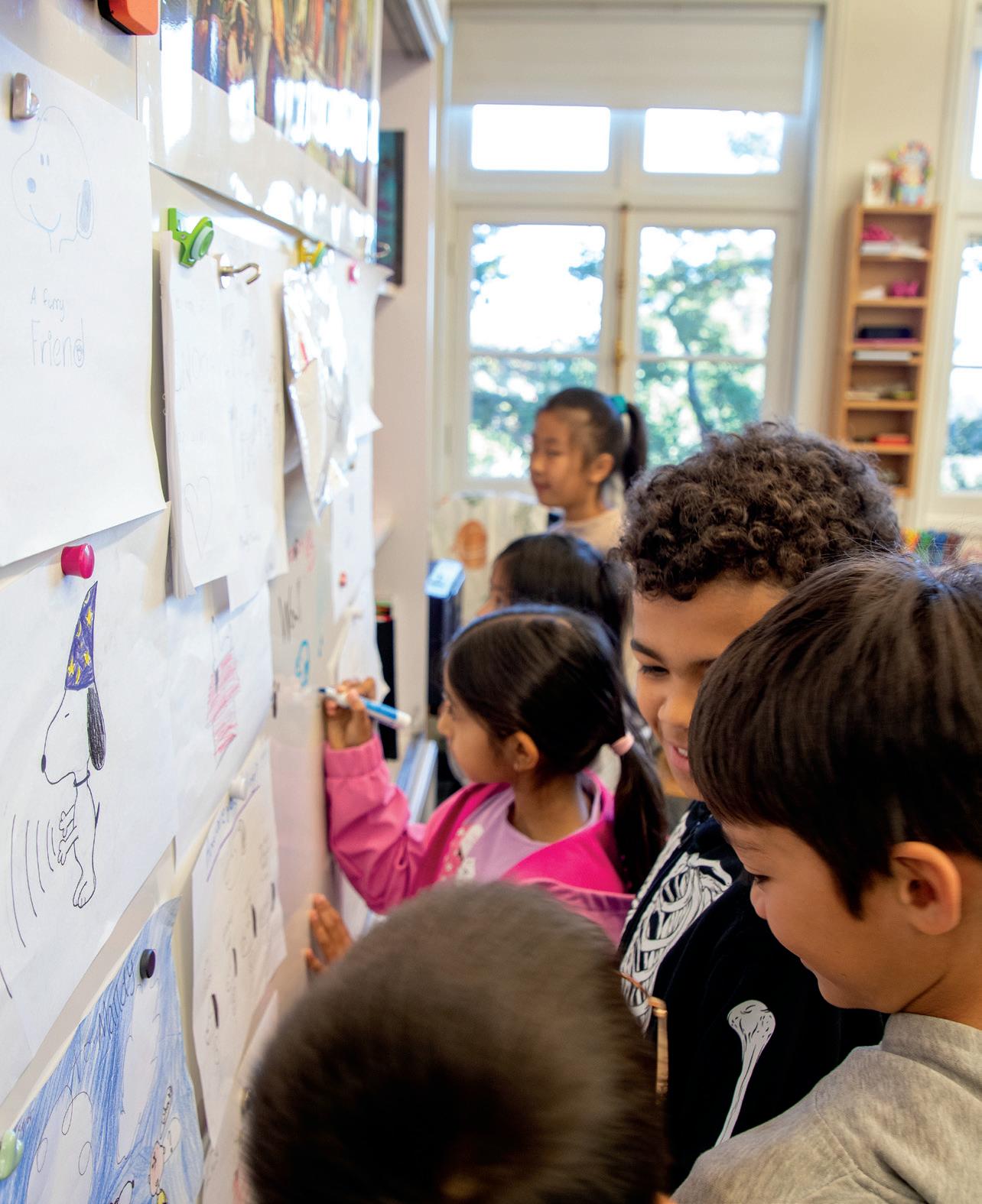
Fourth grade teacher Mandy Yarnall hung up a Snoopy poster and clock at the start of this school year, which led to an unexpected Snoopy takeover. Students led drawing tutorials, sewed Snoopy pillows, filled a “Snoopy Wall” with art, and even voted to hold a Snoopy debate during a future philosophy class. “The students chose to create and sustain the majority of our Snoopy traditions,” Mandy said. “It shows they feel comfortable shaping our classroom culture.”
Kindergarten Shows
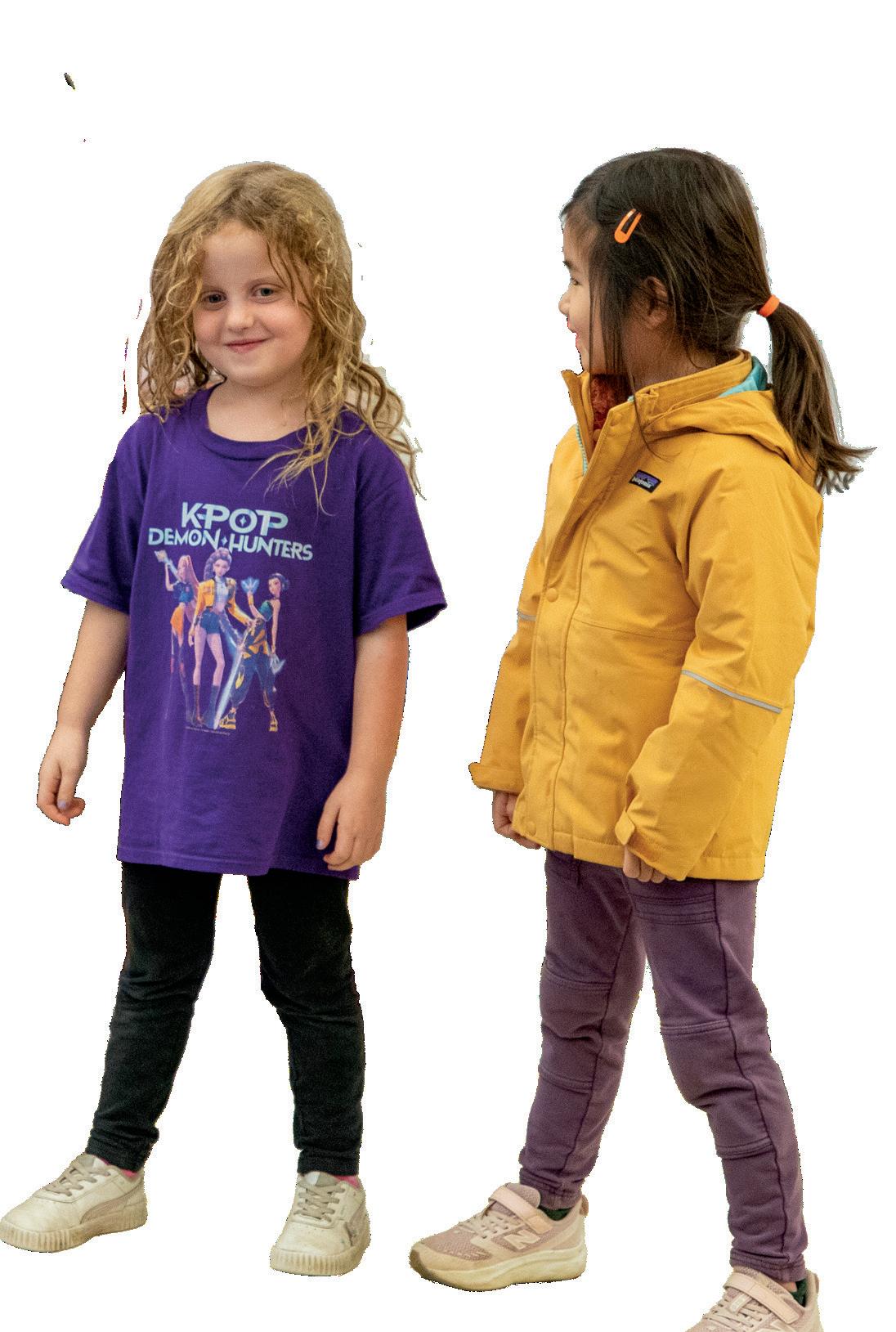
This joyful niche began when Pierce N. ’38 shared a joy of putting on “mini-shows” for his classmates. His enthusiasm quickly spread: classmates began staging their own acts after the closing circle each day, from K-Pop Demon Hunters tributes to improvised adventure tales. When asked how it felt to inspire his peers, Pierce smiled brightly— clearly delighted by the ripple he’d started.
Crafts & Cookies for Causes
Taryn H. ’27 founded this service-center club when she was in eighth grade, transforming a classroom into a calm, screenfree workshop every other week. Students sew and decorate tote bags, braid dog toys for shelters, and write cards for veterans and seniors. Taryn’s favorite memory is hand-delivering holiday cards at a local senior center: “Seeing the smiles on their faces was the best part,” she shared.
Maverick Sports News
At the end of sixth grade, Nik G. ’30 wrote a 10-page NBA report “just for fun” and realized he had nowhere to share it. He reached out to teachers, secured a mentor, and launched the first digital issue of Maverick Sports News (colloquially known as MSN) with a small team of peer contributors. “Once we published our first issue, it finally became real,” he said. Now, two years later, MSN has nearly 15 writers and has expanded from a quarterly newsletter into a real-time website.
GOMAVS
Student-led Publications
What is now Mav Mind, the Middle School literary journal, began as a simple Google Slides project co-founded by Raya I. ’28 and Averie C. ’28. As more writers, artists, and self-described “fussy grammarians” joined, it evolved into a printed, twice-yearly journal with editors-in-chief, genre editors, and design and marketing teams. Each role now has a dedicated apprentice, who shadows the current lead and steps into the position the following year.
At the Upper School, Raya has continued making space for student voices. After discovering that Romanesco, the Upper School humanities journal, had gone dormant for a year, she “just adopted it.” She also co-leads Lit Mag with Senna H. ’26, which showcases student poetry, fiction, creative nonfiction, and art. Both journals rely on their “small but mighty” editorial teams and contributors.
Niches
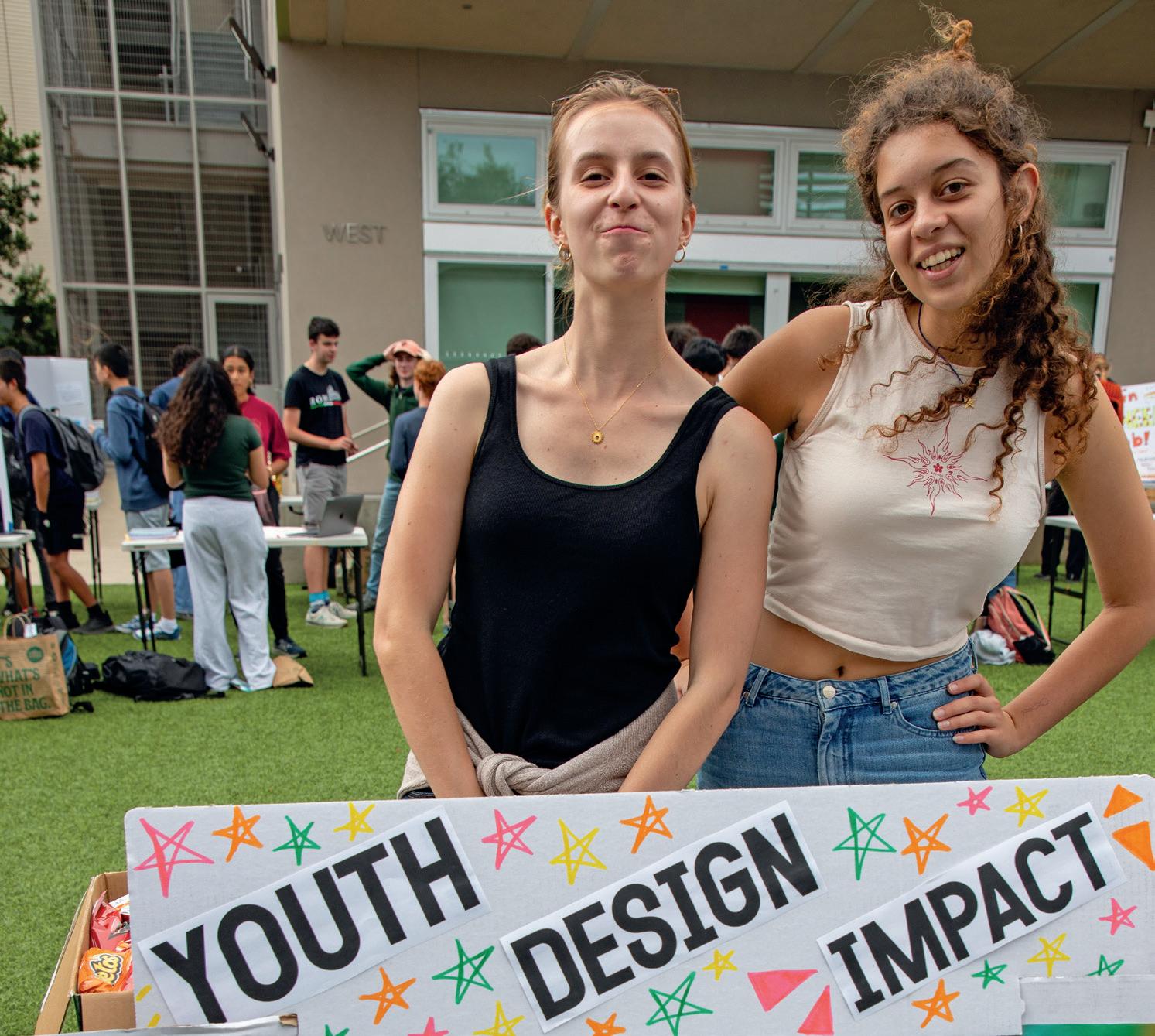
Youth Design Impact
This organization began as Grace B. ’26’s Quest project— redesigning a brochure for her mother’s church—and has since grown into a student-run club supporting nonprofits nationwide with websites, reports, and branding. Grace now leads a crossgrade team that transforms dense Google Docs into clear, professional marketing materials, better equipping organizations to reach the communities they serve.
SALT (Sea, Air, and Land Transit) Club
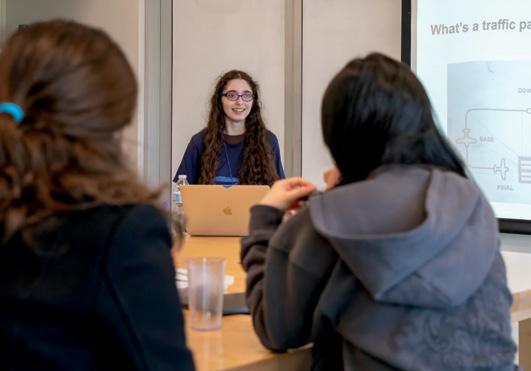
SALT began when Zack M. ’26 rediscovered the Upper School’s old transit club as a ninth grader, where older students sparked his fascination with trains, planes, and urban design. He and co-founder Jacob R. ’26 eventually merged that group with Aviation Club to create one home for all transportation enthusiasts. Meetings range from transit-themed games to student presentations to Jet Lag watch parties—one of which even earned the club signed merch from the show.
“The community is really lively,” Zack says. “We’re all super nerdy about these various vehicles… and even though they’re different, we all appreciate things that move people—and we learn from each other.
Capybara Crew
During a make-believe game one day at recess, Grace L. ’35 refused to stay in character as a cat and kept turning herself into a capybara instead. The bit was so fun that a friend joined in, then another, until there were seven of them. Soon the group had full capybara identities— names like Mango Blossom the Sunbeam and Mandarin Orange the Hot Tub—plus afterlife versions because, Grace said, “Capybaras only live for 20 years.” Their recess culture centers on calm and gentleness, channeling true capybara energy. They sunbathe on the turf, pretend to swim, share fruit, and follow a core rule that “capybaras do not fight.”
Ye Olde Shakespeare Club
For students wary of the Bard, Shakespeare Club is a gentle entry point: co-lead Miah K. ’27 describes it as “99% tomfoolery,” a place where Shakespeare becomes “very unserious and accessible” through chaotic synopses, goofy adaptations, and themed meetings. It’s so welcoming, in fact, that a student who wandered in while hunting a Blammo target still attends today.
Geography Duo
Nolan N. ’35 and Levi S. ’35 each got into geography on their own—Nolan through a deck of flag cards, and Levi through making lists of countries, capitals, and coastlines. When they landed in the same class this year, they realized they shared the same passion and began comparing facts, ranking countries, debating coastline lengths, and quizzing themselves on blank maps. They’ve memorized most of the world’s 196 countries, regularly solve Worldle in under four guesses, and even teamed up for the Middle School GeoBee at last spring’s Humanities Fair—taking second place.
Middle School Chorus
The group began in fifth grade, when Toby G. ’31 and a friend left their longtime choir and still wanted a place to sing together. Toby has kept it going ever since—inviting class mates he knows love singing, welcoming new fifth graders each year, and rehearsing in the Lower School music room, a space he’s known since kindergarten. “I like singing, and I like helping other people sing,” he said. The ensemble has become a regular presence at the winter and spring concerts, and made their GPSF Day debut this past fall. [N]
Teaching Courage, Noticing Kindness
[ SHOUT OUT CARD ]
Diana for being kind and including me in a game.
How Fourth Graders
Built a New Culture of Noticing
Anew ritual took root in the fourth grade this fall, and it’s spreading through the Lower School. It’s called the Beloved Box: a small container, the size of a tissue box, with handwritten notes tucked inside.
These notes represent an appreciable shift in how students are learning to notice one another, care for their community, and take action when it matters.
The Beloved Box began in fourth grade, but the idea didn’t start with celebration; it started with reflection and became transformative growth. At the end of last school year, a third-grade class navigated a challenging moment: a hurtful joke that caused harm. Teachers and students worked together to repair trust and talk about why words matter. They also practiced strategies for responding to hurtful language—how to question, interrupt, educate, or echo support for someone who has been affected or targeted. When the same group of students entered fourth grade this fall, a student came forward to share that similar moments were happening again. The fourth grade teachers responded swiftly: they revisited lessons that had begun the previous spring. Social-emotional learning teacher Keiko Sato helped
students explore the differences between a playful joke, an annoying one, and a hurtful one—and how to tell, clearly and confidently, where the line is.
“Students were already learning to be upstanders,” Keiko explained. “The question became: how do we help them see and name the positive things they are doing for one another, not just the moments when something goes wrong?”
That’s when the fourthgrade teaching team introduced the Beloved Box. Whenever a student notices a classmate or other community member doing something that strengthens the community—being inclusive, supporting a friend, stepping in during a tough moment— they write a “shout-out” card and place it in the Beloved Box. Each Friday during the morning meeting, the fourth grade class opens the box and reads the week’s contributions aloud.
Mandy Yarnall, one of the fourth grade lead teachers, said, “The fourth grade team
STORY BY LIANN YIM
[ SHOUT OUT CARD ]
Nathan and Caden for being great partners to work with on a 60-page math project.
asked themselves, ‘Can we foster more positive connections among everyone? Are there moments where we can laugh and lift each other up in a way that is bridging rather than doing the opposite?’ Since introducing the Beloved Box, I have noticed a lot more intentional kindness being spread.”
Keiko agreed. “We all have that natural negativity bias or a tendency toward noticing what’s going wrong, but we can practice looking for what’s going right—the helpers, the upstanders, the quiet but powerful changemakers in our community. When we notice and celebrate them, we move forward together as a stronger, more caring community.”
What students nominate each other for ranges widely, from moments of inclusion or encouragement to clear examples of upstanding. One note celebrated a classmate for inviting a peer to join in at recess; another recognized someone for interrupting when a mean comment was made. Teachers contribute cards as well, modeling the practice of noticing specific, community-minded behavior.
“It helps us see each other differently,” said Lower School associate teacher Gabriel Gonzalez. “Students feel proud of what they’ve done, but they also learn from hearing what their peers value.”
The Beloved Box isn’t framed as a reward system; the emphasis is on community building. It reinforces the message that care and courage are things students do, not traits they either have or don’t have. At the same time, teachers are intentional about keeping the practice grounded and are careful about striking a balance between celebrating everyday acts while not overinflating them. They want students to recognize the value of these moments—just enough to illuminate the behaviors the community has collectively agreed they want to nurture, without turning them into something students chase.
Crucially, fourth graders have been involved in turning this ritual into a regular practice for the whole Lower School. Students stepped up to lead and steward the box: Aiden W. ’34 and Amari O. ’34 created a poster to explain
the purpose of the box to students in other grades. At a Lower School Community Gathering, Lexi K. ’34 and Daphne Z. ’34 presented about IQEE (Interrupt, Question, Educate, Echo), a framework that gives students tools for responding when someone’s words or actions cause harm. They explained how this protocol can support classmates, clarify misunderstandings, and help keep the community safe and respectful.
Highlighting and encouraging bravery was part of their presentation, Lexi said. “If you’re brave enough to stand up, then you can change the community.”
A community-wide Beloved Box was placed on the Belonging Bridge (on the second floor of the Lower School Building), in addition to the original box that lives in the fourth grade classroom. Notes submitted to the schoolwide box are turned into a garland suspended on the walkway, a visible reminder of how many acts of kindness and courage happen each week.
Strung along this walkway that students travel daily, the garland signals that belonging is ongoing work—and that students are capable contributors to that work.
The fourth graders were excited to share about the Beloved Box and how it builds community, one shout-out at a time.
“I think the hope is just to bring our community together and to encourage people to help each other,” Aiden shared.
“I really like it because it feels really special to people to be appreciated,” said Amari, who said firmly that the box had made a difference for how he feels at school this year. “It felt really special to me when I got called.”
“Their leadership emerged naturally,” Lower School Division Head Megan Terra noted. “They moved from addressing a challenge to repairing it, then to imagining what a strong community could look like, and finally to showing the whole Lower School what they had learned.” [N]
[ SHOUT OUT CARD ]
Emily and Claren, for helping me stand up for someone when a friend said something
ALUMNI
NEWS FROM NUEVA ALUMNI
A WILD WELCOME BACK
Members of the Classes of 2017 to 2025 returned to campus on Jan. 9 for the annual Young Alumni Social and an alumni-only Intersession. After reconnecting with friends and former teachers, alumni headed to a special Conservation Ambassadors session—where things got a little wild! From baby joeys to snakes and skinks, the group enjoyed a hands-on experience learning about rescued and rehabilitated wildlife.
Dear Alumni Community,
The many ways you stay connected to Nueva and in which you so generously support our school are truly special and unique. Thank you, thank you, thank you, Nueva alumni! We are filled with gratitude for moments we’ve shared together.
Some highlights from this fall and winter include the regional events in Boston, New York, and Washington, D.C., and, of course, seeing so many of you during your visits back to campus. We heard about pursuing new opportunities, diving further into personal passions, and the deep appreciation you have for your Nueva community. You can read about these updates and so much more in the Class Notes (see p. 60).
An essential part of our alumni program is hearing from you. Your feedback, ideas, and requests are critical and shape the programming, events, and initiatives we offer, ensuring they reflect what matters most to you. In December we hosted a joyful Home for the Holidays social, an event sparked from outreach from alumni attending quarter system schools whose schedules prevented them from attending our annual January Young Alumni Social (see p. 46).
A heartfelt reminder: you are always invited and welcomed back home to the Hillsborough and San Mateo campuses. Visit us anytime! We are equally eager to stay connected and hear from you wherever you are. Please don’t hesitate to reach out—your voice helps guide what’s next for the Nueva alumni program and we want to stay in touch with you!
Sincerely,
DIANA A. CHAMORRO
Associate Director of Development for Alumni & Community Engagement
ELIZABETH GOMEZ
Alumni Relations Manager
MEET
ELIZABETH!
A Bay Area native whose background includes working in independent schools in development and alumni relations and as a classroom teacher, Elizabeth Gomez will support all aspects of the alumni program. She shared, “I’ve enjoyed connecting with many of you this past fall! If I haven’t met you yet, I hope to see you at an upcoming event or on campus soon.”
Forbes 30 Under 30
An impact-oriented problem-solver, Gabe Adzich ’12 was named a Forbes 30 Under 30 in early December, for his work as co-founder of WKND HRS. The game-changing marketing agency built to not only strategize content brands need, but execute across disciplines—production, design, digital, and experiential in one seamless infrastructure. Now with a global portfolio, Gabe and WKND HRS have produced collateral for Intel’s AR (augmented reality) giveaway at Outside Lands, Nike and Hyperice’s product launch, Bodyarmor’s website rebrand, and more.
Chosen from more than 20,000 nominations across 20 industries, Gabe’s selection to the Forbes U.S. list was a lifelong aspiration. “It’s one of those moments that makes you stop and realize how far you’ve come. Back in Middle School at Nueva, I’d flip through Forbes lists thinking, ‘One day, I want to build something worthy of being here.’”
According to Gabe, WKND HRS started from nothing and grew from there. “No industry connections, no traditional credentials,
GABE ADZICH ’12 NAMED
“In sixth grade, my friends and I decided to build a go-kart despite zero engineering knowledge. We sketched ideas, destroyed prototypes, iterated relentlessly, and eventually created a fully functional vehicle we drove around campus. That experience fundamentally rewired how I approach impossible-seeming challenges.”
<< GABE ADZICH ’12
just conviction and relentless work. We never chased recognition. We chased impact, velocity, and to build something the industry hadn’t seen before.”
Years in the making, Gabe’s hustle and resilience were critical when WKND HRS faced numerous rejections. That drive eventually led to a breakthrough meeting and partnership.
“We were completely out of our depth, but we had the confidence that we could solve any problem thrown at us. That belief system traces directly back to Nueva,” Gabe insisted. “So many projects [at Nueva] were beautifully undefined: no roadmap, no template. You had to architect your own solution.”
Gabe’s advice for the next generation of Nueva changemakers: “Nueva doesn’t teach you what to think. It teaches you how to think: adaptively, creatively, independently. That’s the rarest and most valuable asset in any field. Protect your unconventional thinking like it’s sacred. It’s rare, it’s powerful, and the world will constantly pressure you to think conventionally. The biggest opportunities belong to people who can see around corners, spot patterns others miss, and connect dots that seem unconnectable.”
STAY CONNECTED!
MavNet: Visit nuevaalumni.org to claim your profile, connect with your Nueva alumni community, and register for upcoming events!
Job Board: Does your team or organization have job or internship openings? Share them with the Alumni Office (alumni@nuevaschool.org) and help a fellow Nuevan expand their professional experiences!
OFFICEMATES
While working together at Palantir in New York City, Class Rep Aryan Mehra ’25 and David Foster MS ’15 discovered a special connection: they’re both Nuevans! Aryan is an AI engineer, while David is the chief of staff for Palantir’s U.S. healthcare sector.
FROM NUEVA TO “JEOPARDY”
VICKIE TALVOLA ’17 COMPETED ON “JEOPARDY” IN LATE SEPTEMBER, ACCUMULATING $26,400 IN WINNINGS. SHE WAS INVITED BACK IN EARLY JANUARY TO PARTICIPATE IN THE CHAMPIONS WILD CARD TOURNAMENT.
REGIONAL REUNIONS
We kicked off the year by visiting alumni in Boston, New York City, and Washington, D.C. These unforgettable regional reunions brought together members of the Classes of 1977 to 2025 to reconnect, strengthen old ties, and warmly welcome our newest alumni into the community.
1. Ava Cabreza ’25, Sandra Luo ’25, Vinca Lu ’25, Alaric Li ’25, Luka Kirgin ’25, and Luki Deitchman ’25
2. Kolby Heap ’19, Ian Lum ’22, and Daniel Tabatabaei ’23
3. Boston social attendees
4. Sandra Luo ’25 and Vinca Lu ’25
5. Washington, D.C. social attendees: Head of School Lee Fertig, Devika Mathur ’25, Gabe Hawkins ’24, Parker Phillips ’19, and Sophia Vahanvaty ’19
6. New York City social attendees
7. Neha Govil MS ’15, Arun Johnson ’19, Matthew Salah ’17, Julienne Ho ’19, Leo Ikle-Maizlish ’19, Tyler Poon ’20, and Zach Smirin ’20
9. Leo Stoll ’25, Aria Gao ’25, Marcus Hirschman ’25, Jackson Lee ’25, Winnie Cheston ’25, and Aryan Mehra ’25
10. Noah Sissoko ’11 and Head of School Lee Fertig
EVENTS
Home for the Holidays
alumni return home for festive cheer and friendly competition
As alumni returned to the area to celebrate the holiday season, they had an important stop—Nueva! Members of the Classes of 1995 to 2025 attended the inaugural Home for the Holidays social, where they spent time catching up with one another and faculty over hot cocoa, apple cider, and festive treats.
“Home for the Holidays was a great experience and it was fun to see how the school has evolved since I graduated,” said Class Rep Jesse Valdez ’17. “It was especial ly meaningful to see all the familiar faces who helped us through our Nueva journey and shaped who we are!”
For some alumni, it was a long-awaited homecoming and for others it was their first on-campus event since their graduation.
“I loved seeing friends and classmates at this reunion,” said Gabe Hawkins ’24. “It will always be surreal to see how we—my peers and I—have grown toward the adults we aspire to become.”
The day culminated with the annual alumni soccer and basket ball games. Bringing together former teammates, the games were a mix of friendly competi tion and spirited fun for alumni and current members of the boys’ and girls’ soccer and boys’ basketball teams.
When Curiosity Comes Home
Alumni lead a vibrant offering of Intersession courses
DID YOU KNOW?
alumni facilitated sessions and activities this year— an 86% increase from 2025!
Intersession has long been one of Nueva’s most distinctive and beloved traditions. Founded as “minicourse week” in Nueva’s earliest years, every year Intersession continues to invite students to explore freely—this time alongside alumni who have returned to share the passions they once discovered here. Thirteen alumni returned to campus to lead hands-on courses—from culinary explorations to aviation, sewing and fabrication to classical Athens, and so much more—bringing their passions back to the program that first encouraged them to explore.
STORY BY DIANA A. CHAMORRO
Luca Lit ’23 (below, pictured right) returned for the third consecutive year to co-lead a Neapolitan-style pizza session. In one class, students learned how to turn basic ingredients into a delicious dish.
Kevin Hwong ’23
Alongside classmate Luca Lit ’23, the Connecticut College biochemistry major and men’s soccer player returned for the third consecutive year to lead an artisanal pizza-making class.
What excites you most about teaching at Intersession? We always love seeing students who don’t have much cooking experience take our class and walk away with new skills and newfound confidence. In addition to the physical cooking skills we teach, we love sharing the rationale and science behind the cooking techniques and recipes we use.
In high school, many of our friends used to run pop-up food stands for the community. We thought it would be a lot of fun to return and continue to share our love for cooking with students.
How has your Nueva experience influenced what you are currently pursuing? I took all of the high school chemistry electives Nueva offered and became very passionate about organic chemistry, which is currently what I’m planning to pursue after graduation.
Charlotte Applebaum ’23
After teaching at Reed College’s equivalent of Intersession, the junior studio art major and author of an aviation-themed comic series led “How to Fly a Plane!” at Intersession for the first time.
Tell us about your session. I’m a student pilot and I think the interdisciplinary nature of aviation is underappreciated. I’ve always been interested in aviation—long before coming to Nueva, though Nueva was a supportive environment for being interested in a quirky field. I hope my session made the arcane terminology of aviation more accessible to the average non-pilot. There are so many wild and wacky fun facts about aviation that are just plane cool!
Why is Intersession memorable? I love that Intersession supports wild and free exploration of practically anything and everything from Lower School all the way up through high school—making it clear that such exploration is important (not to mention fun!) no matter how young or old someone may be. I appreciate how Intersession gives students at every age an opportunity to discover new things and go down roads they haven’t gone down before! As a student, I liked how Intersession gave me a chance to dip a toe into something without having to commit to it on a formal, long-term basis. Intersession has inspired me to keep dipping my toes in things in my adult life going forward!
Russell Jong ’75
Returning for the third year, the retired tech and startup veteran led “Culinary Explorations: Insights into the World of Restaurants, Kitchen, and Hospitality.”
Tell us about your session. Although I have had a career in technology and startups, I’ve also had a parallel career in cooking, food, and the hospitality industry. My course explored the origin of restaurants and their evolution over time—from ancient developments in both Europe and Asia to today’s fast-food, takeout, and delivery culture.
What inspired you to teach at Intersession? As someone who doesn’t necessarily have a professional background in food, I still appreciate food, the culture it creates, and the people who prepare meals—and I want
to share that passion with students. It was exciting to engage students in topics they may not have considered and to expose them to points of view that they may not have heard of before.
Did your time at Nueva spark your interest in this field? Surprisingly, yes, in the culinary field. I remember when I was in third grade and my teacher’s wife joined the class to show us how to make Italian dishes. Then in fourth grade, my teacher showed us how to make French crêpes.
Tell us about your Interessession experience. When I was attending Nueva, Intersession was called “mini-course week,” where non-curriculum topics were offered by both teachers and external instructors. Some of the memorable subjects were: Italian cooking, French cooking, ancient Egyptian history, advertising, and nature trail building.
Callisto Lodwick ’22
SAGE ADVICE
Charlotte Applebaum: Have the confidence to jump right in without first ascertaining that something would work out, and persist through the failures when things inevitably don’t work out sometimes.
Russell Jong: Follow your interests, enjoy what you do, incorporate curiosity into every endeavor. Don’t be pigeon-holed into other people’s expectations for your career and life’s path. Remember that your enthusiasm is contagious and learning to adapt to ever-changing circumstances will be your greatest talent.
Callisto Lodwick: Put yourself out there! You can achieve things that seem almost impossible if you set your mind to it!
Supporting Intersession as both a staff member and a facilitator, the University of St Andrews fourth-year returned to lead “Pots and Parthenons,” a session about classical Athens.
What excites you most about teaching at Intersession? I really believe in making learning fun, and the attitude of Nueva students at Intersession allows me to do this—it is a relaxed and inquisitive vibe. I want students to feel free to ask questions, make comments, and raise points; in other words, treating it like a conversation with friends. I'm not that much older than the kids, so I don't want it to feel scary in any way!
What key takeaways do you hope students walk away with? I hope students found history and archaeology exciting, engaging, and fun! I also hope students get a sense of what studying classics at university is like, and hopefully encourage them to take up the subject when they go to college.
Did your time at Nueva spark your interest in this field?
my lessons on ancient Greece in ninth grade and my Intersession classes on the Romans, but what really sparked my interest is that my father is an archaeologist. The lesson is actually adapted from a class he himself taught many years ago!
Natalie Sepulveda ’25
A first-time facilitator, the Wesleyan freshman led a session titled, “Thanks, I made it! DIY Overalls” for Upper School students.
Tell us about your session: I led a two-day overall-making session that included a brief design portion, a pattern-making portion, and a sewing/fabrication section. I hope the session gave students an expedited overview of what it looks like to sew your own clothes—the skills to use a sewing machine, draft their own patterns, and develop or further their interest in making their own clothes.
How has Nueva influenced what you’re pursuing at Wesleyan? Nueva taught me a lot about interdisciplinary study, which feels incredibly relevant to my current coursework and what I’m envisioning for my next four years (and maybe even beyond). I have a lot of different interests, some of which I never thought I’d be able to put together. My time at Nueva helped me understand—and be open to the idea— of something like ethnomusicology, which is now informing and inspiring my studies.
What advice do you have for current Nueva students? Remember to take advantage of the non-academic opportunities. I think a lot of students can get caught up in the academic and professional opportunities at Nueva, but the resources we have also provided us with opportunities for fun and decompressing, which is important. Go to Intersession, enjoy your trips, write letters for your friends during Kindness Week. You don’t need to focus on academics all the time.
“The Nueva community is incredibly special. I’ve made some of my closest friends working at Nueva Summer, and I jumped at the opportunity to be back in this community.”
Annie Mengarelli MS ’18
Annie Mengarelli MS ’18
Leading sessions for all three divisional Intersessions, the University of Virginia fourth-year taught culinary and creative arts sessions, coached volleyball, and shared insight on pursuing careers in education.
What inspired you to teach at Intersession? In my first year working Nueva Summer, I trained and supervised a group of high school teaching assistants. Last summer, I had the opportunity to teach first through fourth grade students about their senses of smell. That was truly one of the best experiences I’ve ever had. So, I thought Intersession would be an exciting opportunity to get back into the classroom. I hope that my students bonded with their classmates, learned a new skill, discovered a new hobby, and most importantly, had fun!!
What are you currently pursuing? I am double-majoring in youth and social innovation and English. I’m hoping to pursue a master’s degree in education next year and eventually become an elementary school teacher.
Did Nueva influence what you’re currently pursuing? I had many inspiring teachers during my time at Nueva. Growing up, I never felt a strong connection to any one subject, but the classes I loved were the ones taught by my favorite teachers. For me, the subject didn’t matter—I loved English, physics, biology, math, Spanish, and history because of the amazing teachers I had for those classes at Nueva. It didn’t take me long to realize that I wanted to be the teacher who could make students love any subject.
What advice do you have for current students? Do the thing that makes you uncomfortable. I’ve made many choices over the course of my life, and the ones that have made the biggest impact and have led me to the most success have been the options that scared me the most.
Maverick Meetups
Mavericks were on the go throughout the summer and fall! From regional reunions to #NuevaNosh get-togethers, alumni enjoyed reconnecting both stateside and abroad. What is #NuevaNosh? When three or more alumni gather over a meal or coffee, the Alumni Office will reimburse them up to $50. Visit MavNet to learn more!
PALO ALTO, CA ↓
In August, Ben Garvin ’22 (Cal Poly), Jackson Gressler ’22 (CSU Long Beach), April Zhang ’22 (Claremont McKenna), Arielle Choi ’22 (USC), and Sam Rosales ’22 (UC Santa Cruz) #NuevaNoshed at Mendocino Farms.
← SAN MATEO CAMPUS College counselor and USC grad Phil Moreno and current USC first-year Gray Chan ’25 caught up about campus life.
BARCELONA, SPAIN ↓
While studying abroad in Barcelona, Eliza Shields ’23 (Miami) reunited with Nico Burlison ’23 (Claremont) and Anya Potsiadlo ’23 (Colorado College) for a Halloween #NuevaNosh at Parking Pizza. Nico studied in Vienna and Anya was in Madrid.
SYDNEY, AUSTRALIA ↓
Sam Jonker ’23 (Stanford), Nixie Herlick ’23 (Villanova), and Juliet Sostena ’23 (Stanford) #NuevaNoshed at Jazushi in the Surrey Hills neighborhood.
LOS ALTOS, CA ↑
Class of 2024 friends hosted a summer #NuevaNosh at
Soussan (Illinois), Logan Ramanathan (Brown), Lauren Stoffel (Stanford), and Sam Zukin (Dartmouth).
SANTA ROSA, CA ↑
Natalie Co (UNC), Luki Deitchman (Boston U), Lopez-Parra (gap year), Hazel Barnes (gap year), and Emil Al-Shaikh (gap year) hosted the first Class of 2025 #NuevaNosh in July.
→
SAN MATEO, CA
Michelle Zhang ’23 (Pomona), Stephanie Liu ’23 (Swarthmore), and Cherise Wong ’23 (Caltech) enjoyed an al fresco #NuevaNosh picnic.
SAN MATEO CAMPUS → Steven Hwang ’22 (Stanford) visited Mandarin Teacher Jamie Gao (right), and his younger brother, Jonathan ’26, in late August.
Sushi 85 & Ramen. Pictured: Ani Velaga (Cornell), Kelly Poon (UC Berkeley), Reese Gannon (UCLA), Navon
BURLINGAME, CA ↓
Members of the Class of 2025 celebrated Friendsgiving. Back row: Max Spivakovsky (Stanford), Ethan Dietcher (UChicago), Logan Xu (UChicago), Brendan Wan (UChicago), Sam Sirota (Tufts), Landon Xu (Northwestern), James Lee (Princeton), Charlotte Rosario (Stanford), Leo Stoll (NYU), Anjuli Mishra (gap year), and Henry Chen MS ’21 (UPenn). Front row: Leah Triantos (Johns Hopkins), Lena Chow (Middlebury), Cami Yen (Stanford), Nathan Schneider (Santa Clara), and Liv Rhee (Northwestern).
REDWOOD CITY, CA ↑
Recent college grads Sian Bareket ’21 (Smith), Willow Taylor Chiang Yang ’21 (UNC), and Daniel Arad ’21 (UChicago) #NuevaNoshed at Mazra in early August.
LAKE TAHOE, CA ↑
Classes of 2020 and 2023 alumni celebrated the Fourth of July together.
Front row: Nixie Herlick ’23 (Villanova), Eliza Shields ’23 (Miami), Anya Potsiadlo ’23 (Colorado College), and Stephanie Shields ’20
Back row: Stanley Wang ’20, David Shields ’20, Josh Francis ’20, Luke Pemberton ’20, Ethan Fong ’20, Chris Martin ’20, and Amit Singh ’20
MENLO PARK, CA ↑
Members of the 12th grade Taiwan trip gathered at the Dutch Goose on July 24. Pictured: Max Spivakovsky ’25 (Stanford), Gavin Zhang ’25 (Cornell), Cami Yen ’25 (Stanford), Landon Xu ’25 (Northwestern), William Zhu ’25 (UPenn), Leah Triantos ’25 (Johns Hopkins), Associate Head of School Terry Lee, and Brendan Wan ’25 (UChicago).
PALO ALTO, CA ↑
Cross country alumni Teddy Gaillard ’25 (gap year), Natalie Sepulveda ’25 (Wesleyan), and Gabriel Bernstein ’25 (Haverford) #NuevaNoshed with former teammates Ryan F. ’26, Jonathan H. ’27, Ashwin P. ’28 at Dumpling Hours.
ANAHEIM, CA ↑
Before heading off to college, Rohan Tummala ’25 (UC Berkeley), Ethan Huynh ’25 (Tufts), and Max Roche ’25 (Tufts) #NuevaNoshed at the Blue Bayou at Disneyland.
SAN MATEO, CA ↑
In mid-October, Quinn Armentrout ’21, Daniel Hwang ’21, and Bayan Shimizu ’21 #NuevaNoshed at Urban Momo in downtown San Mateo.
← BELMONT, CA
Jacob McNab ’25 (Case Western), Daniel Risk ’25 (Stanford), Gabriel Bernstein ’25 (Haverford), Natalie Sepulveda ’25 (Wesleyan), Cam McDonald ’25 (Bowdoin), and Stanley Wang ’20 (not pictured) attended our Summer Sendoff hike at Waterdog Lake Trail and lunch at Slice House on Aug. 4.
SAN FRANCISCO, CA ↑
Members of the Class of 2019 Kiki Kim, Gitika Pahwa, Arya Goutam, Sophia Yang, Osher Lerner, and Elise Meike reconnected for a ramen #NuevaNosh at Hinodeya Ramen Bar in the Marina.
SAN MATEO, CA ↑
Aaron Huang ’24 (Northwestern) coordinated a #NuevaNosh dinner at Avenida on July 20. Pictured: Aaron, Greyson Sloan MS ’20 (ArtCenter), Gabe Ancajas ’24 (Pomona), and Julian Kleinknecht ’24 (St Andrews).
SAN MATEO, CA ↑
Marcus Hirschman ’25 (UPenn) visited Assistant Director of Communications & Upper School Journalism teacher LiAnn Yim over his fall break.
Maverick Meetups
SAN MATEO CAMPUS → Upper School Division Head
Liza Raynal ’95 reunited with former Middle School student
Rina Addiego ’08, who was visiting classmate and current Upper School I-Lab Shop
Manager Zoe Monosson ’08 on Sept. 24.
SAN MATEO CAMPUS ↑
Members of the Class of 2024 enjoyed a final get-together on campus before heading off to college. Pictured: Charlie Berk Mason Choey (UCLA), Cullen Dearing (UC Berkeley), college counselors Paul Gallagher Phil Moreno, Bodie Currier Anping Zhu (Yale), and Syon Patel (Vanderbilt).
SHENANDOAH NATIONAL PARK, VA ↑
Jenna Lange
,
← NASHVILLE, TN
Selin Kandemier ’24 (Vanderbilt) visited with Nueva journalism and yearbook students (pictured junior Alexis C.), who were in town for the National High School Journalism Convention.
, and
AMHERST, MA ↑
Vinca Lu ’25 (Amherst), Sebastian Johansson ’25 (Amherst), and Eleanor Arron ’25 (Williams) set aside their school’s rivalry and met up for a #NuevaNosh at Works Bakery on Oct. 12.
BOSTON, MA ↑
Class
of 2025 friends Hazel Barnes (gap year), Luki Deitchman (Boston U), Jacob McNab (Case Western), and Izel Lopez Parra (gap year) hosted a pre-Thanksgiving #NuevaNosh.
’19
Sophia Vahanvaty MS ’15
Audrey Kost ’19 backpacked through Shenandoah National Park in early October.
CHICAGO, IL ↑
During a break from classes at UChicago, Davis Turner ’22, Pascal Descollonges ’22, Alasdair Dodd ’22, Eva Smolen ’22, and Sarah Willrich ’22 #NuevaNoshed at Virtue Restaurant on Nov. 19.
MEDFORD, MA ↑
Ian Lum ’22 (Olin College), Ryan Poon ’22 (Tufts), and Brandon Zhou ’22 (Carnegie Mellon) reunited for a #NuevaNosh and board game night at Tufts on Oct. 13.
WASHINGTON, D.C. ↓
Class Rep Devika Mathur ’25 (Georgetown) caught up with Leah Triantos ’25 (Johns Hopkins) in mid-August.
NEW YORK, NY ↑
Stanley Wang ’20, Pranav Ram ’20, and Ethan Fong ’20 #NuevaNoshed at Cote Korean Steakhouse in the Flatiron District.
NEW YORK, NY ↑
Luca Nashabeh ’22 (Columbia), Sophia Di Giovanni MS ’18 (Princeton), Maya Avida ’22 (Princeton), and Brandon Cho ’22 (Princeton) #NuevaNoshed at Haile in the East Village.
NEW YORK, NY ↑
Class Reps Brendan Wan ’25 (UChicago), Jackson Lee ’25 (NYU), and Leo Stoll ’25 (NYU) #NuevaNoshed at Ramen Takumi in early September.
NEW YORK, NY ↑
Anika Kwan ’18, Talia Schonberger ’18, and Evan Sucherman ’18 enjoyed a Korean barbecue
NEW YORK, NY ↑
Neeraj Sharma ’18 coordinated a #NuevaNosh with Adam Keller ’18 and Talia Schonberger ’18 at Potluck Club on the Lower East Side on Sept. 7.
NEW YORK, NY ↑
After hosting the New York regional social in early November, Director of Development Lyla Max, Associate Director of Development Diana Chamorro, Head of School Lee Fertig, Cooper Mills ’19, and Associate Director of College Counseling Phil Moreno enjoyed dinner at Veselka in the East Village.
DURHAM, NC ↑
Director of College Counseling Gavin Bradley met with Alex Wagonfeld ’24 and Natalie Lai ’25 at Duke in mid-November.
→ WASHINGTON, D.C.
Anahita Asudani ’23 (Georgetown), Rajeev Sharma ’22 (UChicago), and Class Rep Devika Mathur ’25 (Georgetown) #NuevaNoshed at Yellow Cafe in September.
←
NEW YORK, NY
In November Oliver Cho ’25 (Princeton), Aryan Mehra ’25), Leo Stoll ’25 (NYU), and Jackson Lee ’25 (NYU) reconnected in the Big Apple.
SAN MATEO CAMPUS ↑ Sasha Cocquyt ’24 (Princeton) and Aria Gao ’25 (Princeton) reunited with Upper School Mandarin teacher Jamie Gao on Oct. 15.
Dorm Tour
Dorm living began this fall for members of the Class of 2025. Take a look at how they made their new spaces their own, with a touch of Nueva!
Lara McDowell University of North Carolina
Luki Deitchman Boston University
Charlotte Rosario Stanford University
Ethan Huynh Tufts University
Maya Sprosts Harvey Mudd College
Kayte Chan University of Southern California
Josie Belfer Northwestern University
Liv Rhee Northwestern University
Marcus Hirschman University of Pennsylvania
BRIEFS
2012
Jordan Kuklin completed a multi-year fellowship at the Consumer Financial Protection Bureau in June 2025. After taking the summer off and enjoying a trip to London, he is pursuing graduate studies at Harvard’s Kennedy School.
2017
WE WANT TO HEAR FROM YOU!
Do you have news or personal updates you’d like to share?
We invite you to submit a class brief about exciting personal events, including marriages or new arrivals, professional experiences or accomplishments, recent travel, reunions with fellow Nueva alumni, and more. nuevaschool.org/ classnotes
Oliver Cho, a Berklee College of Music graduate, is an Apple Music podcast and radio producer and a caretaker for their grandmother. They are looking forward to future opportunities which hopefully include more music and connecting with fellow Nuevans. ¶ Henry Phipps lives in Los Angeles, CA and is a project manager at Suno, an AI-generated music platform. Outside of work, he enjoys playing the piano, spending time in the ocean, and practicing yoga. ¶ Jesse Valdez* founded Enthusiasm PR, a public relations and marketing firm in Los Angeles, CA. Her firm specializes in working with small businesses to support brand marketing, press placement, and media coverage. Jesse has also started background acting and recently landed a role as a dodgeball player in a film called Bad Eggs ¶ A middle school science teacher in the Medford public school system, Hannah Zuklie resides in Cambridge, MA with
her partner and fellow Nuevan, Om Gokhale ’18
2018 Brooklyn, NY-based Julianna Garber is a member of Governor Kathy Hochul’s re-election campaign team. During their free time, Julianna enjoys working behind the scenes on short films as part of the camera crew or as an intimacy coordinator. ¶ Om Gokhale* works as a designer and graduate researcher at MIT’s Media Lab, where he focuses on ethical human-computer interaction and civic health. Outside of school, Om volunteers as a tour guide at the Harvard Natural History Museum, consults as a designer,
and frequently travels to coastal Maine with his partner, Hannah Zuklie ’17 ¶ Neeraj Sharma lives in New York City and works in the trading industry. While on garden leave (the non-compete period), he volunteers at the Riverside Park Conservatory and NYC Food Bank. In 2025, he spent time traveling, visiting Belgium and London with partner Talia Schonberger ’18 in the summer and India and Nepal with his dad in early fall.
2019
Ben Cheng is a firstyear medical student at Northwestern’s Feinberg School of Medicine. He is enjoying medical school and
Hannah Zuklie ‘17 and Om Gokhale ‘18 visiting New York City’s Central Park.
is exploring what specialty he would like to pursue—he is currently leaning toward a subspecialty of internal medicine or pediatrics. ¶ Appointed by California Governor Gavin Newsom, Audrey Cho is a legislative and policy advisor. She began her role in September 2025, working on projects related to the Delta Plan Policy. She has previously worked on initiatives related to environmental justice and climate change. ¶ Julienne Ho* resides in Hoboken, NJ and works at an engineering firm in New York City. Outside of work, she has developed a passion for ceramic arts. She shares: “If you’re in the NYC area, come visit!”
¶ Sarah Hope lives in Los Angeles, CA and works in advertising. ¶ Kiki Kim recently relocated from San Francisco, CA, to Madison, WI, to begin a new role at the healthcare software company Epic Systems. In June 2025, she earned her master’s in linguistics, philology, and phonetics at the University of Oxford. ¶ UC Berkeley graduate Osher Lerner is working at an AI startup for accountants alongside his brother, Yoni Lerner ’17
¶ Elise Meike lives in San Francisco, CA and works as an EMT, where she is making a direct and meaningful impact on her community.
¶ Cooper Mills is a financial analyst solving financial and grants management challenges for environmental, women’s health, and other progressive non-profit organizations. He also stays connected to Nueva
Neeraj Sharma ’18 and his dad, Arvind, during their trip to South Asia.
by serving on the school’s Development Committee. Cooper resides on the Upper East Side in Manhattan and enjoys jiu jitsu, partner dance, and taking walks in Carl Schurz Park. ¶ Ph.D. candidate Aster Taylor is studying astronomy and astrophysics at the University of Michigan.
2020 Greyson
Sloan (MS ’20) spent summer 2025 drawing, relaxing, and working at a local teashop. He enjoyed traveling to Houston to visit family, as well as reconnecting with fellow alumni for a Nueva Nosh before heading back to campus. In the fall, he headed back to the ArtCenter College of Design in Pasadena, CA. ¶ Cory Turnbaugh relocated from Chicago to New York City. He works as an assistant for a classical composer, while
building his own portfolio of concert and film music. In addition, he is a high school tutor working with students on their college essays and AP language and literature exam preparation. Cory is loving living in Manhattan, attending and performing in all kinds of shows, and meeting new people constantly.
2021 Quinn
Armentrout graduated from UC Santa Cruz with a B.S. in biochemistry and molecular biology. While pursuing his next professional opportunity, he is working as a photographer on dinner cruises and enjoying taking care of his cats. ¶ Fulbright research fellow Sian Bareket is conducting research at the University of Tokyo. Her work focuses on renewable and nuclear energy, examining factors such as previous
government policies and traditional Japanese beliefs. As part of her research, Sian visited power plants and energy sites throughout Japan. ¶ Joseph Kraus graduated from Stanford with a degree in computer science in June 2025. He currently lives in Aspen, CO. ¶ Sebastian Solorzano lives in San Francisco, CA and works as a project manager at Roblox. ¶ Eli Wandless earned his undergraduate degree from Stanford University in June 2025 and returned to campus this fall to pursue a master’s degree in computer science. As he advances in his education, he shares his appreciation for Nueva and his peers continues to deepen. ¶ Willow Taylor Chiang Yang* graduated from the University of North Carolina at Chapel Hill in spring 2025 and relocated back to the Bay Area. Over the summer, she traveled extensively, volunteering at a farm in Northern Germany, working at a vineyard in Portugal, and visiting Berlin and the Dolomites in the Italian Alps.
2022
University of Southern California fourth-year Arielle Choi enjoyed their fall semester, taking a variety of classes and earning Dean’s List recognition. A creative writing major, they completed an internship at Webtoon in Los Angeles, CA.
¶ Tyler Huang* is a fourthyear at Northwestern, majoring in economics and global health. ¶ Ian Lum will complete his studies at Olin College of Engineering this spring. For his senior capstone project, he is conducting research in education technology to improve the literacy rates for students in kindergarten through second grade. Outside of school, Ian works at LineVision, Inc., a Boston-based company specializing in delivering affordable and reliable power, and on Lukko, his video game development company with Josh Ehrlich ’22 (Rhode Island School of Design). ¶ Columbia physics and math major Luca Nashabeh spent the summer of 2025 conducting research on theoretical condensed matter physics at MIT. He is a member of Columbia’s Airplane Club, the student branch of American
Aeronautics and Astronautics (AIAA), and previously served
Arielle Choi ’22
A member of Nueva’s Development Committee, Cooper Mills ’19 lives and works in New York City.
Sian Bareket ’21
as team president. While competing in AIAA Design/ Build/Fly competitions, Luca has had the opportunity to reconnect with many Nueva alumni representing their universities. ¶ Davis Turner is a fourth-year at the University of Chicago, studying urbanism and economics. This past summer, he traveled to Japan to conduct research for his thesis, examining the intersection of jazz cafes and urban planning in Tokyo. ¶ Sarah Willrich is in the final year of her dual Bachelor of Arts and master’s program in international relations at the University of Chicago. Her thesis analyzes the U.S. Agency on International Development (USAID) and the effect of American soft power in Latin America, a subject she grew interested in through a postcolonial Latin American history class at Nueva. Outside of her studies, Sarah enjoys living in Chicago and spending time with her cat, Squirtle.
2023
Over the summer of 2025, Charlotte Applebaum completed her private pilot certificate training, which included doing a three-hour solo flight in a Cessna 152 propeller plane. A third-year student at Reed College, she is currently studying for the Federal Aviation Administration written test, and in January shared her passion for flying at Intersession (see page. 50) ¶ Anahita Asudani is enjoying her junior year at Georgetown studying in the Walsh School of Foreign Service. During summer 2025, she interned with the
Department of Justice in the Office of International Affairs and worked at Georgetown’s Center for Latin American Studies. Over the fall semester, Anahita attended a foreign affairs conference, where she proudly represented Georgetown at West Point Military Academy in New York. In November, she also had the opportunity to travel to Scotland with friends. ¶ Mia Garcia is studying anthropology at Foothill College. Last summer, she completed coursework in anthropology and global studies in Madrid. During the fall semester, Mia participated in a twoweek service trip to Antigua, Guatemala through the nonprofit organization, Dream Volunteers, to assist with the construction of a school in Astillero. Mia will spend her final semester at Foothill participating in a cultural resource management program at the California Field School Program at Hidden Villa Ranch in Los Altos, CA. Her experience at Foothill has been deeply
rewarding and has sparked her passions and thoughtfully prepared her for her next educational opportunity. ¶ Nicole Kleinknecht* is a third-year student at Southern Methodist University, double majoring in business management and fashion media with a minor in German. This year she is living in her sorority house and enjoys Delta Gamma sisterhood events like hibachi nights. Nicole is co-director of SMU Look, a student-led fashion magazine, and helped organize a Dallas designers panel featuring five designers ranging from streetwear to luxury fashion. She is also a member of the Sustainable Style Club, hosting mending and embroidery workshops to help continue the lifecycle of a clothing garment. During the fall semester, her styling course’s final project was a design brief to style and create a commercial shoot in collaboration with a brand. Through this rewarding project, which required both individual and group work, she gained more
knowledge of the challenges of styling and guiding the production process. As the former Upper School StuCo spirit rep, she invites fellow Nuevans to reach out about campus spirit activities, fashion, or questions about SMU! ¶ Swarthmore third-year Stephanie Liu spent the summer of 2025 researching Oropouche virus–induced microcephalylike phenotypes in cerebral organoids in the Jurado Lab at the University of Pennsylvania. ¶ Ray Perry is a third-year student at Reed College, majoring in neuroscience. They look forward to dramaturging a friend’s senior thesis production in the spring semester. ¶ University of Miami third-year Eliza Shields spent the fall semester abroad in Barcelona, Spain. On Halloween, she reunited with Anya Potsiadlo ’23 (Colorado College) and Nico Burlinson ’23 (Claremont McKenna), who were studying in Madrid, Spain and Vienna, Austria, respectively. ¶ Juliet Sostena is a junior bioengineering major at Stanford. This fall, she studied abroad in Sydney, Australia.
2024
Pomona College
second-year Gabe Ancajas conducted research this past summer in computational chemistry and contributed to a paper published by the lab. He also enjoyed a trip to Korea and played on a semi-pro soccer team in Redwood City in preparation for his collegiate season. ¶ Olivia Chiang is pursuing her bachelor’s
Aviation enthusiast and certified pilot Charlotte Applebaum ’23.
degree in international relations and is enrolled in the coterminal master’s program in sociology at Stanford. On campus, she’s involved in several activities, including dance, Women in Law, and the United Nations Association. Olivia also volunteers with Stanford’s Barrio Assistance, a tutoring program providing K–12 students in the East Palo Alto, CA area with academic tutoring and support. ¶ Northwestern second-year Gabe Hawkins participated in the Medill on the Hill
program this fall, reporting on Capitol Hill, the Supreme Court, and the White House. Through the immersive program, he stretched his journalism skills as a politics reporter. During his time in Washington, D.C., he interviewed Senator Bernie Sanders and Representative Alexandria Ocasio-Cortez on the government shutdown; covered President Trump’s September meeting with Israeli Prime Minister Benjamin Netanyahu live at the White House; interviewed Representative Jasmine Crockett for an exclusive on her senate run; and asked Press Secretary Karoline Leavitt a question at a White House Press Briefing. Gabe shared that he has emerged from the program as an ambitious and versatile ¶ Economics and English literature major Aaron Huang* transferred to Northwestern in the fall of 2025. This past summer, he interned in San Francisco and
enjoyed being home in the Bay Area. ¶ Amrutha Rao is a sophomore at Columbia studying engineering. She co-founded ShadowU (shadowu.org), a platform that connects high schoolers with a student at the university of their choice to spend a “dayin-the-life” either in person or virtually. Outside of her studies, she works as a tour guide at Columbia. ¶ Josh Rezneck is pursuing a degree in cognitive neuroscience at Brown. This past summer, he was a research assistant in the Authenticity & Perception Lab at the Haas School of Business at UC Berkeley. Josh enjoys rock climbing and exploring new foods in his free time. ¶ Alexis
Tuchinda is a second-year computer science major at Stanford University. She is actively involved in an a cappella group and student theatre on campus. ¶ UC Berkeley second-year Noor Zarrinnegar credits a past Nueva course with her current academic pursuits in the field of global health. Over the summer she conducted qualitative research at a public health lab, specializing in pediatric trauma and trauma prevention.
2025
Emil Al-Shaikh is on a gap year volunteering in Costa Rica. ¶ Eleanor Arron is a first year English major at Williams College. She’s become Willam’s unofficial bagpiper-in-residence, including a performance to usher in this year’s Mountain Day, a university-sponsored celebration where classes are canceled and students enjoy the great outdoors. ¶ Hazel Barnes is taking a gap year and spent the fall working in Maine with classmate Izel Lopez Parra ’25. Since graduating, the pair have visited and reconnected with many Nueva friends. ¶ Gabriel Bernstein is enjoying his first-year classes at Haverford College. This fall, he completed his first collegiate season on the cross country team and is competing on the track team over the spring semester. Gabriel is on The Clerk staff, Haverford’s independent student newspaper. ¶ Ava Cabreza is in her firstyear at Wellesley studying biochemistry. ¶ University of Southern California first-year Gray Chan is majoring in
Aaron Huang ’24
Gabe Hawkins ’24 spent the fall quarter reporting in Washington, D.C.
Amrutha Rao ’24
Alexis Tuchinda ’24
economics and data science, minoring in modern art markets and ethics, and was selected to the Thematic Option Honors Program. Outside of classes, he is a member of the Volunteer Income Tax Assistance SC organization, a volunteer group helping file taxes for moderate and low income families in central Los Angeles. Gray is enjoying exploring the city with friends and making art. ¶ Jax Cho is a first year student at the University of Pennsylvania. Over the fall semester, she picked up playing the bass. ¶ Natalie Co spent her first semester at the University of North Carolina at Chapel Hill studying abroad in Costa Rica. Before heading to school in the fall, she organized one last camping road trip with her Nueva classmates. They explored several locations in Northern California, including Mendocino County, Redwoods State Park, and Humboldt County. An important stop at the Charles M. Schulz Museum in Santa Rosa was a highlight of the trip. ¶ Davis Dietzen is double majoring in classics and medieval studies as a first-year at the University of Notre Dame. His studies are focused on language, specifically Latin and ancient Greek. He hopes to begin classical Arabic studies in the near future. Davis is also pursuing archaeological studies and will be working on the site of an Archaic temple in Greece this summer.
¶ After his AmeriCorps program was canceled, Teddy Gaillard pivoted his
gap year plans to working for a family-owned small business which consults with homeowners on eliminating fossil fuel appliances and fully electrifying their homes.
Over the fall, he developed AmpWise, a mobile app that helps with home consultations and for the public to create electrification plans for their own homes.
Hirschman is a first-year student at the University of Pennsylvania. He is taking courses in a wide-range of disciplines and is exploring numerous publications to join. Aside from his academics, Marcus enjoys playing music.
year Ethan Huynh cognitive science. He spent the summer working as a middle school volleyball coach for Legarza Sports Camp at numerous sites around the Bay Area and watched a Golden State Valkyries game during the team’s inaugural season before he left for the East Coast in the fall.
Kirigin is studying math, economics, and history at Northeastern University. He manages a blog and enjoyed a trip to Joshua Tree over winter break.
Natalie Lai is an undeclared first-year at Duke University. One highlight of the fall semester? Ordering sushi on her meal plan. ¶ Jackson Lee* is a first-year at NYU, double majoring in recorded music and economics. He enjoyed a great fall semester living in New York City and engaging with locals through
pickup basketball games.
¶ Sandra Luo is a first-year student-athlete at MIT. She is studying AI and mathematics and competes in foil on the women’s fencing team. Sandra is fencing teammates with fellow Maverick Zandra Feland ’22 ¶ Devika Mathur* is an international economics
major at Georgetown. The first-year student is a member of the university’s Journal of International Affairs, the Social Innovation and Public Service Fund, and Economic Development Analysts. A memorable event from the fall semester was participating in Rangila,
Posing with the Nueva “N,” MIT fencing teammates Zandra Feland ’22 (left) and Sandra Luo ’25.
the Indian philanthropic showcase. ¶ Bowdoin College first-year Cameron McDonald is rowing, fencing, and writing and editing for the school’s creative writing literacy magazine, The Quill, and newspaper, The Bowdoin Orient ¶ Jacob McNab* is studying computer science at Case Western Reserve University. In his free time, he enjoys video editing and game design. Over the fall semester, he traveled to visit classmates, Hazel Barnes ’25 and Izel Parra Lopez ’25, in Maine. ¶ Following a fall fellowship at Palantir Technologies in New York City, Aryan Mehra* is now full-time with the company as a forward deployed AI engineer. ¶ Jack Pemberton is enjoying his first year at Northeastern and living in Boston. ¶ Northwestern first-year Liv Rhee* is enjoying meeting new people on campus and learning Korean. ¶ Max Roche is a biology and biotechnology first-year at Tufts University. Before heading off to college, he worked as a camp counselor and traveled to Greece
political, national, and global significance of the instrument through a music anthropology class. Natalie also works at the Wesleyan costume shop and is part of the Latin and ballroom dance team. ¶ Stanford firstyear Maxwell Spivakovsky is pursuing a degree in mathematics. After taking an accelerated freshman analysis math course, he was inspired to continue his studies in math. Maxwell is part of the TreeHacks team, which competes in an annual campus hackathon. ¶ Charlotte Stewart is a first-year student at Williams College and is considering a major in English. Over the winter, she worked as a snowboard instructor. ¶ Math and economics double major Leo Stoll* is a firstyear student at NYU. He enjoyed his first semester in New York City, where he had the opportunity to learn more about himself, pursue new experiences, and meet diverse groups of people. He shares: “I realize I have grown a lot and done some soul searching. From this, I encourage everyone to keep
trying new things, because only then will you start to genuinely find who you are, even if you already think you know.” ¶ Leah Triantos is a first-year computer science major at Johns Hopkins University. During her free weekends, she travels throughout the East Coast and explores opportunities in health and AI. Leah is also helping to organize the 2026 Johns Hopkins hackathon with her fellow Hophacks organizers. ¶ Rohan Tummala is in his freshman year at UC Berkeley. He spent his summer interning, traveling to Thailand, and reconnecting with family in India before ¶ University of Chicago firstattended a summer pre-orientation program in New York City. As part of the experience, he toured several companies, including Bain Consulting and met UChicago alumni sector. Brendan has been working on the development
of an AI agent that can assist with evaluating companies by scraping qualitative and quantitative data online. ¶ Landon Xu* is a first year at Northwestern and is enjoying exploring the Chicago-area. He is interested in pursuing the pre-medical track and a degree in neuroscience. ¶ UChicago first-year Logan Xu* is considering a double major in biochemistry and economics as he learns more about different academic interests and career paths. ¶ Cami Yen is a first-year math major at Stanford.
Leo Stoll ’25
Devika Mathur ’25 and Anahita Asudani ’23 at Georgetown’s Rangila showcase.
TIN K. ’27
Nueva is a place where I get to be a part of amazing communities and meet so many awesome people. There’s this sort of energy around breaking limits and innovating that keeps everyday fresh and exciting.
MY NUEVA
PLANTS OF NUEVA
California wild grapevine
Camellia
Eastern redbud
Foxtail agave
Hot lips salvia
Manzanita
Marigold Marina strawberry tree
Mexican bush sage
Red osier dogwood
Soap aloe
Sulphur cosmos
Visit Nueva’s campuses and you will likely notice the landscape around you—the trees you pass, the flowers in bloom, and the greenery that changes with the seasons. Below is a selection of plants photographed on the Hillsborough and San Mateo campuses. How many can you identify? Match each image to its plant name, then scan the QR code to check your answers and learn where each plant can be found on campus.
Save the dates for Nueva’s 2026 institutes:
Get… inspired. connected. challenged.
Design Thinking
Monday, June 15 to Thursday, June 18
Create curricula that foster creativity and problem solving
Creating Institutional Belonging
Monday, June 15 to Thursday, June 18
Build inclusive, joyful, and accountable school communities
The Nueva School invites educators, school leaders, and practitioners to join our 2026 Institutes—immersive, practice-driven experiences designed to spark innovation, foster belonging, and deepen learning. Rooted in innovation, equity, and curiosity, these institutes offer participants the opportunity to learn alongside a dynamic community while engaging with research-based practices and real classroom applications. For more information and to register visit www.nuevaschool.org/institutes
Structured Word Inquiry (VIRTUAL)
Monday, June 15 to Friday, June 19
Deepen literacy instruction through inquiry and orthography
Giftedness
Monday, August 3 & Tuesday, August 4
Support the intellectual, social, and emotional needs of gifted learners