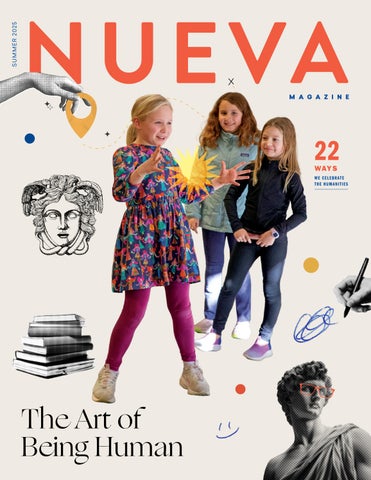
SUMMER 2025
M A G A Z I N E
22 WAY S
W E C ELEBR ATE THE HUM ANITIES
The Art of Being Human
🙂
VO L. 12 / S U M M E R 2 0 2 5
IN THIS ISSUE
F RO M T H E E D I T O R IAL TEAM
D E PA R T M E N T S
Curriculum Vitae (Course of Life) Who are we? How do we understand ourselves and connect across differences? How do we thrive in the complex world we inhabit? These inquiries drive our educational program and lie at the heart of what we mean when we talk about the humanities. At Nueva, the humanities are not just philosophical inquiries or academic exercises—they’re practical tools for living. We believe that the humanities cultivate our capacity to navigate life with wisdom, empathy, and grace. No one at Nueva has embodied this truth more than humanities teacher Cynthia Kosut, who retired in June after 35 years of shaping Nueva students. Her vivid personal anecdotes, her encyclopedic knowledge, and her legendary hands-on projects taught us all to immerse ourselves in other cultures and to take on others’ perspectives—for many, through exchanges with students in Japan (page 6). Read the loving tributes to Cynthia on page 24. This commitment to human-centered, experiential learning extends across all divisions on Nueva trips, a pillar of our program. These trips reveal to students the complexities of human history and society, and their own roles within them—deepening their understanding of the world as a vast, interconnected system. On page 34, read about their experiences across California, the country, and the world, in their own words. Nueva’s emphasis on the humanities grounds our students in the belief that understanding oneself and others is essential to a thriving and fulfilling life. Consider Dan Liu ’05, the Hollywood director profiled on page 56, whose humanities education at Nueva imparted on him the value of storytelling as a means of connection. At Nueva, the humanities are woven into all subject areas. From the youngest grades all the way up, interdisciplinary projects ask students to consider their STEM studies in relation to the humanities, and vice versa. This spring, three Upper School teachers created an interdisciplinary project in which students collected and analyzed data on their peers’ attitudes and perspectives about life at Nueva—and then wrote stories about their findings for the student newspaper. As you will see on page 32, they learned that data is often most compelling when paired with first-hand narratives. In “International Diplomacy and Midnight Crises” on page 26, witness our students practicing connection in real time at the National High School Model United Nations conference. During the five-day simulation, they experienced practiced seeing the world through different lenses, unpacking the human motivations behind political decisions, and building bridges. And finally, on page 14, our cover story explores “The Art of Being Human”—celebrating ways that Nueva embraces the many disciplines within the humanities, from literature and translation to theater and philosophy. Each example highlights a pathway for Nueva students to gain tools for navigating life’s rich complexity. Happy reading!
DROP US A NOTE: Share your thoughts on this magazine—and anything Nueva related—at communications@nuevaschool.org.
02 REFLECTION Letter from the Head of School 03 NOTED News from Nueva 48 ALUMNI News from alumni 68 RECESS Word search
F E AT U R E S
16
The Art of Being Human
Explore 22 ways the humanities are celebrated at Nueva.
26
International Diplomacy and Midnight Crises Eighth graders and Upper School students attended the National High School Model United Nations conference in New York City.
nuevaschool.org Nueva Magazine is published by the Communications Office for alumni, students, parents, grandparents, and friends of The Nueva School. EDITORIAL TEAM Karin Storm Wood Director of Communications
Classroom of Curiosity
Community members reflect on Middle School humanities teacher Cynthia Kosut’s impact on Nueva.
ALUMNI NEWS Diana A. Chamorro Associate Director of Development, Alumni & Community Engagement
DESIGN Aldeia / aldeia.design
Parting Words
PRINTER Lahlouh
The Class of 2025 reminiscences on their Nueva experience.
46
32
Data science, journalism, and statistics students collaborate to investigate the Nueva community.
With assistance from incoming Director of Communications Rachael Uriarte and summer interns Henry H. ’28, Raya I. ’28, and Senya S. ’26.
Mae Walsh Alumni Relations Assistant
28
Investigating Nueva
Holly Nall Communications Associate
What We Carry Forward
34
Picture This
See some of the unforgettable moments from Nueva trips this spring.
Printed on FSC®-certified Accent Opaque cover and text.
Eighth graders share 100-word speeches— each a thoughful reflection on their time at the Hillsborough campus.
C O N N E C T E D
22
LiAnn Yim Assistant Director of Communications
S TAY
Rachel Freeman Assistant Director of Communications
R E F L E C T I O N
Why the Humanities Matter Lee and his co-advisor Upper School Mandarin teacher Jamie Gao with their 11th grade advisory at Russian River.
“ When students engage with the world through many lenses and respond with insight, empathy, and purpose, they can begin to live out our mission—to make choices that benefit the world.”
THIS SPRING, a group of eighth graders joined Upper School students in representing Nigeria at a national Model United Nations conference in New York. Meanwhile, back in California, our debaters argued passionately for and against climate change mitigation policies and thespians performed in theater productions, embodying different characters and their stories. In all of these activities, something remarkable was happening. Students were deeply engaged in understanding the nuanced opportunities and challenges inherent in the human condition. In adopting other perspectives in classes and extracurriculars—even confronting opponents on the court or the field in athletics, which requires students to engage in agile teamwork and creative problem solving—our students were participating in a humanitiesbased approach to education and life. This approach means engaging with the world through many lenses and responding with insight, empathy, and purpose. When students do so, they can begin to live out our mission—to make choices that benefit the world. We want learners to explore the many ways this can be done and also to understand how the world in turn shapes them. To do this well means practicing vital life skills—critical thinking, effective communication, language learning, empathic understanding, literary analysis, historical research, artistic creativity, and more. These skills are integral to the humanities, the focus of this issue of the Nueva Magazine. In our classes, students engage with world literature and primary historical texts that provide them with a solid foundation of the literary tools utilized in the humanities. Across all divisions, problem-solving is intentionally taught through the lens of these skills: interpreting complex texts, articulating wellreasoned arguments, collaborating across perspectives, and applying historical and cultural understanding to contemporary challenges. Our preK–12 curricula for social-emotional learning and our world languages program further support the development of interpersonal skills, intercultural communication, and global citizenship. At a time when critical thinking, empathy, and effective constructive communication are more essential than ever, we are committed to fostering civil discourse—both within Nueva and in the wider world. Humanity is multifaceted, and learning to embrace and harness the strengths inherent in our diverse lived experiences is essential. Guiding students to make choices that benefit the world is a real, and meaningful, challenge—one that inspires us all. Inspiring ourselves in the beauty and complexity of the humanities at Nueva is both a privilege and a responsibility. Thank you for joining us on this path.
LEE FERTIG
Head of School
02
N U E V A
M A G A Z I N E
NOTED N E W S
F R O M
N U E VA
N O T E D
Bence O. ’28 competes at The Golf Club at Moffett Field in Mountain View, CA on March 17. This spring, he and senior captain James Lee ’25 led the team to its first-ever playoff berth in school history. In the Central Coast Section (CCS) Championships on May 13, Nueva finished 10th overall as a team, and Bence finished 18th as an individual—both major accomplishments for this young program.
S U M M E R
2 0 2 5
03
N O T E D
Artfully Designed A stunning new home for the arts is coming to Hillsborough For 38 years, the unassuming buildings known as the old Middle School served as a busy hub of activity, housing music, art, science, and language classes. Tucked below the Hillsborough gym and the Upper Loop, these structures were never meant to be permanent. Before spring break, students said goodbye to the place where they had spent so many formative days of their Middle School experience. Rising in its place will be a building designed specifically for multi-disciplinary creative exploration and community connection. Anchored by visual and performing arts classrooms and a versatile black box theater, the new building will also offer exhibit space, private music instruction rooms, and a recording studio. These spaces, particularly the theater, will also be available to Lower and Upper School students. The new Arts & Administration building will also feature a rooftop gathering space, academic tutoring spaces, tech offices, meeting rooms, and offices for Admissions, Development, and other teams. A spacious, inviting plaza in front of the new building will serve as the campus’s main welcome area, while new landscaping will provide additional outdoor gathering spaces. This project fulfills a key part of Nueva’s commitment to the arts, set forth in our Renew | Belong | Innovate strategic framework, and was made possible by the generous support of our community through the Realize the Potential capital campaign. Construction is expected to be completed in winter 2027.
04
N U E V A
M A G A Z I N E
R E N D E R I N G BY L E D DY M AY T U M S TAC Y A R C H I T E C T S
N O T E D
S U M M E R
2 0 2 5
05
N O T E D
A Q UARTER C ENT UR Y OF
Ichi-go Ichi-e Nueva’s Japanese exchange program celebrates 25 years
This spring marked a milestone for Nueva: the 25th anniversary of its partnership with the Doshisha schools of Japan. What began in 2000 as a humble exchange—two students and two teachers traveling across the Pacific— has since blossomed into a life-changing program that has shaped generations of students and forged bonds between two school systems an ocean apart. Nueva’s Middle School Japan trip began many years before the official exchange, immersing eighth graders in Japanese language and culture. Over time, these opportunities have expanded to include trips to Spain and
06
N U E V A
M A G A Z I N E
China, aligned with Nueva’s language programs. As Head of School Lee Fertig noted at the anniversary celebration in Japan, this year marks the “silver” anniversary of the program. “Like silver, this exchange has a brilliant shine,” he said. “It has served as a phenomenal cross-cultural bridge, enabling us to exchange ideas, perspectives, learning, and joy—just as the metal, silver, is considered one of the best conductors capable of transmitting signals and constructive energy across distance and difference.” Liza Raynal ’95, Upper School Division Head, traveled to Japan as an eighth
grade Nueva student before the official Doshisha exchange began. At the celebration held at the Hillsborough campus, Liza reflected: “Walking to school with your host student or being greeted by your host parent—these are ichi-go ichi-e moments—unique, once-ina-lifetime experiences. They pass quickly but they shape a person forever: they now know how to approach something different, even foreign, with curiosity, reverence, playfulness, and respect.” At its heart, this program has always been about more than travel. “These experiences are not possible by simply reading a textbook or sitting in a classroom,”
said Upper School Japanese teacher Chris Scott, who has been leading Upper School trips to Japan for nearly a decade. “They require getting out into the real world and engaging with real people…the epitome of learning by doing and learning by caring.” The program includes reciprocal week-long homestays. Brayden D. ’27 highlighted the value of “welcoming an exchange student into our family and being welcomed into theirs. In addition to Japanese and English, food was a universal language we shared, from our love of sukiyaki to steak and barbeque.” Alum Kayla Hwong ’23 also cherished the homestay experience. She and her exchange buddy, Maho, “built a strong
N O T E D
“ These are ichi-go ichi-e moments— unique, once-in-a-lifetime experiences. They pass quickly but they shape a person forever: they now know how to approach something different, even foreign, with curiosity, reverence, playfulness, and respect.” L I Z A R AY N A L ’95 , US Division Head
FACULTY BOOKSHELF RECOMMENDED READING
Newbery Award winner The Eyes and the Impossible is the newest book by writer and co-founder of 826 Valencia, Dave Eggers. While it’s technically a kids’ book, it’s also a favorite of many Lower School faculty members, myself included. The story follows a wildly independent stray dog who is the “eyes” of the animals in a large city park. This quick read is surprisingly touching and inspiring, especially to anyone who’s ever dreamed of being free. PAUL KNIGHT Kindergarten Teacher
bond that transcended cultural and language barriers, and were able to show each other the best parts of our wildly different lives.” The success of Nueva’s Doshisha exchange is a testament to the people who built and sustained it. Longtime humanities teacher Cynthia Kosut made 28 trips to Japan over her years at Nueva, including the first trip to establish the partnership in 1999. Each year since, Nueva has welcomed Doshisha students—first to the Hillsborough campus, and, since 2016, to the Upper School in San Mateo—and Doshisha host families have opened their homes to Nueva students in return. The exchange has transformed the lives of more than a thousand students, creating global citizens inspired to make the world a better place. This year’s celebration also marks a poignant transition. Cynthia retired at the end of the school year, making this her final journey with the program. Her impact will
Faculty and staff chaperones at the 25th anniversary celebration in Japan this May. Pictured L–R: Chris Scott, Lee Fertig, Karen Tiegel, Rachel Schlessinger, Jason McEuin, Yoko Sase, Cynthia Kosut, and Erika Sim.
echo through exchanges still to come. “It is people like Cynthia who make the Doshisha Nueva exchange program so incredibly special for our students, families, colleagues, and indeed for our entire communities,” Lee said. As Nueva and Doshisha look ahead to the next 25 years, the ichi-go ichi-e spirit of this exchange remains strong. In every shared meal, brave self-introduction, and heartfelt farewell, the bonds between these two communities continue to grow. —Holly Nall
The Just City by Jo Walton offers a sci-fi take on Plato’s Republic. As an experiment, the goddess Athena gathers philosophy scholars from across time and space and places them on an island to live out the Republic as Plato described it—except with the addition of AI. This novel raises timely questions about agency, ethics, and the tensions between philosophical values and material life. It’s the first of a three-book series, great for anyone interested in philosophy, mythology, or artificial intelligence. ANNA LYON MS Writing Teacher & 7th Grade Co-Dean
A student in my Graphic Novel Manga and Comics elective recommended Kay O’Neill’s The Tea Dragon Society, and I loved it so much that I’ve already gifted copies to friends and loved ones! A twotime Eisner Award-winning graphic novel suitable for all ages, it follows the story of a blacksmith apprentice named Greta who learns about the dying art form of tea dragon care-taking. Though seemingly set in a fantastical world, it promotes mindfulness, mutual aid, and the magic of everyday life. PEARL BAUER US English Teacher
07
AT H L E T I C S 08
N U E V A
M A G A Z I N E
N O T E D
T HE F O U N DAT IO N “Our Middle School student-athletes represent the future of our Upper School program, and a strong foundation in Middle School leads to a competitive and successful high school program. It is for that reason that we call our Middle School program “The Foundation.” We know how important developing foundational skills are, and we want to convey this significance to our athletes and community.”
— B R E T T M C CA B E , Athletics Director
Learn more about our athletics program:
09
N O T E D
V I S U A L
A R T S
2
1
5
6
3
4
1. Mason B. ’33 The In-N-Out pattern tiles, cork, wood, wax sticks, paper, Fimo clay 2. Holden K. ’26 New Flowers tape, sticks and recycled cardboard 3. Evelyn M. ’35 Untitled clay, wire
10
N U E V A
M A G A Z I N E
4. Jane J. ’29 Redefine Your Comfort Zone mixed media collage on paper 5. Feiyan J. ’30 and Kate S.-J. ’30 Butterfly Garden acrylic on canvas 6. Advanced Mixed-Media Elective (Cate Leeman ’25, Dylan Pu ’25,
Landon Pu ’25, Natalie N. ’28, Ariel Z. ’28, Chloe T. ’28, and Anya V. ’26) Wong Kim Ark: Portrait of a Change Maker mixed media 7. Hayes S. ’27 Big Pine Melt oil paint on canvas 8. Veronica B. ’31 Hummingbirds block print on paper
N O T E D
P E R F O R M I N G
A R T S
Beetlejuice, Beetlejuice, Beetlejuice! Middle School students (inset) summoned standing ovations with sold-out performances of Beetlejuice Jr., delivering a wildly entertaining ride through the land of the dead—and high drama on stage. With boundless energy and remarkable stage presence, the actors brought to life the frightfully funny tale of Lydia Deetz played by Kylie E.-M. ’29, a quirky teen mourning her mother and fascinated by the afterlife. The story follows Lydia as she moves into a haunted house, where she meets a ghostly couple and the mischievous Beetlejuice, played by Huxley E. ’29.
7
With jazz hands flying and murder on the mind, the cast and crew of Chicago: Teen Edition lit up the Hillsborough stage in May with a dazzling four-show run worthy of the Roaring Twenties. The musical follows chorus girl Roxie Hart (played by Silvia Goldszmidt-Pauck ’25), who murders her lover. Sent to jail, she meets Velma Kelly (played by Mari Marhefka ’25), a vaudeville star also accused of murder. As both women compete for fame, fortune, and acquittal, they use the corrupt justice system, a slick lawyer, and the press to spin their stories. The cast brought this satirical tale of crime and celebrity to life with bold choreography and powerful vocals. For 11 graduating seniors, the show also marked a heartfelt farewell to the drama program—their final turn on the Nueva stage.
8
Music was in the air as Nuevapalooza brought joyful energy to both campuses during the final weeks of school. The annual year-end lunchtime concert series featured everything from steel drums and jazz to rock and groove bands, as Middle and Upper School students took to the stage to share their musical talents with cheering crowds of peers, faculty, and families.
S U M M E R
2 0 2 5
P H O T O S BY B R E N T C R O M L E Y P ’2 9 ( T O P ), DA M I A N M A R H E F K A P ’2 5 ( M I D D L E)
11
N O T E D
Reflections Revisited “Reflections” is a new weekly series where members of the Nueva community reflect on the values, traditions, and “Nueva magic” that shape our school. Below are excerpts of those written during the 2024–2025 school year.
Learning is a messy business. As educators, we may say this to describe physical messiness, whether it is working with clay in art, dissecting squids in science, or let’s face it, dealing with the aftermath of most projects in the I-Lab. We may also say this to refer to internal messiness—that “I’m confused” feeling when we’re learning something new. One of the many reasons I love being a teacher at Nueva is that we are unafraid and unabashed in allowing this messiness to be visible and celebrated. A N G I C H AU, D I R E C T O R O F T H E I- L A B
Scan the QR to read these piece and many others:
N U E V A
M E GA N T E R R A , LOW E R S C H O O L DIVISION HEAD
We challenge students to see multiple perspectives, ones that may disrupt their map of the world. We expand their ideas of who has authority on a given subject, and we provide them with access to narratives and cultures that have been omitted, whether intentionally or not… Students who embrace diverse perspectives have access to opportunities, relationships, and insights that remain invisible to others. They will become the bridge-builders, translators, innovators, and leaders our polarized world needs. S H AW N TAY LO R , D I R E C T O R O F E Q U I T Y & I N C L U S I O N
12
Students know when they are being taken seriously as learners and contributors. They know when they are recognized as intellectual explorers and meaningmakers. They know when their ideas matter, because peers, teachers, and administrators listen to them. When students’ conjectures and collective questions are essential to the curriculum, they are empowered as co-creators of their learning.
M A G A Z I N E
FEATURES N O T E D
During their visit to The Morgan Library & Museum in New York City, eleventh grade students on the One for the Books trip explore a 16th-century scroll detailing gifts presented to Queen Elizabeth I. This enriching experience brings to life two themes featured in this issue: “The Art of Being Human” (p. 14) and “Picture This” (p. 34).
S U M M E R
2 0 2 5
13
F E AT U R E S
The Art of 22 Being Human WAY S
🙂
WE CEL EBRAT E T HE HUMA NIT IES STORY BY LIANN YIM
“I THINK THE HUMANITIES ARE PREPARATION FOR LIFE,” reflected Cynthia Kosut, Middle School humanities teacher. “Life isn’t just what job you do or how much money you earn, or if you can afford to buy a house. Life includes dealing with birth and death and loss. And the humanities prepares you for the hard stuff.”
14
N U E V A
M A G A Z I N E
♥
F E AT U R E S
Cynthia, who retired in June, spent 35 years teaching humanities at Nueva. During this time, she created the quintessential eighth grade capstone project that shows students just how intertwined the humanities—the study of languages, literature, history, law, philosophy, ethics, and comparative religion—are with all other areas of life. Yet while engineering majors rarely face skepticism here in the Bay Area, humanities students regularly encounter the question “So, what are you going to do with that?”—a telling indicator of how our society undervalues the very disciplines that teach us what it means to be human. Today, this devaluation has real consequences. Libraries and museums nationwide face funding cuts and policy shifts that threaten these institutions. Enrollment in the humanities continues to decline at universities. As advancements in artificial intelligence rapidly scale, paradoxically, we are retreating from the very studies that help us understand what makes us distinctly human. In this age of AI and political division, it is more important than ever to pause and reflect on the humanness we share. The humanities offer essential tools for navigating the complexity we all encounter in life: History reveals patterns that inform present challenges—and perhaps offer paths forward. Philosophy teaches us to grapple with reason, morality, and existence. Literature and the arts express the full human experience, glorious and tragic, in ways that data alone cannot. In these ways, Nueva sees the humanities as a cornerstone of a thriving civil society. As Cynthia reminded her students year after year, the humanities don’t just complement STEM education—they complete it. They teach us to ask not only “Can we?” but “Should we?” They help us understand not only how systems work, but how people work, and why that matters. In fields from medicine to technology to business, the individuals who have shaped our world for the better are those who combine technical expertise with deep human understanding—crafting compelling narratives and navigating complex ethical terrain. “Through the humanities, we learn how to ask essential questions, to critically think about those questions, and how to respond,” said Amber Carpenter, Upper School English teacher. “Without it, we risk an education without empathy or sympathy, without complex discussions regarding societal issues, without an understanding that every life matters.” Nueva is committed to a rich, human-centered education that cultivates not just knowledge, but wisdom. The following 22 examples—and there are so many more!—highlight how the humanities shape our understanding of the world.
15
2 2 WAYS WE L OVE T HE H U M AN I T I E S
F E AT U R E S
1
3 SAY IT LIKE A LOCAL
The opportunity for cultural and language immersion is a hallmark of Nueva’s world languages program. The world languages program offers Japanese, Mandarin, and Spanish, with culminating trips each year for eighth and twelfth graders to Japan, China, and Spain. Middle School travelers participate in homestays—our partnership with the Doshisha school in Japan is celebrating its 25th year (see page 6 for more)!
2
JOURNEY THROUGH THE DISCIPLINES
Seniors on the Mexico City trip took a hot air balloon flight over the ancient city of Teotihuacán.
4
16
M A G A Z I N E
The Humanities Fair is a smorgasbord of presentations, hands-on workshops, and performances. From cartooning for graphic novels and storytelling with shadow boxes to tackling philosophical conundrums and flexing knowledge at a geography bee, this biennial event is a full celebration of all things humanities for Nueva students and families.
SHAKESPEARE, REMIXED
Performance as a gift? A new tradition is for the Upper School faculty and staff to stage an adaptation of a Shakespeare play for the seniors, who, a few weeks later, begin planning their own adaptations of the Bard’s works. (This year featured a punk-rock Macbeth; last year, a “Barbenheimer” Romeo and Juliet. As English teacher and play director Allen Frost says, “There are no small parts, only small actors.” Indeed.) At Renfayre, days before graduation, the seniors perform these unique and highly creative adaptations for the student body.
In eighth grade, students travel the Silk Road in the fall, and later in the spring, they embark upon version 3.0 of STARPAP (science, technology, art, religion, philosophy, architecture, and politics), in which they write an essay on one of these topics, complete a visual annotation of another, and express their understanding of four of the remaining research topics in various formats. This quintessential Middle School capstone project not only helps students understand where humanity has been—and where it’s going—but also recognize the interconnection of the humanities with all other disciplines.
N U E V A
CHOOSE YOUR OWN ADVENTURE
Upper School history teacher Tom Dorrance portrayed Caithness, a Scottish nobleman and one of the thanes, in the faculty and staff production of Macbeth.
=
F E AT U R E S
5
HUMANITIES BY CHOICE
“Nueva is a STEM school”—you’re joking, right? Look no further than the Middle and Upper School Quest Expos to see just how many students are choosing to dive deep into the humanities. Shoutout to the students writing novels, composing music for the Greek pantheon, coding text-based stories and games, exploring refugee healthcare, and…the list is too long to print.
Recent editions of The Mav Mind and Nueva LitMag
At the eighth grade Quest Expo, Allison G. ’29 presented her Quest project on reconstructing the Proto-Indo-European language with the comparative method.
6
WHE RE WE COME FROM
In their final humanities unit, second grade students learn the immigration story of a relative (or family friend) and represent it in some way: students have recorded podcasts retelling the story, board games that build in discrimination as bad luck cards, original music and lyrics that share a family member’s story, and historical diaries and graphic novels they bind together themselves. At Culmination Night, they celebrate the immigration stories of their communities and enjoy a potluck of foods that hold meaning for their interview subjects.
7
THE KIDS ARE ALL WRITE
Nueva has two journals of art and literature! The Mav Mind in the Middle School and the Nueva LitMag in the Upper School both showcase student creative writing, art, and photography.
8
ONE FOR THE BOOKS
Dinner in a bookstore? Yes, please. This 11th grade trip takes students to Boston and New York City to visit esteemed libraries, archives, and preservation rooms, and they meet the people who operate these institutions. Along the way, students examine the crucial role of libraries in a democratic society, with plenty of stops in independent bookstores—including a special meal in a bookshop.
Benjamin Y. ’35 records a podcast to tell the immigration story of someone close to him.
S U M M E R
2 0 2 5
17
F E AT U R E S
2 2 W AY S W E L O V E T H E HUMANITIE S
9
WORDPLAY
Structured Word Inquiry (SWI) is all about understanding larger patterns across words—shared roots, bases, families—as much as it is about understanding the evolution and structure of one word. Lower School students gain investigative tools to understand new vocabulary—allowing them to apply SWI across every discipline, even math or history. Nueva also hosts the annual SWI Institute educators, now in its 12th year.
10
WEAVING THE NUEVA WEB
PreK and first grade students begin developing their understanding of community and building connections through their respective Tuesday Tea and Community Partners projects. They interview different community members to understand not only what they do at Nueva, but what might help them tackle challenges they face.
11 P H O T O : B E N WAT T S P ’ 3 5 ’ 3 8
12
FIFTY WORDS FOR SNOW
This Upper School elective introduces students to the interdisciplinary field of translation studies, encouraging students to think critically and comparatively about how translation shapes, if not skews, our understanding of other peoples, languages, and cultures.
e
uw, nieve, e e n s , e n s , neve nee, snö ch s , e ig e n i, lum
18
e
h
N U E V A
M A G A Z I N E
PreK students got to know Leslie Lindeberg, Executive Assistant to the Heads of School, at a Tuesday Tea in the spring.
CONNECTING PAST TO PRESENT
For their culminating trip, sixth graders visit Washington, D.C., where they tour museums and meet with veterans and members of congress. They visit Mount Vernon and learn about the enslaved people who built and operated George Washington’s estate. Their trip seeks to explore essential questions: “How do I connect with diverse voices to discover more about my community and the United States? What role do I have in democracy, national memory, and community building? What is our role as a class in the broader American community?”
Sixth grader Finn F. ’31 greets a veteran in the Honor Guard at the Lincoln Memorial.
♥
F E AT U R E S
*
Sophia L. ’30 and Arya L. ’30 read and annotate The Book Thief by Markus Zusak in the Realistic Fiction lit club.
13
READING IS LIT
In Lower and Middle School, students get curricular time devoted to developing a love of reading—and to practice reading strategies and literary analysis—with their respective book groups and lit clubs. Book groups are one component of the Lower School literacy program that might look different for each grade. In Middle School, students meet weekly in themed lit clubs—books that have been adapted into movies, graphic novels, science fiction, and more.
14
LONG LIVE PRINT JOURNALISM
Produced six times a year by students in the Upper School journalism elective, The Nueva Current newspaper features news, opeds, culture reviews, and sports commentary. Students work on all aspects of newspaper production, including pitching stories, writing and reporting, layout and graphic design, art, and photography. The Current is the recipient of multiple National Scholastic Press Association’s Pacemaker Awards and Columbia Scholastic Press Association’s Gold Crowns!
15
Multiple award winning student newspaper, The Nueva Current
SHELF LIFE
The Writing & Research Center (WRC) at San Mateo and the Hillsborough library often feel like the beating hearts of both campuses. These spaces are hubs for visiting writers and artists, Coffeehouse performances, and, of course, literature. Shoutout to the WRC and library staff for assembling awesome and creative book displays. They’re often themed—like a celebration of thought-provoking and frequently challenged books during Banned Books Week, books by AAPI authors during AAPI month, and more.
The Writing & Research Center at the San Mateo campus hosts visiting authors, events like Coffeehouse, and more.
S U M M E R
2 0 2 5
PHOTO: KYLE JEFFERS
19
F E AT U R E S
2 2 W AY S W E L O V E T H E HUMANITIE S
16
MARKETPLACE FOR HUMANITIES
Maddy S. ’28 participates in a Chinese calligraphy count-me-in workshop. Students, parents, and employees have the opportunity to snag their spots in hundreds of CMI options—including many centered around humanities themes.
Yes, please, count me in for book binding, Chinese calligraphy, the history of tea in India (with a chai tasting station), and a tour of the Institute of Contemporary Art San Francisco! These events were offered by parents and teachers at the annual Count-Me-In Marketplace, which raises funds for Nueva’s financial assistance programs.
Upper School students examine primary sources on a field trip to the archives at Stanford University.
17
TIME MACHINE Capitalism and crises, existentialism, sociocultural anthropology, international relations—these are just a smattering of the history electives Upper School students can choose from. Learning history is how we understand power, identity, and culture, and studying it through different lenses—from Chinese artifacts (Chinese History Through Objects) to collapsing cities (Urban Studies: the Death and Life of Great American Cities)—shows us where we’ve been, how we got here, and what kind of future we might build.
18
INTERSESSION EXTRAVAGANZA
A seminar on the founding and expansion of Islam. An introduction to cultural anthropology. Two takes on war by two Romans, taught by a professor of classics. Language studies, from American Sign Language to the Korean alphabet, Hangul. During Intersession, rich with over 400 unique offerings, all students get plenty of choices to dig into the humanities. Nathan R. ’34 and Yzabelle M. ’34 stage a scene in the EnActe—Theatre workshop at Intersession.
20
N U E V A
M A G A Z I N E
F E AT U R E S Flanked by classmates and fellow thespians, Sofia G.-O. ’30 takes center stage in a Shakespeare adaptation.
2
19
20
One of many unique English seminars for eleventh and twelfth graders, the Memoir and Adaptation elective focuses on using life narratives to explore and connect with perspectives beyond their own. Reading across time, geography, and culture, students reflect upon the interplay between memoir texts and the social, historical, geographical, and political forces that shape them. After reading memoirs by authors such as Alison Bechdel, Paul Kalanithi, and Alex Haley, students also have the opportunity to craft their own memoirs.
SO DRAMATIC
The seventh grade drama program teaches students how to stage their own performances. This year, one group dedicated itself to improv while another performed monologues and scenes from Shakespeare and other dramatists. The year culminates with a trip in May to Los Angeles that leans into the arts: students take drama classes, visit art museums, and see live theater. Meanwhile, their humanities classes look at how arts and culture have allowed L.A. to become a globally-influential city.
21
22
MYTHOLOGY ACROSS CULTURES
How does mythology shape human experience and influence contemporary literature, art, and society? This elective for fifth and sixth graders explores the myths, legends, and folklore of various cultures to uncover universal themes and cultural differences. Students examine the stories that ancient and modern societies have used to explain their origins, values, and beliefs.
=
3
S U M M E R
2 0 2 5
TRUE STORIES
POP-UP BOOKSTORE
Each spring, parent volunteers bring a bookstore to life right on our campuses, curating faculty favorites and other selections tailored for Nueva readers. At this year’s Book Fair, several books recommended by Upper School teachers in the “Ex Libris” bookplates art installation could be found at the Book Fair. The fair not only celebrates the community’s love of reading, it also raises money for the school, with this year netting more than $62,000! [N] Lower School students browse the Book Fair.
21
F E AT U R E S
For more than three decades, Cynthia Kosut P ’93 ’96 shaped Nueva as a teacher, mentor, parent, and leader. Before her retirement, she gave us a tour of her classroom and the artifacts that tell its story. 2 1
Cynthia’s Classroom of
Curiosities 1
JA PA N E S E H AT This hat is from Takayama, a town in the Japanese Alps— where, as they say, the Japanese go to feel Japanese. It’s a very traditional place, known for Sachiko stitching on indigo fabric. When I first started going, there were entire shops of women doing this work by hand. It’s fading now— fewer shops every year. I didn’t go to Takayama this year because of my leg, but the other chaperones brought this hat back for me, knowing I love that kind of craft because it represents the Japanese qualities of caring for detail and aesthetic design.
2
MONKEY KING This is my advisory mascot, the Monkey King. His story is based on the real journey of Xuanzang, a 16-year-old monk from Chang’an during the Tang Dynasty. Xuanzang spent 17 years traveling to India, studying, and translating the sutras from
22
N U E V A
M A G A Z I N E
Sanskrit into Chinese. When he returned, his work helped elevate Buddhism in China. Students gave this to me years ago.
a straight line,’ because you find the cool stuff on your way to looking for what you think you’re going to find.
3
5
ELEMENTS OF DEPTH AND COMPLEXITY I started using the elements of depth and complexity after meeting Sandra Kaplan, who taught gifted education at the University of Southern California. Any time you think about anything, if you apply those elements, it makes your thinking deeper and more complex. The 11 elements are: Language of the Discipline, Details, Patterns, Rules, Trends, Unanswered Questions, Ethics, Big Idea, Over Time, Multiple Perspectives, and Across Disciplines.
4
“RESEARCH IS NOT A STRAIGHT LINE” MEME A student made this meme of me. I always say, ‘Research is not
P H O T O BY J OA K I M J O H A N S S O N P ’25 ’26
G LO B E A N D M A P S Maps are a storytelling tool. I put them up as needed to help tell the story visually: show, don’t tell. The classrooms I’ve had in the past were covered with maps. They are infographics that help students understand where different people live and how geography affects history.
6
D O S H I S H A BA N N E R This banner represents our 25-year exchange with the Doshisha schools in Japan. I first visited in 1999, before the official partnership began. I remember taking six trains in one day just to visit all four campuses. Since then, I’ve played handbells, made lunch for the principal, helped students into kendo gear, and
joined more tea ceremonies than I can count.
7
MODEL OF TA K AYA M A H O U S E This model is also from Takayama. One of the students brought it back this year—it’s a replica of the traditional buildings you see there, which have steep roofs so the snow slides off.
8
WAT E R B O T T L E I was given this water bottle as a gift just this spring. National History Day is like the spelling bee, but for historical research—students submit essays, documentaries, and exhibits. One of my students, Jason R. ’29, won the state competition for his historical paper and went to Washington D.C. in June to represent California at the national level.
3
F E AT U R E S
4
5 6
7
8 9
9
FOUR BOOKS (The Silk Roads, Behave, Sapiens, The Odyssey) These are a few of our eighth grade humanities texts. We read The Silk Roads by Peter Frankopan in the first semester to understand cultural differences along the Silk Road. Everyone should read Chapter 11 of Behave. Author Robert Sapolsky P ’11 ’17 explains the neuroscience behind why our brains create “usversus-them” divisions—and how education helps us rise above that. It’s fascinating. We read Chapters 5 and 6 of Yuval Noah Harari’s Sapiens in eighth grade, too. That book changes lives. And this is my favorite translation of The Odyssey by Richmond Lattimore. That’s my university training; it’s where I learned that you learn how to learn by studying anything in depth. [N]
“
You learn how to learn by studying anything in depth.
23
F E AT U R E S
A few words about
Cynthia Kosut I remember Cynthia first not as a teacher, but as a Nueva mom and devoted community member. I was in Lower School with her son Oliver in the late ’80s. She was an incredibly engaged parent—volunteering in classrooms, collaborating with the administration, and working tirelessly to make the school better—long before she officially joined the faculty. As Nueva has grown into the remarkable school it is today, I often think back to people like Cynthia who helped lay the foundation for that spirit of engagement. Thank you, Cynthia, for your years of service and your immeasurable impact. Nueva would not be the same without you. —Chris Sun ’96 P ’33 ’35, Trustee
On the eve of her retirement, students, alumni, parents, and colleagues shared their reflections and favorite memories, celebrating the numerous ways she has touched their lives. Cynthia’s understanding of gifted learners, her passion for interdisciplinary learning and her magic in creating meaningful, unforgettable experiences for students have shaped this school in ways few ever could. She has always understood deeply and intuitively what this school is truly about. Gifted learners need depth, pace, freedom to explore, and the room to construct new ideas. She builds learning experiences that blend her goals with her students’ passions. Her projects are flexible, open-ended, and somehow always on point. Learning in Cynthia’s classroom: it sticks, it lives in you. Cynthia is a polymath. There is nothing she doesn’t find intellectually exciting. She tackles learning with glee, and this is precisely what she taught everyone and anyone who would listen. It is one of the greatest gifts, of the many, that she bestowed on me. — Hillary Freeman, former Nueva faculty During our class trip to the Hiroshima Peace Memorial Park in 2001, I wandered away from the group while looking at the thousands of origami cranes. Cynthia soon tracked me down and we ran back to the others. I was always a reluctant runner, but Cynthia said, “This will get our chi flowing!” I’ve always cherished that moment as a perfect example of Cynthia’s unrelenting cheerfulness and optimism. —Zoe Gibbons ’01
24
N U E V A
M A G A Z I N E
P H O T O BY M AT T H E W N A L L
Cynthia was a Nueva legend generations before I started eighth grade. To me, she was the epitome of intellectual curiosity. She put incredible effort into reengineering her curriculum every few years so it would be relevant, captivating, and illuminating. Learning history was not a series of abstract, random facts. Rather, we immersed ourselves in other cultures, seeing history in fresh ways. She always drew us back to critical and contextual thinking, helping us learn how to take in others’ perspectives. I will always remember cutting up melons in her class as a social exercise. As a group, we had to figure out how to distribute a year’s worth of harvest among social classes to understand how societies and imagined orders arose. She was the true embodiment of “learn by doing, learn by caring.” — Nathan L. ’27 >> During the penultimate week of the school year, colleagues past and present—as well as her husband Robert and son Oliver ’96—gathered in Cynthia’s classroom to celebrate the legacy she has built. Upper School Division Head Liza Raynal ’95, who was once a student of Cynthia’s in addition to being a colleague, shared, “Cynthia, you will always be our sensei.”
F E AT U R E S
I can’t imagine Nueva—or Japan—without Cynthia Kosut. Cynthia was one of the first people I met at Nueva when I interviewed for a job at the new Upper School in April 2014, and we immediately hit it off, talking about everything from The Tale of Genji to translation. Since then, I’ve had the pleasure of traveling with Cynthia on the Middle School Japan trip many times between 2015 and 2025, so I know firsthand what a dedicated, compassionate, and inspiring teacher and trip leader she is. Like the seventeenth-century haiku poet Matsuo Bashō, she is a true traveler. She has limitless energy, an insatiable curiosity, and a deep respect for cultural differences. Like Bashō, she has taught so many of us to see Japan—and the multiple connections between its literature, history, and culture—in new and more nuanced ways. Safe travels, Cynthia. Like Bashō’s famous frog forever jumping into that immortal pond, your spirit will reverberate at Nueva for years to come. —Chris Scott, Upper School Japanese Teacher One of my favorite things about Cynthia’s class was how she connected everything we learned to her own life. She always had a story or experience that made any topic feel real and personal. Her passion made you want to engage more deeply, and you couldn’t help but be drawn in. I still think about the hands-on activities we did—like rationing food during a historical simulation—which taught me how complex leadership decisions really are. Cynthia made history my favorite class
S U M M E R
2 0 2 5
that year, even though I’d never considered myself a “history person.” She’s so animated and full of wisdom, and when she shares something she’s passionate about, it sticks with you forever. She was always excited to point out eight-pointed stars and explain their connection to the history of Spain—and to this day, whenever I see one, I can’t help but think of her. — Langley V. ’28 My best friend Evan Albright ’06 and I were not the easiest to have in class. We were fine individually, but together we got excited. One time we were being slightly disruptive and on that day Evan happened to be the more disruptive one. Cynthia calmly told him that he needed to go outside and take a walk for a while. After 15 minutes he came back with a bouquet of wildflowers for her. She immediately gave him a hug, thanked him for the flowers, and told him that just because he was reprimanded did not mean that he is not an amazing person. More than 20 years later, I still think about that moment often. Through the ups and downs of my life, I have held onto that lesson. Cynthia, in the period of one hour, was able to impart upon me that a moment or a mistake does not define me—who I am does. Thank you, Cynthia. — Whitney Eoin ’05 I believe I met Cynthia in about 2015, just passing through campus. My children were too young to be in her classes. Cynthia took me aside to explain the classes she was teaching and showed me
some of the students’ work. She had this amazing spark in her eyes as she glowingly described her students. Since then, both of my daughters have experienced the magical journey of Cynthia’s classes. It’s like a personal and mystical tour of the humanities. I can’t imagine Nueva without Cynthia and Cynthia without Nueva. They are so deeply integral to each other. Cynthia, our family wishes you the best of the world in your next chapter. Thank you for sharing your love and passion for our students—a gift that will live on for generations! —Leon Kuan P ’24 ’28 Depth and complexity: that is Cynthia. In the classroom, she models going deep into the learning—seeking complexity and asking her students to do research before coming to conclusions. She scaffolds that learning for them so that, inch-by-inch, they are drawn into the topics and before they know it, they’ve got well over thirty sources in their bibliographies. Cynthia holds students at the center of every decision, from what the summer reading should be to how they can be their best when traveling overseas. I am grateful to call Cynthia a friend and mentor. My sixteen years at Nueva have been enriched by her curiosity and kindness, and I have loved collaborating with her to continue building programs that serve our middle school students with depth and complexity. —Karen Tiegel P ’20 ’23 ’23, Middle School Division Head
25
F E AT U R E S
International Diplomacy & Midnight Crises A window into the National High School Model UN Conference in New York CIty OVE R DIM SU M in midtown Manhattan, between their morning and afternoon committees, eighth grader Allison G. ’29 asked senior Lara McDowell ’25 for advice. “I’m fighting with this guy for control of my bloc right now,” said Allison. “He’s not giving me a chance to say anything. How do I push him out of power?” Lara—a three-year veteran of the National High School Model United Nations (NHSMUN) conference and Nueva’s MUN team captain—set down her chopsticks. “Well, in an unmod, everyone is trying to talk the loudest. You can gain control by lowering the volume. Talk about the programs you can sponsor, and stand out by highlighting the value you can add that’s different. If someone tries to talk over you, say, ‘Excuse me, I’m speaking,’ pause, then finish your sentence.”
The five-day conference in March is the highlight of the MUN season and feels like a global summit. Nueva brought 18 eighth graders and 11 high school students to join 3,000 fellow MUN delegates from 152 schools in 77 countries. A microcosm of the United Nations, with more backpacks. Historically, Nueva has been the only school to bring middle school students to the conference. Over 95% of the competitors this year were high schoolers. Nine years ago, the Upper School MUN advisor, economics teacher Patrick Berger, began teaching an eighth grade MUN elective. The eighth graders stood out at middle school MUN conferences for their fast analysis, articulateness, and multilateral combinatory thinking. They needed a bigger challenge, and NHSMUN is the biggest conference offered. “It’s so powerful to bring them to a high school conference where they certainly can hang intellectually with their competitors, but where we often find there’s a gap socially,” Patrick explained. “So much of MUN is about how to form and take control over large delegate blocs. That entails a lot of social nuance: understanding social capital, nonverbal communication, knowing how to control a loud room even when you’re staying fairly quiet. Model UN puts all our students into challenging new territories.” In Model UN, students serve as delegates from different countries, and, in a live simulation of United
Nations proceedings, gather to address real-world issues. They participate in different UN committees (UNICEF, FAO, UN HABITAT, G20, etc.), which are held as moderated caucuses, or “mods”— timed, formal sessions of debate that focus on solving a small piece of the larger issue—and more freeform unmoderated caucuses (“unmods”). Delegates present their country’s views on the issue during the structured mods—a good opportunity to identify potential allies, or adversaries. Model UN students develop skills in research, public speaking, and communication, and have the opportunity to engage with diplomacy and global issues. Before the conference, students submit position papers that they research and write. As the advisor, Patrick chooses the country for the team. In the past, the MUN students have represented Venezuela, Iran, Egypt, and, this year, Nigeria. “I try to seek out countries that have as dissimilar a perspective to America’s with regards to international issues as possible,” Patrick admitted. “A really cool value of Model UN is to force students to take a perspective that’s extremely different from their own. It’s a more meaningful opportunity to engage with these issues when they can’t take the politically convenient route and instead have to navigate their way through much more challenging pathways.” At dinner (New York-style pizza) on the second night, Swain Mathewson ’25 asked Ethan
BROKERING DEALS IS HUNGRY WORK.
F E AT U R E S
Deitcher ’25, who participated in the International Court of Justice committee, “How was your punishment argument received?” “No one voted for it,” Ethan reported. The chair had asked him to create more diversity of opinion and stimulate debate by making controversial, yet defensible, arguments. Knowing the conference restricted electronic devices, he had printed out all the relevant treaties, conventions, and precedents beforehand and scoured them to find legal loopholes. “I even tried to convince them by giving speeches and asking, ‘What is life without justice?’” Meanwhile, Swain was in the throes of his first crisis committee. In crises, decisions that the delegates make can actively change the unfolding events. “Crisis is ridiculous,” Swain stated flatly. “Coups are happening, people are being tried, it’s completely chaotic. I didn’t know how to use the back room—I was too benevolent. I was slightly devaluing the currency while everyone else was, like, forming a militia of super ninjas. The global economy changed within seconds.” Fifteen minutes before the evening session, the halls of the Hilton Midtown were swarming with teenagers. High school students in business attire—suits and ties, skirts and blouses—strode purposefully to their committee rooms or conferred in English, Spanish, Italian, French, Arabic. The students consider this conference “iconic”—it’s an opportunity for mentorship, sharing opinions, debating ideas, and negotiating deals. They get to dig into the complexities of international relations through an exciting simulation. They meet students from different backgrounds, geographies, and cultures. “I love the joy of finding common ground and finding solutions,” Eva G. ’29 said. “We do
deep dives into research. Now I know a lot about Nigeria. And I like meeting so many international students. I shared snacks with someone from Australia.” After dinner, in the Food and Agriculture Organization (FAO) committee room, the chairs (all of whom are college students) began calling up delegates one at a time. Algeria, Argentina, India, Indonesia…finally, Nigeria. Eva and Ming-Yi T. ’29, the only two middle schoolers in a committee of over 60 students, delivered their remarks on their plan to use new technology in the farming industry, investigate worker exploitation, and educate workers on their rights. They invited interested countries to approach them to discuss cooperation. (This led to the forming of a coalition that used the strategies Eva and Ming-Yi proposed as their final resolution.) Down the hall, a specialized agency on the Haiti crisis had the delegates locked in to receive an update on the latest developments. Later the chaperones learned from Nathan L. ’27 that the delegates were confronting gang violence, instability, and lack of government, and that he had “led” a group of workers to storm the capitol to raise attention for social equality and workers progress. At 11:30 p.m. after their session, Patrick took 15 students on a run to the Halal Guys cart; brokering deals is hungry work. Waiting in line for gyro wraps and chicken with rice, they rehashed how things were going in their committees. We’re trying to get people to vote for our sustainable development goals for 2045… our chair said we are doing a really good job… trying to get funding for our plan… foreign aid’s been a crutch and an inhibitor for growth; our plan is short-term global aid… I’m working with Saudi Arabia for debt independence… At midnight on their final night, staff members knocked on the doors of eight Nueva students
Read reflections from four students on their experience participating at NHSMUN
to announce various crises. Designed to simulate emergency sessions of the Security Council, a midnight crisis is a high-stakes, sleep-deprived badge of honor at NHSMUN. The midnight crises ranged from an invasion in Bosnia to the kidnapping of an international football star, and a terrorist bombing in Afghanistan. On the Security Council, Harrison Q. ’27 and his partner Clara B. ’27 saw numerous backstabs, false accusations, and illicit dealings involving the U.S. and Russia. It was, Harrison enthused, a wild experience. “The delegate from China seemed constantly on the brink of sleep, giving three-sentence speeches when required. Algeria was focused as ever on trying to win an award. Clara and I were mostly just there for the fun of it, but also trying to be serious.” Ultimately, having spent more than 15 hours in committees, the Nueva MUN team returned with a prestigious prize: the Award of Distinction for Research and Preparation, one of the highest honors a school can achieve. The award is given to students on the strength of their position papers and the demonstration of fluency in the subject matter while participating in committees. A few weeks after NHSMUN, Nueva hosted its own Model UN conference at the San Mateo campus, with the now-seasoned eighth graders participating as delegates. Next year, they told Patrick, they want to chair their own committees. [N] STORY BY LIANN YIM
27
F E AT U R E S
CLASS OF 2025
Parting Words
ON SU NDAY, JU NE 8 , we celebrated the commencement of the Class of 2025. Months earlier, at the start of the fall semester, the yearbook staff surveyed the senior class. See what our newest graduates hold dear about their time at Nueva...
You call your teachers by their first names. You find forgotten robodogs in the closet. Your class’s average number of memorized digits of pi is more than thirty (Semiconductor Processing, 2024).
Someone is panini pressing a PB&J.
LARPing is a popular retreat activity. 28
N U E V A
M A G A Z I N E
Robotics and debate are sports. The teachers are absolutely incredible— masters in their field on par with top college professors.
F E AT U R E S
YOU KNOW YOU GO TO NUEVA WHEN…
A scheduling mishap leads you to a new interest.
My first question when I greet new people is “what is your passion?!”
P H O T O S BY T R AV I S WAT T S P H O T O G R A P H Y
You get candy in exchange for history facts from [Upper School history teacher] Sushu [Xia].
Your physics teacher wants to teach you how to make rocket fuel.
I left my phone on a table for the whole day and no one stole it.
You hear the NYT crossword sound in class on a regular basis. 29
F E AT U R E S
BEST ADVICE? Take the classes you want to, not the ones you think you “should” take. Book a lot of tutorials. “If you’re doing homework past 10:30 p.m., it’s not worth it. Go to sleep.” (Sam Timinsky)
Save your notes! They might just come in handy. “Give grace.” (Dani Moseley) Sejin Lim told me that instead of fighting with my mother I should just stop and give her a hug.
WHAT WILL YOU Being given the MISS MOST? freedom to pursue things I’m interested in such a deep way; that was truly an incredible privilege.
The people and the love for learning. The freedom of exploring and learning from the best of the best while simultaneously forming meaningful connections with them.
It’s OK to say no to things— sometimes you just can’t do everything.
The genuine connection between teachers and students.
Do what you love, and the rest will come. Coach Mike taught me, “If you’re early, you’re on time. If you’re on time, you’re late.” “Stop doing so much work and go live a life.” (Patrick Berger)
Take risks! Talk to people you wouldn’t normally talk to!
30
N U E V A
M A G A Z I N E
Opportunity! My teachers being flexible and encouraging me to find new ways to engage with topics!
The random and spontaneous fun at this school. Where else can you say you’ve seen a steak cooked by students in the cafeteria, students going to coffee with their teacher during class, or meditation before doing work in class? (Thanks Veena for the last one.)
F E AT U R E
WHICH TEACHER MADE A LASTING IMPACT ON YOU AND WHY? Matt Hesby (Computer Science), because it was in his classes that I made some precious memories with friends, and learned that you can learn and laugh at the same time and be better for it. I’ll always be grateful for that. Leonard Pon (Math and Physics):
Thank you for your endless patience and dedication in guiding me through problem sets both after school and when I popped by during my frees. I’ll always remember our life advice talks. Chatting about piano somehow made practicing almost enjoyable—I’m still not sure how you did that! LiAnn Yim: Since freshman year, you have not just believed in me, but you also have made me believe in myself! Thank you for encouraging me to grow and make mistakes (as long as I learn from them! #attentiontodetail) and making journalism my favorite place. Amber Carpenter (English) & Chris Scott (Japanese): Your classes have taught me who I want to be, both academically and as a member of society.
S U M M E R
2 0 2 5
Sean Schochet (Social-emotional Learning): His interest in the various things and events we were doing in our lives really made me feel like I belonged.
Cody Alan has transformed me as a musician and person in more ways than I can describe. Every time I make something new, he’s the first one I share it with. Morgan Snyder (I-Lab) opened my eyes to reimagining systems in ninth grade and taught me to worship design thinking. Jehnna Ronan (Biology) is so downto-earth that you forget she’s so experienced and knowledgeable—it’s made every class experience so fun, fulfilling, and unforgettable. Kathy Paur showed me that math is both beautiful and the universal language of the world. Barak Yedidia (Physics) taught me perseverance, and to believe in myself, even if my ways of learning are different.
Patrick taught economics in such an incredible and interesting way that it made me want to pursue it further.
Patrick Berger:
Amy not only introduced me to psychology, but taught me to deeply understand and appreciate others. Her class made me fall in love with learning again. Amy Hunt:
Gretchen Kellough (Academic Support): Since seventh grade, she has been by my side and helped me grow as a writer, as a person, and as a student. She showed how to strengthen my own voice and ideas instead of changing them, and her infectious positivity and belief in me always pushed me to do better. Pearl Bauer (English): Her devotion to cultivating a familylike environment in the classroom through group work, active listening activities, class discussions with the purple ball, and the little stuffed animals and headbands she brings to every class. 31
F E AT U R E
STORY BY RACHEL FREEMAN
Nueva INVESTIGATING
An interdisciplinary approach to storytelling
W
H AT IF students didn’t just ask big questions— what if they investigated them, analyzed them, and published their findings as must-read stories? After learning that both Ihmar Aldana’s statistics students and Wes Chao’s data science students were using Nueva-specific data in survey projects, Upper School journalism teacher LiAnn Yim had an idea. Discovering insights into the Nueva community was exactly the kind of thing that her journalism students did in the school newspaper, The Nueva Current. She wondered if the research that Ihmar’s and Wes’s classes were conducting could help strengthen her students’ reporting and improve the quality of their data. So she approached her colleagues with a proposal: What if the three classes teamed up? The statistics students would analyze real data, the data science students would be able to share their visualizations more broadly, and the journalism students would have richer evidence to use in their stories. “I wanted my journalism students to spend more time on the research portion of their work, and learning from students in other classes seemed like a great opportunity,” LiAnn said.
32
N U E V A
M A G A Z I N E
G R A P H I C BY A N W E N C. ’ 26 One group explored how optimistic Nueva students feel about the future, both personally and societally. Interestingly, “people are quite optimistic about things that they can personally control,” said Jackson H. ’26, “but not about what the government controls.”
The trio designed a project that asked students to investigate their own community, contribute their subject expertise, and publish their findings in The Current. Students in each class pitched potential research topics of interest—such as gender bias, college competition, and food waste at Nueva. From there, the teachers formed 15 interdisciplinary groups with at least one student from each class, and tasked each group with designing a survey, collecting data, conducting statistical tests, creating visualizations, and ultimately writing an article to be published in The Current. The project was tightly scheduled and high-stakes—requiring the students not just to meet expectations in their own class, but to deliver work their peers in other disciplines could build on. “It’s not often that three classes line up in a way that makes it fulfilling for all students,” said Juliet C. ’26, a data science student who, with her group, investigated teachers’ perception of homework load versus students’ reported time spent on homework. “Everyone had their own part to do. It was cool to work together, see what insights we each came up with, and then apply our skills in an interdisciplinary way.” In their planning, the teachers kept their eye on the collective goal of ensuring the project was personally engaging for all students. “I want learning to be meaningful for my students,” Ihmar said. “If I wanted to just test them, I could give them data from a textbook and ask them to run z-tests and t-tests. But my goal is always for them to run statistical tests on real data.” For Wes, too, student-driven inquiry is a core part of his teaching philosophy. “My top goal is for the work students do to be interesting and challenging in authentic ways,” he said. “I tell them to investigate topics that get them excited. It could be anything from, ‘What is happiness?’ to ‘Why does the BART schedule look the way it does?’” After a year of planning, the three teachers launched the project in a twohour Wednesday of Wonder (WoW) workshop. To the 60 students assembled,
F E AT U R E
they introduced the guiding question: “How can we use data and compelling storytelling to enact change in our school community?” The groups dove into brainstorming and planning. In just one day, “we could bounce ideas off each other, formulate our topic, and really go far,” said Aryan Mehra ’25, whose group focused on the culture of competition around colleges. Knowing that their findings would be published added urgency and weight to the work. “In a typical data science project, if the data doesn’t say much, that’s okay [because students are still doing the investigative work to determine that],” Wes said. “But here, if students didn’t get usable data, their journalism peers couldn’t write their articles.”
“I want students to leave my class knowing how to investigate the questions that matter to them.” [ WE S C HAO ]
This interdependence meant that each student built on the work of the previous student, Aryan explained. “Having a team depending on you [because each person couldn’t do their part until their teammate did theirs] means the work matters.” He advised his team on survey design, pushing for Likert scales over open-text responses. Jackson H. ’26, a journalism student, noted how even small word choices influenced results: “‘I worry that’ versus ‘I trust that’—differences like that changed how people responded.”
“Optimism cannot be assessed from a binary lens,” writes Anwen C. ’26 and Jackson H. ’26 in an article in The Nueva Current. “It can’t be reduced to the classic ‘glass half full’ or ‘half empty’ question.” Above, Anwen and Jackson D. ’27 visualize the results of their team’s Upper School survey on optimism.
Juliet saw firsthand the impact of having usable data and incorporating other disciplines into her analysis. Her group’s data visualizations suggested a gap between how much homework teachers report assigning and how much students say they do. But Jaisimh R. ’26, the stats student on the team, found the difference wasn’t statistically significant. “That surprised me,” Juliet said. “But it’s also a reminder of why the stats piece matters—you can’t just go off what looks like a pattern.” The staff of The Current, wellacquainted with the fast pace of press deadlines, welcomed the opportunity to work with students outside the “journalism bubble,” allowing them to engage with their topics through different lenses, Jackson said. LiAnn agreed. “It was great to hear them say, ‘Wow, the data science and stats students have raised all these questions we had not considered.’ That was what I was hoping for.” By combining the analytical precision of statistics, the compelling visualizations of data analytics, and the narrative power of journalism, students contributed to a shared body of knowledge about their own community—and fulfilled their teachers’ year-long vision.
“I want students to leave my class knowing how to investigate the questions that matter to them, and how to share what they find in ways that change how people think,” Wes said. “This project gave them the tools—and the audience—to do just that.” [N]
Explore all 15 projects in the largestever issue of The Nueva Current!
33
F E AT U R E S
PICTURE Nueva Trips in 20 Photos
34
N U E V A
M A G A Z I N E
THIS!
TRIPS AT NUEVA are about so much more than a break from the classroom—they are a hands-on, real-world extension of our belief in learning by doing and learning by caring. These experiences are rooted in Nueva’s values—including curiosity, creativity, and student voice—and they offer students a chance to explore, connect, and grow in ways that are both exciting and meaningful.
F E AT U R E S ↓ Canoeing on Lake Crescent After a day of learning about Lake Crescent at Olympic National Park and its history, we were able to experience it for ourselves in a traditional, Salish-style canoe. It was so interesting seeing what we had learned reflected back to us. It’s one thing to hear about it, but it’s another to experience it ourselves. — Isabelle W. ’28
Whether Mavericks are hiking and camping in a national park, navigating a new city, or engaging with local communities, they’re learning deeply—not just about the world, but about themselves. Every trip is designed with purpose, using a place-based approach that ties local experiences to global understanding. The program begins with our first graders, who spend the night on campus in the cozy Lower School Gathering Space. From second through twelfth grade, students embark on increasingly adventurous journeys across the Bay Area, the country, and the world. We invite you to see some of the unforgettable moments from these trips—and read the stories behind the images, as told by the students themselves! S U M M E R
2 0 2 5
F E AT U R E S
↑ Learning Kendo Kendo is a modern martial art, characterized by traditional swordsmanship, bamboo swords, and unique pieces of protective armor. The students whose homestays were with Doshisha Kori students got to experience this sport, kneeling with two hands gripping the sword. They vividly remember the difficulty and mastery required to perform certain moves, and how they had to yell every time they hit someone’s wrist or side. A newfound appreciation was discovered for the art, and it was a fun experience for both the Nueva students and club members. — Emma L. ’29
36
N U E V A
M A G A Z I N E
→ Kayaking in the Harbor A group of fifth graders are preparing to enter the water at the Monterey Bay harbor on kayaks. That morning, we left the hotel earlier than normal so we could kayak in the calm morning waters. We saw lots of sea lions, sea otters, and harbor seals as we were paddling around the harbor. Our guide led us to a wooden boardwalk full of barking sea lions! Getting to see the wildlife up close was probably the most enjoyable part of the experience for me. — Isabel F.-S. ’32
F E AT U R E S
Time to Descend Our trip to the Caribbean focused on marine ecology and coral restoration. After a few introductory dives to officially become scuba certified (an incredible opportunity), we dropped 50 feet below the surface to explore the protected reefs and assist the Reef Restoration Foundation in rebuilding the coral reefs. The view in person is unparalleled—I was blown away by the vibrant colors of the brain coral, French angelfish, and even an octopus! Bonaire left me with a burning curiosity for what lies beneath the surface and a deep appreciation for the hands-on conservation led by island locals. — Kayte Chan ’25
↓ Service Work For me, the most meaningful part of our trip was our service work with Youth Rebuilding New Orleans at Mr. Louis’s house in the Gentilly neighborhood. Mr. Louis has lived in NOLA for over three decades, and his home was flooded with eight feet of water during Hurricane Katrina. With the constant stream of floods hitting his neighborhood, he struggled to bounce back, accumulating rusted appliances, lawn mowers, old furniture and other items that he had hoped to use at some point, and which we helped him clear and dispose of. It was incredibly meaningful to be able to help him recover from a series of disasters he experienced, and truly inspiring to witness his resilience. — Grace B. ’26
37
F E AT U R E S
↑ Pounding Poi At Kahua Pa’a Mua, we learned the traditional way of pounding poi, along with the importance of taro for the Hawaiians, from Uncle David. Using wooden boards, each person pounded two to three taro roots with a damp stone poi pounder until it reached a smooth, sticky, dough-like consistency. Learning the hands-on process of pounding the taro root and tasting the poi I made was fun and a valuable experience because nowadays, as Uncle David shared, machines have largely replaced this cultural practice. — Jordan F. ’27
→ Interactive Art Gallery This room of hanging lights at Hopscotch, an interactive art gallery, was accompanied by a sonic landscape, and the mirrors and changing lights combined to truly make it an immersive experience. Other rooms included a “quantum trampoline,” where movement triggered splashes of colorful light; the Secret Garden, where you could record a secret you had or hear the secrets of others; and a coral reef that was constructed entirely out of plastic waste. At Hopscotch, the lines between viewer, collaborator, exhibit, and playground were blurred; we were encouraged to actively participate in our experience of the art. — Raya I. ’28
38
N U E V A
M A G A Z I N E
↓ Meeting with Veterans Veronica B., Sierra A., and Mayling B. talked to Vietnam War veterans who came to Washington D.C. on an honor flight from the Bay Area. An honor flight is a program that flies veterans to visit memorials dedicated to their service and sacrifice. We had insightful conversations with these veterans, learning about what it was like to serve in the military, to fear risking your life every day, and to experience the horrors of war. — Nikhil S. ’31
F E AT U R E S
← Swinging through the Trees We got to do a ropes course, and here, a student is jumping off a ledge in a tree for the “flying fox” section. They climbed up that ladder and then the cargo net before jumping off. This was really fun. At first it was a little intimidating because it’s really tall, but then when I got up to the top, I felt really accomplished. — Karissa L. ’33
S U M M E R
2 0 2 5
↑ Planting in the Garden At Pie Ranch, we got to plant basil and marigolds in the garden. I learned that if you plant plants too close together, they might fight for water or the good soil. What we planted will grow throughout the year and will probably be strong enough to survive the winter, which is really cool! —Adela P. ’34
39
F E AT U R E S
→ Ancient Art of Tea In China, we traveled to Hangzhou’s famous Longjingshan tea village, where we had the unique opportunity to learn about the ancient art of tea preparation as we prepared our own tea. We began by pushing into the vibrant green tea plants and plucking as much tea as we could. Then, as pictured, we processed the tea by frying it at the teahouse. Exhausted, we culminated our stay with a chance to reflect and relax as we sipped our tea and enjoyed light snacks. — Eva G. ’29
↓ Learning Bomba Dance In downtown San Juan, we took a bomba dance class where we learned several traditional moves and experimented with different piquetes— spontaneous steps that let dancers respond to the rhythm of the drums. The class ended with a fun, slightly chaotic dance battle between the girls and boys when our teacher pointed out—pretty bluntly—that we were nowhere near in sync. It was a way to learn about Puerto Rican culture through rhythm, history, and community. — Mylie M. ’26
40
N U E V A
M A G A Z I N E
F E AT U R E S
A B OV E P H O T O BY AT H E N A C. ’26
↑ Chopping Wood for Heat All of the room heating at the Tidelines Inian Island campus comes from wood fires. At the student cabin (nicknamed Fred’s House), Skye C.-B. ’26 chopped wood and manned the wood stove, which dried our clothing and kept us warm (and a bit smokey). Pictured in the background is the floating sauna, which also relies on a wood stove. We were able to use the 140°F sauna three times, which allowed us to cold plunge and take bucket showers (a welcome relief from the freezing shower in Fred’s House). — Pearl Y.–L. ’26
→ Pitching Tents After our first hike, we went back to camp to learn how to put up our tents. The naturalists, who are the people who helped us do everything, did a demonstration for us on how to set it all up. Me and my tentmate Alden L. worked together to put our tent up. I’ve never slept in a tent before, and the wind definitely blew the roof a lot! The best part about putting up the tent was the end, when we finally got to look inside knowing that’s where we’d be sleeping. I learned that it takes teamwork to put up a tent. You can’t really pitch a tent with one person. — Lion L. ’35
S U M M E R
2 0 2 5
41
F E AT U R E S
→ Behind the Scenes During our trip, we toured the Warner Brothers Studio. Tour guides explained how special effects are added into films and showed us the actual sets in which many famous shows were shot. Later, we visited a Harry Potter exhibit, complete with a Sorting Hat, mandrake plants, and famous costumes. Here, Arya L. ’30 poses in a scene from Harry Potter with Hogwarts acceptance letters suspended in mid-flight. Overall, we had a lot of fun going behind the scenes and seeing how things actually work in a film studio. — Olivia F.-S. ’30 and Sofia G.-O. ’30
↓ Working the Land We visited Limahuli Garden and Preserve, a botanical garden on the north side of Kauai that was created to preserve native Hawai’ian culture and protect endangered species. We first helped with chores such as removing weeds and pouring mulch, and then the staff provided us with a fascinating tour of the garden. We got to see the amazing plants they were growing and get to know their significance. We learned about culture preservation before the trip, but it was much more meaningful to see it in front of me. — Harrison Q. ’27
42
N U E V A
M A G A Z I N E
F E AT U R E S
↑ Above the Clouds Our group boarded a breathtaking hot air balloon flight a thousand feet above the ancient city of Teotihuacán and the surrounding modern day towns. The sun was rising as we climbed above the clouds, and we could look out to see the mountains and an aerial preview of the Teotihuacán pyramids. Once safely back on the ground, Martín (far left) led us through the restored and preserved city, which was one of the largest in the world at its peak between 100 CE and 650 CE. — Gabriel Bernstein ’25 ← Tunnels of an Ancient City We visited Italica, an ancient Roman city outside of Sevilla. We learned about the Roman traditions and saw ancient mosaics still intact in some of the rooms. In this photo, we are walking through the tunnels of the amphitheater. These ruins were fascinating because, while not much of the city remained, we could imagine what the city once was. I really enjoyed this excursion and thought it was a great way to learn more about the history of Sevilla. — Reed C. ’29 S U M M E R
2 0 2 5
43
F E AT U R E S
← Visit Fuhsing School We attended a calligraphy class while visiting Fuhsing (K–12) School in Taipei on our final day. A few gracious host students led the way, and we learned to write “peace” and our own names in Mandarin with a brush and ink. Earlier, we were each paired with a Fuhsing student to attend classes in economics, history, literature, and geography. On this concluding day, sitting through these borderline-comprehensible Mandarin lectures and chatting with the students (who study at school from 7 a.m. to 9 p.m.) granted me two takeaways: first, how much one can experience only through immersion—our advanced Mandarin levels barely scratch the surface of true cultural understanding. Second, how immensely privileged we Nueva students are in our freedom in education. — Vinca Lu ’25 ↓ Lawn Games We are playing “What’s the time, Mr. Wolf?” We would ask our teacher Christina, who was pretending to be Mr. Wolf, what time it is, and she would tell us a time. Then we would take that many steps towards Christina, whose back was facing us. When we asked, “What’s the time, Mr. Wolf?” and she said, “It’s dinner time!” we all tried to run back to the starting line before she turned around and saw us. I really like this game because we get to run. — Colton W. ’36
44
N U E V A
M A G A Z I N E
F E AT U R E S
Get to Know Rachael Uriarte A Q&A with Nueva’s new Director of Communications Rachael Uriarte joined Nueva as the Director of Communications in July, bringing with her more than 13 years of experience. Like many who come to Nueva, Rachael’s path here wasn’t exactly a straight line—“more of a winding route with some unexpected but meaningful turns,” she said. Originally from London, she studied journalism and contemporary history as an undergrad, which sparked an interest in war correspondence. But life had other ideas—she took a sharp left into the world of European luxury goods and fashion communications, which honed her deep appreciation for storytelling, visual language, and pushing creative boundaries. When she moved to the United States, she found that independent schools were a surprisingly good match for her skills. Get to know Rachael in her own words.
What drew you to Nueva?
As soon as I stepped into the world of independent school communications, I started hearing about The Nueva School. Its reputation preceded it, but what truly caught my attention was its magazine. Here was a school not just telling its story, but doing so with editorial ambition, design excellence, and a real sense of voice. It felt like a place where creativity wasn’t just welcomed, it was celebrated. What drew me in, and what keeps me inspired, is Nueva’s belief that curiosity, empathy, and innovation are foundational, not optional. That aligns perfectly with how I approach storytelling and communication: as tools for connection, for pushing boundaries, and for shaping culture in meaningful ways.
S U M M E R
2 0 2 5
What do you hope this new school year will bring for you personally and professionally?
This year, I’m looking forward to returning to the Bay Area, a place that holds deep meaning for me, as it’s where my husband and I first met. There’s a sense of coming full circle. Professionally, I can’t wait to immerse myself in the Nueva community—listening closely, learning its rhythms, and finding fresh, authentic ways to tell its story. I’m excited to push the boundaries of how we communicate, and showcase the brilliance happening every day on both campuses. I hope to help extend Nueva’s glow—its spirit of inquiry, creativity, and care— well beyond its walls, so that more people can feel what makes this place so extraordinary.
What is something people might be surprised to learn about you?
People are often surprised to learn that I’m equally passionate about Star Trek and environmental conservation; to me, they’ve always felt deeply connected. Both are rooted in hope: the belief that a better future is possible if we care enough to build it. Whether it’s safeguarding ecosystems here on Earth or imagining ethical dilemmas in deep space, I’m drawn to stories, and actions, that explore our humanity and ask us to think boldly, act responsibly, and never stop exploring.
Q U IC K FA
C TS Favorite mea l:
Sunday Roa
Can you tell us a little about what you like to do in your free time?
I’ve made it my New Year’s resolution to read more. I’ve always been an avid reader, but in the past few years, life’s pace has made it harder to
to gift:
“Zen and th e Art of Motorcycl e Maintenan ce ” by Robert M. P ir sig
h
e
r
Your hero:
My husban d, Max Morning beve rage of choice:
The Lower School often marks the 100th day of school with a celebration. How do you envision your first 100 days at Nueva?
I imagine my first 100 days at Nueva as a kind of creative orbit, immersing myself in the daily life of the school, listening deeply, observing closely, and beginning to map the many stories waiting to be told. I want to understand not just what happens here, but why it matters. I hope to build authentic connections, celebrate the culture that makes Nueva shine, and start crafting ways to share that glow beyond our campuses.
st
Favorite book
Yerba Ma te te
r
Song that ge ts you on the danc e floor:
a
Firestarter b y The Prodigy
a r
Words you liv e by
:
“It is possible to commit n o mistakes an d still lose. T h at is not weak ness, that is life.” —Captain J ean Luc Picard
s
a
h
s
a
carve out that time. This year, I’m rediscovering the pure joy of getting lost in a good book, whether it’s a novel that sweeps me away or an essay that sparks a new way of thinking. (I’m always open to recommendations; feel free to send some my way!)
45
F E AT U R E S
What We Carry Forward
EIGHTH GRADERS SHARE 100-WORD REFLECTIONS
The Value of Community
My time at Nueva has taught me many things, like how to graph trig functions or how to conjugate Spanish verbs in the imperfect. It has given me many things, including a free Noodletools and Word account. But the most important lesson is not tangible. Nueva has taught me the value of community and peers. Not peers you have to be with, nor peers you’re forced to work with, nor peers to compare yourself against, but peers who support, listen, understand, and laugh with you. This is what true community is—facing challenges together, growing together, and learning by doing, together. — Jason R. ’29
On their final day as Middle School students, eighth graders are honored and celebrated before family and friends in a beloved Nueva tradition that spans decades. A highlight of this ceremony is the 100-word speeches— each student’s reflection on their time at Nueva. Crafting these tightly distilled testaments is no simple task, but one that generations of eighth graders have embraced with thoughtfulness, creativity, and heart.
[EXCERPT]
At Nueva, I learned that every mistake is an opportunity. The supportive community, innovative learning, and critical thinking skills turned my failures into successes. — Tigris G. ’29
Living in Blue
For two years, I’ve been living in blue. Blue for the distant stretch of sea visible from the EC walkway, halved by the arch of a bridge and dotted with white sails—constant in this ever-changing life. Blue for the sky as I lie on the café lawn with my eyes half-closed. Blue that, somewhere out there, other people are staring at, too. This campus is monumental, these paths where I’ve walked, talked, and laughed. Here, I’ve learned to let go, forgive, and acknowledge the past while living in the present. My memories will echo here forever: forgotten, eternal, and blue. — Vivian M. ’29
[EXCERPT]
In sixth grade, I learned how powerful collaboration could be. In seventh, I discovered the value of creative risk-taking. In eighth, I explored new interests and joined clubs. — Lucas Y. ’29
Kepler Q. ’29
46
N U E V A
M A G A Z I N E
P H O T O BY T R AV I S WAT T S P H O T O G R A P H Y
F E AT U R E S
Atticus L. ’29 and a family member
[EXCERPT]
Learning isn’t only sitting in a classroom with a teacher at the front. It’s getting your hands dirty, making catapults with marshmallows, and building sustainable house models. — Lucia v. G. ’29 The Insane Word Dictionary
In early December, Gabriel asked a question at the beginning of biology class: “What’s your favorite word? Mine is ‘grawlix,’” but the question was more than that, and it enkindled a few of us to create a spreadsheet of interesting words. Except this got a little exorbitant—there are now a couple thousand words, all elucidated and tabulated… and around half of them are mine. More than just showing my flagrant mismanagement of time, this represents my allurement to projects I find beguiling, my adulation of fathoming new things, and my love of spreadsheets—all attributes I will take to high school. — Julietta C. ’29
Little Timmy
On Tuesday, October 18 of 2022, Diana and I buried Little Timmy after a failed egg drop. We vowed to return to the patch of dirt that marked his grave every October 18 to pay our respects. And every year since, we’ve come back to mourn Little Timmy. Next October 18, though, we’ll mourn not the loss of a sharpie-faced egg dropped 21 times before finally breaking, but the end of a beautiful chapter in our lives. Through all his cracked glory, Little Timmy taught us one simple truth: it’s not about the loss, it’s about the way we remember. — Valentina T. ’29
[EXCERPT]
Something I’d like to remember about Nueva is how the sun feels in the morning. — Ella Y. ’29
Ella Y. ’29 and Eva Y. ’29
[EXCERPT]
Nueva has taught me the journey isn’t only about the self. Think lightly of yourself, and feel deeply for others—that, perhaps, is the truest path forward. — Sean L. ’29 S U M M E R
2 0 2 5
47
A L U M N I
48
N U E V A
ALUMNI
M A G A Z I N E
N E W S
F R O M
N U E VA
A L U M N I
A L U M N I
AN EVENING TO REMEMBER Spanning nearly five decades, members of the Classes of 1975 to 2024 reunited on May 30 for the most anticipated event of the year—Alumni Reunion! More than 160 alumni, parents of alumni, trustees, faculty, and staff returned home to the Hillsborough campus to reconnect, reminisce, and celebrate. The evening was made even more meaningful as the community came together to honor the retirement of beloved humanities teacher Cynthia Kosut—marking the end of an era for so many whose lives she touched. S U M M E R
2 0 2 5
49
A L U M N I
A Wave of Mavericks
L E T T E R
DEAR ALUMNI COMMUNITY,
Over the 2024–25 academic year, I invited you to share your favorite Nueva experiences and memories. How did you respond? By taking me down memory lane: from learning about the importance of climbing the large oak tree at Nueva’s original Menlo Park campus in the late 1960s to hearing how the forts on the Hillsborough campus continue to spark joy for alumni and current Lower School students alike, it felt like I was right there with you. There were the transformative overnight trips, and the people— teachers, mentors, advisors, and classmates—who were right there alongside you throughout your academic journeys. As you picture yourself back on campus, hearing impromptu piano riffs, traversing halls full of excitement (and backpacks) and the smell of fresh toast in the Café, know that as Nueva grows and evolves, much stays grounded in its roots. Nueva may look different—from 1967 on one small campus to the present day with two campuses and over 950 students—but our mission and values remain our North Star. It is a place where students are anchored in a community that encourages student agency, emphasizes project-based learning, and values socialemotional acuity. Whether it has been only a few months or many decades, I invite you to return home to our Hillsborough and San Mateo campuses to reimmerse yourself in the Nueva magic. We look forward to seeing you again soon! Sincerely,
School spirit was at an all-time high as members of the Classes of 1982 to 2024 reunited during the winter and spring regional socials. While they were at different stages of their lives, alumni were united by the lasting impact of their Nueva experience. “I am so glad I attended the Chicago reunion,” said Alex Mengarelli MS ’16, who was attending his first Nueva alumni event. “It was such a joy and privilege to meet alumni and staff from the high school and reconnect with classmates from middle school, especially those who are living in my area. I am grateful to Nueva for putting on the event and look forward to attending again in the future!”
1
2
DIANA A. CHAMORRO
Associate Director of Development, Alumni & Community Engagement
S E E YO U O N M AV N E T Want to meet fellow alumni in your region? Interested in professional networking? Have a job or internship opening at your company that you’d love to hire a fellow Nuevan to fill? Visit nuevaalumni.org to claim your profile and begin connecting with your Nueva alumni community and register for our upcoming events.
50
N U E V A
M A G A Z I N E
1. Surrounded by the floral and tropical vibes of Wusong Road, a local tiki bar, members of the Classes of 2003 to 2024 reunited at the Boston regional social on Jan. 30.
2. While in Nashville for a conference in late February, Associate Head of School Terry Lee met up with alumni currently at Vanderbilt.
WE NEED YOU! SUPPORT THE NUEVA ALUMNI JOB BOARD Does your team or organization have job or internship openings? Share them with the Alumni Office (alumni@nuevaschool.org) and help a fellow Nuevan expand their professional experiences!
A L U M N I
4
SAVE THE DATES
Alumni Calendar 3
Boston Regional Social Friday, November 7, 2025 5
New York City Regional Social Saturday, November 8, 2025 Washington, D.C. Regional Social Monday, November 10, 2026 Home for the Holidays Social Friday, December 19, 2025 San Mateo Campus Coed Alumni Soccer Game Friday, December 19, 2025 San Mateo Campus
6
Alumni Basketball Game Friday, December 19, 2025 San Mateo Campus Young Alumni Social Friday, January 9, 2026 San Mateo Campus Intersession Tuesday, January 6 to Friday, January 9, 2026 San Mateo Campus Seattle Regional Social Monday, January 26, 2026 Chicago Regional Social Friday, February 27, 2026 Alumni Reunion Friday, May 29, 2026 Hillsborough Campus
3.Tigers on the town! Nuevans at Princeton University bridged new connections at the meetup on Jan. 28. 4.Members of the Classes of 1982 to 2022 gathered for an evening of lively conversation and nostalgia at the Chicago regional social on Feb. 28, hosted at Cindy’s Rooftop on the Magnificent Mile.
5.Nueva’s third annual New York City social brought together seasoned residents, new transplants, and college students from neighboring states. The Feb. 1 event, held at Hide Rooftop in the Financial District, also welcomed two special guests: Upper School Physics teacher Mark Hurwitz and Writing & Resource Center Director Jen Paull.
S U M M E R
instagram @nuevaalumni
6.The inaugural Washington, D.C. social served as a memorable reunion for Middle and Upper School graduates. A highlight of the Jan. 27 event at Chez Billy Sud in the Georgetown neighborhood was old schoolmates reuniting after years apart, only to discover they live in the same city!
Class of 2021 Five-Year Reunion Saturday, May 30, 2026 Stay tuned to our monthly newsletter for announcements of additional events and details for our regional socials!
STAY CONNECTED! FOLLOW NUEVA ONLINE… nuevaalumni.org 2 0 2 5
facebook @nuevaalumniassociation
51
A L U M N I
1
Alumni Reunion Weekend What a weekend! Thank you to the members of the Classes of 1975 to 2024, parents of alumni, trustees, faculty, and staff who joined us at Alumni Reunion and the Class of 2020 fiveyear reunion on May 30 and 31. To all who were unable to join us in person—you were there with us in spirit!
2
3
4
6
5
52
N U E V A
M A G A Z I N E
A L U M N I
7
1. Art Heidrich ’01, Timothy Sun ’01, Andrew Lam ’01, Liz Grauer ’01, and Aria Heidrich 2. Amy Cavet ’20, Anjali Ramanathan ’20, and Asante Spencer MS ’16 8
3. Daniel Vargas, Marissa Maimone ’08, and Upper School I-Lab Shop Manager Zoe Monosson ’08 9
4. Former head of school Diane Rosenberg, Nueva Board Co-chair Puja Kaul, and trustee Kevin Lynch 5. Members of the Class of 2024 6. Julia Robbin ’18, Hilary Nelson ’18, Timothy Isaacs ’12, Michelle Sahai MS ’14, and Lydia Villa MS ’14 7. Anya Potsiadlo ’23, Isabella Yalif ’23, Nixie Herlick ’23, Mia Tavares ’23, and Nicole Kleinknecht ’23 8. Retiring Middle School Humanities teacher Cynthia Kosut P ’93 ’96 with Liping Zhu P ’23 ’24 9. Caroline New ’97 and Christin New ’99
10
10. Annie Mengarelli MS ’18 and friend 11
11. Wilson Green ’22, Head of School Lee Fertig, and Paul Burke ’22
SEE ALL PHOTOS ONLINE
Turn the page for more photos!
S U M M E R
2 0 2 5
53
A L U M N I
12. Aijoon Lee ’22, Anisha Kumar ’22, Cara Wang ’22, Hannah Sievers ’22, and Sophie Heap ’22
12
13. Simon Heap P ’19 22 and Gayathri Goutam P ’19 14. Bodie Currier ’24, Adam Kan ’24, Cullen Dearing ’24, and Jordan Dickson ’24 15. Anya Motwani ’24, Averi Marlin ’24, and Sam Pasternak ’24 16. Members of the Class of 1992 hosted a reunion celebration in Pacifica on May 31. Classmates traveled from around the country and Bay Area to reunite. Pictured: Ann Wenzell, Kate Bedford, Jason Mendelson, Joanna Eveland, Jeni Meresman, Kris Downing, Michael Mastrandrea, Tess Swigart, Lucas Hatton, Erin Ganahl, and Laura (Brother) Browning
13
14
16
15
54
N U E V A
M A G A Z I N E
A L U M N I
Back to Campus, Forward in Life REUNION REFLECTIONS BY STANLEY WANG ’20
Returning to the Hillsborough campus for May’s Alumni Reunion was a heartfelt homecoming—it was my first chance to attend this celebration since graduating in 2020. Walking through my childhood stomping grounds was surreal. It unlocked an endless stream of memories I hadn’t realized were still tucked away so vividly in my mind—running through the forts, singing in choir on Tuesdays and Thursdays in the Mansion ballroom*, learning cursive writing in Maya Sissoko’s classroom, receiving my prized crayon pouch from Matt Berman, and so many more. Everything in the Lower School looked familiar—but smaller. The chairs and stools from which my feet once dangled now seemed miniature. The xylophones in the music room that once seemed impossibly heavy were now easily moveable. But despite these physical changes, there was so much that was still the same—and that rekindled the exact feeling of being a kid at Nueva. Reuniting with everyone—my Class of 2020 classmates, other alumni, parents, and teachers—reminded me how formative and impactful my 14 years at Nueva truly were. I think that it’s often easy to forget while caught up in our daily lives, but so much of our identities were
shaped and remain rooted in the ethos of Nueva. The values that this community upholds are the foundation of who I continue to become and they remain a guiding force in my life. No one truly embodies Nueva’s mission like Cynthia Kosut, whose retirement we celebrated at reunion. Some people may not know this, but she was in the room at the inception of our motto, Learn by Doing, Learn by Caring, and she has not strayed away from being the prime example of what those six words truly mean. Thank you, Cynthia. It’s strange how five years can feel like both a lifetime and the blink of an eye. While I’ve been fortunate to have stayed close with many of my classmates, I’m grateful that Nueva hosted a dedicated Class of 2020 five-year reunion in San Francisco. The event made me wish I had kept in touch with more of my classmates—hearing about everyone’s different adventures following our high school graduation and their continued devotion to pursuing their passions, from graduate studies abroad to ground-breaking research, reaffirms how special Nueva students are. It was incredible connecting with people I hadn’t seen since graduation and still managing to jump into conversation like it was just after a day at school, when everyone was waiting to either take the
2 0 2 5ballroom is now known as the Lower School Gathering Space. *The Mansion
S U M M E R
OV ERH EA RD Ethan Fong ’20: It was heartwarming to see old friends and teachers come together to celebrate someone who has been a pillar of our community for decades. Finley Firth ’20: I enjoyed coming to the reunion. It was cool to catch up with people I wouldn’t have otherwise been in touch with. Pranav Ram ’20: I had a great time at the five-year Alumni Reunion! It’s awesome that the school spirit is alive and well, and that being part of the Nueva community doesn’t end when you graduate. Can’t wait for the next one!
train or start migrating towards their extracurriculars. My time at Nueva was replete with unforgettable moments: the gingerbread investigations; world-class obstacle courses in PE; overcoming my fear of walking in the Halloween parade; going on my first camping trip; staying up all night to finish my STARPAP; seeing incredible wildlife in Costa Rica; and experiencing a drive-in car graduation in the midst of the pandemic. I will forever call Nueva my second home. Thank you to all the people who have kept the Nueva magic going and who make this place we love so special. Class Rep Stanley Wang ’20 returned in January to Nueva to work in the Alumni Office. During his internship, he supported daily operations and the planning of numerous events, including the Class of 2020 five-year reunion.
55
CHICAGO, IL → In early March, Kevin Wang ’21 met up at Ascione Bistro with fellow Nueva Class of 2021 friends and University of Chicago Class of 2025 graduates Sebastian Deery, Daniel Arad, and Gus Waldspurger.
A L U M N I
↑ SAN MATEO, CA Upper School Mandarin teacher Jamie Gao had a chance encounter with Winston Li ’23 (UChicago) at Urban Momo in early June.
↑ SEATTLE, WA Upper School Math teachers Andrew Alexander and Ted Theodosopoulos met up with alumna Nina McCambridge ’23 (Carnegie Mellon) at the Joint Mathematics Meeting in January, where all three presented.
Maverick Meetups Mavericks were on the go throughout the winter and spring! From regional reunions to #NuevaNosh get-togethers, alumni enjoyed reconnecting both stateside and abroad. What is #NuevaNosh? When three or more alumni gather over a meal or coffee, the Alumni Office will reimburse them up to $50. Visit MavNet to learn more!
56
N U E V A
M A G A Z I N E
PROVIDENCE, RI → Izzy Xu ’24 (Brown) gathered fellow Nueva classmates Kelly Poon ’24 (UC Berkeley) and Samara Bainton ’24 (Pitzer) for a #NuevaNosh at Mokban Korean Bistro.
NORTHFIELD, MN → While in Minnesota during spring break, Head of School Lee Fertig and Upper School teacher Amy Hunt #NuevaNoshed with alumni currently attending Carleton College. Pictured: Amy, Alice Tian ’24, Lauren Back ’23, Micah Brown ’23, Jodie Chan ’24, and Lee.
COLORADO SPRINGS, CO → Kayla Hwong ’23 (Syracuse) traveled to Colorado for spring break and #NuevaNoshed at Mexican restaurant Jose Muldoon’s with Emma Leschly ’21 and Anya Potsiadlo ’23, both at Colorado College.
NEW YORK, NY → While chaperoning a school trip in March, Assistant Director of Communications & Journalism teacher LiAnn Yim reunited with Jordan Mak ’21 (USC) and Willow Taylor Chiang Yang ’21 (UNC), both former editors of The Nueva Current.
A L U M N I
↓ ST. ANDREWS, SCOTLAND Class of 2022 friends had #NuevaNosh brunch at Northpoint café in February. Pictured: Meera Williams (St. Andrews), Callisto Lodwick (St. Andrews), Aijoon Lee (Brown), Willow Teter (UToronto).
↑ NEW YORK, NY Nueva Director of Writing and Resource Center Jen Paull ran into Owen Zhang ’22 (NYU) in the East Village while leading an 11th grade trip in April. ← PALO ALTO, CA Owen Yeh-Lee ’24 (Oberlin) got brunch at Crepevine with classmates Jodie Chan ’24 (Carleton College) and Kate Kuan ’24 (Pomona) in March. CAMBRIDGE, MA → Miles Frank ’22 (URochester) hosted a dinner at Nine Tastes with classmates Ian Lum ’22 (Olin), Karen Guo ’22 (MIT), Andrew Chu ’22 (Harvard), and Ryan Poon ’22 (Tufts) in February. ← HOUSTON, TX Former Nueva Current editor-in-chief Aaron Huang ’24 (Northwestern) met up with current news section editor Alvin Y. ’26 in February.
↑ SAN FRANCISCO, CA Peter Choi ’23 (UC Berkeley) coordinated a sushi #NuevaNosh at Sakesan Bistro with classmates Dhruv Chinmay ’23 (Carnegie Mellon), Ethan Kim ’23 (Princeton), and Nick Mahdavi ’23 (Case Western) in January.
↑ HILLSBOROUGH CAMPUS Former Lower School art teacher Grant Ditzler reunited with current faculty and staff during his campus visit on Feb. 25. Pictured left to right: Janice Toy, Zubin Mobedshahi ’03, Sam Arndsten, Grant, Colin Tribble ’04, Cynthia Kosut P ’93 ’96, and Rebecca Loveless.
S U M M E R
2 0 2 5
← LONDON, ENGLAND Mavericks abroad: Sophie Heap ’22 (Carnegie Mellon), Sophia Yin ’22 (UCLA), and Joshua Yao ’22 (Northwestern) reunited while studying this past fall in London.
57
A L U M N I
Behind the Lens DAN LIU ’96 TOOK A NUEVA PASSION AND MADE IT A HOLLYWOOD CAREER BY DIANA A. CHAMORRO
From a love for theater to a career in Hollywood, Dan Liu ’96 never imagined the resume he would build, with director credits in film and television. Shaped by formative Nueva experiences, a pivotal moment in college, and the convergence of passion and purpose, he is a talented storyteller with a knack for connecting with actors and audiences alike. “Nueva planted the seeds,” Dan said about his early introduction to theater, which included an apocalyptic rendition of Macbeth in seventh grade. “Studying Shakespeare and performing on stage with all your classmates and teachers—it was such a new experience for me. It opened my interest in entertainment in general.” It was through those experiences that his creativity was nurtured. Former Nueva Middle School teacher Milton Reynolds “helped build a lot of self-confidence in me. The teachers and staff were very considerate and kind. They pushed me without [making it] hard mentally. There’s pressure, always, but at Nueva there was a real sense of fostering your creativity and knowledge.” Following his eighth grade graduation, Dan’s Nueva roots proved grounding as he navigated an initially challenging transition into high school. During this period of growth, he continued to dive into the performing arts. His passion grew through numerous school musicals and drama classes, as well as a grant to learn how to use the Avid Adrenaline professional video editing system. Despite his love for storytelling, film never felt like a long-term direction, so he pursued a degree in managerial economics at UC Davis. Film and production were never far from his mind, though, and he began turning all of his college projects
58
into short films. Inspired by his work and talent, his professors recommended him for NYU’s Tisch School of the Arts, where he transferred and received his degree in film studies. “I wouldn’t have my career if I hadn’t gone there,” Dan admitted. “The New York experience was amazing—nothing is quite like it. It gave me access to a lot of great professionals.” In his senior year, his editing teacher hired him to work on Spike Lee’s documentary, When the Levees Broke: A Requiem in Four Acts. With a growing resume of experience and a film degree in hand, Dan was ready for full-time professional work. “If you work hard in the entertainment industry—where most jobs are not listed—you get recommended through word of mouth,” Dan said. Due to the success of When the Levees Broke, new documentary job opportunities began presenting themselves to him. But after two years, Dan knew that these weren’t the kinds of projects that had inspired him to go to film school. Through industry connections, a UK advertising agency invited him to join its newly established New York office to craft video spots pitching film and TV series. Dan’s big break came when the overstretched London office tapped him, a junior editor, to create promotional content for an AMC pilot—the immensely popular drama series Breaking Bad. The network liked his work so much, he created promos for three seasons of the show. “Nueva helped prepare me to absorb a lot very quickly,” Dan said. “Every time I jumped on to a new job, I would just try to take in as much as I could and do my work
efficiently and creatively, so hopefully it would stand out.” Dan expanded his portfolio by working on ads for Mad Men and a couple of international movies. Buoyed by this string of successes, he moved to Hollywood. But, as he learned, L.A. producers are hesitant to hire people from outside their specific genres. After 10 months of looking for work, he landed a job as an assistant editor on the hit show The Walking Dead. It was a challenge initially. In documentaries, he explained, “character moments are through [real-life] interview footage. Manufacturing strong character moments is a different skill set.” A true lifelong learner, Dan committed to honing his craft. Under the mentorship of his senior-level editor, he was able to excel quickly and was promoted to head editor. He embraced his new creative responsibilities with enthusiasm, but remained open to other opportunities
A L U M N I
Dan Liu ’96 on the set of The Walking Dead (left) and Shadow and Bone (above).
“ Be curious; never, never stop being curious. Always be open to new ideas and experiences.” within the industry. When the chance arose to direct a friend’s short film, Dan took it. As luck would have it, his boss saw the finished project, was impressed, and asked him if directing was something he wanted to pursue. Another door opened. With the support of his boss, he began directing episodes of The Walking Dead and its spinoffs. Now in his eighth year as a film and television director, Dan finds dramas most inspiring. That spark of inspiration
is important, he says, since it’s his job to motivate the 200-person cast and crew. “For me it’s really about finding what I love about a script and latching onto that. Then it’s breaking it down and communicating to all the departments— actors, camera, production, design, and makeup—everything that’s needed to bring this thing to life.” Directing at this level has meant calling the shots, literally, for some Hollywood actors. Even with his formative experiences in acting and years in the field, managing talent proved more challenging. After directing three episodes of The Walking Dead, he enrolled in acting classes. The decision paid dividends—he developed the confidence to talk to A-list actors and industry leaders. “I noticed a huge shift in how people worked with me.” From there, he continued to seize opportunities. Today, viewers can see Dan’s work on the television series For All Mankind and Star Trek: Strange New Worlds.
S U M M E R
P H O T O S P R OV I D E D BY DA N L I U ’96
2 0 2 5
In an ever-changing and competitive industry, Dan says Nueva “100 percent influenced me. There was so much emphasis on dialogue, problem solving, public presentation, and debate. How can you solve a problem? How can you get your point across? How can you present your argument, even when faced with obstacles? A lot of that understanding I still use regularly in my job.” His Nueva education also gave him a global perspective. “We learned about the history of different parts of the world: Constantinople, Rome, and Japan, in more depth than at a lot of other schools in the U.S. That propelled me. If you study those cultures, you get amazing stories, and I think that just naturally fosters storytellers.” Looking back, Dan fondly reflects on the curious and creative Nueva student he once was that has laid the foundation for a Hollywood career shaping and sharing stories. His advice for the next generation: “Be curious; never, never stop being curious. Always be open to new ideas and experiences. I know there’s a lot of emphasis on STEM, but even when I went to Nueva, I just felt like life revolved around humanities and the arts. “There’s so many good programs out there—take advantage of them. Even if you end up becoming a professor or a scientist, you still want to know how to tell a story. You still need to impart things to your team or your students. The humanities are a huge part in learning how to tell stories from around the world.”
59
C L A S S
B R I E F S
BRIEFS ¶ Jeni Meresman is a professor in the English department at Harold Washington College. While on sabbatical, she organized a Class of 1992 gathering over Alumni Reunion Weekend, noting that using ChatGPT to create excellent cocktails was her highlight. ¶ Michael Mastrandrea runs the Climate and Energy Policy Program at Stanford and lives on the Peninsula with his wife and two boys. Class of 1992 friends: Jeni Meresman, Laura (Brothers) Browning, Lucas Hatton, and Kate Bedford.
WE WANT TO HEAR FROM YOU! Do you have news or personal updates you’d like to share? We invite you to submit a class brief about exciting personal events, including marriages or new arrivals, professional experiences or accomplishments, recent travel, reunions with fellow Nueva alumni, and more. nuevaschool.org/ classbriefs
60
N U E V A
1992
Kate Bedford is a sex education and puberty educator in the Bay Area. She teaches at numerous independent schools, including Nueva. Kate also leads workshops for parents on how to talk to kids about sex. She resides in San Francisco with her husband and two kids. ¶ A full-time professional artist, Laura (Brothers) Browning sells her oil paintings through galleries, designers, and art consultants in the U.S. and Japan. Her art focuses on the play of water and light. Laura lives with her husband and son in the East Bay. ¶ Lucas Hatton, co-artistic director of Davis Repertory Theatre, is currently developing a play about the recall of a transphobic school board member. He lives with his wife and two sons in Davis, CA.
M A G A Z I N E
2016
After graduating from Northwestern with a degree in economics in 2023, Middle School alumnus Alex Mengarelli joined Secretariat as an analytics and data strategy associate in Chicago.
2018
Jasper Anscomb is a legal and business affairs manager at Sony Music Entertainment in London. This April, he toured the 12th grade UK trip participants around Sony headquarters and shared insights into working in the music industry. ¶ Based in New York, Thea Portnoy began a new role as a community manager at NoGood, a creative advertising and marketing agency.
2019
Ben Cheng graduated in 2023 from the University of Chicago with a degree in mathematics. In 2024–25, he worked as an EMT in the Bay Area. He will begin medical
Jasper Anscombe ’18, second from right, hosted the 12th grade UK trip participants at Sony Music’s European headquarters in London.
* CLASS
R E P
C L A S S
school at Northwestern in the fall. ¶ Ethan Knight is a staff machine-learning scientist at Tesla’s Bay Area office. He graduated from Stanford in 2023 with a degree in mathematical and computational science. ¶ Charlie Love relocated to Portland, OR, and is a data scientist at Mimoto, a cybersecurity company. Prior to moving to the Pacific Northwest, he double majored in data science and political science at UC Berkeley. ¶ Eton Shon graduated from Harvard in 2024 with a bachelor’s degree in statistics. He works in finance at Barclays in New York City.
Co-founders and entrepreneurs Ben Lee ’20 and Madeline Park ’20 are launching Vega, a social networking platform.
2020
Finley Firth is relocating this summer to Finland to begin graduate studies. Passionate about games as cultural objects and as an artistic medium, they are pursuing a program studying video games and games culture. ¶ Madeline Park* and Benjamin Lee live in New York City and are co-founders of Vega, a company built on the premise that “magic is other people.” Their goal is to elevate connections beyond LinkedIn and Instagram. Vega allows users to “vibe check the world and orbit the people who may change your life.” They welcome the Nueva community to get early access on Vega at joinvega.com and look forward to connecting with fellow Nuevans in NYC. They can be reached at madeline@joinvega.com or ben@joinvega.com.¶ After graduating from Washington
S U M M E R
2 0 2 5
B R I E F S
Postgraduate Scholarship. A member of the 2024 national champion women’s soccer team, she received a $10,000 scholarship towards her upcoming master’s program at WashU. The highly selective scholarship is annually given to 126 student-athletes who have demonstrated outstanding academic achievements, athletic excellence, and leadership within their communities. ¶ Molly Dillon graduated from Washington University in St. Louis with a Bachelor of Arts in biology with a neuroscience concentration and a minor in anthropology with a concentration on global health and the environment.¶ Following his May 2025 graduation from the University of Chicago with a degree in computer science, Gus Waldspurger returned to the Bay Area in June to work at Apple as a virtual memory kernel engineer. Outside of work, he enjoys electronics and circuit board design.
While interning in the Nueva Alumni Office, Stanley Wang ’20 returned to his preK classroom to spend time with the Class of 2038.
University in St. Louis in 2024, Pranav Ram spent time road-tripping across Morocco and exploring London with his family. He has relocated to San Francisco and works at Evercore, an investment banking firm, as an analyst in the tech mergers and acquisition group.¶ Stanley Wang* joined SinopepAllsino Biopharmaceutical in May as a business development associate. Prior to that, he spent the first part of 2025 interning with
the Nueva Alumni Office, where he contributed to the planning and execution of various events and supported daily operations.
2021
Gaelen Clayton graduated in May from Washington University in St. Louis with her Bachelor of Science in mechanical engineering. In March, she was one of 21 fall female student-athletes awarded the prestigious NCAA
Molly Dillon ’21, Gaelen Clayton ’21, and Amanda Wang ’21 celebrate their spring graduation from WashU in St. Louis.
61
C L A S S
B R I E F S
START YOUR ENGINES! Professional race car driver Nolan Siegel MS ’19 competes in the NTT Indycar Series driving the No. 6 Chevrolet for the Arrow McLean team. Nolan, the 2023 INDY NXT by Firestone Rookie of the Year, raced this past May in the Indianapolis 500. I P H O T O C O U R T E S Y O F @ N O L A N S I E G E L I N S TAG R A M
¶ Amanda Wang graduated in May from Washington University in St. Louis, where she majored in chemistry and minored in finance. During her time at WashU, she was a student-athlete on the dance team. Over the summer, she moved back to the Bay Area to begin working in San Francisco.¶ This spring, Kevin Wang graduated from the University of Chicago with degrees in economics and computer science and minors in environmental studies and urban studies. He spent time traveling in Asia with friends before returning to the Chicago area to work at Capital One. In his free time he plays pickup basketball, tennis, and poker.
62
N U E V A
M A G A Z I N E
2022
Rising Carnegie Mellon fourth-year Sophie Heap will be working this fall at Steelcase, an industrial design co-op, contributing directly to the design and development of workplace furniture. At CMU, she’s participated in the annual fashion design show, led the design of a multistory, interactive booth for her sorority, Alpha Phi, and studied abroad in both London— where she spent time with Nueva
Sophia Heap ’22
classmates Sophia Yin ’22 and Joshua Yao ’22—and in Copenhagen, where she focused on sustainable furniture design. Sophie is exploring career opportunities and would love to connect with any members of the Nueva community working in design, innovation, or related fields. View her portfolio at sophieheap.com. She shared: “Nueva sparked my love for hands-on creativity and design thinking. That inspiration continues to guide me as I prepare to graduate from CMU in May 2026.” ¶ MIT junior Zandra Feland is a two-time fencing All-American. She competes in épée and is studying mechanical engineering.¶ Miles Frank is an incoming fourth-year student at the University of Rochester and a member of the ultimate frisbee team. A highlight of his frequent spring semester travels was a trip to Richmond, VA, where his team “The Piggies” topped their rival and moved up to 15th place in the national Division III Ultimate Frisbee rankings. Miles still follows the Nueva robotics team and enjoys streaming the team’s competitions. He continues to work with classmates Josh Erlich ’22 (RISD) and Ian Lum ’22 (Olin) on their game studio, Lukko, and recently launched a new game called Bladebearer. ¶ Tyler Huang* is a rising fourth-year student at Northwestern majoring in economics and global health and minoring in data science. This summer he is living in Boston and working at the investment firm Bain Capital. In Boston, he will be roommates with Nueva
classmate Sajin Patel ’22 (Duke), who is working at the Dana Farber Cancer Institute. ¶ Aijoon Lee is a religious studies major at Brown. During her junior year, she studied abroad at the National Taiwan University and the University of St. Andrews (Scotland). Her hobbies include collecting ceramic, glass, stone, and metalware. ¶ Olin rising fourth-year Ian Lum spent his summer working for LineVision in Boston. The company provides monitoring and data analytics to improve powerline efficiency. He is working on software to allow for better data validation from sensors installed on powerlines. Ian remains active working on Lukko (see Miles Frank ’22). While working for LineVision, Ian is roommates with Josh Erlich ’22 (RISD) in Providence, R.I. to continue to expand their game development. ¶ Anya Patel is majoring in biosciences (cell biology and genetics) and minoring in data science at Rice University with professional plans to pursue bioinformatics. Over the summer, she is interning at a biotech startup exploring therapeutic targets for autoimmune disease. Anya continues to work at the Boeynaems Lab at Baylor College of Medicine, where she’s worked since freshman year. ¶ Raza Rabbani is majoring in mechanical engineering and robotics at Washington University in St. Louis. During the spring 2025 semester, he studied abroad in Madrid and visited classmates Holden Johnson ’22 (Dartmouth) and Avery Chen ’22* (Penn), who were
* CLASS
R E P
C L A S S
in London and Lisbon, respectively. This summer, Raza is interning at Pivotal on the aeromechanical team. He is supporting testing and design improvements for the company’s newest aircraft, the Helix. ¶ Hannah Sievers is a rising senior at Brown studying economics and entrepreneurship. This past spring, she created and facilitated a class called “Understanding Emerging Roles in Entertainment,” teaching and hosting guest speakers for a group of 20 students. The class explored how careers in media, music, and sports are evolving with the rise of social media, Name-Image-Likeness (NIL) endorsements, and AI. This experience of creating a class from inception to execution has been among Hannah’s collegiate highlights and is reminiscent of the kind of work she did in Quest projects. Hannah also manages social media for the football and basketball teams as part of her work with the Brown athletics department. This includes filming content, working with student-athletes, and growing engagement through strategy and storytelling. Through this work, she was inspired to develop a studentrun agency at Brown to help student-athletes build their personal brands and navigate NIL opportunities. Over the summer, she is working at Reach Capital, a venture capital firm focused on the future of learning. Hannah will be supporting marketing and investment research with the hope of gaining more experience in the edtech and startup spaces. Hannah said:
S U M M E R
2 0 2 5
“I’m always grateful for the curiosity and creativity Nueva encouraged. Those values continue to guide everything I do.” ¶ Rising University of Toronto fourth-year Willow Teter spent the spring of 2025 studying abroad at the University of St. Andrews. She took economics and international relations classes and spent her free time exploring Scotland in search of highland cows. ¶ Meera Williams is pursuing a degree in molecular biology at the University of St. Andrews. In Scotland, she enjoys hiking, running, and traveling.
2023
Anahita Asudani is majoring in international politics at Georgetown University’s Walsh School of Foreign Service and minoring in English. She works at the Georgetown University Center for Latin American Studies and the Georgetown Institute of Women, Peace, and Security, and is involved in the Georgetown Journal of International Affairs. This summer, Anahita is interning in D.C. with the United Nations High Commissioner for Refugees. ¶ Colin Crown is majoring in mechanical engineering and minoring in international relations at Stanford University. He is a member of the Student Space Initiative,
working on a hybrid rocket engine and polar rover. Colin works with the DeSimone Lab in the Chemical Engineering department conducting additive manufacturing research. ¶ Nicole Kleinknecht* is double majoring in business management and fashion media and minoring in German at Southern Methodist University. Over the spring semester, she was a marketing intern at Dallas Trinity FC, the newly created women’s professional soccer team. Among the highlights of her internship was bringing Kayla Hwong ’23—a rising Syracuse third-year studying environmental engineering— to a game day with her in March. ¶ Elianna Kondylis is a rising third-year at Caltech. She enjoys playing soccer and and going on occasional ski trips to Mammoth. ¶ Eliza Shields is studying marketing and business analytics at the University of Miami. Outside class, she is a member of the American Marketing Association and the scuba
A Dallas Trinity FC intern, Nicole Kleinknecht ’23 (SMU) is all smiles with Kayla Hwong ’23 (Syracuse), who joined her for spring game day.
B R I E F S
Eliza Shields ’23
club, and is an active volunteer and a member of a sorority. A former Maverick basketball player, she plays on the traveling women’s club basketball team. In her free time, Eliza can be found at the beach, hanging out with friends, or exploring more of the greater Miami area. She’s looking forward to studying abroad in Barcelona this fall, where she plans to immerse herself in the culture, travel around Europe, and practice her Spanish-speaking skills. ¶ Riyana Srihari* is studying international relations with a focus on development, migration, and refugeehood at Brown. Outside of academics, she is a member of the Brown Refugee Youth Tutoring and Enrichment (BRYTE) organization. The program matches Brown students with K–12 refugee students in Providence, providing three-hour oneon-one weekly tutoring and enrichment sessions. A rising third-year student, Riyana has been tutoring with BRYTE since her freshman year and currently serves as the organization’s co-president. In April, she helped organize and run the school’s annual Spring Weekend music festival, featuring Offset, JT, Zack Fox, and Ravyn Lenae.
63
C L A S S
B R I E F S
2024
Samara Bainton spent her first year at Pitzer taking environmental classes and getting involved with different clubs and the student senate. Over the summer, she was a camp counselor in the Sierra Mountains. ¶ Jodie Chan is a prospective pre-med biology major at Carleton College. Outside academics, she enjoys playing piano, drawing, knitting, and crocheting. Over the summer, she is interning at a hematology lab at Stanford and spending time with family. ¶ Gabriel Ciechanover is pursuing a mathematics major and plays on Amherst College’s baseball team. He is a member of the StudentAthletes in Finance Club. Gabriel is spending his summer interning for the finance department at Ohmium, a clean energy company. ¶ Rising secondyear Gabe Hawkins is enrolled in Northwestern’s Medill School of Journalism. He has expanded his skills and knowledge as a journalist, serving on the editorial boards of both The Daily Northwestern and North By Northwestern. With both publications, he is producing and editing event stories, investigative pieces, entertainment reviews, photo galleries, and spotlight stories. In the fall, he will participate in the Medill on the Hill program, where he will report full-time
64
N U E V A
M A G A Z I N E
Ellie Kearns ’24 is a member of the Yale women’s gymnastics team, where she competes on the bars, beam, and floor exercises.
Josie Monroe ’24 (second from left) helps lead the Tufts women’s rowing team to a second consecutive national championship.
from The White House and Capitol Hill. ¶ Aaron Huang* completed his first year at Rice University. This fall, he will be an incoming sophomore at Northwestern and is looking forward to studying economics and English. ¶ Ellie Kearns is a member of the Yale women’s gymnastics team, competing in the bars, beam, and floor exercise. In her first year, she earned Gymnastics East
Conference (GEC) Newcomer of the Week and GEC Scholar Athlete honors. ¶ Vanderbilt rising second-year Selin Kandemir is studying biomedical engineering. This summer, she is conducting research at the Vanderbilt Institute of Imaging Sciences, which seeks to optimize a low-field MRI
for breast cancer research. Selin is also shadowing and researching with an OB/ GYN at Stanford. ¶ Julian Kleinknecht is double majoring in international relations and business management at the University of St. Andrews. ¶ Milo Kofman enjoyed his first year at UC Berkeley where he is studying political science and English. He is working for the student newspaper, Daily
* CLASS
R E P
C L A S S
B R I E F S
Class Rep Kelly Poon (UC Berkeley), left, at Cal Night at the San Francisco Giants game.
Callisto Lodwick ’22 with retiring Middle School Humanities teacher Cynthia Kosut at Alumni Reunion on May 30.
THRILLING Callisto Lodwick ’22 is looking forward to the March 2026 release of her new psychological thriller, The Drowned Siren, with Datura Books. The story explores the twisted spiral of young love into violent obsession and the ultimate cost of ambition. For Callisto, who is currently studying classical studies and English literature at the University of St. Andrews, Nueva has always been a source of inspiration and support in pursuing her deep love of literature and creative writing. When she joined Nueva in eighth grade, she was “immediately swept up in the amazing creative opportunities offered by the faculty.” Callisto shared, “In Middle School, Jennifer Perry and Cynthia Kosut (pictured above) started a dedicated book club covering texts that were more challenging than the base curriculum offered, aimed at students like me who were eager to explore wider literature. Because of Nueva’s unique English seminar program, I took multiple senior-level classes throughout high school that allowed me and other students to explore niche texts from various angles and viewpoints. We covered everything from medieval French romances to contemporary HBO dramas, and my grasp of literature is better for it.” She added, “Nueva fosters a culture of confidence and empowerment. Students aren’t held back by believing a goal is too lofty: they really think kids have the power to achieve whatever they set their mind to. That mindset is truly incomparable, and the fostering of it in the classroom is what truly sets Nueva apart.”
S U M M E R
2 0 2 5
Californian, and will continue his political science research on political polarization. ¶ Kate Kuan spent her 2024–25 gap year working, volunteering, and completing performance and literacy classes at the College of San Mateo. This fall, she will begin her first year at Pomona. Kate enjoys learning Italian, playing guitar, and crocheting lace. ¶ Josie Monroe helped the Tufts women’s rowing team capture its second consecutive NCAA national championship on May 31. She is a psychology major and an entrepreneurship minor. ¶ Political science and economics major Syon Patel has been studying terrorism and intrastate conflict in the Middle East and political and climate violence in the Philippines at Vanderbilt. In addition to continuing his research work, this summer he is a computer science intern at a software development
company and is working as an analyst at a small private equity fund. ¶ Kelly Poon* is a rising secondyear student at UC Berkeley studying statistics and data science. During the spring semester, she joined Looy Lab as an undergraduate research apprentice and website developer, creating a website and maintaining the lab’s garden. She appreciated spending her Sunday morning shift outside and learning about bees. Through the Berkeley Forum, she organized two speaker events with Halley Kate, a New York City influencer, and Chris Wanstrath, co-founder and former CEO of GitHub. Kelly joined the Berkeley Forum intramural soccer and a favorite memory was playing in the pouring rain field conditions. Late in the spring semester, she traveled to Reno to compete in the National Student Advertising Competition, helping her
65
C L A S S
B R I E F S
team win the regionals. To celebrate the victory, the team enjoyed a Las Vegasstyle buffet! A final highlight of her freshman year spring semester was attending Cal night at the San Francisco Giants game and receiving special Cal-Giants baseball jerseys. ¶ Noah Sagum is studying mechanical engineering at Washington University in St. Louis. During his first year, he was an active member of the Filipino community on campus and is the treasurer of the Philippine United Student Organization. In the spring semester, he performed tinikling at the school-wide Lunar New Year festival and at a variety show during the 2025 Midwest Filipino American Summit hosted by Northwestern. ¶ Owen Yeh-Lee is pursuing a double major in neuroscience and music on the pre-med track at Oberlin College. This summer he’s living in Madrid for a research fellowship to study plants in specialized soil ecosystems. Outside of school, Owen spends his time doing a capella, teaching dance lessons, and swimming. ¶ Izzy Xu is spending the summer in Taipei interning at One-Forty, a South East Asian domestic migrant worker empowerment nonprofit. While in Taipei, her Chinese language skills, honed by Upper School teacher Jamie Gao, are being put to good use. In her first year at Brown, her classes introduced her to Asia Pacific immigration issues, and she has enjoyed pursuing this field further. On campus, she is a member of the same sorority as fellow alumnae
66
N U E V A
M A G A Z I N E
Noah Sagum (WashU), top right, performing tinkling, a traditional Filipino folk dance, at the university’s Lunar New Year celebration.
Riyana Srihari ’23 and Serena Saxena ’23. ¶ Dartmouth rising second-year Sam Zukin* fully embraced the winter season in New Hampshire, enjoying the Dartmouth Skiway every Saturday. With the guidance of friends, he learned to ski and is looking forward to tackling more advanced blue and potentially black-rated slopes next season. In the spring, Sam enjoyed warmer weather and spending time outdoors, running, and participating in intramural sports like pickleball. He also completed an entrepreneurship-focused program through Dartmouth’s Tuck School of Business, working with a team to prototype an edtech startup. Sam is also on the leadership team of Dartmouth’s chapter of the Alexander Hamilton Society, furthering his interest in global affairs and foreign
policy to complement his study of economics; he plans to focus on macroeconomics. SUBMIT A NOTE! Email us at. nuevaschool.org/ classbriefs
Izzy Xu ’24 eats lychees at a Buddhist monastery in Taiwan. Over the summer, Izzy interned in Taipei at a nonprofit that empowers South East Asian domestic migrant workers.
* CLASS
R E P
A L U M N I
M Y
N U E VA
R AC H E L Y. ’ 2 6 “This watercolor captures the beautiful architecture of The Nueva School, a place that continuously fosters curiosity, joy, and connection. Through painting these unique structures, I reflect on how the school has expanded my perspective both intellectually and creatively, shaping me into the person I am today.” S U M M E R
2 0 2 5
67
R E C E S S
Z
I
J
J
S
L
A
X
C
T
N
I
T
Q
H
C
K
K
L
T
C
D
X
F
P
S
B
O
A
R
S
O
Z
S
R
Y
V
G
A
R
D
E
N
C
H
N
O
I
T
A
N
I
M
L
U
C
C
U
G
O
S
A
W
P
O
T
S
E
V
E
O
C
U
Q
E
I
K
P
N
T
H
O
I
L
F
N
O
F
O
T
S
P
I
R
T
I
R
J
F
E
R
U
M
Z
A
N
E
F
W
I
A
Y
E
K
O
C
A
E
K
M
E
U
S
S
H
L
E
E
B
Z
V
T
L
V
N
K
T
L
O
C
H
A
S
C
F
O
S
I
Q
A
C
Z
P
E
O
L
L
B
E
X
T
C
T
V
S
I
W
D
U
D
L
D
S
H
R
M
W
C
X
E
H
V
S
C
I
O
T
Q
O
R
E
E
L
E
D
C
E
N
H
S
D
M
F
M
Y
X
D
U
Z
D
I
N
T
E
R
S
E
S
S
I
O
N
B
H
V
WORD
Advisory
Forts
Model UN
SE ARCH
Arts
Garden
Nueva
Chickens
Hillsborough
Quest
Coffeehouse
Intersession
San Mateo
Culmination
I-Lab
Trips
Cynthia
Lit Club
Elective
MavFest
Scan for answers!
68
N U E V A
M A G A Z I N E
EnlightenEd Shifting Paradigms for Living and Learning M A R C H 12 & 13, 2026 T H U R S DAY & F R I DAY SA N M AT E O, CA
Join a dynamic community of educators, researchers, parents, and school administrators next spring for the Innovative Learning Conference (ILC) at The Nueva School! ILC 2026 promises two days of bold ideas, deep exploration, and powerful connection. This year’s theme, EnlightenEd: Shifting Paradigms for Living and Learning, invites us to reimagine what education can be—both for students and for ourselves. Come ready to challenge assumptions, spark new thinking, and explore innovative approaches to teaching and learning in a rapidly changing world. Whether you’re a returning attendee or new to ILC, this is your chance to be part of a conference community that honors curiosity, celebrates creativity, and inspires change. Explore past speakers, see the 2026 schedule, and find hotel information on our conference website: nuevaschool.org/ILC.
*Through Tuesday, September 30, 2025, use code EARLY to receive $100 off registration.
NON-PROFIT ORGANIZATION US POSTAGE PAID PERMIT N0. 272 BURLINGAME, CA 94010
131 E. 28th Ave. San Mateo, CA 94403
INVESTIGATING NUEVA PAGE 32