In Praise of Ferns, Leopard Sharks, and Other Astonishments
FIFTH


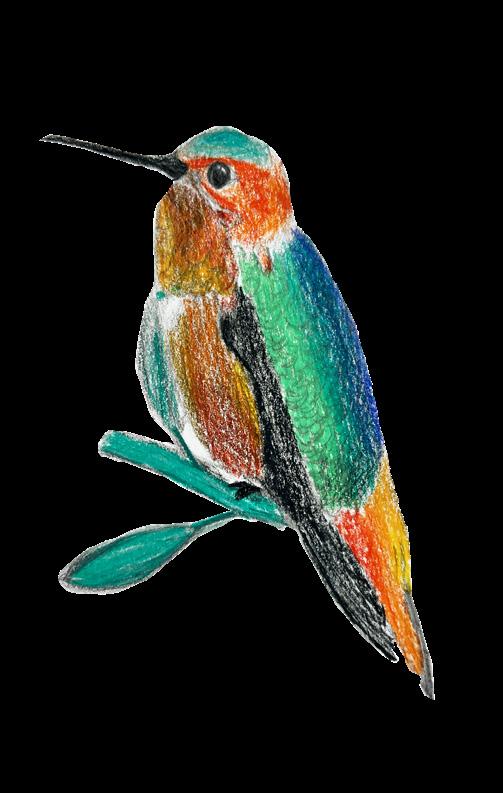
Allen’s Hummingbird BY AMANDA J.
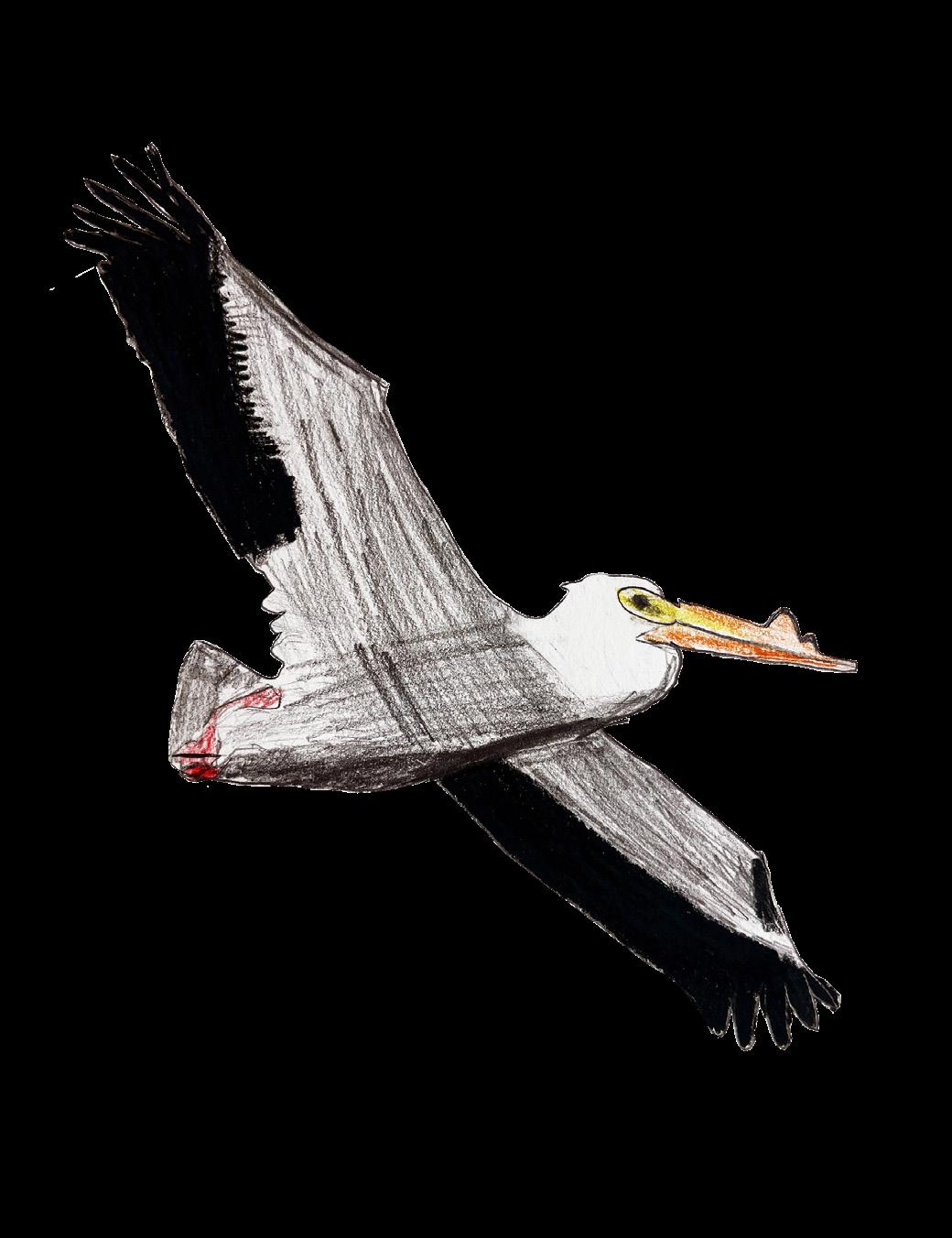
American White Pelican BY ALEX J.
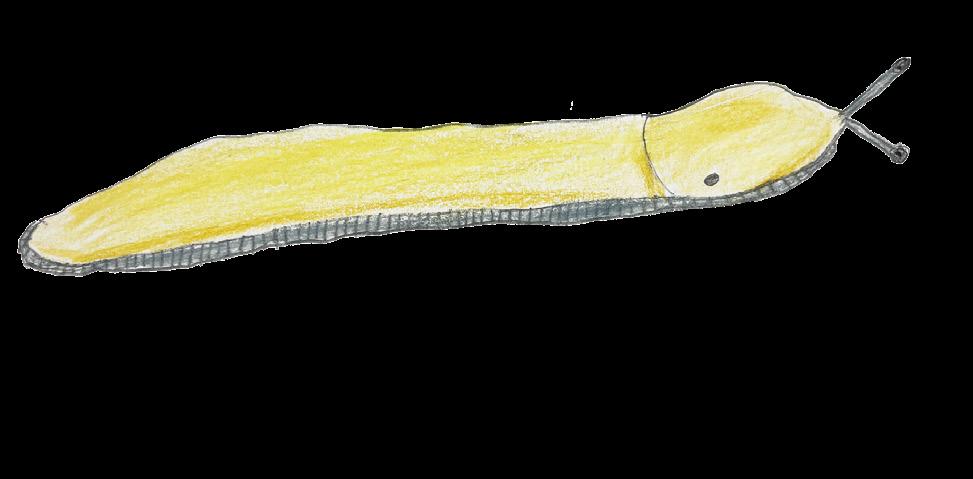
Banana Slug BY JAHAN V.
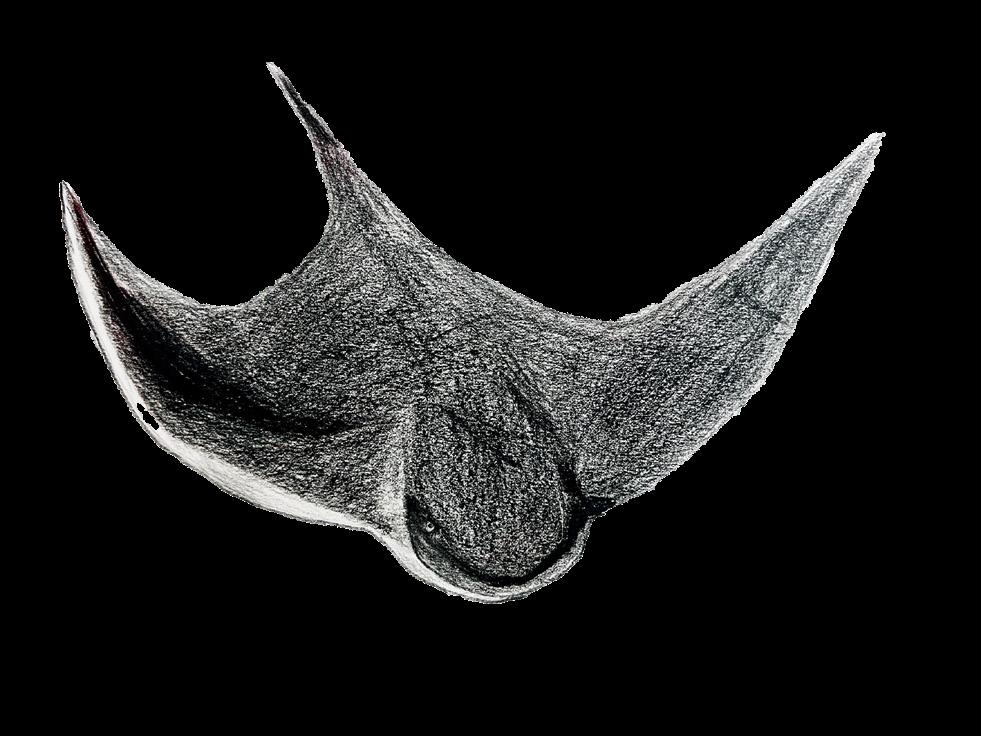
Bat Ray BY AARIV C.
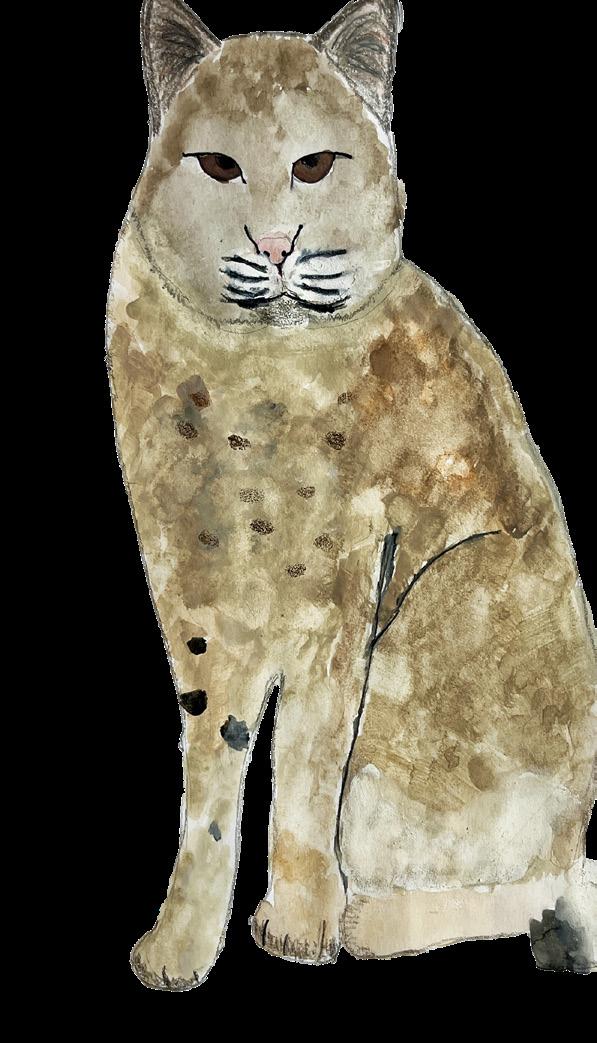
Bobcat BY EMMA Z.
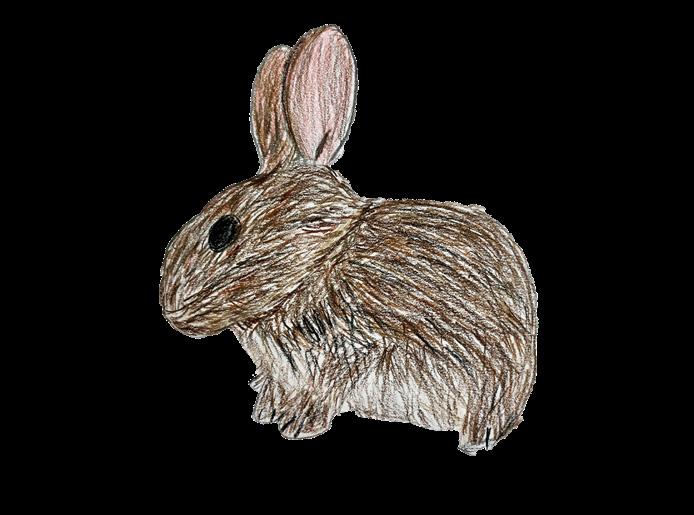
Brush Rabbit BY LEAH M.
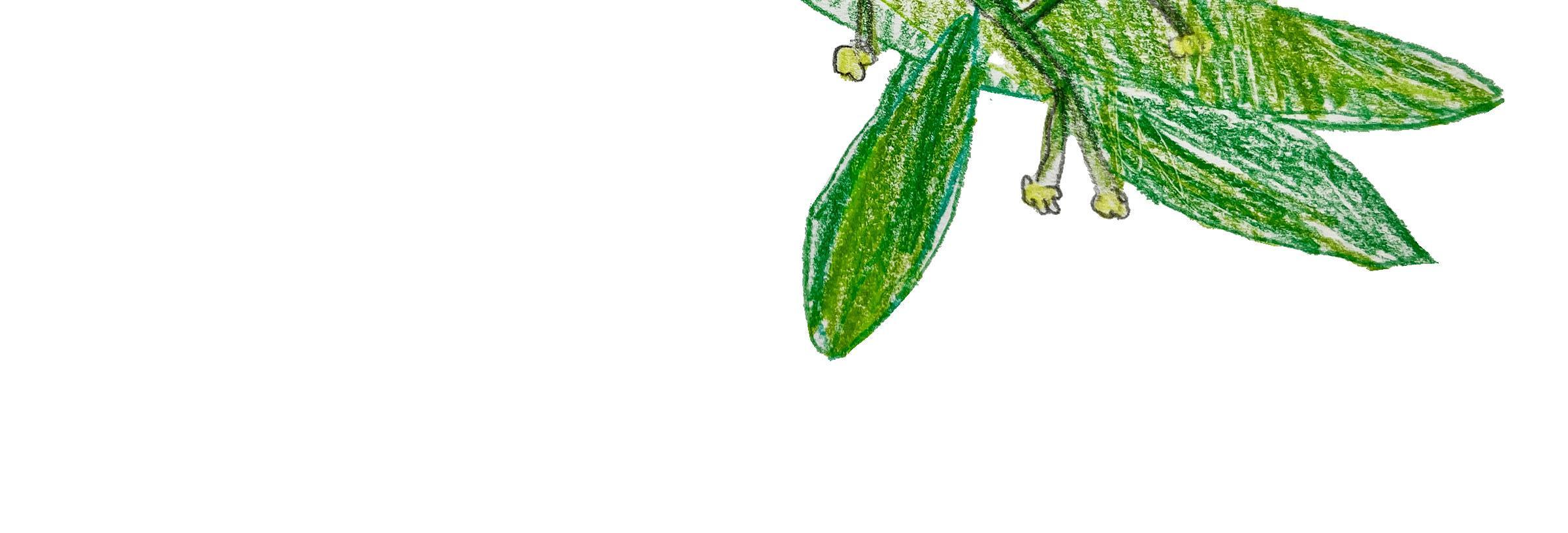
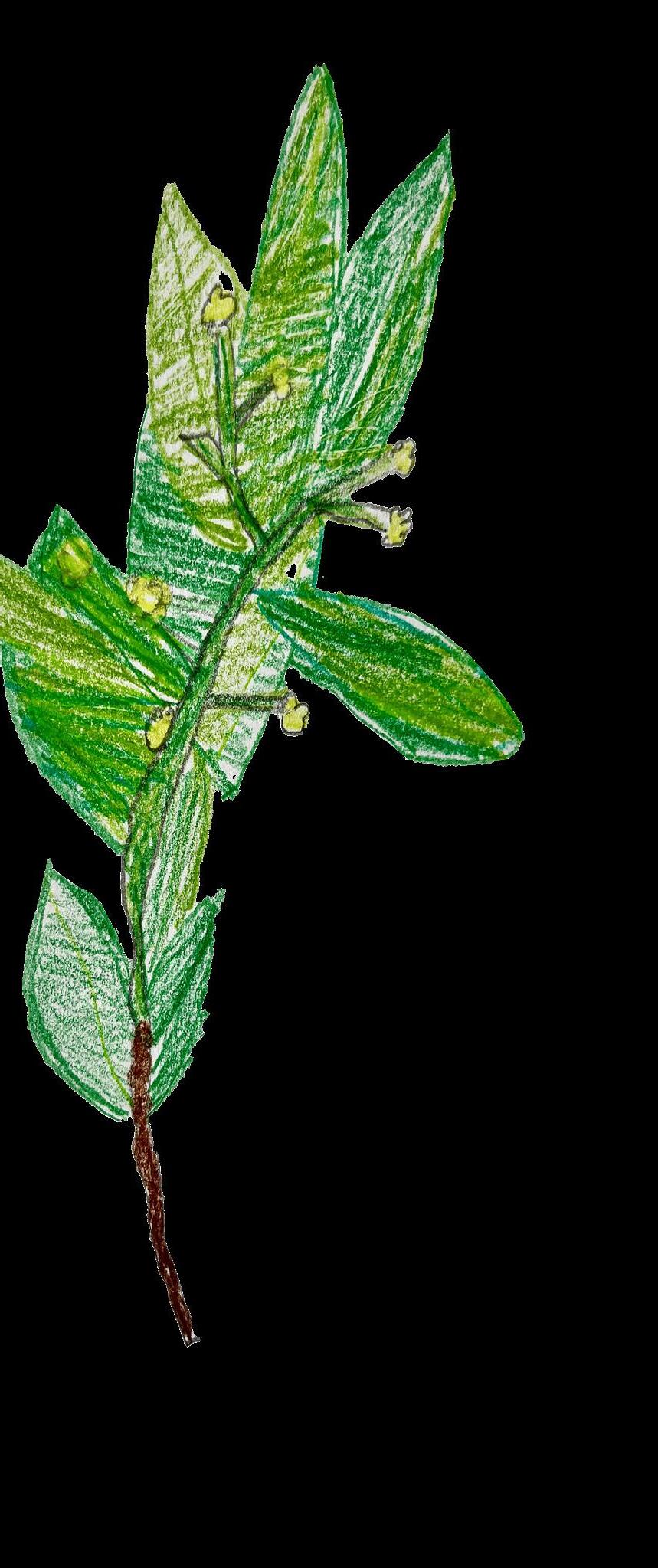
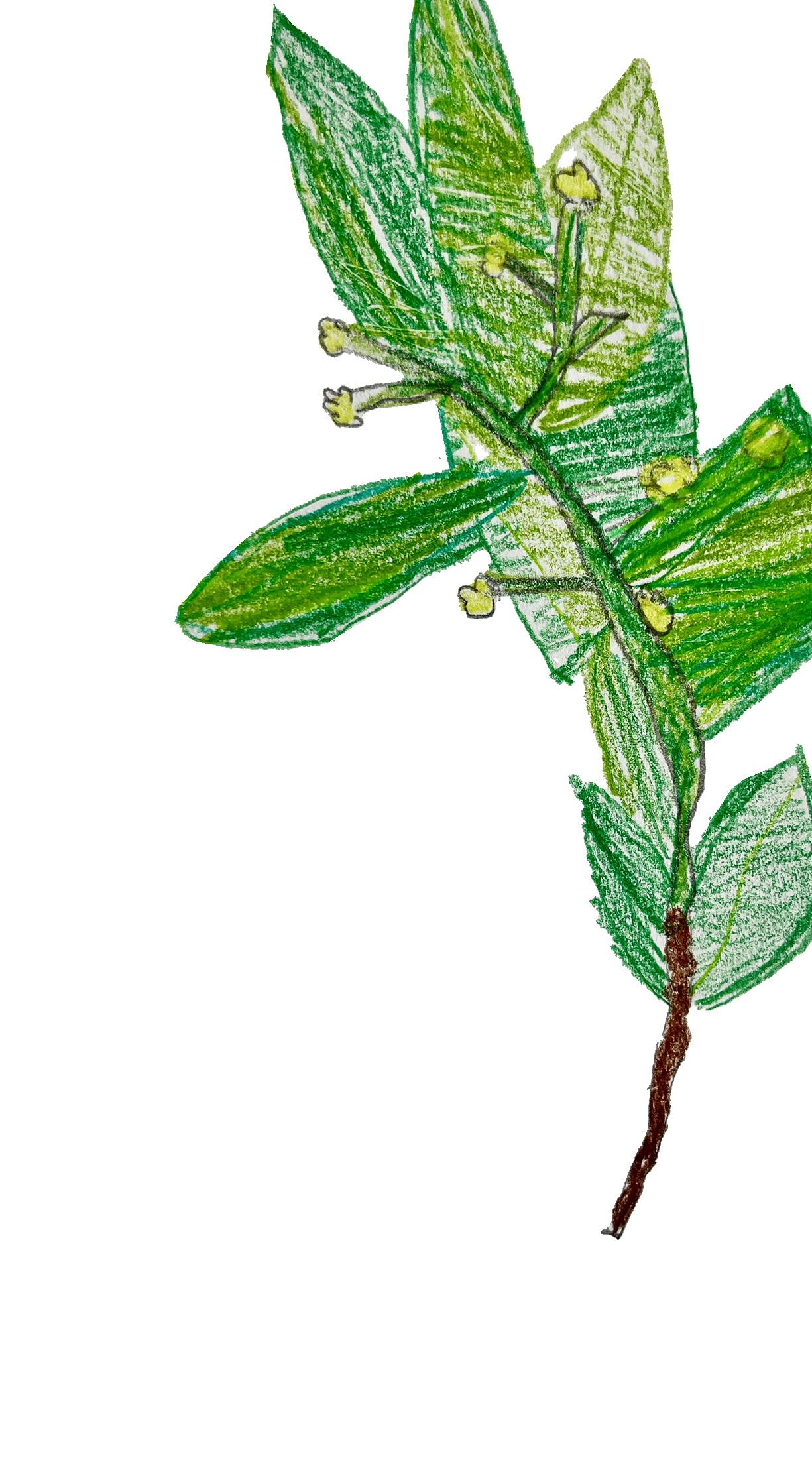
California Bay Laurel BY OSCAR P.
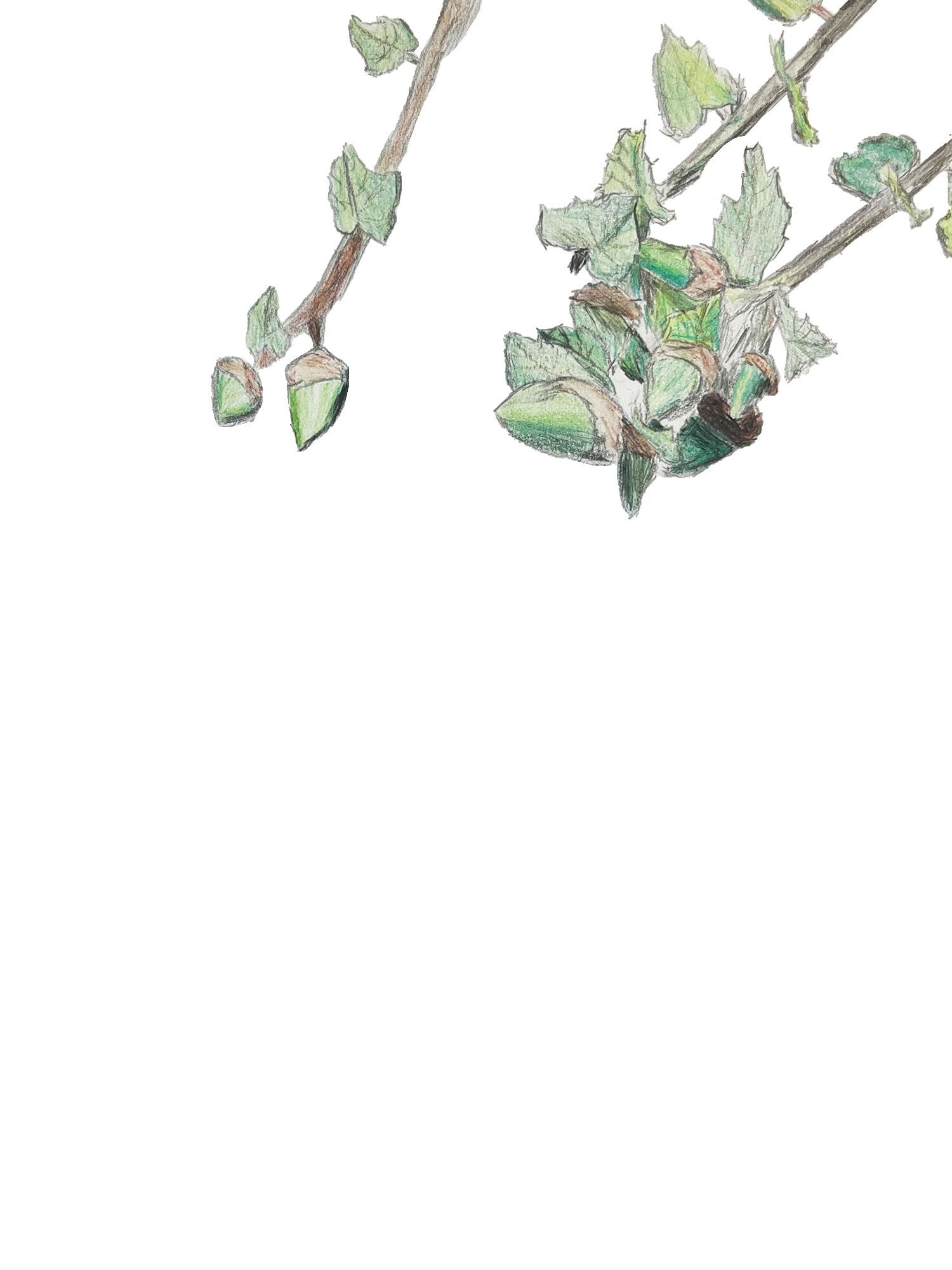
California Buckeye BY OTIS V.
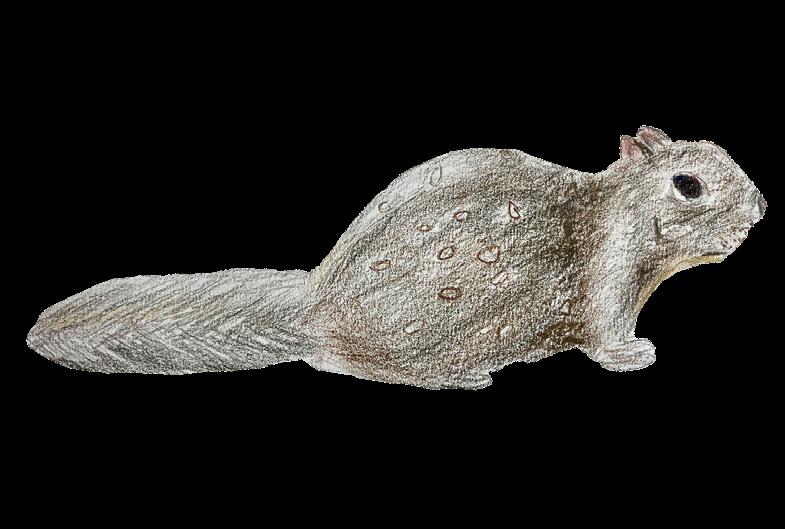
California Ground Squirrel BY MAYA R.
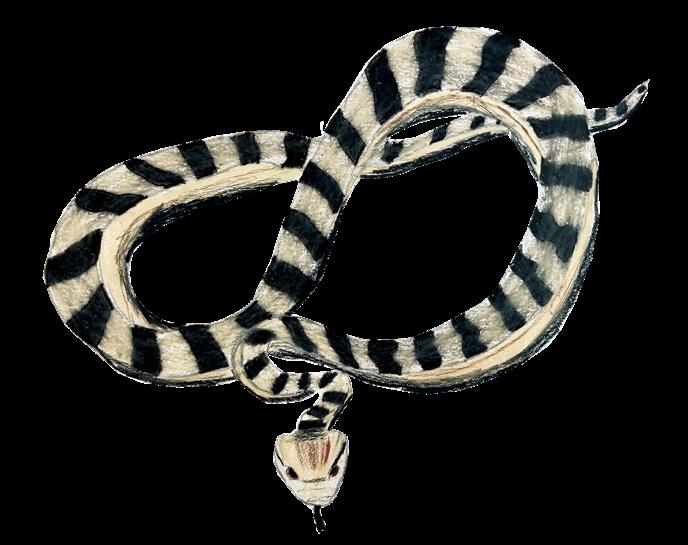
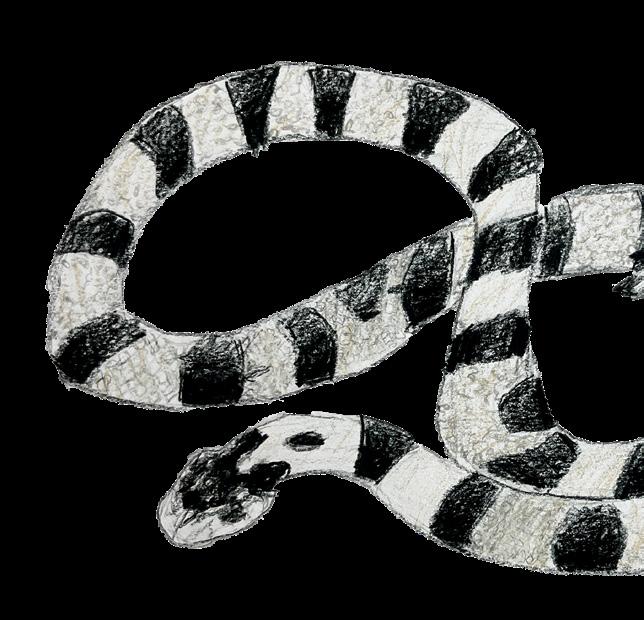
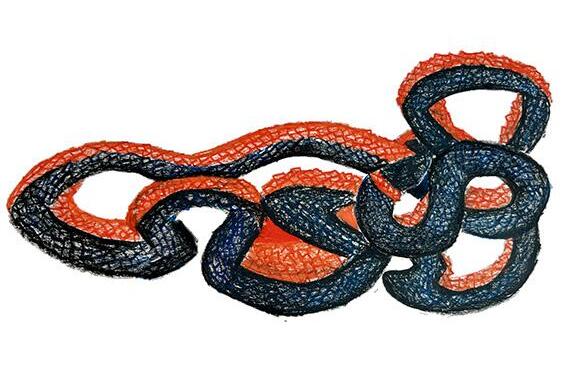
California Kingsnake BY SADE A.
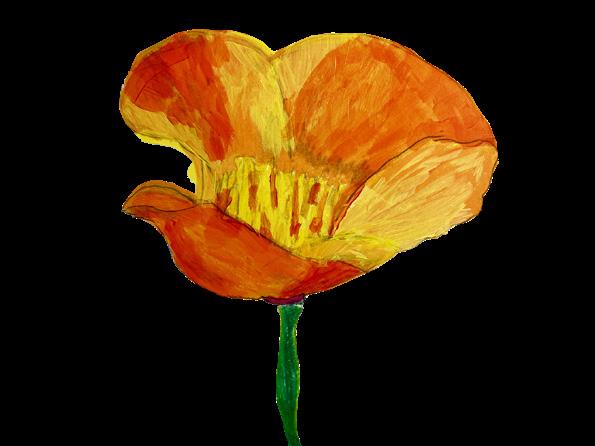
California Poppy BY AMEENA M.
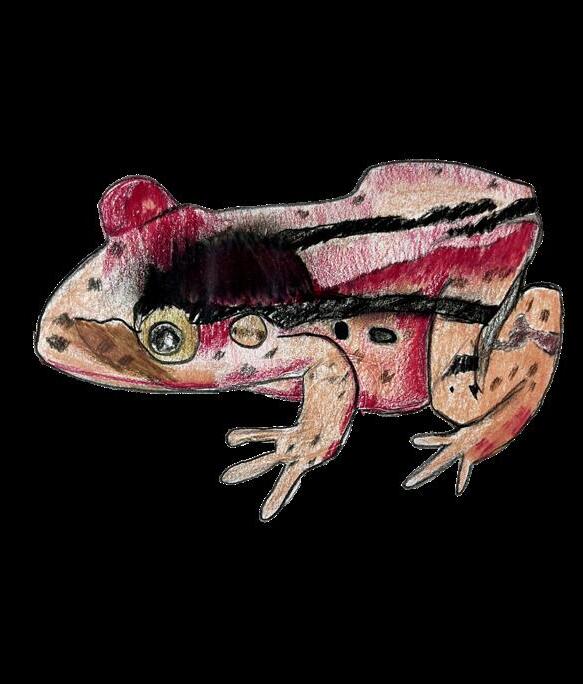
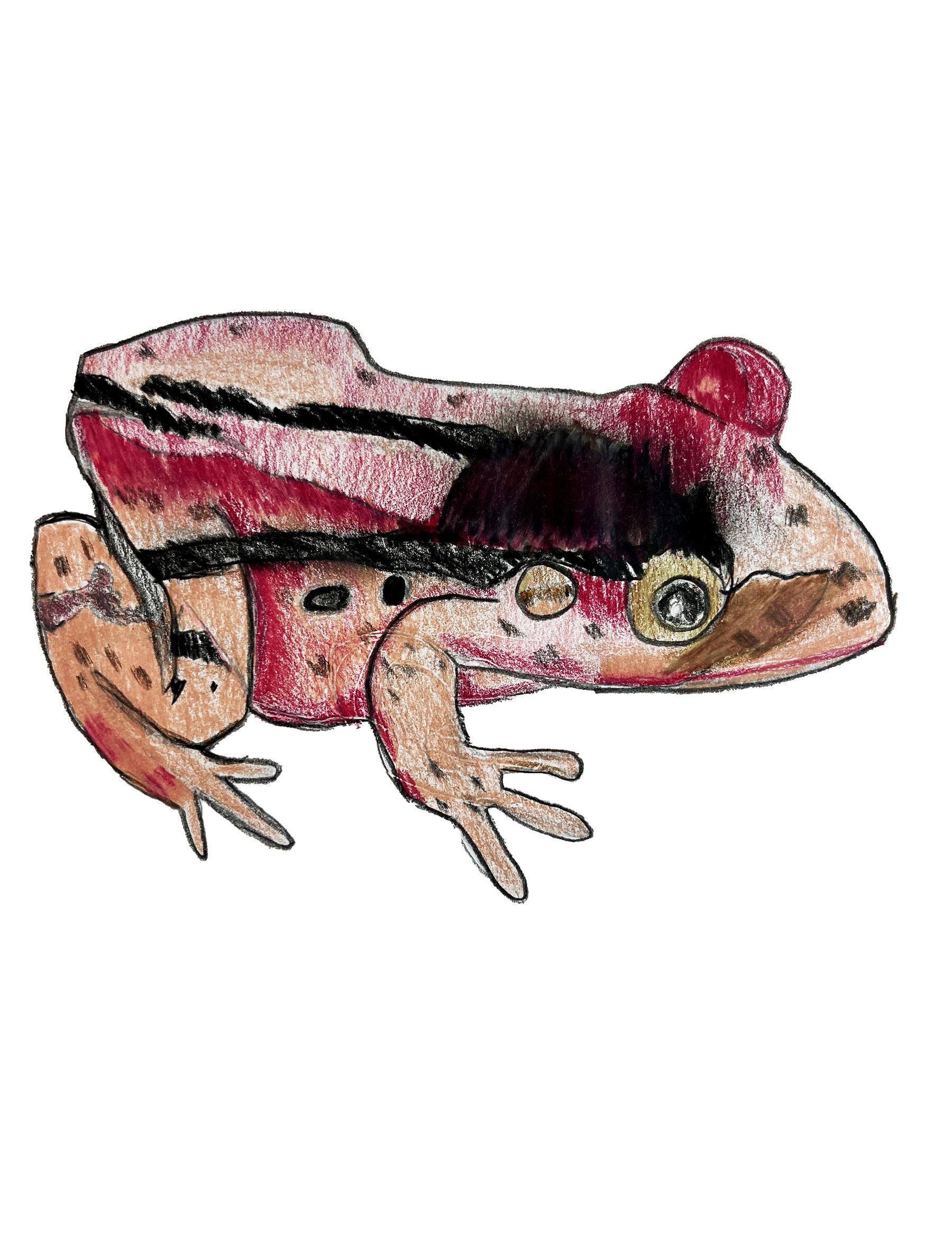
California Red-legged Frog BY LORRAINE W.
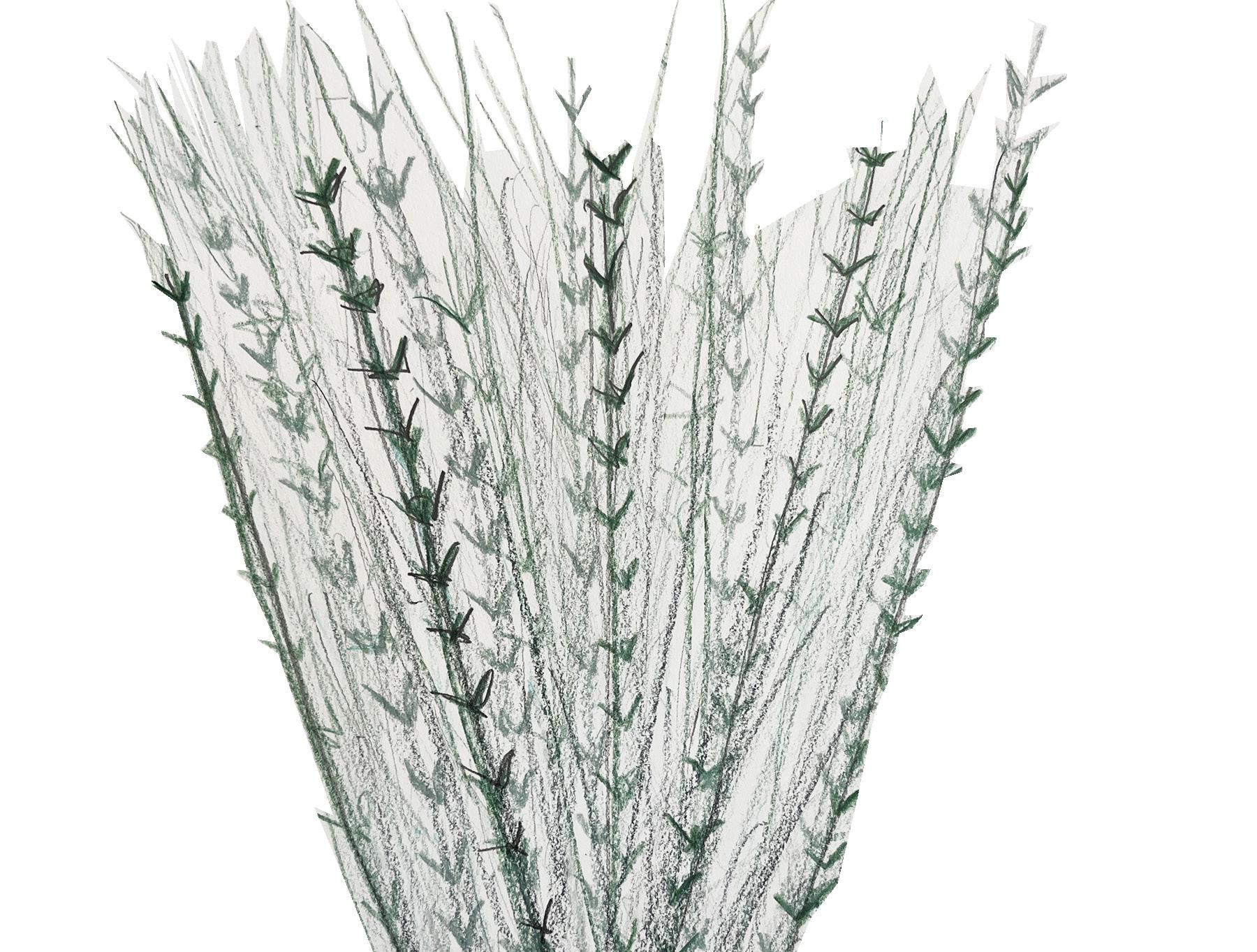
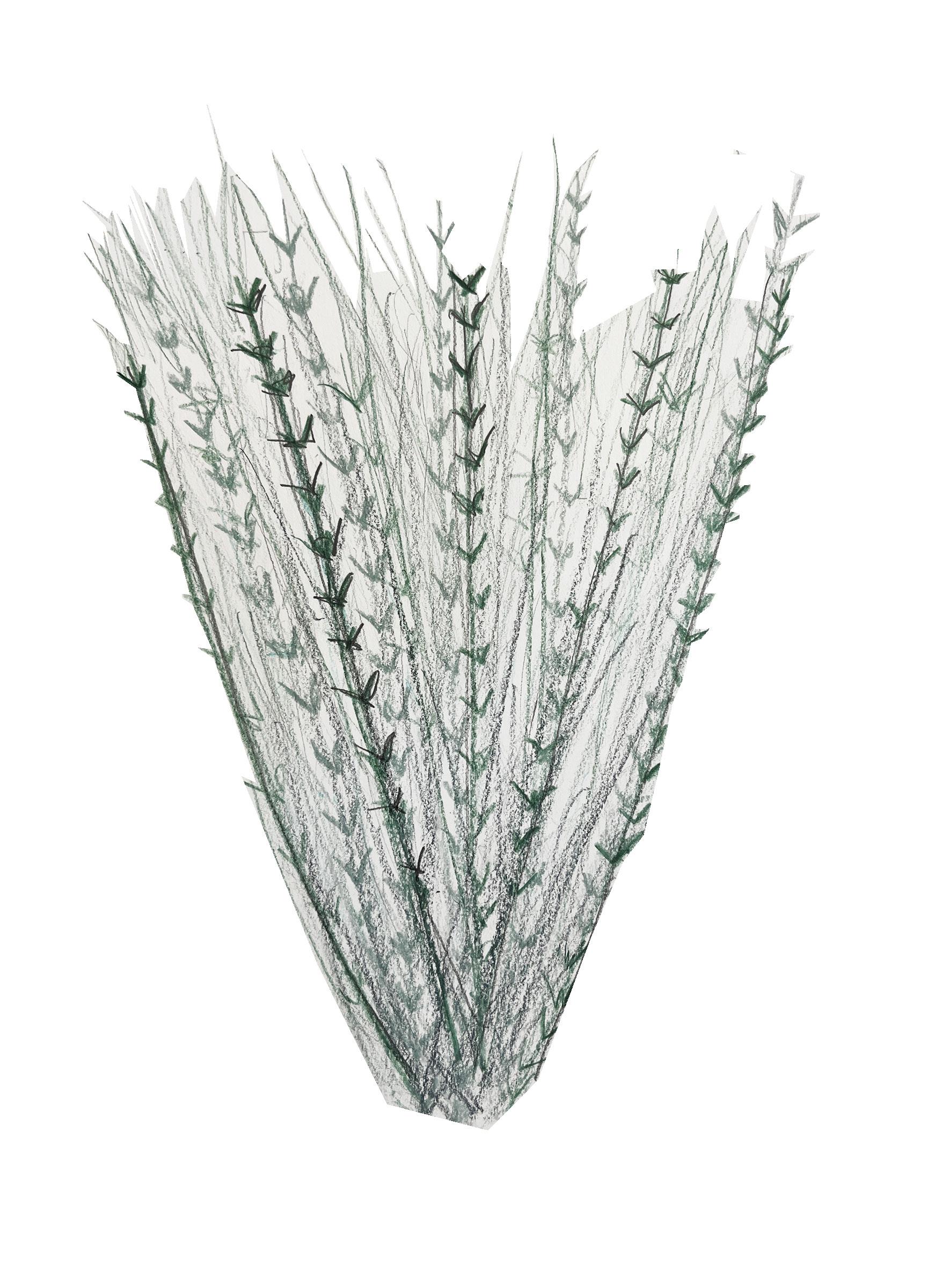
California Sagebrush BY AVA E.
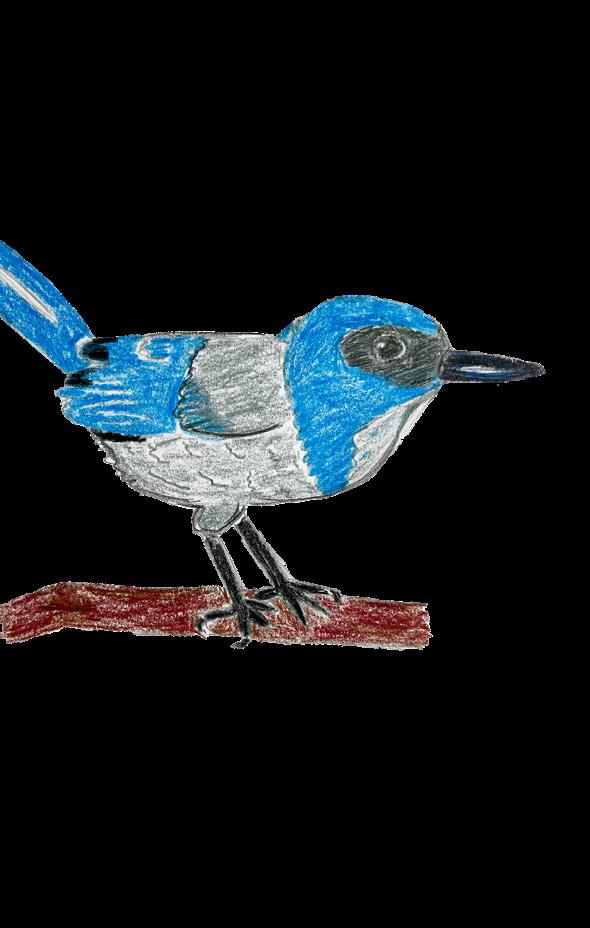
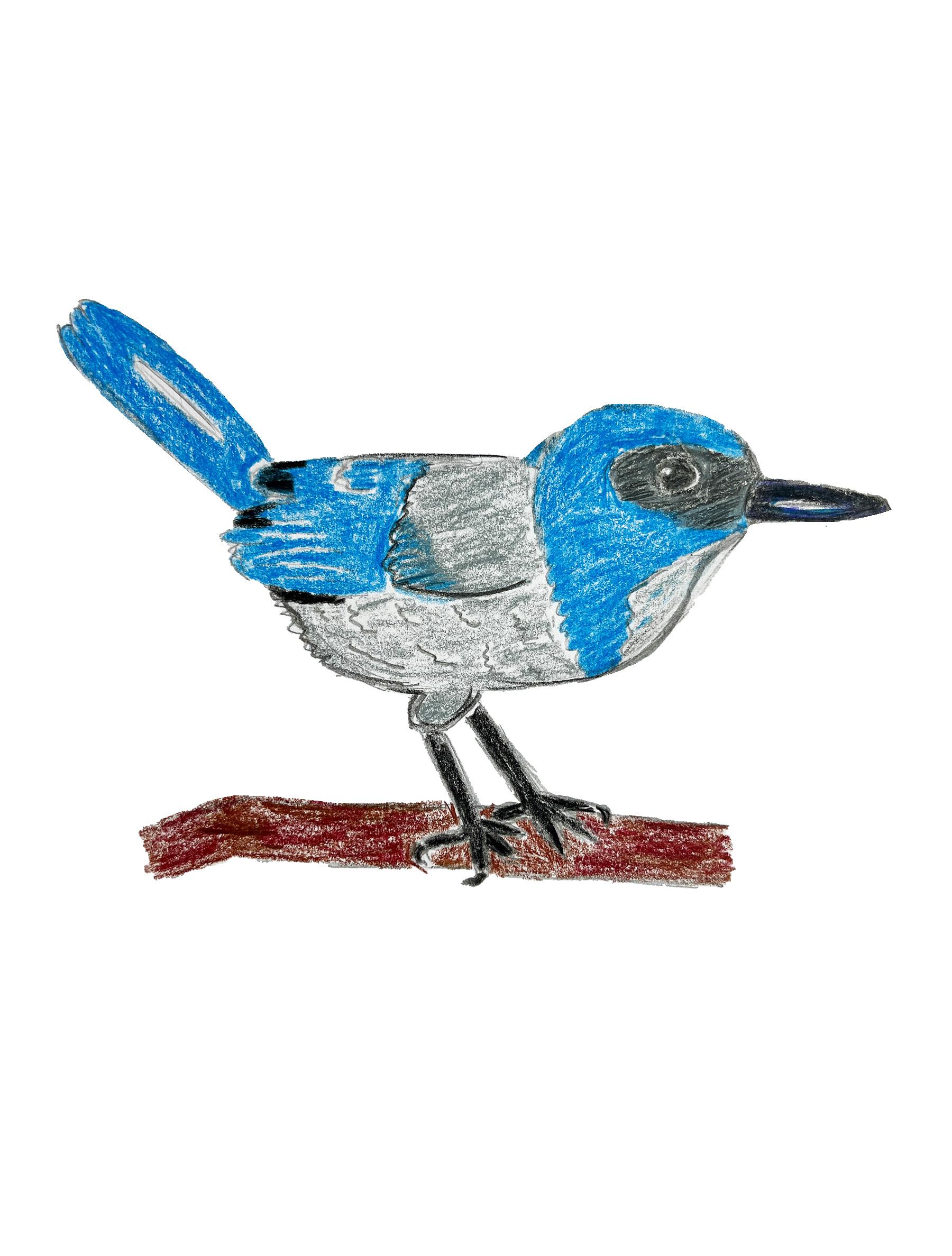
California Scrub Jay BY LAILA V.G.
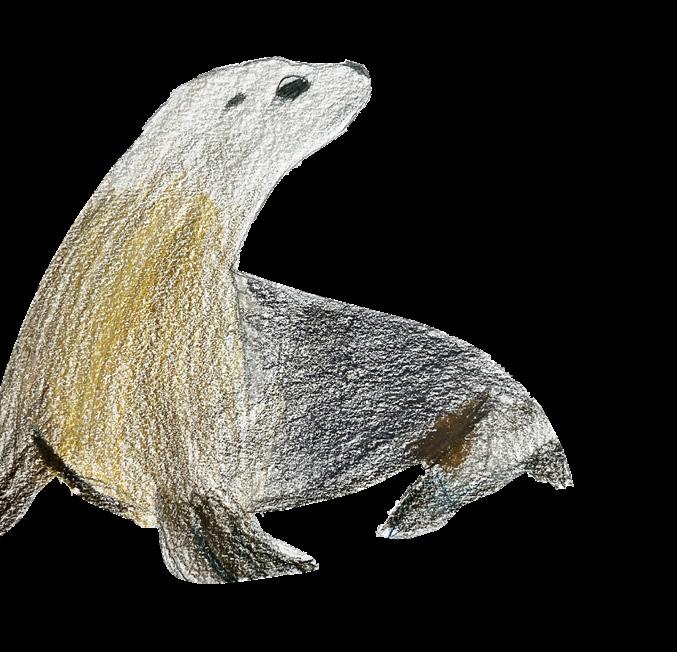
California Sea Lion BY LUCAS A.
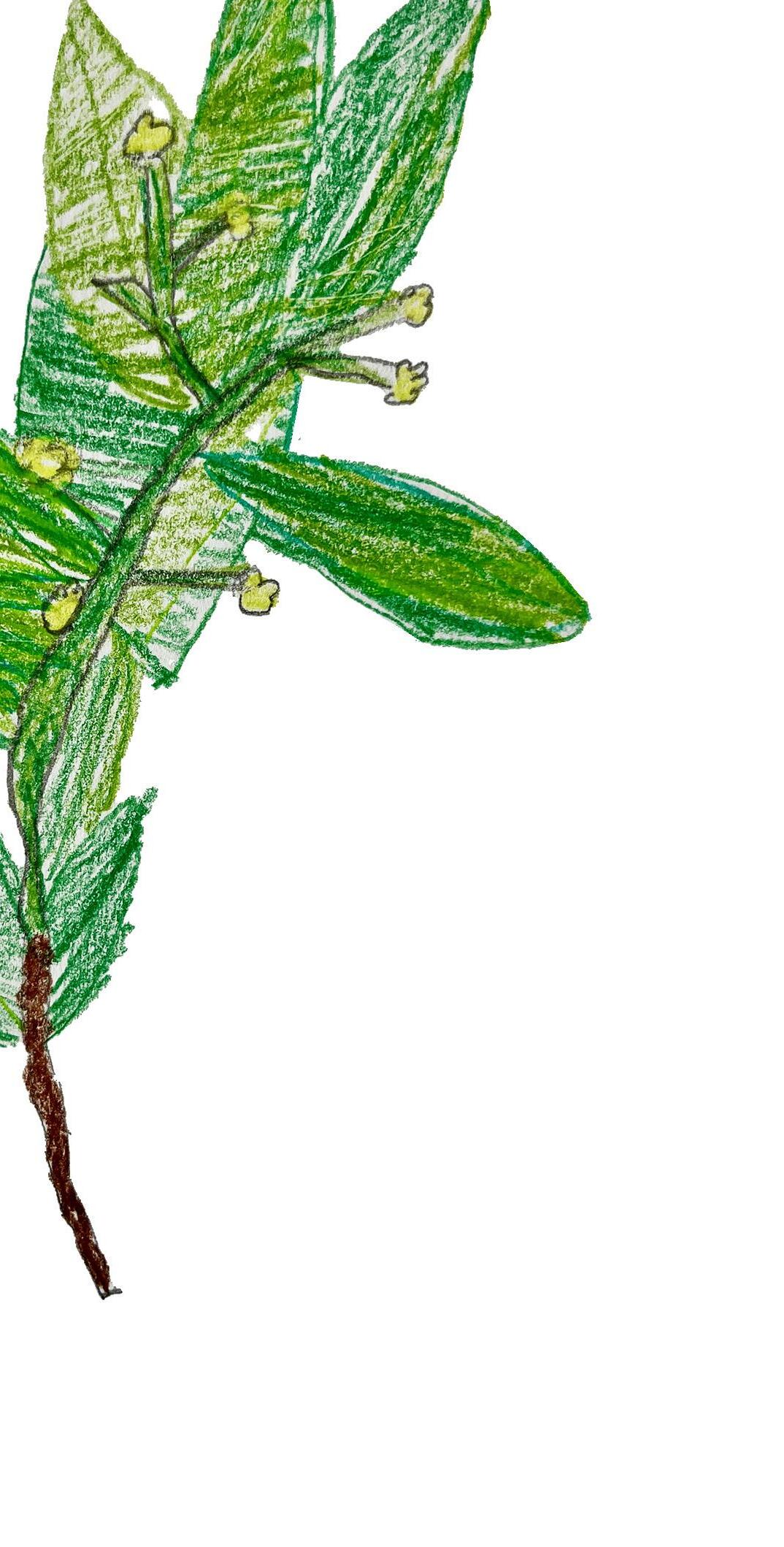
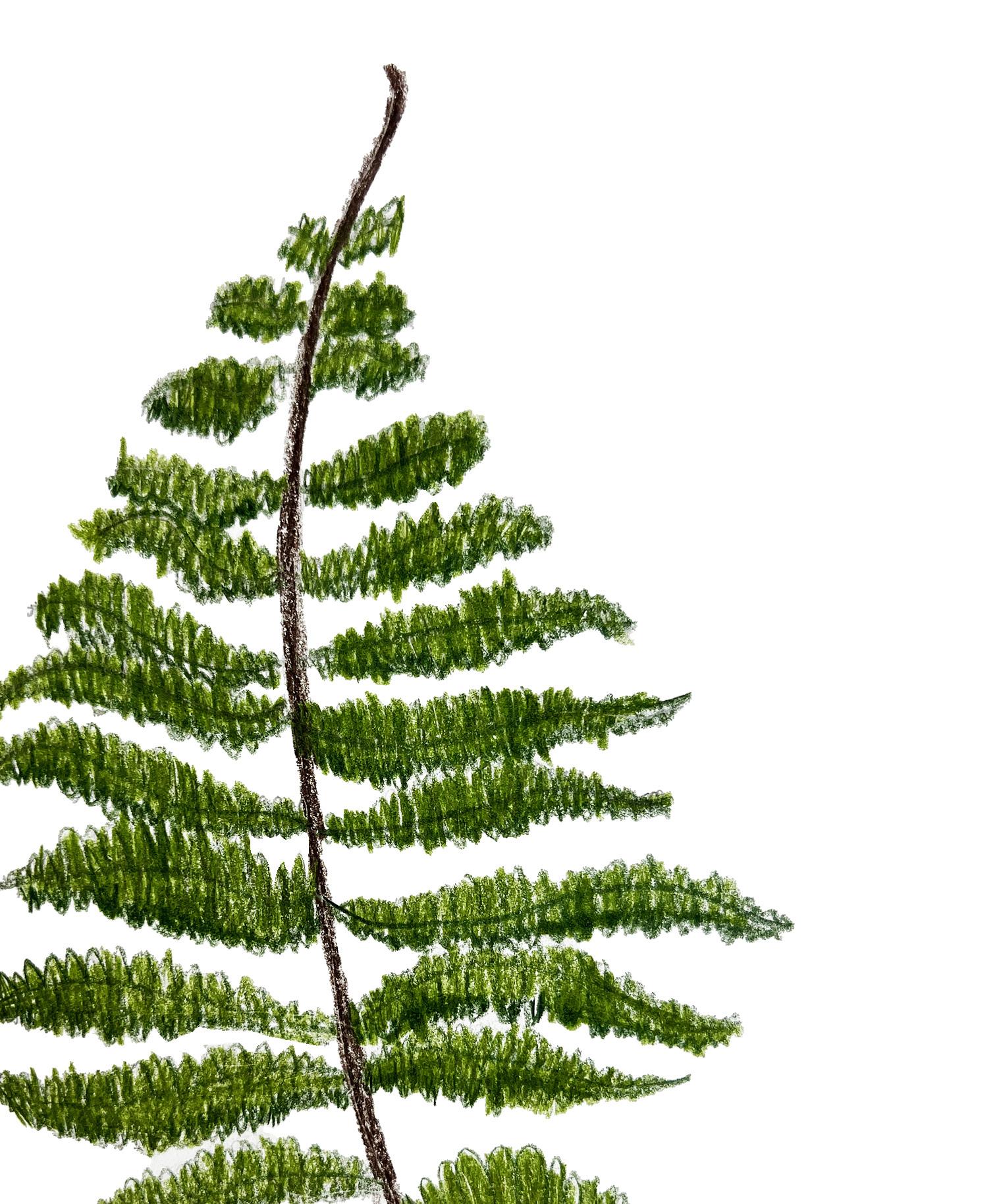
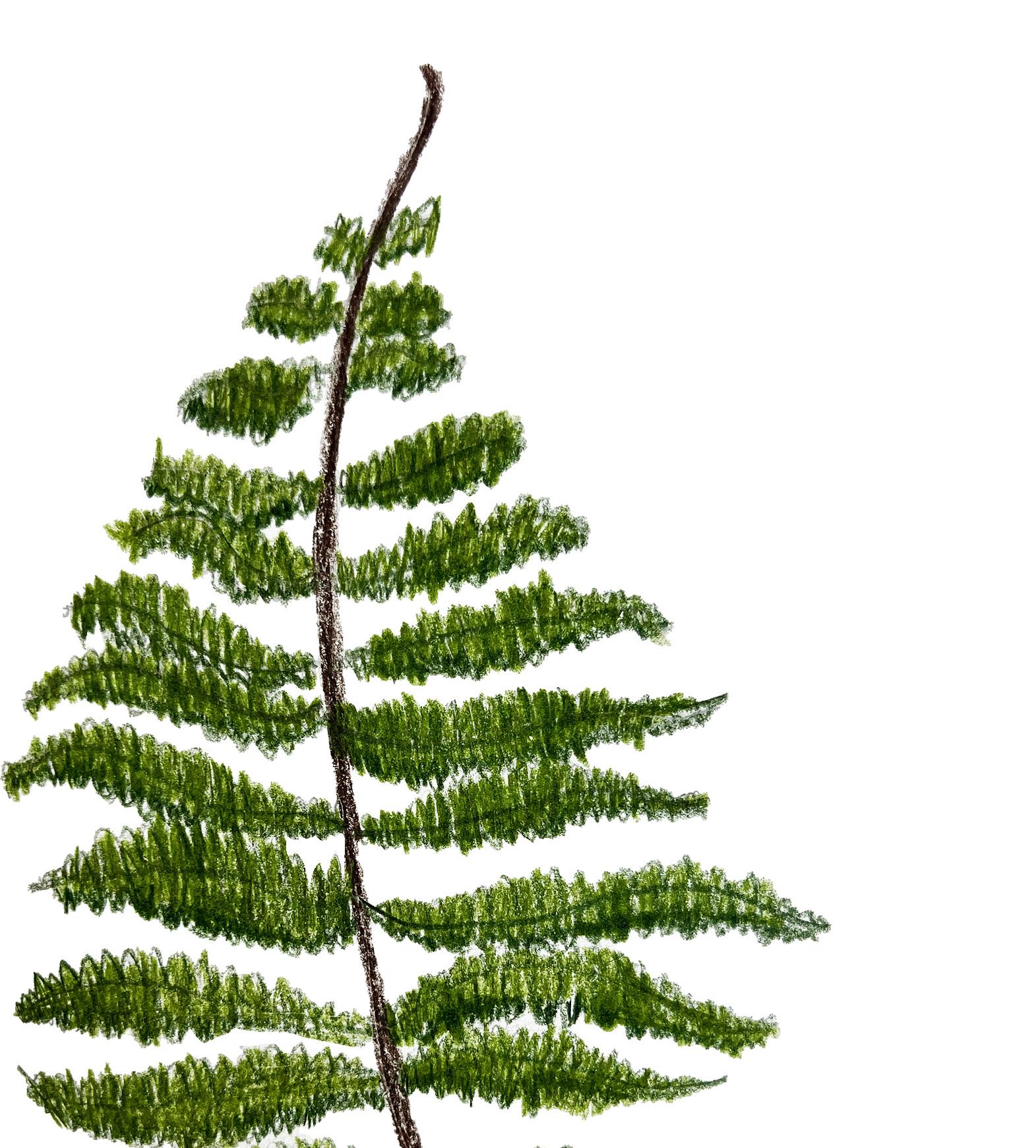
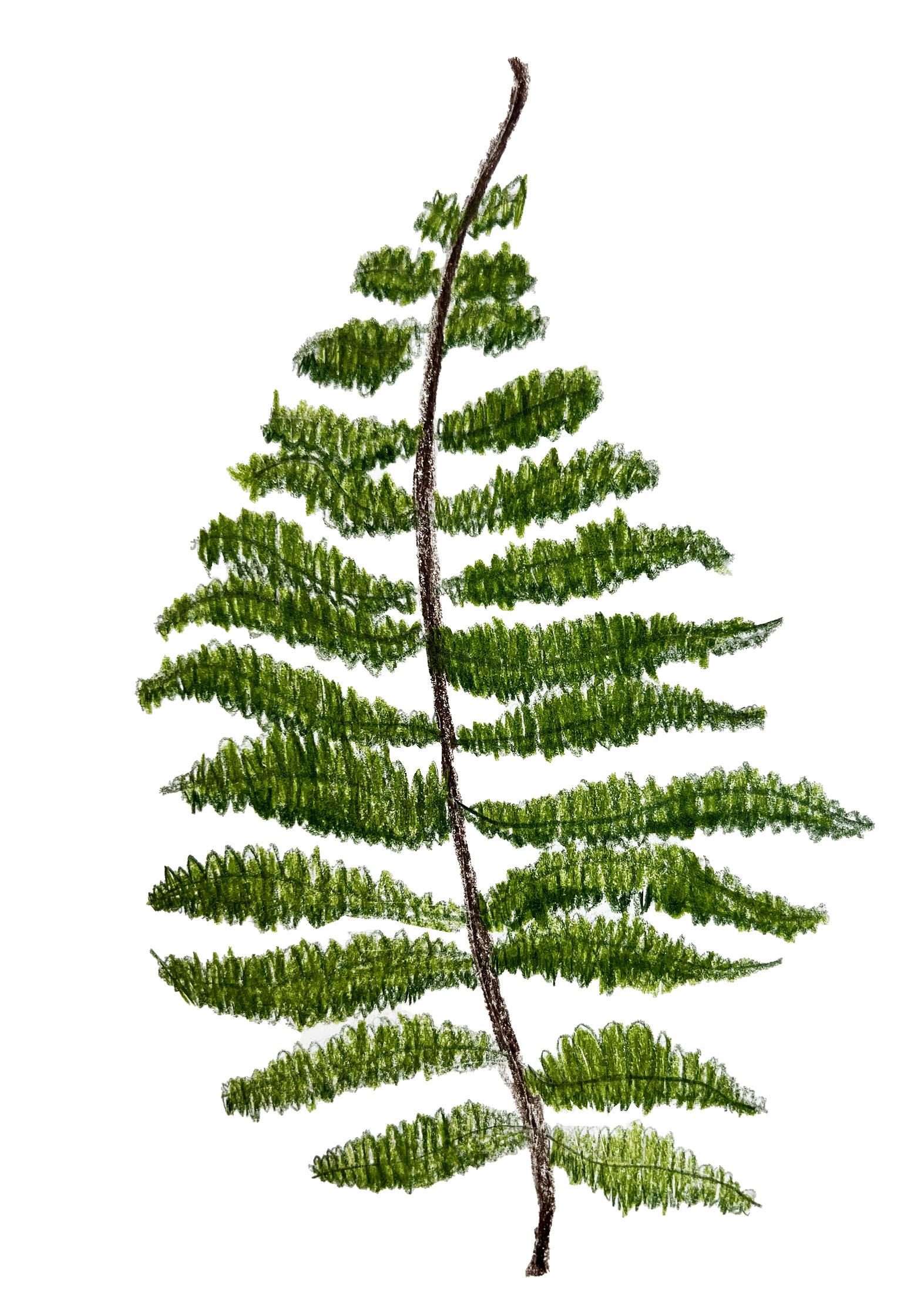
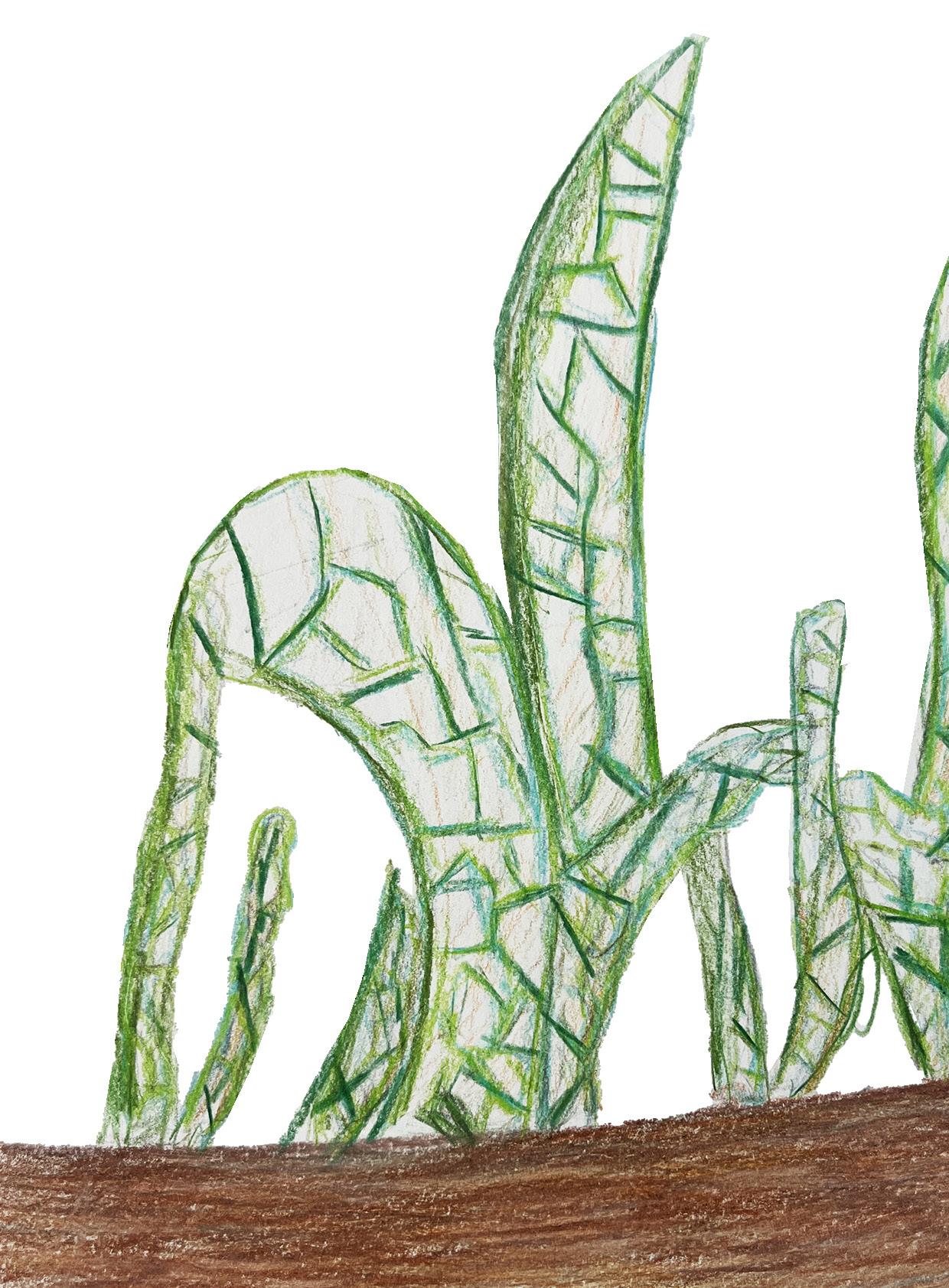
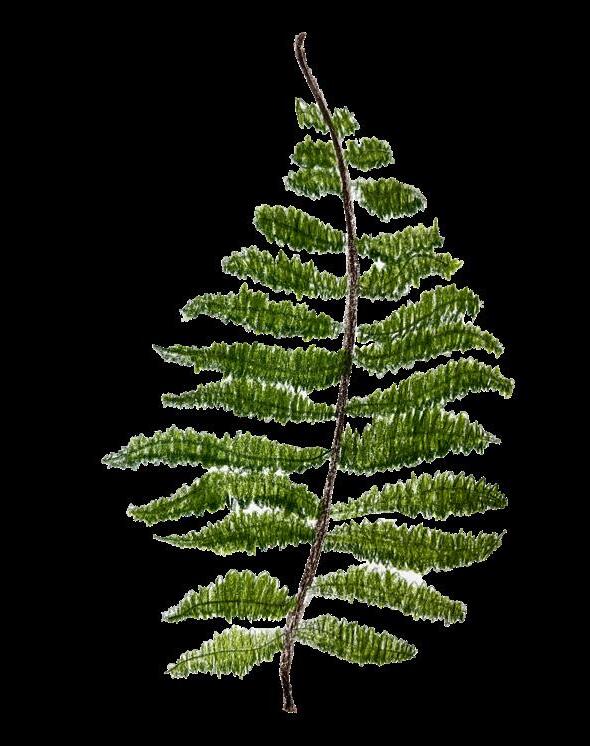
California Shield Fern BY SOPHIA D.
California Towhee BY COOPER C.
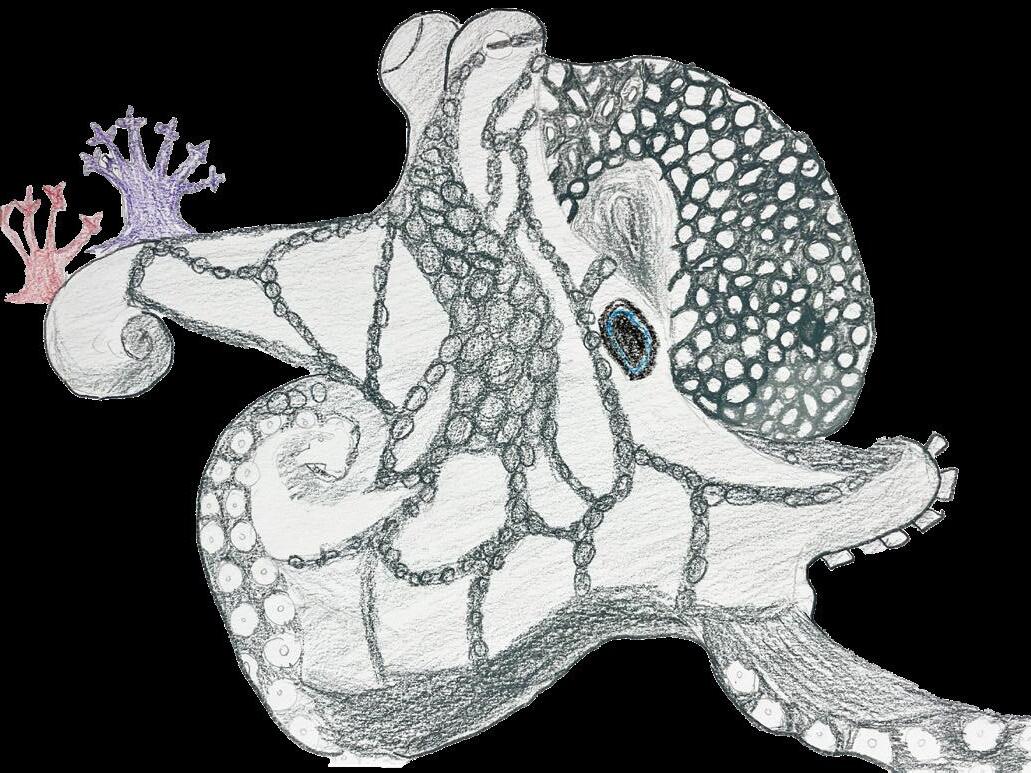
California Two-spot Octopus BY JOSEPH L.
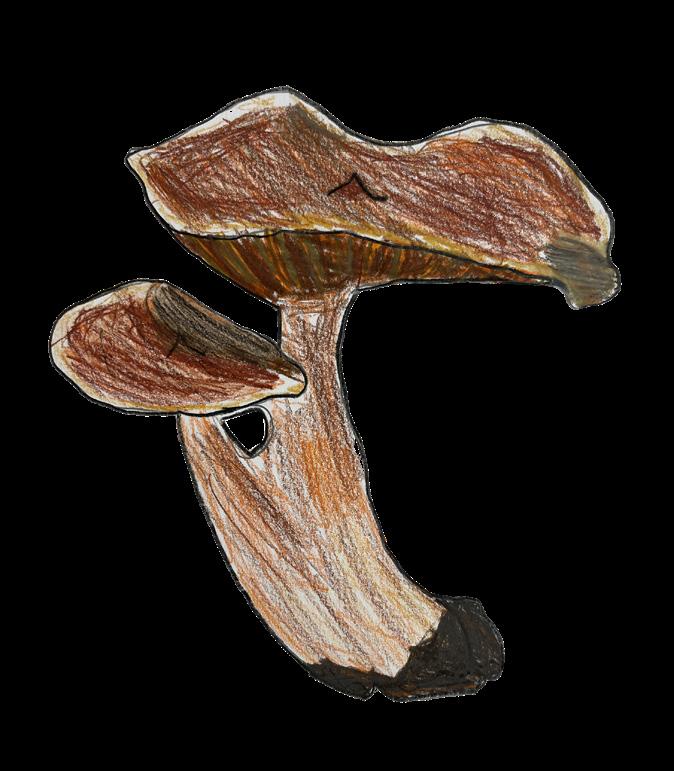
Candy Cap BY GOOGY C.
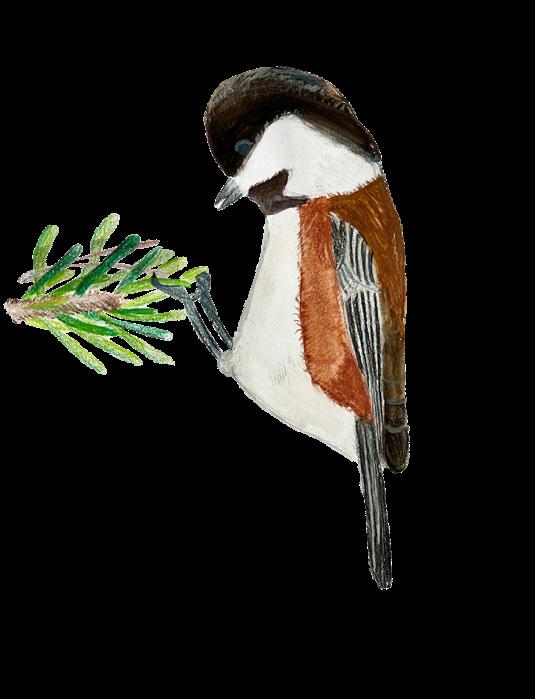
Chestnut-backed Chickadee BY KARISSA L.
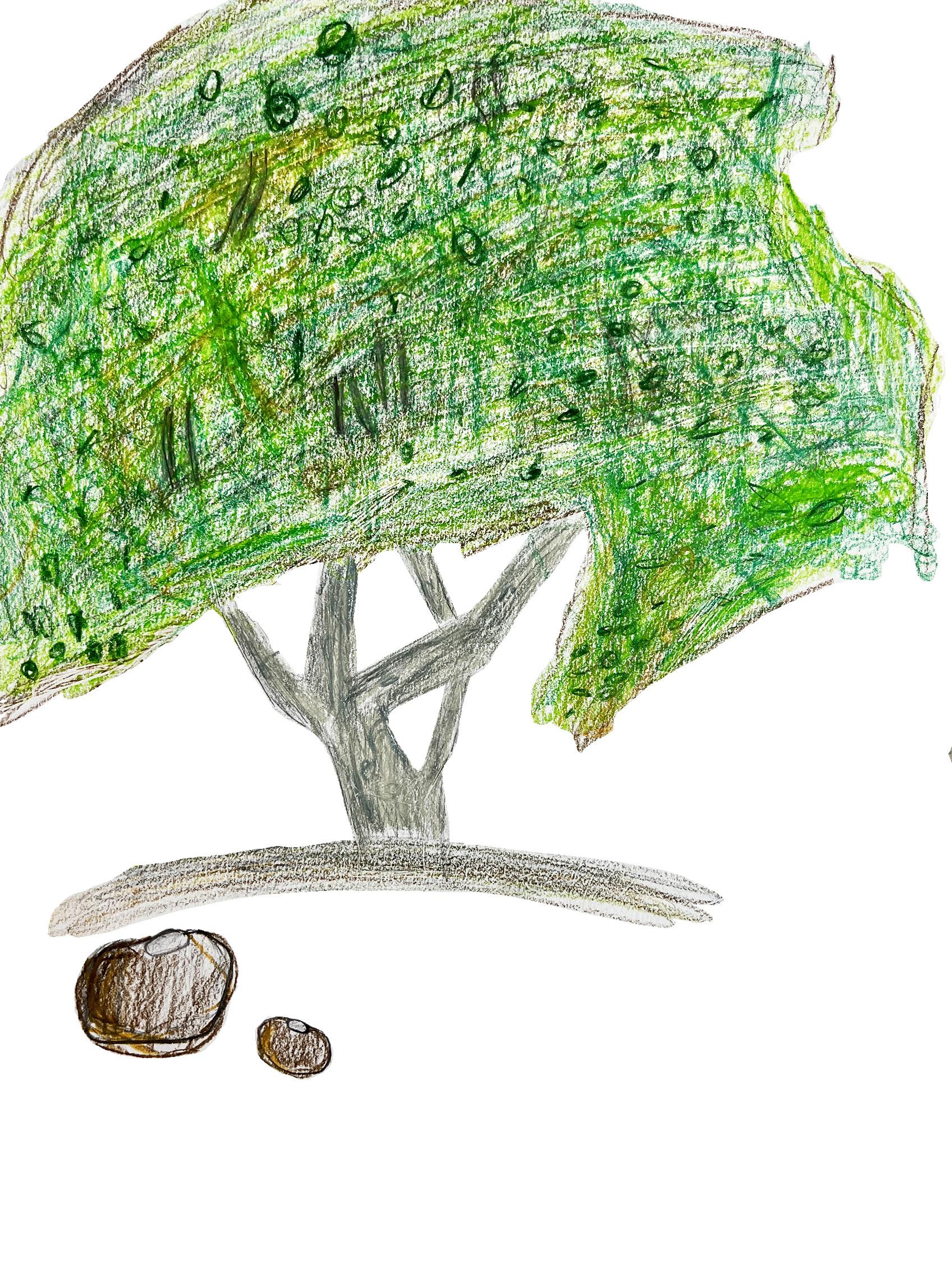
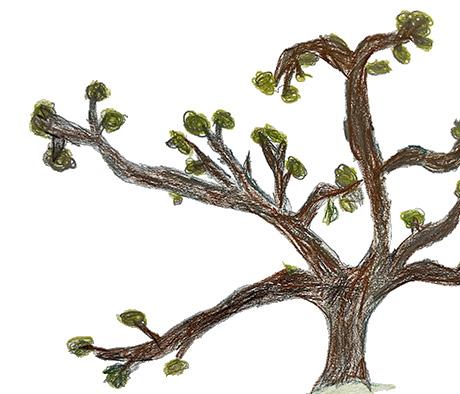
Coast Live Oak BY ZANDER C.
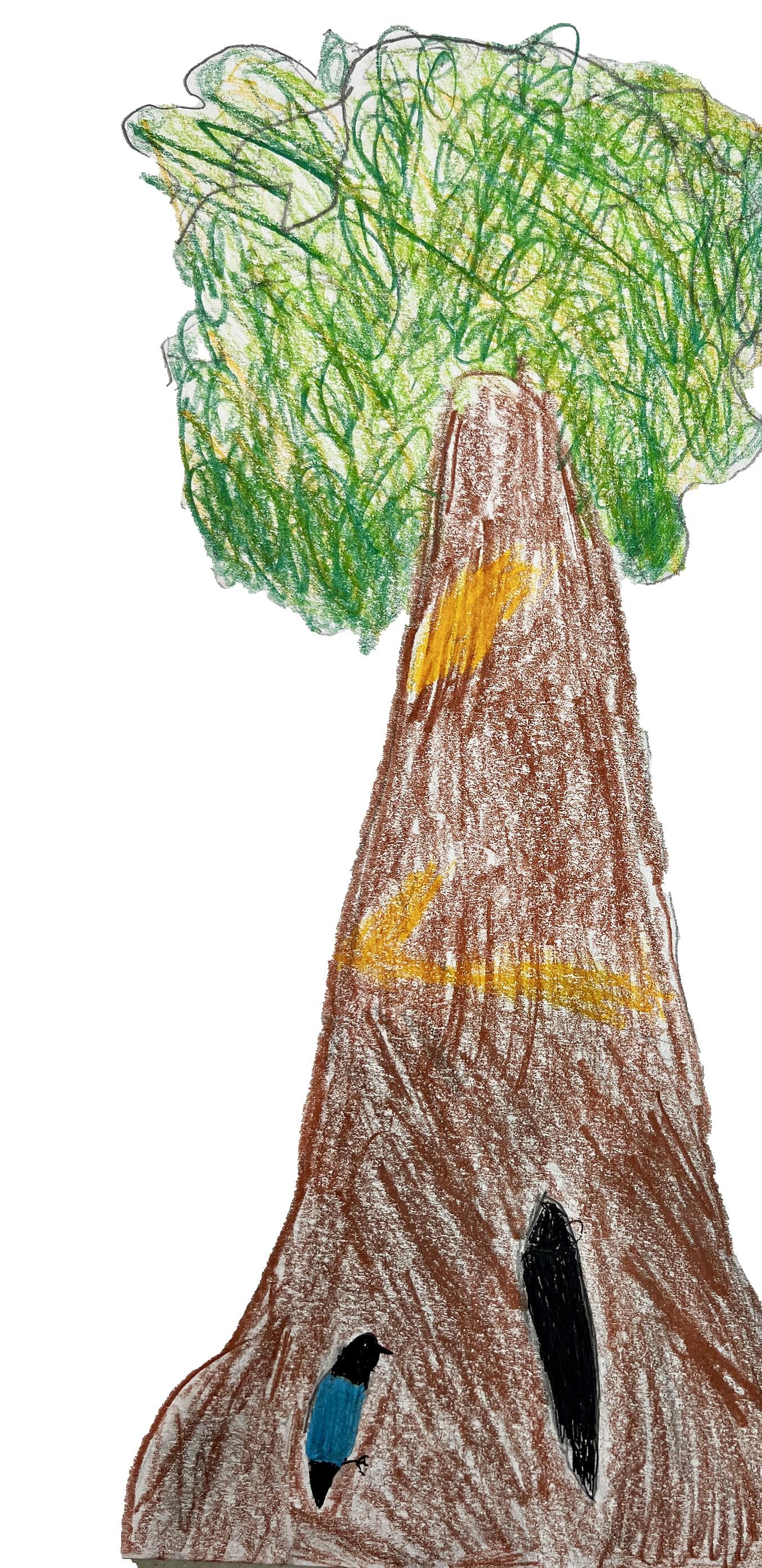
Coast Redwood BY NIRVAAN J.
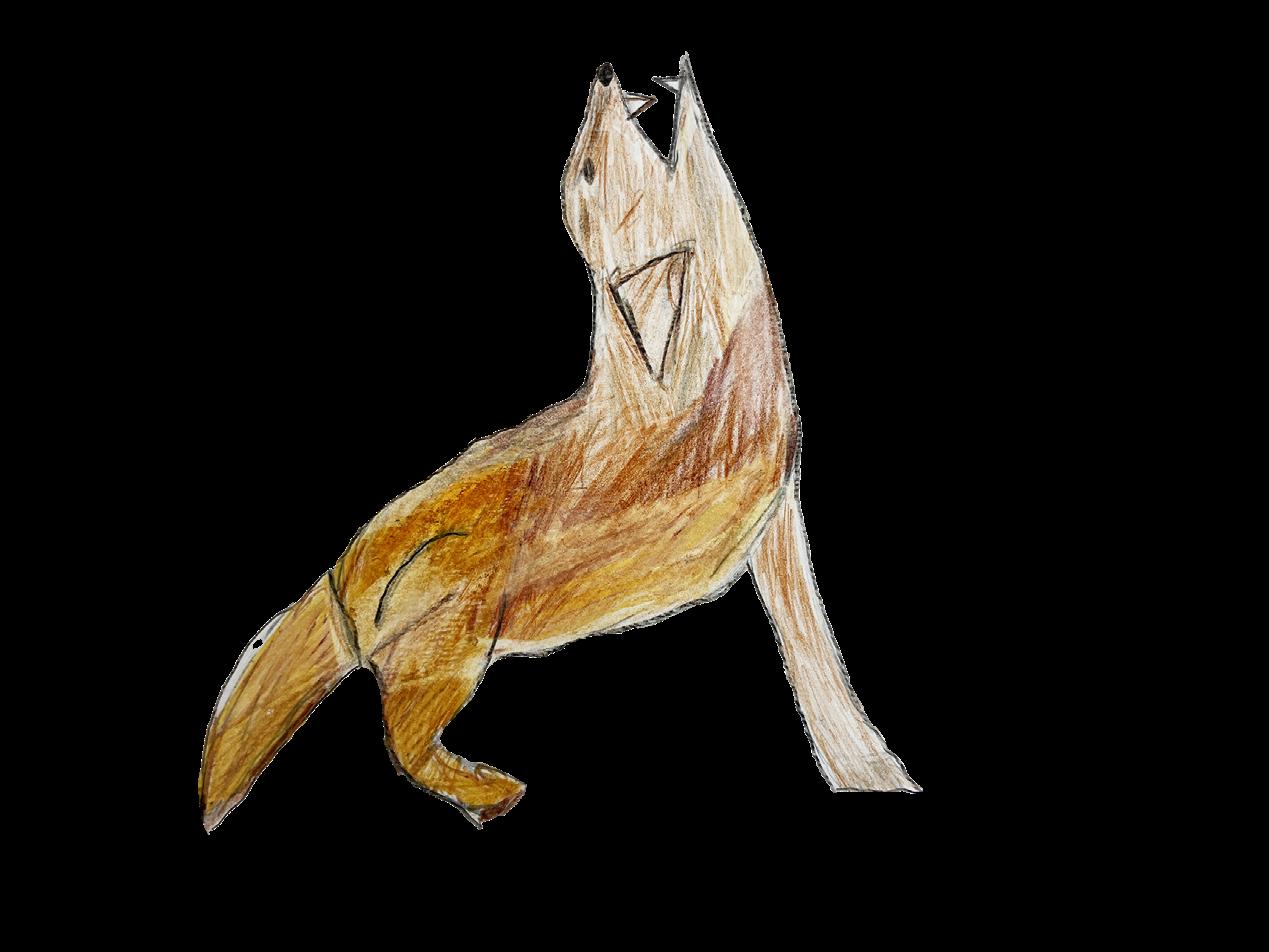
Coyote BY ASTON K.
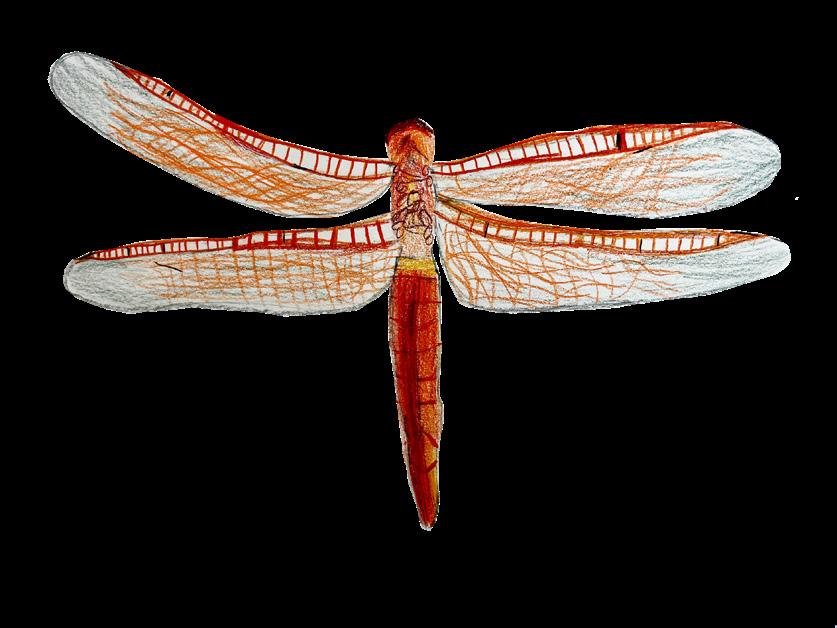
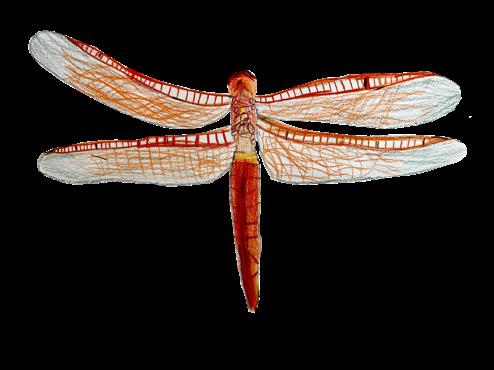
Flame Skimmer BY ABI D.
Giant Kelp BY CAMERON S.
Gopher Snake BY YUCHEN L.
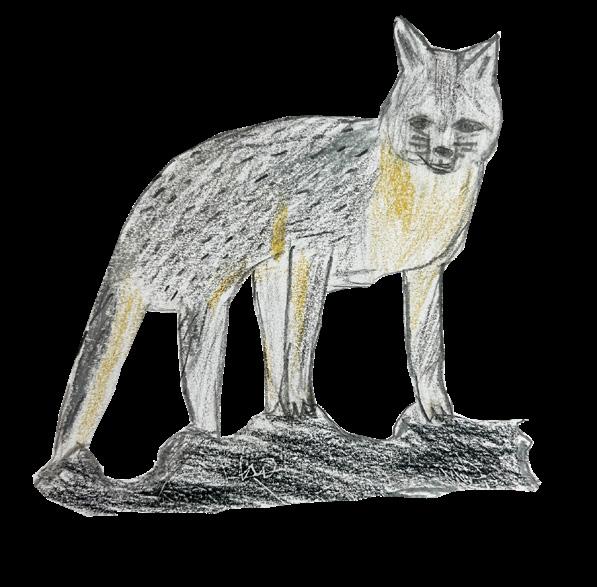
Gray Fox BY AARAV K.
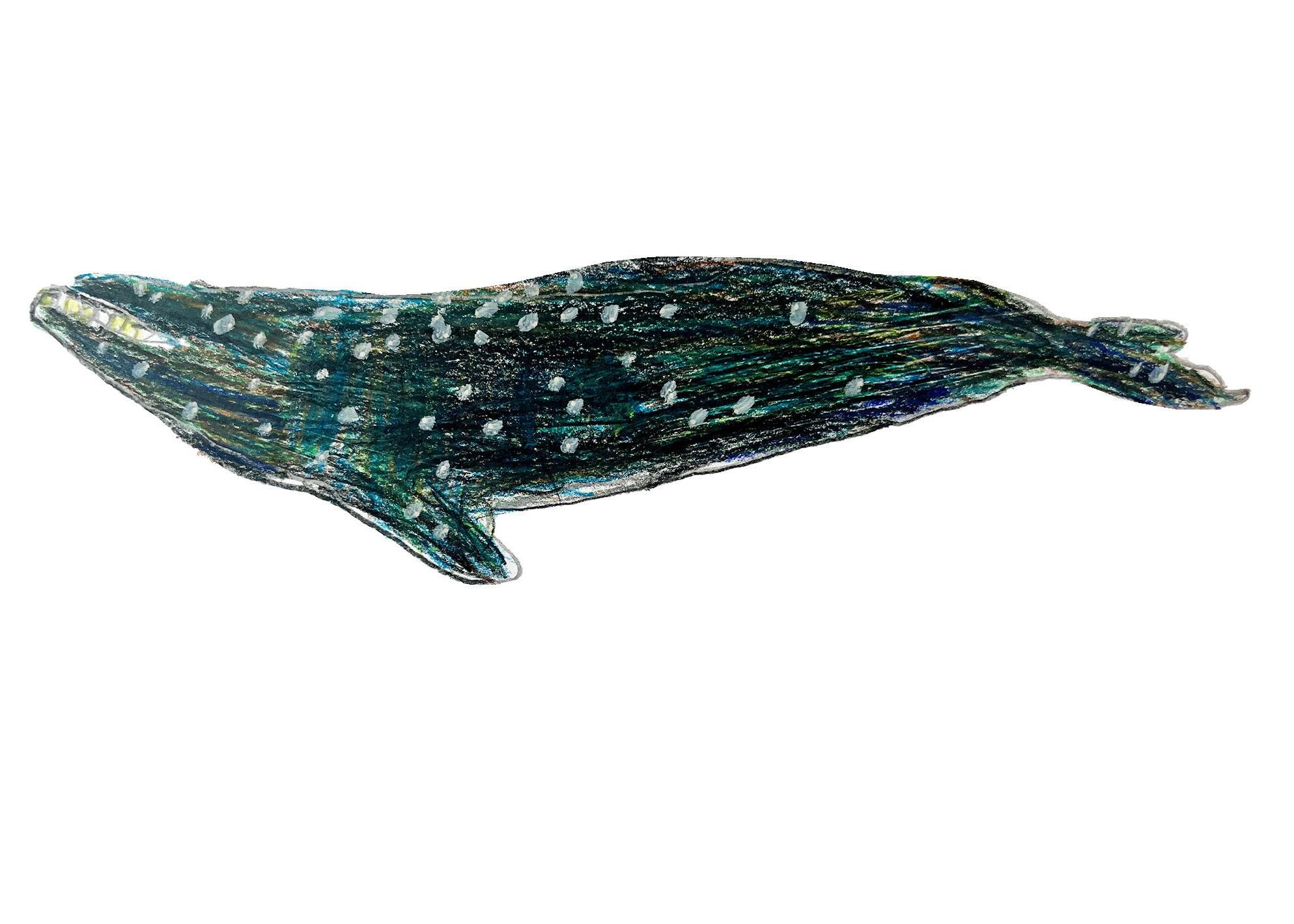
Gray Whale BY PABLO G.
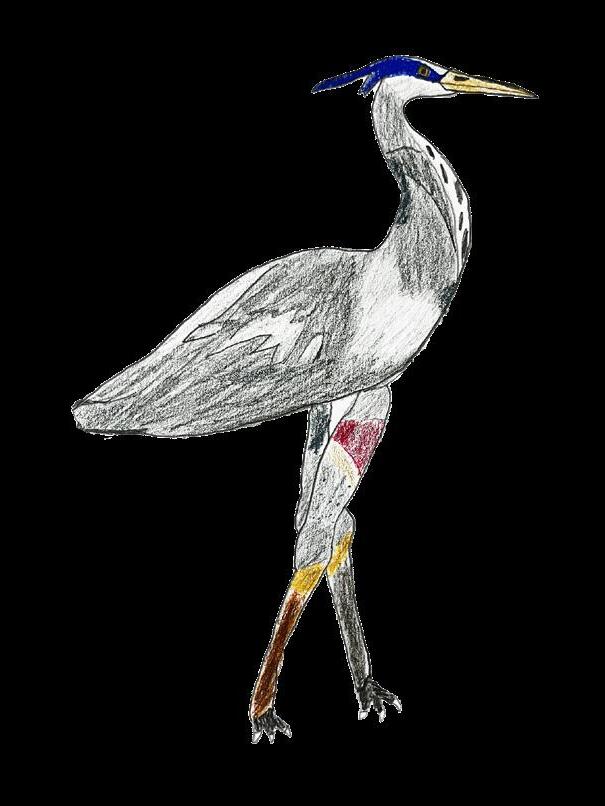
Great Blue Heron BY DASH B.
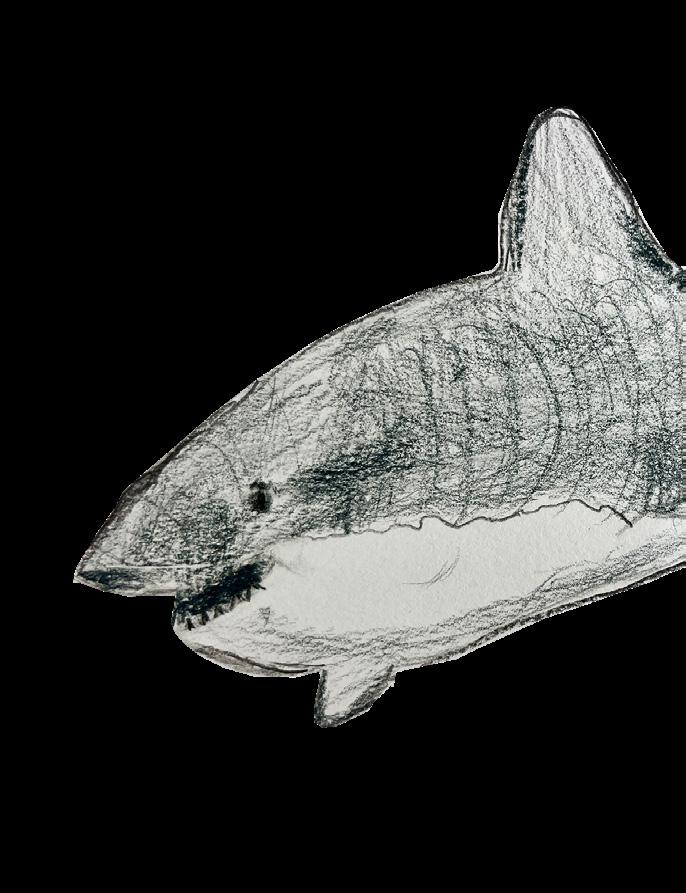
Great White Shark BY SACHIN R.
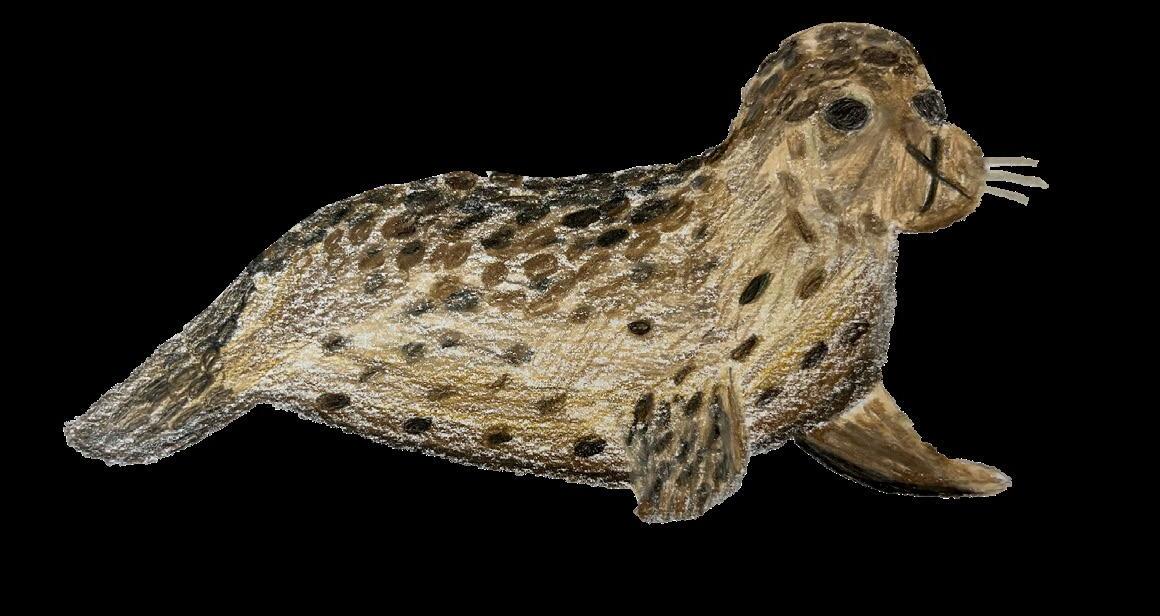
Harbor Seal BY NAOMI L.
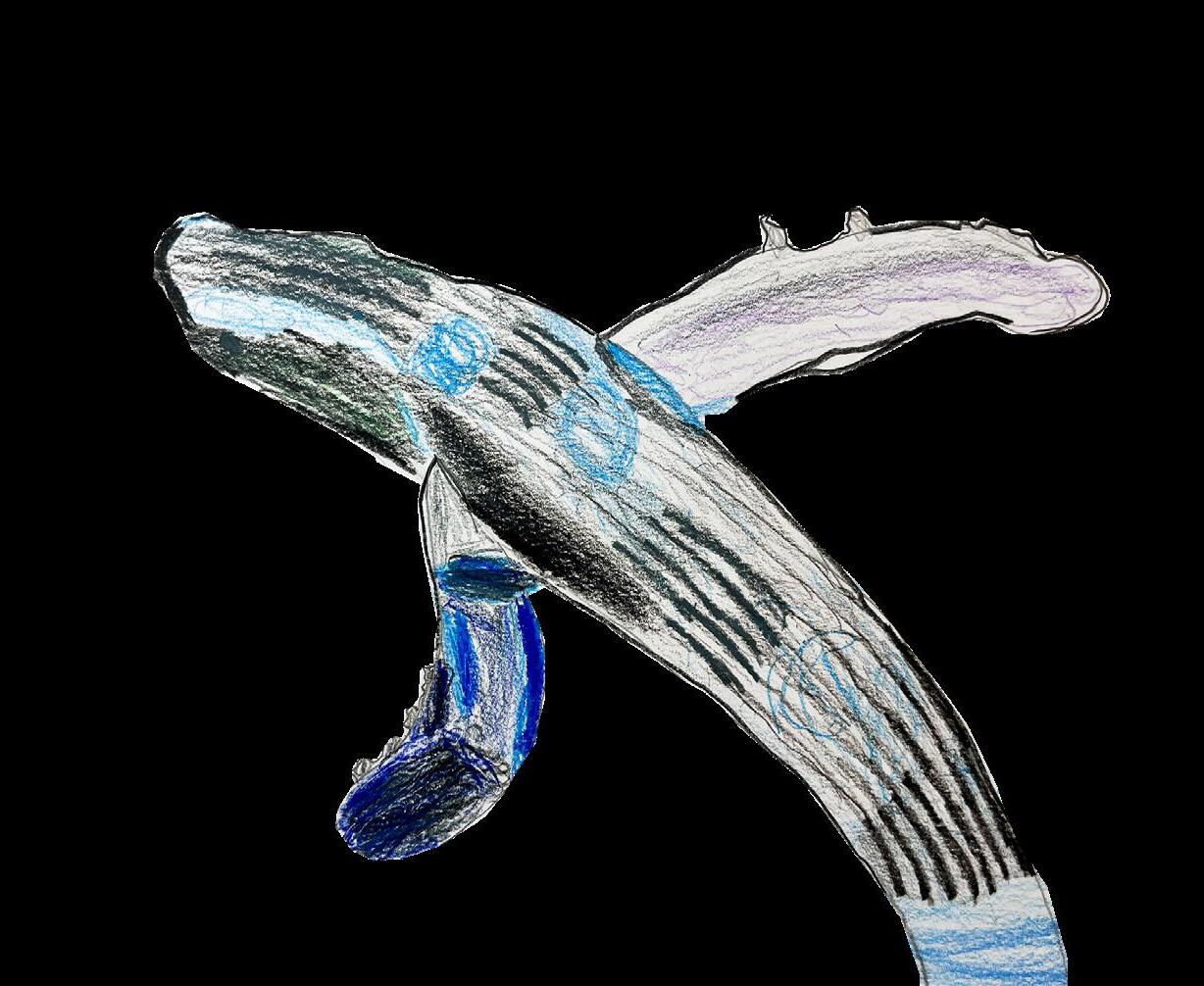
Humpback Whale BY MATTHEW L.
Lace Lichen BY RANIA B.
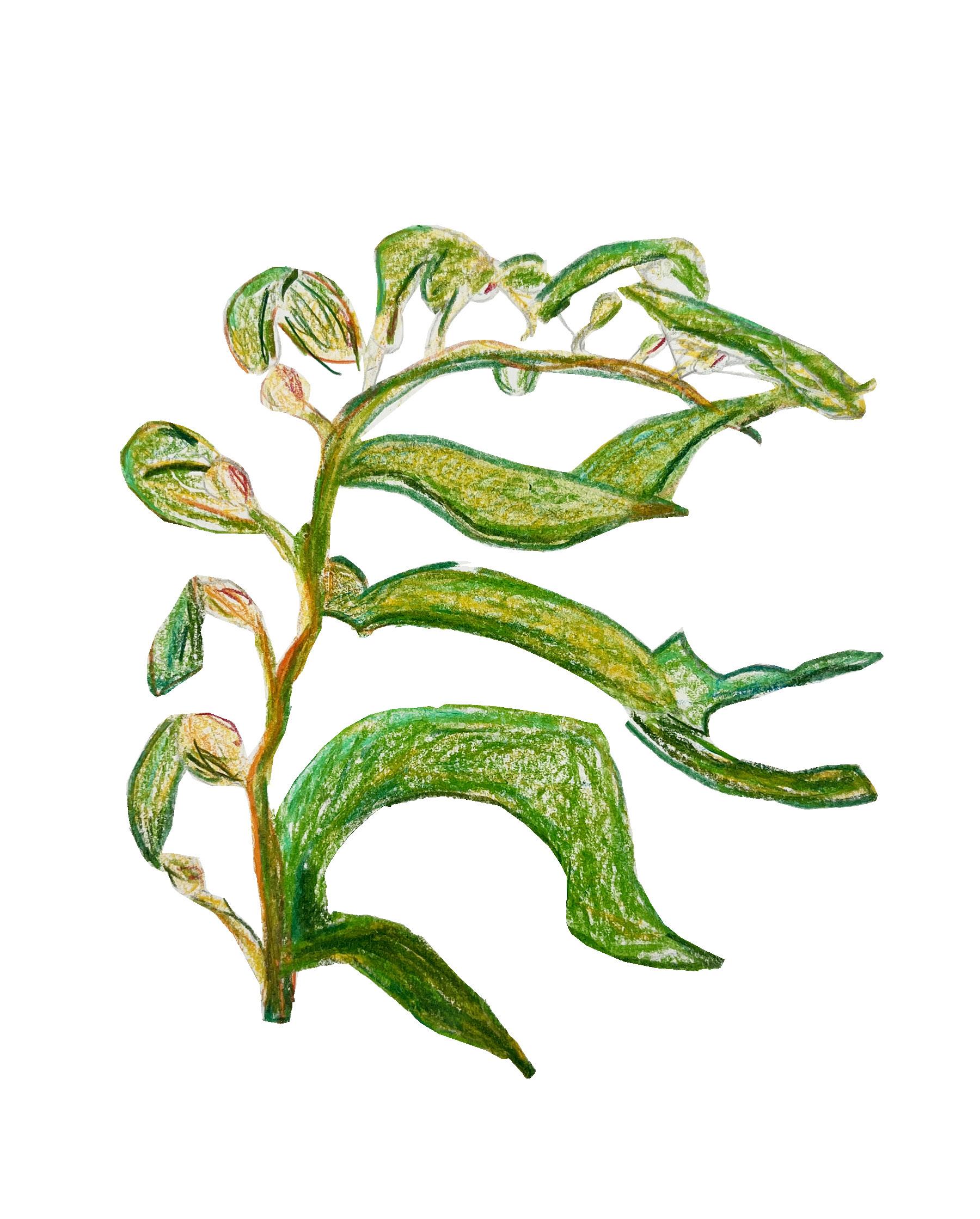
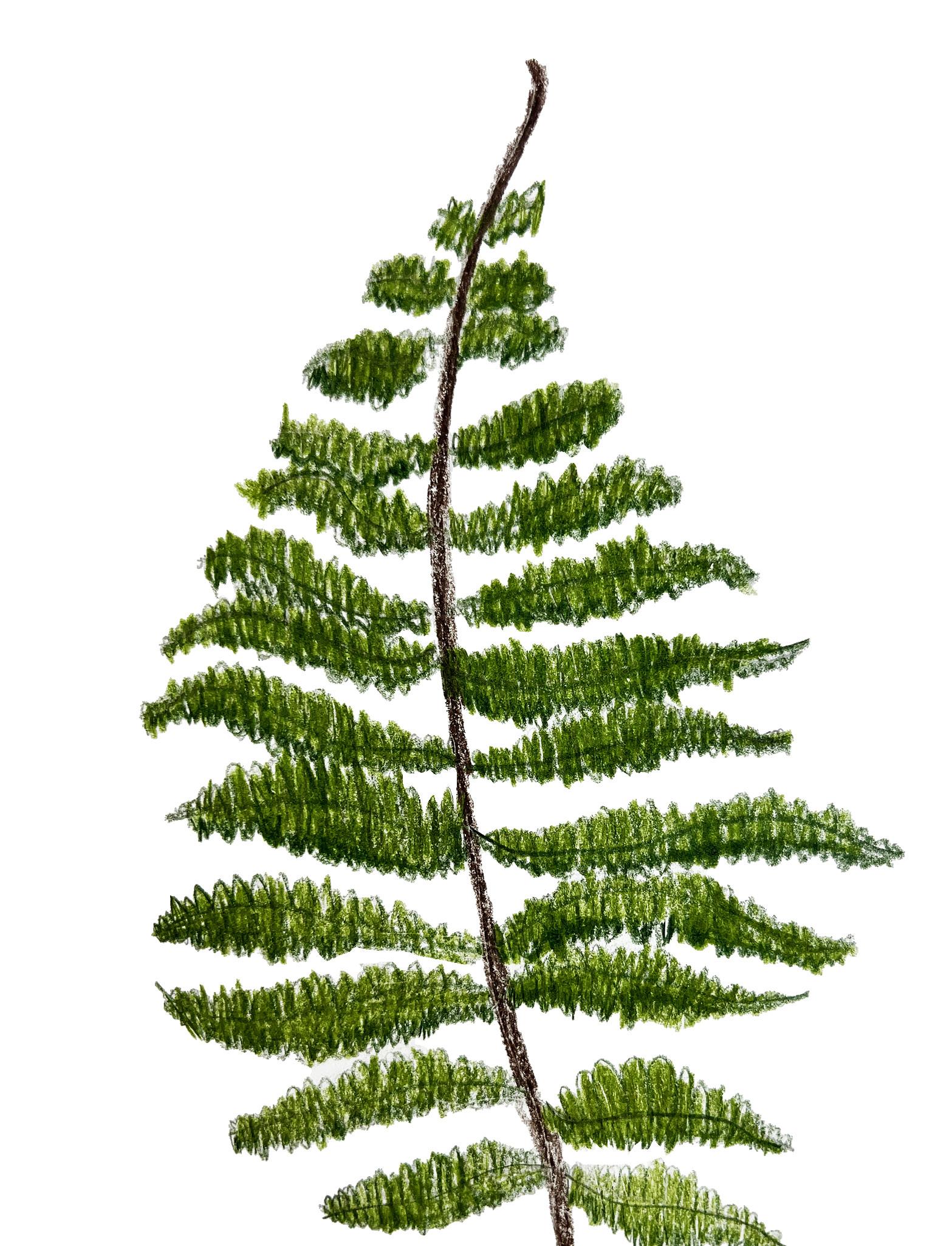
Lady Fern BY DEVYN H.
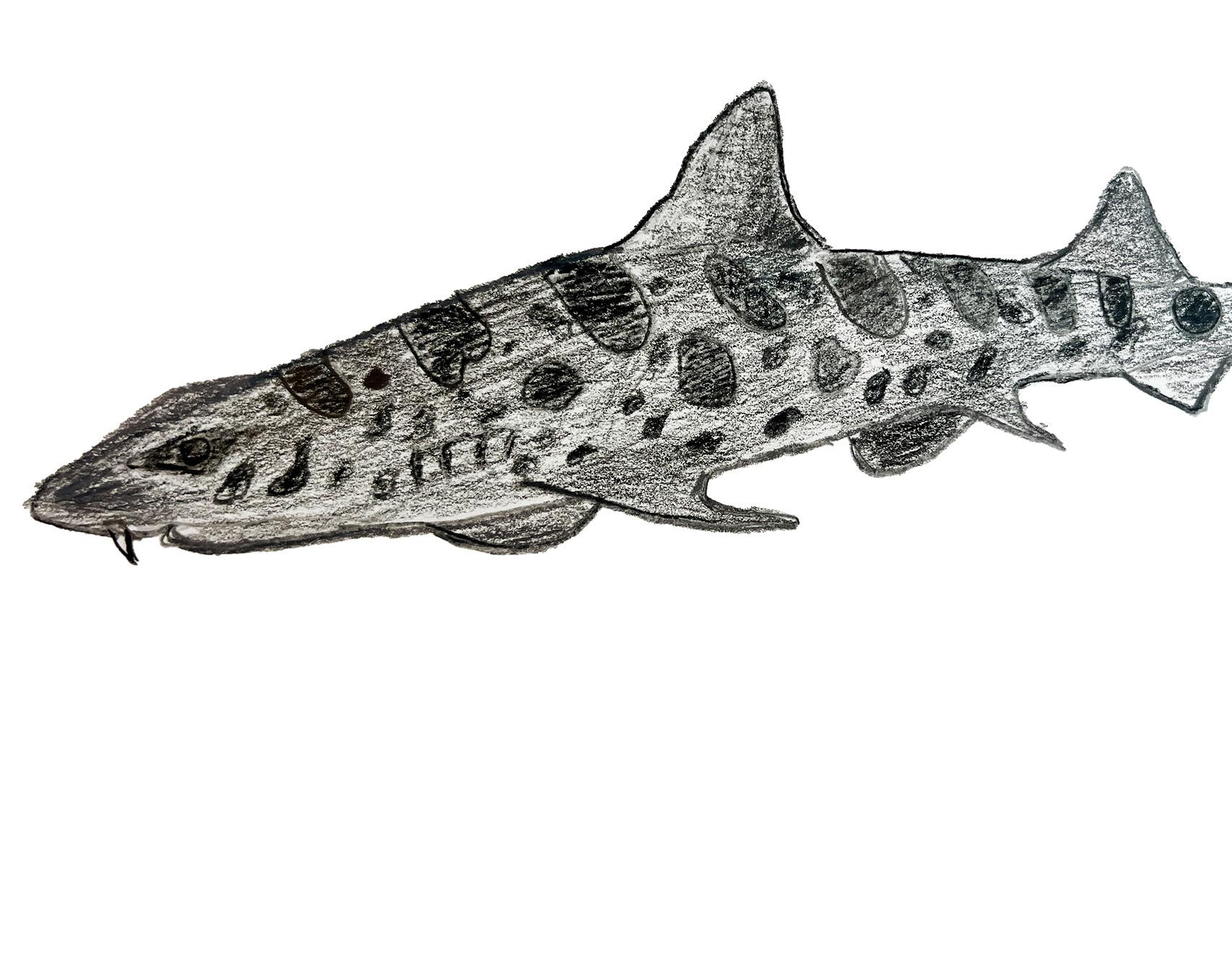
Leopard Shark BY ALEXANDER M.
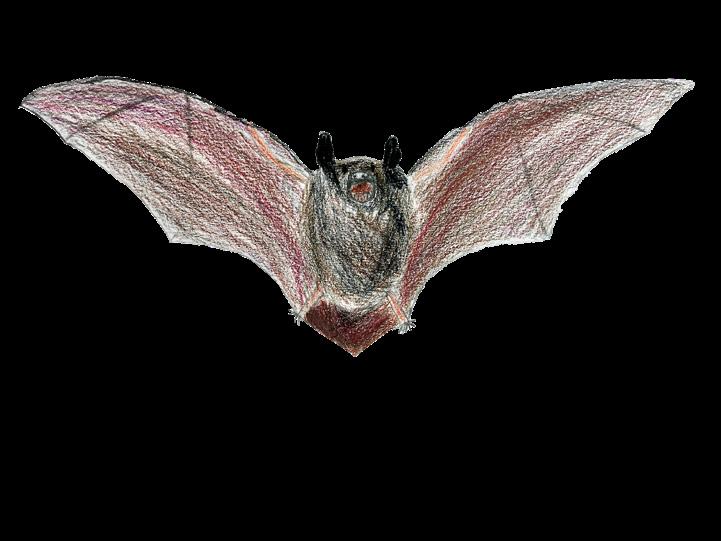
Little Brown Bat BY CORBEN S.
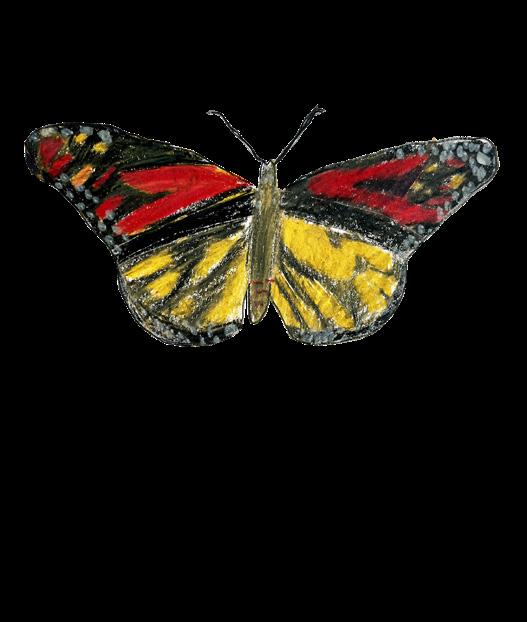
Monarch Butterfly BY KATHERINE S.
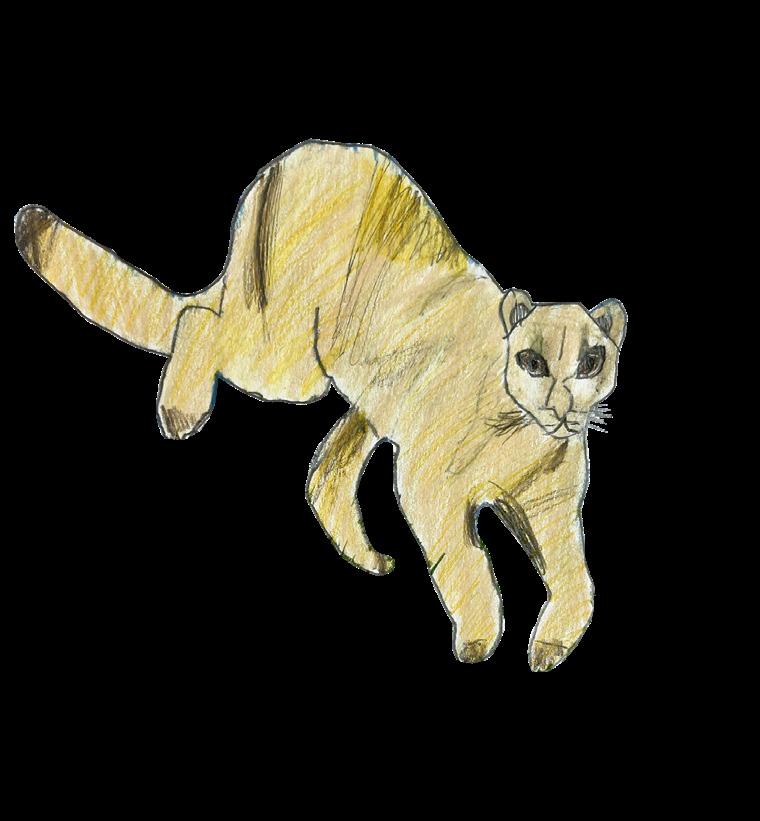
Mountain Lion BY COLTON D.
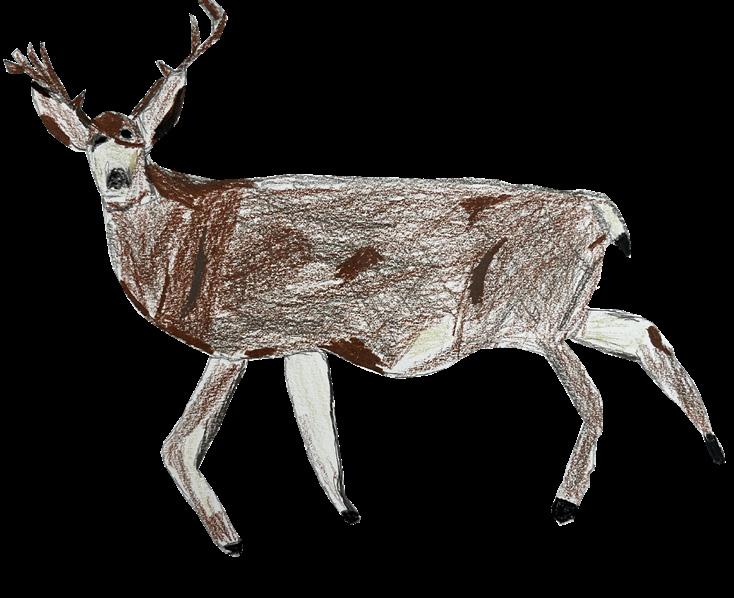
Mule Deer BY MASON B.
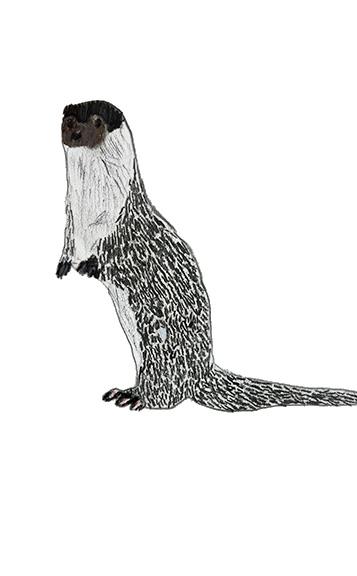
North American River Otter BY FAEREN R.
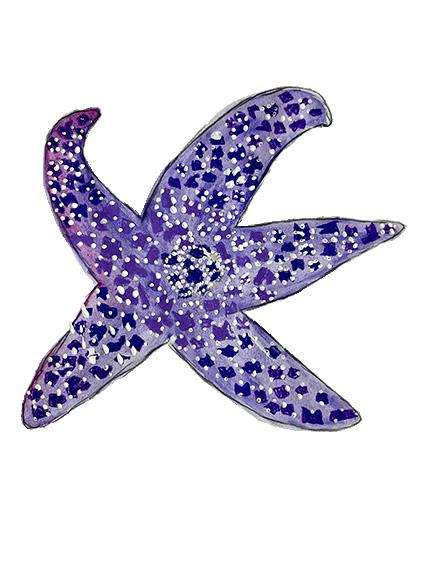
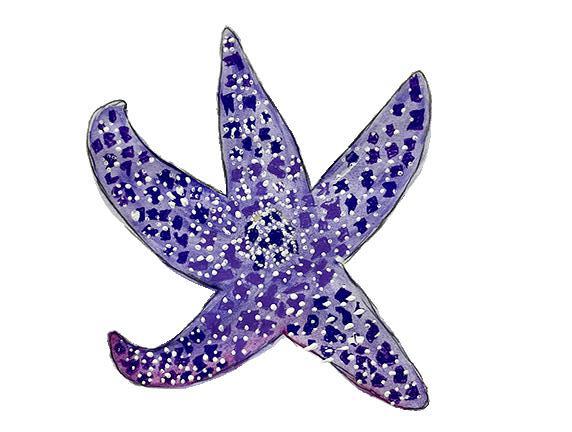
Ochre Sea Star BY CHARLOTTE N.
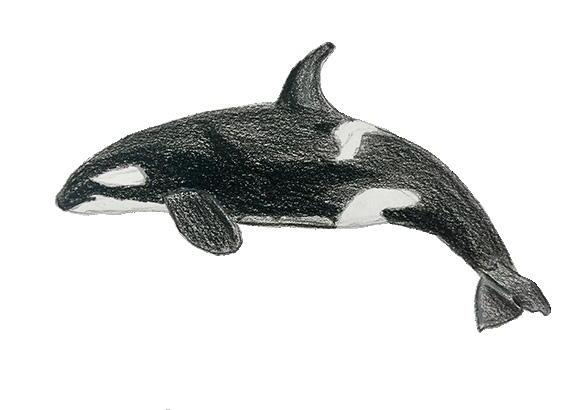
Orca BY CHARLIE Z.
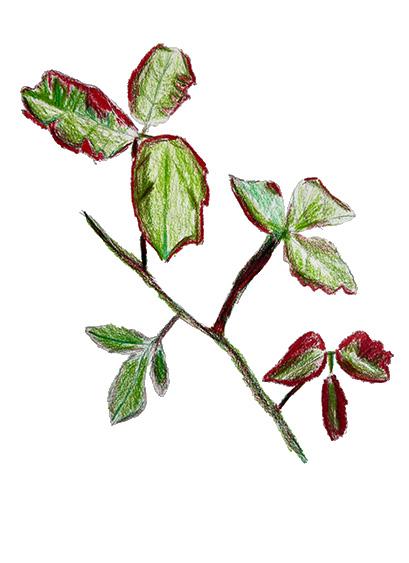
Pacific Poison Oak BY LASZLO D.
Pacific Ring-necked Snake BY EVELYN J.
Peregrine Falcon BY SIMON G.
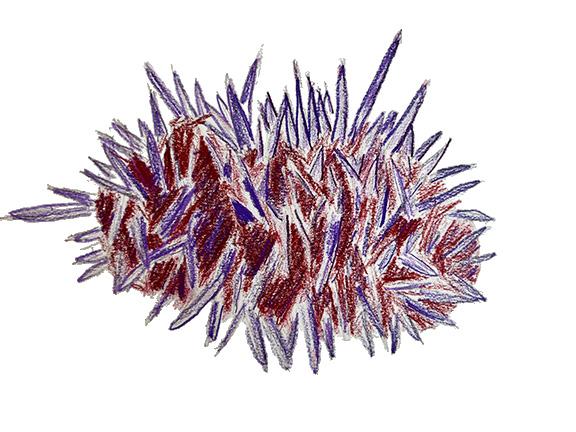
Purple Sea Urchin BY GEMMA B.
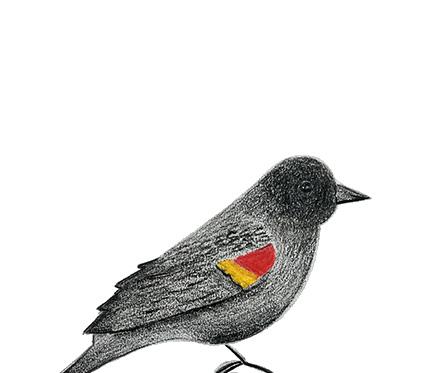
Red-winged Blackbird BY PEARL S.
Round Stingray BY NAVEEN C.
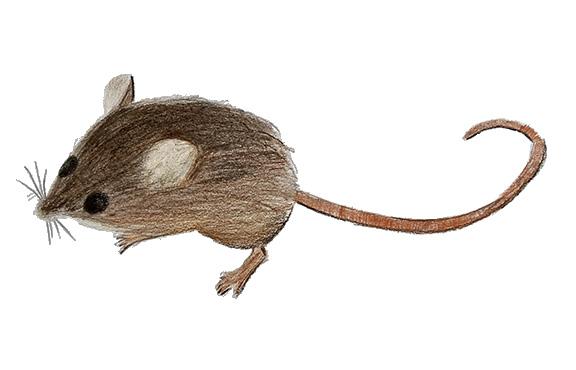
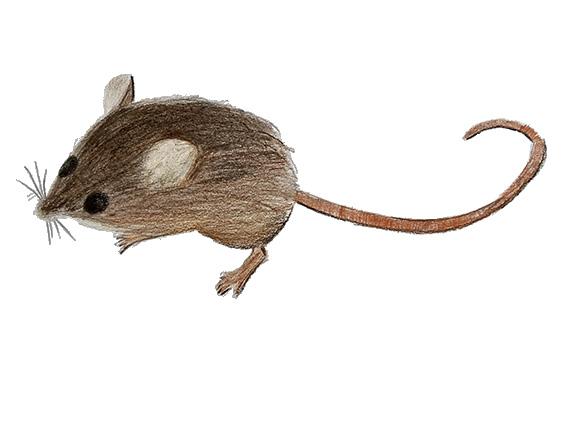
Salt Marsh Harvest Mouse BY ELLIE C.
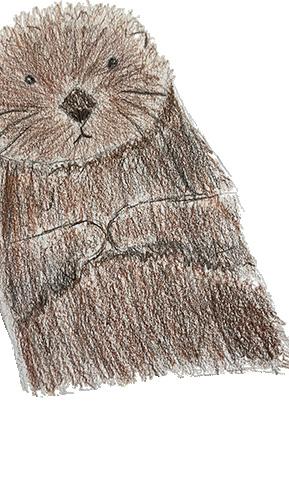
Southern Sea Otter BY ABBY A.
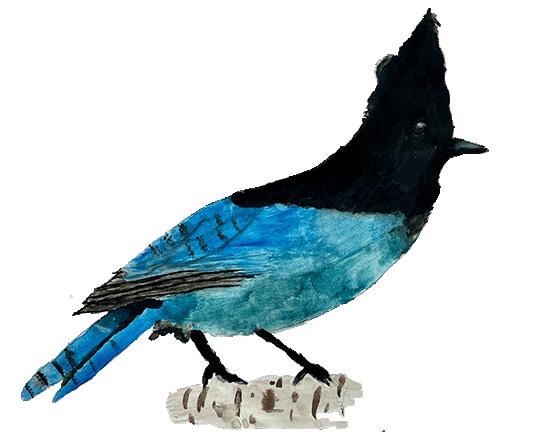
Steller’s Jay BY LEELA S.
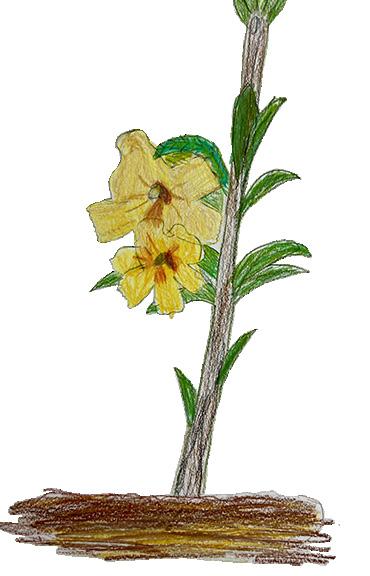
Sticky Monkey-flower BY ARA K.
Valley Oak BY ANNELISE D.
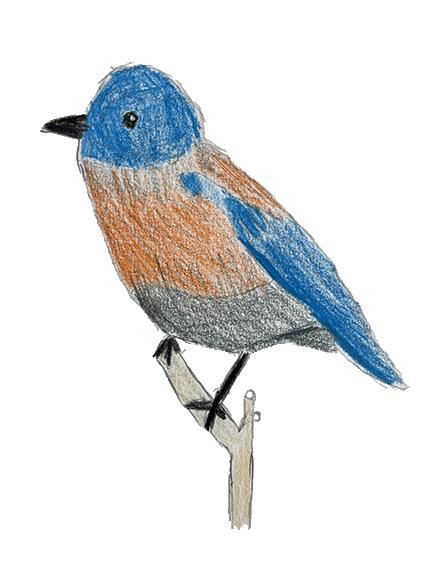
Western Bluebird BY JASPER N.
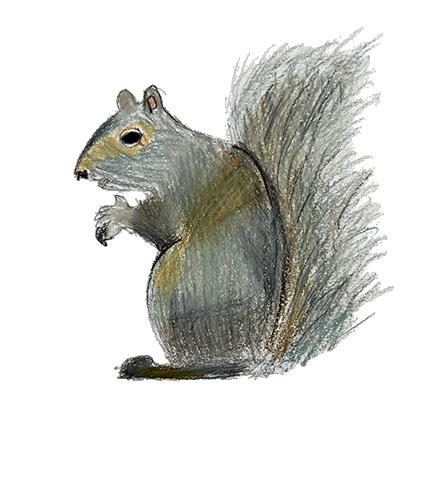
Western Gray Squirrel BY MING-HAO T.
Western Pond Turtle BY DAVID L.
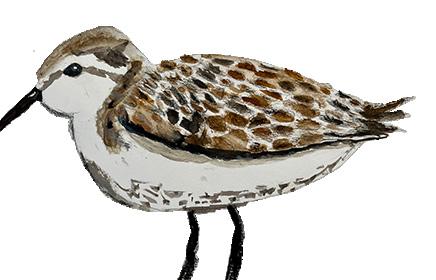
Western Sandpiper BY ALINA L.
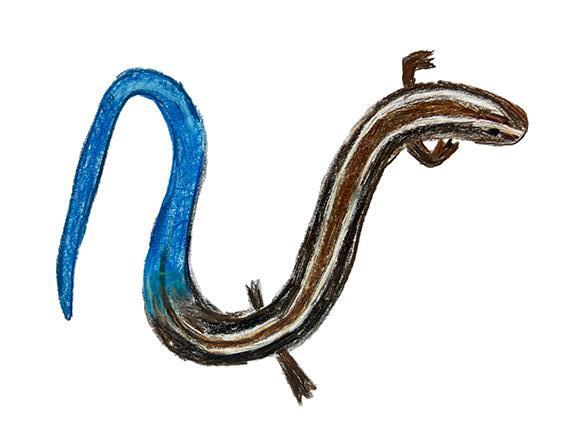
Western Skink BY TESS MP.
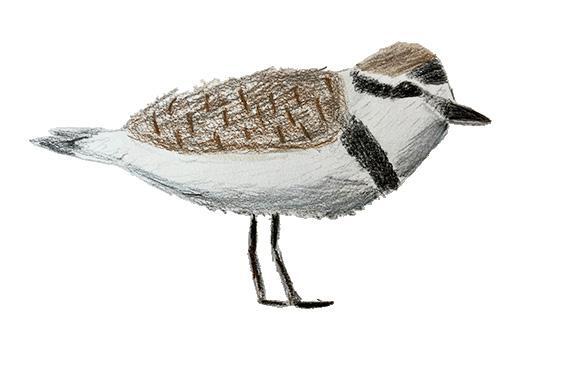
Western Snowy Plover BY TESSA L.
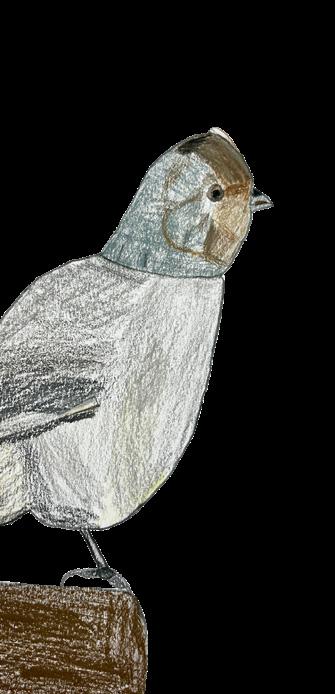
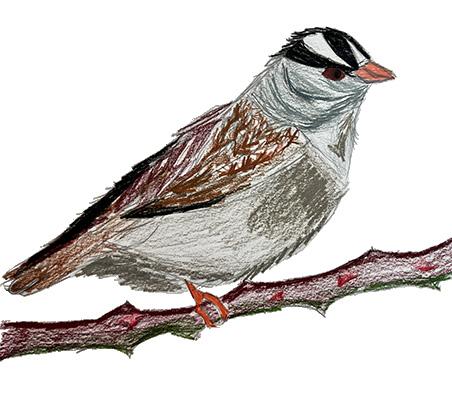
White-crowned Sparrow BY NAAVYA M.
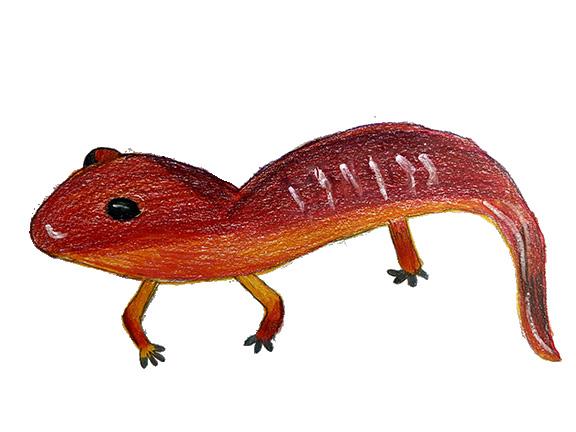
Yellow-eyed Ensatina BY TARYN W.
ACKNOWLEDGEMENTS
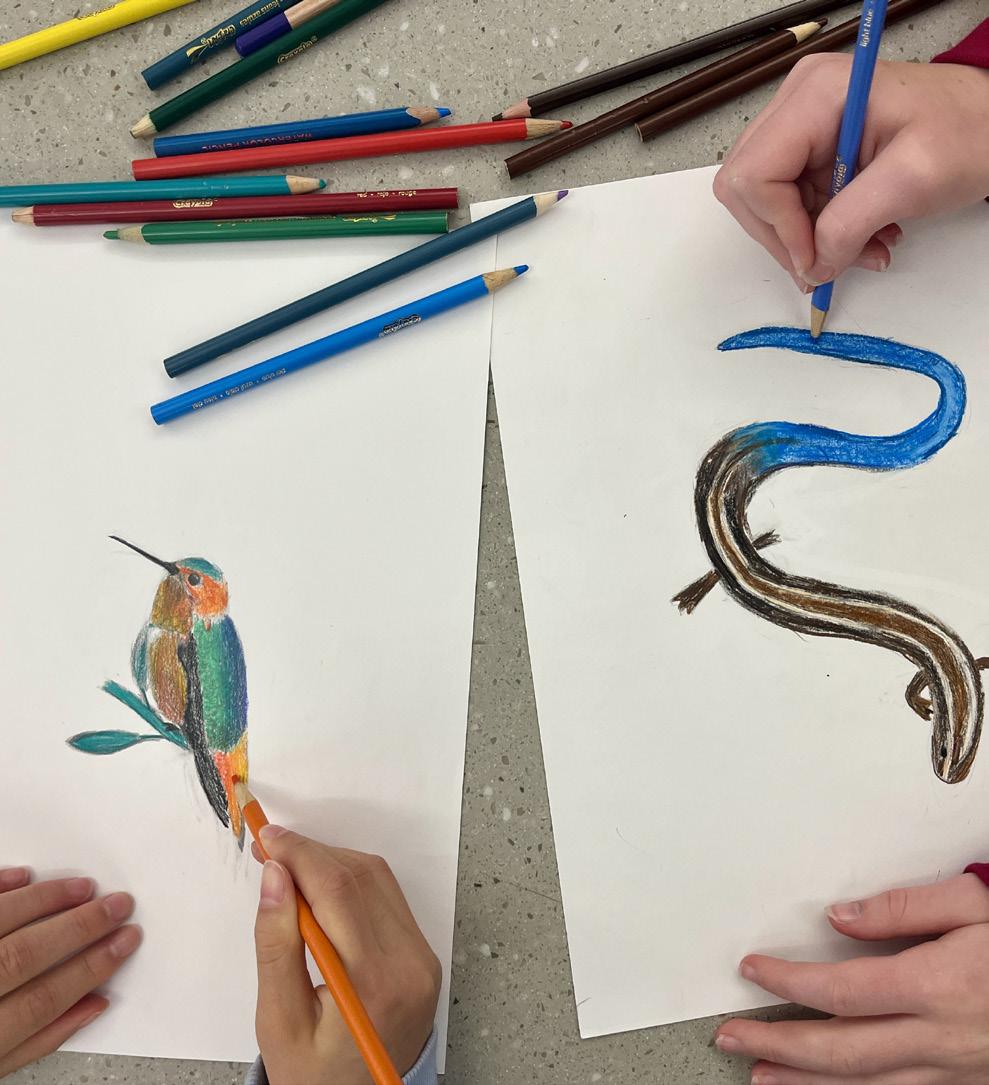
We invite you to marvel at the species with which we share our world and the transformative connections we make with them.
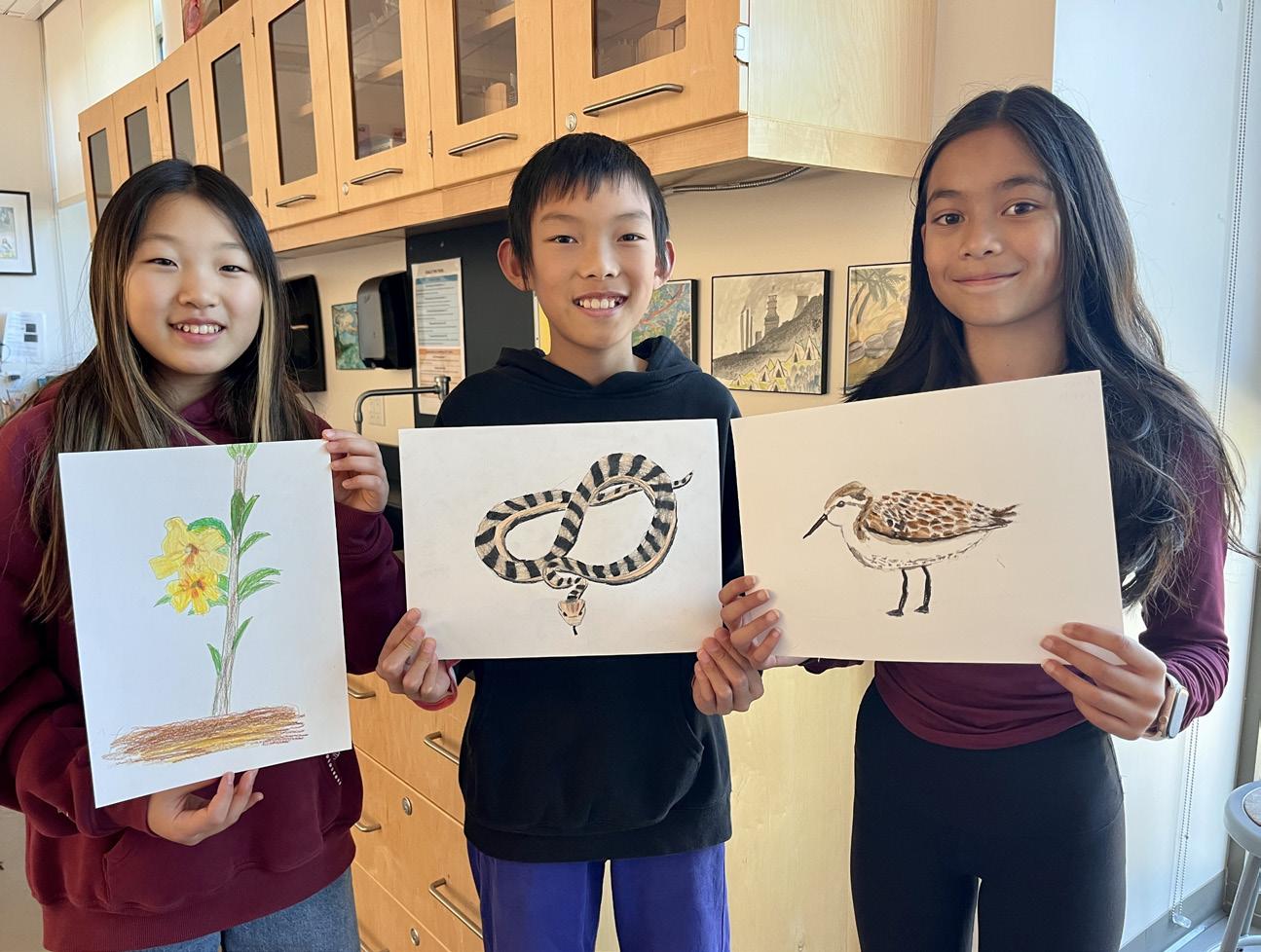
Our topography and coastal climate make the Bay Area a biodiversity hotspot, meaning the ecosystems not only support a rich variety of plants and wildlife but also that they are under threat. Despite widespread commercial development and other human impacts, our region is home to hundreds of native plant species and an array of invertebrates, birds, mammals, reptiles, amphibians, and fish. Many species are endemic—found nowhere else in the world—and some have been classified as rare and endangered. It is essential that our students develop a deep appreciation for this biodiversity and understand its importance.
The initial inspiration for Bay Area Wonders came from Aimee Nezhukumatathil’s World of Wonders, a collection of natural history essays that explore her connections—both real and metaphorical—to different species from around the world. Each essay is devoted to a unique species, and they are all beautifully illustrated by Fumi Nakamura.
Bay Area Wonders is an interdisciplinary collaboration between science, art, and writing, focused on local species. For this project, students selected a subject from a curated list of native plants and animals for their own “wonder essay.” We encouraged them to choose a species with which they felt connected; some students had a firsthand encounter with a species, while others may have related to an aspect of the species’ behavior or physical characteristics.
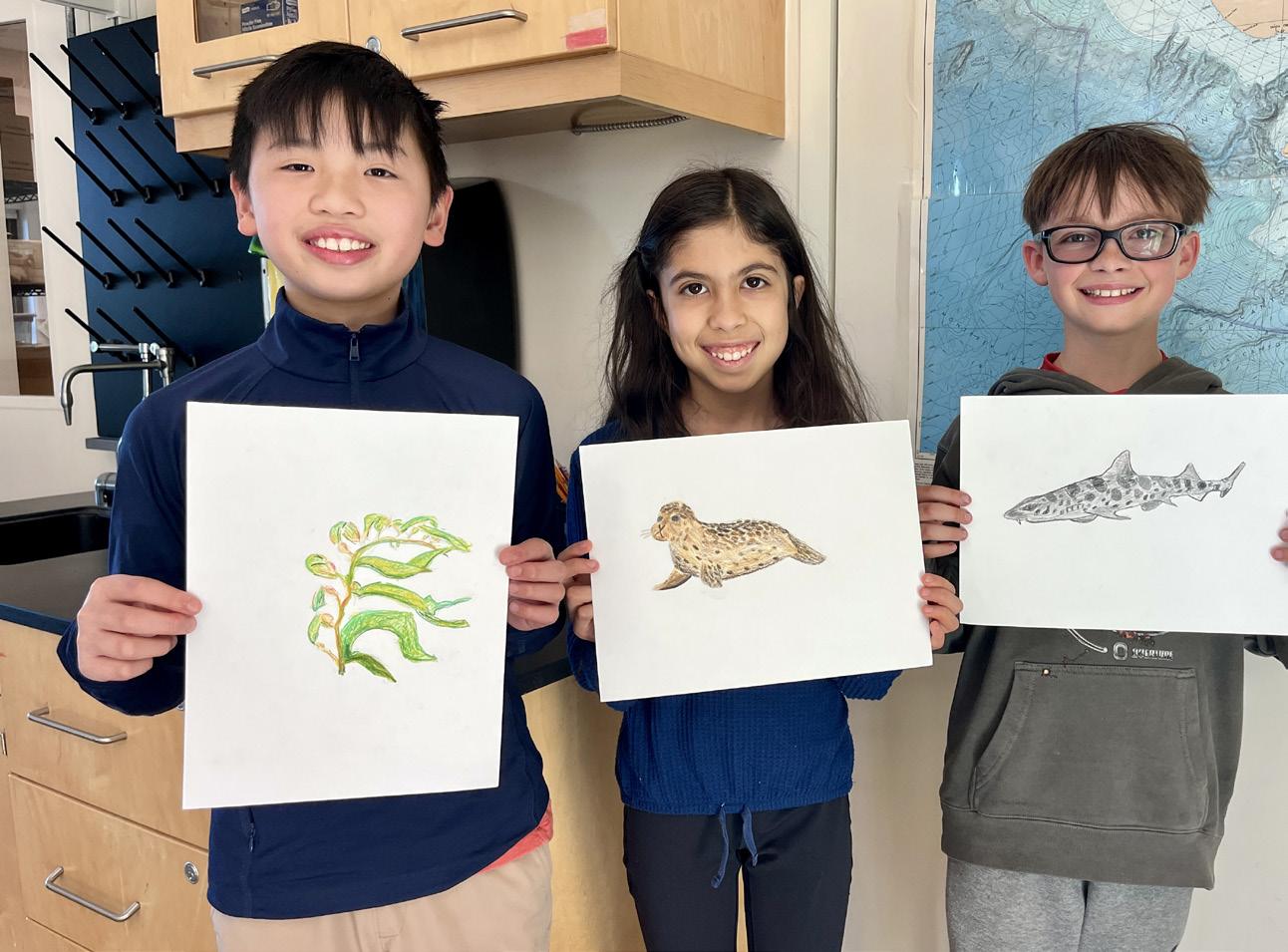
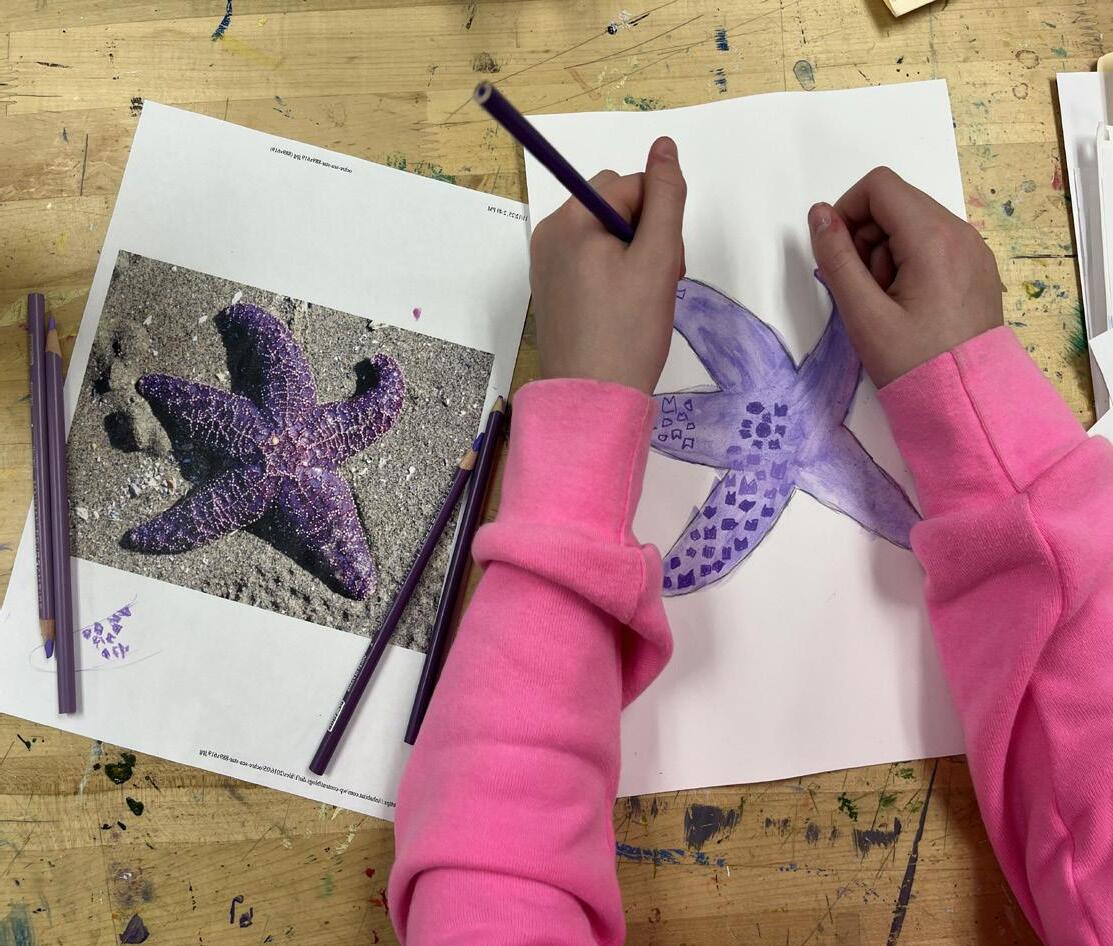
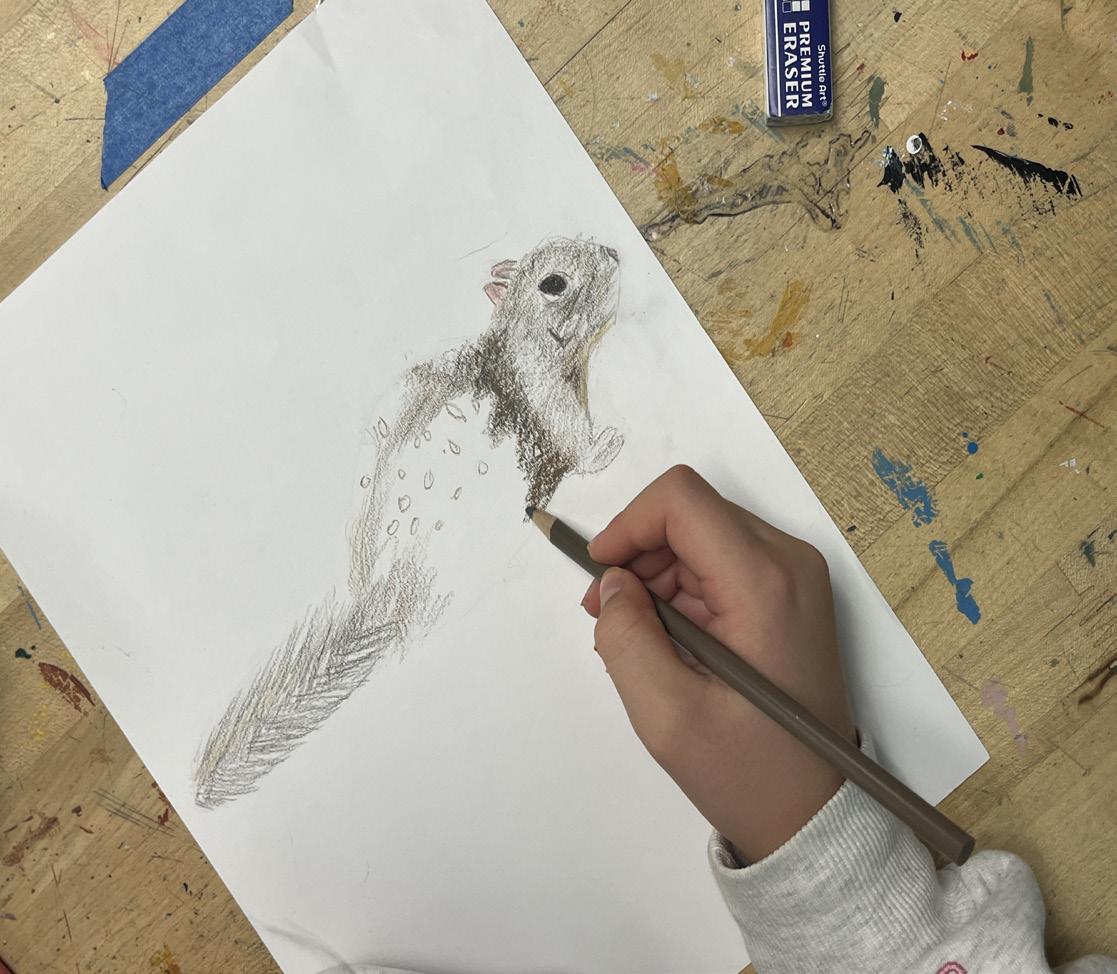
In science class, students investigated ecology concepts, while in writing class they read and analyzed essays from World of Wonders. In both classes, using Nezhukumatathil’s essays as a model, students researched and wrote their own essays about their selected species—integrating personal experiences, figurative language, and natural history information. In art class, students worked with photographic reference images to create scientific illustrations of their species. They combined contour drawings with detailed shaded drawings to show volume and dimensionality.
In this anthology, Bay Area Wonders: In Praise of Leopard Sharks, Ferns, and Other Astonishments, you’ll find all of the fifth-grade illustrated essays. This volume represents a lot of hard work in science, writing, and art classes. We invite you to marvel at the species with which we share our world and the transformative connections we make with them.
CRISTINA VERESAN SCIENCE TEACHER
ADDISON EFTEKHARI SCIENCE ASSOCIATE TEACHER
BECKY TURNER WRITING TEACHER
NINA OSBORNE ART TEACHER
BY AMANDA J.
Hummingbirds love flower nectar. Most people probably know this. Most people, however, do not know that they, as birds, cannot see glass. This means they fly towards people’s homes and crash into their windows if and when they see any type of flower inside the structure. This includes artificial flowers, floral patterns, flower stickers, and floral paintings. Sometimes they come out of the experience unharmed, but other times they can be fatally injured, especially if the wind boosts their momentum and slams them into any window of a tall building. They are also about the size of a house key, so they are paper airplanes in the wind.
One day, my parents and I wanted to eat dinner at the small table we have on our patio. Even though the seats are hard and covered in spiderwebs, and the table is about as big as a Thanksgiving turkey dish, we loved the fresh air and the view it offered.
I’d started setting the table when suddenly a strong wind blew, and one of the napkins flew into the air. I hated the idea of the napkin littering the world, so naturally, I searched under the table.
Suddenly, I heard a thunk behind me. I whirled around to see a small dark spot on the ground in front of the dining room window. At first, I thought it was a piece of wood or bark, but as I approached, I realized it was an unconscious female Allen’s hummingbird.
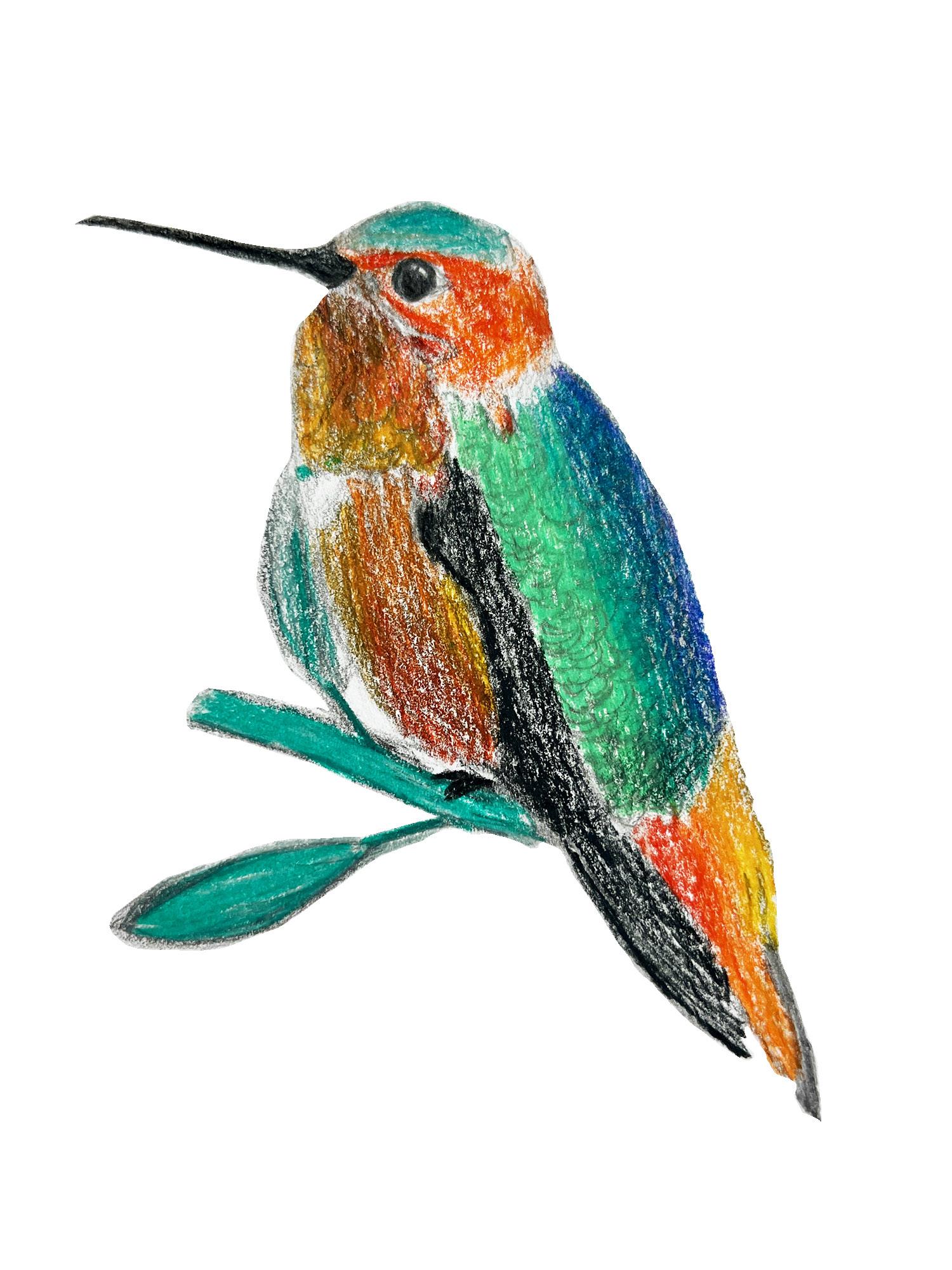
Female Allen’s hummingbirds have green bodies except for their tails and sides, which are orange-brown, and their stomachs, which are snow white. The green feathers on her neck, called gorgets, shine with tiny, twinkling stars. That was how I knew which gender she was.
I rushed inside to tell my parents, napkin forgotten. They’d started preparing dinner. Mom went to inspect the hummingbird, and we concluded the hummingbird collided with the window. Considering we had a bright yellow tablecloth depicting lush green plants and pink flowers, this was a probable assumption.
Dad took a box and padded it with soft paper towels. He lifted the hummingbird in with gloves. I wanted to touch her, too, but my parents told me no, so I took some pictures with my phone instead. I still have the photos today!
We took the box to the car and started driving to the hospital. Mid-ride, however, she regained consciousness and started thrashing inside her soft confines. Mom was afraid the hummingbird would actually injure herself this time, so we stopped in the middle of the road and let her go.
I hope she knows we tried to help. We also took her farther away from our house, so hopefully she is less likely to crash into our window again. Now, every time I see a hummingbird, I wonder if it is the one I saw on that windy evening, or maybe it’s her offspring, coming to say hello.
BY ALEX J.
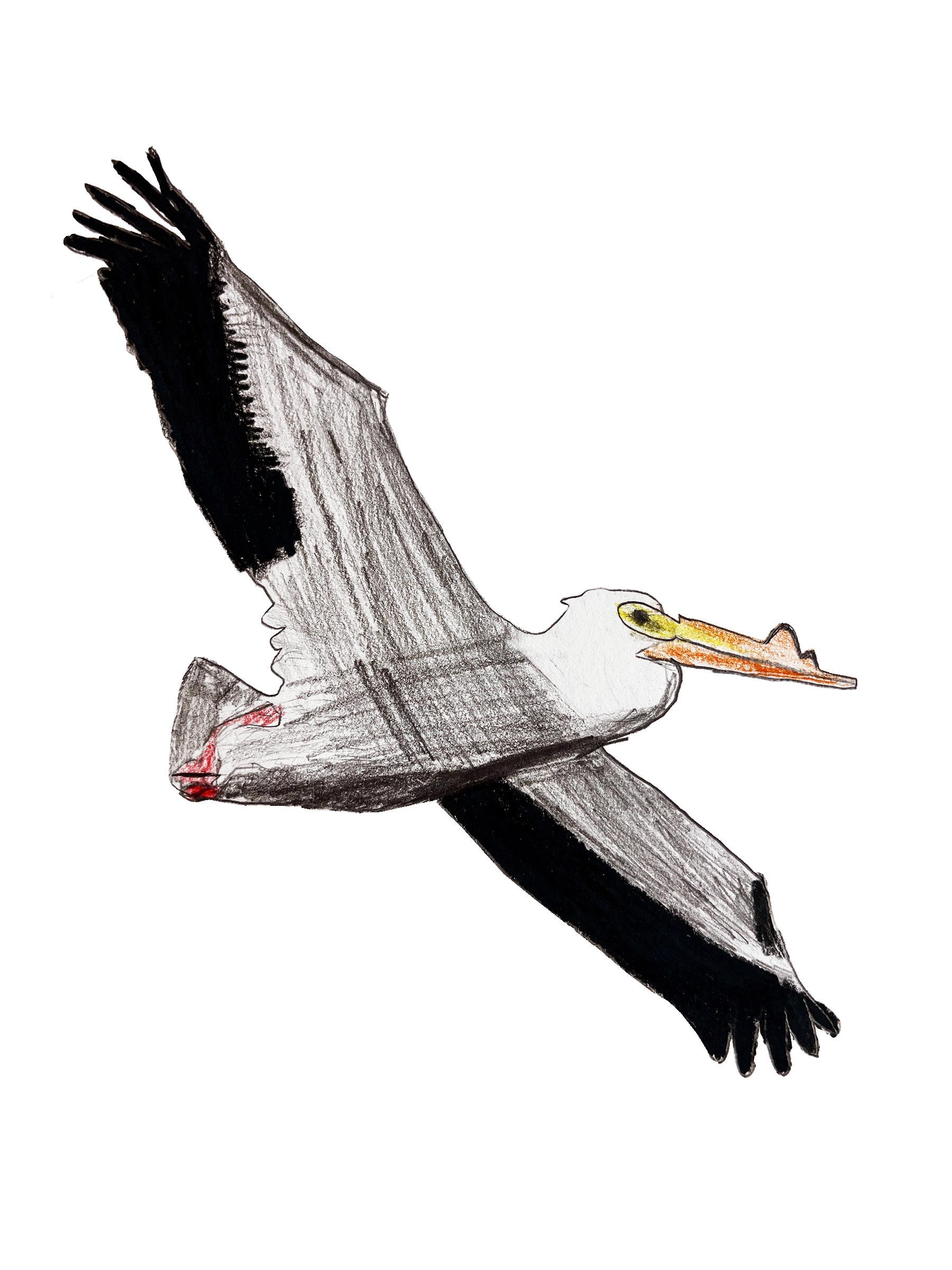
The American white pelican is a massive bird, towering over seagulls and seabirds like a skyscraper. Standing about five feet tall, it is the second-largest bird in California, only surpassed in size by the California condor. The American white pelican hangs around lakes, rivers, and marshes, dipping its long beak into the water to catch fish, including trout, carp, minnows, and catfish. This bird is rarely found near the ocean. When these birds migrate, they can be found almost everywhere in the United States and Mexico.
Pacifica can be a hard place to catch fish. I sit at the edge of the pier, waiting for a bite. This is quite boring, so I find ways to entertain myself. I usually watch the ocean and count the animals that appear. I commonly see seagulls, with a few pelicans here and there. One day, I saw a flock of pelicans around the end of the pier. Suddenly, one of them dove down, landed onto the water, dipped its beak, and came up with a fish in its mouth. I was astonished that the pelican caught a fish when I was unable to.
Seeing American white pelicans around the ocean is less common, as it is harder to find fish in the ocean waters. I was lucky to see these pelicans around Pacifica, and even luckier to see one catch a fish. I did not know that Pelicans, like the American white pelican, could efficiently catch fish until that day.
A year later, I was on the boat dock at my house in Lake Tahoe, trying to catch fish. I caught only a few fish, unlike a year ago when I caught fish as fast as a wildfire. I thought back to when I saw the pelican catch a fish. I remembered how the pelican quickly dipped its beak and popped right back up with a fish. I saw this, grabbed my net, and waited. It was hard to find a fish, but when I did see one, I waited patiently for it to swim closer. The first time I attempted to catch the fish, it slipped away. The second time I tried, I missed it. Finally, on the third try, I caught the fish the same way the pelican did. This surprised me, as I had not expected such a technique to work. I caught a fish by using the pelican’s technique.
American white Pelicans use this technique to catch fish because they hang around in large groups near the end of rivers, where there can be a narrow gap in the river for fish to go out through. When fish try to cross the gap, they are eaten by the pelicans waiting for them.
I still think back to the day I saw a pelican catch a fish at Pacifica. I still think back to when I caught the fish in Lake Tahoe. When I go to Pacifica now, I set down a net that has much more success than I do at catching fish.
The American white pelican is a massive bird, towering over seagulls and
BY JAHAN V.
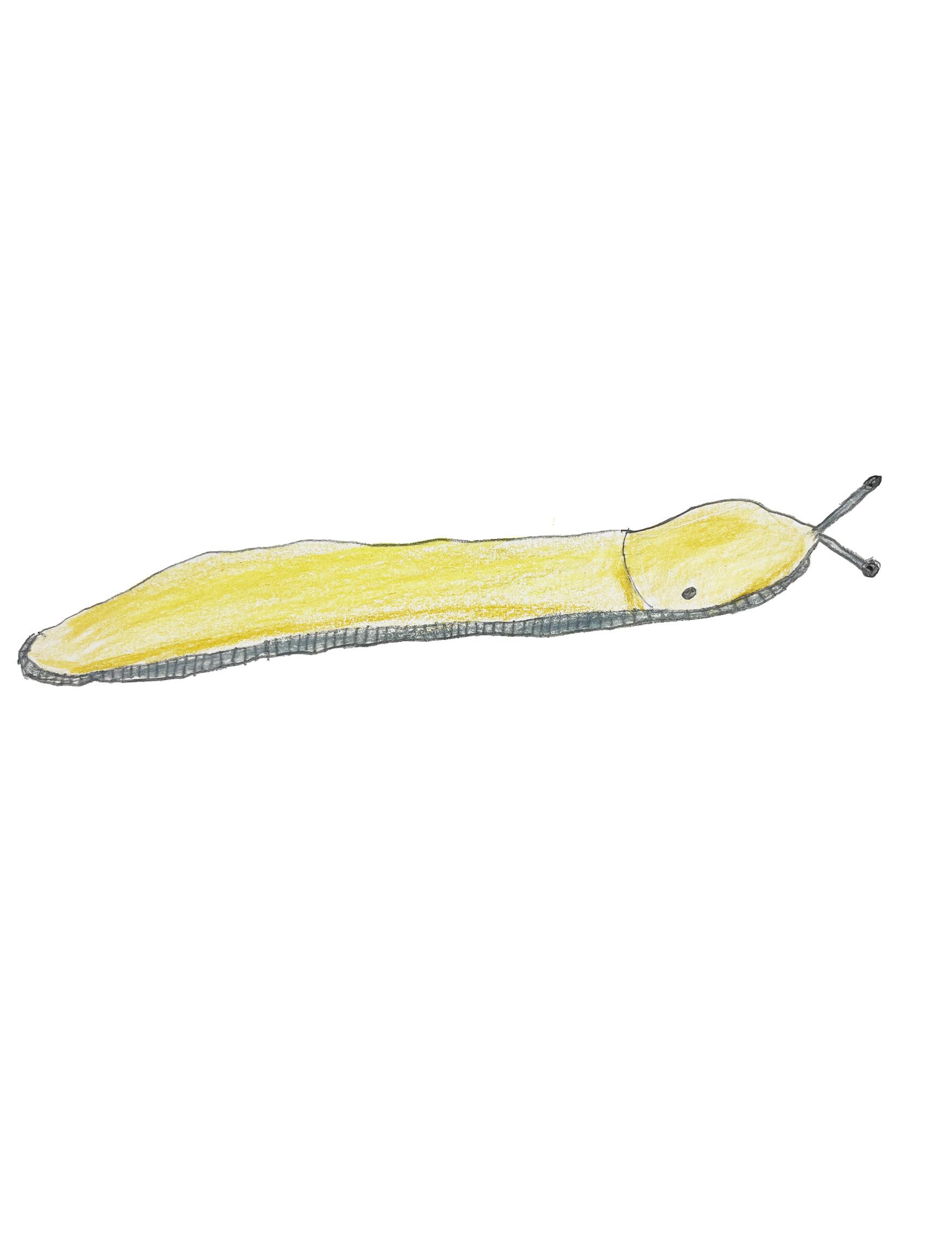
The first time I entered Henry Cowell State Park in the redwood forests of Felton, I was only three months old. This was my parents’ favorite spot in California. We have been going there monthly as a family, except for the years we lived in Southern California. The park is abundant with majestic and ancient redwoods, but the highlight of our trips has been discovering and looking out for banana slugs. There exists a large number of species of banana slugs, but this California variety is the only one found in the park. Named California’s state slug in 2024, they are truly special creatures that closely resemble their namesake fruit. This animal is so special to its local area that a banana slug, “Sammy the Slug,” is the beloved mascot of the University of California, Santa Cruz, in the same geographic area.
Bright as a ray of sunshine, banana slugs can grow as long as twelve inches, and have a lifespan of one to seven years. They have a hole in their body, which many people mistake for their eyes, but actually is a breathing hole where air can go into the slug’s only lung. Their eyes are on their antennae and can move individually.
The most interesting thing about banana slugs is their slime. Somewhere between a liquid and a solid, it serves as both a lubricant and an adhesive. The weirdest fact of all though, is that it is a defense system. The slime contains an anesthetic that instantly numbs the tongue of any predator that tries to eat it. Many people consider it good luck to kiss a banana slug, although my family and I have not tried it.
One time when my family took one of our regular trips to Henry Cowell State Park, we looked for banana slugs, but could not find a single one. Since it had not rained for a while, and that is when they usually emerge, this was to be expected, but we were still disappointed. Just as we gave up looking for them, I noticed an oddly shaped yellow leaf on a tree. Upon closer inspection, it turned out to be a banana slug. It camouflaged itself to look exactly like a leaf, except for its rather thin body and a pair of silver antennae. I shared the fact that there was a slug with my parents, and they wondered how they had missed it, even after years of practice.
Biologist Branley Allan Branson claims that it is the slowest animal on Earth. She clocked its slowest speed at 0.000275 meters per second. Their slime can absorb water up to one hundred times its volume, allowing them to lower themselves down from tree branches, squeeze into small crevices just like octopuses. Additionally, their slime is useful for mating season, when they follow mucous trails to find each other. They also put their slime to use during the summer, when they cover themselves with it to make sure they stay hydrated while hibernating. In some ways, these slow-moving slugs remind me of couch potatoes the day after Thanksgiving.
Researchers foresee many potential uses for the slug’s slime, including in water-based lubricants, pollutant traps for sewage treatment plants, surgical implants, and wound coverings. It is not every day that I see a banana slug pretending to be a leaf, all the while using slime as its superpower!
BY AARIV C.
The bat ray is a distinct-looking animal. Its skin is smoother than the smoothest silk, and its belly is whiter than the whitest clouds in the sky. It can dive to a depth of 590 feet, deeper than most people have seen in their lives. Its head directly connects to the body, giving it a large, rounded appearance. Since they do not put up much resistance when caught, bat rays are easy targets for sport fishers. Despite this, they have an IUCN (International Union for Conservation of Nature) endangerment status of “Least Concern,” indicating that they thrive in the wild.
When I think about a bat ray, I think about a time when I was on a boat for an aquarium trip. I remember the bat ray splashing around in the water near the boat. I would picture holding it. If I try to remember a bat ray at an aquarium, I would have forgotten its characteristics.
Bat rays are not aggressive to humans, but people must be careful around them because of their venomous spines. Batrays obtain their names from their fins that resemble bat wings, which can grow up to 5.9 feet long. The fins let them dig in the sand to find hidden prey. They have an average lifespan of 23-35 years.
When I saw a bat ray, it was in the wild, so I was able to see its natural behaviors and activities. The coolest part was that I was able to touch it. It was a memorable experience because I was able to see many different animals up close, but the bat ray was the most interesting of all the animals due to its unique characteristics. The bat ray’s relatives include the spotted eagle ray and the common eagle ray, but the bat ray is still different in other ways.
They can be seen everywhere from the Galapagos Islands, all the way up the Gulf of California to Oregon. They are often found in the San Francisco Bay and also in Point Reyes, Marin County. They usually live alone, but some people have seen them in the thousands. Bat rays have durable, sharp teeth, allowing them to break clam and crab shells with ease. This makes clams their primary diet. They use their snouts to dig in the sand, which enables them to find food much more easily than other animals. They prefer living on sandy seafloors with rocks, most likely because the seafloor is a blanket covering their food.
The bat ray can weigh up to 200 pounds, but not all of them are that big. When they are newborn, they weigh about 2 pounds, which is a huge difference from their maximum weight of 200 pounds.
I remember lots about seeing the bat ray on the boat, but back then, I did not know about its size, weight, or characteristics. Since researching the bat ray, I have changed my views on them. I have learned so much about their life cycle, their behaviors, and their habitat. If I knew all of this information, I would have been able to identify its key features, and I would have also been able to remember so much more information. The bat ray is different from other animals in lots of ways, which makes it very interesting to learn about.
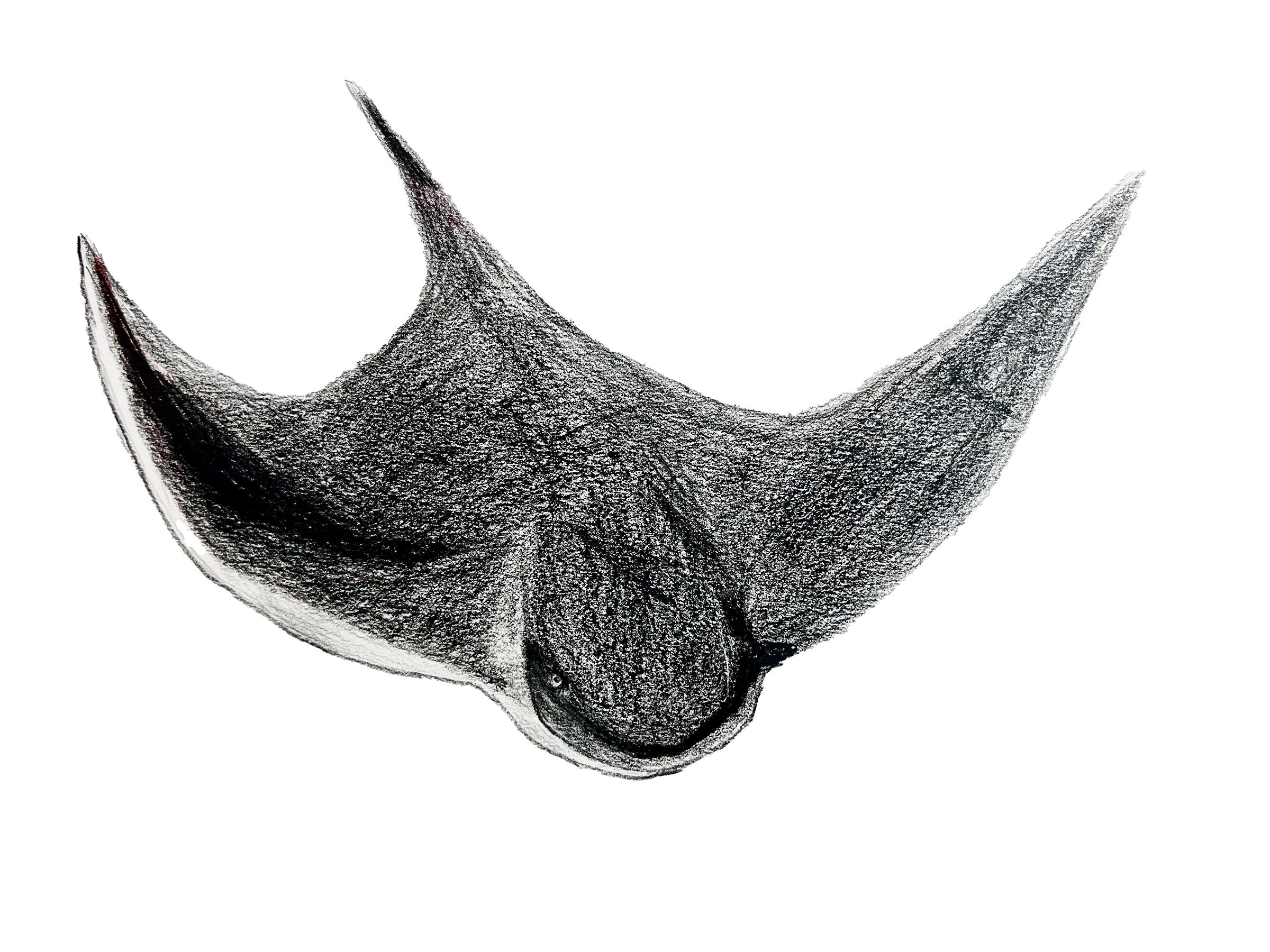
...the bat ray was the most interesting of all the creatures due to its unique characteristics.
The early bobcat catches the rabbit.
BY EMMA Z.
After I heard the proverb “The early bird gets the worm,” I created and used my own proverb, “The early bobcat catches the rabbit.” It made more sense to me, as bobcats are elusive creatures that are mainly crepuscular, meaning they are most active at dawn or dusk. Crepuscular creatures wake up an hour before sunrise, theoretically earlier than the birds. Bobcats sleep a total of twelve to sixteen hours a day, but their sleep is split into two to threehour power naps throughout the day, typically after hunting or eating a large meal.
It is rare to spot a bobcat in California, despite its abundant population in the state, which can range from 10,000 - 70,000. Even when people hike in the arid, brush-covered cliffs of California, bobcats tend to avoid humans and other bobcats. They are highly adaptable creatures that thrive in diverse environments, from deserts to forests.
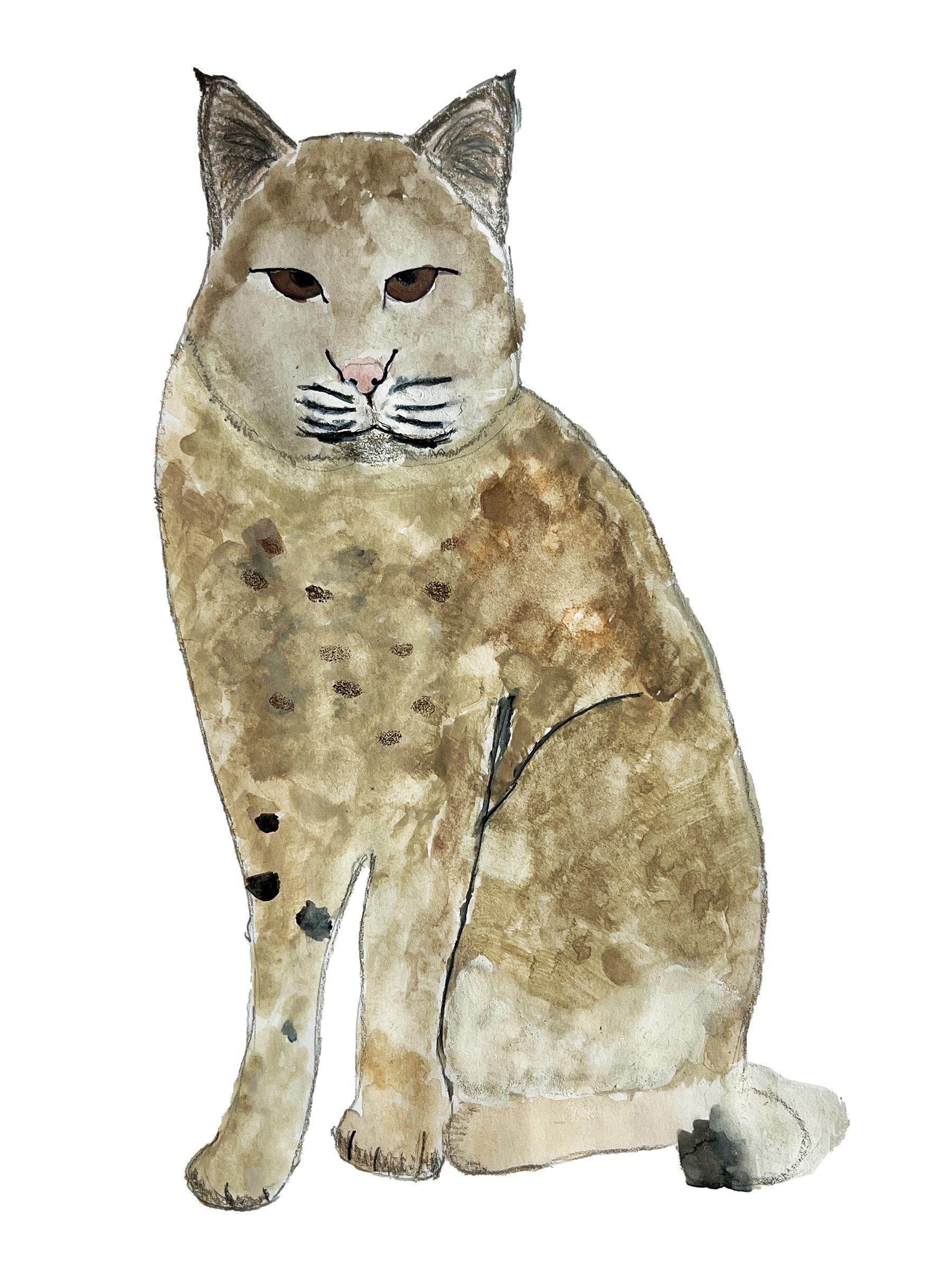
Bobcats are two to three times the size and weight of the average housecat, and have more muscular hind legs. They have a short, black-tipped tail that looks “bobbed,” thus inspiring the name “bobcat.”
Compared to lynxes, a close relative, bobcats are slightly smaller and have thinner coats of fur. This is because they are not adapted to the cold Canadian weather, unlike lynxes. Bobcats have dark spots on their fur and a white belly. Their coats can range from gray to reddish-brown, varying geographically, so that the bobcats can better camouflage and adapt to their habitats.
With the precision of an eagle, a bobcat’s sharp eyesight and lightning-fast reflexes allow it to navigate the world easily. While swimming, quick reflexes are also essential for a good race. As the announcer’s beep signals me to start swimming, I dive into the pool as fast as a hungry bobcat pouncing on a rabbit. My immediate reaction gives me a slight advantage over my competitors; however, swimming itself is challenging, as I need to maintain a steady yet fast pace. Starting too quickly wastes my energy for the final sprint.
Bobcats are fierce, and they stealthily hunt prey while staying hidden. Although they can catch and eat a wide range of animals, including poultry, insects, berries, salmon, and deer, their main and favorite food is rabbits. They slowly stalk the prey and follow it to a covered area, like a bush, log, or tree. Once positioned, the bobcat waits, sometimes for a minute or longer, with tense patience, legs tucked underneath its body like coiled springs, ready to act. When the prey is close enough, the bobcat explodes from its concealed spot with a powerful pounce or a swift rush. A paw at the neck or throat is enough to kill most prey, and the amount of food is just enough to keep the bobcat satisfied, but not too full, so it can continue to hunt. Bobcats avoid wetting their feet, but will go into ponds and rivers to catch fish if desperate. They can climb trees to catch squirrels and birds surprisingly quickly for a creature that seems so small.
Nowadays, whenever I nervously grip the edge of the diving block during a swim meet, I remember how bobcats fearlessly hunt for prey, and how they never give up when the prey escapes. I picture how determined they are to catch their prey, even in a pond or high up in a tree. I think that even if I do not catch my prey, I should keep trying. Giving up would only decrease my chances of catching it.
BY LEAH M.
Brush rabbits are found in areas with dense brush. They rarely leave the brush for long periods of time. They are one to two pounds. As for their diet, they mostly eat grass but also leaves and shrubs. They are wary and secretive, and they use tunnels and burrows to live in and hide, but not as much as other rabbits.
I have seen how secretive these rabbits are when I am with my mom at the Baylands nature preserve. She runs there, and sometimes she invites me to come with her on my bike. When I am there, I see many brush rabbits. It makes me happy when I spot one. They look like a small brown ball of fur before they dart away.
I also sometimes see brush rabbits at Foothills Park, although I do not go there as much now. They are so cautious that as soon as I see one, it darts away at the speed of light, into the brush where its home is. I remember pointing them out to my brother when I was little. “Look! A bunny!” Since we were so loud, it hid quickly.
Every time I see a brush rabbit, I wonder if it thinks I am a predator, since it runs away quickly. Their main predators are bobcats, cougars, foxes, hawks, and other animals. Some people hunt brush rabbits for sport, and others capture and bring them in as pets, since they are cute. Since brush rabbits live in the wild, they do not make appropriate pets. No one should try to capture them.
Since brush rabbits have so many predators, they have many techniques to protect themselves. If they are struggling, like if a human is trying to grab them, the seemingly gentle brush rabbit can deliver a bite. Their wariness, which as a young child I hated because I wanted to see them more, is actually helpful when predators are nearby. Once a kit is born, the mother avoids the nest for two weeks and only comes back at dusk and dawn to care for the babies. Doing this creates less attention from predators and protects the babies.
If a predator is chasing a brush rabbit and there is a tree or bush nearby, they can climb it. They can only climb trees if the tree has a sloped trunk, though.
A main reason I don’t see brush rabbits often is because they use the tunnels of other animals to cross open areas and fields, like how ants travel in tunnels. Brush rabbits hardly ever dig their own tunnels.
When I was a small child, I always wondered why the brush rabbits ran away from me. Now, I realized that it was just instinct. They are very wary and they run away from almost anything. I would like to get to know these animals more, but they still think I am a danger to them.
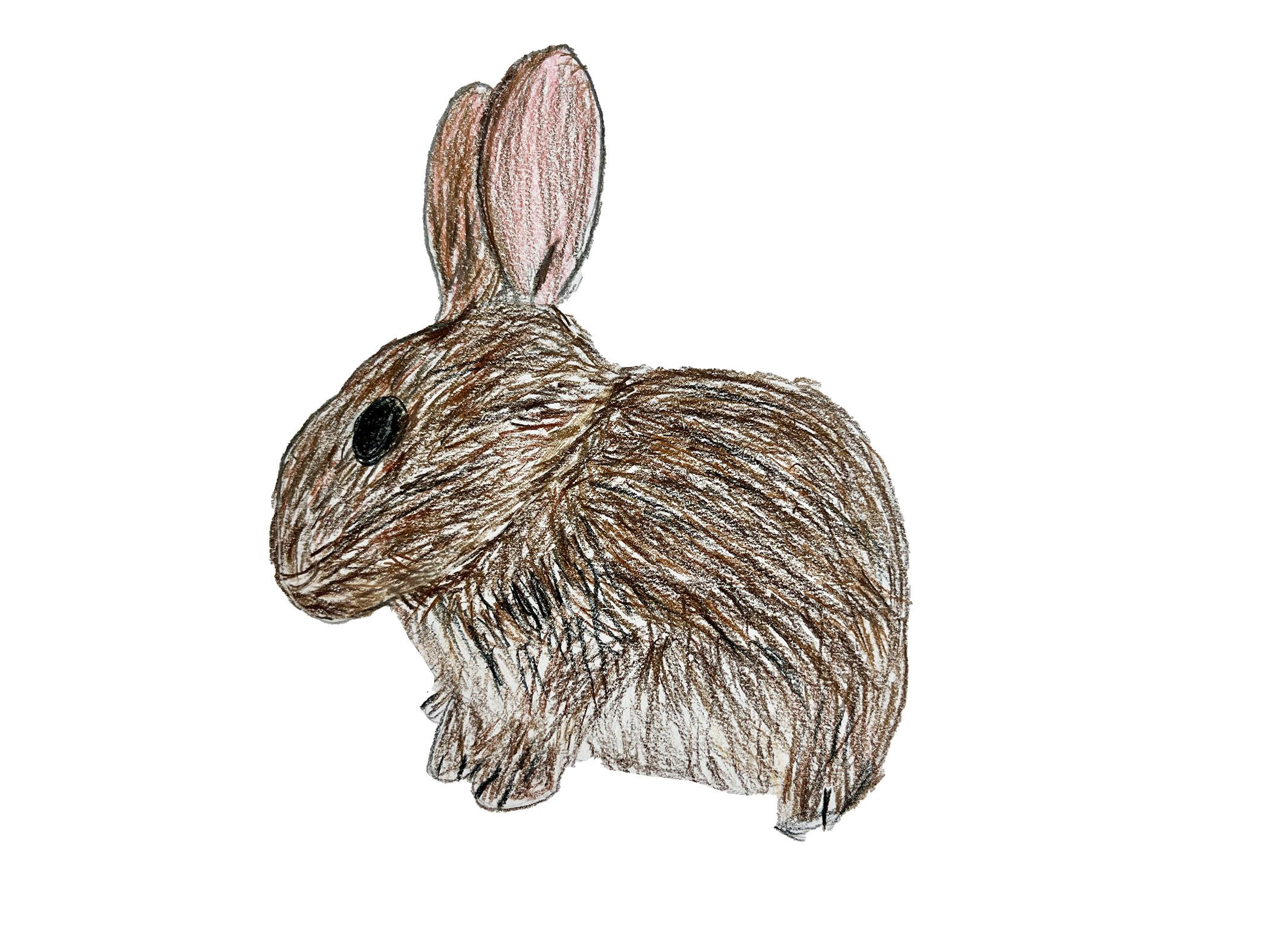
...I wonder if it thinks I am a predator, since it runs away quickly.
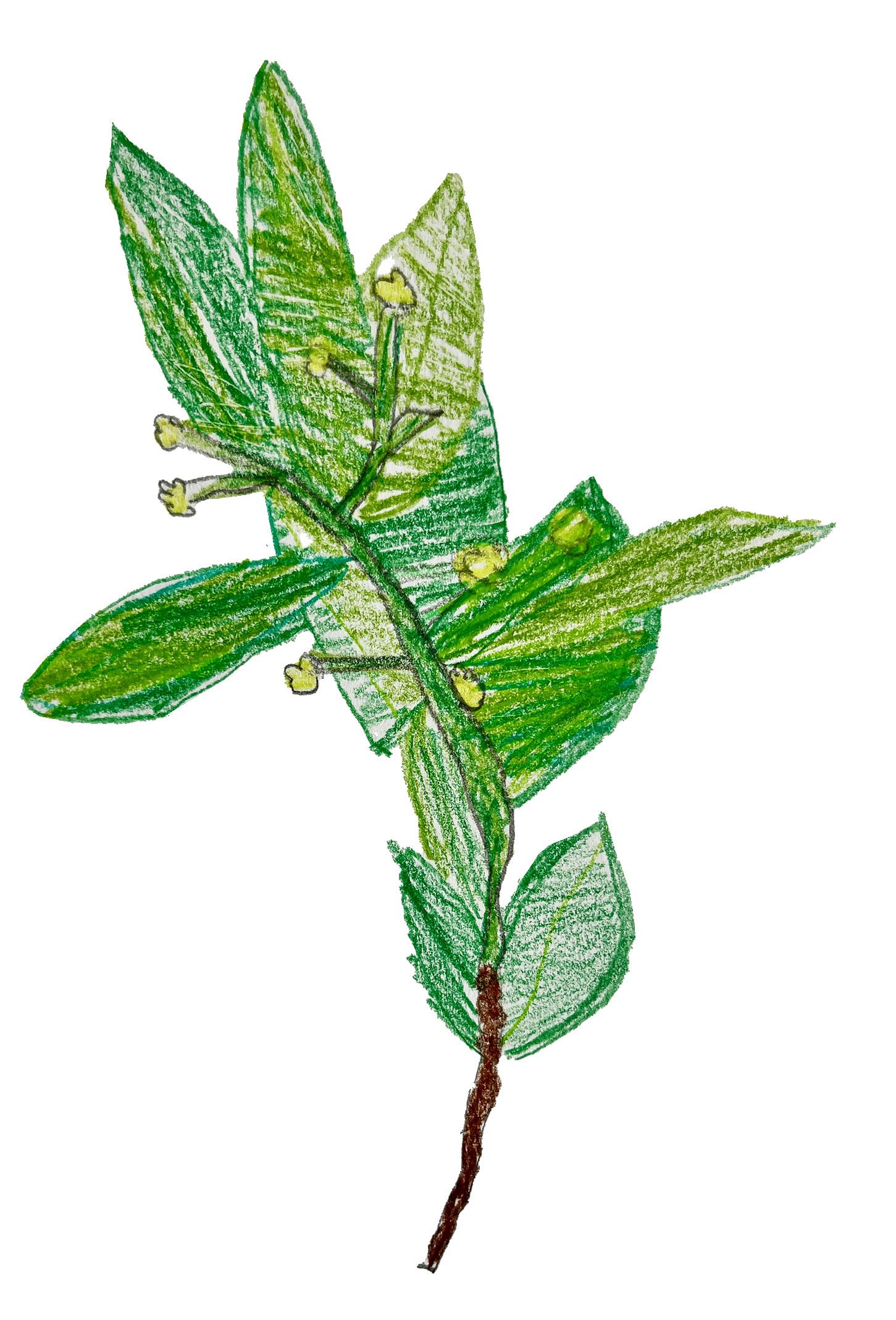
The California bay laurel tree is a good plant; it just does not have a good name.
BY OSCAR P.
The California bay laurel tree is a plant of many talents, such as its fruits. Also known as California bay nuts, they are green, bloom in late September, and are approximately the size of a small avocado. In fact, the plant is in the same family as avocados. When roasted, the nuts are edible, tasting similar to burnt popcorn, dark chocolate, or ground coffee (or all three).
Additionally, its leaves have medicinal properties that were utilized by Native Americans. The leaves can cure headaches, toothaches, stomachaches, and earaches. California bay leaves are most often used as a cooking spice in soups or stews. Spanish settlers in California used it as a substitute for black pepper. When using this spice, however, one must beware, as it packs a spicy punch.
The California bay laurel has other features. It has an uncountable number of candles on its birthday cake. Some laurels live for hundreds of years. Unfortunately, it is often misreferred because it has many alternative names, such as pepperwood, Oregon myrtle, headache tree, and spicebush. It is also commonly confused with regular bay laurel, a plant native to the Mediterranean and with alternate names of its own. Its name is as hard to remember as mine is!
When I was four years old, I lived in New York City. I went to a local preschool to learn to read and write. Unfortunately, my name was frequently mixed up there. Usually, the confusion is with “Oliver” or “Asher,” although I am confused whenever somebody mentions the famous award. Whenever this happens, I become annoyed.
I was more frustrated about my name at the school for a different reason, though. One of the reasons my parents chose the name Oscar was that it had been thought of at the time to be an uncommon name, rarely chosen or duplicated. This proved to be absolutely anything but true. At my preschool (which was very small - only twenty or so children), there was a second boy named Oscar.
Generally, when this occurs in elementary schools, the students’ last initial is appended to their first name, for example, “Alex G.” I was Oscar P. for the year that I enrolled in that preschool. The other boy’s name (Oscar K.) remained the same. I disliked this and eventually asked the teacher why Oscar K. did not need to have a last initial on his name while I had to be called Oscar P. They replied that Oscar K. began going to the school earlier than I had, so to provide the “least inconvenience” to him, the logical choice was to leave his name as Oscar and to make my name Oscar P.
Luckily, once I left New York and came to the Bay Area, my new school had no Oscars at all (and no Olivers, either), and I did not have to deal with that issue again. The California bay laurel tree is a good plant; it just does not have a good name. Whenever I think about the California bay laurel tree, it reminds me of my preschool years.
BY OTIS V.
The California buckeye is a unique tree, with features that some people call extraordinary or beautiful. It produces brown, bulbous seeds of various sizes, ranging from the size of a penny to a fist. It is a deciduous tree; in the fall, its leaves and seeds drop and scatter on the ground, and in winter, its bark turns a shade of silvery gray. These trees drop seeds that remain inside their husks, giving them protection, like a shield, from critters that may attempt to consume them.
When I arrived at Nueva in fourth grade, I wasn’t expecting to begin obsessing over a plant. I was on my way to recess one day at the lower meadow, which had a play structure and a great amount of foliage. My friend took me along the path to the structure, and he showed me the California buckeye. Then, during recess each day, we raced down to the lower meadow to grab all of the low-hanging brown buckeyes. We did not grab the pale ones, because they were still unripe and sticky.
The plant contains round, smooth seed husks containing the buckeyes, hand-shaped leaves, and many other visual aspects. The buckeyes also have many different names. The two most common names are horse chestnuts and conkers.
I carry a buckeye seed around wherever I go because they are good luck charms. I love to collect them to play conkers with my friends. Conkers is a game where two or more people attach a string to large buckeyes (or conkers) and attempt to break the other person’s seed before theirs does. Inside a buckeye seed is pale flesh that covers most, if not all, of the inside of the seed. The buckeye seed is not edible directly after picking it from the tree, but after complex soaking and leeching, its insides become an edible paste-like food that Native Americans have eaten for hundreds of years.
One of the California buckeye’s defenses includes toxins, especially its seeds, leaves, bark, and young sprouts, which can harm humans, honeybees, and other small critters. The tree’s flowers are also toxic and have a slightly sweet-smelling aroma. These flowers produce brown seeds that are known as buckeyes. They fall off and disperse after ripening between September and November. Then, they embed themselves in the soil and begin the journey anew.
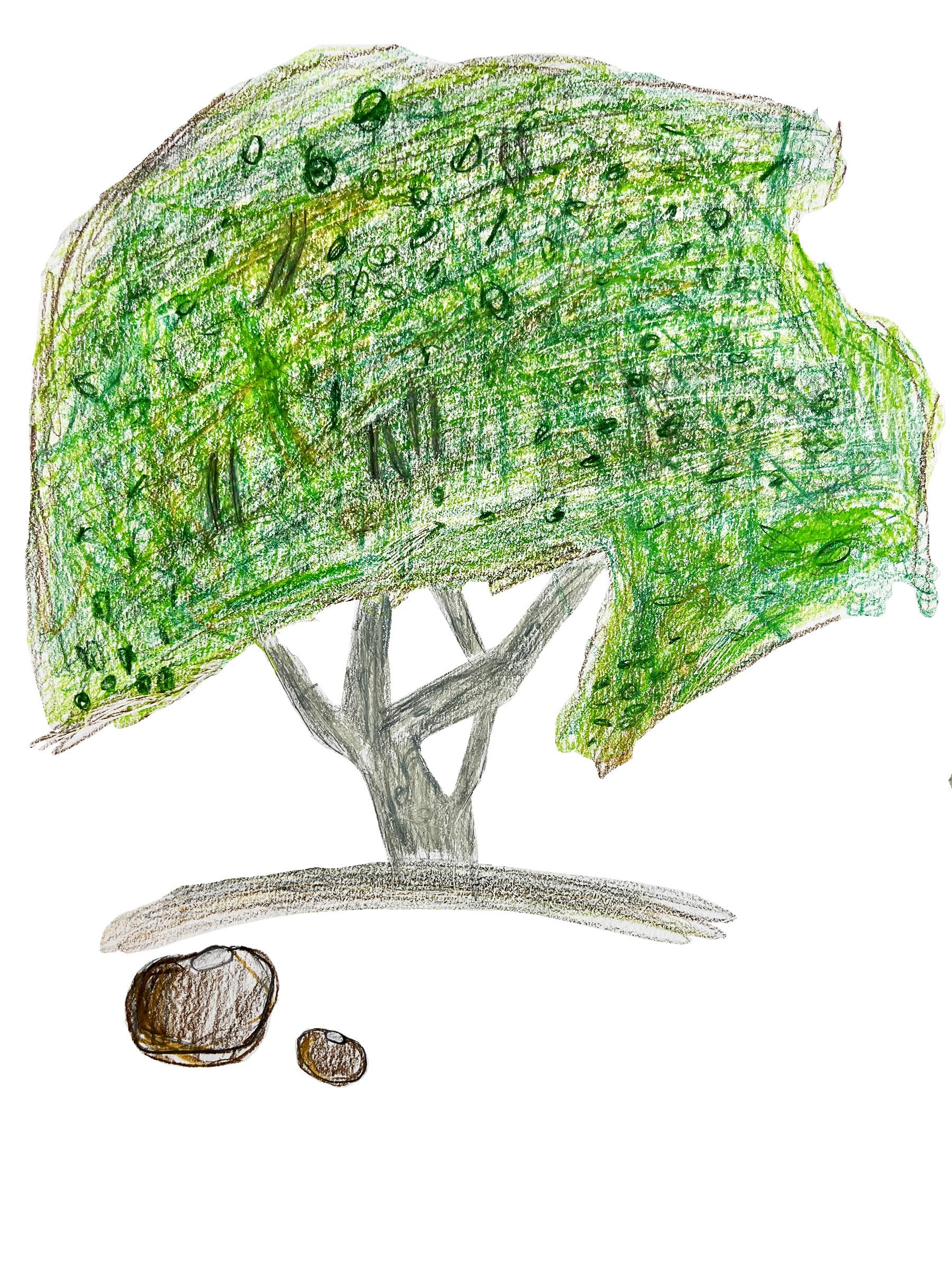
protection, like a shield.
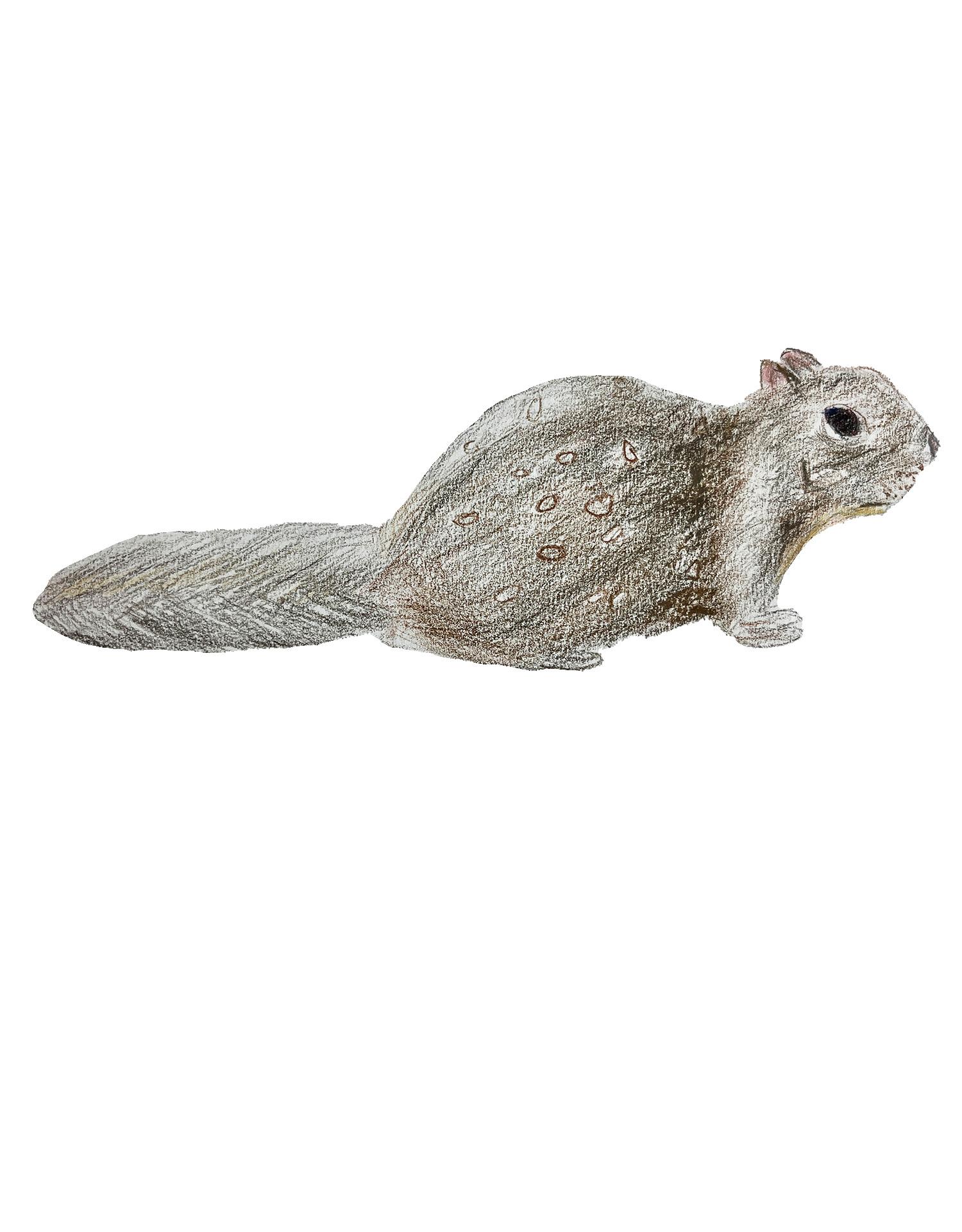
The squirrels had eaten all of our pincushion flowers, leaving large piles of white fuzz...
BY MAYA R.
California ground squirrels are absolutely incredible. For instance, they dig their own burrows with an entrance for every squirrel in that colony, and live a maximum of six years in the wild. Their burrows can be up to six feet deep and over thirty-five feet long. The squirrels use the burrows for hibernating and eating, just like a cozy room on a cold day.
California ground squirrels are absolutely adorable, with mottled grey or brown fur, but they can also be little devils. In the front yard of my house, we have pincushion protea flowers. They are beautiful, and my mom loves them. Sadly, the squirrels love them as well. Maybe even a little bit more than we do. When the pincushion flowers started disappearing in late summer, like snowflakes disappearing in spring, strange piles of white fluff started appearing on our outdoor couch. At first, we did not know what those piles were, but eventually we put it together. The squirrels had eaten all of our pincushion flowers, leaving large piles of white fuzz to accumulate on our couch. Our yard is large, but now, we have very few pincushion protea plants. Surprisingly, their hunger for our flowers is not their only harm. They gnaw on sprinklers and irrigation lines, and they burrow, which can cause trip hazards for the reason that you can potentially get stuck in them, and they eat both food-bearing and ornamental plants. They can even carry diseases that are very harmful to humans, such as the bubonic plague. They are classified as pests on many websites.
Their flaws do not define them. They will walk over one hundred yards to find a meal, and eat a wide range of foods, from seeds to fruits and nuts. Even though they are mostly vegetarian, they eat meat, like voles and insects, bird eggs, and sometimes shellfish. Surprisingly, some squirrel mothers have even been seen eating their neighbors’ pups.
They have many predators, such as northern Pacific rattlesnakes, red-tailed hawks, golden eagles, coyotes, foxes, badgers, weasels, house cats, and dogs. Even more shocking, the springtime diet of northern Pacific rattlesnakes is almost 70 percent squirrel pup.
California ground squirrels are nine to eleven inches long, not including the five to nine-inch tail that is not quite as fluffy as a tree squirrel’s tail. These squirrels breed once per year, with seven to eight pups in a litter. Once they are six months old, they resemble adults.
From the squirrel’s impressive qualities to their flaws, they teach us an important lesson. While everything has its flaws, it is important that we accept change and move forward. Nothing is perfect, and we have to accept what happens to us and be flexible.
BY SADE A.
The California kingsnake has many different features that make it very different from other snakes. For one, the California kingsnake changes its sleep schedule depending on the season. In the warmer months, the snake becomes nocturnal to avoid hot weather, and in the winter, it becomes diurnal (sleeping at night).
In the summers of 2024 and 2025, I went to a summer camp for girls in New Hampshire. I experienced many things I had never done before, such as waterskiing, camp-wide treasure hunts, and archery, and I enjoyed it. One thing I didn’t like were these two girls in my cabin who seemed to always be awake at night. They seemed to talk to each other until 3:00 AM, and they only slept for a few hours. As a result, they were always taking naps during freetime. The counselors told them to stop talking after 10:00 PM, but then they used sign language. This reminds me of the California kingsnake, because it was summer, and the people in my cabin were tired in the day because the girls kept everyone awake.
At camp, we went swimming every day. I took swimming lessons, and I moved up to higher levels. I improved my swimming skills, and I can swim for long periods of time. California kingsnakes are excellent swimmers that can comfortably swim for extended periods of time.
My schedule had its ups and downs, but the worst part of my schedule was when I had swimming first thing in the morning. Right after that, I went to outdoor education. I was soaking wet, freezing cold, and very tired, but I still went into the forest to re-learn how to pitch a tent.
We once did an exciting activity where we had to learn to climb trees, and that reminds me of the California kingsnake. They are excellent tree climbers, and they use that skill to survive. They use trees as a refuge from threats and uncomfortable temperatures. They also climb trees to find food. They eat birds, bird eggs, and a species of lizards that live in trees.
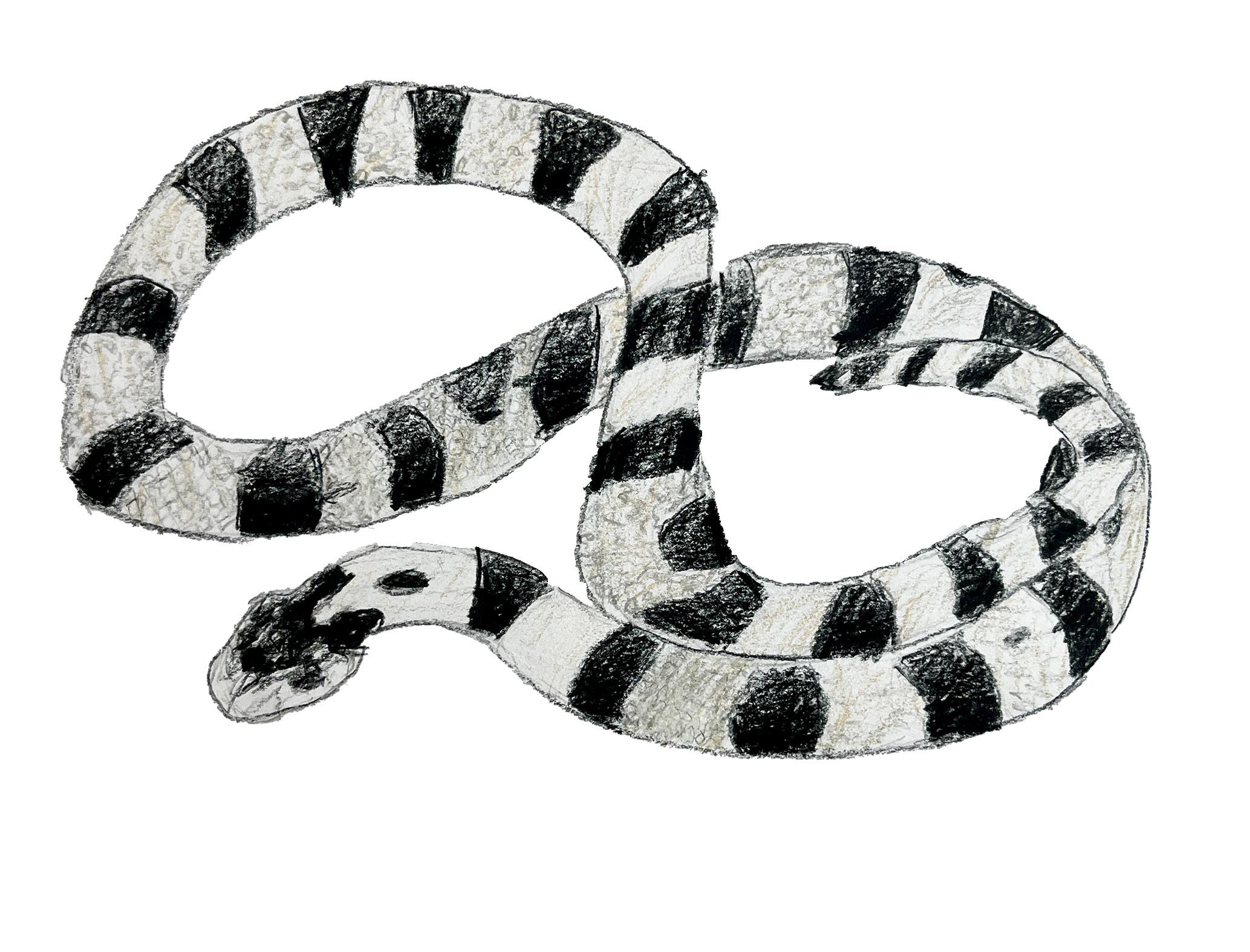
The California kingsnake is a living chessboard. Their black and white stripes help them blend into their environment by breaking up their body outline. This helps them hunt small animals and stay safe. California kingsnakes eat other snakes, even other kingsnakes. They use their flexible jaws to stretch to eat food larger than their heads. This allows them to eat other snakes, earning them the name of kingsnake.
If they are agitated, they coil their bodies, hide their heads, and mimic how a rattlesnake rattles its tail. By mimicking a venomous snake, these snakes give others a warning sign, even though they are not poisonous.
These California kingsnakes can change their sleep schedule, eat food larger than life, and slither and swim on different terrains. California kingsnakes are a fascinating species.
The California kingsnake is a living chessboard.
The California poppy will always be a part of me, because I am a California girl.
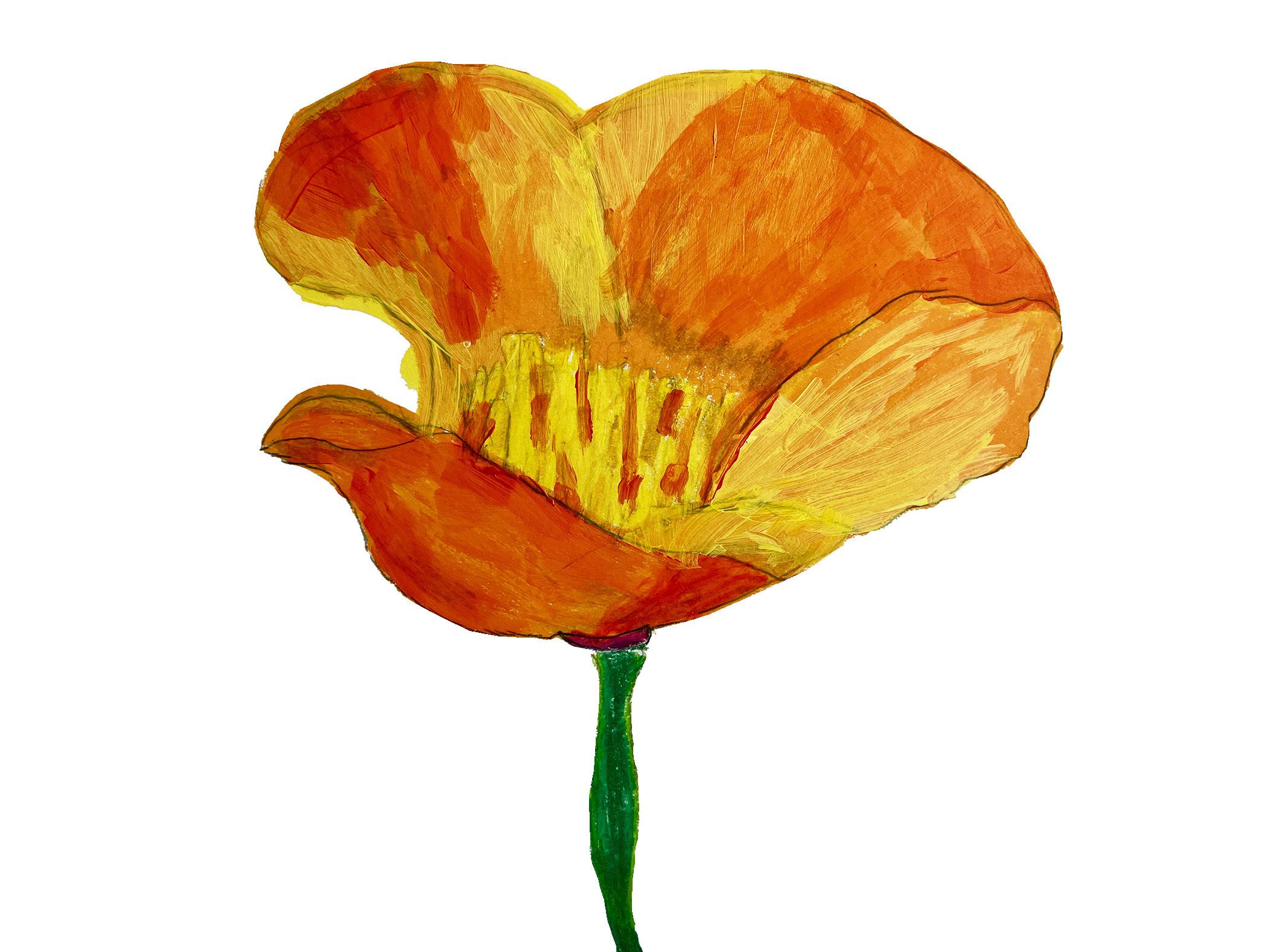
BY AMEENA M.
At five years old, after spending too much of my life listening to The Wizard of Oz audiobooks in forts crammed with blankets and pillows, I spotted a cluster of bright orange California poppies at the park one day. I had an idea. I picked one and ran it over to my mom and grandma, who were sitting in a nearby gazebo. I held it up to their faces and commanded they sleep. My grandma burst into laughter, but my mom did not. She instead explained to me that it was illegal to pick a state flower and that I could go to jail.
Driving to school each day on the 280 freeway, I see California poppies speckling the thoroughfare like craters speckle a rock, and I think about that day in the park. The California poppy blooms year-round, which means I can gaze out the window and admire the strong, beautiful, flowers on all my drives to and from school. The petals are orange, sometimes yellow, as well as red, scarlet, white, and many other shades of red and pink. These poppies can be two to twenty-four inches tall, although the ones I see are usually about 12 inches tall. I remember the soft, satiny petals of the California poppy. It felt like petting a baby caterpillar.
Before March of 1903, when the California poppy was designated a state flower, Native Americans used it as a sedative. I imagine they would pick poppies as much as they needed, and that there was always an abundance of poppies due to the fact that one poppy seed can create many blooms. A single plant makes its own seeds because the flowers develop pods, which fall off to create new poppy plants. The California poppy is a gritty flower. It prefers sun, but it endures shade, thrives in a variety of soil, and tolerates a variety of weather. Maybe my favorite quality of the California poppy is that one poppy can create a ripple effect by its ability to self-seed.
I am gritty. When conditions are rocky, I remain resilient. Like the poppy, I am flexible and fierce. I create a ripple effect. In third grade, I learned that anyone can be a changemaker, and I decided to become one. I found my own road to changemaking after reading the graphic novel When Stars are Scattered by Omar Mohamed. I wrote him a letter asking if he would be willing to talk to my third grade class. His voice inspired me, and my voice inspired others. I spread the word about Omar Mohamed and his life in a refugee camp and the organization he started, Refugee Strong. I was a single poppy seed, but my roots reached out, and I now stand with many poppies around me, a propitious field, all of us supporting refugees like Omar. One seed can be planted, and many poppies bloom. One voice will speak up, and many more follow.
I love the California poppy. I always have, and always will. The California poppy makes me feel safe and peaceful. The California poppy will always be a part of me, because I am a California girl.
BY LORRAINE W.
It was around three o’clock in the morning, and I was at Lake Tahoe. It was our first day there. I thought that my watch had broken, because it said 3:04 AM. The first thing that popped into my head was,Why does it say that? It cannot be in the afternoon, and it is possibly not 3:04 in the morning. My family and I were quite active–just like California red-legged nocturnal frogs. Nocturnal means that they spend most of their time doing their normal activity during the night. I sometimes do that, too. When I was three years old, I used to have trouble sleeping, and it made me think of nocturnal animals. The California red-legged frog has long, red, skinny legs, and is five to twelve centimeters (two to five inches) long. The tadpoles, however, have pink legs, not red. When they are froglets, they have olive or brown legs; the frogs will gain red legs. The California red-legged frog can live in deep, still, slow-moving streams.
During the wintertime, they live in vegetative areas. According to the Golden Gate National Parks Conservancy, the California red-legged frog enjoys being around cattails. Cattails are a type of plant where the tip is brown, and the stem is thin and green, just like the tail of a cat. The California red-legged frogs are from the Sierra Nevada Mountains. California red-legged frogs also eat California mice and California tree frogs. According to the National Wildlife Federation (NWF), the California red-legged frog eats anything that they can fit in their mouth and is part of their diet. The California red-legged frogs are prey to the American bullfrog.
Back in Tahoe, I prepared for bed when I realised it was 3:47 AM. The time got very late. I do stay up late occasionally. I was also extremely loud when I was three years old. I could be heard through the door of my room even if I closed the door. Sometimes I jumped up and down, screaming, trying to deplete energy. When I jumped up and down, noises like, “CRASH”were the only things that would be heard.
Similarly, the California red-legged frog can be heard from underwater. These frogs can also be heard through ice. They are as loud as speakers.
They lay their eggs in water and will inhabit other animals’ abandoned dwelling spots. For their preservation, the frogs have a bill associated with them. The California red-legged frog was officially listed as vulnerable in the Endangered Species Act in 2016. This act was approved by Jerry Brown, a lawyer and former governor of California. According to the U.S. Fish and Wildlife Service, 46 counties in the United States used to have California red-legged frog residency , but now only 35 have the California red-legged frog. In fact, 90 percent of their habitats got diked, drained, or filled by humans for agricultural purposes. The California red-legged frogs were of special concern because they were extensively imperiled.
...the California red-legged frog can be heard underwater.
The California sagebrush is drought-tolerant, but it is also highly flammable due to its oils and fine structure.
BY AVA E.
The first time I saw the California sagebrush was on a hike around ten minutes from my house. It was summer, and I was astonished by the length and greenness of the plant. Bending down to pick a piece, which I planned on showing to my brother, I was captivated by the potent scent of the shrub. As I plucked the thin, thread-like leaf, I saw a bird. This wasn’t any bird, but a bird that I would later find was the endangered California gnatcatcher.
The California sagebrush is a plant with many benefits. Offering habitat and food for wildlife, its health directly impacts the survival of other animals, including the pygmy rabbit, which maintains a diet consisting of over 99 percent sagebrush, and the mule deer, which relies on the sagebrush as winter shelter. Without it, these small prey animals struggle to survive, as would the predators that hunt them.
An entire ecosystem depends upon the existence of this important vegetation.
Known for its pungent aroma and often compared to “cowboy cologne,” California sagebrush has a scent that might be called minty, otherwise sweet and tangy. Though it appears green and fresh, the finely-textured leaves can thrive in harsh weather and sweltering heat. If not for this unique ability to adapt, the California sagebrush would not be able to survive in the state of the hills and valleys it lives in.
While California sagebrush lives on dry, sunny slopes, it is not the only species able to survive in this Mediterranean climate. California sagebrush shelters small animals, such as jackrabbits, woodrats, and the threatened California gnatcatcher. While sagebrush is always a good option for shelter, predators like the bobcat and the mountain lion rely on the vitality of these small animals to survive.
When I first read about the California sagebrush’s ability to survive for so long without water, I was stupefied. It becomes dormant or semi-dormant during dry summer months, reducing water loss. This is its key to survival, because the habitat they live in is especially prone to wildfires.
The California sagebrush is drought-tolerant, but it is also highly flammable due to its oils and fine structure. This is a major disadvantage to all the animals it shelters, since the sagebrush is a lone resource to most of them. “Cheatgrass” is a wild grass that grows in similar climates to the California sagebrush. When wildfires and natural disasters destroy the sagebrush, cheatgrass quickly replaces it. Cheatgrass creates a poor habitat because it outcompetes vital native plants for water, dries out quickly, and offers little nutrition or shelter. This is part of the reason the California gnatcatcher has been endangered for over thirty years.
The best way to help the California sagebrush is to focus on habitat restoration, removing invasive plants like cheatgrass, controlling fire, and protecting core areas. This would not only help to revive the sagebrush population itself, but also add/contribute to the enrichment of the entire ecosystem that relies on it.
BY LAILA V. G.
Whoosh! A flurry of flapping feathers reveals a scrub jay in the woods. These vibrant blue birds can be found all over the West Coast, including scrublands and forests. If one looks at a scrub jay, they will see magnificent azure wings and tail feathers, which contrast with their smoky-colored underfeathers. Their stout, hooked bills help them crack open acorns, a favorite food for a scrub jay. In fact, without scrub jays, oak trees would not stand as tall and proud as they do. In a single season, a scrub jay can take and bury up to six thousand acorns; around one-half of them are consumed, but the rest grow into oak trees.
California scrub jays have a voracious appetite, which means they like to eat large amounts of food. Their diet changes depending on the season: In the spring, they feast on insects and fruit, while in autumn, they snack on acorns, nuts, and seeds. They also eat nesting birds, birds’ eggs, mice, and snakes; due to their high protein content, these foods are beneficial for raising young birds.
Scrub jays can be loud and arrogant, and can hoard food, but they are also playful, social, and animated. Similarly, I am social and love spending time with family and friends. For instance, I enjoy going camping with my family in the summer. We have gone to many different campsite locations, but the most memorable were Henry Coe State Park (Morgan Hill, California), Clear Lake (north of Napa, California), and Sugarloaf Ridge State Park (Sonoma, California). These camping trips are full of trees, animals, nature, tent-pitching, and our little, red, portable camping stove.
In the mornings when I woke up, the first sights and sounds that reached my senses were the warm glow of dawn and the squawking of scrub jays. Lying on my air mattress in the tent, I saw the cornflower-blue birds flapping around, squawking while cramming their bellies with acorns. Crunch! Clack! Clack! They glided through the air like a paper airplane, then landed on a gnarly oak branch.
Though people disagree with me, I find the California scrub jay’s squawk to be amusing. It lets everyone know, “I’m here, I’m here!” It is also an alarm call that benefits not only scrub jays, but also other animals that do not want to be eaten or attacked.
My school, the Nueva School in Hillsborough, California, is situated on a 33-acre plot, featuring numerous trees and hiking trails. I also spend time outdoors when engaging in competitive soccer games. Recently, I have been visiting the trails near my house. Now and then, I hear a scrub jay’s scratchy, nasal call when I am in nature. It reminds me of my family camping trips in the summer, the inflated black air mattresses, the red camping stove, and being together with my family.
Whoosh! A flurry of flapping feathers reveals a scrub jay in the woods.
Sea lions go to sandy beaches, as I did in Miami.
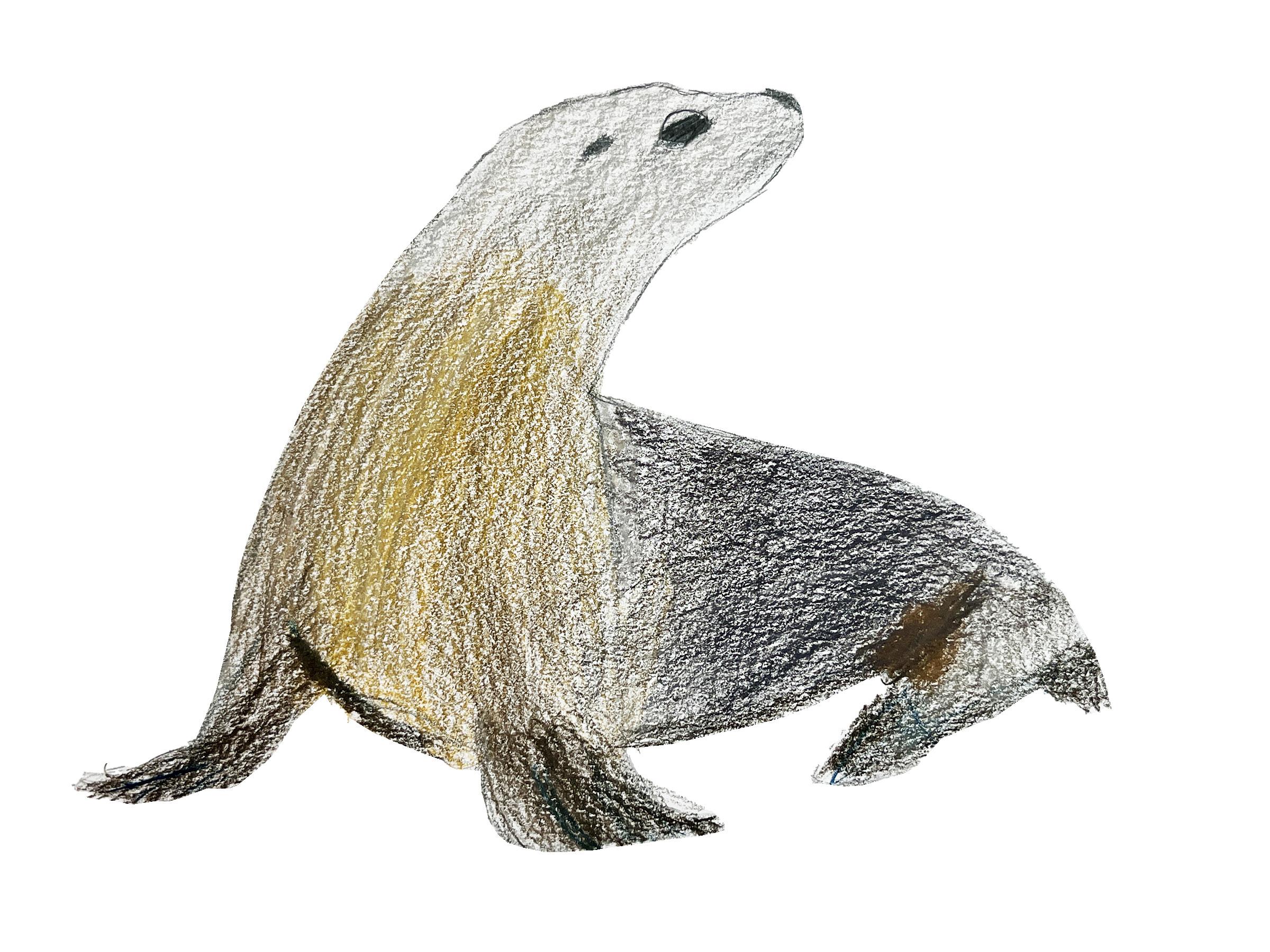
BY LUCAS A.
California sea lions are helpful to humans and can warn us of strong storms or bad weather. Groups of sea lions are like a pack of mad dogs. They are super noisy, and their constant loud barking can be heard around them. Unlike me, they like seafood. They eat squid, anchovies, mackerel, rockfish, and sardines. They often body surf for fun. Females weigh about 240 pounds, and males weigh about 700 pounds. That is as heavy as a grizzly bear! Females are around six feet long, and males weigh around 7.5 feet long. California sea lions are usually dark brown. Orcas and white sharks eat sea lions. California sea lions can live from twenty to thirty years.
They can feel air pressure changes, which means storms might be coming. Hurricanes and large storms produce super low-frequency sounds that travel long distances, warning California sea lions before the storm arrives. When bad weather is coming or toxic chemicals are in the water, the sea lion’s behavior changes, and they might attack at any time.
California sea lions can also detect earthquakes. They hear low-frequency sounds in the ocean that humans cannot hear, which tell them when an earthquake is coming. Because sound travels much faster in water than in air, they know when to go to higher ground before humans feel the ground shake.
California sea lions swim near aquariums, searching for food or resting along the aquarium’s shores. They have even been seen covering the whole of San Carlos Beach. Additionally, sea lions can stay underwater for nearly ten minutes without coming up for air by slowing their heart rate. They can swim up to twenty-five miles per hour, which is faster than a human on a bicycle. Groups of twelve or more dive to depths of nine hundred feet to find food.
California sea lions are semi-aquatic mammals, which means they can live both on land and in water, just like I feel. Young California sea lion pups prefer to stay on the beach instead of going into the water, just like I did when I was young. Sea lions love to go to sandy beaches, as I did in Miami.
When I was in Miami, I would go to the beach almost every week. I loved jumping in the waves. When I was pushed down by the waves, I would be wet and come right back up. When I was not hit down by the waves, it felt like an accomplishment. I also loved playing in the sand because I could build sand castles and roll in the sand. Sometimes, I would just relax. Sea lions also dive into the waves, roll in the sand, and take naps on the beach.
BY SOPHIA D.
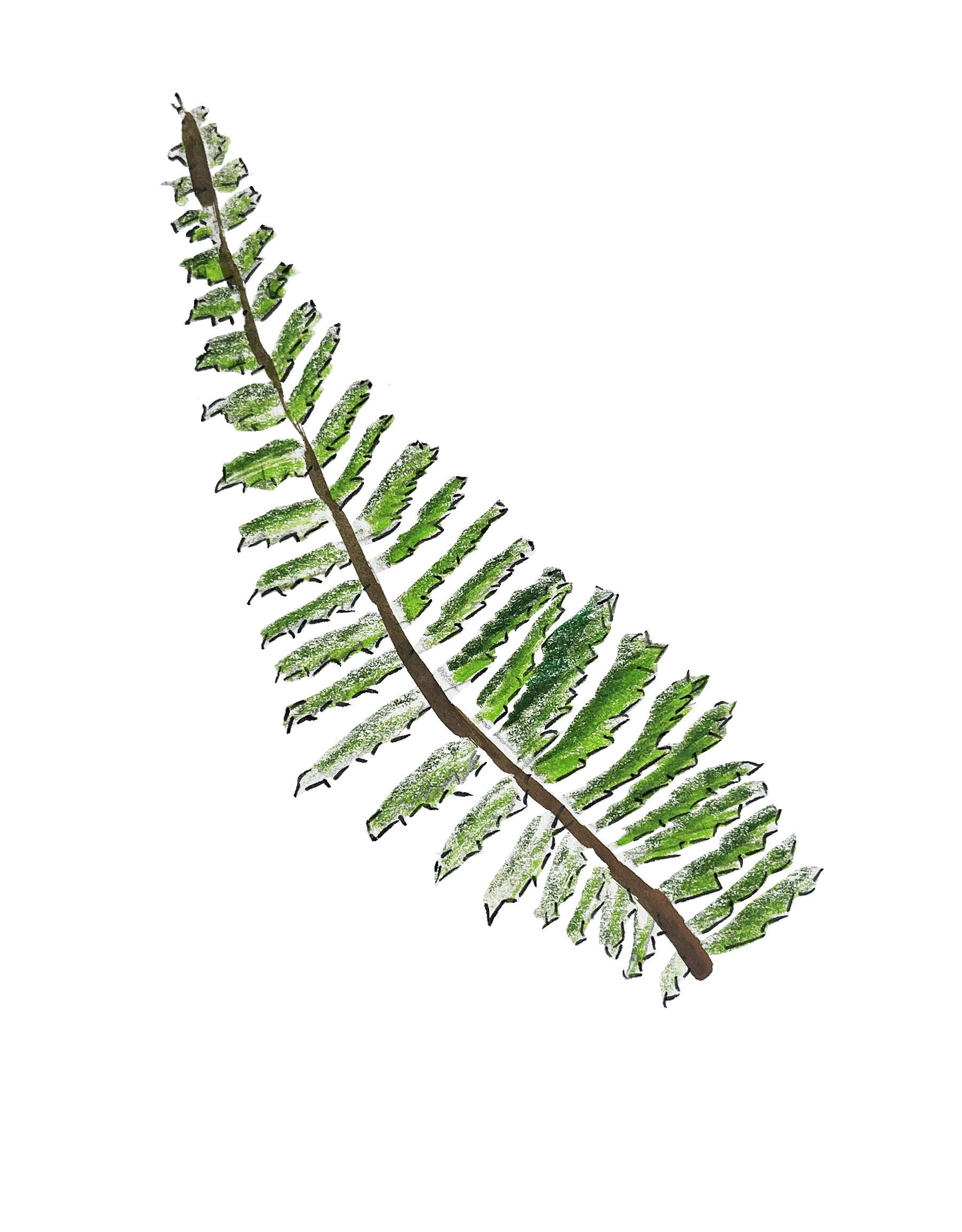
The California shield fern, also commonly known as the sword fern, has a variety of interesting characteristics. It is a leafy evergreen fern that grows between 2 and 6 feet wide and 2 and 6 feet tall, while its leaves, the color of shining emeralds, grow up to 31inches. It also has lance-shaped leaf fronds, stems that grow with bulbets, and narrowly toothed leaflets, which means it has small teeth-like leaves on the edges, and also is narrow without a bud at its base. The shield fern’s leaf fronds usually live from 1-2 years before dying ,while the entire shrub itself can live for 500 years or more.
The California shield fern also prevents erosion and helps decontaminate soil, even though it is an endangered plant, harmed by habitat loss. The shield fern is a shelter that provides shade and a microhabitat for other animals to help them survive.
I have shield ferns in my backyard. It reminds me of running around with my sister and dog and playing hideand-seek in the bushes. My family really appreciates them because of their beauty and how they help the environment. I love shield ferns because they are really pretty and can also help the environment by providing microhabitats for other smaller animals. I like them because they symbolize strength and flexibility, and because of their flexible growing habitat and their strength in being able to live while endangered.
The shield fern has cultural significance to many people. Native Americans use it as a food source. The fern also has some medical uses; an infusion of the stems or a poultice of the leaves can be used to treat skin sores and boils. Its preferred habitat is a rocky forest, but it can also survive in both wetlands and drier places. In conclusion, it has flexible growing conditions. It typically grows in moist forest understory or in rock crevices. The shield fern can be a competitive plant, meaning it competes against other plants for water, growing space, sun, and other things.
The California shield fern competes with other plants for a place to grow because there is limited space, some of which include drought-tolerant plants, large or aggressive ornamental grasses, and tree seedlings. It is also an endangered plant that is affected by quarrying and droughts. Flooding is also sometimes a danger to its habitat.
It is also harmed by invasive plant species because it takes up the habitat that the shield fern needs, so the fern struggles to live. The shield fern belongs to the kingdom Plantae. It also belongs to the phylum Tracheophyta, the class Polypodiopsida, and the subclass Polypodiidae. While it belongs to the order Polypodiales, its genus is Polystichum, and the species is Californicum. So this makes the scientific name Polystichum californicum.
After learning all of these facts, some noteworthy things that stood out to me are that the species is threatened, and it is a micro-habitat for many different animals, which may cause a chain reaction if it goes extinct, which would cause many problems. Being a very beneficial species by helping other plants, but also being a beautiful fern, we should try to prevent it from going extinct. It could cause a lot of problems, like other animals and plants going extinct, because they could use it as a food source, so it will basically be a chain reaction.
The shield fern is a shelter that provides shade and a microhabitat for other animals to help them survive.
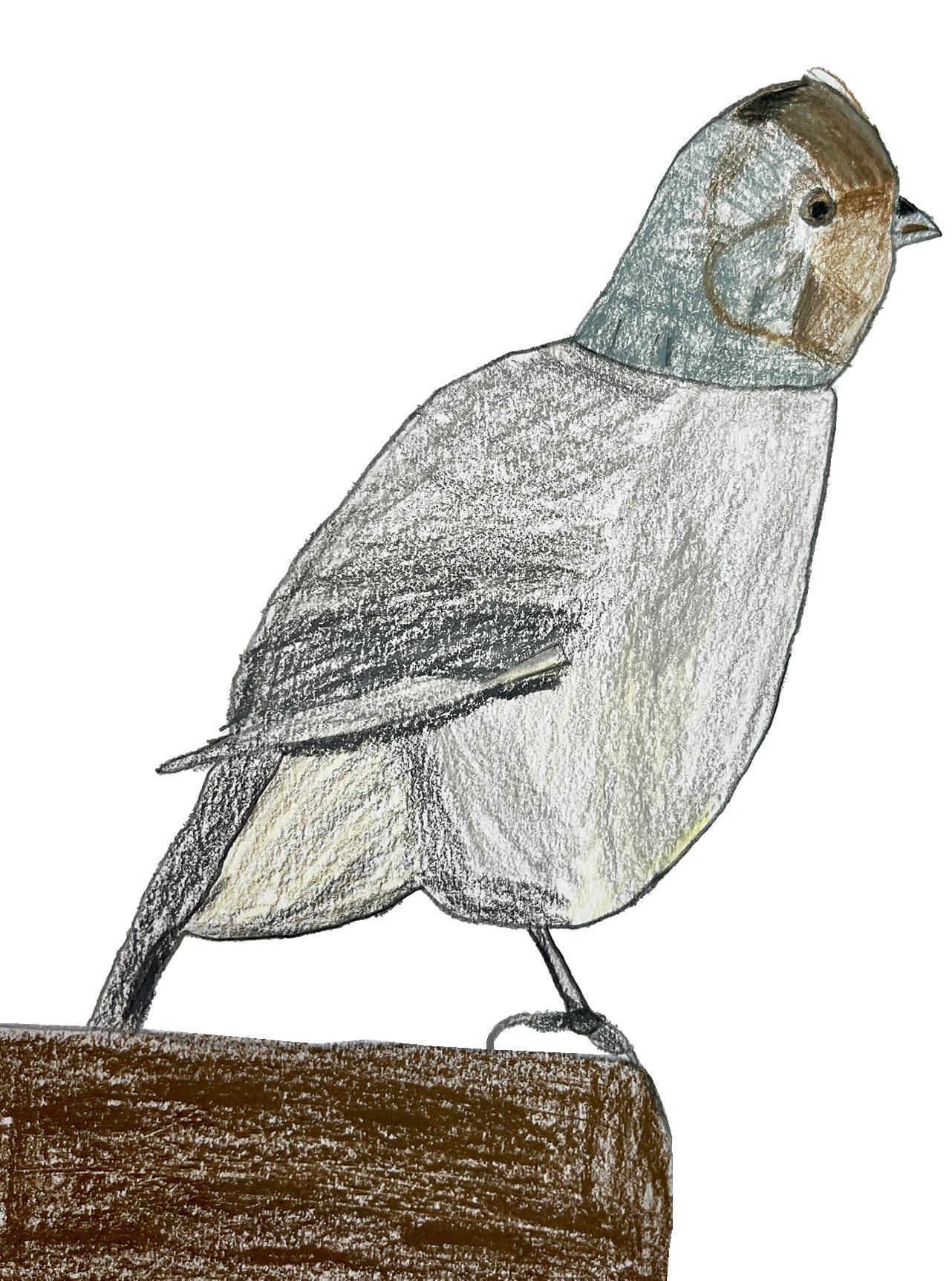
I could not get the picture of that one bird out of my mind.
BY COOPER C.
I just came back from a short drive to the north of San Francisco, where I saw the one bird that I will never forget.
It was a Tuesday, and my art teacher told us to paint anything we wanted. I was wondering what to do, and I could not get the picture of that one bird out of my mind. When I showed my picture to my teacher, he asked me what animal it was, and I told him it was a California towhee. I drew the bird eating some acorns and plums, something that I learned they eat.
When I came home, my dad told me we were going on a trip north of San Francisco. I immediately asked how far north, and my dad said one hour. I was telling myself, Perfect! We were going to see the California towhee again! Sadly, before we went, I got sick, and I could not go. I walked to my room, took out the painting I made of the California towhee, and looked at it. It reminded me of that one time when I was at the San Francisco Zoo. There was a bird that would just stare at me continuously. I looked at it, and it would just stare back at me. Then, I would wave, and it would fly away.
I walked downstairs, turned on the TV, and heard a glass fall and shatter. I told myself, Oh no, what happened? I went to look, and the glass dropped from a rack. I told myself, Could my day get any worse? It did, sadly, because when I went to school, it was pouring. I imagined the California towhee, having its home outside in the rain, and how wet they must have been. Their blueish-white eggs would have been soaking wet. At least, I had an umbrella, but the California towhee did not have one.
When I arrived back home, I had drawn a new picture of the California towhee. I drew some huddling together in the rain, while trying to protect their eggs. I drew their brownish-black eyes and their small brown beaks, which looked like sharp tips. I knew all the facts about the California towhee. I had thought they could lay up to 100 eggs! I was wrong, though; they actually only lay up to five eggs. They can live up to eight years. And, seventy percent of their food is on the ground.
I did my best to incorporate those facts into my picture. When I finished, I told myself, Wow, pretty good! I added all the facts into my picture! My art teacher told me that he was showing some art that we made, so I asked him to put my picture in it, and he said yes. That was a long time ago, and I still remember it, but I will never forget my liking for the California towhee.
BY JOSEPH L.
The octopus may be the closest organism to alien life we have on this planet. It has eight arms, three hearts, and nine brains. All of its organs lie in its head (which is called the mantle). It can touch, smell, and feel with its suckers. It is one of the smartest animals on Earth. This fascinating creature can change the color of its skin. Despite all of these awe-inspiring qualities, it is still a living being, just like every human on Earth.
Every year, my family visits the Monterey Bay Aquarium. I remember reading about octopuses for the first time, admiring how they seemed to have superpowers. When I first saw one at the aquarium, I marveled at how long it took me to actually spot it. It was the same shade of grey as the surrounding rocks. After walking inside the Monterey Bay Aquarium and entering the Reefs and Pilings exhibit, I counted eight arms in the first glass tank I saw.
There used to be an exhibit called Tentacles at the Monterey Bay Aquarium, which included octopuses, squid, and cuttlefish. I would spend countless minutes staring into the glass at the giant Pacific octopus. One year, when I visited the aquarium, the mollusk section was under renovation, so I could not see the octopus that year. I was devastated. The next year, the Tentacles exhibit was gone, and I discovered the octopus closer to the front of the aquarium. Sometimes, I tried counting the suckers on its arms. There were too many to count. Both the California two-spot octopus and the giant Pacific octopus have more than two hundred suckers on each arm.
The California two-spot octopus receives its name from the two blue neon rings on both sides of its head; however, it can camouflage itself, making its spots invisible. The California two-spot octopus uses chromatophores to mix shades of red, yellow, and black, and iridophores to bounce off green, blue, and purple wavelengths.
During break, my class plays a game where one person is “it” and holds their palms out. All of the other players high-five that person and find a hiding place. I try to find a good hiding place and blend in with my surroundings, just as the two-spot octopus camouflages itself upon sight of a predator.
Camouflage is one of the California two-spotted octopus’ methods to escape predators, but this species has another tactic as well: intimidation. The two blue neon rings on the octopus’ mantle look like eyes, tricking a predator into thinking that the California two-spot octopus is bigger than it is, like a mime pretending to be something that it is not.
The California two-spot octopus has another way to evade predators. Similar to all octopuses, the California two-spot octopus has an ink sac located in its mantle. When faced by a predator, an octopus can ink, creating a dark cloud to confuse predators and conceal its escape. The ink is also slightly poisonous, stinging the predator’s eyes to help the octopus escape.
Two of an octopus’ three hearts pump blood to the gills, and the other pumps blood to the rest of the body. The octopus has a small collection of brain cells in each tentacle, each of which works in coordination with the central brain. The mini-brain in each arm collects information from the suckers on the same arm; thus, the octopus can taste, feel, and smell with its suckers.
Sometimes, I feel like the California two-spot octopus. I am small, but I am able to make a difference in the community. The California two-spot octopus only grows up to a meter long, but still plays an important part in the ecosystem. I have never seen the California two-spot octopus before, but the octopus will always be my favorite animal, no matter which species.
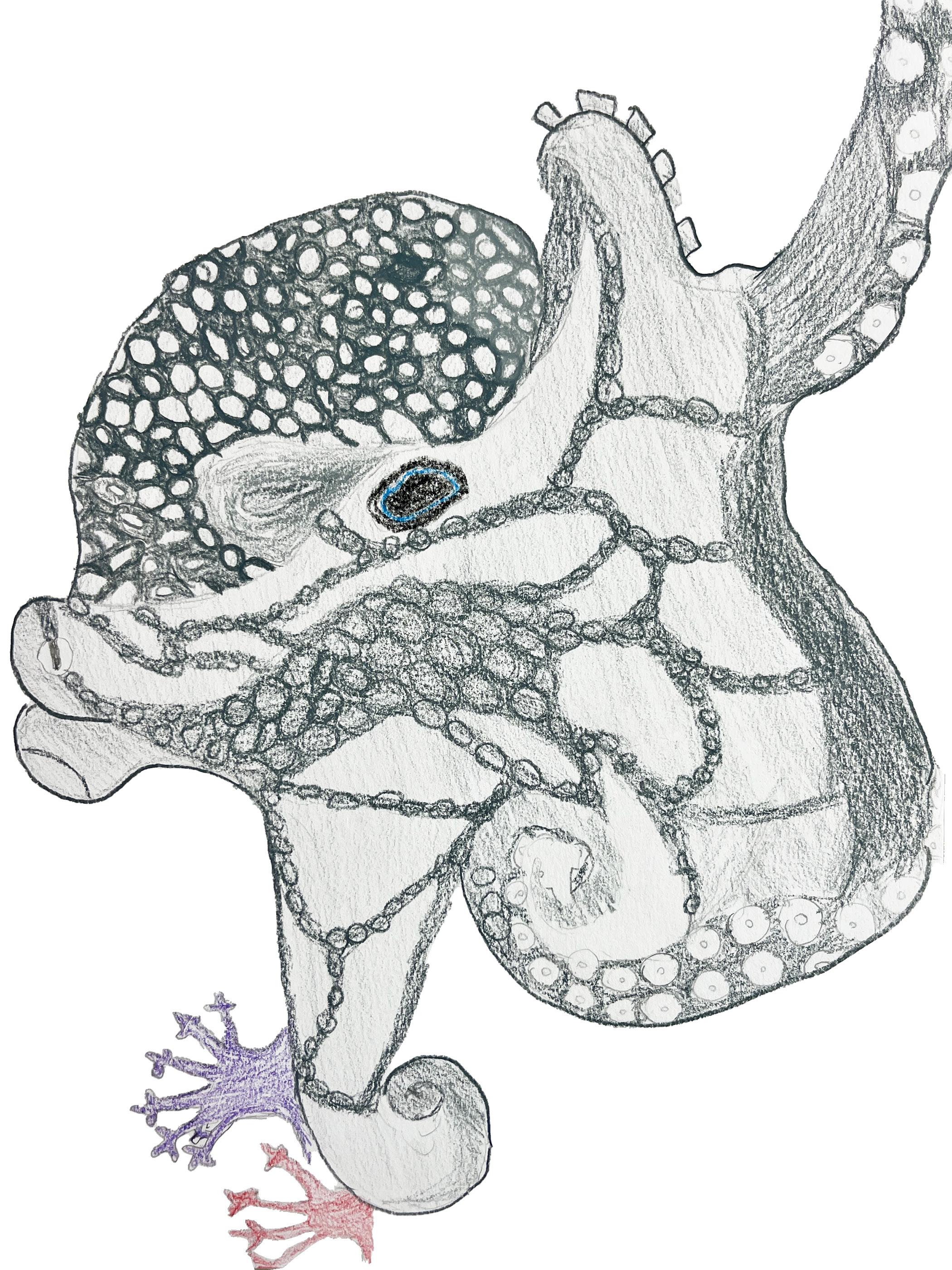
The octopus may be the closest organism to alien life we have on this planet.
When I smelled it, my mind went BOOM!
BY GOOGY C.
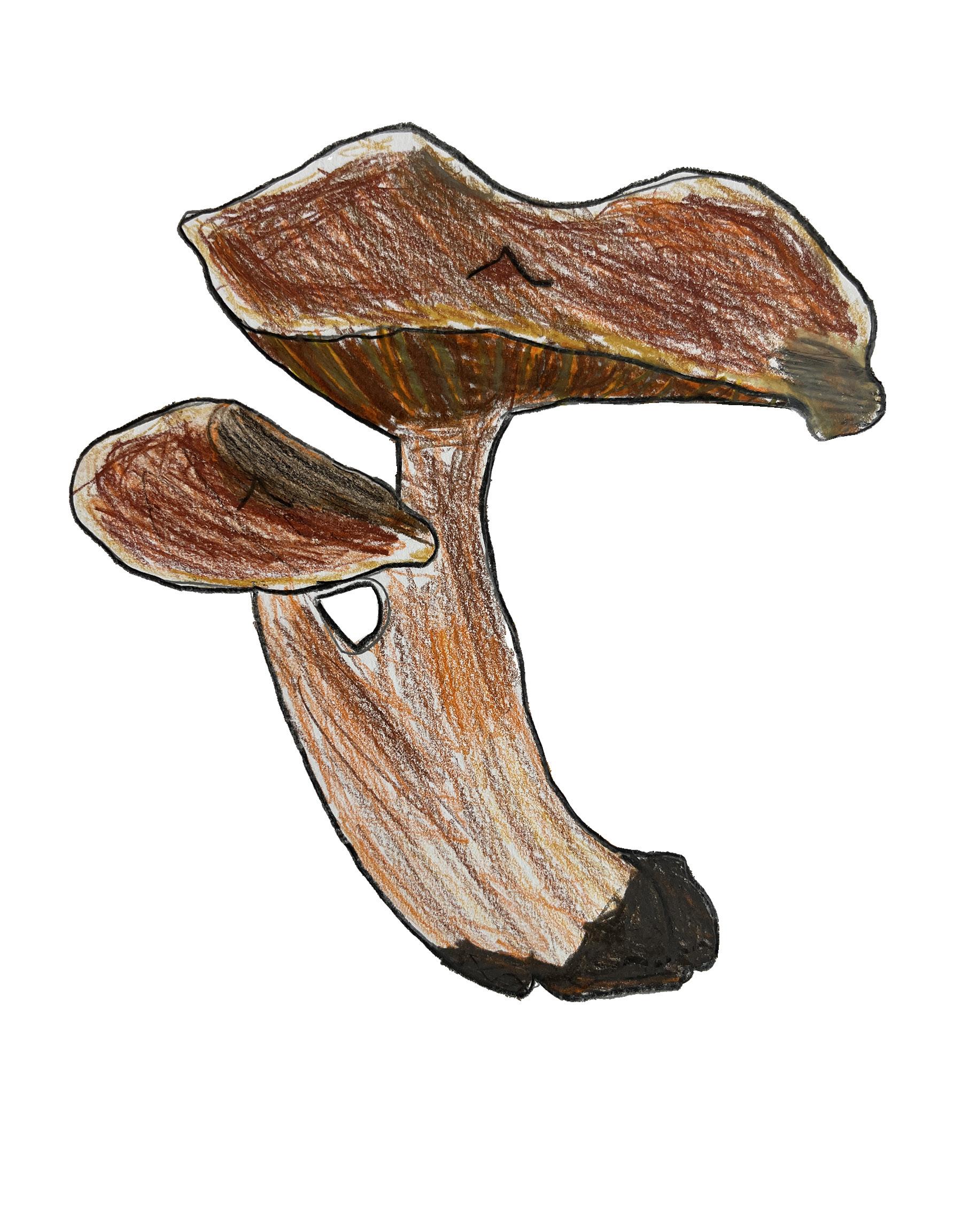
The candy cap is a unique mushroom. It lives in disturbed areas, such as turns on a street or decomposing wood. It is mycorrhizal with oaks, meaning that the candy cap’s mycelium (like roots, but for a mushroom) and the roots of an oak, trade nutrients, water, and sugar. Candy caps grow in the fall and the winter, as moisture is important for their survival. They have the “regular” mushroom shape, a short stem with a little cap on top, and are brownish orange. Their stems are 2 to 7centimeters long.
Mushrooms have latex, a milky liquid that ensures a mushroom’s survival. It is kept in cells called laticifers. When an insect takes one bite, its mouth fills with a sticky substance, rendering it impossible to bite it any longer, saving the mushroom from its demise. Candy caps are a part of the Lactarius family (Lactarius Rubidus). They are the only types of mushrooms that can have latex that is colored not only white, but all the colors of the rainbow (even though candy caps have white latex). Their flesh is very colorful as well. Lactarius Indigo, for example, has blue flesh and blue latex.
Candy caps taste and smell lovely, like maple syrup. To make them smell and taste good, quabalactone III must react with water. The reaction makes sotolon, the chemical that makes maple syrup taste and smell as it does.
Candy caps are similar to over 300 species of other mushrooms, a group frequently called “Little Brown Mushrooms” or “LBMs.” This is why, even though it is one of the most delicious mushrooms that anybody could ever eat or smell, I would be extremely cautious when trying to forage a candy cap. There are more than 1000 types of LBMs, and many, including Galerina marginata, Pholiotina rugosa, Lepiota brunneoincarnata, Inocybe species, and Clitocybe dealbata, are poisonous.
For my 9th birthday, I went on a foraging walk with expert naturalists. On my first mushroom-themed walk, the naturalist showed me the candy cap. When I smelled it, my mind went BOOM! I thought that all mushrooms had an earthy smell, more like a garden than maple syrup. As Eugenia Bone said, “The candy cap was a revelation to me: Redolent with the smell of maple, marvelously silky and spongy in texture, earth (sic) and meaty and sweet. When you eat a candy cap, your skin smells like maple sugar.” This quote shows how wonderful the candy caps are, as lovely as the scent from a rose.
Candy caps live both alone and in spread-out clusters. They mainly grow on the west coast of North America. They are not a threatened species because overpicking is not a problem. This is funny because it is the most delicious mushroom but it is still not overpicked like other nice-tasting mushrooms.
BY KARISSA L.
Chickadees are named after their distinctive “chick-a-dee” calls, which they use to signal predators or other threats, meaning their name is an onomatopoeia. I have seen chestnut-backed chickadees, as they are common in the Bay Area, and they never cease to amaze me. Measuring four to five inches long, chestnut-backed chickadees are the smallest among the seven chickadee species. They weigh between 0.2 and 0.4 ounces, about as much as one or two U.S. quarters. They typically live about four years, although the oldest recorded chestnut-backed chickadee reached nine and a half years.
When I turned eight, I received the Birds of California Field Guide by Stan Tekiela, complete with a blue feather, as a birthday gift. As I read the book, I began appreciating birds, noticing the wide variety of colorful species and marveling at their ability to fly. When I was bored, I would flip to a random page of the guide and read the facts about the birds, or I would take it with me to the park to try to identify the birds I saw.
One day, I flipped to page 123, where the page titled “Chestnut-backed Chickadee” was displayed in a bold font with the scientific name, Poecile rufescens, right beneath. I saw a crisp photo of this colorful, cute chickadee, and I was immediately intrigued. It was the first time I saw a chestnut-backed chickadee. A fact in the “Stan’s Notes” section, especially interested me, which read, “In winter, it joins other birds such as kinglets, woodpeckers, and other chickadees.”
This behavior of flocks of chickadees forming mixed-species associations reminds me of how my friends invited other classmates to play during recess. We went to the playground and played “grounders.” Whenever someone asked to join the game, my friends eagerly said, “Yes,” because the game is more fun as people join. Chestnut-backed chickadees join mixed flocks for safety and efficiency, while we children are inclusive. Chestnut-backed chickadees will always remind me of the inclusive community I had when I was younger.
Chestnut-backed chickadees are sociable and smart. They work together to defend against predators, such as weasels, deer, mice, and squirrels, and they have an incredible ability to remember hundreds of hiding spots.
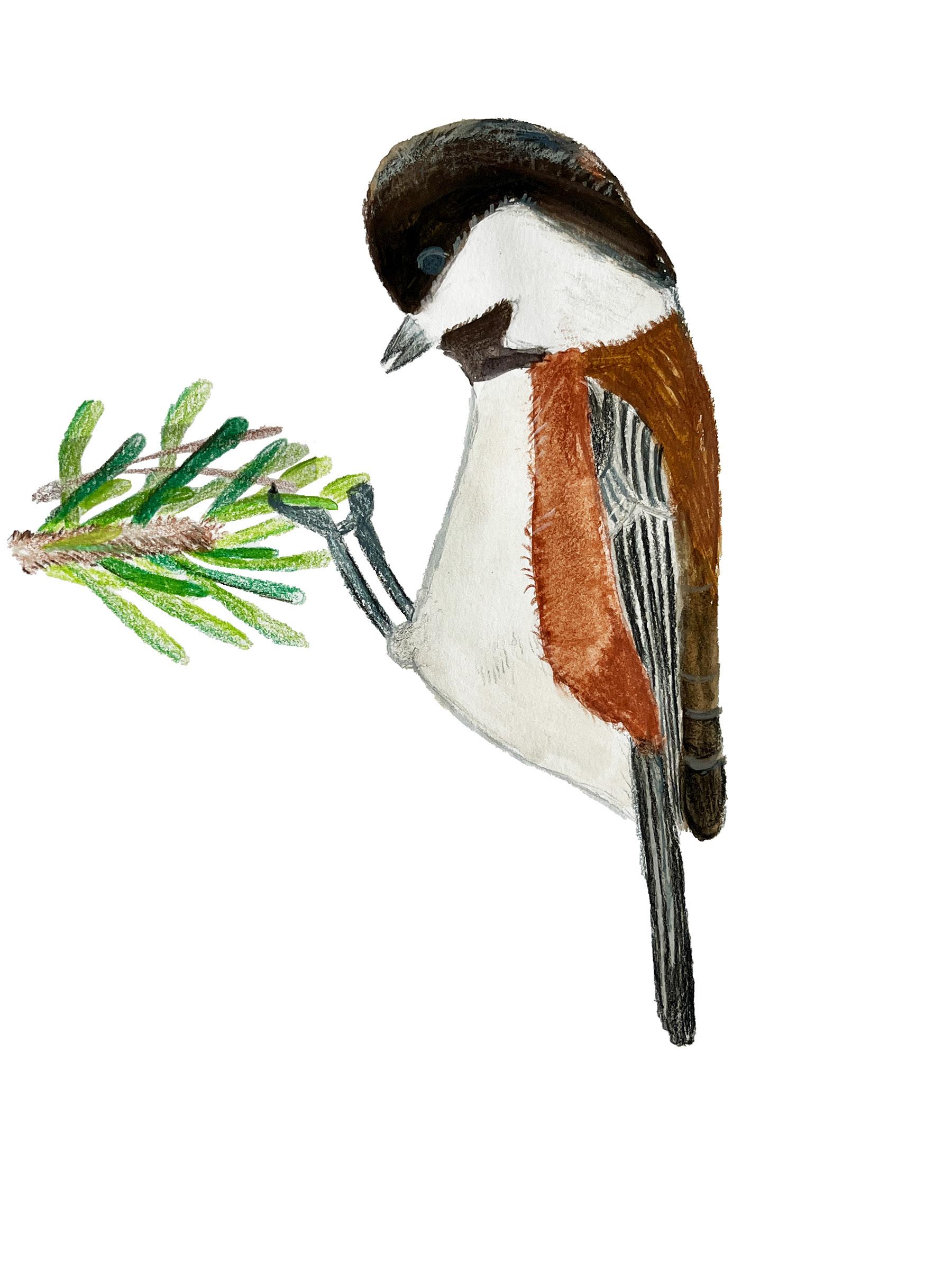
These birds have adapted to cold weather by wearing denser, more insulating plumage. Chestnut-backed chickadees are cavity nesters, meaning they build their nests in pre-existing holes in trees and use nest boxes. Much like my mother buying the warmest winter blankets for me, for seven to eight days, chestnut-backed chickadee parents build cozy nests, half made of rabbit, coyote, and deer fur. They lay between one and eleven white eggs with fine reddish-brown dots, reusing the same nest year after year. These active and agile birds mostly inhabit conifer forests along the Pacific coast, unlike other chickadees. In these forests, their rich chestnut-colored backs and sides blend perfectly into the bark of coastal trees. Chestnut-backed chickadees have bright white cheeks, contrasting with their dark brown caps.
Although they do not migrate, chestnut-backed chickadees move around to find food. When gleaning insects, they use their strong feet to cling upside down to trees. They are also nimble in flight and jump for joy around while searching for food, mainly insects and arthropods. Chestnut-backed chickadees are small, yet social birds with impressive memory and beautiful plumage.
...chestnut-backed chickadee parents build cozy nests, half made of rabbit, coyote, and deer fur.
They are like a magnet for wildlife.
BY ZANDER C.
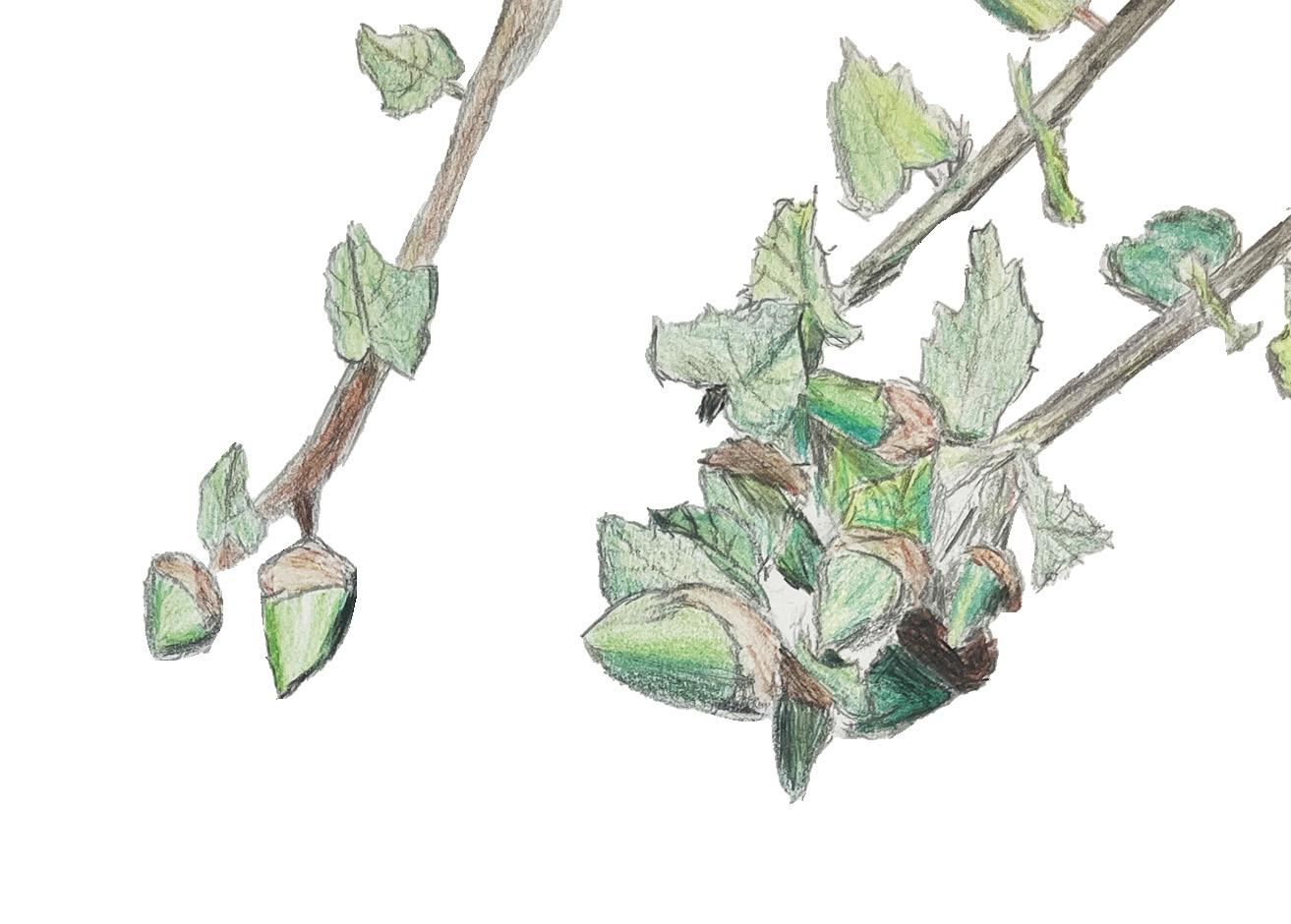
When I began to realize the beauty of nature, the first thing I noticed was the coast live oaks in my backyard. If a person has never seen a coast live oak, it is one of the most magnificent trees ever, with its huge canopy, twisting branches, and leaves that resemble a smooth but uneven rock. It can grow up to 100 feet tall, taller than a nine-storey building.
When I first moved to Shady Oaks Court, I immediately recognized the place’s namesake: a huge valley oak by the driveway. When I went to the backyard, I saw live oaks lining the fence like guards at a music concert. I admit, I might have tried to climb the valley oak by the driveway.
I lived in the house for a year before we decided to remodel it. We chose to move back to our old house for five years. Construction was scheduled for three years originally, and I was three when it started. I was eight when the remodeling was done. Once we moved in, the wait was worth it. The house felt cleaner, more refined, and had a basketball court in the backyard, although the construction was still not done when we moved in. In fact, it is happening to this day, but at least the coast live oaks are living through the construction with an incredible lifespan of up to 250 years.
Coast live oaks still stood, although some unwanted neighbors had moved in. Wasps made a nest in the huge valley oak, but I guess that’s how nature is. Everything comes with a caveat. That even applies to the coast live oaks, because although these trees are incredibly sturdy, sometimes they do not want to be disturbed. Coast live oaks can be hurt or even killed when people irrigate them artificially after they have made themselves a strong tree, because these coast live oaks adapt to their environment every day and do not need to be helped. When I see the coast live oaks everywhere, it reminds me of how I have biked, driven and walked past them, but seeing that they are in my backyard has never ceased to amaze me. These trees have survived five years of construction, harsh droughts, heavy rains, and who knows what before my family moved in. This makes me wonder if they will ever stop adapting. They help grow biodiverse environments, with birds and squirrels living in the canopy. Their roots loosen up soil for other plants to grow around them, and they produce acorns, a vital food source for other animals. They are like a magnet for wildlife.
We humans can learn from the coast live oaks. We can learn how to be friendly to wildlife, how to grow tall and strong biodiverse habitats, and how to adapt. People in California have had to put up with droughts, and we can learn from these trees to create areas that are resistant to droughts. Once we create these reservoirs, people can have water to cook, drink, and wash. When heavy rain comes, we can learn how to store water more efficiently in the reservoirs we created to be drought-resistant. To create more biodiversity, we can learn how to be more natural in the ways that we nurture good soil and native plants, and how to let animals survive. We can learn so much from coast live oaks, and if we just pay attention, and be in the moment, not the future, we can learn. Learn so much, one coast live oak at a time.
BY NIRVAAN J.
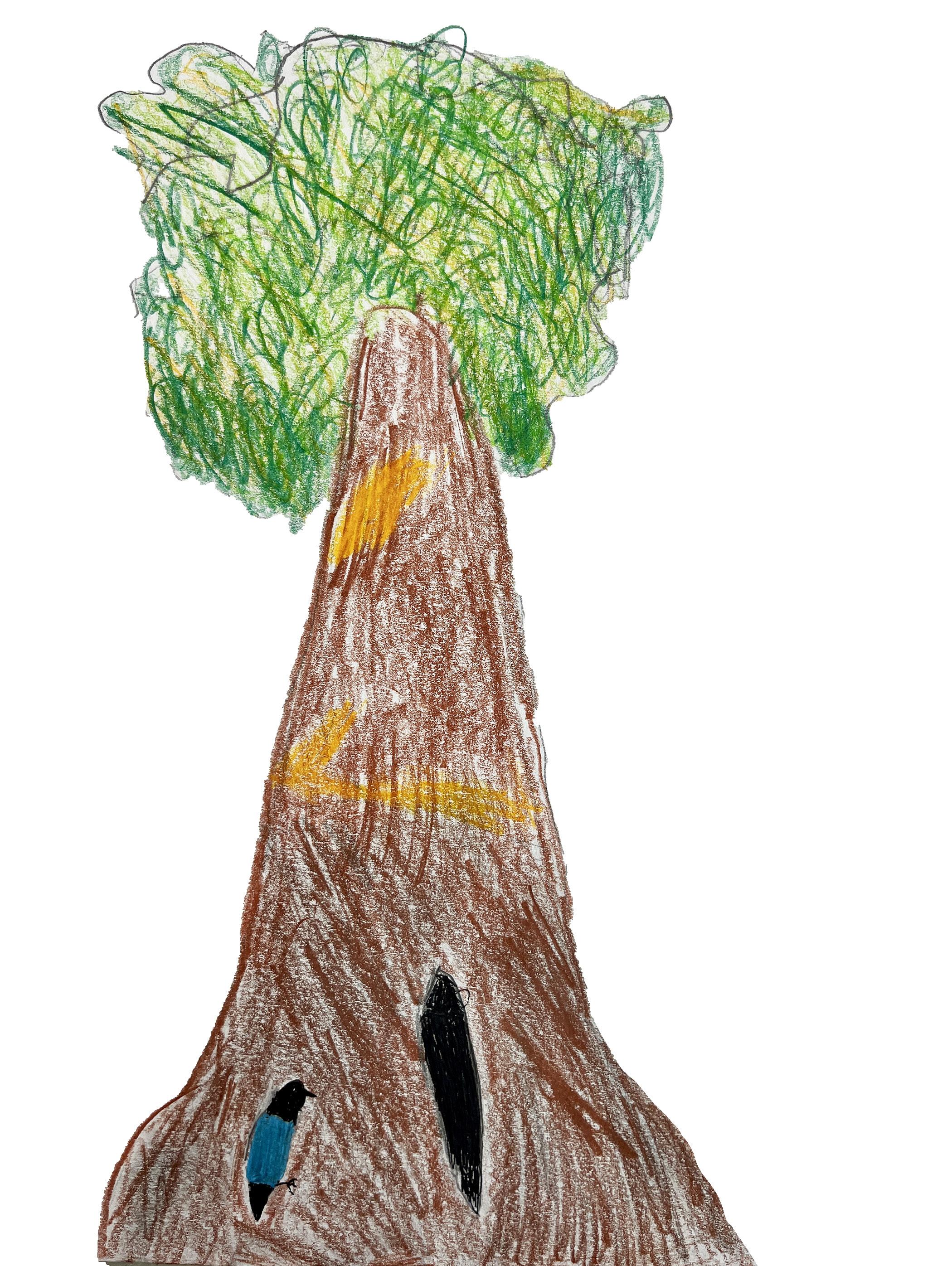
Out of some three trillion trees in the world, the tallest one is a coastal redwood. For the last six years, my family and I have gone camping with our friends for the Fourth of July celebration. There are usually redwoods wherever we go, such as those found in Humboldt Redwoods State Park, Samuel P. Taylor State Park, and Navarro River State Park.
On one of our camping trips, we had a mosquito-repelling flame on a wooden railing. My dad sat on the railing, which, unknown to him, was unstable. Because it was unstable, the railing broke, and the flame fell into the surrounding redwoods. It could have started a forest fire! Although the redwood trees would have been damaged, they would not die, as coastal redwoods are resistant to fire, due to their twelve-inch-thick bark and lack of flammable pitch or resin. These qualities also make coastal redwoods nearly immune to insects that hollow and damage other trees. This resistance contributes to the longevity of redwoods, which can live for over two thousand years.
Coastal redwoods grow along the Pacific coast, spanning from Southern Oregon all the way down to Central California. This stretch of coastline is extremely foggy, and fog can account for up to forty percent of a redwood’s water intake during the dry summer. Redwoods are evergreens, which means their leaves remain green throughout the year. Although their leaves are always green, redwoods still shed their needles. When the needles fall, they protect the soil and provide important nutrients to the soil as they die. A fallen redwood can sprout over one hundred new redwoods from its stumps. This helps the redwood forest stay strong.
Since I was a toddler, I have loved to hike. On many occasions, I have tried to see the tops of the redwoods. I have always been awed by the reddish-brown hues of the bark, along with its deep indents, almost like a furrowed brow. Coastal redwoods have inspired me with their mass and longevity, as the tallest redwood is 380 feet tall, and the oldest one is 2,520 years old. I have many memories of playing with my friends or sitting in a hammock in the redwood groves. Over time, redwoods have been cut down for building outdoor structures and converting land into agricultural and residential areas. Because of that, only five percent of the old-growth redwoods remain.
Redwoods start producing seeds when they are between five and fifteen years old, but they produce more seeds as they grow older. In fact, one redwood can produce up to six million seeds a year, but the majority of the time, less than five percent of these seeds germinate. Redwoods are monoecious, which means that male and female cones grow on the same tree. Yellowish male cones, which are about 0.2 inches long, spread pollen in late winter and early spring. The one-inch-long female cones drop seeds in the late fall.
All in all, coastal redwoods are amazing trees, with their height, longevity, and sturdiness.
Coastal redwoods have inspired me with their mass and longevity...
The song dog is a mammal that hunts alone for six months.
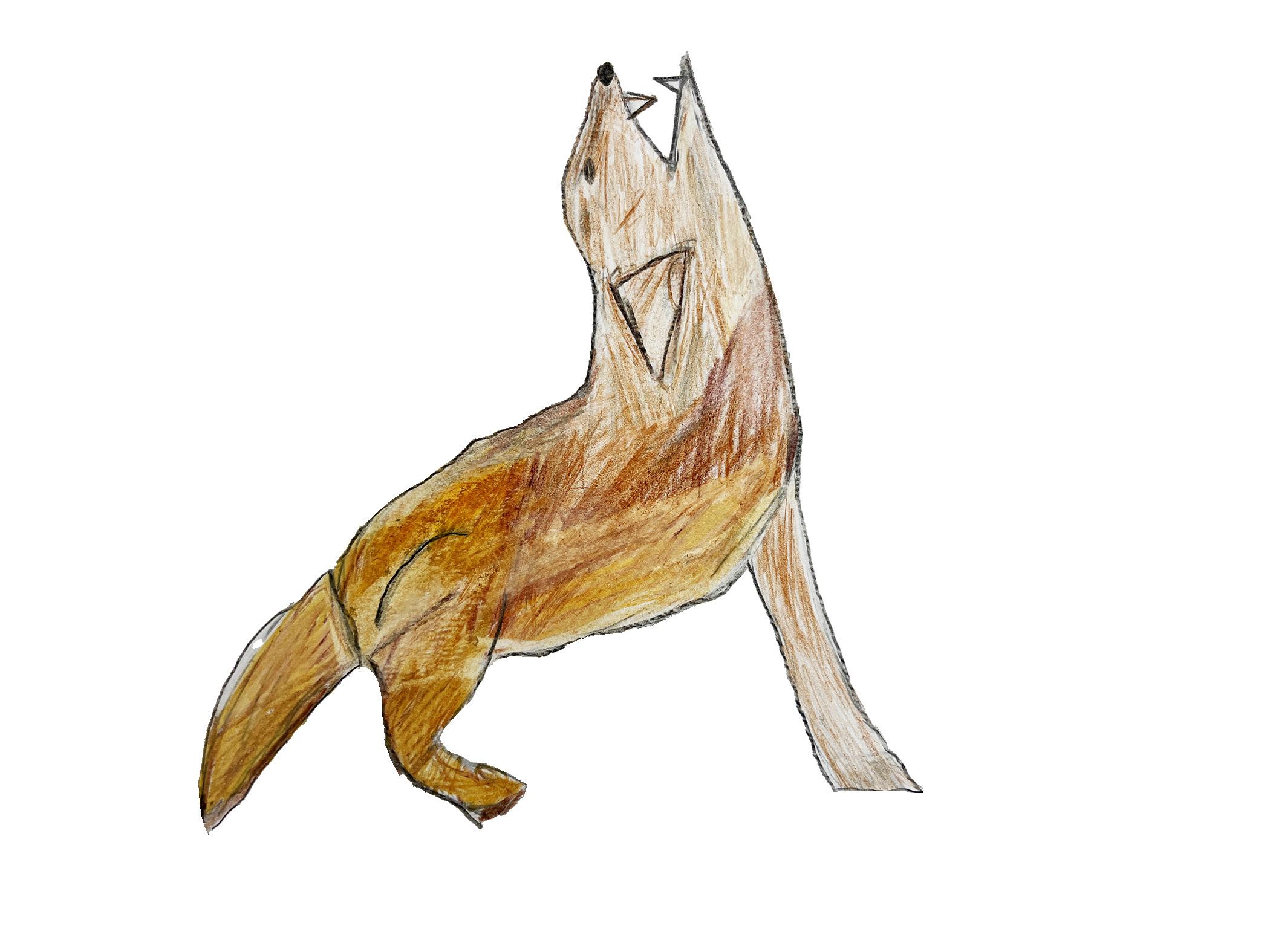
BY ASTON K.
The song dog is a mammal that hunts alone for six months. They live very near my house. At night, I can hear them howl and scream like an opera singer. This is why they call coyotes “song dogs.” The first time this happened, my little brother was going to bed and was about to fall asleep. My brother got scared and went to find our mom, and as that happened, the coyote let out the loudest howl yet. My brother was terrified.
It happened every other night in February because coyotes mate in February, and gestation takes about 2 months. The reason they came back is that they eat small rodents, fruit, deer, and rabbits. Coyotes have five to seven pups when they give birth, so they have a lot of mouths to feed. We have a lot of those tiny little pups near our house.
Coyotes also eat garbage, pets, birds, eggs, and reptiles. I am aware of this because one time, my brother and I were bouncing on our trampoline outside, and we heard my dog, Foxy, squeal in pain. I ran to see what was happening. When I found Foxy, I saw a coyote biting her like a ferocious beast through the fence. My brother and I screamed for Mom like we were being chopped alive. When she came, she grabbed Foxy and brought her inside to safety. Luckily, she was not badly hurt. It could have been much worse than it was. If it were a deep cut, she could have been scarred, or if we hadn’t been there, she could have been eaten!
Coyotes are also excellent swimmers. Coyotes once swam all the way to Angel Island, and now there are twenty coyotes on the island. That is an over-a-mile-long swim. Many things will eat coyotes, including gray wolves, cougars, American black bears, grizzly bears, American alligators, large Canada lynxes, and golden eagles. They can do this because most coyotes only live to three years old, so they never get to a point where they can defend themselves from large animals. Plus, they only weigh between twenty-five and forty-five pounds.
In an ABC report on coyotes, they reported that if I saw a stray dog walking by itself, it’s not a dog but a coyote! This could be bad if someone walked by thinking it’s a dog. Even though they can be dangerous animals, they are still a very important part of the ecosystem and should get our respect.
BY ABI D.
Flame skimmers are awesome. All animals deserve protection. To help them, we should reduce the use of harmful chemicals and create a system to keep aquatic environments in good health. Flame skimmers are endangered by pollution, urban and agricultural runoff, pesticides used in agriculture, and the destruction of riparian habitats.
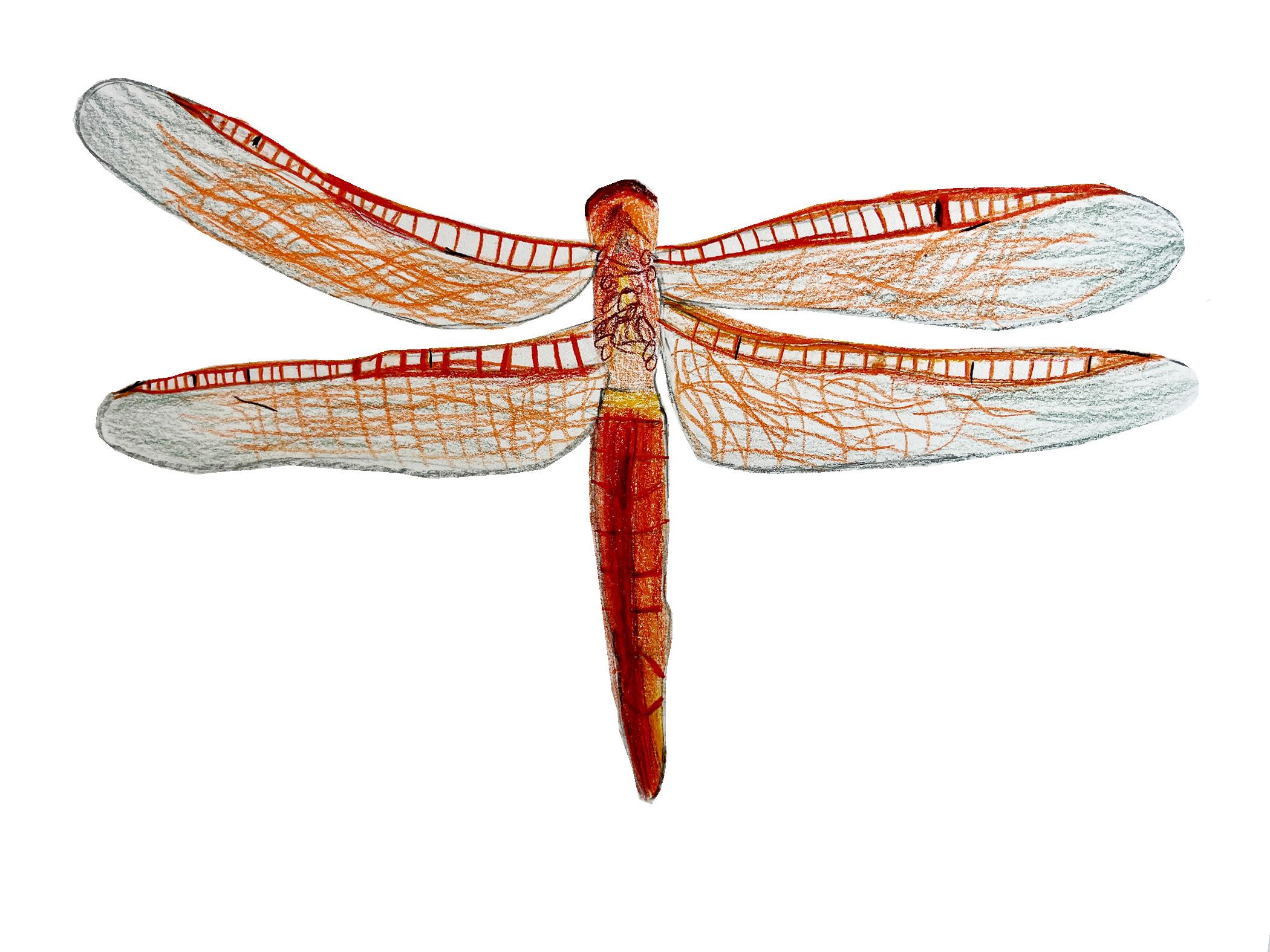
As the name suggests, flame skimmers look like flames. The females are medium or dark brown with yellow markings. The males are entirely brown or red, including their eyes, legs, and wing veins.
Dragonflies are cannibalistic; they also eat other flies, midges, mosquitoes, and butterflies. Mother flame skimmers have to lay their eggs away from each other so the nymphs will not eat each other. Flame skimmers are about two to three inches long. They are large for dragonflies.
Flame skimmers can tell if there is pollution in an aquatic environment. They do not lay their eggs in an aquatic environment if it is polluted.
Flame skimmers are individualistic and territorial. They live, hunt, and forage alone; they are solitary, both as a nymph and an adult. They have favorite perches where they rest in the afternoon. Flame skimmers do long patrols in the morning along sunny, open areas near water to defend or establish breeding areas.
Flame skimmers like sunshine, like most insects. They also like warm water so they can lay eggs in warmer temperatures, so that even in climate change, they can reproduce. Flame skimmers live in warm springs, warm rivers, and sometimes even hot springs. They use their favorite perches for regulating their body temperature. They do this by adopting different postures. There is the obelisk. To do it, the flame skimmer points their abdomen at the sun for cooling. There is also the opposite obelisk, or dorsal basking, which is done by facing the sun to absorb the heat in cooler conditions.
I share a room with my sister, and while I love her, sometimes I need space. Having my own space in a shared room can be tough. One time, I tried to carve out my own space and made a fortress on my bed. I used a mat, triangle blocks, and blankets. I tried to make my fort so that no one I did not want could get in and I could have privacy. Having my bed as a fort made it so that, to get in, people would have to do a little maneuvering. There was no easy access to get in, even for myself. I made a little cat bed inside, so my cats could sleep in it. The tent bed turned into my own favorite perch, and I went there when I needed to rest. While flame skimmers use their perches for regulating body temperature, I use mine to regulate my emotions. I use this space for reading, playing with cats, and sleeping.
As the name suggests, flame skimmers look like flames.
BY CAMERON S.
Imagine an underwater city built with dense high-rises and narrow alleys, packed with abundant life. Meet the giant kelp forests of the Pacific Ocean. Like the endless skyscrapers in San Francisco and Taipei, kelp forests support an overflowing ecosystem full of life and diversity.
When I see giant kelp, it brings me back to memories of enjoying dashi kelp udon on the streets of Taipei, Taiwan. Taiwan is an island in Asia that I visit every summer to see relatives. It is the home of my great-grandparents.
The first place I visit after the long twelve-hour flight from San Francisco to Taipei is my favorite restaurant. I ordered a simple bowl of udon, a dish consisting of thick, white, slurpy noodles and dashi broth, a type of Japanese soup stock made from kelp and soy sauce. This is the dish of my childhood and something I have always enjoyed. I love trying various types of food in Taiwan, and I sometimes travel across the island by bullet train, just to experience different cuisines. I love how it glides over the mountains, through tunnels, and across the rough terrain of Taiwan.
In addition to dashi, kelp is an ingredient in various foods, such as yogurt and ice cream. Kelp is an ingredient in many foods, even though people believe that their food does not contain kelp. Algin is an alginic acid extracted from the brown algae, which usually forms in kelp forests and appears brown to the eye. Algin, used to make ice cream and yogurt, is used to maintain their crystallized structure; without algin, ice cream or yogurt would have icy parts instead of a creamy texture. Algin is used in many other foods, such as frosting, plant-based milks, candies, gummies, and pie filling. It always amazes me how a plant that we do not think of as food is in the food we eat. It is like the highlights and shadows of a painting, subtle and smooth. Kelp is a hidden hero of the food world.
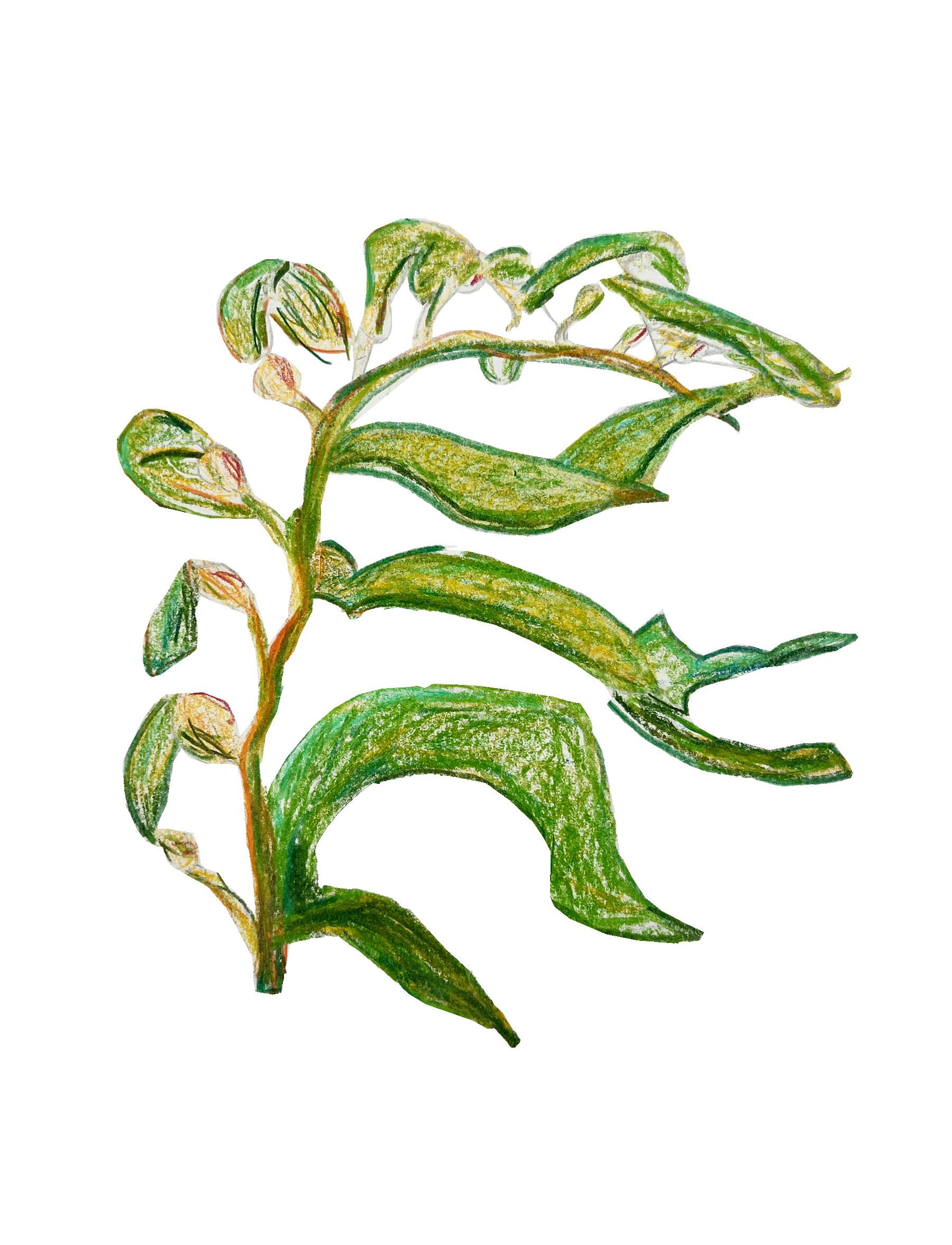
An endless marine ecosystem covers the waters of the kelp forest. As the largest algae in the world, giant kelp grows on the sea floor from an anchoring device called the holdfast. It can grow up to 60 meters (approximately 200 feet). Kelp floats up to the surface by a pneumatic system containing balloons, that keep the kelp upright and prevent it from sinking. Kelp supports rich biodiversity, including starfish, sea urchins, otters, rockfish, kelp bass, and other ocean creatures. The calm currents and waves blocked by kelp forests support diverse life. Similar to the rainforest canopies and understories, the levels and stories of the kelp forest allow many species to flourish.
Giant kelp forests and the busy city of Taipei may seem like very different places, but both are alive with beauty and motion. When I think of giant kelp, I am reminded of the city of Taipei, packed densely with life. Kelp connects my memories across the ocean, shaping our ecosystem and supporting life above and below.
BY YUCHEN L.
I thought this would be a normal day, just like any other. There would be no reason to see anything special. Then, I saw something rare. I saw a snake bigger than my finger for the first time in my life. Gopher snakes are sizable; they are between 2.5 and 7 feet in length.
I was on my blue bike, riding down the same riverside road near where I have lived for the last three years. I have been down the road so many times that I memorized the cracks in the road. I zoomed down the path. Five minutes into the ride, I saw an abnormal crack in the road. This looked as if the crack was new, although it was a bit miscolored. Gopher snakes have light-colored bodies covered with black and/or brown spots. From a distance, they look similar to a crack in the ground.
I picked up the first hints that this “crack” was a snake. First, there was a group of people who walked by talking about a snake. I felt puzzled at first, but noticed the second hint quickly. The “crack” extended outward to the house’s front yard. I thought to myself, This is not possible. How can a crack go into the sand?
I then remembered what the group of people chatted about earlier and came up with this conclusion: There was a snake close to me, and I needed to decelerate. Slowing down, I gently pressed on the brake until I came to a stop one foot from the snake. I did not want to risk harming the snake, and so waited for it to pass. I carefully observed the snake as its tongue came out of its mouth. The tongue, analogous to many other snakes, was black. I was shocked that I had seen a snake almost as long as I was tall.
There is a specific reason why I found it so surprising. Gopher snakes are rare in moist areas, including next to rivers. They are also rare in places inhabited by humans. They are commonly mistaken for rattlesnakes when they are near houses. This can lead to a swift death for them.
I saw the gopher snake looking for mice and rats to eat. Nearly 75 percent of their diet consists of mammals. They use constriction to kill their furry prey, similar to the other snakes in the genus Pituophis. Besides mammals, the gopher snake also eats birds, lizards, and eggs that are small enough to fit in its mouth. Their mouths are like endless pits. They are picky eaters, but when they are granted what they want, they show no mercy.
I used to never think about snakes and how they behaved before I encountered one. I will never forget the first time I saw a snake bigger than me.
I carefully observed the snake as its tongue came out of its mouth.
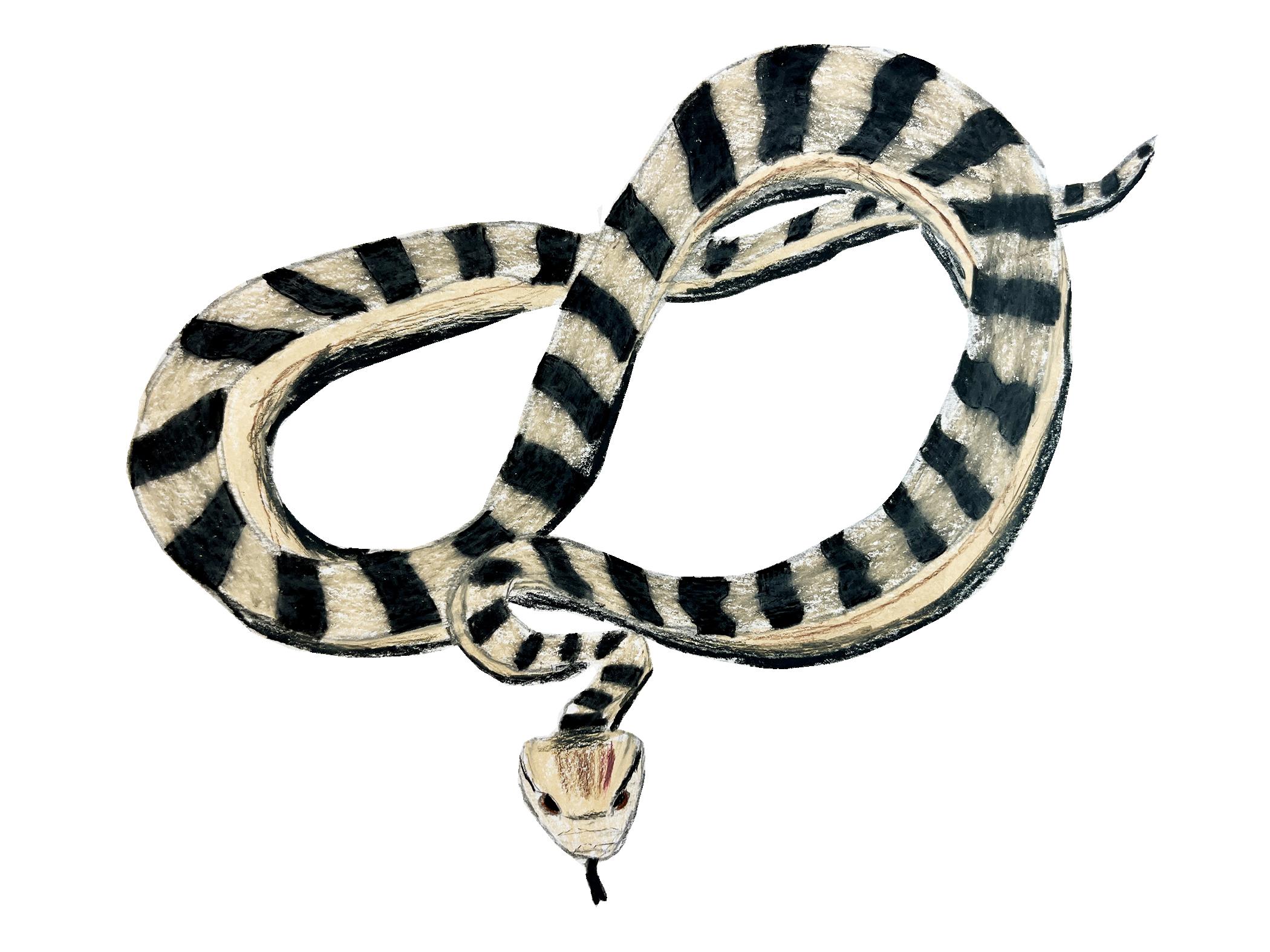
...the fox is cautious and elusive and will stay away from danger if needed.
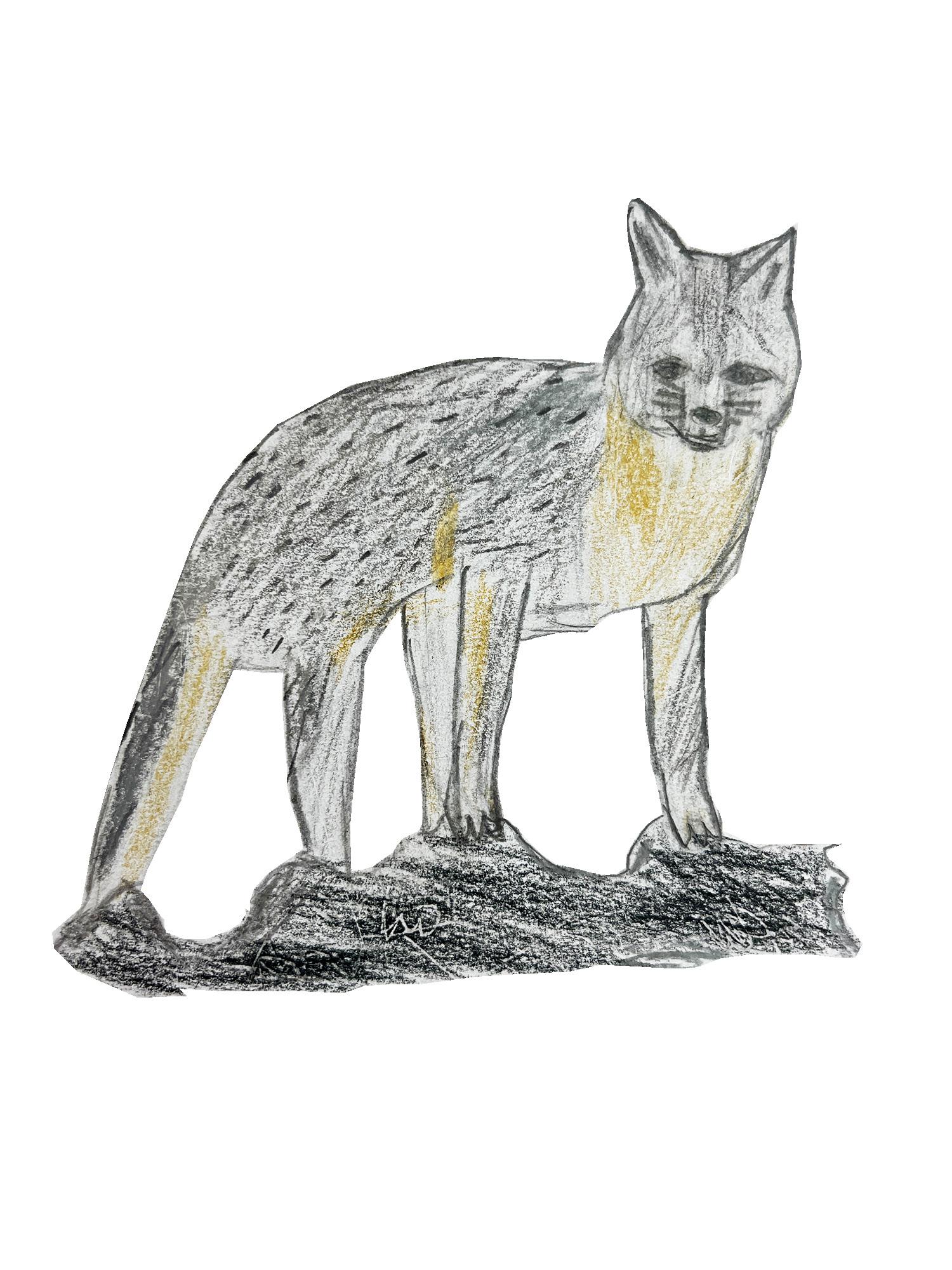
BY AARAV K.
The gray fox can solve a variety of problems and can improvise to help itself. Like when it uses abandoned logs and tunnels under rocks as its home instead of building one itself. The gray fox would probably feel quite clever when it finds an abandoned home and uses it for itself, just like how I felt when I was able to figure out how to repair a broken bike helmet.
Once, when I was reading through a book in my room upstairs, my older brother was biking around the neighborhood. When he returned to the house, he explained to my parents that his bike helmet had fallen and broke into two pieces. When I came downstairs, I asked my mom why the helmet was broken. My mom said that they could not put the helmet back together again, even after many failed attempts. She also explained why and how the helmet sat on the ground. Immediately after, I fixed the bike helmet as quickly as a fox and told my parents. When I fixed that helmet, I felt just like the fox, working smarter, not harder.
I have a book in my house that has 101 fables about varying concepts. In quite a large amount of these fables, a fox is featured. When the fox is included, they resemble a shy, small, and cunning character that can solve a variety of problems, whether good or bad and usually tend to avoid humans. Like the story states, the gray fox can be very shy, and when found by humans, they usually run away. In one of these fables, the fox tricked a crow into dropping a piece of bread, and the fox took it and ran away. This symbolizes the cunning of the fox which is used in finding homes and more. Another fable shows how a fox sees a lion pretending to be sick so it can eat the fox, but the fox does not fall for it and walks away. This story shows how the fox is cautious and elusive and will stay away from danger if needed. Although the gray fox tends to be elusive, they are common in the Bay Area and are not in any threat of being endangered.
The gray fox is an excellent animal with the ability to climb trees, solve problems, and many other amazing traits that not all foxes share. For example, the gray fox is one of two foxes that can climb trees. The gray fox is also one of two foxes with the genus Urocyon rather than Vulpes. In all, the gray fox is a tremendous fox with unique abilities like the ability to climb trees, solve many clever problems, and spot danger before it happens.
BY PABLO G.
Gray whales are giant and majestic marine mammals that grow up to fifteen meters long. Their rough skin can be different shades of dark gray. Pale white barnacles cover the gray whale’s bodies like freckles, and gray whales weigh ninety thousand pounds. These colossal whales have a life span of between fifty and sixty years. Gray whales live in two distinct groups, one in the Western Pacific, near Korea, and one in the Eastern Pacific, near California, the Northwest United States, Western Canada, and Alaska. Both populations of whales prefer to stay on the shallower continental shelf instead of the deeper abyssal plains.
Gray whales, along with beluga whales, are the only whales that are bottom feeders. They dive to the bottom of the Bering Strait or the Chukchi Sea and rub their giant bodies around on the sea floor to kick up mud. They filter the zooplankton from the water with their long brush-like teeth. They can eat over 660 pounds of zooplankton per day. Some types of orcas track the whales like bloodhounds in a tight pack.
Gray whales’ social life is an empty desert. Long-term relationships are rare. Whales communicate with deep guttural moans. Their calves are light gray or brownish gray. They feed on their mother’s milk, which is around fifty percent fat. Gray whale calves become fully mature between eight and nine years old. In 2024, there was a record low population of gray whale calves. There was also a forty-five percent decrease in the overall gray whale population.
They travel from their summer feeding grounds in the Bering Strait to the shallow lagoons in Baja California to breed in the winter. They have one of the longest migrations of any mammal, swimming ten thousand miles each year. During their migration, they do not eat any food. On top of that, the whales migrate alone or in small, unstable groups.
I can relate to the whale’s migration because when I was five years old, I moved from Seattle to Stanford in the Bay Area. For me, it felt as if I had to leave everything I worked for behind. When I lived in Seattle, I was beginning to settle into school and make friends. When my parents told me that I was going to move to Stanford, everything fell apart. I woke up the day I was leaving for Stanford and wished it was all a dream. I needed to make new friends and start at a new school. On top of that, I was starting elementary school during the pandemic, which made it even harder to make friends. I felt as if I needed to restart my entire life. Being on Zoom meant that I did not have friends for the first part of kindergarten. When we were allowed to go to school in person, I slowly but surely started to make friends. I also began to settle into school.
Gray whales leave their home in the Bering Strait to help ensure that the next generation can thrive. I can relate to that because I had to leave Seattle for my family’s needs.
They have one of the longest migrations of any mammal, swimming ten thousand miles each year.
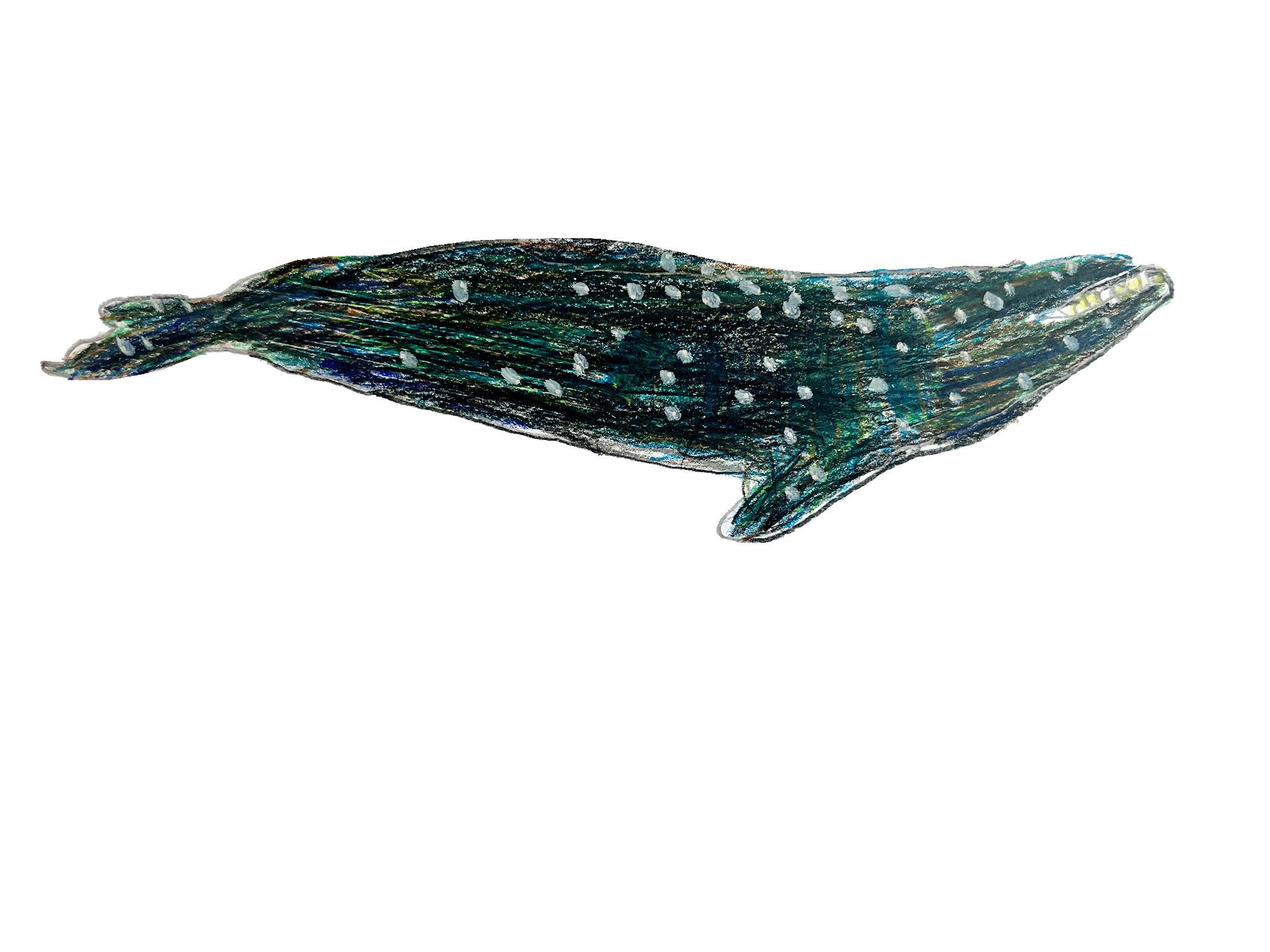
...its beak splashes through the water like lightning.
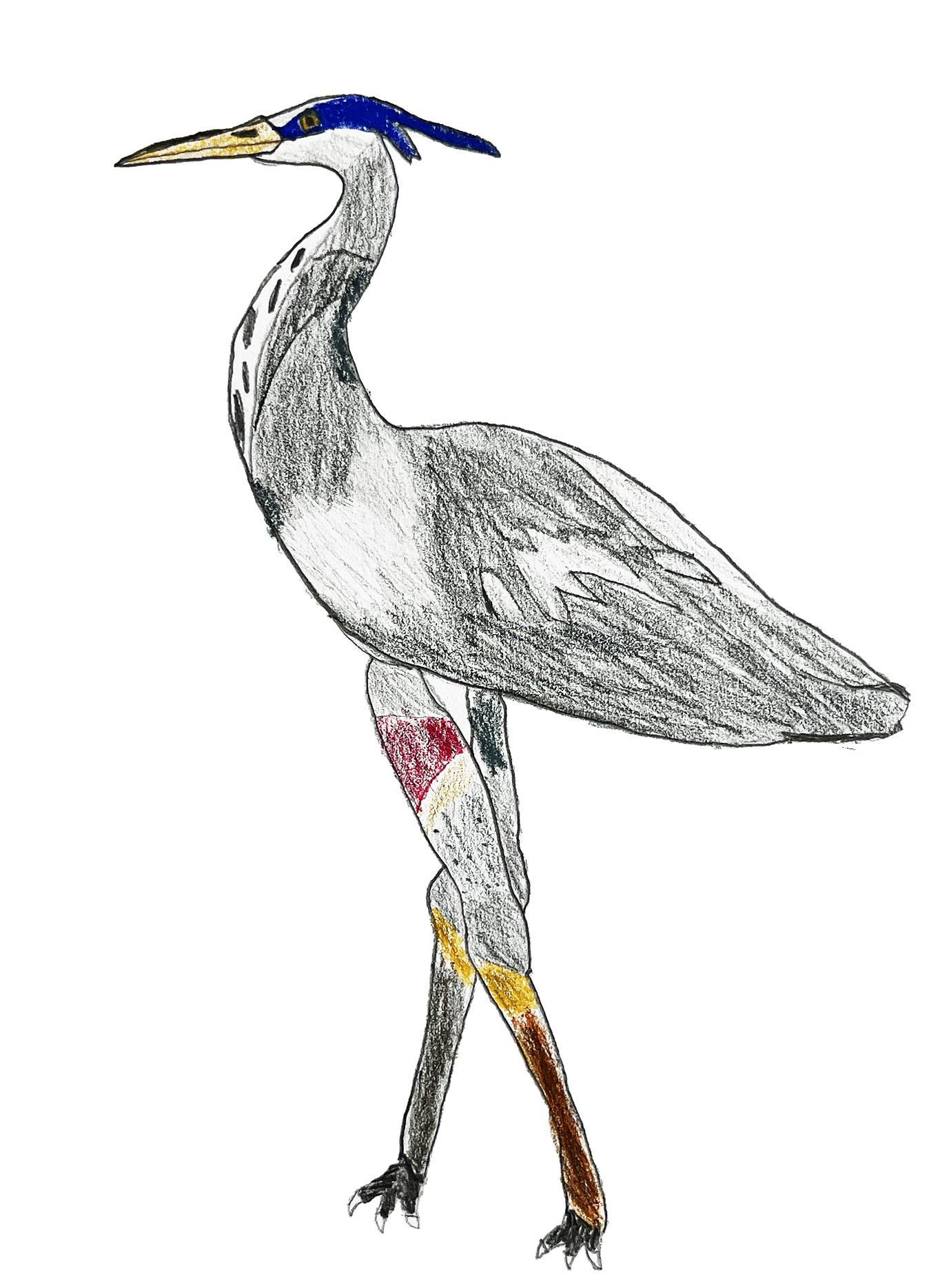
BY DASH B.
I have always thought the great blue heron was a striking creature. One time, when I went to Los Angeles, I was within around five feet of one. I saw some people making a commotion; they were shouting, and many of them had cameras. When my family and I went over to see, a great blue heron stood on the rocks staring at the water, obviously stalking a fish. Its eyes are a great pool of amber, its legs resembled sticks. Its feathers have a blue-gray quality. It was then that I realized how cool the great blue heron is.
I have gone to great lengths to gather facts after I saw that heron. I can hypothetically relate to them. For example, I often stand silently, and when people look around, they can usually find me doing the same. Great blue herons are also introverts, according to some sources and videos. Some say their eggs resemble the sky being placed into a ball. They migrate day and night. One time, I watched a video of a great blue heron catching a fish in a fast-flowing river. There was another time when I saw a video of a great blue heron eating something way bigger than its neck, and afterward, you could see the outline of the fish in its neck. I have seen some videos of the heron hunting, and one thing is clear: its beak splashes through the water like lightning. The great blue heron’s diet consists of frogs, fish, salamanders, lizards, snakes, shrimp, crabs, crayfish, dragonflies, grasshoppers, aquatic insects, and occasionally ducklings, squirrels, and mice. They eat anything that comes within striking range.
The heron faces many problems. This includes habitat loss, often caused by humans. As well as these predators: crows, ravens, hawks, and bears. Although there are other predators like turkey vultures, raccoons, and bald eagles.
In mid-December, I went to Half Moon Bay to find the local great blue heron named Brian. At the beginning of my search, I had no luck, but did find a very friendly white egret. When my mom and I went back to the car to check other places where Brian had been seen, we thought we saw him flying toward a tree. We arrived at the tree, and instead of a heron, there was a giant red-tailed hawk. When my mom and I checked the last spot, there was another red-tailed hawk ten feet away from me on a sign. Before we arrived at our final destination, we saw a pond with a little island in the middle of it, and on that island, there he was, Brian the Heron. Sadly, the heron was not doing anything exciting; he was only grooming himself.
There is an all-white version found in Florida. They also often make their neck into an S-shape.
BY SACHIN R.
Great white sharks seem scary and dangerous, but they are not. They were extremely close to becoming extinct and are vulnerable due to human fishing. The species population drastically reduced during the last Ice Age. More people die each year from vending machines than from great white sharks. Only 5 people died from any shark species in 2022. Given this, they are known to be one of the fiercest animals on the planet. They can bite so hard, it is like being pierced by a knife. They thrive in temperate and coastal offshore waters between 50-70˚ Fahrenheit.
Great white sharks can detect vibrations in the ocean using their lateral line system. They can also detect pressure and movement well. The sense of vibration for a great white shark is crucial to locating their prey from afar.
This relates to me because when I play the guitar, I can feel the vibration. When I play the guitar, I can feel the strings vibrating as I move my fingers along the fretboard. I enjoy playing the instrument, and it makes me feel joyful when I am able to play and produce music. I have performed many times and think it is a way to show what I have been learning and how much I have improved. I have played this instrument for at least seven years and have improved majorly. I enjoy playing classical and electric guitar. It is my hobby and passion. I play classical music and some pop songs. The strings are tense and tight, so when my fingers pluck them, they move back and forth to make a tone.
The longest great white shark ever recorded, named Deep Blue, is recorded to be twenty feet long. Twenty feet is like a huge mansion! Some say that there was a one from Canada that was thirty-seven feet long, but their theory was proven incorrect. There is scientific evidence that a great white shark is around twenty-five feet long. Even though they are one of the fiercest animals on the planet, they are not at the top of the food chain. The great white shark’s main predators are killer whales and humans.
The great white shark evolved from the species, Cosmopolitodus hastalis and Carcharodon hubbelli. Both species are extinct today. Against popular belief, the great white shark did not evolve from the megalodon shark; they are distant cousins. Great white sharks have been around for 5 to 6 million years, even though the species population is vulnerable, with only 3000 to 5000 left.
If a person ever encounters a shark, they should not panic. Panicking makes the sharks think that there is prey. Stay calm, make eye contact, and back away from the shark slowly. Also, a surfboard can be used for protection like a barrier. Most people become scared and start screaming and flailing their arms and kicking to stop it from attacking them. What if a person doesn’t want that moment to even happen? Then they should not go near their habitats, which include seal colonies and murky waters. Great white sharks maintain healthy oceans and climate regulation. They help the ocean, so we should help them.
When I play the guitar, I will remember the great white shark.
More people die each year from vending machines than from great white sharks.
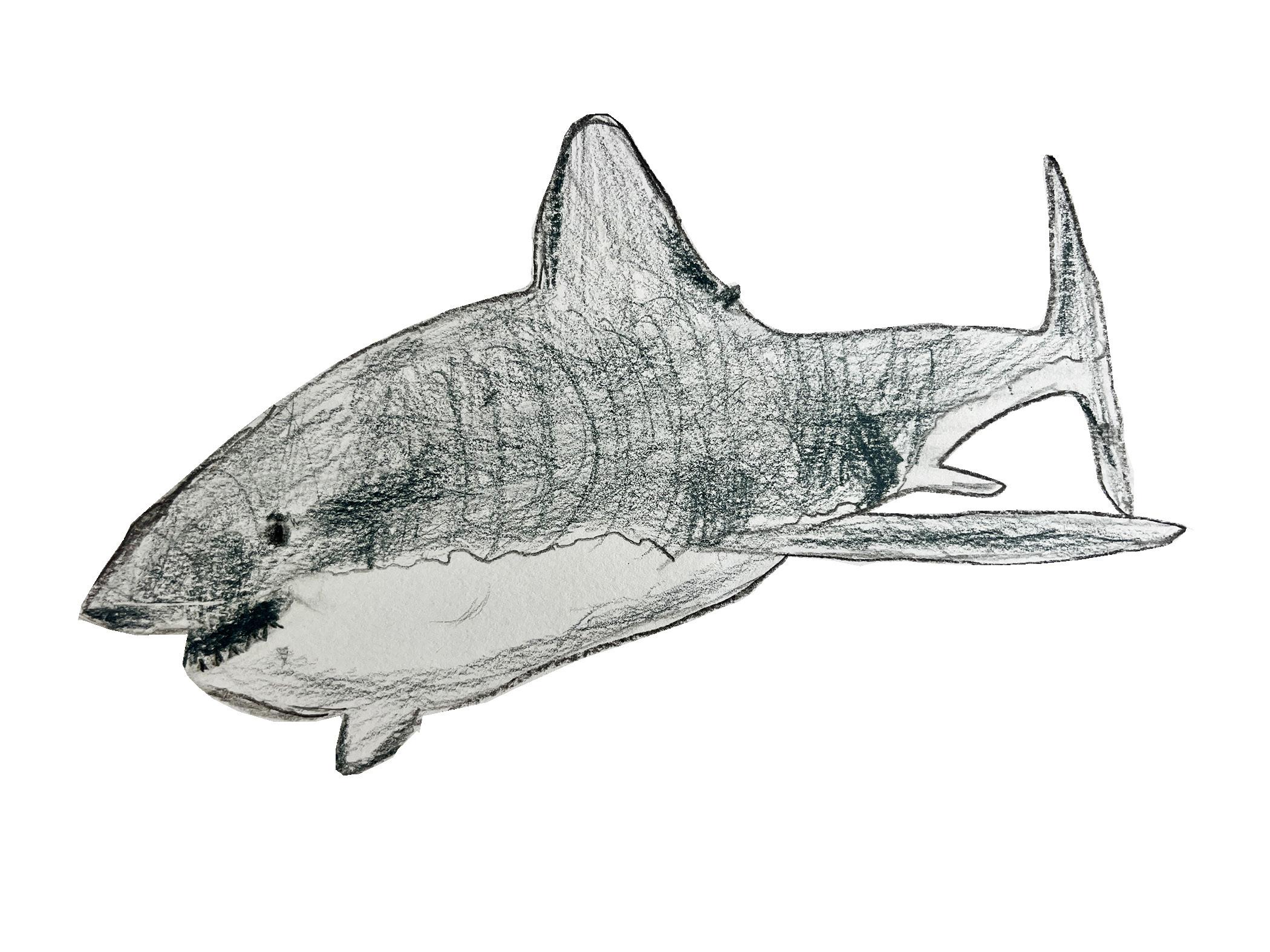
The personalities of the harbor seals amazed me. They were so similar to each other, but also so unique and different.
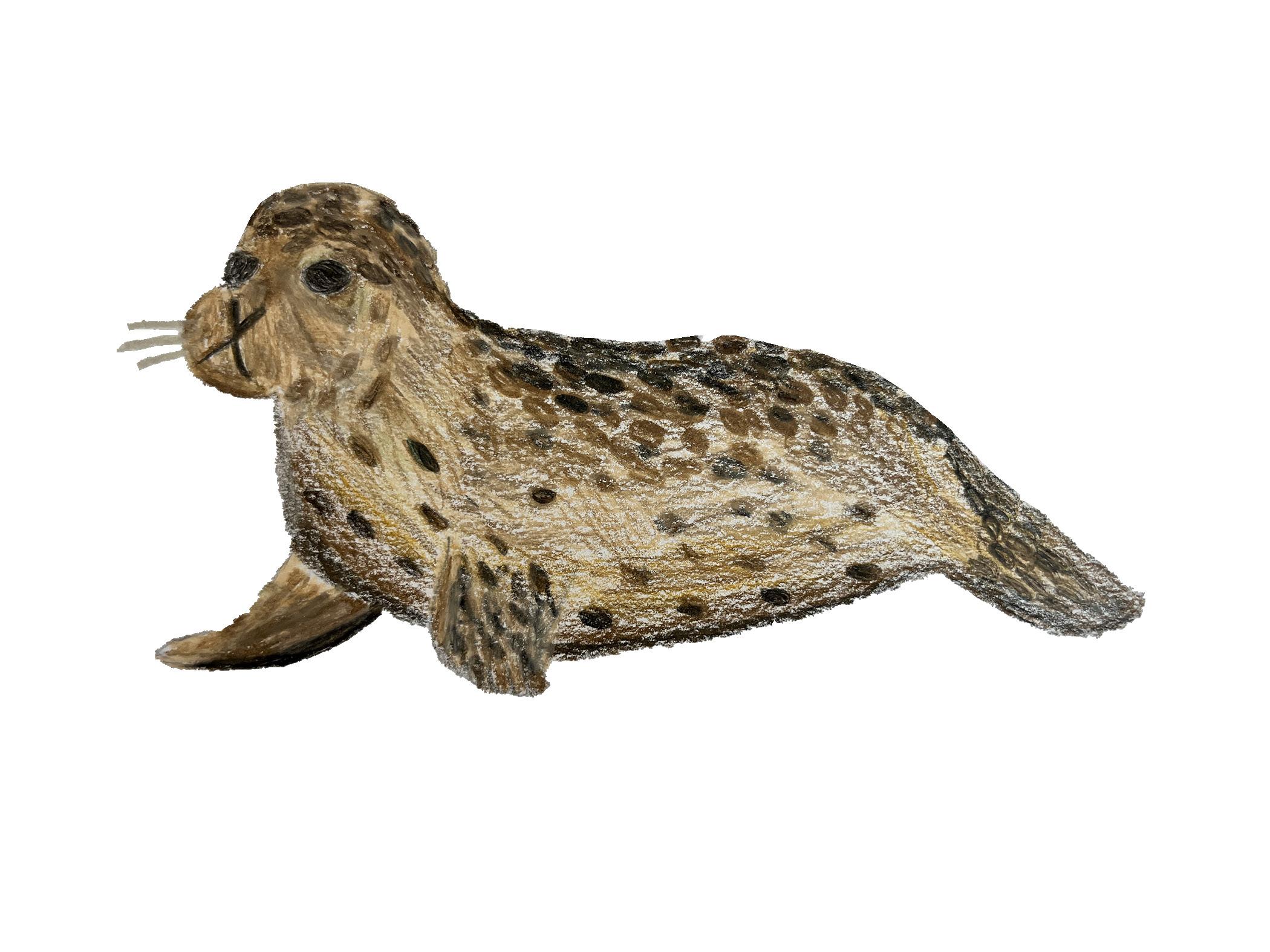
BY NAOMI L.
Harbor seals are unique. Every single one of them has a different coat, just like the stripes on a zebra. Some harbor seals’ coats are white, some have spots, and some are as red as bricks. Their coat is not the only part of them that gives them their uniqueness. Their uniqueness is in their personalities, too.
When I was seven years old, I went to La Jolla, San Diego. There, I saw harbor seals and sea lions resting on the beach. I first looked at a sea lion and saw its body arched upward, in a moon shape. Then, my eyes moved to a harbor seal, and they were not arching their bodies. I wondered why a sea lion, but not a harbor seal, curved its body. Sea lions use this technique to either heat or cool themselves. Harbor seals instead have thicker blubber, so they stay warm more easily.
Harbor seals and sea lions both have a lifespan of twenty to thirty years. The difference between harbor seals and sea lions is that sea lions have external ear flaps, but harbor seals do not.
When I looked at one harbor seal, I noticed how persistent it was, inching along the sand like an ant hauling a seed from one tree to another. I also noticed how supportive they were, teaching their young pups how to use their skills. In others, their curiosity stood out, as I watched them slide into the sea. The personalities of the harbor seals amazed me. They were so similar to each other, but also so unique and different.
Their curiosity is just like mine. When I went to Hawaii this summer. I tried horseback riding for the first time, and it turned out to be really fun!
A harbor seal’s eyes adapt to low-light vision with a lining, sort of like a cat’s eye. This feature helps them sense prey like fish, shellfish, and crustaceans. It is similar to echolocation, a technique that whales, bats, and many other animals use to sense their surroundings. Harbor seals have perceptiveness and awareness, and it helps them move around their environment.
Harbor seals work all day to keep their ecosystem healthy. This is because they are in the middle of their food chain, with both predators, such as orcas and white sharks, and prey, like fish, shellfish, and crustaceans. Unfortunately, young seal pups have been eaten by some coyotes and bobcats.
The other big problem for harbor seals and so many other animals is global warming. Here, in California, temperatures are increasing slower than the Arctic, but temperatures in the Arctic are increasing rapidly. Luckily, with all of the unique traits that a harbor seal has, they can use their persistence to adapt and push through all of the years ahead in global warming.
Harbor seals are so spectacular, with every different trait they have; there is a unique job to help the next generations, and teach them to be unique, curious, and supportive, like themselves, and like us, too.
BY MATTHEW L.
In five different oceans around the world, the humpback whale amazes people with a chorus of breaches, tail slaps, and high-pitched songs. For 70,000 years, the humpback whale has roamed the world. In the 18th and 19th centuries, they were killed off for their blubber to make oil lamps. Because of this, there are only about 45,000 humpbacks still alive today. This is an endangered animal that should be protected.
As much as I love whale watching, it should be banned because it puts the whales at risk of ship strikes and entanglement. Hunting put the humpback whale’s numbers in a lower place than they had ever been before, and we put them in this hole, so we need to do everything we can to fix it.
When I went to Hawaii for the first time, I was shocked at the scenery of it all. The nice beaches, the huge hotel pools, and the great food, it was really a sight. What struck me most was when we sailed out to the water in a boat to whale watch. We saw the craziest things ever; giant turtles, flying fish, and of course, the 70- foot humpback whales. We were awestruck by the 3-foot breaches and splashes so big, they wet my family and me. I was not old enough to go kayaking at that time, but when we returned a few years later, I had never been this excited in my life. I thought it would be an enjoyable experience but it was not. It was absolutely insane times a million! We were probably five feet from a baby humpback, called a calf, when it and its mom popped up right next to our kayak. I was never the same after that experience. I had a deeper understanding of the animals. It was like we were one and the same. I felt what they had been through, and I wanted to give it back.
Every year, the whales migrate from Alaska to Hawaii, and it is really hard. I know how that feels because I had the same experience when I moved from Seattle to Redwood City. Not to mention, they do it every year and almost went extinct due to fishing nets and entanglement, so their level of perseverance and fight is off the charts.
Humpbacks eat fish, crustaceans, and krill. Like humpback whales, I love to eat fish like salmon and mackerel, as well as crustaceans like crab and lobster. Additionally, The whales love to breach and tail slap, and when they do, the water goes splash! They, like humans, enjoy playing and having fun. I enjoy this kind of thing in sports like baseball and soccer. Maybe humpbacks have their own version of those games.
Overall, humpbacks are amazing animals that never deserved the cruelty we inflicted on them in the past. In my opinion, we should do everything we can to help their numbers grow. A few helpful things we can do to help the species are, sadly, prevent whale watching, not pollute and throw trash into the water, and be careful with our propellers and fishing gear, so the species continues to exist.
Watching humpbacks is a thrill and experience of a lifetime, and I hope everyone has the opportunity to experience it one day in a way that is safe for both the whales and the humans.
...a chorus of breaches, tail slaps, and highpitched songs.
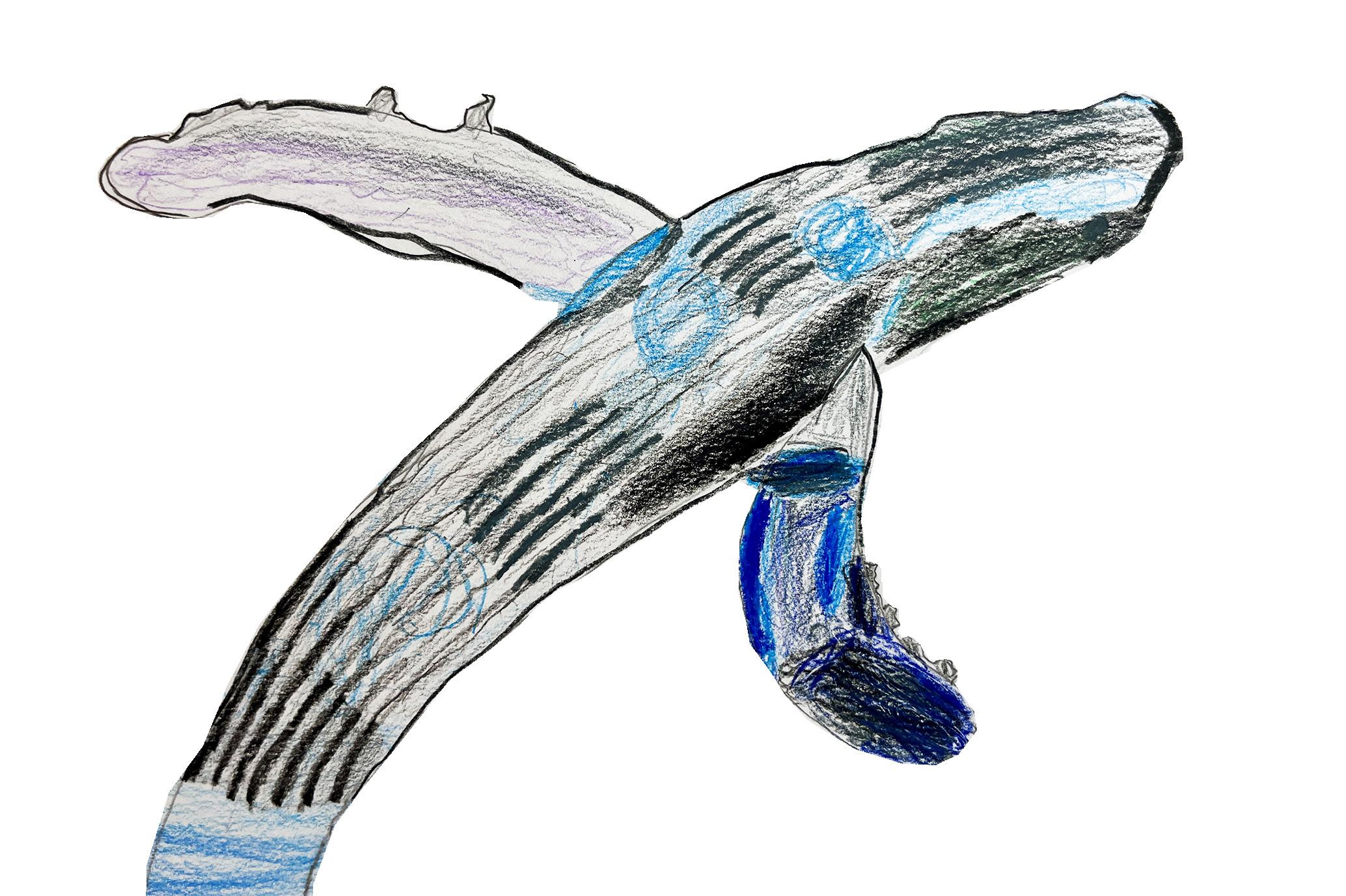
Lace lichen mostly grow in clumps with other strands nearby, like friends hanging out.
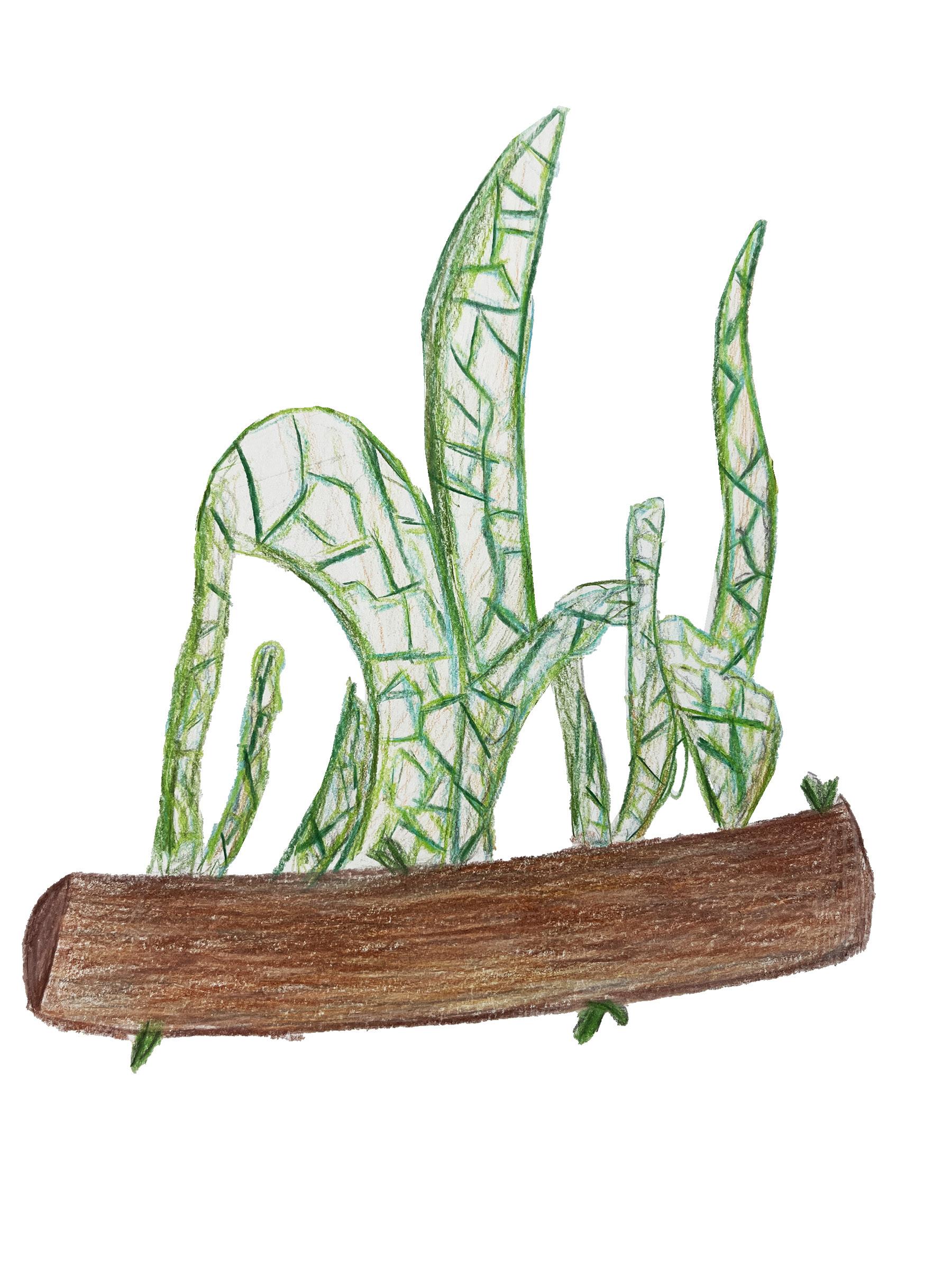
BY RANIA B.
Lace lichen is a lichen species. Growing up to a meter in length, lace lichens hang down from large branches, particularly those of the coast live oak. With its light green color and its unique strands, it can be hard to recognize at first. Lace lichen can be found all through the United States, but is most often found along the Pacific coast. In California, lace lichen can be found on many different types of trees, especially during spring, because the air is moist. Lace lichen typically hangs on trees but can also hang on rocks, shells, and even old sheds or houses. It may seem that having too much lace lichen on one plant could hurt the plant, but removing the lace lichen would hurt the lichen more than the plant. There is so much lace lichen in California that, in fact, lace lichen is the official state lichen of California! Lace lichen gained its title on July 25, 2015. The name “lace lichen” comes from its lacelike appearance and occasionally grey strands.
The first time I saw lace lichen was on a hike. There were many trees around the trail, and as I hiked, I kept seeing lichen. I had no idea what lichen was, but I was still interested. I remember saying how it looked like plastic, after all, it is a quite unusual shape. And calling the lichen plastic would not have been a bad guess.
Despite looking so different from other species, lace lichen looks very similar to the lichen old man’s beard. It is not hard to tell them apart, though. Old man’s beard lichen has one strand in the center with many little pieces hanging off. Lace lichen is a combination of shapes with many different sections. These sections almost resemble cells. Lace lichen mostly grow in clumps with other strands nearby, like friends hanging out.
Lichen, in general, are a fascinating species; they are a mix of algae and fungus, two groups that help each other. The fungus part of the lace lichen helps the lichen obtain water and nutrients. Meanwhile, the algae part of the lichen allows the lichen to use photosynthesis in order to receive the food it needs. Even though lace lichens typically grow on trees, their fungal aspect lets them continue to grow even if the lichen is on the ground.
Lace lichen also contributes to the ecosystem; it can be used in nests for birds or as food for small rodents and deer, and that is just the tip of the iceberg.
Lace lichen can be useful to us humans as well. It can be used to see whether the air quality is safe. In thin air, it thrives, and it is easy to find healthy strands. When air quality is bad, lace lichens are much less abundant, and many strands die due to the conditions. Knowing what lace lichen looks like when the air quality is unsafe can help humans know when to stay inside if the air is not safe to breathe. Lace lichen is an amazing species with different roles in our ecosystem.
BY DEVYN H.
Ferns are one of the oldest groups of plants on Earth. They date back to 393 million years ago. Lady ferns grow in clumps, like they are growing a family. I thrive with my family too. I learn with them, grow closer, and stay with my family.
I relate to ferns because they are different in so many ways, just like how everyone I know is different in so many ways too. For example, I love to rock climb, and no one else in my family enjoys it as much as I do. My sister loves to race go-karts, but the rest of my family does not.
When I was little, I used to love ferns because they had these bumps on them that I enjoyed touching. Those bumps are sori. Sori are spores that are covered with a white indusium. An indusium is a covering for the sori under the fern leaves. Lady ferns are named lady ferns because the sori are “elegant.”
There are over 10,500 fern species in the world, and I can have over 10,500 moods. Each one of these moods is like a fern, different in so many ways. Lady ferns have lived so long, they have grown to learn how to grow. They have learned how to take care of themselves, just how we learn. They are also native to Alaska, Asia, Europe, and North Africa. It is one of the most common ferns you see, and they mostly grow in woods, swamplands, and meadows.
These ferns are my favorite, because I loved their amazing textures and colors when I was little. Once, when my family went to Muir Woods National Monument, we went on a long hike and I was so excited to see ferns. My grandma was with us, and whenever I asked where more ferns were, she always found more. I loved looking at and touching ferns so much, I started to fall behind in hikes, and my grandma had to tell me to hurry up.
Lady ferns can grow from two feet tall to five feet tall. Lady ferns’ fronds are wider than most ferns. Sometimes I had to go on my tippy-toes to reach the ferns. They always amazed me with how many cool features they had, like their bright, vibrant colors, bumpy texture, and elegant shape. They are like me because they are all unique and different, and grow in so many ways, just like my community and my family do.
Lady ferns grow in clumps, like they are growing a family.
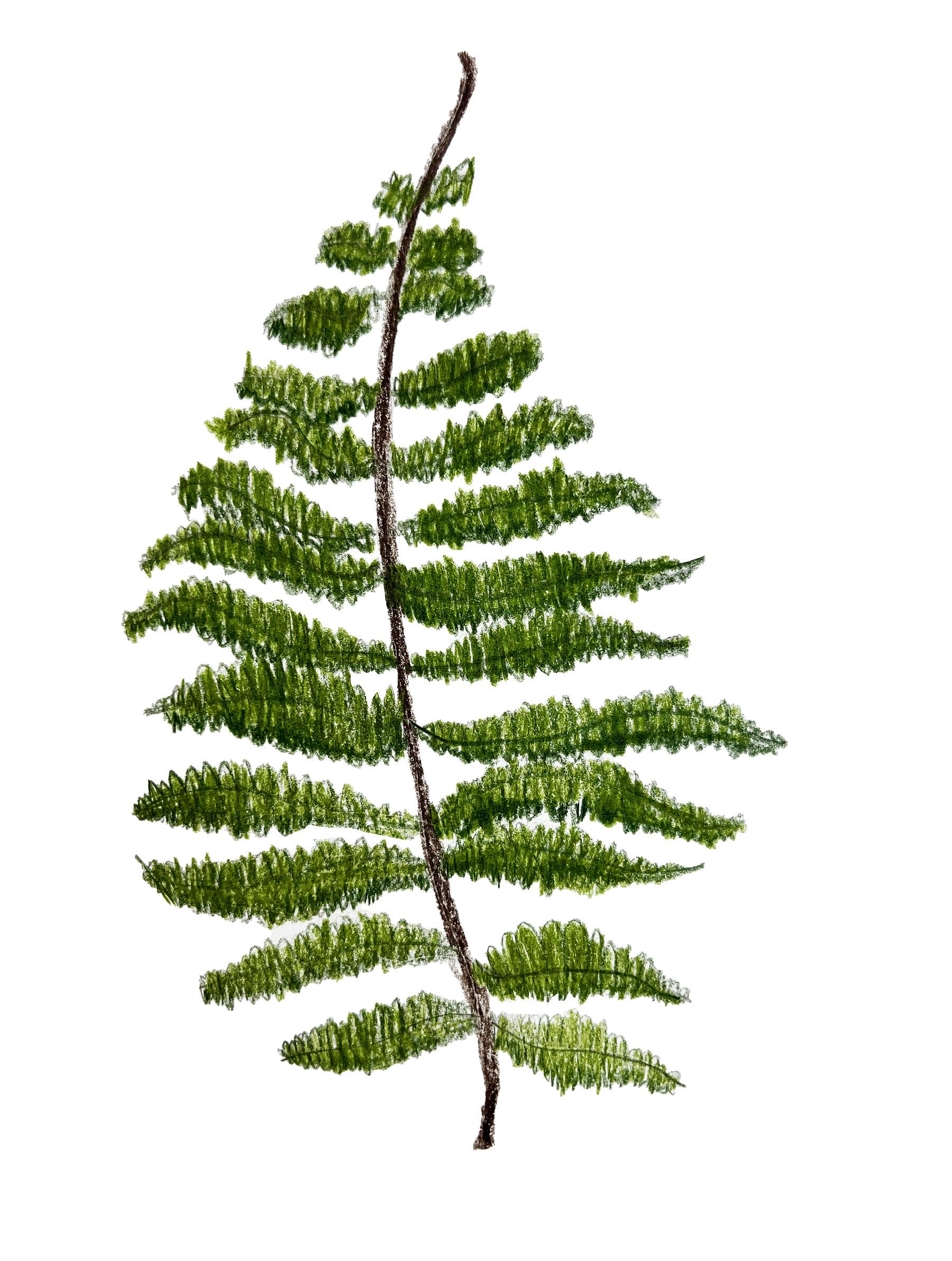
I watched it, mesmerized, until it swam away elegantly.
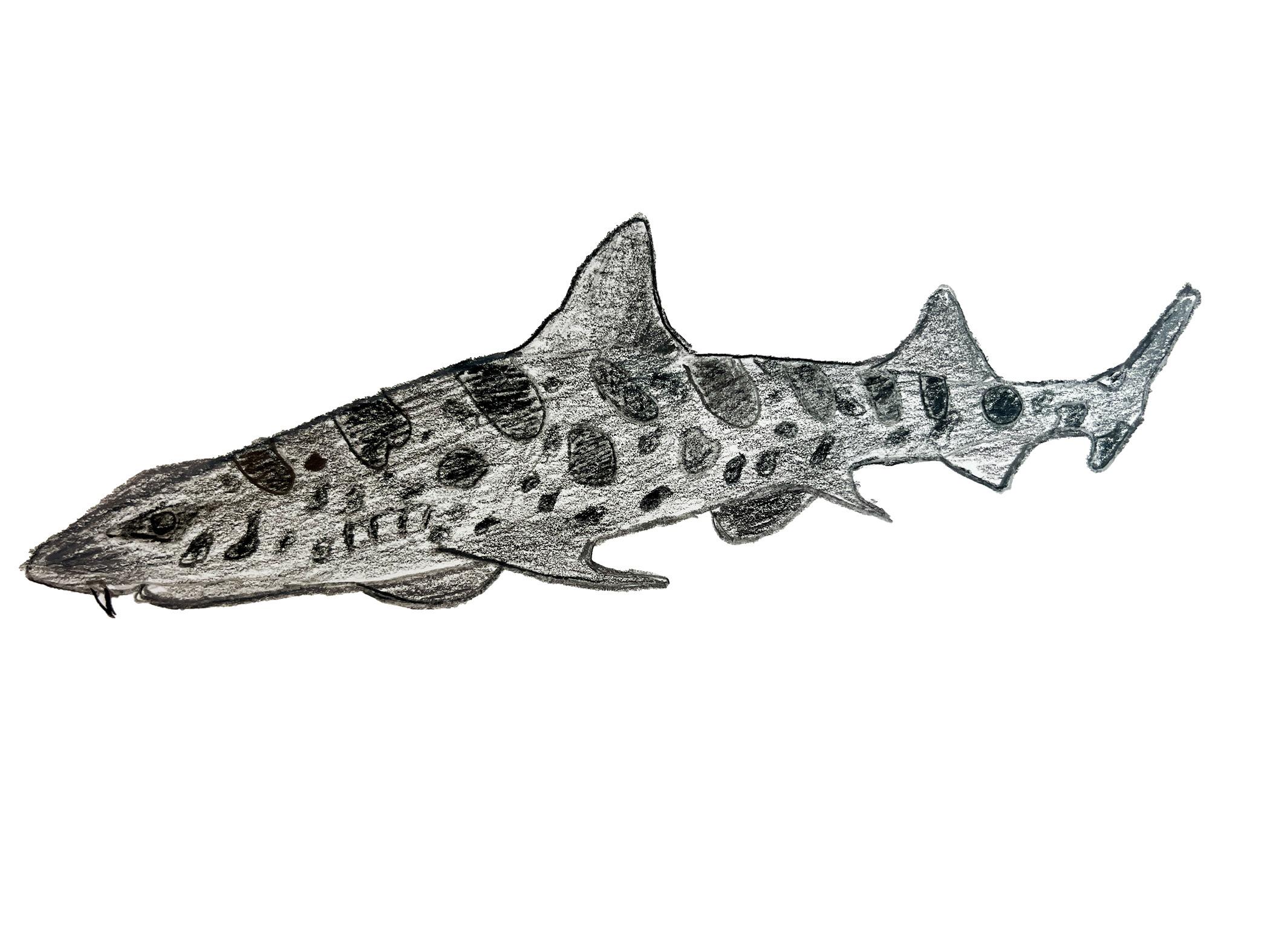
BY ALEXANDER M.
“WAKE UP, WAKE UP!” My sister yelled, being the first one ready to go snorkeling, which I then realized was our activity of the day. I grabbed my swimsuit, and we all climbed into the car. While we were in the car, I felt myself drifting to sleep.
I woke up to find the sun staring at me and the smell of seaweed. I realized that we were on a boat and about to go snorkeling.
I put everything on and went out to sea. I looked around, seeing tons of fish gliding through the water, when I spotted a fish that looked different; it had spots and resembled a baby shark. I called my aunt over, and she told me it is a leopard shark. I watched it, mesmerized, until it swam away elegantly. I swam back to the boat as fast as I could and thought about the shark for the rest of the day.
The next day, I persuaded my parents to take me back. I waded in the ocean and spotted fish that I had never seen before. I swam past a huge school of glimmering sardines when I saw them: two giant leopard sharks, both of whom were trying to catch the sardines. They jumped out of their hiding place, striking with their strong jaws. The fish swam around frantically and looked as panicked as my sister during a tag game. The leopard sharks struck one last time and then swam away, never to be seen again. Ever since, finding the shark has always been a source of pride to me, as I found it before all my older, faster, and stronger relatives.
The leopard shark uses its gills to push through the sand and detect food underneath. The leopard shark is not a picky eater, but enjoys small fish the most. It is really fast, reaching up to eight miles per hour. All in all, leopard sharks are very cool creatures to study and watch in the water.
BY CORBEN S.
When I thought about someone similar to me, no one was, but something was, a bat. Not a regular one, but a little brown bat; a fast, athletic, and smart mammal that has wowed me from the start.
Running has always been a valuable skill in my life, and that is when I first noticed how fast bats are. The Chesapeake Bay Program states that little brown bats fly at speeds of around 12miles per hour. That might sound slow, but they can reach speeds up to 21 to 22 miles per hour. Just asI sprint around the school, these bats chase down their prey.
I also have a passion for running long distances. I remember the time when I approached the starting line of the course, ready to jog a mile or two. As I stood at the starting line, I pictured myself as a bat with its high endurance, and I knew that I could run this.
Little brown bats are fitted with adaptations. They have a thin membrane called the patagium, which is similar to wings. Other useful elements of the bat are their 38 shark-like teeth, great for devouring food. When they stand tall and strong, try to notice their tan, brown, and golden fur, insulating them like a warm blanket.
According to the National Wildlife Federation, mating season starts in the fall. Most of their migrations require flying for hundreds of miles without stopping; that is when their endurance kicks in, allowing them to fly long distances with ease. They are also able to withstand the cold by entering a state called “torpor,” where they drastically slow down their heart rates and body temperatures by entering a deep sleep. When spring arrives, the bats wake up and start a nursery colony, allowing them to give birth to their newborns in May.
I have a big group of friends with whom I like to hang out. We talk to each other, we help each other, and we spend time with each other. On the other hand, little brown bats are known for hanging out with up to hundreds of thousands of bats in a single colony. According to Bat Conservation International, bats use a special kind of communication called “echolocation,” creating sounds with their mouths that work similarly to how humans communicate. This type of communication helps them find colony mates, coordinate group hunts, and warn others of potential dangers.
I love that this creature is an insectivore; it only eats insects, which are the ugliest and grossest species in the world. A little brown bat feasts on about half its body weight each night, making a delectable meal of a whole army of bugs.
These bats amaze me with how well-built, intelligent, and independent they are. I am also so happy about how they protect the world from creepy bugs. I now know them not just as creatures, but as a creature that I’ll always remember.
They have a thin membrane called the patagium, which is similar to wings.
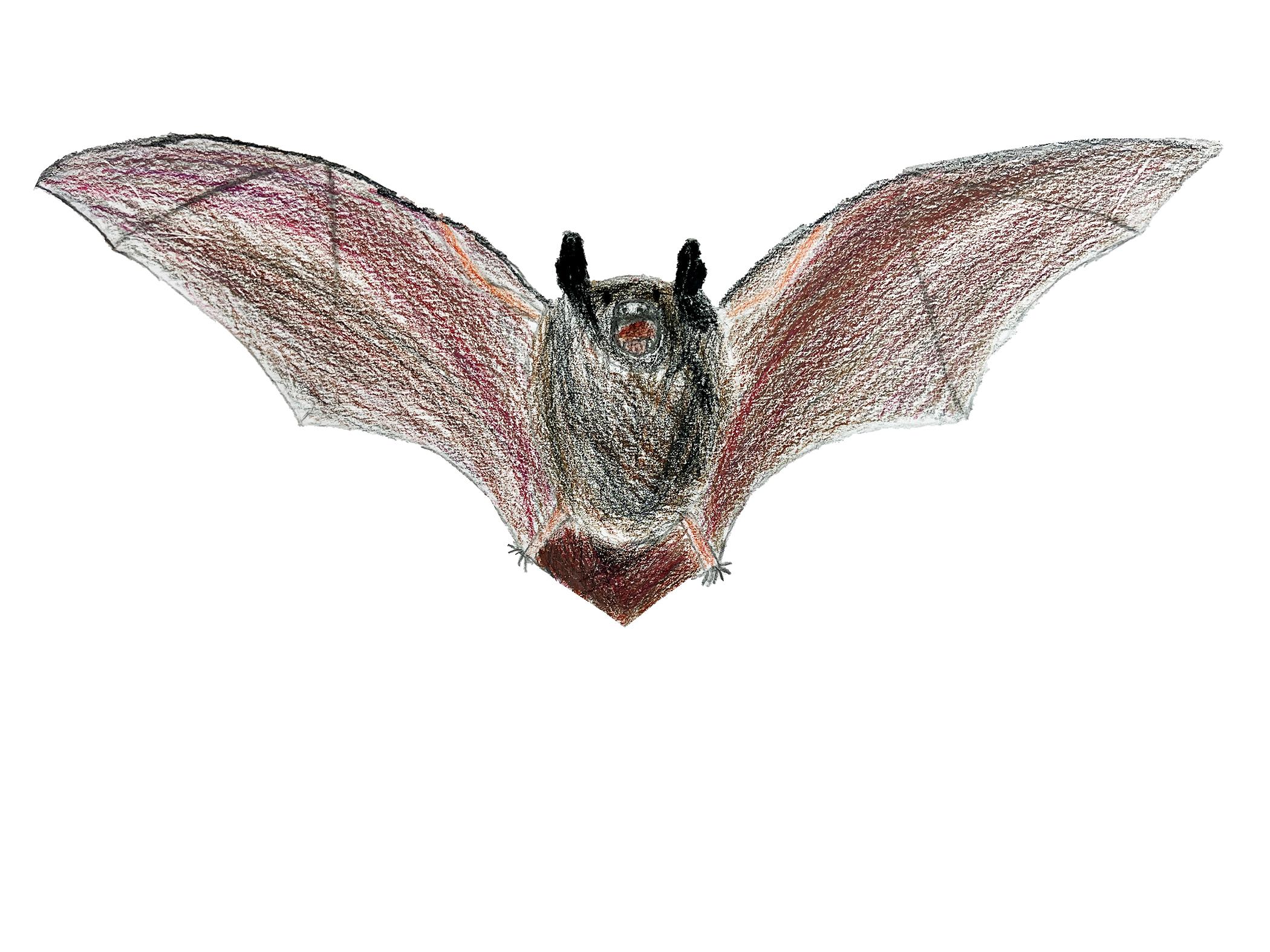
Its feathery beauty takes my breath away.
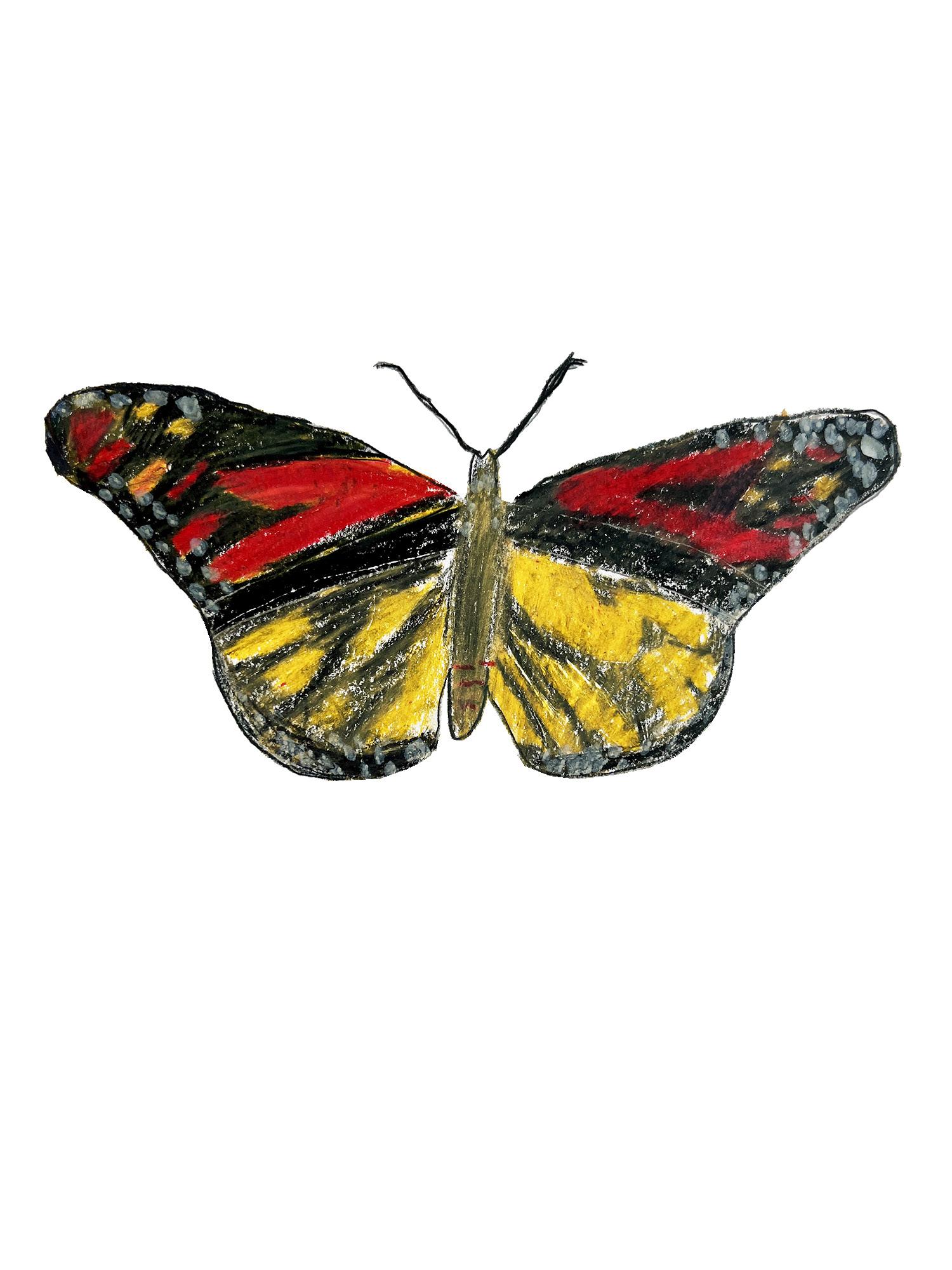
BY KATHERINE S.
The monarch butterfly’s orange and black pattern is made for Halloween. Its feathery beauty takes my breath away. It truly amazes me how the monarch can be a species that anyone can see every day because the monarch is like a flying wonder. The caterpillar (the first stage of the monarch’s life cycle) is like a magnificent, all-seeing eye. The pupa (its next evolution) is like a plastic tube that transforms the caterpillar into a totally different animal. The butterfly is a truly jaw-dropping creature; its fiery-colored wings make my jaw drop. The four quadrants of the wings remind me of all the butterflies on my trip to the Academy of Sciences.
The first exhibit I wanted to explore was the butterfly exhibit. The thought of the fiery animals flying around made me very excited. I would finally meet so many butterflies at the same time! Butterflies even landed on my finger. I put my finger next to so many butterflies and tried not to move. My ears went on full alert when my mom and brother told me that I had a butterfly on my hat. I was thrilled, but kept still so I would not scare the butterfly. I stood like a tree, remaining still until my brother told me that the butterfly flew off. Afterwards, I could not wait until my next trip to meet more butterflies.
My next trip happened a few years later, and the butterflies landed on me many times. I was glad that they landed on me and I was happy when they landed on me again after that trip.
I wondered why I struggled to make the butterflies land on me. It is because butterflies are scared when people chase them and try to kill them. The cruising speed for the butterflies is five to twelve miles per hour, and they can fly up to thirty-seven miles per hour. No wonder I could not make the butterflies land on my finger.
After knowing what monarchs are capable of, I was sad that I could not have a monarch as a pet. If I could, I would sweat every time I entered my house because the monarch’s habitat is 75°to 85° Fahrenheit (24-29°Celcius), but their flying temperature is 50-55°Fahrenheit (10-13°Celcius). That would be extreme if I had to live in those temperatures every day.
I think that monarch butterflies are an extraordinary species. Their plastic wings make their physical appearance amazing. They are astonishing creatures because they know what species can kill them and the monarchs do a great job avoiding any close calls.
BY COLTON D.
The average mountain lion, or cougar, opens its eyes after 10-14 days, when it is technically blind, while doing what I call “sleeping in.” I call it that because when they close their eyes, it reminds me of the weekend mornings when I have nothing to do but sleep in. While the cub’s eyes are shut, they cannot walk. They rely heavily on their mothers to feed and protect them. Most mountain lions are solitary animals and tend to be quite sly and elusive unless they are trying to find a mate or have cubs. They also have the unique ability to change colors as they grow. Starting with brown to black spots, they look like little football players wearing eye black until about three months into their life, when the spots disappear and they begin to look more mature.
There is a common myth that mountain lions are dangerous and immediately attack people when they see them. After a kill, mountain lions drag the carcass to a secluded spot and cover it with debris. This makes them seem to be criminals after a homicide, when they are actually the opposite. The truth is, they are actually terrified of us since we hunt them. For every mountain lion that kills a human (which is very rare), around one thousand mountain lions can be killed from human activities such as hunting, vehicle collisions, and lethal removal. Mountain lions are an endangered species, meaning there are not many left in the world.
My family drove down to visit my grandparents, who live in a country club near a golf course. My grandfather is a great golfer and golfs almost every day. He owns a golf cart that my brother and I love to ride. He drove us around the golf course, pointing out the different holes where he had made a hole-in-one. While we drove along the uppermost part of the golf course, we heard rustling in the bushes. Our grandpa, whom we call Pops, stopped the cart abruptly. We wondered if it was just a quail, but the sound was too loud. We waited and sat very still in the cart until a huge, majestic cat crossed the road, completely oblivious to us. Then came three cubs, playfighting with each other and making little mewing sounds.
The cubs were about the size of a normal house cat. They had brown-blackish spots and were unimaginably cute. We sat there in awe as we saw the parade go by, but as soon as it started, it was over. We all exchanged looks, and without any words, we drove to the next intersection and waited in silence for about fifteen minutes to see if they would cross the road again. We finally gave up and drove back to my grandparents’ house. When our parents asked us how it was when we got home, it took us almost three minutes before we even processed what they said. Those mountain lions taught us a lesson. Being impressed and being in awe are two entirely different feelings.
...a huge, majestic cat crossed the road, completely oblivious to us.
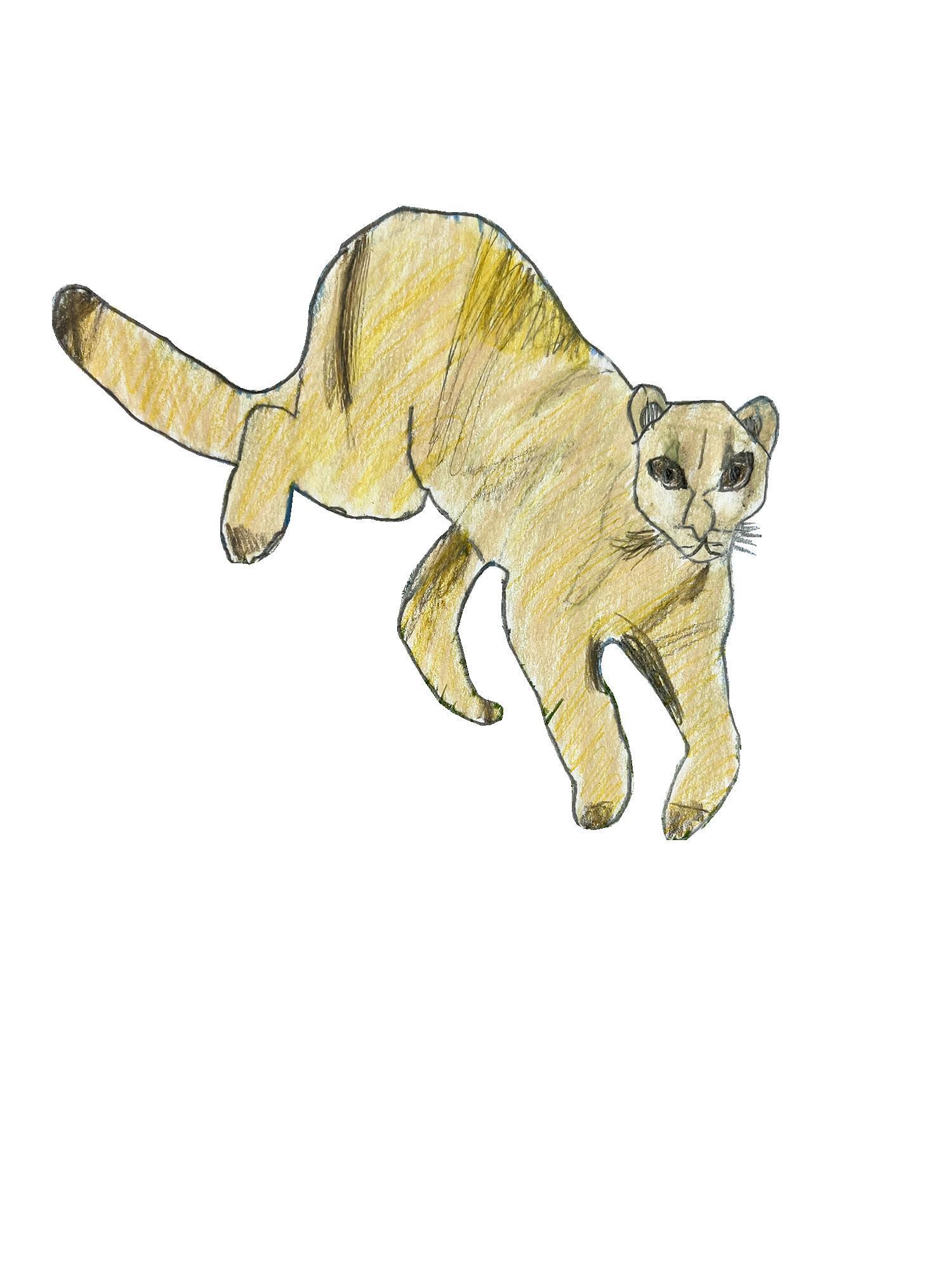
Mule deer are strong animals; the only lethal part of their bodies is the head.
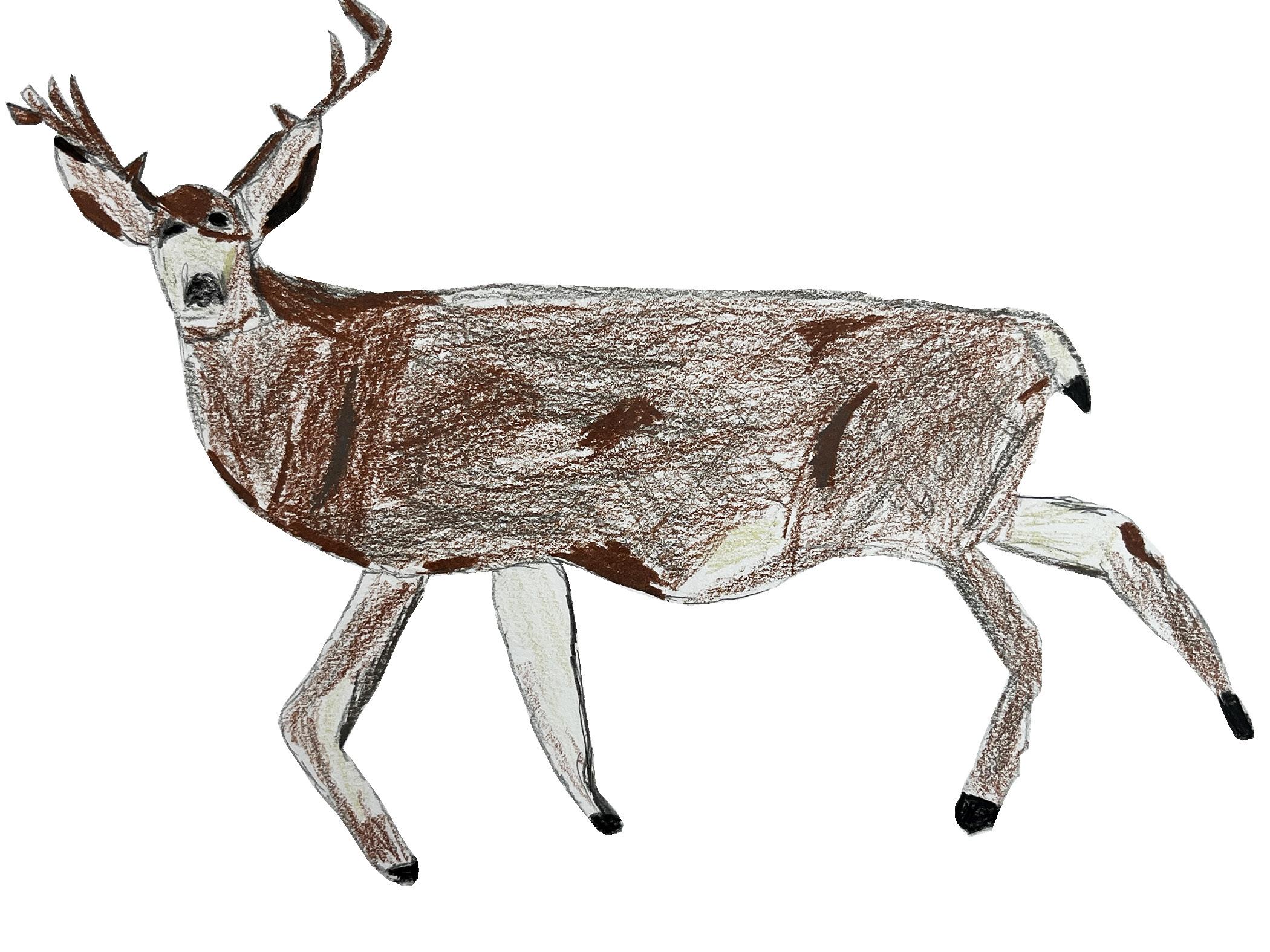
BY MASON B.
When I was ten, I tried to spot mule deer while in the car. I saw ten mule deer in one car ride, and most were in packs, but sometimes I saw fewer. Mule deer are social animals; they migrate in packs, so they can survive in harsh conditions and find vital resources. I asked my dad if they were safe for humans to eat. He said they were dangerous because they can transmit rabies. Afterwards, I asked him if I could go near them, but he said they could cause several big scratches; they are similar to a wolf lurking through the trees, waiting to bite. After I learned this, every time I golfed, I was as cautious as a rabbit in an open field, so I would not be injured or worse, contract rabies.
Mule deer show up at most golf courses because that is usually where they lie down and chill. Looking for scrumptious food to eat, mule deer like to eat lupine, dandelions, and certain types of grass, such as sagebrush and bitterbrush. Mules also eat berries, nuts, and conifer twigs. After mules eat, they rest, digest the food, roll around in the grass and dirt, and graze on grass to obtain nutrients and thus receive energy from plants.
Once it turns dark, mules watch out for predators, such as wolves, cougars, bears, and coyotes. Surprisingly, they sleep while standing up so they can stay alert and run away faster. I wondered why and how they remained upright and did not lie down. They can also lie down fully to get a better rest for when they wake up. Once, when I was nine years old, I saw a mule deer sleeping on the hill next to my house. After that, I began to be in awe of how cool mule deer were; they could sleep while standing up.
When mule deer wake up, they stretch, drink water, and/or change where they sleep. They also stretch their front legs and their hindquarters.
Mule deer are strong animals; the only lethal part of their bodies is the head. If a very strong person hits the mule deer’s body, even with a golf ball, it will not cause much injury to the mule deer because their skin is thicker than most deer’s skin. This is because they are usually heavier. Even if someone really strong hits them in the body with a golf ball, they would still do no damage. When I hit a mule deer in the chest with my golf shot, it did not even move or flinch. I was astonished due to the fact that I hit the ball really hard. I also became scared until someone told me deer do not feel as hurt when they are shot in the body.
Mule deer receive their name from their mule-like ears. Their ears are around eight inches tall. These tall, mulelike ears make the mule deer one of the most distinctive animals on the planet.
BY FAEREN R.
Once on the brink of extinction, the North American river otter has made a remarkable comeback, reestablishing its presence in rivers and streams across our region. This resilient creature is not just surviving; it is thriving, captivating us with its playful antics and vibrant spirit. With the help of humans, water quality has improved, habitat restoration efforts have been implemented, and reintroduction programs have been undertaken to welcome back the river otter.
This species has thick fur, which protects them from scratches and cuts, and shields them from the cold water where they live most of the time. Since they are semi-aquatic, they inhabit a wide range of habitats, including dens under trees, abandoned beaver holes, streams, and rivers. Even though river otters can live on land, they spend most of their time in the water because their prey lives there.
I remember sitting in the backseat of my dad’s car, looking out the window, and seeing a sign on a bus stop saying, “The Long-Lost River Otter Returns!” That was only one of the many matters of the river otter that I found astonishing. Surprisingly, there are three featuresthe river otter has that no other animal does. They have two-layered water-repellent fur, they can close their ears and nostrils underwater, and their right lung is 20 percent bigger than their left.
Additionally, I remember hearing a commercial in a podcast, which mentioned a science website that spoke of the river otter’s return. The river otter has many nice traits. River otters are curious, usually about their environment and prey, and are also particularly playful. Examples of playfulness include sliding in the snow and hanging out in groups of two to four.
My favourite hobby is tennis, and when I practice or just goof off with my friends, I am usually near the top of the group that I am playing with; metaphorically speaking, “at the top of the chain.” Similarly, the river otter is at the top of the freshwater food chain, preying on animals such as fish, crabs, frogs, and bird eggs. River otters are as dangerous to animals in their habitat as a storm is to a calm sea.
The teeth of the river otter are the most hazardous feature of the animal. Adult river otters hold a jaw full of 36 teeth so formidable that they could crush boulders and grasp the slipperiest of fish as if they were mere butter. Their bite can cause infections as well as rabies, which can be fatal if treatment is not provided to help the wound. Their lifespan in captivity is 20 years, whereas in the wild, they live to be 9 years.
The river otter has given me an understanding of the common and unique factors in the world, as well as forcing me to think deeper about my life and connections to this once almost extinct species.
River otters are as dangerous to animals in their habitat as a storm is to a calm sea.
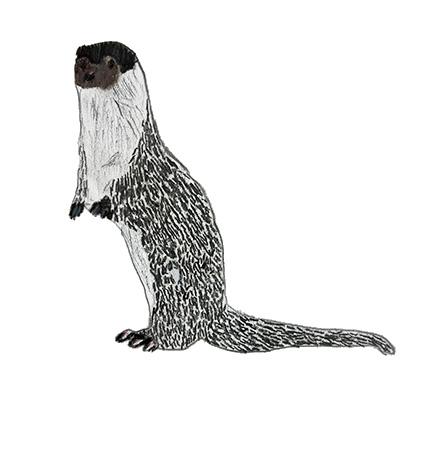
They are the most symmetrical animal in existence.
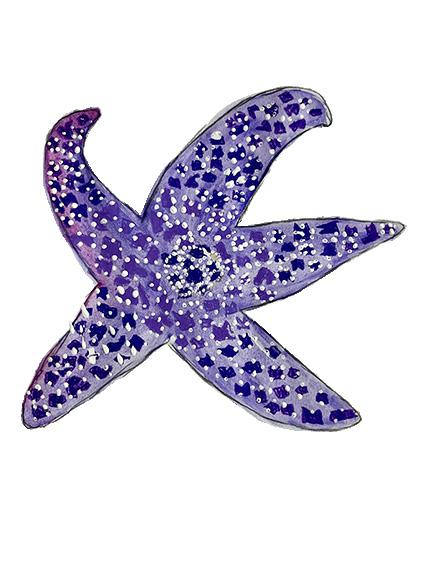
BY CHARLOTTE N.
The ochre sea star is a coldwater species unlike me, because I do not do well in cold water. I could stay in a hot tub for millions of years, but I can only stay in a cold plunge for one second. When I was in the hot tub with my mom, she dared me to go in the cold plunge. At first, I said no, because it was too cold. Then she stood up and hustled out of the water. I yelled, “Wait! Let me do it first!” I did not realize what I had said until I left the hot tub and was in the cold plunge. I said that because I knew that she could go in for longer than I. If I went in first, it would be harder for my mom because the longer you are in hot water, the harder it would be to stay in the cold water. Once I was in the cold plunge for at least 30 seconds, it was not as bad as I thought it would be. Yes, it was worse when I moved my body. Overall, it was not that bad. My mom set a stopwatch for me on her phone so that we could see how long I was in for. My goal was to go in for at least two minutes.
The ochre sea star prefers to be in cold waters between 9 and 12 degrees Celsius. The ochre sea star is like ice cream, they are both cold. Adult echinoderms have radial symmetry, which helps them move in any direction. They are the most symmetrical animal in existence. Humans do not have radial symmetry, humans have mirror symmetry, although people have small differences in the shape of their ears and the size of their feet and hands. The eyes of the ochre sea star are at the tips of their arms. Humans’ eyes are in their heads, so they cannot move around much. It would be cool to see in so many different directions like the ochre sea star does.
When my mom stopped the cold plunge timer, I had been in for 12minutes. I was really cold and shocked at the same time. The water in the cold was 55 degrees Fahrenheit! I usually cannot even wiggle myself into the cold plunge when I am back in the hot tub. This was not like me; it was equivalent to the ochre sea star. When we left to go inside, my mom made me take a shower. While I prefer the water to be warm but not hot, this time I was so cold that I turned the temperature to hot.
BY CHARLIE Z.
The orca sliced through the air like an arrow, landing in the water with a splash and splattering the front row of the audience. The orca came up and bumped a ball that was high above the waterline. The audience cheered at the sight of this majestic creature performing tricks. I was four on that day with my family, on vacation at SeaWorld, staring in amazement at the orca. Throughout the day and even the entire year, I thought about that day and the orca show. Orcas have fascinated me ever since.
Orcas are highly intelligent, able to communicate hunting strategies with their pods in the wild, and can learn the tricks I saw at SeaWorld years ago. Even though they make the tricks look easy, they are challenging and require years of training to perfect. Orcas are also social. They have been recorded in groups of more than 100 in the wild. Orcas help each other, hunting together like a pack of wolves. At Nueva, we also work together to form a large community, similar to the orcas.
Even though many people think that orcas are too ferocious when they hunt, they have to eat to survive. Orcas have various methods of hunting. One strategy they use against seals that love to lounge on the beach is known as beaching. In this method, an orca approaches the shore, suddenly pounces on the beach, snatches a flopping seal, and slides back into the ocean with its catch to share with the group. Sometimes, though, orcas fail and do not catch their prey.
After the stunning orca show, I was still very curious about these animals. I kept on asking my parents questions: “What do orcas eat?” “How fast do they swim?” “Can we go and see the orca show again?” This went on for a week before my parents told me that when I grew up, I would find out. Ever since, I wished for the time when I would grow up and study orcas. That moment is now.
Orcas are fast. They can reach speeds of up to 33.5 miles per hour and travel more than 99 miles every day. Orcas are also unique; each one has a different color pattern, helping scientists identify them in the wild. The color pattern of the orcas has a lot of shades of black to white to choose from. The orca patterns are also similar to those of Homo sapiens. Each one of us is unique, whether in our age or our identity. People sometimes call orcas “killer whales” because when people first came to the California coast, they saw the orcas killing whales ferociously, so they nicknamed orcas “killer whales”.
After I investigated orcas, I found out that they are supervised unfairly at SeaWorld, with limited space inside the tanks, and are lonely due to the lack of other orcas. Thankfully, the news about how orcas are treated has spread, and people around the world know about it.
Orcas are truly fascinating. I hope I see them more in the future.
The audience cheered at the sight of this majestic creature performing tricks.
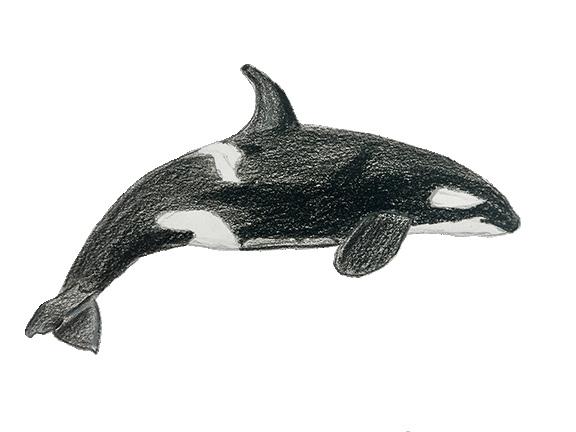
Poison oak has green or reddishgreen leaves, and quite a few textures on their edges...
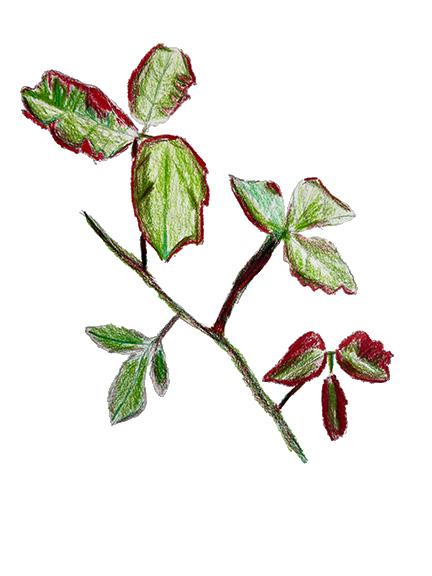
BY LASZLO D.
My dad is allergic to poison oak, which makes me worry about him having a rash. He is less resistant than most people to poison oak rashes, which come from the urushiol in poison oak reacting to a human or animal’s skin. This also applies to any member of my family, because even though my mom and I only get normally affected by poison oak, we still get rashes.
One day, when hiking on a path in the East Bay close to where I live, we encountered a tall poison oak bush that blocked three-quarters of the path. Poison oak has green or reddish-green leaves, and quite a few textures on their edges, such as smooth, lobed or ridged. It is also usually quite short in its bush form, usually three to four feet tall, but sometimes up to six feet. The climbing vine form of poison oak can also be taller, up to a hundred feet. This poison oak was the tallest poison oak bush I had ever seen, and its leaves were so dark that I barely recognized them as green. It was still poison oak, though, and it could give us a rash.
My dad, as he often does while we are hiking, warned my mom and me about the poison oak. The path was around three and a half feet wide, so I would not have avoided the poison oak had I casually walked through, without knowledge of it. I would not have recognized the poison oak had I been leading the hike, and since poison oak rashes are very uncomfortable, I was grateful like my dad had saved my life that my dad pointed it out.
A similar occurrence happened when we were walking back from the beach. This time, my family was with our friends. My dad mentioned the poison oak that was growing on the handrail for the stairs going up, but not all of us heard. I had heard, though, and I relayed the message to the rest of the group behind us. I remember feeling proud of my family and myself for reminding the other family members and our friends to watch out for poison oak. To me, the reminder, even though they were not our family, meant through actions, “It does not matter who we are, we can all still be together.” We were a community, even if it was just by warning each other about poison oak.
Even the smallest parts of the poison oak plant are like a community. The seeds and the fruits, which are different but still help each other. The fruit protects the seed. The fruit itself has three parts, each defending each other from the outside world, which can include predators, larger creatures, or the elements.
Poison oak is a community, helping other plants, by being connected underground, like my family is a community helping each other and our friends. Poison oak can be harmful, but it can also be together.
BY EVELYN J.
I have flat feet caused by my accessory navicular. My foot muscles attach the wrong way, making my arch and foot weaker. Some people have to undergo surgery if their feet are too weak; others, like me, receive inserts made to fit my feet perfectly and then placed inside my shoes. The insert is similar to a midsole in normal shoes, except that the arch part is stronger and stiffer than the regular midsoles. In dance, I have to wear Velcro tape and wrap it around my foot. It supports the arch and it makes my muscles strong, so one day I will not have to wear Velcro tape anymore. I still can not have “regular practice”, though, because the Velcro tape is too big to fit my dance shoes.
Ring-necked snakes also have a unique trait; they are one of the smallest snakes in the world. When a juvenile is born, it is 3 to 4 inches long. They are also left to grow up independently; their mother leaves right after they hatch. When they finally grow up, they are 11 to 14 inches long, which makes them the eighth smallest snake in the world.
Despite their size, ring-necked snakes are great hunters. With their smooth scales, they move easily through leaf litter and ambush their prey, coiling their bodies around them to stop the blood flow. The ring-necked snake’s prey are usually slugs, worms, or insects, though hunting happens at night. During the day, they hide from birds, mammals, and larger reptiles, going deep underground. If they encounter predators, these snakes are like an octopus, tricking their enemies into thinking they are toxic when they are not. They trick them by rolling over, then exposing their bright yellow belly with a row of black dots. They also scare predators off by releasing a musky odor and playing dead. When they are disturbed, they will coil their tails and may bite or release venom if they feel threatened. In that case, they cannot hurt humans and do not have enough venom to inject into our bodies. Ringnecked snakes can also move in water, gliding gracefully through streams and ponds.
When spring and fall come, the mating season begins. Males try to attract the females by aligning their bodies with the female ring-necked snakes and flicking their tongues. Females release pheromones to attract male snakes, but they communicate with each other by body language, like how we communicate by talking. When egg hatching starts, females eat bigger meals than the males to conserve energy. Afterwards, females produce eggs, laying between one and ten eggs. Then, it takes up to four weeks for the eggs to hatch, typically around August or September.
Ring-necked snakes have the widest geographic range of any snake, every hectare has around 700 to 1800 ringnecked snakes. Even if they are common, these snakes might be hit by a car, or their habitats might be destroyed. Also, climate change can bring death to these snakes. Ring-necked snakes are also largely social; they can be found in groups of one hundred or more. These snakes hibernate in the same colonies they form.
Ring-necked snakes are largely social; they can be found in groups of one hundred or more.
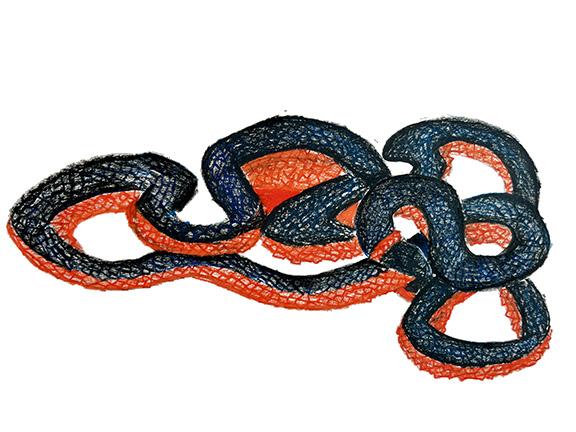
When a peregrine falcon stoops, they can reach up to 250 miles per hour.
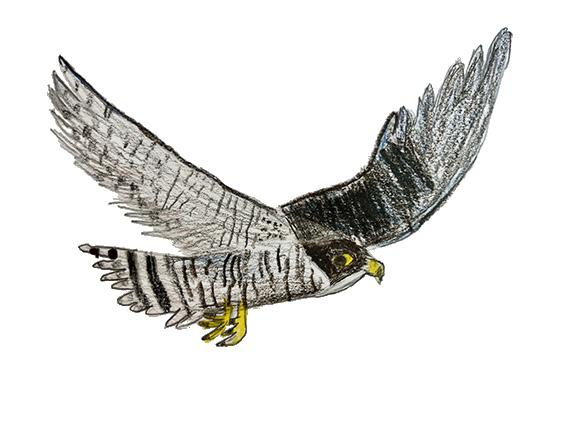
BY SIMON G.
Peregrine falcons are beautiful, majestic animals. I have seen them while birding. I even felt the phenomenal power of their talons and agility. The calm moments watching birds help me remember how I first fell in love with them.
In Pre-K, we selected a topic from a limited list to study. I initially wanted vehicles, but I ended up studying birds, my second choice. Learning with my friends made the topic feel enjoyable and exciting, and my teacher made it even more fun. She kept us engaged with hands-on activities that included birdwatching. I learned to love all kinds of birds and to recognize the magnificent creatures that can fly at high speeds, travel to many different places, and successfully thrive, even in circumstances where humans have made life so difficult. When I went home after my first day of learning about birds, I shared my incredible experience with my parents. They helped me elevate my interest by taking me to see a wide variety of birds. The peregrine was always the coolest.
The peregrine falcon has a black head and wing tips, while its underparts are white with barred black. There was a large depletion of falcons because of pesticides, such as DDT. DDT is now banned, and there are more peregrines than ever before.
Peregrine falcons live in plenty of climates; this makes them adaptable. They can be found on every continent except Antarctica, which shows they can adjust to significant changes in climate.
I will never forget my closest interaction with the peregrine falcon. During Thanksgiving break of 2021, we drove to Paso Robles, California. My parents surprised me with a birding experience that allowed us to hold the birds. We fed them from our fists. We learned details about the traits of the birds because we were so close to them, and I was interested in learning more from the naturalist.
After that, birding became a family hobby. We go on hikes just to see one bird, and we love to mimic their funny sounds. I can make a million different bird sounds. These sounds range from a chickadee’s high-pitched screech to an owl’s soothing hoot. Peregrine falcons make many sounds as well.
When a peregrine falcon stoops, they can reach up to 250 miles per hour. This speed is remarkable for an animal, and there are very few other species that can reach similar speeds. Birds that can reach that speed have streamlined bodies and powerful wing muscles that help them fly at high speeds.
Peregrine’s food palette has approximately 2000 different foods. Their palette is as large as a mountain. Studying something new in Pre-K shaped me into an open-minded person. I learn about many topics that make me well-rounded, but this experience taught me so much. Looking forward, I wonder what new hobbies I will try. Maybe they will also lead me to love them as much as I love the peregrine falcon.
BY GEMMA B.
Any sea urchin might seem scary at first, but they are calm creatures with a big personality. Purple sea urchins live along the Pacific coast, from Alaska to Baja California. People can see their prickly spines in low, shallow zones with depths up to 100 meters. Purple sea urchins stick together, just like my two closest friends, Hailey and Lilly. I have known the two of them since I was about a month old. We move around to different places when we play: at the park, my house, and hiding from my brother. Wherever one of us goes, the others follow.
At the end of preschool, we found out which schools we were accepted into. Hailey and Lilly went to South School, and I went to Nueva. I was so sad. It broke my heart. My two best friends went to a different school. Nowadays, even though we attend different schools, we remain good friends.
Sea urchins are always on the hunt for seaweed and kelp. They move around several times a day, but people almost always find these prickly friends smashed together. They are found in tidepools and the ocean. If humans put their hands in a tidepool, they should watch out for the spikes of these creatures.
One year, my father and mother went swimming in the ocean in Hawaii, and a big wave took my mother’s flipper off and slammed her against a rock. She found her swimming flipper after looking for a minute, because she needed to put it back on to swim in the ocean, and winced in pain. When my mom and dad looked at my mom’s foot on the beach, big purple spikes were sticking out. That is how she knew it was a purple sea urchin. She booked a surgery, and my mother was able to walk after a couple of weeks of recovery, though we rode golf carts for the rest of the trip because my mom could not walk anywhere. When people do not have surgery on their foot, they soak it in vinegar because it helps the acid from the urchin dissolve.
Sea urchins are not scary. People just need to watch where they step in rocky oceanic areas. Some facts about these fun, purple, spiky sea creatures are that they can absorb nutrients directly from the seawater, and they are uncommon. The purple sea urchins are not hungry snackers, like us humans. This species can last years or decades without eating any food. If a human tried not eating any food for the rest of their life, they would die after a couple of weeks of starvation. The purple sea urchins stay in huge groups; when a purple sea urchin is alone, something has happened to that creature. At tidepools or when walking around the California coast, look out for the purple spikes, and take care of these wonderful urchins.
They move around several times a day, but people almost always find these prickly friends smashed together.
It had glossy, jet black feathers all over its body, except for its bright, fiery red wings.
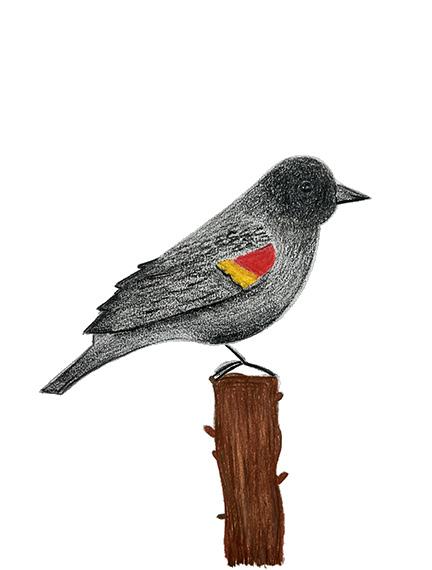
BY PEARL S.
The red-winged blackbird is an unmistakable, glossy black bird with vibrant red shoulder patches, like a flame in a fireplace. They can be found across most of North and Central America. They typically migrate south between August and October. They enjoy being in or near water, so they can typically be found in marshes and wetlands. Red-winged blackbirds are extremely social, but they fiercely defend their territories and chase other birds away from their nests. They are typically 6.7 to 9.4 inches long and weigh between 1.1 and 2.8 ounces; however, males are generally larger than females. The loud conk-la-ree call is the red-winged blackbird’s signature sound, used to defend its territory or attract mates.
Every year, my family and I go on a trip to Florida for winter break to visit my grandparents, cousins, aunts, and uncles. A few years ago, we all packed into the car for our annual trip, and we drove off to the airport, music playing over the sound of our suitcases gently rattling in the trunk. The plane ride to Florida was six hours long, and I spent the whole time anticipating how much fun I was going to have with my cousins.
When I arrived at my grandparents’ house with my family, we were welcomed with hugs and smiles. I rushed to my room and unpacked my bags, then went right outside into the backyard to look for alligators with my cousins. Whenever we are all in Florida, we always look for alligators, because we never see them anywhere else. There is a large canal in my grandparents’ backyard where alligators swim, separated from their house by a tall, twelve-foot fence. My cousins and I pressed our faces up to the scorching metal fence and searched for alligators for twenty minutes in what felt like thousand-degree heat with no luck. Finally, we decided that it was time to go inside.
Just as I was about to open the sliding glass door, out of the corner of my eye, I caught a glimpse of something dark and bright flying past me. “Look!” I called out to my cousins. Sitting on a tree branch a few feet away from me was a red-winged blackbird! It had glossy, jet black feathers all over its body, except for its bright, fiery red wings. I never would have thought that seeing a bird would be more exciting than seeing an alligator, but after seeing the vibrant colors of the red-winged blackbird, I proved myself wrong.
Once we saw the red-winged blackbird, we rushed inside to tell everyone. Our grandma told us that she noticed red-winged blackbirds when she walked around the neighborhood with our grandpa in the mornings. She said they gather in her backyard because of the canal.
To this day, this memory reminds me that I can hope for one thing, but end up with something even better, like messing up a recipe, but making something more delicious instead.
BY NAVEEN C.
I remember going to the Monterey Bay Aquarium and seeing stingrays gliding effortlessly across the sand, sometimes surfacing from their tiny pond-like enclosure and splashing droplets of water into the air. Those circle-shaped stingrays amazed me. I wondered how they swam, watching them hide underneath the tan-colored sand that matched their scales.
Round stingrays are ambush predators and scavengers; they hide in the sand, waiting for an unsuspecting fish to swim by. Suddenly, without warning, they shoot out of the sand and grab the fish in their mouths. Other times, when there are no fish nearby, they scoot around the sand with their mouths open, eating whatever small crustaceans happen to hide in the sand. They remind me of cows grazing on grass. Ironically, I hate eating shellfish and crustaceans, but that is what the round stingray eats.
When the stingray is approached by one of its predators, like the northern elephant seal, the giant sea bass, or its most common predator, the leopard shark, it waves its tail around violently and quickly. The stingray waves its tail around as a threat, and if the predator comes closer, then the ray will target the predator and aim its barb at the threat to injure it or scare it away.
Other things that can threaten it are parasites, and its most common parasite is an ectoparasite, which includes leeches and species of copepods like Tigriopus californicus. There can be up to 16 parasites that live in its stomach at once. There is also a tapeworm that is found only in the stomach of the round stingray. Its scientific name is Phyllobothrium hallericola, and it has only been found in the stomachs of two stingrays. It is transferred to the stingray when it eats an infected fish or crustacean that is housing the parasite.
Their best sense is the bioelectric sense, which allows them to sense where prey and other animals are. It uses that sense to find a mate. Reproduction is most common from March to April. When the rays find a mate and begin reproducing, the baby stingrays are in the female’s stomach for three months, feeding off the yolk sac attached to them to grow. Once the baby stingrays emerge, they are fully independent and can find their own food. The babies are approximately 2.5 inches to 3.1 inches.
I always wondered how stingrays swim; they have no back flippers to move around. I learned that instead of using a back fin, they use a side fin and wiggle it around to move almost silently like a ghost. Round stingrays grow to about the size of one foot or even larger, but the biggest one found was 22.8 inches in length, its body width was 12.1 inches, and it weighed 3 pounds.
...they hide in the sand, waiting for an unsuspecting fish to swim by.
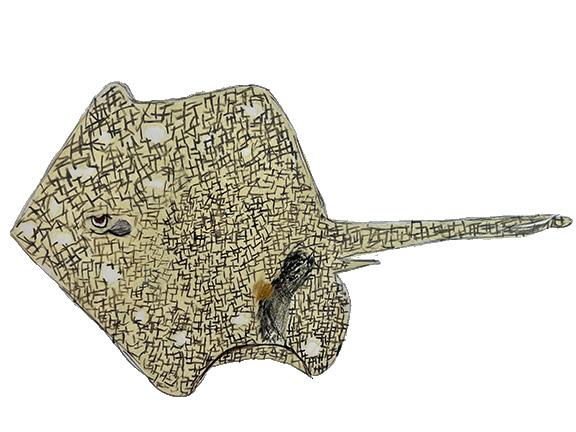
The salt marsh harvest mouse is a unique species because it is one of the few land mammals that can drink saltwater.
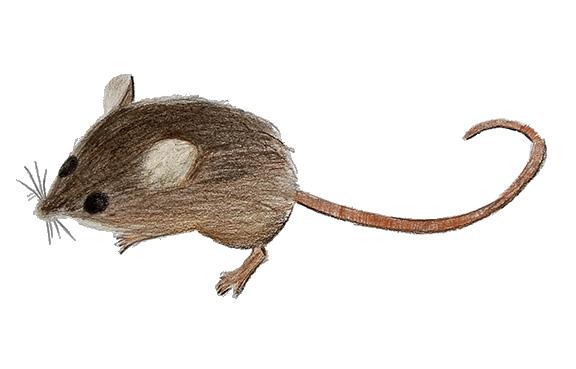
BY ELLIE C.
The endangered species list includes more than 48,600 species, but one of the animals that stood out to me was the three-inch brown mouse, also known as the Salt Marsh Harvest Mouse. I loved it immediately.
The salt marsh harvest mouse is a small, brown rodent. Its scientific name, Reithrodontomys raviventris, translates to “grooved-toothed mouse with a red belly. This little creature plays a critical role in its ecosystem, often aiding in seed dispersal and contributing to the marsh’s health by controlling plant growth. The salt marsh harvest mouse is a unique species because it is one of the few land mammals that can drink saltwater. It sneaks into the other rodents’ burrows and explores, then leaves as soon as the other rodents arrive, like a robber running from a crime scene.
Back in second grade, I always felt a thrill when heading into the forest to spend time with my friends. Sometimes we gathered sticks from the ground and built forts. We also engaged in a lively trading system, exchanging our “valuable” items, including pottery and even acorns, for better sticks to utilize in our fort. On days when we did not feel like building, we created small shops that sold sticks, pottery, and acorns for free. Now and again, we climbed a sturdy tree that seemed to touch the sky. Then, we sat side by side and chatted about the secrets of the school, or sat and watched classmates build their forts, admiring their forts from afar.
The salt marsh harvest mouse may look small and cute, but it is an incredible swimmer. Its swimming ability helps it escape predators quickly and access fresh food and water sources. The salt marsh harvest mouse effortlessly glides through the water due to the strong, paddle-like feet it uses to propel itself like a boat.
This mouse is also a great climber. It has strong limbs and sharp claws that help it climb steep trees and rocks. Escaping to higher ground enables the mouse to evade predators and allows the salt marsh harvest mouse to access nests and food sources that are out of reach for other rodent species. It is, overall, a remarkable creature, being able to drink salt water, swim, and climb.
The memories of playing in the woods remind me of how wonderful nature is. Those days in nature mirror the life of a salt marsh harvest mouse. Just like us, when we build forts and trade valuable items, the salt marsh harvest mouse uses the world around them to live and thrive. I appreciate nature and the importance of protecting smaller animals. Every living thing, regardless of size, has a unique perspective on life and a special path to forge, and it is our duty to ensure that they have the opportunity to thrive in their natural habitat.
BY ABBY A.
Southern sea otters almost went extinct as a result of the fur trade in the 1700s, 1800s, and 1900s. Their numbers dropped to as low as fifty otters, spotted near Big Sur, located right off the coast of California. Now, they are under the Endangered Species Act, the Marine Mammal Protection Act, and California state law. According to the US Fish and Wildlife Service, there are now more than three thousand individual sea otters.
Southern sea otters have a wide diet, including crabs, snails, urchins, clams, abalone, other invertebrates, and shellfish. One individual can eat up to twenty to thirty percent of their own body weight. When they find food, they are like fluffy syringes, slowly sucking up all their food. They spend around sixty percent of their day eating and scavenging for food.
This reminds me of a time when I went to the Monterey Bay Aquarium. There, I learned that the aquarium staff is not allowed to give the otters shellfish. This is because the otters tried to use the wall and the glass as a tool to crack it open. I also watched a feeding session, and the otters used their stomachs as a table to eat their food.
Otters are also one of the many helpful stewards of the ocean because they are a vital part of the kelp forest ecosystem. For example, sea otters eat sea urchins and sea urchins eat kelp, so this balances their diverse ecosystem.
Even though sea otters are shielded from hunting, they still have other threats, including loose fishing lines, oil spills, climate change, availability of prey, great white sharks, and even harmful algal blooms.
Otters are resourceful. Southern sea otters have a pocket under their arm that they can use for storing both food and tools on deep dives up to four hundred feet below the water. When they bring their food up to the surface, they usually use a sharp rock, stone, or even a glass bottle to crack open their prey. Some otters can use the same rock for years. This trait of resourcefulness reminds me of when I went strawberry picking with my family, and my basket soon filled up. Instead of stopping, I used my pockets to keep collecting.
Out of all animals, sea otters have the densest fur, having up to one million hairs per square inch; humans only have around two hundred thousand hairs on our whole head. Since all sea otters lack blubber, their two layers of insulating fur keep them warm in the freezing water. Southern sea otters are about four feet long, and males weigh up to seventy pounds while females only weigh up to fifty pounds.
Southern otters are social animals, and they love resting in rafts. Their rafts provide them with safety and company; For example, sea otters wrap kelp or seagrass around themselves when they rest or hold hands so they do not drift away from their raft.
Southern sea otters give birth year-round, but peak from January to March. Sea otters usually give birth to one pup at a time and care for that pup for around six months. Because of this, the sea otters’ population is decreasing.
Sea otters are one of the great wonders of the ocean, and they are essential for keeping the ocean healthy.
...they are a vital part of the kelp forest ecosystem.
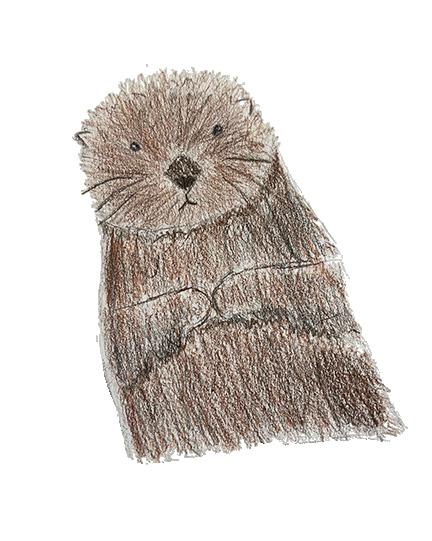
While Steller’s jays symbolize hope and adaptation, underneath they are thieves.
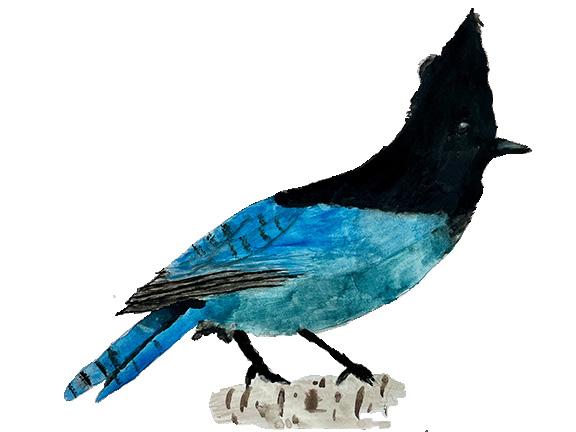
BY LEELA S.
Steller’s jays form bonds for life. On my first day of kindergarten, I sat down at a desk and looked to my right. I saw a girl. We looked at each other and smiled. We became friends in the same way that a Stellar’s jay would, Even now, I am close friends with her. When I was in first grade, I walked up to someone and asked their name. We also became close friends. I have a deep connection to my friends from my old school, Hoover Elementary, and I can recall all of us standing up for each other. One time someone was being really mean to my friend, so I told them to back off. When that person was then mean to me, my friends protected me.
Steller’s jays are excellent mimics, known for being able to mimic many animals with their call, including hawks, and sometimes machines. They are similar to a wolf in sheep’s clothing.
Steller’s jays live in forests, camps, and parks. Steller’s jays make their nests near the tops of trees. They breed in conifer trees and hatch 2 to 6 eggs. Their hatchlings can achieve short flights after about 2 weeks, and after a month, the fledglings leave the nest.
Steller’s jays are very loud, like when I play the violin. When Steller’s jays mate, they are very quiet. When this happens, they become extremely quiet and secretive. These birds are most always in groups, always protecting each other. Groups of jays are said to be a party or a band of jays.
Steller’s jays are one of the most misspelled birds. Some people spell the name as Stellar’s jays, with an “a” instead of an “e.” Steller’s jays earned their name from the naturalist and explorer George W. Steller.
I like to wonder about many things. When I was younger, I would always quietly creep close to birds. Whenever I saw a bird that looked like a blue jay, I would always wonder if it was a Steller’s jay or a blue jay.
I am drawn to these birds because of their majestic colors. The Steller’s jay has feathers as deep blue as the ocean and as black as the midnight sky. They have long, straight bills with a slight hook at the end. Steller’s jays have an average wingspan of 17.3 inches. Their maximum life is 16.1 years, and the adult weight is approximately 100 grams. Steller’s jay males and females look alike.
While Steller’s jays symbolize hope and adaptation, underneath they are thieves. They steal eggs from other nests and are capable of stealing food from a human. Steller’s jays eat berries, insects, and nuts. A Steller’s jay’s diet is two-thirds vegetables and one-third animal matter.Steller’s jays have a good memory; they will store nuts in the ground to eat in the winter and remember where they put them.
Steller’s jays are bold and curious. Once, a Steller’s jay came close to me, tilting its head curiously and looking to see if I had food before hopping away.
BY ARA K.
The sticky monkeyflower is an extremely sticky plant. Last year, when I lived in Seattle, my school went on many field trips to wetlands. Whenever we saw a catchweed plant, we picked it and stuck it on each other as pranks. Sometimes, the teachers would join in. The catchweed plant is very similar to the sticky monkeyflower because both its stem and leaves are covered in a sticky substance. Now living in California, I see many more flowers in the environment; plants that are unlike the ones I saw in Seattle. When I walk by sticky monkeyflowers, it reminds me of the fun memories I had in Seattle and the adventures to come in California.
The sticky monkeyflower’s population is practically blossoming. People can find one almost anywhere in the Bay Area. Their bright orange-yellow flowers attract birds such as hummingbirds, and bees. Butterflies feed on it to gain nutrients for metamorphosis and lay their eggs on the leaves. The plant usually has four to five petals, and the sticky substance takes up thirty percent of the leaf’s weight. It protects the plant like an extra layer of skin and repels herbivores. It can also act as a shield and reduces the amount of water lost by blocking the moisture from escaping.
The Miwok and Pomo peoples used the stems and leaves in salads and as a flavor enhancer. They harvested and ground the seeds into flour. They crushed the leaves to treat sores and burns. The leaves can also be used in teas.
The bright plant is in the snapdragon family and blooms in late spring. It grows to be about two to three feet tall. It prefers full sun and can handle different types of soil, including rocky ground. In Seattle, it was rarely sunny. Every day was the same as the last: cold wind, grey sky, and clouds. Whenever my school went on break, my family traveled somewhere sunny; for example, California or Hawaii. I loved seeing the bright flowers in California, especially the sticky monkeyflower, and the sunny beaches. After modern studies, its scientific name was changed from Mimulus aurantiacus to Diplacus aurantiacus because DNA studies showed that the genus, or “Mimulus,” was two parts, so it was reclassified as Diplacus aurantiacus. The name Diplacus comes from the Greek words di (which means double) and plax (meaning a flat plate or a huge surface).
The sticky monkeyflower has hybrids that are the shades white and red, and can be other bright colors. It has a woody stem. Over time, the plant adapted to the California weather, and now it can re-sprout from its stem after a fire. Even if it looks dried out and dead, it is most likely still alive. Once the plant fully dies, the leaves and stem become food for small decomposer insects.
In the United Kingdom, the sticky monkeyflower received the Royal Horticultural Society’s Award of Garden Merit. It is recognized in the native plant and ecological communities for its ability to stay alive in harsh weather or fires.
When I see a sticky monkeyflower, I think of the fun memories I had in Seattle and the trips that I took to sunny places. When I look at the stem, it reminds me to stay resilient and persistent in my life.
I loved seeing the bright flowers in California, especially the sticky monkeyflower...
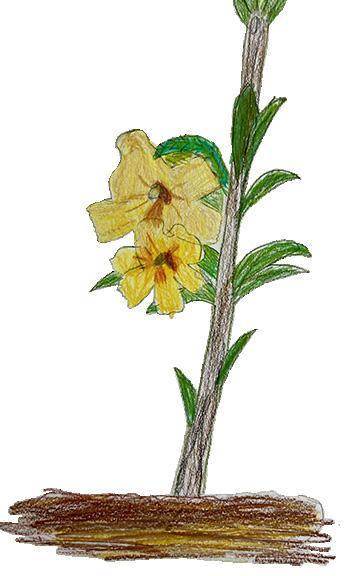
The leaves are like little fingers because they are dull green and deeply and roundly lobed.
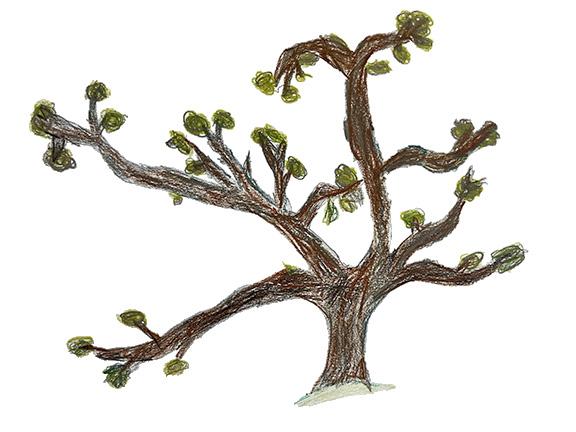
BY ANNELISE D.
Valley oak trees have been a part of my life since I was two years old. I was born in New York, but moved to Hillsborough when I was one. When I was younger, I visited my grandmother’s house in Orinda, California all the time. Every Saturday and Wednesday, I rode in the back seat for an hour and a half on my way to her house. I remember pointing at things when we drove, and my mom told me what they were. I pointed at everything because I was curious to learn. Then I pointed at a tree, and my mom said it was a valley oak. My mom explained all about it. For the next month, every time I saw it, I would ask my mom to tell me about the valley oak tree.
George Vancouver discovered and researched valley oaks in 1792. Researchers later discovered many facts about the Quercus lobata. It is the biggest and tallest oak in Northern California, known as the “Monarch of California Oaks.” Valley oaks can grow up to forty feet in ten years. That’s about four feet per year. They can grow 50-100 feet tall and up to seven feet in diameter. These trees love the sun, and they can survive for a few years in drought conditions. To find water, its roots can grow up to sixty feet deep. As the tree becomes older, its roots degrade, and the tree grows a “tiered root system” four to two feet underground. This system helps the tree find water even during a drought.
Valley oaks can live up to 600 years and are protected all over the Bay Area. As a heritage tree, local cities and counties require permits to remove them. The valley oak has lost up to 90 percent of its habitat due to its land being taken over for agriculture.
My dad used to tell me that I would live for a long, long time like a valley oak if I ate all my food. These trees provide acorns for all types of animals. They are a main food source for black-tailed deer, various rodents, gophers, and California ground squirrels, especially in winter.
Like valley oaks, I provide food to my classmates and friends. In many of my classes, I give snacks to my friends. The valley oak is one of my favorite trees, and I always love to see it. When I drive to my grandma’s house, I always look for them.
Their leaves are two to four inches long, and they lose their leaves in the fall, but grow them back at the beginning of spring. The leaves are like little fingers because they are dull green and deeply and roundly lobed. When I first saw a valley oak leaf, it was grey, so I thought that was what they looked like. The leaves are soft and fuzzy on their pale undersides, and also slightly silky. The valley oak can live up to six hundred years. It is a lasting tree. It is my heart.
BY JASPER N.
My family used to live with my grandma. We stayed on the second floor while she was on the first floor. One day, she rolled down the stairs because of a door slamming into her. I called her every day to check up on her while she was in the hospital. When she finally recovered from the surgeries, she came home. She could not run or bend down. I checked up on her as often as I could, going downstairs to say hi and ask about her day.
A year later, we had to move to another school, and I became farther from her. I still called her every time I could. Sometimes on weekends, I was able to talk to her. A few months later, she wanted to live in a place with no stairs because of the hazard. She moved to my cousin’s house. She moved closer, which meant I could see her more. Every few months, I was able to see and check up on her, still calling on the phone as much as I could.
When I look at bluebirds, I see them caring for their families just as I do. Western bluebirds stay with their parents, and do not immediately try to find a mate. They stay with their family, and other unrelated bluebirds help the family raise chicks.
Western bluebirds have electric blue manes and rusty orange stomachs. Near the bottom of their bodies, they are a metallic grey. They are six to seven inches tall.
Once while hiking, I saw a western bluebird. They were in an open meadow, searching for something. I was really confused, but now I know they were trying to catch food. They search for prey and, like hawks, they wait for a second, then swoop in for the kill. They are not hawks, so they still can be hunted by hawks. Also, western bluebirds are not an endangered species. Their main predators are domestic cats, hawks, raccoons, and opossums.
Western bluebirds live in the cavities of trees or use nest boxes that humans made. When they lay their eggs, the eggshell color is blue, just like the bluebirds themselves.
These birds only need fifteen calories per day. Their diet consists of bugs and berries. Western bluebirds can collect hundreds of berries. Fire burns out some bugs, so the birds have a harder time finding food. The Western bluebird could also burn berries, another food source. They are like the people before the world was civilized; they have survived famine and other hardships.
Do not be fooled by how innocent they look; the males fight over territories. During these fights, it becomes pretty intense and they fight wildly. Sadly, deforestation causes more and more houses for bluebirds to go away. Maybe in the future, the Western bluebird population will be gone. Though if we work hard and make bird houses and bird feeders for them, and reduce our paper use, we can do it.
...the eggshell color is blue, just like the bluebirds themselves.
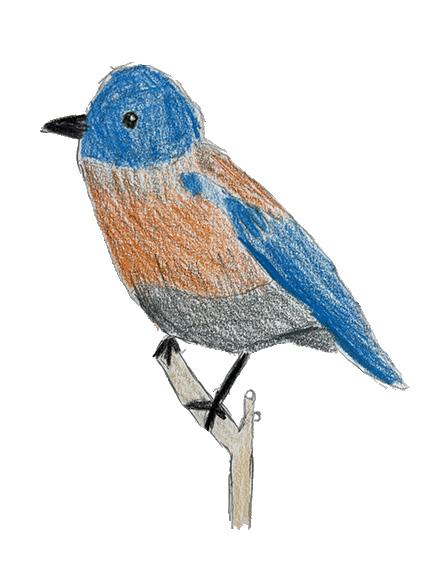
The western grey squirrel is the largest native squirrel in the United States.
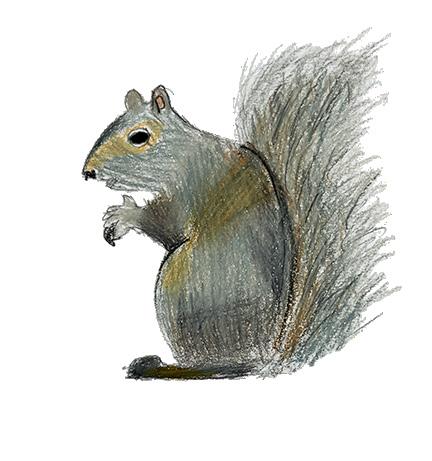
BY MING-HAO T.
When my family first moved into our new house, my parents were arranging furniture in the house, and my younger sister and I went to the yard. At first, I pushed my sister on the swing, amused her with the see-saw, pretended the hammock was a boat, and played hide and seek. All of a sudden, I heard a chirp. It was like a bird call, but somehow different. It did not have the clear ringing that most bird calls have. When I looked up, I saw a squirrel, darker than the other squirrels I saw earlier that day, and louder too. From that day forward, I took time off my schedule to look for it and, potentially, play with this squirrel.
The western gray squirrel is the largest native squirrel in the United States, weighing in between 0.8 and 2.2 pounds. It is seventeen to twenty-four inches in length. It has gunmetal gray hair with pure white undersides, and in some cases, black flecks on its tail. Western gray squirrels are shy and will run up a tree to give a hoarse chirping call when disturbed. These squirrels are found throughout the Pacific region of the Western United States and Northern Mexico, from Northern Washington state to Northern Baja California. They can reach elevations of two thousand meters.
Some western gray squirrels live in coniferous forests and feed primarily on seeds from pinecones. Others live in hardwood forests and feed largely on nuts and acorns. Western gray squirrels also eat berries, fungus, bark, sap, insects, and the eggs of small birds. They open hard seeds and nuts using their incisors.
When western gray squirrels are approximately one year old, they begin breeding. Breeding takes place in late spring, and female western gray squirrels typically have around three offspring at a time. Younger females have smaller litters than older females. Their young are born without hair and with closed eyes and ears, and their heads and feet are larger than the rest of their bodies. They live in hollow trees or in nests they build called dreys. These are built of branches and lined or insulated with softer materials, such as moss.
Western gray squirrels live around seven to eight years, the main cause of death being crushed by cars. They are susceptible to fires that degrade forest quality for extended periods, and are sensitive to disease outbreaks, which become more frequent with warmer temperatures. Western gray squirrels undergo a complete head-to-tail molt in the spring and a head-to-rump molt in the fall. They compete for food with acorn woodpeckers, California ground squirrels, and other tree squirrels. Since not all their seed and nut stashes get eaten, Western grey squirrels help the forest by planting trees.
Every time I start a cross-country race, I imagine myself as a squirrel, scampering over the ground with the immense energy that squirrels always seem to have, to the finish line.
BY DAVID L.
A few weeks ago, I went to my mom’s cousin’s 40th birthday party. I brought a ripstick, a skateboard with joints. Right next to the party house, there was a park. The park had a cement sidewalk circling it, and I hopped on my ripstick and circled the path. On my 12th lap, I waved to my cousin. I was not looking where I was going. I rammed my thigh into a cold, hard, metal bench. It hurt, but like a turtle’s shell, it hurt for less time than it should have because I forced myself not to think about it. I am a very pain-resistant person, and even though it hurts, I am strong and push through it.
Western pond turtles have a rivalry with red slider turtles. Red slider turtles are significantly bigger than western pond turtles, which means they are more powerful and steal territory from the western pond turtles. Western pond turtles’ shells also camouflage them and protect them from red sliders. Western pond turtles have a dark brown to olive shell, and it is round and smooth. Their underside is yellow with black spots. Western pond turtles are pacifists and are victims of the red slider invasion. Red sliders do not directly fight with western pond turtles, but they invade their territory and steal their nests. Western pond turtles are like miniature fortresses, with strong shells to protect them. If I were a turtle, red slider turtles would represent pain. The red-eared sliders are like an invading mint plant when they steal territory from the peaceful turtles.
Western pond turtles lay soil around their nests to protect themselves. It makes their nests safer for the hatchlings. The hatchlings are small and independent. They grow quickly at first, but then slow down as they mature. Their eggs are about an inch long.
Western pond turtles are omnivorous, so they eat meat and plants. They are not picky eaters. I, too, eat whatever is available to me.
I can learn so much from turtles. Similar to a turtle, a good habit is to think slowly, act slowly, and not rush into problems. Even though turtles are slow, they always arrive at their destination. People have portrayed turtles as wise creatures. Turtles are my fourth-favorite animals, and I share many characteristics with them.
Western pond turtles are omnivorous, so they eat meat and plants.
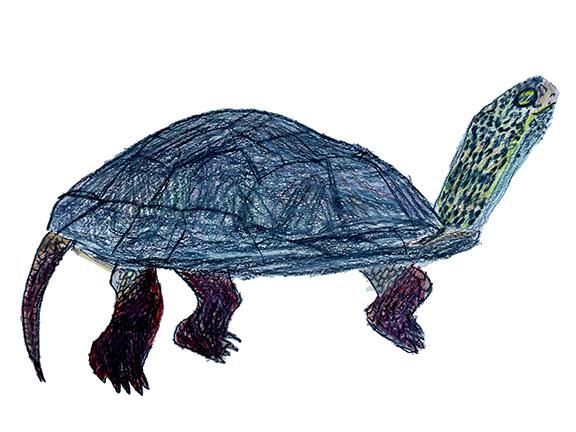
...the top of their head is a nice warm brown color, like a tree trunk, and their belly is as white as snow
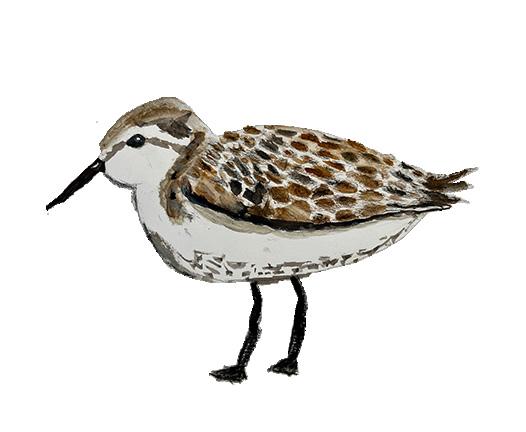
BY ALINA L.
On summer weekends, there was a red “X” on the calendar. On those sunny days, my whole family packed into the car and stuffed the trunk with beach mats, an umbrella, and an array of plastic toys. I looked forward to building a sand castle at the beach and hunting for shells, but a bird became the highlight of the whole trip, a tiny shorebird called “Calidris mauri,” also known as the Western Sandpiper.
We set out our beach mat and wrestled the umbrella into the sand. I had just learned how to swim, but I was scared of the rushing waves that fiercely pulled water onto shore. To me, the ocean was an unknown giant, full of secrets and large voids of emptiness. The salty water stung my eyes like a jellyfish, and the sand stuck to me like gum when I was wet.
Instead of swimming, I made a sand castle with my beach toys. My fortress was a tiny castle, and the moat was a defense from the ocean. Each sand grain was part of a bigger creation, the sand castle, like how the Western Sandpipers fly in a flock with hundreds of thousands of other Western Sandpipers in synchronicity, creating a painting together near the shore. Sandpipers migrate over three thousand miles, between breeding and wintering grounds. A tiny bird that weighs about as much as a golf ball can fly farther than most people travel in a year. I walked to the shoreline to find shells for decoration, but I was cautious that no speck of salty water touched my foot.
That was when I noticed a little bird racing back and forth along the wet sand. It had long, thin legs and a straight black beak, adaptations that help it search for food in sand and shallow water. The Western Sandpiper is a small bird, as small as 5.5 inches to as big as 6.7 inches long and weighs around 0.8 - 1.2 ounces. They have small webbed feet that are perfect for mudflats or wet meadows. The Western Sandpiper has brown feathers with gray streaks, the top of their head is a nice warm brown color, like a tree trunk, and their belly is as white as snow.
Later, at ten years old, I saw a sign near the parking lot that said Western Sandpipers migrate to Northern California from where they nest, the Arctic. They eat tiny invertebrates called biofilm, a group of microorganisms that form a slimy substance. Birds do not usually eat biofilm, but Western Sandpipers use the spines of their tongue to mold the biofilm to make it swallowable. I watched the bird running back and forth for several minutes. Every time a wave slid back, the bird ran forward and pecked its beak rapidly in the wet sand, a behavior known as surface probing; they are searching for food in the water. It looked like it was playing a game.
I followed it into the water, playing with sand, running away when the next wave came, splishing and splashing in the water ; my sandals were soaked, but it was so much fun.
Before the trip, I watched the film “Piper” over ten times. It was my favorite short on Disney. I always loved the baby sandpiper, but did not realize the moral of the film and how much I related to the bird. The baby sandpiper was afraid of the waves, but ended up loving them and finding more shells than any other bird. Now, when I try new things, I think of the Western Sandpiper and how a creature that is smaller than my hand can do amazing things, like running fast and adapting to food. It reminds me how I can be brave too, even in difficult situations.
BY TESS MP.
Juvenile western skinks have stunning, bright blue tails that fade with age. Their eye-catching tails grab the attention of predators and have evolved to break off at the slightest touch, leaving the predator confused and allowing the lizards to escape easily. Their tails continue to flail for a few minutes after falling off, and grow back several months later.
These lizards develop an orange-red cast on their chins during the breeding season, and females usually lay 2 to 10 eggs in early summer in a cavity in the ground, usually under a rock or log. The female guards the eggs until they hatch, showing the same care and protection as a human mother does for her children.
The western skink can be found in many habitats, including grasslands, chaparrals, desert scrubs, juniper woodlands, rocky areas, and coniferous forests. These reptiles can sometimes be seen moving through leaf litter and grass in daylight, but they are normally secretive and hide under foliage and other objects.
My grandparents on my dad’s side live in a town called Los Gatos. Los Gatos (“The Cats” in Spanish) is a town in the Bay Area, southwest of San Jose. I visit them fairly often and love spending time there. It has a bustling downtown that I enjoy walking through, and lots of nature. They have a large backyard with a beautiful landscape, full of rocks and leaves. When I was younger, my brother and I always went into the backyard and tried to catch lizards. Because of the sunny rocks, these lizards’ favorite place to lie down, the yard was irresistible to them. Except, it was not easy to capture them. They would hide under leaves, sneak into the gaps in the rocks, and were really fast.
Once, my brother grabbed a lizard and grasped it in his hand only for it to nip him, slide out, and jump for freedom. Usually, we found common lizards, not skinks. Except for one afternoon, my brother, my grandparents, and I stepped outside to see an amazing striped lizard with a bright blue tail. This was a western skink. Once I saw the striking blue of the tail, I knew we had to catch it. My brother crept up behind the lizard, and I snuck up to its front, making sure we were quiet. My brother lunged for it, and it ran my way. I grabbed it, and it squirmed in my hands as my grandpa took a photo. I then handed it to my brother to hold, and as I passed it to him, it leaped out of my hands. It escaped into a crack in the rocks, never seen again.
These reptiles are very beautiful, stunning, and unique. With their smooth, shiny scales, a distinctive, recognizable stripe pattern, and a dramatic tail, the western skink is a breathtaking animal.
Juvenile western skinks have stunning, bright blue tails that fade with age.
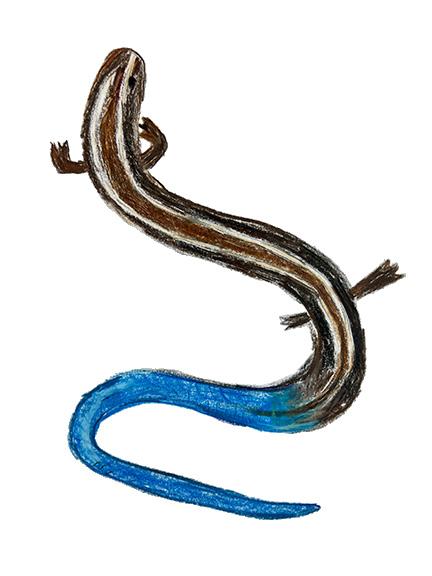
Snowy plovers are remarkably independent and usually can start to care for themselves early.
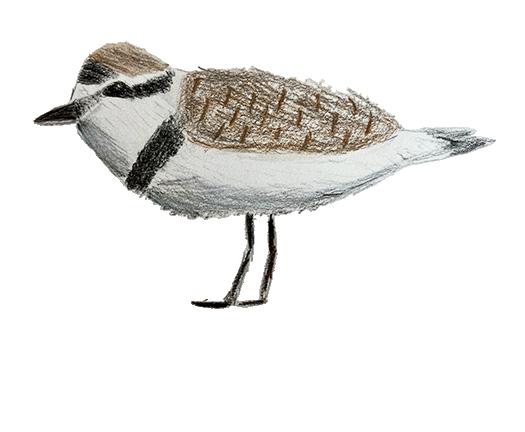
BY TESSA L.
Western snowy plovers, often described as tiny fluffballs on legs, are only about 6 inches long and usually weigh less than 2 ounces. They love eating insects, marine worms, crustaceans, and invertebrates, and they sometimes live on beaches. Sadly, this adorable bird’s population is decreasing rather quickly, and human passersby often accidentally step on snowy plover eggs, due to the plover’s camouflage skills and extremely small size. Snowy plover babies are quite small, only about the size of a human thumb, but their legs do not lengthen as they age. Instead, adult snowy plover legs are the same length as the newborns.
For 2 months every year during the winter, western snowy plovers migrate to quieter beaches, much like how some humans often travel during the summer. I, myself, love to travel, and have been to quite a few places.
One rather memorable time, my family and I traveled to Taiwan. We stayed in a hotel in the capital, Taipei, and had an amazing view of Taipei 101, a beautiful skyscraper so tall that it was the tallest building in the world for six years. I can only imagine how enormous it would look to a snowy plover.
Even though we had jet lag, there were just as many adventures at night as there were during the day. Taipei was full of amazing food, and every couple of days, we visited a night market. Night markets are places where vendors set up stalls in the streets, mostly food, but also souvenirs, like bags, clothing, and sometimes jewelry. There were also games, but I was there for the food. I loved night markets, and my favorite snack there was tanghulu ( ), fruit covered in malt sugar. The night market was full of food and fun, and my sister and I begged our mom to stay just a bit longer, even though it was way past our bedtime.

To us, Taiwan was like another world. My sister and I ran around Taipei 101’s food court, taking in all the beautiful sights and smells, which were fundamentally different from night markets, but we loved them both the same. We visited restaurants and shops all over Taipei, foods that I had never seen before, and foods that I grew up with. Taiwan was not just food, even though I loved the food there. While there, we traveled to museums and saw plenty of artifacts. We also saw some paintings, and one of my favorites was one of birds.
Snowy plovers are remarkably independent and usually can start to care for themselves early. Picture snowy plovers as small children who can walk and talk at a young age. Oftentimes, the mother breeds elsewhere while the father takes care of the chick until it reaches an age where it can care for itself.
Western snowy plovers are only found on the West Coast, hence their name. Only around 2500 live on the Pacific coast, and about 1500 live on California beaches.
Despite being endangered, snowy plovers are amazing creatures.
BY NAAVYA M.
On a cold and windy winter day, a white-crowned sparrow can rest its brown and beige speckled feathers in someone’s backyard, singing a faint song and occasionally stealing a snack from a fruit tree. The songbird is practicing, since next spring, it will mate. It will pass this tradition on to its young, following a cycle of harmonious birds that can put on a concert for an unsuspecting person playing outside.
I picked up my pencil and started drawing in my sketchbook. I wondered what to draw and looked out the window. The big, twisty tree that tangled with the electrical wires had an inhabitant. A small white-crowned sparrow sat in the tree, nestling its wings on a branch. It cocked its head to say, “Hello, who are you?” How sweet. I picked up my pencil and began to draw its bold, white and black striped head, signaling that it was an adult. I could imagine it among all the sparrow species in the world, sitting on a golden throne with its crown perched on its head like it was a regal queen.
Suddenly, a loud, piercing chirp interrupted me. The white-crowned sparrow chirped out a clear whistle. This note was followed by another series of sharp, sweet trills and a long note, which stretched out into the neighborhood. I sat and listened to the patterns of the notes, creating a lovely mating song. Each note was like a puzzle piece; it did not quite fit with other notes, but when one adjusted them just right, they lined up perfectly and fit together to create a lyrical song, full of energy and life, or anger and strife. I listened closely, trying to make out the scene. The bird suddenly stopped and looked right at me with its beady black eyes, its salmon-colored beak pointing straight at me. I opened my eyes wide, scared I had frightened the tiny bird off. It lifted its wings and took off into the sky, flying like a ballerina leaping across a stage. I watched as the white-crowned sparrow flapped its wings, cutting through the air like a rocket. It flew off into the distance, and I squinted as it became smaller and smaller, until it was just a small dot in a sea of blue.
“Goodbye, little bird, I hope you come back next winter with a family,” I whispered, watching as the bird flew off.
Since I moved, I do not see many white-crowned sparrows anymore, but whenever I see one, it reminds me of my old home, of my mom’s soft voice calling me her “little sparrow,” and of that bird I saw flying through the wind all those years ago. I hope and wonder if it is that white-crowned sparrow I promised I would see again. Each time I hold on to that memory, and look out for another one that might just stop by to see me again, and maybe even put on a show as it had for me that cold winter day.
...suddenly stopped and looked right at me with its beady black eyes, its salmon-colored beak pointing straight at me.
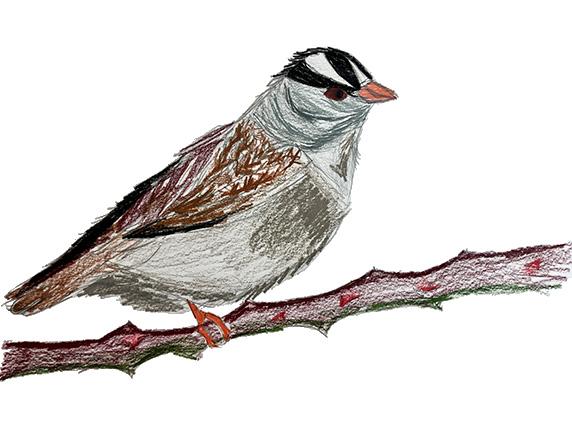
The yellow-eyed ensatina is a natural actor.
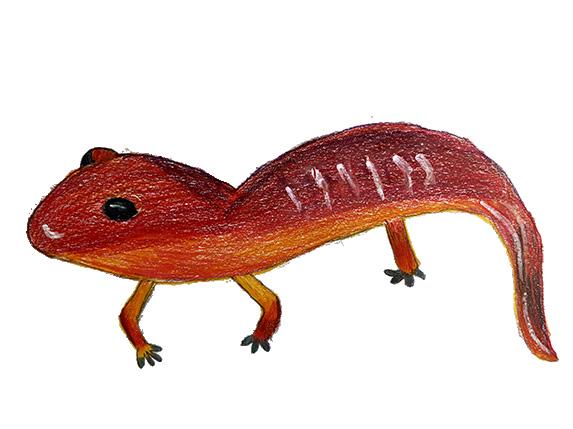
BY TARYN W.
It is one hour until showtime. I am nervous and excited at the same time. I am performing the musical Peter Pan, and my roles are Nana the dog and a Lost Boy. I am rehearsing one last time before the real deal. On my first line, I am scared. All I need to say is, “Woof! Woof!” Even if I know the line super well, it is still hard knowing when to say it. I become more comfortable with the show the more I practice. In the song “I’m Flying,” I am singing my heart out. When I finish rehearsing the show forty minutes later, I am ready to perform.
The yellow-eyed ensatina is a natural actor. They do not do it for fun like I do; they do it for their life. When a predator comes near them, they strike a pose to pretend they are a California newt. Unlike the California newt, the yellow-eyed ensatina is not poisonous. They have to chew on the scenery so they do not die. The yellow-eyed ensatina is brown on top and orange on the bottom, with yellow markings around its eyes, leading to its name, yellow-eyed ensatina.
When going on hikes, I always check streams, rivers, and lakes for ensatinas. I look for logs or fallen branches, and flip them over to see if there is an ensatina underneath. Ensatinas are found in high elevations, from 520 to 2,400 meters. But I check anyway. The yellow-eyed ensatina is one of the most common salamanders in North America. They live near the California coast and in the San Francisco Bay Area.
Now, it is time for the real show. I am in the first scene of the show. I see at least 100 people watching, probably more, but I am too scared to think about it. “Nana, do I have to go to bed?” Michael said.
That was my cue, I replied, “Woof! Woof!” I did it! I am becoming more and more comfortable performing in front of a large crowd, as the scene keeps rolling along. It is time for “I’m Flying.” First, I dance, but then I start singing louder and louder. While I am singing and dancing, the lights are dancing on the stage along with me. Soon, I grow quiet and head backstage for the end of the song.
It is time for me to come out again, but as a Lost Boy. The pirates chase the Lost Boys, who chase the Brave Girls, who chase the pirates. In the next scene, Tiger Lily and the Brave Girls dance. When the Brave Girls finish, Wendy falls from the sky and becomes the Lost Boys’ mother. Peter Pan saves Tiger Lily, and the Lost Boys and Brave Girls become allies. The show ends with Peter Pan defeating Captain Hook. The cast and I all take our bows.
Every time I see an ensatina, I think of how I love acting, and I am an actor just like them. I cannot wait for next year to do another show.
The Nueva School fifth-grade class would like to express our deep appreciation to…
World of Wonders writer Aimee Nezhukumatathil and illustrator Fumi Nakamura for inspiring these pieces with their marvelous work.
Our teachers Cristina Veresan, Becky Turner, Nina Osborne, and associate teacher Addison Eftekhari for their guidance during this collaborative project.
Ninth-grade student Kylie E-M. for managing the manuscript production with Cristina, digitally editing the artwork, and providing exceptional graphic design including the cover.
Educator and author Cliff Burke for co-developing this wonder essay curriculum with Cristina Veresan during his time at Nueva.
Fifth-grade parent Dilnavaz Bamboat for her careful copy-editing of the manuscript.
Ninth-grade student Lucia v.G. for her assistance with digitally editing artwork.
Middle School Head Karen Tiegel, Assistant Middle School Head Toni Setteducato, and Assistant Director of Communications Rachel Freeman for their enthusiastic support of this book.
Digital Communications Manager LiAnn Yim for her design of the original 2021 Bay Area Wonders: In Praise of Redwoods, Sea Otters, and Other Astonishments volume and her ongoing guidance to the design team.
Our families for providing us with opportunities to find wonder in the natural world.