NOVEMBER 12, 2025
VOLUME 9, ISSUE 2
Dissent and Discussion
Need a sip or snack?
Bridging Communities
It's time to lock in....
A Golden Effort See a 25-foot Golden Gate Bridge walking around campus on Halloween? Two sophomores explain how they pulled it off.
An assembly about antisemitism draws mixed responses from the student body.
Newly opened Sidewalk Juice offers fresh smoothes, pressed juices, and acai bowls.
A look inside the partnership bewteen Nueva and Peninsula Bridge, an education non-profit based in the Bay Area.
Nueva needs to put in place measures to counter unauthorized AI use.
News // Page 4
Culture // Page 6
Features // Page 7
Opinion // Page 12
Entertainment // Page 17
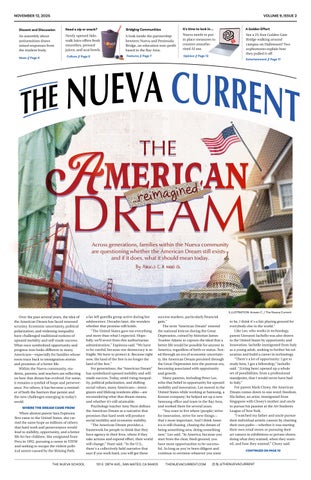
Across generations, families within the Nueva community are questioning whether the American Dream still exists— and if it does, what it should mean today. By: Alexis C. & Neel G.
DESIGN BY: Anwen Chen
ILLUSTRATION: Anwen C. / The Nueva Current
Over the past several years, the idea of the American Dream has faced renewed scrutiny. Economic uncertainty, political polarization, and widening inequality have challenged traditional notions of upward mobility and self-made success. What once symbolized opportunity and progress now looks different to many Americans—especially for families whose roots trace back to immigration stories and promises of a better life. Within the Nueva community, students, parents, and teachers are reflecting on how that dream has evolved. For some, it remains a symbol of hope and perseverance. For others, it has become a reminder of both the barriers that persist and the new challenges emerging in today’s world. WHERE THE DREAM CAME FROM When alumni parent Sara Espinoza first came to the United States, she carried the same hope as millions of others: that hard work and perseverance would lead to stability, opportunity, and a better life for her children. She emigrated from Peru in 1992, pursuing a career in STEM and seeking to escape the violent political unrest caused by the Shining Path,
THE NUEVA SCHOOL
a far-left guerilla group active during her adolescence. Decades later, she wonders whether that promise still holds. “The United States gave me everything and more than what I expected. Hopefully, we’ll revert from this authoritarian administration,” Espinoza said. “We have to be careful, because our democracy is so fragile. We have to protect it. Because right now, the land of the free is no longer the land of the free.” For generations, the “American Dream” has symbolized upward mobility and selfmade success. Today, amid rising inequality, political polarization, and shifting social values, many Americans—immigrants and lifelong residents alike—are reconsidering what that dream means, and whether it’s still attainable. Psychology teacher Amy Hunt defines the American Dream as a narrative that promises that hard work will produce social mobility and economic stability. “The American Dream provides a framework for people to think that they have agency in their lives, where if they take actions and expend effort, their world will change,” Hunt said. “In the U.S., there's a collectively held narrative that says if you work hard, you will get these
success markers, particularly financial gain.” The term “American Dream” entered the national lexicon during the Great Depression, coined by historian James Truslow Adams to capture the ideal that a better life would be possible for anyone in America, regardless of birth or status. Tested through an era of economic uncertainty, the American Dream persisted through the Great Depression into the postwar era, becoming associated with opportunity and growth. Many parents, including Peter Lee, echo that belief in opportunity for upward mobility and innovation. Lee moved to the United States while working at Samsung, a Korean company; he helped set up a new Samsung office and team in the Bay Area, and worked there for several years. “You want to live where [people] strive for innovation, strive for new things— that's most important. And I think America is still chasing, chasing the dream of being something new, doing something new,” Lee said. “In America, because you start from the clear, fresh ground, you have more opportunities to be successful. As long as you've been diligent and continue to envision whatever you want
131 E. 28TH AVE., SAN MATEO, CA 9��03
THENUEVACURRENT.COM
to be, I think it's a fair playing ground for everybody else in the world.” Like Lee, who works in technology, parent Giovanni Iachello was also drawn to the United States by opportunity and innovation. Iachello immigrated from Italy as a young adult, seeking to further his education and build a career in technology. “There's a lot of opportunity: I got to study here, I got a fellowship,” Iachello said. “[Living here] opened up a whole set of possibilities, from a professional standpoint, that I would never have had in Italy.” For parent Mark Choey, the American Dream comes down to one word: freedom. His father, an artist, immigrated from Singapore with Choey’s mother and uncle to pursue his passion at the Art Students League of New York. “I watched my father and uncle pursue their individual artistic careers by charting their own paths —whether it was starting their own retail stores or pursuing their art careers in exhibitions or private shows: doing what they wanted, when they wanted, and how they wanted,” Choey said. CONTINUED ON PAGE 10
@THENUEVACURRENT
P2
|
NEWS
NOVEMBER 12, 202�
|
VOLUME 9, ISSUE 2
|
Dec. 4: Student Life Night From 5 to 7:30 p.m., visit the Upper School’s largest admissions event, featuring food, activities, athletics events, and performances.
WWW.THENUEVACURRENT.COM
|
THE NUEVA CURRENT
Bridging Creativity Learn more about the unique Halloween Golden Gate Bridge costume that doubled as a Quest project. Page 17
By the Numbers REPORTING BY ELLIE L.
100 fake candles at the first dance of the year, homecoming, on Oct. 17. The theme of the event was "A Starry Night."
PHOTOS: The Stanford Daily
Speaking Out
College newspapers across the country stand with The Stanford Daily’s lawsuit against Marco Rubio STORY BY RAYA I.
50+ pumpkins decorated by seniors in an activity set up by senior parents in the Nueva Parent Association (NPA).
108+ collective hours spent by Ravi K. ’28 and Dav K. ’28 making a 25+ foot long Halloween costume of the Golden Gate Bridge
11 jumpscares in the annual haunted house presented by Student Council, on Oct. 28.
PHOTOS: Ellie L. / The Nueva Current, The Nueva School, Freepik
The Stanford Daily, the student-run, independent daily newspaper serving Stanford University, filed a free speech lawsuit against the Trump administration earlier this fall. Fifty-five other student newspapers have since signed an amicus brief, pledging their support of the suit. The lawsuit was filed with the Foundation for Individual Rights and Expression (FIRE) and targets Secretary of State Marco Rubio’s employment of two legal provisions concerning the free speech rights of legal noncitizens. Both provisions are a part of the 1952 Immigration and Nationality Act. The first declares that Rubio has the power to deport legal noncitizens whose speech on campus is considered to oppose a United States foreign policy interest; the second, that Rubio has the ability to revoke visas of legal noncitizens “at any time” for any reason. The Daily and FIRE allege in the suit that the provisions, and Rubio’s application of them, are unconstitutional: every noncitizen’s rights are protected by the First Amendment.
The legal action is in response to the Trump administration’s attacks on student protesters, specifically those on student visas who have publicly expressed pro-Palestinian sentiments deemed by the government to be anti-Israel and anti-American. At Tufts University, a graduate student was
seized by Immigration and Customs Enforcement and detained, following her co-authored op-ed in The Tufts Daily that advocated for the affirmation of the equality and humanity of all people, including the acknowledgment of the Palestinian genocide. Similarly, two Columbia graduate students were arrested in March and April, respectively, both of whom were pro-Palestinian student activists and publicly condemned the war in Gaza. Given this threat to international students, the Stanford Daily has reported a significant decline in the number of international students willing to contribute to
the paper—declining to give interviews, requesting anonymity, leaving the staff, and requesting that their articles and bylines be taken down online. The Daily has stated that their objective and mission as a school paper remains unchanged because of the lawsuit, and that, according to Editors-in-Chief Greta Reich, Ananya Udaygiri, and Lauren Koong, “this was not a political move—journalism exists to hold those in power accountable, regardless of who is in power.” Of the 55 other universities who have voiced support, most of them report cases of international students whose visas have been revoked or threatened, resulting in a campus culture of fear and confusion. “In the United States of America, no one should fear a midnight knock on the door for voicing the wrong opinion,” Conor Fitzpatrick, an attorney for the FIRE Legal Network working with Stanford, said. The lawsuit is currently pending in the U.S. District Court for the Northern District of California.
The Daily Princetonian
The Cornell Daily Sun
The Brown Daily Herald
“We believe this brief … persuasively conveys the extraordinary challenges that student newspapers across the country have faced since January — and that the brief benefits from the support of a diversity of student media organizations, including our own.”
“Independent student journalism exists to build a historical record and to keep institutions accountable. Once protected speech becomes a punishable offense, both our job and the virtue of our community is compromised.”
“As Brown University’s paper of record, The Herald has a unique responsibility to shine light on the perspectives that shape campus life, while preserving the stories that define our current moment. And we’ve remained committed to this goal.”
Princeton University
Cornell University
Brown University
THE NUEVA CURRENT
|
NOVEMBER 12, 202�
Nov. 24–28 Students and faculty have nine days off for Fall Break—the last vacation before Winter Break.
PHOTO: Anna Rose Layden / Reuters
ANALYSIS
The Federal Government Letdown Why did the longest U.S. government shutdown in history feel so anticlimactic? STORY BY ALVIN Y.
On Nov. 9, eight Democratic senators voted with Republicans for cloture on a spending bill that would bring an end to the longest government shutdown in American history. After 43 days, the anticlimactic vote resulted in no major concessions from Republican legislators. In this issue’s A Fuller Picture column, we examine the role of media in ending previous government shutdowns and how this shutdown differed. During the 1995-96 government shutdown under the Bill Clinton administration, media coverage played a key role in amplifying public dissatisfaction. The Republicans, led by House Speaker Newt Gingrich and Senate Majority Leader Bob Dole, sought to dramatically slow spending, while Clinton advocated for increased funding for education and Medicare. When no agreement was reached by the Nov. 14 deadline, the government shut down. Public opinion quickly turned against the Republicans. According to Gallup, 49% of voters blamed Republicans and Gingrich, while only 26% held Clinton and the Democrats responsible. This pressure eventually compelled Dole, who was in the middle of a presidential run, to compromise with Clinton and end the shutdown with minor concessions. A similar dynamic played out during the 2013 government shutdown under President Barack Obama. That 16-day shutdown was sparked by a Republican-led effort to delay or defund the Affordable Care Act, also known as Obamacare. During those two weeks, President Obama repeatedly used public addresses to frame the shutdown as a threat to Americans, sharing stories of workers affected by the crisis, and concluding each message with an urge for Congress to negotiate. This strategy successfully generated pressure on the Republicans and ultimately led to a favorable agreement for Democrats. Unlike these past examples, the Trump administration did not attempt to wield public pressure through a full media offensive in this shutdown—rather, President Trump primarily communicated on Truth Social, reaching a narrower, more partisan audience. Throughout October, his administration’s focus shifted from a ceasefire in Gaza and the Nobel Peace Prize to the demolition of the White House East Wing, with the shutdown out of the national spotlight until mass flight delays brought it to the fore of news coverage this past weekend. The contrast between past and present shutdowns highlights how public pressure and media can influence political outcomes. In previous instances, a combination of public pressure, media attention, and strategic messaging compelled politicians to negotiate and reach agreements. This time was different. After more than a month of apathy from the administration and Congress, the increasing costs of inaction led to a resolution that left both parties basically where they were before the shutdown began.
|
VOLUME 9, ISSUE 2
|
WWW.THENUEVACURRENT.COM
Golden State Politics Former Speaker and longtime San Francisco congresswoman Nancy Pelosi announced her retirement on Nov. 6, opening up a highly competitive race for her successor.
|
P3
NEWS
Colleges across America respond to Trump’s “Compact” Many rejected federal funding opportunities, worrying about academic independence STORY BY ALVIN Y.
In early October, President Trump’s “Compact for Academic Excellence in Higher Education” was offered to nine universities: Massachusetts Institute of Technology (MIT), University of Texas at Austin (UT Austin), Vanderbilt University, University of Virginia (UVA), University of Southern California, Brown University, University of Arizona, Dartmouth College, and the University of Pennsylvania. The compact calls for the reconstruction of universities’ admissions processes and campus life; it requests that schools eliminate race-based admissions, create more space for conservative ideas to exist, and reinstate mandatory testing, among other conditions. Trump’s compact extended the requisite conditions from a smaller set of compliance laws to broader questions of campus policy and culture, a change from decades of federal support for universities. The compact also requires universities to enforce a “Marketplace of Ideas & Civil Discourse.” Specifically, it calls for the “removal of any institutional units that purposefully punish, belittle, and even spark violence against conservative ideas,"
Independent Thinking Sally Kornbluth, MIT's President, at a Commencement ceremony in 2024. // PHOTO: Brian Snyder / Reuters
while also forbidding disruptions that impact classes or harass students, and prevent violence from occurring. Institutions that accept and agree to the compact will receive “preferential funding,” where the Trump administration is more likely to provide them with federal funding compared to the universities that decline the offer. The deal itself comes in the wake of the government’s cutting of education funds and targeting of universities such as Columbia and Harvard. Upper School history teacher Simon Brown’s initial reaction to the college compact was to compare it to other instances in history when the federal government mandated universities to agree to a deal, such as the Loyalty Oath during the Cold War and the Red Scare. “I'd also say this proposed deal is even more divisive than during the Cold War; most people in America then agreed that communists or subversives are a problem and they should be excluded from the university,” Brown said. “In this case, it’s a very controversial imposition on universities. It's meant not just to restrict the most radical speech, but also,
from what I can tell, tries to promote a degree of conservative speech in universities.” Among the nine colleges that were offered the deal, seven have declined the original offer, with Vanderbilt and UT Austin still considering it. Leaders from those seven institutions cited concerns around the violation of the First Amendment and threats to academic freedom. Additionally, the universities that declined have stated that the administration’s concern about the lack of conservative ideas felt unnecessary, as the universities state they have already supported spaces for conservative ideas. “In our view, America’s leadership in science and innovation depends on independent thinking and open competition for excellence,” MIT President Sally Kornbluth wrote in her letter to Secretary of Education Linda McMahon. “In that free marketplace of ideas, the people of MIT gladly compete with the very best, without preferences. Therefore, with respect, we cannot support the proposed approach to addressing the issues facing higher education.”
Something Fowl on the Horizon Foster City implements new goose management plan STORY BY SENYA S.
Foster City’s greatest nuisance: Canada geese. Well, at least that’s what the city’s latest endeavor seems to indicate. On Aug. 4, Foster City greenlit a pilot program for its goose management plan. This comes after a previous iteration of the plan— where federal permits were acquired to kill 100 geese—was halted three years ago due to massive public backlash. The pilot program will cost an estimated $428,000 and aims to deter geese from frequenting seven parks that
border the Foster City lagoon. If the program is deemed successful, the overall cost of the goose migration plan is projected at $1.2 million. Advocates for the plan assert that geese are a nuisance to public spaces. According to city data, over 400 pounds of goose feces are dropped daily in Foster City parks, blocking paths and negatively impacting the lagoon’s water quality. Concerns of bird flu have also been raised. The pilot program has ILLUSTRATION: Senya S. / The Nueva Current
three phases. The first: observation and surveillance. This phase, which started in October, entails goose tracking cameras placed in trees to monitor the avian’s population. Phase two—deployed in early November—is tracking. Select birds will be banded around their feet and neck to track their movements. The goal of this phase is to gain a further understanding of where Foster City geese frequent. Phase three begins full goose deterrence. Nonviolent and nonlethal bird deterrence strategies, including handheld lasers, tree-mounted speakers that play aviary calls, aerial drones, fogging, and a trained dog and handler, will be employed. Additionally, during nesting season egg addling—the rendering of eggs non-viable—is set to occur. The city council hopes these strategies will once and for all deter geese from frequenting Foster City.
P4
|
NEWS
NOVEMBER 12, 202�
|
VOLUME 9, ISSUE 2
|
Nov. 13: Civil Discourse Practicum The next round of civil discourse programming will occur during advisory time, with discussion spaces for a variety of topics. Students select which session they join.
WWW.THENUEVACURRENT.COM
|
THE NUEVA CURRENT
The Future of Civil Discourse Read more about further civil discourse programming, in Jackson H.'s critical examination. Page 14
Guest speaker addresses line between antisemitism and legitimate criticism of Israel First mandatory civil discourse session draws discussion and dissent STORY BY ELLIE L.
At an all-school assembly on Nov. 5, Upper School students heard from Valerie Rutenberg, a representative from StandWithUs, who spoke about antisemitism and how to distinguish it from legitimate criticism of Israel. The event was part of Nueva’s ongoing civil discourse programming. Head of Upper School Liza Raynal characterized the assembly as an “upskilling,” an exercise in understanding how to be better participants in civil discourse. “We wanted [the assembly] to be a chance for people to learn something about how people experience antisemitism—that maybe they knew, maybe they didn't. Then we could have some shared understanding before engaging in challenging topics,” said Raynal, referring to the upcoming civil discourse practicum on Nov. 13. "Perhaps some people were disappointed that this speaker didn't want to talk about [geopolitical] conflict, but that wasn't what she was here for. That is the plan for next week.” StandWithUs, also known as the Israel Emergency Alliance, is a nonprofit organization that describes itself as dedicated to combating antisemitism and educating the public about Israel. The group was chosen due to a number of considerations, such as the speaker’s expertise and ability to talk to high school students, distinct from other organizations they talked to. Prior to the assembly, some students circulated a flier—both on social media and in person at the Caltrain station— sharing information about StandWithUs’ pro-Israel stances and tactics. The flier noted the organization’s controversial actions on college campuses, which critics have condemned as alleged harassment, doxxing, and misinformation. The flier included a link to sources for further reading and denounced the school’s choice of speaker, stating, “We cannot begin talking about civil discourse with an organization that wants it shut down.” Lily Z. ’28, one student involved with the creation of the flier, shared that the group of students took issue with the assembly being described as a “training” in prior emails and presentations. They were skeptical of such framing and its implied neutrality after learning that the speaker was affiliated with StandWithUs. “We just wanted people to think critically about the decisions that the school is making. It’s not even so much that we wanted the school to not bring in the speaker—we strongly objected to the way that the speaker was introduced and presented to us,” Lily said. Raynal addressed the “energy” surrounding the assembly a few hours prior to the event via an email to students, faculty, and staff. Raynal described the assembly as one step towards engaging in difficult, challenging civil discourse, and was not about silencing criticism, but rather raising awareness around “the difference between structural criticism and identity-based harm.” In addition, Raynal stated that the school “will not and
"UPSKILLING ASSEMBLY" Valerie Rutenberg addresses the Upper School. // PHOTO: Kayla L. / The Nueva Current
does not align with [StandWithUs] or any organization.” In opening the assembly, Upper School Equity and Inclusion Coordinator Evan Vaughan encouraged the Upper School student body to “[listen], not to respond, but to really digest and put ourselves in the shoes of someone else.” Rutenberg began her presentation by acknowledging that the topic is emotionally charged and complex. “I know there are a lot of preconceived notions in this room about what it is I am or am not going to say,” she told students. She emphasized that her talk was focused on antisemitism, not to comment on any particular stance in the Israel-Palestine conflict. Rutenberg traced the historical roots of antisemitism—from ancient accusations like “blood libel” and demonization to modern conspiracy theories—and explained how these ideas continue to shape stereotypes about Jewish people today. She also offered examples of what she felt were legitimate, non-antisemitic criticisms one might make against Israel. “What might seem on the surface like rhetoric or commentary has historically led to the violent killing of Jews,” said Rutenberg, adding that this history of antisemitism is something that Jewish people “carry in their bones.” Addressing the tension between anti-Zionism and antisemitism, Rutenberg said misunderstandings often arise over understandings of Zionism, and she included her definition of Zionism as the “majority-held” belief in the right of Jews to self-determination in their indigenous lands. “Whoever you’re talking to, ask them questions,” she urged. “Don’t assume what they mean.” After her presentation, Rutenberg engaged with student questions, which ranged from the intricacies of wording around the Israel-Palestine conflict—for instance, Rutenberg asserted that the use of the word “genocide” was not antisemitic, though she disagreed with the term itself—to her own experiences with antisemitism, such as her fiancé’s brother repeating a conspiracy theory that Jews caused Covid-19. She closed by thanking students for
their respectful questions and listening, staying for some extra time after the assembly to engage with additional questions and discussion. “A lot of [your questions] came from a really sincere place where you want to stand up for justice everywhere, and I think that’s beautiful,” Rutenberg said. “I just want to make sure that you’re doing so in an environment that is safe and mutually respectful.” Reactions to the assembly were mixed. Some students said that they appreciated the clarity and context the speaker gave— one Jewish student said during the Q&A portion that he appreciated having the assembly and that he felt seen. Although the assembly was not intended to address the Israel-Palestine conflict, it remains a sensitive topic that many students find difficult to discuss without sparking intense disagreement, fear of misunderstanding or offense. Several students requested anonymity due to discomfort with sharing their views publicly. “This was a phenomenal speaker. She did a great job distinguishing her views from the views of the group she’s affiliated with and being unfazed by complex questions,” a senior said. “I hope that students walked away—and I believe that many students did—with an awareness of the deep history behind a wide array of both antisemitic tropes and comments about Israel.” However, other students took issue with how Rutenberg defined Zionism and applied that definition to examples of antisemitic discourse. They also voiced dissatisfaction with what they perceived to be deflections of questions regarding Zionism in the academic context and StandWithUs. “I was disappointed in this choice of presenter. I don't know how we can expect a pretty well-known right-wing organization known for shutting down campus protesters to be conducive to proper neutral discussion, and especially one that makes everyone feel safe,” Max E. ’26 said. “I also don't think that we can brush away the controversial aspects of the assembly just because there were some good parts with the history.” One junior characterized the assembly
as biased, criticizing what they saw as unnuanced statements being presented as fact. “It seemed like the goal of this assembly was to change people's minds and not to educate them,” said the junior, who observed a similar lack of nuance amongst student reactions after the assembly—not in the opinions themselves, but in the lack of diverse viewpoints. “Even for people who haven't been as vocal about any of these topics before, it seems like there's either a strong satisfaction or dissatisfaction with the assembly, and with each other’s reactions. There’s tension,” the junior said. “After leaving, I felt like we were more divided than before.” Students remain divided on the efficacy of similar assemblies going forward. The senior pointed to what they perceived as “a surge of hostility” in response to the assembly as reason for concern about comparable sessions in the future. “Many Jewish students felt very uncomfortable with their peers’ response—it highlighted how much work needs to be done to make sure all participants feel safe at future assemblies,” the senior said. Tarun M. ’26 noted the importance of assemblies that discuss prejudice and discrimination. “Antisemitism, Islamophobia, racism, sexism—we need all these topics covered. And I think it's important to have the space and proper respect for each one,” Tarun said. “Going forward, I think that when we're trying to come at an issue at face value, not from a specific side [on the conflict], we need an organization that does not have a background of clearly taking one side.” Another senior who attended the assembly described the session as "significant," and worth continuing. “I did somewhat go [into the assembly] looking for something to disagree with, but I did really find value in just hearing a new perspective, which I think is something that [students] have consistently asked for in the past,” the senior said. “I hope we have more opportunities for difficult conversations like this.”
|
NOVEMBER 12, 202�
Fresh Albums This November, listen to “Lux” by Rosalía and “Everybody Scream” by Florence + the Machine.
Pop Culture Thermometer On a scale from freezing to blazing hot, here's the latest in pop culture
|
VOLUME 9, ISSUE 2
|
WWW.THENUEVACURRENT.COM
Submit to LitMag! Scan the QR code on the flyers around campus for a chance to have your work featured in this winter's mini-issue. Submissions due Nov. 16.
|
P�
CULTURE
In One Battle After Another, Every Fight Is Personal
PHOTO: IMDb
THE NUEVA CURRENT
Paul Thomas Anderson’s newest film turns America’s landscapes into stages for grief and resistance.
STORY BY CALLUM S.
PHOTO: Dazed
BLAZING HOT: ANOK YAI WINS MODEL OF THE YEAR After closing for Ralph Lauren, Fendi, Vetements, and more, Anok Yai winning Model of the Year feels nothing short of earned. She didn’t just dominate the runway; she starred in major campaigns and condemned the industry’s tokenistic approach to diversity. In an environment that won’t hesitate to expel those who speak up, Yai is rewriting the rules and still winning on her own terms.
Kendrick Lamar leads the 68th annual Grammys with nine nominations. GNX is anchoring nearly every major category—for good reason. The nearly year-old album is rich, commanding, and bends its different genres to perfection.
PHOTO : Reuters
WARM: KENDRICK LAMAR LEADS GRAMMY NOMINATIONS
COLD: MISS UNIVERSE PAGEANT CONTROVERSY At the 2026 Miss Universe pageant, hosted in Thailand, executive Nawat Itsaragrisil publicly berated Miss Mexico Fátima Bosch by accusing her of “sabotage” and calling her a “dumbhead” on livestream. When Bosch tried to respond, he called security to remove her, and her fellow contestants walked out in solidarity and—thankfully—Itsaragrisil was swiftly barred from all future events. PHOTO: RUNGROJ YONGRIT/ People.com
FREEZING: MARIAH CAREY'S CHRISTMAS CAMPAIGN Mariah Carey’s annual Christmas “defrosting” on the first of November hit a sour note this year. Her new Sephora campaign was an extravaganza of crystal sets, luxury makeup, and complete obliviousness. The ad mocks elves striking over harsh working conditions—a tone-deaf jab at the working-class struggles many Americans face. Carey’s attempt at festivity instead exposed her own snow globe of unawareness.
PHOTO: Sephora Newsroom
STORY BY RAYA I.
Midway through One Battle After Another, an aging revolutionary yells into a pay phone frantically trying to find his missing daughter—except he can’t remember the secret password that will confirm he is a member of the leftist rebel group whose members he is contacting. It’s moments like this one that make One Battle After Another shine. The film is packed with action, but also with moments of profound emotional tenderness; relationships are its beating heart, around which weighty themes of power, freedom, race trauma, and political warfare coalesce. The dystopian adventure is divided into two chapters, sixteen years apart. The first, set in an alternate America in which far-left revolutionaries rebel against an authoritarian government, opens at an immigration center on the US-Mexico border. There, a revolutionary group—the French 75—frees detainees, sets bombs, and arrests the man in charge, Colonel Steven J. Lockjaw (Sean Penn). The mission is led by the volatile, outspoken revolutionary Perfidia Beverly Hills (Teyana Taylor). But the French 75 isn’t invincible. Sixteen years later, thwarted by systems of government and authority they are unable to break apart, the organization has faded and Per-
fidia has run away. Meanwhile, Pat, now Bob, and his daughter, Willa (Chase Infiniti), are living secluded in the NorCal redwoods. Willa is a smart, sarcastic teen, but the normalcy she tries to cultivate is a thin cover for a life of self-defense training, paranoia, and the caretaking of her addled father. Despite his reliance on substances and her chafing at the rules, though, Willa and Bob love each other fiercely. Their relative stability changes when Lockjaw reappears, hell-bent on removing any trace of Willa and shattering their world. The second chapter of the movie follows this harrowing hunt, populated by a colorful cast of characters, with Sensei Sergio St. Carlos (Benicio del Toro), Willa’s karate teacher, being the most endearing—a calm contrast to the chaotic, blustering Bob. Although Bob wants to protect Willa, he is bumbling and incompetent (also surprisingly funny), unable to cull her independent streak—ultimately, Willa fights her battles on her own. These battles are set across California, with scenes in El Paso, Texas. One Battle After Another is fundamentally rooted in the notion of setting, both physical and not. It is undeniably visual: the outline of a body on a rooftop, the lush, hazy redwoods where Bob and Willa live, the muted sterility of various bathrooms
and hospitals, the warm messiness of a lived-in home, the dull concrete of immigration centers where the brightest things are Mylar blankets, the dusty, winding Texas road on which a brilliant (and horrifying) car chase takes place. But setting in One Battle After Another is also about spheres of power, and how they generate conversation and action. For example, chilling conversations about dominance, racial purity, and war happen in the hushed office of a group of racist extremists into which Lockjaw desperately yearns to be accepted. In contrast, Willa’s reckoning with her past—and the choices that her parents made—echoes off the walls of a cavernous church in the middle of the desert, a part of a convent where she is hidden by an old revolutionary ally in hopes of escaping Lockjaw’s manhunt. And her parents’ revolution was one formed on the margins, with the aim to disrupt and destroy an authoritarian government through force, not roundabout political rhetoric. It is this obsession with setting that fuels One Battle After Another, and allows it to probe such a diverse set of issues—politics, parenting, freedom, community—without feeling incoherent or overly ambitious. The locations, both physical and philosophical, give color and urgency to the battles of individuals and communities that are at its core.
A Lovatic’s Take on It’s Not That Deep
Why I think Demi Lovato’s newest album is exceptionally electric STORY BY KAYLA L.
Electronic-enhanced, rarely artificial vocals. Sultry, sweet, and simple lyrics. Pulsing basslines. A cohesive narrative that skims—without plunging into—emotional depths. Demi Lovato, to my slight surprise, is delivering above and beyond. In Lovato’s most recent album, It’s Not That Deep, she offers 11 tracks that are refreshingly easy to sing and dance along to (yes, I did test dance-ability while preparing this review). Lovato succeeds in transcending her past creative work through luminous sounds and lightweight storytelling. Admittedly, when Lovato first released her hyperpop album singles—“Fast,” “Here All Night,” and “Kiss”—I did immediately wonder if the rest of her album would fall victim to the trend of over-production evident in recent pop albums like Charli xcx’s BRAT or Lady Gaga’s Chromatica, which I’ve mostly found to be suffocating. Yet, Lovato thrives in the dance-pop genre, because her rich vocals pierce through synthetic tones and beats; she doesn’t require filtering to sound like a Grammy-nominated singer. And though Lovato traditionally tends toward punk, pop, and R&B sounds, her ever-powerful voice introduces an essential grittiness to the slippery, stylized vocals common in electronic styles. Lovato also evolves from the heavy storytelling strategy of her past work. Even as a diehard Lovatic, I admit that the power ballads of her two most recent albums Dancing with the Devil and HOLY
FVCK were hard to listen to. Lovato dropped graphic details about her substance abuse, abusive relationships, a near-fatal overdose, and identifying as a piece of bloody meat. Lovato’s lyricism was vulnerable and brave— but dark. On It’s Not That Deep, life is brighter: Lovato dedicates the album to (sober) partying, getting over heartbreak, and falling into a love with “somebody who can match [her] frequency,” as she chants in “Frequency.” In other words, if “Dancing with the Devil” and “HOLY FVCK” are haunted houses jailing Lovato’s worst demons, “It’s Not That Deep” is a disco club to celebrate—but not erase—overcoming unimaginable pain. Initially, I wondered if the lyrics were too repetitive and unpoetic. Lovato sings “f*ck up the vibe” 27 times on “Frequency,” works in the phrase “a little bit” 25 times in “Little Bit,” and talk-sings “Li-li-lilike what? / Li-li-li-like this” eight times in “Kiss.” But the more I listened, the more I grew to appreciate Lovato’s phrasing. An album titled “It’s Not That Deep” can rightly contain more shallow and sensual lyrics, and they reinforce the easy listening experience. The songs feel fast and fo-
cused, and almost every one is less than three minutes long. The brevity is persuasive: even if there are a million issues in Lovato’s life—in my life—surely, we can take a pause from our stressors and “talk a little bit, touch a little bit, move a little bit.” Doses of fun are not superficial but essential to protecting our peace. Noticeably long and unique to this album is “Ghost,” a stunning song that satisfies my annual craving for a Demi Lovato power ballad. Lovato slows it down for the album’s last track, and she sings serenely to her lover: “I hope we’re falling for eternity.” Lovato has a newfound fear of outliving her just-married husband, Canadian singer Jutes, but she knows that the couple’s love will transcend dimensions: “I hope you flicker the lights / And send a chill down my spine, so cold / Wanna be haunted for life by your ghost.” Honestly, I will be haunted by these delicate, poignant lyrics for a lifetime. I am floored by Lovato’s beautiful, experimental sonic storytelling. Though the name suggests otherwise, It’s Not That Deep just may be Lovato’s most profound album yet. She is acutely aware— not ignorant—that the public has watched her repeatedly spiral into depression and disorder. And yet, she loves loudly and parties joyfully, lighting a fuse for the future of her artistry and reputation.
PHOTO: Island Records
P6
|
CULTURE
NOVEMBER 12, 202�
|
VOLUME 9, ISSUE 2
|
Nov. 7: GrandSLAM Director of Equity & Inclusion Shawn Taylor recently performed in the open mic Bay Area GrandSLAM Championship.
WWW.THENUEVACURRENT.COM
|
THE NUEVA CURRENT
Coming Soon The highly anticipated musical-movie Wicked: For Good, starring Ariana Grande and Cynthia Erivo, will be out in theatres starting Nov. 21.
Finding Frequency New course Sound Experience is changing how students hear the world STORY BY OLIVER L.
Two to three times each week, Upper School music teacher Max Cowan makes the 52-minute commute from Berkeley to teach only one block of his elective: Sound Experience. With the class in its first year, Cowan is excited to dive into the nuances of sound perception even as he continues to fine-tune the elective’s direction. “The idea [of the class] was to include musicians and non-musicians in an environment where we could learn how to manipulate sound based on the principles of auditory perception,” Cowan said. A professional performer with an extensive performing career, Cowan has spent decades giving live performances and sharing his passion for sound through music. Now, he aims to share his love for sound through teaching sound history and techniques to the nine Upper School students in Sound Experience. Similar to other performing art courses
“SOUNDS HAVE ALWAYS BEEN A BIG PART OF MY LIFE. THIS CLASS GAVE ME AN OPENING INTO A WORLD OF MUSIC AND SOUND.” in its incorporation of imagination and technology, the course shifts away from the sole focus on producing songs and expands on the umbrella term of sound itself. Inspired by his curiosity for sound’s history and impact in life, Cowan aims to use Nueva's new music studio and API
Box 2 board to enhance how students interact and produce sound. “The whole point of the class, from my perspective, is to offer students an opportunity to work with sound,” Cowan said. “We spend a lot of time experiencing sound, and I want to integrate that experience when creating with it.” Cowan was initially unsure how the elective would be received and if anyone would sign up at all. For Yazzie A. ’29, Sound Experience was first in her course request form, and she was elated when she got in. “Sounds have always been a big part of my life,” Yazzie said. “I am constantly distracted by what is going on and how we perceive it to be going on, and this class gave me an opening into a world of music and sound.” Assignments focus on projects that challenge students in engaging with how sound alters perception, including recording seemingly random noises and turning them into soundbites for short films. Recently, students recreated a Star Wars scene by transforming their own recorded sounds. Oliver S. ’29 noted how the preproduction of adding sounds into a movie clip changed his perspective on how screenplay editors include sound into films. “One thing I thought was really interesting was that although Star Wars is filmed in space, many of us chose to incorporate wind,” Oliver said. “Sound doesn't happen in space at all, but it just makes sense in our brains, and without it, the scene felt off.” Cowan has helped his students into an editorial and evocative style of thinking through Logic, a digital audio workstation. The idea that people's minds fill sound with emotions and memories is central to
PHOTO: Callum S. / The Nueva Current
Sound Experience. For Cowan’s students, this means seeing past the isolated noises. Abela noted, “I'm not thinking of the sound individually. I'm thinking of an emotion, an object, or something like that. But I don't think about the actual sound itself.” Through building the foundations of linking emotion and memory to sound, deeper questions arise: “How do we hear stuff now from a new perspective? How do I manipulate the things that are already in my environment?” Cowan asked. “Soon, we're going to be talking about concepts around music and emotion and some broader perceptual phenomena, such as how we interact in conversations with language.” Cowan’s enthusiasm for learning how people perceive and interact with music resonates with his students as well.
“I feel like this class actually gives me a new window into how our perception of sound changes how we emotionally interact with it, and therefore it might impact us,” Elie W. ’26 said. “It’s changing how I interact with writing music.” In addition to being engrossed with different interpretations of music, Elie emphasized the class’s sense of community: “I think it's a very collaborative environment, but we also have a lot of fun because of how small the class is. I think it gives us room to engage in the weirdness of Sound Experience." As the semester progresses, Cowan hopes that students will continue to bond over the music and sounds around them and listen with deeper insight and understanding of the frequencies and their purpose.
Sidewalk Juice: Worth the Walk and Wait New Bay Meadows shop dazzles with luscious flavor combinations STORY BY ELLIE L.
The key to any successful bowl is balance. At Sidewalk Juice, that perfect union is found, in a bowl of pitaya and acai bases, piled high with granola, pearly shredded coconut, and heaps of berries. No one ingredient is overpowering. Instead, all the components of the bowl meld together perfectly, offering a fresh mix of fruity and earthy flavors. As a San Francisco based franchise, Sidewalk Juice expanded into San Mateo at the beginning of October, replacing Bay Meadows staple ice cream shop, Humphrey Slocombe. Only a few blocks from school, sandwiched between Blue Bottle and Bache, the store is open for a full twelve hours, from 7:30 a.m. to 7:30 p.m. Its menu is multifunctional, good for a breakfast run (perhaps, paired with an oat milk latte from next door) or late night treat. Its offerings are vast yet consistently refreshing, from creamy banana smoothies to avocado toast to refreshing green
juices. The prices are a bit high: acai bowls are $15 each, smoothies are $11 each ($10 for vegan smoothies), toasts range from $10-$13, and just-blended juices are $11, with the already bottled juices at $10. Despite its name, the juices are certainly not the highlight of its menu, as they lack any special quality, or any innovative blends. The Purple Energy combination of apples and beets was a welcome cold drink, but any lemonade or basic ginger shot would have fulfilled the same purpose. Given the prices and time it takes for a juice to get freshly
blended, the juices simply aren’t worth it. However, the rest of the menu is populated with delightful items that earn their place. It might take a few extra minutes for each item to be prepared, but the flavors are actually worth the time (and money). The bowls and toasts offer an excellent array of fruit and nut butters, and unlike Jamba Juice or Pressed Juicery, their smoothies are smooth and not excessively sugary. No single component or topping is special on its own. Sure, the strawberries are consistently fresh and sliced into small, perfect-sized chunks. Magenta and creamy, the pitaya base is refreshing.
PHOTO: Sidewalk Juice
And the bread has a great crunch to it, never soggy. But it is the balance of these elements that melds textures and taste profiles together—sweet strawberries with the earthy acai base, soft pitaya cream with the brittle golden granola, slices of bread spread with honey and peanut butter—and establishes Sidewalk Juice as a fruitful stop. The shop itself is minimalistic and stark, with dual countertops and stools, and a little space for a line to form. Sidewalk Juice works well for a pit stop and conversation overlooking the little silver courtyard nearby, just as it is easily enjoyed as a take-away snack, scooped up in the car. In the store, there’s some extra fun in watching the workers put together each item, albeit a bit loud given the smoothie-making on display. Time will tell if Sidewalk Juice becomes a Bay Meadows staple shop. Still, their items certainly earn a recommendation from this author. Take a chance on a colorful acai bowl or smoothie—it is certainly worth a try.
THE NUEVA CURRENT
|
NOVEMBER 12, 202�
Nov. 19: CSL Day Nueva advisories will participate in community service projects around the Bay—from packing meals to removing invasive plants.
|
VOLUME 9, ISSUE 2
|
WWW.THENUEVACURRENT.COM
Quoted: “[As Nueva students,] we have the privilege to learn in a place where classes are often interactive and collaborative. There’s a responsibility that comes with that. If we can share it, we should.”
|
P7
FEATURES
Pathways Through
Partnership
From summer programs to after-school sessions, Peninsula Bridge and Nueva students build community through learning
STORY BY ANWEN C.
At 3:30 p.m., the walkway to the 2nd Floor Rosenberg patio bursts to life: laughter, chatter, and a swarm of backpacks in motion. It’s another day for Peninsula Bridge’s Middle School Academy program. Near the entrance stands Ms. Sam, the woman in the bright blue T-shirt. She’s the site coordinator for Peninsula Bridge’s after-school program at Nueva, and nothing gets past her watchful eye. While students filter in, she checks attendance, and directs students and volunteers where they need to go. Around her, parent helpers and Nueva TAs gather supplies and flip through activity sheets. The all-hands-on-deck energy is warranted, because today is a special day: activity day. On the second floor, a group of students huddle over bingo cards. Spider cookie decorating and sponge art stations are setting up on the patio classrooms. Down on the astroturf below, a group of kids tee up for a round of tag. It feels like pure fun at first, but every moment fits into a larger mission. Peninsula Bridge is a Bay Area nonprofit that supports more than 900 first-generation, low-income students from fourth grade through college annually. Between the games and the workshops, the organization’s goal remains the same: to expand educational opportunity and, ultimately, college access. Yet what sets Peninsula Bridge apart is its unique, holistic approach. Rather than offering short-term enrichment or one-off programming, the organization commits to 13 years of academic and personal support. During the school year, that commitment translates into twice-weekly sessions hosted on nearby campuses, where middle school students in the program meet for small-group lessons in ELA, math, and financial literacy. The curriculum emphasizes hands-on learning and small-group discussion as a way to keep the students engaged and learning, even after a full day of classes. Bridge runs this model with several partner schools, including Menlo-Atherton and Crystal Springs Uplands. And at Nueva, the partnership has taken on a particular depth. Nueva began opening its doors to Peninsula Bridge programming as early as 2017. But in the eight years since, the collaboration has also grown into strategic support for Bridge’s high school pathway and volunteering opportunities that put Nueva students directly in the classroom as mentors. To Rachel Chen, the Manager of Community Partnerships at Peninsula Bridge,
having those student volunteers is at the heart of what makes the program special. “It's something that we like to call our secret sauce in our programming,” Chen said. “Our students really thrive when they have role models come into our program who can bring that fun and excitement into the classroom.”
At Nueva, one of those mentors is Andy M. ’26. After hearing about the organization through a former middle school teacher, Andy first got involved with Peninsula Bridge as a teen coordinator the summer before junior year. His days were spent setting out snacks, helping run activities, and jumping into games—whatever was needed in the moment. What he found most rewarding, though, were the connections he built with students. “You get to know the kids [and] hear what they’re excited about, what they’re proud of,” Andy said. “You get to watch them become better people.” By fall, returning as a TA during the school year didn’t feel like a decision so much as a continuation. “I felt a responsibility to be a role model figure,” Andy said. “Someone who [the students] actually trust and want to talk to, essentially like an older sibling.” As Andy grew more familiar with the organization, he started looking for new ways to make an impact. During his
A Snapshot into Activity Day Peninsula Bridge students gather around for a game of bingo. PHOTO: Peninsula Bridge
junior year, Andy built an engineering-focused STEM curriculum from the ground up: a three-week course on Lego robotics. By summer, he was piloting the program at Episcopal Middle School. Alongside it, he launched the “Trailblazer Trivia Table,” where students could earn candy by sharing facts, beating him at board games, or reciting digits of pi. Eventually, what started as a way to spark engagement turned into a unique community fixture. “I ended up having a line of like twenty kids every morning,” Andy said. “Some kids really started going to me every morning with ten facts, twenty digits of pi, and then playing me in connect four, or chess or checkers…I'd be playing, like, four games of chess at once.” Back at Nueva, Andy continues to volunteer during the school year. For him, the value of the program lies not just in the act of teaching, but in the process of making sure everyone feels engaged and welcome. “You're walking around, you’re getting to know the kids, and you're building a community,” Andy said. For Wendy E. ’26, that sense of community connection feels a little more personal. As someone who first joined Peninsula Bridge as a middle school student, she remembers firsthand the impact of having mentors and support, and the ways it shaped her own learning.
“EDUCATION WORKS BEST WHEN IT FEELS COLLABORATIVE AND FUN." Now a high schooler at Nueva, she’s looking to spread the favor. This past year, Wendy worked with Isabel Q. ’26 and other co-leads of Systema, a student-led club dedicated to expanding access to hands-on STEM education in underserved communities across the Bay Area. When the club began looking for local partners, Peninsula Bridge stood out immediately. The organizations already shared history, community, and mission. “It felt natural to give back to the same organization that helped me earlier,” Wendy said, “It [was also] nice to connect with younger generations of Peninsula Bridge scholars.” This past April, Systema launched a six-week series of STEM workshops for
Peninsula Bridge students. With the help of faculty advisor Jeremy Jacquot, they blended their own interests in STEM with online resources and experiments. The resulting curriculum was something that made scientific concepts fun, engaging, and most importantly, real. To learn about freezing-point depression, kids could make ice cream in a plastic bag. To learn about the building blocks of life, they could extract DNA from strawberries. With every workshop, what struck Wendy most wasn’t just the curiosity the kids brought to the table, but the ways each student “made each activity their own.” If an experiment stalled, students began troubleshooting together. If an idea sparked, they ran with it. Isabel recalled one group who, after finishing their strawberry DNA extractions, insisted on experimenting with oranges instead. Though it wasn’t part of the lesson plan, the Systema team guided the students through their hands-on exploration. For Wendy, moments like this highlighted the importance of curiosity and creativity in the classroom. “Seeing their confidence evolve and grow over the course of just even one workshop [was] really great,” said Wendy. Isabel echoed that same sentiment. For her, one of the most rewarding aspects was watching students make real-time connections between scientific concepts and the hands-on activities in front of them. “It really showed me how powerful interactive learning can be,” Isabel said. “Education works best when it feels collaborative and fun.” To Isabel and Wendy, the experience has also sharpened their understanding of access and responsibility. At Nueva, interactive learning and mentorship are the norm, but for many students elsewhere, they are a luxury. “[As Nueva students,] we have the privilege to learn in a place where classes are often interactive and collaborative,” Wendy said. “There’s a responsibility that comes with that. If we can share it, we should.”
INTERESTED IN VOLUNTEERING? If you are a Nueva student who is interested in TAing for Peninsula Bridge next spring, please reach out to Nueva’s site coordinator, Sam Espinoza-Valerio. (samantha@peninsulabridge.org)
P8
|
NOVEMBER 12, 202�
FEATURES
|
VOLUME 9, ISSUE 2
|
WWW.THENUEVACURRENT.COM
Dec. 5-7: Upper School Fall Play Join us for a production of Shakespeare’s A Midsummer Night’s Dream! Tickets available now—scan QR codes around campus.
|
THE NUEVA CURRENT
Excerpt: “This was the perfect opportunity to say that I’m not just watching bad things happen—that I can be part of a solution.”
Students join "No Kings" protests
Nueva community members reflect on what drew them to the protests and what they took away from the experience STORY BY AVIVA S. & NATALIA R.
Since June 2025, “No Kings” protests against the Trump administration have swept across the country. Organizers say the movement is meant to offer a peaceful but powerful statement against what they view as an abuse of presidential power. On Oct. 18—now referred to by organizers as “No Kings Day—thousands of demonstrations took place across the country. In San Francisco, hundreds of protesters gathered on Ocean Beach to form the phrases “NO KINGS” and “YES ON 50,” referencing Proposition 50. Members of the Nueva community joined protests throughout the Bay Area, describing a largely positive atmosphere and a shared commitment to peaceful demonstration.
ANDY M. Andy M. ’26 attended a protest at Hillsdale that was much smaller than the demonstrations in bigger cities, but still held its own in terms of positivity and energy. “It was really exciting,” Andy recalled. “I think a lot about politics all the time, but I haven't really been to rallies to express my political opinions before.” The signs reflected a mix of urgency and wit, as protestors used humor to engage with the seriousness of their cause. Andy's sign read “FROGS AGAINST ICE” in reference to a protester in Portland dressed up as an inflatable frog who got pepper-sprayed by federal agents. The frog has since become a symbol of resistance to government officials such as White House Press Secretary Karoline Leavitt, who have labeled the No Kings protesters as ‘terrorists’ and ‘violent criminals.’ Demonstrators have embraced this symbolism by wearing inflatable frog costumes, along with a variety of other blow-up animal outfits. “It's really hard to say that [the protesters are] terrorists if they're bouncing around in frogs,” Andy said.
ELIE W. The sound of drums echoed down Market Street as the crowd moved forward: steady, insistent, impossible to ignore. To Elie W. ’26, the rhythm captured the spirit of the day. “It felt like a parade,” Elie said. “There was so much energy, life, and vibrance.” Elie joined tens of thousands who filled the streets—nearly 50,000 people, according to official organizers. The march began at Embarcadero and ended at Civic Center, where speeches called on participants to turn outrage into action. “Everything that’s going on in the world right now makes me angry,” Elie said. “This was the perfect opportunity to say that I’m not just watching bad things happen—that I can be part of a
No Kings, No Silence Protestors, from seniors to high school students, march forward, at various protests in the Bay Area. Flags were raised high, alongside various home-made signs. // PHOTOS: Andy M., Anya O.
solution.” Initially, Elie had worried about clashes with the police, having seen pictures of protestors being teargassed or shot by rubber bullets in the media. At the protest, however, the atmosphere was generally positive. Police and crossing guards kept the route safe—“people for people,” as she described them. At one point, though, Elie did notice pro-Trump counter-protesters trying to provoke the crowd. “They were shouting, but these white men would fight back against them, which I thought was really important to see,” Elie said. The moment evoked reflection about her own place in the movement. “Being white does grant me privilege,” Elie said. “But it’s so important that white people say, ‘just because we’re white doesn’t mean we shouldn’t be fighting.’” Though Elie doesn’t believe protests alone can create change, she sees them as essential to building a movement. “[Protesting] is the power of the people,” she said. “This is just the beginning of the movement against the administration.”
ANYA O. Homemade signs rose above the marchers in San Francisco, bobbing with each step through the street. Anya O. ’26 carried one that read “I ONLY LIKE ICE IN MY HORCHATA,” a jab at
Immigration and Customs Enforcement’s treatment of immigrants. “When the government tries to limit free speech or access—like with immigration policy—it’s important for us, the people, to stand up and speak out,” Anya said. “That’s the power we have.” Anya described her connection to immigration as personal. Her family came to the U.S. during the fall of the Soviet Union as Russian Jews. “I’m a first-generation American,” Anya said. “To see the government trying to control immigration, when that’s what this country was built on, feels very anti-American.” Anya also pointed to how policy decisions affect broader communities. “As a queer person, my rights feel targeted, and that’s scary,” she said. “But even if it’s not you being targeted right now, it’s still your problem. It’s everyone’s problem.” Anya spoke about participation as central to democracy. “I think it’s very important for anyone to stand up for what they believe is right because this is a free country,” she said. “Even when the government abuses its power, we still have a voice.” By the time the crowd reached the Civic Center, the rhythm had softened— posters tilting, voices fading to conversation. Anya reflected on the message at the protest’s core. “It reminded me how powerful we can be as a country and as a movement,” she said. “You have to keep using
your voice and knowing your rights— that’s what keeps democracy alive.”
MILA W. Cheers of encouragement from onlookers mingled with the many excited voices of protesters as Mila W. ’27 walked through the San Francisco protest on Oct. 18, accompanied by a few classmates. Compliments on creative signs, and offers to join a group of friends were just a few of the uplifting comments that rang through the crowd. “Environments where it feels safe to engage in something political and you're surrounded by people who will stand up for you makes all of the scary things and the polarization feel less daunting and a little more tangible,” Mila said. For Mila, the demographics of attendees at the protest added to the support and uplift of the protest. While many of the participants were in their forties and fifties, there were many young families in attendance as well. “It was pretty awesome that young kids were getting involved,” Mila said. “It [is] important for people to see that even the youngest people are affected by these things too.” For Mila, the goal of the protests is to take action by getting others to take notice. “If everyone has the mindset that them going won’t do anything, then nothing ever happens,” Mila said. “So we have to be a part of [this movement].”
THE NUEVA CURRENT
|
NOVEMBER 12, 202�
|
VOLUME 9, ISSUE 2
Evolving Extensions Nueva’s Upper School learning support team has implemented a revised policy for providing extended time. Now, students must turn in their work within a week.
|
WWW.THENUEVACURRENT.COM
Quoted: "You had to be a student who was willing to deal with a certain amount of risk.”
|
P9
FEATURES
One Week More Inside the school’s new policy for standardizing extended time accommodations BY KAYLA L. & VEDA P.
Papered on the walls of Buffalo Community Middle School in 2003, signs advertised a common phrase: “It's easier to KEEP UP than CATCH UP!” Though meant to be inspired, biology teacher Lindy Jensen would walk past the flyers as a sixth-grade student and feel a deep sense of hopelessness. Her strategy for “barely” surviving middle school was to procrastinate assignments, then play catch-up at the end of the year, and face a daunting mountain of work at the end of each semester. As a student, Jensen lacked institutional guidance or appropriate accommodations to manage her ADHD. Now, as an educator and the faculty co-advisor of Nueva’s Neurodiversity Affinity Group, Jensen hopes that neurodivergent students today will not similarly struggle with piles of schoolwork. A recent development to Nueva’s learning plans aims to prevent and address unsupportive educational experiences like Jensen’s. Since August, Nueva’s Upper School learning support team has implemented a revised policy for providing extended time to students with learning accommodations: now, students must turn in their work within a week after the deadline of any given project. If a student passes the one-week mark, they will have a conversation with their teacher and the learning support team. Before this change, students with learning plans—who make up 28% of the school’s 450 students—had time-anda-half for both in-class and homework assignments. For example, a student with a learning plan would have three weeks to complete an essay normally assigned over two weeks. However, the policy proved unsustainable: both teachers and students often struggled to determine amended
deadlines, and neurodivergent students often missed critical scaffolding checkpoints. “In practice, we were all spinning plates and scrambling to keep up,” explained Upper School Academic Support Coach Gretchen Kellough, who spearheaded the new policy and is one-half of the learning support team. After serving in both faculty and support roles at Nueva for 10 years, Kellough noticed that procrastination often manifested into overdue assignments stacking up at the end of an academic semester. Many students with learning plans were racing toward burnout on a “perpetual hamster wheel”—the exact problem Jensen once faced. Kellough sought a better system. After communicating with 10 local independent schools, as well as talking with specialists at Stanford University's Office of Accessible Education, she discovered that no comparable school gives students more than one week of extended time. “No one else was doing it like us—at all,” Kellough said. So, in the spring of 2025, she presented an idea to the Academic Council: a new homework policy that standardized extended time to one week, among other strategies to support students’ executive functioning and metacognition. Her colleagues appreciated the new policy’s clarity and were widely supportive. “It makes me feel good that Gretchen works so hard to support students,” Jensen said, adding that neurodivergent students cannot always take on the role of being disability advocates and still have enough time to pursue their own academic passions. She also specifically appreciated that the new system refers students to the learning support team if an extension beyond one week is needed. For students like Anya O. ’26, the revised one-week deadline structure has helped school feel more manageable. Anya, who has a learning plan for her mental health
In It Together Neurodivergent students sometimes work with professionals to strengthen executive functioning skills. // PHOTOS: Pixabay
and ADHD, has found the consistency to be grounding. “I've been using this week for almost every assignment,” she said. Even if Anya does not use all seven days, the extended time is always helpful. “I tell myself that I'll have that time to do it,” Anya shared. The new structure has also supported Aurelia F. ’27, who received a learning plan for the first time this fall. Though she sometimes used to burn the midnight oil, Aurelia now uses the extra week to plan tutorials and to put into practice her executive function skills. Aurelia also appreciated that the standardized extended time would support teachers’ planning. Still, Aurelia wished the policy’s development process was more inclusive and “in conversation with the kids.” Pearl Y.-L. ’26 worried that the oneweek window overlooks a deeper challenge many neurodivergent students face. “The problem isn’t that we have too much time,” Pearl said. “We’re struggling with scaffolding the time or getting unstuck.” Pearl remembers her own experience from middle school, when a part of her depression stemmed from frustration of being unable to motivate herself and begin working. Acknowledging Pearl's concern, Lead Learning Specialist Cathy Robinson highlighted that the policy is not completely insensitive or inflexible. “Deadline extensions of up to one week may be granted for assignments for students with approved learning plans,” Robinson said. “Additional extensions may be considered based on individual circumstances and are subject to approval on a case-by-case basis.” Some students in the Neurodiversity Affinity Group voiced that the change itself was not the problem—but how the policy was communicated. Blue N. ’27 only learned about the one-week cap after his
Japanese teacher mentioned it in an email several months into the semester. “I really wish we were notified of this,” he said. Jensen wasn’t surprised by the uncertainty. Neurodivergent students, she said, often feel “frustrated with systems that affect them deeply but aren’t directly communicated to them”—especially when they are expected to understand and use those systems correctly. Kellough acknowledged that the rollout was not perfect. But she emphasized that the practice is meant to support student well-being, not restrict it. And teachers like English teacher Amber Carpenter have already noticed a radical improvement in students’ academic performance. Though Carpenter used to have students compounding overdue assignments, she has not yet had a single student turn in work after the one week of extended time. Hopefully, teachers will be less often “scrambling after students for missing work,” Kellough explained. The learning support team hopes that no one reaches December feeling buried under a mountain of essays and projects. Kellough expanded, saying that the change was designed with care and longterm well-being in mind—for teachers, but primarily for students. She hopes that the community sees how much the policy was “crafted with intentionality” to enhance extended time, a key accommodation for neurodiverse students. Pearl, as lead of the Neurodiversity Affinity Group, had one message for her peers about extended time and other accommodations: unlike she used to personally believe, accommodations are neither cheating nor a “privilege”—rather, a right for those who need them.
12 Years Later
Teachers reflect on how students have evolved with the school STORY BY VIOLET C.
Nueva welcomed its first ninth-grade class in the fall of 2013: a small group of students stepping into an educational experiment that was still very much in the making. Grading systems, curriculum development, and even the daily school schedule were in flux, changing nearly every year as faculty and administration tested new ideas to shape the school’s identity. Debate teacher Les Phillips, hired in 2014 to be the first formal Upper School debate coach, described the environment as one of open-ended possibility and experimentation. “Everybody was improvising one way or another. I would ask somebody, ‘How do you do that here?’ and they’d say, ‘We don’t know. How do you think we should do it?’” Phillips said. To thrive and learn in this inventive environment where routines and expectations were not yet defined required a certain degree of faith and tenacity. Five teachers described the first graduating classes as “pioneers,” who embraced the opportunity
and challenge of forging their own path. Those students were excited to shape their ideal high school experience, one informed by a deep love of learning and passion for exploration. “You had to be a student who was willing to deal with a certain amount of risk,” said SEL teacher Lee Holtzman, who began teaching at Nueva in 2010. Holtzman continues to see the intrinsic motivation and love of learning necessary to adapt from those early years remaining strong among Nueva students today. However, the school itself has changed drastically, having grown into a more established institution with larger class sizes and clearer, lasting systems. At times, that accomplishment had its trade-offs. Shortly after the high school was founded, Nueva gained a reputation for strong college acceptance rates, attracting new families with higher expectations for what they wanted out of the school experience. “We were suddenly an established, famous school perceived as a gateway to Stanford. That drew a different crowd,
and with it, more anxiety about competition and grades,” said Upper School Assistant Division Head Claire Yeo.“Somewhere between those first few classes and [the current grades], there became an impression that there was more anxiety about college. You all shouldn’t be as anxious as you are.” The pandemic, which occurred a few years after, further negatively impacted students’ social and academic behavior. Science teacher Jeremy Jacquot recounted the transition back into in-person learning as somewhat rocky. “Students had to relearn how to be in a classroom, how to socialize and get used to being around people,” Jacquot said. He added that things seem to have returned to normal now.
ILLUSTRATION: Violet C. / The Nueva Current
Despite these shifts, teachers emphasized that the change they had observed was not altogether negative or positive. They stressed the continuity of Nueva students’ passion for learning. In particular, Yeo insisted that the core of Nueva’s identity and culture remains intact. “The kindness, the sheer joy of learning, and shared wonder and curiosity have been consistent. That’s the treasure we hope never to lose,” Yeo said.
P10
|
NOVEMBER 12, 202�
|
VOLUME 9, ISSUE 2
|
WWW.THENUEVACURRENT.COM
|
THE NUEVA CURRENT
Across generations, famil are questioning whether and if it does, wh
By: Alexis C
CONTINUED FROM PAGE 1
“Growing up in that environment inspired me to pursue my own professional ambitions, constantly generating new ideas and working hard across different roles, jobs, and ventures as I shaped my career.” For many parents, the fulfillment of their own dreams naturally extends to their children—particularly through education. “My child’s education has been one of the most important things in my life,” parent Pamela Resser said. “I certainly define that as success for myself, because I hold so much importance to it and have been working towards it in my career.” Their values often shape the next generation. Soraya J.。 ’26, whose parents immigrated to the U.S., has inherited her parents’ values and sees education as the cornerstone of security and opportunity in the American Dream. “Security plays a huge role in my perception of success. Both my parents contributed to me finding education as a way to be secure, because it was a foundational aspect of their American Dream,” she said. “My mom could only build her career because her mom immigrated here through receiving an education. My dad could only come to the US because his education gave him an advantage. Education is something that can’t be taken away from me and sets me up for a lasting career.”
WHEN THE DREAM FALLS SHORT To history teacher Tom Dorrance, hard work has been portrayed as a core value of the American Dream that allows for social mobility. “[There’s this belief ] that anyone, no matter what circumstances they were born into, should have the opportunity to rise or fall depending upon their talents,” Dorrance said. “Work ethic is the classic articulation of the American Dream.” However, as he explains, the meritocracy the American Dream represents is often constrained by social class and entrenched systems. “I think the aspirational ideal for the American Dream is that it should apply to all people,” Dorrance said. “And I think one of the struggles of American history is the efforts of people to lay claim to the American Dream.” Hunt warns that this emphasis on individual effort can create a culture of personal blame when success is not
DESIGN BY: Anwen C。
achieved. “What happens when you work hard and don’t achieve these markers? It can feel really discouraging, and people have a lot of shame.” Hunt said. “It makes the person think they aren’t working hard enough. But in reality, many people attain ‘success’ through ways other than sole merit, and many people have systems working against them. This belief system that everybody keeps repeating—that’s the problem.” Mars R. ’27 shares Hunt’s concerns, particularly regarding the pressures created by the American Dream’s promises. “The American Dream narrative allows people to feel
individual blame for not being successful,” Mars said. “The narrative of ‘I can do it, I can become a CEO, I can come from nothing’ is harmful when I’m not doing that. The blame falls on me rather than where I was born or the opportunities I have.” Beyond these intrinsic pressures, Resser described external challenges that can make pursuing the dream especially difficult for marginalized groups. “Everything’s going in the wrong direction. The American Dream is supposed to be that anybody and everybody is welcome,” Resser said. “But right now, the [Trump] administration is making it harder to be a person of color, to be a woman, or any minority. People live with fear, which cannot be part of the American Dream. We are going backwards in every imaginable way possible.” Class stratification is another limiting factor, according to Mars. “Success is becoming increasingly unattainable in late stage capitalism and the rise of nepotism where people can’t achieve social mobility. That American Dream has crumbled and isn’t accessible to anyone anymore,” Mars said. Soraya shares a similar perspective. Her foundational belief in the American Dream was shaped by her family
history: her mother fled the 1979 Iranian Revolution with a single suitcase, and her father left a small town in Sweden to attain a quality education in the United States. Today, she finds that pathway of success to be less feasible. “In the past, minorities and people of color came to the United States where they could distinguish themselves into a higher class and achieve their American Dream and goals,” Soraya said. “Now, discrimination is so intrinsic to our system—reinforcing the notion that not everyone can achieve the American Dream.” Espinoza also sees upward mobility as especially challenging for immigrants under the current administration.
“The American Dream is about immigrants bringing in different perspectives to advance culture and society, while bringing a sense of ingenuity to the industry,” Espinoza said. Instead, “thousands of immigrants are being cruelly arrested and deported without due process.” Part of Espinoza’s vision of the American Dream was to find security, and now she worried about whether her children will be able to. “I’m concerned for my children,” Espinoza said, “because in the administration they are growing up with, every decision about Spanish-speaking and darker-skinned people is made out of fear and anger.” REIMAGINING THE AMERICAN DREAM Though aspects of the American Dream may be flawed, its ethos continues to influence/shape the hopes and dreams of many immigrant families in the Nueva community. For them, the Dream embodies both the journey to America and the opportunities they have built—privileges that remain out of reach for many. “For somebody who came here as
a foreigner, this country has given an enormous amount to me personally and to our family,” Iachello said. The American Dream has also provided vast opportunities for the children of immigrants. Hubert C. ’27 reflected on how his parents’ journey influenced his own opportunities. “My parents grew up in a small town in China in the eighties, and I think that their dream was to just get into the big city, get a good job,” said Hubert. “I’m lucky to have parents that strive for more, and that’s why I’m here in the U.S. I’m very grateful for that.” Similarly, Daniel K. ’27 sees the United States as offering more opportunities than would be available elsewhere. “I personally always want to continue growing up in America—working here once I graduate college and after,” Daniel admitted. Although his extended family lives in Korea, Daniel believes the professional and educational opportunities in the U.S. are unparalleled. Mars considers these opportunities as a privilege the majority of Americans don’t have access to. In a community like Nueva, where students benefit from top-tier education and abundant social connections, success feels more attainable. “Our connections give us so much more social mobility, which is a privilege
“
“AMERICA IS STILL CHASING THE DREAM OF BEING SOMETHING NEW, DOING SOMETHING NEW.” given the current political atmosphere,” Mars said. “We are surrounded by CEOs and billionaires, which also makes the student body so ambitious in terms of their aspirations.” Soraya and Mars emphasize that using these privileges and opportunities is crucial in their definition of success. They feel a shared obligation to utilize their privileges for communal benefit. “As I start to recognize my own privilege being from the Bay Area, I won’t feel as successful if I just sit on my wealth without doing something productive with it,” Soraya said. “Everyone from this area owes it to the world to give back a little bit more. That’s not what the U.S.
THE NUEVA CURRENT
|
NOVEMBER 12, 202�
lies within the Nueva community the American Dream still exists— hat it should mean today.
C. & Neel G.
looks like right now.” “There needs to be a reframing of the American Dream from the individual to the collective. We need to focus on how you can uplift your community, and how your community as a whole can have more of a voice rather than this individual splintering,” Mars said. “Especially if you start from a disenfranchised community and move up the socioeconomic ladder, your original community usually doesn’t reap those benefits.” Pamela aims to elevate this value with her business, whose mission is explicitly to “provide its services for the community.” Espinoza also highlights the importance of finding purpose and building connections, especially in terms of defining success. This “privilege of focusing on personal fulfillment” is “completely different” from her journey coming to America. “I believe in the optimization—not maximization—of human potential,” Espinoza said. “Making tons of money even though you’re miserable does not translate to success. Success is to know and love yourself first, to be whole and present, to aim for balance, and to be financially independent.” This balance is central to Hunt’s definition of a fulfilled American Dream, though she finds it lacking in Nueva’s high-achieving culture. “After we meet our needed means for a comfortable life, there’s a point where having more money or stuff doesn’t actually improve our set point happiness level. When people keep chasing for more, they engage in what we call the hedonic treadmill,” Hunt said. “But that’s not where happiness comes from; even if it grants a temporary boost in dopamine, that craving and fulfillment cycle isn’t healthy for thriving as humans.” Like Espinoza, Hunt believes people need to maintain connection, purpose, and personal values for a fulfilling life. “It’s really important to be part of something that matches your values when you work hard, and by that, I mean invest in yourself,” Hunt said. “If the American Dream is about connection, meaning, and purpose, be an agent in your life. Particularly, engage in reciprocal relationships that offer a feeling of belonging—that’s the optimal state for humans.” These ideals of personal fulfillment are mirrored in the aspirations of Tammy Dare. Dare, who recognized her parents’ sacrifices at a young age, wishes to alleviate the “adult worries” that many immigrant children, including herself, took on. With this in mind, Dare aims to give her children the opportunity to decide their passions. “Our kids, we don’t necessarily want them to pick something that’s safe. We want them to pick something for them that they feel like, ‘This is what I was meant to do,’” Dare said. “We want more for them than just survival, we want them to find their purpose.” Similarly, Espinoza is optimistic for the future of her children, and America as a whole. Despite the current “cruel” situation Espinoza witnesses, she is optimistic that America will achieve a climate where her American Dream can thrive. “America is like a team, and right now, we are going through a very rocky period,” she said. “But I see people waking up. As long as we keep protesting and [advocating], the future of America will be excellent.”
|
VOLUME 9, ISSUE 2
|
WWW.THENUEVACURRENT.COM
|
P11
P12
|
OPINION
NOVEMBER 12, 202�
|
VOLUME 9, ISSUE 2
|
News in Nashville From Nov.13–16, The Nueva Current and Tidal will represent Nueva at the National High School Journalism Convention in Tennessee.
WWW.THENUEVACURRENT.COM
|
THE NUEVA CURRENT
English Teacher Allen Frost: "It feels really icky whenever I can’t say for certain if someone wrote what they turned in. I don’t like being suspicious of my students."
Lock In and Lock Down
It’s time to implement Blue Books and lockdown browsers to protect our own learning. PHOTO: Cameron Schneider / The Daily Cardinal STORY BY RAYA I.
We’ve had many conversations around AI at Nueva: teachers put notes about ChatGPT on syllabi and specify how AI should or should not be used on different assignments. But despite these conversations, we haven’t moved very far past talking and into action. Although I personally don’t have much experience with AI tools, I see AI being used all the time: to complete whole assignments, yes, but also to generate ideas for, make improvements to, and heavily edit projects. Even in class discussions, which are supposed to be spontaneous and organic, students use AI to give them insights and responses. This is about more than just cheating: it is about an unhealthy emphasis on product over process. By using generative AI tools as a crutch, we are losing the ability to work—to trust our own knowledge, skills, and the process of learning. That journey of learning can only take place when failure and imperfections are embraced, knowing that from failure comes improvement. Too frequently, students turn to AI not because of some malicious compulsion to cheat, but because they are
afraid of not scoring full mastery on a rubric. But by taking intellectual shortcuts in this way, they miss the opportunity to make the mistakes necessary to cultivate a growth mindset: to revel in making work that is both authentic and, often, imperfect. If Nueva wants students to truly develop their growth mindsets and embrace failure and struggle on the way to mastery, it needs to intentionally create the spaces for them to do so. Refusing to fully confront AI with classroom changes goes against our mission as a school. Those active changes would look like using Blue Books (paper examination books)—or their modern equivalents, lockdown browsers and remote proctoring services—to bolster our own academic integrity and safeguard the deep, explorative learning that is so precious and integral to Nueva. These tools don’t only remove the potential for AI use—they also remove the many other distractions enabled by Internet browsers. Studies have revealed that the average adult switches tabs roughly every 40 seconds, and that it can take more than 20 minutes to properly refocus after each switch. Chopping up work in
lockdown browser. For homework, this way promotes a fragmented state remote proctoring services—where of mind, hijacking our already-deteristudents’ screens are recorded as they orating attention spans. work—allow for accountability while Furthermore, it shouldn’t be the also enabling larger-scale projects. job of teachers to spend their time When limited in this way, we are and energy policing whether or not a forced to cultivate our ability to student used AI. Detection tools can’t formulate and articulate original be wholly relied upon, and so the arguments, often under time pressure specter of potential AI use creates a or less-than-ideal circumstances. And culture of distrust among changing the medium doesn’t necesstudents and teachers. sarily mean changing the Lockdown browsers motive. Moving towards and remote proctoring more in-class assesssolutions aren’t perfect ments won’t destroy solutions, though, and Nueva’s progressive, they aren’t applicable exploratory ethos. In fact, everywhere. Alour philosophical aversion though they to standardized testing, rote remove distracmemorization, and learning tions and ensure without purpose and reflection honesty while makes us an ideal kind of instithey are being PHO tution to try lockdown browsers, used, they aren’t TO: UV Ma Blue Books, and remote proctoreffective for the long-term gaz ine ing. group projects that are a key Such tools are an important step component of many Nueva courses. on the way to cultivating an environInstead, we should be using lockment that holds true to our values: down browsers or Blue Books to write one where students feel truly empowin-class essays and shorter assignered to take the long route to deep, ments. Assessing on paper (and not rewarding learning, not bypassing just for STEM classes) is especially challenges for the sake of conveeffective, and can accommodate a nience and a better grade. wider range of assignments than a
Editorial: The Death of a Collective Fiction The constant redefining of the American Dream is highly social, theoretical, and complex. It may just be the defining question of our time. STORY BY THE EDITORIAL BOARD
The American Dream has always been a social imaginary: an evolving collection of ideals, images, and life expectations that pulled people to this country. In 1800, people were drawn to this country by the call of being a yeoman farmer on a small plot of land. In 1950, it was the image of suburban affluence: two kids, two cars, a house, and a comfortable retirement at the end. The material culture of midcentury modernity was underpinned by the era’s nonmaterial values—a steadfast belief in upward mobility and inevitable progress being chief among them. That dream was reasonable for high school graduates of the ’50s, but the same is not the case today. Young people are increasingly left to delay life plans until they reach a level of financial stability that seems decades away. At the same time, inequality is at its highest since the Great Depression, with wealth accumulating and calcifying at the very top. Today, the top 1% of households own 31% of the country’s wealth. This moment has its historic
parallels. The 19th century American Dream was quashed by the staggering inequality of the Gilded Age. The ensuing backlash to that oligarchy, the Progressive Movement and New Deal, then created the zenith of the 20th century Dream and the lowest income inequality in American history. Should we hope today to replicate that levelling era, rebuilding a new Dream for the 21st century? It’s a difficult question. Social constructs like the American Dream almost always paper over their contemporaneous evils. In the 1800s, the yeoman farmers were surrounded by the horrors of slavery; the relative equality of the 1950s existed alongside deep divides on racial and gender lines. It’s hard to say that what we need is a renewed naive idealism about the American promise. Another option would be to trust that by lifting this sentimental veil, the deep material inequalities that sprang from the outset of the American experiment can be assessed with sober senses. But this, too, is likely a false hope. The ideological lenses through which we view the world cannot be eliminated by a pure materialism— some new ideology always seems to
Levittown, N.Y., 1958 Colorized photos of three homes in the postwar suburban planned communities. // PHOTOS: Library of Congress
fill the vacuum. If the American Dream—and the cultural hegemony of liberal capitalist democracy that it represents—is in decline, then we are in a moment where consensus breaks apart, the political options widen, and the next few years may determine the next century. Currently, the leading viewpoint for a new ethos, embodied by the Trump administration and its allies, answers this key question in the most vindictive way possible. It is harder to meet everyone’s aspirations in today’s world, so they seek to deny the dreams of the weakest among us, blaming these groups—immigrants, queer people, the unhoused—for the decline in
opportunity. American identity, rather than being defined as a belief in some common ideals, is molded into a kind of “blood-and-soil” nationalism. This deeply pessimistic approach cannot be the answer. There is a need today for new ideas and conceptions of our national ethos. We hope that this issue of The Nueva Current, by framing the transformation of the American Dream as the crucial political question of our time, can bring about the necessary discussions to ensure the next social imaginary is not a system of violence, dispossession, and hate. Sincerely, The Nueva Current Editorial Team
THE NUEVA CURRENT
|
NOVEMBER 12, 202�
Math Teacher Ihmar Aldana: “I love thrifting. I like the idea that someone else has enjoyed this clothing, and now feel as though they want someone else to enjoy it too.”
THE NUEVA CURRENT VOLUME 9 2025–2026
Ellie L. ’26 Kayla L. ’26 Editors-in-Chief
I like to think that my ancestors would be proud of me. They hunted deer in the open plains; I hunt leather jackets beneath the fluorescent lights of my local Goodwill. They scanned river currents for fish; I look for my prey, the die-cast finish of a Riri zipper, hanging limp on a plastic hanger. The aisles are crammed, the racks are cluttered, and the smell inside is so thick that it's almost palpable—like every human experience has been bottled, worn, and donated. Yet I live for it. Eventually, sorting through the chaos, I catch a rhythm and rely purely on instinct. After two years of maniacal thrifting, I’ve become well-versed in determining quality, decoding value, fabric, and construction almost immediately. My first stop is always the new racks in the back. I move methodically, hanger by hanger, fingers brushing through the polyester and rayon until something catches: the chilly bite from a mother-of-pearl button, the dense weave of a Super 150’s wool suit, or a luxury designer tag. Thrifting hits every part of me: fashion obsession, frugality, and sustainability. It teaches me to slow down, spend carefully, and practice patience. My belongings are a collection of second chances. Everything I buy is secondhand: clothes, headphones, my desk monitors, and even the shaving kit by my sink. After enough time spent digging through secondhand things, the appeal of “newness” faded; it only lasts until the first wear. Once a garment’s tags are cut off, it’s indistinguishable from everything else, including many of the “used” pieces at the thrift store that have seen one or two wears. The tradeoff for buying secondhand is simple: a little wear for a heavy discount. Thrift store trips play like blackjack: one week, it's a stained pair of jeans; the next, designer tailoring that fetched five figures in-store, priced down to pocket lint. After accumulating enough wins, the retail value of my wardrobe is absurd, but in reality, almost everything was purchased at a small percentage of its original price. At some point, I thought of myself less as thrifty and more as a witness to the boondoggle of retail fashion. Now, paying full price for anything feels like a punch in the gut. Most people (understandably) wince at the prices of luxury fashion; I nearly convulse at H&M, where paying $30 for a shirt that will disintegrate after two washes feels
Anwen C. ’26 Features Editor Jackson H. ’26 Opinion Editor Senna H, ’26 Sports Editor Alexis C. ’27 Web Editor Senya S. ’26 Managing Web Editor LiAnn Yim Faculty Advisor STAFF Violet C. ’28 Timothy C. ’27 Raya I. ’28 Niam K. ’26 Oliver L. ’27 Veda P. ’29 Natalia R. ’28 Callum S. ’27 Aviva S. ’29 THE NUEVA CURRENT strives to provide informative and impactful articles for our community. Our issues cover stories related to our school, the Bay Area, California, and other relevant spheres. We are dedicated to helping readers understand the ways in which we can all make a difference in the world around us. The opinions expressed in The Nueva Current belong solely to the writers and are not a reflection or representation of the opinions of the school or administrators.
The Nueva Current is distributed to current and alumni members of The Nueva School community. Press run is 600 copies, printed by FolgerGraphics.Fonts used in Volume 9: Optima Nova LT Pro, Basic Sans, and Utopia. The Nueva Current is a member of the NSPA and CSPA. NSPA Pacemaker Finalist 2020, 2022, 2023. Pacemaker Winner 2022. Gold Crown winner 2023. QUESTIONS, COMMENTS, SUBMISSIONS We welcome your voices. We accept photographs, letters to the editors, articles, illustrations, and other pieces of work. Please email us at thenuevacurrent@nuevaschool.org. STAY CONNECTED www.thenuevacurrent.com Instagram: @thenuevacurrent 131 E. 28th Ave., San Mateo, CA 94403
|
WWW.THENUEVACURRENT.COM
Callum's Favorite Places to Thrift: Goodwill, Out of the Closet, and Salvation Army.
P13
OPINION
From racks to real life, thrifting has taught me to live and spend more intentionally STORY BY CALLUM S.
Neel G. ’27 Culture Editor
VOLUME 9, ISSUE 2
Secondhand lessons from a firsthand obsession
EDITORIAL TEAM
Alvin Y. ’26 Managing Editor
|
unjustifiable. When anything needs to be bought, whether for me or the family, I will try to hijack the purchase, scouring eBay or Facebook Marketplace for the same item at a fraction of the price. I will do just about anything in my power to bargain—I have three eBay accounts to hound sellers with absurd lowballs, and I will decry even the tiniest flaws to solicit a discount. Shameless? Possibly. Petty? Probably. Effective? Undeniably. My point isn’t bravado but practice and experience: the savings are real, they compound, and they’ve taught me to see value as a sport, not a set standard. Thrifting is a privilege, and I’m so lucky to live in such an amazing city that makes it possible. Still, my pastime is entirely self-sustained. Whatever doesn’t fit me, I’ll sell it online to fund the next find. Every purchase has to justify itself, and there's no safety net if I make any mistakes. Thrifting has taught me patience in a way nothing else could. Clothing is one of my biggest hobbies, which means there's always something I want, but I don’t buy much for myself outside of the thrift store; I take what it has to offer. The hunt is slow, and I leave empty-handed more often than not, but I’ve learned to accept that. Because I buy things so infrequently, I think twice before spending, and I have stopped chasing every impulse purchase the moment it hits. My favorite jeans are proof. When I first saw them online—natural indigo dye, perfect cut, already half off retail—I wanted them right then and there. But I didn’t bite. I waited. For six months, I checked eBay every day until a pair was finally listed in Japan at a reason-
able price. Of course, first I messaged the seller to complain about a missing swatch of extra fabric and haggled the price down to 80% off retail. Thrifting didn’t get me into fashion—it got me into clothes. After seeing thousands of garments pass through my hands, I've come to understand what's worth keeping. Fashion is a carousel of fleeting trends that will be gone in months; clothes are more interesting. They show in construction, fabric, detail, how a fabric breathes, or how a cuff holds its shape. Somewhere along the way, society’s appreciation for these things disappeared. Most people don’t care how their clothes are made anymore; the fashion economy of convenience thrives on our willingness not to. The average American throws away more than 80 pounds of clothing each year, proof that fast fashion has stripped intentionality from purchasing and guilt from discarding. Especially in the Nueva sphere, we are told that fast fashion is wasteful, exploitative, and unsustainable, but that message never comes with an alternative. Thrifting is the alternative. It's affordable, sustainable, and it’s the best way to develop your own style. Even curated secondhand stores or online resale sites make it easy to buy quality clothing for the same price as fast fashion. Thrifting is more than a hobby for me; it's a worldview. It’s changed how I see worth, how I spend, and how I resist a culture that makes thoughtless purchases. The search never really ends; it’s become a permanent way of seeing—of slowing down, of being patient, and living intentionally.
Corrections In Issue 1’s article “The Future of Education,” Elyse D. ’29’s description of classroom AI use was misattributed to math models. The use was actually for practice problems. In the “By the Numbers” piece, the Dungeons and Dragons club was incorrectly described as a new club. It is not a new club. As always, the Nueva Current welcomes comments, questions, and suggestions, especially in the face of any error or innacuracies in our content. Reach us at thenuevacurrent@nuevaschool.org.
P14
|
NOVEMBER 12, 202�
OPINION
VOLUME 9, ISSUE 2
|
|
WWW.THENUEVACURRENT.COM
The Civil Discourse Practicum Kicks Off Read more about the civil discourse program and the assembly on antisemitism that sparked discussion—and dissent. Page 4
|
THE NUEVA CURRENT
Excerpt: "Indifference doesn’t enhance any chat you have, and passivity will not enhance your friendship."
Tinker-ing with the Civil Discourse Plan The draft plan for regulating student protest is both too broad and too limiting STORY BY JACKSON H.
The political climate today is defined by a rising level of violence and vitriol, and schools across the nation, from kindergarten to graduate programs, have been caught in the crosshairs. Schools are faced with a constant balancing act between the threat of backlash and promoting civil discourse within its walls. The rights of students to self-expression, intellectual freedom, and protest have often been a subject of political fights, but the capacity to police and pressure on-campus speech has become increasingly coveted and weaponized. Fights on campus speech have covered various issues, but none have proven as inflammatory as Israel and Palestine. In the past few years, protest and discourse on the war in Gaza have rocked many campuses and lightly grazed our own. It makes sense, then, that Nueva would seek to create clarity and guidelines around student speech and discourse on campus, and the administration’s role in shaping it. Unfortunately, the initial draft policy presented to Upper School students in the Oct. 22 assembly did not create that clarity. The draft’s vagueness was not just confusing—if left unchanged, I believe it would seriously endanger free student speech. The guidelines around student civic action reasserted admin’s
prerogative to restrain or disallow “school-based” actions, from posters to petitioning. This is not a change; this has always been the legal right of any private school administration. The draft policy then laid out six “values” required for student action: that they be “educative,” incorporate varied perspectives, be “free of overgeneralization,” fully voluntary, be free of hate speech or violence, and “considerate of the impact on the school community.”
limits. Similarly, the second requirement of “incorporating varied perspectives” misunderstands the role student political action plays in the process of civil discourse. The synthesizing of various points of view into a nuanced picture is what happens after the protest, not before it. It is the job of the protest to voice loudly and clearly the missing perspectives that we then seek to unpack and discuss as a community Frankly, this level of proactive administration involvement in vetting political action is against the nature of protest—a school-sponsored walkout is little more than a field trip. Similarly, if the school is worried about maintaining their stated political neutrality, getting involved in the permitting of every on-campus action is the fastest way to undermine it. A final policy on student action ought to be both more specific in how it is applied and more open to students’ rights of intellectual expression as a whole. Fortunately, I think the precedents for how this can work can be found in the public school system. The First Amendment rights of students in public schools are constantly changing and subject to intense transformations. However, the basic test laid out by Tinker v. Des Moines in 1969, a case
responding to anti-war protests in high schools, is that students’ right to free expression can be restricted only if it constitutes a “substantial disruption” of everyday school operations. Nueva, as a private school, is not bound by these regulations, but I think the guidelines for on-campus political action ought to be much closer to these national standards. The Tinker test is clear in its meaning and provides students, not administrators, with the leading role in shaping their intellectual and political development and the tambour of their discussions. If we are a school devoted to allowing student-driven intellectual exploration, why should our students be less free to express their views than the school down the block?
characteristics is simply unnecessary. I am sure you will appreciate what you Emotional regulation is important, but find much more than this small monot for the purpose of coming across as ment of time you are in right now. nonchalant. Finally, even if you treat nonchaThere is so much more value in lance ironically and don’t believe that being present and expressing your your behavior is too detrimental to emotions freely. Laugh as loudly as yourself, I’d argue that the impulse is you want, and never apologize for your simply rude. Indifference doesn’t entears either. Your emotions change and hance any chat you have, and passivity manifest in strong waves because you will not enhance your friendship. It are human. You are a better person and only makes you seem like an uninterfriend when you are actually emoested conversation partner and a distionally available to engage with—not missive friend. When you put when you comply with an unfeeling your care and emotions ideal. on full display, there I challenge you to reflect on what lies the chance of being nonchalant actually accomplish- actually gaining es for you. Not caring too much about a new conwhat others think is a good idea, but nection, nonchalance is shaped as a protective building mechanism that stifles natural bebetter rehavior and emotions, in a particularly counterintuitive and temporary way. You might be able to claim immunity from others’ judgements and presumptions, but only by conforming No Need to be Nonchalant to a rigid and agonizing set An Airpod in your ear, pretending to be bored and on of expectations you have for your phone—the behavior is yourself. Find out who you are with- simply rude. // PHOTO: Ellie L. / The Nueva Current out these restrictions instead;
lationships, and generally just having more fun. Feel your feelings—in full view, and naturally so. Be chalant. Care about your friends and passions enthusiastically. I promise it won’t hurt.
“
THE DRAFT’S VAGUENESS WAS NOT JUST CONFUSING—IF LEFT UNCHANGED, I BELIEVE IT WOULD SERIOUSLY ENDANGER FREE STUDENT SPEECH. While some of these values, like prohibiting overt calls to violence, are clear and understandable, I worry that the vagueness of guidelines like “being considerate of impact” gives the administration a blank check to shut down or delay any protest for any reason. As a result, the policy is fundamentally asymmetric: students are bound by the policy, but the school does not have a reciprocal responsibility to operate within clear
PHOTO: Vecteazy
The Apathy Epidemic Feel your feelings, fully and loudly. STORY BY ELLIE L.
There’s a new epidemic. You might see it in monotone responses and indifferent facial expressions, students seemingly unconcerned about what’s going on all around them. You might hear it from your own friends, when they react in subdued and aloof ways to your excitement or stories about what’s going on in your life. You might even recognize it in yourself, when you tamp down the noise of your giggles with a parent, or put on an air of being ultra-chill if you unexpectedly see a classmate at your local grocery store. Apathy isn’t exactly a novel phenomenon. But it has been recently rebranded under nonchalance, a more moderate version approved by half-joking but admiring comments between friends, and various social media references. Honestly, I think it’s stupid. There is no need for you to try to be nonchalant. I understand the desire to be unbothered. Maybe it feels nice to have an AirPod in one ear, ignoring what’s going on around you, and being ultra non-reactive. But to actually change your behavior and instinctive reactions to fit these
THE NUEVA CURRENT
|
NOVEMBER 12, 202�
Expert Opinion A Nov. 4 Roundtable panel featured guest speaker Dr. Daryl DeFord, who once provided expert analysis to the Supreme Court on gerrymandering.
|
VOLUME 9, ISSUE 2
|
WWW.THENUEVACURRENT.COM
History Teacher Simon Brown: “I wasn't surprised on the night. Weeks before, I thought it would not pass, since Californians generally vote no on ballot measures."
|
P1�
OPINION
STUDENT STANDOFF On Nov. 4, Californians voted to redraw their congressional maps in Democrats' favor. Was Prop 50 the right call? An Impromptu Campaign California Governor Gavin Newsom at a rally in August announcing the Prop 50 ballot measure. // PHOTO: Mike Blake / Reuters
If you want fair elections, Prop 50 is the easy way you have to win them first out. Democrats need a Political reform doesn’t need a fair map right reckoning. now, it needs power in the long term STORY BY JACKSON H.
Most of the ballot propositions handed down to California voters are incredibly complicated, with tons of bureaucratic fine print hidden behind sleek 30-second ads. Prop 50, however, posed a simple question. If you believe the government is even marginally better with Democrats in power than Republicans, you should vote yes. If not, you should vote no. Opponents of Prop 50 argued that even if Democrats are preferable to Republicans, it would be immoral to win back power by stacking the deck in their favor. They’d argue that Texas’s actions—followed by further gerrymanders in Missouri, North Carolina, and Ohio—should not justify California following the same path. This argument strikes me as quaint, but ultimately unconvincing. There is a moral imperative for Democrats to oppose this administration, and the needs of the political present ought to overwhelm our nostalgia for an imagined time of civility and fair play. In their eagerness to tweak the flaws in the machine of government, liberals often wind up forgetting what politics has
“
POLITICS IS NOT ABOUT CREATING THE BEST INSTITUTION FOR TWO PARTIES TO TAKE TURNS PRESIDING OVER. meant historically and presently. Politics is not about creating the best institution for two parties to take turns presiding over; it is the millenia-old challenge of wielding and spending power in order to create social change. To actually do things is the whole point. And in order to do that, we need at least a majority in Congress. Of course, gerrymandering is an abhorrent practice that a progressive government should seek to outlaw nationwide all at once. Unilateral disarmament by Democratic-controlled states, however, does not get us there. There are two principal issues with gerrymandering: disproportionality, that a party can win 80% of a state’s seats with only 50% of its votes, and uncompetitiveness, that incumbents in safely partisan
The redistricting measure only obscures the real path forward for the party
seats are not challenged to reach out to their voters. These both ultimately stem from a common point: representation. GerSTORY BY NATE B. rymandering is bad because it makes Congress unrepresentative of voters in I believe that, unquestionably, a longmanifold ways, therefore undermining term Democratic majority in Congress is the entire principle of representative necessary—for working families, climate, democracy. for national security, and the revitalBut if we want to get serious about ization of American industrialism. But restoring representation to the House all Prop 50 does is put a band-aid on a of Representatives, we shouldn’t start by deeper wound. Prop 50 can’t change the ending gerrymandering. What is nation. All it does is delay the renewal needed is a far broader agenda of of a Democratic Party that stands electoral and political reform. hand-in-hand with the There is a need to get American people. serious on campaign fiEven with Prop 50 nance reform: eliminating passed, there’s functhe super PACs that allow tionally zero chance that unlimited individual California’s redistricting will spending on campaigns change the balance of power and introducing public in the House. Republicans have matching funds, currently already passed gerrymandering in use in New York City, on measures in Texas, North Carolina, a broader level. Ohio, and Missouri this year— Next, Congress struggles California’s five new Democratic to be representative beseats aren’t going to make a difcause it is just too small. ference. The only Republicans The size of the House this gerrymandering removes grew steadily over the are bipartisan stalwarts like 19th century with popuKevin Kiley, the only GOP lation, but has been frozen congressman still regularly at 435 representatives coming into work during since 1929. Since then, the shutdown. Blue-state the average population of Republicans, almost a congressional district has to a tee, are no MAGA risen from 280,000 to 760,000 faithfuls—they’re pragpeople per seat. It is literally matic leaders elected impossible for any one person to to represent moderate represent 760,000 people; instead, communities. politicians have to rely on small I would also argue networks of big-money donors rather that a ten-seat Republithan any grassroots mobilization. PH OTO : DC can majority is a lot better CC Would a Democratic congress enact for the American people than these changes? It’s unlikely. But it is abuna five-seat one. The slimmer the GOP dantly clear that a Republican governmajority is, the easier it is for hardline Rement will not attempt to redemocratize publicans (think Marjorie Taylor Greene our present political system. or Lauren Boebert) to dominate the party Of course there is a need for broadand hold the rest of Congress hostage, er change in the Democratic Party—an which they already showed their willadvantageous map can not solve the ingness to do during the Speaker of the problems of a party simultaneously out House fights in 2023. of touch with its own base and ordinary Even if, by some miracle, the California Americans. gerrymandering provides Democrats with However, Prop 50 is not a distraction a majority in the House, it’s still worse for from making that change, but a first step American labor, working families, and in moving towards it. This is a break from the Democratic Party itself in the long a time of passing up on easy victories, run. The Democratic Party is immensely, driven by the understanding that the absurdly unpopular in 2025. Just one in stakes of political power in shaping three Americans view it favorably, and for people’s lives today is far more than an good reason. The party has stood idly by esoteric, academic concern.
as the American middle class has been hollowed out by offshoring, as our debt has ballooned from forever wars and foreign intervention, and as healthcare and food and housing have become scarcities. But that’s not a predetermined destiny. There are better solutions and leaders coming from every wing of the party. The flood of grassroots, small-dollar support for insurgents challenging incumbent senators and representatives in California, Illinois, Maine, and Texas shows the very
“
PROP 50 CAN’T CHANGE THE NATION. ALL IT DOES IS DELAY THE RENEWAL OF A DEMOCRATIC PARTY THAT STANDS HANDIN-HAND WITH THE AMERICAN PEOPLE. real appetite for dramatic change from the progressive left. And the election and continued popularity of swing-state moderates like Elissa Slotkin, Ruben Gallego, and Mark Kelly demonstrates the hunger of the more moderate, working-class base of the party for legitimate representation. One thing unites the most successful incumbents and challengers under the Democratic tent: a return to a scrappy, industrial, uniquely-American populism. Long-term Democratic stability won’t come through grasping for cyclically disenchanted voters across once-stable Democratic strongholds in the Midwest. It’ll come when Democrats create supermajorities under the unified banner of abundance, labor, and shared prosperity. It’ll come when Democrats finally retake the mantle of the party of the common American that Donald Trump stole a decade ago. It’ll come when Democrats, rather than fighting in courts or through parliamentary tactics, mobilize the American people to save the democracy that’s left them behind. Prop 50 cannot save the Democratic Party. Only a national reckoning can.
P16
|
NOVEMBER 12, 202�
ENTERTAINMENT
|
VOLUME 9, ISSUE 2
WWW.THENUEVACURRENT.COM
|
Overheard at Nueva: “Even in Spanish class, por supuesto Marc [C.] wants to talk about public transit.”
Crossword
|
THE NUEVA CURRENT
A Chance Encounter: Police officers stopped—and let go—the boys cross country team when runners acquired a shopping cart mid-run.
Cartoon of the Issue CARTOON BY ANWEN C.
PUZZLE BY CLARA B.
Performative Pigeon ART BY SENYA S.
ACROSS
DOWN
1. Draped clothing 5. "Easy ____" 10. Hot Spot? 11. Dried coconut kernels 13. They play baseball in this swamp?! Or... it's the home of the Red Sox, no way! 15. California's state freshwater fish 16. One with many subordinate Clauses? 17. Cabin type 19. Net preceder 20. An automatic spinal cord! Or... the Internet Archive, no way! 25. Half and half? 26. Type of chart or hole 27. 2024 African Women Footballer of the Year Barbra 30. Drops of Jupiter band 34. I'm thinking about my buddy Einstein! Or... constantly aware of, no way! 36. Oklahoma athlete 37. "Ight___head out" (Spongebob meme format) 38. Increases 39. Casual tops
1. Lenient 2. Declare 3. Casino city 4. By the dozen 5. Common knee injury, in short 6. Fa followers 7. Dad, in Korean 8. Women's soccer star Chastain 9. Egg box 12. Stingray-esque fish 14. One that makes everything up 18. "Mind the __!" 20. Bubble teas 21. Digital clock alternative 22. Redact 23. Sydney or Eugene 24. Crab type 28. "First, ___ harm" (doctor's principle) 29. From the start 31. AMC follower 32. "You've got a friend __" 33. Confidentialitiy contracts, in brief 35. Married lady, in short
The Nueva Current is looking for submissions! The Nueva Current accepts writing, photography, art, puzzles, and more. Please contact and send any submissions to thenuevacurrent@nuevaschool.org.
THE NUEVA CURRENT
|
NOVEMBER 12, 202�
Buggy Costume Head of School Lee Fertig was a cockroach for Halloween and crawled across the Lower School costume parade.
|
VOLUME 9, ISSUE 2
|
Letters to the Editor Questions? Comments? Submit a letter to the editor at thenuevacurrent@nuevaschool.org.
WWW.THENUEVACURRENT.COM
|
P17
ENTERTAINMENT
Bridging Creativity How two sophomores created a 25-foot cardboard Golden Gate Bridge costume and won Halloween STORY BY TIMOTHY C. The Golden Gate Bridge appeared on campus on Oct. 28. Only, it was 25 feet long, made of cardboard, and a Halloween costume. This model suspension bridge was the creation of sophomores Ravi K. ’28 and Dav R. ’28—a feat of craftsmanship that doubled as their Quest project. “It started with us asking, ‘Can we build that out of cardboard and put two people in it?’” Dav said. “If the answer was yes, then we built it.” The costume took shape over three months and more than 108 hours of planning and construction, not including the design process. Every Sunday afternoon since August, Dav and Ravi met in Dav's garage. Piece by piece, they transformed their materials into the iconic landmark that could actually be worn. The two spent a long time planning before starting to build. First, they modeled the bridge using Computer-Aided Design after hours of research about the bridge’s proportions. In the process, Dav even read through an engineering report
from the 2014 earthquake retrofit to understand the tower’s exact dimensions. “You can find the length and width of the bridge in, like, 4,000 places online,” Dav said. “But if you want to know the height of the holes in the towers, you have to dig deeper.” That precision, he explained, guided their design and was a good reference, even if the final costume didn’t match every measurement perfectly. Despite their preparation, the process was not without challenges. They started the build with cardboard, cutting boxes into the right shape and stacking them on each other to create the tall stanchions of the bridge, but soon found that it couldn’t support the structure’s weight. To strengthen it, they added a PVC frame— but even then, the connectors that held the structure together kept breaking under stress. “We learned that glue alone wasn’t enough,” Ravi said. “Eventually, we used PVC cement, which was actually my dad’s idea, and it finally held everything securely.” However, for them, all the work was
PHOTO: Ravi K.
worth it. When they brought the bridge to school, the response was immediate and enthusiastic. “People kept saying, ‘That’s a big bridge,’” Ravi said. “It was also too large to wear to class, so people wondered where it was stored.” What people might not know is that two engineers had created the bridge with a special feature; the roadway in the middle could actually telescope, and the whole bridge would fold up and fit into Ravi's parents’ car. “That was a lot of work and it was very finicky but we're very proud of designing that part on our own,” Dav said. For them, that Tuesday was also a “task failed successfully.” It acted as a final stress test for the bridge before the real deal—Halloween night. That evening, they brought the bridge to San Francisco, where it attracted even more attention. Strangers stopped to take photos and clapped for them on the streets. “We turned into a photobooth for a while, and people would come to take selfies with us,” Ravi said. “It was overwhelming, but it was also amazing.” Their creation sparked conversations even beyond the night itself. Ravi said their father later overheard people at their local coffee shop in San Francisco still talking about the costume. For both creators, the most rewarding moments came during the ending stages of construction. “When we finally put the roadway on, it was like ‘wow, it looks so much more bridge,’” Ravi said. “That was really cool.”
For Dav, that moment of awe came when they painted the bridge, a final step that turned months of trial and error into something unmistakably real. The finished costume now rests folded up in Dav's garage until its next planned appearance at the Quest Expo, and the two are already thinking about future projects for next year. “We have some ideas, but we know it's going to be big,” Dav said.
“
WE TURNED INTO A PHOTOBOOTH FOR A WHILE, AND PEOPLE WOULD COME TO TAKE SELFIES WITH US. After months of hard work, their creation became more than a costume; it became a celebration of imagination and persistence. To them, this is what a great Halloween costume should be. “We noticed that the people trick-ortreating were mostly little kids with storebought costumes,” Ravi said. “In my eyes, it's something that nobody else is doing or that's unique. It doesn't even have to be that big.” “It’s also about the dedication,” Dav added. “Everyone should spend this much time on their Halloween costume, because it's fun and that’s what makes it stand out.”
Shrunken Down The bridge costume folded and put in the trunk of Kumar's father's car. // PHOTO: Ravi K.
Guess the Teacher by their Childhood Picture Guess who's who. BY SENNA H.
2.
3.
4.
Answers: 1. Paul Gallagher, 2. Simon Brown, 3. John Carter, 4. Jeremy Jacquot
1.
|
NOVEMBER 12, 202�
SPORTS
|
VOLUME 9, ISSUE 2
|
WWW.THENUEVACURRENT.COM
|
THE NUEVA CURRENT
Making Waves Ethan Heller ’26 and the NorCal Crew Eights surged to a 4th place finish out of 85 teams at the 60th annual Head of the Charles Regatta, the largest rowing event in the world. Their performance would have ranked second among the collegiate eight teams, and beat their own team’s time from 2024.
Sports Report Card REPORTING BY SENNA H.
PHOTO: Jakub Porzycki / Reuters
MEXICO GRAND PRIX: A With a 30.324-second victory, McLaren’s Lando Norris secured the largest win margin of the season and reclaimed the Drivers’ Championship lead. His 357 points, only one more than his teammate Oscar Piastri, sets the stage for a rivetingly tense final stretch of the season. Another standout was Haas rookie Oliver Bearman landing fourth place, delivering the team’s best position since 2018. In a subpar car competing with beasts like McLaren, Bearman’s drive was remarkable, gaining five positions from ninth on the starting grid. Climbing up just one more position than Bearman was fellow rookie Gabriel Bortoleto, from 16th to point-scoring 10th. The Grand Prix set up a nail-biting fight for the title—and gave a glimpse into F1’s future. With the most rookies in a season since 2010, and incredible talent among them, the seasons ahead are sure to be full throttle.
PHOTO: John E. Sokolowski / Imagn Images
WORLD SERIES: AEveryone loves an underdog—-especially in baseball. For the first time in 22 years, the Toronto Blue Jays clawed their way to the World Series. A team that missed the 2024 postseason and hadn’t won a playoff game since 2016 battled the defending champions, the Los Angeles Dodgers, to the very last inning. When the Dodgers clinched their second title, it still felt like an accomplishment. Whether or not you’re a fan of the Blue Jays, their run brought unpredictability and excitement the sport sorely missed.
PHOTO: John Rudoff / Reuters
NBA SCANDALS: F Over or under $6 million? That’s the price of Terry Rozier’s freedom—or, more precisely, of his Miami home put up for collateral—after he was arrested and charged with illegal sports betting on Oct. 23, just two days after the start of the NBA season. Prosecutors accused the Miami Heat guard of faking an injury during a 2023 game to help gamblers win bets, and divulging confidential information to aid in placing bets. On the same day of Rozier’s arrest, the FBI apprehended 31 people in a separate case involving rigged poker games. Among these was Chauncey Billups, Portland Trail Blazers head coach and 2024 NBA Hall of Fame inductee. He allegedly cheated victims out of at least $7 million and collaborated with organized crime families. Together, these arrests make perhaps the biggest scandal since sports betting was legalized in 2018. An F for the NBA’s reputation, but an A+ for the drama.
The game beyond the field Online platforms have made fandom louder, meaner and alarmingly personal STORY BY CALLUM S. & OLIVER L.
In today’s game, loyalty doesn’t last long. One mistake, one bad night, and the same fans who posted a player’s highlights last week are now flooding that same player’s DMs with death threats. Social media has changed how fans interact with sports—for the worse. Fueled by anonymity, many fans have transformed their enthusiasm into unacceptable harassment and dehumanization of players. Online attacks include AI deepfakes that overlay players onto nauseating and gruesome videos, threats via direct messages, and hateful comments on their social media posts. In recent years, that volatility has erupted beyond mere words. In 2022, Manchester United defender Harry Maguire had his home searched by police officers after a bomb threat from an enraged fan. While bomb threats are rare in sports, violent threats have become increasingly common, and constant exposure has slowly numbed people to their severity. So when it happened to Maguire, many fans barely reacted, revealing a new form of fandom so consumed by passion that it punishes its own players for the smallest mistakes— in his case, a string of defensive errors during the club’s worst stretch in years. Sports betting has also intensified the persecution of athletes, especially post2018 in the United States, when Congress struck down the federal Professional and Amateur Sports Protection Act (PASPA) of 1992, which had effectively banned sports betting in all states outside Nevada. One of the most popular betting options is player props, where fans can
COLLAGE CREDIT: Oliver Leung. PHOTOS CREDIT: Getty Images
P18
COLLAGE: Oliver L. PHOTOS: Getty Images
wager on a player’s performance. Once money gets tied in, bettors’ emotions intensify, which can lead to degrading comments and videos if a player’s poor performance causes them to lose their bets. In August, Ukrainian tennis player and world number 14 Elina Svitolina lost a quarterfinal match at the National Bank Open in Montreal. After the match, she posted to social media screenshots of sickening messages she received from enraged sports bettors that included slurs, death and sexual assault threats, and attacks on her nationality. A report from the Women’s Tennis Association found that angry gamblers accounted for roughly 40% of all online abuse against their athletes. These threats don’t come out of nowhere; they come from a culture
that treats athletes as entertainment commodities instead of human beings—a distinction that social media has eroded even more. Players are expected to perform, impress, and produce constantly, and when they fall short, their own “fans” will smear them online. Betting platforms knowingly drive this obsession further, turning every yard, every ace, every shot into a bet that is tied as much to emotion as to money. Anonymity on social media emboldens this cruelty. Being able to hide behind a screen and a private profile allows users to spout ridiculous claims and assertions regarding athletes without facing consequences. Until social media platforms enforce real boundaries and take personal threats seriously, the same toxicity will continue to spill into our sports.
Uplifting Athletes
Weight room strengthens focus and fosters connection STORY BY SENYA S.
Since last school year, students have had access to a weight room where they can work to build their physical prowess through workouts supervised by Head Strength and Conditioning Coach Nick Hryekewicz. While the main patrons of the weight room are student athletes, a few non-affiliated students frequent it and the facility is also available for faculty and staff to use during the day—2-5 of which use it consistently. Winter D. ’29 enjoys the intense focus the weight room provides him every Monday and Wednesday. “At first I went to weight room to fill the P.E. requirement, but it’s evolved into a therapeutic space for me,” Winter said. “Once you hit the right level of weight, it’s like you can focus on nothing but the physical aspect of it.” David O. ’28 has similarly noticed how weight training develops his focus. “I like lifting, I think it’s good for self improvement. It helps me build focus and is just fun in general!” David said. For student athletes, the weight room strengthens muscles their sport doesn’t use, helping them get a leg up in competition. “If you can just get 5 % better or 5%
PHOTO: Matt Nall / Matt Nall Photography
PHOTO: Matt Nall / Matt Nall Photography
stronger before the start of your competitions, you're going to be in a much better place than your competition. Someone that may have been tough to compete against the previous season now probably won't stand a chance when you come back a little bit stronger,” Hryekewicz said. Hryekewicz noted that Nueva cross country and track athletes frequent the weight room the most on and off season. This fall, cross country runners weight train every Tuesday and Thursday, using it as a time to cross train and further connect with their team. “I like the really big sense of community, a lot of the stuff that we do is really challenging, but we’re forced to do it together which makes it a lot more bearable,” runner Neela P. ’29 said. Cross country girls co-captain Lila P. ’26 echoes this sentiment. “Nick always explains the workouts and makes them very positive and clear. If you know how to do it you can know how to make yourself stronger and it’s just fun to be with the team and do the workouts together,” Lila said. Whether for student athletes or non-athletes, the weight room provides students a space to work together to build focus and strength.
THE NUEVA CURRENT
|
NOVEMBER 12, 202�
|
VOLUME 9, ISSUE 2
Mental Training Nueva athletes have had two early morning meetings with sports psychologist John Brown, who discussed defining success and overcoming mistakes.
Mixing It Up: Baddiez and Sharks Battle for Tennis Glory Students and faculty teamed up for a fierce fiveround doubles showdown STORY BY NIAM K.
Julian D. ’28 and Amaira G. ’29 met each other just minutes before teaming up to send high backhands and winning volleys toward Vian Y. ’26 and Trevor C. ’28. When the Deery-Gupta duo won their final point, Deery pumped his fist into the air. “Vian, when are you going to win a racket sport, man? Come on!” complained economics teacher & 9th Grade Dean Patrick Berger. Berger was joking, as Vian is the boys team’s top-ranking player. On Oct. 20, faculty and staff and students came together at Cañada College for the school’s first-ever Maverick Match-Up, a competitive tennis gathering. About 40 students and six teachers hit the courts, mixed together in two teams—The Baddiez and The Sharks. The “zed” of Baddiez was incredibly important, as Pablo Z. ’27 constantly reminded his team. “The best part of the event was coming up with team names that everyone actually agreed on,” Baddiez player Natasha M. ’27 said. “It was funny how it took a good 30 minutes for the girls and boys team, four grades, and teachers to agree.” Once teams finally identified their names, players engaged exclusively in doubles play for a five-round tournament of 10-point tiebreaks, with the winning team being decided by the overall number of points. Girls team captain Kayla L. ’26 organized the event with the help of Head Coach Gerald Sargeant. Kayla recalled having “a great time” when teachers joined the girls team in her freshman and sophomore years, and Sargeant had invited the girls team to a boys team practice this past spring. “I thought, how chaotic and amazing would it be to have everyone join us? We have such a great tennis community here at Nueva, so let’s tap into it,” Kayla said. To organize the event, Kayla polled the boys team for the most popular date, and she worked with Assistant Director of Annual Giving Matt Fernald to recruit the teacher attendees: CS teacher Wes Chao, journalism teacher LiAnn Yim, Lower and Middle School Math Competition Coordinator Steven Chanan, I-Lab Engineer Dan Norgan, Berger, and Fernald himself. The teachers brought their own competitive flair to the event, teaming up with students to combat the opposing teams. “I loved being in the middle of a point and hearing Patrick Berger scream ‘Get this kid off my court!’” Kayla said. Kayla paired up with Norgan to take on the freshman twin phenoms Ethan C. ’29 and Evan C. ’29, who made quick work of them. Kayla and Norgan lost 4–10. When Round 5 concluded, Coach Sargeant took a dramatic pause before declaring Team Sharks the winner with a margin of 244–204. Kayla and Vian hope to coordinate another Maverick Match Ups in the boys season. Watch out—Team Baddiez is looking for redemption.
|
WWW.THENUEVACURRENT.COM
Final Lap On Nov. 6, the cross country team had their senior night at Crystal Springs Cross Country Course.
|
P19
SPORTS
Hitting Their Stride
With the season coming to a close, the cross country team is ready to leave it all on the trail STORY BY ANWEN C.
As championship season looms on the horizon, things are looking promising for the cross country team. After putting down stellar individual performances in the Clovis Invitational on Oct. 10, the Mavericks blazed to an all-division victory at PSAL championships. The results point to what the team has been slowly building toward all fall: a well-timed peak. “This is one of my favorite parts of the season because I feel like our fitness and team bonding [has] all built up to this point,” said girls team co-captain Lila P. ’26. “It's really, really fun.” As the varsity teams gear up for Central Coast Section (CCS) and California Interscholastic Foundation (CIF) State Championships, practices have started to look a little different. Long-distance stamina runs have given way to speedwork—400 meter, 200 meter intervals, or hill “reps”—broken by steady-state runs and weight room training. With a strong aerobic base built early in the season, the goal now is to improve each runner’s finishing “kick” and overall cadence. Ultimately, the training looks to have paid off. Newer runners are finding their
PHOTO CREDIT: Diane Mazzoni Photography
place in the pack, while veterans of the team are pushing their limits one last time. “Reed [C. ’29] has been breaking all the freshman records. Ryan [F. ’26] has been breaking all the senior records,” said boys co-captain Jonathan H. ’27. “It’s really a groundbreaking time for the Nueva cross country [team].” Jonathan and Lila noted that the season’s momentum, however, hasn’t come from training alone. In response to a string of injuries occurring around this same time last year, the coaching staff and upperclassmen have doubled down on stretching, mobility training, and proper refueling. Lila said the lessons learned from past seasons have shaped how upperclassmen support the rest of the team. “We have a lot of wisdom within our group from past years doing this,” Lila said. “We can share what challenges we’ve faced and ways we've gotten through them.” At the same time, the team’s chemistry has only grown stronger. Throughout October, the team hosted its own spirit weeks, complete with friendly competitions
and themed practices. During “Maverick Pride” week, runners competed to see who could deck out in the most Nueva swag. For “Dress-the-Coach” week, the team brought ridiculous costumes for the coaches to wear during practice—from hot pink cowboy hats to grinch slippers. Moments like these, said Lila, are what keep the group connected. More than just team bonding, they’ve helped build a real sense of trust between the runners and their coaches. For Lila, that trust may be what makes this part of the season feel so meaningful. “It brings a new purpose and intensity to the training, the meets themselves, and to the celebrations afterwards,” Lila said. “You want to run your absolute best…because you know how much your team deserves to make it to State [championships], and you want so badly to be able to share that special experience with them.”
Old is Gold: A Veteran Team in a Changing League How are the Warriors responding to an increasingly younger league? STORY BY OLIVER L.
DEFYING AND ADAPTING Old is Gold. This is the new look of the Golden State Warriors. As the second-oldest roster in the league with an average player age of 29.3, the Warriors are looking for one more Stephen Curry-led championship. For the Warriors, keeping up with young talent meant acquiring Al Horford from free agency, adding much-needed spacing to their historically small lineup. Head coach Steve Kerr, in his 11th year with the Warriors, talked about this new signing with enthusiasm on NBC Sports. “The beauty of Al is that he's very versatile,” Kerr said. “Al Horford can play in any lineup. He can be a four and space the floor.” Additionally, the acquisitions of De’Anthony Melton and Seth Curry, and the re-signings of Jonathan Kuminga and Gary Payton II, aim to give the team flexibility on both sides of the ball. Kuminga, now stepping into a starting position, brings a youthful spark to an experienced well-oiled machine, while Payton remains as a defensive expert—particularly in his ability to lock down guards on the perimeter. OFF SEASON AND DRAFT PICKS The 2025 offseason has seen it all. From the most hyped draft class in years to blockbuster trades, the NBA is going through a true changing of the guard. As stars from the
2010s retire, a new generation is stepping out of the shadows and into the limelight. Perversely, fighting the decline of the 2010s stardom, Kevin Durant’s stunning trade from the Phoenix Suns to the Houston Rockets shows the value a seasoned veteran has on an inexperienced roster. The Warriors, following similarly, refuse to rebuild, signing veterans to an already experienced lineup. Headlining the overall shift in the league was the controversial drafting order of the 2025 draft. The Dallas Mavericks, jumping 10 spots and defying the 1.8% chance for the No. 1 pick, selected Duke power forward Cooper Flagg. Following him, shooting guards Dylan Harper and V.J. Edgecombe went to the San Antonio Spurs and Philadelphia 76ers, respectively. All three prospects have been lauded for their potential to become franchise players. Each embodies the league’s transition to new athletic talent — an obstacle the Warriors must hurdle. A THUNDEROUS NEW STANDARD Coming into the 2025-2026 season, the Oklahoma City Thunder (OKC) are the No. 1-ranked team in the NBA. As the defending champions, the Thunder have retained most of their core players and have the highest chance of topping the West. The Warriors, in comparison, are ranked between ninth and eleventh in power rankings, according to ESPN, CBS, and NBC.
Going for Gold The Warriors' Jonathan Kuminga dunks against the Memphis Grizzlies // PHOTO CREDIT: Cary Edmondson / Imagn Images
Unsurprisingly, the Thunder have the best chance of going back-to-back, with current MVP Shai Gilgeous-Alexander leading the charge. At only +200 to +220 underdogs, CBS Sports and Fox Sports believe the reigning champions have a roughly one-third chance of being the first team to win consecutive titles since the Warriors in 2017 and 2018. However, ESPN predicts the Warriors will top the West with a 63-19 record, beating out the defending champions, and go on to the NBA finals, where they will lose to the Orlando Magic. CAN EXPERIENCE WIN CHAMPIONSHIPS? As the Warriors enter the 2025-2026 season, the debate between experience and youth will be answered. The Golden State Warriors, built on championship DNA, have survived the test of time. Yet, in a league that has younger, quicker, and stronger players, the question is not just about competing, but how a veteran roster can adapt and evolve to challenge the current standard. This season is not just about chasing another ring; it's about proving old is gold.
P20
|
NOVEMBER 12, 202�
SPORTS
|
VOLUME 9, ISSUE 2
|
Winter Kick-off The winter sports season has begun with basketball team tryouts and the first soccer practices on Nov. 10. Get ready for their first games!
WWW.THENUEVACURRENT.COM
Spirited Seniors From left to right: teammates cheer and clap after a particularly challenging point; Sakura T. '26 runs through the senior tunnel // PHOTOS: Diane Mazzoni Photography
Senior night reflected the heart of Nueva girls volleyball: connection, courage, and a shared love of the game Games of down by the banks, carefully crafted speeches for graduating team members, and bittersweet tears characterized the girls varsity volleyball team’s senior night on Oct. 21. The Mavericks ended up winning 3-0 against Pacific Bay Christian High School, but their main highlight was their collaboration. The night culminated with heartfelt appreciation speeches for their seniors. “I was sobbing,” said co-captain Sakura T. ’26. “Everyone poured their hearts into the speeches. It was really sweet. It's definitely sad to leave the team, I’ve just been with them for so long.” Due to a delay from the referee during the second set, the team had a free eight minutes with one point left in the set, which they used to play down by the banks and talk.
“
PEOPLE REALLY LIFT EACH OTHER UP AND MAKE SURE EVERYBODY KNOWS THEY'RE SUPPORTED. “It was a really heartwarming moment,” Langley V. ’28 said. Their senior night embodied the season’s growth and bonding. Through the past few months, they’ve learned to celebrate their bonding—taking a collective deep breath before a match, trying
out new positions and plays, and, most importantly, enjoying the game. “We had the most fun this season as a team. In past years, there's been small groups within the team, but this year we were able to all be close with each other,” Sakura said. Langley further emphasized their chemistry and the support the team has built among themselves. “People really lift each other up and make sure everybody knows they're supported and show them through actions,” Langley said. “Last year we clicked as a team a little later in the season. This year, pretty early on, we got along really well and we had a good dynamic off the court.” Kelly Z. ’27 echoed that sentiment, highlighting their team’s growth. “Everyone's always pushing each other to get better,” Kelly said. “Surrounded by all these amazing players, I want to be on their level and be able to play super well with them. I think that's driven a lot of growth as a team.” With three new freshmen, the team’s defense has strengthened, which has stabilized the team as a whole. Players have also stepped up into positions they hadn’t traditionally played to help the team where they are needed, improving skill as a whole. To cap off their growth, Coach Harley Marques Silva has emphasized trying out new combination plays—offensive tactics requiring quick movements and decoy actions—which encourage players to add nuance to their strategies
THE NUEVA CURRENT
Swinging Into History The athlete of the week of Oct. 27 was Annabel Y. ’27, who was the first female Nueva golfer to be named the WBAL Individual Champion.
Bonds Beyond the Net STORY BY SENNA H.
|
and plays in-game. As part of testing these new plays, the team introduced “secret” terms to signal different combos they’ve practiced—for example, a “cookie” is a play where a player in the middle switches with someone in an outside position to hit the ball, a “pipe” is when the defense specialist hits from the middle-back, and a “brownie” is when the middle blocker goes behind the setter for a quick shot, while the right side goes in front of a setter to hit a different quick shot. These new strategies have paid off—for the first time in six years, the varsity team won a set against Summit Shasta, who’s ranked first in the Division 5 Central Coast Section (CCS). “I think we did the best that we've done in the four years we've played,” said Tsutsui, who’s played for the varsity team since freshman year. Their coach has also pushed them to focus on morale and expanding their mindset. Even when playing against teams they have historically lost to, such as Shasta, he reminds them not to expect
another loss, but to put up their best fight. “At the end of the day, it's just a game. Win or lose, we're going to try hard,” Sakura said. That spirit—prioritizing effort over outcomes—has carried the team throughout their season, shaping both their play and who they are as a team. “Volleyball was my second family. I'm going to miss having that,” Sakura said. “But I'll definitely come back to watch the games.”
Ace-ing the Season Together Strong leadership and trust carry girls tennis team to confident finish STORY BY NATALIA R.
The West Bay Athletic League regular season has wound down, and the girls tennis team is ending on steady footing. Players described the season as one marked by growth and resilient team spirit. Co-captain Kayla L. ’26, who has played all four years, said this season stood out for its energy and commitment. “The girls really bring their full energy and full presence to each practice and time we spend together,” she said. “That alone helps us as a team be stronger and have a lot more trust in each other.” To build that sense of unity, Kayla and teammate Ela K. ’27 organized spirit days for home matches—showing up in themed outfits ranging from all-black “spy” day to red, white, and blue. Team van rides, post-match Chipotle runs, and other outings have also kept the team connected. “The tennis team really feels like a team,” said Katy W. ’29, who has just finished her first season in a team dynamic. “[We] talk a lot, even outside of tennis, we see each other during school and we always say hi.” Like Katy, Amaira G. ’29 is new to competing on a school team, rather than individually. For both players, the shift highlighted teamwork over results. Returning players and coaches have
off your back.” The team’s resilience was tested early in the season after a loss to King’s Academy—but that setback became a turning point. Since then, focus and morale have only improved. Kayla said her most motivating moment came on Senior Night, where she along with seniors Anna V. ’26, Caitlyn Z. ’26, and Anya V. ’26 played in front of classmates, teachers, and family. “To have the community support out there, it was something that I'm so grateful for,” she said. “Every single point, people were cheering. It was a really fun match to end my Nueva journey.” That night also included lighthearted touches; seniors received signed posters, giant tennis balls, and custom socks designed by team parent Grace Voorhis All Sunny Smiles The girls tennis team, including varsity and junior varsity players, pose together featuring Coach Gerald Sargeant’s face post-speeches. In the center, the four senior girls hold giant tennis balls, decorated with love by all their holding a tiny racket. teammates // PHOTO: Diane Mazzoni Photography Under Sargeant’s leadership, Kayla said Amaira came from the pre-match team helped ease that transition, fostering commitment has grown dramatically. huddles: “Singles, talk to yourself. Doucommunication and emphasizing team “Attendance has drastically improved. bles, talk to your partner. Each point is its culture as key to success. Basically every practice you can count own.” “Coach Gerald is honestly the life of on all but maybe one or two players to That mindset helped her stay comthe group,” Katy said. “He always supports be there,” she said. “We’re showing up posed and focused on competing for everyone and he knows what to say to get for ourselves and for our team, and that’s more than just herself. us all hyped up. been magical to be a part of.” “When you’re playing on the team, The three captains on the team also The team finished the season in secthere’s a little bit more pressure since your make a point of keeping energy and focus ond place in the Skyline Division with a match doesn’t only count for you, but high before every match with team hud6–2 record—an outcome that reflects both your entire team,” Amaira said. “It’s just dles and speeches. their progress and unity. trying to find a way to take that pressure A piece of advice that stuck with