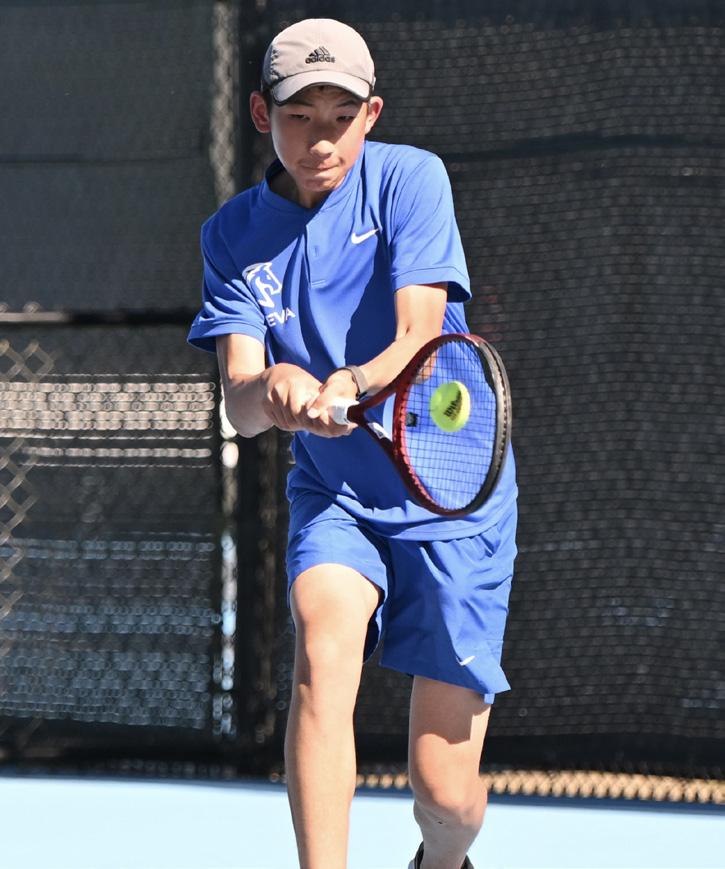
As Caltrain and BART face funding restrictions, students and teachers discuss the impact of public transport on their daily lives.
// Page 3
Senior Audrey Z. ‘26 presents her debut art exhibition: "Soft Bodied."
// Page 7
We celebrate the legacy of the six teachers leaving the Nueva community this year.
// Page 8
A collection of lessons and meditations on the Nueva experience—brought to you by senior editors from The Nueva Current.
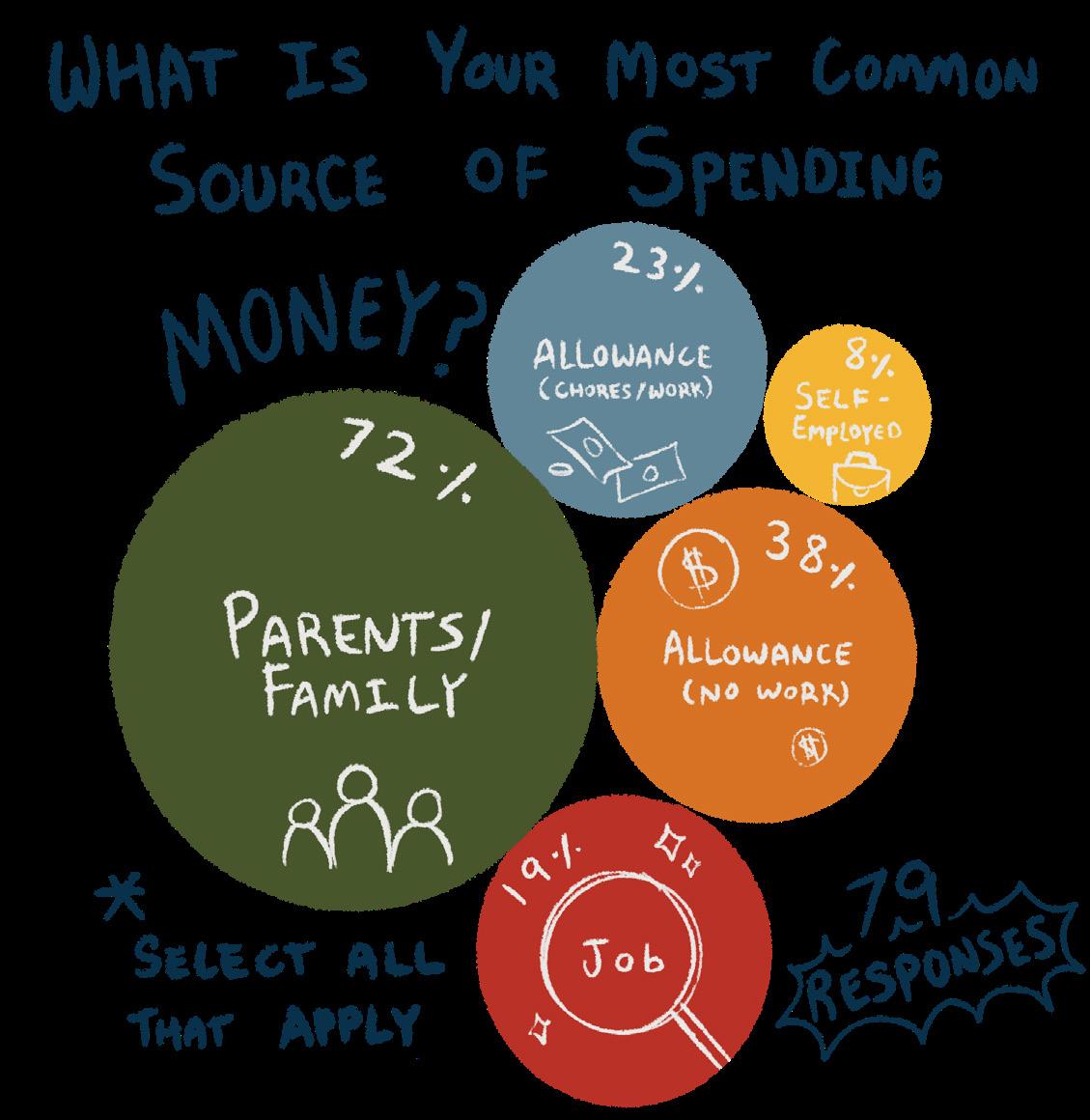
How do Nueva students stay caffeinated throughout the day?
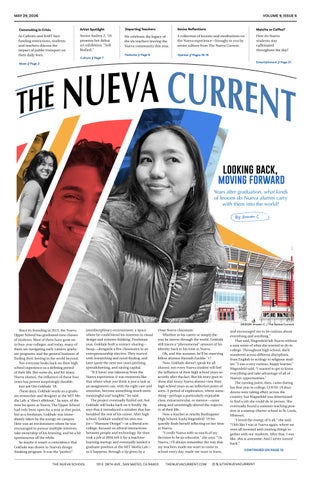
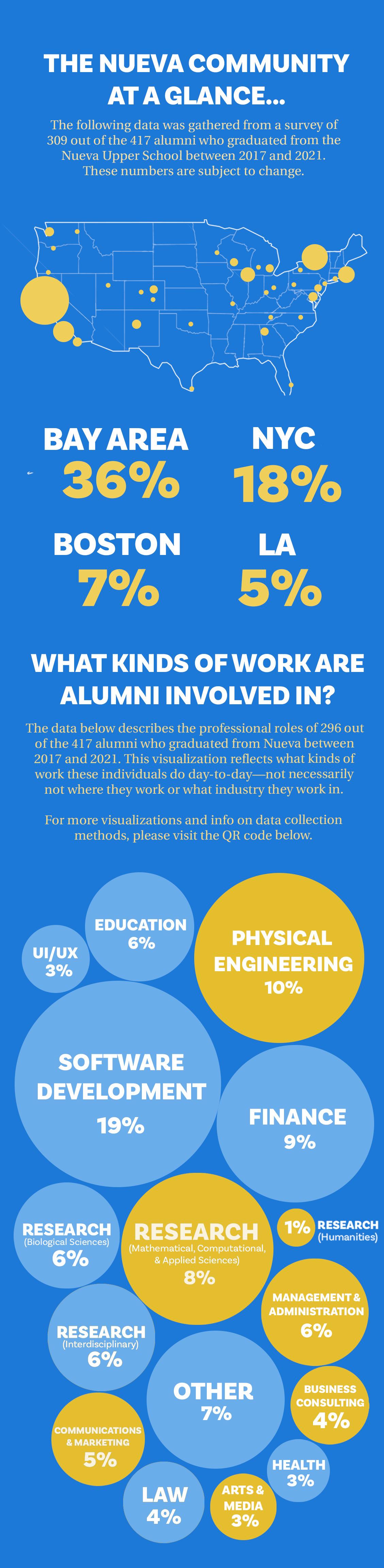
Since its founding in 2013, the Nueva Upper School has graduated nine classes of students. Most of them have gone on to four-year colleges, and today, many of them are navigating early careers, graduate programs, and the general business of finding their footing in the world beyond. Not everyone looks back on their high school experience as a defining period of their life. But some do, and for many Nueva alumni, the influence of those four years has proven surprisingly durable.
Just ask Om Gokhale ’18.
These days, Gokhale works as a graduate researcher and designer at the MIT Media Lab: a “direct offshoot,” he says, of the time he spent at Nueva. The Upper School had only been open for a year at that point, but as a freshman, Gokhale was immediately taken by the energy on campus. Here was an environment where he was encouraged to pursue multiple interests, take ownership of his learning, and be a bit spontaneous all the while.
So maybe it wasn’t a coincidence that Gokhale was drawn to Nueva’s design thinking program. It was the “perfect”
Years after graduation, what kinds of lessons do Nueva alumni carry with them into the world?
interdisciplinary environment, a space where he could blend his interests in visual design and systems thinking. Freshman year, Gokhale built a contact-sharing— Swap—alongside a few classmates in an entrepreneurship elective. They started with researching and need-finding, and later spent the next two years pitching, spreadsheeting, and raising capital.
“If [I have] one takeaway from the Nueva experience, it was moments like that where what you think is just a task or an assignment can, with the right care and attention, become something much more meaningful and tangible,” he said.
The project eventually fizzled out, but Gokhale still looks back on it fondly. He says that it introduced a mindset that has heralded the rest of his career. After high school, Gokhale studied his own major—”Humane Design”—at a liberal arts college, focused on ethical interactions between people and technology. He then took a job at IBM; left it for a machine learning startup; and eventually landed a graduate position at the MIT Media Lab— as it happens, through a tip given by a
Whether in his career or simply the way he moves through the world, Gokhale still traces a “phenomenal” amount of his identity back to his time at Nueva.
Oh, and this summer, he’ll be marrying fellow alumna Hannah Zucklie ’17.
Now, Gokhale doesn’t speak for all alumni; not every Nueva student will feel the influence of their high school years so acutely after the fact. But his story goes to show that many Nueva alumni view their high school years as an inflection point of sorts. A period of exploration, where something—perhaps a particularly enjoyable class, extracurricular, or mentor—came along and unwittingly altered the trajectory of their life.
Now a teacher at nearby Burlingame High School, Kayla Wagonfeld ’19 frequently finds herself reflecting on her time at Nueva.
“I credit Nueva with so much of my decision to be an educator,” she says. “[At Nueva,] I’ll always remember the way that my teachers made me want to come to school every day, made me want to learn,
and encouraged me to be curious about everything and anything.”
That said, Wagonfeld left Nueva without a sure sense of what she wanted to do in college. Throughout high school, she’d wandered across different disciplines, from English to ecology to religious studies: “I was a very curious, happy learner,” Wagonfeld said. “I wanted to get to know everything and take advantage of all of Nueva’s opportunities.”
The turning point, then, came during her first year in college. COVID-19 shutdowns were taking effect across the country, but Wagonfeld was determined to find a job she could do in person. She eventually found a summer teaching position at a startup charter school in St. Louis, Missouri.
“I loved the energy of it all,” she said. “I felt like I was at Nueva again, where we were all invested and creating things together with our students. After that, I was like, this is awesome. And I never turned back.”
close Nueva classmate.
DESIGN: Anwen C. / The Nueva Current
By the Numbers
senior plays will be performed for Renfaire, on June 4—ranging from a Minions-themed rendition of Shakespeare’s Hamlet, to an adaptation of Wuthering
Public Forum Debate Team wins national championship
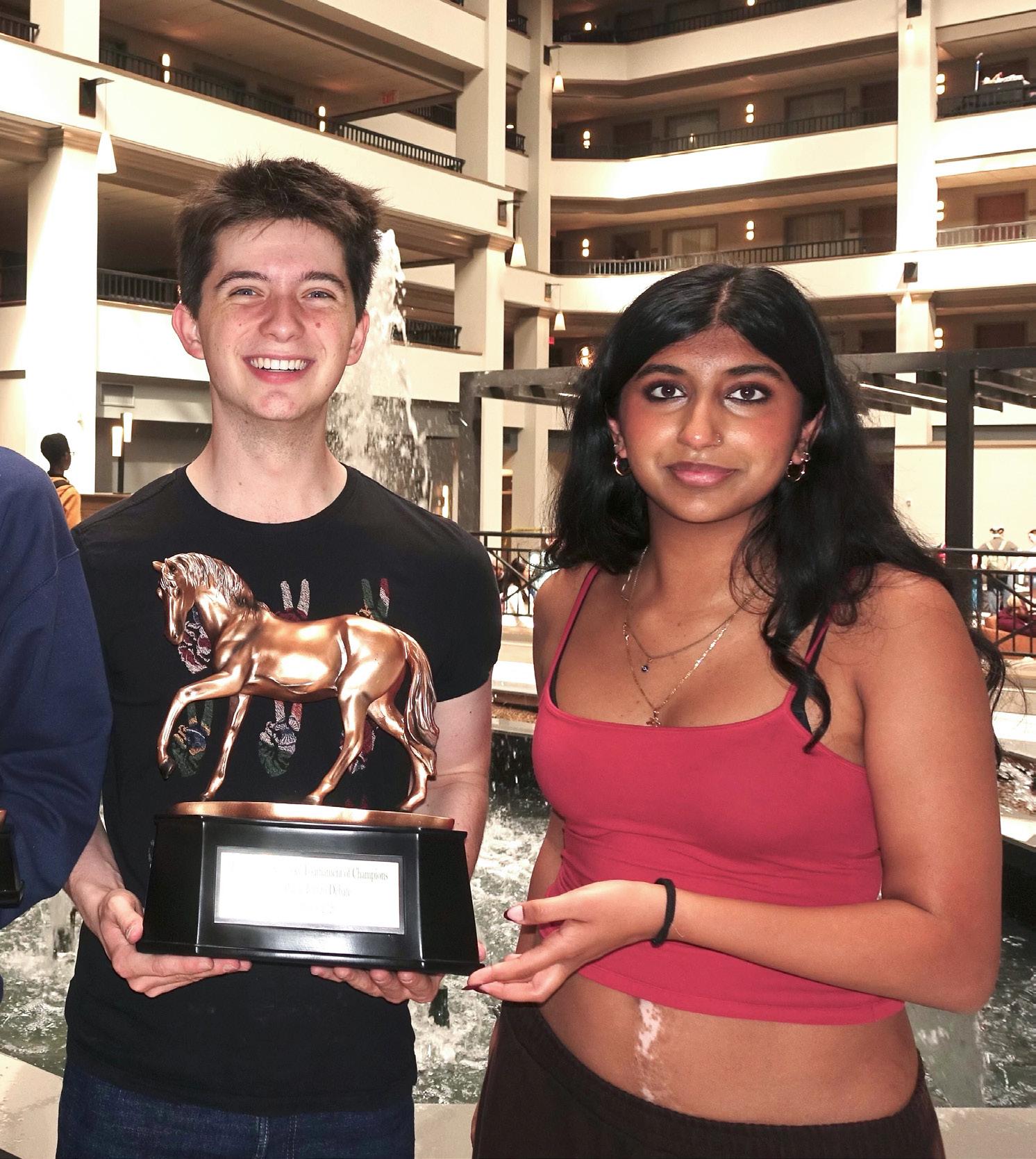
Oliver A. ’26 and Anika G. ’26 debate their way to first place at the Tournament of Champions
STORY BY TIMOTHY C.
As the final round judges were deliberating, hundreds of people sat waiting at the Clarion Hotel Ballroom in Lexington, Kentucky.
At the front of the room stood Oliver A. ’26 and Anika G. ’26, finalists in the Public Forum Gold division at the 54th annual Tournament of Champions. Fifteen minutes later, the panel of three announced their decision: a unanimous vote for Nueva.
Oliver and Anika took first place out of the 119 entries in that event, defeating a team from Harker in finals and earning Nueva its second TOC championship. The school won previously in 2017, the year of its first graduating class, and Anika is the first woman to win the Public Forum TOC since 2021.
Throughout the tournament, teams debated about presidential war powers, but Oliver and Anika’s strategies went beyond typical policy arguments. They focused, instead, on philosophical questions about law, violence, and whether debate can change how people think.
“Debate matters because it can shape us to be different people,” Oliver said. “The way in which I now think about how power is distributed, how it is shaped over time through philosophical frameworks has been deeply influential for me.”
For debate coach Les Phillips, the final round was memorable not only because Nueva won, but because of what the judges praised.
“They were complimenting our
debaters on exactly the things I wanted to hear compliments about,” he said. “[The team has] done the most amazing argument development, working hard on unusual arguments that they believed in.”
Though debate rounds themselves are between teams of two, the group’s success has been a collective effort. Over the two months leading up to TOC, the team shared their files with each other on their labyrinthean Dropbox; and when each round’s pairing is released, debaters quickly compare notes and help their teammates prepare.
“People in that time pressure still think beyond their own interests and they're looking at their teammates,” Phillips said.
At TOC, the team has also racked up a number of successes beyond just its winning duo. Seniors Deniz S. ’26 and Max E. ’26 reached the quarterfinals, while sophomore team Etienne Y. ’28 and Chiara D. ’28 also advanced to the runoffs—a performance that Phillips said was “unheard of” from such a young team at a tournament of the TOC’s rigor. Emerging from the tournament was another promising pair: Jason R. ’29 & Abhinav I. ’28, who won four out of their seven preliminary rounds.
As Phillips looks to the next school year, he remains optimistic about the teams’ prospects. “We’ve got teams that are ready to compete at the level that Oliver and Anika had,” Phillips said. “They performed well this year and will perform well with another year of seasoning.”
Rewriting the Narrative
Freshmen produce an original documentary
STORY BY OLIVER L.
Inspired by this year's National History Day theme—revolution, reactions, and reform in history—freshmen Amaira G. ’29, Leo H. ’29, Kepler Q. ’29, and Katy W. ’29 produced and earned runner-up distinction for their original documentary, FabricatingTruth:HowQuiltsBroke PastCensorshipinChile. Out of over 1,600 competing submissions statewide, the group celebrated the tremendous achievement.
“I’m really happy with how the project turned out,” Kepler said. “I learned so much about video production through this process.”
Amaira echoed Kepler’s sentiment, “Writing this script was difficult, but seeing the success our documentary had made winning extremely fulfilling.”
The group hopes to bring their newfound producing skills to next year's competition, aiming for even higher achievements.
Drum Jamboree
Students from all grades perform in annual concert
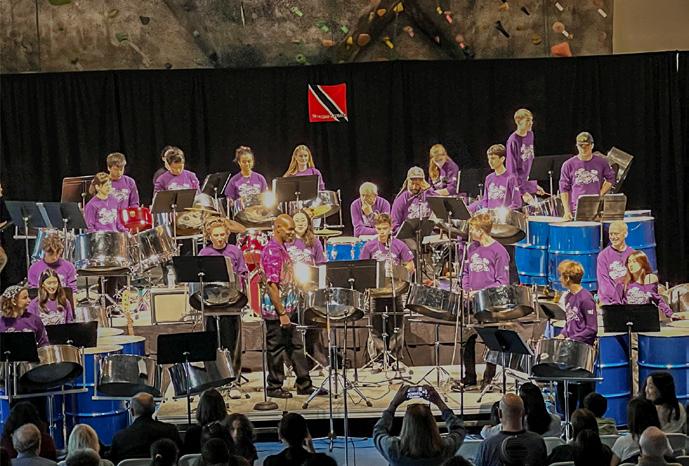
On Saturday, May 23, the Steel Drum Band performed alongside Duvone Stewart, one of the most acclaimed steel pan composers and players in recent history.
The end-of-year show has been a tradition for the band, led by music teacher Jim Munzenrider, since 2021. Over the years, they have played alongside industry-leading figures such as 8-time Grammy winner Tony Lindsay and jazz steel pianist Andy Narell.
This year, the show’s venue moved from SFJAZZ to the more accessible Upper School gym after three consecutive years at the venue. By hosting this year's performance at school, Munzenrider can perform with all of his students, from first grade to senior year.
The Jamboree featured 15 songs like “Calypso Party” and “Paradise Garden,” the latter dedicated to a longtime friend of Munzenrider and steel pan legend Robbie Greenidge, who is currently hospitalized. The last song played was an encore, “Bee’s Melody,” which gave the show an exciting finish. The evening marked another successful performance by the steel drum program, bringing together professional talent and student musicians before a packed home audience.
May 22: Freshmen and Sophomore Arcade Night Last week, underclassmen took to Gama Ride in San Mateo to play various arcade games and enjoy burgers, fries, and chicken wings.
REPORTING BY ELLIE L.
Fear the Kvaal Oliver A. '26 (left) and Anika G. '26 (right) pose with their TOC trophy. // PHOTO: Anika G.
musical numbers in Guys and Dolls, which was presented by Nueva theatre in performances from May 15–17.
PHOTOS: Damian Marhefka Photography, Frances Liang, Folger Shakespeare Library, Penguin Books, Holly Nall / The Nueva School
seniors set to graduate this year on June 7.
speakers presented at Science Friday events throughout the 2025–26 school year.
Heights set in the world of Love Island.
Nueva Steel
STORY BY OLIVER L.
// PHOTO: Sarah Ordody
Commuting in Crisis
Public transit in the Bay Area is on the edge of a "fiscal cliff." Here's how the Nueva community will be impacted—and what they're doing about it.
STORY BY JACKSON H.
It's 2019, and the future is looking bright for Caltrain.
The average ridership is at an all-time high of 63,000 riders a week, almost double what it was 10 years ago. The electrification project is underway, promising faster and cleaner trains in the near future. The train primarily caters to Silicon Valley commuters on their way to and from work, but it's not just a service for tech workers. Just six years earlier, a new high school opened right next to Hillsdale station, and its students can now regularly be found on the train with their school-provided GoPasses.
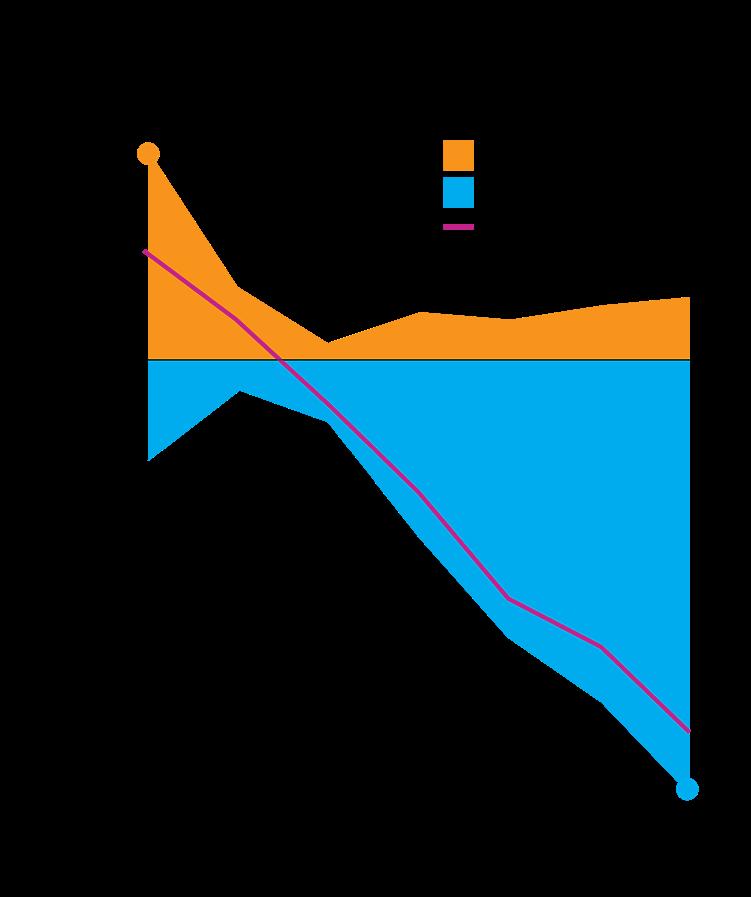
The agency is reliant upon rider fares to cover 70% of their operating expenses. For BART, fares make up 72%. Both figures are much higher than the national average for public transit systems, but that won’t be a problem so long as there isn’t a sudden, sharp, disastrous decline in commuting in the near future.
Fingers crossed.
I. SLASHED SERVICE
The COVID-19 pandemic and the rise of remote work led to a plummet in ridership for both BART and Caltrain. And while there has been strong growth over the last few years, especially since Caltrain was electrified, it's still not close to pre-pandemic levels.
As a result, public transit in the Bay Area is now teetering on the edge of a fiscal cliff. Caltrain is facing a $75 million budget deficit. BART is even deeper in the hole, with a deficit of $375 million. Barring a new external funding source, both are expected to make drastic cuts starting in 2027.
The worst-case-scenario cuts for Caltrain would include reducing train frequency to once an hour, eliminating all service on the weekends or after 9 p.m., or even the closing of one-third of stations. BART has warned that they could feasibly slash 70% of service hours, ramp up fares, or close 15 of their 50 stations.
Transit advocates note that these severe cuts could induce a “doom spiral,” where more infrequent service discourages commuters from using public transit, thereby further reducing fare revenue and thus triggering more cuts.
Those cuts, however, are more a way to raise the alarm than a legitimate plan. A more likely scenario, according to a knowledgeable source, would keep two express or limited trains and one local train an hour during peak commuting times, along with one train per hour during the rest of the day.
“During peak, most of the [express and limited trains] actually turn profits, [so] it’s not like they’re not going to run them,” the source said.
The resulting timetable, then, would be
a tale of two cities. Those living near smaller stations will have to reckon with drastically reduced schedules, and as such, may find taking the train increasingly infeasible. Commuters located on major stops (like Hillsdale), meanwhile, would see as much, if not more, service.
“If you live in Palo Alto and you commute to the city three days a week, it’ll be excellent for you,” the source said.
POTENTIAL CUTS TO TRANSIT
Hourly service on weekdays
No weekend service
No service after 9 p.m.
Close one-third of stations
30 minute service frequency
No service after 9 p.m.
30% fare increases
Close up to 15 stations
Doubled wait times
Cut 20 bus routes
Cut historic cable cars
Lay off up to 2,000 employees
II. THE IMPACT FOR NUEVA
For Nueva, where 86% of students and 71% of faculty and staff have school-provided GoPasses, the freedom and connectivity the train provides has become a part of the school’s identity. The school community stands to be impacted regardless of how severe the service cuts wind up being.
“I’d have to rely on my parents more, which would affect my independence and [ability to] take initiative around school,” said Amaira G. ’29, who takes the Caltrain from Mountain View every day.
Nueva’s faculty, many of whom live in the East Bay or further afield, would face even larger disruptions.
For history teacher Simon Brown—who commutes from Oakland each morning for an hour and 10 minutes via BART, Muni, and Caltrain—the proposed cuts could be life-changing.
“It seems at best inconvenient. At worst, [it would be] pretty much impossible for me to actually use the service,” Brown said. If severe cuts were to go into effect, he would likely have to buy a car for the first time in his life: “a huge financial impact.”
This acute impact on faculty could present meaningful difficulties for the school, whose proximity to public transportation has been a major pull for years.
“I would have been much less likely to work somewhere that would require me to have a car,” Brown said. “The fact that I was close to a Caltrain station and got free Caltrain service is what made it seem viable for me to work here.”
III. A WAY OUT?
However, all hope is not lost for gaining an external funding source. This November, Bay Area residents may get the chance to vote on ballot measure SB 63, which would draw in $980 million a year for public transit through an additional regional sales tax over the next 14 years.
Getting SB 63 the 200,000 signatures required for ballot access has brought together a large-scale grassroots campaign— one in which Nueva students are helping to play a part.
Amaira, as the lead of the transit team at the nonprofit Silicon Valley Youth Climate Action, has aimed to personally support the cause by presenting at youth-oriented webinars hosted by the ballot measure campaign.
As time goes on, she’s seen this increased awareness making a difference.
“[I’ve been] hearing more about it outside of transit organizations. I see students and teachers knowing more about it,” Amaira said. “The fact that people who aren’t being affected are trying to become involved is very important.”
Marc C. ’27, who leads Muni’s Youth Advisory Board, is opposed to the measure. He criticized SB 63’s prioritization of BART over Muni—which makes up half of all Bay Area transit ridership—and its dependence on a regressive sales tax, which would place the greatest financial burden on the poorest taxpayers, proposing a property or sales tax limited to San Francisco instead.
But Marc acknowledges that, for BART in particular, it is now try or die for SB 63, as imperfect as it may be. And as the campaign ramps up, enthusiasm and support for public transit in San Francisco is proving hard to ignore.
“[There is this] pride and culture that has been built over the past few years, both in the youth community and the adult community, about how Muni is this thing that we can take for granted, that makes living in San Francisco easier,” Marc said. “So I'm hopeful that, because of everybody caring in San Francisco, we will see something [change].”
ANALYSIS
The Cost of Canvas
The implications of the platform’s recent cybersecurity incident
STORY BY KAYLA L. & ALVIN Y.
Two weeks ago, a cyberattack deactivated Canvas—one of the world’s leading learning management systems—for many hours. As a result, students and teachers internationally lost access to class materials, were unable to take final exams, and were forced to extend project deadlines.
The recent Canvas hack is one of the most significant cybersecurity threats in a larger trend: in 2025, a ransomware breach of Oracle obtained 4 million sensitive records from the University of Phoenix, Dartmouth College, and the University of Pennsylvania; in 2024, hackers exploited file transfer software MOVEit Transfer to access personal information about students and faculty at nearly 900 colleges.
And yet, schools are more reliant on educational technologies (EdTech) than ever before. 30 million students and teachers use Canvas to manage classwork; schools nationwide are integrating AI learning tools into classrooms; and some institutions have even continued to use Zoom for remote learning post-pandemic. In this final Fuller Picture column, we will investigate how increased reliance on EdTech both helps and hurts institutions globally.
The global EdTech market’s size has increased from $106 billion to $187 billion between 2021 and 2025. Because of their accessibility and availability, EdTech platforms can significantly ease the burden on education systems for smaller schools with less robust IT programs. Additionally, students in rural areas or with disabilities can access high-quality instruction, materials, and accommodations that might otherwise be unavailable. Open-source digital education resources have decreased textbook costs for schools by an average of 31%. And personalized learning plans, normally inaccessible to understaffed classes, have become more accessible to students, who can follow the curriculum at their own pace.
However, the latest hacking incident has reemphasized privacy concerns among educators and students alike about the increased reliance on EdTech platforms. Unlike breaches of retail or social media platforms, breaches of educational data are uniquely sensitive; students often share medical and mental health records and communicate with Title IX advocates through platforms like Canvas. This means stolen data can be used to create highly targeted, personalized scams that are difficult to detect.
The Canvas outage two weeks ago was not an isolated incident, and it certainly won't be the last. As cyberattacks on EdTech platforms grow more frequent, the need to balance the safety of students with the accessibility and cost-efficiency that schools prioritize is increasingly important.
PHOTO: Wikimedia Commons
NEWS
Quoted: “The flaws that we have as humans make us human. [They] make us more interesting, complex, and beautiful.”
Sealing, Sewing, and Sentimental Value
Students in Art of Repair elective take on their final project
STORY BY AVIVA S.
In an age of Amazon and same-day delivery, items that may have once been repaired are now more likely to be replaced and tossed aside. Items with sentimental value, or a deeper meaning to the owner, however, follow a different story.
Students in I-Lab teacher Hilary Fenton’s Art of Repair elective have spent the semester experimenting with diverse repair methods and processes to repair household objects. Although the initial premise of the class is to fix personal items that may have sentimental value or are less enticing to replace, students also learn how to engage with their repair work on a more philosophical level.
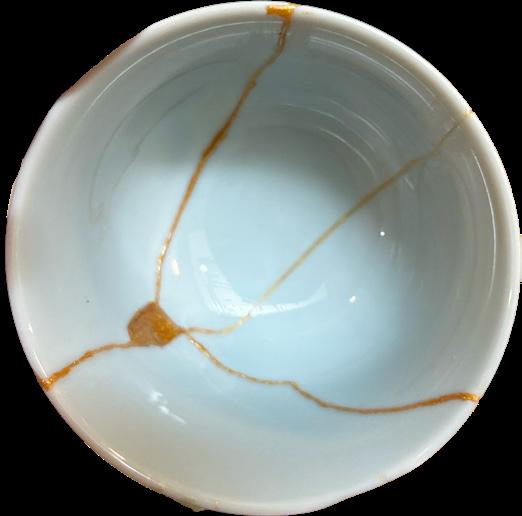
Fenton describes the human sentimental relationship to the Japanese repair technique called kintsugi, the process of repairing broken ceramic pieces with gold filling. The human nature of this process was a major consideration during the repair of items for the class.
“The flaws that we have as humans make us human. [They] make us more interesting, complex, and beautiful,” Fenton explained.
What
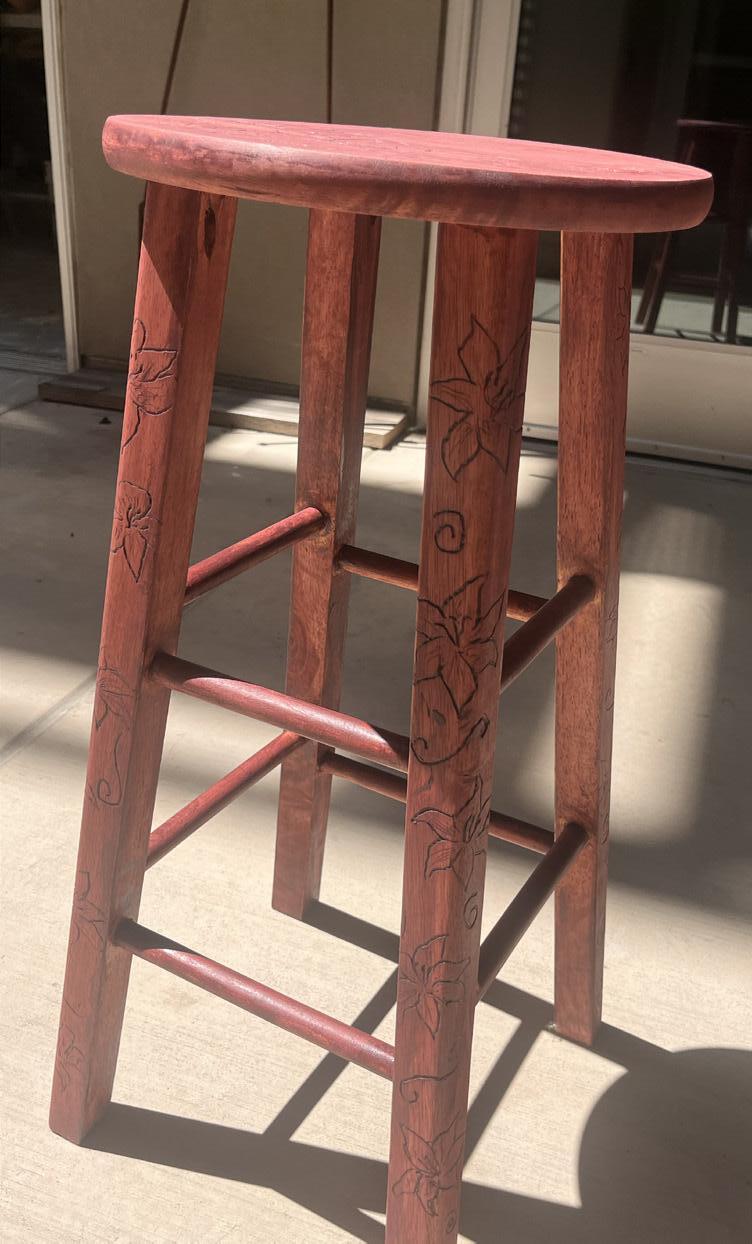
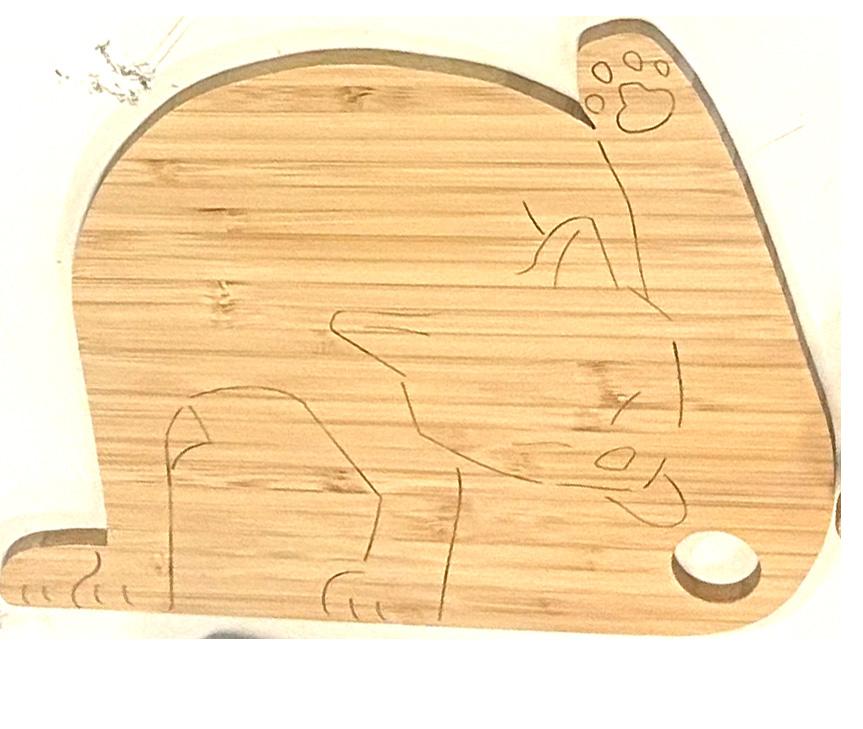
The class’s final project is called Repair Cafe, where members of the Nueva community submit items in need of mending. It is the first project that the class has done of this variety. Anything can be submitted, from torn clothes to worn cutting boards and vases.
Most broken items are expensive to repair, and it is often less expensive to purchase a new item and forget about the old one. In the Repair Cafe project, Fenton’s students will receive a different, more personally valuable, type of item. These items are sent in by the community and the class takes time to carefully seal, patch, and mend each one.
“It’s a discussion on what we value and the things we have,” Fenton said.
The class accepted submissions for the project via a form filled out by the owners, and an intense week of repairs commenced on Wednesday, May 20, when item submissions were dropped off. Students worked hard to repair all of the submissions before the return date of Thursday, May 28.
items have students in Art of Repair been working on?
Bowl repaired with the Kintsugi technique
“We're excited to close out the year by bringing the skills the [students have] learned to the community, and hopefully save a lot of things from going into the landfill,” Fenton said.
The Race for California’s Future
Students follow a gubernatorial race shaped by affordablity
STORY BY OLIVER L.
As California enters one of its most competitive election cycles in years, students are increasingly paying attention to the gubernatorial race, which could shape issues ranging from climate policy to housing affordability.
A Republican has not won statewide in California since 2006. This year, however, recent polls have displayed a far more competitive field, with the top Democratic candidates—Xavier Becerra and Tom Steyer—polling within just a few percentage points of Republicans Steve Hilton and Chad Bianco.
California elections operate using a “jungle primary” system. Candidates of all parties will be on the ballot on June 2, with the top two advancing to the general election in November.
Although the gubernatorial race has drawn national attention because of the political prominence of California and its incumbent governor, Gavin Newsom, many Nueva students have fixated on this race because of personal concerns about issues like climate change, healthcare, and the cost of living.
“One of the reasons why affordability is such a big issue for me is because I used to go to school in San Francisco, and so every day I witnessed students like us who were homeless,” Kyle W. ’27 said. “Whether that's
a lack of social programs or a need for food or a need for housing, a lot of these supportive programs aren't supporting people in need.”
Affordability has become the central point of contention in the gubernatorial race. Hilton, a Fox News host and former political strategist for British Prime Minister David Cameron, has focused heavily on his youth-targeted “Califordible” program, which includes abolishing the gas tax and eliminating state income tax on the first $100,000 earned. Since his endorsement by President Trump, Hilton has been the leading Republican candidate.
Becerra, a former Congressman, state Attorney General, and Secretary of Health and Human Services under Joe Biden, is the most politically experienced candidate and the current frontrunner. His campaign has centered around traditional Democratic priorities in expanding healthcare, tackling the affordability crisis, and representing immigrant families.
Meanwhile, billionaire investor and environmental activist Tom Steyer has become the leading candidate for progressive Democrats, with a campaign focused on political reform and environmental policy. Steyer has argued that California’s current political leadership has disregarded its citizens by failing to address rising energy costs and the influence of corporate PAC money. His proposed structural changes would include
prohibiting gubernatorial candidates from taking corporate PAC money and decreasing energy prices by breaking up utility monopolies like PG&E.
Several students also named climate change as a major issue among younger voters.
“Climate change is an issue that will continue to get worse throughout our generation, and if we look at who's in politics, they're usually older,” Kyle said. “And so when you're looking at older people who generally look at short-term gains, you can understand why there's less propagation of climate policies.”
Steyer is currently the principal advocate of progressive environmental policy in the race, advocating for a drastic transition away from reliance on fossil fuels. Other candidates have focused
reducing gas and utility costs for consumers a trend which reflects the current tension between prioritizing environmental goals and affordability.
This campaign is happening amidst a nationwide political moment where
candidates are increasingly focused on how to reach out to young Gen Z. Candidates have focused on messaging towards young people worried about their ability to afford a future in California through visits to college campuses, social media outreach, and influencer endorsements. The online campaign has now stirred its own controversies, with both Becerra and Steyer accusing each other of buying online bot accounts and influencer support.
For many Nueva students who can or will be able to vote in this year’s midterms, the power to vote holds a larger weight than simply who will win the election. Instead, voting reflects the most pressing issues in California; from affordability to the climate crisis, it serves as a way for younger generations to shape the future of California.
11th Congressional District San Francisco will have a primary election on June 2 for Nancy Pelosi' successor, with Scott Wiener, Saikat Chakrabarti, and Connie Chan as the main contenders.
Patched jeans Cutting board carved with cat design
COLLAGE: Jackson H. PHOTOS: Reuters
PHOTOS: Hilary Fenton
July 17: TheOdyssey Catch Christopher Nolan’s rendition of the Greek epic, starring a celebrity-packed cast.
Pop Culture Thermometer
On a scale from freezing to blazing hot, here's the latest in pop culture
BLAZING
With just one month to go before the World Cup and a soundtrack nobody wanted, Shakira and Burna Boy scored a stoppage-time banger with “Dai Dai.” Sixteen years after "Waka Waka" became the anthem for this entire generation of soccer fans, FIFA finally wised up, pushed Jelly Roll aside, and handed the mic back to the artist on her fourth World Cup appearance.
June 12:YouSeemPrettySadforaGirlSoinLoveOlivia Rodrigo returns with her third studio album.
Dazzling the stage
Nueva theatre takes on classic musical Guys and Dolls
Oversized vibrant suits shone under bright stage lights, spinning choreography filled the stage, and the audience was excited. It was opening night of Nueva’s production of Guys and Dolls, and Andy M. ’28 hit the stage for “Luck Be a Lady” with an energized ensemble behind him. It’s Andy’s favorite song to perform in the whole show: “I really like the energy. It's a really fun dance number. And it's a really key turning point in his story.”
having that history,” Swenson-Graham said.
At the same time, the old nature of the musical meant that the team had to reckon with the play’s more old-fashioned elements, from sexist language to incredibly binary divisions of gender to a dubiously romantic scene. Swenson-Graham had a simple approach for navigating these aspects.
man among the other upperclassmen dance captains.
“It's really nice being able to look up to them as upperclassmen, but also become friends with them,” Kylie said. “When we're just [rehearsing] together, I think learning the choreography is so much fun because everyone is really motivated—even if they're not a dancer, they're willing to try it out!”
Eleven years of runtime, a cancellation that reeked of politics, and Steven Colbert went out with Paul McCartney singing Beatles songs in the same theater where the Beatles made their American debut. Then, McCartney pulled a lever, the lights went dark, and the whole Ed Sullivan Center got swallowed by a wormhole. For a man who got screwed, he left with more grace than CBS deserved.
Coming off the most documented beef in rap history, Drake finally responded with three albums in a single night and 43 total songs thrown blindfolded at a dartboard. Sure, a few of them landed, “2 Hard 4 The Radio” and “Slap the City” among them, but a few bullseyes don’t make up for the 30 darts he stuck in the wall. Mind you, this man made Take Care, an album with zero skips, but it’s clear the pen dried up since then. Get new ghostwriters, Drake.
“Fashion is Art” is the most open theme the Met Gala has ever given its attendees, and Emma Chamberlain, Rihanna, and Jeremy Pope made the most of it. But still, for every person who committed, three showed up in expensive black nothing, which, for such a prestigious event, raises the question: Why are you here? Did you read the invitation? A tuxedo or draped silk gown at an art themed Met Gala is the loudest possible way to say you are profoundly, expensively empty.
However, Andy's actual favorite Guys and Dolls song was one he was not in at all, “Sit Down You’re Rocking the Boat.” The song was simultaneously a testament to the incredible teamwork Andy watched his fellow cast members pull off, and also, remains a classic showtune.
That classic nature of the show is what drew director Zoe Swenson-Graham to Guys and Dolls. Not only did she believe that it’d be worthwhile for her students to have an old show in their repertoire, but she also hoped that those watching in the audience would be familiar with the show’s classic songs and dances. “I think there’s something really valuable about
IN REVIEW
“We tr[ied] to be as open and transparent in talking about that from the very beginning. ” Swenson-Graham said. “I always hope that the students and the community feel involved in making sure that they feel comfortable telling it.”
Throughout the semester, Swenson-Graham was keen on incorporating student leadership and initiative into the class, whether through trusting the seniors to help create a welcoming atmosphere, or assigning dance captains to lead choreography routines—this year’s being Kylie E-M. ’29, Eva S. ’26, Mylie M. ’26, Tin K. ’27, and Caitlin Z. ’27.
Kylie truly enjoyed taking on the responsibility, especially as the only fresh-
The Devil Wears Prada 2
When I first watched the credits roll for The Devil Wears Prada (2006), I wasn’t a fan. The humor felt outdated, and the story was weighed down by too many conflicts and unresolved subplots.
The sequel, The Devil Wears Prada 2, is still messy, but a more enjoyable watch. Andy Sachs (Anne Hathaway) returns to the fictional fashion magazine Runway after losing her job as a journalist, only to find that the tyrannical editor-in-chief Miranda Priestly (Meryl Streep) no longer holds the same prestige as she did 20 years ago. That shift gives the film a lighter, more self-aware tone.
Set against glossy runways and the brightest lights, the sequel is tailored to modern audiences. In one scene, Priestly says “body negative” in a half-hearted attempt to recall the right term, a joke that lands better than the original’s constant fat jokes. The film also leans more into the specta cle of high fashion, sometimes making scenes feel closer to ad campaigns.
work keeps it engaging. Handheld shots during fashion shows and red carpets give the movie a chaotic, paparazzi-like energy that fits with the more luxu rious setting.
effortlessly back into their roles, Hathaway’s performance was cartoonish, making Andy feel like a caricature of herself. Even so, the sequel remains stylish, entertaining, and surprisingly fun.
That willingness to simply try is something that Archie B. ’26 has internalized throughout his time in theater, as he’s grown into lead roles, experimented with accents and all kinds of acting methods, and become a student who can build a welcoming culture amongst the cast.
“People like people who take risks. When I first got into theater, I wanted to look cool while doing these big, theatrical actions and dances. But that silliness is what theater is—you just gotta embrace that, on stage and off the stage. Just be yourself,” Archie said.
Remarkably Bright Creatures
I love movies about old people. Yes, I want to cry over found family and the grumpy gray-haired man who lives next door. Olivia Newman’s Remarkably Bright Creatures, based on Shelby van Pelt’s novel, is no exception. It’s a collection of cliches stitched together with the sentimentality of the human experience, held through the glue of beautiful acting.
Tova (Sally Field), a widow who lost her son in a tragic boating accident, works as the nighttime cleaner at the local aquarium until she sprains her ankle while speaking to the narrator-octopus, Marcellus (voiced by Alfred Molina). Luckily for her, Cameron (Lewis Pullman), who drifts through town amid a middle(ish) life crisis, is in need of a job during his quest to find his deadbeat father.
You might be able to guess where the plot unfurls from there. The storyline blooms through its handling of the human experience—in her old age, Tova must sell her house, a log cabin built by her late husband, and move to a retirement home. Cameron searches for his sense of purpose as his career plans fall apart. The universality of these stories is what makes the audience feel for the characters.
It was the actors that transformed the characters into people—Field brought the nuance needed to breathe life into Tova’s character. Even Molina was incredible, with the voice of an ocean documentary filmmaker infused with a nuanced layer of emotion.
As an audience member, you must put in the work to enjoy
Remarkably Bright Creatures. Partially narrated by a perceptive, meddling octopus, this story requires you to be in a sentimental mood. Yet, if you lean into the film’s playfulness, you may find a hidden pearl.
STORY BY ELLIE L.
STORY BY CALLUM S.
WARM: STEVEN COLBERT’S FINAL LATE SHOW
COLD: DRAKE'S TRIPLE ALBUM RELEASE
FREEZING: THE MET GALA
STORY BY NATALIA R.
STORY BY SENNA H.
HOT: SHAKIRA WORLD CUP ANTHEM
PHOTO: Shakira
PHOTO: Getty Images
PHOTO: OVO Sound
PHOTOS: Devil Wears Prada and Bright Creatures
// PHOTO: Damian Marhefka Photography
PHOTO: Getty Images
CULTURE
COMMENTARY
MonetandVenice Claude Monet's seasonal exhibit will be featured at the deYoung Museum in San Francisco until July 26, 2026.
‘Fashion is Art.’ But can fashion be activism?
STORY BY NEEL G.
At this year’s Met Gala, like most fashion or award shows, some celebrities attempted to make a political statement. Most notably, Sarah Paulson masked her eyes with a dollar bill, an outfit she titled “The 1%.”
The look was laughable in its irony. Paulson, herself a member of the 1%, in a room full of wealthy elites, at an event sponsored by Jeff Bezos, with tickets costing $100,000, aimed to protest the accumulation of wealth? A real social impact would have been helping those in poverty, urging her peers not to attend, or boycotting.
This isn’t to say fashion can’t be activism; fashion has proven to be a successful outlet. The biggest impact in fashion comes from risk-taking and a willingness to defy what is socially deemed as acceptable—Vivienne Westwood’s anti-authoritarian punk, Katharine Hamnett’s "58% Don't Want Pershing" shirt, the AIDS quilt.
At various red carpet events this past year, including the Met Gala, celebrities, many of whom are completely silent about ICE raids and deportations, have been wearing “ICE Out” pins—often at events like the Met Gala that are sponsored by companies exacerbating political corruption. Stunts like this or Paulson’s attempt at political resistance feel more like an easy way to garner attention and craft a “for the people” image rather than creating real, noteworthy statements. Their attempts at activism are more performative, even paradoxical at times, than courageous.
But during the Met Gala, the real fashion activism came from the “Labor is Art” protest. On Little West 12th Street, participants held the “Ball Without Billionaires,” a counter-fashion show that featured designs by immigrants and BIPOC artists. Just blocks away from the Met Gala’s entrance, advocacy groups also hosted the “Resistance Red Carpet,” where costumed protesters staged a dance party to ABBA’s “Money, Money, Money.”
What made this protest successful was its display of rallying against the status quo. It highlighted the power of community while exposing the diverse talents of ordinary, individual creativity. It was fashion that sent a sincere message.
This is real fashion activism: bold, authentic, genuine, risky,
July 31: Spider-Man: Brand New Day The next installment of Marvel’s Spider-Man franchise is set to hit theaters this summer.
“Lázár” is the first novel of young Swiss writer Nelio Biedermann to be translated into English, and it establishes him as a keenly perceptive author with a knack for narrative momentum and compelling, flawed characters.
Biedermann uses his heritage to his advantage: “Lázár,” a sweeping, multigenerational saga that covers decades of tumultuous 20th-century Hungarian history, is based on Biedermann’s own family’s story.
We meet the Lázárs in the sunset years of the Habsburg Monarchy, the last of the Austro-Hungarian Empire. The current Lázár patriarch, Sándor von Lázár, is dismayed by the birth of his son Lajos (a “translucent child”), and his unstable marriage becomes an allegory for his country’s political situation.
Families evolve and decades pass, but the novel always zeroes in on the intimate, using moments of connection and discord to propel the years forward. Biedermann has said that the novel’s chief protagonist (if there is one) is time, and it certainly feels that way: “Lázár” moves with surprising agility compared to the density of its historical period. A novel could be written about any of the characters, but Biedermann has chosen to include them all in a colorful, alive, and ever-shifting amalgamation.
Although the characters move around Europe, generations of Lázárs continue to return to the family’s wooded manor house, the site of birth, death, illness, and drama. The forest lends an aged, mysterious quality to the atmosphere and a touch of magical realism to the plot, as what the house represents—wealth, respite, isolation, stability, nostalgia, decay—shifts, making “Lázár” feel at once brilliantly fluid and unmistakably
grounded.
The family’s social status is also constantly shifting. With the fall of the Habsburgs, the destruction of the Second World War, and the rise of communism, the Lázárs’ material wealth is alternately a safeguard and a liability. During the war, especially, they stay relatively unscathed— but at the price of potential complicity and resulting guilt. The Lázárs are morally gray people: because there is no central narrator, their world and the social hierarchy they are entrenched in are presented without the risk of excessive sympathy.
Biedermann has been compared to Thomas Mann and his novel labeled a modern classic. This reviewer hasn’t read any Mann, but what stands out about “Lázár” is Biedermann’s ability to tell his story with a scope and lightness of touch that does evoke older narratives—it is very different from the hyper-realistic, deeply interior writing that comprises much of modern literary fiction.
The novel also excels in its restraint; given its subject matter, “Lázár” could have easily been a tome, but it is only 258 pages. Assumedly because of Biedermann’s relative newness to the craft, “Lázár” is not a flawless book. The first section, especially, feels slightly unmoored, and it takes some time for the
Lázárs to become familiar and truly interesting. Occasionally, description drifts into cliché, or a moment full of potential is swept aside by the constant movement of the plot. But Biedermann’s writing is sensitive and perceptive, and he is brave to take on so many characters and eras very much unlike him or his time. Perhaps what is most extraordinary about him, rather than his age, is his humility, and his recognition that the world does not need another navel-gazing tale about the perils of being a young, white man in the 21st century. Instead, he has given us a unique novel about a flawed and intriguing family that is a true pleasure to read—and, hopefully, the promise that this is only the beginning of his work.
STORY BY NATALIA R.
In the final weeks before Vespucci Ristorante Italiano closed last December, longtime customers packed the downtown San Mateo restaurant for one last meal, bringing cards, gifts, and messages for owners Manuela Fumasi and Francesco Zaccaro.
celebrity looks that ex-
“The response we received from the public was incredible,” Fumasi said. “I didn’t realize how good we did for people in the community until then.”
After eleven years in business, the family-owned restaurant closed amid a broader shift in San Mateo’s dining scene, where rising operating costs and increasing competition from chains and fast-casual restaurants have made it difficult for local businesses, like Vespucci, to survive.
Vespucci was built around recreating the traditional southern Italian cuisine that Fumasi and Zaccaro grew up with. Recipes came from family members, ingredients were imported from Italy, and
much of the restaurant's décor depicted the owners’ hometown of
As costs rose over the years, however, Vespucci struggled to keep up. According
to Fumasi, Vespucci’s rent nearly doubled after the building was sold to an investment company in 2024. Imported ingredients became more expensive, while wages rose sharply compared to when the restaurant first opened in 2014.
Chain restaurants are often better equipped to handle rising costs because of their larger corporate structures and multiple locations, but small businesses like Vespucci are more vulnerable to rising rents and shrinking margins.
As San Mateo’s restaurant landscape changed over the past decade, the city has also seen shifts in demographics and dining habits. With an increase of apartment buildings, younger residents became more frequent restaurant-goers, with a higher preference for fast-casual dining. Older people, who made up the majority of Vespucci’s clientele, began moving away.
“The world was changing, and we could not change with the world,” Fumasi said. “We tried, but at some point there was nothing we could do.”
PHOTO: Michael Buckner // Getty Images
DATA VISUALIZATION: Grace B. '26, Anya V. '26, and Arishka J. '26
// PHOTOS: Ruben Hollinger
Scalea.
Looking for more? Check out the Asian Art Museum’s newest exhibit, Chiharu
CULTURE
Senior debuts solo artwork exhibition
In “Soft Bodied,” Audrey Z. ’26 pays homage to roots and futures
STORY BY ALEXIS C.
From May 22 through May 24, Audrey Z. ’26 debuted her first solo exhibition of artwork at Orangeland Gallery in San Francisco. The exhibition, entitled “Soft Bodied,” was a collection of mainly oil paintings and plaster sculptures made from 2024 to 2025, each piece all at once bittersweet, fantastical, and striking.
Among the themes of “Soft Bodied” was Audrey's identity as a first-generation Chinese American grappling with sexuality and gender expression. “A lot of the work in the show is inspired by traditional Eastern mythology, [...] different ways of passing down tradition through my family, and [how] that brings me closer to them,” Audrey said.
Though some of Audrey's pieces, such as the mixed media sculpture “Beneath Carapace,” have been on display at the San Mateo campus, Audrey was particularly eager to display her artwork as a solo collection.
“I think it's really important to kind of see art [...] and pieces that were meant to be seen together, actually be together,” Audrey said. “Having a dedicated space for everything to live together is really exciting.”
Audrey, who grew up loving art, began to consider pursuing art as a career in her freshman year, while taking Introduction to Drawing with Upper School art teacher Danielle Lawrence. Most of
the exhibition is from Audrey's art school application portfolio.
In addition to Lawrence, Audrey also wished to acknowledge the support she received from Upper School art faculty
Rachel Dawson and Blake Masi, as well as her art teacher, Jung Eun Lee, who “was really amazing and guided me [with] writing and installation,” Audrey said.
The oil painting “Calling on Angels” is one piece Audrey is particularly proud of.
“[I]t was a play on me leaving for college
and personal growth, and wanting to fly away from the place that you're kind of stuck in, but also your home,” Audrey said. Audrey will leave for the Rhode Island School of Design in the fall. “Soft Bodied,” as a capstone to her high school art career, is a tribute to her home—physical, emotional, and “the one you find in yourself,” Audrey said.
The best of Bay Area art A guide to experiencing music and art this summer
STORY BY ELIYA WEE
2155 Center St, Berkeley
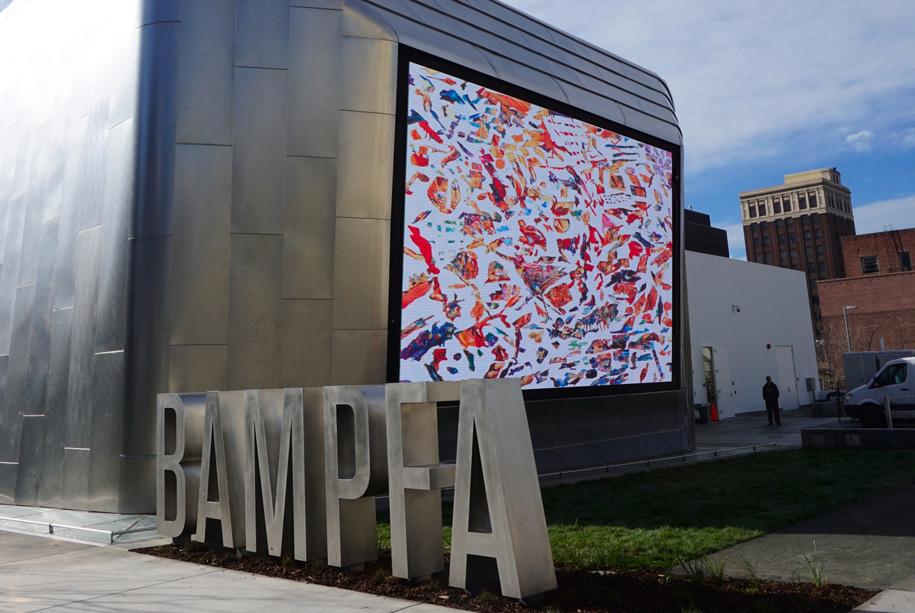
Tucked in downtown Berkeley and a short walk from the Bart station, BAMFA’s eclectic galleries and film screenings are unique in their blend of installations and performance art. Theresa Hak Kyung Cha’s retrospective is a highlight of the museum. Her work, fluidly crossing mediums, centers around the experience of a variety of languages, womanhood, and being a foreigner—engaging all five senses. Set to replace Cha’s exhibition in June is a retrospective on Maren Hassinger’s work, titled “Maren Hassinger: Living Moving Growing.” Hassinger’s work—sculpture, film, performance art, and even dance—similarly evokes an interactive response from the viewer. Her work draws upon nature and our representations of and relationship with the Earth through various mediums. To sweeten the deal, the BAMFA holds regular free community days on the first Thursday of each month.
Geary St #450, San Francisco
Hidden between the bustling streets of Geary and Market, Fraenkel Gallery is an often overlooked destination for art lovers. While the gallery was originally centered around photography, it now exhibits more multi-disciplinary work. The gallery’s first exhibition focused on early California photographers, and this summer, the Fraenkel is again providing a peek into the robust scene of photography and arts in the Bay Area. Although California legends such as Ansel Adams and Fred Lyon are quite well known, the Fraenkel hopes to give visitors a taste of another “Slice of the Pie”—for free—in its upcoming group exhibition with fourteen other Bay Area galleries. Diane Arbus’s work, titled Sanctus Sanctorum, is also a must-see. Arbus’s work is an unflinching depiction of humanity, portraying subjects from circus performers to nudist camps.
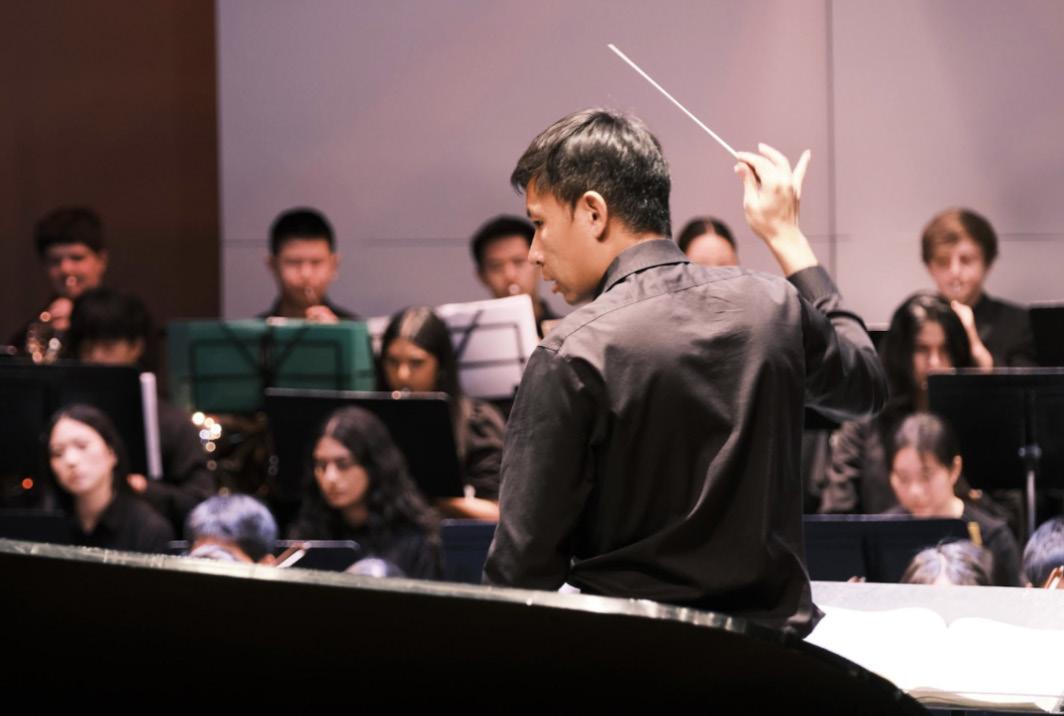
On Friday, June 12th, the Golden State Youth Orchestra will open their Bon Voyage concert with a performance by The Wasps, an orchestral overture by Ralph Vaughan Williams. The Wasps was written for the Cambridge University Greek Play production of Aristophane’s The Wasps, a play that criticizes the jury and legal system. The Overture opens with the strings and winds as wasps buzzing in harmony before moving away from the Mediterranean to the serene and sweeping majesty of Vaughan Williams’ native English countryside. Listen out for the beating of the wasps’ wings, articulated through stopped horn punctuations throughout the piece, interspersed between classic English folk tunes.
On Display Top left: "Calling on Angels;" Bottom: "Bai Hu" // PHOTOS: Alexis C. / The Nueva Current
FRAENKEL GALLERY
GSYO BON VOYAGE CONCERT
PHOTOS: BAMPFA, Fraenkel Gallery via Instagram, and Eunjin Lee
New San Mateo Restaurant: Mahasan The Thai restaurant, located in downtown, held a soft-opening in April and offers hearty dinner meals.
Shiota: Two Home Countries, an expansive, scarlet installation.
May 30: Nueva’s Admissions and Equity & Inclusion departments will host a Bay Area-wide event called “Sustaining Joy and Wellness in the Black Student Experience.”
Leaving their Mark
BY SENNA H., ALVIN Y., NIAM K., ALEXIS C., JACKSON H., RAYA I., AND CALLUM S.
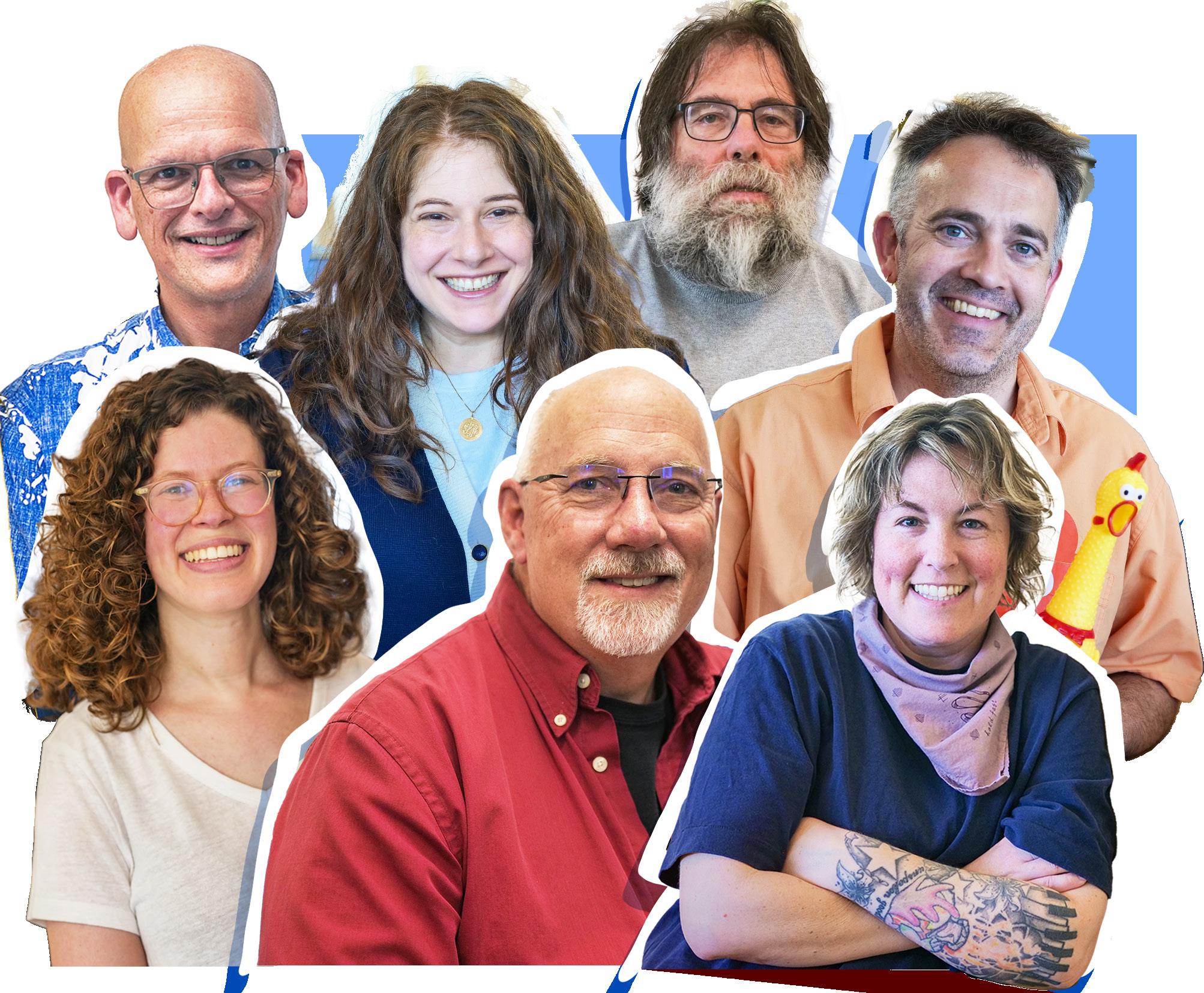
Seven teachers will be departing Nueva in the fall. We reflect on their legacies and the impacts they’ve left on members of our community.
Amber Carpenter, English
A canonical “Amber class,” as English teacher Amber Carpenter’s advisee Lila P. ’26 described, is relaxed and comfortable—and often taught while sitting on top of desks. Perched upon a table, Carpenter always begins class by checking in with her students before diving into the day’s activities.
Since 2019, English teacher Amber Carpenter has been recognized by her colorful outfits and friendly presence on campus. In addition to teaching English and Creative Writing, Carpenter formerly advised the student-run literary magazine LitMag and is a published writer and photographer.
Lila described how she always felt seen, heard, and supported by Carpenter. “She wasn’t sugarcoating any of [our discussions]; she was super honest and positive—really listening to us, and agreeing with us. And it made me feel really seen,” Lila said. “It made me feel really seen.”
After this semester, Carpenter will be moving to Portland, Ore., with her wife, where she will be working as a substitute teacher at Catlin Gabel School.
John Carter, Math
After two years at Nueva, John Carter is heading back to Hawaii, taking with him a wardrobe of rare vintage Hawaiian shirts and a classroom presence that students won’t soon aren't going to forget quickly.
“He has this kind of natural charisma when it comes to math,” said Lucas T. ’26 said. “He had these songs that he would sing about math, and, especially because my class was in the morning, it really brought my spirits up.”
Carter has quickly become one of those teachers everyone at Nueva knows, whether they’ve had him or not.
“When I see him in the hallways, he's always got a smile on his face,” said Evan W. ’28 said. “It really doesn't feel like you can make a mistake with him. He can spin everything into a success for you, whether he got the answer right or not.”
Carter will return to 'Iolani School in Honolulu, where he taught before joining Nueva.
Sarah Muszynski, English
Since 2021, English teacher Sarah Muszynski has taught her students to be intentional in both their dictionword choice and lens of viewing the world in English and Cinema Studies.
To students, Muszynski is known for offering detailed and individualized feedback, always with a planner in hand and a slideshow to keep class on track.
Her guidance, Liam P. ’26 reflected, not only improved his writing but changed how he approached projects: “Often I try [to] do everything all at once. [...] She taught me to go into a project with a focus on one certain aspect that I want to get out of the project,” Liam said. “I will definitely miss how individual and actionable the feedback she gives is.”
Muszynski will be teaching at another local independent school next fall and will spend this summer working on her recently opened online vintage and resale shop, Storied Wares.
Allen Frost, English
Allen Frost has been a pillar of the Nueva community for over a decade. Through that time, he served as the English Department Chair, co-founded the annual faculty Shakespeare show, organized junior trips exploring AIDS in New York City and education policy in his home state, Arkansas.
Fortunately for students who haven’t been lucky enough to embark on a trip with him, Frost is just as fun in class as he is out of it. At the start of every class, he reads a poem—aloud, of course—and asks that his students sit with the language.
“If you're in English with [Frost], it's impossible not to be excited about [the class]. His excitement is contagious,” Harper F. ’26 said.
As Frost begins teaching ninth grade English at Episcopal Collegiate School in Little Rock, we will miss his unmatchable wit. Even still, we have no doubt that he will continue to bring his enthusiasm into every space he enters.
Les Phillips, Debate
Les Phillips has coached Public Forum Debate at Nueva since 2014. Over his time here, the team has won two national championships at the Tournament of Champions, and consistently been in the upper echelons of the competitive debate circuit.
As Director of Debate and a coach with over 50 years of experience, Phillips has played a vital role in managing and supporting the team.
“[Les] is able to give us agency as students, and one reason the team does so well is because he allows the team to build its own culture and step in to provide structure when needed,” debater Deniz S. ’26 said. “He removes the unnecessary logistical stress. The only thing I have to worry about when I debate is debating, and that’s thanks to Les.”
Next year, Phillips will be teaching debate to middle and high school students at the Quarry Lane School in Dublin, California.
Zoe Monosson, I-Lab
Zoe Monosson ’13, who joined the faculty in 2022, spent her four years as Upper School I-Lab Shop Manager championing design, innovation, and the intersection of engineering and art.
A Nueva alumna herself, Zoe brought a range of diverse experience (including previous work in UX design and formal training in studio art) to the I-Lab, enthusiastically mentoring robotics, teaching Art & Fabrication class, and lending a helping hand to anyone who wandered into the shop.
She brought admirable dedication to her work, Asher J. ’27 reflected. “She’s there on the weekends with us. She’s there at competitions with us. She’s always there helping us,” he said. “Even if a tool isn’t her most comfortable subject, she’s willing to learn with us and learn for us.”
Next, Zoe will be heading to an artist residency at Arteles Creative Center in Finland.
Barry Treseler, History
In his 11 years at Nueva, Upper School History teacher Barry Treseler’s impact has extended beyond his role as a cornerstone of the school’s history department. He served as a basketball coach for seven years and a trip leader multiple times.
Treseler’s unique teaching style, centered on collaboration and discussion, educates his students while keeping them engaged: “I’m not that into history as a subject that much, but I think when [Treseler] became my teacher, he brought out a joy in history that I’[d] never had before,” Dylan S. ’27 said.
Beyond just teaching, Treseler’s effort to genuinely understand his students and show his care for them is what makes him beloved:
“ The environment he creates is super fun. Everybody’s focused, and everybody wants to do good work,” Justin C.-B. ’26 said. “He pushes [us] to be [our] best selves.”
Treseler looks to become involved in his community up in the Sierras, where he serves on the community board. HAside from that, he also plans to spend time with his grandchildren and continue working on his two upcoming books.
PHOTOS: Kayla L. & Anwen C. / The Nueva Current
Quoted: “For me, it was honestly just trying to become a stronger test taker… and trying to hold myself to a standard of continuing to build better habits.”
AP Exams at Nueva
College Counseling: "Our general advice for most students is to focus on pursuing their interests as Nueva would have them do, rather than spend time preparing for an AP exam."
In a school with no AP classes, why do some students still choose to take AP tests?
STORY BY ELLIE L.
In ninth grade, Mila B. ’28 didn’t get into any of her top choice electives for the year: Intro. to Microeconomics, Intro. to Macroeconomics, or Intro. to Psychology. It wasn’t too surprising—the classes were popular and Mila was only a freshman. She was still determined to learn the material on her own. So Mila took matters into her own hands—she signed up for Advanced Placement (AP) exams.
That spring, Mila took five AP exams, mostly for her own learning. To fill the void of the electives she hadn’t gotten into, she sat for AP Microeconomics, AP Macroeconomics, and AP Psychology. To strengthen her writing, she took AP English Language and Composition. And since chemistry was already part of her freshman curriculum, she figured she might as well take AP Chemistry too.
“I honestly took them just to force myself to actually study subjects that I was interested in with a curriculum that was going to teach me over time, instead of just watching random [educational] videos once in a while,” Mila said.
In addition, with no time-extensive extracurriculars, Mila figured that freshman year was the optimal time to commit to the study workload of APs.
Mila is far from alone. At Nueva, 93 students took AP exams in 2026, accounting for 142 exams total. That’s down from 2025, when 106 students sat for 174 exams—but the broader trend points upward: the number of students taking AP exams has grown 58% over the past four years. Underclassmen are driving much of that growth, with more freshmen and sophomores taking exams than before, though juniors led the school this year with 38. The majority of students only take one AP exam, with only 33 students taking more than one AP exam this year.
Nueva does not offer any AP classes or explicit exam prep, yet it still hosts several AP exams on campus, including AP Calculus, AP Chinese, and AP Chemistry. For exams not offered at Nueva, students are responsible for finding their own test sites and transportation.
Opting into AP exams comes with an “opportunity cost,” according to Nueva’s college counselling team—the added study time and workload pull students away from other pursuits. In a statement
on AP exams, the team was candid about their stance that taking APs is simply not a necessity for Nueva students: “Our program is explicitly not designed to prepare students for AP exams; we can and do offer something better,” adding that students who choose to take them are “ opting out of an experience designed specifically for them in order to participate in something designed to be a ‘least common denominator.’”
Still, the college counselling team also acknowledges one of the more practical draws of AP exams: college credit. Roughly 60% of U.S. colleges accept AP scores to place out of introductory courses, though policies vary widely by school.
For Jason C. ’26, college credits were his primary motivation for taking three AP exams: AP Calculus and AP Physics Mechanics in sophomore year, and AP Chemistry in senior year.
“I thought I might as well get it done [so I] get credits,” Jason said. “Also, it’s a nice motivator to make sure I'm focusing and also accustomed to testing, 'cause in college, you'll have standardized testing.”
He noted how a fully self-motivated and self-regulated study process can be tedious in comparison to learning in a Nueva class. “Frankly, I found the content
"A LOT OF TIMES IT CAN FEEL LIKE: OH, ALL MY FRIENDS ARE TAKING APS; IN ORDER TO CATCH UP, I NEED TO TAKE APS TOO, OTHERWISE I'LL BE REALLY BEHIND." “
kind of boring on my own,” Jason said.
Nevertheless, he felt the preparation was helpful for his study habits.
“It does help give me a little bit of creativity in the sense of predicting what's going to be on the test and then what to practice,” Jason said.
How the AP scores would look on his college application did not inform his decision, given the college counselling team’s general guidelines around AP exams, which include an emphasis on
how submitting AP scores does not enhance a student’s applica tion to US colleges.
This reasoning has consistently been included in emails to students and par ents about APs, as well as standard college counselling presentations to students.
Asher J. ’27, with these guidelines in mind, described the decision to take AP Biology this year as one not influenced by such college considerations at all. At the beginning of the year, he signed up simply because he wanted to, ready to study and prepare.
effectively. During his studying, Colin was able to implement new learning strategies on his own, while occasionally relying on Nueva teachers for help with any concepts he was confused about.
21% of all Upper School students took at least one AP exam this May.
35% of students who took AP exams took more than one AP exam.
By the time the exam rolled around, however, he hadn’t spent much time studying. Undeterred, he still took the AP exam. He gained a newfound appreciation for his ability to adapt and apply knowledge in the process.
“I thought, what if I just take it and see what happens? And I gained new confidence in my reasoning skills and applying what I know in different situations,” Asher said, and added, “But I definitely think you should study if you are going to take an AP.”
For Colin C. ’26, test-taking and studying skills were precisely what he hoped to improve when he took AP Chemistry as a senior.
“For me, it was honestly just trying to become a stronger test taker, making sure that I'm not letting things go in senior spring, and trying to hold myself to a standard of continuing to build better habits,” Colin said.
He also took the AP Calculus exam as a sophomore, and the AP Computer Science Principles and AP Physics exams as a junior. Throughout the past three years, his primary motivations have remained relatively consistent: to learn, maintain and demonstrate his knowledge, and shore up test-taking skills.
“I feel like there's no harm in taking the tests,” Colin said. “If anything, it will help me understand where my strengths and weaknesses are.”
In particular, the study process for AP exams has been particularly helpful in understanding how to organize his time
Freshman Reed C. ’29 used a similarly collaborative study plan—only, he worked with a study group of five other freshmen. Together, they worked through textbook problems and exchanged advice for the AP Calculus exam they were studying for. Reed viewed AP Calculus as an opportunity to get college credit, and freshman year was the right time since he was currently taking calculus at Nueva—all standard reasons he heard amongst other freshman test-takers. Still, the number of freshmen test-takers was surprising; he had not expected so many people around him to be taking APs.
Reed pointed to worries about falling behind in terms of college applications or academics as potential contributing factors.
"A lot of times it can feel like: oh, all my friends are taking APs; in order to catch up, I need to take APs too, otherwise I'll be really behind,” Reed said.
Ultimately, none of these students would trade the Nueva curriculum for the AP curriculum, or for a more traditional AP academic program. Reed described the current opt-in Nueva framework for AP tests as a balance that is the “best of both worlds” and praised the Nueva academic experience.
“Nueva[’s] projects and rubrics [have] definitely been very transformative for me and other classmates,” Reed said.
“It's ignited in me a passion for specific academic areas, and I think that will carry me much further than a test focus or test-centric learning style will.”
58% increase in the number of students taking AP exams between 2022 and 2026. 14 different Nueva-proctored AP exams were offered this May.
// PHOTO: CollegeBoard
“We are guests in a place that has a very complicated history
Why do we go to Hawaii?
Students, teachers, and administrators discuss the tension between meaningful travel and extractive tourism.
STORY BY RAYA I.
This year, 116 sophomores traveled to Hawaii during Upper School Trips Week, spread across six trips to all four major islands. Each had a different focus—ecology, open-ocean wayfinding, cultural immersion, wilderness safety—but all grappled with the same question: how do you travel responsibly to a place with a complicated relationship to tourism?
The Hawaii trips are designed as an extension of what sophomores have been studying throughout the school year. History 10 examines processes of colonialism and decolonization, and in English 10, all students read Jamaica Kincaid’s essay A Small Place, which critiques tourism as a modern form of colonialism that harms local culture and environments for the consumption and benefit of privileged travelers.
Upper School Academic Support Coach Gretchen Kellough, who used to teach English 10 and lived in Hawaii for several years, helped design one of the Kaua‘i trips as a response to Kincaid’s text.
She started by asking her local and native Hawaiian friends a blunt question: was it even possible to bring dozens of students to a small island responsibly?
“I asked them, [can] we make this pono?—meaning righteous, balanced, responsible,” she said. “And the answer [they gave] was yes, but it had to be really thoughtful.”
Those conversations also reshaped Kellough’s understanding of service work, a core component of many Hawaii trips.
“It was interesting for me to hear that there is a benefit in the cross-cultural experiences where [trip partners] get to interact with young people [from] the mainland,” Kellough noted.
Through these connections with local residents, thoughtful travel—even thoughtful tourism—has the potential to reshape and expand perspectives on both sides. Cultural exchange, especially, is hard to replicate without physical travel, and the revenue tourists bring (~$12 billion annually in Hawaii) can flow into local businesses and cultural preservation initiatives.
But physical travel comes with a slew of environmental harms: emissions, pollution, erosion, wildlife interference, and the massive amounts of energy swallowed by hotels, resorts, or golf courses. Meanwhile,
short-term commercial tourism tends to flatten the complexity and richness of local culture into superficial stereotypes.
To avoid these harms, the trip Kellough led to Kaua‘i this year focused on supporting local organizations and forming connections with local residents. Students also stayed in condos and houses with kitchens, instead of hotels, to minimize food waste.
Lily Z. ’28 traveled to O’ahu and said that her trip put a similarly welcome focus on building community, both in and out of Nueva.
“Seeing yourself as being in community and cultivating that kind of empathy is really important,” she said.”
But Lily also felt that the issue of tourism was “skirted around.” Students stayed in Waikiki, a well-known tourist hotspot, though they spent most of their days farther up the coast, learning about invasive species and biogeography at state parks and farms.
SEEING YOURSELF AS BEING IN COMMUNITY AND CULTIVATING THAT KIND OF EMPATHY IS REALLY IMPORTANT. “
“The rhetoric [was that] we’re being environmentally conscious and socially conscious of our harm—this idea that we are just atoning for our sins,” Lily said. “We kind of de-emphasized the problems [inherent in] tourism in the first place.”
Lily also expressed concern with the concept of “service work” as a way to justify or offset the school trips.
“I think that service is not a thing that exists. I think that actually doing something for your community is not an act of service,” she said. “It is just you participating in a larger ecosystem and doing your part in that larger environment.”
Camilla K. ’28, who traveled to West Kaua‘i, described how her trip revolved around wilderness conservation work, a different type of service. “[We] primarily focused on traveling safely and with as little impact in outdoor spaces, while also learn-
Q&A: Ecologist Audrey Chin ‘19
REPORTING BY ANWEN C.
Alumnus Audrey Chin ’19 is a field ecologist and remote sensing researcher. She is currently working a fivemonth contract with Eastern Research Group, Inc. leading a field crew surveying Bureau of Land Management lands across Utah. In the fall, she will be pursuing her PhD at UC Santa Barbara.
WHAT DID YOU STUDY IN COLLEGE?
Environmental Science and Public Policy at Harvard.
ing about Hawaiian culture,” she said.
For her, the trip’s curricular tie-in to colonialism was less explicit, and the most memorable moments instead came from spending time in nature, cooking from scratch, exploring culture, and bonding with the other dozen students on her trip.
She also recognized the tension between learning about colonialism in the classroom and actually spending time in Hawaii, even as the trips were designed with an awareness of potential harm.
“[Although we are] understanding the impacts of colonialism in English and History, we are actively feeding a tourism economy built due to colonialism,” Camilla said. “While the Nueva trips work hard to avoid this directly by engaging with local organizations, and not following a traditional tourist itinerary, there is still inherent tourism with all Hawaii trips.”
As Kellough was grappling with these questions, she landed on the realization that tourism is, in many ways, “inevitable” in Hawaii. “You’re going to be touching, in some way, that infrastructure, whether it's because you’re [on] a trip that's using a hotel or you’re visiting tourist sites,” she said.
Head of School Liza Raynal added that concerns with tourism are not unique to Hawaii, and that guidelines around responsible travel are designed to apply to every single Nueva trip.
“Where we’re going to stay, who we’re going to meet first, what kind of prep [students] need to know before [they] go— all of those are choices that trip leads or chaperones are making that we hope are setting the [right] context towards the kind of travelers we want to be,” she said.
Still, Lily remains unconvinced. “The material damage that tourism does in Hawaii is something that we can resolve by just not going there,” she said.
Upper School Dean of Students Jackee Bruno, who uses his Trips Feedback Survey to gauge the student experience and factors like sustainability and repeatability, acknowledged the ongoing tension. “[With trips, we’re] constantly trying to move away from consumerism,” he said. “Traveling in itself is a privilege.”
Kellough put it simply: “We are guests in a place that has a very complicated history with the mainland, and we have to acknowledge that.”
WHAT GOT YOU INTERESTED IN ECOLOGY RESEARCH?
“[In college,] I had an amazing mentor—my conservation biology professor—who really encouraged students who were curious and passionate to get involved with research. I joined [his lab, which] did a lot of work in sub-Saharan Africa… and I ended up designing my own research project where I went out to Southern Mozambique and collected data on the impacts of elephant herbivory on baobab trees. And it was the craziest, most incredible experience.”
WHAT DO YOU LIKE MOST ABOUT WORKING OUT IN THE FIELD?
“For me, fieldwork just goes back to just the roots of ecology. When you're looking at data in a spreadsheet or on a screen, it can be easy to just intellectualize it or reduce it to numbers. But being in the field, for me, is when I sort of understand the significance of the data. [I can] build an intuition for what patterns and processes exist in the natural world.”
WHAT’S THE BIGGEST THING YOU TOOK AWAY FROM YOUR NUEVA EXPERIENCE?
“Definitely learning how to build relationships. When you're out [in the field], you're rarely out there alone—you're usually out there with a crew. And really your relationships with your crew can make or break your experience because everyone's going to have hard days.”
ANY WORDS OF ADVICE FOR STUDENTS LOOKING TO GET INTO FIELD RESEARCH?
“There will always be things that you can't control: the weather, insects, temperatures over 100 degrees, your equipment breaking. There are going to be things that are frustrating…but that's the thing about field research— it always feels like a lesson in spontaneity and [being] resourceful.”
Learning on the Ground Students volunteer on a banana farm in O'ahu, Hawaii during their April trip. // PHOTO: Rye O. '28
Quoted:
with the mainland, and we have to acknowledge that.”
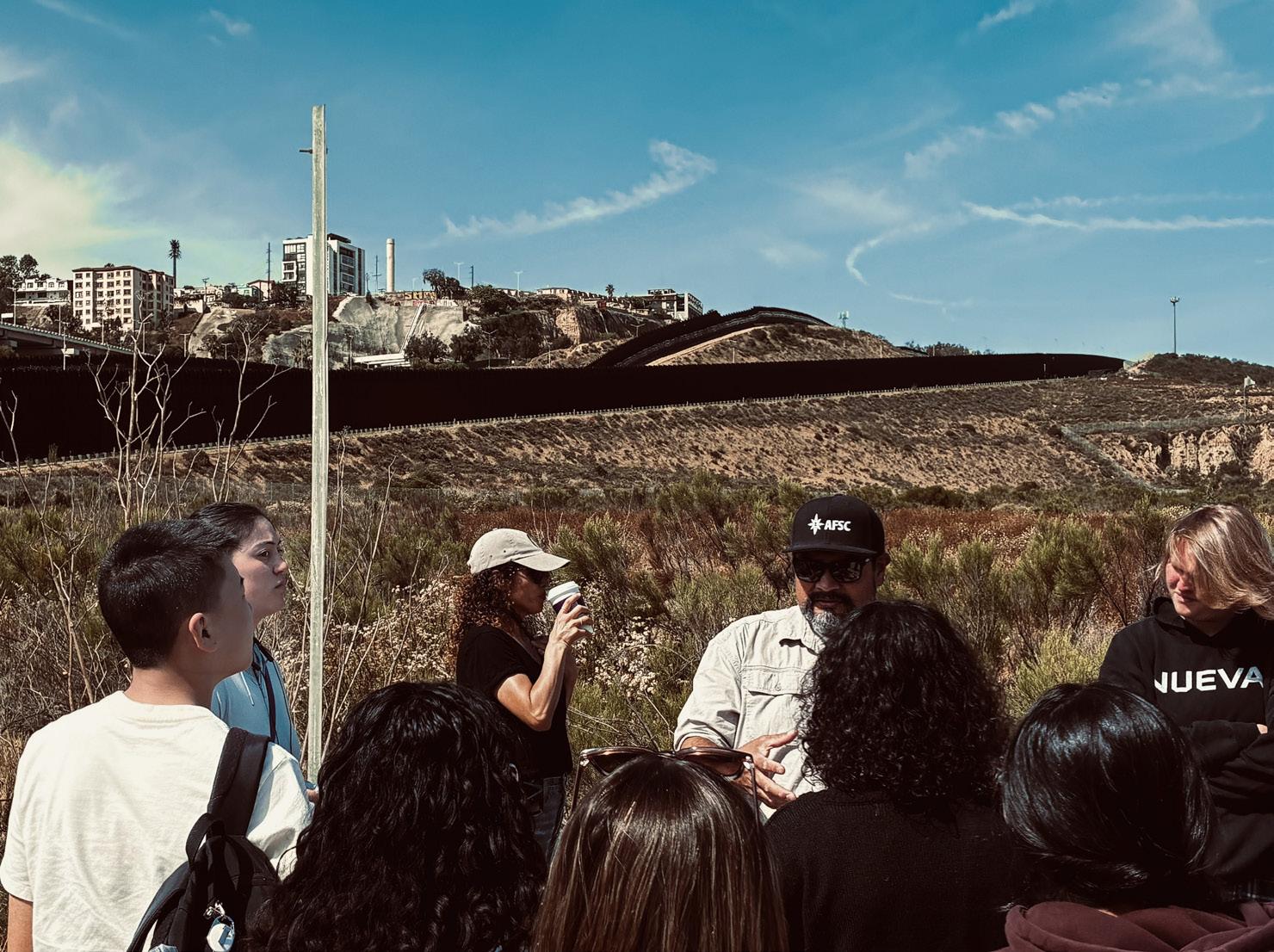
At the Border This May, Nueva students traveled to San Diego to investigate the relationship between immigration policy and border politics. Page 16
PHOTO: Audrey Chin
Next Stop, College
REPORTING BY VIOLET C.
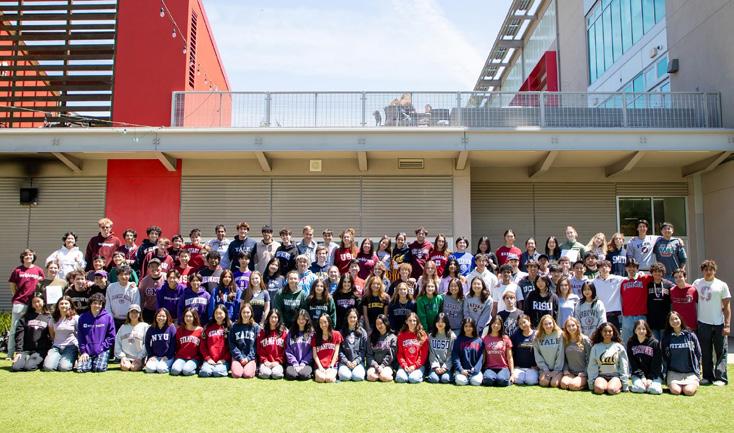
The Class of 2026 is college bound; here's where they're headed
Destinations
BROWN UNIVERSITY, Providence, RI (x4)
BUCKNELL UNIVERSITY, Lewisburg, PA
CALIFORNIA POLYTECHNIC STATE UNIVERSITY, San Luis Obispo, CA (x2)
CARLETON COLLEGE, Northfield, MN (x3)
CARNEGIE MELLON UNIVERSITY, Pittsburgh, PA (x6)
CLAREMONT MCKENNA COLLEGE, Claremont, CA
COLUMBIA UNIVERSITY, New York, NY (x2)
CORNELL UNIVERSITY, Ithaca, NY (x2)
DARTMOUTH COLLEGE, Hanover, NH (x2)
DUKE UNIVERSITY, Durham, NC
EMORY UNIVERSITY, Atlanta, GA (x2)
HARVARD UNIVERSITY, Cambridge, MA (x6)
HARVEY MUDD COLLEGE, Claremont, CA
JOHNS HOPKINS UNIVERSITY, Baltimore, MD
LEHIGH UNIVERSITY, Bethlehem, PA
NEW YORK UNIVERSITY, New York, NY (x4)
NORTHEASTERN UNIVERSITY, Boston, MA
NORTHWESTERN UNIVERSITY, Evanston, IL (x4)
30% 1379 Majors at a Glance of seniors are staying in California applications submitted
Why did you choose your college?
Brown is the best fit [for me].
I just want to get as far away from home as I could because I think that the beauty in life is experiencing novelty and the farther away from home I go the more novel the college experience will be, I'll be forced to–I say forced but it's really a pleasure–to have new experiences and to make new friends.
I'm really excited, because the classes are super interdisciplinary and rigorous. I looked at the course catalog, and they sound like the coolest classes ever. And, the kids are known for being really smart, and also really quirky, and artsy, and kind, and happy. [That] is definitely the kind of environment I want to spend the next four years in.
Personally, choosing a college was all about the vibe. When I visited [Smith], I was just, like, do I feel at home here? Can I picture myself here? And I've always loved the East Coast and I've always really felt at home [there]. Obviously, Smith is a good school, but I felt comfortable there, and I could see myself being really happy living there. It's your life, it's where you live and where you're gonna study.
I had to do a lot of internal work to de-center the top-10 schools that everybody wants to go to. I think you'll do so much better at a place that is right for you, [rather] than a place that other people will think is impressive. It's really hard to get comfortable with, and accept, that you will do best at a place that you truly think is right for you.
OBERLIN COLLEGE, Oberlin, OH
PITZER COLLEGE, Claremont, CA
POMONA COLLEGE, Claremont, CA
PRINCETON UNIVERSITY, Princeton, NJ
REED COLLEGE, Portland, OR
RHODE ISLAND SCHOOL OF DESIGN, Providence, RI (x2)
SMITH COLLEGE, Northhampton, MA (x2)
STANFORD UNIVERSITY, Stanford, CA (x14)
SWARTHMORE COLLEGE, Swarthmore, PA
THE COOPER UNION, New York, NY
UNION COLLEGE, Schenectady, NY
UNIVERSITY OF CALIFORNIA, BERKELEY, Berkeley, CA (x5)
UNIVERSITY OF CALIFORNIA, IRVINE, Irvine, CA
UNIVERSITY OF CALIFORNIA, LOS ANGELES, Los Angeles, CA
UNIVERSITY OF CALIFORNIA, SAN DIEGO, La Jolla, CA (x2)
UNIVERSITY OF CHICAGO, Chicago, IL (x9)
UNIVERSITY OF MICHIGAN, Ann Arbor, MI
UNIVERSITY OF NOTRE DAME, Notre Dame, IN (x2)
UNIVERSITY OF PENNSYLVANIA, Philadelphia, PA (x6)
UNIVERSITY OF SOUTHERN CALIFORNIA, Los Angeles, CA (x3)
WASHINGTON UNIVERSITY IN ST. LOUIS, St. Louis, MO
WELLESLEY COLLEGE, Wellesley, MA (x3) WESLEYAN UNIVERSITY, Middletown, CT
WILLIAMS COLLEGE, Williamstown, MA
YALE UNIVERSITY, New Haven, CT (x4)
SKYE C.-B. LILA P.
GRACE E.
ELIE W.
of seniors are going to a public college
Years after graduation, what kinds of lessons do
alumni carry with them into the world?
CONTINUED FROM PAGE 1
This year marks Wagonfeld’s second as a full-time teacher, and her first after returning to the Bay Area. These days, she continues to find ways to bring her own Nueva experience into the classroom. Some of her teaching practices she’s borrowed wholesale, like Alexa Hart’s ninth-grade English exercise of “vomit journaling.” Other influences have been more philosophical, like Nueva’s emphasis on collaboration and the importance of finding joy in the process of wrestling with ideas.
“[These] are such satisfying [parts of learning], and I think public schools sometimes don’t build [them] into the curriculum as much,” Wagonfeld said. “So, much of my work now is trying to give [my students] some of that experience.”
Wagonfeld still carries a lot of Nueva with her. But what would it be like to have a Nueva student as your coworker? Or even yet, your co-founder?
For the past year and a half, that’s been life for Madeline Park ’20. Park is a startup co-founder based in NYC, and she’s been building Vega—a social networking app—alongside former classmate Ben Lee ’20.
In high school, Park and Lee were good friends; they ran cross country and track together and took the same advanced STEM electives. And although the two went their separate ways in college—with Park headed to Columbia to study engineering, and Lee studied Computer Science at Brown—they stayed in touch, working on side projects pitched by their friends.
Growing up in the Bay Area, Park said that she’s always been drawn to startups. But it was only after college—and a short-lived job as a machine learning scientist at Uber—that she decided to try building one of her own. She reached out to Lee via email, and quickly discovered that they both cared deeply about the same problems: tackling loneliness, fostering relationships, and connecting the right kinds of people together. They also shared the same frustrations about the limitations of current matchmaking apps. Then came the question: Could they create something better?
Determined to find out, the two reconnected in NYC and got to work building Vega. The thesis of the app was simple: whereas existing matchmaking apps relied on users to self-input information, Vega would allow users to vouch for their friends, and connect them to other users. It would be a platform for “setting people up,” in other words.
With their pitch locked down, the two spent the next months in development mode, flitting between different startup accelerator events, raising capital, and navigating the high-speed thrum of NYC’s tech startup scene.
A year and a half in, Park says that the pressure can still feel intense at times. But through it all, she says she’s grateful to work with someone who can match her passion, trade inside jokes, and draw on a sort of shared history:
“[Ben’s] always the thoughtful one—he thinks things
through. [Meanwhile,] I’m more like, let’s just go and get out there.We might break things or fail, but in any case, we’ll try again. I think those opposing ways that we work are actually really complementary.”
While Park and Lee may occupy the unique position of having founded a startup, plenty of their peers have wound up at one. In a survey conducted by The Nueva Current, 26% of alumni who are formally employed (outside of academia) currently work at startups, defined as companies founded within the last 10 years, centered on rapid growth and market disruption, and usually reliant on external funding.
Similarly, Park and Lee are two of many Nueva alumni who now work in the tech sector. According to the survey results, 23% of alumni who graduated between 2017 and 2021 are currently employed at tech or software development companies. 19% hold technical positions related to software development specifically, making it the most common sector by a large margin.
So why does tech draw so many Nueva graduates? And is there something about Nueva that encourages alumni to seek out startup environments in particular?
Park says yes. Nowadays, she sees a direct line between the freedom she found in Nueva’s curriculum and the freedom she now enjoys as a startup founder.
“[At Nueva], I remember having a lot of agency in my work. I found that I was the most inspired and motivated when I could own and decide what I was doing,” she said.
Others shared similar experiences. Jordan Mak ’21 works as a UI/UX designer for a travel planning startup, Shrtlst. For Mak, the appeal of startup life comes down to visibility and ownership: “[Being at a startup] is particularly fun and rewarding because a lot of the work you do is a lot more visible, and you have freedom and autonomy to make your own decisions.”
Like Park, Mak also credited Nueva with giving him the skills to thrive in such an open-ended and at times unpredictable environment.
“[Nueva] taught me how to carve your own path and take advantage of any opportunity,” Mak said. “That’s something I loved in high school, and it’s the same thing that I find the most enjoyable about working at a startup now.”
But not every Nueva alumnus can trace a clean line from their high school experience to their current career. For some, the years after graduation came with turns and pivots they never could’ve seen coming.
Ishani Gupta ’18 can speak to her experience. At Nueva, Gupta was convinced she was headed towards a career in biology research—stem cell research, to be exact. She had nurtured a love of lab research through the Biology Research Team course, loaded up on advanced biology electives, and when it came time to apply for college, confidently put herself down as a major in the Biological Sciences.
She held to that plan through her first year of college. But in the summer of 2019, during a study abroad program at Oxford, she began to have second thoughts about her trajectory. In her first public health seminar, Gupta encountered a framework she hadn’t fully considered before: disease not just as a microbial problem,
DESIGN BY: Anwen C.
Nueva
but a policy one. She learned about the outsized role of governments, economic systems, and historical injustices in shaping access to care.
It was a whole new lens for understanding disease and human biology. And for Gupta, it brought a paradox that she couldn’t shake: What good was advancing the science of medicine if most people couldn’t access it?
“As a researcher, I knew I was going to raise the ceiling of science and medicine,” she said. “At the same time, I knew we also had to raise the floor.”
It was a lucky time for her to be at such a crossroads. Gupta was a freshman; she
37%
of post-college Nueva alumni have obtained or are in the process of obtaining a postgraduate degree
still had time to switch her major. Even still, she deferred the decision until the following year—the year the COVID-19 pandemic hit, and the failures of the US public health system became impossible to ignore. For Gupta, this was it; if there was ever going to be a “perfect” time to pivot, it was going to be this one.
“I cared about [health equity], and I struggled with figur[ing] out how stem cell research and [these] advancements in medicine could be made available to everybody when we still have gaps in [basic health] coverage,” she said.
Gupta officially switched to a public health-related major as a college sophomore. And over the next few years, her life began to look nothing like she’d imagined. Things started to move with a new rhythm: days at the lab bench gave way to nights spent pouring over research on population health outcomes. She eventually graduated in 2022 with her degree in public health, spent the next two years working to improve health education at a children’s hospital, and in 2025, returned to her studies as a master’s student at Harvard.
Now six years into her public health journey, Gupta admits that what she does now is a far cry from what she envisioned herself doing in high school. But in the time since, she has learned to carry her choice with pride.
“What I just keep focusing on—and what I keep reminding myself—is that this is the work that I’m so passionate about,” she said. “It’s the work that makes me want to get out of bed.”
Like Gupta, Sora Cullen-Baratloo ’19’s path started out deceptively straightforward. In high school, she was skilled in math and had a knack for coding—all reason enough, it seemed, for her to keep on the STEM path in college. It felt like the natural way forward, “the default thing to do,” as she called it.
So for years, she stuck to those defaults. In 2023, Cullen-Baratloo graduated college with a joint degree in mathematics and computer science. Not wanting to lose the momentum, she defaulted again to enrolling in a CS PhD program at the University of Maryland.
“[At the time], I was like, I don’t really know what to do. I’ll just go to grad school. I’m familiar with [CS], I know how to do CS. I’ll just keep doing it.”
In undergrad, getting by had been enough: CS might not have been her passion, but at least she was competent at it. Graduate school was different. Coursework and test scores only got you so far; eventually, you had to do actual research. And research required something she was running out of: genuine interest.
On the other hand, Cullen-Baratloo had become interested in something else. It just didn’t have anything to do with coding or algorithms. In the fall of 2024, she attended a student panel where someone mentioned the university’s graduate student union in passing. Intrigued, she decided to get involved. She started becoming a regular at union meetings, began working advocacy events herself, and quickly discovered her passion for labor organizing in the process.
“I wasn’t sure that [CS] was something that I wanted to spend the rest of my life doing,” she said. “I was involved in organizing already on the side, and it felt like much more meaningful, fulfilling work.”
So she made the call. In late 2025, Cullen-Baratloo took an indefinite break from her PhD program, and now spends her days working as a United Auto Workers (UAW) affiliate full-time. She says it hasn’t been easy. Day-to-day, her work now consists of a lot of “exhausting social labor”: hosting meetings with stakeholders, going door-to-door, and generally fighting the same uphill battles that plague many in her profession. Still, Cullen-Baratloo says
that the switch has felt worth it.
“I haven’t been involved [in this work] for that long, and at times, there’s a part of me that’s still a little [hesitant],” she said. “But at the end of the day, I don’t wish I was back doing CS.”
Cullen-Baratloo’s story is not a common one. It’s a full career reversal, one that’s hard to explain to friends and family, and harder still to justify on paper. But the decision made sense for her, and ultimately, she’s been happier for it.
Like Cullen-Baratloo, many Nueva alumni have had to grapple at some point with the question of whether or not to pursue graduate school. According to survey data, 37% of post-college alumni have obtained or are currently in the process of obtaining a graduate or professional degree. And of those 37%, most begin their graduate studies immediately after earning their four-year degree. For some, graduate school presents itself as an opportunity to build deep expertise. For others, like aspiring doctors and lawyers, it’s an occupational necessity.
But graduate school isn’t for everyone. At least, not right away.
Scott Brasesco ’18 came into undergrad with a plan: he’d start out studying political science and history, go through the pipeline of academia, and end up a history teacher. But after taking a course on democratic backsliding, that plan took a backseat. If Brasesco had the skills to make an impact on the world, then he knew he had to put them to use: “I wanted to go out into the world and try some things—maybe some journalism, some government, some policy, all kinds of different [subjects],” he said.
Today, Brasesco serves as a policy researcher at Global Action on Gun Violence, a DC-based nonprofit that litigates against gun manufacturers. He says that moving directly into the working world has helped him “build an identity” as a young person: he’s gained valuable experiences by situating himself in the hubbub of DC politics, experiences that he wouldn’t have gotten just going from one classroom to another.
Brasesco still thinks back to Nueva occasionally. He’s grateful for the soft skills he developed there, from learning how to deal with uncertainty to building the confidence to approach people for help. But, as he’s found, life after high school opens up a whole new testing ground for these skills.
Chief among them has been self-ad-
vocacy: “No one’s gonna hand stuff to you if you don’t ask for it. And if you do ask, you’ll find that people will be surprisingly generous with their time and resources,” he said.
Other alumni have also found that some lessons can only be learned through experience. There are many things in the world that no amount of schooling, Nueva or otherwise, can fully prepare you for.
Ben Cheng ’19 has a name for it: growing up. Now in his second year of medical school, Cheng has felt a palpable shift in the years since leaving high school. “When you’re young, you have so much support around you,” he said. “Especially in Nueva, [you have] the privilege of being able to access an almost infinite number of resources. So, sometimes you can feel a bit sheltered.”
Still, he added, “This is not necessarily unique to Nueva, but I think Nueva amplifies it.”
Willow Taylor Chiang Yang ’21, who will begin her master’s in political research this fall, also said that “success” becomes harder to define as you get older. Things can’t just be categorized on academic rubrics or resume lines anymore; rather, being an adult means confronting important, and sometimes existential, questions.
“Now, I often think, what does it mean to cultivate other parts of myself that are more important [than my academics or career]? Like my self-identity, my confidence, and my curiosity towards the world?” she said.
Brasesco agrees. For many high schoolers and college students, it is natural to want to map out your future, to know what options are available and blueprint accordingly. Yet, if Brasesco’s learned anything in the near-decade since leaving Nueva, it’s that there’s a limit to how much you can plan ahead.
“I’ve always been someone who likes to think a few years out in advance and be like, This is my plan. This is what I’m going to do, and this is what I have to do to get there,” he said. “[But] what I know now is that those plans are more like guidelines.”
And for any high schooler reading this, still in the thick of figuring it out, Brasesco has one last piece of advice:
“Life happens, things change, and that’s okay. So have some trust in yourself. Things will always turn out right in the end.”
Nueva
Quoted: “I feel more in the moment. That’s been really, really important to me.”
Back to Basics
Shifting Away from Screens 63% of Gen Z individuals report deliberately trying to reduce their screen time, according to a 2026 study by Talker Research.
Students discuss attempts to ditch their phones, feel more connected, and live in the moment by embracing analog technology.
STORY BY RAYA ILIEVA
Hayes S. ’27 can often be found out in nature, hiking and backpacking. As an artist whose work often portrays the natural environment, he also likes to capture what he sees through photography. Usually, he pulls out his camera during breaks in his hikes to capture lighting, movement, and scenery, using the photos as references for future paintings.
But recently, Hayes has changed the way he does so. Before, he would often take his phone with him on hikes, snapping photos along the way as references for future paintings. Now, Hayes almost always leaves his phone behind—opting instead for an analog camera (and a physical map). “It’s a lot more enjoyable to not have my phone with me,” he said. “When I used to take pictures with my phone, I’d jump onto other applications and it would distract me from where I was.”
He added that breaking away from social media’s focus on hyperpalatable aesthetics has made him more in tune with the landscape, “on a level that stretches beyond [trying to capture] the most beautiful snapshot.”
Eliya W. ’28 has also been experimenting with analog, using a camera and journaling on paper every night, and has felt many of the same effects as Schwarz: more presence, more clarity, and less distraction.
“[After] starting to do more things off my phone, I reduced my dependence on my phone to record my thoughts or take pictures,” she said. “It gets rid of that instinct that in order to do anything, you need to have your phone.”
Eliya and Hayes are all part of a broader cultural shift away from a constant online presence. According to a 2026 study by Talker Research, 63%
of Gen Z is attempting to intentionally reduce their screen time for wellbeing. And popularity for app-blocking apps and “dumbphones” has surged.
Other students have found that going analog forces a different speed from the frenetic pace of digital life. Aerie L. ’28, who has been using a record player for more than two years, said, “I like that I have my playlist, but sometimes I just want to listen through a whole album.”
She added that a record player’s lack of a streaming algorithm and customizable playlists is a virtue, not a downside.
Analog replacements are fundamentally different from their digital counterparts, though, and ditching phones often means ditching some degree of convenience.
“You notice how much extra stuff you’re carrying with you when you replace functions on your phone with other items,” Hayes said. But he thinks the switch has been worth it: “I feel more in the moment. That’s been really,
really important to me.”
Eliya has noticed a change in how she relates to what she owns, since larger analog devices can often feel more fragile.
“For my camera or for my journal, if that gets damaged, it’s pretty hard to get those moments back,” she said. “So I think that [fragility] makes me a little more intentional about how I treat those items and also what I record in those items.”
Aerie finds herself stepping out of the comforts of the repetitive digital algorithm when searching for new music.
“The cheaper [records] are more obscure,” she said. “It incentivizes you to find new music, and to be okay with getting records that you don’t know about yet.”
She sees this spirit of discovery as a way to challenge the “one-track mind” of generative AI. “[AI is] designed by a specific culture and will only spit out that culture back to you,” she said. “And I think we all recognize that.”
Consumer Culture at Nueva
A look into Nueva students' spending habits
STORY BY SENYA S. & AVIVA S.
Whether it be lunch off-campus one day, or boba after school with friends another, it’s undeniable that Nueva students spend. The campus itself is situated a half-mile from the Hillsdale mall and just a few blocks from popular food destinations such as Whole Foods and Mendocino Farms.
For some students, there’s a social expectation to spend when going out with friends; most spots that students frequent are centered around spending.
“People go to the mall a lot,” Aditya S. ’28 said. "If I'm going to the mall with my friends, I'm going to be expected to spend money.”
Wendy E. ’26 echoed this sentiment.
“Going out with friends usually means spending a lot on food or drinks,” Wendy said. “I do think that I've cut down since sophomore year, when I would go out for boba maybe every day.”
Out of 79 Upper School students who were surveyed on their spending habits,
roughly nine out of 10 typically buy food when spending with friends.
“I think the reason why I was buying all these things was just because it's a good way to socialize,” Wendy said. “For underclassmen, the go-to hangout location is the mall. By junior year, I started going out less because I had less time and became a lot more conscious about how much I was spending each week.”
Some students, such as Gabby L. ’26, consistently take a more frugal approach.
“I have my boba quota, which [means] I can only have one boba a month, but I usually try to get it from school. If I don't get it from school, then I usually just don't buy it,” Gabby said.
That mindset is relatively uncommon, though, since spending is often woven into social life for students: “I think people at Nueva spend pretty freely,” Gabby added.
Further, Nueva’s proximity to retail and food and drink establishments, combined with the rigorous workloads students can
take on, can encourage spending as a form of self-reward.
“I think people realize that it’s a problem, but don't do anything to solve it. It makes sense why a lot of these high achiev ing, very ambitious students who are constantly working all the time would want to do Starbucks runs every morning,” Wendy said.
As an artist, Hayes prefers physical to digital media precisely for this reason. “I think some of my pieces definitely contemplate digital media and AI, especially because AI has become a very relevant force in shaping the art world,” he noted.
He added that creating physical art also pushes back against other aspects of the digital experience: “When I’m painting in a studio on a physical surface, it’s a lot easier for me to talk to other people.”
For others who are interested but apprehensive about going analog, Hayes suggests trying a phone-free day. If that feels too intimidating, he says that trying to replace select applications—like the camera, Notes, music apps, or calculator—can be a place to start. Wee, meanwhile, recommends picking up new analog habits like journaling instead of just trying to transfer existing habits onto analog mediums, which can feel more difficult.
Ultimately, Eliya says that personal experience with going analog has transformed not only her relationship with technology, but also the way she lives her life.
“Always being in a digital place is taking away from my actual ability to engage in my life,” Eliya said. “And I think especially growing up with all this technology, it’s something that previous generations didn’t really have to deal with.”
This summer, she’s considering taking her analog journey a notch further and using a flip phone alongside her camera and journal. And especially when the absence of school creates a vacuum of free time, scrolling can easily become the default.
“A lot of your life happens on your phone, which I think is [why it] is really scary, often, to go completely analog,” she said. “[Still,] I hope I can at least take some small steps towards that.”
However, it’s not just proximity and workload that influence student spending. At Nueva, many students are privileged enough to have the freedom to spend frequently.
“I think there are lots of people where money is not an issue at all or they don't think about it, ever,” said Andromeda W. ’26. “So they just buy things that they like, and then there's people for that not the
At a school where there’s a plethora of opportunities to spend and many students who can, there remain a variety of approaches to spending.
“I don't think there's one unified culture around spending at Nueva,” Andromeda added.
Beauty in the Process Eliya Wee '28 displays her collection of analog items (left) and uses her digital camera (right) // PHOTOS: Eliya Wee case.”
GRAPHIC: Senya S. / The Nueva Current
Mars Resser ’27: “The way we go about punishing objectification is very semantic. We tell people, ‘no, you can't say this or that.’ What would be better is if we could reconceive how we think about objectification—it's literally thinking that a group of people are [less] human [than] you.”
Ayaan Masud ’26: “I think it's totally okay to joke about someone who [objectifies people]. But it gets to a point. Are we, by joking about that, minimizing people’s experiences?”
Under the weight of the gaze
Students reflect on the normalization of objectifying language and the harms it poses for female-identifying students
STORY BY ALEXIS C., ELLIE L., & SENNA H.
I. A FAMILIAR PATTERN
It was the end of the school day, and Hannah F. ’27 sat alone at a table. Across the hallway, she heard male students start talking loudly about the alumni and senior girls they most wanted to sleep with. She grew increasingly uncomfortable as the boys revealed their lists, floating comments about their peers’ faces and bodies to “justify” their rankings. They laughed and belittled each other’s choices.
It wasn’t a particularly surprising experience; Hannah had consistently noticed objectifying language being used at school since her freshman year. It never got easier to hear. As she listened, Hannah stayed put, unable to stop overhearing the conversation taking place 30 feet away.
“I didn't say anything, because I wasn't involved in the conversation,” she said. “But I do wish that I stood up and said something.”
However, she is not sure what she would have said, or how she could effectively push back against objectifying language.
Objectification, the act of degrading someone to the status of a mere object, and sexualization, the act of imbuing a person, behavior, or object with a sexual meaning or character, are not always easy for students to identify or rebuff in everyday settings. Objectifying behavior is not always sexual. Sexualization does not always fall along gendered lines—although it commonly intersects with misogynistic views of women’s bodies—and it can be harder to identify when it does not take traditional gendered forms.
In a survey of 101 Upper School students, faculty, and staff, 53.5% of respondents reported that they often or very often perceive “objectifying language being used casually or as a joke, as though it's normal,” in an average week at Nueva. When it comes to students standing up against objectifying comments, 51.5% of respondents reported that they rarely perceive students pushing back against such remarks in an average week at Nueva, and 24.8% reported they never see it happening.
Since freshman year, Connor H. ’26 has noticed repetitive, casual use of objectifying language in social contexts. He recalled a ride with senior boys from soccer practice back to school: they talked about a girl in their grade, commenting on her appearance and sexual appeal.
“This was my first impression of the girl. Every single time I saw her in the halls or heard about her, I just couldn't help but remember that,” Connor said.
As a senior, Ayaan M. ’26 said that the normalization of objectifying language is especially worrying for his grade, as seniors often model behavior and shape
school culture.
“As seniors on campus, the fact that we allow this [behavior] in our circles allows younger grades [to] feel like they can push the boundaries on it, which is, of course, not okay,” Ayaan said.
Social media platforms, as Arishka J. ’26 believes, can amplify objectifying behavior, especially when teenagers use the platforms to seek out romantic interests or prom dates, judging every possible prospect only by their appearances.
“When so much of our focus is on the way people look, people are always going to objectify, because they make judgements about people before getting to fully know them,” Arishka said.
At times, within online and in-person contexts, it is unclear whether comments are objectifying or not. For Beckett B. ’26, talking about attraction amongst friends is normal and harmless. However, he acknowledged that the line between objectifying comments and non-objectifying appreciation of someone’s looks can be easily blurred.
In sophomore year, for instance, a friend shared positive comments about Beckett’s appearance made by upperclassmen. Beckett considered the experience more flattering than creepy. “I didn’t feel uncomfortable. I felt a little validated, actually,” Beckett said. “Maybe if the gender roles had been switched, I [would] have felt different. I don’t know.”
For an anonymous sophomore, the
“WE DON'T WANT THE FIRST THING THAT COMES TO THEIR MINDS ABOUT US TO BE THAT SOMEONE SHARED SOME[THING] REALLY WEIRD ABOUT US." “
categorization of comments or incidents as objectification is defined by how she feels in the direct aftermath. She recalled an incident where a male friend shared a distorted story about her with other male classmates. Beyond a general “gross” feeling, she began to worry about whether she’d be perceived differently by her peers. She characterized it as a particularly significant concern for girls with similar experiences to hers.
“These are people that we're friends with, we work with, we have group projects with; we don't want the first thing that comes to their minds about us to be that someone shared some[thing] really weird about us,” she said.
And when objectifying comments or
incidents get shared and become more broadly known amongst the student body, Lila P. ’26 is wary of how someone’s personal experience quickly becomes fodder for gossip or rumors.
“Especially with instances of oversexualization, I feel like it [gets spread] a lot through rumor mills such that the person [sexualized] doesn't actually have control over the narrative,” Lila said. “I don't love everyone else sharing other people's business. I feel like if there's an incident, it should be their own story to tell.”
II. THE DIFFICULTY OF SPEAKING UP
As a freshman, Irene V. ’26 had a “bit of a superiority complex” about Nueva culture. She thought students used less sexist or objectifying language than at other high schools, and that even if there were any incidents, students wouldn’t just let the comments go by.
However, as she encountered spreadsheets and tier lists ranking girls’ appearances, casual sexualizing remarks, and a culture that didn’t blink an eye, her outlook became far more cynical. These days, when she faces objectifying or sexualizing language, she isn’t sure how to effectively call out the behavior—instead, she processes the experiences in conversations with her friends, building a shared, weary knowledge of who to be cautious around.
“In general, [at] Nueva and in society, [we’re] set up to just let these things pass and think, ‘oh, that's just how it is,’” Irene said. “I honestly think there's a bit of fatigue amongst the people [whom] this is happening to, where we’ve just come to accept it.”
While a portion of students brush off objectifying language, others feel pressure to take comments about their looks as a compliment, regardless of the undertones of those remarks.
“I would almost try to shape it as a compliment or something else entirely [because] I don't want those words lingering in my mind,” Julia C. ’27 said.
Speaking out against objectifying language in a social setting is also challenging for bystanders. Zoe B. ’29 would like to think she would be able to speak out at the moment. But reality, she acknowledged, is often complicated by initial shock at the comment and fear about how speaking up will be perceived.
“It can be hard, especially if it's in a situation where you look up to someone, or you're in the same social group as someone. You don't want to be a problem,” Zoe said.
Despite these many difficulties, Beckett still believes that social pushback is the most effective way to address casual objectifying language. In particular, he urged male students to act, highlight-
ing how the typically gendered tone of objectifying comments may make it more difficult for female students to speak up.
“If someone makes an inappropriate comment, and I see a woman let it slide, I'd think, ‘that’s a terrible situation, she's probably pretty uncomfortable right now.’ But if I see a man let it slide, I’d think, ‘who is this guy?’” Beckett said. “I think as a man, you are the one who is supposed to be more accountable, because under [the] patriarchy, you are privileged.”
Despite internal and external discour-
“
“I WOULD ALMOST TRY TO SHAPE IT AS A COMPLIMENT OR SOMETHING ELSE ENTIRELY [BECAUSE] I DON'T WANT THOSE WORDS LINGERING IN MY MIND."
agement, students hope that objectifying behavior can be more widely addressed both in educational settings and by peers.
Wendy E. ’26 believes that discussions in Sex Education sessions or classes about consent, which occur during junior and senior years, should not sugarcoat the impact of objectifying behavior or sexualizing comments. Previously, in those spaces, Wendy has found the language to be somewhat weak, dancing around serious topics.
“If we are educating people on the effects of misogyny and sexism in our language, it's really important to shift our vocabulary to fit how serious these things actually are,” Wendy said. “Education has to fit the magnitude of the problem.”
Part of taking objectification seriously includes listening to the experiences of those affected. For bystanders, Hilde K. ’27 emphasized the importance of offering support.
“We have to believe people when they're saying, ‘I'm feeling uncomfortable,’ as opposed to saying, ‘Well, I don't actually believe that guy would do that,’” Hilde said.
As for students who use objectifying language, thinking it’s harmless, Lauren J. ’28 has a simple message to share.
“It's not a secret thing that is staying within group chats and conversations. People hear about it and spread it,” Lauren said. “It will most likely get back to whoever they are saying it about. And it does affect them to hear stuff like that. It does hurt.”
overall
Facing the Border
Freshmen document the human faces of the immigration crisis on their trip to San Diego
STORY BY VEDA P.
I. WHO'S ALLOWED TO STAY?
The young woman entered the courtroom with two children beside her. The children sat quietly while the judge asked her the same question several times through a translator.
Was she sure? Did she understand what self-deportation meant? Was this really what she wanted? Each time, she said yes.
The hearing lasted only a few minutes before the woman, who had traveled from Venezuela with her sons to reunite with her husband in Sacramento, agreed to voluntarily leave the United States.
This courtroom scene was one of many illuminating encounters during Nueva’s ninth- grade trip to San Diego. Over the course of their five-day trip, 24 students explored the complex intersection of migration and identity from behind the camera lens. Students visited historical museums, courtrooms, day laborer sites, and the border wall itself to document the lived realities of the U.S.-Mexico borderlands.
II. WHAT'S THE PROCESS?
Before the trip, several students expected immigration enforcement to resemble television footage of raids or chaotic border crossings. What they encountered was unexpected but chilling.
“I was expecting the ICE officers to come in and grab someone,” Elyse D. ’29 said. “But it’s actually a lot of waiting.”
That process of waiting has become increasingly common across the United States. As of March 2026, the national immigration court backlog had reached nearly 3.3 million active cases, with roughly 70% involving asylum claims. Many immigrants spend years moving through the system. In March 2026, only about one-third of immigrants facing removal orders had legal representation, and judges issued removal or voluntary departure orders in roughly 80% of completed cases.
In courtroom after courtroom, students watched hearings end the same
way. “Almost every court case was basically, ‘Fill out this form and come back in a year,’” Elyse said.
For some students, the hearings also complicated assumptions they already held about immigration enforcement.
Nate S. ’29 said he expected the system to feel harsher and more chaotic than what he observed in court.
“I thought it was slightly better [than what I expected], but also that there was a lot to work on,” Nate said. “It was actually reassuring to see that people got due process.”
Still, the courtroom presented a paradox. Judges often spoke patiently and respectfully to families while still enforcing policies that could separate them.
One case in particular stayed with Nate: a family in which an aunt with a disability faced deportation while the rest of the family was allowed to remain in the United States.
The moment transformed immigration from a political debate into something painfully human: “I couldn’t imagine being in those families’ positions,” Nate said.
“
KINDNESS IS FREE. EMPATHY IS FREE.
III. WHO'S ON THE GROUND?
Early on the fourth morning of the trip, students volunteered with Border Angels, a humanitarian organization supporting migrants and day laborers throughout Southern California. They distributed care packages and spoke with workers who were gathered in parking lots and on sidewalks across the city, waiting for temporary jobs in construction, landscaping, and manual labor.
Some had families elsewhere in the United States. Others had none nearby at all.
Eduardo, a man in his 50s from El Salvador, had spent four years in San Diego while his wife remained unable to join him in the United States. Ysidro was 78 years old with three kids, and was still searching for work because he
could not afford to retire. Noel, 31, was alone in San Diego with no family.
California recently expanded legal protections for vulnerable workers, including laws targeting wage theft and unfair immigration-related labor practices. Yet many day laborers still face unstable employment, unsafe conditions, and inconsistent pay.
Across language barriers, students struck up conversations with the workers. In particular, an interaction with a Haitian worker, has stayed with Elyse. After learning that the worker spoke neither English nor Spanish, she and another student attempted to greet him using Haitian Creole phrases they had searched for online.
“At first we were speaking in horrible accents,” she said. “But then he started teaching us vocabulary words by pointing at objects around him. Seeing his face light up after we spoke to him in his native language kind of made my day.”
Ana, a guide with Border Angels, told students that interactions like those mattered more than many people realized.
“Kindness is free. Empathy is free,” she said. “People think helping is this huge thing, but sometimes it’s just talking to somebody.”
IV. WHAT'S BEYOND THE WALL?
By the end of the trip, students found themselves standing near the border wall.
The structure stretched across the landscape in towering metal slabs lined with layers of fencing and barbed wire. Behind them sat federal buildings and surveillance infrastructure. On the other side lay Tijuana, dense and lively against the hills.
“I hear so much about the border wall in the news,” Elyse said. “And then suddenly it was right there.”
“It felt super foreboding,” Nate added.
Recent border policies have sharply restricted access to asylum at the southern border, contributing to major declines in migrant crossings compared to previous years. Meanwhile, humanitarian groups continue to report deaths from dehydration, falls, and exposure as migrants attempt crossings through increasingly
dangerous terrain.
Students also learned how the recent border wall expansion has disrupted wildlife corridors and indigenous lands across the region. Some newly constructed sections have even been painted black to increase surface temperatures as a deterrent.
For many students, the wall itself felt less like a political symbol and more like evidence of fear.
Visiting the Otay Mesa Detention Center left a similar impression.
Located among warehouses and industrial buildings east of San Diego, the privately operated facility houses
WE HEAR SO MANY TRAGIC STORIES EVERY DAY THAT EVENTUALLY YOU STOP KNOWING WHAT TO FOCUS ON. “
more than 1,000 detainees daily. The fencing and barbed wire around the building cast stark shadows on the sand as the guide described the poor living conditions and limited oversight inside the center.
“My first reaction was: wow, this looks like a prison,” Elyse said.
In recent months, San Diego County officials have fought for greater access to inspect the facility, arguing that oversight is necessary to investigate potential health and safety concerns.
Throughout the week, students repeatedly returned to one idea: how easy it is to become desensitized to stories that constantly appear online.
“We hear so many tragic stories every day that eventually you stop knowing what to focus on,” Elyse said.
But in San Diego, immigration became something more than a headline or hot-button issue. Understanding and confronting the immigration process meant seeing the face of a mother giving up on a years-long asylum case. Workers waiting for jobs before sunrise. Families living between walls, literally and figuratively.
“I don’t think you can fully understand it without actually seeing these systems in person,” said Nate.
At the Edge Students visit the U.S.-Mexico border wall. // PHOTOS: Veda P.
College Controversy An Instagram Reel posted by students at Harker School showcasing students’ college sweatshirts garnered over two million views, sparking a wave of online discussion.
Student Standoff Should Nueva discontinue Senior Sweatshirt Day?
Sweatshirt Day is not all smiles
Every celebration comes at a cost.
STORY BY NATE B.
If there’s one senior tradition I’ve been both looking forward to and dreading since I got to Nueva, it was this one. At 11:45 am on a Monday morning in midMay, our class gathered on the lawn, clad in the swag of our next school. In the end, Sweatshirt Day felt so much smaller than I had expected: it was a half-hour photoshoot during lunch where we spent more time milling around than actually taking pictures.
But Sweatshirt Day’s short duration hardly meant it was brief or insignificant. I had spent three years imagining myself in those photos, oscillating between excitement and dread about whatever logo would end up sprawled across my chest. Sweatshirt Day is just a day. But it’s emblematic of a much larger tradition of valorizing emblems of achievement at the expense of those who feel like they missed the mark.
I’ll caveat what follows by noting that I’ll be attending the school, Stanford, that I’ve dreamed about my whole life, and I know that colors everything that follows. Depending on your family, school, and hobbies of choice, your life becomes dominated by college at some point or another. For Nueva students, that day comes at some point between birth and the start of your junior year. For me, the constriction of my life around the axle of college discourse began slowly, with well-intentioned questions about my college plans from distant relatives; backhanded compliments about how prepared and genuine I seemed, when I felt like anything but; and sort-of-butnot-quite-interrogations from people painfully curious but just barely socially aware enough to not just ask you where you’ve gotten in: So, Nate, have you heard back from any schools yet? How are you feeling so far?
But some of my friends haven’t gone a month without explicit reminders from their parents that if they don’t attend an elite university, they’ll have wasted their family’s time, work, money, and care. And to those folks, college admissions take on far higher stakes, with much clearer benchmarks of success.
To me, the premise that Nueva (or anywhere else in our life) suppresses conversations about college is a joke. Yes, constant conversation about college is taboo, for the reasons I’ve already
described. But we can’t treat the lingering angst that stems from our continued belief in college-results-as-self-worth as a symptom of our own conscientiousness.
And the unfortunate reality of the crapshoot of college admissions is that sometimes, they don’t go the way we plan. A quarter of my class is going to a top-five school. But that still means more than eighty kids aren’t. None of those kids, none of their college results, are disappointments in any sense of the word. But the truth we have to confront is that in the academic pressure cooker of Nueva (and Bay Area private schools at large) there are dozens of my classmates who have been conditioned into a belief that anything less than complete perfection is utter failure.
Sweatshirt Day is a celebration. Nothing more, nothing less. But it would be naive for us to put aside the fact that what feels like a celebration for most ends up feeling like a public shaming to others. The crux the debate about Sweatshirt about whether or not a college decision is an accurate reflection of anyone’s worth;
Our college culture needs openness year-round
Sweatshirt Day isn't the problem. A culture of silence is.
STORY BY ALVIN Y.
Every year around May, my social media feed is flooded with college-related videos. Whether it’s decision posts, galleries of logos of school students who are accepted into, or summaries of school acceptance trends, one stands out above the rest: college sweatshirt videos. With Hannah Montana’s "I'll Always Remember You" playing in the background, students reveal the school they’ll be attending for the next four years.
However, these videos are controversial. There are times when parents and
IT WOULD BE NAIVE FOR US TO PUT ASIDE THE FACT THAT WHAT FEELS LIKE A CELEBRATION FOR MOST ENDS UP FEELING LIKE A PUBLIC SHAMING TO OTHERS.
it’s a question of whether anyone in our community sees it that way. And if even a half-dozen seniors feel uncomfortable enough to not participate in Sweatshirt Day at all, I don’t think it’s worth continuing.
I’ve been fortunate enough to never feel like my self-worth was tied to any external benchmark of my performance. But for too many of my classmates, Sweatshirt Day and the rhetoric it exemplifies become constant reminders of the tightrope they’ve walked for a decade, and for those who’ve been told that they’ve stumbled, it seems impossible to choose to maintain it.
flects a larger issue at hand: the unspoken culture of avoiding discussions of college, as though if we don’t speak about it, it doesn’t exist. Our community’s silence and near disregard for the application process don’t actually protect the people who are struggling; rather, they further isolate and harm them.
At Nueva, we should be more open about discussing college. There shouldn’t be a need to “hide” our screens when we open our essays or whisper when we mention some of the schools we apply to; talking more freely about college will make events like Sweatshirt Day less controversial and the atmosphere less tense.
Because of our silence, students learn where others are accepted through word of mouth, by overhearing side conversations, or even by peeking at someone’s screen. There’s no real conversation that occurs around the entire process itself: essays are hidden from each other, screens are dimmed to prevent lists from being seen, and everyone restates the school’s approach of “trusting the process,” while actually doing everything but.
But what actually happens is that, with the silence, pressure rises. At school, I was told I was in great shape in the application process and encouraged to keep up
my pace. When I opened my phone or talked to others outside Nueva, I was seen as extremely behind, and the pre-existing pressure I faced only built up.
For me, opening my deferral letter from my early-decision school, Northwestern, was a punch in the gut. It felt like all that work I put into the application process was a waste of time, and the stress over the possibility that my application would not be successful spiked. But when speaking to others who had similar results, I was reassured to hear that I wasn’t the only one feeling this way. I felt renewed motivation to work on my regular-round applications.
BY BECOMING MORE OPEN WITH EACH OTHER ABOUT THE APPLICATION PROCESS, SWEATSHIRT DAY COULD BE A DAY OF EXCITEMENT. “
Sweatshirt Day feels controversial because it’s a moment of honesty and openness after an entire year of silence. We’ve never had conversations amongst ourselves about being open about the pressures we faced, what essays we wrote, or even had a genuine conversation about how we feel about the process as a whole. But this isn’t to say that openness can solve everyone’s problems. Although many of my friends and I ended up at some of our top-choice schools, there will always be people who worked just as hard and feel that they didn’t get the result they wanted. The difference, however, is that through openness, you’ll have a community that understands the work you’ve put in. Sweatshirt Day feels less like a day of judgment based on assumptions and more like a time for empathy and support from your peers.
Sweatshirt Day at Nueva has lost its meaning. What was originally intended as a day of celebration of our next chapter in life is instead perceived as a day of judgment toward one another. By becoming more open with each other about the application process, Sweatshirt Day could be a day of excitement and tears of happiness, and one of the last few moments when we can enjoy being together as a grade.
OPINION
Excerpt: “Let opinions be spontaneous, messy, and not account for every little nuance and exception to the rule. People are allowed to make mistakes, and giving people grace should be the norm.”
Excerpt: “Nuance may be the most invaluable lesson that I’ve gained over my time at the Upper School. I’ve learned that the world, almost always, operates in shades of grey.”
THE NUEVA CURRENT VOLUME 9
2025–2026
EDITORIAL TEAM
Ellie L. ’26
Kayla L. ’26
Editors-in-Chief
Alvin Y. ’26 ManagingEditor
Neel G. ’27
Culture Editor
Anwen C. ’26
Features Editor
Jackson H. ’26
OpinionEditor
Senna H. ’26
SportsEditor
Alexis C. ’27
Web Editor
Senya S. ’26
ManagingWebEditor
LiAnn Yim
FacultyAdvisor
STAFF
Violet C. ’28
Timothy C. ’27
Raya I. ’28
Niam K. ’26
Oliver L. ’27
Veda P. ’29
Natalia R. ’28
Callum S. ’27
Aviva S. ’29
THE NUEVA CURRENT strives to provide informative and impactful articles for our community. Our issues cover stories related to our school, the Bay Area, California, and other relevant spheres. We are dedicated to helping readers understand the ways in which we can all make a difference in the world around us.
The opinions expressed in The Nueva Current belong solely to the writers and are not a reflection or representation of the opinions of the school or administrators.
TheNuevaCurrentis distributed to current and alumni members of The Nueva School community. Press run is 600 copies, printed by FolgerGraphics.Fonts used in Volume 9: Optima Nova LT Pro, Basic Sans, and Utopia.
The Nueva Current is a member of the NSPA and CSPA. NSPA Pacemaker Finalist 2020, 2022, 2023. Pacemaker Winner 2022. Gold Crown Winner 2023, 2024, 2025.
QUESTIONS, COMMENTS, SUBMISSIONS
We welcome your voices. We accept photographs, letters to the editors, articles, illustrations, and other pieces of work. Please email us at thenuevacurrent@nuevaschool.org.
STAY CONNECTED
www.thenuevacurrent.com
Instagram: @thenuevacurrent
131 E. 28th Ave., San Mateo, CA 94403
The problem with playing it safe What we lose when we mistake neutrality for nuance
STORY BY ELLIE L.
Six hundred words. I figured that was all the space I needed to cover the StandWithUs assembly. My article was going to be a standard news brief, with straightforward, objective writing and a few quotes sprinkled in. It was just civil discourse programming: easy to cover and important to highlight in our newspaper.
Very quickly, I realized just how wrong I was. StandWithUs, the organization the speaker was from, was a polarizing group due to its pro-Israel stances and contentious history on college campuses. Allegations of doxxing, harassment—they were all listed in student-created online infographics and posters handed out in person.
Although the assembly itself lacked much public disagreement and the halls were void of heated debates, there was an underlying tension in every conversation I had about the assembly. Many students either refused to talk to me or would only share vague, impersonal quotes, fearing backlash or discipline. Many were certain that some huge schism within the student body was coming. Friends questioned why I was writing the article, and told me I was only adding fuel to the fire.
The apparent lack of civil discourse occurring around the assembly led me to hope my article could be a source of respectful but real debate. With that kind of opportunity in my hands, I knew I had a responsibility to frame the controversy accurately and share perspectives that students could engage with.
But when I began to actually write the article, I faltered. I chose the most equivocal,
Here’s
broad quotes of each interviewee. I obsessively rewrote framing sentences, inserting as many neutralizing words—can, could, perceived—as I could. Although critical views of the assembly far outnumbered praise, I allotted the same amount of quotes to each side.
WHEN WE PRIORITIZE NEUTRALITY OVER REAL DIALOGUE, WE LOSE THE CHANCE TO TRUTHFULLY DISAGREE WITH EACH OTHER. “
Editorial neutrality is not always neutral. And my article, nonpartisan and palatable as I had tried to make it, actively presented an unneutral stance by trying to be perfectly neutral, stifling the potential for full discourse.
That article was, I hope, a standalone regret of this variety in my body of work at The Nueva Current. But I worry that the same process of suppressing disagreement is occurring on a larger scale than just one article—that in the very attempt to produce civil discourse, we often push its fundamental principles away.
When this happens, it is not as though people stop disagreeing with each other or stop voicing their opinions. Often, I’ve seen proponents of civil discourse emphasize that conservative voices get silenced in liberal-leaning environments, like academia or a school like Nueva. I believe our civil discourse culture has instead encouraged a race to the middle, where all sides may be pleased.
Your Rubric Back!
Where I have really cared about scoring well on at
STORY BY KAYLA L.
While I haven’t taken a single final exam during my time at Nueva, I believe that there are some very real ways to ace—or, to put it bluntly, perform mediocrely at—the Upper School. Over the past four years, I have found a few unnamed rubric standards to matter most for my “mastery” and “growth over time,” and I challenge younger Mavericks to put themselves to the test.
CONTENT KNOWLEDGE
Did you know that English teacher Pearl Bauer, as a child, ate fertilized duck eggs in the dark? Or, that Eric W. ’26 has a special knack for singing by breathing in—rather than the conventional method of breathing out? How about how third-grader Wesley S. ’35 started the Nueva Pokémon Team with his dad, Dave Scott.? I bet you didn’t know that math teacher John Carter spends his free time playing MagicSort on his iPad. In my mind, being successful at Nueva is intrinsically intertwined with getting to know the unbelievably fascinating students,
teachers, staff, and parents that surround us. Our community is made up of people who are uniquely and sincerely open to connection—and I just had to lean in.
SKILLS &
PRACTICES
At Nueva, I have found best friends who are the very definition of loyalty, confidence, and compassion. Peer tutors Anna A. ’25 and Jason C. ’26 have saved my math grades countless times. Dean of Students Jackee Bruno, English teacher Regina Yoong, and a number of other adults have seen and helped me through some emotional breakdowns. Older students have taken me under their wing and mentored me in pursuing my passions for environmentalism, journalism, and filmmaking. Really, to me, being at Nueva is like a warm hug.
So, I try to hug and love back. Whether volunteering my weekend to help with admissions events, going up to the city to support English teacher Allen Frost in an orchestral concert, or literally bear-hugging my friends after a long weekend—I have learned that love at Nueva is a product of reciprocity, and I encourage future students to strive for walking this two-way street.
The most middling, general, and vaguely neutral-seeming opinions become all that is acceptable, whether they are presented through artificial processes like my writing or simply espoused in the face of conflict. We must condemn violence from both Hamas and Israel. There are issues within both the Democratic and the Republican parties. It’s not just X—it’s Y!
I understand why people parrot opinions like these and excuse their equivocation by calling it nuance. After all, they touch on basic logic and moral values that few people would cast away. They won’t draw backlash. However, they fail to interrogate the questions of “what next,” “how,” and “why” that invoke real controversy and are far more critical to consider.
We must actively support contentious, bold opinions over maintaining some semblance of perfect neutrality and peace. It’s time to focus on and expect actual discourse, while preserving guidelines of basic decency and respect to prevent debate that devolves into personal insults.
Under this model, let opinions be spontaneous, messy, and not account for every little nuance and exception to the rule. People are allowed to make mistakes, and giving people grace should be the norm. Emotional disagreement should be allowed and expected. And opinions are certainly allowed to develop and change through this process—that development should be the primary focus of civil discourse, not prettily packaged statements. This discourse will rarely end in agreement. That’s all right. The alternative is far worse. For as long as we prioritize the appearance of neutrality or not ruffling any feathers over the messiness of real debate, we lose the chance to actually disagree with each other.
Nueva
HABITS OF LEARNING
When I entered the Upper School, I was too confident in the views I held, and I reduced complex issues down to mere rightand-wrongs. Yet, when people challenged my beliefs over the past few years—my teammates in Ethics Bowl, the delegates I met while representing Nueva at California Girls State, history teacher Tom Dorrance in modern world history, Lee Holtzman in a confusingly philosophical SEL class, or my own father—my confidence steadily dwindled. For example, I learned that feminism and anti-racism are not the flawless movements I had once thought, and I realized that I actually hold a non-liberal perspective about certain political issues.
Nuance may be the most invaluable lesson that I’ve gained over my time at the Upper School. I’ve learned that the world, almost always, operates in shades of grey— and attempting to live in the grey zone means greater opportunity for connection across differences. I know firsthand that students at Nueva do not have to operate within echo chambers or shield themselves from “the other side,” so long as they begin with a mindset of embracing nuance.
(33%): BE LOVED… AND BE LOVING
(33%): PRACTICE NUANCE, NUANCE, NUANCE
We want to hear from you! As always, if you have any guest opinions, illustrations, or letters to the editor, reach out to thenuevacurrent@nuevaschool.org— though we may not respond until August.
New Electives There will be six new electives offered in the fall of 2026, ranging from Irish Literature to Psychological Disorders: Mind, Body, and Culture.
Senior priority is failing Nueva's underclassmen
It’s
time to let freshmen explore so seniors can excel
STORY BY BENJI W.
Senior priority in class selection is meant to be the reward for three years of patience, a system that helps seniors put the final capstone on their high school career. But this gift comes at the expense of underclassmen, who have to watch seniors fill many of the intro and intermediate classes of their preferred academic disciplines.
Underclassmen routinely have to shift their expectations and preparation when class schedules are released, as many are placed in their fifth or sixth choice. While seniors generally take more advanced classes in their final year of high school, often, spots in intro and intermediate classes are filled by upperclassmen. Bioorganic Chemistry, Intro to Microeconomics, and Intro to Psychology are year after year crammed with upperclassmen. As a result, it's nearly impossible for any underclassmen to adequately explore certain fields of Nueva classes without having their options shrunk down to a handful of classes.
Senior priority, despite how much we all look forward to it, is not an equitable basis for class selections. It restricts the options for underclassmen, who are already limited by required prerequisites, while pressuring seniors to complete an unrealistic number of classes in their final year. Occasionally, that means exploring a new field in the second semester of senior year, something which can drain exploratory classes of their potential to drive curiosity and create passionate students, and instead stands as a one-off class on the resume of a normally senioritis-infected senior.
While senior priority appears valuable as a means to give students something to look forward to, in truth, it is completely unnecessary. Most of the advanced,
high-level classes where prioritizing seniority makes sense are already filtered by the high number of necessary prerequisites. Underclassmen, and juniors to an extent, haven’t completed nearly the same number of courses as seniors, meaning that, even without Senior priority, many of the most advanced and in-depth courses at Nueva would still be filled by Seniors.
NUEVA HAS ALWAYS BEEN DIFFERENT FROM OTHER SCHOOLS ... NOW, IT’S TIME FOR OUR COURSE SELECTION PROCESS TO REFLECT THAT. “
The fix requires shifting class access to match academic development. Nueva must assign specific class priorities to grades based on the number of prerequi sites. Here’s what this system would look like in practice: As freshmen, students should have priority for introductory courses with no prerequisites. Think Intro to CS, Microeconomics, or Religion and Modernity. Freshmen should spend their two elective spots finding topics that interest them and taking classes that will set them up for more in-depth coursework down the line. Sophomores, meanwhile, should have priority in classes with one prerequisite, which are themselves gateways to more advanced classes, such as Physics, Bioorganic Chemistry, or Data Science.
Thinking in public
Early access to these classes would help students find their passions in different fields and plan the rest of their high school career around them. By junior or senior year, priority hardly matters—most upperclassmen are the only ones eligible to take the advanced classes in their field anyway.
Nueva has always been different from other schools. It offers a diverse range of courses and has always prided itself on its unique structure and emphasis on student individuality. Now, it’s time for our course selection process to reflect that. Students should be able to choose their passions, set their priorities, and craft a full high school experience out of them without the arbitrary restrictions of senior priority. Seniors should not get their reward from being able to choose from any course in the Nueva catalog; they should be excited by the opportunity to take the few classes they have spent three years preparing for.
SENIORS
ONLY
Editorial: Firsts and Lasts
STORY BY THE EDITORIAL BOARD
In our final year on The Nueva Current, we’ve often gotten sentimental over our “lasts.” Last six-week work stretch, last faculty photoshoot, last 11 p.m. work session.
In our last ever article, however, it feels fitting to focus on all of the “firsts” from our time on the Current—the realizations and memories that will always stick with us.
There’s nothing quite like the first round of edits: our Google Docs looked like a mural of red suggestions and yellow comments. But no matter how far our writing seemed from being print-ready, LiAnn and our editors were always there to help. With their support, every sentence became a new lesson, and every article was another step forward in becoming better journalists. Initially, it wasn’t easy to take constructive criticism in stride, but we quickly learned to receive feedback with greater humility
ILLUSTRATION: Callum S. / The Nueva Current
The case for writing an opinion now and regretting
STORY BY JACKSON H.
Editing this opinion section has truly been one of the defining experiences of my senior year; even if my red ink and blunt comments tell a different story, working through each article is almost always a joy. The hardest part, to be honest, has been the initial task of actually finding the opinions and persuading people to write.
It seems I don’t face this problem with myself, having written 11 opinions and editorials so far this year. This is probably owed in part to a certain white male arrogance that leaves me baffled as to why people are not clamoring at the door to subscribe to my Substack and have me directly blurt political commentary into their inboxes on a highly irregular basis. Needless to say, many others lack the
same zeal for publishing their insight and perspectives.
CHANGING YOUR MIND ABOUT YOUR WRITING IN THE FUTURE IS UNAVOIDABLE. “
I’m sure that for many, this is because of a fear of other people reading your writing, but I think deep down, the greater fear is of your future self. That’s the main one I face; I’ve gone back and forth on whether or not to write the infamous Senior Reflection™ out of the fear that five years down the line I will look back at what I wrote and cringe at what a naive, self-assured, navel-gazing adolescent I was.
Here’s the thing, though: changing your mind about your writing in the future is unavoidable. Go back and read any essay
it later
you've ever written. Read one you remember being good. You will find ideas you should’ve worded differently, sentences you should’ve ended sooner, and semicolons you would have been better off without.
But writing your thoughts down now, however unevolved and unsure they may be, allows you the invaluable experience of thinking in public. Taking the amorphous mass of social observations and vibes that float around your head and turning them into concrete thoughts, words on a page, is a meaningful creative act that will bring about your progress as a thinker. It will engage you with your own mind, and if you’re willing to share, it will engage you with others’ too.
Eventually, you will come back and realize your perspective was oversimplistic, out of date, or just flat out wrong. But, hopefully, your future self will be a little nostalgically grateful for this fossilized record of your intellectual evolution, and for where you ended up.
Meanwhile, during our interviews, we often met and conversed with community members—teachers, faculty, parents, alumni, or other students—for the very first time. We’ll always appreciate the opportunity to connect deeply with the people who form Nueva, and we’re heading to college with confidence to reach out and build relationships in our next journeys.
Of course, we’ll always appreciate the first time we heard one of our articles discussed outside of room 343A. Whether the reaction was incredulous, satisfied, or curious, there lay another important lesson: our words have real impact, good or bad. As public trust in journalism erodes nationwide, we’ve treasured the opportunity to deliver news and investigations as a small school newspaper.
The feedback that we get from readers like you has made the vivid whirlwind of student journalism that much more rewarding. So, whether this is your first or last time reading an issue of the Current: thank you for engaging with our work and giving it real purpose.
Sincerely,
Ellie L.
Kayla L.
Alvin Y.
Anwen C.
Jackson H. Senna H.
Crossword: Pig Latin Cartoon of the Issue
CLARA B.
1. Nueva student stressors
4. Praise poem
7. "¡Ay, ___!" (Bart Simpson catchphrase)
11. Media outlets?
12. Significant other, in Pig Latin 13. How-___ 14. Maui fire locale
15. Altar in the sky at night 16. Airplane brother, in Pig Latin
Byzantine capital?
Adult acorns 22. Absence, in Pig Lain
___ glance
Common burger bread 31. Beauty's counterpart, in Pig Latin 33. Half and half?
1. 2052, in Rome
2. Way to go out 3. Doctor's order
4. Canadian capital
Cafémaxxing
Students share how to get the most out of your cafe experience
5. Colemak alternative
6. Opinion pieces
7. Rank above maj.
8. "Selma" director DuVernay
9. Deer: Ger.
10. Noah's landfall
17. Its logo has three ovals
18. Guiding light
19. "What's ___ you?"
20. Go places
23. I-bar alternative
24. "Darn!"
On the loose 35. TBH alternative 36. MIT degree ACROSS DOWN
25. Region for Produce or Dry Goods
28. Big Bang aftereffect, in brief
29. Crone
30. Sightseer?
Senior Ditch Day Checklist!
1. (Optional) If you want to make sure your grilled cheese isn’t soggy, pre-toast two slices of sourdough bread.
2. Prepare your cheese—the optimal ratio is 40% swiss and 60% cheddar cheese. If not possible, use 2 slices of swiss and 2 slices of cheddar.
3. Put the sandwich into the panini press until the cheese oozes out of the sides and becomes really, really crispy.
1. Put the toaster setting on 4.
2. Toast 1 slice of nine grain bread.
3. Once toasted, slather with ½ of a butter pat (the real stuff, not the vegan butter!) and ½ a container of grape or strawberry jam. Ensure the jam is spread in a very thin layer.
In a bowl, combine mixed greens, sweet potato, chicken cubes, peas, bell peppers, cucumber, olives, and pickled ginger, if available, from the salad bar.
2. From the dressing area, add sunflower seeds, and a mix of balsamic vinaigrette and olive oil.
PUZZLE BY
BY ANWEN C.
REPORTING BY SENNA H.
Grilled Cheese - Oliver A. ’26
Toast - Ellie L. ’26
Salad - Raya I. ’28
1.
Take a Picture with a Policeman! Eat Pizza at Golden Gate Park
Last week, seniors called in "sick" to class and took to San Francisco, where they went on a scavenger hunt with silly tasks, ate lunch together, and relaxed on Baker Beach.
Overheard at Nueva: “Hey, can I get your help doing something unethical?” - Anonymous Teacher
Overheard at Nueva: “Maybe we should do one more lecture and a little bit of homework before we decide to give up for the rest of the semester.”Math teacher Leonard Pon
What are students go-to sources for caffeine?
Based on a survey of 154 Upper Schoolers who consume caffeine at least once a week...
“I love to drink Hojicha because it’s like the underrated version of Matcha and tastes even better. Because Kaizen is so close, I find myself getting one at least once a week.” - Aiken C. '27
“Like Captain Picard, I like Earl Grey tea.” - Kyle W. ’27
PHOTOS: Wikimedia Commons, Starbucks
Saying Goodbye
“I credit my 150-point SAT score boost to the eight chocolate-covered coffee beans I wolfed down during the break between the English and Math sections.” - Kayla L. ’26
“I’m the type of person who can’t have the same thing too many times, and I feel like coffee is very versatile. I can have it iced, hot, black or sweet.” - Violet C. ’28
Drinks (11%)
“I really love Iced Vanilla Berry red bull because it's hella sweet and it gives me a good energy boost when doing homework.” - Xochi S. ’29
“I drink the low-sugar yerba mate energy drinks because they are a healthier alternative to some other energy drinks.” - Alvin Y. ’26
COMIC BY SENYA S.
June 11–July 19: FIFA World Cup For the first time in history, the FIFA World Cup will be hosted by three countries—the United States, Canada and Mexico—and feature 48 national teams.
Sports Report Card
REPORTING BY TIMOTHY C.
After nearly a month’s rest, the Formula One season continued in Montreal with surprising action. Mercedes’ intra-team fight became the focus of both the sprint and the race, with Kimi Antonelli and George Russell fighting for first place. After many wheel-to-wheel moments and complaints over the team radio, ultimately the Grand Prix went the way of Antonelli as Russell, the winner of the sprint race on Saturday, retired with a mechanical issue on lap 30. A total of six retirements in the race opened the door for Lewis Hamilton to take second, his best Grand Prix finish for Ferrari, and for Max Verstappen to take third, Red Bull’s best result this season. A- for one of the most eventful weekends yet.
This year’s French Open has broken expectations from its outset. Tragically, one of the best, Carlos Alcaraz, had to withdraw due to a wrist injury—an inflammation of the tendon sheath— leaving his reign of the French open for two consecutive years up for grabs. Meanwhile, Sinner has continued to build momentum in Alcaraz' absence, becoming the first ever to win five successive Masters 1000 titles. B for the unfortunate absence and Sinner’s broken records.
The road to the final of the UCL this year saw notable drama, including a historic run by Fk Bodø/Glimt on their debut to the tournament and an eventful semifinal where defending champions Paris Saint-Germain narrowly bested Bayern Munich six to five on aggregate. Now, the stage is set for showdown at Budapest’s Puskás Aréna on May 30, where an unbeaten Arsenal squad, returning to the final for the first time in 20 years, will challenge Luis Enrique's PSG "machine" as the French club attempts to become the second in the Champions League era to retain the trophy. Interesting to see the promising debut performances, but C+ for the continued dominance of the bigger names in the tournament.
Excerpt: “Through Nueva sports, I have learned teamwork, resilience, hard work, and many more lessons that I will carry with me for the rest of my
How Nueva sports has changed my life
Once I graduate, the biggest thing I will miss is Nueva sports
STORY BY NIAM K.
My official Nueva sports career started in fourth grade when I joined the boys basketball team, but I would argue it really began much earlier—on the Lower School lawn during recess.
Throughout elementary school, some of my fondest memories came from playing football with my best friends on the K-Lawn. Every day, we counted down the minutes until recess, only to spend half our time arguing over teams chosen by the signature “TK’s” (team captains, but TK sounded cooler than TC). We adopted the monikers of our favorite NFL players and treated every game like the Super Bowl. The games would get so intense that the teachers eventually created “The Nueva Football Rules,” a sign that still hangs on the lawn today.
Among the teachers who shaped generations of Nueva students, PE teacher Zubin Mobedshahi holds a special place in my memory. As a Nueva alumnus himself, he embodied the spirit of the school. Through PE games, hikes, and personal interactions, Zubin impacted every student uniquely. Everyone looked forward to PE class—it felt like more than just a time to play sports; it was the time when we were growing as people and making meaningful connections with our classmates.
Once we moved out of the Lower School Building (formerly known as The Mansion), our football games died out. Suddenly, homework, projects, and a busy schedule consumed us, and we forgot the backbone of our life at Nueva. At the same time, though, our class more than doubled in size, and sports became one of the easiest ways to build friendships. Playing on three different sports teams throughout Middle School gave me the opportunity to create connections with these new students and bond through practices, competitions, and shared interests.
By high school, many of my closest friends came through sports. Being on the
tennis team for four years acquainted me with students in different grades, which I wouldn’t have been otherwise. As a freshman, I looked up to the upperclassmen who gave me advice and helped me grow. These friendships went beyond the field and courts and helped me adjust to high school.
Becoming a captain on the team has signified a full-circle moment in my time at Nueva. Giving the underclassmen rides to practice or hanging out with them at school has allowed me to reciprocate and continue the team culture that I benefited from. I also began to appreciate how much team culture has shaped my own experience at Nueva.
For much of my life, I’ve heard people describe Nueva as “just an academic school” that we don’t really play sports. But as my time at Nueva comes to an end, I want to push back on this idea.
No, Nueva may not have the same
athletic reputation as some larger Bay Area schools. But our sports have been one of the most meaningful and integral parts of my experience here. They have shaped who I am. Through sports, I have learned teamwork, resilience, hard work, and many more lessons that I will carry with me long after graduation. What I’ll miss most is not the scores or records, but the practices after school, team dinners, van rides, warm-ups, and conversations with teammates who became some of my closest friends.
To the underclassmen, I leave you with this advice: Appreciate these moments. Join a team, stay a little longer after practice, and spend time with your classmates. The camaraderie, competition, and mentorship that come from the athletics program will become some of your most formative experiences.
The World comes to North America
WORLD
CUP
world cup subhead
The 2026 FIFA World Cup arrives at a pivotal moment for international soccer
STORY BY NATALIA R.
The United States men’s national team will begin its 2026 FIFA World Cup run in Los Angeles against the Paraguay national team, one day after the tournament kicks off in Mexico City. Hosting alongside Mexico and Canada, the U.S. automatically qualified into the tournament, though how far the team advances may depend on how quickly it can return to form.
The face of the team, Christian Pulisic, is expected to be on the squad list alongside Weston McKennie, Tyler Adams and Antonee Robinson, who were regular starters in the 2022 World Cup. There, the U.S. reached the Round of 16 before falling to the Netherlands national team.
On home soil, expectations are higher, even as the team enters the competition following inconsistent performances and consecutive losses against European heavy-hitters Belgium and Portugal. Their opponents in Group D: Paraguay, Australia, and Türkiye should be less challenging
for the team though, with the USMNT beating Paraguay and Australia in recent friendlies.
Outside the U.S., European and South American teams once again enter the tournament as favorites. Defending champion Argentina could make one final World Cup run with Lionel Messi, while French, Spanish, and English national teams all feature rosters stacked with established stars and rising young talent.
The expanded 48-team format has also created opportunities for smaller nations to make unexpected runs. Curaçao is set to make its World Cup debut, becoming the smallest nation by population to ever qualify for the competition.
On soccer’s biggest stage, where breakout stars emerge and legends make their final international appearances, the 2026 World Cup is poised to usher in a new era for the sport.
Team Camraderie The basketball end-of-season photo when Kaul was in fourth grade. // PHOTO: Niam K.
During World Cup qualifiers, referee Wilmar Roldan sends off Ecuador's Moises Caicedo. Both teams qualified for the tournament. // PHOTO: Cristina Vega / Reuters
PHOTO: Ciro De Luca / Reuters FRENCH OPEN: B
PHOTO: Mathieu Belanger / Reuters CANADIAN GRAND PRIX: A-
PHOTO: Mickael Chavet / ZUMA Press Wire CHAMPIONS LEAGUE: C+
State Championships in June.
Swim Spirit
The Nueva swim team takes on the final leg of the 2026 season
This season, the Nueva swim team has battled through injuries, and the downsides of a small team. Morale and team spirit have been an integral part in supporting the team’s performance.
“The best moment of the season was senior night when a lot of our friends showed up to cheer for us,” said Michael Y. ’26, one of this season’s co-captains. “In my four years I had never seen so many Nueva kids show up to cheer for the swim team.”
“[We have] a big cheering culture. No matter who's in the water, there will always be other Nueva swimmers at the other side of the pool cheering them on,” said Remi C. ’26, Michael's co-captain.
"[WE HAVE] A BIG CHEERING CULTURE. NO MATTER WHO'S IN THE WATER, [WE'LL] ALWAYS BE CHEERING THEM ON." “
Support comes not only from teammates and friends, but also from the team’s coaches. Head Coach Cathy Polinsky and new assistant coaches Adelaide and Cara helped provide motivation leading up to Central Coast Section (CCS) and West Bay Athletic League (WBAL) finals.
“They helped the team culture a lot with their energy,” Michael said.
This year has not been unsuccessful for the team, with the girls 400 relay breaking the school’s record, and many personal records being beaten as well. Remi placed first in the 100 backstroke at the WBAL finals, and broke Nueva’s record for the 50 freestyle.
Meredith M. ’29 also became the first female swimmer in team history to ever qualify for CCS.
“Making CCS for the first time was an amazing experience, especially because of the support and encouragement from my teammates and coaches,” Meredith said.
All the way!
Quoted: “I think golf is a game of integrity, and that's important to me.”
As the class of 2026 pushes over the finish line, they reflect on their last four years on the track team
STORY BY SENNA H.
Games of post-meet paranoia, van karaoke on the way to daily practice, charades to pass the time waiting in line for Disneyland rides—these moments of community are what make the running team special. Spending well over 12 hours a week together (not even including away meets!) brings them together in an inimitable way.
Ainsley H. ’26, who has run cross country and track and field for four years, holds the school record for the girls’ 100m and 200m, as well as a myriad of other numerical accomplishments. Yet, as they look back on their time running, what kept them going was not just improving their times, but the community that came with it.
“Because of how stressful and exhausting [running] can be, you get close with your teammates. There’s an understanding that these are all people who have made the same commitment that I have, and appreciate working hard and striving for self-improvement the same way that I do. I'm going to miss that community,” Ainsley said.
The seniors’ impact on the team can’t be missed, either. Though graduation is approaching quickly, the sentimentality of their final season has kept them engaged on the track.
“Since it's their last year, they bring extra energy. They're more motivated to
give their all and make the most out of the season,” Jason L. ’28 said. “They're always leading the charge and cheering.”
While this senior season brings more enthusiasm to the team, it also foreshadows the season’s end. Each meet raced is their last, each step on a familiar course is a goodbye. That sentiment is what makes the seniors treasure the sport, especially the team and people who make it special. It’s the same for Ryan F. ’26—although he will continue running competitively in the fall for the Pomona–Pitzer cross country team, the Nueva community remains special to him.
“[My last season] feels a bit bitter-
sweet. I'm obviously looking forward to running next year, but this team has been such a huge part of my life for the past four years that it feels really weird to be leaving it behind. There's been a lot of questioning in my head of what my life [will] look like without the team,” Ryan said.
As he graduates and leaves the community behind, he’ll carry with him the lessons he’s learned from four years of the sport.
“Hard work and dedication will pay off, but the people around you are even more important than the sheer amount of work you put in,” Ryan said.
Under par, above expectations
Team
dinners, school records, and another CCS run define Nueva’s golfing success
STORY BY TIMOTHY C.
After a season of long drives, five-hour matches, and post-match team dinners, the Nueva golf team ended its year with a strong ten to two record. They made a second consecutive appearance at CCS qualifiers, capping one of the program’s strongest seasons.
The team advanced to CCS qualifiers after beating Harker at the WBAL championships. Though the team did not advance farther, the season still marked clear progress. A highlight came at Sunnyvale, where the team achieved a school-best three-under-par performance against Menlo and King’s Academy. Annabel Y. ’27 said the record-setting moments, both personal and with the team, made the season feel larger than any single match.
“It was really cool to be like, ‘Oh, you're part of Nueva’s sports history,’” Annabel said.
For Ryo S. ’29, who was in his first high school golf season after two years with the middle school team, the season was a major step up.
“The high school team was definitely a much larger time commitment, but I already knew most of the people on the team, and so it was fun to finally be able to actually spend that time with them,” Ryo said.
Although golf is usually scored individually, players said the team environment changed the way they approached the sport. In high school matches, six players from each team compete in nine-hole
stroke play, with the five lowest scores counting toward the team total. Co-captain Cameron L. '27 said that format added a layer of support he had not expected from golf.
“If people come off a bad hole, we will be like, ‘You got the next one, don't worry about it.’ And that sort of small thing adds that team dynamic to golf that I would've never expected,” Cameron said.
That culture carries off the course too. After late-night matches, the team often went to In-N-Out, Popeyes, and other restaurants, while van rides also gave players time to talk personally, beyond school and golf.
For players new to the team like Ryo, that support made the transition easier.
“[It] really made it feel like I wasn't a freshman on the team for the first time,” Ryo said. “[Cameron] invited me out to play
different courses outside of school and really helped me with my game.”
For Annabel, being on a co-ed team created challenges, especially because many opposing teams were all boys. Opponents were sometimes inclined to cheat on their shot count, assuming that nothing would be said. Still, those moments helped her learn to advocate for herself and focus on her own game.
“I think golf is a game of integrity, and that's important to me,” Annabel said.
The co-ed team is set to be separated into the boys and girls teams next year, but with several strong underclassmen and new players expected, Cameron believes the team is already looking ahead.
“I'm super proud of the team this year and just wish we made it a step further,” he said. “But I know everyone's going to work hard this summer, so I'm super excited.”
A Pre-Race Ceremony Nueva's track seniors hold their roses on their senior night. // PHOTO: Diane Mazzoni Photography
STORY BY AVIVA S.
Driving Away! Mo C. ’27 Takes a swing. // PHOTO: Diane Mazzoni Photography
Making Waves Elin R. ’28 (top) and Meredith M. '29 (bottom) compete at WBAL meets. // PHO-
TO: Diane Mazzoni Photography
SPORTS Off to the Races On May 27, the third annual Athletics Commitment Ceremony celebrated eight senior student-athletes who will continue their athletic careers in college.
Ready, set, spike!
Boys volleyball season ends in Summit Shasta loss, but team remains resilient
STORY BY ELLIE L.
The Summit Shasta gym roared with noise as the fifth set tightened. In their final game of the season, the Nueva boys volleyball team was working with some new positions—Oliver S. ’29 had replaced team captain Matias V. ’26 as setter—and, in a set that only went up to 15, every point mattered. But, they had already accomplished a stellar season over the last few months and it showed. Every boy was playing the best they ever had, hitting every set, well-placed pass, and pitch-perfect spike seamlessly. They were viscerally aware that a win against Summit Shasta, who they had never beaten, was all they needed to make it to their first CCS.
In the final moments of the game, they fought to 12-14 before ascending to 13-14 with a well-timed spike by Velasquez. Then, on the final point, the Summit Shasta boys’ return of the ball sent it bouncing off Holden K. ’26’s arms, and soaring into the crowd. They lost by the smallest possible margin, the closest they have ever come to eking out a win.
Although it was a devastating moment, Matias still described the night as euphoric.
“Even though we lost and we really wanted to win, throughout the entire game and post-game, I just couldn't stop grinning the entire time. I was just having the best time,” Matias said.
Similarly, for Max E. ’26, at the end of the game, his immediate reaction was not disappointment.
“Especially for us seniors, I think our first thought after losing to Shasta was just, ‘Wow, that was a good game,’” Max said. “And our second thought was, I can't wait to hear you guys beat them next
year.”
That optimistic, perseverant team mindset remained consistent throughout the whole season, as they soared to victory at a majority of their league games, while also suffering a few disappointments in tournaments and against out of league opponents.
“The lesson that I have taken away from Nueva volleyball is to have the memory of a goldfish. There's always gonna be moments of limbo or struggle, and so just come back to the next point with the same energy that you attacked the last point with and always reset,” Matias said.
“If you always let yourself get bogged down by a setback or some other thing, then your motivation, your mentality, everything just goes downhill from there.”
Lev B. ’29, a freshman, is certainly grateful for the welcoming upperclassmen and coaches who made that perspective come to life. In the next year of Nueva volleyball, he hopes to commit more fully to that kind of student leadership, having already started to develop such team-building skills this year.
“It's kind of abstract, but being able to motivate people just by the energy that you display as a single player—it can really affect everyone else on the team. It's super important for me, especially, to always try and be excited about everything, because that's one of the best ways that I can help the team,” Lev said.
Admittedly, at the start of the season, Lev found one of Matias and other team captain Kevin S. ’26’s tactics, their famous “family on three” cheer, a bit inane. Now, it’s one of his favorite team traditions.
Looking back on their season, Max and Matias have no regrets. They might
Bouncing Back
The boys tennis team fosters
STORY BY TIMOTHY C.
This season, the boys tennis season has been putting in the work and achieving notable growth along the way.
Against both King’s Academy and Crystal Springs, they lost only by one match, scores that were described as massive improvements from seasons prior.
“We've never been one of the top contenders, but this year we gave a lot of really good teams a good run for their money,” Evan W. ’28 said.
Evan began playing with a new doubles partner this year: Ethan C. ’29. The two didn’t link up immediately, but it didn’t take long for them to start playing as a collective and racking up wins.
“In that first match, there was no chemistry, but the coach gave us another chance together, and we completely bounced back,” Evan said. “We basically played perfectly. We figured out the strategy quickly, we executed it, and we were on the same wavelength. It just felt like everything clicked.”
Ultimately, Evan believes that the team dynamic played an integral role in his improvement this year. Unlike some other schools, where there is an intra-team
Quoted: “There is some sense of camaraderie within the team that I think is quite unique. I want to always keep that alive.”
have not won against Summit Shasta, but the rest of their season was quite triumphant as they ended second place in their league. They credited their coaches Marc Kramer and Rachel Freeman, who both have much experience in indoor volleyball and have efficiently run practices the whole season.
And with a bittersweet ending in store, Max has only fond memories of his time with his teammates, which he described as coming from different social circles, classes, and walks of life. In particular, he highlighted every van ride with the team and one of their coaches Rachel Freeman as distinctly memorable.
“It’s an elementary space where no one’s talking about volleyball—I’m sure Rachel has heard us talk about everything
from college to drama to our thoughts on anything,” Max said. “It’s just a lot of fun.”
For Matias, his favorite memories lie in all the small moments on and off the court. He recalled playing header ball during breaks, rushing to scarf down an inadvisable Chipotle bowl before a game, and just playing Brawl Stars together as the moments that really brought the team together.
“I'm not gonna say, oh, my God, we're a family,” Matias joked. “But I mean, there is some sense of camaraderie within the team that I think is quite unique. I want to always keep that alive.”
a community centering improvement and encouragement
competitiveness to fight for the top spots, Coach Gerald Sargeant promotes a more cohesive relationship between teammates by focusing competition against other teams, rather than each other.
“We all want to get better, but when we're [at practice], we're kind of joking around,” Evan said. “If we're ever playing games, we're not there to beat other people. We're there to help ourselves, and
others, get better.”
Looking to the future, Evan is excited by the promise he sees with the rookies on the team. Freshman Lucas Y. ’29 has already earned the singles two spot, the second-best of the team.
“I can't wait to see him continue dominating at that single spot because he's a pretty amazing player,” Evan said.
Jump to the net Matias V. '26 prepares to spike a ball. // PHOTO: Eric Bass
Racket Tap Jackson A. ’27 and Aanik C. ’29 congratulate each other with their rackets. // PHOTO: Diane Mazzoni Photography
Midair Swing Lucas Y. '29 volleys the tennis balll. // PHOTO: Diane Mazzoni Photography