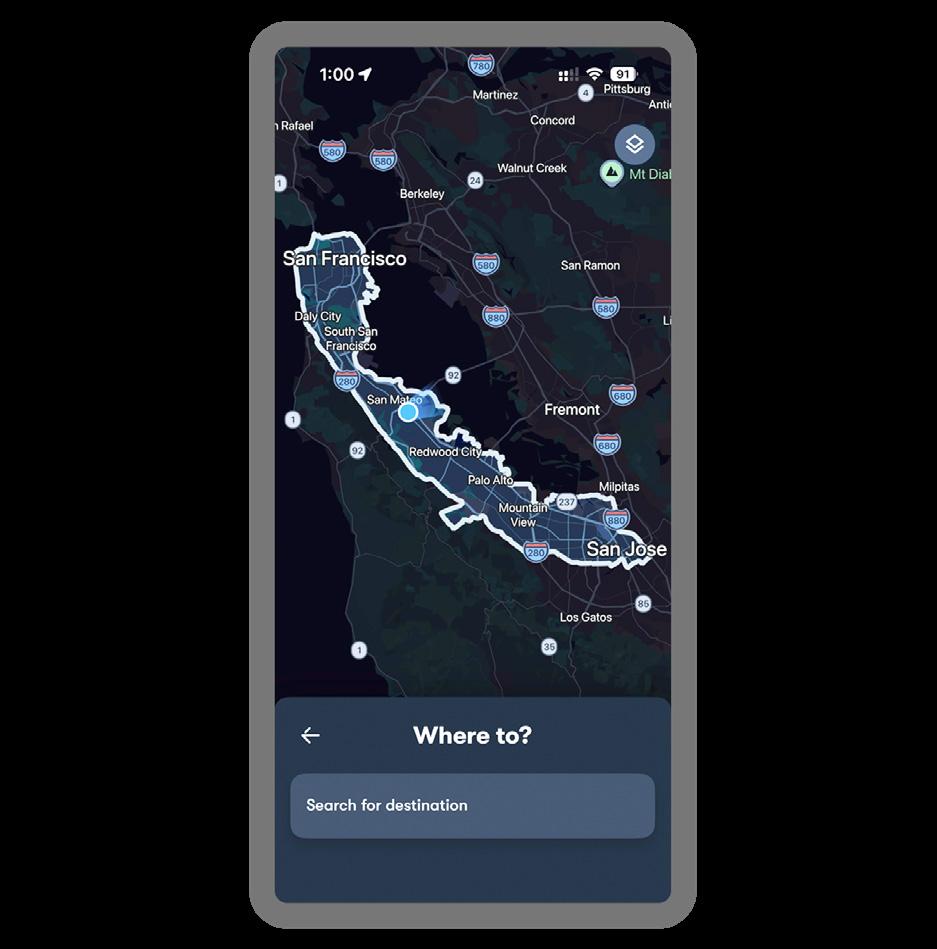
One year into the Trump administration, San Mateo County leaders reflect on the threats of ICE here and nationally.
Check out this review of independent bookstores near you.
Culture // Page 6
What it means to be a teenage girl amid today's cultural and political landscape?
Features // Page 12
Natalia Razo '28 and Jackson Hayward '26 examine the implications of Waymo on labor and safety.
Nueva's Sailing Club navigates headwinds— on and off the water—to attend its first regatta.
Opinion // Page 15 Sports // Page 19
For years, Yezen H. carried his Kindle everywhere. Whenever he had time to himself, he would eagerly jump into his latest read, letting the stories completely occupy his attention.
That all changed when the pandemic hit, and school moved online. Confined to his computer for a large portion of the day, Yezen set the Kindle aside and began spending more of his free time playing video games instead.
He didn’t fall out of love with books. Casual reading simply lost its place in his day, routinely overpowered in the constant competition for his attention. “Video games just deliver more dopamine to my brain,” he said. Books, by comparison, feel outgunned. “It’s just words on a page versus flashing colors and extreme audio with quicker dopamine spikes.”
The role that reading played in Yezen's life had fundamentally changed. Shaped by a media landscape engineered to constantly divert attention elsewhere, books surrendered their status as his go-to leisure activity and became synonymous with school assignments and tedious effort.
Yezen is not alone in his experience.
Nationwide, American teenagers are reading for pleasure less than ever before.
According to September 2025 data from the American Time Use Survey, more than 80% of Americans now read for five minutes a day or less. Compared to 20 years ago, the share of Americans who report reading for pleasure on a given day has dropped by 39%, even as books have become more accessible through phones, e-readers, and audiobooks.
In 1984, 31% of 17-year-olds reported reading for pleasure almost daily. Today, that number has dropped precipitously to 19%, according to the 2020 National Assessment of Educational Progress. Meanwhile, social media use has become a daily habit for more than 80% of teens.
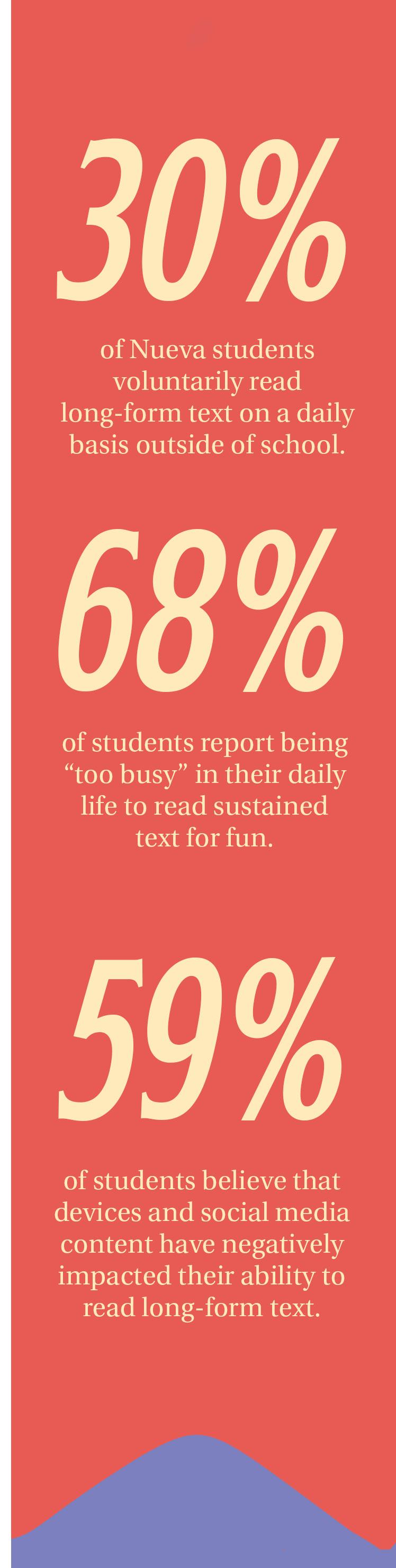
Given Nueva’s reputation as an academically rigorous private Bay Area high school whose curriculum emphasizes critical thinking and curiosity, its students might be expected to show stronger reading habits than the national average. In a recent survey conducted by The Nueva Current, 29.8% of the 189 respondents said they voluntarily read long-form texts daily outside of school. This figure places Nueva well above the current national
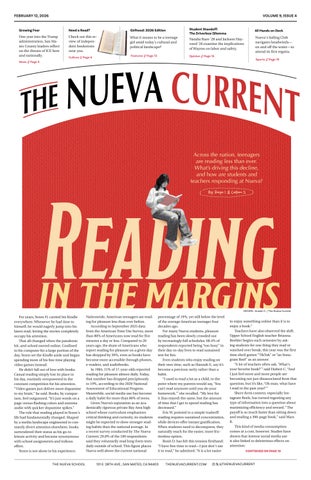
Across the nation, teenagers are reading less than ever. What’s driving this decline, and how are students and teachers responding at Nueva?
percentage of 19%, yet still below the level of the average American teenager four decades ago.
For many Nueva students, pleasure reading has been slowly crowded out by increasingly full schedules: 68.4% of respondents reported being “too busy” in their day-to-day lives to read sustained text for fun.
Even students who enjoy reading on their own time, such as Hannah F., say it’s become a precious rarity rather than a habit.
“I used to read a lot as a child, to the point where my parents would say, ‘You can’t read anymore until you do your homework,’” she recalled. “My love for it [has stayed] the same, but the amount of time that I get to spend reading has decreased.”
Eric W. pointed to a simple tradeoff: reading requires sustained concentration, while devices offer instant gratification. When students need to decompress, they naturally reach for the easier, more frictionless option.
Ronit D. has felt this tension firsthand: “I have free time to read—I just don't use it to read,” he admitted. “It is a lot easier
to enjoy something online than it is to enjoy a book.”
Teachers have also observed the shift. Upper School English teacher Brianna Beehler begins each semester by asking students for one thing they read or watched over break; this year was the first time she’d gotten “TikTok” or “an Instagram Reel” as an answer.
“A lot of teachers often ask, ‘What's your favorite book?’” said Hubert C. “And I just feel more and more people are becoming not just disassociated from that question, but it’s like, ‘Oh man, what have I read in the past year?’”
Short-form content, especially Instagram Reels, has turned ingesting any type of information into a question about maximizing efficiency and reward. “The payoff is so much faster than sitting down and reading a 300-page book,” said Mars R.
This kind of media consumption comes at a cost, however. Studies have shown that intense social media use is also linked to deleterious effects on attention:
DESIGN : Anwen C. / The Nueva Current
By the Numbers
REPORTING BY ELLIE L.
feet of silver snowflake garlands set up for the annual Winter Formal dance.
unique Intersession workshops at the Upper School, spanning topics like Neapolitan pizza-making, movie makeup, and mural creation.
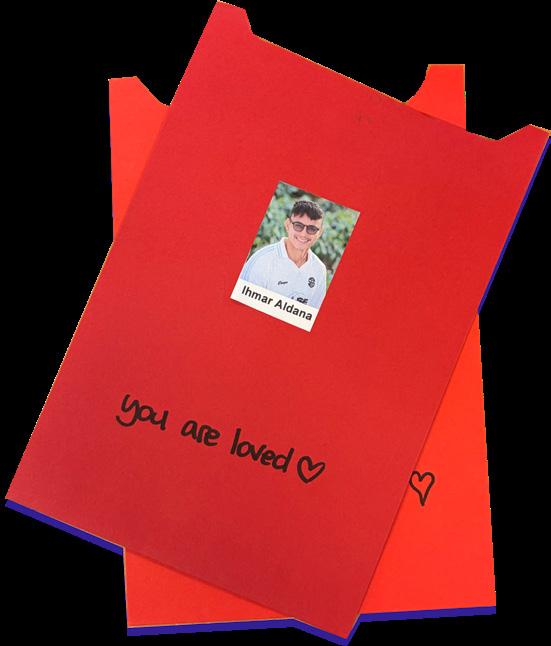
envelopes set up for Kindness Week, where students receive and send personalized notes to peers, staff, and teachers.
civil discourse practicum sessions, ranging from discussion spaces regarding the Minneapolis immigration crackdown to the history of gender and sex.
Feb. 11-21: Japan Exchange Trip 15 students will be in Japan as part of the 10th anniversary of the Doshisha Schools exchange program.
Strong Results, Growing Concerns
Recent conversations reveal widespread satisfaction but
concerning stress levels and a community asking hard questions
STORY BY KAYLA L.
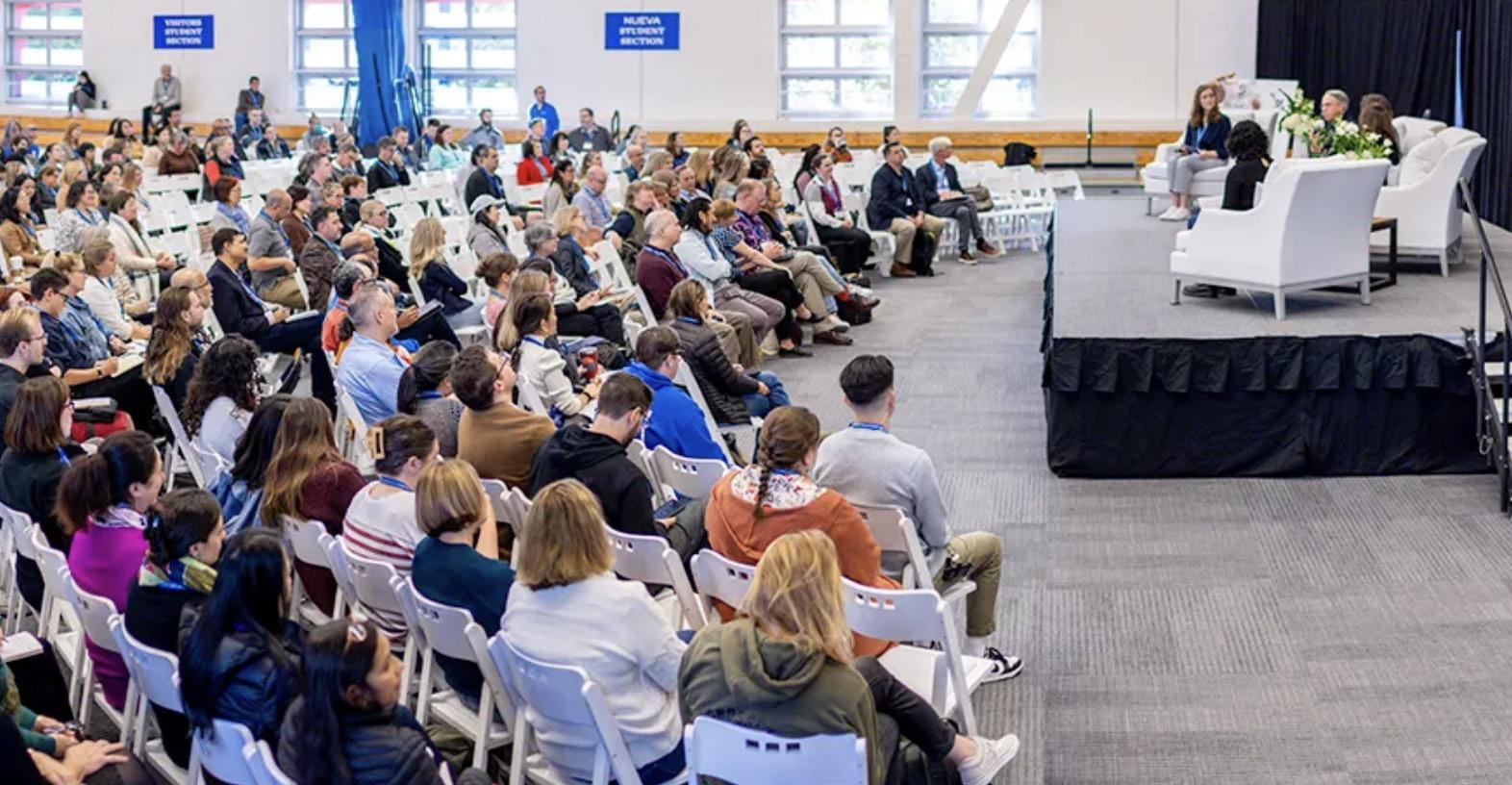
In two parent-oriented presentations this January, school administrators invited families into a discourse about Upper School’s strategic direction, student wellbeing, college-related pressure, and the importance of remaining true to Nueva’s core values.
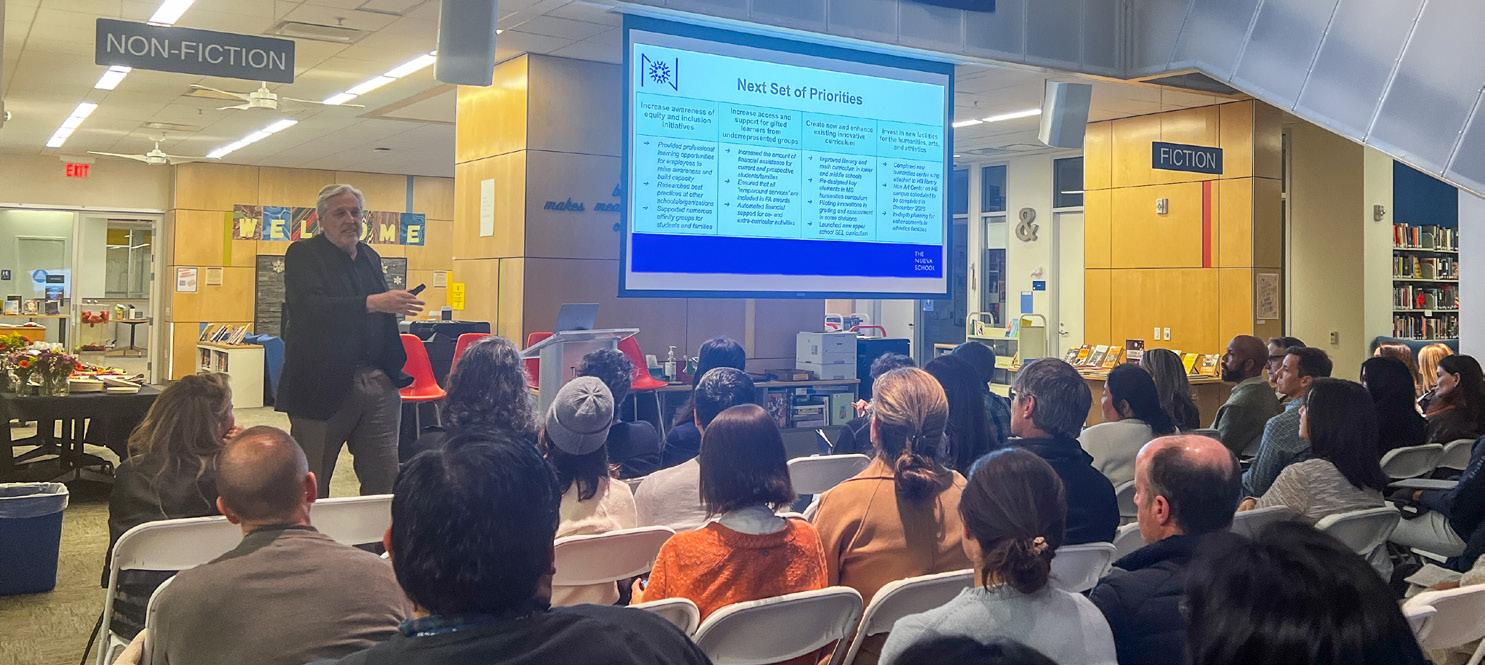
In his annual State of Nueva presentation, Head of School Lee Fertig captured both quantitative and qualitative data about various facets of the school. While presenting a slide with the school’s incredible matriculation trends in recent years, he also shared his reservations with parents surrounding the school’s increasingly elite college acceptances.
“It's a metric, sadly in some ways, that the world wants to know,” he said. “Although we do really well, we downplay it. We refuse to allow that to overshadow the joy of learning each and every day here. We're not going to give up that fight.”
In one of Fertig’s concluding slides, he revisited the importance of an intentional pedagogy. “Enthusiasm for Nueva’s unique educational philosophy to remain at the core,” one bullet point read. “Minor but persistent concern that the school may drift towards a more ‘traditional’ prep school environment.”
This “concern” was reflected by a later presentation on an external survey conducted by Challenge Success, which studies students’ habits and engagement at school. The study revealed that 57% of Upper School students are either “not
at all, a little, or somewhat confident” coping with stress. That being said, an encouraging metric was that 76% of students “have an adult to go to with a personal problem.”
Meanwhile, “College” emerged as a source of stress for 51% of students, while 34% reported being stressed by extracurricular activities. The students feeling stressed by extracurriculars usually shared one common trait: their primary reason for participating in the activity was “for college admissions.”
Then, as in past years’ State of Nuevas, Fertig invited four community members—a parent, student, alum, and teacher—onstage to reflect on the updates. After responding positively to several aspects of Fertig’s presentation, Rowan B. ’26 shared that, as an admissions ambassador, he’s received an increasing quantity of college-related questions from pro-
spective students and families.
“I worry more and more that people are coming here for the next place they're going to go—rather than coming here for here,” Rowal admitted.
This year’s discussion about core values resonated especially with parent Manoj Mangalpady. “When we look for a good school for our kids, we don't look just at what happens inside of the classroom,” Mangalpady shared. “We also look at what kind of community is [being] built for the children. What's the impact of that community throughout the years?”
Similarly, parent Elaine Poon appreciated the honest reflection from Fertig and Rowan. “I love that they didn’t shy away from areas to improve on,” Poon said. “It feels like we’re on board, and we can tackle problems as a team. There’s a trust that we all need to double down and work together.”
The Power of the Microphone
MLK Day assembly examines how music can fuel social impact
STORY BY VIOLET C.
On Feb. 4, Upper School students filtered into the gym for an assembly honoring Martin Luther King Jr. Day and Black Heritage Month, featuring DJ and music journalist Dave “Davey D” Cook as a speaker. His presentation focused on the role of music in the Civil Rights Movement, encouraging students and faculty to consider how cultural figures can inspire social change through “the power of the microphone.”
‘[King] had a strategy,” Davey D said. “Music was in his toolbox. It was medicine. It gave them strength. It inspired love. It gave them hope.”
To preface Davey D’s presentation, Director of Equity and Inclusion Shawn Taylor noted that culture can often precede policy and politics. In the assembly's aftermath, he expressed hope that students would carry its lessons forward.
“I hope everyone learned that politics and social change aren’t out of their reach,” Taylor said. “You don't always have to go the traditional route; you can introduce or leverage pieces of popular culture to serve your ends.”
Following the assembly, students gathered with their advisory groups to reflect on the presentation, and later reconvened in the gym for a closing discussion led by Equity and Inclusion Coordinator Evan Vaughan. Vaughan drew parallels between Davey D’s speech and the current political
situation in America, and encouraged students to continue seeking avenues for civil engagement.
Despite being pleased with the quality of the assembly, Dean of Students Jackee Bruno noted the exceptionally low turnout among upperclassmen. In an email sent to the senior class, he called on students to be more proactive participants: “Words can't fairly express how disappointing it is to see so few of you here this morning. So many people have worked so hard to try to make today meaningful for people.”
Reflecting on the assembly, Taylor later emphasized the importance of recognizing Black artists and activists, particularly
at a school with a small Black student population.
“Most students here probably have a lot of access and interaction with Black culture, but not Black people,” said Taylor, citing popular slang and music that originated from Black communities as an example.
Bruno echoed that idea, noting that, “as a Black person from the South, it was a pleasure to watch [Nueva students] be exposed to that.”
“To have you all be shown and learn about so many [Black artists], was cool for me to experience,” he added. “I saw some great conversations, and I think the students who attended did great.”
PHOTOS: The Nueva School, Plaza Provisions
Learn by Doing At the start of Fertig's annual presentation, he engages parent attendees in a trivia about Nueva. //
PHOTO: Kayla L. / The Nueva Current
Songs and Strategy DJ Dave "Davey D" Cook presented for 75 minutes about various musical genres' intersection with the civil rights movement. // PHOTO: Marissa Leshnov / Alta
Feb. 24-27: Upper School Book Fair This year, Nueva will be partnering with local independent bookstore Linden Tree to bring students a selection of thoughtfully curated books. Stop by to read, wander, or just browse!
Caltrans Roadway Rehabilitation Project aims to improve major road
Construction along sections of El Camino Real worsens traffic for Burlingame residents
STORY BY ALEXIS C.
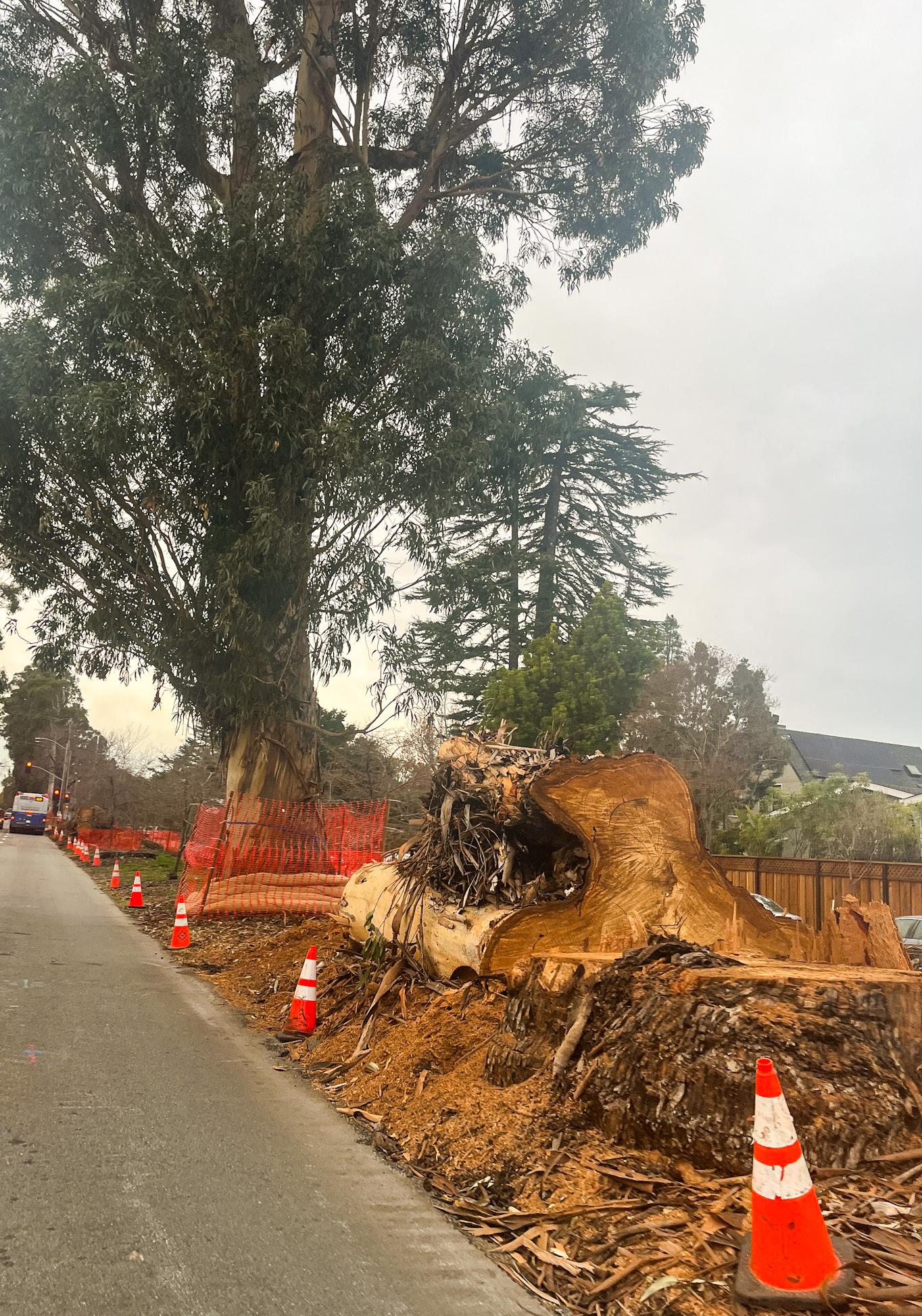
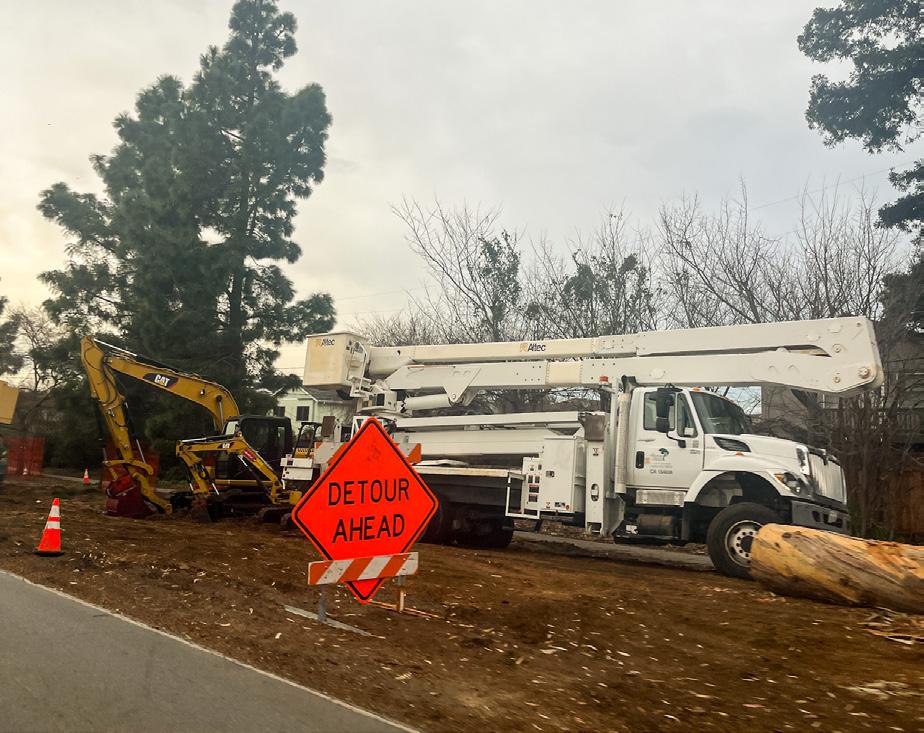
Beginning on Jan. 8, sections of El Camino Real in Burlingame, Calif., were closed to passenger vehicles during the day; the closure ended on Jan. 16. During this time, crews removed multiple eucalyptus trees between Rosedale Ave. and Grove Ave.
This closure was the first part of Caltrain’s El Camino Real roadway rehabilitation project, an effort to restore sections of State Route 82 throughout Burlingame. The project is estimated to cost $173 million and includes other roadwork projects: restoration of the Howard Ralston Eucalyptus Rows, identification of underground utilities, repavement of the road and sidewalks, and flood reduction.
El Camino Real road closures have also occurred on Jan. 21 and between Jan. 22 and Feb. 3. Phase I of this construction will continue in waves through May 2026.
Sofia C. ’27, a Burlingame resident, criticized the potholes that flood during the rainy season, as well as the cracks in the pavement from eucalyptus tree roots—both of which make driving on State Route 82 through Burlingame difficult for her
everyday commute to school.
“I rely on [El Camino Real] so much, but I think it's terrible. I purposely drive in the left lane because the right lane is just so bumpy. It's like I’m on a roller coaster,” Sofia said.
Jasmine, a Paper Source employee and Burlingame resident, has noticed that construction nearby has led to a decline in foot traffic on Burlingame Ave. “There’s been a lot of construction in the past years, and when that’s happening, usually [fewer] people are out,” Jasmine said. Jasmine, Sofia, and others who drive on the El Camino corridor on a daily basis have experienced worsened traffic in an already crowded zone.
Sofia’s commute, during the peak of construction in her neighborhood, began leaving 20 minutes earlier to account for the traffic. Lucas R. ’27 spent extra time planning out his commute through the residential neighborhood in order to avoid congestion along El Camino.
However, Caltrans’ plan to remove and restore the historical eucalyptus trees is a point of contention for residents in the City of Trees.
During the fall semester, Efehan K. ’27 conducted a Contingent Valu-
Adapting to a new policy
How the Upper School has shifted after five weeks of the phone Ban
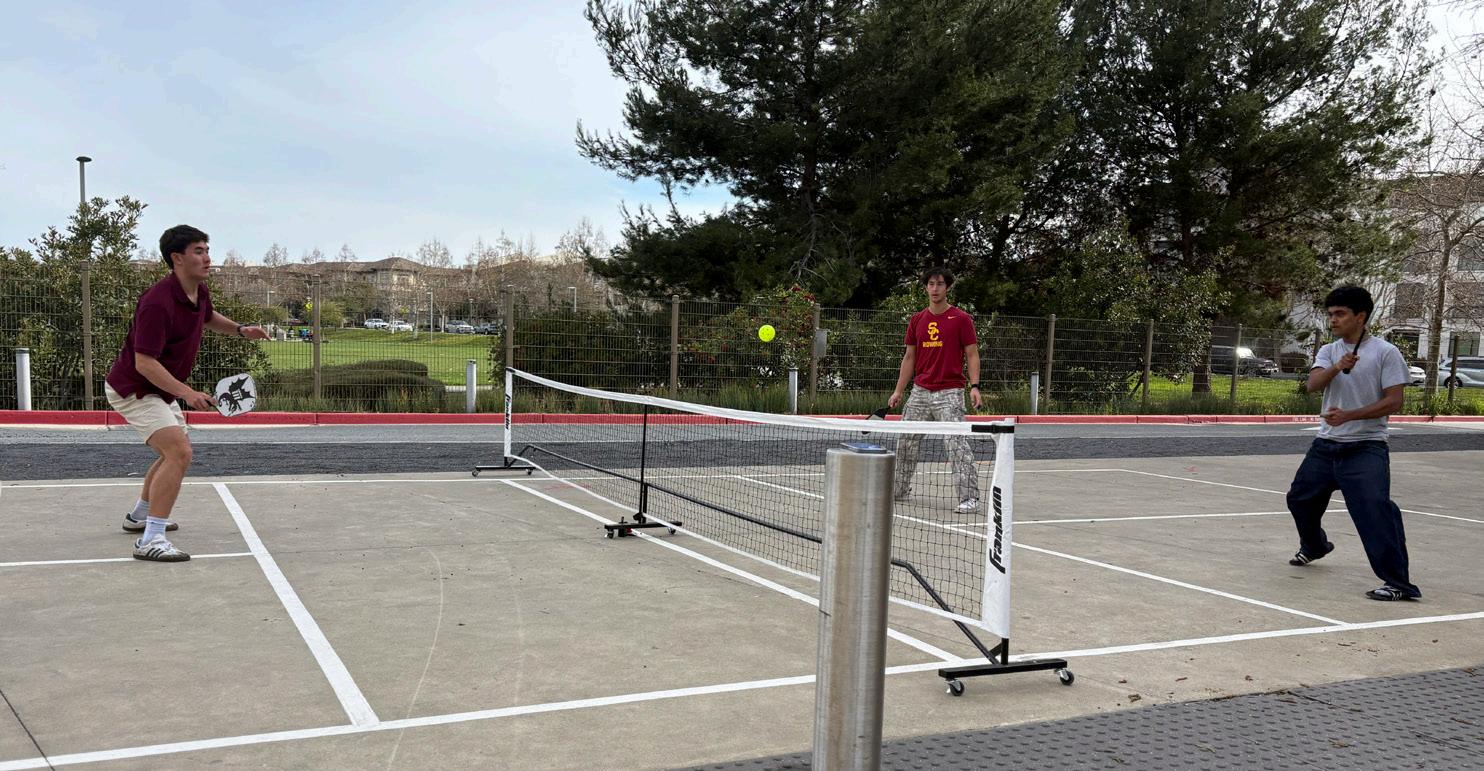
Couches previously strewn with students, heads bowed over their phones, can now be seen filled with card games and upbeat conversation. Previously, the Cafe courtyard was quiet, with a few people scattered around the tables. Now, the constant pops of a pickleball game fill in among the voices of students.
The Upper School Cellphone Policy was implemented at the beginning of the second semester this school year, with the intention being “not to ‘ban’ phones but to encourage mindful and respectful habits that foster focus, connection, and student agency,” as stated in the policy.
It is the first real policy the Upper School has had around cell phone use, with discussions of the phone policy taking place in many settings pre-December break, including at grade-level deans meetings, faculty meetings, assemblies, and advisory. Feedback from students and faculty on the initial draft of the policy led to clarifying edits and
ation survey in his Environmental Economics course to determine the value of the eucalyptus trees. Despite the symbolic significance of the trees, results show that 60 percent of respondents were unwilling to pay an annual preservation fee, at any price.
“My optimistic opinion is that there is some way to fix the road while keeping the trees,” Efehan said. “I think there is some benefit to removing at least the most harmful ones.”
“I feel [they’re] a landmark of Burlingame,” Lucas said in reference to the Howard Ralston Eucalyptus Row.
Though construction has temporarily inconvenienced regular El Camino Real commuters, many Burlingame residents ultimately feel that construction will improve transit in the Burlingame–San Mateo area.
“I do think that [the construction] is inconvenient for me, but I just have to remind myself that, even though this will take a while, the city is listening to the people. We’ve always complained about the quality of El Camino Real,” Lucas said.
sparked critiques of the policy, with a mixed view on the potential effects.
“My primary hope after releasing the policy was that we would stop talking about the policy so much,” said Jackee Bruno, Upper School Dean of Students. “The result I wanted was that we would realize it’s not that big a deal.”
This result has mostly come to fruition, with students and staff taking part in support. On the first floor outside the Cafe, a countertop is stacked with board games and other activities supplied by Bruno. New pickleball and spikeball equipment were also provided.
These games were quickly taken up around school, with Codenames being particularly popular among the senior class. “I appreciate that admin and the people who care about the phone policy also care about filling that space with games for us,” said Ayaan M. ’26.
The college counseling department has also contributed its part to the policy, offering what is most popularly known as the ‘phone jail’. Here, the counselor in possession of the ‘jail’ takes the phone of any student not
complying with the policy, locks it up, and returns it at the end of the day.
Incentives to follow the policy have been provided across campus. “I hope you've shared at least a fraction of my joy in seeing our community connecting without the use of phones this past week,” wrote Patrick Berger, 9th Grade Dean of Students, at the beginning of an email to the freshmen class.
He later shared that he would be rewarding a Hot Pot gift card to any student who could successfully beat Xochitl S. ’29 and Maddie L. ’29 in a game of foosball, the current dominating duo among students. The goal of this is to “incentivize and recognize [students] who are using these new guidelines around technology as an opportunity to connect with each other and challenge
[themselves]."
“I’ve seen us doing a lot more together as a group,” said Matias V. ’26.
These greater investments in seeing where the absence of phones can take students have not gone unnoticed. “Every time I walk by [the senior couches], in addition to dishes everywhere, you see a game out,” Bruno said.
One concern for students before the policy took effect was access to schedule changes, classwork updates, and other important notifications. Despite these worries, Bruno has said the policy hasn’t posed a significant problem for accessing such updates, and there are no major changes expected in the near future.
Detour Ahead Eucalyptus trunks lay along El Camino Real. // PHOTO: Alexis C. / The Nueva Current
STORY BY AVIVA S.
In Real Life Seniors play pickleball on the Cafe Courtyard. // PHOTO: Aviva S. / The Nueva Current
How Immunity Matters Local measles cases in San Mateo County may impact community members
STORY BY KAYLA L.
Since the beginning of 2026, California has confirmed a total of nine cases of measles, including two cases from San Mateo County; both occurred in unvaccinated adults who traveled internationally. Amidst the national landscape of changing vaccine recommendations and increased local exposure, the risk for measles for unvaccinated individuals is now significantly higher than in recent years.
According to Tamta Mchedlishvili, a San Mateo County health department representative, measles is airborne and can remain in the air for two hours after an infected person coughs or sneezes.
“Measles spreads faster and more easily than almost any other virus,” Mchedlishvili explained in an email to The Nueva Current. “About nine out of ten people who are not immune will get sick if exposed. This means a small number of cases can turn into a large outbreak very quickly if action isn’t taken early.”
Local health officials like Mchedlishvili underscored that the MMR (Measles, Mumps, and Rubella) vaccination is the most effective way to prevent the spread of measles. The vaccine is about 97% effective, according to the California Department of Public Health.
On the flip side, not having the MMR vaccination can not only increase an individual’s vulnerability to measles but also that of other community members. Because immunocompromised people and babies under 12 months old are unable to be vaccinated for measles, these vulnerable populations depend entirely on herd immunity—widespread immunity through vaccination or previous infection—to stay safe.
For students in California’s in-person schools, the MMR vaccine is required. According to Mchedlishvili, the San Mateo County health department collaborates with regional schools to verify immunization records, provide guidance during potential outbreaks, and notify schools of potential exposure.
At Nueva, the nursing team keeps up to date on the latest state health guidelines and works to maintain a healthy community. The team is led by Lead School Nurse Phoebe Wargny, who confirmed that the Upper School has had no measles cases or potential exposures.
Wargny recognized that the school exists within a larger culture of vaccine skepticism, where national health organizations and leaders like Robert F. Kennedy Jr. are spreading misinformation about vaccines.
“When you have this volume of noise that says, ‘maybe [vaccines] aren't so safe,’ it becomes really hard as an individual to know what to trust,” Wargny said.
As a professional nurse, Wargny is deeply supportive of the MMR vaccine
Students take to the streets
based on scientific evidence of its efficacy and safety. “Measles is here, and the vaccine is safe,” she said. “I hope the folks that have withheld the vaccine from their children, or from themselves, will think about trusting their doctor's advice.”
And though the school has not suffered any measles cases, Wargny also explained one hope for Nueva community members amidst flu season and the risk of other infectious diseases: if sick, stay home.
“If you're sick, you should be resting,” Wargny said. “But I would love it if folks would take a minute and reframe [staying home] from a lens of supporting your community.”
As the Nueva community includes immunocompromised students and family members on immunosuppressant treatments, showing up to school with symptoms for any infectious disease— from the common cold to measles—can risk infecting and seriously harming vulnerable community members.
“We do need to also think about other people and care about our community as a whole,” Wargny said.
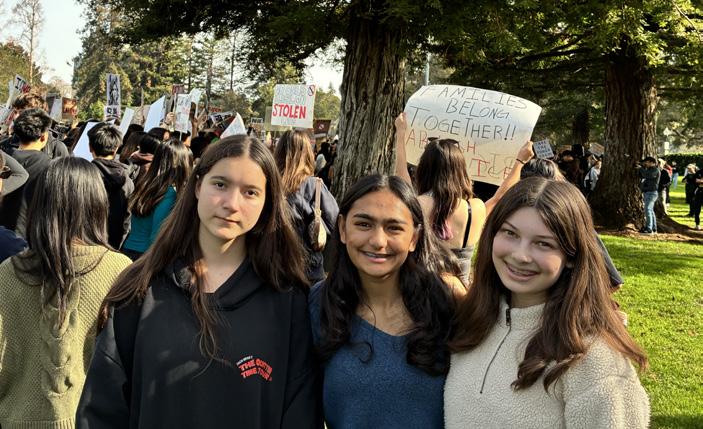
Nueva students join nationwide walkouts against ICE
STORY BY VEDA P.
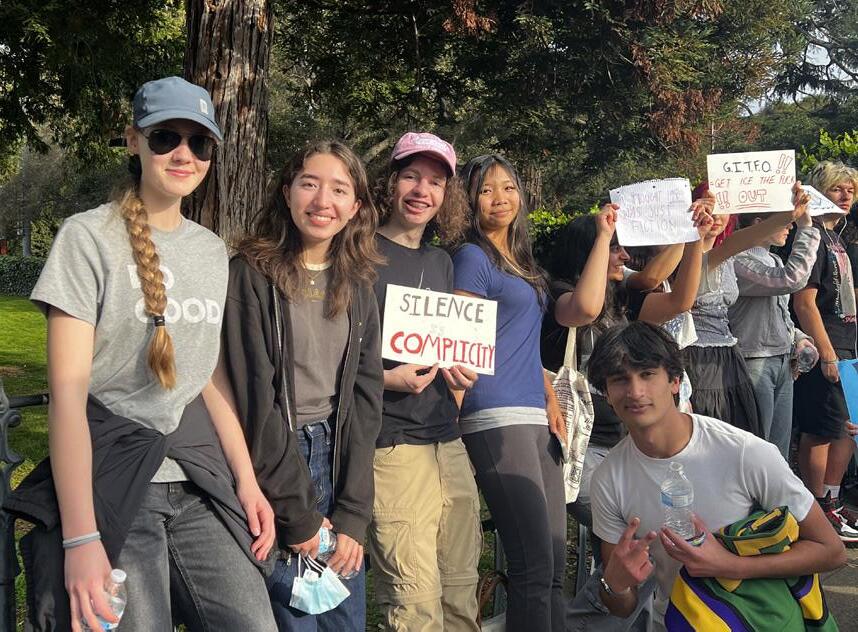
On Jan. 30, clusters of students congregated under sunny skies in San Mateo’s Central Park, faces set with determination as they chanted: “No ICE in our streets!” and “No ICE, no KKK, no fascist USA!” Hand-drawn posters bobbed in the crowd—“Melt ICE,” “Stop Separating Families,” and “Abolish ICE, Uphold Human Rights.”
The scene was unmistakable: one stop in a student-driven movement unfolding across cities and campuses across the country.
The protest in San Mateo was part of a broader wave of walkouts and demonstrations coordinated as part of a national “ICE Out” day of action. Across the Bay Area, thousands of students from San Francisco to San Jose walked out of school in protest of federal immigration enforcement and joined rallies calling for accountability and policy change. Students took turns with megaphones, leading chants in tight call-and-response rhythms that echoed across the park. “The wrong ice is melting!” and “The people united will never be divided!” rang out and lifted the crowd’s energy.
For Max K. ’26, the scale and visibility of the walkouts mattered.
“It forces the news cycle to keep its focus on this issue and puts pressure on the government to start making substantial changes,” Max said. “There’s also a morale boost in going out and doing something against a presidency that feels unstoppable.”
To Xochi S. ’29, the moment signaled a rare surge of youth civic action—especially significant in a political moment often marked by the disengagement of youth.
Media of Minneapolis
Comparing the different forms of protest and media coverage regarding ICE in Minnesota
STORY BY KAYLA L. & ALVIN Y.
Over the past month in the Minneapolis-St. Paul area, thousands of Minnesota residents have banded together to resist Operation Metro Surge: an ongoing ICE operation that deployed 2,000 agents into the Twin Cities and led to 3,000 arrests and tragic deaths.
In this issue’s A Fuller Picture, we explore how the Minneapolis protests have unfolded and the role media has played in shaping public perception.
Much of the national media attention has focused on massive nonviolent marches in downtown Minneapolis. During these protests, tens of thousands of residents flooded the streets, calling for ICE to leave the state; the arrest of officer Jonathan Ross, who shot Renee Good; for private companies to end relations with ICE; and for the federal government to defund ICE.
While not nearly as visible, Minnesotans have also developed smaller grassroots initiatives, such as delivering groceries to families in hiding and placing outdoor furniture as ICE van-deterrents in streets. Thousands of residents created Singing Resistance, a group that has made it its mission to gather and sing outside ICE officers' hotels. Their choruses of “It’s okay to change your mind. Show us your courage, leave this behind,” can be heard in the subzero winter weather.
Others have coordinated shifts to stand outside ICE detention centers. Because ICE can release detainees at any time of day, the volunteers wait outside to provide them with warm clothing, food, and free transportation.
While most protest activity has been peaceful, there have been exceptions: outside of the Whipple Federal Building, which serves as ICE’s field office, at least 50 were arrested by the county sheriff’s office on Feb. 7 after a memorial for Renee Good and Alex Pretti turned violent. The arrested protesters threw objects like ice chunks at local law enforcement, damaging a police car’s windshield and striking a sheriff’s deputy in the head.
Weeks earlier, protestors threw ice and rocks at local police at a Hilton hotel in downtown Minneapolis, where protestors believed ICE was staying. There, 30 people were arrested for unlawful assembly and causing thousands of dollars in property damage.
“We’re the next generation that has to deal with this. Even if adults don’t always realize it, it affects us and will affect our future,” Xochi said.
Jane J. ‘29 emphasized the importance of such collective action. “It’s good to stand with people our age,” she said. “Showing our voices and standing together—this is one of the few things we can do, and it really makes a difference.”
Notably, it’s these more violent protests that have been amplified by media outlets such as Fox News and conservative social media influencers, while peaceful resistance tends to dominate coverage from left-leaning outlets and influencers. Though most outlets are presenting fact-based, verified information, each sheds light on a different story. This selective coverage has generated fundamentally different understandings of events in Minneapolis across the political divide. Readers of conservative outlets that primarily highlight violent protesters may generalize all protesters as such. Conversely, when liberal media emphasizes ICE’s use of force, readers may conclude that agents are extremely cruel and cause chaos. This dichotomy of media coverage is where political polarization can begin—but seeking a fuller picture can promote the most realistic understanding about ICE activity and resistance from all sides of the political spectrum.
PHOTO: Tim Evans / Reuters ANALYSIS
Prevention is Key Getting vaccinated for measles is recommended for young kids in a series of two doses.
// PHOTO: Shannon Stapleton / Reuters
ICE Out Many Nueva students attended the San Mateo walkout with a friend or group.
// PHOTOS: Kayla L. and Veda P./ The Nueva Current
Feb. 25: World Culture Day Join us as we celebrate the diversity of Nueva's community with performances, food, and presentations from campus affinity groups.
A Climate of Uncertainty
Knowing our rights Alexis C. explains why understanding our constitutional rights matters now more than ever Page 14
As teams of Immigration and Customs Enforcement (ICE) agents ramped up enforcement operations in cities nationwide, immigrant communities across the country are living in heightened fear.
That anxiety has extended to the Bay Area. Although Northern California has the nation’s lowest ICE arrest rate, at roughly 217 arrests per 100,000 noncitizens, the threat of detainment and deportation still looms large over local immigrant communities.
According to a report by immigrants rights organization Faith in Action (FIA), at least 153 residents of San Mateo County were detained by ICE in 2025, with about one in ten of those detained eventually released through the legal process. That figure squares with recent national trends: 13 of every 14 people detained were deported in 2025, compared to only one of two in 2024.
San Mateo immigration attorney Haitham Ballout said recent policy changes have further narrowed detainee’s options. In an interview over Zoom, Ballout noted that immigration judges can no longer release detainees on bond.
“It used to be that if you were not a threat to the community and you [would] not abscond, you should be able to be released,” Ballout said. “[Now,] you’re just going to be detained.”
This shift has intensified fear in everyday life for many immigrants. Concerns about legal representation are especially acute: unlike in criminal courts, immi-
gration courts do not provide pro-bono lawyers. As a result, many detainees have to represent themselves before immigration judges in a system that legal experts describe as being complex and difficult to navigate.
For immigrant advocacy groups on the ground, that fear has shown up in the volume of calls they receive each day.
“We sometimes get hundreds of calls [a] day just [from] people scared of seeing people in a uniform—especially when ICE agents were operating under masks, under secrecy,” said Kimberly Woo, a member of the Santa Clara County Rapid Response Network, which monitors and verifies immigration enforcement activity.
"GET TO KNOW YOUR NEIGHBORS, BECAUSE IF SOMETHING DOES HAPPEN, WE NEED TO BE THERE FOR EACH OTHER." “
False reports of ICE activity are among the most common drivers of fear in immigrant communities. The most frequent calls to FIA’s Rapid Response program— which tracks and investigates ICE activity—come from people who believe they have seen ICE agents in their neighborhood or heard rumors that federal agents have visited a local workplace or school. Nani Friedman, FIA’s research, policy, and communications organizer, noted that
most reported sightings are false alarms. Still, she highlighted the potential for this kind of misinformation to spark widespread and damaging panic.
“While we do need to protect and share information with each other, what's also really scary is the way [misinformation] encourages people to isolate,” Friedman said.
ICE activity across the country has led to a paralyzing fear in immigrant communities—though immigration enforcement in the Bay Area hasn't exactly mirrored national trends, the perception of threat remains deeply disruptive.
“What we're seeing is nothing like what's happening in other parts of the country. We're not seeing agents indiscriminately grabbing people off the street. We're not seeing people being profiled based on race and the language that they're speaking. We haven't seen any raids. We are in a different situation right now,” Friedman reiterated. “That's not to say things aren’t still really scary and concerning, but it's important for people to have access to the information about what is happening locally so they can accurately assess how they want to live their lives.”
Despite the current climate of uncertainty, immigrant and non-immigrant communities alike have forged moments of solidarity.
“Everybody has the same hopes and fears. The more you talk to people, the more you realize that’s all that really matters,” said Steve Chamberlin, a community member engaged with three immigra-
Lurie’s First Year in Review
STORY BY VEDA P.
In his first year as mayor of San Francisco, Daniel Lurie has called for bold interventions and policies to address homelessness, drug use, and public safety. Facing a $936 million projected deficit, he has ordered $400 million in cuts across the board, while promising to remain faithful to campaign priorities. A major focus of Lurie’s first year has been cleaning up the streetscape and reducing what his administration describes as “visible disorder,” including open-air drug use and homeless encampments.
To that end, the Lurie administration launched its “Breaking the Cycle” initiative in March 2025. Under the plan, city agencies have opened dozens of interim housing and recovery sites, with services ranging from short-term care to longer-term housing. According to a report by the city government, more than 10,300 people have moved from homelessness into permanent housing over the last two years.
A lifelong San Francisco resident, Marc C. ’27, has witnessed the effects of Lurie’s recent initiatives firsthand. “The city is
tion-related organizations.
In a time defined by fear, isolation, and unpredictability, it’s precisely this kind of community resilience that remains crucial to maintaining a sense of belonging.
“[We’re] trying to ensure that we have spaces of joy and healing to be there for each other, because this movement is long,” Woo said. “We have to be there for each other in more ways than just one. I would really encourage people to join local networks, spread the word, do Know Your Rights canvassing, [and] get to know your neighbors, because if something does happen, we need to be there for each other.”
Friedman echoed the call: “Fear has been here before. Fear will continue to be here. The question is, how do we support each other through [this] time?”
generally cleaner, and there are fewer erratic individuals on the streets,” he said. “Open-air drug use outside of the Tenderloin has definitely decreased. You don’t really see it that much anymore.”
Marc stressed that the visible changes he described—particularly reductions in street disorder—should not be confused with greater improvements in public safety. “Those were never really a safety issue,” he noted. “It was more of a comfort issue.”
For Oliver A. ’26, however, Lurie’s first year has felt less like a shift in direction and more like a continuation of former Mayor London Breed’s leadership. “I don’t think he’s a very big departure from anything that the city has had in a long time,” he noted. “I’m really displeased with how both of them have run it.”
Oliver argued that both administrations have framed public safety around crime and disorder in fear-driven ways, often prioritizing policing and removal over long-term reform. In his view, that approach has come at the expense of structural solutions such as affordable housing, accessible mental-health care, and comprehensive addiction treatment.
“People can’t live in RVs in the city anymore. These are residents who have lived here for decades, who are now getting forced out in favor of tech bros. [Yet] instead of getting access to care, they are arrested and rounded up,” Oliver said.
While Lurie’s “Breaking the Cycle” initiative has expanded stabilization centers and shelter capacity, both Marc and Oliver questioned whether those interventions meaningfully change outcomes for unhoused residents. Marc noted that certain neighborhoods, such as the historically Black Hunters Point, were being left out of broader planning efforts.
“His solution to the homelessness crisis has been kind of pushing all the issues into one area of the city,” Marc said.
Similarly, Oliver criticized what he described as an increasingly punitive strategy on homelessness and crime.
“His approach has been upsetting,” he said. “I don’t think the tough-on-crime approach works. We need to be more thoughtful and treat every member of San Francisco as people, as neighbors, as our community.”
Concerns over Lurie’s agenda extend beyond homelessness policy. Despite
the mayor’s framing of budget cuts as a strategic reallocation, labor unions and nonprofit service providers have warned that hiring freezes and reduced services could weaken emergency response, health services, and community-based safety programs.
Even with these criticisms, both Marc and Oliver acknowledged positive aspects of Lurie’s leadership. Marc highlighted improvements in communication: “I think the biggest improvement has been [in the way] people think of the government and perceive the administration.”
Oliver similarly praised the mayor’s personal engagement with city residents. “He’s walking around, talking with people. I think he’s kind of embodied some of the positive aspects of almost like a smalltown kind of mayor,” Oliver said.
Marc believes that Lurie’s leadership has “overall been a positive change.”
Looking ahead, though, he emphasized the need for policies that go beyond surface-level improvements.
“Changing perception is one thing, but if the underlying crisis isn’t being solved, people aren’t really safer or better off.”
Speaking Up Kimberly Woo speaks against the presence of ICE at Super Bowl LX.
PHOTO: Mariana Garcia / Mission Local
CULTURE
Are we still reading? Our front cover story examines how reading has steadily receded from student life. Page 1, 10-11
Bookstores in the Bay
From literary landmarks to cozy
Quoted: “[Going to a bookstore is a] very hands-on-experience, quite different from what you’d get just going on Goodreads or Amazon.” - Michael Young, bookseller at City Lights
nooks, check out these independent bookstores near you
STORY BY ANWEN C. DOG EARED BOOKS
Nestled on the corner of Valencia and 20th is a turquoise building: Dog Eared Books. Founded in 1992, this Mission District bookstore carries a mix of new, used, and remaindered titles. But what makes it worth visiting is its playful spirit.
Walk through the bright red door and you’ll find an atmosphere that’s cozy, handmade, and deliberately offbeat. As you weave your way through the shelves, let your attention settle on all the little minutiae of the space: the vintage bike dangling from the ceiling; the wooden skeleton overlooking the cash register; the notes and stickers and manifestos taped to the shelves.
Though Dog Eared Books may be small, it refuses to be predictable. If you’re looking for the perfect place to wander, read, and get pleasantly lost, then this is the bookstore for you.
KEPLER'S BOOKS
Looking for something closer to school? A literary haven, a personalized book recommendation, or just a fun hangout space? Kepler's Books may have what you’re searching for.
The store boasts a vast selection; bestseller hardcovers sit on roll-away tables near the entrance, while fantasy, sociology, and everything in between fill out the aisles. If you're overwhelmed by choice, the staff has you covered—laminated recommendations are tucked throughout the shelves, and booksellers are happy to help if you ask.
Just a two-minute walk from the Menlo Park Caltrain station, Kepler's makes for an easy after-school stop. Come browse, stay awhile… and maybe grab a screen-printed tote bag on your way out.
System Overload
Socially Inept serves up hard truths and harder laughs in San Jose
STORY BY SENNA H.
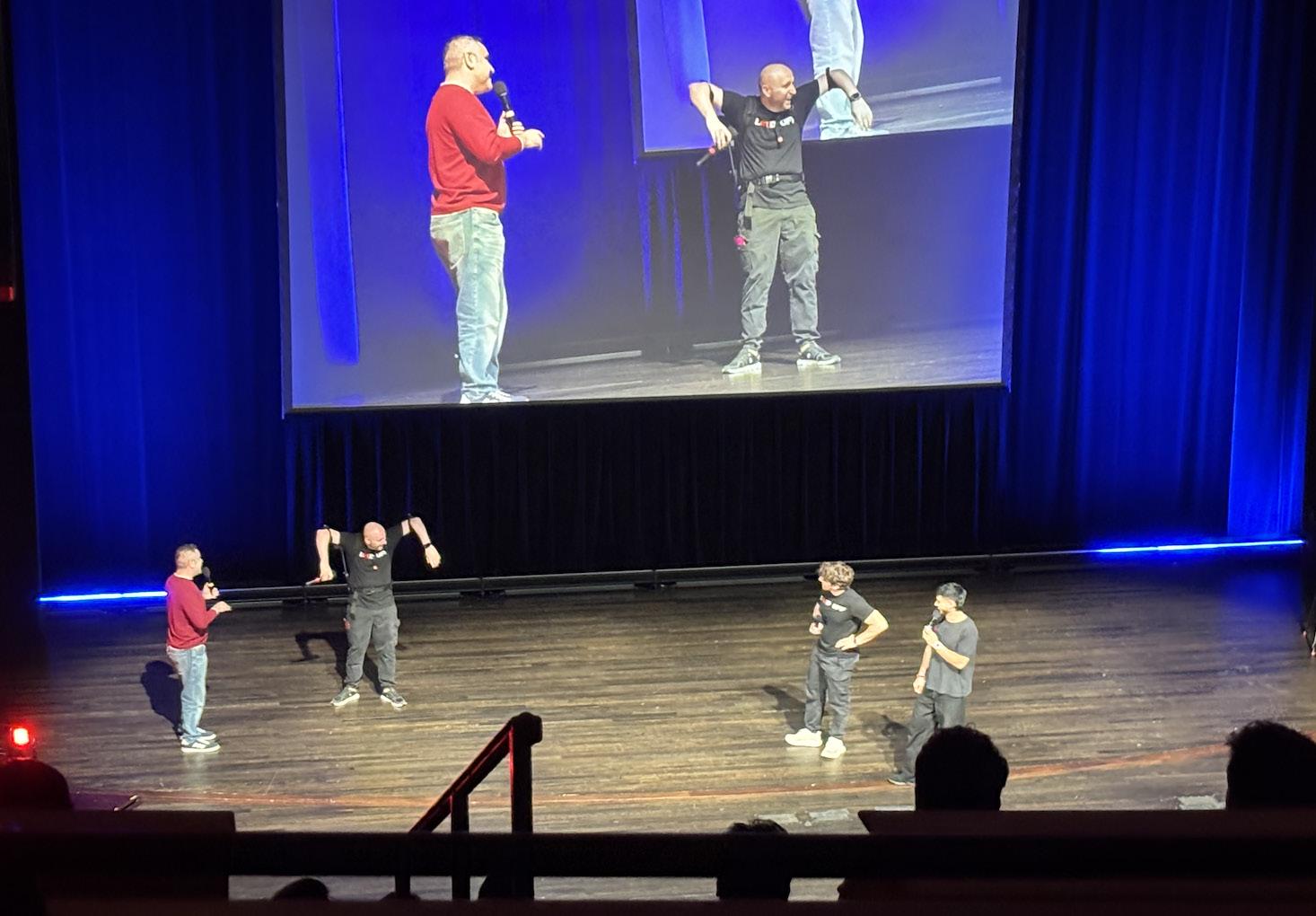
Nikita Oster stood onstage wearing a ridiculous exoskeleton created by an audience member, designed to relieve physical stress for people undergoing manual labor daily. With his elbows hoisted near his ears, hands dangling stiffly, the contraption left Oster looking not unlike a futuristic human scarecrow, inducing chuckles from the crowd.
“I’ve never felt less empowered in my life,” he deadpanned to the audience, kicking off an evening full of sharp, witty digs at Silicon Valley tech culture.
That opening was part of a tech roast show by Socially Inept, a comedy trio of former tech workers—Austin Nasso, Nikita Oster, and Jesse Warren—now touring the U.S. to poke fun at startups, founders, and tech moguls. On Jan. 17, they brought their humor to the San Jose Civic for a night of jokes, roasts, and savage banter.
The format was interactive from the
start. In one of the show’s best segments, the comedy trio solicited audience members’ own LinkedIn pages and startup ideas to be reviewed onstage.
When the trio spoke to one founder in the audience claiming to “shape human civilization” with AI, they refused to let up from turning him over the fire, even though the founder was quite obviously less receptive to such jokes. Although the group got in a few good jabs as they perused the website (“Did you take acid once and make a website?” one quipped), the jokes, unfortunately, fell flat without reciprocation.
City Lights Booksellers & Publishers is part bookstore, part literary landmark. Established in 1953, it became a gathering place for writers and progressive activists of the Beat movement, and in 2001, was granted official historic landmark status by the city of San Francisco.
It’s easy to understand why. The store itself spans three floors, each with its own, distinct character. The ground level is bright and welcoming, packed with classics, staff picks, and contemporary fiction. Upstairs lies the poetry room: a woody, dark nook lined floor-to-ceiling with shelves and shelves of verse. As you descend to the underground basement, notice how the atmosphere shifts again, the brightness of the street swallowed by shelves devoted to world literature and critical theory.
There is a museum-like quality to City Lights; each floor feels like an ode to different chapter of San Francisco's literary identity. Book or no book, you'll leave with a piece of that history.
The funniest moments came when audience members leaned into the roast. RapidFlare, a company bringing AI-assistants to business websites, went so far as to bring its whole team to the show as a team-bonding exercise. While testing out their chatbots, ads for a sketchy spa
kept appearing—“Is your entire company just a PDF of a random spa?” Nasso asked. The CEO laughed and passed the blame to the CTO, who passed it right down the line to the engineers. It’s this kind of playful humor that thrived during the show, where the tech world is more than ripe for roasting. In
Silicon Valley, where everyone is touched by technology in some shape or form, Socially Inept isn’t afraid to call out the “founders” of the newest buzzword startups, serving up humor that the local tech crowd can especially appreciate. Catch their next shows in San Francisco on March 12 and 13.
900 Valencia St., San Francisco
PHOTOS: Anwen C. / The Nueva Current
CITY LIGHTS BOOKSELLERS & PUBLISHERS
1010 El Camino Real #100, Menlo Park
261 Columbus Ave., San Francisco LinkedIn-fluencers The comedy trio scrolled through a variety of tech websites to find one founder's company with an uncommonly common name: SentientX. // PHOTO: Senna H. / The Nueva Current
Feb. 27: Nothing'sAbouttoHappentoMeMitski’s long-awaited album has fans waiting with eager anticipation.
Pop Culture Thermometer
On a scale from freezing to blazing hot, here's the latest in pop culture
STORY BY CALLUM S.
BLAZING HOT: BAD BUNNY HALFTIME SHOW
On a night of football that lacked any momentum, Bad Bunny delivered the one stretch that actually felt alive. The sugarcane field opening was striking, the setlist was perfect, and the real wedding on stage was iconic. For 13 minutes, it cut through the noise and united a massive American audience with the power of music—something pop culture hasn’t pulled off in years.
WARM: HARRY STYLES RETURN
After four years of letting the pop-music genre burn itself out, Harry Styles is smoothly returning with his new album, KissAllTheTime.Disco, Occasionally set to release on March 6. Coming off an Album the Year Grammy win in 2023 for Harry’s House, the bar is set high. That's what makes the lead single, Aperture, feel sleepy and underwhelm ing. The anticipation remains intense, just no longer unquestioned by fans.
Hungry for more? Check out Whisper, a new Korean fusion brunch restaurant that’s opened this past month in downtown San Mateo.
A Return to Traditional Tea
MollyTeaoffersauthenticflavorsandaplatformfor cultural connection
STORY BY SENYA S.
Whether dawn or dusk, downtown San Mateo’s Molly Tea is never without a line out the door. Nestled in the midst of over a dozen boba shops, Molly Tea is one of a kind; it’s not a boba shop like its competitors, but rather simply a milk tea shop. It hails from Shenzhen China, and expanded to San Mateo in late October.
I visit downtown San Mateo weekly, and have passed their crazy lines since Molly Tea’s opening three months ago. It became an inside joke with my family that there must be something sinister about the place; there was no way it could actually sustain so much popularity for so long. A quick perusal of Instagram affirmed my conspiracy: the tea shop is viral, and, ever the skeptic of viral locations, I chalked the craze up to a social media trend.
COLD: CHER GRAMMYS DEBACLE
If the Grammys are meant to represent the pinnacle of the industry, they shouldn’t feel this unsure of themselves. Cher’s onstage blunder, announcing Luther Van Dross as the winner for Record of the Year, was just one visible slip in a night bogged down with clumsy handoffs and avoidable drama. Strip the ceremony down, cut the exhausting filler, and let the performances speak without interruption.
FREEZING: NICKI MAGAJ
The Queen of Rap has never been afraid of backlash, but staking her next era in Donald Trump’s MAGA orbit is a baffling move. Seeing Nicki Minaj holding Donald Trump's hand and calling herself his “number one fan” feels like a pivot away from the fanbase that built her power in the first place. It’s clear targeting a new audience and entire legacy on a moment that won’t last longer than she did.
However, when I finally caved and tried the tea, I found myself pleasantly surprised by how authentic it felt. For instance, Molly Tea’s most popular drink, Premium Jasmine Milk Tea, tasted like a quality tea. Subtle at first, it hits you with a rich creaminess paired with a tinge of subtle floral notes. It’s delicate and softspoken, a stark juxtaposition to the typical viral boba drink.
At the end of the day, Molly Tea approaches the beverage with a tea-first
approach; It makes the tea the star of the show. Their priority of quality over flashy flavors has gained a cult-following.
Sitting outside Molly Tea sipping my drink, I found myself surrounded by Mandarin speakers who were chatting about their day and posing with their tea for social media. It was then that I realized that the place has sort of become a thriving “city-center” for young Chinese
immigrants, a much-needed platform for cultural connection.
Not everyone’s going to like the long lines or the subtlety of their drinks, but at a time when the US is lacking in public spaces, it’s up to us to find and create private spaces like Molly Tea where immigrants can build community.
After eight years, A$AP Rocky has returned with the release of Don’t Be Dumb. A reclamation of his position in the pantheon of rap royalty, the album oozes confidence and serves a warning not to deny his stature. “Still in the field like I’m running in cleats / last time I checked we still in the lead / [...] better show me some respect when you talkin’ to me” goes the chorus of his opening song, “ORDER OF PROTECTION.”
The quality of the album backs up his bold claim: it’s an experimental, fun album that excels in its hype quality. However, critics and fans alike have been vocal about their disappointment with Don’t Be Dumb’s lack of ground breaking music, considering the eight year wait. This criticism is sound; the
reads as a conglomeration of many different sounds without a central sonic theme, and lacks any cohesive inten tion in terms of messaging or sequencing.
But taking away the unrealistic expecta tions of producing ground-breaking music, A$AP Rocky still delivered a masterful album that deserves praise.
The album shines in its genre-bending abilities. From the groovy jazz rhythm of “ROBBERY” to the stylistic R&B of “STAY HERE 4 LIFE” to edgy punk rock sound of “Punk Rocky,” all in addition to the classic A$AP Rocky rap seen in songs like “NO TRESSPASSING" or “HELICOPTER,” he shows his versatility and proves genre can’t restrain him from creating impactful music.
His experimentation with genre creates an impactful emotional atmosphere; his music captures a range of emotions and experiences that can resonate with different audiences. He’s confident and accusatory in “STOLE YA FLOW”; yearns for romance in “DON’T BE DUMB”; criticizes society in “THE
END”; reflects on addiction in “WHISKEY (RELEASE ME).” His lyricism is deeply poetic. For instance, the scenic imagery of “DON’T BE DUMB” leaves the listener with a highly personal plea for love and the bars in “THE END” are a powerful stance against the sociopolitical state of the nation. “I can see the sky cryin' when your rain fall tears / Gotta close / the windows when the wind blows, dear / I can hear the hurricanes when the ends close near,” he sings in “DON’T BE DUMB.” His collaborators add to the breadth of Don’t Be Dumb. The guest artists don’t just sing a verse; rather, the whole song is a true collaboration, with the featured artists weaving their own distinct sound into the fabric of the song: Brent Faiyaz’s relaxed R&B melodies in “STAY HERE 4 LIFE,” The Gorillaz electronic beats in “WHISKEY (RELEASE ME),” and Tyler, The Creator’s slow alternative Hip-Hop flow in “FISH N STEAK (WHAT IS THIS). In all, despite it feeling incohesive, the album is an expressive and experimental project that offers commendatory music.
ILLUSTRATIONS:
PHOTO: Chris Graythen/Getty
PHOTO: Kevin Winter/Getty
PHOTO: Angela Weiss / Getty Images
PHOTO: Harry Styles
PHOTO:MollyTea
Feb. 27: The Romantic Bruno Mars is back with his first solo album in nearly a decade.
Tuning to Perfection
us in the WRC for a night of live music performances from students and faculty alike.
Song Studio offers student songwriters a place to hone their musicianship
STORY BY OLIVER L.
Wanting to share his knowledge and insights from performing with his band Attakid, Max Cowan has created a space for students who are interested in furthering their talents in songwriting and music performance.
This semester, Cowan is teaching an extra enrichment course called Song Studio for $325 that offers students the opportunity to learn about songwriting, recording, and production. The course is part of a broader initiative called Musicianship Tracks: two other programs will be available, taught by musicians Jason Muscat and Josh Charney, called Band Works and Improvisation Lab.
Although Song Studio is offered as an enrichment program rather than an elective, Cowan has planned out a curriculum that includes three five-week
Nueva's Music Department is launching a new Musicianship Tracks intiative, offering three enrichment courses for students to develop their musical skills.
course modules. Students with or without musicianship experience are all encouraged to join if they're interested in trying something new.
I HOPE SONG STUDIO WILL EMPOWER THE STUDENTS TO TAKE COMMAND OF THEIR OWN MUSICAL CREATIVE PROCESSES. “
In a Jan. 14 email sent by Cowan, a Google Form was provided for students to sign up for the program, with the second set of enrichment rounds set to begin on Feb. 23.
Band Works
Jason Muscat
For student-led bands rehearse for, set up, and manage live performance.
“If you want to engage with the music production process in any conceivable way, you belong in Song Studio,” Cowan said.
Unlike his fall elective Sound Experience, where students experimented with manipulating sound waves, Song Studio will give interested students full control over their song production.
“This after-school time is giving kids access to me and sort of the broader scope of my musical world,” Cowan said. “We're off-syllabus after school. I’m not conforming to the curriculum.”
Still, Cowan hopes to bring both Sound Experience and Song Studio together as sister electives in the future, with the latter being open only to students with prior musicianship experience. Cowan intends for students to complete a song as their culmination of Song Studio and perform
Improvisation Lab
Josh Charney
For students learning the skills and theory of musical improvisation.
Local Stages, Student Sounds
it at the end of the semester. He emphasized that students have complete artistic freedom over their finished products.
“Whatever aligns with their own sort of musical desires. My goal is that at the end of the program, for each student to have something that they feel is finished and that they are proud of,” Cowan said.
During this semester’s trial period, Cowan hopes Song Studio will attract students who are motivated to create and produce music, with a focus on accomplishing the goal of producing an arrangement of a song.
“I hope Song Studio will empower the students to take command of their own musical creative processes. The idea being when they go home, I want them to feel like they can do something about music,” Cowan said.
Song Studio
Max Cowan
For students to write, record, and mix their own original songs.
Nueva students are playing cafés, restaurants, and community gigs across the Bay Area
STORY BY JACKSON H.
As a freshman, Maia M. ’27 went into Cafe Zoe in Menlo Park, guitar in hand, for Open Mic night. After performing a small set of songs, she approached the restaurant manager to ask about performing there regularly—and thus began Maia's gigging career.
“I have loved performing ever since I was little,” said Maia, now a junior. “Finding opportunities for people to perform casually really opened my eyes to the fact that it was possible for me to book myself places and become my own manager.”
Maia is just one of Nueva’s student musicians who perform gigs across Bay Area venues. You can find Julian D. ’28 on occasion at Yoshi’s, a renowned jazz venue in Oakland. Lauren J. ’28, Finn R. ’27, and Walter A. ’28 are a regular jazz trio at San Mateo’s Cuban Kitchen—just around the corner from campus—and San Francisco’s Old Skool Cafe. The sophomore rock band Revolve are making their mark on local fairs in Hillsborough and Burlingame. While these students play across a wide range of instruments and genres, they share the common experiences that gigging provides: a mic on a stage, an audience of strangers, and a lot of dead air to fill.
The process of booking a gig is often the first challenge. While Maia usually cold emails venues she’s interested in performing at, other musicians develop relationships through former bandmates and mentors.
“Musicians who have already been getting gigs then pass [them] down, and once I start getting older, [I’ll] pass it down to the next group of Bay Area musicians,” Julian said.
Performing live also gives them an invaluable lesson in developing their stage presence and the ability to move on and keep the show going, even when mistakes happen.
“I've learned that nothing will ever go my way,” Walter said. “Once [I] get up on stage, everything is diminished. [I’ve] got to deal with the nerves.”
On Jan. 23, Walter, Lauren, and Finn played together at Old Skool Cafe. With nobody on drums, it was left to Walter's bass guitar to keep up the trio’s rhythm section and tempo. Ultimately, the performance was a success.
“I was nervous, and I just had to hope for the best,” Walter reflected. “We were pretty underprepared, but I think that might’ve been my favorite [gig], just because of how in tune all the members of the band were with each other.”
Later on in the hour-and-a-half-long set, Lauren’s voice briefly choked as she started coughing.
“Two years ago that would have torn me up. I would not have been able to focus,” Lauren said. “But instead, Walter started laughing at me, I started laughing with him, and then I just came back in on the next one and it was totally fine.”
Gigs can range from 30 minute sets to as long as three hours, creating a challenging test of musical endurance.
“I've learned how to build a set of songs that make it feel like a marathon and not a sprint,” Maia said. “I try to distribute the high-intensity, high-effort songs sparsely throughout my set instead of putting them all together.”
For Lauren, the nature of jazz allows for a similar strategy, since songs can be stretched out through additional solos, riffs, or improvisation in order to fill time.
However, on occasion, the setting can limit a musician’s control over pacing.
“It depends on the vibes of the place,” Lauren said. “At Cuban Kitchen, we’d do something that's like swing or bossa nova, because that's more upbeat. There's more feel to it, there's more vibrancy in it.”
The audience also plays a key role in deciding the set for a gig. Often, musicians have to consider the balance between their own musicianship and the kinds of songs that please a crowd.
“We try to pick diverse songs,” said Ayda D. ’28, who plays drums for Revolve. “For the Guild [Theatre], we want to do one song that’s relatively complex that we’re really proud of the musicality of, and [another] that’s fun and engaging.”
Maia, who began promoting her music on Instagram this year, now has to adapt to the constant feedback of social media algorithms.
“On the stage, there’s an implication that you already have people’s attention. On social media, the need to immediately grab and earn their attention was a mindset shift for me,” she said.
Maia found that iterative testing using social media helped her in revising and completing her latest single, “Sig-
nal,” released on Spotify on Feb. 7.
Many of these student musicians are unsure what role music will play in their long-term future. For Julian, it’s the joy of playing at this moment in his life that matters most.
“I'm not sure if I will fully pursue music, but right now it’s really nice to be able to get paid for something that’s actually really fun to do,” he said.
Mar. 7: Spring Coffeehouse Nueva’s biannual arts celebration returns again! Join
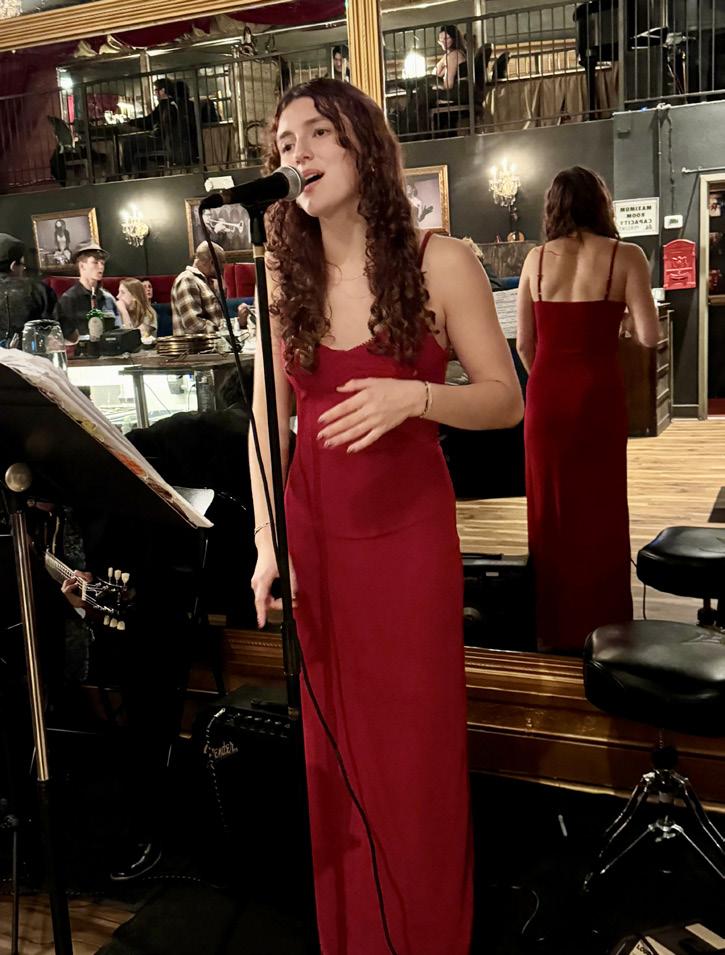
Live Mics Above: Lauren J. '28 singing at Old Skool Cafe in San Francisco, dressed for the occasion. Below: Maia M. '27 performing at Apple Jack's Bar in La Honda with her guitar. // PHOTOS: Lauren J. '28, @maiadoesmusic / Instagram
Pokemon on the world stage: Ever wondered what competitive Pokemon really looks like? Tune in to the Europe International Championships held in London from Feb. 13-15.
Gotta Catch 'Em All
Inside the brand-new Pokémon Team of strategymaximizing and Charizard-adoring Lower and Middle Schoolers
BY KAYLA L.
While poring through his seven-card hand, third-grader Wesley S. ’35 giggled maniacally across the table from Rohan K. ’32.
“I know just who I want to get out…” Wesley threatened, eying his friend. As Rohan grew increasingly nervous, Wesley pulled a Mega Dragonite EX from his card deck and slapped it onto the Active Spot in his lineup of six Pokémon.
“No! No! No!” Rohan shrieked. Wesley’s play had dramatically weakened Rohan's lineup, and Rohan was forced to flip his dice, symbolizing the damage he had suffered.
Through giggles, Wesley explained his play aloud: “Mega Dragonite EX is really strong because it can do a Ryuno Glide with 330 damage. I think it works pretty nicely!”
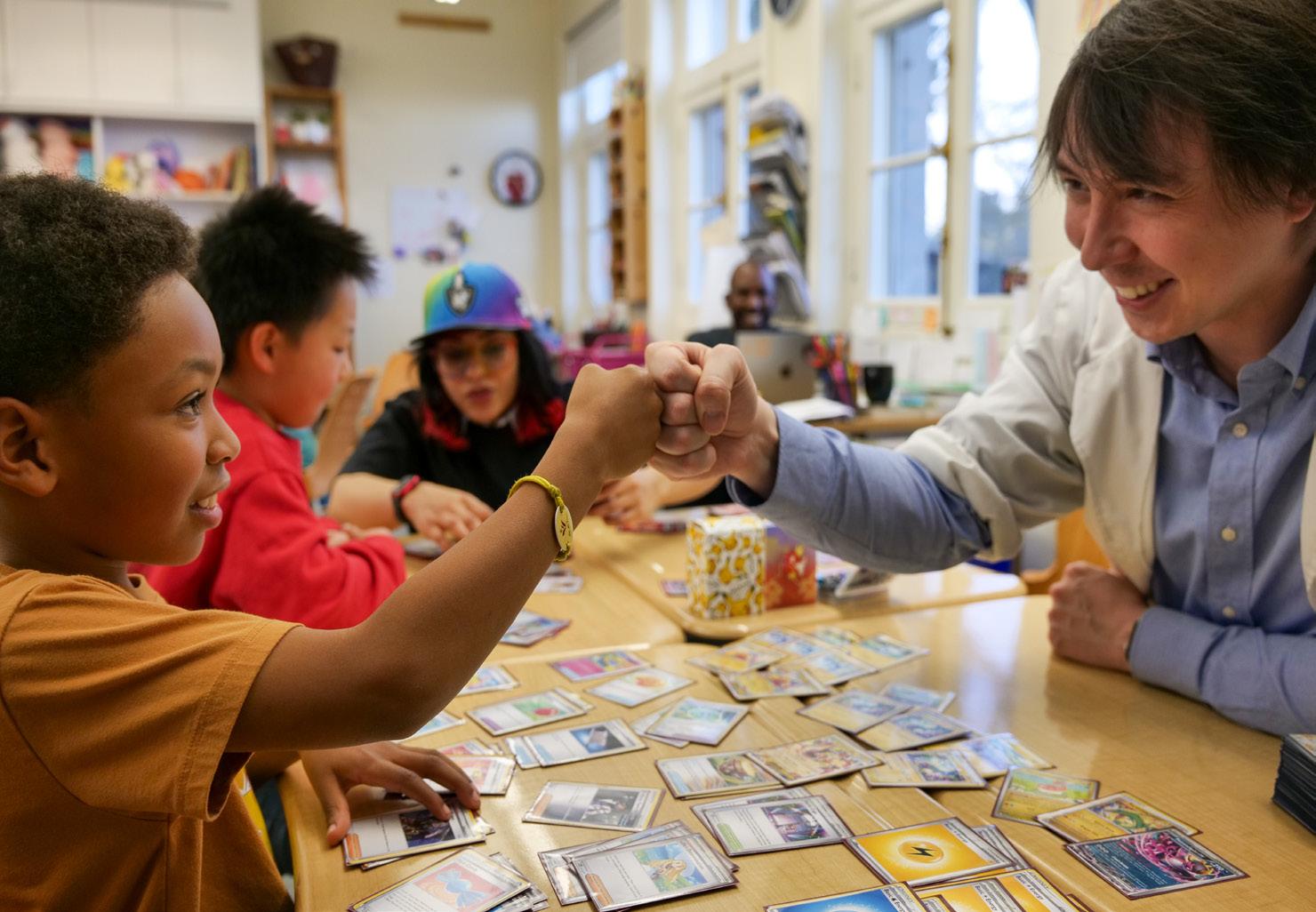
Wesley and Rohan both belong to the Nueva Pokémon Team: a new, nine-student team coached by Nueva alumnus Daniel Hwang ’21, Wesley’s father Dave Scott, and three professional Pokémon professors. The team, whose members range from third to eighth graders, meets weekly in room A201 of the Lower School Building to practice the Pokémon Trading Card Game (TCG): a tabletop game designed for the franchise’s collectible cards.
The idea for a Nueva Pokémon Team originated last summer, when Dave and Wesley came across an official Pokémon tournament at an international gaming convention.
While Dave is the CEO of Evil Genius Games and familiar with many tabletop games, both he and Wesley were surprised to learn about the sheer scale and stakes of Pokémon gaming; winners will often walk away from tournaments with scholarships,
prize money, and other lucrative awards. Meanwhile, Dave was also struck by the cognitive benefits of a game like Pokémon, by bolstering players’ strategic thinking, math, and memory skills.
Wesley’s motivations were a bit simpler: “I really like playing Pokémon!”
Inspired by what he had discovered at the gaming convention, Wesley sent a letter seeking support for a Pokémon team to Head of School Lee Fertig. Fertig responded, recommending that the father-son duo meet with Lower School Division Head Megan Terra and Middle School Division Head Karen Tiegel to create an after-school enrichment program.
After some initial setbacks with fielding enough teammates in the fall semester, the team officially launched in January.
At the first practice, some teammates didn’t even know how to play the game. And yet, lead Pokémon Professor Kai Kasim described the team as “very promising.” Kasim specifically recalled asking Royce Z. ’35 to reflect on sportsmanship and being shocked by the young student’s answer: “We learn and grow by losing.”
In that same session, Kasim also gave students an initial introduction to the game’s “metas:” 17 of the highest-performing Pokémon decks that competitors can use in tournaments. Over the course of the students’ training, they will study the metas to prepare for real competition.
Coordinating Care
Inside Nueva’s wellness team
BY SENYA S. understanding what might be affecting a student’s performance.
Amid flurries of stressful MAs and hectic schedules, Nueva students can sometimes find themselves falling behind academically. Given the stressors that students face, administration has to think through how to build safety nets that support students.
Nueva takes a holistic approach to student support through its wellness team, which consists of staff members who are involved in non-academic aspects of student life: administration, school counselors, academic support staff, health staff, and THRIVE coordinators.
The goal is to create a place where different perspectives on student wellness can intersect.
“Nueva has been trying to gather interdisciplinary bodies to think about how to support students and how to support the school,” said Upper School Lead Counselor Aviva Jacobstein. “There's an academic council where every academic discipline has a department chair and they meet [bi] weekly. I think of the wellness team the same way.”
Every Thursday, the team meets to go over new submissions collected through a “Student of Concern” form, where teachers and advisors flag questions or observations about students who might need additional support. The team then collaborates to determine how best to provide each student with the support they need. Each member brings their own unique perspective to
Mar. 8: Daylight Savings Starts Students, faculty, and staff should expect to adjust their clocks one hour forward.
Kasim underscored the complexity of metas in the game. “It's as if, for chess, you got to bring whatever pieces you wanted—and there were hundreds of pieces you could choose from,” she explained.
Mastering that complexity takes serious focus, which is why Hwang was extremely impressed by the students’ dedication in the first practice. Hwang is also an Upper School alumnus and serendipitously ranked as the world’s eighth-best Pokémon Video Game Competition (VGC) player.
“They actually did their best to pay attention and listen. That’s the first thing that immediately stuck out,” Hwang described.
Hwang is focused on helping the team prepare for the team’s first challenge, which will be the Los Angeles Pokémon Regional Championships in May. Later in August, the team will travel more locally to spectate the annual Pokémon World Championships. There, the students will be able to meet other Pokémon enthusiasts, witness high-level competition, and improve their own gaming skills.
Looking forward, Dave is optimistic about the team’s success and chance to be globally-competitive in the future. “If anyone has the raw talent to capitalize on this phenomenon, I think it's a Nueva student,” Dave said. “We have students that I think are really promising, and I can't wait to see them compete on the national level.”
But the path to victory will not be without challenges, and the coaches already anticipate the students will have to weather losses. In addition, the Pokémon game undergoes an annual rotation that swaps out certain playable cards, forcing players to adapt to new strategies. Unfortunately, the next rotation will remove Charizard, an orange dragon that is the most-favorite Pokémon of teammate Ian L. ’35.
Despite these obstacles, Wesley is looking to achieve one major aim: “beating everybody in the club at least one time. To get there, he’s ready to put in the work. “I think I still have a bit to learn!”
As a counselor, Jacobstein emphasizes the importance of considering students’ mental health while supporting academic success.
“When we're looking at ways to help faculty support students, I'm holding the mental health lens for kids and thinking about what might be going on for a student if they're struggling academically,” she said.
Lead school nurse Phoebe Wargny provides a physical health perspective to discussions: “Being the nurse, I contribute information that I might know about someone who has a physical health condition that might be affecting their academic performance,” Wargny said.
Upper School Lead Learning Specialist Cathy Robinson focus es on neurodivergent students: “My role is to bring a perspective of students’ ability to learn and access cur riculum if they have a learning difference. [I] make sure that student rights and privi leges are not being violated.”
This
multi-pronged approach to student wellness was spearheaded by Upper School Division Head Liza Raynal. Before and during the Covid-19 pandemic, wellness was led by grade-level deans. As the workload became untenable, Nueva expanded its wellness team and shifted responsibilities to fulltime learning support and counseling professionals.
“[We used to have] three different people who [were] only looking through their own lens of how they care about kids. Sometimes they were all meeting with the same kid and they weren't talking to each other,” Jacobstein said. “[Now,] it’s the right people in the right roles in the room, and hopefully
These days, the wellness team continues to evolve. Shortly before winter break, Raynal invited I-Lab Director Angi Chau to do a “design sprint” and evaluate the wellness team from an outside perspective.
Chau interviewed each member of the team and sat in on meet-
“One thing that kept coming up over and over when I interviewed people individually was that they were wondering what other schools do,” Chau said. “So, I gave them homework: everybody had to interview at least one or two other schools and learn what their processes are, then report back to the group.”
For many members of the wellness team, those conversations highlighted what makes Nueva’s approach to student support so unique. Where other schools tend to keep their support services more separate, Nueva encourages open communication between disparate departments.
Upper School Academic Support Coach Gretchen Kellough, who interviewed schools across the Bay Area and in Hawaii, returned from her research feeling optimistic about Nueva’s model.
“I came back feeling really good about how we approach wellness because most of the other schools I talk to are more siloed,” Kellough said. “[It’s] made me feel really good about the more holistic approach that Nueva takes.”
As Chau wraps up her work with the wellness team, she emphasizes that success won’t always be immediately visible.
“Students [may not] see a lot of background work in terms of how teachers and the entire faculty support students,” Chau said. “[Yet] ultimately, if the wellness team is successful, students should say, ‘oh, everything's working great!’”
STORY
ILLUSTRATION: Senya S. / The Nueva Current
Take a Pikachu Wesley S. '35 and Pokemon Professor Frank Luciano celebrated after Wesley made a successful move. // PHOTO: Kayla L. / The Nueva Current
CONTINUED FROM PAGE 1
A 2026 study published in Pediatrics Open Science found that increased social media use was associated with reduced attention over time, even as other forms of screen use were not. This seems true at Nueva, too, where 59.1% of respondents said devices or social media content made it harder to read longform text.
In contrast, reading books has been shown to strengthen the very capacities that social media erodes. Various researchers and studies have found innumerable positive effects of reading on cognition, from improving brain connectivity and short- and long-term memory to alleviating stress and even preventing cognitive decline.
There’s a psychological element to it, too: researchers from Harvard, Princeton, and McGill University found that frequent fiction reading resulted in strong “social cognition performance” of participants, as a result of fiction’s ability to simulate “social content.” A 2013 study in Science similarly showed how reading fiction helped adults navigate ideological diversity.
However, many of these benefits depend on sustained, uninterrupted attention—something that students report is increasingly difficult to maintain.
“[When] I’m reading a book, I can almost get into [a] flow state. But the second I get back on my phone, or I get a notification that causes me to open my phone, I end up getting sidetracked,” William H. ’28 noted.
Even teachers are noticing a similar trend in their own technology habits. “I know that I can’t sit still anymore the same way that I used to just sit in silence. I need to pick up my phone; I need to busy myself somehow,” Upper School English teacher Amber Carpenter said.
For that reason, Carpenter worries when she hears from students about their multitasking habits: eating while doing homework, flitting between unrelated tabs, or using a split-screen to watch videos in the background.
“It was shocking to me,” she said. “They’re not really focusing on one thing. I think that skill is something that students have lost.”
Ronit partially attributes the shift to a generational gap in how students and teachers relate to technology.
Gen Z has only ever known a world of smartphones, streaming, and algorithmic feeds. As a result, teens have been made prone to relying on their devices for both information and escape. High school students who spent formative years online during the pandemic have carried those digital habits forward.
But it’s not just devices and algorithms that are changing students’ relationships to reading. When students
read mostly for class rather than pleasure, they begin to approach texts with their eventual essay grade, rather than enjoyment, at the forefront.
Mila W. ’27 notes that when reading is assigned in an English class, “[students] are only engaging with the books to find materials for their essay, and because of that, they’re incapable of reading normally.”
Mars echoed Mila’s observations.
“The way that we [as students] see reading is like we are mastering the text, we are subjugating the text,” they said. “Whereas, when I was much younger, it was kind of like the text was taking me on a journey.”
Upper School English teacher Jen Neubauer understands that students experience a disconnect when their reading is framed as an academic task rather than a personal one. “I think we place a lot of emphasis on experiences and presentations, and not just [on] the joy of reading, which is maybe more personal and independent,” she said.
Teachers also recognize that reading can feel more forced and less enjoyable when it’s assigned rather than chosen. Carpenter, for example, acknowledges that students may feel less engaged when they are not invested in the particular texts included in the reading curriculum. “I think part of that is on us to make things a bit more exciting,” she said.
At the same time, English teachers want to remind students that reading a text for fun and analyzing it for deeper meanings are two fundamentally different skills—both equally valid, but suited for different contexts. “Reading doesn’t necessarily have the most linear outcome. Responding to ambiguity or complexity often requires you to tune in a little bit more rather than lie back,” Upper School English teacher Sarah Muszynski said.
“That seems counterintuitive to a lot of people, and I can get why that would produce some frustration,” she added. “Sometimes it’s difficult to square those different, context-bound forms of reading.”
“I think that some texts are just innately challenging,” Carpenter said. “And so that’s part of the pushback. [Students] don’t always want to be challenged.”
This disillusionment has real consequences. When students approach their academic reading as a hurdle rather than an experience, they begin to see shortcuts as a more appealing option.
Indeed, William acknowledged that students tend to turn to online or AI tools in place of reading when their primary goal is to “just complete the assignment and get a good grade.”
“Is there truly much of a payoff for that time commitment for [students]?” William asked. “If they can have
Across the nation, teenagers are reading less than ever. What’s driving this decline, and how are students and teachers responding at Nueva?
ChatGPT or SparkNotes summarize this whole book for them, is there a benefit for them actually reading it versus them getting the summary?”
Some teachers, such as Muszynski, see the proliferation of AI summary tools as correlative to the fragmentation of modern attention spans.
“Why sit with something when an answer can be right at your fingertips?” she said.
Beehler agreed, seeing the AI summaries that now preface every Google search result as emblematic of the modern desire to distill any block of text into its main points. “If that’s how we’re being trained to read the world around us, it’s hard to encounter a full text,” she said.
Even so, Upper School English teacher Pearl Bauer believes that a system where students bypass their own learning isn’t inevitable. “If you get a student excited about what they’re thinking about and what they’re writing, they’re not going to turn to AI,” she said.
“[WITH SHORT FORM CONTENT], THE PAYOFF IS SO MUCH FASTER THAN SITTING DOWN AND READING A 300PAGE BOOK.” “
Still, the English department tries to ensure that students can handle weekly reading loads without shortcuts. Teachers must work within Nueva’s homework policy, which recommends homework not to exceed 45 minutes of work per class period. This limits the amount of reading the English teachers can allot, and, as a result, how many books one course syllabus can contain.
“We have students who read at varying speeds, and accommodating for an entire class, trying to be in sync with pages, actually often really limits the reading that we assign here—more than any school I’ve ever worked at,” Neubauer said.
Some students, however, wish for a faster-paced English curriculum that would make space for more challenging books.
“I do think that Nueva prides itself on being really contemporary with the things we read, [and so] sometimes I think there are books we read that have a really low barrier [to] entry,” Nancy G.-M. ’26 said.
She noted that although maximizing the accessibility and modern relevancy of a text is important, the communal aspect of an academic English class makes it well-suited for the exploration of more challenging texts.
Evelyn K. ’28 shared a similar senti-
ment. “I understand it’s hard to balance reading levels, but I feel like I’d get a lot more out of [English] courses if we read one or two more books a semester.”
Still, some teachers have found ways to accommodate a desire for more extensive exploration within the constraints of the curriculum. Rather than adding more books, they’re carving out spaces where reading can exist without being tethered to an assignment or rubric.
In Upper School English teacher Allen Frost’s classroom, that effort takes the form of a single poem read together at the beginning of each class, without annotation or discussion prompts. For Eric, the exercise feels almost radical in its pure simplicity. “It’s a nice way of reminding me that reading isn’t always about analysis,” he said.
The Senior English curriculum, where students select English classes tailored to specific subjects, offers an additional opportunity to prioritize personal interests in reading. Some seniors have told English teachers that their senior seminar was one of their favorite classes at Nueva, Bauer noted. “That’s a huge testament, that [students] are saying the best class they’ve ever taken is an English class,” she said.
As a senior herself, Nancy pointed to the opt-in component of senior English as a high point of her Nueva experience. “I feel like everyone’s really engaged in the readings because a lot of us chose to read [them],” she said.
Anya O. ’26 similarly relished the few times she got to choose her English books as an upperclassman. And others, like Kyle W. ’27, are looking forward to the change they’ll experience when they become seniors.
Outside the classroom, the WRC has taken on a subtler but increasingly deliberate approach to incentivize student reading. “We’ve aimed to encourage reading at both of those zones,” WRC coordinator Jen Paull said, referring to the two “zones” of academic and personal reading.
So far, the WRC has jump-started a variety of initiatives: the staff “Blind Date with a Book” giveaway before the holidays; the Book Plates project showcasing faculty and staff’s favorite books; public readings of novels like The Great Gatsby; and displays of student-written poetry chapbooks.
The team also oversees the Book Club and the recently announced Student Library Board, a group that aims to incorporate student voices into the library’s collection and outreach programs. All of these projects celebrate reading, hoping to build community among readers across a spectrum of ages and preferences.
Paull also co-chaperones the annual, book-centric 11th-grade trip to Boston and NYC, where students explore the cit-
ies’ rich selection of libraries, archives, and bookstores.
“It’s all part of just keeping it in the air,” Paull explained.
Beyond institutional programs, the students who continue to maintain active reading habits do so for reasons that have little to do with academics. “There’s something about reading that really recharges your battery, and it’s nice to be spending time alone doing something that’s not on the internet,” Nancy said.
Reading offers Pearl Y.-L. ’26 something unique: “[Reading] is a way of experiencing a whole different world from the day-to-day grind, and I can read about these people who are completely different from me.”
Sofia R. ’28 agreed. “I like the escapism of it,” she said. “I enjoy fiction for [its] grand fantasticalness.”
Paull wants to remind students who are looking to incorporate more reading into their lives that it doesn’t have to be an all-or-nothing commitment: “You might not have the time for an entire novel, but maybe there’s an audiobook, maybe there’s a novella, maybe there’s a graphic novel that grabs you. It’s not a huge investment before you get something great out of it.”
Reading, she emphasized, should not have to be a burden, or just a form of academic tedium. “There’s this hilarious,
fun, provocative, energizing, social part of reading too.”
For many teachers, reading is a means of developing robust skills of thinking and inquiry. Upper School Math teacher Ted Theodosopoulos— who also teaches Linguistics and often incorporates readings into his math, economics, and interdisciplinary class es—thinks of reading as a means of sustaining a deeper habit of cognitive flexibility.
“We become conceptually poor in being able to discern different mean ings if we don’t engage with deeper readings,” he said.
Without continuous encounters with complex texts, the ability to sit with ambiguity and layered ideas will erode. That loss is easy to miss, es pecially among Nueva students who continue to read well and perform academically.
Reading hasn’t disappeared at Nue va. It has been diminished by the same forces reordering attention every where: busier schedules, an inter net and social media optimized for immediacy, academic struc tures that reward efficiency, and the lingering habits of a childhood shaped by the pandemic.
None of these factors tells the whole story, nor are they unique to Nueva. Books remain at the heart of English classes and are loved and valued by many students. What has changed is the extent to which
A Disappearing Pastime
Students say time constraints and digital distractions have made reading for fun increas ingly rare.
DESIGN BY: Anwen C. / The Nueva Current
Quoted: “You want to feel attractive, to feel pretty. We’re taught to value this attention so deeply that even vulgarity and blatant disrespect can register as validation rather than harm,” – Elie W. ’26
A Portrait of the Teenage Girl in 2026
What it’s like to grow up in a world that is constantly telling you who should be
STORY BY ELLIE L.
On the internet, the teenage girl experience is defined by a certain aesthetic: flash photos of elaborate girls’ nights; the girlhood vocabulary of girl dinner and girl math; 20-second blurry clips of girls running through city streets set to Lorde’s Ribs; and of course, pink everything.
This generation of teenage girls is adept at curating their image. Online, they can exercise control in ways the rapidly changing world around them doesn't allow.
That world, for them, has been defined by large, and often contradictory, cultural shifts. The #MeToo movement exploded into mainstream media when they were in elementary school. As they entered their teens, they witnessed a surge of media celebrating girl power, from Barbie (2023) to Hidden Figures (2017). Meanwhile, the toxic subcultures like the “manosphere” and “bro-culture” have only grown in influence, alongside other misogynistic hate campaigns.
On the political level, these girls are coming of age under an administration that’s rolled back protections for issues like abortion and reproductive rights, workplace harassment, and gender pay disparity. Their country is helmed by a president accused multiple times of sexual harassment and has verbally attacked female reporters on live television.
For Emma F. ’27, it’s been difficult to watch it all play out in the news. Her gut response has been defined by apprehension.
“We have an administration [that] doesn't really support women or young girls, and they've made that clear through their laws and their policies,” Emma said. “I don't want to say it's dangerous, but it's definitely not a safe place for women right now.”
Danger itself is not unfamiliar to Emma. The worry of seeming too provocative, walking alone, or attracting too much attention remains an unavoidable cornerstone of the female experience. Yet as Elie W. ’26 notes, what’s different about this moment in time is that those fears are being augmented in a world where women’s rights are increasingly restricted, and misogyny progressively becomes more commonplace.
“Our political leaders [are] saying women
THERE'S ALWAYS THE FEELING OF SELFBLAME. YOU FEEL WATCHED WHEN YOU'RE AT SCHOOL AND DEFINED BY HOW YOU PRESENT YOUR BODY.
exist to have babies,” Elie said. “I definitely am not at the point of internalizing that, but there's a fear that this will be other people's perception of what I exist to do and how I should exist.”
Sakura T. ’26 shares these frustrations. For her, it is bad enough to witness misogyny enshrined in policy changes or in political rhetoric. Seeing fellow women rally behind such changes has only made everything seem even worse.
“I feel like generations of work that women have done to gain opportunities have been reversed in a way. I think we're regressing,” Sakura said. “And it’s confusing
to see other women supporting that.”
The growing influence of these conservative women—alongside a presidential administration that is predominantly white and male—has made Izzy H. ’27 more wary about the current state of the country. On the national stage, she simply doesn’t feel represented.
“It makes me feel uncertain of where my voice fits in,” Izzy said.
Aurelia F. ’27 shared a similar uncertainty.
“It's the most powerful thing—the idea that I don't feel like I can see myself in the [current] political climate,” she said.
As it’s only been one year of the second Trump administration, these impacts remain difficult to quantify. Part of this draws from the fact that most effects manifest through cultural shifts: the normalization of backhanded comments, casual disrespect, and objectification online.
Anika A. ’29 noted how this difficulty in pointing to a concrete increase, paired with assumptions that gender equality has already been achieved, can prevent girls from speaking up about their own experiences with male peers and friends.
“People think that we are now equal. And so [sexism] feels like something that you have to deal with on your own. If you bring it up, it's like, oh, well, we already have equality,” Anika said.
The result is a special kind of double burden. Not only do girls face sexism—both the systemically and culturally embedded sort—but they're also expected to suffer through it quietly. Anika has often found it tiring to try to process it all on her own.
“There's a lot more going on underneath the surface that anyone sees, [whether it’s] just the perfect facets that are shown via so cial media or the semi-perfect facets shown through everyday life,” Aurelia said. “There are particular vulnerabilities and issues that girls that have to live under that men would never have to consider.”
Recently, Xochi S. ’29’s mother showed her a picture of Xochi as a child. In it, Xochi looks into a mirror, content.
“She [said]: I love this picture, because you're so happy in it—so happy with yourself,” Xochi said.
ILLUSTRATION:
like, oh, this again. I think many teenage girls can relate to this,” Mia said. “I think it's gotten to a point where it's not necessarily something that I'll notice as much because it is really common.”
Online, searching for a similarly posed reference for an art project, Xochi was struck by how different modern photos of teenage girls with mirrors looked. Their hair was perfect, they bore full faces of makeup, and they looked glamorous. Yet, none of them looked confident or joyful. Their beauty caught on camera felt like an expectation, rather than a choice.
For Xochi, her childhood photo now embodies the last tinge of childhood innocence, before beauty standards.
“I want that to last longer for young girls—to not have that self-consciousness I had at a very young age,” Xochi said.
Self-consciousness and insecurity have long been an unavoidable part of adolescence; it is expected for girls to wrestle with their appearance. But for this generation, social media amplifies those pressures in unique ways. Katy W. ’29 described how her experiences with ads on Lemon8, an image and lifestyle platform dedicated to all things aesthetic, revealed a detrimental edge to the platform.
“The ads for Lemon8 are all [about] how to glow up. You don't want acne, you want clear skin. You don't want oily hair, you want long, luscious hair,” Katy said. “A lot of times
For Xochi, experiences with similar comments have also been frequent. It’s a change she attributes to trends on the national stage—where men in positions of power consistently make similar comments without consequence.
“In my personal life, I can see that—it feels mean if I say men, but it is mostly men—they feel like it's more okay to say [these] things. I've been given comments on my body with disregard for everything else,” Xochi said. “They're so confident when they say it, too. There's not any remorse.”
Elie has noticed a similar lack of remorse in her own experiences with unwanted attention. Towards the end of freshman year, as a part of Quest programming, she recorded a basic FlipGrid video about her project, a final presentation of her work. Elie submitted the video, thinking nothing of it. Later, she heard that male upperclassmen had passed around the video and sent messages about her body in group chats.
“There's always the feeling of self-blame, [especially after] hearing people say, ‘oh yeah, she wore that shirt in her Flipgrid video for attention.’ And then you just feel naive and foolish,” Elie said. “You feel watched when you're at school and defined by how you present your body.”
Though Elie felt uncomfortable, she wasn’t immediately sure why. She had spent much of freshman year trying to fit into a
Three years on from the experience, Elie has some simple advice for younger girls enduring similar situations. She acknowledged that some attention can genuinely feel good; people are certainly allowed to want to feel attractive. At the same time, she emphasized how unwanted attention or sexualization is never deserved, regardless of how they present themselves.
“It’s not someone’s responsibility to change how they look or dress; it is solely the responsibility of those doing the sexualizing to change their behavior,” Elie said. “[And] I would want to encourage young girls to not put your worth into what anyone, especially a guy, thinks of you. You are so much more than what other people see you as.”
It’s a lesson that Elie has internalized as she’s gotten older, and one that she's also seen repeated within her female friendships. In a world that can often feel hostile towards teenage girls, these relationships offer a sense of solidarity and support. Even online, girls can form communities that are pockets of resistance, pushing back against misogyny.
“What’s really sweet is [seeing] people using online platforms to share stories about how to feel empowered and protect yourself,” Eva G. ’29 said.
Izzy maintains that hope for the future, and continues to view the teenage girl experience with appreciation.
“I would say that it's a lot less glamorous than it's portrayed in [social] media, but still... I don't think I could see myself being anywhere else or feeling anything else than I feel right now,” Izzy said.
I. A SHIFTING, UNSTEADY WORLD
II. FITTING THE MOLD
Quoted: “As soon as we started ‘We Wish You a Merry Christmas,’ we had a whole crowd singing every single word right back at us. It was really touching.” - Tin K. ’27
The January Shuffle
Quoted: “December comes and—poof—you’re with another teacher, and you’ve got to learn what they expect.” - John Carter
For teachers and students, midyear class switches bring new styles, expectations, and classroom dynamics.
STORY BY TIMOTHY C.
Every January, students return to campus, and while the hallways might feel familiar, many classrooms do not. Schedules reset, electives rotate, and for a number of students, a yearlong class quietly changes hands.
For many students, the start of a new semester can mean a new teacher, new routines, and new expectations. This shift is not an exception, but the reality of a school that offers a wide range of courses and electives.
According to Assistant Upper School Head Claire Yeo, who also oversees academics, the practice dates back to Nueva’s roots as a school that emphasizes student choice. Since many electives are semester-long and offer only one section, they are scheduled first. Core and year-long classes are then built around them.
“It’s not a policy nor a rule; it’s a practice. [We] believe that students' elective choices are paramount,” Yeo said.
Yeo acknowledges the challenges this practice poses: teachers need to align course curricula such that students can pick up where they left off. To address these issues, Nueva has implemented communication channels, such as shared pods and departmental meeting times. For “shared classes,” taught by multiple teachers across two semesters, each department coordinates content, skills, and pacing to ensure both “continuous student experiences” and teachers’ “individual liberty.”
In math, where content builds sequentially, that coordination is crucial.
“We have rubrics that lay out all the standards for every course,” said Upper School Math Teacher John Carter. “We decide the content to be covered in one
semester, and stick to it, so that if a student is switching at the end of the semester, they’ve got that material.”
Even with shared standards, however, some students note that mid-semester swaps can be jarring, with different teachers having distinct approaches to the curriculum, assessments, and class environment.
Mila W. ’27 described how, since moving into a new Math 3 block, she has felt she didn’t bring with her the foundational knowledge to keep up with the lessons. Her new class, for example, expected fluency with specific trigonometry identities that her previous teacher hadn’t focused on.
Many teachers understand and are empathetic to this transition: it’s natural to
experience difficulty in adjusting, not just to new material but also to new expectations and class dynamics.
“You take so long to learn the personality of the teacher, learn their requirements, learn how they operate,” Carter said. “And then December comes and—poof—you’re with another teacher, and you’ve got to learn their technique and what they expect.”
English remains a similarly flexible subject, but rather than units or tests shifting around, it’s the books and major assignments that change. In English 11, for example, some teachers may dive deeper into The Great Gatsby by F. Scott Fitzgerald, while others may choose to include Passing by Nella Larsen.
In the English department, all classes ensure coherence through a set of shared criteria: at least two common texts and major assessments per semester, and a consistent rubric within the same course, regardless of the teacher.
Additionally, teachers also align pacing through shared calendars.
“We abide by that calendar to a T,” said Upper School English Teacher Amber Carpenter. “If I have students reading 30 pages for homework, the other teachers have students reading 30 pages for homework.”
Still, careful planning cannot completely eliminate differences. Professional autonomy allows teachers to tailor content to students, so classrooms won’t feel identical.
“I think the most important thing was communicating with my teacher,” Mila said. “When you have a teacher who’s really trying to accommodate you, transition can happen a lot faster, but sometimes you just have to go through it on your own pathway.”
For her, clearer shared foundations and systemic support could make the switch more navigable.
“If there were certain baseline things that everyone did across classes, that would really help,” Mila said. “I don’t think it’s anyone’s fault. The school just needs a system that makes transitions easier for students.”
For Yeo, in a school year that shifts halfway through, paying close attention is key to ensuring students are still seen and supported as they move forward.
Link-age: a mission for harmony across generations
Nueva students perform music in effort to combat loneliness in the elderly community
STORY BY NEEL G.
Edden L. ’26 and Tin K. ’27 are using music to connect across generations.
They’re doing so through Link-age, a youth-based organization that performs instrumental music at local senior centers.
Edden, who plays violin, founded Linkage in the summer of 2023. After playing in his youth orchestra for six years, he “always felt that there was something missing and wasn't doing a lot with [his] music.” So, he quit and began Link-age.
“It’s a way to bring [the seniors] company while also bringing them great music. The beauty of the connection really happens in the conversations after the performance,” Edden said. “I encourage all performers to stay after performances to chat with the seniors, and it's really sweet getting to know them, to remember their names, and to see them come back every month and catch up about their lives.”
Over the organization’s two-year history, Link-age has hosted around 50 performers—both Nueva and non-Nueva students—and performed at 15 different senior centers. Today, they perform every Sunday, cycling through four centers on a monthly basis: The Ivy in San Francisco, The Trousdale in Burlingame, Atria in
Foster City, and Oakmont in Redwood City.
“We've built a lot of rapport with the staff [of these senior centers], and along the way, we've created regular audience members too,” said Tin, the Peninsula Manager. “They often don't remember talking to us because a lot of them are in memory care, but we are still able to create some sort of impression on them.”
Recently, Link-age completed their annual holiday tour over winter break, where they toured senior centers in San Francisco and performed carols.
“On our last performance of the day, we were all kind of weary. But as soon as we started ‘We Wish You a Merry Christmas,’ we had a whole crowd of seniors singing every single word right back at us. It was really touching,” Tin said. “We ended on ‘Jingle Bells’, and everyone got together to sing. The sheer volume made it feel like the room was about to burst open. It was one of those moments where I was like ‘wow, we definitely made an impact here.’”
That impact—for the seniors and students—goes both ways. Edden has gotten to know several regulars over the years: Cathy, a San Francisco native who lives in San Mateo and dearly misses the city but always looks forward to Edden’s rendition of “I Left My Heart in San Francisco;”
Elizabeth and her dog Chiquita, who love “Hallelujah;”, and Grandma Gigi, a former music teacher who always plays the piano after each performance.
These were just some of the “many stories and personal connections” made through Link-age, according to Tin. Linkage hopes to further their central value of fostering community through more recruitment next year.
“There's a joy you get from picking out a duet, practicing it in the Nueva's tiny practice rooms, and then getting to
perform it. There's another joy from seeing that your music is actively making people happy,” Tin said.
For Tin, Link-age has had an especially powerful impact on not only building community, but also her own journey with music.
“The community I found at Link-age, both in the other musicians and in the people we were performing for, helped me rebuild my love for piano. Making connections through music is so much easier than you think.”
A Spirited Duet Tin K. '27 and Edden L. '26 perform a Christmas special at Oakmont.
// PHOTO: Hugh Li
Coordinated Calendar Shared planning document of an English 12 seminar. // PHOTO: Jen Neubauer
Editorial: How We're Learning
STORY BY THE EDITORIAL BOARD
Whether in school board meetings or at your lunch table, debates over what children are and ought to be learning stir strong feelings and bitter disputes. History curricula carry deep political implications; the shelves of school libraries are a constant source of moral outrage; new approaches to math education like “New Math” in the 1960s and “Common Core” in the 2000s provoked widespread backlash.
It makes sense that we thus spend a lot of time thinking about what we learn in school. But the non-curricular aspects of a classroom cannot be ignored, because they structure how we engage with the curriculum. That’s why, across this issue, we have chosen to focus not just on what we’re learning, but how we’re learning.
Our feature on midyear teacher changes, “The January Shuffle” (pg. 13) explores how switching teachers between semesters can create discontinuities in a yearlong course, and how various departments think through how to bridge those gaps. An op-ed by Oliver Leung (pg. 16) offers a vision for how sabbaticals could provide both teachers and students with access to new perspectives and experiences. At the State of Nueva presentation (pg. 2), administration, faculty, and parents alike are all grappling with the tension between Nueva’s pedagogical philosophy and the high expectations and mounting pressures imposed by collegiate admissions.
This issue’s cover story on reading also highlights the importance of how we learn. Developing strong, consistent, and self-directed readers isn’t just a matter of what books we choose to read—in our curriculum or on our own—but also of the ways we relate to literature, technology, and our daily routines. The decline of reading among Americans, and our generation in particular, is a societal problem; one that requires not just book recommendations, but deeper introspection.
We hope that this issue encourages you to think about your learning not just through the lens of what’s on the syllabus or the next MA, but also through considering how the broader contexts of your classroom environment, teacher experiences, and out-of-school habits shape your education.
Sincerely,
The Nueva Current Editorial Board
What does “Know Your Rights” mean now?
In Minnesota,
federal agents have taken to violence and ignored the Constitution
STORY BY ALEXIS C.
When Minneapolis resident Alex Pretti held up his iPhone to take a video, he should have been protected by the First Amendment. He should have been protected by the Second, permitting his bearing of arms; he should have been protected by the Fourth, prohibiting search and seizure of a person without a judicial warrant.
Fourteen seconds after Pretti was taken to the ground, he was shot 10 times. Numerous videos from bystanders documented the commotion preceding the shooting, and the horror that followed. One other individual was shoved to the ground as agents brandished pepper spray and citizens blew whistles. No video shows any federal agent reading Pretti his rights as they are obligated to do:
You have the right to remain silent. You have the right to a lawyer. You have the right to due process of law.
These constitutional rights are granted to all citizens and residents of the United States, including visa holders or undocumented persons. The Bill of Rights, shaped by nearly two centuries of activ-
ism and evolution, exists to protect the people within the borders of this country.
But in the month of January, we have seen how federal agents have disregarded those rights. The flagrant refusal of our constitutional rights is why what happened in Minnesota was so terrifying. Border Patrol and ICE agents haven’t just demonstrated their propensity for violence; they’ve shown us that they don’t care about our basic rights as United States residents.
As we witness the direct violation of individual rights, it’s hard not to feel helpless. This is the tactic of intimidation being used to induce widespread resignation.
ICE and CBP agents have shot at 27 people, eight of which were fatal. Out of these tragedies, Renee Good and Alex Pretti’s deaths emerged to the forefront because they were filmed, because they highlighted the terrible injustice of actions of federal agents in their role of serving this country, and because they evoked a sense of helplessness, grief, and frustration.
I have to wonder, what would happen
if I had lived in a different state, taken a wrong turn, or even pulled out my phone at the wrong time?
The deaths in Minnesota strike a chord because they combine our natural empathy with learned helplessness to create the most terrifying anxiety: that our rights might be trampled, and we can no longer expect others to respect them. Those protections don’t exist for any of us. And in some way, fear has empowered this nation to not fall into the grasp of learned helplessness. This personal and intimate helplessness has drawn us together. Maybe, leaning into our fear is the vulnerability we must show in order to unite in opposition to this violence. This moment demands real action. Our government has abandoned business-as-usual, and as a result typical responses feel hollow: it is no longer enough to call our senators or memorize our rights. We need solidarity, protest, and organization that does not rely solely on turning to the judicial and legislative mass. The protection of the people’s rights is, and has always been, in the people’s hands.
What are Nueva students walking out on?
STORY BY MARA BALLMER
Our campus has been noticeably empty twice in the last few weeks: once for the ICE walkout and once on the MLK Day programming on Feb. 4. I’ve been struggling to reconcile these two days, one a conscientious civic action and the other an apathetic ditching. When I asked students about the low attendance, students were quick to provide several justifications. I most often heard them cite the overload of homework and extracurriculars as the reason they are too tired, too overwhelmed, and too stressed-out to participate. You’re right—you are overwhelmed and you may be drowning under the demands of this school. I don’t mean to invalidate this very difficult reality students are struggling through. That being said, this situation of overwhelm and burnout isn’t unique to the high school experience;
many of your parents, your teachers, or the people making your boba are also overwhelmed and battling with their workload, mental health, and obligations. Everyone is struggling. If we accept exhaustion as an excuse for complacency, it would follow that no one is obligated to advocate for others. When we remain focused on our own internal worlds to the exclusion of others’ more existential struggles, we all lose the mutual support of our communities.
Other students describe these “one off” programming days as performative and ask where the school’s commitment to these ideals exist outside of a guest speaker once a year. This is a necessary conversation. It is not, however, a reason to be absent on these days entirely. Often, the reason these days feel inauthentic is precisely because students choose not to participate only to then turn around and
use that inauthenticity to justify their lack of participation. Staff and faculty can create containers for discussion and learning, but ultimately it is up to the students to lead the conversation.
The recent walk-out against ICE activity was one such example of student leadership. It was inspiring to hear the care and passion that students showed about the world around them. Some students have also led roundtable conversations, passed out fliers, or advocated directly with administrators. Where was this conviction on MLK Day? If the programming isn’t what you want, why wasn’t there a student-organized alternative? Are you only interested in civic engagement if it gets you out of class?
Mara Ballmer teaches biologyattheUpperSchool.
GUEST OPINION
PHOTO: Shannon Stapleton / Reuters
Student Standoff: The Rise of Waymo
Two perspectives on driverless vehicles and what they mean for transport, safety, and the future of work.
A Revolution in Rideshare Safety
Removing the driver makes rides safer, especially for women
STORY BY NATALIA R.
A few months ago, I got into an Uber with my older brother. The driver was friendly and talkative. My brother fell asleep early in the ride, leaving me to keep the conversation going. The questions gradually became more personal until, five minutes from our destination, the driver asked for my Instagram. I gave it to him—in that moment, saying no felt riskier than saying yes. I blocked him when I arrived at my destination.
I’ve kept taking Ubers since then, but from that point on, I’ve wondered: How friendly is too friendly? How do you leave a conversation without provoking one more question? It’s a skill I haven’t fully acquired yet.
FEELING UNSAFE, FOR ME, IS NOT WHEN SOMETHING BAD HAPPENS IN THE MOMENT. IT IS WHEN SAFETY DEPENDS ON CONSTANT SELFMONITORING. “
Waymo makes rides safer, not because it is smarter or more ethical than humans, but because it removes them entirely from the equation. That structural change matters for riders whose safety depends on avoiding misinterpretation and escalation. Feeling unsafe, for me, is not when something bad happens in the moment. It is when safety depends on constant self-monitoring—when I have to put in effort to keep a situation from becoming unsafe. My family doesn’t own a car, meaning I rely on public transportation and rideshare. The risks are not the same across gender. Women are disproportionally the targets of harassment and assault in rideshare vehicles. According to Uber’s 2021-
From Bad to Worse
Waymo is simply one step further in the slow erosion of human labor
STORY BY JACKSON H.
2022 safety report, 89% of in-ride rape victims were women, mostly riders.
This is where Waymo, and other robotaxis, can change the nature of getting around. By removing the human driver, it removes the power imbalance inherent in rideshare, particularly between male drivers and female riders.
Existing safeguards in rideshare apps have failed to make safety a priority. Uber is currently facing more than 3,000 physical or sexual assault lawsuits. The “Women Preferences” feature added in San Francisco in the summer of 2025—allowing female riders to request a female driver or vice-versa—isn't guaranteed, since matching depends on availability.
Waymo has its flaws, but it doesn’t change the fact that it eliminates an entire category of interpersonal risk that no in-app safeguard has been able to fully address.
Yet the moment Waymo fails, the tolerance for error disappears.
When huge swaths of San Francisco lost power in a blackout on Dec. 21, Waymos struggled to navigate intersections without functioning traffic signals. But human drivers fail far more frequently: they speed, get distracted, and make judgement calls that put riders at risk. Still, perfection is demanded from automation in ways it has never been demanded from people.
I don’t want to com pletely replace human drivers, but rejecting Waymo outright ignores the uneven risk in traditional rideshare. For people with valid safety concerns— especially women—Waymo is a system where safety does not depend on man aging another person’s behavior.
On Dec. 21, as power blackouts roiled San Francisco, the city's eerily inhuman army of sterile, driverless vehicles. Waymo’s robotaxis were simply unable to handle four-way stops in a city blanketed in flashing red lights.
Meanwhile, some unfortunate souls in a windowless cube of an office in the Philippines have been tasked with remotely operating the cars and cleaning up the robots’ mistakes—as usual, automation at home rests on the backs of exploitation abroad. However, having only been trained to handle maybe one or two malfunctioning cars at a time, the Fleet Response team was soon overwhelmed. Within a few hours, Waymo had suspended all service in the Bay Area.
I wish I had been in San Francisco that day; it would have been a beautiful sight to behold.
The rise of Waymo is perhaps the epitome of automation and its discontents. Whatever case-specific benefits we can ascribe to self-driving cars cannot be detached from capital and the tech world’s full-frontal assault on human labor.
The taxi industry was never a perfect system. In major cities, most notably New York but also San Francisco, drivers needed to purchase “medallions” to operate taxicabs, a system which enabled regulation but also led to predatory loaning practices and sky-high prices of entry into the industry.
Nonetheless, the job once provided a baseline of stability. Medallions were solid investments, and quite a few taxi drivers in the 20th century were able to make an honest living for themselves and their family; if they were lucky, they may even be able to enter the middle class. Local governments, meanwhile, had a role to play in ensuring certain industry standards.
Then, sometime in the early 2010s, this all fell apart. Some twenty-somethings out in Silicon Valley had coded an app to “disrupt” the industry, providing a convenient, cheap alternative to the yellow cab.
With millions of new gig workers to compete with and the value of their medallions plummeting, taxi drivers faced two options: stay in a dying industry, or become a gig worker themselves. Either way, they’d be living by Uber and Lyft’s rules.
Unsurprisingly, many taxi drivers chose
Gig work is defined by constant precarity and instability. The worker is offered the false freedom of a life in which their working time is theirs to control, but without any of the baseline protections required for genuine freedom and choice. Many Uber drivers both work and live in their cars, and since they are independent contractors, not employees, they have few legal protections.
It is no wonder that an informal sector like gig work, which builds its base on the backs of the down-on-their-luck and downtrodden, has become an unregulatable mess rampant with problems of abuse and assault.
Yet, less than a decade later, we have decided that even that broken system is too much to offer the driver. We’d turned their jobs into “gigs,” and now it’s time to do away with their work completely. All we have to do is sic the robots on them, leave them with nothing but the clothes on their backs, and declare it a boon for “safe streets.”
WE’D TURNED THEIR JOBS INTO “GIGS,” AND NOW IT’S TIME TO DO AWAY WITH THEIR WORK COMPLETELY. “
Waymo is only one player in a broader push towards artificial intelligence and automation. While the threat AI poses to white-collar and particularly entry-level work is very real, driverless vehicles have the particular dishonor of targeting the most unstable, precarious, and ostracized segments of the working class first.
In fact, high-earning white-collar workers are supposed to be the main beneficiaries of jettisoning the gig worker from decent society. Business and capital almost always benefit from defining the rights of consumers in opposition to the rights of workers. But if we want to say we are seriously concerned with the threat of AI job loss, we cannot be pitting the driver and the rider against each other.
Those of us more fortunate should not view the steady erosion of drivers’ labor, from imperfect taxis to exploitative rideshare to total obsoletion, as some natural progression towards a techno-utopian future. For the rest of us, it should be a warning.
// PHOTO: Mario Anzuoni / Reuters
GRAPHIC: Jackson H. / The Nueva Current
OPINION
Giving teachers time to learn benefits students
Why sabbaticals should be part of faculty professional development
STORY BY OLIVER L.
The most significant changes in a classroom do not always come from a new teacher or an impressive curriculum, but from a returning teacher who arrives with renewed energy and ideas for teaching their subject. When teachers are given time to pursue sustained learning in an area of their choosing, their students benefit from the depth, a refreshed perspective, and the enthusiasm that follows.
Great teaching depends on continued curiosity and experience. Nueva already recognizes this through a range of professional development opportunities, including ILC, summer grants, and Professional Development Days throughout the school year. In particular, Professional Development Days offer teachers the chance to learn from their peers and guests and explore new approaches to teaching. These days can provide exposure to new teaching practices or niche areas within a subject, but their limited scope— there are only two on the calendar for the 2025–2026 school year—makes it an isolated opportunity. While these sessions can spark new ideas, they rarely provide enough time to deeply explore or test new approaches, as students benefit more from a semester-long class than from a single workshop.
Beyond these biannual sessions, Nueva also offers Personal Professional Development Days, a substantial summer grant program, and hosts an annual learning conference. Teachers are encouraged to utilize the summer grants and Personal Development Days to pursue longer ex-
periences or sustained study. At the same time, every two years, Nueva’s Innovative Learning Conference brings educators from around the country together to reimagine education. Cumulatively, these programs allow teachers to extend their learning beyond the classroom and dive deeper into a subject of their choice.
Sabbaticals, a common practice at the university level for professors, build on this same philosophy. By giving educators the time and space to fully immerse themselves in new environments, sabbaticals allow them to learn and bring back knowledge that they can meaningfully integrate into their classrooms. I believe that to maximize teacher excellence and long-term retention, sabbaticals could become a vital part of Nueva’s approach
SABBATICALS GIVE EDUCATORS THE TIME AND SPACE TO FULLY IMMERSE THEMSELVES IN NEW ENVIRONMENTS. “
to teaching and learning. They also offer something less tangible but equally important: a mental reset.
This past semester, I worked as an intern with a history professor who had recently returned from a semester-long sabbatical in France. While abroad, he continued his primary research but also engaged deeply with aspects of French
Reflecting on 13 years of SEL
How SEL quietly shaped my Nueva experience from kindergarten to senior year
STORY BY NIAM K.
I’ve been at Nueva since kindergarten, and so many things have changed since then: When I started, the high school didn’t exist, the Gathering Place was still the Ballroom, and Upper School Division Head Liza Raynal was a Middle School teacher! But throughout all 13 years, one constant in my school life has been SEL (short for social-emotional learning).
“
WITHOUT SEL, THERE WAS NO TIME TO CONSCIOUSLY STEP BACK FROM ALL OF THE PRESSURE OF ACADEMICS, SPORTS, AND COLLEGE APPLICATIONS.
Throughout elementary school, SEL was a regular and central part of my life. Every week, I would look forward to adding new tools—SEL skills—to my “toolbox” and reenacting scenarios with my class-
mates. I learned to throw my bad days in the “trash can,” and use I-Statements to resolve disagreements.
However, somewhere between middle and high school, SEL stopped feeling like a fun, useful class and became a drag that many of my peers stopped looking forward to. Throughout high school, I have heard students complaining about “having to go to SOM (Science of Mind)” and wondering why it is still necessary.
Now, as a senior reflecting on my time at Nueva, I recognize the importance of SEL and how much it has benefited my life. Last semester was the first time I didn’t have some sort of SEL class in over 12 years, and I clearly felt the void. I didn’t have a built-in space to talk openly about what was going on in my life and get perspectives from people of all different backgrounds.
One of my earliest memories of SEL actually happened outside the classroom. In first grade, I took the bus to school every day with two of my closest friends. At one point, they got into a fight that lasted about a week (which feels like forever when you’re 6): every morning and afternoon, they would bicker and force me into the middle of it. As an innocent 6-year-old,
education, which he later brought back to his teaching. In one of our first meetings after his return, he shared new strategies for navigating dense texts—specifically, older 19th-century documents— which I was able to apply immediately to my own work.
Experiences like this help explain why sabbaticals are a valuable benefit that can also support teacher retention: investment in a teacher’s personal growth incentivizes them to stay longer at their institution.
At the same time, concerns about sabbaticals are understandable. Financial strain and the temporary absence of experienced faculty are challenges that require significant planning for the school to fully absorb.
Some potential solutions have been proposed; for example, Director of Teaching and Learning Lauren Pool suggested a teacher exchange with partner schools to reduce the financial burden. Logistical
barriers—such as the difficulty of relocating for a semester and the complexities of reallocating professional development funds—had made implementation challenging.
Ultimately, sabbaticals are not just about the teachers; they are about students and the broader school community. My experience working with a professor who returned transformed by his time abroad showed me how quickly the benefits can reach students. I learned more, approached assignments more critically from new perspectives, and thus engaged in richer conversations.
If Nueva wants classrooms to remain lively, reflective learning environments, expanding professional development to include long-term academic and professional explorations could be a meaningful step. Sabbaticals are an immediate investment in teachers—and a lasting, sustained investment in students.
I didn’t know how to handle it.
The situation could’ve quickly spiraled out of control, but instead, the three of us went to our SEL teacher for guidance. We talked about how to handle conflict and communicate more effectively in the future so our friendship wouldn’t be so sorely tested by every disagreement.
That was the first time I saw my “toolbox” work in action. Looking back on it now, these moments didn’t stop in elementary school; they just became less obvious. That’s why the absence of SEL felt so pronounced this year. Without it, there was no time to consciously step back from all of the pressure of academics, sports, and college applications. I no longer had
a consistent space to reflect and decompress. While some students view SEL as less essential than academic classes, my experience has shown me how valuable it can be. My SEL teachers have taught me practical skills and provided me with a dedicated space to pause, reflect, and manage the stress of daily life.
As I look forward to college, where almost everything will be different, I know that if times get tough, I can fall back on my SEL toolbox and the skills I’ve been cultivating since kindergarten. The SEL curriculum at Nueva has prepared me to meet new people, overcome arguments with roommates, and adapt to a new city–all that’s left is to put it in action.
A Central Part of My Life Every week, I would look forward to adding new tools—SEL skills—to my “toolbox” and reenacting scenarios with my classmates. // PHOTO: Niam K. / The Nueva Current
Reimagining Education Teachers around the country attend Nueva's annual Innovative Learning Conference // PHOTO: Simone Summers
Crossword
PUZZLE BY ALLISON G.
1. Overly affectionate couples
10. ChatGPT and DALL-E, for two
13. Television drama that might feature sappy love stories
14. Like two peas ___ pod
15. Unending, as a rant
16. Assassinated political figure whose brother was also famously assasinated in 1963
17. Zaps with a police gun
18. Despises 20. Alternative to an emoji
22. S, A, B, C, D, E, or F, in an internet list
23. Contest before the AIME
26. Black dialect, in brief
29. Isn't able to
31. February 14th
34. Name of shrinking Central Asian sea
35. Poet ___ St. Vincent Millay
Foxy 37. Autobús alternative
"___, actually..."
41. Cat breed with blue eyes 44. "¿Usted ___ español?"
48. What might be switched when a teacher walks by a computer
49. Where to scroll Reels
51. Singer Yoko
52. Prepares, as for a date
53. Opposite of ENE
54. Name of the emoji
1. Right-angle body pose
2. Chaplin of "Avatar: Fire and Ash"
3. Hoovers, for short 4. Fencing swords
5. Guy in charge
6. Computer addresses, for short
7. "Relatable!"
8. Bond foe
9. Occupied, as a table
10. Dummies 11. Hellish
12. Fifth Avenue store
19. Quirks
21. Abhor
23. Palindromic girl's name worth 6
24. Hypothetical little green men on a planet next door
25. Final trick of Taylor Swift's "The Tortured Poets Department"
27. YouTube content, for short
28. Feminizing suffix
30. "ur such a lifesaver!!"
32. Kind of sch.
33. Female aviation legend
38. __ : horse :: 45-Down : donkey
40. Irish-born Tony winner Patrick
41. Put away
42. Old dagger
43. "¿Como ___?" (Spanish greeting)
45. See 38-Down
46. Put on board, as cargo
47. Senator Klobuchar and author Tan, for two
50. Game co. that created Dungeons & Dragons
John vs. John
Withtherecentarrivalof math teacherJohnConnolly-Whelan, Nuevaserendipitouslynowhas twomathteachersnamedJohn. Checkoutthekeydifferences andsimilaritiesbetweenthem!
REPORTING
BY
KAYLA L.
Cartoon of the Issue
Nueva Phone Ban:
Goose Edition
Grew up in and attended college in Illinois
Referenced at Nueva as John
Spends his free time making math songs, traveling, exploring the Bay Area, and playing MagicSort on his iPad
Has two kids and two dogs
Has 73 first cousins Old (self-described) Young (relatively)
Named John C. Teaches Math 2 and Booster at Nueva Wears glasses
Grew up in and attended college in New York
Referenced at Nueva as John H, the intial of his middle name
Spends his free time reading, memorizing poetry, and cooking with his wife
Has a prime number of cousins
Did a PhD in math Likes coffee
Has two (not very smart) cats
Has three cousins
Has hair or (self-described) undepilated
CARTOON BY ANWEN C.
CARTOON BY SENYA S.
SPORTS
Feb. 6-22
Milano Cortina Winter Olympics: This year’s 2026 Winter Olympics will introduce ski mountaineering ("skimo") to its roster of sports.
Sports Report Card
REPORTING BY TIMOTHY C.
The Australian Open ended Feb. 1, with Carlos Alcaraz winning the competition over Novak Djokovic in the finals. With this win, Alcaraz captured his seventh title, and has become the youngest player ever to win a career grand slam, setting a new benchmark for how quickly greatness can arrive. In an interesting turn of events, Djokovic defeated Janik Sinner in the semi-finals, a result that has lifted him back to third in the ATP rankings. An A for the resurgence of a veteran champion and for Alcaraz’s two consecutive wins.
The Winter Olympics of 2026 is already under way. This event, taking place in Milan and Cortina in Italy, is the first time that a Winter Olympics has had two official host cities. The event features 16 sports in 25 different venues, with various new events including dual moguls, mixed team skeleton, and ski mountaineering. Yet the ambitions of the organizers have drawn backlash, as environmental activists and locals criticize deforestation, construction in landslide-prone regions, and heavy reliance on artificial snow. Meanwhile, ongoing investigations into alleged organized crime organizations linked to construction projects have further clouded the Games’ legacy. Their ambition is worthy of applause, but they get C for the lack of foresight and transparency.
As a rematch a decade in the making, just last weekend, the Seattle Seahawks beat the New England Patriots at the Super Bowl in a one-sided domination. Winning 29 to 13, the Seahawks held their underdog opponents scoreless until the fourth quarter, turning the game into a defensive shutdown rather than championship battle. This lack of offensive rhythm, repeated punts downfield, and early disappearance of drama left viewers openly frustrated, with many labelling it as one of the most boring Super Bowls in recent memory. The game failed to deliver the tension or late stakes expected on the sport’s largest stage, earning Super Bowl LX a C plus for its competitive spirit, or lack thereof.
Quoted: “A lot of the time, it’s less about the scoreboard and more about the adventure of the game.” - Mila W. ’27
Inside the Girls Breakout Basketball Season
How teamwork is powering an on-court surge
STORY BY VIOLET C.
With only 20 seconds left before the buzzer blared and rendered the basketball game over, the San Mateo campus gym fell into a tense, anticipatory silence. The scoreboard read 32–34; Nueva was two points down against Hillbrook Upper School. As the clock counted down, number 15, Camilla K. ’28, made a bounce pass to number 30, Julia R. ’26, near the baseline.
Julia pivoted, dribbled twice beneath the outstretched arm of a Hillbrook defender, and launched the ball high into the air. The ball arced behind the backboard, grazed the top edge, and dropped straight through the hoop, tying the game. The gymnasium erupted into astonished and triumphant shrieks.
The game went into a three-minute overtime, and the girls varsity basketball team ultimately won 39–37. Moments of last-minute triumph like this have come to define the season so far.
The team is currently riding a six-game win streak, including a recent decisive 53–19 victory over University Preparatory Academy, a school ranked 22nd in Central Coast Section Division 5, and they have already surpassed last season’s win total of five.
Captain Willa B. ’27 attributed this season’s standout success to improved team dynamics.
“I think being bonded on and off the court has brought the most success to our team this year,” said Willa, a third-year player who has grown into a leadership role she once found intimidating. “There’s a level of connection you get when playing with people on the team that you can’t really get anywhere else.”
That sense of connection has transformed how practices and games feel. Players describe listening to music during laughter-filled practices, along with constant encouragement and support.
“One of the things I love about our team is that our girls never yell at each other,” coach Gavin Bradley commented. “They make plenty of mistakes, but there’s instant forgiveness. They lift each other up, and that’s pretty organic to who they are.”
Bradley, now in his seventh year of coaching basketball at Nueva, described this season—his third year with the
girls’ team—as one of his favorites in his nearly 30 years of coaching. After leading countless teams, the energy in this group stands out to him.
“There’s something about this group that’s been extra,” he said. “It’s a really fun, engaging, loving, supporting group of girls that only wants each other to succeed.”
Players point to individual student leadership as a major reason for the shift in team culture. This year’s captains, Julia, Willa, and Anjali M. ’27, have helped foster an environment where everyone feels supported and valued.
“Being a captain is really just communicating what the team wants out of the season,” Willa said, adding, “And making sure everyone is heard.”
One of the team’s star players, almost
A changing of the seasons
STORY BY OLIVER L.
Despite a coaching change shaking up the team in the middle of the season, the boys varsity basketball team has persevered through the transition to obtain results.
In Dec., Coach Mike stepped away from the team and was replaced by Coach Marcus and Dani, marking a key transition in team leadership. Initially, the season expectations were high, but losses in very tight games by two or three points dampened the team's spirit. By late Dec., the team was not optimistic about the rest of the season. However, team manager Veer B. ’28, who helps optimize the team’s performance through analyzing game statistics, categorized this year as a “step forward in the right direction” and was insistent that a full season with coach Marcus and Dani would set the team on a positive trajectory.
“The new coaching staff and style of play, on offense and defense, feels revolutionary,” Veer said.
Nigel L. ’28 agreed with Bhandari’s positive outlook, commenting on the new coaches' effective shift in intensity during practice. “Practice is harder and more exhausting, but I feel that it gets us more prepared for games,” Nigel said.
Despite the season having fallen short of players’ expectations, Nigel believes the alteration of mentality and training will lead to strides in improvement next season. This positive sentiment was echoed by Aidin and Shayan S. ’27.
six-foot-tall senior Julia, is ranked second in the nation for rebounding, making an average of around 20 rebounds per game. On the court, the ball seems to gravitate towards her.
That leadership has been especially important given the team’s diverse set of experience levels. With both returning players and many new ones, the team has learned to rely on everyone’s different strengths.
That family dynamic becomes most evident under pressure. The team has adopted the motto “fourth quarter, best quarter,” emphasizing its ability to pull through close games with small margins.
“When pressure is on, we’re really good at locking in,” Mila W. ’27 said. “That motivation really helps us get there.”
Camilla, who is in her second year on the team, reiterated how much positivity has grown since last season.
“This year, the team dynamics—how everyone supports each other—make [playing together] so encouraging,” she said. “You’re like, ‘Oh my gosh, I’m so excited to play the next game with these amazing girls.’”
Even losses are approached differently. Post-game reflections focus less on the final score and more on effort and how the team played together.
“A lot of the time, it’s less about the scoreboard and more about the adventure of the game,” Mila reflected.
Bradley also credits the team’s success to structural changes this season, including a more balanced schedule that helped build confidence early on. Instead of entering league play discouraged, the team came in energized.
So far, Nueva has won eight games and has eight more to go, aiming to reach the playoffs and secure double-digit wins by the end of the season.
Beyond the statistics, what defines this team is something harder to quantify: the laughter during practice, the pre-game meals, the tight huddles with arms wrapped around one another.
“There’s research that shows teams that are physically connected play better,” Bradley said. “When the girls really get tight in a huddle, we do seem to play better. It builds trust.”
Aidin reflected, as the team’s only junior captain, on the structural advantages his position had regarding rebuilding next season.
“I think, in some ways, it's actually better to have a junior captain in the sense that you get to grow into the leadership role,” he said. “[Next season] I’ll hopefully be a better leader, and people will be more comfortable
with me being a captain for the team.”
For Shayan, team chemistry has been the primary highlight of the season.
“We have good team chemistry, and we like playing together,” Shayan said. “We have a lot of fun. Even though we haven't been able to stack up as many wins as we would have hoped, we've still been really engaged and close in these games.”
PHOTO: Leonhard Foeger / Imagn Images
WINTER OLYMPICS: C
PHOTO: Darren Yamashita / Imagn Images SUPER BOWL LX: C+
PHOTO: Edgar Su / Reuters AUSTRALIAN OPEN: A
Half Time Trevor C. '28 high-fives his teammates. // PHOTO: Diane Mazzoni Photography
Shootin' for the Stars Willa B. '27 shoots her shot. //
PHOTO: Diane Mazzoni Photography.
Quoted: “For years on, I hope this [club] continues to be an opportunity where people join the school and go: ‘I can learn sailing here?” - Max K. ’26
Swim, Bike, Run. Repeat.
Maia C. '27 finds structure, purpose, and catharsis in the triathlon.
STORY BY ANWEN C.
Ask any high schooler what’s on their bucket list before they graduate, and you’ll get a handful of predictable responses: getting a driver’s license; spending time with friends; going to prom.
For Maia C. ’27, that list includes just one, additional thing: completing a full Ironman.
Widely considered the crown jewel of endurance triathlons, the Ironman is one of the most brutal athletic challenges in the world. To get to the finish line, competitors must traverse a 2.4-mile swim in open waters, pedal through a 112-mile bike ride, and complete a full, 26.2-mile marathon run. That's a total trek of 140.6 miles—and even well-trained athletes often take between 10 to 17 hours to complete the grueling journey.
Maia isn’t intimidated by the scale of the challenge, though. If anything, the difficulty is part of the appeal.
Growing up as a lifelong swimmer and runner, Maia participated in club athletics from elementary school through to the beginning of high school. Choosing to pivot to a multi-event sport in her sophomore year, though, was a “spur-ofthe-moment decision.” She caught wind of a 16-mile “sprint” triathlon being held in nearby Sonoma, and wanted in on the challenge.
That trial run quickly became something more: “I absolutely loved it. In the moment, I thought, ‘maybe this is the right decision.’ And ever since then, I’ve just stuck with it.”
Due to the sheer intensity of the sport, the Ironman race committee requires
participants to be at least 18 years old before they can officially compete. Yet in the meantime, Maia remains intent on building her physical fitness and mental endurance. She’s moved beyond sprint triathlons, and now competes primarily in the standard, 32-mile “Olympic” event.
It’s a commitment that requires serious training. Six days a week, Maia blends high-volume cardio with structured strength work under the guidance of her coach, Jamii North. Weekdays typically rotate between lift-and-swim, lift-andrun, or lift-and-bike sessions, while Saturdays are reserved for hours-long biking and running sessions designed to simulate race fatigue. Maia calls the latter her “brick” days: in the triathlon community, the joke is that by the end of these workouts, it’s impossible for one’s legs not to feel completely “bricked,” or spent. All that training builds toward race day. And for Maia, the best part comes right at the start with the long-distance swim. She says the appeal lies in the intensity
“IT'S REALLY FUN TO PUSH YOURSELF. I REALLY ENJOY IT, THE ENERGY OF IT ALL.” “
of the moment: the noise and clamor of the start, the rush of cold water, and the feeling of being alone against the ocean.
“While being in an ocean can bring you horrible conditions—it can be the
Charting New Waters
Sailing Club gets back out on the water after a successful fall season.
STORY BY JACKSON H.
For the past two months, Nueva’s sailing club had been practicing out of a protected marina, contained in one of the many shallow marshy channels that thread through the southern margins of the San Francisco Bay. Now, in the culminating regatta of their fall season, they were thrust into the uneven winds and deeper waters of the Oakland Estuary, vying to outmaneuver and overtake 33 other boats and finish first. The San Francisco Bay covers 1,600 square miles, but for the next five hours of races, these three miles were all that mattered.
Each crew of two sailors are snugly fit in a 13-by-5 foot sailboat. Their coordination, swift decisions, and constant awareness will be what decides this race.
At the Nov. 2, 2025 regatta, the club achieved their best-ever result. Max K. ’26 and Maya S. ’28 got a second-place finish, while Agata I. ’26 and Nate S. ’29 finished 16th, in the middle of the pack.
Fall was a growth season for the club, having expanded their roster to nine regular sailors.
“We had the problem where we no longer could fit everybody in one car for carpooling, which is a great problem to have,” Agata said.
Max co-founded the club in 2022 with Sasha Gordon ’24 and Adam Kan ’24. The
most painful swim of your life—it's really fun to push yourself,” she said. “I really enjoy it, the energy of it all.”
The finish, however, is what keeps her coming back. For Maia, there’s a sort of catharsis to be found in reaching total exhaustion.
“When you finish a race, you fall over, and there’s absolutely nothing left,” she said. “For some reason, I really enjoy that feeling. It’s appealing to know I pushed my body to its absolute limit—and to think, next time I can push it even farther.”
Navigating the demands of training, racing, and schoolwork all at once—on top of a part-time job as a swim instructor—certainly hasn’t been easy. Still, Maia has devised strategies to help her manage the load. When it comes to athletics, she engages in “de-loading” periods in the weeks leading up to a race, prioritizes
injury prevention exercises, and fits in recovery where she can. Meanwhile, when it comes to school, she optimizes for time management. Maia says that she often listens to readings during her commute, and when the workload gets particularly rough, she’ll type out assignments while training on her stationary bike.
Looking ahead, Maia will be racing her first 70.3-mile half Ironman this summer, and will later compete at USA Triathlon Nationals in Milwaukee in August. But more than the titles or awards, or even the races themselves, what motivates her is the opportunity to push her limits.
“Sometimes I finish my race and I don't actually remember what I was thinking or remember how it felt. All I know is that I’ve finished it, and I've done it,” she said. ”I think I really chase that feeling—the feeling of having pushed myself far.”
three had been sailing at Peninsula Youth Sailing Foundation—a program at Redwood City Yacht Club—before they began competing under the Nueva name.
The group practices two days a week in partnership with PYSF’s high school sailing program, which works with 14 other Bay Area schools. They begin by drilling the basic techniques of boathandling, before running exercises pertaining to race strategy.
“We need to know, how do you judge a course? How do you know where to sail and when? How can you be competitive on the starting line?” Max said.
For some in the club, sailing has been a lifelong activity. Max first learned the ropes from his grandfather on a lake in Connecticut.
“I then spent elementary school unlearning all the bad habits he had taught me, and I’ve been sailing ever since,” Max said.
Others, like Agata, came into the club with no prior experience. Willow H. ’27 joined the team last year, inspired by people she knew in the club and a general interest in sailing.
“Instead of starting as a game like many other sports, it started as a skill set and then evolved into a game,” Willow said. “It feels at once very unique and interesting, but it also feels very applicable.”
But while the water they practice on is
flat, the learning curve is steep.
“I like to compare it to driving a car,” Max said. “There are so many things you need to keep track of in your head, and it's really overwhelming. Then one day it clicks, and you have no idea why, but you’re all of a sudden doing 80% of the things you need to do unconsciously.”
The team’s spring season began on Jan. 27, and will continue through May 3. Max anticipates the team will attend at least two regattas this semester.
This semester, maintaining the fall season's team spirit will be key.
“The fall season went well in terms of community and the team as a whole,” Jane J. ’29 said. “Our motivation to just get out on the water and focus on improving our skills for that three or four hours was really important.”
Another primary goal for the spring is to strengthen the club’s relationship with Nueva Athletics. As a club rather than an official sport, the sailors have to pay outof-pocket for access to PYSF’s boats and coaching, which costs $1,500 a season.
Max and Agata hope to arrange for Nueva students on financial assistance to automatically qualify for a need-based scholarship offered by PYSF that covers the full cost of sailing, as is the case for other PYSF partner programs.
“We’re very hopeful that this is something we can do this year, as one parting gift to the team before we graduate,” Max said. “For years on, I hope this continues to be an opportunity where people join the school and go: ‘I can learn sailing here?’”
Billowing Ahead Max Kaufman '26 skippers on a CFJ (Club Flying Junior), the standard boat for interscholastic sailing. // PHOTO: John Vandemoer
At the finish line This past summer, Maia C. '27 participated in the Long Beach Legacy Triathlon alongside her dad. // PHOTO: Maia C. / The Nueva School
Quoted: “Nueva girls soccer as a team has changed me so much—as a leader, as a person, as a teammate.” - Nancy G.-M. ’26
A Team of Goal-Getters
Girls soccer chases victory to CCS
STORY BY ELLIE L.
Every game, the girls soccer team has a simple ritual. They’ll warm up on the field, figure out their roster, and get ready to play, excitement thrumming in each movement. And then, it’s time for the team to huddle. 18 hands go into the middle of their impromptu circle.
It has to be their left hand, though, for the left hand is closer to the heart. And though soccer is a brutal game, full of abrasive tussles over the ball and body slams that can earn a yellow card—the team is serene for this one moment, before they begin their chase towards victory.
“It's just a special thing,” Zoe T. ’28 said.
In her second year on the team, Zoe finds these little traditions—including In-N-Out runs after practice, group
NUEVA GIRLS SOCCER AS A TEAM HAS CHANGED ME SO MUCH, AS A LEADER, AS A PERSON, AS A TEAMMATE. “
viewings of game footage, and various fun carpools—extra exciting. The team morale cultivated with these moments then flows into their season, which has been victorious so far.
“Our team spirit during games is
Seahawks take the Super Bowl On Sunday, Feb. 8, the Seattle Seahawks coasted to a 29-13 win over the New England Patriots.
high,” Zoe said. “All the seniors are definitely a big part of it. It makes me want to do this more, when they're there and they're showing up for the team.”
For Nancy G.-M. ’26, that consistency in support and with practices has been one of her main objectives as team co-captain.
“As a senior on the team, I really want to be present,” she said.
On the field itself, Nancy is focused on continuing to build up the team chemistry, as players push themselves to improve. Already, she’s seeing changes amongst the underclassmen.
“The really nice thing about soccer is that you have to communicate when you're on the field. And in a lot of ways, that brings younger players out of their shells,” Nancy said.
Moving Forward
Looking ahead to the future, the team intends to continue their dominance over their league, and emerge victorious in CCS. In particular, both Nancy and Zoe are excited for their next game against Crystal Uplands High School, their rival.
For Nancy, the season is a bit bittersweet, as the next month will be her last one playing with the team before she graduates.
“Nueva girls soccer as a team has changed me so much, as a leader, as a person, as a teammate,” Nancy said. “Now, I really want to celebrate how much I've grown the past 4 years and all the friends that I've made. And also just celebrate how much fun competition is.”
The boys soccer season shows how development sustains success.
STORY BY NATALIA R.
On the sidelines of a game against Crystal Springs Uplands, the boys soccer team learned something about itself.
Watching with an injury, co-captain Connor H. ’26 stood off the pitch as the team entered the match underdogs. In their previous meeting with Crystal Springs Uplands, Nueva had lost 6–0. From kickoff, the game was a relentless back-and-forth.
With around half the starters out, players who hadn’t seen as much playing time stepped up. Communication was constant, with players connecting passes and creating chances, allowing the team to remain organized and competitive against Crystal for the full match.
When the final whistle sounded on a 2-4 defeat, the result mattered less than what the team had proven.
“I remember watching players I hadn’t seen play before fill the shoes of other people,” Connor said. “It was a loss, but watching that game made me realize this team is really something special.”
Anay M. ’29 emphasized the team’s collective mindset. “No matter who was on the field,” he said, “everyone trusted each other.”
Last season, the team made the Central Coast Section (CCS) quarterfinals for
the first time. After a large senior class graduated, Huh expected a rebuilding season for the team.
“But every year,” Connor said, “great freshmen come in, and returning players develop over the offseason.”
The team now sits second in its league—driven in large by a culture of trust. Anay credits his fellow freshmen and upperclassmen with helping him adjust to the new environment, while Huh points to the captains from past seasons as role models who shaped his
A Dream That Never Came True
How Levi’s Stadium failed to be the model of the future
STORY BY ALVIN Y.
Nestled in the heart of Silicon Valley, Levi’s Stadium—home of the San Francisco 49ers— was intended to be a must-visit stadium for every NFL fan. With modern facilities, it was meant to be an upgrade over San Francisco’s decaying Candlestick Park and a model for future projects.
At least, that’s what 49ers owner Jed York promised when he moved the team’s home venue south to Santa Clara in 2014. What came instead was a painfully mediocre, expensive, and miserably hot experience that no NFL fan should endure, given the hype the stadium received during its drafting.
During morning and afternoon games, fans on the opposing team’s side are blasted by the sweltering Santa Clara sunlight. Although the sunlight gives the 49ers an advantage, as opponents on the sidelines always face the sun, spectators looking for a fun experience are instead blinded by the rays and forced to squint to see players run across the field.
The “luxurious fan experience” we were promised was replaced instead by a lackluster, unoriginal one. Although the team museum and concession stands that partner with local businesses are unique, the overall fan experience is characterized by basic food items priced as if they were Michelin-starred, even by Bay Area standards.
When I watch a game in person, I want to feel the cheers of the crowd rumbling through my body. Levi’s sometimes rewards viewers with these moments: whenever players break off for a 49ers touchdown, or during closing drives, the crowd almost becomes the twelfth player. Still, there are too many instances when the crowd seems nonexistent. This isn’t to say South Bay fans aren’t spirited enough. The lower down the stadium you go, the rowdier and louder the fans get.
Even with such excited fans, the stadium’s open, bowl-like design with gaps lets noise escape, making the noise level extremely variable. Whether it's the heat scaring fans into hiding in the stadium, or the design that lets sound out, it’s inexcusable for such a good team to have a quiet home stadium compared to division rivals.
leadership style.
“The captains I had in the past did a really good job of leading by example,” he said. “Just interacting with them taught me a lot about the game and about how to lead.”
Rather than relying on any single class or lineup, the team has built a continuity of leadership, with responsibility passed down year after year.
“Regardless of the outcome,” Connor said, “I know the future of this team is in great hands.”
As much as some fans hate to admit it, Levi’s is in fact a step up from Candlestick in the fan experience, offering a multitude of amenities that weren’t offered in San Francisco. The transit system, for instance, is great; those who complain about it have probably never taken the Lightrail. Although it gets extremely packed, it’s definitely been one of the best ways to get to a stadium in my experience.
Still, this shouldn’t obscure the fact that Levi’s is a soulless stadium. It desperately needs a revamp to match the high level of play from its team and the passionate fanbase that fills the Bay Area.
Team Cheer The boys soccer team comes together after a game. // PHOTO: Diane Mazzoni Photography
Tearing through the green Grace E. '26 races against time to get to the ball. // PHOTO: Diane Mazzoni Photography