
Dear student, the Supreme Court regrets to inform you...
As Oct. 31 ushers in a landmark race-based affirmative action Supreme Court hearing, college counselors and upper school students brace for its impact
In2014, the nonprofit Students for Fair Admissions (SFFA) sued Harvard University and The University of North Carolina at Chapel Hill (UNC). They alleged that the universities’ consideration of race in admissions—a practice known as “affirmative action”—was unconstitutional.
Affirmative action refers to a set of policies that seeks to include particular groups based on their gender, race, sexuality, religion, or nationality in areas in which they are underrepresented. In terms of college admissions, affirmative action sought

and promote diversity.
In an article for the New Yorker that delved into the evolution of racebased affirmative action, writer Louis Menand summed it up as such: “We took race out of the equation only to realize that, if we truly wanted not just equality of opportunity for all Americans but equality of result, we needed to put it back in.”

After lower courts ruled in favor of the universities, SFFA continued to appeal to higher courts—until they reached the nation’s highest
is ambiguity surrounding SFFA’s founder, the politically conservative litigant Edward Blum (who claimed in his lawsuit that he “needed Asian plaintiffs”), his nonprofit’s mission has ignited debate across the country. Headlines such as “End Affirmative Action for White Students, Too” and “Here’s a Fact: We’re Routinely Asked to Use Leftist Fictions,” have featured in publications such as The New York Times.
This is not the first time race-based
affirmative action has been brought to court. Since its adoption in 1965, the initiative has weathered numerous lawsuits. However, affirmative action still permeates the nation’s college application process.
Only nine states, including California, have banned race-based affirmative action. But if successful, the lawsuit could reshape college admissions nationwide.
STORY Isabella X ILLUSTRATION Jodie C NEWS CULTURE The Caltrain Modernization Project aims to establish a fully electric infrastructure that will impact riders in the short term. Rarely does an album emerge that transcends time and convention. Megan Thee Stallion’s Traumazine does just that. This year, Nueva has emphasized affinity as an integral aspect of the beloved community by making time and space for affinity groups. Increasing the number of genderneutral bathrooms is one way Nueva can help transgender students feel welcomed.FEATURE OPINION
READ MORE ON PAGE 3 READ MORE ON PAGE 6 READ MORE ON PAGE 14 READ MORE ON PAGE 19 9/30/2022 THE NUEVA SCHOOL, SAN MATEO, CA 94403 VOLUME 6INSTAGRAM & TWITTER: @THENUEVACURRENT ISSUE ONE
CONTINUED ON PAGE 12
THE INSIDE SCOOP
Read about the closing of a student favorite—Tin Pot has vacated its Bay Meadows space.
READ MORE ON
THE RETURN OF RETREATS
Upper school grade level overnight retreats returned for the first time since 2019.

MORE ON
First affinity groups fair independent of clubs fair

4
From Black Student Union to Juda ism Alliance Group to Neurodiverse Students Affinity Group, the first-ever Affinity Groups Fair showcased 13 stu dent-led affinity groups on Sept. 14.

“Throughout the year, one of the ways we hope to facilitate [meaning ful community building] is through affinity groups, wherein participants can share from the “I” perspective and create deep belonging among lines of shared identity,” wrote Matthew Oakland, Coordinator of Social Justice and Equity, in an email to the upper school where he shared details about the fair.
To Director of Social Jus tice & Equi ty Savannah Strong,
New year, new rubric
Classes are now introducing new rubrics that assess students on a scale of one to four rather than “foundational,” “proficient,” and “exemplary.” These “newbrics” are piloted this year in hopes of clarifying rubric standards.
According to Upper School Division Head Liza Raynal, the lack of uniformity between different classes’ rubrics was difficult for students and parents to interpret.
“If we were looking back to understand [a student’s] progression from Math 1 to Math 2 to Math 3, you could have three different rubrics,” Raynal said. “You couldn’t really tell if what the student was working on in Math 1 got better or worse in Math 2.”
Science representative Jehnna Ronan and math representative Braelyn Riner designed the first version of the newbric presented to the Academic Council, and continued to finalize the newbric until its piloting stage in spring of 2022. The rubric was first used for tenth-grade biology, a class Ronan teaches. At the end of the semester, the feedback from families and students was “overwhelmingly positive.”
“Most families and students found the newbric to be clear and transparent,” Ronan said.
Currently, 33 teachers are piloting the newbric.
“My hope is that Nueva will have a streamlined, coherent process for how to go from rubric to grade that is the same or clear for every class,” Ronan said. “This year, we’re working out what that will look like.”
EXTREME WEATHER
The Bay Area experienced triple-digit temperatures in early September—just one more extreme weather event.
READ MORE ON PAGE 4
Nueva is already a community with a “strong emphasis on belonging.” For her, these affinity groups are only another opportunity to expand upon that not only for upper school students but also faculty, parents, and the lower and middle school community.

“There’s so much power in building these spaces, especially for the youngest members of our community,” Strong said.
She hopes these affinity groups are not only “safe and brave” spaces of growth, but also a place “to exhale and to laugh.”
Anoushka K ’23, co-lead of South Asian Affinity Group, already felt the “palpable feeling of community” during the fair.
“Going around the room, seeing groups, and learning more about what they do and how they build community made me excited for any cross-affin ity space collaboration in the future,” Anoushka said. “I can’t wait to see all the amazing things that come out of our affinity groups.”
Beloved Community Day and spirit assembly unifies upper school
STORY Isabelle S PHOTO The Nueva Current StaffIn the morning, advisories clustered togeth er, probing the nuances of the term, “beloved community.” In the afternoon, face paint and cheers erupted from the gym. On Aug. 31, the first Wednesday of the school year, the day was split in two—half the day dedicated to discussing what “beloved community” means and the other half to the first spirit assembly of the year.
“I hope students gained their own un derstanding of what a ‘beloved community’ means,” said Dean of Students Jackee Bruno, recalling the advisory discussions. “Talking to classmates, figuring out what it looks like for them. It’s really about what you do in your own sphere of influence.”
After a morning of discourse, the upper school filed into the gym for spirit festivities led by the student council. From an intergrade
competition of musical chairs to a students versus faculty volleyball game, the spirit assembly was a “complete group effort,” according to Spirit and Social Representative Nicole K ’23.

“Seeing everyone in their grades cheering each other on really felt like we were all to gether in the community,” Nicole said. “I want to keep fostering that.”
Bruno echoed Nicole’s sentiments.
“Just hearing that much noise, having the gym shaking like that, and the adults who were downstairs like ‘what the heck is going on up there,’ it was great,” Bruno said.
Student council co-lead Luca L ’23 recalled the energy he witnessed during the volleyball games.
“It was the most spirited I’ve seen the school—students and teachers alike—in a long time,” Luca said.
Bruno hopes that “the same energy shows up every day.”
Swellness lounge for student wellbeing
STORY Aaron H PHOTO Gabriel AIt was a place only for sending emails and filing documents, but now, filled with its distinctive red and blue couches and fidgets for students to destress with, it is known as the Swellness Lounge.
Located on the second floor by the counselors’ offices, the room was transformed from an office into the Swellness Lounge by upper school counselor Aviva Jacobstein and school nurse Saskia Chan. According to Jacobstein, it is designed to be a safe and private space for students to destress.

“What was
saddest to me is that I heard many kids use the bathrooms as a place to privately cry or have a moment,” Jacobstein said. “But we don’t want a school where kids feel like the only place to find privacy is in the restroom.”
Jacobstein and Chan also realized that one communal room for students may not always provide enough privacy. So, in addition to the lounge, they added the Swellness Nook. The nook was previously a single office pod, but has since been converted into a private room students can reserve for telemedicine appointments, needed rest, and so forth.
“Since the Swellness Lounge is dedicated to student mental wellbeing, it’s really meaningful to see students hanging around, just doing their homework, and relaxing,” Naomie C ’24 said, deeming the lounge “an overall really friendly place to be.”
STATION CHANGES
Public transit riders have observed changes at the Mission & 24th BART station.
PAGE 2 THE NUEVA CURRENT 9/30/2022 NEWS By the Numbers
donuts

PRACTICING SWELLNESS Students do work on one of the several couches in the lounge. A myriad of activities for unwinding such as puzzles and coloring sheets is another feature of the space.
boxes students clubs
performances
 STORY Aaron H
STORY Isabelle S PHOTO Serena S
passed out at senior sunrise on Aug. 25 stacked at the spirit assembly on Aug. 31 attended the Back-ToSchool dance
by Nueva students at MavFest on Aug.
at
Fair on
STORY Aaron H
STORY Isabelle S PHOTO Serena S
passed out at senior sunrise on Aug. 25 stacked at the spirit assembly on Aug. 31 attended the Back-ToSchool dance
by Nueva students at MavFest on Aug.
at
Fair on
300 36 267 20+ 81
27 showcased
Clubs
Sept. 28
PAGE 3 READ
PAGE
READ MORE ON PAGE 4
Caltrain Modernization Project gets underway
Riders should expect delays during electrification project construction
students commute to school via Caltrain. For Holden K. ‘26, the unpredictability of Caltrain delays complicates scheduling.


As school revs back into session, so has construction for Caltrain’s new electrification project. Following Labor Day weekend, riders observed delays of up to an hour, disrupting the commutes of students and faculty alike.

The Caltrain Modernization Project (CalMod), a $2.4 billion endeavor, aims to “reduce noise, improve regional air quality, and lower greenhouse gas emissions,” according to Caltrain’s website. The fully electric infrastructure will also increase the frequency and speed of operations. However, construction often blocks off stretches of railroad, restricting trains to only one track and causing delays.
Nearly 80 percent of upper school

The inside scoop on Tin Pot’s departure
“Coordinating with parents to pick you up becomes more difficult,” he said. “It also leaves less time for homework.”
Holden also expressed concerns with Caltrain’s transparency and the lack of clarity with the posted signs.
“When you’re waiting for the train in 90 to 100 degree weather, it would be nice to know why it’s getting delayed,” he said, referring to the post-Labor Day hiccups. “If I knew what time to expect the delays, I could schedule a bit of my day around that.”
Upper school history teacher Barry Treseler, who has taken the train to school for seven years, echoed Holden's sentiment. For him, the lack of communication is more frustrating than
STORY Ellie K. IMAGE Jenny O.Student-favorite spot has permanently shuttered its Bay Meadows location
After five years scooping for the Nueva community, Tin Pot Creamery bids a sweet farewell to Bay Meadows. Its Bay Meadows location officially ceased operations as of Aug. 28, while storefronts in Palo Alto, Los Altos, Campbell, and San Carlos remain open.

The Bay Meadows location was especially convenient for upper school students. Within walking distance from campus, Tin Pot was a frequent hang out spot for students during advisory and after school. Before


the Caltrain station moved to 28th Avenue, Tin Pot was right along their route to and from the Hillsdale station.
Kayte C. ’25 regularly got ice cream with her friends, and got to know the staff members well.


“It became a part of my routine to visit every now and then as a break,” Kayte said. “With its closing, I’m not sure how often I will visit that area anymore.”
Kayte describes feeling “shocked” when the store announced their closing since
What shops do you want to see in Bay Meadows?
“Boba shop.”
“A kebab shop/cat café.”
the delays themselves.
“Whether it’s through a text message or even on the platforms themselves, they don’t keep those schedules very up to date,” he said.
To navigate the uncertainty, Treseler offered his strategy: taking the second to last train that arrives in time for the start of school.
“It gives me the insurance that, if there is a problem with the train, I’ve got one more chance to get here on time,” he said.
Despite these complications, Treseler ultimately emphasized the environmental advantages of Caltrain and convenience afforded by the proximity of the Hillsdale station to campus.
“It’s wonderful,” he concluded. “I wish more people would take the train.”
its popularity was growing, indicated by the increase of in-store traffic—particularly including Nueva students.
Although details on what shop is filling Tin Pot’s place remains undisclosed to the public, Bamboo Asia – Far Out Market will be coming to Bay Meadows later in the fall. Bamboo Asia is a “fine-casual eatery” serving a fusion of Japanese, Vietnamese, and Indian flavors, or as their website describes: “Far East flavors with West Coast vibes.”
“KFC but good. Or Chick-fil-A but not homophobic.”
STORY Owen Y-L. PHOTO Mia G. and staff alike have Tin Pot treat during advisory9/30/2022 THE NUEVA CURRENT PAGE 3 77.4% OF STUDENTS TAKE THE TRAIN TO SCHOOL 46.7% OF FACULTY TAKE THE TRAIN $2.4 bil. FUNDING NEEDED FOR THE CALTRAIN ELECTRIFICATION 75% OF THE EXISTING CALTRAIN FLEET WILL BE REPLACED BY ELECTRIC LOCOMOTIVES BY 2024 ALL ABOARD This fall, 350 Go Passes were issued to students upon request. The Go Pass program provides an annual unlimited-ride pass to eligible riders, which include students and employees of an organization. INSET Students ride the Caltrain back home at the end of the school day.
—Sam L. ’23
—Ani W. ’24
—Houjun L. ’23 A BITTERSWEET GOODBYE Students
enjoyed visiting
as a special
and after school.
NEWS
Vendor shutdowns at Mission and 24th BART station affect daily commuters
STORY Samara B. PHOTO TKTKApproaching the BART entrance on 24th and Mission streets in San Francisco, riders navigate through piles of colorful woven blankets, silver and gold watches, shampoos and detergents, and jewelry with all kinds of pendants and stones. The Mission and 24th BART station is one of San Francisco’s busiest, hosting an array of local vendors.
While not all Nueva students take BART on a regular basis, over 75 percent take public transit to school, including Caltrain, BART, and MUNI according to the Nueva website.


In July, public concerns around potential illicit activities amongst vendors outside the station led to foot traffic and shutdowns of the plaza at the station entrance. San Francisco Supervisor Hillary Ronen ordered San Francisco police to empty sidewalks of vendors and install chain-link fences until late September.
Many community members of the Mission District protested, posting on Instagram saying that the police were
criminalizing vendors’ livelihood and interfering with their right to earn a living. Signs posted near the station argued that the shutdown was an act of gentrification, stating, “First they built fences around the plaza, which deny access to public space & increased the presence of police who cite and harass vendors. This month they plan to replace the fences with heavy, SFPD-DPWenforced fines unless vendors pay for the unaffordable permits and register businesses thru [sic] a costly bureaucratic process…” Protestors insisted that police were racist to prioritize the comfort of affluent commuters over Mission locals’ need to make a living. On Aug. 20, protestors removed the fences, and selling began again in September.
The issue of what constitutes a safe commute impacts all public transit riders. Kaitlyn K. ’24, a BART rider, reflected on the safety of the area before and after shutdowns.
“Before it was emptied out, there were always people around. When there are more people around, I feel more safe,” they said. “If something happens, there’s help.”

Weather, off-the-charts
What can students do when extreme weather has become the new normal?
STORY Isabelle S. PHOTO UnsplashSevere droughts in India, wildfires in Europe, and heat waves in the U.S. that sent temperatures soaring above 110 degrees Fahrenheit: in the past few months, climate crisis has made extreme weather conditions a part of everyday life.

“It’s chaotic,” said Sarah Koning, Director of Environmental Citizenship. “We have these severe weather events, not just in California. Thirty percent of Pakistan is underwater because of floods. That’s the definition of chaos.”
To Koning, understanding climate change long-term rather than individual events is key as it does not follow a “neat or orderly” pattern.
“Much of the science can be hard for people to conceptualize on a daily basis. Everyone knows climate change broadly and that things are changing,” Koning said, “but they don’t know what that means.”
Koning believes it’s more about “bringing tangible ways” to help
solve climate change, involving the government and public policy as these climate crises “don’t just spring up organically.”
“They stem from policy, they stem from capitalism, they stem from decision making at the highest level,” Koning said. “Saving water in a drought is important at that moment.
Not overtaxing the electrical grid is important at the moment. But the bigger picture is to have a communal way of shifting our relationship with climate change at a larger scale.”

Koning encourages everyone, especially young people, to “be out there” to advocate for climate change and reform with local government officials.
“That is what’s really powerful,” she said. “That’s how things change. We have to talk about changing structures, not just lightbulbs, which is also important, but the changing of our political and economic systems.”

Flicks from the retreats
City government and Mission District inhabitants clash over vendor restrictionsThe upper school returns from grade-wide camping retreats Tenth graders at Lake Chabot, Alameda County. Seniors belaying each other and climbing up a ropes course in Santa Cruz. Eleventh graders white river rafting in Russian River. Senior sand-castle building at Gray Whale Cove State Beach, Half Moon Bay SAN FRANCISCO STAPLE BART began operation in San Francisco in 1972, and has since served as a major mode of transportation in, out, and about the city, similar to other Bay Area public transit systems such as Caltrain and MUNI. Ninth graders camped under old growth redwoods at Memorial State Park.
PAGE 4 THE NUEVA CURRENT 9/30/2022
NEWS
MEGAN THEE STALLION'S RENAISSANCE
Rarely does an album emerge that transcends time and convention.
Megan Thee Stallion's Traumazine does just that.
HOUSE OF DRAGON IS A RETURN TO FORM
Game of Thrones and Lord of the Rings prequels mark a return to high-fantasy.
HOW KATE BUSH REVOLUTIONIZED THE MUSIC INDUSTRY
Kate Bush, who first rose to fame at 19 years old, dominated the British music industry and battled EMI records.

ARTS CALENDAR
With Arts Week just around the corner from Oct. 17–20, here are a few upcoming events you won’t want to miss.
Behind expressionist statements and bright dreamscapes
Rosie D. ’23 creates for the larger sphere by unpacking her inner world
STORY Grace F. PHOTOS Rosie D.Vibrant colors, metal structures, and abstract works surround Rosie D. ’23 while in the studio. Enamored with abstract expression and surrealism, she is constantly at work, whether through acrylic painting or metal sculpture, portraying parts of her inner world through her artwork. Art is more than just a hobby for Rosie, rather, it’s become her way of speaking to the world.
own mental health.
“[Devoured] is more of a personal exploration of fear and intrusive thoughts,” she said. “It's an introspection of my mental state, with two spiders eating your brain, the spiders symbolizing intrusive thoughts.”
Rosie has been an artist “on and off for as early as [she] can remember.” However, over the past few years, she decided to stray from the historically classical sphere of art to create work that truly expresses her own voice.
“I think I needed something that was more aggressive or out front, and almost bare or vulnerable, where I could really just express myself and my inner thoughts,” she said. “But I think at the end of the day, my background prepared me well for the artistic practices I would do later on.”
Rosie's work has gained traction both on social media and smaller publications. However, she saw her highest-stakes opportunity in the February 2022 issue of Vogue China. She worked in collaboration with skier and model Eileen Gu, who is also a family friend of hers, as well as Italian photographer Max Tardio to create a statement on something which Gu, who the cover of this issue, hoped to use art to portray.
or human influence on nature and landscapes,” she said. “The juxtaposition of the two basically creates a visual contrast that can evoke some sort of shock, or that can bring attention to the issue.”
This process was both a learning experience and a source of inspiration for her. Since starting to publicize her art, Rosie hopes that through sharing a part of her own experience, she can reach out to worldwide audiences, regardless of their backgrounds and experiences.
“I really want my art to bring a positive impact in the world,'' she said. “Whether that means establishing unique personal connections with individual viewers, or whether it speaks on an urgent social issue.”
Since this collaboration, Rosie has been constantly creating and building off of events in her life or in the world, using art both as a way to make a statement and to heal.
“It's a constant source of imagination and creation,” she said. “The actual creation process is super therapeutic,
and is definitely another reason I keep making.”
Despite the amount of public attention she has garnered, Rosie still remains incredibly personal with her art.
“Even now that I seem public with my art, there's still a ton of artwork that I'm not showing to the public,” she said.
“Usually, I choose to publicize the ones either that I really like, or the ones that I think make a strong statement about who I am, or the issue that the piece illustrates.”
Through pouring herself into her work, Rosie ultimately hopes to build more connections with her viewers by being vulnerable and reflecting on her own life.
“I hope that through my art, my viewers can feel this emotional, spiritual, or conceptual connection,” Rosie said. “I hope they know that they're not alone in this world filled with challenges and obstacles, and that they can find their own unique ways of personal reconciliation in their lives.”
“The thing I like to focus the most on with my art is how to convey emotions,” she said, “and then how to convey thoughts or feelings that are subtle and sometimes unable to be expressed by language.”
One of Rosie’s favorite works was one she made at UCLA, involving metal welding and mixed media sculpture. The piece, “Devoured,” mixes cold rods of metal and the dripping texture of hot glue painted red to represent her view on her

“Eileen had this project idea where she wanted to reach out to friends who specialized in different fields,” Rosie said. “Her idea was to do a column on climate change and the relationship between humans and nature, since as a professional skier she cares and knows a lot about the mountains, and she wanted to utilize art as a medium to reveal these issues and highlight the problem that we face today.”
Rosie utilized ink paintings and Procreate, overlaid perfectly on Tardio’s photos, to create an impactful mixedmedia statement. The final product: photos of both mountains and the city of San Francisco, covered in abstract ink blotches which represent the dichotomy between urbanization and nature in its element.

“My idea with the ink blotches was to make them symbolic of human interaction
Grace’s Culture Corner: EPs, Epilogues, and Prequels
White Bird (2022) follows the arguably most memorable part of R.J. Palacio’s 2012 novel Wonder—and subsequently 2019 graphic novel—the epilogue. This short yet impactful story follows the antagonist, who was learning to be more compassionate after hearing the story of his grandmother, who escaped concentration camps in WWII with help from a disabled classmate. It incorporates elements from the source material as well as the history of 1940s France.

In her sophomore album, Rae, Ashe explores feminine liberation. In the lead single “Angry Woman,” Ashe was influenced by Yoko Ono’s 1964 cut-piece performance. Ashe continues to expand her vocal talent by experimenting with genre and style, adding an indie-rock flair to these tracks. So far, five singles from this album are available for streaming.

They Both Die at the End (2017) added a unique element to the already fruitful canon of YA romance novels: existential dread. Adam Silvera’s breakout novel takes place in a world where a phone call would inform you of your death within the next 24 hours. In the upcoming prequel, The First to Die at the End, the existential dread is exemplified not only through the perspectives of characters who will die, but by thought on how how much control an individual agent has on life itself.
 "DEVOURED" Exhibit at UCLA Sculpture Studio gallery, summer 2022.
White Bird:
Rae by Ashe Expected
The First to Die at the End
"DEVOURED" Exhibit at UCLA Sculpture Studio gallery, summer 2022.
White Bird:
Rae by Ashe Expected
The First to Die at the End
9/30/2022 THE NUEVA CURRENT PAGE 5
You heard it here first, this column is back! These three pieces of media all reflect on the cost of liberation
READ MORE ON PAGE 6 READ MORE ON PAGE 7 READ MORE ON PAGE 8 READ MORE ON PAGE 8
"UNTITLED" Vogue+ Feb. 2022
A Wonder Story Expected 10/14
10/14
Expected 10/14 ARTS & CULTURE
An outlet for emotion
STORY Char P. PHOTO Grace F.For Hazel D. '23, the best part of writing and releasing her own music is the joy of listening to her track for the first time. Yet the final product is far from Hazel's only motivation; the songwriting process itself is a way for her to express her emotions.
In her soon-to-be-released song, "Under The Sun," Hazel channeled her passion for songwriting to articulate her anger at the music industry for idealizing trauma.
"[Music labels are] convincing [kids] that their worth lies in how much they're suffering [and] they need a lover to fix it," Hazel said.
Hazel also expands on topics such as her identity and sexual harrasement in her music, creating a powerful message through her art.
Hazel's first song, "Evolve," was released on May 6, 2022. "Inner Self" followed on May 27, and "Not Yours" was released on Aug. 2. Those three songs, along with the upcoming two "Mylimasis"
and "Under The Sun," will be combined into Hazel's first EP (extended play), Beginning to Blur.
The songs cover topics ranging from first love to problems with the world. "Evolve" and "Mylimasis" focus on crushes and romance, while "Inner Self" is about the social anxiety Hazel faces as a teenager in adult-dominated spaces. "Not Yours" details Hazel's anger at catcalls and harassment, and "Under The Sun" centers on the damage done by music that glorifies inner pain.
Hazel described her EP as "a time capsule for [her] 11th grade year."
However, Hazel’s love for songwriting began far before her junior year of high school. For Hazel, songwriting has always been a way to process and express herself. Hazel first started writing music at the age of 12, following an emotional disagreement with her mother.
"I wanted to make it up to her, so I wrote a song…this really helped me vent [and] come to terms with my emotions, [so] I kept doing it," Hazel said.
Other people and real-life scenarios continue to inspire her songwriting—
"Mylimasis" is a love song written for Hazel's partner. In all scenarios, Hazel sees songwriting as a way to “be honest with [herself.]”
"Writing is about admitting things that are really difficult for me to say to others and [about] confronting my own issues,” Hazel said. “It's how I clear the air with
other people, [for] myself."
Beginning To Blur will be released in late October or early November. After its release, Hazel plans to release a second EP that she described as "less singersongwriter, more indie pop-rock."

Traumazine is Megan Thee Stallion’s renaissance
The lauded rapper behind “Body” and “Hot Girl Summer” is at it again—leaving no heavy topics uncharted
Rarely does an album emerge that transcends time and convention. When albums are released, they are often tailored for a specific period in the artist’s life, a reference point that is exhausted alarmingly quickly due to over-saturation (Think, Adele’s 30 or Cardi B’s Invasion of Privacy). But not Megan Thee Stallion’s most recent—and authentic—album to date, Traumazine

Released on Aug. 12, 2022, Traumazine fearlessly delves into Megan’s storied past and uncovers her long withheld insecurities. Megan’s unsparing coverage of her various struggles—her mental health, the societal expectations of black women, discrimination in the music industry, and personal anecdotes about her late mother—are just a few of the powerful ingredients in her most ambitious album so far.
It’s only apt that an album that presents such hefty topics would mark a point of differentiation for its songwriter—a personal artistic renaissance in which the rapper’s creative potential becomes fully realized. Trauamazine serves as a triumphant revamping of
Megan’s artistic image, where she shifts away from empowering themes and tackles more extensive societal issues. In her lyrics, which serve as a dynamic coalescence of raw musings and hottakes, she solidifies herself not just as a rapper, but an artist with powerful command over her music.
In previous albums, Megan skirted around political issues, focusing instead on ideas of personal empowerment and sexual liberation. Traumazine takes an entirely different route.
In track 3, titled “Not Nice,” Megan raps about the armor she has created in her public and private personas to be taken seriously. Boldly, she raps, “My skin not light enough / My dialect not white
enough.” She continues detailing the colorism and objectification she’s withstood in various arenas as the song progresses, underlined by her titular rap “I’m not nice / I’m the sh*t.”
In “Anxiety,” the album’s eleventh track, Megan comes clean about her struggles with mental health which may have been masked by the ease and confidence radiated through lyrics in her previous albums.
With raw grit, Megan raps about not knowing how to seek help.
“They keep saying' I should get help / But I don't even know what I need / They keep saying' speak your truth / And at the same time say they don't believe.”
The chorus of “Anxiety” takes on an optimistic quality, destigmatizing the concept of anxiety as a whole
and speaking to the ubiquity of an emotion that renders so many isolated. She raps about having frequent “bad days,” but having the ability to “bounce back”, like a “bad b*tch.” Through “Anxiety,” Megan works masterfully at the intersection of vulnerability and empowerment, acknowledging her struggles while pledging to her resilience and tenacity.
The album’s twelfth track, “Flip, Flop,” echoes these sentiments in a seamless transition from “Anxiety.” Megan begins the song dishing about her mother and her feelings of isolation: “Behind this smile, I'm fightin' these tears 'Cause a b*tch be sad as f*ck (yeah) / Ever since my mama died, 2019 I don't really know who I can trust.” The bulk of “Flip Flop” seems to build upon the lyrics of “Anxiety,” detailing the traumatic events that have shaped her as a person and artist.
While lyrics in Traumazine occasionally have a propensity toward repetition, the issue is remedied by Megan’s easy-to-dance-to-beats and eclectic backing tracks. As the heaviness of the first four tracks begins to reach a breaking point, Megan swoops in with a lighthearted and bubbly club track.
The album’s fifth and most playful track, “Her,” is underscored by a jubilant club beat that is admittedly impossible not to dance to. The song is devoid of depth or trauma-filled insight—the most welcome and wholesome respite in an album that leaves its unbandaged scars scattered about every other track. It creates a dynamic contrast, a radical dissonance; Megan juggles her agony in addition to her triumph.
For any other artist, meshing this level of sensitivity and triumphant boldness into 17 bite-sized tracks (“Sweetest Pie,” which was released on March 11 in collaboration with Dua Lipa, is a bonus track) would be somewhat of a daunting undertaking. But Megan Thee Stallion has proven herself. Traumazine is bold, defiant, searching, unapologetic, and shocking in all the right ways. Moreover, it represents a refreshing turning point in Megan’s evolution as an artist, and it’s a thrill to be along for the ride.
Hazel D. ’23 tells the story of her junior year through her EP, Beginning To BlurSTORY Gabriel H. PHOTO Megan Thee Stallion
“In ‘Anxiety,’ the album’s eleventh track, Megan comes clean about her struggles with mental health which may have been masked by the ease and confidence radiated through lyrics in her previous albums... Megan raps about not knowing how to seek help.”BEGINNING TO BLUR The cover for Hazel's upcoming EP, designed by Grace F. '23
PAGE 6 THE NUEVA CURRENT 9/30/2022 ARTS & CULTURE
CULTURE
House of the Dragon is a return to form for high fantasy TV—the same can’t be said about Rings of Power
The long awaited prequels to Game of Thrones and Lord of the Rings are a lesson on the importance of thoughtful character writing

As J.R.R. Tolkien himself wrote, “All that is gold does not glitter.” And while Rings of Power certainly glitters—with its reportedly $1 billion dollar budget and overly-vibrant, airbrushed shots—it’s a long way from gold. Where the 2001 Lord of theRings trilogy was innovative and authentic, paving the way for mainstream high-fantasy and bigbudget productions, Rings of Power is all luster and no substance.
While I’d like to think that I approach most media with an open mind, I couldn’t watch Amazon Prime’s new LordofTheRings prequel, Rings of Power, without any bias. As a die-hard Tolkien fan, the show’s predecessor’s fame is a double-edged sword. While it can leverage a pre-existing fanbase, knowledgeable audiences’ eyes will turn hostile at the first slip of a canonical inaccuracy. And while audiences hate to admit it, we set the bar a little out of reach for most productions, even inflating the quality of the originals in process. But
Enter HBO’s HouseoftheDragon Preceding its premiere, the show, a prequel to the GameofThrones series, had all the odds stacked against it: a widely derided final season, leaving one Rotten Tomatoes critic to quip that it was “constantly swinging and missing” on both writing and production fronts. And yet, simultaneously, an audience who remembered the glory days of the Throne, where high fantasy had shed its Dungeons and Dragons image and become “cool” again. The task House oftheDragon showrunners Miguel Sapochnik and Ryan Condal were shouldered with seemed immense, almost impossible. How were they to create an engaging show from George R.R. Martin’s FireandBlood , which was little more than a glorified fictional textbook? The answer came in what Rings of Power’s writers seemed to overlook: emotional depth and the precious lulls from which it’s fostered.
While both House of the Dragon and RingsofPower were based on dense fictional histories, covering events in broad, sweeping generalizations, the Dragon took care to explore the emotional cores of characters. Daemon Targaryen, who on the surface may seem like a “loose-cannon”type villain archetype, is immediately shown to have a desperate vulnerability. As he hangs his head limp in resignation against his mistress, Mysaria’s, chest, the viewer immediately realizes that there is more to his virile facade. He’s less a roaring dragon than a trembling little boy, who had taken up the mantle of battle too young.

It’s these moments that shape HouseoftheDragon’s characters. The care taken to flesh out their motivations takes the prequel beyond the one-trick-pony of audience subversion and gore that its predecessor became known for.
And it’s these moments that Rings of Power lacks. The show over-relies on pre-established connections with the original trilogy’s characters, taking little care to flesh them out as standalone, genuine characters. The few moments allotted to character development are stilted, less to foster characterization than to drop awkward exposition.
RingsofPoweris a skyscraper built with flimsy beams and a billion dollar facade. At its best, it’s charming. At its worst, it’s unbearably boring, like being force-fed clumsy writing for hours at a time.
Only once during the Amazon adaptation’s runtime did my heart truly open the way it did for LordoftheRings. When the Harfoots—a type of Hobbit—are introduced, emerging from the landscape under woven grass tents, I was reminded of why I fell in love with Tolkien’s Middle-earth. They are the show’s highlight, whimsical and down-to-earth (both figuratively and literally, with their mudcaked faces and shrubdecorated hair), a welcome change of pace from surfacelevel portrayals of the other races.


Still, these rare precious moments aren’t enough to save an otherwise weak show. Rings of Power is a
skyscraper built with flimsy beams and a billion dollar facade. At its best, it’s charming. At its worst, it’s unbearably boring, like being forcefed clumsy writing for hours at a time.
Despite this, the show has already been renewed for a second season. (Whether this decision was for the show’s own merit or part of Amazon’s last-ditch effort to save this fruitless monetary sink may be left at the reader’s discretion.)
I, for one, will not be anticipating the new season. Instead, I’ll be spending my time watching Rings of Power’s much bloodier and much more tactfully written counterpart— HouseoftheDragon.
TheDragon’s last episode is scheduled to air on Oct. 23, and unless the final episodes take a nose-dive as steep and senseless as the original show, I’m confident that House of theDragon will join ranks with the early seasons of Game of Thrones as a masterclass in high-fantasy on the silver screen.
STORY Isabella X. PHOTO Amazon & HBO BACK TO MIDDLE-EARTH The 2003 installation of the Lord of the Rings became the highest grossing movie trilogy of all time—beating the original Star Wars trilogy—and is also the most acclaimed film series in history, having won 17 Oscar awards.9/30/2022 THE NUEVA CURRENT PAGE 7
ARTS &
ARTS & CULTURE
Calling all photographers
San Mateo Parks Foundation invites submissions to their Parks Pic contest
The San Mateo Parks Foundation is once again inviting submissions to their annual Parks Pic contest.
“We are calling all photographers, nature lovers and outdoor enthusiasts to spend some time in one of the 23 San Mateo County Parks and submit your favorite photos,” the Foundation writes.
Submissions are accepted between Sept. 8 through Oct. 17 of this year.
Winners will receive a $125 gift
card at REI. A People's Choice winner will receive a $175 REI gift card. Winning photos will be featured in the San Mateo Parks Foundation publications and social Media.
There are three categories: landscapes and waterscapes, which celebrate the beauty of the trails, vistas, natural landscape, and coastline; up close with nature, which are photos that spotlight the flora
and fauna in the parks; and people in parks, which highlight people and even pets enjoying ithe parks.
A judging panel selects an overall winner from each category, plus an aspiring photographer (grades 6–12) winner from each category. The people's choic winner is chosen by public vote on the website in mid-November. Visit https://supportparks.org/ for more information.
An artist who transcends time
How Kate Bush revolutionized the music industry

“Rocket’s Tail” opens with a dream-like riff, Kate Bush’s bright voice perfectly matching the raw vocals of Bulgarian folk group Trio Bulgarka. After three hypnotic verses, a powerful electric guitar solo, performed by David Gilmour CBE, guitarist and co-lead vocalist of Pink Floyd, truly captures the feeling of living in the moment— all in a song dedicated to her cat, Rocket.
Kate Bush was repopularized with “Running Up That Hill [A Deal with God],” the transcendent synthpop ballad which dominated the charts following the fourth season of hit TV show Stranger Things. However, Bush’s discography expands beyond just this one song; Bush is an artist who created music based on whatever spawned from her imagination, regardless of criticisms from the British press and record companies alike. She’s an inspiration for what art as a whole should be.

Bush first got involved in the music industry at only 19 years old. Bush saw her radio debut with her 1978 album, The Kick Inside. Despite
same title, Bush rides up and down the octave, showing off her vocal range, and uses her love of interpretive dance to portray the ghost of Catherine coming to haunt Heathcliff.
Bush immediately became known for her eccentricity, and continued to release songs on whatever came from her imagination. In “Breathing,” Bush addresses the issue of radiation poisoning, but sings from the perspective of a fetus in the womb, while in “Babooshka”—a song which has seen recent popularity through TikTok—crafts a fictional story about a wife testing her husband’s fidelity. Bush’s creative voice came to be appreciated throughout all of Britain, becoming the first female British artist to hit the top of the chart with an original song in 1978.
However, Bush never intended for fame or notoriety, and stayed relatively private during her career.
In an interview with Profiles in Rock, Bush said, “Artists shouldn't be made famous. They're just as important as doctors, and priests—or maybe not as important sometimes—and yet they have this huge aura of almost god-like quality about them, just because their craft
time it is a forced importance… it is man-made so the press can feed off it.”
Along with her discontentment with fame, Bush was known for her reclusivity, having only performed in one concert tour in 1979, and often disappearing from the press altogether between albums. However, Bush truly put her heart and soul into art, something which made her work transformative.
This caused Bush’s ongoing war with EMI Records to persist. The record label proclaimed her 1982 album The Dreaming as her “commercial suicide note” due to its highly experimental nature and refusal to pander to the trends of 1980’s music.

However, the public was more open to Bush’s commitment to art in her following two albums, Hounds of The Sensual World. Notable works from these albums include the aforementioned “Running up that Hill” and “Rocket’s Tail,” as well as “This Woman’s Work,” a song which reached mothers all across her audience.
Bush is an inspiration for artists everywhere. She created whatever came to her mind, and transcended the overly metallic and electronic norm 1980s music. As one of the most unique female artists in music history, Bush’s legacy reverberates through experimentalist work and manifestations of creativity, and is something that all creators should learn from.
Fall Arts Calendar
Classical Corner
Tuesday, Oct. 18, lunch block San Mateo campus Café
These monthly performances are the perfect opportunities for students and faculty to perform and enjoy classical music. Past events have included piano, violin, and opera performances. Be sure to sign up by Oct. 17 to perform!
Groove Workshop concert

Wednesday, Oct. 19, lunch block Rosenberg Courtyard
Grab your lunch and stop by the Rosenberg Courtyard to listen to students in the Groove Workshop elective perform and celebrate a semester of hard work.

Fall Coffeehouse and Student Art Exhibition
Thursday, Oct. 20, 5–7:30 p.m. Rosenberg Courtyard
Calling all musicians, comedians, artists, and performers…sign up by Oct. 12 to perform or display visual art at Nueva’s beloved autumn event or show up to support your classmates and teachers. The coffeehouse features a range of creative performances, including stand-up comedy, original music, poetry readings, and more. An open mic portion concludes the evening. There will be plenty of hot chocolate and food!
Steel Drums Band concert
Friday, Nov. 11, 7:30 p.m.
SFJAZZ Center
The Nueva Steel Drums Band joins forces with musicians Tony Lindsay and Robert Greenidge for a culminating performance at the San Francisco Jazz Center. Tickets are on sale at SFJazz.org starting Oct. 1.
STORY Grace F. PHOTOS Mirrorpix, Kate Bush Kate Bush's 1985 lead single, "Running Up That Hill (A Deal with God)," topped charts after being featured in Stranger Things's fourth season.With Arts Week just around the corner from Oct. 17–20, here are a few upcoming events you won’t want to miss.STORY Owen Y. PHOTOS The Nueva Current Staff PICNIC & PERFORMANCES Over 130 students, families, and faculty from all three divisions attended the spring Coffeehouse in April 2022. LUNCHTIME SESSIONS Arielle Choi ’22 performs at a Groove Workshop concert during lunch. STORY The Nueva Current Staff
PAGE 8 THE NUEVA CURRENT 9/30/2022
FEATURES
THE YEAR OF AFFINITY
INTERNSHIPS SPOTLIGHT
Read about some of the internships that took place this summer.

READ MORE ON PAGE
Designing a new frame of thought
In a nook in the WRC, Savannah Strong relaxes. This is her office, which she’s still in the process of organizing to be a safe space. Already though, her appreciation for design, synthesized with her love of conversation, shines through a sofa for casual conversation with whoever stops by and posters with written student opinions from a recent school event. .
Strong previously worked as a history teacher and the Associate Director of Diversity, Equity and Inclusion at Greenwich Academy in Connecticut for six years. After receiving her Master’s degree from Stanford’s Graduate School of Education, Strong has now brought her passion for social justice to Nueva as the new Director of Social Justice and Equity. To Strong, Nueva symbolizes the continuation of what she had been working on throughout all her years as an educator.
“In my work as a history teacher, I was constantly trying to have these complex conversations about power and positionality,
systemic oppression, resistance, and resilience of marginalized people,” Strong said. “Now at Nueva, I'm trying to listen to other members of the faculty. I'm trying to listen to students to really understand what the needs of the community are and to build programming in response to those needs.”
Since arriving on campus, Strong has facilitated events centered on social justice and equity, including the first Beloved Community Day for the upper school and a re-introduction to justice, equity, diversity, and inclusion (JEDI) work with faculty and staff before the start of the school year. She has also collaborated with Matthew Oakland, the upper school coordinator of social justice and equity, in order to provide more spaces and opportunities for the community to discuss identity. One area which Strong is especially passionate about is connecting community and identity.
“I think it's important to have every single voice included in the conversation. I think it's also important to recognize that we communicate across power,” she said. “I think also recognizing that those who are closest to
Opening a door to the future
New Dean of Students Jackee Bruno hopes to connect with students and reinvent traditions
Bruno said. “‘Proof-of-purchase.’”
At 15, Jackee Bruno, upper school Dean of Students, thought he had his life planned out. That year, during his sophomore year of high school, Bruno took the trip of a lifetime. His destination? Costa Rica.

For six weeks in a scholastic exchange pro gram, Bruno learned to adjust to the country’s culture and language. He traded the concrete skyscrapers of his hometown, Houston, for the canopy of the guanacaste tree, Costa Rica’s national tree. Surrounded by leaves twice his height, Bruno had one thought—“I’m gonna be a tour guide in Costa Rica.”
He planned to study wildlife biology or ecology in college, but when he arrived on Stanford’s campus in freshman year, he was stricken to learn they didn’t offer any animal-based majors. Determined to fulfill his childhood dream, Bruno took the “next best thing”—he became a Spanish Literature major. After all, it was the language that first connected him to his host family, with whom he maintained deep, lasting ties.
With his familiarity with the language and interest in the culture, studying Spanish was also the “fastest way out.”
“I say that my degree was like a receipt,”
But while Bruno’s address and major changed, his lifelong “hunt for impact” never quelled. He entered education “on accident,” wandering away from his planned career path. But as serendipitous as life sometimes is—and Bruno is a firm believer in serendipity—he joined the Pinewood School in Los Altos as an assistant athletics director, and it was there that he stayed for 17 fruitful years.
His first years at school were filled with long hours “folding uniforms and booking referees,” before being promoted to a grade level advisor. Eventually, Bruno signed on as Activities Director.
Bruno set himself to work, spending the years improving Pinewood’s athletics pro gram, connecting with families, and develop ing new “efficient and inclusive” systems.

Always an explorer, Bruno encouraged students to continue trying new things, em phasizing the memories that these seemingly small choices could create.
“If someone said, ‘I hate baseball,’ I’d be like, ‘That’s exactly why you should play,’” he said. “Because all you have to do is swing as hard as you can, and you’ll either strike out all season—which would be epic—or, one of the times, you will connect.”
However, Bruno admitted that he didn’t
the problem critically, when it comes to issues of systemic inequity, have the most robust and complex understanding of it is important.”
Having students at the forefront of these movements is key to a stronger community-wide understanding, Strong believes.
Efforts for awareness should go beyond the individual student who pioneered them.
“I always want to empower students to leverage their voices to have their voices centered,” she said. “I think that what I’ve seen so often is that the students who are most marginalized are put in the position of educating others, and that’s not fair. I think then equipping those faculty with the tools to be doing that labor will help to strike that balance of empowering students to raise their voices, while never putting the burden on them.”
Strong finds that hosting spaces for critical thinking is the key to creating a more open society, and thinks that building a communitywide understanding of social justice and equity is a strong foundation. When hosting these conversations, she often finds that she’s often inspired by the “people that [she meets] in life,” and most of all hopes to support the community by getting to know them first.
always follow his own advice. “If I were to change anything about my experience at Pine wood,” he said, “I would have pushed to move up faster or left sooner.”
Despite his love for the school and its com munity, Bruno was beginning to feel stifled in his reach. While he loved listening to com munity members, he felt that he “didn’t have enough access” to enact meaningful change.
“At Nueva, I’m not going to let that be the case,” he said. “I’m high enough now to make the change. I’m committed to either creating it or asking for it.”
That’s just one of the many goals he has for his Nueva experience. Just as high on the list is authenticity and community visibility. Ever noticed that Bruno’s office doors always seem to be wide open? He’s likely listening in on students’ hallway conversations, laughing to himself at the antics of stress-filled, hor mone-filled teenagers.
And when Bruno leaves his office, it isn’t always to debate about student council bud gets or plan faculty meetings. Instead, Bruno will venture out into the halls with only one goal in mind—“shenanigans.”
“I love giving students conundrums. I want to see them argue about things for fun,” Bruno said. In his first few weeks at the upper school, unsuspecting students may have been cornered in the halls and given the simple but mind-boggling question: “If naturally occur ring ice is a rock, is water therefore lava?”
Bruno hopes to create so-called “ripples in the rain,” whether it’s with playful arguments or larger scale projects.
One initiative the upper school’s Dean of
Students always takes on is the task of leading the student council.

According to Stuco Co-lead Lucie L. ’23, Bruno made his presence immediately known during their first meeting, when, during a dis cussion of off-campus privileges, he “turned the room into a freeze-frame,” pausing con versations to analyze the efficiency of each planned step.
“He brings a very special long term vision,” Lucie said, “and guides us in build ing a sustainable structure to ensure that the changes we make aren’t washed away.”
In his first months at the upper school, Bruno aims to embrace Nueva’s flexibility, us ing his status as a newcomer to his advantage by shedding any antiquated traditions. The phrase “it’s what’s always been done” means very little to him—and with the upper school entering its eighth year, it “hasn’t been done for all that long, either.”
So when tasked with the job of defining the school’s budget, previous constraints weren’t a factor in Bruno’s decision.
“[I’m creating] an expanded budget be cause I want to see what we can build, instead of following what was already in place,” he said. “I’m committed to following the future, not the past.”
And the future is exactly what Bruno will be defining in the upcoming months. Always in line with his goal of centering student voices, the Dean of Students’ office doors will remain open, whether for locker inqui ries, class issues, or just another paradoxical conundrum.
Nueva’s new Director of Social Justice and Equity is paving her own path to support and inspire the communitySTORY Grace F. PHOTO Karin Stormwood REIMAGINING THE POSSIBILITIES New Director of Social Justice and Equity Savannah Strong is enthusiastic about building new JEDI programming for the coming school year
“I always want to empower students to leverage their voices and to have their voices centered.”STORY Isabella X. PHOTO Jackee Bruno FACULTY FACTS
DONATE FOR A FREE PHOTOSHOOT
Get to know the new upper school teachers!Charlotte R. ’25 founded a youth initiative that merges photography with philanthropy. This year, affinity groups are being emphasized as an integral part of creating a Beloved Community. MORE ON
9/30/2022 THE NUEVA CURRENT PAGE 9
READ MORE ON PAGE 10 READ MORE ON PAGE 11 READ
PAGE 14
15
RETURNING HOME In the summer of 2014, Bruno returned to Costa Rica with the students from Pinewood School.
FEATURES
Meet your faculty Get to know new upper school teachers

While Ihmar Aldana (he/him) was born in the Philippines, he and his family eventually moved to Guam where he taught as a public high school teacher for five years. He earned a B.S. in math and an M.A. in secondary education teaching from the University of Guam. Aldana enjoys listening to music, specifically BTS, playing volleyball, and going to the gym.

What is your life motto?
Buy those shoes. Eat that cake. Book that flight. I am very big on experience! Life really is short, so I make the most of it by making memories with the people I love and care about.
What is your favorite style of music and artist?
I have been hooked on Kpop since getting introduced to it. I liked them mostly because they're boppy, and I like being able to just dance to them. I would say that R&B and island music (Kolohe Kai) are also my favorite because I also like singing.
Born in St. Louis, MO, Katie Kintz (she/ her) earned a B.A. from Lindenwood University as a history major and an M.L.I.S. from University of Missouri. Kintz has been a school librarian for ten years and is excited to begin the next leg of her journey at Nueva. In her free time, she enjoys reading Jane Austen and Shakespeare, as well as spending time outdoors, and baking sweets.
Do you have any phobias?
I am so scared about going to jail. Not that I've done anything bad...but when I was younger, my family went to San Francisco and visited Alcatraz. After that, I was just scared straight.
What fictional character do you relate to or like most?
I wish I was like Elizabeth Bennet because she's super strong and kind of has her own mind. Even if she messes up and judges others, she can still admit that, and she changes and becomes a better person.
Born and raised in Southern California just north of San Diego, Dan Norgan (he/ him) moved to the Bay Area after college and has been here since 2008. He earned his bachelor’s degree from Cal Poly San Luis Obispo with a concentration in machining of aerospace materials, and has worked in defense, clean teach, and aerospace industries as an engineer. Norgan is excited about Nueva’s handson approach to learning and in his free time enjoys scuba diving and other ocean activities.
How are you adjusting to Nueva? Can you ever really adjust to chaos? It's been great getting to know everyone figuring out where I can be helpful and where I still have much to learn.
What is your life motto?
“I'm making this up as I go.”
At a party, where could someone find you? You will find me with the animals in the house.
Paul Hicks (he/him) was born and raised in North Carolina. He holds a B.S. with honors in chemistry and an M.S. in physical chemistry from North Carolina State University and Boston College, respectively. In his spare time, Hicks enjoys reading science fiction, baking, and oil painting.


What are your pet peeves? When flora is disrespected and treated like something that isn’t alive. When people are unnecessarily aggressive while driving. Certain tones of speech, song or general sound can make me uncomfortable. Certain temperatures of light >8000 K.
At a party, where could someone find you?
If there is cheese out on a table, that is where I will go first. I can’t think of a counter example or a time when that hasn’t played out true. If it’s a house, I tend towards kitchen-like areas; if it’s like karaoke then I’m on the mic or waiting for it.
Why Nueva?
"The nurturing of passion! The Nueva community celebrates, cherishes and congratulates being excited about something and going for it. As an adult, even just existing in a space where this is true can feel wildly novel."
- Paul Hicks
Born in Washington, D.C., Bayard Miller (he/him) grew up in the suburbs of Bethesda, Maryland. Miller is drawn to the love for learning shared by Nueva students. While Miller can be found admiring the Sutro Tower and departing planes from SFO at his desk in Pod 3.1, outside of Nueva he dedicates long hours to “high-quality television” (Sunday NFL football).
What is your favorite spot on campus? I really like the view from my desk in Pod 3.1. I can see all the way to Sutro Tower (the big TV antenna in San Francisco) and the planes coming and going from SFO give me something to look at whenever I need a little break.
What is your guilty pleasure? During the fall, I will spend about nine hours each Sunday watching NFL football. This is certainly not the best use of my time, but boy is it high-quality television!
Roya Curtis (she/her) was born in Tehran, Iran, and attended the Georgia Institute of Technology where she earned her industrial systems and engineering degree and a master’s in secondary education in mathematics. After leading and teaching IB math for over 20 years, Curtis is excited to learn more about Nueva's approach to learning.

Who is your favorite celebrity or celebrity crush?
Still George Clooney! From way back on the ER series!
What is your favorite music genre? I like jazz and multicultural music from different countries, even when I can not understand the lyrics.
What is your life motto?
Live and learn. I highly believe in learning from doing and reflecting both good and bad (mistakes).
Simon Brown (he/him) was born and raised right outside Pittsburgh, PA, where he attended college before moving to the Bay Area. Prior to Nueva, he studied and taught at the University of California, Berkeley, and currently resides in Oakland. In his free time, Brown enjoys cooking seafood, exploring old buildings, and listening to folk music.
What is your favorite story about yourself? When I was in high school, I worked as a waiter in a retirement home dining room. I once served ice cream to a resident who insisted that I had not given him enough, so he started shouting after me that I was the “King of the Hollow Scoop.” This is a title that I still carry and friends still call me.
Do you believe in any conspiracy theories? I once watched a very long YouTube video that alleged that Jennifer Lopez has never sung any of her own songs. I have no opinion about this, but the person invested so much time and research in something with such low stakes that I almost want it to be true.
"I was really excited to learn that teachers at Nueva can work together to design innovative curriculum. There aren't many places where we can take risks and experiment with new ways of teaching in the classroom."
- Simon Brown
"How welcoming this school is to the expression of all kinds of passions... Here, it’s cool to be excited by the esoteric and I find that very refreshing."
- Bayard Miller
"The kind of community that Nueva is, the school's inclusivity, and its view on social emotional learning as being an integral to students' experiences in school."
- Ihmar Aldana
As the beginning of school passes in a blur, new faces crowd the hallways and classrooms. Among those unfamiliar faces are 11 new faculty members. Here’s what you need to know, from their pet peeves and guilty pleasures, to their favorite fictional characters and celebrity crushes. STORY Serena S. & Gabriel A. Ihmar Aldana, Math Paul Hicks, Chemistry Roya Curtis, MathBayard Miller, Math Simon Brown, History Katie Kintz, Librarian Dan Norgan, I-LabWHAT DREW THESE NEW FACULTY MEMBERS TO NUEVA IN THE FIRST PLACE?
PAGE 10 THE NUEVA CURRENT 9/30/2022
FEATURES
Photography meets philanthropy in The Community Photobooth
Eight teens raise money for local community through photoshoots
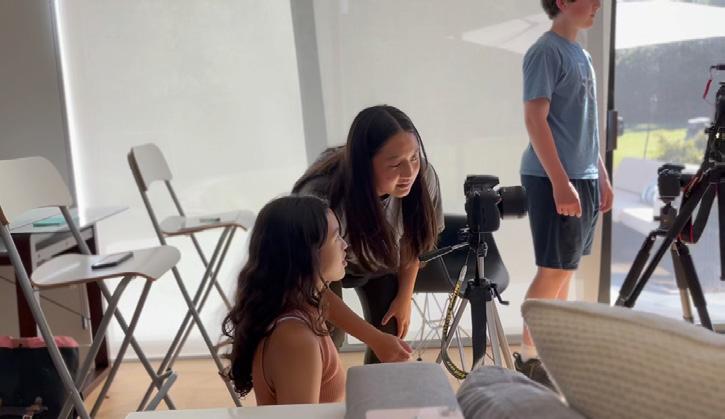
realized she could combine her love for photography with philanthropy.
When the pandemic hit, Charlotte R. ’25 found solace behind her camera lens. From shooting street photography to friends’ portraits to landscapes, Charlotte documented moments with a click of her Nikon D810. Fifty photoshoots later, Charlotte's love for photography blossomed into establishing The Community Photobooth, a youth nonprofit initiative led by Charlotte to support the Bay Area community through photoshoot fundraisers. With the money earned from photoshoots, Charlotte and her team make donations to local organizations, small businesses, community educational events, and programs.
“As humans, we all have unique stories to share,” Charlotte said. “Photography allows me to share someone’s story through a photo, which is why I started using my camera to focus on important issues, bring awareness, and capture people’s emotions.”
When requests rolled in from her friends’ parents for family photoshoots, Charlotte
“I wanted to find a way to help the first responders who were working super hard during the [COVID-19] surge. I could babysit or mow lawns,” Charlotte said, “but I kept coming back to photography.”
During her first fundraiser for local hospitals in 2020, Charlotte set a goal of raising $300. She ultimately raised $800. The following year, she and a group of Photobooth photographers raised almost $2,000 for the San Mateo County Parks Foundation to alleviate damage from wildfires. Now, their focus is on mental health.

“Youth were going through the worst cases of mental health illnesses during the pandemic,” Charlotte said.
It was a conversation with family and friends about the news of the suicide of Stanford soccer player Katie Meyer, and the Photobooth “decided to focus [their] cameras on the issue.”
This year, the Photobooth’s goal is to raise $10,000 to support Ending The Silence, a mental health program part of the National Alliance for Mental Illness that will bring stigma reduction education to middle and high schools around the Bay Area. They hope to connect youth with trained young adults who will inspire and educate students on being
stigma,” Charlotte said. “That’s how we ensure people get the help they need. It’s also how we ensure youth can properly support their peers.”
On top of fundraising, Charlotte and her team shot a ten-minute documentary discussing youth mental health, “It’s Time We Talk About It.”
“It really began with just an idea, and eventually turned into converting the downstairs of my house into a filming studio,” Charlotte said. “We filmed for two days, but a lot of the time really went into thinking, ‘what questions should we be asking? What should we be talking about?’”
The team interviewed Terry D. ’25, who shared their perspective on mental health as someone who is transgender and queer. Terry
addressed how overlooked mental health issues are pervading the queer community.
“I’ve always been willing to share my story,” Terry said. “This time, it just felt like taking it to another level, in front of a camera. A lot of raising awareness and reducing stigma is just talking about it.”
On Aug. 19, the team and their documentary was featured on CBS News.
“It was crazy,” Charlotte said, describing the experience as a “whirlwind.” “That Friday, [CBS] called us and told us that if we were in school, we had to get out to do an interview… I was speechless and very shocked.”
Over Zoom, the Photobooth team shared their message of uplifting youth voices with CBS News journalist Reed Cowan, who said at the end of the segment, “I feel hope when I meet these kids.”
rapidly decreasing shared experiences, and heightening Gen Z pressure
Theodosopoulos said, modern technology for him is a “tool,” yet for Gen Z is “life itself.”
Boomers and Millennials, Theodosopoulos commented on his generation’s youthful “naivete” and optimism while growing up during a historically “serious” period. “We imagined ourselves like we were going to recreate the 60s,” Theodosopoulos said. “We were not really worried too much about the market or the economy… we really were not that bothered about what careers we were following.”
To Theodosopoulos, Gen Xers enjoyed more independence compared to Gen Zers.
“Maybe it was the naivete, or maybe it was because the world was simpler,” said Theodosopoulos, reflecting on his unsupervised upbringing.
it’s true,” she said, pointing to examples of the positive change Gen Z has initiated in areas surrounding climate change, racial inequality, LGBTQ+ acceptance, gender inequality, and mental health stigma.
However, while having limited political or societal power, “sometimes it also feels like a big onus that’s put on us,” Christine shared.
As someone who also experienced teenage generational pressure, and is now a member of the Boomer generation, Barry Treseler, upper school history teacher, described how generations pass down societal issues regardless of technological intervention.
It was summer in 2021, and Zoe B. ’24 was visiting her grandma, 82, after two years of pandemic-induced isolation. Her grandma had recently bought a new phone, and Zoe recognized her grandma was struggling to understand the technological features that seemed “second nature” to her.

During the following school year, Zoe dedicated her Quest project to designing videos and tutorials for her grandma to comprehend modern technology, connect with friends online, read the news, and—of course—play crossword puzzles.
Zoe's project highlights a contemporary hurdle for the generations: their relationship with technology exacerbating mutual divides and diminishing shared experiences. As upper school math teacher and Gen Xer Ted
Members of Gen Z or those born in late 1990s and early 2000s, grew up alongside technology, practically befriending it in utero. However, technology serves as a double-edged sword for Gen Zers: it provides opportunities and advantages—like how every Nueva student has access to a MacBook for educational purposes—but it eliminates a shared culture among generations, widening the gaps.
Relating the adolescence of Gen Z teenagers to those of preceding generations is getting increasingly difficult as younger generations encounter modern advancements in an increasingly digitized world. Conversations that begin with “back in my day” increase in regularity as the shared experiences dwindle.
As a member of Generation X, a smaller generation “sandwiched” between the
To the older generations, Gen Z’s reality is like a “science fiction universe,” as Theodosopoulos described. The “futuristic aspect” of it keeps the generations at a distance, stretching the gap that would already exist naturally. Unless, as demonstrated by Barton, this gap is actively closed by educating older generations on the benefits of technology.
A more complex element of Gen Z’s teenage years is the influence of technological advancements on their relationships and expectations. With a faster-paced digital world, Gen Zers, or “part-time high schoolers, part-time advocates” as Christine Z. ’24 coined, experience heightened pressure to “fix the world.” She argues that access to technology further augments pressure on youth to use the incessant influx of information for productive and positive societal change.
“On one hand, I’m proud that there is this connotation with Gen Z, and to some degree
“The future generations are going to pay the price for us not addressing and facing some of these social and economic inequalities that are getting worse,” he said, referring to how his generation is reckoning with whether they were “good enough stewards.”
Though unique to the Gen Z pressure is that Gen Zers are expected to partner with technology—with its resources for rapid paced action and opportunities to make more expansive impacts—yet experience harmful social and mental health effects as a consequence.
As a millennial, Aviva Jacobstein, upper school student counselor, worries about Gen Z’s “tech saturation.”
“[Technology] is altering the way people connect, and I’m worried as [Gen Z] ages, [they] won’t have the foundational skills to build in person connections and communities,” Jacobstein said.
Whether the trend of technology and rapid advancements exacerbating the divide between generations continues or not, it is evident that Gen Z’s upbringing serves as a pivotal point in generational history.
DONATE TO GET A FREE PHOTOSHOOT Charlotte (left) shares information about The Community Photobooth at San Mateo Farmer's Market. STORY Isabelle S. PHOTO Charlotte R. STORY Ellie K. PHOTO Audrey Z. SAY "CHEESE!" The Community Photobooth team film their documentary, It's Time to Talk About It.“[Technology] is altering the way people connect, and I’m worried as [Gen Z] ages, [they] won’t have the foundational skills to build in person connections and communities.”
9/30/2022 THE NUEVA CURRENT PAGE 11
I. Nationwide college counseling prepares for potential ramifications
CONTINUED FROM PAGE 1
“Race is just one piece of the bigger picture that college admission boards look at,” said upper school Associate Director of College Counseling Phil Moreno. “But the fear is, if we lose the context that race provides, colleges won’t be able to accurately assess this bigger picture.”
Moreno emphasizes the oppression which Black and brown persons of color have systematically faced within the American legal system.
Part of the systemic imbalance between different races in the United States which Moreno referenced are reflected by the 2018 Census Bureau data and IRS tax returns. This study found that among children raised in the bottom fifth of income distribution, 10.6 percent of white children reach the top fifth of household income, as do 25.5 percent of Asian-American children. In starkly lower numbers, only 7.1 percent of Hispanic children reach the top fifth. The statistic is even lower for Indigenous American and Black children—3.3 percent and 2.5 percent, respectively.
According to Moreno, doubts have been raised amongst administrators for less selective universities without endowments about the process of class endowment without race as a factor.
But the aftermath of the case could affect even the most established institutions. On Sept. 13, Nueva’s college counseling team attended a conference held by Kenyon College, Claremont McKenna College, and six other liberal arts schools.
Moreno cites that the colleges’
Dear student,
The Supreme Court regrets to inform you...
STORY Isabella X. ILLUSTRATION Jodie C.primary concern were possible financial ramifications from the case—they feared that in losing race-based admissions, more money would need to be diverted towards diversity outreach. The UC system has poured more than half a billion dollars into extensive outreach since California outlawed race-based affirmative action 18 years ago. (In 2020, UCLA’s Black student population was 5 percent of the total student body; UC Berkeley’s was just over 2 percent. In 2001, the Black student populations were 4 percent and 6 percent for UCLA and UC Berkeley, respectively.)
The eight colleges in the conference also claimed that in limiting their autonomy to make admissions decisions, the government legislature is limiting their ability to enroll their target student bodies.
“These lawsuits, they fear, are the slippery slope to admission by legislation,” Moreno said. “Instead of each admissions decision being dictated by each institution, it’s going to be dictated by Sacramento or Washington D.C.”
College counselors across the country have also united with admission offices against the SFFA’s mission.
In an email sent to Moreno on Aug. 1, 2022, the CEO of the National Association for College Admission Counseling (NACAC), Angel B. Pérez, wrote, “In filing an amicus brief alongside the College Board, ACT, and the American Association of Collegiate Registrars and Admissions Officers (AACRAO), we present a powerful message of unified concern for the future of holistic admission practices.”
On Sept. 24, Nueva’s college counseling team attended NACAC’s annual conference, which featured sessions such as “The Future of RaceConscious Admission: Update on
the UNC and Harvard Cases” and “Dr. Leonard Moore on Race and Culture in College Admission.”
Despite possible changes on the weight of demographics, the team will work to maintain a smooth application process for future seniors.
“When we meet with Nueva students, we’re still going to meet them in the middle,” said Moreno, emphasizing the college counseling office’s personalized approach to admissions. “Only now there’s going to be a lot more work put in on our side to get there.”
But while college counselors have joined in a unified front against SFFA’s lawsuit, the case has revealed divided opinions amongst the upper school community.
II. Upper school students stand divided on affirmative action
Given the possible ramifications of the Supreme Court decision on high school students applying to college, the majority-Asian and white population of Nueva students has divided in opinion on affirmative action.

In a survey sent to 454 upper school students, 106 anonymous respondents weighed in on the complex issue.
One student who opposed race-based admissions argued that race was only the tip of the iceberg, asserting that socioeconomic status is a more accurate way to view disadvantages.
“I know that it is supposed to break the cycle of systemic racism, but it just seems kind of unfair,” the student wrote. “Why not just give benefits to the entire lower socio-economic class?”
Other students noted that in
Of the respondents who opposed affirmative action, less than half indicated that they felt comfortable publically sharing this opinion—read their reasoning here.

“It's hard to share opinions about this, especially because it's easy to be discredited since we have access to opportunities that others don't.”
“Nueva has a fairly homogenous political atmosphere where any public opinion deviating from what is conventionally accepted here guarantees backlash.”
“It's such a hard topic, and so many people get hurt either way. Do we care more about the people of color that get denied because there are already white people and (East) Asians in school? Why? Who gets to decide how important that is? How do we know we can trust them?”
“You need to be very careful treading on the topic of who has privilege and who does not. I don't want to be coined as someone who invalidates other races' struggles.”
“People often have extreme thoughts on controversial topics such as affirmative action, so I don't want my relatively neutral view to be made more extreme and used to characterize me or show me in a negative light.”
“This is just something that I keep to myself. I feel like there are better ways of helping others.”
“I wouldn't want colleges doing a background check and finding out—I fear there would be repurcussions.”
“I'm neutral about this, but I wouldn't even say anything because it's controversial and I am scared of cancel culture.”
“I don't think I'm well enough informed to form a proper opinion on it, much less share it with the entire school.”
the U.S., race and socioeconomic status are intrinsically tied.
“Yes, in a perfect world, affirmative action shouldn’t exist,” said Tammer M. ’24, a bi-ethnic Middle Eastern and East Asian student. Tammer’s ideal world would be marked by “equitable education” in the 18 years before college, including funding for underserved communities and schools. But finance wouldn’t be the only
“ ”
As someone with privilege, I know I have access to a lot of opportunities that others don't. Though affirmative action may not necessarily support me, I think it's worth taking for those that don't have the same access to application and testing resources.
factor, as Tammer believes “race precedes class.”
“Systematically, Black and brown persons of color are still disportionately discriminated against,” Tammer said. “AsianAmericans aren’t as
As Oct. 31 ushers in a landmark race-based affirmative action hearing, college counselors and upper school students brace
PAGE 12 THE NUEVA CURRENT
you...
action Supreme Court brace for its impact

In a survey sent on Sept. 20 to 454 upper school students, 106 anonymous respondents weighed in on affirmative action. barred.”
Despite his half-Asian heritage, when Tammer is asked to specify his race in educational applications, he checks “mixed-race,” and if not given the option, “Middle Eastern.”
“I believe I deserve the benefits that come from race-based admissions,” Tammer said. “I’m not afraid to say that racist attitudes pervade every step of the system. If I can claim my heritage of being Muslim as well as Middle Eastern, why shouldn’t I?”
However, the conversation around affirmative action has become increasingly centered around Asian-American students due to high percentages of Asian students in highly-selective universities (Harvard University’s class of 2024 was 25 percent Asian, while Asian-Americans barely make up 7 percent of the total U.S. population). Multiple students anonymously attributed this focus on Asian-Americans to the model minority stereotype, a controversial term coined in 1966 by sociologist William Petersen. In his essay, Petersen described Asian Americans as ethnic minorities who, despite their marginalization,
achieved success in the U.S. over “problem minorities.”
“[The model minority stereotype] only furthers the idea that Asians are the enemy to white success and should be categorized by white people,” a student noted.
Yet, affirmative action is not universally burdensome for Asian Americans.
Mei Mei L. ’24, a bi-ethnic ChineseIndian student joked that while her academic profile as a “math-loving Asian student in the Bay Area” is “very common,” she doesn’t think it “holds much weight.”
“My experiences are independent of my race,” Mei Mei said. “My college essays probably aren’t going to be written about my cultural identity. I’m still going to do the things I love, regardless of stereotypes, because I just love it with all my heart.”
She added that while it’s “easy to be salty” about affirmative action, she ultimately supports it, believing that any personal detriment can be justified if it’s for “the greater good.”
Of the respondents who support
necessity of considering race in college admissions due to its lingering role in American societal and academic structures.

“As someone with privilege, I know I have access to a lot of opportunities that others don't,” one respondent acknowledged. “Because of that, though affirmative action may not necessarily support me, I think it's a really important step worth taking for those that don't have the same access to application and testing resources, are marginalized or have challenging circumstances.”
The students in favor of affirmative action still acknowledge its limitations— with one survey respondent calling it a “sugar packet solution”—but in the current society, they maintain, it’s still “absolutely necessary.”

9/30/2022 PAGE 13 As SFFA’s lawyers prepare to stand before the Supreme Court, students in favor of affirmative action grow increasingly anxious; those who deem it an unnecessary or unjust policy can only wait and see whether the United States can truly herald equality without factoring in race.
12.3% 19.8% 20.8% 34.8%
of respondents indicated that they "strongly oppose" racebased affirmative action. of respondents indicated that they "moderately oppose" racebased affirmative action. of respondents indicated that they were not well-enough informed to provide an opinion on affirmative action.
Affinity, redefined
Affinity program rebuilt for transparency and accessibility
STORY Serena S. ILLUSTRATION Anwen C.
When Tammer M. ’24 recalled his experience as a new member of Nueva’s Muslim Student Association during his sophomore year, he shared the near impossible quest to find a willing advisor and the lack of resources from the school. At the club’s fair, he and the group’s three other members—alumni Aayan Banerjee ’22, Humza Rabbani ’22, and Raza Rabbani ’22—stood amidst over 80 clubs on the Rosenberg lawn, encouraging Muslim students to join their affinity group.
In fact, Tammer would not have even known about the group if he had not been cold emailed by the other members during his first weeks of school.
Likewise, Meher B. ’24, co-lead of the South Asian Affinity Group (SAAG) with Anoushka K. ’23, found it difficult to get involved with any pre-existing affinity groups during her freshman year.
“Many affinity groups, including SAAG, had not been started at the time,” Meher said. “I’m so grateful to [Anoushka] for beginning this space, and I would’ve loved to have seen previous students establish it, as it would’ve been just as important to me then as it is now.”
Tammer's and Meher’s underclassman years were spent founding or restoring affinity groups, searching for support and promoting their spaces.
This school year, however, the conversation around affinity takes a different direction—emphasizing affinity as an integral aspect of the beloved community, differentiating affinity spaces from standard clubs, and
FEATURES
yielding transparency.
The community had their first glance of this year’s affinity groups on Sept. 14 as students and faculty gathered in the gym to hear from upper school Coordinator of Social Justice and Equity, Matthew Oakland, who believes affinity groups are “a place where those who often feel marginalized or excluded based on social identities feel safe, connected, and heard.”
In his presentation, Oakland solidified a shared vocabulary for terms regarding identity, debunked misconceptions surrounding exclusivity, and defined these groups as spaces for individuals who “are able to speak from the ‘I’ perspective.”
“People from marginalized groups have historically faced the burden and frustration of having to ‘teach others’ about their experience or being asked to ‘represent’ their group’s perspective,” Oakland wrote in a follow-up email to the upper school. “Affinity groups allow for a space safe from that burden and frustration.”
For Savannah Strong, the new Director of Equity and Social Justice, her work with affinity groups is inspired by allyship and collaboration with the rest of the community.
“Affinity groups should be supported by the institution, and the institution should be responsive to the needs of folks,” Strong said. “I envision a reality in which over the next few years, we build our affinity group program so that folks across a wide range of identifiers have a space and dedicated time carved out to come together and to perform functions of solidarity, celebration, and strategy.”
These three tiers of affinity— solidarity, celebration, and strategy— were echoed by Oakland in his presentation, believing them to be the primary pillars of affinity groups.
“Having a space where you can feel connected with others…where you can speak from experience and help others who can affirm your experience and reflect on similarities or resonances they have with you is a really powerful moment,” Oakland said. “That’s such an important part of building the fabric of our beloved community.”
But garnering support for affinity groups was not an effort constricted to the faculty on the Justice, Equity, Diversity, and Inclusion (JEDI) team. Oakland and Strong both acknowledged that they are not “reinventing the wheel.”
“We have a real opportunity to expand upon the student work that already exists… I’m just excited to build this program across the three divisions,” Strong said.
Mia T. ’23, leader of Black Student Union and student council Diversity, Equity, and Inclusion Representative, is just one of the students who has consistently advocated for stronger affinity programs.
“Nueva is home to many minority voices who are often overlooked because of their small numbers,” Tavares said in her student council campaign speech last spring. “Our voices must be magnified in order to create tangible positive change. It’s
much easier to feel a sense of belonging if you have a strong community, and the goal of these affinity spaces is to create that sense of community.”
Nueva’s first official Affinity Fair on Sept. 14 aimed to increase awareness surrounding affinity groups and allow upper school members to join or start groups. The fair showcased 13 studentled affinity groups including SAAG, Latine Affinity Group, Black Student Union, and Neurodiverse Students Affinity Group. Students and faculty had time to browse each booth, ask questions to group leaders, and enjoy delicious ethnic treats.
Aria G. ’25, leader of the East Asian Affinity Group, felt the fair “validated the idea that this was needed at Nueva.”
“Many people signed up for my affinity group and it made me happy to see a smaller community where many people with diverse personalities can come together,” Aria said. “I want my group to be a safe space.”
And to Aria, a safe space means somewhere people will listen and relate to one another.
“Sympathy is not empathy. Even if someone understands what you feel, they can’t always feel what you feel,” she said.
Similarly, Meher hopes SAAG
growth, alliance, and resonance for the South Asian community.
“I’ve always felt comfortable speaking up, and members are so respectful and supportive,” she said. Meher and Anoushka have already begun discussing celebratory plans for Diwali that all students can participate in.
However, students shared concerns about finding time to attend affinity groups if they had other commitments during clubs block or after school.
“I talked to a lot of students who felt like they were having to make decisions between meeting in affinity spaces and pursuing academic passions, which is problematic because they shouldn’t be mutually exclusive,” Mia said, reflecting on her student council campaign.
To address this, Wednesday lunches will now serve as dedicated time for affinity groups to meet.
The doors of affinity remain open, with the conversation far from over. Strong and Oakland welcome feedback and strongly encourage students to reach out.
“These are spaces we are trying to build for you all, with you all,” Strong said. “We want to be responsive to the needs of the students. Let us know how we can support you and your visions for this program. This is just the start of the work that we do together.”
“People from marginalized groups have historically faced the burden and frustration of having to ‘teach others’ about their experience or being asked to ‘represent’ their group’s perspective. Affinity groups allow for a space safe from that burden and frustration.”
PAGE 14 THE NUEVA CURRENT 9/30/2022
FEATURES
Summer internships provide students, alumni with real world experience
Participation in Nueva’s Internship Program continues to grow
each candidate’s background and political priorities and categorized the candidates based on their profiles.
The Nueva campus was quiet, and summer had begun. Students no longer wandered the halls, occupied the classrooms, or drew upon the whiteboards. Instead, 114 students and alumni spent their summer interning at organizations that are partnered with the Nueva Internship Program. Here are a few of the internships that took place:
For three years, Luca L. '23 has spent his summer working with animals. This year, Luca worked with Conversation Ambassadors to build dens at the zoo in Paso Robles. He described the internship as one that provided opportunities for self-motivation and handson work—and one that provided unique opportunities.
“After a long day of working on a den, we got to swim with the capybaras in their pool,” Lit said.
Olivia C. ’24 interned remotely at Equality Now, an organization combining legal advocacy, regional partnership-building, and community mobilization to “realize our vision of a more just and equal world for women and girls.”
“The idea of empowering women and creating equality for women and girls around the globe through law and policy really fits what I am passionate about,” Olivia said.
Olivia researched political polarization and gender discrimination across political parties, race, and sexual orientation. She crafted a paper titled, “American Politics through the Lens of Democratic Women Politicians,” for which she interviewed politicians and professors from around the world.
“I hope to continue using the information I gained through these three weeks and find more analysis on how women think the political system can reform, what politics looks like to women, and what gender based discrimination women politicians face,” Olivia said.
In Palo Alto, Carina T. ’24 and Riyana S. ’23 also interned at a civic engagement organization. Working at Women Count, an organization aiming to elect more women into office, they created slates compiling

For Carina, this internship where political discussion was “lively” and women’s rights were “at the forefront” fit her well.
“It’s taught me a lot about how women are viewed in politics and all the difficulties and backlash Women Count has to deal with by only supporting women,” Carina said. “I don’t know if I want to pursue politics in the future, but I do know that the work I did was important, and it made me feel good. And I like doing work that makes you feel good.”
Carina's slate of politicians protecting abortion and Srihari’s slate about childcare are both featured on the Women Count website.
Throughout her life, Riyana had answered the age-old question, “what do you want to do when you grow up?” with “maybe something in politics.” While she enjoyed her experience at Women Count, describing it as an “empowering experience,” she realized that going full-time into politics was not actually what she was most interested in pursuing. Instead, her second internship—Superior Court in San Francisco, where she sat in on court cases, explored the legal rights of children, and created briefs for the judge—sparked passion and provided more clarity as to what she might want to delve into later in life.
“I think the thing that’s really cool about Nueva internships is you can do a different one every single semester, and you don’t really feel like you’re forced to pursue whatever it is that you’re doing because you're really just getting a very valuable work experience,” she said.
Later this year, Riyana will participate in the annual Human Trafficking Symposium organized by the San Francisco Coalition Against Human Trafficking, an offshoot of the program she worked at.
Finally, alumnus Tyler Huang ’22 worked as the marketing intern for BeyondTrucks, a trucking software startup. He remotely wrote and published a paper detailing the state of the trucking industry and managed ad campaigns. In late August, he and the rest of the team met up in Santa Cruz.
Describing his team, Huang said, “they were incredibly welcoming, and being new to the trucking industry, they guided me and helped me a lot.” Huang worked directly with the CFO, Kay Makishi.
“Because I knew nothing about the trucking industry, writing the white paper was super difficult at first. I spent a lot of time researching and meeting with them to understand the industry better before even beginning the paper,” he said. “Their support made the process much easier.”
The entire internship program ensures students have the guidance and clarity necessary to make the most of their summer work opportunities.
“I’d never written a cover letter before, and I learned so much about that process,” Olivia said. “It was a great way to get exposed while having the support that I needed with peer tutors and teachers.”
Huang and Riyana mentioned Director of Internships, Intersession, and Community Service Learning Katie Saylor’s invaluable position in setting them up for success, sharing advice, and making the application
A different approach to drug education and support
STORY Natalie L. PHOTOS Fireside ProjectDriven by a “love for health-hotlines”, the first psychedelic health hotline in the world was created by Joshua White in April 2021 in the kitchen of his San Francisco home.
Since then, White and co-founder Hanifa Nayo Washington’s hotline has received over 5,000 calls by people during or after they had ingested psychedelics, with trained-volunteers from all communities on the other side of the line.
“We like to say that we’re a harm reduction organization,” White said in a Zoom interview. “We’re not advocating that people take psychedelics, but rather we’re advocating that people do their research and make a well informed decision about whether to take psychedelics while knowing the safety principles we share.”
The creation of the hotline as a part of Fireside Project serves as a psychedelic help-center and education hub across the nation amidst ongoing legislation shifts of psychedelic decriminalization and legality.
In 2019, Denver became the first ever city to decriminalize the use of psilocybin compounds. In 2020, Oregon became the first-and-only state to allow statewidelegalization of psychedelic mushrooms for adults. Over the past several years and during the emergence of Fireside, a range of laws decriminalizing the use of psychedelic substances have been passed in cities across the country.
On Sept. 6 this year, San Francisco’s Board of Supervisors unanimously voted to decriminalize the substance as well.
While White views the psychedelic decriminalization as a positive change, he emphasizes the importance of increased education on psychedelic substance use for all people in a judgment-free, accessible space—which is what his organization hopes to offer.

“Psychedelics are incredibly powerful tools which can be used for great healing, but can also carry risks.” White said.
“As more jurisdictions prioritize or decriminalize access to psychedelics and we are finally moving in the direction of ending the drug war, it is important that we have robust, harm reduction services that are in place like Fireside Project.”
“By talking to people over the phone, we've on estimate averted about 1000 Emergency Room interactions,” White continues.
With conversation around psychedelics gaining traction nationally, the organization has taken efforts to expand their resources to the community while prioritizing including marginalized
groups to work in the psychedelic field.
This year, the organization began training 200 more volunteers, in addition to the 101 existing volunteers, 31 of them being people of color.
“By making really deliberate choices to hire people from all parts of the community, [Fireside Project] could create a springboard into the psychedelic field for communities that have been excluded from it,” said White, referring to marginalized groups.“I think Fireside will really be a tool to fundamentally reshape the psychedelic fields, so that everyone has access to support, especially from someone like them if they so choose.”
Additionally, to increase awareness of their public resources, the organization is present at in-person booths and events.
In August, Fireside Project had a booth at Outside Lands, an annual, uber-popular, summer music and arts festival in San Francisco.

The idea and approval of a harm reduction booth at Outside Lands was by Rhana Hashemi, Nueva upper and lower school Drug Educator, who eventually decided to pass the project unto the organization through a friend who works at Fireside.
“When Outside Lands agreed to have their first harm-reduction booth, it was exciting because my childhood error with substanceuse began at festivals. At 15, Outside Lands was one of the first festivals I went to,” said Rhana, “it was a full circle moment to now share Drug education and harm reduction at a festival, but I wanted the San Francisco festival scene to have the psychedelic crisis support that I just wasn’t familiar with doing."
Wendy Taylor, a psychedelic assistant therapist and long-term volunteer for Fireside, was one of eight volunteers who helped manage the booth.
“We were giving out stickers and spreading the word for people to know that we exist. People could call right then and
experience smooth and comfortable.
“Anytime I can get students out of the classroom outside the four walls of Nueva feels so meaningful because it allows them to apply all of their learning in the classroom to the real world,” Saylor said. “There’s so much learning that takes place in that transfer of knowledge from theoretical to practicality.”
In a slideshow presentation presented to sophomores, juniors, and seniors—or potential interns—Saylor emphasizes the benefits of internships as learning a new skill, discovering real world applications and deepening understanding, getting outside of the Nueva bubble, and running an experiment.
Internships taught Riyana the importance of “connection” and Huang valued the opportunity to learn to step out of one’s comfort zone.
“The research skills, as well as work environment experience, are both things that will help me in whatever future internships, jobs, and careers I hope to pursue,” Huang said.
there if someone was having a hard time at Outside Lands,” said Taylor. “For the most part, I would say that about 98 percent of the interactions I had with people were overwhelmingly positive. It was so much fun.”
With more people learning about the organization, White is enthusiastic for the future and expansion of Fireside Project. He hopes to soon implement an online and eventually in-person group discussion settings, or “integration circles,” revolving around psychedelic conversation. Additionally, they have taught a public education course at Naropa University in Colorado that will be shared with other universities and the general public.
“The ultimate goal is for every single person in the world to have access to free and confidential support during and after their psychedelic experiences,” White said.
“To provide non-judgmental, compassionate support and information is really a very positive thing,” Taylor added.
Fireside Project serves to provide accessible education and resources for harm-reductionSAFE-USE ADVOCATE Joshua White founded Fireside Project to help all people navigate safe psychadelic usage. STORY Isabelle S. & Ellie K. PHOTO Women Count CALLING ALL WOMEN Alumna Sarah Willrich ’22, Riyana S. ’23, and Carina T. ’24 (not pictured) interned at Women Count, a non-profit that seeks to increase women’s political participation. They researched upcoming elections, came up with issue slates that they are passionate about, and attended donor events, including an event with Vice President Kamala Harris and Stacey Abrams.
9/30/2022 THE NUEVA CURRENT PAGE 15
STUDENT STANDOFF
Two students reflect on the question of whether pre-college summer programs are worthwhile.
EDITORIAL TEAM
Serena S. ’23, Emma Z. ’23
Editor-in-Chief
Grace F. ’23
Managing Editor
Isabelle S. ’23
News Editor
Aaron H. ’24
Opinion Editor
Ellie K. ’24
Features Editor
Isabella X. ’24
Culture Editor
LiAnn Yim
Faculty Advisor
STAFF
Gabe A. ’24

Samara B. ’24
Josie B. ’25
Gabriel H. ’24
Sami K. ’23
Natalie L. ’25 Zara M. ’25
Char P. ’23
Anuj T. ’23
Roan W. ’24
Owen Y-L. ’24
THE NUEVA CURRENT strives to provide informative and impactful articles for our community. Our issues cover stories related to our school, the Bay Area, California, and other relevant spheres. We are dedicated to helping readers understand the ways in which we can all make a difference in the world around us.
The opinions expressed in The Nueva Current belong solely to the writers and are not a reflection or representation of the opinions of the school or administrators.
500 print copies are distributed for free to students and faculty members in all three of Nueva’s divisions.
The Nueva Current is a member of the NSPA and CSPA.
QUESTIONS, COMMENTS, OR SUBMISSIONS?
We welcome your voices. We accept photographs, letters to the editors, articles, illustrations, and other pieces of work. Please email us at thenuevacurrent@ nuevaschool.org.
STAY CONNECTED
www.thenuevacurrent.com
Instagram: @thenuevacurrent
Twitter: @thenuevacurrent
131 E. 28th Ave. San Mateo, CA 94403
PATAGONIA LEADS THE WAY
Guest writer Alex W. ’24 reflects on Patagonia founder’s unprecedented donation of his multibillion-dollar company.
OPINION
ANDREW TATE
What can we learn from this polarizing figure’s rise and fall?
GREEN COMMERCE
Email culture is dangerous… this is how we fix it
The overuse and saturation of email is inefficient and it’s time we address it

Take the number 4743. That’s how many non-spam emails I received last school year. That’s around 26 emails for every day of school—reading them was practically another daily homework assignment for me. The overwhelming, detached nature of email is daunting, and with my dependence on it for all assignments, community updates, and other necessary information, there’s no way to avoid it.
And I’m not the only who feels this way.
There’s no shortage of studies proving that email culture is bad for peoples’ mental health—take a 2018 study by Academy of Management that found people who respond to emails from home have higher levels of anxiety for example—and yet the dependence grows.
A study by Adobe in 2018 found that 85 percent of respondents in a 1000 person survey spend 3.1 hours a weekday on work email and 2.5 on personal. And this was before everything went digital in 2021.
In 2021, a year of COVID-19 and
remote work, Forbes published a survey that had found 38 percent of workers reported email fatigue had made them consider quitting their job. In the same year, Statista reported that office workers receive 120 emails a day and send at least 40.
Emails also blur the line between work and home. Another study published in Forbes prior to the pandemic found that 51.1 percent of U.S. employees respond to emails outside of work hours.
Work has led to an oversaturation of emails, setting a dangerous precedent that needs to be fixed. Although the U.S. has been reluctant to create labor laws about emails, many European countries have.
Take France’s 2016 law that provides workers the “right to disconnect” for example. The mandate requires that companies with 50 employees or over are prohibited from sending emails after working hours. Countries like Italy, Spain, and Ireland adopted similar laws soon thereafter.
While this mandate may not be suitable for schools, Nueva should implement realistic email guidelines. The separation between school and home is necessary for students and especially for teachers. Creating guidelines for times when teachers and students can reasonably be expected to respond should be mandated.
Additionally, nearly all informational emails I receive could, and should, be consolidated into singular emails. The dean’s weekly emails and Nueva Notes, both of which provide one central location for necessary and timely information, are two great examples of this.
But most importantly, we need to stop using email for everything. Please utilize the assemblies we have all Wednesdays instead of flooding all of our inboxes. And try to track me down in person or at lunch (you’ll find me at the indoor cafe tables or in the communications office if there’s a journalism deadline) because unlike email, I can’t pretend I didn’t see you or hear you, even if I’m busy.
To better represent the community, The Nueva Current is seeking letters to the editors and guest opinion essays from all readers. Letters to the editors are for readers who would like to respond to a recently published editorial or Op-Ed. Please keep them between 150–175 words in length. Guest opinion pieces, or guest Op-Eds, are newsworthy or timely opinions in response to or provide commentary on current community or worldwide events.
Please email all letters and guest Op-Eds to thenuevacurrent@ nuevaschool.org.
Do using paper straws really impact the environment as much as we believe?
Call
submissions. Your voice matters. Write for The Nueva Current.STORY Aaron H. PHOTO Brett Jordan / Unsplash
PAGE 16 THE NUEVA CURRENT 9/30/2022
READ MORE ON PAGE 17 READ MORE ON PAGE 18 READ MORE ON PAGE 18 READ MORE ON PAGE 19
for
OPINION
Pre-collegiate programs are worthwhile formative social and academic experiences
STORY Ellie K. PHOTO Rachel Y.The morning Roe v. Wade was overturned, I hung up the call with my mom who had somberly shared the news with me as I wiped my eyes. My damp fingertips clutched my phone as if the tighter I gripped the device, the tighter I held on to a United States that respected women’s bodily autonomy.
I sat alone in the kitchen on that uncomfortably sunny morning. It was summer, and although I was no longer dedicating my weeks to all-things educational, I had been studying the ethics of abortions for the past few days through an online Brown Pre-College summer program. That weekend, I would go on to spend hours in front of a Zoom screen talking with students I had just met about our fears and frustrations regarding the Supreme Court decision.
My asynchronous summer program primarily focused on feminist philosophy, yet included readings and class discussions on various social movements in the US.
Every day, I annotated multiple articles, book chapters, and essays, sharing thoughts and ideas with students from across the world. Not only was this experience thoughtprovoking and eye-opening to previously unconsidered arguments and social concepts, but I was given a community on a day I will never forget.
Of course, one positive experience in a summer college course is not indicative of all programs being a productive use of time. However, I do believe that college programs offer significant benefits for students to supplement their high school experience.
Even months prior to participating in the course, I had spent weeks perfecting


Within the Brown PreCollege class discussion posts were paragraphs and paragraphs of highly detailed explanation and argumentation building off of ideas from enthusiastic peers, acclaimed authors, and the course’s instructors. After the program, I felt academically invigorated, which helped mitigate the impacts of summer brain fog.
However, most meaningful for me was the community I had during that difficult week when a woman’s fundamental right to choose was stripped away. On the day of the ruling, the course’s instructors sent multiple announcements checking in on me and my peers and providing extra resources—including a video of individuals protesting in Washington, D.C.
In addition to the supplemental content and comforting words, the instructors hosted a Zoom meeting to foster a reflective and supportive environment.

Without that formative program and outlet to share fears and frustrations, I would not have educated myself to such great lengths in order to understand this historic and life-altering event or gotten through that day with sustained hope.
I was fortunate enough to be economically and academically capable—thanks, Nueva—of participating in a rigorous and prestigious course, and I encourage everyone with that opportunity to take advantage of it, and—most importantly—to use their subsequent gain in knowledge to positively impact their classrooms and peers back at school.
Hefty expenses and lack of admissions make precollege experiences something you should avoid.

As my plane took off from the state of Massachusetts, I watched Boston’s concrete fingers wave farewell before slipping between the shrinking veils of clouds. I reflected on my time on the East Coast. My dad and I had collectively funded my two week precollege creative writing program at Boston College with his hard earned income and my paid internship. Yet as the city continued to fade, I wondered if the many coins we had sunk into that concrete well truly granted our wishes.
This disparity is not unique to UPenn. On average, summer programs from Harvard University, Brown University, Columbia University, Northwestern University, and University of Southern California cost $1,604 more per week than the undergraduate tuition. If these summer programs provide experiences similar to those of undergraduate students, what is the purpose of this stark discrepancy in expense?
According to Paul Gallagher, Associate Dean of College Counseling, these programs are “money makers for colleges.”
Take the University of Pennsylvania,
College Counselor Phil Moreno spoke on the effectiveness of these programs in admissions: “My experience has been that often the perception is that these programs do give students a leg up in the admissions process and I have not found that to be the case.” In fact, these programs are often run by a completely separate office on the campus, disconnected from the admissions office.”
and board for approximately 37 weeks of education. In other words, UPenn’s
The tuition and lack of admissions aid in summer pre-college programs should prompt hesitance among interested students and parents, before being coaxed into these college money grabs. Rather, it is more effective to spend summer engaging in internships or exploring personal passions as both are free experiences, build your resume, and offer substantial enrichment and rigor.
Pre-collegiate programs are not worth their hefty and exclusive prices.STORY Gabriel A. PHOTO Rachel Y.
How my summer program offered me encouragement and a community
9/30/2022 THE NUEVA CURRENT PAGE 17
Kids are impressionable, there’s no getting around it.
In the summer of sixth grade I watched a speech by The Daily Wire founder Ben Shapiro. He argued that abortion was murder, a topic that I had no understanding of, yet, in 15 minutes he had me convinced that abortion was a crime. I had to spend the next two years unlearning this.
So, you can imagine my fear this summer when 35-year-old Emory Andrew Tate III—known across most platforms simply as “Andrew Tate”—started to dominate social media. Tate spread his misogynistic rhetoric to young men across the globe, garnering
OPINION
786,000 YouTube subscribers and 16.3 billion views on TikTok.
To say Tate is a misogynist who somehow took the world by storm is an understatement—a dangerously ignorant understatement. Tate is much worse than a misogynist, he’s an alleged rapist; and he did a lot more than just taking the world by storm, he indoctrinated young men.
Even before his fame, Tate was an awful person with a history of abusing women. An employee accused him of hitting her, resulting in a house raid by the UK authorities.
In 2016, Tate was kicked off the Columbia Broadcasting System’s television show “Big Brother” after a video surfaced of him
beating a woman with a belt. He claims it was consensual.
On April 11, his house in Romania was also raided due to reports of human trafficking and rape, in which police found two women being held captive. Tate has said that 40 percent of the reason he even moved to Romania was because they are less likely to pursue sexual assault allegations.
And somehow, through all of this, Tate still gained a platform with hundreds of thousands of followers. It took months for Tate to be banned across the major social media outlets, despite his numerous counts of hate speech and sexism. There must be stricter, and quicker, reactions against people like Andrew Tate.
In a perfect world, social media companies would take quick and divisive action against so-called influencers when they so obviously breach platform guidelines, but since they do so rarely and slowly, the U.S. government needs to take action.
For example, take Germany’s Network Enforcement Act, a law that requires social media companies with over 2 million users to remove any clearly illegal content within one day of it being reported, and any illegal content within seven. YouTube, Twitter, Instagram, and other major platforms operating in the U.S. should be held to this standard, too.
And companies are capable of doing so. YouTube’s response to copyright claims is instantaneous in comparison to their response to reports of hate speech.
Unfortunately, Tate is not the last of his kind. There are many more like him, growing more radical by the day. In an era of sensationalism, social media must stay wary. Companies need to take preventative measures to ensure men like Andrew Tate are not given a platform.
“Earth is now our only shareholder”
Patagonia: an outlier, example, and role model
clothing impacts the environment, something most companies do not do.
Alex W. ’24 is the co-leader of Environmental Club and created the website www. hsclimateaction.com to provide “high school climate enthusiasts an easy on-ramp to engage in the fight against climate change.”
The news about the clothing company Patagonia grabbed headlines the week of September 11. Yvon Chouinard, the company’s founder, made the unprecedented move of giving it all away. He donated his $3 billion company and all its future profits to “fighting the environmental crisis and defending nature,” Chouinard said in an interview.

While billionaires donating money is surely not unprecedented—Bill Gates has given $50 billion to charity—donating an entire company has never been seen before. One of Patagonia’s core values is to “use business to protect nature” and Chouinard stands behind these words as seen with this donation.
I’ve been thinking about Choinard’s mantra—“own fewer things, but really good things”—and it’s opened my eyes to the consumerist culture we live in. Additionally, I've realized the cultural shift we will have to undergo on a global scale before 2050 if we want to live sustainability. Before I started to explore Patagonia’s core values and ethos, I rarely thought about how the clothing I purchased impacts the planet.
Most clothing is manufactured unsustainably—zippers are irreplaceable, and the fabrics or textiles are rarely reusable or recyclable. But Patagonia, unlike the majority of clothing brands, applies the commonly known waste management strategy of “reduce, reuse, and recycle” to the clothing industry.
Patagonia offers free repairs for any clothing, even if it’s torn, has stains or tears, or if it doesn’t fit anymore. Yes, any clothing, including their competitors. Not only that, but Patagonia is super transparent with their environmental footprint. This makes it easy for the consumer to see how your purchased
Now, more than ever, we need to reconsider and change how we manufacture and dispose of clothing. Eighty-five percent of the world’s clothing ends up in landfills or is incinerated. Many may think this issue lies with the consumers, but the industry is mainly at fault.
According to the Public Interest Research Group, 60 percent of garments are not made to be recyclable in the first place. The current manufacturing process and failure to properly redistribute unwanted clothing pieces is contributing greatly to climate change and causing a lot of environmental harm. The fashion industry is responsible for 10 percent of all of the world’s greenhouse gas emissions. Not only that, the industry contributes greatly to the global water crisis and pollution of rivers and streams, a pair of jeans takes 3,781 liters of water. This needs to change.
Patagonia’s quest for sustainability is the cultural mindset we need for this world— reduce the purchasing of clothing, reuse and repair old garments, and at the end of their life cycle, make sure to recycle them. Through various marketing campaigns, we’ve been trained to continuously buy new clothes. I’m guilty of playing into this system. But I'm now realizing it’s time to shift away from this mass-consumerist culture and I hope others will follow.
As a consumer we do try to make a difference, sometimes going for clothing labeled as “eco-friendly, sustainable, or green.” But these buzzwords don’t really mean much, because there is no government agency to enforce companies’ sustainability claims. Instead, to maximize profit, companies cut corners with their sustainability practices and leave our planet to suffer the consequences. Sixty percent of sustainability claims by fashion giants—such as H&M, Zara, and Uniqlo—are meaningless, but attract customers nonetheless. This is otherwise known as greenwashing.
As society pressures companies to be more
environmentally conscious, companies tend to greenwash—advertising sustainable efforts but backing them up with minimal action. As consumers, we have no idea what is truly good for the environment or not and that is why it’s so troubling. One way to solve this issue is to have an anti-greenwashing agency under the federal government agency, the Environmental Protection Agency (EPA). But we also can
A note from the editors
Dear readers,
As we welcome a new school year, The Nueva Current welcomes a new editorial team. While our bylines and leadership may change, our dedication to providing a nuanced outlet for the diverse opinions and ideas of our community does not. Our mission remains to “help readers understand the ways in which we can all make a difference in the world around us.”
For this issue’s centerfold, we chose to dissect race-based college admissions, controversial yet crucial and timely. We strove to represent voices of the student body and faculty in an accurate, unbiased manner. With articles like this, we hope to prompt readers to cultivate their own opinions and engage in productive discourse surrounding these nuanced issues.
We also acknowledge the recent violation of student publications across the country, most notably in Nebraska with The Saga. Student publications are crucial to a school’s community as they inform the student body while also holding leadership accountable. The disbandment of The Saga and unjust suspension of Los Angeles based journalism teacher Adriana Chavira are deplorable, and The Nueva Current stands against these attacks on student publication.
Lastly, we welcome contributions and feedback from the community. We implore anyone interested in illustrating or creating artwork for our publication to contact Isabella X., Culture Editor. To guest write OpEd articles or a letter to the editors, please contact Aaron H., Opinion Editor. And as always, please reach out to any of the editors if other remarks, questions, or concerns arise.
As we aim to provide Nueva with more opportunities for constructive discourse, we hope the community
STORY The Editorial Board STORY Aaron H. PHOTO VoxThe lessons we learn from Andrew Tate’s rise and fall Social media needs to take quicker action against mysoginists like TateBILLION DOLLAR CAUSE All funds from clothing company Patagonia will now be designated to “fighting the environmental crisis and defending nature.” A DANGEROUS IMPRESSION Andrew Tate's misogynistic messaging has harmed youth and silenced his victims. STORY Alex W., Guest PHOTO Forbes
PAGE 18 THE NUEVA CURRENT 9/30/2022
OPINION
Your paper straws aren't cutting it The lies of green commerce

Recently, the market for disposable, non-plastic products has been on the rise, with paper straws being seen in nearly every environmentally aware restaurant, cafe, or coffee shop. Be Straw Free’s estimate that Americans use 500 million plastic straws every day shocked the world in 2011, which prompted legislation and shocked news outlets across the country.
But what if I told you that this estimate was false, that the estimate provided was drastically over exaggerated, and that your paper straws aren’t making nearly the impact their producers claim.
According to The New York Times article “How a 9-Year-Old Boy’s Statistic Shaped a Debate on Straws,” the figure was first reported by a 9-year-old boy who started the “Be Straw Free” campaign to persuade restaurants to offer straws only upon request. That alone should strike you as a little off, but the same article tells us that the boy came up with the statistic based on his own research, and the actual statistic is between 390 million and 170 million. At most, the estimate initially used to shape legislature and corporate policy is off by more than 300 million straws.
Now this may still seem like a lot, but according to Time magazine, only three percent of plastic waste actually ends up in the ocean due to a large portion of the population not living near the coast. So, only 5.1 million of those straws will make it into the sea. Now, don’t get me wrong, that’s still a lot, but there are certainly larger polluters in the ocean. National Geographic estimates that 46 percent of plastic waste in the ocean is fishing
equipment dumped by commercial fisheries. That’s a lot compared to the measly one percent that plastic straws make up, Stanford University suggests.
Mesoplastics, a category of plastic that’s small in size, which plastic straws constitute, make up 12 percent of the plastic. Now consider how many other plastics are discarded and end up in the ocean. That can be anything from bottle caps to little shreds of plastic wrapping. Straws surely have to be a fraction of this fraction. And even then, these plastic straws are more recyclable than the paper alternative.
Paper straws are often not recyclable. Paper straws being, well, straws, often come into contact with food and nonwater substances, and items that are contaminated with food are often not recycled, rendering the recycling of paper straws nearly impossible. And even if the plant can process contaminated waste, paper straws are paper, they disintegrate into the mush we all hate if you try to wash them.
The miniscule impact that your plastic straws have on the environment has been drastically exaggerated, and corporations haven’t waited to jump on the fact that people are willing to pay more for something they think is going to save the world. It’s time to face the facts: your paper straws aren’t saving the environment, they’re just slowing the inevitable progression of plastics to the sea. We instead need to focus on things that can actually save the environment; such as activism for better climate legislation, implementing more efficient, less polluting landfill and recycling systems, and reducing your carbon footprint by composting, recycling, and overall wasting less.
Nueva needs more gender-neutral bathrooms
girl, which I'm not, and misgender me when they interact with me later on. Additionally, gender dysphoria (distress due to a difference between biological sex and gender identity) when using the bathroom associated with birth-assigned gender is common among transgender individuals; I've felt dysphoric when using the women's bathroom before.
While using the men's bathroom wouldn't exactly make me dysphoric, it still would feel strange—I'm not a boy. Not to mention that there's a history in the U.S. of transgender and genderqueer individuals being harassed, even assaulted, when they try to use the bathroom that best fits their gender identity. A transgender individual who would prefer to use the gendered bathroom not associated with their birth-assigned gender might not feel comfortable doing so.
come out to look at upgrades to the building.
"We put this need on the list and there’s planning to make upgrades and add additional gender neutral bathrooms," Raynal wrote to The Current staff. "Renovation like that is of course a slower process than we’d like, but it is important so our non-binary and trans students feel a sense of belonging."
Not only is this an important next step, these bathrooms should ideally be multi-stall. People cycle through multistall bathrooms faster than they cycle through single-stall ones, so this would help cut down the current wait times for gender-neutral bathrooms.
Take a second and think: how many gender-neutral bathrooms does Nueva have?

The answer is five—two on the first floor, three on the second—but if you thought the number was lower, it's no surprise.
Nueva's gender-neutral bathrooms are relegated to awkward corners of the school, such as the rarely-used hallway by the art rooms and the back of the second floor, and each of them can only be used by one person at a time. This design makes the bathrooms feel like an afterthought, or like they're supposed to be hidden.
Using one during a five-minute passing period is difficult; there are none
on the third floor, and the ones on the other floors are hard to get to. Even if a gender-neutral bathroom is nearby, they're often occupied, and waiting for one to open up will likely result in being late to class. This creates a problem for Nueva's 30-plus transgender students, many of whom don't feel comfortable using gendered bathrooms.
I'm nonbinary and graygender (someone who has a weak or loose connection to gender), and I was assigned female at birth. When people see me using the women's bathroom— which I sometimes do, because it's much faster than using a gender-neutral one and I don't want to be late to class— they're likely to assume that I'm a
To make it easier for transgender people to use a bathroom without feeling uncomfortable or dealing with long wait times, more gender-neutral restrooms at Nueva are a necessity. The existing gendered bathrooms could be re-labeled "public urinals and private stalls" and "private stalls" instead of “men” and “women.” Though this wouldn't completely solve the issue, it would more accurately reflect the bathrooms and who uses them.
According to Head of School Liza Raynal, adding more gender-neutral bathrooms when the campus next expands is on the administration's radar. Recently, the school had an architect
The current struggle to find an open gender-neutral bathroom might seem minor, but it's exhausting to experience this day after day. Let's increase genderneutral bathroom availability to help transgender students feel welcomed.
“Even if a gender-neutral bathroom is nearby, they're often occupied, and waiting for one to open up will likely result in being late to class. This creates a problem for Nueva's 30-plus transgender students, many of whom don't feel comfortable using gendered bathrooms.”
STORY Roan W. PHOTO AI Club via Stable Diffusion HIDDEN STORYIncreasing the number of gender-neutral bathrooms is one way Nueva can help transgender students feel welcomed
9/30/2022 THE NUEVA CURRENT PAGE 19
IDENTITY Gender-neutral bathrooms on campus still remain hidden in strange corners of campus.
Char P. PHOTO The Nueva Current Staff
STORY Josie B. PHOTOS Nueva Students
Bzzt! Throughout the hallways of the upper school, students look up from their lunchtime discussions, rummage through backpacks, and turn to friends to discuss the highly anticipated alert: Time to BeReal!
Amid her friends’ excitement in the Rosenberg Courtyard, Vivi L. ’25 grabbed her phone and rushed to tap on the new notification. She quickly snapped a selfie, set on beating the built-in twominute timer, with her friends on one side of the photo and their plates of penne pasta on the other.

Vivi downloaded the app back in March 2022 after her curiosity was set off by a social media promotion.
“My favorite thing about BeReal is that it shows you little moments you wouldn’t normally get to see in real life,” Vivi said. “It's refreshing to see the times when people aren’t just living the highlight reel.”
An escape from highlight reels and unrealistic standards online is exactly what founder Alexis Barreyat, a French entrepreneur who formerly worked for GoPro, had in mind when BeReal was released in 2020.
Barreyat had the idea for the app at a mountain bike event after observing how social media users were more focused on their content than the environment around them, according to
venture capitalist Jean de La Rochebrochard, an investor in the startup.
To shift focus back to the real world, the app simultaneously notifies all users once per day that it is time to "BeReal" and post their daily dual-camera picture. Once the next BeReal arrives, the prior day's posts vanish into users' private memories.

Users may continue to post after the initial two-minute window, but the time and number of retakes will be public so that friends can tell just how “real” a post is. Unlike other social media platforms, where heavily curated feeds can lead users to feelings of isolation and envy, the daily cycle of interaction gives the app an intimate and communal feeling.
Noor Z. ’24, who downloaded the app in March 2022, said that BeReal provided a unique online experience.
“In comparison to other social media apps, BeReal definitely does a better job of showing accurate depictions of people's regular lives,” Noor said.
This uniqueness may have played a role in the app's rapid growth over the past few years. Although the app didn't fully take off until early 2022, by April it had received over 6.8 million downloads. Today, BeReal has over 10 million active users, according to the company's online job board.

The app's sudden rise to stardom has been an important factor in its novelty, especially among users under the age of
18. Christine Z. '24 was the first of her friends to download the app in February 2022.

“I think BeReal came at the perfect time,” Christine said. “People started to post casual dumps on Instagram, but they were still inevitably ‘curated.’ We still needed a way to keep up with our friends' lives, and BeReal is perfect for that.”
Still, some students prefer social media platforms that allow them to connect with users they may not know in real life. Ines P. ’25 chose to stick with these social media platforms like Instagram and Snapchat rather than give in to BeReal's massive popularity.
“On Instagram, I follow a lot of people I don't know. So, while BeReal is great for friends and family, I think Instagram is better for interacting with mutuals, celebrities, and things like that," Ines said.
While other social networking sites remain popular, BeReal attempts to give users on all platforms a chance to look behind the screens and concentrate on making real-life connections.
“Seeing your friends' posts on BeReal is a good reminder that the content shared on their other social media platforms is not an accurate representation of their day-to-day lives,” Noor said.
Outside Lands music festival, live and in person
In matching purple joggers, Kaila E. ’24 and alumna Cate Lee ’22 pose for Instagram pictures before strolling over to Jack Harlow’s performance. Halfway across Golden Gate Park, with a box of fries in hand, Marcus H. ’25 lines up for Kali Uchis’s perfomance and secures a barricade spot.

Inaugurated in 2008 by Allen Scott & Bryan Duquette, Outside Lands is an annual, three-day festival located in San Francisco’s Golden Gate Park with music by artists all over the world.
With 90 performances from Billboard’s top artists to underground-indie musicians, the festival catered to all music-lovers.
This year, several Nueva students and 220,000 people attended the highly sought after Bay Area summer event.
“I went for all three days, and each day
was even more fun than the last. It was definitely one of my favorite weekends of the summer,” Riley S. ’23 said, who attended the festival with Kaila, Lee, and Kayla H. ‘23.

The event had a staggered structure of multiple productions simultaneously occurring around the park. Marcus, who attended the festival for all three days, described being able to faintly hear music from stages “all the way across the park” from where he was.
This layout allowed attendees the autonomy to see the artists they loved without waiting through shows they didn’t care for.
"I like this [structure] a lot more than the other concerts I’ve been to because you have a lot more control over who you want to see," said Marcus, who has also attended concerts by Billie Ellish and Rex Orange County.
Anjuli M. ’25, who joined Marcus at Outside Lands for a day, said that the highenergy crowds and stage sets, specifically at Phoebe Bridgers’ performance, allowed for an enjoyable atmosphere.
“Phoebe’s [performance] was at night time when it was raining a bit, and her set was so beautiful and cute. And, she crowd-surfed!”
Anjuli said. “The vibes were just perfect.”
Kaila attended shows by Sza, Lil Uzi, and Post Malone at the festival.
"Post Malone was so good at interacting with the crowd. At some point, he was like ‘Hey guys, I’m going to slow it down,’ and then sang ‘Stay,’” Kaila said. “I literally started crying because it’s one of my favorite songs by him.”
“I can’t wait to go back next year,” Marcus said.
“Your friends for real”: The latest social media sensation aims to normalize mundanityIn a social media space overrun by influencers, intense editing, and overly curated feeds, BeReal provides a space for the smaller moments in life
Nueva students share their experience at the largest independently owned music festival in the United States
STORY Natalie L. PHOTOS Marcus H. & Kaila E.
PAGE 20 THE NUEVA CURRENT 9/30/2022 ENTERTAINMENT
GET YOUR SUNNIES ON Students pose in front of various attractions of the festival throughout the Golden Gate Park.
Crossword Puzzle
 BY
BY
ACROSS
1 America's Got Talent network
4 a dark reddish brown
8 fine white powder, often sold in bags
10 unattractive
11 like a spear or christmas tree
12 color opposite orange
13 sugarfree gum now in circulation
14 insects that can taste with their feet
15 change heading
16 Kuro ___ (hillsdale mall ramen spot)
17 unbranded cattle
21 like ln or st
22 famous ___ cookies
24 Jane Austen novel, with "Sensibility"
27 gaze fixedly

28 palm tree harvested for its reddish purple berries
29 evening gathering
30 weaponized toothbrush
31 unique feature of LAS airport in Las Vegas
32 aptly named fish bearing resemblance to a sandal
33 didn't lose
Comic
 BY EMMA
DOWN
1 native or indigenous
2 victim of a joke
3 express sadness

4 the current, for example
5 cross between an orange and a grapefruit
6 this
7 visual body parts
8 place to exchange ideas

9 scales of justice (astrological sign)
11 holder of dirt or pasta
14 Gracie Hart's organization in Miss Congeniality
16 may contain coal, iron, or diamonds

18 ate the apple
19 Walmart version of Walmart
20 painful body parts
23 7-down let you do this

24 youthful impudence

25 Alexa
26 thing to avoid hitting with a hammer
27 Star Wars spin-off film featuring Donald Glover
29 opposite of NNE
XANDER Y. 9/30/2022 THE NUEVA CURRENT PAGE 21 ENTERTAINMENT
Z.
SPORTS
THE NFL HAS A MORALITY ISSUE

Varsity girls volleyball team sets off on a dominant season
STORY Zara M PHOTO Isabella YThe girls volleyball team kicked the season off on Aug. 30 with a strong win against Pinewood, wiping the competition within the first three sets (25-9, 25-16, 25-8). Students, faculty, and parents packed the Nueva gym bleachers for the first home game of the season.
“There were a lot of people cheering in the stands; [it] was a lot of fun to play with the support of the entire school…[It] made the game have a lot more energy,” said Emma Z ’25, who played as outside hitter during the match.
The girls volleyball team did not have a coach for the first couple weeks of their season, so upper school chemistry teacher Paul Hicks served as an interim coach.
Isabella Y ’23, who sat out with a leg injury, helped support the practices and made the team line-up for matches.
“It was awesome [working with Isabella]. She has great experience playing…she knows the lingo and what it’s like to play at different levels. She was able to welcome everyone new and returning in a warm, authentic way,” Hicks said.
Isabella was cleared to play on Sept. 6—which was also the same day the team met their official coaches, Leo Pasquali and
Luciana Fernanades Sertic.
The team continued their winning streak, sweeping Woodside Priory (25-12, 25-12, 25-19) and Eastside College (25-11, 25-11, 25-16). Their first defeat came in the next match on Sept. 9, where they lost to Mercy 0-3.

The players put up a fight for this out of league match, almost staging a comeback in the second set. Their set scores were 10-25, 19-25, 11-25. Despite the disappointing loss, the team still had a blast playing against Mercy.
“Even though we lost, the positivity, spirit, and scrappiness that every single player— both on and off of the court—brought created this sense of, ‘Wow. We could take on anything and anyone right now and we would have so much fun,’” said Emma Z ’23, who plays outside hitter for the team. “I wasn’t intitally planning on playing this year but the energy that we build when playing against teams like Mercy drove me back on the court.”
The team came back stronger as ever after playing Mercy, and managed to climb back to the top by winning their next two matches 3-0 against University Preparatory Academy (25-19, 25-17, 26-24) and St. Thomas More (25-24, 25-12, 25-12).
Sakura T ’26 is one of the newest
additions to the 10-player varsity team, along with Elie W ’26. Sakura has played volleyball for two and a half years and is a varsity starter. She plays as libero, subbing in for the team’s middles as a permanent pillar of backrow defense.
Team captain Isabella praised how strong the girl’s volleyball team come into the season, and proudly reported that players are adapting and trying out new positions this season.
“We have so many new people stepping into new roles, and I think it’ll just grow [and] get better exponentially,” Isabella said.
One of these people is Kaila E ’24. Kaila, who played last season as an opposite hitter, is exploring playing setter this year.
“I’ve never played [this] position before but I really enjoy it. I feel like I’m getting better; the coaches are helping me a lot,” Kaila said.
Kaila also encouraged Nueva members to show up and show out at their next spirit game against rival Crystal Springs on Oct. 7: “There's going to be pizza, there’s going to be the mascot. Everyone has to come!”
DRAFT PICKS, STEALS, AND BUSTS
Rise of the ultimate sport
STORY Sami K PHOTO Sami KThe West Lawn turf and Bay Meadows that surround Nueva offer tempting fields for frisbee, and this fall, student interest in the sport has begun to pick up. Scrimmages and mini game are becoming more competitive and sticking closer to official rules.
Ultimate frisbee is now a club with a potential for P.E. credit led by Wes Chao, middle and upper school computer science teacher, who is excited about coaching new and old students.
Practice is open to players of all skill levels with drill practice on Monday and scrimmages on Friday this fall, in the spring there are plans to expand practice to five days a week to prepare for the Spaghetti Western tournament for Bay Area Ultimate youth teams.
Ultimate is typically played seven versus seven players to a score of 13 or 15 or to a time limit. The field is similar to football, the rules themselves are like basketball (no traveling with the disc), and the strategy and collaboration with teammates is similar to soccer.
Chao’s interest in Ultimate began in college when he found out about Fortunat Mueller, one of the best players at the time, who was only 5’9’’ also playing in Boston which was only two inches taller than Chao is.
“He was sort of my hero because as someone who would always watch sports growing up, I never saw myself reflected in professional sports,” Chao said.
Chao never thought of himself as an athletic or coordinated person, but with time and practice he is now very skilled as both a competitor and a coach and understands that coordination wasn’t as important as he originally thought.
“There’s a bigger margin of error, as your hands don’t need to be in the exact right place at the right time,” Chao said.
When a group of seniors including Atharv C, Tyler P, Ben L, Jacob L, and Austin Z came to Chao in early 2020 and said they wanted to start
A full-circle season
STORY Emma Zhao IMAGE Vivi LevenbergSince winning the league championships last year the girls tennis team has been prepping for round two. Now led by new coach David Tyler (who coached the boy’s team last school year) and senior captains Gigi S ’23, Mia G ’23, and Anahita A ’23, the team has played two in-league games and three scrimmages as of the beginning of the season. The girls won both of their games, and while they weren’t able to secure a victory in any of the scrimmages, Lucie L ’23 explains that they’ve still been great experiences.

“Our scrimmages are always out-of-league so they can get pretty tough,” Lucie said. “But it's still great practice.”
Many of the girls have been practicing together for months outside of the regular season, thanks to a newly introduced sixweek co-ed preseason.
“Because so many people have a tennis off-season, [the preseason] was really helpful
Girls tennis ramps up for a year of new beginnings
to just get back into the game,” Gigi said. “We also had a lot of fun team bonding—one practice we had popsicles, and another time we organized a water balloon fight.”
The majority of the 25-member team are underclassmen, and primarily freshmen. Gigi attributes to this composition a dynamic that’s both unique and valuable.
“The 15 minutes before and after practice and the van rides have been really meaningful,” she said. “Those little moments have all created a really great sense of comradery and given us a chance to talk to people outside of our normal ‘group’ at Nueva.”
And for Gigi, Lucie, Mia, and Anahita— four of this year’s tennis seniors—the team has come full-circle. Nueva’s tennis program first began when the girls had just entered the school as freshmen, in 2019.
“It’s been really amazing to watch it grow,” Gigi said. “When we started—when it started—it was very small and we only played scrimmages and we weren’t even in a league. And we have a JV team now and just last year
we won the league championships. It’s like we’ve grown up with this program and the team.”
The team won all seven matches against Woodside Priory on Sept. 27. Their next game is Tuesday, Oct 4, against Mercy High School Burlingame.
a team, Chao was elated. They started playing five days a week for three weeks at the end of February, and then promptly got shut down due to the pandemic.
While the team’s founding members have since graduated, the student body’s interest in frisbee has continued to thrive.

Sam L ’23, one of five leads this year, started playing last year during the off season for soccer. In the first few practices she realized that she loved it and there was copious support for new players like herself.
At Spaghetti Western, Sam began to understand the culture of Ultimate and the importance of simply enjoying the plays.
“There were high fives after every point with whoever you're matched up against,” Sam said. “And after the match, there were spirit circles where you're just complimenting whatever insane thing that other team did.”
Sam hopes that more people will join, even if it’s a casual commitment for them.
“Warning that you might get addicted like me,” said Sam, who originally joined as a fun way to fill time. “Every time you catch a really good throw or you think you're almost not going to get it but you do catch it. There’s that magic feeling to see how you're improving.”
In the coming months, as the team continues to practice for the spring tournaments, there will be a faculty versus student game.
Second year of the PE class and club of Ultimate Frisbee
This fall, the team has fielded both strong veteran players and newcomersMAVS ON THREE The varsity girls volleyball team has seen only four losses this season, two of which were against out-of-division teams. Without Lance, San Francisco 49er's QB Jimmy Garoppolo must step up if the team wants a chance to make playoffs. NFL Commissioner Roger Goodell has continually prioritized money over justice. Everything you need to know about this year's Fantasy Football game to avoid any punishments in store. MORE ON PAGE 24 New Athletics Trainer Keiloni Smith brings wealth of knowledge and understanding.
MEET KEILONI SMITH WHAT DOES TREY LANCE’S INJURY MEAN FOR THE 49ER’S?THE ULTIMATE CATCH Students practice frisbee in Bay Meadows park REAL ONES The girls tennis team snapped a BeReal on the court.
PAGE 22 THE NUEVA CURRENT 9/30/2022
READ MORE ON PAGE 23 READ MORE ON PAGE 23 READ
READ MORE ON PAGE 24
New athletics trainer brings experience and an athlete’s understanding
Bay Area native Keiloni Smith joins Nueva’s athletics team
Sports has always run in Keiloni Smith’s blood—her dad had been an athlete at the College of San Mateo who participated in a myriad of sports from baseball to wrestling. Her mom ran track in high school and set numerous records for her team—later, Smith would follow in her footsteps and do the same.

By the time she started at Ontario High School, Smith’s time was dedicated to yearround athletics, juggling varsity basketball and varsity track when she wasn’t studying for AP classes.
“I’ve always loved sports but especially so in high school. I liked the way that they made me feel,” Smith said. “Physically for sure—I don’t like feeling sluggish—but also mentally. They helped me stay focused on my academics.”
Now, as Nueva’s new athletics trainer, Smith works to help students maintain their physical capabilities so that they can feel the same. Seated in room () at the end of the athletics hallway, Smith has organized an arsenal of novel and effective techniques to assess, treat, and prevent injury.
Supplementing her collection is her bright smile and springy energy—her hope is that she can not only serve as a resource for sportsmed, but also as a system of support for athletes who either want or need it.
Smith draws this crucial connection between maintaining physical and athletic health and mental wellness as one of the driving forces of her career, and a significant impact that she hopes to make upon the upper school. Because not too long ago, Smith was left in a position where she didn’t have such a choice.
In her sophomore year, Smith tore her ACL in a basketball game. Ontario didn’t have an athletics trainer, someone who could properly diagnose and help treat her injury. Her doctor insisted that it would heal with time and some PT. Plus, Smith had been taught to push through hardships.
“I was raised with a very ‘get up, you’re okay’ mentality,” she said. “So sometimes when things would happen—and even still, to this day—I would just get up and power through.” So Smith kept on playing; a knee brace was switched out for ice during halftime, and by the end of the season she had led her team to the playoffs.
And then at the beginning of her junior year she twisted her knee in the exact same way, and this time the doctor didn’t have such positive news.
“I went to the doctor, and he goes, ‘you don't have an ACL. How have you been playing this whole time?’” Smith recalls.
“I had always identified as an athlete, and the surgery also took away the one thing that I identified as.”
“And I say, ‘I don't know. I guess I just toughed through it.’”
The doctor soon discovered that Smith had also torn her LCL and her minsucus— injuries that required surgery that was expected to take her out of sports for nine months. While Smith bounced back in just six months, she struggled with depression through a good portion of it.
“When you need something to get away from all the stressors in life—that was sports for me. Suddenly I didn’t have that,” Smith said. “At the same time, I had always identified as an athlete, and the surgery also took away the one thing that I identified as.”
An athletics trainer, (talk about role of an athletics trainer in working through mental barriers).
“My depression at the time was also so bad, and I just had to go through it by myself—I didn’t have an athletic trainer to help me through that mental pain either.”
Smith’s injury healed fully in just six months, and she recovered mentally in half the time. And while her senior season was the worst of her athletic career, she was now confident that she wanted to study sports medicine in college. Memories of the physical and mental turmoil that she had been left to face without the guidance of a sports professional through her injury ().
“When I was getting my masters, sometimes I would think to myself ‘do I really want to do this?’ Smith said. “And then I would just remember that little girl on the ground, crying, ‘somebody help me. My knee is hurting.’ And I realize that nobody was there to help me.”
In () she graduated high school, and started her undergraduate degree in () at (). Through her undergrad program, Smith worked multiple jobs alongside her studies and sports med internships to prepare her for applications to her master’s program. With a full course load, she graduated early. Smith interned at high schools, colleges, and with professional athletes, specifically runners and football players.
When she graduated a year early,
she applied to her masters program at Azusa Pacific University. She was out of college in 3 years, and looking for new opportunities. Just () months later, she moved down from Azusa and started her first day at Nueva.
In just the first four weeks, Smith has begun to work on physical therapy with injured athletes at the upper school. She has introduced countless new modalities to treat injury, such as cupping and electricity-based techniques. And through the rest of her time at Nueva, Smith hopes to build an injury prevention program within the athletics program, to educate and assist student athletes by bringing them into the weight room during off season. But Smith encourages all students to drop by, athlete or not.
“I'm very determined to educate you guys on sports medicine, so you can know more about your bodies,” Smith said. “Not only because many of you are athletes but also because physical wellness concerns everyday things as well—anyone can use this knowledge that I’m here to share.”
What Trey Lance's ankle injury means for the 49ers

Search for new athletic director underway
Former Athletic Director, Chris Wade, departed Nueva in August
Announced by Associate Head of School Terry Lee in an all school email on Aug. 15, former PE & Athletic Director Chris Wade has departed after five years.
Wade, who started the 2022 school year as the Associate Director of Athletics at Crystal Springs Uplands School, thanked the Nueva community prior to his official departure.
“The accomplishments of [our] stu dents—those who helped pioneer programs and those who earned league, section, and
state recognition—are impressive and wide ranging,” Wade wrote in a message to the community. “I cannot thank you enough for all of the things you have shown and taught me along this journey.”
During this transitory period, the athletics team consisting of Robert Lopez, Director of Track/Cross Country, PE Teacher, and Ath letic Admin Support, Keiloni Smith, Athletic Trainer, and David Burgee, Pre-K-8 Athletic & PE Director have split the responsibilities
of Wade in order ensure the fall sports season flows smoothly.
“It's a lot more work but we're all willing to put the time and effort in to make sure our students have the experience that they hope for and want,” Lopez said. “Everybody's pitching in and for the most part, we've been able to move forward without skipping a beat.”
Already having interviewed two candi dates, Nueva expects to soon implement
Trey Lance’s season-ending ankle injury significantly lowers the San Francisco 49er’s 2022-2023 season potential.
In the 49ers 27-7 week two victory over division rival Seattle Seahawks, Lance suffered a fractured fibula and ligament after being drilled by Seahawks linebacker Cody Barton on a poorly executed read-option play. The injury cuts Lance’s first year as a starter short and makes Jimmy Garoppolo a starter for the fourth consecutive year.
After replacing Lance against the Seahawks, Garoppolo threw for 154 yards and one touchdown against the Seahawks with a passer rating of 100.1—slightly higher than his 2021 season average of 98.7, an impressive outing considering the way he was thrusted into the offense. However, in the 49ers disheartening 11-10 loss to the struggling Denver Broncos, Garoppolo’s passer rating fell to 81.2, a number that doesn’t include the ridiculous safety where Garoppolo stepped out of the endzone on accident.
If Garoppolo is able to perform at the same level as he did against the Seahawks, the 49ers have a chance to sneak into the wildcard slot and make another playoff run. However, the offense as a whole has seemed to trend downwards with George Kittle sidelined to an injury and Deebo Samuel reducing his role in the rushing game. Looking ahead to the rest of the 2022-2023 campaign, the 49ers may struggle to stay above a 50% win rate with one of the toughest schedules in the league.
an “interim solution” and then “conduct a national search later in the year,” Lee shared in a school-wide email.
“Although we are down a person, I'm re ally proud of our athletics team,” Lopez said. “They've really stepped up. We're making sure that things are getting done and we will continue to do so.”
STORY Serena S. STORY Emma Z. PHOTO Rachel Freeman OUR NEWEST MAVERICK Keiloni Smith can be found on the sidelines of the girls volleyball games this fall, cheering on the team, playing DJ, and encouraging the athletes. STORY Anuj T. PHOTO Thearon Henderson ON THE GROUND Medics attend to fallen San Francisco 49er's quarterback Trey Lance, after he breaks his ankle in-game.9/30/2022 THE NUEVA CURRENT PAGE 23 SPORTS
The NFL has a morality issue
The National Football League only cares about money. The number of jerseys ordered by fans means more to them than the morality of the names on those jerseys. Take Deshaun Watson or Matt Araiza—two people whom the NFL tried to let play despite sexual assault accusations. Or maybe Ben Roethlisberger, a future hall-of-famer and sexual assaulter. All these players were allowed to get away with heinous crimes because of one thing: their generational talent.
Since his appointment in 2006, NFL Commissioner Roger Goodell has mishandled player
numerous accusations that lacked enough hard evidence to press criminal charges. In 2020, the NFL agreed with the NFL Players Association to appoint disciplinary officers to decide on punishments to make objective penalties. Despite this attempt to ensure judicially fair punishments by removing bias, Goodell’s ego and sense of image has held these processes back.
One of the biggest headlines this offseason revolved around the expiration of Cleveland Browns quarterback Deshaun Watson’s $28 million contract and the peak of the 24 civil lawsuits and charges he faced.

On Aug. 21, the former Texans quarterback was handed a six-game suspension by Sue L. Robinson, appointed for this case. This suspension came despite Robinson’s confirmation that evidence pointed to Watson’s actions causing evident harm and being
appealed the decision made by Robinson two days later. The appeal comes as no surprise, seeing as the decision of a six-game suspension
contradicted his vow to impose harsher punishments after the Ray Rice case in 2014. The public backlash that faced the Browns organization and the NFL tarnished the image of the league for months—the real reason Goodell appealed. However, these proceedings have shown that the system the NFL has in place continues to favor those with status and wealth.
The league’s appeal resulted in only an 11-game suspension and a marginal five million dollar fine. While it is the largest monetary fine the NFL has levied against a single player, it comes after a five-year guaranteed $230 million contract with the Cleveland Browns, framing the fine as a formality.

Throughout the handling of these proceedings, Goodell continually claimed to be committed to serving unbiased justice yet the result reinforces his history as a hypocritical commissioner who wishes for nothing more than money. While he cites agreements with the NFLPA as reasons for not being able to intervene, he always reserved the power to enact his own discipline and keep Watson off the field. Seeing as Goodell was able to hand Dallas Cowboys running back Ezekiel Elliot a six-game suspension without a present arrest, criminal charge, or even a lawsuit, Goodell easily could have pushed for an indefinite suspension.
On Aug. 25, less than a month after the conclusion of Watson’s disciplinary hearing, rookie punter Matt Araiza was publicly accused of gang-raping a 17-year-old girl when he was 19. Although Araiza’s $3.8 million contract with the Buffalo Bills was soon terminated, Araiza and his attorney claim the NFL was made aware of the
Fantasy Football: this year’s rundown
Draft
The 2022-2023 NFL season is underway but, more importantly, fantasy football is back. To avoid the embarrassment of whatever punishment is in store for whoever finishes last in your league, you need to be ready to trade for the inevitable breakout players and to cut your losses on busts.
A dark horse in this year’s fantasy football drafts, Michael Thomas, the 2019 Offensive Player of the Year was going in the sixth round of 10-man full points per reception leagues. The Saints receiver has totaled 171 yards and three touchdowns in the first three weeks, placing him within the top 10 wide receivers overall. Thomas is dubbed “Can’t Guard Mike” for a reason and is on track to produce a monster

season as he looks to match his impressive 2019 campaign.
In his rookie season, Najee Harris put up an impressive 1,328 on a pass-first offense led by former Steelers quarterback Ben Roethelisberger. Heading into his second year, expectations were high for Harris with a new quarterback in Mitch Trubisky and a unimpressive wide receiver cast headed by Diontae Johnson. However, Najee has only put up 128 yards through his first three games with one total touchdown, placing him significantly low in the rankings for running backs. It seems as though a poor front seven as well as an increasingly comfortable Trubisky is hindering both touches and production from the former first round pick making him a low end secondary running back.
accusations before to the draft in April. In those four months, the NFL did nothing to Araiza.
Goodell has repeatedly reinforced to their players that if you are good enough, the rules do not apply to you. Furthermore, punishments are only doled out if the public is made aware and when the league suffers public backlash.
Though the settlement reached with Deshaun Watson is final, Goodell has the opportunity to change his reputation by not allowing Araiza and other future offenders to touch the field again.
National Football League Commissioner Roger Goodell has continually prioritized the image of the league over justiceSTORY Anuj T. PHOTO NFL STORY MORALITY IN SPORTS Despite Deshaun Watson's sexual assault allegations, the NFL persists to focus on the image of the sport. OF ARRESTS INVOLVE THE ABUSE OF WOMEN IN SOME CAPACITY
“Goodell has repeatedly reinforced to their players that if you are good enough, the rules do not apply to you.”
PAGE 24 THE NUEVA CURRENT 9/30/2022 SPORTS
steals and busts from this season
Anuj T. PHOTO NFL
OFFENSIVE REVAMP Michael Thomas catching a touchdown over Falcons cornerback A.J. Terell 1043 FORMAL ACCUSATIONS 75% OF 1043 ACCUSATIONS RESULT IN NO CONSEQUENCES 855 CONFIRMED ARRESTS 11%