It’s not often that a 300-billiondollar company topples at the hands of a nine-word tweet. On Elon Musk’s Twitter 2.0, that may be just the beginning.
On Nov. 10—15 days after Musk completed his purchase of the social media platform—a Twitter account posing as the pharmaceutical giant Eli Lilly erroneously posted: “We are excited to announce insulin is free now.” The tweet amassed tens of thousands of likes and retweets before the account was eventually suspended, hours later and after Eli Lilly’s stock price plummeted 4.37%.
This was just one example of the volatility and chaos that followed Musk’s takeover. Hateful and misleading speech spiked, half of the platform’s top 100 advertisers steered away, and the hashtag #RIPTwitter went viral as users mourned the downfall of the site.
In the Eli Lilly debacle, the fingers all seemed to point to one glaring issue: the blue checkmark.
Since 2009, Twitter has used the coveted symbol to “verify,” or denote as notable and authentic, accounts such as government agencies, major brands, and celebrities. Accounts of “individuals or groups associated with coordinated harmful activity, or hateful content” or “parody, newsfeed, commentary, and unofficial fan accounts” were ineligible for verification, according to Twitter’s website.


Everything changed when Elon Musk’s bid to purchase Twitter for $44 billion went through in October.
As part of his pledge to expand free speech on the platform, the billionaire tech magnate and self-proclaimed free speech absolutist announced that the checkmark would now be an automatic benefit for subscribers to Twitter Blue, the platform’s paid service, regardless of their identity or intent. “Power to the people!” Musk proclaimed in a Nov. 1
tweet announcing the shift.
The power of the people, however, was a power easily abused.
The floodgates were now open for parody accounts and other digital delinquents seeking a veil of legitimacy for the simple price of $7.99 per month. Countless doppelgängers—Donald Trump, George W. Bush, even faux Jesus Christ—quickly emerged, rendered virtually indistinguishable from legitimate public figures and organizations.
Eli Lilly had unfortunately fallen victim to one of these blue-checked impersonators—an eight-dollar prank turned billion-dollar quagmire.
Yet, it was merely a symptom of a much larger storm brewing beneath the surface, as the world’s wealthiest person solidified his grip on Twitter and began his crusade for freedom of speech.

NEWS CULTURE FEATURE OPINION
The upper school community works to rebuild trust after discovering a homophobic slur written in a gender-neutral bathroom.
Check out Culture Editor Isabella X. ’24’s picks for the best books of 2022. If anything sparks interest, head to The Current’s display in the WRC.
The Nueva visual arts department adapts to a lack of work space within the upper school campus.
READ MORE ON PAGE 4 READ MORE ON PAGE 5 READ MORE ON PAGE 14 READ MORE ON PAGE 19 12/14/2022 THE NUEVA SCHOOL, SAN MATEO, CA 94403 VOLUME 6 INSTAGRAM & TWITTER: @THENUEVACURRENT ISSUE THREE THE NUEVA CURRENT CONTINUED ON PAGE 12 Opening the Birdcage STORY Owen Y-L. ART Anwen C. Vox populi: Elon Musk assumed complete control of Twitter in October. What could that mean for free speech?
Guest writer and DWI teacher Morgan Snyder explains why seniors should consider taking a gap year.
CLOSED BORDERS
How China's closed borders travel policy affects Nueva families.

READ
CLIMATE REACH
San Mateo is making strides to innovate electrification policies.
READ
HOMOPHOBIA ON CAMPUS
How queer community members are responding to and connecting in the wake of hate speech.
READ MORE ON PAGE 4
New express lane to be added to the statelong highway.
Steel drums band returns to SFJAZZ
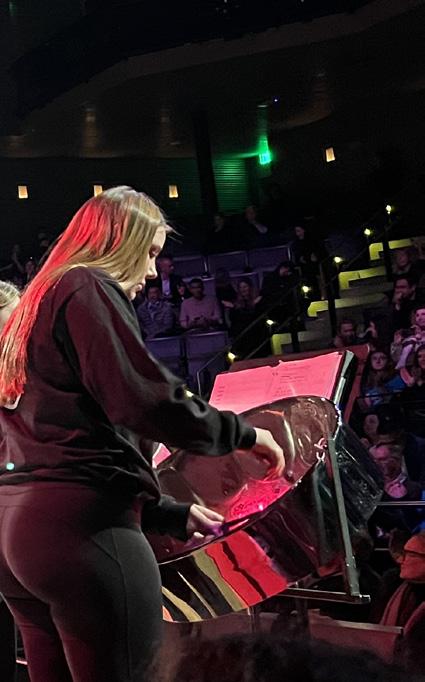 STORY Emma Z. PHOTO Serena S.
Nueva’s steel drum band graced the SFJAZZ Center in San Francisco for the second time on Friday, Nov. 11, alongside Santana vocalist Tony Lindsay and steelpan player Robert Greenidge.
Before an audience of friends, family, and other SFJAZZ patrons, the band performed a series of 12 songs they had practiced since the beginning of the school year.
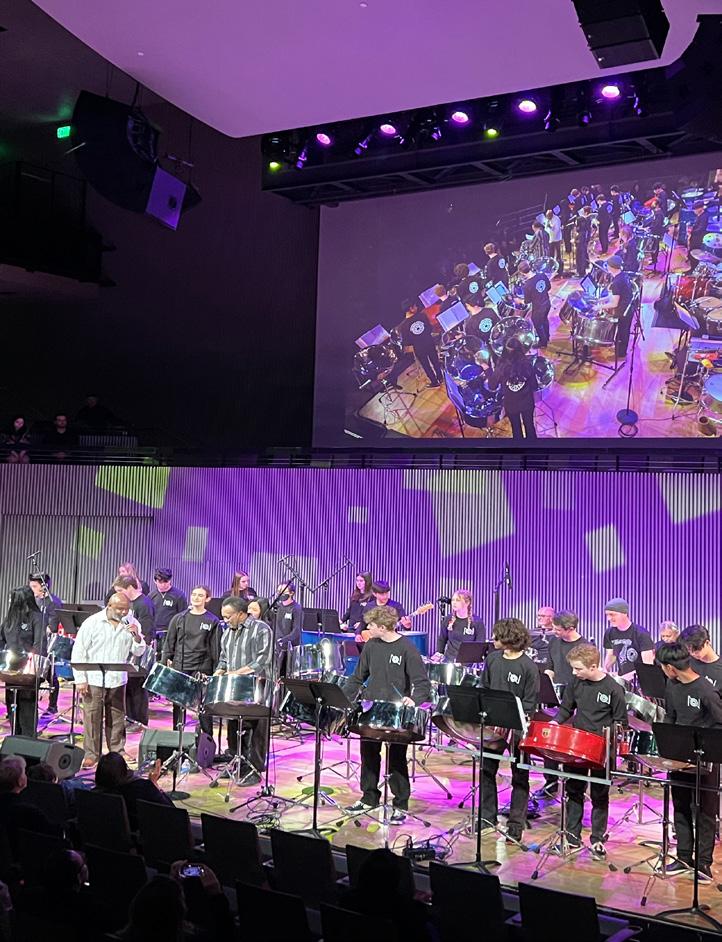
The concert featured a ten-minute improv solo by Greenidge, hit songs such as King Harvest’s "Dancing in the Moonlight," and Grover Washington, Jr’s "Just the Two of Us," as well as steelpan pieces composed or arranged by Greenidge and Munzenrider. While Lindsay also sang with the band at the 2021 concert, Greenidge was a new face. Previously, steel pannist Andy Narrell had accompanied Lindsay.
“Having my senior year be a culmination
of steel drums was incredible,” said Eliza S. ’23, who has been a part of the band since third grade. “Being able to perform with Jim and the other musicians was also an opportunity Nueva provided that I wouldn’t be able to get anywhere else.”
The band responded to roaring applause with Santana’s "Smooth" as an encore. And to end the concert? A last-minute surprise celebration for Munzenrider, whose birthday was the following day.
“Each time it's someone’s birthday, Jim magically knows. He’ll get us all donuts and have everyone play our class’ special rendition of happy birthday, which ends in an amalgamation of random notes and chaos” Anya P. ’23 said. “We thought SFJAZZ would be the perfect place to repay the favor so we got Tony on board right before we got onstage, and hopefully surprised everyone there.”
The middle school band played as well, accompanied by Lindsay, between upper school band sets.
Music Outreach Club brings joy to local retirement home
perform, with benefits for both sides.”
From Beethoven to Elvis, music filled the lobby of The Peninsula Regent, a nonprofit San Mateo retirement home, on Nov. 6 as students from Music Outreach Club showcased their talents on the violin, piano, and more.
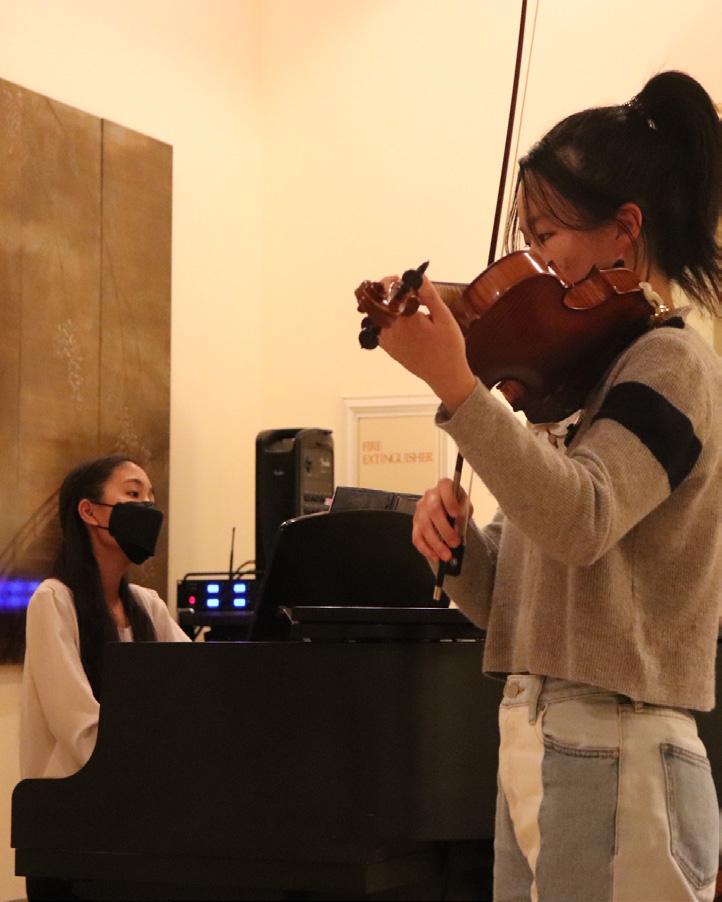
The club, led by juniors Christine Z. and Kerrie Z., offers opportunities for students to perform for local community organizations. While the club took a brief hiatus during the pandemic, Kerrie is “excited to have a fresh start.”
Their concert at The Peninsula Regent was the club’s first in-person performance in two years. Christine recalled the enthusiasm and appreciation expressed by audience members.
“A couple of them came up to us afterwards and said hearing live music was so nice,” Christine said. “To have our first performance be so successful is just amazing.”
The fruits of their musical labor didn’t just extend to the audience. Jodie C. ’24 described the club as “a meaningful way to
“We all got to work together and have fun together,” said Jodie, who performed a piano duet with Anna A. ’25 and provided accompaniment for Kerrie’s violin piece.
Similarly, one of Kerrie’s favorite parts has been finding a community with a shared love for music.
“There are so many people who I never even knew played music,” Kerrie said. “Some students might thrive in STEM or history classes, but we all share that same passion for music.”
As the club grows, Christine hopes to expand to other performance venues—such as the mall—and hinted at a potential future collaboration with the Nueva Notes, the school’s a cappella group.
Kerrie encourages student performers of all musical genres to join, emphasizing the club’s “low-effort, low-key” nature. Most importantly, she hopes to continue making a local impact by doing what she loves most.
“We want to share the joy of music with our community,” Kerrie said. “Music belongs to everyone.”
Photo of the Issue:
 PHOTO Damian Marhefka
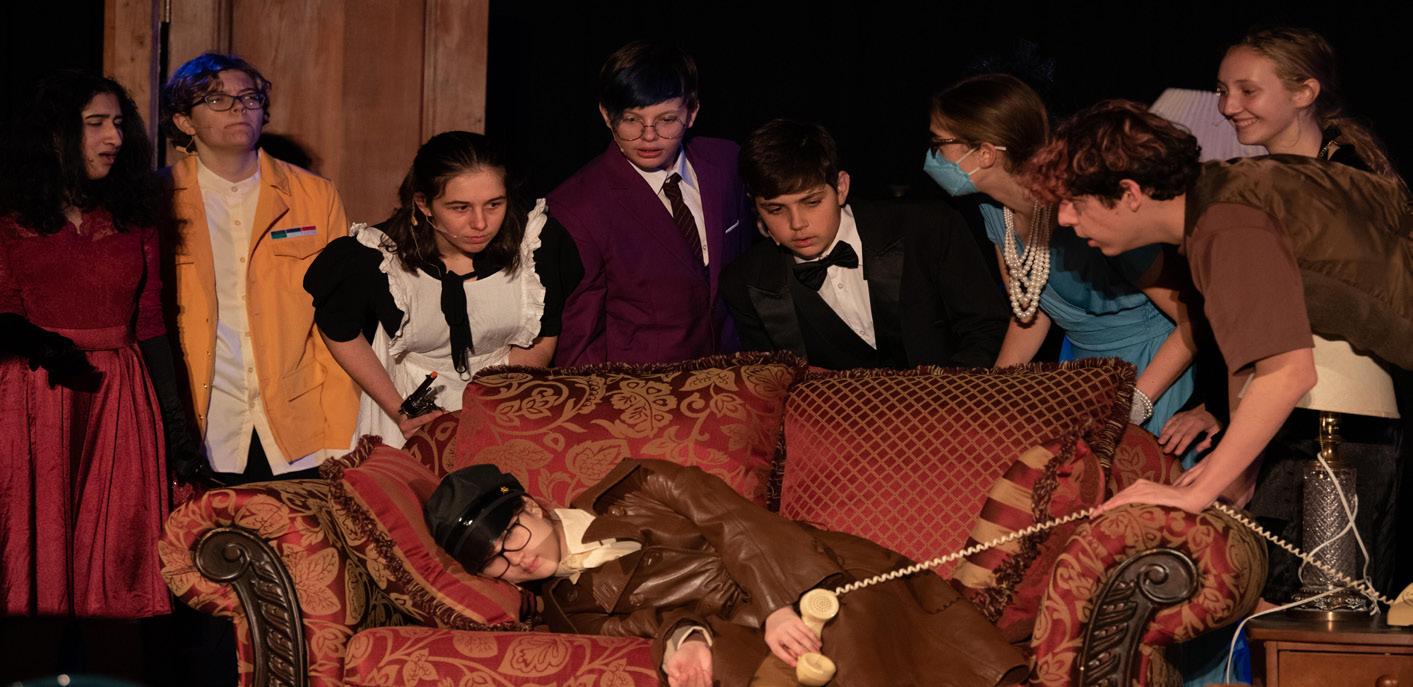
The cast of this fall's upper school play, Clue, performed Dec. 2-4 after months of rehearsing. In this scene, party guests huddle around a murdered motorist, determined to deduce who the culprit is.
The 2022 midterms did not play out as predicted
STORY Gabe H.
In various partisan upsets throughout the country, Democrats retained a slim majority in the senate while Republicans gained control over the House of Representatives by a close margin. Though Republicans were projected to win control over the house, the Democrat’s victory in the Senate was largely unexpected, with prominent pollsters such as The New York Times and FiveThirtyEight predicting a GOP takeover of the senate branch.
Nonetheless, Republicans have capitalized on growing momentum since
the 2020 election. With President Biden’s approval hovering below fifty percent, the midterms were an opportunity for conservatives to flip seats in local congressional districts. In New York, upstate and Long Island districts flipped a total of four previously democratic seats, partially solidifying a GOP majority. Gaining a total of eight seats, Republicans have honed a slim house majority—221 to Democrat’s 213.
Since the GOP did not solidify a majority in the Senate, the Democrats have a 51-49 majority with the closely-watched re-elections of Nevada senator Catherine
Cortez Masto and Georgia incumbent
In recent years, staggering voter turnout in midterm elections has sounded the alarm on federal law making practices. The 2018 midterms saw a record turnout of 49% of eligible. While the 2022 midterms did not reach the heights of 2018, many states have exceeded previous elections in early voter turnout.
The high volume of early voting in states like Georgia, New York, and Pennsylvania has signaled a seismic shift in the way elections are run. Since early voters typically trend democratic, these
races have demonstrated a wholescale rejection of Donald Trump-endorsed candidates who have emerged on the scene, spreading false claims that voter fraud is permeating American elections and denying that Joe Biden won the presidential race in 2020. Though election denialism has been a popular talking point in many republican races, none of these candidates emerged victorious.
The legislative impacts of this election remain to be seen. However, it is safe to say that Trump’s influence in government is shrinking.
PAGE 2 THE NUEVA CURRENT 12/14/2022 NEWS
STORY Owen Y.-L.
PHOTO Christine Z.
I-101
MORE ON PAGE 3
MORE ON PAGE
3
PAGE
READ MORE ON
4
TEAM EFFORT Kerrie, on violin, and Jodie, on piano, collaborate on Beethoven’s “Romance in F Major.”
senator Rapheal Warnock.
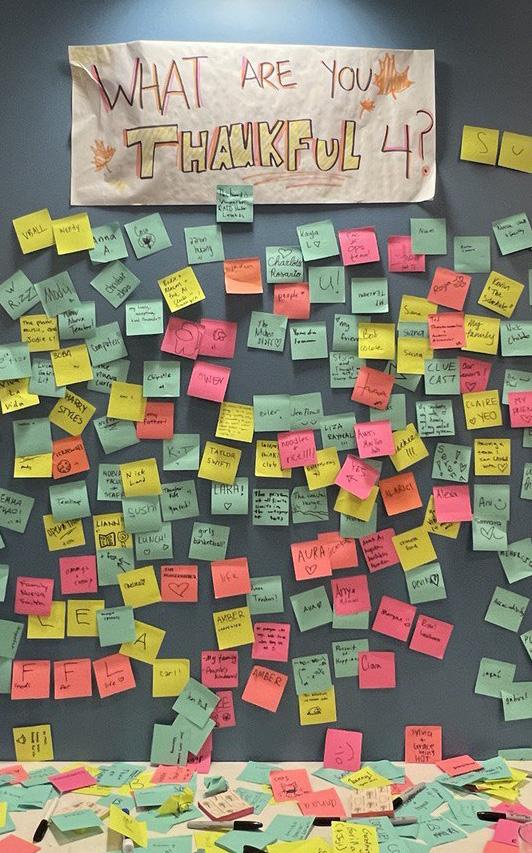
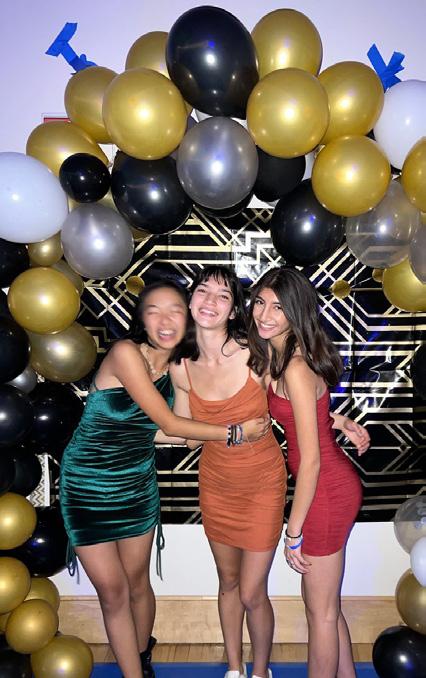
sticky notes 200 stuck on the Thankfulness wall before Thanksgiving break balloons 140 set up for the Homecoming dance on Nov. 4 songs
performed by the steel band at SF Jazz on Nov. 11
12
By the Numbers
A look into
through
17
A BIRTHDAY CELEBRATION Students from the steel drums elective wish instructor Jim Munzenrider a surprise happy birthday.
campus life
numbers.
teams participated in the Pie Bake Off on Dec. 14
Going green, here and now
San Mateo’s local climate action leaps beyond state requirements with recent building electrification policies
STORY Natalie L. PHOTO San Mateo City Council
Say goodbye to your gas appliances, requests San Mateo City Council.
On Nov. 7, San Mateo became one of few counties in California to implement local climate amendments, or Bay Area Reach Codes, beyond state requirements. The county will require electric alternatives for certain gas appliances during home renovation, as well as electric vehicle charging stations and full-electrification in future building development.
The reach codes will take effect on Jan. 1, 2023. While no immediate action is required of homeowners, the reach codes aim to shift towards electric appliances in existing residential infrastructure.
Gas water heaters will be substituted with zero-emission heat pump technology while gas furnaces will be exchanged for heat pump air conditioners—which emits 40 percent less carbon dioxide according to a study from UC Davis.
Additionally, the county will require power outlets compatible with electric appliances to allow for “electric-readiness” for a home under renovation.
Despite a potentially higher cost upfront, both heat pump appliances have yearly capital savings of $500 to $3,000 each when
compared to its gas alternatives, according to a state-wide residential electrification study done by Energy and Environmental Economics in 2019.
And, to address lingering citizen concerns of cost, San Mateo officials adopted the “Economic Hardship Exemptions” program for home renovations on Nov. 7. The program exempts homeowners from electrification requirements if the all-electric appliance replacement costs surpass 110 percent of a
similar gas system replacement.
Ultimately, these amendments aim to decrease the local climate footprint.
“[Existing] buildings account for nearly 38 percent of the greenhouse gas emissions in the city, and reach codes are an important step to address climate change,” wrote county officials in a news release document on Oct. 18.
Regarding the construction of future buildings, the county requires all appliances to be electric and prohibits installment of combustion equipment such as space heaters, gas water heaters, and wood or coal-burning stoves and fireplaces.
The county refers to a state-wide study done by Energy and Environmental Economics in 2019 which finds that during building development, all-electric appliances have “negligible impact on installation costs” compared to traditional gas appliances. Instead, it would show “substantial cost savings” in the long term.
Furthermore, depending on hometype, 20 to 100 percent of available parking spaces in townhomes, multifamily buildings, and commercial buildings will require electric vehicle (EV) charging stations or preliminary infrastructure for future installation of EV charging equipment.
“I think these reach codes are a step
Xi Jinping’s isolated China
As China’s recent protests and zeroCovid policy adjustments make headlines, it is crucial to reflect on the impacts of the policies within the Nueva community.
For the past two years, Chinese president Xi Jinping has been one of few global leaders to enforce zero-Covid—a public health policy system aiming to eradicate COVID-19 domestically through “maximum suppression” of the disease, according to the International Journal of Health Policy and Management.
Since the pandemic, the government has imposed strict city-wide lockdowns, routine community-testing, and government quarantine facilities.
For tourists to enter the country, a negative COVID-19 test must be taken 48 hours before flights along with an eightday hotel quarantine as of Nov. 11. Similarly, those with a permanent residence must quarantine for five days in a hotel and three in their home.
Though not explicitly correlated to zero-Covid, the number of visitors to China dropped from 145 million to 60 million in the past two years according to Statistica.
The stringency of the policies have often fluctuated rapidly as a result of infection flare-ups, leading to disclarity for citizens and tourists.
For Rosie D. ’23, China's zero-Covid policies threw a two-year curveball at her family travel itinerary from what was supposed to be a short vacation at the beginning of the pandemic.
“We thought, at most, we would stay for a little while to take care of [my grandparents] if the pandemic worsened,” Rosie said. “It was never supposed to be an extended visit.”
But as travel policies became stricter with “no prior notice,” Rosie was forced to stay in China. She finished her freshman year and the first semester of sophomore year at Nueva virtually with a 15-hour time difference—which “took a huge toll” on both her mental and physical health.
While Rosie was in China, her household was put under quarantine four times— the longest being two weeks—despite never testing positive for the virus. The government even installed a motion sensor on their door.
“Everything was extreme and scary,” Rosie said. “By the time there were flights available to return to the United States, I had already begun [another] school in China. We ended up staying there until June 2022. We had no prior plans whatsoever of moving there, it was all so unexpected.”
Thousands of other tourists have found themselves “trapped” in the country amidst waves of unexpected lockdowns, according to a CNN article published on July 18.
Additionally, because direct flights to each city in China are unavailable, Gavin Z. ’25's grandmother had to fly from the Bay Area to Beijing, quarantine for two weeks, and back to her home province with another quarantine.
“It was really inconvenient and because she’s older, it took a toll on her,” Gavin said.
Prior to the pandemic, his grandmother would visit their family a couple times a year, but now no longer feels comfortable. Similarly, Zhang’s family have halted their yearly visits to China since the pandemic.
“A bulk of our family is in China and we can't see them anymore,” Gavin said. “I hope to visit again, but the policies make it difficult.”
For Victor Shi, the father of Isabelle S. ’23, who has to travel regularly to China for business trips several times a year, he has learned to make peace with these extensive quarantines.
“I have developed a kind of routine, including exercising with Youtube, Zoom
meetings to conduct business as usual, and an overdose of Netflix,” Shi said.
However, Shi notes that pricey plane tickets with frequent cancellations by the Chinese authorities, along with Covidtesting requirements prior to boarding the flight have decreased the number of trips he has taken to China in recent years.
While China has recorded only 6,000 deaths thus far with a population of 1.4 billion people (compared to the United States with nearly 1.1 million deaths despite a population of 330 million people), community members feel the policies have overstayed their welcome.
“It’s clear that eliminating the virus is not possible,” Adam K. ’24 said. “China should retain some level of safety protocol, but they shouldn’t lock down the country as it disrupts the workforce and the economy.”
Shi notes that while China’s zero-Covid policy may have enabled “the country to be relatively free within its borders” in the first year of the pandemic, it is now taking a “heavy toll” on citizens’ livelihoods.

“It’s concerning that sometimes people can’t go out to buy things like food, or even get it delivered to them because of the lockdowns,” Vickie H. ’25 said.
Rosie agrees, adding that the extent of current policies are a violation of the human rights of autonomy.
in the right direction,” Anjuli M. ’25 said, founder of San Mateo Youth Climate Action Team (SMYCA), “San Mateo has been a trailblazer in climate action and they successfully navigate the fine line between what is good for the climate and feasible economically for residents.”
In this youth-led branch of Silicon Valley Climate Action nonprofit, Mishra and Lara M. ’25 attended and spoke at multiple city council meetings to advocate for the reach codes in the months prior to its adoption. Additionally, sophomores Charlotte S. '25 and Ines P. '25 participated once alongside SMYCA.
“While there is climate action on a larger scale, it typically takes much longer. It is much easier for me to make changes locally where my voice can be heard,” said Ines, who spoke at the City Hall meeting on Oct. 18.
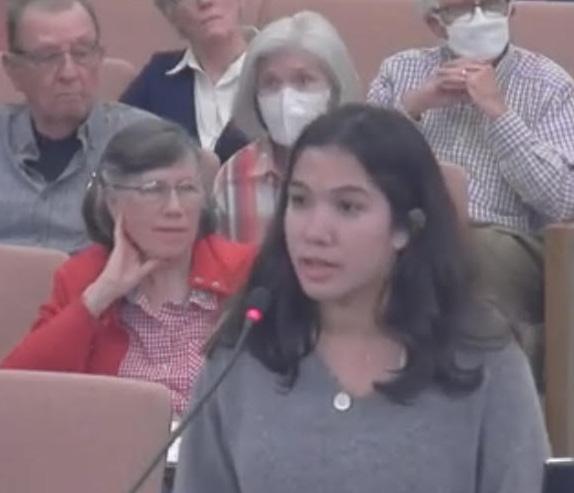
“If local governments around the state, or even around the country, emulate what San Mateo is doing with these reach codes, it will create a bigger impact over time,” said McDowell, who spoke at two City Hall meetings. “It’s really important for people to recognize how important electrification is for the climate.”
The county hopes to achieve 100% green energy by 2025, according to an article by Peninsula Press in 2019.
“It’s gotten so bad that my grandparents, who still live in China, only leave the house two or three times a year,” Rosie said.
In fact, citizen protests have recently arisen around the country—something unheard of in communist China. Thousands of protestors have gathered in provinces such as Shanghai and Guangzhou, demanding the government retract their policies.
Rosie is in “full support” of these protests.
“All we want are our basic human rights back and to be able to freely go outside,” Rosie said. “Right now, the government is showing the world they think it’s okay to pass any policies they want with no regard to its effect on the people.”
After the mass protests, the Chinese government announced that city-wide testing and lockdowns will only be limited to high-risk buildings or small areas. Additionally, citizens who test positive will be able to quarantine at home instead of a government facility, inter-province travel restrictions will be lifted, and routine country-wide testing requirements will be eased according to BBC news on Dec. 7.
“I’m glad the government is receptive to protesters. I think it is a step in the right direction but there is still a long way to go,” Adam said.
12/14/2022 THE NUEVA CURRENT PAGE 3
NEWS
A reflection of the impacts China’s zero-Covid policies has had on our school’s Chinese community
STORY Natalie L. PHOTO Rosie D.
THE YOUTH SPEAK OUT Charlotte S. '25 guest speaks at the Sep. 19 San Mateo City Council meeting to advocate for climate reach codes two months before its adoption.
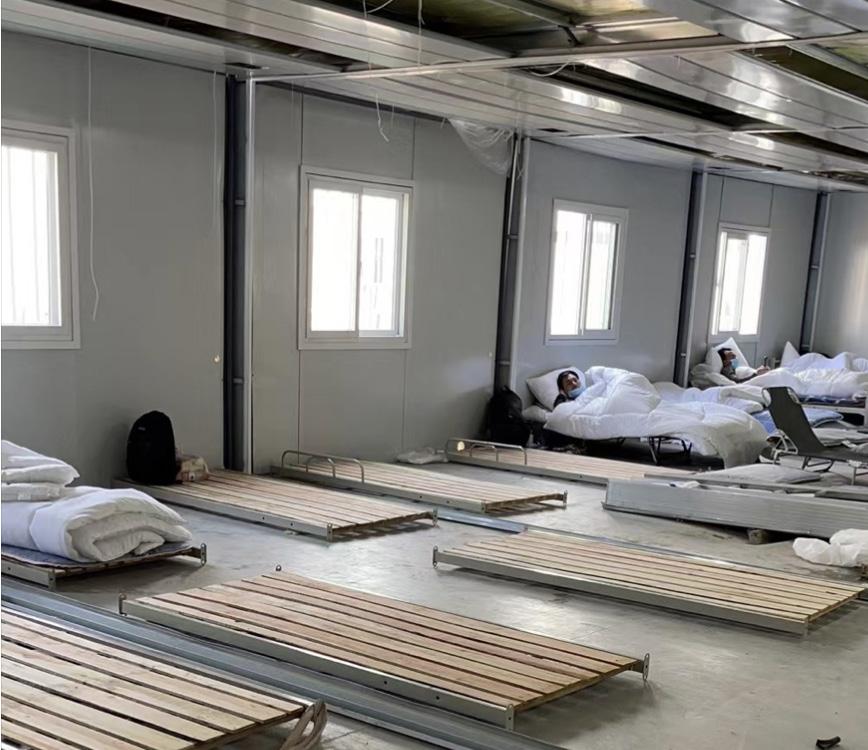
A QUARANTINED REALITY Citizens positive with COVID-19 quarantine in a government facility with many beds in each room and construction parts scattered about.
Hefty express lane tolls soon to be added to Highway 101
STORY Aaron H. PHOTO SF Chronicle
Harvard researchers say the average American will spend 1,600 days of their life driving. San Mateo County wants to cut that down—one express lane at a time.

In 2020, CalTrans and San Mateo County began construction on two of Highway 101’s lanes (one northbound and one southbound), running the 16-mile stretch between the Whipple Avenue exit and Redwood City exit.
Two years and $581 million later, the lanes are now open for all drivers free of cost—yet not for long. The lanes were built to be High Occupancy Vehicle (HOV) express lanes, constructed with the hopes to lower the Bay Area’s increasing highway congestion.
The county predicts that starting March 2023, the lanes will be fully functioning HOV express lanes. Vehicles with three or more passengers will be allowed to use the lane free of charge during the tolls’ operating hours of 5 a.m. to 8 p.m. Monday through Friday, while vehicles with two or fewer passengers must pay a toll. The toll, which is based
$581
million was spent on construction of the new express lanes along Highway 101.
on distance driven and can range from 50 cents to upwards of $12, is calculated automatically based upon how many vehicles are in the lane. Two-passenger vehicles are charged at half-price.
With many Nueva community members commuting to school daily, some faculty and students often travel from as far as three counties away and encounter the express lanes on a day-today basis. Many disapprove of the express lane’s addition.
“I think the new express lanes have extremely poor user design,” said upper school I-Lab Design Thinking teacher Morgan Snyder, who commutes from East Palo Alto. “Creating signs on the highway that contain complex conditionals like ‘three plus HOV or Fastrak Express between these hours of the day’ is confusing. As a computer scientist, even I have trouble parsing through that before I’ve had my coffee in the morning.”
But Snyder’s confusion with the express lane’s design is only part of her criticism. To Snyder, the express lane is “inherently inequitable” and comparable to TSA PreCheck in its “pay for the premium experience” ethos.
Gabriel C. ’24, who drives on Highway 101 almost daily for baseball practices, also agrees that San Mateo’s implementation of the express lane only benefits a small subset of San Mateo drivers.
“Aside from weekends when [the lane is] free, it’s pretty much just letting wealthy people not have
on
How
STORY Serena S. & Isabelle S. ART Ariane Y.
A homophobic slur was found written in the all-gender bathroom of the second floor Rosenberg wing on Wednesday, Nov. 16.
The second instance of public hate speech on campus ian nine months, the slur was discovered during National Transgender Awareness Week (Nov. 13 to Nov. 19), and specifically, on the day in which queer community members led a celebratory rally in the morning.
“This is a clear violation of our community agreements and is absolutely unacceptable,” Upper School Division Head Liza Raynal wrote in an email to the upper school the following day. She continued the email by urging the responsible student to come forward.
However, new information surfaced later that led administrators to believe the slur was neither written by a Nueva student nor intentionally in an all-gender bathroom due to the content of the tagged message and the timing of the incident.
Prior to alerting the entire community, Raynal, along with upper school student counselor Aviva Jacobstein, director of social justice & equity Savannah Strong,
and coordinator of social justice and equity Matthew Oakland, met with the Queer Student Union (QSU) to discuss the impact of seeing such language in a space for transgender and non-binary students.
To QSU member Hazel D. ’23, much of this discussion was an outlet for queer students to express emotional sentiments in solidarity.
“I was angry because [learning of the slur] wasn’t surprising,” QSU member Hazel said.
Hazel was also one of the four students who spoke at the all-school assembly on Friday, Nov. 18—two days after learning about the incident. The
traffic,” Gabriel said.
Gabriel argued that San Mateo’s goal of “[improving] travel time and reliability for express lane users,” which can be found on the CalTrans website, only highlights the county’s prioritization of wealth.
“It’s a Band-Aid fix for the larger problem of too many cars on the road,” Gabriel said. “I appreciate that people are aware of the traffic issue and are trying to implement ways to improve it, but I don’t think this was a great use of resources.”
Both Snyder and Ciechanover said the express lane is a “Band-Aid” solution, but Snyder believes the express lane only adds to the county’s economic inequity that “has led to so many residents to move out.”
“I wish all of [the express lane budget] was invested in a longer term, transformative change for public transportation and making Caltrain more
The county does hope to improve Bay Area transportation through the express lane’s profit. CalTrans plans to allocate profits to not only Highway 101 projects, but also CalTrain and BART services.
For other drivers, however, whether the express lane is positive or negative is not clear cut.
“Over Thanksgiving break I went to see my family in Los Angeles,” said upper school English teacher Jennifer Neubauer. “When I was driving to San Jose Airport, there were a lot of accidents, a lot of back up, and we were allowed in the express lane because we had three people. If I hadn’t had the express lane, I would’ve missed my flight.”
While the express lane enabled Neubauer to make her flight, she still felt the lane was “a little unfair” to be able to avoid the traffic while others were not.
But for now, only time will tell how
At the assembly, Hazel mentioned how deep down, she had “feared something like this might happen”—and she was not alone. QSU lead Abi W. ’23 also felt angry yet unsurprised when hearing about the tagged slur on campus.
“Regardless of who put the slur in the bathroom, the fact that I believed someone at school did it—a belief reflected by pretty much everybody I talked with—implies there is something within the school to change,” Abi said.
To Abi, the less visible acts of homophobia around campus reveal discrimination towards queer students still exist.
“There are just things you hear passing the halls and it might be difficult to point out in that setting,” Abi said.
She hopes for students to step up for their LGBTQ+ peers: “If you see people making jokes, like using ‘gay’ as a derogatory term, just please call it out.”

Echoing Abi sentiment, Oakland believes everyone has “the power to craft a healthier community.”
“We all have the power to be an upstander, we all have the power to intervene in moments of harm,” Oakland said.
For Hazel, this incident has further proven to them one thing: “it’s time to start holding people accountable.”
PAGE 4 THE NUEVA CURRENT 12/14/2022
Homophobic incident
campus sparks conversations around anti-queer microaggressions
the community responded to a homophobic slur found written on campus
NEWS
Community members question whom the $581 million express lanes really helps
CARS IN CHAOS Cars stream down Highway 101, passing the Santa Clara County express lane toll markers.
“Our community allows casual macro and microaggressions to grow and fester. It’s time to start holding people accountable.”
ARTS & CULTURE
A GLASS CLOSET
MULTICULTURAL CUISINE
REGALITY AND IDENTITY A MASK OF WOKENESS
Tong Soon Garden serves food which combines the best of Chinese and Korean food.

After months of online harrassment, Heartstopper star Kit Connor was "forced" to come out on Twitter, contradicting the message of the show.
Must-read books from 2022
Season two of Young Royals explores queer identities and brings a compelling slow-burn romance.
The second season of The White Lotus is a prime example of how a new cast doesn't cover the passt wrongdoings of a show. READ
I'm Glad My Mom Died by Jennette McCurdy
MEMOIR
Babel: An Arcane History by R.F. Kuang

FICTION FANTASY
In Young Mungo, Booker-Prizewinning author Douglas Stuart returns readers to the literary territory he’s most familiar with—working class, post-Thatcher-era Glasgow. Despite the novel’s setting being nearly identical to his debut Shuggie Bain, it’s evident that Stuart still has plenty of stories left to tell.

Young Mungo follows a young boy, Mungo, as he explores his sexuality amidst a domestic life tainted by his mother’s alcoholism and economic insecurity. His starry-eyed outlook is continuously ruptured as he’s tormented by his gangster brother, poverty-stricken community, and ultimately sent off with two strange men as his mother seeks to “man him up.”
This depth of social commentary is a heavy burden for any novelist, yet Stuart achieves it all without sacrificing emotional or literary prowess. Young Mungo is gritty—and startlingly mundane. Stuart masterfully uses portraits of Mungo’s life (right down to the burning scent of sausage grease and the yellowing wallpaper of his cramped apartment) to intimately acquaint readers with the gentle protagonist. It’s this acquaintance that makes the trauma he endures all the more painful. Young Mungo capitalizes on empathy and transforms it into commentary; it’s a tale of homophobia and classism which—despite its historic setting—remains hugely relevant.
Let’s face it: celebrity memoirs aren’t great. Typically, they’re cashgrabs meant to capitalize on a famous name, starring an abundance of overinflated egos and a distinct lack of any storytelling value. (Source: your local bookstore's memoir section.) However, Nickelodeon sitcom iCarly star Jennette McCurdy’s I’m Glad My Mom Died is a refreshing, punchy, heartbreaking exception to this rule, recounting McCurdy’s struggle with eating disorders, addiction, and an abusive mother as a former child star.

Whether you grew up with McCurdy’s shows, or stumbled upon her name for the first time today, I’m Glad My Mom Died is a must-read. Its writing is simple but poignant, placing readers in the shoes of a naive child who only wanted to make her mom happy. McCurdy utilizes this style to address her own flaws, reflecting on her descent into bitter resentfulness. As a reader, however, I finished the book feeling that I understood where her resentfulness stemmed from: the abuse she faced at the hands of Nickelodeon, the media, and her titular mother.
While McCurdy is not the first to address child exploitation within the media industry, I’m Glad My Mom Died is one of the most candid recollections of an overlooked, underprotected, and terrifyingly vulnerable demographic.
Dear student: Welcome to Babel, otherwise known as Oxford University’s Royal Institute of Translation. The year is 1828. Here, translators use enchanted silver bars to summon color, shape, emotion, and even death. Yet as our protagonist—a Chinese boy named Robin—is soon to discover, this silver-making holds the reins to Britain’s imperial expansion, as well as the internal collapse of China in the Opium Wars.
It’s an ambitious premise, but with a soaring plot and treasuretroves of footnotes about translation (Kuang herself is a translation scholar, and much of the novel was inspired by her time pursuing an MSc in Contemporary Chinese Studies at Oxford), Kuang delivers a masterclass in intertwining literary fantasy and modern socio-political commentary. Babel is a nuanced critique of academia’s role in European imperialism packaged within the atmospheric swooping arches and gray skies of Oxford University. It’s an astonishing addition—or more fittingly, subversion—of the ever-popular dark academia literary genre.
Sometimes, words just don’t cut it. Quippy dialogue alone doesn’t embody the frustration of sitting in sluggish hospital waiting rooms—the sickeningly sterile flourescent lights and infuriatingly calm expressions of hospital staff play just as important of a role. In a standout collection of autobiographical comics, cartoonist Keiler Roberts proves that that combined, these two forms of media can create some of the most compelling depictions of everyday life.
The Joy of Quitting encompasses eight years of Roberts’s life raising her daughter Xia. As Xia grows from a toddler to a pre-teen, the family and their dynamics subtly shift. These changes, which occur without anyone noticing in real life, are masterfully captured with Roberts’s pen.
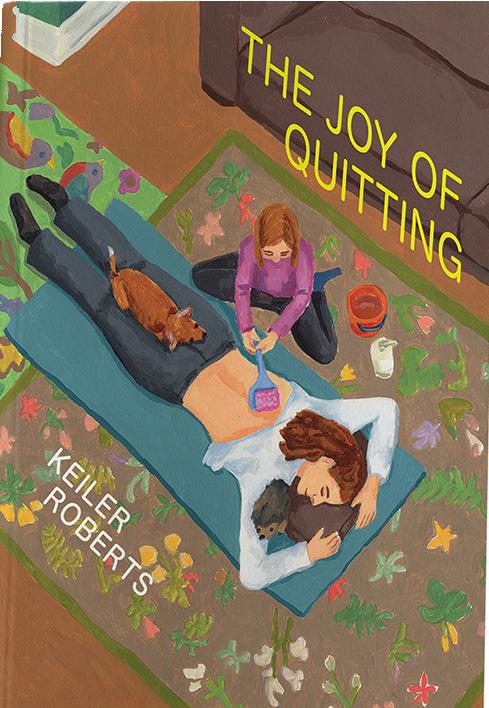
The work endows smaller, throwaway moments with just as much importance as larger ones, and it was these moments that I found myself nodding along to. Not all of the experiences Roberts’s chronicals are universal (no, I’ve never had to sift through a daughter’s hair for lice), but every reader is sure to find an intensely relatable interaction within The Joy of Quitting’s sparse yet potent pages.
(Pro tip: this relatability makes it the perfect holiday present for someone you don’t know all that well.)
A Little Life by Hanya Yanagihara
Hillbilly Elegy by J.D. Vance
Educated by Tara Westover
The Glass Castle by Jeannette Walls
Confessions of a Prairie Bitch by Alison Arngrim
Portrait of a Thief by Grace D. Li
The Secret History by Donna Tart
Harlem Shuffle by Colson Whitehead
The Complete Persepolis by Marjane Satrapi
Fun Home: A Family Tragicomic by Alison Bechdel
French Milk by Lucy Knisley
12/14/2022 THE NUEVA CURRENT PAGE 5
STORY Isabella X. PHOTOS Douglas Stuart, R.F. Kuang, Jennette McCurdy, Keiler Roberts
MORE ON PAGE 6 READ MORE ON PAGE 7 READ MORE ON PAGE 7 READ MORE ON PAGE 8
With the year coming to a close and winter break right around the corner, bundle up with our four favorite books released in 2022. Don’t want to pay the premium for hardcovers? Check out The Current’s pop-up display in the WRC!
Young Mungo by Douglas Stuart
The Joy of Quitting by Keiler Roberts
ENJOYED THIS BOOK? CHECK OUT THESE READS NEXT:
Earth We're Briefly Gorgeous
AUTOBIOGRAPHICAL COMIC
On
by Ocean Vuong
A cultural beacon hiding in plain sight
Tong Soon Garden preserves Sino-Korean cuisine in Santa Clara
 STORY Gabe A. PHOTOS Maangchi
Nestled between an auto repair shop and hardware store, just off of the busy El Camino Real, is Tong Soon Garden, a restaurant combining Chinese and Korean cuisine. Bikes are left unlocked, leaned against the dumpsters next to the entrance of the kitchen, resembling the chefs after closing. Inklings of rust and dying cigarette buds scuttle to and from the entrance’s twin doors—as if to safeguard the kitchen aroma as a wellkept secret.
“One order jajangmyeon, one order jjamppong—”

Our waiter smiles knowingly, and sets her pen and pad back into her apron’s pocket.
“—one order tangsuyuk, one order garlic spinach.”
“You are Korean?”
“Ne.”
“Takkwang yangpa duroyo (Do you want radish and onion)?”
“Ne.”
Founded in 1999, Santa Clara’s Tong-Soon Garden brings people from all walks of the Bay Area, seeking Korean-Chinese cuisine.

Elbows rested on the same paper table mats and backs slumped against the same dumpsters, sipping from the same bleached porcelain. Sheltered underneath the aged cigarette haze.
Before our main dishes arrive, our table begins to fill with a motley clutter of items signature to both Chinese and Korean cuisine. Petite porcelain teacups, whose floral jasmine steam is overwhelmed by the sole bowl of kimchi’s poignant clouds of gochugaru and garlic. Small plates hold semi-circle yellow radishes and thin-cut slices of white onion. The brittle pungency is gently cradled by a savory fermented black bean paste.
sharing occasional brined, tired smiles. The two waitresses shift to the center of the restaurant, where a Caucasion family sits surrounding their circular table’s assortment of sweet and sour pork, chicken chow mein, and walnut prawns—stabbed with forks and washed down with ice water. Finally, they stand, push in their chairs, and disappear into the kitchen.
Soon after, our arrangement of panchan is met with vibrant main
lean beef. A fried black bean paste sauce clings to each noodle’s surface, its fullbodied warmth soothing
After taking my order, our waitress seats herself beside her coworkers at a table in the corner of the room. The women rest their elbows on the table as their eyes traipse the restaurant. They settle on a trio of halabeojis (grandpas) seated next to a window with its dim lit view of the oncoming El Camino Real traffic. The three sip on beers, talking in low voices,
dishes. The jjamppong’s murky depths churn with octopus tentacles, mussels, scallops, and shrimp, each speckled with the broth’s maroon debris. The soup’s vehement spice is soothed by slippery wheat noodles, boiled to a slight give. It calls to the daring, practiced eaters with well-traveled tongues and calloused lips.
Kitchen scissors snap, dispersing the densely packed noodles nestled within the wide ceramic bowl of jjangmyeon and
and healing to the heartbroken.
Tong-Soon Garden is a refuge: For those Chinese or Korean. For white people. For the gutsy or timid. For halabeojis looking for a drink. For those heartbroken. Hunched over bowls, in unison, buried within the metallic cigarette lacquer.
Movies that chronicle real-life events must be delicate in their approaches—even more so when those real-life events bear staggering repercussions. She Said, a deeply moving and introspective film about sexual assault in Hollywood, does not take this responsibility lightly.


Released in theaters on Nov. 18, the blockbuster film tells the true story about the plight of New York Times reporters Megan Twohey (Carey Mulligan) and Jodi Kantor (Zoe Kazan) in their reports revealing the relentless abuse of women working under mega-producer Harvey Weinstein. The movie highlights the grueling nature of investigative reporting, focusing heavily on victims’ refusal to speak on the record about their experiences due to fear of corporate and legal retaliation.
Zelda Perkins (Samantha Morton), one of the featured women who speaks on the record about her experience with sexual assault, discloses to Twhoey “This is bigger than Wesintein, this is about the system protecting abusers.”
Whether the system in question is Hollywood, capitalism, or misogyny at large, the film argues that victims are silenced by
its protection of abusive figures. She Said features multiple women throughout the film industry whose careers were sidelined after being assaulted by Harvey Weinstein. Many of these women pivoted from their careers entirely, too traumatized by their experiences to return.
Watching She Said, I couldn’t help but harken back to the 2018 film Bombshell, which expertly chronicled the abusive working environment at Fox News, particularly regarding sexual assault perpetrated by executive Roger Ailes. The similarities between Ailes and Weinstein are impossible not to recognize. Both figures were high-powered executives of corporate monopolies, widely revered both in their fields and on the national pop-culture scene. However, behind closed doors, they ruthlessly pursued women in their companies, trading promotions for sexual favors, undressing in meetings advertised as business gatherings, and requesting oral sex in exchange for career guidance. Though cable news and Hollywood are vastly different industries, both movies told a story that was somewhat analogous. Women who dared to speak out against abuse were siloed and dismissed.
This parallel is alarming in multiple ways. For one, it signals just how ubiquitous sexual assault is the workplace. However, most disturbing is the fact that the victims
represented were in the public eye and had an elevated status in society. If women of this status were victimized so heavily, what does this say about women who do not bear this authority?
Despite its central theme, She Said not just a movie about sexual assault. It is also masterfully depicts the difficulties of journalism. Twohey and Kantor travel across the globe, weathering physical and emotional burnout, attempting to convince women forced into silence to share their stories with the world. The movie soars in its biting reality; battered by the entertainment industry at large, women are reluctant to come forward with their stories. Interviews are difficult to come by, a dearth of hard evidence threatens the story’s reputability in the eyes of Kantor and Towhey’s supervisors, and legal intervention from Weinstein’s lawyers becomes an increasing hurdle. Nonetheless, the two reporters fight beyond the odds to bring this story into the mainstream.
Much of She Said flirts with the motifs of risk and sacrifice. A cornerstone of the broader narrative about women being forced into silence, Weinstein’s victims must risk their careers in order to speak candidly about their experiences. Twohey and Kantor make large sacrifices in order to uncover more about these women.
As new stories constantly surface about
PAGE 6 THE NUEVA CURRENT
CULTURE
ARTS &
Content warning: depictions of sexual abuse
Kitchen scissors snap, dispersing the densely packed noodles nestled within the wide ceramic bowl of jajangmyeon and uncovering fresh seafood and strips of lean beef.
She Said provides a masterful condemnation of Hollywood The blockbuster film expertly chronicles the narrative of abusive power structures in the film industry
to the anxious
STORY Gabe H. PHOTO She Said
REPORTING ON THE TRUTH Carey Mulligan and Zoe Kazan headline the biographical drama film as reporters Jodi Kantor and Megan Twohey respectively.
Pop culture report card
Our staff’s celebrations and condemnations of the latest events in pop culture

IN REVIEW
Young Royals season two delivers slow burn queer love story Realistic pacing builds nuanced romances
Young Royals, the Netflix original drama released in July 2021, follows the fictional prince of Sweden, Willhelm, played by teenage actor Edvin Ryding. The show opens with Willhelm’s parents demanding he start taking his life seriously—forcing his transfer to Hillerska, a strict, traditional boarding school in the Swedish countryside.
Swedish royalty, epic secret romances, and refreshingly honest storytelling were all featured in season one of establishing a growing legacy for season two to live up to—and it does.
Willhelm is sent to Hillerska to take his place amongst elite Swedish youth. Amongst the privileged youth are a few local, non-boarding students, including Simon Eriksson, portrayed by Omar Rudberg. When Willhelm and Simon meet, sparks fly immediately.
are not AOC or
approved. Fans hovered anxiously on Ticketmaster’s website for hours on end over the course of multiple days in efforts to secure tickets to Taylor Swift’s highly anticipated Eras Tour. Count yourself one of the “Lucky Ones” if you managed to snag tickets before they unfortunately, but expectedly, sold out.

Season two picks up right where its precursor left off, immediately following the winter break from school. The season immediately reestablishes Willhelm being head-over-heels in love, Simon unable to commit to a life of secrecy in order to uphold the royal family’s image of heteronormative tradition. Ryding is undoubtedly the break-out star of the season; his intense performance not only maintains the powerful sting of separation from a loved one, but also portrays teenage mental health issues in an authentic manner. In season two both characters explore other potential love interests, further building the slow-burn anticipation that kept viewers hooked. The development of romantic tension throughout this season feels authentic in its inherent teenage awkwardness and air of confusion and suspense.
As Willhelm’s encroaching public princely duties seep further into daily life, his resulting anxiety places Willhelm’s
mental health at the center of the season. It's an emotional center that brings nuance to Simon and Willhelm’s interactions and the heavy toll of expectations and secrecy.
These teenage realities of frustration, lack of independence, mental health issues, academic struggles, and doubts about the future ground an otherwise fantastical plot about something as far removed from
STORY Samara B. PHOTO Netflix

soapy teenage shows now like Elite or Euphoria. Unlike most high-budget young adult dramas where actors in their mid, or sometimes even late, twenties portray highly unrealistic depictions of school life (usually ignoring homework and their families in favor of partying), Young Royals represents a more balanced teenage life and an honest emotional landscape. The show
without the rush and frenzied dramatization
Forced out of the closet
The
IN REVIEW
Aftering facing months of online harassment, actor Kit Connor was "forced to come out" on Twitter, generating interesting conversation on queerbaiting and representation
STORY Grace F. PHOTO Netflix, Twitter
Since the first season of Heartstopper released on Netflix in April, fans have reveled in the new wave of authentic queer representation, as many of the cast members, such as Joe Locke and Yasmin Finney, are openly queer and have spoken on the impact of the show on their own identities.

However, fans gravitated towards Kit Connor, who played a bisexual main character named Nick Nelson on the show, with Connor gaining approximately 3.5 million Instagram followers following the release of the show.


But with this obsession came endless speculation. The combined fascination with the show and the representation led fans to immediately start social media to harass Connor for “queerbaiting” after spotting the actor holding hands with actress Maia Reficco, eventually leading him to crack under the pressure and come out on Twitter.
After months of back-and-forth interactions with prying audiences, Connor finally posted a tweet on Oct. 31 stating, “back for a minute. i’m bi. congrats for making an 18 year old to out himself. i think
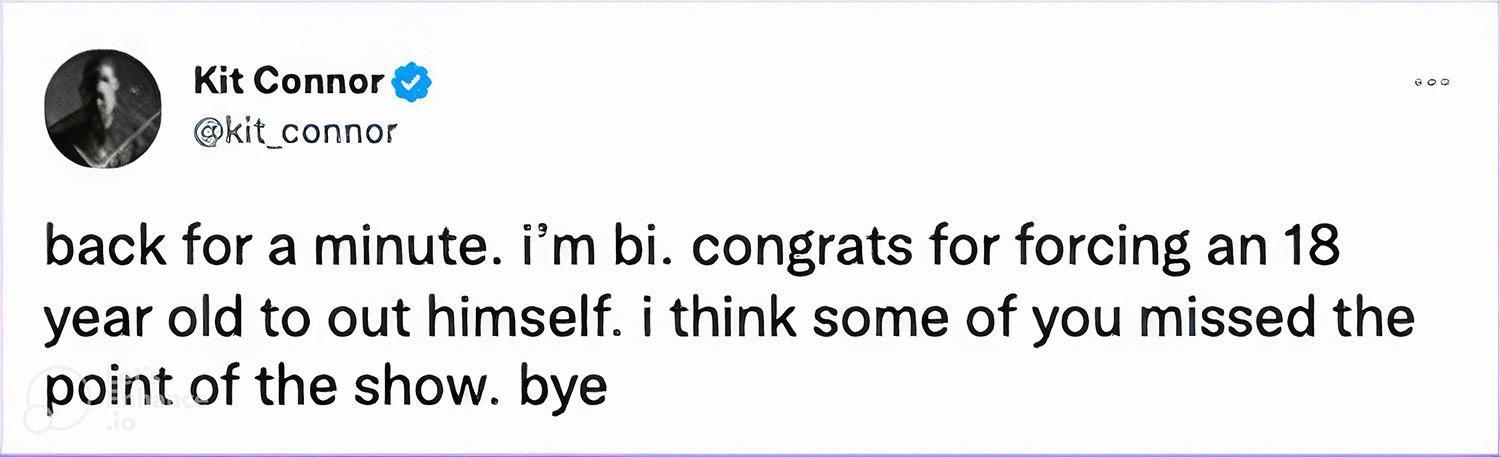
some of you missed the point of the show. bye”
The term queerbaiting has a long history in the discourse of LGBTQ+ representation in media. It is often used as an accusation leveled at straight artists who incorporate aspects of queer culture as part of their brand or performance, a notable example being Billie Eilish.
Alice Oseman, the writer of the Heartstopper graphic novels and executive producer of the show, has repetitively stated that she wanted the show to “celebrate queer joy.”
However, fans took issue with Connor’s discomfort with explicitly giving himself a label, as he stated in an interview with W Magazine, “To speculate about a person’s sexuality is so dangerous, especially for someone at my age of 18, it’s a bit strange for me to see. If I haven’t said anything, you shouldn’t assume anything, but you also shouldn’t pressure me to tell people. It’s a very personal journey that people have to go on.” This issue became prominent enough that YouTubers such as withcindy have included key search terms such as “queerbaiting” and “Kit Connor” as clickbait.
Connor acknowledged he “completely understands the idea that they want authentic queer representation,” but this
wasn’t enough for fans.
Much of Nick Nelson’s story arc was about him figuring out his sexuality.
However, the show was written in a way where Nick was able to explore this on his own terms and was able to come out on his own time. Ultimately, if fans cared as much about Connor as they do for Nick, they would have given him the same grace to let him discover himself.
Connor was never queerbaiting. This show was a revelation in LGBTQ+ representation, both due to its authenticity and diversity. Though Connor portrayed a queer character, he was simply doing his job as an actor. In a show as well-loved as Heartstopper, it’s difficult to separate the characters from the actor. However, just like Nick, Kit Connor is a teenager who’s still discovering himself. Celebrities aren’t untouchable deities, and to be forced to come out is incredibly damaging, especially at his age. It’s a shame that the parasocial relationships which fans have built with him have pushed him to a point where he was forced to reveal a part of his identity that he should have been able to explore on his own terms.
12/14/2022 THE NUEVA CURRENT PAGE 7
ARTS & CULTURE
Taylor Swift Ticketmaster Fiasco: D Oligopolies such as Live Nation (which owns Ticketmaster)
Swiftie
Tim Burton’s Wednesday: A
Jenna Ortega shines as the classic campy gothic character Wednesday Addams in the new Netflix series. Ortega’s more mature take on Wednesday as a teenager delights. Why was the show released after Halloween, though?
Pete Davidson & Emily Ratajkowski: A Between Ariana Grande, Kim Kardashian, and now Ratajkowski, Davidson has got game. Many Twitter users have joked about the situation, with one user declaring that “Pete Davidson’s rizz [charisma] needs to be studied at Harvard,” in reference to his noteworthy ability to court pop culture’s most famous and successful women.
Kanye West praising Hitler: F
notoriously polarizing rapper needs to stop clouding the internet with hateful discourse masked as passionate hot-takes. Social media as a whole needs to stop enabling and excusing his outbursts.
CELEBRITY CYBERBULLYING
On Oct. 31, Heartstopper actor Kit Connor posted a Tweet admitting to his bisexuality, after months of online harassment him pressuring to come out.
STORY Gabe H. & Samara B. PHOTOS NPR, Netflix, Getty Images, AP Photo
A PRINCE IN LOVE
Lead actors Edvin Ryding and Omar Rudberg display their unmatched chemistry.
STORY Gabe H. PHOTOS HBO Max
Season one of The White Lotus amassed millions of fans. I was not one of them. Something about the show just didn’t sit right with me the first time around. The heavy whitewashing of the Hawaiian island intermixed with the hypocritical decentering of people of color left my stomach churning. While attempting to expose the dangers of white privilege and entitlement, The White Lotus perpetuated these very systems. Season two aims to usurp the failures of season one with it’s new Italian setting, which welcomes a new and mainly white ensemble cast. Ultimately, this season does not do enough to assuage the problems with season one.
The White Lotus’ kickoff season dazzled audiences with its stunning depictions of nature. Set on the island of Maui, viewers were immersed in the goings-on of clients at a lavish hotel of the titular name. As episodes advanced,
The White Lotus management became overwhelmed by a scourge of entitlement and disrespect for the Hawaiian landscape; having to juggle both a strict standard of hospitality with a devotion to their island. While this commentary about the intersectionality of wealth and privilege is necessary, the show contradicts itself by featuring almost exclusively white characters.
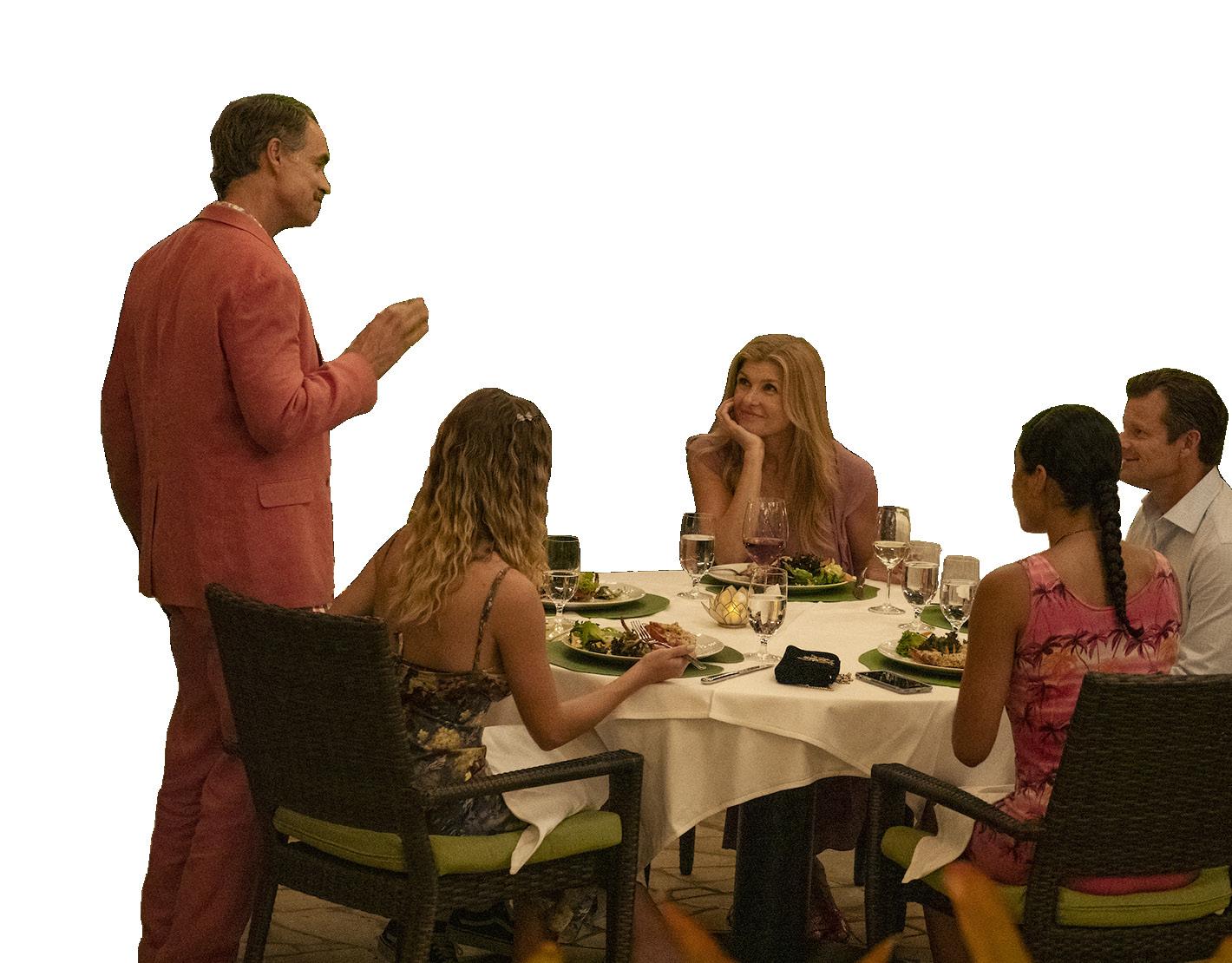
Many staunch fans of The White Lotus may argue that this dissonance is the show’s very intent; as if perpetuating the rigid institutions of privilege and whiteness is somehow an indicator of intellectual transcendence. However, the misaligned notion that reenacting injustice opens up discourse is rooted in the very institutions that the show’s creators claim to abhor.
Each character in The White Lotus advances the show’s underlying message about privilege. There’s the chronically unlikable white dude with a hefty trust fund and an inflated ego (Jake Lacy). There’s his newly-wedded white wife (Alexandra Daddario), whom he preposterously neglects. There’s a multi-millionaire middle-aged white woman (Jennifer Coolidge) who pays six figures for a luxury Hawaiian getaway to distract from her unstable marriage. And then there’s the overworked and underpaid white manager of The White Lotus hotel (Murray Bartlett), who becomes increasingly disturbed by a barrage of rude clients. Only one character color plays a salient role in this story; a racially ambiguous friend of the white Mossbacher family (Brittany O’Grady) falls in love with a native Hawaiian (Kekoa Kekumano), only to have her love interest distracted by the advances of her Mossbacher friend (Sydney Sweeny). And finally, there’s the token

black character; the “healer” on staff at The White Lotus (Natasha Rothwell), tasked with weathering the emotional hardships and back pain of the hotel’s overwhelmingly white clients. One egregious example of white privilege solidified my hesitation surrounding The White Lotus. In the very first episode, the aforementioned manager informs a Native Hawaiian on staff of the “tropical kabuki” of concealing her identity to appease the “five-star” guests set to arrive. The fact that this staff member is Native Hawaiian racializes the encounter and left an unsavory aftertaste. The lack of intentionality in the show’s commentary was alarming.
The issue that ties my previous gripes together is that The White Lotus is unknowingly hypocritical. Despite whitewashing privilege and colonialism, the show still attempts to challenge these systems. There is a prominent plot point towards the end of season one that perfectly encapsulates this duality. A friend of the Mossbacher family expresses disinterest in participating in the ritual of watching hula dancers, objecting to the capitalist fetishization of Native Hawaiian culture for a
predominately non-Hawaiian audience. Her argument about the corruptive nature of privilege and capitalism is ultimately bookended by the white family’s justifications for partaking in the hula rituals. It sends the message that if nonwhite people critique unfair systems, their opinions will be rendered baseless. It also leaves the narrative on an uncertain note; when the verdict should be unanimous that these rituals are inherently fetishizing.
Nonetheless, The White Lotus loves to have it both ways. In season two, a character of color is centered. Harper (Aubrey Plaza), half Puerto Rican, is reluctantly thrust into a vacation in Sicily with her husband, his irksome frat buddy and his equally irksome wife. Playing on Harper’s lasting discomfort, the show posits that white privilege is isolating, a message that may have been obfuscated in season one. However, the show’s multiple storylines delegitimize this crucial takeaway.
I love a binge-worthy show set in one of the most storied locales in the world. However, when people of color and Native islanders are erased, it becomes far less enjoyable. With season two released for streaming, I’m urging fellow viewers to look elsewhere.
Grace’s Culture Corner: Transcending genre
Cozy up to these cultural offerings to
you through the dreary weeks ahead
THE PALE BLUE EYE RUSH
Where do detective horror and twisted biopics intersect?
The Pale Blue Eye, a fictional story about a real historical figure, is the cross between these two subgenres. The film follows a young Edgar Allan Poe as a new police recruit entangled in a murder investigation.

Based on Louis Baynard’s 2003 novel of the same title, The Pale Blue Eye not only features a starstudded cast including Christian Bale and Gillian Anderson, but also a cross of genres, including mystery and historical fiction, in its plot and cinematography.
ALL THE DARK PLACES
Terri Parlato’s All the Dark Places portrays a group of friends torn apart by the murder of the protagonist’s husband. The novel follows Molly, the widow of the late psychologist Jay. Molly tracks stories from the past as an attempt to make sense of the crime, but ends up uncovering more than she anticipated. All the Dark Places combines elements of thriller and realistic fiction, creating a story filled with unconventional narratives and connections that withstand time.

Italian rock band
MÅNESKIN is set to release their third studio album, Rush!, in early 2023. This record is a sequel to their first two albums, but also a collection of other singles which they had made in the past years.
MÅNESKIN is known for its 1970s nostalgia and its members’ comfort with their public personas and sexuality, making their music an invigorating listening experience. This new album will continue to expand on the band’s creative talents and expression.

Expected Dec. 23
PAGE 8 THE NUEVA CURRENT 12/14/2022 ARTS & CULTURE
STORY Grace F. PHOTOS Netflix, Grace F.
sustain
Expected
20 Expected Dec. 27
Jan.
Everyone is talking about season two of The White Lotus—remember when season one erased characters of color?
The hit show refuses to reckon with its contradictions
IN REVIEW
NEW SEASON, NEW CAST Season two of the show features an entirely new cast—a transparent attempt to sweep season one's missteps under the rug.
HOLIDAY SCHEDULES
An examination into how Nueva prioritizes different holiday breaks.
INVENTION STUDIO
How
Lights, camera, social impact
TUTORING PROGRAM
Natalie S. ’25 offers academic support through a program she co-piloted.
READ MORE ON PAGE 11
Student-led club seeks social impact through filmmaking
The first subject Oliver C. ’25 filmed never said any words. Three years ago, Oliver was merely fiddling around with iMovie, editing videos of his newly adopted dog, Choco Pie—a black and white bernedoodle quick to dig up holes in Oliver's garden yet even quicker to capture everyone’s hearts.
Since then, Oliver has pivoted from dog documentaries. This past November, Oliver and a group of Nueva student filmmakers set up their cameras in Muir Woods, a national park in Marin County, to document visitors’ and park rangers’ perspectives on climate change.

This group, consisting of sophomores Maya S., Ethan H., Izzy F., and Oliver, is a part of the Social Impact Filmmaking Club (SIFC). Formed at the end of last year and led by Oliver, SIFC aims to use film to inspire social change in and beyond the Nueva community.
“[Filmmaking] is a medium to express the larger issues at hand,” Oliver said. “It just makes it all the more powerful to show others.”
Under the towering redwood trees in Muir Woods, the group highlighted the role of global warming in the gradual disappearance of San Francisco’s famous fog. Oliver emphasizes that while the fog may be seen as a “small aspect of life,” it is consequential in protecting the environment and climate.
“We want to showcase to Bay Area residents that climate change is not limited to the ‘big name’ things you hear about, such as wildfires and tornadoes,” Oliver said.
For Ethan, a videographer of the club, the range of voices they received from the park visitors was illuminating.
“We heard people’s experiences and how [the climate] has affected their lives from Brazil to New York to Pennsylvania,” Ethan said. “Filmmaking is a way to share stories and inspire people. Getting opinions from all over the world is awesome.”
The club expects to release this documentary spotlighting global perspectives on climate change this spring.
Until then, the club found opportunities to showcase student voices in the school microcosm. In late October, SIFC released their first short film, The 2022 Nueva ArtistsSpotlight, an opportunity for students to display their artistics talents and inspirations.
“Seeing all this art on the monitors and walls, I was curious about the story behind them,” Oliver said. “By interviewing them, you get to capture their motivations and why they create. I think that’s more powerful than just seeing something and being like, ‘oh, that’s pretty cool.’”
It was for the same reason that Gigi S. ’23 signed up for the film.
“[The viewer] will get to know more about the artist behind the art and the vibrant community of art,” Gigi said, who advocates for more opportunities to showcase and talk about art on campus. “I’m
SPACE FOR ARTS
How can we create more space for student artists to work?
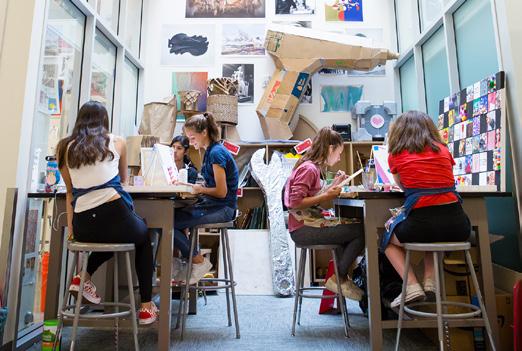
onto their next Nueva-centric production: Humans of Nueva.
Inspired by Humans of New York, a photoblog and collection of interviews collected on the streets of New York City by photographer Brandon Stanton, the club is creating a Nueva-centric version with “a vision to center students,” according to Ethan. The ongoing video series is to be released approximately every six weeks.
The first of the series, released on Nov. 28, spotlights equestrians Emi Y. ’26 and Mari M. ’25.
Nueva community.
“I would define success for Humans of Nueva if it inspires students to go up to the person and talk to them because they are interested to learn more about it from the person themself,” Oliver said.
Looking forward, club member Kayla L. ’26 hopes for the club to expand and welcomes students with all ranges of experience levels, skill sets, and perspectives to join. An aspiring filmmaker herself, Kayla is grateful for the opportunities the club has provided.
really happy this club addressed that. This was them saying, ‘we do value art.’”
The film, spotlighting six student artists, ultimately took eight hours alone to edit—a “grueling” process for Oliver.
“There’s a saying that says, ‘for every minute of footage in a movie you see is an hour of editing,’” Oliver recalled. “Probably even longer.”
Despite the labor-intensive production process, the club hopes viewers can “walk away with a newfound appreciation for the artist community at Nueva” and reach out to artists to learn more.
With one project done, the club is
FINAL WEEK Luke De works with students in XRT in his last week before he leaves the school. Reflecting on his time at Nueva, De said, “I don’t know if many people get to go home at the end of the day and say, ‘I have done good in this world.’ I do."
A cultivator of community and curiosity
PHOTO Aaron H.
Upper school science teacher Luke De led many lives before settling into the third floor science pods. Before turning to the world of science research, he waited tables in restaurants and served drinks as a bartender. Securing a job at the Genome Research Institute of Cincinnati, De met Dr. Randy Seeley, the mentor who pushed him to become a mentor himself.
With support from Seeley, De pivoted to a career in teaching, eventually joining Nueva in 2015. For seven years, he has
pioneered the Experimental Research Team (XRT) classes and advised the clubs Discussions and Talks About Science (DATAS) and Project 80. However, his chapter at Nueva will come to an end on Friday, Jan. 6.
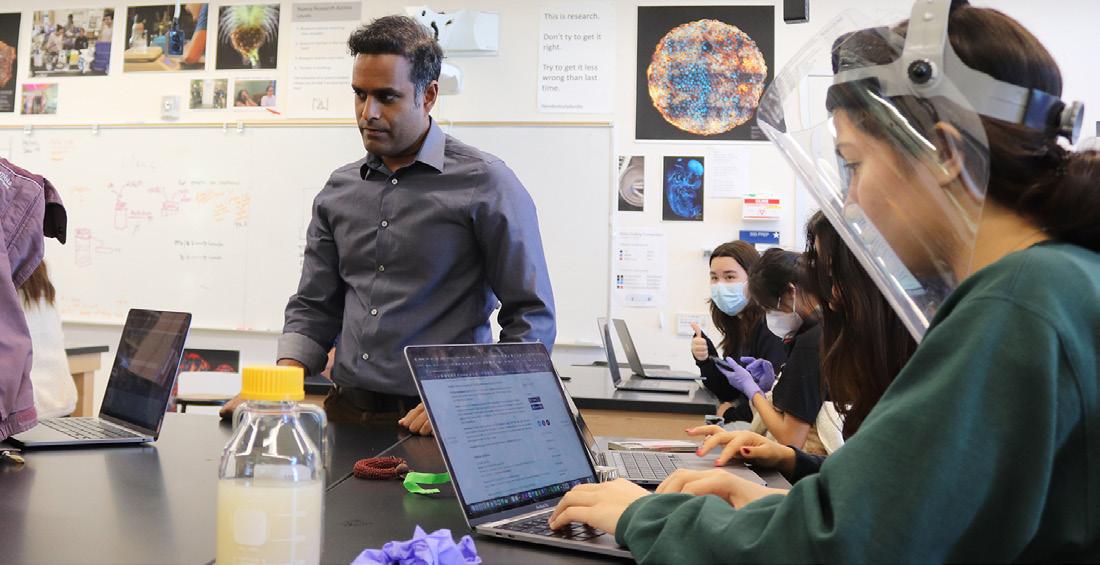
While De has yet to determine what he will do next, he is confident he’s “not giving anything up” but walking away with a wealth of experiences. On top of everything he’s done at Nueva, he believes his relationships with students to be his “greatest achievement.”
“I still get notes from students I’ve had years ago, and I hope that continues,” De
“If you saw them in the hallway, you would never know they do that every day for hours behind the scenes,” Oliver said. “Through this film, we hope to highlight that people are not just walking faces around campus but people you can interact with and learn more from.”
Even as a fellow equestrian, Mari was just as “blown away” watching Emi's vaulting video.
“It hit me how people who weren’t familiar with vaulting would be so blown away by what she was doing,” Mari said. “That realization made me smile and got me so excited to have the video be shared and to gain more exposure for vaulting in the Nueva community.”
Believing the spotlight is “another way to create social impact,” Oliver aims to “show another layer of depth” to members of the
said. “I think there’s very little of greater value in this world than a bond between two human beings. I’m immensely proud of the bonds I’ve formed with my students.”
To Micah B. ’23, a participant in DATAS, Project 80, and XRT, De has a penchant for bringing students together.
“I remember at the end of tenth grade, [De] hosted a little senior sendoff lunch. The sense of community, care, and passion in the group he pulled together was unparalleled,” Micah said. “From strange looks in Philadelphia restaurants to 8 a.m. jokes about hard-to-read papers, I have so many fond memories about De and the research community he’s made.”
De’s “insatiable fascination” for building systems for learning has made Nueva research “uber productive and highly effective as a tool to bring quality research into the world,” shares Houjun L. ’23, a fouryear DATAS member.
“It [gives] us students a framework to propagate this knowledge and influence others,” Houjun said. “[De] also has a positive spirit. He taught us how to have a fantastical dedication to the systems while [having fun] at the same time. Those are all qualities I will bring with me wherever I go.”
While De will no longer be tinkering with microscopes in the biology lab, he is proud of the “beautiful, complicated, [and] intricate” learning environment he’s built with
“It’s a space where creative people can unite—whether you’re a sound mixer, videographer, screenwriter, editor, Instagram pro—to tell important stories,” Kayla said. “This club has made my dream into something I can start working on right now.”
Eager to work on projects that will reach both the Nueva community and beyond, club members encourage other students, no matter their prior experience, to join.
“If you want to make a film about something you’re passionate about, go for it,” Ethan said. “It is definitely within your reach and there will be other people you can work with and help you, like SIFC.”
With the club as a “melting pot” of everyone’s skills and perspectives, Oliver is excited for what they will create next as a team, “seek[ing] to change the world through film.”
students and his fellow faculty members.
“I’m proud of how much we push each other, challenge each other, and respect each other. I’m proud we took this idea Nueva had of [focusing] on doing,” De said. “My students have risen to every challenge. There’s nothing that I’ve built here. There’s only things that we’ve built.”
De’s professional journey has been full of wins and a few especially brutal losses— he’s bombed medical school interviews, overcome addiction, suffered a heart attack, and received an artificial hip—but above it all, he is proud of what he has accomplished as a teacher.
“I don’t know if many people get to go home at the end of the day and say, ‘I have done good in this world.’ I do,” De said.
In his departure, De hopes Nueva will continue to focus on the community beyond its walls.
“I don’t think it should ever be just ‘the Nueva community.’ It should be ‘the community of which Nueva is a part,’” De said. “It should be San Mateo, the homeless shelters, the addiction clinics, the Planned Parenthood’s, the domestic violence shelters. That is the community which we should seek.”
For the remainder of the year, upper school science teachers Jehnna Ronan and Paul Hauser will take over XRT classes and upper school chemistry teacher Paul Hicks will advise DATAS.
FEATURES
CAMERA READY In Muir Woods, sophomores Izzy F., Oliver C., and Maya S. (left to right) interview park rangers and visitors for their documentary on climate change.
STORY Isabelle S. PHOTO Oliver C.
this club works with community needs to fuel their innovation.
READ MORE ON PAGE 10 READ MORE ON PAGE 10 READ MORE ON PAGE 14
“We want to showcase to Bay Area residents that climate change is not limited to the ‘big name’ things you hear about, such as wildfires and tornadoes,” Oliver said.
STORY Isabelle S. & Aaron H.
12/14/2022 THE NUEVA CURRENT PAGE 9
After seven years of teaching upper school science, Luke De departs Nueva
A look into the upper school calendar
STORY Isabella X. ART Jodie C.
Every few weeks, students sigh in collective relief as the upper school Google Calendar is once again punctuated with an event reading “No Classes.” These days off mark the administration’s efforts to—as Head of School Lee Fertig puts it—“break up the school year” and allow students time away from Canvas dashboards and WRC work sessions.
The current calendar is the result of trial and error, as Fertig and the rest of the administration aim to meet the “benchmark” of at least 170 school days per year while balancing federal holidays and commonly followed school breaks. The latter requires more conversations.
Fertig explains that when planning each year’s calendar, he aims to align these common breaks, dictated by a “paradigm that the world follows” (Thanksgiving break, February break, and spring break, for example), with other cultural, non-federal holidays.
“As innovative and iterative as Nueva is, we aren’t going to break [that paradigm],”
said Fertig, explaining that it benefits both students’ families and administrators. Students with siblings outside of Nueva can avoid having mismatched holiday schedules, and the team creating the schedule doesn't have to completely rearrange the traditional school calendar.
By slightly shifting some of these breaks, however, the administration hopes to honor more cultural holidays.
Last year, former Social Justice and Equity Coordinator Alegria Barclay began work on a cultural calendar, and Fertig notes that it’s given administrators the foresight to avoid scheduling major sporting events and college representative visits on days like Rosh Hashanah and Lunar New Year.
One change students can anticipate for next year concerns the three “Senior Days,” currently on Oct. 12 through 14, will be shifted earlier to Oct. 9 through 11. All grades will have Oct. 9 off for Indigenous Peoples’ Day, and Oct. 10 will be a faculty work day.
This change reflects the administration’s decision to utilize days off to acknowledge cultural identities. In the 2022–2023 school calendar, Yom Kippur is notably the only cultural holiday where students and faculty are not expected on campus. According to Fertig and Jewish Affinity Group leader Gigi S. ’23, Yom Kippur is distinctive for being less of a holiday and more of a “day of atonement,” where attending school is
“It’s not like Christmas. It’s not like New Year’s,” Gigi explained. “It’s a day where you fast all day, sit in synagogue, strip yourself bare, and ask for forgiveness from everyone you wronged that year.”
Jewish people, whether they believe in God or not.
“We pray for ourselves and for our sick and dying loved ones to be written in the Book of Life,” Gigi said.
So last year, when the Jewish Affinity Group discovered that school would remain in session on Yom Kippur, many Jewish community members, who were still reeling from a recent hate speech incident, went to appeal the decision to not offer the day off for everyone on Yom Kippur.
“It just felt hypocritical, after everything that was said during restorative justice, to remove a holiday so fundamental to a community that had been so recently hurt,” Gigi said.
Upon hearing perspectives from the parent Jewish Affinity Group, the administration was quick to reverse the decision, maintaining Yom Kippur’s position as a day off on the school calendar.

Fertig adds that while he would love to give students days off for more holidays, it isn’t feasible due to the sheer number of holidays that Nueva families celebrate. He estimates that if every cultural holiday was given time off, there would be fewer than 160 school days per year.

Yom Kippur was not the only day that the school calendar saw added in these past few years, however. Prior to the pandemic, students and faculty were only given three
Nueva makers invent to save the world–in high school
days off for Thanksgiving break (Thanksgiving Thursday, along with the two days before and after it), while after online learning, students could enjoy the entire week of Thanksgiving as a respite.
Fertig explains that this was a purely practical choice. At the peak of the pandemic, students and teachers alike were “in desperate need of some time off.” Adding more days to Thanksgiving break would allow much-needed rest during the fall semester while also lending families more “critical mass” with their days off.
“We decided that it’d be better to have an entire week off than to scatter it with one day here, two days there, and another off over there,” Fertig said.
While he admits that, symbolically, lengthening Thanksgiving break seemingly elevates the holiday’s importance, Fertig maintains that what it really elevates is “the importance of a little bit of downtime that happens to be attached to Thanksgiving.”
Fertig’s hope is that these scheduling decisions will allow students to feel both culturally acknowledged and academically rejuvenated, and looks forward to revealing the product of hours of administrative discussion, Nueva Parents Association screenings, and dean meetings: the 2023–2024 upper school calendar.
i.Studio teams develop original assistive inventions to promote compassion and equity
SALUS
KYNTIC
PERCH
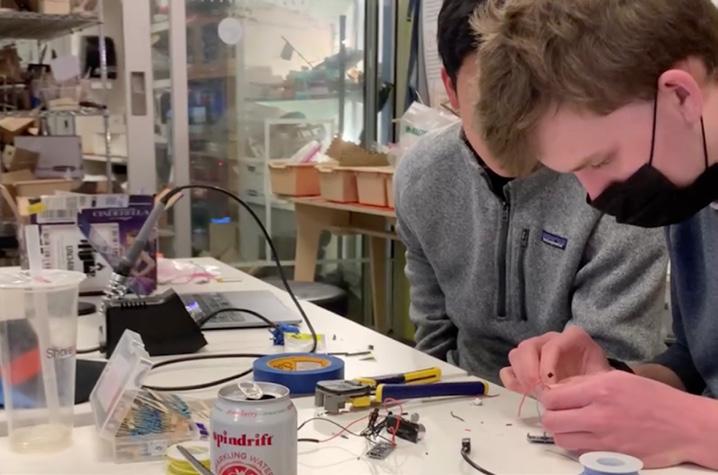
Taking original ideas from whiteboard drafting to functional final products, Invention Studio, or i.Studio, teams simulate start-ups to develop human-centered products. The student-led club was launched in 2015 by former I-Lab teacher Connie Liu as a part of Project Invent, a nonprofit for students to learn about design thinking and innovation, and is now overseen by I-Lab and design thinking teacher Morgan Snyder. Projects vary between sub-teams, but all cater towards a specific group who are underrepresented in existing technology due to factors such as age, race, disability, or socioeconomic class. Teams conduct user-testing from the product’s target audience to receive feedback for their product’s functionality, and some apply for funds such as “The Joey Scholarship Fund,” grant program based in Nueva that grants up to thousands of dollars to recipients creating assistive technology.
“We want to help kids do social entrepreneurship. I look at i.Studio and see them as a collective of 100 people saving the world together,” said Houjun “Jack” L. ’23, one of the i.Studio student captains alongside Logan R. ’24 and Charlotte R. ’25.
In the spring, subteams are matched with and receive feedback from mentors who work in the respective field of their project. For a culmination of their efforts, teams look forward to Demo Day, where they present their inventions at various stages of development to the Nueva community, visitors, and a panel of professional product engineering judges. Meet a few of the current teams.
Salus, created by a duo of seniors, Lucan L. and Thomas R., is a headlamplike device, mounts onto hats of all sorts to assist the visually impaired and legally blind in navigating head-level obstacles that traditional hand-held walking canes cannot detect. The team expects to transition their final prototypes into a commercial product by the end of the school year.
The duo joined i.Studio in freshman year and inherited Salus from Alumni Nico Lit ’20, who had been working on an upwardsfacing sensor that could be mounted on a walking cane.
However, after the primitive prototypes were tested by members at the Berkeley Lighthouse of the Blind, a clinic specializing in care for adults with low vision, the testers reported that the sensor “messes up the weight and feel of the blind cane,” Thomas said, prompting the product’s pivot to its current model.
Lucan adds that the most “enlightening” thing he has learned from the past four years is that trial and error is “just a part of the process.”
After joining i.Studio in 10th grade with a shared interest in pediatrics, seniors Serena S. and Juliet S. discovered a lack of technology in the Tourettes community tracking motor tics, which cause rapid motions in different parts of their body.
According to Juliet, the current tictracking system is manual, leading to high error rates in a data set crucial for therapists and doctors.
Kyntic solves this problem as an automated, wearable sensor which connects to an app to track both tic frequency and environmental factors that could have triggered the tics.

In the past two years, the two have reached out and connected their product with many different medical officials and Tourettes communities, including the Tourettes Association of America. The team aims to complete Kyntic by their graduation.
"It's been incredibly rewarding to support an unrepresented community," Serena said.
The idea of PERCH first came to Kian S. ’25 in Design With Impact, a mandatory product design class for freshmen, during a final project in June meant to simulate a simplified i.Studio-like startup project. And, wanting to take the project further, Salimi and project partner Teddy G. ’25 joined i.Studio at the beginning of the school year and formed PERCH.
With PERCH, a communication and database website, the team hopes to increase medical literacy between physicians and patients, especially for patients with limited high-level English proficiency. So far, they have done user testing on family and friends, including Kian’s mother, who is a physician, and are creating mock-ups of the website on design platforms like Figma.
“We're hoping to soon transition into some actual back end and front end development to create a working prototype version of the app,” Teddy said.
While Kian focuses on the conceptual, user-design aspects of the website to ensure relevancy and readability of the website’s content, Teddy takes charge of the programming and technical aspects with prior coding experience–together making a well-rounded team.
For more information on i.Studio and to join or start a team, check out their website: https://www.nuevaschool.org/istudio
PAGE 10 THE NUEVA CURRENT 12/14/2022
Administration aims for both cultural affirmation and academic rejuvenation with select days off
FEATURES
STORY Natalie L. PHOTOS i.Studio
WHATCHA DOING? Seniors Lucan L. and Thomas R. (left) wire an early prototype of Salus; seniors Serena S. and Juliet S. (right, not shown) model and photograph Kyntic and its hardware.
No ‘I’ in all-around success for the parliamentary debate team
Cumulative back-to-back victories are a testament to the team’s growth
STORY Josie B. PHOTOS Riyana S.
In Long Beach, California, cheers ring out as a crowd of students lines up to form a human tunnel. Moments later, seniors Riyana S. and Abi W. parade under the crowd’s hands, accompanied by the opening notes of “Silk Chiffon” by MUNA and Phoebe Bridgers.

The parliamentary debate team had left for the annual California State University tournament days earlier, and after a weekend of rounds, it was time to celebrate an exciting victory. Riyana and Abi took first place overall, winning the tournament for Nueva.
Head coach Sam Timinsky said the moment stuck with him as the team was not only celebrating a success, but also giving much-deserved recognition to their fellow teammates.
“It wasn't a question that [the tunnel] was what we were going to do; everybody did it without thinking,” said Timinsky. “It was super sweet.”
The October tournament has been far from the team's only victory this fall. If not winning overall, as they have done back-to-back, they regularly make it to
the quarterfinal and semifinal rounds of competitions.
What was the key to success this season? One important factor, according to research lead Lauren S. '24, was the team's research and drill program.
“We tend to spend only about a third of our time in practice rounds, which are actually full start-to-finish rounds,” said Lauren. The other two-thirds, she says, is spent listening to and giving feedback.
“There's lots and lots and lots of repetition, just like a tennis player hitting thousands of times.”
According to Timinsky, the group's collective effort to gather files has evolved into a strategy for encouraging teamwork as students are unified around common experiences and frustrations.
“Research is not for yourself. It's the gift you give to the team. Everybody donates from the beginning; it's the way you buy in,” Timinsky said. “Just like if you're becoming a partner at a law firm, you have to buy equity, and your equity on this squad is your donation of files.”
Ben J. ‘23, widely acknowledged as the leader of the team's culture, said another key part of the team’s practices involves adapting what they are studying
depending on what kind of tournament they are going to next. Depending on the tournament, judges will have different levels of experience and therefore require different arguments.
“Right now, we're switching from traditionally lay arguments that we would read in front of parents or inexperienced judges, to very technical and critical arguments,” Ben said. “We are talking about capitalism and we're talking about gender issues, and that's a switch we have to make.”
Ben said that this year's changes have gone beyond their topics in tournaments. With winning a constant certainty, the team has had more time to spend on strengthening group bonds.
“We've gotten to a point where we pretty consistently win things; we get close to winning most tournaments,” Ben said. “I think that's allowing us to focus more on the social aspect, like team bonding, and trying to create a positive space.”
The team's efforts to establish this space have centered on mentorship opportunities and forging connections between new debaters and experienced upperclassmen. In recent years, the group
has expanded rapidly, and it now includes 30 to 40 students from all four grade levels.
“The team is made up of kids from all different grades. It’s a good way for younger kids to get to know older kids and use them as mentors,” Ben said. “I found the mentorship program super helpful when I started; older debaters became role models.”
According to Timinsky, a new aspect of success that has come with this growth has been the cumulative wins across grade and experience levels, rather than one dominant partnership.
“When we win, it's not the same team over and over again. That’s the biggest win; not only are we winning things we have won before, but the team is winning broadly. It's not one powerhouse team,” Timinsky said.
Building the team up as a community rather than a series of individuals, Timinsky says, is one of the most important aspects of the team's future.
“The fact that we oriented ourselves first, mainly around the community, and made sure that we're collectively growing, not just one partnership, is really important.”
Sophomore’s tutoring program helps underprivileged students
Natalie S. ’25 offers academic support to local low-income, first-generation students through a student-led
tutoring program
From costly standardized test prep courses to poorly-funded public schools, successfully navigating the US education system is a pay-to-play. According to the Jack Kent Cooke Foundation, the largest private scholarship provider in the country, only 28 percent of first graders in the top quartile of achievement were from lower-income families.
Natalie S. ’25 aims to close this gap through her tutoring program, which she co-leads with a friend at Crystal Springs Uplands School in the grade above her.
Natalie started as a tutor when she was in fourth grade, and currently meets weekly with students in kindergarten through fifth grade.
The program partners with the Young Scholars program, an extension of Family Connections, a nonprofit that has provided academic and mental health support to low-income, first-generation families in the Bay Area since 1993.
“Many of the students are incredibly smart but don't necessarily have the resources to go into gifted programs or schools like Nueva,” Natalie said. “We make sure they're engaging in material that's more than what they get at school.”
Younger students focus on math and reading comprehension, while third through fifth graders receive support as they prepare for standardized testing and
essay writing.
Furthermore, many of Family Connections’ students come from Spanish-speaking families and don’t receive English language support at home. Tutors with fluency or proficiency in Spanish help to bridge that divide and ensure each student feels comfortable.
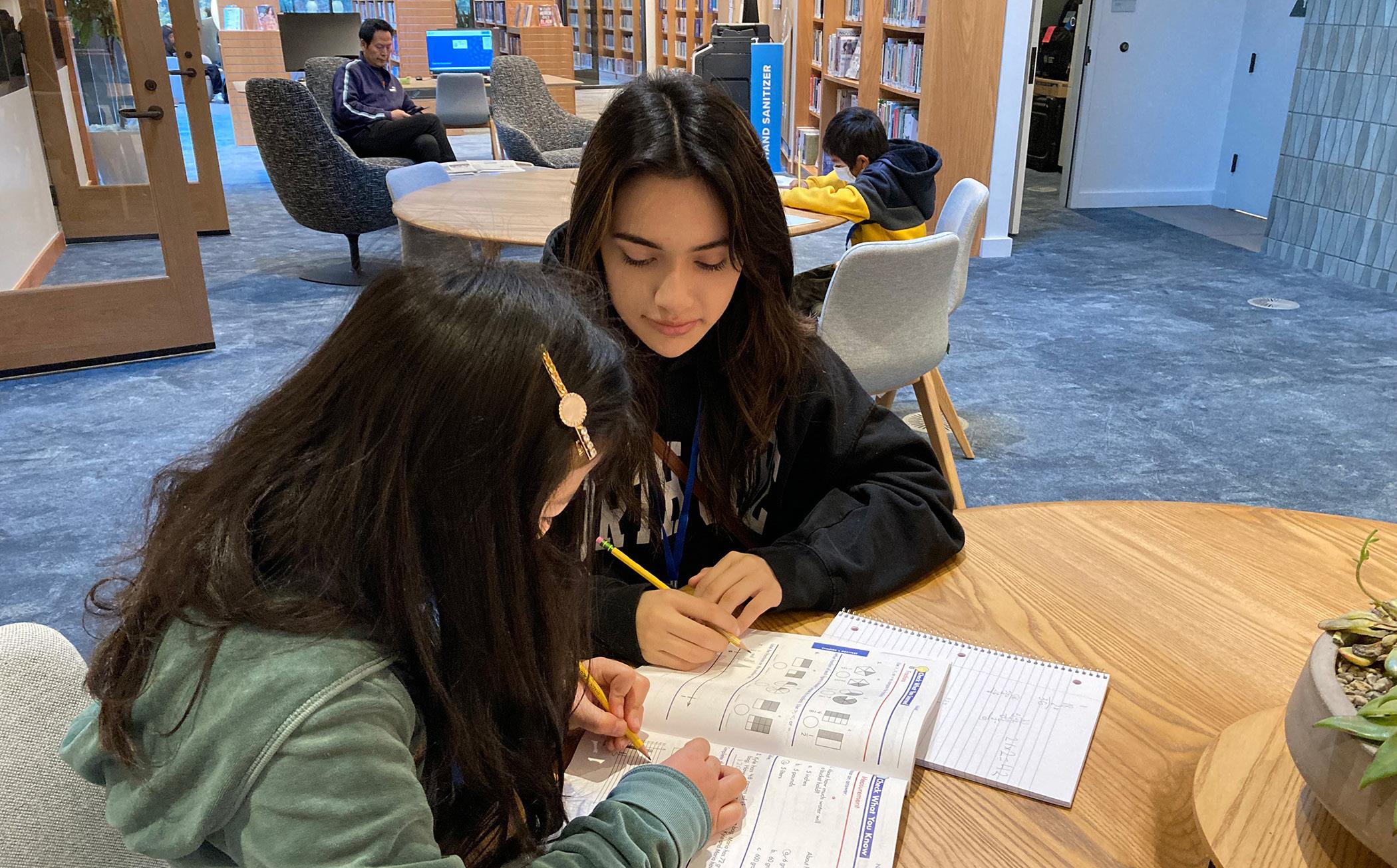
Regardless of each student’s learning background and abilities, Natalie’s program focuses on providing
individualized instruction and support.
“We strive for a one-on-one ratio between the tutors and the kids," Natalie said. If there are more students than tutors, students are grouped into twos or threes; the tutors aim to pair students who are at similar academic levels and work well together.”
Fourth and fifth graders also get a unique opportunity to tutor younger students, which Natalie says is beneficial
and enriching for both parties.
"If a younger student is struggling, how do you help them sound out a word without telling them what it is? How do you interact with them and make sure they're engaged?" Natalie said. "The older students learn a lot about how to help younger ones."
Natalie’s favorite part is seeing the students blossom and simply “smile and laugh more.”
“It's great to see the kids become more confident,” Natalie said. “When they come to us, we try to make sure that they are understanding the content, however long it takes.”
However, maintaining a stable cohort of both students and tutors has been a challenge, especially after the pandemic put the program on hold.
“Pre-Covid, we had a solid group of seven to 15 students,” Natalie said. “We're hoping to get back to that kind of number.”
In the long term, Natalie hopes to expand the program and “make sure that it will outlive [the current tutors].” Several Nueva students have already joined as tutors; Natalie encourages anyone interested to email her to get involved.
“This is something that we hope students for years to come will be able to interact with—both the tutors and the students with Family Connections,” Natalie said.
12/14/2022 THE NUEVA CURRENT PAGE 11
FEATURES
STORY Char P. & Owen Y-L. PHOTO Natalie S.
A HELPING HAND Volunteer tutor Margot S. ’25 assists a young student with math homework. "One of my favorite things is when you can tell that something has finally clicked for them," Natalie said.
TRAVEL TOURNAMENT Members of the debate team attend the annual Cal State University tournament in Long Beach. The team won 2nd, 7th, 12th, 13th, 14th, and 15th speaker awards.
Vox populi: Opening the birdcage
STORY Owen Y-L. ART Anwen C.
I. “A DOUBLE-EDGED SWORD”
“Just setting up my twttr.”
With this tweet by co-founder Jack Dorsey on Mar. 21, 2006, “twttr,” as it was originally named, unfolded its wings for the first time.
Initially prototyped as an internal SMSbased messaging service for employees of podcasting company Odeo, Twitter quickly exploded globally, growing from five thousand tweets per day to over 60 million daily in its first three years.

Much of Twitter’s allure was found in its 140-character tweet limit. What was once a capacity restriction for SMS messages sprouted a novel form of social media: ”microblogging.” Twitter became a space for “sharing funny stories, grievances, the little things that pop into your brain at 2 a.m., and everything in between,” according to Riyana S. ’23.
Riyana described Twitter as a “personal diary” and highlighted the ability to foster and join communities of like-minded users. Everyone from journalists to K-pop superfans could find a home on Twitter.
“The best thing I’ve gained from Twitter has been knowledge, book recommendations, and interesting little facts and tidbits,” Riyana said. “I follow a lot of really interesting political organizers and activists, and learning from them has definitely broadened my horizons.”
Politics, in particular, has thrived on the platform, in part due to Twitter’s emphasis on cultivating a “free and global conversation,” according to the company’s mission statement.
Many prominent political figures flocked to Twitter to join this conversation, transforming it into a virtual town square for everything from election announcements—Barack Obama first declared his historic 2012 presidential victory on the platform—to controversial opinions. Pew Research Center estimated that one-third of all tweets in 2021 were political in nature.
Jack L. ’23, an active Twitter microblogger since 2019, likened the site to a room everyone can “scream into.” But unlike other social networking sites like Instagram and Facebook, Jack said, Twitter fosters uniquely bidirectional relationships, even with celebrities or strangers.
“The thing about Twitter is not only can you scream into the room,” Jack said, “but you can also see what other very famous people are screaming into the room.”
However, the platforms of some prominent figures can have dangerous consequences.
Former President Donald Trump was one of Twitter’s most vocal users, leveraging his account to broadcast and propagate racist, Covid-denial, and other harmful rhetoric.
During the 2020 presidential election, Trump repeatedly made false, inflammatory claims about election results that ultimately resulted in the deadly insurrection at the United States Capitol on Jan. 6, 2021.
Trump’s personal Twitter account was permanently suspended two days later “due to the risk of further incitement of violence,” according to the company’s official blog.
content can achieve a global audience with a click and a bit of algorithmic luck, he said, Twitter can also be used as a megaphone for false and dangerous ideologies.
“Small conspiracy theories could travel really far because of these technologies,” Jack said. He compared the social media platform to the historical development of the mail system and the telegraph: “How is Twitter’s enabling of fringe topics any different?”
In an effort to combat disinformation, in 2021, Twitter launched Community Notes, which allows users to contribute context to potentially misleading tweets. Once enough users rate a disclaimer as “helpful,” it is displayed publicly below the corresponding tweet.

However, Twitter’s attempts to create a safer, more curated online environment would soon be challenged and even rebuilt from the ground up.
II. “THE BIRD IS FREED”
At first glance, it appears almost oxymoronic: the wealthiest person on Earth purchasing a social media platform to amplify the voices of the masses. Yet that’s exactly what Elon Musk, CEO of Tesla and SpaceX, set out to do this year.
The tumultuous saga began in April after Musk acquired a 9% stake in Twitter, making him the company’s largest shareholder. A week later, he presented an unsolicited offer to purchase Twitter for roughly $44 billion and expressed his intention to take the company private. The company’s board unanimously accepted the offer shortly thereafter.
not).” He also suggested Blue subscribers’ tweets by the algorithm, while be suppressed, purportedly
Along those lines, one reforms has been a shift of speech, but not freedom Musk described in one moderation policy remained assured, but instead of banning hateful or harmful content and made difficult to find
In a step towards this the accounts of previously including Donald Trump, was based on the results conducted with his Twitter
“Vox Populi, Vox Dei,” 51.8% voted to unban the quoting a Latin phrase meaning the people is the voice of
In another move towards speech, Twitter stopped misinformation policy, which place since 2020 to flag content.
Additionally, Musk has his distrust of mainstream an article from The New biggest failures in US journalistic of the 21st century” in a transform Twitter into an journalism by encouraging and disrupting the media’s information,” he said.
“Twitter is like open-sourcing summed up in a tweet.
While Twitter has served as a channel for prominent figures, it also plays a unique role in amplifying the voices of ordinary people.
“It creates opportunities for new voices to come out and push against dominant narratives in our society,” said upper school history teacher Tom Dorrance.
For example, Donnya J. ’23, who joined Twitter “for the memes,” highlighted how the site gives a platform to marginalized content creators.
“Viral fame due to the spread of memes gives a chance for non-white or non-rich influencers to become ‘Twitter famous’ and essentially make a living for themselves,” Donnya said.
For Riyana, however, the communitybuilding aspect is a “double-edged sword.”
“I’ve seen really adorable and heartwarming interactions, where people find their people through Tweets about shared interests or a mutual celebrity idol,” Riyana said, “but I’ve also seen some pretty disturbing examples: misogynists are provided a platform to connect with each other and I’ve witnessed people bond over a shared violent dislike of a person.”
Jack expressed a similar view: while lighthearted
In May, Musk abruptly threatened to withdraw from the deal after reports surfaced that 5% of the platform’s users were bots. In response, Twitter filed a lawsuit against Musk, claiming he had breached contract, triggering a bitter legal battle that dragged through the summer.
Finally, on Oct. 26, Musk tweeted a video of himself carrying a porcelain sink into Twitter’s headquarters with the caption, “Entering Twitter HQ – let that sink in!” The next day, he announced the completion of the $44-billiondollar purchase with a tweet: “the bird is freed.”
Almost immediately, the newly selfproclaimed “Chief Twit” began enacting a series of sweeping changes. He fired top executives and nearly half of the company’s 7,500 employees. In addition, hundreds of employees resigned, leaving a skeletal workforce as Musk began laying the foundation for his ambitious Twitter 2.0.
On Nov. 9, Musk launched the updated Twitter Blue service with the fated verification badge feature, which was later paused after impersonation accounts wreaked havoc.
Musk stated that a modified version would return in the future, with a “gold check for companies, grey check for government, blue for individuals (celebrity or
In response to skeptics, “Truth over time builds Only time would tell million monthly users would that risk.
Free speech activists Musk’s reforms, which allowed many far-right to the platform and participate consequence.
Brands, on the other hesitant to be associated harbors unchecked, potentially speech. Despite Musk’s had declined after his takeover, York Times reported that tweets using a slur against tripled. Transphobic slurs homophobic slurs by 58%, language by 33%.
Out of caution, many General Motors, Coca-Cola, paused their advertising Advertising constituted revenue in 2021, so a mass advertisers could cost the dollars annually.
Musk responded with activists for pressuring the subsequent “massive “Extremely messed up!
PAGE 12 THE NUEVA CURRENT
Elon Musk assumed complete control of Twitter in October. What could that mean for free speech?
CONTINUED FROM PAGE 1
“I’ve seen really adorable and heartwarming interactions on Twitter. But I’ve also seen some pretty disturbing examples: misogynists are provided a platform to connect with each other." How would
you
III. “A RECIPE FOR
birdcage
suggested in one interview that tweets would be “prioritized” non-subscribers would purportedly to reduce spam. one of Musk’s main shift towards “freedom freedom of reach,” as tweet. The content remained the same, he banning offenders, content would be suppressed find on the site. this goal, Musk reinstated previously banned figures, Trump, whose reinstatement results of a poll Musk Twitter followers.
Dei,” Musk tweeted after the former president, meaning “the voice of of God.” towards unrestricted stopped enforcing the Covid which had been in and remove misleading has repeatedly aired mainstream media, even calling New York Times “one the journalistic integrity tweet. His goal is to an avenue for citizen encouraging competition media’s “oligopoly on open-sourcing the news,” he skeptics, Musk tweeted, trust. Nothing else.” whether Twitter’s 450 would be willing to take
destroy free speech in America,” he proclaimed.
Dorrance pointed to this as a difficult decision Musk may have to make: fulfill his ambitions and appease his followers or retain advertisers and accept the consequent corporate influence.
“Hate speech is intrinsically an enemy of free speech. It’s just as easy to use Twitter to advance hate speech as it is to advance free speech. The difference in those two outcomes is profitability,” Dorrance said. “It’s encouraging that businesses see Twitter becoming more useful for hate speech and something they don’t want to be affiliated with.”

For Riyana, it’s not just a money battle; she fears absolute free speech could, in practice, silence certain voices instead.
whistleblowers and others who threatened him or his companies. “I think his drive to have a monopoly over free speech at the expense of safety is indicative of a broader technological crisis: big companies do not and likely will never have our best interests at heart.”
Dorrance echoed Riyana and described Musk’s ownership as “scary.”
“It goes back to the erosion of a non-market social sphere. It’s not a new development. We’ve often seen media organs serving the interests of capital,” Dorrance said. “Twitter is not a public service; it’s a for-profit entity. And I certainly don’t think it’s a victory for free speech.”
prevent the “manipulation of truth.”
“I don’t think that’s an infringement on free speech. I think it’s a precondition to free and open exchange to have mutually agreed-on terrain of exchange,” Dorrance said. “Otherwise you’re just shouting things at each other.”
Dorrance also pointed out the irony in the current Twitter debates, which he described as “a departure from earlier movements for free speech.”

“A lot of the early controversies around free speech were around the right to organize and mobilize mass protest in the early 20th century, whether it was advocating for labor rights or resisting the war,” Dorrance said. Organizations like the American Civil Liberties Union (ACLU) emerged to provide protection from government prosecution and brutality, he added.
have rejoiced over have, in particular, extremists to return participate without hand, have been more associated with a platform that potentially dangerous claims that hate speech takeover, The New that the number of daily against Black people had slurs increased by 62%, 58%, and misogynistic many companies, including Coca-Cola, and Verizon, advertising campaigns on the site. about 90% of Twitter’s mass exodus of willing the company billions of with a tweet blaming brands and inducing “massive drop in revenue.” up! They’re trying to
“‘Free speech’ that allows hateful or violent figures to spread their hate simply pushes minorities who fear for their own safety off of the app,” Riyana said. “If Elon wants ‘total free speech,’ it will only be free speech for the most powerful, hateful, or controversial people.”
Similarly, Donnya worries that it’s “going to start a lot more fights” instead of encouraging healthy discourse.
“On Twitter, everything is much more intense,” she said. “One tweet can lead to a huge Twitter storm over even the most trivial topic. It’s a very volatile place.”
Riyana also expressed concern over the prospect of a single man controlling a vital public forum, calling it a “recipe for disaster.”
“I find it laughable that Elon Musk claims to care so much about free speech, when his actions have shown that he only cares about ‘freedom’ when it benefits him,” Riyana said, citing Musk’s history of suppressing Tesla
For these reasons, many ex-Twitter users, coined “Twitter quitters,” have flocked to other social networks. App downloads for Mastodon, an open-source, decentralized platform, surged by over 100 times in the 12 days following Musk’s takeover. Another service, Hive Social, crashed after hundreds of thousands of users attempted to join in a single day.
Jack, who has already switched to a personal website to host his blog, says he has been “trying to leave Twitter.”
“Twitter is good for hearing other people’s opinions, but I’m trying to change my consumption to more about facts and be more conscious of who I’m listening to,” Jack said. “I think there should be a better solution but I haven’t found one yet.”
In the meantime, Jack doesn’t believe content moderation should extend beyond what is prohibited by law.
“Hate speech actively hurts people, but it’s up to regulatory bodies and not companies to figure out what can be said,” he said. “If you set up a talking booth in the middle of New York City, what is allowed to be said in that booth should be exactly what’s allowed on Twitter.”
On the other hand, Dorrance believes there need to be “referees for civic debate” to
“That’s the biggest transformation: we’re not looking at free speech in terms of defense from real government repression nowadays,” Dorrance said. “Ideally, free speech should be about having a debate. We see it more often that people want to say whatever they want without facing any consequences.”
The First Amendment, he explained, was intended as a way to speak truth to government power, and Dorrance believes the authors of the U.S. Constitution would, in reality, be “more afraid of the anarchical character of Twitter than anything else.”
For now, Dorrance doesn’t believe there is a simple technological fix. Instead, he highlighted the opportunities for conversation offered by educational settings.
“Non-market solutions are where we’re going to get the best debate, where the incentives are developing a more nuanced understanding of the world rather than getting the most clicks or views,” Dorrance concluded. “Schools and classrooms are great places for that. We can have an accumulation of small debates; it doesn’t have to be a single grand debate that brings about cultural or social change.”
you describe the Twitter situation in a tweet (140 characters or less)?
“We’ve often seen media organs serving the interests of capital. Twitter is not a public service; it’s a for-profit entity. And I certainly don’t think it’s a victory for free speech.”
FOR DISASTER”
Pods for the homeless: constructing a club for good
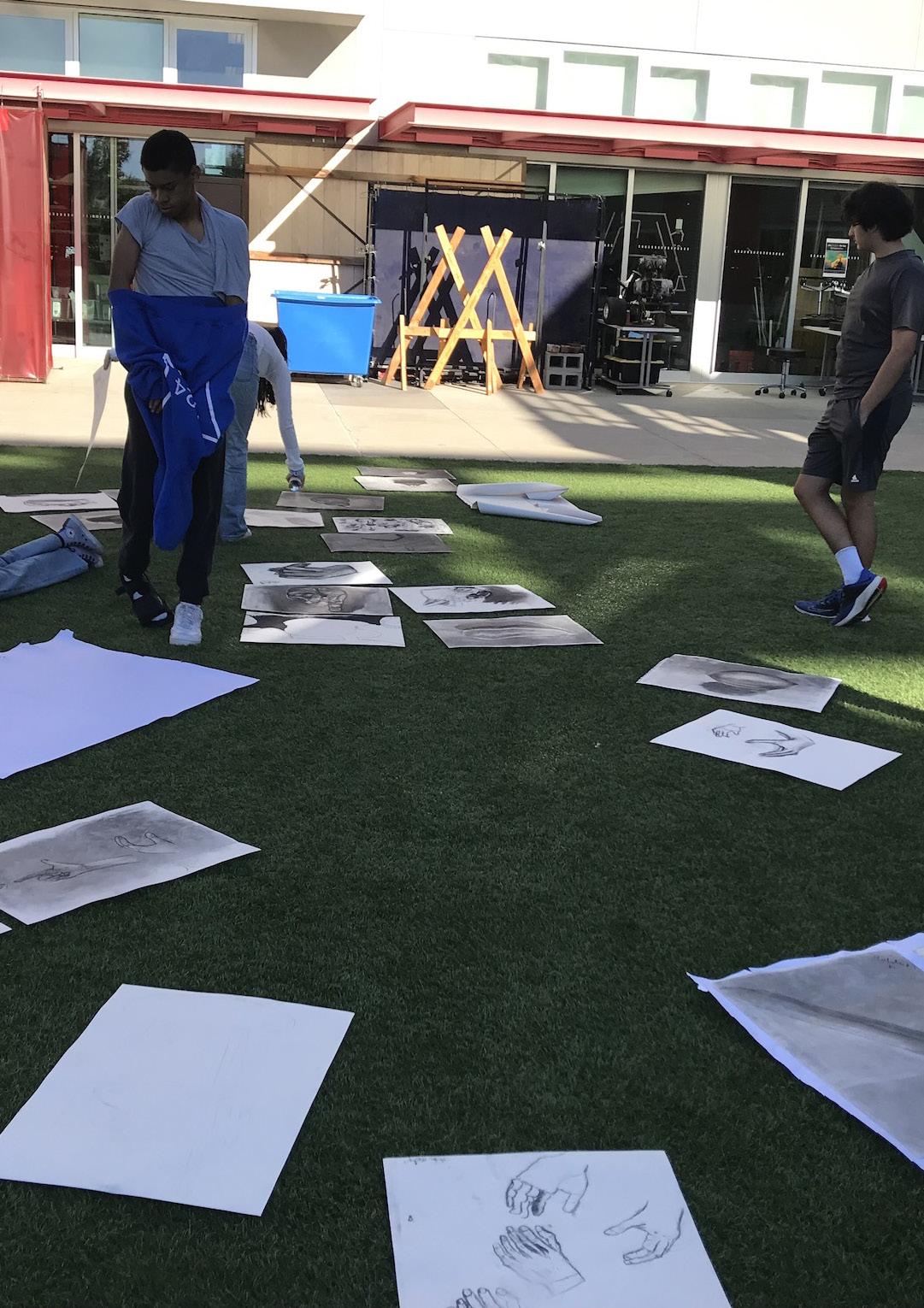
New club founded in hopes of helping the unhoused
STORY Zara M. PHOTOS Emma Z.
Inspired by arts and engineering, Carly B. ’25 began Pod Club to build shelter units for unhoused residents in the Bay Area.
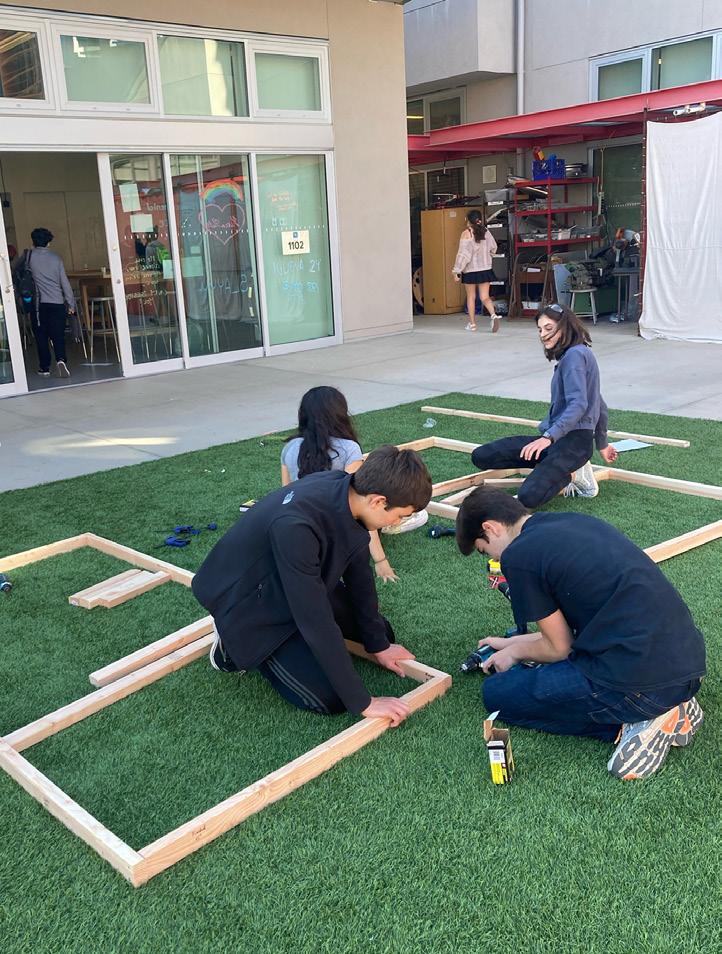
“Last year at Clubs Fair, I didn’t feel there were enough creative and engineering clubs,” Carly said. “I wanted to create a club that would teach students how to make the most of the I-Lab while also being creative and collaborative.”
Carly also wanted to make a meaningful contribution to society.
“The homelessness epidemic in this country is something I’m passionate about,” Carly said. “Each of these pods function as a home for over fifteen years.”
The club is currently cutting out windows, installing foam insulation, and assembling the finished walls. The 4x8x4foot pod is made up of 2x3 studs and plywood with insulated foam lining and two hinged doors that lock. With wheels attached to the bottom, the pods can also be mobilized.
While the club aims to complete one pod by the end of the school year, they hope to build more in the years to come. With
weekly meetings and anticipated Wednesday of Wonder workdays, the team is confident they will reach their goal.
“We’ve all been trying our hardest to finish this pod,” said club co-lead Alaric L. ’25.
Carly planned the pods’ construction with upper school shop manager George Jemmott and admin, who helped her secure club storage space.
However, this is not the first time Carly has built a pod. For her eighth grade recital project, she successfully built a pod from blueprints provided by Fred Sotcher, a 2020 intersession teacher. This year, she reached out to Sotcher again.
“He was thrilled I was starting this club and gave me permission to use his blueprint and plans,” Carly said.
This time around though, Carly has the additional support of 15 other dedicated club members. Alaric, along with other sophomore co-leads Daniel R., Luki D., and Siana K. help plan logistics and manage construction of the pods.
The leadership team meets a day before the weekly meetings to plan accordingly and divide work among the different teams. Each team, composed of around three members, works together on a different part of the pod.
“It’s great to have the Monday meeting because that way we can maximize the usage of our time on Tuesday,” Daniel said. “Since it’s just the club leaders, we can figure out what each team needs to do by the end of Tuesday.”
On club meetings every Tuesday, members help assemble the floors, walls, and windows for the pod.
“I love participating in the assembly process,” said Maya S. ’25, a member of Pod Club. “I feel like all members can
meaningfully contribute, which is what makes this club so wonderful.”
Once the pods are completed, Gregory Klochn, a contact given by Sotcher, will help the club find people interested in moving in. Klochn has made pods in the past as well.
To Carly, the “welcoming and supportive community the club has fostered” is a major contributor to its success.
“I’m so excited to run this club next year, and I can’t wait to see what the club will do in the future,” Carly said.
put in a pot that’s too small”: Art department advocates for space
How do teachers and students adapt to—and reimagine—a space constantly in flux?
STORY Isabelle S.
PHOTOS Danielle Lawrence
When upper school art teacher Danielle Lawrence walked into the art room to student works strewn across the floor and tables, her first thought was to strip the room of its whiteboards—offering more work space for students.
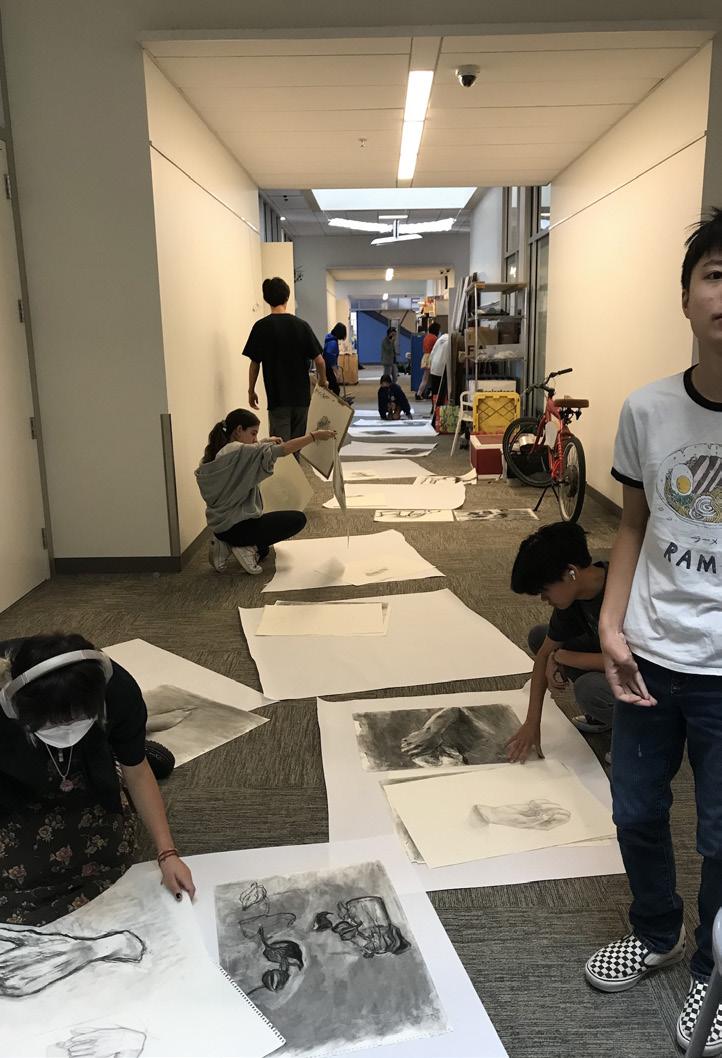
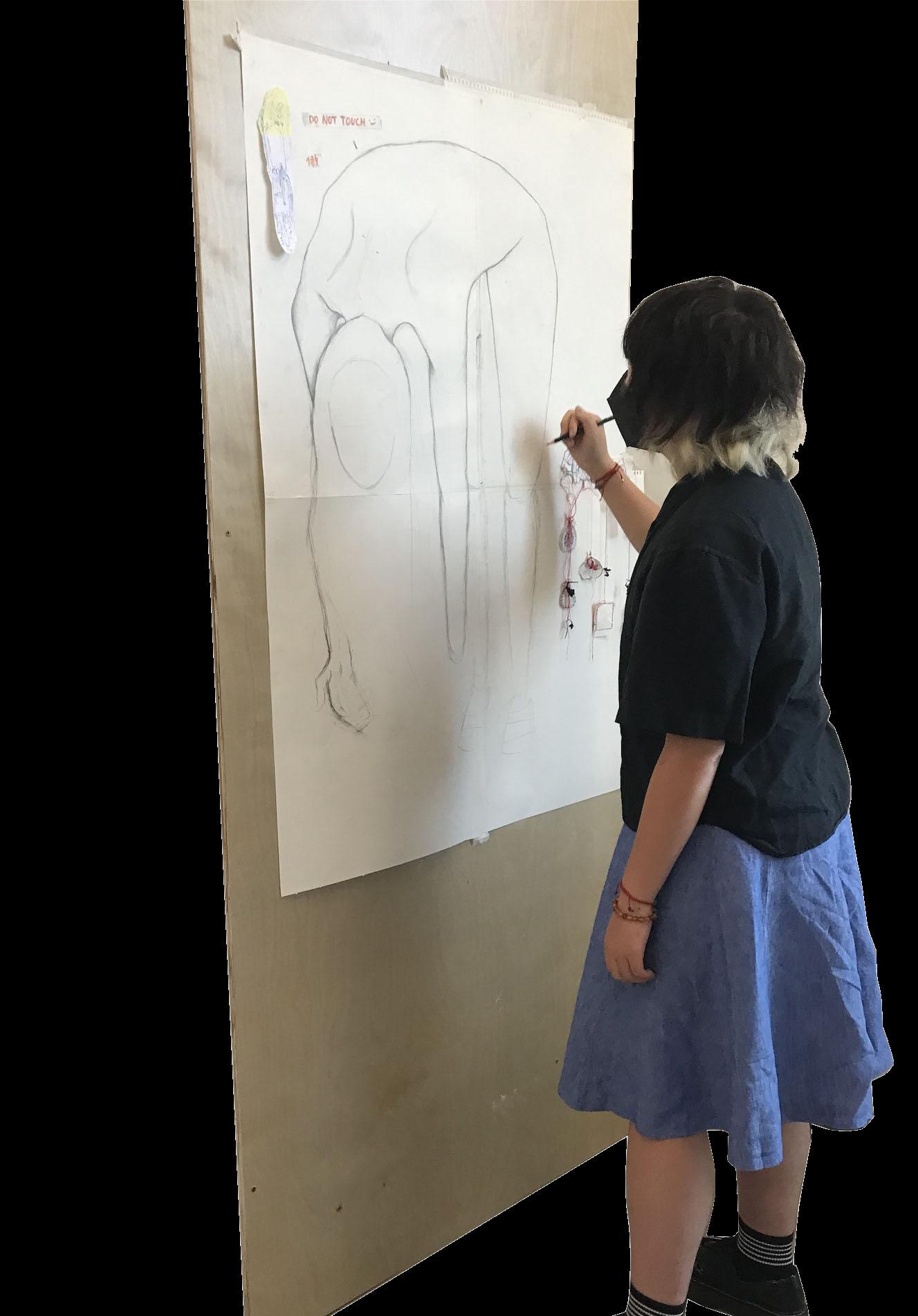
Room 101, now with wooden panels in place of whiteboards for students to tape and screw in their work, is one of two small rooms fully dedicated to the visual arts. For Lawrence, two is not enough.
“If you are growing a seedling kept in a small pot, it atrophies and dies. Nueva has highly talented students, and as an educator, I want them to be able to grow,” Lawrence said. “The space is limiting us. We’re put in a pot that’s too small.”
To Rosie D. ’23, the space does not properly accommodate the talent and artistic exploration of students.
“Most people overlook our fantastic arts program. It would mean so much if there is more physical space and supplies to aid us in our artistic pursuit,” said Rosie, who is currently taking multiple art courses. “Think about giant canvases and sculptures. What about people who want to create even bigger installation works? I’d hate to see ideas discarded because of limited space and resources.”
Because the physical space is constrained, so are materials, natural lighting, course offerings, and as Rosie mentioned, scale of student works.
“It’s just not possible with the shared space,” middle and upper school art teacher Rachel Dawson said, referring to Room 1202, a classroom designated for Dawson’s painting class alongside three other subjects. When Dawson started teaching at Nueva, she had offered oil as well, an “increasingly impossible” task now with the communal rooms.
“The paint was getting tracked all over campus because other classes would be in the studio,” Dawson said. “We’ve held off on certain purchases too, such as a pugmill for sculpture, because the idea of ‘well, where would we store that?’ comes into question.”
Consequently, the department has had to move art equipment off site.
“We used to have a huge printing press, but we had to put desks here,” Dawson said. “It impacts what we can offer.”
The art faculty, however, have been
reconfiguring the space to serve the needs of such a material-based discipline.
Lawrence has found ways to adapt— including teaching her classes outside the classroom.
“For my classes with 17 kids, how do you spread out to be able to see everything?” Lawrence said. “I’ve been taking them up to the gymnasium and out to the lawn for critiques to lay their drawings on the ground, which isn’t ideal.”
Yet, it gives students more space.
“You have to have distance,” Dawson added. “You want to put something on a wall and be able to back up, and you cannot do that right now.”
Outside of the classroom, Lawrence aims to foster relationships between art and its neighboring space: the I-Lab. She not only taught Advanced Studio Art students how to build canvases but also promoted site-specific installations in her fabrication class—utilizing the tools of the I-Lab and thinking about the “whole school as an active site.”
“We can make things in smaller compartments and take it out to a site and make it larger,” Lawrence said, highlighting one student’s project of forming a bridge across the balcony out of pieces of trash and plastic.
And for Lawrence, artistic endeavors not only travel across the hallway into the I-Lab but also STEM classrooms. Along with upper school chemistry teacher Paul Hicks, Lawrence led a Wednesday of Wonder workshop on color pigments.
“Just because we’re working with textile or paint doesn’t mean that creativity shouldn’t translate or connect with other areas of focus,” she said. To Lawrence, an artist’s critical engagement with the world is “innately intertwined” with science and math.
Ultimately, both teachers believe art ought to be shared, yet the capacity to do so is “extremely limited” in the available hallway space.
“Part of [showing art] is being visible,” Lawrence said. “How are we helping students move to the next step of their creative practice or
OUT WITH THE WHITEBOARDS Audrey Z. '26 uses the recently screwed in wooden panels in Room 101 to draw.
professionalism?”
Despite their efforts to creatively utilize space, Lawrence and Dawson still consistently adapt to classroom changes beyond their control.
“It’s almost like clockwork that every summer I’m going to get information that’s like, ‘you’re going to have this taken away’ or ‘you’re going to have to adjust,’” Dawson said.
Last summer, what used to house the printing press was transformed into cubicle art desks, which were almost replaced with other subjects’.
“I’m tired of fighting for space every year,” Dawson said.
While frustrated at times from undergoing the consistent process of pivoting, Dawon and Lawrence maintain their focus on supporting their students.
“The student body has so much potential,” Lawrence said. “We need to provide the opportunity and space to the students to really explore that potential.”
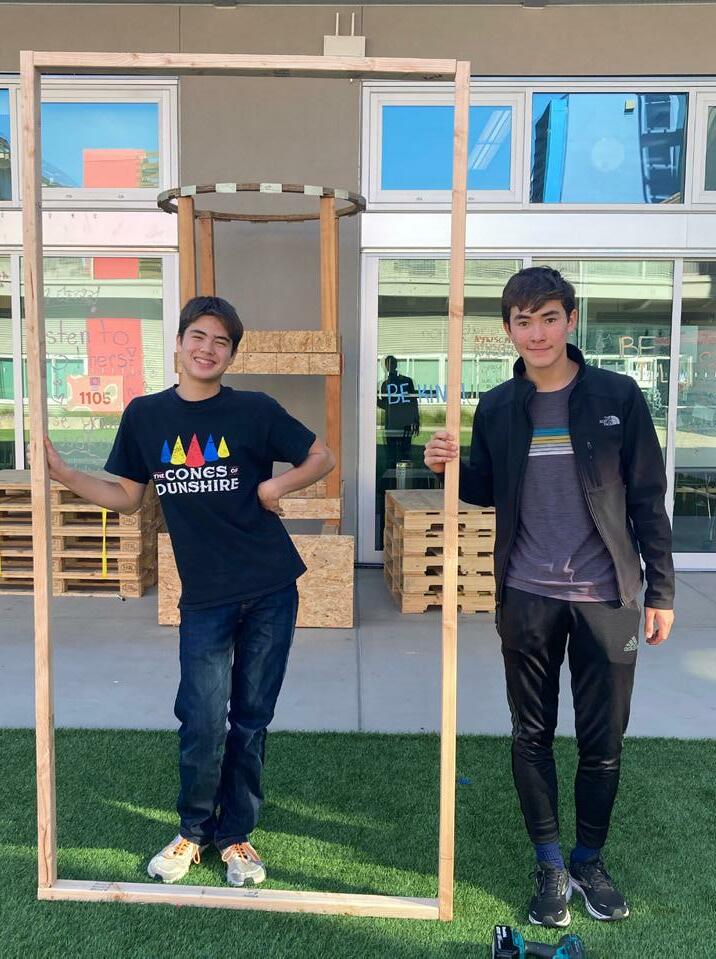
PAGE 14 THE NUEVA CURRENT 12/14/2022
FEATURES
HARD AT WORK Left to right: Justin B. '26, Alaric L. '25, and Siana K. '25 drill studs for a wall for the pod. Alaric and Justin C-B. '26 pose with finished frame of the stud.
“We’re
LAWN CRITIQUES Lawrence takes her
Introduction to Drawing class out to the Rosenberg Courtyard to lay out their pieces for critique.
AN EXTENSION OF THE CLASSROOM
Introduction to Drawing students work on their charcoal pieces in the hallway outside the art room.
It never darkens on Eucalyptus Avenue’s
December nights
Eucalyptus Avenue remains one of the Bay Area’s most celebrated holiday attractions, lighting up the night with elaborate displays of holiday spirit
STORY Ellie K. ’24 PHOTOS Ellie K. ’24
A hot chocolate dispenser, slowly dampening stack of cups, bag of marshmallows, two containers of whipped cream, and a thin layer of rainwater rest atop Sequoia High School student Quinn Dugas’ table. To each umbrella-covered passerby, Dugas asks his memorized question loud enough to be heard over the cheerful holiday music and drizzling rain: “Would you like to buy some hot
Dugas has lived on Eucalyptus Avenue in San Carlos for the past seven years. Growing up, he participated in the avenue’s famous tradition. As the winter dusk’s final drops of sunlight drip down below the horizon, Eucalyptus continues to glow; an explosion of LED lights and smiling faces scatter the “Christmas Tree Lane” of the Bay Area all throughout the brisk night, marking the return of a much-awaited event of the holiday season.
“It’s really nice to walk down the street and see everyone,” Dugas shared. When asked about his favorite memory on the avenue, he was quick to respond with the joy of strolling down the street and the “hot cocoa, of course.”
For nearly 30 years, Eucalyptus Avenue in San Carlos has been a popular destination for visitors to feel the holiday spirit, listen to music, and admire the decorations.
Each year, residents adorn their houses with twinkling lights, countless snowpeople, wreaths, three-foot-tall nutcrackers, and life-sized Santa and Mrs. Claus figures, dedicating tremendous amounts of time, energy, and financial resources to displaying the holiday spirit. Halfway along the street is a large tree covered in oversized ornaments the size of balloons towering over awe-stricken visitors. Another house hosts a six-foot-tall Grinch, while another features six leaping, glowing reindeer pulling a bright red Jeep carrying presents.


The tradition was started by homeowner David Newman, who bought his house in 1990. In 2002, he bought the adjacent house, which he combined with his first to create the avenue’s most extravagant and over-the-top festive production. Lights cover every square inch of the houses and the dozen ornamented trees scattering the lawns. Covered in a wreath, the mail box reads “North Pole.”

Residents like Dugas and Newman have spent years fostering the annual amplified holiday spirit, and often feel “iffy,” as Dugas put it, about newer residents not decorating as much.

Yet one new family on the block has lived up to the Avenue’s expectations,
decorating their front yard with six-foot tall light-up candy canes.

Arpit Dhariwal and his family moved to Eucalyptus Avenue in June of 2022. Their first experience of Eucalyptus festivities was during Halloween, during which they encountered a “never-ending” wave of costumed kids and passed out more than 1,000 pieces of candy, some of which his 6-year-old daughter helped distribute.
When moving in, Dhariwal “knew what [he] was getting into,” having read about the avenue’s fame while he was buying. In fact, selling a house on the avenue requires a mention of the tradition in the disclosure packet.
“It is a lot of fun,” Dhariwal said. “The entire process of [considering] what theme we should have, buying the lights, and setting them up has been quite nice.”
Dhariwal and his two kids, ages 6 and 2, enjoy viewing their efforts and those of their neighbors during their nightly 15-minute walks along the avenue. The most elaborate displays are on block 1900, a 12 house strip.
Residents are not the only admirers of the lights; the event has attracted countless individuals from neighboring cities and countries, often becoming an annual family destination.
Burlingame residents Christina Bianchi and her elementary school daughter, Ella, were among the mass of crowds walking
Q&A with Sajeda Amin of Population Council
Amin pioneers research on female empowerment throughout the world
Sajeda Amin leads the international organization Population Council’s work on livelihoods for adolescent girls. She is a senior sociologist and demographer with decades of experience generating evidence on empowerment programs for girls and women. She also studies the role of work opportunities in girls’ and women’s lives.
Before joining the Population Council in 1993, Amin was a research fellow at the Bangladesh Institute of Development Studies, in Dhaka. She has coordinated large projects in Bangladesh, Egypt, India, Nepal, Uganda, and Vietnam.
Q: One goal of the projects you are leading is to empower adolescent girls. So how would you define adolescent empowerment?
A: So in the contexts where I work, girl empowerment is about both raising the awareness of parents and communities about what child marriage entails for a girl, and then helping girls to be able to voice their opinions about what's good for them. Our programs try to change the way families and communities perceive girls. We help them develop some
skills to show that they can contribute to their communities in different ways. For instance, we offer lessons in computer skills or using gadgets. [The programs are] a designated place for girls to meet others and meet with potential mentors in their community.
Q: Have these training programs been effective in empowering girls?
A: The programs resulted in about a 30% decline in child marriage, a 90% decline in school dropout rates, and some increase in workforce participation. We started with very large differences between wealthy and poor girls in terms of having a voice – the wealthier they were, the more voice they had. At the end of the program, we didn't see those differences.
Q: I read that one of your main goals is preventing violence towards women. Could you talk more about how you try to accomplish this goal?
A: Our assumption is that most young girls don't want early marriage, and they're used to living with a certain type of violation of rights, violation of various things having to
do with seeking their consent. It starts with not allowing girls to have bodily integrity and control of their own bodies and sexual violence or gender based violence in general. The girls are usually married to someone ten or so years older than them. And the pattern and that power dynamic translates into a lifelong experience of powerlessness that results in all kinds of violence. Through gender rights awareness training, we are trying to teach them about learning the skills to control their environment, assert their rights, and preemptively guard themselves.
Q: I saw that the Population Council also emphasizes the importance of helping adolescent girls set health and development goals. So I was wondering if you could talk a little bit more about that.
A: A lot of the exercises that we do that are intended to promote self-sufficiency have to do with planning, articulating aspirations, and then working towards those aspirations. It's not about teaching high finance. It's about inculcating that orientation towards the future where you can have a handle on your life.
along the street. When asked for their favorite aspects of the tradition, Bianchi said “seeing the creativity,” and Ella enthusiastically replied: “All the lights!”
Lights cover practically every inch of the neighborhood, even beautifying the avenue’s Porta Potties, which are installed by the city in response to its growing popularity.
Another addition to the avenue to enhance the growing crowds’ experience is vendors selling hot dogs and lit balloons.
Jorge Martinez learned about the avenue from TikTok two years ago. He has since spent his December nights either on Eucalyptus Avenue or at the Fantasy of Lights drive-thru in Los Gatos. Martinez sells his own handmade balloons with lights wrapped inside, as colorful as the houses’ lawns.
On drier days, Martinez experiences a lot of business.
“It’s nice to see the children smiling,” he said.
While the avenue’s influx of visitors on foot and in their cars is enjoyable, some residents find the traffic difficult, especially during the weeks leading up to Christmas.
As a new resident, Dhariwal only had good things to report on his experience so far: “it’s all been positive.”
12/14/2022 THE NUEVA CURRENT PAGE 15
FEATURES
HOLIDAY GLOW UP Block 1900 of Eucalyptus Avenue in San Carlos displays some of the most extravagant holiday lights and decorations in the Bay Area.
AN EXPLOSION OF LIGHT David Newman steals the show with his intricate holiday scenes, dozens of trees, and thousands of lights.
WORLDWIDE AMBASSADOR Amin shares her knowledge of issues related to gender, work, poverty, and family in the Global South at a 2009 press conference.
STORY Elianna K. ’23 GUEST WRITER PHOTO Nestle via Flickr
SEPARATING ART FROM THE ARTIST
HOW CAN NUEVA IMPROVE ADVISORY?
CRYPTO-CURRENCY CRASH
ADVICE COLUMN
Two students discuss the morality of trying to separate the art from the artist.
EDITORIAL TEAM
Serena S. ’23, Emma Z. ’23
Editor-in-Chief
Grace F. ’23 Managing Editor
Isabelle S. ’23 News Editor
Aaron H. ’24
Opinion Editor
Ellie K. ’24 Features Editor
Isabella X. ’24 Culture Editor
LiAnn Yim Faculty Advisor
STAFF
Gabe A. ’24
Samara B. ’24
Josie B. ’25
Gabriel H. ’24
Sami K. ’23 Natalie L. ’25 Zara M. ’25 Char P. ’23
Anuj T. ’23
Roan W. ’24 Owen Y-L.’24
THE NUEVA CURRENT strives to provide informative and impactful articles for our community. Our issues cover stories related to our school, the Bay Area, California, and other relevant spheres. We are dedicated to helping readers understand the ways in which we can all make a difference in the world around us.
The opinions expressed in The Nueva Current belong solely to the writers and are not a reflection or representation of the opinions of the school or administrators.
500 print copies are distributed for free to students and faculty members in all three of Nueva’s divisions.
The Nueva Current is a member of the NSPA and CSPA.
QUESTIONS, COMMENTS, OR SUBMISSIONS?
We welcome your voices. We accept photographs, letters to the editors, articles, illustrations, and other pieces of work. Please email us at thenuevacurrent@ nuevaschool.org.
STAY CONNECTED www.thenuevacurrent.com Instagram: @thenuevacurrent Twitter: @thenuevacurrent 131 E. 28th Ave. San Mateo, CA 94403
Balancing how students spend lunch is hard enough already, but Char P. '23 has a solution.
Roan W. '24 discusses his thoughts on the recent FTX scandal.
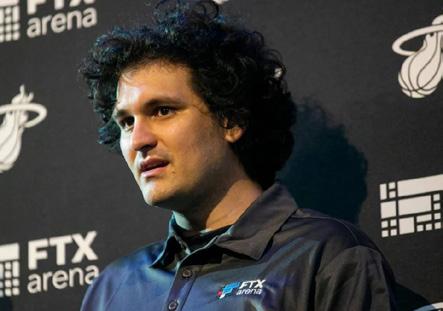
The second-ever advice column discusses time management and essay burnout. READ
Wandering off the path to find my path: My gap year in India
Snyder's gap year changed her life and pushed her to her career as a teacher. She now works as Nueva's Design with Impact teacher.
This is my first year teaching seniors at Nueva, and the frenzy of college application season has me reflecting on my own path to college and my decision to take a gap year. In fact, it gives me déjà vu…
December 2010, senior year of high school—
I’m intensely over-scheduled, rushing from AP Physics to field hockey practice to marching band rehearsal with a hockey stick in one hand and trumpet in the other, then to Starbucks for the late barista shift after school. I’m busy, I’m happy, and I know I’m supposed to be doing something about the whole college situation. I procrastinate. I apply to a handful of schools, get waitlisted at my favorite, then choose to go to a school in Philadelphia 30 minutes away from home. I applied to their engineering school. It felt like the most practically useful and positively impactful thing I could do with my mathoriented mind.
December 2011, freshman year of college—
I’m home for my first Thanksgiving break in college, and my hands are shaking, because I need to tell my parents about my plan to take a leave of absence. I explain that I want an experiential education before continuing my higher education. Instead of going to college next year, I want to work for a nonprofit that runs life skills education programs in India. I show them where on the map I plan to live: Bangalore. I tell them that most people speak English there, it’s safe, I’ll be paid, and—most importantly—I’m going. I had my mind made up.
Earlier in the semester, I revisited my reasoning for “why engineering?” and was utterly unsatisfied with my previous answers (“because I’m good at it” and “because it’s useful”—useful to whom?). I wanted a better framework to make meaning of my education, find my purpose, and do good for others in the world. I knew I love working
with young people from years of tutoring, babysitting, and camp counseling, and India had captured my imagination for years—my mom’s best friend and her husband, my engineering mentor, had shared many stories from growing up there. It was an idea I couldn’t shake: moving to India and working for Dream A Dream.
Asking “why?” again catalyzed the greatest journey of my life.
“I’m in Bangalore in a small apartment filled with my coworkers from the nonprofit, Dream A Dream. We’re playing Catchphrase, because the power is out again. We’re laughing just as hard as if How I Met Your Mother was still on the TV.”
December 2012, my would-be sophomore year of college—
I’m in Bangalore in a small apartment filled with my coworkers from the nonprofit, Dream A Dream. We’re playing Catchphrase, because the power is out again. We’re laughing just as hard as if How I Met Your Mother was still on the TV. I hear firecrackers go off from neighbors staving off boredom. We just got back from a field trip where we took a few hundred students to ride on the newly finished metro. It was a short ride because there are only two stops completed, but the kids had a blast. It’s an elevated train, and being that high up holds a special appeal when you’re 10-year-old sized. I’m tired but happy after a day of herding kids, handing out juice boxes, and leading silly dances and singalongs. Last week, we took a group of students to the Bannerghatta Zoo. Next week, we’ll take them to the Air and Space Museum. On the weekends, we take them camping outside of the city. Most of the students haven’t been outside their
neighborhoods before this.
There’s so much I’m looking forward to: planning a graduation ceremony for our eighth graders, going to Kerala to meet my roommate’s family for Christmas, fundraising for my Mumbai marathon attempt in January, showing my art at the Soul Sante fair, and maybe I’ll even do a Vipassana meditation course before I leave. Time is flying, even though life feels slower here.
December 2022, ten years later—
My decision to take a gap year in India after my freshman year of college was the most important and formative experience of my life. Wandering off the path was how I found my own path.
Leaving college for a year felt like a big risk at the time, but this set off a string of incredible circumstances and opportunities that have ended with me finding my way to Nueva as an I-Lab Teacher! After my work with Dream A Dream, I switched my major from Chemical Engineering to Software Engineering, inspired to build better technical tools for grassroots nonprofits (who often make do with paper-only processes). I founded a social enterprise during my sophomore year of college to address one of the biggest issues I witnessed among my students in Bangalore: cavities from chronic tooth decay. I returned to India for several months to pilot our first product, a xylitol chewing gum, with students in cities across the country, then in the Philippines and Haiti. They loved our “fresh fruit” flavor. After college, I stayed close to the social sector, working as a software engineer for a nonprofit fundraising startup. Until finally, my heart pulled me back into my favorite place to work and play: the classroom. At Nueva, I get to inspire students to do good with their education and never stop asking “why?” of themselves and the ever-changing world around them.
I’m grateful for my gap year, the ultimate experiential education. Over the course of my gap year, I learned how to slow down, wander, wonder, take risks, ask for help, find my voice, and celebrate the many, many different valid approaches to how one might live a good life. I also learned how to cook, meditate, and drive an auto-rickshaw.
To better represent the community, The Nueva Current is seeking letters to the editors and guest opinion essays from all readers. Letters to the editors are for readers who would like to respond to a recently published editorial or Op-Ed. Op-Eds are newsworthy or timely opinions in response to or provide commentary on current community or worldwide events.
Interested in writing for The Nueva Current? Please email thenuevacurrent@nuevaschool.org
MORE ON PAGE
READ MORE ON PAGE
READ MORE ON PAGE
READ MORE ON PAGE
17
18
18
19
PAGE 16 THE NUEVA CURRENT 12/14/2022
OPINION
STORY & PHOTOS Morgan Snyder
BREAK DANCE OR DANCE BREAK? Snyder teaches her students how to dance
COCONUT CRAZE! Snyder tries raw coconuts in the streets of Bangalore
for submissions.
GUEST OPINION
Call
Can art be separated from the artist?
Two students explain whether or not you can morally or financially separate the artist from their art
Art is in the eye of the beholder, even Ye's
STORY Aaron H.
I’ve always had a soft spot for Johnny Cash’s songs. Whether it be Hurt’s harrowing ballads about self-harm and drug addiction or God’s Gonna Cut You Down’s call for listeners to repent in the face of sin, Cash guided me through the pandemic. His songs sparked selfreflection and growth when I needed them most.
So when I think of Cash, I think of my progress and change. Hurt reminds me that “I am still right here” despite my darkest moments, and that I wasn’t lying to myself when I said, “I would find a way.”
And when critics of Cash bring up his addiction and his infidelity, I roll my eyes. Not only because everyone should like Johnny Cash’s music, but because I thoroughly believe art is not necessarily tethered to its creator.
Let’s simplify art as a form of selfexpression; by producing artwork you imprint a part of yourself on the canvas (or whatever medium you prefer). But this definition is only half-true. It only considers the message of the creator rather than the more important half, which is the viewer’s interpretation.
The audience makes the artwork anew; they imbue another point of view that recreates the artwork entirely, meaning that the artist’s intentions,
Japanese bridge in Monet’s The Water Lily Pond, I don’t think of “the illusion of an endless whole,” as Monet meant for it to represent, and I also don’t see the “water without horizon or bank.” What I do envision is the bridge in Taiwan I can only remember through photographs; how underneath my Crocs, the water lilies dotted the koi-filled pond. I feel a content, cozy joy.
But naybe Monet doesn’t convince you that art is separate from its creator. So, take Ye.
Formerly known as Kanye West, Ye has not stopped digging himself a hole since I wrote an OpEd defending the mans’ antics against Pete Davidson last year (yes, it is an OpEd I regret). But his recent words don’t change the meaning of his past songs—or what they mean to millions of his previous fans.
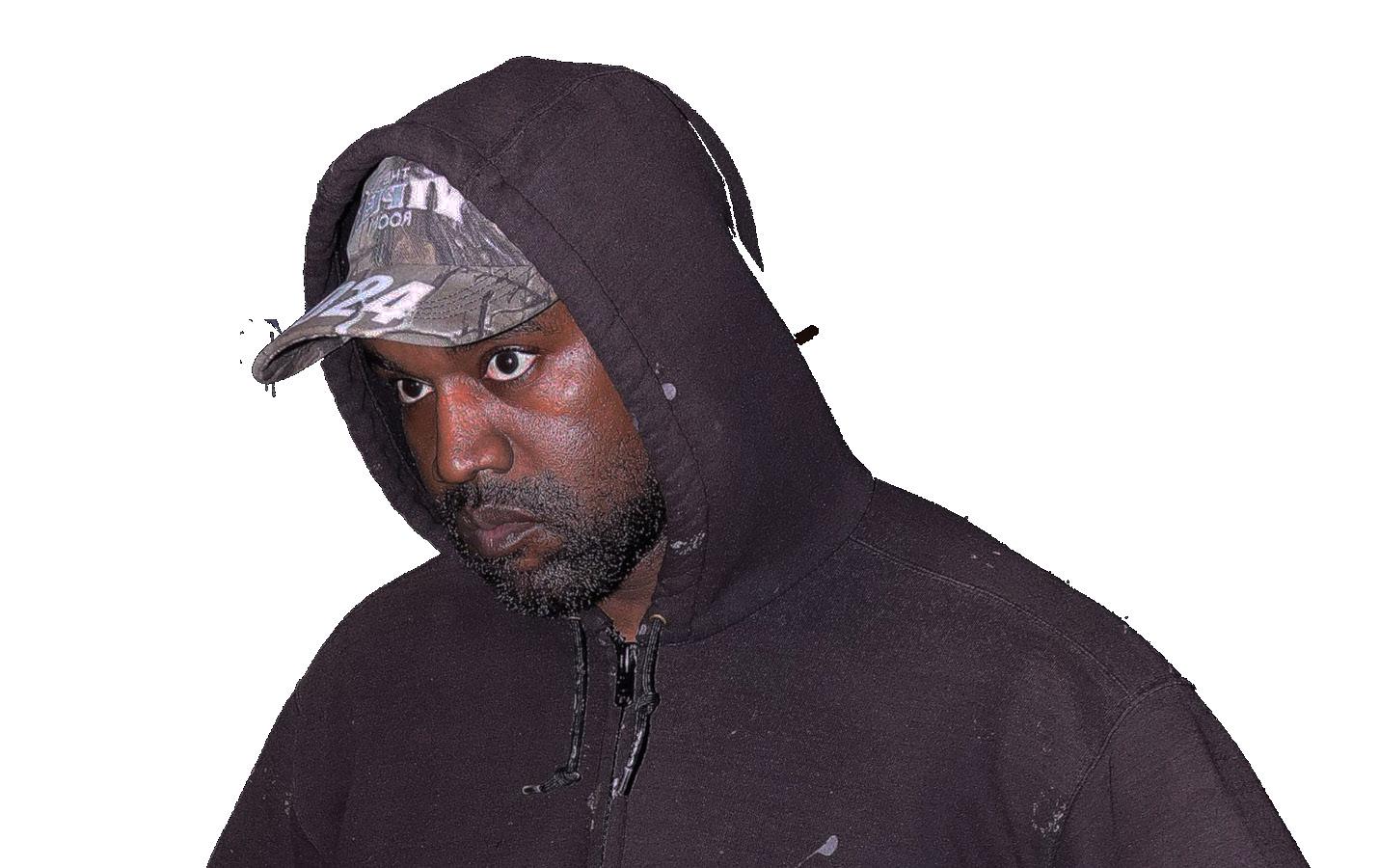
And while an art’s message is separate from the artist, the same cannot be said about money. I admit that by streaming Ye, formerly known as Kanye West, I indirectly add to an anti-semite’s bank account; by buying Balenciaga, I financially support a company that fetishized children to advertise a product. But past money, the connection between art and the artist is non-existent.


That’s why I try to avoid it all, but such desperate avoidance of anything that funds a bad corporation or celebrity
Art pads pockets
STORY Isabella X.
Morality doesn’t drive the industries— money does. It’s why Italian luxury house Dolce & Gabbana’s designs continue be flaunted on the runway and worn by the Kardashian clan, despite its decade-long history of racism and homophobia. How can a brand who famously released a $2,000 shoe called the “Slave Sandal,” and whose co-founder, Stefano Gabbana, attended a 2013 “disco Africa” themed party in blackface, continue to dictate the trends of a $1.7 trillion industry?
The answer is simple: consumers have the power to condemn corporations with their purchases. (In 2018, clean beauty brand The Body Shop announced a new policy banning animal-tested ingredients after the Naturewatch foundation called for a boycott condemning ctheir practices the year prior.) Only, we’re not.
Boycotting problematic brands and figures is hard. In a world where convenience dictates decisions (how many times have Amazon’s borderline abusive warehouse working conditions actually prevented you from ordering that free shipping, two-day-delivery trinket?), it’s easier to brush aside a conglomerates missteps in favor of consuming the products they produce. I’m certainly guilty of it. But as I add my fifth Prime item to my cart, I can’t avoid the truth: every dollar I spend is a dollar endorsing the immorality and bigotry that stubbornly continues to permeate our culture.
One infinitely convenient platform is Spotify, where artists can make up to $0.001 per stream. While this number seems minuscule, it adds up. Take Rex Orange County, an English singer-songwriter who, in October of this year, was charged with six counts of sexual assault. On Spotify, his most popular song, “Best Friend,” has amassed over 536 million streams. Assuming he makes $0.001 per stream as a well-established artist, that’s $536,000. Money talks, and that


$536,000 is saying that we as a society value three minutes of music over the victims of Rex’s alleged assault. Unless his listenership greatly drops, Rex Orange County will likely never face monetary repercussions for his actions—and that’s terrifying.
It was easy enough for me to boycott his music, but only because I was never a huge fan. For longtime stans, however, I can see why they insisted on separating his music from him as a person.
When you’ve lost an artist who you once looked up to, their art is all that you have left. And it’s hard to let go.
Like many current teens, I grew up with J.K. Rowling’s Harry Potter series.
I spent my elementary school lunches taking quizzes on Pottermore and thumbed through the books so often that they’ve fallen apart at the spine. So when, in June 2020, Rowling published an article on her website dubbed “TERF Wars” (“TERF” stands for trans-exclusionary radial feminist. In short, the article was her transphobic manifesto.), I was heartbroken. Finding out that an author whose books essentially raised me hurt. But at that point, I had to make a choice: was I comfortable with continuing to consume media from which Rowling could profit? Despite my soft spot for the Harry Potter saga, the moral trade off just isn’t worth it. For each book sold, Rowling makes 15 percent of the profits, and each movie stream pads her hefty wallet as well. Like Rex Orange County’s Spotify streams, that money adds up. There’s no justification I can make to buy a new copy of The Prisoner of Azkaban if my money is sent straight into the pockets of a TERF with a frighteningly large platform.


Still, hope remains for fans of media by problematic creators. Many books and DVDs are easily found secondhand, where the profits are sent to charity instead. And for those of us who already own all of the artists merchandise, there’s no shame in curling up with a book you already own. Ultimately, unless consuming their art is financially supporting the artist, I find no problem seperating art from the artist.
Just remember—the market is dictated by money, and if we continue to use our dollars to overlook bigoted beliefs, those beliefs will never be condemned.
it.
whose
name is Alex O'Connor, was charged with six counts of sexual assault. O'Connor has since pleaded not guilty, and has a trial set for
Cho Chang has been criticized for being the only East Asian character in Harry Potter
Furthermore, Cho is canonically Chinese, but both her surnames are Korean.

12/14/2022 THE NUEVA CURRENT PAGE 17 OPINION
REX ORANGE COUNTY
legal
KATIE LEUNG, the actress who played Cho Chang in Harry Potter, reported facing racism from fans and instruction from film publicists to not speak out against
PHOTO CREDIT: Rolling Stone, NBC, Warner Brothers
What should we think of crypto? The uncertain future of an uncertain technology
Cryptocurrency isn’t doing too hot at the moment. It’s been all over the news— whether it be the collapse of FTX or the various crypto scams that plague the internet. It continues to build a bad name for itself with seemingly unending failures and flaws, and that leaves many wondering: what should we think of cryptocurrency and the blockchain?
For me, at first, the concept of cryptocurrency seemed a bit difficult to grasp, but that makes perfect sense. Cryptocurrency doesn’t really exist in the real world like other forms of capital do, and isn’t based on any real-world indicator like stocks are. But once you break it down a little bit, it’s not too hard to understand.
The main reason that digital currencies and properties have failed in the past is because someone could just copy something you own, and there wouldn’t be any distinguishing marks to show that yours was the original or the copy. Cryptocurrency solves this problem with a unique technology—the blockchain.

The way the blockchain works is pretty neat. It’s a form of peer-to-peer encryption, in which a transaction or transfer of data is permanently logged on thousands of computers worldwide, making an irreversible
network of data. This creates a piracy and counterfeit-free environment that allows for secure transfers into a decentralized network, and if it wasn’t associated with the failures of crypto, could actually be used in some pretty interesting ways. For example: contracts can be signed digitally on the blockchain without the need of a middleman, simplifying and expediting the process, and governmental records can be filed in a permanent, tamper-free environment.
The uses of blockchain and related technologies expand far beyond just NFT trading and cryptocurrency transactions, and have the potential to make our lives much easier. However, there have been countless examples of the danger of crypto, which initially swayed me away from the blockchain. And rightfully so, considering the prevalence of scams among the crypto community.
Some of the most prevalent dangers are the pump-and-dump scams, which came into the limelight after the creators of last year’s Squid, a cryptocurrency marketed to fans of Netflix’s Squid Game, vanished with more than $3 million from investors. There’s certainly been no shortage of these
STORY Roan W. IMAGE Vincent Kilbride
grain of salt, if not more.
Imagine you find a cool up-and-coming NFT program that promises you dibs in a metaverse game, but after you pour your money into the fundraising and initial outroll programs, they vanish off the face of the Earth, deleting their social media accounts and running off with millions of dollars in people’s cash. The blockchain is not just a way to make money, but it’s also a marketplace for some of the greatest thefts in recent history.
There’s also the issue of total anonymity: if anyone gets ahold of your crypto wallet code, or a copy of it, they don’t need a login —in fact, they don’t need anything at all— to steal everything you have. This leads many in the crypto community to store thumb drives with their information in literal bank vaults.
In any case, there’s plenty of good that could come from the world of crypto, which could make our lives many times easier through the simplification and decentralization of many multi-step processes. But like anything with monetary value, it pays to be cautious. The blockchain has the power to be just as dangerous as it could be beneficial, and we need to treat it as
A note from the editors
Dear Reader, Welcome to Issue 3, Volume 6 of The Nueva Current. In this issue, we cover topics ranging from China’s borders to our local Highway 101; we hope each and every article informs you, the reader, of the wide range of pressing topics within our community.
The most pressing topic, which we decided to cover in our centerfold article, was freedom of speech. From Elon Musk’s Twitter takeover to a growing cultural distrust of news outlets, being able to confidently navigate through media has never been more valuable.
The centerfold article discusses Twitter’s descent into chaos under Musk’s leadership and the wider debate surrounding freedom of speech in our school environment and society at large.
For example, because we know that every issue is reviewed by the administration before publication, a chilling effect may sometimes take place for some articles. This provokes a conversation around the fine line between protection and censorship, on Twitter and at Nueva.
While it is important to maintain a space for healthy discourse around potentially controversial topics, it would also be reckless to encourage a free-for-all battlefield. And within the discussion of free speech, it is necessary to note the recent hate speech at Nueva towards the LGBTQ+ community.
In the past few years, hate speech at Nueva has emerged as a recurring and extremely problematic violation of community agreements; the slur homophobic found on the all-gender bathroom door the day of Nov. 16 is no different.
The editorial staff had a thorough conversation on how we would cover the homophobic incident—features, personal essays, OpEds, and news briefs were all considered.
Bringing belonging back home
What Nueva should take back from the Student Diversity Leadership Conference
STORY & PHOTO Sami K.
Last week, I discovered a sense of belonging with strangers who I would never have talked to otherwise.
Along with a cohort of community members, five other students and 11 faculty and staff, I attended the Student Diversity Leadership Conference (SDLC) in San Antonio, Texas. Over the course of two 16 hour days, I learned how to talk about eight core cultural identifiers—race, sexuality, gender, age, ability, socio economic status, religion, and family structure—and create space to connect across uncommon territory.
At SDLC, there were many ways to discuss diversity issues with family groups, similar to advisory, to affinity groups to all student spaces.
Family groups consisted of roughly 50 students and two facilitators and were named after influential women ranging from activists to pop culture icons; I was in the Serena Williams group. Participants were also broken into smaller randomly selected “home groups” within our family group consisting of five through 10 people.
Although we sat on the carpet crisscross applesauce for the majority of time in our family groups, there were plenty of activities to stretch our legs and meet new people across the room. There was a smaller version of fishbowl, with four people in the middle instead of half of the class discussing a given prompt with the option to leave and someone from the outside circle to join, to concentric circle speed dating, one circle rotating every three minutes for a given prompt, to family groups. It was an informative experience, learning about different perspectives so quickly, and one that could let students at Nueva share their contrasting viewpoints without getting singled out.
The conference also offered affinity spaces for students who identified as Black, East Asian, LGBTQ+, Latinx, Jewish, multiracial, and transracially adopted, with a white awareness space, too. I joined the multiracial affinity group on both days, but there was an option to switch between days.
The required affinity space time meant that everyone had to go somewhere, and
there was a place for everyone. All of the affinity spaces had over 30 attendees, the multiracial space had upwards of 120 student attendees with six mixed race adult facilitators, so there were many different perspectives to hear from. The multiracial space that I lead at Nueva garners three to four people at best, but there are over 50 people on the mailing list. If there was a required time for affinity spaces where everyone would have to go to one, these spaces would likely be more populated and there would be greater pride in our different identities.
At the very beginning and at the very end of the conference, there was time for students to stand for their truth through an activity called “Silent Movement” and answering reflection questions including, “how do you live like that?” which was presented in an inspirational speech by Dr. Rodney Glassglow, a DEI trainer and facilitator.
Silent Movement was a very powerful and informative exercise in which there were prompts that were read regarding a core cultural identifier students who identified with it would stand. Over 50 prompts were read, and through that time I felt so strong standing with other students and appreciated the visual indications. The 12th graders participated in a similar activity during the grade retreat, but we anonymously filled out a 25 paper questionnaire in that afternoon and then that evening the papers were randomly handed back out and we would stand for the true statements on that form. Although the activity that SDLC conducted was intimidating and more powerful than during the retreat, I think it would be feasible to conduct the 12th grade one and connect grades through our shared differences.
There are smaller versions of all of these activities currently, but incorporating them into the zeitgeist and assemblies would create a sense of pride and community for our different identities.
In the end, we settled on a news article. The news piece aims to provide students and parents with accurate and objective information without the bias of student gossip. We as a publication fully support the LGBTQ+ community, and we wanted to ensure that queer voices were uplifted and valued throughout the Nueva community.
We hope you enjoy our third issue. We’ve heard that new newspapers and winter breaks go really well together. See you in January!
Letter to the editors
From an upper schooler, via TNC's advice column survey
We collectively as a community have to get better at respecting each other by protecting each other's health. The nurse has already sent out multiple reminders of what should be common sense, and those messages have been largely ignored. Life is stressful, and we all have a lot going on in our lives that have a lot at stake: musicians, performers, and singers have shows, athletes have competitions, juniors have standardized testing, seniors have college applications and interviews.
It is inconsiderate to come to school while symptomatic, when you're more than likely infecting others and potentially disrupting whatever big events they have going on in their lives. Even without major life events going on, nobody wants to get sick, regardless of whether it's COVID-19, the flu, RSV, the common cold, or something else. You have the power to stop the spread with you by staying home. Zooming in is always an option, and your classmates and teachers will appreciate you for it. Seriously.
- Frustrated Community Member
STORY The Editorial Board
PAGE 18 THE NUEVA CURRENT 12/14/2022
OPINION
MADE IT! SDLC-attending
students and faculty try to pose after their 10-hour journey to San Antonio.
with advisory
Locking us in to 30-minute meetings twice a week leaves little time for other lunch activities
STORY Char P. ART Vickie H.
Advisory is meant to be a place for students and teachers to connect with each other through meaningful experiences. Yet in my seven years at Nueva, I’ve found far more opportunities for connection outside of advisory than in it.
Advisories are seemingly randomly assigned. It’s possible, even likely, for a student to have an advisor who has never taught them. This has happened to me every year, making it difficult for me to connect with my advisor or come to them when I’m struggling. This isn’t on them; all of my advisors have been great people, but it’s hard to be open to someone I barely know. Instead, when I need help, I’ll go to a teacher I already know and trust.
Furthermore, it can be hard for students to connect with each other at advisory; the random assignment means that I’m unlikely to have things in common with my fellow advisees. In contrast, lunchtime clubs and activities provide spaces for me to bond with my fellow students over shared interests. Advisory also leads to split-grade lunch, stopping students with friends in other grades from eating lunch with their friends.
While I appreciate the time and effort my advisors have put into planning advisory meetings, twice-a-week advisory leaves little time for other activities. On Tuesdays, I’m forced to choose between Queer Student Union and having lunch with my friends—if I’m not in a meeting or struggling to catch
up on homework. My Wednesday schedule changes every week, and often leaves me with an abbreviated lunch block. And on Fridays, I can go to Neurodivergency Affinity Group or Science Friday—but not both.
While advisory provides a welcome space to relax, it’s usually less meaningful than non-advisory lunchtimes. Why dedicate so much time to advisory when there are so many things lunchtimes have to offer?
But I also see how students can benefit from advisory if the circumstances are right. To help make advisory more meaningful, let students have some input as to who our advisor and fellow advisees will be. This could be done through a survey similar to those for trip rooming. Of the teachers advising our grade, we could list a few who we’re comfortable around or have had classes with in the past. We could also list
a few classmates who we’re friends with, with a guarantee of getting one friend in our advisory. Knowing my advisor and fellow advisees better would make it easier to open up during advisory discussions.

Finally, advisory should only meet once a week, to free up time for lunchtime clubs, tutorials, and affinity spaces. Lunch at Nueva already offers so many spaces to bond and connect; oncea-week advisory would give us more opportunities to take full advantage of those. Additionally, if advisory only met once a week, meetings would be more meaningful; it would be less difficult to find ways to fill the time.
The level of choice we have at Nueva leads to many meaningful experiences, from open-ended class projects to the freedom we have in our schedules to the variety of clubs and extracurriculars. Let’s extend that same level of choice to lunchtimes and advisory.
Advice Column
From romance to writing, the Nueva Current editorial team is giving advice.
The essays never seem to stop coming, and I can never seem to write productively when I need to or write something that I'm proud of. How do I deal with essay burnout?
- Weary Writer
This is a hard question to answer. Writers block comes in different forms for different people—some peoples’ mind goes blank, others hate whatever they produce—but here are our suggestions.
Give yourself ample time. Or, in other words, don’t procrastinate. We get it, the semester is about to end and our minds are too tired to think about major assessments, but to produce good work you need a good amount of time.
“From my experience as a graduate student,” said upper school Writing and Research Center (WRC) teacher Jennifer Perry, “when you're up against a deadline, and you haven’t left yourself enough time, you're going to submit something subpar.”
According to Perry, when you write your first draft you need to be relaxed. You need space between you and the deadline or else the pressure will be too high.
Another tip is what Perry calls “the walk-and-talk.” The walk-and-talk, which is backed by a Stanford study, has shown that walking, or physical stimulation, allows the brain to be more creative and imaginative. And whether you walk-and-talk with your dog, sister, or a significant other, it doesn’t matter as long as you’re moving and they’re listening.
And lastly, use the peer tutors. These students have been taught by the WRC team how to help students with a range of subjects.
ENJOY LIFE BEFORE APPLICATIONS! Also, learn time management early on. - Stressed Senior
moving targets
STORY Sami K.
I went to a traditional middle school, which graded based on test scores and homework success rate, which translated into a number grade, which fluctuated up or down with each next assignment. Which was frustrating at moments, but at least I knew what to expect in every class instead of hypothesizing.
When I first got to Nueva four years ago, I was confused by the standard based grading system as it prioritizes skill growth instead of knowledge acquired. While it was nice to have a freshman year of shadow grades that showed how grading would operate, four years later, I am still confused now about how exactly I am learning and being assessed on my work.
There’s no question learning is happening, of course. I know how to write a persuasive argument, find derivatives, and converse decently well in Spanish (or at least I did while I was taking the class). I’ve done plenty of essays, creative group projects, and presentations, and yet I still feel that there’s something missing.
There should be a smoother transition to standard based grading that clarifies what a student should be aiming for and how that shows up over time.
There should be a smoother transition to standard based grading that clarifies what a student should be aiming for and how that shows up over time to help students who may have gone to a school with previously simpler and traditional grading metrics.
The Nubric pilot standards set a point average which indicates that, “a ‘4’ shows full mastery, a ‘3’ shows partial mastery, ‘2’ shows an emerging understanding of the standards assessed, and a ‘1’ shows that a student has insufficient evidence for the standards assessed.”

This interpretation correlates a ‘4’ with an A, ‘3’ with a B, ‘2’ with a C, and a ‘1’ with failed course which sets up a notion that once a student achieves a ‘4’ in a certain category they need to grip tightly less they fall lower and get a worse grade than they started out with. Standard based grading is supposed to support improvement overtime, but instead it’s causing a muddled view of what type of work over the semester correlates with the grades received.
Many rubrics have the exemplary category, which at first I was confused by as the word exemplary itself seems to indicate “perfect” or work that can be used as an example for other students to strive to make. But when exemplary becomes the category for an A, it normalizes the word into something more average and less extraordinary, therefore creating a situation where an A is common and expected.
As I look into the future at college, I wonder if my expectations have been set too high. At the University of California Berkeley, an A represents “excellent”
work, a B represents “good” work, and a C represents “fair” work. The words “good” and “fair” are not words I would use for lesser work, although receiving a 3 or 2 on a rubric would indicate partial mastery and that doesn’t compare consistently. I’m unsure if I have been set up with the best tools to understand the quality of my work because of the skewed nature of standard based grading towards skills instead of knowledge.
Currently students don’t receive official grades on their transcript until 10th grade, which provides a safety net for the beginning of high school, but it isn’t enough. Through shadow grades, a student can try to learn the amount of work they need to put in for an A, but I’ve noticed that even through the feedback on assignments, conferences with teachers, narratives the distinct difference which provide some answer to this question, it’s still a nebulous process class to class, year to year.
It would be helpful to emphasize the need for both skills and knowledge which can both be learned in class and through assignments before major assessments officially grade students on their ability. Additionally, homework assignments that check in with a student’s understanding of the grading ways of the class would clarify how improvement is tracked and shows up in the final grade.
Yes! But… consider defining “enjoy[ing] life” in a sustainable way that’ll ultimately make application season much more manageable. Perhaps this means that alongside your adventures, you set aside time for less exciting commitments as a means to practice strong time management abilities.
After all, psychology explains muscle memory isn’t confined to our muscles, but can be developed in our cognitive functioning as well! While the application process can be stressful, implementing the right routines and systems of study means that it doesn’t have to be overwhelming. And with all that said, I can’t fathom getting through all my supplements without having time to unwind, on my own or with friends.
To my fellow seniors: please don’t starve yourselves of the opportunities to recuperate that you may need!
Application season shouldn’t—and doesn’t need to be—all-consuming.
In need of advice? Have a question you need answered? Maybe a statement you need people to hear? Anonymously submit it here and it might get it answered in the next issue of TNC.
Choice is one of Nueva’s core values—but it isn’t present
12/14/2022 THE NUEVA CURRENT PAGE 19
OPINION
Traversing the landscape of standard based grading is like playing infinity tag –too many
What should an “A” mean?
BY XE Y.

Issue 3 Crossword PAGE 20 THE NUEVA CURRENT 12/14/2022 ENTERTAINMENT
1 "___ about time!" 4 Green prefix 7 City near Lake Tahoe 9 Treasure hunting guide 10 Frosty treats 13 Pursue romantically 14 Felonious Gru's brother 15 Pole worker 17 Often confused with sweet potato 18 Feel sick 19 Servant of Sauron 21 Violently open (wrapping paper, for example) 25 Hit the slopes 26 Chew like a beaver or dog 27 Part of a table or chair 28 Sense of self ACROSS 1 Tax collection org. 2 X, in roman numerals 3 Unique icy crystal (no two are alike) 4 Rock genre 5 Striped peppermint treat 6 Madama Butterfly or The Barber of
for example 8 uwu 11 Hot drink for chilly days 12 Total 15 Consume 16 Eldest child in The Sound of Music 20 Video game genre 22 Fix, as an election 23 Cleaning cloth 24 Binary base DOWN CORRECTIONS: The Nueva Current welcomes comments and suggestions. We seek to publish corrections and clarifications in the subsequent issue. Please email any corrections to thenuevacurrent@nuevaschool.org. 1 DPS 4 MYTH 8 IOU 9 MAYA 10 BARB 11 APPLES 14 UNCAP 16 SOFAS 17 TEHRAN 19 ARE 20 PUMPKIN 23 PSI 25 RIDDLE 28 AUROR 31 TAHOE 32 LEAVES 34 HARK 35 TEAM 36 OLA 37 ENDS 38 SFX ACROSS 1 DIANE 2 PORCHPIRATE 3 SUBARU 4 MMA 5 YAPS 6 TYPO 7 HALFANDHALF 10 BUT 12 EAR 13 SSE 15 PAM 18 NPR 21 KIT 22 IDAHOS 23 PAL 24 SUE 26 LORAX 27 EEK 29 OVEN 30 READ 33 SMS DOWN Issue 2 Crossword answers
Seville,
STORY Josie B. PHOTOS Local Attractions

Spotify Wrapped: Faculty Favorites
STORY Serena S. PHOTO Spotify
It’s that time of year again: When Spotify drops Spotify Wrapped, the highly anticipated report of people’s annual listening trends.
We asked Nueva teachers to share their Spotify Wrapped with us. From Phoebe Bridgers to BTS, here’s the rundown of their most listened-to artists, favorite genres, and top songs.
Stroll through the magical light and décor displays at Filoli's holiday gardens! Holidays at Filoli are a time to take in colorful surroundings and spend quality time with family.

TING ZHANG: middle and upper school Mandarin teacher
“Most of my ‘top songs’ list was actually an accident—my daughter always wants to listen to music when I’m driving her, so half of my top played songs are Chinese children’s music. My number one song, ‘晴天’ (Sunny Day) by Jay Chou, however, has been my favorite since ninth grade. Ever since then, I’ve found comfort in its lyrics. Jay Chou is my Taylor Swift.”
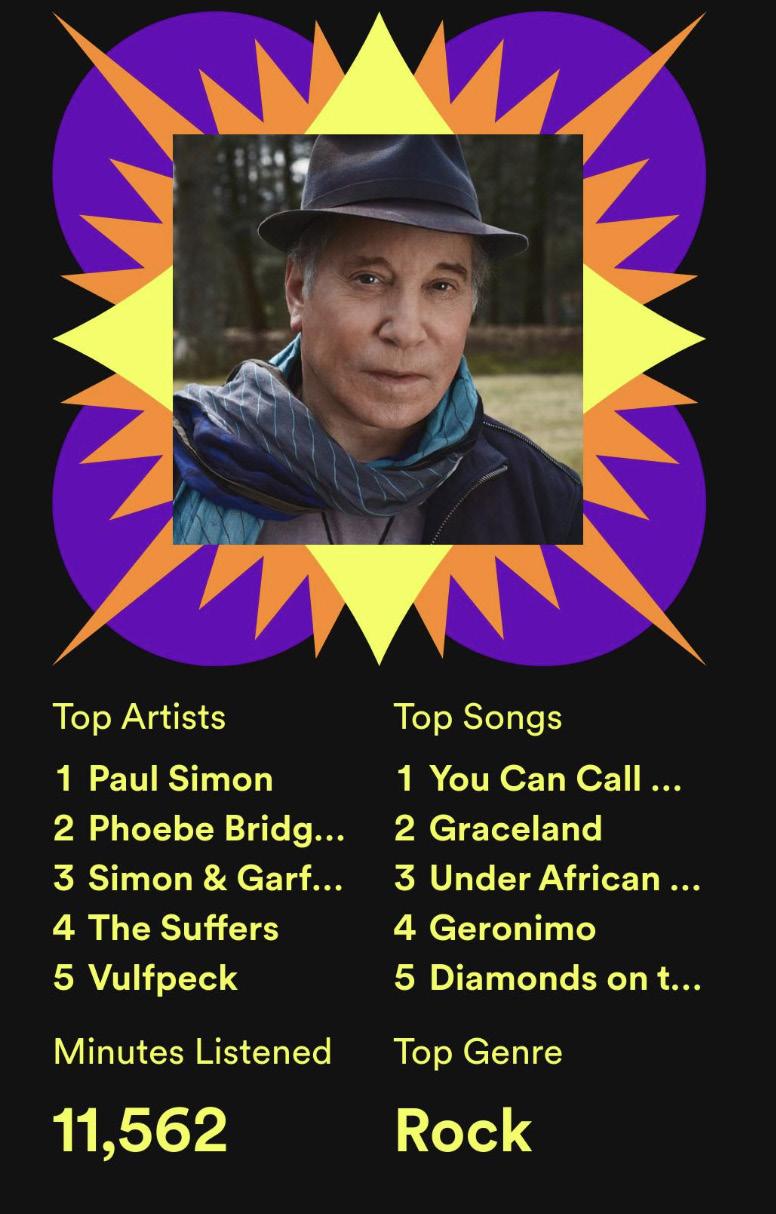
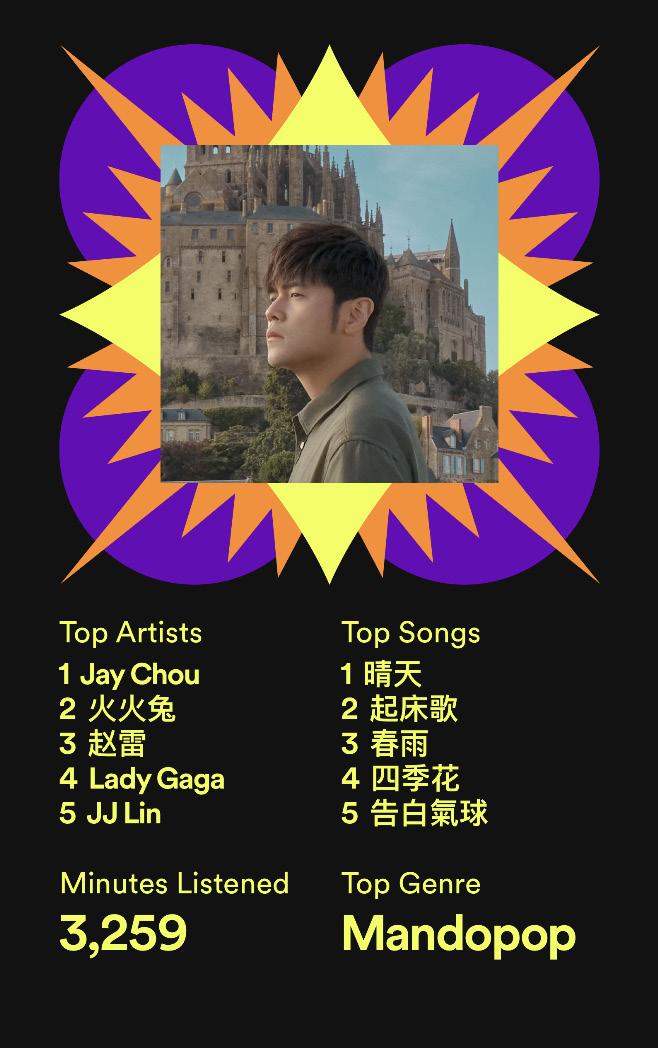
IHMAR ALDANA: upper school math teacher
“BTS’s ‘Permission To Dance’ was released back in 2021, when the pandemic was still prominent in my life. The song’s celebration of diversity gifted me with an ability to connect with the outside world in a way that I couldn’t before. It really was a lighthearted ‘Permission To Dance’ in an otherwise bleak world. Better yet, it was the name of their first post-Covid concert, which I obviously had to attend.”
The Great Dickens Christmas Fair

Glow: Festival of Lights

Artists light up Pier 15 with interactive and, most importantly, glowing sculptures, inviting visitors to “connect, play, and get inspired” by the art of light 'Tis

12/14/2022 THE NUEVA CURRENT PAGE 21 ENTERTAINMENT
Choose your own staycation Three styles of local holiday activities for a festive winter break
Route 1: Active Ice-skating in San Mateo’s Central Park Take a spin around San Mateo Central Park's annual ice skating rink as you glide into the holidays! Don’t miss free “community skate days” on Dec. 13 and Jan. 5. Route 2: Creative Route 3: Scientific
Holidays at Filoli
The Great Dickens Christmas Fair is an annual event that brings the magic of Charles Dickens' Victorian London to life. Shop for unique gifts and holiday decorations, indulge festive foods, and enjoy live entertainment.
the Season for Science Visit the two visiting reindeer, Nicky and Butterscotch, holiday musical performances, and indoor snow flurries.
ALLEN FROST: upper school English teacher
ANGI CHAU: I-Lab Director
Starbucks holiday lineup
STORY Emma Z. PHOTOS Starbucks

It’s the most wonderful time of the year: Starbucks has released their annual lineup of half a dozen festive, merry, and bright holiday drinks. Some are packed with comfort and others with cheer, but in my opinion, almost all are worth trying this holiday season, especially as winter break rolls around. For those who aren’t big on taste-testing, I’ve done the work for you—here are my personal ratings of each drink.
Disclaimer: I enjoy sweet drinks. Also, I tried all these drinks as they appear on the menu (with whipped cream) and no modifications for consistency’s sake. The only exception I made was for the Iced Sugar Cookie Almondmilk Latte, which I ordered warm rather than iced; it was 55° in the Bay Area, after all.
Caramel Brulee Latte
This latte is a hug in a cup. Each sip tucks you under thick folds of sweet steamed milk, soft vanilla, and toasty caramel. The topping of brulee bits adds a satisfying bittersweet crunch to the drink’s creaminess as well. Wherever you find yourself this break—blanketburritoed by the fire or adventuring far from home—this drink offers a holiday comfort that’s hard to match.
Peppermint Mocha
The Peppermint Mocha is rich, velvety, and oh-so-pepperminty—perhaps to a fault. While I would’ve preferred just a hint of peppermint flavoring to complement the mocha (rather than the other way around), this is the drink for you if your goal is festivity. In every other way, the taste is fantastic; considering the luxurious thickness of the mocha sauce and its delightful sweetness, it’s no wonder that the drink has been gracing the holiday lineup for 20 consecutive years.
Chestnut Praline Latte



A venti drink if there ever was one. While the taste of sugary beverages can build up unpleasantly, the Chestnut Praline Latte harbors a sweetness that is just gentle enough to enhance its nuttiness without turning it into a sweet drink. Its soft and buttery flavor of caramelized chestnuts decked with a subtle flair of spices makes this drink the embodiment of Nat “King” Cole’s “chestnuts roasting on an open fire” to its core.
Irish Cream Cold Brew

The Irish Cream Cold Brew’s bitterness is tempered by a strong vanilla and hint of cacao. However, while the drink was enjoyable, the flavor was slightly watered down and not particularly unique.
Toasted White Chocolate Mocha
This drink’s decadent nutty caramel flavor is complemented by a whitechocolate base that brews a warm, subtle sweetness rather than a strong cacao taste. The slightly bitter aftertaste makes it more of a winter drink than a holiday one—it belongs on the sill of a bay window rather than in celebrations or out in the snow.


Iced Sugar Cookie Almondmilk Latte
This drink does not deserve to be a part of your holiday season. The “Sugar Cookie Syrup” perfectly emulates sugar-coated plastic, and the only positive thing I can say about this drink is that it tasted (overwhelmingly and abhorrently) like its name—I’ll gift a single star to corporate for accuracy’s sake. I cannot fathom how or why this is a returning drink. Try at your own risk.
Hot chocolate recommendations for the holiday season



Starbucks Hot Cocoa
If you want to bring a taste of Starbucks into your home, their hot cocoa mix is a great choice (and available at Costco in addition to Starbucks stores). This mix uses premium ingredients for you to make a smooth, velvety cocoa with rich chocolate notes right in the comfort of your home.




Lake Champlain Hot Chocolate
Stop by your local Whole Foods store and pick up this hot chocolate! It’s not only totally organic but it’s also certified kosher. The chocolate is dark, rich, and sure to fill your entire body with warmth on those chilly California nights.

Trader Joe's Hot Cocoa Spoon
Trader Joe’s sells a hot chocolate spoon for just $0.99! The Double Chocolate Cocoa Spoons comes with mini marshmallows and features both dark chocolate and milk chocolate. Warm yourself a cup of milk, stir the hot cocoa spoon, and watch your milk be transformed into hot cocoa.

PAGE 22 THE NUEVA CURRENT 12/14/2022 ENTERTAINMENT
Looking for a hot chocolate mix (or something similar) to warm you up this winter? Here are
some staff-favorites.
SOCCER, NOT FOOTBALL
Despite the United States men's national team loss against the Netherlands, their mere World Cup qualification proves stength.
READ
Alumni versus varsity basketball game ends in blowout
AN INTERNATIONAL SCANDAL
Money-seeking president Gianni Infantino is destroying the reputation of the world's biggest sport.

READ
STORY & PHOTOS Aaron H.
“No stretching? No nothing?” boys varsity basketball head coach Mike Green asked his former players.
“Nah, we don’t need to,” Tyler Huang ’22 replied. “We’re ready.”
And ready the alumni were, winning the “Alumni versus Varsity” basketball game 55-26.
The event, planned by director of alumni relations Diana Chamorro, took place on Nov. 23 at the Hillsborough campus. And while the team had hosted similar alumni against player games in seasons prior, this was the first official match-up.
The “veterans’ roster,” as Green put it, was an elite 15-man squad comprised of middle and upper school graduates, all of whom played basketball for Nueva.
Among the team’s ranks were twothirds of the McGraw brothers: Tyler McGraw ’12 (who graduated from the
middle school) and Connor McGraw ’22 were both able to attend, while Kyle McGraw ’19 was unable to. Alongside Connor were many of his previous teammates, including last years’ seniors Sajin Patel, Tyler Huang, Paul Burke, and Matthew Risk—or as the McGraw brothers’ mother, Janet McGraw, called it, “the old squad.”
Janet had seen these five players together for years—Connor and Huang playing basketball together since kindergarten, Risk and Patel joining in seventh grade, and Burke being the last
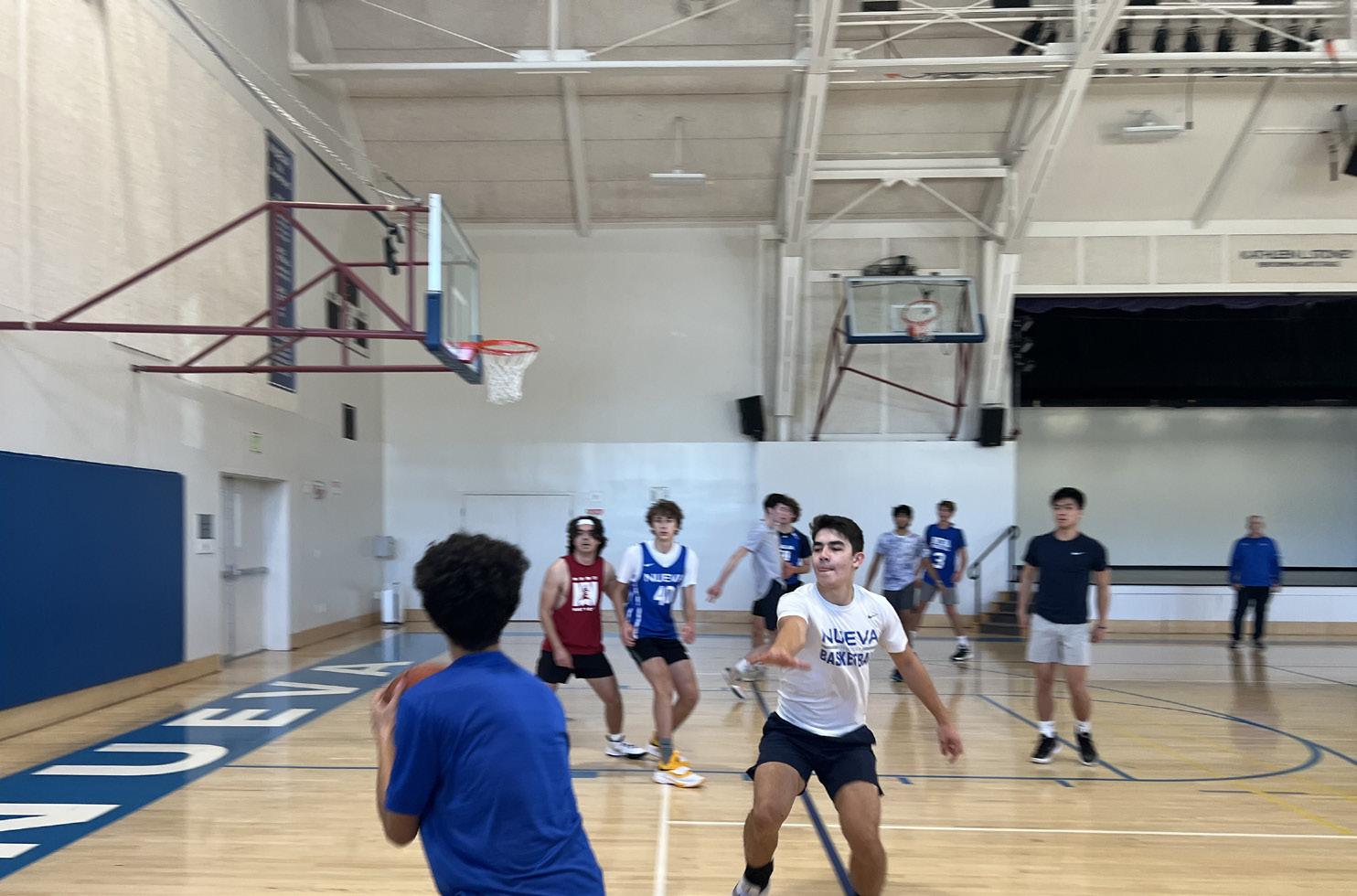
addition in grade nine—and she was not disappointed. When they began playing Green’s new starting five—Clay M. ’23, Nathan L. ’23, Daniel T. ’23, Theo Q. ’23, and Diego A. ’25—the veterans went on a 13-point run led by Huang. Connor, like usual, facilitated the ball, dishing it to players with open shots and nabbing steals with his 6-foot wingspan.
And to finish the game, James Tilson ’21 dunked, something he had never done before in a Nueva game.
A season of success and program firsts
While much of the world focuses on the current World Cup in Qatar, the upper school girls’ soccer team steals the show, making program history.
The team is coached by Daniel Zerbruk and alum Sebastian Ortiz, and captained by seniors Kayla H., Mia T., and Anya P. This year with 18 players, the team practices two days on the upper school’s turf or Bay Meadows Park, two days at Los Prados Park, and Fridays at the middle school field.
With a packed roster, the team has both a varsity and junior varsity for the first time. In the past, there were too few people to even field a varsity team, and the girls had to play on the boys’ team.
“We’re all super excited that the program has grown this much,” Kayla said.
While the team grows, so does their success. So far into their four-week season, the team has played four non-
league games; although the team is in PSAL Division 5, they have played a few big public school teams in Divisions 3 and 4. Currently, they have won two games, yet scored and blocked opponent goals in all four. As team member Zoe B. ’24 put it: they began with a “bumpy” start and have made solid and impressive improvement.
Among the other program firsts is their participation in the The Firebird Classic tournament, where they have faced their most skilled opponents yet. In fact, this season marks the team’s tournament debut.
One memorable moment from the tournament so far was their victory against Castilleja, which Kayla described as a “win [they’ve] been waiting for” since her freshman year.
“The energy on the field is great.” Kayla scored the third and final goal while feeling “surrounded by [her] teammates.”
Zoe echoed Kayla's sentiment, expressing gratitude for the team’s positive and supportive environment.
“I’m seeing so much potential from new players and the team dynamic in general,” she said. “I’m excited to see where [the season] takes us.”
As the team members celebrate their accomplishments and transformations since the program’s commencement, they remain focused on their season goals, including making it past the first round of CCS Playoffs.
To Kayla, the games beyond the first round have always been “a tough challenge” as they play more Division 3 and Division 4 teams.
Despite the challenge, Zoe remains confident in her team and excited to see how the season plays out: “I have high hopes what we can accomplish,” she said.
Here's the rundown of the next games. Support our teams in the new year by attending matches, telling your friends, and bringing spirit.
If only they had Messi
for
STORY Serena S.
Coached by Sergio Rivera and ‘21 alum Sebastian Ortiz, the 17-member boys soccer team is excited to be back on the field. Although only four weeks into the season, the three matches have proven beneficial to providing competitive opportunities for players to improve both individually and as a unit.
On Dec. 1, the team emerged victorious with a 2-0 win over Pinewood for their first non-league game of the season.
“Beating pinewood set the tone for the rest of the year. Only Ws,” midfielder Logan X. ’25 said.
However, on Dec. 3, the team lost 4-1 in a rainy rivalry match against Crystal Springs Uplands School. While the score was 1-1 at halftime due to a goal from Gabe A. ’24, the team attributes much of their loss to their small roster size and lack of substituions.
“We didn’t have many players on our bench and even some playing were injured, so overall, considering the circumstances, we did well,” goalie Sam Z. ’24 said.
With nine seniors departures from last year and only three freshmen players this year, senior captain Daniel R. echoed this challenge. However, he believes the new freshmen to be “great additions to the team.”
“They have amazing talent so they’re definitely going to work well with us,” Daniel said.
Additionally, the smaller roster has allowed the team to mesh.
“A lot of our players don’t play soccer outside of school so it’s just fun to play the game with everyone,” Sam said. “We move the ball well and the chemistry is there so this season seems promising.”
On Dec. 9, the team tied Woodside Priory 1-1 with a penalty kick from Daniel.
The team aims to improve their in-game performance by strengthening the team culture.
“We are always talking how to play better and how we can improve our play. We are never talking about the score and that’s a big part of our team culture,” defensive back Sam P. ’24 said. “It is very centered around what we can do better rather than what went wrong.”
The team’s goals for the season, in addition to achieving a winning record, include beating rivals Design Tech High School on Jan. 6 and qualifying for Central Coast Section (CCS) playoffs in February.
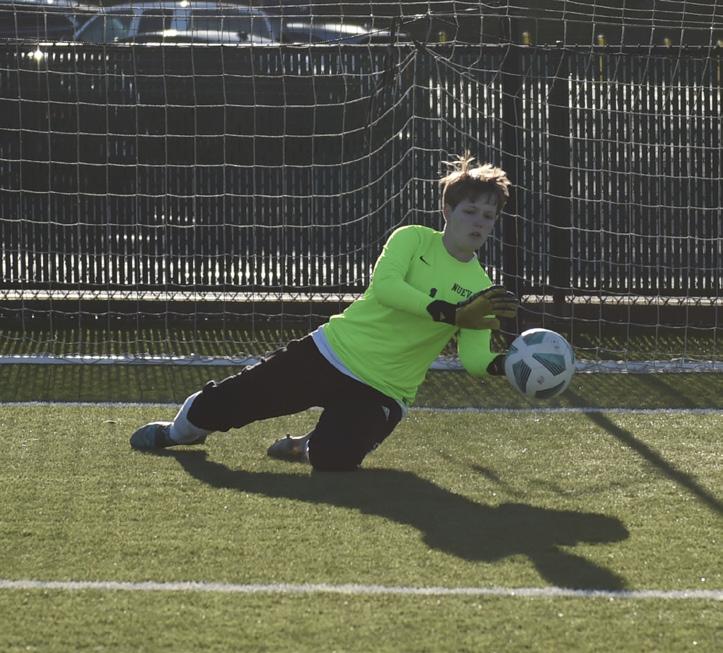
12/14/2022 THE NUEVA CURRENT PAGE 23 SPORTS
KICKS AND FLICKS (Left) Anya P. ’22 prepares a pass, (middle) team members pose with alum Mira Deb ’21, and (right) Luki D. ’25 blocks an incoming goal.
2023 SPORTS CALENDAR
MORE ON PAGE 24
MORE ON PAGE 24
READ MORE ON PAGE 24
STORY Ellie K. PHOTO Diane Mazzoni & team Instagram
The girls' soccer team kicks off season with a tournament debut and memorable victory
Boys soccer sets two goals for the season: beating Design Tech and qualifying
playoffs
COZY IN THE CORNER! Tammer Maraqa squaring up to swish his third 3-pointer in a row.
Boys varsity basketball loses 55-26 in a scrimmage against past teammates
An international scandal
How money-seeking FIFA president Gianni Infantino is quickly destroying the reputation of the world’s biggest sport
STORY Anuj T. PHOTO Fabrice Coffrini
Enabled by corrupt FIFA president Gianna Infantino, modern Qatari slavery has laid the foundation of the World Cup’s infrastructure for the past 12 years.
The decision to allow Qatar to host the 2022 World Cup has put the country under the scrutiny of the public eye for the country's lack of fundamental human rights for minority groups along with its exploitation of migrant workers.
Despite the several glaring issues with it being hosted in Qatar, such as the expectation of 104-degree weather in the summer, the potential to expand the sport into the untapped market of the Arab world and profit from the rich and corrupt countries in the Middle East was too great for former FIFA president Joseph Blatter. Of course, the several payments and bribes that Qatari

representatives made to voting officials helped too.
But the large majority of the criticism against Qatar is due to their unfair and inhumane treatment of their migrant workers that serve as the foundation for their country’s economy and physical labor force. Qatar is built on the kafala system, a hierarchical way for Qatar to trap—and essentially—enslave workers from other countries for their own benefit. These workers that enter Qatar have little legal protection and, as a result, often face horrific working conditions and absurdly low wages.
Despite FIFA president Gianni Infantino’s recognition of these terrible conditions that thousands of migrant workers would face as Qatar built the infrastructure for the World Cup, the huge payday that would come from the event had Infantino starstruck. Not only
is Infantino not concerned by the obvious issues with having a World Cup in Qatar, he fully supports the decision, calling it a “bridge between the Arab and Western worlds.”

Additionally, Joseph Blatter, FIFA’s previous president and the man who approved the decision to let Qatar host the World Cup, has come out and said it was a “mistake” and a “bad choice.” In 2015, Blatter was ousted as the president of FIFA for fraud and mismanagement; it clearly doesn’t take a genius nor someone with the strongest moral compass to recognize how great of a mistake it was to allow Qatar to be the host.
But even with repeated warnings and pleas for help from multiple global social groups and the workers in Qatar themselves, Infantino did not impose strong enough conditions to protect and guarantee the safety of the workers. FIFA leaders have turned a blind eye to the several levels of corruption within Qatar simply because of the record-setting $7.5 billion in revenue, which is one billion more than the World Cup hosted by Russia made for FIFA.
Human rights organizations such as the Human Rights Watch have called for FIFA and the Qatari government to pay reparations for the abuse the workers endured over the past decade in preparation for the World Cup. Infantino has refused this proposition, telling fans to simply “enjoy the football,” claiming that monetary compensation is “too performative” and won’t create any actual change.
Presidents like Infantino who are so clearly corrupt and driven completely by money and numbers are running the reputation of the world’s most popular sport into the ground. It is time we put a stop to them.
US Men's National Team falls short in 2022 World Cup
After missing the 2018 World Cup in Russia, the USMNT came into Qatar with something to prove to themselves and to the world. The lack of international professional experience for players holding key roles such as centerback Walker Zimmerman and forward Jesus Ferreira costed the team in clutch moments. In their first showing of the tournament against Wales, Zimmerman’s ill-advised 80th minute tackle on Gareth Bale, while up 1-0, unnecessarily conceded a penalty, stripping the team of a win.

Subsequently, the 3-1 loss to the No. 8 ranked Dutch team was far closer than reflected in the statline—extremely encouraging for a team that fielded the second youngest lineup in the tournament. The US was able to generate significantly more chances in the box, but with brutal misses from Christian Pulisic, Haji Wright, and others, they stood no chance against a far more efficient Dutch team.
While many see the US’s performance in the 2022 World Cup as a failure, the very fact they qualified despite playing a group of talented teams is very promising.
They have proven that they are already able to compete with such a young group and are just a few pieces away from making a run for the title. As the team grows over the next four years, they will be more than ready to welcome the 32 countries to North America in 2026.
PAGE 24 THE NUEVA CURRENT 12/14/2022 SPORTS
STORY Anuj T. PHOTO Marvin Guengor
An inexperienced US team continues two-decade-long quarterfinal drought
to allow
to be the
GIANNI INFANTINO FIFA president delivers speech on the eve of the World Cup criticizing those who protest against the decision
Qatar
host
The boys soccer team on the World Cup Read about the team's opinions on the World Cup STORY Anuj T. PHOTOS Joy Feng 2022 world champs? Most exciting player? Most fun team to watch? Most disappointing game? Argentina -Daniel R. '23 Argentina -Landon X. '25 Morocco -Logan X. '25 Argentina -Nathan S. '25 Kylian Mbappé -Daniel R. '23 Tyler Adams -Nathan S. '25 Croatia -Daniel R. '23 Morocco -Landon X. '25 Portugal versus Morocco -Daniel R. '23 U.S. versus Netherlands -Landon X. '25 U.S. versus Netherlands -Logan X. '25
Captain America Winger Christian Pulisic scoring the go-ahead goal against Iran to qualify the USMNT for the knockout stages.
